No other improvements have been attempted in this edition of Mr. Watson’s
Biblical and Theological Dictionary, than adding a few notes in relation to some
matters existing in this country, which had escaped the attention of the author, and
rendering those passages and phrases into English which had been left untranslated.
Such translations are included in brackets. It may be proper to remark, that only
that part of the work from the eight hundred and forty second page has been printed
under the superintendence of the present editor; the former part having passed
through the press previous to the last general conference.
It is not necessary to say any thing in commendation of this work. Whatever
merit, however, may be attached to others of a similar character which have preceded
it, we think it will be conceded by all, that Mr. Watson, by furnishing this Dictionary,
has supplied a desideratum, in the department of Biblical and Theological
literature, which had long been felt, and for doing which the religious community
will not be backward in acknowledging its obligations.
N. Bangs.
New-York, Sept. 25, 1832.
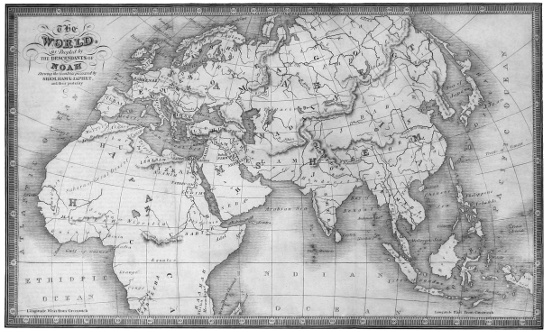
The
WORLD,
as Peopled by
THE DESCENDANTS OF
NOAH
Shewing the Countries possessed by
SHEM, HAM & JAPHET
and their posterity
A
BIBLICAL AND THEOLOGICAL DICTIONARY.
1AARON, the son of Amram and Jochebed,
of the tribe of Levi. Aaron was three years
older than his brother Moses; and when God
appeared in the burning bush, Moses having
excused himself from the undertaking committed
to him, by urging that he was slow of speech,
Aaron, who was an eloquent man, was made
his interpreter and spokesman; and in effecting
the deliverance of the Hebrews we therefore find
them constantly associated. During the march
of the children of Israel through the wilderness,
Aaron and his sons were appointed by God to
exercise for ever the office of priests in the
tabernacle.
Moses having ascended the mountain to receive
the law from God, Aaron, his sons, and
seventy elders, followed him, Exod. xxiv, 1, 2,
9–11; not indeed to the summit, but “afar off,”
“and they saw the God of Israel,” that is, the
glory in which he appeared, “as it were the
paved work of a sapphire stone, and as it were
the body of heaven for clearness;”--a clear and
dazzling azure, a pure, unmingled splendour
like that of the heavens. “And upon the nobles
of Israel,” Aaron, his sons, and the seventy
elders, “he laid not his hand,”--they were not
destroyed by a sight which must have overwhelmed
the weakness of mortal men had they
not been strengthened to bear it; “and they
did eat and drink,”--they joyfully and devoutly
feasted before the Lord, as a religious act, upon
the sacrifices they offered. After this they departed,
and Moses remained with God on the
very summit of the mount forty days.
During this period, the people, grown impatient
at the long absence of Moses, addressed
themselves to Aaron in a tumultuous manner,
saying, “Make us gods which shall go before
us: for, as for this Moses, the man that brought
us up out of the land of Egypt, we wot not what
is become of him.” Aaron sinfully yielded to
the importunities of the people; and having
ordered them to bring the pendants and the ear-rings
of their wives and children, he melted
them down, and then made a golden calf, probably
in imitation of the Egyptian Apis, an ox
or calf dedicated to Osiris. In this instance the
image was dedicated to Jehovah the true God;
but the guilt consisted in an attempt to establish
image worship, which, when even ultimately
referring to God, he has forbidden. Neither are
images to be worshipped, nor the true God by
images;--this is the standing unrepealed law
of Heaven. The calf was called a golden calf,
as being highly ornamented with gold. Having
finished the idol, the people placed it on a pedestal,
and danced around it, saying, “These be thy
gods, O Israel;” or, as it is expressed in Nehemiah,
“This is thy God,” the image or symbol
of thy God, “which brought thee up out of the
land of Egypt.” Moses, having hastened from
the mount by the command of God, testified to
the people, by breaking the tables of the law
in their presence, that the covenant between
God and them was now rendered of none effect
through their offence. He also indignantly reproved
Aaron, whose sin indeed had kindled
against him the anger of the Lord, so that he
would “have destroyed him but that Moses
prayed for him.”
After the tabernacle was built, Moses consecrated
Aaron to the high priesthood with the
holy oil, and invested him with his priestly
robes,--his garments “of glory and beauty;”
but Aaron’s weakness was again manifested in
concurring with Miriam, his sister, to censure
and oppose Moses, through envy. Aaron, as
being the elder brother, could not perhaps brook
his superiority. What the motive of Miriam
might be does not appear; but she being struck
with leprosy, this punishment, as being immediately
from God, opened Aaron’s eyes; he acknowledged
his fault, and asked forgiveness of
Moses both for himself and his sister.
Aaron himself became also the object of jealousy;
but two miraculous interpositions confirmed
him in his office of high priest, as of
Divine appointment. The first was the destruction
of Korah, who sought that office for himself,
and of the two hundred and fifty Levites
who supported his pretensions, Num. xvi. The
second was the blossoming of Aaron’s rod,
which was designed “to cause the murmurings
of the Israelites against him to cease,” by showing
that he was chosen of God. Moses having,
at the command of God, taken twelve rods of
an almond tree from the princes of the twelve
tribes, and Aaron’s separately, he placed them
in the tabernacle before the sanctuary, after
having written upon each the name of the tribe
which it represented, and upon the rod of Aaron
the name of Aaron. The day following, when
the rods were taken out, that of Aaron “was
budded, and brought forth buds, and bloomed
blossoms, and yielded almonds.” This rod
therefore was laid up by the ark, to perpetuate
the remembrance of the miracle, and to be a
token of Aaron’s right to his office.
Aaron married Elisheba, the daughter of
Amminadab, of the tribe of Judah, by whom he
had four sons, Nadab and Abihu, Eleazar and
Ithamar, Exodus vi, 23. The two first were
2killed by fire from heaven, as a punishment for
presuming to offer incense with strange fire in
their censers, Lev. x, 1, 2. From the two others
the succession of high priests was continued in
Israel.
The account of the death of Aaron is peculiarly
solemn and affecting. As he and Moses,
in striking the rock at Meribah, Num. xvi, had
not honoured God by a perfect obedience and
faith, he in his wrath declared unto them that
they should not enter into the promised land.
Soon after, the Lord commanded Moses, “Take
Aaron, and Eleazar his son, and bring them up
to mount Hor; and strip Aaron of his garments,”--his
splendid pontifical vestments,--“and put
them upon Eleazar, his son; and Aaron shall
be gathered unto his people, and shall die there.”
This command was carried into effect in the
presence of all Israel, who were encamped at
the foot of the mountain; and his son being
invested with the father’s priestly dress, Aaron
died, and all the people mourned for him thirty
days. His sepulchre was left unmarked and
unknown, perhaps to prevent the superstitious
reverence of future ages. In Deuteronomy it
is said that Aaron died at Mosera; because that
was the name of the district in which mount
Hor was situated.
2. The PRIESTHOOD being established in Aaron
and his family, the nature of this office among
the Israelites, and the distinction between the
high priest and the other priests, require here
to be pointed out.
Before the promulgation of the law by Moses,
the fathers of every family, and the princes of
every tribe, were priests. This was the case both
before and after the flood; for Cain and Abel,
Noah, Abraham, Job, Abimelech, Laban, Isaac,
and Jacob, themselves offered their own sacrifices.
But after the Lord had chosen the family
of Aaron, and annexed the priesthood to that
line, then the right of sacrificing to God was
reserved to that family only. The high priesthood
was confined to the first-born in succession;
and the rest of his posterity were priests
simply so called, or priests of the second order.
Both in the high priest and the second or inferior
priests, two things deserve notice,--their
consecration and their office. In some things
they differed, and in others agreed. In their
consecration they differed thus: the high priest
had the chrism, or sacred ointment, poured upon
his head, so as to run down to his beard, and
the skirts of his garment, Exod. xxx, 23; Lev.
viii, 12; Psa. cxxxiii, 2. But the second priests
were only sprinkled with this oil, mixed with
the blood of the sacrifice, Lev. viii, 30. They
differed also in their robes, which were a necessary
adjunct to consecration. The high priest
wore at the ordinary times of his ministration
in the temple, eight garments;--linen drawers--a
coat of fine linen close to his skin--an embroidered
girdle of fine linen, blue and scarlet,
to surround the coat--a robe all of blue with
seventy-two bells, and as many embroidered
pomegranates upon the skirts of it; this was
put over the coat and girdle--an ephod of gold,
and of blue, purple, scarlet, and fine linen,
curiously wrought, on the shoulders of which
were two stones engraved with the names of
the twelve tribes; this was put over the robe,
and girt with a curious girdle of the same--a
breastplate, about a span square, wrought with
gold, blue, purple, scarlet, and fine linen, and
fastened upon the ephod by golden chains and
rings; in this breastplate were placed the urim
and thummim, also twelve several stones, containing
the names of the twelve tribes--a mitre
of fine linen, sixteen cubits long, to wrap round
his head--and lastly, a plate of gold, or holy
crown, two fingers broad, whereon was engraved,
“Holiness to the Lord;” this was tied with
blue lace upon the front of the mitre. Beside
these garments, which he wore in his ordinary
ministration, there were four others, which he
wore only upon extraordinary occasions, viz.
on the day of expiation, when he went into the
holy of holies, which was once a year. These
were: linen drawers--a linen coat--a linen
girdle--a linen mitre, all white, Exod. xxviii;
Lev. xvi, 4. But the inferior priests had only
four garments: linen drawers--a linen coat--a
linen girdle--a linen bonnet. The priest and
high priest differed also in their marriage restrictions;
for the high priest might not marry
a widow, nor a divorced woman, nor a harlot,
but a virgin only; whereas the other priests
might lawfully marry a widow, Lev. xxi, 7.
In the following particulars the high priest
and inferior priests agreed in their consecration:
both were to be void of bodily blemish--both
were to be presented to the Lord at the
door of the tabernacle--both were to be washed
with water--both were to be consecrated by
offering up certain sacrifices--both were to
have the blood of a ram put upon the tip of the
right ear, the thumb of the right hand, and the
great toe of the right foot, Exod. xxix, 20. In
the time of consecration, certain pieces of the
sacrifice were put into the priest’s hand, which
was called “filling his hand;” hence the Hebrew
phrase, “to fill the hand,” signifies consecration.
In the discharge of their offices, the high
priest differed from the other priests in these
particulars: the high priest only, and that but
once a year, might enter into the holy of holies--the
high priest might not mourn for his nearest
relations by uncovering his head, or tearing
any part of his garments, except the skirt;
whereas the priest was allowed to mourn for
these six,--father, mother, son, daughter, brother,
and sister if she had no husband, Lev.
xxi, 2, 10, 11; but they agreed in these respects:
they both burnt incense and offered sacrifices--they
both sounded the trumpet, either as an
alarm in war, or to assemble the people and
their rulers--they both slew the sacrifices--both
instructed the people--and both judged
of leprosy.
For the more orderly performance of these
offices, the high priest had his sagan, who, in
case of the high priest’s pollution, performed
his duty. The high priest and his sagan resembled
our bishop and his suffragan.
3. Aaron was a TYPE of Christ, not personally,
but as the high priest of the Jewish church.
All the priests, as offering gifts and sacrifices,
3were in their office types of Christ; but Aaron
especially, 1. As the high priest. 2. In entering
into the holy place on the great day of atonement,
and reconciling the people to God; in
making intercession for them, and pronouncing
upon them the blessing of Jehovah, at the termination
of solemn services. 3. In being anointed
with the holy oil by effusion, which was prefigurative
of the Holy Spirit with which our
Lord was endowed. 4. In bearing the names of
all the tribes of Israel upon his breast and upon
his shoulders, thus presenting them always before
God, and representing them to him. 5. In
being the medium of their inquiring of God by
urim and thummim; and of the communication
of his will to them. But though the offices of
Aaron were typical, the priesthood of Christ is
of a different and higher ORDER than his, namely,
that of Melchizedeck. See Calf, Priest,
Type, Ephod, Breastplate, Urim.
AB, in the Hebrew chronology, the eleventh
month of the civil year, and the fifth of the
ecclesiastical year, which began with Nisan.
This month answered to the moon of July,
comprehending part of July and of August, and
contained thirty days.
The first day of this month is observed as a
fast by the Jews, in memory of Aaron’s death;
and the ninth, in commemoration of the destruction
of the temple by Nebuchadnezzar, in
the year before Christ 587. Josephus observes,
that the burning of the temple by Nebuchadnezzar
happened on the same day of the year
on which it was afterward burned by Titus.
The same day was remarkable for Adrian’s
edict, which prohibited the Jews to continue in
Judea, or to look toward Jerusalem and lament
its desolation. The eighteenth day is also kept
as a fast, because the sacred lamp was extinguished
on that night, in the reign of Ahaz.
On the twenty-first, or, according to Scaliger,
the twenty-second day, was a feast called Xylophoria,
from their laying up the necessary wood
in the temple: and on the twenty-fourth, a feast
in commemoration of the abolishing of a law by
the Asmoneans, or Maccabees, which had been
introduced by the Sadducees, and which enacted,
that both sons and daughters should alike
inherit the estate of their parents.
ABADDON, Heb. corresponding to Apollyon,
Gr. that is, Destroyer, is represented, Rev. ix,
11, as king of the locusts, and the angel of the
bottomless pit. Le Clerc and Dr. Hammond
understand by the locusts in this passage, the
zealots and robbers who infested and desolated
Judea before Jerusalem was taken by the Romans;
and by Abaddon, John of Gischala, who
having treacherously left that town before it
was surrendered to Titus, came to Jerusalem
and headed those of the zealots who acknowledged
him as their king, and involved the Jews
in many grievous calamities. The learned
Grotius concurs in opinion, that the locusts are
designed to represent the sect of the zealots,
who appeared among the Jews during the siege,
and at the time of the destruction of Jerusalem.
But Mr. Mede remarks, that the title Abaddon
alludes to Obodas, the common name of the
ancient monarchs of that part of Arabia from
which Mohammed came; and considers the
passage as descriptive of the inundation of the
Saracens. Mr. Lowman adopts and confirms
this interpretation. He shows that the rise and
progress of the Mohammedan religion and empire
exhibit a signal accomplishment of this
prophecy. All the circumstances here recited
correspond to the character of the Arabians,
and the history of the period that extended from
A. D. 568 to A. D. 675. In conformity to this
opinion, Abaddon may be understood to denote
either Mohammed, who issued from the abyss,
or the cave of Hera, to propagate his pretended
revelations, or, more generally, the Saracen
power. Mr. Bryant supposes Abaddon to have
been the name of the Ophite deity, the worship
of whom prevailed very anciently and very
generally.
ABANA. Naaman, the leper, on being directed
to wash in the river Jordan, says, 2 Kings
v, 12, “Are not Abana and Pharpar, rivers of
Damascus, better than all the waters of Israel?”
Probably the Abana is a branch of the Barrady,
or Chrysorrhoas, which derives its source from
the foot of mount Libanus, eastward; runs round
and through Damascus, and continues its course
till lost in the wilderness, four or five leagues
south of the city. Benjamin of Tudela will have
that part of Barrady which runs through Damascus
to be the Abana, and the streams which
water the gardens without the city, to be Pharpar;
but perhaps the Pharpar is the same with
Orontes, the most noted river of Syria, which,
taking its rise a little to the north or north-east
of Damascus, glides through a delightful plain,
till, after passing Antioch, and running about
two hundred miles to the north-west, it loses
itself in the Mediterranean sea, 2 Kings v, 12.
ABBA, a Syriac word, which signifies father.
The learned Mr. Selden, from the Babylonian
Gemara, has proved that slaves were not allowed
to use the title abba in addressing the master
of the family to which they belonged. This
may serve to illustrate Rom. viii, 15, and Gal.
iv, 6, as it shows that through faith in Christ all
true Christians pass into the relation of sons;
are permitted to address God with filial confidence
in prayer; and to regard themselves as
heirs of the heavenly inheritance. This adoption
into the family of God, inseparably follows
our justification; and the power to call God our
Father, in this special and appropriative sense,
results from the inward testimony given to our
forgiveness by the Holy Spirit. St. Paul and
St. Mark use the Syriac word abba, a term which
was understood in the synagogues and primitive
assemblies of Christians; but added to it when
writing to foreigners the explanation, father.
Figuratively, abba means also a superior, in
respect of age, dignity, or affection. It is more
particularly used in the Syriac, Coptic, and
Ethiopic churches as a title given to their
bishops. The bishops themselves bestow the
title abba more eminently upon the bishop of
Alexandria, which occasioned the people to
give him the title of baba, or papa, that is,
grandfather; a title which he bore before the
bishop of Rome.
ABEDNEGO, the Chaldee name given by
4the king of Babylon’s officer to Azariah, one
of Daniel’s companions, Dan. i, 7. This name
imports the servant of Nago, or Nego, which is
supposed to signify the sun, or morning star, so
called from its brightness. Abednego was
thrown into a fiery furnace, at Babylon, with
his two companions Shadrach and Meshach,
for refusing to adore the statue erected by the
command of Nebuchadnezzar. God suffered
them not to be injured by the flames; but made
the whole to redound to his own glory, and the
shame of the idols of Babylon. One like unto
the Son of God, or a Divine person, probably
the Angel of the Divine presence himself, appeared
in the midst of them; and they came
out of the furnace, which had been heated
seven times hotter than usual, so completely
preserved from the power of the flames, that
not even “the smell of fire had passed upon
them.” This was an illustrious instance of the
courageous and hallowed spirit of martyrdom;
and the interposition was no doubt designed to
encourage the Jews while in captivity, living
among idolaters, to hold fast their religion. It
is an instance also of those gracious visitations
to the old Heathen world, by which it was
loudly called from its idolatries, and aroused
to the acknowledgment of the true and only
Jehovah, who, in various ways, “left not himself
without witness” among them. A great
temporary effect was produced by this and other
miracles related in the book of Daniel; but the
people relapsed again into idolatry, and justly
brought upon themselves all those wasting
judgments which in succession swept over the
mightiest and most ancient states.
ABEL. He was the second son of Adam
and Eve, and born probably in the second or
third year of the world; though some will have
it that he and Cain were twins. His name
signifies vapour, vanity, and might be given
either because our first parents now began so
to feel the emptiness and vanity of all earthly
things, that the birth of another son reminded
them painfully of it, although in itself a matter
of joy; or it was imposed under prophetic impulse,
and obscurely referred to his premature
death. His employment was that of a shepherd;
Cain followed the occupation of his father, and
was a tiller of the ground. Whether they remained
in their father’s family at the time when
they brought their offerings to the Lord, or had
establishments separate from that of Adam,
does not clearly appear. Abel was probably
unmarried, or had no children; but Cain’s wife
is mentioned. “At the end of the days,”--which
is a more literal rendering than “in
process of time,” as in our translation, that is,
on the Sabbath,--both brothers brought an offering
to the Lord. Cain “brought of the fruit of
the ground;” Abel “the firstlings of his flock,
and of the fat thereof.” “And the Lord had
respect to Abel and to his offering; but unto
Cain and his offering he had not respect.” As
Cain afterward complains that “he should be
hid from the face or presence of the Lord,” it is
probable that the worship of the first family was
performed before some visible manifestation of
the glory of God, which thus consecrated a particular
place for their services. Some have
thought that this was at the east gate of Eden,
where “Cherubim and a flaming sword were
placed;” but this was a vengeful manifestation,
and could only have inspired a dread of God
inconsistent with the confidence and hope with
which men through the promise of redemption
were now encouraged to draw nigh to him.
The respect which God was pleased to show to
Abel’s offering, appears from the account to
have been sensibly declared; for Cain must
have known by some token that the sacrifice
of Abel was accepted, the absence of which
sign, as to his own offering, showed that it was
rejected. Whether this was by fire going forth
from “the presence of the Lord,” to consume
the sacrifice, as in later instances recorded in
the Old Testament, or in some other way, it is
in vain to inquire;--that the token of acceptance
was a sensible one is however an almost
certain inference. The effect of this upon Cain
was not to humble him before God, but to excite
anger against his brother; and, being in
the field with him, or, as the old versions have
it, having said to him, “Let us go out into the
field,” “he rose up against Abel his brother,
and slew him;” and for that crime, by which
the first blood of man was shed by man upon
the earth,--a murder aggravated by the relationship
and the “righteous” character of the
sufferer, and having in it also the nature of religious
persecution,--he was pronounced by the
Lord “cursed from the earth.”
2. As the sacrifice of Abel is the first on record,
and has given rise to some controversy, it
demands particular attention. It was offered,
says St. Paul, “in faith,” and it was “a more
excellent sacrifice” than that of Cain. Both
these expressions intimate that it was EXPIATORY
and PREFIGURATIVE.
As to the matter of the sacrifice, it was an animal
offering. “Cain brought of the fruit of the
ground; and Abel also brought of the firstlings
of his flock, and of the fat thereof;” or, more
literally, “the fat of them,” that is, according
to the Hebrew idiom, the fattest or best of his
flock; and in this circumstance consisted its
specific character as an act of faith. This is supported
by the import of the phrase, ϖλείονα θυσίαν,
used by the Apostle in the Epistle to the Hebrews,
when speaking of the sacrifice of Abel.
Our translators have rendered it, “a more excellent
sacrifice.” Wickliffe translates it, as
Archbishop Magee observes, uncouthly, but in
the full sense of the original, “a much more
sacrifice;” and the controversy which has arisen
on this point is, whether this epithet of “much
more,” or “fuller,” refers to quantity or quality;
whether it is to be understood in the sense of a
more abundant, or of a better, a more excellent
sacrifice. Dr. Kennicott takes it in the sense
of measure and quantity, as well as quality; and
supposes that Abel brought a double offering of
the firstlings of his flock, and of the fruit of the
ground also. His criticism has been very satisfactorily
refuted by Archbishop Magee. The
sacrifice of Abel was that of animal victims, and
it was indicative not of gratitude but of “faith:”
a quality not to be made manifest by the quantity
5of an offering, for the one has no relation
to the other.
3. This will more fully appear if we consider
the import of the words of the Apostle,--“By
FAITH Abel offered unto God a more excellent
sacrifice than Cain, by which he obtained WITNESS
that he was RIGHTEOUS, God testifying of his
gifts; and by it, he, being dead, yet speaketh.”
Now what is the meaning of the Apostle, when
he says that it was witnessed or testified to Abel
that he was righteous? His doctrine is, that
men are sinners; that all, consequently, need
pardon; and to be declared, witnessed, and accounted
righteous, are, according to his style of
writing, the same as “to be justified, pardoned,
and dealt with as righteous.” Thus he argues
that Abraham believed God, “and it was accounted
to him for righteousness,”--“that faith
was reckoned to Abraham for righteousness,”--“that
he received the sign of circumcision, a
seal,” a visible confirmatory, declaratory, and
witnessing mark “of the righteousness which
he had by faith.” In these cases we have a
similarity so striking, that they can scarcely fail
to explain each other. In both, sinful men are
placed in the condition of righteous men; the
instrument, in both cases, is faith; and the transaction
is, in both cases also, publicly and sensibly
witnessed,--as to Abraham, by the sign of
circumcision; as to Abel, by a visible acceptance
of his sacrifice, and the rejection of that
of Cain.
Abel had faith, and he expressed that faith by
the kind of sacrifice he offered. It was in this
way that his faith “pleased God;” it pleased
him as a principle, and by the act to which it led,
which act was the offering of a sacrifice to God
different from that of Cain. Cain had not this
faith, whatever might be its object; and Cain,
accordingly, did not bring an offering to which
God had “respect.” That which vitiated the
offering of Cain was the want of this faith; for
his offering was not significant of faith: that
which “pleased God,” in the case of Abel, was
his faith; and he had “respect” to his offering,
because it was the expression of that faith; and
upon his faith so expressing itself, God witnessed
to him “that he was righteous.” So
forcibly do the words of St. Paul, when commenting
upon this transaction, show, that Abel’s
sacrifice was accepted, because of its immediate
connection with his faith, for by faith he is said
to have offered it; and whatever it might be,
which made Abel’s offering differ from that of
Cain, whether abundance, or kind, or both, this
was the result of his faith. So evident also is
it from the Apostle, that Abel was witnessed to
be “righteous,” not with reference to any previous
“habit of a religious life,” as some say,
but with reference to his faith; and to this faith
as expressing itself by his offering “a more excellent
sacrifice.”
4. If, then, the faith of Abel had an immediate
connection with his sacrifice, and both with
his being accepted as “righteous,”--that is, justified,
in St. Paul’s use of the term,--to what had
his faith respect? The particular object of the
faith of the elders, celebrated in Hebrews xi, is
to be deduced from the circumstances mentioned
as illustrative of the existence and
operation of this great principle, and by which
it manifested itself in them. Let us explain this,
and then ascertain the object of Abel’s faith also
from the manner of its manifestation,--from
the acts in which it embodied and rendered itself
conspicuous.
Faith, in this chapter, is taken in the sense
of affiance in God, and, as such, it can only be
exercised toward God, as to all its particular
acts, in those respects in which we have some
warrant to confide in him. This supposes revelation,
and, in particular, promises or declarations
on his part, as the ground of every act of affiance.
When, therefore, it is said that “by faith Enoch
was translated that he should not see death,” it
must be supposed that he had some promise or
intimation to this effect, on which, improbable
as the event was, he nobly relied; and in the
result God honoured his faith in the sight of all
men. The faith of Noah had immediate respect
to the threatened flood, and to the promise of
God to preserve him in the ark which he was
commanded to prepare. The chapter is filled
with other instances, expressed or implied; and
from the whole, as well as from the nature of
things, it will appear, that, when the Apostle
speaks of the faith of the elders in its particular
acts, he represents it as having respect to some
promise, declaration, or revelation of God.
This revelation was necessarily antecedent
to the faith; but it is also to be observed, that
the acts by which the faith was represented,
whenever it was represented by particular acts,
and when the case admitted it, had a natural
and striking conformity and correspondence to
the previous revelation. So Noah built the ark,
which indicated that he had heard the threat
of the world’s destruction by water, and had received
the promise of his own preservation, and
that of his family, as well as that of a part of the
beasts of the earth. When Abraham went into
Canaan at the command of God, and upon the
promise that that country should become the inheritance
of his decendants, he showed his faith
by taking possession of it for them in anticipation,
and his residence there indicated the kind
of promise which he had received. Thus these
instances show, that when the faith which the
Apostle commends exhibited itself in some particular
act, that act had a correspondency to the
previous promise or revelation which was the
ground of faith. We must therefore interpret
the acts of Abel’s faith so as to make them also
correspond with an antecedent revelation. His
faith had respect to some previous revelation,
and the nature of the revelation is to be collected
from the significant manner in which he declared
his faith in it.
Now that which Abel did “by faith,” was,
generally, to perform an act of solemn worship,
in the confidence that it would be acceptable to
God. This supposes a revelation, immediate
or by tradition, that such acts of worship were
acceptable to God, or his faith could have had
no warrant, and would not have been faith, but
fancy. But the case must be considered more
particularly. His faith led him to offer “a more
excellent sacrifice” than that of Cain; but this
6as necessarily implies, that there was some antecedent
revelation to which his faith, as thus
expressed, had respect, and on which that peculiarity
of his offering, which distinguished it
from the offering of Cain, was founded; a revelation
which indicated that the way in which
God would be approached acceptably, in solemn
worship, was by animal sacrifices. Without
this, the faith to which his offering, which was
an offering of the firstlings of his flock, had a
special fitness and adaptation, could have had
no warrant in Divine authority. But this revelation
must have included, in order to its being
the ground of faith, as “the substance of things
hoped for,” a promise of a benefit to be conferred,
in which promise Abel might confide. But
if so, then this promise must have been connected,
not with the worship of God in general, or
performed in any way whatever indifferently,
but with his worship by animal oblations; for it
was in this way that the faith of Abel specially
and distinctively indicated itself. The antecedent
revelation was, therefore, a promise of a
benefit to be conferred, by means of animal sacrifice;
and we are taught what this benefit was,
by that which was actually received by the
offerer,--“He obtained witness that he was
righteous;” which must be interpreted in the
sense of a declaration of his personal justification,
and acceptance as righteous, by the forgiveness
of his sins. The reason of Abel’s
acceptance and of Cain’s rejection is hereby
made manifest; the one, in seeking the Divine
favour, conformed to his established and appointed
method of being approached by guilty
men, and the other not only neglected this, but
profanely and presumptuously substituted his
own inventions.
5. It is impossible, then, to allow the sacrifice
of Abel, in this instance, to have been an act
of FAITH, without supposing that it had respect
to a previous revelation, which agreed with all
the parts of that sacrificial action by which he
expressed his faith in it. Had Abel’s sacrifice
been eucharistic merely, it would have expressed
gratitude, but not faith; or if faith in the
general sense of confidence in God that he would
receive an act of grateful worship, and reward
the worshippers, it did not more express faith
than the offering of Cain, who surely believed
these two points, or he would not have brought
an offering of any kind. The offering of Abel
expressed a faith which Cain had not; and the
doctrinal principles which Abel’s faith respected
were such as his sacrifice visibly embodied.
If it was not an eucharistic sacrifice, it was an
expiatory one; and, in fact, it is only in a sacrifice
of this kind, that it is possible to see that
faith exhibited which Abel had, and Cain had
not. If then we refer to the subsequent sacrifices
of expiation appointed by Divine authority,
and their explanation in the New Testament, it
will be obvious to what doctrines and principles
of an antecedent revelation the faith of Abel
had respect, and which his sacrifice, the exhibition
of his faith, proclaimed: confession of
the fact of being a sinner,--acknowledgment
that the demerit and penalty of sin is death,--submission
to an appointed mode of expiation,--animal
sacrifice offered vicariously, but in itself
a mere type of a better sacrifice, “the Seed of
the woman,” appointed to be offered at some
future period,--and the efficacy of this appointed
method of expiation to obtain forgiveness,
and to admit the guilty into the Divine favour.
“Abel,” Dr. Magee justly says, “in firm reliance
on the promise of God, and in obedience
to his command, offered that sacrifice which
had been enjoined as the religious expression
of his faith; whilst Cain, disregarding the gracious
assurances that had been vouchsafed, or
at least disdaining to adopt the prescribed mode
of manifesting his belief, possibly as not appearing
to his reason to possess any efficacy or
natural fitness, thought he had sufficiently acquitted
himself of his duty in acknowledging
the general superintendence of God, and expressing
his gratitude to the Supreme Benefactor,
by presenting some of those good things
which he thereby confessed to have been derived
from his bounty. In short, Cain, the first-born
of the fall, exhibits the first fruits of his
parents’ disobedience, in the arrogance and
self-sufficiency of reason rejecting the aids of
revelation, because they fell not within its apprehension
of right. He takes the first place
in the annals of Deism, and displays, in his
proud rejection of the ordinance of sacrifice,
the same spirit which, in later days, has actuated
his enlightened followers, in rejecting the
sacrifice of Christ.”
Abel was killed about the year of the world,
130.
ABEL-MISRAIM, the floor of Atad, beyond
the river Jordan, where Joseph, his brethren,
and the Egyptians mourned for the death of
Jacob, Gen. l, 11. On this occasion the funeral
procession was, at the command of Joseph, attended
by “all the elders of Egypt, and all the
servants of Pharaoh, and all his house, and the
house of his brethren, chariots and horsemen,
a very great company;” an affecting proof, as
it has been remarked, of Joseph’s simplicity and
singleness of heart, which allowed him to give
to the great men of Egypt, over whom he bore
absolute rule, an opportunity of observing his
own comparatively humble origin, by leading
them in attendance upon his father’s corpse to
the valleys of Canaan, the modest cradle of his
race, and to their simple burial places.
ABEL-SHITTIM, a city situate in the plains
of Moab, beyond Jordan, opposite to Jericho,
Num. xxv, 1, &c; xxiii, 49; Joshua xi, 1. Eusebius
says it stood in the neighbourhood of
mount Peor. Moses encamped at Abel-Shittim
some time before the Hebrew army passed the
Jordan. Here the Israelites fell into idolatry,
and worshipped Baal-peor, for which God punished
them by the destruction of twenty-four
thousand persons in one day.
ABIAH, the second son of the prophet Samuel,
and brother of Joel. Samuel having entrusted
to his sons the administration of public
justice, and admitted them to a share in the government,
they behaved so ill, that the people
demanded a king, 1 Sam. viii, 2. A. M. 2909.
ABIATHAR, the son of Ahimelech, and the
tenth high priest among the Jews, and fourth
7in descent from Eli, 2 Sam. viii, 17; 1 Chron.
xviii, 16. When Saul sent to Nob to murder
all the priests, Abiathar escaped the massacre,
and fled to David in the wilderness. There he
continued in the quality of high priest; but
Saul, out of aversion to Ahimelech, whom he
imagined to have betrayed his interests, transferred
the dignity of the high priesthood from
Ithamar’s family into that of Eleazar, by conferring
this office upon Zadok. Thus there
were, at the same time, two high priests in Israel,
Abiathar with David, and Zadok with
Saul. In this state things continued, until the
reign of Solomon, when Abiathar, being attached
to the party of Adonijah, was, by Solomon,
divested of his priesthood, A. M. 2989;
and the race of Zadok alone performed the
functions of that office during the reign of Solomon,
to the exclusion of the family of Ithamar,
according to the word of the Lord to Eli,
1 Sam. ii, 30, &c.
ABIB, the name of the first Hebrew sacred
month, Exod. xiii, 4. This month was afterward
called Nisan; it contained thirty days,
and answered to part of our March and April.
Abib signifies green ears of corn, or fresh fruits,
according to Jerom’s translation, Exod. xiii, 4,
and to the LXX. It was so named because
corn, particularly barley, was in ear at that
time. It was an early custom to give names
to months, from the appearances of nature;
and the custom is still in force among many
nations. The year among the Jews commenced
in September, and consequently their
jubilees and other civil matters were regulated
in this way, Lev. xxv, 8–10; but their sacred
year began in Abib. This change took place
at the redemption of Israel from Egypt, Exod.
xii, 2, “This shall be to you the beginning of
months.” Ravanelli observes, that as this deliverance
from Egypt was a figure of the redemption
of the church of Jesus Christ, who
died and rose again in this month, it was made
the “beginning of months,” to lead the church
to expect the acceptable year of the Lord. On
the tenth day of this month the paschal lamb
was taken; and on the fourteenth they ate the
passover. On the seven succeeding days they
celebrated the feast of unleavened bread, on the
last of which days they held a solemn convocation,
Exod. xii, xiii. On the fifteenth they
gathered the sheaf of the barley first fruits, and
on the following day presented an offering of
it to the Lord, which having done they might
begin their harvest, Lev. xxiii.
ABIHU, the son of Aaron, the high priest,
was consumed, together with his brother Nadab,
by fire sent from God, because he had
offered incense with strange fire, instead of
taking it from the altar, Lev. x, 1, 2. This calamity
happened A. M. 2514; within eight days
after the consecration of Aaron and his sons.
Some commentators believe that this fire proceeded
from the altar of burnt offerings; others,
that it came from the altar of incense. Several
interpreters, as the Rabbins, Lyra, Cajetan, and
others, are of opinion, that Nadab and Abihu
were overtaken with wine, and so forgot to take
the sacred fire in their censers. This conjecture
is founded on the command of God delivered
immediately afterward to the priests, forbidding
them the use of wine during the time
they should be employed in the service of the
temple. Another class allege, that there was
nothing so heinous in their transgression, but
it was awfully punished, to teach ministers
fidelity and exactness in discharging their office.
It had a vastly more important meaning,--this
instance of vengeance is a standing
example of that divine wrath which shall consume
all who pretend to serve God, except with
incense kindled from the one altar and offering
by which he for ever perfects them that
are sanctified.
ABIJAH, the son of Jeroboam, the first king
of the ten tribes, who died very young, 1 Kings
xiv, 1, &c, A. M. 3046.--2. The son of Rehoboam,
king of Judah, and of Maachah, the
daughter of Uriel, who succeeded his father,
A. M. 3046, 2 Chron. xi, 20; xiii, 2, &c. The
Rabbins reproach this monarch with neglecting
to destroy the profane altar which Jeroboam
had erected at Bethel; and with not suppressing
the worship of the golden calves there
after his victory over that prince.
ABILENE, a small province in Cœlo Syria,
between Lebanon and Antilibanus. Of this
place Lysanias was governor in the fifteenth
year of Tiberius, Luke iii, 1. Abela, or Abila,
the capital, was north of Damascus, and south
of Heliopolis.
ABIMELECH. This seems to have been
the title of the kings of Philistia, as Cæsar
was of the Roman emperors, and Pharaoh of
the sovereigns of Egypt. It was the name
also of one of the sons of Gideon, who became
a judge of Israel, Judges ix; and of the Jewish
high priest, who gave Goliath’sGoliath’s sword, which
had been deposited in the tabernacle, and part
of the shew bread, to David, at the time this
prince was flying from Saul, 1 Sam. xxi, 1.
ABIRAM, the eldest son of Hiel, the Bethelite.
Joshua having destroyed the city of Jericho,
pronounced this curse: “Cursed be the
man, before the Lord, that riseth up and buildeth
this city, Jericho: he shall lay the foundation
thereof in his first-born, and in his youngest
son shall he set up the gates of it,” Joshua
vi, 26. Hiel of Bethel, about five hundred and
thirty-seven years after this imprecation, having
undertaken to rebuild Jericho, whilst he
was laying the foundation of it, lost his eldest
son, Abiram, 1 Kings xvi, 34; and Segub, the
youngest, when they set up the gates of it: a
remarkable instance of a prophetic denunciation
fulfilled, perhaps on a person who would
not credit the tradition, or the truth of the prediction.
So true is the word of the Lord; so
minutely are the most distant contingencies
foreseen by him; and so exact is the accomplishment
of Divine prophecy!
2. Abiram, the son of Eliab, of the tribe of
Reuben, was one of those who conspired with
Korah and Dathan against Moses in the wilderness,
and was swallowed up alive, with his
companions, by the earth, which opened to receive
them, Num. xvi.
ABISHAG, a young woman, a native of
8Shunam, in the tribe of Issachar. David, at the
age of seventy, finding no warmth in his bed,
was advised by his physicians to procure some
young person, who might communicate the
heat required. To this end Abishag was presented
to him, who was one of the most beautiful
women in Israel, 1 Kings i, 3; and the
king made her his wife. After his death, Adonijah
requested her in marriage, for which he
lost his life; Solomon perceiving in this a design
upon the crown also. Adonijah was his
elder brother, an intriguing man, and had aspired
to be king before the death of David,
and had had his life spared only upon the condition
of his peaceable conduct. By this request
he convinced Solomon, that he was still
actuated by political views, and this brought
upon him the punishment of treason.
ABISHAI, the son of Zeruiah, David’s sister,
who was one of the most valiant men
of his time, and one of the principal generals
in David’s armies.
ABLUTION, purification by washing the
body, either in whole or part. Ablutions appear
to be almost as ancient as external worship
itself. Moses enjoined them; the Heathens
adopted them; and Mohammed and his
followers have continued them: thus they have
been introduced among most nations, and
make a considerable part of all superstitious religions.
The Egyptian priests had their diurnal
and nocturnal ablutions; the Grecians, their
sprinklings; the Romans, their lustrations and
lavations; the Jews, their washings of hands
and feet, beside their baptisms; the ancient
Christians used ablution before communion,
which the Romish church still retains before
the mass, sometimes after; the Syrians, Copts,
&c, have their solemn washings on Good Friday;
the Turks their greater and less ablutions,
&c.
Lustration, among the Romans, was a solemn
ceremony by which they purified their cities,
fields, armies, or people, after any crime or
impurity. Lustrations might be performed by
fire, by sulphur, by water, and by air; the last
was applied by ventilation, or fanning the
thing to be purified. All sorts of people, slaves
excepted, might perform some kind of lustration.
When a person died the house was
to be swept in a particular manner; new married
persons were sprinkled by the priest with
water. People sometimes, by way of purification,
ran several times naked through the
streets. There was scarcely any action performed,
at the beginning and end of which
some ceremony was not required to purify
themselves and appease the gods.
ABNER was the uncle of king Saul, and the
general of his army. After Saul’s death, he
made Ishbosheth king; and for seven years
supported the family of Saul, in opposition to
David; but in most of his skirmishes came off
with loss. While Ishbosheth’s and David’s
troops lay near each other, hard by Gibeon,
Abner challenged Joab to select twelve of David’s
warriors to fight with an equal number
of his. Joab consented: the twenty-four engaged;
and fell together on the spot. A fierce
battle ensued, in which Abner and his troops
were routed. Abner himself was hotly pursued
by Asahel, whom he killed by a back stroke of
his spear. Still he was followed by Joab and
Abishai, till he, who in the morning sported
with murder, was obliged at even to entreat that
Joab would stay his troops from the effusion of
blood, 2 Sam. ii.
Not long after, Abner, taking it highly amiss
for Ishbosheth to charge him with lewd behaviour
toward Rizpah, Saul’s concubine, vowed
that he would quickly transfer the whole
kingdom into the hands of David. He therefore
commenced a correspondence with David,
and had an interview with him at Hebron. Abner
had just left the feast at which David had
entertained him, when Joab, informed of the
matter, warmly remonstrated, asserting, that
Abner had come as a spy. On his own authority
he sent a messenger to invite him back, to
have some farther communication with the
king; and when Abner was come into Joab’s
presence, the latter, partly from jealousy lest
Abner might become his superior, and partly
to revenge his brother Asahel’s death, mortally
stabbed him in the act of salutation. David, to
show how heartily he detested the act, honoured
Abner with a splendid funeral, and composed
an elegy on his death, 2 Sam. iii.
ABOMINATION. This term was used with
regard to the Hebrews, who, being shepherds,
are said to have been an abomination to the
Egyptians; because they sacrificed the animals
held sacred by that people, as oxen, goats, sheep,
&c, which the Egyptians esteemed unlawful.
This word is also applied in the sacred writings
to idolatry and idols, not only because the worship
of idols is in itself an abominable thing, but
likewise because the ceremonies of idolaters
were almost always of an infamous and licentious
nature. For this reason, Chrysostom affirms,
that every idol, and every image of a man,
was called an abomination among the Jews.
The “abomination of desolation” foretold by
the Prophet Daniel, x, 27, xi, 31, is supposed by
some interpreters to denote the statue of Jupiter
Olympius, which Antiochus Epiphanes caused
to be erected in the temple of Jerusalem. The
second of the passages above cited may probably
refer to this circumstance, as the statue of
Jupiter did, in fact, “make desolate,” by banishing
the true worship of God, and those who
performed it, from the temple. But the former
passage, considered in its whole connection,
bears more immediate reference to that which
the evangelists have denominated the “abomination
of desolation,” Matt. xxiv, 15, 16; Mark
xiii, 14. This, without doubt, signifies the ensigns
of the Roman armies under the command
of Titus, during the last siege of Jerusalem.
The images of their gods and emperors were
delineated on these ensigns; and the ensigns
themselves, especially the eagles, which were
carried at the heads of the legions, were objects
of worship; and, according to the usual style of
Scripture, they were therefore an abomination.
Those ensigns were placed upon the ruins of
the temple after it was taken and demolished;
and, as Josephus informs us, the Romans sacrificed
9to them there. The horror with which
the Jews regarded them, sufficiently appears
from the account which Josephus gives of Pilate’s
introducing them into the city, when he
sent his army from Cæsarea into winter quarters
at Jerusalem, and of Vitellius’s proposing
to march through Judea, after he had received
orders from Tiberius to attack Aretas, king of
Petra. The people supplicated and remonstrated,
and induced Pilate to remove the army, and
Vitellius to march his troops another way. The
Jews applied the above passage of Daniel to the
Romans, as we are informed by Jerome. The
learned Mr. Mede concurs in the same opinion.
Sir Isaac Newton, Obs. on Daniel ix, xii, observes,
that in the sixteenth year of the emperor
Adrian, B. C. 132, the Romans accomplished
the prediction of Daniel by building a temple
to Jupiter Capitolinus, where the temple of God
in Jerusalem had stood. Upon this occasion the
Jews, under the conduct of Barchochab, rose up
in arms against the Romans, and in the war had
fifty cities demolished, nine hundred and eighty-five
of their best towns destroyed, and five
hundred and eighty thousand men slain by the
sword; and in the end of the war, B. C. 136,
they were banished from Judea upon pain of
death; and thenceforth the land remained desolate
of its old inhabitants. Others again have
applied the prediction of Daniel to the invasion
and desolation of Christendom by the Mohammedans,
and to their conversion of the churches
into mosques. From this interpretation they
infer, that the religion of Mohammed will prevail
in the east one thousand two hundred and
sixty years, and be succeeded by the restoration
of the Jews, the destruction of antichrist, the
full conversion of the Gentiles to the church of
Christ, and the commencement of the millennium.
In general, whatever is morally or ceremonially
impure, or leads to sin, is designated an
abomination to God. Thus lying lips are said
to be an abomination to the Lord. Every thing
in doctrine or practice which tended to corrupt
the simplicity of the Gospel is also in Scripture
called abominable; hence Babylon is represented,
Rev. xvii, 4, as holding in her hand a cup
“full of abominations.” In this view, to “work
abomination,” is to introduce idolatry, or any
other great corruption, into the church and
worship of God, 1 Kings xi, 7.
ABRAM, אברם, a high father; and ABRAHAM,
אבררם, father of a great multitude, the
son of Terah, born at Ur, a city of Chaldea,
A. M. 2008. The account of this eminent patriarch
occupies so large a part of the book of
Genesis, and stands so intimately connected
with both the Jewish and Christian dispensations,--with
the one by a political and religious,
and with the other by a mystical, relation,--that
his history demands particular notice. Our account
may be divided into his personal history,
and his typical, and mystic character.
I. Abraham’s PERSONAL history.
1. Chaldea, the native country of Abraham,
was inhabited by a pastoral people, who were
almost irresistibly invited to the study of the
motions of the heavenly bodies, by the peculiar
serenity of the heavens in that climate, and their
habit of spending their nights in the open air in
tending their flocks. The first rudiments of astronomy,
as a science, is traced to this region;
and here, too, one of the earliest forms of idolatry,
the worship of the host of heaven, usually
called Tsabaism, first began to prevail. During
the three hundred and fifty years which elapsed
between the deluge and the birth of Abraham,
this and other idolatrous superstitions had
greatly corrupted the human race, perverted the
simple forms of the patriarchal religion, and
beclouded the import of its typical rites. The
family of Abraham was idolatrous, for his “fathers
served other gods beyond the flood,” that
is, the great river Euphrates; but whether he
himself was in the early period of his life an
idolater, we are not informed by Moses. The
Arabian and Jewish legends speak of his early
idolatry, his conversion from it, and of his zeal
in breaking the images in his father’s house; but
these are little to be depended upon. Before
his call he was certainly a worshipper of the
true God; and that not in form only, but “in
spirit and in truth.” Whilst Abraham was still
sojourning in Ur, “the God of glory” appeared
to him, and said unto him, “Get thee out of thy
country and from thy kindred, and go into the
land which I shall show thee;” and so firm was
his faith in the providence and care of God, that
although the place of his future abode was not
indicated, nor any information given of the nature
of the country, or the character of its inhabitants,
he nevertheless promptly obeyed, and
“went out, not knowing whither he went.”
Terah his father, Nahor his brother, and Lot his
nephew, the son of Haran his deceased brother,
accompanied him; a circumstance which indicates
that if the family had formerly been idolatrous
it had now received the faith of Abraham.
They first migrated to Haran, or Charran, in
Mesopotamia, a flat, barren region westward of
Ur; and after a residence there of a few years,
during which Terah had died, Abraham left
Haran to go into Palestine, taking with him
Sarah his wife, who had no child, and Lot, with
his paternal property. Nahor appears to have
been left in Haran. To this second migration
he was incited also by a Divine command, accompanied
by the promises of a numerous issue,
that his seed should become a great nation, and,
above all, that “in him all the families of the
earth should be blessed;” in other words, that
the Messiah, known among the patriarchs as the
promised “seed of the woman,” should be born
in his line. Palestine was then inhabited by
the Canaanites, from whom it was called Canaan.
Abraham, leading his tribe, first settled
at Sechem, a valley between the mountains Ebal
and Gerizim, where God appeared to him and
promised to give him the land of Canaan, and
where, as in other places in which he remained
any time, he built an altar to the Lord. He
then removed to a hilly region on the north of
Jericho; and as the pastures were exhausted,
migrated southward, till a famine drove him
into Egypt, probably the earliest, certainly the
most productive, corn country of the ancient
world.
102. Here it may be observed, that the migrations
of Abraham and his sons show the manner
in which the earth was gradually covered with
people. In those ages some cities had been
built, and the country to some extent about them
cultivated; but wide spaces of unoccupied land
lay between them. A part of society following
therefore the pastoral life, led forth their flocks,
and, in large family tribes, of which the parent
was the head, uniting both the sovereign power
and the priesthood in himself, and with a
train of servants attached to the tribe by hereditary
ties, pitched their camps wherever a
fertile and unappropriated district offered them
pasture. A few of these nomadic tribes appear
to have made the circuit of the same region,
seldom going far from their native seats; which
would probably have been the case with Abraham,
had he not received the call of God to depart
to a distant country. Others, more bold,
followed the track of rivers, and the sweep of
fertile valleys, and at length some built cities
and formed settlements in those distant regions;
whilst others, either from attachment to their
former mode of life, or from necessity, continued
in their pastoral occupations, and followed
the supplies afforded for their flocks by the still
expanding regions of the fertile earth. Wars
and violences, droughts, famines, and the constant
increase of population, continued to impel
these innumerable, but at first, small streams
of men into parts still more remote. Those
who settled on the sea coast began to use that
element, both for supplying themselves with a
new species of food, and as a medium of communication
by vessels with other countries for
the interchange of such commodities as their
own lands afforded with those offered by maritime
states, more or less distant. Thus were laid
the foundations of commerce, and thus the maritime
cities were gradually rendered opulent and
powerful. Colonies were in time transported
from them by means of their ships, and settled
on the coasts of still more distant and fertile
countries. Thus the migrations of the three
primitive families proceeded from the central
regions of Armenia, Mesopotamia, and Assyria;
and in succession they established numerous
communities,--the Phenicians, Arabians, Egyptians,
Ethiopians, and Lybians southward;--the
Persians, Indians, and Chinese eastward;--the
Scythians, Celts, and Tartars northward;--and
the Goths, Greeks, and Latins westward,
even as far as the Peruvians and Mexicans of
South America, and the Indians of North America.
3. Abraham, knowing the dissolute character
of the Egyptians, directed Sarah to call
herself his sister, which she was, although by
another mother; fearing that if they knew her
to be his wife, they would not only seize her,
but kill him. This circumstance indicates the
vicious state of morals and government in
Egypt at this early period. In this affair Abraham
has been blamed for want of faith in God;
but it was perhaps no more than an act of common
prudence, as the seraglio of the Egyptian
monarch was supplied by any means, however
violent and lawless. Sarah, upon the
report of her beauty, was seized and taken into
his harem; and God sent great plagues upon
his house, which, from their extraordinary
character, he concluded to be divine judgments.
This led to inquiry, and on discovering that he
was detaining another man’s wife by violence,
he sent her back, and dismissed Abraham laden
with presents.
4. After the famine Abraham returned to
Canaan, and pitched his tents between Bethel
and Hai, where he had previously raised an
altar. Here, as his flocks and herds, and those
of Lot, had greatly increased, and strifes had
arisen between their herdsmen as to pasturage
and water, they peaceably separated. Lot returning
to the plain of the Jordan, which before
the destruction of Sodom was as “the garden
of God,” and Abraham to Mamre, near Hebron,
after receiving a renewal of the promise, that
God would give him the whole land for a possession.
The separation of Abraham and Lot
still farther secured the unmingled descent of
the Abrahamitic family. The territories of the
kings of the cities of the plain were a few years
afterward invaded by a confederacy of the petty
kings of the Euphrates and the neighbouring
countries, and Lot and his family were taken
prisoners. This intelligence being brought to
Abraham, he collected the men of his tribe,
three hundred and eighteen, and falling upon
the kings by night, near the fountains of Jericho,
he defeated them, retook the spoil, and
recovered Lot. On his return, passing near
Salem, supposed to be the city afterward called
Jerusalem, he was blessed by its king Melchizedec,
who was priest of the most high God;
so that the knowledge and worship of Jehovah
had not quite departed at that time from the
Canaanitish nations. To him Abraham gave
a tithe of the spoil. The rest he generously
restored to the king of Sodom, refusing, in a
noble spirit of independence, to retain so much
as a “shoe lachet,” except the portion which,
by usage of war, fell to the young native sheiks,
Aner, Eschal, and Mamre, who had joined him
in the expedition.
5. After this he had another encouraging
vision of God, Gen. xv, 1; and to his complaint
that he was still childless, and that his name
and property would descend to the stranger
Eliezer, who held the next rank in his tribe,
the promise was given, that he himself should
have a son, and that his seed should be countless
as the stars of heaven. And it is emphatically
added, “He believed in the Lord, and he
counted it to him for righteousness.” He was
then fully assured, that he stood before God, a
pardoned and accepted man, “whose iniquities
were forgiven,” and to whom “the Lord did
not impute sin.” Still the fulfilment of the
promise of a son was delayed; and Sarah, perhaps
despairing that it would be accomplished
in her person, and the revelation which had
been made merely stating that this son should
be the fruit of Abraham’s body, without any
reference to her, she gave to him, according to
the custom of those times, one of her handmaids,
an Egyptian, to be his secondary wife,
who brought forth Ishmael. Children born in
11this manner had the privileges of legitimacy;
but fourteen years afterward, when Abraham
was a hundred years old, and Sarah ninety,
the Lord appeared to him again, established his
covenant with him and with his seed, changed
his name to Abraham, “the father of many
nations,” promised that Sarah herself should
bring forth the son to whom the preceding
promises had referred; instituted circumcision
as the sign of the covenant; and changed the
name of his wife from Sarai, my princess, to
Sarah, the princess, that is, of many people to
descend from her.
6. At this time Abraham occupied his former
encampment near Hebron. Here, as he sat in
the door of his tent, three mysterious strangers
appeared. Abraham, with true Arabian hospitality,
received and entertained them. The chief
of the three renewed the promise of a son to be
born from Sarah, a promise which she received
with a laugh of incredulity, for which she was
mildly reproved. As Abraham accompanied
them toward the valley of the Jordan, the same
divine person, for so he manifestly appears,
announced the dreadful ruin impending over
the licentious cities among which Lot had taken
up his abode. No passage, even in the sacred
writings, exhibits a more exalted view of the
divine condescension than that in which Abraham
is seen expostulating on the apparent injustice
of involving the innocent in the ruin of
the guilty: “Shall the city perish, if fifty, if
forty-five, if forty, if thirty, if twenty, if ten
righteous men be found within its walls?”
“Ten righteous men shall avert its doom.”
Such was the promise of the celestial visitant;
but the guilt was universal, the ruin inevitable;
and the violation of the sacred laws of hospitality
and nature, which Lot in his horror
attempted to avert by the most revolting expedient,
confirmed the justice of the divine
sentence.
7. Sarah having conceived, according to
the divine promise, Abraham left the plain of
Mamre, and went south to Gerar, where Abimelech
reigned; and again fearing lest Sarah
should be forced from him, and himself be put
to death, her beauty having been, it would appear,
preternaturally continued, notwithstanding
her age, he here called her, as he had done
in Egypt, his sister. Abimelech took her to
his house, designing to marry her; but God
having, in a dream, informed him that she was
Abraham’s wife, he returned her to him with
great presents. This year Sarah was delivered
of Isaac; and Abraham circumcised him, according
to the covenant stipulation; and when
he was weaned, made a great entertainment.
Sarah, having observed Ishmael, son of Hagar,
mocking her son Isaac, said to Abraham,
“Cast out this bondwoman and her son, for
Ishmael shall not be heir with Isaac.” After
great reluctance, Abraham complied; God having
informed him that this was according to
the appointments of his providence, with respect
to future ages. About the same time,
Abimelech came with Phicol, his general, to
conclude an alliance with Abraham, who made
that prince a present of seven ewe lambs out
of his flock, in confirmation that a well he had
opened should be his own property; and they
called the place Beer-sheba, or “the well of
swearing,” because of the covenant there ratified
with oaths. Here Abraham planted a
grove, built an altar, and for some time resided,
Gen. xx, xxi.
8. More than twenty years after this, (A. M.
2133,) God, for the final trial and illustration
of Abraham’s faith, directed him to offer up his
son Isaac. Abraham took his son, and two
servants, and went toward mount Moriah.
When within sight of the mountain, Abraham
left his servants, and ascended it with his son
only; and there having bound him, he prepared
for the affecting sacrifice; but when he
was about to give the blow, an angel from heaven
cried out to him, “Lay not thine hand upon
the lad, neither do thou any thing to him. Now
I know that thou fearest God, since thou hast
not withheld thine only son from me.” Abraham,
turning, saw a ram entangled in the bush
by his horns; and he offered this animal as a
burnt offering, instead of his son Isaac. This
memorable place he called by the prophetic
name, Jehovah-jireh, or the Lord will see--or
provide, Gen. xxii, 1–14, having respect, no
doubt, to the true sacrifice which, in the fulness
of time, was to be offered for the whole
world upon the same mountain.
9. Twelve years afterward, Sarah, wife of
Abraham, died in Hebron. Abraham came to
mourn and to perform the funeral offices for
her. He addressed the people at the city gate,
entreating them to allow him to bury his wife
among them; for, being a stranger, and having
no land of his own, he could claim no right of
interment in any sepulchre of that country.
He, therefore, bought of Ephron, one of the
inhabitants, the field of Machpelah, with the
cave and sepulchre in it, at the price of four
hundred shekels of silver, about forty-five
pounds sterling. And here Abraham buried
Sarah, with due solemnities, according to the
custom of the country, Gen. xxiii. This whole
transaction impressively illustrates the dignity,
courtesy, and honour of these ancient chiefs;
and wholly disproves the notion that theirs was
a rude and unpolished age.
10. Abraham, having grown old, sent Eliezer,
his steward, into Mesopotamia, with directions
to obtain a young woman of his own family, as
a wife for his son Isaac. Eliezer executed his
commission with fidelity, and brought back
Rebecca, daughter of Bethuel, grand-daughter
of Nahor, and, consequently, Abraham’s niece,
whom Isaac married. Abraham afterward married
Keturah; by whom he had six sons, Zimran,
Jokshan, Medan, Midian, Ishbak, and
Shuah; who became heads of different people,
which dwelt in Arabia, and around it. He died,
aged a hundred and seventy-five years, and
was buried, with Sarah his wife, in the cave of
Machpelah, which he had purchased of Ephron,
Gen. xxiv, xxv, A. M. 2183, before Christ 1821.
II. From the personal history of Abraham
we may now proceed to the consideration of
the TYPICAL circumstances which were connected
with it.
121. Abraham himself with his family may be
regarded as a type of the church of God in
future ages. They indeed constituted God’s
ancient church. Not that many scattered patriarchal
and family churches did not remain:
such was that of Melchizedec; and such probably
was that of Nahor, whom Abraham left
behind in Mesopotamia. But a visible church
relation was established between Abraham’s
family and the Most High, signified by the
visible and distinguishing sacrament of circumcision,
and followed by new and enlarged revelations
of truth. Two purposes were to be
answered by this,--the preservation of the true
doctrine of salvation in the world, which is the
great and solemn duty of every branch of the
church of God,--and the manifestation of that
truth to others. Both were done by Abraham.
Wherever he sojourned he built his altars to
the true God, and publicly celebrated his worship;
and, as we learn from St. Paul, he lived
in tents in preference to settling in the land of
Canaan, though it had been given to him for
a possession, in order that he might thus proclaim
his faith in the eternal inheritance of
which Canaan was a type; and in bearing this
testimony, his example was followed by Isaac
and Jacob, the “heirs with him of the same
promise,” who also thus “confessed that they
were strangers and pilgrims,” and that “they
looked” for a continuing and eternal city in
heaven. So also now is the same doctrine of
immortality committed to the church of Christ;
and by deadness to the world ought its members
to declare the reality of their own faith
in it.
2. The numerous natural posterity promised
to Abraham was also a type of the spiritual
seed, the true members of the church of Christ,
springing from the Messiah, of whom Isaac
was the symbol. Thus St. Paul expressly distinguishes
between the fleshly and the spiritual
seed of Abraham; to the latter of which, in
their ultimate and highest sense, the promises
of increase as the stars of heaven, and the
sands of the sea shore, are to be referred, as
also the promise of the heavenly Canaan.
3. The intentional offering up Isaac, with
its result, was probably that transaction in
which Abraham, more clearly than in any
other, “saw the day of Christ, and was glad.”
He received Isaac from the dead, says St. Paul,
“in a figure.” This could be a figure of
nothing but the resurrection of our Lord; and,
if so, Isaac’s being laid upon the altar was a
figure of his sacrificial death, scenically and
most impressively represented to Abraham.
The place, the same ridge of hills on which
our Lord was crucified; the person, an only
son, to die for no offence of his own; the sacrificer,
a father; the receiving back, as it were,
from death to life; the name impressed upon
the place, importing, “the Lord will provide,”
in allusion to Abraham’s own words to Isaac,
“the Lord will provide a lamb for a burnt
offering;” all indicate a mystery which lay
deep beneath this transaction, and which Abraham,
as the reward of his obedience, was permitted
to behold. “The day” of Christ’s humiliation
and exaltation was thus opened to
him; and served to keep the great truth in
mind, that the true burnt offering and sacrifice
for sin was to be something higher than the
immolation of lambs and bulls and goats,--nay,
something more than what was merely human.
4. The transaction of the expulsion of Hagar
was also a type. It was an allegory in
action, by which St. Paul teaches us to understand
that the son of the bondwoman represented
those who are under the law; and the
child of the freewoman those who by faith in
Christ are supernaturally begotten into the
family of God. The bondwoman and her son
being cast out, represented also the expulsion
of the unbelieving Jews from the church of
God, which was to be composed of true believers
of all nations, all of whom, whether Jews
or Gentiles, were to become “fellow heirs.”
III. But Abraham appears before us invested
with a MYSTIC character, which it is of great
importance rightly to understand.
1. He is to be regarded as standing in a
federal or covenant relation, not only to his
natural seed, but specially and eminently to all
believers. “The Gospel,” we are told by St.
Paul, “was preached to Abraham, saying, In
thee shall all nations be blessed.” “Abraham
believed in God, and it was accounted to him
for righteousness;” in other words, he was justified.
A covenant of gratuitous justification
through faith was made with him and his believing
descendants; and the rite of circumcision,
which was not confined to his posterity
by Sarah, but appointed in every branch of his
family, was the sign or sacrament of this covenant
of grace, and so remained till it was displaced
by the sacraments appointed by Christ.
Wherever that sign was it declared the doctrine,
and offered the grace, of this covenant--free
justification by faith, and its glorious results--to
all the tribes that proceeded from
Abraham. This same grace is offered to us by
the Gospel, who become “Abraham’s seed,” his
spiritual children with whom the covenant is
established, through the same faith, and are
thus made “the heirs with him of the same
promise.”
2. Abraham is also exhibited to us as the
representative of true believers; and in this
especially, that the true nature of faith was
exhibited in him. This great principle was
marked in Abraham with the following characters:--An
entire unhesitating belief in the
word of God;--an unfaltering trust in all his
promises;--a steady regard to his almighty
power, leading him to overlook all apparent
difficulties and impossibilities in every case
where God had explicitly promised;--and habitual
and cheerful and entire obedience. The
Apostle has described faith in Heb. xi, 1; and
that faith is seen living and acting in all its
energy in Abraham.
A few miscellaneous remarks are suggested
by some of the circumstances of Abraham’s
history:--
1. The ancient method of ratifying a covenant
by sacrifice is illustrated in the account
given in Gen. xv, 9, 10. The beasts were slain
13and divided in the midst, and the persons covenanting
passed between the parts. Hence,
after Abraham had performed this part of the
ceremony, the symbol of the Almighty’s presence,
“a smoking furnace, and a burning
lamp, passed between the pieces,” verse 18,
and so both parties ratified the covenant.
2. As the beauty of Sarah, which she retained
so long as quite to conceal her real age
from observers, attracted so much notice as to
lead to her forcible seizure, once by Pharaoh in
Egypt, and again by Abimelech in Palestine, it
may appear strange, that, as in the east women
are generally kept in seclusion, and seldom appear
without veils, she exposed herself to observation.
But to this day the Arab women do
not wear veils at home in their tents; and Sarah’s
countenance might have been seen in the
tent by some of the officers of Pharaoh and
Abimelech, who reported her beauty to their
masters.
3. The intentional offering up of Isaac is
not to be supposed as viewed by Abraham as an
act sanctioned by the Pagan practice of human
sacrifice. The immolation of human victims,
particularly of that which was most precious,
the favourite, the first-born child, appears to
have been a common usage among many early
nations, more especially the tribes by which
Abraham was surrounded. It was the distinguishing
rite among the worshippers of Moloch;
at a later period of the Jewish history, it
was practised by a king of Moab; and it was
undoubtedly derived by the Carthaginians from
their Phenecian ancestors on the shores of Syria.
Where it was an ordinary usage, as in the
worship of Moloch, it was in unison with the
character of the religion, and of its deity. It
was the last act of a dark and sanguinary superstition,
which rose by regular gradation to
this complete triumph over human nature. The
god, who was propitiated by these offerings,
had been satiated with more cheap and vulgar
victims; he had been glutted to the full with
human suffering and with human blood. In
general it was the final mark of the subjugation
of the national mind to an inhuman and
domineering priesthood. But the Mosaic religion
held human sacrifices in abhorrence; and
the God of the Abrahamitic family, uniformly
beneficent, had imposed no duties which entailed
human suffering, had demanded no offerings
which were repugnant to the better feelings
of our nature. The command to offer
Isaac as “a burnt offering,” was for these reasons
a trial the more severe to Abraham’s faith.
He must therefore have been fully assured of
the divine command; and he left the mystery
to be explained by God himself. His was a
simple act of unhesitating obedience to the
command of God; the last proof of perfect reliance
on the certain accomplishment of the
divine promises. Isaac, so miraculously bestowed,
could be as miraculously restored;
Abraham, such is the comment of the Christian
Apostle, “believed that God could even raise
him up from the dead.”
4. The wide and deep impression made by
the character of Abraham upon the ancient
world is proved by the reverence which people
of almost all nations and countries have paid to
him, and the manner in which the events of
his life have been interwoven in their mythology,
and their religious traditions. Jews,
Magians, Sabians, Indians, and Mohammedans
have claimed him as the great patriarch and
founder of their several sects; and his history
has been embellished with a variety of fictions.
One of the most pleasing of these is the following,
but it proceeds upon the supposition that
he was educated in idolatry: “As Abraham
was walking by night from the grotto where
he was born, to the city of Babylon, he gazed
on the stars of heaven, and among them on the
beautiful planet Venus. ‘Behold,’ said he within
himself, ‘the God and Lord of the universe!’
but the star set and disappeared, and Abraham
felt that the Lord of the universe could not
thus be liable to change. Shortly after, he beheld
the moon at the full: ‘Lo,’ he cried, ‘the
Divine Creator, the manifest Deity!’ but the
moon sank below the horizon, and Abraham
made the same reflection as at the setting of
the evening star. All the rest of the night he
passed in profound rumination; at sunrise he
stood before the gates of Babylon, and saw the
whole people prostrate in adoration. ‘Wondrous
orb,‘ he exclaimed, ‘thou surely art the
Creator and Ruler of all nature! but thou, too,
hastest like the rest to thy setting!--neither
then art thou my Creator, my Lord, or my
God!’”
ABRAHAMITES, reported heretical sects
of the eighth and ninth centuries, charged with
the Paulician errors, and some of them with
idolatry. For these charges we have, however,
only the word of their persecutors. Also the
name of a sect in Bohemia, as late as 1782,
who professed the religion of Abraham before
his circumcision, and admitted no scriptures
but the decalogue and the Lord’s prayer. As
these were persecuted, they too were probably
misrepresented, and especially as their conduct
is allowed to have been good, even by their
enemies.
ABSALOM, the son of David by Maachah,
daughter of the king of Geshur; distinguished
for his fine person, his vices, and his unnatural
rebellion. Of his open revolt, his conduct in
Jerusalem, his pursuit of the king his father,
his defeat and death, see 2 Sam. xvi-xviii, at
large.
ABSOLUTION, in the church of Rome, is
a sacrament, in which the priests assume the
power of forgiving sins. The rite of absolution
in the church of England is acknowledged to
be declarative only--“Almighty God hath
given power and commandment to his ministers
to declare and pronounce to his people, being
penitent, the absolution and remission of
their sins: He pardoneth,” &c. In this view
it is innocent; and although any private Christian
has a right to declare and pronounce the
same doctrine to his neighbour, the official publication
of the grace of the Gospel is the public
duty of its ministers in the congregation, since
they are Christ’s “ambassadors.”
ABSTINENCE, forbearance of any thing
14It is generally used with reference to forbearance
from food under a religious motive. The
Jewish law ordained that the priests should abstain
from the use of wine during the whole
time of their being employed in the service of
the temple, Lev. x, 9. The same abstinence
was enjoined upon the Nazarites, during the
time of their Nazariteship, or separation, Num.
vi, 3. The Jews were commanded to abstain
from several sorts of animals. See Animal.
The fat of all sorts of animals that were
sacrificed was forbidden to be eaten, Lev. iii,
17; vii, 23; and the blood of every animal, in
general, was prohibited under pain of death.
Indeed blood was forbidden by the Creator,
from the time of the grant of the flesh of beasts
to man for food; this prohibition was continued
under the Jewish economy, and transmitted to
the Christian church by Apostolic authority,
Acts xv, 28, 29. (See Blood.) The Jews also
abstained from the sinew which is upon the
hollow of the thigh, Gen. xxxii, 25; because of
the shrinking of the sinew of Jacob’s thigh
when touched by the angel, as though by that
the part had been made sacred.
Among the primitive Christians, some denied
themselves the use of such meats as were prohibited
by the law; others treated this abstinence
with contempt. St. Paul has given his
decision on these questions in his epistles,
1 Cor. viii, 7–10; Rom. xiv, 1–3. The council
of Jerusalem, which was held by the Apostles,
enjoined the Christian converts to abstain from
meats strangled, from blood, from fornication,
and from idolatry, Acts xv, 20.
The spiritual monarchy of the western world
introduced another sort of abstinence which
may be termed ritual, and which consists in
abstaining from particular meats at certain
times and seasons, the rules of which are called
rogations. The ancient Lent was observed
only a few days before Easter. In the course
of the third century, it extended at Rome to
three weeks; and before the middle of the succeeding
age, it was prolonged to six weeks,
and began to be called quadragesima, or the
forty days’ fast.
ABYSS, or DEEP, ἄβυσσος, without bottom.
The chaos; the deepest parts of the sea; and,
in the New Testament, the place of the dead,
Rom. x, 7; a deep place of punishment. The
devils besought Jesus that he would not send
them into the abyss, a place they evidently
dreaded, Luke viii, 31; where it seems to mean
that part of Hades in which wicked spirits are
in torment. See Hell.
In the opinion of the ancient Hebrews, and
of the generality of eastern people at this day,
the abyss, the sea, or waters, encompassed the
whole earth. This was supposed to float upon
the abyss, of which it covered a small part.
According to the same notion, the earth was
founded on the waters, or at least its foundations
were on the abyss beneath, Psalm xxiv,
2; cxxxvi, 6. Under these waters, and at
the bottom of this abyss, they represented the
wicked as groaning, and suffering the punishment
of their sin. The Rephaim were confined
there, those old giants, who, whilst living,
caused surrounding nations to tremble, Prov.
ix, 18; xxi, 16, &c. Lastly, in these dark dungeons
the kings of Tyre, Babylon, and Egypt
are described by the Prophets as suffering the
punishment of their pride and cruelty, Isaiah
xxvi, 14; Ezek. xxviii, 10, &c.
These depths are figuratively represented as
the abodes of evil spirits, and powers opposed to
God: “I saw,” says St. John, “a star fall from
heaven unto the earth, and to him was given
the key of the bottomless pit. And he opened
the bottomless pit; and there arose a smoke
out of it, as the smoke of a great furnace;
and the sun and the air were darkened by
reason of the smoke of the pit. And there
came out of the smoke locusts upon the earth.
And they had a king over them, which is the
angel of the bottomless pit,” Rev. ix, 1, 2, 11.
In another place, the beast is represented as
ascending out of the bottomless pit, and
waging war against the two witnesses of God,
Rev. xi, 7. Lastly, St. John says, “I saw an
angel come down from heaven, having the key
of the bottomless pit, and a great chain in his
hand. And he laid hold on the dragon, that
old serpent, which is the devil, and Satan, and
bound him a thousand years, and cast him into
the bottomless pit, and shut him up, and set a
seal upon him, that he should deceive the nations
no more till the thousand years should
be fulfilled: and after that he must be loosed a
little season,” Rev. xx, 1–3.
ABYSSINIAN CHURCH, a branch of the
Coptic church, in Upper Ethiopia. The Abyssinians,
by the most authentic accounts, were
converted to the Christian faith about the year
330; when Frumentius, being providentially
raised to a high office, under the patronage of
the queen of Ethiopia, and ordained bishop of
that country by Athanasius, patriarch of Alexandria,
established Christianity, built churches,
and ordained a regular clergy to officiate in
them. The Abyssinian Christians themselves,
indeed, claim a much higher antiquity, having
a tradition, that the doctrine of Christ was first
introduced among them by Queen Candace,
Acts viii, 27; or even preached there by the
Apostles Matthew and Bartholomew; but the
former is supported by no collateral evidence,
and the latter is in opposition to high authority.
Some of them claim relation to the Israelites,
through the queen of Sheba, so far back as the
reign of Solomon.
The Abyssinian Christians have always received
their abuna, or patriarch, from Alexandria,
whence they sprang, and consequently
their creed is Monophysite, or Eutychian;
maintaining one nature only in the person of
Christ, namely, the divine, in which they considered
all the properties of the humanity to be
absorbed; in opposition to the Nestorians.
On the power of the Saracens prevailing in
the east, all communication being nearly cut
off between the eastern and western churches,
the Abyssinian church remained unknown in
Europe till nearly the close of the fifteenth
century, when John II, of Portugal, accidentally
hearing of the existence of such a church,
sent to make inquiry. This led to a correspondence
15between the Abyssinians and the
church of Rome; and Bermudes, a Portuguese,
was consecrated by the pope patriarch of Ethiopia,
and the Abyssinians were required to receive
the Roman Catholic faith, in return for
some military assistance afforded to the emperor.
Instead of this, however, the emperor
sent for a new patriarch from Alexandria, imprisoned
Bermudes, and declared the pope a
heretic.
About the middle of the sixteenth century,
the Jesuits attempted a mission to Abyssinia,
in the hope of reducing it to the pope’s authority;
but without success. In 1588 a second
mission was attempted, and so far succeeded as
to introduce a system of persecution, which
cost many lives, and caused many troubles to
the empire. In the following century, however,
the Jesuits were all expelled, Abyssinia
returned to its ancient faith, and nothing more
was heard of the church of Abyssinia, till the
latter part of the last century.
After the expulsion of the Jesuits, all Europeans
were interdicted; nor does it appear that
any one dared to attempt an entrance until the
celebrated Mr. Bruce, by the report of his
medical skill, contrived to introduce himself to
the court, where he even obtained military promotion;
and was in such repute, that it was
with great difficulty he obtained leave to return
to England.
Encouraged, perhaps, by this circumstance,
the Moravian brethren attempted a mission to
this country, but in vain. They were compelled
to retreat to Grand Cairo, from whence, by
leave of the patriarch, they visited the Copts
at Behrusser, and formed a small society; but
in 1783, they were driven thence, and compelled
to return to Europe. More recently,
however, the late king of Abyssinia (Itsa Takley
Gorges) addressed a letter to Mr. Salt, the
British consul in Egypt, and requested copies
of some parts of both the Old and New Testaments.
Copies of the Psalms, in Ethiopic, as
printed by the British and Foreign Bible Society,
were also sent to him.
ACADEMICS, a name given to such philosophers
as adopted the doctrines of Plato.
They were so called from the Academia, a
grove near Athens, where they frequently indulged
their contemplations. Academia is said
to derive its name from one Academus, a god
or hero so called. Thus Horace,--
Atque inter sylvas Academi quærere verum.
[And in the groves of Academus to search for truth.]
The academics are divided into those of the
first academy, who taught the doctrines of
Plato in their original purity; those of the second
or middle academy, who differed materially
from the first, and inclined to skepticism;
and those of the new academy. The middle
school laid it down as a principle, that neither
our senses, nor our reason, are to be trusted;
but that in common affairs we are to conform
to received opinions. The new academy maintained
that we have no means of distinguishing
truth, and that the most evident appearances
may lead us into error; they granted the wise
man opinion, but denied him certainty. They
held, however, that it was best to follow the
greatest probability, which was sufficient for
all the useful purposes of life, and laid down
rules for the attainment of felicity. The difference
betwixt the middle academy and the
new seems to have been this, that though they
agreed in the imbecility of human nature, yet
the first denied that probabilities were of any
use in the pursuit of happiness; and the latter
held them to be of service in such a design:
the former recommended a conformity with received
opinions, and the latter allowed men an
opinion of their own. In the first academy,
Speusippus filled the chair; in the second, Arcesilaus;
and in the new or third academy,
Carneades.
ACCAD, one of the four cities built by Nimrod,
the founder of the Assyrian empire. (See
Nimrod.) “And the beginning of his kingdom
was Babel, and Erech, and Accad, and
Calneh, in the land of Shinar,” Gen. x, 10.
Thus it appears that Accad was contemporary
with Babylon, and was one of the first four
great cities of the world.
It would scarcely be expected that any thing
should now remain to guide us in our search
for this ancient city, seeing that Babylon itself,
with which it was coeval, is reduced to heaps;
and that it is not mentioned under its ancient
name by any profane author. But the discoveries
of modern travellers may be brought to aid
us in our inquiry. At the distance of about
six miles from the modern town of Bagdad, is
found a mound, surmounted by a tower-shaped
ruin, called by the Arabs Tell Nimrood, and by
the Turks Nemrood Tepasse; both terms implying
the Hill of Nimrod. This gigantic mass
rises in an irregularly pyramidal or turreted
shape, according to the view in which it is taken,
one hundred and twenty-five or one hundred and
thirty feet above the gently inclined elevation on
which it stands. Its circumference, at the bottom,
is three hundred feet. The mound which
constitutes its foundation is composed of a collection
of rubbish, formed from the decay of
the superstructure; and consists of sandy earth,
fragments of burnt brick, pottery, and hard
clay, partially vitrified. In the remains of the
tower, the different layers of sun-dried brick, of
which it is composed, may be traced with
great precision. These bricks, cemented together
by slime, and divided into courses varying
from twelve to twenty feet in height, are
separated from one another by a stratum of
reeds, similar to those now growing in the
marshy parts of the plain, and in a wonderful
state of preservation. The resemblance of this
mode of building to that in some of the structures
at Babylon, cannot escape observation;
and we may reasonably conclude it to be the
workmanship of the same architects. The solidity
and the loftiness of this pile, unfashioned
to any other purpose, bespeak it to be one of
those enormous pyramidal towers which were
consecrated to the Sabian worship; which, as
essential to their religious rites, were probably
erected in all the early cities of the Cuthites;
and, like their prototype at Babylon, answered
the double purpose of altars and observatories.
16Here then was the site of one of these early
cities. It was not Babylon; it was not Erech;
it was not Calneh. It might be too much to
say that therefore it must be Accad; but the
inference is at least warrantable; which is
farther strengthened by the name of the place,
Akarkouff; which bears a greater affinity to
that of Accad than many others which are
forced into the support of geographical speculations,
especially when it is recollected that
the Syrian name of the city was Achar.
ACCESS, free admission, open entrance.
Our access to God is by Jesus Christ, the way,
the truth, and the life, Rom. v, 2; Eph. ii, 18.
Under the law, the high priest alone had access
into the holiest of all; but when the veil
of the temple was rent in twain, at the death
of Christ, it was declared that a new and living
way of access was laid open through the veil,
that is to say, his flesh. By his death, also, the
middle wall of partition was broken down, and
Jew and Gentile had both free access to God;
whereas, before, the Gentiles had no nearer
access in the temple worship than to the gate
of the court of Israel. Thus the saving grace
and lofty privileges of the Gospel are equally
bestowed upon true believers of all nations.
ACCHO, afterward called Ptolemais, and
now Akka by the Arabs, and Acre by the Turks.
It was given to the tribe of Asher, Judges i, 31.
Christianity was planted here at an early period,
and here St. Paul visited the saints in his way
to Jerusalem, Acts xxi, 7. It is a seaport of
Palestine, thirty miles south of Tyre, and, in
the first partition of the holy land, belonged to
the tribe of Asher; but this was one of the
places out of which the Israelites could not
drive the primitive inhabitants. In succeeding
times it was enlarged by the first Ptolemy, to
whose lot it fell, and who named it after himself,
Ptolemais.
This city, now called Acre, which, from the
convenience of its port, is one of the most considerable
on the Syrian coast, was, during
almost two centuries, the principal theatre of
the holy wars, and the frequent scene of the
perfidies and treacheries of the crusaders.
Among its antiquities, Dr. E. D. Clarke
describes the remains of a very considerable
edifice, exhibiting a conspicuous appearance
among the buildings on the north side of the
city. “In this structure the style of the architecture
is of the kind we call Gothic. Perhaps
it has on that account borne among our countrymen
the appellation of ‘King Richard’s
Palace,’ although, in the period to which the
tradition refers, the English were hardly capable
of erecting palaces, or any other buildings
of equal magnificence. Two lofty arches, and
part of the cornice, are all that now remain to
attest the former greatness of the superstructure.
The cornice, ornamented with enormous
stone busts, exhibiting a series of hideous distorted
countenances, whose features are in no
instances alike, may either have served as allusions
to the decapitation of St. John, or were
intended for a representation of the heads of
Saracens suspended as trophies upon the walls.”
Maundrell and Pococke consider this building
to have been the church of St. Andrew; but
Dr. E. D. Clarke thinks it was that of St. John,
erected by the Knights of Jerusalem, whence
the city changed its name of Ptolemais for
that of St. John d’Acre. He also considers
the style of architecture to be in some degree
the original of our ornamented Gothic, before
its translation from the holy land to Italy,
France, and England.
Mr. Buckingham, who visited Acre in 1816,
says, “Of the Canaanitish Accho it would be
thought idle perhaps to seek for remains; yet
some presented themselves to my observation
so peculiar in form and materials, and of such
high antiquity, as to leave no doubt in my own
mind of their being the fragments of buildings
constructed in the earliest ages.
“Of the splendour of Ptolemais, no perfect
monument remains; but throughout the town
are seen shafts of red and grey granite, and
marble pillars. The Saracenic remains are
only to be partially traced in the inner walls
of the town; which have themselves been so
broken down and repaired, as to leave little visible
of the original work; and all the mosques,
fountains, bazaars, and other public buildings,
are in a style rather Turkish than Arabic, excepting
only an old, but regular and well-built
khan or caravanserai, which might perhaps be
attributed to the Saracen age. The Christian
ruins are altogether gone, scarcely leaving a
trace of the spot on which they stood.”
Acre has been rendered famous in our own
times by the successful resistance made by our
countryman Sir Sydney Smith, aided by the
celebrated Djezzar Pasha, to the progress of the
French under Buonaparte. Since this period,
the fortifications have been considerably increased;
and although to the eye of an engineer
they may still be very defective, Acre
may be considered as the strongest place in
Palestine.
Mr. Conner says, on the authority of the
English consul, that there are about ten thousand
inhabitants in Acre, of whom three thousand
are Turks, and the remainder Christians,
chiefly Catholics.
ACCUBATION, the posture used at table
by the ancients. The old Romans sat at meat
as we do, till the Grecian luxury and softness
had corrupted them. The same custom, of
lying upon couches at their entertainments,
prevailed among the Jews also in our Saviour’s
time; for having been lately conquered by
Pompey, they conformed in this, and in many
other respects, to the example of their masters.
The manner of lying at meat among the Romans,
Greeks, and more modern Jews, was the
same in all respects. The table was placed
in the middle of the room, around which stood
three couches covered with cloth or tapestry,
according to the quality of the master of the
house; upon these they lay, inclining the superior
part of their bodies upon their left arms,
the lower part being stretched out at full length,
or a little bent. Their heads were supported
and raised with pillows. The first man lay at
the head of the couch; the next man lay with
his head toward the feet of the other, from
17which he was defended by the bolster that
supported his own back, commonly reaching
over to the middle of the first man; and the
rest after the same manner. The most honourable
place was the middle couch--and the middle
of that. Favourites commonly lay in the
bosom of their friends; that is, they were placed
next below them: see John xiii, 23, where St.
John is said to have lain in our Saviour’s bosom.
The ancient Greeks sat at the table; for
Homer observes that when Ulysses arrived at
the palace of Alcinous, the king dispatched his
son Laodamas to seat Ulysses in a magnificent
chair. The Egyptians sat at table anciently,
as well as the Romans, till toward the end of the
Punic war, when they began to recline at table.
ACCURSED, in the Scriptures, signifies
that which is separated or devoted. With regard
to persons, it denotes the cutting off or
separating any one from the communion of the
church, the number of the living, or the privileges
of society; and also the devoting an animal,
city, or other thing to destruction. Anathema
was a species of excommunication among the
Jews, and was often practised after they had
lost the power of life and death, against those
persons who, according to the Mosaic law,
ought to have been executed. A criminal, after
the sentence of excommunication was pronounced,
became anathema: and they had a
full persuasion that the sentence would not be
in vain; but that God would interfere to punish
the offender in a manner similar to the penalty
of the law of Moses: a man, for instance, whom
the law condemned to be stoned, would, they
believed, be killed by the falling of a stone
upon him; a man to be hanged, would be
choked; and one whom the law sentenced to
the flames, would be burnt in his house, &c.
Maranatha, a Syriac word, signifying the Lord
cometh, was added to the sentence, to express
their persuasion that the Lord God would come
to take vengeance upon that guilt which they,
circumstanced as they were, had not the power
to punish, 1 Cor. xvi, 22.
According to the idiom of the Hebrew language,
accursed and crucified were synonymous
terms. By the Jews every one who died upon
a tree was reckoned accursed, Deut. xxi, 23.
Excommunication is a kind of anathema
also among some Christians; and by it the
offender is deprived, not only of communicating
in prayers and other holy offices, but of
admittance to the church, and of conversation
with the faithful. The spirit of Judaism, rather
than that of the Gospel, has in this been imitated;
for among the Hebrews, they who were
excommunicated could not perform any public
duty of their employments; could be neither
judges nor witnesses; neither be present at
funerals, nor circumcise their own sons, nor sit
down in the company of other men, nearer than
within the distance of four cubits. If they died
under excommunication, they were denied the
rites of burial; and a large stone was left on
their graves, or a heap of stones was thrown
over them, as over Achan, Joshua vii, 26. The
Apostolical excommunication was simply to
deny to the offender, after admonition, the right
of partaking of the Lord’s Supper, which was
excision from the church of Christ.
ACELDAMA, a piece of ground without the
south wall of Jerusalem, on the other side of
the brook Siloam. It was called the Potter’s
Field, because an earth or clay was dug in it,
of which pottery was made. It was likewise
called the Fuller’s Field, because cloth was dried
in it. But it having been afterward bought with
the money by which the high priest and rulers
of the Jews purchased the blood of Jesus, it was
called Aceldama, or the Field of Blood.
ACHAIA. This name is used to denote the
whole of Greece, as it existed as a Roman province;
or Achaia Proper, a district in the
northern part of the Peloponnesus, on the bay
of Corinth, and in which the city of that name
stood. It appears to have been used in the
former sense in 2 Cor. xi, 10; and in the latter,
in Acts xix, 21.
ACHAN, the son of Carmi, of the tribe of
Judah, who having taken a part of the spoils of
Jericho, against the injunction of God, who had
accursed or devoted the whole city, was, upon
being taken by lot, doomed to be stoned to
death. The whole history is recorded, Joshua
vii. It would appear that Achan’s family were
also stoned; for they were led out with him,
and all his property, “And all Israel stoned him
with stones, and burned them with fire, after
they had stoned them with stones.” Some of
the critics have made efforts to confine the
stoning to Achan, and the burning to his goods;
but not without violence to the text. It is probable,
therefore, that his family were privy to
the theft, seeing he hid the accursed things
which he had stolen in the earth, in his tent.
By concealment they therefore became partakers
of his crime, and so the sentence was justified.
ACHMETHA. See Ecbatana.
ACHOR, Valley of, between Jericho and Ai.
So called from the trouble brought upon the
Israelites by the sin of Achan; Achor in the
Hebrew denoting trouble.
ACHZIB, a city on the coast of the Mediterranean,
in the tribe of Asher, and one of the
cities out of which that tribe did not expel the
inhabitants, Judges i, 31. It was called Ecdippa
by the Greeks, and is at present termed Zib. It
is situated about ten miles north of Accho, or
Ptolemais. Mr. Buckingham, who passed by
this place, says that it is small, and situated on
a hill near the sea; having a few palm trees
rearing themselves above its dwellings.
ACRA, Ἄκρα. This Greek word signifies, in
general, a citadel. The Syrians and Chaldeans
use הקרא, in the same sense. King Antiochus
gave orders for building a citadel at Jerusalem,
north of the temple, on an eminence, which
commanded the holy place; and for that reason
was called Acra. Josephus says, that this eminence
was semicircular, and that Simon Maccabæus,
having expelled the Syrians, who had
seized Acra, demolished it, and spent three
years in levelling the mountain on which it
stood; that no situation in future should command
the temple. On mount Acra were afterward
built, the palace of Helena; Agrippa’s palace,
the place where the public records were
18lodged; and that where the magistrates of Jerusalem
assembled.
ACRABATENE, a district of Judæa, extending
between Shechem (now Napolose) and Jericho,
inclining east. It was about twelve miles
in length. The Acrabatene had its name from
a place called Akrabbim, about nine miles from
Shechem, eastward. This was also the name
of another district of Judea on the frontier of
Idumea, toward the northern extremity of the
Dead Sea.
ACTS OF THE APOSTLES. This book,
in the very beginning, professes itself to be a
continuation of the Gospel of St. Luke; and its
style bespeaks it to be written by the same person.
The external evidence is also very satisfactory;
for besides allusions in earlier authors,
and particularly in Clement of Rome, Polycarp,
and Justin Martyr, the Acts of the Apostles
are not only quoted by Irenæus, as written by
Luke the evangelist, but there are few things
recorded in this book which are not mentioned
by that ancient father. This strong testimony
in favour of the genuineness of the Acts of the
Apostles is supported by Clement of Alexandria,
Tertullian, Jerome, Eusebius, Theodoret,
and most of the later fathers. It may be added,
that the name of St. Luke is prefixed to this
book in several ancient Greek manuscripts of
the New Testament, and also in the old Syriac
version.
2. This is the only inspired work which gives
us any historical account of the progress of
Christianity after our Saviour’s ascension. It
comprehends a period of about thirty years, but
it by no means contains a general history of
the church during that time. The principal
facts recorded in it are, the choice of Matthias
to be an Apostle in the room of the traitor Judas;
the descent of the Holy Ghost on the day
of pentecost; the preaching, miracles, and sufferings
of the Apostles at Jerusalem; the death
of Stephen, the first martyr; the persecution
and dispersion of the Christians; the preaching
of the Gospel in different parts of Palestine, especially
in Samaria; the conversion of St. Paul;
the call of Cornelius, the first Gentile convert;
the persecution of the Christians by Herod
Agrippa; the preaching of Paul and Barnabas
to the Gentiles, by the express command of the
Holy Ghost; the decree made at Jerusalem, declaring
that circumcision, and a conformity to
other Jewish rites and ceremonies, were not
necessary in Gentile converts; and the latter
part of the book is confined to the history of St.
Paul, of whom St. Luke was the constant companion
for several years.
3. As this account of St. Paul is not continued
beyond his two years’ imprisonment at Rome,
it is probable that this book was written soon
after his release, which happened in the year
63; we may therefore consider the Acts of the
Apostles as written about the year 64.
4. The place of its publication is more doubtful.
The probability appears to be in favour of
Greece, though some contend for Alexandria
in Egypt. This latter opinion rests upon the
subscriptions at the end of some Greek manuscripts,
and of the copies of the Syriac version;
but the best critics think, that these subscriptions,
which are also affixed to other books of
the New Testament, deserve but little weight;
and in this case they are not supported by any
ancient authority.
5. It must have been of the utmost importance
in the early times of the Gospel, and certainly
not of less importance to every subsequent
age, to have an authentic account of the
promised descent of the Holy Ghost, and of the
success which attended the first preachers of
the Gospel both among the Jews and Gentiles.
These great events completed the evidence
of the divine mission of Christ, established
the truth of the religion which he taught, and
pointed out in the clearest manner the comprehensive
nature of the redemption which he purchased
by his death.
Œcumenius calls the Acts, the “Gospel of
the Holy Ghost;” and St. Chrysostom, the “Gospel
of our Saviour’s resurrection,” or the Gospel
of Jesus Christ risen from the dead. Here, in
the lives and preaching of the Apostles, we
have the most miraculous instances of the
power of the Holy Ghost; and in the account of
those who were the first believers, we have received
the most excellent pattern of the true
Christian life.
ADAM, the name given to man in general,
both male and female in the Hebrew Scriptures,
Gen. i, 26, 27; v, 1, 2; xi, 5; Josh. xiv, 15;
2 Sam. vii, 19; Eccl. iii, 21; Jer. xxxii, 20;
Hosea vi, 7; Zech. xiii, 7: in all which places
mankind is understood; but particularly it is
the name of the first man and father of the
human race, created by God himself out of the
dust of the earth. Josephus thinks that he was
called Adam by reason of the reddish colour of
the earth out of which he was formed, for Adam
in Hebrew signifies red. God having made
man out of the dust of the earth, breathed into
him the breath of life, and gave him dominion
over all the creatures of this world, Gen. i, 26,
27; ii, 7. He created him after his own image
and resemblance; and having blessed him, he
placed him in a delicious garden, in Eden, that
he might cultivate it, and feed upon its fruits,
Gen. ii, 8; but under the following injunction:
“Of every tree of the garden thou mayest freely
eat: but of the tree of the knowledge of good
and evil, thou shalt not eat of it; for in the day
thou eatest thereof, thou shalt surely die.” The
first thing that Adam did after his introduction
into paradise, was to give names to all the
beasts and birds which presented themselves
before him, Gen. ii, 19, 20.
But man was without a fellow creature of his
own species; wherefore God said, “It is not
good for man to be alone; I will make him a
help meet for him.” And the Lord caused a
deep sleep to fall upon Adam, and while he
slept, he took one of his ribs, “and closed up
the flesh instead thereof;” and of that substance
which he took from man made he a woman,
whom he presented to him. Then said Adam,
“This is now bone of my bone, and flesh of
my flesh: she shall be called woman, because
she was taken out of man,” Gen. ii, 21, &c.
The woman was seduced by the tempter;
19and she seduced her husband to eat of the forbidden
fruit. When called to judgment for this
transgression before God, Adam attempted to
cast the blame upon his wife, and the woman
upon the serpent tempter. But God declared
them all guilty, and punished the serpent by
degradation; the woman by painful childbearing
and subjection; and the man by agricultural
labour and toil; of which punishments
every day witnesses the fulfilment. As their
natural passions now became irregular, and
their exposure to accidents was great, God made
a covering of skins for Adam and for his wife;
and expelled them from the garden, to the
country without; placing at the east of the garden
cherubims and a flaming sword, which
turned every way, to keep the way of the tree
of life. It is not known how long Adam and
his wife continued in paradise: some say, many
years; others, not many days; others, not many
hours. Adam called his wife’s name Eve, which
signifies “the mother of all living.” Shortly
after, Eve brought forth Cain, Gen. iv, 1, 2. It
is believed that she had a girl at the time, and
that, generally, she had twins. The Scriptures
notice only three sons of Adam: Cain, Abel,
and Seth; and omits daughters; except that
Moses tells us, “Adam begat sons and daughters;”
no doubt many. He died, aged nine
hundred and thirty, B. C. 3074.
Upon this history, so interesting to all Adam’s
descendants, some remarks may be offered.
1. It is disputed whether the name Adam is
derived from red earth. Sir W. Jones thinks
it may be from Adim, which in Sanscrit signifies,
the first. The Persians, however, denominate
him Adamah, which signifies, according
to Sale, red earth. The term for woman is
Aisha, the feminine of Aish, man, and signifies,
therefore, maness or female man.
2. The manner in which the creation of Adam
is narrated indicates something peculiar and
eminent in the being to be formed. Among
the heavenly bodies the earth, and above all
the various productions of its surface, vegetable
and animal, however perfect in their kinds,
and beautiful and excellent in their respective
natures, not one being was found to whom the
rest could minister instruction; inspire with
moral delight; or lead up to the Creator himself.
There was, properly speaking, no intellectual
being; none to whom the whole frame
and furniture of material nature could minister
knowledge; no one who could employ upon
them the generalizing faculty, and make them
the basis of inductive knowledge. If, then, it
was not wholly for himself that the world was
created by God; and if angels were not so immediately
connected with this system, as to
lead us to suppose that it was made for them;
a rational inhabitant was obviously still wanting
to complete the work, and to constitute a
perfect whole. The formation of such a being
was marked, therefore, by a manner of proceeding
which serves to impress us with a sense of
the greatness of the work. Not that it could
be a matter of more difficulty to Omnipotence
to create man than any thing beside; but principally,
it is probable, because he was to be the
lord of the whole and therefore himself accountable
to the original proprietor; and was to be
the subject of another species of government, a
moral administration; and to be constituted an
image of the intellectual and moral perfections,
and of the immortality, of the common Maker.
Every thing therefore, as to man’s creation, is
given in a solemn and deliberative form, and contains
also an intimation of a Trinity of Persons
in the Godhead, all equally possessed of creative
power, and therefore Divine, to each of whom
man was to stand in relations the most sacred
and intimate:--“And God said, Let US make
man in our image, after our likeness; and let
them have dominion,” &c.
3. It may be next inquired in what that image
of God in which man was made consists.
It is manifest from the history of Moses, that
human nature has two essential constituent
parts, the BODY formed out of preëxisting matter,
the earth; and a LIVING SOUL, breathed into
the body by an inspiration from God. “And
the Lord God formed man out of the dust of
the ground, and breathed into his nostrils (or
face) the breath of life, (lives,) and man became
a living soul.” Whatever was thus imparted
to the body of man, already “formed,” and perfectly
finished in all its parts, was the only
cause of life; and the whole tenor of Scripture
shows that this was the rational spirit itself,
which, by a law of its Creator, was incapable
of death, even after the body had fallen under
that penalty.
The “image” or likeness of God in which
man was made has, by some, been assigned to
the body; by others, to the soul. It has, also,
been placed in the circumstance of his having
“dominion” over the other creatures. As to
the body, it is not necessary to prove that in
no sense can it bear the image of God; that is,
be “like” God. An upright form has no more
likeness to God than a prone or reptile one;
God is incorporeal, and cannot be the antitype
of any thing material.
Equally unfounded is the notion that the
image of God in man consisted in the “dominion”
which was granted to him over this lower
world. Limited dominion may, it is true, be
an image of large and absolute dominion; but
man is not said to have been made in the image
of God’s dominion, which is an accident merely,
for, before creatures existed, God himself could
have no dominion:--he was made in the image
and likeness of God himself. Still farther, it
is evident that man, according to the history,
was made in the image of God in order to his
having dominion, as the Hebrew particle imports;
and, therefore, his dominion was consequent
upon his formation in the “image” and
“likeness” of God, and could not be that image
itself.
The notion that the original resemblance of
man to God must be placed in some one essential
quality, is not consistent with holy writ,
from which alone we can derive our information
on this subject. We shall, it is true, find that
the Bible partly places it in what is essential to
human nature; but that it should comprehend
nothing else, or consist in one quality only, has
20no proof or reason; and we are, in fact, taught
that it comprises also what is so far from being
essential that it may be both lost and regained.
When God is called “the Father of spirits,” a
likeness is suggested between man and God in
the spirituality of their nature. This is also
implied in the striking argument of St. Paul
with the Athenians: “Forasmuch, then, as we
are the OFFSPRING of God, we ought not to think
that the Godhead is like unto gold, or silver,
or stone, graven by art and man’s device;”--plainly
referring to the idolatrous statues by
which God was represented among Heathens.
If likeness to God in man consisted in bodily
shape, this would not have been an argument
against human representations of the Deity;
but it imports, as Howe well expresses it, that
“we are to understand that our resemblance to
him, as we are his offspring, lies in some higher,
more noble, and more excellent thing, of which
there can be no figure; as who can tell how to
give the figure or image of a thought, or of the
mind or thinking power?” In spirituality, and,
consequently, immateriality, this image of God
in man, then, in the first instance, consists.
Nor is it any valid objection to say, that “immateriality
is not peculiar to the soul of man;
for we have reason to believe that the inferior
animals are actuated by an immaterial principle.”
This is as certain as analogy can make
it: but though we allow a spiritual principle to
animals, its kind is obviously inferior; for that
spirit which is incapable of induction and moral
knowledge, must be of an inferior order to the
spirit which possesses these capabilities; and
this is the kind of spirit which is peculiar to man.
The sentiment expressed in Wisdom ii, 23,
is an evidence that, in the opinion of the ancient
Jews, the image of God in man comprised
immortality also. “For God created man to
be immortal, and made him to be an image of
his own eternity:” and though other creatures
were made capable of immortality, and at least
the material human frame, whatever we may
think of the case of animals, would have escaped
death, had not sin entered the world;
yet, without admitting the absurdity of the
“natural immortality” of the human soul, that
essence must have been constituted immortal
in a high and peculiar sense which has ever
retained its prerogative of continued duration
amidst the universal death not only of animals,
but of the bodies of all human beings. There
appears also a manifest allusion to man’s immortality,
as being included in the image of
God, in the reason which is given in Genesis
for the law which inflicts death on murderers:
“Whoso sheddeth man’s blood, by man shall
his blood be shed: for in the image of God
made he man.” The essence of the crime of
homicide is not confined here to the putting to
death the mere animal part of man; and it must,
therefore, lie in the peculiar value of life to an
immortal being, accountable in another state
for the actions done in this, and whose life
ought to be specially guarded for this very reason,
that death introduces him into changeless
and eternal relations, which were not to be left
to the mercy of human passions.
To these we are to add the intellectual powers,
and we have what divines, in perfect accordance
with the Scriptures, have called, “the
NATURAL image of God in his creatures,” which
is essential and ineffaceable. Man was made
capable of knowledge, and he was endowed
with liberty of will.
This natural image of God was the foundation
of that MORAL image by which also man
was distinguished. Unless he had been a spiritual,
knowing, and willing being, he would
have been wholly incapable of moral qualities.
That he had such qualities eminently, and that
in them consisted the image of God, as well as
in the natural attributes just stated, we have
also the express testimony of Scripture: “Lo
this only have I found, that God made man
UPRIGHT; but they have sought out many inventions.”
There is also an express allusion to
the moral image of God, in which man was at
first created, in Colossians iii, 10: “And have
put on the new man, which is renewed in
knowledge, after the image of Him that created
him;” and in Ephesians iv, 24: “Put on
the new man, which after God is created in
righteousness and true holiness.” In these
passages the Apostle represents the change
produced in true Christians by the Gospel, as
a “renewal of the image of God in man; as a
new or second creation in that image;” and he
explicitly declares, that that image consists
in “knowledge,” in “righteousness,” and in
“true holiness.”
This also may be finally argued from the
satisfaction with which the historian of the
creation represents the Creator as viewing
the works of his hands as “very good,” which
was pronounced with reference to each of them
individually, as well as to the whole: “And
God saw every thing that he had made, and
behold it was very good.” But, as to man, this
goodness must necessarily imply moral as
well as physical qualities. Without them he
would have been imperfect as man; and had
they, in their first exercises, been perverted
and sinful, he must have been an exception,
and could not have been pronounced “very
good.” The goodness of man, as a rational
being, must lie in devotedness and consecration
to God; consequently, man was at first holy.
A rational creature, as such, is capable of
knowing, loving, serving, and living in communion
with the Most Holy One. Adam, at
first, did or did not exert this capacity; if he did
not, he was not very good,--not good at all.
4. On the intellectual and moral endowments
of the progenitor of the human race,
erring views appear to have been taken on both
sides.
In knowledge, some have thought him little
inferior to the angels; others, as furnished
with but the simple elements of science and of
language. The truth seems to be that, as to
capacity, his intellect must have been vigorous
beyond that of any of his fallen descendants;
which itself gives us very high views of the
strength of his understanding, although we
should allow him to have been created “lower
than the angels.” As to his actual knowledge,
21that would depend upon the time and opportunity
he had for observing the nature and laws
of the objects around him; and the degree in
which he was favoured with revelations from
God on moral and religious subjects.
On the degree of moral excellence also in
the first man, much license has been given to
a warm imagination, and to rhetorical embellishment;
and Adam’s perfection has sometimes
been fixed at an elevation which renders it exceedingly
difficult to conceive how he could
fall into sin at all. On the other hand, those
who either deny or hold very slightly the doctrine
of our hereditary depravity, delight to
represent Adam as little superior in moral perfection
and capability to his descendants. But,
if we attend to the passages of holy writ above
quoted, we shall be able, on this subject, to ascertain,
if not the exact degree of his moral
endowments, yet that there is a certain standard
below which they cannot be placed.--Generally,
he was made in the image of God,
which, we have already proved, is to be understood
morally as well as naturally. Now,
however the image of any thing may be limited
in extent, it must still be an accurate representation
as far as it goes. Every thing good
in the creation must always be a miniature
representation of the excellence of the Creator;
but, in this case, the “goodness,” that is, the
perfection, of every creature, according to the
part it was designed to act in the general assemblage
of beings collected into our system,
wholly forbids us to suppose that the image of
God’s moral perfections in man was a blurred
and dim representation. To whatever extent
it went, it necessarily excluded all that from
man which did not resemble God; it was a
likeness to God in “righteousness and true
holiness,” whatever the degree of each might
be, and excluded all admixture of unrighteousness
and unholiness. Man, therefore, in his
original state, was sinless, both in act and in
principle. Hence it is said that “God made
man UPRIGHT.” That this signifies moral rectitude
cannot be doubted; but the import of the
word is very extensive. It expresses, by an
easy figure, the exactness of truth, justice, and
obedience; and it comprehends the state and
habit both of the heart and the life. Such,
then, was the condition of primitive man;
there was no obliquity in his moral principles,
his mind, or affections; none in his conduct.
He was perfectly sincere and exactly just, rendering
from the heart all that was due to God
and to the creature. Tried by the exactest
plummet, he was upright; by the most perfect
rule, he was straight.
The “knowledge” in which the Apostle Paul,
in the passage quoted above from Colossians
iii, 10, places “the image of God” after which
man was created, does not merely imply the
faculty of understanding, which is a part of the
natural image of God; but that which might
be lost, because it is that in which we may be
“renewed.” It is, therefore, to be understood
of the faculty of knowledge in right exercise;
and of that willing reception, and firm retaining,
and hearty approval, of religious truth, in
which knowledge, when spoken of morally, is
always understood in the Scriptures. We may
not be disposed to allow, with some, that Adam
understood the deep philosophy of nature, and
could comprehend and explain the sublime
mysteries of religion. The circumstance of
his giving names to the animals, is certainly
no sufficient proof of his having attained to a
philosophical acquaintance with their qualities
and distinguishing habits, although we should
allow their names to be still retained in the
Hebrew, and to be as expressive of their peculiarities
as some expositors have stated. Sufficient
time appears not to have been afforded
him for the study of the properties of animals,
as this event took place previous to the formation
of Eve; and as for the notion of his acquiring
knowledge by intuition, this is contradicted
by the revealed fact, that angels themselves acquire
their knowledge by observation and study,
though no doubt, with great rapidity and certainty.
The whole of this transaction was supernatural;
the beasts were “brought” to Adam,
and it is probable that he named them under a
Divine suggestion. He has been also supposed
to be the inventor of language, but his history
shows that he was never without speech. From
the first he was able to converse with God; and
we may, therefore, infer that language was in
him a supernatural and miraculous endowment.
That his understanding was, as to its capacity,
deep and large beyond any of his posterity,
must follow from the perfection in which he
was created; and his acquisitions of knowledge
would, therefore, be rapid and easy. It was,
however, in moral and religious truth, as being
of the first concern to him, that we are to suppose
the excellency of his knowledge to have
consisted. “His reason would be clear, his
judgment uncorrupted, and his conscience upright
and sensible.” The best knowledge would,
in him, be placed first, and that of every other
kind be made subservient to it, according to its
relation to that. The Apostle adds to knowledge,
“righteousness and true holiness;” terms
which express, not merely freedom from sin,
but positive and active virtue.
Sober as these views of man’s primitive state
are, it is not, perhaps, possible for us fully to
conceive of so exalted a condition as even this.
Below this standard it could not fall; and that
it implied a glory, and dignity, and moral greatness
of a very exalted kind, is made sufficiently
apparent from the degree of guilt charged upon
Adam when he fell: for the aggravating circumstances
of his offence may well be deduced
from the tremendous consequences which followed.
5. The salvation of Adam has been disputed;
for what reason does not appear, except that
the silence of Scripture, as to his after life, has
given bold men occasion to obtrude their speculations
upon a subject which called for no such
expression of opinion. As nothing to the contrary
appears, the charitable inference is, that
as he was the first to receive the promise of redemption,
so he was the first to prove its virtue.
It is another presumption, that as Adam and
Eve were clothed with skins of beasts, which
22could not have been slain for food, these were
the skins of their sacrifices; and as the offering
of animal sacrifice was an expression of faith in
the appointed propitiation, to that refuge we
may conclude they resorted, and through its
merits were accepted.
6. The Rabbinical and Mohammedan traditions
and fables respecting the first man are as
absurd as they are numerous. Some of them
indeed are monstrous, unless we suppose them to
be allegories in the exaggerated style of the
orientals. Some say that he was nine hundred
cubits high; whilst others, not satisfied with
this, affirm that his head touched the heavens.
The Jews think that he wrote the ninety-first
Psalm, invented the Hebrew letters, and composed
several treatises; the Arabians, that he
preserved twenty books which fell from heaven;
and the Musselmen, that he himself wrote ten
volumes.
7. That Adam was a type of Christ, is plainly
affirmed by St. Paul, who calls him “the figure
of him who was to come.” Hence our Lord is
sometimes called, not inaptly, the Second
Adam. This typical relation stands sometimes
in SIMILITUDE, sometimes in CONTRAST. Adam
was formed immediately by God, as was the
humanity of Christ. In each the nature was
spotless, and richly endowed with knowledge
and true holiness. Both are seen invested with
dominion over the earth and all its creatures;
and this may explain the eighth Psalm, where
David seems to make the sovereignty of the
first man over the whole earth in its pristine
glory, the prophetic symbol of the dominion
of Christ over the world restored. Beyond
these particulars fancy must not carry us; and
the typical CONTRAST must also be limited to that
which is stated in Scripture, or supported by its
allusions. Adam and Christ were each a public
person, a federal head to the whole race of
mankind; but the one was the fountain of sin
and death, the other of righteousness and life.
By Adam’s transgression “many were made sinners,”
Rom. v, 14–19. Through him, “death
passed upon all men, because all have sinned”
in him. But he thus prefigured that one man,
by whose righteousness the “free gift comes
upon all men to justification of life.” The first
man communicated a living soul to all his posterity;
the other is a quickening Spirit, to restore
them to newness of life now, and to raise
them up at the last day. By the imputation of
the first Adam’s sin, and the communication of
his fallen, depraved nature, death reigned over
those who had not sinned after the similitude
of Adam’s transgression; and through the righteousness
of the Second Adam, and the communication
of a divine nature by the Holy Spirit,
favour and grace shall much more abound
in Christ’s true followers unto eternal life. See
Redemption.
ADAMA, one of the five cities which were
destroyed by fire from heaven, and buried under
the waters of the Dead Sea, Gen. xiv, 2;
Deut. xxix, 23. It was the most easterly of
all those which were swallowed up; and there
is some probability that it was not entirely sunk
under the waters; or that the inhabitants of the
country built a new city of the same name upon
the eastern shore of the Dead Sea: for Isaiah,
according to the Septuagint, says, “God will
destroy the Moabites, the city of Ar, and the
remnant of Adama.”
ADAMANT, שמיר, Ἀδάμας, Ecclus. xvi, 16.
A stone of impenetrable hardness. Sometimes
this name is given to the diamond; and so it is
rendered, Jer. xvii, 1. But the Hebrew word
rather means a very hard kind of stone, probably
the smiris, which was also used for cutting,
engraving, and polishing other hard stones and
crystals. The word occurs also in Ezek. iii, 9,
and Zech. vii, 12. In the former place the
Lord says to the Prophet, “I have made thy
forehead as an adamant, firmer than a rock;”
that is, endued thee with undaunted courage.
In the latter, the hearts of wicked men are declared
to be as adamant; neither broken by the
threatenings and judgments of God, nor penetrated
by his promises, invitations, and mercies.
See Diamond.
ADAMITES, sects reputed to have professed
the attainment of a perfect innocence, so that
they wore no clothes in their assemblies. But
Lardner doubts their existence in ancient, and
Beausobre in modern, times.
ADAR, the twelfth month of the ecclesiastical,
and the sixth of the civil, year among the
Hebrews. It contains but twenty-nine days,
and answers to our February, and sometimes
enters into March, according to the course of
the moon, by which they regulated their seasons.
ADARCONIM, אדרכונים, a sort of money,
mentioned 1 Chron. xxix, 7, and Ezra viii, 27.
The Vulgate translates it, golden pence, the LXX,
pieces of gold. They were darics, a gold coin,
which some value at twenty drachms of silver.
ADER. Jerom observes, that the place where
the angels declared the birth of Jesus Christ to
the shepherds, was called by this name, Luke ii,
8, 9. The empress Helena built a church on
this spot, the remains of which are still visible.
ADDER, a venomous serpent, more usually
called the viper. In our translation of the Bible
we find the word adder five times; but without
sufficient authority from the original.
שפיפון, in Gen. xlix, 17, is probably the cerastes;
a serpent of the viper kind, of a light brown
colour, which lurks in the sand and the tracks
of wheels in the road, and unexpectedly bites
not only the unwary traveller, but the legs of
horses and other beasts. By comparing the
Danites to this artful reptile, the patriarch intimated
that by stratagem, more than by open
bravery, they should avenge themselves of their
enemies and extend their conquests.--פתן, in
Psalm lviii, 4; xci, 13, signifies an asp. We
may perhaps trace to this the Python of the
Greeks, and its derivatives. (See Asp.)--עכשוב, עכשוב
found only in Psalm cxl, 3, is derived from a
verb which signifies to bend back on itself. The
Chaldee Paraphrasts render it עכביש, which we
translate elsewhere, spider: they may therefore
have understood it to have been the tarantula.
It is rendered asp by the Septuagint and Vulgate,
and is so taken, Rom. iii, 13. The name
is from the Arabic achasa. But there are several
serpents which coil themselves previously
23to darting on their enemy; if this be a character
of the asp, it is not peculiar to that reptile.--צפע,
or צפעני, Prov. xxiii, 32; Isaiah xi, 8; xiv,
29; lix, 5; and Jer. viii, 17, is that deadly serpent
called the basilisk, said to kill with its very
breath. See Cockatrice.
In Psalm lviii, 5, reference is made to the
effect of musical sounds upon serpents. That
they might be rendered tame and harmless by
certain charms, or soft and sweet sounds, and
trained to delight in music, was an opinion
which prevailed very early and universally.
Many ancient authors mention this effect;
Virgil speaks of it particularly, Æn. vii, v, 750.
Quin et Marrubia venit de gente sacerdos,
Fronde super galeam et felici comptus oliva,
Archippi regis missu fortissimus Umbro;
Vipereo generi, et graviter spirantibus hydris
Spargere qui somnos cantuque manuque solebat,
Mulcebatque iras, et morsus arte levabat.
“Umbro, the brave Marrubian priest, was there,
Sent by the Marsian monarch to the war.
The smiling olive with her verdant boughs
Shades his bright helmet and adorns his brows;
His charms in peace the furious serpent keep;
And lull the envenom’d viper’s race to sleep:
His healing hand allay’d the raging pain,
And at his touch the poisons fled again.”
Pitt.
Mr. Boyle quotes the following passage from
Sir H. Blunt’s Voyage into the Levant:--
“Many rarities of living creatures I saw in
Grand Cairo; but the most ingenious was a nest
of serpents, of two feet long, black and ugly,
kept by a Frenchman, who, when he came to
handle them, would not endure him, but ran
and hid in their hole. Then he would take his
cittern and play upon it. They, hearing his
music, came all crawling to his feet, and began
to climb up him, till he gave over playing, then
away they ran.”
The wonderful effect which music produces
on the serpent tribes, is confirmed by the testimony
of several respectable moderns. Adders
swell at the sound of a flute, raising themselves
up on the one half of their body, turning themselves
round, beating proper time, and following
the instrument. Their head, naturally
round and long like an eel, becomes broad and
flat like a fan. The tame serpents, many of
which the orientals keep in their houses, are
known to leave their holes in hot weather, at
the sound of a musical instrument, and run
upon the performer. Dr. Shaw had an opportunity
of seeing a number of serpents keep
exact time with the Dervishes in their circulatory
dances, running over their heads and
arms, turning when they turned, and stopping
when they stopped. The rattlesnake acknowledges
the power of music as much as any of
his family; of which the following instance is
a decisive proof: When Chateaubriand was in
Canada, a snake of that species entered their
encampment; a young Canadian, one of the
party, who could play on the flute, to divert his
associates, advanced against the serpent with
his new species of weapon: on the approach
of his enemy, the haughty reptile curled himself
into a spiral line, flattened his head, inflated
his cheeks, contracted his lips, displayed
his envenomed fangs, and his bloody throat,
his double tongue glowed like two flames of
fire; his eyes were burning coals; his body,
swollen with rage, rose and fell like the bellows
of a forge; his dilated skin assumed a
dull and scaly appearance; and his tail, which
sounded the denunciation of death, vibrated
with so great rapidity as to resemble a light
vapour. The Canadian now began to play
upon his flute, the serpent started with surprise,
and drew back his head. In proportion as he
was struck with the magic effect, his eyes lost
their fierceness, the oscillations of his tail became
slower, and the sound which it emitted
became weaker, and gradually died away. Less
perpendicular upon their spiral line, the rings
of the fascinated serpent were by degrees expanded,
and sunk one after another upon the
ground, in concentric circles. The shades of
azure, green, white, and gold, recovered their
brilliancy on his quivering skin, and slightly
turning his head, he remained motionless, in
the attitude of attention and pleasure. At this
moment, the Canadian advanced a few steps,
producing with his flute sweet and simple
notes. The reptile, inclining his variegated
neck, opened a passage with his head through
the high grass, and began to creep after the
musician, stopping when he stopped, and beginning
to follow him again, as soon as he
moved forward. In this manner he was led
out of their camp, attended by a great number
of spectators, both savages and Europeans,
who could scarcely believe their eyes, when
they beheld this wonderful effect of harmony.
The assembly unanimously decreed, that the
serpent which had so highly entertained them,
should be permitted to escape. Many of them
are carried in baskets through Hindostan, and
procure a maintenance for a set of people who
play a few simple notes on the flute, with
which the snakes seem much delighted, and
keep time by a graceful motion of the head,
erecting about half their length from the
ground, and following the music with gentle
curves, like the undulating lines of a swan’s
neck.
But on some serpents, these charms seem to
have no power; and it appears from Scripture,
that the adder sometimes takes precautions to
prevent the fascination which he sees preparing
for him: “for the deaf adder shutteth her ear,
and will not hear the voice of the most skilful
charmer.” The threatening of the Prophet
Jeremiah proceeds upon the same fact: “I will
send serpents” (cockatrices) “among you,
which will not be charmed, and they shall bite
you.” In all these quotations, the sacred writers,
while they take it for granted that many
serpents are disarmed by charming, plainly admit
that the powers of the charmer are in vain
exerted upon others.
It is the opinion of some interpreters, that
the word שחל, which in some parts of Scripture
denotes a lion, in others means an adder, or
some other kind of serpent. Thus, in the
ninety-first Psalm, they render it the basilisk:
“Thou shalt tread upon the adder and the
basilisk, the young lion and the dragon thou
24shalt trample under foot.” Indeed, all the ancient
expositors agree, that some species of serpent
is meant, although they cannot determine
what particular serpent the sacred writer had
in view. The learned Bochart thinks it extremely
probable that the holy Psalmist in this
verse treats of serpents only; and, by consequence,
that both the terms שחל and כפיר mean
some kind of snakes, as well as פתן and תנין;
because the coherence of the verse is by this
view better preserved, than by mingling lions
and serpents together, as our translators and
other interpreters have commonly done; nor is
it easy to imagine what can be meant by treading
upon the lion, and trampling the young
lion under foot; for it is not possible in walking
to tread upon the lion, as upon the adder,
the basilisk, and other serpents.
To ADJURE, to bind by oath, as under the
penalty of a fearful curse, Joshua vi, 26; Mark
v, 7. 2. To charge solemnly, as by the authority,
and under pain, of the displeasure of
God, Matt. xxvi, 63; Acts xix, 13.
ADONAI, one of the names of God. This
word in the plural number signifies my Lords.
The Jews, who either out of respect or superstition,
do not pronounce the name of Jehovah,
read Adonai in the room of it, as often as they
meet with Jehovah in the Hebrew text. But
the ancient Jews were not so scrupulous.
Neither is there any law which forbids them to
pronounce any name of God.
ADONIS. The text of the Vulgate in Ezek.
viii, 14, says, that the Prophet saw women sitting
in the temple, and weeping for Adonis;
but according to the reading of the Hebrew
text, they are said to weep for Thamuz, or
Tammuz, the hidden one. Among the Egyptians
Adonis was adored under the name of
Osiris, the husband of Isis. But he was sometimes
called by the name of Ammuz, or Tammuz,
the concealed, probably to denote his death
or burial. The Hebrews, in derision, sometimes
call him the dead, Psalm cvi, 28; Lev.
xix, 28; because they wept for him, and represented
him as dead in his coffin; and at other
times they denominate him the image of jealousy,
Ezek. viii, 3, 5, because he was the
object of the jealousy of Mars. The Syrians,
Phœnicians, and Cyprians, called him Adonis;
and Calmet is of opinion that the Ammonites
and Moabites designated him by the name of
Baal-peor.
The manner in which they celebrated the
festival of this false deity was as follows: They
represented him as lying dead in his coffin,
wept for him, bemoaned themselves, and sought
for him with great eagerness and inquietude.
After this, they pretended that they had found
him again, and that he was still living. At
this good news they exhibited marks of the
most extravagant joy, and were guilty of a
thousand lewd practices, to convince Venus
how much they congratulated her on the return
and revival of her favourite, as they had before
condoled with her on his death. The Hebrew
women, of whom the Prophet Ezekiel speaks,
celebrated the feasts of Tammuz, or Adonis, in
Jerusalem; and God showed the Prophet these
women weeping for this infamous god, even in
his temple.
Fabulous history gives the following account
of Adonis: He was a beautiful young shepherd,
the son of Cyniras, king of Cyprus, by his own
daughter Myrrha. The goddess Venus fell in
love with this youth, and frequently met him
on mount Libanus. Mars, who envied this
rival, transformed himself into a wild boar, and,
as Adonis was hunting, struck him in the groin
and killed him. Venus lamented the death of
Adonis in an inconsolable manner. The eastern
people, in imitation of her mourning, generally
established some solemn days for the
bewailing of Adonis. After his death, Venus
went to the shades, and obtained from Proserpine,
that Adonis might be with her six months
in the year, and continue the other six in the
infernal regions. Upon this were founded
those public rejoicings, which succeeded the
lamentations of his death. Some say that
Adonis was a native of Syria; some, of Cyprus;
and others, of Egypt.
ADOPTION. An act by which one takes
another into his family, owns him for his son,
and appoints him his heir. The Greeks and
Romans had many regulations concerning
adoption. It does not appear that adoption,
properly so called, was formerly in use among
the Jews. Moses makes no mention of it in
his laws; and the case of Jacob’s two grandsons,
Gen. xlviii, 14, seems rather a substitution.
2. Adoption in a theological sense is that act
of God’s free grace by which, upon our being
justified by faith in Christ, we are received into
the family of God, and entitled to the inheritance
of heaven. This appears not so much a
distinct act of God, as involved in, and necessarily
flowing from, our justification; so that,
at least the one always implies the other. Nor
is there any good ground to suppose that in the
New Testament the term adoption is used with
any reference to the civil practice of adoption
by the Greeks, Romans, or other Heathens, and
therefore it is not judicious to illustrate the
texts in which the word occurs by their formalities.
The Apostles in using the term appear
to have had before them the simple view, that
our sins had deprived us of our sonship, the
favour of God, and the right to the inheritance
of eternal life; but that, upon our return to
God, and reconciliation with him, our forfeited
privileges were not only restored, but greatly
heightened through the paternal kindness of
God. They could scarcely be forgetful of the
affecting parable of the prodigal son; and it is
under the same view that St. Paul quotes from
the Old Testament, “Wherefore come out
from among them, and be ye separate, saith
the Lord, and touch not the unclean thing, and
I will receive you, and I will be a Father unto
you, and ye shall be my sons and daughters,
saith the Lord Almighty.”
Adoption, then, is that act by which we who
were alienated, and enemies, and disinherited,
are made the sons of God, and heirs of his
eternal glory. “If children, then heirs, heirs
of God and joint heirs with Christ;” where it
is to be remarked, that it is not in our own
25right, nor in the right of any work done in us,
or which we ourselves do, though it should be
an evangelical work, that we become heirs;
but jointly with Christ, and in his right.
3. To this state belong, freedom from a servile
spirit, for we are not servants but sons;
the special love and care of God our heavenly
Father; a filial confidence in him; free access
to him at all times and in all circumstances;
a title to the heavenly inheritance; and the
Spirit of adoption, or the witness of the Holy
Spirit to our adoption, which is the foundation
of all the comfort we can derive from those
privileges, as it is the only means by which we
can know that they are ours.
4. The last mentioned great privilege of
adoption merits special attention. It consists
in the inward witness or testimony of the Holy
Spirit to the sonship of believers, from which
flows a comfortable persuasion or conviction of
our present acceptance with God, and the hope
of our future and eternal glory. This is taught
in several passages of Scripture:--
Rom. viii, 15, 16, “For ye have not received
the spirit of bondage again to fear, but the
Spirit of adoption, whereby we cry, Abba, Father.
The Spirit itself beareth witness with
our spirit that we are the children of God.” In
this passage it is to be remarked, 1. That the
Holy Spirit takes away “fear,” a servile dread
of God as offended. 2. That the “Spirit of God”
here mentioned, is not the personified spirit or
genius of the Gospel, as some would have it,
but “the Spirit itself,” or himself, and hence
he is called in the Galatians, “the Spirit of his
Son,” which cannot mean the genius of the
Gospel. 3. That he inspires a filial confidence
in God, as our Father, which is opposed to
“the fear” produced by the “spirit of bondage.”
4. That he excites this filial confidence, and
enables us to call God our Father, by witnessing,
bearing testimony with our spirit, “that
we are the children of God.”
Gal. iv, 4–6, “But when the fulness of the
time was come, God sent forth his Son, made
of a woman, made under the law, to redeem
them that were under the law, that we might
receive the adoption of sons; and because ye
are sons, God hath sent forth the Spirit of his
Son into your hearts, crying, Abba, Father.”
Here also are to be noted, 1. The means of
our redemption from under (the curse of) the
law,--the incarnation and sufferings of Christ.
2. That the adoption of sons follows upon our
actual redemption from that curse, or, in other
words, upon our pardon. 3. That upon our
being pardoned, the “Spirit of the Son” is
“sent forth into our hearts,” producing the
same effect as that mentioned in the Epistle to
the Romans, viz. filial confidence in God,--“crying,
Abba, Father.” To these texts are to
be added all those passages, so numerous in the
New Testament, which express the confidence
and the joy of Christians; their friendship with
God; their confident access to him as their
God; their entire union and delightful intercourse
with him in spirit.
This has been generally termed the doctrine
of assurance, and, perhaps, the expressions of
St. Paul, “the full assurance of faith,” and
“the full assurance of hope,” may warrant the
use of the word. But as there is a current and
generally understood sense of this term, implying
that the assurance of our present acceptance
and sonship implies an assurance of our
final perseverance, and of an indefeasible title
to heaven; the phrase, a comfortable persuasion,
or conviction of our justification and
adoption, arising out of the Spirit’s inward and
direct testimony, is to be preferred.
There is, also, another reason for the sparing
and cautious use of the term assurance, which
is, that it seems to imply, though not necessarily,
the absence of all doubt, and shuts out all
those lower degrees of persuasion which may
exist in the experience of Christians. For, our
faith may not at first, or at all times, be equally
strong, and the testimony of the Spirit may
have its degrees of clearness. Nevertheless,
the fulness of this attainment is to be pressed
upon every one: “Let us draw near,” says St.
Paul to all Christians, “with full assurance of
faith.”
It may serve, also, to remove an objection
sometimes made to the doctrine, and to correct
an error which sometimes pervades the statement
of it, to observe that this assurance, persuasion,
or conviction, whichever term be
adopted, is not of the essence of justifying
faith; that is, justifying faith does not consist
in the assurance that I am now forgiven,
through Christ. This would be obviously contradictory.
For we must believe before we
can be justified; much more before we can be
assured, in any degree, that we are justified:--this
persuasion, therefore, follows justification,
and is one of its results. But though we must
not only distinguish, but separate, this persuasion
of our acceptance from the faith which
justifies, we must not separate it, but only distinguish
it, from justification itself. With that
come in as concomitants, adoption, the “Spirit
of adoption,” and regeneration.
ADORATION, the act of rendering divine
honours; or of addressing God or any other
being as supposing it to be God. (See Worship.)
The word is compounded of ad, “to,” and os,
“mouth;” and literally signifies to apply the
hand to the mouth; manum ad os admovere,
“to kiss the hand;” this being in eastern countries
one of the great marks of respect and submission.
To this mode of idolatrous worship
Job refers, xxxi, 26, 27. See also 1 Kings xix, 18.
The Jewish manner of adoration was by
prostration, bowing, and kneeling. The Christians
adopted the Grecian, rather than the
Roman, method, and always adored uncovered.
The ordinary posture of the ancient Christians
was kneeling; but on Sundays, standing.
Adoration is also used for certain extraordinary
acts of civil honour, which resemble those
paid to the Deity, yet are given to men.
We read of adorations paid to kings, princes,
emperors, popes, bishops, abbots, &c, by kneeling,
falling prostrate, kissing the feet, hands,
garments, &c.
The Persian manner of adoration, introduced
by Cyrus, was by bending the knee, and falling
26on the face at the prince’s feet, striking the
earth with the forehead, and kissing the ground.
This was an indispensable condition on the part
of foreign ministers and ambassadors, as well
as the king’s own vassals, of being admitted to
audience, and of obtaining any favour. This
token of reverence was ordered to be paid to
their favourites as well as to themselves, as we
learn from the history of Haman and Mordecai,
in the book of Esther; and even to their statues
and images; for Philostratus informs us
that, in the time of Apollonius, a golden statue
of the king was exposed to all who entered
Babylon, and none but those who adored it
were admitted within the gates. The ceremony,
which the Greeks called ϖροσκυνεῖν, Conon refused
to perform to Artaxerxes, and Callisthenes
to Alexander the Great, as reputing it
impious and unlawful.
The adoration performed to the Roman and
Grecian emperors consisted in bowing or kneeling
at the prince’s feet, laying hold of his purple
robe, and then bringing the hand to the
lips. Some attribute the origin of this practice
to Constantius. They were only persons of
rank or dignity that were entitled to the honour.
Bare kneeling before the emperor to deliver a
petition, was also called adoration.
It is particularly said of Dioclesian, that he
had gems fastened to his shoes, that divine
honours might be more willingly paid him, by
kissing his feet. And this mode of adoration
was continued till the last age of the Greek
monarchy. When any one pays his respects
to the king of Achen in Sumatra, he first takes
off his shoes and stockings, and leaves them at
the door.
The practice of adoration may be said to be
still subsisting in England, in the custom of
kissing the king’s or queen’s hand.
Adoration is also used in the court of Rome,
in the ceremony of kissing the pope’s feet. It
is not certain at what period this practice was
introduced into the church: but it was probably
borrowed from the Byzantine court, and accompanied
the temporal power. Dr. Maclaine,
in the chronological table which he has subjoined
to his translation of Mosheim’s Ecclesiastical
History, places its introduction in the
eighth century, immediately after the grant of
Pepin and Charlemagne. Baronius traces it to
a much higher antiquity, and pretends that
examples of this homage to the vicars of Christ
occur so early as the year 204. These prelates
finding a vehement disposition in the people to
fall down before them, and kiss their feet, procured
crucifixes to be fastened on their slippers;
by which stratagem, the adoration intended for
the pope’s person is supposed to be transferred
to Christ. Divers acts of this adoration we find
offered even by princes to the pope; and Gregory
XIII, claims this act of homage as a duty.
Adoration properly is paid only to the pope
when placed on the altar, in which posture the
cardinals, conclavists, alone are admitted to
kiss his feet. The people are afterward admitted
to do the like at St. Peter’s church; the
ceremony is described at large by Guicciardin.
Adoration is more particularly used for kissing
one’s hand in presence of another as a
token of reverence. The Jews adored by kissing
their hands, and bowing down their heads;
whence in their language kissing is properly
used for adoration. This illustrates a passage
in Psalm ii, “Kiss the Son lest he be angry;”--that
is, pay him homage and worship.
It was the practice among the Greek Christians
to worship with the head uncovered,
1 Cor. xi; but in the east the ancient custom of
worshipping with the head covered was retained.
ADRAMMELECH, the son of Sennacherib,
king of Assyria. The king returning to Nineveh,
after his unhappy expedition made into
Judea against king Hezekiah, was killed by his
two sons, Adrammelech and Sharezer, whilst
at his devotions in the temple of his god Nisroch,
Isaiah xxxvii, 38; 2 Kings xix. It is
not known what prompted these two princes to
commit this parricide; but after they had committed
the murder, they fled for safety to the
mountains of Armenia, and their brother, Esarhaddon,
succeeded to the crown.
Adrammelech was also one of the gods
adored by the inhabitants of Sepharvaim, who
were settled in the country of Samaria, in the
room of the Israelites, who were carried beyond
the Euphrates. The Sepharvaites made their
children pass through the fire in honour of this
idol, and another, called Anammelech, 2 Kings
xvii, 31. The Rabbins say, that Adrammelech
was represented under the form of a mule; but
there is much more reason to believe that
Adrammelech meant the sun, and Anammelech
the moon; the first signifying the magnificent
king, the second the gentle king,--many eastern
nations adoring the moon as a god, not as
a goddess.
ADRAMYTTIUM, a city on the west coast
of Mysia, in Lesser Asia, over against the isle
of Lesbos. It was in a ship belonging to this
place, that St. Paul sailed from Cesarea to proceed
to Rome as a prisoner, Acts xxvii, 2. It
is now called Edremit.
ADRIA. This name, which occurs in Acts
xxvii, 27, is now confined to the gulf lying
between Italy on the one side, and the coasts
of Dalmatia and Albania on the other. But in
St. Paul’s time it was extended to all that portion
of the Mediterranean between Crete and
Sicily. Thus Ptolemy says that Sicily was
bounded on the east by the Adriatic, and Crete
in a similar manner on the west; and Strabo
says that the Ionian Gulf was a part of what,
in his time, was called the Adriatic Sea.
ADULLAM, a city in the tribe of Judah, to
the west of Hebron, whose king was slain by
Joshua, Josh. xii, 15. It is frequently mentioned
in the history of Saul and David; and
is chiefly memorable from the cave in its neighbourhood,
where David retired from Achish,
king of Gath, when he was joined by the distressed
and discontented, to the number of four
hundred, over whom he became captain, 1 Sam.
xxii, 1. Judas Maccabeus encamped in the
plain of Adullam, where he passed the Sabbath
day, 2 Mac. xii, 38. Eusebius says that, in his
time, Adullam was a very great town, ten miles
to the east of Eleutheropolis.
27ADULTERY, the violation of the marriage
bed. The law of Moses punished with death
both the man and the woman who were guilty
of this crime, Lev. xx, 10. If a woman was
betrothed to a man, and was guilty of this infamous
crime before the marriage was completed,
she was, in this case, along with her
paramour, to be stoned, Deut. xxii, 22–24.
When any man among the Jews, prompted
by jealousy, suspected his wife of the crime of
adultery, he brought her first before the judges,
and informed them that, in consequence of his
suspicions, he had privately admonished her,
but that she was regardless of his admonitions.
If before the judges she asserted her innocency,
he required that she should drink the waters of
jealousy, that God might by these means discover
what she attempted to conceal, Num. v,
12, &c. The man then produced his witnesses,
and they were heard. After this, both the man
and the woman were conveyed to Jerusalem,
and placed before the sanhedrim; the judges of
which, by threats and other means, endeavoured
to confound the woman, and make her
confess. If she persisted in denying the fact,
she was led to the eastern gate of the court of
Israel, stripped of her own clothes, and dressed
in black, before great numbers of her own sex.
The priest then told her, that if she was really
innocent, she had nothing to fear; but if guilty,
she might expect to suffer all that the law had
denounced against her, to which she answered,
“Amen, amen.” The priest then wrote the
terms of the law in this form:--“If a strange
man hath not come near you, and you are
not polluted by forsaking the bed of your husband,
these bitter waters, which I have cursed,
will not hurt you: but if you have polluted
yourself by coming near to another man, and
gone astray from your husband,--may you be
accursed of the Lord, and become an example
for all his people; may your thigh rot, and your
belly swell till it burst; may these cursed waters
enter into your belly, and being swelled
therewith, may your thighs putrefy.“
After this, the priest filled a pitcher out of
the brazen vessel, near the altar of burnt offerings,
cast some dust of the pavement into it,
mingled something with it as bitter as wormwood,
and then read the curses, and received
her answer of Amen. Another priest, in the
meantime, tore off her clothes as low as her
bosom--made her head bare--untied the tresses
of her hair--fastened her clothes, which were
thus torn, with a girdle under her breasts, and
then presented her with the tenth part of an
ephah, or about three pints, of barley meal.
The other priest then gave her the waters of
jealousy, or bitterness, to drink; and as soon
as the woman had swallowed them, he gave
her the meal in a vessel like a frying-pan into
her hand. This was stirred before the Lord,
and part of it thrown into the fire of the altar.
If the wife was innocent, she returned with
her husband, and the waters, so far from injuring
her, increased her health, and made her
more fruitful; but if she was guilty, she grew
pale immediately, her eyes swelled; and, lest
she should pollute the temple, she was instantly
carried out, with these symptoms upon her, and
died instantly, with all the ignominious circumstances
related in the curses.
On this law of Moses, Michaëlis has the following
remarks:--
“This oath was, perhaps, a relic of some
more severe and barbarous consuetudinary
laws, whose rigours Moses mitigated; as he
did in many other cases, where an established
usage could not be conveniently abolished altogether.
Among ourselves, in barbarous times,
the ordeal, or trial by fire, was, notwithstanding
the parity of our married people, in common
use; and this, in point of equity, was
much the same in effect, as if the husband had
had the right to insist on his wife submitting
to the hazardous trial of her purity, by drinking
a poisoned potion; which, according to an
ancient superstition, could never hurt her if
she was innocent. And, in fact, such a right
is not altogether unexampled; for, according
to Oldendorp’s History of the Mission of the
Evangelical Brethren, in the Caribbee Islands,
it is actually in use among some of the savage
nations in the interior parts of Western Africa.
“Now, when in place of a poisoned potion
like this, which very few husbands can be very
willing to have administered to their wives, we
see, as among the Hebrews, an imprecation-drink,
whose avenger God himself promises to
become, we cannot but be struck with the contrast
of wisdom and clemency which such a
contrivance manifests. In the one case, (and
herein consists their great distinction,) innocence
can only be preserved by a miracle;
while, on the other, guilt only is revealed and
punished by the hand of God himself.
“By one of the clauses of the oath of purgation,
(and had not the legislator been perfectly
assured of his divine mission, the insertion
of any such clause would have been a very bold
step indeed,) a visible and corporeal punishment
was specified, which the person swearing
imprecated on herself, and which God himself
was understood as engaging to execute. To
have given so accurate a definition of the punishment
that God meant to inflict, and still
more one that consisted of such a rare disease,
would have been a step of incomprehensible
boldness in a legislator who pretended to have
a divine mission, if he was not, with the most
assured conviction, conscious of its reality.
“Seldom, however, very seldom, was it likely
that Providence would have an opportunity of
inflicting the punishment in question. For the
oath was so regulated, that a woman of the
utmost effrontery could scarcely have taken it
without changing colour to such a degree as to
betray herself.
“In the first place, it was not administered
to the woman in her own house, but she was
under the necessity of going to that place of
the land where God in a special manner had
his abode, and took it there. Now, the solemnity
of the place, unfamiliarized to her by daily
business or resort, would have a great effect
upon her mind. In the next place, there was
offered unto God what was termed an execration
offering, not in order to propitiate his
28mercy, but to invoke his vengeance on the
guilty. Here the process was extremely slow,
which gave her more time for reflection than
to a guilty person could be acceptable, and that,
too, amidst a multitude of unusual ceremonies.
For the priest conducted her to the front of the
sanctuary, and took holy water, that is, water
out of the priests’ laver, which stood before it,
together with some earth off its floor, which
was likewise deemed holy; and having put the
earth in the water, he then proceeded to uncover
the woman’s head, that her face might
be seen, and every change on her countenance
during the administration of the oath accurately
observed: and this was a circumstance which,
in the east, where the women are always veiled,
must have had a great effect; because a woman,
accustomed to wear a veil, could, on so extraordinary
an occasion, have had far less command
of her eyes and her countenance than a
European adulteress, who is generally a perfect
mistress in all the arts of dissimulation, would
display. To render the scene still more awful,
the tresses of her hair were loosened, and then
the execration offering was put into her hand,
while the priest held in his the imprecation
water. This is commonly termed the bitter
water; but we must not understand this as if
the water had really been bitter; for how could
it have been so? The earth of the floor of the
tabernacle could not make it bitter. Among
the Hebrews, and other oriental nations, the
word bitter was rather used for curse: and,
strictly speaking, the phrase does not mean
bitter water, but the water of bitternesses, that is,
of curses. The priest now pronounced the oath,
which was in all points so framed that it could
excite no terrors in the breast of an innocent
woman; for it expressly consisted in this, that
the imprecation water should not harm her if
she was innocent. It would seem as if the
priest here made a stop, and again left the woman
some time to consider whether she would
proceed with the oath. This I infer from the
circumstance of his speech not being directly
continued in verse 21st, which is rather the
apodosis of what goes before; and from the
detail proceeding anew in the words of the historian,
Then shall the priest pronounce the rest
of the oath and the curses to the woman; and
proceed thus.--After this stop he pronounced
the curses, and the woman was obliged to declare
her acquiescence in them by a repeated
Amen. Nor was the solemn scene yet altogether
at an end; but rather, as it were commenced
anew. For the priest had yet to write
the curses in a book, which I suppose he did
at great deliberation; having done so, he
washed them out again in the very imprecation
water, which the woman had now to
drink; and this water being now presented to
her, she was obliged to drink it, with this warning
and assurance, in the name of God, that if
she was guilty, it would prove within her an
absolute curse. Now, what must have been
her feelings, while drinking, if not conscious
of purity? In my opinion she must have conceived
that she already felt an alteration in the
state of her body, and the germ, as it were, of
the disease springing within her. Conscience
and imagination would conspire together, and
render it almost impossible for her to drink it
out. Finally, the execration offering was taken
out of her hand, and burnt upon the altar. I
cannot but think that, under the sanction of
such a purgatorium, perjury must have been a
very rare occurrence indeed. If it happened
but once in an age, God had bound himself to
punish it; and if this took place but once, (if
but one woman who had taken the oath was
attacked with that rare disease which it threatened,)
it was quite enough to serve as a determent
to all others for at least one generation.”
This procedure had also the effect of keeping
in mind, among the Jews, God’s high displeasure
against this violation of his law; and
though some lax moralists have been found, in
modern times, to palliate it, yet the Christian
will always remember the solemn denunciations
of the New Testament against a crime
so aggravated, whether considered in its effects
upon the domestic relations, upon the moral
character of the guilty parties, or upon society
at large,--“Whoremongers and adulterers God
will judge.”
Adultery, in the prophetic scriptures, is often
metaphorically taken, and signifies idolatry,
and apostasy from God, by which men basely
defile themselves, and wickedly violate their
ecclesiastical and covenant relation to God,
Hos. ii, 2; Ezek. xvi.
ADVOCATE, Παράκλητος, a patron, one who
pleads the cause of any one before another. In
this sense the term is applied to Christ our intercessor,
1 John ii, 1. It signifies also a comforter,
and an instructer; and is used of the
Holy Spirit, John xiv, 16, and xv, 26.
ADYTUM is a Greek word, signifying inaccessible,
by which is understood the most retired
and secret place of the Heathen temples, into
which none but the priests were allowed to
enter. The adytum of the Greeks and Romans
answered to the sanctum sanctorum of the Jews,
and was the place from whence oracles were
delivered.
ÆRA, a series of years, commencing from a
certain point of time called an epocha: thus we
say, the Christian æra; that is, the number of
years elapsed since the birth of Christ. The
generality of authors use the terms æra and
epocha in a synonymous sense; that is, for
the point of time from which any computation
begins.
The ancient Jews made use of several æras
in their computation; sometimes they reckoned
from the deluge, sometimes from the division
of tongues; sometimes from their departure out
of Egypt; and at other times from the building
of the temple; and sometimes from the restoration
after the Babylonish captivity: but their
vulgar æra was from the creation of the world,
which falls in with the year of the Julian
period 953; and consequently they supposed the
world created 294 years sooner than according
to our computation. But when the Jews became
subject to the Syro-Macedonian kings,
they were obliged to make use of the æra of
the Seleucidæ in all their contracts, which from
29thence was called the æra of contracts. This
æra begins with the year of the world 3692, of
the Julian period 4402, and before Christ 312.
The æra in general use among the Christians
is that from the birth of Jesus Christ, concerning
the true time of which chronologers differ; some
place it two years, others four, and again others
five, before the vulgar æra, which is fixed for the
year of the world 4004: but Archbishop Usher,
and after him the generality of modern chronologers,
place it in the year of the world 4000.
The ancient Heathens used several æras:
1. The æra of the first olympiad is placed in
the year of the world 3228, and before the vulgar
æra of Jesus Christ 776. 2. The taking of
Troy by the Greeks, in the year of the world
2820, and before Jesus Christ 1884. 3. The
voyage undertaken for the purpose of bringing
away the golden fleece, in the year of the world
2760. 4. The foundation of Rome, in 2856.
5. The æra of Nabonassar, in 3257. 6. The æra
of Alexander the Great, or his last victory over
Darius, in 3674, and before Jesus Christ 330.
AERIANS, a sect which arose about the middle
of the fourth century, being the followers of
Aërius, (who must be distinguished from Arius
and Aëtius,) a monk and a presbyter of Sebastia,
in Pontus. He is charged with being an
Arian, or Semi-Arian; but the heaviest accusation
against him is an attempt to reform the
church; and, by rejecting prayers for the dead,
with certain fasts and festivals then superstitiously
observed, to reduce Christianity as nearly
as possible “to its primitive simplicity; a
purpose, indeed, laudable and noble,” says Dr.
Mosheim, “when considered in itself: though
the principles from whence it springs, and the
means by which it is executed, are sometimes,
in many respects, worthy of censure, and may
have been so in the case of this reformer.”
This gentle rebuke probably refers to a report
that the zeal of Aërius originated in his being
disappointed of the bishopric of Sebastia, (conferred
on Eustathius,) which led him to affirm
that the Scriptures make no distinction between
a presbyter and a bishop, which he founded
chiefly on 1 Tim. iv, 14. Hence he is considered
by many, as the father of the modern Presbyterians.--“For
this opinion, chiefly,” says Dr.
Turner, “he is ranked among the heretics, by
Epiphanius, his contemporary, who calls it a
notion full of folly and madness. His followers
were driven from the churches, and out of all
the towns and villages, and were obliged to assemble
in the woods, caverns, and open defiles.”
AETIANS, another branch (as it is said) of
Arians, so called from Aëtius, bishop of Antioch,
who is also charged with maintaining
“faith without works,” as “sufficient to salvation,”
or rather justification; and with maintaining
“that sin is not imputed to believers.” It
is added, that he taught God had revealed to
him things which he had “concealed from the
Apostles;” which, perhaps, is only a misrepresentation
of what he taught on the doctrine of
divine influences.
AFFINITY. There are several degrees of
affinity, wherein marriage was prohibited by
the law of Moses: thus the son could not marry
his mother, nor his father’s wife, Lev. xviii, 7,
&c. The brother could not marry his sister,
whether she were so by the father only, or only
by the mother, and much less if she were his
sister both by the same father and mother. The
grandfather could not marry his granddaughter,
either by his son or daughter. No one could
marry the daughter of his father’s wife; nor
the sister of his father or mother; nor the uncle,
his niece; nor the aunt, her nephew; nor the
nephew, the wife of his uncle by the father’s
side. The father-in-law could not marry his
daughter-in-law; nor the brother the wife of his
brother, while living; nor even after the death
of his brother, if he left children. If he left no
children, the surviving brother was to raise up
children to his deceased brother by marrying his
widow. It was forbidden to marry the mother
and the daughter at one time, or the daughter
of the mother’s son, or the daughter of her
daughter, or two sisters, together.
It is true the patriarchs, before the law, married
their sisters, as Abraham married Sarah,
who was his father’s daughter by another mother;
and two sisters together, as Jacob married
Rachel and Leah; and their own sisters,
both by father and mother, as Seth and Cain.
But these cases are not to be proposed as examples;
because in some they were authorized
by necessity; in others, by custom; and the law
as yet was not in being. If some other examples
may be found, either before or since the law,
the Scripture expressly disapproves of them; as
Reuben’s incest with Balah, his father’s concubine;
and the action of Amnon with his sister
Tamar; and that of Herod Antipas, who married
Herodias, his sister-in-law, his brother
Philip’s wife, while her husband was yet living;
and that which St. Paul reproves and punishes
among the Corinthians, 1 Cor. v, 1.
AGABUS, a prophet, and as the Greeks say,
one of the seventy disciples of our Saviour. He
foretold that there would be a great famine over
all the earth; which came to pass accordingly,
under the emperor Claudius, in the fourth year
of his reign, A. D. 44, Acts xi, 28.
Ten years after this, as St. Paul was going
to Jerusalem, and had already landed at Cæsarea,
in Palestine, the same prophet, Agabus,
arrived there, and coming to visit St. Paul and
his company, he took this Apostle’s girdle, and
binding himself hand and feet, he said, “Thus
saith the Holy Ghost, So shall the Jews at
Jerusalem bind the man that owneth this girdle,
and shall deliver him into the hands of the
Gentiles,” Acts xxi, 10. We know no other
particulars of the life of Agabus. The Greeks
say that he suffered martyrdom at Antioch.
AGAG. This seems to have been a common
name of the princes of Amalek, one of whom
was very powerful as early as the time of Moses,
Num. xxiv, 7. On account of the cruelties exercised
by this king and his army against the
Israelites, as they returned from Egypt, a bloody
and long contested battle took place between
Joshua and the Amalekites, in which the former
was victorious, Exod. xvii, 8–13. At the same
time, God protested with an oath to destroy
Amalek, verses 14–16; Deut. xxv, 17–19, A. M.
302513. About four hundred years after this, the
Lord remembered the cruel treatment of his
people, and his own oath; and he commanded
Saul, by the mouth of Samuel, to destroy the
Amalekites. Saul mustered his army, and
found it two hundred thousand strong, 1 Sam.
xv, 1, &c. Having entered into their country,
he cut in pieces all he could meet with from
Havilah to Shur. Agag their king, and the
best of their cattle, were however spared, an act
of disobedience on the part of Saul, probably
dictated by covetousness. But Agag did not
long enjoy this reprieve; for Samuel no sooner
heard that he was alive, than he sent for
him; and notwithstanding his insinuating address,
and the vain hopes with which he flattered
himself that the bitterness of death was
past, he caused him to be hewed to pieces in
Gilgal before the Lord, saying, “As, כאשר, in
the same identical mode as, thy sword hath made
women childless, so shall thy mother be childless
among women.” This savage chieftain had
hewed many prisoners to death; and, therefore,
by command of the Judge of the whole earth,
he was visited with the same punishment which
he had inflicted upon others.
AGAPÆ. See Love Feast.
AGAR, mount Sinai, so called, Gal. iv, 24,
25. But this reading is doubtful, many MSS.
having the verse, “for this Sinai is a mountain
of Arabia.” Some critics however contend for
the reading of the received text, and urge that
Agar, which signifies “a rocky mountain,” is
the Arabic name for Sinai.
AGATE, שבו, Exod. xxviii, 19; xxxix, 12.
In the Septuagint ἀχάτης, and Vulgate, achates.
A precious stone, semi-pellucid. Its variegations
are sometimes most beautifully disposed,
representing plants, trees, rivers, clouds, &c.
Its Hebrew name is, perhaps, derived from the
country whence the Jews imported it; for the
merchants of Sheba brought to the market of
Tyre all kinds of precious stones, Ezek. xxvii,
22. The agate was the second stone in the
third row of the pectoral of the high priest,
Exod. xxviii, 19, and xxxix, 12.
AGE, in the most general sense of the term,
denotes the duration of any substance, animate
or inanimate; and is applied either to the whole
period of its existence, or to that portion of it
which precedes the time to which the description
of it refers. In this sense it is used to signify either
the whole natural duration of the LIFE of man,
or any interval of it that has elapsed before the
period of which we speak. When age is understood
of a certain portion of the life of man, its
whole duration is divided into four different
ages, viz. infancy, youth, manhood, and old
age: the first extending to the fourteenth year;
the second, denominated youth, adolescence,
or the age of puberty, commencing at fourteen,
and terminating at about twenty-five; manhood,
or the virile age, concluding at fifty; and the
last ending at the close of life. Some divide
the first period into infancy and childhood; and
the last likewise into two stages, calling that
which succeeds the age of seventy-five, decrepit
old age. Age is applicable to the duration of
things inanimate or factitious; and in this use
of the term we speak of the age of a house, of
a country, of a state or kingdom, &c.
Age, in chronology, is used for a century, or
a period of one hundred years: in which sense
it is the same with seculum, and differs from
generation. It is also used in speaking of the
times past since the creation of the world.
The several ages of the world may be reduced
to three grand epochas, viz. the age of the law
of nature, called by the Jews the void age,
from Adam to Moses. The age of the Jewish
law, from Moses to Christ, called by the Jews
the present age. And the age of grace, from
Christ to the present year. The Jews call the
third age, the age to come, or the future age;
denoting by it the time from the advent of the
Messiah to the end of the world. The Romans
distinguished the time that preceded them into
three ages: the obscure or uncertain age, which
reached down as low as Ogyges king of Attica,
in whose reign the deluge happened in Greece;
the fabulous or heroic age, which ended at the
first olympiad; and the historical age, which
commenced at the building of Rome. Among
the poets, the four ages of the world are, the
golden, the silver, the brazen, and the iron age.
Age is sometimes used among the ancient
poets in the same sense as generation, or a period
of thirty years. Thus Nestor is said to have
lived three ages, when he was ninety years old.
The period preceding the birth of Jesus
Christ has been generally divided into six
ages. The first extends from the creation to
the deluge, and comprehends 1656 years. The
second age, from the deluge to Abraham’s entering
the land of promise, A. M. 2082, comprehends
426 years. The third age from Abraham’s
entrance into the promised land to the
Exodus, A. M. 2512, includes 430 years. The
fourth age, from the Exodus to the building of
the temple by Solomon, A. M. 2992, contains
480 years. The fifth age from the foundation of
Solomon’s temple to the Babylonish captivity,
A. M. 3416, comprehends 424 years. The sixth
age, from the Babylonish captivity to the birth
of Jesus Christ, A. M. 4000, the fourth year before
the vulgar æra, includes 584 years. Those
who follow the Septuagint, or Greek version,
divide this period into seven ages, viz. 1. From
the creation to the deluge, 2262 years. 2. From
the deluge to the confusion of tongues, 738
years. 3. From this confusion to the calling
of Abraham, 460 years. 4. From this period
to Jacob’s descent into Egypt, 215 years; and
from this event to the Exodus, 430 years,
making the whole 645 years. 5. From the Exodus
to Saul, 774 years. 6. From Saul to Cyrus,
583 years. 7. From Cyrus to the vulgar æra
of Christians, 538 years; the whole period from
the creation to this period containing 6000
years.
AGRIPPA, surnamed Herod, the son of
Aristobulus and Mariamne, and grandson of
Herod the Great, was born A. M. 3997, three
years before the birth of our Saviour, and seven
years before the vulgar æra. After the death
of his father Aristobulus, Josephus informs us
that Herod, his grandfather, took care of his
education, and sent him to Rome to make his
31court to Tiberius. Agrippa, having a great inclination
for Caius, the son of Germanicus, and
grandson of Antonia, chose to attach himself
to this prince, as if he had some prophetic
views of the future elevation of Caius, who at
that time was beloved by all the world. The
great assiduity and agreeable behaviour of
Agrippa so far won upon this prince, that he
was unable to live without him. Agrippa,
being one day in conversation with Caius, was
overheard by one Eutychus, a slave whom
Agrippa had emancipated, to say that he should
be glad to see the old emperor take his departure
for the other world and leave Caius master
of this, without meeting with any obstacle from
the emperor’s grandson, Tiberius Nero. Eutychus,
some time after this, thinking he had
reason to be dissatisfied with Agrippa, communicated
the conversation to the emperor;
whereupon Agrippa was loaded with fetters,
and committed to the custody of an officer.
Soon after this, Tiberius dying, and Caius
Caligula succeeding him, the new emperor
heaped many favours and much wealth upon
Agrippa, changed his iron fetters into a chain
of gold, set a royal diadem on his head, and
gave him the tetrarchy which Philip, the son of
Herod the Great, had been possessed of, that
is, Batanæa and Trachonitis. To this he added
that of Lysanias; and Agrippa returned very
soon into Judea, to take possession of his new
kingdom. The emperor Caius, desiring to be
adored as a god, commanded to have his statue
set up in the temple of Jerusalem. But the
Jews opposed this design with so much resolution,
that Petronius was forced to suspend his
proceedings in this affair, and to represent, in
a letter to the emperor, the resistance he met
with from the Jews. Agrippa, who was then
at Rome, coming to the emperor at the very
time he was reading the letter, Caius told him
that the Jews were the only people of all mankind
who refused to own him for a deity; and
that they had taken arms to oppose his resolution.
At these words Agrippa fainted away,
and, being carried home to his house, continued
in that state for a long time. As soon as he
was somewhat recovered, he wrote a long letter
to Caius, wherein he endeavoured to soften
him; and his arguments made such an impression
upon the emperor’s mind, that he desisted,
in appearance, from the design which he had
formed of setting up his statue in the temple.
Caius being killed in the beginning of the following
year, A. D. 41, Agrippa, who was then at
Rome, contributed much by his advice to maintain
Claudius in possession of the imperial dignity,
to which he had been advanced by the army.
The emperor, as an acknowledgment for his
kind offices, gave him all Judea, and the kingdom
of Chalcis, which had been possessed by
Herod his brother. Thus Agrippa became of
a sudden one of the greatest princes of the
east, and was possessed of as much, if not more
territory, than had been held by Herod the
Great, his grandfather. He returned to Judea,
and governed it to the great satisfaction of the
Jews. But the desire of pleasing them, and a
mistaken zeal for their religion, induced him
to put to death the Apostle James, and to cast
Peter into prison with the same design; and,
but for a miraculous interposition, which, however,
produced no effect upon the mind of the
tyrant, his hands would have been imbrued in
the blood of two Apostles, the memory whereof
is preserved in Scripture. At Cæsarea, he had
games performed in honour of Claudius. Here
the inhabitants of Tyre and Sidon waited on
him to sue for peace. Agrippa being come
early in the morning into the theatre, with a
design to give them audience, seated himself
on his throne, dressed in a robe of silver tissue,
worked in the most admirable manner. The
rising sun darted his golden beams thereon,
and gave it such a lustre as dazzled the eyes of
the spectators; and when the king began his
speech to the Tyrians and Sidonians, the parasites
around him began to say, it was “the
voice of a god and not of man.” Instead of
rejecting these impious flatteries, Agrippa received
them with an air of complacency; and
the angel of the Lord smote him because he
did not give God the glory. Being therefore
carried home to his palace, he died, at the end
of five days, racked with tormenting pains in
his bowels, and devoured with worms. Such
was the death of Herod Agrippa, A. D. 44,
after a reign of seven years. He left a son of
the same name, and three daughters--Bernice,
who was married to her uncle Herod, her
father’s brother; Mariamne, betrothed to Julius
Archelaus; and Drusilla, promised to Epiphanius,
the son of Archelaus, the son of
Comagena.
AGRIPPA, son of the former Agrippa, was
at Rome with the emperor Claudius when his
father died. The emperor, we are told by
Josephus, was inclined to give him all the dominions
that had been possessed by his father,
but was dissuaded from it, Agrippa being only
seventeen years of age; and he kept him therefore
at his court four years.
Three years after this, Herod, king of Chalcis,
and uncle to young Agrippa, dying, the
emperor gave his dominions to this prince,
who, notwithstanding, did not go into Judea
till four years after, A. D. 53; when, Claudius
taking from him the kingdom of Chalcis, gave
him the provinces of Gaulonitis, Trachonitis,
Batanæa, Paneas, and Abylene, which formerly
had been in the possession of Lysanias. After
the death of Claudius, his successor, Nero, who
had a great affection for Agrippa, to his other
dominions added Julias in Peræa, and that part
of Galilee to which Tarichæa and Tiberias belonged.
Festus governor of Judea, coming to
his government, A. D. 60, king Agrippa and
Bernice, his sister, went as far as Cæsarea to
salute him; and as they continued there for
some time, Festus talked with the king concerning
the affair of St. Paul, who had been
seized in the temple about two years before, and
within a few days previous to his visit had appealed
to the emperor. Agrippa wishing to hear
Paul, that Apostle delivered that noble address
in his presence which is recorded, Acts xxvi.
AGUR. The thirtieth chapter of Proverbs
begins with this title: “The words of Agur,
32the son of Jakeh;” and the thirty-first, with
“the words of king Lemuel;” with respect to
which some conjecture that Solomon describes
himself under these appellations; others, that
these chapters are the productions of persons
whose real names are prefixed. Scripture history,
indeed, affords us no information respecting
their situation and character; but there
must have been sufficient reason for regarding
their works in the light of inspired productions,
or they would not have been admitted into the
sacred canon.
They are called Massa, a term frequently
applied to the undoubted productions of the
prophetic Spirit; and it is not improbable that
the authors meant, by the adoption of this term,
to lay claim to the character of inspiration. A
succession of virtuous and eminent men, favoured
with divine illuminations, flourished in
Judea till the final completion of the sacred
code; and, most likely, many more than those
whose writings have been preserved. Agur
may then have been one of those prophets
whom Divine providence raised up to comfort
or admonish his chosen people; and Lemuel
may have been some neighbouring prince, the
son of a Jewish woman, by whom he was
taught the Massa contained in the thirty-first
chapter. These, of course, can only be considered
as mere conjectures; for, in the absence
of historic evidence, who can venture to pronounce
with certainty? The opinion, however,
that Agur and Lemuel are appellations of Solomon,
is sanctioned by so many and such
respectable writers, that it demands a more
particular examination.
The knowledge of names was anciently regarded
as a matter of the highest importance,
in order to understand the nature of the persons
or things which they designate; and, in
the opinion of the rabbins, was preferable even
to the study of the written law. The Heathens
paid considerable attention to it, as appears
from the Cratylus of Plato; and some of the
Christian fathers entertained very favourable
notions of such knowledge. The Jewish
doctors, it is true, refined upon the subject with
an amazing degree of subtilty, grounding upon
it many ridiculous ideas and absurd fancies;
yet it is unquestionable that many of the proper
names in Scripture are significant and characteristic.
Thus the names Eve, Cain, Seth,
Noah, Abraham, Israel, &c, were imposed by
reason of their being expressive of the several
characters of the persons whom they represent.
Reasoning from analogy, we may infer that all
the proper names in the Old Testament, at
their original imposition, were intended to denote
some quality or circumstance in the person
or thing to which they belong; and though
many, from transference, have ceased to be
personally characteristic, yet are they all significative.
As the custom of imposing descriptive
names prevailed in the primitive ages, it is not
impossible that Agur and Lemuel may be appropriated
to Solomon, and Jakeh to David as
mystic appellations significative of their respective
characters. It is even some confirmation
of this opinion, that Solomon is denominated
Jedidiah (beloved of the Lord) by the Prophet
Nathan; and that in the book of Ecclesiastes,
he styles himself Koheleth, or the Preacher.
Nevertheless, this hypothesis does not appear
to rest upon a firm foundation. It is foreign to
the simplicity of the sacred penmen, and contrary
to their custom in similar cases, to adopt
a mystic name, without either explaining it, or
alleging the reasons for its adoption. In the
names Eve, Cain, Seth, Noah, &c, before alluded
to; in the appellation Nabal; in the enigmatical
names in the first chapter of Hosea; in
the descriptive names given to places, as Beersheba,
Jehovah-jireh, Peniel, Bethel, Gilgal;
and in many other instances, the meaning of
the terms is either explained, or the circumstances
are mentioned which led to their selection.
When Solomon is called Jedidiah, it is
added that it was “because of the Lord;” and
when he styles himself Koheleth, an explanatory
clause is annexed, describing himself “the
son of David, the king of Jerusalem.” But if
Solomon be meant by the titles Agur and Lemuel,
he is so called without any statement of the
reasons for their application, and without any
explanation of their import; a circumstance unusual
with the sacred writers, and the reverse to
what is practised in the book of Proverbs, where
his proper name, Solomon, is attributed to him
in three different places. Nor is anything characteristic
of the Jewish monarchs discoverable
in the terms themselves. Jakeh, which denotes
obedient, is no more applicable to David than
to Nathan, or any other personage of eminent
worth and piety among the Israelites. The
name of Agur is not of easy explanation; some
giving it the sense of recollectus, that is, recovered
from his errors, and become penitent; an
explanation more applicable to David than to
Solomon. Simon, in his lexicon, says it may
perhaps denote “him who applies to the study
of wisdom;” an interpretation very suitable to
the royal philosopher, but not supported by
adequate authority; and in his Onomasticon
he explains it in a different manner. Others
suppose that it means collector; though it has
been argued, that, as it has a passive form, it
cannot have an active sense. But this is not
a valid objection, as several examples may be
produced from the Bible of a similar form with
an active signification. If such be its meaning,
it is suitable to Solomon, who was not the
collector or compiler, but the author, of the
Proverbs. With respect to the name Lemuel, it
signifies one that is for God, or devoted to God;
and is not, therefore, peculiarly descriptive of
Solomon. It appears, then, that nothing can
be inferred from the signification of the names
Agur and Lemuel in support of the conjecture,
that they are appellations of Solomon. The
contents, likewise, of the two chapters in
question strongly militate against this hypothesis.
When all these circumstances are taken into
consideration, together with the extreme improbability
that Solomon should be denominated
three times by his proper name, and afterward,
in the same work, by two different enigmatical
33names, we are fully warranted in rejecting the
notion, that the wise monarch is designed by
the appellations Agur and Lemuel. And it
seems most reasonable to consider them as
denoting real persons.
AHAB, the son and successor of Omri. He
began his reign over Israel, A. M. 3086, and
reigned 22 years. In impiety he far exceeded
all the kings of Israel. He married Jezebel,
the daughter of Ethbaal, king of Zidon, who
introduced the whole abominations and idols
of her country, Baal and Ashtaroth.
2. Ahab the son of Kolaiah, and Zedekiah the
son of Maaseiah, were two false prophets, who,
about A. M. 3406, seduced the Jewish captives
at Babylon with hopes of a speedy deliverance,
and stirred them up against Jeremiah. The
Lord threatened them with a public and ignominious
death, before such as they had deceived;
and that their names should become a
curse; men wishing that their foes might be
made like Ahab and Zedekiah, whom Nebuchadnezzar
king of Babylon roasted in the fire,
Jer. xxix, 21, 22.
AHASUERUS was the king of Persia, who
advanced Esther to be queen, and at her request
delivered the Jews from the destruction plotted
for them by Haman. Archbishop Usher is of
opinion that this Ahasuerus was Darius Hystaspes;
and that Atossa was the Vashti, and
Artystona the Esther, of the Scriptures. But,
according to Herodotus, the latter was the
daughter of Cyrus, and therefore could not be
Esther; and the former had four sons by Darius,
besides daughters, born to him after he
was king; and therefore she could not be the
queen Vashti, divorced from her husband in
the third year of his reign, nor he the Ahasuerus
who divorced her. Besides, Atossa retained
her influence over Darius to his death, and
obtained the succession of the crown for his
son, Xerxes; whereas Vashti was removed from
the presence of Ahasuerus by an irrevocable
decree, Esther i, 19. Joseph Scaliger maintains
that Xerxes was the Ahasuerus, and Hamestris
his queen, the Esther, of Scripture. The
opinion is founded on the similitude of names,
but contradicted by the dissimilitude of the characters
of Hamestris and Esther. Besides, Herodotus
says that Xerxes had a son by Hamestris
that was marriageable in the seventh year of his
reign; and therefore she could not be Esther.
The Ahasuerus of Scripture, according to Dr.
Prideaux, was Artaxerxes Longimanus. Josephus
positively says that this was the person.
The Septuagint, through the whole book of
Esther, uses Artaxerxes for the Hebrew Ahasuerus
wherever the appellation occurs; and
the apocryphal additions to that book every
where call the husband of Esther Artaxerxes;
and he could be no other than Artaxerxes Longimanus.
The extraordinary favour shown to
the Jews by this king, first in sending Ezra,
and afterward Nehemiah, to relieve this people,
and restore them to their ancient prosperity,
affords strong presumptive evidence that they
had near his person and high in his regard
such an advocate as Esther. Ahasuerus is also
a name given in Scripture, Ezra iv, 6, to Cambyses,
the son of Cyrus; and to Astyages, king
of the Medes, Dan. ix, 1.
AHAVA. The name of a river of Babylonia,
or rather of Assyria, where Ezra assembled
those captives whom he afterward brought into
Judea, Ezra viii, 15. The river Ahava is
thought to be that which ran along the Adabene,
where a river Diava, or Adiava, is mentioned,
and on which Ptolemy places the city
Abane or Aavane. This is probably the country
called Ava, whence the kings of Assyria
translated the people called Avites into Palestine,
and where they settled some of the captive
Israelites, 2 Kings xvii, 24; xviii, 34; xix, 13;
xvii, 31. Ezra, intending to collect as many
Israelites as he could, who might return to Judea,
halted in the country of Ava, or Aahava,
whence he sent agents into the Caspian mountains,
to invite such Jews as were willing to
join him, Ezra viii, 16. The history of Izates,
king of the Adiabenians, and of his mother
Helena, who became converts to Judaism some
years after the death of Jesus Christ, sufficiently
proves that there were many Jews still settled
in that country.
AHAZ succeeded his father Jotham, as king
of Israel, at the age of twenty years, reigned
till the year before Christ, 726, and addicted
himself to the practice of idolatry. After the
customs of the Heathen, he made his children
to pass through fire; he shut up the temple,
and destroyed its vessels. He became tributary
to Tiglath-pileser, whose assistance he supplicated
against the kings of Syria and Israel.
Such was his impiety, that he was not allowed
burial in the sepulchres of the kings of Israel,
2 Kings xvi; 2 Chron. xxviii.
AHAZIAH, the son of Ahab, king of Israel.
Ahaziah reigned two years, partly alone, and
partly with his father Ahab, who appointed him
his associate in the kingdom a year before his
death. Ahaziah imitated his father’s impieties,
1 Kings xxii, 52, &c, and paid his adorations
to Baal and Ashtaroth, the worship of whom
had been introduced into Israel by Jezebel his
mother. The Moabites, who had been always
obedient to the kings of the ten tribes, ever
since their separation from the kingdom of
Judah, revolted after the death of Ahab, and
refused to pay the ordinary tribute. Ahaziah
had not leisure or power to reduce them, 2 Kings
i, 1, 2, &c, for, about the same time, having
fallen through a lattice from the top of his
house, he was considerably injured, and sent
messengers to Ekron to consult Baalzebub, the
god of that place, whether he should recover,
2 Kings i, 1–17. Elijah met the messengers,
and informed them he should certainly die;
and he died accordingly.
2. Ahaziah, king of Judah, the son of Jehoram
and Athaliah. He succeeded his father in
the kingdom of Judah, A. M. 3119; being in
the twenty-second year of his age, 2 Kings
viii, 26, &c; and he reigned one year only in
Jerusalem. He walked in the ways of Ahab’s
house, to which he was related, his mother
being of that family. Joram, king of Israel,
2 Kings viii, going to attack Ramoth Gilead,
which the kings of Syria had taken from his
34predecessors, was there dangerously wounded,
and carried by his own appointment to Jezreel,
for the purpose of surgical assistance. Ahaziah,
Joram’s friend and relation, accompanied him
in this war, and came afterward to visit him at
Jezreel. In the meantime, Jehu, the son of
Nimshi, whom Joram had left besieging the
fortress of Ramoth, rebelled against his master,
and set out with a design of extirpating the
house of Ahab, according to the commandment
of the Lord, 2 Kings ix. Joram and Ahaziah,
who knew nothing of his intentions, went to
meet him. Jehu killed Joram dead upon the
spot: Ahaziah fled, but Jehu’s people overtook
him at the going up of Gur, and mortally
wounded him; notwithstanding which, he had
strength enough to reach Megiddo, where he
died. His servants, having laid him in his
chariot, carried him to Jerusalem, where he was
buried with his fathers, in the city of David.
AHIJAH, the prophet of the Lord, who
dwelt in Shiloh. He is thought to be the person
who spoke twice to Solomon from God,
once while he was building the temple, 1 Kings
vi, 11, at which time he promised him the
divine protection; and again, 1 Kings xi, 11,
after his falling into his irregularities, with
great threatenings and reproaches. Ahijah was
one of those who wrote the history or annals
of this prince, 2 Chron. ix, 29. The same
prophet declared to Jeroboam, that he would
usurp the kingdom, 1 Kings xi, 29, &c; and,
about the end of Jeroboam’s reign, he also predicted
the death of Abijah, the only pious son
of that prince, as is recorded 1 Kings xiv, 2,
&c. Ahijah, in all probability, did not long
survive the delivery of this last prophecy; but
we are not informed of the time and manner
of his death.
AHIKAM, the son of Shaphan, and father
of Gedaliah. He was sent by Josiah, king of
Judah, to Huldah the prophetess, 2 Kings xxii,
12, to consult her concerning the book of the
law, which had been found in the temple.
AHIMAAZ, the son of Zadok, the high
priest. Ahimaaz succeeded his father under
the reign of Solomon. He performed a very
important piece of service for David during the
war with Absalom. While his father Zadok
was in Jerusalem, 2 Sam. xv, 29, Ahimaaz and
Jonathan continued without the city, xvii, 17,
near En-Rogel, or the fountain of Rogel; thither
a maid servant came to tell them the resolution
which had been taken in Absalom’s
council: whereupon they immediately departed
to give the king intelligence. But being discovered
by a young lad who gave information
concerning them to Absalom, that prince sent
orders to pursue them: Ahimaaz and Jonathan,
fearing to be taken, retired to a man’s
house at Baharim, in whose court-yard there
was a well, wherein they concealed themselves.
After the battle, in which Absalom was overcome
and slain, xviii, Ahimaaz desired leave
of Joab to carry the news thereof to David.
But instead of him Joab sent Cushi to carry
the news, and told Ahimaaz that he would send
him to the king upon some other occasion; but
soon after Cushi was departed, Ahimaaz applied
again to Joab, praying to be permitted to
run after Cushi; and, having obtained leave,
he ran by the way of the plain, and outran
Cushi. He was succeeded in the priesthood by
his son Azariah.
AHIMELECH. He was the son of Ahitub,
and brother of Ahia, whom he succeeded in
the high priesthood. He is called Abiathar,
Mark ii, 26. During his priesthood the tabernacle
was at Nob, where Ahimelech, with
other priests, had their habitation. David,
being informed by his friend Jonathan that
Saul was determined to destroy him, thought
it prudent to retire. He therefore went to Nob,
to the high priest Ahimelech, who gave him
the shew bread, and the sword of Goliath. One
day, when Saul was complaining of his officers,
that no one was affected with his misfortunes,
or gave him any intelligence of what was carrying
on against him, 1 Sam. xxii, 9, &c, Doeg
related to him what had occurred when David
came to Ahimelech the high priest. On this
information, Saul convened the priests, and
having charged them with the crime of treason,
ordered his guards to slay them, which they
refusing to do, Doeg, who had been their accuser,
at the king’s command became their
executioner, and with his sacrilegious hand
massacred no less than eighty-five of them;
the Septuagint and Syriac versions make the
number of priests slain by Doeg three hundred
and five. Nor did Saul stop here; but, sending
a party to Nob, he commanded them to
slay men, women, and children, and even cattle,
with the edge of the sword. Only one son
of Ahimelech, named Abiathar, escaped the
carnage and fled to David.
AHITHOPHEL, a native of Giloh, who,
after having been David’s counsellor, joined
in the rebellion of Absalom, and assisted him
with his advice. Hushai, the friend of David,
was employed to counteract the counsels of
Ahithophel, and to deprive Absalom, under a
pretence of serving him, of the advantage that
was likely to result from the measures which
he proposed. One of these measures was calculated
to render David irreconcilable, and
was immediately adopted; and the other to
secure, or to slay him. Before the last counsel
was followed, Hushai’s advice was desired;
and he recommended their assembling together
the whole force of Israel, putting Absalom at
their head, and overwhelming David by their
number. The treacherous counsel of Hushai
was preferred to that of Ahithophel; with
which the latter being disgusted he hastened
to his house at Giloh, where he put an end to
his life. He probably foresaw Absalom’s defeat,
and dreaded the punishment which would
be inflicted on himself as a traitor, when David
was resettled on the throne. A. M. 2981. B. C.
1023. 2 Sam. xv, xvii.
AHOLIBAH. This and Aholah are two
feigned names made use of by Ezekiel, xxiii, 4,
to denote the two kingdoms of Judah and Samaria.
Aholah and Aholibah are represented
as two sisters of Egyptian extraction. Aholah
stands for Samaria, and Aholibah for Jerusalem.
The first signifies a tent, and the second,
35my tent is in her. They both prostituted themselves
to the Egyptians and Assyrians, in imitating
their abominations and idolatries; for
which reason the Lord abandoned them to
those very people for whose evil practices they
had shown so passionate an affection. They
were carried into captivity, and reduced to the
severest servitude.
AI, called by the LXX, Gai, by Josephus
Aina, and by others Ajah, a town of Palestine,
situate west of Bethel, and at a small distance
north-west of Jericho. The three thousand
men, first sent by Joshua to reduce this city,
were repulsed, on account of the sin of Achan,
who had violated the anathema pronounced
against Jericho, by appropriating a part of the
spoil. After the expiation of this offence, the
whole army of Israel marched against Ai, with
orders to treat that city as Jericho had been
treated, with this difference, that the plunder
was to be given to the army. Joshua, having
appointed an ambush of thirty thousand men,
marched against the city, and by a feigned retreat,
drew out the king of Ai with his troops;
and upon a signal given by elevating his shield
on the top of a pike, the men in ambush entered
the city and set fire to it. Thus the soldiers
of Ai, placed between two divisions of Joshua’s
army, were all destroyed; the king alone being
preserved for a more ignominious death on a
gibbet, where he hung till sunset. The spoil
of the place was afterward divided among the
Israelites. The men appointed for ambush
are, in one place, said to be thirty thousand,
and in another five thousand. For reconciling
this apparent contradiction, most commentators
have generally supposed, that there were two
bodies placed in ambuscade between Bethel
and Ai, one of twenty-five thousand and the
other of five thousand men; the latter being
probably a detachment from the thirty thousand
first sent, and ordered to lie as near to the
city as possible. Masius allows only five thousand
men for the ambuscade, and twenty-five
thousand for the attack.
AICHMALOTARCH, Ἀιχμαλοτάρχης signifies
the prince of the captivity, or chief of the
captives. The Jews pretend that this was the
title of him who had the government of their
people during the captivity of Babylon; and
they believe these princes or governors to have
been constantly of the tribe of Judah, and family
of David. But they give no satisfactory
proof of the real existence of these Aichmalotarchs.
There was no prince of the captivity
before the end of the second century, from
which period the office continued till the
eleventh century. The princes of the captivity
resided at Babylon, where they were installed
with great ceremony, held courts of justice,
&c, and were set over the eastern Jews, or
those settled in Babylon, Chaldæa, Assyria, and
Persia. Thus they affected to restore the splendour
of their ancient monarchy, and in this
view the following account may be amusing.
The ceremonial of the installation is thus described:
The spiritual heads of the people, the
masters of the learned schools, the elders, and
the people, assembled in great multitudes within
a stately chamber, adorned with rich curtains,
in Babylon, where, during his days of splendour,
the Resch-Glutha fixed his residence.
The prince was seated on a lofty throne. The
heads of the schools of Sura and Pumbeditha
on his right hand and left. These chiefs of
the learned men then delivered an address,
exhorting the new monarch not to abuse his
power; and reminded him that he was called
to slavery rather than to sovereignty, for he
was prince of a captive people. On the next
Thursday he was inaugurated by the laying on
of hands, and the sound of trumpets, and acclamations.
He was escorted to his palace with
great pomp, and received magnificent presents
from all his subjects. On the Sabbath all the
principal people being assembled before his
house, he placed himself at their head, and,
with his face covered with a silken veil, proceeded
to the synagogue. Benedictions and
hymns of thanksgiving announced his entrance.
They then brought him the book of
the law, out of which he read the first line,
afterward he addressed the assembly, with his
eyes closed out of respect. He exhorted them
to charity, and set the example by offering
liberal alms to the poor. The ceremony closed
with new acclamations, and prayers to God
that, under the new prince, he would be pleased
to put an end to their calamities. The prince
gave his blessing to the people, and prayed for
each province, that it might be preserved from
war and famine. He concluded his orisons in
a low voice, lest his prayer should be repeated
to the jealous ears of the native monarchs, for
he prayed for the restoration of the kingdom of
Israel, which could not rise but on the ruins of
their empire. The prince returned to his palace,
where he gave a splendid banquet to the
chief persons of the community. After that
day he lived in a sort of stately oriental seclusion,
never quitting his palace, except to go to
the schools of the learned, where, as he entered,
the whole assembly rose and continued standing,
till he took his seat. He sometimes paid
a visit to the native sovereign in Babylon (Bagdad.)
This probably refers to a somewhat later
period. On these great occasions his imperial
host sent his own chariot for his guest; but the
prince of the captivity dared not accept the invidious
distinction, he walked in humble and
submissive modesty behind the chariot. Yet
his own state was by no means wanting in
splendour: he was arrayed in cloth of gold;
fifty guards marched before him; all the Jews
who met him on the way paid their homage,
and fell behind into his train. He was received
by the eunuchs, who conducted him to the
throne, while one of his officers, as he marched
slowly along, distributed gold and silver on all
sides. As the prince approached the imperial
throne, he prostrated himself on the ground,
in token of vassalage. The eunuchs raised
him and placed him on the left hand of the
sovereign. After the first salutation, the prince
represented the grievances, or discussed the
affairs, of his people.
The court of the Resch-Glutha is described
as splendid. In imitation of his Persian master,
36he had his officers, counsellors, and cup-bearers;
and rabbins were appointed as satraps
over the different communities. This state, it
is probable, was maintained by a tribute raised
from the body of the people, and substituted for
that which, in ancient times was paid for the
temple in Jerusalem. His subjects in Babylonia
were many of them wealthy.
AIJALON, a city of the Canaanites; the
valley adjoining to which is memorable in
sacred history from the miracle of Joshua, in
arresting the course of the sun and moon, that
the Israelites might have sufficient light to pursue
their enemies, Joshua x, 12, 13. Aijalon
was afterward a Levitical city, and belonged to
the tribe of Dan; who did not, however, drive
out the Amorite inhabitants, Judges i, 35.
AIR, that thin, fluid, elastic, transparent,
ponderous, compressible body which surrounds
the terraqueous globe to a considerable height.
In Scripture it is sometimes used for heaven;
as, “the birds of the air;” “the birds of heaven.”
To “beat the air,” and “to speak to the air,”
1 Cor. ix, 26, signify to fatigue ourselves in
vain, and to speak to no purpose. “The prince
of the power of the air” is the head and chief
of the evil spirits, with which both Jews and
Heathens thought the air was filled.
ALABASTER, Ἀλάβαϛρον, the name of a
genus of fossils nearly allied to marble. It is
a bright elegant stone, sometimes of a snowy
whiteness. It may be cut freely, and is capable
of a fine polish; and, being of a soft nature,
it is wrought into any form or figure with ease.
Vases or cruises were anciently made of it,
wherein to preserve odoriferous liquors and ointments.
Pliny and others represent it as peculiarly
proper for this purpose; and the druggists in
Egypt have, at this day, vessels made of it, in
which they keep their medicines and perfumes.
In Matt. xxvi, 6, 7, we read that Jesus being
at table in Bethany, in the house of Simon
the leper, a woman came thither and poured an
alabaster box of ointment on his head. St.
Mark adds, “She brake the box,” which merely
refers to the seal upon the vase which closed it,
and kept the perfume from evaporating. This
had never been removed, but was on this occasion
broken, that is, first opened.
ALBIGENSES. See Waldenses.
ALEPH, א, the name of the first letter in the
Hebrew alphabet, from which the alpha of the
Syrians and Greeks was formed. This word
signifies, prince, chief, or thousand, expressing,
as it were, a leading number.
ALEXANDER, commonly called the Great,
son and successor of Philip, king of Macedon,
is denoted in the prophecies of Daniel by a
leopard with four wings, signifying his great
strength, and the unusual rapidity of his conquests,
Dan. vii, 6; and by a one-horned he-goat
running over the earth so swiftly as not to touch
it, attacking a ram with two horns, overthrowing
him, and trampling him under foot, without
any being able to rescue him, Dan. viii, 4–7.
The he-goat prefigured Alexander; the ram,
Darius Codomannus, the last of the Persian
kings. In the statue beheld by Nebuchadnezzar
in his dream, Dan. ii, 39, the belly of brass was
the emblem of Alexander. He was appointed
by God to destroy the Persian empire, and to
substitute in its room the Grecian monarchy.
Alexander succeeded his father Philip, A. M.
3668, and B. C. 336. He was chosen, by the
Greeks, general of their troops against the Persians,
and entered Asia at the head of thirty-four
thousand men, A. M. 3670. In one campaign,
he subdued almost all Asia Minor; and
afterward defeated, in the narrow passes which
led from Syria to Cilicia, the army of Darius,
which consisted of four hundred thousand foot,
and one hundred thousand horse. Darius fled,
and left in the hands of the conqueror, his camp,
baggage, children, wife, and mother.
After subduing Syria, Alexander came to
Tyre; and the Tyrians refusing him entrance
into their city, he besieged it. At the same
time he wrote to Jaddus, high priest of the
Jews, that he expected to be acknowledged by
him, and to receive from him the same submission
which had hitherto been paid to the king
of Persia. Jaddus refusing to comply under the
plea of having sworn fidelity to Darius, Alexander
resolved to march against Jerusalem, when
he had reduced Tyre. After a long siege, this
city was taken and sacked; and Alexander
entered Palestine, A. M. 3672, and subjected it
to his obedience. As he was marching against
Jerusalem, the Jews became greatly alarmed,
and had recourse to prayers and sacrifices. The
Lord, in a dream, commanded Jaddus to open
the gates to the conqueror, and, at the head of
his people, dressed in his pontifical ornaments,
and attended by the priests in their robes, to
advance and meet the Macedonian king. Jaddus
obeyed; and Alexander perceiving this company
approaching, hastened toward the high
priest, whom he saluted. He then adored God,
whose name was engraven on a thin plate of
gold, worn by the high priest upon his forehead.
The kings of Syria who accompanied
him, and the great officers about Alexander,
could not comprehend the meaning of his conduct.
Parmenio alone ventured to ask him
why he adored the Jewish high priest; Alexander
replied, that he paid this respect to God,
and not to the high priest. “For,” added he,
“whilst I was yet in Macedonia, I saw the God
of the Jews, who appeared to me in the same
form and dress as the high priest at present,
and who encouraged me and commanded me
to march boldly into Asia, promising that he
would be my guide, and give me the empire of
the Persians. As soon, therefore, as I perceived
this habit, I recollected the vision, and understood
that my undertaking was favoured by God,
and that under his protection I might expect
prosperity.”
Having said this, Alexander accompanied
Jaddus to Jerusalem, where he offered sacrifices
in the temple according to the directions of the
high priest. Jaddus is said to have showed
him the prophecies of Daniel, in which the destruction
of the Persian empire by Alexander is
declared. The king was therefore confirmed
in his opinion, that God had chosen him to
execute this great work. At his departure,
Alexander bade the Jews ask of him what they
37would. The high priest desired only the liberty
of living under his government according to
their own laws, and an exemption from tribute
every seventh year, because in that year the
Jews neither tilled their grounds, nor reaped
their fruits. With this request Alexander readily
complied.
Having left Jerusalem, Alexander visited
other cities of Palestine, and was every where
received with great testimonies of friendship
and submission. The Samaritans who dwelt at
Sichem, and were apostates from the Jewish
religion, observing how kindly Alexander had
treated the Jews, resolved to say that they also
were by religion Jews. For it was their practice,
when they saw the affairs of the Jews in a prosperous
state, to boast that they were descended
from Manasseh and Ephraim; but when they
thought it their interest to say the contrary,
they failed not to affirm, and even to swear,
that they were not related to the Jews. They
came, therefore, with many demonstrations of
joy, to meet Alexander, as far almost as the
territories of Jerusalem. Alexander commended
their zeal; and the Sichemites entreated him
to visit their temple and city. Alexander promised
this at his return; but as they petitioned
him for the same privileges as the Jews, he asked
them if they were Jews. They replied, they
were Hebrews, and were called by the Phœnicians,
Sichemites. Alexander said that he had
granted this exemption only to the Jews, but
that at his return he would inquire into the
affair, and do them justice.
This prince having conquered Egypt, and
regulated it, gave orders for the building of the
city of Alexandria, and departed thence, about
spring, in pursuit of Darius. Passing through
Palestine, he was informed that the Samaritans,
in a general insurrection, had killed Andromachus,
governor of Syria and Palestine, who had
come to Samaria to regulate some affairs. This
action greatly incensed Alexander, who loved
Andromachus. He therefore commanded all
those who were concerned in his murder to be
put to death, and the rest to be banished from
Samaria; and settled a colony of Macedonians
in their room. What remained of their lands
he gave to the Jews, and exempted them from
the payment of tribute. The Samaritans who
escaped this calamity, retired to Sichem, at the
foot of mount Gerizim, which afterward became
their capital. Lest the eight thousand men of
this nation, who were in the service of Alexander,
and had accompanied him since the
siege of Tyre, if permitted to return to their
own country, should renew the spirit of rebellion,
he sent them into Thebais, the most remote
southern province of Egypt, where he
assigned them lands.
Alexander, after defeating Darius in a pitched
battle, and subduing all Asia and the Indies with
incredible rapidity, gave himself up to intemperance.
Having drunk to excess, he fell sick
and died, after he had obliged “all the world to
be quiet before him,” 1 Macc. i, 3. Being sensible
that his end was near, he sent for the
grandees of his court, and declared that “he
gave the empire to the most deserving.” Some
affirm that he regulated the succession by a will.
The author of the first book of Maccabees says,
that he divided his kingdom among his generals
while he was living, 1 Macc. i, 7. This he
might do; or he might express his foresight of
what actually took place after his death. It is
certain, that a partition was made of Alexander’s
dominions among the four principal officers
of his army, and that the empire which he
founded in Asia subsisted for many ages. Alexander
died, A. M. 3684, and B. C. 323, in the
thirty-third year of his age, and the twelfth of his
reign. The above particulars of Alexander are
here introduced because, from his invasion of
Palestine, the intercourse of the Jews with the
Greeks became intimate, and influenced many
events of their subsequent history.
On the account above given of the interview
between Alexander and the Jewish high priest,
by Josephus, many doubts have been cast by
critics. But the sudden change of his feelings
toward them, and the favour with which the
nation was treated by him, render the story not
improbable.
ALEXANDRIA, a famous city of Egypt,
and, during the reign of the Ptolemies, the regal
capital of that kingdom. It was founded by
Alexander the Great: who being struck with
the advantageous situation of the spot where
the city afterward stood, ordered its immediate
erection; drew the plan of the city himself, and
peopled it with colonies of Greeks and Jews: to
which latter people, in particular, he gave great
encouragement. They were, in fact, made free
citizens, and had all the privileges of Macedonians
granted to them; which liberal policy
contributed much to the rise and prosperity of
the new city; for this enterprising and commercial
people knew much better than either
the Greeks or the Egyptians how to turn the
happy situation of Alexandria to the best account.
The fall of Tyre happening about the
same time, the trade of that city was soon drawn
to Alexandria, which became the centre of commercial
intercourse between the east and the
west; and in process of time grew to such an
extent, in magnitude and wealth, as to be second
in point of population and magnificence to none
but Rome itself.
Alexandria owed much of its celebrity as well
as its population to the Ptolemies. Ptolemy
Soter, one of Alexander’s captains, who, after
the death of this monarch, was first governor
of Egypt, and afterward assumed the title of
king, made this city the place of his residence,
about B. C. 304. This prince founded an academy,
called the Museum, in which a society
of learned men devoted themselves to philosophical
studies, and the improvement of all the
other sciences; and he also gave them a library,
which was prodigiously increased by his successors.
He likewise induced the merchants
of Syria and Greece to reside in this city, and
to make it a principal mart of their commerce.
His son and successor, Ptolemy Philadelphus,
pursued the designs of his father.
In the hands of the Romans, the successors
of the Macedonians in the government of
Egypt, the trade of Alexandria continued to
38flourish, until luxury and licentiousness paved
the way, as in every similar instance, for its
overthrow.
Alexandria, together with the rest of Egypt,
passed from the dominion of the Romans to
that of the Saracens. With this event, the sun
of Alexandria may be said to have set: the
blighting hand of Islamism was laid on it; and
although the genius and the resources of such a
city could not be immediately destroyed, it continued
to languish until the passage by the
Cape of Good Hope, in the fifteenth century,
gave a new channel to the trade which for so
many centuries had been its support; and at
this day, Alexandria, like most eastern cities,
presents a mixed spectacle of ruins and wretchedness,--of
fallen greatness and enslaved human
beings.
Some idea may be formed of the extent and
grandeur of Alexandria, by the boast made by
Amrou: “I have taken,” said he, “the great
city of the west. It is impossible for me to
enumerate the variety of its riches and beauty.
I shall content myself with observing, that it
contains four thousand palaces, four thousand
baths, four hundred theatres or places of
amusement, twelve thousand shops for the
sale of vegetable foods, and forty thousand
tributary Jews.”
It was in Alexandria chiefly that the Grecian
philosophy was engrafted upon the stock of
ancient oriental wisdom. The Egyptian method
of teaching by allegory was peculiarly
favourable to such a union: and we may well
suppose that when Alexander, in order to preserve
by the arts of peace that extensive empire
which he had obtained by the force of arms,
endeavoured to incorporate the customs of the
Greeks with those of the Persian, Indian, and
other eastern nations, the opinions as well as
the manners of this feeble and obsequious race
would, in a great measure, be accommodated
to those of their conquerors. This influence
of the Grecian upon the oriental philosophy
continued long after the time of Alexander,
and was one principal occasion of the confusion
of opinions which occurs in the history of
the Alexandrian and Christian schools. Alexander,
when he built the city of Alexandria,
with a determination to make it the seat of his
empire, and peopled it with emigrants from
various countries, opened a new mart of philosophy,
which emulated the fame of Athens
itself. A general indulgence was granted to
the promiscuous crowd assembled in this rising
city, whether Egyptians, Grecians, Jews, or
others, to profess their respective systems of
philosophy without molestation. The consequence
was, that Egypt was soon filled with
religious and philosophical sectaries of every
kind; and particularly, that almost every Grecian
sect found an advocate and professor in
Alexandria. The family of the Ptolemies, as
we have seen, who after Alexander obtained
the government of Egypt, from motives of
policy encouraged this new establishment.
Ptolemy Lagus, who had obtained the crown
of Egypt by usurpation, was particularly careful
to secure the interest of the Greeks in his
favour, and with this view invited people from
every part of Greece to settle in Egypt, and
removed the schools of Athens to Alexandria.
This enlightened prince spared no pains to
raise the literary, as well as the civil, military,
and commercial credit of his country. Under
the patronage first of the Egyptian princes,
and afterward of the Roman emperors, Alexandria
long continued to enjoy great celebrity
as the seat of learning, and to send forth eminent
philosophers of every sect to distant countries.
It remained a school of learning, as well
as a commercial emporium, till it was taken,
and plundered of its literary treasures by the
Saracens. Philosophy, during this period, suffered
a grievous corruption from the attempt
which was made by philosophers of different
sects and countries, Grecian, Egyptian, and
oriental, who were assembled in Alexandria, to
frame, from their different tenets, one general
system of opinions. The respect which had
long been universally paid to the schools of
Greece, and the honours with which they were
now adorned by the Egyptian princes, induced
other wise men, and even the Egyptian priests
and philosophers themselves, to submit to this
innovation. Hence arose a heterogeneous mass
of opinions, under the name of the Eclectic
philosophy, and which was the foundation of
endless confusion, error, and absurdity, not
only in the Alexandrian school, but among Jews
and Christians; producing among the former
that specious kind of philosophy, which they
called their Cabala, and among the latter innumerable
corruptions of the Christian faith.
At Alexandria there was, in a very early
period of the Christian æra, a Christian school
of considerable eminence. St. Jerome says,
the school at Alexandria had been in being
from the time of St. Mark. Pantænus, placed
by Lardner at the year 192, presided in it. St.
Clement of Alexandria succeeded Pantænus in
this school about the year 190; and he was
succeeded by Origen. The extensive commerce
of Alexandria, and its proximity to Palestine,
gave an easy entrance to the new
religion, and when Adrian visited Egypt, he
found a church composed of Jews and Greeks,
sufficiently important to attract the notice of
that inquisitive prince. The theological system
of Plato was introduced into both the philosophical
and Christian schools of Alexandria;
and of course many of his sentiments and expressions
were blended with the opinions and
language of the professors and teachers of
Christianity.
Alexandria was the source, and for some
time the principal stronghold, of Arianism;
which had its name from its founder, Arius, a
presbyter of the church of this city, about the
year 315. His doctrines were condemned by
a council held here in the year 320; and afterward
by a general council of three hundred
and eighty fathers, held at Nice, by order of
Constantine, in 325. These doctrines, however,
which suited the reigning taste for disputative
theology, and the pride and self-sufficiency
of nominal Christians, better than the
unsophisticated simplicity of the Gospel, spread
39widely and rapidly notwithstanding. Arius was
steadfastly opposed by the celebrated Athanasius,
bishop of Alexandria, the intrepid champion
of the catholic faith, who was raised to
the archiepiscopal throne of Alexandria in 326.
This city was, in 415, distinguished by a
fierce persecution of the Jews by the patriarch
Cyril. They who had enjoyed the rights of
citizens, and the freedom of religious worship,
for seven hundred years, ever since the foundation
of the city, incurred the hatred of this
ecclesiastic; who, in his zeal for the extermination
of heretics of every kind, pulled down
their synagogues, plundered their property,
and expelled them, to the number of forty
thousand, from the city.
It was in a ship belonging to the port of
Alexandria, that St. Paul sailed from Myra, a
city of Lycia, on his way to Rome, Acts xxvii,
5, 6. Alexandria was also the native place of
Apollos.
ALEXANDRIAN LIBRARY. This celebrated
collection of books was first founded by
Ptolemy Soter, for the use of the academy, or
society of learned men, which he had founded
at Alexandria. Beside the books which he
procured, his son, Ptolemy Philadelphus, added
many more, and left in this library at his
death a hundred thousand volumes; and the
succeeding princes of this race enlarged it still
more, till at length the books lodged in it
amounted to the number of seven hundred
thousand volumes. The method by which
they are said to have collected these books
was this: they seized all the books that were
brought by the Greeks or other foreigners into
Egypt, and sent them to the academy, or museum,
where they were transcribed by persons
employed for that purpose. The transcripts
were then delivered to the proprietors, and the
originals laid up in the library. Ptolemy Euergetes,
for instance, borrowed of the Athenians
the works of Sophocles, Euripides, and Æschylus,
and only returned them the copies, which
he caused to be transcribed in as beautiful a
manner as possible; the originals he retained
for his own library, presenting the Athenians
with fifteen talents for the exchange, that is,
with three thousand pounds sterling and upwards.
As the museum was at first in the
quarter of the city called Bruchion, the library
was placed there; but when the number of
books amounted to four hundred thousand
volumes, another library, within the Serapeum,
was erected by way of supplement to it, and,
on that account, called the daughter of the
former. The books lodged in this increased
to the number of three hundred thousand
volumes; and these two made up the number
of seven hundred thousand volumes, of which
the royal libraries of the Ptolemies were said
to consist. In the war which Julius Cæsar
waged with the inhabitants of Alexandria, the
library of Bruchion was accidentally, but unfortunately,
burnt. But the library in Serapeum
still remained, and there Cleopatra deposited
the two hundred thousand volumes of
the Pergamean library with which she was
presented by Marc Antony. These, and
others added to them from time to time, rendered
the new library more numerous and considerable
than the former; and though it was
plundered more than once during the revolutions
which happened in the Roman empire,
yet it was as frequently supplied with the same
number of books, and continued, for many
ages, to be of great fame and use, till it was
burnt by the Saracens, A. D. 642. Abulpharagius,
in his history of the tenth dynasty,
gives the following account of this catastrophe:
John Philoponus, surnamed the Grammarian,
a famous Peripatetic philosopher, being at
Alexandria when the city was taken by the
Saracens, was admitted to familiar intercourse
with Amrou, the Arabian general, and presumed
to solicit a gift, inestimable in his
opinion, but contemptible in that of the barbarians;
and this was the royal library. Amrou
was inclined to gratify his wish, but his rigid
integrity scrupled to alienate the least object
without the consent of the caliph. He accordingly
wrote to Omar, whose well known answer
was dictated by the ignorance of a fanatic:
“If these writings of the Greeks agree with
the Koran, or book of God, they are useless,
and need not be preserved; if they disagree,
they are pernicious, and ought to be destroyed.”
The sentence of destruction was executed with
blind obedience: the volumes of paper or parchment
were distributed to the four thousand
baths of the city; and such was their number,
that six months were barely sufficient for the
consumption of this precious fuel.
ALGUM, אלגם or אלגומים, 1 Kings x, 11, 12.
This is the name of a kind of wood, or tree,
large quantities of which were brought by the
fleet of Solomon from Ophir, of which he made
pillars for the house of the Lord, and for his own
palace; also musical instruments. See Almug.
ALLEGORY, a figure in rhetoric, whereby
we make use of terms which, in their proper
signification, mean something else than what
they are brought to denote; or it is a figure
whereby we say one thing, expecting it shall
be understood of another, to which it alludes;
or which, under the literal sense of the words,
conceals a foreign or distant meaning. An
allegory is, properly, a continued metaphor, or
a series of several metaphors in one or more
sentences. Such is that beautiful allegory in
Horace, lib. i, Od. 14.
“O navis, referent in mare te novi
Fluctus,” &c.
[O ship, shall new billows drive thee again to sea, &c.]
Where the ship is usually held to stand for the
republic; waves, for civil war; port, for peace
and concord; oars, for soldiers; and mariners
for magistrates. Thus, also, in Prior’s Henry
and Emma, Emma describes her constancy to
Henry in the following allegorical manner:--
“Did I but purpose to embark with thee
On the smooth surface of a summer’s sea,
While gentle zephyrs play with prosperous gales,
And fortune’s favour fills the swelling sails;
But would forsake the ship, and make the shore,
When the winds whistle, and the tempests roar?”
Cicero, likewise, speaking of himself, in Pison.
c. 9, tom. vi, p. 187, uses this allegorical language:
40“Nor was I so timorous, that, after I
had steered the ship of the state through the
greatest storms and waves, and brought her
safe into port, I should fear the cloud of your
forehead, or your colleague’s pestilential breath.
I saw other winds, I perceived other storms, I
did not withdraw from other impending tempests;
but I exposed myself singly to them for
the common safety.” Here the state is compared
to a ship, and all the things said of it
under that image, are expressed in metaphors
made use of to denote the dangers with which
it had been threatened. We have also a very
fine example of an allegory in Psalm lxxx; in
which the people of Israel are represented under
the image of a vine, and the figure is supported
throughout with great correctness and
beauty. Whereas, if, instead of describing the
vine as wasted by the boar from the wood, and
devoured by the wild beasts of the field, the
Psalmist had said, it was afflicted by Heathens,
or overcome by enemies, which is the real
meaning, the figurative and the literal meaning
would have been blended, and the allegory
ruined. The learned Bishop Lowth, De Sacrâ
Poesi Hebræorum, Præl. 10, 11, has specified
three forms of allegory that occur in sacred
poetry. The first is that which rhetoricians
call a continued metaphor. When several
metaphors succeed each other, they alter the
form of the composition; and this succession
has very properly, in reference to the etymology
of the word, been denominated by the Greeks
αλληγορια, an allegory; although Aristotle, instead
of considering it as a new species of
figure, has referred it to the class of metaphors.
The principle of allegory in this sense of the
term, and of the simple metaphor, is the same;
nor is it an easy matter to restrict each to its
proper limit, and to mark the precise termination
of the one, and the commencement of the
other. This eminently judicious critic observes,
that when the Hebrew poets use the congenial
figures of metaphor, allegory, and comparison,
particularly in the prophetic poetry, they adopt
a peculiar mode of doing it, and seldom regulate
the imagery which they introduce by any
fixed principle or standard. Not satisfied with
a simple metaphor, they often run it into an
allegory, or blend with it a direct comparison.
The allegory sometimes follows, and sometimes
precedes the simile: to this is added a frequent
change of imagery, as well as of persons and
tenses; and thus are displayed an energy and
boldness, both of expression and meaning,
which are unconfined by any stated rules, and
which mark the discriminating genius of the
Hebrew poetry. Thus, in Gen. xlix, 9, “Judah
is a lion’s whelp;” this metaphor is immediately
drawn out into an allegory, with a change of
person: “From the prey, my son, thou art
gone up,” that is, to the mountains, which is
understood; and in the succeeding sentences
the person is again changed, the image is
gradually advanced, and the metaphor is joined
with a comparison that is repeated.
“He stoopeth down, he coucheth as a lion;
And as a lioness; who shall rouse him?”
A similar instance occurs in the prophecy, recorded
in Psalm cx, 3, which explicitly foretels
the abundant increase of the Gospel on its first
promulgation. This kind of allegory, however,
sometimes assumes a more regular and
perfect form, and then occupies the whole
subject and compass of the discourse. An example
of this kind occurs in Solomon’s well
known allegory, Eccles. xii, 2–6, in which old
age is so admirably depicted. There is also, in
Isaiah xxviii, 24–29, an allegory, which, with
no less elegance of imagery, is more simple and
regular, as well as more just and complete,
both in the form and the method of treating it.
Another kind of allegory is that which, in the
proper and more restricted sense, may be called
a parable; and consists of a continued narration
of some fictitious event, accommodated,
by way of similitude, to the illustration of some
important truth. The Greeks call these allegories
αινοι or apologues, and the Latins fabulæ,
or fables. (See Parable.) The third species
of allegory, which often occurs in the prophetic
poetry, is that in which a double meaning
is couched under the same words, or when
the same discourse, differently interpreted, designates
different events, dissimilar in their
nature, and remote as to time. These different
relations are denominated the literal and mystical
senses. This kind of allegory, which the
learned prelate calls mystical, seems to derive
its origin from the principles of the Jewish
religion; and it differs from the two former
species in a variety of respects. In these allegories
the writer may adopt any imagery that
is most suitable to his fancy or inclination;
but the only proper materials for this allegory
must be supplied from the sacred rites of the
Hebrews themselves; and it can only be introduced
in relation to such things as are immediately
connected with the Jewish religion, or
their immediate opposites. The former kinds
partake of the common privileges of poetry;
but the mystical allegory has its foundation in
the nature of the Jewish economy, and is adapted
solely to the poetry of the Hebrews. Besides,
in the other forms of allegory, the exterior
or ostensible imagery is mere fiction, and the
truth lies altogether in the interior or remote
sense; but in this allegory each idea is equally
agreeable to truth. The exterior or ostensible
image is itself a reality; and although it sustains
another character, it does not wholly lay
aside its own. There is also a great variety in
the use and conduct of the mystical allegory;
in the modes in which the corresponding images
are arranged, and in which they are obscured
or eclipsed by one another. Sometimes the
obvious or literal sense is so prominent and
conspicuous, both in the words and sentiments,
that the remote or figurative sense is scarcely
permitted to glimmer through it. On the other
hand, the figurative sense is more frequently
found to beam forth with so much perspicuity
and lustre, that the literal sense is quite
cast into the shade, or becomes indiscernible.
Sometimes the principal or figurative idea is
exhibited to the attentive eye with a constant
and equal light; and sometimes it unexpectedly
glares upon us, and breaks forth with sudden
41and astonishing coruscations, like a flash of
lightning bursting from the clouds. But the
mode or form of this figure which possesses the
chief beauty and elegance, is, when the two images,
equally conspicuous, run, as it were, parallel
throughout the whole poem, mutually illustrating
and correspondent to each other. The learned
author has illustrated these observations by
instances selected from Psalms ii, and lxxii.
He adds, that the mystical allegory is, on account
of the obscurity resulting from the nature
of the figure, and the style of the composition,
so agreeable to the nature of the prophecy, that
it is the form which it generally, and indeed
lawfully, assumes, as best adapted to the prediction
of future events. It describes events in
a manner exactly conformable to the intention
of prophecy; that is, in a dark, disguised, and
intricate manner, sketching out, in a general
way, their form and outline; and seldom descending
to a minuteness of description and
exactness of detail.
ALLELUIA, or Hallelu-jah, הללו־יה, praise
the Lord; or, praise to the Lord: compounded
of הללו, praise ye, and יה, the Lord. This word
occurs at the beginning, or at the end, of many
Psalms. Alleluia was sung on solemn days of
rejoicing: “And all her streets shall sing Alleluia,”
says Tobit, speaking of the rebuilding of
Jerusalem, Tob. xiii, 18. St. John, in the
Revelation, xix, 1, 3, 4, 6, says, “I heard a
great voice of much people in heaven, who
cried, Alleluia; and the four living creatures
fell down, and worshipped God, saying, Alleluia.”
This expression of joy and praise was
transferred from the synagogue to the church.
At the funeral of Fabiola, “several psalms
were sung with loud alleluias,” says Jerom, in
Epitaphio Paulæ, “The monks of Palestine
were awaked at their midnight watchings, with
the singing of alleluias.” It is still occasionally
used in devotional psalmody.
ALMAH, עלמה, a Hebrew word signifying
properly a virgin, a young woman unacquainted
with man. In this sense it occurs in the famous
passage of Isaiah, vii, 14: “Behold a
virgin shall conceive and bear a son.” The
Hebrew has no term that more properly signifies
a virgin than almah. St. Jerom, in his
commentary on this passage, observes, that the
Prophet declined using the word bethaul which
signifies any young woman, or young person,
but employed the term almah, which denotes a
virgin never seen by man. This is the import
of the word almah, which is derived from a
root which signifies to conceal. It is very well
known, that young women in the east do not
appear in public, but are shut up in their
houses, and their mothers’ apartments, like
nuns. The Chaldee paraphrast and the Septuagint
translate almah “a virgin;” and Akiba,
the famous rabbin, who was a great enemy to
Christ and Christians, and lived in the second
century, understands it in the same manner.
The Apostles and Evangelists, and the Jews
of our Saviour’s time, explained it in the same
sense, and expected a Messiah born of a virgin.
The Jews, that they may obscure this plain
text, and weaken this proof of the truth of the
Christian religion, pretend that the Hebrew
word signifies a young woman, and not a virgin.
But this corrupt translation is easily confuted.
1. Because this word constantly denotes
a virgin in all other passages of Scripture in
which it is used. 2. From the intent of the
passage, which was to confirm their faith by a
strange and wonderful sign. It surely could
be no wonder, that a young woman should
conceive a child; but it was a very extraordinary
circumstance that a virgin should conceive
and bear a son.
ALMIGHTY, an attribute of the Deity,
Gen. xvii, 1. The Hebrew name, שדי, Shaddai,
signifies also all-sufficient, or all-bountiful. See
Gen. xxviii, 3; xxxv, 11; xliii, 14; xlix, 25.
Of the omnipotence of God, we have a most
ample revelation in the Scriptures, expressed in
the most sublime language. From the annunciation
by Moses of a divine existence who was
“in the beginning,” before all things, the very
first step is to the display of his almighty power
in the creation out of nothing, and the immediate
arrangement in order and perfection, of
the “heaven and the earth;” by which is meant,
not this globe only with its atmosphere, or
even with its own celestial system, but the universe
itself; for “he made the stars also.” We
are thus at once placed in the presence of an
agent of unbounded power; for we must all
feel that a being which could create such a
world as this, must, beyond all comparison,
possess a power greater than any which we
experience in ourselves, than any which we
observe in other visible agents, and to which we
are not authorized by our observation or knowledge
to assign any limits of space or duration.
2. That the sacred writers should so frequently
dwell upon the omnipotence of God,
has important reasons which arise out of the
very design of the revelation which they were
the means of communicating to mankind.
Men were to be reminded of their obligations
to obedience; and God is therefore constantly
exhibited as the Creator, the Preserver, and
Lord of all things. His solemn worship and
fear were to be enjoined upon them; and, by
the manifestation of his works, the veil was
withdrawn from his glory and majesty. Idolatry
was to be checked and reproved, and the
true God was therefore placed in contrast with
the limited and powerless gods of the Heathen:
“Among the gods of the nations, is there no
god like unto thee; neither are there any works
like thy works.” Finally, he is exhibited as
the object of trust to creatures constantly reminded
by experience of their own infirmity
and dependence; and to them it is essential to
know, that his power is absolute, unlimited, and
irresistible, and that, in a word, he is “mighty
to save.”
3. In a revelation which was thus designed
to awe and control the wicked, and to afford
strength of mind and consolation to good men
under all circumstances, the omnipotence of
God is therefore placed in a great variety of
impressive views, and connected with the most
striking illustrations.
It is declared by the fact of creation, the
42creation of beings out of nothing; which itself,
though it had been confined to a single object,
however minute, exceeds finite comprehension,
and overwhelms the faculties. This with God
required no effort: “He spake and it was done,
he commanded and it stood fast.” The vastness
and variety of his works enlarge the conception:
“The heavens declare the glory of
God, and the firmament showeth his handy
work.” “He spreadeth out the heavens, and
treadeth upon the waves of the sea; he maketh
Arcturus, Orion, and Pleiades, and the chambers
of the south; he doeth great things, past
finding out, yea, and wonders without number.
He stretcheth out the north over the empty
place, and hangeth the earth upon nothing.
He bindeth up the waters in the thick clouds,
and the cloud is not rent under them; he hath
compassed the waters with bounds until the
day and night come to an end.” The ease with
which he sustains, orders, and controls the
most powerful and unruly of the elements,
arrays his omnipotence with an aspect of ineffable
dignity and majesty: “By him all things
consist.” “He brake up for the sea a decreed
place, and set bars and doors, and said, Hitherto
shalt thou come and no farther, and here shall
thy proud waves be stayed.” “He looketh to
the end of the earth, and seeth under the whole
heaven, to make the weight for the winds, to
weigh the waters by measure, to make a decree
for the rain, and a way for the lightning of the
thunder.” “Who hath measured the waters in
the hollow of his hand, meted out heaven with
a span, comprehended the dust of the earth
in a measure, and weighed the mountains in
scales, and the hills in a balance.” The descriptions
of the divine power are often terrible:
“The pillars of heaven tremble, and are
astonished at his reproof; he divideth the sea
by his power.” “He removeth the mountains,
and they know it not; he overturneth them in
his anger; he shaketh the earth out of her
place, and the pillars thereof tremble; he commandeth
the sun and it riseth not, and sealeth
up the stars.” The same absolute subjection
of creatures to his dominion is seen among the
intelligent inhabitants of the material universe;
and angels, mortals the most exalted, and evil
spirits, are swayed with as much ease as the
most passive elements: “He maketh his angels
spirits, and his ministers a flame of fire.” They
veil their faces before his throne, and acknowledge
themselves his servants: “It is he that
sitteth upon the circle of the earth, and the inhabitants
thereof are as grasshoppers,” “as the
dust of the balance, less than nothing and
vanity.” “He bringeth princes to nothing.”
“He setteth up one and putteth down another;”
“for the kingdom is the Lord’s, and he is governor
among the nations.” “The angels that
sinned he cast down to hell, and delivered them
into chains of darkness, to be reserved unto
judgment.” The closing scenes of this world
complete these transcendent conceptions of
the majesty and power of God. The dead of
all ages rise from their graves at his voice: and
the sea gives up the dead which are in it. Before
his face heaven and earth fly away; the
stars fall from heaven, and the powers of heaven
are shaken. The dead, small and great,
stand before God, and are divided as a shepherd
divideth the sheep from the goats. The wicked
go away into everlasting punishment, but the
righteous into life eternal.
4. Of these amazing views of the omnipotence
of God, spread almost through every page
of the Scriptures, the power lies in their truth.
They are not eastern exaggerations, mistaken
for sublimity. Every thing in nature answers
to them, and renews from age to age the energy
of the impression which they cannot but make
on the reflecting mind. The order of the astral
revolutions indicates the constant presence of
an invisible but incomprehensible power. The
seas hurl the weight of their billows upon the
rising shores, but every where find a “bound
fixed by a perpetual decree.” The tides reach
their height; if they flowed on for a few hours,
the earth would change places with the bed of
the sea; but, under an invisible control, they
become refluent. The expression, “He toucheth
the mountains and they smoke,” is not
mere imagery:--every volcano is a testimony
of its truth; and earthquakes proclaim, that,
before him, “the pillars of the world tremble.”
Men collected into armies, or populous nations,
give us vast ideas of human power; but let an
army be placed amidst the sand storms and
burning winds of the desert, as, in the east;
or, before “his frost,” as in our own day in
Russia, where one of the mightiest armaments
was seen retreating before, or perishing under,
an unexpected visitation of snow and storm;
or let the utterly helpless state of a populous
country which has been visited by famine, or
by a resistless pestilential disease, be reflected
upon; and we feel that it is scarcely a figure
of speech to say, that “all nations before him
are less than nothing and vanity.”
5. Nor, in reviewing this doctrine of Scripture,
ought the great practical uses made of the
omnipotence of God, by the sacred writers, to
be overlooked. By them nothing is said for
the mere display of knowledge, as in Heathen
writers; and we have no speculations without
a subservient moral. To excite and keep alive
in man the fear and worship of God, and to
bring him to a felicitous confidence in that
almighty power which pervades and controls
all things, are the noble ends of those ample
displays of the omnipotence of God, which roll
through the sacred volume with a sublimity
that inspiration only could supply. “Declare
his glory among the Heathen, his marvellous
works among all nations; for great is the Lord,
and greatly to be praised.--Glory and honour
are in his presence, and strength and gladness
in his place.--Give unto the Lord, ye kindreds
of the people, give unto the Lord glory and
strength; give unto the Lord the glory due unto
his name.--The Lord is my light and my salvation;
whom shall I fear?--The Lord is the
strength of my life; of whom shall I be afraid?
If God be for us, who then can be against us?
Our help standeth in the name of the Lord, who
made heaven and earth.--What time I am
afraid, I will trust in thee.”--Thus, as one observes,
43“our natural fears, of which we must
have many, remit us to God, and remind us,
since we know what God is, to lay hold on his
almighty power.”
6. Ample, however, as are these views of the
power of God, the subject is not exhausted.
As, when the Scriptures speak of the eternity
of God, they declare it so as to give us a mere
glimpse of that fearful peculiarity of the divine
nature, that God is the fountain of being to
himself, and that he is eternal, because he is
the “I am;” so we are taught not to measure
God’s omnipotence by the actual displays of it
which we see around us. These are the manifestations
of the fact, but not the measure of
the attribute; and should we resort to the discoveries
of modern philosophy, which, by the
help of instruments, has so greatly enlarged
the known boundaries of the visible universe,
and add to the stars which are visible to the
naked eye, those new exhibitions of the divine
power in the nebulous appearances of the heavens
which are resolvable into myriads of
distinct celestial luminaries, whose immense
distances commingle their light before it reaches
our eyes; we thus almost infinitely expand
the circle of created existence, and enter upon
a formerly unknown and overwhelming range
of divine operation. But still we are only reminded,
that his power is truly almighty and
measureless--“Lo, all these are parts of his
ways; but how little a portion is known of him,
and the thunder of his power who can understand?”
It is a mighty conception that we
form of a power from which all other power is
derived, and to which it is subordinate; which
nothing can oppose; which can beat down
and annihilate all other power whatever;
which operates in the most perfect manner, at
once, in an instant, with the utmost ease; but
the Scriptures lead us to the contemplation of
greater and even unfathomable depths. The
omnipotence of God is inconceivable and
boundless. It arises from the infinite perfection
of God, that his power can never be actually
exhausted; and, in every imaginable instant
in eternity, that inexhaustible power of God
can, if it please him, be adding either more
creatures to those in existence, or greater perfection
to them; since “it belongs to self-existent
being, to be always full and communicative,
and, to the communicated contingent being, to
be ever empty and craving.”
7. One limitation of the divine power it is
true we can conceive, but it detracts nothing
from its perfection. Where things in themselves
imply a contradiction, as that a body
may be extended and not extended, in a certain
place and not in it, at the same time; such
things cannot be done by God, because contradictions
are impossible in their own nature.
Nor is it any derogation from the divine power
to say, they cannot be done; for as the object
of the understanding, of the eye, and the ear,
is that which is intelligible, visible, and audible;
so the object of power must be that which
is possible; and as it is no prejudice to the most
perfect understanding, or sight, or hearing, that
it does not understand what is not intelligible,
or see what is not visible, or hear what is not
audible; so neither is it any diminution to the
most perfect power, that it does not do what is
not possible. In like manner, God cannot do
any thing that is repugnant to his other perfections:
he cannot lie, nor deceive, nor deny
himself; for this would be injurious to his truth.
He cannot love sin, nor punish innocence; for
this would destroy his holiness and goodness:
and therefore to ascribe a power to him that is
inconsistent with the rectitude of his nature, is
not to magnify but debase him; for all unrighteousness
is weakness, a defection from right
reason, a deviation from the perfect rule of action,
and arises from a want of goodness and
power. In a word, since all the attributes of
God are essentially the same, a power in him
which tends to destroy any other attribute of
the divine nature, must be a power destructive
of itself. Well, therefore, may we conclude him
absolutely omnipotent, who, by being able to
effect all things consistent with his perfections,
showeth infinite ability, and, by not being able to
do any thing repugnant to the same perfections,
demonstrates himself subject to no infirmity.
8. Nothing certainly in the finest writings of
antiquity, were all their best thoughts collected
as to the majesty and power of God, can bear
any comparison with the views thus presented
to us by divine revelation. Were we to forget,
for a moment, what is the fact, that their noblest
notions stand connected with fancies and vain
speculations which deprive them of their force,
still their thoughts never rise so high; the current
is broken, the round of lofty conception is
not completed, and, unconnected as their views
of divine power were with the eternal destiny
of man, and the very reason of creation, we
never hear in them, as in the Scriptures, “the
THUNDER of his power.”
ALMOND TREE, לוז. Arabic, lauz. Translated
hazel, Gen. xxx, 37; שקד, rendered almond,
Gen. xliii, 11; Exod. xxv, 33, 34; xxxvii, 19,
20; Num. xvii, 8; Eccles. xii, 5; and Jer. i, 11.
The first name may be that of the tree; the
other, that of the fruit, or nut.
A tree resembling the peach tree in its leaves
and blossoms, but the fruit is longer and more
compressed, the outer green coat is thinner and
drier when ripe, and the shell of the stone is
not so rugged. This stone, or nut, contains a
kernel, which is the only esculent part. The
whole arrives at maturity in September, when
the outer tough cover splits open and discharges
the nut. From the circumstance of its blossoming
the earliest of any of the trees, beginning
as soon as the rigour of winter is past, and before
it is in leaf, it has its Hebrew name shakad,
which comes from a verb signifying to make
haste, to be in a hurry, or to awake early. To
the forwardness of the almond tree there seems
to be a reference in Jeremiah: “The word of
the Lord came unto me, saying, Jeremiah, what
seest thou? And I said, I see a rod of an almond
tree. Then said the Lord unto me, Thou hast
well seen: for I will hasten my word to perform
it;” or rather, “I am hastening, or watching
over my word to fulfil it,” Jer. i, 11, 12. In
this manner it is rendered by the Seventy;
44and by the Vulgate, Vigilabo ego super verbum
meum. [I will watch over my word.] This is
the first vision with which the Prophet was
honoured; and his attention is roused by a very
significant emblem of that severe correction
with which the Most High was hastening to
visit his people for their iniquity; and from the
species of tree to which the rod belonged, he is
warned of its near approach. The idea which
the appearance of the almond rod suggested to
his mind, is confirmed by the exposition of God
himself: “I am watching over, or on account
of, my word to fulfil it;” and this double mode
of instruction, first by emblem, and then by
exposition, was certainly intended to make a
deeper impression on the mind both of Jeremiah
and of the people to whom he was sent.
It is probable that the rods which the princes
of Israel bore, were scions of the almond tree, at
once the ensign of their office, and the emblem
of their vigilance. Such, we know from the testimony
of Scripture, was the rod of Aaron; which
renders it exceedingly probable, that the rods of
the other chiefs were from the same tree.
The hoary head is beautifully compared by
Solomon to the almond tree, covered in the earliest
days of spring with its snow white flowers,
before a single leaf has budded: “The almond
tree shall flourish, and the grasshopper shall
be a burden, and desire shall fail,” Eccl. xii, 5.
Man has existed in this world but a few days,
when old age begins to appear, sheds its snows
upon his head, prematurely nips his hopes,
darkens his earthly prospects, and hurries him
into the grave.
ALMUG TREE, a certain kind of wood,
mentioned 1 Kings, x, 11; 2 Chron. ii, 8; ix,
10, 11. Jerom and the Vulgate render it, ligna
thyina, and the Septuagint ξύλα ϖελεκητὰ, wrought
wood. Several critics understand it to mean
gummy wood; but a wood abounding in resin
must be very unfit for the uses to which this is
said to be applied. Celsus queries if it be not
the sandal; but Michaelis thinks the particular
species of wood to be wholly unknown to us.
Dr. Shaw supposes that the almug tree was the
cypress; and he observes that the wood of this
tree is still used in Italy and other places for
violins, harpsichords, and other stringed instruments.
ALOE, עלר, a plant with broad leaves, nearly
two inches thick, prickly and serrated. It
grows about two feet high. A very bitter gum
is extracted from it, used for medicinal purposes,
and anciently for embalming dead bodies.
Nicodemus is said, John xix, 39, to have
brought one hundred pounds’ weight of myrrh
and aloes to embalm the body of Jesus. The
quantity has been exclaimed against by certain
Jews, as being enough for fifty bodies. But
instead of ἑκατὸν it might originally have been
written δέκατον, ten pounds’ weight. However,
at the funeral of Herod there were five hundred
ἀρωματόφορους, spice bearers; and at that of R. Gamaliel,
eighty pounds of opobalsamum were used.
The wood which God showed Moses, that
with it he might sweeten the waters of Marah,
is called alvah, Exod. xv, 25. The word has
some relation to aloe; and some interpreters are
of opinion that Moses used a bitter sort of wood,
that so the power of God might be the more
remarkable. Mr. Bruce mentions a town, or
large village, by the name of Elvah. It is thickly
planted with trees; is the oasis parva of the
ancients; and the last inhabited place to the
west that is under the jurisdiction of Egypt.
He also observes that the Arabs call a shrub or
tree, not unlike our hawthorn, either in wood
or flower, by the name of elvah. “It was this,”
say they, “with which Moses sweetened the
waters of Marah; and with this, too, did Kalib
Ibn el Walid sweeten those of Elvah, once bitter,
and give the place the name of this circumstance.”
It may be that God directed Moses to
the very wood proper for the purpose. M. Neibuhr,
when in these parts, inquired after wood
capable of this effect, but could gain no information
of any such. It will not, however, from
hence follow that Moses really used a bitter
wood; but, as Providence usually works by the
proper and fit means to accomplish its ends, it
seems likely that the wood he made use of was,
in some degree at least, corrective of that quality
which abounded in the water, and so rendered
it potable. This seems to have been the opinion
of the author of Ecclesiasticus, xxxviii, 5. That
other water, also, requires some correction, and
that such a correction is applied to it, appears
from the custom in Egypt in respect to that of
the Nile, which, though somewhat muddy, is
rendered pure and salutary by being put into
jars, the inside of which is rubbed with a paste
made of bitter almonds. The first discoverers
of the Floridas are said to have corrected the
stagnant and fetid water they found there, by
infusing in it branches of sassafras; and it is
understood that the first inducement of the Chinese
to the general use of tea, was to correct
the water of their ponds and rivers.
The Lign-Aloe, or agallochum, Num. xxiv,
6; Psalm xlv, 9; and Cantic. iv, 14. אהלת, masculine,
אהל, whose plural is אהלים, is a small
tree about eight or ten feet high. That the
flower of this plant yielded a fragrance, is assured
to us in the following extract from Swinburne’s
Travels, letter xii: “This morning,
like many of the foregoing ones, was delicious.
The sun rose gloriously out of the sea, and all
the air around was perfumed with the effluvia of
the aloe, as its rays sucked up the dew from the
leaves.” This extremely bitter plant contains
under the bark three sorts of wood. The first
is black, solid, and weighty; the second is of
a tawny colour, of a light spongy texture, very
porous, and filled with a resin extremely fragrant
and agreeable; the third kind of wood,
which is the heart, has a strong aromatic odour,
and is esteemed in the east more precious than
gold itself. It is used for perfuming habits and
apartments, and is administered as a cordial in
fainting and epileptic fits. These pieces, called
calunbac, are carefully preserved in pewter
boxes, to prevent their drying. When they are
used they are ground upon a marble with such
liquids as are best suited to the purpose for
which they are intended. This wood, mentioned
Cantic. iv, 14, in conjunction with several
other odoriferous plants there referred to, was
45in high esteem among the Hebrews for its exquisite
exhalations.
The scented aloe, and each shrub that showers
Gum from its veins, and odours from its flowers.
Thus the son of Sirach, Ecclesiasticus xxiv, 15:
“I gave a sweet smell like the cinnamon and
aspalathus. I yielded a pleasant odour like the
best myrrh; like galbanum and onyx, and
fragrant storax, and like the fume of frankincense
in the tabernacle.” It may not be amiss
to observe that the Persian translator renders
ahalim, sandal wood; and the same was the
opinion of a certain Jew in Arabia who was
consulted by Neibuhr.
ALPHA, the first letter of the Greek alphabet;
Omega being the last letter. Hence
Alpha and Omega is a title which Christ appropriates
to himself, Rev. i, 8; xxi, 6; xxii, 13;
as signifying the beginning and the end, the
first and the last, and thus properly denoting
his perfection and eternity.
ALPHEUS, father of James the less, Matt.
x, 3; Luke vi, 15. Alpheus was the husband
of Mary, believed to have been sister to the
mother of Christ; for which reason, James is
called the Lord’s brother; but the term brother
is too general in its application to fix their
relation, though the fact is probable. Many
are of opinion that Cleopas, mentioned Luke
xxiv, 18, is the same as Alpheus; Alpheus being
his Greek name, and Cleopas his Hebrew,
or Syriac name, according to the custom of
this province, (or of the time,) where men often
had two names; by one of which they were
known to their friends and countrymen, by the
other to the Romans or strangers.
2. Alpheus, father of Levi, or Matthew,
whom Jesus took to be an Apostle and Evangelist,
Mark ii, 14.
ALTAR. Sacrifices are nearly as ancient
as worship, and altars are of almost equal antiquity.
Scripture speaks of altars, erected by
the patriarchs, without describing their form,
or the materials of which they were composed.
The altar which Jacob set up at Bethel, was
the stone which had served him for a pillow;
Gideon sacrificed on the rock before his house.
The first altars which God commanded Moses
to raise, were of earth or rough stones; and it
was declared that if iron were used in constructing
them they would become impure,
Exod. xx, 24, 25. The altar which Moses
enjoined Joshua to build on Mount Ebal, was
to be of unpolished stones, Deut. xxvii, 5; Josh.
viii, 31; and it is very probable that such were
those built by Samuel, Saul, and David. The
altar which Solomon erected in the temple
was of brass, but filled, it is believed, with
rough stones, 2 Chron. iv, 1–3. It was twenty
cubits long, twenty wide, and ten high. That
built at Jerusalem, by Zerubbabel, after the
return from Babylon, was of rough stones; as
was that of Maccabees. Josephus says that
the altar which in his time was in the temple
was of rough stones, fifteen cubits high, forty
long, and forty wide.
Among the Romans altars were of two kinds,
the higher and the lower; the higher were
intended for the celestial gods, and were called
altaria, from altus; the lower were for the
terrestrial and infernal gods, and were called
aræ. Those dedicated to the heavenly gods
were raised a great height above the surface of
the earth; those of the terrestrial gods were
almost even with the surface; and those for
the infernal deities were only holes dug in the
ground called scrobiculi.
Before temples were in use the altars were
placed in the groves, highways, or on tops of
mountains, inscribed with the names, ensigns,
or characters of the respective gods to whom
they belonged. The great temples at Rome
generally contained three altars; the first in
the sanctuary, at the foot of the statue, for
incense and libations; the second before the
gate of the temple, for the sacrifices of victims;
and the third was a portable one for the offerings
and sacred vestments or vessels to lie
upon. The ancients used to swear upon the
altars upon solemn occasions, such as confirming
alliances, treaties of peace, &c. They
were also places of refuge, and served as an
asylum and sanctuary to all who fled to them,
whatever their crimes were.
The principal altars among the Jews were
those of incense, of burnt-offering, and the
altar or table for the shew bread. The altar
of incense was a small table of shittim wood
covered with plates of gold. It was a cubit
long, a cubit broad, and two cubits high. At
the four corners were four horns. The priest,
whose turn it was to officiate, burnt incense on
this altar, at the time of the morning sacrifice
between the sprinkling of the blood and the
laying of the pieces of the victim on the altar
of burnt-offering. He did the same also in the
evening, between the laying of the pieces on
the altar and the drink-offering. At the same
time the people prayed in silence, and their
prayers were offered up by the priests. The
altar of burnt-offering was of shittim wood
also, and carried upon the shoulders of the
priests, by staves of the same wood overlaid
with brass. In Moses’s days it was five cubits
square, and three high: but it was greatly enlarged
in the days of Solomon, being twenty
cubits square, and ten in height. It was covered
with brass, and had a horn at each corner
to which the sacrifice was tied. This altar was
placed in the open air, that the smoke might
not sully the inside of the tabernacle or temple.
On this altar the holy fire was renewed
from time to time, and kept constantly burning.
Hereon, likewise, the sacrifices of lambs
and bullocks were burnt, especially a lamb
every morning at the third hour, or nine of the
clock, and a lamb every afternoon at three,
Exod. xx, 24, 25; xxvii, 1, 2, 4; xxxviii, 1.
The altar of burnt-offering had the privilege of
being a sanctuary or place of refuge. The
wilful murderer, indeed, sought protection there
in vain; for by the express command of God
he might be dragged to justice, even from the
altar. The altar or table of shew bread was of
shittim wood also, covered with plates of gold,
and had a border round it adorned with sculpture.
It was two cubits long, one wide, and
one and a half in height. This table stood in
46the sanctum sanctorum, [holy of holies,] and
upon it were placed the loaves of shew bread.
After the return of the Jews from their captivity,
and the building of the second temple,
the form and size of the altars were somewhat
changed.
Sacrifices according to the laws of Moses,
could not be offered except by the priests; and
at any other place than on the altar of the
tabernacle or the temple. Furthermore, they
were not to be offered to idols, nor with any
superstitious rites. See Lev. xvii, 1–7; Deut.
xii, 15, 16. Without these precautionary measures,
the true religion would hardly have been
secure. If a different arrangement had been
adopted, if the priests had been scattered about
to various altars, without being subjected to the
salutary restraint which would result from a
mutual observation of each other, they would
no doubt some of them have willingly consented
to the worship of idols; and others, in
their separate situation, would not have been
in a condition to resist the wishes of the multitude,
had those wishes been wrong. The
necessity of sacrificing at one altar, (that of
the tabernacle or temple,) is frequently and
emphatically insisted on, Deut. xii, 13, 14; and
all other altars are disapproved, Lev. xxvi, 30,
compare Joshua xxii, 9–34. Notwithstanding
this, it appears that, subsequently to the time
of Moses, especially in the days of the kings,
altars were multiplied; but they fell under
suspicions, although some of them were perhaps
sacred to the worship of the true God. It is,
nevertheless, true, that prophets, whose characters
were above all suspicion, sacrificed, in
some instances, in other places than the one
designated by the laws, 1 Sam. xiii, 3–14;
xvi, 1–5; 1 Kings xviii, 21–40.
AMALEKITES, a people whose country
adjoined the southern border of the land of
Canaan, in the north-western part of Arabia
Petræa. They are generally supposed to have
been the descendants of Amalek, the son of
Eliphaz, and grandson of Esau. But Moses
speaks of the Amalekites long before this
Amalek was born; namely in the days of
Abraham, when Chedorlaomer, king of Elam,
devastated their country, Gen. xiv, 7; from
which it may be inferred that there was some
other and more ancient Amalek, from whom
this people sprang. The Arabians have a
tradition that this Amalek was a son of Ham;
and when we consider that so early as the
march from Egypt the Amalekites were a people
powerful enough to attack the Israelites, it
is far more probable that they should derive
their ancestry from Ham, than from the then
recent stock of the grandson of Esau. It may
also be said, that the character and fate of this
people were more consonant with the dealings
of Providence toward the families of the former.
This more early origin of the Amalekites
will likewise explain why Balaam called
them the “first of the nations.”
They are supposed by some to have been a
party or tribe of the shepherds who invaded
Egypt, and kept it in subjection for two hundred
years. This will agree with the Arabian tradition
as to their descent. It also agrees with
their pastoral and martial habits, as well as
with their geographical position; which was
perhaps made choice of on their retiring from
Egypt, adjoining that of their countrymen the
Philistines, whose history is very similar. It
also furnishes a motive for their hostility to the
Jews, and their treacherous attempt to destroy
them in the desert. The ground of this hostility
has been very generally supposed to have
been founded in the remembrance of Jacob’s
depriving their progenitor of his birthright.
But we do not find that the Edomites, who had
this ground for a hatred to the Jews, made any
attempt to molest them, nor that Moses ever
reproaches the Amalekites for attacking the
Israelites as their brethren; nor do we ever
find in Scripture that the Amalekites joined
with the Edomites, but always with the Canaanites
and the Philistines. These considerations
would be sufficient, had we no other
reasons for believing them not to be of the stock
of Esau. They may, however, be deduced
from a higher origin; and viewing them as
Cuthite shepherds and warriors, we have an
adequate explanation both of their imperious
and warlike character, and of the motive of
their hostility to the Jews in particular. If
expelled with the rest of their race from Egypt,
they could not but recollect the fatal overthrow
at the Red Sea; and if not participators in that
catastrophe, still, as members of the same
family, they must bear this event in remembrance
with bitter feelings of revenge. But an
additional motive is not wanting for this hostility,
especially for its first act. The Amalekites
probably knew that the Israelites were
advancing to take possession of the land of
Canaan, and resolved to frustrate the purposes
of God in this respect. Hence they did not
wait for their near approach to that country,
but came down from their settlements, on its
southern borders, to attack them unawares at
Rephidim. Be this as it may, the Amalekites
came on the Israelites, when encamped at that
place, little expecting such an assault. Moses
commanded Joshua, with a chosen band, to
attack the Amalekites; while he, with Aaron
and Hur, went up the mountain Horeb. During
the engagement, Moses held up his hands to
heaven; and so long as they were maintained
in this attitude, the Israelites prevailed, but
when through weariness they fell, the Amalekites
prevailed. Aaron and Hur, seeing this,
held up his hands till the latter were entirely
defeated with great slaughter, Exod. xvii.
The Amalekites were indeed the earliest and
the most bitter enemies the Jews had to encounter.
They attacked them in the desert;
and sought every opportunity afterward of
molesting them. Under the judges, the Amalekites,
in conjunction with the Midianites,
invaded the land of Israel; when they were
defeated by Gideon, Judges vi, vii. But God,
for their first act of treachery, had declared
that he would “utterly put out the remembrance
of Amalek from under heaven;” a
denunciation which was not long after accomplished.
Saul destroyed their entire army,
47with the exception of Agag their king; for
sparing whom, and permitting the Israelites to
take the spoil of their foes, he incurred the
displeasure of the Lord, who took the sceptre
from him. Agag was immediately afterward
hewn in pieces by Samuel, 1 Sam. xv. It is
remarkable, that most authors make Saul’s
pursuit of the Amalekites to commence from
the lower Euphrates, instead of from the southern
border of the land of Canaan. (See Havilah.)
David a few years after, defeated another
of their armies; of whom only four hundred
men escaped on camels, 1 Sam. xxx; after
which event, the Amalekites appear to have
been obliterated as a nation.
AMASA, the son of Ithra and Abigail, David’s
sister, whom Absalom, when he rebelled
against his father, appointed general of his
army, 2 Sam. xvii, 25. Amasa having thus received
the command of Absalom’s troops, engaged
his cousin Joab, general of David’s army,
and was worsted. But, after the defeat of Absalom’s
party, David, being angry at Joab for
killing Absalom, pardoned Amasa, and gave
him the command of his own army. Upon the
revolt of Sheba, the son of Bichri, David gave
orders to Amasa to assemble all Judah and
march against Sheba. Amasa not being able to
form his army in the time prescribed, David
directed Abishai to pursue Sheba with the
guards. Joab, with his people, accompanied
him; and these troops were scarcely got as far
as the great stone in Gibeon, before Amasa came
and joined them with his forces. Then said
Joab to Amasa, “Art thou in health, my brother?”
and took him by the beard with his right
hand to kiss him; and treacherously smote him
under the fifth rib, so that he expired.
AMAZIAH, one of the kings of Judah, 2
Chron. xxiv, 27, son of Joash, succeeded his
father A. M. 3165, B. C. 839. He was twenty-five
years of age when he began to reign, and
reigned twenty-nine years at Jerusalem. “He
did good in the sight of the Lord, but not with
a perfect heart.” When settled in his kingdom,
he put to death the murderers of his father, but
avoided a barbarous practice then too common,
to destroy also their children; in which he had
respect to the precept, “The fathers shall not
be put to death for the children, neither shall
the children be put to death for the fathers;
every man shall be put to death for his own
sin,” Deut. xxiv, 16; 2 Chron. xxv, 1–3.
In the muster which Amaziah made of his
people, he found three hundred thousand men
able to bear arms. He hired, besides, one hundred
thousand men of Israel; for which he paid
the king of Israel a hundred talents, about
thirty-four thousand pounds English. His design
was to employ these troops against Edom,
which had revolted from Judah, in the reign of
Joram, about fifty-four years before, 2 Kings,
viii, 20. But a prophet of the Lord came to
him, and said, “O king, let not the army of
Israel go with thee; for the Lord is not with
Israel.” Amaziah, hereupon, sent back those
troops; and they returning, strongly irritated
against Amaziah, dispersed themselves over the
cities of Judah, from Bethoron to Samaria,
killed three thousand men, and carried off a
great booty, to make themselves amends for
the loss of the plunder of Edom. Amaziah,
with his own forces gave battle to the Edomites
in the Valley of Salt, and defeated them;
but having thus punished Edom, and taken their
idols, he adored them as his own deities. This
provoked the Lord, who permitted Amaziah to
be so blinded as to believe himself invincible.
He therefore sent to defy the king of Israel,
saying, “Come, let us look one another in the
face.” The motive of this challenge was probably
to oblige Joash, king of Israel, to repair
the ravages which his troops had committed
on their return homewards. Joash answered
him by the fable of the cedar of Lebanon, and
the thistle trodden down by a beast, 2 Kings
xiv, 8, 9. But Amaziah, deaf to these reasonings,
advanced to Bethshemesh, and was defeated
and taken prisoner there, by Joash, who
carried him to Jerusalem. Joash ordered the
demolition of four hundred cubits of the city
wall, carried to Samaria all the gold and silver,
the rich vessels of the house of God, the treasuries
of the royal palace, and the sons of those
among his own people who had been hostages
there. Amaziah reigned after this, fifteen or
sixteen years at Jerusalem, but returned not to
the Lord. He endeavoured to escape from a
conspiracy to Lachish; but was assassinated.
He was buried with his ancestors in the city of
David, and Uzziah, or Azariah, his son, about
sixteen years of age, succeeded him.
AMBASSADOR, a messenger sent by a
sovereign, to transact affairs of great moment.
Ministers of the Gospel are called ambassadors,
because, in the name of Jesus Christ the King
of kings, they declare his will to men, and propose
the terms of their reconciliation to God,
2 Cor. v, 20; Eph. vi, 20. Eliakim, Shebna,
and Joah, the servants of king Hezekiah, were
called “ambassadors of peace.” In their master’s
name they earnestly solicited a peace from
the Assyrian monarch, but were made “to weep
bitterly” with the disappointment and refusal,
Isaiah xxxiii, 7.
AMBER, השמל, Ezek. i, 4, 27; viii, 2. The
amber is a hard inflammable bitumen. When
rubbed it is highly endowed with that remarkable
property called electricity, a word which
the moderns have formed from its Greek name
ἠλέκτρον. But the ancients had also a mixed
metal of fine copper and silver, resembling the
amber in colour, and called by the same name.
From the version of Ezekiel i, 4, by the LXX,
Καὶ ἐν τῷ μέσω ἀυτου ὡς ὅρασις ἠλεκτρȣ ἐν μέσῳ τοῦτοῦ ϖυρὸς,
“And in the midst of it as the appearance of
electrum in the midst of the fire,” it appears that
those translators by ἠλέκτρον, could not mean
amber, which grows dim as soon as it feels the
fire, and quickly dissolves into a resinous or
pitchy substance; but the mixed metal above
mentioned, which is much celebrated by the
ancients for its beautiful lustre, and which,
when exposed to the fire like other metals,
grows more bright and shining. St. Jerom,
Theodoret, St. Gregory and Origen think, that,
in the above cited passages from Ezekiel, a
precious and highly polished metal is meant.
48AMEN. אמן, in Hebrew, signifies true, faithful,
certain. It is used likewise in affirmation;
and was often thus employed by our Saviour:
“Amen, amen,” that is, “Verily, verily.” It is
also understood as expressing a wish, “Amen!
so be it!” or an affirmation, “Amen, yes, I
believe it:” Num. v, 22. She shall answer,
“Amen! Amen!” Deut. xxvii, 15, 16, 17, &c.
“All the people shall answer, Amen! Amen!”
1 Cor. xiv, 16. “How shall he who occupieth
the place of the unlearned, say, Amen! at thy
giving of thanks? seeing he understandeth not
what thou sayest.” “The promises of God are
Amen in Christ;” that is, certain, confirmed,
granted, 2 Cor. i, 20. The Hebrews end the
five books of Psalms, according to their distribution
of them, with “Amen, amen;” which
the Septuagint translate, Γένοιτο, γένοιτο, and the
Latins, Fiat, fiat. The Gospels, &c, are ended
with AMEN. The Greek, Latin, and other
churches, preserve this word in their prayers,
as well as alleluia and hosanna. At the conclusion
of the public prayers, the people anciently
answered with a loud voice, “Amen!” and
Jerom says, that, at Rome, when the people
answered, “Amen!” the sound was like a clap
of thunder, in similitudinem cœlestis tonitrui
Amen reboat. [Amen rings again like a peal
of thunder.] The Jews assert that the gates
of heaven are opened to him who answers,
“Amen!” with all his might.
The Jewish doctors give three rules for pronouncing
the word: 1. That it be not pronounced
too hastily and rapidly, but with a grave and
distinct voice. 2. That it be not louder than
the tone of him that blesses. 3. That it be expressed
in faith, with a certain persuasion that
God would bless them, and hear their prayers.
Amen is a title of our Lord, “The Amen,
the true and faithful witness,” Rev. i, 14.
AMETHYST. אחלמה, Exod. xxviii, 19; and
xxix, 12; and once in the New Testament, Rev.
XXI, 20, ἀμέθυϛος.
A transparent gem, of a colour which seems
composed of a strong blue and deep red; and,
according as either prevails, affords different
tinges of purple, sometimes approaching to violet,
and sometimes even fading to a rose colour.
The stone called amethyst by the ancients was
evidently the same with that now generally
known by this name; which is far from being
the case with regard to some other gems. The
oriental is the hardest, scarcest, and most valuable.
It was the ninth stone in the pectoral of
the high priest, and is mentioned as the twelfth
in the foundations of the New Jerusalem.
AMMINADAB, or ABINADAB, a Levite,
and an inhabitant of Kirjath-jearim, with whom
the ark was deposited after it was brought back
from the land of the Philistines, 1 Sam. vii. This
Amminadab dwelt in Gibeath, that is to say, in
the highest part of the city of Kirjath-jearim.
2. The chariots of Amminadab are mentioned,
Canticles vi, 12, as being extremely light.
He is thought to have been some celebrated
charioteer, whose horses were singularly swift.
AMMON, or HAMMON, or JUPITER-AMMON,
an epithet given to Jupiter in Lybia,
where was a celebrated temple of that deity
under the denomination of Jupiter Ammon,
which was visited by Alexander the Great.
The word Amoun, which imports “shining,”
according to Jablonski, denoted the effects produced
by the sun on attaining the equator, such
as the increase of the days; a more splendid
light; and, above all, the fortunate presage of
the inundation of the Nile, and its consequent
abundance.
Ammon is by others derived from Ham, the
son of Noah, who first peopled Egypt and Lybia,
after the flood; and, when idolatry began to
gain ground soon after this period, became the
chief deity of those two countries, in which his
descendants continued. A temple, it is said,
was built to his honour, in the midst of the
sandy deserts of Lybia, upon a spot of good
ground, about two leagues broad, which formed
a kind of island or oasis in a sea of sand.
He was esteemed the Zeus of Greece, and the
Jupiter of Latium, as well as the Ammon of the
Egyptians. In process of time, these two names
were joined; and he was called Jupiter Ammon.
For this reason the city of Ammon, No-ammon,
or the city of Ham, was called by the Greeks
Diospolis, or the city of Jupiter. Plutarch says,
that of all the Egyptian deities which seemed
to have any correspondence with the Zeus of
Greece, Amon or Ammon was the most peculiar
and appropriate. From Egypt his name and
worship were brought into Greece; as indeed
were almost all the names of all the deities that
were there worshipped. Jupiter Ammon, or
the Egyptian Jupiter, was usually represented
under the figure of a ram; though in some
medals he appears of a human shape, having
only two ram’s horns growing out beneath his
ears. The Egyptians, says Proclus, in the
Timæus of Plato, had a singular veneration for
the ram, because the image of Ammon bore its
head, and because this first sign of the zodiac was
the presage of the fruits of the earth. Eusebius
adds, that this symbol marked the conjunction
of the sun and moon in the sign of the ram.
2. Ammon, or Ben-Ammi, the son of Lot, by
his youngest daughter, Gen. xix, 38. He was
the father of the Ammonites, and dwelt on the
east side of the Dead Sea, in the mountains of
Gilead.
AMMONIANS, the disciples of Ammonius
Saccas, of the Alexandrian school. His character
was so equivocal, that it is disputed
whether he was a Heathen or a Christian. Mr.
Milner calls him “a Pagan Christian,” who
imagined “that all religions, vulgar and philosophical,
Grecian and barbarous, Jewish and
Gentile, meant the same thing in substance.
He undertook, by allegorizing and subtilizing
various fables and systems, to make up a coalition
of all sects and religions; and from his
labours, continued by his disciples,--some of
whose works still remain,--his followers were
taught to look on Jew, philosopher, vulgar,
Pagan, and Christian, as all of the same creed,”
and worshippers of the same God, whether denominated
“Jehovah, Jove, or Lord.”
AMMONITES, the descendants of Ammon,
the son of Lot. They took possession of the
country called by their name, after having
49driven out the Zamzummims, who were its
ancient inhabitants. The precise period at
which this expulsion took place is not ascertained.
The Ammonites had kings, and were
uncircumcised, Jer. ix, 25, 26, and seem to
have been principally addicted to husbandry.
They, as well as the Moabites, were among the
nations whose peace or prosperity the Israelites
were forbidden to disturb, Deut. ii, 19, &c.
However, neither the one nor the other were
to be admitted into the congregation to the
tenth generation, because they did not come
out to relieve them in the wilderness, and were
implicated in hiring Balaam to curse them.
Their chief and peculiar deity is, in Scripture,
called Moloch. Chemosh was also a god of
the Ammonites. Before the Israelites entered
Canaan, the Amorites conquered a great part
of the country belonging to the Ammonites
and Moabites; but it was retaken by Moses, and
divided between the tribes of Gad and Reuben.
Previous to the time of Jephthah, B. C. 1188,
the Ammonites engaged as principals in a war,
under a king whose name is not given, against
the Israelites. This prince, determining to recover
the ancient country of the Ammonites,
made a sudden irruption into it, reduced the
land, and kept the inhabitants in subjection for
eighteen years. He afterward crossed Jordan
with a design of falling upon the tribes of
Judah, Benjamin, and Ephraim. The Israelites
resisted the invader; and, assembling at
Mizpeh, chose Jephthah for their general, and
sent an expostulatory message to the king of
the Ammonites, Judges x, xi. The king replied,
that those lands belonged to the Ammonites,
who had been unjustly dispossessed of
them by the Israelites, when they came out of
Egypt, and exhorted Jephthah to restore them
peaceably to the lawful owners. Jephthah remonstrated
on the injustice of his claim; but
finding a war inevitable, he fell upon the Ammonites
near Aroer, and defeated them with
great slaughter. On this occasion the Ammonites
lost twenty cities; and thus an end was
put, after eighteen years’ bondage, to the
tyranny of Ammon over the Israelites beyond
Jordan. In the days of Saul, 1 Sam. xi, B. C.
1095, the old claim of the Ammonites was revived
by Nahash their king, and they laid siege
to the city of Jabesh. The inhabitants were
inclined to acknowledge Nahash as their sovereign;
but he would accept their submission
only on condition that every one of them
should consent to lose his right eye, and that
thus he might fix a lasting reproach upon
Israel: but from this humiliating and severe
requisition they were delivered by Saul, who
vanquished and dispersed the army of Nahash.
Upon the death of Nahash, David sent ambassadors
to his son and successor Hanun, to congratulate
him on his accession; but these
ambassadors were treated as spies, and dismissed
in a very reproachful manner, 2 Sam. x.
This indignity was punished by David with
rigour. Rabbah, the capital of Hanun, and
the other cities of Ammon, which resisted the
progress of the conqueror, were destroyed and
razed to the ground; and the inhabitants were
put to death or reduced to servitude. In the
reign of Jehoshaphat the Ammonites united
with their brethren, the Moabites, and the
inhabitants of Mount Seir, against the king of
Judah; but they were completely routed. They
were afterward overthrown by Uzziah, king
of Judah, and made tributary, 2 Chron. xxvi,
8; and rebelling in the reign of his son Jotham,
they were reduced to the necessity of purchasing
peace at a very dear rate. After the tribes
of Reuben, Gad, and the half tribe of Manasseh,
were carried into captivity by Tiglath
Pileser, B. C. 740, the Ammonites and Moabites
took possession of the cities belonging to
these tribes, and were reproached for it by
Jeremiah, xlix, 1. Their ambassadors were
exhorted to submit to Nebuchadnezzar, and
threatened, on their refusal, with captivity and
slavery, Jer. xxvii, 2, 3, 4. The Prophet Ezekiel,
xxv, 4–10, denounces their entire destruction,
and informs them, that God would deliver them
up to the people of the east; and that the Ammonites
should no more be mentioned among
the nations: and this punishment they were to
suffer for insulting the Israelites on account of
their calamities, and the destruction of their
temple by the Chaldeans. This malediction
began to be inflicted upon them in the fifth
year after the taking of Jerusalem, when Nebuchadnezzar
made war against all the people
around Judea, A. M. 3420 or 3421, B. C. 583.
It is probable that Cyrus granted to the Ammonites
and Moabites liberty to return into their
own country, whence they had been removed
by Nebuchadnezzar; for they were exposed to
the revolutions that were common to the people
of Syria and Palestine, and were subject
sometimes to the kings of Egypt, and sometimes
to the kings of Syria. Polybius informs
us, that Antiochus the Great took Rabboth, or
Philadelphia, the capital of the Ammonites,
demolished the walls, and put a garrison into
it, A. M. 3806, B. C. 198. During the persecutions
of Antiochus Epiphanes, the Ammonites
manifested their hatred to the Jews, and exercised
great cruelties against such of them as
lived in their parts. At length their city Jaser,
and the neighbouring town, fell a prey to the
Jews, who smote the men, carried their wives
and children into captivity, and plundered and
burned the city. Thus ended their last conflict
with the descendants of Israel. Ammon was,
however, a highly productive and populous
country when the Romans became masters of
all the provinces of Syria; and several of the
ten allied cities, which gave name to the celebrated
Decapolis, were included within its
boundaries. Even when first invaded by the
Saracens, this country, including Moab, was
enriched by the various benefits of trade,
covered with a line of forts, and possessed some
strong and populous cities. Volney bears witness,
“that in the immense plains of the Hauran,
ruins are continually to be met with, and
that what is said of its actual fertility perfectly
corresponds with the idea given of it in the
Hebrew writings.” The fact of its natural fertility
is corroborated by every traveller who has
visited it. And “it is evident,” says Burckhardt,
50“that the whole country must have been
extremely well cultivated in order to have
afforded subsistence to the inhabitants of so
many towns,” as are now visible only in their
ruins. While the fruitfulness of the land of
Ammon, and the high degree of prosperity and
power in which it subsisted long prior and long
subsequent to the date of the predictions, are
thus indisputably established by historical evidence
and by existing proofs, the researches of
recent travellers (who were actuated by the
mere desire of exploring these regions and obtaining
geographical information) have made
known its present aspect; and testimony the
most clear, unexceptionable, and conclusive,
has been borne to the state of dire desolation
to which it is and has long been reduced.
It was prophesied concerning Ammon, “Son
of man, set thy face against the Ammonites,
and prophesy against them. I will make Rabbah
of the Ammonites a stable for camels and
a couching place for flocks. Behold, I will
stretch out my hand upon thee, and deliver
thee for a spoil to the Heathen; I will cut thee
off from the people, and cause thee to perish
out of the countries; I will destroy thee. The
Ammonites shall not be remembered among
the nations. Rabbah” (the chief city) “of the
Ammonites shall be a desolate heap. Ammon
shall be a perpetual desolation,” Ezek. xxv, 2,
5, 7, 10; xxi, 32; Jer. xlix, 2; Zeph. ii, 9.
Ammon was to be delivered to be a spoil to
the Heathen--to be destroyed, and to be a perpetual
desolation. “All this country, formerly
so populous and flourishing, is now changed
into a vast desert.” (Seetzen’s Travels.) Ruins
are seen in every direction. The country is
divided between the Turks and the Arabs, but
chiefly possessed by the latter. The extortions
of the one, and the depredations of the other,
keep it in “perpetual desolation,” and make it
“a spoil to the Heathen.” “The far greater
part of the country is uninhabited, being abandoned
to the wandering Arabs, and the towns
and villages are in a state of total ruin.” (Ibid.)
“At every step are to be found the vestiges of
ancient cities, the remains of many temples,
public edifices, and Greek churches.” (Burckhardt’s
Travels.) The cities are left desolate.
“Many of the ruins present no objects of any
interest. They consist of a few walls of dwelling
houses, heaps of stones, the foundations of
some public edifices, and a few cisterns filled
up; there is nothing entire, though it appears
that the mode of building was very solid, all
the remains being formed of large stones. In
the vicinity of Ammon there is a fertile plain
interspersed with low hills, which for the greater
part are covered with ruins.” (Burckhardt’s
Travels in Syria.) While the country is thus
despoiled and desolate, there are valleys and
tracts throughout it which “are covered with
a fine coat of verdant pasture, and are places
of resort to the Bedouins, where they pasture
their camels and their sheep.” (Buckingham’s
Travels in Palestine.) “The whole way we
traversed,” says Seetzen, “we saw villages in
ruins, and met numbers of Arabs with their
camels,” &c. Mr. Buckingham describes a
building among the ruins of Ammon, “the masonry
of which was evidently constructed of
materials gathered from the ruins of other and
older buildings on the spot. On entering it at
the south end,” he adds, “we came to an open
square court, with arched recesses on each side,
the sides nearly facing the cardinal points.
The recesses in the northern and southern wall
were originally open passages, and had arched
door ways facing each other; but the first of
these was found wholly closed up, and the last
was partially filled up, leaving only a narrow
passage, just sufficient for the entrance of one
man and of the goats, which the Arab keepers
drive in here occasionally for shelter during
the night.” He relates that he lay down among
“flocks of sheep and goats,” close beside the
ruins of Ammon; and particularly remarks
that, during the night, he “was almost entirely
prevented from sleeping by the bleating of
flocks.” So literally true is it, although Seetzen,
and Burckhardt, and Buckingham, who
relate the facts, make no reference or allusion
whatever to any of the prophecies, and travelled
for a different object than the elucidation of
the Scriptures,--that “the chief city of the
Ammonites is a stable for camels, and a couching
place for flocks.”
“The Ammonites shall not be remembered
among the nations.” While the Jews, who
were long their hereditary enemies, continue
as distinct a people as ever, though dispersed
among all nations, no trace of the Ammonites
remains; none are now designated by their
name, nor do any claim descent from them.
They did exist, however, long after the time
when the eventual annihilation of their race
was foretold; for they retained their name, and
continued a great multitude until the second
century of the Christian æra. (Justin Martyr.)
“Yet they are cut off from the people. Ammon
has perished out of the countries; it is
destroyed.” No people is attached to its soil;
none regard it as their country and adopt its
name: “And the Ammonites are not remembered
among the nations.”
“Rabbah” (Rabbah Ammon, the chief city
of Ammon) “shall be a desolate heap.” Situated,
as it was, on each side of the borders of
a plentiful stream, encircled by a fruitful region,
strong by nature and fortified by art, nothing
could have justified the suspicion, or warranted
the conjecture in the mind of an uninspired
mortal, that the royal city of Ammon, whatever
disasters might possibly befal it in the fate
of war or change of masters, would ever undergo
so total a transmutation as to become a
desolate heap. But although, in addition to
such tokens of its continuance as a city, more
than a thousand years had given uninterrupted
experience of its stability, ere the prophets of
Israel denounced its fate; yet a period of equal
length has now marked it out, as it exists to
this day, a desolate heap, a perpetual or permanent
desolation. Its ancient name is still
preserved by the Arabs, and its site is now
“covered with the ruins of private buildings--nothing
of them remaining except the foundations
and some of the door posts. The buildings,
51exposed to the atmosphere, are all in
decay,” (Burckhardt’s Travels in Syria,) so that
they may be said literally to form a desolate
heap. The public edifices, which once strengthened
or adorned the city, after a long resistance
to decay, are now also desolate; and the remains
of the most entire among them, subjected
as they are to the abuse and spoliation
of the wild Arabs, can be adapted to no better
object than “a stable for camels.” Yet these
broken walls and ruined palaces, says Mr.
Keith, which attest the ancient splendour of
Ammon, can now be made subservient, by
means of a single act of reflection, to a far
nobler purpose than the most magnificent edifices
on earth can be, when they are contemplated
as monuments on which the historic and
prophetic truth of Scripture is blended in one
bright inscription.
AMORITES, the descendants of Amori, or
Hæmorri, or Amorrhæus, Gen. x, 16, the fourth
son of Canaan, whose first possessions were in
the mountains of Judea, among the other families
of Canaan: but, growing strong above their
fellows, and impatient of confinement within
the narrow boundaries of their native district,
they passed the Jordan, and extended their
conquests over the finest provinces of Moab
and Ammon; seizing and maintaining possession
of that extensive and almost insulated portion
of country included between the rivers
Jordan, Jabbok, and Arnon. This was the
kingdom, and Heshbon the capital, of the
Amorites, under Sihon their king, when the
Israelites, in their way from Egypt, requested
a passage through their country. This request,
however, Sihon refused; and came out against
them with all his force, when he was slain, his
people extirpated, and his kingdom taken possession
of by the Israelites. It was subsequently
divided between the tribes of Reuben
and Gad, Num. xiii, 29; xxi, 13, 25; Joshua
v, 1; xi, 3; Judges xi, 19, 22.
AMOS, the fourth of the minor prophets,
who in his youth had been a herdsman in Tekoa,
a small town about four leagues southward
of Jerusalem. He was sent to the people of
Samaria, to bring them back to God by repentance,
and reformation of manners. Hence it
is natural to suppose that he must have been
born within the territories of Israel, and that
he only retired to Tekoa, on being expelled
from Bethel by Amaziah, the priest of the calves
at Bethel. He frequently complains of the violence
offered him by those who endeavoured
to impose silence on him. He boldly inveighs
against the crying sins of the Israelites, such
as idolatry, oppression, wantonness, and obstinacy.
Nor does he spare the sins of Judah,
such as their carnal security, sensuality, and
injustice. He utters frequent threatenings
against them both, and predicts their ruin. It
is observable in this prophecy, that, as it begins
with denunciations of judgment and destruction
against the Syrians, Philistines, Tyrians,
and other enemies of the Jews, so it concludes
with comfortable promises of the restoration of
the tabernacle of David, and the establishment
of the kingdom of Christ. Amos was called to
the prophetic office in the time of Uzziah, king
of Judah, and Jeroboam, the son of Joash, king
of Israel.
Some writers, in adverting to the condition
of Amos, have, with a minute affectation of
criticism, pretended to discover a certain rudeness
and vulgarity in his style; and even Jerom
is of opinion that he is deficient in magnificence
and sublimity. He applies to him
the words which St. Paul speaks of himself,
that he was rude in speech, though not in
knowledge; and his authority, says Bishop
Lowth, “has influenced many commentators
to represent him as entirely rude, and void of
elegance; whereas it requires but little attention
to be convinced that he is not a whit behind
the very chiefest of the prophets;” equal
to the greatest in loftiness of sentiment, and
scarcely inferior to any in the splendour of his
diction, and in the elegance of his composition.
Mr. Locke has observed, that his comparisons
are chiefly drawn from lions, and other animals,
because he lived among, and was conversant
with, such objects. But, indeed, the finest
images and allusions, which adorn the poetical
parts of Scripture, in general are drawn from
scenes of nature, and from the grand objects
that range in her walks; and true genius ever
delights in considering these as the real sources
of beauty and magnificence. The whole book
of Amos is animated with a fine and masculine
eloquence.
AMULET, a charm or supposed preservative
against diseases, witchcraft, or any other mischief.
They were very frequent among the
Jews, the Greeks, and the Romans, and were
made of stone, metal, animal substances, or, in
short, any thing which a weak imagination
suggested. The Jews were very superstitious
in the use of amulets, but the Mishna forbids
them, unless received from some person of
whose cures, at least, three instances could be
produced. The phylacteries worn by the Pharisees
and others of the Jewish nation were a
sort of amulets.
Amulets among the Greeks were called,
φυλακτήρια, περιάπτα, ἀποτέλεσματα, περιάμματα, βρήβια,
and εξκόλπια. The Latins called them amuleta,
appensa, pentacula, &c. Remains of this
superstition continue among ignorant people
even in this country, which ought to be strongly
discountenanced as weak or wicked. The word
amulet is probably derived from amula, a small
vessel with lustral water in it, anciently carried
in the pocket for the sake of purification and
expiation.
AMYRALDISM, a name given by some
writers to the doctrine of universal grace, as
explained and asserted by Amyraldus, or Moses
Amyraut, and his followers, among the
reformed in France, toward the middle of the
seventeenth century. This doctrine principally
consisted of the following particulars,
viz. that God desires the happiness of all men,
from which none are excluded by a divine decree;
that none can obtain salvation without
faith in Christ; that God refuses to none the
power of believing, though he does not grant
to all his assistance, that they may improve
52this power to saving purposes; and that many
perish through their own fault. Those who
embraced this doctrine were called Universalists,
although, it is evident that they rendered
grace universal in words, but partial in reality,
and are chargeable with greater inconsistencies
than the Supralapsarians. Amyraldus is
said to have formed his system with a view of
producing a reconciliation between the Lutherans
and Calvinists. This theory was supported
in England by Baxter. See Baxterianism.
ANABAPTISTS, a name given to those
Christians who maintain that baptism ought
always to be performed by immersion; that it
ought not to be administered to children before
the age of discretion; and that at this age it ought
to be readministered to those who have been
baptized in their infancy. They affirm that the
administration of this sacrament is neither valid
nor useful, if it be done by sprinkling only, and
not by immersion; or if the persons who receive
it be not in a condition to give the reasons of
their belief. The Anabaptists of Germany
brought the name into great odium by their
turbulent conduct; but by the people of this
persuasion generally, the conduct of these
fanatics was at all times condemned. In England
they form a most respectable, though not
a very numerous body.
The word Anabaptist is compounded of ἀνὰ,
new, and βαπτιϛὴς, a baptist; and has been indiscriminately
applied to people of very different
principles. Many of them object to the
name, because the baptism of infants by sprinkling
is, in their opinion, no baptism; and others
hold nothing in common excepting some one
or other of the above mentioned opinions concerning
baptism. See Baptism.
ANAGOGICAL. This is one of the four
senses in which Scripture may be interpreted,
viz. the literal, allegorical, anagogical, and
tropological. The anagogical sense is given
when the text is explained with regard to the
end which Christians should have in view, that
is, eternal life: for example, the rest of the
Sabbath, in the anagogical sense, corresponds
to the repose of everlasting blessedness.
ANAK, ANAKIM, famous giants in Palestine.
Anak, father of the Anakim, was son of
Arba, who gave his name to Kirjath-Arba, or
Hebron. Anak had three sons, Sheshai, Ahiman,
and Talmai, whose descendants were
terrible for their fierceness and stature. The
Hebrew spies reported that in comparison of
those monstrous men, they themselves were
but grasshoppers. Some have thought that
the name Phœnician, given to the Canaanites,
and particularly to the Sidonians, was originally
from Bene-Anak, sons of Anak. Caleb,
assisted by the tribe of Judah, took Kirjath-Arba,
and destroyed the Anakim, A. M. 2559.
Josh. xv, 14; Judg. i, 20.
ANALOGY OF FAITH. This has been
often and largely descanted upon as an important
rule for interpreting Scripture, founded, as it
is said, upon Rom. xii, 6, “Let us prophesy according
to the proportion” (analogy) “of faith.”
The principle of this rule has been thus
stated: It is evident the Almighty doth not
act without a design in the system of Christianity,
any more than in the works of nature.
Now this design must be uniform; for as in the
system of the universe every part is proportioned
to the whole, and made subservient to
it,--so, in the system of the Gospel, all the
various truths, doctrines, declarations, precepts,
and promises must correspond with, and tend
to, the end designed. For instance, supposing
the glory of God in the salvation of sinners by
free grace be the grand design,--then, whatever
doctrine, assertion, or hypothesis agrees
not with this, it is to be considered as false.
The effect however of this view of the case
appears to be often delusive. If nothing more
be meant than that, what is obscure in a revelation
should be interpreted by that which is
plain, the same rule applies to all sober interpretations
of any book whatever; but if we call
our opinions, perhaps hastily taken up, or admitted
on some authority without examination
by the light of Scripture, “the analogy of faith,”
we shall greatly err. On this subject Dr. Campbell
remarks:--
“In vain do we search the Scriptures for
their testimony concerning Christ, if, independently
of these Scriptures, we have received a
testimony from another quarter, and are determined
to admit nothing as the testimony of
Scripture which will not perfectly quadrate
with that formerly received. This was the very
source of the blindness of the Jews in our Saviour’s
time. They searched the Scriptures as
much as we do; but, in the disposition they
were in, they would never have discovered
what that sacred volume testifies of Christ.
Why? because their great rule of interpretation
was the analogy of the faith; or, in other
words, the system of the Pharisean scribes, the
doctrine then in vogue, and in the profound
veneration of which they had been educated.
This is that veil by which the understandings
of that people were darkened, even in reading
the law, and of which the Apostle observed,
that it remained unremoved in his day, and of
which we ourselves have occasion to observe,
that it remains unremoved in ours. And is it
not precisely in the same way that the phrase
is used by every sect of Christians, for the particular
system or digest of tenets for which
they themselves have the greatest reverence?
The Latin church, and even the Greek, are explicit
in their declarations on this article.
With each, the analogy of the faith is their own
system alone. And that different parties of
Protestants, though more reserved in their
manner of speaking, aim at the same thing, is
undeniable; the same, I mean, considered relatively
to the speakers; for, absolutely considered,
every party means a different thing.
‘But,’ say some, ‘is not this mode of interpretation
warranted by Apostolical authority?
Does not Paul, Rom. xii, 6, in speaking of the
exercise of the spiritual gifts, enjoin the prophets
to prophesy κατὰ τὴν ἀναλογίαν τῆς ϖίϛεως,
according to the proportion of faith, as our
translators render it, but as some critics explain
it, according to the analogy of the faith?’
Though this exposition has been admitted into
53some versions, and adopted by Hammond and
other commentators, and may be called literal,
it is suited neither to the ordinary meaning of
the words, nor to the tenor of the context.
The word ἀναλογία strictly denotes proportion,
measure, rate, but by no means that complex
notion conveyed in the aforesaid phrase by the
term analogy, which has been well observed by
Whitby to be particularly unsuitable in this
place, where the Apostle treats of those who
speak by inspiration, not of those who explain
what has been thus spoken by others. The
context manifestly leads us to understand
ἀναλογία ϖίϛεως, verse 6, as equivalent to μέτρον
ϖίστεως, verse 3. And for the better understanding
of this phrase, the measure of faith, it may
be proper to observe, 1. That a strong conviction
of any tenet, from whatever cause it arises,
is in Scripture sometimes termed faith. Thus
in the same epistle, Rom. xiv, 22, the Apostle
says, ‘Hast thou faith? have it to thyself before
God.’ The scope of his reasoning shows
that nothing is there meant by faith, but a conviction
of the truth in regard to the article of
which he had been treating, namely, the equality
of days and meats, in point of sanctity, under
the Gospel dispensation. The same is
evidently the meaning of the word, verse 23,
‘Whatsoever is not of faith, is sin;’ where,
without regard to the morality of an action
abstractly considered, that is concluded to be
sin which is done by one who doubts of its
lawfulness. 2. As to spiritual gifts, prophecy
and inspiration in particular, they appear to
have been accompanied with such a faith or
conviction that they came from the Spirit, as
left no room for hesitation. And indeed it is
easy to perceive that something of this kind
was absolutely necessary to enable the inspired
person to distinguish what proceeded from the
Spirit of God, from what was the creature of
his own imagination. The prophets of God
were not acted upon like machines in delivering
their predictions, as the diviners were supposed
to be among the Heathen, but had then,
as at other times, the free use of their faculties,
both of body and mind.” This caution is
therefore with great propriety given them by
the Apostle, to induce them to be attentive in
prophesying, not to exceed the precise measure
allowed them, (for different measures of the
same gift were committed to different persons,)
and not to mingle aught of their own with the
things of God’s Spirit. Let him prophesy according
to the proportion in which he has
received this gift, which is in proportion to his
faith. Though a sense somewhat different has
been given to the words by some ancient Greek
expositors, none of them seems to have formed
a conception of that sense, which, as was observed
above, has been given by some moderns.
This has, nevertheless, a sound and sober principle
included in it, although capable of great
abuse. Undoubtedly there is a class of great
and leading truths in the Scriptures so clearly
revealed as to afford principles of interpretation
in doubtful passages, and these are so
obvious that persons of sound minds and hearts
will not need those formal rules for the application
of the analogy of faith to interpretation,
which have been drawn up by several writers,
and which when not misleading, are generally
superfluous.
ANANIAS was the son of Nebedæus, high
priest of the Jews. According to Josephus, he
succeeded Joseph, the son of Camith, in the
forty-seventh year of the Christian æra; and
was himself succeeded by Ishmael, the son of
Tabæus, in the year 63. Quadratus, governor
of Syria, coming into Judæa, on the rumours
which prevailed among the Samaritans and
Jews, sent the high priest Ananias to Rome, to
vindicate his conduct to the emperor. The
high priest justified himself, was acquitted, and
returned. St. Paul being apprehended at Jerusalem
by the tribune of the Roman troops that
guarded the temple, declared to him that he
was a citizen of Rome. This obliged the officer
to treat him with some regard. As he was
ignorant of what the Jews accused him, the
next day he convened the priests, and placed
St. Paul in the midst of them, that he might
justify himself. St. Paul began as follows:
“Men and brethren, I have lived in all good
conscience before God until this day.” He had
scarcely spoken this, when the high priest,
Ananias, commanded those who were near him
to smite him on the face. The Apostle immediately
replied, “God shall judge thee, thou
whited wall; for, sittest thou to judge me after
the law, and commandest me to be smitten
contrary to the law?” They that stood by
said, “Revilest thou God’s high priest?” And
Paul answered, “I wist not, brethren, that he
was the high priest; for it is written, Thou
shalt not speak evil of the ruler of thy people,”
Acts xxii, 23, 24; xxiii, 1–5; by which words
many suppose that the Apostle spake in bitter
irony; or at least that he considered Ananias
as a usurper of the office of the priesthood.
After this, the assembly being divided in
opinion, St. Paul was sent by the tribune to
Cæsarea, that Felix, governor of the province,
might take cognizance of the affair. When it
was known that the Apostle had arrived at
Cæsarea, Ananias the high priest, and other
Jews, went thither to accuse him; but the affair
was adjourned, and St. Paul continued two
years in prison in that city, Acts xxiv.
The Apostle’s prediction that God would
smite Ananias, was thus accomplished: Albinus,
governor of Judæa, being come into that
country, Ananias found means to gain him by
presents; and Ananias, by reason of this patronage,
was considered as the first man of his
nation. However, there were in his party
some violent persons, who plundered the country,
and seized the tithes of the priests; and
this they did with impunity, on account of the
great credit of Ananias. At the same time,
several companies of assassins infested Judæa,
and committed great ravages. When any of
their companions fell into the hands of the
governors of the province, and were about to
be executed, they failed not to seize some domestic
or relation of the high priest Ananias,
that he might procure the liberty of their associates,
in exchange for those whom they detained.
54Having taken Eleazer, one of Ananias’s
sons, they did not release him till ten of
their companions were liberated. By this means
their number considerably increased, and the
country was exposed to their ravages. At
length, Eleazer, the son of Ananias, heading a
party of mutineers, seized the temple, and forbade
any sacrifices for the emperor. Being
joined by the assassins, he pulled down the
house of his father Ananias, with his brother,
hid himself in the aqueducts belonging to the royal
palace, but was soon discovered, and both of
them were killed. Thus God smote this whited
wall, in the very beginning of the Jewish wars.
2. Ananias, one of the first Christians of
Jerusalem, who being converted, with his wife
Sapphira, sold his estate; (as did the other
Christians at Jerusalem, under a temporary
regulation that they were to have all things in
common;) but privately reserved a part of the
purchase money to himself. Having brought
the remainder to St. Peter, as the whole price
of the inheritance sold, the Apostle, to whom
the Holy Ghost had revealed this falsehood,
rebuked him severely, as having lied not unto
men but unto God, Acts v. At that instant,
Ananias, being struck dead, fell down at the
Apostle’s feet; and in the course of three hours
after, his wife suffered a similar punishment.
This happened, A. D. 33, or 34. It is evident,
that in this and similar events, the spectators
and civil magistrates must have been convinced
that some extraordinary power was exerted;
for if Peter had himself slain Ananias, he would
have been amenable to the laws as a murderer.
But, if by forewarning him that he should immediately
die, and the prediction came to pass,
it is evident that the power which attended this
word of Peter was not from Peter, but from
God. This was made the more certain by the
death of two persons, in the same manner, and
under the same circumstances, which could
not be attributed to accident.
3. Ananias, a disciple of Christ, at Damascus,
whom the Lord directed to visit Paul, then
lately converted. Ananias answered, “Lord,
I have heard by many of this man, how much
evil he hath done to thy saints at Jerusalem;
and how he hath authority from the chief
priests to bind all that call upon thy name.”
But the Lord said unto him, “Go thy way, for
he is a chosen vessel unto me.” Ananias,
therefore, went to the house in which God had
revealed unto him that Paul was, and putting
his hands on him, said, “Brother Saul, the
Lord Jesus who appeared unto thee in the way,
hath sent me that thou mightest receive thy
sight, and be filled with the Holy Ghost,” Acts
ix, 10–12, &c. We are not informed of any
other circumstance of the life of Ananias.
ANATHEMA, from ἀνατίθημι, signifies something
set apart, separated, or devoted, Mic. iv,
13, or the formula by which this is effected.
To anathematize is generally understood to
denote the cutting off or separating any one
from the communion of the faithful, the number
of the living, or the privileges of society; or
the devoting of an animal, city, or other thing,
to destruction. See Accursed.
ANATHEMA MARANATHA. “If any
man love not the Lord Jesus Christ, let him
be Anathema Maranatha,” 1 Cor. xvi, 22. Why
these two words, one Greek and the other Syriac,
were not translated, is not obvious. They
are the words with which the Jews began their
greater excommunication, whereby they not
only excluded sinners from their society, but
delivered them up to the divine cherem, or
anathema, that is, to misery in this life, and
perdition in the life to come. “Let him be
Anathema” is, “Let him be accursed.” Maranatha
signifies, “The Lord cometh,” or, “will
come;” that is, to take vengeance. See See Accursed.
ANDREW, an Apostle of Jesus Christ, a
native of Bethsaida, and the brother of Peter.
He was at first a disciple of John the Baptist,
whom he left to follow our Saviour, after the
testimony of John, “Behold the Lamb of God
which taketh away the sin of the world,” John
i, 29, and was the first disciple received by our
Saviour. Andrew then introduced his brother
Simon, and they went with him to the marriage
in Cana, but afterward returned to their ordinary
occupation, not expecting, perhaps, to be
farther employed in his service. However,
some months after, Jesus meeting them, while
fishing together, called them to a regular attendance
upon him, and promised to make
them fishers of men, Matt. iv, 19.
After our Saviour’s ascension, tradition states
that Andrew was appointed to preach in Scythia
and the neighbouring countries. According
to Eusebius, after this Apostle had planted
the Gospel in several places, he came to Patræ,
in Achaia, where, endeavouring to convert the
pro-consul Ægeas, he was, by that governor’s
orders, first scourged, and then crucified. The
time of his suffering martyrdom is not known;
but all the ancient and modern martyrologies
of the Greeks and Latins agree in celebrating
his festival on the 30th of November. His
body was embalmed, and decently interred at
Patræ, by Maximilla, a lady of great quality
and estate. It was afterward removed to Constantinople,
by Constantine the Great, who
buried it in the great church which he had built
to the honour of the Apostles. It is not known
for what reason painters represent St. Andrew’s
cross like an X. Peter Chrysologus says that
he was crucified upon a tree; and the spurious
Hippolytus assures us that it was an olive tree.
Nevertheless, the tradition which describes him
to have been nailed to a cross is very ancient.
ANGEL, a spiritual, intelligent substance,
the first in rank and dignity among created
beings. The word angel, ἀγγέλος, is not properly
a denomination of nature but of office;
denoting as much as nuncius, messenger, a
person employed to carry one’s orders, or declare
his will. Thus it is St. Paul represents
angels, Heb. i, 14, where he calls them “ministering
spirits;” and yet custom has prevailed
so much, that angel is now commonly taken
for the denomination of a particular order of
spiritual beings, of great understanding and
power, superior to the souls or spirits of men.
Some of these are spoken of in Scripture in
55such a manner as plainly to signify that they
are real beings, of a spiritual nature, of high
power, perfection, dignity, and happiness.
Others of them are distinguished as not having
kept their first station, Jude 6. These are
represented as evil spirits, enemies of God, and
intent on mischief. The devil as the head of
them, and they as his angels, are represented
as the rulers of the darkness of this world, or
spiritual wickednesses, or wicked spirits, τὰ
ϖνευματικὰ τῆς ϖονηρίας ἐν τοῖς ἐπȣρανίοις, Eph. vi, 12;
which may not be unfitly rendered, “the spiritual
managers of opposition to the kingdom
of God.”
The existence of angels is supposed in all
religions, though it is incapable of being proved
a priori. Indeed, the ancient Sadducees are
represented as denying all spirits; and yet the
Samaritans, and Caraites, who are reputed
Sadducees, openly allowed them: witness
Abusaid, the author of an Arabic version of
the Pentateuch; and Aaron, a Caraite Jew, in
his comment on the Pentateuch; both extant
in manuscript in the king of France’s library.
In the Alcoran we find frequent mention of
angels. The Mussulmen believe them of different
orders or degrees, and to be destined for
different employments both in heaven and on
earth. They attribute exceedingly great power
to the angel Gabriel, as that he is able to descend
in the space of an hour from heaven to
earth; to overturn a mountain with a single
feather of his wing, &c. The angel Asrael,
they suppose, is appointed to take the souls of
such as die; and another angel, named Esraphil,
they tell us, stands with a trumpet ready
in his mouth to proclaim the day of judgment.
The Heathen philosophers and poets were
also agreed as to the existence of intelligent
beings, superior to man; as is shown by St.
Cyprian in his treatise of the vanity of idols;
from the testimonies of Plato, Socrates, Trismegistus,
&c. They were acknowledged under
different appellations; the Greeks calling them
dæmons, and the Romans genii, or lares. Epicurus
seems to have been the only one among the
old philosophers who absolutely rejected them.
Authors are not so unanimous about the nature
as about the existence of angels. Clemens
Alexandrinus believed they had bodies; which
was also the opinion of Origen, Cæsarius, Tertullian,
and several others. Athanasius, St.
Basil, St. Gregory Nicene, St. Cyril, St. Chrysostom,
&c, held them to be mere spirits. It
has been the more current opinion, especially
in later times, that they are substances entirely
spiritual, who can, at any time, assume bodies,
and appear in human or other shapes. Ecclesiastical
writers make a hierarchy of nine orders of
angels. Others have distributed angels into nine
orders, according to the names by which they
are called in Scripture, and reduced these
orders into three hierarchies; to the first of
which belong seraphim, cherubim, and thrones;
to the second, dominions, virtues, and powers;
and to the third, principalities, archangels, and
angels. The Jews reckon four orders or companies
of angels, each headed by an archangel;
the first order being that of Michael; the second,
of Gabriel; the third, of Uriel; and the fourth,
of Raphael. Following the Scripture account,
we shall find mention made of different orders
of these superior beings; for such a distinction
of orders seems intimated in the names given
to different classes. Thus we have thrones,
dominions, principalities, or princedoms, powers,
authorities, living ones, cherubim, and seraphim.
That some of these titles may indicate the
same class of angels is probable; but that they
all should be but different appellations of one
common and equal order is improbable. We
learn also from Scripture, that they dwell in
the immediate presence of God; that they
“excel in strength;” that they are immortal;
and that they are the agents through which
God very often accomplishes his special purposes
of judgment and mercy. Nothing is
more frequent in Scripture than the missions
and appearances of good and bad angels, whom
God employed to declare his will; to correct,
teach, reprove, and comfort. God gave the
law to Moses, and appeared to the old patriarchs,
by the mediation of angels, who represented
him, and spoke in his name, Acts vii,
30, 35; Gal. iii, 19; Heb. xiii, 2.
Though the Jews, in general, believed the
existence of angels, there was a sect among
them, namely, the Sadducees, who denied the
existence of all spirits whatever, God only excepted,
Acts xxiii, 8. Before the Babylonish
captivity, the Hebrews seem not to have known
the names of any angel. The Talmudists say
they brought the names of angels from Babylon.
Tobit, who is thought to have resided in
Nineveh some time before the captivity, mentions
the angel Raphael, Tob. iii, 17; xi, 2, 7;
and Daniel, who lived at Babylon some time
after Tobit, has taught us the names of Michael
and Gabriel, Dan. viii, 16; ix, 21; x, 21. In
the New Testament, we find only the two latter
mentioned by name.
There are various opinions as to the time
when the angels were created. Some think
this took place when our heavens and the earth
were made. For this opinion, however, there
is no just foundation in the Mosaic account.
Others think that angels existed long before
the formation of our solar system; and Scripture
seems to favour this opinion, Job xxxviii,
4, 7, where God says, “Where wast thou when
I laid the foundations of the earth?--and all
the sons of God shouted for joy.” Though it
be a universal opinion that angels are of a spiritual
and incorporeal nature, yet some of the
fathers, misled by a passage in Gen. vi, 2,
where it is said, “The sons of God saw the
daughters of men, that they were fair, and they
took them wives of all which they chose,”
imagined them to be corporeal, and capable of
sensual pleasures. But, without noticing all
the wild reveries which have been propagated
by bold or ignorant persons, let it suffice to
observe, that by “the sons of God” we are evidently
to understand the descendants of Seth,
who, for the great piety wherein they continued
for some time, were so called; and that “the
daughters of men” were the progeny of wicked
Cain.
56As to the doctrine of tutelary or guarding
angels, presiding over the affairs of empires,
nations, provinces, and particular persons,
though received by the later Jews, it appears
to be wholly Pagan in its origin, and to have
no countenance in the Scriptures. The passages
in Daniel brought to favour this notion
are capable of a much better explanation; and
when our Lord declares that the “angels” of
little children “do always behold the face of
God,” he either speaks of children as being the
objects of the general ministry of angels, or,
still more probably, by angels he there means
the disembodied spirits of children; for that the
Jews called disembodied spirits by the name of
angels, appears from Acts xii, 15.
On this question of guardian angels, Bishop
Horsley observes: “That the holy angels are
often employed by God in his government of
this sublunary world, is indeed to be clearly
proved by holy writ. That they have power
over the matter of the universe, analogous to
the powers over it which men possess, greater
in extent, but still limited, is a thing which
might reasonably be supposed, if it were not
declared. But it seems to be confirmed by
many passages of holy writ; from which it
seems also evident that they are occasionally,
for certain specific purposes, commissioned to
exercise those powers to a prescribed extent.
That the evil angels possessed before their fall
the like powers, which they are still occasionally
permitted to exercise for the punishment
of wicked nations, seems also evident. That
they have a power over the human sensory,
which they are occasionally permitted to exercise,
and by means of which they may inflict
diseases, suggest evil thoughts, and be the instruments
of temptation, must also be admitted.
But all this amounts not to any thing of a discretional
authority placed in the hands of
tutelar angels, or to an authority to advise the
Lord God with respect to the measures of his
government. Confidently I deny that a single
text is to be found in holy writ, which, rightly
understood, gives the least countenance to the
abominable doctrine of such a participation of
the holy angels in God’s government of the
world. In what manner then, it may be asked,
are the holy angels made at all subservient to
the purposes of God’s government? This question
is answered by St. Paul in his Epistle to
the Hebrews, in the last verse of the first chapter;
and this is the only passage in the whole
Bible in which we have any thing explicit upon
the office and employment of angels: ‘Are
they not all,’ saith he, ‘ministering spirits, sent
forth to minister for them that shall be heirs of
salvation?’ They are all, however high in
rank and order, nothing more than ‘ministering
spirits,’ or, literally, ‘serving spirits;’ not
invested with authority of their own, but ‘sent
forth,’ occasionally sent forth, to do such service
as may be required of them, ‘for them that
shall be heirs of salvation.’”
The exact number of angels is no where
mentioned in Scripture; but it is always represented
as very great. Daniel, vii, 10, says of
the Ancient of Days, “A fiery stream came from
before him; thousand thousands ministered
unto him, and ten thousand times ten thousand
stood before him.” Jesus Christ says, that his
heavenly Father could have given him more
than twelve legions of angels, that is, more
than seventy-two thousand, Matt. xxvi, 53;
and the Psalmist declares, that the chariots of
God are twenty thousand, even thousands of
angels, lxviii, 17, These are all intended not
to express any exact number, but indefinitely
a very large one.
Though all the angels were created alike
good, yet Jude informs us, verse 6, that some
of them “kept not their first estate, but left
their own habitation,” and these God hath
“reserved in everlasting chains under darkness,
unto the judgment of the great day.”
Speculations on the cause and occasion of their
fall are all vain and trifling. Milton is to be
read on this subject, as on others, not as a
divine, but as a poet. All we know, is, that
they are not in their first “estate,” or in their
original place; that this was their own fault,
for “they left their own habitation;” that they
are in chains, yet with liberty to tempt; and
that they are reserved to the general judgment.
Dr. Prideaux observes, that the minister of
the synagogue, who officiated in offering the
public prayers, being the mouth of the congregation,
delegated by them, as their representative,
messenger, or angel, to address God in
prayer for them, was in Hebrew called sheliack-zibbor,
that is, the angel of the church; and that
from hence the chief ministers of the seven
churches of Asia are in the Revelation, by a
name borrowed from the synagogue, called
angels of those churches.
THE ANGEL OF THE LORD, or the
Angel Jehovah, a title given to Christ in his
different appearances to the patriarchs and
others in the Old Testament.
When the Angel of the Lord found Hagar
in the wilderness, “she called the name of
Jehovah that spake to her, Thou God seest
me.”--Jehovah appeared unto Abraham in the
plains of Mamre. Abraham lifted up his eyes,
and three men, three persons in human form,
“stood by him.” One of the three is called
Jehovah. And Jehovah said, “Shall I hide from
Abraham the thing that I do?” Appearances
of the same personage occur to Isaac and to
Jacob under the name of “the God of Abraham,
and of Isaac.” After one of these manifestations,
Jacob says, “I have seen God face
to face;” and at another, “Surely the Lord
(Jehovah) is in this place.” The same Jehovah
was made visible to Moses, and gave him his
commission; and God said, “I am that I am;
thou shalt say to the children of Israel, I am
hath sent me unto you.” The same Jehovah
went before the Israelites by day in a pillar of
cloud, and by night in a pillar of fire; and by
Him the law was given amidst terrible displays
of power and majesty from Mount Sinai. “I
am the Lord (Jehovah) thy God, which have
brought thee out of the land of Egypt, out of
the house of bondage: Thou shalt have no
other gods before me,” &c. The collation of
a few passages, or of the different parts of the
57same passages, of Scripture, will show that
Jehovah, and “the Angel of the Lord,” when
used in this eminent sense, are the same person.
Jacob says of Bethel, where he had exclaimed,
“Surely Jehovah is in this place;” “The Angel
of God appeared to me in a dream, saying, I
am the God of Bethel.” Upon his death bed
he gives the names of God and Angel to this
same person: “The God which fed me all my
life long unto this day, the Angel which redeemed
me from all evil, bless the lads.” So
in Hosea xii, 2, 5, it is said, “By his strength
he had power with God; yea, he had power
over the Angel, and prevailed.” “We found
him in Bethel, and there he spake with us,
even the Lord God of Hosts; the Lord is his
memorial.” Here the same person has the
names, God, Angel, and Lord God of Hosts.
“The Angel of the Lord called to Abraham a
second time from heaven, and said, By myself
have I sworn, saith the Lord, (Jehovah,) that,
since thou hast done this thing, in blessing will
I bless thee.” The Angel of the Lord appeared
to Moses in a flame of fire; but this same
Angel “called to him out of the bush, and said,
I am the God of thy fathers, the God of Abraham,
the God of Isaac, and the God of Jacob;
and Moses hid his face, for he was afraid to
look upon God.” To omit many other passages,
St. Stephen, in alluding to this part of
the history of Moses, in his speech before the
council, says, “There appeared to Moses in
the wilderness of Mount Sinai, an Angel of the
Lord in a flame of fire,” showing that that
phraseology was in use among the Jews in his
day, and that this Angel and Jehovah were regarded
as the same being; for he adds, “Moses
was in the church in the wilderness with the
Angel which spoke unto him in Mount Sinai.”
There is one part of the history of the Jews in
the wilderness, which so fully shows that they
distinguished this Angel of Jehovah from all
created angels, as to deserve particular attention.
In Exodus xxiii, 20, God makes this
promise to Moses and the Israelites: “Behold,
I send an Angel before thee to keep thee in
the way, and to bring thee into the place which
I have prepared. Beware of him, and obey
his voice; provoke him not; for he will not
pardon your transgressions, for my name is in
him.” Of this Angel let it be observed, that
he is here represented as the guide and protector
of the Israelites; to him they were to
owe their conquests and their settlement in the
promised land, which are in other places often
attributed to the immediate agency of God;
that they are cautioned to “beware of him,”
to reverence and stand in dread of him; that
the pardoning of transgressions belongs to him;
finally, “that the name of God was in him.”
This name must be understood of God’s own
peculiar name, Jehovah, I am, which he assumed
as his distinctive appellation at his first
appearing to Moses; and as the names of God
are indicative of his nature, he who had a right
to bear the peculiar name of God, must also
have his essence. This view is put beyond all
doubt by the fact, that Moses and the Jews so
understood the matter; for afterward when
their sins had provoked God to threaten not to
go up with them himself, but to commit them
to “an angel who should drive out the Canaanite,”
&c, the people mourned over this as a
great calamity, and Moses betook himself to
special intercession, and rested not until he
obtained the repeal of the threat, and the renewed
promise, “My presence shall go with
thee, and I will give thee rest.” Nothing,
therefore, can be more clear than that Moses
and the Israelites considered the promise of the
Angel, in whom was “the name of God,” as a
promise that God himself would go with them.
With this uncreated Angel, this presence of the
Lord, they were satisfied, but not with “an
angel” indefinitely, who was by nature of that
order of beings usually so called, and therefore
a created being; for at the news of God’s determination
not to go up with them, Moses
hastens to the tabernacle to make his intercessions,
and refuses an inferior conductor:--“If
thy presence go not with me, carry us not
up hence.”
The Jews held this Word, or Angel of the
Lord, to be the future Messiah, as appears from
the writings of their older rabbins. So that
he appears as the Jehovah of all the three dispensations,
and yet is invariably described as a
separate person from the unseen Jehovah who
sends him. He was then the Word to be made
flesh, and to dwell for a time among us, to
open the way to God by his sacrifice, and to
rescue the race, whose nature he should assume,
from sin and death. This he has now actually
effected; and the Patriarchal, Mosaic, and
Christian religions are thus founded upon the
same great principles,--the fall and misery of
mankind, and their deliverance by a Divine
Redeemer.
ANGELICS, worshippers of angels. Those
who consider this as a sect of the Apostolic
age, think St. Paul, Coloss. ii, 18, cautions
Christians against a superstitious reverence of
these celestial agents of the Deity, which they
conceive to have been borrowed from the idolatrous
reverence paid by the Heathen to genii
and demons. The Jews of that time are also
accused of worshipping angels, and probably
this superstition might through them influence
the Judaizing members of some of the Apostolic
churches. This idolatry may now be too justly
charged upon the Romish and some other corrupt
churches.
ANGER, a resentful emotion of the mind,
arising upon the receipt, or supposed receipt,
of an affront or injury; and also simple feeling
of strong displacency at that which is in
itself evil, or base, or injurious to others. In
the latter sense it is not only innocent but commendable.
Strong displeasure against evil
doers, provided it be free from hatred and
malice, and interferes not with a just placableness,
is also blameless, Eph. iv, 26. When it
is vindictive against the person of our neighbour,
or against the innocent creatures of God,
it is wicked, Matt. v, 22. When anger, hatred,
wrath, and fury, are ascribed to God, they denote
no tumultuous passion, but merely his
holy and just displeasure with sin and sinners;
58and the evidence of it in his terrible threatenings,
or righteous judgments, Psalm vi, 1, and
vii, 11. We must, however, take care that we
refine not too much. These are Scriptural
terms, and are often used of God; and though
they express not a tumultuous, much less an
unjust, passion, there is something in God
which answers to them. In him they are
principles arising out of his holy and just nature;
and for this reason they are more steady
and uniform, and more terrible, than if they
were emotions, or as we say passions. Nor
can we rightly regard the severity of the judgments
which God has so often executed upon
sin without standing in awe of him, “as a
consuming fire” to the ungodly.
ANIMAL, is an organized and living body,
endowed with sensation. Minerals are said to
grow or increase, plants to grow and live, and
animals alone to have sensation. The Hebrews
distinguished animals into pure and impure,
clean and unclean; or those which might be
eaten and offered, and those whose use was
prohibited. The sacrifices which they offered,
were, 1. Of the beeve kind; a cow, bull, or
calf. The ox could not be offered, because it
was mutilated; and when it is said oxen were
sacrificed, we are to understand bulls, Lev.
xxii, 18, 19. Calmet thinks, that the mutilation
of animals was neither permitted, nor used,
among the Israelites. 2. Of the goat kind;
a he-goat, a she-goat, or kid, Lev. xxii, 24.
3. Of the sheep kind; a ewe, ram, or lamb.
When it is said sheep are offered, rams are
chiefly meant, especially in burnt-offerings and
sacrifices for sin; for as to peace-offerings, or
sacrifices of pure devotion, a female might be
sometimes offered, provided it was pure, and
without blemish, Lev. iii, 1.
Besides these three sorts of animals, used in
sacrifices, many others might be eaten, wild or
tame; as the stag, the roe-buck, and in general
all that have cloven feet, or that chew the
cud, Lev. ix, 2, 3, &c. All that have not
cloven hoofs, and do not chew the cud, were
esteemed impure, and could neither be offered
nor eaten. The fat of all sorts of animals
sacrificed was forbidden to be eaten. The
blood of all kinds of animals generally, and in
all cases, was prohibited on pain of death,
Lev. iii, 17; vii, 23–27. Neither did the
Israelites eat animals which had been taken
and touched by a devouring or impure beast,
as a dog, a wolf, a boar, &c, Exodus xxii, 3;
nor of any animal that died of itself. Whoever
touched its carcass was impure until the evening;
and till that time, and before he had
washed his clothes, he did not return to the company
of other Jews, Lev. xi, 39, 40; xvii, 15;
xxii, 8. Fish that had neither fins nor scales
were unclean, Lev. xi, 20. Birds which
walk on the ground with four feet, as bats,
and flies that have many feet, were impure.
The law, however, excepts locusts, which have
their hind feet higher than those before, and
rather leap than walk. These were clean, and
might be eaten, Lev. xi, 21, 22, as they still
are in Palestine. The distinction between
clean and unclean animals has been variously
accounted for. Some have thought it symbolical,
intended to teach the avoidance of those
evil qualities for which the unclean animals
were remarkable; others, that, in order that
the Hebrews might be preserved from idolatry,
they were commanded to kill and eat many
animals which were sacred among the Egyptians,
and were taught to look with abhorrence
upon others which they reverenced. Others
have found a reason in the unwholesomeness
of the flesh of the creatures pronounced by the
law to be unclean, so that they resolve the
whole into a sanative regulation. But it is
not to be forgotten that this division of animals
into clean and unclean existed both before
the law of Moses, and even prior to the flood.
The foundation of it was therefore clearly sacrificial;
for before the deluge it could not have
reference to health, since animal food was not
allowed to man prior to the deluge; and as no
other ground for the distinction appears, except
that of sacrifice, it must therefore have
had reference to the selection of victims to be
solemnly offered to God, as a part of worship,
and as the means of drawing near to him by
expiatory rites for the forgiveness of sins.
Some it is true, have regarded this distinction
of clean and unclean beasts as used by Moses
by way of prolepsis, or anticipation,--a notion
which, if it could not be refuted by the context,
would be perfectly arbitrary. Not only
are the beasts, which Noah was to receive,
spoken of as clean and unclean; but it will be
noticed, that, in the command to take them
into the ark, a difference is made in the number
to be preserved--the clean being to be
received by sevens, and the unclean by two of a
kind. This shows that this distinction among
beasts had been established in the time of Noah;
and thus the assumption of a prolepsis is refuted.
The critical attempts which have been
made to show that animals were allowed to
man for food, previous to the flood, have
wholly failed.
A second argument is furnished by the prohibition
of blood for food, after animals had
been granted to man for his sustenance along
with the “herb of the field.” This prohibition
is repeated by Moses to the Israelites, with
this explanation:--“I have given it upon the
altar to make an atonement for your souls.”
From this it has indeed been argued, that the
doctrine of the atoning power of blood was
new, and was then, for the first time, announced
by Moses, or the same reason for the prohibition
would have been given to Noah. To
this we may reply, 1. That unless the same be
supposed as the ground of the prohibition of
blood to Noah, as that given by Moses to the
Jews, no reason at all can be conceived for
this restraint being put upon the appetite of
mankind from Noah to Moses. 2. That it is
a mistake to suppose, that the declaration of
Moses to the Jews, that God had “given them
the blood for an atonement,” is an additional
reason for the interdict, not to be found in the
original prohibition to Noah. The whole passage
in Lev. xvii, is, “And thou shalt say to
them, Whatsoever man there be of the house
59of Israel, or of the strangers that sojourn among
you, that eateth any manner of blood, I will
even set my face against that soul that eateth
blood, and I will cut him off from among his
people: FOR THE LIFE of the flesh is in the
blood; and I have given it upon the altar, to
make atonement for your souls: for it is the
BLOOD (or LIFE) that maketh atonement for the
soul.” The great reason, then, of the prohibition
of blood is, that it is the LIFE; and what
follows respecting atonement is exegetical of
this reason; the life is in the blood, and the
blood or life is given as an atonement. Now,
by turning to the original prohibition in Genesis,
we find that precisely the same reason is
given: “But the flesh with the blood, which is
the life thereof, shall ye not eat.” The reason,
then, being the same, the question is, whether
the exegesis added by Moses must not necessarily
be understood in the general reason
given for the restraint to Noah. Blood is
prohibited for this cause, that it is the life; and
Moses adds, that it is “the blood,” or life,
“which makes atonement.” Let any one
attempt to discover any cause for the prohibition
of blood to Noah, in the mere circumstance
that it is “the life,” and he will find it impossible.
It is no reason at all, moral or instituted,
except that as it was life substituted for
life, the life of the animal in sacrifice for the
life of man, and that it had a sacred appropriation.
The manner, too, in which Moses introduces
the subject is indicative that, although
he was renewing a prohibition, he was not
publishing a “new doctrine;” he does not
teach his people that God had then given, or
appointed, blood to make atonement; but he
prohibits them from eating it, because he had
made this appointment, without reference to
time, and as a subject with which they were
familiar. Because the blood was the life, it
was sprinkled upon, and poured out at, the
altar: and we have in the sacrifice of the paschal
lamb, and the sprinkling of its blood, a
sufficient proof, that, before the giving of the
law, not only was blood not eaten, but was
appropriated to a sacred sacrificial purpose.
Nor was this confined to the Jews; it was
customary with the Romans and Greeks, who,
in like manner, poured out and sprinkled the
blood of victims at their altars, a rite derived,
probably, from the Egyptians, as they derived
it, not from Moses, but from the sons of Noah.
The notion, indeed, that the blood of the victims
was peculiarly sacred to the gods, is impressed
upon all ancient Pagan mythology.
If, therefore, the distinction of animals into
clean and unclean existed before the flood, and
was founded upon the practice of animal sacrifice,
we have not only a proof of the antiquity
of that practice, but that it was of divine institution
and appointment, since almighty God
gave laws for its right and acceptable performance.
Still farther, if animal sacrifice was of
divine appointment, it must be concluded to
be typical only, and designed to teach the
great doctrine of moral atonement, and to
direct faith to the only true sacrifice which
could take away the sins of men;--“the Lamb
slain from the foundation of the world,”--the
victim “without spot,” who suffered the just
for the unjust, that he might bring us to God.
See Sacrifices.
ANISE, an annual umbeliferous plant, the
seeds of which have an aromatic smell, a pleasant
warm taste, and a carminative quality.
But by ἄνηθον, Matt. xxiii, 23, the dill is meant.
Our translators seem to have been first misled
by a resemblance of the sound. No other versions
have fallen into the mistake. The Greek
of anise is ἄνισον; but of dill, ἄνηθον.
ANNA, the daughter of Phanuel, a prophetess
and widow, of the tribe of Asher, Luke ii, 36,
37. She was married early, and had lived only
seven years with her husband. Being then
disengaged from the ties of marriage, she
thought only of pleasing the Lord; and continued
without ceasing in the temple, serving
God night and day, with fasting and prayer,
as the Evangelist expresses it. However, her
serving God at the temple night and day, says
Dr. Prideaux, is to be understood no otherwise
than that she constantly attended the morning
and evening sacrifice at the temple; and then
with great devotion offered up her prayers to
God; the time of morning and evening sacrifice
being the most solemn time of prayer
among the Jews, and the temple the most
solemn place for this devotion. Anna was
fourscore years of age when the holy virgin
came to present Jesus in the temple; and entering
accidentally, while Simeon was pronouncing
his thanksgiving, she likewise began
to praise God, and to speak of the Messiah to
all those who waited for redemption in Jerusalem.
We know nothing more either of the
life or death of this holy woman.
ANNAS, or ANANUS, as Josephus calls
him, was the son of Seth, and high priest of
the Jews. He succeeded Joazar, the son of
Simon, enjoyed the high priesthood eleven
years, and was succeeded by Ishmael, the son
of Phabi. After he was deposed, he still preserved
the title of high priest, and had a great
share in the management of public affairs. He
is called high priest in conjunction with Caiaphas,
when John the Baptist entered upon the
exercise of his mission; though Calmet thinks
that at that time he did not, strictly speaking,
possess or officiate in that character, Luke iii, 2.
On the contrary, Macknight and some others
are of opinion, that at this time Caiaphas was
only the deputy of Annas. He was father-in-law
to Caiaphas; and Jesus Christ was carried
before him, directly after his seizure in the
garden of Olives, John xviii, 13. Josephus
remarks, that Annas was considered as one of
the happiest men of his nation, for five of his
sons were high priests, and he himself possessed
that great dignity many years. This
was an instance of good fortune which, till
that time, had happened to no person.
ANOINT, to pour oil upon, Gen. xxviii, 18;
xxxi, 13. The setting up of a stone and
anointing it by Jacob, as here recorded, in
grateful memory of his celestial vision, probably
became the occasion of idolatry in succeeding
ages, and gave rise to the erection of temples
60composed of shapeless masses of unhewn
stone, of which so many astonishing remains
are scattered up and down the Asiatic and the
European world.
Under the law persons and things set apart
for sacred purposes were anointed with the
holy oil; which appears to have been a typical
representation of the communication of the
Holy Ghost to Christ and to his church. See
Exod. xxviii, xxix. Hence the Holy Spirit is
called an unction or anointing, 1 John ii, 20,
27; and our Lord is called the “Messiah,” or
“Anointed One,” to denote his being called to
the offices of mediator, prophet, priest, and
king, to all of which he was consecrated by the
anointing of the Holy Ghost, Matt. iii, 16, 17.
When we hear of the anointing of the Jewish
kings, we are to understand by it the same
as their inauguration; inasmuch as anointing
was the principal ceremony on such an occasion,
2 Sam. ii, 4; v, 3. As far as we are
informed, however, unction, as a sign of investiture
with the royal authority, was bestowed
only upon Saul and David, and subsequently
upon Solomon and Joash, who ascended the
throne under such circumstances, that there
was danger of their right to the succession being
forcibly disputed, 1 Sam. x, 24; 2 Sam. ii,
4; v, 1–3; 1 Chron. xi, 1, 2; 2 Kings xi, 12–20;
2 Chron. xxiii, 1–21. The ceremony of
regal anointing needed not to be repeated in
every instance of succession to the throne, because
the unction which the first one who held
the sceptre in any particular line of princes had
received was supposed to suffice for the succeeding
incumbents in the same descent.
In the kingdom of Israel, those who were
inducted into the royal office appear to have
been inaugurated with some additional ceremonies,
2 Kings ix, 13. The private anointings
which we learn to have been performed
by the prophets, 2 Kings ix, 3, comp. 1 Sam.
x, 1; xvi, 1–13, were only prophetic symbols
or intimations that the persons who were thus
anointed should eventually receive the kingdom.
The holy anointing oil which was made by
Moses, Exod. xxx, 22–33, for the maintaining
and consecrating of the king, the high priest,
and all the sacred vessels made use of in the
house of God, was one of those things, as Dr.
Prideaux observes, which was wanting in the
second temple. The oil made and consecrated
for this use was commanded to be kept by the
children of Israel, throughout their generations,
and therefore it was laid up in the most
holy place of the tabernacle and the first temple.
ANOMŒANS, the name by which the pure
Arians were called in the fourth century, in
contradistinction to the Semi-Arians. The word
is formed from the Greek ἀνόμοιος, different.
For the pure Arians asserted, that the Son was
of a nature different from, and in nothing like,
that of the Father; whereas the Semi-Arians
acknowledged a likeness of nature in the Son,
at the same time that they denied, with the
pure Arians, the consubstantiality of the Word.
The Semi-Arians condemned the Anomœans
in the council of Seleucia; and the Anomœans,
in their turn, condemned the Semi-Arians in
the councils of Constantinople and Antioch,
erasing the word like out of the formula of
Rimini and Constantinople.
ANSWER. Beside the common usage of
this word, in the sense of a reply, it has other
significations. Moses, having composed a
thanksgiving, after the passage of the Red Sea,
Miriam, it is said, answered, “Sing ye to the
Lord” &c,--meaning, that Moses, with the
men on one side, and Miriam, with the women
on the other side, sung the same song, as it
were, in two choruses, or divisions; of which
one answered the other. Num. xxi, 17, “Then
Israel sung this song, Spring up, O well, answer
unto it;” that is, sing responsively, one side
(or choir) singing first, and then the other.
1 Sam. xxix, 5, “Is not this David of whom
they sung one to another in dances, saying,
Saul hath slain his thousands, and David his
ten thousands?” They sung this song to his
honour in distinct choruses.
This word is taken likewise for, to accuse or
to defend any one, judicially. Gen. xxx, 33,
“My righteousness shall answer for me;” it
shall be my advocate before thee. Deut. xxxi,
21, “The song which thou shalt compose and
teach them shall testify (answer) against them
as a witness.” Isaiah says, “The show of
their countenance will testify (answer) against
them;” their impudence will be like a witness
and an accuser. Hosea, v, 5, “The pride of
Israel doth testify (answer) to his face.”
To answer, is likewise taken in a bad sense;
as when it is said that a son answers his father
insolently, or a servant his master. Rom. ix,
20, “Who art thou that repliest against God?”
that is, to contest or debate with him. John
xviii, 22, “Answerest thou the high priest so?”
St. Paul declares that he “had in himself the
answer (or sentence) of death;” 2 Cor. i, 9;
like a man who has had notice of condemnation,
he had a certain assurance of dying.
To answer is also used in Scripture for the
commencement of a discourse, when no reply
to any question or objection is intended. This
mode of speaking is often used by the evangelists,
“And Jesus answered and said.” It is a
Hebrew idiom.
ANT, נמלה, in the Turkish and Arabic, neml,
Prov. vi, 6; xxx, 25. It is a little insect, famous
from all antiquity for its social habits, its
economy, unwearied industry, and prudent foresight.
It has afforded a pattern of commendable
frugality to the profuse, and of unceasing
diligence to the slothful. Solomon calls the
ants “exceeding wise; for though a race not
strong, yet they prepare their meat in the summer.”
He therefore sends the sluggard to
these little creatures, to learn wisdom, foresight,
care, and diligence.
“Go to the ant; learn of its ways, be wise;
It early heaps its stores, lest want surprise.
Skill’d in the various year, the prescient sage
Beholds the summer chill’d in winter’s rage.
Survey its arts; in each partition’d cell
Economy and plenty deign to dwell.”
That the ant hoarded up grains of corn
against winter for its sustenance, was very
generally believed by the ancients, though
61modern naturalists seem to question the fact.
Thus Horace says,
“------Sicut
Parvula (nam exemplo est) magni formica laboris
Ore trahit quodcunque potest, atque addit acervo
Quem struit, haud ignara ac non incauta futuri;
Quæ, simul inversum contristat aquarius annum,
Non usquam prorepit, et illis utitur ante
Quæsitis sapiens.”
Sat. i, l. i, v. 33.
“For thus the little ant (to human lore
No mean example) forms her frugal store,
Gather’d with mighty toil on every side,
Nor ignorant nor careless to provide
For future want; yet, when the stars appear
That darkly sadden the declining year,
No more she comes abroad, but wisely lives
On the fair stores industrious summer gives.”
The learned Bochart, in his Hierozoicon, has
displayed his vast reading on this subject, and
has cited passages from Pliny, Lucian, Ælian,
Zoroaster, Origen, Basil, and Epiphanius, the
Jewish rabbins and Arabian naturalists, all
concurring in opinion that ants cut off the
heads of grain, to prevent their germinating;
and it is observable that the Hebrew name of
the insect is derived from the verb נמל, which
signifies to cut off, and is used for cutting off
ears of corn, Job xxiv, 24.
The following remarks are from “the Introduction
to Entomology,” by Kirby and Spence:
“Till the manners of exotic ants are more
accurately explored, it would be rash to affirm
that no ants have magazines of provisions; for,
although, during the cold of our winters in this
country, they remain in a state of torpidity, and
have no need of food, yet in warmer regions,
during the rainy seasons, when they are probably
confined to their nests, a store of provisions
may be necessary for them. Even in northern
climates, against wet seasons, they may provide
in this way for their sustenance and that of the
young brood, which, as Mr. Smeatham observes,
are very voracious, and cannot bear to
be long deprived of their food; else why do
ants carry worms, living insects, and many
other such things, into their nests? Solomon’s
lesson to the sluggard has been generally adduced
as a strong confirmation of the ancient
opinion: it can, however, only relate to the
species of a warm climate, the habits of which
are probably different from those of a cold one;
so that his words, as commonly interpreted,
may be perfectly correct and consistent with
nature, and yet be not at all applicable to the
species that are indigenous to Europe.”
The ant, according to the royal preacher, is
one of those things which are little upon the
earth, but exceeding wise. The superior wisdom
of the ant has been recognised by many
writers. Horace in the passage from which
the preceding quotation is taken, praises its
sagacity; Virgil celebrates its foresight, in providing
for the wants and infirmities of old age,
while it is young and vigorous:--
----atque inopi metuens formica senectæ.
[And the ant dreading a destitute old age.]
And we learn from Hesiod, that among the
earliest Greeks it was called Idris, that is, wise,
because it foresaw the coming storm, and the
inauspicious day, and collected her store.
Cicero believed that the ant is not only furnished
with senses, but also with mind, reason
and memory:--In formica non modo sensus sed
etiam mens, ratio, memoria. [The ant possesses
not only senses, but also mind, reason, memory.]
The union of so many noble qualities in
so small a corpuscle, is indeed one of the most
remarkable phenomena in the works of nature.
ANTHROPOMORPHITES, a sect of ancient
heretics, who were so denominated from
two Greek words ἄνθρωπος, man, and μόρφη, shape.
They understood every thing spoken in Scripture
in a literal sense, and particularly that
passage of Genesis in which it is said, “God
made man after his own image.” Hence they
maintained, that God had a human shape.
ANTHROPOPATHY, a metaphor by which
things belonging to creatures and especially to
man are ascribed to God. Instances of this
abound in the Scriptures, by which they adapt
themselves to human modes of speaking, and
to the limited capacities of men. These anthropopathies
we must however interpret in a
manner suitable to the majesty of the divine
nature. Thus, when the members of a human
body are ascribed to God, we must understand
by them those perfections of which such members
in us are the instruments. The eye, for
instance, represents God’s knowledge and
watchful care; the arm, his power and strength;
the ears, the regard he pays to prayer and to
the cry of oppression and misery, &c. Farther,
when human affections are attributed to God,
we must so interpret them as to imply no imperfection,
such as perturbed feeling in him.
When God is said to repent, the antecedent,
by a frequent figure of speech, is put for the
consequent; and in this case we are to understand
an altered mode of proceeding on the part
of God, which in man is the effect of repenting.
ANTICHRIST, compounded of ἀντὶ, contra,
against, and Χριϛὸς, Christ, in a general
sense, denotes an adversary of Christ, or one
who denies that the Messiah is come. In this
sense, Jews, infidels, &c, may be said to be
antichrists. The epithet, in the general sense
of it, is also applicable to any power or person
acting in direct opposition to Christ or his doctrine.
Its particular meaning is to be collected
from those passages of Scripture in which it
occurs. Accordingly, it may either signify one
who assumes the place and office of Christ, or
one who maintains a direct enmity and opposition
to him. The Fathers all speak of antichrist
as a single man; though they also assure
us, that he is to have divers precursors, or forerunners.
Yet many Protestant writers apply
to the Romish church, and the pope who is at
the head of it, the several marks and signatures
of antichrist enumerated in the Apocalypse,
which would imply antichrist to be, not
a single person, but a corrupt society, or a long
series of persecuting pontiffs, or rather, a certain
power and government, that may be held
for many generations, by a number of individuals
succeeding one another. The antichrist
mentioned by the Apostle John, first Epistle ii,
18, and more particularly described in the book
62of Revelation, seems evidently to be the same
with the man of sin, &c, characterized by St. Paul
in his Second Epistle to the Thessalonians,
chap. ii; and the whole description literally
applies to the Papal power. A late writer, after
collecting the principal prophecies relating to
antichrist, infers from them that a power, sometimes
represented as the little horn, the man of
sin, the antichrist, the beast, the harlot, the star
falling from heaven, the false prophet, the dragon,
or as the operation of false teachers, was
to be expected to arise in the Christian world
to persecute and oppress, and delude the disciples
of Christ, corrupt the doctrine of the primitive
church, enact new laws, and establish its
dominion over the minds of mankind. He
then proceeds to show, from the application of
prophecy to history, and to the remarkable
train of events that are now passing in the
world, how exactly Popery, Mohammedanism,
and Infidelity, correspond with the character
given in Scripture of the power of antichrist,
which was to prevail a certain time for the
especial trial and punishment of the corrupted
church of Christ. Upon this system, the different
opinions of the Protestants and Papists,
concerning the power of antichrist, derived
from partial views of the subject, are not wholly
incompatible with each other. With respect
to the commonly received opinion, that the
church of Rome is antichrist, Mede and Newton,
Daubuz and Clarke, Lowman and Hurd,
Jurieu, Vitringa, and many other members of
the Protestant churches who have written upon
the subject, concur in maintaining, that the
prophecies of Daniel, St. Paul, and St. John,
point directly to this church. This was likewise
the opinion of the first reformers; and it
was the prevalent opinion of Christians, in the
earliest ages, that antichrist would appear soon
after the fall of the Roman empire. Gregory
the Great, in the sixth century, applied the
prophecies concerning the beast in the Revelation,
the man of sin, and the apostasy from
the faith mentioned by St. Paul, to him who
should presume to claim the title of universal
priest, or universal bishop, in the Christian
church; and yet his immediate successor, Boniface
III, received from the tyrant Phocas the
precise title which Gregory had thus censured.
At the synod of Rheims, held in the tenth century,
Arnulphus, bishop of Orleans, appealed to
the whole council, whether the bishop of Rome
was not the antichrist of St. Paul, “sitting in
the temple of God,” and perfectly corresponding
with the description of him given by St.
Paul. In the eleventh century, all the characters
of antichrist seemed to be so united in the
person of Pope Hildebrand, who took the
name of Gregory VII, that Johannes Aventinus,
a Romish historian, speaks of it as a
subject in which the generality of fair, candid,
and ingenuous writers agreed, that at that
time began the reign of antichrist. And the
Albigenses and Waldenses, who may be called
the Protestants of the twelfth and thirteenth
centuries, expressly asserted in their declarations
of faith, that the church of Rome was
the whore of Babylon. The Papists imagine
they view in the prophetical picture of antichrist,
imperial Rome, elated by her victories,
exulting in her sensuality and her spoils, polluted
by idolatry, persecuting the people of
God, and finally falling like the first Babylon;
whilst a new and holy city, represented by
their own communion, filled with the spotless
votaries of the Christian faith, rises out of its
ruins, and the victory of the cross is completed
over the temples of Paganism. This scheme
has had its able advocates, at the head of whom
may be placed Bossuet, bishop of Meaux, Grotius,
and Hammond. Some writers have maintained,
that Caligula was antichrist; and others
have asserted the same of Nero. But in order
to establish the resemblance, they violate
the order of time, disregard the opinions of
the primitive Christians, and overlook the appropriate
descriptions of the Apostles. After
the point had been maturely debated at the
council of Gap, held in 1603, a resolution was
taken thereupon to insert an article in the confession
of faith, whereby the Pope is formally
declared to be antichrist. Pope Clement VIII
was stung with this decision; and even king
Henry IV, of France was not a little mortified,
to be thus declared, as he said, an imp of
antichrist.
In the book of Daniel it is foretold, that this
power should exercise dominion until a time
and times, and the dividing of time, Dan. vii,
25. This expression is generally admitted to
denote 1260 years. The Papal power was completely
established in the year 755, when it
obtained the exarchate of Ravenna. Some,
however, date the rise of antichrist in the year
of Christ 606; and Mede places it in 456. If
the rise of antichrist be not reckoned till he
was possessed of secular authority, his fall will
happen when this power shall be taken away.
If his rise began, according to Mede in 456, he
must have fallen in 1716; if in 606, it must be
in 1866; if in 755, in 2015. If, however, we
use prophetical years, consisting of three hundred
and sixty days, and date the rise of antichrist
in the year 755, his fall will happen in
the year of Christ 2000. Every thing however
in the state of the world betokens a speedy
overthrow of the Papal and Mohammedan powers,
both of which have indeed been already
greatly weakened.
ANTI-LIBANUS. The Greeks give this
name to that chain of mountains east of Libanus,
which, properly speaking, forms, together
with Libanus, but one ridge of mountains, extending
from north to south, and afterward
from south to north, in the shape almost of a
horse shoe, for the space of about fourscore
leagues. The western part of these mountains
was called Libanus; the eastern was called Antilibanus;
the former reached along the Mediterranean,
from Sidon, almost to Arada, or
Symira. The Hebrew text never mentions Antilibanus;
but uses the general name Libanus:
and the coins struck at Laodicea and Hierapolis,
have the inscription, “cities of Libanus,”
though they belong rather to Antilibanus. The
Septuagint, on the contrary, puts Antilibanus
often instead of Libanus. The valley which
63separates Libanus from Antilibanus is very fruitful:
it was formerly, on the side of Syria, inclosed
with a wall, whereof there are now no
traces. Strabo says, that the name of Cœlo-Syria,
or “the hollow Syria,” belongs principally
to the valley between Libanus and Antilibanus.
ANTINOMIANS are those who maintain
that the law is of no use or obligation under
the Gospel dispensation, or who hold doctrines
that clearly supersede the necessity of good
works and a virtuous life. The Antinomians
took their origin from John Agricola, about
the year 1538, who taught that the law was in
no wise necessary under the Gospel; that good
works do not promote our salvation, nor ill ones
hinder it; that repentance is not to be preached
from the decalogue, but only from the Gospel.
This sect sprung up in England during
the protectorate of Oliver Cromwell; and extended
their system of libertinism much farther
than Agricola, the disciple of Luther. Some
of their teachers expressly maintained, that as
the elect cannot fall from grace nor forfeit the
divine favour, the wicked actions they commit
are not really sinful, nor are to be considered
as instances of their violation of the divine law;
and that consequently they have no occasion
either to confess their sins, or to break them off
by repentance. According to them, it is one of
the essential and distinctive characters of the
elect, that they cannot do any thing which is
displeasing to God. Luther, Rutherford, Schlusselburgh,
Sedgwick, Gataker, Witsius, Bull,
Williams, &c, have written refutations; Crisp,
Richardson, Saltmarsh, &c, defences, of the
Antinomians; Wigandus, a comparison between
ancient and modern Antinomians.
The doctrine of Agricola was in itself obscure,
and is thought to have been represented worse
than it really was by Luther, who wrote against
him with acrimony, and first styled him and his
followers Antinomians. Agricola, in defending
himself, complained that opinions were imputed
to him which he did not hold. The writings
of Dr. Crisp in the seventeenth century are considered
as highly favourable to Antinomianism,
though he acknowledges that, “in respect of
the rules of righteousness, or the matter of
obedience, we are under the law still, or else,”
as he adds, “we are lawless, to live every man
as seems good in his own eyes, which no true
Christian dares so much as think of.” The
following sentiments, however, among others,
are taught in his sermons: “The law is cruel
and tyrannical, requiring what is naturally
impossible.” “The sins of the elect were so
imputed to Christ, as that though he did not
commit them, yet they became actually his
transgressions, and ceased to be theirs.” “The
feelings of conscience, which tell them that sin
is theirs, arise from a want of knowing the
truth.” “It is but the voice of a lying spirit in
the hearts of believers, that saith they have yet
sin wasting their consciences, and lying as a
burden too heavy for them to bear.” “Christ’s
righteousness is so imputed to the elect, that
they, ceasing to be sinners, are as righteous as
he was, and all that he was.” “An elect person
is not in a condemned state while an unbeliever;
and should he happen to die before
God call him to believe, he would not be lost.”
“Repentance and confession of sin are not
necessary to forgiveness. A believer may certainly
conclude before confession, yea, as soon
as he hath committed sin, the interest he hath
in Christ, and the love of Christ embracing him.”
These dangerous sentiments, and others of a
similar bearing, have been fully answered by
many writers; but by none more ably than by
the Rev. John Fletcher, in his “Checks to
Antinomianism.”
ANTIOCH, a city of Upper Syria, on the
river Orontes, about twenty miles from the
place where it discharges itself into the Mediterranean.
It was built by Seleucus Nicanor, about
three hundred years before Christ; and became
the seat of empire of the Syrian kings of
the Macedonian race, and afterward of the
Roman governors of the eastern provinces;
being very centrally and commodiously situated
midway between Constantinople and Alexandria,
about seven hundred miles from each,
in 37° 17´ north latitude, and 36° 45´ east longitude.
No city perhaps, Jerusalem excepted,
has experienced more frequent revolutions, or
suffered more numerous and dire calamities,
than Antioch; as, besides the common plagues
of eastern cities, pestilence, famine, fire, and
sword, it has several times been entirely overthrown
by earthquakes.
In 362, the emperor Julian spent some months
at Antioch; which were chiefly occupied in his
favourite object of reviving the mythology of
Paganism. The grove at Daphne, planted by
Seleucus, which, with its temple and oracle,
presented, during the reigns of the Macedonian
kings of Syria, the most splendid and fashionable
place of resort for Pagan worship in the
east, had sunk into neglect since the establishment
of Christianity. The altar of the god was
deserted, the oracle was silenced, and the sacred
grove itself defiled by the interment of Christians.
Julian undertook to restore the ancient
honours and usages of the place; but it was
first necessary to take away the pollution occasioned
by the dead bodies of the Christians,
which were disinterred and removed! Among
these was that of Babylas, a bishop of Antioch,
who died in prison in the persecution of Decius,
and after resting near a century in his grave
within the walls of Antioch, had been removed
by order of Gallus into the midst of the grove
of Daphne, where a church was built over him;
the remains of the Christian saint effectually
supplanting the former divinity of the place,
whose temple and statue, however, though neglected,
remained uninjured. The Christians of
Antioch, undaunted by the conspiracy against
their religion, or the presence of the emperor
himself, conveyed the relics of their former
bishop in triumph back to their ancient repository
within the city. The immense multitude who
joined in the procession, chanted forth their
execrations against idols and idolaters; and on
the same night the image and the temple of the
Heathen god were consumed by the flames. A
dreadful vengeance might be expected to have
followed these scenes; but the real or affected
64clemency of Julian contented itself with shutting
up the cathedral, and confiscating its
wealth. Many Christians, indeed, suffered from
the zeal of the Pagans; but, as it would appear,
without the sanction of the emperor.
In 1268, Antioch was taken by Bibars, or
Bondocdar, sultan of Egypt. The slaughter
of seventeen thousand, and the captivity of one
hundred thousand of its inhabitants, mark the
final siege and fall of Antioch; which, while
they close the long catalogue of its public woes,
attest its extent and population. From this
time it remained in a ruinous and nearly deserted
condition, till, with the rest of Syria, it
passed into the hands of the Ottoman Turks,
with whose empire it has ever since been incorporated.
To distinguish it from other cities of the
same name, the capital of Syria was called
Antiochia apud Daphnem, or Antioch near
Daphne, a village in the neighbourhood, where
was a temple dedicated to the goddess of that
name; though, in truth, the chief deity of the
place was Apollo, under the fable of his amorous
pursuit of the nymph Daphne; and the
worship was worthy of its object. The temple
stood in the midst of a grove of laurels and
cypresses, where every thing was assembled
which could minister to the senses; and in
whose recesses the juvenile devotee wanted
not the countenance of a libertine god to abandon
himself to voluptuousness. Even those of
riper years and graver morals could not with
safety breathe the atmosphere of a place where
pleasure, assuming the character of religion,
roused the dormant passions, and subdued the
firmness of virtuous resolution. Such being
the source, the stream could scarcely be expected
to be more pure; in fact, the citizens of
Antioch were distinguished only for their luxury
in life and licentiousness in manners.
This was an unpromising soil for Christianity
to take root in. But here, nevertheless, it was
planted at an early period, and flourished vigorously.
It should be observed, that the inhabitants
of Antioch were partly Syrians, and partly
Greeks; chiefly, perhaps, the latter, who were
invited to the new city by Seleucus. To these
Greeks, in particular, certain Cypriot and Cyrenian
converts, who had fled from the persecution
which followed the death of Stephen,
addressed themselves; “and a great number
believed, and turned unto the Lord.” When
the heads of the church at Jerusalem were informed
of this success, they sent Barnabas to
Antioch, who encouraged the new disciples,
and added many to their number; and finding
how great were both the field and the harvest,
went to Tarsus to solicit the assistance of Paul.
Both this Apostle and Barnabas then taught
conjointly at Antioch; and great numbers were,
by their labours during a whole year, added to
the rising church, Acts xi, 19–26; xv, 22–35.
Here they were also joined by Peter, who was
reproved by Paul for his dissimulation, and his
concession to the Jews respecting the observance
of the law, Gal. ii, 11–14.
Antioch was the birthplace of St. Luke and
Theophilus, and the see of the martyr Ignatius.
In this city the followers of Christ had first the
name of Christians given them. We have the
testimony of Chrysostom, both of the vast increase
of this illustrious church in the fourth
century, and of the spirit of charity which continued
to actuate it. It consisted at this time
of not less than a hundred thousand persons,
three thousand of whom were supported out of
the public donations. It is painful to trace the
progress of declension in such a church as this.
But the period now referred to, namely, the
age of Chrysostom, toward the close of the
fourth century, may be considered as the brightest
of its history subsequent to the Apostolic
age, and that from which the church at Antioch
may date its fall. It continued, indeed,
outwardly prosperous; but superstition, secular
ambition, the pride of life; pomp and formality
in the service of God, in place of humility and
sincere devotion; the growth of faction, and
the decay of charity; showed that real religion
was fast disappearing, and that the foundations
were laid of that great apostasy which, in two
centuries from this time, overspread the whole
Christian world, led to the entire extinction of
the church in the east, and still holds dominion
over the fairest portions of the west.
Antioch, under its modern name of Antakia,
is now but little known to the western nations.
It occupies, or rather did till lately occupy, a
remote corner of the ancient enclosure of its
walls. Its splendid buildings were reduced to
hovels; and its population of half a million, to
ten thousand wretched beings, living in the
usual debasement and insecurity of Turkish
subjects. Such was nearly its condition when
visited by Pocock about the year 1738, and
again by Kinneir in 1813. But its ancient
subterranean enemy, which, since its destruction
in 587, never long together withheld its
assaults, has again triumphed over it: the earthquake
of the 13th of August, 1822, laid it once
more in ruins; and every thing relating to Antioch
is past.
ANTIOCH, of Pisidia. Beside the Syrian
capital, there was another Antioch visited by
St. Paul when in Asia, and called, for the sake
of distinction, Antiochia ad Pisidiam, as belonging
to that province, of which it was the capital.
Here Paul and Barnabas preached; but
the Jews, jealous, as usual, of the reception of
the Gospel by the Gentiles, raised a sedition
against them, and obliged them to leave the
city, Acts xiii, 14, to the end. There were
several other cities of the same name, sixteen
in number, in Syria and Asia Minor, built by
the Seleucidæ, the successors of Alexander in
these countries; but the above two are the only
ones which it is necessary to describe as occurring
in Scripture.
ANTIOCHUS. There were many kings of
this name in Syria, much celebrated in the
Greek, Roman, and Jewish histories, after the
time of Seleucus Nicanor, the father of Antiochus
Soter, and reckoned the first king of Syria,
after Alexander the Great.
1. Antiochus Soter was the son of Seleucus
Nicanor, and obtained the surname of Soter,
or Saviour, from having hindered the invasion
65of Asia by the Gauls. Some think that it was
on the following occasion: The Galatians having
marched to attack the Jews in Babylon,
whose army consisted only of eight thousand
men, reinforced with four thousand Macedonians,
the Jews defended themselves with so
much bravery, that they killed one hundred
and twenty thousand men, 2 Mac. viii, 20. It
was perhaps, too, on this occasion, that Antiochus
Soter made the Jews of Asia free of the
cities belonging to the Gentiles, and permitted
them to live according to their own laws.
2. Antiochus Theos, or, the God, was the
son and successor of Antiochus Soter. He
married Berenice, daughter of Ptolemy Philadelphus,
king of Egypt. Laodice, his first wife,
seeing herself despised, poisoned Antiochus,
Berenice, and their son, who was intended to
succeed in the kingdom. After this, Laodice
procured Seleucus Callinicus, her son by Antiochus,
to be acknowledged king of Syria. These
events were foretold by Daniel: “And in the
end of years,” the king of Egypt, or of the
south, and the king of Syria, or of the north,
“shall join themselves together; for the king’s
daughter of the south shall come to the king
of the north to make an agreement: but she
shall not retain the power of the arm; neither
shall he stand, nor his arm: but she shall be
given up, and they that brought her, and he
that begat her, and he that strengthened her in
these times,” Dan. xi, 6.
3. Antiochus the Great was the son of
Seleucus Callinicus, and brother to Seleucus
Ceraunus, whom he succeeded in the year of
the world 3781, and before Jesus Christ 223.
He made war against Ptolemy Philopator, king
of Egypt, but was defeated near Raphia, 3 Mac. i.
Thirteen years after, Ptolemy Philopator being
dead, Antiochus resolved to become master
of Egypt. He immediately seized Cœlo-Syria,
Phenicia, and Judea; but Scopas, general
of the Egyptian army, entered Judea while
Antiochus was occupied by the war against
Attalus, and retook those places. However,
he soon lost them again to Antiochus. On
this occasion happened what Josephus relates
of this prince’s journey to Jerusalem. After a
victory which he had obtained over Scopas,
near the springs of Jordan, he became master
of the strong places in Cœlo-Syria and Samaria;
and the Jews submitted freely to him, received
him into their city and furnished his
army plentifully with provisions. In reward
for their affection, Antiochus granted them,
according to Josephus, twenty thousand pieces
of silver, to purchase beasts for sacrifice, one
thousand four hundred and sixty measures of
meal, and three hundred and seventy-five measures
of salt to be offered with the sacrifices,
and timber to rebuild the porches of the Lord’s
house. He exempted the senators, scribes, and
singing men of the temple, from the capitation
tax; and he permitted the Jews to live according
to their own laws in every part of his dominions.
He also remitted the third part of
their tribute, to indemnify them for their losses
in the war; he forbade the Heathens to enter
the temple without being purified, and to bring
into the city the flesh of mules, asses, and horses
to sell, under a severe penalty.
In the year of the world 3815, Antiochus
was overcome by the Romans, and obliged to
cede all his possessions beyond Mount Taurus,
to give twenty hostages, among whom was his
own son Antiochus, afterward surnamed Epiphanes,
and to pay a tribute of twelve thousand
Euboic talents, each fourteen Roman pounds
in weight. To defray these charges, he resolved
to seize the treasures of the temple of
Belus, at Elymais; but the people of that country,
informed of his design, surprised and destroyed
him, with all his army, in the year of
the world 3817, and before Jesus Christ 187.
He left two sons, Seleucus Philopator, and
Antiochus Epiphanes, who succeeded him.
4. Antiochus Epiphanes, the son of Antiochus
the Great, having continued a hostage at
Rome fourteen years, his brother Seleucus resolved
to procure his return to Syria, and sent
his own son Demetrius to Rome in the place
of Antiochus. Whilst Antiochus was on his
journey to Syria, Seleucus died, in the year of
the world 3829. When, therefore, Antiochus
landed, the people received him as some propitious
deity come to assume the government,
and to oppose the enterprises of Ptolemy, king
of Egypt, who threatened to invade Syria. For
this reason Antiochus obtained the surname of
Epiphanes, the illustrious, or of one appearing
like a god.
Antiochus quickly turned his attention to
the possession of Egypt, which was then enjoyed
by Ptolemy Philometor, his nephew, son
to his sister Cleopatra, whom Antiochus the
Great had married to Ptolemy Epiphanes, king
of Egypt. He sent Apollonius, one of his
officers, into Egypt, apparently to honour Ptolemy’s
coronation, but in reality to obtain
intelligence whether the great men of the kingdom
were inclined to place the government of
Egypt in his hands during the minority of the
king his nephew, 2 Mac. iv, 21, &c. Apollonius,
however, found them not disposed to
favour his master; and this obliged Antiochus
to make war against Philometor. He came to
Jerusalem in 3831, and was received there by
Jason, to whom he had sold the high priesthood.
He designed to attack Egypt, but returned
without effecting any thing. The ambition
of those Jews who sought the high
priesthood, and bought it of Antiochus, was
the beginning of those calamities which overwhelmed
their nation under this prince. Jason
procured himself to be constituted in this dignity
in the stead of Onias III; but Menelaus
offering a greater price, Jason was deprived,
and Menelaus appointed in his place. These
usurpers of the high priesthood, to gratify the
Syrians, assumed the manners of the Greeks,
their games and exercises, and neglected the
worship of the Lord, and the temple service.
War broke out between Antiochus Epiphanes
and Ptolemy Philometor. Antiochus entered
Egypt in the year of the world 3833, and reduced
almost the whole of it to his obedience,
2 Mac. v, 3–5. The next year he returned;
and whilst he was engaged in the siege of
66Alexandria, a false report was spread of his
death. The inhabitants of Jerusalem testifying
their joy at this news, Antiochus, when returning
from Egypt, entered this city by force,
treated the Jews as rebels, and commanded his
troops to slay all they met. Eighty thousand
were killed, made captives, or sold on this
occasion. Antiochus, conducted by the corrupt
high priest Menelaus, entered into the
holy of holies, whence he took and carried off
the most precious vessels of that holy place,
to the value of one thousand eight hundred
talents. In the year 3835, Antiochus made a
third expedition against Egypt, which he entirely
subdued. The year following, he sent
Apollonius into Judea, with an army of twenty-two
thousand men, and commanded him to kill
all the Jews who were of full age, and to sell
the women and young men, 2 Mac. v, 24, 25.
These orders were too punctually executed. It
was on this occasion that Judas Maccabæus
retired into the wilderness with his father and
his brethren, 2 Mac. v, 29. These misfortunes
were only preludes of what they were to suffer;
for Antiochus, apprehending that the Jews
would never be constant in their obedience to
him, unless he obliged them to change their
religion, and to embrace that of the Greeks,
issued an edict, enjoining them to conform to
the laws of other nations, and forbidding their
usual sacrifices in the temple, their festivals,
and their Sabbath. The statue of Jupiter
Olympus was placed upon the altar of the temple,
and thus the abomination of desolation
was seen in the temple of God. Many corrupt
Jews complied with these orders; but others
resisted them. Mattathias and his sons retired
to the mountains. Old Eleazar, and the seven
brethren, suffered death with great courage at
Antioch, 2 Mac. vii. Mattathias being dead,
Judas Maccabæus headed those Jews who continued
faithful, and opposed with success the
generals whom king Antiochus sent into Judea.
The king, informed of the valour and resistance
of Judas, sent new forces; and, finding
his treasures exhausted, he resolved to go into
Persia to levy tributes, and to collect large
sums which he had agreed to pay to the Romans,
1 Mac. iii, 5–31; 2 Mac. ix, 1, &c;
1 Mac. vi, 1, &c. Knowing that very great
riches were lodged in the temple of Elymaïs,
he determined to carry it off; but the inhabitants
of the country made so vigorous a resistance,
that he was forced to retreat toward
Babylonia. When he was come to Ecbatana,
he was informed of the defeat of Nicanor and
Timotheus, and that Judas Maccabæus had
retaken the temple of Jerusalem, and restored
the worship of the Lord, and the usual sacrifices.
On receiving this intelligence, the king
was transported with indignation; and, threatening
to make Jerusalem a grave for the Jews,
commanded the driver of his chariot to urge
the horses forward, and to hasten his journey.
However, divine vengeance soon overtook
him: he fell from his chariot, and bruised all
his limbs. He was also tormented with such
pains in his bowels, as allowed him no rest;
and his disease was aggravated by grief and
vexation. In this condition he wrote to the
Jews very humbly, promised them many things,
and engaged even to turn Jew, if God would
restore him to health. He earnestly recommended
to them his son Antiochus, who was
to succeed him, and entreated them to favour
the young prince, and to continue faithful to
him. He died, overwhelmed with pain and
grief, in the mountains of Paratacene, in the
little town of Tabes, in the year of the world
3840, and before Jesus Christ 164.
5. Antiochus Eupator, son of Antiochus
Epiphanes, was only nine years old when his
father died and left him the kingdom of Syria.
Lysias, who governed the kingdom in the name
of the young prince, led against Judea an army
of one hundred thousand foot, twenty thousand
horse, and thirty elephants, 1 Mac. vi; 2 Mac.
xiii. He besieged and took the fortress of
Bethsura, and thence marched against Jerusalem.
The city was ready to fall into his hands
when Lysias received the news that Philip,
whom Antiochus Epiphanes had entrusted
with the regency of the kingdom, had come to
Antioch to take the government, according to
the disposition of the late king. He therefore
proposed an accommodation with the Jews,
that he might return speedily to Antioch and
oppose Philip. After concluding a peace, he
immediately returned into Syria, with the
young king and his army.
In the meantime, Demetrius Soter, son of
Seleucus Philopator, and nephew to Antiochus
Epiphanes, to whom by right the kingdom
belonged, having escaped from Rome, came
into Syria. Finding the people disposed for
revolt, Demetrius headed an army, and marched
directly to Antioch, against Antiochus and
Lysias. However, the inhabitants did not wait
till he besieged the city; but opened the gates,
and delivered to him Lysias and the young king
Antiochus Eupator, whom Demetrius caused
to be put to death, without suffering them to
appear in his presence. Antiochus Eupator
reigned only two years, and died in the year of
the world 3842, and before Jesus Christ 162.
6. Antiochus Theos, or the Divine, the son
of Alexander Balas, king of Syria, was brought
up by the Arabian prince Elmachuel, or, as he
is called in the Greek, Simalcue, 1 Mac. xi,
39, 40, &c. Demetrius Nicanor, king of Syria,
having rendered himself odious to his troops,
one Diodotus, otherwise called Tryphon, came
to Zabdiel, a king in Arabia, and desired him
to entrust him with young Antiochus, whom
he promised to place on the throne of Syria,
which was then possessed by Demetrius Nicanor.
After some hesitation, Zabdiel complied
with the request; and Tryphon carried Antiochus
into Syria, and put the crown on his
head. The troops dismissed by Demetrius,
came and joined Tryphon, who, having formed
a powerful army, defeated Demetrius, and
forced him to retreat to Seleucia. Tryphon
seized his elephants, and rendered himself
master of Antioch, in the year of the world
3859, and before Jesus Christ 145. Antiochus
Theos, to strengthen himself in his new acquisition,
sent letters to Jonathan Maccabæus,
67high priest and prince of the Jews, confirming
him in the high priesthood, and granting him
four toparchies, or four considerable places, in
Judea. He also received Jonathan into the
number of his friends, sent him vessels of gold,
permitted him to use a gold cup, to wear purple,
and a golden buckle; and he gave his brother,
Simon Maccabæus, the command of all his
troops on the coast of the Mediterranean, from
Tyre to Egypt. Jonathan, engaged by so many
favours, declared resolutely for Antiochus, or
rather for Tryphon, who reigned under the
name of this young prince; and on several
occasions, he attacked the generals of Demetrius,
who still possessed many places beyond
Jordan and in Galilee, 1 Macc. xi, 63, &c; xii,
24, 34. Tryphon, seeing young Antiochus in
peaceable possession of the kingdom of Syria,
resolved to usurp his crown. He thought it
necessary, in the first place, to secure Jonathan
Maccabæus who was one of the most powerful
supporters of Antiochus’s throne. He came,
therefore, with troops into Judea, invited Jonathan
to Ptolemais, and there, on frivolous pretences,
made him prisoner. However, Simon,
Jonathan’s brother, headed the troops of Judea,
and opposed Tryphon, who intended to take
Jerusalem. Tryphon, being disappointed, put
Jonathan to death at Bassa or Bascama, and
returned into Syria, where, without delay, he
executed his design of killing Antiochus. He
corrupted the royal physicians, who, having
published that Antiochus was tormented with
the stone, murdered him, by cutting him without
any necessity. Thus Tryphon was left
master of Syria, in the year of the world 3861,
and before Jesus Christ 143.
7. Antiochus Sidetes, or Soter the Saviour,
or Eusebes the pious, was the son of Demetrius
Soter, and brother to Demetrius Nicanor. Tryphon,
the usurper of the kingdom of Syria,
having rendered himself odious to his troops,
they deserted him, and offered their services to
Cleopatra, the wife of Demetrius Nicanor.
She lived in the city of Seleucia, shut up with
her children, while her husband Demetrius was
a prisoner in Persia, where he had married
Rodeguna, the daughter of Arsaces king of
Persia. Cleopatra, therefore sent to Antiochus
Sidetes, her brother-in-law, and offered him the
crown of Syria, if he would marry her; to
which Antiochus consented. This prince was
then at Cnidus, where his father, Demetrius
Soter had placed him with one of his friends.
He came into Syria, and wrote to Simon Maccabæus,
to engage him against Tryphon, 1 Macc.
xv, 1, 2, 3, &c. He confirmed the privileges
which the kings of Syria had granted to Simon,
permitted him to coin money with his own
stamp, declared Jerusalem and the temple
exempt from royal jurisdiction, and promised
other favours as soon as he should obtain
peaceable possession of the kingdom which had
belonged to his ancestors. Antiochus Sidetes
having married his sister-in-law, Cleopatra, in
the year of the world 3865, the troops of Tryphon
resorted to him in crowds. Tryphon,
thus abandoned, retired to Dora, in Phœnicia,
whither Antiochus pursued him with an army
of 120,000 foot, 800 horse, and a powerful
fleet. Simon Maccabæus sent Antiochus two
thousand chosen men, but the latter refused
them and revoked all his promises. He also
sent Athenobius to Jerusalem to oblige Simon
to restore to him Gazara and Joppa, with the
citadel of Jerusalem; and to demand of him five
hundred talents more, as reparation for injuries
the king had suffered, and as tribute for his
own cities. At the same time he threatened
to make war upon him, if he did not comply.
Simon showed Athenobius all the lustre of his
wealth and power, told him he had in his possession
no place which belonged to Antiochus,
and said that the cities of Gazara and Joppa
had greatly injured his people, and he would
give the king for the property of them one
hundred talents. Athenobius returned with
great indignation to Antiochus, who was extremely
offended at Simon’s answer. In the
meantime, Tryphon having escaped privately
from Dora, embarked in a vessel and fled. Antiochus
pursued him, and sent Cendebeus with
troops into the maritime parts of Palestine, and
commanded him to rebuild Cedron, and fight
the Jews. John Hircanus, son of Simon Maccabæus,
was then at Gaza, and gave notice to
his father of the coming of Cendebeus. Simon
furnished his sons, John Hircanus and Judas
with troops, and sent them against Cendebeus,
whom they routed in the plain and pursued to
Azotus.
Antiochus followed Tryphon, till he forced
him to kill himself in the year of the world
3869. After this, Antiochus thought only of
reducing to his obedience those cities which, in
the beginning of his father’s reign, had shaken
off their subjection. Simon Maccabæus, prince
and high priest of the Jews, being treacherously
murdered by Ptolemy, his son-in-law, in the
castle of Docus, near Jericho, the murderer
immediately sent to Antiochus Sidetes to demand
troops, that he might recover for him the
country and cities of the Jews. Antiochus came
in person with an army, and besieged Jerusalem,
which was bravely defended by John Hircanus.
The siege was long protracted; and
the king divided his army into seven parts, and
guarded all the avenues of the city. It being
the time for celebrating the feast of tabernacles,
the Jews desired of Antiochus a truce
for seven days. The king not only granted
this request, but sent them bulls with gilded
horns, and vessels of gold and silver filled with
incense, to be offered in the temple. He also
ordered such provisions as they wanted, to be
given to the Jewish soldiers. This courtesy of
the king so won the hearts of the Jews, that
they sent ambassadors to treat of peace, and to
desire that they might live according to their
own laws. Antiochus required that they should
surrender their arms, demolish the city walls,
pay tribute for Joppa and the other cities they
possessed out of Judea, and receive a garrison
into Jerusalem. To these conditions, except
the last, the Jews consented; for they could
not be induced to see an army of strangers in
their capital, and chose rather to give hostages
and five hundred talents of silver. The king
68entered the city, beat down the breast work
above the walls, and returned to Syria, in the
year of the world 3870, and before Jesus Christ
134. Three years after, Antiochus marched
against the Persians, or Parthians, and demanded
the liberty of his brother Demetrius Nicanor,
who had been made prisoner long before by
Arsaces, and was detained for the purpose of
being employed in exciting a war against Antiochus.
This war, therefore, Antiochus thought
proper to prevent. With an army of eighty
thousand, or, as Orosius says, of one hundred
thousand men, he marched toward Persia, and
no sooner appeared on the frontiers of that
country, than several eastern princes, detesting
the pride and avarice of the Persians, came and
surrendered. Antiochus defeated his enemies
in three engagements, and took Babylon. He
was accompanied in these expeditions by John
Hircanus, high priest of the Jews, who, it is
supposed, obtained the surname of Hircanus
from some gallant action which he performed.
As the army of Antiochus was too numerous
to continue assembled in any one place, he was
obliged to divide it, to put it into winter quarters.
These troops behaved with so much insolence,
that they alienated the minds of all
men. The cities in which they were, privately
surrendered to the Persians; and all resolved to
attack, in one day, the garrisons they contained,
that the troops being separated might not assist
each other. Antiochus at Babylon obtained
intelligence of this design, and, with the few
soldiers about him, endeavoured to succour his
people. He was attacked in the way by Phraates,
king of Persia, whom he fought with great
bravery; but being at length deserted by his
own forces, according to the generality of historians,
he was overpowered and killed by the
Persians or Parthians. Appian, however, says
that he killed himself, and Ælian, that he threw
himself headlong from a precipice. This event
took place in the year of the world 3874, and
before Jesus Christ 130. After the death of
Sidetes, Demetrius Nicanor, or Nicetor, reascended
the throne of Syria.
ANTIPÆDOBAPTISTS, a denomination
given to those who object to the baptism of infants.
The word is derived from ἀντὶ, against,
ϖᾶις, ϖαιδὸς, a child, βαπτίζω, I baptize. See
Baptism.
ANTIPAS, Antipas-Herod, or Herod-Antipas,
was the son of Herod the Great, and Cleopatra
of Jerusalem. Herod the Great, in his
first will, declared him his successor in the kingdom;
but he afterward named his son Archelaus
king of Judea, and gave to Antipas only
the title of tetrarch of Galilee and Peræa. Archelaus
going to Rome, to persuade the emperor
to confirm his father’s will, Antipas also
went thither. The emperor bestowed on Archelaus
one moity of what had been assigned
him by Herod, with the quality of ethnarch, and
promised to grant him the title of king when
he had shown himself deserving of it by his
virtues. To Antipas, Augustus gave Galilee and
Peræa; and to Philip, Herod’s other son, the
Batanæa, Trachonitis, and Auranitis, with some
other places.
Antipas, returning to Judea, took great pains
in adorning and fortifying the principal places
of his dominions. He married the daughter of
Aretas, king of Arabia, whom he divorced about
A. D. 33, that he might marry his sister-in-law,
Herodias, the wife of his brother Philip, who
was still living. John the Baptist, exclaiming
against this incest, was seized by order of Antipas,
and imprisoned in the castle of Machærus.
Josephus says, that Antipas caused John to be
taken, because he drew too great a concourse
after him; and Antipas was afraid he should use
his influence over the people to induce them to
revolt. But Josephus has reported the pretence
for the true cause. The evangelists, who were
better informed than Josephus, as being eye
witnesses of what passed, and particularly acquainted
with John and his disciples, assure
us, that the true reason of imprisoning John
was the aversion of Herod and Herodias against
him, on account of his liberty in censuring their
scandalous marriage, Matt. xiv, 3, 4; Mark vi,
14, 17, 18; Luke iii, 19, 20. When the king
was celebrating his birth day, with the principal
persons of his court, the daughter of Herodias
danced before them, and pleased him so
well that he swore to give her whatever she
should ask. She consulted her mother, who
advised her to ask the head of John the Baptist.
Returning, therefore, to the hall, she addressed
herself to the king, and said, “Give me
here John Baptist’s head in a charger.” The
king was afflicted at this request; but in consideration
of his oath, and of the persons at
table with him, he sent one of his guards, who
beheaded John in prison. The head was
brought in, and given to the young woman,
who delivered it to her mother, Matt. xiv, 5, 6,
&c. Aretas, king of Arabia, to revenge the
affront which Herod had offered to his daughter,
declared war against him, and vanquished
him in a very obstinate contest. Josephus tells
us, that the Jews attributed the defeat of Herod
to the death of John the Baptist. In the year
of the Christian æra 39, Herodias being jealous
of the prosperity of her brother Agrippa, who
from a private person had become king of Judea,
persuaded her husband, Herod-Antipas, to
visit Rome, and desire the same dignity of the
emperor Caius. She resolved to accompany
him; and hoped that her presents and appearance
would contribute to procure the emperor’s
favour. However, Agrippa obtaining intelligence
of this design, wrote to the emperor and
accused Antipas. The messenger of Agrippa
arrived at Baiæ, where the emperor was, at the
very time when Herod received his first audience.
Caius, on the delivery of Agrippa’s letters, read
them with great earnestness. In these letters,
Agrippa accused Antipas of having been a party
in Sejanus’s conspiracy against Tiberius, and
said that he still carried on a correspondence
with Artabanus, king of Partha, against the
Romans. As a proof of this, he affirmed that
Antipas had in his arsenals arms for seventy
thousand men. Caius being angry, demanded
hastily of Antipas, if it were true that he had
such a quantity of arms? The king not daring
to deny it, was instantly banished to Lyons in
69Gaul. The emperor offered to forgive Herodias,
in consideration of her brother Agrippa;
but she chose rather to follow her husband, and
to share his fortune in banishment. This is
that Antipas, who, being at Jerusalem at the
time of our Saviour’s passion, ridiculed Jesus
whom Pilate had sent to him, dressed him in
worn-out royalty, and sent him back to Pilate
as a mock king, whose ambition gave him no
umbrage, Luke xxiii, 7, 11. The year of the
death of Antipas is unknown; but it is certain
that he, as well as Herodias, died in exile. Josephus
says, that he died in Spain, whither
Caius, on his coming into Gaul the first year
of his banishment, might order him to be sent.
2. Antipas, the faithful martyr or witness
mentioned in the book of Revelation, ii, 13.
He is said to have been one of our Saviour’s
first disciples, and to have suffered martyrdom
at Pergamus, of which he was bishop. His Acts
relate that he was burnt in a brazen bull.
Though ancient ecclesiastical history furnishes
no account of this Antipas, yet it is certain
that, according to all the rules of language,
what is said concerning him by St. John must
be understood literally, and not mystically, as
some interpreters have done.
ANTIPATRIS, Acts xxiii, 31, a town in Palestine,
anciently called Caphar-Saba, according
to Josephus; but named Antipatris by Herod
the Great, in honour of his father Antipater.
It was situated in a pleasant valley, near the
mountains, in the way from Jerusalem to Cæsarea.
Josephus places it at about the distance of
seventeen miles from Joppa. To this place St.
Paul was brought in his way to the governor of
Judea at Cæsarea, Acts xxiii, 31.
ANTITYPE, that which answers to a type
or figure. A type is a model, mould, or pattern;
that which is formed according to it is
an antitype. See Type.
ANTONIA, one of the towers of Jerusalem,
called by Herod after M. Antony. The Romans
generally kept a garrison in this tower; and
from thence it was that the tribune ran with his
soldiers to rescue St. Paul out of the hands of
the Jews, who had seized him in the temple, and
designed to have murdered him, Acts xxi, 31, 32.
APE, קוֹף, κῆφος and κῆπος, cephus, 1 Kings x,
22; 2 Chron. ix, 21. This animal seems to be
the same with the ceph of the Ethiopians, of
which Pliny speaks, l. viii, c. 19: “At the
games given by Pompey the Great,” says he,
“were shown cephs brought from Ethiopia,
which had their fore feet like a human hand,
their hind legs and feet also resembled those
of a man.” The Scripture says that the fleet of
Solomon brought apes, or rather monkeys, &c,
from Ophir. The learned are not agreed respecting
the situation of that country; but
Major Wilford says that the ancient name of
the River Landi sindh in India was Cophes.
May it not have been so called from the קפים
inhabiting its banks?
We now distinguish this tribe of creatures
into 1. Monkeys, those with long tails; 2. Apes,
those with short tails; 3. Baboons, those without
tails. The ancient Egyptians are said to
have worshipped apes; it is certain that they
are still adored in many places in India. Maffeus
describes a magnificent temple dedicated to
the ape, with a portico for receiving the victims
sacrificed, supported by seven hundred columns.
“With glittering gold and sparkling gems they shine,
But apes and monkeys are the gods within.”
Figures of apes are also made and reverenced
as idols, of which we have several in Moore’s
“Hindoo Pantheon;” also in the avatars, given
in Maurice’s “History of India,” &c. In some
parts of the country the apes are held sacred,
though not resident in temples; and incautious
English gentlemen, by attempting to shoot
these apes, (rather, perhaps, monkeys,) have
been exposed, not only to all manner of insults
and vexations from the inhabitants of the villages,
&c, adjacent, but have even been in
danger of their lives.
APHARSACHITES, a people sent by the
kings of Assyria to inhabit the country of Samaria,
in the room of those Israelites who had
been removed beyond the Euphrates, Ezra v, 6.
They, with the other Samaritans, opposed the
rebuilding of the walls of Jerusalem, Ezra iv, 9.
APIS, a symbolical deity worshipped by the
Egyptians. It was an ox, having certain exterior
marks, in which animal the soul of the
great Osiris was supposed to subsist. The ox
was probably made the symbol of Osiris because
he presided over agriculture.
APOCALYPSE, Ἀποκάλυψις, signifies revelation.
It is, however, particularly applied to
the Revelations which St. John had in the isle
of Patmos, whither he had been banished. The
testimonies in favour of the book of the Revelation
being a genuine work of St. John the
Evangelist are very full and satisfactory. Andrew,
bishop of Cæsarea in Capadocia, in the
fifth century, assures us that Papias acknowledged
the Revelation to be inspired. But the
earliest author now extant who mentions this
book is Justin Martyr, who lived about sixty
years after it was written, and he ascribes it to
St. John. So does Iræneus, whose evidence
is alone sufficient upon this point; for he was
the disciple of Polycarp, who was the disciple
of John himself; and he expressly tells us that
he had the explanation of a certain passage in
this book from those who had conversed with
St. John the author. These two fathers are
followed by Clement of Alexandria, Theophilus
of Antioch, Tertullian, Origen, Cyprian,
Lactantius, Jerome, Athanasius, and many
other ecclesiastical writers, all of whom concur
in considering the Apostle John as the author
of the Revelation. Some few persons, however,
doubted the genuineness of this book in
the third and fourth centuries; but since that
time it has been very generally acknowledged
to be canonical; and, indeed, as Mr. Lowman
observes, “hardly any one book has received
more early, more authentic, and more satisfactory
attestations.” The omission of this book
in some of the early catalogues of the Scriptures,
was probably not owing to any suspicion
concerning its authenticity or genuineness, but
because its obscurity and mysteriousness were
thought to render it less fit to be read publicly
and generally. It is called the Revelation of
70John the Divine; and this appellation was
first given to St. John by Eusebius, not to distinguish
him from any other person of the
same name, but as an honourable title, intimating
that to him was more fully revealed
the system of divine counsels than to any other
prophet of the Christian dispensation.
St. John was banished to Patmos in the
latter part of the reign of Domitian, and he
returned to Ephesus immediately after the
death of that emperor, which happened in the
year 96; and as the Apostle states, that these
visions appeared to him while he was in that
island, we may consider this book as written in
the year 95 or 96.
In the first chapter, St. John asserts the
divine authority of the predictions which he
is about to deliver; addresses himself to the
churches of the Proconsular Asia; and describes
the first vision, in which he is commanded to
write the things then revealed to him. The
second and third chapters contain seven epistles
to the seven churches in Asia; namely, of
Ephesus, Smyrna, Pergamus, Thyatira, Sardis,
Philadelphia, and Laodicea, which relate chiefly
to their then respective circumstances and
situation. At the fourth chapter the prophetic
visions begin, and reach to the end of the book.
They contain a prediction of all the most remarkable
revolutions and events in the Christian
church from the time of the Apostle to
the final consummation of all things. An
attempt to explain these prophecies does not
fall within the design of this work; and therefore
those who are disposed to study this sublime
and mysterious book are referred to Mede,
Daubuz, Sir Isaac Newton, Lowman, Bishop
Newton, Bishop Hurd, and many other excellent
commentators. These learned men agree
in their general principles concerning the interpretation
of this book, although they differ
in some particular points; and it is not to be
expected that there should be a perfect coincidence
of opinion in the explanation of those
predictions which relate to still future times;
for, as the incomparable Sir Isaac Newton observes,
“God gave these and the prophecies
of the Old Testament, not to gratify men’s
curiosity, by enabling them to foreknow things,
but that after they were fulfilled they might be
interpreted by the event, and his own prescience,
not that of the interpreters, be then
manifested thereby to the world.” “To explain
this book perfectly,” says Bishop Newton, “is
not the work of one man, or of one age; but
probably it never will be clearly understood,
till it is all fulfilled.” It is graciously designed,
that the gradual accomplishment of these predictions
should afford, in every succeeding
period of time, additional testimony to the
divine origin of our holy religion.
APOCRYPHA, books not admitted into the
sacred canon, being either spurious, or at least
not acknowledged to be divine. The word
Apocrypha is of Greek origin, and is either
derived from the words ἀπὸ τῆς κρύπτῆς, because
the books in question were removed from the
crypt, chest, ark, or other receptacle in which
the sacred books were deposited whose authority
was never doubted, or more probably from the
verb ἀποκρύπτω, to hide or conceal, because they
were concealed from the generality of readers,
their authority not being recognised by the
church, and because they are books which are
destitute of proper testimonials, their original
being obscure, their authors unknown, and
their character either heretical or suspected.
The advocates of the church of Rome, indeed,
affirm that some of these books are divinely
inspired; but it is easy to account for this: the
apocryphal writings serve to countenance some
of the corrupt practices of that church. The Protestant
churches not only account those books
to be apocryphal and merely human compositions
which are esteemed such by the church
of Rome, as the Prayer of Manasseh, the third
and fourth books of Esdras, the addition at the
end of Job, and the hundred and fifty-first
Psalm; but also the books of Tobit, Judith, the
additions to the book of Esther, Wisdom, Ecclesiasticus,
Baruch the Prophet, with the
Epistle of Jeremiah, the Song of the Three
Children, the Story of Susanna, the Story of
Bel and the Dragon, and the first and second
books of Maccabees. The books here enumerated
are unanimously rejected by Protestants
for the following reasons:--
1. They possess no authority whatever,
either external or internal, to procure their
admission into the sacred canon. None of
them are extant in Hebrew; all of them are in
the Greek language, except the fourth book of
Esdras, which is only extant in Latin. They
were written for the most part by Alexandrian
Jews, subsequently to the cessation of the prophetic
spirit, though before the promulgation
of the Gospel. Not one of the writers in direct
terms advances a claim to inspiration; nor
were they ever received into the sacred canon
by the Jewish church, and therefore they were
not sanctioned by our Saviour. No part of the
apocrypha is quoted, or even alluded to, by him
or by any of his Apostles; and both Philo and
Josephus, who flourished in the first century of
the Christian æra, are totally silent concerning
them.
2. The apocryphal books were not admitted
into the canon of Scripture during the first
four centuries of the Christian church. They
are not mentioned in the catalogue of inspired
writings made by Melito bishop of Sardis, who
flourished in the second century, nor in those
of Origen in the third century, of Athanasius,
Hilary, Cyril of Jerusalem, Epiphanius, Gregory
Nazianzen, Amphilochius, Jerom, Rufinus,
and others of the fourth century; nor in
the catalogue of canonical books recognised by
the council of Laodicea, held in the same century,
whose canons were received by the catholic
church; so that as Bishop Burnet well
observes, we have the concurring sense of the
whole church of God in this matter. To this
decisive evidence against the canonical authority
of the apocryphal books, we may add that
they were never read in the Christian church
until the fourth century; when, as Jerom informs
us, they were read “for example of life,
and instruction of planners; but were not
71applied to establish any doctrine.” And contemporary
writers state, that although they
were not approved as canonical or inspired
writings, yet some of them, particularly Judith,
Wisdom, and Ecclesiasticus, were allowed to
be perused by catechumens. As a proof that
they were not regarded as canonical in the
fifth century, Augustine relates, that when the
book of Wisdom and other writings of the
same class were publicly read in the church,
they were given to the readers or inferior ecclesiastical
officers, who read them in a lower
place than those which were universally acknowledged
to be canonical, which were read
by the bishops and presbyters in a more eminent
and conspicuous manner. To conclude:
notwithstanding the veneration in which these
books were held by the western church, it is
evident that the same authority was never
ascribed to them as to the Old and New Testament
until the last council of Trent, at its
fourth session, presumed to place them all
(except the Prayer of Manasseh and the third
and fourth books of Esdras) in the same rank
with the inspired writings of Moses and the
Prophets.
APOLLINARIANS, or Apollinarists, or, as
they are called by Epiphanius, Dimaritæ, a sect
who derive their principal name from Apollinaris,
bishop of Laodicea, in the fourth century.
Apollinaris strenuously defended the divinity of
Christ against the Arians; but by indulging
too freely in philosophical distinctions and
subtleties, he denied in some measure his humanity.
He maintained that the body which
Christ assumed was endowed with a sensitive,
and not a rational, soul; and that the divine
nature performed the functions of reason, and
supplied the place of the intellectual principle
in man. Hence it seemed to follow, that the
divine nature in Christ was blended with the
human and suffered with it the pains of crucifixion
and death. Apollinaris and his followers
have been charged with other errors by
certain ancient waiters; but it is not easy to
determine how far their charge is worthy of
credit. The doctrine of Apollinaris was first
condemned by a council at Alexandria in 362,
and afterward in a more formal manner by a
council at Rome in 375, and by another council
in 378, which deposed Apollinaris from his bishopric.
In short, it was attacked at the same
time by the laws of the emperors, the decrees
of councils, and the writings of the learned;
and sunk by degrees under their united force.
APOLLOS was a Jew of Alexandria, who
came to Ephesus in the year of our Lord 54,
during the absence of St. Paul, who had gone
to Jerusalem, Acts xviii, 24. He was an eloquent
man, and mighty in the Scriptures; but
he knew only the baptism of John, and was
not fully informed of the higher branches of
Gospel doctrine. However, he acknowledged
that Jesus Christ was the Messiah, and declared
himself openly as his disciple. At Ephesus,
therefore, he began to speak boldly in the
synagogue, and demonstrated by the Scriptures
that Jesus was the Christ. Aquila and Priscilla,
having heard him there, took him with
them, and instructed him more fully in the
ways of God. Some time after, he was inclined
to go into Achaia, and the brethren wrote to
the disciples there, desiring them to receive
him. He was very useful at Corinth, where
he watered what St. Paul had planted, 1 Cor.
iii, 6. It has been supposed, that the great
admiration of his disciples for him tended to
produce a schism. Some said, “I am of Paul;”
some, “I am of Apollos;” and others, “I am
of Cephas.” But this division, which St. Paul
mentions and reproves in his First Epistle to
the Corinthians, did not prevent Paul and
Apollos, personally, from being closely united
in the bonds of Christian charity and affection.
Apollos, hearing that the Apostle was at Ephesus,
went to meet him, and was there when
St. Paul wrote the First Epistle to the Corinthians;
in which he observes, that he had earnestly
entreated Apollos to return to Corinth:
but though he had not prevailed with him,
Apollos gave him room to hope that he would
visit that city at a favourable opportunity.
Some have supposed, that the Apostle names
Apollos and Cephas, not as the real persons in
whose name parties had been formed in Corinth,
but that, in order to avoid provoking a
temper which he wished to subside, he transfers
“by a figure” to Apollos and himself what
was really meant of other parties, whom from
prudence he declines to mention. However
this might be, the reluctance of Apollos to
return to Corinth seems to countenance the
general opinion. St. Jerom says that Apollos
was so dissatisfied with the division which had
happened on his account at Corinth, that he
retired into Crete with Zeno, a doctor of the
law; but that the evil having been corrected
by the letter of St. Paul to the Corinthians,
Apollos returned to that city, of which he afterward
became bishop. The Greeks say that he
was bishop of Duras; some, that he was bishop
of Iconium, in Phrygia; and others of Cæsarea.
APOLLYON. See Abaddon.
APOLOGIES, in ecclesiastical history,
were defences (so the Greek word means) of
Christianity, presented to Heathen emperors,
by the Christian fathers, who were therefore
called Apologists. The first was presented to
the emperor Adrian, by Quadratus, A. D. 126,
a fragment of which is preserved by Eusebius;
but another, presented soon after to the same,
by Aristides, a converted Athenian philosopher,
is totally lost. Justin Martyr wrote two apologies;
the latter (to the Roman senate) is imperfect
at the beginning; but the former, addressed
to Antoninus Pius, is preserved entire,
and was published in English, in 1709, by the
Rev. W. Reeves, together with one by Tertullian,
the Octavius (a dialogue) of Minucius
Felix, and the Commentary of Vincentius
Lirinensis, with notes and preliminary dissertations
to each, in 2 vols. 8vo. The Apologies
are curious and valuable remains of antiquity,
as showing what were the objections of the
Heathens, and the manner in which they were
rebutted by the early Christians.
APOSTASY, a deserting or abandoning of
the true religion. The word is borrowed from
72the Latin apostatare, or apostare, to despise or
violate any thing. Hence apostatare leges
anciently signified to transgress the laws. The
Latin apostatare, again, comes from ἀπὸ, from,
and ἳϛημι, I stand. Among the Romanists,
apostasy also signifies the forsaking of a religious
order, whereof a man had made profession,
without a lawful dispensation. The
ancients distinguished three kinds of apostasy:
the first, a supererogatione, is committed by a
priest, or religious, who abandons his profession,
and returns to his lay state; the second,
a mandatis Dei, by a person of any condition,
who abandons the commands of God, though
he retains his faith; the third, a fide, by him
who not only abandons his works, but also the
faith. There is this difference between an
apostate and a heretic; that the latter only
abandons a part of the faith, whereas the former
renounces the whole. The primitive Christian
church distinguished several kinds of
apostasy. The first was that of those who
relapsed from Christianity into Judaism; the
second, that of those who blended Judaism and
Christianity together; and the third was that
of those who, after having been Christians,
voluntarily relapsed into Paganism.
APOSTLE, ἀπόϛολος, one of the twelve disciples
of Jesus Christ, commissioned by him to
preach his Gospel, and propagate it to all parts
of the earth. The word originally signifies a
person delegated or sent; from ἀποϛέλλω, mitto;
in which sense it occurs in Herodotus, and
other profane authors. Hence, in the New
Testament, the term is applied to divers sorts
of delegates; and to the twelve disciples by
way of eminence. They were limited to the
number twelve, in allusion to the twelve tribes
of Israel. See Matt. xix, 28; Luke xxii, 30;
Rev. xxi, 12–14; and compare Exod. xxiv,
4; Deut. i, 23; and Josh. iv, 2, 3. Accordingly
care was taken, on the death of Judas, to
choose another, to make up the number, Acts
i, 21, 22, 26. Of the first selection and commission
of the twelve Apostles, we have an
account, Luke vi, 13, &c; Matt. x, 1, &c.
Having chosen and constituted twelve persons,
under the name of Apostles, our blessed Lord
determined that for some time they should be
continually with him, not only to attend upon
his public ministry, but to enjoy the benefit of
his private conversation, that he might furnish
them the better for the great work in which
they were to be employed; and that, at length,
after suitable preparation, he might, with
greater advantage, send them abroad to preach
his Gospel, and thus make way for his own
visits to some more distant parts, where he had
not yet been; and to enable them more effectually
to do this, he endowed them with the
power of working miracles, of curing diseases,
and casting out demons. About the commencement
of the third year of his ministry,
according to the common account of its duration,
he sent them out two by two, that they
might be assistants to each other in their work;
and commanded them to restrict their teaching
and services to the people of Israel, and to
avoid going to the Gentiles or to the Samaritans;
to declare the approach of the kingdom
of heaven, and the establishment of the Gospel
dispensation; to exercise the miraculous
powers with which they had been endowed
gratuitously; and to depend for their subsistence
on the providence of God, and on the
donations of those to whom they ministered.
Their names were, Simon Peter; Andrew, his
brother; James the greater, the son of Zebedee;
and John his brother, who was the beloved
disciple; Philip of Bethsaida; Bartholomew;
Thomas, called Didymus, as having a twin
brother; Matthew or Levi, who had been a
publican; James, the son of Alpheus, called
James the less; Lebbeus, surnamed Thaddeus,
and who was also called Judas or Jude, the
brother of James; Simon, the Canaanite, so
called, as some have thought, because he was
a native of Cana, or, as Dr. Hammond thinks,
from the Hebrew קנא, signifying the same with
Zelotes, or the Zelot, a name given to him on
account of his having before professed a distinguishing
zeal for the law; and Judas Iscariot,
or a man of Carioth, Josh. xv, 25, who
afterward betrayed him, and then laid violent
hands on himself. Of these, Simon, Andrew,
James the greater, and John, were fishermen;
Matthew, and James the son of Alpheus, were
publicans; and the other six were probably
fishermen, though their occupation is not distinctly
specified.
After the resurrection of our Saviour, and
not long before his ascension, the place of Judas
the traitor was supplied by Matthias, supposed
by some to have been Nathanael of
Galilee, to whom our Lord had given the distinguishing
character of an “Israelite indeed,
in whom there was no guile;” and the twelve
Apostles, whose number was now completed,
received a new commission, of a more extensive
nature than the first, to preach the Gospel
to all nations, and to be witnesses of Christ,
not only in Jerusalem, in all Judea, and in
Samaria, but unto the uttermost parts of the
earth; and they were qualified for the execution
of their office by a plenteous effusion of
miraculous powers and spiritual gifts, and particularly
the gift of tongues. In consequence
of this commission, they preached first to the
Jews, then to the Samaritans, and afterward
to the idolatrous Gentiles. Their signal success
at Jerusalem, where they opened their
commission, alarmed the Jewish sanhedrim,
before which Peter and John were summoned,
and from which they received a strict charge
never more to teach, publicly or privately, in
the name of Jesus of Nazareth. The noble
reply and subsequent conduct of the Apostles
are well known. This court of the Jews was
so awed and incensed, as to plot the death of
the twelve Apostles, as the only effectual measure
for preventing the farther spread of Christianity.
Gamaliel interposed, by his prudent
and moderate counsel; and his speech had so
good an effect upon the sanhedrim, that, instead
of putting Peter and John to death, they
scourged them, renewed their charge and
threats, and then dismissed them. The Apostles,
however, were not discouraged nor restrained;
73they counted it an honour to suffer
such indignities, in token of their affection to
their Master, and zeal in his cause; and they
persisted in preaching daily in the courts of the
temple, and in other places, that Jesus of
Nazareth was the promised and long expected
Messiah. Their doctrine spread, and the number
of converts in Jerusalem still increased.
During the violent persecution that raged at
Jerusalem, soon after the martyrdom of St.
Stephen, several of the leading men among
the Christians were dispersed; some of them
travelled through the regions of Judea and
Samaria, and others to Damascus, Phœnicia,
the Island of Cyprus, and various parts of
Syria; but the twelve Apostles remained, with
undaunted firmness, at Jerusalem, avowing
their attachment to the persecuted interest of
Christ, and consulting how they might best
provide for the emergencies of the church, in
its infant and oppressed state.
When the Apostles, during their abode at
Jerusalem, heard that many of the Samaritans
had embraced the Gospel, Peter and John were
deputed to confer upon them the gift of the
Holy Spirit; for to the Apostles belonged the
prerogative of conferring upon others spiritual
gifts and miraculous powers. In their return
to Jerusalem, from the city of Samaria, they
preached the Gospel in many Samaritan villages.
The manner of its being sent to Ethiopia,
by the conversion of the eunuch who was chief
treasurer to Candace, queen of the country, is
related in Acts viii, 26, &c. After the Christian
religion had been planted in Jerusalem,
Judea, and Samaria, and sent into Ethiopia,
one of the uttermost parts of the earth, Acts
i, 8; and after it had been preached about eight
years to the Jews only, God, in his wise and
merciful providence, disposed things for the
preaching of it among the Gentiles. Cæsarea
was the scene in which the Apostle Peter was
to open his commission for this purpose; and
Cornelius, one of the devout Gentiles, and a
man distinguished by his piety and charity,
was the first proselyte to Christianity. After
Peter had laid the foundation of a Christian
church among the devout Gentiles, others imitated
his example, and a great number of persons
of this description embraced the Christian
faith, more especially at Antioch, where the
disciples, whom their enemies had hitherto
called Galileans, Nazarenes, and other names
of reproach, and who, among themselves, had
been called “disciples,” “believers,” “the
church,” “the saints,” and “brethren,” were
denominated, probably not without a divine
direction, Christians.
When Christianity had been preached for
about eight years among the Jews only, and
for about three years more among the Jews and
devout Gentiles, the next stage of its progress
was to the idolatrous Gentiles, in the year of
Christ 44, and the fourth year of the emperor
Claudius. Barnabas and Saul were selected
for this purpose, and constituted in an extraordinary
manner Apostles of the Gentiles, or
uncircumcision. Barnabas was probably an
elder of the first rank; he had seen Christ in
the flesh, had been an eye witness of his being
alive again after his crucifixion, and had received
the Holy Spirit on the day of Pentecost,
as being one of the hundred and twenty. Saul
also, since his conversion had preached as a
superior prophet, about seven years to the Jews
only, and about two years more to the Jews
and devout Gentiles. They had both been born
in Gentile countries; and therefore may be
supposed to have had more respect and affection
for the Gentiles than most of the Jews,
who were natives of Judea. Saul had been
converted, and had hitherto preached chiefly
on Gentile ground; and he had joined with
Barnabas in teaching devout Gentiles for a
whole year, at Antioch in Syria; by all which
previous steps they were regularly conducted
to the last gradation, or the conversion of the
idolatrous Gentiles. But it was necessary, in
order to the being an Apostle, to have seen our
Lord Jesus Christ alive after his crucifixion,
for the Apostles were in a peculiar manner the
witnesses of his resurrection. Some have supposed
that Saul saw the person of Jesus, when
he was converted, near the city of Damascus;
but others, who conceive from the history of
this event, that this could not have been the
case, as he was instantly struck blind, are of
opinion that the season, when his Apostolic
qualification and commission were completed,
was that mentioned by himself, Acts xxii, 17,
when he returned to Jerusalem the second time
after his conversion, saw the Lord Jesus Christ in
person, and received the command to go quickly
out of Jerusalem, that he might be sent unto
the Gentiles. See also Acts xxvi, 16–20, where
he gives an account of the object of his commission.
He also received a variety of gifts
and powers, which, superadded to his own
genius and learning, as well as fortitude and
patience, eminently qualified him for the office
of an Apostle, and for that particular exercise
of it which was assigned to him. St. Paul is
frequently called the Apostle, by way of eminence;
and the Apostle of the Gentiles, because
his ministry was chiefly employed for the conversion
of the Gentiles, as that of St. Peter was
for Jews, who is therefore styled the Apostle of
the circumcision.
The Apostles having continued at Jerusalem
twelve years after the ascension of Christ, as
tradition reports, according to his command,
determined to disperse themselves in different
parts of the world. But what were the particular
provinces assigned to each, does not
certainly appear from any authentic history.
Socrates says, that Thomas took Parthia for
his lot; Matthew, Ethiopia, and Bartholomew,
India. Eusebius gives the following account:
“Thomas, as we learn by tradition, had Parthia
for his lot; Andrew, Scythia; John, Asia, who
having lived there a long time, died at Ephesus.
Peter, as it seems, preached to the dispersed
Jews in Pontus and Galatia, Bithynia,
Cappadocia, and Asia; at length, coming to
Rome, he was crucified with his head downward,
as he had desired. What need I to speak
of St. Paul, who fully preached the Gospel of
Christ, from Jerusalem to Illyricum, and at last
74died a martyr at Rome, in the time of Nero?”
From this passage we may conclude, that at
the beginning of the fourth century, there were
not any certain and well attested accounts of
the places out of Judea, in which several of the
Apostles of Christ preached; for if there had,
Eusebius must have been acquainted with them.
The stories that are told concerning their
arrival and exploits among the Gauls, the English,
the Spaniards, the Germans, the Americans,
the Chinese, the Indians, and the Russians, are
too romantic in their nature, and of too recent
a date, to be received by an impartial inquirer
after truth. These fables were for the most
part forged after the time of Charlemagne,
when most of the Christian churches contended
about the antiquity of their origin, with as
much vehemence as the Arcadians, Egyptians,
and Greeks disputed formerly about their seniority
and precedence.
It appears, however, that all of the Apostles
did not die by martyrdom. Heraclion, cited
by Clemens Alexandrinus, reckons among the
Apostles who did not suffer martyrdom, Matthew,
Thomas, Philip, and Levi, probably
meaning Lebbeus.
To the Apostles belonged the peculiar and
exclusive prerogative of writing doctrinal and
preceptive books of authority in the Christian
church; and it sufficiently appears that no
epistles or other doctrinal writings of any person
who was of a rank below that of an Apostle,
were received by Christians as a part of
their rule of faith. With respect to the writings
of Mark and Luke, they are reckoned
historical, not doctrinal or dogmatical; and
Augustine says, that Mark and Luke wrote at
a time when their writings might be approved
not only by the church, but by Apostles still
living.
The appellation of Apostles was also given to
the ordinary travelling ministers of the church.
Thus St. Paul, in the Epistle to the Romans,
xvi, 7, says, “Salute Andronicus and Junia,
my kinsmen and fellow prisoners, who are of
note among the Apostles.” In this inferior
sense the appellation is applied, by Clement of
Alexandria, to Barnabas; who was not an
Apostle in the highest sense of the word, so as
the twelve and Paul were Apostles. Tertullian
calls all the seventy disciples Apostles; and
Clement calls Barnabas Apostolical merely in
another place, and says that he was one of the
seventy, and fellow labourer of Paul. These,
says Dr. Lardner, are the highest characters
which he really intends to give to Barnabas,
and what he means when he styles him Apostle;
therefore he need not be supposed to
ascribe to Barnabas that large measure of inspiration
and high authority, which was peculiar
to the Apostles, strictly and properly so
called. In a similar subordinate form, St.
Clement of Rome is called Apostle. Timothy
also is called by Salvian, Apostle, meaning
merely Apostolical, or a companion and disciple
of Apostles.
Apostle was likewise a title given to those
sent by the churches, to carry their alms to
the poor of other churches. This usage they
borrowed from the synagogues, who called
those whom they sent on this message, by the
same name; and the function or office itself
ἀποϛολὴ, that is, mission. Thus St. Paul, writing
to the Philippians, tells them, that Epaphroditus,
their Apostle, had ministered to his
wants, chap. ii, 25. It is applied in like manner
to those persons who first planted the
Christian faith in any place.
Apostle is also used among the Jews, for a
kind of officer anciently sent into the several
parts and provinces in their jurisdiction, by
way of visiter, or commissary; to see that the
laws were duly observed, and to receive the
moneys collected for the reparation of the temple,
and the tribute payable to the Romans.
These apostles were a degree below the officers
of the synagogues, called patriarchs, and received
their commissions from them. Some
authors observe, that St. Paul had borne this
office; and that it is this he alludes to in the
beginning of the Epistle to the Galatians: as
if he had said, Paul, no longer an apostle of
the synagogue, nor sent by men to maintain
the law of Moses, but now an Apostle and envoy
of Jesus Christ, &c. St. Jerom, though he
does not believe that St. Paul had been an
apostle of this kind, yet imagines that he alludes
to it in the passage just cited.
APOSTLES’ CREED. See Creed.
APPELLATIO, an appeal. The Sempronian
law secured this privilege to the Roman
citizens, that they could not be capitally convicted,
but by the suffrage of the people; and
in whatever provinces they happened to reside,
if the governor showed a disposition to condemn
them to death, to scourge, or deprive
them of their property, they had liberty to appeal
from his jurisdiction to the judgment of
the people. This law, which was enacted under
the republican form of government, continued
in force under the emperors; so that if
any freeman of Rome thought himself ill used
and aggrieved by the presidents in any of the
provinces, he could, by appeal, remove his
cause to Rome, to the determination of the
emperor. A number of persons, we are told,
were delegated by Augustus, all of consular
rank, to receive the appeals of the people in
the provinces. These observations will explain
the nature of St. Paul’s appeal in the Acts of
the Apostles.
APPII FORUM, a place about fifty miles
from Rome, near the modern town of Piperno
on the road to Naples. It probably had its
name from the statue of Appius Claudius, a
Roman consul, who paved the famous way
from Rome to Capua, and whose statue was
set up here. To this place some Christians from
Rome came to meet St. Paul, Acts xxviii, 15.
APPLE TREE, תפוח, Prov. xxv, 11; Cant.
ii, 3, 5; vii, 8; viii, 5; Joel i, 12. As the best
apples of Egypt, though ordinary, are brought
thither by sea from Rhodes, and by land from
Damascus, we may believe that Judea, an intermediate
country between Egypt and Damascus,
has none that are of any value. Can
it be imagined, then, that the apple trees of
which the Prophet Joel speaks, i, 12, and
75which he mentions among the things that
gave joy to the inhabitants of Judea, were
those that we call by that name? Our translators
must surely have been mistaken here,
since the apples which the inhabitants of Judea
eat at this day are of foreign growth, and at
the same time but very indifferent.
There are five places, beside this in Joel, in
which the word occurs; and from them we
learn that it was thought the noblest of the
trees of the wood, and that its fruit was very
sweet or pleasant, Cant. ii, 3; of the colour of
gold, Prov. xxv, 11; extremely fragrant, Cant.
vii, 8; and proper for those to smell that were
ready to faint, Cant. ii, 5. We may be sure that
the taphuach was very early known in the holy
land, as it is mentioned in the book of Joshua
as having given name to a city of Manasseh
and one of Judah. Several interpreters and
critics render פר עץ הדר, Lev. xxiii, 40, branches,
or fruit, of the beautiful tree; and understand
it of the citron; and it is known that the Jews
still make use of the fruit of this tree at their
yearly feast of tabernacles.
Citron trees are very noble, being large, their
leaves beautiful, ever continuing on the trees,
of an exquisite smell, and affording a most delightful
shade. It might well, therefore, be
said, “As the citron tree is among the trees of
the wood, so is my beloved among the sons.”
This is a delicate compliment, comparing the
fine appearance of the prince, amid his escort,
to the superior beauty with which the citron
tree appears among the ordinary trees of the
forest; and the compliment is heightened by an
allusion to the refreshing shade and the exhilarating
fruit.
The exhilarating effects of the fruit are mentioned
Cant. ii, 5, “Comfort me with citrons.”
Egmont and Heyman tell us of an Arabian who
was in a great measure brought to himself, when
overcome with wine, by the help of citrons and
coffee.
To the manner of serving up these citrons in
his court, Solomon seems to refer, when he says,
“A word fitly spoken is like golden citrons in
silver baskets;” whether, as Maimonides supposes,
in baskets wrought with open work, or
in salvers curiously chased, it nothing concerns
us to determine; the meaning is, that an excellent
saying, suitably expressed, is as the most
acceptable gift in the fairest conveyance. So
the rabbins say, that the tribute of the first ripe
fruits was carried to the temple in silver baskets.
APRIES, a king of Egypt, called in the
sacred writings Pharaoh Hophrah, Jer. xliv, 30.
Apries was the son of Psammis, and grandson
of Necho, or Nechao, who waged war against
Josiah, king of the Jews. He reigned twenty-five
years, and was long considered as one of
the happiest princes in the world; but having
equipped a fleet for the reduction of the Cyrenians,
he lost in this expedition almost the
whole of his army. The Egyptians resolved to
make him responsible for this ill success, rebelled,
and pretended that he undertook the
war only to get rid of his subjects, and that he
might govern the remainder more absolutely.
Apries deputed Amasis, one of his officers, to
suppress the rebellion, and induce the people to
return to their allegiance. But, while Amasis
was haranguing them, one of the multitude
placed a diadem about his helmet, and proclaimed
him king. The rest applauded him; and
Amasis having accepted their offer, continued
with them, and confirmed them in their rebellion.
Amasis put himself at the head of the
rebels, and marched against Apries, whom he
defeated and took prisoner. Amasis treated
him with kindness; but the people were not
satisfied till they had taken him from Amasis
and strangled him. Such was the end of Apries,
according to Herodotus. Jeremiah threatened
this prince with being delivered into the hands
of his enemies, as he had delivered Zedekiah,
king of Judah, into the hands of Nebuchadnezzar,
king of Babylon.
Apries had made a league with Zedekiah, and
promised him assistance, Ezek. xvii, 15. Zedekiah,
therefore, relying on his forces, revolted
from Nebuchadnezzar, in the year of the world
3414, and before Jesus Christ 590. Early in
the year following, Nebuchadnezzar marched
against Hezekiah; but as other nations of Syria
had shaken off their obedience, he first reduced
them to their duty, and toward the end
of the year besieged Jerusalem, 2 Kings xxv, 5;
2 Chron. xxxvi, 17; Jer. xxxix, 1; lii, 4. Zedekiah
defended himself in Jerusalem, long and
obstinately, that he might give time to Pharaoh
Hophrah, or Apries, to come to his assistance.
Apries advanced with a powerful army; and the
king of Babylon raised the siege, and marched
to meet him. But Apries not daring to hazard
a battle against the Chaldeans, retreated into
Egypt, and abandoned Zedekiah. Ezekiel reproaches
Egypt severely with this baseness, and
says that it had been a staff of reed to the house
of Israel, and an occasion of falling; for when
they took hold of it by the hand, it broke and
rent all their shoulder. He therefore prophesies
that Egypt should be reduced to a solitude,
and that God would send against it the sword,
which would destroy in it man and beast, Ezek.
xxix. This was afterward accomplished, first,
in the time of Apries; and secondly, in the
conquest of Egypt by the Persians.
AQUILA. This person was a native of Pontus
in Asia Minor, and was converted by St.
Paul, together with his wife Priscilla, to the
Christian religion. As Aquila was by trade a
tentmaker, Acts xviii, 2, 3, as St. Paul was, the
Apostle lodged and wrought with him at Corinth.
Aquila came thither, not long before,
from Italy, being obliged to leave Rome upon
the edict which the emperor Claudius had published,
banishing the Jews from that city. St.
Paul afterward quitted Aquila’s house, and abode
with Justus, near the Jewish synagogue at Corinth;
probably, as Calmet thinks, because
Aquila was a converted Jew, and Justus was a
convert from Paganism, that in this case the
Gentiles might come and hear him with more
liberty. When the Apostle left Corinth, Aquila
and Priscilla accompanied him as far as Ephesus,
where he left them with that church while
he pursued his journey to Jerusalem. They
rendered him great service in that city, so far
76as to expose their own lives to preserve his.
They had returned to Rome when St. Paul
wrote his Epistle to the Romans, xvi, 4, wherein
he salutes them with great kindness. Lastly,
they were come back to Ephesus again, when
St. Paul wrote his Second Epistle to Timothy,
iv, 19, wherein he desires him to salute them
in his name. What became of them after this
time is not known.
AR, the capital city of the Moabites, situated
in the hills on the south of the river Arnon.
This city was likewise called Rabbah or Rabbath
Moab, to distinguish it from the Ammonite
Rabbah. It was afterward called by the
Greeks Areopolis; and is at present termed El-Rabba.
See Moab.
ARABIA. A vast country of Asia, extending
one thousand five hundred miles from north
to south, and one thousand two hundred from
east to west; containing a surface equal to four
times that of France. The near approach of
the Euphrates to the Mediterranean constitutes
it a peninsula, the largest in the world. It is
called Jezirat-el-Arab by the Arabs; and by the
Persians and Turks, Arebistan. This is one
of the most interesting countries on the face of
the earth. It has, in agreement with prophecy,
never been subdued; and its inhabitants, at
once pastoral, commercial, and warlike, are the
same wild, wandering people as the immediate
descendants of their great ancestor Ishmael are
represented to have been.
Arabia, or at least the eastern and northern
parts of it, were first peopled by some of the
numerous families of Cush, who appear to have
extended themselves, or to have given their
name as the land of Cush, or Asiatic Ethiopia,
to all the country from the Indus on the east,
to the borders of Egypt on the west, and from
Armenia on the north to Arabia Deserta on
the south. By these Cushites, whose first plantations
were on both sides of the Euphrates
and Gulf of Persia, and who were the first that
traversed the desert of Arabia, the earliest commercial
communications were established between
the east and the west. But of their
Arabian territory, and of the occupation dependent
on it, they were deprived by the sons
of Abraham, Ishmael, and Midian; by whom
they were obliterated in this country as a distinct
race, either by superiority of numbers after
mingling with them, or by obliging them to recede
altogether to their more eastern possessions,
or over the Gulf of Arabia into Africa.
From this time, that is, about five hundred and
fifty years after the flood, we read only of Ishmaelites
and Midianites as the shepherds and
carriers of the deserts; who also appear to have
been intermingled, and to have shared both the
territory and the traffic, as the traders who
bought Joseph are called by both names, and
the same are probably referred to by Jeremiah,
xxv, as “the mingled people that dwell in the
desert.” But Ishmael maintained the superiority,
and succeeded in giving his name to the
whole people.
Arabia, it is well known, is divided by geographers
into three separate regions, called Arabia
Petræa, Arabia Deserta, and Arabia Felix.
The first, or Arabia Petræa, is the north-western
division, and is bounded on the north
by Palestine and the Dead Sea, on the east by
Arabia Deserta, on the south by Arabia Felix,
and on the west by the Heroopolitan branch of
the Red Sea and the Isthmus of Suez. The
greater part of this division was more exclusively
the possession of the Midianites, or land
of Midian; where Moses, having fled from
Egypt, married the daughter of Jethro, and
spent forty years keeping the flocks of his father-in-law:
no humiliating occupation in those
days, and particularly in Midian, which was a
land of shepherds; the whole people having no
other way of life than that of rearing and tending
their flocks, or in carrying the goods they
received from the east and south into Phenicia
and Egypt. The word flock, used here, must
not convey the idea naturally entertained in our
own country of sheep only, but, together with
these or goats, horned cattle and camels, the
most indispensable of animals to the Midianite.
It was a mixed flock of this kind which
was the sole care of Moses, during a third part
of his long life; in which he must have had
abundance of leisure, by night and by day, to
reflect on the unhappy condition of his own
people, still enduring all the rigours of slavery
in Egypt. It was a similar flock also which
the daughters of Jethro were watering when
first encountered by Moses; a trifling event in
itself, but important in the history of the future
leader of the Jews; and showing, at the same
time, the simple life of the people among
whom he was newly come, as well as the scanty
supply of water in their country, and the strifes
frequently occasioned in obtaining a share of it.
Through a considerable part of this region, the
Israelites wandered after they had escaped from
Egypt; and in it were situated the mountains
Horeb and Sinai. Beside the tribes of Midian,
which gradually became blended with those of
Ishmael, this was the country of the Edomites,
the Amalekites, and the Nabathæi, the only
tribe of pure Ishmaelites within its precincts.
But all those families have long since been confounded
under the general name of Arabs. The
greater part of this district consists of naked
rocks and sandy and flinty plains; but it contained
also some fertile spots, particularly in
the peninsula of Mount Sinai, and through the
long range of Mount Seir.
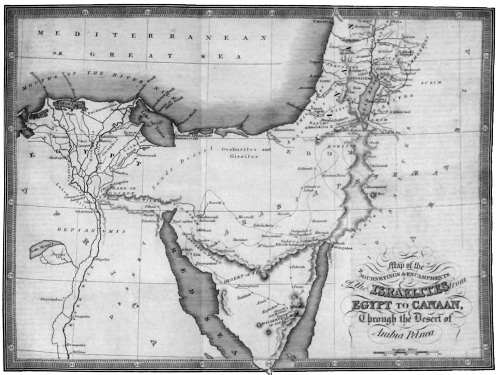
Map of the
JOURNEYINGS & ENCAMPMENTS
of the ISRAELITES from
EGYPT to CANAAN
Through the Desert of
Arabia Petræa
The second region, or Arabia Deserta, is
bounded on the north and north-east by the
Euphrates, on the east by a ridge of mountains
which separates it from Chaldea, on the south
by Arabia Felix, and on the west by Syria, Judea,
and Arabia Petræa. This was more particularly
the country first of the Cushites, and
afterward of the Ishmaelites; as it is still of
their descendants, the modern Bedouins, who
maintain the same predatory and wandering
habits. It consists almost entirely of one vast
and lonesome wilderness, a boundless level of
sand, whose dry and burning surface denies
existence to all but the Arab and his camel.
Yet, widely scattered over this dreary waste,
some spots of comparative fertility are to be
found, where, spread around a feeble spring of
77brackish water, a stunted verdure, or a few
palm trees, fix the principal settlement of a
tribe, and afford stages of refreshment in these
otherwise impassable deserts. Here, with a
few dates, the milk of his faithful camel, and
perhaps a little corn, brought by painful journeys
from distant regions, or plundered from a
passing caravan, the Arab supports a hard existence,
until the failure of his resources impels
him to seek another oasis, or the scanty herbage
furnished on a patch of soil by transient
rains; or else, which is frequently the case, to
resort, by more distant migration, to the banks
of the Euphrates; or, by hostile inroads on the
neighbouring countries, to supply those wants
which the recesses of the desert have denied.
The numbers leading this wandering and precarious
mode of life are incredible. From these
deserts Zerah drew his army of a million of
men; and the same deserts, fifteen hundred
years after, poured forth the countless swarms,
which, under Mohammed and his successors,
devastated half of the then known world.
The third region, or Arabia Felix, so denominated
from the happier condition of its
soil and climate, occupies the southern part of
the Arabian peninsula. It is bounded on the
north by the two other divisions of the country;
on the south and south-east by the Indian
Ocean; on the east by part of the same ocean
and the Persian Gulf; and on the west by the
Red Sea. This division is subdivided into the
kingdoms or provinces of Yemen, at the southern
extremity of the peninsula; Hejaz, on the
north of the former, and toward the Red Sea;
Nejed, in the central region; and Hadramant
and Oman, on the shores of the Indian Ocean.
The four latter subdivisions partake of much
of the character of the other greater divisions
of the country, though of a more varied surface,
and with a larger portion capable of cultivation.
But Yemen seems to belong to another country
and climate. It is very mountainous, is well
watered with rains and springs, and is blessed
with an abundant produce in corn and fruits,
and especially in coffee, of which vast quantities
are exported. In this division were the
ancient cities of Nysa, Musa or Moosa, and
Aden. This is also supposed to have been the
country of the queen of Sheba. In Hejaz are
the celebrated cities of Mecca and Medina.
Arabia Felix is inhabited by a people who
claim Jotkan for their father, and so trace their
descent direct from Shem, instead of Abraham
and Ham. They are indeed a totally different
people from those inhabiting the other quarters,
and pride themselves on being the only pure
and unmixed Arabs. Instead of being shepherds
and robbers, they are fixed in towns and
cities; and live by agriculture and commerce,
chiefly maritime. Here were the people who
were found by the Greeks of Egypt enjoying
an entire monopoly of the trade with the east,
and possessing a high degree of wealth and
consequent refinement. It was here, in the
ports of Sabæa, that the spices, muslins, and
precious stones of India, were for many ages
obtained by the Greek traders of Egypt, before
they had acquired skill or courage sufficient to
pass the straits of the Red Sea; which were
long considered by the nations of Europe to be
the produce of Arabia itself. These articles,
before the invention of shipping, or the establishment
of a maritime intercourse, were conveyed
across the deserts by the Cushite, Ishmaelite,
and Midianite carriers. It was the
produce partly of India, and partly of Arabia,
which the travelling merchants, to whom Joseph
was sold, were carrying into Egypt. The
balm and myrrh were probably Arabian, as they
are still the produce of the same country; but
the spicery was undoubtedly brought farther
from the east. These circumstances are adverted
to, to show how extensive was the communication,
in which the Arabians formed the
principal link: and that in the earliest ages of
which we have any account, in those of Joseph,
of Moses, of Isaiah, and of Ezekiel, “the
mingled people” inhabiting the vast Arabian
deserts, the Cushites, Ishmaelites, and Midianites,
were the chief agents in that commercial
intercourse which has, from the most remote
period of antiquity, subsisted between the extreme
east and west. And although the current
of trade is now turned, caravans of
merchants, the descendants of these people,
may still be found traversing the same deserts,
conveying the same articles, and in the same
manner as described by Moses!
The singular and important fact that Arabia
has never been conquered, has already been
cursorily adverted to. But Mr. Gibbon, unwilling
to pass by an opportunity of cavilling
at revelation, says, “The perpetual independence
of the Arabs has been the theme of praise
among strangers and natives; and the arts of
controversy transform this singular event into
a prophecy and a miracle in favour of the posterity
of Ishmael. Some exceptions, that can
neither be dissembled nor eluded, render this
mode of reasoning as indiscreet as it is superfluous.
The kingdom of Yemen has been
successively subdued by the Abyssinians, the
Persians, the Sultans of Egypt, and the Turks;
the holy cities of Mecca and Medina have repeatedly
bowed under a Scythian tyrant; and
the Roman province of Arabia embraced the
peculiar wilderness in which Ishmael and his
sons must have pitched their tents in the face
of their brethren.” But this learned writer has,
with a peculiar infelicity, annulled his own argument;
and we have only to follow on the
above passage, to obtain a complete refutation
of the unworthy position with which it begins:
“Yet these exceptions,” says Mr. Gibbon, “are
temporary or local; the body of the nation has
escaped the yoke of the most powerful monarchies:
the arms of Sesostris and Cyrus, of
Pompey, and Trajan, could never achieve the
conquest of Arabia; the present sovereign of
the Turks may exercise a shadow of jurisdiction,
but his pride is reduced to solicit the
friendship of a people whom it is dangerous to
provoke, and fruitless to attack. The obvious
causes of their freedom are inscribed on the
character and country of the Arabs. Many ages
before Mohammed, their intrepid valour had
been severely felt by their neighbours, in offensive
78and defensive war. The patient and active
virtues of a soldier are insensibly nursed in
the habits and discipline of a pastoral life. The
care of the sheep and camels is abandoned to
the women of the tribe; but the martial youth,
under the banner of the emir, is ever on horseback
and in the field, to practise the exercise
of the bow, the javelin, and the scimitar. The
long memory of their independence is the
firmest pledge of its perpetuity; and succeeding
generations are animated to prove their
descent, and to maintain their inheritance.
Their domestic feuds are suspended on the approach
of a common enemy; and in their last
hostilities against the Turks, the caravan of
Mecca was attacked and pillaged by four score
thousand of the confederates. When they advance
to battle, the hope of victory is in the
front, in the rear the assurance of a retreat.
Their horses and camels, who in eight or ten
days can perform a march of four or five hundred
miles, disappear before the conqueror;
the secret waters of the desert elude his search;
and his victorious troops are consumed with
thirst, hunger, and fatigue, in the pursuit of
an invisible foe, who scorns his efforts, and
safely reposes in the heart of the burning solitude.
The arms and deserts of the Bedouins
are not only the safeguards of their own freedom,
but the barriers also of the happy Arabia,
whose inhabitants, remote from war, are enervated
by the luxury of the soil and climate.
The legions of Augustus melted away in disease
and lassitude; and it is only by a naval
power that the reduction of Yemen has been
successfully attempted. When Mohammed
erected his holy standard, that kingdom was
a province of the Persian empire; yet seven
princes of the Homerites still reigned in the
mountains; and the vicegerent of Chosroes
was tempted to forget his distant country and
his unfortunate master.”
Yemen was the only Arabian province which
had the appearance of submitting to a foreign
yoke; but even here, as Mr. Gibbon himself
acknowledges, seven of the native princes remained
unsubdued: and even admitting its
subjugation to have been complete, the perpetual
independence of the Ishmaelites remains
unimpeached. For this is not their country.
Petra, the capital of the Stony Arabia, and the
principal settlement of the Nabathæi, it is true,
was long in the hands of the Persians and Romans;
but this never made them masters of
the country. Hovering troops of Arabs confined
the intruders within their walls, and cut
off their supplies; and the possession of this
fortress gave as little reason to the Romans to
exult as the conquerors of Arabia Petræa, as
that of Gibraltar does to us to boast of the conquest
of Spain.
The Arabian tribes were confounded by the
Greeks and Romans under the indiscriminate
appellation of Saracens; a name whose etymology
has been variously, but never satisfactorily,
explained. This was their general name
when Mohammed appeared in the beginning
of the seventh century. Their religion at this
time was Sabianism, or the worship of the sun,
moon, &c; variously transformed by the different
tribes, and intermingled with some Jewish
and Christian maxims and traditions. The
tribes themselves were generally at variance,
from some hereditary and implacable animosities;
and their only warfare consisted in desultory
skirmishes arising out of these feuds,
and in their predatory excursions, where superiority
of numbers rendered courage of less
value than activity and vigilance. Yet of such
materials Mohammed constructed a mighty empire;
converted the relapsed Ishmaelites into
good Musselmen; united the jarring tribes under
one banner; supplied what was wanting in
personal courage by the ardour of religious
zeal; and out of a banditti, little known and
little feared beyond their own deserts, raised an
armed multitude, which proved the scourge of
the world.
Mohammed was born in the year 569, of the
noble tribe of the Koreish, and descended, according
to eastern historians, in a direct line
from Ishmael. His person is represented as
beautiful, his manners engaging, and his eloquence
powerful; but he was illiterate, like the
rest of his countrymen, and indebted to a Jewish
or Christian scribe for penning his Koran.
Whatever the views of Mohammed might have
been in the earlier part of his life, it was not
till the fortieth year of his age that he avowed
his mission as the Apostle of God: when so
little credit did he gain for his pretensions, that
in the first three years he could only number
fourteen converts; and even at the end of ten
years his labours and his friends were alike
confined within the walls of Mecca, when the
designs of his enemies compelled him to fly to
Medina, where he was favourably received by
a party of the most considerable inhabitants,
who had recently imbibed his doctrines at Mecca.
This flight, or Hegira, was made the Mohammedan
æra, from which time is computed,
and corresponds with the 16th of July, 622, of
the Christian æra. Mohammed now found
himself sufficiently powerful to throw aside all
reserve; declared that he was commanded to
compel unbelievers by the sword to receive the
faith of one God, and his prophet Mohammed;
and confirming his credulous followers by the
threats of eternal pain on the one hand, and
the allurements of a sensual paradise on the
other, he had, before his death, which happened
in the year 632, gained over the whole of Arabia
to his imposture. His death threw a temporary
gloom over his cause, and the disunion
of his followers threatened its extinction. Any
other empire placed in the same circumstances
would have crumbled to pieces; but
the Arabs felt their power; they revered their
founder as the chosen prophet of God; and
their ardent temperament, animated by a religious
enthusiasm, gave an earnest of future
success, and encouraged the zeal or the ambition
of their leaders. The succession, after
some bloodshed, was settled, and unnumbered
hordes of barbarians were ready to carry into
execution the sanguinary dictates of their prophet;
and, with “the Koran, tribute, or death,”
as their motto, to invade the countries of the
79infidels. During the whole of the succeeding
century, their rapid career was unchecked; the
disciplined armies of the Greeks and Romans
were unable to stand against them; the Christian
churches of Asia and Africa were annihilated;
and from India to the Atlantic, through
Persia, Arabia, Syria, Palestine, Asia Minor,
Egypt, with the whole of northern Africa,
Spain, and part of France, the impostor was
acknowledged. Constantinople was besieged;
Rome itself was plundered; and nothing less
than the subjection of the whole Christian
world was meditated on the one hand and
tremblingly expected on the other.
All this was wonderful; but the avenging
justice of an incensed Deity, and the sure word
of prophecy, relieve our astonishment. It was
to punish an apostate race, that the Saracen
locusts were let loose upon the earth; and the
countries which they were permitted to ravage
were those in which the pure light of revelation
had been most abused. The eastern church
was sunk in gross idolatry; vice and wickedness
prevailed in their worst forms; and those
who still called themselves Christians trusted
more to images, relics, altars, austerities, and
pilgrimages, than to a crucified Saviour.
About a hundred and eighty years from the
foundation of Bagdad, during which period the
power of the Saracens had gradually declined,
a dreadful reaction took place in the conquered
countries. The Persians on the east, and the
Greeks on the west, were simultaneously roused
from their long thraldom, and, assisted by the
Turks, who, issuing from the plains of Tartary,
now for the first time made their appearance
in the east, extinguished the power of the
caliphate, and virtually put an end to the Arabian
monarchy in the year 936. A succession
of nominal caliphs continued to the year 1258:
but the provinces were lost; their power was
confined to the walls of their capital; and they
were in real subjection to the Turks and the
Persians until the above year, when Mostacem,
the last of the Abbassides, was dethroned and
murdered by Holagou, or Hulaku, the Tartar,
the grandson of Zingis. This event, although
it terminated the foreign dominion of the Arabians,
left their native independence untouched.
They were no longer, indeed, the masters of
the finest parts of the three great divisions of
the ancient world: their work was finished;
and returning to the state in which Mohammed
found them three centuries before, with
the exception of the change in their religion,
they remained, and still remain, the unconquered
rovers of the desert.
It is not the least singular circumstance in
the history of this extraordinary people, that
those who, in the enthusiasm of their first successes,
were the sworn foes of literature, should
become for several ages its exclusive patrons.
Almansor, the founder of Bagdad, has the merit
of first exciting this spirit, which was encouraged
in a still greater degree by his grandson
Almamon. This caliph employed his agents
in Armenia, Syria, Egypt, and at Constantinople,
in collecting the most celebrated works
on Grecian science, and had them translated
into the Arabic language. Philosophy, astronomy,
geometry, and medicine, were thus introduced
and taught; public schools were
established; and learning, which had altogether
fled from Europe, found an asylum on the
banks of the Tigris. Nor was this spirit confined
to the capital: native works began to
appear; and by the hands of copyists were multiplied
out of number, for the information of
the studious, or the pride of the wealthy. The
rage for literature extended to Egypt and to
Spain. In the former country, the Fatimites
collected a library of a hundred thousand manuscripts,
beautifully transcribed, and very elegantly
bound; and in the latter, the Ommiades
formed another of six hundred thousand volumes;
forty-four of which were employed in
the catalogue. Their capital, Cordova, with
the towns of Malaga, Almeria, and Murcia,
produced three hundred writers; and seventy
public libraries were established in the cities of
Andalusia. What a change since the days of
Omar, when the splendid library of the Ptolemies
was wantonly destroyed by the same people!
A retribution, though a slight one, was
thus made for their former devastations; and
many Grecian works, lost in the original, have
been recovered in their Arabic dress. Neither
was this learning confined to mere parade,
though much of it must undoubtedly have been
so. Their proficiency in astronomy and geometry
is attested by their astronomical tables,
and by the accuracy with which, in the plain
of Chaldea, a degree of the great circle of the
earth was measured. But it was in medicine
that, in this dark age, the Arabians shone most:
the works of Hippocrates and Galen had been
translated and commented on; their physicians
were sought after by the princes of Asia and
Europe; and the names of Rhazis, Albucasis,
and Avicenna are still revered by the members
of the healing art. So little, indeed, did the
physicians of Europe in that age know of the
history of their own science, that they were
astonished, on the revival of learning, to find
in the ancient Greek authors those systems for
which they thought themselves indebted to the
Arabians!
The last remnant of Arabian science was
found in Spain; from whence it was expelled
in the beginning of the seventeenth century,
by the intemperate bigots of that country, who
have never had any thing of their own with
which to supply its place. The Arabians are
the only people who have preserved their descent,
their independence, their language, and
their manners and customs, from the earliest
ages to the present times; and it is among
them that we are to look for examples of patriarchal
life and manners. A very lively sketch
of this mode of life is given by Sir R. K. Porter,
in the person and tribe of an Arab sheik,
whom he encountered in the neighbourhood of
the Euphrates. “I had met this warrior,” says
Sir R. K. P., “at the house of the British resident
at Bagdad; and came, according to his
repeated wish, to see him in a place more consonant
with his habits, the tented field; and,
as he expressed it, ‘at the head of his children.’
80As soon as we arrived in sight of his camp, we
were met by crowds of its inhabitants, who,
with a wild and hurrying delight, led us toward
the tent of their chief. The venerable old
man came forth to the door, attended by his
subjects of all sizes and descriptions, and greeted
us with a countenance beaming kindness;
while his words, which our interpreter explained,
were demonstrative of patriarchal welcome.
One of my Hindoo troopers spoke Arabic;
hence the substance of our succeeding discourse
was not lost on each other. Having entered,
I sat down by my host; and the whole of the
persons present, to far beyond the boundaries
of the tent, (the sides of which were open,)
seated themselves also, without any regard to
those more civilized ceremonies of subjection,
the crouching of slaves, or the standing of
vassalage. These persons, in rows beyond
rows, appeared just as he had described, the
offspring of his house, the descendants of his
fathers, from age to age; and like brethren,
whether holding the highest or the lowest rank,
they seemed to gather round their common
parent. But perhaps their sense of perfect
equality in the mind of their chief could not be
more forcibly shown, than in the share they
took in the objects which appeared to interest
his feelings; and as I looked from the elders
or leaders of the people, seated immediately
around him, to the circles beyond circles of
brilliant faces, bending eagerly toward him
and his guest, (all, from the most respectably
clad to those with hardly a garment covering
their active limbs, earnest to evince some attention
to the stranger he bade welcome,) I
thought I had never before seen so complete an
assemblage of fine and animated countenances,
both old and young: nor could I suppose a
better specimen of the still existing state of
the true Arab; nor a more lively picture of the
scene which must have presented itself, ages
ago, in the fields of Haran, when Terah sat in
his tent door, surrounded by his sons, and his
sons’ sons, and the people born in his house.
The venerable Arabian sheik was also seated
on the ground with a piece of carpet spread
under him; and, like his ancient Chaldean ancestor,
turned to the one side and the other,
graciously answering or questioning the groups
around him, with an interest in them all which
clearly showed the abiding simplicity of his
government, and their obedience. On the
smallest computation, such must have been
the manners of these people for more than
three thousand years; thus, in all things, verifying
the prediction given of Ishmael at his
birth, that he, in his posterity, should ‘be a wild
man,’ and always continue to be so, though
‘he shall dwell for ever in the presence of his
brethren.’ And that an acute and active people,
surrounded for ages by polished and luxurious
nations, should from their earliest to their
latest times, be still found a wild people, dwelling
in the presence of all their brethren, (as we
may call these nations,) unsubdued and unchangeable,
is, indeed, a standing miracle:
one of those mysterious facts which establish
the truth of prophecy.” But although the
manners of the Arabians have remained unaltered
through so many ages, and will probably
so continue, their religion, as we have seen,
has sustained an important change; and must
again, in the fulness of time, give place to a
faith more worthy of the people.
St. Paul first preached the Gospel in Arabia,
Gal. i, 17. Christian churches were subsequently
founded, and many of their tribes embraced
Christianity prior to the fifth century;
most of which appear to have been tinctured
with the Nestorian heresy. At this time, however,
it does not appear that the Arabians had
any version of the Scriptures in their own
language, to which some writers attribute the
ease with which they were drawn into the Mohammedan
delusion; while the “Greeks, Syrians,
Armenians, Abyssinians, Copts, and
others,” who enjoyed that privilege, were able
to resist it.
ARAM, the fifth son of Shem, Gen. x, 22.
He was the father of the Syrians, who from
him were called Aramæans, or Aramites.
ARARAT, a mountain of Asia, in Armenia,
on which the ark of Noah rested after the cessation
of the deluge. Concerning the etymology
of the name, Dr. Bryant observes, that it
is a compound of Ar-Arat, and signifies “the
mountain of descent,” being equivalent to
הר־ירר, of the Hebrews. Of the precise situation
of this mountain, different accounts have been
given. Some have supposed that it was one
of the mountains which divide Armenia on the
south from Mesopotamia, and that part of Assyria
inhabited by the Curds, from whom those
mountains took the name of Curdue, or Cardu;
by the Greeks denominated Gordyæi. It is
called by the Arabs Al-Judi, and also Thamanin.
In confirmation of this opinion, it is
alleged that the remains of the ark were to be
seen on these mountains; and it is said, that
Berosus and Abydenus both declare, that such
a report existed in their time. Epiphanius
pretends, if we may credit his assertion, that
the relics of the ark were to be seen in his
day; and we are farther told, that the emperor
Heraclius went from the town of Thamanin,
up the mountain Al-Judi, and saw the place of
the ark. Others maintain, that mount Ararat
was situated toward the middle of Armenia,
near the river Araxes, or Aras, about twelve
miles from it, according to Tournefort, above
two hundred and eighty miles distant from
Al-Judi, to the north-east. Ararat seems to
be a part of that vast chain of mountains called
Caucasus and Taurus; and upon these
mountains, and in the adjacent country, were
preserved more authentic accounts of the ark
than in almost any other part of the world. The
region about Ararat, called Araratia, was esteemed
among the ancients as nearly a central
part of the earth; and it is certainly as well
calculated as any other for the accommodation
of its first inhabitants, and for the migration of
colonies, upon the increase of mankind. The
soil of the country was very fruitful, and especially
of that part where the patriarch made
his first descent. The country also was very
high, though it had fine plains and valleys
81between the mountains. Such a country, therefore,
must, after the flood, have been the soonest
exsiccated, and, consequently, the soonest
habitable.
The mountain which has still the name of
Ararat, has retained it through all ages. Tournefort
has particularly described it, and from
his account it seems to consist chiefly of freestone,
or calcareous sandstone. It is a detached
mountain in form of a sugar loaf, in the
midst of a very extensive plain, consisting of
two summits; the lesser, more sharp and pointed;
the higher, which is that of the ark, lies
north-west of it, and raises its head far above
the neighbouring mountains, and is covered
with perpetual snow. When the air is clear,
it does not appear to be above two leagues from
Erivan, and may be seen at the distance of
four or five days’ journey. Its being visible at
such a distance, however, is ascribed not so
much to its height, as to its lonely situation,
in a large plain, and upon the most elevated
part of the country. The ascent is difficult
and fatiguing. Tournefort attempted it; and,
after a whole day’s toil, he was obliged, by the
snow and intense cold, to return without accomplishing
his design, though in the middle
of summer. On the side of the mountain that
looks toward Erivan, is a prodigious precipice,
very deep, with perpendicular sides, and of a
rough, black appearance, as if tinged with
smoke.
The summit of Ararat has never been reached,
though several attempts have been made;
and if the ark rested on the summit, it is certain
that those who have spoken of its fragments
being seen there in different ages, must have
been imposed upon. It is, however, not necessary
to suppose that the ark rested upon either of
its tops; and that spot would certainly be chosen
which would afford the greatest facility of descent.
Sir Robert Ker Porter is among the
modern travellers who have given us an account
of this celebrated mountain:--“As the
vale opened beneath us in our descent, my
whole attention became absorbed in the view
before me. A vast plain, peopled with countless
villages; the towers and spires of the
churches of Eitch-mai-adzen, arising from
amidst them; the glittering waters of the Araxes,
flowing through the fresh green of the vale;
and the subordinate range of mountains, skirting
the base of the awful monument of the
antediluvian world. It seemed to stand a stupendous
link in the history of man, uniting the
two races of men before and after the flood.
But it was not until we had arrived upon the
flat plain, that I beheld Ararat in all its amplitude
of grandeur. From the spot on which I
stood, it appeared as if the hugest mountains
of the world had been piled upon each other,
to form this one sublime immensity of earth,
and rock, and snow. The icy peaks of its
double heads rose majestically into the clear
and cloudless heavens; the sun blazed bright
upon them; and the reflection sent forth a
dazzling radiance, equal to other suns. This
point of the view united the utmost grandeur
of plain and height. But the feelings I experienced
while looking on the mountain, are
hardly to be described. My eye, not able to
rest for any length of time upon the blinding
glory of its summits, wandered down the apparently
interminable sides, till I could no longer
trace their vast lines in the mists of the horizon;
when an inexpressible impulse, immediately
carrying my eye upward again, refixed
my gaze upon the awful glare of Ararat; and
this bewildered sensibility of sight being answered
by a similar feeling in the mind, for
some moments I was lost in a strange suspension
of the powers of thought.”
The separate peaks are called Great and
Little Ararat, and the space between them is
about seven miles. “These inaccessible summits,”
continues Sir R. K. Porter, “have never
been trodden by the foot of man since the days
of Noah, if even then; for my idea is, that the
ark rested in the space between these heads,
and not on the top of either. Various attempts
have been made in different ages to ascend
these tremendous mountain-pyramids, but in
vain: their form, snows, and glaciers, are insurmountable
obstacles: the distance being so
great from the commencement of the icy region
to the highest points, cold alone would be the
destruction of any person who should have the
hardihood to persevere. On viewing mount
Ararat from the northern side of the plain, its
two heads are separated by a wide cleft, or
rather glen, in the body of the mountain. The
rocky side of the greater head runs almost
perpendicularly down to the north-east, while
the lesser head rises from the sloping bottom of
the cleft, in a perfectly conical shape. Both
heads are covered with snow. The form of the
greater is similar to the less, only broader and
rounder at the top; and shows to the north-west
a broken and abrupt front, opening, about
half way down, into a stupendous chasm, deep,
rocky, and peculiarly black. At that part of
the mountain, the hollow of the chasm receives
an interruption from the projection of minor
mountains, which start from the sides of Ararat
like branches from the root of a tree, and
run along, in undulating progression, till lost in
the distant vapours of the plain.” Dr. Shuckford
argues that the true Ararat lies among the
mountains of the north of India; but Mr. Faber
has answered his reasoning, and proved by a
comparison of geographical notices incidentally
mentioned in the Old Testament, that the Ararat
of Armenia is the true Ararat.
ARCHANGEL, according to some, means
an angel occupying the eighth rank in the
celestial order or hierarchy; but others reckon
it a title only applicable to our Saviour; Jude
9; Dan. xii, 1; 1 Thess. iv, 16. On this point
Bishop Horsley has the following observations:--“It
has been for a long time a fashion
in the church to speak very frequently and
familiarly of archangels as beings of an order
with which we are perfectly well acquainted.
Some say there are seven of them. Upon what
solid ground that assertion stands, I know not;
but this I know, the word ‘archangel’ is not
to be found in any one passage of the Old Testament:
in the New Testament it occurs twice,
82and only twice. One of the two passages is in
the First Epistle to the Thessalonians; where
the Apostle, among the circumstances of the
pomp of our Lord’s descent from heaven to the
final judgment, mentions ‘the voice of the archangel;’
the other passage is in the Epistle of St.
Jude, where the title of archangel is coupled
with the name of ‘Michael the archangel.’
This passage is so remarkably obscure that I
shall not attempt to draw any conclusion from it
but this, which manifestly follows, be the particular
sense of the passage what it may: since
this is one of the two texts in which alone the
word ‘archangel’ is found in the whole Bible;
since in this one text only the title of archangel
is coupled with any name; and since the
name with which it is here coupled is Michael;
it follows undeniably that the archangel Michael
is the only archangel of whom we know
any thing from holy writ. It cannot be proved
from holy writ, and, if not from holy writ,
it cannot be proved at all, that any archangel
exists but the one archangel Michael, and this
one archangel Michael is unquestionably the
Michael of the book of Daniel.
“I must observe by the way, with respect to
the import of the title of archangel, that the
word, by etymology, clearly implies a superiority
of rank and authority in the person to
whom it is applied. It implies a command
over angels; and this is all that the word of
necessity implies. But it follows not, by any
sound rule of argument, that, because no other
superiority than that of rank and authority is
implied in the title, no other belongs to the
person distinguished by the title, and that he
is in all other respects a mere angel. Since
we admit various orders of intelligent beings,
it is evident that a being highly above the angelic
order may command angels.
“To ascertain, if we can, to what order of
beings the archangel Michael may belong, let
us see how he is described by the Prophet
Daniel, who never mentions him by that title;
and what action is attributed to him in the
book of Daniel and in another book, in which
he bears a principal part.
“Now Daniel calls him ‘one of the chief
princes,‘ or ‘one of the capital princes,’ or
‘one of the princes that are at the head of all:’
for this I maintain to be the full and not more
than the full import of the Hebrew words. Now
we are clearly got above the earth, into the
order of celestials, who are the princes that are
first, or at the head of all? Are they any
other than the three persons in the Godhead?
Michael, therefore, is one of them; but which
of them? This is not left in doubt. Gabriel,
speaking of him to Daniel, calls him ‘Michael
your prince,’ and ‘the great prince which
standeth for the children of thy people;‘ that
is, not for the nation of the Jews in particular,
but for the children, the spiritual children, of
that holy seed the elect people of God; a description
which applies particularly to the Son
of God, and to no one else; and in perfect
consistence with this description of Michael
in the book of Daniel, is the action assigned
to him in the Apocalypse, in which we find
him fighting with the old serpent, the deceiver
of the world, and victorious in the combat.
That combat who was to maintain? in that
combat who was to be victorious, but the seed
of the woman? From all this it is evident,
that Michael is a name for our Lord himself,
in his particular character of the champion of
his faithful people, against the violence of the
apostate faction and the wiles of the devil.”
To this opinion there is nothing irreconcilable
in the “voice of the archangel” mentioned in
1 Thess. iv, 16: since the “shout,” the “voice,”
the “trump of God,” may all be the majestic
summons of the Judge himself. At the same
time we must feel that the reasoning of Bishop
Horsley, though ingenious, is for from
being conclusive against the existence of one
or more archangels.
ARCHBISHOP, a bishop of the first class,
who superintends the conduct of other bishops.
Archbishops were not known in the east till
about the year 320; and though there were
some soon after this, who had the title, yet it
was only a personal honour, by which the
bishops of considerable cities were distinguished.
It was not till of late that archbishops
became metropolitans, and had suffragans under
them. Athanasius appears to have been
the first who used the title archbishop, which
he gave occasionally to his predecessor. Gregory
Nazianzen, in like manner, gave it to
Athanasius; not that either of them was entitled
to any jurisdiction, or even any precedency,
in virtue of this title. Among the
Latins, Isidore Hispalensis is the first who
speaks of archbishops.
ARCHELAUS, son of Herod the Great, and
Maltace, his fifth wife. Herod having put to
death his sons Alexander, Aristobulus, and
Antipater, and expunged out of his will Herod
Antipas, whom he had declared king, he substituted
Archelaus, and gave Antipas the title
of tetrarch only. After the death of Herod,
Archelaus ordered that king’s will to be read,
wherein he, Archelaus, was declared king, on
condition that Augustus consented. Hereupon
the assembly cried, “Long live king Archelaus!”
and the soldiers promised the same
fidelity to him as they had shown to his father.
Archelaus buried his father magnificently,
came to Jerusalem, and there mourned seven
days, according to custom. He then gave a
splendid entertainment to the people, went to
the temple, harangued the multitude, promised
them good treatment, and declared he would
not assume the title of king till the emperor
had confirmed it, A. M. 4001; B. C. 3. The
people, notwithstanding, tumultuously demanded
the execution of those who advised Herod
to slay certain zealots, who had pulled down a
golden eagle from one of the temple gates.
They also required Archelaus to divest Joazar
of the high priesthood; and they vehemently
reproached the memory of the late king. Archelaus
sent troops to suppress the mutineers,
and killed near three thousand of them about
the temple. After this he embarked at Cæsarea
for Rome, to procure from Augustus the
confirmation of Herod’s will. Antipas, his
83brother, went to Rome likewise, to dispute his
title, pretending that Herod’s first will should
be preferred to his last, which he alleged to
have been made by him when his understanding
was not sound.
The two brothers, Archelaus and Antipas,
procured able orators to display their pretensions
before the emperor; and when they had
done speaking, Archelaus threw himself at
Augustus’s feet. Augustus gently raised him,
said he would do nothing contrary to Herod’s
intention or his interest, but refused to decide
the affair at that time. Some time afterward,
the Jews sent a solemn embassy to Rome, to
desire Augustus would permit them to live according
to their own laws, and on the footing
of a Roman province, without being subject to
kings of Herod’s family, but only to the governors
of Syria. Augustus heard them, and
likewise heard Archelaus in reply; then broke
up the assembly without declaring himself.
After some days, he sent for Archelaus, gave
him the title, not of king, but of ethnarch, with
one moiety of the territories which his father
Herod had enjoyed; promising him the crown
likewise, if his good conduct deserved it. Archelaus
returned to Judea, and, under pretence
that he had countenanced the seditious against
him, he deprived Joazar of the high priesthood,
and gave that dignity to his brother Eleazar.
He governed Judea with so much violence,
that, after seven years, the chiefs of the Samaritans
and Jews accused him before Augustus.
The emperor immediately sent for his agent at
Rome, and without condescending to write to
Archelaus he commanded the agent to depart
instantly for Judea, and order Archelaus to
Rome, to give an account of his conduct. On
his arrival at Rome, the emperor called for his
accusers, and permitted him to defend himself;
which he did so insufficiently, that Augustus
banished him to Vienne, in Gaul, where he
continued in exile to the end of his life. See
Antipas.
ARCHI-SYNAGOGUS, the ruler of a synagogue.
See Synagogue.
ARCHITRICLINUS, ἀρχιτρίκλινος, generally
translated steward, signifies rather the master
or superintendent of the feast; “one,” says
Gaudentius, “who is the husband’s friend, and
commissioned to conduct the order and economy
of the feast.” He gave directions to the
servants, superintended every thing, commanded
the tables to be covered, or to be cleared of
the dishes, as he thought proper: whence his
name, as regulator of the triclinium, or festive
board. He also tasted the wine, and distributed
it to the guests. The author of Ecclesiasticus
thus describes this office, xxxii, 1, 2: “If
thou be made the master of a feast, lift not
thyself up, but be among them as one of the
rest: take diligent care of them, and so sit
down. And when thou hast done all thy office,
take thy place, that thou mayest be merry with
them, and receive a crown for the well ordering
of the feast.” This office is mentioned,
John ii, 8, 9, upon which Theophylact remarks:
“That no one might suspect that their
taste was vitiated by having drunk to excess,
so as not to know water from wine, our Saviour
orders it to be first carried to the governor
of the feast, who certainly was sober; for
those who on such occasions are intrusted with
this office, observe the strictest sobriety, that
they may be able properly to regulate the
whole.”
AREOPAGUS, the high court at Athens,
famed for the justice of its decisions; and so
called, because it sat on a hill of the same
name, or in the suburbs of the city, dedicated
to Mars, the god of war, as the city was to
Minerva, his sister. St. Paul, Acts xvii, 19,
&c, having preached at Athens, was carried
before the Areopagites, as “a setter forth of
strange gods.” On this occasion he delivered
that fine sermon which is in substance recorded
in Acts xvii. Dionysius, one of the judges,
was converted; and the Apostle was dismissed
without any farther trouble.
ARGOB, a canton lying beyond Jordan, in
the half tribe of Manasseh, and in the country
of Bashan, one of the most fruitful on the
other side of Jordan. In the region of Argob
there were sixty cities, called Bashan-havoth-Jair,
which had very high walls and strong
gates, without reckoning many villages and
hamlets, which were not inclosed, Deut. iii,
4–14; 1 Kings iv, 13. But Argob was more
peculiarly the name of the capital city of the
region of Argob, which Eusebius says was fifteen
miles west of Gerara.
ARIANS, this ancient sect, was unquestionably
so called from Arius, a presbyter of Alexandria,
in the early part of the fourth century. It
is said that he aspired to episcopal honours;
and after the death of Achilles, in A. D. 313,
felt not a little chagrined that Alexander
should be preferred before him. Whether this
circumstance had any influence on his opinions,
it is impossible to say; but one day, when his
rival (Alexander) had been addressing the
clergy in favour of the orthodox doctrine, and
maintaining, in strong and pointed language,
“that the Son of God was co-eternal, co-essential,
and co-equal with the Father,” Arius considered
this as a species of Sabellianism, and
ventured to say, that it was inconsistent and
impossible, since the Father, who begat, must
be before the Son, who was begotten: the latter,
therefore, could not be absolutely eternal.
Alexander at first admonished Arius, and endeavoured
to convince him of his error; but
without effect, except that he became the more
bold in contradiction. Some of the clergy
thought their bishop too forbearing, and it is
possible he felt his inferiority of talent; for
Arius was a man of accomplished learning,
and commanding eloquence; venerable in person,
and fascinating in address. At length
Alexander was roused, and attempted to silence
Arius by his authority; but this not succeeding,
as the latter was bold and pertinacious,
Alexander, about the year 320, called a council
of his clergy, by whom the reputed heretic
was deposed and excommunicated. Arius now
retired into Palestine, where his talents and
address soon made a number of converts; and
among the rest, the celebrated Eusebius, bishop
84of Nicomedia, and other bishops and clergy of
those parts, who assembled in council, and received
the excommunicated presbyter into
their communion. Eusebius also, having great
interest with Constantia, the sister of Constantine,
and wife of Licinius, recommended Arius
to her protection and patronage; through
which, and by his own eloquent letters to the
clergy in various parts, his system spread with
great rapidity, and to a vast extent. The emperor
Constantine, who had no great skill in
these matters, was grieved to see the Christian
church (but just escaped from the red dragon
of persecution) thus torn by intestine animosity
and dissensions; he therefore determined to
summon a general council of the clergy, which
met at Nice, A. D. 325, and contained more
than 300 bishops. Constantine attended in
person, and strongly recommended peace and
unanimity. Athanasius was the chief opponent
of the Arians. Both parties were willing
to subscribe to the language of the Scriptures,
but each insisted on interpreting for themselves.
“Did the Trinitarians,” says Mr.
Milner, “assert that Christ was God? The
Arians allowed it, but in the same sense as
holy men and angels are styled gods in Scripture.
Did they affirm that he was truly God?
The others allowed that he was made so by
God. Did they affirm that the Son was naturally
of God? It was granted: Even we, said
they, are of God, ‘of whom are all things.’”
At length the Athanasians collected a number
of texts, which they conceived amounted to
full proof of the Son being of one and the same
substance with the Father; the Arians admitted
he was of like substance, the difference in
the Greek phrases being only in a single letter,--ὁμοούσιος,
homoousios and ὁμοιούσιος, homoiousios.
At length the former was decreed to
be the orthodox faith, and the Nicene creed
was framed as it remains at this day so far as
concerns the person of the Son of God, who is
said to be “begotten of his Father before all
worlds; God of God, Light of Light, very God
of very God, begotten, not made, of one substance
with the Father, by whom all things
were made,” &c.
Arius was now excommunicated. The sentence
of the council pronounced against him
and his associates was followed by another of
the emperor, whereby the excommunicated persons
were condemned to banishment, that they
might be debarred the society of their countrymen
whom the church had judged unworthy to
remain in her communion. Soon after which,
Eusebius of Nicomedia, and Theognis of Nice,
being found to continue their countenance and
protection to the Arian cause, to communicate
with those whom they had anathematized, and
to concur in those sentiments which they had
condemned by their subscriptions; they were
both subjected to the same penalty of exile by
the emperor, and were actually deposed, (as we
learn from Athanasius,) and had successors ordained
to their sees, though history is silent as
to the council by which this was done. But
such was the good nature and credulity of Constantine,
that these men, by their usual artifices,
easily imposed upon him, and brought him to
such a full persuasion of their agreement with
the Nicene faith, that in about three years’ time
they were not only recalled from banishment,
but restored to their sees, and to a considerable
degree of interest at court. Their thorough
attachment to the cause of Arius, and their
hatred of Athanasius, who had so vigorously
withstood them in the council, and was now
advanced to the see of Alexandria, made them
watchful of every opportunity to defeat the decisions
of the council.
In the meantime one who wished well to
their designs, and whom Constantia had upon
her death bed recommended to the emperor, did
so far prevail upon the easy credulity of Constantine,
by complaining that Arius had been
misrepresented, and differed nothing in his sentiments
from the Nicene fathers, that the indulgent
emperor recalled him from his banishment,
and required him to exhibit in writing, a confession
of his faith. He did this in such terms
as, though they admitted of a latent reservation,
yet bore the appearance of being entirely catholic;
and therefore not only gave satisfaction to
the emperor, but even offended some of his own
followers, who from that time forth separated
from him. The discerning Athanasius was not
so easily imposed upon as Constantine; but,
well assured of the heretic’s prevarication, was
resolute in refusing to admit him to communion,
whom the Nicene council had so openly
condemned. Upon this the emperor sent for
Arius to Constantinople, and insisted upon his
being received into communion, by Alexander,
bishop of that city. However, on the day before
this was to have taken place, Arius died suddenly
from a complaint in his bowels. Some
attributed this to poison; others to the judgment
of God. The emperor did not long survive;
and Constantius, his successor, became
warmly attached to the Arian cause, as were
all the court party. Successive emperors took
different sides, and thus was the peace of the
church agitated for many years, and practical
religion sacrificed alternately to the dogmas or
the interests of one party or the other; and each
was in turn excommunicated, fined, imprisoned,
or banished. Constantius supported Arianism
triumphantly, Julian laughed at both parties,
but persecuted neither, Jovian supported the
Nicene doctrine. Valentinian, and his brother
Valens, took contrary sides; the former supporting
Athanasianism in the west, and the
latter Arianism in the east; so that what was
orthodoxy at Rome was heresy at Constantinople,
and vice versa. The Arians themselves were
not unanimous, but divided into various shades
of sentiment, under their respective leaders; as
Eusebians, Eudoxians, Acasians, Aëtians, &c;
but the more general distinction was into Arians
and Semi-Arians; the former sinking the
character of the Son of God into that of a mere
creature, while the latter admitted every thing
but the homoousian doctrine, or his absolute
equality with the Father. After this period we
hear little of Arianism, till it was revived in
England in the beginning of the last century by
the eccentric Mr. Whiston, by Mr. Emlyn, and
85Dr. Samuel Clarke. The latter was what may
be called a high or Semi-Arian, who came within
a shade of orthodoxy; the two former were
low Arians, reducing the rank of our Saviour
to the scale of angelic beings--a creature “made
out of nothing.” Since this time, however, both
Arians and Socinians are sunk into the common
appellation of Unitarians, or rather Humanitarians,
who believe our Saviour (as Dr.
Priestley expresses it) to be “a man like themselves.”
The last advocates of the pure Arian
doctrine, of any celebrity, were Mr. Henry Taylor,
(under the signature of Ben Mordecai,) and
Dr. Richard Price, in his “Sermons on the
Christian Doctrine.” It may be proper to observe,
that the Arians, though they denied the
absolute eternity of the Son, strongly contended
for his preëxistence, as the Logos, or the Word
of God, “by whom the worlds were made;” and
admitted, more or less explicitly, the sacrifice
which he offered for sin upon the cross.
ARIEL, the capital city of Moab, frequently
mentioned in Scripture, Ezra viii, 16. See Moab.
ARIMATHEA, or RAMAH, now called
Ramlè, or Ramla, a pleasant town, beautifully
situated on the borders of a fertile and extensive
plain, abounding in gardens, vineyards,
olive and date trees. It stands about thirty
miles north-west of Jerusalem, on the high road
to Jaffa. At this Rama, which was likewise
called Ramathaim Zophim, as lying in the district
of Zuph, or Zoph, Samuel was born,
1 Sam. i. This was likewise the native place
of Joseph, called Joseph of Arimathea, who
begged and obtained the body of Jesus from
Pilate, Matt. xxvi, 57. There was another
Ramah, about six miles north of Jerusalem, in
a pass which separated the kingdoms of Israel
and Judah, which Baasha, king of Israel, took
and began to fortify; but he was obliged to relinquish
it, in consequence of the alliance formed
between Asa, king of Judah, and Benhadad,
king of Syria, 1 Kings xv. This is the Ramah,
supposed to be alluded to in the lamentation of
Rachel for her children.
ARISTARCHUS, spoken of by St. Paul in
his Epistle to the Colossians, iv, 10, and often
mentioned in the Acts of the Apostles. He
was a Macedonian, and a native of Thessalonica.
He accompanied St. Paul to Ephesus,
and there continued with him during the two
years of his abode in that place, sharing with
him in all the dangers and labours of the ministry,
Acts xix, 29; xx, 4; xxvii, 2. He was near
losing his life in a tumult raised by the Ephesian
silversmiths. He left Ephesus with the
Apostle, and went with him into Greece. From
thence he attended him into Asia; from Asia
into Judea, and from Judea to Rome.
ARK, arca, denotes a kind of floating vessel
built by Noah, for the preservation of himself
and family, with several species of animals
during the deluge. The Hebrew word by which
the ark is expressed, is תבה or תיבה, the constructive
form of תבה, which is evidently the
Greek θίβη; and so the LXX render the word in
Exod. ii, 3, where only it again occurs. They
also render it κιβωτὸν; Josephus, λαρνάκα; and
the Vulgate, arcam; signifying an ark, coffer,
or chest. Although the ark of Noah answered,
in some respects, the purpose of a ship, it is
not so certain that it was of the same form and
shape. It has been inconclusively argued by
Michaelis and some others, that if its form had
not been like that of a ship, it could not have
resisted the force of the waves; because it was
not intended to be conducted, like a ship, from
one place to another, but merely “to float on
the surface of the waters,” Gen. vii, 17. It
appears to have had neither helm, nor mast,
nor oars; but was merely a bulky capacious
vessel, light enough to be raised aloft with all
its contents, by the gradual rise of the deluge.
Its shape, therefore, was of little importance;
more especially as it seems to have been the
purpose of Providence, in this whole transaction,
to signify to those who were saved, as well
as to their latest posterity, that their preservation
was not in any degree effected by human contrivance.
The ark in which Moses was exposed
bears the same name; and some have thought
that both were of the same materials. With
respect to the etymology of the Hebrew word,
the most rational seems to be that of Clodius,
who derives it from the Arabic word תאה, “he
collected,” from which is formed תבה, or תיבה,
denoting a place in which things are collected.
Foster deduces it from two Egyptian words,
thoi, “a ship,” and bai, “a palm tree branch”;
and such ships are still to be seen not only in
Egypt, but in India and other countries; particularly
in some isles of the Pacific Ocean.
To the insufficiency of the ark to contain all
the creatures said to have been brought into it,
objections have, at different times, been made.
Bishop Wilkins and others have learnedly discussed
this subject, and afforded the most satisfactory
answers. Dr. Hales proves the ark to
have been of the burden of forty-two thousand
four hundred and thirteen tons; and asks,
“Can we doubt of its being sufficient to contain
eight persons, and about two hundred or two
hundred and fifty pair of four-footed animals, (a
number to which, according to M. Buffon, all
the various distinct species may be reduced,)
together with all the subsistence necessary for
a twelvemonth, with the fowls of the air, and
such reptiles and insects as cannot live under
water?” All these various animals were controlled
by the power of God, whose special agency
is supposed in the whole transaction, and
“the lion was made to lie down with the kid.”
Whether Noah was commanded to bring with
him, into the ark, a pair of all living creatures,
zoologically and numerically considered, has
been doubted. During the long period between
the creation and the flood, animals must have
spread themselves over a great part of the antediluvian
earth, and certain animals would, as
now, probably become indigenous to certain
climates. The pairs saved must therefore, if
all the kinds were included, have travelled from
immense distances. But of such marches no
intimation is given in the history; and this
seems to render it probable that the animals
which Noah was “to bring with him” into the
ark, were the animals clean and unclean of the
country in which he dwelt, and which, from
86the capacity of the ark, must have been in great
variety and number. The terms used, it is true,
are universal; and it is satisfactory to know,
that if taken in the largest sense there was
ample accommodation in the ark. Nevertheless,
universal terms in Scripture are not always
to be taken mathematically, and in the vision
of Peter, the phrase ϖάντα τὰ τετράποδα τῆς γῆς,--all
the four-footed beasts of the earth, must be
understood of varii generis quadrupedes, as
Schleusner paraphrases it. Thus we may easily
account for the exuviæ of animals, whose species
no longer exist, which have been discovered
in various places. The number of such
extinct species probably has been greatly over-rated
by Cuvier; but of the fact, to a considerable
extent, there can be no doubt. It is also
to be observed that the presumptive evidence
of the truth of the fact of the preparation of
such a vessel, and of the supernatural circumstances
which attended it, is exceedingly strong.
It is, in truth, the only solution of a difficulty
which has no other explanation; for as a universal
deluge is confirmed by the general history
of the world, and by a variety of existing
facts and monuments, such a structure as the
ark, for the preservation and sustenance of
various animals, seems to have been absolutely
necessary; for as we can trace up the first imperfect
rudiments of the art of ship building
among the Greeks, there could be no ships before
the flood; and, consequently, no animals
could have been saved. Nay, it is highly improbable
that even men and domestic animals
could be saved, not to mention wild beasts,
serpents, &c, though we should admit that the
antediluvians had shipping, unless we should
suppose, also, that they had a divine intimation
respecting the flood, such as Moses relates; but
this would be to give up the cause of infidelity.
Mr. Bryant has collected a variety of ancient
historical relations, which show that some records
concerning the ark had been preserved
among most nations of the world, and in the
general system of Gentile mythology. Abydenus,
with whom all the eastern writers concur,
informs us that the place of descent from the
ark was Armenia; and that its remains had
been preserved for a long time. Plutarch mentions
the Noachic dove, and its being sent out
of the ark. Lucian speaks of Deucalion’s going
forth from the ark, and raising an altar to God.
The priests of Ammonia had a custom, at particular
seasons, of carrying in procession a
boat, in which was an oracular shrine, held in
great veneration: and this custom of carrying
the deity in an ark or boat was in use also
among the Egyptians. Bishop Pococke has
preserved three specimens of ancient sculpture,
in which this ceremony is displayed. They
were very ancient, and found by him in Upper
Egypt. The ship of Isis referred to the ark,
and its name, “Baris,” was that of the mountain
corresponding to Ararat in Armenia. Bryant
finds reference to the ark in the temples of
the serpent worship, called Dracontia; and also
in that of Sesostris, fashioned after the model
of the ark, in commemoration of which it was
built, and consecrated to Osiris at Theba; and
he conjectures that the city, said to be one of
the most ancient in Egypt, as well as the province,
was denominated from it, Theba being
the appellation of the ark. In other countries,
as well as in Egypt, an ark, or ship, was introduced
in their mysteries, and often carried about
in the seasons of their festivals. He finds, also,
in the story of the Argonauts several particulars,
that are thought to refer to the ark of Noah.
As many cities, not in Egypt only and Bœotia,
but in Cilicia, Ionia, Attica, Phthiotis, Cataonia,
Syria, and Italy, were called Theba; so
likewise the city Apamea was denominated
Cibotus, from κιϐωτος, in memory of the ark, and
of the history connected with it. The ark, according
to the traditions of the Gentile world,
was prophetic; and was regarded as a kind of
temple or residence of the deity. It comprehended
all mankind, within the circle of eight
persons, who were thought to be so highly
favoured of Heaven that they at last were reputed
to be deities. Hence in the ancient mythology
of Egypt, there were precisely eight
gods; and the ark was esteemed an emblem of
the system of the heavens. The principal terms
by which the ancients distinguished the ark were
Theba, Baris, Arguz, Aren, Arene, Arni, Laris,
Boutas, Bœotus, and Cibotus; and out of these
they formed different personages. See Deluge.
ARK OF THE COVENANT, a small chest
or coffer, three feet nine inches in length, two
feet three inches in breadth, and two feet three
inches in height; in which were contained the
golden pot that had manna, Aaron’s rod, and
the tables of the covenant, Num. xvii, 10; Heb.
ix, 4. This coffer was made of shittim wood,
and was covered with a lid, called the mercy
seat, Exod. xxv, 17–22, &c, which was of solid
gold, at the two ends whereof were two figures,
called cherubim, looking toward each other,
with expanded wings, which, embracing the
whole circumference of the mercy seat, met in
the middle. The whole, according to the rabbins,
was made out of the same mass, without
any of the parts being joined by solder. Over
this it was that the Shechinah, or visible display
of the divine presence in a luminous cloud
rested, both in the tabernacle and in the temple,
Lev. xvi, 2; and from hence the divine
oracles were given forth by an audible voice,
as often as God was consulted in behalf of his
people. Hence it is that God is said in Scripture
to dwell between the cherubim, on the
mercy seat, because there was the seat or
throne of the visible appearance of his glory
among them, 2 Kings xix, 15; 2 Chron, xiii, 6;
Psalm lxxx, 1, &c; and for this reason the
high priest appeared before the mercy seat once
every year, on the great day of expiation, at
which time he was to make his nearest approach
to the divine presence, to mediate and
make atonement for the whole people of Israel.
On the two sides of the ark there were four
rings of gold, two on each side, through which
staves, overlaid with gold, were put, by means
whereof they carried it as they marched through
the wilderness, &c, on the shoulders of the
Levites, Exod. xxv, 13, 14; xxvii, 5. After the
passage of the Jordan, the ark continued for
87some time at Gilgal, from whence it was removed
to Shiloh. From this place the Israelites
carried it to their camp, where, in an
engagement with the Philistines, it fell into
their hands. The Philistines, having gotten possession
of the ark, carried it in triumph to one
of their principal cities, named Ashdod, and
placed it in the temple of Dagon, whose image
fell to the ground and was broken. The Philistines
also were so afflicted with emerods, that
they afterward returned the ark with various
presents; and it was lodged at Kirjath-Jearim,
and afterward at Nob. David conveyed it to
the house of Obededom, and from thence to
his palace at Zion; and lastly, Solomon brought
it into the temple which he had built at Jerusalem.
It remained in the temple till the times
of the last kings of Judah, who gave themselves
up to idolatry, and even dared to place their
idols in the holy temple itself. The priests,
being unable to bear this profanation, took the
ark and carried it from place to place, to preserve
it from the hands of those impious princes.
Josiah commanded them to bring it back to the
sanctuary, and it was accordingly replaced,
2 Chron. xxxv, 3. What became of the ark
at the destruction of the temple by Nebuchadnezzar,
is a dispute among the rabbins. Had
it been carried to Babylon with the other vessels
of the temple, it would, in all probability,
have been brought back with them at the close
of the captivity. But that this was not the
case, is agreed on all hands; whence it is probable
that it was destroyed with the temple.
The ark of the covenant was, as it were, the
centre of worship to all those of the Hebrew
nation who served God according to the Levitical
law; and not only in the temple, when
they came thither to worship, but every where
else in their dispersions through the whole
world; whenever they prayed, they turned their
faces toward the place where the ark stood,
and directed all their devotions that way, Dan.
vi, 10. Whence the author of the book of
Cosri, justly says, that the ark, with the mercy
seat and cherubim, were the foundation, root,
heart, and marrow of the whole temple, and
all the Levitical worship performed therein;
and, therefore, had there been nothing else
wanting in the second temple but the ark only,
this alone would have been a sufficient reason
for the old men to have wept when they remembered
the first temple in which it stood;
and for the saying of Haggai, ii, 3, that the
second temple was as nothing compared with
the first; so great a share had the ark of the
covenant in the glory of Solomon’s temple.
However, the defect was supplied as to the outward
form, for in the second temple there was
also an ark of the same dimensions with the
first, and put in the same place; but it wanted
the tables of the law, Aaron’s rod, and the pot
of manna; nor was there any appearance of
the divine glory over it; nor any oracles delivered
from it. The only use that was made
of it was to be a representation of the former
on the great day of expiation, and to be a repository
of the Holy Scriptures, that is, of the
original copy of that collection of them made
by Ezra after the captivity; in imitation of
which the Jews, in all their synagogues, have
a like ark or coffer in which they keep their
Scriptures.
For the temple of Solomon a new ark was
not made; but he constructed cherubim in the
most holy place, which were designed to give
additional state to this most sacred symbol of
God’s grace and mercy. These cherubim were
fifteen feet high, and were placed at equal distance
from the centre of the ark and from each
side of the wall, so that their wings being expanded,
the two wings which were extended
behind touched the wall, and the other two met
over the ark and so overshadowed it. When
these magnificent cherubim were finished, the
ark was brought in and placed under their
wings, 2 Chron. v, 7–10.
The ark was called the ark of the covenant,
because it was a symbol of the covenant between
God and his people. It was also named
the ark of the testimony, because the two tables
which were deposited in it were witnesses
against every transgression.
ARM. As it is by this member of the body
that we chiefly exert our strength, it is therefore
used in Scripture for an emblem of power.
Thus God is said to have delivered his people
from Egyptian bondage “with a stretched-out
arm,” Deut. v, 15; and he thus threatens Eli
the high priest, “I will cut off thine arm, and
the arm of thy father’s house,” 1 Sam. ii, 31;
that is, I will deprive thee and thy family of
power and authority.
ARMAGEDDON, a place spoken of, Rev.
xvi, 16, which literally signifies “the mountain
of Mageddon,” or “Megiddo,” a city situated in
the great plain at the foot of Mount Carmel,
where the good prince Josiah received his mortal
wound, in the battle against Necho, king
of Egypt. At Armageddon, the three unclean
spirits coming out of the dragon’s mouth shall
gather together the kings of the earth, to the
battle of the great day of God Almighty, Rev.
xvi, 13, 14; where the word Armageddon, according
to Mr. Pool, does not signify any particular
place, but is used in allusion to Megiddo,
mentioned Judges v, 19, where Barak overcame
Sisera with his great army, and where Josiah
was slain, 2 Kings xxiii, 30. If so, the term
must have been a proverbial one for a place of
destruction and mourning.
ARMENIA, a considerable country of Asia,
having Colchis and Iberia on the north, Media
on the east, Mesopotamia on the south, Pontus
and Cappadocia on the west, and the Euphrates
and Syria on the south-west. Armenia is often
confounded with Aramæa, the land of Aram
or Syria; but they are totally different. Armenia,
which is separated from Aram by Mount
Taurus, was so denominated from Ar-Men, the
mountainous country of Meni or Minni, the
people of which country are mentioned under
this name by Jeremiah, when summoning the
nations against Babylon.
The people of this country have in all ages
maintained a great similarity of character,
partly commercial and partly pastoral. They
have, in fact, in the northern parts of the Asiatic
88continent, been what the Cushites and
Ishmaelites were in the south, tenders of cattle,
living on the produce of their flocks and
herds, and carriers of merchandize between the
neighbouring nations; a part living at home
with their flocks, and a part travelling as merchants
and dealers into distant countries. In
the flourishing times of Tyre, the Armenians,
according to Ezekiel, xxvii, 14, brought horses
and mules to the markets of that city; and, according
to Herodotus, they had a considerable
trade in wine, which they sent down the Euphrates
to Babylon, &c. At the present day,
the Armenians are the principal traders of the
east; and are to be found in the capacity of
merchants or commercial agents all over Asia,
a patient, frugal, industrious, and honest people,
whose known character for these virtues
has withstood the tyranny and extortions of
the wretched governments under which they
chiefly live.
The religion of the Armenians is a corrupt
Christianity of the sect of Eutyches; that is,
they own but one nature in Jesus Christ.
Their rites partake of those of the Greek and
Latin churches, but they reject the idolatries
of both. It is indeed a remarkable instance of
the firmness of this people, that while the surrounding
nations submitted to the religion as
well as the arms of the Turks, they have preserved
the purity of their ancient faith, such as
it is, to the present day. It cannot be supposed
but that the Turks used every effort to impose
on the conquered Armenians the doctrines of
the Koran. More tolerant, indeed, than the
Saracens, liberty of conscience was still not to
be purchased of them but by great sacrifices,
which for three centuries the Armenians have
patiently endured, and exhibit to the world an
honourable and solitary instance of a successful
national opposition of Christianity to Mohammedanism.
ARMENIAN CHURCH, a branch, originally,
of the Greek church, residing in Armenia.
They probably received Christianity in the
fourth century. Mr. Yeates gives the most
recent account of them:--
“Their whole ecclesiastical establishment is
under the government of four patriarchs; the
first has his residence in Echmiadzin, or Egmiathin,
near Irivan; the second, at Sis, in the
lesser Armenia; the third, in Georgia; and
the fourth, in Achtamar, or Altamar, on the
Lake of Van; but the power of the two last is
bounded within their own diocesses, while the
others have more extensive authority, and the
patriarch of Egmiathan has, or had, under him
eighteen bishops, beside those who are priors
of monasteries. The Armenians every where
perform divine service in their own tongue,
in which their liturgy and offices are written,
in the dialect of the fourth or fifth centuries.
They have the whole Bible translated from
the Septuagint, as they say, so early as the
time of Chrysostom. The Armenian confession
is similar to that of the Jacobite Christians,
both being Monophysites, acknowledging
but one nature in the person of Christ;
but this, according to Mr. Simon, is little more
than a dispute about terms; few of them being
able to enter into the subtilties of polemics.
“In the year 1664, an Armenian bishop,
named Uscan, visited Europe for the purpose
of getting printed the Armenian Bible, and
communicated the above particulars to Mr.
Simon. In 1667, a certain patriarch of the
lesser Armenia visited Rome, and made a profession
of faith which was considered orthodox,
and procured him a cordial reception,
with the hope of reconciling the Armenian
Christians to the Roman church; but, before
he got out of Italy, it was found he had prevaricated,
and still persisted in the errors of
his church. About this time, Clement IX,
wrote to the king of Persia, in favour of some
Catholic converts in Armenia, and received a
favourable answer; but the Armenian church
could never be persuaded to acknowledge the
authority of Rome.
“They have among them a number of monasteries
and convents, in which is maintained
a severe discipline; marriage is discountenanced,
though not absolutely prohibited; a
married priest cannot obtain promotion, and
the higher clergy are not allowed to marry.
They worship in the eastern manner, by
prostration: they are very superstitious, and
their ceremonies much resemble those of the
Greek church. Once in their lives they generally
perform a pilgrimage to Jerusalem; and
in 1819, the number of Armenian pilgrims was
thirteen hundred, nearly as many as the Greeks.
Dr. Buchanan, however, says, ‘Of all the
Christians in central Asia, they have preserved
themselves most free from Mohammedan and
Papal corruptions.’”
ARMIES. In the reign of David, the Hebrews
acquired such skill in the military art,
together with such strength, as gave them a
decided superiority over their competitors on
the field of battle. David increased the standing
army, which Saul had introduced. Solomon
introduced cavalry into the military force
of the nation, also chariots. Both cavalry and
chariots were retained in the subsequent age;
an age, in which military arms were improved
in their construction, the science of fortification
made advances, and large armies were
mustered. From this period, till the time
when the Hebrews became subject to the
Assyrians and Chaldeans, but little improvement
was made in the arts of war. The
Maccabees, after the return of the Hebrews
from the captivity, gave a new existence to
the military art among them. But their descendants
were under the necessity of submitting
to the superior power of the Romans.
Whenever there was an immediate prospect
of war, a levy was made by the genealogists,
Deut. xx, 5–9. In the time of the kings, there
was a head or ruler of the persons, that made
the levy, denominated השוטר, who kept an account
of the number of the soldiers, but who
is, nevertheless, to be distinguished from the
generalissimo, הסופר, 2 Chron. xxvi, 11. Compare
2 Sam. viii, 17; xx, 25; 1 Chron. xviii, 16.
After the levy was fully made out, the genealogists
gave public notice, that the following
89persons might be excused, from military service,
Deut. xx, 5–8: 1. Those who had built a house,
and had not yet inhabited it. 2. Those who
had planted a כרס, that is, an olive or vine garden,
and had not as yet tasted the fruit of it;
an exemption, consequently, which extended
through the first five years after such planting.
3. Those who had bargained for a spouse, but
had not celebrated the nuptials; also those who
had not as yet lived with their wife, for a year.
4. The faint-hearted, who would be likely to
discourage others, and who, if they had gone
into battle, where, in those early times, every
thing depended on personal prowess, would
only have fallen victims.
At the head of each rank or file of fifty, was
the captain of fifty. The other divisions consisted
of a hundred, a thousand, and ten thousand
men, each one of which was headed by
its appropriate commander. These divisions
ranked in respect to each other according to
their families, and were subject to the authority
of the heads of those families, 2 Chron. xxv, 5;
xxvi, 12, 13. The centurions, and chiliarchs
or captains of thousands, were admitted into
the councils of war, 1 Chron. xiii, 1–3; 1 Sam.
xviii, 13. The leader of the whole army was
denominated אל־שרהצכא, the captain of the host.
The genealogists, (in the English version, officers,)
according to a law in Deut. xx, 9, had
the right of appointing the persons who were
to act as officers in the army; and they, undoubtedly,
made it a point, in their selections,
to choose those who are called heads of families.
The practice of thus selecting military
officers ceased under the kings. Some of them
were then chosen by the king, and in other instances
the office became permanent and hereditary
in the heads of families. Both kings
and generals had armour bearers, נשא כלים.
They were chosen from the bravest of the
soldiery, and not only bore the arms of their
masters, but were employed to give his commands
to the subordinate captains, and were
present at his side in the hour of peril, 1 Sam.
xiv, 6; xvii, 7. The infantry, the cavalry, and
the chariots of war were so arranged, as to
make separate divisions of an army, Exod. xiv,
6, 7. The infantry were divided likewise into
light-armed troops, גדודים, and into spearmen,
Genesis xlix, 19; 1 Samuel xxx, 8, 15, 23;
2 Sam. iii, 22; iv, 2; xxii, 30; Psalm xviii, 30;
2 Kings v, 2; Hosea vii, 1. The light-armed
infantry were furnished with a sling and javelin,
with a bow, arrows, and quiver, and also,
at least in latter times, with a buckler. They
fought the enemy at a distance. The spearmen,
on the contrary, who were armed with
spears, swords, and shields, fought hand to
hand, 1 Chron. xii, 24, 34; 2 Chron. xiv, 8;
xvii, 17. The light-armed troops were commonly
taken from the tribes of Ephraim and
Benjamin, 2 Chron. xiv, 8; xvii, 17. Compare
Gen. xlix, 27; Psalm lxxviii, 9.
The art of laying out an encampment appears
to have been well understood in Egypt,
long before the departure of the Hebrews from
that country. It was there that Moses became
acquainted with that mode of encamping,
which, in the second chapter of Numbers, is
prescribed to the Hebrews. In the encampment
of the Israelites, it appears that the holy
tabernacle occupied the centre. In reference
to this circumstance, it may be remarked, that
it is the common practice in the east, for the
prince or leader of a tribe to have his tent
pitched in the centre of the others; and it
ought not to be forgotten, that God, whose
tent or palace was the holy tabernacle, was
the prince, the leader of the Hebrews. The
tents nearest to the tabernacle were those of
the Levites, whose business it was to watch it,
in the manner of a Pretorian guard. The
family of Gershom pitched to the west, that of
Kehath to the south, that of Merari to the north.
The priests occupied a position to the east, opposite
to the entrance of the tabernacle, Num.
i, 53; iii, 21–38. At some distance to the east,
were the tribes of Judah, Issachar, and Zebulon;
on the south were those of Reuben, Simeon,
and Gad; to the west were Ephraim,
Manasseh, and Benjamin; to the north, Dan,
Asher, and Napthali. The people were thus
divided into four bodies, three tribes to a division;
each of which divisions had its separate
standard, דגל. Each of the large family associations
likewise, of which the different tribes
were composed, had a separate standard, termed,
in contradistinction from the other, אות; and
every Hebrew was obliged to number himself
with his particular division, and follow his appropriate
standard. Of military standards,
there were,--1. The standard, denominated
דגל; one of which pertained to each of the
four general divisions. The four standards of
this name were large, and ornamented with
colours in white, purple, crimson, and dark
blue. The Jewish Rabbins assert, (founding
their statement on Genesis xlix, 3, 9, 17, 22,
which in this case is very doubtful authority,)
that the first of these standards, namely, that,
of Judah, bore a lion; the second, or that of
Reuben, bore a man; that of Ephraim, which
was the third, displayed the figure of a bull;
while that of Dan, which was the fourth, exhibited
the representation of cherubim. They
were wrought into the standards with embroidered
work. 2. The standard, called אות. The
ensign of this name belonged to the separate
classes of families. 3. The standard, called נס.
This standard was not, like the others, borne
from place to place. It appears from Num.
xxi, 8, 9, that it was a long pole, fixed into the
earth. A flag was fastened to its top, which
was agitated by the wind, and seen at a great
distance, Jer. iv, 6, 21; li, 2, 12, 27; Ezek.
xxvii, 7. In order to render it visible, as far
as possible, it was erected on lofty mountains,
and was in this way used as a signal, to assemble
soldiers. It no sooner made its appearance on
such an elevated position, than the war-cry
was uttered, and the trumpets were blown,
Isaiah v, 26; xiii, 2; xviii, 3; xxx, 17; xlix,
22; lxii, 10–13.
Before battle the various kinds of arms were
put into the best order; the shields were
anointed, and the soldiers refreshed themselves
by taking food, lest they should become weary
90and faint under the pressure of their labours,
Jer. xlvi, 3, 4; Isaiah xxi, 5. The soldiers,
more especially the generals and kings, except
when they wished to remain unknown, 1 Kings
xxii, 30–34, were clothed in splendid habiliments,
which are denominated, בהדרי-קדש, the
sacred dress, Psalm cx, 3. It was the duty of
the priests, before the commencement of the
battle, to exhort the Hebrews to exhibit that
courage which was required by the exigency
of the occasion. The words which they used
were as follows:--“Hear, O Israel; ye approach
this day unto battle against your enemies;
let not your hearts faint; fear not, and
do not tremble; neither be ye terrified, because
of them. For the Lord your God is he that
goeth with you, to fight for you against your
enemies, to save you,” Deut. xx, 2, &c. The
last ceremony, previous to an engagement, was
the sounding of the sacred trumpets by the
priests, Num. x, 9, 10; 2 Chron. xiii, 12–14;
1 Macc. iii, 54.
ARMINIANISM, strictly speaking, is that
system of religious doctrine which was taught
by Arminius, professor of divinity in the university
of Leyden. If therefore we would learn
precisely what Arminianism is, we must have
recourse to those writings in which that divine
himself has stated and expounded his peculiar
tenets. This, however, will by no means give
us an accurate idea of that which, since his
time, has been usually denominated Arminianism.
On examination, it will be found, that
in many important particulars, those who have
called themselves Arminians, or have been
accounted such by others, differ as widely from
the nominal head and founder of their sect, as
he himself did from Calvin, and other doctors
of Geneva. There are, indeed, certain points,
with regard to which he has been strictly and
uniformly followed by almost all his pretended
adherents; but there are others of equal or of
greater importance, dogmatically insisted on
by them, to which he unquestionably never
gave his sanction, and even appears to have
been decidedly hostile. Such a distinction,
obvious as it must be to every attentive reader,
has yet been generally so far overlooked, that
the memory of Arminius is frequently loaded
with imputations the most unreasonable and
unjust. He is accused, by the ignorant and
the prejudiced, of introducing corruptions into
the Christian church, which he probably never
thought of, and which certainly have no place
in his works. And all the odium which his
followers have from time to time incurred
by their varied and increasing heterodoxy,
has been absurdly reflected upon him, as if
he could be responsible for every error that
may be sent abroad under the sanction of his
name. Whatever be the number or the species
of these errors, and in whatever way they
may be associated with his principles, it is fair
to the character of Arminius, and useful to the
interests of religious truth, to revert to his own
writings as the only source from which we
ought to derive information concerning the
Arminian scheme; and by doing so, it may be
discovered, that genuine unadulterated Arminianism
is not that great and dangerous heresy
which among a certain class of Christians it
is too often represented to be.
Arminianism, in its proper sense, is to be
considered as a separation from Calvinism, with
regard to the doctrines of unconditional election,
particular redemption, and other points
necessarily resulting from these. The Calvinists
held that God had elected a certain portion of the
human race to eternal life, passing by the rest,
or rather dooming them to everlasting destruction;
that God’s election proceeded upon no prescience
of the moral principles and character
of those whom he had thus predestinated, but
originated solely in the motions of his free and
sovereign mercy; that Christ died for the elect
only, and therefore that the merits of his death
can avail for the salvation of none but them;
and that they are constrained by the irresistible
power of divine grace to accept of him as
their Saviour. To this doctrine, that of Arminius
and his legitimate followers stands opposed.
They do not deny an election; but
they deny that it is absolute and unconditional.
They argue, that an election of this kind is
inconsistent with the character of God, that it
destroys the liberty of the human will, that it
contradicts the language of Scripture, and that
it tends to encourage a careless and licentious
practice in those by whom it is believed. They
maintain that God has elected those only who,
according, not to his decree, but to his foreknowledge,
and in the exercise of their natural
powers of self-determination, acting under the
influence of his grace, would possess that faith
and holiness to which salvation is annexed in
the Gospel scheme. And those who are not
elected are allowed to perish, not because they
were not elected, but merely and solely in consequence
of their infidelity and disobedience;
on account, indeed, of which infidelity and
disobedience being foreseen by God, their election
did not take place. They hold, that Christ
died for all men in the literal and unrestricted
sense of that phrase; that his atonement is
able, both from its own merit, and from the
intention of him who appointed it, to expiate
the guilt of every individual; that every individual
is invited to partake of the benefits
which it has procured; that the grace of God
is offered to make the will comply with this
invitation, but that this grace may be resisted
and rendered ineffectual by the sinner’s perversity.
Whether true believers necessarily
persevered, or whether they might fall from
their faith, and forfeit their state of grace, was
a question which Arminius left in a great measure
unresolved, but which was soon determined
by his followers in this additional proposition,
that saints may fall from the state of
grace, in which they are placed by the operation
of the Holy Spirit. This, indeed, seems
to follow as a corollary, from what Arminius
maintained respecting the natural freedom and
corruption of the will, and the resistibility of
divine grace.
It may now be proper to mention some tenets
with regard to which Arminianism has been
much misrepresented.misrepresented. If a man hold that
91good works are necessary to justification; if he
maintain that faith includes good works in its
own nature; if he reject the doctrine of original
sin; if he deny that divine grace is requisite
for the whole work of sanctification; if he
speak of human virtue as meritorious in the
sight of God; it is very generally concluded,
that he is an Arminian. But the truth is, that
a man of such sentiments is properly a disciple
of the Pelagian and Socinian schools. To such
sentiments pure Arminianism is as diametrically
opposite as Calvinism itself. The genuine
Arminians admit the corruption of human
nature in its full extent. They admit, that we
are justified by faith only. They admit, that our
justification originates solely in the grace of
God. They admit, that the procuring and meritorious
cause of our justification is the righteousness
of Christ. Propter quam, says Arminius,
Deus credentibus peccatum condonat, eosque
pro justis reputat non aliter atque si legem perfectè
implevissent. [For the sake of which God
pardons believers, and accounts them as righteous
precisely as if they had perfectly obeyed
the law.] They admit in this way, that justification
implies not merely forgiveness of sin, but
acceptance to everlasting happiness. Junctam
habet adoptionem in filios, et collationem juris
in hereditatem vitæ eternæ. [It has connected
with it adoption to sonship, and the grant of a
right to the inheritance of eternal life.] They
admit, in fine, that the work of sanctification,
from its very commencement to its perfection
in glory, is carried on by the operation of the
Holy Spirit, which is the gift of God by Jesus
Christ. So sound, indeed, are the Arminians
with respect to the doctrine of justification, a
doctrine so important and essential in the
opinion of Luther, that he scrupled not to call
it, articulus ecclesiæ stantis vel cadentis; [the
article with which the church stands or falls;]
that those who look into the writings of Arminius
may be disposed to suspect him of having
even exceeded Calvin in orthodoxy. It is
certain, at least, that he declares his willingness
to subscribe to every thing that Calvin
has written on that leading subject of Christianity,
in the third book of his Institutes; and
with this declaration the tenor of his writings
invariably corresponds.
The system of Arminius, then, appears to
have been the same with that which was generally
maintained in the reformed churches at
that time; except in so far as the doctrine of
the divine decrees was concerned. But the
most eminent of those who became Arminians,
or ranked among his professed followers, by
embracing and avowing his peculiar tenets
with respect to election and redemption, soon
began to depart widely from the other tenets
of his theological creed. They adopted views
of the corruption of man, of justification, of
the righteousness of Christ, of the nature of
faith, of the province of good works, of the
necessity and operations of grace, that are
quite contrary to those which he had entertained
and published. Many of them, in process
of time, differed more or less from one
another, on some or all of these points. And
so diversified are the forms which Arminianism,
as it is called, has assumed in the course
of its progress, that to describe precisely what
it has been since the synod of Dort, or what it
is at the present day, would be a most difficult,
if not an impossible, task. Even the confession
of faith, which was drawn out for the
Arminians by Episcopius, and is to be found in
the second volume of his works, cannot be
referred to as a standard. It was composed
merely to counteract the reproach of their
being a society without any common principles.
It is expressed chiefly in the words and phrases
of Scripture, to which, of course, every one
would annex his own meaning. Beside, no
person, not even a pastor, was obliged, by any
form, to adhere strictly to it; but every one
was left entirely at liberty to interpret its language
in the manner that was most agreeable
to his own private sentiments. Accordingly,
so various and inconsistent are their opinions,
that could Arminius peruse the unnumbered
volumes which have been written as expositions
and illustrations of Arminian doctrine,
he would be at a loss to discover his own simple
system, amidst that heterogeneous mass of
error with which it has been rudely mixed;
and would be astonished to find, that the controversy
which he had conscientiously introduced,
had wandered far from the point to
which he had confined it, and that with his
name dogmas were associated, the unscriptural
and dangerous nature of which he had pointed
out and condemned.
The same temper of mind which led him to
renounce the peculiarities of Calvinism, induced
him also to adopt more enlarged and
liberal views of church communion than those
which had hitherto prevailed. While he maintained
that the mercy of God is not confined
to a chosen few, he conceived it to be quite
inconsistent with the genius of Christianity,
that men of that religion should keep at a distance
from each other, and constitute separate
churches, merely because they differed in their
opinions as to some of its doctrinal articles.
He thought that Christians of all denominations
should form one great community, united
and upheld by the bonds of charity and brotherly
love; with the exception, however, of Roman
Catholics, who, on account of their idolatrous
worship and persecuting spirit, must be
unfit members of such a society. That this
was not only agreeable to the wishes of Arminius,
but one chief object of his labours, is
evident from a passage in his last will, which
he made a little before his death:--Ea proposui
et docui quæ ad propagationem amplificationemque
veritatis religionis Christianæ, veri Dei cultus,
communis pietatis, et sanctæ inter homines
convers[at]ionis, denique ad convenientem Christiano
nomini tranquillitatem et pacem juxta
verbum Dei possent conferre, excludens ex iis
papatum, cum quo nulla unitas fidei, nullum
pietatis aut Christianæ pacis vinculum servari
potest. [I have advanced and taught those
things which might contribute to the propagation
and spread of the truth of Christianity,
the worship of the true God, general piety, and
92a holy fellowship among men;--in fine, to a
tranquillity and peace according to God’s word
and becoming the Christian name, excluding
the Papacy, with which no unity of faith, no
bond of piety, or of Christian peace can be
maintained.]
Mosheim has stated this circumstance in a
note to his history of the Arminian church;
but his statement, or rather the conclusion
which he deduces from it, is evidently unfair
and incorrect. He alleges, that Arminius had
actually laid the plan of that theological system
which was afterward embraced by his followers;
that he had inculcated the main and
leading principles of it on the minds of his disciples;
and that Episcopius and others, who
rejected Calvinism in more points than in that
which related to the divine decrees, only propagated,
with greater courage and perspicuity,
the doctrines which Arminianism, as taught
by its founder, already contained. These allegations,
it is clear, have no sort of connection
with the passage from which they are drawn
as inferences; and they are wholly inconsistent
with the assertions, and reasonings, and
declarations of Arminius, when he is discussing
the merits of the question that was agitated
between him and the Geneva school. Arminius,
in addition to the scheme of doctrine which
he taught, was anxious to establish this maxim,
and to reduce it to practice, that, with the exception
above mentioned, no difference of
opinions should prevent Christians from remaining
in one church or religious body. He
did not mean to insinuate, that a difference of
opinion was of no consequence at all; that
they who thought one way were just as right
as they who thought a contrary way; or that
men have no occasion to be solicitous about
the religious tenets which they hold. He did
not mean to give up his own system as equally
true, or equally false, with that of Calvin; and
as little could he be supposed to sanction those
sentiments of his followers which were in direct
opposition to the sentiments which he
himself had maintained. But he endeavoured,
in the first place, to assert liberty of conscience,
and of worship; and then, upon that fundamental
principle, to persuade all Christians,
however divided in opinion, to lay aside the
distinctions of sect and party, and in one united
body to consult that tranquillity and peace
which is so agreeable to the Christian name.
This we conceive to have been the object of Arminius;
an object so indicative of an enlightened
mind, so congenial to that charity which
hopeth all things, and thinketh no evil, and so
conducive to the interests of religion and the
peace of the world, as to reflect the highest
honour on him by whom it was first pursued,
and to constitute the true glory of Arminianism.
The controversy to which Arminianism had
given rise, was carried on after the death of
its founder, with the greatest eagerness, and
produced the most bitter and deplorable dissensions.
The Arminians requested nothing
more than a bare toleration. This moderate
demand, at all times reasonable and just, was
particularly so in Holland, which had thrown
off the yoke of civil and spiritual despotism,
and where the received confession of faith had
not determined the questions under debate. It
was strongly urged by Grotius, Hoogerbeets,
Olden Barnevelt, and other persons of respectability
and influence. And Maurice, prince of
Orange, and his mother the princess dowager,
giving countenance to the claim, there was
some prospect of the Calvinists being persuaded
to enter into pacific measures, and to treat
their dissenting brethren with forbearance.
Accordingly, in the year 1611, a conference
between the contending parties was held at
the Hague, on which occasion, it is commonly
asserted, the toleration required was offered to
the Arminians, provided they would renounce
the errors of Socinianism,--though the papers
which passed between the parties at that conference,
as authenticated by each of them,
contain no proviso of that description. Another
conference was held at Delft, in 1613.
And in 1614, the States of Holland promulgated
an edict, exhorting the disputants to the
exercise of mutual charity. But these and
other expedients employed for the same purpose,
had not the desired effect. The Calvinists
expressed great indignation at the magistrates,
for endeavouring, by their authority, to
promote a union with such adversaries. The
conduct of the States was ably and eloquently
defended by Grotius, in two treatises, entitled,
“De Jure Summarum Potestatum circa sacra,”
and “Ordinum Hollandiæ, ac West-Frisiæ
Pietas a multorum calumniis vindicata.”
The hopes of success which the Arminians
entertained from the indulgent manner in
which they were treated by the civil authorities,
were soon blasted by a misunderstanding
which had secretly subsisted for some time between
the stadtholder and the principal magistrates,
and at last broke forth into an open
rupture. Maurice, being suspected of aiming
at sovereign power, was firmly opposed by the
leading persons in the government, who had
been the friends and patrons of the Arminians,
and to whom, therefore, these adhered at this
difficult crisis. On the other hand, the Gomarists,
or Calvinists, attached themselves to
Maurice, and inflamed the resentment which
he had already, for various reasons, conceived
against the Arminians. The prince was resolved,
at once to ruin the ministers who had
ventured to oppose his schemes of usurpation,
and to crush the Arminians, by whom those
statesmen had been warmly supported. For
this purpose he got the leading men cast into
prison. Barnevelt, whose long and faithful
services deserved a better fate, died on the
scaffold: and Grotius and Hoogerbeets, under
pretexts more plausible than solid, were unjustly
condemned to perpetual imprisonment,
from which, however, the former afterward
escaped, and fled into France. The alleged
crime of the Arminians being of an ecclesiastical
nature, it was thought proper to bring
their cause before a national assembly of divines
by which their religious opinions might
be regularly and finally condemned.
Under the auspices of Maurice, therefore,
93and by the authority of the states general, a
synod was convoked at Dort, in the year 1618.
Before this meeting, which consisted of deputies
from the United Provinces, from England,
Scotland, Switzerland, and other places, the
Arminians appeared, with Episcopius at their
head, to answer to the accusations brought
against them, of departing from the established
religion. For a full account of the proceedings
of this synod, the reader may consult
the second and third volumes of Brandt’s History
of the Reformation, and the Remains of
Mr. John Hales of Eaton, who was present at
the meeting, and gives a simple narrative of
what he saw and heard. The conduct of the
synod has been applauded by some, and condemned
by others. On the one hand, it has
been placed above every other synod since the
Apostolic age, for its temper, moderation, and
sanctity; on the other, it has been charged
with injustice and cruelty, and burlesqued in
such lines as these:--
Dordrechti synodus nodus; chorus integer, æger;
Conventus, ventus; sessio, stramen, Amen.
[The point of this doggrel, which consists
chiefly in the gingle of the Latin words, is lost
in a translation. The following is a literal
version:--
The synod of Dort, a knot; the whole assembly, sick;
The convention, wind; the session, straw, Amen.]
Neal remarks, that it behaved as well as most
assemblies of a similar kind have done, “who
have pretended to establish articles for other
men’s faith, with penal sanctions.” This says
very little for the synod of Dort; though, perhaps,
it is even more than can be said with
truth. Martinius of Bremen seems to have
spoken much more correctly, when he told his
friends, “I believe now what Gregory Nazianzen
says, that he had never seen any council
attended with good effects, but that it always
increased the evil rather than removed it. I
declare as well as that father, that I will never
set my foot in any synod again. O Dort!
Dort! would to God that I had never seen
thee!” The Arminians, it is contended, asked
more indulgence than they had reason to expect;
however it is certain that the treatment
which they received from the synod, was arbitrary,
faithless, and oppressive. They were at
length found guilty of heresy, and of hostility
to their country and its religion. And the
measures adopted against them, in consequence
of this sentence, were of the most severe and
rigorous kind. They were excommunicated;
they were driven from all their offices, civil
and ecclesiastical; their ministers were prohibited
from preaching; and their congregations
were suppressed. Refusing to submit to
the two last of these hard decrees, they were
subjected to fines, imprisonments, and various
other punishments. To avoid this tyrannical
treatment, many of them retired to Antwerp,
others to France, and a considerable number
into Holstein, where they were kindly received
by Frederick the duke, and where, in the form
of a colony, they built for themselves a handsome
town, naming it Frederickstadt, in compliment
to their friend and protector. The
history of this colony may be found in a work
entitled Epistolæ Præstantium et Eruditorum
Virorum Ecclesiasticæ et Theologicæ, and published
by Limborch and Hartsoeker.
The tenets of the Arminians may be comprised
in the following five articles relating to
predestination, universal redemption, the corruption
of men, conversion, and perseverance,
viz. 1. That God, from all eternity, determined
to bestow salvation on those whom he foresaw
would persevere unto the end in their
faith in Christ Jesus; and to inflict everlasting
punishment on those who should continue in
their unbelief, and resist unto the end his divine
succours; so that election was conditional,
and reprobation in like manner the result of
foreseen infidelity and persevering wickedness.
2. That Jesus Christ, by his sufferings and
death, made an atonement for the sins of all
mankind in general, and of every individual in
particular; that, however, none but those who
believe in him can be partakers of the divine
benefits. 3. That true faith cannot proceed
from the exercise of our natural faculties and
powers, nor from the force and operation of
free will; since man, in consequence of his
natural corruption, is incapable either of thinking
or doing any good thing; and that, therefore,
it is necessary, in order toto his salvation,
that he be regenerated and renewed by the
operation of the Holy Ghost, which is the gift
of God through Jesus Christ. 4. That this
divine grace or energy of the Holy Ghost
begins and perfects every thing that can be
called good in man, and consequently all good
works are to be attributed to God alone; that,
nevertheless, this grace is offered to all, and
does not force men to act against their inclinations,
but may be resisted and rendered ineffectual
by the perverse wills of impenitent sinners.
5. That God gives to the truly faithful,
who are regenerated by his grace, the means
of preserving themselves in this state; and
though the first Arminians made some doubt
with respect to the closing part of this article,
their followers uniformly maintain, that the
regenerate may lose true justifying faith, forfeit
their state of grace, and die in their sins. The
Arminians are also called Remonstrants, from
an humble petition entitled their Remonstrance,
which, in the year 1610, they addressed to the
States of Holland. Their principal writers
are, Arminius, Episcopius, Uitenbogart, Grotius,
Curcellæus, Limborch, Le Clerc, Wetstein,
Goodwin, Whitby, Wesley, Fletcher, Tomline,
&c. The works of Arminius, with a copious
account of his life and times, have been recently
translated into English, by Mr. James
Nichols; and have not only served to dissipate
many misconceptions respecting the sentiments
of this celebrated divine, which had prevailed
in England, where the Pelagianism of some
eminent divines, generally called Arminian,
had been unjustly charged upon him; but have
added a most valuable collection of treatises to
our theological literature.
ARMS. The Hebrews do not appear to have
had any peculiar military habit. As the flowing
dress which they ordinarily wore would
94have impeded their movements, they girt it
closely around them when preparing for battle,
and loosened it on their return, 2 Sam. xx, 8;
1 Kings xx, 11. They used the same arms as
the neighbouring nations, both defensive and
offensive; and these were made either of iron
or of brass, principally of the latter metal. Of
the defensive arms of the Hebrews, the following
were the most remarkable; namely,
1. The helmet, כובע, for covering and defending
the head. This was a part of the
military provision made by Uzziah for his vast
army, 2 Chron. xxvi, 14; and long before the
time of that king, the helmets of Saul and of
the Philistine champion were of the same metal,
1 Sam. xvii, 38. This military cap was also
worn by the Persians, Ethiopians, and Libyans,
Ezek. xxxviii, 5, and by the troops which Antiochus
sent against Judas Maccabeus, 1 Mac.
vi, 35.
2. The breastplate or corslet, שדיון, was another
piece of defensive armour. Goliath, and
the soldiers of Antiochus, 1 Sam. xvii, 5; 1 Mac.
vi, 35, were accoutred with this defence; which,
in our authorized translation, is variously rendered
habergeon, coat of mail, and brigandine,
1 Sam. xvii, 38; 2 Chron. xxvi, 14; Isa. lix,
17; Jer. xlvi, 4. Between the joints of this
harness, as it is termed in 1 Kings xxii, 4, the
profligate Ahab was mortally wounded by an
arrow, shot at a venture. From these various
renderings of the original word, it should seem
that this piece of armour covered both the back
and breast, but principally the latter. The
corslets were made of various materials: sometimes
they were made of flax or cotton, woven
very thick, or of a kind of woollen felt: others
again were made of iron or brazen scales, or
laminæ, laid one over another, like the scales
of a fish; others were properly what we call
coats of mail; and others were composed of two
pieces of iron or brass, which protected the
back and breast. All these kinds of corslets
are mentioned in the Scriptures. Goliath’s
coat of mail, 1 Sam. xvii, 5, was literally a
corslet of scales, that is, composed of numerous
laminæ of brass, crossing each other. It was
called by Virgil, and other Latin writers, squama
lorica. Similar corslets were worn by the
Persians and other nations. The breastplate
worn by the unhappy Saul, when he perished
in battle, is supposed to have been of flax, or
cotton, woven very close and thick, 2 Sam. i, 9,
marginal rendering.
3. The shield defended the whole body during
the battle. It was of various forms, and
made of wood covered with tough hides, or of
brass, and sometimes was overlaid with gold,
1 Kings x, 16, 17; xiv, 26, 27. Two sorts are
mentioned in the Scriptures; namely, the צנה,
great shield or buckler, and the מלן, or smaller
shield. It was much used by the Jews, Babylonians,
Chaldeans, Assyrians, and Egyptians.
David, who was a great warrior, often mentions
a shield and buckler in his divine poems,
to signify that defence and protection of Heaven
which he expected and experienced, and in
which he reposed all his trust, Psalm v, 12;
and when he says, “God will with favour compass
the righteous as with a shield,” he seems
to allude to the use of the great shield tsinnah,
(which is the word he uses,) with which they
covered and defended their whole bodies.
King Solomon caused two different sorts of
shields to be made; namely, the tsinnah, (which
answers to clypeus among the Latins,) such a
large shield as the infantry wore, and the maginnim,
or scuta, which were used by the horsemen,
and were of a much less size, 2 Chron. ix,
15, 16. The former of these are translated
targets, and are double in weight to the other.
The Philistines came into the field with this
weapon: so we find their formidable champion
was appointed, 1 Sam. xvii, 7. One bearing a
shield went before him, whose proper duty it
was to carry this and some other weapons,
with which to furnish his master upon occasion.
The loss of the shield in fight was excessively
resented by the Jewish warriors, as well as lamented
by them; for it was a signal aggravation
of the public mourning, that “the shield
of the mighty was vilely cast away,” 2 Sam.
i, 21. David, a man of arms, who composed
this beautiful elegy on the death of Saul, felt
how disgraceful a thing it was for soldiers to
quit their shields in the field.
These honourable sentiments were not confined
to the Jews. We find them prevailing
among most other ancient nations, who considered
it infamous to cast away or lose their
shield. With the Greeks it was a capital crime,
and punished with death. The Lacedemonian
women, it is well known, in order to excite the
courage of their sons, used to deliver to them
their fathers’ shields, with this short address:
“This shield thy father always preserved: do
thou preserve it also, or perish.” Alluding perhaps
to these sentiments, St. Paul, when exhorting
the Hebrew Christians to steadfastness
in the faith of the Gospel, urges them not to
cast away their confidence, which “hath great
recompense of reward,” Heb. x, 35.
4. Another defensive provision in war was
the military girdle, which was for a double purpose:
first, in order to hold the sword, which
hung, as it to thisto this day, at the soldier’s girdle
or belt, 1 Sam. xvii, 39: secondly, it was necessary
to gird the clothes and the armour together.
To gird and to arm are synonymous
words in Scripture; for those who are said to
be able to put on armour are, according to the
Hebrew and the Septuagint, girt with a girdle;
and hence comes the expression of “girding
to the battle,” 1 Kings xx, 11; Isa. viii, 9;
2 Sam. xxii, 40; 1 Sam. xviii, 4. There is express
mention of this military girdle, where it
is recorded that Jonathan, to assure David of
his entire love and friendship by some visible
pledges, stripped himself not only of his usual
garments, but of his military habiliments, his
sword, bow, and girdle, and gave them to David.
5. Boots or greaves were part of the ancient
defensive harness, because it was the custom
to cast certain εμποδια, impediments, (so called,
because they entangled the feet,) in the way
before the enemy. The military boot or shoe
was therefore necessary to guard the legs and
feet from the iron stakes placed in the way to
95gall and wound them; and thus we are enabled
to account for Goliath’s greaves of brass which
were upon his legs.
The offensive weapons were of two sorts;
namely, such as were employed when they
came to a close engagement, and those with
which they annoyed the enemy at a distance.
Of the former description were the sword and
the battle-axe.
1. The sword is the most ancient weapon of
offence mentioned in the Bible. With it Jacob’s
sons treacherously assassinated the Shechemites,
Gen. xxxiv, 2. It was worn on the
thigh, Psalm xlv, 4; Exod. xxxii, 27; and, it
should seem on the left thigh; for it is particularly
mentioned that Ehud put a dagger or
short sword under his garments on his right
thigh, Judges iii, 16. There appear to have been
two kinds of swords in use, a larger one with
one edge, which is called in Hebrew the mouth
of the sword, Joshua vi, 21; and a shorter one
with two edges, like that of Ehud. The modern
Arabs, it is well known, wear a sabre on one
side, and a cangiar or dagger in their girdles.
2. Of the battle-axe we have no description
in the sacred volume: it seems to have been a
most powerful weapon in the hands of cavalry,
from the allusion made to it by Jeremiah:
“Thou art my battle-axe and weapons of war;
for with thee will I break in pieces the nations,
and with thee will I destroy kingdoms: and
with thee will I break in pieces the horse and
his rider, and with thee will I break in pieces
the chariot and his rider,” Jer. li, 20, 21.
3. The spear and javelin (as the words רמח
and חנית are variously rendered in Num. xxv, 7;
1 Sam. xiii, 19, and Jer. xlvi, 4) were of different
kinds, according to their length or make.
Some of them might be thrown or darted,
1 Sam. xviii, 11; others were a kind of long
swords, Num. xxv, 8; and it appears from
2 Sam. ii, 23, that some of them were pointed
at both ends. When armies were encamped,
the spear of the general or commander-in-chief
was stuck into the ground at his head.
4. Slings are enumerated among the military
stores collected by Uzziah, 2 Chron. xxvi, 14.
In the use of the sling David eminently excelled,
and he slew Goliath with a stone from
one. The Benjaminites were celebrated in
battle because they had attained to great skill
and accuracy in handling this weapon; “they
could sling stones to a hair’s breadth, and not
miss,” Judges xx, 16; and where it is said that
they were left-handed, it should rather be rendered
ambidexters; for we are told they could
use “both the right hand and the left,” 1 Chron.
xii, 2; that is, they did not constantly use the
right hand as others did, when they shot arrows
or slung stones; but they were so expert in their
military exercises, that they could perform them
with their left hand as well as with their right.
5. Bows and arrows are of great antiquity;
indeed, no weapon is mentioned so early.
Thus Isaac said to Esau, “Take thy weapons,
thy quiver and thy bow,” Gen. xxvii, 3; though,
it is true, these are not spoken of as used in
war, but in hunting; and so they are supposed
and implied before this, where it is said of
Ishmael, that he became an archer, he used
bows and arrows in shooting of wild beasts,
Gen. xxi, 20. This afterward became so useful
a weapon, that care was taken to train up
the Hebrew youth to it betimes. When David
had, in a solemn manner, lamented the death
of King Saul, he gave orders for teaching the
young men the use of the bow, 1 Sam. i, 18,
that they might be as expert as the Philistines,
by whose bows and arrows Saul and his army
were slain. These were part of the military
ammunition; for in those times bows were used
instead of guns, and arrows supplied the place
of powder and ball. From the book of Job,
xx, 24, it may be collected, that the military
bow was made of steel, and consequently was
very stiff and hard to bend, on which account
they used their foot in bending their bows;
and therefore when the prophets speak of
treading the bow and of bows trodden, they are
to be understood of bows bent, as our translators
rightly render it, Jer. 1, 14; Isa. v, 28;
xxi, 15; but the Hebrew word which is used in
these places, signifies to tread upon. This
weapon was thought so necessary in war, that
it is there called, “the bow of war,” or the
“battle-bow,” Zech. ix, 10; x, 14.
ARNON, a river or brook, mentioned Num.
xxi, 24, and elsewhere. Its spring head is in
the mountains of Gilead, or of the Moabites,
and it discharges itself into the Dead Sea.
ARROW. See Arms. Divination with arrows
was a method of presaging future events,
practised by the ancients. Ezekiel, xxi, 21, informs
us, that Nebuchadnezzar, putting himself
at the head of his armies, to march against
Zedekiah, king of the Jews, and against the
king of the Ammonites, stood at the parting of
two ways, to mingle his arrows together in a
quiver, in order to divine from thence which
way he should march. Jerom, Theodoret, and
the modern commentators after them, believe
that this prince took several arrows, and upon
each of them wrote the name of the king, town,
or province, which he was to attack: for example,
upon one, Jerusalem; upon another,
Rabbah, the capital of the Ammonites; and
upon another, Egypt, &c. After having put
these into a quiver, he shook them together,
and then drew them out; and the arrow which
was drawn was thought to declare the will of
the gods to attack first that city, province, or
kingdom, with whose name it was inscribed.
ARTAXERXES, or Ahasuerus, a king of
Persia, the husband of Esther, who, in the
opinion of the learned Usher and Calmet, was
the Darius of profane authors. See Ahasuerus.
2. Artaxerxes Longimanus is supposed by
Dr. Prideaux to be the Ahasuerus of Esther.
He was the son of Xerxes, and grandson of
Darius Hystaspes, and reigned in Persia from
the year of the world 3531 to 3579. He permitted
Ezra, with all those inclined to follow
him, to return into Judea, in the year of the
world 3537, Ezra vii, viii. Afterward, Nehemiah
also obtained leave to return, and to build
the walls and gates of Jerusalem, in the year
of the world 3550, Nehem. i, 11. From this
year, chronologers reckon the beginning of
96Daniel’s seventy weeks, Daniel xi, 29. These
are weeks of years, and make four hundred and
ninety years. Dr. Prideaux, who discourses
very copiously, and with great learning, on
this prophecy, maintains that the decree mentioned
in it for the restoring and rebuilding of
Jerusalem, cannot be understood of that granted
to Nehemiah, in the twentieth year of Artaxerxes;
but of that granted to Ezra, by the
same Artaxerxes, in the seventh year of his
reign. From that time to the death of Christ,
are exactly four hundred and ninety years, to
a month: for in the month Nisan the decree
was granted to Ezra; and in the middle of the
same month Nisan, Christ suffered, just four
hundred and ninety years afterward.
The easterns think that the surname of
Longimanus was given to Artaxerxes by reason
of the extent of his dominions; as it is
commonly said that princes have long hands:
but the Greeks maintain that this prince had
really longer hands or arms than usual; and
that, when he stood upright, he could touch
his knees. He is said to have been the handsomest
man of his time. The eastern people
call him Bahaman, and give him the surname
of Ardschir-diraz-dest, or the long-handed.
He was the son of Asfendiar, sixth king of
the second dynasty of the Persians. After
having extinguished the family of Rostam,
which was formidable to him on account
of the great men who composed it, he carried
his arms into the western provinces, Mesopotamia
and Syria, which formed part of his
empire. He took Babylon from Belshazzar,
son of Nebuchadnezzar; and he put in his
place Kiresch, who by us is called Cyrus.
Some Persian historians assert that the mother
of Artaxerxes was a Jewess, of the tribe of
Benjamin, and family of Saul; and that the
most beloved of his wives was of the tribe of
Judah, and race of Solomon, by Rehoboam,
king of Judah. If this be true, we need not
wonder that he should recommend to Cyrus to
favour the Jewish nation. This Cyrus performed,
by sending back the people into their
own country, and permitting them to rebuild
their temple. But the truth of this story is
doubtful; and were it true, the interference of
the special providence of God must still be
acknowledged. Artaxerxes reigned forty-seven
years, and died in the year of the world 3579,
and before Jesus Christ 425.
ARTEMAS, St. Paul’s disciple, who was
sent by that Apostle into Crete, in the room of
Titus, chap. iii, 12, while he continued with
St. Paul at Nicopolis, where he passed the
winter. We know nothing particular of the
life or death of Artemas; but the employment
to which he was appointed by the Apostle is a
proof of his great merit.
ASA, the son and successor of Abijam, king
of Judah, began to reign in the year of the
world 3049, and before Christ 955. He reigned
forty-one years at Jerusalem, and did right in
the sight of the Lord. He purged Jerusalem
from the infamous practices attending the
worship of idols; and he deprived his mother
of her office and dignity of queen, because she
erected an idol to Astarte, which he burnt in
the valley of Hinnom, 1 Kings xv, 8, &c.
The Scripture reproaches Asa with not destroying
the high places, which, perhaps, he
thought it politic to tolerate, to avoid the greater
evil of idolatry. He carried into the house
of the Lord the gold and silver vessels which
his father Abijam had vowed to consecrate.
He fortified several cities, and repaired others,
encouraging his people to this labour while the
kingdom was at peace; and the Lord favoured
them with his protection. After this he levied
three hundred thousand men in Judah, armed
with shields and pikes; and two hundred and
eighty thousand men in Benjamin, armed with
shields and bows, all men of courage and valour.
About this time, Zerah, king of Ethiopia,
or rather of Cush, which is part of Arabia,
marched against Asa with a million of foot,
and three hundred chariots of war, and advanced
as far as Mareshah. This probably
happened in the fifteenth year of Asa’s reign,
and in the year of the world 3064, 2 Chron.
xv, 10. Asa advanced to meet Zerah, and encamped
in the plain of Zephathah, or rather
Zephatah, near Mareshah, and having prayed
to the Lord, God struck the forces of Zerah
with such a panic that they began to flee. Asa
and his army pursued them to Geran, and slew
of them a great number. After this, Asa’s
army returned to Jerusalem, laden with booty.
The prophet Azariah met them, and said,
“Hear ye me, Asa, and all Judah and Benjamin,
The Lord is with you while ye be with
him, and if ye seek him he will be found of
you; but if ye forsake him, he will forsake
you.--Be ye strong, therefore, and let not your
hands be weak: for your work shall be rewarded,”
2 Chron. xv, 2, 7. After this exhortation,
Asa, being animated with new courage, destroyed
the idols of Judah, Benjamin, and
Mount Ephraim; repaired the altar of burnt-offerings;
and assembled Judah and Benjamin,
with many from the tribes of Simeon, Ephraim,
and Manasseh, and on the third day, in the
fifteenth year of his reign, celebrated a solemn
festival. Of the cattle taken from Zerah, they
sacrificed seven hundred oxen, and seven thousand
sheep; they renewed the covenant with
the Lord; and, with cymbals and trumpets
sounding, they swore to the covenant, and declared
that whoever should forsake the true
worship of God, should be put to death. The
Lord gave them peace; and, according to the
Chronicles, the kingdom of Judah had rest till
the thirty-fifth year of Asa. Concerning this
year, however, there are difficulties; and some
think that we should read the twenty-fifth, instead
of the thirty-fifth; since Baasha, who
made war on Asa, lived no longer than the
twenty-sixth year of Asa, 1 Kings xvi, 8.
In this year Baasha, king of Israel, began
to fortify Ramah, on the frontiers of the two
kingdoms of Judah and Israel, that he might
prevent the Israelites from resorting to the
kingdom of Judah, and the temple of the Lord
at Jerusalem. When Asa was informed of
this, he sent to Benhadad, king of Damascus,
all the gold and silver of his palace, and of the
97temple, to induce him to break his alliance
with Baasha, and to assist him against the king
of Israel. Benhadad accepted Asa’s presents,
and invaded Baasha’s country, where he took
several cities belonging to the tribe of Naphtali.
This obliged Baasha to retire from Ramah,
that he might defend his dominions nearer
home. Asa immediately ordered his people to
Ramah, carried off all the materials prepared
by Baasha, and employed them in building
Geba and Mizpah. This application to Benhadad
for assistance was inexcusable. It implied,
that Asa distrusted God’s power and
goodness, which he had so lately experienced.
Therefore the Prophet Hanani was sent to reprove
him for his conduct. Asa, however, was
so exasperated at his rebukes that he put the
Prophet in chains, and at the same time ordered
the execution of several persons in Judah.
Toward the latter part of his life, he was incommoded
with swellings in his feet, which,
gradually rising upwards, killed him. The
Scripture reproaches him with having had recourse
to physicians, rather than to the Lord.
He was buried in the sepulchre which he had
provided for himself in the city of David; and
after his death they placed on the bed great
quantities of perfumes and spices, with which
his body was burned. His bones and ashes
were then collected, and put into his grave.
ASAHEL, the son of Zeruiah, and brother
of Joab. He was killed by Abner, in the battle
of Gibeon, 2 Sam. ii, 18, 19, while he obstinately
persisted in the pursuit of that general.
To revenge his death, his brother Joab, some
years after, treacherously killed Abner, who
had come to wait on David at Hebron, in order
to procure him to be acknowledged king by all
Israel, 2 Sam. iii, 26, 27. See Abner.
ASAPH, a celebrated musician in the time
of David, was the son of Barachias of the tribe
of Levi. Asaph, and also his descendants,
presided over the musical band in the service
of the temple. Several of the psalms, as the
fiftieth, the seventy-third to the eighty-third,
have the name of Asaph prefixed; but it is not
certain whether the words or the music were
composed by him. With regard to some of
them, which were written during the Babylonish
captivity, they cannot in any respect be
ascribed to him. Perhaps they were written
or set to music by his descendants, who bore
his name, or by some of that class of musicians
of which the family of Asaph was the head,
1 Chron. vi, 39; 2 Chron. xxix, 30; xxxv, 15;
Neh. xii, 46. The psalms which bear the
name of Asaph are doctrinal or preceptive:
their style, though less sweet than that of
David, is more vehement, and little inferior to
the grandeur of Isaiah.
ASCENSION OF CHRIST, his visible
elevation to heaven. Our Saviour, having
repeatedly conversed with his Apostles after his
resurrection, and afforded them many infallible
proofs of its reality, led them from Jerusalem
to Bethany, and was raised up to heaven in
their sight; there to continue till he shall descend
at the last day to judge the quick and
the dead. The evidences of this fact were
numerous. The disciples saw him ascend,
Acts i, 9, 10. Two angels testified that he
did ascend, Acts i, 11. Stephen, Paul, and
John saw him in his ascended state, Acts vii,
55, 56; ix; Rev. i. The ascension was demonstrated
by the descent of the Holy Ghost,
John xvi, 7, 14; Acts ii, 33; and the terrible
overthrow and dispersion of the Jewish nation
is still a standing proof of it, John viii, 21;
Matt. xxvi, 64. The time of Christ’s ascension
was forty days after his resurrection. He
continued so many days upon earth that he
might give repeated proofs of his resurrection,
Acts i, 3; instruct his Apostles in every thing
of importance respecting their office and ministry,
Acts i, 3; and might open to them the
Scriptures concerning himself, and renew their
commission to preach the Gospel, Acts i, 5, 6;
Mark xvi, 15. As to the manner of his ascension,
it was from mount Olivet to heaven, not
in appearance only, but in reality, and that
visibly and locally. It was a real motion of
his human nature; sudden, swift, glorious, and
in a triumphant manner. He was parted from
his disciples while he was solemnly blessing
them; and multitudes of angels attended him
with shouts of praise, Psalm lxviii, 17; xlvii,
5, 6.
The effects or ends of his ascension were,
1. To fulfil the types and prophecies concerning
it; 2. To “appear” as a priest “in the
presence of God for us;” 3. To take upon him
more openly the exercise of his kingly office;
4. To receive gifts for men, both ordinary and
extraordinary, Psalm lxviii, 18; 5. To open the
way to heaven for his people, Heb. x, 19, 20;
6. To assure the saints of their ascension to
heaven after their resurrection from the dead,
John xiv, 1, 2.
ASHDOD, Azoth, according to the Vulgate,
or Azotus, according to the Greek, a city
which was assigned by Joshua to the tribe of
Judah, but was possessed a long time by the
Philistines, and rendered famous for the temple
of their god Dagon, Joshua xv, 47. It lies
upon the Mediterranean Sea, about nine or
ten miles north of Gaza; and in the times
when Christianity flourished in these parts was
made an episcopal see, and continued a fair
village till the days of St. Jerom. Here the
ark of Jehovah triumphed over the Philistine
idol Dagon, 1 Sam. v, 2.
ASHER, tribe of. The province allotted to
this tribe was a maritime one, stretching along
the coast from Sidon on the north to Mount
Carmel on the south; including the cities Abdon,
Achshaph, Accho, Achzib, Sarepta, Sidon,
and Tyre. But of the northern half of this territory,
that is, from Tyre northward, this tribe
never became possessed, not having expelled
the Phœnician inhabitants, who are supposed
not to have been pure Canaanites, but a mixture
of this people with a Cuthite colony from
Egypt. Asher was the most northerly of the
tribes; and had that of Naphtali on the west,
and Zebulun on the south.
ASHES. Several religious ceremonies, and
some symbolical ones, anciently depended upon
the use of ashes. To repent in sackcloth and
98ashes, or, as an external sign of self-affliction
for sin, or of suffering under some misfortune,
to sit in ashes, are expressions common in
Scripture. “I am but dust and ashes,” exclaims
Abraham before the Lord, Gen. xviii,
27; indicating a deep sense of his own meanness
in comparison with God. God threatens
to shower down dust and ashes on the lands
instead of rain, Deut. xxviii, 24; thereby to
make them barren instead of blessing them, to
dry them up instead of watering them. Tamar,
after the injury she had received from Amnon,
covered her head with ashes, 2 Sam. xiii, 19.
The Psalmist, in great sorrow, says poetically,
he had “eaten ashes as it were bread,” Psalm
cii, 9; that is, he sat on ashes, he threw ashes
on his head; and his food, his bread, was
sprinkled with the ashes wherewith he was
himself covered. So Jeremiah introduces Jerusalem
saying, “The Lord hath covered me
with ashes,” Lamentations iii, 16. Sitting on
ashes, or lying down among ashes, was a token
of extreme grief. We find it adopted by Job,
ii, 8; by many Jews when in great fear, Esther
iv, 3; and by the king of Nineveh, Jonah
iii, 6. He arose from his throne, laid aside his
robe, covered himself with sackcloth, and sat
in ashes. This token of affliction is illustrated
by Homer’s description of old Laertes grieving
for the absence of his son, “Sleeping in the
apartment where the slaves slept, in the ashes,
near the fire.” Compare Jer. vi, 26, “Daughter
of my people, wallow thyself in ashes.”
There was a sort of ley and lustral water, made
with the ashes of the heifer sacrificed on the
great day of expiation; these ashes were distributed
to the people, and used in purifications,
by sprinkling, to such as had touched a dead
body, or had been present at funerals, Num.
xix, 17.
ASHKENAZ, one of the sons of Gomer,
and grandson of Japheth, who gave his name
to the country first peopled by him in the north
and north-western part of Asia Minor, answering
to Bithynia; where were traces long after
of his name, particularly in that of Ascanius,
applied to a bay and city, as well as to some
islands lying along the coast. It was also
from this country, most probably, that the king
Ascanius, mentioned by Homer, came to the
aid of Priamus at the siege of Troy. From the
same source, likewise, the Pontus Euxinus, or
Black Sea, derived its name. It may farther
be remarked on the identity of these countries,
that the Prophet Jeremiah, predicting the capture
of Babylon, and calling by name the
countries which were to rise against it, exclaims,
“Call together against her the kingdoms
of Ararat, (or Armenia,) Minni, and
Ashkenaz:” which was literally fulfilled; as
Xenophen informs us that Cyrus, after taking
Sardis, became master of Phrygia on the Hellespont,
and took along with him many soldiers
of that country.
ASHTAROTH, or Astarte, a goddess of
the Zidonians. The word Ashtaroth properly
signifies flocks of sheep, or goats; and sometimes
the grove, or woods, because she was
goddess of woods, and groves were her temples.
In groves consecrated to her, such lasciviousness
was committed as rendered her worship infamous.
She was also called the queen of heaven;
and sometimes her worship is said to be that of
“the host of heaven.” She was certainly represented
in the same manner as Isis, with cows’
horns on her head, to denote the increase and
decrease of the moon. Cicero calls her the
fourth Venus of the Syrians. She is almost
always joined with Baal, and is called a god,
the Scriptures having no particular word to
express a goddess. It is believed that the
moon was adored in this idol. Her temples
generally accompanied those of the sun; and
while bloody sacrifices or human victims were
offered to Baal, bread, liquors, and perfumes
were presented to Astarte. For her, tables
were prepared upon the flat terrace roofs of
houses, near gates, in porches, and at crossways,
on the first day of every month; and
this was called by the Greeks, Hecate’s supper.
Solomon, seduced by his foreign wives, introduced
the worship of Ashtaroth into Israel;
but Jezebel, daughter of the king of Tyre, and
wife to Ahab, principally established her worship.
She caused altars to be erected to this
idol in every part of Israel; and at one time
four hundred priests attended the worship of
Ashtaroth, 1 Kings xviii, 7.
ASHUR, the son of Shem, who gave his
name to Assyria. It is believed that Ashur
originally dwelt in the land of Shinar and about
Babylonia, but that he was compelled by the
usurper Nimrod to depart from thence, and
settle higher toward the springs of the Tigris,
in the province of Assyria, so called from him,
where some think he built the famous city of
Nineveh, and those of Rehoboth, Calah, and
Resen, Gen. x, 11, 12.
ASIA, one of the four grand divisions of the
earth. It is also used in a more restricted
sense for Asia Minor, or Anatolia. In the
New Testament it always signifies the Roman
Proconsular Asia, in which the seven Apocalyptic
churches were situated.
ASKELON, a city in the land of the Philistines,
situated between Azoth and Gaza,
upon the coast of the Mediterranean Sea, about
520 furlongs from Jerusalem. The tribe of
Judah, after the death of Joshua, took the city
of Askelon, Judges i, 18, being one of the five
governments belonging to the Philistines. The
place at present is in ruins.
ASMONÆANS, a name given to the Maccabees,
the descendants of Mattathias. After
the death of Ezra and Nehemiah, the Jews
were governed by their high priest, in subjection,
however, to the Persian kings, to whom
they paid tribute; but with full enjoyment of
their liberties, civil and religious. Nearly
three centuries of prosperity ensued, until they
were cruelly oppressed by Antiochus Epiphanes,
king of Syria, when they were compelled
to take up arms in their own defence. Under
the able conduct of Judas, surnamed Maccabeus,
and his valiant brothers, the Jews maintained
a religious war for twenty-six years with
five successive kings of Syria; and after destroying
upwards of two hundred thousand of
99their best troops, the Maccabees finally established
the independence of their own country,
and the aggrandisement of their family. This
illustrious house, whose princes united the
regal and pontifical dignity in their own persons,
administered the affairs of the Jews during
a period of a hundred and twenty-six years;
until, disputes arising between Hyrcanus II,
and his brother Aristobulus, the latter was
defeated by the Romans, who captured Jerusalem,
and reduced Judea to a military province,
B. C. 59.
ASNAPPER, the king of Assyria, who sent
the Cutheans into the country belonging to the
ten tribes, Ezra iv, 10. Many take this prince
to be Shalmaneser; but others, with more
probability, think him to be Esar-haddon.
ASP, פתן. Deut. xxxii, 33; Job xx, 14, 16;
Psalm lviii, 4; xci, 13; Isaiah xi, 8. A very
venomous serpent, whose poison is so subtle as
to kill within a few hours with a universal
gangrene. This may well refer to the bæten
of the Arabians, which M. Forskal describes
as spotted with black and white, about one foot
in length, and nearly half an inch in thickness,
oviparous, and whose bite is death. It is the
aspic of the ancients, and is so called now by
the literati of Cyprus, though the common
people call it kufi, (κȣ́φη,) deaf. With the PETHEN
we may connect the python of the Greeks,
which was, according to fable, a huge serpent
that had an oracle at mount Parnassus, famous
for predicting future events. Apollo is said to
have slain this serpent, and hence he was called
“Pythius.” Those possessed with a spirit
of divination were also styled Πυθωνες. The
word occurs in Acts, xvi, 16, as the characteristic
of a young woman who had a pythonic
spirit. It is well known that the serpent was
particularly employed by the Heathens in their
enchantments and divinations. See Serpent].
Pethen, פתן, is variously translated in our
version; but interpreters generally consider it
as referring to the asp. Zophar alludes to it
more than once in his description of a wicked
man: “Yet his meat in his bowels is turned,
it is the gall of asps within him. He shall suck
the poison of asps: the viper’s tongue shall slay
him.” The venom of asps is the most subtle
of all; it is incurable; and, if the wounded part
be not instantly amputated, it speedily terminates
the existence of the sufferer. To these
circumstances, Moses evidently alludes in his
character of the Heathen: “Their wine is the
poison of dragons, and the cruel venom of asps.”
To tread upon the asp is attended with extreme
danger; therefore, to express in the strongest
manner the safety which the godly man enjoys
under the protection of his heavenly Father, it
is promised, that he shall tread with impunity
upon these venomous creatures. No person of
his own accord approaches the hole of these
deadly reptiles; for he who gives them the
smallest disturbance is in extreme danger of
paying the forfeit of his rashness with his life.
Hence, the Prophet Isaiah, predicting the conversion
of the Gentiles to the faith of Christ,
and the glorious reign of peace and truth in
those regions which, prior to that period, were
full of horrid cruelty, marvellously heightens
the force of the whole description by declaring,
“The sucking child shall play on the hole of
the asp, and the weaned child shall put his hand
on the cockatrice’ den. They shall not hurt
nor destroy in all my holy mountain; for the
earth shall be full of the knowledge of the Lord,
as the waters cover the sea.”
ASS, המור, Arabic, chamara and hamar.
There are three words referred by translators
to the ass: 1. המור, which is the usual appellation,
and denotes the ordinary kind; such as is
employed in labour, carriage, and domestic services.
2. פררא, rendered onager, or “wild ass.”
3. אהון, rendered she ass. To these we must
add, ערדיא, rendered wild asses, Dan. v, 21.
The prevailing colour of this animal in the
east is reddish; and the Arabic word, chamara,
signifies to be red.
In his natural state he is fleet, fierce, formidable,
and intractable; but when domesticated,
the most gentle of all animals, and assumes a
patience and submission even more humble
than his situation. Le Clerc observes, that the
Israelites not being allowed to keep horses, the
ass was not only made a beast of burden, but
used on journeys; and that even the most honourable
of the nation were wont to be mounted
on asses, which in the eastern countries were
much larger and more beautiful than they are
with us. Jair of Gilead had thirty sons who
rode on as many asses, and commanded in thirty
cities, Judges x, 4. Abdon’s sons and grandsons
rode also upon asses, Judges xii, 4. And
Christ makes his solemn entry into Jerusalem
riding upon an ass, Matt. xxi, 4; John xii, 14.
To draw with an ox and ass together was prohibited
in the Mosaic law, Deut. xxii, 10. This
law is thought to have respect to some idolatrous
custom of the Gentiles, who were taught
to believe that their fields would be more fruitful
if thus ploughed; for it is not likely that
men would have yoked together two creatures
so different in their tempers and motions, had
they not been led to it by some superstition.
There might be, however, a physical reason for
this injunction. Two beasts of a different species
cannot well associate together; and on
this account never pull pleasantly either in the
cart or plough, and are not therefore “true
yoke fellows.” Le Clerc considers this law as
merely symbolical, importing that we are not
to form improper alliances in civil and religious
life; and he thinks his opinion confirmed by
these words of St. Paul, 2 Cor. vi, 14: “Be ye
not unequally yoked with unbelievers;” which
are simply to be understood as prohibiting all
intercourse between Christians and idolaters,
in social, matrimonial, and religious life. To
teach the Jews the propriety of this, a variety
of precepts relative to improper and heterogeneous
mixtures were interspersed through their
law; so that in civil and domestic life they
might have them ever before their eyes.
The wild ass, called PARA, is probably the
onager of the ancients. It is taller and a much
more dignified animal than the common or domestic
ass; its legs are more elegantly shaped;
and it bears its head higher. It is peculiarly
100distinguished by a dusky woolly mane, long
erect ears, and a forehead highly arched. The
colour of the hair, in general, is of a silvery
white. These animals associate in herds, under
a leader, and are very shy. They inhabit the
mountainous regions and desert parts of Tartary,
Persia, &c. Anciently they were likewise
found in Lycaonia, Phrygia, Mesopotamia,
and Arabia Deserta. They are remarkably
wild; and Job, xxxix, 5–8, describes the liberty
they enjoy, the place of their retreat, their manners,
and wild, impetuous, and untamable spirit.
“Vain man would be wise, though he be
born a wild ass’s colt,” Job xi, 12; עיר פרא, “ass
colt,” not “ass’s colt;” יר being in apposition
with פרא, and not in government. The whole
is a proverbial expression, denoting extreme
perversity and ferocity, and repeatedly alluded
to in the Old Testament. Thus, Gen. xvi, 12,
it is prophesied of Ishmael that he should be
פרא אדם, a wild ass man; rough, untaught,
and libertine as a wild ass. So Hosea, xiii, 15;
“He (Ephraim) hath run wild (literally assified
himself) amidst the braying monsters.” So
again, Hosea viii, 9, the very same character is
given of Ephraim, who is called “a solitary
wild ass by himself,” or perhaps a solitary wild
ass of the desert; for the original will bear to
be so rendered. This proverbial expression has
descended among the Arabians to the present
day, who still employ, as Schultens has remarked,
the expressions, “the ass of the desert,” or
“the wild ass,” to describe an obstinate, indocile,
and contumacious person. The Prophet
Isaiah, xxxii, 14, describes great desolation by
saying that “the wild asses shall rejoice where
a city stood.” There is another kind of ass
called, אתון. Abraham had ATONOTH, Gen. xii,
16; Balaam rode on an ATON, Num. xxii, 23.
We find from 1 Chron. xxvii, 30, that David
had an officer expressly appointed to superintend
his ATONOTH; not his ordinary asses, but
those of a nobler race; which implies at least
equal dignity in this officer to his colleagues
mentioned with him. This notion of the ATON
gives also a spirit to the history of Saul, who,
when his father’s ATONOTH were lost, was at no
little pains to seek them; moreover, as beside
being valuable, they were uncommon, he might
the more readily hear of them if they had been
noticed or taken up by any one; and this leads
to the true interpretation of the servant’s proposed
application to Samuel, verse 6, as though
he said, “In his office of magistracy this honourable
man may have heard of these strayed
rarities, and secured them; peradventure he
can direct us.”
Thus we find that these atonoth are mentioned
in Scripture, only in the possession of
judges, patriarchs, and other great men; insomuch
that where these are there is dignity,
either expressed or implied. They were also a
present for a prince; for Jacob presented Esau
with twenty, Gen. xxxii, 15. What then shall
we say of the wealth of Job, who possessed a
thousand? Another word which is rendered
“wild ass” by our translators, Job xxxix, 5, is
ORUD; which seems to be the same, that in the
Chaldee of Daniel, v, 21, is called oredia. Mr.
Parkhurst supposes that this word denotes the
brayer, and that PARA and ORUD are only two
names for the same animal. But these names
may perhaps refer to different races, though of
the same species; so that a description of the
properties of one may apply to both, though not
without some variation.
Who sent out the para free?
Or who hath loosed the bands of the orud?
Whose dwelling I have made the wilderness,
And the barren land (salt deserts) his resort:
The range of open mountains are his pasture,
And he searcheth after every green thing.
Gmelin observes that the onager is very fond
of salt. Whether the “deserts” of the above
text were salt marshes, or salt deserts, is of very
little consequence; the circumstance shows the
correctness of the Hebrew poet. In Daniel we
read that Nebuchadnezzar dwelt with the OREDIA.
We need not suppose that he was banished
to the deserts, but was at most kept safely
in an enclosure of his own park, where curious
animals were kept for state and pleasure. If
this be correct, then the ORUD was somewhat,
at least, of a rarity at Babylon; and it might
be of a kind different from the PARA, as it is
denoted by another name. May it not be the
Gicquetei of Professor Pallas, the wild mule of
Mongalia which surpasses the onager in size,
beauty, and perhaps in swiftness.
ASSIDEANS, by some named Chasideans,
from chasidim, “merciful, pious.” They were
a kind of religious society among the Jews,
whose chief and distinguishing character was,
to maintain the honour of the temple, and observe
punctually the traditions of the elders.
They were therefore not only content to pay
the usual tribute for the maintenance of the
house of God, but charged themselves with farther
expense upon that account; for every day,
except that of the great expiation, they sacrificed
a lamb, in addition to the daily oblation,
which was called the sin offering of the Assideans.
They practised greater hardships and
mortifications than others; and their common
oath was, “By the temple;” for which our Saviour
reproves the Pharisees, who had learned
that oath of them, Matt. xxiii, 16. From this
sect the Pharisees sprung. The Assideans are
represented as a numerous sect, distinguished
by its valour, as well as by its zeal for the law,
1 Mac. ii, 42. A company of them resorted to
Mattathias, to fight for the law of God, and the
liberties of their country. This sect arose either
during the captivity, or soon after the restoration,
of the Jews; and were probably in the
commencement, and long afterward, a truly
pious part of the nation; but they at length
became superstitious.
ASSURANCE. The sense in which this
term is used theologically is that of a firm persuasion
of our being in a state of salvation.
The doctrine itself has been matter of dispute
among divines, and when considered as implying
not only that we are now accepted of God
through Christ, but that we shall be finally
saved, or when it is so taken as to deny a state
of salvation to those who are not so assured as
to be free from all doubt, it is in many views
101questionable. Assurance of final salvation must
stand or fall with the doctrine of personal unconditional
election, and is chiefly held by divines
of the Calvinistic school; and that nothing
is an evidence of a state of present salvation
but so entire a persuasion as amounts to assurance
in the strongest sense, might be denied
upon the ground that degrees of grace, of real
saving grace, are undoubtedlyundoubtedly mentioned in
Scripture. Assurance, however, is spoken of
in the New Testament, and stands prominent
as one of the leading doctrines of religious experience.
We have “full assurance of understanding;”
that is a perfect knowledge and entire
persuasion of the truth of the doctrine of
Christ. The “assurance of faith,” in Hebrews
ix, 22, is an entire trust in the sacrifice and
priestly office of Christ. The “assurance of
hope,” mentioned in Hebrews vi, 11, relates to
the heavenly inheritance, and must necessarily
imply a full persuasion that we are “the children
of God,” and therefore “heirs of his glory;”
and from this passage it must certainly
be concluded that such an assurance is what
every Christian ought to aim at, and that it is
attainable. This, however, does not exclude
occasional doubt and weakness of faith, from
the earlier stages of his experience.
A comforting and abiding persuasion of present
acceptance by God, through Christ, we
may therefore affirm, must in various degrees
follow true faith. In support of this view, the
following remarks may be offered:--
If it is the doctrine of the inspired records,
that man is by nature prone to evil, and that
in practice he violates that law under which
as a creature he is placed, and is thereby exposed
to punishment;--if also it is there stated,
that an act of grace and pardon is promised on
the conditions of repentance toward God, and
faith in our Lord Jesus Christ;--if that repentance
implies consideration of our ways, a sense
of the displeasure of Almighty God, contrition
of heart, and consequently trouble and grief of
mind, mixed, however, with a hope inspired by
the promise of forgiveness, and which leads to
earnest supplication for the actual pardon of
sin so promised, it will follow from these premises--either,
1. That forgiveness is not to be
expected till after the termination of our course
of probation, that is, in another life; and that,
therefore, this trouble and apprehension of
mind can only be assuaged by the hope we
may have of a favourable final decision on our
case;--or, 2. That sin is, in the present life,
forgiven as often as it is thus repented of, and
as often as we exercise the required and specific
acts of trust in the merits of our Saviour;
but that this forgiveness of our sins is not in
any way made known unto us: so that we are
left, as to our feelings, in precisely the same
state as if sin were not forgiven till after death,
namely, in grief and trouble of mind, relieved
only by hope;--or, 3. The Scriptural view is,
that when sin is forgiven by the mercy of God
through Christ, we are, by some means, assured
of it, and peace and satisfaction of mind take
the place of anxiety and fear.
The first of these conclusions is sufficiently
disproved by the authority of Scripture, which
exhibits justification as a blessing attainable in
this life, and represents it as actually experienced
by true believers. “Therefore being
justified by faith.” “There is now no condemnation
to them who are in Christ Jesus.”
“Whosoever believeth is justified from all
things,” &c. The quotations might be multiplied,
but these are decisive. The notion that
though an act of forgiveness may take place,
we are unable to ascertain a fact so important
to us, is also irreconcilable with many scriptures
in which the writers of the New Testament
speak of an experience, not confined
personally to themselves, or to those Christians
who were endowed with spiritual gifts, but
common to all Christians. “Being justified by
faith we have peace with God.” “We joy in
God, by whom we have received the reconciliation.”
“Being reconciled unto God by the
death of his Son.” “We have not received
the spirit of bondage again unto fear, but the
spirit of adoption, by which we cry, Abba, Father.”
To these may be added innumerable
passages which express the comfort, the confidence,
and the joy of Christians; their “friendship”
with God; their “access” to him; their
entire union and delightful intercourse with
him; and their absolute confidence in the success
of their prayers. All such passages are
perfectly consistent with deep humility, and
self-diffidence; but they are irreconcilable with
a state of hostility between the parties, and with
an unascertained and only hoped-for restoration
of friendship and favour.
An assurance, therefore, that the sins which
are felt to “be a burden intolerable” are forgiven,
and that the ground of that apprehension
of future punishment which causes the penitent
to “bewail his manifold sins,” is taken
away by restoration to the favour of the offended
God, must be allowed, or nothing would be
more incongruous and impossible than the comfort,
the peace, the rejoicing of spirit, which in
the Scriptures are attributed to believers.
Few Christians of evangelical views have,
therefore, denied the possibility of our becoming
assured of the favour of God in a sufficient
degree to give substantial comfort to the mind.
Their differences have rather respected the
means by which the contrite become assured
of that change in their relation to Almighty
God, whom they have offended, which in Scripture
is expressed by the term justification. The
question has been, (where the notion of an assurance
of eternal salvation has not been under
discussion,) by what means the assurance of
the divine favour is conveyed to the mind.
Some have concluded that we obtain it by
inference, others by the direct testimony of the
Holy Spirit to the mind. See Holy Spirit.
ASSYRIA, a kingdom of Asia, of the extent,
origin, and duration of which very different
accounts have been given by ancient
writers. Ctesias and Diodorus Siculus affirm,
that the Assyrian monarchy, under Ninus and
Semiramis, comprehended the greater part of
the known world: but, if this had been the
case, it is not likely that Homer and Herodotus
102would have omitted a fact so remarkable. The
sacred records intimate that none of the ancient
states or kingdoms were of considerable extent;
for neither Chederlaomer, nor any of the neighbouring
princes, were tributary or subject to
Assyria; and “we find nothing,” says Playfair,
“of the greatness or power of this kingdom in
the history of the judges and succeeding kings
of Israel, though the latter kingdom was oppressed
and enslaved by many different powers
in that period.” It is therefore highly probable
that Assyria was originally of small extent.
According to Ptolemy, this country was bounded
on the north by part of Armenia and Mount
Niphates; on the west by the Tigris; on the
south by Susiana; and on the east by part of
Media and the mountains Choatra and Zagros.
Of the origin, revolutions, and termination of
Assyria, properly so called, and distinguished
from the grand monarchy which afterward bore
this appellation, the following account is given
by Mr. Playfair, as the most probable:--“The
founder of it was Ashur, the second son of
Shem, who departed from Shinar, upon the
usurpation of Nimrod, at the head of a large
body of adventurers, and laid the foundations of
Nineveh, where he resided, and erected a new
kingdom, called Assyria, after his name, Gen.
x, 11. These events happened not long after
Nimrod had established the Chaldean monarchy,
and fixed his residence at Babylon; but it
does not appear that Nimrod reigned in Assyria.
The kingdoms of Assyria and Babylon
were originally distinct and separate, Micah
v, 6; and in this state they remained until
Ninus conquered Babylon, and made it tributary
to the Assyrian empire. Ninus, the successor
of Ashur, Gen. x, 11, seized on Chaldea
after the death of Nimrod, and united the kingdoms
of Assyria and Babylon. This great
prince is said to have subdued Asia, Persia,
Media, Egypt, &c. If he did so, the effects of
his conquests were of no long duration; for,
in the days of Abraham, we do not find that
any of the neighbouring kingdoms were subject
to Assyria. Ninus was succeeded by Semiramis,
a princess bold, enterprising, and
fortunate; of whose adventures and exploits
many fabulous relations have been recorded.
Playfair is of opinion that there were two
princesses of this name, who flourished at different
periods: one, the consort of Ninus; and
another, who lived five generations before
Nitocris, queen of Nebuchadnezzar. Of the
successors of Ninus and Semiramis nothing
certain is recorded. The last of the ancient
Assyrian kings was Sardanapalus, who was
besieged in his capital by Arbaces, governor of
Media, in concurrence with the Babylonians.
These united forces defeated the Assyrian
army, demolished the capital, and became
masters of the empire, B. C. 821.
“After the death of Sardanapalus,” says Mr.
Playfair, “the Assyrian empire was divided
into three kingdoms; namely, the Median,
Assyrian, and Babylonian. Arbaces retained
the supreme authority, and nominated governors
in Assyria and Babylon, who were honoured
with the title of kings, while they remained
subject and tributary to the Persian monarchs
Belesis,” he says, “a Chaldean priest, who assisted
Arbaces in the conquest of Sardanapalus,
received the government of Babylon as the
reward of his services; and Phul was intrusted
with that of Assyria. The Assyrian governor
gradually enlarged the boundaries of his kingdom,
and was succeeded by Tiglath-pileser,
Salmanasar, and Sennacherib, who asserted
and maintained their independence. After the
death of Assar-haddon, the brother and successor
of Sennacherib, the kingdom of Assyria
was split, and annexed to the kingdoms of
Media and Babylon. Several tributary princes
afterward reigned in Nineveh; but we hear no
more of the kings of Assyria, but of those of
Babylon. Cyaxares, king of Media, assisted
Nebuchadnezzar, king of Babylon, in the siege
of Nineveh, which they took and destroyed,
B. C. 606.”
The history of Assyria, deduced from Scripture,
and acknowledged as the only authentic
one by Sir Isaac Newton and many others,
ascribes the foundation of the monarchy to
Pul, or Phul, about the second year of Menahem,
king of Israel, twenty-four years before
the æra of Nabonassar, 1579 years after the
flood, and, according to Blair, 769, or, according
to Newton, 790, years before Christ. Menahem,
having taken forcible possession of the
throne of Israel by the murder of Shallum,
2 Kings xv, 10, was attacked by Pul, but prevented
the hostilities meditated against him by
presenting the invader with a thousand talents
of silver. Pul, thus gratified, took the kingdom
of Israel under his protection, returned to
his own country, after having received voluntary
homage from several nations in his march,
as he had done from Israel, and became the
founder of a great empire. As it was in the
days of Pul that the Assyrians began to afflict
the inhabitants of Palestine, 2 Kings xi, 9;
1 Chron. v, 26, this was the time, according to
Sir Isaac Newton, when the Assyrian empire
arose. Thus he interprets the words, “since
the time of the kings of Assyria,” Nehem. ix, 32;
that is, since the time of the kingdom of Assyria,
or since the rise of that empire. But
though this was the period in which the Assyrians
afflicted Israel, it is not so evident that
the time of the kings of Assyria must necessarily
be understood of the rise of the Assyrian
empire. However, Newton thus reasons; and
observes, that “Pul and his successors afflicted
Israel, and conquered the nations round about
them; and upon the ruin of many small and
ancient kingdoms erected their empire; conquering
the Medes, as well as other nations.”
It is farther argued, that God, by the Prophet
Amos, in the reign of Jeroboam, about ten or
twenty years before the reign of Pul, (see Amos
vi, 13, 14,) threatened to raise up a nation
against Israel; and that, as Pul reigned presently
after the prophecy of Amos, and was
the first upon record who began to fulfil it, he
may be justly reckoned the first conqueror and
founder of this empire. See 1 Chron. v, 26.
Pul was succeeded on the throne of Assyria
by his elder son Tiglath-pileser; and at the
103same time he left Babylon to his younger son
Nabonassar, B. C. 747. Of the conquests of
this second king of Assyria against the kings
of Israel and Syria, when he took Damascus,
and subdued the Syrians, we have an account
in 2 Kings xv, 29, 37; xvi, 5,9; 1 Chron. v, 26;
by which the prophecy of Amos was fulfilled,
and from which it appears that the empire of
the Assyrians was now become great and
powerful. The next king of Assyria was Shalmaneser,
or Salmanassar, who succeeded Tiglath-pileser,
B. C. 729, and invaded Phœnicia,
took the city of Samaria, and, B. C. 721, carried
the ten tribes into captivity, placing them
in Chalach and Chabor, by the river Gazon,
and in the cities of the Medes, 2 Kings xvii, 6.
Shalmaneser was succeeded by Sennacherib,
B. C. 719; and in the year B. C. 714, he was
put to flight with great slaughter by the Ethiopians
and Egyptians. In the year B. C. 711 the
Medes revolted from the Assyrians; Sennacherib
was slain; and he was succeeded by his
son Esar-Haddon, Asserhaddon, Asordan, Assaradin,
or Sarchedon, by which names he is
called by different writers. He began his reign
at Nineveh, in the year of Nabonassar 42; and
in the year 68 extended it over Babylon. He
then carried the remainder of the Samaritans
into captivity, and peopled Samaria with captives
brought from several parts of his kingdom;
and in the year of Nabonassar 77 or 78
he seems to have put an end to the reign of the
Ethiopians over Egypt. “In the reign of Sennacherib
and Asser-Hadon,” says Sir I. Newton,
“the Assyrian empire seems arrived at its
greatness; being united under one monarch,
and containing Assyria, Media, Apolloniatis,
Susiana, Chaldea, Mesopotamia, Cilicia, Syria,
Phœnicia, Egypt, Ethiopia, and part of Arabia;
and reaching eastward into Elymais, and Parætæcene,
a province of the Medes; and if
Chalach and Chabor be Colchis and Iberia, as
some think, and as may seem probable from
the circumcision used by those nations till the
days of Herodotus, we are also to add these
two provinces, with the two Armenias, Pontus,
and Cappadocia, as far as to the river Halys:
for Herodotus tells us that the people of Cappadocia,
as far as to that river, were called
Syrians by the Greeks, both before and after
the days of Cyrus; and that the Assyrians were
also called Syrians by the Greeks.” Asser-Hadon
was succeeded in the year B. C. 668 by
Saosduchinus. At this time Manasseh was
allowed to return home, and fortify Jerusalem;
and the Egyptians also, after the Assyrians had
harassed Egypt and Ethiopia three years, Isa.
xx, 3, 4, were set at liberty. Saosduchinus,
after a reign of twenty years, was succeeded
at Babylon, and probably at Nineveh also, by
Chyniladon, in the year B. C. 647. This
Chyniladon is supposed by Newton to be the
Nebuchadonosor mentioned in the book of Judith,
i, 1–15, who made war upon Arphaxad,
king of the Medes; and, though deserted by
his auxiliaries of Cilicia, Damascus, Syria,
Phœnicia, Moab, Ammon, and Egypt, routed
the army of the Medes, and slew Arphaxad.
This Arphaxad is supposed to be either Dejoces
or his son Phraortes, mentioned by Herodotus.
Soon after the death of Phraortes, in the year
B. C. 635, the Scythians invaded the Medes
and Persians; and in 625, Nabopolassar, the
commander of the forces of Chyniladon in
Chaldea, revolted from him, and became king
of Babylon. Chyniladon was either then or
soon after succeeded at Nineveh by the last
king of Assyria, called Sarac by Polyhistor.
The authors of the Universal History suppose
Saosduchinus to have been the Nebuchadonosor
of Scripture, and Chyniladon or Chynaladan
to have been the Sarac of Polyhistor. At
length Nebuchadnezzar, the son of Nabopolassar,
married Amyit, the daughter of Astyages,
king of the Medes, and sister of Cyaxares;
and by this marriage the two families having
contracted affinity, they conspired against the
Assyrians. Nabopolassar being old, and Astyages
dead, their sons Nebuchadnezzar and
Cyaxares led the armies of the two nations
against Nineveh, slew Sarac, destroyed the
city, and shared the kingdom of the Assyrians.
This victory the Jews refer to the Chaldeans;
the Greeks, to the Medes; Tobit, xiv, 15, Polyhistor,
and Ctesias, to both. With this victory
commenced the great successes of Nebuchadnezzar
and Cyaxares, and it laid the foundation
of the two collateral empires of the Babylonians
and Medes, which were branches of the Assyrian
empire; and hence the time of the fall of
the Assyrian empire is determined, the conquerors
being then in their youth. In the reign
of Josiah, when Zephaniah prophesied, Nineveh
and the kingdom of Assyria were standing;
and their fall was predicted by that Prophet,
Zeph. i, 3; ii, 13. And in the end of his reign,
Pharaoh-Necho, king of Egypt, the successor
of Psammitichus, went up against the king of
Assyria to the river Euphrates, to fight against
Carchemish, or Circutium; and in his way
thither slew Josiah, 2 Kings xxiii, 29; 2 Chron.
xxxv, 20; and therefore the last king of Assyria
was not yet slain. But in the third and
fourth years of Jehoiakim, the successor of
Josiah, the two conquerors having taken Nineveh,
and finished their war in Assyria, prosecuted
their conquests westward; and, leading
their forces against the king of Egypt, as an
invader of their right of conquest, they beat
him at Carchemish, and took from him whatever
he had recently taken from the Assyrians,
2 Kings xxiv, 7; Jer. xlvi, 2; “and therefore
we cannot err,” says Sir Isaac Newton, “above
a year or two, if we refer the destruction of
Nineveh, and fall of the Assyrian empire, to
the third year, of Jehoiakim,” or the hundred
and fortieth, or, according to Blair, the hundred
and forty-first year of Nabonassar; that
is, the year B. C. 607.
Of the government, laws, religion, learning,
customs, &c, of the ancient Assyrians, nothing
absolutely certain is recorded. Their kingdom
was at first small, and subsisted for several
ages under hereditary chiefs; and their government
was simple. Afterward, when they
rose to the sublimity of empire, their government
seems to have been despotic, and the
empire hereditary. Their laws were probably
104few, and depended upon the mere will of the
prince. To Ninus we may ascribe the division
of the Assyrian empire into provinces and governments;
for we find that this institution
was fully established in the reigns of Semiramis
and her successors. The people were
distributed into a certain number of tribes; and
their occupations or professions were hereditary.
The Assyrians had several distinct councils,
and several tribunals for the regulation of public
affairs. Of councils there were three, which
were created by the body of the people, and
who governed the state in conjunction with
the sovereign. The first consisted of officers
who had retired from military employments;
the second, of the nobility; and the third, of
the old men. The sovereigns also had three
tribunals, whose province it was to watch over
the conduct of the people. The Assyrians
have been competitors with the Egyptians for
the honour of having invented alphabetic
writing. It appears, from the few remains now
extant of the writing of these ancient nations,
that their letters had a great affinity with each
other. They much resembled one another in
shape; and they ranged them in the same
manner, from right to left.
ASTROLOGY, the art of foretelling future
events, from the aspects, positions, and influences
of the heavenly bodies. The word is
compounded of ἀϛὴρ star, and λόγος, discourse;
whence, in the literal sense of the term, astrology
should signify no more than the doctrine
or science of the stars. Astrology judiciary,
or judicial, is what we commonly call
simple astrology, or that which pretends to foretel
mortal events, even those which have a dependence
on the free will and agency of man;
as if they were directed by the stars. This
art, which owed its origin to the practice of
knavery on credulity, is now universally exploded
by the intelligent part of mankind. Judicial
astrology is commonly said to have been invented
in Chaldea, and thence transmitted to
the Egyptians, Greeks, and Romans; though
some will have it of Egyptian origin, and ascribe
the invention to Cham. But we derive
it from the Arabians. The Chaldeans, and
the Egyptians, and indeed almost all the nations
of antiquity, were infatuated with the
chimæras of astrology. It originated in the
notion, that the stars have an influence, either
beneficial or malignant, upon the affairs of
men, which may be discovered, and made the
ground of certain prediction, in particular
cases; and the whole art consisted in applying
astronomical observations to this fanciful purpose.
Diodorus Siculus relates, that the Chaldeans
learned these arts from the Egyptians;
and he would not have made this assertion, if
there had not been at least a general tradition
that they were practised from the earliest
times in Egypt. The system was, in those remote
ages, intimately connected with Sabaism,
or the worship of the stars as divinities; but
whether it emanates from idolatry or fatality,
it denies God and his providence, and is therefore
condemned in the Scriptures, and ranked
with practices the most offensive and provoking
to the Divine Majesty.
ASTYAGES, otherwise, Cyaxares, king of
the Medes, and successor to Phraortes. He
reigned forty years, and died A. M. 3409.
He was father to Astyages, otherwise called
Darius the Mede. He had two daughters,
Mandane and Amyit: Mandane married Cambyses,
the Persian, and was the mother of
Cyrus; Amyit married Nebuchadnezzar, the
son of Nabopolassar, and was the mother of
Evilmerodach.
Astyages, otherwise called Ahasuerus in the
Greek, Dan. ix, 1, or Cyaxares in Xenophon, or
Apandus in Ctesias, was appointed by his
father Cyaxares governor of Media, and sent
with Nabopolassar, king of Babylon, against
Saracus, otherwise called Chynaladanus, king
of Assyria. These two princes besieged Saracus
in Nineveh, took the city, and dismembered
the Assyrian empire. Astyages was with
Cyrus at the conquest of Babylon, and succeeded
Belshazzar, king of the Chaldeans, as
is expressly mentioned in Daniel, v, 30, 31,
A. M. 3447. After his death Cyrus succeeded
him, A. M. 3456.
ASUPPIM, a word which signifies gatherings,
and the name of the treasury of the temple
of Jerusalem, 1 Chron. xxvi, 15.
ATHALIAH, the daughter of Omri, king of
Samaria, and wife to Jehoram, king of Judah.
This princess, being informed that Jehu had
slain her son Ahaziah, resolved to take the
government upon herself, 2 Kings xi; which
that she might effect without opposition, she
destroyed all the children that Jehoram had by
other wives, and all their offspring. But Jehosheba,
the sister of Ahaziah, by the father’s
side only, was at this time married to Jehoiada,
the high priest; and while Athaliah’s executioners
were murdering the rest, she conveyed
Joash the son of Ahaziah away, and kept him
and his nurse concealed in an apartment of
the temple, during six years. In the seventh
year, his uncle Jehoiada being determined to
place him on the throne of his ancestors, and
procure the destruction of Athaliah, he engaged
the priests and Levites, and the leading
men in all the parts of the kingdom in his
interest, and in a public assembly produced
him, and made them take an oath of secrecy
and fidelity to him. He then distributed arms
among the people, whom he divided into three
bodies, one to guard the person of the king,
and the other two to secure the gates of the
temple. After this, he brought out the young
prince, set the crown on his head, put the
book of the law into his hand, and with sound
of trumpet proclaimed him; which was seconded
with the joyful shouts and acclamations
of the people. Athaliah, hearing the noise,
made all haste to the temple; but when, to her
astonishment, she saw the young king seated
on a throne, she rent her clothes and cried out,
“Treason!” But, at the command of Jehoiada,
the guards seized and carried her out of the
temple, putting all to the sword who offered to
rescue or assist her; and then taking her to
the stable gate belonging to the palace, there
put her to death, A. M. 3126.
ATHANASIANS, the orthodox followers
of St. Athanasius, the great and able antagonist
105of Arius. The Athanasian Creed, though
generally admitted not to be drawn up by this
father, (but probably, as Doctor Waterland
says, by Hilary, bishop of Arles, in the fifth
century,) is universally allowed to contain a
fair expression of his sentiments. This creed
says, “The Catholic faith is this: that we
worship One God in Trinity, and Trinity
in Unity: neither confounding the persons,
nor dividing the substance. For there is one
person of the Father, another of the Son, and
another of the Holy Ghost. But the Godhead
of the Father, of the Son, and of the Holy
Ghost, is all one; the glory equal, the majesty
co-eternal. Such as the Father is, such is the
Son, and such is the Holy Ghost;” namely,
“uncreate, incomprehensible, eternal,” &c.
The true key to the Athanasian Creed lies in
the knowledge of the errors to which it was opposed.
The Sabellians considered the Father,
Son, and Holy Spirit as one in person;--this
was “confounding the persons:” the Arians
considered them as differing in essence--three
beings;--this was “dividing the substance:”
and against these two hypotheses was the creed
originally framed. And since every sect was
willing to adopt the language of Scripture, it
was thought necessary to adopt scholastic terms,
in order to fix the sense of Scripture language.
Many, however, hold the doctrine of the Athanasian
Creed, and approve its terms, who object
to its damnatory clauses. See Arians.
ATHANASIUS, the celebrated patriarch of
Alexandria, resisted Arius and his erroneous
doctrines; and his sentiments as to the Trinity
are embodied in the creed which bears his
name, though not composed by him. At the
Council of Nice, though then but a deacon of
Alexandria, his reputation for skill in controversy
gained him an honourable place in the
council, and with great dexterity he exposed
the sophistry of those who pleaded on the side
of Arius. Notwithstanding the influence of
the emperor, who had recalled Arius from
banishment, and upon a plausible confession
of his faith, in which he affected to be orthodox
in his sentiments, directed that he should be
received by the Alexandrian church, Athanasius
refused to admit him to communion,
and exposed his prevarication. The Arians
upon this exerted themselves to raise tumults
at Alexandria, and to injure the character of
Athanasius with the emperor, who was prevailed
upon to pronounce against him a sentence
of banishment. In the beginning of the
reign of Constantius he was recalled; but was
again disturbed and deposed through the influence
of the Arians. Accusations were also
sent against him and other bishops from the
east to the west, but they were acquitted by
Pope Julius in full council. Athanasius was
restored to his see upon the death of the Arian
bishop, who had been placed in it. Arianism,
however, being in favour at court, he
was condemned by a council convened at Arles,
and by another at Milan, and was obliged
to fly into the deserts. He returned with the
other bishops whom Julian the apostate recalled
from banishment, and in A. D. 362, held a
council at Alexandria, where the belief of a
consubstantial Trinity was openly professed.
Many now were recovered from Arianism, and
brought to subscribe the Nicene Creed. During
the reign of Jovian also Athanasius held another
council, which declared its adherence to
the Nicene faith; and with the exception of a
short retirement under Valens he was permitted
to sit down in quiet and govern his affectionate
church of Alexandria. Athanasius was an
eminent instrument of maintaining the truth
in an age when errors affecting the great
foundation of our faith were urged with great
subtlety. He was by his acuteness able to trace
the enemy through his most insidious modes
of attack; and thus to preserve the simple and
unwary from being misled by terms and distinctions,
which, whilst they sounded in unison with
the true faith of the Gospel, did in fact imply,
or at least open the door to, the most deadly
errors. The Scripture doctrine of the Trinity,
as explained by him, at length triumphed over
the heresies which at one time met with so
much support and sanction; and the views of
Athanasius have been received, in substance,
by all orthodox churches to the present time.
ATHEIST, in the strict and proper sense of
the word, is one who does not believe in the
existence of a God, or who owns no being
superior to nature. It is compounded of the
two terms, α negative, and Θεὸς, God, signifying
without God. Atheists have been also
known by the name infidels; but the word
infidel is now commonly used to distinguish a
more numerous party, and is become almost
synonymous with Deist. He who disbelieves the
existence of a God, as an infinite, intelligent,
and a moral agent, is a direct or speculative
Atheist; he who confesses a Deity and providence
in words, but denies them in his life and
actions, is a practical Atheist. That Atheism
existed in some sense before the flood, may be
suspected from what we read in Scripture, as
well as from Heathen tradition; and it is not
very unreasonable to suppose, that the deluge
was partly intended to evince to the world a
heavenly power, as Lord of the universe, and
superior to the visible system of nature. This
was at least a happy consequence of that fatal
catastrophe; for, as it is observed by Dean
Sherlock, “The universal deluge, and the
confusion of languages, had so abundantly
convinced mankind of a divine power and providence,
that there was no such creature as an
Atheist, till their ridiculous idolatries had tempted
some men of wit and thought, rather to own
no God than such as the Heathens worshipped.”
Atheistical principles were long nourished
and cherished in Greece, and especially among
the atomical, peripatetic, and skeptical philosophers;
and hence some have ascribed the
origin of Atheism to the philosophy of Greece.
This is true, if they mean that species of refined
Atheism, which contrives any impious
scheme of principles to account for the origin
of the world, without a divine being. For
though there may have been in former ages,
and in other countries, some persons irreligious
in principle as well as in practice, yet we know
106of none who, forming a philosophical scheme of
impiety, became a sect, and erected colleges of
Atheistical learning, till the arrogant and enterprising
genius of Greece undertook that
detestable work. Carrying their presumptuous
and ungoverned speculations into the very
essence of the divinity, at first they doubted,
and at length denied, the existence of a first
cause independent of nature and of a providence
that superintends its laws, and governs
the concerns of mankind. These principles,
with the other improvements of Greece, were
transferred to Rome; and, excepting in Italy,
we hear little of Atheism, for many ages after
the Christian æra. “For some ages before
the Reformation,” says Archbishop Tillotson,
“Atheism was confined to Italy, and had its
chief residence at Rome. But, in this last age,
Atheism has travelled over the Alps and infected
France, and now of late it hath crossed the
seas, and invaded our nation, and hath prevailed
to amazement.” However, to Tillotson,
and other able writers, we owe its suppression
in this country; for they pressed it down with
a weight of sound argument, from which it has
never been able to raise itself. For although in
our time, in France and Germany a subtle
Atheism was revived, and spread its unhallowed
and destructive influence for many years
throughout the Continent, it made but little
progress in this better-instructed nation.
Atheism, in its primary sense, comprehends,
or at least goes beyond, every heresy in the
world; for it professes to acknowledge no religion,
true or false. The two leading hypotheses
which have prevailed, among Atheists,
respecting this world and its origin, are, that
of Ocellus Lucanus, adopted and improved by
Aristotle, that it was eternal; and that of Epicurus,
that it was formed by a fortuitous concourse
of atoms. “That the soul is material
and mortal, Christianity an imposture, the
Scripture a forgery, the worship of God superstition,
hell a fable, and heaven a dream, our
life without providence, and our death without
hope, like that of asses and dogs, are part of
the glorious gospel of our modern Atheists.”
The being of a God may be proved from the
marks of design, and from the order and beauty
visible in the world; from universal consent;
from the relation of cause and effect; from
internal consciousness; and from the necessity
of a final as well as an efficient cause.
Of all the false doctrines and foolish opinions
that ever infested the mind of man, nothing
can possibly equal that of Atheism, which
is such a monstrous contradiction of all evidence,
to all the powers of understanding, and
the dictates of common sense, that it may be
well questioned whether any man can really
fall into it by a deliberate use of his judgment.
All nature so clearly points out, and so loudly
proclaims, a Creator of infinite power, wisdom,
and goodness, that whoever hears not its voice,
and sees not its proofs, may well be thought
wilfully deaf, and obstinately blind. If it be
evident, self-evident to every man of thought,
that there can be no effect without a cause,
what shall we say of that manifold combination
of effects, that series of operations, that
system of wonders, which fill the universe,
which present themselves to all our perceptions,
and strike our minds and our senses on every
side? Every faculty, every object of every
faculty, demonstrates a Deity. The meanest
insect we can see, the minutest and most contemptible
weed we can tread upon, is really
sufficient to confound Atheism, and baffle all
its pretensions. How much more that astonishing
variety and multiplicity of God’s works
with which we are continually surrounded!
Let any man survey the face of the earth, or
lift up his eyes to the firmament; let him consider
the nature and instincts of brute animals,
and afterward look into the operations of his
own mind, and will he presume to say or suppose
that all the objects he meets with are
nothing more than the result of unaccountable
accidents and blind chance? Can he possibly
conceive that such wonderful order should
spring out of confusion? or that such perfect
beauty should be ever formed by the fortuitous
operations of unconscious, unactive particles of
matter? As well, nay better, and more easily,
might he suppose that an earthquake might
happen to build towns and cities; or the materials
carried down by a flood fit themselves
up without hands into a regular fleet. For
what are towns, cities, or fleets, in comparison
of the vast and amazing fabric of the universe!
In short, Atheism offers such violence to all
our faculties, that it seems scarce credible it
should ever really find any place in the human
understanding. Atheism is unreasonable, because
it gives no tolerable account of the existence
of the world. This is one of the greatest
difficulties with which the Atheist has to
contend. For he must suppose either that the
world is eternal, or that it was formed by
chance and a fortuitous concourse of the parts
of matter. That the world had a beginning,
is evident from universal tradition, and the
most ancient history that exists; from there
being no memorials of any actions performed
previously to the time assigned in that history
as the æra of the creation; from the origin of
learning and arts, and the liability of the parts
of matter to decay. That the world was not
produced by chance, is also evident. Nothing
can be more unreasonable than to ascribe to
chance an effect which appears with all the
characters of a wise design and contrivance.
Will chance fit means to ends, even in ten
thousand instances, and not fail in a single
one? How often might a man, after shaking
a set of letters in a bag, throw them on the
ground, before they would become an exact
poem, or form a good discourse in prose? In
short, the arguments in proof of Deity are so
numerous, and at the same time so obvious to
a thinking mind, that to waste time in disputing
with an Atheist, is approaching too
much toward that irrationality, which may be
considered as one of the most striking characteristics
of the sect.
The more noted Atheist, since the Reformation,
are Machiavel, Spinoza, Hobbes, Blount,
and Vanini. To these may be added Hume,
107and Voltaire the corypheus of the sect, and the
great nursing father of that swarm of them
which has appeared in these last days.
Dr. Samuel Clarke, in his “Demonstration
of the Being of a God,” says, that Atheism
arises either from stupid ignorance, or from
corruption of principles and manners, or from
the reasonings of false philosophy; and he
adds, that the latter, who are the only Atheistical
persons capable of being reasoned with at
all, must of necessity own that, supposing it
cannot be proved to be true, yet it is a thing
very desirable, and which any wise man would
wish to be true, for the great benefit and happiness
of man, that there was a God, an intelligent
and wise, a just and good Being, to
govern the world. Whatever hypothesis these
men can possibly frame, whatever argument
they can invent, by which they would exclude
God and providence out of the world; that
very argument or hypothesis, will of necessity
lead them to this concession. If they argue,
that our notion of God arises not from nature
and reason, but from the art and contrivance
of politicians; that argument itself forces them
to confess, that it is manifestly for the interest
of human society, that it should be believed
there is a God. If they suppose that the world
was made by chance, and is every moment
subject to be destroyed by chance again; no
man can be so absurd as to contend, that it is
as comfortable and desirable to live in such an
uncertain state of things, and so continually
liable to ruin, without any hope of renovation,
as in a world that is under the preservation
and conduct of a powerful, wise, and good
God. If they argue against the being of God,
from the faults and defects which they imagine
they can find in the frame and constitution of
the visible and material world; this supposition
obliges them to acknowledge that it would
have been better the world had been made by
an intelligent and wise Being, who might have
prevented all faults and imperfections. If they
argue against providence, from the faultiness
and inequality which they think they discover
in the management of the moral world; this is
a plain confession, that it is a thing more fit
and desirable in itself, that the world should
be governed by a just and good Being, than
by mere chance or unintelligent necessity.
Lastly, if they suppose the world to be eternally
and necessarily self-existent, and consequently
that every thing in it is established by a blind
and eternal fatality; no rational man can at
the same time deny, but that liberty and choice,
or a free power of acting, is a more eligible
state, than to be determined thus in all our
actions, as a stone is to move, downward, by
an absolute and inevitable fate. In a word,
which way soever they turn themselves, and
whatever hypothesis they make, concerning
the original and frame of things, nothing is so
certain and undeniable, as that man, considered
without the protection and conduct of a superior
Being, is in a far worse case than upon
supposition of the being and government of
God, and of men’s being under his peculiar
conduct, protection, and favour.
ATHENS, a celebrated city of Greece, too
well known to be here described. St. Paul’s
celebrated sermon, Acts xvii, was preached on
the Areopagus, or Hill of Mars, where a celebrated
court was held which took cognizance
of matters of religion, blasphemies against the
gods, the building of temples, &c. (See Areopagus.)
The inscription on the altar, “to the
unknown God,” which St. Paul so appropriately
made the text of his discourse, was adopted
on the occasion of the city having been relieved
from a pestilence; and they erected
altars to “the God unknown,” either as not
knowing to which of their divinities they were
indebted for the favour, or, which is more probable,
because there was something in the circumstances
of this deliverance, which led them
to refer it to a higher power than their own
gods, even to the supreme God, who was not
unfrequently styled, the “unknown,” by the
wiser Heathens. The existence of such altars
is expressly mentioned by Lucian. On the
place where the great Apostle bore his noble
testimony against idols, and declared to them
the God whom they ignorantly worshipped,
Dr. E. D. Clarke, the traveller, remarks, “It
is not possible to conceive a situation of greater
peril, or one more calculated to prove the
sincerity of a preacher, than that in which the
Apostle was here placed; and the truth of this,
perhaps, will never be better felt than by a
spectator, who from this eminence actually
beholds the monuments of Pagan pomp and
superstition by which he, whom the Athenians
considered as the setter forth of strange gods,
was then surrounded: representing to the
imagination the disciples of Socrates and of
Plato, the dogmatist of the porch, and the
skeptic of the academy, addressed by a poor
and lowly man, who, ‘rude in speech,’ without
the ‘enticing words of man’s wisdom,’ enjoined
precepts contrary to their taste, and very hostile
to their prejudices. One of the peculiar privileges
of the Areopagitæ seems to have been
set at defiance by the zeal of St. Paul on this
occasion; namely, that of inflicting extreme
and exemplary punishment upon any person
who should slight the celebration of the holy
mysteries, or blaspheme the gods of Greece.
We ascended to the summit by means of steps
cut in the natural stone. The sublime scene
here exhibited is so striking, that a brief description
of it may prove how truly it offers to
us a commentary upon the Apostle’s words, as
they were delivered upon the spot. He stood
upon the top of the rock, and beneath the canopy
of heaven. Before him there was spread
a glorious prospect of mountains, islands, seas,
and skies; behind him towered the lofty Acropolis,
crowned with all its marble temples.
Thus every object, whether in the face of nature,
or among the works of art, conspired to
elevate the mind, and to fill it with reverence
toward that Being who made and governs the
world, Acts xvii, 24, 28; who sitteth in that
light which no mortal eye can approach, and
yet is nigh unto the meanest of his creatures;
in whom we live, and move, and have our
being.”
108ATONEMENT, the satisfaction offered to
divine justice by the death of Christ for the
sins of mankind, by virtue of which all true
penitents who believe in Christ are personally
reconciled to God, are freed from the penalty
of their sins, and entitled to eternal life. The
atonement for sin made by the death of Christ,
is represented in the Christian system as the
means by which mankind may be delivered
from the awful catastrophe of eternal death;
from judicial inflictions of the displeasure of a
Governor, whose authority has been contemned,
and whose will has been resisted, which shall
know no mitigation in their degree, nor bound
to their duration. This end it professes to accomplish
by means which, with respect to the
Supreme Governor himself, preserve his character
from mistake, and maintain the authority
of his government; and with respect to man,
give him the strongest possible reason for hope,
and render more favourable the condition of
his earthly probation. These are considerations
which so manifestly show, from its own
internal constitution, the superlative importance
and excellence of Christianity, that it
would be exceedingly criminal to overlook
them.
How sin may be forgiven without leading to
such misconceptions of the divine character as
would encourage disobedience, and thereby
weaken the influence of the divine government,
must be considered as a problem of very
difficult solution. A government which admitted
no forgiveness, would sink the guilty to
despair; a government which never punishes
offence, is a contradiction,--it cannot exist.
Not to punish the guilty, is to dissolve authority;
to punish without mercy, is to destroy,
and where all are guilty, to make the destruction
universal. That we cannot sin with impunity,
is a matter determined. The Ruler of
the world is not careless of the conduct of his
creatures; for that penal consequences are attached
to the offence, is not a subject of argument,
but is matter of fact evident by daily
observation of the events and circumstances of
the present life. It is a principle therefore
already laid down, that the authority of God
must be preserved; but it ought to be remarked,
that in that kind of administration which restrains
evil by penalty, and encourages obedience
by favour and hope, we and all moral
creatures are the interested parties, and not the
divine Governor himself, whom, because of his
independent and all-sufficient nature, our transgressions
cannot injure. The reasons, therefore,
which compel him to maintain his authority
do not terminate in himself. If he
treats offenders with severity, it is for our sake,
and for the sake of the moral order of the universe,
to which sin, if encouraged by a negligent
administration, or by entire or frequent
impunity, would be the source of endless disorder
and misery; and if the granting of pardon
to offence be strongly and even severely
guarded, so that no less a satisfaction could be
accepted than the death of God’s own Son, we
are to refer this to the moral necessity of the
case as arising out of the general welfare of
accountable creatures, liable to the deep evil
of sin, and not to any reluctance on the part
of our Maker to forgive, much less to any
thing vindictive in his nature,--charges which
have been most inconsiderately and unfairly
said to be implied in the doctrine of Christ’s
vicarious sufferings. If it then be true, that
the release of offending man from future punishment,
and his restoration to the divine favour,
ought, for the interests of mankind themselves,
and for the instruction and caution of
other beings, to be so bestowed, that no license
shall be given to offence;--that God himself,
whilst he manifests his compassion, should not
appear less just, less holy, than he really is;--that
his authority should be felt to be as compelling,
and that disobedience should as truly,
though not unconditionally, subject us to the
deserved penalty, as though no hope of forgiveness
had been exhibited;--we ask, On what
scheme, save that which is developed in the
New Testament, are these necessary conditions
provided for? Necessary they are, unless we
contend for a license and an impunity which
shall annul all good government in the universe,
a point for which no reasonable man
will contend; and if so, then we must allow
that there is strong internal evidence of the
truth of the doctrine of Scripture, when it
makes the offer of pardon consequent only upon
the securities we have before mentioned. If
it be said, that sin may be pardoned in the exercise
of the divine prerogative, the reply is,
that if this prerogative were exercised toward
a part of mankind only, the passing by of the
rest would be with difficulty reconciled to the
divine character; and if the benefit were extended
to all, government would be at an end.
This scheme of bringing men within the exercise
of a merciful prerogative, does not therefore
meet the obvious difficulty of the case;
nor is it improved by confining the act of
grace only to repentant criminals. For in the
immediate view of danger, what offender, surrounded
with the wreck of former enjoyments,
feeling the vanity of guilty pleasures, now past
for ever, and beholding the approach of the
delayed penal visitation, but would repent?
Were the principle of granting pardon to repentance
to regulate human governments, every
criminal would escape, and judicial forms would
become a subject for ridicule. Nor is it recognised
by the divine Being in his conduct to
men in the present state, although in this
world punishments are not final and absolute.
Repentance does not restore health injured by
intemperance; property, wasted by profusion;
or character, once stained by dishonourable
practices. If repentance alone could secure
pardon, then all must be pardoned, and government
dissolved, as in the case of forgiveness
by the exercise of mere prerogative; but if an
arbitrary selection be made, then different and
discordant principles of government are introduced
into the divine administration, which
is a derogatory supposition.
The question proposed abstractedly, How
may mercy be extended to offending creatures,
the subjects of the divine government, without
109encouraging vice, by lowering the righteous
and holy character of God, and the authority
of his government, in the maintenance of
which the whole universe of beings are interested?
is, therefore, at once one of the most
important and one of the most difficult that
can employ the human mind. None of the
theories which have been opposed to Christianity
affords a satisfactory solution of the
problem. They assume principles either destructive
of moral government, or which cannot,
in the circumstances of man, be acted
upon. The only answer is found in the Holy
Scriptures. They alone show, and, indeed,
they alone profess to show, how God may be
“just,” and yet the “justifier” of the ungodly.
Other schemes show how he may be merciful;
but the difficulty does not lie there. The Gospel
meets it, by declaring “the righteousness
of God,” at the same time that it proclaims his
mercy. The voluntary sufferings of the Divine
Son of God “for us,” that is, in our room and
stead, magnify the justice of God; display his
hatred to sin; proclaim “the exceeding sinfulness”
of transgression, by the deep and painful
manner in which they were inflicted upon the
Substitute; warn the persevering offender of
the terribleness, as well as the certainty, of his
punishment; and open the gates of salvation
to every penitent. It is a part of the same
divine plan also to engage the influence of the
Holy Spirit, to awaken penitence in man, and
to lead the wanderer back to himself; to renew
our fallen nature in righteousness, at the
moment we are justified through faith, and to
place us in circumstances in which we may
henceforth “walk not after the flesh, but after
the Spirit.” All the ends of government are
here answered--no license is given to offence,--the
moral law is unrepealed,--a day of judgment
is still appointed,--future and eternal
punishments still display their awful sanctions,--a
new and singular display of the awful purity
of the divine character is afforded,--yet pardon
is offered to all who seek it; and the
whole world may be saved.
With such evidence of suitableness to the
case of mankind, under such lofty views of
connection with the principles and ends of
moral government, does the doctrine of the
atonement present itself. But other important
considerations are not wanting to mark the
united wisdom and goodness of that method of
extending mercy to the guilty, which Christianity
teaches us to have been actually and
exclusively adopted. It is rendered, indeed,
“worthy of all acceptation,” by the circumstance
of its meeting the difficulties we have
just dwelt upon,--difficulties which could not
otherwise have failed to make a gloomy impression
upon every offender awakened to a
sense of his spiritual danger; but it must be
very inattentively considered, if it does not
farther commend itself to us, by not only removing
the apprehensions we might feel as to
the severity of the divine Lawgiver, but as exalting
him in our esteem as “the righteous
Lord, who loveth righteousness,” who surrendered
his beloved Son to suffering and
death, that the influence of moral goodness
might not be weakened in the hearts of his
creatures; and as a God of love, affording in
this instance a view of the tenderness and
benignity of his nature infinitely more impressive
and affecting than any abstract description
could convey, or than any act of creating
and providential power and grace could exhibit,
and, therefore, most suitable to subdue
that enmity which had unnaturally grown up
in the hearts of his creatures, and which, when
corrupt, they so easily transfer from a law
which restrains their inclination to the Lawgiver
himself. If it be important to us to know
the extent and reality of our danger, by the
death of Christ it is displayed, not in description,
but in the most impressive action; if it
be important that we should have an assurance
of the divine placability toward us, it here
receives a demonstration incapable of being
heightened; if gratitude be the most powerful
motive of future obedience, and one which
renders command on the one part, and active
service on the other, “not grievous but joyous,”
the recollection of such obligations as
those which the “love of Christ” has laid us
under, is a perpetual spring to this energetic
affection, and will be the means of raising it
to higher and more delightful activity for ever.
All that can most powerfully illustrate the
united tenderness and awful majesty of God,
and the odiousness of sin; all that can win
back the heart of man to his Maker and Lord,
and render future obedience a matter of affection
and delight as well as duty; all that can
extinguish the angry and malignant passions
of man to man; all that can inspire a mutual
benevolence, and dispose to a self-denying
charity for the benefit of others; all that can
arouse by hope, or tranquillize by faith; is to
be found in the vicarious death of Christ, and
the principles and purposes for which it was
endured.
The first declaration, on this subject, after
the appearance of Christ, is that of John the
Baptist, when he saw Jesus coming unto him,
“Behold the Lamb of God, which taketh away
the sin of the world;” where it is obvious, that
when John called our Lord, “the Lamb of
God,” he spoke of him under a sacrificial
character, and of the effect of that sacrifice as
an atonement for the sins of mankind. This
was said of our Lord, even before he entered
on his public office; but if any doubt should
exist respecting the meaning of the Baptist’s
expression, it is removed by other passages, in
which a similar allusion is adopted, and in
which it is specifically applied to the death of
Christ, as an atonement for sin. In the Acts
of the Apostles, the following words of Isaiah
are, by Philip the evangelist, distinctly applied
to Christ, and to his death: “He was led as a
sheep to the slaughter; and like a lamb dumb
before his shearer, so opened he not his mouth.
in his humiliation his judgment was taken
away: and who shall declare his generation?
for his life is taken from the earth.” This particular
part of the prophecy being applied to
our Lord’s death, the whole must relate to the
110same subject; for it is undoubtedly one entire
prophecy, and the other expressions in it are
still stronger: “He was wounded for our
transgressions; he was bruised for our iniquities;
the chastisement of our peace was upon
him; and with his stripes we are healed: the
Lord hath laid on him the iniquity of us all.”
In the First Epistle of Peter, is also a strong and
very apposite text, in which the application of
the term “lamb” to our Lord, and the sense in
which it is applied, can admit of no doubt:
“Forasmuch as ye know that ye were not redeemed
with corruptible things, but with the
precious blood of Christ, as of a lamb without
blemish and without spot,” 1 Peter i, 18, 19.
It is therefore evident that the Prophet Isaiah,
six hundred years before the birth of Jesus;
that John the Baptist, on the commencement
of his ministry; and that St. Peter, his friend,
companion and Apostle, subsequent to the
transaction; speak of Christ’s death as an
atonement for sin, under the figure of a lamb
sacrificed.
The passages that follow, plainly and distinctly
declare the atoning efficacy of Christ’s
death: “Now once in the end of the world
hath he appeared to put away sin by the sacrifice
of himself.” “Christ was once offered to
bear the sins of many; and unto them that
look for him shall he appear the second time
without sin unto salvation,” Heb. ix, 26, 28.
“This man, after he had offered one sacrifice
for sin, for ever sat down on the right hand of
God; for by one offering he hath perfected for
ever them that are sanctified,” Heb. x, 12. It
is observable, that nothing similar is said of
the death of any other person, and that no
such efficacy is imputed to any other martyrdom.
“While we were yet sinners Christ
died for us; much more then, being now justified
by his blood, we shall be saved from wrath
through him: for if, when we were enemies,
we were reconciled to God by the death of his
Son, much more, being reconciled, we shall
be saved by his life,” Rom. v, 8–10. The
words, “reconciled to God by the death of his
Son,” show that his death had an efficacy in
our reconciliation; but reconciliation is only
preparatory to salvation. “He has reconciled
us to his Father in his cross, and in the body
of his flesh through death,” Col. i, 20, 22.
What is said of reconciliation in these texts, is
in some others spoken of sanctification, which
is also preparatory to salvation. “We are
sanctified,”--how? “by the offering of the
body of Christ once for all,” Heb. x, 10. In
the same epistle, the blood of Jesus is called
“the blood of the covenant by which we are
sanctified.” In these and many other passages
that occur in different parts of the New Testament,
it is therefore asserted that the death of
Christ had an efficacy in the procuring of human
salvation. Such expressions are used
concerning no other person, and the death of
no other person; and it is therefore evident,
that Christ’s death included something more
than a confirmation of his preaching; something
more than a pattern of a holy and patient
martyrdom; something more than a necessary
antecedent to his resurrection, by which he
gave a grand and clear proof of our resurrection
from the dead. Christ’s death was all
these, but it was something more. It was an
atonement for the sins of mankind; and in
this way only it became the accomplishment
of our eternal redemption. See Day of Expiation.
AUGSBURGH, or AUGUSTAN CONFESSION.
In 1530, a diet of the German princes
was convened by the emperor Charles V, to
meet at Augsburgh, for the express purpose of
composing the religious troubles which then
distracted Germany. On this occasion Melancthon
was employed to draw up this famous confession
of faith which may be considered as the
creed of the German reformers, especially of
the more temperate among them. It consisted
of twenty-one articles, including the following
points:--The Trinity, original sin, the
incarnation, justification by faith, the word and
sacraments, necessity of good works, the perpetuity
of the church, infant baptism, the Lord’s
Supper, repentance and confession, the proper
use of the sacraments, church order, rites and
ceremonies, the magistracy, a future judgment,
free will, the worship of saints, &c. It then
proceeds to state the abuses of which the reformers
chiefly complained, as the denial of the
sacramental cup to the laity, the celibacy of the
clergy, the mass, auricular confession, forced
abstinence from meats, monastic vows, and the
enormous power of the church of Rome. The
confession was read at a full meeting of the
diet, and signed by the elector of Saxony, and
three other princes of the German empire.
John Faber, afterward archbishop of Vienna,
and two other Catholic divines, were employed
to draw up an answer to this confession, which
was replied to by Melancthon in his “Apology
for the Augsburgh Confession” in 1531. This
confession and defence; the articles of Smalcald,
drawn up by Luther; his catechisms, &c,
form the symbolical books of the Lutheran
church; and it must be owned that they contain
concessions in favour of some parts of
popery, particularly the real presence, that few
Protestants in this country would admit.
AUGUSTINE, or, as he is sometimes called
in the court style of the middle ages, St. Austin,
one of the ancient fathers of the church,
whose writings for many centuries had almost
as potent an influence on the religious opinions
of Christendom as those of Aristotle exercised
over philosophy. Indeed, it has often been mentioned
as a fact, with expressions of regret, that
the writings of no man, those of the Stagirite
excepted, contributed more than those of St.
Augustine to encourage that spirit of subtle disquisition
which subsequently distinguished the
era of the Schoolmen. He was born, November
13th, A. D. 354, at Tagasta, an episcopal
city of Numidia in Africa. His parents, Patricius
and Monica, were Christians of respectable
rank in life, who afforded their son all the
means of instruction which his excellent genius
and wonderful aptitude for learning seemed to
require. He studied grammar and rhetoric at
Madura, until he was sixteen years old; and
111afterward removed to Carthage, to complete his
studies. In both these cities, in all the fervour
of unregenerate youth, he entered eagerly into
the seducing scenes of dissipation and folly
with which he was surrounded, and became not
only depraved but infamous in his conduct. In
this respect he was not improved by his subsequent
connection with the Manichees, whose
unhallowed principles afforded an excuse for
his immorality, and threw a veil over the vilest
of his actions. The simplicity and minuteness
with which he has narrated the numerous incidents
of his childhood, youth, and mature age,
in his celebrated book of “Confessions,” have
afforded abundant matter of ridicule to the profane
and infidel wits of this and the last age.
The reflections, however, which accompany his
narrative, are generally important and judicious,
and furnish to the moral philosopher
copious materials for a history of the varieties
of the human heart, and are of superior value
to the humble Christian for the investigation
and better knowledge of his own. With a
strange though not uncommon inconsistency,
few books have been more frequently quoted
as authority on matters relating to general literature
and philosophy by infidels themselves,
than St. Augustine’s otherwise despised “Confessions,”
and his “City of God.” But, whatever
else is taught in this remarkable piece of
autobiography, every pious reader will be delighted
with the additional proofs which it contains
of the ultimate prevalence of faithful
prayer, especially on the part of Christian parents.
Monica’s importunate prayers to heaven
followed the aberrations of her graceless son,--when
he settled at Carthage as a teacher of
rhetoric; when he removed to Rome, and lodged
with a Manichee;--and when he finally settled
at Milan as professor of rhetoric. St.
Ambrose was at that time, A. D. 384, bishop
of Milan, and to his public discourses Augustine
began to pay much attention. His heart
became gradually prepared for the reception of
divine truth, and for that important change of
heart and principles which constitutes “conversion.”
The circumstances attending this
change, though often related, are not unworthy
of being repeated, if only to show that the
mode of the Holy Spirit’s operations was in
substance the same in those early days as they
are now; and time was when some of the soundest
divines and most worthy dignitaries of the
church of England were in the habit of referringreferring
with approbation to this well attested instance
of change of heart. One of his Christian
countrymen, Pontinius, who held a high
situation at court, having perceived a copy of
St. Paul’s Epistles lying on the table, entered
one day into conversation with him and his
friend Alipius about the nature of faith and the
happiness of those who lived in the enjoyment
of religion. Augustine was deeply affected at
the close of this visit; and when Pontinius had
retired, giving vent to his feelings he addressed
Alipius in a most animated strain: “How
is this? What shall we do? Ignorant people
come, and seize upon heaven; and we, with
our learning, (senseless wretches that we are!)
behold we are immersed in flesh and blood!
Are we ashamed to follow them? Yet is it not
a still greater shame, not even to be able to follow
them?” Full of remorse and contrition
Augustine left the house and retired to a secret
part of the garden, followed by his friend, who
seemed on this occasion to be a partaker of his
grief only because he saw him grieved in spirit.
Unwilling to unman himself, as he accounted
it, before Alipius, he left him; and
throwing himself down under the branches of
a large fig tree he poured out a torrent of tears
which he was unable any longer to restrain,
and exclaimed in bitterness of soul, “When, O
Lord, when will thy anger cease? Why tomorrow?
Why not at this time?” He instantly
heard what he considered to be the voice of
a child, saying Tolle, lege, “Take and read.”
These two Latin words were repeated several
times; Augustine reflected upon them, checked
his tears, received them as the voice of God,
and running into the house, opened, according
to the divine direction, the Epistles of St. Paul
which he had left on the table, and attentively
read the first passage which he found. It was
Romans xiii, 13, 14; a passage peculiarly applicable
to him, in reference to his former habits
and present state of mind: “Not in rioting and
drunkenness, not in chambering and wantonness,
not in strife and envying: but put ye on
the Lord Jesus Christ, and make not provision
for the flesh to fulfil the lusts thereof.” He
shut up the book, and was amazed that all his
doubts and fears had vanished. Alipius was
speedily informed of this wonderful change in
his feelings and views; and after having desired
to see the two verses, in the spirit of a true
seeker he pointed out to Augustine the passage
which immediately follows, and which he considered
as peculiarly adapted to his own case:
“Him that is weak in the faith receive ye,”
&c, Rom. xiv, 1. The two friends then ran to
acquaint Monica with these circumstances, the
knowledge of which transported her with joy.
In a frame of mind not unfamiliar to those
who have themselves had “much forgiven,”
Augustine wished to retire at once from so
wicked a world as that in which he had passed
the first thirty-two years of his dissolute life.
His secession, however, was only a temporary
one; for he and Alipius were, a few months
afterward, received by baptism into the Christian
church. After having composed several
religious treatises in his retreat near Tagasta,
especially against the errors of the Manichees,
from which he had been so recently reclaimed,
he was, in the year 392, ordained priest by Valerius,
bishop of Hippo, now a part of the Barbary
States on the coast of Africa. He there
held a public disputation with Fortunatus, a
celebrated priest among the Manichees, and
acquitted himself with great spirit and success,
he also wrote and preached largely and to great
effect against the Donatists and Manichees.
His reputation as a divine increased; and he
was, at the close of the year 395, ordained bishop
of Hippo, in which high station he continued
with great advantage to wage war against various
orders of heretics.
112Augustine had hitherto directed his theological
artillery principally against the predestinarian
errors of the Manichees; but he was soon
called upon to change his weapons and his mode
of warfare, in attacking a new and not less dangerous
class of heretics. In the year 412 he
began to write against the injurious doctrines
of Pelagias, a native of Britain, who had resided
for a considerable time at Rome, and acquired
universal esteem by the purity of his manners,
his piety, and his erudition. Alarmed at the
consequences which seemed to him obviously
to result from allowing that Adam’s sin is transmitted
to all his posterity, and fortified in his
sentiments on this subject by those of Origen
and Ruffinus, with the latter of whom he had
associated, he boldly denied tenets which he
did not believe. In the defence of his opinions,
Pelagius, was seconded by Celestius, a man
equally eminent for his talents and his virtues.
Their principles were propagated at first rather
by hints and intimations, than by open avowal
and plain declarations; but this reserve was
laid aside when they perceived the ready reception
which their doctrines obtained; and Celestius
began zealously to disseminate them in
Africa, while Pelagius sowed the same tares in
Palestine, whence they were speedily transplanted
to almost every corner of Christendom.
If the brief notices, which have come down to
us respecting their tenets, in the writings of
their adversaries, be correct, they affirmed, “It
is not free will if it requires the aid of God;
because every one has it within the power of
his own will to do any thing, or not to do it.
Our victory over sin and Satan proceeds not
from the help which God affords, but is owing
to our own free will. The prayers which the
church offers up either for the conversion of
unbelievers and other sinners, or for the perseverance
of believers, are poured forth in vain.
The unrestricted capability of men’s own free
will is amply sufficient for all these things, and
therefore no necessity exists for asking of God
those things which we are able of ourselves to
obtain; the gifts of grace being only necessary
to enable men to do that more easily and
completely which yet they could do themselves
though more slowly and with greater difficulty;
and that they are perfectly free creatures,” in
opposition to all the current notions of predestination
and reprobation. These novel opinions
were refuted by St. Augustine and St. Jerom,
as well as by Orosius a Spanish presbyter,
and they were condemned as heresies in the
council of Carthage and in that of Milevum.
The discussions which then arose have been
warmly agitated in various subsequent periods
of the Christian church, though little new light
has been thrown upon them from that age to
the present. In his eagerness to confute these
opponents St. Augustine employed language so
strong as made it susceptible of an interpretation
wholly at variance with the accountability
of man. This led to farther explanations and
modifications of his sentiments, which were
multiplied when the Semi-Pelagians arose, who
thought that the truth lay between his doctrines
and those of the Pelagians. Concerning original
sin, he maintained that it was derived from
our first parents; and he believed he had ascertained
in what the original sin conveyed by
Adam to his posterity consisted. In his sentiments,
however, upon the latter point he was
rather inconsistent, at one time asserting that
the essence of original sin was concupiscence,
and at another expressing doubts respecting
his own position. This subject was bequeathed
as a legacy to the schoolmen of a subsequent
age, who exercised their subtle wits upon all
its ramifications down to the period of the council
of Trent. On the consequences of the fall
of our first parents, St. Augustine taught that
by it human nature was totally corrupted, and
deprived of all inclination and ability to do
good. Before the age in which he lived, the
early fathers held what, in the language of
systematic theology, is termed the synergestic
system, or the needfulness of human coöperation
in the works of holiness; but though the
freedom of the will was not considered by them
as excluding or rendering unnecessary the
grace of God, yet much vagueness is perceptible
in the manner in which they express themselves,
because they had not examined the
subject with the same attention as the theologians
by whom they were succeeded. Those
early divines generally used the language of
Scripture, the fertile invention of controversial
writers, not having as yet displayed itself, except
on the divine nature of Jesus Christ, and
subsidiary terms and learned distinctions not
being then required by any great differences of
opinion. But as soon as Pelagius broached his
errors, the attention of Christians was naturally
turned to the investigation of the doctrine
of grace. The opinions of St. Augustine on
this subject, which soon became those of the
great body of the Christian church, admitted
the necessity of divine grace, or the influence
of the Holy Spirit, for our obedience to the law
of God. He ascribed the renovation of our
moral constitution wholly to this grace, denied
all coöperation of man with it for answering
the end to be accomplished, and represented it
as irresistible. He farther affirmed that it was
given only to a certain portion of the human
race, to those who showed the fruits of it in
their sanctification, and that it secured the perseverance
of all upon whom it was bestowed.
Plaifere in his “Appello Evangelium” has given
the following as the substance of that opinion
of the order of predestination of which “many
do say that St. Austin was the first author:
1. That God from all eternity decreed to create
mankind holy and good. 2. That he foresaw
man, being tempted by Satan, would fall
into sin, if God did not hinder it; he decreed
not to hinder. 3. That out of mankind, seen
fallen into sin and misery, he chose a certain
number to raise to righteousness and to eternal
life, and rejected the rest, leaving them in their
sins. 4. That for these his chosen he decreed
to send his Son to redeem them, and his Spirit
to call them and sanctify them; the rest he
decreed to forsake, leaving them to Satan and
themselves, and to punish them for their sins.”
After St. Augustine had thus in a great degree
113new moulded the science of theology, and
had combined with it as an essential part of
divine truth, that the fate of mankind was determined
by the divine decree independently of
their own efforts and conduct, and that they
were thus divided into the elect and reprobate,
it became necessary, in order to preserve consistency,
to introduce into his system a limitation
with respect to baptism, and to prevent
the opinions concerning it from interfering
with those which flowed from the doctrine of
predestination. He accordingly taught, that
baptism brings with it the forgiveness of sins;
that it is so essential, that the omission of it
will expose us to condemnation; and that it is
attended with regeneration. He also affirmed
that the virtue of baptism is not in the water;
that the ministers of Christ perform the external
ceremony, but that Christ accompanies it with
invisible grace; that baptism is common to all,
whilst, grace is not so; and that the same external
rite may be death to some, and life to
others. By this distinction he rids himself of
the difficulty which would have pressed upon
his scheme of theology, had pardon, regeneration,
and salvation been necessarily connected
with the outward ordinance of baptism; and
limits its proper efficacy to those who are comprehended,
as the heirs of eternal life, in the
decree of the Almighty. Many, however, of
those who strictly adhere to him in other parts
of his doctrinal system, desert him at this
point. Bishop Bedell speaks thus in disparagement
of his baptismal views, in a letter to Dr.
Ward: “This I do yield to my Lord of Sarum
most willingly, that the justification, sanctification,
and adoption which children have in
baptism, is not univocè [univocally] the same
with that which adulti [adults] have. I think
the emphatical speeches of Augustine against
the Pelagians, and of Prosper, are not so much
to be regarded (who say the like of the eucharist
also) touching the necessity and efficacy
in the case of infants; and they are very like
the speeches of Lanfranc and Guitmund of
Christ’s presence in the sacrament, opposing
veracitér, [truly] and veré [truly] to sacramentalitér;
[sacramentally;] which is a false and
absurd contraposition. The opinion of the
Franciscans out of Scotus and Bernard, mentioned
in the council of Trent, seems to be
the true opinion; for they make the sacraments
to be effectual, ‘because God gives them
effectus regularitér concomitantes,’ [regularly
accompanying effects,] and to contain grace
no otherwise than as an effectual sign; and
that grace is received by them as an investiture
by a ring or staff, which is obsignando, [by
signation.] Consider that if you will aver, that
baptism washes away otherwise than sacramentally,
that is, obsignatorily, original sin;
yet you must allow that manner of washing
for future actual sins; and you must make two
sorts of justification, one for children, another
for adulti; [adults;] and (which passes all the
rest) you must find some promise in God’s
covenant wherein he binds himself to wash
away sin without faith or repentance. By this
doctrine, you must also maintain that children
do spiritually eat the flesh of Christ and drink
his blood, if they receive the eucharist, as for
ages they did, and by the analogy of the passover
they may; and sith [if] the use of this
sacrament toties quoties [as often as it is used]
must needs confer grace, it seems it were
necessary to let them communicate, and the
oftener the better, to the intent they might be
stronger in grace: which opinion, though St.
Austin and many more of the ancients do
maintain, I believe you will not easily condescend
unto, or that children dying without
baptism are damned.” These remarks are important,
as proceeding from the pen of the
personal friend of Father Paul, who wrote the
History of the council of Trent.
In the various discussions which have arisen
concerning predestination and the doctrines
with which it is connected, some modern divines
have quoted the arguments of St. AugustineAugustine
against the Manichees, and others those
which he employed against the Pelagians, according
to the discordant views which the
combatants severally entertain on these controverted
points. One of them has thus expressed
himself, in his endeavour to reconcile St Augustine
with himself:--“The heresy of Pelagius
being suppressed, the catholic doctrine in
that point became more settled and confirmed
by the opposition; such freedom being left to
the will of man, as was subservient unto grace,
coöperating in some measure with those heavenly
influences. And so much is confessed
by St. Augustine himself, where he asks this
question, ‘Doth any man affirm that free will
is perished utterly from man by the fall of
Adam?’ And thereunto he makes this answer:
‘Freedom is perished by sin; but it is that
freedom only which we had in paradise, of
having perfect righteousness with immortality.’
For, otherwise, it appears to be his opinion,
that man was not merely passive in all the acts
of grace which conduced to glory, according
to the memorable saying of his, so common in
the mouths of all men, ‘He who first made us
without our help will not vouchsafe to save us
at last without our concurrence.’ If any harsher
expressions have escaped his pen, (as commonly
it happeneth in the heats of a disputation,)
they are to be qualified by this last rule, and
by that before, in which it was affirmed, that
‘God could not with justice judge and condemn
the world, if all men’s sins proceeded
not from their own free will, but from some
overruling providence which inforced them to
it.‘” Another admirer of this father offers the
following as an attempt at reconciliation: “St.
Augustine denied that the coöperation of man
is at all exerted to produce the renewal of our
nature; but, when the renewal had been produced,
he admitted that there was an exercise
of the will combined with the workings of
grace. In the tenth chapter of his work
against the Manichæans, the bishop of Hippo
thus expresses himself: ‘Who is it that will
not exclaim, How foolish it is to deliver precepts
to that man who is not at liberty to perform what
is commanded! And how unjust it is to condemn
him who had not power to fulfil the commands!
114Yet these unhappy persons [the Manichees]
do not perceive that they are ascribing
such injustice and want of equity to God. But
what greater truth is there than this, that God
has delivered precepts, and that human spirits
have freedom of will?‘ Elsewhere he says,
‘Nothing is more within our power than our
own will. The will is that by which we commit
sin, and by which we live righteously.’
Nothing can be plainer than that the writer of
these passages admitted the liberty of the human
will, and the necessity of our own exertions
in conjunction with divine grace. How
this is to be reconciled with his general doctrine,
is perhaps indicated in the following
passage from his book De Gratiâ et lib. Arbitrio,
c. 17. Speaking of grace he says, ‘That
we may will God works without us; but when
we will, and so will as to do, he co-works with
us; yet unless he either works that we may
will, or co-works when we do will, we are
utterly incapable of doing any thing in the
good works of piety.’” These are but very
slight specimens of the mode in which learned
and ingenious men have tried to give a kind
of symmetrical proportion to this father’s doctrinal
system. Several large treatises have
been published with the same praiseworthy
intention; the pious authors of them either
entirely forgetting, or having never read, the
rather latitudinarian indulgence of opinion
which St. Augustine claims for himself in his
“Retractations,” in which he has qualified the
harshness of his previous assertions on many
subjects. If, however, an estimate may be
formed of what this father intended in his various
pacifacatory doctrinal explanations from
what he has actually admitted and expressed,
it may be safely affirmed that no systematic
writer of theology seems so completely to have
entered into the last and best views of the
bishop of Hippo, or so nearly reconciled the
apparent discordances in them, as Arminius
has done; and few other authors have rendered
more ample justice to his sentiments, talents,
and character, than the famous Dutch Professor.
Many were the theological labours to which
he was invited by the most eminent of his contemporaries;
and hastily as some of his lucubrations
were executed, it is not surprising that
among two hundred and seventy-two treatises
on different subjects, some are of inferior value
and unworthy of the fame which he had acquired
in the church. After a life of various
changes, and of a mixed character, he died
A. D. 430, in the seventy-sixth year of his age;
having been harassed at the close of life by
seeing his country invaded by the Vandals,
and the city of which he was the bishop besieged.
Though those barbarians took Hippo
and burned it, they saved his library, which
contained his voluminous writings.
St. Augustine was a diligent man in the
sacred calling; and that the office of a bishop
even in that age of the church was no sinecure,
is evident from several notices in his letters.
At the close of one addressed to Marcellinus
he gives the subjoined account: “If I were
able to give you a narrative of the manner in
which I spend my time, you would be both surprised
and distressed on account of the great
number of affairs which oppress me without
my being able to suspend them. For when
some little leisure is allowed me by those who
daily attend upon me about business, and who
are so urgent with me that I can neither shun
them nor ought to despise them, I have always
some other writings to compose, which indeed
ought to be preferred, [to those which Marcellinus
requested,] because the present juncture
will not permit them to be postponed. For the
rule of charity is, not to consider the greatness
of the friendship, but the necessity of the affair.
Thus I have continually something or other to
compose which diverts me from writing what
would be more agreeable to my inclinations,
daring the little intervals in that multiplicity
of business with which I am burdened either
through the wants or the passions of others.”
He frequently complains of this oppressive
weight of occupation in which his love of his
flock had engaged him, by obeying the Apostolical
precept, which forbids Christians from
going to law before Pagan tribunals. In reference
to this employment his biographer, Posidonius,
says: “At the desire of Christians, or
of men belonging to any sect whatever, he
would hear causes with patience and attention,
sometimes till the usual hour of eating, and
sometimes the whole day without eating at all,
observing the dispositions of the parties, and
how much they advanced or decreased in faith
and good works; and when he had opportunity
he instructed them in the law of God, and gave
them suitable advice, requiring nothing of them
except Christian obedience. He sometimes
wrote letters, when desired, on temporal subjects;
but looked upon all this as unprofitable
occupation, which drew him aside from that
which was better and more agreeable to himself.”
The character of this eminent father has
been much misrepresented both as a man and
as a writer. Whoever looks into his writings
for accurate and enlarged views of Christian
doctrine, looks for that which could not be expected
in the very infancy of Biblical criticism.
He was a rhetorician by profession, and the
degenerate taste of that age must be blamed,
rather than the individual who wrote in the
style which then prevailed. The learning of
St. Augustine, and particularly his knowledge
of Greek, have been disputed; and hence the
importance of his Biblical criticisms has been
depreciated. In the account of the early part
of his life he confesses his great aversion to
the study of that language; and as he tells us,
in his maturer age, that he read the Platonists
in a Latin version, it has perhaps been too
hastily concluded that he never made any great
proficiency in it. But though it be allowed
that his comments on Scripture consist chiefly
of popular reflections, spiritual and moral, or
allegorical and mystical perversions of the literal
meaning; yet the works of this father are
not wholly destitute of remarks and critical
interpretations, that are pertinent and judicious:
to such, after a series of extracts from his
115writings, Dr. Lardner has referred his readers.
With regard to his knowledge of Greek, this
impartial and candid author is of opinion, that
he understood that language better than some
have supposed; and he has cited several passages
from which it may be perceived, that St.
Augustine frequently compared his copies of
the Latin version with those of the Greek original.
Le Clerc himself allows that he sometimes
explains Greek words and phrases in a
very felicitous manner. Indeed, the commencement
of his correspondence with St.
Jerom proves him to have been no contemptible
critic. In this he besought him, in the
name of all the African churches, to apply
himself to the translation into Latin of the
Greek interpreters of Scripture, rather than to
enter upon a new translation from the original
Hebrew; and to point out those passages in
which the Hebrew differed from the Septuagint,
as he had previously done in the book of
Job. Voltaire and other profane wits have, in
the exercise of their buffoonery, impeached his
moral conduct; but their charges, when impartially
examined, will be seen to be founded in
ignorance or in malice. They resemble those
which the same parties prefer against Prophets,
Apostles, and against Christ himself. Mosheim
observes that Augustine’s high reputation filled
the Christian world; and “not without reason,
as a variety of great and shining qualities were
united in the character of that illustrious man.
A sublime genius, an uninterrupted and zealous
pursuit of truth, an indefatigable application,
an invincible patience, a sincere piety,
and a subtle and lively wit, conspired to establish
his fame upon the most lasting foundations.”
Such a testimony as this far outweighs
the vituperative remarks and petty sneers of a
thousand infidels. See Pelagians and Synods.
AUGUSTUS, emperor of Rome, and successor
of Julius Cæsar. The battle of Actium,
which he fought with Mark Antony, and which
made him master of the empire, happened fifteen
years before the birth of Christ. This is
the emperor who appointed the enrolment
mentioned Luke ii, 1, which obliged Joseph
and the Virgin Mary to go to Bethlehem, the
place where Jesus Christ was born. Augustus
procured the crown of Judea for Herod, from
the Roman senate. After the defeat of Mark
Antony, Herod adhered to Augustus, and was
always faithful to him; so that Augustus loaded
him with honours and riches.
AVEN, a city of Egypt, afterward called
Heliopolis, and On, Ezek. xxx, 17. Herodotus
informs us that in this city there was an annual
assembly in honour of the sun, and a temple
dedicated to him. It appears, however, highly
probable, by the behaviour of Pharaoh to Joseph
and Jacob, and especially by Joseph’s
care to preserve the land to the priests, Gen.
xlvii, 22, 26, that the true religion prevailed
in Egypt in his time; and it is incredible that
Joseph should have married the daughter of
the priest of On, had that name among the
Egyptians denoted only the material light;
which, however, no doubt they, like all the
rest of the world, idolized in after times, and
to which we find a temple dedicated among the
Canaanites, under this name, Joshua vii, 2.
AVENGER OF BLOOD. He who prosecuted
the man-slayer under the law was called
the avenger of blood, and had a right to slay
the person, if he found him without a city of
refuge. See Goel.
AVIMS, a people descended from Hevus, the
son of Canaan. They dwelt at first in the
country which was afterward possessed by the
Caphtorims, or Philistines. The Scripture says
expressly, that the Caphtorims drove out the
Avims, who dwelt in Hazerim, even unto
Azzah, Deut. ii, 23. There were also Avims,
or Hivites, at Shechem, or Gibeon, Joshua
xi, 19; for the inhabitants of Shechem were
Hivites. Lastly, there were some of them
beyond Jordan, at the foot of Mount Hermon.
Bochart thinks, that Cadmus, who conducted
a colony of the Phœnicians into Greece, was
a Hivite. His name, Cadmus, comes from the
Hebrew Kedem, “the east,” because he came
from the eastern parts of the land of Canaan.
The name of his wife Hermione was taken from
Mount Hermon, at the foot whereof the Hivites
dwelt. The metamorphoses of the companions
of Cadmus into serpents is founded upon the
signification of the name of Hivites, which, in
the Phœnician language, signifies serpents.
AZARIAH, or UZZIAH, king of Judah,
son of Amaziah. He began to reign at the age
of sixteen years, and reigned fifty-two years in
Jerusalem; his mother’s name being Jecholiah,
2 Kings xv. Azariah did that which was right
in the sight of the Lord; nevertheless he did
not destroy the high places; and, against the
express prohibition of God, the people continued
to sacrifice there. Having taken upon
him to offer incense in the temple, which office
belonged entirely to the priests, he was struck
with a leprosy, and continued without the city,
separated from other men until the day of his
death, 2 Chron. xxvi. Josephus says, that upon
this occasion a great earthquake happened;
and that the temple opening at the top, a ray
of light darted upon the king’s forehead, the
very moment he took the censer into his hand,
and he instantly became a leper; nay, that the
earthquake was so very violent, that it tore in
sunder a mountain west of Jerusalem, and
rolled one half of it over and over to the distance
of four furlongs, till at length it was
stopped by another mountain which stood over
against it; but choked up the highway, and
covered the king’s gardens with dust. This
is what Josephus adds to the history related in
the Chronicles; but the truth of it may be
justly suspected. We know, indeed, that there
was a very great earthquake in the reign of
Uzziah; for Amos, chap. i, 1, and Zechariah,
chap. xiv, 5, make mention of it: however, it
is not certain that it happened at the very time
that Uzziah took upon him to offer incense.
During the time that Uzziah was a leper, his
son Jotham, as his father’s viceroy, took the
public administration upon himself, and succeeded
him after his death, which happened in
the fifty-second year of his reign, A. M. 3246.
116He was not buried in the royal sepulchre; but
in the same field, at some distance, on account
of his leprosy.
The first part of Uzziah’s reign was very
successful: he obtained great advantages over
the Philistines, Ammonites, and Arabians.
He made additions to the fortifications at Jerusalem,
and always kept an army on foot of
three hundred and seven thousand men, and
upwards, 2 Chron. xxvi; and he had great
magazines, well stored with all sorts of arms,
as well offensive as defensive; and he was a
great lover of agriculture.
BAAL, BEL, or BELUS, denoting lord, a
divinity among several ancient nations; as the
Canaanites, Phœnicians, Sidonians, Carthaginians,
Babylonians, Chaldeans, and Assyrians.
The term Baal, which is itself an
appellative, served at first to denote the true
God, among those who adhered to the true religion.
Accordingly, the Phœnicians, being
originally Canaanites, having once had, as
well as the rest of their kindred, the knowledge
of the true God, probably called him Baal, or
lord. But they, as well as other nations, gradually
degenerating into idolatry, applied this
appellation to their respective idols; and thus
were introduced a variety of divinities, called
Baalim, or Baal, with some epithet annexed to
it, as Baal Berith, Baal Gad, Baal Moloch,
Baal Peor, Baal Zebub, &c. Some have supposed
that the descendants of Ham first worshipped
the sun under the title of Baal, 2
Kings xxiii, 5, 11; and that they afterward ascribed
it to the patriarch who was the head of
their line; making the sun only an emblem
of his influence or power. It is certain, however,
that when the custom prevailed of deifying
and worshipping those who were in any
respect distinguished among mankind, the appellation
of Baal was not restricted to the sun,
but extended to those eminent persons who
were deified, and who became objects of worship
in different nations. The Phœnicians had
several divinities of this kind, who were not
intended to represent the sun. It is probable
that Baal, Belus, or Bel, the great god of the
Carthaginians, and also of the Sidonians,
Babylonians, and Assyrians, who, from the
testimony of Scripture, appears to have been
delighted with human sacrifices, was the Moloch
of the Ammonites; the Chronus of the
Greeks, who was the chief object of adoration
in Italy, Crete, Cyprus, and Rhodes, and all
other countries where divine honours were paid
him; and the Saturn of the Latins. In process
of time, many other deities, beside the principal
ones just mentioned, were distinguished
by the title of Baal among the Phœnicians,
particularly those of Tyre, and of course
among the Carthaginians, and other nations.
Such were Jupiter, Mars, Bacchus, and Apollo,
or the sun.
The temples and altars of Baal were generally
placed on eminences: they were places
inclosed by walls, within which was maintained
a perpetual fire; and some of them bad statues
or images, called in Scripture “Chamanim.”
Maundrell, in his journey from Aleppo to Jerusalem,
observed,observed, some remains of these enclosures
in Syria. Baal had his prophets and
his priests in great numbers; accordingly, we
read of four hundred and fifty of them that
were fed at the table of Jezebel only; and they
conducted the worship of this deity, by offering
sacrifices, by dancing round his altar with violent
gesticulations and exclamations, by cutting
their bodies with knives and lancets, and by
raving and pretending to prophesy, as if they
were possessed by some invisible power.
It is remarkable that we do not find the
name Baal so much in popular use east of
Babylonia; but it was general west of Babylonia,
and to the very extremity of western
Europe, including the British isles. The worship
of Bel, Belus, Belenus, or Belinus, was
general throughout the British islands; and
certain of its rites and observances are still
maintained among us, notwithstanding the
establishment of Christianity during so many
ages. A town in Perthshire, on the borders
of the Highlands, is called Tilliebeltane or
Tulliebeltane; that is, the eminence, or rising
ground, of the fire of Baal. In the neighbourhood
is a Druidical temple of eight upright
stones, where it is supposed the fire was kindled.
At some distance from this is another
temple of the same kind, but smaller; and near
it a well still held in great veneration. On
Beltane morning, superstitious people go to
this well, and drink of it; then they make a
procession round it nine times. After this they
in like manner go round the temple. So deep-rooted
is this Heathenish superstition in the
minds of many who reckon themselves good
Protestants, that they will not neglect these
rites, even when Beltane falls on the Sabbath.
In Ireland, Bel-tein is celebrated on the
twenty-first of June, at the time of the solstice.
There, as they make fires on the tops of hills,
every member of the family is made to pass
through the fire; as they reckon this ceremony
necessary to ensure good fortune through the
succeeding year. This resembles the rites used
by the Romans in the Palilia. Bel-tein is also
observed in Lancashire.
In Wales, this annual fire is kindled in autumn,
on the first day of November; which
being neither at the solstice nor equinox, deserves
attention. It may be accounted for by
supposing that the lapse of ages has removed
it from its ancient station, and that the observance
is kept on the same day, nominally,
though that be now removed some weeks backward
from its true station. However that may
be, in North Wales especially, this fire is attended
by many ceremonies; such as running
through the fire and smoke, each participator
casting a stone into the fire.
The Hebrews often imitated the idolatry of
the Canaanites in adoring Baal. They offered
human sacrifices to him in groves, upon high
places, and upon the terraces of houses. Baal
had priests and prophets consecrated to his
service. All sorts of infamous and immodest
actions were committed in the festivals of Baal
and Astarte. See Jer. xxxii, 35; 2 Kings xvii,
11716; xxiii, 4, 5, 12; 1 Kings xviii, 22; 2 Kings
x, 19; 1 Kings xiv, 24; xv, 12; 2 Kings xxiii,
7; Hosea iv, 14. This false deity is frequently
mentioned in Scripture in the plural number,
Baalim, which may intimate that the name
Baal was given to several different deities.
There were many cities in Palestine, whose
names were compounded of Baal and some
other word: whether it was that the god Baal
was adored in them, or that these places were
looked upon as the capital cities,--lords of
their respective provinces,--is uncertain.
BAAL BERITH, the god of the Shechemites,
Judges viii, 33; ix, 4, 46.
BAAL PEOR. Peor is supposed to have
been a part of Mount Abarim; and Baal was
the great idol or chief god of the Phœnicians,
and was known and worshipped under a similar
name, with tumultuous and obscene rites, all
over Asia. He is the same as the Bel of the
Babylonians. Baal, by itself, signifies lord,
and was a name of the solar or principal god.
But it was also variously compounded, in allusion
to the different characters and attributes
of the particular or local deities who were
known by it, as Baal Peor, Baal Zebub, Baal
Zephon, &c. Baal Peor, then, was probably
the temple of an idol belonging to the Moabites,
on Mount Abarim, which the Israelites
worshipped when encamped at Shittim; this
brought a plague upon them, of which twenty-four
thousand died, Num. xxxv. Chemosh,
the abomination of Moab, to whom Solomon
erected an altar, 1 Kings xi, 7, is supposed to
have been the same deity. Baal Peor has been
farther supposed by some to have been Priapus;
by others, Saturn; by others, Pluto; and by
others again, Adonis. Mr. Faber agrees with
Calmet in making Baal Peor the same with
Adonis; a part of whose worship consisted in
bewailing him with funeral rites, as one lost or
dead, and afterward welcoming, with extravagant
joy, his fictitious return to life. He was
in an eminent degree the god of impurity.
Hosea, speaking of the worship of this idol,
emphatically calls it “that shame,” Hos. ix, 10.
Yet in the rites of this deity the Moabite and
Midianite women seduced the Israelites to join.
BAAL ZEBUB, BEELZEBUB, or BEL-ZEBUB,
signifies the god of flies, and was an
idol of the Ekronites. It is not easy to discover
how this false deity obtained its name.
Some commentators think that he was called
Baal Samin, or the lord of heaven; but that
the Jews, from contempt, gave him the name
of Baal-zebub. Others with greater reason believe
that he was denominated “the god of
flies” by his votaries, because he defended them
from flies, which are extremely troublesome in
hot countries; in the same manner as the
Eleans worshipped Hercules under the appellation
of Ἀπόμυιος, the fly chaser. Pliny is of
opinion, that the name of Achor, the god invoked
at Cyrene against flies, is derived from
Accaron, or Ekron, where Baal-zebub was
worshipped, and where he had a famous temple
and oracle. Winkelman has given the figures
of two heads, “both of them images of Jupiter,
called by the Greeks Ἀπόμυιος, and by the Romans
Muscarius; that is to say, fly driver; for
to this Jupiter was attributed the function of
driving away flies.”
It is evident that Beelzebub was considered
as the patron deity of medicine; for this is
plainly implied in the conduct of Ahaziah, 2
Kings i. The Greek mythology considered
Apollo as the god of medicine, and attributed
also to him those possessions by a pythonic
spirit which occasionally perplexed spectators,
and of which we have an instance in Acts xvi,
19. Apollo, too, was the sun. Hence we probably
see the reason why Ahaziah sent to Beelzebub
to inquire the issue of his accident; since
Beelzebub was Apollo, and Apollo was the god
of physic. The Jews, who changed Beelzebub
into Beelzebul, “god of a dunghill,” perhaps
had a reference to the Greek of pytho, which
signifies putrefied. In Scripture Beelzebub is
called “the prince of devils,” Matt. xii, 24;
Luke xi, 15; merely, it would seem, through
the application of the name of the chief idol of
the Heathen world to the prince of evil spirits.
This was natural, since the Jews were taught
in their own Scriptures to consider all the idols
of the Heathens “devils.” Those commentators
who think that the idol of Ekron himself
is intended, have indulged in an improbable
fancy. See Hornet.
BAAL ZEPHON, or the god of the watch
tower, was probably the temple of some idol,
which served at the same time for a place of
observation for the neighbouring sea and country,
and a beacon to the travellers by either.
It was situated on a cape or promontory on the
eastern side of the western or Heroopolitan
branch of the Red Sea, near its northern extremity,
over against Pihahiroth, or the opening
in the mountains which led from the desert,
on the side of Egypt, to the Red Sea.
BAASHA, the son of Ahijah, commander-in-chief
of the armies belonging to Nadab, the
son of Jeroboam, king of Israel. Baasha killed
his master treacherously at the siege of
Gibbethon, a city of the Philistines, A. M.
3051, and usurped the crown, which he possessed
twenty-four years, 1 Kings xv, 27, &c.
And, to secure himself in his usurpation, he
massacred all the relatives of his predecessor;
which barbarous action proved the accomplishment
of the prophecy denounced against the
house of Jeroboam by Ahijah, the prophet,
1 Kings xiv, 1, &c.
BABEL, the tower and city founded by the
descendants of Noah in the plain of Shinar.
The different tribes descended from Noah were
here collected, and from this point were dispersed,
through the confusion of their language.
The time when this tower was built is differently
stated in the Hebrew and Samaritan
chronologies. The former fixes it in the year
101 after the flood, which Mr. Faber thinks
encumbered with insuperable difficulties. This
writer then goes on to show, that the chronology
of the Samaritan Pentateuch reconciles
every date, and surmounts every difficulty. It
represents Shem as dying nearly a century and
a half before the death of Peleg, instead of
more than that number of years afterward, and
118almost four centuries and a half before the
death of Abraham; whom, in accordance with
the history, it makes to survive his father
Terah precisely a hundred years. It removes
the difficulties with which the Hebrew chronology
invests the whole history, by giving
time, while it allows the dispersion to have
taken place in the latter part of Peleg’s life, for
the thirteen sons of his younger brother Joktan
to have become heads of families; for Noah
and his sons to have died, as it is proved they
must have done, prior to the emigration from
Armenia; for Nimrod, instead of being a boy,
to have been of an age suitable to his exploits,
and to have acquired the sovereign command,
not, in the face of all probability, while the
four great patriarchs were living, but after
their decease; and for the families of mankind
to have multiplied sufficiently to undertake the
stupendous work of the tower. It explains
also the silence respecting Shem in the history
of Abraham, by making the former die in Armenia
four hundred and forty years before the
latter was born, instead of surviving him thirty-five
years; and, lastly, it makes sacred history
accord with profane; the Babylonic history of
Berosus, and the old records consulted by
Epiphanius, both placing the death of Noah
and his sons before the emigration from
Armenia.
The sum of the whole is as follows: All the
descendants of Noah remained in Armenia in
peaceable subjection to the patriarchal religion
and government during the lifetime of the
four royal patriarchs, or till about the beginning
of the sixth century after the flood;
when, gradually falling off from the pure
worship of God, and from their allegiance to
the respective heads of families, and seduced
by the schemes of the ambitious Nimrod, and
farther actuated by a restless disposition, or a
desire for a more fertile country, they migrated
in a body southwards, till they reached the
plains of Shinar, probably about sixty years
after the death of Shem. Here, under the
command of their new leader, and his dominant
military and sacerdotal Cuthites, by
whom the original scheme of idolatry, the
groundwork of which was probably laid in
Armenia, was now perfected; and, with the
express view to counteract the designs of the
Almighty in their dispersion into different
countries, they began to build the city and
tower, and set up a banner which should serve
as a mark of national union, and concentrate
them in one unbroken empire; when they
were defeated and dispersed by the miraculous
confusion of tongues. All this probably occupied
the farther space of twenty or twenty-one
years; making eighty-one from the death of
Shem, and five hundred and eighty-three after
the flood. All of which also will come within
the life of Peleg, who, according to the Samaritan
Pentateuch, died in the year 640. The
tower of Belus in Babylon, mentioned by
Herodotus, was probably either the original
tower of Babel repaired, or it was constructed
upon its massive foundations. The remains
of this tower are still to be seen, and are thus
described by Captain Mignan, in his Travels
in Chaldea:--
“At day light I departed for the ruins, with
a mind absorbed by the objects which I had
seen yesterday. An hour’s walk, indulged in
intense reflection, brought me to the grandest
and most gigantic northern mass, on the eastern
bank of the Euphrates, and distant about
four miles and a half from the eastern suburb
of Hillah. It is called by the natives, El Mujellibah,
‘the overturned;’ also Haroot and
Maroot, from a tradition handed down, with
little deviation, from time immemorial, that
near the foot of the ruin there is a well, invisible
to mortals, in which those rebellious angels
were condemned by God to be hung with their
heels upward, until the day of judgment, as a
punishment for their wickedness. This solid
mound, which I consider, from its situation
and magnitude, to be the remains of the Tower
of Babel, (an opinion likewise adopted by that
venerable and highly distinguished geographer,
Major Rennell,) is a vast oblong square, composed
of kiln-burnt and sun-dried bricks, rising
irregularly to the height of one hundred and
thirty-nine feet, at the south-west; whence it
slopes toward the north-east to a depth of one
hundred and ten feet. Its sides face the four
cardinal points. I measured them carefully,
and the following is the full extent of each
face: that to the north, along the visible face,
is two hundred and seventy-four yards; to the
south, two hundred and fifty-six yards; to the
east, two hundred and twenty-six yards; and
to the west, two hundred and forty yards.
The summit is an uneven flat, strewed with
broken and unbroken bricks, the perfect ones
measuring thirteen inches square, by three
thick. Many exhibited the arrow-headed
character, which appeared remarkably fresh.
Pottery, bitumen, vitrified and petrified brick,
shells, and glass, were all equally abundant.
The principal materials composing this ruin
are, doubtless, mud bricks baked in the sun,
and mixed up with straw. It is not difficult
to trace brick work along each front, particularly
at the south-west angle, which is faced by
a wall, composed partly of kiln-burnt brick,
that in shape exactly resembles a watch tower
or small turret. On its summit there are still
considerable traces of erect building; at the
western end is a circular mass of sold brick
work, sloping toward the top, and rising from
a confused heap of rubbish. The chief material
forming this fabric appeared similar to
that composing the ruin called Akercouff, a
mixture of chopped straw, with slime used as
cement; and regular layers of unbroken reeds
between the horizontal courses of the bricks.
The base is greatly injured by time and the
elements; particularly to the south-east, where
it is cloven into a deep furrow from top to
bottom. The sides of the ruin exhibit hollows
worn partly by the weather, but more
generally formed by the Arabs, who are incessantly
digging for bricks, and hunting for
antiquities.”
BABYLON, 2 Kings xxiv, 1. The capital
of Chaldea, built by Nimrod, Gen. x, 10. It
119was under Nebuchadnezzar that Babylon, then
become the seat of universal empire, is supposed
to have acquired that extent and magnificence,
and that those stupendous works
were completed which rendered it the wonder
of the world and of posterity: and accordingly,
this prince, then the most potent on the earth,
arrogated to himself the whole glory of its
erection; and in the pride of his heart exclaimed,
“Is not this great Babylon that I have
built?” The city at this period stood on both
sides of the river, which intersected it in the
middle. It was, according to the least computation,
that of Diodorus Siculus, 45 miles in
circumference; and according to Herodotus,
the older author of the two, 60 miles. Its
shape was that of a square, traversed each
way by 25 principal streets; which of course
intersected each other, dividing the city into
626 squares. These streets were terminated
at each end by gates of brass, of prodigious
size and strength, with a smaller one opening
toward the river. The walls, from the most
moderate accounts, were 75 feet in height and
32 in breadth; while Herodotus makes them
300 in height and 75 in breadth: which last
measurement, incredible as it may seem, is
worthy of credit, as Herodotus is much the
oldest author who describes them, and who
gives their original height; whereas, those
who follow him in their accounts of these
stupendous walls, describe them as they were
after they had been taken down to the less
elevation by Darius Hystaspes. They were
built of brick, cemented with bitumen instead
of mortar; and were encompassed by a broad
and deep ditch, lined with the same materials,
as were also the banks of the river in its course
through the city: the inhabitants descending
to the water by steps through the smaller
brazen gates before mentioned. The houses
were three or four stories high, separated from
each other by small courts or gardens, with
open spaces and even fields interspersed over
the immense area enclosed within the walls.
Over the river was a bridge, connecting the
two halves of the city, which stood, the one on
its eastern, and the other on its western, bank;
the river running nearly north and south. The
bridge was 5 furlongs in length, and 30 feet in
breadth, and had a palace at each end, with, it
is said, a subterraneous passage beneath the
river, from one to the other: the work of Semiramis.
Within the city was the temple of
Belus, or Jupiter, which Herodotus describes
as a square of two stadia, or a quarter of a
mile: in the midst of which arose the celebrated
tower, to which both the same writer,
and Strabo, give an elevation of one stadium,
or 660 feet; and the same measure at its base;
the whole being divided into eight separate
towers, one above another, of decreasing
dimensions to the summit; where stood a
chapel, containing a couch, table, and other
things of gold. Here the principal devotions
were performed; and over this, on the highest
platform of all, was the observatory, by the
help of which the Babylonians arrived to such
perfection in astronomy, that Calisthenes the
philosopher, who accompanied Alexander to
Babylon, found astronomical observations for
1903 years backwards from that time; which
reach as high as the 115th year after the flood.
On either side of the river, according to Diodorus,
adjoining to the bridge, was a palace;
that on the western bank being by much the
larger. This palace was eight miles in circumference,
and strongly fortified with three
walls one within another. Within it were the
celebrated pensile or hanging gardens, enclosed
in a square of 400 feet. These gardens were
raised on terraces, supported by arches, or
rather by piers, laid over with broad flat stones;
the arch appearing to be unknown to the Babylonians:
which courses of piers rose above one
another, till they reached the level of the top
of the city walls. On each terrace or platform,
a deep layer of mould was laid, in which flowers,
shrubs and trees were planted; some of
which are said to have reached the height of
50 feet. On the highest level was a reservoir,
with an engine to draw water up from the
river by which the whole was watered. This
novel and astonishing structure, the work of a
monarch who knew not how to create food for
his own pampered fancy, or labour for his debased
subjects or unhappy captives, was undertaken
to please his wife Amyitis; that she
might see an imitation of the hills and woods
of her native country, Media.
Yet, while in the plenitude of its power, and,
according to the most accurate chronologers,
160 years before the foot of an enemy had entered
it, the voice of an enemy had entered it,
the voice of prophecy pronounced the doom of
the mighty and unconquered Babylon. A
succession of ages brought it gradually to the
dust; and the gradation of its fall is marked
till it sinks at last into utter desolation. At a
time when nothing but magnificence was
around this city, emphatically called the great,
fallen Babylon was delineated by the pencil of
inspiration exactly as every traveller now describes
its ruins.
The immense fertility of Chaldea, which
retained also the name of Babylonia till after
the Christian æra, corresponded with the greatness
of Babylon. It was the most fertile region
of the whole east. Babylonia was one
vast plain, adorned and enriched by the Euphrates
and the Tigris, from which, and from
the numerous canals that intersected the country
from the one river to the other, water was
distributed over the fields by manual labour and
by hydraulic machines, giving rise, in that
warm climate and rich exhaustless soil, to an
exuberance of produce without a known parallel,
over so extensive a region, either in ancient
or modern times. Herodotus states, that he
knew not how to speak of its wonderful fertility,
which none but eye witnesses would
credit; and, though writing in the language of
Greece, itself a fertile country, he expresses his
own consciousness that his description of what
he actually saw would appear to be improbable,
and to exceed belief. Such was the “Chaldees’
excellency,” that it departed not on the first
conquest, nor on the final extinction of its
120capital, but one metropolis of Assyria arose after
another in the land of Chaldea, when Babylon
had ceased to be “the glory of kingdoms.”
2. Manifold are the prophecies respecting
Babylon and the land of the Chaldeans; and
the long lapse of ages has served to confirm
their fulfilment in every particular, and to render
it at last complete. The judgments of
Heaven are not casual, but sure; they are not
arbitrary, but righteous. And they were denounced
against the Babylonians, and the inhabitants
of Chaldea, expressly because of their
idolatry, tyranny, oppression, pride, covetousness,
drunkenness, falsehood, and other wickedness.
The burden of Babylon, which Isaiah
the son of Amos did see: “The noise of a
multitude in the mountains, like as of a great
people: a tumultuous noise of the kingdoms of
nations gathered together: the Lord of Hosts
mustereth the host of the battle. They come
from a far country, from the end of heaven,
even the Lord and the weapons of his indignation,
to destroy the whole land. Behold, the
day of the Lord cometh, cruel both with wrath
and fierce anger, to lay the land desolate: and
he shall destroy the sinners thereof out of it.
Babylon, the glory of kingdoms, the beauty of
the Chaldees’ excellency, shall be as when God
overthrew Sodom and Gomorrah. It shall
never be inhabited, neither shall it be dwelt in
from generation to generation: neither shall
the Arabian pitch tent there: neither shall the
shepherds make their fold there. But wild
beasts of the desert shall lie there: and their
houses shall be full of doleful creatures; and
owls shall dwell there, and satyrs shall dance
there. And the wild beasts of the islands shall
cry in their desolate houses, and dragons in
their pleasant palaces.” “Thou shalt take up
this proverb against the king of Babylon, and
say, How hath the oppressor ceased! the golden
city ceased! Thy pomp is brought down to
the grave, and the noise of thy viols: the worm
is spread under thee, and the worms cover thee.
Thou shalt be brought down to hell, to the
sides of the pit. Thou art cast out of the grave
like an abominable branch.--I will cut off from
Babylon the name, and remnant, the son, and
nephew, saith the Lord. I will also make it a
possession for the bittern, and pools of water:
and I will sweep it with the besom of destruction,
saith the Lord of Hosts.” “Babylon is
fallen, is fallen; and all the graven images of
her gods he hath broken unto the ground.”
“Thus saith the Lord, that saith unto the deep,
Be dry; and I will dry up thy rivers: that
saith of Cyrus, He is my shepherd, and shall
perform all my pleasure,--and I will loose the
loins of kings, to open before him the two-leaved
gates; and the gates shall not be shut.”
“Bel boweth down,” &c. “Come down, and
sit in the dust, O virgin daughter of Babylon:
sit on the ground, there is no throne, O daughter
of the Chaldeans. Sit thou silent, and get
thee into darkness, O daughter of the Chaldeans;
for thou shalt no more be called the
lady of kingdoms.”
Many other prophecies against Babylon, and
the whole land of Chaldea, are found in the
Old Testament; and though the limits of this
article will only allow a reference to be made
to the exact fulfilment of a few, there is not
one of the great number of predictions on
record, the accomplishment of which has not
been remarked by numerous writers, and more
especially by those who have visited the spot.
For, though for many centuries the site of
Babylon was unknown, or the ruins of other
Chaldean cities mistaken for its remains, its
true situation and present condition have been,
within a few years, satisfactorily ascertained,
and accurately described, by several most intelligent
and enterprising travellers.
When in the plenitude of its greatness,
splendour and strength, Babylon first yielded
to the arms of Cyrus, whose name, and the
manœuvre by which the city was taken, were
mentioned by Isaiah nearly two hundred years
before the event; which was also predicted by
Jeremiah: “Go up, O Elam, (or Persia,) besiege,
O Media. The Lord hath raised up the
spirit of the kings of the Medes, for his device
is against Babylon, to destroy it.” The kings
of Persia and Media, prompted by a common
interest, freely entered into a league against
Babylon, and with one accord entrusted the
command of their united armies to Cyrus, the
relative and eventually the successor of them
both.--But the taking of Babylon was not
reserved for these kingdoms alone: other nations
had to be “prepared against her.” “Set
up a standard in the land; blow the trumpet
among the nations, prepare the nations against
her, call together against her the kingdoms of
Ararat, Minni, and Aschenaz: Lo, I will raise
and cause to come up against Babylon an assembly
of great nations from the north country,”
&c. Cyrus subdued the Armenians, who
had revolted against Media, spared their king,
bound them over anew to their allegiance, by
kindness rather than by force, and incorporated
their army with his own.--“The mighty men
of Babylon have foreborne to fight. They have
remained in their holds; their might hath failed,
they became as women.” So dispirited
became its people, that Babylon, which had
made the world to tremble, was long besieged,
without making any effort to drive off the
enemy. But, possessed of provisions for twenty
years, which in their timid caution they had
plentifully stored, they derided Cyrus from their
impregnable walls, within which they remained.
Their profligacy, their wickedness and false
confidence were unabated; they continued to
live carelessly in pleasures: and Babylon the
great, unlike to many a small fortress and unwalled
town, made not one struggle to regain
its freedom or to be rid of the foe.--Much time
having been lost, and no progress being made
in the siege, the anxiety of Cyrus was strongly
excited, and he was reduced to great perplexity,
when at last it was suggested and immediately
determined to divert the course of the Euphrates.
And while the unconscious and reckless
citizens were engaged in dancing and merriment,
the river was suddenly turned into the
lake, the trench, and the canals; and the Persians,
both foot and horse, so soon as the subsiding
121of the water permitted, entered by its
channel, and were followed by the allies in
array, along the dry part of the river. “I will
dry up thy sea, and make thy springs dry. That
saith to the deep, Be dry, I will dry up thy
rivers.”--One detachment was placed where
the river first enters the city, and another
where it leaves it. And “one post did run to
meet another, and one messenger to meet another,
to show the king of Babylon that his
city is taken at the end, and that the passages
are shut.” “They were taken,” says Herodotus,
“by surprise; and such is the extent of the
city, that, as the inhabitants themselves affirm,
they who lived in the extremities were made
prisoners before any alarm was communicated
to the centre of the place,” where the palace
stood. Thus a “snare was laid for Babylon,
it was taken, and it was not aware; it was
found and also caught; for it had sinned against
the Lord. How is the praise of the whole
earth surprised!”--“In their heat I will make
their feasts, and I will make them drunken,
that they may rejoice and sleep a perpetual
sleep, and not wake, saith the Lord. I will
bring them down like lambs to the slaughter,”
&c. “I will make drunken her princes and
her wise men, her captains and her rulers, and
her mighty men, and they shall sleep a perpetual
sleep,” &c. Cyrus, as the night drew
on, stimulated his assembled troops to enter
the city, because in that night of general revel
within the walls, many of them were asleep,
many drunk, and confusion universally prevailed.
On passing, without obstruction or
hinderance, into the city, the Persians, slaying
some, putting others to flight, and joining with
the revellers, as if slaughter had been merriment,
hastened by the shortest way to the
palace, and reached it ere yet a messenger had
told the king that his city was taken. The
gates of the palace, which was strongly fortified,
were shut. The guards stationed before
them, were drinking beside a blazing light,
when the Persians rushed impetuously upon
them. A louder and altered clamour, no longer
joyous, caught the ear of the inmates of the
palace, and the bright light showed them the
work of destruction, without revealing its
cause. And not aware of the presence of an
enemy in the midst of Babylon, the king himself,
(who had been roused from his revelry by
the hand writing on the wall,) excited by the
warlike tumult at the gates, commanded those
within to examine from whence it arose; and
according to the same word, by which “the
gates” (leading from the river to the city)
“were not shut, the loins of kings were loosed
to open before Cyrus the two-leaved gates” of
the palace. The eager Persians sprang in.
“The king of Babylon heard the report of
them; anguish took hold of him;” he and all
who were about him perished; God had “numbered”
his kingdom and finished it; it was
“divided,” and given to the Medes and Persians;
the lives of the Babylonian princes, and
lords, and rulers, and captains, closed with
that night’s festival; the drunken slept “a perpetual
sleep, and did not wake.”--“I will fill
thee with men as with caterpillars.” Not only
did the Persian army enter with ease as caterpillars,
together with all the nations that had
come up against Babylon, but they seemed
also as numerous. Cyrus, after the capture of
the city, made a great display of his cavalry
in the presence of the Babylonians, and in the
midst of Babylon. Four thousand guards stood
before the palace gates, and two thousand on
each side. These advanced as Cyrus approached;
two thousand spearmen followed them.
These were succeeded by four square masses
of Persian cavalry, each consisting of ten
thousand men: and to these again were added,
in their order, the Median, Armenian, Hyrcanian,
Caducian, and Sacian horsemen,--all, as
before, “riding upon horses, every man in
array,”--with lines of chariots, four abreast,
concluding the train of the numerous hosts.
Cyrus afterward reviewed, at Babylon, the
whole of his army, consisting of one hundred
and twenty thousand horse, two thousand
chariots, and six hundred thousand foot. Babylon,
which was taken when not aware, and
within whose walls no enemy, except a captive,
had been ever seen, was thus “filled with
men as with caterpillars,” as if there had not
been a wall around it. The Scriptures do not
relate the manner in which Babylon was taken,
nor do they ever allude to the exact fulfilment
of the prophecies. But there is, in every particular,
a strict coincidence between the predictions
of the prophets and the historical
narratives, both of Herodotus and Xenophon.
3. Every step in the progress of the decline
of Babylon was the accomplishment of a prophecy.
Conquered, for the first time, by Cyrus,
it was afterward reduced from an imperial to a
tributary city. “Come down and sit in the
dust, O daughter of Babylon: sit on the ground,
there is no throne, O daughter of the Chaldeans.”
After the Babylonians rebelled against
Darius, the walls were reduced in height, and
all the gates destroyed. “The wall of Babylon
shall fall, her walls are thrown down.”--Xerxes,
after his ignominious retreat from
Greece, rifled the temples of Babylon, the
golden images alone of which were estimated
at 20,000,000l, beside treasures of vast amount.
“I will punish Bel in Babylon, and I will bring
forth out of his mouth that which he has swallowed
up; I will do judgment upon the graven
images of Babylon.”--Alexander the Great attempted
to restore it to its former glory, and
designed to make it the metropolis of a universal
empire. But while the building of the
temple of Belus, and the reparation of the embankments
of the Euphrates, were actually
carrying on, the conqueror of the world died,
at the commencement of this his last undertaking,
in the height of his power, and in the
flower of his age. “Take balm for her pain,
if so be that she may be healed. We would
have healed Babylon, but she is not healed.”
The building of the neighbouring city of Seleucia
was the chief cause of the decline of
Babylon, and drained it of a great part of its
population. And at a later period, or about 130
years before the birth of Christ, Humerus, a
122Parthian governor, who was noted as excelling
all tyrants in cruelty, exercised great severities
on the Babylonians; and having burned the
forum and some of the temples, and destroyed
the fairest parts of the city, reduced many of
the inhabitants to slavery on the slightest pretexts,
and caused them, together with all their
households, to be sent into Media. “They
shall remove, they shall depart, both man and
beast.” The “golden city” thus gradually
verged, for centuries, toward poverty and desolation.
Notwithstanding that Cyrus resided
chiefly at Babylon, and sought to reform the
government, and remodel the manners of the
Babylonians, the succeeding kings of Persia
preferred, as the seat of empire, Susa, Persepolis,
or Ecbatana, situated in their own country:
and in like manner the successors of Alexander
did not attempt to complete his purpose of
restoring Babylon to its preeminence and glory;
but, after the subdivision of his mighty empire,
the very kings of Assyria, during their
temporary residence even in Chaldea, deserted
Babylon, and dwelt in Seleucia. And thus the
foreign inhabitants, first Persians and afterward
Greeks, imitating their sovereigns by deserting
Babylon, acted as if they verily had said, “Forsake
her, and let us go every man unto his own
country; for her judgment is reached unto
heaven, and is lifted up even to the skies.”
4. But kindred judgments, the issue of common
crimes, rested on the land of Chaldea, as
well as on its doomed metropolis. “They come
from a far country, from the end of the earth, to
destroy the whole land. Many nations and great
kings shall serve themselves of thee also,” &c.
The Persians, the Macedonians, the Parthians,
the Romans, the Saracens, and the Turks, are
the chief of the many nations who have unscrupulously
and unsparingly “served themselves”
of the land of the Chaldeans: and Cyrus
and Darius, kings of Persia; Alexander the
Great; and Seleucus, king of Assyria; Demetrius
and Antiochus the Great; Tragan, Severus,
Julian, and Heraclius, emperors of Rome;
the victorious Omar, the successor of Mohammed;
Holagou, and Tamerlane,--are “great
kings” who successively subdued or desolated
Chaldea, or exacted from it tribute to such an
extent, as scarcely any other country ever paid
to a single conqueror. And though the names
of some of these nations were unknown to the
Babylonians, and unheard of in the world at
the time of the prophecy, most of these “many
nations and great kings” need now but to be
named, to show that, in local relation to Chaldea,
“they came from the utmost border, from
the coasts of the earth.”--“I will punish the
land of the Chaldeans, and will make it perpetual
desolations; cut off the sower from Babylon,
and him that handleth the sickle in the
time of harvest. A drought is on her waters,
and they shall be dried up. Behold the hinder-most
of the nations, a dry land and a desert.”
The land of the Chaldeans was indeed made--perpetual,
or long continued, desolation. Ravaged
and spoiled for ages, the Chaldees’ excellency
finally disappeared, and the land became
desolate, as still it remains. Rauwolff, who
passed through it in 1574, describes the country
as bare, and “so dry and barren that it cannot
be tilled.” And the most recent travellers
all concur in describing it in similar terms. On
the one side, near to the site of Opis, “the
country all around,” says Mr. Buckingham,
“appears to be one wide desert, of sandy and
barren soil, thinly scattered over with brushwood
and tufts of reedy grass.” On the other,
between Bussorah and Bagdad, “immediately
on either bank of the Tigris,” observes Mignan,
“is the untrodden desert. The absence of all
cultivation, the sterile, arid, and wild character
of the whole scene, formed a contrast to the
rich and delightful accounts delineated in Scripture.
The natives, in travelling over these
pathless deserts, are compelled to explore their
way by the stars.” “The whole country between
Bagdad and Hillah is a perfectly flat and
(with the exception of a few spots as you approach
the latter place) uncultivated waste.
That it was at some former period in a far
different state, is evident from the number of
canals by which it is traversed, now dry and
neglected; and the quantity of heaps of earth
covered with fragments of brick and broken tiles,
which are seen in every direction, the indisputable
traces of former population. At present
the only inhabitants of the tract are the Sobeide
Arabs. Around, as far as the eye can reach is
a trackless desert.”--“Her cities are desolations.”
The course of the Tigris through Babylonia,
instead of being adorned with cities,
is marked with the sites of “ancient ruins.”
Sitace, Sabata, Narisa, Fuchera, Sendia, “no
longer exist.” A succession of longitudinal
mounds, crossed at right angles by others, mark
the supposed site of Artemita, or Destagered.
Its once luxuriant gardens are covered with
grass; and a higher mound distinguishes “the
royal residence” from the ancient streets. “Extensive
ridges and mountains, (near to Houmania,)
varying in height and extent, are seen
branching in every direction.” A wall, with
sixteen bastions, is the only memorial of Apollonia.
The once magnificent Seleucia is now a
scene of desolation. There is not a single entire
edifice, but the country is strewed for miles
with fragments of decayed buildings. “As
far,” says Major Keppel, “as the eye could
reach, the horizon presented a broken line of
mounds; the whole of this place was a desert
flat.” On the opposite bank of the Tigris, where
Ctesiphon its rival stood, beside fragments of
walls and broken masses of brick work, and remains
of vast structures encumbered with heaps
of earth, there is one magnificent monument
of antiquity “in a remarkably perfect state of
preservation,” “a large and noble pile of building,
the front of which presents to view a wall
three hundred feet in length, adorned with four
rows of arched recesses, with a central arch,
in span eighty-six feet, and above a hundred
feet high, supported by walls sixteen feet thick,
and leading to a hall which extends to the depth
of a hundred and fifty-six feet,” the width of
the building. A great part of the back wall,
and of the roof, is broken down; but that which
remains “still appears much larger than Westminster
123Abbey.” It is supposed to have been
the lofty palace of Chosroes; but there desolation
now reigns. “On the site of Ctesiphon,”
says Mignan, “the smallest insect under heaven
would not find a single blade of grass wherein
to hide itself, nor one drop of water to allay its
thirst.” In the rear of the palace, and attached
to it, are mounds two miles in circumference,
indicating the utter desolation of buildings,
formed to minister to luxury.
5. But let us come to the fulfilment of these
wonderful prophecies in the present condition
of Babylon itself, as described by those who
have most recently visited it.
“Babylon shall become heaps.” Babylon the
glory of kingdoms is now the greatest of ruins.
“Immense tumuli of temples, palaces, and habitations
of every description,” are every where
seen, and form “long and varied lines of ruins,”
which, in some places, says Sir R. K. Porter,
“rather resemble natural hills than mounds
which cover the remains of great and splendid
edifices.” These buildings, which were once
the labour of slaves and the pride of kings, are
now misshapen heaps of rubbish. “The whole
face of the country,” observes Rich, “is covered
with vestiges of building, in some places
consisting of brick walls surprisingly fresh, in
others, merely a vast succession of mounds of
rubbish, of such indeterminate figures, variety,
and extent, as to involve the person who should
have formed any theory in inextricable confusion.”--“Let
nothing of her be left.” “Vast
heaps constitute all that now remains of ancient
Babylon,” says Rich. All its grandeur is departed;
all its treasures have been spoiled; all
its excellence has utterly vanished; the very
heaps are searched for bricks, when nothing
else can be found; even these are not left,
wherever they can be taken away; and Babylon
has for ages been “a quarry above ground,”
ready to the hand of every successive despoiler.
Without the most remote allusion to this prophecy,
Captain Mignan describes a mound attached
to the palace, ninety yards in breadth
by half that height, the whole of which is deeply
furrowed, in the same manner as the generality
of the mounds. “The ground is extremely
soft, and tiresome to walk over, and appears
completely exhausted of all its building materials;
nothing now is left, save one towering
hill, the earth of which is mixed with fragments
of broken brick, red varnished pottery, tile,
bitumen, mortar, glass, shells, and pieces of
mother of pearl,”--worthless fragments, of no
value to the poorest. “From thence shall she
be taken, let nothing of her be left.” While
the workmen “cast her up as heaps” while excavating
for bricks, that they may “take” them
“from thence,” and that “nothing may be
left;” they labour more than trebly in the fulfilment
of prophecy: for the numerous and deep
excavations form pools of water, on the over-flowing
of the Euphrates, and, annually filled,
they are not dried up throughout the year.
“Deep cavities are also formed by the Arabs,
when digging for hidden treasure.” Thus “the
ground,” says Buckingham, “is sometimes
covered with pools of water in the hollows.”
“Sit in the dust, sit on the ground, O daughter
of the Chaldeans.” The surface of the
mounds which form all that remains of Babylon,
consists of decomposed buildings, reduced
to dust; and over all the ancient streets and
habitations, there is literally nothing but the
dust of the ground on which to sit.--“Thy
nakedness shall be uncovered.” “Our path,”
says Captain Mignan, “lay through the great
mass of ruined heaps on the site of ‘shrunken
Babylon;’ and I am perfectly incapable of conveying
an adequate idea of the dreary, lonely
nakedness that appeared before me.”--“Sit
thou silent, and get thee into darkness.”
“There reigns throughout the ruins,” says Sir
R. K. Porter, “a silence profound as the grave.”
“Babylon is now a silent scene, a sublime
solitude.”--“It shall never be inhabited, nor
dwelt in from generation to generation.” From
Rauwolff’s testimony it appears that, in the
sixteenth century, “there was not a house to
be seen.” And now “the eye wanders over a
barren desert, in which the ruins are nearly
the only indication that it had ever been inhabited.”
“It is impossible,” adds Major Keppel,
“to behold this scene and not to be reminded
how exactly the predictions of Isaiah and Jeremiah
have been fulfilled, even in the appearance
Babylon was doomed to present, that ‘she
should never be inhabited;’ that ‘the Arabian
should not pitch his tent there;’ that she
should ‘become heaps;’ that her cities should
be ‘a desolation, a dry land, and a wilderness.’”
“Babylon is spurned alike by the heel of the
Ottomans, the Israelites, and the sons of Ishmael.”
It is “a tenantless and desolate metropolis,”
remarks Mignan. “It shall not be
inhabited, but be wholly desolate. Neither
shall the Arabian pitch tent there, neither shall
the shepherds make their folds there.” It was
prophesied of Ammon that it should be a stable
for camels and a couching place for flocks;
and of Philistia, that it should be cottages for
shepherds, and a pasture of flocks. But Babylon
was to be visited with a far greater desolation,
and to become unfit or unsuited even for
such a purpose; and that neither a tent would
be pitched there, even by an Arab, nor a fold
made by a shepherd, implies the last degree of
solitude and desolation. “It is common in
these parts for shepherds to make use of ruined
edifices to shelter their flocks in.” But Babylon
is an exception. Instead of taking the
bricks from thence, the shepherd might very
readily erect a defence from wild beasts, and
make a fold for his flock amidst the heaps of
Babylon; and the Arab who fearlessly traverses
it by day, might pitch his tent by night. But
neither the one nor the other could now be
persuaded to remain a single night among the
ruins. The superstitious dread of evil spirits,
far more than the natural terror of the wild
beasts, effectually prevents them. Captain
Mignan was accompanied by six Arabs, completely
armed; but he “could not induce them
to remain toward night, from the apprehension
of evil spirits. It is impossible to eradicate
this idea from the minds of this people, who
are very deeply imbued with superstition.”
124“Wild beasts of the deserts shall lie there,
and their houses shall be full of doleful creatures;
and owls shall dwell there, and satyrs
(goats) shall dance there,” &c. “There are
many dens of wild beasts in various parts.
And while the lower excavations are often
pools of water, in most of the cavities are numbers
of bats and owls.” The king of the forest
now ranges over the site of that Babylon which
Nebuchadnezzar built for his own glory. And
the temple of Belus, the greatest work of man,
is now like unto a natural den of lions. Two
or three majestic lions were seen upon its
heights by Sir Robert Ker Porter, as he was
approaching it; and “the broad prints of their
feet were left plain in the clayey soil.” Major
Keppel saw there a similar foot-print of a lion.
It is also the unmolested retreat of jackalls,
hyenas, and other noxious animals. Wild
beasts are numerous at the Mujelibé, as well as
on Birs Nimrood. “The mound,” says Kinneir,
“was full of large holes: we entered some of
them, and found them strewed with the carcasses
and skeletons of animals recently killed.
The ordure of wild beasts was so strong, that
prudence got the better of curiosity; for we
had no doubt as to the savage nature of the
inhabitants. Our guides, indeed, told us, that
all the ruins abounded in lions, and other wild
beasts: so literally has the divine prediction
been fulfilled, that wild beasts of the deserts
should lie there, and their houses be full of
doleful creatures; that the wild beasts of the
islands should cry in their desolate houses.”
“The sea is come upon Babylon. She is
covered with the multitude of the waves thereof.”
The traces of the western bank of the
Euphrates are now no longer discernible. The
river overflows unrestrained; and the very
ruins, with “every appearance of the embankment,”
have been swept away. “The ground
there is low and marshy, and presents not the
slightest vestige of former buildings, of any
description whatever.” “Morasses and ponds,”
says Porter, “tracked the ground in various
parts. For a long time after the general subsiding
of the Euphrates, great part of this plain
is little better than a swamp,” &c. “The ruins
of Babylon are then inundated, so as to render
many parts of them inaccessible, by converting
the valleys among them into morasses.” But
while Babylon is thus “covered with the multitude
of waves, and the waters come upon it;”
yet, in striking contrast and seeming contradiction
to such a feature of desolation, (like
the formation of “pools of water,” from the
“casting up of heaps,”) are the elevated sunburnt
ruins, which the waters do not overflow,
and the “dry waste” and “parched and burning
plain,” on which the heaps of Babylon lie,
equally prove that it is “a desert, a dry land,
and a wilderness.” One part, even on the
western side of the river, is “low and marshy,
and another,” says Mignan, “an arid desert.”
Many other striking particulars might be
collected; and we may conclude in the words
of Mr. Keith, from whose work on the prophecies
several of the above particulars have been
extracted:--“Is it possible that there can be
any attestation of the truth of prophecy, if it be
not witnessed here? Is there any spot on earth
which has undergone a more complete transformation?
‘The records of the human race,’
it has been said with truth, ‘do not present a
contrast more striking than that between the
primeval magnificence of Babylon and its long
desolation.’ Its ruins have of late been carefully
and scrupulously examined by different
natives of Britain, of unimpeached veracity;
and the result of every research is a more
striking demonstration of the literal accomplishment
of every prediction. How few spots
are there on earth of which we have so clear
and faithful a picture as prophecy gave to fallen
Babylon at a time when no spot on earth resembled
it less than its present desolate solitary
site! or could any prophecies respecting any
single place have been more precise, or wonderful,
or numerous, or true, or more gradually
accomplished throughout many generations?
And when they look at what Babylon was, and
what it is, and perceive the minute realization
of them all, may not nations learn wisdom,
may not tyrants tremble, and may not skeptics
think?”
The reasons why prophecies so numerous
and particular were recorded concerning Babylon,
appear to have been, 1. That Babylon was
the great oppressor of the Jews. 2. That it
was the type of all the powerful persecuting
enemies of the church of God, especially of
Rome; and in its fate they may read their own.
3. That the accomplishment of prophecy in the
destruction of so eminent an empire might give
a solemn testimony to the truth of the Scriptures
to the whole earth, and to all ages.
BACKSLIDING, a falling off, or defection
in matters of religion; an apostasy, Acts xxi,
21; 2 Thess. ii, 3; 1 Tim. iv, 1. This may be
either partial or complete: partial, when it is
in the heart, as Prov. xiv, 14; complete, as that
described in Heb. vi, 4, &c; x, 6, &c. On the
latter passage Chrysostom observes, “When a
house has a strong foundation, suppose an arch
fall, some of the beams break, or a wall decline,
while the foundation is good, these breaches
may be repaired; so in religion, whilst a person
maintains the true doctrines, and remains
on the firm rock, though he fall, true repentance
may restore him to the favour and image
of God: but as in a house, when the foundation
is bad, nothing can save the building from ruin;
so when heretical doctrines are admitted for a
foundation, nothing can save the professor from
destruction.” It is important in interpreting
these passages to keep it steadfastly in mind,
that the apostasy they speak of is not only moral
but doctrinal.
BADGER, תחש. This word in a plural form
occurs, Exod. xxv, 5; xxvi, 14; xxxv, 7, 23;
xxxvi, 19; xxxix, 34; Num. iv, 6, 8, 10–12,
14, 25; Ezek. xvi, 10; and is joined with ערת,
skins used for the covering of the tabernacle in
the wilderness. The Jewish interpreters are
agreed as to its being some animal. Jarchi
says it was a beast of many colours, which no
more exists. Kimchi holds the same opinion.
Aben Ezra thinks it some animal of the
125bovine kind, of whose skins shoes are made;
alluding to Ezek. xvi, 10. Most modern interpreters
have taken it to be the badger, and
among these our English translators; but, in
the first place, the badger is not an inhabitant
of Arabia; and there is nothing in its skin peculiarly
proper either for covering a tabernacle
or making shoes. Hasæus, Michaelis, and
others, have laboured to prove that it is the
mermaid, or homo marinus, the trichekus of
Linnæus. Faber, Dathe, and Rosenmuller,
think that it is the seal, or sea calf, vitulus
marinus, the skin of which is both strong and
pliable, and was accounted by the ancients as
a most proper outer covering for tents, and
was also made into shoes, as Rau has clearly
shown. Niebuhr says, “A merchant of Abushahr
called dahash that fish which the captains
in English vessels call porpoise, and the
Germans, sea hog. In my voyage from Maskat
to Abushahr, I saw a prodigious quantity
together near Ras Mussendom, that were all
going the same way, and seemed to swim with
great vehemence.” Bochart thinks that not
an animal, but a colour, was intended, Exodus
xxv, 5; so that the covering of the tabernacle
was to be azure, or sky blue.
BAG, a purse or pouch, Deut. xxv, 13;
1 Sam. xvii, 40; Luke xii, 33; Job xiv, 17.
The money collected in the treasuries of eastern
princes was reckoned up in certain equal sums,
put into bags and sealed. These are, in some
parts of the Levant, called purses, where they
estimate great expenses by so many purses.
The money collected in the temple in the time
of Joash, for its reparation, seems, in like manner,
to have been told up in bags of equal value;
and these were probably delivered sealed to
those who paid the workmen, 2 Kings xii, 10.
In the east, in the present day, a bag of money
passes, for some time at least, currently from
hand to hand, under the authority of a banker’s
seal, without any examination of its contents.
See Tobit ix, 5; xi, 16.
BAKING BREAD. Abraham directed Sarah
to bake cakes upon the hearth, for the use
of the strangers who had visited him, Genesis
xviii, 6. Elijah requests the same of the widow
of Zarephath, 1 Kings xvii, 13. Amnon the son
of David requests Tamar his sister to come and
make cakes in his sight, that he might eat at
her hand, 2 Sam. xiii, 6. These and other allusions
to the preparation of bread will be explained
by referring to eastern customs. Rauwolff
observes that travellers frequently bake
bread in the deserts of Arabia, on the ground
heated for that purpose by fire, covering their
cakes of bread with ashes and coals, and turning
them several times till they are enough.
The eastern bread is made in small thin cakes,
and is generally eaten new. Sometimes it was
however made to keep several days, as the
shew bread; and a sort of rusks, or bread for
travelling, Joshua ix, 12. The eastern ladies
of rank often prepare cakes, pastry, &c, in their
own apartments.
BALAAM, a prophet of the city of Pethor,
or Bosor, upon the Euphrates, whose intercourse
with Balak, king of the Moabites, who
sent for him to curse the Israelites, is recorded
at large by Moses, Num. xxii-xxiv. It has
been a subject of controversy, whether Balaam
was a true prophet or a mere diviner, magician,
or fortune teller. Origen says that his whole
power consisted in magic and cursing. Theodoret
is of opinion that Balaam did not consult
the Lord, but that he was supernaturally inspired,
and constrained to speak against his
own inclination. Cyril says that he was a magician,
an idolater, and a false prophet, who
spoke truth against his will; and St. Ambrose
compares him to Caiaphas, who prophesied
without being aware of the import of what he
said. Jerom seems to have adopted the opinion
of the Hebrews; which was, that Balaam knew
the true God, erected altars to him, and that he
was a true prophet, though corrupted by avarice,
Num. xxii, 18. St. Austin and other commentators
have inclined to this opinion. Dr.
Jortin supposes that Balaam was a worshipper
of the true God, and a priest and prophet of
great reputation; and that he was sent for by
Balak from a notion which generally prevailed,
that priests and prophets could sometimes,
by prayers and sacrifices duly and skilfully applied,
obtain favours from God, and that their
imprecations were efficacious. He conceives
that the prophet had been accustomed to revelations,
and that he used to receive them in
visions, or in dreams of the night. It cannot
be denied that the Scripture expressly calls him
a prophet, 2 Pet. ii, 15, and therefore those are
probably right who think that he had once been
a good man and a true prophet, till, loving the
wages of unrighteousness, and prostituting the
honour of his office to covetousness, he apostatized
from God, and, betaking himself to idolatrous
practices, fell under the delusion of the
devil, of whom he learned all his magical enchantments;
though at this juncture, when the
preservation of his people was concerned, it
might be consistent with God’s wisdom to appear
to him and overrule his mind by the impulse
of real revelations. As to what passed
between him and his ass, when that animal
was miraculously enabled to speak to its master,
commentators are divided in their opinions;
whether it really and literally happened as Moses
relates it, or whether it be an allegory only,
or was the mere imagination or vision of Balaam.
But St. Peter evidently mentions it as
a fact literally and certainly occurring: “the
dumb ass, speaking with man’s voice, when she
forbade the madness of the prophet,” 2 Pet. ii,
16. This, it is true, has frequently been made
the subject of profane banter by those whose
skepticism leads them to scoff at all prodigies.
But how absurd is it to subject a miraculous
event to the ordinary rules of reasoning! “Say
what you will of the formation of the tongue
and jaws being unfit for speaking,” says Bishop
Newton, “yet an adequate cause is assigned
for this wonderful event; for it is expressly
said that ‘the Lord opened the mouth of the
ass;’ and who that believes a God, can doubt
his power to do this and much more? The
miracle was by no means needless or superfluous;
it was well adapted to convince Balaam
126that the mouth and tongue were under God’s
direction, and that the same divine power which
caused the dumb ass to speak contrary to its
nature, could, in like manner, make him utter
blessings contrary to his inclination. And,
accordingly, he was overruled to bless the people,
though he came prepared and disposed to
curse them; which was the greater miracle of
the two; for the ass was merely passive, but
Balaam resisted the good motions of God.”
The prophecy which Balaam delivered concerning
Israel on this remarkable occasion, and
which is contained in Numbers xxiv, 5–9, has
been greatly admired by critics. Bishop Lowth,
in particular, remarks that he knows nothing
in the whole scope of the Hebrew poetry more
exquisite or perfect. “It abounds,” says he,
“in splendid imagery, copied immediately from
the tablet of nature; and is chiefly conspicuous
for the glowing elegance of the style, and the
form and diversity of the figures.”
After his predictions, Balaam returned into
his own country; but before he left the land
of Moab, as if vexed with his own disappointment
in missing the promised reward, and with
a purpose of revenging himself on the Israelites,
as the cause of it, he instructed the Moabites
and Midianites in a wicked scheme, which
was to send their daughters into the camp of
the Israelites, in order to draw them first into
lewdness, and then into idolatry, the certain
means of depriving them of the help of
that God who protected them. This artifice
succeeded; for as the Israelites lay encamped
at Shittim, many of them were deluded by these
strange women, not only to commit whoredom
with them, but to assist at their sacrifices, and
worship their god Baal-Peor, Num. xxv, 1–3;
xxxi, 16; Mic. vi, 5; 2 Pet. ii, 15; Jude 11; Rev.
ii, 14; Deut. xxiii, 4, 5; Joshua xxiv, 9, 10; Neh.
xiii, 2. God commanded Moses to avenge this
crime. He therefore declared war against the
Midianites, killed five of their princes, and a
great number of other persons without distinction
of age or sex, among whom was Balaam
himself.
Moses says that Balaam consulted the Lord,
and calls the Lord his God: “I cannot go beyond
the commandment of the Lord my God,”
Num. xxii, 18. The reason why Balaam calls
Jehovah, “my God” may be, because he was of
the posterity of Shem, who maintained the
worship of Jehovah, not only in his own person,
but among his descendants; so that while
the posterity of Ham fell into idolatry, and the
posterity of Japhet were settled at a distance in
Europe, the Shemites generally, though not
universally, retained the worship of God.
BALDNESS is a natural effect of old age, in
which period of life the hair of the head, wanting
nourishment, falls off, and leaves the head
naked. Artificial baldness was used as a token
of mourning; it is threatened to the voluptuous
daughters of Israel, instead of well set hair,
Isaiah iii, 24. See Mic. i, 16; and instances
of it occur, Isaiah xv, 2; Jer. xlvii, 5. See
Ezek, vii, 18; Amos viii, 10.
The insult offered to Elisha by the young
people of Bethel, improperly rendered “little
children,” who cried out after him, “Go up,
thou bald head,” may here be noticed. The
town of Bethel was one of the principal nurseries
of Ahab’s idolatry, and the contempt was
offered to Elisha in his public character as a
prophet of the Lord. If in the expression, “Go
up,” there was also a reference to the translation
of Elijah, as turning it into jest, this was
another aggravation of the sin, to which these
young people were probably instigated by their
parents. The malediction laid upon them by
the prophet was not an act of private resentment,
but evidently proceeded from prophetic
impulse.
BALM, צרי, Gen. xxxvii, 25; xliii, 11; Jer.
viii, 22; xlvi, 11; li, 8; Ezek. xxvii, 17. Balm,
or balsam, is used with us as a common name
for many of those oily resinous substances,
which flow spontaneously or by incision, from
certain trees or plants, and are of considerable
use in medicine and surgery. It serves therefore
very properly to express the Hebrew word
צרי, which the LXX have rendered ῥητίνη, and
the ancients have interpreted resin indiscriminately.
BALSAM TREE, בעל־שמין; in Arabic, abuschâm,
that is, “father of scent,” sweet-scented.
According to Mr. Bruce, the balessan, balsam,
or balm, is an evergreen shrub, or tree, which
grows to about fourteen feet high, spontaneously
and without culture in its native country,
Azab, and all along the coast to Babelmandel.
There were three kinds of balsam extracted
from this tree. The first was called opobalsamum,
and was most highly esteemed. It was
that which flowed spontaneously, or by means
of incision, from the trunk or branches of the
tree in summer time. The second was carpobalsamum,
made by expressing the fruit when in
maturity. The third, and least esteemed of all,
was hylobalsamum, made by a decoction of the
buds and small young twigs. The great value
set upon this drug in the east is traced to the
earliest ages. The Ishmaelites, or Arabian
carriers and merchants, trafficking with the
Arabian commodities into Egypt, brought with
them צרי as a part of their cargo, Gen. xxxvii,
25; xliii, 11. Josephus, in the history of the
antiquities of his country, says that a tree of
this balsam was brought to Jerusalem by the
queen of Saba, and given among other presents
to Solomon, who, as we know from Scripture,
was very studious of all sorts of plants, and
skilful in the description and distinction of
them. And here, indeed, it seems to have been
cultivated and to have thriven; so that the place
of its origin, through length of time, combined
with other reasons, came to be forgotten. Notwithstanding
the positive authority of Josephus,
and the great probability that attends it, we
cannot put it in competition with what we have
been told in Scripture, as we have just now seen
that the place where it grew, and was sold to
merchants, was Gilead in Judea, more than
1730 years before Christ, or 1000 before the
queen of Saba; so that in reading the verse,
nothing can be plainer than that it had been
transplanted into Judea, flourished, and had
become an article of commerce in Gilead, long
127before the period he mentions. “A company
of Ishmaelites came from Gilead with their
camels, bearing spicery and balm, and myrrh,
going to carry it down to Egypt,” Gen. xxxvii,
25. Theophrastus, Dioscorides, Pliny, Strabo,
Diodorus Siculus, Tacitus, Justin, Solinus, and
Serapion, speaking of its costliness and medicinal
virtues, all say that this balsam came from
Judea. The words of Pliny are, “But to all
other odours whatever, the balsam is preferred,
produced in no other part but the land of Judea,
and even there in two gardens only; both
of them belonging to the king, one no more
than twenty acres, the other still smaller.” The
whole valley of Jericho was once esteemed the
most fruitful in Judea; and the obstinacy with
which the Jews fought here to prevent the balsam
trees from falling into the possession of
the Romans, attests the importance which was
attached to them. This tree Pliny describes as
peculiar to the vale of Jericho, and as “more
like a vine than a myrtle.” It was esteemed
so precious a rarity, that both Pompey and Titus
carried a specimen to Rome in triumph;
and the balsam, owing to its scarcity, sold for
double its weight in silver, till its high price led
to the practice of adulteration. Justin makes
it the chief source of the national wealth. He
describes the country in which it grew, as a
valley like a garden, environed with continual
hills, and, as it were, enclosed with a wall.
“The space of the valley contains 200,000
acres, and is called Jericho. In that valley,
there is wood as admirable for its fruitfulness
as for its delight, for it is intermingled with
palm trees and opobalsamum. The trees of the
opobalsamum have a resemblance to fir trees;
but they are lower, and are planted and husbanded
after the manner of vines. On a set
season of the year they sweat balsam. The
darkness of the place is beside as wonderful as
the fruitfulness of it; for although the sun
shines no where hotter in the world, there is
naturally a moderate and perpetual gloominess
of the air.” According to Mr. Buckingham,
this description is most accurate. “Both the
heat and the gloominess,” he says, “were observed
by us, though darkness would be an improper
term to apply to this gloom.”
BANGORIAN CONTROVERSY, a controversy
that arose with Dr. Hoadly, bishop of
Bangor. That prelate, in a sermon preached
before George I, asserted that Christ was supreme
in his own kingdom; that he had not
delegated his power, like temporal lawgivers
during their absence, to any persons as his
vicegerents or deputies; and that the church
of England, as all other national churches,
was merely a civil or human institution, established
for the purpose of diffusing and perpetuating
the knowledge and belief of Christianity.
On the meeting of the convocation, a
committee was appointed to examine this publication.
A heavy censure was passed against
it, as tending to subvert all government and
discipline in the church of Christ, to reduce
his kingdom to a state of anarchy and confusion,
and to impugn and impeach the royal
supremacy in matters ecclesiastical, and the authority
of the legislature to enforce obedience
in matters of religion, by severe sanction. To
these proceedings a sudden stop was put by
proroguing the convocation; but the controversy
which had been commenced was continued
for several years.
BANNER, an ensign, or standard, used by
armies or caravans on their journeys in the
eastern countries. The original דגל, is rendered
by lexicographers and translators under
this word, as a noun, in which form it often
occurs, a standard, banner; as a verb, once, to
set up a banner; Psalm xx, 5; as a participle
pahul, vexillatus, one distinguished by a banner,
the chief; as a participle niphal, bannered,
or with banners. The meaning of the root is
illustrated by the very ingenious and sensible
author of “Observations on Divers Passages
of Scripture,” who shows, from Pitts and Pococke,
that, “as in Arabia and the neighbouring
countries, on account of the intense heat of the
sun by day, people generally choose to travel
in the night; so, to prevent confusion in their
large caravans, particularly in the annual one
to Mecca, each company, of which the caravan
consists, has its distinct portable beacon,
which is carried on the top of a pole, and consists
of several lights, which are somewhat like
iron stoves, into which they put short dry
wood, with which some of the camels are
loaded. Every company has one of these poles
belonging to it; some of which have ten, some
twelve, of these lights on their tops, more or
less; and they are likewise of different figures,
as well as numbers; one, perhaps, in an oval
shape; another, triangular, or in the form of
an M, or N, &c, so that by these every one
knows his respective company. They are carried
in the front, and set up in the place where
the caravan is to pitch, before that comes up,
at some distance from one another. As travelling
then in the night must be, generally
speaking, more agreeable to a great multitude
in that desert, we may believe a compassionate
God, for the most part, directed Israel to move
in the night. And in consequence, must we
not rather suppose the standards of the tribes
were movable beacons, like those of the Mecca
pilgrims, than flags or any thing of that kind?”
This ingenious author seems, however, to forget,
1. That the pillar of fire was with the
Israelites to direct their marches. 2. That the
Israelites were not a mere caravan, but an army;
and, as such, for order, required standards
as well by day as by night. See Armies.
BANQUET. The hospitality of the present
day in the east exactly resembles that of the
remotest antiquity. The parable of the “great
supper” is in those countries literally realized.
And such was the hospitality of ancient Greece
and Rome. When a person provided an entertainment
for his friends or neighbours, he
sent round a number of servants to invite the
guests; these were called vocatores by the Romans,
and κλητώρες by the Greeks. The day
when the entertainment is to be given is fixed
some considerable time before; and in the evening
of the day appointed, a messenger comes
to bid the guests to the feast. The custom is
128thus introduced in Luke: “A certain man
made a great supper, and bade many; and sent
his servant at supper time to say to them that
were bidden, Come, for all things are now
ready.” They were not now asked for the first
time; but had already accepted the invitation,
when the day was appointed, and were therefore
already pledged to attend at the hour when
they might be summoned. They were not
taken unprepared, and could not in consistency
and decency plead any prior engagement. They
could not now refuse, without violating their
word, and insulting the master of the feast,
and, therefore, justly subjected themselves to
punishment. The terms of the parable exactly
accord with established custom. The Jews did
not always follow the same method; sometimes
they sent a number of servants different ways
among the friends they meant to invite; and at
other times, a single male domestic.
The Persians send a deputation to meet their
guests: this deputation are called openers of
the way; and the more distinguished the persons
sent, and the greater the distance to which
they go, so much greater is the honour. So it
is proclaimed, “Go forth and behold king Solomon,
with the crown wherewith his mother
crowned him.” “The bridegroom cometh, go
ye forth to meet him.” The names of the persons
to be invited were inscribed upon tablets,
and the gate was set open to receive those who
had obtained them; but to prevent any getting
in that had no ticket, only one leaf of the door
was left open; and that was strictly guarded by
the servants of the family. Those who were
admitted had to go along a narrow passage to
the room; and after all who had received tickets
of admission were assembled, the master of
the house rose and shut to the door; and then
the entertainment began. The first ceremony,
after the guests arrived at the house of entertainment,
was the salutation performed by the
master of the house, or one appointed in his
place. Among the Greeks, this was sometimes
done by embracing with arms around; but the
most common salutation was by the conjunction
of their right hands, the right hand being
reckoned a pledge of fidelity and friendship.
Sometimes they kissed the lips, hands, knees,
or feet, as the person deserved more or less
respect. The Jews welcomed a stranger to
their house in the same way; for our Lord complains
to Simon, that he had given him no kiss,
had welcomed him to his table with none of
the accustomed tokens of respect.
The custom of reclining was introduced from
the nations of the east, and particularly from
Persia, where it seems to have been adopted at
a very remote period. The Old Testament
Scriptures allude to both customs; but they
furnish undeniable proofs of the antiquity of
sitting. As this is undoubtedly the most
natural and dignified posture, so it seems to
have been universally adopted by the first generations
of men; and it was not till after the
lapse of many ages, and when degenerate man
had lost much of the firmness of his primitive
character, that he began to recline.
The tables were constructed of three different
parts or separate tables, making but one
in the whole. One was placed at the upper
end crossways, and the two others joined to its
ends, one on each side, so as to leave an open
space between, by which the attendants could
readily wait at all the three. Round these
tables were placed beds or couches, one to each
table; each of these beds was called clinium;
and three of these being united, to surround
the three tables, made the triclinium. At the
end of each clinium was a footstool, for the
convenience of mounting up to it. These beds
were formed of mattresses, and supported on
frames of wood, often highly ornamented; the
mattresses were covered with cloth or tapestry,
according to the quality of the entertainer. At
the splendid feast which Ahasuerus made for
the nobles of his kingdom, beds of silver and
gold were placed round the tables; according
to a custom in the east of naming a thing from
its principal ornament, these must have been
couches profusely ornamented with the precious
metals. Each guest inclined the superior part
of his body upon his left arm, the lower part
being stretched out at length, or a little bent;
his head was raised up, and his back sometimes
supported with pillows. In conversation, those
who spoke raised themselves almost upright,
supported by cushions. When they ate, they
raised themselves on their elbow, and made use
of the right hand; which is the reason our
Lord mentions the hand of Judas in the singular
number: “He that dippeth his hand with
me in the dish, the same shall betray me,”
Matt. xxvi, 23. See Accubation.
When a Persian comes into an assembly, and
has saluted the house, he then measures with
his eye the place to which his degree of rank
entitles him; he straightway wedges himself
into the line of guests, without offering any
apology for the general disturbance which he
produces. It often happens that persons take
a higher seat than that to which they are entitled.
The Persian scribes are remarkable for
their arrogance in this respect, in which they
seem to bear a striking resemblance to the
Jews of the same profession in the days of our
Lord. The master of the entertainment has,
however, the privilege of placing any one as
high in the rank of the assembly as he may
choose. And Mr. Morier saw an instance of
it at a public entertainment to which he was
invited. When the assembly was nearly full,
the governor of Kashan, a man of humble
mien, although of considerable rank, came in
and seated himself at the lowest place; when
the master of the house, after numerous expressions
of welcome, pointed with his hand to
an upper seat in the assembly, to which he desired
him to move, and which he accordingly
did. These circumstances furnish a beautiful
and striking illustration of the parable which
our Lord uttered, when he saw how those that
were invited chose the highest places.
Before the Greeks went to an entertainment,
they washed and anointed themselves; for it
was thought very indecent to appear on such
an occasion, defiled with sweat and dust; but
they who came off a journey were washed, and
129clothed with suitable apparel, in the house of
the entertainer, before they were admitted to
the feast. When Telemachus and Pisistratus
arrived at the palace of Menelaus, in the course
of their wanderings, they were immediately
supplied with water to wash, and with oil to
anoint, themselves, before they took their seats
by the side of the king. The oil used on such
occasions, in the palaces of nobles and princes,
was perfumed with roses and other odoriferous
herbs. They also washed their hands before
they sat down to meat. To these customary
marks of respect, to which a traveller, or one
who had no house of his own, was entitled, our
Lord alludes in his defence of Mary: “And he
turned to the woman, and said unto Simon,
Seest thou this woman? I entered into thine
house; thou gavest me no water for my feet,
but she hath washed my feet with her tears,
and wiped them with the hairs of her head.
Thou gavest me no kiss; but this woman, since
the time I came in, hath not ceased to kiss my
feet. My head with oil thou didst not anoint;
but this woman hath anointed my feet with
ointment,” Luke vii, 44. Homer mentions it
as a custom quite common in those days, for
daughters to wash and afterward to anoint the
feet of their parents. Our Saviour was in the
circumstances of a traveller; he had no home
to wash and anoint himself in, before he went
to Simon’s house; and, therefore, had a right
to complain that his entertainer had failed in
the respect that was due to him as a stranger,
at a distance from the usual place of his residence.
The Jews regularly washed their hands
and their feet before dinner; they considered
this ceremony as essential, which discovers the
reason of their astonishment, when they observed
the disciples of Christ sit down at table
without having observed this ceremony: “Why
do thy disciples transgress the tradition of the
elders? for they wash not their hands when
they eat bread,” Matt. xv, 2. After meals they
wash them again; for, says the evangelist,
“the Pharisees and all the Jews, except they
wash their hands oft, eat not, holding the tradition
of the elders,” Mark vii, 3, 4. When
they washed their hands themselves, they
plunged them into the water up to the wrists;
but when others performed this office for them,
it was done by pouring it upon their hands.
The same custom prevailed in Greece, for
Homer says, the attendants poured water on
the hands of their chiefs. This was a part of
the service which Elisha performed for his
master Elijah; and in every instance under the
law where water was applied to the body by
another, it was done, not by plunging, but by
pouring or sprinkling. To wash the feet was
a mean and servile office, and, therefore, generally
performed by the female servants of the
family. It was occasionally performed, however,
by females of the highest rank; for the
daughter of Cleobulus, one of the Grecian
sages, and king of Lindus, a city on the south-east
part of Rhodes, was not ashamed to wash
the feet of her father’s guests. And it was
customary for them to kiss the feet of those
to whom they thought a more than common
respect was due; for the daughter of Philocleon,
in Aristophanes, washed her father, anointed
his feet, and, stooping down, kissed them.
The towel which was used to wipe the feet
after washing, was considered through all the
east as a badge of servitude. Suetonius mentions
it as a sure mark of the intolerable pride
of Caligula, the Roman emperor, that when at
supper he suffered senators of the highest rank,
sometimes to stand by his couch, sometimes at
his feet, girt with a towel. Hence it appears
that this honour was a token of humiliation,
which was not, however, absolutely degrading
and inconsistent with all regard to rank. Yet
our blessed Redeemer did not refuse to give his
disciples, and Judas Iscariot himself, that proof
of his love and humility.
The entertainment was conducted by a symposiarch,
or governor of the feast. He was,
says Plutarch, one chosen among the guests,
the most pleasant and diverting in the company,
that would not get drunk, and yet would
drink freely; he was to rule over the rest, to
forbid any disorder, but to encourage their
mirth. He observed the temper of the guests,
and how the wine worked upon them; how
every one could bear his wine, and to endeavour
accordingly to keep them all in harmony,
and in an even composure, that there might be
no disquiet nor disturbance. To do this effectually,
he first proclaimed liberty to every one
to drink what he thought proper, and then observing
who among them was most ready to
be disordered, mixed more water with his wine,
to keep him equally sober with the rest of the
company; so that this officer took care that
none should be forced to drink, and that none,
though left to their own choice, should get
intoxicated. Such, we have reason to believe,
was the governor of the feast at the marriage
in Cana of Galilee, which our Lord honoured
with his presence. The term ἀρχιτρίκλινος literally
signifies the governor of a place furnished
with three beds; and he acted as one having
authority; for he tasted the wine before he
distributed it to the company, which, it is universally
admitted, was one of the duties of a
symposiarch. Neither the name nor the act
accords with the character and situation of a
guest; he must, therefore, have been the symposiarch,
or governor of the feast. The existence
of such an officer among the Jews is
placed beyond a doubt, by a passage in the
apocryphal book of Ecclesiasticus, where his
office is thus described: “If thou be made the
master of a feast, lift not thyself up, but be
among them as one of the rest; take diligent
care of them, and so sit down. And when
thou hast done all thine office, take thy place,
that thou mayest be merry with them, and receive
a crown for the well-ordering of the feast,”
Ecclesiasticus xxxii, 1. See Architriclinus.
BAPTISM, from the Greek word βαπτίζω, is
a rite or ceremony by which persons are
initiated into the profession of the Christian
religion; or, it is the appointed mode by which
a person assumes the profession of Christianity,
or is admitted to a participation of the privileges
belonging to the disciples of Christ. It
130was by this mode that those who believed the
Gospel were to be separated from unbelievers,
and joined to the visible Christian church; and
the rite accompanying it, or washing with water,
was probably intended to represent the
washing away, or renouncing, the impurities
of some former state, viz. the sins that had
been committed, and the vicious habits that
had been contracted; and to this purpose it
may be observed, that the profession of repentance
always accompanied, or was understood
to accompany, the profession of faith in Christ.
That our Lord instituted such an ordinance as
baptism, is plain from the commission given to
the Apostles after his resurrection, and recorded
in Matt. xxviii, 19, 20. To this rite there
is also an allusion in Mark xvi, 16; John iii, 5;
Acts ii, 41; viii, 12, 36–38; xxii, 16. The design
of this institution, which was to express
faith in Christ on the part of those who were
baptized, and to declare their resolution of
openly professing his religion, and cultivating
real and universal holiness, appears from Rom.
vi, 3, 4; 1 Peter iii, 21; Ephes. v, 26; and
Titus iii, 5. We find no account of baptism
as a distinct religious rite, before the mission
of John, the forerunner of Christ, who was
called the “Baptist,” on account of his being
commanded by God to baptize with water all
who should hearken to his invitation to repent.
Washing, however, accompanied many of the
Jewish rites, and, indeed, was required after
contracting any kind of uncleanness. Also,
soon after the time of our Saviour, we find it
to have been the custom of the Jews solemnly
to baptize, as well as to circumcise, all their
proselytes. As their writers treat largely of
the reasons for this rite, and give no hint of its
being a novel institution, it is probable that
this had always been the custom antecedent
to the time of Moses, whose account of the
rite of circumcision, and of the manner of performing
it, is by no means circumstantial. Or,
baptism, after circumcision, might have come
into use gradually from the natural propriety
of the thing, and its easy conformity to other
Jewish customs. For if no Jew could approach
the tabernacle, or temple, after the most trifling
uncleanness, without washing, much less would
it be thought proper to admit a proselyte from
a state so impure and unclean as Heathenism
was conceived to be, without the same mode
of purification. The antiquity of this practice
of proselyte baptism among the Jews, has been
a subject of considerable debate among divines.
It is strenuously maintained by Lightfoot. Dr.
John Owen considers the opinion, that Christian
baptism came from the Jews, as destitute
of all probability. On the other hand, Mr. Wall
has made it highly probable, to say the least,
from many testimonies of the Jewish writers,
who without one dissenting voice allow the
fact, that the practice of Jewish baptism obtained
before and at, as well as after, our Saviour’s
time. There is also a strong intimation,
even in the Gospel itself, of such a known practice
among the Jews in the time of John the
Baptist, John i, 25. The testimonies of the
Jewish writers are of the greater weight, because
the practice, reported by them to have
been of so ancient a date, did still remain
among them; for if it had not been of that
antiquity to which it pretends, viz. before the
time of Christ, it is not likely that it would
ever have become a custom among the Jews
afterward. Would they begin to proselyte persons
to their religion by baptism in imitation
of the disciples of Jesus of Nazareth, whom
they held accursed? And yet if this proselyte
baptism were adopted by the Jews since the
time of Christ, it must have been a mere innovation
in imitation of Christians, which is not
very likely. This ceremony is performed by
immersion in the oriental churches. The practice
of the western churches is, to sprinkle the
water on the head or face of the person to be
baptized, except in the church of Milan, in
whose ritual it is ordered, that the head of the
infant be plunged three times into the water;
the minister at the same time pronouncing the
words, “I baptize thee in the name of the Father,
the Son, and the Holy Ghost;” importing
that by this ceremony the person baptized is
received among the professors of that religion
which God, the Father of all, revealed to mankind
by the ministry of his Son, and confirmed
by the miracles of his Spirit.
2. It is observable that the baptismal form,
above cited from St. Matthew, never occurs in
the same words, either in the book of the Acts,
or in any of the Epistles. But though the form
in St. Matthew never appears elsewhere, the
thing intended thereby is always implied.
There are many ceremonies delivered by ecclesiastical
writers, as used in baptism, which
were introduced after the age of Justin Martyr,
but which are now disused; as the giving milk
and honey to the baptized, in the east; wine
and milk, in the west, &c. They also added
unction and the imposition of hands. Tertullian
is the first who mentions the signing
with the sign of the cross, but only as used in
private, and not in public worship; and he
particularly describes the custom of baptizing
without it. Indeed, it does not appear to have
been used in baptism till the latter end of the
fourth or fifth century; at which time great
virtue was ascribed to it. Lactantius, who
lived in the beginning of the fourth century,
says the devil cannot approach those who have
the heavenly mark of the cross upon them as
an impregnable fortress to defend them; but
he does not say it was used in baptism. After
the council of Nice, Christians added to baptism
the ceremonies of exorcism and adjuration,
to make evil spirits depart from the persons to
be baptized. They made several signings with
the cross, they used lighted candles, they gave
salt to the baptized person to taste, and the
priest touched his mouth and ears with spittle,
and also blew and spat upon his face. At that
time also baptized persons wore white garments
till the Sunday following. They had also various
other ceremonies; some of which are
now abolished, though others of them remain
in the church of Rome to this day.
3. The Quakers assert, that water baptism
was never intended to continue in the church
131of Christ any longer than while Jewish prejudices
made such an external ceremony necessary.
They argue from Eph. iv, 5, in which
one baptism is spoken of as necessary to Christians,
that this must be a baptism of the Spirit.
But from comparing the texts that relate to
this institution, it will plainly appear that
water baptism was instituted by Christ in more
general terms than will agree with this explication.
That it was administered to all the
Gentile converts, and not confined to the Jews,
appears from Matt. xxviii, 19, 20, compared
with Acts x, 47; and that the baptism of the
Spirit did not supersede water baptism appears
to have been the judgment of Peter and of
those that were with him; so that the one
baptism spoken of seems to have been that of
water; the communication of the Holy Spirit
being only called baptism in a figurative sense.
As for any objection which may be drawn from
1 Cor. i, 17, it is sufficiently answered by the
preceding verses, and all the numerous texts,
in which, in epistles written long after this,
the Apostle speaks of all Christians as baptized;
and argues from the obligation of baptism, in
such a manner as we can never imagine he
would have done, if he had apprehended it to
have been the will of God that it should be
discontinued in the church. Compare Rom.
vi, 3, &c; Col. ii, 12; Gal. iii, 27.
4. Baptism, in early times, was only administered
at Easter and Whitsuntide, except in
cases of necessity. Adult persons were prepared
for baptism by abstinence, prayer, and
other pious exercises. It was to answer for
them, says Mosheim, that sponsors, or godfathers,
were first instituted in the second century,
though they were afterward admitted
also in the baptism of infants. This, according
to M. Daillé, was not done till the fourth century.
Wall refers the origin of sponsors, or
godfathers, on the authority of Tertullian, to
the commencement of the second century; who
were used in the baptism of infants that could
not answer for themselves. The catechumens
were not forward in coming to baptism. St.
Ambrose was not baptized before he was elected
bishop of Milan; and some of the fathers
not till the time of their death. Some deferred
it out of a tender conscience; and others out
of too much attachment to the world; it being
the prevailing opinion of the primitive times,
that baptism, whenever conferred, washed
away all antecedent stains and sins. Accordingly
they deferred this sanctifying rite as long
as possible, even till they apprehended they
were at the point of death. Cases of this kind
occur at the beginning of the third century.
Constantine the Great was not baptized till he
was at the last gasp, and in this he was followed
by his son Constantius; and two of his
other sons, Constantine and Constans, were
killed before they were baptized. As to the
necessity of baptism, we may observe, however,
that, though some seem to have laid too
great stress upon it, as if it were indispensably
necessary in order to salvation; it must be
allowed, that for any person to omit baptism,
when he acknowledges it to be an institution
of Christ, and that it is the will of Christ that
he should submit to it, is an act of disobedience
to his authority, which is inconsistent with
true faith.
5. The word baptism is frequently taken for
sufferings, Mark x, 38; Luke xii, 50; Matt.
xx, 22, 23. Of expressions like these we find
some traces in the Old Testament also, where
waters often denote tribulations, Psalm lxix, 1,
15; cxxiv, 4, 5; and where to be swallowed
up by the waters, and to pass through the great
waters, signify to be overwhelmed with miseries
and calamities.
6. St. Paul, endeavouring to prove the resurrection
of the dead, among several other
reasons in support of the doctrine, says, “If
the dead rise not at all, what shall they do who
are baptized for the dead?” 1 Cor. xv, 29. Of
this phrase various interpretations have been
given; three of which only shall be here mentioned.
“It means,” say some, “‘baptized in
the room of the dead just fallen in the cause of
Christ, and who are thus supported by a sucession
of new converts, immediately offering
themselves to fill up their places, as ranks of
soldiers who advance to combat in the room of
their companions, who have just been slain in
their sight.’” Others think it signifies, “In
hope of blessings to be received after they are
numbered with the dead.” Dr. Macknight
supplies the words, τῆς ἀναϛάσεως, and reads the
clause, “Who are baptized for the resurrection
of the dead;” or in consequence of their believing
in the doctrine of the resurrection of
the dead; on account of which faith, and their
profession of it, they are exposed to great sufferings,
for which they can have no recompense,
if there be no resurrection of the dead,
nor any future life at all.
7. As to the subjects of baptism, the anti-pædobaptists
hold that believing adults only
are proper subjects, because the commission of
Christ to baptize appears to them to restrict
this ordinance to such only as are taught, or
made disciples; and that, consequently, infants,
who cannot be thus taught, ought to be excluded.
“It does not appear,” say they, “that
the Apostles, in executing the commission of
Christ, ever baptized any but those who were
first instructed in the Christian faith, and professed
their belief of it.” They contend that
infants can receive no benefit from baptism,
and are not capable of faith and repentance,
which are to be considered as prerequisites.
8. As to the mode, they observe that the
meaning of the word βαπτίζω signifies to immerse
or dip, and that only; that John baptized
in Jordan; that he chose a place where there
was much water; that Jesus came up out of
the water; that Philip and the eunuch went
down both into the water; that the terms,
washing, purifying, burying in baptism, so often
mentioned in the Scriptures, allude to this
mode; that immersion only was the practice
of the Apostles and the first Christians; and
that it was only laid aside from the love of
novelty, and the coldness of climate. These
positions, they think, are so clear from Scripture,
and the history of the church, that they
132stand in need of but little argument for their
support. Farther, they also insist that all
positive institutions depend entirely upon the
will and declaration of the institutor; and that,
therefore, reasoning by analogy from previously
abrogated rites is to be rejected, and the express
command of Christ respecting baptism
ought to be our rule.
9. The Pædobaptists, however, are of a different
opinion. As to the subjects of baptism,
they believe that qualified adults, who have
not been baptized before, are certainly proper
subjects; but then they think, also, that infants
ought not to be excluded. They believe that,
as the Abrahamic and Christian covenants are
the same, Gen. xvii, 7; Heb. viii, 12; that as
children were admitted under the former; and
that as baptism is now a sign, seal, or confirmation
of this covenant, infants have as great a
right to it as the children of the Israelites had
to the seal of circumcision under the law, Acts
ii, 39; Rom. iv, 11. Farther, if children are
not to be baptized because there is no positive
command for it, for the same reason they say
that women should not come to the Lord’s
Supper; nor ought we to keep holy the first
day of the week; neither of these being expressly
commanded. If baptizing infants had
been a human invention, they also ask, how
such a practice could have been so universal in
the first three hundred years of the church,
and yet no record have remained when it was
introduced, nor any dispute or controversy
about it have taken place? Some reduce the
matter to a narrower compass; urging, (1.) That
God constituted in his church the membership
of infants, and admitted them to that privilege
by a religious ordinance, Gen. xvii; Gal. iii,
14, 17. (2.) That this right of infants to church
membership was never taken away: and this
being the case, they argue, that infants must
be received, because God has appointed it; and,
since they must be received, it must be either
with baptism or without it; but none must be
received without baptism; therefore, infants
must of necessity be baptized. Hence it is
clear that, under the Gospel, infants are still
continued exactly in the same relation to God
and his church in which they were originally
placed under former dispensations. That infants
are to be received into the church, and
as such baptized, is also inferred from the following
passages of Scripture: Gen. xvii; Isa.
xliv, 3; Matt. xix, 13; Luke ix, 47, 48; Acts
ii, 38, 39; Rom. xi, 17, 21; 1 Cor. vii, 14.
10. Though there are no express examples
in the New Testament of Christ and his Apostles
baptizing infants, yet there is no proof that
they were excluded. Jesus Christ actually
blessed little children; and it is difficult to believe
that such received his blessing, and yet
were not to be members of the Gospel church.
If Christ received them, and would have us
“receive” them, how can we keep them out of
the visible church? Beside, if children were
not to be baptized, it is reasonable to expect
that they would have been expressly forbidden.
As whole households were baptized, it is also
probable there were children among them.
From the year 400 to 1150, no society of men,
in all that period of seven hundred and fifty
years, ever pretended to say it was unlawful to
baptize infants: and still nearer the time of
our Saviour there appears to have been scarcely
any one who advised the delay of infant baptism.
Irenæus, who lived in the second century,
and was well acquainted with Polycarp,
who was John’s disciple, declares expressly,
that the church learned from the Apostles to
baptize children. Origen, in the third century,
affirms, that the custom of baptizing infants
was received from Christ and his Apostles.
Cyprian, and a council of ministers, held about
the year 254, no less than sixty-six in number,
unanimously agreed that children might be
baptized as soon as they were born. Ambrose,
who wrote about 274 years from the Apostles,
declares that the baptism of infants had been
practised by the Apostles themselves, and by
the church down to that time. “The catholic
church every where declares,” says Chrysostom,
in the fifth century, “that infants
should be baptized;” and Augustine affirmed,
that he never heard or read of any Christian,
catholic or sectarian, but who always held that
infants were to be baptized. They farther believe
that there needed no mention in the New
Testament of receiving infants into the church,
as it had been once appointed and never repealed.
So far from confining baptism to
adults, it must be remembered that there is not
a single instance recorded in the New Testament,
in which the descendants of Christian
parents were baptized in adult years. The
objection that infants are not proper subjects
for baptism, because they cannot profess faith
and repentance, falls with as much weight
upon the institution of circumcision as infant
baptism; since they are as capable or are as fit
subjects for the one as the other. Finally, it
is generally acknowledged, that if infants die,
(and a great part of the human race die in
their infancy,) they are saved: if this be the
case then why refuse them the sign of union
with Christ, if they be capable of enjoying the
thing signified?
11. As to the mode, the Pædobaptists deny
that the term βαπτίζω, which is a derivative of
βάπτω, and, consequently, must be something
less in its signification, is invariably used in
the New Testament to express plunging. It
is denied, therefore, that dipping is its only
meaning; that Christ absolutely enjoined immersion;
and that it is his positive will that
no other mode should be used. As the word
βαπτίζω is used to express the various ablutions
among the Jews, such as sprinkling, pouring,
&c, Heb. ix, 10, for the custom of washing
before meals, and the washing of household
furniture, pots, &c, it is evident from hence
that it does not express the manner of doing a
thing, whether by immersion or effusion, but
only the thing done; that is, washing; or the
application of water in some form or other. It
no where signifies to dip, but in denoting a mode
of, and in order to, washing or cleansing; and
the mode or use is only the ceremonial part
of a positive institute; just as in the Lord’s
133Supper, the time of day, the number and posture
of the communicants, the quantity and
quality of bread and wine, are circumstances
not accounted essential by any part of Christians.
If in baptism there be an expressive
emblem of the descending influence of the
Spirit, pouring must be the mode of administration;
for that is the Scriptural term most
commonly and properly used for the communication
of divine influences, Matt. iii, 11;
Mark i, 8, 10; Luke iii, 16–22; John i, 33;
Acts i, 5; ii, 38, 39; viii, 12, 17; xi, 15, 16.
The term sprinkling, also, is made use of in
reference to the act of purification, Isa. lii, 15;
Ezek. xxxvi, 25; Heb. ix, 13, 14; and therefore
cannot be inapplicable to baptismal purification.
But, it is observed, that John baptized
“in Jordan:” to this it is replied, To infer
always a plunging of the whole body in water
from this particle, would, in many instances,
be false and absurd. The same Greek preposition,
ἐν, is used when it is said they should be
“baptized with fire;” but few will assert that
they should be plunged into it. The Apostle,
speaking of Christ, says, he came not, ἐν, “by
water only;” but, ἐν, “by water and blood.”
There the same word, ἐν, is translated by; and
with justice and propriety; for we know no
good sense in which we could say he came in
water. It has been remarked that ἐν is, more
than a hundred times, in the New Testament,
rendered at; and in a hundred and fifty others
it is translated with. If it be rendered so here,
John baptized at Jordan, or with the water of
Jordan, there is no proof that he plunged his
disciples in it.
Jesus, it is said, came up out of the water;
but this is no proof that he was immersed, as
the Greek term, ἀπὸ, often signifies from: for
instance, “Who hath warned you to flee from,”
not out of, “the wrath to come?” with many
others that might be mentioned. Again: it is
urged that Philip and the eunuch went down
both into the water. To this it is answered,
that here also is no proof of immersion: for,
if the expression of their going down into the
water necessarily includes dipping, then Philip
was dipped, as well as the eunuch. The preposition
εἰς, translated into, often signifies no
more than to, or unto: see Matt. xv, 24; Rom.
x, 10; Acts xxviii, 14; Matt. iii, 11; xvii, 27:
so that from none of these circumstances can
it be proved that there was one person of all
the baptized, who went into the water ankle
deep. As to the Apostle’s expression, “buried
with him in baptism,” that has no force in the
argument for immersion, since it does not
allude to a custom of dipping, any more than
our baptismal crucifixion and death has any
such reference. It is not the sign, but the
thing signified, that is here alluded to. As
Christ was buried, and rose again to a heavenly
life, so we by baptism signify that we are separated
from sin, that we may live a new life of
faith and love.
To conclude: it is urged, against the mode
of immersion, that, as it carries with it too
much of the appearance of a burdensome rite
for the Gospel dispensation; as it is too indecent
for so solemn an ordinance; as it has a
tendency to agitate the spirits, often rendering
the subject unfit for the exercise of proper
thoughts and affections, and indeed utterly incapable
of them; as in many cases the immersion
of the body would, in all probability, be
instant death; as in other situations it would
be impracticable, for want of water; it cannot
be considered as necessary to the ordinance of
baptism, and there is the strongest improbability
that it was ever practised in the times of
the New Testament, or in the earliest periods
of the Christian church.
BAPTISTS, or ANTIPÆDOBAPTISTS,
so called from their rejecting the baptism of
infants. The Baptists in England form one of
“the three denominations of Protestant Dissenters.”
The constitution of their churches,
and their modes of worship, are congregational,
or independent. They bore a considerable
share in the sufferings of the seventeenth and
preceding centuries: for there were many
among the Lollards and Wickliffites who disapproved
of infant baptism. There were also
many of this faith among the Protestants and
Reformers abroad. In Holland, Germany, and
the north, they went by the names of Anabaptists
and Mennonites; and in Piedmont and
the south, they were found among the Albigenses
and Waldenses. The Baptists subsist
chiefly under two denominations,--the Particular
or Calvinistical, and the General or Arminian.
The former is by far the most numerous.
Some of both denominations, General and Particular,
allow of free or mixed communion;
admitting to the Lord’s table pious persons who
have not been immersed, while others consider
that as an essential requisite to communion.
These are sometimes called Strict Baptists.
Other societies of this denomination observe
the seventh day of the week as their Sabbath,
apprehending the original law of the Sabbath
to remain in force, unaltered and unrepealed.
These are called Seventh-day Baptists. A
considerable number of the General Baptists
have gone into Unitarianism; in consequence
of which, those who maintained the doctrines
of the Trinity and atonement, in the latter
part of the eighteenth century, formed themselves
into what is called “The New Connection,”
or Association. These preserve a friendly
correspondence with their other brethren in
things which concern the general interests of
the denomination, but hold no religious communion
with them. Some congregations of
General Baptists admit three distinct orders
of church officers: messengers or ministers,
elders, and deacons. The Baptists in America,
and in the East and West Indies, are chiefly
Calvinists; but most of them admit of free
communion. The Scottish Baptists form a
distinct denomination, and are distinguished by
several peculiarities of church government.
“No trace can be found of a Baptist church in
Scotland,” says Mr. Jones, “excepting one
which appears to have been formed out of
Cromwell’s army, previous to 1765, when a
church was settled at Edinburgh, under the
pastoral care of Mr. Carmichael and Mr. Archibald
134M’Lean. Others have since been formed
at Dundee, Glasgow, and in most of the principal
towns of Scotland:” also at London, and in
various parts of England. They think that
the order of public worship, which uniformly
obtained in the Apostolic churches, is clearly
set forth in Acts ii, 42–47; and therefore they
endeavour to follow it out to the utmost of
their power. They require a plurality of elders
in every church, administer the Lord’s Supper,
and make contributions for the poor every first
day of the week. The prayers and exhortations
of the brethren form a part of their church
order, under the direction and control of the
elders, to whom it exclusively belongs to preside
in conducting the worship, to rule in cases
of discipline, and to labour in the word and
doctrine, in distinction from the brethren exhorting
one another. The elders are all laymen,
generally chosen from among the brethren;
but, when circumstances require, are
supported by their contributions. They approve
also of persons who are properly qualified for
it, being appointed by the church to preach the
Gospel and baptize, though not vested with
any pastoral charge. The discipline and government
of the Scottish Baptists are strictly
congregational.
BARACHIAS, the father of Zacharias,
mentioned Matt. xxiii, 35, as slain between the
temple and the altar. There is a great diversity
of opinions concerning the person of this
Zacharias, the son of Barachias. Some think
him to be Zacharias, the son of Jehoiada, who
was killed by the orders of Joash, between the
temple and the altar, 2 Chron. xxiv, 21. Campbell
thinks, with Father Simon, that Jehoiada
had two names, Barachias and Jehoiada. See
Zacharias.
BARAK, son of Abinoam, chosen by God to
deliver the Hebrews from that bondage under
which they were held by Jabin, king of the
Canaanites, Judges iv, 4, 5, &c. He refused
to obey the Lord’s commands, signified to him
by Deborah, the prophetess, unless she consented
to go with him. Deborah accompanied
Barak toward Kedesh of Naphtali; and, having
assembled ten thousand men, they advanced to
mount Tabor. Sisera, being informed of this
movement, marched with nine hundred chariots
of war, and encamped near the river Kishon.
Barak rapidly descended from mount
Tabor, and the Lord having spread terror
through Sisera’s army Barak easily obtained a
complete victory. Sisera was killed by Jael.
Barak and Deborah composed a hymn of
thanksgiving; and the land had peace forty
years from A. M. 2719 to 2759, B. C. 1245.
BARBARIAN. The word לעו (rendered
barbarian; LXX, βάρβαρος,) in the Hebrew sense
of it, signifies a stranger; one who knows
neither the holy language nor the law. According
to the notions of the Greeks, all
nations who were not Greeks, or not governed
by laws like the Greeks, were barbarians.
The Persians, Egyptians, Hebrews, Arabians,
Gauls, Germans, and even the Romans, were,
in their phraseology, barbarians, however learned
or polite they might be in themselves. St.
Paul comprehends all mankind under the
names of Greeks and barbarians: “I am a
debtor both to the Greeks and to the barbarians;
to the wise and to the unwise,” Rom. i, 14.
St. Luke calls the inhabitants of the island of
Malta barbarians, Acts xxviii, 2, 4. St. Paul,
writing to the Colossians, uses the terms barbarian
and Scythian almost in the same signification.
In 1 Cor. xiv, 11, he says, that if he
who speaks a foreign language in an assembly
be not understood by those to whom he discourses,
with respect to them he is a barbarian;
and, reciprocally, if he understand not those
who speak to him, they are to him barbarians.
Barbarian, therefore, is used for every stranger
or foreigner who does not speak our native
language, and includes no implication whatever
of savage nature or manners in those respecting
whom it is used. It is most probably
derived from berbir, “a shepherd;” whence
Barbary, the country of wandering shepherds;
Bedouins, Sceni, Scythei, as if, wanderers in
tents; therefore barbarians.
BAR-JESUS, or, according to some copies,
BAR-JEU, was a Jewish magician in the
island of Crete, Acts xiii, 6. St. Luke calls
him Elymas. He was with the pro-consul Sergius
Paulus, who, sending for Paul and Barnabas,
desired to hear the word of God. Bar-Jesus
endeavouring to hinder the pro-consul
from embracing Christianity, Paul, filled with
the Holy Ghost, “set his eyes upon him, and
said, O full of all subtilty and mischief, thou
child of the devil, thou enemy of all righteousness,
wilt thou not cease to pervert the right
ways of the Lord? Behold, the hand of the Lord
is upon thee, and thou shalt be blind, not seeing
the sun for a season;” which took place immediately.
The pro-consul, who saw this
miracle, was converted. Origen and Chrysostom
think that Elymas, or Bar-Jesus, was converted
likewise; and that St. Paul speedily
restored his sight.
BARLEY, שערה, Exod. ix, 31; Lev. xxvii,
16, &c;; a well-known kind of grain. It derives
its Hebrew name from the long hairy
beard which grows upon the ear. Pliny, on
the testimony of Menander, says that barley
was the most ancient aliment of mankind. In
Palestine the barley was sown about October,
and reaped in the end of March, just after the
passover. In Egypt the barley harvest was
later; for when the hail fell there, Exodus ix,
31, a few days before the passover, the flax and
barley were bruised and destroyed: for the flax
was at its full growth, and the barley began to
form its green ears; but the wheat, and more
backward grain, were not damaged, because
they were only in the blade, and the hail
bruised the young shoots which produce the
ears.
The rabbins sometimes called barley the
food of beasts, because in reality they fed their
cattle with it, 1 Kings iv, 28; and from Homer
and other ancient writers we learn, that barley
was given to horses. The Hebrews, however,
frequently used barley bread, as we find by
several passages of Scripture: for example, David’s
friends brought to him in his flight wheat,
135barley, flour, &c, 2 Sam. xvii, 28. Solomon
sent wheat, barley, oil, and wine, to the labourers
King Hiram had furnished him, 2 Chron.
ii, 15. Elijah had a present made him, of
twenty barley loaves, and corn in the husk,
2 Kings iv, 22. And, by miraculously increasing
the five barley loaves, Christ fed a multitude
of about five thousand, John vi, 8–10.
The jealousy-offering, in the Levitical institution,
was to be barley meal, Num. v, 15.
The common mincha, or offering, was of fine
wheat flour, Lev. ii, 1; but this was of barley,
a meaner grain, probably to denote the vile
condition of the person in whose behalf it was
offered. For which reason, also, there was no
oil or frankincense permitted to be offered with
it. Sometimes barley is put for a low, contemptible
reward or price. So the false prophets
are charged with seducing the people for
handfuls of barley, and morsels of bread, Ezek.
xiii, 19. Hosea bought his emblematic bride
for fifteen pieces of silver, and a homer and a
half of barley, Hosea iii, 2.
BARNABAS, a disciple of Jesus Christ, and
companion of St. Paul in his labours. He was
a Levite, born in the isle of Cyprus. His proper
name was Joses, to which the Apostles
added Barnabas, signifying the son of consolation.
He is generally considered one of the
seventy disciples, chosen by our Saviour. He
was brought up with Paul at the feet of Gamaliel.
When that Apostle came to Jerusalem,
three years after his conversion, Barnabas introduced
him to the other Apostles, Acts ix,
26, 27, about A. D. 37. Five years afterward,
the church at Jerusalem, being informed of the
progress of the Gospel at Antioch, sent Barnabas
thither, who beheld with great joy the
wonders of the grace of God, Acts xi, 22, 24.
He exhorted the faithful to perseverance.
Some time afterward, he went to Tarsus, to
seek Paul, and bring him to Antioch, where
they jointly laboured two years, and converted
great numbers; and here the disciples were
first called Christians. They left Antioch
A. D. 44, to convey alms from this church to
that at Jerusalem. At their return they brought
John Mark, the cousin of Barnabas. While
they were at Antioch, the Holy Ghost directed
that they should be separated for those labours
among the Gentiles to which he had appointed
them. They departed into Cyprus, where
they converted Sergius Paulus, the pro-consul.
They preached at Perga in Pamphylia without
much success, by reason of the obstinacy and
malice of the Jews; but being come to Iconium,
they made many converts. Here the Jews
stirred up a sedition, and obliged them to retire
to Derbe and Lystra, in Lycaonia, where St.
Paul curing one Æneas, who had been lame
from his birth, the people of Lystra regarded
them as gods; calling Barnabas, Jupiter; and
Paul, Mercury; and would have sacrificed to
them, which the two Apostles with great difficulty
hindered: nevertheless, soon afterward,
they were persecuted in this very city. Having
revisited the cities through which they had
passed, and where they had preached the Gospel,
they returned to Antioch in Syria.
In A. D. 51, Barnabas was sent with Paul
from Antioch to Jerusalem, on occasion of disputes
concerning the observance of legal rites,
to which the Jews wished to subject the Gentiles.
Paul and Barnabas were present in the
council at Jerusalem, and returned immediately
to Antioch. Peter, arriving there soon afterward,
was led to countenance, in some degree,
by his conduct, the observance of the Mosaic
distinctions. Barnabas, too, (who, being by
descent a Levite, might retain some former notions,)
used the like dissimulation: but Paul
reproved Peter and Barnabas with great freedom.
Paul afterward determining to visit the
churches in the isle of Cyprus, and in Asia
Minor, Barnabas desired that John Mark might
accompany them: but Paul objected, because
Mark had left them on the first journey. Hereupon
the two Apostles separated: Paul went
toward Asia; and Barnabas, with Mark, to
Cyprus. This is all we know certainly concerning
Barnabas.
There is extant among the writings of the
fathers an epistle which is attributed to Barnabas;
though, being without an inscription,
it is not known to whom it professes to have
been addressed. It was first published by Archbishop
Usher, in Greek and Latin, and translated
by Archbishop Wake, in his “Genuine
Epistles of the Apostolical Fathers,” and has
often been reprinted. That it is not the production
of Barnabas, the companion of Paul,
may be safely concluded from internal evidence;
though it may have been written by
some other person of the same name. There
is also a tract which goes by the name of,
“The Gospel of Barnabas,” still extant; from
which Dr. White, at the end of his Bampton
Lectures, has given extracts sufficiently copious
to satisfy any impartial mind that it is spurious.
BARRENNESS. This was looked upon as
reproachful among the Greeks and Romans,
but more particularly so among the Jews;
which may be accounted for by the constant
expectation of Messiah, and the hope that
every woman had, that she might be the mother
of the promised seed. This constant hope of
the speedy coming of the great “Seed of the
woman” serves also to account for many circumstances
in the Old Testament history.
“Couple it,” says the Rev. J. J. Blunt, “with
this consideration, and I see the scheme of
revelation, like the physical scheme, proceeding
with beautiful uniformity: a unity of
plan ‘connecting,’ as it has been well said by
Paley, ‘the chicken roosting upon its perch
with the spheres revolving in the firmament;’
and a unity of plan connecting in like manner
the meanest accidents of a household with
the most illustrious visions of a prophet. Abstracted
from this consideration, I see in the
history of Moses details of actions, some trifling,
some even offensive, pursued at a length
(when compared with the whole) singularly
disproportionate; while things which the angels
would desire to look into are passed over
and forgotten. But this principle once admitted,
all is consecrated; all assumes a new aspect;
136trifles, that seem at first not bigger than
a man’s hand, occupy the heavens; and wherefore
Sarah laughed, for instance, at the prospect
of a son, and wherefore that laugh was
rendered immortal in his name; and wherefore
the sacred historian dwells on a matter so
trivial, whilst the world and its vast concerns
were lying at his feet, I can fully understand.
For then I see the hand of God shaping every
thing to his own ends, and in an event thus
casual, thus easy, thus unimportant, telling
forth his mighty design of salvation to the
world, and working it up into the web of his
noble prospective counsels, Gen. xxi, 6. I see
that nothing is great or little before Him who
can bend to his purposes whatever he willeth,
and convert the light-hearted and thoughtless
mockery of an aged woman into an instrument
of his glory, effectual as the tongue of the seer
which he touched with living coals from the
altar. Bearing this master-key in my hand, I
can interpret the scenes of domestic mirth, of
domestic stratagem, or of domestic wickedness,
with which the history of Moses abounds.
The Seed of the woman, that was to bruise the
serpent’s head, Gen. iii, 15, however indistinctly
understood, (and probably it was understood
very indistinctly,) was the one thing longed for
in the families of old; was ‘the desire of all
nations,’ as the Prophet Haggai expressly calls
it, Hag. ii, 7; and, provided they could accomplish
this desire, they (like others, when urged
by an overpowering motive) were often reckless
of the means, and rushed upon deeds which
they could not defend. Then did the wife forget
her jealousy, and provoke, instead of resenting,
the faithlessness of her husband, Gen.
xvi, 2; xxx, 3, 9; then did the mother forget
a parent’s part, and teach her own child treachery
and deceit, Gen. xxv, 23; xxvii, 13; then
did daughters turn the instincts of nature backward,
and deliberately work their own and
their father’s shame, Gen. xix, 31; then did
the daughter-in-law veil her face, and court the
incestuous bed, Gen. xxxviii, 14; and to be
childless, was to be a by-word, Gen. xvi, 5;
xxx, 1; and to refuse to raise up seed to a
brother, was to be spit upon, Gen. xxxviii, 26;
Deut. xxv, 9; and the prospect of the promise,
like the fulfilment of it, did not send peace
into families, but a sword; and three were set
against two, and two against three, Gen. xxvii,
41; and the elder, who would be promoted unto
honour, was set against the younger, whom
God would promote, Gen. iv, 5; xxvii, 41; and
national differences were engendered by it, as
individuals grew into nations, Gen. xix, 37;
xxvi, 35; and even the foulest of idolatries may
be traced, perhaps, to this hallowed source; for
the corruption of the best is the worst corruption
of all, Num. xxv, 1, 2, 3. It is upon this
principle of interpretation, and I know not
upon what other so well, that we may put to
silence the ignorance of foolish men, who have
made those parts of the Mosaic history a stumbling-block
to many, which, if rightly understood,
are the very testimony of the covenant;
and a principle which is thus extensive in its
application and successful in its results; which
explains so much that is difficult, and answers
so much that is objected against, has, from this
circumstance alone, strong presumption in its
favour, strong claims upon our sober regard.”
BARSABAS. Joseph Barsabas, surnamed
Justus, was one of the first disciples of Jesus
Christ, and probably one of the seventy. When
St. Peter proposed to the disciples to fill up the
place of Judas the traitor, by choosing another
Apostle, Acts i, 21, Barsabas was nominated
along with Matthias; but the lot fell on Matthias,
who was therefore numbered with the
eleven Apostles. We know nothing farther of
the life of this Barsabas.
2. Barsabas was also the surname of Judas,
one of the principal disciples mentioned, Acts
xv, 22, &c. Barsabas and some others were
sent by the Apostles, with Paul and Barnabas,
to Antioch, and carried a letter with them from
the Apostles, signifying what the council at
Jerusalem had decreed. After the reading of
the letter to the brethren, which was received
with joy, Barsabas and Silas continued here
some time longer, instructing and confirming
the brethren; after which Silas and Barsabas
returned to Jerusalem. This is all we know
of Barsabas Judas.
BARTHOLOMEW, one of the twelve Apostles,
Matt. x, 3, is supposed to be the same person
who is called Nathanael, one of the first
of Christ’s disciples. This opinion is founded
on the circumstance, that as the evangelist
John never mentions Bartholomew in the number
of the Apostles, so the other evangelists
never mention Nathanael. And as in John
i, 45, Philip and Nathanael are mentioned together
as coming to Jesus, so in the other evangelists
Philip and Bartholomew are constantly
associated together. The supposition also acquires
additional probability from considering,
that Nathanael is particularly mentioned among
the Apostles to whom Christ appeared at the
sea of Tiberias, after his resurrection; Simon
Peter, Thomas, and Nathanael, of Cana in
Galilee; the sons of Zebedee, namely, James
and John; with two other of his disciples, probably
Andrew and Philip, John xxi, 2. It is
an early tradition, that Bartholomew propagated
the faith as far as India, and also in the
more northern and western parts of Asia, and
that he finally suffered martyrdom. But all the
particulars respecting the life and labours of the
Apostles, not mentioned in the New Testament,
are exceedingly uncertain.
BARUCH, the son of Neriah, and grandson
of Maaseiah, was of illustrious birth, and of
the tribe of Judah. He had a brother of the
name of Seraiah, who occupied an important
station in the court of King Zedekiah; but he
himself adhered to the person of the Prophet
Jeremiah, and was his most steady friend, though
his attachment to him drew on himself several
persecutions and much ill treatment. He appears
to have acted as his secretary during a
great part of his life, and never left him till
they were parted by death. In the reign of
Jehoiakim, king of Judah, A. M. 3398, Jeremiah
having been thrown into prison, the Lord
commanded him to commit to writing all the
137prophecies that he had delivered until that time.
He accordingly sent for Baruch, and dictated
them to him by word of mouth. Some time
afterward he instructed the latter to go and
read them to the people, who were then assembled
in the temple; on which Michaiah,
who happened to be present, and heard them,
instantly gave notice of them to the king’s
counsellors. The latter immediately sent for
Baruch, and commanded him to repeat to them
what he had been reading to the people in the
temple; which he accordingly did, to their great
astonishment: and, finding that they contained
some very unwelcome tidings respecting the
fate of the kingdom, they inquired how he came
into possession of them; intimating that their
duty to the king required that they should make
him acquainted therewith. Baruch was at the
same time advised to consult his own safety,
and to let no man know where he was to be
found; after which they took from him the
roll of his prophecies, and deposited it in the
chamber of Elishama, the scribe. They next
waited on the king, and told him what had
passed. The latter sent Jehudi to fetch the
book; which being brought, Jehoiakim commanded
it to be read in his presence, and in
the presence of his nobles who surrounded
him. But Jehudi had not proceeded far before
the king took the book, cut it with his secretary’s
penknife, and threw it into the fire,
where it was consumed before their faces. He
at the same time gave orders to have both
Baruch and Jeremiah seized; but the hand of
Providence concealed them from his fury.
Jeremiah was instructed a second time to
commit his prophecies to writing; and Baruch
wrote them as before, with the addition of
several others which were not contained in
the former book. In the fourth year of the
reign of Zedekiah, Baruch went to Babylon,
carrying with him a long letter from Jeremiah,
in which the Prophet foretold the judgments
that should come upon Babylon, and promised
the Jews, who were then captives in that country,
that they should again be restored to their
own land. The latter were exceedingly affected
at hearing Jeremiah’s letter read to them,
and returned an answer to their brethren at
Jerusalem. After his return to Jerusalem, Baruch
continued his constant attendance on
Jeremiah; and when Jerusalem was besieged
by Nebuchadnezzar, and Jeremiah thrown into
prison, Baruch also was confined with him:
but when the city had surrendered, Nebuzaraddan
showed him much kindness, granted him
his liberty, and permitted him to go with Jeremiah
wherever he chose.
The remnant of the people who had been left
in Judea under the care of Gedaliah, having
adopted the resolution of going into Egypt,
and finding that Jeremiah opposed their taking
that journey, threw the blame upon Baruch;
insinuating that the latter had influenced the
Prophet to declare against it. They were,
however, both of them at last compelled to follow
the people into Egypt, where Jeremiah
soon afterward died; on which Baruch retired
to Babylon, where the rabbins say he also died
in the twelfth year of the captivity, Jer. xxxvi;
xliii. The book of Baruch is justly placed
among the apocryphal writings. Grotius thinks
it a fiction written by some Hellenistic Jew;
and St. Jerome gives as the reason why he did
not write a commentary upon it, that the Jews
themselves did not deem it canonical.
BASHAN, or BASAN, one of the most fertile
cantons of Canaan, which was bounded on
the west by the river Jordan, on the east by the
mountains of Gilead, on the south by the brook
of Jabbok, and on the north by the land of
Geshur. The whole kingdom took its name
from the hill of Bashan, which is situated in
the middle of it, and by the Greeks is called
Batanæa. It had no less than sixty walled
towns in it, beside villages. It afforded an
excellent breed of cattle, and stately oaks, and
was, in short, a plentiful and populous country.
Og, king of the Amorites, possessed this country
when Moses made the conquest thereof.
In the division of the Holy Land, it was assigned
to the half tribe of Manasseh. Of the
present state of this portion of the ancient possessions
of the Israelites, Mr. Buckingham, in
his Travels, gives the following account: “We
ascended the steep on the north side of the
Zerkah, or Jabbok; and, on reaching the summit,
came again on a beautiful plain, of an
elevated level, and still covered with a very
rich soil. We had now quitted the land of
Sihon, king of the Amorites, and entered into
that of Og, the king of Bashan, both of them
well known to all the readers of the early Scriptures.
We had quitted too, the districts apportioned
to the tribes of Reuben and of Gad, and
entered that part which was allotted to the
half tribe of Manasseh, beyond Jordan eastward,
leaving the land of the children of Ammon
on our right, or to the east of the Jabbok,
which, according to the authority before quoted,
divided Ammon, or Philadelphia, from Gerasa.
The mountains here are called the land of
Gilead in the Scriptures, and in Josephus; and,
according to the Roman division, this was the
country of the Decapolis, so often spoken of
in the New Testament, or the province of
Gaulonitis, from the city of Gaulon, its early
capital. We continued our way over this elevated
tract, continuing to behold, with surprise
and admiration, a beautiful country on all sides
of us: its plains covered with a fertile soil, its
hills clothed with forests; at every new turn
presenting the most magnificent landscapes
that could be imagined. Among the trees, the
oak was frequently seen; and we know that
this territory produced them of old. In enumerating
the sources from which the supplies
of Tyre were drawn in the time of her great
wealth and naval splendour, the Prophet says,says,
‘Of the oaks of Bashan have they made thine
oars,’ Ezek. xxvii, 6. Some learned commentators
indeed, believing that no oaks grew in
these supposed desert regions, have translated
the word by ‘alders,’ to prevent the appearance
of inaccuracy in the inspired writer. The expression
of ‘the fat bulls of Bashan,’ which
occurs more than once in the Scriptures,
seemed to us equally inconsistent, as applied
138to the beasts of a country generally thought to
be a desert, in common with the whole tract
which is laid down in our modern maps as
such between the Jordan and the Euphrates;
but we could now fully comprehend, not only
that the bulls of this luxuriant country might
be proverbially fat, but that its possessors, too,
might be a race renowned for strength and
comeliness of person. The general face of this
region improved as we advanced farther in it;
and every new direction of our path opened
upon us views which surprised and charmed
us by their grandeur and their beauty. Lofty
mountains gave an outline of the most magnificent
character; flowing beds of secondary
hills softened the romantic wildness of the picture;
gentle slopes, clothed with wood, gave a
rich variety of tints, hardly to be imitated by
the pencil; deep valleys, filled with murmuring
streams and verdant meadows, offered all
the luxuriance of cultivation; and herds and
flocks gave life and animation to scenes as
grand, as beautiful, and as highly picturesque
as the genius or taste of a Claude could either
invent or desire.”
BASILIDEANS, the followers of Basilides
of Alexandria, a gnostic leader of the early
part of the second century. See Gnostics.
BASTARD, one born out of wedlock. A
bastard among the Greeks was despised, and
exposed to public scorn, on account of his
spurious origin. In Persia the son of a concubine
is never placed on a footing with the
legitimate offspring; any attempt made by parental
fondness to do so would be resented by
the relations of the legitimate wife, and outrage
the feelings of a whole tribe. The Jewish
father bestowed as little attention on the
education of his natural children as the Greek:
he seems to have resigned them, in a great
measure, to their own inclinations; he neither
checked their passions, nor corrected their
faults, nor stored their minds with useful knowledge.
This is evidently implied in these words
of the Apostle: “If ye endure chastening, God
dealeth with you as with sons; for what son
is he whom the father chasteneth not? But if
ye be without chastisement, whereof all are
partakers, then are ye bastards and not sons,”
Heb. xii, 7, 8. To restrain the licentious desires
of the heart, Jehovah by an express law
fixed a stigma upon the bastard, which was not
to be removed till the tenth generation; and
to show that the precept was on no account to
be violated, or suffered to fall into disuse, it is
emphatically repeated, “A bastard shall not
enter into the congregation of the Lord; even
to his tenth generation shall he not enter into
the congregation of the Lord,” Deut. xxiii, 2.
BASTINADO, the punishment of beating
with sticks. It is also called tympanum, [a
drum,] because the patient was beaten like a
drum. Upwards of a hundred blows were often
inflicted, and sometimes the beating was unto
death. St. Paul, Heb. xi, 35, says that some
of the saints were tortured, τυμπανίζω, suffered
the tympanum, that is, were stretched on an
instrument of torture, and beaten to death.
BAT, עטלף, Lev. xi, 19; Deut. xiv, 18; Isaiah
ii, 20; Baruch vi, 22. The Jewish legislator,
having enumerated the animals legally unclean,
as well beasts as birds, closes his catalogue
with a creature whose equivocal properties
seem to exclude it from both those classes: it
is too much a bird to be properly a mouse, and
too much a mouse to be properly a bird. The
bat is therefore well described in Deut. xiv,
18, 19, as the passage should be read, “Moreover
the othelaph, and every creeping thing that
flieth, is unclean to you: they shall not be
eaten.” This character is very descriptive,
and places this creature at the head of a class
of which he is a clear and well-known instance.
It has feet or claws growing out of its pinions,
and contradicts the general order of nature, by
creeping with the instruments of its flight.
The Hebrew name of the bat is from עטל darkness,
and עמ to fly, as if it described “the flier
in darkness.” So the Greeks called the creature
νυκτερὶς, from νὺξ, night; and the Latins,
vespertilio, from vesper, “evening.” It is
prophesied, Isaiah ii, 20, “In that day shall
they cast away their idols to the moles and to
the bats;” that is, they shall carry them into
the dark caverns, old ruins, or desolate places,
to which they shall fly for refuge, and so shall
give them up, and relinquish them to the filthy
animals that frequent such places, and have
taken possession of them as their proper habitation.
BATH, a measure of capacity for things
liquid, being the same with the ephah, Ezek.
xlv, 11, and containing ten homers, or seven
gallons and four pints.
BATH-KOL, בח־קול, daughter of the voice.
By this name the Jewish writers distinguish
what they called a revelation from God, after
verbal prophecy had ceased in Israel; that is,
after the prophets Haggai, Zechariah, and
Malachi. The generality of their traditions
and customs are founded on this Bath-Kol.
They pretend that God revealed them to their
elders, not by prophecy, but by the daughter of
the voice. The Bath-Kol, as Dr. Prideaux
shows, was a fantastical way of divination,
invented by the Jews, like the Sortes Virgilianæ
[divination by the works of Virgil] among
the Heathen. For, as with them, the words
first opened upon in the works of that poet,
was the oracle whereby they prognosticated
those future events which they desired to be
informed of; so with the Jews when they appealed
to Bath-Kol, the next words which they
should hear drop from any one’s mouth were
taken as the desired oracle. With some it is
probable that Bath-Kol, the daughter of the
voice, was only an elegant personification of
tradition. Others, however, more bold, said
that it was a voice from heaven, sometimes
attended by a clap of thunder.
BATTLE. See Armies.
BAXTERIANISM, a modification of the
Calvinistic doctrine of election advocated by
the celebrated Baxter in his treatise of “Universal
Redemption,” and in his “Methodus
Theologiæ.” The real author of the scheme,
at least in a systematized form, was Camero,
who taught divinity at Saumur, and it was unfolded
139and defended by his disciple Amyraldus,
whom Curcellæus refuted. Baxter says, in his
preface to his “Saint’s Rest,” “The middle way
which Camero, Crocius, Martinius, Amyraldus,
Davenant, with all the divines of Britain
and Bremen in the synod of Dort, go, I think
is nearest the truth of any that I know who
have written on these points.” Baxter first
differs from the majority of Calvinists, though
not from all, in his statement of the doctrine
of satisfaction:--
“Christ’s sufferings were not a fulfilling of
the law’s threatening; (though he bore its curse
materially;) but a satisfaction for our not fulfilling
the precept, and to prevent God’s fulfilling
the threatening on us. Christ paid not,
therefore, the idem, but the tantundem, or
æquivalens; not the very debt which we owed
and the law required, but the value: (else it
were not strictly satisfaction, which is redditio
æquivalentis: [the rendering of an equivalent:])equivalent:])
and (it being improperly called the paying of
a debt, but properly a suffering for the guilty)
the idem is nothing but supplicium delinquentis.
[The punishment of the guilty individual.]
In criminals, dum alius solvet simul aliud solvitur.
[When another suffers, it is another
thing also that is suffered.] The law knoweth
no vicarius pœnæ; [substitute in punishment;]
though the law maker may admit it, as he is
above law; else there were no place for pardon,
if the proper debt be paid and the law not
relaxed, but fulfilled. Christ did neither obey
nor suffer in any man’s stead, by a strict, proper
representation of his person in point of law;
so as that the law should take it, as done or
suffered by the party himself. But only as a
third person, as a mediator, he voluntarily bore
what else the sinner should have borne. To
assert the contrary (especially as to particular
persons considered in actual sin) is to overthrow
all Scripture theology, and to introduce
all Antinomianism; to overthrow all possibility
of pardon, and assert justification before
we sinned or were born, and to make ourselves
to have satisfied God. Therefore, we must
not say that Christ died nostro loco, [in our
stead,] so as to personate us, or represent our
persons in law sense; but only to bear what
else we must have borne.”
This system explicitly asserts, that Christ
made a satisfaction by his death equally for
the sins of every man; and thus Baxter essentially
differs both from the higher Calvinists,
and, also, from the Sublapsarians, who, though
they may allow that the reprobate derive some
benefits from Christ’s death, so that there is a
vague sense in which he may be said to have
died for all men, yet they, of course, deny to
such the benefit of Christ’s satisfaction or
atonement which Baxter contends for:--
“Neither the law, whose curse Christ bore,
nor God, as the legislator to be satisfied, did
distinguish between men as elect and reprobate,
or as believers and unbelievers, de presenti vel
de futuro; [with regard to the present or the
future;] and to impose upon Christ, or require
from him satisfaction for the sins of one sort
more than of another, but for mankind in
general. God the Father, and Christ the Mediator,
now dealeth with no man upon the
mere rigorous terms of the first law; (obey perfectly
and live, else thou shalt die;) but giveth
to all much mercy, which, according to the
tenor of that violated law, they could not receive,
and calleth them to repentance, in order
to their receiving farther mercy offered them.
And accordingly he will not judge any at last
according to the mere law of works, but as
they have obeyed or not obeyed his conditions
or terms of grace. It was not the sins of the
elect only, but of all mankind fallen, which lay
upon Christ satisfying. And to assert the
contrary, injuriously diminisheth the honour
of his sufferings; and hath other desperate ill
consequences.”
The benefits derived to all men equally, from
the satisfaction of Christ, he thus states:--
“All mankind, immediately upon Christ’s
satisfaction, are redeemed and delivered from
that legal necessity of perishing which they
were under, (not by remitting sin or punishment
directly to them, but by giving up God’s
jus puniendi [right of punishing] into the hands
of the Redeemer; nor by giving any right
directly to them, but per meram resultantiam
[by mere consequence] this happy change is
made for them in their relation, upon the said
remitting of God’s right and advantage of justice
against them,) and they are given up to
the Redeemer as their owner and ruler, to be
dealt with upon terms of mercy which have a
tendency to their recovery. God the Father
and Christ the Mediator hath freely, without
any prerequisite condition on man’s part, enacted
a law of grace of universal extent, in
regard of its tenor, by which he giveth, as a
deed or gift, Christ himself, with all his following
benefits which he bestoweth; (as benefactor
and legislator;) and this to all alike, without
excluding any; upon condition they believe
and accept the offer. By this law, testament,
or covenant, all men are conditionally pardoned,
justified, and reconciled to God already, and no
man absolutely; nor doth it make a difference,
nor take notice of any, till men’s performance
or non-performance of the condition makes a
difference. In the new law Christ hath truly
given himself with a conditional pardon, justification,
and conditional right to salvation, to all
men in the world, without exception.”
But the peculiarity of Baxter’s scheme will
be seen from the following farther extracts:--
“Though Christ died equally for all men, in
the aforesaid law sense, as he satisfied the
offended legislator, and as giving himself to all
alike in the conditional covenant; yet he never
properly intended or purposed the actual justifying
and saving of all, nor of any but those that
come to be justified and saved; he did not,
therefore, die for all, nor for any that perish,
with a decree or resolution to save them,
much less did he die for all alike, as to this intent.
Christ hath given faith to none by his
law or testament, though he hath revealed,
that to some he will, as benefactor and Dominus
Absolutus, [absolute Lord,] give that grace
which shall infallibly produce it; and God
140hath given some to Christ that he might prevail
with them accordingly; yet this is no
giving it to the person, nor hath he in himself
ever the more title to it, nor can any lay claim
to it as their due. It belongeth not to Christ
as satisfier, nor yet as legislator, to make wicked
refusers to become willing, and receive him
and the benefits which he offers; therefore he
may do all for them that is fore-expressed,
though he cure not their unbelief. Faith is a
fruit of the death of Christ, (and so is all the
good which we do enjoy,) but not directly, as
it is satisfaction to justice; but only remotely,
as it proceedeth from that jus dominii [right of
dominion] which Christ has received to send
the Spirit in what measure and TO WHOM HE
WILL, and to succeed it accordingly; and as it
is necessary to the attainment of the farther
ends of his death in the certain gathering and
saving of THE ELECT.”
Thus the whole theory amounts to this, that,
although a conditional salvation has been purchased
by Christ for all men, and is offered to
them, and all legal difficulties are removed out
of the way of their pardon as sinners by the
atonement, yet Christ hath not purchased for
any man the gift of FAITH, or the power of performing
the condition of salvation required; but
gives this to some, and does not give it to others,
by virtue of that absolute dominion over men
which he has purchased for himself, so that, as
the Calvinists refer the decree of election to the
sovereignty of the Father, Baxter refers it to the
sovereignty of the Son; one makes the decree
of reprobation to issue from the Creator and
Judge, the other, from the Redeemer himself.
If, however, any one expects to find something
in the form of system in Baxter’s opinions
on the five disputed points, he will be much disappointed.
The parties to whom he refers as
the authors of this supposed “middle way,”
differ as much among themselves as Baxter occasionally
does from himself. Bishop Davenant
and Dr. S. Ward differed from Amyraut, Martinius,
and others of that school, on the topic
of baptismal regeneration; and, as the subjects
of baptism, according to the sentiments of the
two former, are invested with invisible grace,
and are regenerated in virtue of the ordinance
when canonically performed, such divines far
more easily disposed of their baptized converts
in the ranks of strict predestination, than the
others could who did not hold those sentiments.
But they exhibited much ingenuity in not suffering
it to “intrench upon the question of
perseverance.” Their friend Bishop Bedell,
however, maintained, that “reprobates coming
to years of discretion, after baptism, shall be
condemned for original sin; for their absolution
and washing in baptism was but conditional
and expectative; which doth truly interest
them in all the promises of God, but under
the condition of repenting, believing and obeying,
which they never perform, and therefore
never attain the promise.” Bishop Overal has
also been claimed as a patron of this diversified
“middle system;” but it will be evident to
every one who peruses his productions, that his
chief endeavour was to display the doctrines of
the English church as identical with those of
St. Augustine, yet basing them upon the antecedent
will of God and conditional decrees.
After all the refined distinctions which Baxter
employed to render the theory of common and
special grace plausible and popular, the real
meaning of the inventors was frequently elicited
when such a question as this was asked,
“Have any men in the world grace sufficient
to repent and believe savingly who do not?”
After asserting that he knows nothing about
the matter, the reply of Baxter is, “If we may
conjecture upon probabilities, it seemeth most
likely that there is such a sufficient grace, or
power, to repent and believe savingly, in some
that use it not, but perish.” “This,” says one
of Baxter’s apologists, “seems to me very inexplicable!”
and in the same light it will be
viewed by all who recollect that this “sufficient
grace or power” is that “portion of special
grace which never fails to accomplish its design,--the
salvation of the individual on whom
it is bestowed!” Baxter’s celebrated “Aphorisms
of Justification,” published in 1649,
afforded employment to himself and his theological
critics till near the close of his life; and
in the many modifications, concessions, and
alterations which were extorted from him by
men of different religious tenets, he sometimes
incautiously proved himself to be more Calvinistic
than Calvin, and at others more Arminian
than Arminius. The following observations,observations,
from “Orme’s Life of Baxter,” are on the whole
just and instructive:--
“Thus did Baxter, at a very early period of
his life, launch into the ocean of controversy,
on some of the most interesting subjects that
can engage the human mind. The manner in
which he began to treat them was little favourable
to arriving at correct and satisfactory conclusions.
Possessed of a mind uncommonly
penetrating, he yet seems not to have had the
faculty of compressing within narrow limits
his own views, or the accounts he was disposed
to give of the views of others. All this arose,
not from any indisposition to be explicit, but
from the peculiar character of his mind. He
is perpetually distinguishing things into physical
and moral, real and nominal, material and
formal. However important these distinctions
are, they often render his writings tiresome to
the reader, and his reasonings more frequently
perplexing than satisfactory. Baxter is generally
understood to have pursued a middle course
between Calvinism and Arminianism. That
he tried to hold and adjust the balance between
the two parties, and that he was most anxious
to reconcile them, are very certain. But it
seems scarcely less evident, that he was much
more a Calvinist than he was an Arminian.
While this seems to me very apparent, it must
be acknowledged, that if certain views which
have often been given of Calvinism are necessary
to constitute a Calvinist, Richard Baxter
was no believer in that creed.
“While satisfied that among Baxter’s sentiments,
no important or vital error will be found,
yet in the style and method in which he too
generally advocated or defended them, there is
141much to censure. The wrangling and disputatious
manner in which he presented many of
his views, was calculated to gender an unsanctified
state of mind in persons who either abetted
or opposed his sentiments. His scholastic
and metaphysical style of arguing is unbefitting
the simplicity of the Gospel, and cannot
fail to injure it wherever such is employed. It
not only savours too much of the spirit of the
schools, and the philosophy of this world; but
places the truths of revelation on a level with
the rudiments of human science. I am not
sure whether certain effects which began early
in the last century to appear among the Presbyterian
part of the Nonconformists, may not
be traced, in some degree, to the speculative
and argumentative writings of Baxter. His influence
over this class of his brethren was evidently
very great. He contributed more than
any other man to mitigate the harsh and forbidding
aspect which the Presbyterians presented
during the civil wars and the commonwealth.
This was well, but he did not stop here. He
was inimical to all the existing systems of doctrine
and discipline then contended for, or ever
before known in the world; while he did not
present any precisely defined system as his own.
He opposed Calvinism; he opposed Arminianism;
he would not allow himself to be considered
an Episcopalian, in the ordinary acceptation
of the word; he denied that he was a Presbyterian,
and scorned to be thought an Independent.
He held something in common with them
all, and yet he was somewhat different from all.
He contended for a system more general, and
more liberal, than was then approved; and, as
we have stated, wished to place a variety of theological
truths on grounds belonging rather to
philosophy or metaphysics, than to revelation.
“On himself, this species of latitudinarianism
produced little injurious effect, but I fear
it had a baneful influence on others. The rejection
of all human authority and influence in
religion, requires to be balanced by a very strong
sense of the divine authority, to prevent its generating
a state of mind more characterized by
pride of intellect, and independence of spirit,
than by the humility and diffidence which are
essential features in the Christian character. It
is a singular fact, that the Presbyterians, though
at first more rigid in their doctrinal views, and
more exclusive in their spirit and system of
church government, than the Independents,
became before the death of Baxter the more
liberal party. High views began to be ascribed
by them to their now moderate brethren;
and, to avoid the charge of Antinomianism,
which Baxter was too ready to prefer against
such as differed from some of his views, the
Presbyterians seem gradually to have sunk into
a state of low, moderate orthodoxy, in which
there was little of the warmth or vitality of
evangelical religion.
“In farther illustration of the influence now
adverted to, it must be remarked, that the first
stage in that process of deterioration which
took place among the Presbyterian Dissenters,
was generally characterized by the term Baxterianism;
a word to which it is difficult to
attach a definite meaning. It denotes no separate
sect or party, but rather a system of opinions
on doctrinal points, verging toward
Arminianism, and which ultimately passed to
Arianism and Socinianism. Even during Baxter’s
own life, while the Presbyterians taxed the
Independents with Antinomianism, the latter
retorted the charge of Socinianism, or at least
of a tendency toward it, in some of the opinions
maintained both by Baxter and others of that
party. To whatever cause it is to be attributed,
it is a melancholy fact, that the declension
which began even at this early period in the
Presbyterian body, went on slowly, but surely,
till, from the most fervid orthodoxy, it finally
arrived at the frigid zone of Unitarianism.
“I wish not to be understood as stating that
Baxter either held any opinions of this description,
or was conscious of a tendency in his
sentiments toward such a fearful consummation;
but, that there was an injurious tendency
in his manner of discussing certain important
subjects. It was subtle, and full of logomachy;
it tended to unsettle, rather than to fix and determine;
it gendered strife, rather than godly
edifying. It is not possible to study such books
as his ‘Methodus,’ and his ‘Catholic Theology,’
without experiencing that we are brought into
a different region from Apostolic Christianity;
a region of fierce debate and altercation about
words, and names, and opinions; in which all
that can be said for error is largely dwelt upon,
as well as what can be said for truth. The ambiguities
of language, the diversities of sects,
the uncertainties of human perception and argument
are urged, till the force of revealed
truth is considerably weakened, and confidence
in our own judgment of its meaning greatly impaired.
Erroneous language is maintained to
be capable of sound meaning, and the most
Scriptural phrases to be susceptible of unscriptural
interpretation, till truth and error almost
change places, and the mind is bewildered,
confounded, and paralyzed. Into this mode of
discussing such subjects, was this most excellent
man led, partly by the natural constitution
of his mind, which has often been adverted to;
partly by his ardent desire of putting an end
to the divisions of the Christian world, and producing
universal concord and harmony. He
failed where success was impossible, however
plausible might have been the means which he
employed. He understood the causes of difference
and contention better than their remedies;
hence the measures which he used frequently
aggravated instead of curing the disease. While
a portion of evil, however, probably resulted
from Baxter’s mode of conducting controversy,
and no great light was thrown by him on some
of the dark and difficult subjects which he so
keenly discussed, I have no doubt he contributed
considerably to produce a more moderate
spirit toward each other, between Calvinists and
Arminians, than had long prevailed. Though
he satisfied neither party, he must have convinced
both, that great difficulties exist on the
subjects in debate, if pursued beyond a certain
length; that allowance ought to be made by
each, for the weakness or prejudices of the
142other; and that genuine religion is compatible
with some diversity of opinion respecting one
or all of the five points.” A similar effect as
that which Mr. Orme ascribes to Baxter’s writings
on the English Presbyterians, followed
also, on the continent among the reformed
churches. It was the same middle system with
its philosophical subtleties, which Camero and
Amyraut taught abroad, and which produced
in them those effects that have been falsely ascribed,
both in England and abroad, to Arminianism.
See Amyraut and Cameron.
BAY-TREE. אזרח. It is mentioned only in
Psalm xxxvii, 35, 36: “I have seen the ungodly
in great power, and flourishing like a
green bay-tree. Yet he passed away, and lo,
he was not. Yea, I sought him, but he could
not be found.” Aben Ezra, Jarchi, Kimchi,
Jerom, and some others say that the original
may mean only a native tree; a tree growing
in its native soil, not having suffered by transplantation.
Such a tree spreads itself luxuriantly.
The Septuagint and Vulgate render
it cedars; but the high Dutch of Luther’s Bible,
the old Saxon, the French, the Spanish,
the Italian of Diodati, and the version of Ainsworth,
make it the laurel.
BDELLIUM, בדלה, occurs Gen. ii, 12, and
Num. xi, 7. Interpreters seem at a loss to
know what to do with this word, and have rendered
it variously. Many suppose it a mineral
production. The Septuagint translates in the
first place, ἀνθράκα, a carbuncle, and in the
second, κρύϛαλλον, a crystal. The rabbins are
followed by Reland in calling it a crystal; but
some, instead of bedolah, read berolah, changing
the ב into ר, which are not always easily
distinguished, and are often mistaken by transcribers;
and so render it the beryl, which, say
they, is the prime kind of crystal. The bedoleh,
in Genesis, is undoubtedly some precious stone;
and its colour, mentioned in Numbers, where
the manna is spoken of as of the colour of
bdellium, is explained by a reference to Exod.
xvi, 14, 31, where it is likened to hoar frost,
which being like little fragments of ice, may
confirm the opinion that the bdellium is the
beryl, perhaps that pellucid kind, called by Dr.
Hill the ellipomocrostyla, or beryl crystal.
BEAN, פול, occurs 2 Sam. xvii, 28, and
Ezek. iv, 9. A common legume. Those most
usually cultivated in Syria are the white horse-bean,
faba rotunda oblonga, and the kidney-bean,
phaseolis minimus, fructu viridi ovato,
called by the natives masch. The Arabic ban,
the name of the coffee berry, corresponds with
our bean, and is probably its etymon.
BEAR. That bears were common in Palestine
appears from several passages of the Old
Testament. Their strength, rapacity, and
fierceness, furnish many expressive metaphors
to the Hebrew poets. The Hebrew name of
this animal is taken from his growling; so
Varro deduces his Latin name ursus by an
onomatopæia from the noise which he makes:
“ursi Lucana origo, vel unde illi, nostri ab
ipsius voce:” [the origin of the term ursus (bear)
is Lucanian, (whence also the bears themselves,)
from the noise made by the animal.]
David had to defend his flock against bears as
well as lions, 1 Sam. xvii, 34. And Dr. Shaw
gives us to understand that these rugged animals
are not peculiar to the bleak regions of the
north, being found in Barbary; and Thevenot
informs us that they inhabit the wilderness adjoining
the Holy Land, and that he saw one near
the northern extremities of the Red Sea. The
ferocity of the bear, especially when hungry or
robbed of its whelps, has been mentioned by
many authors. The Scripture alludes in three
places to this furious disposition. The first is,
2 Sam. xvii, 8, “They be mighty men, and
they be chafed in their minds as a bear robbed
of her whelps in the field.” The second, Prov.
xvii, 12, “Let a bear robbed of her whelps
meet a man rather than a fool in his folly.”
And the third, Hosea xiii, 8, “I will meet them
as a bear that is bereaved of her whelps, and
will rend the caul of their heart.”
BEARD. The Hebrews wore their beards,
but had, doubtless, in common with other
Asiatic nations, several fashions in this, as in
all other parts of dress. Moses forbids them,
Lev. xix, 27, “to cut off entirely the angle, or
extremity of their beard;” that is, to avoid the
manner of the Egyptians, who left only a little
tuft of beard at the extremity of their chins.
The Jews, in some places, at this day suffer a
little fillet of hair to grow from below the ears
to the chin: where, as well as upon their lower
lips, their beards are long. When they mourned,
they entirely shaved the hair of their heads
and beards, and neglected to trim their beards,
to regulate them into neat order, or to remove
what grew on their upper lips and cheeks, Jer.
xli, 5; xlviii, 37. In times of grief and affliction,
they plucked away the hair of their heads
and beards, a mode of expression common to
other nations under great calamities. The
king of the Ammonites, designing to insult
David in the person of his ambassadors, cut
away half of their beards, and half of their
clothes; that is, he cut off all their beard on
one side of their faces, 2 Sam. x, 4, 5; 1 Chron.
xix, 5. To avoid ridicule, David did not wish
them to appear at his court till their beards
were grown again. When a leper was cured
of his leprosy, he washed himself in a bath,
and shaved off all the hair of his body; after
which, he returned into the camp, or city;
seven days afterward, he washed himself and
his clothes again, shaved off all his hair, and
offered the sacrifices appointed for his purification,
Lev. xiv, 9. The Levites, at their consecration,
were purified by bathing, and washing
their bodies and clothes; after which, they
shaved off all the hair of their bodies, and then
offered the sacrifices appointed for their consecration,
Num. viii, 7.
Nothing has been more fluctuating in the
different ages of the world and countries than
the fashion of wearing the beard. Some have
cultivated one part and some another; some
have endeavoured to extirpate it entirely, while
others have almost idolized it; the revolutions
of countries have scarcely been more famous
than the revolutions of beards. It is a great
mark of infamy among the Arabs to cut off the
143beard. Many people would prefer death to
this kind of treatment. As they would think
it a grievous punishment to lose it, they carry
things so far as to beg for the sake of it: “By
your beard, by the life of your beard, God preserve
your blessed beard.” When they would
express their value for any thing, they say,
“It is worth more than a man’s beard.” And
hence we may easily learn the magnitude of
the offence of the Ammonites in their treatment
of David’s ambassadors, as above mentioned;
and also the force of the emblem used
Ezek. v, 1–5, where the inhabitants of Jerusalem
are compared to the hair of his head and
beard. Though they had been dear to God as
the hair of an eastern beard to its owner, they
should be taken away and consumed, one part
by pestilence and famine, another by the sword,
another by the calamities incident on exile.
BEASTS. When this word is used in opposition
to man, as Psalm xxxvi, 5, any brute
creature is signified; when to creeping things,
as Lev. xi, 2, 7; xxix, 30, four-footed animals,
from the size of the hare and upward, are intended;
and when to wild creatures, as Gen.
i, 25, cattle, or tame animals, are spoken of.
In Isaiah xiii, 21, several wild animals are
mentioned as dwelling among the ruins of
Babylon: “Wild beasts of the desert,” ציים,
those of the dry wilderness, as the root of the
word implies, “shall dwell there. Their houses
shall be full of doleful creatures,” אהים, marsh
animals. “Owls shall dwell there,” ostriches,
“and satyrs,” שעירים, shaggy ones, “shall
dance there. And the wild beasts of the islands,”
איים, oases of the desert, “shall cry in
their desolate houses, and dragons,” תנים, crocodiles,
or amphibious animals, “shall be in
their desolate places.” St. Paul, 1 Cor. xv, 32,
speaks of fighting with beasts, &c: by which
he does not mean his having been exposed in
the amphitheatreamphitheatre to fight as a gladiator, as some
have conjectured, but that he had to contend
at Ephesus with the fierce uproar of Demetrius
and his associates. Ignatius uses the same
figure in his Epistle to the Romans: “From
Syria even unto Rome I fight with wild beasts,
both by sea and land, both night and day,
being bound to ten leopards;” that is, to a
band of soldiers. So Lucian, in like manner,
says, “For I am not to fight with ordinary
wild beasts, but with men, insolent and hard
to be convinced.” In Rev. iv, v, vi, mention
is made of four beasts, or rather, as the word
ζῶα signifies, living creatures, as in Ezek. i;
and so the word might have been less harshly
translated. Wild beasts are used in Scripture
as emblems of tyrannical and persecuting powers.
The most illustrious conquerors of antiquity
also have not a more honourable emblem.
BED. Mattresses, or thick cotton quilts
folded, were used for sleeping upon. These
were laid upon the duan, or divan, a part of
the room elevated above the level of the rest,
covered with a carpet in winter, and a fine mat
in summer. (See Accubation and Banquets.)
A divan cushion serves for a pillow and bolster.
They do not keep their beds made; the mattresses
are rolled up, carried away, and placed
in a cupboard till they are wanted at night.
And hence the propriety of our Lord’s address
to the paralytic, “Arise, take up thy bed,” or
mattress, “and walk,” Matt. ix, 6. The duan
on which these mattresses are placed, is at the
end of the chamber, and has an ascent of several
steps. Hence Hezekiah is said to turn his
face to the wall when he prayed, that is, from
his attendants. In the day the duan was used
as a seat, and the place of honour was the
corner, Amos iii, 12.
BEELZEBUB, Matt. x, 25. See Baalzebub.
BEERSHEBA, or the well of the oath; so
named from a well which Abraham dug in this
place, and the covenant which he here made
with Abimelech, king of Gerar, Gen. xx, 31.
Here also he planted a grove, as it would appear,
for the purpose of retirement for religious
worship. In process of time, a considerable
town was built on the same spot, which retained
the same name. Beersheba was given by
Joshua to the tribe of Judah, and afterward
transferred to Simeon, Joshua xv, 28. It was
situated twenty miles south of Hebron, in the
extreme south of the land of Israel, as Dan
was on the north. The two places are frequently
thus mentioned in Scripture, as “from
Dan to Beersheba,” to denote the whole length
of the country.
דבורה
BEE, דבורה, occurs Deut. i, 44; Judges xiv,
8; Psalm cviii, 12; Isa. vii, 18. A well known,
small, industrious insect; whose form, propagation,
economy, and singular instinct and
ingenuity, have attracted the attention of the
most inquisitive and laborious inquirers into
nature. Bees were very numerous in the east.
Serid, or Seriad, means “the land of the hive;”
and Canaan was celebrated as “a land flowing
with milk and honey.” The wild bees formed
their comb in the crevices of the rocks, and in
the hollows of decayed trees. The passage in
Isa. vii, 8, which mentions the “hissing for
the bee,” is supposed to involve an allusion to
the practice of calling out the bees from their
hives, by a hissing or whistling sound, to their
labour in the fields, and summoning them again
to return when the heavens begin to lower, or
the shadows of evening to fall. In this manner
Jehovah threatens to rouse the enemies of
Judah, and lead them to the prey. However
widely scattered, or far remote from the scene
of action, they should hear his voice, and with
as much promptitude as the bee that has been
taught to recognise the signal of its owner
and obey his call, they should assemble their
forces; and although weak and insignificant
as a swarm of bees, in the estimation of a proud
and infatuated people, they should come, with
irresistible might, and take possession of the
rich and beautiful region which had been abandoned
by its terrified inhabitants.
The bee is represented by the ancients as a
vexatious and even a formidable enemy; and
the experience of every person who turns his
attention to the temper and habits of this insect
attests the truth of their assertion. The
allusion, therefore, of Moses to their fierce hostility,
Deut. i, 44, is both just and beautiful:
“The Amorites, which dwelt in that mountain,
144came out against you, and chased you as
bees do, and destroyed you in Seir even unto
Hormah.” The Amorites, it appears, were the
most bitter adversaries to Israel of all the nations
of Canaan. Like bees that are easily
irritated, that attack with great fury and increasing
numbers the person that dares to molest
their hive, and persecute him in his flight
to a considerable distance, the incensed Amorites
had collected their hostile bands, and
chased the Israelites from their territory. The
Psalmist also complains that his enemies compassed
him about like bees; fiercely attacking
him on every side. From these allusions it
would however appear, that the bees of the east
were of a more quarrelsome temper than ours,
which exist chiefly in a domesticated state.
BEETLE. חרגל. It occurs only Lev. xi, 22.
A species of locust is thought to be there spoken
of. The word still remains in the Arabic, and
is derived from an original, alluding to the vast
number of their swarms. Golius explains it of
the locust without wings. The Egyptians paid
a superstitious worship to the beetle. Mr.
Molyneaux, in the “Philosophical Transactions,”
says, “It is more than probable that
this destructive beetle we are speaking of was
that very kind of scarabæus, which the idolatrous
Egyptians of old had in such high veneration
as to pay divine worship unto it, and so
frequently engrave its image upon their obelisks,
&c, as we see at this day. For nothing
can be supposed more natural than to imagine
a nation, addicted to polytheism, as the Egyptians
were, in a country frequently suffering
great mischief and scarcity from swarms of
devouring insects, should, from a strange sense
and fear of evil to come, (the common principle
of superstition and idolatry,) give sacred
worship to the visible authors of these their
sufferings, in hopes to render them more propitious
for the future. See Fly and Locust.
BEHEMOTH. בהמות. This term has greatly
tried the ingenuity of the critics. By some,
among whom are Bythner and Reiske, it is
regarded in Job xl, 16, as a plural noun for
beasts in general: the peculiar name of the
animal immediately described not being mentioned,
as unnecessary, on account of the description
itself being so easily applied at the
time. In this sense it is translated in various
passages in the Psalms. Thus, l, 10, in which
it is usually rendered cattle, as the plural of
בהמת it means unquestionably a beast or brute,
in the general signification of these words:
“For every beast of the field is mine, and the
cattle,” behemoth, “upon a thousand hills.”
So again, Isa. lxxiii, 22: “So foolish was I,
and ignorant; I was as a beast,” behemoth,
“before thee.” It is also used in the same
sense in chap. xxxv, 11, of the book of Job:
“Who teacheth us more than the beasts,” behemoth,
“of the earth.” The greater number
of critics, however, have understood the word
behemoth, in the singular number, as the peculiar
name of the quadruped described, Job xl,
of whatever kind or nature it may be; although
they have materially differed upon this last
point, some regarding it as the hippopotamus,
or river horse, and others as the elephant.
The evidence in favour of the hippopotamus
appears, however, to predominate. The hippopotamus
is nearly as large as the rhinoceros.
The male has been found seventeen feet in
length, fifteen in circumference, and seven in
height. The head is enormously large, and
the jaws extend upwards two feet, and are
armed with four cutting teeth, each of which
is twelve inches in length. The body is of a
lightish colour, thinly covered with hair. The
legs are three feet long. Though amphibious,
the hoofs, which are quadrifid, are not connected
by membranes. The hide is so thick
and tough as to resist the edge of a sword or
sabre. Although an inhabitant of the waters,
the hippopotamus is well known to breathe air
like land animals. On land, indeed, he finds
the chief part of his food. It has been pretended
that he devours vast quantities of fish;
but it appears with the fullest evidence, both
from the relations of many travellers, and from
the structure of the stomach, in specimens that
have been dissected, that he is nourished solely,
or almost solely, on vegetable food. Though
he feeds upon aquatic plants, yet he very often
leaves the waters, and commits wide devastations
through all the cultivated fields adjacent
to the river. Unless when accidentally provoked,
or wounded, he is never offensive; but
when he is assaulted or hurt, his fury against
the assailants is terrible. He will attack a
boat, break it in pieces with his teeth; or,
where the river is not too deep, he will raise it
on his back and overset it. If he be irritated
when on shore, he will immediately betake
himself to the water; and there, in his native
element, shows all his strength and resolution.
BEHMENISTS, a name given to those
mystics who adopted the explication of the
mysteries of nature and grace, as given by Jacob
Behmen. This writer was born in the
year 1575, at Old Siedenburg, near Gorlitz, in
Upper Lusatia. He was a shoemaker by trade,
and is described as having been thoughtful and
religious from his youth up, taking peculiar
pleasure in frequenting the public worship. At
length, seriously considering within himself
that speech of our Saviour, “Your heavenly
Father will give the Holy Spirit to them that
ask him,” he was thereby awakened to desire
that promised Comforter; and, continuing in
that earnestness, he was at last, to use his own
expression, “surrounded with a divine light
for seven days, and stood in the highest contemplation
and kingdom of joys!” After this,
about the year 1600, he was again surrounded
with a divine light and replenished with the
heavenly knowledge; insomuch as, going
abroad into the fields, and viewing the herbs
and grass, by his inward light, he saw into their
essences, uses, and properties, which were discovered
to him by their lineaments, figures,
and signatures. In the year 1610, he had a
third special illumination, wherein still farther
mysteries were revealed to him; but it was not
till the year 1612 that Behmen committed these
revelations to writing. His first treatise is entitled,
“Aurora,” which was seized by the
145senate of Gorlitz before it was completed. His
next production is called, “The Three Principles,”
by which he means the dark world, or
hell; the light world, or heaven; and the external,
or visible world, which we inhabit. In
this work he more fully illustrates the subjects
treated of in the former, and supplies what is
wanting in that work, showing, 1. How all
things came from a working will of the holy,
triune, incomprehensible God, manifesting himself
as Father, Son, and Holy Spirit, through
an outward, perceptible, working, triune power
of fire, light, and spirit, in the kingdom of
heaven. 2. How and what angels and men
were in their creation; that they are in and
from God, his real offspring; that their life
begun in and from this divine fire, which is
the Father of Light, generating a birth of light
in their souls; from both which proceeds the
Holy Spirit, or breath of divine love, in the
triune creature, as it does in the triune Creator.
3. How some angels, and all men, are fallen
from God, and their first state of a divine triune
life in him; what they are in their fallen state,
and the difference between the fall of angels
and that of man. 4. How the earth, stars, and
elements were created in consequence of the
fall of angels. 5. Whence there is good and
evil in all this temporal world; and what is
meant by the curse that dwells in it. 6. Of
the kingdom of Christ, how it is set in opposition
to the kingdom of hell. 7. How man,
through faith in Christ, is able to overcome the
kingdom of hell, and thereby obtain eternal
salvation. 8. How and why sin and misery
shall only reign for a time, until God shall, in
a supernatural way, make fallen man rise to
the glory of angels, and this material system
shake off its curse, and enter into an everlasting
union with that heaven from whence it fell.
The next year, Behmen produced his “Three-fold
Life of Man,” according to the three principles
above mentioned. In this work he treats
more largely of the state of man in this world:
that he has, 1. That immortal spark of life,
which is common to angels and devils. 2. That
divine life of the light and Spirit of God, which
makes the essential difference between an angel
and a devil; and, 3. The life of this external
and visible world. The first and last are
common to all men; but the second only to a
true Christian, or child of God. Behmen wrote
several other treatises; but these are the basis
of all his other writings. His conceptions are
often clothed under allegorical symbols; and,
in his later works, he frequently adopted chemical
and Latin phrases, which he borrowed
from conversation with learned men. But as
to the matter contained in his writings, he disclaims
having borrowed it either from men or
books. He died in the year 1624; and his last
words were, “Now I go hence into paradise!”
Behmen’s principles were adopted by Mr. Law,
who clothed them in a more modern dress, and
in a style less obscure. The essential obscurity
of the subjects indeed he could not remedy.
If they were understood by the author himself,
he is probably the only one who ever made that
attainment.
BEL, or Belus, a name by which many
Heathens, and particularly the Babylonians,
called their chief idol. But whether under this
appellation they worshipped Nimrod, their first
Baal, or lord, or Pul, king of Assyria, or some
other monarch, or the sun, or all in one, is uncertain.
It is, however, probable, that Bel is
the same as the Phenician Baal, and that the
worship of the same deity passed over to the
Carthagenians, who were a colony of Phenicians.
Hence the names Hannibal, Asdrubal,
&c, compounded with Bel or Baal, according
to the custom of the east, where great men
added the names of the gods to their own.
Bel had a temple erected to him in the city of
Babylon, on the very uppermost range of the
famous tower of Babel, wherein were many
statues of this pretended deity; and one, among
the rest, of massy gold, forty feet high. The
whole furniture of this magnificent temple was
of the same metal, and valued at eight hundred
talents of gold. This temple, with its riches,
was in being till the time of Xerxes, who, returning
from his unfortunate expedition into
Greece, demolished it, and carried off the immense
wealth which it contained. It was,
probably, the statue of this god which Nebuchadnezzar,
being returned to Babylon after
the end of the Jewish war, set up and dedicated
in the plain of Dura; the story of which is related
at large, Dan. iii. See Babel.
Bel and the Dragon, an apocryphal and uncanonical
book. It was always rejected by the
Jewish church, and is extant neither in the Hebrew,
nor in the Chaldee languages; nor is
there any proof that it ever was so, although
the council of Trent allowed it to be part of
the canonical book of Daniel, in which it
stands in the Latin Vulgate. There are two
Greek texts of this fragment, that of the Septuagint,
and that found in Theodotion’s Greek
version of Daniel. The Latin and Arabic versions
are from the text of Theodotion. Daniel
probably, by detecting the mercenary contrivances
of the idolatrous priests of Babylon,
and by opening the eyes of the people to the
follies of superstition, might furnish some
foundation for the story; but the whole is evidently
charged with fiction, though introduced
with a pious intent. St. Jerom gives it no better
title than, “The fable of Bel and the Dragon.”
Selden thinks that this history ought
rather to be considered as a poem or fiction,
than a true account: as to the dragon, he observes,
that serpents, dracones, made a part of
the hidden mysteries of the Pagan religion, as
appears from Clemens Alexandrinus, Julius
Firmicus, Justin Martyr, and others. See
Serpent.
BELIAL. The phrase, “sons of Belial,” signifies
wicked, worthless men. It was given to
the inhabitants of Gibeah, who abused the Levite’s
wife, Judges xix, 22; and to Hophni and
Phineas, the wicked and profane sons of Eli,
1 Samuel ii, 12. In later times the name Belial
denoted the devil: “What concord hath
Christ with Belial?” 2 Cor. vi, 15; for as the
word literally imports “one who will do no one
good,” the positive sense of a doer of evil was
146applied to Satan, who is the author of evil, and,
eminently, “the Evil One.”
BELLS. Moses ordered that the lower part
of the blue robe, which the high priest wore in
religious ceremonies, should be adorned with
pomegranates and bells, intermixed alternately,
at equal distances. The pomegranates were of
wool, and in colour, blue purple, and crimson;
the bells were of gold. Moses adds, “And it
shall be upon Aaron to minister; and his sound
shall be heard when he goeth in unto the holy
place before the Lord, and when he cometh
out; that he die not.” Some of the Hebrews
believe that these little bells are round; others,
that they were such as were commonly in use.
The ancient kings of Persia are said to have
had the hem of their robes adorned like that of
the Jewish high priest, with pomegranates and
golden bells. The Arabian ladies, who are
about the king’s person, have little gold bells
fastened to their legs, their neck, and elbows,
which, when they dance, make a very agreeable
harmony. The Arabian women of rank,
generally, wear on their legs large hollow gold
rings, containing small flints, that sound like
little bells when they walk; or they are large
circles, with little rings hung all round, which
produce the same effect. These, when they
walk, give notice that the mistress of the house
is passing, that so the servants of the family
may behave themselves respectfully, and strangers
may retire, to avoid seeing the person who
advances. It was, in all probability, with some
such design of giving notice that the high priest
was passing, that he also wore little bells at the
hem of his robe. Their sound intimated also
when he was about to enter the sanctuary, and
served to keep up the attention of the people.
A reverential respect for the Divine Inhabitant
was also indicated. The palace of kings was
not to be entered without due notice, by striking
some sonorous body, much less the sanctuary
of God; and the high priest did, by the sound
of his bells at the bottom of his robe, ask leave
to enter. “And his sound shall be heard when
he goeth into the holy place before the Lord,
and when he cometh out; that he die not.”
Bells were a part of the martial furniture of
horses employed in war. The Jewish warrior
adorned his charger with these ornaments;
and the prophet foretels that these in future
times should be consecrated to the service of
God: “In that day shall there be upon the
bells of the horses, Holiness unto the Lord.”
Chardin observes that something like this is
seen in several places of the east; in Persia,
and in Turkey, the reins of their bridles are of
silk, of the thickness of a finger, on which are
wrought the name of God, or other inscriptions.
A horse which had not been trained was by the
Greeks called, “one that had never heard the
noise of bells.”
BELLY is used in Scripture for gluttony,
Titus i, 12; Philip iii, 16; Rom. xvi, 18. For
the heart, or the secrets of the mind, Prov. xx,
27, 30; xxii, 18. The “belly of hell” signifies
the grave, or some imminent danger, or deep
distress, Jonah ii, 2; Ecclus. ii, 5.
BELSHAZZAR, the last king of Babylon,
and, according to Hales and others, the grandson
of Nebuchadnezzar, Dan. v, 18. During
the period that the Jews were in captivity at
Babylon, a variety of singular events concurred
to prove that the sins which brought desolation
on their country, and subjected them for a
period of seventy years to the Babylonish yoke,
had not dissolved that covenant relation which,
as the God of Abraham, Jehovah had entered
into with them; and that any act of indignity
perpetrated against an afflicted people, or any
insult cast upon the service of their temple,
would be regarded as an affront to the Majesty
of heaven, and not suffered to pass with
impunity, though the perpetrators were the
princes and potentates of the earth. Belshazzar
was a remarkable instance of this. He had
an opportunity of seeing, in the case of his
ancestor, how hateful pride is, even in royalty
itself; how instantly God can blast the dignity
of the brightest crown, and reduce him that
wears it to a level with the beasts of the field;
and consequently how much the prosperity of
kings and the stability of their thrones depend
upon acknowledging that “the Most High
ruleth in the kingdom of men, and giveth it
to whomsoever he will.” But all these awful
lessons were lost upon Belshazzar.
The only circumstances of his reign, recorded,
are the visions of the Prophet Daniel,
in the first and third years, Dan. vii, 1; viii, 1;
and his sacrilegious feast and violent death,
Dan. v, 1–30. Isaiah, who represents the Babylonian
dynasty as “the scourge of Palestine,”
styles Nebuchadnezzar “a serpent,” Evil Merodach
“a cockatrice,” and Belshazzar “a fiery
flying serpent,” the worst of all, Isaiah xiv,
4–29. And Xenophon confirms this prophetic
character by two atrocious instances of cruelty
and barbarity, exercised by Belshazzar upon
some of his chief and most deserving nobles.
He slew the only son of Gobryas, in a transport
of rage, because at a hunting match he
hit with his spear a bear, and afterward a lion,
when the king had missed both; and in a fit of
jealousy, he brutally castrated Gadatus, because
one of his concubines had commended him as
a handsome man. His last and most heinous
offence was the profanation of the sacred vessels
belonging to the temple of Jerusalem,
which his wise grandfather, and even his foolish
father Evil Merodach, had respected.
Having made a great feast for a thousand of
his lords, he ordered those vessels to be brought
during the banquet, that he, his princes, his
wives, and his concubines, might drink out of
them, which they did; and to aggravate sacrilege
by apostasy and rebellion, and ingratitude
against the Supreme Author of all their
enjoyments, “they praised the gods of gold,
silver, brass, iron, and stone, but the God in
whose hand was their breath, and whose were
all their ways, they praised or glorified not.”
For these complicated crimes his doom was
denounced in the midst of the entertainment;
a divine hand appeared, which wrote on the
plaister of the wall, opposite to the king, and
full in his view, a mysterious inscription. This
tremendous apparition struck Belshazzar with
147the greatest terror and agony: “his countenance
was changed, and his thoughts troubled
him, so that the joints of his loins were loosed,
and his knees smote against each other.” This
is one of the liveliest and finest amplifications
of dismay to be found throughout the sacred
classics, and infinitely exceeds, both in accuracy
and force, the most admired of the Heathen;
such as “et corde et genibus tremit,” of
Horace, and “tarda trementi genua labant,” of
Virgil.
Unable himself to decypher the writing, Belshazzar
cried aloud to bring in the astrologers,
the Chaldeans, and the soothsayers, promising
that whosoever should read the writing, and
explain to him its meaning, should be clothed
with scarlet, have a chain of gold about his
neck, and be the third ruler in his kingdom.
But the writing was too difficult for the Magi;
at which the king was still more greatly troubled.
In this crisis, and at the instance of the
queen mother, the Prophet Daniel was sent for,
to whom honours were promised, on condition
of his explaining the writing. Daniel refused
the honours held out to him; but having with
great faithfulness pointedly reproved the monarch
for his ingratitude to God who had conferred
on him such dignity, and particularly for
his profanation of the vessels which were consecrated
to his service, he proceeded to the interpretation
of the words which had been written,
and still stood visible on the wall. They
were, Mene, Tekel, Upharsin. “This is the
interpretation of the thing, Mene, ‘God hath
numbered thy kingdom and finished it;’ Tekel,
‘thou art weighed in the balances and art found
wanting;’ Peres, ‘thy kingdom is divided, and
given to the Medes and Persians.’” In that
very night, in the midst of their mirth and revelling,
the city was taken by surprise, Belshazzar
himself put to death, and the kingdom
transferred to Darius the Mede. If the character
of the hand-writing was known to the
Magi of Babylon, the meaning could not be
conjectured. Perhaps, however, the character
was that of the ancient Hebrew, or what we
now call the Samaritan; and in that case it
would be familiar to Daniel, though rude and
unintelligible to the Chaldeans. But even if
Daniel could read the words, the import of this
solemn graphic message to the proud and impious
monarch could only have been made
known to the prophet by God. All the ideas
the three words convey, are numbering, weighing,
and dividing. It was only for the power
which sent the omen to unfold, not in equivocal
terms, like the responses of Heathen oracles,
but in explicit language, the decision of
the righteous Judge, the termination of his long
suffering, and the instant visitation of judgment.
See Babylon.
BELUS, a river of Palestine. On leaving
Acre, and turning toward the south-east, the
traveller crosses the river Belus, near its mouth,
where the stream is shallow enough to be easily
forded on horseback. This river rises out of a
lake, computed to be about six miles distant,
toward the south-east, called by the ancients
Palus Cendovia. Of the sand of this river, according
to Pliny, glass was first made; and
ships from Italy continued to convey it to the
glass houses of Venice and Genoa, so late as
the middle of the seventeenth century.
BENEDICTION, in a general sense, the
act of blessing in the name of God, or of giving
praise to God, or returning thanks for his favours.
Hence benediction is the act of saying
grace before or after meals. Neither the ancient
Jews, nor Christians, ever ate without a
short prayer. The Jews are obliged to rehearse
a hundred benedictions every day; of which,
eighty are to be spoken in the morning. Rabbi
Nehemiah Baruch, in 1688, published a discourse
on the manner wherein the sacerdotal
benediction is to be pronounced. In the synagogue
of Ferrara, it is rather sung than spoken.
Among the ancient Jews, as well as Christians,
benedictions were attended with the imposition
of hands; and Christians, in process of time,
added the sign of the cross, which was made
with the same hand, elevated or extended.
Hence, in the Romish church, benediction was
used to denote the sign of the cross, made by
a bishop or prelate, from an idea that it conferred
some grace on the people. The custom
of receiving benediction by bowing the head
before the bishops, is very ancient; and was
so universal, that emperors themselves did not
decline this mark of submission. Under the
name benediction the Hebrews also frequently
understood the presents which friends made to
one another; in all probability because they
were generally attended with blessings and
prayers, both from those who gave and those
who received them. The solemn blessing pronounced
by the Jewish high priest upon the
people, is recorded Num. vi, 22, &c: “The
Lord bless thee, and keep thee: the Lord make
his face to shine upon thee, and be gracious
unto thee: the Lord lift up his countenance
upon thee, and give thee peace.” The great
Christian benediction is, “The grace of our
Lord Jesus Christ, the love of God the Father,
and the fellowship of the Holy Ghost, be with
you always.” See Blessing.
BENHADAD, the son of Tibrimon, king of
Syria, came to the assistance of Asa, king of
Judah, against Baasha, king of Israel, obliging
the latter to return home and succour his own
country, and to abandon Ramah, which he had
undertaken to fortify, 1 Kings xv, 18. This
Benhadad is thought by some to have been the
same person with Hadad the Edomite, who
rebelled against Solomon toward the end of
that prince’s reign, 1 Kings xi, 25.
2. Benhadad, king of Syria, son of the preceding,
made war upon Ahab, king of Israel,
but was defeated. In the following year, however,
he came with a most powerful army to
Aphek, where Ahab again engaged him, killed
a hundred thousand of his men, and the remainder
endeavouring to take refuge in Aphek,
the walls of the city fell upon them, and killed
twenty-seven thousand more. Thus completely
defeated, Benhadad submitted to beg his life of
the king of Israel, who not only granted his
request, but gave him his liberty, and restored
him to his crown upon certain conditions,
1481 Kings xx. Twelve years afterward, A. M.
3115, Benhadad declared war against Jehoram,
the son and successor of Ahab, 2 Kings vi, 8;
but his designs were made known to Jehoram by
the Prophet Elisha, and they were accordingly
frustrated. Suspecting some treachery in this
affair, Benhadad was informed that all his projects
were revealed to his enemy by Elisha,
and getting intelligence that the latter was at
Dothan, he sent a detachment of his best troops
to invest the city and apprehend the prophet;
but they were struck with blindness at Elisha’s
prayer, so that they were unable to distinguish
him, when he was in the midst of them and
held a conversation with them. He then led
them into the city of Samaria, and having conducted
them safely there, he prayed to God again
to open their eyes, and induced Jehoram to dismiss
them without violence. Generous as this
conduct was, it produced no salutary effect on
the infatuated Benhadad; for about four years
afterward, he laid close siege to Samaria,
and reduced the city to such distress that the
head of an ass, which the Israelites considered
to be an unclean animal, was sold for fourscore
pieces of silver, about 2l. 9s. sterling; and the
fourth part of a cab of dove’s dung, or rather
three quarters of a pint of chick pease, as Bochart
understands the word, for five pieces of
silver. In fact, such was the pressure of the
famine at this time in Samaria, that mothers
were constrained to eat their own children.
Jehoram, hearing of these calamities, attributed
them to Elisha, and sent orders to have him put
to death; but before his messengers could reach
the prophet’s house, he came thither himself.
Elisha predicted that the next day, about the
same hour, a measure of fine flour would be
sold at the gate of Samaria for a shekel, which,
however incredible at the moment, proved to
be the case; for in the night, a general panic,
supernaturally induced, pervaded the Syrian
camp; they imagined that Jehoram had procured
an army of Egyptians to come to his
assistance, and, abandoning their horses, tents,
and provisions, they all took to flight. Four
lepers, whose disease did not permit them to
live within the city, and being ready to perish
with hunger, ventured into the Syrian camp;
and finding it deserted, and at the same time
abounding with all sorts of provisions, communicated
the information to Jehoram. The king
immediately rose, though in the middle of the
night; but reflecting that probably it was only
a stratagem of Benhadad to draw his people
out of the town, he first sent parties to reconnoitre.
They, however, speedily returned, and
informed him that the enemy was fled, and that
the roads were every where strewed with arms
and garments, which the Syrians had abandoned
to facilitate their flight. As soon as
the news was confirmed, the Samaritans went
out, pillaged the Syrian camp, and brought in
such quantities of provisions, that a measure
of fine flour was, at the time specified by Elisha,
sold at the gate of Samaria for a shekel,
2 Kings vii.
The following year, A. M. 3120, Benhadad
fell sick, and sent Hazael, one of his officers,
with forty camels, loaded with valuable presents,
to the Prophet Elisha, to interrogate
him, whether or not he should recover of his
indisposition. Elisha fixed his eyes steadfastly
on Hazael, and then burst into tears: “Go,”
said he, “and tell Benhadad, Thou mayest
certainly recover; though the Lord hath showed
me that he shall assuredly die.” He at the
same time apprised Hazael that he himself
would reign in Syria, and do infinite mischief
to Israel. Hazael on this returned and told
Benhadad that his health should be restored.
But on the next day he took a thick cloth,
which, having dipped in water, he spread over
the king’s face and stifled him. He then took
possession of the kingdom of Syria, according
to the prediction of Elisha, 2 Kings viii.
3. Benhadad, the son of Hazael, mentioned
in the preceding article, succeeded his father
as king of Syria, 2 Kings xiii, 24. During his
reign, Jehoash, king of Israel, recovered from
him all that his father Hazael had taken from
Jehoahaz his predecessor. He defeated him in
three several engagements, and compelled him
to surrender all the country beyond Jordan,
2 Kings xiii, 25.
BENI KHAIBIR, sons of Keber, the descendants
of the Rechabites, to whom it was
promised, Jer. xxxv, 19, “Thus saith the Lord,
Jonadab, the son of Rechab, shall not want a
man to stand before me for ever.” They were
first brought into notice in modern times by
Mr. Samuel Brett, who wrote a narrative of
the proceedings of the great council of the
Jews in Hungary, A. D. 1650. He says of the
sect of the Rechabites, “that they observe their
old rules and customs, and neither sow, nor
plant, nor build houses; but live in tents, and
often remove from one place to another with
their whole property and families.” They are
also mentioned in Neibuhr’s travels. Mr.
Wolff, a converted Jew, gives the following
account in a late journal. He inquired of the
rabbins at Jerusalem, relative to these wandering
Jews, and received the following information:
“Rabbi Mose Secot is quite certain that
the Beni Khaibir are descendants of the Rechabites;
at this present moment they drink no
wine, and have neither vineyard, nor field, nor
seed; but dwell, like Arabs, in tents, and are
wandering nomades. They receive and observe
the law of Moses by tradition, for they
are not in possession of the written law.” Mr.
Wolff afterward himself visited this people,
who have remained, amidst all the changes of
nations, a most remarkable monument of the
exact fulfilment of a minute, and apparently at
first sight an unimportant, prophecy. So true
is it, that not one jot or tittle of the word of
God shall pass away! See Rechabites.
BENJAMIN, the youngest son of Jacob and
Rachel, who was born, A. M. 2272. Jacob,
being on his journey from Mesopotamia, as he
was proceeding southward with Rachel in the
company, Gen. xxxv, 16, 17, &c, the pains of
child-bearing came upon her, about a quarter
of a league from Bethlehem, and she died after
the delivery of a son, whom, with her last
breath, she named Benoni, that is, “the son of
149my sorrow;” but soon afterward Jacob changed
his name, and called him Benjamin, that is,
“the son of my right hand.” See Joseph.
BEREA, a city of Macedonia, where St.
Paul preached the Gospel with great success,
and where his hearers were careful to compare
what they heard with the scriptures of the Old
Testament, Acts, xvii, 10; for which they are
commended, and held out to us as an example
of subjecting every doctrine to the sole test of
the word of God.
BERNICE, the daughter of Agrippa, surnamed
the Great, king of the Jews, and sister
to young Agrippa, also king of the Jews. This
lady was first betrothed to Mark, the son of
Alexander Lysimachus, albarach of Alexandria;
afterward she married Herod, king of
Chalcis, her own uncle by the father’s side.
After the death of Herod, which happened
A. D. 48, she was married to Polemon, king
of Pontus, but did not long continue with him.
She returned to her brother Agrippa, and with
him heard the discourse which Paul delivered
before Festus, Acts xxv.
BERYL, תרשיש, a pellucid gem of a bluish
green colour, whence it is called by the lapidaries,
aqua marina. Its Hebrew name is a
word also for the same reason given to the sea,
Psalm xlviii, 7. It is found in the East Indies,
Peru, Siberia, and Tartary. It has a
brilliant appearance, and is generally transparent.
It was the tenth stone belonging to the
high priest’s pectoral, Exod. xxviii, 10, 20;
Rev. xxi, 20.
BETHABARA, or BETHBARAH, signifies
in the Hebrew a place of passage, because of its
ford over the river Jordan, on the east bank of
which river it stood over against Jericho, Joshua
ii, 7; iii, 15, 16. To this place Gideon sent a
party to secure the passage of the river, previous
to his attack on the Midianites, Judges
vii, 24. Here John commenced his baptizing,
and here Christ himself was baptized, John i,
28. To this place, also, Jesus retired, when
the Jews sought to take him at the feast of
dedication; and many who resorted there to
him believed on him, John x, 39–42.
BETHANY, a considerable place, situated
on the ascent of the mount of Olives, about
two miles from Jerusalem, John xi, 18; Matt.
xxi, 17; xxvi, 6, &c. Here it was that Martha
and Mary lived, with their brother Lazarus,
whom Jesus raised from the dead; and it was
here that Mary poured the perfume on our Saviour’s
head. Bethany at present is but a very
small village. One of our modern travellers tells
us, that, at the entrance into it, there is an old
ruin, called the castle of Lazarus, supposed to
have been the mansion house where he and his
sisters resided. At the bottom of a descent,
not far from the castle, you see his sepulchre,
which the Turks hold in great veneration,
and use it for an oratory, or place for prayer.
Here going down by twenty-five steps, you
come at first into a small square room, and from
thence creep into another that is smaller, about
a yard and a half deep, in which the body is
said to have been laid. About a bow-shot from
hence you pass by the place which they say
was Mary Magdalene’s house; and thence descending
a steep hill, you come to the fountain
of the Apostles, which is so called because, as
the tradition goes, these holy persons were
wont to refresh themselves there between Jerusalem
and Jericho,--as it is very probable they
might, because the fountain is close to the road
side, and is inviting to the thirsty traveller.
Bethany is now a poor village, but pleasantly
situated, says Dr. Richardson, on the shady
side of the mount of Olives, and abounds in
trees and long grass.
BETHAVEN, the same with Bethel. This
city, upon the revolt of the ten tribes, belonged
to the kingdom of Israel, and was therefore
one of the cities in which Jeroboam set up his
golden calves. Whence the prophet in derision
calls it, “Bethaven,” the house of vanity or
idols, Hosea iv, 15, instead of “Bethel,” the
house of God, the name which Jacob formerly
gave it, when he had the vision of the mysterious
ladder, reaching from earth to heaven,
Gen. xxviii, 19.
BETHEL, a city which lay to the west of
Ai, about eight miles to the north of Jerusalem,
in the confines of the tribe of Ephraim
and Benjamin. Here Jacob slept and had his
vision. The name of this city had formerly
been Luz, which signifies an almond, and was
probably so called from the number of almond
trees which grew in those parts. See Jacob.
BETHESDA. This word signifies the house
of mercy, and was the name of a pool, or public
bath, at Jerusalem, which had five porticos,
piazzas, or covered walks around it. This
bath was called Bethesda, because, as some
observe, the erecting of baths was an act of
great kindness to the common people, whose
infirmities in hot countries required frequent
bathing; but the generality of expositors think
it had this name rather from the great goodness
of God manifested to his people, in bestowing
healing virtues upon its waters. The
account of the evangelist is, “Now there was
at Jerusalem, by the sheep market, a pool,
which is called in the Hebrew tongue, Bethesda,
having five porches. In these lay a multitude
of impotent folk, of blind, halt, withered,
waiting for the moving of the water; for an
angel went down at a certain season into the
pool: whosoever then first after the troubling
of the water stepped in was made whole of
whatsoever disease he had,” John v, 2–4. The
genuineness of the fourth verse has been disputed,
because it is wanting in some ancient
MSS, and is written in the margin of another
as a scholion; but even were the spuriousness
of this verse allowed, for which, however, the
evidence is by no means satisfactory, the supernatural
character of the account, as it is
indicated by the other parts of the narrative,
remains unaffected. The agitation of the
water; its suddenly healing virtue as to all
diseases; and the limitation to the first that
should go in, are all miraculous circumstances.
Commentators have however resorted to various
hypotheses to account for the whole without
divine agency. Dr. Hammond says, “The
sacrifices were exceedingly numerous at the
150passover, κατὰ καιρὸν, (once a year, Chrysostom,)
when the pool being warm from the immediate
washing of the blood and entrails, and thus
adapted to the cure of the blind, the withered,
the lame, and perhaps the paralytic, was yet
farther troubled, and the congelations and
grosser parts stirred up by an officer or messenger,
ἄγγελος, to give it the full effect.” To
this hypothesis Whitby acutely replies, 1. How
could this natural virtue be adapted to, and
cure, all kinds of diseases? 2. How could the
virtue only extend to the cure of one man,
several probably entering at the same instant?
3. How unlikely is it, if natural, to take place
only at one certain time, at the passover? for
there was a multitude of sacrifices slain at other
of the feasts. 4. Lastly, and decisively, Lightfoot
shows that there was a laver in the temple
for washing the entrails; therefore they were
not washed in this pool at all.
Others, however, suppose that the blood of
the victims was conveyed from the temple to
this pool by pipes; and Kuinoel thinks that it
cannot be denied that the blood of animals
recently slaughtered may impart a medicinal
property to water; and he refers to Richter’s
“Dissertat. de Balneo Animali,” and Michaelis
in loc. But he admits that it cannot be proved
whether the pool was situated out of the city
at the sheep gate, or in the city, and in the
vicinity of the temple; nor that the blood of
the victims was ever conveyed thither by canals.
Kuinoel justly observes, that though in
Josephus no mention is made of the baths here
described, yet this silence ought not to induce
us to question the truth of this transaction;
since the historian omits to record many other
circumstances which cannot be doubted; as,
for instance, the census of Augustus, and the
murder of the infants. This critic also supposes
that St. John only acts the part of an
historian, and gives the account as it was current
among the Jews, without vouching for its
truth, or interposing his own judgment. Mede
follows in the track of absurdly attempting to
account for the phenomenon on natural principles:--“I
think the water of this pool acquired
a medicinal property from the mud at
its bottom, which was heavy with metallic
salts,--sulphur perhaps, or alum, or nitre.
Now this would, from the water being perturbed
from the bottom by some natural cause,
perhaps subterranean heat, or storms, rise upward
and be mingled with it, and so impart a
sanative property to those who bathed in it before
the metallic particles had subsided to the
bottom. That it should have done so, κατὰ
καιρὸν, is not strange, since Bartholin has, by
many examples, shown, that it is usual with
many medicinal baths, to exert a singular force
and sanative power at stated times, and at
periodical, but uncertain, intervals.” Doddridge
combines the common hypothesis with
that of Mede; namely, that the water had at
all times more or less of a medicinal property;
but at some period, not far distant from that in
which the transaction here recorded took place,
it was endued with a miraculous power; an
extraordinary commotion being probably observed
in the water, and Providence so ordering
it, that the next person who accidentally
bathed here, being under some great disorder,
found an immediate and unexpected cure: the
like phenomenon in some other desperate case,
was probably observed on a second commotion:
and these commotions and cures might
happen periodically.
All those hypotheses which exclude miracle
in this case are very unsatisfactory, nor is there
any reason whatever to resort to them; for,
when rightly viewed, there appears a mercy
and a wisdom in this miracle which must strike
every one who attentively considers the account,
unless he be a determined unbeliever in
miraculous interposition. For, 1. The miracle
occurred κατὰ καιρὸν, from time to time, that is,
occasionally, perhaps frequently. 2. Though
but one at a time was healed, yet, as this might
often occur, a singularly gracious provision
was made for the relief of the sick inhabitants
of Jerusalem in desperate cases. 3. The angel
probably acted invisibly, but the commotion in
the waters was so strong and peculiar as to
mark a supernatural agent. 4. There is great
probability in what Doddridge, following Tertullian,
supposes, that the waters obtained
their healing property not long before the
ministry of Christ, and lost it after his rejection
and crucifixion by the Jews. In this case
a connection was established between the healing
virtue of the pool and the presence of
Christ on earth, indicating HIM to be the source
of this benefit, and the true agent in conferring
it; and thus it became, afterward at least, a
confirmation of his mission. 5. The whole
might also be emblematical, “intended,” says
Macknight, “to show that Ezekiel’s vision of
waters issuing out of the sanctuary was about
to be fulfilled, of which waters it is said, They
shall be healed, and every thing shall live
where the river cometh.” It cannot be objected
that this was not an age of miracles; and
if miracles be allowed, we see in this particular
supernatural visitation obvious reasons of
fitness, as well as a divine compassion. If
however the ends to be accomplished by so
public and notable a miraculous interposition
were less obvious, still we must admit the fact,
or either force absurd interpretations upon the
text, or make the evangelist carelessly give his
sanction to an instance of vulgar credulity and
superstition.
Maundrell and Chateaubriand both describe
a bason or reservoir, near St. Stephen’s gate,
and bounding the temple on the north, as the
identical pool of Bethesda; which, if it really
be what it is represented to be, is all that now
remains of the primitive architecture of the
Jews at Jerusalem. The latter says, “It is a
reservoir, a hundred and fifty feet long and
forty wide. The sides are walled, and these
walls are composed of a bed of large stones
joined together by iron cramps; a wall of
mixed materials runs up on these large stones;
a layer of flints is stuck upon the surface of
this wall; and a coating is laid over these
flints. The four beds are perpendicular with
the bottom, and not horizontal: the coating
151was on the side next to the water; and the
large stones rested, as they still do, against the
ground. This pool is now dry, and half filled
up. Here grow some pomegranate trees, and
a species of wild tamarind of a bluish colour:
the western angle is quite full of nopals. On
the west side may also be seen two arches,
which probably led to an aqueduct that carried
the water into the interior of the temple.”
BETH-HORON. About twelve miles from
Jerusalem, lies the Arab village of Bethoor,
where Dr. E. D. Clarke was by accident compelled
to pass a night. It is noticed by no
other traveller; and yet, there is the highest
probability that this is the Beth-horon of the
Scriptures. St. Jerom associates it with Rama,
in the remark that they were in his time, together
with other noble cities built by Solomon,
only poor villages. Beth-horon stood on the
confines of Ephraim and Benjamin; which,
according to the learned traveller, exactly answers
to the situation of Bethoor. He supposes
it, from its situation on a hill, to be
Beth-horon the upper, the Beth-horon superior
of Eusebius, of which frequent notice occurs
in the apocryphal writings. Josephus mentions
that Cestius, the Roman general, marched
upon Jerusalem by way of Lydda and Beth-horon.
BETHLEHEM, a city in the tribe of Judah,
Judges xvii, 7; and likewise called Ephrath,
Gen. xlviii, 7; or Ephratah, Micah v, 2; and
the inhabitants of it, Ephrathites, Ruth i, 2;
1 Sam. xvii, 12. Here David was born, and
spent his early years as a shepherd. And here
also the scene of the beautiful narrative of Ruth
is supposed to be laid. But its highest honour
is, that here our divine Lord condescended to
be born of woman:--“And thou, Bethlehem
Ephratah, though thou be little among the
thousands of Judah, yet out of thee shall he
come forth unto me, that is to be ruler in
Israel, whose goings forth have been of old,
from everlasting.” Travellers describe the
first view of Bethlehem as imposing. The town
appears covering the ridge of a hill on the
southern side of a deep and extensive valley,
and reaching from east to west. The most
conspicuous object is the monastery erected
over the supposed “Cave of the Nativity;” its
walls and battlements have the air of a large
fortress. From this same point, the Dead Sea
is seen below on the left, seemingly very near,
“but,” says Sandys, “not so found by the traveller;
for these high, declining mountains are
not to be directly descended.” The road winds
round the top of a valley which tradition has
fixed on as the scene of the angelic vision which
announced the birth of our Lord to the shepherds;
but different spots have been selected,
the Romish authorities not being agreed on this
head. Bethlehem (called in the New Testament
Bethlehem Ephrata and Bethlehem
of Judea, to distinguish it from Bethlehem
of Zabulon) is situated on a rising ground,
about two hours’ distance, or not quite six
miles from Jerusalem. Here the traveller meets
with a repetition of the same puerilities and
disgusting mummery which he has witnessed
at the church of the sepulchre. “The stable,”
to use the words of Pococke, “in which our
Lord was born, is a grotto cut out of the rock,
according to the eastern custom.” It is astonishing
to find so intelligent a writer as Dr.
E. D. Clarke gravely citing St. Jerom, who
wrote in the fifth century, as an authority for
the truth of the absurd legend by which the
cave of the nativity is supposed to be identified.
The ancient tombs and excavations are occasionally
used by the Arabs as places of shelter;
but the Gospel narrative affords no countenance
to the notion that the Virgin took refuge
in any cave of this description. On the contrary,
it was evidently a manger belonging to
the inn or khan: in other words, the upper
rooms being wholly occupied, the holy family
were compelled to take up their abode in the
court allotted to the mules and horses, or other
animals. But the New Testament was not the
guide which was followed by the mother of
Constantine, to whom the original church owed
its foundation. The present edifice is represented
by Chateaubriand as of undoubtedly
high antiquity; yet Doubdan, an old traveller,
says that the monastery was destroyed in the
year 1263 by the Moslems; and in its present
state, at all events, it cannot lay claim to a
higher date. The convent is divided among
the Greek, Roman, and Armenian Christians,
to each of whom separate parts are assigned as
places of worship and habitations for the monks;
but, on certain days, all may perform their devotions
at the altars erected over the consecrated
spots. The church is built in the form
of a cross; the nave being adorned with forty-eight
Corinthian columns in four rows, each
column being two feet six inches in diameter,
and eighteen feet high, including the base and
the capital. The nave, which is in possession
of the Armenians, is separated from the three
other branches of the cross by a wall, so that
the unity of the edifice is destroyed. The top
of the cross is occupied by the choir, which belongs
to the Greeks. Here is an altar dedicated
to the wise men of the east, at the foot
of which is a marble star, corresponding, as the
monks say, to the point of the heavens where
the miraculous meteor became stationary, and
directly over the spot where the Saviour was
born in the subterranean church below! A flight
of fifteen steps, and a long narrow passage,
conduct to the sacred crypt or grotto of the
nativity, which is thirty-seven feet six inches
long, by eleven feet three inches in breadth,
and nine feet high. It is lined and floored with
marble, and provided on each side with five
oratories, “answering precisely to the ten cribs
or stalls for horses that the stable in which our
Saviour was born contained!” The precise spot
of the birth is marked by a glory in the floor,
composed of marble and jasper encircled with
silver, around which are inscribed the words,
Hìc de Virgine Mariâ Jesus Christus natus est.
[Here Jesus Christ was born of the Virgin Mary.]
Over it is a marble table or altar, which rests
against the side of the rock, here cut into an
arcade. The manger is at the distance of seven
paces from the altar; it is in a low recess hewn
152out of the rock, to which you descend by two
steps, and consists of a block of marble, raised
about a foot and a half above the floor, and
hollowed out in the form of a manger. Before
it is the altar of the Magi. The chapel is
illuminated by thirty-two lamps, presented by
different princes of Christendom. Chateaubriand
has described the scene in his usual
florid and imaginative style: “Nothing can be
more pleasing, or better calculated to excite
devotional sentiments, than this subterraneous
church. It is adorned with pictures of the
Italian and Spanish schools, which represent
the mysteries of the place. The usual ornaments
of the manger are of blue satin, embroidered
with silver. Incense is continually
burning before the cradle of our Saviour. I
have heard an organ, touched by no ordinary
hand, play, during mass, the sweetest and most
tender tunes of the best Italian composers.
These concerts charm the Christian Arab, who,
leaving his camels to feed, repairs, like the
shepherds of old, to Bethlehem, to adore the
King of kings in the manger. I have seen
this inhabitant of the desert communicate at
the altar of the Magi, with a fervour, a piety,
a devotion, unknown among the Christians of
the west. The continual arrival of caravans
from all the nations of Christendom; the public
prayers; the prostrations; nay, even the
richness of the presents sent here by the Christian
princes, altogether produce feelings in the
soul, which it is much easier to conceive than
to describe.”
Such are the illusions which the Roman
superstition casts over this extraordinary scene!
In another subterraneous chapel, tradition
places the sepulchre of the Innocents. From
this, the pilgrim is conducted to the grotto of
St. Jerom, where they show the tomb of that
father, who passed great part of his life in this
place; and who, in the grotto shown as his
oratory, is said to have translated that version
of the Bible which has been adopted by the
church of Rome, and is called the Vulgate.
He died at the advanced age of ninety-one,
A. D. 422. The village of Bethlehem contains
about three hundred inhabitants, the greater
part of whom gain their livelihood by making
beads, carving mother-of-pearl shells with sacred
subjects, and manufacturing small tables
and crucifixes, all which are eagerly purchased
by the pilgrims.
Bethlehem has been visited by many modern
travellers. The following notice of it by Dr.
E. D. Clarke will be read with interest: “After
travelling for about an hour from the time of
our leaving Jerusalem, we came in view of
Bethlehem, and halted to enjoy the interesting
sight. The town appeared covering the ridge
of a hill on the southern side of a deep and
extensive valley, and reaching from east to
west; the most conspicuous object being the
monastery, erected over the cave of the nativity,
in the suburbs, and upon the eastern
side. The battlements and walls of this building
seemed like those of a vast fortress. The
Dead Sea below, upon our left, appeared so
near to us that we thought we could have rode
thither in a very short space of time. Still
nearer stood a mountain upon its western shore,
resembling in its form the cone of Vesuvius
near Naples, and having also a crater upon its
top which was plainly discernible. The distance,
however, is much greater than it appears
to be; the magnitude of the objects
beheld in this fine prospect causing them to
appear less remote than they really are. The
atmosphere was remarkably clear and serene;
but we saw none of those clouds of smoke,
which, by some writers, are said to exhale from
the surface of the lake, nor from any neighbouring
mountain. Every thing about it was
in the highest degree grand and awful. Bethlehem
is six miles from Jerusalem. Josephus
describes the interval between the two cities
as equal only to twenty stadia; and in the passage
referred to, he makes an allusion to a
celebrated well, which, both from the account
given by him of its situation, and more especially
from the text of the sacred Scriptures,
2 Sam. xxiii, 15, seems to have contained the
identical fountain, of whose pure and delicious
water we were now drinking. Considered
merely in point of interest, the narrative is not
likely to be surpassed by any circumstance of
Pagan history. David, being a native of Bethlehem,
calls to mind, during the sultry days of
harvest, verse 13, a well near the gate of the
town, the delicious waters of which he had
often tasted; and expresses an earnest desire
to assuage his thirst by drinking of that limpid
spring. ‘And David longed, and said, O that
one would give me to drink of the water of the
well of Bethlehem, which is by the gate!’
The exclamation is overheard by ‘three of
the mighty men whom David had,’ namely,
Adino, Eleazar, and Shamnah, verses 8, 9, 11.
These men sallied forth, and having fought
their way through the garrison of the Philistines
at Bethlehem, verse 14, ‘drew water from
the well that was by the gate,’ on the other
side of the town, and brought it to David.
Coming into his presence, they present to
him the surprising testimony of their valour
and affection. The aged monarch receives
from their hands a pledge they had so dearly
earned, but refuses to drink of water every
drop of which had been purchased with blood,
2 Sam. xxiii, 17. He returns thanks to the
Almighty, who had vouchsafed the deliverance
of his warriors from the jeopardy they had encountered;
and pouring out the water as a libation
on the ground, makes an offering of it to
the Lord. The well still retains its pristine
renown; and many an expatriated Bethlehemite
has made it the theme of his longing and
regret.”
BETHPHAGE, so called from its producing
figs, a small village situated in Mount Olivet,
and, as it seems, somewhat nearer Jerusalem
than Bethany. Jesus being come from Bethany
to Bethphage, commanded his disciples to
seek out an ass for him that he might ride, in
his triumphant entrance into Jerusalem, Matt.
xxi, 1, &c. The distance between Bethphage
and Jerusalem is about fifteen furlongs.
BETHSAIDA, a city whose name in Hebrew
153imports a place of fishing or of hunting,
and for both of these exercises it was well
situated. As it belonged to the tribe of Naphtali,
it was in a country remarkable for plenty
of deer; and as it lay on the north end of the
lake Gennesareth, just where the river Jordan
runs into it, it became the residence of fishermen.
Three of the Apostles, Philip, Andrew,
and Peter, were born in this city. It is not
mentioned in the Old Testament, though it
frequently occurs in the New: the reason is,
that it was but a village, as Josephus tells us,
till Philip the tetrarch enlarged it, making it a
magnificent city, and gave it the name of Julias,
out of respect to Julia, the daughter of Augustus
Cæsar.
The evangelists speak of Bethsaida; and yet
it then possessed that name no longer: it was
enlarged and beautified nearly at the same time
as Cæsarea, and called Julias. Thus was it
called in the days of our Lord, and so would
the sacred historians have been accustomed to
call it. But if they knew nothing of this, what
shall we say of their age? In other respects
they evince the most accurate knowledge of
the circumstances of the time. The solution
is, that, though Philip had exalted it to the rank
of a city, to which he gave the name of Julias,
yet, not long afterward, this Julia, in whose
honour the city received its name, was banished
from the country by her own father. The
deeply wounded honour of Augustus was
even anxious that the world might forget that
she was his daughter. Tiberius, whose wife
she had been, consigned the unfortunate princess,
after the death of Augustus, to the most
abject poverty, under which she sank without
assistance. Thus adulation must under
two reigns have suppressed a name, from
which otherwise the city might have wished to
derive benefit to itself; and for some time it
was called by its ancient name Bethsaida instead
of Julias. At a later period this name
again came into circulation, and appears in the
catalogue of Jewish cities by Pliny. By such
incidents, which are so easily overlooked, and
the knowledge of which is afterward lost, do
those who are really acquainted with an age
disclose their authenticity. “But it is strange,”
some one will say, “that John reckons this
Bethsaida, or Julias, where he was born, in
Galilee, John xii, 21. Should he not know to
what province his birthplace belonged?” Philip
only governed the eastern districts by the
sea of Tiberias; but Galilee was the portion of
his brother Antipas. Bethsaida or Julias could
therefore not have been built by Philip, as the
case is; or it did not belong to Galilee, as John
alleges. In fact, such an error were sufficient
to prove that this Gospel was not written by
John. Julias, however, was situated in Gaulonitis,
which district was, for deep political
reasons, divided from Galilee; but the ordinary
language of the time asserted its own opinion,
and still reckoned the Gaulonitish province in
Galilee. When, therefore, John does the same,
he proves, that the peculiarity of those days
was not unknown to him; for he expresses
himself after the ordinary manner of the period.
Thus Josephus informs us of Judas the Gaulonite
from Gamala, and also calls him in the
following chapters, the Galilean; and then in
another work he applies the same expression to
him; from whence we may be convinced that
the custom of those days paid respect to a more
ancient division of the country, and bade defiance,
in the present case, to the then existing
political geography. Is it possible that historians
who, as it is evident from such examples,
discover throughout so nice a knowledge of
geographical arrangements and local and even
temporary circumstances, should have written
at a time when the theatre of events was unknown
to them, when not only their native
country was destroyed, but their nation scattered,
and the national existence of the Jews
extinguished and extirpated? On the contrary,
all this is in proof that they wrote at the very
period which they profess, and it also proves
the usual antiquity assigned to the Gospels.
BETHSHAN, a city belonging to the half
tribe of Manasseh, on the west of Jordan, and
not far from the river. It was a considerable
city in the time of Eusebius and St. Jerom, and
was then, as it had been for several ages before,
called Scythopolis, or the city of the Scythians,
from some remarkable occurrence when
the Scythians made an irruption into Syria. It
is said to be six hundred furlongs from Jerusalem,
2 Macc. xii, 29. After the battle of Mount
Gilboa, the Philistines took the body of Saul,
and hung it against the wall of Bethshan,
1 Sam. xxxi, 10. Bethshan is now called Bysan,
and is described by Burckhardt as situated
on rising ground on the west of the Ghor, or
valley of Jordan.
BETHSHEMESH, a city of the tribe of Judah,
belonging to the priests, Joshua xxi, 16.
The Philistines having sent back the ark of
the Lord, it was brought to Bethshemesh,
1 Sam. vi, 12, where some of the people out of
curiosity having looked into it, the Lord destroyed
seventy of the principal men belonging
to the city, and fifty thousand of the common
people, verse 19. It is here to be observed that
it was solemnly enjoined, Num. iv, 20, that not
only the common people but that even the Levites
themselves should not dare to look into the
ark, upon pain of death. “It is a fearful thing,”
says Bishop Hall, “to use the holy ordinances
of God with an irreverent boldness; fear and
trembling become us in our access to the majesty
of the Almighty.”
BETHUEL, the son of Nahor and Milcah.
He was Abraham’s nephew, and father to Laban
and Rebekah, the wife of Isaac, Genesis
xxii, 20, 23.
BETROTHMENT, a mutual promise or
compact between two parties for a future marriage.
The word imports as much as giving
one’s troth; that is, true faith, or promise.
Among the ancient Jews, the betrothing was
performed either by a writing, or by a piece of
silver given to the bride. After the marriage
was contracted, the young people had the liberty
of seeing each other, which was not allowed
them before. If, after the betrothment, the
bride should trespass against that fidelity she
154owed to her bridegroom she was treated as an
adulteress. See Marriage.
BEZER, or Bozra, or Bostra, a city beyond
Jordan, given by Moses to Reuben: this town
was designed by Joshua to be a city of refuge;
it was given to the Levites of Gershom’s family,
Deut. iv, 43. When Scripture mentions
Bezer, it adds, “in the wilderness,” because it
lay in Arabia Deserta, and the eastern part of
Edom, encompassed with deserts. Eusebius
places Bozra twenty-four miles from Adraa, or
Edrai. This city is sometimes said to belong
to Reuben, sometimes to Moab, and sometimes
again to Edom; because, as it was a frontier
town to these three provinces, it was occasionally
in the hands of one party, and then was
taken by another. The bishops of Bostra subscribed
the decrees of several councils.
BIBLE, the book, by way of eminence so called,
as containing the sacred Scriptures, that is,
the inspired writings of the Old and New Testament;
or the whole collection of those which
are received among Christians as of divine authority.
The word Bible comes from the Greek
Βίϐλος, or Βιϐλίον, and is used to denote any
book; but is emphatically applied to the book
of inspired Scripture, which is “the book” as
being superior in excellence to all other books.
Βιβλίον again comes from Βίϐλος, the Egyptian
reed, from which the ancient paper was procured.
The word Bible seems to be used in
the particular sense just given by Chrysostom:
“I therefore exhort all of you to procure to
yourselves Bibles, Βιϐλια. If you have nothing
else, take care to have the New Testament,
particularly the Acts of the Apostles and the
Gospels, for your constant instructers.” And
Jerome says, “that the Scriptures being all
written by one Spirit, are one book.” Augustine
also informs us, “that some called all the canonical
Scriptures one book, on account of
their wonderful harmony and unity of design
throughout.” It is not improbable that this
mode of speaking gradually introduced the
general use of the word Bible for the whole
collection of the Scriptures, or the books of the
Old and New Testament. By the Jews the
Bible, that is, the Old Testament, is called
Mikra, that is, “lecture, or reading.” By
Christians the Bible, comprehending the Old
and New Testament, is usually denominated
“Scripture;” sometimes also the “Sacred Canon,”
which signifies the rule of faith and practice.
These, and similar appellations, are derived
from the divine original and authority of
the Bible. As it contains an authentic and
connected history of the divine dispensations
with regard to mankind; as it was given by
divine inspiration; as its chief subject is religion;
and as the doctrines it teaches, and the
duties it inculcates, pertain to the conduct of
men, as rational, moral, and accountable beings,
and conduce by a divine constitution and
promise, to their present and future happiness;
the Bible deserves to be held in the highest estimation,
and amply justifies the sentiments of
veneration with which it has been regarded,
and the peculiar and honourable appellations
by which it has been denominated.
2. The list of the books contained in the
Bible constitutes what is called the canon of
Scripture. Those books that are contained in
the catalogue to which the name of canon has
been appropriated, are called canonical, by way
of contradistinction from others called deutero-canonical,
apocryphal, pseudo-apocryphal, &c,
which either are not acknowledged as divine
books, or are rejected as heretical and spurious.
(See Apocrypha.) The first canon or catalogue
of the sacred books was made by the Jews;
but the original author of it is not satisfactorily
ascertained. It is certain, however, that
the five books of Moses, called the Pentateuch,
were collected into one body within a short
time after his death; since Deuteronomy, which
is, as it were, the abridgment and recapitulation
of the other four, was laid in the tabernacle
near the ark, according to the order which he
gave to the Levites, Deut. xxxi, 24. Hence
the first canon of the sacred writings consisted
of the five books of Moses: for a farther
account of which see Pentateuch. It does not
appear that any other books were added to
these, till the division of the ten tribes, as the
Samaritans acknowledged no others. However,
after the time of Moses, several prophets,
and other writers divinely inspired, composed
either the history of their own times, or prophetical
books and divine writings, or psalms
appropriated to the praise of God. But these
books do not seem to have been collected into
one body, or comprised under one and the same
canon, before the Babylonish captivity. This
was not done till after their return from the captivity,
about which time the Jews had a certain
number of books digested into a canon, which
comprehended none of those books that were
written since the time of Nehemiah. The book of
Ecclesiasticus affords sufficient evidence that the
canon of the sacred books was completed when
that tract was composed; for that author, in
chapter xlix, having mentioned among the famous
men and sacred writers, Isaiah, Jeremiah,
Ezekiel, adds the twelve minor prophets who
follow those three in the Jewish canon; and
from this circumstance we may infer that the
prophecies of these twelve were already collected
and digested into one body. It is farther
evident, that in the time of our Saviour the canon
of the Holy Scriptures was drawn up, since
he cites the law of Moses, the Prophets, and
the Psalms, which are the three kinds of books
of which that canon is composed, and which
he often styles, “the Scriptures,” or, “the Holy
Scripture,” Matt. xxi, 42; xxii, 29; xxvi, 54;
John v, 39; and by him therefore the Jewish
canon, as it existed in his day, was fully authenticated,
by whomsoever or at what time
it had been formed.
3. The person who compiled this canon is
generally allowed to be Ezra. According to
the invariable tradition of Jews and Christians,
the honour is ascribed to him of having collected
together and perfected a complete edition of
the Holy Scriptures. The original of the Pentateuch
had been carefully preserved in the side
of the ark, and had been probably introduced
with the ark into the temple at Jerusalem.
155After having been concealed in the dangerous
days of the idolatrous kings of Judah, and particularly
in the impious reigns of Manasseh and
Amon, it was found in the days of Josiah, the
succeeding prince, by Hilkiah the priest, in the
temple. Prideaux thinks, that during the preceding
reigns the book of the law was so destroyed
and lost, that, beside this copy of it,
there was then no other to be obtained. To
this purpose he adds, that the surprise manifested
by Hilkiah, on the discovery of it, and
the grief expressed by Josiah when he heard it
read, plainly show that neither of them had
seen it before. On the other hand, Dr. Kennicott,
with better reason, supposes, that long before
this time there were several copies of the
law in Israel, during the separation of the ten
tribes, and that there were some copies of it also
among the tribes of Judah and Benjamin, particularly
in the hands of the prophets, priests,
and Levites; and that by the instruction and
authority of these MSS, the various services in
the temple were regulated, during the reigns of
the good kings of Judah. He adds, that the
surprise expressed by Josiah and the people, at
his reading the copy found by Hilkiah, may be
accounted for by adverting to the history of
the preceding reigns, and by recollecting how
idolatrous a king Manasseh had been for fifty-five
years, and that he wanted neither power
nor inclination to destroy the copies of the law,
if they had not been secreted by the servants
of God. The law, after being so long concealed,
would be unknown almost to all the Jews;
and thus the solemn reading of it by Josiah
would awaken his own and the people’s earnest
attention; more especially, as the copy produced
was probably the original written by
Moses. From this time copies of the law were
extensively multiplied among the people; and
though, within a few years, the autograph, or
original copy of the law, was burnt with the
city and temple by the Babylonians, yet many
copies of the law and the prophets, and of all
the other sacred writings, were circulated in
the hands of private persons, who carried them
with them into their captivity. It is certain that
Daniel had a copy of the Holy Scriptures with
him at Babylon; for he quotes the law, and mentions
the prophecies of Jeremiah, Dan. ix, 2, 11,
13. It appears also, from the sixth chap. of Ezra,
and from the ninth chap. of Nehemiah, that copies
of the law were dispersed among the people.
The whole which Ezra did may be comprised in
the following particulars: He collected as many
copies of the sacred writings as he could find,
and compared them together, and, out of them
all, formed one complete copy, adjusted the various
readings, and corrected the errors of
transcribers. He likewise made additions in
several parts of the different books, which appeared
to be necessary for the illustration, correction,
and completion of them. To this class
of additions we may refer the last chapter of
Deuteronomy, which, as it gives an account of
the death and burial of Moses, and of the succession
of Joshua after him, could not have
been written by Moses himself. Under the
same head have also been included some other
interpolations in the Bible, which create difficulties
that can only be solved by allowing
them; as in Gen. xii, 6; xxii, 14; xxxvi, 3;
Exodus xvi, 35; Deut. ii, 12; iii, 11, 14; Prov.
xxv, 1. The interpolations in these passages
are ascribed by Prideaux to Ezra; and others
which were afterward added, he attributes to
Simon the Just. Ezra also changed the old
names of several places that were become obsolete,
putting instead of them the new names
by which they were at that time called; instances
of which occur in Genesis xiv, 4, where
Dan is substituted for Laish, and in several
places in Genesis, and also in Numbers, where
Hebron is put for Kirjath Arba, &c. He likewise
wrote out the whole in the Chaldee character,
changing for it the old Hebrew character,
which has since that time been retained only by
the Samaritans, and among whom it is preserved
even to this day. The canon of the whole
Hebrew Bible seems, says Kennicott, to have
been closed by Malachi, the latest of the Jewish
prophets, about fifty years after Ezra had
collected together all the sacred books which
had been composed before and during his time.
Prideaux supposes the canon was completed by
Simon the Just, about one hundred and fifty
years after Malachi: but, as his opinion is
founded merely on a few proper names at the
end of the two genealogies, 1 Chron. iii, 19;
Nehem. xii, 22, which few names might very
easily be added by a transcriber afterward, it is
more probable, as Kennicott thinks, that the
canon was finished by the last of the prophets,
about four hundred years before Christ.
4. It is an inquiry of considerable importance,
in its relation to the subject of this article,
what books were contained in the canon
of the Jews. The Old Testament, according
to our Bibles, comprises thirty-nine books, viz.
the Pentateuch or five books of Moses, called
Genesis, Exodus, Leviticus, Numbers, and
Deuteronomy, the books of Joshua, Judges,
Ruth, 1 & 2 Samuel, 1 & 2 Kings, 1 & 2
Chronicles, Ezra, Nehemiah, Esther, Job,
Psalms, Proverbs, Ecclesiastes, the Song of
Solomon, the prophecies of Isaiah, Jeremiah
with his Lamentations, Ezekiel, Daniel, Hosea,
Joel, Amos, Obadiah, Jonah, Micah, Nahum,
Habakkuk, Zephaniah, Haggai, Zechariah, and
Malachi. But, among the ancient Jews, they
formed only twenty-two books, according to
the letters of their alphabet, which were
twenty-two in number; reckoning Judges and
Ruth, Ezra and Nehemiah, Jeremiah and his
Lamentations, and the twelve minor prophets,
(so called from the comparative brevity of their
compositions,) respectively as one book. Josephus
says, “We have not thousands of books,
discordant, and contradicting each other: but
we have only twenty-two, which comprehend
the history of all former ages, and are justly
regarded as divine. Five of them proceed from
Moses; they include as well the laws, as an
account of the creation of man, extending to
the time of his (Moses) death. This period
comprehends nearly three thousand years.
From the death of Moses to that of Artaxerxes,
who was king of Persia after Xerxes, the prophets,
156who succeeded Moses, committed to writing,
in thirteen books, what was done in their
days. The remaining four books contain
hymns to God, (the Psalms,) and instructions
of life for man.” The threefold division of the
Old Testament into the Law, the Prophets, and
the Psalms, mentioned by Josephus, was expressly
recognised before his time by Jesus
Christ, as well as by the subsequent writers of
the New Testament. We have therefore sufficient
evidence that the Old Testament existed
at that time; and if it be only allowed that
Jesus Christ was a teacher of a fearless and
irreproachable character, it must be acknowledged
that we draw a fair conclusion, when we
assert that the Scriptures were not corrupted in
his time: for, when he accused the Pharisees
of making the law of no effect by their traditions,
and, when he enjoined his hearers to
search the Scriptures, he could not have failed
to mention the corruptions or forgeries of
Scripture, if any had existed in that age.
About fifty years before the time of Christ
were written the Targums of Onkelos on the
Pentateuch, and of Jonathan Ben-Uzziel on the
Prophets; (according to the Jewish classification
of the books of the Old Testament;) which
are evidence of the genuineness of those books
at that time. We have, however, unquestionable
testimony of the genuineness of the Old
Testament, in the fact that its canon was fixed
some centuries before the birth of Jesus Christ.
Jesus the son of Sirach, author of the book of
Ecclesiasticus, makes evident references to the
prophecies of Isaiah, Jeremiah, and Ezekiel,
and mentions these prophets by name: he
speaks also of the twelve minor prophets. It
likewise appears from the prologue to that
book, that the law and the prophets, and other
ancient books, were extant at the same period.
The book of Ecclesiasticus, according to the
best chronologers, was written in the Syro-Chaldaic
dialect A. M. 3772, that is, two hundred
and thirty-two years before the Christian
æra, and was translated by the grandson of
Jesus into Greek, for the use of the Alexandrian
Jews. The prologue was added by the
translator; but this circumstance does not diminish
the evidence for the antiquity of the Old
Testament: for he informs us, that the law
and the prophets, and the other books of their
fathers, were studied by his grandfather; a sufficient
proof that they were extant in his time.
Fifty years, indeed, before the age of the author
of Ecclesiasticus, or two hundred and
eighty-two years before the Christian æra, the
Greek version of the Old Testament, usually
called the Septuagint, was executed at Alexandria,
the books of which are the same as in
our Bibles; whence it is evident that we still
have those identical books, which the most ancient
Jews attested to be genuine. The Christian
fathers too, Origen, Athanasius, Hilary,
Gregory, Nazianzen, Epiphanius, and Jerom,
speaking of the books that are allowed by the
Jews as sacred and canonical, agree in saying
that they are the same in number with the letters
in the Hebrew alphabet, that is, twenty-two,
and reckon particularly those books which
we have already mentioned. Nothing can be
more satisfactory and conclusive than all the
parts of the evidence for the authenticity and integrity
of the canon of the Old Testament scriptures.
The Jews, to whom they were first committed,
never varied respecting them; while
they were fully recognised by our Lord and his
Apostles; and, consequently, their authenticity
is established by express revelation. And that
we now possess them as thus delivered and authenticated,
we have the concurrent testimony
of the whole succession of the most distinguished
early Christian writers, as well as of
the Jews to this day, who, in every age, and
in all countries, the most remote from one
another, have constantly been in the habit of
reading them in their synagogues.
5. The five books of the law are divided into
fifty-four sections, which division is attributed
to Ezra, and was intended for the use of their
synagogues, and for the better instruction of
the people in the law of God. For, one of
these sections was read every Sabbath in their
synagogues. They ended the last section with
the last words of Deuteronomy on the Sabbath
of the feast of the tabernacles, and then began
anew with the first section from the beginning
of Genesis the next Sabbath after, and so went
round in this circle every year. The number
of these sections was fifty-four, because in their
intercalated years (a month being then added)
there were fifty-four Sabbaths. On other years
they reduced them to the number of the Sabbaths
which were in those years, by joining
two short ones several times into one. For
they held themselves obliged to have the whole
law thus read over in their synagogues every
year. Till the time of the persecution of Antiochus
Epiphanes, they read only the law; but
being then prohibited from reading it any more,
they substituted in the room of the fifty-four
sections of the law, fifty-four sections out of
the prophets, the reading of which they ever
after continued. Thus, when the reading of
the law was restored by the Maccabees, the
section which was read every Sabbath out of
the law served for their first lesson, and the
section out of the prophets for their second lesson;
and this practice was continued to the
times of the Apostles, Acts xiii, 15, 27. These
sections were divided into verses, called by the
Jews pesukim, and they are marked out in the
Hebrew Bible by two great points at the end of
them, called from hence, soph-pasuk, that is,
the end of the verse. This division, if not made
by Ezra, is very ancient; for when the Chaldee
came into use in the room of the Hebrew
language, after the return of the Jews from
their captivity in Babylon, the law was read to
the people first in the Hebrew language, and
then rendered by an interpreter into the Chaldee
language; and this was done period by
period. The division of the Holy Scriptures
into chapters is of a much later date. The
Psalms, indeed, appear to have been always divided
as they are at present, Acts xiii, 33; but
as to the rest of the Bible, the present division
into chapters was unknown to the ancients.
6. From the time when the Old Testament
157was completed by Malachi, the last of the prophets,
till the publication of the New Testament,
about four hundred and sixty years
elapsed. During the life of Jesus Christ, and
for some time after his ascension, nothing on
the subject of his mission was committed to
writing. The period of his remaining upon
earth may be regarded as an intermediate state
between the old and new dispensations. His
personal ministry was confined to the land of
Judea; and, by means of his miracles and discourses,
together with those of his disciples, the
attention of men, in that country, was sufficiently
directed to his doctrine. They were also
in possession of the Old Testament scriptures;
which, at that season, it was of the greatest
importance they should consult, in order to
compare the ancient predictions with what
was then taking place. Immediately after the
resurrection of Jesus Christ, his disciples, in
the most public manner, and in the place where
he had been crucified, proclaimed that event,
and the whole of the doctrine which he had
commanded them to preach. In this service
they continued personally to labour for a considerable
time, first among their countrymen the
Jews, and then among the other nations. During
the period between the resurrection and the
publication of the New Testament, the churches
possessed miraculous gifts, and the prophets
were enabled to explain the predictions of the
Old Testament, and to show their fulfilment.
After their doctrine had every where attracted
attention, and, in spite of the most violent
opposition, had forced its way through the
civilized world; and when churches or societies
of Christians were collected, not only in
Judea, but in the most celebrated cities of Italy,
Greece, and Asia Minor, the scriptures of the
New Testament were written by the Apostles,
and other inspired men, and intrusted to the
keeping of these churches.
The whole of the New Testament was not
written at once, but in different parts, and on
various occasions. Six of the Apostles, and
two inspired disciples who accompanied them
in their journeys, were employed in this work.
The histories which it contains of the life of
Christ, known by the name of the Gospels,
were composed by four of his contemporaries,
two of whom had been constant attendants on
his public ministry. The first of these was
published within a few years after his death, in
that very country where he had lived, and
among the people who had seen him and observed
his conduct. The history called the
Acts of the Apostles, which contains an account
of their proceedings, and of the progress
of the Gospel, from Jerusalem, among the
Gentile nations, was published about the year
64, being thirty years after our Lord’s crucifixion,
by one who, though not an Apostle,
declares that he had “perfect understanding
of all things, from the very first,” and who had
written one of the Gospels. This book, commencing
with a detail of proceedings, from the
resurrection of Jesus Christ, carries down the
evangelical history till the arrival of Paul as a
prisoner at Rome. The Epistles, addressed to
churches in particular places, to believers scattered
up and down in different countries, or to
individuals, in all twenty-one in number, were
separately written, by five of the Apostles,
from seventeen, to twenty, thirty, and thirty-five
years after the death of Christ. Four of
these writers had accompanied the Lord Jesus
during his life, and had been “eye witnesses of
his majesty.” The fifth was the Apostle Paul,
who, as he expresses it, was “one born out of
due time,” but who had likewise seen Jesus
Christ, and had been empowered by him to
work miracles, which were “the signs of an
Apostle.” One of these five also wrote the
book of Revelation, about the year A. D. 96,
addressed to seven churches in Asia, containing
Epistles to these churches from Jesus Christ
himself, with various instructions for the immediate
use of all Christians, together with a
prophetical view of the kingdom of God till
the end of time. These several pieces, which
compose the scriptures of the New Testament,
were received by the churches with the highest
veneration; and, as the instructions they contain,
though partially addressed, were equally
intended for all, they were immediately copied,
and handed about from one church to another,
till each was in possession of the whole. The
volume of the New Testament was thus completed
before the death of the last of the Apostles,
most of whom had sealed their testimony
with their blood. From the manner in which
these scriptures were at first circulated, some
of their parts were necessarily longer in reaching
certain places than others. These, of
course, could not be so soon received into the
canon as the rest. Owing to this circumstance,
and to that of a few of the books being addressed
to individual believers, or to their not having
the names of their writers affixed, or the designation
of Apostle added, a doubt for a time
existed among some respecting the genuineness
of the Epistle to the Hebrews, the Epistle of
James, the second Epistle of Peter, the second
and third Epistles of John, the Epistle of Jude,
and the book of Revelation. These, however,
though not universally, were generally acknowledged;
while all the other books of the New
Testament were without dispute received from
the beginning. This discrimination proves the
scrupulous care of the first churches on this
highly important subject.
At length these books, which had not at first
been admitted, were, like the rest, universally
received, not by the votes of a council, as is
sometimes asserted, but after deliberate and
free inquiry by many separate churches, under
the superintending providence of God, in different
parts of the world. It is at the same
time a certain fact, that no other books beside
those which at present compose the volume of
the New Testament, were admitted by the
churches. Several apocryphal writings were
published under the name of Jesus Christ and
his Apostles, which are mentioned by the writers
of the first four centuries, most of which
have perished, though some are still extant.
Few or none of them were composed before
the second century, and several of them were
158forged as late as the third century. But they
were not acknowledged as authentic by the
first Christians; and were rejected by those
who have noticed them, as spurious and heretical.
Histories, too, as might have been
expected, were written of the life of Christ;
and one forgery was attempted, of a letter
said to have been written by Jesus himself to
Abgarus, king of Edessa; but of the first,
none were received as of any authority, and
the last was universally rejected. “Beside
our Gospels, and the Acts of the Apostles,” says
Paley, “no Christian history claiming to be
written by an Apostle, or Apostolical man,
is quoted within three hundred years after the
birth of Christ, by any writer now extant or
known, or, if quoted, is quoted with marks of
censure and rejection.” This agreement of
Christians respecting the Scriptures, when we
consider their many differences in other respects,
is the more remarkable, since it took
place without any public authority being interposed.
“We have no knowledge” says the
above author, “of any interference of authority
in the question before the council of Laodicea,
in the year 363. Probably the decree of this
council rather declared than regulated the
public judgment, or, more properly speaking,
the judgment of some neighbouring churches,
the council itself consisting of no more than
thirty or forty bishops of Lydia and the adjoining
countries. Nor does its authority seem to
have extended farther.” But the fact, that no
public authority was interposed, does not require
to be supported by the above reasoning.
The churches at the beginning, being widely
separated from each other, necessarily judged
for themselves in this matter, and the decree
of the council was founded on the coincidence
of their judgment. In delivering this part of
his written revelation, God proceeded as he
had done in the publication of the Old Testament
scriptures. For a considerable time, his
will was declared to mankind through the medium
of oral tradition. At length he saw meet,
in his wisdom, to give it a more permanent
form. But this did not take place till a nation,
separated from all others, was provided for its
reception. In the same manner, when Jesus
Christ set up his kingdom in the world, of
which the nation of Israel was a type, he first
made known his will by means of verbal communication,
through his servants whom he
commissioned and sent out for that purpose;
and when, through their means, he had prepared
his subjects and collected them into
churches, to be the depositaries of his word, he
caused it to be delivered to them in writing.
His kingdom was not to consist of any particular
nation, like that of Israel, but of all those
individuals, in every part of the world, who
should believe in his name. It was to be ruled,
not by means of human authority, or compulsion
of any kind, but solely by his authority.
These sacred writings were thus intrusted to a
people prepared for their reception,--a nation
among the nations, but singularly distinct from
all the rest, who guarded and preserved them
with the same inviolable attachment as the
Old Testament scriptures had experienced from
the Jews.
7. Respecting the lateness of the time when
the scriptures of the New Testament were
written, no objection can be offered, since they
were published before that generation passed
away which had witnessed the transactions
they record. The dates of these writings fall
within the period of the lives of many who
were in full manhood when the Lord Jesus was
upon earth; and the facts detailed in the histories,
and referred to in the Epistles, being of
the most public nature, were still open to full
investigation. It must also be recollected, that
the Apostles and disciples, during the whole
intermediate period, were publicly proclaiming
to the world the same things which were afterward
recorded in their writings. Thus were
the Scriptures, as we now possess them, delivered
to the first churches. By the concurrent
testimony of all antiquity, both of friends and
foes, they were received by Christians of different
sects, and were constantly appealed to on
all hands, in the controversies that arose among
them. Commentaries upon them were written
at a very early period, and translations made
into different languages. Formal catalogues
of them were published, and they were attacked
by the adversaries of Christianity, who not
only did not question, but expressly admitted,
the facts they contained, and that they were
the genuine productions of the persons whose
names they bore. In this manner the Scriptures
were also secured from the danger of
being in any respect altered or vitiated. “The
books of Scripture,” says Augustine, “could
not have been corrupted. If such an attempt
had been made by any one, his design would have
been prevented and defeated. His alterations
would have been immediately detected by many
and more ancient copies.” The difficulty
of succeeding in such an attempt is apparent
hence, that the Scriptures were early translated
into divers languages, and copies of them were
numerous. The alterations which any one
attempted to make would have been soon perceived;
just even as now, in fact, lesser faults
in some copies are amended by comparing
ancient copies or those of the original. “If
any one,” continues Augustine, “should charge
you with having interpolated some texts alleged
by you as favourable to your cause, what would
you say? Would you not immediately answer
that it is impossible for you to do such a thing
in books read by all Christians; and that if
any such attempt had been made--by you, it
would have been presently discerned and defeated
by comparing the ancient copies? Well,
then, for the same reason that the Scriptures
cannot be corrupted by you, neither could they
be corrupted by any other people.” Accordingly,
the uniformity of the manuscripts of
the Holy Scriptures that are extant, which are
incomparably more numerous than those of
any ancient author, and which are dispersed
through so many countries, and in so great a
variety of languages, is truly astonishing. It
demonstrates both the veneration in which the
Scriptures have been always held, and the singular
159care that has been taken in transcribing
them. The number of various readings, that
by the most minute and laborious investigation
and collations of manuscripts have been discovered
in them, are said to amount to one
hundred and fifty thousand; though at first
sight they may seem calculated to diminish
confidence in the sacred text, yet in no degree
whatever do they affect its credit and integrity.
They consist almost wholly in palpable errors
in transcription, grammatical and verbal differences,
such as the insertion or omission of a
letter or article, the substitution of a word for
its equivalent, or the transposition of a word
or two in a sentence. Taken altogether, they
neither change nor affect a single doctrine or
duty announced or enjoined in the word of
God. When, therefore, we consider the great
antiquity of the sacred books, the almost infinite
number of copies, of versions, and of editions,
which have been made of them in all
languages, in languages which have not any
analogy one with another, among nations
differing so much in their customs and their
religious opinions,--when we consider these
things, it is truly astonishing, and can only be
ascribed to the watchful providence of God
over his own word, that, among the various
readings, nothing truly essential can be discerned,
which relates to either precept or doctrine,
or which breaks that connection, that
unity which subsists in all the various parts of
divine revelation, and which demonstrates the
whole to be the work of one and the same Spirit.
8. Having considered the appellations by
which the Bible is distinguished, the books of
which it consists, the time and manner in which
they were collected, it may not be improper to
subjoin a few observations on the genuineness
and authenticity of the Scriptures, on their high
original and divine authority, and on their great
importance and utility.
It should here be considered, that the genuineness
of the Scriptures proves the truth
of the principal facts contained in them; to
which purpose we may observe that it is
very rare to meet with any genuine writings
of the historical kind, in which the principal
facts are not true, unless it be in instances
where both the motives which engaged the author
to falsify, and the circumstances which
gave some plausibility to the fiction, are apparent;
neither of which can be alleged in the
present case with any colour of reason. As
this is rare in general, it is more rare when the
writer treats of things that happened in his
own time, and under his own cognizance and
direction, and communicates his history to persons
under the same circumstances; all which
may be said of the writers of the Scripture history.
Beside, the great importance of the facts
mentioned in the Scriptures makes it more improbable,
that the several authors should either
have attempted to falsify, or have succeeded in
such an attempt. The same observation may
be applied to the great number of particular circumstances
of time, place, persons, &c, mentioned
in the Scriptures, and to the harmony of
the books with themselves, and with each other.
These are arguments both for the genuineness
of the books, and truth of the facts distinctly
considered, and also arguments for deducing
the truth from the genuineness. Moreover, if
the books of the Old and New Testaments
were written by the persons to whom they have
been ascribed, that is, if they be genuine, the
moral characters of these writers afford the
strongest assurance, that the facts asserted by
them are true. The sufferings which several
of the writers underwent both in life and in
death, in attestation of the facts delivered by
them, furnish a particular argument in favour
of these facts. Again, the arguments here
alleged for proving the truth of the Scripture
history from the genuineness of the books, are
as conclusive in respect of the miraculous facts,
as of the common ones. It may also be observed,
that if we allow the genuineness of the
books to be a sufficient evidence of the common
facts which they record, the miraculous
facts must also be allowed from their close connection
with the others. It is necessary to
admit both or neither. We cannot conceive
that Moses should have delivered the Israelites
from their slavery in Egypt, or conducted them
through the wilderness for forty years, at all in
such manner as the common history represents,
unless we suppose the miraculous facts
intermixed with it to be true also. In like manner,
the fame of Christ’s miracles, the multitudes
which followed him, the adherence of his
disciples, the jealousy and hatred of the chief
priests, scribes, and Pharisees, with many other
facts of a common nature, are impossible to be
accounted for, unless we allow that he did really
work miracles. And the same observations
hold, in general, of the other parts of the Scripture
history. We might urge that a particular
argument in favour of the miraculous part of
the Scripture history, may be deduced from the
reluctance of mankind to receive miraculous
facts; which would put the writers and readers
very much upon their guard, and would operate
as a strong check upon the publication of
a miraculous history at or near the time when
the miracles were said to be performed; and
thus it would serve as a strong confirmation of
such a history, if its genuineness be previously
granted.
9. In connection with the preceding proposition
we may observe, that the genuineness of
the Scriptures proves their divine authority.
Porphyry in effect acknowledges the truth of
this proposition, in its reference to the book of
Daniel, by being unable to devise a method of
invalidating its divine authority implied in the
accomplishment of the prophecies which it contains,
without asserting that they were written
after the event, or that they were forgeries.
Many of the other books of the Old and New
Testaments have unquestionable evidences of
the divine foreknowledge, if they be allowed
genuine; such are those supplied by Moses’s
prophecy concerning the captivity of the Israelites,
or of a state not yet erected; Isaiah’s concerning
Cyrus; Jeremiah’s concerning the duration
of the Babylonish captivity; Christ’s
concerning the destruction of Jerusalem, and
160the captivity that was to follow; St. John’s concerning
the great corruption of the Christian
church; and Daniel’s concerning the fourth
empire in its declension; which last was extant
in the time of Porphyry, at least; that is,
before the events which it represents. The truth
of the proposition might also be argued from the
sublimity and excellence of the doctrines contained
in the Scriptures; in no respect suiting
the supposed authors, or the ages in which they
lived, their education or occupation; so that,
if they were the real authors, we are under the
necessity of admitting the divine assistance.
The converse of this proposition, namely, that
the divine authority of the Scriptures infers
their genuineness, will be readily and universally
acknowledged. Moreover, the truth of
the principal facts contained in the Scriptures
proves their divine authority. Such is the frame
of the human mind, that the Scripture history,
allowed to be true, must convince us that
Christ, the Prophets, and the Apostles, were
endued with a power greater than human, and
acted by the authority of a Being of the highest
wisdom and goodness. By such mode of
reasoning it is shown that the genuineness of
the Scriptures, the truth of the principalprincipal facts
contained in them, and their divine authority,
appear to be so connected with each other,
that, any one being established upon independent
principles, the other two may be inferred
from it. On the subject of the inspiration of
the Scriptures, see Inspiration.
10. Another argument in favour of the genuineness
of the books of the Old and New Testaments,
and of the truth of the principal facts
contained in them, may be deduced from the
manner in which they have been transmitted
down from one age to another; resembling
that in which all other genuine books and true
histories have been conveyed down to posterity.
As the works of the Greek and Roman writers
were considered by these nations as having
been transmitted to them by their ancestors in
a continued succession from the times when
the respective authors lived, so have the books
of the Old Testament been accounted by the
Jews, and those of the New by the Christians;
and it is an additional evidence in the last case,
that the primitive Christians were not a distinct
nation, but a great multitude of people dispersed
through all the nations of the Roman empire,
and even extending itself beyond the
bounds of that empire. As the Greeks and
Romans always believed the principal facts of
their historical books, so the Jews and Christians
did more, and never seem to have doubted
of the truth of any part of theirs. In short--whatever
can be said of the traditional authority
due to the Greek and Roman writers--something
analogous to this, and for the most
part of greater weight, may be urged for the
Jewish and Christian. Now, as all sober minded
persons admit the books usually ascribed to
the Greek and Roman historians, philosophers,
&c, to be genuine, and the principal facts related
or alluded to in them to be true, and that
one chief evidence for this is the general traditionary
one here recited, they ought, therefore,
to pay the same regard to the books of the Old
and New Testaments, since there are the same,
or even greater, reasons for it. Beside, these
traditionary evidences are sufficient; and we
thus obtain a real argument, as well as one ad
hominem, for receiving books thus handed down
to us. For it is not conceivable, that whole
nations should either be imposed upon themselves,
or concur to deceive others by forgeries
of books or of facts. These books and facts
must therefore, in general, be genuine and true;
and it is a strong additional evidence of this,
that all nations must be jealous of forgeries for
the same reasons as we are.
11. We may proceed to state farther, that
the great importance of the histories, precepts,
promises, threatenings, and prophecies contained
in the Scriptures, is in evidence both of
their genuineness, and of the truth of the principal
facts mentioned in them. The history
of the creation, fall, deluge, longevity of the
patriarchs, dispersion of mankind, calling of
Abraham, descent of Jacob with his family into
Egypt, and the precepts of abstaining from
blood, and of circumcision, were of such concern,
either to mankind in general, or to the
Israelites in particular, and some of them of so
extraordinary a nature, as that it could not be
a matter of indifference to the people among
whom the account given of them in Genesis
was first published, whether they received them
or not. On the supposition that this account
was first published among the Israelites by
Moses, and then confirmed by clear, universal,
uninterrupted tradition, it will be easy to conceive
how it should be handed down from age
to age among the Jews, and received by them
as indubitable. But, supposing the account to
be false, or that there were no such vestiges
and evidences of these histories and precepts,
it will be difficult to conceive how this could
have happened, let the time of publication be
what it may. If early, the people would reject
at once the account, for want of a clear tradition;
if late, it would be natural to inquire
how the author was informed of things never
known before to others. As to other cosmogonies
and theogonies current among Pagans,
which are evident fictions, they furnish no just
objection against the Mosaic history, because
they were generally regarded merely as amusing
fictions; and yet they concealed in figures,
or expressed in plain words, some truths which
agree with the book of Genesis, and afford a
strong presumptive evidence in favour of this
book. With respect to the law of Moses, this
was extremely burdensome, expensive, and
severe, particularly in its reference to the
crime of idolatry, to which mankind were then
extravagantly prone; and it was absurd, according
to human judgment, in the instances
of prohibiting their furnishing themselves with
horses for war, and of commanding all the
males of the whole nation to appear at Jerusalem
three times a year. Nevertheless, it claims
a divine authority, and appeals to facts of the
most notorious kind, and to customs and ceremonies
of the most peculiar nature, as the
memorials of these facts. Can we then conceive
161that any nation, with such motives to
reject, and such opportunities of detecting, the
forgery of the books of Exodus, Leviticus,
Numbers, and Deuteronomy, should yet receive
them, and submit to this heavy yoke? That
the Jews did submit to the law of Moses in
these circumstances, is evident from the books
of the Old and New Testaments, if we allow
them the least truth and genuineness, or even
from profane writers, and from the present
observance of it by the Jews scattered through
all the kingdoms of the world. Should it be
said that other nations have ascribed divine
authority to their lawgivers, and submitted to
very severe laws, it may be alleged in reply to
this, that the pretences of lawgivers among
the Pagans to inspiration, and the submission
of the people, may be accounted for from their
peculiar circumstances at the time, without
recurring to real inspiration; and more especially
if we admit the patriarchal revelations
related by Moses, and his own divine legation,
as Heathen lawgivers copied after these, and
hence we derive a strong argument in their
favour. Beside, no instance occurs among
the Pagans of a body of laws framed at once
and remaining invariable; whereas the body
politic of the Israelites assumed a complete
form at once, and has preserved it, with little
variation, to the present time, and under many
external disadvantages; thus supplying us with
an instance altogether without parallel, and
showing the high opinion which they entertained
of the great importance of their law.
In short, of all the fictions or forgeries that
can happen among any people, the most improbable
is that of the Jewish body of civil
laws, and seems to be utterly impossible.
12. If we farther examine the history contained
in the books of Joshua, Judges, Ruth,
Samuel, Kings, Chronicles, Ezra, and Nehemiah,
and extending from the death of Moses
to the reëstablishment of the Jews after the
Babylonish captivity by Ezra and Nehemiah,
we shall find a variety of important facts, most
of which must be supposed to leave such vestiges
of themselves, either external and visible,
or internal in the minds and memories of the
people, as would verify them if true, or cause
them to be rejected if false. The conquest of
the land of Canaan, the division of it, and the
appointment of cities for the priests and Levites
by Joshua; the frequent slaveries of the
Israelites to the neighbouring kings, and their
deliverance by the judges; the creation of a
kingdom by Samuel; the translation of this
kingdom from Saul’s family to David, with his
conquests; the glory of Solomon’s kingdom;
the building of the temple; the division of the
kingdom; the idolatrous worship set up at Dan
and Bethel; the captivity of the Israelites by
the kings of Assyria; the captivity of the Jews
by Nebuchadnezzar; the destruction of their
temple; their return under Cyrus, rebuilding
the temple under Darius Hystaspes, and reëstablishment
under Artaxerxes Longimanus,
by Ezra and Nehemiah:--these events are
some of them the most glorious, and some of
them the most reproachful, that can happen to
any people. How can we reconcile forgeries
of such opposite kinds, and especially as they
are interwoven together by various complicated
and necessary connections, which do not admit
of separation? The facts, indeed, are of
such importance, notoriety, and permanency
in their effects, that no particular persons
among the Israelites could first project the
design of feigning them, that their own people
would not concur with such a design, and that
neighbouring nations would not permit the fiction
to pass. Nothing but the invincible evidence
of the facts here alleged, could induce
a jealous multitude among the Israelites or
neighbouring nations to acquiesce. This must
be acknowledged upon the supposition that the
several books were published in or near the
times when the facts that are recorded in them
happened. But suppose all these historical
books forged by Ezra; the hypothesis is evidently
impossible. Things so important and
notorious, so honourable and so reproachful to
the people for whose sake they were forged,
would have been rejected with the utmost indignation,
unless there were the strongest and
most genuine traces of these things already
among the people. They must therefore, in
part at least, be true. If it be said that additions
were made by Ezra, these additions must
have been either of important or trivial matters.
On the first supposition, the difficulty
already stated recurs; and if the important
facts are true, what possible motive could have
induced Ezra to make additions of no importance?
Beside, if any ancient writings were
extant, Ezra must either copy after them, which
destroys the present supposition, or differ from
and oppose them, which would betray him. If
there were no such ancient writings, the people
would be led to inquire with regard to matters
of importance, for what reason Ezra was
so particular in things of which there was
neither any memory, nor account in writing.
Should it be said that the people did not regard
what Ezra had thus forged, this reduces the
subject in question to matters of small or of no
importance. Beside, why should Ezra write
if no one would read or regard? Farther: Ezra
must have had, like other men, friends, enemies,
and rivals; and some, or all of these,
would have been a check upon him, and a security
against him, in matters of importance.
If we suppose these books, instead of having
been forged at once, to have been forged successively,
at the interval of one, two, or three
centuries after the facts related, we shall involve
ourselves in the same or similar difficulties.
Upon the whole, then, we may conclude,
that the forgery of the annals of the Israelites
appears to be impossible, as well as that of the
body of their civil laws. It is needless to examine
the books of Esther, Job, the Psalms,
Proverbs, Ecclesiastes, and Canticles; and we
might proceed to the Prophecies; but this will
be resumed under the article Prophecy. For
the subjects comprehended in the books of the
New Testament. See Gospel:GOSPEL, and #Christianity.
13. We shall here subjoin some general evidences
162in attestation of the truth of the books
of Scripture. That Jews and Christians have
thought their sacred books very highly important,
most genuine, and true, appears from the
persecutions and sufferings which they have
undergone on account of their attachment to
them, and because they would not be prevailed
upon to surrender them. The preservation of
the law of Moses, probably the first book written
in any language, whilst many others of a
later date have been lost, shows the great regard
that has been paid to it; and from this
circumstance we may infer that this and the
other books of the Old Testament have been
preserved on account of their importance, or
from some other cause, equally evincing their
genuineness and truth. The great value set
upon these books appears also from the many
early translations and paraphrases of them; and
these translations and paraphrases serve to correct
errors that are unavoidable in the lapse of
time, and to secure their integrity and purity.
The hesitation and difficulty with which some
few books of the New Testament were received
into the canon, show the great care and concern
of the primitive Christians about the
canon, and the high importance of the books
admitted into it; and afford a strong evidence
of their genuineness and truth. The same
observation is in a degree applicable to the
Jewish canon. Moreover, the religious hatred
and animosity which subsisted between the
Jews and Samaritans, and between several of
the ancient sects among the Christians, convince
us of what importance they all thought
their sacred books, and disposed them to watch
over one another with a jealous eye. Farther:
the genuineness of the books of the Old and
New Testaments may be evinced from the language,
style, and manner of writing used in
them. The Hebrew language, in which the
Old Testament was written, being the language
of an ancient people, who had little intercourse
with their neighbours, would not change so
fast as modern languages have done, since different
nations have been variously blended with
one another by the extension of trade, arts, and
sciences; and yet some changes must have occurred
in the interval that elapsed between the
time of Moses and that of Malachi. The biblical
Hebrew corresponds so exactly to this criterion,
as to afford a considerable argument in
favour of the genuineness of the books of the
Old Testament. Beside, these books have too
great a diversity of style to be the work of
either one Jew, or of any set of contemporary
Jews. If they be forgeries, there must have
been a succession of impostors in different ages,
who concurred in the same iniquitous design.
Again: the Hebrew language ceased to be
spoken, as a living language, soon after the
time of the Babylonish captivity; and it would
be difficult or impossible to forge any thing in
it after it became a dead language. Hence it
appears, that all the books of the Old Testament
must at least be nearly as ancient as the
Babylonish captivity; and as they could not
all be written in the same age, some must be
much more ancient, and this would reduce us
to the necessity of supposing a succession of
conspiring impostors. Moreover, there is, as
we have already observed, a simplicity of style,
and an unaffected manner of writing, in all the
books of the Old Testament, which is a strong
evidence of their genuineness. The style of
the New Testament, in particular, is not only
simple and unaffected, but is Greek influenced
by the Hebrew idiom, and exactly answers to
the circumstances of time, places, and persons.
To which we may add, that the narrations and
precepts of both the Old and New Testament
are delivered without hesitation; the writers
teaching as having authority: and this circumstance
is peculiar to those who unite, with a
clear knowledge of what they deliver, a perfect
integrity of heart. But a farther argument for
the genuineness and truth of the Scriptures is
supplied by the very great number of particular
circumstances of time, place, persons, &c,
mentioned in them. It is needless to recount
these; but they are incompatible with forged
and false accounts, that do not abound in such
particularities, and the want of which furnishes
a suspicion to their discredit. Compare, in
this respect, Manetho’s account of the dynasties
of Egypt, Ctesias’s of the Assyrian kings,
and those which the technical chronologers
have given of the ancient kingdoms of Greece,
which are defective in such particulars, with
the history by Thucydides of the Peloponnesian
war, and with Cæsar’s of the war in Gaul,
and the difference will be sufficiently apparent.
Dr. Paley’s admirable treatise, entitled, “Horæ
Paulinæ,” affords very valuable illustrations of
this argument as it respects the genuineness of
the books of the New Testament. The agreement
of the Scriptures with history, natural
and civil, is a farther proof of their genuineness
and truth. The history of the fall agrees
in an eminent manner both with the obvious
facts of labour, sorrow, pain, and death, with
what we see and feel every day, and with all
our philosophical inquiries into the frame of
the human mind, the nature of social life, and
the origin of evil. Natural history bears a
strong testimony to Moses’s account of the
deluge. Civil history affords many evidences
which corroborate the same account. (See
Deluge.) The Mosaic account of the confusion
of languages, of the dispersion of Noah’s sons,
and of the state of religion in the ancient postdiluvian
world, is not only rendered probable,
but is in a very high degree established, by
many collateral arguments. See Confusion of Languages,
and Division of the Earth.
14. The agreement of the books of the Old
and New Testaments with themselves and with
each other, affords another argument both of
their genuineness and truth. The laws of the
Israelites are contained in the Pentateuch, and
referred to, in a great variety of ways, direct
and indirect, in the historical books, in the
Psalms, and in the Prophecies. The historical
facts also in the preceding books are
often referred to in those that succeed, and in
the Psalms and Prophecies. In like manner,
the Gospels have the greatest harmony with
each other, and the Epistles of St. Paul with
163the Acts of the Apostles; and, indeed, there is
scarcely any book of either the Old or New
Testament, which may not be shown to refer
to many of the rest, in one way or other. For
the illustration of this argument, let us suppose
that no more remained of the Roman writers
than Livy, Tully, and Horace; would they not,
by their references to the same facts and customs,
by the sameness of style in the same
writer, and difference in the different ones, and
numberless other such like circumstances of critical
consideration, prove themselves, and one
another to be genuine, and the principal facts
related, or alluded to, to be true? Whoever
will apply this reasoning to the present case
will perceive, that the numberless minute, direct,
and indirect agreements and coincidences,
that present themselves to all diligent readers
of the Scriptures, prove their truth and genuineness
beyond all contradiction.
The harmony and agreement of the several
writers of the Old and New Testament appear
the more remarkable, when it is considered that
their various parts were penned by several
hands in very different conditions of life, from
the throne and sceptre down to the lowest degree,
and in very distant ages, through a long
interval of time; which would naturally have
led a spirit of imposture to have varied its
schemes, and to have adapted them to different
stations in the world, and to the different vicissitudes
of every age. David wrote about four
hundred years after Moses, and Isaiah about
two hundred and fifty after David, and Matthew
more than seven hundred years after Isaiah;
and yet these authors, with all the other Prophets
and Apostles, write in perfect harmony,
confirming the authority of their predecessors,
labouring to reduce the people to the observance
of their instructions, and loudly exclaiming
against the neglect and contempt of them,
and denouncing the severest judgments against
such as continued disobedient. Consequently,
as the writers of the Holy Scriptures, though
they all claim a divine authority, yet write in
perfect connection and harmony, mutually confirming
the doctrine and testimony of each other,
and concurring to establish the very same religious
truths and principles, it is a strong proof
that they all derived their instructions from the
same fountain, the wisdom of God, and were indeed
under the direction and illumination of
the same Spirit. This leads us to add, that the
unity of design, which appears in the dispensations
recorded in the Scriptures, is an argument
not only of their truth and genuineness, but also
of their divine authority. In order to perceive
the force of this argument, it is only necessary
to inquire what this design is, and how it is
pursued by the series of events and divine interpositions
recorded in the Scriptures. (See
Dispensation.) It should also be considered,
that the historical evidences in favour of the
genuineness, truth, and divine authority of the
Scriptures, do not become less from age to age;
but, on the contrary, it may rather be presumed
that they increase. Since the three great concurring
events of printing, the reformation of
religion in these western parts, and the restoration
of letters, so many more evidences and coincidences
have been discovered in favour of the
Jewish and Christian histories, as may serve,
in some measure, to supply the want of those
that have been lost in the preceding times;
and as this accumulation of evidences is likely
to continue, there is great reason to hope that
it will at length become irresistible to all and
silence even every gainsayer.
15. The moral characters of the Prophets,
and the Apostles, prove the truth and divine
authority of the Scriptures. The characters of
the persons who are said in the Scriptures to
have had divine communications, and a divine
mission, are so much superior to the characters
that occur in common life, that we can
scarcely account for the more eminent individuals,
and much less so for so large a succession
of them, continued through so many ages,
without allowing the divine communications
and assistance which they allege. Notwithstanding
considerable imperfections that pertained
to many of these eminent persons, and
the occasional offences chargeable upon one
or two of them, yet the impartial reader should
consider whether the Prophets, Apostles, &c,
were not so much superior, not only to mankind
at an average, but even to the best men
among the Greeks and Romans, as is not fairly
to be accounted for by the mere powers of
human nature. If this statement should not
be conceded, their characters, however, are too
good to allow the supposition of an impious fraud
and imposture, which must have been the case
if they had not divine authority. Beside, it
should be recollected, that the undisguised and
impartial manner in which the imperfections
and faults of the eminent persons mentioned in
Scripture are related, furnishes a remarkable
additional evidence for the truth of those parts
of the Scripture history in which such relations
occur, beside such evidences as extend to
the whole.
16. The excellence of the doctrine contained
in the Scriptures is an additional evidence
of their authority. This argument has great
force independently of all other considerations.
Suppose, for instance, that the author of the
Gospel, which goes under the name of St. Matthew,
was not known, and that it was unsupported
by the writers of the primitive times;
yet such are the unaffected simplicity of the
narrations, the purity of the doctrine, and the
sincere piety and goodness of the sentiments,
that it carries its own authority with it. The
same observation is applicable in general to all
the books of the Old and New Testaments; so
that if there was no other book in the world
beside the Bible, a man could not reasonably
doubt of the truth of revealed religion. If all
other arguments were set aside, we may conclude
from this single consideration, that the
authors of the books of the Old and New Testaments,
whoever they were, cannot have made
a false claim to divine authority. The Scriptures
contain doctrines concerning God, providence,
a future state, the duty of man, &c,
far more pure and sublime than can in any
way be accounted for from the natural powers
164of men, so circumstanced as the sacred writers
were. Let the reader consider whether it can
be reasonably supposed, that Jewish shepherds,
fishermen, &c, should, both before and after
the rise of the Heathen philosophy, so far exceed
men of the greatest abilities and accomplishments
in other nations, by any other means
than divine communications. Indeed, no writers,
from the invention of letters to the present
times, are equal to the penmen of the books of
the Old and New Testaments in true excellence,
utility and dignity; and this is surely
such an internal criterion of their divine authority,
as ought not to be resisted.
17. The many and great advantages which
have accrued to the world from the patriarchal,
Judaical, and Christian revelations, confirm the
whole. These advantages relate partly to the
knowledge, and partly to the practice, of religion.
The internal worth and excellence of
the Scriptures, as containing the best principles
of knowledge, holiness, consolation, and
hope, and their consequent utility and importance
in a moral and practical view, fully and
directly demonstrate their divine original. For
an enlarged view of this branch of evidence see
Christianity.
BIBLISTS, or BIBLICI, a term applied to
certain doctors in the twelfth and thirteenth
centuries, who expounded the sacred writings
in their public schools, and endeavoured to establish
their doctrines by the authority of Scripture,
in opposition to uncertain traditions, or
the speculations of the schools. Upon the same
principle, the Pietists of the seventeenth century
formed what they called Biblical colleges,
for expounding the Scriptures.
BIER. See Burial.
BILDAD, the Shuhite, one of Job’s friends,
thought by some to have descended from Shuah,
the son of Abraham, by Keturah, Job ii, 11;
viii, xviii, xxv.
BILHAH, Rachel’s handmaid, given by her
to Jacob her husband, as a concubinary wife,
that, through her she might have a son, Gen.
xxx, 3, 4, &c. See Barrenness.
BIND. To bind and loose are taken for
condemning and absolving: “And I will give
unto thee the keys of the kingdom of heaven:
and whatsoever thou shalt bind on earth shall
be bound in heaven: and whatsoever thou
shalt loose on earth shall be loosed in heaven,”
Matt. xvi, 19. By binding and loosing, in the
language of the Jews, is understood, likewise,
permitting and forbidding; or declaring any
thing in a judicial manner to be permitted or
forbidden; and on the promotion of their doctors,
they put the keys into their hands with
these words, “Receive the power of binding
and loosing.” So our Lord says, “I am not
come to destroy,” to unloose or dissolve, “the
law, but to fulfil,” that is, to confirm and establish
it, Matt. v, 17. See Keys.
BIRD, צפור, a common name for all birds,
but is sometimes used for the sparrow in particular.
Birds are distinguished by the Jewish legislator
into clean and unclean. Such as fed
upon grain and seeds were allowed for food,
and such as devoured flesh and carrion were
prohibited.
Moses, to inspire the Israelites with sentiments
of tenderness toward the brute creation,
commands them, if they find a bird’s nest, not
to take the dam with the young, but to suffer
the old one to fly away, and to take the young
only, Deut. xxii, 6. This is one of those merciful
constitutions in the law of Moses which
respect the animal creation, and tended to humanize
the heart of that people, to excite in
them a sense of the divine providence extending
itself to all creatures, and to teach them to
exercise their dominion over them with gentleness.
Beside, the young never knew the sweets
of liberty; the dam did: they might be taken
and used for any lawful purpose; but the dam
must not be brought into a state of captivity.
The poet Phocylides has a maxim, in his admonitory
poem, very similar to that in the
sacred texts:--
Μηδέ τις ὄρνιθας καλιῆς ἅμα ϖάντας ἑλέσθω,
Μητερα δ’ ἐκπρολίπης, ἵν’ ἔχῃς ϖάλι τῆσδε νεοττούς.
Nor from a nest take all the birds away,
The mother spare, she’ll breed a future day.
It appears that the ancients hunted birds.
Baruch, iii, 17, speaking of the kings of Babylon,
says, “They had their pastime with the
fowls of the air;” and Daniel, iii, 38, tells
Nebuchadnezzar that God had made the fowls
of the air subject to him.
Birds were offered in sacrifice on many occasions.
In the sacrifices for sin, he who had
not a lamb, or a kid, “might offer two turtles,
or two young pigeons; one for a sin-offering,
the other for a burnt-offering. These he presented
to the priest, who offered that first
which was for the sin-offering, and wrung off
the head from the neck, but did not divide it
asunder: the other he was to offer for a burnt-offering,”
Lev. v, 7, 8. When a man who had
been smitten with a leprosy was healed, he
came to the entrance of the camp of Israel, and
the priest went out to inspect him, whether he
were entirely cured, Lev. xiv, 5, 6. After this
inspection, the leprous person came to the
door of the tabernacle, and offered two living
sparrows, or two birds; (pure birds, those of
which it was lawful to eat;) he made a wisp
with branches of cedar and hyssop, tied together
with a thread, or scarlet ribbon; he
filled an earthen pot with running water, that
the blood of the bird might be mingled with it;
then the priest, dipping the bunch of hyssop
and cedar into the water, sprinkled with it the
leper who was healed; after which he let loose
the living bird, to fly where it would. In Palestine
dead bodies were sometimes left exposed
to birds of prey, as appears from Scripture;
but, generally, they were buried in the evening:
even criminals were taken down from the
gallows.
BIRTHRIGHT, or PRIMOGENITURE,
the right of the first-born or eldest son. The
birthright, or right of primogeniture, had many
privileges annexed to it. The first-born was
consecrated to the Lord, Exod. xxii, 29; had a
double portion of the estate allotted him, Deut.
xxi, 17; had a dignity and authority over his
165brethren, Gen. xlix, 3; succeeded in the government
of the family or kingdom, 2 Chron. xxi, 3;
and, as some with good reason suppose, in ancient
times to the priesthood or chief government in
matters ecclesiastical. Jacob, having bought
Esau’s birthright, acquired a title to the particular
blessing of his dying father; and, accordingly,
he had consigned to him the privilege
of the covenant which God made with
Abraham, that from his loins the Messiah
should spring: a prerogative which descended
to his posterity. Reuben forfeited the blessings
of his birthright, as we see by the express
declaration of his father Jacob, in his benediction
of his children, Gen. xlix, 1, &c, for the
crime of incest with his father’s concubine, on
account of which his tribe continued all along
in obscurity; while the priesthood was conferred
on Levi, the government on Judah, and the
double portion on Joseph, to descend to their
respective tribes. And this preëminence of
the first-born took place from the beginning,
and as much belonged to Cain, before his forfeiture
of it, as it did to Reuben before his.
See Genesis iv, 7; xlix, 3. Thus the patriarchs,
Abraham, Isaac, and Jacob, offered
sacrifices, and were priests as well as kings in
their respective families, Gen. xii, 7, 8; xiii,
18; xvii, 7; xxvi, 25; xxxi, 54; xxxv, 7. Job,
in Arabia, acted in the same capacity, Job, i,
5; and it is highly probable that, among the
ancient Heathen nations in general, the first-born
were entitled not only to the civil authority,
but also to the priesthood. This seems to
have been the case in Egypt, in the time of
Moses: and hence Jehovah’s destroying their
first-born, as it was the last miracle wrought in
that country before the Exodus, so was it the
most dreadful, and most effectual in prevailing
on Pharaoh and the Egyptians to dismiss the
Israelites.
BISHOP, פקיד, ἐπίσκοπος, signifies an overseer,
or one who has the inspection and direction of
any thing. Nehemiah speaks of the overseer
of the Levites at Jerusalem, Neh. xi, 22. The
most common acceptation of the word bishop
is that in Acts xx, 28, and in St. Paul’s Epistles,
Philip, i, 1, where it signifies the pastor of a
church. St. Peter calls Jesus Christ “the Shepherd
and Bishop of our souls,” 1 Peter ii, 25;
and St. Paul describes the qualities requisite in
a bishop, 1 Tim. iii, 2; Titus 1, 2, &c. It is
not improbable that the overseers of Christ’s
church are in the New Testament called ἐπισκόποι,
from the following passage in Isaiah: “I
will also make thy officers peace, and thine
overseers” (ἐπισκόπȣς,) “righteousness,” Isa. lx,
17. The word, as used by the Apostolic writers,
when referring to the pastors of Christian
churches, is evidently of the same import as
presbyter or elder; for the terms, as they occur
in the New Testament, appear to be synonymous,
and are used indifferently. Thus the
same persons that are called ἐπισκόποι, bishops
are also called ϖρεσβύτεροι, elders. Hence, when
St. Paul came to Miletus, he sent to Ephesus
for the presbyters of the church, and thus addressed
them: “Take heed unto yourselves,
and to all the flock over which the Holy Ghost
hath made you” (the presbyters) “ἐπισκόπȣς,
bishops,” or overseers, Acts xx, 17. “Here,”
says Dr. Campbell, “there can be no question
that the same persons are denominated presbyters
and bishops.” Nor is this the only passage
in which we find the terms used convertibly.
In Titus i, 5, it is said, “For this cause
left I thee in Crete, that thou shouldest set in
order the things that are wanting, and ordain
elders” (Greek, ϖρεσβυτέρȣς) “in every city;”
and then it follows in verse 7, “For a bishop”
(ἐπίσκοπον) “must be blameless.” In like manner,
the Apostle Peter, 1 Peter v, 1: “The
elders” (ϖρεσβυτέρȣς) “which are among you I
exhort; feed the flock of God which is among
you, taking the oversight thereof; ἐπισκοποῦντες,
that is, discharging the office of bishops.” See
Episcopacy.
BITHYNIA, a country of Asia Minor,
stretching along the shore of the Pontus Euxinus,
or Black Sea, from Mysia to Paphlagonia;
having Phrygia and Galatia on the south. In
it are the two cities of Nicæa, or Nice, and
Chalcedon: both celebrated in ecclesiastical
history, on account of the general councils
held in them, and called after their names.
The former city is at present called Is-Nick,
and the latter Kadi-Keni. Within this country,
also, are the celebrated mountains of Olympus.
St. Peter addressed his first Epistle to the Hebrew
Christians who were scattered through
this and the neighbouring countries.
BITTER HERBS. מרורים. Exod. xii, 8,
and Num. ix, 11. The Jews were commanded
to eat their passover with a salad of bitter
herbs; but whether one particular plant was
intended, or any kind of bitter herbs, has been
made a question. By the Septuagint it is rendered
επι ϖικριδων; by Jerom, “cum lactucis
agrestibus;” and by the Gr. Venet., επι ϖικρισιν.
Dr. Geddes remarks, that “it is highly probable
that the succory or wild lettuce is meant.”
The Mischna in Pesachim, cap. 2, reckons five
species of these bitter herbs: 1. Chazareth,
taken for lettuce: 2. Ulsin, supposed to be
endive or succory: 3. Tamca, probably tansy:
4. Charubbinim, which Bochart thought might
be the nettle, but Scheuchzer shows to be the
camomile: 5. Meror, the sow-thistle, or dent-de-lion,
or wild lettuce. Mr. Forskal says,
“the Jews in Sana and in Egypt eat the lettuce
with the paschal lamb.” He also remarks,
that moru is centaury, of which the young
stems are eaten in February and March.
BITTERN. קפוד. Isa. xiv, 23; xxxiv, 11;
and Zephaniah ii, 14. Interpreters have rendered
this word variously: an owl, an osprey, a
tortoise, a porcupine, and even an otter. “How
unhappy,” says Mr. Harmer, “that a word which
occurs but three times in the Hebrew Bible
should be translated by three different words,
and that one of them should be otter!” Isaiah,
prophesying the destruction of Babylon, says
that “the Lord will make it a possession for
the bittern, and pools of water;” and Zephaniah,
ii, 14, prophesying against Nineveh, says
that “the cormorant and bittern shall lodge in
the upper lintels of it: their voice shall sing in
the windows.” The Arabic version reads “al-houbara.”
166According to Dr. Shaw, the houbara
is “of the bigness of a capon, but of a
longer body. It feeds on little shrubs and
insects, like the graab el Sahara; frequenting,
in like manner, the confines of the desert.”
Golius interprets it the bustard; and Dr. Russel
says that the Arabic name of the bustard is
“houbry.”
BITTERNESS, waters of. See Adultery.
BLASPHEMY, βλασφημία, properly denotes
calumny, detraction, reproachful or abusive language,
against whomsoever it be vented. That
βλασφημία and its conjugates are very often applied,
says Dr. Campbell, to reproaches not
aimed against God, is evident from the following
passages: Matt. xii, 31, 32; xxvii, 39;
Mark xv, 29; Luke xxii, 65; xxiii, 39; Rom.
iii, 8; xiv, 16; 1 Cor. iv, 13; x, 30; Eph. iv,
31; 1 Tim. vi, 4; Titus iii, 2; 1 Pet. iv, 14;
Jude 9, 10; Acts vi, 11, 13; 2 Pet. ii, 10, 11;
in the much greater part of which the English
translators, sensible that they could admit no
such application, have not used the words blaspheme
or blasphemy, but rail, revile, speak evil,
&c. In one of the passages quoted, a reproachful
charge brought even against the devil is
called κρισις βλασφημίας, Jude 9; and rendered
by them, “railing accusation.” The import
of the word βλασφημία is maledicentia, in the
largest acceptation; comprehending all sorts
of verbal abuse, imprecation, reviling, and calumny.
And let it be observed, that when
such abuse is mentioned as uttered against
God, there is properly no change made in the
signification of the word: the change is only
in the application; that is, in the reference to
a different object. The idea conveyed in the
explanation now given is always included,
against whomsoever the crime be committed.
In this manner every term is understood that
is applicable to both God and man. Thus the
meaning of the word disobey is the same,
whether we speak of disobeying God or of
disobeying man. The same may be said of
believe, honour, fear, &c. As, therefore, the
sense of the term is the same, though differently
applied, what is essential to constitute
the crime of detraction in the one case, is essential
also in the other. But it is essential to
this crime, as commonly understood, when
committed by one man against another, that
there be in the injurious person the will or
disposition to detract from the person abused.
Mere mistake in regard to character, especially
when the mistake is not conceived by him who
entertains it to lessen the character, nay, is
supposed, however erroneously, to exalt it, is
never construed by any into the crime of defamation.
Now, as blasphemy is in its essence
the same crime, but immensely aggravated by
being committed against an object infinitely
superior to man, what is fundamental to the
very existence of the crime will be found in
this, as in every other species which comes
under the general name. There can be no
blasphemy, therefore, where there is not an
impious purpose to derogate from the Divine
Majesty, and to alienate the minds of others
from the love and reverence of God. The
blasphemer is no other than the calumniator
of Almighty God. To constitute the crime, it
is as necessary that this species of calumny be
intentional. He must be one, therefore, who
by his impious talk endeavours to inspire others
with the same irreverence toward the Deity,
or perhaps, abhorrence of him, which he indulges
in himself. And though, for the honour
of human nature, it is to be hoped that very
few arrive at this enormous guilt, it ought not
to be dissembled, that the habitual profanation
of the name and attributes of God by common
swearing, is but too manifest an approach toward
it. There is not an entire coincidence:
the latter of these vices may be considered as
resulting solely from the defect of what is good
in principle and disposition; the former from
the acquisition of what is evil in the extreme:
but there is a close connection between them,
and an insensible gradation from the one to
the other. To accustom one’s self to treat the
Sovereign of the universe with irreverent familiarity,
is the first step; malignly to arraign
his attributes, and revile his providence, is the
last. The first divine law published against it,
“He that blasphemeth the name of the Lord”
(or Jehovah, as it is in the Hebrew) “shall be
put to death,” Lev. xxiv, 16, when considered
along with the incident that occasioned it,
suggests a very atrocious offence in words, no
less than abuse or imprecations vented against
the Deity. For, in what way soever the crime
of the man there mentioned be interpreted,--whether
as committed against the true God, the
God of Israel, or against any of the false gods
whom his Egyptian father worshipped,--the law
in the words now quoted is sufficiently explicit;
and the circumstances of the story plainly show,
that the words which he had used were derogatory
from the Godhead, and shocking to the
hearers. And if we add to this the only other
memorable instance in sacred history, namely,
that of Rabshakeh, it will lead us to conclude
that it is solely a malignant attempt, in words,
to lessen men’s reverence of the true God, and,
by vilifying his perfections, to prevent their
placing confidence in him, which is called in
Scripture blasphemy, when the word is employed
to denote a sin committed directly
against God. This was manifestly the attempt
of Rabshakeh, when he said, “Neither let
Hezekiah make you trust in the Lord,” (the
word is Jehovah,) “saying, Jehovah will
surely deliver us. Hath any of the gods of the
nations delivered his land out of the hand of
the king of Assyria? Where are the gods of
Hamath and of Arpad? Where are the gods
of Sepharvaim, Hena, and Iva? Have they
delivered Samaria out of my hand? Who are
they, among all the gods of the countries, that
have delivered their country out of mine hand,
that Jehovah should deliver Jerusalem out of
mine hand?” 2 Kings xviii, 30, 33–35.
2. It will naturally occur to inquire, what
that is, in particular, which our Lord denominates
“blasphemy against the Holy Spirit,”
Matt. xii, 31, 32; Mark iii, 28, 29; Luke
xii, 10. But without entering minutely into
the discussion of this question, it may suffice
167here to observe, that this blasphemy is certainly
not of the constructive kind, but direct, manifest,
and malignant. First, it is mentioned as
comprehended under the same genus with
abuse against men, and contradistinguished
only by the object. Secondly, it is farther explained
by being called speaking against in
both cases: ὃς ἂν ἐίπη λόγον κατὰ τοῦ ὑιοῦ τοῦ ἀνθρωπȣ,--ὃς
δ’ ἂν ἐίπη κατὰ τοῦ ϖνεύματος τοῦ ἁγίς.
“Whosoever speaketh a word against the Son
of Man.”--“Whosoever speaketh against the
Holy Ghost.” The expressions are the same,
in effect, in all the Evangelists who mention
it, and imply such an opposition as is both intentional
and malevolent. This cannot have
been the case of all who disbelieved the mission
of Jesus, and even decried his miracles;
many of whom, we have reason to think, were
afterward converted by the Apostles. But it
was the wretched case of some who, instigated
by worldly ambition and avarice, slandered
what they knew to be the cause of God; and,
against conviction, reviled his work as the
operation of evil spirits. This view of the sin
against the Holy Ghost is confirmed by the
circumstances under which our Lord spoke.
If we consider the Scripture account of this
sin, nothing can be plainer than that it is to
be understood of the Pharisees’ imputing the
miracles wrought by the power of the Holy
Ghost to the power of the devil; for our Lord
had just healed one possessed of a devil, and
upon this the Pharisees gave this malicious
turn to the miracle. This led our Saviour to
discourse on the sin of blasphemy. The
Pharisees were the persons charged with the
crime: the sin itself manifestly consisted in
ascribing what was done by the finger of God
to the agency of the devil; and the reason,
therefore, why our Lord pronounced it unpardonable,
is plain; because, by withstanding the
evidence of miracles, they resisted the strongest
means of conviction, and that wilfully and
malignantly; and, giving way to their passions,
opprobriously treated that Holy Spirit
whom they ought to have adored. From all
which it will probably follow, that no person
can now be guilty of the blasphemy against
the Holy Ghost, in the sense in which our
Saviour originally intended it; but there may
be sins which bear a very near resemblance to
it. This appears from the case of the apostates
mentioned in the Epistle to the Hebrews,
to whom “no more sacrifice for sins” is said
to remain; whose defection, however, is not
represented so much as a direct sin against
the Holy Ghost as against Christ, whom the
apostate Jews blasphemed in the synagogues.
It implied, however, a high offence against the
Holy Spirit also, with whose gifts they had,
probably, been endowed, and their conduct
must be considered, if not the same sin as that
committed by the Pharisees, yet as a consenting
with it, and thus as placing them in nearly,
if not altogether, the same desperate condition.
Even apostasy in the present day, although a
most aggravated and perilous offence, cannot
be committed with circumstances of equal
aggravation to those which were found in the
case of the persons mentioned by St. Paul;
and it may be laid down as certain, for the
relief of those who may be tempted to think
that they have committed the unpardonable
sin, that their horror of it, and the trouble
which the very apprehension causes them, are
the sure proofs that they are mistaken. But
although there may be now fearful approaches
to the unpardonable offence, it is to be remembered
that there may be many dangerous and
fatal sins against the Holy Ghost, which are
not the sin against him, which has no forgiveness.
BLEMISH, whatever renders a person or
thing imperfect or uncomely. The Jewish law
required the priests to be free from blemishes
of person, Lev. xxi, 17–23; xxii, 20–24. Scandalous
professors are blemishes to the church
of God, 2 Peter ii, 13; Jude 12, and therefore
ought to be put away from it, in the exercise
of a godly discipline.
BLESS, BLESSING. There are three
points of view in which the acts of blessing
may be considered. The first is, when men
are said to bless God, as in Psalm ciii, 1, 2.
We are then not to suppose that the divine
Being, who is over all, and, in himself, blessed
for evermore, is capable of receiving any augmentation
of his happiness, from all the creatures
which he has made: such a supposition,
as it would imply something of imperfection
in the divine nature, must ever be rejected with
abhorrence; and, therefore, when the creatures
bless the adorable Creator, they only ascribe to
him that praise and dominion, and honour, and
glory, and blessing, which it is equally the
duty and joy of his creatures to render. But
when God is said to bless his people, Gen. i,
22; Eph. i, 3; the meaning is, that he confers
benefits upon them, either temporal or spiritual,
and so communicates to them some portion of
that blessedness which, in infinite fulness,
dwells in himself, James i, 17; Psalm civ, 24,
28; Luke xi, 9–13. In the third place men
are said to bless their fellow creatures. From
the time that God entered into covenant with
Abraham, and promised extraordinary blessings
to his posterity, it appears to have been
customary for the father of each family, in the
direct line, or line of promise, previous to his
death, to call his children around him, and to
inform them, according to the knowledge
which it pleased God then to give him, how,
and in what manner, the divine blessing conferred
upon Abraham was to descend among
them. Upon these occasions, the patriarchs
enjoyed a divine illumination; and under its
influence, their benediction was deemed a
prophetic oracle, foretelling events with the
utmost certainty, and extending to the remotest
period of time. Thus Jacob blessed his
sons, Gen. xlix; and Moses, the children of
Israel, Deut. xxxiii. When Melchizedeck
blessed Abraham, the act of benediction included
in it not merely the pronouncing solemn
good wishes, but also a petitionary address to
God that he would be pleased to ratify the
benediction by his concurrence with what was
prayed for. Thus Moses instructed Aaron,
168and his descendants, to bless the congregation,
“In this wise shall ye bless the children of
Israel, saying unto them, The Lord bless thee,
and keep thee; the Lord make his face to
shine upon thee; the Lord lift up his countenance
upon thee, and give thee peace,” Num.
iv, 23. David says, “I will take the cup of
salvation, and call upon the name of the Lord,”
Psalm cxvi, 13. This phrase appears to be
taken from the practice of the Jews in their
thank-offerings, in which a feast was made of
the remainder of their sacrifices, and the offerers,
together with the priests, did eat and drink
before the Lord; when, among other rites, the
master of the feast took a cup of wine in his
hand and solemnly blessed God for it, and for
the mercies which were then acknowledged,
and gave it to all the guests, every one of
whom drank in his turn. To this custom it is
supposed our blessed Lord alludes in the institution
of the cup, which also is called, 1 Cor.
x, 16, “the cup of blessing.” At the family
feasts also, and especially that of the passover,
both wine and bread were in this solemn and
religious manner distributed, and God was
blessed, and his mercies acknowledged. They
blessed God for their present refreshment, for
their deliverance out of Egypt, for the covenant
of circumcision, and for the law given by
Moses; and prayed that God would be merciful
to his people Israel, that he would send the
Prophet Elijah, and that he would render them
worthy of the kingdom of the Messiah. See
also 1 Chron. xvi, 2, 3. In the Mosaic law,
the manner of blessing is appointed by the
lifting up of hands. Our Lord lifted up his
hands, and blessed his disciples. It is probable
that this action was constantly used on such
occasions. The palm of the hand held up was
precatory; and the palm turned outward or
downward was benedictory. See Benediction
and Lord’s Supper.
BLINDFOLDING. This is the treatment
which Christ received from his enemies. It
refers to a sport which was common among
children, called μυΐνδα, in which it was the manner
first to blindfold, then to strike, and to ask
who gave the blow, and not to let the person
go till he had named the right man who had
struck him. It was used in reproach of our
blessed Lord as a Prophet, or divine instructer,
and to expose him to ridicule, Luke xxii, 63, 64.
BLINDNESS is often used in Scripture to
express ignorance or want of discernment in
divine things, as well as the being destitute of
natural sight. See Isa. xlii, 18, 19; vi, 10;
Matt. xv, 14. “Blindness of heart” is the want
of understanding arising from the influence
of vicious passions. “Hardness of heart” is
stubbornness of will, and destitution of moral
feeling. Moses says, “Thou shalt not put a
stumbling block before the blind,” Lev. xix, 14,
which may be understood literally; or figuratively,
as if Moses recommended that charity
and instruction should be shown to them who
want light and counsel, or to those who are
in danger of going wrong through their ignorance.
Moses says also, “Cursed be he who
maketh the blind to wander out of his way,”
Deut. xxvii, 18, which may also be taken in
the same manner. An ignorant or erring
teacher is compared by our Lord to a blind
man leading a blind man;--a strong representation
of the presumption of him that professes
to teach the way of salvation without due
qualifications, and of the danger of that implicit
faith which is often placed by the people in
the authority of man, to the neglect of the
Holy Scriptures.
BLOOD. Beside its proper sense, the fluid
of the veins of men and animals, the term in
Scripture is used, 1. For life. “God will require
the blood of a man,” he will punish murder
in what manner soever committed. “His
blood be upon us,” let the guilt of his death be
imputed to us. “The voice of thy brother’s
blood crieth;” the murder committed on him
crieth for vengeance. “The avenger of blood;”
he who is to avenge the death of his relative,
Num. xxxv, 24, 27. 2. Blood means relationship,
or consanguinity. 3. Flesh and blood
are placed in opposition to a superior nature:
“Flesh and blood hath not revealed it unto
thee, but my Father who is in heaven,” Matt.
xvi, 17. 4. They are also opposed to the glorified
body: “Flesh and blood cannot inherit
the kingdom of God,” 1 Cor. xv, 50. 5. They
are opposed also to evil spirits: “We wrestle
not against flesh and blood,” against visible
enemies composed of flesh and blood, “but
against principalities and powers,” &c, Eph.
vi, 12. 6. Wine is called the pure blood of the
grape: “Judah shall wash his garments in the
blood of the grape,” Gen. xlix, 11; Deut. xxxii.
14. 7. The priests were established by God to
judge between blood and blood; that is, in
criminal matters, and where the life of man is
at stake;--to determine whether the murder
be casual, or voluntary; whether a crime deserve
death, or admit of remission, &c. 8. In
its most eminent sense blood is used for the
sacrificial death of Christ; whose blood or
death is the price of our salvation. His blood
has “purchased the church,” Acts xx, 28. “We
are justified by his blood,” Rom. v, 9. “We
have redemption through his blood,” Eph. i, 7,
&c. See Atonement.
That singular and emphatic prohibition of
blood for food from the earliest times, which
we find in the Holy Scriptures, deserves particular
attention. God expressly forbade the
eating of blood alone, or of blood mixed with
the flesh of animals, as when any creature was
suffocated, or strangled, or killed without drawing
its blood from the carcass. For when the
grant of animal food was made to Noah, in
those comprehensive words, “Even as the
green herb have I given you all things,” it
was added, “but flesh with the life thereof,
namely, its blood, ye shall not eat,” Gen. ix, 4.
And when the law was given to the children
of Israel, we find the prohibition against the
eating of blood still more explicitly enforced,
both upon Jews and Gentiles, in the following
words, “Whatsoever man there be of the house
of Israel, or of the strangers that sojourn among
you, that eateth any manner of blood; I will
even set my face against that soul that eateth
169blood, and will cut him off from among his
people: for the life of the flesh is in the blood;
and I have given it to you upon the altar to
make atonement for your souls: for it is the
blood that maketh an atonement for the soul,”
Lev. xvii, 10, 11. And to cut off all possibility
of mistake upon this particular point, it is added:
“Therefore I said unto the children of
Israel, No soul of you shall eat blood, neither
shall any stranger that sojourneth among you
eat blood; and whatsoever man there be of the
children of Israel, or of the strangers that sojourn
among you, which hunteth and catcheth
any beast or fowl that may be eaten; he shall
even pour out the blood thereof and cover it
with dust, for it is the life of all flesh; the blood
of it is for the life thereof; therefore I said unto
the children of Israel, Ye shall eat the blood of
no manner of flesh: for the life of all flesh is
the blood thereof; whosoever eateth it shall be
cut off,” verses 12–14. This restraint, than
which nothing can be more express, was also,
under the new covenant, enjoined upon believing
Gentiles, as “a burden” which “it
seemed necessary to the Holy Spirit to impose
upon them,” Acts xv, 28, 29. For this prohibition
no moral reason seems capable of being
offered; nor does it clearly appear that
blood is an unwholesome aliment, which some
think was the physical reason of its being inhibited;
and if, in fact, blood is deleterious as
food, there seems no greater reason why this
should be pointed out by special revelation to
man, to guard him against injury, than many
other unwholesome aliments. There is little
force in the remark, that the eating of blood
produces a ferocious disposition; for those nations
that eat strangled things, or blood cooked
with other aliments, do not exhibit more ferocity
than others. The true reason was, no
doubt, a sacrificial one. When animals were
granted to Noah for food, the blood was reserved;
and when the same law was reënacted
among the Israelites, the original prohibition
is repeated with an explanation which at once
shows the original ground upon which it rested:
“I have given it upon the altar to make
an atonement for your souls.” From this
“additional reason,” as it has been called, it
has been argued, that the doctrine of the atoning
power of blood was new, and was, then, for
the first time, announced by Moses, or the same
cause for the prohibition would have been assigned
to Noah. To this we may reply, 1. That
unless the same reason be supposed as the
ground of the prohibition of blood to Noah, as
that given by Moses to the Jews, no reason at
all can be conceived for this restraint being put
upon the appetite of mankind from Noah to
Moses; and yet we have a prohibition of a most
solemn kind, which in itself could have no
reason, enjoined without any external reason
being either given or conceivable. 2. That it
is a mistake to suppose that the declaration of
Moses to the Jews, that God had “given them
the blood for an atonement,” is an “additional
reason” for the interdict, not to be found in the
original prohibition to Noah. The whole passage
occurs in Lev. xvii; and the great reason
there given of the prohibition of blood is, that
it is “the life;” and what follows respecting
“atonement,” is exegetical of this reason;--the
life is in the blood, and the blood or life is
given as an atonement. Now, by turning to
the original prohibition in Genesis we find that
precisely the same reason is given: “But the
flesh with the blood, which is the life thereof,
shall ye not eat.” The reason, then, being the
same, the question is, whether the exegesis
added by Moses must not necessarily be understood
in the general reason given for the restraint
to Noah. Blood is prohibited because
it is the life; and Moses adds, that it is “the
blood,” or life, “which makes atonement.”
Let any one attempt to discover any reason for
the prohibition of blood to Noah, in the mere
circumstance that it is “the life,” and he will
find it impossible. It is no reason at all, moral
or instituted, except that as it was LIFE SUBSTITUTED
FOR LIFE, the life of the animal in sacrifice
for the life of man, and that, therefore,
blood had a sacred appropriation. The manner,
too, in which Moses introduces the subject,
is indicative that, though he was renewing
a prohibition, he was not publishing a new
doctrine; he does not teach his people that
God had then given, or appointed, blood to
make atonement; but he prohibits them from
eating it, because he had already made this appointment,
without reference to time, and as a
subject with which they were familiar. Because
the blood was the life, it was sprinkled
upon, and poured out at, the altar: and we
have in the sacrifice of the paschal lamb, and
the sprinkling of its blood, a sufficient proof
that, before the giving of the law, not only
was blood not eaten, but was appropriated to
a sacred sacrificial purpose. Nor was this confined
to the Jews; it was customary with the
Romans and Greeks, who, in like manner,
poured out and sprinkled the blood of victims
at their altars; a rite derived, probably, from
the Egyptians, who deduced it, not from Moses,
but from the sons of Noah. The notion, indeed,
that the blood of the victims was peculiarly
sacred to the gods, is impressed upon all
ancient Pagan mythology.
BOANERGES. This word is neither Hebrew
nor Syriac, and some have thought that
the transcribers have not exactly copied it, and
that the word was benereen, βενερεὲν, which expresses
the sound of the Hebrew of the phrase,
“sons of thunder.” Parkhurst judges the word
to be the Galilean pronunciation of the Hebrew
בנירעש expressed in Greek letters. Now,
רעש properly signifies a violent trembling or
commotion, and may therefore be well rendered
by βροντὴ, thunder, which is a violent commotion
in the air; so, vice versâ, any violent
commotion is figuratively, and not unusually,
in all languages, called thunder. When our
Saviour named the sons of Zebedee, Boanerges,
he perhaps had an eye to that prophecy of Haggai,
“Yet once, and I will shake the heavens
and the earth,” ii, 6; which is by the Apostle
to the Hebrews, xii, 26, applied to the great
alteration made in the economy of the Jews
by the publication of the Gospel. The name
170Boanerges, therefore, given to James and John,
imports that they should be eminent instruments
in accomplishing the wondrous change,
and should, like an earthquake or thunder,
mightily bear down all opposition, by their
inspired preaching and miraculous powers.
That it does not relate to their mode of preaching
is certain; for that clearly appears to have
been calmly argumentative, and sweetly persuasive--the
very reverse of what is usually
called a thundering ministry.
BOAR, חזיר. The wild boar is considered
as the parent stock of our domestic hog. He
is smaller, but at the same time stronger and
more undaunted, than the hog. In his own
defence, he will turn on men or dogs; and
scarcely shuns any denizen of the forests, in
the haunts where he ranges. His colour is
always an iron grey, inclining to black. His
snout is longer than that of the common breed,
and his ears are comparatively short. His
tusks are very formidable, and all his habits are
fierce and savage. It should seem, from the
accounts of ancient authors, that the ravages
of the wild boar were considered as more formidable
than those of other savage animals. The
conquest of the Erymanthian boar was one of
the fated labours of Hercules; and the story of
the Calydonian boar is one of the most beautiful
in Ovid. The destructive ravages of these
animals are mentioned in Psalm lxxx, 14. Dr.
Pococke observed very large herds of wild
boars on the side of Jordan, where it flows out
of the sea of Tiberias; and saw several of them
on the other side lying among the reeds by the
sea. The wild boars of other countries delight
in the like moist retreats. These shady marshes
then, it should seem, are called in the Scripture,
“woods;” for it calls these animals, “the
wild boars of the woods.”
BOHEMIAN BRETHREN, a sect of heretics,
according to the church of Rome; but,
in truth, a race of early reformers, who preceded
Luther. At first they were charged with
so many heresies, that the great reformer was
shy of them; but, upon receiving from themselves
an account of their tenets, in 1522, he
readily acknowledged them as brethren, and
received them into communion. Some time
after this, they were driven by persecution
from their native country, and entered into
communion with the Swiss church, as reformed
by Zuinglius; and from thence sprang the
church of the United Brethren.
BONDS were of two kinds, public and private;
the former were employed to secure a
prisoner in the public jail, after confession or
conviction; the latter when he was delivered
to a magistrate, or even to private persons, to
be kept at their houses till he should be tried.
The Apostle Paul was subjected to private
bonds by Felix, the Roman governor, who
“commanded a centurion to keep him, and to
let him have liberty, and that he should forbid
none of his acquaintance to minister, or come
unto him,” Acts xxiv, 23. And after he was
carried prisoner to Rome, he “dwelt two whole
years in his own hired house, and received all
that came in unto him,” xxviii, 30.
BONNET was a covering for the head, worn
by the Jewish priests. Josephus says, that the
bonnet worn by the private priests was composed
of several rounds of linen cloth, turned
in and sewed together, so as to appear like a
thick linen crown. The whole was entirely
covered with another piece of linen, which
came down as low as their forehead, and concealed
the deformity of the seams. See Exodus
xxviii, 40. The high priest’s bonnet was
not much different from that which has been
described.
BOOK, a writing composed on some point
of knowledge by a person intelligent therein,
for the instruction or amusement of the reader.
The wordword is formed from the Gothic boka, or
Saxon boc, which comes from the Northern
buech, of buechaus, a beech or service tree, on
the bark of which our ancestors used to write.
Book is distinguished from pamphlet, or single
paper, by its greater length; and from tome or
volume, by its containing the whole writing
on the subject. Isidore makes this distinction
between liber and codex; that the former denotes
a single book, the latter a collection of
several; though, according to Scipio Maffei,
codex signifies a book in the square form; liber,
a book in the roll form. The primary distinction
between liber and codex seems to have
been derived, as Dr. Heylin has observed, from
the different materials used for writing, among
the ancients: from the innerside of the bark
of a tree, used for this purpose, and called in
Latin liber, the name of liber applied to a book
was deduced; and from that tablet, formed
from the main body of a tree, called caudex,
was derived the appellation of codex.
2. Several sorts of materials were formerly
used in making books: stone and wood were
the first materials employed to engrave such
things upon as men were desirous of having
transmitted to posterity. Porphyry makes mention
of some pillars preserved in Crete, on
which the ceremonies observed by the Corybantes
in their sacrifices were recorded. The
works of Hesiod were originally written on
tables of lead, and deposited in the temple of
the Muses in Bœotia. The laws of Jehovah
were written on tables of stone, and those of
Solon on wooden planks. Tables of wood and
ivory were common among the ancients: those
of wood, were very frequently covered with
wax, that persons might write on them with
more ease, or blot out what they had written.
And the instrument used to write with was a
piece of iron, called a style; and hence the
word “style” came to be taken for the composition
of the writing. The leaves of the palm-tree
were afterward used instead of wooden
planks, and the finest and thinnest part of the
bark of such trees as the lime, ash, maple, and
elm; and especially the tilio, or phillyrea, and
Egyptian papyrus. Hence came the word liber,
(a book,) which signifies the inner bark of the
trees. And as these barks were rolled up in
order to be removed with greater ease, each
roll was called volumen, a volume; a name
afterward given to the like rolls of paper or
parchment. From the Egyptian papyrus the
171word paper is derived. After this, leather was
introduced, especially the skins of goats and
sheep. For the king of Pergamus, in collecting
his library, was led to the invention of
parchment made of those skins. The ancients
likewise wrote upon linen. Pliny says, the
Parthians, even in his time, wrote upon their
clothes; and Livy speaks of certain books made
of linen, lintei libri, upon which the names of
magistrates, and the history of the Roman
commonwealth, were written, and preserved in
the temple of the goddess Moneta.
3. The materials generally used by the
ancients for their books, were liable to be
easily destroyed by the damp, when hidden in
the earth; and in times of war, devastation,
and rapacity, it was necessary to bury in the
earth whatever they wished to preserve from
the attacks of fraud and violence. With this
view, Jeremiah ordered the writings, which he
delivered to Baruch, to be put in an earthen
vessel, Jer. xxxii. In the same manner the
ancient Egyptians made use of earthen urns,
or pots of a proper shape, for containing whatever
they wanted to inter in the earth, and
which, without such care, would have been
soon destroyed. We need not wonder then,
that the Prophet Jeremiah should think it
necessary to inclose those writings in an earthen
pot, which were to be buried in Judea, in
some place where they might be found without
much difficulty on the return of the Jews from
captivity. Accordingly two different writings,
or small rolls of writing, called books in the
original Hebrew, were designed to be inclosed
in such an earthen vessel; but commentators
have been much embarrassed in giving any
probable account of the necessity of two writings,
one sealed, the other open; or, as the
passage has been commonly understood, the
one sealed up, the other left open for any one
to read; more especially, as both were to be
alike buried in the earth and concealed from
every eye, and both were to be examined at the
return from the captivity. But the word translated
open, in reference to the evidence, or
book which was open, (1 Sam. iii, 7, 21; Dan.
ii, 19, 30; x, 1,) signifies the revealing of future
events to the minds of men by a divine agency;
and it is particularly used in the book of Esther,
viii, 13, to express a book’s making known the
decree of an earthly king. Consequently the
open book of Jeremiah seems to signify, not
its being then lying open or unrolled before
them, while the other was sealed up; but the
book that had revealed the will of God, to
bring back Israel into their own country, and
to cause buying and selling of houses and lands
again to take place among them. This was a
book of prophecy, opening and revealing the
future return of Israel, and the other little
book, which was ordered to be buried along
with it, was the purchase deed.
4. By adverting to the different modes of
writing in eastern countries, we obtain a satisfactory
interpretation of a passage in the book
of Job, xix, 23, 24, and a distinct view of the
beautiful gradation which is lost in our translation:
“O that my words were now written!
O that they were printed (written) in a book!
that they were graven with an iron pen and
lead in the rock for ever!” In the east there is
a mode of writing, which is designed to fix
words in the memory, but the writing is not
intended for duration. Accordingly we are
informed by Dr. Shaw, that children learn to
write in Barbary by means of a smooth thin
board, slightly covered with whiting, which
may be wiped off or renewed at pleasure. Job
expresses his wish not only that his words were
written, but also written in a book, from which
they should not be blotted out, nay, still farther,
graven in a rock, the most permanent mode of
recording them, and especially if the engraved
letters were filled with lead; or the rock was
made to receive leaden tablets, the use of
which was known among the ancients. So
Pliny, “At first men wrote on the leaves of
palm, and the bark of certain trees, but afterward
public documents were preserved on leaden
plates, and those of a private nature on wax,
or linen.”
5. The first books were in the form of blocks
and tables, of which we find frequent mention
in Scripture, under the appellation sepher,
which the Septuagint render ἀξίνες, that is,
square tables: of which form the book of the
covenant, book of the law, book, or bill of divorce,
book of curses, &c, appear to have been.
As flexible matters came to be written on, they
found it more convenient to make their books
in form of rolls, called by the Greeks κοντάκια,
by the Latins volumina, which appear to have
been in use among the ancient Jews as well as
the Grecians, Romans, Persians, and even Indians;
and of such did the libraries chiefly consist,
till some centuries after Christ. The form
which obtains among us is the square, composed
of separate leaves; which was also known,
though little used, among the ancients; having
been invented by Attalus, king of Pergamus,
the same who also invented parchment: but it
has now been so long in possession, that the
oldest manuscripts are found in it. Montfaucon
assures us, that of all the ancient Greek
manuscripts he has seen, there are but two in
the roll form; the rest being made up much
after the manner of the modern books. The
rolls, or volumes, were composed of several
sheets, fastened to each other, and rolled upon
a stick, or umbilicus; the whole making a kind
of column, or cylinder, which was to be managed
by the umbilicus, as a handle; it being
reputed a kind of crime to take hold of the roll
itself. The outside of the volume was called
frons; the ends of the umbilicus were called
cornua, “horns;” which were usually carved
and adorned likewise with silver, ivory, or even
gold and precious stones. Whilst the Egyptian
papyrus was in common use, its brittle nature
made it proper to roll up what they wrote;
and as this had been a customary practice,
many continued it when they used other materials,
which might very safely have been treated
in a different manner. To the form of books
belongs the economy of the inside, or the order
and arrangement of points and letters into lines
and pages, with margins and other appurtenances.
172This has undergone many varieties:
at first, the letters were only divided into lines,
then into separate words; which, by degrees,
were noted with accents, and distributed by
points and stops into periods, paragraphs, chapters,
and other divisions. In some countries, as
among the orientals, the lines began from the
right, and ran to the left; in others, as in northern
and western nations, from the left to the
right; others, as the Grecians, followed both
directions alternately, going in the one and returning
in the other, called boustrophedon, because
it was after the manner of oxen turning
when at plough. In the Chinese books, the
lines ran from top to bottom. Again: the page
in some is entire, and uniform; in others, divided
into columns; in others distinguished into
texts and notes, either marginal, or at the bottom:
usually it is furnished with signatures and
catch words; also with a register to discover
whether the book be complete. To these are
occasionally added the apparatus of summaries,
or side notes; the embellishments of red, gold,
or figured initial letters, head pieces, tail pieces,
effigies, schemes, maps, and the like. The end
of the book now denoted by finis, was anciently
marked with a <, called coronis, and the
whole frequently washed with an oil drawn
from cedar, or citron chips, strewed between
the leaves to preserve it from rotting. There
also occur certain formulæ at the beginning and
end of books; as among the Jews, the word
חוק, esto fortis, which we find at the end of
the books of Exodus, Leviticus, Numbers, Ezekiel,
&c, to exhort the reader to be courageous,
and proceed on to the following book. The
conclusions were also often guarded with imprecations
against such as should falsify them;
of which we have an instance in the Apocalypse.
The Mohammedans, for the like reason,
place the name of God at the beginning
of all their books, which cannot fail to procure
them protection, on account of the infinite regard
which they pay to that name, wherever
found. For the like reason it is, that divers of
the laws of the ancient emperors begin with
the formula, In nomine Dei. [In the name of
God.] At the end of each book the Jews also
added the number of verses contained in it, and
at the end of the Pentateuch the number of
sections; that, it might be transmitted to posterity
entire. The Masorites and Mohammedan
doctors have gone farther; so as to number
the several words and letters in each book, chapter,
verse, &c, of the Old Testament and the
Alcoran. The scarcity and high price of books
in former ages, ought to render us the more
grateful for the discovery of the great art of
printing, as especially by that means the Holy
Bible, “the word of truth and Gospel of our
salvation,” is made familiar to all classes.
The universal ignorance that prevailed in
Europe, from the seventh to the eleventh century,
may be ascribed to the scarcity of books
during that period, and the difficulty of rendering
them more common, concurring with other
causes arising from the state of government
and manners. The Romans wrote their books
either on parchment, or on paper made of the
Egyptian papyrus. The latter, being the cheapest,
was of course the most commonly used.
But after the Saracens conquered Egypt, in
the seventh century, the communication between
that country and the people settled in
Italy, or in other parts of Europe, was almost
entirely broken off, and the papyrus was no
longer in use among them. They were obliged
on that account to write all their books upon
parchment; and as the price of that was high,
books became extremely rare and of great
value. We may judge of the scarcity of materials
for writing them from one circumstance.
There still remain several manuscripts of the
eighth, ninth, and following centuries, written
on parchment, from which some former writing
had been erased, in order to substitute a new
composition in its place. Thus, it is probable,
several of the works of the ancients perished.
A book of Livy or of Tacitus might be erased,
to make room for the legendary tale of a saint,
or the superstitious prayers of a missal. Nay,
worse instances are recorded, of obliterating
copies of the Holy Scriptures to make room for
the lucubrations of some of the more modern
fathers of the church. Manuscripts thus defaced,
the vellum or parchment of which is occupied
with some other writings, are called
“palimpsests,” codices rescripti or palimpsesti,
from ϖαλίμψηϛος, “that which has been twice
scraped.” As this want of materials for writing
will serve to account for the loss of many
of the works of the ancients, and for the small
number of MSS. previous to the eleventh
century, many facts prove the scarcity of books
at this period. Private persons seldom possessed
any books whatever; and even monasteries
of note had only one missal. In 1299, John de
Pontissara, bishop of Winchester, borrows of
his cathedral convent of St. Swithin, at Winchester,
“bibliam bene glossatam,” that is, the
Bible, with marginal annotations, in two folio
volumes; but gives a bond for the return of it,
drawn up with great solemnity. For the bequest
of this Bible to the convent, and one hundred
marks, the monks founded a daily mass
for the soul of the donor. If any person gave
a book to a religious house, he believed that so
valuable a donation merited eternal salvation,
and he offered it on the altar with great ceremony.
The prior and convent of Rochester
declare, that they will every year pronounce
the irrevocable sentence of damnation on him
who shall purloin or conceal a Latin translation
of Aristotle’s Poetics, or even obliterate
the title. Sometimes a book was given to a
monastery, on condition that the donor should
have the use of it for his life; and sometimes
to a private person, with the reservation that
he who receives it should pray for the soul of his
benefactor. In the year 1225, Roger de Insula,
dean of York, gave several Latin Bibles
to the university of Oxford, on condition that
the students who perused them should deposit
a cautionary pledge. The library of that
university, before the year 1300, consisted only
of a few tracts, chained or kept in chests, in
the choir of St. Mary’s church. The price of
books became so high, that persons of a moderate
173could not afford to purchase them.
In the year 1174, Walter, prior of St. Swithin’s
at Winchester, purchased of the monks of Dorchester,
in Oxfordshire, Bede’s homilies, and St.
Austin’s psalter for twelve measures of barley
and a pall, on which was embroidered in silver
the history of St. Birinus converting a Saxon
king. About the year 1400, a copy of John of
Meun’s “Roman de la Rose” was sold before the
palace gate at Paris for forty crowns, or 33l. 6s.
6d. The countess of Anjou paid, for a copy of
the homilies of Haimon, bishop of Halberstadt,
two hundred sheep, five quarters of wheat,
and the same quantity of rye and millet. Even
so late as the year 1471, when Louis XI. of
France borrowed the works of Rhasis, the Arabian
physician, from the faculty of medicine at
Paris, he not only deposited by way of pledge
a considerable quantity of plate, but he was
obliged to procure a nobleman to join with him
as surety in a deed, binding himself under a
great forfeiture to restore it. But when, in the
eleventh century, the art of making paper
was invented, and more especially after the
manufacture became general, the number of
MSS. increased, and the study of the sciences
was wonderfully facilitated. Indeed, the invention
of the art of making paper, and the invention
of the art of printing, are two very memorable
events in the history of literature and of
human civilization. It is remarkable, that the
former preceded the first dawning of letters and
improvement in knowledge, toward the close
of the eleventh century; and the latter ushered
in the light which spread over Europe at the
æra of the reformation.
6. If the ancient books were large, they were
formed of a number of skins, of a number of
pieces of linen and cotton cloth, or of papyrus,
or parchment, connected together. The leaves
were rarely written over on both sides, Ezek.
ii, 9; Zech. v, 1. Books, when written upon
very flexible materials, were, as stated above,
rolled round a stick; and, if they were very
long, round two, from the two extremities.
The reader unrolled the book to the place which
he wanted, ἀναπτύζας τὸ βιλβλίον, and rolled it up
again, when he had read it, πτύζας τὸ βιβλίον,
Luke iv, 17–20; whence the name מגלה, a
volume, or thing rolled up, Psalm xl, 7; Isaiah
xxxiv, 4; Ezek. ii, 9; 2 Kings xix, 14; Ezra
vi, 2. The leaves thus rolled round the stick,
which has been mentioned, and bound with a
string, could be easily sealed, Isaiah xxix, 11;
Dan. xii, 4; Rev. v, 1; vi, 7. Those books,
which were inscribed on tablets of wood, lead,
brass, or ivory, were connected together by
rings at the back, through which a rod was
passed to carry them by. The orientals appear
to have taken pleasure in giving tropical
or enigmatical titles to their books. The titles,
prefixed to the fifty-sixth, sixtieth, and eightieth
psalms appear to be of this description. And
there can be no doubt, that David’s elegy upon
Saul and Jonathan, 2 Sam. i, 18, is called קשת
or the bow, in conformity with this peculiarity
of taste.
The book, or flying roll, spoken of in Zech.
v, 1, 2, twenty cubits long and ten wide, was
one of the ancient rolls, composed of many
skins, or parchments, glued or sewed together
at the end. Though some of these rolls or
volumes were very long, yet none, probably,
was ever made of such a size as this. This
contained the curses and calamities which
should befal the Jews. The extreme length
and breadth of it shows the excessive number
and enormity of their sins, and the extent of
their punishment.
Isaiah, describing the effects of God’s wrath,
says, “The heavens shall be folded up like a
book,” (scroll,) Isaiah xxxiv, 4. He alludes to
the way among the ancients, of rolling up
books, when they purposed to close them. A
volume of several feet in length was suddenly
rolled up into a very small compass. Thus the
heavens should shrink into themselves, and
disappear, as it were, from the eyes of God,
when his wrath should be kindled. These ways
of speaking are figurative, and very energetic.
7. Book is sometimes used for letters, memoirs,
an edict, or contract. In short, the
word book, in Hebrew, sepher, is much more
extensive than the Latin liber. The letters
which Rabshakeh delivered from Sennacherib
to Hezekiah are called a book. The English
translation, indeed, reads letter; but the Septuagint
has βιβλίον, and the Hebrew text, הספרים.
The contract, confirmed by Jeremiah for the
purchase of a field, is called by the same name,
Jer. xxxii, 10; and also the edict of Ahasuerus
in favour of the Jews, Esther ix, 20, though
our translators have called it letters. The
writing which a man gave to his wife when he
divorced her, was denominated, in Hebrew,
“a book of divorce,” Deut. xxiv.
Books, Writers of. The ancients seldom
wrote their treatises with their own hand, but
dictated them to their freedmen and slaves.
These were either ταχυγράφοι, amanuenses, notarii,
“hasty writers,” or καλλιγράφοι, librarii,
“fair writers,” or βιβλιογράφοι, librarii, “copyists.”
The office of these last was to transcribe
fairly that which the former had written
hastily and from dictation; they were those who
were obliged to write books and other documents
which were intended to be durable. The
correctness of the copies was under the care of
the emendator, corrector, ὁ δοκιμάζων τὰ γεγραμμένα.
A great part of the books of the New Testament
was dictated after this custom. St. Paul
noted it as a particular circumstance in the
Epistle to the Galatians, that he had written it
with his own hand, Gal. vi, 11. But he affixed
the salutation with his own hand, 2 Thess. iii,
17; 1 Cor. xvi, 21; Col. iv, 18. The amanuensis
who wrote the Epistle to the Romans,
has mentioned himself near the conclusion,
Rom. xvi, 22.
Books, modes of publication. Works could
only be multiplied by means of transcripts.
Whenever in this way they passed over to
others, they were beyond the control of the
author, and published. The edition, or publication,
by means of the booksellers, was, only
at a later period, advantageous to the Christians.
The recitatio [reading aloud] preceded
the publication, which took place often merely
174among some few friends, and often with great
preparations before many persons, who were
invited for that purpose. From hence the
author became known as the writer, and the
world became previously informed of all which
they might expect from the work. If the composition
pleased them, he was requested to permit
its transcription; and thus the work left
the hands of the author, and belonged to the
publicum: [public.] Frequently an individual
sent his literary labours to some illustrious man,
as a present, strena, [a new-year’s gift,] munusculum;
[a small present;] or he prefixed his
name to it, for the sake of giving him a proof
of friendship or regard, by means of this express
and particular direction of his work.
When it was only thus presented or sent to
him, and he accepted it, he was considered as
the person bound to introduce it to the world,
or as the patronus libri, [patron of the book,]
who had pledged himself, as the patronus personæ
[patron of the person] to this duty. It
now became his office to provide for its publication
by means of transcripts, to facilitate its
approach ad limina potentiorum to the gates of
men of great influence, and to be its defensor.
Thus the works of the first founders of the
Christian church made their appearance before
their community. Their Epistles were read in
those congregations to which they were directed;
and whoever wished to possess them either
took a transcript of them, or caused one to be
procured for him. The historical works were
made known by the authors in the congregations
of the Christians, per recitationem: [by
reading aloud:] the object and general interest
in them procured for them readers and transcribers.
St. Luke dedicated his writings to an
illustrious man of the name of Theophilus.
Book of Life, or Book of the Living, or
Book of the Lord, Psalm lxix, 28. Some have
thought it very probable that these descriptive
phrases, which are frequent in Scripture, are
taken from the custom, observed generally in
the courts of princes, of keeping a list of persons
who are in their service, of the provinces
which they govern, of the officers of their
armies, of the number of their troops, and
sometimes even of the names of their soldiers.
Thus, when it is said that any one is written
in the book of life, it means that he particularly
belongs to God, and is enrolled among
the number of his friends and servants: and
to be “blotted out of the book of life,” is to be
erased from the list of God’s friends and servants,
as those who are guilty of treachery
are struck off the roll of officers belonging to a
prince. The most satisfactory explanation of
these phrases is, however, that which refers
them to the genealogical lists of the Jews, or to
the registers kept of the living, from which the
names of all the dead were blotted out.
Book of Judgment. Daniel, speaking of
God’s judgment, says, “The judgment was set,
and the books were opened,” Dan. vii, 10. This
is an allusion to what was practised when a
prince called his servants to account. The
accounts are produced and examined. It is
possible he might allude, also, to a custom of
the Persians, among whom it was a constant
practice every day to write down the services
rendered to the king, and the rewards given to
those who had performed them. Of this we
see an instance in the history of Ahasuerus and
Mordecai, Esther iv, 12, 34. When, therefore,
the king sits in judgment, the books are
opened: he obliges all his servants to reckon
with him; he punishes those who have failed
in their duty; he compels those to pay who
are indebted to him; and he rewards those who
have done him services. A similar proceeding
will take place at the day of God’s final
judgment.
Sealed Book, mentioned Isa. xxix, 11, and
the book sealed with seven seals, in the Revelation
v, 1–3, are the prophecies of Isaiah and
of John, which were written in a book, or roll,
after the manner of the ancients, and were
sealed, which figure truly signifies that they
were mysterious: they had respect to times
remote, and to future events; so that a complete
knowledge of their meaning could not be
obtained till after what was foretold should
happen, and the seals, as it were taken off.
In old times, letters, and other writings that
were to be sealed, were first wrapped round
with thread or flax, and then wax and the seal
were applied to them. To read them, it was
necessary to cut the thread or flax, and to break
the seals.
BOOTY, spoils taken in war, Num. xxxi,
27–32. According to the law of Moses, the
booty was to be divided equally between those
who were in the battle and those who were in
the camp, whatever disparity there might be
in the number of each party. The law farther
required that, out of that part of the spoils
which was assigned to the fighting men, the
Lord’s share should be separated; and for every
five hundred men, oxen, asses, sheep, &c, they
were to take one for the high priest, as being
the Lord’s first fruits. And out of the other
moiety, belonging to the children of Israel,
they were to give for every fifty men, oxen,
asses, sheep, &c, one to the Levites.
BOOZ, or BOAZ, the son of Salmon and
Rahab, Ruth iv, 21, &c; Matt., i, 5. Rahab,
we know, was a Canaanite of Jericho, Joshua
ii, 1. Salmon, who was of the tribe of Judah,
married her, and she bore him Booz, one of
our Saviour’s ancestors according to the flesh.
Some say there were three of this name, the
son, the grandson, and the great grandson, of
Salmon: the last Booz was Ruth’s husband,
and the father of Obed.
2. Booz, or Boaz, was the name of one of
the two brazen pillars which Solomon erected
in the porch of the temple, the other column
being called Jachin. This last pillar was on
the right hand of the entrance into the temple,
and Booz on the left, 1 Kings vii, 21. The
word signifies strength or firmness. Mr. Hutchinson
has an express treatise upon these two
columns, attempting to show that they represented
the true system of the universe, which
he insists was given by God to David, and by
him to Solomon, and was wrought by Hiram
upon these pillars.
175BOSOM. See Accubation.
BOSSES, the thickest and strongest parts
of a buckler, Job xv, 20.
BOTTLE. The eastern bottle is made of a
goat or kid skin, stripped off without opening
the belly; the apertures made by cutting off
the tail and legs are sewed up, and, when filled,
it is tied about the neck. The Arabs and
Persians never go a journey without a small
leathern bottle of water hanging by their side
like a scrip. These skin bottles preserve their
water, milk, and other liquids, in a fresher
state than any other vessels they can use. The
people of the east, indeed, put into them every
thing they mean to carry to a distance, whether
dry or liquid, and very rarely make use of boxes
and pots, unless to preserve such things as are
liable to be broken. They enclose these leathern
bottles in woollen sacks, because their beasts
of carriage often fall down under their load, or
cast it down on the sandy desert. These skin
bottles were not confined to the countries of
Asia; the roving tribes, which passed the Hellespont
soon after the deluge, and settled in
Greece and Italy, probably introduced them
into those countries. We learn from Homer,
that they were in common use among the
Greeks at the siege of Troy; for, with a view
to an accommodation between the hostile armies,
the heralds carried through the city the
things which were necessary to ratify the compact,
two lambs, and exhilarating wine, the
fruit of the earth, in a bottle of goat skin:
Ἄρνε δύω, καὶ οἶνον ἐΰφρονα, καρπὸν ἀρούρης,
Ἀσκῷ ὲν αἰγείῳ. Il. lib. iii, l. 246.
The bottle of wine which Samuel’s mother
brought to Eli, 1 Sam. i, 24, is called נבל, and
was an earthen jug. Another word is used to
signify the vessel out of which Jael gave milk
to Sisera: she opened a bottle of milk, and
gave him drink, Judges iv, 19. This is called
נאוד, which refers to something supple, moist,
oozing, or, perhaps, imports moistened into
pliancy, as that skin must be which is kept
constantly filled with milk. This kind was
usually made of goat skins. This word is also
used to denote the bottle in which Jesse sent
wine by David to Saul, 1 Sam. xvi, 20. It is
likewise employed to express the bottle into
which the Psalmist desires his tears may be
collected, Psalm lvi, 8; and that to which he
resembles himself, and which he calls a bottle
in the smoke, Psalm cxix, 83, that is, a skin
bottle, blackened and shrivelled. Beside the
words already considered, another אבות, in the
plural, is used, Job xxxii, 19. This signifies,
in general, to swell or distend. On receiving
the liquor poured into it, a skin bottle must be
greatly swelled and distended; and it must be
swelled still farther by the fermentation of the
liquor within it, as that advances to ripeness.
In this state, if no vent be given to the liquor,
it may overpower the strength of the bottle, or
it may penetrate by some secret crevice or
weaker part. Hence arises the propriety of
putting new wine into new bottles, which, being
strong, may resist the expansion, the internal
pressure of their contents, and preserve the
wine to due maturity; while old bottles may,
without danger, contain old wine, whose fermentation
is already past, Matt. ix, 17; Luke
v, 38.
BOUDDHISTS, or BUDHISTS, one of the
three great sects of India, distinct both from
the Brahminical sect, and the Jainas. The
Bouddhists do not believe in a First Cause: they
consider matter as eternal; that every portion
of animated existence has in itself its own rise,
tendency, and destiny; that the condition of
creatures on earth is regulated by works of
merit and demerit; that works of merit not
only raise individuals to happiness, but, as they
prevail, exalt the world itself to prosperity;
while, on the other hand, when vice is predominant,
the world degenerates till the universe
itself is dissolved. They suppose, however,
that there is always some superior deity, who
has attained to this elevation by religious merit;
but they do not regard him as the governor of
the world. To the present grand period, comprehending
all the time included in a “kulpu,”
they assign five deities, four of whom have
already appeared, including Goutumu, or Bouddhu,
whose exaltation continues five thousand
years, two thousand three hundred and fifty-six
of which had expired, A. D. 1814. After the
expiration of the five thousand years, another
saint will obtain the ascendancy, and be deified.
Six hundred millions of saints are said to be
canonized with each deity, though it is admitted
that Bouddhu took only twenty-four thousand
devotees to heaven with him. The lowest
state of existence is in hell; the next is that
in the forms of brutes: both these are states of
punishment. The next ascent is to that of
man, which is probationary. The next includes
many degrees of honour and happiness
up to demigods, &c, which are states of reward
for works of merit. The ascent to superior
deity is from the state of man. The Bouddhists
are taught that there are four superior
heavens which are not destroyed at the end of
“kulpu;” that below these there are twelve
other heavens, followed by six inferior heavens;
after which follows the earth; then the
world of snakes; and then thirty-two chief
hells: to which are to be added, one hundred
and twenty hells of milder torments. The
highest state of glory is absorption. The person
who is unchangeable in his resolution;
who has obtained the knowledge of things
past, present, and to come, through one “kulpu;”
who can make himself invisible; go
where he pleases; and who has attained to
complete abstraction; will enjoy absorption.
Those who perform works of merit are admitted
to the heavens of the different gods, or are
made kings or great men on earth; and those
who are wicked are born in the forms of different
animals, or consigned to different hells.
The happiness of these heavens is described as
entirely sensual. The Bouddhists believe that at
the end of a “kulpu” the universe is destroyed.
To convey some idea of the extent of this
period, the illiterate Cingalese use this comparison:
“If a man were to ascend a mountain
nine miles high, and to renew these journeys
176once in every hundred years, till the mountain
were worn down by his feet to an atom, the
time required to do this would be nothing to
the fourth part of a ‘kulpu.’” Bouddhu, before
his exaltation, taught his followers that,
after his death, the remains of his body, his
doctrine, or an assembly of his disciples, were to
be held in equal reverence with himself. When
a Cingalese, therefore, approaches an image of
Bouddhu, he says, “I take refuge in Bouddhu;
I take refuge in his doctrine; I take refuge in
his followers.” There are five commands given
to the common Bouddhists; the first forbids
the destruction of animal life; the second forbids
theft; the third, adultery; the fourth,
falsehood; the fifth, the use of spirituous liquors.
There are other commands for superior
classes, or devotees, which forbid dancing,
songs, music, festivals, perfumes, elegant dresses,
elevated seats, &c. Among works of the
highest merit, one is the feeding of a hungry
infirm tiger with a person’s own flesh.
BOURIGNONISTS, the followers of the
celebrated Mad. Antoinette Bourignon de la
Ponte, a native of Flanders, born at Lisle, in
1616. She was so much deformed at her birth,
that it was even debated whether she should
not be stifled as a monster. As she grew up,
however, this deformity greatly decreased, and
she discovered a superior mind, a strong imagination,
and very early indications of a devotional
spirit, strongly tinctured with mysticism.
She conceived herself to be divinely called,
and set apart to revive the true spirit of Christianity
that had been extinguished by theological
animosities and debates. In her confession
of faith, she professes her belief in the Scriptures,
and in the divinity and atonement of
Christ. The leading principles which pervade
her productions are these: that man is perfectly
free to resist or receive divine grace; that God
is ever unchangeable in love toward all his
creatures, and does not inflict any arbitrary
punishment, but that the evils they suffer are
the natural consequences of sin; that true
religion consists not in any outward forms of
worship, nor systems of faith, but in immediate
communion with the Deity, by internal
feelings and impulses, and by a perfect acquiescence
in his will.
This lady was educated in the Roman Catholic
religion; but she declaimed equally
against the corruptions of the church of Rome
and those of the Reformed churches: hence she
was opposed and persecuted by both Catholics
and Protestants, and after being driven about
from place to place, she died at Franeker, in
1680. She maintained that there ought to be
a general toleration of all religions. Her notion
on God’s foreknowledge was, that God
was capable of foreknowing all events, but, his
power being equal to his knowledge, he purposely
withheld from himself that knowledge
in certain cases, that he might not interfere
with the free agency and responsibility of his
creatures. Her works are very numerous,
making eighteen volumes in octavo: of which
the principal are, “The Light of the World;”
“The Testimony of Truth;” and “The Renovation
of the Gospel Spirit;” which are much
in esteem among the admirers of mystical theology.
BOW. The expression, “to break the bow,”
so frequent in Scripture, signifies to destroy the
power of a people, because the principal offensive
weapon of armies was anciently the bow.
“A deceitful bow” is one that, from some
defect, either in bending or the string, carries
the arrow wide of the mark, however well
aimed. See Arms.
BOWELS. The bowels are the seat of
mercy, tenderness, and compassion. Joseph’s
bowels were moved at the sight of his brother
Benjamin; that is, he felt himself softened and
affected. The true mother of the child whom
Solomon commanded to be divided, felt her
bowels move, and consented that it should be
given to the woman who was not its real mother,
1 Kings, iii, 26. The Hebrews also sometimes
place wisdom and understanding in the
bowels, “Who hath put wisdom in the inner
parts?” or bowels, Job xxxviii, 36. The
Psalmist says, “Thy law is within my heart,”
literally, in the midst of my bowels,--it is by
me strongly and affectionately regarded, Psalm
xl, 8.
BOX TREE, תאשור, Isa. xli, 9; lx, 13;
Ezek. xxvii, 6; 2 Esdras xiv, 24, where the
word appears to be used for tablets. Most of
the ancient, and several of the modern, translators
render this word the buxus, or “box
tree;” but from its being mentioned along with
trees of the forest, some more stately tree must
be intended, probably the cedar.
BRACELET. A bracelet is commonly worn
by the oriental princes, as a badge of power
and authority. When the calif Cayem Bemrillah
granted the investiture of certain dominions
to an eastern prince, he sent him letters
patent, a crown, a chain, and bracelets. This
was probably the reason that the Amalekite
brought the bracelet which he found on
Saul’s arm, along with his crown, to David,
2 Sam. i, 10. It was a royal ornament, and
belonged to the regalia of the kingdom. The
bracelet, it must be acknowledged, was worn
both by men and women of different ranks; but
the original word, in the second book of Samuel,
occurs only in two other places, and is quite
different from the term which is employed to
express the more common ornament known by
that name. And beside, this ornament was
worn by kings and princes in a different manner
from their subjects. It was fastened above
the elbow; and was commonly of great value.
BRAHMINS, or BRACHMINS, the highest
caste of Hindoos, to whom is confined the
priesthood, and, in general, all their ancient
learning, which is locked up in their sacred
language, called the Sanscrit. The Brahmins
derive that name from Brahma, the Creator;
for they maintain the doctrine of three embodied
energies, the creative, the preserving, and
the destroying; personified under the names of
Brahma, Vishnu, and Shiva, all sprung from
Brimh; and to each of them is assigned a kind
of celestial consort, a female deity, which they
describe as a passive energy.
177Like the philosophers of Greece, they seem
to have had an open and a secret doctrine:
the latter, a species of Spinozism, considering
the great Supreme as “the soul of the world;”
endowed with no other quality than ubiquity;
requiring no worship, and exerting no power,
but in the production of the three great energies
above mentioned. These are so ingeniously
diversified as to produce three hundred
and thirty millions of gods, or objects of idolatry;
so various in character as to suit every
man’s taste or humour, and to furnish examples
of every vice and folly to which humanity
is subject.
As it respects a future state, two of the principal
doctrines of Brachminism are transmigration
and absorption. After death, the person
is conveyed, by the messengers of Yumu,
through the air to the place of judgment. After
receiving his sentence, he wanders about the
earth for twelve months, as an aërial being or
ghost; and then takes a body suited to his
future condition, whether he ascend to the
gods, or suffer in a new body, or be hurled into
some hell. This is the doctrine of several
“pooranus;” others maintain, that immediately
after death and judgment, the person suffers
the pains of hell, and removes his sin by suffering;
and then returns to the earth in some
bodily form. The descriptions which the
“pooranus” give of the heavens of the gods
are truly in the eastern style; all things, even
the beds of the gods, are made of gold and
precious stones. All the pleasures of these
heavens are exactly what we should expect in
a system formed by uninspired and unrenewed
men: like the paradise of Mohammed, they are
brothels, rather than places of rewards for
“the pure in heart.” Here all the vicious
passions are personified, or rather, deified: the
quarrels and licentious intrigues of the gods fill
these places with perpetual uproar, while their
impurities are described with the same literality
and gross detail, as similar things are talked of
among these idolaters on earth.
But the highest degree of happiness is absorption.
God, as separated from matter, the
Hindoos contemplate as a being reposing in
his own happiness, destitute of ideas; as infinite
placidity; as an unruffled sea of bliss; as
being perfectly abstracted, and void of consciousness.
They therefore deem it the height
of perfection to be like this being. Hence
Krishnu, in his discourse to Urjoonu, praises the
man “who forsaketh every desire that entereth
into his heart; who is happy of himself; who
is without affection; who rejoiceth not either
in good or evil; who, like the tortoise, can
restrain his members from their wonted purpose;
to whom pleasure and pain, gold, iron,
and stones are the same.” “The learned,”
adds Krushnu, “behold Brumhu alike in the
reverend ‘branhun,’ perfected in knowledge;
in the ox, and in the elephant; in the dog, and
in him who eateth of the flesh of dogs.” The
person whose very nature, say they, is absorbed
in divine meditation; whose life is like a sweet
sleep, unconscious and undisturbed; who does
not even desire God, and who is thus changed
into the image of the ever blessed; obtains
absorption into Brumhu. The ceremonies
leading to absorption are called by the name of
“tupushya” and the persons performing them,
a “tupushwee.” Forsaking the world; retiring
to a forest; fasting, living on roots, fruits,
&c;--remaining in certain postures; exposure
to all the inclemencies of the weather, &c;
these, and many other austere practices are
prescribed, to subdue the passions, to fix the
mind, habituate it to meditation, and fill it with
that serenity and indifference to the world
which is to prepare it for absorption, and place
it beyond the reach of future birth.
BRAMBLE, אטד, a prickly shrub, Judges
ix, 14, 15; Psalm lviii, 9. In the latter place
it is translated “thorn.” Hiller supposes atad
to be the cynobastus, or sweetbrier. The author
of “Scripture Illustrated” says, that the
bramble seems to be well chosen as the representative
of the original; which should be a
plant bearing fruit of some kind, being associated,
Judges ix, 14, though by opposition,
with the vine. The apologue or fable of Jotham
has always been admired for its spirit and
application. It has also been considered as the
oldest fable extant.
BRANCH, a title of Messiah: “And there
shall come forth a rod out of the stem of Jesse,
and a Branch shall grow out of his roots,”
Isaiah xi, 1. See also Zech. iii, 8; vi, 12;
Jer. xxiii, 5; xxxiii, 15. When Christ is represented
as a slender twig, shooting out from
the trunk of an old tree lopped to the very root
and decayed, and becoming itself a mighty tree,
reference is made, 1. To the kingly dignity of
Christ, springing up from the decayed house of
David; 2. To the exaltation which was to succeed
his humbled condition on earth, and to the
glory and vigour of his mediatorial reign.
BRASS. נחשת. The word brass occurs
very often in our translation of the Bible; but
that is a mixed metal, for the making of which
we are indebted to the German metallurgists
of the thirteenth century. That the ancients
knew not the art of making it, is almost certain.
None of their writings even hint at the
process. There can be no doubt that copper
is the original metal intended. This is spoken
of as known prior to the flood; and to have
been discovered, or at least wrought, as was
also iron, in the seventh generation from
Adam, by Tubal-cain: whence the name Vulcan.
The knowledge of these two metals
must have been carried over the world afterward
with the spreading colonies of the Noachidæ.
Agreeably to this, the ancient histories
of the Greeks and Romans speak of Cadmus
as the inventor of the metal which by the
former is called χαλκὸς, and by the latter æs;
and from him had the denomination cadmea.
According to others, Cadmus discovered a
mine, of which he taught the use. The name
of the person here spoken of was undoubtedly
the same with Ham, or Cam, the son of Noah,
who probably learned the art of assaying
metals from the family of Tubal-cain, and
communicated that knowledge to the people
of the colony which he settled.
178BRASEN SERPENT, the, was an image
of polished brass, in the form of one of those
fiery serpents which were sent to chastise the
murmuring Israelites in the wilderness, and
whose bite caused violent heat, thirst, and inflammation.
By divine command “Moses
made a serpent of brass,” or copper, and “put
it upon a pole; and it came to pass, that if a
serpent had bitten any man, when he beheld
the serpent of brass, he lived,” Num. xxi, 6–9.
This brasen serpent was preserved as a monument
of the divine mercy, but in process of
time became an instrument of idolatry. When
this superstition began, it is difficult to determine;
but the best account is given by the
Jewish rabbi, David Kimchi, in the following
manner: From the time that the kings of
Israel did evil, and the children of Israel followed
idolatry, till the reign of Hezekiah, they
offered incense to it; for it being written in
the law of Moses, “Whoever looketh upon it
shall live,” they fancied they might obtain
blessings by its mediation, and therefore
thought it worthy to be worshipped. It had
been kept from the days of Moses, in memory
of a miracle, in the same manner as the pot of
manna was: and Asa and Jehoshaphat did not
extirpate it when they rooted out idolatry, because
in their reign they did not observe that
the people worshipped this serpent, or burnt
incense to it; and therefore they left it as a
memorial. But Hezekiah thought fit to take
it quite away, when he abolished other idolatry,
because in the time of his father they adored
it as an idol; and though pious people among
them accounted it only as a memorial of a
wonderful work, yet he judged it better to
abolish it, though the memory of the miracle
should happen to be lost, than suffer it to remain,
and leave the Israelites in danger to
commit idolatry hereafter with it. On the subject
of the serpent-bitten Israelites being healed
by looking at the brasen serpent, there is a
good comment in the book of Wisdom, chap.
xvi, 4–12, in which are these remarkable
words:--“They were admonished, having a
sign of salvation,” that is, the brasen serpent,
“to put them in remembrance of the commandments
of thy law. For he that turned himself
toward it, was not saved by the THING that he
saw, but by THEE, that art the Saviour of all,”
verses 6, 7. To the circumstance of looking
at the brasen serpent in order to be healed,
our Lord refers, John iii, 14, 15: “As Moses
lifted up the (brasen) serpent in the wilderness,
even so must the Son of man be lifted up, that
whosoever believeth in him should not perish,
but have eternal life.”
BREAD, a term which in Scripture is used,
as by us, frequently for food in general; but is
also often found in its proper sense. Sparing
in the use of flesh, like all the nations of the
east, the chosen people usually satisfied their
hunger with bread, and quenched their thirst
in the running stream. Their bread was generally
made of wheat or barley, or lentiles and
beans. Bread of wheat flour, as being the
most excellent, was preferred: barley bread
was used only in times of scarcity and distress.
So mean and contemptible, in the estimation
of the numerous and well-appointed armies of
Midian, was Gideon, with his handful of undisciplined
militia, that he seems to have been
compared to bread of this inferior quality,
which may account for the ready interpretation
of the dream of the Midianite respecting
him: “And when Gideon was come, behold,
there was a man that told a dream unto his
fellow, and said, Behold, I dreamed a dream,
and lo, a cake of barley bread tumbled into the
host of Midian, and came unto a tent and
smote it that it fell, and overturned it, that the
tent lay along. And his fellow answered and
said, This is nothing else save the sword of
Gideon, the son of Joash, a man of Israel; for
into his hand hath God delivered Midian, and
all the host.” In the cities and villages of
Barbary, where public ovens are established,
the bread is usually leavened; but among the
Bedoweens and Kabyles, as soon as the dough
is kneaded, it is made into thin cakes, either
to be baked immediately upon the coals, or
else in a shallow earthen vessel like a frying-pan,
called Tajen. Such were the unleavened
cakes which we so frequently read of in Scripture;
and those also which Sarah made quickly
upon the hearth. These last are about an
inch thick; and, being commonly prepared in
woody countries, are used all along the shores
of the Black Sea, from the Palus Mæotis to the
Caspian, in Chaldea and Mesopotamia, except
in towns. A fire is made in the middle of the
room: and when the bread is ready for baking,
a corner of the hearth is swept, the bread is
laid upon it, and covered with ashes and embers;
in a quarter of an hour, they turn it.
Sometimes they use small convex plates of
iron, which are most common in Persia, and
among the nomadic tribes, as being the easiest
way of baking, and done with the least expense;
for the bread is extremely thin, and
soon prepared. The oven is also used in every
part of Asia: it is made in the ground, four or
five feet deep, and three in diameter, well
plastered with mortar. When it is hot, they
place the bread (which is commonly long, and
not thicker than a finger) against the sides: it
is baked in a moment. Ovens, Chardin apprehends,
were not used in Canaan in the patriarchal
age: all the bread of that time was
baked upon a plate, or under the ashes; and
he supposes, what is nearly self-evident, that
the cakes which Sarah baked on the hearth
were of the last sort, and that the shew bread
was of the same kind. The Arabs about
Mount Carmel use a great strong pitcher, in
which they kindle a fire; and when it is heated,
they mix meal and water, which they apply
with the hollow of their hands to the outside
of the pitcher; and this extremely soft
paste, spreading itself, is baked in an instant.
The heat of the pitcher having dried up all the
moisture, the bread comes off as thin as our
wafers; and the operation is so speedily performed,
that in a very little time a sufficient
quantity is made. But their best sort of bread
they bake, either by heating an oven, or a
large pitcher full of little smooth shining flints,
179upon which they lay the dough, spread out in
the form of a thin broad cake. Sometimes
they use a shallow earthen vessel, resembling
a frying pan, which seems to be the pan mentioned
by Moses, in which the meat-offering
was baked. This vessel, Dr. Shaw informs
us, serves both for baking and frying; for the
bagreah of the people of Barbary differs not
much from our pancakes; only, instead of rubbing
the pan in which they fry them with butter,
they rub it with soap, to make them like a
honey-comb. If these accounts of the Arab
stone pitcher, the pan, and the iron hearth or
copper plate, be attended to, it will not be difficult
to understand the laws of Moses in the
second chapter of Leviticus: they will be
found to answer perfectly well to the description
which he gives us of the different ways of
preparing the meat-offerings. As the Hebrews
made their bread thin, in the form of little flat
cakes, they did not cut it with a knife, but
broke it; which gave rise to the expression,
breaking bread, so frequent in Scripture.
The Arabians and other eastern people,
among whom wood is scarce, often bake their
bread between two fires made of cow dung,
which burns slowly, and bakes the bread very
leisurely. The crumb of it is very good, if it
be eaten the same day; but the crust is black
and burnt, and retains a smell of the materials
that were used in baking it. This may serve
to explain a passage in Ezekiel, iv, 9–13. The
straits of a siege and the scarcity of fuel were
thus intimated to the Prophet. During the
whole octave of the passover, the Hebrews use
only unleavened bread, as a memorial that at
the time of their departure out of Egypt they
wanted leisure to bake leavened bread; and,
having left the country with precipitation, they
were content to bake bread which was not
leavened, Exod. xii, 8. The practice of the
Jews at this day, with relation to the use of
unleavened bread, is as follows: They forbid
to eat, or have in their houses, or in any place
belonging to them, either leavened bread or
any thing else that is leavened. That they
may the better observe this rule, they search
into all the corners of the house with scrupulous
exactness for all bread or paste, or any
thing that is leavened. After they have thus
well cleansed their houses, they whiten them,
and furnish them with kitchen and table utensils,
all new, and with others which are to be
used only on that day. If they are movables,
which have served only for something else,
and are made of metal, they have them polished,
and put into the fire, to take away all the
impurity which they may have contracted by
touching any thing leavened. All this is done
on the thirteenth day of Nisan, or on the vigil
of the feast of the passover, which begins with
the fifteenth of the same month, or the fourteenth
day in the evening; for the Hebrews
reckon their days from one evening to another.
On the fourteenth of Nisan, at eleven o’clock,
they burn the common bread, to show that the
prohibition of eating leavened bread is then
commenced; and this action is attended with
words, whereby the master of the house declares
that he has no longer any thing leavened
in his keeping; that, at least, he believes
so. In allusion to this practice, we are commanded
to “purge out the old leaven;” by
which “malice and wickedness” are intended;
and to feed only on the “unleavened bread of
sincerity and truth.”
2. Shew Bread, or, according to the Hebrews,
the bread of faces, was bread offered
every Sabbath day upon the golden table in the
holy place, Exod. xxv, 30. The Hebrews
affirm that these loaves were square, and had
four sides, and were covered with leaves of
gold. They were twelve in number, according
to the number of the twelve tribes, in whose
names they were offered. Every loaf was composed
of two assarons of flour, which make
about five pints and one-tenth. These loaves
were unleavened. They were presented hot
every Sabbath day, the old ones being taken
away and eaten by the priests only. This
offering was accompanied with salt and frankincense,
and even with wine, according to
some commentators. The Scripture mentions
only salt and incense; but it is presumed that
wine was added, because it was not wanting in
other sacrifices and offerings. It is believed
that these loaves were placed one upon another,
in two piles of six each; and that between every
loaf were two thin plates of gold, folded back
in a semicircle the whole length of them, to
admit air, and to prevent the loaves from growing
mouldy. These golden plates, thus turned
in, were supported at their extremities by two
golden forks, which rested on the ground.
The twelve loaves, because they stood before
the Lord, were called
לחם הפנים, ἄρτοι ϖροθέσεως,
or ἐνωπίοι, the bread of faces, or of the presence;
and are therefore denominated in our English
translation the shew bread.
Since part of the frankincense put upon the
bread was to be burnt on the altar for a memorial,
even an offering made by fire unto the
Lord; and since Aaron and his sons were to
eat it in the holy place, Lev. xxiv, 5–9, it is
probable that this bread typified Christ, first
presented as a sacrifice to Jehovah, and then
becoming spiritual food to such as in and
through him are spiritual priests to God, even
his Father, Rev. i, 6; v, 10; xx, 6; 1 Peter
ii, 5. It appears, from some places in Scripture,
(see Exodus xxix, 32, and Numbers vi, 15,) that
there was always near the altar a basket full of
bread, in order to be offered together with the
ordinary sacrifices.
BREASTPLATE, or PECTORAL, one part
of the priestly vestments, belonging to the Jewish
high priests. It was about ten inches
square, Exod. xxviii, 13–31; and consisted of
a folded piece of the same rich embroidered stuff
of which the ephod was made. It was worn
on the breast of the high priest, and was set
with twelve precious stones, on each of which
was engraven the name of one of the tribes.
They were set in four rows, three in each row,
and were divided from each other by the little
golden squares or partitions in which they were
set. The names of these stones, and that of
the tribe engraven on them, as also their disposition
180on the breastplate, are usually given
as follows; but what stones really answer to
the Hebrew name, is for the most part very
uncertain:--
| Sardine, |
Topaz, |
Carbuncle, |
| Reuben. |
Simeon. |
Levi. |
| Emerald, |
Sapphire, |
Diamond, |
| Judah. |
Dan. |
Naphtali. |
| Ligure, |
Agate, |
Amethyst, |
| Gad. |
Asher. |
Issachar. |
| Beryl, |
Onyx, |
Jasper, |
| Zebulun. |
Joseph. |
Benjamin. |
This breastplate was fastened at the four
corners, those on the top to each shoulder, by a
golden hook or ring, at the end of a wreathen
chain; and those below to the girdle of the
ephod, by two strings or ribbons, which had
likewise two rings or hooks. This ornament
was never to be separated from the priestly garment;
and it was called the memorial, because
it was a sign whereby the children of Israel
might know that they were presented to God,
and that they were had in remembrance by
him. It was also called the breastplate of judgment,
because it had the divine oracle of Urim
and Thummim annexed to it. These words signify
lights and perfections, and are mentioned
as in the high priest’s breastplate; but what
they were, we cannot determine. Some think
they were two precious stones added to the
other twelve, by the extraordinary lustre of
which, God marked his approbation of a design,
and, by their becoming dim, his disallowance
of it; others, that these two words were written
on a precious stone, or plate of gold, fixed
in the breastplate; others, that the letters of
the names of the tribes, were the Urim and
Thummim; and that the letters by standing
out, or by an extraordinary illumination,
marked such words as contained the answer
of God to him who consulted this oracle.
Le Clerc will have them to be the names of
two precious stones, set in a golden collar
of the high priest, and coming down to his
breast, as the magistrates of Egypt wore a
golden chain, at the end of which hung the
figure of truth, engraven on a precious stone.
Prideaux thinks the words chiefly denote the
clearness of the oracles dictated to the high
priest, though perhaps the lustre of the stones
in his breastplate might represent this clearness.
Jahn says the most probable opinion is,
that Urim and Thummim (אורים, ותמים, light
and justice, Septuagint, δήλωσις καὶ ἀλήθεια)
[manifestation and truth] was a sacred lot,
1 Samuel xiv, 41, 42. There were employed,
perhaps, in determining this lot, three precious
stones, on one of which was engraven כן, yes;
on the other, לא, no; the third being destitute
of any inscription. The question proposed,
therefore, was always to be put in such a way,
that the answer might be direct, either yes or
no, provided any answer was given at all.
These stones were carried in the purse or bag,
formed by the lining or interior of the pectoral;
and when the question was proposed, if
the high priest drew out the stone which exhibited
yes, the answer was affirmative; if the
one on which no was written, the answer was
negative; if the third, no answer was to be
given, Joshua vii, 13–21; 1 Sam. xiv, 40–43;
xxviii, 6. In the midst of all this conjecture,
only two things are certain: 1. That one of
the appointed methods of consulting God, on
extraordinary emergencies, was by Urim and
Thummim: 2. That the oracles of God rejected
all equivocal and enigmatical replies, which
was the character of the Heathen pretended
oracles. “The words of the Lord are pure
words.” His own oracle bears, therefore, an
inscription which signifies lights and perfections,
or, the shining and the perfect; or, according
to the LXX, manifestation and truth. In
this respect it might be a type of the Christian
revelation made to the true Israel, the Christian
church, by the Gospel. St. Paul seems especially
to allude to this translation of Urim and
Thummim by the Septuagint, when he speaks
of himself and his fellow labourers, “commending
themselves to every man’s conscience
by manifestation of the truth;” in opposition to
those who by their errors and compliances with
the Jewish prejudices, or with the philosophical
taste of the Greeks, obscured the truth, and
rendered ambiguous the guidance of Christian
doctrine. His preaching is thus tacitly compared
to the oracles of God; theirs, to the misleading
and perplexed oracles of the Heathen.
BRIDE and BRIDEGROOM. Under this
head an account of the marriage customs of
ancient times, the knowledge of which is so
necessary to explain many allusions in the Holy
Scriptures, may be properly introduced. Among
the Jews, the state of marriage was, from the
remotest periods of their history, reckoned so
honourable, that the person who neglected or
declined to enter into it without a good reason,
was thought to be guilty of a great crime.
Such a mode of thinking was not confined to
them; in several of the Grecian states, marriage
was held in equal respect. The Jews did
not allow marriageable persons to enter into
that honourable state without restriction; the
high priest was forbidden by law to marry a
widow; and the priests of every rank, to take
a harlot to wife, a profane woman, or one put
away from her husband. To prevent the alienation
of inheritances, an heiress could not marry
but into her own tribe. The whole people
of Israel, being a holy nation, separated from
all the earth to the service of the true God, and
to be the depositaries of his law, were forbidden
to contract matrimonial alliances with the
idolatrous nations in their vicinity. The
marriage engagement of a minor, without the
knowledge and consent of the parents, was of
no force; so sacred was the parental authority
held among that people. These customs appear
to have been derived from a very remote
antiquity; for when Eliezer of Damascus went
to Mesopotamia to take a wife from thence
unto his master’s son, he disclosed the motives
of his journey to the father and brother of Rebecca;
and Hamor applied to Jacob and his
sons, for their consent to the union of Dinah
with his son Shechem. Samson also consulted
his parents about his marriage; and entreated
181them to get for him the object of his choice.
Marriage contracts seem to have been made in
the primitive ages with little ceremony. The
suitor himself, or his father, sent a messenger
to the father of the woman, to ask her in marriage.
In the remote ages of antiquity, women
were literally purchased by their husbands;
and the presents made to their parents or other
relations were called their dowry. Thus, we
find Shechem bargaining with Jacob and his
sons for Dinah: “Let me find grace in your
eyes, and what ye shall say unto me, I will
give: ask me never so much dowry and gift,
and I will give according as ye shall say unto
me; but give me the damsel to wife,” Gen.
xxxiv, 2. The practice still continues in the
country of Shechem; for when a young Arab
wishes to marry, he must purchase his wife;
and for this reason, fathers, among the Arabs,
are never more happy than when they have
many daughters. They are reckoned the principal
riches of a house. An Arabian suitor will
offer fifty sheep, six camels, or a dozen of cows:
if he be not rich enough to make such offers,
he proposes to give a mare or a colt, considering
in the offer the merit of the young woman,
the rank of her family, and his own circumstances.
In the primitive times of Greece, a
well-educated lady was valued at four oxen.
When they are agreed on both sides, the contract
is drawn up by him that acts as cadi or
judge among these Arabs. In some parts of
the east, a measure of corn is formally mentioned
in contracts for their concubines, or
temporary wives, beside the sum of money
which is stipulated by way of dowry. This custom
is probably as ancient as concubinage, with
which it is connected; and if so, it will perhaps
account for the Prophet Hosea’s purchasing a
wife of this kind, for fifteen pieces of silver, and
for a homer of barley, and a half homer of
barley. When the intended husband was not
able to give a dowry, he offered an equivalent.
The patriarch Jacob, who came to Laban with
only his staff, offered to serve him seven years
for Rachel: a proposal which Laban accepted.
This custom has descended to modern times;
for in Cabul the young men who are unable to
advance the required dowry “live with their future
father-in-law, and earn their bride by their
services, without ever seeing the object of their
wishes.” The contract of marriage was made in
the house of the woman’s father, before the elders
and governors of the city or district. The
espousals by money, or a written instrument,
were performed by the man and woman under
a tent or canopy erected for that purpose. Into
this chamber the bridegroom was accustomed
to go with his bride, that he might talk with
her more familiarly; which was considered as
a ceremony of confirmation to the wedlock.
While he was there, no person was allowed to
enter: his friends and attendants waited for
him at the door, with torches and lamps in
their hands; and when he came out, he was
received by all that were present with great
joy and acclamation. To this ancient custom,
the Psalmist alludes in his magnificent description
of the heavens: “In them he set a tabernacle
for the sun; which, as a bridegroom
coming out of his chamber, rejoices as a strong
man to run a race,” Psalm xix, 4. A Jewish
virgin legally betrothed was considered as a
lawful wife; and, by consequence, could not be
put away without a bill of divorce. And if she
proved unfaithful to her betrothed husband,
she was punished as an adulteress; and her
seducer incurred the same punishment as if he
had polluted the wife of his neighbour. This
is the reason that the angel addressed Joseph,
the betrothed husband of Mary, in these terms:
“Joseph, thou son of David, fear not to take
unto thee Mary thy wife; for that which is
conceived in her is of the Holy Ghost.” The
Evangelist Luke gives her the same title: “And
Joseph also went up from Galilee unto Bethlehem,
to be taxed, with Mary his espoused wife,”
Luke ii, 4, 5.
2. Ten or twelve months commonly intervened
between the ceremony of espousals and
the marriage: during this interval, the espoused
wife continued with her parents, that she might
provide herself with nuptial ornaments suitable
to her station. This custom serves to explain
a circumstance in Samson’s marriage, which
is involved in some obscurity. “He went
down,” says the historian, “and talked with
the woman,” (whom he had seen at Timnath,)
“and she pleased him well,” Judges xiv, 7, &c.
These words seem to refer to the ceremony of
espousals; the following, to the subsequent
marriage: “And after a time he returned to
take her,” Judges xiv, 8. Hence a considerable
time intervened between the espousals
and their actual union. From the time of the
espousals, the bridegroom was at liberty to
visit his espoused wife in the house of her father;
yet neither of the parties left their own
abode during eight days before the marriage;
but persons of the same age visited the bridegroom,
and made merry with him. These circumstances
are distinctly marked in the account
which the sacred historian has given us of Samson’s
marriage: “So his father went down unto
the woman, and made there a feast; for so used
the young men to do. And it came to pass
when they saw him, that they brought thirty
companions to be with him,” Judges xiv, 10.
These companions were the children of the
bride chamber, of whom our Lord speaks:
“Can the children of the bride chamber mourn
as long as the bridegroom is with them?”
Matt. xix, 15. The marriage ceremony was
commonly performed in a garden, or in the
open air; the bride was placed under a canopy,
supported by four youths, and adorned with
jewels according to the rank of the married
persons; all the company crying out with joyful
acclamations, “Blessed be he that cometh!”
It was anciently the custom, at the conclusion
of the ceremony, for the father and mother and
kindred of the woman, to pray for a blessing
upon the parties. Bethuel and Laban, and the
other members of their family, pronounced a
solemn benediction upon Rebecca before her
departure: “And they blessed Rebecca, and
said unto her, Thou art our sister, be thou the
mother of thousands of millions; and let thy
182seed possess the gate of those that hate them,”
Gen. xxiv, 60. And in times long posterior to
the age of Isaac, when Ruth, the Moabitess, was
espoused to Boaz, “all the people that were in
the gate, and the elders, said, We are witnesses:
the Lord make the woman that is come into
thine house like Rachel, and like Leah, which
two did build the house of Israel; and do thou
worthily in Ephratah, and be famous in Bethlehem,”
Ruth iv, 11, 12. After the benedictions,
the bride is conducted with great pomp
to the house of her husband: this is usually
done in the evening; and as the procession
moved along, money, sweetmeats, flowers, and
other articles, were thrown among the populace,
which they caught in cloths made for such
occasions, stretched in a particular manner
upon frames. The use of perfumes at eastern
marriages is common; and upon great occasions
very profuse.
3. It was the custom among the ancient
Greeks, and the nations around them, to conduct
the new-married couple with torches and
lamps to their dwelling; as appears from the
messenger in Euripides, who says he called to
mind the time when he bore torches before
Menelaus and Helena. These torches were
usually carried by servants; and the procession
was sometimes attended by singers and
dancers. Thus Homer, in his description of
the shield of Achilles:--
--ἐν τῇ μέν ῥα γάμοι τ’ ἔσαν εἰλαπίναι τε,
Νύμφας δ’ ἐκ θαλάμων, δαΐδων ὑπο λαμπομενάων,
Ἠγίνεον ἀνὰ ἄστυ. κ. τ. λ. Il. lib. xviii, l. 490.
“In one of the sculptured cities, nuptials were
celebrating, and solemn feasts; through the
city they conducted the new-married pair from
their chambers, with flaming torches, while
frequent shouts of Hymen burst from the attending
throng, and young men danced in
skilful measures to the sound of the pipe and
the harp.”
A similar custom is observed among the Hindoos.
The husband and wife, on the day of
their marriage, being both in the same palanquin,
go about seven and eight o’clock at night,
accompanied with all their kindred and friends;
the trumpets and drums go before them; and
they are lighted by a number of flambeaux;
immediately before the palanquin walk many
women, whose business it is to sing verses, in
which they wish them all manner of prosperity.
They march in this equipage through the streets
for the space of some hours, after which they
return to their own house, where the domestics
are in waiting. The whole house is illumined
with small lamps; and many of those flambeaux
already mentioned are kept ready for
their arrival, beside those which accompany
them, and are carried before the palanquin.
These flambeaux are composed of many pieces
of old linen, squeezed hard against one another
in a round figure, and thrust down into a
mould of copper. The persons that hold them
in one hand have in the other a bottle of the
same metal with the copper mould, which is
full of oil, which they take care to pour out
from time to time upon the linen, which otherwise
gives no light. The Roman ladies also
were led home to their husbands in the evening
by the light of torches. A Jewish marriage
seems to have been conducted in much
the same way; for in that beautiful psalm,
where David describes the majesty of Christ’s
kingdom, we meet with this passage: “And
the daughter of Tyre shall be there with a gift;
even the rich among the people shall entreat
thy favour. The king’s daughter is all-glorious
within; her clothing is of wrought gold.
She shall be brought unto the king in raiment
of needle work; the virgins, her companions
that follow her, shall be brought unto thee.
With gladness and rejoicing shall they be
brought: they shall enter into the king’s palace,”
Psalm xlv, 12, &c. In the parable of
the ten virgins, the same circumstances are
introduced: “They that were foolish took
their lamps, and took no oil with them: but
the wise took oil in their vessels with their
lamps. While the bridegroom tarried,” leading
the procession through the streets of the
city, the women and domestics that were appointed
to wait his arrival at home, “all slumbered
and slept. And at midnight there was
a cry made, Behold, the bridegroom cometh!
Go ye out to meet him. Then all those virgins
arose and trimmed their lamps. And the
foolish said unto the wise, Give us of your oil;
for our lamps are gone out,” Matt. xxv, 6.
The following extract from Ward’s “View
of the Hindoos” very strikingly illustrates this
parable: “At a marriage, the procession of
which I saw some years ago, the bridegroom
came from a distance, and the bride lived at
Serampore, to which place the bridegroom was
to come by water. After waiting two or three
hours, at length, near midnight, it was announced,
as if in the very words of Scripture,
‘Behold, the bridegroom cometh! Go ye out
to meet him.’ All the persons employed now
lighted their lamps, and ran with them in their
hands to fill up their stations in the procession;
some of them had lost their lights, and were
unprepared; but it was then too late to seek
them, and the cavalcade moved forward to the
house of the bride, at which place the company
entered a large and splendidly illuminated
area, before the house covered with an awning,
where a great multitude of friends dressed
in their best apparel were seated upon mats.
The bridegroom was carried in the arms of a
friend, and placed on a superb seat in the midst
of the company, where he sat a short time, and
then went into the house, the door of which
was immediately shut, and guarded by Sepoys.
I and others expostulated with the
door keepers, but in vain.”
4. But among the Jews, the bridegroom was
not always permitted to accompany his bride
from her father’s house; an intimate friend
was often sent to conduct her, while he
remained at home to receive her in his apartment.
Her female attendants had the honour
to introduce her; and whenever they changed
the bride’s dress, which is often done, they presented
her to the bridegroom. It is the custom,
and belongs to their ideas of magnificence,
183frequently to dress and undress the bride, and
to cause her to wear on that same day all the
clothes made up for her nuptials. These circumstances
discover the force of St. John’s
language, in his magnificent description of the
Christian church in her millennial state: “And
I, John, saw the holy city, New Jerusalem,
coming down from God out of heaven, prepared
as a bride adorned for her husband,”
Rev. xxi, 2.
5. Those that were invited to the marriage
were expected to appear in their best and gayest
attire. If the bridegroom was in circumstances
to afford it, wedding garments were
prepared for all the guests, which were hung
up in the antechamber for them to put on over
the rest of their clothes, as they entered the
apartments where the marriage feast was prepared.
To refuse, or even to neglect, putting
on the wedding garment, was reckoned an
insult to the bridegroom; aggravated by the
circumstance that it was provided by himself
for the very purpose of being worn on that
occasion, and was hung up in the way to the
inner apartment, that the guests must have
seen it, and recollected the design of its suspension.
This accounts for the severity of the
sentence pronounced by the king, who came
in to see the guests, and found among them
one who had neglected to put it on: “And he
saith unto him, Friend, how camest thou in
hither, not having a wedding garment? And
he was speechless,” Matt. xxii, 11, because it
was provided at the expense of the entertainer,
and placed full in his view. “Then said the
king to the servants, Bind him hand and foot,
and take him away, and cast him into outer
darkness: there shall be weeping and gnashing
of teeth.”
The following extract will show the importance
of having a suitable garment for a marriage
feast, and the offence taken against those
who refuse it when presented as a gift. “The
next day, Dec. 3d, the king sent to invite the
ambassadors to dine with him once more. The
Mehemander told them, it was the custom that
they should wear over their own clothes the best
of those garments which the king had sent
them. The ambassadors at first made some scruple
of that compliance; but when they were
told that it was a custom observed by all ambassadors,
and that no doubt the king would
take it very ill at their hands if they presented
themselves before him without the marks of
his liberality, they at last resolved to do it;
and, after their example, all the rest of the
retinue.”
BRIER. This word occurs several times in
our translation of the Bible, but with various
authorities from the original. 1. הברקנים,
Judges viii, 7, 16, is a particular kind of thorn.
2. חדק, Prov. xv, 19; Micah vii, 4. It seems
hardly possible to determine what kind of plant
this is. Some kind of tangling prickly shrub
is undoubtedly meant. In the former passage
there is a beautiful opposition, which is lost in
our rendering: “The narrow way of the slothful
is like a perplexed path among briers;
whereas the broad road” (elsewhere rendered
causeway) “of the righteous is a high bank;”
that is, free from obstructions, direct, conspicuous,
and open. The common course of
life of these two characters answers to this
comparison. Their manner of going about
business, or of transacting it, answers to this.
An idle man always takes the most intricate,
the most oblique, and eventually the most
thorny, measures to accomplish his purpose;
the honest and diligent man prefers the most
open and direct. In Micah, the unjust judge,
taking bribes, is a brier, holding every thing
that comes within his reach, hooking all that
he can catch. 3. סרבים, Ezek. ii, 6. This
word is translated by the Septuagint, παροιϛρήσουσιν,
stung by the œstrus, or gadfly; and they
use the like word in Hosea iv, 16, where, what
in our version is “a backsliding heifer,” they
render “a heifer stung by the œstrus.” These
coincident renderings lead to the belief that
both places may be understood of some venomous
insect. The word סרר may lead us to sarran,
by which the Arabs thus describe “a great
bluish fly, having greenish eyes, its tail armed
with a piercer, by which it pesters almost all
horned cattle, settling on their heads, &c.
Often it creeps up the noses of asses. It is a
species of gadfly; but carrying its sting in its
tail.” 4. סלון, Ezek. xxviii, 24, and סלונים,
Ezek. ii, 6, must be classed among thorns.
The second word Parkhurst supposes to be a
kind of thorn, overspreading a large surface of
ground, as the dewbrier. It is used in connection
with קוצ, which, in Gen. iii, 18, is
rendered thorns. The author of “Scripture
Illustrated” queries, however, whether, as it is
associated with “scorpions” in Ezek. ii, 6,
both this word and serebim may not mean
some species of venomous insects. 5. סרפד,
mentioned only in Isaiah lv, 13, probably
means a prickly plant; but what particular
kind it is impossible to determine. 6. שמיר.
This word is used only by the Prophet Isaiah,
and in the following places: Isa. v, 6; vii,
23–25; ix, 17; x, 17; xxvii, 4; and xxxii, 13.
It is probably a brier of a low kind; such as
overruns uncultivated lands.
BRIMSTONE, גפרית, Gen. xix, 24; Deut.
xxix, 23; Job xviii, 15; Psalm xi, 6; Isaiah
xxx, 33; xxxiv, 9; Ezek. xxxviii, 22. It is
rendered θεῖον by the Septuagint, and is so
called in Luke xvii, 29. Fire and brimstone
are represented in many passages of Scripture
as the elements by which God punishes the
wicked; both in this life, and another. There
is in this a manifest allusion to the overthrow
of the cities of the plain of the Jordan, by
showers of ignited sulphur, to which the physical
appearances of the country bear witness
to this day. The soil is bituminous, and might
be raised by eruptions into the air, and then
inflamed and return in horrid showers of overwhelming
fire. This awful catastrophe, therefore,
stands as a type of the final and eternal
punishment of the wicked in another world.
In Job. xviii, 15, Bildad, describing the calamities
which overtake the wicked person,
says, “Brimstone shall be scattered upon his
habitation.” This may be a general expression,
184to designate any great destruction: as that in
Psalm xi, 6, “Upon the wicked he shall rain
fire and brimstone.” Moses, among other
calamities which he sets forth in case of the
people’s disobedience, threatens them with
the fall of brimstone, salt, and burning like
the overthrow of Sodom, &c, Deut. xxix, 23.
The Prophet Isaiah, xxxiv, 9, writes that the
anger of the Lord shall be shown by the streams
of the land being turned into pitch, and the
dust thereof into brimstone. See Dead Sea.
BROOK is distinguished from a river by its
flowing only at particular times; for example,
after great rains, or the melting of the snow;
whereas a river flows constantly at all seasons.
However, this distinction is not always observed
in the Scripture; and one is not unfrequently
taken for the other,--the great rivers, such as
the Euphrates, the Nile, the Jordan, and others
being called brooks. Thus the Euphrates,
Isaiah xv, 7, is called the brook of willows.
It is observed that the Hebrew word, נחל, which
signifies a brook, is also the term for a valley,
whence the one is often placed for the other,
in different translations of the Scriptures. To
deal deceitfully “as a brook,” and to “pass
away as the stream thereof,” is to deceive our
friend when he most needs and expects our help
and comfort, Job vi, 15; because brooks, being
temporary streams, are dried up in the heats of
summer, when the traveller most needs a supply
of water on his journey.
BROTHER. 1. A brother by the same
mother, a uterine brother, Matt. iv, 21;
xx, 20. 2. A brother, though not by the same
mother, Matt. i, 2. 3. A near kinsman, a
cousin, Matt. xiii, 55; Mark vi, 3. Observe,
that in Matt. xiii, 55, James, and Joses, and
Judas, are called the ἀδελφοὶ, brethren, of Christ,
but were most probably only his cousins by his
mother’s side; for James and Joses were the
sons of Mary, Matt. xxvii, 56; and James and
Judas, the sons of Alpheus, Luke vi, 15, 16;
which Alpheus is therefore probably the same
with Cleopas, the husband of Mary, sister to
our Lord’s mother, John xix, 25.
BUCKLER. See Arms.
BUILD. Beside the proper and literal signification
of this word, it is used with reference
to children and a numerous posterity. Sarah
desires Abraham to take Hagar to wife, that
by her she may be builded up, that is, have
children to uphold her family, Gen. xvi, 2.
The midwives who refused obedience to Pharaoh’s
orders, when he commanded them to put
to death all the male children of the Hebrews,
were rewarded for it; God built them houses,
that is, he gave them a numerous posterity.
The Prophet Nathan tells David that God
would build his house; that is, give him children
and successors, 2 Sam. vii, 27. Moses,
speaking of the formation of the first woman,
says, God built her with the rib of Adam, Gen.
ii, 22.
BUL, the eighth month of the ecclesiastical
year of the Jews, and the second month of the
civil year. It answers to October, and consists
of twenty-nine days. On the sixth day of this
month the Jews fasted, because on that day
Nebuchadnezzar put to death the children of
Zedekiah in the presence of their unhappy
father, whose eyes, after they had been witnesses
of this sad spectacle, he ordered to be put
out, 2 Kings xxv, 7. We find the name of
this month mentioned in Scripture but once,
1 Kings vi, 38.
BULL, the male of the beeve kind; and it
is to be recollected that the Hebrews never
castrated animals. There are several words
translated “bull” in Scripture, of which the
following is a list, with the meaning of each:
שור, a bove, or cow, of any age. תאו, the wild
bull, oryx, or buffalo, occurs only Deut. xiv, 5;
and in Isaiah li, 20, תוא, with the interchange
of the two last letters. אבירי, a word implying
strength, translated “bulls,” Psalm xxii, 12;
l, 13; lxviii, 30; Isaiah xxxiv, 7; Jer. xlvi, 15.
בקר, herds, horned cattle of full age. פר, a full
grown bull, or cow, fit for propagating. עגל, a
full grown, plump young bull; and in the feminine,
a heifer. תור, Chaldee taur, and Latin
taurus; the ox accustomed to the yoke: occurs
only in Ezra vi, 9, 17; vii, 17; Dan. iv,
25, 32, 33; xxii, 29, 30.
This animal was reputed by the Hebrews to
be clean, and was generally made use of by
them for sacrifices. The Egyptians had a
particular veneration for it, and paid divine
honours to it; and the Jews imitated them in
the worship of the golden calves or bulls, in the
wilderness, and in the kingdom of Israel. The
wild bull is found in the Syrian and Arabian
deserts. It is frequently mentioned by the
Arabian poets, who are copious in their descriptions
of hunting it, and borrow many
images from its beauty, strength, swiftness, and
the loftiness of its horns. They represent it
as fierce and untamable; as being white on the
back, and having large shining eyes. Bulls, in
a figurative and allegorical sense, are taken for
powerful, fierce, and insolent enemies, Psalm
xxii, 12; lxviii, 30.
BULRUSH, גמא, Exodus ii, 3; Job viii, 11;
Isaiah xviii, 2; xxxv, 7. A plant growing on
the banks of the Nile, and in marshy grounds.
The stalk rises to the height of six or seven
cubits, beside two under water. This stalk
is triangular, and terminates in a crown of
small filaments resembling hair, which the
ancients used to compare to a thyrsus. This
reed, the Cyperus papyrus of Linnæus, commonly
called “the Egyptian reed,” was of the
greatest use to the inhabitants of the country
where it grew; the pith contained in the stock
served them for food, and the woody part for
building vessels, figures of which are to be seen
on the engraven stones and other monuments
of Egyptian antiquity. For this purpose they
made it up, like rushes, into bundles; and, by
tying these bundles together, gave their vessels
the necessary shape and solidity. “The vessels
of bulrushes,” or papyrus, “that are mentioned
in sacred and profane history,” says
Dr. Shaw, “were no other than large fabrics
of the same kind with that of Moses, Exodus
ii, 3; which, from the late introduction of
plank and stronger materials, are now laid
aside.” Thus Pliny takes notice of the “naves
185papyraceas armamentaque Nili,” “ships made
of papyrus, and the equipments of the Nile;”
and he observes, “ex ipsâ quidem papyro navigia
texunt,” “of the papyrus itself they construct
sailing vessels.” Herodotus and Diodorus
have recorded the same fact; and among
the poets, Lucan, “Conseritur bibulâ Memphitis
cymba papyro,” “the Memphian” or Egyptian
boatboat is made of the thirsty papyrus; where
the epithet bibulâ, “drinking,” “soaking,”
“thirsty,” is particularly remarkable, as corresponding
with great exactness to the nature
of the plant, and to its Hebrew name, which
signifies to soak or drink up. These vegetables
require much water for their growth; when,
therefore, the river on whose banks they grew
was reduced, they perished sooner than other
plants. This explains Job viii, 11, where the
circumstance is referred to as an image of
transient prosperity: “Can the flag grow without
water? Whilst it is yet in its greenness,
and not cut down, it withereth before any other
herb.”
BURIAL, the interment of a deceased person;
an office held so sacred, that they who
neglected it have in all nations been held in
abhorrence. As soon as the last breath had
fled, the nearest relation, or the dearest friend,
gave the lifeless body the parting kiss, the last
farewell and sign of affection to the departed
relative. This was a custom of immemorial
antiquity; for the patriarch Jacob had no sooner
yielded up his spirit, than his beloved Joseph,
claiming for once the right of the first-born,
“fell upon his face and kissed him.” It is
probable he first closed his eyes, as God had
promised he should do: “Joseph shall put his
hands upon thine eyes.” The parting kiss
being given, the company rent their clothes,
which was a custom of great antiquity, and the
highest expression of grief in the primitive
ages. This ceremony was never omitted by
the Hebrews when any mournful event happened,
and was performed in the following
manner: they took a knife, and holding the
blade downward, gave the upper garment a cut
in the right side, and rent it a hand’s breadth.
For very near relations, all the garments are
rent on the right side. After closing the eyes,
the next care was to bind up the face, which
it was no more lawful to behold. The next
care of surviving friends was to wash the body,
probably, that the ointments and perfumes with
which it was to be wrapped up, might enter
more easily into the pores, when opened by
warm water. This ablution, which was always
esteemed an act of great charity and devotion,
was performed by women. Thus the body of
Dorcas was washed, and laid in an upper room,
till the arrival of the Apostle Peter, in the hope
that his prayers might restore her to life. After
the body was washed, it was shrouded, and
swathed with a linen cloth, although in most
places, they only put on a pair of drawers and
a white tunic; and the head was bound about
with a napkin. Such were the napkin and
grave clothes in which the Saviour was buried.
2. The body was sometimes embalmed, which
was performed by the Egyptians after the following
method: the brain was removed with
a bent iron, and the vacuity filled up with medicaments;
the bowels were also drawn out,
and the trunk being stuffed with myrrh, cassia,
and other spices, except frankincense, which
were proper to exsiccate the humours, it was
pickled in nitre, in which it lay for seventy
days. After this period, it was wrapped in
bandages of fine linen and gums, to make it
adhere; and was then delivered to the relations
of the deceased entire; all its features, and the
very hairs of the eyelids, being preserved. In
this manner were the kings of Judah embalmed
for many ages. But when the funeral obsequies
were not long delayed, they used another
kind of embalming. They wrapped up the body
with sweet spices and odours, without extracting
the brain, or removing the bowels. This
is the way in which it was proposed to embalm
the lifeless body of our Saviour; which was
prevented by his resurrection. The meaner
sort of people seem to have been interred in
their grave clothes, without a coffin. In this
manner was the sacred body of our Lord committed
to the tomb. The body was sometimes
placed upon a bier, which bore some resemblance
to a coffin or bed, in order to be carried out to
burial. Upon one of these was carried forth
the widow’s son of Nain, whom our compassionate
Lord raised to life, and restored to his
mother. We are informed in the history of
the kings of Judah, that, Asa being dead, they
laid him in the bed, or bier, which was filled
with sweet odours. Josephus, the Jewish historian,
describing the funeral of Herod the
Great, says, His bed was adorned with precious
stones; his body rested under a purple covering;
he had a diadem and a crown of gold
upon his head, a sceptre in his hand; and all
his house followed the bed. The bier used by
the Turks at Aleppo is a kind of coffin, much
in the form of ours, only the lid rises with a
ledge in the middle.
3. The Israelites committed the dead to their
native dust; and from the Egyptians, probably,
borrowed the practice of burning many spices
at their funerals. “They buried Asa in his
own sepulchres, which he made for himself in
the city of David, and laid him in the bed
which was filled with sweet odours, and divers
kinds of spices, prepared by the apothecaries’
art; and they made a very great burning for
him,” 2 Chron. xvi, 14. Thus the Old Testament
historian entirely justifies the account
which the Evangelist gives, of the quantity of
spices with which the sacred body of Christ
was swathed. The Jews object to the quantity
used on that occasion, as unnecessarily profuse,
and even incredible; but it appears from
their own writings, that spices were used at
such times in great abundance. In the Talmud
it is said, that no less than eighty pounds
of spices were consumed at the funeral of rabbi
Gamaliel the elder. And at the funeral of
Herod, if we may believe the account of their
most celebrated historian, the procession was
followed by five hundred of his domestics carrying
spices. Why then should it be reckoned
incredible, that Nicodemus brought of myrrh
186and aloes about a hundred pounds’ weight, to
embalm the body of Jesus?
4. The funeral procession was attended by
professional mourners, eminently skilled in the
art of lamentation, whom the friends and relations
of the deceased hired, to assist them in
expressing their sorrow. They began the
ceremony with the stridulous voices of old
women, who strove, by their doleful modulations,
to extort grief from those that were
present. The children in the streets through
which they passed, often suspended their sports,
to imitate the sounds, and joined with equal
sincerity in the lamentations. “But whereunto
shall I liken this generation? It is like
unto children sitting in the markets, and calling
unto their fellows, and saying, We have
mourned unto you, and ye have not lamented,”
Matt. ix, 17. Music was afterward introduced
to aid the voices of the mourners: the trumpet
was used at the funerals of the great, and the
small pipe or flute for those of meaner condition.
Hired mourners were in use among the
Greeks as early as the Trojan war, and probably
in ages long before; for in Homer, a choir
of mourners were planted around the couch on
which the body of Hector was laid out, who
sung his funeral dirge with many sighs and
tears:--
Ὁι δ’ ἐπεὶ ἐισάγαγον κλυτὰ δώματα, τὸν μὲν ἔπειτα
Τρητοῖς ἐν λεχέεσσι θέσαν, ϖαρὰ δ’ εἷσαν ἀοιδοὺς,
Θρήνων ἐξάρχȣς. κ. τ. λ. Il. lib. xxiv, l. 720.
“A melancholy choir attend around,
With plaintive sighs and music’s solemn sound;
Alternately they sing, alternate flow
The obedient tears, melodious in their wo.” Pope.
In Egypt, the lower class of people call in
women who play on the tabor; and whose
business it is, like the hired mourners in other
countries, to sing elegiac airs to the sound of
that instrument, which they accompany with
the most frightful distortions of their limbs.
These women attend the corpse to the grave,
intermixed with the female relations and friends
of the deceased, who commonly have their hair
in the utmost disorder; their heads covered
with dust; their faces daubed with indigo, or
at least rubbed with mud; and howling like
maniacs. Such were the minstrels whom our
Lord found in the house of Jairus, making so
great a noise round the bed on which the dead
body of his daughter lay. The noise and tumult
of these retained mourners, and the other
attendants, appear to have begun immediately
after the person expired. It is evident that
this sort of mourning and lamentation was a
kind of art among the Jews: “Wailing shall
be in the streets; and they shall call such as
are skilful of lamentation to wail,” Amos v,
16. Mourners are still hired at the obsequies
of Hindoos and Mohammedans, as in former
times. To the dreadful noise and tumult of
the hired mourners, the following passage of
Jeremiah indisputably refers; and shows the
custom to be derived from a very remote antiquity:
“Call for the mourning women that
they may come; and send for cunning women,
that they may come, and let them make haste,
and take up a wailing for us, that our eyes may
run down with tears, and our eyelids gush out
with waters,” Jer. ix, 17. The funeral processions
of the Jews in Barbary are conducted
nearly in the same manner as those in Syria.
The corpse is borne by four to the place of
burial: in the first rank march the priests,
next to them the kindred of the deceased; after
whom come those that are invited to the funeral;
and all singing in a sort of plain song, the
forty-ninth Psalm. Hence the Prophet, Amos
viii, 3, warns his people that public calamities
were approaching, so numerous and severe, as
should make them forget the usual rites of
burial, and even to sing one of the songs of
Zion over the dust of a departed relative.
This appears to be confirmed by a prediction
in the eighth chapter: “And the songs of the
temple shall be howlings in that day, saith the
Lord God; there shall be many dead bodies in
every place; they shall cast them forth with
silence;” they shall have none to lament and
bewail; none to blow the funeral trump or
touch the pipe and tabor; none to sing the
plaintive dirge, or express their hope of a blessed
resurrection, in the strains of inspiration.
All shall be silent despair. See Sepulchres.
BUSH. סנה. This word occurs in Exod.
iii, 2, 4, and Deut. xxxiii, 16, as the name of
the bush in which God appeared to Moses. If
it be the χιονὸς mentioned by Dioscorides, it is
the white thorn. Celsius calls it the rubus
fructicosus. The number of these bushes in
this region seems to have given the name to
the mountain Sinai. The word נהללים, found
only in Isa. vii, 19, and there rendered “bushes,”
means fruitful pastures.
BUTTER is taken in Scripture, as it has
been almost perpetually in the east, for cream
or liquid butter, Prov. xxx, 33; 2 Sam. xvii, 29.
The ancient way of making butter in Arabia
and Palestine was probably nearly the same as
is still practised by the Bedoween Arabs, and
Moors in Barbary, and which is thus described
by Dr. Shaw: “Their method of making butter
is by putting the milk or cream into a goat’s
skin turned inside out, which they suspend
from one side of the tent to the other; and then
pressing it to and fro in one uniform direction,
they quickly separate the unctious and wheyey
parts. In the Levant they tread upon the skin
with their feet, which produces the same effect.”
The last method of separating the butter from
the milk, perhaps may throw light upon a passage
in Job of some difficulty: “When I washed
my steps with butter, and the rock poured me
out rivers of oil,” Job xxxi, 6. The method of
making butter in the east illustrates the conduct
of Jael, the wife of Heber, described in
the book of Judges: “And Sisera said unto
her, Give me, I pray thee, a little water to
drink, for I am thirsty: and she opened a bottle
of milk, and gave him drink and covered
him.” In the Song of Deborah, the statement
is repeated: “He asked water, and she gave
him milk; she brought forth butter in a lordly
dish,” Judges iv, 19; v, 25. The word חמאה,
which our translators rendered butter, properly
signifies cream; which is undoubtedly the
meaning of it in this passage: for Sisera complained
187of thirst, and asked a little water to
quench it;--a purpose to which butter is but
little adapted. Mr. Harmer, indeed, urges the
same objection to cream, which, he contends,
few people would think a very proper beverage
for one that was extremely thirsty; and concludes
that it must have been butter-milk which
Jael, who had just been churning, gave to Sisera.
But the opinion of Dr. Russel is preferable,--that
the hemah of the Scriptures is probably the
same as the haymak of the Arabs, which is not,
as Harmer supposed, simple cream, but cream
produced by simmering fresh sheep’s milk for
some hours over a slow fire. It could not be
butter newly churned, which Jael presented to
Sisera, because the Arab butter is apt to be foul,
and is commonly passed through a strainer before
it is used: and Russel declares, he never
saw butter offered to a stranger, but always
haymak; nor did he ever observe the orientals
drink butter-milk, but always leban, which is
coagulated sour milk, diluted with water. It
was leban, therefore, which Pococke mistook
for butter-milk, with which the Arabs treated
him in the Holy Land. A similar conclusion
may be drawn concerning the butter and milk
which the wife of Heber presented to Sisera:
they were forced cream or haymak, and leban,
or coagulated sour milk, diluted with water,
which is a common and refreshing beverage
in those sultry regions. In Isaiah vii, 15, butter
and honey are mentioned as food which, in
Egypt and other places in the east, is in use to
this day. The butter and honey are mixed,
and the bread is then dipped in it.
BYSSUS. By this word we generally understand
that fine Egyptian linen of which the
priests’ tunics were made. But we must distinguish
three kinds of commodities, which are
generally comprehended under the name of
linen: 1. The Hebrew בד, which signifies linen:
2. שש, which signifies cotton: 3. בוץ, which is
commonly called bussus, and is the silk growing
from a certain shell fish, called pinna. We
do not find the name butz in the text of Moses,
though the Greek and Latin use the word
byssus, to signify the fine linen of certain habits
belonging to the priests. The word butz occurs
only in 1 Chron. xv, 27; Ezek. xxvii, 16;
Esther i, 6. In the Chronicles we see David
dressed in a mantle of butz, with the singers
and Levites. Solomon used butz in the veils
of the temple and sanctuary. Ahasuerus’s tents
were upheld by cords of butz; and Mordecai
was clothed with a mantle of purple and butz,
when king Ahasuerus honoured him with the
first employment in his kingdom. Lastly, it is
observed that there was a manufacture of butz
in the city of Beersheba, in Palestine. This butz
must have been different from common linen,
since in the same place where it is said, David
wore a mantle of byssus, we read likewise that
he had on a linen ephod.
CAB, or KAB, a Hebrew measure, containing
three pints one-third of our wine measure,
or two pints five-sixths of our corn measure.
CABBALA, a mysterious kind of science,
delivered to the ancient Jews, as they pretend,
by revelation, and transmitted by oral tradition
to those of our times; serving for the interpretation
of the books both of nature and
Scripture. The word is variously written, as
Cabala, Caballa, Kabbala, Kabala, Cabalistica,
Ars Cabala, and Gaballa. It is originally Hebrew,
קבלה, and properly signifies reception;
formed from the verb קבל, to receive by tradition,
or from father to son; especially in the Chaldee
and Rabbinical Hebrew. Cabbala, then, primarily
denotes any sentiment, opinion, usage,
or explication of Scripture, transmitted from
father to son. In this sense the word cabbala
is not only applied to the whole art, but also to
each operation performed according to the
rules of that art. Thus it is, rabbi Jacob Ben
Ascher, surnamed Baal-Hatturim, is said to
have compiled most of the cabbalas invented
on the books of Moses before his time. As to
the origin of the cabbala, the Jews relate many
marvellous tales. They derive the mysteries
contained in it from Adam; and assert, that
whilst the first man was in paradise, the angel
Raphael brought him a book from heaven,
which contained the doctrines of heavenly wisdom;
and that when Adam received this book,
angels came down from heaven to learn its
contents; but that he refused to admit them to
the knowledge of sacred things, intrusted to
himself alone: that, after the fall, this book
was taken back into heaven; that, after many
prayers and tears, God restored it to Adam;
and that it passed from Adam to Seth. The
Jewish fables farther relate, that the book
being lost, and the mysteries contained in it
almost forgotten, in the degenerate age preceding
the flood, they were restored by special
revelation to Abraham, who transmitted them
to writing in the book “Jezirah;” and that the
revelation was renewed to Moses, who received
a traditionary and mystical, as well as a
written and preceptive, law from God. Accordingly,
the Jews believe that God gave to
Moses on Mount Sinai, not only the law, but
also the explication of that law; and that
Moses, after his coming down, retiring to his
tent, rehearsed to Aaron both the one and
the other. When he had done, the sons of
Aaron, Eleazar and Ithamar, were introduced
to a second rehearsal. This being
over, the seventy elders that composed the
sanhedrim were admitted; and, lastly, the
people, as many as pleased; to all of whom
Moses again repeated both the law and explanation,
as he received them from God: so that
Aaron heard it four times, his sons thrice, the
elders twice, and the people once. Now, of
the two things which Moses taught them, the
laws and the explanation, only the first were
committed to writing; which is what we have
in Exodus, Leviticus, and Numbers. As to the
second, or the explication of those laws, they
were contented to impress it well in their memory,
to teach it their children; they to theirs,
&c. Hence the first part they call simply the
law, or the written law; the second, the oral
law, or cabbala. Such is the original notion
of the cabbala.
2. The cabbala being again lost amidst the
188calamities of the Babylonish captivity, was
once more revealed to Esdras; and it is said to
have been preserved in Egypt, and transmitted
to posterity through the hands of Simeon Ben
Setach, Elkanah, Akibha, Simeon Ben Jochai,
and others. The only warrantable inference
from these accounts, which bear the obvious
marks of fiction, is, that the cabbalistic doctrine
obtained early credit among the Jews as a part
of their sacred tradition, and was transmitted,
under this notion, by the Jews in Egypt to their
brethren in Palestine. Under the sanction of
ancient names, many fictitious writings were
produced, which greatly contributed to the
spreading of this mystical system. Among
these were “Sepher Happeliah,” or the book of
wonders; “Sepher Hakkaneh,” or the book of
the pen; and “Sepher Habbahir,” or the book
of light. The first unfolds many doctrines said
to have been delivered by Elias to the rabbi
Elkanah; the second contains mystical commentaries
on the divine commands; and the
third illustrates the most sublime mysteries.
Among the profound doctors who, beside the
study of tradition, cultivated with great industry
the cabbalistic philosophy, the most celebrated
persons are the rabbis Akibba, who lived
soon after the destruction of Jerusalem, and
Simeon Ben Jochai, who flourished in the
second century. To the former is ascribed the
book entitled “Jezirah,” concerning the creation;
and to the latter, the book “Sohar,” or
brightness; and these are the principal sources
from which we derive our knowledge of the
cabbala.
3. That this system of the cabbalistic philosophy,
which we may consider as the acroamatic,
esotericesoteric, or concealed doctrine of the Jews,
by way of contradistinction from the exoretic
or popular doctrine, was not of Hebrew origin,
we may conclude with a very great degree of
probability, from the total dissimilarity of its
abstruse and mysterious doctrines to the simple
principles of religion taught in the Mosaic law;
and that it was borrowed from the Egyptian
schools will sufficiently appear from a comparison
of its tenets with those of the oriental
and Alexandrian philosophy. Many writers
have, indeed, imagined that they have found in
the cabbalistic dogmas a near resemblance of the
doctrines of Christianity; and they have thought
that the fundamental principles of this mystical
system were derived from divine revelation.
This opinion, however, may be traced
up to a prejudice which originated with the
Jews, and passed from them to the Christian
fathers, by which they were led to ascribe all
Pagan wisdom to a Hebrew origin: a notion
which very probably took its rise in Egypt,
when Pagan tenets first crept in among the
Jews. Philo, Josephus, and other learned Jews,
in order to flatter their own vanity, and that of
their countrymen, industriously propagated this
opinion; and the more learned fathers of the
Christian church, who entertained a high
opinion of the Platonic philosophy, hastily
adopted it, from an imagination that if they
could trace back the most valuable doctrines
of Paganism to a Hebrew origin, this could
not fail to recommend the Jewish and Christian
religions to the attention of the Gentile philosophers.
Many learned moderns, relying
implicitly upon these authorities, have maintained
the same opinion; and have thence been
inclined to credit the report of the divine original
of the Jewish cabbala. But the opinion
is unfounded; and the cabbalistic system is
essentially inconsistent with the pure doctrine
of divine revelation. The true state of the case
seems to be, that during the prophetic ages, the
traditions of the Jews consisted in a simple explanation
of those divine truths which the prophets
delivered, or their law exhibited, under
the veil of emblems. After this period, when
the sects of the Essenes and Therapeutæ were
formed in Egypt, foreign tenets and institutions
were borrowed from the Egyptians and
Greeks; and, in the form of allegorical interpretations
of the law, were admitted into what
might then be called the Jewish mysteries, or
secret doctrines. These innovations chiefly
consisted in certain dogmas concerning God
and divine things, at this time received in the
Egyptian schools; particularly at Alexandria,
where the Platonic and Pythagorean doctrines
on these subjects had been blended with the
oriental philosophy. The Jewish mysteries,
thus enlarged by the accession of Pagan dogmas,
were conveyed from Egypt to Palestine,
at the time when the Pharisees, who had been
driven into Egypt under Hyrcanus, returned
with many other Jews into their own country.
From this time the cabbalistic mysteries continued
to be taught in the Jewish schools; but
at length they were adulterated by a mixture of
Peripatetic doctrines, and other tenets. These
mysteries were not, probably, reduced to any
systematic forms in writing, till after the dispersion
of the Jews; when in consequence of
their national calamities, they became apprehensive
that those sacred treasures would be
corrupted or lost. In preceding periods, the
cabbalistic doctrines underwent various corruptions,
particularly from the prevalence of the
Aristotelian philosophy. The similarity, or
rather the coincidence, of the cabbalistic, Alexandrian,
and oriental philosophy, will be sufficiently
evinced by briefly stating the common
tenets in which these different systems agreed.
They are as follow:--“All things are derived
by emanation from one principle; and this principle
is God. From him a substantial power
immediately proceeds, which is the image of
God, and the source of all subsequent emanations.
This second principle sends forth, by
the energy of emanation, other natures, which
are more or less perfect, according to their
different degrees of distance, in the scale of
emanation, from the first source of existence,
and which constitute different worlds or orders
of being, all united to the eternal power from
which they proceed. Matter is nothing more
than the most remote effect of the emanative
energy of the Deity. The material world
receives its form from the immediate agency
of powers far beneath the first source of being.
Evil is the necessary effect of the imperfection
of matter. Human souls are distant emanations
189from Deity; and, after they are liberated
from their material vehicles, will return, through
various stages of purification, to the fountain
whence they first proceeded.” From this brief
view it appears, that the cabbalistic system,
which is the offspring of the other two, is a
fanatical kind of philosophy, originating in
defect of judgment and eccentricity of imagination,
and tending to produce a wild and pernicious
enthusiasm.
4. Among the explications of the law which
are furnished by the cabbala, and which, in
reality, are little else but the several interpretations
and decisions of the rabbins on the
laws of Moses, some are mystical; consisting
of odd abstruse significations given to a word,
or even to the letters whereof it is composed:
whence, by different combinations, they draw
meanings from Scripture very different from
those it seems naturally to import. The art of
interpreting Scripture after this manner is called
more particularly cabbala; and it is in this
last sense the word is more ordinarily used
among us. This cabbala, called also artificial
cabbala, to distinguish it from the first kind,
or simple tradition, is divided into three sorts.
The first, called gematria, consists in taking
letters as figures, or arithmetical numbers, and
explaining each word by the arithmetical value
of the letters whereof it is composed; which is
done various ways: the second is called notaricon,
and consists either in taking each letter
of a word for an entire diction, or in making
one entire diction out of the initial letters of
many: the third kind, called themurah, that is,
changing, consists in changing and transposing
the letters of a word; which is done various
ways. The generality of the Jews prefer the
cabbala to the literal Scripture; comparing the
former to the sparkling lustre of a precious
stone, and the latter to the fainter glimmering
of a candle. The cabbala only differs from
masorah, as the latter denotes the science of
reading the Scripture; the former, of interpreting
it. Both are supposed to have been handed
down from generation to generation by oral
tradition only, till at length the readings were
fixed by the vowels and accents, as the interpretations
were by the gemara.
5. Cabbala is also applied to the use, or
rather abuse, which visionaries and enthusiasts
make of Scripture, for discovering futurity
by the study and consideration of the combination
of certain words, letters, and numbers,
in the sacred writings. All the words, terms,
magic figures, numbers, letters, charms, &c,
used in the Jewish magic, as also in the hermetical
science, are comprised under this species
of cabbala; which professes to teach the
art of curing diseases, and performing other
wonders, by means of certain arrangements
of sacred letters and words. But it is only
the Christians that call it by this name, on
account of the resemblance this art bears to
the explications of the Jewish cabbala: for
the Jews never used the word cabbala in any
such sense; but ever with the utmost respect
and veneration. It is not, however, the
magic of the Jews alone which we call cabbala;
but the word is also used for any kind
of magic.
CABUL, the name which Hiram, king of
Tyre, gave to the twenty cities in the land of
Galilee, of which Solomon made him a present,
in acknowledgment for the great services in
building the temple, 1 Kings ix, 31. These
cities not being agreeable to Hiram, on viewing
them, he called them the land of Cabul,
which in the Hebrew tongue denotes displeasing;
others take it to signify binding or adhesive,
from the clayey nature of the soil.
CÆSAR, a title borne by all the Roman
emperors till the destruction of the empire. It
took its rise from the surname of the first emperor,
Caius Julius Cæsar; and this title, by a
decree of the senate, all the succeeding emperors
were to bear. In Scripture, the reigning
emperor is generally mentioned by the name
of Cæsar, without expressing any other distinction:
so in Matt. xxii, 21, “Render unto Cæsar,”
&c, Tiberias is meant; and in Acts xxv, 10,
“I appeal unto Cæsar,” Nero is intended.
CÆSAREA, a city and port of Palestine,
built by Herod the Great, and thus called in
honour of Augustus Cæsar. It was on the site
of the tower of Strato. This city, which was
six hundred furlongs from Jerusalem, is often
mentioned in the New Testament. Here it
was that Herod Agrippa was smitten of the
Lord for not giving God the glory, when the
people were so extravagant in his praise. Cornelius
the centurion, who was baptized by St.
Peter, resided here, Acts x, 1, &c; and also
Philip the deacon, with his four maiden daughters.
At Cæsarea the Prophet Agabus foretold
that Paul would be bound and persecuted at
Jerusalem. Lastly, the Apostle himself continued
two years a prisoner at Cæsarea, till he
was conducted to Rome. When Judea was
reduced to the state of a Roman province,
Cæsarea became the stated residence of the
proconsul, which accounts for the circumstance
of Paul being carried thither from Jerusalem,
to defend himself.
Dr. E. D. Clarke’s remarks upon this once
celebrated city will be read with interest: “On
the 15th of July, 1801, we embarked, after sunset,
for Acre, to avail ourselves of the land
wind, which blows during the night, at this
season of the year. By day break, the next
morning, we were off the coast of Cæsarea;
and so near with the land that we could very
distinctly perceive the appearance of its numerous
and extensive ruins. The remains of this
city, although still considerable, have long
been resorted to as a quarry, whenever building
materials are required at Acre. Djezzar
Pacha brought from hence the columns of rare
and beautiful marble, as well as the other ornaments
of his palace, bath, fountain, and mosque
at Acre. The place at present is inhabited
only by jackals and beasts of prey. As we
were becalmed during the night, we heard the
cries of these animals until day break. Pococke
mentions the curious fact of the former
existence of crocodiles in the river of Cæsarea.
Perhaps there has not been in the history of
the world an example of any city, that in so
190short a space of time rose to such an extraordinary
height of splendour as did this of Cæsarea;
or that exhibits a more awful contrast to
its former magnificence, by the present desolate
appearance of its ruins. Not a single inhabitant
remains. Its theatres, once resounding
with the shouts of multitudes, echo no
other sound than the nightly cries of animals
roaming for their prey. Of its gorgeous
palaces and temples, enriched with the choicest
works of art, and decorated with the most
precious marbles, scarcely a trace can be discerned.
Within the space of ten years after
laying the foundation, from an obscure fortress,
it became the most celebrated and flourishing
city of all Syria. It was named Cæsarea by
Herod, in honour of Augustus, and dedicated
by him to that emperor, in the twenty-eighth
year of his reign. Upon this occasion, that
the ceremony might be rendered illustrious, by
a degree of profusion unknown in any former
instance, Herod assembled the most skilful
musicians, wrestlers, and gladiators from all
parts of the world. This solemnity was to be
renewed every fifth year. But, as we viewed
the ruins of this memorable city, every other
circumstance respecting its history was absorbed
in the consideration that we were actually
beholding the very spot where the scholar of
Tarsus, after two years’ imprisonment, made
that eloquent appeal, in the audience of the
king of Judea, which must ever be remembered
with piety and delight. In the history of
the actions of the holy Apostles, whether we
regard the internal evidence of the narrative,
or the interest excited by a story so wonderfully
appalling to our passions and affections,
there is nothing that we call to mind with fuller
emotions of sublimity and satisfaction. ‘In
the demonstration of the Spirit and of power,’
the mighty advocate for the Christian faith had
before ‘reasoned of righteousness, temperance,
and judgment to come,’ till the Roman governor,
Felix, trembled as he spoke. Not all the
oratory of Tertullus; not the clamour of his
numerous adversaries; not even the countenance
of the most profligate of tyrants availed
against the firmness and intrepidity of the
oracle of God. The judge had trembled before
his prisoner; and now a second occasion
offered, in which, for the admiration and the
triumph of the Christian world, one of the
bitterest persecutors of the name of Christ, and
a Jew, appeals, in the public tribunal of a large
and populous city, to all its chiefs and its
rulers, its governor and its king, for the truth
of his conversion founded on the highest evidence.”
CÆSAREA PHILIPPI was first called
Laish or Leshem, Judg. xviii, 7. After it was
subdued by the Danites, Judg. v, 29, it received
the name of Dan; and is by Heathen writers
called Paneas. Philip, the youngest son of
Herod the Great, made it the capital of his
tetrarchy, enlarged and embellished it, and
gave it the name of Cæsarea Philippi. It was
situated at the foot of Mount Hermon, near the
head of the Jordan; and was about fifty miles
from Damascus, and thirty from Tyre. Our
Saviour visited and taught in this place, and
healed one who was possessed of an evil spirit:
here also he gave the memorable rebuke to
Peter, Mark viii.
CAIAPHAS, high priest of the Jews, succeeded
Simon, son of Camith; and after possessing
this dignity nine years, from A. M.
4029 to 4038, he was succeeded by Jonathan,
son of Ananas, or Annas. Caiaphas was high
priest, A. M. 4037, which was the year of Jesus
Christ’s death. He married a daughter of Annas,
who also is called high priest in the Gospel,
because he had long enjoyed that dignity.
When the priests deliberated on the seizure
and death of Jesus Christ, Caiaphas declared,
that there was no room for debate on that
matter, “because it was expedient that one
man should die for the people, that the whole
nation should not perish,” John xi, 49, 50.
This sentiment was a prophecy, which God
suffered to proceed from the mouth of the high
priest on this occasion, importing, that the
death of Jesus would be for the salvation of the
world. When Judas had betrayed Jesus, he
was first taken before Annas, who sent him to
his son-in-law, Caiaphas, who possibly lived in
the same house, John xviii, 24. The priests
and doctors of the law there assembled to judge
our Saviour, and to condemn him. The depositions
of certain false witnesses being insufficient
to justify a sentence of death against him,
and Jesus continuing silent, Caiaphas, as high
priest, said to him, “I adjure thee by the living
God, that thou tell us whether thou art the
Christ, the Son of God!” To this adjuration,
so solemnly made by the superior judge, Jesus
answered, “Thou hast said; nevertheless I say
unto you, Hereafter shall ye see the Son of man
sitting on the right hand of power, and coming
in the clouds of heaven.” On hearing these
words, Caiaphas rent his clothes, saying,
“What farther need have we of witnesses?
Behold, now you have heard his blasphemy.
What think ye?” They answered, “He is
worthy of death.” And as the power of life
and death was not at this time in their hands,
but was reserved by the Romans, they conducted
him to Pilate, that he might confirm their sentence,
and order his execution.
Two years after this, Vitellus, governor of
Syria, coming to Jerusalem at the passover,
was received very magnificently by the people.
As an acknowledgment for this honour, he
restored the custody of the high priest’s ornaments
to the priests, he remitted certain duties
raised on the fruits of the earth, and deposed
the high priest Caiaphas. From this it appears
that Caiaphas had fallen under popular odium,
for his deposition was to gratify the people.
CAIN, the eldest son of Adam and Eve. He
was the first man who had been a child, and
the first man born of woman. For his history,
as connected with that of Abel, see Abel. The
curse pronounced upon Cain, on account of
his fratricide, is thus expressed: “And the
Lord said unto Cain, Where is thy brother
Abel? And he said, I know not: am I my
brother’s keeper? And God said, What hast
thou done? The voice of thy brother’s blood
191crieth unto me from the ground. And now
art thou cursed from the earth, which hath
opened her mouth to receive thy brother’s blood
from thy hand. When thou tillest it, it shall
not henceforth yield unto thee its strength; a
fugitive and a vagabond shalt thou be in the
earth. And Cain said unto the Lord, My
punishment is greater than I can bear. Behold,
thou hast driven me out this day from
the face of the earth,” meaning, probably, from
his own native district, and from the presence
of his kindred, “and from thy face shall I be
hid;” by which he probably intended the divine
glory, or Shekinah, whose appearance sanctified
the place of primitive worship, and was
the pledge of acceptance and protection. The
mark set upon Cain “lest any one finding him
should kill him,” has been variously interpreted.
Some have supposed it a change in the colour
of his skin, others a certain horror of countenance.
The LXX. understood the passage to
mean, that the Lord gave him a sign, to assure
him that his life should be preserved. Whatever
it was, its object was not to aggravate,
but to mitigate, his punishment, which may
intimate that Cain had manifested repentance.
Cain, being thus banished from the presence of
the Lord, retired into the land of Nod, lying
east from the province of Eden. While he
dwelt in this country, which is generally understood
to be Susiana, or Chusistan, he had a son,
whom he named Enoch, in memory of whom
he built a city of the same name. This is all
we learn from Scripture concerning Cain.
CAKE. See Bread.
CALAH, a city of Assyria, built by Ashur,
Gen. x, 12. From it the adjacent country, on
the north-east of the Tigris, and south of the
Gordian mountains of Armenia, was called
Callachene, or Callacine.
CALAMUS, קנה. Exod. xxx, 23; Cantic.
iv, 14; Isa. xliii, 24; Jer. vi, 20; Ezek. xxvii,
19. An aromatic reed, growing in moist places
in Egypt, in Judea near lake Genezareth, and
in several parts of Syria. It grows to about
two feet in height; bearing from the root a
knotted stalk, quite round, containing in its
cavity a soft white pith. The whole is of an
agreeable aromatic smell; and the plant is said
to scent the air with a fragrance even while
growing. When cut down, dried, and powdered,
it makes an ingredient in the richest
perfumes. It was used for this purpose by the
Jews.
Calamus Scriptorius, a reed answering the
purpose of a pen to write with. The ancients
used styles, to write on tablets covered with
wax; but reeds, to write on parchment or
papyrus. The Psalmist says, “My tongue is
the pen of a ready writer,” xlv, 1. The Hebrew
signifies rather a style. The third book
of Maccabees states, that the writers employed
in making a list of the Jews in Egypt, produced
their reeds quite worn out. Baruch wrote
his prophecies with ink, Jer. xxxvi, 4; and,
consequently, used reeds; for it does not appear
that quills were then used to write with.
In third John 13, the Apostle says, he did not
design to write with pen (reed) and ink. The
Arabians, Persians, Turks, Greeks, and Armenians,
to this day, write with reeds or rushes.
CALEB, the son of Jephunneh, of the tribe
of Judah, was one of those who accompanied
Joshua, when he was deputed by Moses to view
the land of Canaan, which the Lord had promised
them for an inheritance, Num. xiii. The
deputies sent on this occasion were twelve in
number, selected one out of each of the tribes,
and they performed their commission with
great promptitude and skill; they traversed the
country in every direction, bringing with them,
on their return, some of its finest fruits for the
inspection of their brethren. Some of them,
however, after making the report of the beauty
and goodness of the country, which they described
to be a land flowing with milk and
honey, added, that the inhabitants of it were
remarkable for their strength, while its cities
were large and enclosed with walls. These
later particulars having excited a spirit of murmuring
among the Israelites, Caleb endeavoured
to animate their courage by dwelling upon
the fertility of the country, and exhorting them
to go boldly and take possession of it. Others,
however, dissuaded the people from making
the attempt, assuring them that they would
never make themselves masters of it. We
have seen giants there, said they, in comparison
of whom we were as grasshoppers; on which
the people declared against the project, and
intimated their wish to return again into Egypt.
Moses and Aaron no sooner heard this than they
fell upon their faces before the whole congregation,
and Joshua and Caleb rent their clothes,
imploring them to take courage and march
boldly on; since, if God were with them, they
might easily make a conquest of the whole
land. So exasperated, however, were the multitude,
that they were proceeding to stone
Caleb and Joshua, when the glory of the Lord
appeared upon the tabernacle, and threatened
their extermination. Moses, having fervently
interceded for them, the Lord graciously heard
his prayer; but though he was pleased not to
destroy them immediately, he protested with an
oath, that none of those who had murmured
against him should see the land of Canaan,
but that they should all die in the wilderness.
“As for my servant Caleb,” it was added,
“who hath faithfully followed me, him will I
bring into the land, and he shall possess it, he
and his children after him,” Num. xiv, 1–24.
Joshua also obtained a similar exception, verses
30, 38. When Joshua had entered the promised
land, and conquered a considerable part
of it, Caleb, with the people of his tribe, came
to meet him at Gilgal, and finding that he was
about to divide the land among the twelve
tribes, Caleb petitioned to have the country
which was inhabited by the giants allotted to
him, on which Joshua blessed him and granted
his request. Assisted by a portion of his tribe,
he marched against Hebron, and slew the
children of Anak: thence he proceeded to
Debir, and finding the place almost impregnable,
he offered his daughter Achsah in marriage
to the hero that should take it. This was done
by his nephew Othniel, who in consequence
192obtained Achsah with a considerable portion
also of territory. We are not informed of the
particular time or manner of the death of Caleb;
but by his three sons, Iru, Elah, and
Naam, he had a numerous posterity, who maintained
an honourable rank among their brethren.
See Num. xiii, xiv, Josh. xiv, 6–15; xv,
13–19; Judges i, 9–15; 1 Chron. iv, 15–20.
עגל
CALF, עגל. The young of the ox kind.
There is frequent mention in Scripture of
calves, because they were made use of commonly
in sacrifices. The “fatted calf,” mentioned
in several places, as in 1 Sam. xxviii,
24, and Luke xv, 23, was stall fed, with special
reference to a particular festival or extraordinary
sacrifice. The “calves of the lips,”
mentioned by Hosea, xiv, 2, signify the sacrifices
of praise which the captives of Babylon
addressed to God, being no longer in a condition
to offer sacrifices in his temple. The
Septuagint render it the “fruit of the lips;”
and their reading is followed by the Syriac,
and by the Apostle to the Hebrews, xiii, 15.
The “golden calf” was an idol set up and
worshipped by the Israelites at the foot of
mount Sinai in their passage through the wilderness
to the land of Canaan. Having been
conducted through the wilderness by a pillar
of cloud and fire, which preceded them in their
marches, while Moses was receiving the divine
commands that cloud covered the mountain,
and they probably imagined that it would no
longer be their guide; and, therefore, applied
to Aaron to make for them a sacred sign or
symbol, as other nations had, which might
visibly represent God. With this request,
preferred tumultuously, and in a menacing
manner, Aaron in a moment of weakness complied.
The image thus formed is supposed to
have been like the Egyptian deity, Apis, which
was an ox, an animal used in agriculture, and
so a symbol of the god who presided over their
fields, or of the productive power of the Deity.
The means by which Moses reduced the golden
calf to powder, so that when mixed with water
he made the people drink it, in contempt, has
puzzled commentators. Some understand that
he did this by a chymical process, then well
known, but now a secret; others, that he beat
it into gold leaf, and then separated this into
parts so fine, as to be easily potable; others, that
he reduced it by filing. The account says,
that he took the calf, burned it to powder, and
mixed the powder with water; from which it
is probable, as several Jewish writers have
thought, that the calf was not wholly made of
gold, but of wood, covered with a profusion of
gold ornaments cast and fashioned for the
occasion. For this reason it obtained the
epithet golden, as afterward some ornaments
of the temple were called, which we know
were only overlaid with gold. It would in
that case be enough to reduce the wood to
powder in the fire, which would also blacken
and deface the golden ornaments; but there is
no need to suppose they were also reduced to
powder. It is plain from Aaron’s proclaiming
a fast to Jehovah, Exod. xxxii, 4, and from the
worship of Jeroboam’s calves being so expressly
distinguished from that of Baal, 2 Kings x,
28–31, that both Aaron and Jeroboam meant
the calves they formed and set up for worship
to be emblems of Jehovah. Nevertheless, the
inspired Psalmist speaks of Aaron’s calf with
the utmost abhorrence, and declares that, by
worshipping it, they forgat God their Saviour,
(see 1 Cor. x, 9,) who had wrought so many
miracles for them, and that for this crime God
threatened to destroy them, Psalm cvi, 19–24;
Exod. xxxii, 10; and St. Stephen calls it
plainly εἴδωλον, an idol, Acts vii, 41. As for
Jeroboam, after he had, for political reasons,
1 Kings xii, 27, &c, made a schism in the Jewish
church, and set up two calves in Dan and
Bethel, as objects of worship, he is scarcely
ever mentioned in Scripture but with a particular
stigma set upon him: “Jeroboam, the son
of Nebat, who made Israel to sin.”
CALL, to name a person or thing, Acts xi,
26; Rom. vii, 3. 2. To cry to another for
help; and hence, to pray. The first passage
in the Old Testament in which we meet with
this phrase, is Gen. iv, 26, where we read,
“Then began men to call on the name of the
Lord,” or Jehovah; the meaning of which
seems to be, that they then first began to worship
him in public assemblies. In both the
Old and New Testament, to call upon the
name of the Lord, imports invoking the true
God in prayer, with a confession that he is Jehovah,
that is, with an acknowledgment of his
essential and incommunicable attributes. In
this view the phrase is applied to the worship
of Christ.
CALLING, a term in theology, which is
taken in a different sense by the advocates and
the impugners of the Calvinistic doctrine of
grace. By the former it is thus stated: In the
golden chain of spiritual blessings which the
Apostle enumerates in Rom. viii, 30, originating
in the divine predestination, and terminating
in the bestowment of eternal glory on the
heirs of salvation, that of calling forms an important
link. “Moreover, whom he did predestinate,
them he also called; and whom he
called, them he also glorified.” Hence we read
of “the called according to his purpose,” Rom.
viii, 28. There is indeed a universal call of
the Gospel to all men; for wherever it comes
it is the voice of God to those who hear it,
calling them to repent and believe the divine
testimony unto the salvation of their souls;
and it leaves them inexcusable in rejecting it,
John iii, 14–19; but this universal call is not
inseparably connected with salvation; for it is
in reference to it that Christ says, “Many are
called, but few are chosen,” Matt. xxii, 14. But
the Scripture also speaks of a calling which is
effectual, and which consequently is more than
the outward ministry of the word; yea, more
than some of its partial and temporary effects
upon many who hear it, for it is always ascribed
to God’s making his word effectual
through the enlightening and sanctifying influences
of his Holy Spirit. Thus it is said,
“Paul may plant, and Apollos water, but God
giveth the increase,” 1 Cor. iii, 6, 7. Again,
he is said to have “opened the heart of Lydia,
193that she attended to the doctrine of Paul,” Acts
xvi, 14. “No man can come unto Christ, except
the Father draw him,” John vi, 44. Hence
faith is said to be the gift of God, Eph. ii, 8;
Phil. i, 29. The Spirit takes of the things of
Christ and shows them to men, John xvi, 14;
and thus opens their eyes, turning them from
darkness to light, and from the power of Satan
unto God, Acts xxvi, 18. And so God saves
his people, not by works of righteousness which
they have done, but according to his mercy,
by the washing of regeneration and renewing
of the Holy Spirit, Titus iii, 5. Thus they are
saved, and called with a holy calling, not according
to their works, but according to the
divine purpose and grace which was given them
in Christ Jesus before the world began, 2 Tim. i, 9.
2. To this it is replied, that this whole statement
respecting a believer’s calling is without
any support from the Scriptures, and is either
a misunderstanding, or a misapplication of their
sense. “To call” signifies to invite to the blessings
of the Gospel, to offer salvation through
Christ, either by God himself, or, under his
appointment, by his servants; and in the parable
of the marriage of the king’s son, Matt.
xxii, 1–14, which appears to have given rise,
in many instances, to the use of this term in
the Epistles, we have three descriptions of
“called” or invited persons. First, the disobedient,
who would not come in at the call,
but made light of it. Second, the class of persons
represented by the man who, when the
king came in to see his guests, had not on the
wedding garment; and with respect to whom
our Lord makes the general remark, “For
many are called, but few are chosen;” so that
the persons thus represented by this individual
culprit were not only “called,” but actually
came into the company. Third, the approved
guests; those who were both called and chosen.
As far as the simple calling or invitation is
concerned, all these three classes stood upon
equal ground--all were invited; and it depended
upon their choice and conduct whether they
embraced the invitation, and were admitted as
guests. We have nothing here to countenance
the notion of what is termed “effectual calling.”
This implies an irresistible influence exerted
upon all the approved guests, but withheld
from the disobedient, who could not, therefore,
be otherwise than disobedient; or at most could
only come in without that wedding garment,
which it was never put into their power to take
out of the king’s wardrobe; and the want of
which would necessarily exclude them, if not
from the church on earth, yet from the church
in heaven. The doctrine of Christ’s parables
is in entire contradiction to this notion of irresistible
influence; for they who refused, and
they who complied but partially with the calling,
are represented, not merely as being left
without the benefit of the feast, but as incurring
additional guilt and condemnation for
refusing the invitation. It is to this offer of
salvation by the Gospel, this invitation to spiritual
and eternal benefits, that St. Peter appears
to refer, when he says, “For the PROMISE
is unto you and to your children, and to all that
are afar off, even as many as the Lord our God
shall CALL,” Acts ii, 39; a passage which declares
“the promise” to be as extensive as the
“calling;” in other words, as the offer or invitation.
To this also St. Paul refers, Rom. i,
5, 6: “By whom we have received grace and
Apostleship, for obedience to the faith among
all nations, for his name;” that is, to publish
his Gospel, in order to bring all nations to the
obedience of faith; “among whom are ye also
the CALLED of Jesus Christ;” you at Rome have
heard the Gospel, and have been invited to salvation
in consequence of this design. This
promulgation of the Gospel, by the personal
ministry of the Apostle, under the name of
calling, is also referred to in Gal. i, 6: “I marvel
that ye are so soon removed from him that
called you into the grace of Christ,” obviously
meaning, that it was he himself who had called
them, by his preaching, to embrace the grace
of Christ. So also in chap. v, 13: “For, brethren,
ye have been called unto liberty.”
Again: 1 Thess. ii, 12: “That ye would walk
worthy of God, who hath CALLED you,” invited
you, “to his kingdom and glory.”
3. In our Lord’s parable it will also be observed,
that the persons called are not invited
as separate individuals to partake of solitary
blessings; but they are called to “a feast,” into
a company or society, before whom the banquet
is spread. The full revelation of the transfer
of the visible church of Christ from Jews by
birth, to believers of all nations, was not, however,
then made. When this branch of the
evangelic system was fully revealed to the
Apostles, and taught by them to others, that
part of the meaning of our Lord’s parable which
was not at first developed was more particularly
discovered to his inspired followers. The calling
of guests to the evangelical feast, we then
more fully learn, was not the mere calling of
men to partake of spiritual benefits; but calling
them also to form a spiritual society composed
of Jews and Gentiles, the believing men
of all nations; to have a common fellowship
in these blessings, and to be formed into this
fellowship for the purpose of increasing their
number, and diffusing the benefits of salvation
among the people or nation to which they respectively
belonged. The invitation, “the
calling,” of the first preachers was to all who
heard them in Rome, in Ephesus, in Corinth,
and other places; and those who embraced it,
and joined themselves to the church by faith,
baptism, and continued public profession, were
named, especially and eminently, “the called,”
because of their obedience to the invitation.
They not only put in their claim to the blessings
of Christianity individually, but became
members of the new church, that spiritual society
of believers which God now visibly owned
as his people. As they were thus called into
a common fellowship by the Gospel, this is
sometimes termed their “vocation;” as the
object of this church state was to promote
“holiness,” it is termed a “holy vocation;” as
sanctity was required of the members, they are
said to have been “called to be saints;” as the
final result was, through the mercy of God, to
194be eternal life, we hear of “the hope of their
calling,” and of their being “called to his eternal
glory by Christ Jesus.”
4. These views will abundantly explain the
various passages in which the term calling occurs
in the Epistles: “Even us whom he hath
called, not of the Jews only, but also of the
Gentiles,” Rom. ix, 24; that is, whom he hath
made members of his church through faith.
“But unto them which are called, both Jews
and Greeks, Christ the power of God, and the
wisdom of God;” the wisdom and efficacy of
the Gospel being, of course, acknowledged in
their very profession of Christ, in opposition to
those to whom the preaching of “Christ crucified”
was “a stumbling block,” and “foolishness,”
1 Cor. i, 24. “Is any man called,”
(brought to acknowledge Christ, and to become
a member of his church,) “being circumcised?
let him not become uncircumcised. Is any
called in uncircumcision? let him not be circumcised,”
1 Cor. vii, 18. “That ye walk
worthy of the vocation, wherewith ye are called.
There is one body, and one Spirit, even as ye
are called in one hope of your calling,” Eph.
iv, 1, 4. “That ye would walk worthy of
God, who hath called you to his kingdom and
glory,” 1 Thess. ii, 12. “Through sanctification
of the Spirit, and belief of the truth,
whereunto he called you by our Gospel, to the
obtaining of the glory of our Lord Jesus Christ,”
2 Thess. ii, 13, 14. “Who hath saved us and
called us with a holy calling; not according to
our works, but according to his own purpose
and grace, which was given us in Christ Jesus
before the world began; but is now made
manifest by the appearing of our Saviour Jesus
Christ,” 2 Tim. i, 9, 10. On this passage we may
remark, that the “calling,” and the “purpose”
mentioned in it, must of necessity be interpreted
to refer to the establishment of the
church on the principle of faith, so that it
might include men of all nations; and not, as
formerly, be restricted to natural descent. For
personal election, and a purpose of effectual personal
calling, could not have been hidden till
manifested by the “appearing of Christ;” since
every instance of true conversion to God in
any age prior to the appearing of Christ, would
be as much a manifestation of eternal election,
and an instance of personal effectual calling,
according to the Calvinistic scheme, as it was
after the appearance of Christ. The Apostle
is speaking of a purpose of God, which was
kept secret till revealed by the Christian system;
and, from various other parallel passages,
we learn that this secret, this “mystery,” as he
often calls it, was the union of the Jews and
Gentiles in “one body,” or church, by faith.
5. In none of these passages is the doctrine
of the exclusive calling of a set number of
men contained; and the synod of Dort, as
though they felt this, only attempt to infer the
doctrine from a text already quoted; but which
we will now more fully notice: “Whom he
did predestinate, them he also called; and
whom he called, them he also justified; and
whom he justified, them he also glorified,”
Rom. viii, 30. This is the text on which the
Calvinists chiefly rest their doctrine of effectual
calling; and tracing it, as they say, through
its steps and links, they conclude, that a set
and determinate number of persons having
been predestinated unto salvation, this set
number only are called effectually, then justified,
and finally glorified. But this passage
was evidently nothing to the purpose, unless
it had spoken of a set and determinate number
of men as predestinated and called, independent
of any consideration of their faith and
obedience; which number as being determinate,
would, by consequence exclude the rest.
The context declares that those who are foreknown,
and predestinated to eternal glory, are
true believers, those who “love God,” as stated
in a subsequent verse; for of such only the
Apostle speaks; and when he adds, “Moreover,
whom he did predestinate, them he also
called; and whom he called, them he also
justified; and whom he justified, them he also
glorified;” he shows in particular how the
divine purpose to glorify believers is carried
into effect, through all its stages. The great
instrument of bringing men to “love God” is
the Gospel; they are, therefore, called, invited
by it, to this state and benefit; the calling being
obeyed, they are justified; and being justified,
and continuing in that state of grace, they
are glorified. Nothing, however, is here said
to favour the conclusion, that many others who
were called by the Gospel, but refused, might
not have been justified and glorified as well as
they; nothing to distinguish this calling into
common and effectual: and the very guilt
which those are every where represented as
contracting who despised the Gospel calling,
shows that they reject a grace which is sufficient,
and sincerely intended, to save them.
CALNEH, a city in the land of Shinar, built
by Nimrod, and one of the cities mentioned
Genesis x, 10, as belonging to his kingdom.
It is believed to be the same with Calno, mentioned
in Isa. x, 9. It is said by the Chaldee
interpreters, as also by Eusebius and Jerom, to
be the same with Ctesiphon, standing upon the
Tigris, about three miles distant from Seleucia,
and that for some time it was the capital city
of the Parthians. Bochart, Wells, and Michaëlis,
agree in this opinion.
CALVARY, or, as it is called in Hebrew,
Golgotha, “a skull,” or “place of skulls,” supposed
to be thus denominated from the similitude
it bore to the figure of a skull or man’s
head, or from its being a place of burial. It
was a small eminence or hill to the north of
Mount Sion, and to the west of old Jerusalem,
upon which our Lord was crucified. The ancient
summit of Calvary has been much altered,
by reducing its level in some parts, and raising
it in others, in order to bring it within the area
of a large and irregular building, called “The
Church of the Holy Sepulchre,” which now
occupies its site. But in doing this, care has
been taken that none of the parts connected
with the crucifixion should suffer any alteration.
The same building also encloses within
its spacious walls several other places reputed
sacred. The places which claim the chief attraction
195of the Christian visitant of this church,
and those only perhaps which can be relied on,
are, the spot on which the crucifixion took
place, and the sepulchre in which our Lord
was afterward laid. The first has been preserved
without mutilation: being a piece of
ground about ten yards square, in its original
position; and so high above the common floor
of the church, that there are, according to
Chateaubriand, twenty-one steps to ascend up
to it. Mr. Buckingham describes the present
mount as a rock, the summit of which is ascended
by a steep flight of eighteen or twenty
steps from the common level of the church,
which is equal with that of the street without;
and beside this, there is a descent of thirty
steps, from the level of the church, into the
chapel of St. Helena, and by eleven more to
the place where the cross was said to be found.
On this little mount is shown the hole in which
the cross was fixed; and near it the position
of the crosses of the two thieves: one, the
penitent, on the north; and the other on the
south. Here, also, is shown a cleft in the rock,
said to have been caused by the earthquake
which happened at the crucifixion. The sepulchre,
distant, according to Mr. Jolliffe,
forty-three yards from the cross, presents
rather a singular and unexpected appearance
to a stranger; who, for such a place, would
naturally expect to find an excavation in the
ground, instead of which, he perceives it altogether
raised, as if artificially, above its level.
The truth is, that in the alterations which were
made on Calvary, to bring all the principal
places within the projected church, the earth
around the sepulchre was dug away; so that,
what was originally a cave in the earth has
now the appearance of a closet or grotto above
ground. The sepulchre itself is about six feet
square and eight high. There is a solid block
of the stone left in excavating the rock, about
two feet and a half from the floor, and running
along the whole of the inner side; on which
the body of our Lord is said to have been laid.
This, as well as the rest of the sepulchre, is
now faced with marble: partly from the false
taste which prevailed in the early ages of Christianity,
in disguising with profuse and ill-suited
embellishments the spots rendered memorable
in the history of its Founder; and partly, perhaps,
to preserve it from the depredations of
the visitants. This description of the holy
sepulchre will but ill accord with the notions
entertained by some English readers of a grave;
but a cave or grotto, thus excavated in rocky
ground, on the side of a hill, was the common
receptacle for the dead among the eastern nations.
Such was the tomb of Christ; such that of
Lazarus; and such are the sepulchres still found
in Judea and the east. It may be useful farther
to observe, that it was customary with Jews of
property to provide a sepulchre of this kind on
their own ground, as the place of their interment
after death; and it appears that Calvary
itself, or the ground immediately around it,
was occupied with gardens; one of which belonged
to Joseph of Arimathea, who had then
recently caused a new sepulchre to be made
for himself. It was this sepulchre, so close at
hand, and so appropriate, which he resigned
for the use of our Lord; little thinking perhaps,
at the time, how soon it would again be left
vacant for its original purpose by his glorious
resurrection.
CALVINISM, that scheme of doctrine on
predestination and grace, which was taught by
Calvin, the celebrated reformer, in the early
part of the sixteenth century. His opinions
are largely opened in the third book of his
“Institutes:” “Predestination we call the
eternal decree of God; by which he hath determined
in himself what he would have to
become of every individual of mankind. For
they are not all created with similar destiny;
but eternal life is foreordained for some, and
eternal damnation for others. Every man,
therefore, being created for one or other of these
ends, we say, he is predestinated, either to life,
or to death.” After having spoken of the election
of the race of Abraham, and then of particular
branches of that race, he proceeds:
“Though it is sufficiently clear, that God, in
his secret counsel, freely chooses whom he
will, and rejects others, his gratuitous election
is but half displayed till we come to particular
individuals, to whom God not only offers salvation,
but assigns it in such a manner that
the certainty of the effect is liable to no suspense
or doubt.” He sums up the chapter, in
which he thus generally states the doctrine, in
these words: “In conformity, therefore, to the
clear doctrine of the Scripture, we assert, that,
by an eternal and immutable counsel, God hath
once for all determined both whom he would
admit to salvation, and whom he would condemn
to destruction. We affirm that this counsel,
as far as concerns the elect, is founded on
his gratuitous mercy, totally irrespective of human
merit; but that to those whom he devotes
to condemnation, the gate of life is closed by
a just and irreprehensible, but incomprehensible,
judgment. In the elect, we consider calling
as an evidence of election; and justification as
another token of its manifestation, till they
arrive in glory, which constitutes its completion.
As God seals his elect by vocation and
justification, so by excluding the reprobate from
the knowledge of his name, and sanctification
of his Spirit, he affords another indication of the
judgment that awaits them,” chap. 21, book iii.
2. In the commencement of the following
chapter he thus rejects the notion that predestination
is to be understood as resulting from
God’s foreknowledge of what would be the
conduct of either the elect or the reprobate:
“It is a notion commonly entertained, that
God, foreseeing what would be the respective
merits of every individual, makes a correspondent
distinction between different persons;
that he adopts as his children such as he foreknows
will be deserving of his grace; and devotes
to the damnation of death others, whose
dispositions he sees will be inclined to wickedness
and impiety. Thus they not only obscure
election by covering it with the veil of foreknowledge,
but pretend that it originates in
another cause,” book iii, chap. 22. Consistently
196with this, he a little farther on asserts,
that election does not flow from holiness, but
holiness from election: “For when it is said,
that the faithful are elected that they should
be holy, it is fully implied, that the holiness
they were in future to possess had its origin
in election.” He proceeds to quote the example
of Jacob and Esau, as loved and hated
before they had done good or evil, to show that
the only reason of election and reprobation is
to be placed in God’s “secret counsel.” He
will not allow the future wickedness of the
reprobate to have been considered in the decree
of their rejection, any more than the righteousness
of the elect, as influencing their better
fate: “‘God hath mercy on whom he will
have mercy, and whom he will he hardeneth.’
You see how he (the Apostle) attributes both
to the mere will of God. If, therefore, we can
assign no reason why he grants mercy to his
people but because such is his pleasure, neither
shall we find any other cause but his will for
the reprobation of others. For when God is
said to harden, or show mercy to whom he
pleases, men are taught, by this declaration, to
seek no cause beside his will.” (Ibid.) “Many,
indeed, as if they wished to avert odium from
God, admit election in such a way as to deny
that any one is reprobated. But this is puerile
and absurd; because election itself could not
exist, without being opposed to reprobation;--whom
God passes by he therefore reprobates;
and from no other cause than his determination
to exclude them from the inheritance
which he predestines for his children,” book
iii, chap. xxiii.
3. This is the scheme of predestination as
exhibited by Calvin; and to the objection taken
from justice, he replies, “They” (the objectors)
“inquire by what right the Lord is angry with
his creatures who had not provoked him by
any previous offence; for that to devote to destruction
whom he pleases, is more like the
caprice of a tyrant, than the lawful sentence of
a judge. If such thoughts ever enter into the
minds of pious men, they will be sufficiently
enabled to break their violence by this one consideration,
how exceedingly presumptuous it
is, only to inquire into the causes of the divine
will; which is, in fact, and is justly entitled
to be, the cause of every thing that exists.
For if it has any cause, then there must be
something antecedent on which it depends,
which it is impious to suppose. For the will
of God is the highest rule of justice; so that
what he wills must be considered just, for this
very reason, because he wills it.” Thus he
assumes the very thing in dispute, that God
has willed the destruction of any part of the
human race, “for no other cause than because
he wills it;” of which assumption there is not
only not a word of proof in Scripture; but, on
the contrary, it ascribes the death of him that
dieth to his own will, and not to the will of
God. 2. He pretends that to assign any cause
to the divine will is to suppose something antecedent
to, something above God, and therefore
“impious;” as if we might not suppose something
IN God to be the rule of his will, not only
without any impiety, but with truth and piety;
as, for instance, his perfect wisdom, holiness,
justice, and goodness; or, in other words, to
believe the exercise of his will to flow from the
perfection of his whole nature; a much more
honourable and Scriptural view of the will of
God than that which subjects it to no rule, even
though it should arise from the nature of God
himself. 3. When he calls the will of God,
“the highest rule of justice,” beyond which we
cannot push our inquiries, he confounds the
will of God, as a rule of justice to us, and as a
rule to himself. This will is our rule; yet even
then, because we know that it is the will of a
perfect being: but when Calvin represents mere
will as constituting God’s own rule of justice,
he shuts out knowledge, discrimination of the
nature of things, and holiness; which is saying
something very different from that great truth,
that God cannot will any thing but what is perfectly
just. It is to say that blind will, will
which has no respect to any thing but itself, is
God’s highest rule of justice; a position which, if
presented abstractedly, many Calvinists themselves
would spurn. 4. He determines the
question by the authority of his own metaphysics,
and totally forgets that one dictum of
inspiration overturns his whole theory,--God
“willeth all men to be saved;” a declaration,
which in no part of the sacred volume is opposed
or limited by any contrary declaration.
4. Calvin was not, however, content thus to
leave the matter; but resorts to an argument,
in which he has been generally followed by
those who have adopted his system with some
mitigations: “As we are all corrupted by sin,
we must necessarily be odious to God, and that
not from tyrannical cruelty, but in the most
equitable estimation of justice. If all whom the
Lord predestinates to death are, in their natural
condition, liable to the sentence of death, what
injustice do they complain of receiving from
him?” To this Calvin very fairly states the
obvious rejoinder made in his day; and which
the common sense of mankind will always
make,--“They object, Were they not by the
decree of God antecedently predestinated to
that corruption which is now stated as the
cause of their condemnation? When they
perish in their corruption, therefore, they only
suffer the punishment of that misery into
which, in consequence of his predestination,
Adam fell, and precipitated his posterity with
him.” The manner in which Calvin attempts
to meet this objection, shows how truly unanswerable
it is upon his system. “I confess,”
says he, “indeed, that all the descendants of
Adam fell, by the Divine will, into that miserable
condition in which they are now involved;
and this is what I asserted from the beginning,
that we must always return at last to the sovereign
determination of God’s will; the cause of
which is hidden in himself. But it follows not,
therefore, that God is liable to this reproach;
for we will answer them in the language of
Paul, ‘O man, who art thou that repliest
against God? Shall the thing formed say to
him that formed it, Why hast thou made me
thus’” That is, in order to escape the pinch
197of the objection, he assumes that St. Paul affirms
that God has “formed” a part of the
human race for eternal misery; and that, by
imposing silence upon them, he intended to
declare that this proceeding in God was just.
Now the passage may be proved from its context
to have no respect to the eternal state of
men at all; but, if that were less obvious, it
gives no answer to the objection; and we are
brought round again, as indeed he confesses, to
his former, and indeed only, argument, that the
whole matter as he states it, is to be referred
back to the divine will; which will, though
perfectly arbitrary, is, as he contends, the highest
rule of justice: “I say, with Augustine,
that the Lord created those whom he certainly
foreknew would fall into destruction; and that
this was actually so, because he willed it; but
of his will, it belongs not to us to demand the
reason, which we are incapable of comprehending;
nor is it reasonable, that the divine
will should be made the subject of controversy
with us, which is only another name for the
highest rule of justice.” Thus he shuts us out
from pursuing the argument. But the evasion
proves the objection unanswerable. For if all
is to be resolved into the mere will of God as
to the destruction of the reprobate; if they
were created for this purpose, as Calvin expressly
affirms; if they fell into their corruption
in pursuance of God’s determination; if,
as he had said before, “God passes them by,
and reprobates them, from no other cause than
his determination to exclude them from the inheritance
of his children,” why refer to their
natural corruption at all, and their being odious
to God in that state, since the same reason
is given for their corruption as for their reprobation?--not
any fault of theirs; but the mere
will of God, “the reprobation hidden in his secret
counsel,” and that not grounded on the
visible and tangible fact of their demerit. Thus
the election taught by Calvin is not the choice
of some persons to peculiar grace from the
whole mass, equally deserving of punishment;
(though this is a sophism;) since, in that case,
the decree of reprobation would rest upon
God’s foreknowledge of those passed by as corrupt
and guilty, which notion he rejects: “For
since God foresees future events only in consequence
of his decree that they shall happen, it
is useless to contend about foreknowledge,
while it is evident that all things come to pass
rather by ordination and decree.” “It is a HORRIBLE
DECREE, I confess; but no one can deny
that God foreknew the future fate of man before
he created him; and that he did foreknow it,
because it was appointed by his own decree.”
Agreeably to this, he repudiates the distinction
between will and permission: “For what reason
shall we assign for his permitting it, but
because it is his will? It is not probable, however,
that man procured his own destruction by
the mere permission, and without any appointment,
of God.”
5. With this doctrine he again attempts to
reconcile the demerit of men: “Their perdition
depends on the divine predestination in
such a manner, that the cause and matter of it
are found in themselves. For the first man fell
because the Lord had determined it should so
happen. The reason of this determination is
unknown to us.--Man, therefore, falls according
to the appointment of divine providence;
but he falls by his own fault. The Lord had a
little before pronounced every thing that he
had made to be ‘very good.’ Whence, then,
comes the depravity of man to revolt from his
God? Lest it should be thought to come from
creation, God approved and commended what
had proceeded from himself. By his own wickedness,
therefore, man corrupted the nature he
had received pure from the Lord, and by his
fall he drew all his posterity with him to destruction.”
It is in this way that Calvin attempts
to avoid the charge of making God the
author of sin. But how God should not merely
permit the defection of the first man, but appoint
it, and will it, and that his will should be the
“necessity of things,” (all which he had before
asserted,) and yet that Deity should not be the
author of that which he appointed, willed, and
imposed a necessity upon, would be rather a
delicate inquiry. It is enough that Calvin rejects
the impious doctrine; and even though
his principles directly lead to it, since he has
put in his disclaimer, he is entitled to be exempted
from the charge;--but the logical conclusion
is inevitable.
6. In much the same manner he contends
that the necessity of sinning is laid upon the
reprobate by the ordination of God, and yet
denies God to be the author of their sinful acts,
since the corruption of men was derived from
Adam, by his own fault, and not from God.
He exhorts us “rather to contemplate the evident
cause of condemnation, which is nearer
to us, in the corrupt nature of mankind, than
search after a hidden and altogether incomprehensible
one, in the predestination of God.”
“For though, by the eternal providence of
God, man was created to that misery to which
he is subject, yet the ground of it he has derived
from himself, not God; since he is thus
ruined, solely in consequence of his having
degenerated from the pure creation of God to
vicious and impure depravity.” Thus, almost
in the same breath, he affirms that men became
reprobate from no other cause than “the will
of God,” and his “sovereign determination;”
that men have no reason “to expostulate with
God, if they are predestinated to eternal death,
without any demerit of their own, merely by
his sovereign will;”--and then, that the corrupt
nature of mankind is the evident and nearer
cause of condemnation; (which cause, however,
was still a matter of “appointment,” and
“ordination,” not “permission;”) and that man
is “ruined solely in consequence of his having
degenerated from the pure state in which God
created him.” These propositions manifestly
fight with each other; for if the reason of
reprobation be laid in man’s corruption, it cannot
be laid in the mere will and sovereign determination
of God, unless we suppose him to
be the author of sin. It is this offensive doctrine
only, which can reconcile them. For if
God so wills, and appoints, and necessitates
198the depravity of man, as to be the author of it,
then there is no inconsistency in saying that
the ruin of the reprobate is both from the mere
will of God, and from the corruption of their
nature, which is but the result of that will.
The one is then, as Calvin states, the “evident
and nearer cause,” the other the more remote
and hidden one; yet they have the same source,
and are substantially acts of the same will.
But if it be denied that God is, in any sense,
the author of evil, and if sin is from man alone,
then is the “corruption of nature” the effect of
an independent will; and if this corruption be
the “real source,” as he says, of men’s condemnation,
then the decree of reprobation rests
not upon the sovereign will of God, as its sole
cause, which he affirms; but upon a cause dependent
on the will of the first man: but as
this is denied, then the other must follow. Calvin
himself, indeed, contends for the perfect
concurrence of these proximate and remote
causes, although in point of fact, to have been
perfectly consistent with himself, he ought
rather to have called the mere will of God THE
CAUSE of the decree of reprobation, and the corruption
of man THE MEANS by which it is carried
into effect:--language which he sanctions, and
which many of his followers have not scrupled
to adopt.
7. So certainly does this opinion involve in
it the consequences, that in sin man is the instrument,
and God the actor, that it cannot be
maintained, as stated by Calvin, without this
conclusion. For as two causes of reprobation
are expressly laid down, they must be either
opposed to each other, or be consenting. If
they are opposed, the scheme is given up; if
consenting, then are both reprobation and human
corruption the results of the same will,
the same decree, and necessity. It would be
trifling to say that the decree does not influence;
for if so, it is no decree in Calvin’s
sense, who understands the decree of God, as
the foregoing extracts and the whole third
book of his “Institutes” plainly show, as appointing
what shall be, and by that appointment
making it necessary. Otherwise, he could
not reject the distinction between will and
permission, and avow the sentiment of St.
Augustine, “that the will of God is the necessity
of things; and that what he has willed
will necessarily come to pass,” book iii, chap.
23, sec. 8. So, in writing to Castellio, he
makes the sin of Adam the result of an act of
God: “You say Adam fell by his free will. I
except against it. That he might not fall, he
stood in need of that strength and constancy
with which God armeth all the elect, as long
as he will keep them blameless. Whom God
has elected, he props up with an invincible
power unto perseverance. Why did he not
afford this to Adam, if he would have had him
stand in his integrity?” And with this view
of necessity, as resulting from the decree of
God, the immediate followers of Calvin coincided;
the end and the means, as to the elect,
and as to the reprobate, are equally fixed by the
decree, and are both to be traced to the appointing
and ordaining will of God. On such a
scheme it is therefore worse than trifling to
attempt to make out a case of justice in favour
of this assumed divine procedure, by alleging
the corruption and guilt of man: a point which,
indeed, Calvin himself, in fact, gives up when
he says, “That the reprobate obey not the
word of God, when made known to them, is
justly imputed to the wickedness and depravity
of their hearts, provided it be at the same time
stated, that they are abandoned to this depravity,
because they have been raised up by a just
but inscrutable judgment of God, to display his
glory in their condemnation.”
8. It was by availing themselves of the ineffectual
struggles of Calvin to give some colour
of justice to his reprobating decree by fixing
upon the corruption of man as a cause of reprobation,
that some of his followers endeavoured,
in the very teeth of his own express
words, to reduce his system to sublapsarianism.
This was attempted by Amyraldus; who was
answered by Curcellæus, in his tract “De Jure
Dei in Creaturas.” This last writer, partly by
several of the same passages we have given
above from Calvin’s Institutes, and by extracts
from his other writings, proves that Calvin did
by no means consider man, as fallen, to be the
object of reprobation; but man not yet created;
man as to be created, and so reprobated, under
no consideration in the divine mind of his fall
or actual guilt, except as consequences of an
eternal preterition of the persons of the reprobate,
resolvable only into the sovereign pleasure
of God. The references he makes to men
as corrupt, and to their corrupt state as the
proximate cause of their rejection, are all manifestly
used to parry off rather than to answer
objections, and somewhat to moderate and
soften, as Curcellæus observes, the harsher
parts of his system. And, indeed, for what
reason are we so often brought back to that
unfailing refuge of Calvin, “the presumption
and wickedness of replying against God?”
For if reprobation be a matter of human desert,
it cannot be a mystery; if it be adequate punishment
for an adequate fault, there is no need
to urge it upon us to bow with submission to
an unexplained sovereignty. We may add,
there is no need to speak of a remote or first
cause of reprobation, if the proximate cause
will explain the whole case; and that Calvin’s
continual reference to God’s secret counsel, and
will, and inscrutable judgment, could have no
aptness to his argument. Among English
divines, Dr. Twisse has sufficiently defended
Calvin from the charge, as he esteems it, of
sublapsarianism; and, whatever merit Twisse’s
own supralapsarian creed may have, his argument
on this point is unanswerable.
9. As it is not intended here to enter into
this controversy, on which multitudes of books
have been written, and the leading authors are
known almost to every one, the above may be
sufficient to convey a just notion of Calvin’s
own opinions. After these subjects had long
agitated the reformed churches, and given rise
to several modifications of Calvin’s original
scheme, and to numerous writings in refutation
of it, the synod of Dort digested the whole
199into five articles from which arose the celebrated
controversy on the five points. These
articles, as being the standard of what is generally
called strict Calvinism, are, in substance,
as follows:--
(1.) “Of Predestination. As all men have
sinned in Adam, and have become exposed to
the curse and eternal death, God would have
done no injustice to any one, if he had determined
to leave the whole human race under
sin and the curse, and to condemn them on
account of sin; according to those words of
the Apostle, ‘All the world is become guilty
before God,’ Rom. iii, 19, 23; vi, 23. That
some, in time, have faith given them by God,
and others have it not given, proceeds from his
eternal decree; for ‘known unto God are all
his works from the beginning,’ &c, Acts xv,
18; Eph. i, 11. According to which decree,
he graciously softens the hearts of the elect,
however hard, and he bends them to believe;
but the non-elect he leaves, in his judgment, to
their own perversity and hardness. And here,
especially, a deep discrimination, at the same
time both merciful and just; a discrimination
of men equally lost, opens itself to us; or that
decree of election and reprobation which is
revealed in the word of God; which, as perverse,
impure, and unstable persons do wrest
to their own destruction, so it affords ineffable
consolation to holy and pious souls. But election
is the immutable purpose of God; by
which, before the foundations of the world
were laid, he chose, out of the whole human
race, fallen by their own fault from their primeval
integrity into sin and destruction, according
to the most free good pleasure of his
own will, and of mere grace, a certain number
of men, neither better nor worthier than others,
but lying in the same misery with the rest, to
salvation in Christ; whom he had, even from
eternity, constituted Mediator and head of all
the elect, and the foundation of salvation; and
therefore he decreed to give them unto him to
be saved, and effectually to call and draw them
into communion with him, by his word and
Spirit; or he decreed himself to give unto them
true faith, to justify, to sanctify, and at length
powerfully to glorify them, &c, Eph. i, 4–6;
Rom. viii, 30. This same election is not made
from any foreseen faith, obedience of faith,
holiness, or any other good quality and disposition,
as a pre-requisite cause or condition
in the man who should be elected, &c. ‘He
hath chosen us,’ not because we were, but ‘that
we might be, holy,’ &c, Eph. i, 4; Rom. ix,
11–13; Acts xiii, 48. Moreover, Holy Scripture
doth illustrate and commend to us this
eternal and free grace of our election, in this
more especially, that it doth testify all men not
to be elected; but that some are non-elect, or
passed by, in the eternal election of God, whom
truly God, from most free, just, irreprehensible,
and immutable good pleasure, decreed to leave
in the common misery into which they had, by
their own fault, cast themselves; and not to
bestow on them living faith, and the grace of
conversion; but having been left in their own
ways, and under just judgment, at length, not
only on account of their unbelief, but also of
all their other sins, to condemn and eternally
punish them, to the manifestation of his own
justice. And this is the decree of reprobation,
which determines that God is, in no wise, the
author of sin, (which, to be thought of, is
blasphemy,) but a tremendous, incomprehensible,
just judge, and avenger.“
(2.) “Of the Death of Christ.” Passing over,
for brevity’s sake, what is said of the necessity
of atonement, in order to pardon, and of Christ
having offered that atonement and satisfaction,
it is added, “This death of the Son of God is
a single and most perfect sacrifice and satisfaction
for sins; of infinite value and price,
abundantly sufficient to expiate the sins of the
whole world; but because many who are called
by the Gospel do not repent, nor believe in
Christ, but perish in unbelief; this doth not
arise from defect or insufficiency of the sacrifice
offered by Christ upon the cross, but from
their own fault. God willed that Christ, through
the blood of the cross, should, out of every
people, tribe, nation, and language, efficaciously
redeem all those, and those only, who were
from eternity chosen to salvation, and given to
him by the Father; that he should confer on
them the gift of faith,” &c.
(3.) “Of Man’s Corruption, &c. All men
are conceived in sin, and born the children of
wrath, indisposed (inepti) to all saving good,
propense to evil, dead in sin, and the slaves of
sin; and without the regenerating grace of the
Holy Spirit, they neither are willing nor able
to return to God, to correct their depraved
nature, or to dispose themselves to the correction
of it.“
(4.) “Of Grace and Free will. But in like
manner as, by the fall, man does not cease to
be man, endowed with intellect and will; neither
hath sin, which hath pervaded the whole
human race, taken away the nature of the human
species, but it hath depraved and spiritually
stained it; so that even this divine grace
of regeneration does not act upon men like
stocks and trees, nor take away the properties
of his will; or violently compel it, while unwilling;
but it spiritually quickens, heals, corrects,
and sweetly, and at the same time powerfully,
inclines it; so that whereas before it was
wholly governed by the rebellion and resistance
of the flesh, now prompt and sincere obedience
of the Spirit may begin to reign; in
which the renewal of our spiritual will, and
our liberty, truly consist; in which manner,
(or for which reason,) unless the admirable Author
of all good should work in us, there could
be no hope to man of rising from the fall by
that free will, by which, when standing, he fell
into ruin.”
(5.) “On Perseverance. God, who is rich in
mercy, from his immutable purpose of election,
does not wholly take away his Holy Spirit from
his own, even in lamentable falls; nor does he
so permit them to glide down, (prolabi,) that
they should fall from the grace of adoption,
and the state of justification; or commit the
‘sin unto death,’ or against the Holy Spirit;
that, being deserted by him, they should cast
200themselves headlong into eternal destruction.
So that not by their own merits or strength,
but by the gratuitous mercy of God, they obtain
it, that they neither totally fall from faith and
grace, nor finally continue in their falls and
perish.”
10. The controversy on these difficult subjects
was not decided by the decrees of the
synod of Dort, which, it will be seen under that
article, were purposely drawn up in a politic
and wary manner, so as to quadrate with the
opinions, and not to outrage the feelings, of
any grade of Calvinists. Prior to the convention
of that celebrated assembly, the doctrines
of Calvin had been refined upon and incautiously
carried out to some of their legitimate
consequences, in a manner almost without precedent,
except that of the Mohammedan doctors
on the absolute fate which holds a distinguished
place in the Koran. Several of the brightest
and most acute wits in Europe occupied themselves
in sublimating to the height of extravagance
the two kindred branches of predestination,--the
eternal and absolute election of
certain men to everlasting glory, and the reprobation
of the rest of mankind to endless punishment,
without regard in the divine mind to the
foreseen faith of one class or to the foreseen
unbelief of the other. This course was commenced
by Beza, the contemporary and successor
of Calvin, who possessed neither his genius
nor his caution; and his writings contain several
rash assertions on these points, which, it is
probable, would never have obtained the approbation
of his departed friend and instructer. Zanchius,
with true Italian astuteness, carried on
this process of refinement in high style; and his
predestinarian improvements were only equalled
by those of Piscator, Pareus, Keckerman, Hommius,
Kimedontius, Polanus, Sturmius, Danæus,
Thysius, Donteklock, Bogerman, Gomar,
Smoutius, Triglandius, down to the minor tribe
of Contra-Remonstrants, Damman, Maccovius,
and Sibrandus Lubbertus. Nor were the clever
divines of our own country a whit behind the
foreigners in accomplishing this grand object;
and the theological reader, on seeing the names
of Perkins, Whitaker, Abbot, and Twisse, will
instantly recognise men whose doctrinal vagaries
were familiar to all the Calvinists in Europe.
No one can form an adequate conception
of the injury thus inflicted on the divine
attributes of wisdom, goodness, and mercy, as
they have been revealed in the Scriptures, unless
he has read the immense mass of quotations
from the writings of these and other divines,
which were presented to the notice of
the synod of Dort by the Remonstrants, especially
in their Rejection of Errors under each
of the five points in dispute; the proofs of
which were quoted from their respective authors,
and the accuracy and faithfulness of
which were never called in question. Not only
would the minds of all sober Christians in these
days be shocked when perusing the monstrous
sentiments propounded in those extracts, but
even the tolerably stiff Calvinists of Oliver
Cromwell’s time felt themselves scandalized by
any allusion to them, and would not admit that
their opinions had the least affinity to such
desecrating dogmas. Little more than twenty
years after the synod of Dort, that distinguished
polemical divine and accurate scholar, Dr.
Thomas Pierce, published his able and very interesting
pamphlet, entitled, “A Correct Copy
of Some Notes concerning God’s Decrees;” in
which, without naming the authors, he gave ten
extracts from celebrated Calvinistic treatises,
to prove, that “there are men of no small
name who have told the world, that all the evil
of sin which is in man proceedeth from God
only as the author, and from man only as the
instrument.” Four of these extracts will furnish
sufficient matter to every judicious mind
for mournful reflections on the strange obliquities
to which the human understanding is liable:--(1.)
“A wicked man, by the just impulse
of God, doeth that which is not lawful for him
to do.” (2.) “When God makes an angel or
a man a transgressor, he himself doth not transgress,
because he doth not break a law. The
very same sin, namely, adultery or murder, inasmuch
as it is the work of God, the author,
mover, and compeller, is not a crime; but inasmuch
as it is of man, it is a wickedness.”
(3.) “God can will that man shall not fall, by
his will which is called voluntas signi; and in
the mean while he can ordain that the same
man shall infallibly and efficaciously fall, by
his will which is called voluntas beneplaciti.
The former will of God is improperly called his
will, for it only signifieth what man ought to
do by right; but the latter will is properly called
a will, because by that he decreed what
should inevitably come to pass.” (4.) “God’s
will doth pass, not only into the permission of
the sin, but into the sin itself which is permitted.
The Dominicans,” the high predestinarian
order in the church of Rome, “do imperfectly
and obscurely relate the truth whilst,
beside God’s concurrence to the making way
for sin, they require nothing but the negation
of efficacious grace, when it is manifest that
there is a farther prostitution of sin required.”
Of these four passages the first is from Calvin
himself, the second from Zuinglius, and the
third and fourth from Dr. Twisse. This pamphlet
was the first in a smart controversy, in which
Doctor (afterward Bishop) Reynolds, Baxter,
Hickman, and Barlee, took part against Dr.
Pierce, but in which those eminent men virtually
disclaimed all community of sentiment
between themselves and such high predestinarians.
In their warmth, however, they accused
the Doctor of having “rifled the well-furnished
cabinet of the Batavian Remonstrant
writings,” and of not having hesitated “to be
beholden to very thieves, namely, such roguish
pamphlets as Fur Predestinatus and others are,
rather than want materials for invectives against
Calvin, Beza, Twisse,” &c. In his reply, the
Doctor says, “When I published my papers on
God’s decrees, I had never so much as seen that
well-furnished cabinet, the ‘Acta Synodalia
Remonstrantium;’” and he proves that he has
copied none of his extracts from Fur Predestinatus.
As his opponents were “so unthankful
for the lenity” which he had displayed in
201giving “so short a catalogue,” he added other
affirmations of a still more revolting import, if
that were possible. The four extracts which
follow, will serve as a correct specimen of the
gross and unguarded assertions of some of those
good men who were thus exposed; the first two
are from Zanchius, the other two from Piscator,
both of them men of renown in that age:--(1.)
“Reprobates are compelled with a necessity
of sinning, and so of perishing, by this ordination
of God; and so compelled that they
cannot choose but sin and perish.” (2.) “God
works all things in all men, not only in the
godly, but also in the ungodly.” (3.) “Judas
could not but betray Christ, seeing that God’s
decrees are immutable; and whether a man
bless or curse, he always doth it necessarily in
respect of God’s providence, and in so doing he
doeth always according to the will of God.”
(4.) “It doth or at least may appear from the
word of God, that we neither can do more good
than we do, nor omit more evil than we omit;
because God from eternity hath precisely decreed
that both [the good and the evil] should
so be done. It is fatally constituted when, and
how, and how much, every one of us ought to
study and love piety, or not to love it.” In
that newly emancipated age, the ample discussion
of these topics could not fail to produce
much good; and the result in the course of a
few years was, that a vast number of those who
had implicitly followed the guidance of Calvin,
deserted his standard, and either went completely
over to the ranks of Arminius, or halted
midway under the command of Baxter.
From that time to the middle of the eighteenth
century, those dogmas which are usually designated
as ultra-Calvinian or Antinomian, received
no support except from such shallow
divines as Dr. Crisp and his immediate admirers.
But when the Rev. John Wesley and his brother,
as Arminians, propounded the doctrines
of the Gospel in as evangelical a manner, and
with as marked success, as any Calvinist, a
number of those excellent men, both in the
church and among the Dissenters, who had
been early benefited by the ministry of the
two brothers, thought, as many now do, that
it was impossible for any thing to be evangelical
that was not Calvinistic; and, apparently
with the design of being at as great a remove
as possible from a reputed heresy, they became
in principle real Antinomians. In forming
this conclusion, and in running to a supposed
opposite extreme, such persons seem to have
forgotten that those truly evangelical principles,--which
in Germany and the neighbouring
states effected the reformation from Popery,
which transformed sinners into Christians and
martyrs, and which, in the perverted state of
society that then obtained, but too painfully
reminded the sainted sufferers of the domestic,
municipal, and national grievances and persecutions
to which the earliest confessors of the
name of Christ were subjected,--had been in
beneficial operation long before Calvin’s doctrinal
system was brought to maturity, and
when he was known only as the humble and
diligent pastor of the church of Geneva. And
even after the publication of his “Institutes,”
which contained the peculiarities of his creed,
he had to wait many years, to labour hard, not
always in the most sanctified spirit, both from
the pulpit and the press, and to endure many personal
mortifications, before he was able to obtrude
his novel dogmas on his own immediate
connections, or to make any sensible impression
on the generally received theology of his
learned contemporaries. Such persons ought
also to recollect, that, as Dr. Watts justly observes,
“some of the most rigid and narrow
limitations of grace to men are found chiefly
in Calvin’s Institutions, which were written in
his youth. But his comments on Scripture
were the labours of his riper years and maturer
judgment.”
11. His first tract on predestination was
published in 1552; and the first complete edition
of his “Institutes” did not see the light
till the year 1558; but the change in Melancthon’s
opinions, from the fatality of Stoicism,
to the universality of the Gospel, occurred at
least six years prior to 1535, when the second
edition of his “Common Places” was published,
that contained his amended creed, and strong
cautions against the contrary doctrines. One
of the most eloquent and best informed writers
of the present age has, in reference to this subject,
justly observed: “Both Luther and Melancthon,
after their creed became permanently
settled at the diet of AugsburgAugsburg, (A. D. 1530,)
kept one object constantly in view,--to inculcate
only what was plain and practical, and
never to attempt philosophizing. They perceived,
that before the reformation the doctrine
of divine foreknowledge had been grossly misconceived
and abused, although guarded by all
the logic of the schools; and they felt, that,
after it, they had themselves at first contributed
to increase the evil, by grounding upon the
same high argument, although for a very different
purpose, the position of an infallible
necessity. Thenceforward, therefore, they only
taught a predestination which the Christian
religion explains, and the Christian life exemplifies.
Thus, while their adversaries philosophized
upon a predestination of individuals,
preferred one before another by divine regard
because worthy of such a preference, they
taught only that which has been revealed with
certainty,--the predestination of a peculiar description
of persons, of a people zealous of good
works, of the Christian church contemplated
as an aggregate, not on account of its own
dignity, but on account of Christ its supreme
Head, and the author of eternal salvation to all
who obey him. While restoring Scriptural simplicity
to the doctrine of predestination, perplexed
and disfigured by the vanity of the
schools, they studiously and anxiously preserved
every trace of that universal benevolence
by which Christianity is particularly
distinguished. ‘Let us,’ they said, ‘with both
our hands, or rather with all our heart, hold
fast the true and pious maxim, that God is not
the author of sin, that he sits not in heaven
writing Stoical laws in the volumes of fate;
but, endowed with a perfect freedom himself,
202he communicates a liberty of action to his
creatures; firmly opposing the position of necessity
as false, and pernicious to morals and
religion. God, we may be assured, is no cruel
and merciless tyrant; he does not hate and
reject men, but loves them as a parent loves his
children.’ Universal grace, indeed, was at all
times a favourite topic with the Lutherans; nor
would they admit of any predestination except
that of a beneficent Deity, who was in Christ
reconciling the world to himself; except a predestination
conformable with that order of
things which he has established, and with the
use or abuse of the means which he has ordained.
‘The Almighty,’ they said, ‘has
seriously willed and decreed, from eternity, all
men to be saved and to enjoy everlasting felicity;
let us not therefore indulge in evil suggestions,
and separate ourselves from his grace,
which is as expanded as the space between
heaven and earth; let us not restrain the general
promise, in which he offers his favour to
all without discrimination, nor confine it to
those who, affecting a peculiar garb, wish to be
alone esteemed pious and sanctified. If many
perish, the fault is not to be imputed to the
divine will, but to human obstinacy, which
despises that will, and disregards a salvation
destined for all men.’ ‘And because many are
called, but few are chosen, let us not,’ they added,
‘entertain an opinion highly impious,--that
God tenders his grace to many, but communicates
it only to a few; for should we not
in the greatest degree detest a Deity by whose
arbitrary will we believed ourselves to be excluded
from salvation?’ Upon the important
point likewise of the conditional acceptance of
the individual, their ideas were not more distinct
than their language was explicit. ‘If
God chose,’ they argued, ‘certain persons only
in order to unite them to himself, and rejected
the remainder in all respects alike, would not
such AN ELECTION WITHOUT CAUSES seem tyrannical?
Let us therefore be persuaded, that
some cause exists in us, as some difference is to
be found between those who are, and those who
are not, accepted.’accepted.’ Thus they conceived that,
predestinating his elect in Christ, or the Christian
church, to eternal salvation, he excludes
none from that number by a partial adoption
of favourites, but calls all equally, and accepts
of all who obey his calling, or, in other words,
who become true Christians by possessing the
qualifications which Christianity requires.--'He,'
they stated, who ‘falls from grace, cannot
but perish, completely losing remission of
sin, with the other benefits which Christ has
purchased for him, and acquiring in their stead
divine wrath and death eternal.’ Melancthon,
who in his private correspondence expressly
termed Calvin the Zeno of his day, says, ‘Let
us execrate the Stoical disputations which
some introduce, who imagine that the elect
always retain the Holy Spirit, even when they
commit atrocious crimes,--a manifest and
highly reprehensible error; and let us not confirm
in fools security and blindness.’”
These quotations might be augmented by
others from the earliest Lutheran authors, more
Arminian in their import than any which Arminius
ever wrote: but the preceding are sufficient
to show, that, during upward of thirty
years, the Protestant church in Germany was
nourished by doctrines most manifestly at variance
with the refinements afterward promulgated
by Calvin. Real conversions of sinners
were never more abundant than in that golden
age; yet these were produced by the blessing
of God upon an evangelical agency that had
scarcely any thing in common with the Genevan
dogmas. With these and similar facts
before him, therefore, no Calvinist can in common
honesty claim for the peculiarities of his
creed, for those doctrines which distinguish it
from the Melancthonism of the Protestant
churches of England and Germany, the exclusive
title of Evangelical. Equally fallacious
is the ground on which he can prefer any
such claim on account of the alleged counsel
and advice given by Calvin to our reformers
while they were engaged in the formation of
our Articles and Liturgy. On no fact in the
ecclesiastical history of this country are our
annalists more completely at agreement than
on this,--that Calvin’s name and writings were
scarcely known in England till the time when
the persecution under Queen Mary forced
many of our best divines into banishment; and
that, to the great future disquietude of the
church, several of these exiles on their return
imported a personal bias either in favour of his
discipline or of his dogmas. Anterior to that
period he had received no such pressing invitations
from our reformers, and from the king
himself, as Melancthon had done, for his
friendly theological aid in drawing up the doctrinal
and disciplinary formulæ of our national
church. The man who asserts the contrary to
this, and who has the hardihood to deny the
Melancthonian origin of the Articles and Liturgy,
discovers at once his want of correct
information on these subjects, and has never
read the convincing documents appended to
the Archbishop of Cashel’s (Dr. Laurence’s)
“Eight Sermons,” being the Bampton Lectures
for 1804, and entitled, “An Attempt to
Illustrate those Articles of the Church of England
which the Calvinists improperly consider
as Calvinistical;” Todd’s treatise “On Original
Sin, Free Will, &c, as maintained by certain
Declarations of our Reformers;” Plaifere’s “Appello
Evangelium;” nor even the portable yet
convincing pamphlets of Kipling and Winchester,
the former entitled “The Articles not Calvinistic;”
the latter, “A Dissertation on the
Seventeenth Article of the Church.”
12. There is one fact connected with these
assumed yet unfounded claims, which has never
yet been placed in its proper light, but which
it may be well briefly to notice in this place.
Calvin himself, in 1535, wrote the following
truly Melancthonian paragraphs as part of his
preface to the New Testament in French:
“This Mediator, our Lord Jesus Christ, was the
only, true, and eternal Son of God, whom the
Father was about to send into the world, that
he might collect all men together from this
horrid dispersion and devastation. When, at
203length, that fulness of time arrived, that day
preordained by the Lord, he openly showed
himself as that Messiah who had for so many
ages been the desire of all nations, and hath
most abundantly performed all those things
which were necessary for the redemption of all
men. But this great blessing was not confined
solely within the boundaries of the land of
Israel, since, on the contrary, it was intended
[porrigendum] to be held out for the acceptance
of the whole human race; because through
Christ alone the entire family of man was to
be reconciled to God, as will be seen, and most
amply demonstrated, in these pages of the New
Testament.” “To this inheritance of our heavenly
Father’s kingdom we are all called without
respect of persons,--whether we be men or
women, high or low, masters or servants, teachers
or disciples, [doctores] divines or laics, Jews
or Greeks, Frenchmen or [Romani] Italians.
From this inheritance no one is excluded, if
he only so receive Christ as he is offered by
the Father for the salvation of all men, and
embrace him when received.” Great research
has been displayed by the Calvinists at different
periods, in endeavouring to discover, in
the public formularies of the church, or in the
private productions of our reformers, some
trace of affinity between them and the writings
of Calvin. Only two cases of such affinity
have yet been found; and, unfortunately for
the validity of all pretensions of this kind,
neither of them contains a single peculiarity
of Calvinism, but, on the contrary, both are of
the moderate and evangelical class of the Melancthonian
school. One of the passages thus
discovered is here subjoined from Cranmer’s
“Defence of the True and Catholic Doctrine
of the Sacrament,” &c; and bears all the marks
of verisimilitude to the second of the preceding
paragraphs from Calvin, though written fifteen
years after it:--“Almighty God, without respect
of person, accepteth the oblation and
sacrifice of priest and lay person, of king and
subject, of master and servant, of man and woman,
of young and old, yea, of English, French,
Scot, Greek, Latin, Jew, and Gentile; of every
man according to his faithful and obedient
heart unto him, and that through the sacrifice
propitiatory of Jesus Christ.” Had either this or
the other passage contained the least tinge of
what is now considered as belonging exclusively
to the system of Calvin, the English admirers
of that great man would have had some
grounds for the assertions which have been too
confidently made, because so easily refuted.
13. Having given this summary of the sentiments
of Calvin himself, and of the ancient
or strict Calvinists, it is proper to observe, that
there are, and always have been, many who
generally embrace the Calvinistic system, but
object to some particular parts, and to the
strong language in which some of the propositions
are expressed. These are called moderate
or modern Calvinists, who differ from Calvin,
and the synod of Dort, chiefly on two points,--the
doctrine of reprobation, and the extent of
the death of Christ. The theory of Baxter has
already been noticed. This and all other mitigated
schemes rest on two principles, the sufficiency
of the atonement for all mankind, and
the sufficiency of grace for those who do not
believe. Still something more is held to be
necessary than this sufficiency of grace in
order to actual salvation; namely, an acceptance
by man, which can only be made under
that degree of effectual supernatural aid which
is dispensed only to a certain number of persons,
who are thus distinguished as the “elect
of God.” The main characteristic of all these
theories, from the first to the last, from the
highest to the lowest, is, that a part of mankind
are shut out from the mercies of God, on
some ground irrespective of their refusal of a
sincere offer to them of salvation through
Christ, made with a communicated power of
embracing it. Some power they allow to the
reprobate, as natural power, and degrees of
superadded moral power; but in no case the
power to believe unto salvation; and thus, as
one well observes, “When they have cut some
fair trenches, as if they would bring the water
of life unto the dwellings of the reprobate, on
a sudden they open a sluice which carries it
off again.” The whole labour of these theories
is to find out some plausible reason for the
infliction of punishment on them that perish,
independent of the only cause assigned by the
word of God--their rejection of a mercy free
for all, and made attainable by all. See Baxterianism.
14. After all, however, it is pleasant to find
these indications of a growing consciousness,
on the part of modern predestinarians, that the
common notions and common language of
mankind on these deep subjects are not far
from the truth. And though some too fastidious
Arminians may complain, that, in this
desire to enlist the views and words of common
sense on the side of Calvinism, many of those
by whom they are employed attach to them
a meaning very different from that which
ordinary usage warrants; yet even this tendency
to approximate to right views should be
regarded as favourable to the progress of truth,
and the evidently improved feeling which has
suggested such approximation ought to be met
in a conciliating spirit. But this is a fault
which must always be an appendage to such a
system, however it may be modified; and does
not exclusively apply to its modern supporters.
The following remarks by Archbishop Laurence
on the ambiguity of language not unfrequently
discernible in the writings of Calvin
himself, are worthy of consideration:--“In
whatsoever sense he wished these words to be
understood, it must be admitted that he sometimes
adapted the style of others, who had a
very different object in view, to his own peculiar
opinions. And hence, from the want of a
due discrimination, the sentiments of his contemporaries,
opposite in their natural tendency,
are often improperly forced into the vortex of
Calvinism. Systematizing was his darling propensity,
and the ambition of being distinguished
as a leader in reform his predominant passion:
in the arrangements of the former, he never
felt a doubt, or found a difficulty; and in the
204pursuits of the latter he displayed an equal
degree of perseverance and ardour. Thus, in
the doctrine of the eucharist, it is well known
that he laboured to acquire celebrity, and conciliate
followers, by maintaining a kind of
middle sacramental presence between the corporeal
of the Lutherans, and the mere spiritual
of the Zuinglians; expressing himself in language
which, partly derived from one, and
partly from the other, verged toward neither
extreme; but which, by his singular talent at
perspicuous combination, he applied, and not
without success, to his own particular purpose.
Nor was he less solicitous to press into his
service a foreign phraseology upon the subject
more immediately before me; a subject on his
theory of which he not a little prided himself,
and seemed contented to stake his reputation.
He perceived that the Lutherans, strongly
reprobating every discussion upon the decrees
of a Deity unrevealed to us, founded predestination
solely on a Scriptural basis; contending
for a divine will which is seriously, not fictitiously,
disposed to save all men, and predetermined
to save all who become and continue sincere
Christians. Zuingle, indeed, had reasoned
from a different principle; and, although persuaded
that God’s mercies in Christ were liberally
bestowed on all without distinction, on
infants who commit not actual crime, and on
the Heathen as well as the Christian world, he
nevertheless was a necessitarian in the strictest
sense of the expression; referring events of
every kind to an uncontrollable and absolute
predetermination. Zuingle, however, died in
1531, before the youth of Calvin permitted him
to assume the character of a reformer; who
found Bullinger then at the head of the Zuinglian
church, not only applauding, but adopting,
the moderation of the Lutherans; and, to
use the phrase of Turretin, plainly Melancthonizing.
But the doctrine alluded to, it may be
imagined, was of a species too limited and
unphilosophical for one of his enterprising turn
of mind, who never met with an obstacle which
he attempted not instantly to surmount. Disregarding,
therefore, the sober restrictions of
the times, he gave loose to the most unbounded
speculation: yet, anxious by all means to win
over all to his opinion, he studiously laboured
to preserve, on some popular points, a verbal
conformity with the Lutherans. With them,
in words, he taught the universality of God’s
good will; but it was a universality which he
extended only to the offer of salvation; conceiving
the reprobate to be precluded from the
reception of that offer by the secret decree of
an immutable Deity. The striking feature of
their system was an election in Christ, by
which they meant an election as Christians.
This also, in words, he inculcated: his idea,
however, of an election in Christ was totally
different from theirs; for he held it to be the
previous election of certain favourites by an
irrespective will of God, whom, and whom
alone, Christ was subsequently appointed to
save. But his ingenuity was such, in adapting
the terms borrowed from another source to his
own theory, that some erroneously conceive
them to have been thus originally used by the
Lutherans themselves. Hence, therefore, much
confusion has arisen in the attempt of properly
discriminating between the various sentiments
of Protestants upon this question, at the period
under consideration: all have been regarded
as formed upon the model which Calvin exhibited;
at least by writers who have contemplated
him as the greatest reformer of his age,
but who have forgotten that, although they
chose to esteem him the greatest, they could
not represent him as the first in point of time;
and that his title to preëminence, in the common
estimation of his contemporaries, was
then far from being acknowledged.”
15. On one topic, however, Calvin and the
older divines of that school were very explicit.
They tell us plainly, that they found all the
Christian fathers, both of the Greek and the
Latin church down to the age of St. Augustine,
quite unmanageable for their purpose; and
therefore occasionally bestow upon them and
their productions epithets not the most courteous.
Yet some modern writers, not possessing
half the splendid qualifications of those veterans
in learning, make a gorgeous display of the
little that they know concerning antiquity;
and wish to lead their readers to suppose, that
the whole stream of early Christianity has
flowed down only in their channel. Every one
must have remarked how much like Calvin all
those fathers speak whose works are quoted by
Toplady in his “Historic Defence.” Nor can
the two Milners, in their “History of the
Church,” entirely escape censure on this account,--though
both were excellent men, and
better scholars than Toplady. But from the
manner in which they “show up” only those
ancient Christian authors, some of whose sentiments
seem to be nearly in unison with their
own, they induce the unlearned or half informed
to draw the erroneous conclusion,--that the
peculiarities of Calvinism are not the inventions
of a comparatively recent æra, and that
they have always formed a prominent part of
the profession of faith of every Christian community
since the days of the Apostles.
All men must admire the candid and liberal
spirit which breathes in the subjoined high but
just eulogium on Calvin, from the pen of the
same amiable Archbishop: “Calvin himself
was both a wise and a good man; inferior to
none of his contemporaries in general ability,
and superior to almost all in the art, as well as
elegance, of composition, in the perspicuity
and arrangement of his ideas, the structure of
his periods, and the Latinity of his diction.
Although attached to a theory, which he found
it difficult in the extreme to free from the suspicion
of blasphemy against God, as the author
of sin, he certainly was no blasphemer; but,
on the contrary, adopted that very theory from
an anxiety not to commit, but, as he conceived,
to avoid blasphemy,--that of ascribing to human,
what he deemed alone imputable to divine,
agency.”
CAMBYSES, the son of Cyrus, king of
Persia. He succeeded his father, A. M. 3475,
and is the Ahasuerus mentioned in Ezra iv, 6,
205to whom, as soon as he came to the crown,
the Samaritans applied by petition, desiring
that the rebuilding of Jerusalem might be stopped.
What the motives were which they made
use of to prevail upon this prince, we are ignorant;
but it is certain, that though he was not
persuaded to revoke his father’s decree, yet he
put a stop to the works, so that for the remaining
seven years and five months which he
reigned, the building of the city and temple
was suspended. See Ahasuerus.
CAMEL, גמל. This animal is called in
ancient Arabic, gimel; and in modern, diammel;
in Greek, κάμηλος. With very little variation,
the name is retained in modern languages.
The camel is very common in Arabia, Judea,
and the neighbouring countries; and is often
mentioned in Scripture, and reckoned among
the most valuable property, 1 Chron. v, 21;
Job i, 3, &c. “No creature,” says Volney,
“seems so peculiarly fitted to the climate in
which he exists as the camel. Designing this
animal to dwell in a country where he can find
little nourishment, nature has been sparing of
her materials in the whole of his formation.
She has not bestowed upon him the fleshiness
of the ox, horse, or elephant; but limiting herself
to what is strictly necessary, has given
him a long head, without ears, at the end of a
long neck without flesh; has taken from his
legs and thighs every muscle not immediately
requisite for motion; and, in short, bestowed
upon his withered body only the vessels and
tendons necessary to connect its frame together.
She has furnished him with a strong jaw, that
he may grind the hardest aliments; but, lest
he should consume too much, has straitened
his stomach, and obliged him to chew the cud;
has lined his foot with a lump of flesh, which
sliding in the mud, and being no way adapted
to climbing, fits him only for a dry, level, and
sandy soil, like that of Arabia. So great, in
short, is the importance of the camel to the
desert, that, were it deprived of that useful
animal, it must infallibly lose every inhabitant.”
The chief use of the camel has always been as
a beast of burden, and for performing journeys
across the deserts. They have sometimes been
used in war, to carry the baggage of an oriented
army, and mingle in the tumult of the
battle. Many of the Amalekite warriors, who
burnt Ziklag in the time of David, were mounted
on camels; for the sacred historian remarks,
that of the whole army not a man escaped the
furious onset of that heroic and exasperated
leader, “save four hundred young men, which
rode upon camels, and fled,” 1 Sam. xxx, 17.
The passage of Scripture in which our Lord
says, “It is easier for a camel to go through
the eye of a needle, than for a rich man to
enter into the kingdom of heaven,” Matt. xix,
24, has been the occasion of much criticism.
Some assert that near Jerusalem was a low
gate called “the needle’s eye,” through which
a camel could not pass unless his load was
taken off. Others conjecture that κάμιλος should
be read κάβιλος, a cable. But there are no ancient
manuscripts to support the reading. In
the Jewish Talmud, there is, however, a similar
proverb respecting an elephant: “Rabbi
Shesheth answered Rabbi Amram, who had
advanced an absurdity, ‘Perhaps thou art one
of the Pambidithians, who can make an elephant
pass through the eye of a needle;’” that
is, says the Aruch, “who speak things impossible.”
There is also a saying of the same
kind in the Koran: “The impious, who in his
arrogancy shall accuse our doctrine of falsity,
shall find the gates of heaven shut; nor shall
he enter there, till a camel shall pass through
the eye of a needle. It is thus that we shall
recompense the wicked,” Surat. vii, 37. Indeed,
Grotius, Lightfoot, Wetstein, and Michaëlis
join in opinion, that the comparison is
so much in the figurative style of the oriental
nations and of the rabbins, that the text is sufficiently
authentic.
CAMEL’s HAIR, mentioned Matt. iii, 4;
Mark i, 6. John the Baptist, we are told, was
habited in a raiment of camel’s hair; and Chardin
assures us, that the modern dervises wear
such garments; as they do also great leathern
girdles. Camel’s hair is also made into those
beautiful stuffs, called shawls; but certainly
the coarser manufacture of this material was
adopted by John, and we may receive a good
idea of its texture, from what Braithwaite says
of the Arabian tents: “They are made of
camel’s hair, somewhat like our coarse hair
cloths to lay over goods.” By this coarse vesture
the Baptist was not merely distinguished,
but contrasted with those in royal palaces, who
wore “soft raiment,” such as shawls or other
superfine manufactures, whether of the same
material or not.
CAMERONIANS, a sect in Scotland, who
separated from the Presbyterians in 1666, and
continued to hold their religious assemblies in
the fields. The Cameronians took their denomination
from Richard Cameron, a famous
field preacher, who, refusing to accept the indulgence
to tender consciences granted by
King Charles II, as such an acceptance seemed
an acknowledgment of the king’s supremacy,
and that he had before a right to silence them,
separated from his brethren, and even headed
a rebellion in which he was killed. His followers
were never entirely reduced till the
Revolution, when they voluntarily submitted
to King William. The Cameronians adhered
rigidly to the form of government established
in 1648.
CAMERONISTS, or CAMERONITES, is
the denomination of a party of Calvinists in
France, who asserted, that the cause of men’s
doing good or evil proceeds from the knowledge
which God infuses into them; and that God
does not move the will physically, but only
morally, in virtue of its dependence on the
judgment of the mind. They had this name
from John Cameron, one of the most famous
divines among the Protestants of France, in
the seventeenth century, who was born at Glasgow,
in Scotland, about the year 1580, and
taught Greek there till he removed to Bourdeaux
in 1600. Here he acquired such celebrity
by the fluency with which he spoke
Greek, that he was appointed to teach the
206learned languages at Bergerac. He afterward
became professor of philosophy at Sedan; but
returning to Bourdeaux in 1604, he devoted
himself to the study of divinity. Upon being
appointed tutor to the sons of the chancellor of
Navarre, he accompanied them to Paris, Geneva,
and Heidelberg. After having discharged
the office of a minister at Bourdeaux, which he
assumed in 1608, for ten years, he accepted
the professorship of divinity at Saumur. Upon
the dispersion of that academy by the public
commotions in 1621, he removed to England,
and taught divinity at his own house in London.
King James inclined to favour him on
account of his supposed attachment to the
hierarchy, made him master of the college, and
professor of divinity, at Glasgow; but after
holding this office, which he found to be unpleasant
to him, for a year, he returned to
Saumur, where he read private lectures. From
thence he removed, in 1624, to Montauban;
where the disturbances excited by the emissaries
of the duke de Rohan led him to remonstrate
against the principles which produced
them, with more zeal than prudence. This
occasioned his being insulted by a private person
in the streets, and severely beaten: and
this treatment so much affected him, that he
soon after died, in 1625, at the early age of
forty-six years. Bayle represents him as “a
man of great parts and judgment, of an excellent
memory, very learned, a good philosopher,
good humoured, liberal not only of his knowledge
but his purse, a great talker, a long-winded
preacher, little versed in the fathers,
inflexible in his opinions, and inclined to turbulence.”
He was one of those who attempted
to reconcile the doctrine of predestination, as
it had been taught at Geneva, and confirmed
at Dort, with the sentiments of those who believe
that God offers salvation to all mankind.
His opinion was maintained and propagated by
Moses Amyraut, and several others of the most
learned among the reformed ministers, who
thought Calvin’s doctrine too harsh. They
were called Hypothetical Universalists. Cameron
likewise maintained the possibility of salvation
in the church of Rome. See Amyraut
and Baxterianism.
CAMP, or ENCAMPMENT, of the Israelites.
The whole body of the people, consisting
of six hundred thousand fighting men,
beside women and children, was disposed under
four battalions, so placed as to enclose the
tabernacle, in the form of a square, and each
under one general standard. (See Armies.)
There were forty-one encampments, from their
first in the month of March, at Rameses, in the
land of Goshen, in Egypt, and in the wilderness,
until they reached the land of Canaan.
They are thus enumerated in Numbers xxxiii:--
- 1. Rameses
- 2. Succoth
- 3. Etham, on the edge of the wilderness
- 4. Pihahiroth
- 5. Marah
- 6. Elim
- 7. By the Red Sea
- 8. Wilderness of Sin
- 9. Dophkah
- 10. Alush
- 11. Rephidim
- 12. Wilderness of Sinai
- 13. Kibroth-hattaavah
- 14. Hazeroth
- 15. Rithmah
- 16. Rimmon-parez
- 17. Libnah
- 18. Rissah
- 19. Kehelatha
- 20. Shapher
- 21. Haradah
- 22. Makheloth
- 23. Tahath
- 24. Tarah
- 25. Mithcah
- 26. Hashmonah
- 27. Moseroth
- 28. Bene-jaakan
- 29. Hor-hagidgad
- 30. Jotbathah
- 31. Ebronah
- 32. Ebion-gaber
- 33. Kadesh
- 34. Mount Hor
- 35. Zalmonah
- 36. Punon
- 37. Oboth
- 38. Ije-abarim
- 39. Dibon-gad
- 40. Almon-diblathaim
- 41. Mountains of Abarim
In the second year after their exodus from
Egypt they were numbered; and upon an exact
poll, the number of their males amounted to
six hundred and three thousand, five hundred
and fifty, from twenty years old and upward,
Num. i, ii. This vast mass of people, encamped
in beautiful order, must have presented
a most impressive spectacle. That it failed
not to produce effect upon the richly endowed
and poetic mind of Balaam, appears from Num.
xxiv, 2; “And Balaam lifted up his eyes and
he saw Israel abiding in his tents according to
their tribes; and the Spirit of God came upon
him, and he took up his parable and said, How
goodly are thy tents, O Jacob, and thy tabernacles,
O Israel! As the valleys are they spread
forth, as gardens by the river side, as the trees
of lign aloes which the Lord hath planted, and
as cedar trees beside waters.” Grandeur, order,
beauty, and freshness, were the ideas at once
suggested to the mind of this unfaithful prophet,
and called forth his unwilling admiration.
Perhaps we may consider this spectacle as a
type of the order, beauty, and glory of the true
“church in the wilderness,” in those happy
days when God “shall not behold iniquity in
Jacob, nor perverseness in Israel;” when it
shall be said, “The Lord his God is with him,
and the shout of a king is among them.”
CAMPHIRE. כפר. Greek, κύπρος. Latin
cyprus. Canticles i, 14; iv, 13. Sir T. Browne
supposes that the plant mentioned in the Canticles,
rendered κύπρος in the Septuagint, and
cyprus in the Vulgate, is that described by
Dioscorides and Pliny, which grows in Egypt,
and near to Ascalon, producing an odorate
bush of flowers, and yielding the celebrated
oleum cyprinum. [A sweet oil made of the
flowers of the privet tree.] This is one of the
plants which is most grateful to the eye and
the smell. The deep colour of its bark, the
light green of its foliage, the softened mixture
of white and yellow with which the flowers,
collected into long clusters like the lilac, are
coloured; the red tint of the ramifications
which support them, form an agreeable combination.
The flowers, whose shades are so
delicate, diffuse around the sweetest odours,
and embalm the gardens and apartments which
they embellish. The women take pleasure in
decking themselves with them. With the
powder of the dried leaves they give an orange
tincture to their nails, to the inside of their
hands, and to the soles of their feet. The expression,
עשתה את־צפרניה, rendered “pare their
207nails,” Deut. xxi, 12, may perhaps rather mean,
“adorn their nails;” and imply the antiquity
of this practice. This is a universal custom in
Egypt, and not to conform to it would be considered
indecent. It seems to have been practised
by the ancient Egyptians, for the nails of
the mummies are most commonly of a reddish
hue.
In the Song of Solomon, the bride is described
as saying, “My beloved is unto me as
a cluster of camphire in the vineyards of Engedi,”
chap. i, 24; and again, “Thy plants are
an orchard of pomegranates, with pleasant
fruits, camphire with spikenard,” chap. iv, 13.
CANA, a town of Galilee, where Jesus performed
his first miracle, John ii, 1, 2, &c. It
lay in the tribe of Zebulun, not far from Nazareth.
Cana was visited by Dr. E. D. Clarke,
who says, “It is worthy of note, that, walking
among the ruins of a church, we saw large
massy stone pots, answering the description
given of the ancient vessels of the country;
these were not preserved nor exhibited as reliques,
but lying about, disregarded by the present
inhabitants, as antiquities with whose original
use they were unacquainted. From their
appearance, and the number of them, it was
quite evident that a practice of keeping water
in large stone pots, each holding from eighteen
to twenty-seven gallons, was once common in
the country.”
CANAAN, the son of Ham. The Hebrews
believe that Canaan, having first discovered
Noah’s nakedness, told his father Ham; and
that Noah, when he awoke, having understood
what had passed, cursed Canaan, the first author
of the offence. Others are of opinion that
Ham was punished in his son Canaan, Gen.
ix, 25. For though Canaan is mentioned, Ham
is not exempted from the malediction; on the
contrary, he suffers more from it, since parents
are more affected with their children’s misfortunes
than with their own; especially if the
evils have been inflicted through some fault or
folly of theirs. Some have thought that Canaan
may be put elliptically for the father of
Canaan, that is, Ham, as it is rendered in the
Arabic and Septuagint translations.
The posterity of Canaan was numerous. His
eldest son, Sidon, founded the city of Sidon,
and was father of the Sidonians and Phenicians.
Canaan had ten other sons, who were
fathers of as many tribes, dwelling in Palestine
and Syria; namely, the Hittites, the Jebusites,
the Amorites, the Girgasites, the Hivites, the
Arkites, the Sinites, the Arvadites, the Zemarites,
and the Hemathites. It is believed that
Canaan lived and died in Palestine, which from
him was called the land of Canaan. Notwithstanding
the curse is directed againstagainst Canaan
the son, and not against Ham the father, it is
often supposed that all the posterity of Ham
were placed under the malediction, “Cursed
be Canaan; a servant of servants shall he be
unto his brethren.” But the true reason why
Canaan only was mentioned probably is, that
the curse was in fact restricted to the posterity
of Canaan. It is true that many Africans,
descendants of other branches of Ham’s family,
have been largely and cruelly enslaved; but
so have other tribes in different parts of the
world. There is certainly no proof that the
negro race were ever placed under this malediction.
Had they been included in it, this
would neither have justified their oppressors,
nor proved that Christianity is not designed to
remove the evil of slavery. But Canaan alone
in his descendantsdescendants, is cursed, and Ham only in
that branch of his posterity. It follows that the
subjugation of the Canaanitish races to Israel
fulfils the prophecy. To them it was limited,
and with them it expired. Part of the seven
nations of the Canaanites were made slaves to
the Israelites, when they took possession of
their land; and the remainder by Solomon.
Canaan, Land of. In the map it presents
the appearance of a narrow slip of country, extending
along the eastern coast of the Mediterranean;
from which, to the river Jordan, the
utmost width does not exceed fifty miles. This
river was the eastern boundary of the land of
Canaan, or Palestine, properly so called, which
derived its name from the Philistines or Palestines
originally inhabiting the coast. To three
of the twelve tribes, however, Reuben, Gad,
and Manasseh, portions of territory were assigned
on the eastern side of the river, which
were afterward extended by the subjugation of
the neighbouring nations. The territory of
Tyre and Sidon was its ancient border on the
north-west; the range of the Libanus and Antilibanus
forms a natural boundary on the north
and north-east; while in the south it is pressed
upon by the Syrian and Arabian deserts.
Within this circumscribed district, such were
the physical advantages of the soil and climate,
there existed, in the happiest periods of the
Jewish nation, an immense population. The
kingdom of David and Solomon, however, extended
far beyond these narrow limits. In a
north-eastern direction, it was bounded only
by the river Euphrates, and included a considerable
part of Syria. It is stated that Solomon
had dominion over all the region on the western
side of the Euphrates, from Thiphsah, or
Thapsacus, on that river, in latitude 25° 20´, to
Azzah, or Gaza. “Tadmore in the wilderness,”
(Palmyra,) which the Jewish monarch is stated
to have built, (that is, either founded or fortified,)
is considerably to the north-east of Damascus,
being only a day’s journey from the Euphrates;
and Hamath, the Epiphania of the
Greeks, (still called Hamah,) in the territory
belonging to which city Solomon had several
“store cities,” is seated on the Orontes, in latitude
34° 45´ N. On the east and south-east,
the kingdom of Solomon was extended by the
conquest of the country of Moab, that of the
Ammonites, and Edom; and tracts which were
either inhabited or pastured by the Israelites,
lay still farther eastward. Maon, which belonged
to the tribe of Judah, and was situated
in or near the desert of Paran, is described by
Abulfeda as the farthest city of Syria toward
Arabia, being two days’ journey beyond Zoar.
In the time of David, the people of Israel, women
and children included, amounted, on the
lowest computation, to five millions; beside
208the tributary Canaanites, and other conquered
nations.
The vast resources of the country, and the
power of the Jewish monarch, may be estimated
not only by the consideration in which he
was held by the contemporary sovereigns of
Egypt, Tyre, and Assyria, but by the strength
of the several kingdoms into which the dominions
of David were subsequently divided. Damascus
revolted during the reign of Solomon,
and shook off the Jewish yoke. At his death,
ten of the tribes revolted under Jeroboam, and
the country became divided into the two rival
kingdoms of Judah and Israel, having for their
capitals Jerusalem and Samaria. The kingdom
of Israel fell before the Assyrian conqueror, in
the year B. C. 721, after it had subsisted about
two hundred and fifty years. That of Judah
survived about one hundred and thirty years,
Judea being finally subdued and laid waste by
Nebuchadnezzar, and the temple burned B. C.
588. Idumea was conquered a few years after.
From this period till the æra of Alexander the
Great, Palestine remained subject to the Chaldean,
Median, and Persian dynasties. At his
death, Judea fell under the dominion of the kings
of Syria, and, with some short and troubled intervals,
remained subject either to the kings of
Syria or of Egypt, till John Hyrcanus shook off
the Syrian yoke, and assumed the diadem, B. C.
130. The Asmonean dynasty, which united, in
the person of the monarch, the functions of king
and pontiff, though tributary to Roman conquerors,
lasted one hundred and twenty-six years,
till the kingdom was given by Anthony to Herod
the Great, of an Idumean family, B. C. 39.
2. At the time of the Christian æra, Palestine
was divided into five provinces; Judea,
Samaria, Galilee, Perea, and Idumea. On the
death of Herod, Archelaus, his eldest son, succeeded
to the government of Judea, Samaria,
and Idumea, with the title of tetrarch; Galilee
being assigned to Herod Antipas; and Perea,
or the country beyond Jordan, to the third brother,
Philip. But in less than ten years the
dominions of Archelaus became annexed, on
his disgrace, to the Roman province of Syria;
and Judea was thenceforth governed by Roman
procurators. Jerusalem, after its final destruction
by Titus, A. D. 71, remained desolate and
almost uninhabited, till the emperor Hadrian
colonized it, and erected temples to Jupiter and
Venus on its site. The empress Helena, in the
fourth century, set the example of repairing in
pilgrimage to the Holy Land, to visit the scenes
consecrated by the Gospel narrative; and the
country became enriched by the crowds of
devotees who flocked there. In the beginning
of the seventh century, it was overrun by the
Saracens, who held it till Jerusalem was taken
by the crusaders in the twelfth. The Latin
kingdom of Jerusalem continued for about
eighty years, during which the Holy Land
streamed continually with Christian and Saracen
blood. In 1187, Judea was conquered by
the illustrious Saladin, on the decline of whose
kingdom it passed through various revolutions,
and at length, in 1317, was finally swallowed
up in the Turkish empire.
Palestine is now distributed into pashalics.
That of Acre or Akka extends from Djebail
nearly to Jaffa; that of Gaza comprehends Jaffa
and the adjacent plains; and these two being
now united, all the coast is under the jurisdiction
of the pasha of Acre. Jerusalem, Hebron,
Nablous, Tiberias, and in fact, the greater part
of Palestine, are included in the pashalic of
Damascus, now held in conjunction with that
of Aleppo; which renders the present pasha,
in effect, the viceroy of Syria. Though both
pashas continue to be dutiful subjects to the
Grand Seignior in appearance, and annually
transmit considerable sums to Constantinople
to insure the yearly renewal of their office, they
are to be considered as tributaries, rather than
subjects of the Porte; and it is supposed to be
the religious supremacy of the Sultan, as caliph
and vicar of Mohammed, more than any apprehension
of his power, which prevents them
from declaring themselves independent. The
reverence shown for the firmauns of the Porte
throughout Syria attests the strong hold which
the Sultan maintains, in this character, on the
Turkish population. The pashas of Egypt and
Bagdad are attached to the Turkish sovereign
by the same ecclesiastical tie, which alone has
kept the ill-compacted and feeble empire from
crumbling to ruin.
3. A few additional remarks upon the topography
and climate will tend to elucidate the
force of many of those parts of Scripture which
contain allusions to these topics. Dr. E. D.
Clarke, after stating his resolve to make the
Scriptures his only guide throughout this interesting
territory, says, “The delight afforded
by the internal evidences of truth, in every instance
where their fidelity of description was
proved by a comparison of existing documents,
surpassed even all we had anticipated. Such
extraordinary instances of coincidence even
with the customs of the country as they are now
exhibited, and so many wonderful examples of
illustration afforded by contrasting the simple
narrative with the appearances presented, made
us only regret the shortness of our time, and
the limited sphere of our abilities for the comparison.”
Judea is beautifully diversified with
hills and plains--hills now barren and gloomy,
but once cultivated to their summits, and smiling
in the variety of their produce, chiefly the
olive and the vine; and plains, over which the
Bedouin now roves to collect a scanty herbage
for his cattle, but once yielding an abundance
of which the inhabitants of a northern climate
can form no idea. Rich in its soil; glowing
in the sunshine of an almost perpetual summer;
and abounding in scenery of the grandest,
as well as of the most beautiful kind; this
happy country was indeed a land which the
Lord had blessed: but Mohammedan sloth and
despotism, as the instruments employed to execute
the curse of Heaven, have converted it into
a waste of rock and desert, with the exception
of some few spots, which remain to attest the
veracity of the accounts formerly given of it.
The hills of Judea frequently rise into mountains;
the most considerable of which are those
of Lebanon and Hermon, on the north; those
209which surround the sea of Galilee, and the
Dead Sea, also attain a respectable elevation.
The other mountains of note are, Carmel, Tabor,
Ebal, and Gerizim, and the mountains of
Gilboa, Gilead, and Abarim; with the summits
of the latter, Nebo and Pisgah: a description
of which will be found under their respective
heads. Many of the hills and rocks abound in
caverns, the refuge of the distressed, or the resorts
of robbers.
4. From the paucity of rain which falls in
Judea, and the heat and dryness of the atmosphere
for the greater part of the year, it possesses
but few rivers; and as these, have all
their rise within its boundaries, their course is
short, and their size inconsiderable: the principal
is the Jordan, which runs about a hundred
miles. The other remarkable streams are, the
Arnon, the Jabbok, the Kishon, the Kedron,
the Besor, the Sorek, and the stream called
the river of Egypt. These, also, will be found
described under their respective heads. This
country was once adorned with woods and
forests: as we read of the forest of cedars in
Lebanon, the forest of oaks in Bashan, the
forest or wood of Ephraim, and the forest of
Hareth in the tribe of Judah. Of these, the
woods of Bashan alone remain; the rest have
been swept away by the ravages of time and of
armies, and by the gradual consumption of the
inhabitants, whose indolence and ignorance
have prevented their planting others.
5. There are no volcanoes now existing in
Judea or its vicinity: nor is mention made of
any in history, although volcanic traces are
found in many parts on its eastern side, as
they are also in the mountains of Edom on the
south, the Djebel Shera and Hesma, as noticed
by Burckhardt. There can be no doubt that
many of the sacred writers were familiarly
acquainted with the phenomena of volcanoes;
whence it may be inferred that they were presented
to their observation at no great distance,
and from which they drew some of their sublimest
imagery. Mr. Horne has adduced the
following instances: “The mountains quake
at him, and the hills melt, and the earth is
burned at his presence. His fury is poured out
like fire, and the rocks are thrown down by
him,” Nahum i, 5, 6. “Behold, the Lord
cometh forth out of his place, and will come
down and tread upon the high places of the
earth. And the mountains shall be molten under
him, and the valleys shall be cleft as wax before
the fire, and as the waters that are poured
down a steep place,” Micah i, 3, 4. “O that
thou wouldest rend the heavens, that thou
wouldest come down, that the mountains might
flow down at thy presence. As when the melting
fire burneth, the fire causeth the waters to
boil, to make thy name known to thine adversaries,
that the nations may tremble at thy
presence. When thou didst terrible things
which we looked not for, thou camest down,
the mountains flowed down at thy presence,”
Isa. lxiv, 1–3.
6. The climate of Judea, from the southern
latitude of the country, is necessarily warm.
The cold of winter is, indeed, sometimes greater
than in European climates situated some degrees
farther to the north; but it is of short
duration, and the general character of the
climate is that of heat. Both heat and cold
are, however, tempered by the nature of the
surface; the winter being scarcely felt in the
valleys, while in the summer the heat is almost
insupportable; and, on the contrary, in the
more elevated parts, during the winter months,
or rather weeks, frosts frequently occur, and
snow sometimes falls, while the air in summer
is comparatively cool and refreshing. Many
winters pass without either snow or frost; and
in the coldest weather which ever occurs, the
sun in the middle of the day is generally warm,
and often hot; so that the pain of cold is in
reality but little felt, and the poor who cannot
afford fires may enjoy, during several hours of
the day, the more genial and invigorating influence
of the sun. This is the ordinary character
of the winters; though in some years,
as will be seen presently, the cold is more
severely felt during the short time that it prevails,
which is never more than two months,
and more frequently not so much as one. Toward
the end of November, or beginning of
December, domestic fires become agreeable.
It was at this time that Jehoiakim, king of
Judah, is represented by Jeremiah as sitting in
his winter house, with a fire burning on the
hearth before him, Jer. xxxvi, 22. The same
luxury, though frequently by no means necessary,
is used by the wealthy till the end of
March.
7. Rain only falls during the autumn, winter,
and spring, when it sometimes descends with
great violence: the greatest quantity, and that
which properly constitutes the rainy season,
happening between the autumnal equinox, or
somewhat later, and the beginning of December;
during which period, heavy clouds often obscure
the sky, and several days of violent rain
sometimes succeed each other with winds.
This is what in Scripture is termed the early
or the former rain. Showers continue to fall
at uncertain intervals, with some cloudy but
more fair weather, till toward the vernal equinox,
when they become again more frequent
and copious till the middle of April. These
are the latter rains, Joel ii, 23. From this
time to the end of May, showers come on at
irregular intervals, gradually decreasing as the
season advances; the sky being for the most
part serene, and the temperature of the air
agreeable, though sometimes acquiring a high
degree of heat. From the end of May, or
beginning of June, to the end of September, or
middle of October, scarce a drop of rain falls,
the sky being constantly unclouded, and the
heat generally oppressive. During this period,
the inhabitants commonly sleep on the tops of
their houses. The storms, especially in the
autumn, are preceded by short but violent gusts
of wind, which, from the surface of a parched
soil, raise great clouds of dust; which explains
what is meant by, “Ye shall not see wind,”
2 Kings iii, 7. The continuation of the same
passage likewise implies, that such circumscribed
whirlwinds were generally considered
210as the precursors of rain: a circumstance likewise
alluded to by Solomon, who says, “Whoso
boasteth himself of a false gift, is like clouds
and wind without rain,” Prov. xxv, 14. Another
prognostic of an approaching storm is a
small cloud rising in the west, and increasing
until it overspreads the whole heavens. Such
was the cloud, “like a man’s hand,” which
appeared to Elijah, on mount Carmel; which
spread “till the heaven was black with clouds
and wind, and there was a great rain,” 1 Kings
xviii, 44. To this phenomenon, and the certainty
of the prognostic, our Saviour alludes:
“When ye see a cloud” (or the cloud, την νεφελην)
“rise out of the west, straightway ye say,
There cometh a shower; and so it is,” Luke
xii, 54. The same appearance is noticed by
Homer:--
Ὡς δ’ ὄτ’ ἀπὸ σκοπιῆς εῖδεν νεφος αιπολος ανηρ
Ἐρχόμενον κατὰ ϖόντον ὑπὸ Ζεφύροιο ἰωῆς,
Τῷ δε τ’, ἄνευθεν ἐόντι, μελάντερον, ἠΰτι ϖὶσσα,
Φαίνετ’ ἰὸν κατὰ ϖόντον, ἄγεί δέ τέ λαίλαπα ϖολλην.
Ῥίγησεν τε ἰδὼν. κ. τ. λ. Il. lib. iv, 275.
“Slow from the main the heavy vapours rise,
Spread in dim streams, and sail along the skies,
Till black as night the swelling tempest shows,
The cloud condensing as the west wind blows.
He dreads the impending storm,” &c. Pope.
Hail frequently falls in the winter and spring
in very heavy storms, and with hailstones of
an enormous size. Dr. Russel says that he has
seen some at Aleppo which measured two
inches in diameter; but sometimes they are
found to consist of irregularly shaped pieces,
weighing near three ounces. The copious
dew forms another peculiarity of this climate,
frequently alluded to in Scripture: so copious,
indeed, is it sometimes, as to resemble small
rain, and to supply the wants of superficial
vegetation. Mr. Maundrell, when travelling
near mount Hermon, says, “We were instructed
by experience what the Psalmist means by
‘the dew of Hermon,’ Psalm cxxxiii, 3; our
tents being as wet with it, as if it had rained
all night.”
8. The seasons are often adverted to in
Scripture, under the terms “seed time and
harvest.” The former, for wheat, is about the
middle of October to the middle or end of November:
barley is put into the ground two and
sometimes three months later. The wheat
harvest commences about the twentieth of May,
and early in June the whole is off the ground.
The barley harvest, it is to be observed, is generally
a fortnight earlier. A survey of the astonishing
produce of this country, and of the
manner in which its most rocky and, to appearance,
insuperably sterile parts, are made to
yield to the wants of man, will be sufficient to
refute the objections raised by skeptical writers
against the possibility of its furnishing subsistence
to the multitude of its former inhabitants
recorded in Scripture. Dr. Clarke, when travelling
from Napolose to Jerusalem, relates,
“The road was mountainous, rocky, and full
of loose stones; yet the cultivation was every
where marvellous: it afforded one of the most
striking pictures of human industry which it
is possible to behold. The limestone rocks
and stony valleys of Judea were entirely covered
with plantations of figs, vines, and olive
trees: not a single spot seemed to be neglected.
The hills, from their bases to their upmost
summits, were entirely covered with gardens:
all of these were free from weeds, and in the
highest state of agricultural perfection. Even
the sides of the most barren mountains had
been rendered fertile, by being divided into
terraces, like steps rising one above another,
whereon soil had been accumulated with astonishing
labour. Among the standing crops,
we noticed millet, cotton, linseed, and tobacco;
and occasionally small fields of barley. A
sight of this territory can alone convey any
adequate idea of its surprising produce: it is
truly the Eden of the east, rejoicing in the
abundance of its wealth. Under a wise and
a beneficent government, the produce of the
Holy Land would exceed all calculation. Its
perennial harvest; the salubrity of its air; its
limpid springs; its rivers, lakes, and matchless
plains; its hills and dales;--all these, added to
the serenity of its climate, prove this land to be
indeed ‘a field which the Lord hath blessed:
God hath given it of the dew of heaven, and
the fatness of the earth, and plenty of corn and
wine.’” An oriental’s ideas of fertility differ,
however, from ours; for to him, plantations of
figs, vines, and olives, with which the limestone
rocks of Judea were once covered, would
suggest the same associations of plenty and
opulence that are called up in the mind of an
Englishman by rich tracts of corn land. The
land of Canaan is characterized as flowing
with milk and honey; and it still answers to
this description; for it contains extensive pasture
lands of the richest quality, and the rocky
country is covered with aromatic plants, yielding
to the wild bees, who hive in the hollow of
the rocks, such abundance of honey as to supply
the poorer classes with an article of food.
Honey from the rocks is repeatedly referred to
in the Scriptures, as a delicious food, and an
emblem of plenty, 1 Sam. xiv, 25; Psa. lxxxi,
16. Dates are another important article of
consumption; and the neighbourhood of Judea
was famous for its numerous palm trees, which
are found springing up from chance-sown kernels
in the midst of the most arid districts.
When to these wild productions we add the oil
extracted from the olive, so essential an article
to an oriental, we shall be at no loss to account
for the ancient fertility of the most barren districts
of Judea, or for the adequacy of the soil
to the support of so numerous a population,
notwithstanding the comparatively small proportion
of arable land. There is no reason to
doubt, however, that corn and rice would be
imported by the Tyrian merchants; which the
Israelites would have no difficulty in exchanging
for the produce of the olive ground and
the vineyard, or for their flocks and herds.
Delicious wine is still produced in some districts,
and the valleys bear plentiful crops of
tobacco, wheat, barley, and millet. Tacitus
compares both the climate and the soil, indeed,
to those of Italy; and he particularly specifies
the palm tree and balsam tree as productions
211which gave the country an advantage over his
own. Among other indigenous productions
may be enumerated the cedar and other varieties
of the pine, the cypress, the oak, the sycamore,
the mulberry tree, the fig tree, the willow,
the turpentine tree, the acacia, the aspen, the
arbutus, the myrtle, the almond tree, the tamarisk,
the oleander, the peach tree, the chaste
tree, the carob or locust tree, the oskar, the
doom, the mustard plant, the aloe, the citron,
the apple, the pomegranate, and many flowering
shrubs. The country about Jericho was
celebrated for its balsam, as well as for its palm
trees; and two plantations of it existed during
the last war between the Jews and the Romans,
for which both parties fought desperately. But
Gilead appears to have been the country in
which it chiefly abounded: hence the name,
“balm of Gilead.” Since the country has
fallen under the Turkish dominion, it has
ceased to be cultivated in Palestine, but is still
found in Arabia. Other indigenous productions
have either disappeared or are now confined
to circumscribed districts. Iron is found
in the mountain range of Libanus, and silk is
produced in abundance in the plains of Samaria.
9. The grand distinction of Canaan, however,
is, that it was the only part of the earth
made, by divine institution, a type of heaven.
So it was exhibited to Abraham, and also to
the Jews. It pointed to the eternal rest which
the spiritual seed of the father of the faithful
were to enjoy after the pilgrimage of life; its
holy city was the figure of the “Jerusalem
above;” and Zion, with its solemn and joyful
services represented that “hill of the Lord” to
which the redeemed shall come with songs, and
everlasting joy upon their heads; where they
shall obtain joy and gladness, and sorrow and
sighing shall fly away.
CANAANITES, the posterity of Canaan
by his eleven sons, who are supposed to have
settled in the land of Canaan, soon after the
dispersion of Babel. Five of these are known
to have dwelt in the land of Canaan; viz. Heth,
Jebus, Hemor or Amor, Girgashi, and Hevi or
Hivi; and these, together with their father
Canaan, became the heads of so many nations.
Sina or Sini was another son of Canaan, whose
settlement is not so precisely ascertained; but
some authors infer, from the affinity of the
names, that the Desert of Sin, and Mount
Sinai, were the places of his abode, and that
they were so called from him. The Hittites
inhabited the country about Hebron, as far as
Beersheba, and the brook Besor, reckoned by
Moses the southern limits of Canaan. The
Jebusites dwelt near them on the north, as far
as the city of Jebus, since called Jerusalem.
The Amorites possessed the country on the
east side of Jordan, between the river Arnon
on the south-east, and Mount Gilead on the
north, afterward the lot of Reuben and Gad.
The Girgashites lay next above the Amorites,
on the east side of the Sea of Tiberias, and
their land was afterward possessed by the half
tribe of Manasseh. The Hivites dwelt northward,
under Mount Libanus. The Perizzites,
who make one of the seven nations of the Canaanites,
are supposed, by Heylin and others,
to be the descendants of Sina or Sini; and it is
probable, since we do not read of their abode in
cities, that they lived dispersed, and in tents,
like the Scythians, roving on both sides of the
Jordan, on the hills and plains; and that they
were called by that name from the Hebrew
pharatz, which signifies “to disperse.” The
Canaanites dwelt in the midst of all, and were
surrounded by the rest. This appears from the
sacred writings to have been the respective
situation of those seven nations, which are said
to have been doomed to destruction for their
idolatry and wickedness, when the Israelites
first invaded their country. The learned have
not absolutely determined whether the nations
proceeding from Canaan’s other six sons
should be reckoned among the inhabitants of
the land of Canaan. The prevalent opinion
is, that they were not included. As to the
customs, manners, arts, sciences, and language
of the seven nations that inhabited the
land of Canaan, they must, from the situation
they severally occupied, have been very different.
Those who inhabited the sea coast were
merchants, and by reason of their commerce
and wealth scattered colonies over almost all
the islands and maritime provinces of the Mediterranean.
(See Phenicia) The colonies
which Cadmus carried to Thebes in Bæotia,
and his brother Cilix into Cilicia, are said to
have proceeded from the stock of Canaan.
Sicily, Sardinia, Malta, Cyprus, Corfu, Majorca,
Minorca, Gades, and Ebutris, are supposed
to have been peopled by the Canaanites.
The other Canaanites, whose situation was
inland, were employed partly in pasturage, and
partly in tillage, and they were also well skilled
in the exercise of arms. Those who dwelt in
the walled cities, and who had fixed abodes,
cultivated the land; and those who wandered
about, as the Perizzites seem to have done,
grazed cattle: so that among the Canaanites,
we discover the various classes of merchants,
and, consequently, mariners; of artificers, soldiers,
shepherds, and husbandmen. We learn,
also, from their history, that they were all
ready, however diversified by their occupations
or local interests, to join in a common cause;
that they were well appointed for war, both
offensive and defensive; that their towns were
well fortified; that they were sufficiently furnished
with military weapons and warlike chariots;
that they were daring, obstinate, and
almost invincible; and that they were not destitute
of craft and policy. Their language, we
find, was well understood by Abraham, who
was a Hebrew, for he conversed readily with
them on all occasions; but as to their mode of
writing, whether it was originally their own or
borrowed from the Israelites, it is not so easy
to determine. Their religion, at least in part,
seems to have been preserved pure till the days
of Abraham, who acknowledged Melchisedek
to be priest of the most high God; and Melchisedek
was, without doubt, a Canaanite, or,
at least, dwelt at that time in Canaan in high
esteem and veneration.
2. But we learn from the Scripture history,
212that the Hittites in particular were become degenerate
in the time of Isaac and Rebekah;
for they could not endure the thoughts of Jacob’s
marrying one of the daughters of Heth,
as Esau had done. From this time, then, we
may date the prevalence of those abominations
which subjected them to the divine displeasure,
and made them unworthy of the land which
they possessed. In the days of Moses, they
were become incorrigible idolaters; for he commands
his people to destroy their altars, and
break down their images, (statues or pillars,)
and cut down their groves, and burn their
graven images with fire. And lest they should
pervert the Israelites, the latter were strictly
enjoined not to intermarry with them; but “to
smite them, and utterly destroy them, nor show
mercy upon them,” Deut. vii, 1–5. They are
accused of the cruel custom of sacrificing
men, and are said to have made their seed pass
through the fire to Moloch, Lev. xviii, 21.
Their morals were as corrupt as their doctrine:
adultery, bestiality of all sorts, profanation,
incest, and all manner of uncleanness, are the
sins laid to their charge. “The Canaanites,”
says Mr. Bryant, “as they were a sister tribe
of the Mizraim, resembled them in their rites
and religion. They held a heifer, or cow, in
high veneration, agreeably to the customs of
Egypt. Their chief deity was the sun, whom
they worshipped, together with the Baalim, under
the titles of Ourchol, Adonis, or Thamuz.”
3. When the measure of the idolatries and
abominations of the Canaanites was filled up,
God delivered their country into the hands of
the Israelites, who conquered it under Joshua.
However, they resisted with obstinate valour,
and kept Joshua employed six years from the
time of his passing the river Jordan, and entering
Canaan, in the year B. C. 1451, to the year
B. C. 1445, the sabbatical year beginning from
the autumnal equinox; when he made a division
of the land among the tribes of Israel, and rested
from his conquests. As God had commanded
this people, long before, to be treated with
rigour, see Deut. vii, 2, Joshua extirpated great
numbers, and obliged the rest to fly, some of
them into Africa, and others into Greece.
Procopius says, they first retreated into Egypt,
but advanced into Africa, where they built
many cities, and spread themselves over those
vast regions which reach to the straits, preserving
their old language with little alteration.
In the time of Athanasius, the Africans
still said they were descended from the Canaanites;
and when asked their origin, they
answered, “Canani.” It is agreed, that the
Punic tongue was nearly the same as the Canaanitish
or Hebrew.
4. On the rigorous treatment of the nations
of Canaan by the Israelites, to which infidels
have taken so many exceptions, the following
remarks of Paley are a sufficient reply: The
first thing to be observed is, that the nations
of Canaan were destroyed for their wickedness.
This is plain from Lev. xviii, 24, &c. Now
the facts disclosed in this passage sufficiently
testify, that the Canaanites were a wicked people;
that detestable practices were general
among them, and even habitual; that it was
for these enormities the nations of Canaan
were destroyed. It was not, as some have
imagined, to make way for the Israelites; nor
was it simply to make away with their idolatry;
but it was because of the abominable
crimes which usually accompanied the latter.
And we may farther learn from the passage,
that God’s abhorrence of these crimes and his
indignation against them are regulated by the
rules of strict impartiality, since Moses solemnly
warns the Israelites against falling into the like
wicked courses, “that the land,” says he, “cast
not you out also, when you defile it, as it cast
out the nations that were before you; for whosoever
shall commit any of these abominations,
even the souls that commit them shall be cut
off from among their people,” Lev. xviii, 28, 29.
Now, when God, for the wickedness of a people,
sends an earthquake, or a fire, or a plague
among them, there is no complaint of injustice,
especially when the calamity is known, or expressly
declared beforehand, to be inflicted for
the wickedness of such people. It is rather
regarded as an act of exemplary penal justice,
and, as such, consistent with the character of
the moral Governor of the universe. The objection,
therefore, is not to the Canaanitish nations
being destroyed; (for when their national
wickedness is considered, and when that is expressly
stated as the cause of their destruction,
the dispensation, however severe, will not be
questioned;) but the objection is solely to the
manner of destroying them. I mean there is
nothing but the manner left to be objected to:
their wickedness accounts for the thing itself.
To which objection it may be replied, that if
the thing itself be just, the manner is of little
signification, of little signification even to the
sufferers themselves. For where is the great
difference, even to them, whether they were
destroyed by an earthquake, a pestilence, a
famine, or by the hands of an enemy? Where
is the difference, even to our imperfect apprehensions
of divine justice, provided it be, and
is known to be, for their wickedness that they
are destroyed? But this destruction, you say,
confounded the innocent with the guilty. The
sword of Joshua, and of the Jews spared neither
women nor children. Is it not the same
with all other national visitations? Would not
an earthquake, or a fire, or a plague, or a
famine among them have done the same?
Even in an ordinary and natural death the
same thing happens; God takes away the life
he lends, without regard, that we can perceive,
to age, or sex, or character. “But, after all,
promiscuous massacres, the burning of cities,
the laying waste of countries, are things dreadful
to reflect upon.” Who doubts it? so are
all the judgments of Almighty God. The effect,
in whatever way it shows itself, must necessarily
be tremendous, when the Lord, as the
Psalmist expresses it, “moveth out of his place
to punish the wicked.” But it ought to satisfy
us; at least this is the point upon which we
ought to rest and fix our attention; that it was
for excessive, wilful, and forewarned wickedness,
that all this befel them, and that it is
213all along so declared in the history which
recites it.
But, farther, if punishing them by the hands
of the Israelites rather than by a pestilence, an
earthquake, a fire, or any such calamity, be
still an objection, we may perceive, I think,
some reasons for this method of punishment in
preference to any other whatever; always bearing
in our mind, that the question is not concerning
the justice of the punishment, but the
mode of it. It is well known, that the people
of those ages were affected by no proof of the
power of the gods which they worshipped, so
deeply as by their giving them victory in war.
It was by this species of evidence that the superiority
of their own gods above the gods of
the nations which they conquered, was, in their
opinion, evinced. This being the actual persuasion
which then prevailed in the world, no
matter whether well or ill founded, how were
the neighbouring nations, for whose admonition
this dreadful example was intended, how
were they to be convinced of the supreme
power of the God of Israel above the pretended
gods of other nations; and of the righteous
character of Jehovah, that is, of his abhorrence
of the vices which prevailed in the land of Canaan?
How, I say, were they to be convinced
so well, or at all indeed, as by enabling the
Israelites, whose God he was known and acknowledged
to be, to conquer under his banner,
and drive out before them, those who resisted
the execution of that commission with which
the Israelites declared themselves to be invested,
namely, the expulsion and extermination
of the Canaanitish nations? This convinced
surrounding countries, and all who were observers
or spectators of what passed, first, that
the God of Israel was a real God; secondly,
that the gods which other nations worshipped,
were either no gods, or had no power against
the God of Israel; and thirdly, that it was he,
and he alone, who possessed both the power
and the will, to punish, to destroy, and to exterminate
from before his face, both nations
and individuals, who gave themselves up to the
crimes and wickedness for which the Canaanites
were notorious. Nothing of this sort would
have appeared, or with the same evidence, from
an earthquake, or a plague, or any natural calamity.
These might not have been attributed
to divine agency at all, or not to the interposition
of the God of Israel.
Another reason which made this destruction
both more necessary, and more general, than
it would have otherwise been, was the consideration,
that if any of the old inhabitants
were left, they would prove a snare to those
who succeeded them in the country; would
draw and seduce them by degrees into the vices
and corruptions which prevailed among themselves.
Vices of all kinds, but vices most particularly
of the licentious kind, are astonishingly
infectious. A little leaven leaveneth the
whole lump. A small number of persons addicted
to them, and allowed to practise them
with impunity or encouragement, will spread
them through the whole mass. This reason is
formally and expressly assigned, not simply for
the punishment, but for the extent to which it
was carried; namely, extermination: “Thou
shalt utterly destroy them, that they teach you
not to do after all their abominations, which
they have done unto their gods.”
In reading the Old Testament account,
therefore, of the Jewish wars and conquests in
Canaan, and the terrible destruction brought
upon the inhabitants thereof, we are always to
remember that we are reading the execution of
a dreadful but just sentence, pronounced by
Jehovah against the intolerable and incorrigible
crimes of these nations; that they were
intended to be made an example to the whole
world of God’s avenging wrath against sins,
which, if they had been suffered to continue,
might have polluted the whole ancient world,
and which could only be checked by the signal
and public overthrow of nations notoriously
addicted to them, and so addicted as even to
have incorporated them into their religion and
their public institutions; and that the Israelites
were mere instruments in the hands of a
righteous Providence for effecting the extirpation
of a people, of whom it was necessary
to make a public example to the rest of mankind;
that this extermination, which might
have been accomplished by a pestilence, by fire,
by earthquakes, was appointed to be done by
the hands of the Israelites, as being the clearest
and most intelligible method of displaying
the power and the righteousness of the God of
Israel; his power over the pretended gods of
other nations; and his righteous indignation
against the crimes into which they were fallen.
CANDACE, the name of an Ethiopian
queen, whose eunuch coming to Jerusalem to
worship the Lord, was baptized by Philip the
deacon, near Bethsura, in the way to Gaza, as
he was returning to his own country, Acts
viii, 27. The Ethiopia here mentioned was
the isle or peninsula of Meroë to the south of
Egypt, which, as Mr. Bruce shows, is now
called Atbara, up the Nile. Candace was the
common name of the queens of that country.
Strabo and Pliny mention queens of that name
as reigning in their times. That the queen
mentioned in the Acts was converted by the
instrumentality of her servant, and that the
country thus received Christianity at that early
period, are statements not supported by any
good testimony. See Abyssinian Church.
CANDLESTICK. The instrument so rendered
by our translators was more properly a
stand for lamps. One of beaten gold was made
by Moses, Exod. xxv, 31, 32, and put into the
tabernacle in the holy place, over against the
table of shew bread. The basis of this candlestick
was also of pure gold; it had seven
branches, three on each side, and one in the
middle. When Solomon had built the temple,
he was not satisfied with placing one golden
candlestick there, but had ten put up, of the
same form and metal with that described by
Moses, five on the north, and five on the south
side of the holy place, 1 Kings vii, 49. After
the Jews returned from their captivity, the
golden candlestick was again placed in the temple,
as it had been before in the tabernacle by
214Moses. The lamps were kept burning perpetually;
and were supplied morning and evening
with pure olive oil. Josephus says, that
after the Romans had destroyed the temple,
the several things which were found within it,
were carried in triumph to Rome, namely, the
golden table, and the golden candlestick with
seven branches. These were lodged in the
temple built by Vespasian, and consecrated to
Peace; and at the foot of Mount Palatine, there
is a triumphal arch still visible, upon which
Vespasian’s triumph is represented, and the
several monuments which were carried publicly
in the procession are engraved, and among
the rest the candlestick with the seven branches,
which are still discernible upon it. In Rev.
i, 12, 20, mention is made of seven golden candlesticks,
which are said to be emblems of the
seven Christian churches.
CANKER-WORM, ילק, Psalm cv, 34; Jer.
li, 27, where it is rendered caterpillar; Joel i, 4;
ii, 25; Nahum iii, 15, canker-worm. As it is
frequently mentioned with the locust, it is
thought by some to be a species of that insect.
It certainly cannot be the canker-worm, as our
version renders it; for in Nahum, it is expressly
said to have wings and fly, to camp in the
hedges by day, and commit its depredations in
the night. But it may be, as the Septuagint
renders it in five passages out of eight where
it occurs, the bruchus, or “hedge-chaffer.”
Nevertheless, the passage, Jer. li, 27, where
the ialek is described as “rough,” that is, with
hair standing onon end on it, leads us very
naturally to the rendering of our translators in
that place, “the rough caterpillar,” which, like
other caterpillars, at a proper time, casts its exterior
covering and flies away in a winged
state. Scheuchzer observes that we should not,
perhaps, be far from the truth, if with the ancient
interpreters, we understood this ialek,
after all, as a kind of locust; as some species
of them have hair principally on the head, and
others have prickly points standing out.
CANON, a word used to denote the authorized
catalogue of the sacred writings. The
word is originally Greek, κανὼν, and signifies a
rule or standard, by which other things are to
be examined and judged. Accordingly the
same word has been applied to the tongue of
a balance, or that small part which, by its perpendicular
position, determines the even poise
or weight, or, by its inclination either way,
the uneven poise of the things which are
weighed. Hence it appears, that as the writings
of the Prophets, Apostles, and Evangelists
contain an authentic account of the revealed
will of God, they are the rule of the belief and
practice of those who receive them. Canon is
also equivalent to a list or catalogue, in which
are inserted those books which contain the
rule of faith.
For an account of the settling of the canon
of Scripture, see Bible. The following observations
of Dr. Alexander, in his work on the
canon, proving that no canonical book of the
Old or New Testament has been lost, may here
be properly introduced.--No canonical book
of the Old Testament has been lost. On this
subject, there has existed some diversity of
opinion. Chrysostom is cited by Bellarmine
as saying, “that many of the writings of the
prophets had perished, which may readily be
proved from the history in Chronicles. For
the Jews were negligent, and not only negligent,
but impious; so that some books were
lost through carelessness, and others were
burned, or otherwise destroyed.” In confirmation
of this opinion, an appeal is made to
1 Kings iv, 32, 33, where it is said of Solomon,
“that he spake three thousand proverbs, and
his songs were a thousand and five. And he
spake of trees, from the cedar in Lebanon even
unto the hyssop that springeth out of the wall:
he spake also of beasts, and of fowl, and of
creeping things, and of fishes.” All these productions,
it is acknowledged, have perished.
Again it is said in 1 Chron. xxix, 29, 30:
“Now, the acts of David the king, first and
last, behold they are written in the book of
Samuel the seer, and in the book of Nathan
the prophet, and in the book of Gad the seer;
with all his reign, and his might, and the times
that went over him, and over Israel, and over
all the kingdoms of the countries.” The book
of Jasher, also, is twice mentioned in Scripture.
In Joshua x, 13: “And the sun stood
still, and the moon stayed, until the people had
avenged themselves on their enemies. Is not
this written in the book of Jasher?” And in
2 Sam. i, 18: “And he bade them teach the
children of Israel the use of the bow: behold,
it is written in the book of Jasher.”
The book of the wars of the Lord is referred
to in Numbers xxi, 14. But we have in the
canon no books under the name of Nathan
and Gad, nor any book of Jasher, nor of the
wars of the Lord. Moreover, we frequently
are referred, in the sacred history, to other
chronicles or annals, for a fuller account of the
matters spoken of, which chronicles are not
now extant. And in 2 Chron. ix, 29, it is
said, “Now, the rest of the acts of Solomon,
first and last, are they not written in the book
of Nathan the prophet, and in the prophecy of
Ahijah the Shilonite, and in the visions of
Iddo the seer, against Jeroboam, the son of
Nebat?” Now, it is well known that none of
these writings of the prophets are in the
canon; at least, none of them under their
names. It is said, also, in 2 Chron. xii, 15,
“Now, the acts of Rehoboam, first and last,
are they not written in the book of Shemaiah
the prophet, and of Iddo the seer, concerning
genealogies?” Of which works nothing remains
under the names of these prophets.
1. The first observation which may be made
on this subject is, that every book referred to
or quoted in the sacred writings is not necessarily
an inspired or canonical book. Because
St. Paul cites passages from the Greek poets,
it does not follow that we must receive their
poems as inspired.
2. A book may be written by an inspired
man, and yet be neither inspired nor canonical.
Inspiration was not constantly afforded to the
prophets; but was occasional, and for particular
important purposes. In common matters,
215and especially in things no way connected
with religion, it is reasonable to suppose that
the Prophets and Apostles were left to the
same guidance of reason and common sense as
other men. A man, therefore, inspired to deliver
some prophecy, or even to write a canonical
book, might write other books with no
greater assistance than other good men receive.
Because Solomon was inspired to
write some canonical books, it does not follow
that what he wrote on natural history was
also inspired, any more than Solomon’s private
letters to his friends, if ever he wrote any.
Let it be remembered that the Prophets and
Apostles were only inspired on special occasions,
and on particular subjects, and all difficulties
respecting such works as these will
vanish. How many of the books referred to
in the Bible, and mentioned above, may have
been of this description, it is now impossible
to tell; but probably several of them belong to
this class. No doubt there were many books
of annals much more minute and particular in
the narration of facts than those which we
have. It was often enough merely to refer to
these state papers, or public documents, as
being sufficiently correct, in regard to the facts
on account of which the reference was made.
The book of the wars of the Lord might, for
aught that appears, have been merely a muster
roll of the army. The word translated book
has so extensive a meaning in Hebrew, that it
is not even necessary to suppose that it was a
writing at all. The book of Jasher (or of
Rectitude, if we translate the word) might have
been some useful compend taken from Scripture,
or composed by the wise, for the regulation
of justice and equity between man and
man. Augustine, in his “City of God,” has
distinguished accurately on this subject. “I
think,” says he, “that those books which
should have authority in religion were revealed
by the Holy Spirit, and that men composed
others by historical diligence, as the prophets
did these by inspiration. And these two classes
of books are so distinct, that it is only by those
written by inspiration that we are to suppose
that God, through them, is speaking unto us.
The one class is useful for fulness of knowledge;
the other, for authority in religion; in
which authority the canon is preserved.”
3. But again: it may be maintained, without
any prejudice to the completeness of the canon,
that there may have been inspired writings
which were not intended for the instruction of
the church in all ages, but composed by the
prophets for some special occasion. These
writings, though inspired, were not canonical.
They were temporary in their design; and
when that was accomplished, they were no
longer needed. We know that the prophets
delivered, by inspiration, many discourses to
the people, of which we have not a trace on
record. Many true prophets are mentioned,
who wrote nothing that we know of; and
several are mentioned, whose names are not
even given. The same is true of the Apostles.
Very few of them had any concern in writing
the canonical Scriptures, and yet they all possessed
plenary inspiration. And if they wrote
letters on special occasions, to the churches
planted by them; yet these were not designed
for the perpetual instruction of the universal
church. Therefore, Shemaiah, and Iddo, and
Nathan, and Gad, might have written some
things by inspiration which were never intended
to form a part of the sacred volume. It is
not asserted that there certainly existed such
temporary inspired writings: all that is necessary
to be maintained is, that, supposing such
to have existed, which is not improbable, it
does not follow that the canon is incomplete
by reason of their loss.
4. The last remark in relation to the books
of the Old Testament supposed to be lost is,
that it is highly probable that we have several
of them now in the canon, under another name.
The books of Samuel, Kings, and Chronicles,
were, probably, not written by one, but by a
succession of prophets. There is reason to
believe that, until the canon of sacred Scripture
was closed, the succession of prophets
was never interrupted. Whatever was necessary
to be added, by way of explanation, to
any book already received into the canon, they
were competent to annex; or, whatever annals
or histories it was the purpose of God to have
transmitted to posterity, they would be directed
and inspired to prepare. Thus, different
parts of these books might have been penned
by Gad, Nathan, Iddo, Shemaiah, &c. That
some parts of these histories were prepared by
prophets, we have clear proof in one instance;
for Isaiah has inserted in his prophecy several
chapters which are contained in 2 Kings, and
which, I think, there can be no doubt were
originally written by himself. The Jewish
doctors are of opinion that the book of Jasher
is one of the books of the Pentateuch, or the
whole law. The book of the wars of the
Lord has by many been supposed to be no
other than the book of Numbers.
Thus, it sufficiently appears from an examination
of particulars, that there exists no evidence
that any canonical book of the Old
Testament has been lost. To which we may
add, that there are many general considerations
of great weight which go to prove that no part
of the Scriptures of the Old Testament has
been lost. The translation of these books into
Greek is sufficient to show that the same books
existed nearly two hundred years before the
advent of Christ. And, above all, the unqualified
testimony to the Scriptures of the Old
Testament, by Christ and his Apostles, ought
to satisfy us that we have lost none of the inspired
books of the canon. The Scriptures are
constantly referred to, and quoted as infallible
authority by them, as we have before shown.
These oracles were committed to the Jews as
a sacred deposit, and they are never charged
with unfaithfulness in this trust. The Scriptures
are declared to have been written “for
our learning;” and no intimation is given that
they had ever been mutilated, or in any degree
corrupted.
As to the New Testament, the same author
proceeds: With respect to the New Testament,
216I am ready to concede, as was before done,
that there may have been books written by inspired
men that have been lost; for inspiration
was occasional, not constant; and confined to
matters of faith, and not afforded on the affairs
of this life, or in matters of mere science.
And if such writings have been lost, the canon
of Scripture has suffered no more by this
means, than by the loss of any other uninspired
books. But again: I am willing to go farther,
and say that it is possible (although I
know no evidence of the fact) that some things,
written under the influence of inspiration, for
a particular occasion, and to rectify some disorder
in a particular church, may have been
lost, without injury to the canon. For, since
much that the Apostles preached by inspiration
is undoubtedly lost, so there is no reason why
every word which they wrote must necessarily
be preserved, and form a part of the canonical
volume. For example: suppose that when St.
Paul said, “I wrote to you in an epistle not to
company with fornicators,” 1 Cor. v, 9, he referred
to an epistle which he had written to
the Corinthians, before the one now called the
First; it might never have been intended that
this letter should form a constituent part of the
canon; for although it treated of subjects connected
with Christian faith or practice, yet, an
occasion having arisen, in a short time, of
treating these subjects more at large, every
thing in that epistle (supposing it ever to have
been written) may have been included in the
two Epistles to the Corinthians which are now
in the canon.
1. The first argument to prove that no canonical
book has been lost, is derived from the
watchful care of providence over the sacred
Scriptures. Now, to suppose that a book written
by the inspiration of the Holy Spirit, and
intended to form a part of the canon, which is
the rule of faith to the church, should be utterly
and irrecoverably lost, is surely not very
honourable to the wisdom of God, and in no
way consonant with the ordinary method of
his dispensations, in regard to his precious
truth. There is good reason to think that, if
God saw it needful, and for the edification of
the church, that such books should be written
under the inspiration of the Holy Spirit, by
his providence he would have taken care to
preserve them from destruction. We do know
that this treasure of divine truth has been, in
all ages, and in the worst times, the special
care of God, or not one of the sacred books
would now be in existence. And if one canonical
book might be lost through the negligence
or unfaithfulness of men, why not all?
And thus the end of God, in making a revelation
of his will, might have been defeated.
But whatever other corruptions have crept into
the Jewish or Christian churches, it does not
appear that either of them, as a body, ever incurred
the censure of having been careless in
preserving the oracles of God. Our Saviour
never charges the Jews, who perverted the
sacred Scriptures to their own ruin, with having
lost any portion of the sacred deposit intrusted
to them. History informs us of the
fierce and malignant design of Antiochus
Epiphanes, to abolish every vestige of the sacred
volume; but the same history assures us
that the Jewish people manifested a heroic
fortitude and invincible patience in resisting
and defeating his impious purpose. They
chose rather to sacrifice their lives, and suffer
a cruel death, than to deliver up the copies of
the sacred volume in their possession. And
the same spirit was manifested, and with the
same result, in the Dioclesian persecution of
the Christians. Every effort was made to obliterate
the sacred writings of Christians; and
multitudes suffered death for refusing to deliver
up the New Testament. Some, indeed, overcome
by the terrors of a cruel persecution, did,
in the hour of temptation, consent to surrender
the holy book; but they were ever afterward
called traitors; and it was with the utmost difficulty
that any of them could be received
again into the communion of the church, after
a long repentance, and the most humbling
confessions of their fault. Now, if any canonical
book was ever lost, it must have been in
these early times, when the word of God was
valued far above life, and when every Christian
stood ready to seal the truth with his blood.
2. Another argument which appears to me
to be convincing is, that in a little time, all the
sacred books were dispersed over the whole
world. If a book had, by some accident or
violence, been destroyed in one region, the loss
could soon have been repaired, by sending for
copies to other countries. The considerations
just mentioned would, I presume, be satisfactory
to all candid minds, were it not that it is
supposed that there is evidence that some things
were written by the Apostles which are not
now in the canon. We have already referred
to an epistle to the Corinthians, which St. Paul
is supposed to have written to them, previously
to the writing of those which we now possess.
But it is by no means certain, or even probable,
that St. Paul ever did write such an epistle;
for not one ancient writer makes the least mention
of any such letter, nor is there any where
to be found any citation from it, or any reference
to it. It is a matter of testimony, in
which all the fathers concur, as with one voice,
that St. Paul wrote no more than fourteen epistles,
all of which we now have. But still, St.
Paul’s own declaration stands in the way of
our opinion: “I wrote to you in an epistle,”
1 Cor. v, 9, 11. The words in the original are,
Ἔγραψα ὑμῖν ἐν τῇ ἐπιϛολῇ; the literal version of
which is, “I have written to you in the epistle,”
or “in this epistle;” that is, in the former
part of it; where, in fact, we find the very thing
which he says that he had written. See 1 Cor.
v, 2, 5, 6. But it is thought by learned and
judicious commentators, that the words following,
Νυνὶ δὲ ἔγραψα ὑμῖν, “But now I have written
unto you,” require that we should understand
the former clause, as relating to some former
time; but a careful attention to the context
will convince us that this reference is by no
means necessary. The Apostle had told them
in the beginning of the chapter, to avoid the
company of fornicators, &c; but it is manifest,
217from the tenth verse, that he apprehended that
his meaning might be misunderstood, by extending
the prohibition too far, so as to decline
all intercourse with the world; therefore, he
repeats what he had said, and informs them
that it had relation only to the professors of
Christianity, who should be guilty of such vices.
The whole may be thus paraphrased: “I wrote
to you above in my letter, that you should separate
from those who were fornicators, and
that you should purge them out as old leaven;
but, fearing lest you should misapprehend my
meaning, by inferring that I have directed you
to avoid all intercourse with the Heathen around
you, who are addicted to these shameful vices,
which would make it necessary that you should
go out of the world, I now inform you that my
meaning is, that you do not associate familiarly
with any who make a profession of Christianity,
and yet continue in these evil practices.”
In confirmation of this interpretation,
we can adduce the old Syriac version, which,
having been made soon after the days of the
Apostles, is good testimony in relation to this
matter of fact. In this venerable version, the
meaning of the eleventh verse is thus given:
“This is what I have written unto you,” or,
“the meaning of what I have written unto
you.”
The only other passage in the New Testament
which has been thought to refer to an
epistle of St. Paul not now extant, is that in
Colossians iv, 16: “And when this epistle is
read among you, cause also that it be read in
the church of the Laodiceans, and that ye likewise
read the epistle from Laodicea.” But
what evidence is there that St. Paul ever wrote
an epistle to the Laodiceans? The text on
which this opinion has been founded, in ancient
and modern times, correctly interpreted,
has no such import. The words in the original
are, καὶ τὴν ἐκ Λαοδικείας ἵνα καὶ ὑμεῖς ἀναγνῶτε, “and
that ye likewise read the epistle from Laodicea,”
Col. iv, 16. These words have been differently
taken; for, by them some understand that an
epistle had been written by St. Paul to the
Laodiceans, which he desired might be read in
the church at Colosse. Chrysostom seems to
have understood them thus; and the Romish
writers almost universally have adopted this
opinion. “Therefore,” says Bellarmine, “it
is certain that St. Paul’s epistle to the Laodiceans
is now lost.” And their opinion is favoured
by the Latin Vulgate, where we read,
eamque Laodicensium, “that which is of the
Laodiceans;” but even these words admit of
another construction. Many learned Protestants,
also, have embraced the same interpretation;
while others suppose that St. Paul here
refers to the epistle to the Ephesians, which
they think he sent to the Laodiceans, and that
the present inscription is spurious. But that
neither of these opinions is correct, may be
rendered very probable. That St. Paul could
not intend, by the language used in the passage
under consideration, an epistle written by
himself, will appear by the following arguments:
(1.) St. Paul could not, with any propriety
of speech, have called an epistle written by
himself, and sent to the Laodiceans, an epistle
from Laodicea. He certainly would have said,
ϖρὸς Λαοδικείαν, [to Laodicea,] or some such thing.
Who ever heard of an epistle addressed to any
individual, or to any society, denominated an
epistle from them? (2.) If the epistle referred
to in this passage had been one written by St.
Paul, it would have been most natural for him
to call it his epistle; and this would have rendered
his meaning incapable of misconstruction.
(3.) All those best qualified to judge of
the fact, and who were well acquainted with St.
Paul’s history and writings, never mention any
such epistle: neither Clement, Hermas, nor the
Syriac interpreter, knew any thing of such an
epistle of St. Paul. But it may be asked, To
what epistle, then, does St. Paul refer? It
seems safest in such a case, where testimony
is deficient, to follow the literal sense of the
words, and to believe that it was an epistle
written by the Laodiceans, probably to himself,
which he had sent to the Colossians, together
with his own epistle, for their perusal.perusal.
CANTICLES, the book of, in Hebrew,
שיר השירים, the song of songs. The church,
as well as the synagogue, received this book
generally as canonical. The royal author appears,
in the typical spirit of his times, to have
designed to render a ceremonial appointment
descriptive of a spiritual relation; and this song
is accordingly considered, by judicious writers,
to be a mystical allegory of that sort which induces
a more sublime sense on historical truths,
and which, by the description of human events,
shadows out divine circumstances. The sacred
writers were, by God’s condescension, authorized
to illustrate his strict and intimate relation
to the church by the figure of a marriage;
and the emblem must have been strikingly becoming
and expressive to the conceptions of
the Jews, since they annexed ideas of peculiar
mystery to this appointment, and imagined the
marriage union to be a counterpart representation
of some original pattern in heaven. Hence
it was performed among them with very peculiar
ceremonies and solemnity, with every
thing that could give dignity and importance
to its rites. Solomon, therefore, in celebrating
the circumstances of his marriage, was
naturally led, by a train of correspondent reflections,
to consider that spiritual connection
which it was often employed to symbolize; and
the idea must have been the more forcibly suggested
to him, as he was at this period preparing
to build a temple to God, and thereby to
furnish a visible representation of the Hebrew
church. The spiritual allegory thus worked
up by Solomon to its highest perfection, was
very consistent with the prophetic style, which
was accustomed to predict evangelical blessings
by such parabolical figures; and Solomon was
more immediately furnished with a pattern for
this representation by the author of the forty-fifth
Psalm, who describes, in a compendious
allegory, the same future connection between
Christ and his church.
2. But though the work be certainly an allegorical
representation, many learned men, in
an unrestrained eagerness to explain the song,
218even in its minutest and most obscure particulars,
have too far indulged their imaginations;
and, by endeavouring too nicely to reconcile
the literal with the spiritual sense, have been
led beyond the boundaries which a reverence
for the sacred Scriptures should ever prescribe.
The ideas which the sacred writers furnish concerning
the mystical relation between Christ
and his church, though well accommodated to
our apprehensions by the allusion of a marriage
union, are too general to illustrate every
particular contained in this poem, which may
be supposed to have been intentionally decorated
with some ornaments appropriate to the literal
construction. When the general analogy
is obvious, we are not always to expect minute
resemblance, and should not be too curious in
seeking for obscure and recondite allusions.
Solomon, in the glow of an inspired fancy, and
unsuspicious of misconception or deliberate
perversion, describes God and his church, with
their respective attributes and graces, under
colourings familiar and agreeable to mankind,
and exhibits their ardent affection under the
authorized figures of earthly love. No similitude,
indeed, could be chosen so elegant and
apposite for the illustration of this intimate
and spiritual alliance, as a marriage union, if
considered in the chaste simplicity of its first
institution, or under the interesting circumstances
with which it was established among
the Jews.
3. This poem may be considered, as to its
form, as a dramatic poem of the pastoral kind.
There is a succession of time, and a change of
place, to different parts of the palace and royal
gardens. The persons introduced as speakers,
are the bridegroom and bride, and their respective
attendants. The interchange of dialogue
is carried on in a wild and digressive manner;
but the speeches are adapted to the persons with
appropriate elegance. The companions of the
bride compose a kind of chorus, which seems
to bear some resemblance to that afterward
adopted in the Grecian tragedy. Solomon and
his queen assume the pastoral simplicity of style,
which is favourable to the communication of
their sentiments. The poem abounds throughout
with beauties, and presents every where a
delightful and romantic display of nature, painted
at its most interesting season, and described
with every ornament that an inventive fancy
could furnish. It is justly entitled Song of
Songs, or most excellent song, as being superior
to any that an uninspired writer could have
produced, and tending, if properly understood,
to purify the mind, and to elevate the affections
from earthly to heavenly things.
CAPERNAUM, a city celebrated in the
Gospels, being the place where Jesus usually
resided during the time of his ministry. It
stood on the sea coast, that is, on the coast of
the sea of Galilee, in the borders of Zebulun
and Naphtalim, Matt. iv, 15, and consequently
toward the upper part of it. As it was a convenient
port from Galilee to any place on the
other side of the sea, this might be our Lord’s
inducement to make it the place of his most
constant residence. Upon this account Capernaum
was highly honoured; and though
“exalted unto heaven,” as its inhabitants
boasted, because it made no proper use of this
signal favour it drew from him the severe denunciation,
that it should “be brought down
to hell,” Matt. xi, 23. This sentence of destruction
has been fully realized; the ancient
city is reduced to a state of utter desolation.
Burckhardt supposes the ruins called Tal
Houm, near the rivulet called El Eshe, to be
those of Capernaum. Mr. Buckingham, who
gives this place the name of Talhhewn, describes
considerable and extensive ruins; the
only remains of those edifices which exalted
Capernaum above its fellows.
CAPPADOCIA, is called in Hebrew Caphtor.
Cappadocia joined Galatia on the east,
and is mentioned in Acts ii, 9, and by St. Peter,
who addresses his First Epistle to the dispersed
throughout Pontus, Galatia, Cappadocia, Bithynia,
and Asia. The people of this country
were formerly infamous for their vices; but
after the promulgation of Christianity, it produced
many great and worthy men: among
these may be reckoned Gregory Nazianzen,
Gregory Nyssen, and St. Basil, commonly
styled the Great.
CAPTIVES. The treatment of persons
taken in war among ancient nations throws
great light upon many passages of Scripture.
The eastern conqueror often stripped his unhappy
captives naked, shaved their heads, and
made them travel in that condition, exposed to
the burning heat of a vertical sun by day, and
the chilling cold of the night. Such barbarous
treatment was to modest women the height of
cruelty and indignity; especially to those who
had been educated in softness and elegance,
who had figured in all the superfluities of ornamental
dress, and whose faces had hardly ever
been exposed to the sight of man. The Prophet
Isaiah mentions this as the hardest part
of the sufferings in which female captives are
involved: “The Lord will expose their nakedness.”
The daughter of Zion had indulged in
all the softness of oriental luxury; but the
offended Jehovah should cause her unrelenting
enemies to drag her forth from her secret chambers
into the view of an insolent soldiery; strip
her of her ornaments, in which she so greatly
delighted; take away her splendid and costly
garments, discover her nakedness, and compel
her to travel in that miserable plight to a far
distant country, a helpless captive, the property
of a cruel lord. Arrived in the land of their
captivity, captives were often purchased at a
very low price. The Prophet Joel complains
of the contemptuous cheapness in which the
people of Israel were held by those who made
them captives: “And they have cast lots for
my people; and have given a boy for a harlot,
and sold a girl for wine, that they might drink.”
The custom of casting lots for the captives
taken in war appears to have prevailed both
among the Jews and the Greeks. The same
allusion occurs in the prophecy of Obadiah:
“Strangers carried away captive his forces,
and foreigners entered into his gates, and cast
lots upon Jerusalem,” Obadiah 11. With respect
219to the Greeks, we have an instance in
Tryphiodorus:--
“Shared out by lot the female captives stand,
The spoils divided with an equal hand;
Each to his ship conveys his rightful share,
Price of their toil, and trophies of the war.”
2. By an inhuman custom which is still retained
in the east, the eyes of captives taken
in war were not seldom put out, sometimes
literally scooped or dug out of their sockets.
This dreadful calamity Samson had to endure
from the unrelenting vengeance of his enemies.
In a posterior age, Zedekiah, the last
king of Judah and Benjamin, after being compelled
to behold the violent death of his sons
and nobility, had his eyes put out, and was
carried in chains to Babylon. The barbarous
custom long survived the decline and fall of
the Babylonian empire; for by the testimony
of Mr. Maurice, in his history of Hindostan,
the captive princes of that country were often
treated in this manner by their more fortunate
rivals; a red hot iron was passed over their
eyes, which effectually deprived them of sight,
and at the same time of their title and ability
to reign. To the wretched state of such prisoners,
the Prophet Isaiah alludes in a noble prediction,
where he describes in very glowing
colours the character and work of the promised
Messiah: “He hath sent me to heal the broken
hearted, to preach deliverance to the captives,
and recovering of sight to the blind, to
set at liberty them that are bruised,” as captives
too frequently were by the weight of their
fetters.
3. It seems to have been the practice of eastern
kings, to command their captives taken in
war, especially those that had, by the atrociousness
of their crimes, or the stoutness of their
resistance, greatly provoked their indignation,
to lie down on the ground, and then put to
death a certain part of them, which they measured
with a line, or determined by lot. This
custom was not, perhaps, commonly practised
by the people of God, in their wars with the
nations around them; but one instance is recorded
in the life of David, who inflicted this
punishment on the Moabites: “And he smote
Moab, and measured them with a line, casting
them down to the ground; even with two lines
measured he to put to death, and with one full
line to keep alive: and so the Moabites became
David’s servants, and brought gifts,” 2 Sam.
viii, 2. But the most shocking punishment
which the ingenious cruelty of a haughty and
unfeeling conqueror ever inflicted on the miserable
captive, is described by Virgil in the
eighth book of the Æneid; and which even
a Roman, inured to blood, could not mention
without horror:--
“Quid memorem infandas cædes? quid facta tyranni,” &c.
Line 483.
“What words can paint those execrable times,
The subjects’ sufferings, and the tyrant’s crimes!
That blood, those murders, O ye gods! replace
On his own head, and on his impious race:
The living and the dead at his command
Were coupled face to face, and hand to hand,
Till, choked with stench, in loathed embraces tied,
The lingering wretches pined away, and died.”
Dryden.
It is to this deplorable condition of a captive
that the Apostle refers, in that pathetic exclamation,
“O wretched man that I am! who
shall deliver me from the body of this death?”
Who shall rescue me, miserable captive as I
am, from this continual burden of sin which I
carry about with me; and which is cumbersome
and odious, as a dead carcass bound to a
living body, to be dragged along with it where-ever
it goes?
CAPTIVITY. God generally punished the
sins and infidelities of the Jews by different
captivities or servitudes. The first captivity
is that of Egypt, from which they were delivered
by Moses, and which should be considered
rather as a permission of providence,
than as a punishment for sin. Six captivities
are reckoned during the government by judges:
the first, under Chushanrishathaim, king of
Mesopotamia, which continued about eight
years; the second, under Eglon, king of Moab,
from which the Jews were delivered by Ehud;
the third, under the Philistines, from which
they were rescued by Shamgar; the fourth,
under Jabin, king of Hazor, from which they
were delivered by Deborah and Barak; the
fifth, under the Midianites, from which Gideon
freed them; and the sixth, under the Ammonites
and Philistines, during the judicatures of
Jephthah, Ibzan, Elon, Abdon, Eli, Samson,
and Samuel. But the greatest and most remarkable
captivities were those of Israel and
Judah, under their regal government.
Captivities of Israel. In the year of the
world 3264, Tiglath-pileser took several cities,
and carried away captives, principally from the
tribes of Reuben, Gad, and the half tribe of
Manasseh, 2 Kings xv, 29. In the year of the
world 3283, Shalmaneser took and destroyed
Samaria, after a siege of three years, and transplanted
the tribes that had been spared by Tiglath-pileser,
to provinces beyond the Euphrates,
2 Kings xviii, 10, 11. It is generally believed,
there was no return of the ten tribes from this
second captivity. But when we examine carefully
the writings of the Prophets, we find a
return of at least a great part of Israel from
the captivity clearly pointed out. Hosea says,
“They shall tremble as a bird out of Egypt,
and as a dove out of the land of Assyria; and
I will place them in their houses, saith the
Lord,” Hosea xi, 11. Amos says, “And I will
bring again my people Israel from their captivity:
they shall build their ruined cities and
inhabit them,” &c, Amos ix, 14. Obadiah
observes, “The captivity of this host of the
children of Israel shall possess that of the Canaanites,”
&c, Obadiah 18, 19. To the same
purpose speak the other Prophets. “The Lord
shall assemble the outcast of Israel, and gather
together the dispersed of Judah,” Isa. xi, 12, 13.
Ezekiel received an order from God to take two
pieces of wood, and write on one, “For Judah
and for the children of Israel;” and on the
other, “For Joseph and for all the house of
Israel;” and to join these two pieces of wood,
220that they might become one, and designate the
reunion of Judah and Israel, Ezek. xxxvii, 16.
Jeremiah is equally express: “The house of
Judah shall walk with the house of Israel; and
they shall come together out of the north, to
the land which I have given for an inheritance
to their fathers,” Jer. iii, 18. See also Jer.
xxxi, 7–9, 16, 17, 20; xvi, 15; xlix, 2, &c;
Zech. ix, 13; x, 6, 10; Micah ii, 12. In the
historical books of Scripture, we find that
Israelites of the ten tribes, as well as of Judah
and Benjamin, returned from the captivity.
Among those that returned with Zerubbabel
are reckoned some of Ephraim and Manasseh,
who settled at Jerusalem with the tribe of Judah.
When Ezra numbered those who returned
from the captivity, he only inquired whether
they were of the race of Israel; and at the first
passover which was then celebrated in the temple,
was a sacrifice of twelve he-goats for the
whole house of Israel, according to the number
of the tribes, Ezra vi, 16, 17; viii, 35. Under
the Maccabees, and in our Saviour’s time,
we see Palestine peopled by Israelites of all the
tribes indifferently. The Samaritan Chronicle
asserts that in the thirty-fifth year of the pontificate
of Abdelus, three thousand Israelites, by permission
of King Sauredius, returned from captivity,
under the conduct of Adus, son of Simon.
Captivities of Judah. The captivities of
Judah are generally reckoned four: the first,
in the year of the world 3398, under King Jehoiakim,
when Daniel and others were carried
to Babylon; the second, in the year of the
world 3401, and in the seventh year of the reign
of Jehoiakim, when Nebuchadnezzar carried
three thousand and twenty-three Jews to Babylon;
the third, in the year of the world 3406,
and in the fourth of Jehoiachin, when this
prince, with part of his people, was sent to
Babylon; and the fourth in the year 3416, under
Zedekiah, from which period begins the
captivity of seventy years, foretold by the Prophet
Jeremiah. Dr. Hales computes that the
first of these captivities, which he thinks formed
the commencement of the Babylonish captivity,
took place in the year before Christ 605. The
Jews were removed to Babylon by Nebuchadnezzar,
who, designing to render that city the
capital of the east, transplanted thither very
great numbers of people, subdued by him in
different countries. In Babylon the Jews had
judges and elders, who governed them, and
who decided matters in dispute juridically, according
to their laws. Of this we see a proof
in the story of Susanna, who was condemned
by elders of her own nation. Cyrus, in the
year of the world 3457, and in the first year of
his reign at Babylon, permitted the Jews to
return to their own country, Ezra i, 1. However,
they did not obtain leave to rebuild the
temple; and the completion of those prophecies
which foretold the termination of their
captivity after seventy years, was not till the
year of the world 3486. In that year, Darius
Hystaspes, by an edict, allowed them to rebuild
the temple. In the year of the world 3537,
Artaxerxes Longimanus sent Nehemiah to Jerusalem.
The Jews assert that only the refuse
of their nation returned from the captivity, and
that the principal of them continued in and near
Babylon, where they had been settled, and where
they became very numerous. It may, however,
be doubted whether the refuse of Judah was
really carried to Babylon. It appears from
incidental observations in Scripture that some
remained; and Major Rennell has offered several
reasons for believing that only certain
classes of the Jews were deported to Babylon,
as well as into Assyria. Nebuchadnezzar carried
away only the principal inhabitants, the
warriors, and artisans of every kind; and he
left the husbandmen, the labourers, and in
general, the poorer classes, that constitute the
great body of the people.
CARAITES, or KARÆITES, an ancient
Jewish sect. The name signifies Textualists,
or Scripturists, and was originally given to the
school of Shammai, (about thirty years or more
before Christ,) because they rejected the traditions
of the elders, as embraced by the school
of Hillel and the Pharisees, and all the fanciful
interpretations of the Cabbala. They claim,
however, a much higher antiquity, and produce
a catalogue of doctors up to the time of Ezra.
The rabbinists have been accustomed to call
them Sadducees; but they believed in the inspiration
of the Scriptures, the resurrection of
the dead, and the final judgment. They believe
that Messiah is not yet come, and reject
all calculations of the time of his appearance:
yet they say, it is proper that even every day
they should receive their salvation by Messiah,
the Son of David. As to the practice of religion,
they differ from the rabbinists in the
observance of the festivals, and keep the Sabbath
with more strictness. They extend their
prohibition of marriage to more degrees of affinity,
and admit not of divorce on any slight
or trivial grounds. The sect of Caraites still
exists, but their number is inconsiderable.
They are found chiefly in the Crimea, Lithuania,
and Persia; at Damascus, Constantinople,
and Cairo. Their honesty in the Crimea is
said to be proverbial.
CARBUNCLE, ברקת, Exod. xxviii, 17;
xxxix, 10; Ezek. xxviii, 13; and ἄνθραξ, Eccles.
xxxii, 5; Tobit xiii, 17; a very elegant and
rare gem, known to the ancients by the name
ἄνθραξ, or coal, because, when held up before
the sun, it appears like a piece of bright burning
charcoal: the name carbunculus has the
same meaning. It was the third stone in the
first row of the pectoral; and is mentioned
among the glorious stones of which the new
Jerusalem is figuratively said to be built.
Bishop Lowth observes that the precious
stones, mentioned Isa. liv, 11, 12, and Rev.
xxi, 18, seem to be general images to express
beauty, magnificence, purity, strength, and solidity,
agreeably to the ideas of the eastern nations;
and to have never been intended to be
strictly scrutinized, and minutely and particularly
explained, as if they had some precise
moral or spiritual meaning. Tobit, in his prophecy
of the final restoration of Israel, Tobit
xii, 16,17, describes the new Jerusalem in the
same oriental manner.
221CARMEL, in the southern part of Palestine,
where Nabal the Carmelite, Abigail’s husband,
dwelt, Joshua xv, 55; 1 Sam. xxv.
2. Carmel was also the name of a celebrated
mountain in Palestine. Though spoken of in
general as a single mountain, it ought rather
to be considered as a mountainous region, the
whole of which was known by the name of
Carmel, while to one of the hills, more elevated
than the rest, that name was usually applied
by way of eminence. It had the plain
of Sharon on the south; overlooked the port
of Ptolemais on the north; and was bounded
on the west by the Mediterranean sea; forming
one of the most remarkable promontories
that present themselves on the shores of that
great sea. According to Volney, it is about
two thousand feet in height, and has the shape
of a flattened cone. Its sides are steep and
rugged; the soil neither deep nor rich; and
among the naked rocks stinted with plants,
and wild forests which it presents to the eye,
there are at present but few traces of that fertility
which we are accustomed to associate
with the idea of Mount Carmel. Yet even
Volney himself acknowledges that he found
among the brambles, wild vines and olive trees,
which proved that the hand of industry had
once been employed on a not ungrateful soil.
Of its ancient productiveness there can be no
doubt; the etymology and ordinary application
of its name being sufficient evidence of the
fact. Carmel is not only expressly mentioned
in Scripture as excelling other districts in that
respect; but, every place possessed of the same
kind of excellence obtained from it the same
appellation in the language both of the prophets
and the people. Mount Carmel is celebrated
in the Old Testament, as the usual place
of residence of the Prophets Elijah and Elisha.
It was here that Elijah so successfully opposed
the false prophets of Baal, 1 Kings xviii; and
there is a certain part of the mountain facing
the west, and about eight miles from the point
of the promontory, which the Arabs call Mansur,
and the Europeans the place of sacrifice,
in commemoration of that miraculous event.
Near the same place is also still shown a cave,
in which it is said the Prophet had his residence.
The brook Kishon, which issues from
Mount Tabor, waters the bottom of Carmel,
and falls into the sea toward the northern side
of the mountain, and not the southern, as some
writers have erroneously stated. Its greatest
elevation is about one thousand five hundred
feet; hence, when the sea coast on one side,
and the plain on the other, are oppressed with
sultry heat, this hill is refreshed by cooling
breezes, and enjoys a delightful temperature.
The fastnesses of this rugged mountain are so
difficult of access, that the Prophet Amos classes
them with the deeps of hell, the height of heaven,
and the bottom of the sea: “Though they
dig into hell,” (or the dark and silent chambers
of the grave,) “thence shall mine hand take
them; though they climb up to heaven, thence
will I bring them down; and though they hide
themselves in the top of Carmel, I will search
and take them out thence; and though they be
hid from my sight in the bottom of the sea,
thence will I command the serpent, and he
shall bite them,” Amos ix, 2, 3. Lebanon
raises to heaven a summit of naked and barren
rocks, covered for the greater part of the year
with snow; but the top of Carmel, how naked
and sterile soever its present condition, was
clothed with verdure which seldom was known
to fade. Even the lofty genius of Isaiah,
stimulated and guided by the Spirit of inspiration,
could not find a more appropriate figure
to express the flourishing state of the Redeemer’s
kingdom, than “the excellency of Carmel
and Sharon.”
CART, a machine used in Palestine to force
the corn out of the ear, and bruise the straw,
Isaiah xxviii, 27, 28. The wheels of these
carts were low, broad, and shod with iron, and
were drawn over the sheaves spread on the
floor by means, of oxen.
CASTOR and POLLUX. It is said that
the vessel which carried Paul to Rome had the
sign of Castor and Pollux, Acts xxviii, 11.
Castor and Pollux were sea-gods, and invoked
by sailors; and even the light balls or meteors
which are sometimes seen on ships, were called
Castor and Pollux. An inscription in Gruter
proves that seamen implored Castor and Pollux
in dangers at sea. It is to be observed,
that St. Luke does not mention the name, but
the sign, of the ship. By the word sign, the
sacred writer meant a protecting image of the
deity, to whom the vessel was in some sort
consecrated; as at present in Catholic countries,
most of their vessels are named after
some saint, St. Xavier, St. Andero, St. Dominique,
&c. It appears to be certain, that the
figure which gave name to the ship was at the
head, and the tutelary deity was placed on the
poop.
CASUIST, one who studies and decides
upon cases of conscience. Escobar has made
a collection of the opinions of all the casuists
before his time. M. Le Feore, preceptor to
Louis XIII, said that the books of the casuists
taught “the art of quibbling with God;” which
does not seem far from truth, by reason of the
multitude of distinctions and subtleties with
which they abound. Mayer has published a
bibliotheca of casuists, containing an account
of all the writers on cases of conscience, ranged
under three heads; the first comprehending the
Lutheran; the second, the Calvinistic; and
the third, the Roman casuists.
CASUISTRY, the doctrine and science of
conscience and its cases, with the rules and
principles of resolving the same; drawn partly
from natural reason, or equity, and partly from
the authority of Scripture, the canon law,
councils, fathers, &c. To casuistry belongs
the decision of all difficulties arising about
what a man may lawfully do or not do; what
is sin or not sin; what things a man is obliged
to do in order to discharge his duty, and what
he may let alone without breach of it. Although
the morality of the Gospel is distinguished
by its purity and by its elevation, it is
necessarily exhibited in a general form; certain
leading principles are laid down; but the
222application of these to the innumerable cases
which occur in the actual intercourse of life,
is left to the understanding and the conscience
of individuals. Had it been otherwise, the
Christian code would have swelled to an extent
which would have rendered it in a great
degree useless; it would have been difficult or
impossible to recollect all its provisions; and,
minute as these would have been, they would
still have been defective,--new situations or
combinations of circumstances modifying duty
continually arising, which it would have been
impracticable or hurtful to anticipate. When
the principles of duty are rightly unfolded, and
when they are placed on a sound foundation,
there is, to a fair mind, no difficulty in accommodating
them to its own particular exigencies.
A few cases, it is true, may occur, where
it is a matter of doubt in what way men should
act; but these are exceedingly rare, and the
lives of vast numbers may come to an end without
any of them happening to occasion perplexity.
Every man may be, and perhaps is,
sensible, that his errors are to be ascribed, not
to his having been at a loss to know what he
should have done, but to his deliberately or
hastily violating what he saw to be right, or to
his having allowed himself to confound, by vain
and subtile distinctions, what, in the case of
any one else, would have left in his mind no
room for hesitation. The manner, however,
in which the Gospel inculcates the law of God,
combined with other causes in leading to a
species of moral discussion, which, pretending
to ascertain in every case what ought to be
practised, and thus to afford plain and safe directions
to the conscience, terminated in what
has been denominated casuistry.
The schoolmen delighted in this species of
intellectual labour. They transferred their
zeal for the most fanciful and frivolous distinctions
in what respected the doctrines of
religion to its precepts; they anatomized the
different virtues; nicely examined all the circumstances
by which our estimate of them
should be influenced; and they thus rendered
the study of morality inextricable, confounded
the natural notions of right and wrong, and so
accustomed themselves and others to weigh
their actions, that they could easily find some
excuse for what was most culpable, while they
continued under the impression that they were
not deviating from what, as moral beings, was
incumbent upon them. The corruption of
manners which was introduced into the church
during the dark ages rendered casuistry very
popular; and, accordingly, many who affected
to be the most enlightened writers of their age,
and perhaps really were so, tortured their understanding
or their fancy in solving cases of
conscience, and often in polluting their own
imaginations and those of others, by employing
them on possible crimes, upon which, however
unlikely was their occurrence in life, they
were eager to pronounce a decision. The
happy change which the Reformation produced
upon the views of men respecting the sacred
Scriptures, tended to erect that pure standard
of duty which for ages had been laid in the
dust. Yet for a considerable time Protestant
divines occupied themselves with the intricacies
of casuistry, thus in some degree shutting
out the light which they had fortunately poured
upon the world. The Lutheran theologians
walked very much in the tract which the
schoolmen had opened, although their decisions
were much more consonant with Christianity;
and it was not uncommon in some countries
for ecclesiastical assemblies to devote part of
their time to the resolution of questions which
might have been safely left unnoticed, which
now are almost universally regarded as frivolous,
and about which almost the most ignorant
would be ashamed to ask an opinion. Even
after much of the sophistry, and much of the
moral perversion connected with casuistry,
were exploded, the form of that science was
preserved, and many valuable moral principles
in conformity to it delivered. The venerable
Bishop Hall published a celebrated work, to
which he gave the appellation of “Cases of
Conscience Practically resolved;” and he introduces
it with the following observations
addressed to the reader: “Of all divinity, that
part is most useful which determines cases of
conscience; and of all cases of conscience, the
practical are most necessary, as action is of
more concernment than speculation; and of
all practical cases, those which are of most
common use are of so much greater necessity
and benefit to be resolved, as the errors thereof
are more universal, and therefore more prejudicial
to the society of mankind. These I have
selected out of many; and having turned over
divers casuists, have pitched upon those decisions
which I hold most conformable to enlightened
reason and religion; sometimes I
follow them, and sometimes I leave them for a
better guide.” He divides his work into four
parts,--Cases of profit and traffic, Cases of life
and liberty, Cases of piety and religion, and
Cases matrimonial; under each of these solving
a number of questions, or rather giving a
number of moral dissertations.
Casuistry, as a systematic perversion of
Christian morality, is now, in the Protestant
world, very much unknown; though there still
is, and perhaps always will be, that softening
down of the strict rules of duty, to which mankind
are led either by self-deceit, or by the
natural desire of reconciling, with the hope of
the divine favour, considerable obliquity from
that path of rectitude and virtue which alone
is acceptable to God. But the most striking
specimen of the length to which casuistry was
carried, and of the dangerous consequences
which resulted from it, is furnished by the
history of the maxims and sentiments of the
Jesuits, that celebrated order, which combined
with profound literature, and the most zealous
support of Popery, an ambition that perverted
their understandings, or rather induced them
to employ their rational powers in the melancholy
work of poisoning the sources of morality,
and of casting the name and the appearance
of virtue over a dissoluteness of principle and
a profligacy of licentiousness, which, had they
not been checked by sounder views, and by
223feelings and habits favourable to morality,
would have spread through the world the most
degrading misery. See Jesuits.
CATERPILLAR. חסיל. The word occurs
Deut. xxviii, 38; Psa. lxviii, 46; Isa. xxxiii,
4; 1 Kings viii, 37; 2 Chron. vi, 28; Joel i,
4; ii, 25. In the four last cited texts, it is
distinguished from the locust, properly so called;
and in Joel i, 4, is mentioned as “eating
up” what the other species had left, and therefore
might be called the consumer, by way of
eminence. But the ancient interpreters are
far from being agreed what particular species
it signifies. The Septuagint in Chronicles, and
Aquila in Psalms, render it βροῦχος: so the
Vulgate in Chronicles and Isaiah, and Jerom
in Psalms, bruchus, the chafer, which is a great
devourer of leaves. From the Syriac version,
however, Michaëlis is disposed to understand
it the taupe grillon, “mole cricket,” which, in
its grub state, is very destructive to corn and
other vegetables, by feeding on their roots.
See Locust.
CATHOLIC denotes what is general or
universal. The rise of heresies induced the
primitive Christian church to assume to itself
the appellation of catholic, as being a characteristic
to distinguish itself from them. The
Romish church now proudly assumes the title
catholic, in opposition to all who have separated
from her communion, and whom she considers
as heretics and schismatics, while she herself
remains the only true and Christian church.
The church of Christ is called catholic, because
it extends throughout the world, and endures
through all time.
2. Catholic, general, Epistles. They are
seven in number; namely, one of James, two
of Peter, three of John, and one of Jude. They
are called catholic, because directed to Christian
converts generally, and not to any particular
church. Hug, in his “Introduction
to the New Testament,” takes another view
of the import of this term, which was certainly
used at an early period, as by Origen and
others:--“When the Gospels and Acts of the
Apostles constituted one peculiar division, the
works of Paul also another, there still remained
writings of different authors, which might
likewise form a collection of themselves, to
which a name must be given. It might most
aptly be called the common collection, καθολικὸν
σύνταγμα, of the Apostles, and the treatises contained
in it, κοιναὶ and καθολικαὶ, which are commonly
used by the Greeks as synonyms. For
this we find a proof even in the most ancient
ecclesiastical language. Clemens Alexandrinus
calls the epistle which was despatched by
the assembly of the Apostles, Acts xv, 23, the
‘catholic epistle,’ as that in which all the
Apostles had a share, την ἐπιστολὴν καθολικὴν τῶν
Ἀποστόλων ἅπαντων. Hence our seven epistles
are catholic, or epistles of all the Apostles who
are authors.”
CAVES, or CAVERNS. The country of
Judea, being mountainous and rocky, is in
many parts full of caverns, to which allusions
frequently occur in the Old Testament. At
Engedi, in particular, there was a cave so
large, that David, with six hundred men, hid
themselves in the sides of it, and Saul entered
the mouth of the cave without perceiving
that any one was there, 1 Sam. xxiv. Josephus
tells us of a numerous gang of banditti,
who, having infested the country, and being
pursued by Herod with his army, retired into
certain caverns, almost inaccessible, near Arbela
in Galilee, where they were with great
difficulty subdued. “Beyond Damascus,” says
Strabo, “are two mountains, called Trachones,
from which the country has the name of Trachonitis;
and from hence, toward Arabia and
Iturea, are certain rugged mountains, in which
there are deep caverns; one of which will hold
four thousand men.” Tavernier, in his “Travels
in Persia,” speaks of a grotto between Aleppo
and Bir, that would hold near three thousand
horse. And Maundrel assures us, that “three
hours distant from Sidon, about a mile from
the sea, there runs along a high rocky mountain,
in the sides of which are hewn a multitude
of grottoes, all very little differing from each
other. They have entrances about two foot
square. There are of these subterraneous
caverns two hundred in number. It may, with
probability, at least, be concluded that these
places were contrived for the use of the living,
and not of the dead.” These extracts may be
useful in explaining such passages of Scripture
as the following: “Because of the Midianites,
the children of Israel made them dens which
are in the mountains, and caves, and strong
holds,” Judges vi, 2. To these they betook
themselves for refuge in times of distress and
hostile invasion:--“When the men of Israel
saw that they were in a strait, for the people
were distressed, then the people did hide themselves
in caves, and in thickets, and in rocks,
and in high places, and in pits,” 1 Sam. xiii, 6.
See also Jer. xli, 9: “To enter into the holes
of the rocks and into the caves of the earth,”
became with the prophets a very proper and
familiar image to express a state of terror and
consternation. Thus Isa. ii, 19: “They shall
go into the holes of the rocks, and into the
caves of the earth, for fear of the Lord, and
for the glory of his majesty, when he ariseth
to shake terribly the earth.”
CEDAR, ארז. The cedar is a large and noble
evergreen tree. Its lofty height, and its far
extended branches, afford spacious shelter and
shade, Ezek. xxxi, 3, 6, 8. The wood is very
valuable; is of a reddish colour, of an aromatic
smell, and reputed incorruptible. This is owing
to its bitter taste, which the worms cannot
endure, and to its resin, which preserves it
from the injuries of the weather. The ark of
the covenant, and much of the temple of Solomon,
and that of Diana at Ephesus, were built
of cedar. The tree is much celebrated in
Scripture. It is called, “the glory of Lebanon,”
Isa. lx, 13. On that mountain it must in former
times have flourished in great abundance.
There are some cedars still growing there
which are prodigiously large. But the travellers
who have visited the place within these
two or three centuries, and who describe trees
of vast size, inform us that their number is
224diminished greatly; so that, as Isaiah says, “a
child may number them,” Isa. x, 19. Maundrell
measured one of the largest size, and
found it to be twelve yards and six inches in
girt, and yet sound; and thirty-seven yards in
the spread of its boughs. Gabriel Sionita, a
very learned Syrian Maronite, who assisted in
editing the Paris Polyglott, a man worthy of
all credit, thus describes the cedars of mount
Lebanon, which he had examined on the spot:
“The cedar grows on the most elevated part
of the mountain, is taller than the pine, and so
thick, that five men together could scarcely
encompass one. It shoots out its branches at
ten or twelve feet from the ground: they are
large and distant from each other, and are
perpetually green. The wood is of a brown
colour, very solid and incorruptible, if preserved
from wet. The tree bears a small cone
like that of the pine.”pine.”
CELSUS. A Pagan philosopher of the second
century, who composed a work against Christianity,
in which he so expressly refers to the
facts of the Gospels, and to the books of the
New Testament, as to have furnished important
undesigned testimony to their antiquity
and truth.
CEMETERY. See Sepulchre.
CENSER, a sacred instrument made use of
in the religious rites of the Hebrews. It was
a vase which contained incense to be used in
sacrifice. When Aaron made an atonement for
himself and his house, he was to take a censer
full of burning coals of fire from off the altar
of the Lord, Lev. xvi, 12. And Solomon, when
he provided furniture for the temple of the
Lord, made, among other things, censers of
pure gold, 1 Kings vii, 50.
CENTURION, an officer in the Roman
army, who, as the term indicates, had the command
of a hundred men, Matt. viii, 5, &c.
CEPHAS, Κηφᾶς, from כיפא, a rock. The
Greek Πέτρος, and the Latin Petrus, have the
same signification. See Peter.
CEREMONY, an assemblage of several actions,
forms, and circumstances, serving to render
a thing magnificent and solemn. Applied
to religious services, it signifies the external
rites and manner in which the ministers of religion
perform their sacred functions, and direct
or lead the worship of the people. In 1646,
M. Ponce, published a history of ancient ceremonies,
showing the rise, growth, and introduction
of each rite into the church, and its
gradual advancement to superstition. Many
of them were borrowed from Judaism, but
more from Paganism. In all religions adapted
to the nature of man there must be some positive
institutions for fixing the mind upon spiritual
objects, and counteracting that influence
of material things upon habits and pursuits
which is, and must be, constantly exerted.
Without such institutions, religion might be
preserved, indeed, by a few of superior understanding
and of strong powers of reflection;
but among mankind in general all trace of it
would soon be lost. When the end for which
they are appointed is kept in view, and the simple
examples of the New Testament are observed,
they are of vast importance to the production
both of pious feelings and of virtuous conduct;
but there has constantly been a propensity in
the human race to mistake the means for the
end, and to consider themselves as moral and
religious, when they scrupulously observe what
was intended to produce morality and religion.
The reason is obvious: ceremonial observances
can be performed without any great sacrifice
of propensities and vices; they are palpable;
when they are observed by men who, in the
tenor of public life, do not act immorally, they
are regarded by others as indicating high attainments
in virtue; and through that self-deceit
which so wonderfully misleads the reason,
and inclines it to minister to the passions which
it should restrain, men have themselves become
persuaded that their acknowledgment of divine
authority, implied in their respect to the ritual
which that authority is conceived to have sanctioned,
may be taken as a proof that they have
nothing to apprehend from the violation of the
law under which they are placed. But, whatever
be the causes of this, the fact itself is
established by the most extensive and the most
incontrovertible evidence. We find it, indeed,
wherever mankind have had notions of superior
power, and of their obligation to yield obedience
to the will of the supreme Being.
Under the system of polytheism which prevailed
in the most enlightened nations previous
to the publication of Christianity, this was carried
so far, that the connection between religion
and morality was in a great degree dissolved,
rites and ceremonies, sacrifices and oblations,
were all that it was thought requisite to observe;
when these were carefully performed, there
was no hesitation in ascribing piety to the persons
who did perform them, however deficient
they might be in virtuous and pious dispositions.
Even under the Mosaical dispensation,
proceeding as it did, immediately from heaven,
and adapted, as in infinite wisdom it was, to
the situation of those to whom it was given,
the same evil early began to be experienced;
and although it was lamented and exposed by
the prophets, and the most enlightened men
among the Jews, it was so far from being eradicated,
that it continued to acquire strength,
till it was exhibited in all its magnitude in the
character prevalent among the Pharisees at the
period of Christ’s manifestation. With this
highly popular and revered class of men, religion
was either merely a matter of ceremony,
or was employed, for base and interested purposes,
to cast a veil of sanctity over their actions.
They said long prayers, but it was for
a show; they gave alms, but it was after they
had sounded a trumpet, that the eye of man
might be fixed upon their beneficence; and, as
to the point now under review, they were most
strikingly described by our Saviour, when he
said of them, “They pay tithe of mint, and
anise, and cummin, but they neglect the
weightier matters of the law, justice, and mercy,
and truth.” The Christian religion not only
expressly guards against an evil which had become
so prevalent, but its whole spirit is at variance
with it, its own ceremonial observances
225being few, and obviously emblematical of whatever
is excellent and holy. But still the Gospel
finds human nature as other religions found
it; and ecclesiastical history, even from the
earliest periods, shows with what astonishing
perverseness, and with what wonderful ingenuity,
men departed from the simplicity of
Christianity, and substituted in its room the
most childish, and often the most pernicious,
practices and observances. The power of godliness
was lost in forms; and the innovations
of a profane will-worship became almost innumerable.
The effect was, that men regarded
God as less concerned with the moral conduct
of his creatures, than with the quantum of service
they performed in his temples; and religion
and morals were so disjoined, that one became
the substitute for the other, to the universal
corruption of the Christian world.
CERINTHIANS. Of Cerinthus, the founder
of this sect, Dr. Burton gives the following account:
Cerinthus is said to have been one of
those Jews who, when St. Peter returned to
Jerusalem, expostulated with him for having
baptized Cornelius, Acts xi, 2. He is also stated
to have been one of those who went down
from Judea to Antioch, and said, “Except ye
be circumcised after the manner of Moses, ye
cannot be saved,” Acts xv, 1. According to
the same account, he was one of the false
teachers who seduced the Galatians to Judaism;
and he is also charged with joining in the attack
which was made upon St. Paul, for polluting
the temple by the introduction of Greeks,
Acts xxi, 27, 28. I cannot find any older authority
for these statements than that of Epiphanius,
who wrote late in the fourth century,
and is by no means worthy of implicit credit.
He asserts, also, that Cerinthus was one of the
persons alluded to by St. Luke, as having already
undertaken to write the life of Jesus. But all
these stories I take to be entirely inventions;
and there is no evidence that Cerinthus made
himself conspicuous at so early a period. Irenæus
speaks of the heresy of the Nicolaitans,
as being considerably prior to that of the Cerinthians.
According to the same writer, Carpocrates
also preceded Cerinthus; and if it be
true, as so many of the fathers assert, that St.
John wrote his Gospel expressly to confute this
heresy, we can hardly come to any other conclusion,
than that it was late in the first century
when Cerinthus rose into notice. He
appears undoubtedly to have been a Jew; and
there is evidence that, after having studied philosophy
in Egypt, he spread his doctrines in
Asia Minor. This will account for his embracing
the Gnostic opinions, and for his exciting
the notice of St. John, who resided at Ephesus.
He was certainly a Gnostic in his notion of the
creation of the world, which he conceived to
have been formed by angels; and his attachment
to that philosophy may explain what
otherwise seems inconsistent, that he retained
some of the Mosaic ceremonies, such as
the observance of Sabbaths and circumcision;
though, like other Gnostics, he ascribed the law
and the prophets to the angel who created the
world. This adoption or rejection of different
parts of the same system was a peculiar feature
of the Gnostic philosophy; and the name of
Cerinthus probably became eminent, because
he introduced a fresh change in the notion concerning
Christ. The Gnostics, like their leader,
Simon Magus, had all of them been Docetæ,
and denied the real humanity; but Cerinthus
is said to have maintained that Jesus had a real
body, and was the son of human parents, Joseph
and Mary. In the other points he agreed
with the Gnostics, and believed that Christ was
one of the æons who descended on Jesus at his
baptism. It is difficult to ascertain who was
the first Gnostic that introduced this opinion.
Some writers give the merit of it to Ebion;
and yet it is generally said that Cerinthus and
Ebion agreed in their opinions concerning
Christ, and that Cerinthus preceded Ebion.
Again Carpocrates is said to have held the
same sentiments; and he is placed by Irenæus
before Cerinthus: so that it is difficult, if not
impossible, to decide the chronological precedence
of these heretics. Perhaps the safest
inference to draw from so many conflicting testimonies
is this: that Carpocrates was the first
Gnostic of eminence who was not a Docetist;
but that the notion of Jesus being born of human
parents was taught more explicitly and
with more success by Cerinthus. Carpocrates
is reported to have been distinguished by the
gross immorality of his life; and whatever we
may think of the imputations cast upon the
Gnostics in general, it seems impossible to deny
that this person, at least, professed and practised
a perfect liberty of action. There is also
strong evidence that in this instance Cerinthus
followed his example.
There is a peculiar doctrine ascribed to this
heretic, which, if it originated with him, may
well account for the celebrity of his name.
Cerinthus has been handed down as the first
person who held the notion of a millennium;
and though the fathers undoubtedly believed
that, previous to the general resurrection, the
earth would undergo a renovation, and the just
would rise to enjoy a long period of terrestrial
happiness, yet there was a marked and palpable
difference between the millennium of the
fathers and that of Cerinthus. The fathers
conceived this terrestrial happiness to be perfectly
pure and freed from the imperfections of
our nature; but Cerinthus is said to have promised
his followers a millennium of the grossest
pleasures and the most sensual gratifications.
It is singular that all the three sources, to
which we may trace the Gnostic doctrines,
might furnish some foundation for this notion
of a millennium. Thus Plato has left some
speculations concerning the “great year,”
when, after the expiration of thirty-six thousand
years, the world was to be renewed, and the
golden age to return. It was the belief of the
Persian magi, according to Plutarch, that
the time would come, when Ahreman, or the
evil principle, would be destroyed; when
the earth would lose its impediments and
inequalities, and all mankind would be of one
language, and enjoy uninterrupted happiness.
It was taught, in the Cabbala, that the world
226was to last six thousand years, which would
be followed by a period of rest for a thousand
years more. There appears in this an evident
allusion, though on a much grander scale, to
the sabbatical years of rest. The institution
of the jubilee, and the glowing descriptions
given by the prophets of the restoration of the
Jews, and the reign of the Messiah, may have
led the later Jews to some of their mystical
fancies; and when all these systems were
blended together by the Gnostics, it is not
strange, if a millennium formed part of their
creed long before the time of Cerinthus. It
seems probable, however, that he went much
farther than his predecessors in teaching that
the millennium would consist in a course of
sensual indulgence; and it may have been his
notions upon this subject, added to those concerning
the human nature of Christ, which led
him to maintain, contrary to the generality of
Gnostics, that Christ had not yet risen, but
that he would rise hereafter. The Gnostics,
as we have seen, denied the resurrection altogether.
Believing Jesus to be a phantom,
they did not believe that he was crucified; and
they could not therefore believe that he had
risen. But Cerinthus, who held that Jesus was
born, like other human beings, found no difficulty
in believing literally that he was crucified;
and he is said also to have taught that
he would rise from the dead at some future period.
It is most probable that this period was
that of the millennium; and the words of St.
John in the Revelation would easily be perverted,
where it is said of the souls of the martyrs,
that “they lived and reigned with Christ a thousand
years,” Rev. xx, 4.
CHALCEDONY, χαλκηδών, Rev. xxi, 19; a
precious stone. Arethas, who has written an
account of Bithynia, says that it was so called
from Chalcedon, a city of that country, opposite
to Byzantium; and it was in colour like a
carbuncle. Some have supposed this also to
be the stone called נפך, translated “emerald,”
Exodus xxviii, 18.
CHALDEA, or Babylonia, the country lying
on both sides of the Euphrates, of which Babylon
was the capital; and extending southward
to the Persian Gulf, and northward into
Mesopotamia, at least as far as Ur, which is
called Ur of the Chaldees. This country had
also the name of Shinar. See Babylon.
CHALDEAN PHILOSOPHY claims attention
on account of its very high antiquity.
The most ancient people, next to the Hebrews,
among the eastern nations, who appear to have
been acquainted with philosophy, in its more
general sense, were the Chaldeans; for though
the Egyptians have pretended that the Chaldeans
were an Egyptian colony, and that they
derived their learning from Egypt, there is
reason to believe that the kingdom of Babylon,
of which Chaldea was a part, flourished
before the Egyptian monarchy; and that the
Egyptians were rather indebted to the Chaldeans,
than the Chaldeans to the Egyptians.
Nevertheless, the accounts that have been
transmitted to us by the Chaldeans themselves,
of the antiquity of their learning, are blended
with fable, and involved in considerable uncertainty.
There are other circumstances, independently
of the antiquity of the Chaldean
philosophy, which render our knowledge of it
imperfect and uncertain. We derive our acquaintance
with it from other nations, and
principally from the Greeks, whose vanity led
them to despise and misrepresent the pretended
learning of barbarous nations. The Chaldeans
also adopted a symbolical mode of instruction,
and transmitted their doctrines to posterity
under a veil of obscurity, which it is not easy
to remove. To all which, we may add that,
about the commencement of the Christian æra,
a race of philosophers sprung up, who, with a
view of gaining credit to their own wild and
extravagant doctrines, passed them upon the
world as the ancient wisdom of the Chaldeans
and Persians, in spurious books, which they
ascribed to Zoroaster, or some other eastern
philosopher. Thus, the fictions of these impostors
were confounded with the genuine
dogmas of the ancient eastern nations. Notwithstanding
these causes of uncertainty,
which perplex the researches of modern inquirers
into the distinguishing doctrines and character
of the Chaldean philosophy, it appears
probable that the philosophers of Chaldea were
the priests of the Babylonian nation, who instructed
the people in the principles of religion,
interpreted its laws, and conducted its ceremonies.
Their character was similar to that of
the Persian magi, and they are often confounded
with them by the Greek historians. Like
the priests in most other nations, they employed
religion in subserviency to the ruling powers,
and made use of imposture to serve the purposes
of civil policy. Accordingly, Diodorus
Siculus relates, that they pretended to predict
future events by divination, to explain prodigies,
and interpret dreams, and to avert evils,
or confer benefits, by means of augury and incantations.
For many ages, they retained a
principal place among diviners. In the reign
of Marcus Antonius, when the emperor and
his army, who were perishing with thirst, were
suddenly relieved by a shower, the prodigy was
ascribed to the power and skill of the Chaldean
soothsayers. Thus accredited for their miraculous
powers, they maintained their consequence
in the courts of princes. The principal
instrument which they employed in support of
their superstition, was astrology. The Chaldeans
were probably the first people who made
regular observations upon the heavenly bodies,
and hence the appellation of Chaldean became
afterward synonymous with that of astronomer.
Nevertheless all their observations were
applied to the sole purpose of establishing the
credit of judicial astrology; and they employed
their pretended skill in this art, in calculating
nativities, foretelling the weather, predicting
good and bad fortune, and other practices
usual with impostors of this class. While they
taught the vulgar that all human affairs are influenced
by the stars, and professed to be acquainted
with the nature and laws of their
influence, and consequently to possess a power
of prying into futurity, they encouraged much
227idle superstition, and many fraudulent practices.
Hence other professors of these mischievous
arts were afterward called Chaldeans,
and the arts themselves were called Babylonian
arts. Among the Romans these impostors
were so troublesome, that, during the time of
the republic, it became necessary to issue an
edict requiring the Chaldeans, or mathematicians,
(by which latter appellation they were
commonly known,) to depart from Rome and
Italy within ten days; and, afterward, under
the emperors, these soothsayers were put under
the most severe interdiction.
The Chaldean philosophy, notwithstanding
the obscurity that has rendered it difficult of
research, has been highly extolled, not only by
the orientals and Greeks, but by Jewish and
Christian writers: but upon recurring to authorities
that are unquestionable, there seems
to be little or nothing in this branch of the barbaric
philosophy which deserves notice. The
following brief detail will include the most interesting
particulars. From the testimony of
Diodorus, and also from other ancient authorities,
collected by Eusebius, it appears, that the
Chaldeans believed in God, the Lord and Parent
of all, by whose providence the world is
governed. From this principle sprung their
religious rites, the immediate object of which
was a supposed race of spiritual beings or demons,
whose existence could not have been
imagined, without first conceiving the idea of
a supreme Being, the source of all intelligence.
The belief of a supreme Deity, the fountain of
all the divinities which were supposed to preside
over the several parts of the material
world, was the true origin of all religious worship,
however idolatrous, not excepting even
that which consisted in paying divine honours
to the memory of dead men. Beside the supreme
Being, the Chaldeans supposed spiritual
beings to exist, of several orders; gods, demons,
heroes: these they probably distributed
into subordinate classes, agreeably to their
practice of theurgy or magic. The Chaldeans,
in common with the eastern nations in general,
admitted the existence of certain evil spirits,
clothed in a vehicle of grosser matter; and
in subduing or counteracting these, they placed
a great part of the efficacy of their religious
incantations. These doctrines were the mysteries
of the Chaldean religion, imparted only
to the initiated. Their popular religion consisted
in the worship of the sun, moon, planets,
and stars, as divinities, after the general practice
of the east, Job xxxi, 27. From the religious
system of the Chaldeans were derived
two arts, for which they were long celebrated;
namely, magic and astrology. Their magic,
which should not be confounded with witchcraft,
or a supposed intercourse with evil spirits,
consisted in the performance of certain
religious ceremonies or incantations, which
were supposed, by the interposition of good
demons, to produce supernatural effects. Their
astrology was founded upon the chimerical
principle, that the stars have an influence,
either beneficial or malignant, upon the affairs
of men, which may be discovered, and made
the certain ground of prediction, in particular
cases; and the whole art consisted in applying
astronomical observations to this fanciful purpose,
and thus imposing upon the credulity of
the vulgar.
CHAMBER. See Upper Room.
CHAPTERS. The New Testament was early
portioned out into certain divisions, which appear
under various names. The custom of
reading it publicly in the Christian assemblies
after the law and the prophets, would soon
cause such divisions to be applied to it. The
law and the prophets were for this end already
divided into parashim and haptaroth, and the
New Testament could not long remain without
being treated in the same way. The distribution
into church lessons was indeed the
oldest that took place in it. The Christian
teachers gave the name of pericopes, to the
sections read as lessons by the Jews. Justin
Martyr avails himself of this expression, when
he quotes prophetical passages. Such is the
case also in Clemens of Alexandria; but this
writer also gives the name of ϖερικόπαι to larger
sections of the Gospels and St. Paul’s Epistles.
Pericopes therefore were nothing else but
ἀναγνώσματα, church lessons, or sections of the
New Testament, which were read in the assemblies
after Moses and the Prophets. In
the third century another division also into
κεφαλαία occurs. Dionysius of Alexandria
speaks of them in reference to the Apocalypse,
and the controversies respecting it. Some,
says he, went through the whole book, from
chapter to chapter, to show that it bore no
sense. In the fifth century Euthalius produced
again a division into chapters, which was accounted
his invention. He himself however
lays claim to nothing more than having composed
τὴν τῶν κεφαλαίων ἐκθεσίν, the summaries of
the contents of the chapters in the Acts of the
Apostles and the Catholic Epistles. In the
Epistles of St. Paul, not even these are his
property; but they are derived “from one of
the wisest of the fathers, and worshippers of
Christ,” as he himself says, and he only incorporated
them into his stichometrical edition of
the New Testament. The chapters must,
therefore, have been in existence before Euthalius,
if the father whom he mentions composed
notices of their contents. But how old
they are cannot easily be known. The Euthalian
κεφαλαία are distinguished from the pericopes,
or reading portions, by their extent. The
Jews had divided the law into fifty-three parashim,
according to the number of the Sabbaths,
taking into account the leap year. Nearly so
distributed were the Acts of the Apostles, St.
Paul’s and the Catholic Epistles, according to
the Alexandrine ritual, which Euthalius follows
in his stichometrical edition, namely, into
fifty-six pericopes; three more than the number
of κουριάκαι ἡμέραι, Sundays, probably for three
festivals, which might be observed at Christmas,
Easter, and Whitsuntide. The Gospels
too had naturally in the same way many pericopes.
Such in older times was the practice
in Asia also; for Justin says, that the believers
there assemble themselves for prayer and reading
228on Sunday only, ἐν τῇ τοῦ ἡλίου ἡμερᾷ. Since
then the whole New Testament was distributed
into so few sections, these must necessarily
have been great, and a pericope in Euthalius
sometimes includes in it four, five, and even
six chapters. We have spoken hitherto only
of the chapters of the Acts of the Apostles and
the Epistles. In the Gospels there occur to us
κεφαλαία of two sorts, the greater and the lesser.
The lesser are the Ammonian which Eusebius
rejected, after which he composed his ten canons
in order to point out in the Monotessaron
of Ammonius the respective contents of every
Evangelist. He has explained himself in the
Epistle to Carpianus on their use, and on the
formation of his ten canons, where he names
his sections sometimes κεφαλαία, sometimes
ϖερικόπαι. Matthew has three hundred and
fifty-five of these, Mark two hundred and
thirty-six, Luke three hundred and forty-two,
and John two hundred and thirty-two. The
other chapters are independent of these, which
from their extent are also named the greater.
Of these, Matthew contains sixty-eight, Mark
forty-nine, Luke eighty-three, and John only
eighteen. There are but very few manuscripts
which have not both of them together. As to
the church lessons, to come back to them once
more, various alterations took place in them.
As the festival days multiplied, the old division
could no longer subsist, and in many churches
the pericopes were shortened. At last as the
ritual of ceremonies was enlarged, only certain
portions were extracted from the Gospels, the
Acts of the Apostles, and the Epistles, which
sometimes were very short. A codex of this
sort was termed ἐκλογάδιον; in reference to the
Gospels alone, εὐαγγελιϛάριον; and in respect to
the other books, ϖραξαπόϛολος. This seems to
have taken place among the Latins much earlier
than among the Greeks. There are perfectly
credible testimonies, which establish
such an arrangement among the former at the
middle of the fifth century, at which date
nothing of the kind is perceptible among the
latter. The expression, ϖραξαπόϛολος, appears
indeed frequently in the Typicum of St. Sabas,
who died in the beginning of the fifth century.
But the Greeks do not disavow, that this Typicum
or monastic ritual was not by himself,
that it perished in the invasions of the barbarians,
and was composed anew by John of
Damascus, with references memoriter, [from
memory,] to that of Sabas. He lived toward the
middle of the eighth century, and with an earlier
notice of lectionaries among the Greeks
we are not acquainted. Finally, our present
chapters come, as it is well known, from Cardinal
Hugo de St. Cher, who in the twelfth
century composed a concordance, and to this
end distributed the Bible according to his own
discretion into smaller portions. They are now
moreover generally admitted in the editions of
the Hebrew and Greek texts. The verses,
however, are from Robert Stephens, who first
introduced them in his edition of the New Testament,
A. D. 1551. His son, Henry Stephens,
was the first to record this for the information
of posterity, in the preface to his Greek Concordance
to the New Testament; in which he
says, that two facts connected with it equally
demand our admiration: “The first is, that my
father, while travelling from Paris to Lyons,
finished this division of each chapter into
verses, and indeed the greater part of it [inter
equitandum] when riding on his horse. The
second fact is, that, a short time prior to this
journey, while he had the matter still in contemplation,
almost all those to whom he mentioned
it told him plainly that he was an indiscreet
man, as though he had a wish to spend
his time and labour on an affair which would
prove utterly useless, and which would not obtain
for him any commendation, but, on the
contrary, would expose him to much ridicule.
But behold the result: in opposition to the
opinion which condemned and discountenanced
my father’s undertaking, as soon as his
invention was published, every edition of the
New Testament, whether in the Greek, Latin,
French, German, or in any other language,
which did not adopt it, was immediately discarded.”
It perhaps will not be unedifying to
add, that this passage has yielded mankind
another proof that LEARNING is not always synonymous
with WISDOM: for the phrase respecting
riding, which occurs in it, has furnished
matter of warm dispute to literary men; some
of them contending that inter equitandum
means, that Robert Stephens performed the
greater part of his task while actually on horseback;
but others, giving a more extended construction
to the expression, assert that he was
engaged in this occupation only when stopping
for refreshment at inns on the road. Though
the first interpretation would probably obtain
the greatest number of suffrages from really
learned and impartial men; yet it is quite sufficient
for mankind to know, in either way,
that this division into verses was completed in
the course of that journey.
CHARIOTS OF WAR. The Scripture
speaks of two sorts of these chariots, one for
princes and generals to ride in, the other used
to break the enemies battalions, by letting them
loose armed with iron, which made dreadful
havoc among the troops. The most ancient
chariots of which we have any notice are Pharaoh’s,
which were overwhelmed in the Red
Sea, Exodus xiv, 7. The Canaanites, whom
Joshua engaged at the waters of Merom, had
cavalry and a multitude of chariots, Joshua
xi, 4. Sisera, the general of Jabin, king of
Hazor, had nine hundred chariots of iron in his
army, Judges iv, 3. The tribe of Judah could
not get possession of all the lands of their lot,
because the ancient inhabitants of the country
were strong in chariots of iron. The Philistines,
in the war carried on by them against
Saul, had thirty thousand chariots and six
thousand horsemen, 1 Sam. xiii, 5. David,
having taken one thousand chariots of war
from Hadadezer, king of Syria, hamstrung the
horses, and burned nine hundred chariots, reserving
only one hundred to himself, 2 Sam.
viii, 4. Solomon had a considerable number
of chariots, but we know of no military expedition
in which they were employed, 1 Kings
229x, 26. As Judea was a very mountainous
country, chariots could be of no great use there,
except in the plains; and the Hebrews often
evaded them by fighting on the mountains.
The kings of the Hebrews, when they went to
war, were themselves generally mounted in
chariots from which they fought, and issued
their orders; and there was always a second
chariot empty, which followed each of them,
that if the first was broken he might ascend
the other, 2 Chron. xxxv, 24. Chariots were
sometimes consecrated to the sun; and the
Scripture observes, that Josiah burned those
which had been dedicated to the sun by his
predecessors, 2 Kings xxiii, 11. This superstitious
custom was borrowed from the Heathens,
and principally from the Persians.
CHARITY, considered as a Christian grace,
ought in our translation, in order to avoid mistake,
to have been translated love. It is the
love of God, and the love of our neighbour
flowing from the love of God; and is described
with wonderful copiousness, felicity, and even
grandeur, by St. Paul, 1 Cor. xiii; a portion of
Scripture which, as it shows the habitual temper
of a true Christian, cannot be too frequently
referred to for self-examination, and ought to
be constantly present to us as our rule. 2. In
the popular sense, charity is almsgiving; a
duty of practical Christianity which is solemnly
enjoined, and to which special promises are
annexed.
CHARM. See Divination.
CHEBAR, a river of Chaldea, Ezek. i, 1.
It is thought to have risen near the head of the
Tigris, and to have run through Mesopotamia,
to the south-west, and emptied itself into the
Euphrates.
CHEDORLAOMER, a king of the Elamites,
who were either Persians, or people bordering
upon the Persians. This was one of
the four confederated kings, who made war
upon the five kings of the pentapolis of Sodom;
and who, after having defeated them, and made
themselves masters of a great booty, were pursued
and dispersed by Abraham, Gen. xiv.
CHEMARIM. This word occurs only once
in our version of the Bible: “I will cut off the
remnant of Baal, and the name of the Chemarims
(Chemarim) with the priests,” Zeph. i, 4;
but it frequently occurs in the Hebrew, and is
generally translated “priests of the idols,” or
“priests clothed in black,” because chamar signifies
blackness. By this word the best commentators
understand the priests of false gods,
and in particular the worshippers of fire, because
they were, it is said, dressed in black.
Le Clerc, however, declares against this last
opinion. Our translators of the Bible would
seem sometimes to understand by this word the
idols or objects of worship, rather than their
priests. This is also the opinion of Le Clerc.
Calmet observes that camar in Arabic signifies
the moon, and that Isis is the same deity.
“Among the priests of Isis,” says Calmet,
“were those called melanephori, that is, wearers
of black; but it is uncertain whether this
name was given them by reason of their dressing
wholly in black, or because they wore a
black shining veil in the processions of this
goddess.”
CHEMOSH, כמוש, an idol of the Moabites,
Numbers xxi, 29. The name is derived from
a root which in Arabic signifies to hasten. For
this reason, many believe Chemosh to be the
sun, whose precipitate course might well procure
it the name of swift. Some identify
Chemosh with Ammon; and Macrobius shows
that Ammon was the sun, whose rays were denoted
by his horns. Calmet is of opinion that
the god Hamanus and Apollo Chomeus, mentioned
by Strabo and Ammianus Marcellinus,
was Chamos, or the sun. These deities were
worshipped in many parts of the east. Some,
from the resemblance of the Hebrew Chamos
with the Greek Comos, have thought Chamos
to signify Bacchus. Jerom and most interpreters
consider Chamosh and Peor as the same
deity; but some think that Baal-Peor was
Tammuz, or Adonis. To Chemosh Solomon
erected an altar upon the Mount of Olives,
1 Kings xi, 7. As to the form of the idol Chemosh,
the Scripture is silent; but if, according
to Jerom, it were like Baal-Peor, it must have
been of the beeve kind; as were, probably, all
the Baals, though accompanied with various
insignia. There can be little doubt that part
of the religious services performed to Chemosh,
as to Baal-Peor, consisted in revelling and
drunkenness, obscenities and impurities of the
grossest kinds. From Chemosh the Greeks
seem to have derived their Κῶμος, called by the
Romans Comus, the god of feasting and revelling.
CHERETHIM. כרתים. Cherethim, or Cherethites,
are denominations for the Philistines:
“I will stretch out mine hand upon the Philistines,
and will cut off the Cherethim, and destroy
the remnant of the sea coast,” Ezek.
xxv, 16. Zephaniah, exclaiming against the
Philistines, says, “Wo unto the inhabitants
of the sea coasts, the nation of the Cherethites,”
Zeph. ii, 5. It is said, 1 Sam. xxx, 14,
that the Amalekites invaded the south of the
Cherethites; that is, of the Philistines. David,
and some of the kings, his successors, had
guards called Cherethites and Pelethites, 2
Sam. xv, 18; xx, 7. Calmet thinks that they
were of the country of the Philistines; but
several expositors of our own country are of a
different opinion. “We can hardly suppose,”
say the latter, “that David would employ any
of these uncircumcised people as his body-guard,
or that the Israelitish soldiers would
have patiently seen foreigners of that nation
advanced to such places of honour and trust.”
It may, therefore, be inferred that guards were
called Cherethites, because they went with
David into Philistia, where they continued
with him all the time he was under the protection
of Achish. These were the persons who
accompanied David from the first, and who
remained with him in his greatest distresses;
and it is no wonder, if men of such approved
fidelity should be chosen for his body-guard.
Beside, it is not uncommon for soldiers to derive
their names, not from the place of their
nativity, but of their residence.
230CHERUB. כרב, plural כרבים. It appears,
from Gen. iii, 29, that this is a name given to
angels; but whether it is the name of a distinct
class of celestials, or designates the same
order as the seraphim, we have no means of
determining. But the term cherubim generally
signifies those figures which Moses was commanded
to make and place at each end of the
mercy seat, or propitiatory, and which covered
the ark with expanded wings in the most holy
place of the Jewish tabernacle and temple.
See Exodus xxv, 18, 19. The original meaning
of the term, and the shape or form of these,
any farther than that they were alata animata,
“winged creatures,” is not certainly known.
The word in Hebrew is sometimes taken for a
calf or ox; and Ezekiel, x, 14, sets down the
face of a cherub as synonymous to the face of
an ox. The word cherub, in Syriac and Chaldee,
signifies to till or plough, which is the
proper work of oxen. Cherub also signifies
strong and powerful. Grotius says they were
figures much like that of a calf; and Bochart,
likewise, thinks that they were more like the
figure of an ox than any thing beside; and
Spencer is of the same mind. But Josephus
says they were extraordinary creatures of a
figure unknown to mankind. The opinion of
most critics, taken, it seems, from Ezek. i, 9,
10, is, that they were figures composed of parts
of various creatures; as a man, a lion, an ox,
an eagle. But certainly we have no decided
proof that the figures placed in the holy of
holies, in the tabernacle, were of the same form
with those described by Ezekiel. The contrary,
indeed, seems rather indicated, because they
looked down upon the mercy seat, which is an
attribute not well adapted to a four-faced creature,
like the emblematical cherubim seen by
Ezekiel.
The cherubim of the sanctuary were two in
number; one at each end of the mercy seat;
which, with the ark, was placed exactly in the
middle, between the north and south sides of
the tabernacle. It was here that atonement
was made, and that God was rendered propitious
by the high priest sprinkling the blood
upon and before the mercy seat, Lev. xvi, 14,
15. Here the glory of God appeared, and here
he met his high priest, and by him his people,
and from hence he gave forth his oracles;
whence the whole holy place was called דביר,
the oracle. These cherubim, it must be observed,
had feet whereon they stood, 2 Chron. iii,
13; and their feet were joined, in one continued
beaten work, to the ends of the mercy
seat which covered the ark: so that they were
wholly over or above it. Those in the tabernacle
were of beaten gold, being but of small
dimensions, Exod. xxv, 18; but those in the
temple of Solomon were made of the wood of
the olive tree overlaid with gold; for they were
very large, extending their wings to the whole
breadth of the oracle, which was twenty cubits,
1 Kings vi, 23–28; 2 Chron. iii, 10–13. They
are called “cherubim of glory,” not merely or
chiefly on account of the matter or formation
of them, but because they had the glory of
God, or the glorious symbol of his presence,
“the Shekinah,” resting between them. As
this glory abode in the inward tabernacle, and
as the figures of the cherubim represented the
angels who surround the manifestation of the
divine presence in the world above, that tabernacle
was rendered a fit image of the court of
heaven, in which light it is considered every
where in the Epistle to the Hebrews. See
chapters iv, 14; viii, 1; ix, 8, 9, 23, 24; xii,
22, 23.
The cherubim, it is true, have been considered
by the disciples of Mr. Hutchinson
as designed emblems of Jehovah himself, or
rather of the Trinity of Persons in the Godhead,
with man taken into the divine essence.
But that God, who is a pure Spirit, without parts
or passions, perfectly separate and remote from
all matter, should command Moses to make
material and visible images or emblematical
representations of himself, is utterly improbable:
especially, considering that he had repeatedly,
expressly, and solemnly forbidden every
thing of this kind in the second commandment
of the moral law, delivered from Mount Sinai,
amidst thunder and lightning, “blackness,
darkness, and tempest,” pronouncing with an
audible and awful voice, while “the whole
mount quaked greatly, and the sound of the
trumpet waxed louder and louder, Thou shalt
not make unto thee any graven image, nor the
likeness of any thing that is in heaven above,
or in the earth beneath, or in the water under
the earth.” Hence the solemn caution of
Moses, Deut. iv, 15, &c: “Take ye good heed
unto yourselves, (for ye saw no manner of
similitude on the day the Lord spake unto you
in Horeb out of the midst of the fire,) lest ye
corrupt yourselves, and make you a graven
image, the similitude of any figure, the likeness
of male or female, of any beast that is on the
earth, of any winged fowl that flieth in the air,
of any thing that creepeth on the ground, of
any fish that is in the waters.” Hence God’s
demand by his prophet: “To what will ye
liken me, or shall I be equal, saith the Holy
One?” And hence the censure of the inspired
penman, Psalm cvi, 20: “They changed their
glory into the similitude of an ox that eateth
grass.” Add to this, that in most or all of the
places where the cherubim are mentioned in
the Scriptures, God is expressly distinguished
from them. Thus, “He,” the Lord, “placed
at the east of the garden cherubim, and a flaming
sword,” Gen. iii, 24. “He rode on a
cherub and did fly,” Psalm xviii, 10. “He
sitteth between the cherubim,” Psalm xcix, 1.
“He dwelleth between the cherubim,” Psalm
lxxx, 1. We also read of “the glory of the God
of Israel going up, from the cherub whereupon
he was, to the threshold of the house,” Ezek.
ix, 3. And again, “The glory of the Lord
went up from the cherub, and the court was
full of the brightness of the Lord’s glory,”
Ezek. x, 4. And again, “The glory of the
Lord departed from off the threshold, and
stood over the cherubim,” Ezek. x, 18. In all
these passages the glory of the Lord, that is,
the Shekinah, the glorious symbol of his presence,
is distinguished from the cherubim; and
231not the least intimation is given in these passages,
or any others, of the Scripture, that the
cherubim were images or emblematical representations
of him. Mr. Parkhurst’s laborious
effort to establish Mr. Hutchinson’s opinion on
the subject of the cherubim, in his Hebrew
Lexicon, sub voce, is so obviously fanciful and
contradictory, that few will be converted to
this strange opinion. It seems much more
probable that, as most eminent divines have
supposed, the cherubim represented the angels
who surround the divine presence in heaven.
Accordingly, they had their faces turned toward
the mercy seat, where God was supposed
to dwell, whose glory the angels in heaven
always behold, and upon which their eyes are
continually fixed; as they are also upon Christ,
the true propitiatory, which mystery of redemption
they “desire,” St. Peter tells us, “to
look into,” 1 Peter i, 12: a circumstance evidently
signified by the faces of the cherubim
being turned inward, and their eyes fixed on
the mercy seat. We may here also observe
that, allowing St. Peter in this passage to
allude to the cherubic figures, which, from his
mode of expression, can scarcely be doubted,
this amounts to a strong presumption that the
cherubim represented, not so much one order,
as “the angels” in general, all of whom are
said to “desire to look into” the subjects of
human redemption, and to all whose orders,
“the principalities and powers in heavenly
places, the manifold wisdom of God is made
known by the church.” In Ezekiel, the cherubic
figures are evidently connected with the
dispensations of providence; and they have
therefore appropriate forms, emblematical of
the strength, wisdom, swiftness, and constancy,
with which the holy angels minister in carrying
on God’s designs: but in the sanctuary
they are connected with the administration of
grace; and they are rather adoring beholders,
than actors, and probably appeared under forms
more simple. As to the living creatures, improperly
rendered “beasts” in our translation,
Rev. iv, 7, some think them a hieroglyphical
representation, not of the qualities of angels,
but of those of real Christians; especially
of those in the suffering and active periods of
the church. The first a lion, signifying their
undaunted courage, manifested in meeting with
confidence the greatest sufferings; the second
a calf or ox, emblematical of unwearied patience;
the third with the face of a man representing
prudence and compassion; the fourth
a flying eagle, signifying activity and vigour.
The four qualities thus emblematically set
forth in these four living creatures, namely,
undaunted courage, unwearied patience under
sufferings, prudence united with kindness, and
vigorous activity, are found, more or less, in
the true members of Christ’s church in every
age and nation. But others have imagined
that this representation might be intended to
intimate also that these qualities would especially
prevail in succeeding ages of the church,
in the order in which they are here placed:
that is, that in the first age true Christians
would be eminent for the courage, fortitude,
and success, wherewith they should spread the
Gospel; that in the next age they would manifest
remarkable patience in bearing persecution,
when they should be “killed all the day,”
like calves or oxen appointed for the slaughter;
that in the subsequent age or ages, when the
storms of persecution were blown over, and
Christianity was generally spread through the
whole Roman empire, knowledge and wisdom,
piety and virtue, should increase, and the
church should wear the face of a man, and
excel in prudence, humanity, love, and good
works; and that in ages still later, being reformed
from various corruptions in doctrine
and practice, and full of vigour and activity, it
should carry the Gospel, as upon the wings of
a flying eagle, to the remotest nations under
heaven, “to every kindred, and tongue, and
people.” This is a thought which deserves
some consideration. The four great monarchies
of the earth had their prophetic emblems, taken
both from metals and from beasts and birds;
and it is not unreasonable to look for prophetic
emblems of the one kingdom of Christ, in its
varied and successive states. Perhaps, however,
the most reasonable conclusion is, that,
like the “living creatures” in the vision of
Ezekiel, they are emblematical of the ministrations
of angels in what pertains to those
providential events which more particularly
concern the church.
CHESNUT TREE, ערמון. This tree, which
is mentioned only in Gen. xxx, 37, and Ezek.
xxxi, 8, is by the Septuagint and Jerom rendered
plane tree; and Drusius, Hiller, and
most of the modern interpreters render it the
same. The name is derived from a root which
signifies nakedness; and it is often observed of
the plane tree that the bark peels off from the
trunk, leaving it naked, which peculiarity may
have been the occasion of its Hebrew name.
The son of Sirach says, “I grew up as a plane
tree by the water,” Ecclesiasticus xxiv, 14.
CHILD. Mothers, in the earliest times,
suckled their offspring themselves, and that
from thirty to thirty-six months. The day
when the child was weaned was made a festival,
Gen. xxi, 8; Exod. ii, 7, 9; 1 Sam. i, 22–24;
2 Chron. xxxi, 16; 2 Mac. vii, 27, 28;
Matt, xxi, 16. Nurses were employed, in
case the mother died before the child was old
enough to be weaned, and when from any
circumstances she was unable to afford a sufficient
supply of milk for its nourishment. In
later ages, when matrons had become more
delicate, and thought themselves too infirm to
fulfil the duties which naturally devolved upon
them, nurses were employed to take their
place, and were reckoned among the principal
members of the family. They are, accordingly,
in consequence of the respectable station which
they sustained, frequently mentioned in sacred
history, Gen. xxxv, 8; 2 Kings xi, 2; 2 Chron.
xxii, 11. The sons remained till the fifth year
in the care of the women; they then came
into the father’s hands, and were taught not
only the arts and duties of life, but were instructed
in the Mosaic law, and in all parts of
their country’s religion, Deut, vi, 20–25; vii,
23219; xi, 19. Those who wished to have them
farther instructed, provided they did not deem
it preferable to employ private teachers, sent
them away to some priest or Levite, who sometimes
had a number of other children to instruct.
It appears from 1 Sam. i, 24–28, that there
was a school near the holy tabernacle, dedicated
to the instruction of youth. There had
been many other schools of this kind, which
had fallen into decay, but were restored again
by the Prophet Samuel; after whose time, the
members of the seminaries in question, who
were denominated by way of distinction “the
sons of the prophets,” acquired no little notoriety.
Daughters rarely departed from the
apartments appropriated to the females, except
when they went out with an urn to draw water.
They spent their time in learning those domestic
and other arts, which are befitting a woman’s
situation and character, till they arrived
at that period in life when they were to be
sold, or, by a better fortune, given away in
marriage, Prov. xxxi, 13; 2 Sam. xiii, 7.
2. In Scripture, disciples are often called
children or sons, Solomon, in his Proverbs,
says,to his disciple, “Hear, my son.” The
descendants of a man, how remote soever, are
denominated his sons or children; as “the children
of Edom,” “the children of Moab,” “the
children of Israel.” Such expressions as “the
children of light,” “the children of darkness,”
“the children of the kingdom,” signify those
who follow truth, those who remain in error,
and those who belong to the church. Persons
arrived at almost the age of maturity are sometimes
called “children.” Thus, Joseph is
termed “the child,” though he was at least sixteen
years old, Gen. xxxvii, 30; and Benjamin,
even when above thirty, was so denominated,
xliv, 20. By the Jewish law, children were
reckoned the property of their parents, who
could sell them for seven years to pay their
debts. Their creditors had also the power of
compelling them to resort to this measure.
The poor woman, whose oil Elisha increased
so much as enabled her to pay her husband’s
debts, complained to the prophet, that, her
husband being dead, the creditor was come
to take away her two sons to be bondmen,
2 Kings iv, 1. “Children, or sons of God,” is
a name by which the angels are sometimes
described: “There was a day when the sons
of God came to present themselves before the
Lord,” Job i, 6; ii, 1. Good men, in opposition
to the wicked, are also thus denominated;
the children of Seth’s family, in opposition to
those of Cain: “The sons of God saw the
daughters of men,” Gen. vi, 2. Judges, magistrates,
priests, are also termed children of
God: “I have said, Ye are gods, and all of
you are the children of the Most High,” Psa.
lxxxii, 6. The Israelites are called “sons of
God,” in opposition to the Gentiles, Hosea i,
10; John xi, 52. In the New Testament, believers
are commonly called “children of God”
by virtue of their adoption. St. Paul, in several
places, extols the advantages of being adopted
sons of God, Rom. viii, 14; Gal. iii, 26. “Children,
or sons of men,” is a name given to
Cain’s family before the deluge, and, in particular,
to the giants who were violent men,
and had corrupted their ways. Afterward, the
impious Israelites were thus called: “O ye
sons of men, how long will ye love vanity?”
Psa. iv, 2. “The sons of men, whose teeth
are spears and arrows,” lvii, 4.
CHILD BIRTH. In oriental countries
child birth is not an event of much difficulty;
and mothers at such a season were originally
the only assistants of their daughters, as any
farther aid was deemed unnecessary, Exod. i,
19. In cases of more than ordinary difficulty,
those matrons who had acquired some celebrity
for skill and expertness on occasions of this
kind, were invited in; and in this way there
eventually rose into notice that class of women
denominated midwives. The child was no
sooner born, than it was washed in a bath,
rubbed with salt, and wrapped in swaddling
clothes, החתל, Ezek. xvi, 4. It was the custom
at a very ancient period, for the father, while
music in the mean while was heard to sound,
to clasp the new born child to his bosom, and
by this ceremony was understood to declare it
to be his own, Gen. l, 23; Job iii, 12; Psa.
xxii, 11. This practice was imitated by those
wives who adopted the children of their maids,
Gen. xvi, 2; xxx, 3–5. The birth day of a
son, especially, was made a festival, and on
each successive year was celebrated with
renewed demonstrations of festivity and joy,
Gen. xl, 20; Job i, 4; Matt. xiv, 6. The messenger,
who brought the news of the birth of
a son, was received with joy, and rewarded
with presents, Job iii, 3; Jer. xx, 15. This is
the case at the present day in Persia.
CHISLEU, the third month of the Jewish
civil year, and the ninth of their sacred, answering
to our November and December, Nehem.
i, 1. It contains thirty days.
CHITTIM, the country, or countries, implied
by this name in Scripture, are variously
interpreted by historians and commentators.
Chittim has been taken, by Hales and Lowth,
for all the coasts and islands of the Mediterranean;
which appears most consonant with the
general use of the word by the different inspired
writers.
CHRIST, an appellation synonymous with
Messiah. The word Χριϛὸς, signifies anointed,
from χρίω, I anoint. Sometimes the word
Christ is used singly, by way of autonomasis,
to denote a person sent from God, as an
anointed prophet, king, or priest. “Christ,”
says Lactantius, “is no proper name, but one
denoting power; for the Jews used to give this
appellation to their kings, calling them Christ,
or anointed, by reason of their sacred unction.”
But he adds, “The Heathens, by mistake, call
Jesus Christ, Chrestus.” Accordingly, Suetonius,
speaking of Claudius, and of his expelling
the Jews from Rome, says that “he banished
them because they were continually promoting
tumults, under the influence of one Chrestus:”
“Judæos, impulsore Chresto, assiduè tumultuantes,
Româ expulit,” taking Christ to be a
proper name. The names of Messiah and
Christ were originally derived from the ceremony
233of anointing, by which the kings and the
high priests of God’s people, and sometimes
the prophets, 1 Kings xix, 16, were consecrated
and admitted to the exercise of their functions;
for all these functions were accounted holy
among the Israelites. But the most eminent application
of the word is to that illustrious personage,
typified and predicted from the beginning,
who is described by the prophets, under the
character of God’s Anointed, the Messiah, or
the Christ. As to the use of the term in the
New Testament, were we to judge by the common
version, or even by most versions into
modern tongues, we should receive it rather as
a proper name, than an appellative, or name of
office, and should think of it only as our Lord’s
surname. To this mistake our translators
have contributed, by too seldom prefixing the
article before Christ. The word Christ was at
first as much an appellative as the word Baptist,
and the one was as regularly accompanied
with the article as the other. Yet our translators,
who would always say “the Baptist,”
have, it should seem, studiously avoided saying
“the Christ.” The article, in such expressions
as occur in Acts xvii, 3; xviii, 5, 28,
adds considerable light to them, and yet no
more than what the words of the historian
manifestly convey to every reader who understands
his language. It should therefore be,
“Paul testified to the Jews that Jesus was the
Christ,” or the Messiah, &c. Many other
similar instances occur. Should it be asked,
Is the word Christ never to be understood in
the New Testament as a proper name, but
always as having a direct reference to the
office or dignity? it may be replied, that this
word came at length, from the frequency of
application to one individual, and only to one,
to supply the place of a proper name. It would
also very much accelerate this effect, that the
name Jesus was common among the Jews at
that time, and this rendered an addition necessary
for distinguishing the person. To
this purpose, Grotius remarks, that in process
of time the name Jesus was very much dropped,
and Christ, which had never been used
before as the proper name of any person, and
was, for that reason, a better distinction, was
substituted for it; insomuch that, among the
Heathens, our Lord came to be more known
by the latter than by the former. This use
seems to have begun soon after his ascension.
During his life, it does not appear that the
word was ever used in this manner; nay, the
contrary is evident from several passages of
the Gospels. The evangelists wrote some
years after the period above mentioned; and
therefore they adopted the practice common
among Christians at that time, which was to
employ the word as a surname for the sake of
distinction. See Matt. i, 1, 18; Mark i, 1.
CHRISTIAN, a follower of the religion of
Christ. It is probable that the name Christian,
like that of Nazarenes and Galileans, was given
to the disciples of our Lord in reproach or contempt.
What confirms this opinion is, that
the people of Antioch in Syria, Acts xi, 26,
where they were first called Christians, are
observed by Zosimus, Procopius, and Zonaras,
to have been remarkable for their scurrilous
jesting. Some have indeed thought that this
name was given by the disciples to themselves;
others, that it was imposed on them by divine
authority; in either of which cases surely we
should have met with it in the subsequent history
of the Acts, and in the Apostolic Epistles,
all of which were written some years after;
whereas it is found but in two more places in
the New Testament, Acts xxvi, 28, where a
Jew is the speaker, and in 1 Pet. iv, 16, where
reference appears to be made to the name as
imposed upon them by their enemies. The
word used, Acts xi, 26, signifies simply to be
called or named, and when Doddridge and a
few others take it to imply a divine appointment,
they disregard the usus loquendi [established
acceptation of the term] which gives
no support to that opinion. The words of
Tacitus, when speaking of the Christians persecuted
by Nero, are remarkable, “vulgus
Christianos appellabat,” “the vulgar called
them Christians.” Epiphanius says, that they
were called Jesseans, either from Jesse, the
father of David, or, which is much more probable,
from the name of Jesus, whose disciples
they were. They were denominated Christians,
A. D. 42 or 43; and though the name
was first given reproachfully, they gloried in it,
as expressing their adherence to Christ, and
they soon generally assumed it.
CHRISTIANITY, the religion of Christians.
By Christianity is here meant, not that
religious system as it may be understood and
set forth in any particular society calling itself
Christian; but as it is contained in the sacred
books acknowledged by all these societies, or
churches, and which contained the only authorized
rule of faith and practice.
2. The lofty profession which Christianity
makes as a religion, and the promises it holds
forth to mankind, entitle it to the most serious
consideration of all. For it may in truth be
said, that no other religion presents itself under
aspects so sublime, or such as are calculated
to awaken desires and hopes so enlarged
and magnificent. It not only professes to be
from God, but to have been taught to men by
the Son of God incarnate in our nature, the
Second Person in the adorable trinity of divine
Persons, “the same in substance, equal in
power and glory.” It declares that this divine
personage is the appointed Redeemer of mankind
from sin, death, and misery; that he was
announced as such to our first parents upon
their lapse from the innocence and blessedness
of their primeval state; that he was exhibited
to the faith and hope of the patriarchs in express
promises; and, by the institution of sacrifices,
as a propitiatory sacrifice for the sins of
the whole world, so that man might be reconciled
to God through Him, and restored to his
forfeited inheritance of eternal life. It represents
all former dispensations of true religion,
all revelations of God’s will, and all promises
of grace from God to man, as emanating from
the anticipated sacrifice and sacerdotal intercession
of its Author, and as all preparatory to
234the introduction of his perfect religion; and
that as to the great political movements among
the nations of antiquity, the rise and fall of
empires were all either remotely or proximately
connected with the designs of his advent among
men. It professes to have completed the former
revelations of God’s will and purposes; to have
accomplished ancient prophecies; fulfilled ancient
types; and taken up the glory of the
Mosaic religion into its own “glory that excelleth;”
and to contain within itself a perfect
system of faith, morals, and acceptable worship.
It not only exhibits so effectual a sacrifice
for sin, that remission of all offences against
God flows from its merits to all who heartily
confide in it; but it proclaims itself to be a
remedy for all the moral disorders of our fallen
nature; it casts out every vice, implants every
virtue, and restores man to “the image of God
in which he was created,” even to “righteousness
and true holiness.”
3. Its promises both to individuals and to society
are of the largest kind. It represents its
Founder as now exercising the office of the
High Priest of the human race before God,
and as having sat down at his right hand, a
mediatorial and reconciling government being
committed to him, until he shall come to judge
all nations, and distribute the rewards of eternity
to his followers, and inflict its never-terminating
punishments upon those who reject
him. By virtue of this constitution of things,
it promises pardon to the guilty, of every age
and country, who seek it in penitence and
prayer, comfort to the afflicted and troubled,
victory over the fear of death, a happy intermediate
state to the disembodied spirit, and
finally the resurrection of the body from the
dead, and honour and immortality to be conferred
upon the whole man glorified in the
immediate presence of God. It holds out the
loftiest hopes also as to the world at large. It
promises to introduce harmony among families
and nations, to terminate all wars and all oppressions,
and ultimately to fill the world with
truth, order, and purity. It represents the
present and past state of society, as in contest
with its own principles of justice, mercy, and
truth; but teaches the final triumph of the latter
over every thing contrary to itself. It
exhibits the ambition, the policy, and the restlessness
of statesmen and warriors, as but the
overruled instruments by which it is working
out its own purposes of wisdom and benevolence;
and it not only defies the proudest array
of human power, but professes to subordinate
it by a secret and irresistible working to its
own designs. Finally, it exhibits itself as enlarging
its plans, and completing its designs,
by moral suasion, the evidence of its truth, and
the secret divine influence which accompanies
it. Such are the professions and promises of
Christianity, a religion which enters into no
compromise with other systems; which represents
itself as the only religion now in the
world having God for its author; and in his
name; and by the hope of his mercy, and the
terrors of his frown, it commands the obedience
of faith to all people to whom it is published
upon the solemn sanction, “He that
believeth shall be saved, and he that believeth
not shall be damned.”
4. Corresponding with these professions,
which throw every other religion that pretends
to offer hope to man into utter insignificance,
it is allowed that the evidences of its truth
ought to be adequate to sustain the weight of
so vast a fabric, and that men have a right to
know that they are not deluded with a grand
and impressive theory, but are receiving from
this professed system of truth and salvation
“the true sayings of God.” Such evidence it
has afforded in its splendid train of miracles;
in its numerous appeals to the fulfilment of
ancient PROPHECIES; in its own powerful INTERNAL
EVIDENCE; in the INFLUENCE which it
has always exercised, and continues to exert,
upon the happiness of mankind; and in various
collateral circumstances. Under the heads
of Miracles and Prophecy, those important
branches of evidence will be discussed, and to
them the reader is referred. It is only necessary
here to say, that the miracles to which
Christianity appeals as proofs of its divine authority,
are not only those which were wrought
by Christ and his Apostles, but also those
which took place among the patriarchs, under
the law of Moses, and by the ministry of the
Prophets; for the religion of those ancient
times was but Christianity in its antecedent
revelations. All these miracles, therefore,
must be taken collectively, and present attestations
of the loftiest kind, as being manifestly
the work of the “finger of God,” wrought under
circumstances which precluded mistake,
and exhibiting an immense variety, from the
staying of the very wheels of the planetary
system,--as when the sun and moon paused in
their course, and the shadow on the dial of
Ahaz went backward,--to the supernatural
changes wrought upon the elements of matter,
the healing of incurable diseases, the expulsion
of tormenting demons, and the raising of the
dead. Magnificent as this array of miracles
is, it is equalled by the prophetic evidence,
founded upon the acknowledged principle,
that future and distant contingencies can only
be known to that Being, one of whose attributes
is an absolute prescience. And here, too, the
variety and the grandeur presented by the prophetic
scheme exhibit attestations to the truth
of Christianity suited to its great claims and
its elevated character. Within the range of
prophetic vision all time is included, to the
final consummation of all things; and the
greatest as well as the smallest events are
seen with equal distinctness, from the subversion
of mighty empires and gigantic cities, to
the parting of the raiment of our Lord, and the
casting of the lot for his robe by the Roman
guard stationed at his cross.
5. These subjects are discussed under the
articles assigned to them; as also the INTERNAL EVIDENCE of the truth of Christianity, which
arises from the excellence and beneficial tendency
of its doctrines. Of its just and sublime
conceptions and exhibitions of the divine character;
of the truth of that view of the moral
235state of man upon which its disciplinary treatment
is founded; of the correspondence that
there is between its views of man’s mixed relation
to God as a sinful creature, and yet
pitied and cared for, and that actual mixture
of good and evil, penalty and forbearance,
which the condition of the world presents; of
the connection of its doctrine of atonement
with hope; of the adaptation of its doctrine of
divine influence to the moral condition of mankind
when rightly understood, and the affecting
benevolence and condescension which it
implies; and of its noble and sanctifying revelations
of the blessedness of a future life, much
might be said:--they are subjects indeed on
which volumes have been written, and they
can never be exhausted. But we confine ourselves
to the MORAL TENDENCY, and the consequent
BENEFICIAL INFLUENCE, of Christianity.
No where except in the Scriptures have we a
perfect system of morals; and the deficiencies
of Pagan morality only exalt the purity, the
comprehensiveness, the practicability of ours.
The character of the Being acknowledged as
supreme must always impress itself upon moral
feeling and practice; the obligation of which
rests upon his will. The God of the Bible is
“holy,” without spot; “just,” without partiality;
“good,” boundlessly benevolent and beneficent;
and his law is the image of himself,
“holy, just, and good.” These great moral
qualities are not made known to us merely in
the abstract, so as to be comparatively feeble
in their influence: but in the person of Christ,
our God, incarnate, they are seen exemplified
in action, displaying themselves amidst human
relations, and the actual circumstances of human
life. With Pagans the authority of moral
rules was either the opinion of the wise, or the
tradition of the ancient, confirmed, it is true,
in some degree, by observation and experience;
but to us, they are given as commands immediately
issuing from the supreme Governor,
and ratified as his by the most solemn and explicit
attestations. With them many great
moral principles, being indistinctly apprehended,
were matters of doubt and debate; to us,
the explicit manner in which they are given
excludes both: for it cannot be questioned,
whether we are commanded to love our neighbour
as ourselves; to do to others as we would
that they should do to us, a precept which
comprehends almost all relative morality in
one plain principle; to forgive our enemies;
to love all mankind; to live righteously and
soberly, as well as godly; that magistrates
must be a terror only to evil doers, and a praise
to them that do well; that subjects are to render
honour to whom honour, and tribute to
whom tribute, is due; that masters are to be
just and merciful, and servants faithful and
obedient. These, and many other familiar precepts,
are too explicit to be mistaken, and too
authoritative to be disputed; two of the most
powerful means of rendering law effectual.
Those who never enjoyed the benefit of revelation,
never conceived justly and comprehensively
of that moral state of the heart from
which right and beneficent conduct alone can
flow; and therefore when they speak of the
same virtues as those enjoined by Christianity,
they are to be understood as attaching to them
a lower idea. In this the infinite superiority
of Christianity displays itself. The principle
of obedience is not only a sense of duty to
God, and the fear of his displeasure; but a tender
love, excited by his infinite compassions to
us in the gift of his Son, which shrinks from
offending. To this influential motive as a reason
of obedience, is added another, drawn from
its end: one not less influential, but which
Heathen moralists never knew,--the testimony
that we please God, manifested in the acceptance
of our prayers, and in spiritual and felicitous
communion with him. By Christianity,
impurity of thought and desire is restrained
in an equal degree as are their overt acts in
the lips and conduct. Humanity, meekness,
gentleness, placability, disinterestedness, and
charity are all as clearly and solemnly enjoined
as the grosser vices are prohibited; and on the
unruly tongue itself is impressed “the law of
kindness.” Nor are the injunctions feeble;
they are strictly LAW, and not mere advice and
recommendations: “Without holiness no man
shall see the Lord;” and thus our entrance into
heaven, and our escape from perdition, are
made to depend upon this preparation of mind.
To all this is added possibility, nay certainty,
of attainment, if we use the appointed means.
A Pagan could draw, though not with lines so
perfect, a beau ideal of virtue, which he never
thought attainable; but the “full assurance of
hope” is given by the religion of Christ to all
who are seeking the moral renovation of their
nature; because “it is God that worketh in us
to will and to do of his good pleasure.”
6. When such is the moral nature of Christianity,
how obvious is it that its tendency both
as to individuals and to society must be in the
highest sense beneficial! From every passion
which wastes, and burns, and frets, and enfeebles
the spirit, the individual is set free, and
his inward peace renders his obedience cheerful
and voluntary: and we might appeal to infidels
themselves, whether, if the moral principles
of the Gospel were wrought into the hearts,
and embodied in the conduct, of all men, the
world would not be happy; whether if governments
ruled, and subjects obeyed, by the laws
of Christ; whether if the rules of strict justice
which are enjoined upon us regulated all the
transactions of men, and all that mercy to the
distressed which we are taught to feel and to
practise came into operation; and whether, if
the precepts which delineate and enforce the
duties of husbands, wives, masters, servants,
parents, children, did, in fact, fully and generally
govern all these relations,--whether a better
age than that called golden by the poets,
would not then be realized, and Virgil’s
Jam redit et Virgo, redeunt Saturnia regna,
[Now Astraea returns, and the Saturnian reign,]
be far too weak to express the mighty change?
[It was in the reign of Saturn that the Heathen
poets fixed the golden age. At that period, according
to them, Astraea, (the goddess of justice,)
236and many other deities lived on earth;
but being offended with the wickedness of men,
they successively fled to heaven. Astraea staid
longest, but at last retired to her native seat,
and was translated into the sign Virgo, next
to Libra, who holds her balance.balance. Such is
the tendency of Christianity. On immense
numbers of individuals it has superinduced
these moral changes; all nations, where it has
been fully and faithfully exhibited, bear, amidst
their remaining vices, the impress of its hallowing
and benevolent influence: it is now in active
exertion in many of the darkest and worst
parts of the earth, to convey the same blessings;
and he who would arrest its progress,
were he able, would quench the only hope which
remains to our world, and prove himself an
enemy, not only to himself, but to all mankind.
What then, we ask, does all this prove,
but that the Scriptures are worthy of God, and
propose the very ends which rendered a revelation
necessary? Of the whole system of practical
religion which it contains we may say,
as of that which is embodied in our Lord’s sermon
on the mount, in the words of one, who,
in a course of sermons on that divine composition,
has entered most deeply into its spirit,
and presented a most instructive delineation
of the character which it was intended to form:
“Behold Christianity in its native form, as
delivered by its great Author. See a picture
of God, as far as he is imitable by man, drawn
by God’s own hand. What beauty appears
in the whole! How just a symmetry! What
exact proportion in every part! How desirable
is the happiness here described! How
venerable, how lovely is the holiness!” “If,”
says Bishop Taylor, “wisdom, and mercy,
and justice, and simplicity, and holiness, and
purity, and meekness, and contentedness, and
charity, be images of God, and rays of divinity,
then that doctrine, in which all these shine so
gloriously, and in which nothing else is ingredient,
must needs be from God. If the holy
Jesus had come into the world with less splendour
of power and mighty demonstrations, yet
the excellency of what he taught makes him
alone fit to be the Master of the world;” and
agreeable to all this, has been its actual influence
upon mankind. Although, says Bishop
Porteus, Christianity has not always been so
well understood, or so honestly practised, as it
ought to have been; although its spirit has
been often mistaken, and its precepts misapplied,
yet, under all these disadvantages, it has
gradually produced a visible change in those
points which most materially concern the peace
and quiet of the world. Its beneficent spirit
has spread itself through all the different relations
and modifications of life, and communicated
its kindly influence to almost every public
and private concern of mankind. It has
insensibly worked itself into the inmost frame
and constitution of civil states. It has given a
tinge to the complexion of their governments,
to the temper and administration of their laws.
It has restrained the spirit of the prince, and
the madness of the people. It has softened the
rigours of despotism, and tamed the insolence of
conquest. It has, in some degree, taken away
the edge of the sword, and thrown even over
the horrors of war a veil of mercy. It has
descended into families; has diminished the
pressure of private tyranny; improved every
domestic endearment; given tenderness to the
parent, humanity to the master, respect to superiors,
to inferiors ease; so that mankind are,
upon the whole, even in a temporal view, under
infinite obligations to the mild and pacific temper
of the Gospel, and have reaped from it
more substantial worldlyworldly benefits than from any
other institution upon earth. As one proof of
this, among many others, consider only the
shocking carnage made in the human species
by the exposure of infants, the gladiatorial
shows, which sometimes cost Rome twenty or
thirty lives in a month; and the exceedingly
cruel usage of slaves allowed and practised by
the ancient Pagans. These were not the accidental
and temporary excesses of a sudden fury,
but were legal and established, and constant
methods of murdering and tormenting mankind.
Had Christianity done nothing more
than brought into disuse, as it confessedly has
done, the two former of these inhuman customs
entirely, and the latter to a very great
degree, it has justly merited the title of the benevolent
religion. But this is far from being
all. Throughout the more enlightened parts
of Christendom there prevails a gentleness of
manners widely different from the ferocity of
the most civilized nations of antiquity; and
that liberality with which every species of distress
is relieved, is a virtue peculiar to the
Christian name. But we may ask farther,
What success has it had on the mind of man,
as it respects his eternal welfare? How many
thousands have felt its power, rejoiced in its
benign influence, and under its dictates been
constrained to devote themselves to the glory
and praise of God! Burdened with guilt, incapable
of finding relief from human resources,
the mind has here found peace unspeakable in
beholding that sacrifice which alone could atone
for transgression. Here the hard and impenitent
heart has been softened, the impetuous passions
restrained, the ferocious temper subdued,
powerful prejudices conquered, ignorance dispelled,
and the obstacles to real happiness removed.
Here the ChristianChristian, looking round on the
glories and blandishments of this world, has been
enabled, with a noble contempt, to despise all.
Here death itself, the king of terrors, has lost
his sting; and the soul, with a holy magnanimity,
has borne up in the agonies of a dying
hour, and sweetly sung itself away to everlasting
bliss. In respect to its future spread, we
have reason to believe that all nations shall
feel its happy effects. The prophecies are
pregnant with matter as to this belief. It seems
that not only a nation, or a country, but the
whole habitable globe, shall become the kingdom
of our God, and of his Christ. And who
is there that has ever known the excellency of
this system; who is there that has ever experienced
its happy efficacy; who is there that
has ever been convinced of its divine origin, its
delightful nature and peaceful tendency, but
237must join the benevolent and royal poet in saying,
“Let the whole earth be filled with its
glory? Amen and amen!”
7. Among the collateral proofs of the truth
and divine origin of Christianity, its rapid and
wonderful success justly holds an important
place. Of its early triumphs, the history of
the Acts of the Apostles is a splendid record;
and in process of time it made a wonderful progress
through Europe, Asia, and Africa. In
the third century there were Christians in the
camp, in the senate, and in the palace; in
short, every where, as we are informed, except
in the temples and the theatres: they filled the
towns, the country, and the islands. Men and
women of all ages and ranks, and even those
of the first dignity, embraced the Christian
faith; insomuch that the Pagans complained
that the revenues of their temples were ruined.
They were in such great numbers in the
empire, that, as Tertullian expresses it, if they
had retired into another country, they would
have left the Romans only a frightful solitude.
(See the next article.) For the illustration of
this argument, we may observe, that the Christian
religion was introduced every where in
opposition to the sword of the magistrate, the
craft and interest of the priests, the pride of
the philosophers, the passions and prejudices
of the people, all closely combined in support
of the national worship, and to crush the Christian
faith, which aimed at the subversion of
Heathenism and idolatry. Moreover, this religion
was not propagated in the dark, by persons
who tacitly endeavoured to deceive the
credulous; nor delivered out by little and little,
so that one doctrine might prepare the way for
the reception of another; but it was fully and
without disguise laid before men all at once,
that they might judge of the whole under one
view. Consequently mankind were not deluded
into the belief of it, but received it upon
proper examination and conviction. Beside,
the Gospel was first preached and first believed
by multitudes in Judea, where Jesus exercised
his ministry, and where every individual had
the means of knowing whether the things that
were told him were matters of fact; and in
this country, the scene of the principal transactions
on which its credibility depended, the
history of Christ could never have been received,
unless it had been true, and known to all
as truth. Again: the doctrine and history of
Jesus were preached and believed in the most
noted countries and cities of the world, in the
very age when he is said to have lived. On
the fiftieth day after our Lord’s crucifixion,
three thousand persons were converted in Jerusalem
by a single sermon of the Apostles;
and a few weeks after this, five thousand who
believed were present at another sermon preached
also in Jerusalem, Acts ii, 41; iv, 4; vi, 7;
viii, 1; ix, 1, 20. About eight or ten years
after our Lord’s death, the disciples were become
so numerous at Jerusalem and in the
adjacent country, that they were objects of jealousy
and alarm to Herod himself, Acts xii, 1.
In the twenty-second year after the crucifixion,
the disciples in Judea are said to have been
many myriads, Acts xxi, 20. The age in which
Christianity was introduced and received, was
famous for men whose faculties were improved
by the most perfect state of social life, but who
were good judges of the evidence offered in
support of the facts recorded in the Gospel history.
For it should be recollected, that the
success of the Gospel was not restricted to Judea;
but it was preached in all the different provinces
of the Roman empire. The first triumphs
of Christianity were in the heart of Greece itself,
the nursery of learning and the polite arts;
for churches were planted at a very early period
at Corinth, Ephesus, Beræa, Thessalonica,
and Philippi. Even Rome herself, the seat of
wealth and empire, was not able to resist the
force of truth at a time when the facts related
were recent, and when they might, if they had
been false, have easily been disproved. From
Greece and Rome, at a period of cultivation
and refinement, of general peace, and extensive
intercourse, when one great empire united
different nations and distant people, the confutation
of these facts would very soon have
passed from one country to another, to the utter
confusion of the persons who endeavoured
to propagate the belief of them. Nor ought it
to be forgotten that the religion to which such
numbers were proselyted, was an exclusive one.
It denied, without reserve, the truth of every
article of Heathen mythology, and the existence
of every object of their worship. It accepted
no compromise; it admitted of no comprehension.
If it prevailed at all, it must prevail
by the overthrow of every statue, altar,
and temple in the world. It pronounced all
other gods to be false, and all other worship
vain. These are considerations which must
have strengthened the opposition to it; augmented
the hostility which it must encounter;
and enhanced the difficulty of gaining proselytes:
and more especially when we recollect,
that among the converts to Christianity in the
earliest age, a number of persons remarkable
for their station, office, genius, education, and
fortune, and who were personally interested by
their emoluments and honours in either Judaism
or Heathenism, appeared among the Christian
proselytes. Its evidences approved themselves,
not only to the multitude, but to men
of the most refined sense and most distinguished
abilities; and it dissolved the attachments
which all powerful interest and authority created
and upheld. Among the proselytes to Christianity
we find Nicodemus, and Joseph of Arimathea,
members of the senate of Israel; Jairus,
a ruler of the synagogue; Zaccheus, the
chief of the publicans at Jericho; Apollos, distinguished
for eloquence; Paul, learned in the
Jewish law; Sergius Paulus, governor of the
island of Cyprus; Cornelius, a Roman captain;
Dionysius, a judge and senator of the Athenian
areopagus; Erastus, treasurer of Corinth; Tyrannus,
a teacher of grammar and rhetoric at
Corinth; Publius, governor of Malta; Philemon,
a person of considerable rank at Colosse; Simon,
a noted sophist in Samaria; Zenas, a lawyer;
and even the domestics of the emperor himself.
These are noticed in the sacred writings; and
238the Heathen historians also mention some persons
of great note who were converted at an
early period. To all the preceding circumstances
we may add a consideration of peculiar
moment, which is, that the profession of Christianity
led all, without exception, to renounce
the pleasures and honours of the world, and to
expose themselves to the most ignominious sufferings.
And now, without adding any more
to this argument, we may ask, How could the
Christian religion have thus prevailed had it not
been introduced by the power of God and of
truth? And it has been supported in the world by
the same power through a course of many ages,
amidst the treachery of its friends, the opposition
of its enemies, the dangers of prosperous periods,
and the persecutions and violence of adverse circumstances;
all which must have destroyed it,
if it had not been founded in truth, and guarded
by the protection of an almighty Providence.
CHRISTIANITY: Sketch of its History.
The Christian religion was published by its
great Author in Judea, a short time before the
death of Herod the Great, and toward the conclusion
of the long reign of Augustus. While
other religions had been accommodated to the
peculiar countries in which they had taken
their origin, and had indeed generally grown
out of incidents connected with the history of
those to whom they were addressed, Christianity
was so framed as to be adapted to the
whole human race; and although, for the
wisest reasons, it was first announced to the
Jews, who had peculiar advantages for forming
an accurate judgment with regard to it, it
was early declared that, in conformity to predictions
which had long been known, and long
interpreted, as referring to a new communication
of the divine will, it was to be a light to
lighten the Gentiles, and was to carry salvation
to the ends of the earth. Although Christianity
originated in Judea, it was not long
confined within the narrow limits of the Holy
Land. The open manner in which it was announced,
the length of time during which its
Author publicly addressed his countrymen, the
innumerable miracles which he performed, and,
above all, the report of the resurrection under
circumstances which must have been communicated
to the imperial government at Rome,
excited the deep attention of the numerous
Jews and proselytes who, from surrounding
nations, regularly went up to Jerusalem, and
of whom vast numbers were actually in that
city when the resurrection must have been the
subject of universal discussion. They very
naturally carried to the different countries in
which they usually resided, the astonishing
intelligence with which they had been furnished;
and provision was soon made for fulfilling
the prediction which Jesus had uttered, that
his Gospel would, before the destruction of Jerusalem,
be circulated and embraced by many
through the wide extent of the Roman empire.
The Apostle Peter, in consequence of what he
knew to be a solemn injunction from Heaven,
communicated to a Gentile the truths of Christianity.
St. Paul, who had distinguished himself
by his enmity to the Christians, and by the
cruelty with which he had persecuted them,
having been converted, devoted himself to lay
the foundations of the Gospel through a large
portion of the most enlightened part of the
world; and the miraculous gift of tongues, by
which humble and illiterate men found themselves
at once able to speak the languages of
different nations, left no doubt that they were
bound to preach their faith as extensively as
had been marked out to them by the last instructions
which they had received from their
Master. They had to struggle with the most
formidable difficulties in prosecuting this undertaking;
for which, had they trusted merely
to their own strength, and their own natural
endowments, they were wholly unqualified.
2. The Roman empire at the period of their
commencing the attempt, comprehended almost
the whole of the civilized world, and thus included
within it nations whose habits, customs,
and sentiments essentially differed, and whom
it required the most dexterous policy to unite
in one community, or to subject to one government.
The most effectual method by which,
during the commonwealth, and at the rise of
the empire, this had been accomplished, was a
politic respect to the religious opinions which
all these nations entertained. Not only were
their modes of worship treated with scrupulous
reverence, but their gods, in conformity with
the genius of Paganism, were incorporated or
associated with the deities of Rome, and they
were thus joined to their conquerors by the
strongest ties by which the affections can be
secured. At all times religion had been an object
of prominent interest with the Romans:
at the foundation of the city, Romulus had
professed to be directed by Heaven: during the
whole period of the republic, the most sacred
attention had been paid to the rites and ceremonies
sanctioned by the prevailing superstition,
the prosperity of the state was invariably
ascribed to the protection of the gods, and the
most impressive solemnities, combined with
the richest splendour and magnificence, cast
around polytheism a mysterious sanctity, which
even the philosophers affected to revere. Precautions
accordingly had been early taken to
prevent innovations upon the established ritual;
foreign rites were prohibited till they had obtained
the sanction of the senate; and when
the solicitation of this sanction was neglected,
the persons guilty of the neglect were frequently
punished. From the nature of Paganism,
it was perfectly consistent with its spirit
to conjoin, with any particular mode of it, the
forms which elsewhere prevailed. These additions
left all which had been previously honoured
in unimpaired vigour and influence,
and, in fact, only increased the appearance of
profound regard for religion, which the Romans
so long assumed. But this part of the political
constitution, lightly as it affected other religions,
at once struck at the root of Christianity,
which, unlike the prevailing modifications of
idolatry, prohibited the worship of all the deities
before whose altars mankind had for ages
bent, and required, as essential for obtaining
the divine favour, that they who believed in it
239should pay undivided homage to the one God,
whose existence it revealed. The extension
of the Gospel thus necessarily carried with it
opposition to the most ancient and most revered
law of the empire, and it was impossible for
those who judged of it merely from this circumstance,
without investigating its nature
and tendency, to hesitate in directing against
it the statutes which the zeal of their fathers
had provided, to prevent such a revolution as
would be produced by so thorough and so
alarming a change in their religious principles.
No sooner, however, had the message of salvation
been addressed indiscriminately to all
men, and, from the evidence by which it was
accompanied, had brought numbers to acknowledge
the heavenly source from which it is
derived, than the detestation of it previously
entertained burst forth in all its violence; and
it is apparent that this had been widely and
openly expressed before any imperial edicts
were directed against the Christians. Tacitus,
in the celebrated passage in which he mentions
the disciples of Jesus, and which refers to a
period not more than thirty years distant from
the ascension, represents it as notorious in
Rome, that Christ, during the reign of Tiberius,
had been put to death as a criminal; he
asserts that his adherents had long been odious
on account of their enormities; he laments
that their destructive superstition had found its
way to the capital of the empire; and he attributes
the melancholy fate to which they were
condemned to the general persuasion, that they
were actuated by hatred to the whole human
race. It is necessary to keep this fact steadily
in view, to form an accurate idea of that opposition
which Christianity had to encounter.
This opposition is not to be estimated merely
by reference to particular statutes, or even to
be considered as fully exhibited when we have
gathered together the public proceedings which
have been recorded in history, or deplored in
the writings of those who sought to avert them.
It is to be remembered that even when the laws
which the frantic zeal of some of the emperors
had enacted were repealed, the general law of
the empire was still in force; that it was competent
for every one who had the cruelty to do
so, to turn it against the Christians; and that
the firm, though mistaken, conviction that the
Christian profession involved in it the most
revolting impiety, the most tremendous guilt,
and the most dangerous hostility to the best
interests of the state, would lead numbers to
indulge their antipathy, when little notice was
taken of the sufferers, and would keep the disciples
of the hated faith in a state of unceasing
alarm. (See Persecution.) What was the effect
of this depressing situation? Did it check the
dissemination of the Gospel, or confine it to
the men by whom it was preached? So far
was this from being the case, that from the
period of the death, and, as it must here he
termed, the alleged resurrection of Jesus, it
was embraced by immense numbers in all the
countries to which it was conveyed; and even
while they were contemplating the sacrifices
and the trials to which, by attaching themselves
to it, they would be exposed, they did
not hesitate to relinquish the religion in which
they had been educated, and to exchange for
misery and death all the comforts which the
strongest feelings and propensities of our nature
lead men to value and to pursue. Finally,
imperial Rome bowed to the religion it had
persecuted, and the emperor Constantine became
a Christian.
3. The propagation of Christianity assumes a
new aspect after it became the religion of the
empire, and was guarded by the protection and
surrounded by the munificence of imperial
power. The causes which, in the first stage
of its existence, had most powerfully acted
against it, were now turned to its support; and
all the motives by which men are usually
guided led them to enter with, at least, apparent
conviction into its sanctuaries. Not only
was persecution, after the reign of Constantine,
at an end, but with the exception of the
short reign of Julian, who, having apostatized
from Christianity, and become intoxicated with
the fascinating speculations of the Platonic
philosophy, was eager to raise the temples
which his predecessor had laid in ruins, promotion
and wealth and honour could be most
effectually secured by transferring to the Gospel
the zeal which had been in vain exhausted
to preserve the sinking fabric of Paganism and
idolatry. The emperors, who had displayed
their zeal and their attachment to the religion
of Jesus, by forcing their own subjects to profess
it, conceived it to be their duty to communicate
so great a blessing to all the nations which they
could influence; and when they found it necessary
to declare war against the savage tribes
which pressed upon the frontiers, or forced
themselves within the precincts of the empire,
they carried on hostilities with the view of
rendering these instrumental no less to the
diffusion of their religious tenets, than to the
vindication of their authority, and the security
of their dominions. The vanquished invaders
felt little reluctance to purchase the forbearance
or the clemency of their conquerors, by submitting
to receive their religion; and this species
of conversion, so little connected with the
great objects which revelation was designed to
accomplish, leaving, in fact, all the gross superstitious
practices and all the immoral abominations
which had previously existed, was
boastfully held forth as a decisive proof of the
triumph of the Gospel.
4. The foundation of the empire, not long
after the days of Constantine, began to be
shaken: and it experienced numberless assaults
and convulsions, till it was finally divided into
the eastern and western empires. The luxury
and wealth which had enervated their possessors,
and destroyed the heroism and intrepidity
by which their ancestors had been distinguished,
presented the most powerful temptations to the
lawless bands which, driven from the sterile
regions of the north of Europe, had pressed
forward to seek for new and more favoured
habitations. The feeble attempts to turn aside,
by bribery, these ferocious barbarians increased
the danger which they were intended to remove;
240and the history of Europe presents, for
several ages, the disgusting spectacle of war,
conducted with an atrocity eclipsing the stern
virtues which sometimes were strikingly displayed.
But although the insubordination of
this turbulent and sanguinary period was little
favourable to the mild influence of genuine
Christianity, it did not prove so fatal to it as
might have been apprehended; and it was even
instrumental in extending its nominal dominion.
Mankind, when scarcely emerged from
barbarism, and attached to no particular country,
but seeking wherever it can be found the
food necessary for themselves and the flocks
upon which they in a great measure depend,
although they entertain those sentiments with
regard to religion which seem almost interwoven
with our nature, feel little attachment to
any one system of superstition, and are open
to the reception of new doctrines, which an
association with what they value may have led
them to venerate. When, accordingly, the
tribes which finally overran the Roman empire
had ceased from the destructive contests by
which they got possession of the regions that
had long been blessed with civilization and
enlightened by science, they surveyed with
amazement and with admiration the people
whom they had conquered; they were delighted
with the luxuries which abounded among
them; they were charmed with their manners
and customs; and they eagerly conformed to
institutions from which they hoped that they
should reap what the original inhabitants of
their settlement had enjoyed. The religion of
the vanquished they contemplated with reverence;
they connected it with the wealth, the
refinement, and the power which they saw
spread around them; and they easily exchanged
the rude and careless worship of their native
deities, for the polished and splendid devotional
rites, which, with the most imposing solemnity,
were celebrated by the Christians. Hence,
they soon embraced the religion by which it
was believed that these rites were prescribed;
and they communicated it to the nations with
whom they still maintained an alliance. There
is no doubt that motives very little connected
with the conviction of the understanding led
to the progress of Christianity now described;
and, in fact, that progress was occasioned by
causes so different from those which should
have produced it, that, had circumstances been
changed, and had the religion of Jesus been
continued to be persecuted by the most powerful
states, multitudes who affected to revere it
would, upon the same ground on which their
veneration rested, have exerted themselves to
deride its tenets, and to exterminate its professors.
5. But it was not the secular arm alone that
was stretched forth to lead men to the reception
of Christianity. The church, after it had
been firmly established, and had, amidst the
riches and honours with which it was endowed,
forgotten that it should not have been of this
world, conceived it incumbent, as an evidence
of its zeal, or, as was too often the case, for
extending its power and its influence, to make
attempts to substitute the cross of Christ for
the emblems of Paganism. In accomplishing
this object, it employed different means. But
although the conversions which took place,
from the establishment of Christianity till the
restoration of learning, or the reformation,
which forms a new æra in the dissemination of
the Gospel, were often unfortunately very far
from planting the word of life in the hearts of
those to whom it was conveyed, they were
very extensive. They reached to almost every
country in Europe; to Arabia, China, Judea,
and many other parts of Asia; and the obscure
tribes, to whom no missionaries were despatched,
gradually conformed to the religion
of those more powerful states upon which they
depended, or to which they looked with respect
or veneration.
6. Mohammedanism, however, arrested the
progress of Christianity in some of these countries,
and humbled it and oppressed it in others;
but since the reformation, and especially within
the last century, it has been extended, not so
much by conquest, as by the legitimate means
of colonization, and by missions and education,
to the most distant and important parts of the
world, to China, India, Africa, the American
Islands, and those of the Pacific Ocean. The
zeal, self-denial, and successes, of those missionaries,
who have been sent forth within a few
years by various Protestant societies, and their
great successes form, indeed, a splendid section
in the modern history of the church. They
have sown the seed in almost every land, and
the fruit has spread itself throughout the world.
CHRONICLES, Books of. This name is
given to two historical books of Scripture,
which the Hebrews call Dibri-Jamim, “Words
of Days,” that is, “Diaries,” or “Journals.”
They are called in the LXX, Paralipomena,
which signifies, “things omitted;” as if these
books were a supplement of what had been
omitted, or too much abridged, in the books of
Kings, and other historical books of Scripture.
And, indeed, we find in them many particulars
which are not extant elsewhere: but it must
not be thought that these are the records, or
books of the acts, of the kings of Judah and
Israel, so often referred to. Those ancient
registers were much more extensive than these
are; and the books of Chronicles themselves
refer to those original memoirs, and make long
extracts from them. They were compiled, and
probably by Ezra, from the ancient chronicles
of the kings of Judah and Israel just now mentioned,
and they may be considered as a kind
of supplement to the preceding books of Scripture.
The former part of the first book of
Chronicles contains a great variety of genealogical
tables, beginning with Adam; and in
particular gives a circumstantial account of the
twelve tribes, which must have been very valuable
to the Jews after their return from captivity.
The descendants of Abraham, Isaac,
Jacob, and David, from all of whom it was
predicted that the Saviour of the world should
be born, are here marked with precision. These
genealogies occupy the first nine chapters, and
in the tenth is recorded the death of Saul
241From the eleventh chapter to the end of the
book, we have a history of the reign of David,
with a detailed statement of his preparation
for the building of the temple, of his regulations
respecting the priests and Levites, and
his appointment of musicians for the public
service of religion. The second book of Chronicles
contains a brief sketch of the Jewish history,
from the accession of Solomon to the
return from the Babylonian captivity, being a
period of four hundred and eighty years; and
in both these books we find many particulars
not noticed in the other historical books of
Scripture.
CHRYSOLITE, Rev. xxi, 20, a precious
stone of a golden colour. Schroder says it is
the gem now called the Indian topaz, which
is of a yellowish green colour, and very beautiful.
CHRYSOPRASUS, Rev. xxi, 20, a precious
stone, which Pliny classes among the
beryls; the best of which, he says, are of a
sea-green colour; after these he mentions the
chrysoberyls, which are a little paler, inclining
to golden colour; and next, a sort still paler,
and by some reckoned a distinct species, and
called chrysoprasus.
CHURCH. The Greek word ἐκκλησία, so
rendered, denotes an assembly met about business,
whether spiritual or temporal, Acts xix,
32, 39. It is understood also of the collective
body of Christians, or all those over the face
of the earth who profess to believe in Christ,
and acknowledge him to be the Saviour of
mankind; this is called the visible church.
But by the word church, we are more strictly
to understand the whole body of God’s true
people, in every period of time: this is the invisible
or spiritual church. The people of God
on earth are called the church militant, and
those in heaven the church triumphant. It
has been remarked by Dr. John Owen, that
sin having entered into the world, God was
pleased to found his church (the catholic or universal
church) in the promise of the Messiah
given to Adam; that this promise contained in
it something of the nature of a covenant, including
the grace which God designed to show
to sinners in the Messiah, and the obedience
which he required from them; and that consequently,
from its first promulgation, that promise
became the sole foundation of the church
and of the whole worship of God therein.
Prior to the days of Abraham, this church,
though scattered up and down the world, and
subject to many changes in its worship through
the addition of new revelations, was still but
one and the same, because founded in the
same covenant, and interested thereby in all
the benefits or privileges that God had granted,
or would at any time grant. In process of
time, God was pleased to restrict his church,
as far as visible acknowledgment went, in a
great measure, to the seed of Abraham. With
the latter he renewed his covenant, requiring
that he should walk before him and be upright.
He also constituted him the father of the faithful,
or of all them that believe, and the “heir
of the world.” So that since the days of Abraham,
the church has, in every age, been founded
upon the covenant made with that patriarch,
and on the work of redemption which was to
be performedperformed according to that covenant. Now
wheresoever this covenant made with Abraham
is, and with whomsoever it is established,
with them is the church of God, and to them
all the promises and privileges of the church
really belong. Hence we may learn that at
the coming of the Messiah, there was not one
church taken away and another set up in its
room; but the church continued the same, in
those that were the children of Abraham, according
to the faith. It is common with
divines to speak of the Jewish and the Christian
churches, as though they were two distinct
and totally different things; but that is not a
correct view of the matter. The Christian
church is not another church, but the very
same that was before the coming of Christ,
having the same faith with it, and interested
in the same covenant. Great alterations indeed
were made in the outward state and condition
of the church, by the coming of the
Messiah. The carnal privilege of the Jews, in
their separation from other nations to give
birth to the Messiah, then failed, and with that
also their claim on that account to be the
children of Abraham. The ordinances of
worship suited to that state of things then expired,
and came to an end. New ordinances
of worship were appointed, suitable to the new
light and grace which were then bestowed
upon the church. The Gentiles came into the
faith of Abraham along with the Jews, being
made joint partakers with them in his blessing.
But none of these things, nor the whole collectively,
did make such an alteration in the
church, but that it was still one and the same.
The olive tree was still the same, only some
branches were broken off, and others grafted
into it. The Jews fell, and the Gentiles came
in their room. And this may enable us to determine
the difference between the Jews and
Christians relative to the Old Testament promises.
They are all made to the church. No
individual has any interest in them except by
virtue of his membership with the church.
The church is, and always was, one and the
same. The Jewish plea, is, that the church is
with them, because they are the children of
Abraham according to the flesh. Christians
reply, that their privilege on that ground was
of another nature, and ended with the coming
of the Messiah: that the church of God, unto
whom all the promises belong, are only those
who are heirs of the faith of Abraham, believing
as he did, and are consequently interested
in his covenant. These are Zion, Jerusalem,
Israel, Jacob, the temple, or church of God.
2. By a particular church we understand an
assembly of Christians united together, and
meeting in one place, for the solemn worship
of God. To this agrees the definition given
by the compilers of the Thirty-nine Articles of
the Church of England: “A congregation of
faithful men, in which the true word of God is
preached, and the sacraments duly administered
according to Christ’s ordinances, in all
242those things that of necessity are requisite to
the same,” Acts ix, 31; xx, 17; Gal. i, 2, 22;
1 Cor. xiv, 34; Col. iv, 15. The word is now
also used to denote any particular denomination
of Christians, distinguished by particular
doctrines, ceremonies, &c, as the Romish
church, the Greek church, the English
church, &c.
3. On the subject of the church, opinions as
opposite or varying as possible have been held,
from that of the Papists, who contend for its
visible unity throughout the world under a
visible head, down to that of the Independents,
who consider the universal church as composed
of congregational churches, each perfect in
itself, and entirely independent of every other.
The first opinion is manifestly contradicted by
the language of the Apostles, who, while they
teach that there is but one church, composed
of believers throughout the world, think it not
at all inconsistent with this to speak of “the
churches of Judea,” “of Achaia,” “the seven
churches of Asia,” “the church at Ephesus,”
&c. Among themselves the Apostles had no
common head; but planted churches and gave
directions for their government, in most cases
without any apparent correspondence with
each other. The Popish doctrine is certainly
not found in their writings; and so far were
they from making provision for the government
of this one supposed church, by the appointment
of one visible and exclusive head,
that they provide for the future government of
the respective churches raised up by them in a
totally different manner, that is, by the ordination
of ministers for each church, who are indifferently
called bishops, and presbyters, and
pastors. The only unity of which they speak
is the unity of the whole church in Christ, the
invisible head, by faith; and the unity produced
by “fervent love toward each other.”
Nor has the Popish doctrine of the visible
unity of the church any countenance from
early antiquity. The best ecclesiastical historians
have showed, that, through the greater
part of the second century, the Christian
churches were independent of each other.
“Each Christian assembly,” says Mosheim,
“was a little state governed by its own laws,
which were either enacted, or at least approved,
by the society. But in process of time, all
the churches of a province were formed into
one large ecclesiastical body, which, like confederate
states, assembled at certain times in
order to deliberate about the common interests
of the whole.” So far indeed this union of
churches appears to have been a wise and useful
arrangement, although afterward it was
carried to an injurious extreme, until finally it
gave birth to the assumptions of the bishop of
Rome, as universal bishop; a claim, however,
which, when most successful, was but partially
submitted to, the eastern churches having, for
the most part, always maintained their independence.
No very large association of
churches of any kind existed till toward the
close of the second century, which sufficiently
refutes the papal argument from antiquity.
The independence of the early Christian
churches does not, however, appear to have
resembled that of the churches which, in
modern times, are called Independent. During
the lives of the Apostles and Evangelists
they were certainly subject to their counsel and
control, which proves that the independency
of separate societies was not the first form of
the church. It may, indeed, be allowed, that
some of the smaller and more insulated
churches might, after the death of the Apostles
and Evangelists, retain this form for some
considerable time; but the larger churches, in
the chief cities, and those planted in populous
neighbourhoods, had many presbyters, and, as
the members multiplied, they had several separate
assemblies or congregations, yet all under
the same common government. And when
churches were raised up in the neighbourhood
of cities, the appointment of chorepiscopi, or
country bishops, and of visiting presbyters,
both acting under the presbytery of the city,
with the bishop at its head, is sufficiently in
proof, that the ancient churches, especially the
larger and more prosperous of them, existed in
that form which, in modern times, we should
call a religious connection, subject to a common
government. This appears to have arisen out
of the very circumstance of the increase of the
church, through the zeal of the first Christians;
and it was doubtless much more in the spirit
of the very first discipline exercised by the
Apostles and Evangelists, (when none of the
churches were independent, but remained under
the government of those who had been
chiefly instrumental in raising them up,) to
place themselves under a common inspection,
and to unite the weak with the strong, and the
newly converted with those who were “in
Christ before them.” There was also in this,
greater security afforded both for the continuance
of wholesome doctrine, and of godly
discipline.
4. Church members are those who compose
or belong to the visible church. As to the real
church, the true members of it are such as come
out from the world, 2 Cor. vi, 17; who are born
again, 1 Peter i, 23; or made new creatures,
2 Cor. v, 17; whose faith works by love to God
and all mankind, Gal. v, 6; James ii, 14, 26;
who walk in all the ordinances of the Lord
blameless. None but such are members of the
true church; nor should any be admitted into
any particular church without some evidence
of their earnestly seeking this state of salvation.
5. Church fellowship is the communion that
the members enjoy one with another. The
ends of church fellowship are, the maintenance
and exhibition of a system of sound doctrine;
the support of the ordinances of evangelical
worship in their purity and simplicity; the impartial
exercise of church government and
discipline; the promotion of holiness in all
manner of conversation. The more particular
duties are, earnest study to keep peace and
unity; bearing of one another’s burdens, Gal.
vi, 1, 2; earnest endeavours to prevent each
other’s stumbling, 1 Cor. x, 23–33; Heb. x,
24–27; Rom. xiv, 13; steadfast continuance in
the faith and worship of the Gospel, Acts ii, 42;
243praying for and sympathizing with each other,
1 Sam. xii, 23; Eph. vi, 18. The advantages
are, peculiar incitement to holiness; the right
to some promises applicable to none but those
who attend the ordinances of God, and hold
communion with the saints, Psalm xcii, 13;
cxxxii, 13, 16; xxxvi, 8; Jer. xxxi, 12; the
being placed under the watchful eye of pastors,
Heb. xiii, 7; that they may restore each other
if they fall, Gal. vi, 1; and the more effectually
promote the cause of true religion.
6. As to church order and discipline, without
entering into the discussion of the many
questions which have been raised on this subject,
and argued in so many distinct treatises,
it may be sufficient generally to observe, that
the church of Christ being a visible and permanent
society, bound to observe certain rites,
and to obey certain rules, the existence of
government in it is necessarily supposed. All
religious rites suppose order, all order direction
and control, and these a directive and controlling
power. Again: all laws are nugatory without
enforcement, in the present mixed and imperfect
state of society; and all enforcement
supposes an executive. If baptism be the door
of admission into the church, some must judge
of the fitness of candidates, and administrators
of the rite must be appointed; if the Lord’s Supper
must be partaken of, the times and the mode
are to be determined, the qualifications of communicants
judged of, and the administration
placed in suitable hands; if worship must be
social and public, here again there must be an
appointment of times, an order, and an administration;
if the word of God is to be read
and preached, then readers and preachers are
necessary; if the continuance of any one in the
fellowship of Christians be conditional upon
good conduct, so that the purity and credit of
the church may be guarded, then the power of
enforcing discipline must be lodged some where.
Thus government flows necessarily from the
very nature of the institution of the Christian
church; and since this institution has the
authority of Christ and his Apostles, it is not
to be supposed, that its government was left
unprovided for; and if they have in fact made
such a provision, it is no more a matter of mere
option with Christians whether they will be
subject to government in the church, than it
is optional with them to confess Christ by
becoming its members. The nature of this
government, and the persons to whom it is committed,
are both points which we must briefly
examine by the light of the Holy Scriptures.
As to the first, it is wholly spiritual:--“My
kingdom,” says our Lord, “is not of this
world.” The church is a society founded upon
faith, and united by mutual love, for the personal
edification of its members in holiness,
and for the religious benefit of the world. The
nature of its government is thus determined;
it is concerned only with spiritual objects. It
cannot employ force to compel men into its
pale; for the only door of the church is faith;
to which there can be no compulsion;--“he
that believeth and is baptized” becomes a member.
It cannot inflict pains and penalties upon
the disobedient and refractory, like civil governments;
for the only punitive discipline
authorized in the New Testament, is comprised
in “admonition,” “reproof,” “sharp rebukes,”
and, finally, “excision from the society.” The
last will be better understood, if we consider
the special relations in which true Christians
stand to each other, and the duties resulting
from them. They are members of one body,
and are therefore bound to tenderness and sympathy;
they are the conjoint instructers of
others, and are therefore to strive to be of “one
judgment;” they are brethren, and they are
to love one another as such, that is, with an
affection more special than that general good
will which they are commanded to bear to all
mankind; they are therefore to seek the intimacy
of friendly society among themselves,
and, except in the ordinary and courteous
intercourse of life, they are bound to keep
themselves separate from the world; they are
enjoined to do good unto all men, but “especially
to them that are of the household of
faith;” and they are forbidden “to eat” at the
Lord’s table with immoral persons, that is,
with those who, although they continue their
Christian profession, dishonour it by their practice.
With these relations of Christians to
each other and to the world, and their correspondent
duties, before our minds, we may easily
interpret the nature of that extreme discipline
which is vested in the church. “Persons who
will not hear the church” are to be held “as
Heathen men and publicans,” as those who are
not members of it; that is, they are to be separated
from it, and regarded as of “the world,”
quite out of the range of the above mentioned
relations of Christians to each other, and their
correspondent duties; but still, like “Heathen
men and publicans” they are to be the objects
of pity, and general benevolence. Nor is this
extreme discipline to be hastily inflicted before
“a first and second admonition,” nor before
those who are “spiritual” have attempted “to
restore a brother overtaken by a fault;” and
when the “wicked person” is “put away,” still
the door is to be kept open for his reception
again upon repentance. The true excommunication
of the Christian church is therefore a
merciful and considerate separation of an incorrigible
offender from the body of Christians,
without any infliction of civil pains or penalties.
“Now we command you, brethren, in
the name of our Lord Jesus Christ, that ye
withdraw yourselves from every brother that
walketh disorderly, and not after the tradition
which ye have received from us,” 2 Thess. iii, 6.
“Purge out therefore the old leaven, that ye
may be a new lump,” 1 Cor. v, 7. “But now
I have written to you not to keep company, if
any man that is called a brother be a fornicator,
or covetous, or an idolater, or a railer, or
a drunkard, or an extortioner, with such a one,
no not to eat,” 1 Cor. v, 11. This then is the
moral discipline which is imperative upon the
church of Christ, and its government is criminally
defective whenever it is not enforced.
On the other hand, the disabilities and penalties
which established churches in different
244places have connected with these sentences of
excommunication, have no countenance at all
in Scripture, and are wholly inconsistent with
the spiritual character and ends of the Christian
association.
7. As to the persons to whom the government
of the church is committed, it is necessary
to consider the composition, so to speak, of the
primitive church, as stated in the New Testament.
A full enunciation of these offices we
find in Ephesians iv, 11: “And he gave some,
Apostles; and some, Prophets; and some, Evangelists;
and some, pastors and teachers; for
the perfecting of the saints, for the work of the
ministry, for the edifying of the body of Christ.”
Of these, the office of Apostle is allowed by all
to have been confined to those immediately
commissioned by Christ to witness the fact of
his miracles, and of his resurrection from the
dead, and to reveal the complete system of
Christian doctrine and duty; confirming their
extraordinary mission by miracles wrought by
themselves. If by “prophets” we are to understand
persons who foretold future events,
then the office was from its very nature extraordinary,
and the gift of prophecy has passed
away with the other miraculous endowments
of the first age of Christianity. If, with others,
we understand that these prophets were extraordinary
teachers raised up until the churches
were settled under permanent qualified instructors;
still the office was temporary. The
“Evangelists” are generally understood to be
assistants of the Apostles, who acted under their
especial authority and direction. Of this number
were Timothy and Titus; and as the Apostle
Paul directed them to ordain bishops or
presbyters in the several churches, but gave
them no authority to ordain successors to themselves
in their particular office as Evangelists,
it is clear that the Evangelists must also be
reckoned among the number of extraordinary
and temporary ministers suited to the first age
of Christianity. Whether by “pastors and
teachers” two offices be meant, or one, has
been disputed. The change in the mode of
expression seems to favour the latter view, and
so the text is interpreted by St. Jerom, and St.
Augustine; but the point is of little consequence.
A pastor was a teacher, although
every teacher might not be a pastor; but in
many cases his office might be one of subordinate
instruction, whether as an expounder of
doctrine, a catechist, or even a more private
instructer of those who as yet were unacquainted
with the first principles of the Gospel of
Christ. The term pastor implies the duties
both of instruction and of government, of
feeding and of ruling the flock of Christ; and,
as the presbyters or bishops were ordained in
the several churches, both by the Apostles and
Evangelists, and rules are left by St. Paul as to
their appointment, there can be no doubt but
that these are the “pastors” spoken of in the
Epistle to the Ephesians, and that they were
designed to be the permanent ministers of the
church; and that with them both the government
of the church and the performance of its
leading religious services were deposited. Deacons
had the charge of the gifts and offerings
for charitable purposes, although, it appears
from Justin Martyr, not in every instance; for
he speaks of the weekly oblations as being deposited
with the chief minister, and distributed
by him. These pastors appear to have been
indifferently called Bishops and Presbyters,
and with them the regulation of the churches
was, doubtless, deposited; not without checks
and guards, the principal of which, however,
was, in the primitive church, and continues
to be in all modern churches which have no
supportsupport from the magistracy, or are made
independent of the people by endowments, the
voluntariness of the association. A perfect
religious liberty is always supposed by the
Apostles to exist among Christians; no compulsion
of the civil power is any where assumed
by them as the basis of their advices or directions;
no binding of the members to one
church, without liberty to join another, by any
ties but those involved in moral considerations,
of sufficient weight, however, to prevent the
evils of faction and schism. It was this which
created a natural and competent check upon
the ministers of the church; for being only
sustained by the opinion of the churches, they
could not but have respect to it; and it was
this which gave to the sound part of a fallen
church the advantage of renouncing, upon sufficient
and well-weighed grounds, their communion
with it, and of kindling up the light of
a pure ministry and a holy discipline, by forming
a separate association, bearing its testimony
against errors in doctrine, and failures
in practice. Nor is it to be conceived, that,
had this simple principle of perfect religious
liberty been left unviolated through subsequent
ages, the church could ever have become so
corrupt, or with such difficulty and slowness
have been recovered from its fall. This ancient
Christian liberty has happily been restored
in a few parts of Christendom. See
Episcopacy and Presbyterianism.
CHURCH OF ENGLAND and IRELAND
is that established by law in England and Ireland,
where it forms a part of the common law
of the land, or constitution of the country.
1. When and by whom Christianity was first
introduced into Britain, cannot at this distance
of time be exactly ascertained. Eusebius, indeed,
positively declares that it was by the
Apostles and their disciples; Bishops Jewel and
Stillingfleet, Dr. Cave, and others, insist that
it was by St. Paul; and Baronius affirms, on
the authority of an ancient manuscript in the
Vatican Library, that the Gospel was planted
in Britain by Simon Zelotes, the Apostle, and
Joseph of Arimathea; and that the latter came
over A. D. 35, or about the twenty-first year
of Tiberius, and died in this country. According
to Archbishop Usher, the British churches
had a school of learning in the year 182, to provide
them with proper teachers; and it would
appear that they flourished, without dependence
on any foreign church, till the arrival of
Austin the monk, in the latter part of the sixth
century.
2. Episcopacy was early established in this
245country; and it ought to be remembered, to
the honour of the British bishops and clergy,
that during several centuries they withstood
the encroachments of the see of Rome. Popery,
however, was at length introduced into England,
and, as some say, by Austin, the monk;
and we find its errors every where prevalent
during several ages preceding the reformation,
till they were refuted by Wickliffe. The seed
which Wickliffe had sown ripened after his
death, and produced a glorious harvest. However,
it was not till the reign of Henry VIII,
that the reformation in England in reality
commenced. When Luther declared war
against the pope, Henry wrote his treatise on
the seven sacraments against Luther’s book,
“Of the Captivity of Babylon,” and was repaid
by the pontiff with the title of “Defender of
the Faith.” This title, in a sense diametrically
opposite, and by a claim of higher desert, was
transmitted by Henry with his crown, and
now belongs to his successors. Henry’s affections
being estranged from his queen Catharine,
and fixed on Anne Boleyn, he requested
a divorce from his wife; but the pope hesitating,
the archbishop of Canterbury annulled his
former marriage. The sentence of the archbishop
was condemned by the pope, whose authority
Henry therefore shook off, and was declared
by parliament “supreme head of the
church.” In the year 1800, when the kingdoms
of Britain and Ireland were united, the
churches of England and Ireland, which had
always been the same in government, faith, and
worship, became one united church.
3. The acknowledged standards of the faith
and doctrines of the united church are, after the
Scriptures, the Book of Homilies and the Thirty-nine
Articles. Her liturgy is also doctrinal,
as well as devotional. The homilies were composed
by Cranmer, Latimer, and Ridley, men
of unexceptionable learning and orthodoxy;
or, according to others, the first book was written
principally by Cranmer, and the second by
Jewel. They were appointed to be read in
churches at the beginning of the reformation,
when, by reason of the scarcity of learned divines,
few ministers were found who could
safely be trusted to preach their own compositions.
The first draught of the Articles was
composed by Archbishop Cranmer, assisted by
Bishop Ridley, in the year 1551; and after being
corrected by the other bishops, and approved
by the convocation, they were published in
Latin and English in 1553, and amounted to
forty-two in number. In 1562 they were revised
and corrected. Being then reduced to
thirty-nine, they were drawn up in Latin only;
but in 1571 they were subscribed by the members
of the two houses of convocation, both in
Latin and English; and therefore the Latin
and English copies are to be considered as
equally authentic. The original manuscripts,
subscribed by the houses of convocation, were
burned in the fire of London; but Dr. Bennet
has collated the oldest copies now extant, in
which it appears that there are no variations of
any importance. During the last century, disputes
arose among the clergy respecting the
propriety of subscribing to any human formulary
of religious sentiments. Parliament, in
1772, was applied to for the abolition of the
subscription, by certain clergymen and others,
whose petition received the most ample discussion,
but was rejected by a large majority. It
has been generally held by most, if not all,
Calvinists, both in and out of the church, that
the doctrinal parts of our Articles are Calvinistic.
This opinion, however, has been warmly
controverted. It is no doubt nearer the
truth to conclude that the Articles are framed
with comprehensive latitude; and that neither
Calvinism nor Arminianism was intended to
be exclusively established. In this view such
liberal sentiments as the following, from the
Apology of the Church of England, in 1732, are
not of uncommon occurrence: “This, I know,
I am myself an Anti-Calvinian; and yet, were
I to compile articles for the church, I would
abhor the thoughts of forming them so fully
according to my own scheme of thinking, or of
descending so minutely into all the particular
branches of it, that none but Arminians should
be able to subscribe, or that the church should
lose the credit and service of such valuable
men as the Abbots, Davenant, Usher, and
other Calvinists undoubtedly were. And since
our reformers were men of temper and moderation,
it seems but justice, I am sure it is but
reasonable, to think they intended such a latitude
as I contend for, so that both parties, the
followers of Arminius as well as of Calvin,
might subscribe.” In a subsequent page, however,
the same author says, “But what, if there
was not so entire a harmony among the compilers
or imposers, as was before supposed?
What if several of them were Anti-Calvinian?
This will incline the balance still more in our
favour, and enlarge the probability of the articles
being drawn up in a moderate, indefinite
way. The divines who fled for refuge, in Queen
Mary’s reign, to Geneva, Zurich, and other
places beyond sea, (where, by conceiving a
great veneration for Calvin, they were mightily
changed in their sentiments and ways of
thinking,) began to propagate his notions soon
after their return in the next reign: and this
seems to have been the prime occasion of Calvinism
taking any considerable root in this
kingdom. In King Edward’s time it doth not
appear to have prevailed, except among a few
‘gospelers,’ and how they were reflected on by
Bishop Latimer and Hooper has been already
observed. When the articles were formed in
1552, I do not find that any deference was paid
to Calvin’s judgment or authority: instead of
that, the assistance he offered was, to his no little
grief and dissatisfaction, refused. Next to the
Scriptures and the doctrine of the primitive
church, the compilers had an eye to the Augustan
Confession, as appears from the identity
of many of the articles; to the writings of
Melancthon, whose assistance they desired,
and whom King Edward invited over hither;
the works of Erasmus; and the Necessary
Doctrine and Erudition for any Christian Man.
This last book was published by King Henry’s
authority in 1543; and because it then had the
246approbation of most of those who compiled the
Articles nine years afterward, it will be of consequence
to see how it stands affected toward
Calvinism. It teaches the cardinal point of
universal redemption in several places; which
strikes directly at the root of the Calvinian system,
and, as Dr. Whitby expresses it, ‘draws
all the rest after it, on which side soever the
truth lies.’” This judicious amplitude has received
much elucidation in Dr. Puller’s Moderation
of the Church of England considered, 1679;
and in other works of more recent date.
4. In this church, divine service is conducted
by a liturgy, which was composed in 1547,
and has undergone several alterations, the last
of which took place in 1661, in the reign of
Charles II. Many applications have been since
made for a review; and particular alterations
were proposed in 1689, by several learned and
excellent divines, in the number of whom were
Archbishops Tillotson and Tenison, and Bishops
Patrick, Burnet, Stillingfleet, Kidder, &c. This
subject has been recently revived; and it is believed
that some changes are under consideration.
To this liturgy every clergyman promises
at his ordination to conform in his public
ministrations.
5. Ever since the reign of Henry VIII, the
sovereigns of England have been styled “supreme
heads of the church,” as well as “defenders
of the faith;” but this title is said to convey
no spiritual meaning; or, in other words, it
only substitutes the king in place of the pope,
with respect to temporalities, and the external
economy of the church. The church of England
is governed by two archbishops and twenty-four
bishops, beside the bishop of Sodor and
Man. The benefices of the bishops were converted
by William the Conqueror into temporal
baronies; and, therefore, all of them, except
the bishop of Man, are barons or lords of parliament,
and sit and vote in the house of lords,
where they represent the clergy. The bishops’
representatives and assistants are the archdeacons,
of whom there are sixty in England. The
other dignitaries of the church are the deans,
prebendaries, canons, &c; and the inferior
clergy are the rectors, vicars, and curates. The
united church knows only three orders of ministers;
bishops, priests, and deacons: but in
these orders are comprehended archbishops,
bishops, deans, archdeacons, rectors, vicars,
and curates. The church of Ireland is governed
by four archbishops and eighteen bishops.
Since the union of Britain and Ireland, one
archbishop and three bishops sit alternately in
the house of peers, by rotation of sessions.
CILICIA, a country in the south-east of
Asia Minor, and lying on the northern coast,
at the east end of the Mediterranean Sea: the
capital city thereof was Tarsus, the native city
of St. Paul, Acts xxi, 39.
CINNAMON, קינמון, an agreeable aromatic;
the inward bark of the canella, a small tree of
the height of the willow. It is mentioned,
Exodus xxx, 23, among the materials in the
composition of the holy anointing oil; and in
Proverbs vii, 17; Canticles iv, 14; Ecclesiasticus
xxiv, 15; and Revelation xviii, 13, among
the richest perfumes. This spice is now brought
from the east Indies; but as there was no traffic
with India in the days of Moses, it was then
brought, probably, from Arabia, or some neighbouring
country. We learn, however, from
Pliny, that a species of it grew in Syria.
CINNEROTH, or CINNERETH, a city on
the north-western side of the sea of Galilee;
which, from it, is frequently called in the Old
Testament the sea of Cinneroth: from which
word, that of Genesaret, in the New Testament,
is conjectured by Dr. Wells to have been
framed.
CIRCUMCISION is from the Latin, circumcidere,
“to cut all round,” because the Jews,
in circumcising their children, cut off after this
manner the skin which covers the prepuce.
God enjoined Abraham to use circumcision, as
a sign of his covenant. In obedience to this
order, Abraham, at ninety-nine years of age,
was circumcised: also his son Ishmael, and
all the males of his property, Gen. xvii, 10.
God repeated the precept of circumcision to
Moses: he ordered that all who were to partake
of the paschal sacrifice should receive circumcision;
and that this rite should be performed
on children, on the eighth day after
their birth. The Jews have always been very
exact in observing this ceremony, and it appears
that they did not neglect it when in
Egypt. But Moses, while in Midian with Jethro
his father-in-law, did not circumcise his
two sons born in that country; and during the
journey of the Israelites in the wilderness, their
children were not circumcised. Circumcision
was practised among the Arabians, Saracens,
and Ishmaelites. These people, as well as the
Israelites, sprung from Abraham. Circumcision
was introduced with the law of Moses
among the Samaritans and Cutheans. The
Idumeans, though descended from Abraham
and Isaac, were not circumcised till subdued
by John Hircanus. Those who assert that the
Phenicians were circumcised, mean, probably,
the Samaritans; for we know, from other authority,
that the Phenicians did not observe
this ceremony. As to the Egyptians, circumcision
never was of general and indispensable
obligation on the whole nation; certain priests
only, and particular professions, were obliged
to it. Circumcision is likewise the ceremony
of initiation into the Mohammedan religion.
There is, indeed, no law in the Koran which
enjoins it, and they have the precept only in
tradition. They say that Mohammed commanded
it out of respect to Abraham, the head
of his race. They have no fixed day for the
performance of this rite, and generally wait till
the child is five or six years of age.
Circumcision, Covenant of. That the covenant
with Abraham, of which circumcision was
made the sign and seal, Genesis xvii, 7–14, was
the general covenant of grace, and not wholly,
or even chiefly, a political and national covenant,
may be satisfactorily established. The
first engagement in it was, that God would
“greatly bless” Abraham; which promise, although
it comprehended temporal blessings,
referred, as we learn from St. Paul, more fully
247to the blessing of his justification by the imputation
of his faith for righteousness, with all
the spiritual advantages consequent upon the
relation which was thus established between
him and God, in time and eternity. The second
promise in the covenant was, that he should
be “the father of many nations;” which we
are also taught by St. Paul to interpret more
with reference to his spiritual seed, the followers
of that faith whereof cometh justification,
than to his natural descendants. “That the
promise might be sure to all the seed, not only
to that which is by the law, but to that also
which is by the faith of Abraham, who is the
father of us all,”--of all believing Gentiles as
well as Jews. The third stipulation in God’s
covenant with the patriarch, was the gift to
Abraham and to his seed of “the land of Canaan,”
in which the temporal promise was
manifestly but the type of the higher promise of
a heavenly inheritance. Hence St. Paul says,
“By faith he sojourned in the land of promise,
dwelling in tabernacles with Isaac and Jacob,
the heirs with him of the same promise;” but
this “faith” did not respect the fulfilment of
the temporal promise; for St. Paul adds, “they
looked for a city which had foundations, whose
builder and maker is God,” Heb. xi, 19. The
next promise was, that God would always be
“a God to Abraham and to his seed after him,”
a promise which is connected with the highest
spiritual blessings, such as the remission of sins,
and the sanctification of our nature, as well
as with a visible church state. It is even used
to express the felicitous state of the church in
heaven, Rev. xxi, 3. The final engagement
in the Abrahamic covenant was, that in Abraham’s
“seed, all nations of the earth should be
blessed;” and this blessing, we are expressly
taught by St. Paul, was nothing less than the
justification of all nations, that is, of all believers
in all nations, by faith in Christ: “And
the Scripture, foreseeing that God would justify
the Heathen by faith, preached before the
Gospel to Abraham, saying, In thee shall all
nations be blessed. So then they who are of
faith are blessed with believing Abraham;”
they receive the same blessing, justification, by
the same means, faith, Gal. iii, 8, 9. This covenant
with Abraham, therefore, although it respected
a natural seed, Isaac, from whom a
numerous progeny was to spring; and an earthly
inheritance provided for this issue, the land
of Canaan; and a special covenant relation
with the descendants of Isaac, through the line
of Jacob, to whom Jehovah was to be “a God,”
visibly and specially, and they a visible and
“peculiar people;” yet was, under all these
temporal, earthly, and external advantages, but
a higher and spiritual grace embodying itself
under these circumstances, as types of a dispensation
of salvation and eternal life, to all
who should follow the faith of Abraham, whose
justification before God was the pattern of the
justification of every man, whether Jew or Gentile,
in all ages. Now, of this covenant, in its
spiritual as well as in its temporal provisions,
circumcision was most certainly the sacrament,
that is the “sign” and the “seal;” for St. Paul
thus explains the case: “And he received the
SIGN of circumcision, a SEAL of the righteousness
of the faith which he had yet being uncircumcised.”
And as this rite was enjoined
upon Abraham’s posterity, so that every “uncircumcised
man-child whose flesh of his foreskin
was not circumcised on the eighth day,”
was to be “cut off from his people,” by the
special judgment of God, and that because “he
had broken God’s covenant,” Gen. xvii, 14; it
therefore follows that this rite was a constant
publication of God’s covenant of grace among
the descendants of Abraham, and its repetition
a continual confirmation of that covenant, on
the part of God, to all practising it in that faith
of which it was the ostensible expression.
2. As the covenant of grace made with Abraham
was bound up with temporal promises and
privileges, so circumcision was a sign and seal
of the covenant in both its parts,--its spiritual
and its temporal, its superior and inferior provisions.
The spiritual promises of the covenant
continued unrestricted to all the descendants
of Abraham, whether by Isaac or by Ishmael;
and still lower down, to the descendants
of Esau as well as to those of Jacob. Circumcision
was practised among them all by virtue
of its divine institution at first; and was extended
to their foreign servants, and to proselytes,
as well as to their children; and where-ever
the sign of the covenant of grace was by
divine appointment, there it was as a seal of
that covenant, to all who believingly used it;
for we read of no restriction of its spiritual
blessings, that is, its saving engagements, to
one line of descent from Abraham only. But
over the temporal branch of the covenant, and
the external religious privileges arising out of
it, God exercised a rightful sovereignty, and
expressly restricted them first to the line of
Isaac, and then to that of Jacob, with whose
descendants he entered into special covenant
by the ministry of Moses. The temporal blessings
and external privileges comprised under
general expressions in the covenant with Abraham,
were explained and enlarged under that
of Moses, while the spiritual blessings remained
unrestricted as before. This was probably
the reason why circumcision was reënacted
under the law of Moses. It was a confirmation
of the temporal blessings of the Abrahamic covenant,
now, by a covenant of peculiarity, made
over to them, while it was still recognized as
a consuetudinary rite which had descended to
them from their fathers, and as the sign and
seal of the covenant of grace, made with
Abraham and with all his descendants without
exception. This double reference of circumcision,
both to the authority of Moses and to
that of the patriarchs, is found in the words
of our Lord, John vii, 22: “Moses therefore
gave unto you circumcision, not because it is
of Moses, but of the fathers;” or, as it is better
translated by Campbell, “Moses instituted
circumcision among you, (not that it is
from Moses, but from the patriarchs,) and ye
circumcise on the Sabbath. If on the Sabbath
a child receive circumcision, that the law of
Moses may not be violated,” &c.
2483. From these observations, the controversy
in the Apostolic churches respecting circumcision
will derive much elucidation. The covenant
with Abraham prescribed circumcision as
an act of faith in its promises, and as a pledge
to perform its conditions on the part of his descendants.
But the object on which this faith
rested, was “the Seed of Abraham,” in whom
the nations of the earth were to be blessed:
which Seed, says St. Paul, “is Christ,”--Christ
as promised, not yet come. When the Christ
had come, so as fully to enter upon his redeeming
offices, he could no longer be the object of
faith, as still to come; and this leading promise
of the covenant being accomplished, the
sign and seal of it vanished away. Nor could
circumcision be continued in this view by any,
without an implied denial that Jesus was the
Christ, the expected Seed of Abraham. Circumcision
also as an institution of Moses, who
continued it as the sign and seal of the Abrahamic
covenant both in its spiritual and temporal
provisions, but with respect to the latter
made it also a sign and seal of the restriction
of its temporal blessings and peculiar religious
privileges to the descendants of Israel, was terminated
by the entrance of our Lord upon his
office of Mediator, in which office all nations
were to be blessed in him. The Mosaic edition
of the covenant not only guaranteed the
land of Canaan, but the peculiarity of the
Israelites, as the people and visible church of
God to the exclusion of others, except by proselytism.
But when our Lord commanded the
Gospel to be preached to “all nations,” and
opened the gates of the “common salvation”
to all, whether Gentiles or Jews, circumcision,
as the sign of a covenant of peculiarity
and religious distinction, was also done away.
It had not only no reason remaining, but
the continuance of the rite involved the recognition
of exclusive privileges which had
been terminated by Christ. This will explain
the views of the Apostle Paul on this great
question. He declares that in Christ there is
neither circumcision nor uncircumcision; that
neither circumcision availeth any thing, nor
uncircumcision, but “faith that worketh by
love;” faith in the Seed of Abraham already
come and already engaged in his mediatorial
and redeeming work; faith, by virtue of which
the Gentiles came into the church of Christ on
the same terms as the Jews themselves, and
were justified and saved. The doctrine of the
non-necessity of circumcision, he applies to the
Jews as well as to the Gentiles, although he
specially resists the attempts of the Judaizers
to impose this rite upon the Gentile converts;
in which he was supported by the decision of
the Holy Spirit when the appeal upon this
question was made to “the Apostles and elders
at Jerusalem,” from the church at Antioch.
At the same time it is clear that he takes two
different views of the practice of circumcision,
as it was continued among many of the first
Christians. The first is that strong one which
is expressed in Gal. v, 2–4, “Behold, I Paul
say unto you, that if ye be circumcised, Christ
shall profit you nothing; for I testify again to
every man that is circumcised, that he is a
debtor to do the whole law. Christ is made of
no effect unto you, whosoever of you are justified
by the law, ye are fallen from grace.” The
second is that milder view which he himself
must have had when he circumcised Timothy
to render him more acceptable to the Jews;
and which also appears to have led him to abstain
from all allusion to this practice when
writing his epistle to the believing Hebrews,
although many, perhaps most of them, continue
to circumcise their children, as did the
Jewish Christians for a long time afterward.
These different views of circumcision, held by
the same person, may be explained by considering
the different principles on which circumcision
might be practised after it had become
an obsolete ordinance.
(1.) It might be taken in the simple view of
its first institution, as the sign and seal of the
Abrahamic covenant; and then it was to be
condemned as involving a denial that Abraham’s
Seed, the Christ, had already come, since,
upon his coming, every old covenant gave place
to the new covenant introduced by him.
(2.) It might be practised and enjoined as
the sign and seal of the Mosaic covenant,
which was still the Abrahamic covenant with
its spiritual blessings, but with restriction of
its temporal promises and special ecclesiastical
privileges to the line of Jacob, with a law of
observances which was obligatory upon all
entering that covenant by circumcision. In
that case it involved, in like manner, the notion
of the continuance of an old covenant,
after the establishment of the new; for thus
St. Paul states the case in Galatians iii, 19:
“Wherefore then serveth the law? It was
added because of transgressions until the Seed
should come.” After that therefore it had no
effect:--it had waxed old, and had vanished
away.
(3.) Again: circumcision might imply an
obligation to observe all the ceremonial usages
and the moral precepts of the Mosaic law,
along with a general belief in the mission of
Christ, as necessary to justification before God.
This appears to have been the view of those
among the Galatian Christians who submitted
to circumcision, and of the Jewish teachers
who enjoined it upon them; for St. Paul in
that epistle constantly joins circumcision with
legal observances, and as involving an obligation
to do “the whole law,” in order to justification.--“I
testify again to every man that is
circumcised, that he is a debtor to do the whole
law; whosoever of you are justified by the law,
ye are fallen from grace.” “Knowing that a
man is not justified by the works of the law,
but by the faith of our Lord Jesus Christ,” Gal.
ii, 16. To all persons therefore practising circumcision
in this view it was obvious, that
“Christ was become of none effect,” the very
principle of justification by faith alone in him
was renounced even while his divine mission
was still admitted.
(4.) But there are two grounds on which circumcision
maybe conceived to have been innocently,
though not wisely, practised, among
249the Christian Jews. The first was that of
preserving an ancient national distinction on
which they valued themselves; and were a
converted Jew in the present day disposed to
perform that rite upon his children for this purpose
only, renouncing in the act all consideration
of it as a sign and seal of the old covenants,
or as obliging to ceremonial acts in
order to justification, no one would censure
him with severity. It appears clear that it
was under some such view that St. Paul circumcised
Timothy, whose mother was a Jewess;
he did it because of “the Jews which were in
those quarters,” that is, because of their national
prejudices, “for they knew that his
father was a Greek.” The second was a lingering
notion, that, even in the Christian
church, the Jews who believed would still retain
some degree of eminence, some superior
relation to God; a notion which, however unfounded,
was not one which demanded direct
rebuke, when it did not proudly refuse spiritual
communion with the converted Gentiles, but
was held by men who “rejoiced that God had
granted to the Gentiles repentance unto life.”
These considerations may account for the
silence of St. Paul on the subject of circumcision
in his Epistle to the Hebrews. Some
of them continued to practise that rite, but they
were probably believers of the class just mentioned;
for had he thought that the rite was
continued among them on any principle which
affected the fundamental doctrines of Christianity,
he would no doubt have been equally
prompt and fearless in pointing out that apostasy
from Christ which was implied in it, as
when he wrote to the Galatians.
Not only might circumcision be practised
with views so opposite that one might be wholly
innocent, although an infirmity of prejudice;
the other such as would involve a rejection of
the doctrine of justification by faith in Christ;
but some other Jewish observances also stood
in the same circumstances. St. Paul in his
Epistle to the Galatians, a part of his writings
from which we obtain the most information on
these questions, grounds his “doubts” whether
the members of that church were not seeking
to be “justified by the law” upon their observing
“days, and months, and times, and years.”
Had he done more than “doubt,” he would
have expressed himself more positively. He
saw their danger on this point; he saw that
they were taking steps to this fatal result, by
such an observance of these “days,” &c, as
had a strong leaning and dangerous approach
to that dependence upon them for justification,
which would destroy their faith in Christ’s
solely sufficient sacrifice; but his very doubting,
not of the fact of their being addicted to
these observances, but of the animus with which
they regarded them, supposes it possible, however
dangerous this Jewish conformity might
be, that they might be observed for reasons
which would still consist with their entire
reliance upon the merits of Christ for salvation.
Even he himself, strongly as he resisted
the imposition of this conformity to Jewish
customs upon the converts to Christianity as a
matter of necessity, yet in practice must have
conformed to many of them, when no sacrifice
of principle was understood; for, in order to
gain the Jews, he became “as a Jew.” See
Abraham, and Baptism.
CISLEU, the ninth month of the ecclesiastical,
and the third of the civil, year among
the Hebrews. It answers nearly to our November.
CISTERN, a reservoir chiefly for rain water.
Numbers of these are still to be seen in
Palestine, some of which are a hundred and
fifty paces long, and sixty broad. The reason of
their being so large was, that their cities were
many of them built in elevated situations; and
the rain falling only twice in the year, namely,
spring and autumn, it became necessary for
them to collect a quantity of water, as well
for the cattle as for the people. A broken cistern
would of course be a great calamity to a
family, or in some cases even to a town; and
with reference to this we may see the force of
the reproof, Jer. ii, 13.
CITIES. By referring to some peculiarities
in the building, fortifying, &c, of eastern
cities we shall the better understand several
allusions and expressions of the Old Testament.
It is evident that the walls of fortified cities
were sometimes partly constructed of combustible
materials; for the Prophet, denouncing
the judgments of God upon Syria and other
countries, declares, “I will send a fire on the
wall of Gaza, which shall devour the palaces
thereof,” Amos i, 7. The walls of Tyre and
Rabbah seem to have been of the same perishable
materials; for the Prophet adds, “I will
send a fire upon the wall of Tyrus, which shall
devour the palaces thereof;” and again, “I
will kindle a fire in the walls of Rabbah, and
it shall devour the palaces thereof with shouting
in the day of battle,” verses 10, 14. One
method of securing the gates of fortified places,
among the ancients, was to cover them with
thick plates of iron; a custom which is still
used in the east, and seems to be of great antiquity.
We learn from Pitts, that Algiers has
five gates, and some of these have two, some
three, other gates within them; and some of
them are plated all over with thick iron. The
place where the Apostle was imprisoned seems
to have been secured in the same manner; for,
says the inspired historian, “When they were
past the first and second ward, they came unto
the iron gate that leadeth unto the city; which
opened to them of its own accord,” Acts xii, 10.
Pococke, speaking of a bridge not far from
Antioch, called the iron bridge, says, there are
two towers belonging to it, the gates of which
are covered with iron plates; which he supposes
is the reason of the name it bears. Some
of their gates are plated over with brass; such
are the enormous gates of the principal mosque
at Damascus, formerly the church of John the
Baptist. To gates like these, the Psalmist
probably refers in these words: “He hath
broken the gates of brass,” Psalm cvii, 16;
and the Prophet, in that remarkable passage,
where God promises to go before Cyrus his
anointed, and “break in pieces the gates of
250brass, and cut in sunder the bars of iron,” Isa.
xlv, 2. But, conscious that all these precautions
were insufficient for their security, the
orientals employed watchmen to patrol the city
during the night, to suppress any disorders in
the streets, or to guard the walls against the
attempts of a foreign enemy. To this custom
Solomon refers in these words: “The watchmen
that went about the city found me, they
smote me, they wounded me; the keepers of
the wall took away my veil from me,” Song
v, 7. This custom may be traced to a very
remote antiquity; so early as the departure of
Israel from the land of Egypt, the morning
watch is mentioned, certainly indicating the
time when the watchmen were commonly relieved.
In Persia, the watchmen were obliged
to indemnify those who were robbed in the
streets; which accounts for the vigilance and
severity which they display in the discharge
of their office, and illustrates the character of
watchman given to Ezekiel, and the duties he
was required to perform. If the wicked perished
in his iniquities without warning, the Prophet
was to be accountable for his blood; but if he
duly pointed out his danger, he delivered his
own soul, Ezek. xxxiii, 2. They were also
charged, as with us, to announce the progress
of the night to the slumbering city: “The burden
of Dumah; he calls to me out of Seir,
Watchman, what of the night? watchman,
what of the night? The watchman said, The
morning cometh, and also the night,” Isa. xxi,
11. This is confirmed by an observation of
Chardin upon these words of Moses: “For a
thousand years in thy sight are but as yesterday
when it is past, and as a watch in the
night:” that “as“as the people of the east have no
clocks, the several parts of the day and of the
night, which are eight in all, are announced.
In the Indies, the parts of the night are made
known, as well by instruments of music, in
great cities, as by the rounds of the watchmen,
who, with cries and small drums, give them
notice that a fourth part of the night is past.
Now, as these cries awaked those who had
slept all that quarter part of the night, it appeared
to them but as a moment.” It is evident
the ancient Jews knew, by some public
notice, how the night watches passed away;
but, whether they simply announced the termination
of the watch, or made use of trumpets,
or other sonorous instruments, in making
the proclamation, it may not be easy to determine;
and still less what kind of chronometers
the watchmen used. The probability is, that
the watches were announced with the sound
of a trumpet; for the Prophet Ezekiel makes
it a part of the watchman’s duty, at least in
time of war, to blow the trumpet, and warn the
people. The watchman, in a time of danger,
seems to have taken his station in a tower,
which was built over the gate of the city.
The fortified cities in Canaan, as in some
other countries, were commonly strengthened
with a citadel, to which the inhabitants fled
when they found it impossible to defend the
place. The whole inhabitants of Thebez, unable
to resist the repeated and furious assaults
of Abimelech, retired into one of these towers,
and bid defiance to his rage: “But there was
a strong tower within the city, and thither fled
all the men and women, and all they of the
city, and shut it to them, and gat them up to
the top of the tower.” The extraordinary
strength of this tower, and the various means
of defence which were accumulated within its
narrow walls, may be inferred from the violence
of Abimelech’s attack, and its fatal issue:
“And Abimelech came unto the tower, and
fought against it, and went hard unto the
door of the tower, to burn it with fire. And a
certain woman cast a piece of a millstone upon
Abimelech’s head, and all to break his skull,”
Judges ix, 52. The city of Shechem had a
tower of the same kind, into which the people
retired, when the same usurper took it and
sowed it with salt, Judges ix, 46. These strong
towers which were built within a fortified city,
were commonly placed on an eminence, to
which they ascended by a flight of steps. Such
was the situation of the city of David, a strong
tower upon a high eminence at Jerusalem;
and the manner of entrance, as described by
the sacred writer: “But the gate of the fountain
repaired Shallum, unto the stairs that go
down from the city of David,” Nehemiah
iii, 15.
Cities of Refuge. See Refuge.
CLAUDIUS, a Roman emperor; he succeeded
Caius Caligula, A. D. 41, and reigned
thirteen years, eight months, and nineteen
days, dying A. D. 54. King Agrippa was the
principal means of persuading Claudius to accept
the empire, which was tendered him by
the soldiers. As an acknowledgment for this
service, he gave Agrippa all Judea, and the
kingdom of Chalcis to his brother Herod. He
put an end to the dispute which had for some
time existed between the Jews of Alexandria
and the other freemen of that city, and confirmed
the Jews in the possession of their right
of freedom, which they had enjoyed from the
beginning, and every where maintained them
in the free exercise of their religion. But he
would not permit them to hold any assemblies
at Rome. King Agrippa dying A. D. 44, the
emperor again reduced Judea into a province,
and sent Cuspius Fadus to be governor. About
the same time the famine happened which is
mentioned Acts xi, 28–30, and was foretold by
the Prophet Agabus. Claudius, in the ninth
year of his reign, published an edict for expelling
all Jews out of Rome, Acts xviii, 2.
It is very probable that the Christians, who
were at that time confounded with the Jews,
were banished likewise.
2. Claudius Felix, successor of Cumanus
in the government of Judea. Felix found
means to solicit and engage Drusilla, sister of
Agrippa the Younger, to leave her husband
Azizus, king of the Emessenians, and to marry
him, A. D. 53. Felix sent to Rome Eleazar,
son of Dinæus, captain of a band of robbers,
who had committed great ravages in Palestine;
he procured the death of Jonathan, the high
priest, who sometimes freely represented to
him his duty; he defeated a body of three
251thousand men, whom an Egyptian, a false
prophet, had assembled upon the Mount of
Olives. St. Paul being brought to Cesarea,
where Felix usually resided, was well treated
by this governor, who permitted his friends to
see him, and render him services, hoping the
Apostle would procure his redemption by a
sum of money. He however neither condemned
Paul, nor set him at liberty, when the
Jews accused him; but adjourned the determination
of this affair till the arrival of Lysias,
who commanded the troops at Jerusalem,
where he had taken Paul into custody, and
who was expected at Cesarea, Acts xxiii, 26,
27, &c; xxiv, 1–3, &c.
While the Apostle was thus detained, Felix,
with his wife Drusilla, who was a Jewess, sent
for him, and desired him to explain the religion
of Jesus Christ. The Apostle spoke with his
usual boldness, and discoursed to them on justice,
temperance, and the last judgment. Felix
trembled before this powerful exhibition of
truths so arousing to his conscience; but he
remanded St. Paul to his confinement. He
farther detained him two years at Cesarea, in
compliance with the wishes of the Jews, and
in order to do something to propitiate them,
because they were extremely dissatisfied with
his government. Being recalled to Rome,
A. D. 60; and many Jews going thither to
complain of the extortions and violence committed
by him in Judea, he would have been
put to death, if his brother Pallas, who had
been Claudius’s slave, and was now his freedman,
had not preserved him. Felix was succeeded
in the government of Judea by Porcius
Festus.
CLAY, חמר, is often mentioned in Scripture,
nor is it necessary to explain the various references
to what is so well known. It may be
remarked, however, that clay was used for
scaling doors. Norden and Pococke observe,
that the inspectors of the granaries in Egypt,
after closing the door, put their seal upon a
handful of clay, with which they cover the
lock. This may help to explain Job xxxviii,
14, in which the earth is represented as assuming
form and imagery from the brightness of
the rising sun, as rude clay receives a figure
from the impression of a seal or signet.
CLEOPAS, according to Eusebius and
Epiphanius, was brother of Joseph, both being
sons of Jacob. He was the father of Simeon,
of James the Less, of Jude, and Joseph or
Joses. Cleopas married Mary, sister to the
blessed virgin. He was therefore uncle to
Jesus Christ, and his sons were first cousins to
him. Cleopas, his wife, and sons, were disciples
of Christ. Having beheld our Saviour
expire upon the cross, he, like the other disciples,
appears to have lost all hopes of seeing
the kingdom of God established by him on
earth. The third day after our Saviour’s
death, on the day of his resurrection, Cleopas,
with another disciple, departed from Jerusalem
to Emmaus; and in the way discoursed on
what had lately happened. Our Saviour joined
them, appearing as a traveller; and, taking
up their discourse, he reasoned with them,
convincing them out of the Scriptures, that it
was necessary the Messiah should suffer death,
previously to his being glorified. At Emmaus,
Jesus seemed as if inclined to go farther; but
Cleopas and his companion detained him, and
made him sup with them. While they were
at table, Jesus took bread, blessed it, brake,
and gave it to them, and by this action their
eyes were opened, and they knew him. Upon
his disappearing they instantly returned to
Jerusalem, to announce the fact to the Apostles,
who in their turn declared that “the Lord
was risen indeed and had appeared to Peter.”
In our translation of Luke xxiv, 31, it is said
that Jesus “vanished out of their sight;” but
the original is more properly rendered, “He
suddenly went away from them,” the word
being often applied by the Greek writers to
those who in any way, but especially suddenly
and abruptly, withdraw from any one’s company.
No other actions of Cleopas are known.
It is the opinion of Jerom, that his residence
was at Emmaus, and that he invited our Saviour
into his own house. Supposing Cleopas
to have been the brother of Joseph, and father
of James, &c, Calmet thinks it more probable
that as he was a Galilean, he dwelt in some
city of Galilee.
CLOUD, a collection of vapours suspended
in the atmosphere. When the Israelites had
left Egypt, God gave them a pillar of cloud to
direct their march, Exod. xiii, 21, 22. According
to Jerom, in his Epistle to Fabiola, this cloud
attended them from Succoth; or, according to
others, from Rameses; or, as the Hebrews say,
only from Ethan, till the death of Aaron; or,
as the generality of commentators are of
opinion, to the passage of Jordan. This pillar
was commonly in front of the Israelites; but
at Pihahiroth, when the Egyptian army approached
behind them, it placed itself between
Israel and the Egyptians, so that the Egyptians
could not come near the Israelites all night,
Exod. xiv, 19, 20. In the morning, the cloud
moving on over the sea, and following the
Israelites who had passed through it, the
Egyptians pressing after were drowned. From
that time, this cloud attended the Israelites; it
was clear and bright during night, in order to
afford them light; but in the day it was thick
and gloomy, to defend them from the excessive
heats of the deserts. “The angel of God
which went before the camp of Israel, removed
and went behind them; and the pillar of
the cloud went from before their face, and
stood behind them,” Exod. xiv, 19. Here we
may observe, that the angel and the cloud
made the same motion, as it would seem, in
company. The cloud by its motions gave the
signal to the Israelites to encamp or to decamp.
Where, therefore, it stayed, the people stayed
till it rose again; then they broke up their
camp, and followed it till it stopped. It was
called a pillar, by reason of its form, which
was high and elevated. Some interpreters
suppose that there were two clouds, one to
enlighten, the other to shade, the camp.
The Lord appeared at Sinai in the midst of
a cloud, Exod. xix, 9; xxiv, 5; and after Moses
252had built and consecrated the tabernacle,
the cloud filled the court around it, so that
neither Moses nor the priests could enter,
Exodus xl, 34, 35. The same happened at the
dedication of the temple of Jerusalem by Solomon,
2 Chronicles v, 13; 1 Kings viii, 10.
When the cloud appeared upon the tent, in
front of which were held the assemblies of the
people in the desert, it was then indicated that
God was present; for the tent was a sign of
God’s presence. The angel descended in the
cloud, and thence spoke to Moses, without being
seen by the people, Exod. xvi, 10; Num.
xi, 25; xvi, 5. It is common in Scripture,
when mentioning God’s appearing, to represent
him as encompassed with clouds, which serve
as a chariot, and contribute to veil his dreadful
majesty, Job xxii, 14; Isaiah xix, 1; Matt.
xvii, 5; xxiv, 30, &c; Psalm xviii, 11, 12;
xcvii, 2; civ, 3. Cloud is also used for morning
mists: “Your goodness is as a morning
cloud; and as the early dew it goeth away,”
Hosea vi, 4; xiii, 3. Job, speaking of the
chaos, says, that God had confined the sea or
the water, as it were with a cloud, and covered
it with darkness, as a child is wrapped in its
blankets. The author of Ecclesiasticus, xxiv, 6,
used the same expression. The Son of God,
at his second advent, is described as descending
upon clouds, Matt. xxiv, 30; Luke xi, 27;
Rev. xiv, 14–16.
COCCEIANS, the disciples of John Cocceius,
a celebrated Dutch divine, born at Bremen,
in 1608, where he was appointed professor
of Hebrew, at the age of twenty-seven, and
afterward filled the theological chair at Leyden,
where he died in 1669. His works make ten
volumes in folio. He was a man of good learning,
and a vivid imagination. He considered
the Old Testament as a mirror, which held
forth figuratively the transactions and events
that were to happen in the church under the
dispensation of the New Testament, and unto
the end of the world. He maintained, that by
far the greater part of the ancient prophecies
related to Christ’s ministry and mediation, and
the rise, progress, and revolutions of the church;
not only under the figure of typical persons
and transactions, but in a more direct manner;
and that Christ was, indeed, as much the substance
of the Old Testament as of the New.
Cocceius also taught, that the covenant made
between God and the Jews was of the same
nature as the new covenant by Jesus Christ;
that the law was promulgated by Moses, not
merely as a rule of obedience, but also as a representation
of the covenant of grace; that
when the Jews had provoked the Deity by
their various transgressions, particularly by the
worship of the golden calf, the severe yoke of
the ceremonial law was added as a punishment;
that this yoke, which was painful in itself, became
doubly so on account of its typical signification;
since it admonished the Israelites
from day to day of the imperfection of their
state, filled them with anxiety, and was a perpetual
proof that they had merited the righteous
judgment of God, and could not expect, before
the coming of the Messiah, the entire remission
of their iniquities; that indeed good men,
under the Mosaic dispensation, were, after
death, made partakers of glory; but that, nevertheless,
during the whole course of their
lives they were far removed from that assurance
of salvation, which rejoices the believer
under the dispensation of the Gospel; and that
their anxiety flowed from this consideration,
that their sins, though they remained unpunished,
were not yet pardoned; because Christ
had not as yet offered himself up to make an
atonement for them. Cocceius was also a
millennarian, and expected a personal reign of
Christ on earth in the last days. Many of his
opinions were afterward adopted by the Hutchinsonians.
COCK, ἀλέκτωρ, a well known domestic fowl.
Some derive the Greek name from α, and λέκτρον,
a bed, because the crowing of cocks rouses men
from their beds; but Mr. Parkhurst asks, “May
not this name be as properly deduced from the
Hebrew אור הלכת, the coming of the light, of
which this ‘bird of dawning,’ as Shakspeare
calls him, gives such remarkable notice, and
for doing which he was, among the Heathen,
sacred to the sun, who in Homer is himself
called ἀλέκτωρ?” In Matt. xxvi, 34, our Lord
is represented as saying, that before cock-crow
Peter should deny him thrice; so Luke xxii, 34,
and John xiii, 39. But according to Mark
xiv, 30, he says, “Before the cock crow twice
thou shalt deny me thrice.” These texts may
be very satisfactorily reconciled, by observing,
that ancient authors, both Greek and Latin,
mention two cock-crowings, the one of which
was soon after midnight, the other about three
o’clock in the morning; and this latter being
most noticed by men as the signal of their approaching
labours, was called by way of eminence,
the cock-crowing; and to this alone,
Matthew, giving the general sense of our Saviour’s
warning to Peter, refers; but Mark,
recording his very words, mentions the two
cock-crowings.
The rabbies tell us that cocks were not permitted
to be kept in Jerusalem on account of
the holiness of the place; and that for this reason
some modern Jews cavil against this declaration
of the Evangelists; but the cock is
not among the birds prohibited in the law of
Moses. If there was any restraint in the use
and domestication of the animal, it must have
been an arbitrary practice of the Jews, and
could not have been binding on foreigners, of
whom many resided at Jerusalem as officers or
traders. Strangers would not be willing to
forego an innocent kind of food in compliance
with a conquered people; and the trafficking
spirit of the Jews would induce them to supply
aliens, if it did not expressly contradict the
letter of their law. This is sufficient to account
for fowl of this kind being there, even
admitting a customary restraint. The celebrated
Reland admits that it was not allowed
to breed cocks in the city, but that the Jews
were not prohibited from buying them to eat,
and that therefore the cock mentioned in the
Gospel might be in the house of a Jew who
designed to kill it for his own table; or may
253have been kept in the precincts of Pilate, or
of a Roman officer or soldier.
During the time of our Saviour, the night
was divided into four watches, a fourth watch
having been introduced among the Jews from
the Romans, who derived it from the Greeks.
The second and third watches are mentioned
in Luke xii, 38; the fourth, in Matthew xiv, 25;
and the four are all distinctly mentioned in
Mark xiii, 35: “Watch, therefore; for ye know
not when the master of the house cometh; at
even,” ὀψὲ, or the late watch, “or at midnight,”
μεσονυκτίου, “or at the cock-crowing,” ἀλεκτοροφωνίας,
“or in the morning,” ϖρωΐ, the early
watch. Here, the first watch was at even, and
continued from six till nine; the second commenced
at nine, and ended at twelve, or midnight;
the third watch, called by the Romans
gallicinium, lasted from twelve to three; and
the morning watch closed at six.
COCKATRICE, צפען, or צפעי, Proverbs
xxiii, 32; Isaiah xi, 8; xiv, 29; lix, 5; Jer.
viii, 17. A venomous serpent. The original
Hebrew word has been variously rendered, the
aspic, the regulus, the hydra, the hemorhoos, the
viper, and the cerastes. In Isaiah xi, 8, this
serpent is evidently intended for a proportionate
advance in malignity beyond the peten
which precedes it; and in xiv, 29, it must
mean a worse kind of serpent than the nahash.
In lix, 5, it is referred to as oviparous. In Jer.
viii, 17, Dr. Blayney, after Aquila, retains the
rendering of basilisk. Bochart, who thinks it
to be the regulus or basilisk, says that it may
be so denominated by an onomatopœia from
its hissing; and accordingly it is hence called
in Latin sibilus, “the hisser.” So the Arabic
saphaa signifies “flatu adurere,” [to scorch
with a blast.] The Chaldee paraphrast, the
Syriac, and the Arabic, render it the hurman
or horman; which rabbi Selomo on Gen. xlix,
17, declares to be the tziphoni of the Hebrews:
“Hurman vocatur species, cujus morsus est insanabilis.
Is est Hebræis tziphoni, et Chaldaicè
dicitur hurman, quia omnia facit חרם vastationem;
id est, quia omnia vastat, et ad internecionem
destruit.” [The species is called
hurman, whose bite is incurable. It is the
tziphoni of the Hebrews, and is called in
Chaldee hurman, because it makes all things
חרם--a waste; that is, because it lays waste
and utterly destroys every thing.]
COCKLE, באשה. This word occurs only in
Job xxxi, 40. By the Chaldee it is rendered
noxious herbs; by Symmachus, ἀτελεσφόρητα,
plants of imperfect fruit; by the Septuagint,
βάτος, the blackberry bush; by Castelio, ebulus,
“dwarf elder;” by Celsius, aconite; and by
Bishop Stock and Dr. Good, the night-shade.
M. Michaëlis maintains, after Celsius, that
both this word and ֻּבאשִים, Isaiah v, 2, 4, denote
the aconite, a poisonous plant, growing
spontaneously and luxuriantly on sunny hills,
such as are used for vineyards. He says that
this interpretation is certain, because, as Celsius
had observed, ביש, in Arabic, denotes the
aconite; and he intimates that it best suits Job
xxxi, 40, where it is mentioned as growing
instead of barley. The word appears to import
a weed not only noxious, but of a fetid
smell.
CŒLO-SYRIA, hollow or depressed Syria,
Syria in the vale, 1 Macc. xiii, 10. This name
imports the hollow land, or region, situated
between two long ridges of mountains; and
those mountains have been always understood
to be Libanus and Anti-libanus. As these
ridges run parallel for many leagues, they contain
between them a long, extensive, and extremely
fruitful valley.
COLOSSE, a city of Phrygia Minor, which
stood on the river Lyceus, at an equal distance
between Laodicea and Hierapolis. These three
cities, says Eusebius, were destroyed by an
earthquake, in the tenth of Nero, or about two
years after the date of St. Paul’s Epistle to the
Colossians. Laodicea, Hierapolis, and Colosse
were at no great distance from each other;
which accounts for the Apostle Paul, when
writing to his Christian brethren in the latter
of these places, mentioning them all in connection
with each other, Col. iv, 13. Of these
cities, however, Laodicea was the greatest, for
it was the metropolis of Phrygia, though Colosse
is said to have been a great and wealthy
place. The inhabitants of Phrygia, says Dr.
Macknight, were famous for the worship of
Bacchus, and of Cybele the mother of the gods;
whence the latter was called Phrygia mater, by
way of eminence. In her worship, as well as
in that of Bacchus, both sexes practised every
species of debauchery in speech and action,
with a frantic rage which they pretended was
occasioned by the inspiration of the deities
whom they worshipped. These were the orgies,
from ὀργὴ, rage, of Bacchus and Cybele,
so famed in antiquity, the lascivious rites of
which being perfectly adapted to the corruptions
of the human heart, were performed by
both sexes without shame or remorse. Hence
as the Son of God came into the world to destroy
the works of the devil, it appeared, in
the eye of his Apostle, a matter of great importance
to carry the light of the Gospel into
countries where these abominable impurities
were not only practised, but even dignified
with the honourable appellation of religious
worship; especially as nothing but the heaven-descended
light of the Gospel could dispel such
a pernicious infatuation. That this salutary
purpose might be effectually accomplished,
Paul, accompanied by Silas and Timothy, went
at different times into Phrygia, and preached
the Gospel in many cities of that country with
great success; but it is thought by many persons,
that the Epistle to the Colossians contains
internal marks of his never having been
at Colosse when he wrote it. This opinion
rests principally upon the following passage:
“For I would that ye knew what great conflict
I have for you, and for them at Laodicea,
and for as many as have not seen my face in the
flesh,” Col. ii, 1: but these words, if they prove
any thing upon this question, prove that St.
Paul had never been either at Laodicea or Colosse;
but surely it is very improbable that he
should have travelled twice into Phrygia for
the purpose of preaching the Gospel, and not
254have gone either to Laodicea or Colosse, which
were the two principal cities of that country;
especially as in the second journey into those
parts it is said, that he “went over all the
country of Galatia and Phrygia, strengthening
all the disciples;” and moreover, we know that
it was the Apostle’s practice to preach at the
most considerable places of every district into
which he went. Dr. Lardner, after arguing
this point, says, “From all these considerations,
it appears to me very probable that the
church at Colosse had been planted by the
Apostle Paul, and that the Christians there
were his friends, disciples, and converts.”
The Epistle greatly resembles that to the
Ephesians, both in sentiment and expression.
After saluting the Colossian Christians in his
own name, and that of Timothy, St. Paul assures
them, that since he had heard of their
faith in Christ Jesus, and of their love to all
Christians, he had not ceased to return thanks
to God for them, and to pray that they might
increase in spiritual knowledge, and abound in
every good work; he describes the dignity of
Christ, and declares the universality of the
Gospel dispensation, which was a mystery
formerly hidden, but now made manifest; and
he mentions his own appointment, through the
grace of God, to be the Apostle of the Gentiles;
he expresses a tender concern for the
Colossians and other Christians of Phrygia,
and cautions them against being seduced from
the simplicity of the Gospel, by the subtlety of
Pagan philosophers, or the superstition of Judaizing
Christians; he directs them to set their
affections on things above, and forbids every
species of licentiousness; he exhorts to a variety
of Christian virtues, to meekness, veracity,
humility, charity, and devotion; he enforces
the duties of wives, husbands, children, fathers,
servants, and masters; he inculcates the duty
of prayer, and of prudent behaviour toward
unbelievers; and after adding the salutations
of several persons then at Rome, and desiring
that this epistle might be read in the church
of their neighbours the Laodiceans, he concludes
with a salutation from himself, written,
as usual, with his own hand.
COMFORTER, one of the titles by which
the Holy Spirit is designated in the New Testament,
John xiv, 16, 26; xv, 26. The name
has no doubt a reference to his peculiar office
in the economy of redemption; namely, that of
imparting consolation to the hearts of Christ’s
disciples, which he effects by “taking of the
things that are Christ’s,” and explaining them;
or, in other words, by illuminating their minds
as to the meaning of the Scriptures, assuring
them of the Saviour’s love, bringing to their
recollection his consolatory sayings, and filling
their souls with peace and joy in believing
them.--The word has also been rendered Advocate,
Helper, Monitor, Teacher, &c. The first
does not apply to the office of the Spirit; and
the others are not so well supported by the
connection of our Lord’s discourse, which favours
the translation, Comforter; because whatever
gracious offices the Holy Spirit was to
perform for the disciples, the great end of all
was to remove that sorrow which the approach
of the departure of Christ had produced, and
to render their joy full and complete.
COMMERCE. Merchandise, in its various
branches, was carried on in the east at the
earliest period of which we have any account;
and it was not long before the traffic between
nations, both by sea and land, was very considerable.
Accordingly, frequent mention is
made of public roads, fords, bridges, and beasts
of burden; also of ships for the transportation
of property, of weights, measures, and coin,
both in the oldest books of the Bible, and in
the most ancient profane histories. The Phenicians
anciently held the first rank as a commercial
nation. They were in the habit of
purchasing goods of various kinds throughout
all the east. They then carried them in ships
down the Mediterranean, as far as the shores
of Africa and Europe, brought back in return
merchandise and silver, and disposed of these
again in the more eastern countries. The first
metropolis of the Phenicians was Sidon: afterward
Tyre became the principal city. Tyre
was built two hundred and forty years before
the temple of Solomon, or twelve hundred and
fifty-one before Christ. The Phenicians had
ports of their own in almost every country;
the most distinguished of which were Carthage
and Tarshish, or Tartessus, in Spain. The
ships from the latter place undertook very distant
voyages: hence, any vessels that performed
distant voyages were called “ships of
Tarshish,” אנות תרשיש. Something is said of
the commerce of the Phenicians in the twenty-seventh
and twenty-eighth chapters of Ezekiel,
and the twenty-third chapter of Isaiah. The
inhabitants of Arabia Felix carried on a commerce
with India. They carried some of the
articles which they brought from India through
the straits of Babelmandel into Abyssinia and
Egypt; some they transported to Babylon
through the Persian Gulf and the Euphrates;
and some by the way of the Red Sea to the
port of Eziongeber. They thus became rich;
though it is possible their wealth may have
been too much magnified by the ancients. The
eminence of the Egyptians, as a commercial
nation, commences with the reign of Necho.
Their commerce, nevertheless, was not great,
till Alexander had destroyed Tyre and built
Alexandria.
2. The Phenicians sometimes received the
goods of India by way of the Persian Gulf,
where they had colonies in the islands of Dedan,
Arad, and Tyre. Sometimes they received
them from the Arabians, who either
brought them by land through Arabia, or up
the Red Sea to Eziongeber. In the latter case,
having landed them at the port mentioned,
they transported them through the country by
the way of Gaza to Phenicia. The Phenicians
increased the amount of their foreign goods by
the addition of those which they themselves
fabricated; and were thus enabled to supply all
parts of the Mediterranean. The Egyptians
at first received their goods from the Phenicians,
Arabians, Africans, and Abyssinians;
in all of which countries there are still the remains
255of large trading towns; but in a subsequent
age, they imported goods from India in
their own vessels; and eventually carried on
an export trade with various ports on the
Mediterranean. Oriental commerce, however,
was chiefly carried on by land: accordingly,
vessels are hardly mentioned in the Bible, except
in Psalm cvii, 23–30, and in passages
where the discourse turns upon the Phenicians,
or upon the naval affairs of Solomon
and Jehoshaphat. The two principal routes
from Palestine into Egypt were, the one along
the shores of the Mediterranean from Gaza to
Pelusium, and the other from Gaza by the way
of Mount Sinai and the Elanitic branch of the
Red Sea.
3. The merchants transported their goods
upon camels; animals which are patient of
thirst, and are easily supported in the deserts.
For the common purpose of security against
depredations, the oriental merchants travelled
in company, as is common in the east at the
present day. A large travelling company of
this kind is called a caravan or carvan, a smaller
one was called kafile or kafle, Job vi, 18–20;
Gen. xxxvii, 25; Isa. xxi, 13; Jer. ix, 2;
Judges v, 6; Luke ii, 44. The furniture carried
by the individuals of a caravan consisted
of a mattress, a coverlet, a carpet for sitting
upon, a round piece of leather, which answered
the purpose of a table, a few pots and kettles
of copper covered with tin; also a tin-plated
cup, which was suspended before the breast
under the outer garment, and was used for
drinking, 1 Sam. xxvi, 11, 12, 16: leathern
bags for holding water, tents, lights, and provisions
in quality and abundance as each one
could afford. Every caravan had a leader to
conduct it through the desert, who was acquainted
with the direction of its route, and
with the cisterns and fountains. These he
was able to ascertain, sometimes from heaps
of stones, sometimes by the character of the
soil, and, when other helps failed him, by the
stars, Num. x, 29–32; Jer. xxxi, 21; Isa. xxi,
14. When all things are in readiness, the
individuals who compose the caravan assemble
at a distance from the city. The commander
of the caravan, who is a different person from
the conductor or leader, and is chosen from
the wealthiest of its members, appoints the day
of their departure. A similar arrangement was
adopted among the Jews, whenever they travelled
in large numbers to the city of Jerusalem.
The caravans start very early, sometimes
before day. They endeavour to find a stopping
place or station to remain at during the
night, which shall afford them a supply of water,
Job vi, 15–20. They arrive at their stopping
place before the close of the day; and,
while it is yet light, prepare every thing that
is necessary for the recommencement of their
journey. In order to prevent any one from
wandering away from the caravan, and getting
lost during the night, lamps or torches are
elevated upon poles and carried before it. The
pillar of fire answered this purpose for the
Israelites, when wandering in the wilderness.
Sometimes the caravans lodge in cities; but
when they do not, they pitch their tents so as
to form an encampment; and during the night
keep watch alternately for the sake of security.
In the cities there are public inns, called Chan
and Carvanserai, in which the caravans are
lodged without expense. They are large square
buildings, in the centre of which is an area, or
open court. Carvanserais are denominated in
the Greek of the New Testament, ϖανδοχεῖον,
κατάλυσις and κατάλυμα, Luke ii, 7; x, 34. The
first mention of one in the Old Testament is
in Jer. xli, 17, גרות כמהם. It was situated near
the city of Bethlehem.
4. Moses enacted no laws in favour of commerce,
although there is no question that he
saw the situation of Palestine to be very favourable
for it. The reason of this was, that the
Hebrews, who were designedly set apart to preserve
the true religion, could not mingle with
foreign idolatrous nations without injury. He
therefore merely inculcated good faith and
honesty in buying and selling, Lev. xix, 36, 37;
Deut. xxv, 13–16; and left all the other interests
of commerce to a future age. By the establishment,
however, of the three great festivals, he
gave occasion for some mercantile intercourse.
At these festivals all the adult males of the
nation were yearly assembled at one place.
The consequence was, that those who had any
thing to sell brought it; while those who wished
to buy articles came with the expectation of
having an opportunity. As Moses, though he
did not encourage, did not interdict foreign
commerce, Solomon, at a later period, not only
carried on a traffic in horses, as already stated,
but sent ships from the port of Eziongeber
through the Red Sea to Ophir, probably the
coast of Africa, 1 Kings ix, 26; 2 Chron. ix, 21.
This traffic, although a source of emolument,
appears to have been neglected after the death
of Solomon. The attempt made by Jehoshaphat
to restore it was frustrated, by his ships
being dashed upon the rocks and destroyed,
1 Kings xxii, 48, 49; 2 Chron. xx, 36. Joppa,
though not a very convenient one, was properly
the port of Jerusalem; and some of the
large vessels which went to Spain sailed from
it, Jonah i, 3. In the age of Ezekiel, the commerce
of Jerusalem was so great, that it gave
an occasion of envy even to the Tyrians themselves,
Ezek. xxvi, 2. After the captivity, a
great number of Jews became merchants, and
travelled for the purpose of traffic into all countries.
About the year 150 B. C. prince Simon
rendered the port at Joppa more convenient
than it had hitherto been. In the time of
Pompey the Great, there were so many Jews
abroad on the ocean, even in the character of
pirates, that King Antigonus was accused before
him of having sent them out on purpose.
A new port was built by Herod at Cesarea.
COMMUNION, in a religious sense, refers
chiefly to the admission of persons to the Lord’s
Supper. This is said to be open, when all are
admitted who apply, as in the Church of England;
to be strict, when confined to the members
of a single society, or, at least, to members
of the same denomination; and it is mixed,
when persons are admitted from societies of
256different denominations, on the profession of
their faith, and evidence of their piety. The
principal difficulty on this point arises between
the strict Baptists and Pædo-Baptists.
CONCUBINE, פילגש. This term, in western
authors, commonly signifies, a woman,
who, without being married to a man, yet lives
with him as his wife; but, in the sacred writers,
the word concubine is understood in another
sense; meaning a lawful wife, but one not
wedded with all the ceremonies and solemnities
of matrimony; a wife of the second rank, inferior
to the first wife, or mistress of the house.
Children of concubines did not inherit their
father’s fortune; but he might provide for, and
make presents to, them. Thus Abraham, by
Sarah his wife, had Isaac, his heir; but, by his
two concubines, Hagar and Keturah, he had
other children, whom he did not make equal
to Isaac. As polygamy was tolerated in the
east, it was common to see in every family, beside
lawful wives, several concubines. Since
the abrogation of polygamy by Jesus Christ,
and the restoration of marriage to its primitive
institution, concubinage is ranked with adultery
or fornication.
CONEY, שפן, Levit. xi, 5; Deut. xiv, 7;
Psalm civ, 8; and Prov. xxx, 26. Bochart and
others have supposed the shaphan of the Scriptures
to be the jerboa; but Mr. Bruce proves
that the ashkoko is intended. This curious
animal is found in Ethiopia, and in great numbers
on Mount Lebanon, &c. Instead of holes,
they seem to delight in more airy places, in
the mouths of caves, or clefts in the rock.
They are gregarious, and frequently several
dozens of them sit upon the great stones at the
mouths of caves, and warm themselves in the
sun, or come out and enjoy the freshness of
the summer evening. They do not stand upright
upon their feet, but seem to steal along
as in fear, their belly being nearly close to the
ground; advancing a few steps at a time, and
then pausing. They have something very
mild, feeble-like, and timid, in their deportment;
are gentle and easily tamed, though,
when roughly handled at the first, they bite
very severely. Many are the reasons to believe
this to be the animal called saphan in
Hebrew, and erroneously by our translators,
“the coney,” or rabbit. The latter are gregarious
indeed, and so far resemble the other,
as also in size; but they seek not the same
place of retreat; for the rabbit burrows most
generally in the sand. Nor is there any thing
in the character of rabbits that denotes excellent
wisdom, or that they supply the want of
strength by any remarkable sagacity. The
saphan, then, is not the rabbit; which last, unless
it was brought to him by his ships from
Europe, Solomon never saw.
Let us now apply the characters of the ashkoko
to the saphan. “He is above all other
animals so much attached to the rocks, that I
never once,” says Mr. Bruce, “saw him on the
ground, or from among large stones in the
mouth of caves, where is his constant residence.
He lives in families or flocks. He is
in Judea, Palestine, and Arabia, and consequently
must have been familiar to Solomon.
David describes him very pertinently, and joins
him to other animals perfectly known: ‘The
hills are a refuge for the wild goats, and the rocks
for the saphan:’ and Solomon says that ‘they
are exceeding wise,’ that they are ‘but a feeble
folk, yet make their houses in the rocks.’ Now
this, I think, very obviously fixes the ashkoko
to be the saphan; for his weakness seems to
allude to his feet, and how inadequate these are
to dig holes in the rock, where yet, however,
he lodges. From their tenderness these are
very liable to be excoriated or hurt; notwithstanding
which, they build houses in the rocks
more inaccessible than those of the rabbit, and
in which they abide in greater safety, not by
exertion of strength, for they have it not, but
are truly, as Solomon says, ‘a feeble folk,’ but
by their own sagacity and judgment; and are
therefore justly described as wise. Lastly, what
leaves the thing without doubt is, that some of
the Arabs, particularly Damir, say that the
saphan has no tail, that it is less than a cat,
that it lives in houses or nests, which it builds
of straw, in contradistinction to the rabbit and
the rat, and those animals that burrow in the
ground.”
CONFESSION signifies a public acknowledgment
of any thing as our own: thus Christ
will confess the faithful in the day of judgment,
Luke xii, 8. 2. To own and profess the truths
of Christ, and to obey his commandments, in
spite of opposition and danger from enemies,
Matt. x, 32. 3. To utter or speak the praises
of God, or to give him thanks. 4. To acknowledge
our sins and offences to God, either
by private or public confession; or to our
neighbour whom we have wronged; or to some
pious persons from whom we expect to receive
comfort and spiritual instruction; or to the
whole congregation when our fault is published,
Psalm xxxii, 5; Matt. iii, 6; James v,
16; 1 John i, 9. 5. To acknowledge a crime
before a judge, Josh. vii, 19.
2. In the Jewish ceremony of annual expiation,
the high priest confessed in general his
own sins, the sins of other ministers of the
temple, and those of all the people. When an
Israelite offered a sacrifice for sin, he put his
hand on the head of the victim, and confessed
his faults, Lev. iv. On the day of atonement,
the Jews still make a private confession of their
sins, which is called by them cippur, and which
is said to be done in the following manner:
Two Jews retire into a corner of the synagogue.
One of them bows very low before the
other, with his face turned toward the north.
He who performs the office of confessor gives
the penitent nine-and-thirty blows on the back
with a leathern strap, repeating these words,
“God, being full of compassion, forgave their
iniquity, and destroyed them not; yea, many
a time turned he his anger away, and did not
stir up all his wrath.” As there are only
thirteen words in this verse recited in the Hebrew,
he repeats it three times, and at every
word strikes one blow; which makes nine-and-thirty
words, and as many lashes. In the meantime,
the penitent declares his sins, and at the
257confession of every one beats himself on his
breast. This being finished, he who has performed
the office of confessor prostrates himself
on the ground, and receives in turn from
his penitent nine-and-thirty lashes.
3. The Romish church not only requires
confession as a duty, but has advanced it to
the dignity of a sacrament. These confessions
are made in private to the priest, who is not to
reveal them under pain of the highest punishment.
The council of Trent requires “secret
confession to the priest alone, of all and every
mortal sin, which, upon the most diligent
search and examination of our consciences, we
can remember ourselves to be guilty of since
our baptism; together with all the circumstances
of those sins, which may change the
nature of them; because, without the perfect
knowledge of these, the priest cannot make a
judgment of the nature and quality of men’s
sins, nor impose fitting penance for them.”
This is the confession of sins which the same
council confidently affirms “to have been instituted
by our Lord, and by the law of God, to
be necessary to salvation, and to have been
always practised in the catholic church.” It
is, however, evident, that such confession is
unscriptural. St. James, indeed, says, “Confess
your faults one to another,” James v, 16;
but priests are not here mentioned, and the
word faults seems to confine the precept to a
mutual confession among Christians, of those
offences by which they may have injured each
other. Certain it is, that from this passage the
necessity of auricular confession, and the
power of priestly absolution, cannot be inferred.
Though many of the early ecclesiastical
writers earnestly recommend confession to the
clergy, yet they never recommend it as essential
to the pardon of sin, or as having connection
with a sacrament. They only urge it as
entitling a person to the prayers of the congregation;
and as useful for supporting the authority
of wholesome discipline, and for maintaining
the purity of the Christian church.
Chrysostom condemns all secret confession
to men, as being obviously liable to great
abuses; and Basil, Hilary, and Augustine, all
advise confession of sins to God only. It has
been proved by M. Daillé, that private, auricular,
sacramental confession of sins was unknown
in the primitive church. But, though
private auricular confession is not of divine
authority, yet, as Archbishop Tillotson properly
observes, there are many cases in which
men, under the guilt and trouble of their sins,
can neither appease their own minds, nor sufficiently
direct themselves, without recourse to
some pious and prudent guide. In these cases,
men certainly do very well, and many times
prevent a great deal of trouble and perplexity
to themselves, by a timely discovery of their
condition to some faithful minister, in order to
their direction and satisfaction. To this purpose
a general confession is for the most part
sufficient; and where there is occasion for
a more particular discovery, there is no need
of raking into the minute and foul circumstances
of men’s sins to give that advice which
is necessary for the cure and ease of the penitent.
Auricular confession is unquestionably
one of the greatest corruptions of the Romish
church. It goes upon the ground that the
priest has power to forgive sins; it establishes
the tyrannical influence of the priesthood; it
turns the penitent from God who only can forgive
sins, to man who is himself a sinner; and
it tends to corrupt both the confessors and the
confessed by a foul and particular disclosure of
sinful thoughts and actions of every kind without
exception.
Confessions of Faith, simply considered, is
the same with creed, and signifies a summary
of the principal articles of belief adopted by
any individual or society. In its more common
acceptation, it is restricted to the summaries
of doctrine published by particular Christian
churches, with the view of preventing
their religious sentiments from being misunderstood
or misrepresented, or, by requiring
subscription to them, of securing uniformity
of opinion among those who join their communion.
Except a single sentence in one of
the Ignatian Epistles, (A. D. 180,) which relates
exclusively to the reality of Christ’s personality
and sufferings in opposition to the
Docetæ, the earliest document of this kind is
to be found in the writings of Irenæus, who
flourished toward the end of the second century
of the Christian æra. In his treatise
against heresies, this father affirms that “the
faith of the church planted throughout the
whole world,” consisted in the belief of “one
God, the Father Almighty, Maker of heaven
and earth and sea, and all that are in them;
and one Christ Jesus, the Son of God, who
became incarnate for our salvation; and one
Holy Spirit, who foretold, through the Prophets,
the dispensations and advents, and the
generation by the virgin, and the passion, and
the resurrection from the dead, and the ascension
in the flesh into heaven, of Jesus Christ
our beloved Lord, and his appearing from heaven
in the glory of the Father, to unite together
all things under one head, and to raise
every individual of the human race; that unto
Christ Jesus, our Lord and God, and Saviour
and King, every knee may bow, and every
tongue confess; that he may pronounce just
sentence upon all.” In various parts of Tertullian’s
writings similar statements occur,
(A. D. 200,) which it is unnecessary particularly
to quote. We shall only remark, that in
one of them, the miraculous conception of
Christ by the power of the Holy Ghost is distinctly
mentioned; that in another, he declares
it to have been the uniform doctrine from the
beginning of the Gospel, that Christ was born
of the virgin, both man and God, ex eâ natum
hominem et Deum; and that in each of these,
faith in the Father, Son, and Spirit, is recognised
as essential to Christianity. The following
passage we cite, for the purpose of marking
its coincidence with the Apostles’ Creed, to
which we shall have occasion soon to advert:
“This,” says he, “is the sole, immovable, irreformable
rule of faith; namely, to believe in
the only God Almighty, maker of the world;
258and his Son Jesus Christ, born of the virgin
Mary, crucified under Pontius Pilate, the
third day raised from the dead, received into
heaven, now sitting at the right hand of the
Father, about to come and judge the quick and
the dead, by the resurrection also of the flesh.”
The summaries contained in the works of Origen
(A. D. 520) nearly resemble the preceding;
any difference between them being easily accounted
for, from the tenets of the particular
heresies against which they were directed. In
his “Commentary on St. John’s Gospel,” he
thus writes: “We believe that there is one
God, who created all things, and framed and
made all things to exist out of nothing. We
must also believe in the Lord Jesus Christ, and
in all the truth concerning his Deity and humanity;
and we must likewise believe in the
Holy Spirit; and that, being free agents, we
shall be punished for the things in which we
sin, and rewarded for those in which we do
well.” According to Cyprian, the formula, to
which assent was required from adults at their
baptism, was in these terms: “Dost thou believe
in God the Father, Christ the Son, the
Holy Spirit, the remission of sins, and eternal
life, through the holy church?” This was
called by him symboli lex, “the law of the
creed;” and by Novatian, regula veritatis,
“the rule of truth.”
2. From these and similar sources, the different
clauses of what is commonly called the
Apostles’ Creed appear to have sprung. For,
though it was long believed to be the composition
of the Apostles, its claims to such an
inspired origin are now universally rejected.
Of its great antiquity, however, there can be
no doubt; the whole of it, as it stands in the
English liturgy, having been generally received
as an authoritative confession in the fourth century.
Toward the end of that century, Rufinus
wrote a commentary on it, which is still extant,
in which he acknowledges that the clause respecting
Christ’s descent into hell was not admitted
into the creeds either of the western or
the eastern churches. We learn also that the
epithet catholic was not at that time applied in
it to the church. Its great simplicity and conciseness,
beside, prove it to have been considerably
earlier than the council of Nice,
when the heretical speculations of various sects
led the defenders of the orthodox faith to fence
the interests of religion with more complicated
and cumbrous barriers.
This confession of faith was then preëminently
named symbolum; which might be understood
in the general acceptation of sign, as
the characteristic, representative sign of the
Christian faith; or, in a more restricted sense,
in reference to the σύμϐολον ϛρατιωτικὸν, or tessera
militaris, the watch word of the Christian
soldier, communicated to each man at his first
entrance into the service of Christ. Perhaps
this word, at first, only denoted the formula
of baptism, and was afterward transferred to
the confession of faith.
3. In the celebrated council of Nice, (A. D.
325,) in which Arianism was not only condemned,
but proscribed, the confession established
as the universal standard of truth and
orthodoxy runs thus: “I believe in one God,
the Father Almighty, maker of heaven and
earth, and of all things visible and invisible;
and in one Lord Jesus, the only begotten Son
of God, begotten of the Father, before all
worlds, God of God, Light of Light, very God
of very God, begotten not made, being of one
substance with the Father; by whom all things
were made; who for us men, and for our salvation,
descended from heaven, and became
incarnate by the Holy Ghost, of the virgin
Mary; and was made man, was crucified for
us under Pontius Pilate. He suffered and was
buried; and the third day he rose again according
to the Scriptures, and ascended into
heaven, and sitteth on the right hand of the
Father; and he shall come again with glory to
judge both the quick and the dead, of whose
kingdom there will be no end. And I believe
in the Holy Ghost who spake by the Prophets;
and one catholic, and Apostolical church. I
acknowledge one baptism for the remission of
sins, and I look for the resurrection of the
dead, and the life of the world to come.”
It were endless to specify the particular
shades of difference by which the Arian confessions
(the number of which amounted nearly
to twenty in the space of a very few years)
were distinguished from each other: suffice it
to say, that while they agreed generally in substance,
especially in rejecting the Nicene term,
ὁμοούσιος, as applied to the Son, their variations
of expression concerning the nature of his subordination
to the Father were so astonishingly
minute, as almost to bid defiance to any attempt
which might be made, at this distance
of time, to determine in what their real and
essential differences consisted.
4. “The Book of Armagh,” a very ancient
collection of interesting national documents,
which have recently been published by Sir
William Betham in the second part of his curious
“Irish Antiquarian Researches,” contains
the Confession of St. Patrick; who has been
supposed, from several collateral circumstances,
to have flourished some years prior to the time
of St. Jerom, or about the commencement of
the fourth century. The subjoined are the first
two paragraphs in it, and will be admired for the
orthodoxy, artlessness, and Christian experience
which they exhibit:--“I, Patrick, a sinner,
the rudest, the least, and the most insignificant
of the faithful, had Calphurnius, a deacon,
for my father, who was the son of Potitus,
heretofore a priest, the son of Odissus, who
lived in the village of Banavem Taberniæ.
For he had a little farm adjacent, where I was
captured. I was then almost sixteen years of
age; but I knew not God, and was led into
captivity by the Irish, with many thousand
men, as we deserved, because we estranged
ourselves from God, and did not keep his laws,
and were disobedient to our pastors, who admonished
us with respect to our salvation: and
the Lord brought down upon us the anger of
his Spirit, and dispersed us among many nations,
even to the extremity of the earth, where
my meanness was conspicuous among foreigners,
259and where the Lord discovered to me
a sense of my unbelief; that late I should remember
my transgressions, and that I should
be converted with my whole heart to the Lord
my God, who had respect to my humiliation,
and pitied my youth and ignorance, even before
I knew him, and before I was wise, or
could distinguish between right and wrong,
and strengthened me, and cherished me, as a
father would a son. From which time I could
not remain silent; nor, indeed, did he cease to
bless me with many acts of kindness; and so
great was the favour of which he thought me
worthy in the land of my captivity. For this
is my retribution, that, after my rebuking,
punishment, and acknowledgment of God, I
should exalt him, and confess his wonderful
acts before every nation which is under the
whole heaven; because there is no other God,
nor ever was before, nor will be after him,
except God, the unbegotten Father, without beginning,
possessing all things, as we have said,
and his Son Jesus Christ, who, we bear witness,
was always with the Father, before the
formation of the world, in spirit (or spiritually)
with the Father, inexpressibly begotten before
all beginning, through whom visible things
were made: he became man, having overcome
death, and was received into heaven. And
God has given to him all power ‘above every
name, as well of the inhabitants of heaven as
of the earth and of the powers below, that every
tongue should confess that Jesus Christ is Lord
and God;’ whom we believe, and whose coming
we expect, as presently about to be Judge of
the living and dead, who will render unto
every man according to his actions, and has
poured upon us abundantly the gift of his Holy
Spirit, and the pledge of immortality; who
makes us that believe and are obedient to be
the sons of God and joint heirs of Christ;
whom we believe and adore, one God in the
Trinity of the sacred name. For he spoke by
the Prophet, ‘Call upon me in the day of tribulation,
and I will deliver thee, and thou shalt
glorify me.’ And again he says, ‘It is an honourable
thing to reveal and confess the works
of God.’”
5. Macedonius having denied not only the
divinity but the personality of the Holy Spirit,
maintaining that he is only a divine energy
diffused throughout the universe, a general
council was called at Constantinople, A. D. 381,
in order to crush this rising heresy. The confession
promulgated on this occasion, and which
“gave the finishing touch to what the council
of Nice had left imperfect, and fixed, in a full
and determinate manner, the doctrine of the
Trinity, as it is still received among the generality
of Christians,” exactly coincides with
the Nicene confession, except in the article
respecting the Spirit, which it thus extends:
“And I believe in the Holy Ghost, the Lord,
and Giver of life, who proceedeth from the
Father and the Son, who, together with the
Father and the Son, is worshipped and glorified.”
6. Subsequent to this, and probably toward
the middle of the fifth century, the creed which
bears the name of Athanasius appears to have
been composed. That it was not the work of
this distinguished opposer of Arianism is established
by the most satisfactory evidence. No
traces of it are to be found in any of his writings,
though they relate chiefly to the very
subject of which it is an exposition; and so far
from its being ascribed to him, not the least
notice is taken of it by any of his contemporaries.
Its language, beside, concerning the
Spirit is so similar to that of the council of
Constantinople, but still more precise and explicit,
that there can be no doubt of its having
been written posterior to the time of that assembly.
Yet Athanasius died in the year 373.
Accordingly, it has been, with great probability
of truth, attributed, particularly by Dr.
Waterland, to Hilary, bishop of Arles, who is
said by one of his biographers to have composed
an Exposition of the Creed: a title which
certainly is more appropriate and characteristic
of it than that of Creed simply, by which
it is now so universally known. The damnatory
clauses in this creed have frequently
been made subjects of reprehension; and some
clergymen of the church of England have
scrupled to read them as directed by the Rubric.
The following is an apology for those
clauses, by the late venerable Archdeacon
Dodwell, who seems to have felt none of those
misgivings which troubled his doubting brethren:--“The
form, as well as the substance, of
this creed, and the very introduction to the
main article, has been objected to: ‘Whosoever
will be saved, before all things it is necessary
that he hold the catholic faith;’ to
which is added, ‘Which faith, except every
one do keep whole and undefiled, without
doubt he shall perish everlastingly.’ This,
with a like condemnatory sentence in the conclusion
of the creed, wherein a possibility of
salvation is denied to him who does not cordially
embrace this doctrine, is pronounced
unreasonable, uncharitable, unchristian, with
every other aggravating appellation that can
be used. But the ground of this charge, and
the whole of the difficulty suggested in it, from
the variety of the circumstances of different
persons, depends upon the interpretation of the
phrase of ‘being saved.’ The meaning of this
term in its primary signification, and as it is
applied to common subjects in common discourse,
means a preservation from threatening
perils, or from threatened punishment. But,
in an evangelical sense, and as it occurs in the
NewNew Testament, it includes much more: it
means the whole Christian scheme of redemption
and justification by the Son of God, with
all the glorious privileges and promises contained
in that scheme. It means not merely a
hope of deliverance from danger or from vengeance,
but a federal title to positive happiness,
purchased by the merits, and declared to
mankind by the Gospel of Christ Jesus our
Lord. St. Paul calls it ‘the obtaining the salvation
which is in Christ Jesus with eternal
glory,’ 2 Tim. ii, 10. ‘Whosoever,’ then, says
the creed, ‘will’ thus ‘be saved,’ will be desirous
to secure the glorious promises of the
260Gospel, must pursue it upon the terms which
that Gospel proposes, and particularly must
embrace the doctrines which it reveals. The
creed speaks of those only to whom the evidence
of the Gospel has been fully set forth,
and the importance of it fully explained. We
are to justify it only to professed believers, and
of them only. The state and lot of the Heathen
world are quite out of the question. Neither
common sense nor Scripture will permit
us to interpret it of those who still ‘sit in darkness
and the shadow of death,’ and never had
the means of grace and the hope of glory proposed
to them. Even with respect to those to
whom the Gospel is preached, there is no necessity
of interpreting the words here used in
the harshest and strictest sense. There are
many distinctions and limitations, which are
always understood and supposed in such cases,
though they are not expressly mentioned.
General rules are laid down as such, are true
as such; while excepted cases are referred to
the judgment of those who are qualified to
judge of them, and are not particularly pointed
out; as for other reasons, so lest they should
be extended too far, and defeat the general
rule. Sufficient capacity in the persons to
whom it is applied, and sufficient means of information
and conviction, are always presupposed,
where faith is spoken of as necessary.
Where either of these is wanting, the case is
(where it should be) in the hands of God. The
creed is laid down as a rule of judgment to
men, not to their Maker. We may learn from
thence on what terms alone we can claim a
title to the promises of the Gospel; but we do
not learn from thence how far uncovenanted
favour may be extended to particular persons.
It is not intended to exclude the mercy of God
to Heathens or heretics; it being his prerogative,
and his alone, to judge how far the error
or ignorance of any one is his wilful fault, or
his unavoidable infirmity. But it is intended
to establish the terms on which WE may now
claim acceptance, and, in consequence of his
gracious promise, may say, that ‘God is faithful
and just to forgive us our sins.’ The creed
relates only to the covenant of salvation; and
any expression which, used separately without
this view and connection, might be thought to
bear a stronger and more absolute sense, yet is
limited by this relative coherence, and is to be
interpreted by it. ‘Perishing everlastingly,’
in other discourses, may sometimes be understood
of everlasting damnation; but here it
means the being for ever excluded from the
only stated claim of promised mercy. And
‘without doubt,’ he who does not embrace the
truths proposed by revelation, has no title to
those hopes which that revelation, and that
only, offers to mankind. And even when
such expressions of terror are used in the
strongest sense, and threatened to unbelief or
disobedience, they universally imply such exceptions
as these,--‘Unless personal disabilities
lessen the guilt, or repentance intervene to
prevent the punishment.’ In short, no objection
can be made against this assertion in the
creed, but what would hold as strongly against
that declaration of our blessed Lord, ‘He that
believeth, and is baptized, shall be saved; but
he that believeth not shall be damned,’ Mark
xvi, 15. Indeed, this condemnatory sentence
in this form by human authority is plainly
founded on and borrowed from that divine authority
in the Gospel; and whatever distinctions
and limitations are allowed in that case
are equally applicable to this, and will fully
justify both. The necessity of a true belief in
all whom Providence has blessed with the
means and opportunities of learning it, in order
to entitle them federally to eternal salvation,
being thus established upon Scripture proof,
the creed goes on very regularly to declare
what is that true belief so indispensably necessary.”
This is, perhaps, all that can be said
in favour of these comminations; but few will
think it quite satisfactory. The effect of them
has doubtless been, to induce many to fly to
the opposite extreme of laxity on the subject
of fundamental doctrines.
Before leaving the ancient formulas of
Christian doctrine, it may be stated, that both
in the council of Ephesus against the Nestorians,
held A. D. 431; and in that of Chalcedon,
against the Eutychians, in 451; it was
solemnly declared and decreed, that “Christ
was one divine person, in whom two natures,
the human and the divine, were most closely
united, but without being mixed or confounded
together.”
7. Amid the variance and opposition of council
to council, and pope to pope, (A. D. 1553,)
which prevailed for centuries in the Romish
church, it would be no easy task to ascertain
the real articles of its confession. The decrees
of the council of Trent, however, together
with the creed of Pope Pius IV, are now commonly
understood to be the authoritative standards
of its faith and worship. These, beside
recognising the authority of the Apostles’ and
the Nicene Creeds, embrace a multitude of
dogmas which it is unnecessary particularly to
specify, relating to traditions, the sacraments
of baptism, confirmation, eucharist, penance,
extreme unction, order, and matrimony, transubstantiation,
the sacrifice of the mass,
worshipping of images, purgatory, indulgences,
&c, &c.
8. The Greek church has no public or established
confession; but its creed, so far as can
be gathered from its authorized catechisms,
admits the doctrines of the Nicene and Athanasian
Creeds, with the exception of the article
in each concerning the procession of the
Holy Spirit, which it affirms to be “from the
Father only, and not from the Father and the
Son.” It disowns the supremacy and infallibility
of the pope, purgatory by fire, graven
images, and the restriction of the sacrament
to one kind; but acknowledges the seven sacraments
of the catholics, the religious use of
pictures, invocation of saints, transubstantiation,
and masses and prayers for the dead.
9. Though the Romish church early appropriated
to itself the exclusive title of catholic,
or universal; and though, for many centuries,
its unscriptural tenets pervaded the far greater
261part of Europe; not only were there always
some individuals who adhered to the doctrines
of genuine Christianity, but, long before the
Protestant reformation, there appear to have
been whole congregations who maintained,
in considerable purity, the substance of the
faith contained in Scripture. Such were the
churches of the Waldenses in the valleys of
Piedmont, whose confession, of so early a date
as the beginning of the twelfth century, is still
preserved. It consists of fourteen articles, of
which the following is a copy, taken from the
Cambridge MSS, and bearing date A. D.
1120:--“(1.) We believe and firmly hold all
that which is contained in the twelve articles
of the symbol, which is called the Apostles’
Creed, accounting for heresy whatsoever is
disagreeing, and not consonant to the said
twelve articles. (2.) We do believe that there
is one God, Father, Son, and Holy Spirit.
(3.) We acknowledge for the holy canonical
Scriptures the books of the Holy Bible. [Here
follows a list of the books of the Old and New
Testament, exactly the same as those we have
in our English authorized version. Then follows
a list of “the books apocryphal, which,”
with admirable simplicity they say, “are not
received of the Hebrews. But we read them,
as saith St. Jerom in his Prologue to the Proverbs,
‘for the instruction of the people, not to
confirm the authority of the doctrine of the
church.’”] (4.) The books above-said teach
this, that there is one God, almighty, all-wise,
and all-good, who has made all things by his
goodness; for he formed Adam in his own
image and likeness, but that by the envy of
the devil, and the disobedience of the said
Adam, sin has entered into the world, and that
we are sinners in Adam and by Adam. (5.)
That Christ was promised to our fathers who
received the law, that so knowing by the law
their sin, unrighteousness, and insufficiency,
they might desire the coming of Christ, to
satisfy for their sins, and accomplish the law
by himself. (6.) That Christ was born in the
time appointed by God the Father; that is to
say, in the time when all iniquity abounded,
and not for the cause of good works, for all
were sinners; but that he might show us grace
and mercy, as being faithful. (7.) That Christ
is our life, truth, peace, and righteousness;
also our pastor, advocate, sacrifice, and priest;
who died for the salvation of all those that
believe, and is risen for our justification. (8.) In
like manner, we firmly hold that there is no
other Mediator and Advocate with God the
Father, save only Jesus Christ. And as for
the virgin Mary, that she was holy, humble,
and full of grace. And in like manner do we
believe concerning all the other saints; namely,
that, being in heaven, they wait for the resurrection
of their bodies at the day of judgment.
(9.) Item, We believe that, after this life, there
are only two places, the one for the saved, and
the other for the damned; the which two
places we call paradise and hell, absolutely
denying that purgatory invented by antichrist,
and forged contrary to the truth. (10.) Item,
We have always accounted as an unspeakable
abomination before God all those inventions
of men; namely, the feasts and the vigils of
saints, the water which they call holy: as likewise
to abstain from flesh upon certain days,
and the like; but especially their masses.
(11.) We esteem for an abomination, and as
antichristian, all those human inventions
which are a trouble or prejudice to the liberty
of the spirit. (12.) We do believe that the sacraments
are signs of the holy thing, or visible
forms of the invisible grace; accounting it
good that the faithful sometimes use the said
signs or visible forms, if it may be done. However,
we believe and hold, that the above-said
faithful may be saved without receiving the
signs aforesaid, in case they have no place nor
any means to use them. (13.) We acknowledge
no other sacrament than baptism and
the Lord’s Supper. (14.) We ought to honour
the secular powers by submission, ready obedience,
and paying of tributes.” These
churches had, in modern times, another confession
imposed upon them, after they began
to receive pastors from Geneva, which is
strongly tinged with Calvinism. It bears
date A. D. 1655.
10. The first Protestant confession was that
presented in 1530, to the diet of Augsburg, by
the suggestion and under the direction of John,
elector of Saxony. This wise and prudent
prince, with the view of having the principal
grounds on which the Protestants had separated
from the Romish communion, distinctly
submitted to that assembly, entrusted the duty
of preparing a summary of them to the divines
of Wittemberg. Nor was that task a difficult
one; for the reformed doctrines had already
been digested into seventeen articles, which
had been proposed at the conferences both at
Sultzbach and Smalcald, as the confession of
faith to be adopted by the Protestant confederates.
These, accordingly, were delivered to
the elector by Luther, and served as the basis
of the celebrated Augsburg confession, written
“by the elegant and accurate pen of Melancthon:”
a work which has been admired by
many even of its enemies, for its perspicuity,
piety, and erudition. It contains twenty-eight
chapters, the leading topics of which are, the
true and essential divinity of Christ; his substitution
and vicarious sacrifice; original sin;
human inability; the necessity, freedom, and
efficacy of divine grace; consubstantiation;
and particularly justification by faith, to establish
the truth and importance of which was
one of its chief objects. The last seven articles
condemn and confute the Popish tenets of communion
in one kind, clerical celibacy, private
masses, auricular confession, legendary traditions,
monastic vows, and the exorbitant power
of the church. This confession is silent on the
doctrine of predestination. This is the universal
standard of orthodox doctrine among those
who profess to be Lutherans, in which no authoritative
alteration has ever been made.
11. The confession of Basle, originally presented,
like the preceding, to the diet of Augsburg,
but not published till 1534, consists of
only twelve articles, which, in every essential
262point, agree with those of the Augsburg confession,
except that it rejects the doctrine of
consubstantiation; affirming that Christ is only
spiritually present in the Lord’s Supper, sacramentaliter
nimirum, et per memorationem fidei;
[that is to say sacramentally, and by faith;]
and that it asserts the doctrine of predestination
and infant baptism. But the more detailed
creed of the whole Swiss Protestant churches
is contained in the former and latter Helvetic
confessions. The first was drawn up in 1536,
by Bullinger, Myconius, and Grynæus, in behalf
of the churches of Helvetia, and presented
to an assembly of divines at Wittemberg, by
whom it was cordially approved. But being
deemed too concise, a second was prepared in
1556, by the pastors of Zurich; which was subscribed
not only by all the Swiss Protestants,
but by the churches of Geneva and Savoy, and
by many of those in Hungary and Poland.
They fully harmonize with each other, with
only this difference, that the doctrine of predestination,
and an approbation of the observance
of such religious festivals, as the nativity,
&c, are to be found in the latter confession only.
12. The Bohemic confession was compiled
from various ancient confessions of the Waldenses
who had settled in Bohemia, and approved
of by Luther and Melancthon in 1532;
but it was not published till 1535; when it was
presented by the barons and other nobles to
King Ferdinand. It extends to twenty articles,
similar to those of the Waldensian confession,
with the addition of others on the divinity of
Christ, justification by faith in him, “without
any human help or merit,” predestination, and
the absolute necessity of sanctification and
good works.
13. The confession of the Saxon churches
was composed in 1551 by Melancthon, at the
desire of the pastors of Saxony and Misnia met
in assembly at Wittemberg, in order to be presented
to the council of Trent. It is contained
in twenty-two articles; and while, like that
of Augsburg, it is silent on the subject of predestination,
it lays equal stress on the doctrine
of justification by faith; and has a separate
article entitled “Rewards,” in which the doctrine
of human merit, particularly as connected
with future blessedness, is condemned and
refuted.
14. Some account of the framing of the English
Confession of Faith has been already given
under the article Church of England and Ireland.
The “Articles of Religion” are there
said to have been amended and completed in
the year 1571; and the Rev. Henry J. Todd,
in his very able work on this subject, has shown
their Melancthonian origin and character by
extracts from the “Articles of Religion,” “set
out by the Convocation, and published by the
king’s authority,” in 1536;--from those of
1540;--from Cranmer’s “Necessary Erudition
of any Christian Man,” published in 1543;--from
the Homilies on Salvation, Faith, and
Good Works, in 1547, which three were, according
to Bishop Woolton’s unimpeached testimony
(in 1576) composed by Archbishop Cranmer;--from
the “Reformatio Legum Ecclesiasticarum,”
“composed under the superintendence
of the same watchful primate, in 1551;”--from
the “Articles of Religion” formed
in 1552, almost wholly by Cranmer;”--from
“Catechismus Brevis, Christianæ Disciplinæ
Summam continens,” in 1553, which was published
in English, as well as Latin, and commonly
called “Edward the Sixth’s Catechism;”
and from Bishop Jewel’s celebrated “Apologia
Ecclesiæ Anglicanæ,” “published in 1562 by
the queen’s authority, thus recognised as a national
Confession of Faith, and as such has
been printed in the Corpus Confessionum Fidei.”
“Such,” says Mr. Todd, “are the several public
documents or declarations, produced or
made before the establishment of the Thirty-nine
Articles of Religion, from which I have
given extracts, to which the framers of these
Articles directed their attention, with the spirit
of which they concur, and the words of which
they almost literally adopt. There will also
be found, as chronologically preceding these,
considerable extracts from the Confession of
Augsburg, the whole article from the Saxon
Confession, De Remissione Peccatorum, et Justificatione,
[respecting the forgiveness of sins,
and justification,] and such passages in our
Liturgy as concern the points which the Articles
and Homilies exhibit.” No one who has
perused these documents will require any additional
argument to convince him, that, in its
very foundations, the English Confession of
Faith was most explicitly in favour of general
redemption. We cannot therefore be surprised
at all the old orthodox divines of the church of
England, from 1610 to 1660, refusing to be
called Arminians; for they repeatedly declared
that their own church openly professed similar
doctrines to those promulgated by the Dutch
professor, long before his name was known in
the world. In this assertion they were perfectly
correct; and by every important fact in our
ecclesiastical history, as connected with doctrinal
matters, their views are confirmed. If
the Articles were actually of a Calvinistic complexion,
as they are now often represented to
be, what could have induced Whitaker and
other learned Calvinists to waste so much valuable
time and labour in fabricating the Lambeth
Articles in 1595? Those worthies avowed, that
the original Thirty-nine Articles were not doctrinal
enough for their purpose.--When four
choice divines, two of them professors of divinity
at Cambridge, were sent to the synod of
Dort as deputies from the English church, and
one from the church of Scotland, though their
political instructions went the full length of
assisting in the condemnation and oppression
of the Arminians, personally considered as a
troublesome party in the republic, yet they had
different instructions respecting their doctrines.
On the second article, discussed in that synod,
“the extent of Christ’s redemption,” Balcanqual,
the deputy from the church of Scotland,
informs the English ambassador at the Hague,
that a difference had arisen among the British
deputies: “The question among us is, whether
the words of Scripture, which are likewise the
words of our confession, be to be understood
263of all particular men, or only of the elect who
consist of all sorts of men? Dr. Davenant and
Dr. Ward are of Martinius of Breme his mind,
that it is to be understood of all particular men:
the other three [Bishop Carleton, Dr. Goad,
and Dr. Balcanqual] take the other exposition,
which is that of the writers of the reformed
churches.” The ambassador wrote home for
instructions, and received orders for the British
deputies “to have those conclusions concerning
Christ’s death, and the application of it to
us, couched in manner and terms as near as
possibly may be to those which were used in
the primitive church, by the fathers of that
time, against the Pelagians and Semi-Pelagians,
and not in any new phrase of the modern
age; and that the same may be as agreeable
to the confessions of the church of England
and other reformed churches, and with as little
distaste and umbrage to the Lutheran churches,
as may be.” Archbishop Abbott expressed his
approbation of their “cautelous moderation”
in withholding their “hand from pressing in
public any rigorous exclusive propositions in
the doctrine of the extent of our Saviour Christ’s
oblation.” The history of this affair, which
cannot be here detailed, shows, that, however
willing the three deputies were to condemn the
remonstrants, the resistance of the two more
moderate divines was approved by the authorities
at home, and their opinions on this subject
were recorded in such theses as no true Calvinist
could consistently subscribe. During our
civil troubles in 1643, the Assembly of Divines
at Westminster revised the first fifteen of the
Thirty-nine Articles “with a design,” as Neal
in his “History of the Puritans” candidly declares,
“to render their sense more express
and determinate in favour of Calvinism.” This
they found to be a hopeless task, as the ancient
creed was too incorrigible to be bent to their
views; and they found it much easier to frame
one after their own hearts, some account of
which the reader will find in a subsequent
paragraph.--All these facts go to prove, that
the best informed Calvinists have always viewed
the English articles as not sufficiently high
in doctrine, unless, as in the case of the seventeenth,
they be allowed to interpret them by
interpolations or qualifying epithets.
15. The confession of the reformed Gallican
churches was prepared by order of a synod at
Paris in 1559; and presented to Charles IX. in
1561, by the celebrated Beza, in a conference
with that monarch at Poissy. It was published
for the first time in 1566, with a preface by the
French clergy to the pastors of all Protestant
churches; and afterward, in 1571, it was solemnly
ratified and subscribed in the national
synod of Rochelle. It is extended to forty articles;
but they are in general concise, and
embrace the usual topics of the other Protestant
confessions, including the doctrines of election,
and justification by faith only.
16. The Protestants in Scotland having presented
a petition to parliament in 1560, requesting
the public condemnation of Popery, and the
legal acknowledgment of the reformed doctrine
and worship, they were required to draw up a
summary of the doctrines which they could
prove to be consonant with Scripture, and
which they were anxious to have established.
The ministers on whom this duty was devolved,
being well acquainted with the subject, prepared
the required summary in the course of
four days, and laid it before parliament, when,
after having been read first before the Lords of
the Articles, and afterward twice (the second
time article by article) before the whole parliament,
it received their sanction as the established
system of belief and worship. It consists of
twenty-five articles, and coincides with all the
other Protestant confessions which affirm the
doctrine of election, and reject that of consubstantiation;
for although it is not so explicit as
some of them respecting the unconditional nature
of election, yet a distinct recognition of
this doctrine pervades the whole of it; and
though it has no separate article on justification,
it no less plainly recognises this fundamental
principle of the Protestant faith.
17. The tenets of Arminius having obtained
considerable prevalence in Holland toward the
beginning of the seventeenth century, the Calvinists,
or Gomarists, as they were then called,
appealed to a national synod, which was convened
at Dort in 1618, by order of the states-general;
and attended by ecclesiastical deputies
from England, Switzerland, Bremen, Hesse,
and the Palatinate, beside the clerical and lay
representatives of the reformed churches in the
United Provinces. The canons of this synod,
contained in five chapters, relate to what are
commonly called the five points; namely, particular
and unconditional election; particular
redemption, or the limitation of the saving
effects of Christ’s death to the elect only; the
total corruption of human nature, and the total
moral inability of man in his fallen state; the
irresistibility of divine grace; and the final
perseverance of the saints; all of which are
declared to be the true and the only doctrines
of Scripture.
18. The Remonstrants, as the Dutch Arminians
are generally called, did not present a
confession of faith to the synod of Dort, but
only their sentiments on the five points enumerated
in the preceding paragraph, with corresponding
rejections of errors under each of those
points. However, in the first year of their exile,
they applied themselves diligently to this task,
and soon produced an ample confession, principally
composed by the celebrated Episcopius.
In the preface they give copious reasons for
such a record of their opinions; which Courcelles
has thus expressed in a more summary
manner:--“They did not publish it for the
purpose of making it a standard of schism, by
which they might separate themselves from
men who held other opinions; nor for the purpose
of having it esteemed by those under their
pastoral care as a secondary rule of faith;--which
is in these days with many persons a
most pernicious abuse of this kind of confessions.
But it was published solely with the
intention to stop the mouths of those who
calumniously assert, that the Remonstrants
cherish within their bosoms portentous dogmas
264which they dare not divulge. For there is no
cause for doubting, whether under such circumstances
and for this purpose, it is not lawful
for men to publish a confession of their faith,
especially as St. Peter admonishes us ‘always
to be ready to give an answer to every man
that asketh us a reason of the hope that is in
us with meekness and fear.’” This confession
is of a more practical character than any of the
preceding: it inculcates, at great length, all the
most important duties of Christianity, and, in
the words of the preface, “directs all things to
the practice of Christian piety. For we believe
that true divinity is merely practical, and not
either simply or for its greatest or chief part
speculative; and therefore whatever things are
delivered therein ought to be referred thither
only,--that a man may be the more strongly
and fitly inflamed and encouraged to a diligent
performance of his duty, and keeping of the
commandments of Jesus Christ.” In the English
translator’s address to the reader in 1676,
it is said, “Touching the worth of this book,
as a summary of Christian religion, if Doctor
Jeremy Taylor’s judgment be of credit with
thee, I am credibly informed he should prefer
it to be one of those two or three which, next
the Holy Bible, he would have preserved from
the supposed total destruction of books. A
high encomium from the mouth of so learned
and pious a divine!” But though its contents
were chiefly practical, one expression in it,
respecting the propriety of tolerating in a Christian
community a man who denied the eternal
generation of Jesus Christ, produced a controversy
in Holland, as well as in this country,
in which the famous Bishop Bull eminently
distinguished himself. See Dort and Remonstrants.
19. The only other confession of which we
shall take notice is that of the Westminster
assembly, which met in 1643, and at which five
ministers and three elders as commissioners
from the general assembly of the church of
Scotland attended, agreeably to engagements
between the convention of estates there, and
both houses of parliament in England. This
confession is contained in thirty-three chapters,
and in every point of doctrine, fully accords
with the sentiments of the synod of Dort; and
on some points going rather beyond it, as with
respect to a supposed election of angels. It was
approved and adopted by the general assembly
in 1647; and two years after, ratified by act of
parliament, as “the public and avowed confession
of the church of Scotland.” By act of
parliament in 1690, it was again declared to be
the national standard of faith in Scotland; and
subscription to it as “the confession of his
faith,” specially required of every person who
shall be admitted “a minister or preacher within
this church.” Subscription to it was also
enjoined by the act of union in 1707, on all
“professors, principals, regents, masters, and
others bearing office,” in any of the Scottish
universities.
CONFLAGRATION, a general burning of
a city, or other considerable place. But the
word is more ordinarily restrained to that grand
period, or catastrophe of our world, wherein
the face of nature is expected to be changed by
a deluge of fire, as it was anciently by that of
water. The ancient Chaldeans, Pythagoreans,
Platonists, Epicureans, Stoics, Celts, and Etrurians,
appear to have had a notion of the conflagration;
though whence they should derive
it, unless from the sacred books, it is difficult
to conceive; except, perhaps, from the Phenicians,
who themselves had it from the Jews.
The Celts, whose opinions resembled those of
the eastern nations, held, that after the burning
of the world, a new period of existence would
commence. The ancient Etrurians, or Tuscans,
also concurred with other western and
northern nations of Celtic origin, as well as
with the Stoics, in asserting the entire renovation
of nature after a long period, or great
year, when a similar succession of events would
again take place. The cosmogony of an ancient
Etrurian, preserved by Suidas, limits the
duration of the universe to a period of twelve
thousand years; six thousand of which passed
in the production of the visible world, before
the formation of man. The Stoics also maintained
that the world is liable to destruction
from the prevalence of moisture or of drought;
the former producing a universal inundation,
and the latter, a universal conflagration.
“These,” they say, “succeed each other in
nature, as regularly as winter and summer.”
The doctrine of conflagration is a natural consequence
of the general system of Stoicism;
for, since, according to this system, the whole
process of nature is carried on in a necessary
series of causes and effects, when that operative
fire, which at first, bursting from chaos,
gave form to all things, and which has since
pervaded and animated all nature, shall have
consumed its nutriment; that is, when the vapours,
which are the food of the celestial fires,
shall be exhausted, a deficiency of moisture
must produce a universal conflagration. This
grand revolution in nature is, after the doctrine
of the Stoics, thus elegantly described
by Ovid:--
“Esse quoque in fatis reminiscitur, affore tempus
Quo mare, quo tellus, correptaque regia cœli
Ardeat; et mundi moles operosa laboret.”
Metamor. lib. i, 256.
or, as Dryden has translated the passage,--
“Rememb’ring in the fates a time when fire
Should to the battlements of heaven aspire;
When all his blazing worlds above should burn,
And all the inferior globe to cinders turn.”
Seneca, speaking of the same event, says
expressly, “Tempus advenerit quo sidera sideribus
incurrent, et omni flagrante materia uno
igne, quicquid nunc ex deposito lucet, ardebit;”
that is, “the time will come when the world
will be consumed, that it may be again renewed;
when the powers of nature will be turned
against herself, when stars will rush upon stars,
and the whole material world, which now appears
resplendent with beauty and harmony,
will be destroyed in one general conflagration.”
In this grand catastrophe of nature, all animated
beings, (excepting the Universal Intelligence,)
265men, heroes, demons, and gods, shall
perish together. Seneca, the tragedian, who
was of the same school with the philosopher,
writes to the same purpose:--
“Cœli regia concidens
Certos atque obitus trahet:
Atque omnes pariter deos
Perdet mors aliqua, et chaos.”
“The mighty palace of the sky
In ruin fall’n is doomed to lie;
And all the gods, its wreck beneath,
Shall sink in chaos and in death.”
The Pythagoreans also maintained the dogma
of conflagration. To this purpose Hippasus,
of Metapontum, taught that the universe is
finite, is always changing, and undergoes a
periodical conflagration. Philolaus, who flourished
in the time of Plato, maintained that
the world is liable to destruction both by fire
and water. Mention of the conflagration is
also several times made in the books of the
Sibyls, Sophocles, Lucan, &c. Dr. Burnet,
after F. Tachard and others, relates that the
Siamese believe that the earth will at last be
parched up with heat, the mountains melted
down, and the earth’s whole surface reduced
to a level, and then consumed with fire. And
the Bramins of Siam do not only hold that the
world shall be destroyed by fire, but also that
a new earth shall be made out of the cinders
of the old. The sacred Scriptures announce
this general destruction of the world by fire in
a variety of passages.
2. Various are the sentiments of authors on
the subject of the conflagration; the cause
whence it is to arise, and the effects it is to produce.
Divines ordinarily account for it metaphysically;
and will have it take its rise from
a miracle, as a fire from heaven. Philosophers
contend for its being produced from natural
causes; and will have it effected according to
the laws of mechanics: some think an eruption
of a central fire sufficient for the purpose;
and add, that this may be occasioned several
ways; namely, either by having its intensity
increased, (which, again, may be effected either
by being driven into less space by the encroachments
of the superficial cold, or by an increase
of the inflammability of the fuel whereon it is
fed,) or by having the resistance of imprisoning
earth weakened; which may happen either
from the diminution of its matter, by the consumption
of its central parts, or by weakening
the cohesion of the constituent parts of the
mass, by the excess or the defect of moisture.
Others look for the cause of the conflagration in
the atmosphere; and suppose that some of the
meteors there engendered in unusual quantities,
and exploded with unusual vehemence,
from the concurrency of various circumstances,
may be made to effect it, without seeking any
farther. The astrologers account for it from a
conjunction of all the planets in the sign Cancer;
“as the deluge,” say they, “was occasioned
by their conjunction in Capricorn.”
This was an opinion adopted by the ancient
Chaldeans. Lastly: others have recourse to a
still more effectual and flaming machine; and
conclude the world is to undergo its conflagration
from the near approach of a comet, in its
return from the sun. It is most natural to conclude,
that, as the Scriptures represent the catastrophe
as the work of a moment, no gradually
operating natural cause will be employed to
effect it, but that He who spake and the world
was created, will again destroy it by the same
word of his power; setting loose at once the
all-devouring element of fire to absorb all
others. Beyond this, all is conjecture.
CONFUSION OF TONGUES is a memorable
event, which happened in the one hundred
and first year, according to the Hebrew
chronology, after the flood, B. C. 2247, at the
overthrow of Babel; and which was providentially
brought about, in order to facilitate the
dispersion of mankind, and the population of
the earth. Until this period, there had been
one common language, which formed a bond
of union, that prevented the separation of mankind
into distinct nations.
2. There has been a considerable difference
of opinion as to the nature of this confusion,
and the manner in which it was effected.
Some learned men, prepossessed with the notion
that all the different idioms now in the
world did at first arise from one original language,
to which they may be reduced, and that
the variety among them is no more than must
naturally have happened in a long course of
time by the mere separation of the builders of
Babel, have maintained, that there were no
new languages formed at the confusion; but
that this event was accomplished by creating
a misunderstanding and variance among the
builders, without any immediate influence on
their language. But this opinion, advanced by
Le Clerc, &c, seems to be directly contrary to
the obvious meaning of the word שפה, lip, used
by the sacred historian; which, in other parts
of Scripture signifies speech, Psalm lxxxi, 5;
Isaiah xxviii, 11; xxxiii, 19; Ezekiel iii, 5. It
has been justly remarked, that unanimity of
sentiment, and identity of language, are particularly
distinguished from each other, in the
history: “The people is one, and they have
all one language,” Gen. xi, 6. It has been also
suggested, that if disagreement in opinion and
counsel were the whole that was intended, it
would have had a contrary effect; they would
not have desisted from their project, but
strenuously have maintained their respective
opinions, till the greater number of them
had compelled the minority either to fly or
to submit. Others have imagined, that this
was brought about by a temporary confusion
of their speech, or rather of their apprehensions,
causing them, while they continued together
and spoke the same language, to understand
the words differently: Scaliger is of this
opinion. Others again account for this event,
by the privation of all language, and by supposing
that mankind were under a necessity
of associating together, and of imposing new
names on things by common consent. Another
opinion ascribes the confusion to such
an indistinct remembrance of the original language
which they spoke before, as made them
speak it very differently; so that by the various
266inflections, terminations, and pronunciations
of divers dialects, they could no more
understand one another, than they who understand
Latin can understand those who speak
French, Italian, or Spanish, though all these
languages arise out of it. This opinion is
adopted by Casaubon, and by Bishop Patrick in
his Commentary, and is certainly much more
probable than either of the former: and Mr.
Shuckford maintains, that the confusion arose
from small beginnings, by the invention of new
words in either of the three families of Shem,
Ham, and Japhet, which might contribute to
separate them from one another; and that in
each family new differences of speech might
gradually arise, so that each of these families
went on to divide and subdivide among themselves.
Others, again, as Mr. Joseph Mede
and Dr. Wotton, &c, not satisfied with either
of the foregoing methods of accounting for the
diversity of languages among mankind, have
recourse to an extraordinary interposition of
divine power, by which new languages were
framed and communicated to different families
by a supernatural infusion or inspiration; which
languages have been the roots and originals
from which the several dialects that are, or
have been, or will be, spoken, as long as this
earth shall last, have arisen, and to which they
may with ease be reduced.
3. It is, however, unnecessary to suppose,
that the primitive language was completely
obliterated, and entire new modes of speech at
once introduced. It was quite sufficient, if
such changes only were effected, as to render
the speech of different companies or different
tribes unintelligible to one another, that their
mutual coöperation in the mad attempt in
which they had all engaged might be no longer
practicable. The radical stem of the first language
might therefore remain in all, though
new dialects were formed, bearing among
themselves a similar relation with what we find
in the languages of modern Europe, derived
from the same parent stem, whether Gothic,
Latin, or Sclavonian. In the midst of these
changes, it is reasonable to suppose that the
primitive language itself, unaltered, would still
be preserved in some one at least of the tribes
or families of the human race. Now in none
of these was the transmission so likely to have
taken place, as among that branch of the
descendants of Shem, from which the patriarch
Abraham proceeded. Upon these grounds,
therefore, we may probably conclude, that the
language spoken by Abraham, and by him
transmitted to his posterity, was in fact the
primitive language, modified indeed and extended
in the course of time, but still retaining
its essential parts far more completely than
any other of the languages of men. If these
conclusions are well founded, they warrant the
inference, that, in the ancient Hebrew, there
are still to be found the traces of the original
speech. Whether this ancient Hebrew more
nearly resembled the Chaldean, the Syrian, or
what is now termed the Hebrew, it is unnecessary
here to inquire; these languages, it
has never been denied, were originally and
radically the same, though, from subsequent
modifications, they appear to have assumed
somewhat different aspects.
CONGREGATIONALISTS, a denomination
of Protestants who reject all church government,
except that of a single congregation
under the direction of one pastor, with
their elders, assistants, or managers. In one
particular, the Congregationalists differ from
the Independents: the former invite councils,
which, however, only tender their advice; but
the latter are accustomed to decide all difficulties
within themselves. See Independents.
CONSCIENCE is that principle, power, or
faculty within us, which decides on the merit
or demerit of our own actions, feelings, or
affections, with reference to the rule of God’s
law. It has been called the moral sense by
Lord Shaftesbury and Dr. Hutcheson. This
appellation has been objected to by some, but
has been adopted and defended by Dr. Reid,
who says, “The testimony of our moral faculty,
like that of the external senses, is the testimony
of nature, and we have the same reason to rely
upon it.” He therefore considers conscience
as an original faculty of our nature, which
decides clearly, authoritatively, and instantaneously,
on every object that falls within its
province. “As we rely,” says he, “upon the
clear and distinct testimony of our eyes, concerning
the colours and figures of the bodies
about us, we have the same reason to rely,
with security, upon the clear and unbiassed
testimony of our conscience, with regard to
what we ought and ought not to do.” But Dr.
Reid is surely unfortunate in illustrating the
power of conscience by the analogy of the
external senses. With regard to the intimations
received through the organs of sense, there
can be no difference of opinion, and there can
be no room for argument. They give us at
once correct information, which reasoning can
neither invalidate nor confirm. But it is surely
impossible to say as much for the power of
conscience, which sometimes gives the most
opposite intimations with regard to the simplest
moral facts, and which requires to be corrected
by an accurate attention to the established order
of nature, or to the known will of God, before
we can rely with confidence on its decisions.
It does not appear, that conscience can with
propriety be considered as a principle distinct
from that which enables us to pronounce on
the general merit or demerit of moral actions.
This principle, or faculty, is attended with
peculiar feelings, when we ourselves are the
agents; we are then too deeply interested to
view the matter as a mere subject of reasoning;
and pleasure or pain are excited, with a degree
of intensity proportioned to the importance
which we always assign to our own interests
and feelings. In the case of others, our approbation
or disapprobation is generally qualified,
sometimes suspended, by our ignorance of the
motives by which they have been influenced;
but, in our own case, the motives and the
actions are both before us, and when they do
not correspond, we feel the same disgust with
ourselves that we should feel toward another,
267whose motives we knew to be vicious, while
his actions are specious and plausible. But in
our own case, the uneasy feeling is heightened
in a tenfold degree, because self-contempt and
disgust are brought into competition with the
warmest self-love, and the strongest desire of
self-approbation. We have then something of
the feelings of a parent, who knows the worthlessness
of the child he loves, and contemplates
with horror the shame and infamy which might
arise from exposure to the world.
2. Conscience, then, cannot be considered
as any thing else than the general principle of
moral approbation or disapprobation applied to
our own feelings or conduct, acting with increased
energy from the knowledge which we
have of our motives and actions, and from the
deep interest which we take in whatever concerns
ourselves; nor can we think that they
have deserved well of morals or philosophy,
who have attempted to deduce our notions of
right and wrong from any one principle. Various
powers both of the understanding and of
the will are concerned in every moral conclusion;
and conscience derives its chief and
most salutary influence from the consideration
of our being continually in the presence of
God, and accountable to him for all our
thoughts, words, and actions. A conscience
well informed, and possessed of sensibility, is
the best security for virtue, and the most awful
avenger of wicked deeds; an ill-informed
conscience is the most powerful instrument of
mischief; a squeamish and ticklish conscience
generally renders those who are under its influence
ridiculous.
Hic murus aheneus esto,
Nil conscire sibi, nulla pallescere culpa.
[Let a consciousness of innocence, and a fearlessness
of any accusation, be thy brazen bulwark.]
3. The rule of conscience is the will of God,
so far as it is made known to us, either by the
light of nature, or by that of revelation. With
respect to the knowledge of this rule, conscience
is said to be rightly informed, or mistaken;
firm, or wavering, or scrupulous, &c.
With respect to the conformity of our actions
to this rule when known, conscience is said to
be good or evil. In a moral view, it is of the
greatest importance that the understanding be
well informed, in order to render the judgment
or verdict of conscience a safe directory of
conduct, and a proper source of satisfaction.
Otherwise, the judgment of conscience may
be pleaded, and it has actually been pleaded,
as an apology for very unwarrantable conduct.
Many atrocious acts of persecution have been
perpetrated, and afterward justified, under the
sanction of an erroneous conscience. It is
also of no small importance, that the sensibility
of conscience be duly maintained and
cherished; for want of which men have often
been betrayed into criminal conduct without
self-reproach, and have deluded themselves
with false notions of their character and state.
See Moral Obligation.
CONSECRATION, a devoting or setting
apart any thing to the worship or service of
God. The Mosaical law ordained that all the
first-born, both of man and beast, should be
sanctified or consecrated to God. The whole
race of Abraham was in a peculiar manner
consecrated to his worship; and the tribe of
Levi and family of Aaron were more immediately
consecrated to the service of God,
Exod. xiii, 2, 12, 15; Num. iii, 12; 1 Peter
ii, 9. Beside the consecrations ordained by
the sovereign authority of God, there were
others which depended on the will of men,
and were either to continue for ever or for a
time only. David and Solomon devoted the
Nethinims to the service of the temple for
ever, Ezra viii, 20; ii, 58. Hannah, the
mother of Samuel, offered her son to the
Lord, to serve all his life-time in the tabernacle,
1 Sam. i, 11; Luke i, 15. The Hebrews
sometimes devoted their fields and cattle
to the Lord, and the spoils taken in war,
Leviticus xxvii, 28, 29; 1 Chron. xviii, 11.
The New Testament furnishes us with instances
of consecration. Christians in general
are consecrated to the Lord, and are a holy
race, a chosen people, 1 Peter ii, 9. Ministers
of the Gospel are in a peculiar manner set
apart for his service; and so are places of
worship; the forms of dedication varying according
to the views of different bodies of
Christians; and by some a series of ceremonies
has been introduced, savouring of superstition,
or at best of Judaism.
CONSUBSTANTIALISTS. This term
was applied to the orthodox, or Athanasians,
who believed the Son to be of the same substance
with the Father; whereas the Arians
would only admit the Son to be of like substance
with the Father.
CONSUBSTANTIATION, a tenet of the
Lutheran church respecting the presence of
Christ in the Lord’s Supper. Luther denied
that the elements were changed after consecration,
and therefore taught that the bread
and wine indeed remain; but that together
with them, there is present the substance of
the body of Christ, which is literally received
by communicants. As in red-hot iron it may
be said two distinct substances, iron and fire,
are united, so is the body of Christ joined with
the bread. Some of his followers, who acknowledged
that similes prove nothing, contented
themselves with saying that the body
and blood of Christ are really present in the
sacrament in an inexplicable manner. See
Lord’s Supper.
CONVERSATIONS. These were held by
the orientals in the gate of the city. Accordingly,
there was an open space near the gate,
which was fitted up with seats for the accommodation
of the people, Gen. xix, 1; Psalm
lxix, 12. Those who were at leisure occupied
a position on these seats, and either amused
themselves with witnessing those who came in
and went out, and with any trifling occurrences
that might offer themselves to their
notice, or attended to the judicial trials, which
were commonly investigated at public places
of this kind, namely, the gate of the city, Gen.
xix, 1; xxxiv, 20; Psalm xxvi, 4, 5; lxix, 12;
268cxxvii, 5; Ruth iv, 11; Isaiah xiv, 31; or held
intercourse by conversation. Promenading,
so fashionable and so agreeable in colder latitudes,
was wearisome and unpleasant in the
warm climates of the east, and this is probably
one reason why the inhabitants of those
climates preferred holding intercourse with
one another, while sitting near the gate of the
city, or beneath the shade of the fig tree and
the vine, 1 Samuel xxii, 6; Micah iv, 4. The
formula of assent in conversation was Σὺ εἶπας,
דברתכן, Thou hast said, or Thou hast rightly
said. We are informed by the traveller Aryda,
that this is the prevailing mode of a person’s
expressing his assent or affirmation to this day,
in the vicinity of Mount Lebanon, especially
where he does not wish to assert any thing in
express terms. This explains the answer of
the Saviour to the high priest Caiaphas in
Matt. xxvi, 64, when he was asked whether
he was the Christ, the Son of God, and replied,
Σὺ εἶπας, Thou hast said.
The English word conversation has now a
more restricted sense than formerly; and it is
to be noted that in several passages of our
translation of the Bible it is used to comprehend
our whole conduct.
CONVERSION, a change from one state
or character to another. Conversion, considered
theologically, consists in a renovation
of the heart and life, or a being turned from
sin and the power of Satan unto God, Acts
xxvi, 18; and is produced by the influence of
divine grace upon the soul. This is conversion
considered as a state of mind; and is opposed
both to a careless and unawakened state,
and to that state of conscious guilt and slavish
dread, accompanied with struggles after a
moral deliverance not yet attained, which
precedes our justification and regeneration;
both of which are usually understood to be
comprised in conversion. But this is not the
only Scriptural import of the term; for the
first turning of the whole heart to God in penitence
and prayer is generally termed conversion.
In its stricter sense, as given above, it
is, however, now generally used by divines.
CONVICTION, in general, is the assurance
of the truth of any proposition. In a religious
sense, it is the first degree of repentance, and
implies an affecting sense of our guilt before
God; and that we deserve and are exposed to
his wrath.
COPPER. נחשת. Anciently, copper was
employed for all the purposes for which we
now use iron. Arms, and tools for husbandry
and the mechanic arts, were all of this metal
for many ages. Job speaks of bows of copper,
Job xx, 24; and when the Philistines had
Samson in their power, they bound him with
fetters of copper. Our translators indeed say
“brass;” but under that article their mistake
is pointed out. In Ezra viii, 27, are mentioned
“two vessels of copper, precious as gold.”
The Septuagint renders it σκεύη χαλκοῦ ϛίλϐοντος;
the Vulgate and Castellio, following the Arabic,
“vasa æris fulgentis;” and the Syriac,
“vases of Corinthian brass.” It is more probable,
however, that this brass was not from
Corinth, but a metal from Persia or India,
which Aristotle describes in these terms: “It
is said that there is in India a brass so shining,
so pure, so free from tarnish, that its colour
differs nothing from that of gold. It is even
said that among the vessels of Darius there
were some respecting which the sense of
smelling might determine whether they were
gold or brass.”brass.” Bochart is of opinion that this
is the chasmal of Ezekiel i, 27, the χαλκολίϐανον
of Rev. i, 15, and the electrum of the ancients.
Mr. Harmer quotes from the manuscript
notes of Sir John Chardin a reference to a
mixed metal in the east, and highly esteemed
there; and suggests that this composition
might have been as old as the time of Ezra,
and be brought from those more remote countries
into Persia, where these two basins were
given to be conveyed to Jerusalem. Ezekiel,
xxvii, 13, speaks of the merchants of Javan,
Jubal, and Meshech, as bringing vessels of
nehesh (copper) to the markets of Tyre. According
to Bochart and Michaëlis, these were
people situated toward Mount Caucasus, where
copper mines are worked at this day. See
Brass.
COPTS, a name given to the Christians of
Egypt who do not belong to the Greek church,
but are Monophysites, and in most respects
Jacobites. Scaliger and Father Simon derive
the name from Coptos, once a celebrated
town of Egypt, and the metropolis of the
Thebaid; but Volney and others are of opinion,
that the name Copts is only an abbreviation of
the Greek word Aigouptios, “an Egyptian.”
The Copts have a patriarch, whose jurisdiction
extends over both Egypts, Nubia, and Abyssinia;
who resides at Cairo, but who takes his
title from Alexandria. He has under him
eleven or twelve bishops, beside the abuna, or
bishop of the Abyssinians, whom he appoints
and consecrates. The rest of the clergy,
whether secular or regular, are composed of
the orders of St. Anthony, St. Paul, and St.
Macarius, who have each their monasteries.
Their arch-priests, who are next in degree to
bishops, and their deacons, are said to be
numerous; and they often confer the order of
deacon even on children. Next to the patriarch
is the bishop, or titular patriarch, of
Jerusalem, who also resides at Cairo, because
there are only few Copts at Jerusalem. He
is, in reality, little more than bishop of
Cairo; except that he goes to Jerusalem every
Easter, and visits some other places in Palestine,
which own his jurisdiction. To him belongs
the government of the Coptic church,
during the vacancy of the patriarchal see.
The ecclesiastics are said to be, in general, of
the lowest ranks of the people; and hence
that great degree of ignorance which prevails
among them. They have seven sacraments;
baptism, the eucharist, confirmation, ordination,
faith, fasting, and prayer. They admit
only three œcumenical councils; those of
Nice, Constantinople, and Ephesus. There
are three Coptic liturgies; one attributed to
St. Basil, another to St. Gregory, and the
third to St. Cyril. At present, however, little
269more than the mere shadow of Christianity
can be seen in Egypt; and, in point of numbers,
not more than fifty thousand Christians
in all can be found in this country. There are
not more than three Christian churches at Cairo.
CORAL, ראמות, Job xxviii, 18; Ezek. xxvii,
16; a hard, cretaceous, marine production,
resembling in figure the stem of a plant, divided
into branches. It is of different colours,--black,
white, and red. The latter is the sort
emphatically called coral, as being the most
valuable, and usually made into ornaments.
This, though no gem, is ranked by the author
of the book of Job, xxviii, 18, with the onyx
and sapphire. Dr. Good observes, “It is by
no means certain what the words here rendered
‘corals and pearls,’ and those immediately
afterward rendered ‘rubies and topaz,’
really signified. Reiske has given up the inquiry
as either hopeless or useless; and Schultens
has generally introduced the Hebrew
words themselves, and left the reader of the
translation to determine as he may. Our common
version is, in the main, concurrent with
most of the oriental renderings: and I see no
reason to deviate from it.”
CORBAN, קרבן, Mark vii, 11; from the Hebrew
קרב, to offer, to present. It denotes a gift,
a present made to God, or to his temple. The
Jews sometimes swore by corban, or by gifts
offered to God, Matt. xxiii, 18. Theophrastus
says that the Tyrians forbad the use of such
oaths as were peculiar to foreigners, and particularly
of corban, which, Josephus informs
us, was used only by the Jews. Jesus Christ
reproaches the Jews with cruelty toward their
parents, in making a corban of what should
have been appropriated to their use. For when
a child was asked to relieve the wants of his
father or mother, he would often say, “It is a
gift,” corban, “by whatsoever thou mightest
be profited by me;” that is, I have devoted
that to God which you ask of me; and it is no
longer mine to give, Mark vii, 11. Thus they
violated a precept of the moral law, through a
superstitious devotion to Pharisaic observances,
and the wretched casuistry by which they were
made binding upon the conscience.
CORIANDER, גד, Exod. xvi, 31; Num.
xi, 7; a strongly aromatic plant. It bears a
small round seed, of a very agreeable smell and
taste. The manna might be compared to the
coriander seed in respect to its form or shape,
as it was to bdellium in its colour. See Manna.
CORINTH, a celebrated city, the capital of
Achaia, situated on the isthmus which separates
the Peloponnesus from Attica. This city
was one of the best peopled and most wealthy
of Greece. Its situation between two seas
drew thither the trade of both the east and
west. Its riches produced pride, ostentation,
effeminacy, and all vices, the consequences of
abundance. For its insolence to the Roman
legates, it was destroyed by L. Mummius. In
the burning of it, so many statues of different
metals were melted together, that they produced
the famous Corinthian brass. It was
afterward restored to its former splendour by
Julius Cæsar.
Christianity was first planted at Corinth by
St. Paul, who resided here eighteen months,
between the years 51 and 53; during which
time he enjoyed the friendship of Aquila and his
wife Priscilla, two Jewish Christians, who had
been expelled from Italy, with other Jews, by
an edict of Claudius. The church consisted both
of Jews and of Gentiles; but St. Paul began,
as usual, by preaching in the synagogue, until
the Jews violently opposed him, and blasphemed
the name of Christ; when the Apostle,
shaking his garment, and declaring their blood
to be upon their own heads, left them, and
made use afterward of a house adjoining the
synagogue, belonging to a man named Justus.
The rage of the Jews, however, did not stop
here; but, raising a tumult, they arrested Paul,
and hurrying him before the tribunal of the
pro-consul Gallio, the brother of the famous
Seneca, accused him of persuading men to
worship God contrary to the law. But Gallio,
who was equally indifferent both to Judaism
and Christianity, and finding that Paul had
committed no breach of morality, or of the
public peace, refused to hear their complaint,
and drove them all from the judgment seat.
The Jews being thus disappointed in their
malicious designs, St. Paul was at liberty to
remain some time longer at Corinth; and after
his departure, Apollos, a zealous and eloquent
Jewish convert of Alexandria, was made a
powerful instrument in confirming the church,
and in silencing the opposition of the Jews,
Acts xviii. How much it stood in need of such
support, is evident from the Epistles of St. Paul;
who cautions the Corinthians against divisions
and party spirit; fornication, incest, partaking
of meats offered to idols, thereby giving an
occasion of scandal, and encouragement to
idolatry; abusing the gifts of the Spirit, litigiousness,
&c. The Corinthians, indeed, were
in great danger: they lived at ease, free from
every kind of persecution, and were exposed
to much temptation. The manners of the
citizens were particularly corrupt: they were,
indeed, infamous to a proverb. In the centre
of the city was a celebrated temple of Venus,
a part of whose worship consisted in prostitution;
for there a thousand priestesses of the
goddess ministered to dissoluteness under the
patronage of religion: an example which gave
the Corinthians very lax ideas on the illicit
intercourse of the sexes. Corinth also possessed
numerous schools of philosophy and
rhetoric; in which, as at Alexandria, the purity
of the faith by an easy and natural process,
became early corrupted.
There occurs a chronological difficulty in the
visits of St. Paul to Corinth. In 2 Cor. xii, 14,
and xiii, 1, 2, the Apostle expresses his design
of visiting that city a third time; whereas only
one visit before the date of the Second Epistle
is noticed in the Acts, xviii, 1, about A. D. 51;
and the next time that he visited Greece, Acts
xx, 2, about A. D. 57, no mention is made of
his going to Corinth. Mr. Horne observes on
this subject, “It has been conjectured by Grotius,
and Drs. Hammond and Paley, that his
First Epistle virtually supplied the place of his
270presence; and that it is so represented by the
Apostle in a corresponding passage, 1 Cor. v, 3.
Admitting this solution to be probable, it is,
however, far-fetched, and is not satisfactory as
a matter of fact. Michaëlis has produced another,
more simple and natural; namely, that
Paul, on his return from Crete, visited Corinth
a second time before he went to winter at Nicopolis.
This second visit is unnoticed in the
Acts, because the voyage itself is unnoticed.
The third visit, promised in 2 Cor. xii, 14, and
xiii, 1, 2, was actually paid on the Apostle’s
second return to Rome, when he took Corinth
in his way, 2 Tim. iv, 20. ‘Thus critically,’
says Dr. Hales, ‘does the book of the Acts harmonize,
even in its omissions, with the epistles;
and these with each other, in the minute incidental
circumstances of the third visit.’”
About A. D. 268, the Heruli burned Corinth
to ashes. In 525, it was again almost ruined
by an earthquake. About 1180, Roger, king
of Sicily, took and plundered it. Since 1458,
it was till lately under the power of the Turks;
and is so decayed, that its inhabitants amount
to no more than about fifteen hundred, or two
thousand; half Mohammedans, and half Christians.
A late French writer, who visited this
country, observes, “When the Cæsars rebuilt
the walls of Corinth, and the temples of the
gods rose from their ruins more magnificent
than ever, an obscure architect was rearing in
silence an edifice which still remains standing
amidst the ruins of Greece. This man, unknown
to the great, despised by the multitude,
rejected as the offscouring of the world, at first
associated himself with only two companions,
Crispus and Gaius, and with the family of Stephanas.
These were the humble architects of
an indestructible temple, and the first believers
at Corinth. The traveller surveys the site of
this celebrated city; he discovers not a vestige
of the altars of Paganism, but perceives some
Christian chapels rising from among the cottages
of the Greeks. The Apostle might still,
from his celestial abode, give the salutation of
peace to his children, and address them in the
words, ‘Paul to the church of God, which is at
Corinth.’”
CORINTHIANS, Epistles to. St. Paul left
Corinth A. D. 53 or 54, and went to Jerusalem.
From Ephesus he wrote his First Epistle to the
Corinthians, in the beginning of A. D. 56. In
this epistle he reproves some who disturbed the
peace of the church, complains of some disorders
in their assemblies, of law suits among
them, and of a Christian who had committed
incest with his mother-in-law, the wife of his
father, and had not been separated from the
church. This letter produced in the Corinthians
great grief, vigilance against the vices
reproved, and a very beneficial dread of God’s
anger. They repaired the scandal, and expressed
abundant zeal against the crime committed,
2 Cor. vii, 9–11.
To form an idea of the condition of the Corinthian
church, we must examine the epistles
of the Apostle. The different factions into
which they were divided, exalted above all
others the chiefs, τοὺς ὑπὲρ λίαν ἀποϛόλους, [the
very chiefest Apostles,] 2 Cor. xi, 5; xii, 11,
whose notions they adopted, and whose doctrines
they professed to follow, and attempted
to depreciate those of the opposite party. While,
then, some called themselves disciples of Paul,
Cephas, or Apollos, others assumed the splendid
appellation of Christ’s party. Probably they
affected to be the followers of James, the brother
of our Lord, and thought thus to enter into a
nearer discipleship with Jesus than the other
parties. The controversy, as we shall see from
the whole, related to the obligation of Judaism.
The advocates of it had appealed, even in Galatia,
to Cephas and James, for the sake of
opposing to Paul, who had banished Jewish
ceremonies from Christianity, authorities which
were not less admitted than his own. The
question itself divided all these various parties
into two principal factions: the partisans of
Cephas and James were for the law; the friends
of Paul adopted his opinion, as well as Apollos,
who, with his adherents, was always in heart
in favour of Paul, and never wished to take a
part in a separation from him, 1 Cor. xvi, 12.
The leaders of the party against Paul, these
ψευδαπόϛολοι, [false apostles,] as Paul calls them,
and μετασχηματιζόμενοι εἰς ἀποϛὸλους Χριϛοῦ, [transformers
of themselves into the apostles of
Christ,] who declared themselves the promulgators
and defenders of the doctrines of Cephas,
and James, were, as may be easily conceived,
converted Jews, 2 Cor. xi, 22, who had come
from different places,--to all appearance from
Palestine, ἐρχομένοι, [the comers,] 2 Cor. xi, 4,--and
could therefore boast of having had
intercourse with the Apostles at Jerusalem,
and of an acquaintance with their principles.
They were not even of the orthodox Jews, but
those who adhered to the doctrines of the
Sadducees; and though they were even now
converted to Christianity, while they spoke
zealously in favour of the law, they were undermining
the hopes of the pious, and exciting
doubts against the resurrection, 1 Cor. xv, 35;
so that Paul, from regard to the teachers, whose
disciples they professed to be, was obliged to
refute them from the testimony of James and
Cephas, 1 Cor. xv, 5, 7. These, proud of their
own opinions, 1 Cor. i, 17, not without private
views, depreciated Paul’s authority, and extolled
their own knowledge, 1 Cor. ii, 12; 2 Cor. xi,
16, 17. Violently as the contest was carried
on, they still did not withdraw from the same
place of assembly for instruction and mutual
edification; this, however, was even the cause
of too many scandalous scenes and disorders.
At the ἀγάπαι, love feasts, love and benevolence
were no where to be seen. Instead of eating
together, and refreshing their poor brethren
out of that which they had brought with them,
each one, as he came, ate his own, without
waiting for any one else, and feasted often to
excess, while the needy was fasting, 1 Cor. xi,
17. When also some were preparing for prayers
or singing, others raised their voices to instruct,
and commenced exercises in spiritual gifts,
tongues, prophesyings, and interpretations,
1 Cor. xii, xiii, xiv; moreover, the women, to
bring confusion to its highest pitch, took their
271part in interlocutions and proposals of questions,
1 Cor. xiv, 34.
Such was the state of things as to the interior
discipline of the assemblies and edification; but
the exterior deportment, which the members of
this society had maintained in civil life, soon
disappeared also. Formerly, when differences
arose among the believers, they were adjusted
by the intervention of arbitrators from their
own communion, and terminated quietly.
Now, as their mutual confidence in each other
more and more decreased, they brought, to the
disgrace of Christianity, their complaints before
the Pagan tribunals, 1 Cor. vi, 1. But as
to what concerned the main object, namely,
the obligation of Judaism, it was so little confined
simply to words and reasons, that each
party rather strove to display its opposite principles
in its conduct. One party gave to the
other, as much as possible, motives for ill will
and reproach. The Jews required circumcision
as an indispensable act of religion; while Paul’s
disciples attempted to lay the foundation of a
new doctrine respecting it, and to extinguish
all traces of circumcision, 1 Cor. vii, 18. As
the Jewish party observed and maintained a
distinction of meats, that of Paul ate without
distinction any thing sold in the markets, and
even meats from the Heathen sacrifices, 1 Cor.
x, 25, 28; viii, 1. Nor was this enough; they
often made no scruple to be present at the
sacrificial feasts. Among other things, they
also took part in many scandalous practices
which were common there, and fell, by means
of their imprudence, into still greater crimes,
1 Cor. x, 20, 21; viii, 10. According to the
Jewish custom, the women were obliged to
appear veiled in the synagogues and public
assemblies. The anti-judaists abolished this
custom of the synagogue, 1 Cor. xi, 5, 6, 10;
and herein imitated the Heathen practices.
From despite to Judaism, which considered
matrimonial offspring as a particular blessing
of God, some embraced celibacy, which they
justified by St. Paul’s example, 1 Cor. vii, 7, 8;
and this they also recommended to others,
1 Cor. vii, 1–25. Some went even so far, that,
although married, they resolved to practise a
continual continency, 1 Corinthians, vii, 3–5.
These were the evils, both in his own party
and in that of his opponents, which St. Paul
had to remedy.
Paul, having understood the good effects of
his first letter among the Corinthians, wrote a
second to them, A. D. 57, from Macedonia,
and probably from Philippi. He expresses his
satisfaction at their conduct, justifies himself,
and comforts them. He glories in his suffering,
and exhorts them to liberality. Near the end
of the year 57, he came again to Corinth,
where he staid about three months, and whence
he went to Jerusalem. Just before his second
departure from Corinth, he wrote his Epistle
to the Romans, probably in the beginning of
A. D. 58.
CORMORANT, שלך, Levit. xi, 17; Deut.
xiv, 17; a large sea bird. It is about three feet
four inches in length, and four feet two inches
in breadth from the tips of the extended wings.
The bill is about five inches long, and of a
dusky colour; the base of the lower mandible
is covered with a naked yellowish skin, which
extends under the throat and forms a kind of
pouch. It has a most voracious appetite, and
lives chiefly upon fish, which it devours with
unceasing gluttony. It darts down very rapidly
upon its prey; and the Hebrew, and the Greek
name, καταράκτης, [a cataract,] are expressive of
its impetuosity. The word קאת, which in our
version of Isaiah xxxiv, 11, is rendered cormorant,
is the pelican.
CORNER. Amos iii, 12. Sitting in the
corner is a stately attitude. The place of
honour is the corner of the room, and there
the master of the house sits and receives his
visitants.
COUNCIL sometimes denotes any kind of
assembly; sometimes that of the sanhedrim;
and, at other times, a convention of pastors
met to regulate ecclesiastical affairs. It may
be reasonably supposed that as Christianity
spreads, circumstances would arise which
would make consultation necessary among
those who had embraced the Gospel, or at least
among those who were employed in its propagation.
A memorable instance of this kind
occurred not long after the ascension of our
Saviour. In consequence of a dispute which
had arisen at Antioch concerning the necessity
of circumcising Gentile converts, it was determined
that “Paul and Barnabas, and certain
others of them, should go up to Jerusalem
unto the Apostles and elders about this question.”--“And
the Apostles and elders came
together for to consider of this matter,” Acts
xv, 6. After a consultation, they decided the
point in question; and they sent their decree,
which they declared to be made under the
direction of the Holy Ghost, to all the churches,
and commanded that it should be the rule of
their conduct. This is generally considered
as the first council; but it differed from all
others in this circumstance, that its members
were under the especial guidance of the Spirit
of God. The Gospel was soon after conveyed
into many parts of Europe, Asia, and Africa;
but it does not appear that there was any public
meeting of Christians for the purpose of discussing
any contested point, till the middle of
the second century. From that time councils
became frequent; but as they consisted only of
those who belonged to particular districts or
countries, they were called provincial or
national councils. The first general council
was that of Nice, convened by the emperor
Constantine, A. D. 325; the second general
council was held at Constantinople, in the year
381, by order of Theodosius the Great; the
third, at Ephesus, by order of Theodosius,
Junior, A. D. 431; and the fourth at Chalcedon,
by order of the emperor Marcian, A. D.
451. These, as they were the first four general
councils, so they were by far the most eminent.
They were caused respectively by the Arian,
Apollinarian, Nestorian, and Eutychian controversies,
and their decrees are in high esteem
both among Papists and orthodox Protestants;
but the deliberations of most councils were
272disgraced by violence, disorder, and intrigue,
and their decisions were usually made under
the influence of some ruling party. Authors
are not agreed about the number of general
councils; Papists usually reckon eighteen, but
Protestant writers will not allow that nearly so
many had a right to that name. The last
general council was that held at Trent, for the
purpose of checking the progress of the reformation.
It first met by the command of Pope
Paul III, A. D. 1545; it was suspended during
the latter part of the pontificate of his successor,
Julius III, and the whole of the pontificates
of Marcellus II, and Paul IV, that is, from
1552 to 1562, in which year it met again by
the authority of Pope Pius IV, and it ended,
while he was pope, in the year 1563. Provincial
councils were very numerous: Baxter enumerates
four hundred and eighty-one, and Dufresnoy
many more.
2. Of the eighteen councils denominated
“general” by the Papists, four have already
been enumerated; and they with the next four
constitute the eight eastern councils, which
alone, according to the “Body of Civil Law,”
each of the popes of Rome, on his elevation to
the pontificate, solemnly professes to maintain.
The fifth was convened at Constantinople,
A. D. 556, by the emperor Justinian; the sixth,
also at Constantinople, in 681, in which the
emperor Constantine IV, himself presided; the
seventh at Nice, in 787, by the empress Irene;
and the eighth, at Constantinople, in 870, by
the emperor Basilius. It is matter of historical
record, and therefore cannot be denied,
that the convening of all these councils appertained
solely to the respective emperors; that
they alone exercised authority on such occasions;
that the bishop of Rome was never
thought to possess any, although his power
may be said to have been set up between the
fifth and sixth general councils; nor did the
bishop himself, pro tempore, think himself
entitled to an authority of the kind. The
other councils which the Romish church dignifies
with the title of “general,” are the ten
western ones, which are here subjoined:--(9.)
The first council of Lateran, held under Pope
Calixtus, A. D. 1123; (10.) the second of Lateran,
under Innocent II, in 1139; (11.) the
third of Lateran, under Alexander III, in 1179,
the decrees of which were intended to extirpate
the Albigenses, as well as the Waldenses, who
were variously called Leonists, or poor men of
Lyons; (12.) the fourth of Lateran, under
Innocent III, in 1215, which incited Christian
Europe to engage in a crusade for the recovery
of the Holy Land, and whose canons obtruded
on the church the monstrous doctrines of transubstantiation
and auricular confession, the
latter being ranked among the duties prescribed
by the law of Christ; (13.) the first of Lyons,
under Innocent IV, in 1245; (14.) the second
of Lyons, under Gregory X, in 1274; (15.) that
of Vienne, under Clement V, in 1311; (16.)
that of Florence, under Eugenius IV, in 1439;
(17.) the fifth of Lateran, under the infamous
Julius II; and (18.) the council of Trent, of
which an account is given in the preceding
paragraph, and which grounds its fame on its
opposition to the progress of the reformation
under Luther. Though, according to Bellarmine,
these eighteen alone are recognised by
the Romish church œcumenical or universal
councils, yet some of them did not deserve even
the more restricted appellation of “general.”
For the council of Trent itself, in some of its
sessions, could scarcely number more than
forty or fifty ecclesiastics, and, of those, not
one eminent for profound theological or classical
knowledge. The lawyers who attended,
says Father Paul, “knew little of religion,
while the few divines were of less than ordinary
sufficiency.” Some of the other councils which
are not acknowledged by the Papists to be
“general” with respect to all their sessions,
(as those of Basle and Constance,) are in part
received by them, and in part rejected. Bellarmine
and other celebrated writers of his
church, are dubious about determining whether
or not “the fifth of Lateran” was really a
general council, and leave it as a thing discretionary
with the faithful either to retain or
reject it; if it be rejected, the only refuge which
they have, is to receive in its place the council
of Constance, held under John XXIII, in 1414,
which is disclaimed by the Italian clergy but
admitted by those of France, and which is
rendered infamous in the annals of religion and
humanity by its cruel and treacherous conduct
toward those two early Protestant martyrs, John
Huss and Jerome of Prague; “who went to the
stake,” says, Æneas Sylvius, “as if it had been
to a banquet, without uttering a complaint that
could betray the least weakness of mind. When
they began to burn, they sung a hymn, which
even the crackling of the flames could not
interrupt. Never did any philosopher suffer
death with so much courage, as they endured
the fire.” But this acknowledgment of Constance
as one of the eighteen is resisted vi et
armis, by the crafty Cisalpine ecclesiastics,
because one of the earliest acts of that council
declared the representatives of the church in
general council assembled to be superior to the
sovereign pontiff, not only when schism prevailed,
but at all other times whatsoever.
3. A general council being composed of men
every one of whom is fallible, they must also
be liable to error when collected together; and
that they actually have erred is sufficiently
evident from this fact, that different general
councils have made decrees directly opposite
to each other, particularly in the Arian and
Eutychian controversies, which were upon
subjects immediately “pertaining unto God.”
Indeed, neither the first general councils
themselves, nor those who defended their
decisions, ever pretended to infallibility; this
was a claim of a much more recent date, suited
to the dark ages in which it was asserted and
maintained, but now considered equally groundless
and absurd in the case of general councils
as in that of popes. If God had been pleased
to exempt them from a possibility of error, he
would have announced that important privilege
in his written word; but no such promise or
assurance is mentioned in the New Testament
273If infallibility belonged to the whole church
collectively, or to any individual part of it, it
must be so prominent and conspicuous that no
mistake or doubt could exist upon the subject;
and above all, it must have prevented those
dissensions, contests, heresies, and schisms,
which have abounded among Christians from
the days of the Apostles to the present time;
and of which that very church, which is the
asserter and patron of this doctrine, has had its
full share.
The Scriptures being the only source from
which we can learn the terms of salvation, it
follows that things ordained by general councils
as necessary to salvation, have neither strength
nor authority, as the church of England has
well said, unless it may be declared that they
he taken out of Holy Scripture. It is upon
this ground we receive the decisions of the first
four general councils, in which we find the
truths revealed in the Scriptures, and therefore
we believe them. We reverence the councils
for the sake of the doctrines which they
declared and maintained, but we do not
believe the doctrines upon the authority of
the councils.
COVENANT. The Greek word διαθήκη
occurs often in the Septuagint, as the translation
of a Hebrew word, which signifies
covenant: it occurs also in the Gospels and
the Epistles; and it is rendered in our English
Bibles sometimes covenant, sometimes testament.
The Greek word, according to its
etymology, and according to classical use, may
denote a testament, a disposition, as well as
a covenant; and the Gospel may be called a
testament, because it is a signification of the
will of our Saviour ratified by his death, and
because it conveys blessings to be enjoyed after
his death. These reasons for giving the dispensation
of the Gospel the name of a testament
appeared to our translators so striking, that
they have rendered διαθήκη more frequently by
the word testament, than by the word covenant.
Yet the train of argument, where διαθήκη occurs,
generally appears to proceed upon its meaning
a covenant; and therefore, although, when we
delineate the nature of the Gospel, the beautiful
idea of its being a testament, is not to be lost
sight of, yet we are to remember that the word
testament, which we read in the Gospels and
Epistles, is the translation of a word which
the sense requires to be rendered covenant.
A covenant implies two parties, and mutual
stipulations. The new covenant must derive
its name from something in the nature of the
stipulations between the parties different from
that which existed before; so that we cannot
understand the propriety of the name, new,
without looking back to what is called the old,
or first. On examining the passages in Gal. iii,
in 2 Cor. iii, and in Heb. viii-x, where the old
and the new covenant are contrasted, it will
be found that the old covenant means the
dispensation given by Moses to the children of
Israel; and the new covenant the dispensation
of the Gospel published by Jesus Christ; and
that the object of the Apostle is to illustrate the
superior excellence of the latter dispensation.
But, in order to preserve the consistency of the
Apostle’s writings, it is necessary to remember
that there are two different lights in which the
former dispensation may be viewed. Christians
appear to draw the line between the old and
the new covenant, according to the light in
which they view that dispensation. It may be
considered merely as a method of publishing
the moral law to a particular nation; and then
with whatever solemnity it was delivered, and
with whatever cordiality it was accepted, it is
not a covenant that could give life. For, being
nothing more than what divines call a covenant
of works, a directory of conduct requiring by
its nature entire personal obedience, promising
life to those who yielded that obedience, but
making no provision for transgressors, it left
under a curse “every one that continued not
in all things that were written in the book of
the law to do them.” This is the essential
imperfection of what is called the covenant of
works, the name given in theology to that
transaction, in which it is conceived that the
supreme Lord of the universe promised to his
creature, man, that he would reward that
obedience to his law, which, without any such
promise, was due to him as the Creator.
No sooner had Adam broken the covenant
of works, than a promise of a final deliverance
from the evils incurred by the breach of it was
given. This promise was the foundation of that
transaction which Almighty God, in treating
with Abraham, condescends to call “my
covenant with thee,” and which, upon this
authority, has received in theology the name
of the Abrahamic covenant. Upon the one
part, Abraham, whose faith was counted to
him for righteousness, received this charge
from God, “Walk before me and be thou
perfect;” upon the other part, the God whom
he believed, and whose voice he obeyed, beside
promising other blessings to him and his seed,
uttered these significant words, “In thy seed
shall all the families of the earth be blessed.”
In this transaction, then, there was the essence
of a covenant; for there were mutual stipulations
between two parties; and there was
superadded, as a seal of the covenant, the rite
of circumcision, which, being prescribed by
God, was a confirmation of his promise to all
who complied with it, and being submitted to
by Abraham, was, on his part, an acceptance
of the covenant.
The Abrahamic covenant appears, from the
nature of the stipulations, to be more than a
covenant of works; and, as it was not confined
to Abraham, but extended to his seed, it could
not be disannulled by any subsequent transactions,
which fell short of a fulfilment of the
blessing promised. The law of Moses, which
was given to the seed of Abraham four hundred
and thirty years after, did not come up to the
terms of that covenant even with regard to
them, for, in its form it was a covenant of
works, and to other nations it did not directly
convey any blessing. But although the Mosaic
dispensation did not fulfil the Abrahamic covenant,
it was so far from setting that covenant
aside, that it cherished the expectation of its
274being fulfilled: for it continued the rite of circumcision,
which was the seal of the covenant;
and in those ceremonies which it enjoined,
there was a shadow, a type, an obscure representation,
of the promised blessing, Luke i,
72, 73.
Here, then, is another view of the Mosaic
dispensation. “It was added, because of transgressions,
till the seed should come to whom the
promise was made,” Gal. iii, 19. By delivering
a moral law, which men felt themselves unable
to obey; by denouncing judgments which it
did not of itself provide any effectual method
of escaping; and by holding forth, in various
oblations, the promised and expected Saviour;
“it was a schoolmaster to bring men unto
Christ.” The covenant made with Abraham
retained its force during the dispensation of
the law, and was the end of that dispensation.
The views which have been given furnish the
ground upon which we defend that established
language which is familiar to our ears, that
there are only two covenants essentially different,
and opposite to one another, the covenant
of works, made with the first man, intimated
by the constitution of human nature to
every one of his posterity, and having for its
terms, “Do this and live;”--and the covenant
of grace, which was the substance of the
Abrahamic covenant, and which entered into
the constitution of the Sinaitic covenant, but
which is more clearly revealed, and more extensively
published in the Gospel. This last
covenant, which the Scriptures call new in
respect to the mode of its dispensation under
the Gospel, although it is not new in respect
of its essence, has received, in the language of
theology, the name of the covenant of grace,
for the two following obvious reasons: because,
after man had broken the covenant of works,
it was pure grace or favour in the Almighty
to enter into a new covenant with him; and,
because by the covenant there is conveyed that
grace which enables man to comply with the
terms of it. It could not be a covenant unless
there were terms,--something required, as well
as something promised or given,--duties to be
performed, as well as blessings to be received.
Accordingly, the tenor of the new covenant,
founded upon the promise originally made to
Abraham, is expressed by Jeremiah in words
which the Apostle to the Hebrews has quoted
as a description of it: “I will be to them a
God, and they shall be to me a people,” Heb.
viii, 10:--words which intimate on one part
not only entire reconciliation with God, but
the continued exercise of all the perfections of
the Godhead in promoting the happiness of his
people, and the full communication of all the
blessings which flow from his unchangeable
love; on the other part, the surrender of the
heart and affections of his people, the dedication
of all the powers of their nature to his
service, and the willing uniform obedience of
their lives. But, although there are mutual
stipulations, the covenant retains its character
of a covenant of grace, and must be regarded
as having its source purely in the grace of God.
For the very circumstances which rendered
the new covenant necessary, take away the
possibility of there being any merit upon our
part: the faith by which the covenant is accepted
is the gift of God; and all the good
works by which Christians continue to keep
the covenant, originate in that change of character
which is the fruit of the operation of
his Spirit.
Covenants were anciently confirmed by
eating and drinking together; and chiefly by
feasting on a sacrifice. In this manner, Abimelech,
the Philistine, confirmed the covenant
with Isaac, and Jacob with his father Laban,
Gen. xxvi, 26–31; xxxi, 44–46, 54. Sometimes
they divided the parts of the victim, and
passed between them, by which act the parties
signified their resolution of fulfilling all the
terms of the engagement, on pain of being
divided or cut asunder as the sacrifice had been,
if they should violate the covenant, Gen. xv, 9,
10, 17, 18; Jer. xxxiv, 18. Hence the Hebrew
word charat, which properly signifies to divide,
is applied allusively in Scripture to the making
of a covenant. When the law of Moses was
established, the people feasted in their peace-offerings
on a part of the sacrifice, in token of
their reconciliation with God, Deut. xii, 6, 7.
See Circumcision.
COURT, an entrance into a palace or house.
(See House.) The great courts belonging to the
temple of Jerusalem were three; the first called
the court of the Gentiles, because the Gentiles
were allowed to enter so far, and no farther;
the second was the court of Israel, because all
the Israelites, provided they were purified, had
a right of admission into it; the third was that
of the priests, where the altar of burnt-offerings
stood, where the priests and Levites exercised
their ministry. Common Israelites, who
were desirous of offering sacrifices, were at
liberty to bring their victims as far as the
inner part of the court; but they could not
pass a certain line of separation, which divided
it into two; and they withdrew as soon as they
had delivered their sacrifices and offerings to
the priests, or had made their confession with
the ceremony of laying their hands upon the
head of the victim, if it were a sin-offering.
Before the temple was built, there was a court
belonging to the tabernacle, but not near so
large as that of the temple, and encompassed
only with pillars, and veils hung with cords.
CRANE. In Isaiah xxxviii, 14, and Jer.
viii, 7, two birds are mentioned, the סיססיס and
the עגור. The first in our version is translated
crane, and the second swallow; but Bochart
exactly reverses them, and the reasons he adduces
are incontrovertible. Aristophanes curiously
observes, that “it is time to sow when
the crane migrates clamouring into Africa;
she also bids the mariner suspend his rudder
and take his rest, and the mountaineer to provide
himself with raiment;” and Hesiod,
“When thou hearest the voice of the crane,
clamouring annually from the clouds on high,
recollect that this is the signal for ploughing,
and indicates the approach of showery winter.”
Where do the cranes or winding swallows go,
Fearful of gathering winds and falling snow?
275Conscious of all the coming ills, they fly
To milder regions and a southern sky.
Prior.
The Prophet Jeremiah mentions this bird,
thus intelligent of the seasons by an instinctive
and invariable observation of their appointed
times, as a circumstance of reproach to the
chosen people of God, who, although taught
by reason and religion, “knew not the judgment
of the Lord.”
CREATION, in its primary import, signifies
the bringing into being something which did
not exist before. The term is therefore most
generally applied to the original production of
the materials whereof the visible world is
composed. It is also used in a secondary or
subordinate sense, to denote those subsequent
operations of the Deity upon the matter so
produced, by which the whole system of nature,
and all the primitive genera of things, received
their forms, qualities, and laws. The accounts
of the creation of the world which have existed
among different nations, are called Cosmogonies.
Moses’s is unquestionably the most ancient;
and had it no other circumstance to recommend
it, its superior antiquity alone would give it a
just claim to our attention. It is evidently
Moses’s intention to give a history of man, and
of religion, and an account of creation. In
the way in which he has detailed it, it would
have been foreign to his plan, had it not been
necessary to obviate that most ancient and most
natural species of idolatry, the worship of the
heavenly bodies. His first care, therefore, is to
affirm decidedly, that God created the heavens
and the earth; and then he proceeds to mention
the order in which the various objects of creation
were called into existence. First of all, the
materials, of which the future universe was to
be composed, were created. These were jumbled
together in one indigested mass, which the
ancients called chaos, and which they conceived
to be eternal; but which Moses affirms to have
been created by the power of God. The materials
of the chaos were either held in solution
by the waters, or floated in them, or were sunk
under them; and they were reduced into form
by the Spirit of God moving upon the face of
the waters. Light was the first distinct object
of creation: fishes were the first living things;
man was last in the order of creation.
2. The account given by Moses is distinguished
by its simplicity. That it involves
difficulties which our faculties cannot comprehend,
is only what might be expected from a
detail of the operations of the omnipotent mind,
which can never be fully understood but by the
Being who planned them. Most of the writers
who come nearest to Moses in point of antiquity
have favoured the world with cosmogonies;
and there is a wonderful coincidence in
some leading particulars between their accounts
and his. They all have his chaos; and they
all state water to have been the prevailing
principle before the arrangement of the universe
began. The systems became gradually
more complicated, as the writers receded farther
from the age of primitive tradition; and they
increased in absurdity in proportion to the
degree of philosophy which was applied to the
subject. The problem of creation has been said
to be, “Matter and motion being given, to form
a world;” and the presumption of man has
often led him to attempt the solution of this
intricate question. But the true problem was,
“Neither matter nor motion being given, to
form a world.” At first, the cosmogonists
contented themselves with reasoning on the
traditional or historical accounts they had received;
but it is irksome to be shackled by authority;
and after they had acquired a smattering
of knowledge, they began to think that they
could point out a much better way of forming
the world than that which had been transmitted
to them by the consenting voice of antiquity.
Epicurus was most distinguished in this hopeful
work of invention; and produced a cosmogony
on the principle of a fortuitous concourse of
atoms, whose extravagant absurdity has hitherto
preserved it from oblivion. From his day to
ours, the world has been annoyed with systems;
but these are now modified by the theories
of chemists and geologists, whose speculations,
in so far as they proceed on the principle of
induction, have sometimes been attended with
useful results; but, when applied to solve the
problem of creation, will serve, like the systems
of their forerunners, to demonstrate the
ignorance and the presumption of man.
3. The early cosmogonies are chiefly interesting
from their resemblance to that of Moses;
which proves that they have either been derived
from him, or from some ancient prevailing
tradition respecting the true history of
creation. The most ancient author next to
Moses, of whose writings any fragments remain,
is Sanchoniatho, the Phenician. His
writings were translated by Philo Byblius; and
portions of this version are preserved by Eusebius.
These writings come to us rather in an
apocryphal form; they contain, however, no
internal evidence which can affect their authenticity;
they pretty nearly resemble the
traditions of the Greeks, and are, perhaps, the
parent stock from which these traditions are
derived. The notions detailed by Sanchoniatho
are almost translated by Hesiod, who mentions
the primeval chaos, and states ἔρος, or love, to
be its first offspring. Anaxagoras was the first
among the Greeks who entertained tolerably
accurate notions on the subject of creation:
he assumed the agency of an intelligent mind
in the arrangement of the chaotic materials.
These sentiments gradually prevailed among
the Greeks; from whom they passed to the
Romans, and were generally adopted, notwithstanding
the efforts which were made to establish
the doctrines of Epicurus by the nervous
poetry of Lucretius. Ovid has collected the
orthodox doctrines which prevailed on the subject,
both among Greeks and Romans; and
has expressed them with uncommon elegance
and perspicuity in the first chapter of his
“Metamorphoses.” There is so striking a
coincidence between his account and that of
Moses that one would almost think that he was
translating from the first chapter of Genesis;
and there can be no doubt that the Mosaic
writings were well known at that time, both
276among the Greeks and Romans. Megasthenes,
who lived in the time of Seleucus Nicanor,
affirms, that all the doctrines of the Greeks
respecting the creation, and the constitution
of nature, were current among the Bramins in
India, and the Jews in Syria. He must, of
course, have been acquainted with the writings
of the latter, before he could make the comparison.
Juvenal talks of the writings of Moses
as well known:--
Tradidit arcano quodcunque volumine Moses.
[Whatever Moses has transmitted in his mystic volume.]
We are therefore inclined to think that Ovid
actually copied from the Bible; for he adopts
the very order detailed by Moses. Moses mentions
the works of creation in the following
order: the separation of the sea from the dry
land; the creation of the heavenly bodies; of
marine animals; of fowls and land animals;
of man. Observe now the order of the Roman
poet:--
Ante mare et terras, et, quod tegit omnia, cœlum,
Unus erat toto naturæ vultus in orbe,
Quem dixere chaos, rudis, indigestaque moles.
Hanc Deus, et melior litem natura diremit.
Nam cœlo terras, et terras abscidit undis;
Et liquidum spisso secrevit ab aëre cœlum.
Neu regio foret ulla suis animalibus orba;
Astra tenent cœleste solum, formæque deorum;
Cesserunt nitidis habitandæ piscibus undæ:
Terra feras cepit, volucres agitabilis aër.
Sanctius his animal, mentisque capacius altæ
Deerat adhuc, et quod dominari in cætera posset:
Natus homo est.
| “Before the seas, and this terrestrial ball, | |
| And heav’n’s high canopy, that covers all, | |
| One was the face of nature; if a face: | |
| Rather, a rude and indigested mass: | |
| A lifeless lump, unfashion’d, and unframed, | |
| Of jarring seeds; and justly chaos named. | |
| But God, or nature, while they thus contend, | |
| To these intestine discords put an end; | |
| Then earth from air, and seas from earth were driv’n, | |
| And grosser air sunk from ethereal heav’n. | |
| Thus when the God, whatever god was he, | |
| Had form’d the whole, and made the parts agree, | |
| That no unequal portions might be found, | |
| He moulded earth into a spacious round. | |
| Then, every void of nature to supply, | |
| With forms of gods he fills the vacant sky: | |
| New herds of beasts he sends, the plains to share: |  |
| New colonies of birds, to people air; |
| And to their oozy beds the finny fish repair. |
| A creature of a more exalted kind | |
| Was wanting yet, and then was man design’d: | |
| Conscious of thought, of more capacious breast, | |
| For empire form’d, and fit to rule the rest: | |
| Whether with particles of heav’nly fire | |
| The God of nature did his soul inspire,” &c. | |
| | Dryden. |
Here we see all the principal objects of creation
mentioned exactly in the same order which
Moses had assigned to them in his writings;
and when we consider what follows;--the war
of the giants; the general corruption of the
world; the universal deluge; the preservation
of Deucalion and Pyrrha; their sacrifices to the
gods on leaving the vessel in which they had
been preserved;--there can scarcely remain a
doubt that Ovid borrowed, either directly or at
second hand, from Moses. What he says, too,
is perfectly consistent with the received notions
on the subject, though it is probable that they
had never before been so regularly methodised.
This train of reasoning would lead us to conclude
that Ovid, and indeed the whole Heathen
world, derived their notions respecting the
creation, and the early history of mankind,
from the sacred Scriptures: and it shows how
deficient their own resources were, when the
pride of philosophy was forced to borrow from
those whom it affected to despise. With regard
to the western mythologists, then, there can
be little doubt that their cosmogonies, at least
such of them as profess to be historical, and
not theoretical, are derived from Moses; and
the same may be affirmed with regard to the
traditions of the east: as they were the same
with those of Greece in the time of Megasthenes,
whose testimony to this effect is
quoted both by Clemens Alexandrinus and
Strabo, we may naturally conclude that they
had the same origin.
4. The Hindoo mythology has grown, in the
natural uninterrupted progress of corruption, to
such monstrous and complicated absurdity, that
in many cases it stands unique in extravagance.
In the more ancient Hindoo writings, however,
many sublime sentiments occur; and in the
“Institutes of Menu,” many passages are found
relating to the creation, which bear a strong
resemblance to the account given by Moses.
They are thus given in an advertisement,
prefixed to the fifth volume of the “Asiatic
Researches,” and are intended as a supplement
to a former treatise on the Hindoo religion:--
“This universe existed only in the first divine
idea, yet unexpanded, as if involved in darkness,
imperceptible, undefinable, undiscoverable by
reason, and undiscovered by revelation, as if it
were wholly immersed in sleep. When the
sole self-existing Power, himself undiscerned,
but making this world discernible, with five
elements and other principles of nature, appeared
with undiminished glory, expanding his
idea, or dispelling the gloom. He, whom the
mind alone can perceive, whose essence eludes
the external organs, who has no visible parts,
who exists from eternity, even he, the soul of
all beings, whom no being can comprehend,
shone forth in person. He, having willed to
produce various beings from his own divine
substance, first with a thought created the
waters. The waters are called nara, because
they are the production of Nara, or the Spirit
of God; and since they were his first ayana, or
place of motion, he thence is called Narayana,
or moving on the waters. From that which is,
the first cause, not the object of sense, existing
every where in substance, not existing to our
perception, without beginning or end, was
produced the divine male. He framed the
heaven above, and the earth beneath; in the
midst he placed the subtile ether, the eight
regions, and the permanent receptacle of
waters. He framed all creatures. He, too,
first assigned to all creatures distinct names,
distinct acts, and distinct occupations. He
gave being to time, and the divisions of time;
to the stars also, and the planets; to rivers,
oceans, and mountains; to level plains, and
uneven valleys. For the sake of distinguishing
277actions, he made a total difference between
right and wrong. Having divided his own
substance, the mighty Power became half male,
half female. He whose powers are incomprehensible,
having created this universe, was
again absorbed in the spirit, changing the time
of energy for the time of repose.”
In these passages we have evidently a philosophical
comment on the account of creation
given by Moses, or as transmitted from the
same source of primitive tradition. We also
see in these passages the rudiments of the Platonic
philosophy, the eternal ideas in the divine
mind, &c; and were any question to arise respecting
the original author of these notions,
we should have little hesitation in giving it
against the Greeks. They were the greatest
plagiaries both in literature and philosophy,
and they have scarcely an article of literary
property which they can call their own, except
their poetry. Their sages penetrated into
Egypt and India, and on their return stigmatized
the natives of these countries as barbarians,
lest they should be suspected of stealing
their inventions.
5. The Chaldean cosmogony, according to
Berosus, when divested of allegory, seems to
resolve itself into this, that darkness and water
existed from eternity; that Belus divided the
humid mass, and gave birth to creation; that
the human mind is an emanation from the
divine nature. The cosmogony of the ancient
Persians is very clumsy. They introduce two
eternal principles, the one good, called Oromasdes,
the other evil, called Arimanius; and
they make these two principles contend with
each other in the creation and government of
the world. Each has his province, which he
strives to enlarge; and Mithras is the mediator
to moderate their contentions. This is the most
inartificial plan that has been devised to account
for the existence of evil, and has the least
pretensions to a philosophical basis. The
Egyptian cosmogony, according to the account
given of it by Plutarch, seems to bear a strong
resemblance to the Phenician, as detailed by
Sanchoniatho. According to the Egyptian
account, there was an eternal chaos, and an
eternal spirit united with it, whose agency at
last arranged the discordant materials, and
produced the visible system of the universe.
The cosmogony of the northern nations, as
may be collected from the Edda, supposes an
eternal principle prior to the formation of the
world. The Orphic Fragments state every
thing to have existed in God, and to proceed
from him. The notion implied in this maxim
is suspected to be pantheistic, that is, to imply
the universe to be God; which, however, might
be a more modern perversion. Plato supposed
the world to be produced by the Deity, uniting
eternal, immutable ideas, or forms, to variable
matter. Aristotle had no cosmogony, because
he supposed the world to be without beginning
and without end. According to the Stoical
doctrine, the divine nature, acting on matter,
first produced moisture, and then the other
elements, which are reciprocally convertible.
CRETE, an island in the Mediterranean,
now called Candia, Titus i, 5. Nature had
endowed this island with all that renders man
happy; the inhabitants, likewise, had formerly
a constitution which was renowned and frequently
compared with that of the Spartans;
but at this time, and even long before, all, even
laws and morals, had sunk very low. The
character of this nation was mutable, prone to
quarrelling, to civil disturbances and frays, to
robberies and violences. Avaricious and base
to a degree of sordid greediness, they considered
nothing as ignoble which gratified this
inclination. Thence arose their treachery,
their false and deceitful disposition, which had
passed into a common proverb. Even in the
times of purer morals they were decidedly
addicted to wine; and their propensity to incontinence
was frequently censured and noticed by
the ancients. Religion itself was one cause of
the many excesses of this nation. Many deities
were born among them; they also showed their
tombs and catacombs, and celebrated the feasts
and mysteries of all. They therefore had continually
holydays, diversions, and idle times,
and one of their native poets (Diodorus calls
him Θεολόγος) gave them the testimony which
Paul found to be so true, Titus i, 12. Jews
also had established themselves among them,
who according to all appearance could have
improved here but very little in morality. The
Apostle seems to have considered them a more
dangerous people than the inhabitants themselves.
CRIMSON, כרמיל, 2 Chron. ii, 7, iii, 14, the
name of a colour. Bochart supposes it to be
the cochlea purpuraria, or purple from a kind
of shell-fish taken near Mount Carmel. But
as the name of the mount is said to mean a
vineyard, one may rather suppose the colour to
signify that of grapes; like the redness of the
vesture of him who trod the wine-press, Isa.
lxiii, 1, 2. What our version renders crimson,
Isa. i, 18; Jer. iv, 30, should be scarlet.
CROSS, an ancient instrument of capital
punishment. The cross was the punishment
inflicted by the Romans, on servants who had
perpetrated crimes, on robbers, assassins, and
rebels; among which last Jesus was reckoned,
on the ground of his making himself King or
Messiah, Luke xxiii, 1–5, 13–15. The words
in which the sentence was given were, “Thou
shalt go to the cross.” The person who was
subjected to this punishment was then deprived
of all his clothes excepting something around
the loins. In this state of nudity he was
beaten, sometimes with rods, but more generally
with whips. Such was the severity of
this flagellation, that numbers died under it.
Jesus was crowned with thorns, and made the
subject of mockery; but insults of this kind
were not among the ordinary attendants of
crucifixion. They were owing, in this case,
merely to the petulant spirit of the Roman
soldiers, Matt. xxvii, 29; Mark xv, 17; John
xix, 2, 5. The criminal, having been beaten,
was subjected to the farther suffering of being
obliged to carry the cross himself to the place
of punishment, which was commonly a hill,
near the public way, and out of the city. The
278place of crucifixion at Jerusalem was a hill to
the north-west of the city. The cross, ϛαυρὸς,
a post, otherwise called the unpropitious or
infamous tree, consisted of a piece of wood
erected perpendicularly, and intersected by
another at right angles near the top, so as to
resemble the letter T. The crime for which
the person suffered was inscribed on the
transverse piece near the top of the perpendicular
one.
There is no mention made in ancient writers
of any thing on which the feet of the person
crucified rested. Near the middle, however, of
the perpendicular beam, there projected a piece
of wood, on which he sat, and which answered
as a support to the body, since the weight of
the body might otherwise have torn away the
hands from the nails driven through them.
The cross, which was erected at the place of
punishment, being there firmly fixed in the
ground, rarely exceeded ten feet in height.
The victim, perfectly naked, was elevated to
the small projection in the middle: the hands
were then bound by a rope round the transverse
beam, and nailed through the palm.
The assertion that the persons who suffered
crucifixion were not in some instances fastened
to the cross by nails through the hands and
feet, but were merely bound to it by ropes,
cannot be proved by the testimony of any
ancient writer whatever. That the feet, as
well as the hands, were fastened to the cross
by means of nails, is expressly asserted in the
play of Plautus, entitled “Mostellaria,” compared
with Tertullian against the Jews, and
against Marcion. In regard to the nailing of
the feet, it may be farthermore observed, that
Gregory Nazianzen has asserted, that one nail
only was driven through both of them; but
Cyprian, (de passione,) who had been a personal
witness to crucifixions, and is, consequently,
in this case, the better authority, states, on
the contrary, that two nails or spikes were
driven, one through each foot. The crucified
person remained suspended in this way till he
died, and the corpse had become putrid. While
he exhibited any signs of life, he was watched
by a guard; but they left him when it appeared
that he was dead. The corpse was not buried,
except by express permission, which was sometimes
granted by the emperor on his birth day,
but only to a very few. An exception, however,
to this general practice was made by the
Romans in favour of the Jews, on account of
Deut. xxi, 22, 23; and in Judea, accordingly,
crucified persons were buried on the same day.
When, therefore, there was not a prospect that
they would die on the day of the crucifixion,
the executioners hastened the extinction of
life, by kindling a fire under the cross, so as to
suffocate them with the smoke, or by letting
loose wild beasts upon them, or by breaking
their bones upon the cross with a mallet, as
upon an anvil. The Jews, in the times of
which we are speaking, namely, while they
were under the jurisdiction of the Romans,
were in the habit of giving the criminal, before
the commencement of his sufferings, a medicated
drink of wine and myrrh, Prov. xxxi, 6.
The object of this was to produce intoxication,
and thereby render the pains of the crucifixion
less sensible to the sufferer. This beverage
was refused by the Saviour for the obvious
reason, that he chose to die with the faculties
of his mind undisturbed and unclouded, Matt.
xxvii, 34; Mark xv, 23. It should be remarked,
that this sort of drink, which was probably
offered out of kindness, was different from the
vinegar which was subsequently offered to the
Saviour by the Roman soldiers. The latter
was a mixture of vinegar and water, denominated
posca, and was a common drink for the
soldiers in the Roman army, Luke xxiii, 36;
John xix, 29.
2. Crucifixion was not only the most ignominious,
it was likewise the most cruel, mode
of punishment: so very much so, that Cicero
is justified in saying, in respect to crucifixion,
“Ab oculis, auribusque et omni cogitatione
hominum, removendum esse.” [That it ought
neither to be seen, heard of, nor even thought of
by men.] The sufferings endured by a person
on whom this punishment is inflicted are narrated
by George Gottlieb Richter, a German
physician, in a “Dissertation on the Saviour’s
Crucifixion.” The position of the body is
unnatural, the arms being extended back, and
almost immovable. In case of the least motion,
an extremely painful sensation is experienced
in the hands and feet, which are pierced
with nails, and in the back, which is lacerated
with stripes. The nails, being driven through
the parts of the hands and feet which abound
in nerves and tendons, create the most exquisite
anguish. The exposure of so many wounds to
the open air brings on an inflammation, which
every moment increases the poignancypoignancy of the
suffering. In those parts of the body which
are distended or pressed, more blood flows
through the arteries than can be carried back
in the veins. The consequence is, that a greater
quantity of blood finds its way from the aorta
into the head and stomach, than would be carried
there by a natural and undisturbed circulation.
The blood vessels of the head become
pressed and swollen, which of course causes
pain, and a redness of the face. The circumstance
of the blood being impelled in more than
ordinary quantities into the stomach is an
unfavourable one also, because it is that part
of the system which not only admits of the
blood being stationary, but is peculiarly exposed
to mortification. The aorta, not being at
liberty to empty, in the free and undisturbed
way as formerly, the blood which it receives
from the left ventricle of the heart, is unable
to receive its usual quantity. The blood of the
lungs, therefore, is unable to find a free circulation.
This general obstruction extends its
effects likewise to the right ventricle, and the
consequence is, an internal excitement, and exertion,
and anxiety, which are more intolerable
than the anguish of death itself. All the large
vessels about the heart, and all the veins and
arteries in that part of the system, on account
of the accumulation and pressure of blood, are
the source of inexpressible misery. The degree
of anguish is gradual in its increase; and the
279person crucified is able to live under it commonly
till the third, and sometimes till the
seventh, day. Pilate, therefore, being surprised
at the speedy termination of the Saviour’s
life, inquired in respect to the truth of it of the
centurion himself, who commanded the soldiers,
Mark xv, 44. In order to bring their life to a
more speedy termination, so that they might
be buried on the same day, the bones of the
two thieves were broken with mallets, John
xix, 31–37; and in order to ascertain this point
in respect to Jesus, namely, whether he was
really dead, or whether he had merely fallen
into a swoon, a soldier thrust his lance into
his side; but no signs of life appeared, John
xix, 31–37.
3. Our Saviour says, that whosoever will be
his disciple must take up his cross and follow
him, Matt. xvi, 24: by which is meant, that
his disciples must be willing to suffer for him,
in any way in which God, in the course of his
providence, may call them to suffer; even to
endure martyrdom, if called to it. The cross
is also often put for the whole of Christ’s sufferings,
Eph. ii, 16; Heb. xii, 2; and the doctrine
of his perfect atonement, Gal. vi, 14.
CROWN is a term properly taken for a cap
of state worn on the heads of sovereign princes,
as a mark of regal dignity. In Scripture there
is frequent mention made of crowns; and the
use of them seems to have been very common
among the Hebrews. The high priest wore a
crown, which was girt about his mitre, or the
lower part of his bonnet, and was tied about
his head. On the forepart was a plate of gold,
with these words engraven on it: “Holiness
to the Lord,” Exod. xxviii, 36; xxix, 6. New-married
persons of both sexes wore crowns upon
their wedding day, Cant., iii, 11; and, alluding
to this custom, it is said that when God entered
into covenant with the Jewish nation, he put
a beautiful crown upon their head, Ezekiel
xvi, 12. The first crowns were no more than
a bandelet drawn round the head, and tied behind,
as we see it still represented on medals,
&c. Afterward, they consisted of two bandelets;
by degrees they took branches of trees of
divers kinds, &c; at length they added flowers;
and Claudius Saturninus says there was not any
plant of which crowns had not been made.
There was always a difference, either in
matter or form, between the crowns of kings
and great men, and those of private persons.
The crown of a king was generally a white
fillet bound about his forehead, the extremities
whereof being tied behind the head, fell back
on the neck. Sometimes they were made of
gold tissue, adorned with jewels. That of the
Jewish high priest, which is the most ancient
of which we have any description, was a fillet
of gold placed upon his forehead, and tied with
a ribbon of a hyacinth colour, or azure blue.
The crown, mitre, and diadem, royal fillet and
tiara, are frequently confounded. Crowns were
bestowed on kings and princes, as the principal
marks of their dignity. David took the crown
of the king of the Ammonites from off his
head: the crown weighed a talent of gold, and
was moreover enriched with jewels, 2 Sam.
xii, 30; 1 Chron. xx, 2. The Amalekite who
valued himself on killing Saul, brought this
prince’s crown unto David, 2 Sam. i, 10. The
crown was placed upon the head of young
King Josiah, when he was presented to the
people, in order to be acknowledged by them,
2 Chron. xxiii, 11. Baruch says that the idols
of the Babylonians wore golden crowns, Baruch
vi, 9. Queens, too, wore diadems among the
Persians. King Ahasuerus honoured Vashti
with this mark of power; and, after her divorce,
the same favour was granted to Esther, chap.
ii, 17. The elders, in Rev. iv, 10, are said to
“cast their crowns before the throne.” The
allusion is here to the tributary kings dependent
upon the Roman emperors. Herod took
off his diadem in the presence of Augustus, till
ordered to replace it. Tiridates did homage to
Nero by laying the ensigns of royalty at the
foot of his statue.
Pilate’s guard platted a crown of thorns, and
placed it on the head of Jesus Christ, Matt. xxvii,
29, with an intention to insult him, under the
character of the king of the Jews. See Thorn.
In a figurative sense, a crown signifies honour,
splendour, or dignity, Lam. v, 16; Phil. iv, 1;
and is also used for reward, because conquerors,
in the Grecian games, were crowned, 1 Corinthians
ix, 25.
CRYSTAL, קרח. This word is translated
“crystal” in Ezek. i, 22; and “frost,” Gen.
xxxi, 40; Job xxxvii, 10; Jeremiah xxxvi, 30;
and “ice,” Job vi, 16; xxxviii, 29; Psalm
cxlvii, 17; κρυϛαλλος, Rev. iv, 6; xxii, 1. Crystal
is supposed to have its name from its resemblance
to ice. The Greek word, κρύϛαλλος, is
formed from κρύος, ice, and ϛαλάσσομαι, to concrete.
The word, זכוכית, is translated crystal, in Job
xxviii, 17. Dr. Good observes, “We are not
certain of the exact signification, farther than
that it denotes some perfectly transparent and
hyaline gem.”
CUBIT, a measure used among the ancients.
The Hebrews call it אמא, the mother of other
measures: in Greek ϖῆχυς. A cubit originally
was the distance from the elbow to the extremity
of the middle finger: this is the fourth part
of a well proportioned man’s stature. The
common cubit is eighteen inches. The Hebrew
cubit, according to Bishop Cumberland
and M. Pelletier, is twenty-one inches; but
others fix it at eighteen inches. The Talmudists
observe, that the Hebrew cubit was larger
by one quarter than the Roman. Lewis Capellus
and others have asserted that there were
two sorts of cubits among the Hebrews; one
sacred, the other common; the sacred containing
three feet, the common containing a foot
and a half. Moses assigns to the Levites a
thousand sacred cubits of land round about
their cities, Num. xxxv, 4; and in the next
verse he gives them two thousand common
ones. The opinion, however, is very probable,
that the cubit varied in different districts and
cities, and at different times, &c.
CUCUMBER, קשאים, σίκυος, cucumis, Num.
xi, 5, the fruit of a plant very common in our
gardens. Tournefort mentions six kinds, of
which the white and green are most esteemed.
280They are very plentiful in the east, especially
in Egypt, and much superior to ours. Maillet,
in describing the vegetables which the modern
Egyptians have for food, tells us, that melons,
cucumbers, and onions are the most common;
and Celsius and Alpinus describe the
Egyptian cucumbers as more agreeable to the
taste and of more easy digestion than the
European.
CULDEES, a body of religious, who chiefly
resided in Scotland, Ireland, and some of the
adjacent isles. The name has been also written
Keldees and Kyldees. Various etymons
have been given of it. Two of these seem to
have superior claims to attention. It may be
deduced either from Irish ceile, or, gille, a servant,
and De, Dia, God; or from cuil, ceal, in
Welsh cel, a sequestered corner, a retreat. The
latter seems to derive support from the established
sense of kil, retained in the names of
so many places, which, in an early age, have
been consecrated to religion. It is more than
probable that Christianity had found its way
into Scotland before the close of the second
century; and that it continued to be professed
by a few scattered individuals even before the
arrival of Ninian, in the beginning of the fifth.
But we have no proof of the existence of any
religious societies observing a particular institute,
till the year 563, when Columba landed
in Hii, or Iona; which, in honour of him, was
afterward called I-colum-kill; that is, the isle of
Colum, or Columba, of the cells. He was born
in Ireland, A. D. 521; and, after founding many
seminaries of religion there, prompted by zeal
for the propagation of Christianity, set sail for
Scotland with twelve companions. According
to Bede, having converted the northern Picts,
he received from Brudi, their king, the island
of Hii in possession, for the purpose of erecting
a monastery. Here he almost constantly
resided till the year 597, when he died. He
made occasional visits to the mainland, proceeding
even as far as to Inverness: also to
Ireland, where he was held in high estimation.
As he was himself much devoted to the study
of the Holy Scriptures, he taught his disciples
to confirm their doctrines by testimonies
brought from this unpolluted fountain, and
declared that only to be the divine counsel
which he found there. His followers, faithful
to his instructions, “would receive those things
only which are contained in the writings of
the Prophets, Evangelists, and Apostles, diligently
observing the works of piety and purity.”
They lived, indeed, according to a certain
institute, which, it is said, was composed by
their venerable instructer. But there was this
remarkable distinction between them and those
societies properly called monastic, that they
were not associated expressly for the purpose
of observing this rule. While they seem to
have reckoned something of this kind necessary
for the preservation of order, and for the
attainment of habits of diligence, their great
design was, by the instruction of those committed
to their charge, to train them up for the
work of the ministry. Hence it has been justly
observed, that the Culdean fraternities may
more properly be viewed as colleges than as
monasteries; as being in fact, the seminaries
of the church both in North Britain and in
Ireland. There were also Culdees in Wales;
and, for many ages, the Christians of that
country held the same doctrines, and observed
the same rites, with their Scottish and Irish
brethren. The presbyters not only acted as
the ministers of religion to those in their vicinity,
but were still instructing others, and sending
forth missionaries whenever they had a
call, or any prospect of success.
2. In each regular establishment of the Culdees,
it would appear that there were twelve
brethren, with one who presided over them.
Their ecclesiastical government has been viewed
as materially the same with the Presbyterian.
Their president, or abbot, was not a bishop,
but a presbyter; to whose authority, as we learn
from Bede, even the bishops of the district were
subject. In their meetings, all matters were
settled by plurality of voices. The members
of this council had the general designation of
seniores, or elders. To them, collectively, belonged
the trial of the gifts of those who had
been educated in their seminaries, when they
were to be employed in the public ministry;
from them they received ordination and mission,
and to them they were amenable in the
discharge of their office. Those whom they
thus employed are, by ancient writers, often
denominated bishops. But that they attached
to this designation no dignity superior to that
of presbyter, appears incontrovertible from
their being afterward called to account, and
sometimes censured by the fraternity. It has
been asserted by the friends of diocesan episcopacy,
that a bishop must always have resided
at Iona for the purpose of conferring ordination.
But there is not the slightest evidence of this.
The contrary appears from all the records of
these early ages. We learn from the Saxon
Chronicle, that “there was always an abbot at
Hii, but no bishop.” It is a singular fact, that
those who were first acknowledged as bishops
in the northern parts of England, and were
indeed instrumental in the introduction of
Christianity there, were not only trained up at
Iona, but received all their authority from the
council of seniors in that island. This was the
case with respect to Corman, the bishop of the
Northumbrians, as well as Aidan, Finan, and
Colman, who succeeded each other in this
mission. From the testimony of Bede, it is
evident that by means of Scottish missionaries,
or of those whom they had instructed and
ordained, not only the Northumbrians, but the
Middle-Angles, the Mercians and East-Saxons,
all the way to the river Thames, that is, the
inhabitants of by far the greatest part of the
country now called England, were converted to
Christianity; and for some time acknowledged
subjection to the ecclesiastical government of
the Scots. The latter lost their influence
merely because their missionaries chose rather
to give up their charges than to submit to the
prevailing influence of the church of Rome, to
which the Saxons of the west and of Kent had
subjected themselves.
2813. Their doctrines were not less unpalatable
than their mode of government to the friends
of the church of Rome. In England, in a very
early period, the adherents of the Popish missionary
Augustine were viewed by the delegates
from Iona in the light of heretics. They
accordingly refused to hold communion with
them. Matters were carried so high in support
of the Roman authority in the synod of
Stroneschalch, now Whitby, in England, A.
D. 662, that Colman, the Scottish bishop of
Lindisfarne, left his bishopric, and with his
adherents returned to Scotland. Thus, as Bede
informs us, “the Catholic institution daily
increasing, all the Scots who resided among
the Angles, either conformed to them or returned
to their own country.” It was decreed
in the council of Cealhythe, A. D. 816, that no
Scottish priest should be allowed to perform
any duty of his function in England. But in
Scotland the Culdean doctrine had taken deeper
root; and, although equally offensive to the
votaries of Rome, kept its ground for several
centuries. The Popish writers themselves celebrate
the piety, the purity, the humility, and
even the learning, of the Culdees; but while
they were displeased with the simplicity, or
what they deemed the barbarism, of their worship,
they charged them with various deviations
from the faith of the Catholic church. It was
not the least of these, that they did not observe
Easter at the proper time. They did not acknowledge
auricular confession; they rejected
penance and authoritative absolution; they
made no use of chrism in baptism; confirmation
was unknown; they opposed the doctrine
of the real presence; they withstood the idolatrous
worship of saints and angels, dedicating
all their churches to the Holy Trinity; they
denied the doctrine of works of supererogation;
they were enemies to the celibacy of the clergy,
themselves living in the married state. One
sweeping charge brought against them is, that
they preferred their own opinions to “the statutes
of the holy fathers.”
4. The Scots, having received the Christian
faith by the labours of the Culdees, long withstood
the errors and usurpations of Rome.
It was not till the twelfth century that their
influence began to decline. The difference
between the lower classes of society in England
and those of the same description in Scotland,
both with respect to religious knowledge and
moral conduct, is generally considered to be
very striking. Some writers, whose attention
has been arrested by this singular circumstance,
and who could not be influenced by local attachments,
have ascribed the disparity to the
relative influence, however remote it may seem,
of the doctrine and example of the Culdees.
Notwithstanding their great disinterestedness
and diligence in propagating the Gospel in
England, these good men, it has been remarked,
within thirty years after the commencement
of their mission, were obliged to give way to
the adherents of Rome; whereas the Scots, it
is certainly known, enjoyed the benefit of their
labours for more than seven centuries, and
seem to have still retained their predilection
for the doctrines and modes which they so
early received.
CUMMIN, כמון, Isaiah xxviii, 25, 27;
κύμινον, Matt. xxiii, 23. This is an umbelliferous
plant, in appeara resembling fennel, but
smaller. Is seeds have a bitterish warm taste,
accompanied with an aromatic flavour, not of
the most agreeable kind. An essential oil is
obtained from them by distillation. The Jews
sowed it in their fields, and when ripe threshed
out the seeds with a rod, Isaiah xxviii, 25, 27.
The Maltese sow it, and collect the seeds in
the same manner.
CUP. This word is taken in a twofold sense;
proper, and figurative. In a proper sense, it
signifies a vessel, such as people drink out of
at meals, Gen. xl, 13. It was anciently the custom,
at great entertainments, for the governor
of the feast to appoint to each of his guests the
kind and proportion of wine which they were
to drink, and what he had thus appointed them
it was deemed a breach of good manners either
to refuse or not to drink up; hence a man’s
cup, both in sacred and profane authors, came
to signify the portion, whether of good or evil,
which happens to him in this world. Thus, to
drink “the cup of trembling,” or of “the fury
of the Lord,” is to be afflicted with sore and
terrible judgments, Isaiah li, 17; Jeremiah xxv,
15–29; Psalm lxxv, 8. What Christ means
by the expression, we cannot be at a loss to
understand, since in two remarkable passages,
Luke xxii, 42, and John xviii, 11, he has been
his own interpreter. Lethale poculum bibere,
“to drink the deadly cup,” or cup of death,
was a common phrase among the Jews; and
from them, we have reason to believe, our
Lord borrowed it.
Cup of Blessing, 1 Corinth. x, 16, is that
which was blessed in entertainments of ceremony,
or solemn services; or, rather, a cup over
which God was blessed for having furnished its
contents; that is, for giving to men the fruit of
the vine. Our Saviour, in the Last Supper,
blessed the cup, and gave it to each of his Apostles
to drink, Luke xxii, 20.
Cup of Salvation, Psalm cxvi, 13, a phrase
of nearly the same import as the former, a cup
of thanksgiving, of blessing the Lord for his
saving mercies. We see, in 2 Macc. vi, 27,
that the Jews of Egypt, in their festivals for
deliverance, offered cups of salvation. The
Jews have at this day cups of thanksgiving,
which are blessed, in their marriage ceremonies,
and in entertainments made at the circumcision
of their children. Some commentators think
that “the cup of salvation” was a libation of
wine poured on the victim sacrificed on thanksgiving
occasions, according to the law of Moses,
Exod. xxix, 40.
CURSE. To curse, signifies to imprecate,
to call for mischief upon, or wish evil to, any
one. Noah cursed his grandson Canaan, Gen.
ix, 25: Jacob cursed the fury of his two sons,
Gen. xlix, 7: Moses enjoins the people of Israel
to denounce curses against the violaters of the
law, Deut. xxvii, 15, 16, &c. Joshua pronounced
a curse upon him who should undertake
to rebuild Jericho. These curses were
282such as were either ordained by God himself,
and pronounced by men under the influence of
his Spirit; or they were predictions of certain
evils which would happen to individuals, or to
a people, uttered in the form of imprecations.
They were not the effects of passion, impatience,
or revenge; and, therefore, were not
things condemned by God in his law, like the
cursing mentioned, Exodus xxi, 17, xxii, 28,
Leviticus xix, 14.
CUSH, the eldest son of Ham, and father of
Nimrod, Seba, Havilah, Sabtah, Raamah, and
Sabtecha; and the grandfather of Sheba and
Dedan. The posterity of Cush, spread over
great part of Asia and Africa, were called
Cushim, or Cushites; and by the Greeks and
Romans, and in our Bible, Ethiopians.
Cush, Cutha, Cuthea, Cushan, Ethiopia,
Land of Cush, the country or countries peopled
by the descendants of Cush; whose first plantations
were on the gulf of Persia, in that part
which still bears the name of Chuzestan,
and from whence they spread over India and
great part of Arabia; particularly its western
part, on the coast of the Red Sea; invaded
Egypt, under the name of Hyc-Sos, or shepherd-kings;
and thence passed, as well probably
as by the straits of Babelmandel, into
Central Africa, and first peopled the countries
to the south of Egypt, Nubia, Abyssinia, and
parts farther to the south and west. The
indiscriminate use of the term Ethiopia in our
Bible, for all the countries peopled by the posterity
of Cush, and the almost exclusive application
of the same term by the Greek and
Roman writers to the before mentioned countries
of Africa, have involved some portions of
both sacred and profane history in almost inextricable
confusion. The first country which
bore this name, and which was doubtless the
original settlement, was that which is described
by Moses as encompassed by the river Gihon,
or Gyndes; which encircles a great part of the
province of Chuzestan in Persia. In process
of time, the increasing family spread over the
vast territory of India and Arabia: the whole
of which tract, from the Ganges to the borders
of Egypt, then became the land of Cush, or
Asiatic Ethiopia, the Cusha Dweepa within, of
Hindoo geography. Until dispossessed of this
country, or a great part of it, by the posterity
of Abraham, the Ishmaelites and Midianites,
they, by a farther dispersion, passed over into
Africa; which, in its turn, became the land of
Cush, or Ethiopia, the Cusha Dweepa without,
of the Hindoos: the only country so understood
after the commencement of the Christian æra.
Even from this last refuge, they were compelled,
by the influx of fresh settlers from Arabia,
Egypt, and Canaan, to extend their migrations
still farther westward, into the heart of
the African continent; where only in the
woolly-headed negro, the genuine Cushite is
to be found.
Herodotus relates that Xerxes had, in the
army prepared for his Grecian expedition, both
Oriental and African Ethiopians: and adds,
that they resembled each other in every outward
circumstance except their hair; that of
the Asiatic Ethiopians being long and straight,
while the hair of those of Africa was curled.
This is a very remarkable fact; and leads to
the question, How came this singular distinction
between people of the same stock? Did
it arise from change of climate and of habits?
or from some original difference in a particular
branch of the great family of Cush? The former
appears by far the more probable. It is
not likely that a people descended from a common
parent should naturally be distinguished
by such a peculiar difference; but that it might
be acquired by change of soil and condition,
we have every reason to believe. We have
something exactly analogous to it, in the
change which the hair of animals undergoes
when removed from their native state. But
a modern writer has furnished us with a fact
which will go farther than either theory or
analogy. Dr. Prichard, in his researches into
the Physical History of Man, relates, on the authority
of Dr. S. S. Smith, of the negroes settled
in the southern districts of the United States
of America, that the field-slaves, who live on
the plantations, and retain pretty nearly the
rude manners of their African progenitors,
preserve in the third generation much of their
original structure, though their features are
not so strongly marked as those of imported
slaves. But the domestic servants of the same
race, who are treated with lenity, and whose
condition is little different from that of the
lower class of white people, in the third generation
have the nose raised, the mouth and lips
of moderate size, the eyes lively and sparkling,
and often the whole composition of the features
extremely agreeable. “The hair grows sensibly
longer in each succeeding race, and extends
to three, four, and sometimes to six or
eight inches.”
About four hundred years before Christ, Herodotus,
in his second book which treats of Egypt,
makes frequent mention of Ethiopia; meaning
exclusively the Ethiopia above Egypt. In
the time of our Saviour, (and indeed from that
time forward,) by Ethiopia, was meant, in a
general sense, the countries south of Egypt,
then but imperfectly known: of one of which,
that Candace was queen whose eunuch was
baptized by Philip.
From a review of the history of this remarkable
people, we may see that those writers must
necessarily be wrong who would confine the
Ethiopians to either Arabia or Africa. Many
parts of Scripture history cannot possibly be
understood, without supposing them to have
settlements in both; which Herodotus expressly
asserts was the case. In fine, we may
conclude, that in the times of the prophets,
and during the transactions recorded in the
second books of Kings and Chronicles, the
Cushites, still retaining a part of their ancient
territories in Arabia, had crossed the Red Sea
in great numbers, and obtained extensive possessions
in Africa; where, being, in a farther
course of time, altogether expelled from the
east by the Ishmaelites, &c, their remains are
now concentrated. It is to be observed, however,
that the Cushites probably at the time of
283their expulsion from Egypt, migrated, or sent
colonies into several other parts, particularly
to Phenicia, Colchis, and Greece; where, in
process of time, they became blended with the
other inhabitants of those countries, the families
of Javan, Meshek, and Tubal, and their
distinctive character totally lost.
CYPRESS, תרזה, Isa. xliv, 14; and κυπάρισσος,
Ecclus. xxiv, 13; l, 10; a large evergreen
tree. The wood is fragrant, very compact,
and heavy. It scarcely ever rots, decays, or
is worm-eaten; for which reason the ancients
used to make the statues of their gods with it.
The unperishable chests which contain the
Egyptian mummies were of cypress. The
gates of St. Peter’s church at Rome, which had
lasted from the time of Constantine to that of
Pope Eugene IV, that is to say eleven hundred
years, were of cypress, and had in that time
suffered no decay. But Celsius thinks that
Isaiah speaks of the ilex, a kind of oak; and
Bishop Lowth, that the pine is intended. The
cypress, however, was more frequently used,
and more fit for the purpose which the prophet
mentions, than either of these trees.
CYPRUS, a large island in the Mediterranean,
situated between Cilicia and Syria. Its
inhabitants were plunged in all manner of
luxury and debauchery. Their principal deity
was Venus. The Apostles Paul and Barnabas
landed in the isle of Cyprus, A. D. 44, Acts
xiii, 4. While they continued at Salamis, they
preached Jesus Christ in the Jewish synagogues;
from thence they visited all the cities of the
island, preaching the Gospel. At Paphos, they
found Bar-Jesus, a false prophet, with Sergius
Paulus, the governor: Paul struck Bar-Jesus
with blindness; and the proconsul embraced
Christianity. Some time after, Barnabas went
again into this island with John, surnamed
Mark, Acts xv, 39. Barnabas is considered as
the principal Apostle, and first bishop, of Cyprus;
where it is said he was martyred, being
stoned to death by the Jews of Salamis.
CYRENE was a city of Lybia in Africa,
which, as it was the principal city of that province,
gave to it the name of Cyrenaica. This
city was once so powerful as to contend with
Carthage for preëminence. In profane writers,
it is mentioned as the birthplace of Eratosthenes
the mathematician, and Callimachus the
poet; and in holy writ, of Simon, whom the
Jews compelled to bear our Saviour’s cross,
Matt. xxvii, 32; Luke xxiii, 26. At Cyrene
resided many Jews, a great part of whom
embraced the Christian religion; but others
opposed it with much obstinacy. Among the
most inveterate enemies of Christianity, Luke
reckons those of this province, who had a synagogue
at Jerusalem, and excited the people
against St. Stephen, Acts xi, 20.
CYRENIUS, governor of Syria, Luke ii,
1, 2. Great difficulties have been raised on
the history of the taxing under Cyrenius, for
the different solutions of which we must refer
to the commentators.
It may be observed on the passage in Luke
ii, 1, 2, That the word οἰκȣμένη, rendered all the
world, sometimes signifies the whole of a country,
region, or district, as perhaps Acts xi, 28,
and certainly Luke xxi, 26. The expression,
“all the country,” is peculiarly proper in this
place, because Galilee, as well as Judea, was
included, and perhaps all other parts in which
were Jews. The word ἀπογραφὴ, which is rendered
taxing, should have been translated enrolment;
as a taxation did not always really
follow such enrolment, though such enrolment
generally preceded a taxation. The difficulty
of the passage is in the word ϖρώτη, first, because,
ten or eleven years after, there was
actually a taxation, which, as a decisive mark
of subjection to the Roman power, was very
mortifying to the Jewish nation. To this
taxation Gamaliel alludes, “Judas of Galilee
rose up in the days of the taxing,” Acts v, 37,
when mobs and riots were frequent, under pretence
of liberty.
The narrative of St. Luke may be combined
in the following order, which is probably not
far from its true import: “In those days Cæsar
Augustus,” who was displeased with the conduct
of Herod, and wished him to feel his
dependence on the Roman empire, “issued a
decree that the whole land” of Judea “should
be enrolled,” as well persons as possessions,
that the true state of the inhabitants, their
families, and their property, might be known
and recorded. Accordingly, “all were enrolled,”
but the taxation did not immediately
follow this enrolment, because Augustus was
reconciled to Herod; and this accounts for the
silence of Josephus on an assessment not carried
into effect. “And this was the first assessment
(or enrolment) of Cyrenius, governor of
Syria. And all went to be enrolled, each to
his own city;” and, as the emperor’s order was
urgent, and Cyrenius was known to be active
in the despatch of business, even Mary, though
far advanced “in her pregnancy, went with
Joseph, and while they waited” for their turn
to be enrolled, “Mary was delivered of Jesus.”
It is not, however, improbable, that Mary had
some small landed estate, for which her appearance
was necessary. Jesus, therefore, was
enrolled with Mary and Joseph, as Julian the
Apostate expressly says.
An officer being sent from Rome to enrol
and assess the subjects of a king, implied that
such king was dependent on the Roman emperor,
and demonstrates that the sceptre was
departed from Judah. This occurrence, added
to the alarm of Herod on the inquiry of the
Magi respecting the birthplace of the Messiah,
might sufficiently exasperate Herod, not merely
to slay the infants of Bethlehem, but to every
act of cruelty. Hence, after such an occurrence,
all Jerusalem might well be alarmed
with Herod, Matt. ii, 3; and the priests, &c,
study caution in their answers to him. This
occurrence would quicken the attention of all
who expected temporal redemption in Israel,
as it would extremely mortify every Jewish
national feeling.
The overruling providence of God appointed,
that, at the time of Christ’s birth, there
should be a public, authentic, and general production
of titles, pedigrees, &c, which should
284prove that Jesus was descended from the house
and direct family line of David; and that this
should be proved judicially on such a scrutinizing
occasion. This occurrence brought
about the birth of the Messiah, at the very
place appointed by prophecy long before,
though the usual residence of Joseph and Mary
was at Nazareth.
CYRUS, son of Cambyses the Persian, and
of Mandane, daughter of Astyages, king of
the Medes. At the age of thirty, Cyrus was
made general of the Persian troops, and sent,
at the head of thirty thousand men, to assist
his uncle, Cyaxares, whom the Babylonians
were preparing to attack. Cyaxares and
Cyrus gave them battle, and dispersed them.
After this, Cyrus carried the war into the
countries beyond the river Halys; subdued
Cappadocia; marched against Crœsus, king
of Lydia, defeated him, and took Sardis, his
capital. Having reduced almost all Asia, Cyrus
repassed the Euphrates, and turned his
arms against the Assyrians: having defeated
them, he laid siege to Babylon, which he took
on a festival day, after having diverted the
course of the river which ran through it. On
his return to Persia, he married his cousin, the
daughter and heiress of Cyaxares; after which
he engaged in several wars, and subdued all
the nations between Syria and the Red Sea.
He died at the age of seventy, after a reign of
thirty years. Authors differ much concerning
the manner of his death.
2. We learn few particulars respecting Cyrus
from Scripture; but they are more certain
than those derived from other sources. Daniel,
in the remarkable vision in which God showed
him the ruin of several great empires which
preceded the birth of the Messiah, represents
Cyrus as “a ram which had two horns, both
high, but one rose higher than the other, and
the higher came up last. This ram pushed
westward, and northward, and southward, so
that no beasts might stand before him, neither
was there any that could deliver out of his
hand; but he did according to his will, and
became great,” Daniel viii, 3, 4, 20. The two
horns signify the two empires which Cyrus
united in his person, that of the Medes and
that of the Persians. In another place, Daniel
compares Cyrus to a bear, with three ribs in
its mouth, to which it was said, “Arise, devour
much flesh.” Cyrus succeeded Cambyses
in the kingdom of Persia, and Darius the
Mede (by Xenophon called Cyaxares, and
Astyages in the Greek of Dan. xiii, 65,) also
in the kingdom of the Medes, and the empire
of Babylon. He was monarch, as he speaks
“of all the earth,” Ezra i, 1, 2; 2 Chron.
xxxvi, 22, 23, when he permitted the Jews to
return into their own country, A. M. 3466,
B. C. 538. He had always a particular regard
for Daniel, and continued him in his great
employments.
3. The prophets foretold the exploits of
Cyrus. Isaiah, xliv, 28, particularly declares
his name, above a century before he was born.
Josephus says, that the Jews of Babylon showed
this passage to Cyrus; and that, in the
edict which he granted for their return, he
acknowledged that he received the empire
of the world from the God of Israel. The
peculiar designation by name, which Cyrus
received, must be regarded as one of the most
remarkable circumstances in the prophetic
writings. He was the heir of a monarch who
ruled over one of the poorest and most inconsiderable
kingdoms of Asia, but whose hardy
inhabitants were at that time the bravest of
the brave; and the providential circumstances
in which he was placed precluded him from all
knowledge of this oracular declaration in his
favour. He did not become acquainted with
the sacred books in which it was contained,
nor with the singular people in whose possession
it was found, till he had accomplished all
the purposes for which he had been raised up,
except that of saying to Jerusalem, as the
“anointed” vicegerent of Heaven, “Thou
shalt be inhabited;” and to the cities of Judah,
“Ye shall be built, and I will raise up their
ruins.” The national pride of the Jews during
the days of their unhallowed prosperity, would
hinder them from divulging among other nations
such prophecies as this, which contained
the most severe yet deserved reflections upon
their wicked practices and ungrateful conduct;
and it was only when they were captives in
Babylon that they submitted to the humiliating
expedient of exhibiting, to the mighty
monarch whose bondmen they had become,
the prophetic record of their own apostasy and
punishment, and of his still higher destination,
as the rebuilder of Jerusalem. No temptation
therefore could be laid before the conqueror in
early life to excite his latent ambition to accomplish
this very full and explicit prophecy;
and the facts of his life, as recorded by historians
of very opposite sentiments and feelings,
all concur in developing a series of consecutive
events, in which he acted no insignificant
part; which, though astonishing in their
results, differ greatly from those rapid strides
perceptible in the hurried career of other
mighty men of war in the east; and which,
from the unbroken connection in which they
are presented to us, appear like the common
occurrences of life naturally following each
other, and mutually dependent. Yet this consideration
does not preclude the presence of a
mighty Spirit working within him; which,
according to Isaiah, said to him, “I will gird
thee, though thou hast not known me.” Concerning
the genius, or guardian angel, of
Socrates many learned controversies have
arisen; but, though a few of the disputants
have endeavoured to explain it away, the
majority of them have left the Greek philosopher
in possession of a greater portion of inspiration
than, with marvellous inconsistency,
some of them are willing to accord to the Jewish
prophets. In this view it is highly interesting
to recollect that the elegant historian
who first informed his refined countrymen of
this moral prodigy, is he who subsequently
introduced them to an acquaintance with
the noble and heroic Cyrus. The didactic
discourses and the comparatively elevated
285morality which Xenophon embodied in his
“Memoirs of Socrates,” are generally admitted
to have been purposely illustrated in his
subsequent admirable production, the Cyropædia,
or “Education of Cyrus;” the basis of
which is true history adorned and refined by
philosophy, and exhibiting for universal imitation
the life and actions of a prince who was
cradled in the ancient Persian school of the
Pischdadians, the parent of the Socratic.
Isaiah describes, in fine poetic imagery, the
Almighty going before Cyrus to remove every
obstruction out of his way:--
“I will go before thee, and level mountains,
I will burst asunder the folding-doors of brass,
And split in twain the bars of iron.
Even I will give thee the dark treasures,
And the hidden wealth of secret places:
That thou mayest know, that I the Lord,
Who call thee by thy name, am
the God of Israel.”Israel.”
According to Herodotus, Babylon was famous
for its brazen gates and doors; a hundred
were in the city walls, beside those which led
to the river, and others which belonged to the
temple of Belus. When Sardis and Babylon
were taken by Cyrus, they were the wealthiest
cities in the world. Crœsus gave an exact
inventory of his immense treasures to Cyrus,
and they were removed from Sardis in waggons.
Pliny gives the following account of
the wealth which Cyrus obtained by his conquests
in Asia: “He found thirty-four thousand
pounds’ weight of gold, beside vessels of
gold, and gold wrought into the leaves of a
platanus and of a vine; five hundred thousand
talents of silver, and the cup of Semiramis,
which weighed fifteen talents. The Egyptian
talent, according to Varro, was equal to eighty
pounds.” Mr. Brerewood estimates the value
of the gold and silver in this enumeration at
126,224,000l. sterling. Other particulars relating
to him, and the accomplishment of prophecy
in his conquest of that large city, will
be found under the article Babylon. It is the
God of Israel who, in these sublime prophecies,
confounds the omens and prognostics of the
Babylonian soothsayers or diviners, after they
had predicted the stability of that empire; and
who announces the restoration of Israel, and
the rebuilding of the city and temple of Jerusalem,
through Cyrus his “shepherd” and his
“anointed” messenger. Chosen thus by God
to execute his high behests, he subdued and
reigned over many nations,--the Cilicians,
Syrians, Paphlagonians, Cappadocians, Phrygians,
Lydians, Carians, Phenicians, Arabians,
Egyptians, Babylonians, Assyrians,
Bactrians, &c.
“I am He who frustrateth the tokens of the impostors,
And maketh the diviners mad; &c.
Who saith to the abyss, [Babylon,]
‘Be desolate, and I will dry up thy rivers:’
Who saith to Cyrus, ‘He is my shepherd,
And shall perform all my pleasure.’
Thus saith the Lord to his anointed,
To Cyrus whom I hold by the right hand,
To subdue before him nations,
And ungird the loins of kings,
To open before him [palace] folding-doors;
Even [river] gates shall not be shut:
For Jacob my servant’s sake, and Israel my chosen,
I have surnamed thee;” &c.
4. Herodotus has painted the portrait of Cyrus
in dark colours, and has been followed in
many particulars by Ctesias, Diodorus Siculus,
Dionysius of Halicarnassus, Plato, Strabo,
Justin, and others; in opposition to the contrary
accounts of Æschylus, Xenophon, Josephus,
the Persian historians, and, apparently,
the Holy Scriptures. The motive for this conduct
of Herodotus is probably to be found in
his aversion to Cyrus, for having been the enslaver
of his country. The Greek historian
was a man of free and independent spirit, and
could never brook the mention of the surrender
of his native city, Halicarnassus, to the
troops of Cyrus. But, allowing that heartlessness
and cruelty are too often the accompaniments
of mighty conquerors, and that very
few escape their direful contagion; yet, when
the worst is told about Cyrus, abundance of
authentic facts remain to attest his worth, and
to elevate his character above the standard of
ordinary mortals. Xenophon informs us, that
the seven last years of his full sovereignty this
prince spent in peace and tranquillity at home,
revered and beloved by all classes of his subjects.
In his dying moments he was surrounded
by his family, friends, and children; and
delivered to them the noblest exhortations to
the practice of piety, virtue, and concord.
This testimony is in substance confirmed by
the Persian historians, who relate, that, after
a long and bloody war, Khosru, or Cyrus, subdued
the empire of Turan, and made the city
of Balk, in Chorasan, a royal residence, to
keep in order his new subjects; that he repaid
every family in Persia proper the amount of
their war-taxes, out of the immense spoils
which he had acquired by his conquests; that
he endeavoured to promote peace and harmony
between the Turanians and Iranians; that he
regulated the pay of his soldiery, reformed
civil and religious abuses throughout the provinces,
and, at length, after a long and glorious
reign, resigned the crown to his son Lohorasp,
and retired to solitude, confessing that
he had lived long enough for his own glory,
and that it was then time for him to devote
the remainder of his days to God. Saadi, in
his Gulistan, copies the wise inscription which
Cyrus ordered to be inscribed on his crown:
“What avails a long life spent in the enjoyment
of worldly grandeur, since others, mortal
like ourselves, will one day trample under foot
our pride! This crown, handed down to me
from my predecessors, must soon pass in succession
upon the head of many others.” In
the last book of the “Cyropædia” we find the
following devout thanksgivings to the gods:
“I am abundantly thankful for being truly
sensible of your care, and for never being
elated by prosperity above my condition. I
beseech you to prosper my children, wife,
friends, and country. And for myself, I ask,
that such as is the life ye have vouchsafed to
me, such may be my end.” The reflections of
Dr. Hales on this passage are very judicious:
“Here, Xenophon, a polytheist himself, represents
Cyrus praying to the gods in the plural
number; but that he really prayed to one
286only, the patriarchal God, worshipped by his
venerable ancestors, the Pischdadians, may appear
from the watchword, or signal, which he
gave to his soldiers before the great battle, in
which Evil Merodach was slain:
“JOVE, OUR SAVIOUR AND LEADER.”
Who this god was, we learn from the preamble
of his famous proclamation, permitting the
Jews to return from the Babylonian captivity:
‘The Lord, the God of heaven, hath given me
all the kingdoms of the earth, and he hath
charged me to build him a house at Jerusalem,’
&c, Ezra i, 1, 2. But where did the Lord,
(Iahoh, or Jove) so charge him?--In that signal
prophecy of Isaiah, predicting his name and
his actions, about B. C. 712, above a century
before his birth; a prophecy which was undoubtedly
communicated to him by the venerable
Prophet Daniel, the Archimagus, who
saw the beginning of the Babylonish captivity,
and also its end, here foretold to be effected by
the instrumentality of Cyrus.”
5. Pliny notices the tomb of Cyrus at Passagardæ
in Persia. Arrian and Strabo describe
it; and they agree with Curtius, that Alexander
the Great offered funeral honours to his
shade there; that he opened the tomb, and
found, not the treasures he expected, but a
rotten shield, two Scythian bows, and a Persian
scymetar. And Plutarch records the
following inscription upon it, in his life of
Alexander:--“O man, whoever thou art, and
whenever thou comest, (for come, I know, thou
wilt,) I am Cyrus, the founder of the Persian
empire. Envy me not the little earth that
covers my body.” Alexander was much affected
at this inscription, which set before him,
in so striking a light, the uncertainty and vicissitude
of worldly things. And he placed the
crown of gold which he wore, upon the tomb
in which the body lay, wondering that a prince
so renowned, and possessed of such immense
treasures, had not been buried more sumptuously
than if he had been a private person.
Cyrus, indeed, in his last instructions to his
children, desired that “his body, when he died,
might not be deposited in gold or silver, nor in
any other sumptuous monument, but committed,
as soon as possible, to the ground.”
The observation which Dr. Hales here makes,
is worthy of record:--“This is a most signal
and extraordinary epitaph. It seems to have
been designed as a useful memento mori, [memento
of death,] for Alexander the Great, in
the full pride of conquest, “whose coming” it
predicts with a prophetic spirit, “For come I
know thou wilt.” But how could Cyrus know
of his coming?--Very easily. Daniel the Archimagus,
his venerable friend, who warned
the haughty Nebuchadnezzar, that “head of
gold,” or founder of the Babylonian empire,
that it should be subverted by “the breast and
arms of silver,” Dan. ii, 37, 39, or “the Mede
and the Persian,” Darius and Cyrus, as he more
plainly told the impious Belshazzar, Dan. v, 28,
we may rest assured, communicated to Cyrus
also, the founder of the Persian empire, the
symbolical vision of the goat, with the notable
horn in his forehead, Alexander of Macedon
coming swiftly from the west, to overturn the
Persian empire, Daniel viii, 5, 8, under the last
king Codomannus, the fourth from Darius
Nothus, as afterward more distinctly explained,
Dan. xi, 1, 4. Cyrus, therefore, decidedly addresses
the short-lived conqueror, O man, whoever
thou art, &c.
“Juvenal, in that noble satire, the tenth,
verse 168, has a fine reflection on the vanity
of Alexander’s wild ambition to conquer worlds,
soon destined himself to be confined in a narrow
coffin; by a pointed allusion to the epitaph
on the tomb of Cyrus:--
Unus Pellæo Juveni non sufficit orbis;
Æstuat, infelix angusto limite mundi:
Cum tamen a figulis munitam intraverit urbem,
Sarcophago contentus erit.--Mors sola fatetur
Quantula sint hominum corpuscula!”
‘A single globe suffices not the Pellæan youth;
Discontented, he scorns the scanty limits of the world;
As if within a prison’s narrow bounds confined:
But when he shall enter the brick-walled city, [Babylon,]
A coffin will content him.--The epitaph alone owns,
How small are the diminutive bodies of men!’
“The emotion of Alexander, on visiting the
tomb, and reading the inscription, is not less
remarkable. He evidently applied to himself,
as the destroyer, the awful rebuke of the founder
of the Persian empire, for violating the
sanctity of his tomb, from motives of profane
curiosity, and perhaps of avarice. And we
may justly consider the significant act of laying
down his golden crown upon the tomb
itself, as an amende honorable, a homage due to
the offended shade of the pious and lowly-minded
Cyrus the Great.” These reflections
must close our account of one of the most remarkable
characters that ever appeared among
the eastern conquerors.
DAGON, דגון, corn, from דגן, or דג, a fish,
god of the Philistines. It is the opinion of
some that Dagon was represented like a woman,
with the lower parts of a fish, like a triton or
syren. Scripture shows clearly that the statue
of Dagon was human, at least, the upper part
of it, 1 Sam. v, 4, 5. A temple of Dagon at
Gaza was pulled down by Samson, Judges xvi,
23, &c. In another, at Ashdod, the Philistines
deposited the ark of God, 1 Sam. v, 1–3.
A city in Judah was called Beth-Dagon; that
is, the house, or temple, of Dagon, Joshua
xv, 41; and another on the frontiers of Asher,
Joshua xix, 27.
DALMANUTHA. St. Mark says that
Jesus Christ embarked with his disciples on
the lake of Tiberias, and came to Dalmanutha,
Mark viii, 10, but St. Matthew calls it Magdala,
Matt. xv, 39. It seems that Dalmanutha
was near to Magdala, on the western side of
the lake.
DALMATIA, a part of old Illyria, lying
along the gulf of Venice. Titus preached
here, 2 Tim. iv, 10.
DAMASCUS, a celebrated city of Asia, and
anciently the capital of Syria, may be accounted
one of the most venerable places in the world
for its antiquity. It is supposed to have been
founded by Ux, the son of Aram; and is, at
287least, known to have subsisted in the time of
Abraham, Gen. xv, 2. It was the residence
of the Syrian kings, during the space of three
centuries; and experienced a number of vicissitudes
in every period of its history. Its
sovereign, Hadad, whom Josephus calls the
first of its kings, was conquered by David, king
of Israel. In the reign of Ahaz, it was taken
by Tiglath Pileser, who slew its last king,
Rezin, and added its provinces to the Assyrian
empire. It was taken and plundered, also, by
Sennacherib, Nebuchadnezzar, the generals of
Alexander the Great, Judas Maccabeus, and at
length by the Romans in the war conducted by
Pompey against Tigranes, in the year before
Christ, 65. During the time of the emperors,
it was one of their principal arsenals in Asia,
and is celebrated by the emperor Julian as,
even in his day, “the eye of the whole east.”
About the year 634, it was taken by the Saracen
princes, who made it the place of their
residence, till Bagdad was prepared for their
reception; and, after suffering a variety of
revolutions, it was taken and destroyed by
Tamerlane, A. D. 1400. It was repaired by the
Mamelukes, when they gained possession of
Syria; but was wrested from them by the
Turks, in 1506; and since that period has
formed the capital of one of their pachalics.
The modern city is delightfully situated about
fifty miles from the sea, in a fertile and extensive
plain, watered by the river which the
Greeks called Chrysorrhoras, or “Golden
River,” but which is known by the name of
Barrady, and of which the ancient Abana and
Pharpar are supposed to have been branches.
The city is nearly two miles in length from its
north-east to its north-west extremity; but of
very inconsiderable breadth, especially near the
middle of its extent, where its width is much
contracted. It is surrounded by a circular
wall, which is strong, though not lofty; but
its suburbs are extensive and irregular. Its
streets are narrow; and one of them, called
Straight, mentioned in Acts ix, 11, still runs
through the city about half a mile in length.
The houses, and especially those which front
the streets, are very indifferently built, chiefly
of mud formed into the shape of bricks, and
dried in the sun; but those toward the gardens,
and in the squares, present a more handsome
appearance. In these mud walls, however, the
gates and doors are often adorned with marble
portals, carved and inlaid with great beauty and
variety; and the inside of the habitation, which
is generally a large square court, is ornamented
with fragrant trees and marble fountains, and
surrounded with splendid apartments, furnished
and painted in the highest style of luxury. The
market places are well constructed, and adorned
with a rich colonnade of variegated marble.
The principal public buildings are, the castle,
which is about three hundred and forty paces
in length; the hospital, a charitable establishment
for the reception of strangers, composing
a large quadrangle lined with a colonnade, and
roofed in small domes covered with lead; and
the mosque, the entrance of which is supported
by four large columns of red granite; the apartments
in it are numerous and magnificent, and
the top is covered with a cupola ornamented
with two minarets.
Damascus is surrounded by a fruitful and
delightful country, forming a plain nearly
eighty miles in circumference; and the lands,
most adjacent to the city, are formed into gardens
of great extent, which are stored with
fruit trees of every description. “No place in
the world,” says Mr. Maundrell “can promise
to the beholder at a distance a greater voluptuousness;”
and he mentions a tradition of the
Turks, that their prophet, when approaching
Damascus, took his station upon a certain
precipice, in order to view the city; and, after
considering its ravishing beauty and delightful
aspect, was unwilling to tempt his frailty by
going farther; but instantly took his departure
with this remark, that there was but one paradise
designed for man, and that, for his part,
he was resolved not to take his in this world.
The air or water of Damascus, or both, are
supposed to have a powerful effect in curing
the leprosy, or, at least, in arresting its progress,
while the patient remains in the place.
The Rev. James Conner visited Damascus
in 1820, as an agent of the Church Missionary
Society. He had a letter from the archbishop
of Cyprus to Seraphim, patriarch of Antioch,
the head of the Christian church in the east,
who resides at Damascus. This good man
received Mr. Conner in the most friendly manner;
and expressed himself delighted with the
system and operations of the Bible Society.
He undertook to encourage and promote, to
the utmost of his power, the sale and distribution
of the Scriptures throughout the patriarchate;
and, as a proof of his earnestness in
the cause, he ordered, the next day, a number
of letters to be prepared, and sent to his archbishops
and bishops, urging them to promote
the objects of the Bible Society in their respective
stations.
DAMN, and DAMNATION, are words synonymous
with condemn and condemnation. Generally
speaking, the words are taken to denote
the final and eternal punishment of the ungodly.
These terms, however, sometimes occur in the
New Testament in what may be termed a less
strict, or secondary sense. Thus, when the
Apostle says to the Romans, “He that doubteth,”
namely, the lawfulness of what he is doing,
“is damned if he eat,” Rom. xiv, 23; the meaning
is, he stands condemned in his own mind.
Again: when St. Paul tells the Corinthians,
that “he that eateth and drinketh” of the
Lord’s Supper “unworthily, eateth and drinketh
damnation to himself,” 1 Cor. xi, 29; the
original word, κρίμα, there is thought by many
to import no more than temporal judgments,
and that the Apostle explains himself in the
same sense when he says, “For this cause
many among you are weak and sickly, and
many sleep,” or die. This is at least one mode
of interpreting the “damnation” of which
St. Paul here speaks; but probably the true
sense is the bringing guilt upon the conscience,
and thereby a liability, without remission, to
future judgment.
288DAN, the fifth son of Jacob, Gen. xxx, 1–6.
Dan had but one son, whose name was Hushim,
Gen. xlvi, 23; yet he had a numerous
posterity; for, on leaving Egypt, this tribe
consisted of sixty-two thousand seven hundred
men able to bear arms, Num. i, 38. Of Jacob’s
blessing Dan, see Gen. xlix, 16, 17. They
took Laish, Judges xviii, 1; Joshua xix, 47.
They called the city Dan, after their progenitor.
The city of Dan was situated at the northern
extremity of the land of Israel: hence the
phrase, “from Dan to Beersheba,” denoting
the whole length of the land of promise. Here
Jeroboam, the son of Nebat, set up one of his
golden calves, 1 Kings xii, 29; and the other at
Bethel.
DANCING. It is still the custom in the
east to testify their respect for persons of distinction
by music and dancing. When Baron
Du Tott, who was sent by the French government
to inspect their factories in the Levant,
approached an encampment of Turcomans,
between Aleppo and Alexandretta, the musicians
of the different hordes turned out, playing
and dancing before him all the time he
and his escort were passing by their camp.
Thus, it will be recollected, “the women came
out of all the cities of Israel, singing and dancing,
to meet King Saul, with tabrets, with joy,
and with instruments of music,” when he returned
in triumph from the slaughter of the
Philistines. In the oriental dances, in which
the women engage by themselves, the lady of
highest rank in the company takes the lead,
and is followed by her companions, who imitate
her steps, and if she sings, make up the
chorus. The tunes are extremely gay and
lively, yet with something in them wonderfully
soft. The steps are varied according to the
pleasure of her who leads the dance, but always
in exact time. This statement may
enable us to form a correct idea of the dance,
which the women of Israel performed under
the direction of Miriam, on the banks of the
Red Sea. The prophetess, we are told, “took
a timbrel in her hand, and all the women went
out after her, with timbrels and dances.” She
led the dance, while they imitated her steps,
which were not conducted according to a set,
well-known form, as in this country, but extemporaneous.
The conjecture of Mr. Harmer
is extremely probable, that David did not
dance alone before the Lord, when he brought
up the ark, but, as being the highest in rank,
and more skilful than any of the people, he
led the religious dance of the males.
DANIEL was a descendant of the kings of
Judah, and is said to have been born at Upper
Bethoron, in the territory of Ephraim. He
was carried away captive to Babylon when he
was about eighteen or twenty years of age, in
the year 606 before the Christian æra. He
was placed in the court of Nebuchadnezzar,
and was afterward raised to situations of great
rank and power, both in the empire of Babylon
and of Persia. He lived to the end of the
captivity, but being then nearly ninety years
old, it is most probable that he did not return
to Judea. It is generally believed that he died
at Susa, soon after his last vision, which is
dated in the third year of the reign of Cyrus.
Daniel seems to have been the only prophet
who enjoyed a great share of worldly prosperity;
but amidst the corruptions of a licentious
court he preserved his virtue and integrity
inviolate, and no danger or temptation could
divert him from the worship of the true God.
The book of Daniel is a mixture of history and
prophecy: in the first six chapters is recorded
a variety of events which occurred in the reigns
of Nebuchadnezzar, Belshazzar, and Darius;
and, in particular, the second chapter contains
Nebuchadnezzar’s prophetic dream concerning
the four great successive monarchies, and the
everlasting kingdom of the Messiah, which
dream God enabled Daniel to interpret. In
the last six chapters we have a series of prophecies,
revealed at different times, extending
from the days of Daniel to the general resurrection.
The Assyrian, the Persian, the Grecian,
and the Roman empires, are all particularly
described under appropriate characters;
and it is expressly declared that the last of
them was to be divided into ten lesser kingdoms;
the time at which Christ was to appear
is precisely fixed; the rise and fall of antichrist,
and the duration of his power, are exactly determined;
and the future restoration of the
Jews, the victory of Christ over all his enemies,
and the universal prevalence of true
religion, are distinctly foretold, as being to
precede the consummation of that stupendous
plan of God, which “was laid before the foundation
of the world,” and reaches to its dissolution.
Part of this book is written in the
Chaldaic language, namely, from the fourth
verse of the second chapter to the end of the
seventh chapter; these chapters relate chiefly
to the affairs of Babylon, and it is probable
that some passages were taken from the public
registers. This book abounds with the most
exalted sentiments of piety and devout gratitude;
its style is clear, simple, and concise;
and many of its prophecies are delivered in
terms so plain and circumstantial, that some
unbelievers have asserted, in opposition to the
strongest evidence, that they were written
after the events which they describe had taken
place. With respect to the genuineness and
authenticity of the hook of Daniel, there is
abundance both of external and internal evidence;
indeed all that can well be had or desired
in a case of this nature: not only the
testimony of the whole Jewish church and
nation, who have constantly received this book
as canonical, but of Josephus particularly, who
recommends him as the greatest of the prophets;
of the Jewish Targums and Talmuds,
which frequently cite and appeal to his authority;
of St. Paul and St. John, who have
copied many of his prophecies; and of our
Saviour himself, who cites his words, and
styles him, “Daniel the prophet.” Nor is the
internal less powerful and convincing than the
external evidence; for the language, the style,
the manner of writing, and all other internal
marks and characters, are perfectly agreeable
to that age; and finally he appears plainly and
289undeniably to have been a prophet by the exact
accomplishment of his prophecies.
DARIUS was the name of several princes
in history, some of whom are mentioned in
Scripture.
1. Darius the Mede, spoken of in Daniel v,
31; ix, 1; xi, 1, &c, was the son of Astyages,
king of the Medes, and brother to Mandane,
the mother of Cyrus, and to Amyit, the mother
of Evil-merodach, and grandmother of
Belshazzar. Darius the Mede, therefore, was
uncle by the mother’s side to Evil-merodach
and Cyrus. The Septuagint, in Daniel vii,
give him the name of Artaxerxes; the thirteenth,
or apocryphal chapter of Daniel, calls
him Astyages; and Xenophon designates him
by the name of Cyaxares. He succeeded Belshazzar,
king of Babylon, his nephew’s son,
or his sister’s grandson, in the year of the
world, 3448, according to Calmet, or in 3468,
according to Usher. Daniel does not inform
us of any previous war between them; but the
prophets Isaiah and Jeremiah supply this deficiency.
Isa. xiii, xiv, xlv, xlvi, xlvii; Jer. l, li.
2. Darius, the son of Hystaspes, has been
supposed by some, on the authority of Archbishop
Usher and Calmet, to be the Ahasuerus
of Scripture, and the husband of Esther. But
Dr. Prideaux thinks, that Ahasuerus was Artaxerxes
Longimanus. This prince recovered
Babylon after a siege of twenty months. This
city, which had been formerly the capital of
the east, revolted from Persia, taking advantage
of the revolutions that happened, first
at the death of Cambyses, and afterward on
the massacre of the Magi. The Babylonians
employed four years in preparations, and when
they thought that their city was furnished with
provisions for a long time, they raised the
standard of rebellion. Darius levied an army
in great haste, and besieged Babylon. The
Babylonians shut themselves up within their
walls, whose height and thickness secured
them from assault; and as they had nothing to
fear but famine, they assembled all their women
and children, and strangled them, each
reserving only his most beloved wife, and one
servant. Thus was fulfilled the prophecy of
Isaiah, xlvii, 7–9. Some believe that the Jews
were either expelled by the Babylonians, as
being too much in the interest of Darius; or
that, in obedience to the frequent admonitions
of the prophets, they quitted that city when
they saw the people determined to rebel, Isa.
xlviii, 20; Jer. l, 8; li, 6–9; Zech. xi, 6, 7.
Darius lay twenty months before Babylon,
without making any considerable progress;
but, at length, Zopyrus, one of his generals,
obtained possession of the city by stratagem.
Darius ordered the hundred gates of brass to be
taken away, according to the prediction of
Jeremiah, li, 58, “Thus saith the Lord, The
broad walls of Babylon shall be utterly broken,
and her high gates shall be burnt with fire,
and the people shall labour in vain.” This is
related in Herodotus.
3. Darius Codomanus was of the royal family
of Persia, but very remote from the crown.
He was in a low condition, when Bagoas, the
eunuch, who had procured the destruction of
two kings, Ochus and Arses, placed him on
the throne. His true name was Codoman, and
he did not take that of Darius till he was king.
He was descended from Darius Nothus, whose
son, Ostanes, was father to Arsames, that begat
Codomanus. He was at first only a courier
to the emperor Ochus. But one day when he
was at this prince’s army, one of their enemies
challenged the bravest of the Persians. Codomanus
offered himself for the combat, and
overcame the challenger, and was made governor
of Armenia. From this situation,
Bagoas placed him on the throne of Persia.
Alexander the Great invaded the Persian empire,
and defeated Darius in three successive
battles. After the third battle, Darius fled
toward Media, in hopes of raising another
army. At Ecbatana, the capital of Media, he
gathered the remains of his forces, and some
new levies. Alexander having wintered at
Babylon and Persepolis, took the field in search
of Darius, who quitted Ecbatana, with an intention
of retreating into Bactria; but, changing
his resolution, Darius stopped short, and
determined to hazard a battle, though his army
at this time consisted only of forty thousand
men. While he was preparing for this conflict,
Bessus, governor of Bactria, and Narbazanes,
a grandee of Persia, seized him, loaded
him with chains, forced him into a covered
chariot, and fled, carrying him with them toward
Bactria. If Alexander pursued them,
they intended to purchase their peace by delivering
Darius into his hands; but if not, to
kill him, seize the crown, and renew the war.
Eight days after their departure, Alexander
arrived at Ecbatana, and set out in pursuit of
them, which he continued for eleven days: at
length he stopped at Rages, in Media, despairing
to overtake Darius. Thence he went into
Parthia, where he learned what had happened
to that unfortunate prince. After a precipitate
march of many days, he overtook the traitors,
who, seeing themselves pressed, endeavoured
to compel Darius to get upon horseback, and
save himself with them; but he refusing, they
stabbed him in several places, and left him
expiring in his chariot. He was dead when
Alexander arrived, who could not forbear
weeping at so sad a spectacle. Alexander
covered Darius with his own cloak, and sent
him to Sisygambis his wife, that she might
bury him in the tombs of the kings of Persia.
Thus were verified the prophecies of Daniel,
viii, who had foretold the destruction of the
Persian monarchy, under the symbol of a ram,
which butted with its horns westward, northward,
and southward, and which nothing could
resist; but a goat which had a very large horn
between his eyes, and which denoted Alexander
the Great, came from the west, and overran
the world without touching the earth; springing
forward with impetuosity, the goat ran
against the ram with all his force, attacked
him with fury, struck him, broke his two horns,
trampled him under foot, and no one could
rescue the ram. Nothing can be clearer than
these prophecies.
290DARKNESS, the absence of light. “Darkness
was upon the face of the deep,” Gen. i, 2;
that is, the chaos was immersed in thick darkness,
because light was withheld from it. The
most terrible darkness was that brought on
Egypt as a plague; it was so thick as to be,
as it were, palpable; so horrible, that no one
durst stir out of his place; and so lasting, that
it endured three days and three nights, Exod.
x, 21, 22; Wisdom xvii, 2, 3. The darkness
at our Saviour’s death began at the sixth hour,
or noon, and ended at the third hour, or three
o’clock in the afternoon. Thus it lasted almost
the whole time he was on the cross; compare
Matt. xxvii, 45, with John xix, 14, and Mark
xv, 25. Origen, Maldonatus, Erasmus, Vatablus,
and others, were of opinion that this darkness
covered Judea only; which is sometimes
called the whole earth; that is, the whole country.
Chrysostom, Euthymius, Theophylact, and
others, thought it extended over a hemisphere.
Origen says it was caused by a thick mist,
which precluded the sight of the sun. That it
was preternatural is certain, for, the moon being
at full, a natural eclipse of the sun was
impossible. Darkness is sometimes used metaphorically
for death. “The land of darkness”
is the grave, Job x, 22; Psalm cvii, 10. It is
also used to denote misfortunes and calamities:
“A day of darkness” is a day of affliction,
Esther xi, 8. “Let that day be darkness; let
darkness stain it,”--let it be reckoned among
the unfortunate days, Job iii, 4, 5. The expressions,
“I will cover the heavens with darkness;”
“The sun shall be turned into darkness,
and the moon into blood,” &c, signify very
great political calamities, involving the overthrow
of kings, princes, and nobles, represented
by the luminaries of heaven. In a moral
sense, darkness denotes ignorance and vice;
hence “the children of light,” in opposition to
“the children of darkness,” are the righteous
distinguished from the wicked.
DAVID, the celebrated king of Israel, was
the youngest son of Jesse, of the tribe of Judah,
and was born 1085 years before Christ. The
following is an abstract of his history: He was
chosen of God to be king of Israel, and at his
command was anointed to this dignity by the
hands of Samuel, a venerable prophet, in the
room of Saul; who had been rejected for his
disobedience to the divine orders, in feloniously
seizing, to his own use the prey of an enemy,
which God, the supreme King of Israel, had
devoted to destruction. He was introduced to
court as a man expert in music, a singularly
valiant man, a man of war, prudent in matters,
of a comely person, and one favoured of the
Lord. By his skill in music, he relieved Saul
under a melancholy indisposition that had seized
him, was highly beloved by his royal master,
and made one of his guards. In a war
with the Philistines he accepted the challenge
of a gigantic champion, who defied the armies
of Israel, and being skilful at the sling, he slew
him with a stone, returned safely with his head,
and thus secured to his prince an easy victory
over his country’s enemies. The reputation
he gained, by this glorious action, raised an
incurable jealousy and resentment against him,
in the mind of the king his master; who made
two unsuccessful attempts to murder him. In
his exalted station, and amidst the dangers that
encompassed him, he behaved with singular
prudence, so that he was in high esteem both
in the court and camp. The modesty and
prudence of his behaviour, and his approved
courage and resolution, gained him the confidence
and friendship of Jonathan, the king’s
eldest son, “who loved him as his own soul,”
became his advocate with his father, and obtained
from him a promise, confirmed by an
oath, that he would no more attempt to destroy
him. But Saul’s jealousy returned by a fresh
victory David gained over the Philistines;
who, finding the king was determined to
seek his life, retired from court, and was dismissed
in peace by Jonathan, after a solemn
renewal of their friendship, to provide for his
own safety. In this state of banishment, there
resorted to him companies of men, who were
uneasy in their circumstances, oppressed by
their creditors, or discontented with Saul’s
tyrannical government, to the number of six
hundred men. These he kept in the most excellent
order, and by their valour he gained
signal advantages for his country; but never
employed them in rebellion against the king,
or in a single instance to distress or subvert
his government. On the contrary such was
the veneration he paid him, and such the generosity
of his temper, that though it was thrice
in his power to have him cut off, he spared
him, and was determined never to destroy him,
whom God had constituted the king of Israel.
His friendship with Jonathan, the king’s son,
was a friendship of strict honour, for he never
seduced him from his allegiance and filial duty.
Being provoked by a churlish farmer, who evil
treated and abused his messengers, he, in the
warmth of his temper, swore he would destroy
him and his family; but was immediately pacified
by the address and prudence of a wife,
of whom the wretch was unworthy: her he
sent in peace and honour to her family, and
blessed for her advice, and keeping him from
avenging himself with his own hand. Being
forced to banish himself into an enemy’s
country, he was faithful to the prince who protected
him: and, at the same time, mindful of
the interest of his own nation, he cut off many
of those who had harassed and plundered his
fellow subjects. When pressed by the king,
into whose dominions he retired, to join in a
war against his own country and father-in-law,
he prudently gave him such an answer as his
situation required; neither promising the aid
demanded of him, nor tying up his hands from
serving his own prince, and the army that
fought under him; only assuring him in general,
that he had never done any thing that
could give him just reason to think he would
refuse to assist him against his enemies. Upon
the death of Saul, he cut off the Amalekite
who came to make a merit of having slain him;
and by the immediate direction of God, who
had promised him the succession, went up to
Hebron, where, on a free election, he was
291anointed king over the house of Judah; and
after about a seven years’ contest, he was unanimously
chosen king by all the tribes of Israel,
“according to the word of the Lord by
Samuel.” As king of Israel, he administered
justice and judgment to all his people, was a
prince of courage, and great military prudence
and conduct; had frequent wars with the
neighbouring nations, to which he was generally
forced by their invading his dominions,
and plundering his subjects. Against them he
never lost a battle; he never besieged a city
without taking it; nor, as for any thing that
can be proved, used any severities against those
he conquered, beyond what the law of arms
allowed, his own safety required, or the cruelties
of his enemies rendered just, by way of
retaliation; enriching his people by the spoils
he took, and providing large stores of every
thing necessary for the magnificent temple he
intended to erect, in honour of the God of Israel.
Having rescued Jerusalem out of the hands of
the Jebusites, he made it the capital of his kingdom,
and the place of his residence; and being
willing to honour it with the presence of the ark
of God, he brought it to Jerusalem in triumph,
and divesting himself of his royal robes, out of
reverence to God, he clothed himself in the
habit of his ministers, and with them expressed
his joy by dancing and music; contemned
only by one haughty woman; whom, as a just
punishment of her insolence, he seems ever
after to have separated from his bed. Though
his crimes were henious, and highly aggravated,
in the affair of Uriah and Bathsheba, he
patiently endured reproof, humbly submitted to
the punishment appointed him, deeply repented,
and obtained mercy and forgiveness from
God, though not without some severe marks of
his displeasure, for the grievous offences of
which he had been guilty. A rebellion was
raised against him by his son Absalom. When
forced by it to depart from Jerusalem, a circumstance
most pathetically described by the
sacred historian, he prevented the just punishment
of Shimei, a wretch who cursed and
stoned him. When restored to his throne, he
spared him upon his submission, and would
not permit a single man to be put to death in
Israel upon account of this treason. He, with
a noble confidence, made the commander of
the rebel forces general of his own army, in
the room of Joab, whom he intended to call to
an account for murder and other crimes. After
this, when obliged, by the command of
God, to give up some of Saul’s family to justice,
for the murder of the Gibeonites, he spared
Mephibosheth, Micah, and his family, the male
descendants of Saul and Jonathan, who alone
could have any pretence to dispute the crown
with him, and surrendered only Saul’s bastard
children, and those of his daughter by Adriel,
who had no right or possible claim to the
throne, and could never give him any uneasiness
in the possession of it; and thus showed
his inviolable regard for his oaths, his tenderness
to Saul, and the warmth of his gratitude
and friendship to Jonathan. In the close of
his life, and in the near prospect of death, to
demonstrate his love of justice, he charged
Solomon to punish with death Joab, for the
base murder of two great men, whom he assassinated
under the pretence of peace and
friendship. To this catalogue of his noble
actions must be added, that he gave the most
shining and indisputable proofs of an undissembled
reverence for, and sincere piety to,
God; ever obeying the direction of his prophets,
worshipping him alone, to the exclusion
of all idols, throughout the whole of his life,
and making the wisest settlement to perpetuate
the worship of the same God, through all
succeeding generations.
To this abstract a few miscellaneous remarks
may be added.
1. When David is called “the man after
God’s own heart,” a phrase which profane persons
have often perverted, his general character,
and not every particular of it, is to be
understood as approved by God; and especially
his faithful and undeviating adherence to the
true religion, from which he never deviated
into any act of idolatry.
2. He was chosen to accomplish to their full
extent the promises made to Abraham to give
to his seed, the whole country from the river
of Egypt to the great river Euphrates. He had
succeeded to a kingdom distracted with civil
dissension, environed on every side by powerful
and victorious enemies, without a capital,
almost without an army, without any bond of
union between the tribes. He left a compact
and united state, stretching from the frontier
of Egypt to the foot of Lebanon, from the
Euphrates to the sea. He had crushed the
power of the Philistines, subdued or curbed all
the adjacent kingdoms: he had formed a lasting
and important alliance with the great city
of Tyre. He had organized an immense disposable
force; for every month 24,000 men,
furnished in rotation by the tribes, appeared in
arms, and were trained as the standing militia
of the country. At the head of his army were
officers of consummate experience, and, what
was more highly esteemed in the warfare of
the time, extraordinary personal activity,
strength, and valour. The Hebrew nation
owed the long peace of Solomon the son’s
reign to the bravery and wisdom of the father.
3. As a conqueror he was a type of Christ,
and the country “from the river to the ends of
the earth,” was also the prophetic type of
Christ’s dominion over the whole earth.
4. His inspired psalms not only place him
among the most eminent prophets; but have
rendered him the leader of the devotions of
good men, in all ages. The hymns of David
excel no less in sublimity and tenderness of
expression than in loftiness and purity of religious
sentiment. In comparison with them
the sacred poetry of all other nations sinks into
mediocrity. They have embodied so exquisitely
the universal language of religious emotion,
that they have entered with unquestioned propriety
into the ritual of the higher and more
perfect religion of Christ. The songs which
cheered the solitude of the desert caves of Engedi,
or resounded from the voice of the
292Hebrew people as they wound along the glens
or the hill sides of Judea, have been repeated
for ages in almost every part of the habitable
world, in the remotest islands of the ocean,
among the forests of America or the sands of
Africa. How many human hearts have these
inspired songs softened, purified, exalted! Of
how many wretched beings have they been the
secret consolation! On how many communities
have they drawn down the blessings of
Divine providence, by bringing the affections
into unison with their deep devotional fervour,
and leading to a constant and explicit recognition
of the government, rights, and mercies
of God!
DAY. The Hebrews, in conformity with the
Mosaic law, reckoned the day from evening
to evening. The natural day, that is, the portion
of time from sunrise to sunset, was divided
by the Hebrews, as it is now by the Arabians,
into six unequal parts. These divisions were
as follows:--1. The break of day. This portion
of time was, at a recent period, divided
into two parts, in imitation of the Persians;
the first of which began when the eastern, the
second, when the western, division of the horizon
was illuminated. The authors of the
Jerusalem Talmud divided it into four parts;
the first of which was called in Hebrew איּלת השחר,
which occurs in Psalm xxii, 1, and corresponds
to the phrase, λίαν ϖρωΐ, in the New
Testament, Mark xvi, 2; John xx, 1. 2. The
morning or sunrise. 3. The heat of the day.
This began about nine o’clock, Gen. xviii, 1;
1 Sam. xi, 11. 4. Midday. 5. The cool of the
day; literally, the wind of the day. This expression
is grounded on the fact, that a wind
commences blowing regularly a few hours
before sunset, and continues till evening, Gen.
iii, 8. 6. The evening. This was divided into
two parts, ערבים; the first of which began,
according to the Caraites and Samaritans, at
sunset, the second, when it began to grow dark.
But, according to the rabbins, the first commenced
just before sunset, the second, precisely
at sunset. The Arabians agree with the
Caraites and Samaritans; and in this way the
Hebrews appear to have computed, previous to
the captivity.
The mention of שעה, hours, occurs first in
Daniel iii, 6, 15; v, 5. They were first measured
by gnomons, which merely indicated the
meridian; afterward, by the hour-watch, σκιαθέρικον;
and subsequently still, by the clepsydra,
or instrument for measuring time by means of
water. The hour-watch or dial, otherwise
called the sun-dial, is mentioned in the reign
of King Hezekiah, 2 Kings xx, 9, 10; Isaiah
xxxviii, 8. Its being called “the sundial of
Ahaz” renders it probable that Ahaz first
introduced it from Babylon; whence, also,
Anaximenes, the Milesian, brought the first
skiathericon into Greece. This instrument was
of no use during the night, nor indeed during
a cloudy day. In consequence of this defect,
the clepsydra was invented, which was used in
Persia as late as the seventeenth century in its
simplest form. The clepsydra was a small
circular vessel, constructed of thinly-beaten
copper or brass, and having a small perforation
through the bottom. It was placed in another
vessel, filled with water. The diameter of the
hole in the bottom of the clepsydra was such,
that it filled with water in three hours, and
sunk. It was necessary that there should be
a servant to tend it, who should take it up
when it had sunk, pour out the water, and
place it again empty on the surface of the
water in the vase.
The hours of principal note in the course of
the day were the third, the sixth, and the ninth.
These hours, it would seem, were consecrated
by Daniel to prayer, Dan. vi, 10; Acts ii, 15;
iii, 1; x, 9. The day was divided into twelve
hours, which, of course, varied in length, being
shorter in the winter and longer in the
summer, John xi, 9. In the winter, therefore,
the clepsydras were so constructed that the
water might sink them more rapidly. The
hours were numbered from the rising of the
sun, so that, at the season of the equinox, the
third corresponded to the ninth of our reckoning;
the sixth, to our twelfth; and the ninth,
to three o’clock in the afternoon. At other
seasons of the year, it is necessary to observe
the time when the sun rises, and reduce the
hours to our time accordingly. We observe,
therefore, that the sun in Palestine, at the
summer solstice, rises at five of our time, and
sets about seven. At the winter solstice, it
rises about seven, and sets about five.
Before the captivity, the night was divided
into three watches. The first, which continued
till midnight, was denominated the commencing
or first watch, Lam. ii, 19. The second
was denominated the middle watch, and continued
from midnight till the crowing of the
cock. The third, called the morning watch,
extended from the second to the rising of the
sun. These divisions and names appear to have
owed their origin to the watches of the Levites
in the tabernacle and temple, Exod. xiv, 24;
1 Sam. xi, 11. In the time of Christ, however,
the night, in imitation of the Romans, was
divided into four watches. According to the
English mode of reckoning they were as follows:
1. The evening, from twilight to nine
o’clock. 2. The midnight, from nine to twelve.
3. The cock crowing, from twelve to three.
4. From three o’clock till daybreak. A day
is used in the prophetic Scripture for a year:
“I have appointed thee each day for a year,”
Ezek. iv, 6. See Cock.
DEACON, from the Greek word διάκονος, in
its proper and primitive sense, denotes a servant
who attends his master, waits on him at table,
and is always near his person to obey his orders,
which was accounted a more creditable kind
of service than that which is imported by the
word δοῦλος a slave; but this distinction is not
usually observed in the New Testament. Our
Lord makes use of both terms in Matt. xx, 26,
27, though they are not distinctly marked in
our translation: “Whosoever will be great
among you, let him be your deacon; and whosoever
will be chief among you, let him be
your servant.” The appointment of deacons
in the first Christian church is distinctly recorded,
293Acts vi, 1–16. The number of disciples
having greatly increased in Jerusalem, the
Greeks, or Hellenistic Jews, began to murmur
against the Hebrews, complaining that their
widows were neglected in the daily distribution
of the church’s bounty. The twelve Apostles,
who hitherto had discharged the different offices
of Apostle, presbyter, and deacon, upon
the principle that the greater office always
includes the less, now convened the church,
and said unto them, “It is not reasonable that
we should leave the ministration of the word
of God, and serve tables: look ye out, therefore,
among yourselves, seven men of good
report, full of the Holy Ghost, and wisdom,
whom we may appoint over this business; but
we will give ourselves continually to prayer,
and to the ministry of the word.” And the
saying pleased the whole multitude; and they
(the multitude) chose Stephen, and six others,
whom they set before the Apostles, &c.
The qualifications of deacons are stated by
the Apostle Paul, 1 Tim. iii, 8–12. There were
also, in the primitive churches females invested
with this office, who were termed deaconesses.
Of this number was Phœbe, a member of the
church of Cenchrea, mentioned by St. Paul,
Rom. xvi, 1. “They served the church,” says
Calmet, “in those offices which the deacons
could not themselves exercise, visiting those of
their own sex in sickness, or when imprisoned
for the faith. They were persons of advanced
age, when chosen; and appointed to the office
by imposition of hands.” It is probably of these
deaconesses that the Apostle speaks, where
he describes the ministering widows, 1 Tim.
v, 5–10.
DEAD. See Burial.
Dead, Mournings for the. The ancient
Israelites, in imitation of the Heathen, from
whom they borrowed the practice, frequently
cut themselves with knives and lancets,
scratched their faces, or pricked certain parts
of their bodies with needles. These superstitious
practices were expressly forbidden in
their law: “Ye are the children of the Lord
your God: ye shall not cut yourselves, nor
make any baldness between your eyes for the
dead.” The bereaved Greeks tore, cut off, and
sometimes shaved, their hair; they reckoned
it a duty which they owed to the dead, to
deprive their heads of the greatest part of their
honours, or, in the language of Scripture, made
a baldness between their eyes. The same custom
prevailed among the ancient Persians, and
the neighbouring states. When the patriarch
Job was informed of the death of his children,
and the destruction of his property, he arose
and rent his mantle, and shaved his head, and
fell down upon the ground and worshipped;
and in the prophecies of Jeremiah, we read of
eighty men who were going to lament the
desolations of Jerusalem, having their beards
shaven, and their clothes rent, and having cut
themselves, in direct violation of the divine
law, with offerings and incense in their hand,
to bring them to the house of the Lord, Jer.
xii, 5. Shaving, however, was, on some occasions,
a sign of joy; and to let the hair grow
long, the practice of mourners, or persons in
affliction. Joseph shaved himself before he
went into the palace, Gen. xli, 14; and Mephibosheth
let his hair grow during the time
David was banished from Jerusalem, but shaved
himself on his return. In ordinary sorrows
they only neglected their hair, or suffered it to
hang down loose upon their shoulders; in more
poignant grief they cut it off; but in a sudden
and violent paroxysm, they plucked it off with
their hands. Such a violent expression of sorrow
is exemplified in the conduct of Ezra,
which he thus describes: “And when I heard
this thing I rent my garment and my mantle,
and plucked off the hair of my head, and of
my beard, and sat down astonied,” Ezra ix, 3.
The Greeks, and other nations around them,
expressed the violence of their sorrow in the
same way; for in Homer, Ulysses and his companions,
bewailing the death of Elpenor,
howled and plucked off their hair. Mourners
withdrew as much as possible from the world;
they abstained from banquets and entertainments;
they banished from their houses as
unsuitable to their circumstances, and even
painful to their feelings, musical instruments
of every kind, and whatever was calculated to
excite pleasure, or that wore an air of mirth
and gaiety. Thus did the king of Persia testify
his sorrow for the decree, into which his
wily courtiers had betrayed him, and which,
without the miraculous interposition of Heaven,
had proved fatal to his favourite minister:
“Then the king went to his palace, and spent
the night fasting; neither were instruments of
music brought before him,” Dan. vi, 18.
2. Oriental mourners divested themselves of
all ornaments, and laid aside their jewels, gold,
and every thing rich and splendid in their
dress. This proof of humiliation and submission
Jehovah required of his offending people
in the wilderness: “Therefore, now put off
thy ornaments from thee, that I may know
what to do unto thee. And the children of
Israel stripped themselves of their ornaments
by the Mount Horeb,” Exodus xxxiii, 5, 6.
Long after the time of Moses, that rebellious
nation again received a command of similar
import: “Strip you, and make you bare, and
gird sackcloth upon your loins,” Isaiah xxxii,
11. The garments of the mourner were always
black. Progne, having notice of Philomela’s
death, lays aside her robes, beaming with a
profusion of gold, and appears in sable vestments;
and Althæa, when her brethren were
slain by Meleager, exchanged her glittering
robes for black:--
“Et auratas mutavit vestibus atris.” Ovid.
These sable vestments differed from their
ordinary dress, not only in colour, but also in
value, being made of cheap and coarse stuff,
as appears from these lines of Terence:--
“Texentem telam studiose ipsam offendimus
Mediocriter vestitam veste lugubri
Ejus anus causa, opinor, quæ erat mortua.”
“We found her busy at the loom, in a cheap
mourning habit, which she wore I suppose for
the old woman’s death.” In Judea, the mourner
was clothed in sackcloth of hair, and by consequence,
294in sable robes; and penitents, by
assuming it, seemed to confess that their guilt
exposed them to death. Some of the eastern
nations, in modern times, bury in linen; but
Chardin informs us, that others still retain the
use of sackcloth for that purpose. To sit in
sackcloth and ashes, was a frequent expression
of mourning in the oriental regions; and persons
overwhelmed with grief, and unable to
sustain the weight of their calamities, often
threw themselves upon the earth, and rolled in
the dust; and the more dirty the ground was,
the better it served to defile them, and to express
their sorrow and dejection. In this way
Tamar signified her distress, after being dishonoured
by Amnon, “She put ashes on her
head;” and when Mordecai understood that
the doom of his nation was sealed, he “rent
his clothes, and put on sackcloth with ashes.”
Our Lord alludes to the same custom, in that
denunciation: “Wo unto thee, Chorazin!
wo unto thee, Bethsaida! for if the mighty
works which were done in you, had been done
in Tyre and Sidon, they would have repented
long ago, in sackcloth and ashes,” Matt. xi, 21.
Intimately connected with this, is the custom
of putting dust upon the head. When the
armies of Israel were defeated before Ai,
“Joshua rent his clothes, and fell to the earth
upon his face, he and the elders of Israel, and
put dust upon their heads.” The mourner
sometimes laid his hands upon his head; for
the prophet, expostulating with his people, predicts
their humiliation in these words: “Yea,
thou shalt go forth from him, and thine hands
upon thine head; for the Lord hath rejected
thy confidences, and thou shalt not prosper in
them,” Jer. ii, 37. In both these cases, the
head of the mourner was uncovered; but they
sometimes adopted the opposite custom, and
covered their heads in great distress, or when
they were loaded with disgrace and infamy.
3. To cover the lips was a very ancient sign
of mourning; and it continues to be practised
among the Jews of Barbary to this day. When
they return from the grave to the house of the
deceased, the chief mourner receives them with
his jaws tied up with a linen cloth, in imitation
of the manner in which the face of the dead is
covered; and by this the mourner is said to
testify that he was ready to die for his friend.
Muffled in this way, the mourner goes for
seven days, during which the rest of his friends
come twice every twenty-four hours to pray
with him. This allusion is perhaps involved
in the charge which Ezekiel received when his
wife died, to abstain from the customary forms
of mourning: “Forbear to cry; make no mourning
for the dead; bind the tire of thy head upon
thee, and put on thy shoes upon thy feet, and
cover not thy lips, and eat not the bread of
men,” Ezekiel xxiv, 17.
4. Sitting on the ground was a posture which
denoted severe distress. Thus the prophet represents
the elders of Israel, after the destruction
of Jerusalem, and the captivity of those whom
the sword had spared: “The elders of the
daughter of Zion sit upon the ground, and keep
silence; they have cast up dust upon their
heads; they have girded themselves with sackcloth;
the virgins of Jerusalem hang down
their heads to the ground,” Lam. ii, 10. Judea
is represented on several coins of Vespasian
and Titus, as a solitary female in this very
posture of sorrow and captivity sitting upon
the ground. It is remarkable, that we find
Judea represented as a sorrowful woman sitting
on the ground, in a passage of the prophet,
where the same calamity which was recorded
on the medals of these Roman emperors is
foretold: “And she being desolate shall sit
upon the ground,” Isaiah iii, 26.
5. Chardin informs us that when the king
of Persia dies, his physicians and astrologers
lose their places, and are excluded from the
court; the first, because they could not cure
their sovereign, and the last, because they did
not give previous notice of his death. This
whimsical custom he supposes has descended
to modern times from a very remote antiquity;
and to have been the true reason that Daniel
was absent when Belshazzar saw the hand
writing his doom on the wall. If the conjecture
of that intelligent traveller be well founded,
the venerable prophet had been forced by
the established etiquette of the court to retire
from the management of public affairs at the
death of Nebuchadnezzar; and had remained
in a private station for twenty-three years,
neglected or forgotten, till the awful occurrence
of that memorable night rendered his assistance
necessary, and brought him again into public
notice. This accounts in a very satisfactory
manner, as well for Belshazzar’s ignorance of
Daniel, as for the recollection of Nitocris, the
queen-mother, who had long known his character
and abilities during the reign of her husband.
This solution of the difficulty is at least
ingenious.
6. It was a custom among the Jews to visit
the sepulchres of their deceased friends three
days; for so long they supposed their spirits
hovered about them; but when once they
perceived their visage begin to change, as it
would in that time in those warm countries, all
hopes of a return to life were then at an end.
But it appears from an incident in the narrative
of the raising of Lazarus, that in Judea
they were accustomed to visit the graves of
their deceased relations after the third day,
merely to lament their loss, and give vent to
their grief. If this had not been a common
practice, the people that came to comfort the
sisters of Lazarus would not so readily have
concluded, when Mary, on the fourth day,
went hastily out to meet her Saviour, “She
goeth to the grave to weep there.” The Turkish
women continue to follow this custom:
they go before sunrising on Friday, the stated
day of their worship, to the grave of the deceased,
where, with many tears and lamentations,
they sprinkle their monuments with
water and flowers.
DEAD SEA. This was anciently called
the Sea of the Plain, Deut. iii, 17; iv, 49, from
its situation in the great hollow or plain of the
Jordan; the Salt Sea, Deut. iii, 17; Joshua
xv, 5, from the extreme saltness of its waters;
295and the East Sea, Ezek. xlvii, 18; Joel ii, 20,
from its situation relative to Judea, and in contradistinction
to the West Sea, or Mediterranean.
It is likewise called by Josephus, and
by the Greek and Latin writers generally, Lacus
Asphaltites, from the bitumen found in it;
and the Dead Sea, its more frequent modern
appellation, from a tradition, commonly though
erroneously received, that no living creature
could exist in its saline and sulphureous waters.
It is at present known in Syria by the names
of Almotanah and Bahar Loth: and occupies
what may be considered as the southern extremity
of the vale of Jordan; forming, in that
direction, the western boundary to the Holy
Land. The Dead Sea is about seventy miles
in length, and twenty in breadth at its broadest
part; having, like the Caspian, no visible
communication with the ocean. Its depth
seems to be altogether unknown; nor does it
appear that a boat has ever navigated its surface.
Toward its southern extremity, however,
in a contracted part of the lake, is a ford, about
six miles over, made use of by the Arabs: in
the middle of which they report the water to
be warm; indicating the presence of warm
springs beneath. In general, toward the shore,
it is shallow; and rises and falls with the seasons,
and the quantity of water carried into it
by seven streams, which fall into this their
common receptacle, the chief of which is the
Jordan.
The water now covering these ruins occupies
what was formerly the vale of Siddim; a
rich and fruitful valley, in which stood the five
cities, called the cities of the plain, namely,
Sodom, Gomorrah, Admah, Zeboim, and Bela
or Zoar: the four first of which were destroyed,
while the latter, being “a little city,” was
preserved at the intercession of Lot; to which
he fled for refuge from the impending catastrophe,
and where he remained in safety during
its accomplishment.
The specific gravity of the waters of the
Dead Sea is supposed to have been much exaggerated
by the ancient writers, but their
statements are now proved to be by no means
very wide of the truth. Pliny says, that no
living bodies would sink in it; and Strabo, that
persons who went into it were borne up to
their middle. Van Egmont and Heyman state,
that, on swimming to some distance from the
shore, they found themselves, to their great
surprise, lifted up by the water. “When I had
swam to some distance,” says the latter, “I
endeavoured to sink to the bottom, but could
not; for the water kept me continually up,
and would certainly have thrown me upon my
face, had I not put forth all the strength I was
master of, to keep myself in a perpendicular
posture; so that I walked in the sea as if I had
trod on firm ground, without having occasion
to make any of the motions necessary in treading
fresh water; and when I was swimming,
I was obliged to keep my legs the greatest part
of the time out of the water. My fellow traveller
was agreeably surprised to find that he
could swim here, having never learned. But
this proceeded from the gravity of the water,
as this certainly does from the extraordinary
quantity of salt in it.” Mr. Joliffe says, he
found it very little more buoyant than other
seas, but he did not go out of his depth. “The
descent of the beach,” he says, “is so gently
gradual, that I must have waded above a hundred
yards to get completely out of my depth,
and the impatience of the Arabians would not
allow of time sufficient for this.” Captain
Mangles says: “The water is as bitter and as
buoyant as the people have reported. Those
of our party who could not swim, floated on its
surface like corks. On dipping the head in,
the eyes smarted dreadfully.” With regard to
the agents employed in this catastrophe, there
might seem reason to suppose that volcanic
phenomena had some share in producing it;
but Chateaubriand’s remark is deserving of
attention. “I cannot,” he says, “coincide in
opinion with those who suppose the Dead Sea
to be the crater of a volcano. I have seen
Vesuvius, Solfatara, Monte Nuovo in the lake
of Fusino, the peak of the Azores, the Mamalif
opposite to Carthage, the extinguished volcanoes
of Auvergne; and remarked in all of
them the same characters; that is to say,
mountains excavated in the form of a tunnel,
lava, and ashes, which exhibited incontestable
proofs of the agency of fire.” After noticing
the very different shape and position of the
Dead Sea, he adds: “Bitumen, warm springs,
and phosphoric stones are found, it is true, in
the mountains of Arabia; but then, the presence
of hot springs, sulphur, and asphaltos is not
sufficient to attest the anterior existence of a
volcano.” The learned Frenchman inclines to
adopt the idea of Professors Michaëlis and Busching,
that Sodom and Gomorrah were built
upon a mine of bitumen; that lightning kindled
the combustible mass, and that the cities
sunk in the subterraneous conflagration. M.
Malte Brun ingeniously suggests, that the cities
might themselves have been built of bituminous
stones, and thus have been set in flames
by the fire of heaven. We learn from the Mosaic
account, that the Vale of Siddim, which is
now occupied by the Dead Sea, was full of
“slime pits,” or pits of bitumen. Pococke says:
“It is observed, that the bitumen floats on the
water, and comes ashore after windy weather;
the Arabs gather it up, and it serves as pitch
for all uses, goes into the composition of medicines,
and is thought to have been a very
great ingredient in the bitumen used in embalming
the bodies in Egypt: it has been much
used for cerecloths, and has an ill smell when
burnt. It is probable that there are subterraneous
fires, that throw up this bitumen at the
bottom of the sea, where it may form itself into
a mass, which may be broken by the motion
of the water occasioned by high winds; and it
is very remarkable, that the stone called the
stone of Moses, found about two or three
leagues from the sea, which burns like a coal,
and turns only to a white stone, and not to
ashes, has the same smell, when burnt, as this
pitch; so that it is probable, a stratum of the
stone under the Dead Sea is one part of the
matter that feeds the subterraneous fires, and
296that this bitumen boils up out of it.” To give
force to this last conjecture, however, it would
be requisite to ascertain, whether bitumen is
capable of being detached from this stone, in
a liquid state, by the action of fire. The stone
in question is the black feited limestone, used
at Jerusalem in the manufacture of rosaries
and amulets, and worn as a charm against the
plague. The effluvia which it emits on friction,
is owing to a strong impregnation of sulphuretted
hydrogen. If the buildings were constructed
of materials of this description, with
quarries of which the neighbouring mountains
abound, they would be easily susceptible of
ignition by lightning. The Scriptural account,
however, is explicit, that “the Lord rained
upon Sodom and Gomorrah brimstone and fire
from heaven;” which we may safely interpret
as implying a shower of inflamed sulphur, or
nitre. At the same time it is evident, that the
whole plain underwent a simultaneous convulsion,
which seems referable to the consequences
of a bituminous explosion. In perfect
accordance with this view of the catastrophe, we
find the very materials, as it were, of this awful
visitation still at hand in the neighbouring hills;
from which they might have been poured down
by the agency of thunder storms, directed by
the hand of offended Heaven. Captains Irby
and Mangles collected, on the southern coast,
lumps of nitre and fine sulphur, from the size
of a nutmeg up to that of a small hen’s egg,
which, it was evident from their situation, had
been brought down by the rain: “their great
deposit must be sought for,” they say, “in the
cliff.” These cliffs then were probably swept
by the lightnings, and their flaming masses
poured in a deluge of fire upon the plain.
DEBORAH, a prophetess, wife of Lapidoth,
judged the Israelites, and dwelt under a palm
tree between Ramah and Bethel, Judges iv,
4, 5. She sent for Barak, directed him to attack
Sisera, and, in the name of God, promised
him victory; but Barak refusing to go, unless
she went with him, she told him, that the
honour of this expedition would be given to a
woman, and not to him. After the victory,
Deborah and Barak sung a fine thanksgiving
song, the composition probably of Deborah
alone, which is preserved, Judges v.
DEBTS. In nothing, perhaps, do the Israelitish
laws deviate so far from our own, as in
regard to matters of debt. Imprisonment was
unknown among the Hebrews, who were
equally free from those long and expensive
modes of procedure with which we are acquainted,
for the recovery of debts. Their
laws in this respect were simple, but efficient.
Where pledges were lodged with a creditor for
the payment of a debt, which was not discharged,
the creditor was allowed to appropriate the
pledge to his own benefit, without any interposition
of a magistrate, and to keep it as rightfully
as if it had been bought with the sum
which had been lent for it. But, beside the
pledge, every Israelite had various pieces of
property, on which execution for debt might
readily be made; as (1.) His hereditary land,
the produce of which might be attached till
the year of jubilee: (2.) His houses, which, with
the sole exception of those of the Levites, might
be sold in perpetuity, Lev. xxv, 29, 30: (3.) His
cattle, household furniture, and ornaments, appear
also liable to be taken in execution. See
Job xxiv, 3; Proverbs xxii, 27. From Deut.
xv, 1–11, we see that no debt could be exacted
from a poor man in the seventh year; because
the land lying fallow, he had no income whence
to pay it: (4.) The person of the debtor, who
might be sold, along with his wife and children,
if he had any. See Lev. xxv, 39; Job xxiv, 9;
2 Kings iv, 1; Isaiah l, 1; Nehemiah v. We
have no intimation, in the writings of Moses,
that suretyship was practised among the Hebrews
in cases of debt. In the Proverbs of
Solomon, however, there are many admonitions
respecting it. Where this warranty was
given, the surety was treated with the same
severity as if he had been the actual debtor;
and if he could not pay, his very bed might be
taken from under him, Prov. xxii, 27. There
is a reference to the custom observed in contracting
this obligation in Prov. xvii, 18: “A
man void of understanding striketh hands,”
&c; and also in Prov. xxii, 26: “Be not thou
one of them that strike hands,” &c. It is to
be observed that the hand was given, not to
the creditor, but to the debtor, in the creditor’s
presence. By this act the surety intimated that
he became in a legal sense one with the debtor,
and rendered himself liable to pay the debt.
2. We have above noticed the practice of
lending on pledge; but as this was liable to
considerable abuse, the following judicial regulations
were adopted: (1.) The creditor was
not allowed to enter the house of the debtor to
fetch the pledge, but was obliged to stand without
the door, and wait till it was brought to
him, Deut. xxiv, 10, 11. This law was wisely
designed to restrain avaricious and unprincipled
persons from taking advantage of their
poor brethren in choosing their own pledges.
(2.) The upper garment, which served by night
for a blanket, Exod. xxii, 25, 26; Deut. xxiv,
12, 13, and mills and millstones, if taken in
pledge, were to be restored to the owner before
sunset. The reason of this law was, that
these articles were indispensable to the comfortable
subsistence of the poor; and for the
same reason, it is likely that it extended to all
necessary utensils. Such a restoration was no
loss to the creditor; for he had it in his power
at last, by the aid of summary justice, to lay
hold of the whole property of the debtor; and
if he had none, of his person: and, in the
event of non-payment, as before stated, to take
him for a bond slave.
DECALOGUE, the ten principal commandments,
Exod. xx, 1, &c, from the Greek δεκὰ
ten, and λόγοι words. The Jews call these precepts,
the ten words.
DECAPOLIS, a country in Palestine, so
called, because it contained ten principal cities;
some situated on the west, and some on the
east side of Jordan, Matt. iv, 25; Mark v, 20.
DEDICATION, a religious ceremony,
whereby any person or thing was set apart to
the service of God, and the purposes of religion.
297Dedications of persons, temples, and houses,
were frequent among the Jews. See Consecration.
DEFILEMENT. Under the law, many
were those blemishes of person and conduct,
which were considered as defilements: some
were voluntary, others involuntary; some
were inevitable, and the effect of nature itself,
others arose from personal transgression.
Under the Gospel, defilements are those of
the heart, of the mind, the temper, and conduct.
The ceremonial uncleannesses of the
law are superseded as religious rites; though
many of them claim attention as usages of
health, decency, and civility.
DEGREES. Psalms of Degrees is a name
given to fifteen psalms, from the cxx, to the
cxxxiv, inclusive. The Hebrew text calls
them a song of ascents. Junius and Tremellius
translate the Hebrew a song of excellences, or
an excellent song, from the excellent matter
they contain. Some call them psalms of elevation,
because they were sung with an exalted
voice, or because at every psalm the voice
was raised; but the translation of psalms of
degrees has more generally obtained. Some
think that they were called psalms of degrees,
because they were sung upon the fifteen steps
of the temple; but they are not agreed where
these steps were. Others are of opinion, that
they were so denominated, because sung in a
gallery, which was in the court of Israel,
where the Levites sometimes read the law.
Calmet thinks, that they were called songs of
degrees, or of ascent, because they were composed
on occasion of the deliverance of the
Jews from the captivity of Babylon, either to
implore this deliverance from God, or to return
thanks for it after it had been obtained; and
that the Hebrews used the term to go up, when
they spoke of their journeying from Babylon
to Jerusalem. Others are of opinion, that
these psalms were sung during the time of
service, while the flesh, &c, were consuming
on the altar, and while the fume and smoke
ascended toward heaven; and that the title
Psalms of Ascent seems to favour this supposition.
The point is involved in entire obscurity;
and, after all, the title of these Psalms
may be only a musical direction to the temple
choir.
DEISTS. This term appears to have had
an honourable origin, being of the same import
as Theists, designating those who believe
in the existence of a supreme intelligent cause,
in opposition to the Epicureans, and other
Atheistical philosophers. The name, in modern
times, is said to have been first assumed about
the middle of the sixteenth century, by some
persons on the continent, in order to avoid the
imputation of Atheism. Peter Viret, a divine
of that century, mentions it as a new name
assumed by those who rejected Christianity.
Lord Edw. Herbert, baron of Cherbury, in the
seventeenth century, has been regarded as the
first Deistical writer in this country, or at least,
the first who reduced Deism to a system;
affirming the sufficiency of reason and natural
religion, and rejecting divine revelation as unnecessary
and superfluous. His system, however,
embraced these five articles:--1. The
being of God. 2. That he is to be worshipped.
3. That piety and moral virtue are the chief
parts of worship. 4. That God will pardon
our faults on repentance. And, 5. That there
is a future state of rewards and punishment.
Some have divided all Deists into two classes--those
who admit a future state, and those who
deny it. But Dr. S. Clarke, taking the term
in the most extensive sense, arranges them
under four classes:--1. Those who admit a
Supreme Being, but deny that he concerns
himself with the conduct or affairs of men;
maintaining, with Lucretius, that God
“Ne’er smiles at good, nor frowns at wicked, deeds.”
2. Those who admit not only the being but the
providence of God, with respect to the natural
world; but who allow no difference between
moral good and evil, nor that God takes any
notice of our moral conduct. 3. Such as believe
in the natural attributes of God, and his
all-governing providence; yet deny the immortality
of the soul, or any future state.
4. Such as admit the existence of God, his
providence, and the obligations of natural religion;
but so far only as these things are discoverable
by the light of nature, without any
divine revelation. Some of the Deists have
attempted to overthrow the Christian dispensation,
by opposing to it what they call the
absolute perfection of natural religion. Others,
as Blount, Collins, and Morgan, have endeavoured
to gain the same purpose, by attacking
particular parts of the Christian scheme,
by explaining away the literal sense and meaning
of certain passages, or by placing one portion
of the sacred canon in opposition to the
other. A third class, wherein we meet with
the names of Shaftesbury and Bolingbroke,
advancing farther in their progress, expunge
from their creed the doctrine of future existence,
deny or controvert all the moral perfections
of the Deity, and wholly reject the
Scriptures.
The Deists of the present day are distinguished
by their zealous efforts to diffuse the principles
of infidelity among the common people.
Hume, Bolingbroke, and Gibbon, addressed
themselves solely to the more polished classes
of the community; but of late the writings of
Paine, Carlile, and others, have diffused infidelity
among the lower orders of society, and
clothed it in the dress of vulgar ridicule, the
more effectually to destroy in the common
people all reverence for sacred things. Among
the disciples of this school, Deism has led to
the most disgusting Atheism. Thus “evil
men and seducers wax worse and worse.”
DELUGE signifies, in general, any great
inundation; but more particularly that universal
flood by which the whole inhabitants of
this globe were destroyed, except Noah and
his family. According to the most approved
systems of chronology, this remarkable event
happened in the year 1656 after the creation,
or about 2348 before the Christian æra. Of so
general a calamity, from which only a single
family of all who lived then on the face of the
298earth was preserved, we might naturally expect
to find some memorials in the traditionary
records of Pagan history, as well as in the
sacred volume, where its peculiar cause, and
the circumstances which attended it, are so
distinctly and so fully related. Its magnitude
and singularity could scarcely fail to make an
indelible impression on the minds of the survivors,
which would be communicated from
them to their children, and would not be easily
effaced from the traditions even of their latest
posterity. A deficiency in such traces of this
awful event, though perhaps it might not
serve entirely to invalidate our belief of its
reality, would certainly tend considerably to
weaken its claim to credibility; it being
scarcely probable that the knowledge of it
should be utterly lost to the rest of the world,
and confined to the documents of the Jewish
nation alone. What we might reasonably expect
has, accordingly, been actually and completely
realized. The evidence which has
been brought from almost every quarter of the
world to bear upon the reality of this event, is
of the most conclusive and irresistible kind;
and every investigation, whether etymological
or historical, which has been made concerning
Heathen rites and traditions, has constantly
added to its force, no less than to its extent.
And here, it were injustice to the memory
of ingenuity and erudition almost unexampled
in modern times, were we not to mention the
labours of Bryant, the learned analysist of
ancient mythology, whose patience and profoundness
of research have thrown such new
and convincing light on this subject. Nor
must we forget his ardent and successful disciple,
Mr. Faber, who, in his “Dissertation on
the Mysteries of the Cabiri,” has in travelling
over similar ground with his illustrious master
at once corrected some of his statements, and
greatly strengthened his general conclusions.
As the basis of their system, however, rests on
a most extensive etymological examination of
the names of the deities and other mythological
personages worshipped and celebrated by
the Heathen, compared with the varied traditions
respecting their histories, and the nature
of the rites and names of the places that
were sacred to them, we cannot do more, in
the present article, than shortly state the result
of their investigations, referring for the particular
details, to the highly original treatises
already mentioned. According to them, the
memory of the deluge was incorporated with
almost every part of the Gentile mythology
and worship; Noah, under a vast multitude of
characters, being one of their first deities, to
whom all the nations of the Heathen world
looked up as their founder; and to some circumstance
or other in whose history, and that
of his sons and the first patriarchs, most, if
not all, of their religious ceremonies may
be considered as not indistinctly referring.
Traces of these, neither vague nor obscure,
they conceive to be found in the history and
character, not only of Deucalion, but of Atlas,
Cronus, or Saturn, Dionusos, Inachus, Janus,
Minos, Zeus, and others among the Greeks;
of Isis, Osiris, Sesostris, Oannes, Typhon, &c,
among the Egyptians; of Dagon, Agruerus,
Sydyk, &c, among the Phenicians; of Astarte,
Derceto, &c, among the Assyrians; of Buddha,
Menu, Vishnu, &c, among the Hindus; of
Fohi, and a deity represented as sitting upon
the lotos in the midst of waters, among the
Chinese; of Budo and Iakusi among the Japanese,
&c. They discover allusions to the
ark, in many of the ancient mysteries, and
traditions with respect to the dove and the
rainbow, by which several of these allegorical
personages were attended, which are not easily
explicable, unless they be supposed to relate to
the history of the deluge. By the celebrated
Ogdoas of the Egyptians, consisting of eight
persons sailing together in the sacred baris or
ark, they imagine the family of Noah, which
was precisely eight in number, to have been
designated; and in the rites of Adonis or
Thammuz, in particular, they point out many
circumstances which seem to possess a distinct
reference to the events recorded in the
sixth and seventh chapters of Genesis. With
regard to this system, we shall only farther
observe, that, after every reasonable deduction
is made from it, which the exuberant indulgence
of fancy occasionally exhibited by its
authors appears to render necessary, it contains
so much that is relevant and conclusive,
that it induces the conviction that it has a
solid foundation in truth and fact; it being
scarcely possible to conceive, that a mere
hypothesis could be supported by evidence so
varied, so extensive, and in many particulars
so demonstrative, as that which its framers
have produced.
Beside, however, the allusions to the deluge
in the mythology and religious ceremonies of
the Heathen, to which we have thus concisely
adverted, there is a variety of traditions concerning
it still more direct and circumstantial,
the coincidence of which, with the narrative
of Moses, it will require no common degree of
skeptical hardihood to deny. We are informed
by one of the circumnavigators of the world,
who visited the remote island of Otaheite, that
some of the inhabitants being asked concerning
their origin, answered, that their supreme
God having, a long time ago, been angry,
dragged the earth through the sea, when their
island was broken off and preserved. In the
island of Cuba, the people are said to believe
that the world was once destroyed by water
by three persons, evidently alluding to the
three sons of Noah. It is even related, that
they have a tradition among them, that an old
man, knowing that the deluge was approaching,
built a large ship, and went into it with a
great number of animals; and that he sent out
from the ship a crow, which did not immediately
come back, staying to feed on the carcasses
of dead animals, but afterward returned
with a green branch in its mouth. The author
who gives the above account likewise affirms
that it was reported by the inhabitants of Castella
del Oro, in Terra Firma, that during a
universal deluge, one man, and his children,
were the only persons who escaped, by means
299of a canoe, and that from them the world was
afterward peopled. According to the Peruvians,
in consequence of a general inundation,
occasioned by violent and continued rains, a
universal destruction of the human species
took place, a few persons only excepted, who
escaped into caves on the tops of the mountains,
into which they had previously conveyed
a stock of provisions, and a number of live
animals, lest when the waters abated, the whole
race should have become extinct. Others of
them affirm, that only six persons were saved,
by means of a float or raft, and that from them
all the inhabitants of the country are descended.
They farther believe, that this event took place
before there were any incas or kings among
them, and when the country was extremely
populous. The Brazilians not only preserve
the tradition of a deluge, but believe that the
whole race of mankind perished in it, except
one man and his sister; or, according to others,
two brothers with their wives, who were preserved
by climbing the highest trees on their
loftiest mountains; and who afterward became
the heads of two different nations. The memory
of this event they are even said to celebrate
in some of their religious anthems or songs.
Acosta, in his history of the Indies, says, that
the Mexicans speak of a deluge in their country,
by which all men were drowned; and that it
was afterward peopled by viracocha, who came
out of the lake Titicaca; and, according to
Herrera, the Machoachans, a people comparatively
in the neighbourhood of Mexico, had a
tradition, that a single family was formerly
preserved in an ark amid a deluge of waters;
and that along with them, a sufficient number
of animals were saved to stock the new world.
During the time that they were shut up in the
ark, several ravens were sent out, one of which
brought back the branch of a tree. Among
the Iroquois it is reported that a certain spirit,
called by them Otkon, was the creator of the
world; and that another being, called Messou,
repaired it after a deluge, which happened in
consequence of Otkon’s dogs having one day
while he was hunting with them lost themselves
in a great lake, which, in consequence
of this, overflowed its banks, and in a short
time covered the whole earth.
Passing from the more remote western to the
eastern continent, nearer to the region where
Noah is generally supposed to have lived, we
find the traditions respecting the deluge still
more particular and minute. According to
Josephus, there were a multitude of ancient
authors who concurred in asserting that the
world had once been destroyed by a flood:
“This deluge,” says he, “and the ark are mentioned
by all who have written barbaric histories,
one of whom is Berosus the Chaldean.”
Eusebius informs us, that Melo, a bitter enemy
of the Jews, and whose testimony is on this
account peculiarly valuable, takes notice of the
person who was saved along with his sons from
the flood, having been, after his preservation,
driven away from Armenia, whence he retired
to the mountainous parts of Syria. Abydenus,
after giving an account of the deluge from
which Xisuthrus, the Chaldean Noah, was
saved, concludes with asserting, in exact concurrence
with Berosus, that the ark first rested
on the mountains of Armenia, and that its remains
were used by the natives as a talisman;
and Plutarch mentions the Noachic dove being
sent out of the ark, and returning to it again,
as an intimation to Deucalion that the storm
had not yet ceased.
This, however, is by no means all: Sir W.
Jones, speaking of one of the Chinese fables, says,
“Although I cannot insist with confidence, that
the rainbow mentioned in it alludes to the Mosaic
narrative of the flood, nor build any solid
argument on the divine person Niuva, of whose
character, and even of whose sex the historians of
China speak very doubtfully; I may nevertheless
assure you, after full inquiry and consideration,
that the Chinese believe the earth to have been
wholly covered with water, which, in works of
undisputed authenticity, they describe as flowing
abundantly, then subsiding, and separating the
higher from the lower age of mankind.” Still
more coincident even than this with the Mosaic
account, is the Grecian history of the deluge,
as preserved by Lucian, a native of Samosata
on the Euphrates; and its authority is the more
incontrovertible, on account of his being an
avowed derider of all religions. The antediluvians,
according to him, had gradually become
so hardened and profligate, as to be guilty
of every species of injustice. They paid no
regard to the obligation of oaths; were insolent,
inhospitable, and unmerciful. For this
reason they were visited with an awful calamity.
Suddenly the earth poured forth a vast
quantity of water, the rain descended in torrents,
the rivers overflowed their banks, and
the sea rose to a prodigious height, so that
“all things became water,” and all men were
destroyed except Deucalion. He alone, for the
sake of his prudence and piety, was reserved
to a second generation. In obedience to a
divine nomination, he entered, with his sons
and their wives, into a large ark, which they had
built for their preservation; and immediately
swine, and horses, and lions, and serpents, and
all other animals which live on earth, came to
him by pairs, and were admitted by him into
the ark. There they became perfectly mild
and innoxious, their natures being changed by
the gods, who created such a friendship between
them, that they all sailed peaceably
together, so long as the waters prevailed over
the surface of the globe.
Scarcely less remarkable is the Hindoo tradition.
It is contained in the ancient poem
of the Bhavagat; and forms the subject of the
first Purana, entitled Matsya, or “The Fish.”
The following is Sir William Jones’s abridgment
of it; and the identity of the event which
it describes, with that of the Hebrew historian,
is too obvious to require any particular illustration:
“The demon Hayagriva, having purloined
the Vedas from the custody of Brahma,
while he was reposing at the close of the sixth
Manwantara, the whole race of men became
corrupt, except the seven Rishis, and Satyavrata,
who then reigned in Dravira, a maritime
300region to the south of Carnata. This prince
was performing his ablutions in the river Critimala,
when Vishnu appeared to him in the
shape of a small fish, and after several augmentations
of bulk in different waters, was
placed by Satyavrata in the ocean, where he
thus addressed his amazed votary: ‘In seven
days all creatures who have offended me shall
be destroyed by a deluge, but thou shalt be
secured in a capacious vessel miraculously
formed; take therefore all kinds of medicinal
herbs, and esculent grain for food, and, together
with the seven holy men, your respective
wives, and pairs of all animals, enter the ark
without fear: then shalt thou know God face
to face, and all thy questions shall be answered.’
Saying this, he disappeared; and after
seven days the ocean began to overflow the
coasts, and the earth to be flooded by constant
showers, when Satyavrata, meditating on the
deity, saw a large vessel moving on the waters.
He entered it, having in all respects conformed
to the instructions of Vishnu; who in the form
of a vast fish, suffered the vessel to be tied with
a great sea serpent, as with a cable, to his measureless
horn. When the deluge had ceased,
Vishnu slew the demon, and recovered the
Vedas, instructed Satyavrata in divine knowledge,
and appointed him the seventh Menu,
by the name of Vaivaswata.”
When we thus meet with some traditions of
a deluge in almost every country, though the
persons saved from it are said, in those various
accounts to have resided in different districts
widely separated from each other, we are constrained
to allow that such a general concurrence
of belief could never have originated
merely from accident. While the mind is in
this situation, Scripture comes forward, and,
presenting a narrative more simple, better
connected, and bearing an infinitely greater
resemblance to authentic history, than any of
those mythological accounts which occur in
the traditions of Paganism, immediately flashes
the conviction upon the understanding, that
this must be the true history of those remarkable
facts which other nations have handed
down to us, only through the medium of allegory
and fable. By the evidence adduced in
this article, indeed, the moral certainty of the
Mosaic history of the flood appears to be established
on a basis sufficiently firm to bid defiance
to the cavils of skepticism. “Let the
ingenuity of unbelief first account satisfactorily
for this universal agreement of the Pagan world;
and she may then, with a greater degree of
plausibility, impeach the truth of the Scriptural
narrative of the deluge.” The fact, however,
is not only preserved in the traditions of
all nations, as we have already seen; but after
all the philosophical arguments which were
formerly urged against it, philosophy has at
length acknowledged that the present surface
of the earth must have been submerged under
water. “Not only,” says Kirwan, “in every
region of Europe, but also of both the old and
new continents, immense quantities of marine
shells, either dispersed or collected, have been
discovered.” This and several other facts seem
to prove, that at least a great part of the present
earth was, before the last general convulsion
to which it has been subjected, the bed of
an ocean which, at that time, was withdrawn
from it. Other facts seem also to prove with
sufficient evidence, that this was not a gradual
retirement of the waters which once covered
the parts now inhabited by men; but a violent
one, such as may be supposed from the brief
but emphatic relation of Moses. The violent
action of water has left its traces in various
undisputed phenomena. Stratified mountains
of various heights exist in different parts of
Europe, and of both continents; in and between
whose strata, various substances of marine,
and some vegetables of terrestrial, origin,
repose either in their natural state, or petrified.
To overspread the plains of the arctic circle
with the shells of Indian seas, and with the
bodies of elephants and rhinoceri, surrounded
by masses of submarine vegetation; to accumulate
on a single spot, as at La Bolca, in
promiscuous confusion, the marine productions
of the four quarters of the globe; what conceivable
instrument would be efficacious but
the rush of mighty waters? These facts, about
which there is no dispute, and which are acknowledged
by the advocates of each of the
prevailing geological theories, give a sufficient
attestation to the deluge of Noah, in which
“the fountains of the great deep were broken
up,” and from which precisely such phenomena
might be expected to follow. To this may be
added, though less decisive in proof, yet certainly
strong as presumptive evidence, that the
very aspect of the earth’s surface exhibits interesting
marks both of the violent action, and
the rapid subsidence, of waters; as well as
affords a most interesting instance of the divine
goodness in converting what was ruin itself
into utility and beauty. The great frame-work
of the varied surface of the habitable earth was
probably laid by a more powerful agency than
that of water; either when on the third day
the waters under the heavens were gathered
into one place, and the crust of the primitive
earth was broken down to receive them, so that
“the dry land might appear;” by those
mighty convulsions which appear to have accompanied
the general deluge; but the rounding,
so to speak, of what was rugged, where
the substance was yielding, and the graceful
undulations of hill and dale which so frequently
present themselves, were probably effected by
the retiring waters. The flood has passed
away; but the soils which it deposited remain;
and the valleys through which its last streams
were drawn off to the ocean, with many an
eddy and sinuous course, still exist, exhibiting
visible proofs of its agency, and impressed with
forms so adapted to the benefit of man, and
often so gratifying to the finest taste, that,
when the flood “turned,” it may be said to
have “left a blessing behind it.”
The objections once made to the fact of a
general deluge have, indeed, been greatly
weakened by the progress of philosophical
knowledge; and may be regarded as nearly
given up, like the former notion of the high
301antiquity of the race of men, founded on the
Chinese and Egyptian chronologies and pretended
histories. Philosophy has even at last
found out that there is sufficient water in the
ocean, if called forth, to overflow the highest
mountains to the height given by Moses,--a
conclusion which it once stoutly denied. Keill
formerly computed that twenty-eight oceans
would be necessary for that purpose; but we
are now informed “that a farther progress in
mathematical and physical knowledge has
shown the different seas and oceans to contain,
at least, forty-eight times more water than they
were then supposed to do; and that the mere
raising of the temperature of the whole body
of the ocean to a degree no greater than marine
animals live in, in the shallow seas between
the tropics, would so expand it as more than to
produce the height above the mountains stated
in the Mosaic account.” As to the deluge of
Noah, therefore, infidelity has almost entirely
lost the aid of philosophy in framing objections
to the Scriptures.
DEMONIAC, a human being possessed with
and actuated by some spiritual malignant being
of superior power. The word demon is used by
Pagan writers often in a good sense, and is
applied to their divinities; but the demons of
holy writ are malignant spirits. We are not
informed very particularly about their origin
or destiny; but we find them represented as
ϖνεύματα ἀκάθαρτα, and ϖνεύματα ϖονηρὰ, unclean
and evil spirits; and we must consider them as
in league with the devil, as the subjects of his
dominion, and the instruments of his will. They
were the immediate agents in all possessions;
and to expel or restrain them, or to cure the
diseases which they were supposed to occasion,
was one of the miraculous gifts of the early
times.
2. On this subject an ardent controversy was
agitated about the middle and toward the end
of the last century, between Dr. Farmer and
his opponents. In this controversy, of which
we shall attempt to give a short view, it was
contended, on the one hand, that the demoniacal
cases recorded in the books of the New
Testament, were instances of real possession;
and, on the other, that they were merely diseases,
set forth under the notion of possessions,
in conformity with the belief which was prevalent
at the time. By the one party, the
language of holy writ was interpreted literally;
and by the other it was considered as figurative,
and used in the way of accommodation to the
existing opinions. The leading asseveration
of Dr. Farmer, upon the general question, is,
that miracles, or works surpassing the power
of men, are never performed without a divine
interposition; and by a divine interposition he
means, either the immediate agency of the
Deity himself, or of beings empowered and
commissioned by him. And the proof of this
asseveration, he tells us, may very easily be
found, if we consider that, on any other supposition,
it is impossible to show that a religion
supported by miracles is really from God. For
the miracles in question, or works surpassing
the power of human beings, may have been
performed by evil spirits, acting independently
of the Divinity, thwarting his purposes, and
marring the operation of his goodness. Should
it be said that, from the tendency of the miracle
itself, and a fortiori, from the tendency of
the miracle and religion when taken together,
we may easily infer the character of the being
from whom the whole scheme proceeds,--to
this also Dr. Farmer is ready with his answer.
“With regard to doctrines,” says he “of a
moral or useful tendency, it is not, in all cases,
easy for the bulk of mankind, or even for the
wise and learned, to form a certain judgment
concerning them. What to men appeared to
have a tendency to promote virtue and happiness,
superior beings, who discerned its
remotest effects, might know to be a curse
rather than a blessing, and give it countenance
from a motive of malevolence. On the other
hand, a doctrine really subservient to the cause
of piety and virtue, men might judge to be prejudicial
to it. And were the sanctity of the
doctrine ever so apparent, it would not (on the
principles of those with whom we are here
arguing) certainly follow from hence, that the
miracles recommending it were wrought by
God; inasmuch as other beings, from motives
unknown to us, might interest themselves in
favour of such a doctrine.” In one word,
according to this author, we do not know
whether the tendency of the miracle, or of the
religion, be good or not; and therefore we can
form no accurate idea of the character really
belonging to the being from whom the revelation
proceeds. To our eyes the system may
appear well calculated to promote our happiness,
but it may have been the contrivance of wicked
spirits. According to the sense and discernment
of men, the miracle is useful in itself, but
we cannot be sure whether it may not have
been performed by one of the rebellious angels
“who kept not their first estate.” In conformity
with these opinions, Dr. Farmer maintains
that there is not an instance recorded in
sacred Scripture, where a miracle has been
wrought, and where there is not sufficient
reason to believe that the effect was produced
either by the Deity himself, or by agents commissioned
and empowered to act in his name.
Hence he considers the Egyptian magicians as
jugglers; the witch of Endor, as a ventriloquist;
and, completing the system, he has
written an elaborate dissertation to prove, that
when Christ was “tempted of the devil,” as
the Evangelist Matthew expresses it, that
apostate angel was not really present; and
that the whole transaction took place in a
vision or a dream.
With regard to the demoniacs of the New
Testament, this writer and his followers contend
that, among the Jews, certain diseases,
such as madness and epilepsy, were usually
ascribed to the agency of evil spirits. This
was the current notion and belief of the country.
Upon this notion the ordinary phraseology
was built. Our Lord and his Apostles adapted
their instructions to this prevailing notion, and
used the language which had been formed
upon it; just as Moses, in his account of the
302creation, adapts himself to the popular astronomy
of his time, instead of laying before us
the true system of the heavenly bodies. He
speaks, not in relation to what is physically
correct, but in relation to what was believed.
He founds his instructions upon the ideas
already entertained by the people to whom the
revelation was first communicated: and Christ
and his Apostles do the very same thing.
They speak of the demoniacs, not according
to the real state of the case, but according to
the notions which the Jews entertained of it.
Not a few of those demoniacs appear to have
been persons of a disordered understanding,
subject to attacks of mania; some of them were
afflicted with the epilepsy, or falling sickness,
some were deaf, and others were dumb. When
a demon is said to enter into a man, the meaning
is, that his madness is about to show itself
in a violent paroxysm; when a demon is said
to speak, it is only the unhappy victim of the
disease himself that speaks; and when a demon
or devil is expelled, the exact truth of the case,
as well as the whole of the miracle, is nothing
more than that the disease is cured. Occasionally,
too, say those who contend against
the reality of demoniacal possessions, the language
of the sacred books confirms the explanation
which has just been given. Thus, in
the tenth chapter of St. John’s Gospel, we find
the Jews saying of Christ, “He hath a devil,
and is mad,” as if the expressions were perfectly
equivalent; and the person who is
represented, in the seventeenth chapter of
Matthew, as a lunatic, is spoken of by St.
Mark as vexed with a dumb spirit. It is
farther argued on this side of the question,
that the instances of possession recorded in
the books of the New Testament have all the
features and appearance of ordinary diseases.
The madness shows itself in these cases, just
as it shows itself in the cases which occur
among ourselves in the present day: it is now
melancholy, and the patient is silent and sullen,
and now it vents itself in bursts of anger and
ferocious resentment. And the epilepsy of the
sacred books is the epilepsy of all our systems
of nosology: the phenomena of the diseases
are precisely the same. Nor does this, say
they, detract from the very high character
which Christ undoubtedly sustains in the
inspired writings, or diminish the value of his
miracles as the evidences of our religion; since
it must be allowed, that to cure a disease with
a word or a touch is an effort of power far
beyond the reach of any human being. And
let it be remembered, that those who deny the
expulsion of demons are ready to admit that
diseases were miraculously cured. There is a
miracle in either case; and, in either case, it
is a sufficient proof of our Saviour’s mission,
and an adequate support of the Christian faith.
3. To these statements and reasonings, the
advocates of possessions have not been slow
to reply. They call in question the truth of
Dr. Farmer’s leading asseveration; namely,
“that extraordinary works have never been
performed without a divine interposition;” and
contend, that as human beings have a certain
sphere and agency allotted them, so it is reasonable
to believe that malignant spirits have
a wider sphere, and an agency less controlled;
and that within this sphere, and in the exercise
of this agency, they perform actions, the tendency
of which is to thwart the purposes of
the divine beneficence, and to introduce confusion
and misery into the world. They argue,
too, that the devil himself, the chief of the
apostate spirits, is often represented in holy
writ as exerting his malignity in opposition to
the designs of infinite goodness; and in the
case of our first parents, as a remarkable example,
he tempted them to disobedience, and
led them to their fall. It was in consequence
of his machinations, that they brought down
upon themselves the wrath of Heaven, and
were driven from the garden in which “the
Lord had placed them.” The advocates of
possessions contend still farther, that the revelation
which is made to us in sacred Scripture
is addressed to our understandings; that it is
not only in our power, but that it is our indispensable
duty, to examine it, and to judge of
it; that the tendency of any miracle, or system
of doctrine, is a sufficient evidence of the
character belonging to him who performs the
miracle, or publishes the doctrine; that good
actions are demonstrative of the quality of
goodness; and, in short, that a religion calculated
to make us happy must have proceeded
from a Being who has consulted and provided
for our happiness. Nor is this a matter so
abstruse and remote from human apprehension,
that we can form no opinion about it. “For,”
say they, “if any thing connected with Christianity
be plain, it seems to be that the tendency
of the religion is beneficent; and that
it is no less pure in its character than blessed
in its effects. The very miracles recorded in
Scripture are proofs of goodness. They must
have been wrought by a good being. And,”
they continue, “we think ourselves entitled to
hold our religion as true, and to regard it as in
the highest degree beneficial, though we must
allow, at the same time, that the magicians of
Egypt performed many wonderful works by
the agency of wicked spirits; that the sorceress
of Endor was in league with the powers of
darkness, and that Christ was literally tempted
‘of the devil,’ in the wilderness of Judea.”
4. With regard to the more specific question
of demoniacal possessions, they answer, that
though God has often been pleased to accommodate
himself to our apprehension by adopting
the current language of the countries,
where the revelation was first published; yet
the account of the creation given by Moses is
not altogether an instance in point. For, say
they, while it is granted that the true system
of the universe is not laid before us in the
first chapter of Genesis, it ought to be remembered
that the statements in that chapter are
exceedingly general; and that, while the whole
truth is not told, it being no part of the revelation
to tell it, there is, at the same time, no error
directly inculcated. In the demoniacal cases,
however, the conduct of the inspired writers,
and, indeed, of Christ himself, is widely different.
303They positively and directly inform us,
that a demon “enters into” a man, and “comes
out” of him; they represent the demons as
speaking, and reasoning, and hoping, and fearing,
as having inclinations and aversions peculiar
to themselves, and distinct from those
of the person who is the subject of the possession;
they tell us of one unhappy sufferer who
was vexed with many devils; and, in the case of
the demoniac of Gadara, they assure us that the
devils were “cast out” of the man, and were
permitted, at their own request, to “enter
into” a herd of swine which were feeding in
the neighbourhood, and that immediately the
herd ran violently down a steep place, and
were drowned in the sea. Who ever heard of
swine afflicted with madness as a natural disease?
Or, when and where has the epilepsy,
or falling sickness, been predicable of the sow?
For, it must be carefully observed that the
disease of the man, the affection of the human
sufferer, whatever that affection might have
been, was clearly transferred from him to the
animals in question. Beside, as various instances
are recorded in Scripture, and as
several cases are given at considerable length,
might we not expect, if possessions were really
nothing more than ordinary diseases, that the
truth would be somewhere told or hinted at?
that, within the compass of the sacred canon,
something would be said, or something insinuated,
which would lead us to understand that
the language, though inaccurate and improper,
was used in accommodation to the popular
belief? Might we not expect that Christ himself
would have declared, in one unequivocal
affirmation, or in some intelligible way, the
exact truth of the case? Or, at all events,
when the Holy Ghost had descended upon the
Apostles on the day of pentecost, and when
the full disclosure of the revelation appears to
have been made, might it not reasonably have
been looked for that the popular error would
have been rectified, and the language reduced
from its figurative character to a state of simple
correctness? What conceivable motive
could influence our Saviour, or his Apostles, to
sanction the delusion of the multitude? And
does it not strike at the root of the Christian
religion itself, to have it thought, for a single
moment, that its “Author and Finisher,” who
came to enlighten and to reform the world,
should have, on so many occasions, not only
countenanced, but confirmed, an opinion which
he must have known to be “the reverse of the
truth”?
Let us then, say they, beware how we relinquish
the literal sense of holy writ, in search
of allegorical or figurative interpretations. And
if, upon any occasion, we think it proper to do
so, let us consider well the grounds and reasons
upon which our determination is built. It is
evident that the devil and his angels, according
to all that we can learn of them in the sacred
books, are real beings; that the demons of the
New Testament are malignant spirits; and
that they act upon the same principles, and
even under the authority of Satan himself, who
is otherwise called Beelzebub, and the prince
of the devils. Nay, in these very cases of
possession, the chief of the apostate angels is
clearly set forth as acting either in his own
person, or by means of his infernal agents.
And it is on this supposition alone that we can
explain the language of Christ in that remarkable
declaration which he makes to the Pharisees
and rulers of the Jews, and which we find
recorded in the twelfth chapter of the Gospel
by St. Matthew. “The Pharisees heard it,”
observes the Evangelist, “and they said, This
fellow doth not cast out devils but by Beelzebub,
the prince of the devils. And Jesus
knew their thoughts, and said unto them,
Every kingdom divided against itself is brought
to desolation; and every city or house divided
against itself shall not stand; and if Satan
cast out Satan, he is divided against himself:
how shall then his kingdom stand?”
5. On this subject of diseases it is also to be
observed, that the inspired writers uniformly
make a distinction between diseases occurring
in the ordinary course of nature, and diseases
occasioned by the agency of evil spirits.
“There is every where,” says Bishop Porteus,
“a plain distinction made between common
diseases and demoniacal possessions, which
shows that they are totally different things. In
the fourth chapter of the Gospel of St. Matthew,
where the very first mention is made of
these possessions, it is said that our Lord’s
fame went throughout all Syria, and that they
brought unto him ‘all sick people,people, that were
taken with divers diseases and torments,’ and
those ‘which were possessed with devils,’ and
he healed them. Here those that were taken
with divers diseases and torments, and those
possessed with devils, are mentioned as distinct
and separate persons: a plain proof that the
demoniacal possessions were not natural diseases:
and the very same distinction is made
in several other passages of holy writ. There
can be no doubt, therefore, that the demoniacs
were persons really possessed with evil spirits;
and although it may appear strange to us, yet
we find, from Josephus and other historians,
that it was in those times no uncommon case.”
6. We may conclude, from the argument on
both sides of the question, that the only reason
which can be urged for departing from the
obvious sense of Scripture is, that cases of
possession involve a philosophical mystery.
This, truly, is a very insufficient ground, and
especially when we consider that if we better
knew the nature of spirits, and of our own
frame, the philosophy might appear all on the
opposite side, and no doubt would do so. But
no one who admits the Scriptures to decide
this question, can consistently stand upon
that objectionable ground of interpretation to
which he is forced by denying the plain and
consistent sense of innumerable passages. If
he admits this error, he must admit many
others; for a Bible, so interpreted, may be
made to mean any thing.
DESTRUCTIONISTS, a denomination of
Christians who believe that the final punishment
threatened in the Gospel to the wicked
and impenitent, consists not in eternal misery,
304but in a total extinction of being; and that the
sentence of annihilation shall be executed with
more or less previous torment, in proportion
to the greater or less guilt of the criminal.
This doctrine is largely maintained in the
sermons of the late Dr. John Taylor, of Norwich;
Mr. S. Bourn, of Birmingham; and
many others. In defence of the system, Mr.
Bourn argues, that there are many passages of
Scripture, in which the ultimate punishment
to which wicked men shall be adjudged is defined,
in the most precise and intelligible terms,
to be an everlasting destruction, proceeding
from Him who is equally able to destroy as to
create; and who, by our Lord himself, is said
to be “able to destroy both soul and body in
hell.” By the “everlasting punishment of the
wicked,” therefore, Mr. B. understands “everlasting
destruction,” literally speaking, “from
the presence of the Lord,” which is “the second
death;” from which there can be no
resurrection, and which is set in opposition to
“eternal life.” In speaking of the images
used to illustrate this subject, Mr. B. remarks,
that the wicked are compared to combustible
materials, as brands, tares, &c, which the fire
utterly consumes: so Sodom and Gomorrah
suffer “the vengeance of eternal fire,” that is,
they are destroyed for ever; and the phrases,
“the worm that dieth not, and the fire which
is not quenched,” are placed in opposition to
entering into life, and denote the termination
of existence, Mark ix, 43.
To all this it may be answered: 1. That
annihilation, as a punishment, admits of no
degrees. 2. If we connect with this a previous
state of torment, (as Mr. Winchester says,
“for ages of ages,”) annihilation must be
rather a relief from punishment, than the punishment
itself. 3. That annihilation is rather
a suspension than an exertion of divine power.
4. That the punishment of impenitent men is
described as the same with that of the fallen
angels, who are not annihilated, Matt. xxv,
41, but remain in expectation of future punishment,
“Art thou come to torment us before
the time?” Matt. viii, 29. 5. In the state of
future punishment, there is said to be “weeping
and gnashing of teeth,” Matt. xxiv, 51.
6. As the happiness of saints in the future state
consists not merely in being, but in well being,
or happiness; so the punishment of the wicked
requires the idea of eternal suffering to support
the contrast. It might be added, that annihilation,
as far as we know, forms no part of the
divine economy. One thing is also certain
and indisputable: the strong language of Scripture
is intended to deter men from sin; and
whoever attempts to remove the barrier, offers
insult to the divine wisdom, and trifles with
his own destiny. But the capital argument
is, that it is unscriptural:--“Where their
worm dieth not, and the fire is not quenched,”
is, like many others, a declaration, to which
no dexterity of interpretation can give any
other good sense, than the continuance of
conscious punishment.
DEVIL, Diabolus, an evil angel. The word
is formed from the French diable, of the Latin
diabolus, which comes from the Greek διάϐολος,
which, in its ordinary acceptation, signifies
calumniator, traducer, or false accuser, from
the verb διαϐάλλειν, to calumniate, &c; or from
the ancient British diafol. Dr. Campbell observes,
that, though the word is sometimes,
both in the Old Testament and the New, applied
to men and women, as traducers, it is,
by way of eminence, employed to denote that
apostate angel, who is exhibited to us, particularly
in the New Testament, as the great
enemy of God and man. In the two first chapters
of Job, it is the word in the Septuagint by
which the Hebrew שטן, Satan, or adversary, is
translated. Indeed, the Hebrew word in this
application, as well as the Greek, has been
naturalized in most modern languages. Thus
we say, indifferently, the devil, or Satan; only
the latter has more the appearance of a proper
name, as it is not attended with the article.
There is, however, this difference between the
import of such terms, as occurring in their
native tongues, and as modernized in translations.
In the former, they always retain somewhat
of their primitive meaning, and, beside
indicating a particular being, or class of beings,
they are of the nature of appellatives, and make
a special character or note of distinction in such
beings. Whereas, when thus Latinized or Englished,
they answer solely the first of these uses,
as they come nearer the nature of proper names.
Διάϐολος is sometimes applied to human beings;
but nothing is more easy than to distinguish
this application from the more frequent application
to the arch-apostate. One mark of distinction
is, that, in this last use of the term, it
is never found in the plural. When the plural
is used, the context always shows that it refers
to human beings, and not to fallen angels. It
occurs in the plural only thrice, and that only
in the epistles of St. Paul, 1 Tim. iii, 11; 2 Tim.
iii, 3; Titus ii, 3. Another criterion whereby
the application of this word to the prince of
darkness may be discovered, is its being attended
with the article. The term almost
invariably is ὁ διάϐολος. The excepted instances
occur in the address of Paul to Elymas the
sorcerer, Acts xiii, 10; and that of our Lord to
the Pharisees, John viii, 44. The more doubtful
cases are those in 1 Peter v, 8, and Rev.
xx, 2. These are all the examples in which
the word, though used indefinitely or without
the article, evidently denotes our spiritual and
ancient enemy; and the examples in which it
occurs in this sense with the article, are too
numerous to be recited.
2. That there are angels and spirits, good
and bad, says an eminent writer; that at the
head of these last, there is one more considerable
and malignant than the rest, who, in the
form, or under the name, of a serpent, was
deeply concerned in the fall of man, and whose
head, in the language of prophecy, the Son of
Man was one day to bruise; that this evil spirit,
though that prophecy be in part fulfilled, has
not yet received his death’s wound, but is still
permitted, for ends to us unsearchable, and in
ways which we cannot particularly explain, to
have a certain degree of power in this world,
305hostile to its virtue and happiness,--all this is
so clear from Scripture, that no believer, unless
he be previously “spoiled by philosophy and
vain deceit,” can possibly entertain a doubt of
it. Certainly, among the numerous refinements
of modern times, there is scarcely any thing
more extraordinary than the attempt that has
been made, and is still making, to persuade us
that there really exists no such being in the
world as the devil; and that when the inspired
writers speak of such a being, all that they
mean is, to personify the evil principle! A bold
effort unquestionably; and could its advocates
succeed in persuading men into the universal
belief of it, they would do more to promote his
cause and interest in the world than he himself
has been able to effect since the seduction of
our first parents. But to be armed against this
subtle stratagem, let us attend to the plain doctrine
of divine revelation respecting this matter.
In the Old Testament, particularly in the first
two chapters of Job, this evil spirit is called
Satan; and in the New Testament, he is spoken
of under various titles, which are also descriptive
of his power and malignity; as for example,
he is called, “the prince of this world,” John
xii, 31; “the prince of the power of the air,”
Eph. ii, 2; “the god of this world,” 2 Cor. iv, 4;
“the dragon, that old serpent, the devil,” Rev.
xx, 2; “the wicked one,” 1 John v, 19. He
is represented as exercising a sovereign sway
over the human race in their natural state, or
previous to their being enlightened, regenerated,
and sanctified by the Gospel, Eph. ii, 2, 3.
His kingdom is described as a kingdom of darkness;
and the influence which he exercises over
the human mind is called “the power,” or
energy, “of darkness,” Col. i, 13. Hence believers
are said to be “called out of darkness
into marvellous light,” 1 Peter ii, 9. Farther,
he is said to go about “as a roaring lion, seeking
its prey, that he may destroy men’s souls,”
1 Peter v, 8. Christ says, “He was a murderer
from the beginning, and abode not in the
truth, because there is no truth in him; when
he speaketh a lie, he speaketh of that which is
his own, for he is a liar, and the father of it,”
John viii, 44. We are also taught that this
grand adversary of God and man has a numerous
band of fallen spirits under his control;
and that both he and they are reserved under
a sentence of condemnation unto the judgment
of the great day, Jude 6; and that “everlasting
fire,” or perpetual torment, “is prepared
for the devil and his angels,” Matt. xxv, 41.
In these various passages of Scripture, and
many others which might be added, the existence
of the devil is expressly stated; but if, as
our modern Sadducees affirm, nothing more is
intended in them than a personification of the
abstract quality of evil, the Bible, and especially
the New Testament, must be eminently
calculated to mislead us in matters which intimately
concern our eternal interests. If, in
inferring from them the existence of evil spirits
in this world, we can be mistaken, it will not
be an easy matter to show what inference deduced
from Scripture premises may safely be
relied on. It ought not, however, to surprise
Christians that attempts of this kind should be
made. St. Paul tells us, that in his day there
were “false apostles, deceitful workers, transforming
themselves into the apostles of Christ;
and no wonder,” says he, “for Satan himself
is transformed into an angel of light,” 2 Cor.
xi, 13, 14.
3. To the notion, that the Jews derived their
opinions on this subject from the oriental philosophy,
and that like the Persians they set up
a rival god; it may be replied, that the Jewish
notion of the devil had no resemblance to what
the Persians first, and the Manicheans afterward,
called the evil principle; which they
made in some sort coördinate with God, and
the first source of all evil, as the other is of
good. For the devil, in the Jewish system, is
a creature as much as any other being in the
universe, and is liable to be controlled by omnipotence,--an
attribute which they ascribed
to God alone.
4. The arguments from philosophy against
the existence of evil spirits are as frail as that
which is pretended to be grounded upon criticism.
For that there is nothing irrational in the
notion of superior beings, is plain from this:
that if there be other beings below us, there may
be others above us. If we have demonstration
of one Being at least who is invisible, there
may be many other created invisible and spiritual
beings. If we see men sometimes so bad
as to delight in tempting others to sin and ruin,
there may exist a whole order of fallen beings
who may have the same business and the same
malignant pleasure; and if we see some men
furiously bent upon destroying truth and piety,
this is precisely what is ascribed to these evil
spirits. It is one of the serious circumstances
of our probation on earth, that we should be
exposed to this influence of Satan, and we are
therefore called to “watch and pray that we
enter not into temptation.”
5. The establishment of the worship of devils
so general in some form throughout a great
part of the Heathen world, is at once a painful
and a curious subject, and deserves a more
careful investigation than it has received. In
modern times, devil-worship is seen systematized
in Ceylon, Burmah, and many parts of
the East Indies; and an order of devil-priests
exists, though contrary to the Budhist religion,
against the temples of which it sets up rival
altars.
Mr. Ives, in his Travels through Persia, gives
the following curious account of devil-worship:
“These people (the Sanjacks, a nation inhabiting
the country about Mosul, the ancient
Nineveh) once professed Christianity, then
Mohammedanism, and last of all devilism.
They say it is true that the devil has at present
a quarrel with God; but the time will come
when, the pride of his heart being subdued, he
will make his submission to the Almighty; and,
as the Deity cannot be implacable, the devil
will receive a full pardon for all his transgressions,
and both he, and all those who paid him
attention during his disgrace, will be admitted
into the blessed mansions. This is the foundation
of their hope, and this chance for heaven
306they esteem to be a better one than that of
trusting to their own merits, or the merits of
the leader of any other religion whatsoever.
The person of the devil they look on as sacred;
and when they affirm any thing solemnly, they
do it by his name. All disrespectful expressions
of him they would punish with death,
did not the Turkish power prevent them. Whenever
they speak of him, it is with the utmost
respect; and they always put before his name
a certain title corresponding to that of highness
or lord.” The worshippers of the devil
mentioned by Ives were also found by Niebuhr
in the same country, in a village between Bagdad
and Mosul, called Abd-el-asis, on the great
Zab, a river which empties itself into the Tigris.
This village, says he, is entirely inhabited
by people who are called Isidians, and also
Dauâsin. As the Turks allow the free exercise
of religion only to those who possess sacred
books, that is, the Mohammedans, Christians,
and Jews, the Isidians are obliged to keep the
principles of their religion very secret. They
therefore call themselves Mohammedans, Christians,
or Jews, according to the party of him
who inquires what their religion is. Some
accuse them of worshipping the devil under
the name of Tschellebi; that is, Lord. Others
say that they show great reverence for the sun
and fire, that they are unpolished Heathens,
and have horrid customs. I have also been
assured that the Dauâsins do not worship the
devil; but adore God alone as the Creator and
Benefactor of all mankind. They will not
speak of Satan, nor even have his name mentioned.
They say that it is just as improper
for men to take a part in the dispute between
God and a fallen angel, as for a peasant to
ridicule and curse a servant of the pacha who
has fallen into disgrace; that God did not require
our assistance to punish Satan for his
disobedience; it might happen that he might
receive him into favour again; and then we
must be ashamed before the judgment seat of
God, if we had, uncalled for, abused one of his
angels: it was therefore the best not to trouble
one’s self about the devil; but endeavour not
to incur God’s displeasure ourselves. When
the Isidians go to Mosul, they are not detained
by the magistrates, even if they are known.
The vulgar, however, sometimes attempt to
extort money from them. When they offer
eggs or butter to them for sale, they endeavour
first to get the articles into their hands, and
then dispute about the price, or for this or other
reasons to abuse Satan with all their might; on
which the Dauâsin is often polite enough to
leave every thing behind, rather than hear the
devil abused. But in the countries where they
have the upper hand, nobody is allowed to
curse him, unless he chooses to be beaten, or
perhaps even to lose his life.
DEUTERONOMY, from δέυτερος, second,
and νομὸς, law; the last book of the Pentateuch
or five books of Moses. As its name imports,
it contains a repetition of the civil and moral
law, which was a second time delivered by
Moses, with some additions and explanations,
as well to impress it more forcibly upon the
Israelites in general, as in particular for the
benefit of those who, being born in the wilderness,
were not present at the first promulgation
of the law. It contains also a recapitulation
of the several events which had befallen
the Israelites since their departure from Egypt,
with severe reproaches for their past misconduct,
and earnest exhortations to future obedience.
The Messiah is explicitly foretold in
this book; and there are many remarkable predictions
interspersed in it, particularly in the
twenty-eighth, thirtieth, thirty-second, and
thirty-third chapters, relative to the future condition
of the Jews. The book of Deuteronomy
finishes with an account of the death of
Moses, which is supposed to have been added
by his successor, Joshua.
DEW. Dews in Palestine are very plentiful,
like a small shower of rain every morning.
Gideon filled a basin with the dew which fell
on a fleece of wool, Judges vi, 38. Isaac,
blessing Jacob, wished him the dew of heaven,
which fattens the fields, Gen. xxvii, 28. In
those warm countries where it seldom rains,
the night dews supply the want of showers.
Isaiah speaks of rain as if it were a dew, Isaiah
xviii, 4. Some of the most beautiful and illustrative
of the images of the Hebrew poets are
taken from the dews of their country. The
reviving influence of the Gospel, the copiousness
of its blessings, and the multitude of its
converts, are thus set forth.
DIADEM. See Crown.
DIAL is not mentioned in Scripture before
the reign of Ahaz. Interpreters differ concerning
the form of the dial of Ahaz, 2 Kings xx.
The generality of expositors think that it was
a staircase so disposed, that the sun showed the
hours upon it by the shadow. Others suppose
that it was a pillar erected in the middle of a
very level and smooth pavement, on which the
hours were engraven. According to these
authors, the lines marked in this pavement are
what the Scripture calls degrees. Grotius describes
it as follows: “It was a concave hemisphere,
and in the midst was a globe, the shadow
of which fell on the different lines engraven
in the concavity of the hemisphere; these lines
were twenty-eight in number.” This description
answers pretty nearly to that kind of dial,
which the Greeks called scapha, a boat or
hemisphere, the invention (rather introduction)
of which, Vitruvius ascribes to Berosus the
Chaldean. It would seem, indeed, that the
most ancient sun dial known is in the form of
a half circle, hollowed into the stone, and the
stone cut down to an angle. This kind of dial
was invented in Babylon, and was very probably
the same as that of Ahaz.
DIAMOND, יהלם. Exod. xxviii, 18; xxix,
11; Ezek. xxviii, 13. This has from remote
antiquity been considered as the most valuable,
or, more properly, the most costly substance
in nature. The reason of the high estimation
in which it was held by the ancients was its
rarity and its extreme hardness and brilliancy.
It filled the sixth place in the high priest’s
breastplate, and on it was engraven the name
of Naphtali.
307DIANA, a celebrated goddess of the Heathens,
who was honoured principally at Ephesus,
Acts xix. She was one of the number of
the twelve superior deities, and was called by
the several names of Hebe, Trivia, and Hecate.
In the heavens she was the moon, upon earth
she was called Diana, and in hell Hecate. She
was worshipped in Palestine, Jeremiah vii, 18;
xliv, 17, 18.
DIONYSIUS, the Areopagite, a convert of
St. Paul, Acts xvii, 34. Chrysostom declares
Dionysius to have been a citizen of Athens;
which is credible, because the judges of the
Areopagus generally were so. After his conversion,
Dionysius was made the first bishop
of Athens; having laboured, and suffered much
in the Gospel, he is said to have been burnt at
Athens, A. D. 95. The works attributed to
Dionysius are generally reputed spurious.
DIRECTORY, an ecclesiastical instrument,
containing directions for the conduct of religious
worship, drawn up by the assembly of
divines, by order of parliament, in 1645. It
was intended to supply the use of the Common
Prayer Book, which had been abolished. It
orders the reverent observation of public worship,
prayer, singing of psalms, the reading and
exposition of the Scriptures, &c. It enjoins
no forms, but recommends the Lord’s prayer
as a model of devotion; directs that the Lord’s
Supper may be received sitting; that the Sabbath
day be strictly observed; but puts down
all saints’ days, consecrations of churches, and
private or lay baptisms. This Directory, which
was formerly bound with the Westminster
confession of faith, is still, in effect, the plan
of worship among the Dissenters, and especially
the Presbyterians.
DISCIPLE. The proper signification of
this word is a learner; but it signifies in the
New Testament, a believer, a Christian, a follower
of Jesus Christ. Disciple is often used
instead of Apostle in the Gospels; but, subsequently,
Apostles were distinguished from disciples.
The seventy-two who followed our
Saviour from the beginning, are called disciples;
as are others who were of the body of
believers and bore no office. In subsequent
times, the name disciple, in the sense of learner,
was sometimes given to the κατηχουμενοι, “auditores,”
persons who, in the primitive church,
were receiving a preparatory instruction in
Christianity. They were divided into two
classes, those who received private instruction,
and those who were admitted to the congregations,
and were under immediate preparation
for baptism. The church readers were, in
some places, appointed to instruct the catechumens;
and at Alexandria, where often learned
men presented themselves for instruction, the
office of catechist was filled by learned laymen,
and these catechists laid the foundation of an
important theological school.
DISEASES. In the primitive ages of the
world, diseases, in consequence of the great
simplicity in the mode of living, were but few
in number. At a subsequent period the number
was increased by the accession of diseases
that had been previously unknown. Epidemics
also, diseases somewhat peculiar in their character,
and still more fearful in their consequences,
soon made their appearance, some
infesting one period of life, and some another;
some limiting their ravages to one country,
and some to another. Prosper Alpinus mentions
the diseases which are prevalent in Egypt,
and in other countries in the same climate:
they are ophthalmies, leprosies, inflammations
of the brain, pains in the joints, the hernia,
the stone in the reins and bladder, the phthisic,
hectic, pestilential and tertian fevers, weakness
of the stomach, obstructions in the liver,
and the spleen. Of these diseases, ophthalmies,
pestilential fevers, and inflammations of
the brain, are epidemics; the others are of a
different character. The leprosy prevails in
Egypt, in the southern part of Upper Asia,
and in fact may be considered a disease endemic
in warm climates generally. Accordingly,
it is not at all surprising, if many of the
Hebrews, when they left Egypt, were infected
with it; but the assertion of Manetho, that
they were all thus infected, and were in consequence
of the infection, driven out by force,
in which he is precipitately and carelessly followed
by Strabo, Tacitus, by Justin Trogus,
and others more recent, is a mere dream without
any foundation. The appearance of the
disease externally is not always the same. The
spot is commonly small, and resembling in its
appearance the small red spot that would be
the consequence of a puncture from a needle,
or the pustules of a ringworm. The spots for
the most part make their appearance very suddenly,
especially if the infected person, at the
period when the disease shows itself externally,
happens to be in great fear, or to be moved
with anger, Num. xii, 10; 2 Chron. xxvi, 19.
They commonly exhibit themselves in the first
instance on the face, about the nose and eyes;
and gradually increase in size for a number of
years, till they become, as respects the extent
of surface which they embrace on the skin, as
large as a pea or bean; they are then called שאת.
The white spot or pustule, בהרת, morphea alba,
and also the dark spot, ספחת, morphea nigra, are
indications of the existence of the real leprosy,
Lev. xiii, 2, 39; xiv, 56. From these it is
necessary to distinguish the spot, which, whatever
resemblance there may be in form, is so
different in its effects, called בהק, and also the
harmless sort of scab, which occurs under the
word, מספחתמספחת, Lev. xiii, 6–8, 29. Moses, in the
thirteenth chapter of Leviticus, lays down very
explicit rules for the purpose of distinguishing
between those spots which are proofs of the
actual existence of the leprosy, and those spots
which are harmless and result from some other
cause. Those spots which are the genuine
effects and marks of the leprosy gradually dilate
themselves, till at length they cover the
whole body. Not only the skin is subject to
a total destruction, but the body is affected in
every part. The pain, it is true, is not very
great, but there is a great debility of the system,
and great uneasiness and grief, so much
so, as almost to drive the victim of the disease
to self-destruction.
3082. Moses acted the part of a wise legislator
in making those laws which have come down
to us concerning the inspection and separation
of leprous persons. The object of these laws
will appear peculiarly worthy, when it is considered,
that they were designed, not wantonly
to fix the charge of being a leper upon an innocent
person, and thus to impose upon him
those restraints and inconveniences which the
truth of such a charge naturally implies, but to
ascertain, in the fairest and most satisfactory
manner, and to separate those, and those only,
who were truly and really leprous. As this
was the prominent object of his laws that have
come down to us on this subject, namely, to
secure a fair and impartial decision on a question
of this kind, he has not mentioned those
signs of leprosy which admitted of no doubt,
but those only which might be the subject of
contention; and left it to the priests, who also
fulfilled the office of physicians, to distinguish
between the really leprous, and those who had
only the appearance of being such. We find
mention, in the rules laid down by Moses for
the purpose of ascertaining the true tokens of
leprosy, of a cutaneous disorder which is denominated
by him bohak. The words of Moses,
which may be found in Lev. xiii, 38, 39, are as
follows: “If a man or woman have white spots
on the skin, and the priest see that the colour
of these spots is faint and pale, it is, in this
case, the bohak that has broken out on the skin,
and they are clean.” A person, accordingly,
who was attacked with this disease, the bohak,
was not declared unclean; and the reason of
it was, that it is not only harmless in itself,
but is free from that infectious and hereditary
character which belongs to the true leprosy.
“The bohak” says Mr. Niebuhr, “is neither
infectious nor dangerous. A black boy at
Mocha, who was attacked with this sort of
leprosy, had white spots here and there on his
body. It was said that the use of sulphur had
for some time been of service to this boy, but
had not altogether removed the disease.” He
then adds the following extract from the papers
of a Dr. Foster: “May 15th, 1763, I myself
saw a case of the bohak in a Jew at Mocha.
The spots in this disease are of unequal size.
They have no shining appearance, nor are they
perceptibly elevated above the skin; and they
do not change the colour of the hair. Their
colour is an obscure white or somewhat reddish.
The rest of the skin of this patient was
blacker than that of the people of the country
was in general, but the spots were not so white
as the skin of an European when not sunburnt.
The spots, in this species of leprosy, do not
appear on the hands, nor about the navel, but
on the neck and face; not, however, on that
part of the head where the hair grows very
thick. They gradually spread, and continue
sometimes only about two months; but in some
cases, indeed, as long as two years, and then
disappear, by degrees, of themselves. This
disorder is neither infectious nor hereditary,
nor does it occasion any inconvenience.”
“That all this,” remarks Michaëlis, “should
still be found exactly to hold at the distance of
three thousand five hundred years from the
time of Moses, ought certainly to gain some
credit to his laws, even with those who will
not allow them to be of divine authority.” The
pestilence, in its effects, is equally terrible with
the leprosy, and is much more rapid in its progress;
for it terminates the existence of those
who are infected with it almost immediately,
and at the farthest within three or four days.
The Gentiles were in the habit of referring
back the pestilence to the agency and interference
of that being, whatever it might be,
whether idol or spirit, whom they regarded as
the divinity. The Hebrews, also, every where
attribute it to the agency either of God himself,
or of that legate or angel, whom they denominate
מלאך.
3. The palsy of the New Testament is a
disease of very wide import. Many infirmities,
as Richter has demonstrated, were comprehended
under the word which is rendered
palsy in the New Testament. 1. The apoplexy,
a paralytic shock, which affected the whole
body. 2. The hemiplegy, which affects and
paralyzes only one side of the body. 3. The
paraplegy, which paralyzes all the parts of the
system below the neck. 4. The catalepsy,
which is caused by a contraction of the muscles
in the whole or a part of the body, for
example, in the hands, and is very dangerous.
The effects upon the parts seized are very violent
and deadly. For instance: when a person
is struck with it, if his hand happens to
be extended, he is unable to draw it back. If
the hand is not extended when he is struck
with the disease, he is unable to extend it: it
appears diminished in size, and dried up in appearance.
Hence the Hebrews were in the
habit of calling it “a withered hand,” 1 Kings
xiii, 4–6; Zech. xi, 17; Matt. xii, 10–13; John
v, 3. 5. The cramp, in oriental countries, is
a fearful malady, and by no means unfrequent.
It originates from the chills of the night. The
limbs, when seized with it, remain immovable,
sometimes turned in, and sometimes out, in the
same position as when they were first seized.
The person afflicted resembles those undergoing
the torture βασανιζομένοι, and experiences
nearly the same exquisite sufferings. Death
follows the disease in a few days, Matt. viii, 6,
8; Luke vii, 2; 1 Macc. ix, 55–58.
DISPENSATIONS, Divine. These are
otherwise called “the ways of God,” and denote
those schemes or methods which are
devised and pursued by the wisdom and goodness
of God, in order to manifest his perfections
and will to mankind, for the purpose of
their instruction, discipline, reformation, and
advancement in rectitude of temper and conduct,
in order to promote their happiness.
These are the grand ends of the divine dispensations;
and in their aptitude to promote
these ends consist their excellence and glory.
The works or constitutions of nature are, in
a general sense, divine dispensations, by which
God condescends to display to us his being and
attributes, and thus to lead us to the acknowledgment,
adoration, and love, of our Creator,
Father, and Benefactor. The sacred Scriptures
309reveal and record other dispensations of
divine providence, which have been directed
to the promotion of the religious principles,
moral conduct, and true happiness of mankind.
These have varied in several ages of the world,
and have been adapted by the wisdom and
goodness of God to the circumstances of his
intelligent and accountable creatures. In this
sense the various revelations which God has
communicated to mankind at different periods,
and the means he has used, as occasion has
required, for their discipline and improvement,
have been justly denominated divine dispensations.
Accordingly, we read in the works of
theological writers of the various dispensations
of religion; that of the patriarchs, that of Moses,
and that of Christ, called the dispensation
of grace, the perfection and ultimate object of
every other. All these were adapted to the
conditions of the human race at these several
periods; all, in regular succession, were mutually
connected and rendered preparatory one
to the other; and all were subservient to the
design of saving the world, and promoting the
perfection and happiness of its rational and
moral inhabitants. See Covenant.
DISPERSION OF MANKIND. See Division of the Earth.
DIVINATION, a conjecture or surmise,
formed concerning future events, from things
which are supposed to presage them. The
eastern people were always fond of divination,
magic, the curious arts of interpreting dreams,
and of obtaining a knowledge of future events.
When Moses published the law, this disposition
had long been common in Egypt and the
neighbouring countries. To prevent the Israelites
from consulting diviners, fortune tellers,
interpreters of dreams, &c, he forbade
them, under very severe penalties, to consult
persons of this description, and promised to
them the true spirit of prophecy as infinitely
superior. He commanded those to be stoned
who pretended to have a familiar spirit, or the
spirit of divination, Deut. xviii, 9, 10, 15.
The writings of the prophets are full of invectives
against the Israelites who consulted diviners,
and against false prophets who by such
means seduced the people.
2. Different kinds of divination have passed
for sciences, as 1. Aëromancy, divining by
the air. 2. Astrology, by the heavens. 3. Augury,
by the flight and singing of birds, &c.
4. Cheiromancy, by inspecting the lines of the
hand. 5. Geomancy, by observing cracks or
clefts in the earth. 6. Haruspicy, by inspecting
the bowels of animals. 7. Horoscopy, a
branch of astrology, marking the position of
the heavens when a person is born. 8. Hydromancy,
by water. 9. Physiognomy, by the
countenance. 10. Pyromancy, a divination
made by fire.
3. The kinds of divination, to which superstition
in modern times has given belief, are
not less numerous, or less ridiculous, than
those which were practised in the days of profound
ignorance. The divining rod, which is
mentioned in Scripture, is still in some repute
in the north of England, though its application
is now confined principally to the discovery of
veins of lead ore, seams of coal, or springs. In
order that it may possess the full virtue for this
purpose, it should be made of hazel. Divination
by Virgilian, Horatian, or Bible lots, was
formerly very common; and the last kind is
still practised. The works are opened by
chance, and the words noticed which are covered
by the thumb: if they can be interpreted
in any respect relating to the person, they are
reckoned prophetic. Charles I. is said to have
used this kind of divination to ascertain his
fate. The ancient Christians were so much
addicted to the sortes sanctorum, or divining by
the Bible, that it was expressly forbidden by a
council. Divination by the speal, or blade
bone of a sheep, is used in Scotland. In the
Highlands it is called sleina-reached, or reading
the speal bone. It was very common in England
in the time of Drayton, particularly among
the colony of Flemings settled in Pembrokeshire.
Camden relates of the Irish, that they
looked through the bare blade bone of a sheep;
and if they saw any spot in it darker than ordinary,
they believed that somebody would be
buried out of the house. The Persians used
this mode of divination.
4. Of all attempts to look into futurity by
such means, as well as resorting to charms and
other methods of curing diseases, and discovering
secrets, we may say, that they are relics
of Paganism, and argue an ignorance, folly, or
superstition, dishonourable to the Christian
name; and are therefore to be reproved and
discouraged.
DIVISION OF THE EARTH. The prophecy
of Noah, says Dr. Hales, was uttered
long after the deluge. It evidently alludes to
a divine decree for the orderly division of the
earth among the three primitive families of his
sons, because it notices the “tents of Shem”
and the “enlargement of Japheth,” Genesis ix,
20–27. This decree was probably promulgated
about the same time by the venerable patriarch.
The prevailing tradition of such a decree for
this threefold division of the earth, is intimated
both in the Old and New Testament. Moses
refers to it, as handed down to the Israelites,
“from the days of old, and the years of many
generations; as they might learn from their
fathers and their elders,” and farther, as conveying
a special grant of the land of Palestine,
to be the lot of the twelve tribes of Israel:--
“When the Most High divided to the nations their settlements,
When he separated the sons of Adam,
He assigned the boundaries of the peoples [of Israel]
According to the number of the sons of Israel:
For the portion of the Lord is his people,
Jacob is the lot of his inheritance,” Deut. xxxii, 7–9.
And this furnishes an additional proof of the
justice of the expulsion of the Canaanites, as
usurpers, by the Israelites, the rightful possessors
of the land of Palestine, under Moses,
Joshua, and their successors, when the original
grant was renewed to Abraham, Gen. xv, 13–21.
And the knowledge of this divine decree may
satisfactorily account for the panic terror with
which the devoted nations of Canaan were
struck at the miraculous passage of the Red
310Sea by the Israelites, and approach to their
confines, so finely described by Moses:--
“The nations shall hear [this] and tremble,
Sorrow shall seize the inhabitants of Palestine.
Then shall the dukes of Edom be amazed,
Dismay shall possess the princes of Moab,
The inhabitants of Canaan shall melt away:
Fear and terror shall fall upon them,
By the greatness of thine arm they shall be petrified,
Till thy people pass over [Jordan] O Lord,
Till the people pass over, whom thou hast redeemed.”
Exodus xv, 14–16.
St. Paul, also, addressing the Athenians, refers
to the same decree, as a well-known tradition
in the Heathen world: “God made of one
blood every nation of men to dwell upon the
whole face of the earth; having appointed the
predetermined seasons and boundaries of their
dwellings,” Acts xvii, 26. Here he represents
mankind as all of “one blood,” race, or stock,
“the sons of Adam” and of Noah in succession;
and the seasons and the boundaries of
their respective settlements, as previously regulated
by the divine appointment. And this was
conformable to their own geographical allegory;
that Chronus, the god of time, or Saturn,
divided the universe among his three sons,
allotting the heaven to Jupiter, the sea to Neptune,
and hell to Pluto. But Chronus represented
Noah, who divided the world among
his three sons, allotting the upper regions of
the north to Japheth, the maritime or middle
regions to Shem, and the lower regions of the
south to Ham. According to the Armenian
tradition recorded by Abulfaragi, Noah distributed
the habitable earth from north to south
between his sons, and gave to Ham the region
of the blacks, to Shem the region of the tawny,
fuscorum, and to Japheth the region of the
ruddy, rubrorum: and he dates the actual division
of the earth in the hundred and fortieth
year of Peleg, B. C. 2614, or five hundred and
forty-one years after the deluge, and one hundred
and ninety-one years after the death of
Noah, in the following order:--“To the sons
of Shem was allotted the middle of the earth,
namely, Palestine, Syria, Assyria, Samaria,
Singar, [or Shinar,] Babel, [or Babylonia,]
Persia, and Hegiaz; [Arabia;] to the sons of
Ham, Teimen, [or Idumea, Jer. xlix, 7,] Africa,
Nigritia, Egypt, Nubia, Ethiopia, Scindia, and
India; [or India west and east of the river Indus;]
to the sons of Japheth, also, Garbia, [the
north,] Spain, France, the countries of the
Greeks, Sclavonians, Bulgarians, Turks, and
Armenians.” In this curious and valuable
geographical chart, Armenia, the cradle of the
human race, was allotted to Japheth, by right
of primogeniture; and Samaria and Babel to
the sons of Shem; the usurpation of these
regions, therefore, by Nimrod, and of Palestine
by Canaan, was in violation of the divine decree.
Though the migration of the primitive
families began at this time, B. C. 2614, or
about five hundred and forty-one years after
the deluge, it was a length of time before they
all reached their respective destinations. The
“seasons,” as well as the “boundaries” of their
respective settlements were equally the appointment
of God; the nearer countries to the original
settlement being planted first, and the
remoter in succession. These primitive settlements
seem to have been scattered and detached
from each other according to local
convenience. Even so late as the tenth generation
after the flood in Abraham’s days, there
were considerable tracts of land in Palestine
unappropriated, on which he and his nephew,
Lot, freely pastured their cattle without hinderance
or molestation. That country was not
fully peopled till the fourth generation after,
at the exode of the Israelites from Egypt. And
Herodotus represents Scythia as an uninhabited
desert, until Targitorus planted the first
colony there, about a thousand years, at most,
before Darius Hystaspes invaded Scythia, or
about B. C. 1508. The orderly settlements of
the three primitive families are recorded in
that most venerable and valuable geographical
chart, the tenth chapter of Genesis, in which
it is curious to observe how long the names of
the first settlers have been preserved among
their descendants, even down to the present
day:--
1. Japheth, the eldest son of Noah, Gen. x,
21, and his family, are first noticed, Gen. x, 2–5.
The name of the patriarch himself was preserved
among his Grecian descendants, in the
proverb, τοῦ Ἰάπετου ϖρεσβύτερος, older than Japetus,
denoting the remotest antiquity. The
radical part of the word Ἰάπετ, evidently expresses
Japheth. (1.) Gomer, his eldest son,
was the father of the Gomerians. These,
spreading from the regions north of Armenia
and Bactriana, Ezek. xxxviii, 6, extended themselves
westward over nearly the whole continent
of Europe; still retaining their paternal
denomination, with some slight variation, as
Cimmerians, in Asia; Cimbri and Umbri, in
Gaul and Italy; and Cymri, Cambri, and Cumbri,
in Wales and Cumberland at the present
day. They are also identified by ancient authors
with the Galatæ of Asia Minor, the Gaels,
Gauls, and Celtæ, of Europe, who likewise
spread from the Euxine Sea, to the Western
Ocean; and from the Baltic to Italy southward,
and first planted the British Isles. Josephus
remarks, that the Galatæ were called
Γομαρείς, Gomariani, from their ancestor Gomar.
See the numerous authorities adduced in support
of the identity of the Gomerians and Celts,
by that learned and ingenious antiquary, Faber,
in his “Origin of Pagan Idolatry.” Of Gomer’s
sons, Ashkenaz appears to have settled on the
coasts of the Euxine Sea, which from him
seems to have received its primary denomination
of Ἄξενος, Axenus, nearly resembling Ashkenaz;
but forgetting its etymology in process
of time, the Greeks considered it as a compound
term in their own language, Α-ξένος, signifying
inhospitable; and thence metamorphosed it into
Εὖ-ξένος, Eu-xenus, “very hospitable.” His
precise settlement is represented in Scripture
as contiguous to Armenia, westward; for the
kingdoms of Ararat, Minni, and Ashkenaz, are
noticed together, Jer. li, 27. Riphat, the second
son of Gomer, seems to have given name to
the Riphean mountains of the north of Asia;
and Togarmah, the third son, may be traced
311in the Trocmi of Strabo, the Trogmi of Cicero,
and Trogmades of the council of Chalcedon,
inhabiting the confines of Pontus and Cappadocia.
(2.) Magog, Tubal, and Mesech, sons
of Japhet, are noticed together by Ezekiel, as
settled in the north, Ezek. xxxviii, 2, 14, 15.
And as the ancestors of the numerous Sclavonic
and Tartar tribes, the first may be traced
in the Mongogians, Monguls, and Moguls;
the second, in the Tobolski, of Siberia; and
the third, Mesech, or Mosoc, in the Moschici,
Moscow, and Muscovites. (3.) Madai was the
father of the Medes, who are repeatedly so
denominated in Scripture, 2 Kings xvii, 6; Isa.
xiii, 17; Jer. li, 11; Dan. v, 28, &c. (4.) From
Javan was descended the Javanians, or Ἰάονες
of the Greeks, and the Yavanas of the Hindus.
Greece itself is called Javan by Daniel, xi, 2;
and the people Ἰάονες by Homer in his “Iliad.”
These aboriginal Ἰάονες of Greece are not to be
confounded, as is usually the case, with the
later Ἴωνες, who invaded and subdued the Javanian
territories, and were of a different stock.
The accurate Pausanias states, that the name
of Ἴωνες, was comparatively modern, while that
of Ἰάονες is acknowledged to have been the
primitive title of the barbarians who were subdued
by the Ἴωνες. Strabo remarks that Attica
was formerly called both Ionia and Ias, or Ian;
while Herodotus asserts, that the Athenians
were not willing to be called Ἴωνες; and he
derives the name from Ἴων, the son of Zuth,
descended from Deucalion or Noah. And this
Ion is said by Eusebius to have been the ringleader
in the building of the tower of Babel,
and the first introducer of idol worship, and
Sabianism, or adoration of the sun, moon, and
stars. This would identify Ion with Nimrod.
And the Ionians appear to have been composed
of the later colonists, the Palli, Pelasgi, or roving
tribes from Asia, Phenicia, and Egypt, who,
according to Herodotus, first corrupted the simplicity
of the primitive religion of Greece, and
who, by the Hindus, were called Yonigas, or
worshippers of the yoni or dove. This critical
distinction between the Iaones and the Iones,
the Yavanas, and the Yonigas, we owe to the
sagacity of Faber. Of Javan’s sons, Elishah
and Dodon, may be recognized in Elis and
Dodona, the oldest settlements of Greece;
Kittim, in the Citium of Macedonia, and Chittim,
or maritime coasts of Greece and Italy,
Num. xxiv, 24; and Tarshish, in the Tarsus
of Cilicia, and Tartessus of Spain.
2. Ham and his family are next noticed,
Gen. x, 6–20. The name of the patriarch is
recorded in the title frequently given to Egypt,
“The land of Ham,” Psalm cv, 23, &c. (1.) Of
his sons, the first and most celebrated appears
to have been Cush, who gave name to the land
of Cush, both in Asia and Africa; the former
still called Chusistan by the Arabian geographers,
and Susiana by the Greeks, and
Cusha Dwipa Within, by the Hindus; the
other, called Cusha Dwipa Without. And the
enterprising Cushim or Cuthim, of Scripture,
in Asia and Europe, assumed the title of Getæ,
Guiths, and Goths; and of Scuths, Scuits, and
Scots; and of Sacas, Sacasenas, and Saxons.
The original family settlement of Abraham
was “Ur of the Chasdim,” or Chaldees, Gen.
xi, 28, who are repeatedly mentioned in Scripture,
Isa. xiii, 9; Dan. ix, 1, &c. According
to Faber’s ingenious remark, it may more properly
be pronounced Chus-dim, signifying Godlike
Cushites. It is highly improbable that
they were so named from Chesed, Abraham’s
nephew, Gen. xxii, 22, who was a mere boy,
if born at all, when Abraham left Ur, and was
an obscure individual, never noticed afterward.
Of Cush’s sons, Seba, Havilah, Sabtah, Sabtacha,
and Raamah; and the sons of Raamah,
Sheba, and Dedan, seem to have settled in
Idumea and Arabia, from the similar names of
places there; and of his descendants, Nimrod,
the mighty hunter, first founded the kingdom
of Babylon, and afterward of Assyria, invading
the settlements of the Shemites, contrary to
the divine decree. His posterity were probably
distinguished by the title of Chusdim, Isaiah
xxiii, 13. (2.) The second son of Ham was
Misr, or Mizraim. He settled in Egypt, whence
the Egyptians were universally styled in Scripture,
Mizraim, or Mizraites, in the plural form.
But the country is denominated in the east, to
this day, “the land of Misr;” which, therefore,
seems to have been the name of the patriarch
himself. The children of Misr, like their
father, are denominated in Scripture by the
plural number. Of these, the Ludim and Lehabim
were probably the Copto-Libyans, Ezek.
xxx, 5; the Naphtuhim occupied the sea coast,
which by the Egyptians was called Nephthus;
whence, probably, originated the name of the
maritime god Neptune. The Pathrusim occupied
a part of Lower Egypt, called from them
Pathros, Isa. xi, 11. The Caphtorim and the
Casluhim, whose descendants were the Philistim
of Palestine, occupied the district which
lies between the delta of the Nile and the
southern extremity of Palestine, Deut. ii, 23;
Amos ix, 7. (3.) Phut is merely noticed, without
any mention of his family. But the tribes
of Phut and Lud are mentioned together, with
Cush, or Ethiopia, Jer. xlvi, 9; Ezek. xxx, 5;
and Jerom notices a district in Libya, called
Regio Phutensis, or the land of Phut. (4.) Canaan
has been noticed already; and the original
extent of the land of Canaan is carefully
marked by Moses. Its western border, along
the Mediterranean Sea, extended from Sidon,
southward, to Gaza; its southern border from
thence, eastward, to Sodom and Gomorrah,
Admah and Zeboim, the cities of the plain,
afterward covered by the Dead Sea, or Asphaltite
Lake; its eastern border extending from
thence northward, to Laish, Dan, or the springs
of the Jordan; and its northern border, from
thence to Sidon, westward. Of Canaan’s sons,
Sidon, the eldest, occupied the north-west corner,
and built the town of that name, so early
celebrated for her luxury and commerce in
Scripture, Judges xviii, 7; 1 Kings v, 6; and
by Homer, who calls the Sidonians, πολυδαίδαλοι,
skilled in many arts. And Tyre, so
flourishing afterward, though boasting of her
own antiquity, Isa. xxiii, 7, is styled, “a
daughter of Sidon,” or a colony from thence,
312Isa. v, 12. Heth, his second son, and the
Hittites, his descendants appear to have settled
in the south, near Hebron, Gen. xxiii, 3–7;
and next to them, at Jerusalem, the Jebusites,
or descendants of Jebus, both remaining in
their original settlements till David’s days;
2 Sam. xi, 3; v, 6–9. Beyond the Jebusites,
were settled the Emorites, or Amorites, Num.
xiii, 29, who extended themselves beyond Jordan,
and were the most powerful of the Canaanite
tribes, Gen. xv, 16; Num. xxi, 21,
until they were destroyed by Moses and Joshua,
with the rest of the devoted nations of Canaan’s
family.
3. Shem and his family are noticed last,
Gen. x, 21–30. His posterity were confined to
middle Asia. (1.) His son Elam appears to
have been settled in Elymais, or southern Persia,
contiguous to the maritime tract of Chusistan,
Dan. viii, 2. (2.) His son Ashur planted
the land thence called Assyria, which soon
became a province of the Cushite, or Cuthic
empire, founded by Nimrod. (3.) Arphaxad,
through his grandson, Eber, branched out into
the two houses of Peleg and Joktan. Peleg
probably remained in Chaldea, or southern
Babylonia, at the time of the dispersion; for
there we find his grandson, Terah, and his
family, settled at “Ur of the Chaldees,” Gen.
xi, 31. Of the numerous children of Joktan,
it is said by Moses, that “their dwelling was
from Mesha, as thou goest unto Sephar, a
mount of the east.” Faber is inclined to believe
that they were the ancestors of the great
body of the Hindus, who still retain a lively
tradition of the patriarch Shem, Shama, or
Sharma; and that the land of Ophir, abounding
in gold, so called from one of the sons
of Joktan, lay beyond the Indus, eastward.
(4.) Lud was probably the father of the Ludim
or Lydians, of Asia Minor; for this people had
a tradition that they were descended from Lud
or Lydus, according to Josephus. (5.) The
children of Aram planted the fertile country
north of Babylonia, called Aram Naharaim,
“Aram between the two rivers,” the Euphrates
and the Tigris, thence called by the Greeks,
Mesopotamis, Gen. xxiv, 10, and Padan Aram,
the level country of Aram, Gen. xxv, 20. This
country of Aram is frequently rendered Syria
in Scripture, Judges x, 6; Hosea xii, 12, &c;
which is not to be confounded with Palestine
Syria, into which they afterward spread themselves,
still retaining their original name of
Ἄριμοι, or Arameans, noticed by Homer in his
“Iliad.”
4. Upon this distribution of Noah’s posterity
we shall only observe, that the Deity presided
over all their counsels and deliberations, and that
he guided and settled all mankind according to
the dictates of his all-comprehending wisdom
and benevolence. To this purpose, the ancients
themselves, according to Pindar, retained some
idea that the dispersion of men was not the effect
of chance, but that they had been settled in
different countries by the appointment of Providence,
Gen. xi, 8, 9; Deut. xxii, 8. This
dispersion, and that confusion of languages
with which it originated, was intended, by the
counsel of an all-wise Providence, to counteract
and defeat the scheme which had been
projected by the descendants of Noah, for
maintaining their union, implied in their proposing
to make themselves a name, שם, which
Schultens, in Job i, 1, derives from the Arabic
verb שמה, or שמש, to be high elevated, or eminent.
By this scheme, which seems to have
been a project of state policy, for keeping all
men together under the present chiefs and their
successors, a great part of the earth must, for
a long time, have been uninhabited, and overrun
with wild beasts. The bad effects which
this project would have had upon the minds,
the morals, and religion of mankind, was, probably,
the chief reason why God interposed to
frustrate it as soon as it was formed. It had
manifestly a direct tendency to tyranny, oppression,
and slavery. Whereas in forming
several independent governments by a small
body of men, the ends of government, and the
security of liberty and property, would be
much better attended to, and more firmly established;
which, in fact, was really the case;
if we may judge of the rest by the constitution
of one of the most eminent, the kingdom of
Egypt, Gen. xlvii, 15–27. The Egyptians were
masters of their persons and property, till they
sold them to Pharaoh for bread; and then their
servitude amounted to no more than the fifth
part of the produce of the country, as an
annual tax payable to the king. By this event,
considered as a wise dispensation of Providence,
bounds were set to the contagion of
wickedness; evil example was confined, and
could not extend its influence beyond the
limits of one country; nor could wicked projects
be carried on, with universal concurrence,
by many small colonies, separated by the natural
boundaries of mountains, rivers, barren
deserts, and seas, and hindered from associating
together by a variety of languages, unintelligible
to each other. Moreover, in this dispersed
state, they could, whenever God pleased,
be made reciprocal checks upon each other, by
invasions and wars, which would weaken the
power, and humble the pride, of corrupt and
vicious communities. This dispensation was,
therefore, properly calculated to prevent a
second universal degeneracy; God dealing in
it with men as rational agents, and adapting
his scheme to their state and circumstances.
DIVORCE. As the ancient Hebrews paid
a stipulated price for the privilege of marrying,
they seemed to consider it the natural consequence
of making a payment of that kind, that
they should be at liberty to exercise a very
arbitrary power over their wives, and to renounce
or divorce them whenever they chose.
This state of things, as Moses himself very
clearly saw, was not equitable as respected the
woman, and was very often injurious to both
parties. Finding himself, however, unable to
overrule feelings and practices of very ancient
standing, he merely annexed to the original
institution of marriage a very serious admonition
to this effect, viz. that it would be less
criminal for a man to desert his father and
mother, than without adequate cause to desert
313his wife, Gen. ii, 14, compared with Malachi
ii, 11–16. He also laid a restriction upon the
power of the husband as far as this, that he
would not permit him to repudiate the wife
without giving her a bill of divorce. He
farther enacted in reference to this subject
that the husband might receive the repudiated
wife back, in case she had not in the meanwhile
been married to another person; but if
she had been thus married, she could never
afterward become the wife of her first husband;
a law, which the faith due to the second husband
clearly required, Deut. xxiv, 1–4, compare
Jer. iii, 1, and Matt. i, 19; xix, 8. The inquiry,
“What should be considered an adequate
cause of divorce,” was left by Moses to be determined
by the husband himself. He had
liberty to divorce her, if he saw in her any
thing naked, any thing displeasing or improper,
any thing so much at war with propriety, and
a source of so much dissatisfaction as to be, in
the estimation of the husband, sufficient ground
for separation. These expressions, however,
were sharply contested as to their meaning in
the later times of the Jewish nation. The
school of Hillel contended, that the husband
might lawfully put away the wife for any
cause, even the smallest. The mistake committed
by the school of Hillel in taking this
ground was, that they confounded moral and
civil law. It is true, as far as the Mosaic
statute or the civil law was concerned, the
husband had a right thus to do; but it is
equally clear, that the ground of just separation
must have been, not a trivial, but a prominent
and important one, when it is considered, that
he was bound to consult the rights of the
woman, and was amenable to his conscience
and his God. The school of Shammai explained
the phrase, nakedness of a thing, to
mean actual adultery. Our Lord agreed with
the school of Shammai as far as this, that the
ground of divorce should be one of a moral
nature, and not less than adultery; but he does
not appear to have agreed with them in their
opinion in respect to the Mosaic statute. On
the contrary, he denied the equity of that statute,
and in justification of Moses maintained,
that he permitted divorces for causes below
adultery, only in consequence of the hardness
of the people’s hearts, Matt. v, 31, 32; xviii,
1–9; Mark x, 2–12; Luke xvi, 18. Wives,
who were considered the property of their husbands,
did not enjoy by the Mosaic statutes a
reciprocal right, and were not at liberty to dissolve
the matrimonial alliance by giving a bill
of divorce to that effect. In the latter periods,
however, of the Jewish state, the Jewish matrons,
the more powerful of them at least,
appear to have imbibed the spirit of the ladies
of Rome, and to have exercised in their own
behalf the same power that was granted by
the Mosaic law only to their husbands, Mark
vi, 17–29; x, 12.
DOCETÆ, the advocates of an early heresy,
which taught that Christ acted and suffered,
not in reality, but in appearance. They were
so denominated from δοκεῖν, to appear. See
Gnostics.
DOCTORS, or Teachers, of the law, a class
of men in great repute among the Jews. They
had studied the law of Moses in its various
branches, and the numerous interpretations
which had been grafted upon it in later times;
and, on various occasions, they gave their
opinion on cases referred to them for advice.
Nicodemus, himself a doctor (διδάσκαλος, teacher)
of the law, comes to consult Jesus, whom
he compliments in the same terms as he was
accustomed to receive from his scholars:
“Rabbi, we know that thou art διδάσκαλος, a
competent teacher from God.” Doctors of
the law were chiefly of the sect of the Pharisees;
but they are sometimes distinguished
from that sect, Luke v, 17.
DOG, כלב, an animal well known. By the
law of Moses, the dog was declared unclean,
and was held in great contempt among the
Jews, 1 Sam. xvii, 43; xxiv, 14; 2 Sam. ix, 8;
2 Kings viii, 13. Yet they had them in considerable
numbers in their cities. They were
not, however, shut up in their houses or courts,
but forced to seek their food where they could
find it. The Psalmist compares violent men
to dogs, who go about the city in the night,
prowl about for their food, and growl, and become
clamorous if they be not satisfied, Psalm
lix, 6, 14, 15. Mr. Harmer has illustrated this
by quotations from travellers into the east.
The Turks also reckon the dog a filthyfilthy creature,
and therefore drive him from their houses; so
that with them dogs guard rather the streets
and districts, than particular houses, and live
on the offals that are thrown abroad. In
1 Sam. xxv, 3, Nabal is said to have been
“churlish and evil in his manners; and he was
of the house of Caleb;” but Caleb here is not a
proper name. Literally, it is, “He was the
son of a dog;” and so the Septuagint, Syriac,
and Arabic render it,--he was irritable, snappish,
and snarling as a dog. The irritable disposition
of the dog is the foundation of that
saying, “He that passeth by, and meddleth
with strife belonging not to him, is like one
that taketh a dog by the ears,” Prov. xxvi, 17;
that is, he wantonly exposes himself to danger.
In 1 Kings xxi, 23, it is said, “The dogs
shall eat Jezebel.” Mr. Bruce, when at Gondar,
was witness to a scene in a great measure
similar to the devouring of Jezebel by dogs.
He says, “The bodies of those killed by the
sword were hewn to pieces, and scattered
about the streets, being denied burial. I was
miserable, and almost driven to despair, at
seeing my hunting dogs, twice let loose by the
carelessness of my servants, bringing into the
court yard the heads and arms of slaughtered
men, and which I could no way prevent but
by the destruction of the dogs themselves.”
He also adds, that upon being asked by the
king the reason of his dejected and sickly appearance,
among other reasons, he informed
him, “it was occasioned by an execution of
three men, which he had lately seen; because
the hyænas, allured into the streets by the
quantity of carrion, would not let him pass
by night in safety from the palace; and because
the dogs fled into his house, to eat
314pieces of human carcasses at their leisure.”
This account illustrates also the readiness of
the dogs to lick the blood of Ahab, 1 Kings
xxii, 38; in conformity to which is the expression
of the Prophet Jeremiah, xv, 3, “I will
appoint over them the sword to slay, and the
dogs to tear.”
2. The dog was held sacred by the Egyptians.
This fact we learn from Juvenal, who
complains, in his fifteenth satire,
Oppida tota canem vencrantur, nemo Dianam.
“Thousands regard the hound with holy fear,
Not one, Diana.”
Gifford.
The testimony of the Latin poet is confirmed
by Diodorus, who, in his first book, assures us
that the Egyptians highly venerate some animals,
both during their life and after their
death; and expressly mentions the dog as one
object of this absurd adoration. To these
witnesses may be added Herodotus, who says,
that when a dog expires, all the members of
the family to which he belonged worship the
carcass; and that, in every part of the kingdom,
the carcasses of their dogs are embalmed,
and deposited in consecrated ground. The
idolatrous veneration of the dog by the Egyptians
is shown in the worship of their dog-god
Anubis, to whom temples and priests were
consecrated, and whose image was borne in
all religious ceremonies. Cynopolis, the present
Minieh, situated in the lower Thebais,
was built in honour of Anubis. The priests
celebrated his festivals there with great pomp.
“Anubis,” says Strabo, “is the city of dogs,
the capital of the Cynopolitan prefecture.
These animals are fed there on sacred aliments,
and religion has decreed them a worship.”
An event, however, related by Plutarch,
brought them into considerable discredit with
the people. Cambyses, having slain the god
Apis, and thrown his body into the field, all
animals respected it except the dogs, which
alone ate of his flesh. This impiety diminished
the popular veneration. Cynopolis was not
the only city where incense was burned on
the altars of Anubis. He had chapels in
almost all the temples. On solemnities, his
image always accompanied those of Isis and
Osiris. Rome, having adopted the ceremonies
of Egypt, the emperor Commodus, to celebrate
the Isiac feasts, shaved his head, and himself
carried the dog Anubis.
3. In Matt. vii, 6, we have this direction of
our Saviour: “Give not that which is holy unto
the dogs, neither cast ye your pearls before
swine, lest they,” the swine, “trample them
under their feet, and,” the dogs, “turn again
and tear you.” It was customary, not only
with the writers of Greece and Rome, but also
with the eastern sages, to denote certain classes
of men by animals supposed to resemble them
among the brutes. Our Saviour was naturally
led to adopt the same concise and energetic
method. By dogs, which were held in great
detestation by the Jews, he intends men of
odious character and violent temper; by swine,
the usual emblem of moral filth, he means the
sensual and profligate; and the purport of his
admonition is, that as it is a maxim with the
priests not to give any part of the sacrifices to
dogs, so it should be a maxim with you not to
impart the holy instruction with which you
are favoured, to those who are likely to blaspheme
and to be only excited by it to rage and
persecution. It is, however, a maxim of prudence
not of cowardice; and is to be taken
along with other precepts of our Lord, which
enjoin the publication of truth, at the expense
of ease and even life.
DORT, Synod of. See Synods.
DOVE, יונה. This beautiful genus of birds
is very numerous in the east. In the wild state
they generally build their nests in the holes or
clefts of rocks, or in excavated trees; but they
are easily taught submission and familiarity
with mankind; and, when domesticated, build
in structures erected for their accommodation,
called “dove-cotes.” They are classed by
Moses among the clean birds; and it appears
from the sacred as well as other writers, that
doves were always held in the highest estimation
among the eastern nations. Rosenmuller,
in a note upon Bochart, derives the name from
the Arabic, where it signifies mildness, gentleness,
&c. The dove is mentioned in Scripture
as the symbol of simplicity, innocence,
gentleness, and fidelity, Hosea vii, 11; Matt.
x, 16.
The following extract from Morier’s Persian
Travels illustrates a passage in Isaiah: “In
the environs of the city, to the westward, near
the Zainderood, are many pigeon houses,
erected at a distance from habitations, for the
sole purpose of collecting pigeons’ dung for
manure. They are large round towers, rather
broader at the bottom than the top, and crowned
by conical spiracles, through which the
pigeons descend. Their interior resembles a
honey-comb, pierced with a thousand holes,
each of which forms a snug retreat for a nest.
More care appears to have been bestowed upon
their outside than upon that of the generality
of the dwelling houses; for they are
painted and ornamented. The extraordinary
flights of pigeons which I have seen alight
upon one of these buildings afford, perhaps, a
good illustration for the passage in Isaiah lx,
8: ‘Who are these that fly as a cloud, and as
the doves to their windows?’ Their great
numbers, and the compactness of their mass,
literally look like a cloud at a distance, and
obscure the sun in their passage.”
The first mention of the dove in the Scripture
is Genesis viii, 8, 10–12, where Noah sent
one from the ark to ascertain if the waters of
the deluge had assuaged. She was sent forth
thrice. The first time she speedily returned;
having, in all probability, gone but a little way
from the ark, as she must naturally be terrified
at the appearance of the waters. After seven
days, being sent out a second time, she returned
with an olive leaf plucked off, whereby it
became evident that the flood was considerably
abated, and had sank below the tops of the
trees; and thus relieved the fears and cheered
the heart of Noah and his family. And hence
the olive branch has ever been among the forerunners
315of peace, and chief of those emblems
by which a happy state of renovation and
restoration to prosperity has been signified to
mankind. At the end of other seven days, the
dove, being sent out a third time, returned no
more; from which Noah conjectured that the
earth was so far drained as to afford sustenance
for the birds and fowls; and he therefore removed
the covering of the ark, which probably
gave liberty to many of the fowls to fly off;
and these circumstances afforded him the
greater facility for making arrangements for
disembarking the other animals. Doves might
be offered in sacrifice, when those who were
poor could not bring a more costly offering.
DOWRY. See Bride.
DRACHMA. The value of a common
drachma was sevenpence, English. A didrachma,
or double drachma, made very near half a
shekel; and four drachmas made nearly a
shekel.
DRAGON. This word is frequently to be
met with in our English translation of the
Bible. It answers generally to the Hebrew
תן, תנין, תנים; and these words are variously
rendered dragons, serpents, sea-monsters, and
whales. The Rev. James Hurdis, in a dissertation
relative to this subject, observes, that
the word translated “whales,” in Gen. i, 21,
occurs twenty-seven times in Scripture; and
he attempts, with much ingenuity, to prove
that it every where signifies the crocodile.
That it sometimes has this meaning, he thinks
is clear from Ezekiel xxix, 3: “Behold, I am
against thee, Pharaoh king of Egypt, the great
dragon that lieth in the midst of his rivers.”
For, to what could a king of Egypt be more
properly compared than the crocodile? The
same argument he draws from Isaiah li, 9:
“Art thou not he that hath cut Rahab, [Egypt,]
and wounded the dragon?” Among the ancients
the crocodile was the symbol of Egypt,
and appears so on Roman coins. Some however
have thought the hippopotamus intended;
others, one of the larger species of serpents.
DRAUGHTS, stupifying potions. At the
time of execution, they gave the malefactor a
grain of frankincense in a cup of wine, in order
to stupify and render him less sensible of
pain. This custom is traced to the charge of
the wise man: “Give strong drink to him that
is ready to perish, and wine to those that be
of heavy hearts,” Prov. xxxiv, 6. The prophet
makes an allusion to the powerful effects
of this stupifying draught, in that prediction
which announces the judgments of God upon
the empire of Babylon: “Take the wine cup
of this fury at my hand, and cause all the nations
to whom I send thee to drink it. And
they shall drink, and be moved, and be mad,
because of the sword that I will send among
them,” Jer. xxv, 15, 16. The Jews, according
to the custom of their country, gave our Lord
wine mingled with myrrh at his crucifixion.
See Cross.
DREAMS. The easterns, in particular the
Jews, greatly regarded dreams, and applied for
their interpretation to those who undertook to
explain them. The ancient Greeks and Romans
had the same opinion of them, as appears
from their most eminent writers. We see the
antiquity of this attention to dreams in the
history of Pharaoh’s butler and baker, Gen. xl.
Pharaoh himself, and Nebuchadnezzar, are instances.
God expressly condemned to death
all who pretended to have prophetic dreams,
and to foretel futurities, even though what
they foretold came to pass, if they had any
tendency to promote idolatry, Deut. xiii, 1–3.
But the people were not forbidden, when they
thought they had a significative dream, to address
the prophets of the Lord, or the high
priest in his ephod, to have it explained. Saul,
before the battle of Gilboa, consulted a woman
who had a familiar spirit, “because the Lord
would not answer him by dreams, nor by prophets,”
1 Sam. xxviii, 6, 7. The Lord himself
sometimes discovered his will in dreams, and
enabled persons to explain them. He informed
Abimelech in a dream, that Sarah was the
wife of Abraham, Gen. xx, 3, 6. He showed
Jacob the mysterious ladder in a dream, Gen.
xxviii, 12, 13; and in a dream an angel suggested
to him a means of multiplying his flocks,
Genesis xxxi, 11, 12, &c. Joseph was favoured
very early with prophetic dreams, whose signification
was easily discovered by Jacob, Gen.
xxxvii, 5. God said, that he spake to other
prophets in dreams, but to Moses face to face.
The Midianites gave credit to dreams, as appears
from that which a Midianite related to
his companion; and from whose interpretation
Gideon took a happy omen, Judges vii, 13, 15.
The Prophet Jeremiah exclaims against impostors
who pretended to have had dreams,
and abused the credulity of the people: “They
prophesy lies in my name, saying, I have
dreamed, I have dreamed. The prophet that
hath a dream, let him tell a dream; and he
that hath my word, let him tell it faithfully,
saith the Lord,” Jer. xxiii, 25, 28, 29. The
Prophet Joel promises from God, that in the
reign of the Messiah, the effusion of the Holy
Spirit should be so copious, that the old men
should have prophetic dreams, and the young
men should receive visions, Joel ii, 28.
DRESS. See Habits.
DROMEDARY. This name answers to
two words in the original, בכר, and feminine
בכרה, Isa. lx, 6; Jer. ii, 24; and אחשתרנים,
Esther viii, 10, “young dromedaries;” probably
the name in Persian. The dromedary is a race
of camels chiefly remarkable for its prodigious
swiftness. The most observable difference between
it and the camel is, that it has but one
protuberance on the back; and instead of the
slow solemn walk to which that animal is accustomed,
it will go as far in one day as the
camel in three. For this reason it is used to
carry messengers where haste is required. The
animal is governed by a bridle, which, being
usually fastened to a ring fixed in the nose,
may very well illustrate the expression, 2 Kings
xix, 28, of turning back Sennacherib by putting
a hook into his nose; and may farther indicate
his swift retreat.
DUST, or ashes, cast on the head was a
sign of mourning, Josh. vii, 6: sitting in the
316dust, a sign of affliction, Lam. iii, 29; Isaiah
xlvii, 1. The dust also denotes the grave, Gen.
iii, 19; Job vii, 21; Psalm xxii, 15. It is put
for a great multitude, Gen. xiii, 16; Numbers
xxiii, 10. It signifies a low or mean condition,
1 Sam. ii, 8; Nahum iii, 18. To shake or
wipe off the dust of a place from one’s feet,
marks the renouncing of all intercourse with
it in future. God threatens the Jews with rain
of dust, &c; Deut. xxviii, 24. An extract from
Sir T. Roe’s embassy may cast light on this:
“Sometimes, in India, the wind blows very
high in hot and dry seasons, raising up into
the air a very great height, thick clouds of
dust and sand. These dry showers most grievously
annoy all those among whom they fall;
enough to smite them all with present blindness;
filling their eyes, ears, nostrils, and
mouths too, if not well guarded; searching
every place, as well within as without, so that
there is not a little key-hole of any trunk or
cabinet, if it be not covered, but receives this
dust; add to this, that the fields, brooks, and
gardens, suffer extremely from these terrible
showers.”
2. In almost every part of Asia, those who
demand justice against a criminal throw dust
upon him, signifying that he deserves to lose
his life, and be cast into the grave; and that
this is the true interpretation of the action, is
evident from an imprecation in common use
among the Turks and Persians, “Be covered
with earth!” “Earth be upon thy head.” We
have two remarkable instances of casting dust
recorded in Scripture: the first is that of
Shimei, who gave vent to his secret hostility
to David, when he fled before his rebellious
son, by throwing stones at him, and casting
dust, 2 Sam. xvi, 13. It was an ancient custom,
in those warm and arid countries, to lay
the dust before a person of distinction, and
particularly before kings and princes, by
sprinkling the ground with water. To throw
dust into the air while a person was passing,
was therefore an act of great disrespect; to do
so before a sovereign prince, an indecent outrage.
But it is clear that Shimei meant more
than disrespect and outrage to an afflicted
king, whose subject he was: he intended to
signify by that action, that David was unfit
to live, and that the time was at last arrived to
offer him a sacrifice to the ambition and vengeance
of the house of Saul. This view of his
conduct is confirmed by the behaviour of the
Jews to the Apostle Paul, when they seized
him in the temple, and had nearly succeeded
in putting him to death: they cried out, “Away
with such a fellow from the earth, for it is not
fit that he should live; and as they cried out
and cast off their clothes, and threw dust into
the air, the chief captain commanded him to
be brought into the castle,” Acts xxii, 23. A
great similarity appears between the conduct
of the Jews on this occasion, and the behaviour
of the peasants in Persia, when they go to
court to complain of the governors, whose oppressions
they can no longer endure. They
carry their complaints against their governors
by companies, consisting of several hundreds,
and sometimes of a thousand; they repair to
that gate of the palace nearest to which their
prince is most likely to be, where they set
themselves to make the most horrid cries, tearing
their garments, and throwing dust into the
air, and demanding justice. The king, upon
hearing these cries, sends to know the occasion
of them: the people deliver their complaints in
writing, upon which he informs them that he
will commit the cognizance of the affair to
such a one as he names; and in consequence
of this, justice is usually obtained.
EAGLE, נשר, Exod. xix, 4; Lev. xi, 13.
The name is derived from a verb which signifies
to lacerate, or tear in pieces. The eagle has
always been considered as the king of birds, on
account of its great strength, rapidity and elevation
of flight, natural ferocity, and the terror
it inspires into its fellows of the air. Its voracity
is so great that a large extent of territory
is requisite for the supply of proper sustenance;
and providence has therefore constituted it a
solitary animal: two pair of eagles are never
found in the same neighbourhood, though the
genus is dispersed through every quarter of the
world. Its sight is quick, strong, and piercing,
to a proverb. In Job xxxix, 27, the natural
history of the eagle is finely drawn up:--
Is it at thy voice that the eagle soars?
And therefore maketh his nest on high?
The rock is the place of his habitation.
He abides on the crag, the place of strength.
Thence he pounces upon his prey.
His eyes discern afar off.
Even his young ones drink down blood;
And wherever is slaughter, there is he.
Alluding to the popular opinion that the
eagle assists its feeble young in their flight,
by bearing them up on its own pinions, Moses
represents Jehovah as saying, “Ye have seen
what I did to the Egyptians, and how I bore
you on eagles’ wings, and brought you unto
myself,” Exod. xix, 4. Scheuchzer has quoted
from an ancient poet, the following beautiful
paraphrase on this passage:--
Ac velut alituum princeps, fulvusque tonantis
Armiger, implumes, et adhue sine robore natos
Sollicita refovet cura, pinguisque ferinæ
Indulget pastus: mox ut cum viribus alæ
Vesticipes crevere, vocat se blandior aura,
Expansa invitat pluma, dorsoque morantes
Excipit, attollitque humeris, plausuque secundo
Fertur in arva, timens oneri, et tamen impete presso
Remigium tentans alarum, incurvaque pinnis
Vela legens, humiles tranat sub nubibus oras.
Hinc sensim supra alta petit, jam jamque sub astra
Erigitur, cursusque leves citus urget in auras,
Omnia pervolitans late loca, et agmine fœtus
Fertque refertque suos vario, moremque volandi
Addocet: illi autem, longa assuetudine docti,
Paulatim incipiunt pennis se credere cælo
Impavidi: tantum a teneris valet addere curam.
[And as the king of birds, and tawny armour-bearer
of the Thunderer, cherishes with anxious
care his unfledged, and as yet feeble young,
and gratifies their appetite with rich prey:
presently when their downy wings have increased
in strength, a milder air calls them
forth, with expanded plumage he invites them,
and receives them hesitating on his back, and
sustains them on his shoulders, and with easy
317flight is borne over the fields, fearing for his
burden, and yet with a moderated effort trying
the rowing of their wings, and furling with
his pinions his curved sails, he glides through
the low regions beneath the clouds. Hence by
degrees he soars aloft, and now he mounts to
the starry heaven, and swiftly urges his rapid
flight through the air, sweeping widely over
space, and in his gyrations bearing his offspring
to and fro, teaches them the art of flying:--but
they, taught by long practice, gradually begin
to trust themselves fearlessly on their wings:
So much does it avail to train the young with
care.]
2. When Balaam delivered his predictions
respecting the fate that awaited the nations
which he then particularized, he said of the
Kenites, “Strong is thy dwelling, and thou
puttest thy nest in a rock,” Num. xxiv, 21;
alluding to that princely bird, the eagle, which
not only delights in soaring to the loftiest
heights, but chooses the highest rocks, and most
elevated mountains, as desirable situations for
erecting its nest, Hab. ii, 9; Obad. 4. What
Job says concerning the eagle, which is to be
understood in a literal sense, “Where the slain
are, there is he,” our Saviour turns into a fine
parable: “Wheresoever the carcass is, there
will the eagles be gathered together,” Matt.
xxiv, 28; that is, Wherever the Jews are, who
have corruptly fallen from God, there will be
the Romans, who bore the eagle as their standard,
to execute vengeance upon them, Luke
xvii, 37.
3. The swiftness of the flight of the eagle is
alluded to in several passages of Scripture;
as, “The Lord shall bring a nation against
thee from afar, from the end of the earth, as
swift as the eagle flieth,” Deut. xxviii, 49. In
the affecting lamentation of David over Saul
and Jonathan, their impetuous and rapid career
is described in forcible terms: “They
were swifter than eagles; they were stronger
than lions,” 2 Sam. i, 23. Jeremiah when he
beheld in vision the march of Nebuchadnezzar,
cried, “Behold, he shall come up as clouds,
and his chariots shall be as a whirlwind. His
horses are swifter than eagles. Wo unto us,
for we are spoiled,” Jer. iv, 13. To the wide-expanded
wings of the eagle, and the rapidity
of his flight, the same prophet beautifully alludes
in a subsequent chapter, where he
describes the subversion of Moab by the same
ruthless conqueror: “Behold, he shall fly as
an eagle, and spread his wings over Moab,”
Jer. xlviii, 40. In the same manner he describes
the sudden desolations of Ammon in
the next chapter; but, when he turns his eye
to the ruins of his own country, he exclaims,
in still more energetic language, “Our persecutors
are swifter than the eagles of the
heavens,” Lament. iv, 19. Under the same
comparison the patriarch Job describes the
rapid flight of time: “My days are passed
away, as the eagle that hasteth to the prey,”
Job ix, 26. The surprising rapidity with which
the blessings of common providence sometimes
vanish from the grasp of the possessor is thus
described by Solomon: “Riches certainly
make themselves wings: they fly away as an
eagle toward heaven,” Prov. xxiii, 5. The
flight of this bird is as sublime as it is rapid and
impetuous. None of the feathered race soar
so high. In his daring excursions he is said
to leave the clouds of heaven, and regions of
thunder, and lightning, and tempest, far beneath
him, and to approach the very limits of
ether. There is an allusion to this lofty soaring
in the prophecy of Obadiah, concerning
the pride of Moab: “Though thou exalt thyself
as the eagle, and though thou set thy nest
among the stars, thence will I bring thee
down, saith the Lord,” Obad. 4. The prophet
Jeremiah pronounces the doom of Edom in
similar terms: “O thou that dwellest in the
clefts of the rock, that holdest the height of
the hill; though thou shouldest make thy nest
high as the eagle, I will bring thee down from
thence, saith the Lord,” Jer. xlix, 16. The
eagle lives and retains its vigour to a great age;
and, after moulting, renews its vigour so surprisingly,
as to be said, hyperbolically, to become
young again, Psalm ciii, 5, and Isaiah
xl, 31. It is remarkable that Cyrus, compared,
in Isaiah xlvi, 11, to an eagle, (so the word
translated “ravenous bird” should be rendered,)
had an eagle for his ensign according to
Xenophon, who uses, without knowing it, the
identical word of the prophet, with only a
Greek termination to it: so exact is the correspondence
between the prophet and the historian,
the prediction and the event. Xenophon
and other ancient historians inform us that the
golden eagle with extended wings was the ensign
of the Persian monarchs long before it
was adopted by the Romans; and it is very
probable that the Persians borrowed the symbol
from the ancient Assyrians, in whose banners
it waved, till imperial Babylon bowed her
head to the yoke of Cyrus. If this conjecture
be well founded, it discovers the reason why
the sacred writers, in describing the victorious
march of the Assyrian armies, allude so frequently
to the expanded eagle. Referring to
the Babylonian monarch, the prophet Hosea
proclaimed in the ears of all Israel, the measure
of whose iniquities was nearly full, “He
shall come as an eagle against the house of the
Lord,” Hosea viii, 1. Jeremiah predicted a
similar calamity: “Thus saith the Lord, Behold,
he shall fly as an eagle, and spread his
wings over Moab,” Jer. xlviii, 40; and the
same figure was employed to denote the destruction
that overtook the house of Esau:
“Behold, he shall come up and fly as the
eagle, and spread his wings over Bozrah,”
xlix, 22. The words of these prophets received
a full accomplishment in the irresistible impetuosity
and complete success with which the
Babylonian monarchs, and particularly Nebuchadnezzar,
pursued their plans of conquest.
Ezekiel denominates him, with great propriety,
“a great eagle with great wings,” because he
was the most powerful monarch of his time,
and led into the field more numerous and better
appointed armies, (which the prophet calls,
by a beautiful figure, “his wings,” the wings
of his army,) than perhaps the world had ever
318seen. The Prophet Isaiah, referring to the
same monarch, predicted the subjugation of
Judea in these terms: “He shall pass through
Judah. He shall overflow, and go over. He
shall reach even to the neck; and the stretching
out of his wings” (the array of his army)
“shall fill the breadth of thy land, O Immanuel,”
Isaiah viii, 8. The king of Egypt is also
styled by Ezekiel, “a great eagle, with great
wings, and many feathers;” but he manifestly
gives the preference to the king of Babylon,
by adding, that he had “long wings, full of
feathers, which had divers colours;” that is,
greater wealth, and a more numerous army.
EAR, the organ of hearing. The Scripture
uses the term figuratively. Uncircumcised
ears are ears inattentive to the word of God.
To signify God’s regard to the prayers of his
people, the Psalmist says, “His ears are open
to their cry,” Psalm xxxiv, 15. Among the
Jews, the slave, who renounced the privilege
of being made free from servitude in the sabbatical
year, submitted to have his ear bored
through with an awl; which was done in the
presence of some judge, or magistrate, that it
might appear a voluntary act. The ceremony
took place at his master’s door, and was the
mark of servitude and bondage. The Psalmist
says, in the person of the Messiah, “Sacrifice
and offering thou didst not desire; mine ears
hast thou opened.” Heb. “Thou hast digged
my ears.” This either means, Thou hast
opened them, removed impediments, and made
them attentive; or, thou hast pierced them, as
those of such servants were pierced, who chose
to remain with their masters; and therefore
imports the absolute and voluntary submission
of Messiah to the will of the Father. “Make
the ears of this people heavy,” Isaiah vi, 10;
that is, render their minds inattentive and disobedient;
the prophets being said often to do
that of which they were the innocent occasion.
EAR-RINGS and nose-jewels were favourite
ornaments among the eastern females. Both
are frequently mentioned in Scripture. Thus
the Prophet Ezekiel: “And I put a jewel on
thy forehead,” or, as it should have been rendered,
on thy nose. This ornament was one
of the presents which the servant of Abraham
gave to Rebecca, in the name of his master:
“I put,” said he, “the ear-ring upon her face;”
more literally, I put the ring on her nose.
They wore ear-rings beside; for the household
of Jacob, at his request, when they were
preparing to go up to Bethel, gave him all the
ear-rings which were in their ears, and he hid
them under the oak which was by Shechem.
Sir John Chardin says, “It is the custom in
almost all the east for the women to wear rings
in their noses, in the left nostril, which is
bored low down in the middle. These rings
are of gold, and have commonly two pearls and
one ruby between them, placed in the ring; I
never saw a girl, or young woman in Arabia,
or in all Persia, who did not wear a ring after
this manner in her nostril.” Some writers
contend, that by the nose-jewel, we are to
understand rings, which women attached to
their forehead, and let them fall down upon
their nose; but Chardin, who certainly was a
diligent observer of eastern customs, no where
saw this frontal ring in the east, but every
where the ring in the nose. His testimony is
supported by Dr. Russel, who describes the
women in some of the villages about Aleppo,
and all the Arabs and Chinganas, (a sort of
gipsies,) as wearing a large ring of silver or
gold, through the external cartilage of their
right nostril. It is worn, by the testimony of
Egmont, in the same manner by the women of
Egypt. Two words are used in the Scriptures
to denote these ornamental rings, נזם and עגיל.
Mr. Harmer seems to think they properly signified
ear-rings; but this is a mistake; the sacred
writers use them promiscuously for the rings
both of the nose and of the ears. That writer,
however, is probably right in supposing that
nezem is the name of a much smaller ring than
agil. Chardin observed two sorts of rings in
the east; one so small and close to the ear,
that there is no vacuity between them; the
other so large, as to admit the fore finger between
it and the ear; these last are adorned
with a ruby and a pearl on each side, strung
on the ring. Some of these ear-rings had
figures upon them, and strange characters,
which he believed were talismans or charms;
but which were probably the names and symbols
of their false gods. We know from the
testimony of Pliny, that rings with the images
of their gods were worn by the Romans. The
Indians say, they are preservatives against
enchantment; upon which Chardin hazards a
very probable conjecture, that the ear-rings of
Jacob’s family were perhaps of this kind, which
might be the reason of his demanding them,
that he might bury them under the oak before
they went up to Bethel.
EARTH is used for that gross element which
sustains and nourishes us by producing plants
and fruits; for the continent as distinguished
from the sea, “God called the dry land earth,”
Gen. i, 10; for the terraqueous globe, and its
contents, men, animals, plants, metals, waters,
&c. “The earth is the Lord’s, and the fulness
thereof”,thereof”, Psalm xxiv, 1; for the inhabitants of
the earth, or continent, “The whole earth was
of one language,” Genesis xi, 1; for Judea, or
the whole empire of Chaldea and Assyria.
Thus Cyrus says, Ezra i, 2, “The Lord God
of heaven hath given me all the kingdoms of
the earth.” The restriction of the term “earth”
to Judea is more common in Scripture than is
usually supposed; and this acceptation of it
has great effect on several passages, in which
it ought to be so understood.
Earth in a moral sense is opposed to heaven,
and to what is spiritual. “He that is of the
earth is earthy, and speaketh of the earth; he
that cometh from above is above all,” John
iii, 31. “If ye then be risen with Christ, set
your affections on things above, not on things
on the earth,” Col. iii, 1, 2.
EARTHQUAKE. The Scripture speaks of
several earthquakes. One happened in the
twenty-seventh year of Uzziah, king of Judah,
in the year of the world 3221. This is mentioned
in Amos i, 1, and in Zechariah xiv, 5.
319Josephus says that its violence divided a mountain,
which lay west of Jerusalem, and drove one
part of it four furlongs. A very memorable earthquake
is that which happened at our Saviour’s
death, Matt. xxvii, 51. Many have thought
that this was perceived throughout the world.
Others are of opinion that it was felt only in Judea,
or even in the temple at Jerusalem. St. Cyril
of Jerusalem says, that the rocks upon mount
Calvary were shown in his time, which had
been rent asunder by this earthquake. Maundrell
and Sandys testify the same, and say that
they examined the breaches in the rock, and
were convinced that they were the effects of
an earthquake. It must have been terrible,
since the centurion and those with him were
so affected by it, as to acknowledge the innocence
of our Saviour, Luke xxiii, 47. Phlegon,
Adrian’s freedman, relates that, together
with the eclipse, which happened at noon day,
in the fourth year of the two hundred and second
Olympiad, or A. D. 33, a very great earthquake
was also felt, principally in Bythynia.
The effects of God’s power, wrath, and vengeance
are compared to earthquakes, Psalm xviii,
7; xlvi, 2; cxiv, 4. An earthquake signifies
also, in prophetic language, the dissolution of
governments and the overthrow of states.
EAST, one of the four cardinal points of
the world; namely, that particular point of the
horizon in which the sun is seen to rise. The
Hebrews express the east, west, north, and
south by words which signify before, behind,
left, and right, according to the situation of a
man who has his face turned toward the east.
By the east, they frequently describe, not only
Arabia Deserta, and the lands of Moab and
Ammon, which lay to the east of Palestine,
but also Assyria, Mesopotamia, Babylonia, and
Chaldea, though they are situated rather to the
north than to the east of Judea. Balaam, Cyrus,
and the wise men who visited Bethlehem
at the time Christ was born, are said to come
from the east, Num. xxiii, 7; Isaiah xlvi, 11;
Matt. ii, 1.
EASTER, the day on which the Christian
church commemorates our Saviour’s resurrection.
Easter is a word of Saxon origin, and
imports a goddess of the east. This goddess
was Astarte, in honour of whom sacrifices were
annually offered about the passover time of the
year, the spring; and hence the Saxon name
“æaster” became attached by association of
ideas to the Christian festival of the resurrection.
EATING. The ancient Hebrews did not
eat indifferently with all persons: they would
have esteemed themselves polluted and dishonoured
by eating with people of another religion,
or of an odious profession. In Joseph’s
day they neither ate with the Egyptians, nor
the Egyptians with them, Gen. xliii, 32; nor,
in our Saviour’s time, with the Samaritans,
John iv, 9. The Jews were scandalized at
Christ’s eating with publicans and sinners, Matt.
ix, 11. As there were several sorts of meats,
the use of which was prohibited, they could
not conveniently eat with those who partook
of them, fearing to receive pollution by touching
such food, or if by accident any particles
of it should fall on them. The ancient Hebrews,
at their meals, had each his separate table.
Joseph, entertaining his brethren in Egypt,
seated them separately, each at his particular
table; and he himself sat down separately from
the Egyptians, who ate with him; but he sent
to his brethren portions out of the provisions
which were before him, Gen. xliii, 31, &c.
Elkanah, Samuel’s father, who had two wives,
distributed their portions to them separately,
1 Sam. i, 4, 5. In Homer, each guest has his
little table apart; and the master of the feast
distributes meat to each. We are assured
that this is still practised in China; and that
many in India never eat out of the same dish,
nor on the same table, with another person,
believing that they cannot do so without sin;
and this, not only in their own country, but
when travelling, and in foreign lands.
The ancient manners which we see in Homer
we see likewise in Scripture, with regard
to eating, drinking, and entertainments: we
find great plenty, but little delicacy; and great
respect and honour paid to the guests by serving
them plentifully. Joseph sent his brother
Benjamin a portion five times larger than those
of his other brethren. Samuel set a whole
quarter of a calf before Saul. The women did
not appear at table in entertainments with the
men: this would have been an indecency; as it
is at this day throughout the east. The present
Jews, before they sit down to table, carefully
wash their hands: they speak of this ceremony
as essential and obligatory. After meals
they wash them again. When they sit down
to table, the master of the house, or the chief
person in the company, taking bread, breaks
it, but does not wholly separate it; then, putting
his hand on it, he recites this blessing:
“Blessed be thou, O Lord our God, the King of
the world, who producest the bread of the
earth.” Those present answer, “Amen.”
Having distributed the bread among the guests,
he takes the vessel of wine in his right hand,
saying, “Blessed art thou, O Lord our God,
King of the world, who hast produced the fruit
of the vine.” They then repeat the twenty-third
Psalm. Buxtorf, and Leo of Modena,
who have given particular accounts of the Jewish
ceremonies, differ in some circumstances:
the reason is, Buxtorf wrote principally the
ceremonies of the German Jews, and Leo, those
of the Italian Jews. They take care that, after
meals, there shall be a piece of bread remaining
on the table; the master of the house
orders a glass to be washed, fills it with wine,
and, elevating it, says, “Let us bless Him of
whose benefits we have been partaking:” the
rest answer, “Blessed be He who has heaped
his favours on us, and by his goodness has now
fed us.” Then he recites a pretty long prayer,
wherein he thanks God for his many benefits
vouchsafed to Israel; beseeches him to pity
Jerusalem and his temple, to restore the throne
of David, to send Elias and the Messiah, to
deliver them out of their long captivity, &c.
All present answer, “Amen;” and then recite
Psalm xxxiv, 9, 10. Then, giving the glass
320with the little wine in it to be drunk round, he
drinks what is left, and the table is cleared.
See Banquets.
Partaking of the benefits of Christ’s passion
by faith is also called eating, because this is
the support of our spiritual life, John vi, 53, 56.
Hosea reproaches the priests of his time with
eating the sins of the people, Hosea iv, 8; that
is, feasting on their sin offerings, rather than
reforming their manners. John the Baptist is
said to have come “neither eating nor drinking,”
Matt. xi, 18; that is, as other men did;
for he lived in the wilderness, on locusts, wild
honey, and water, Matt. iii, 4; Luke i, 15. This
is expressed, in Luke vii, 33, by his neither
eating “bread,” nor drinking “wine.” On the
other hand, the Son of Man is said, in Matt. xi,
19, to have come “eating and drinking;” that
is, as others did; and that too with all sorts of
persons, Pharisees, publicans, and sinners.
EBAL, a celebrated mountain in the tribe
of Ephraim, near Shechem, over against Mount
Gerizim. These two mountains are within
two hundred paces of each other, and separated
by a deep valley, in which stood the town
of Shechem. The two mountains are much
alike in magnitude and form, being of a semi-circular
figure, about half a league in length,
and, on the sides nearest Shechem, nearly perpendicular.
One of them is barren; the other,
covered with a beautiful verdure. Moses commanded
the Israelites, as soon as they should
have passed the river Jordan, to go directly to
Shechem, and divide the whole multitude into
two bodies, each composed of six tribes; one
company to be placed on Ebal, and the other
on Gerizim. The six tribes that were on Gerizim
were to pronounce blessings on those
who should faithfully observe the law of the
Lord, and the six others on Mount Ebal were
to pronounce curses against those who should
violate it, Deut. xi, 29, &c; xxvii, and xxviii;
Joshua viii, 30, 31.
This consecration of the Hebrew commonwealth
is thought to have been performed in
the following manner: The heads of the first
six tribes went up to the top of Mount Gerizim,
and the heads of the other six tribes to the top
of Mount Ebal. The priests, with the ark,
and Joshua at the head of the elders of Israel,
took their station in the middle of the valley
which lies between the two mountains. The
Levites ranged themselves in a circle about the
ark; and the elders, with the people, placed
themselves at the foot of the mountain, six
tribes on a side. When they were thus disposed
in order, the priests turned toward Mount
Gerizim, on the top of which were the six
heads of the six tribes who were at the foot of
the same mountain, and pronounced, for example,
these words:--“Blessed be the man that
maketh not any graven images.” The six
princes who were upon the top of the mountain,
and the six tribes who were below at its
foot, answered, “Amen.” Afterward, the
priests, turning toward Mount Ebal, upon
which were the princes of the other six tribes,
cried, with a loud voice, “Cursed be the man
that maketh any graven image;” and were
answered by the princes opposite to them and
their tribes, “Amen.” The Scripture, at first
view, seems to intimate that there were six
tribes upon one mountain, and six on the other;
but beside that it is by no means probable that
the tribes of the Israelites, who were so numerous,
should be able to stand on the summits of
these two mountains, it would not have been
possible for them to have seen the ceremony,
nor to have heard the blessings and curses in
order to answer them. Moreover, the Hebrew
particle, in the original, signifies, near, over
against, as well as at the top, Joshua viii, 33.
Accordingly, we may say, that neither Joshua,
nor the priests or tribes, went up to the top of
the mountains, but the heads only, who in their
persons might represent all the tribes.
EBENEZER, the name of that field wherein
the Israelites were defeated by the Philistines,
when the ark of the Lord was taken, 1 Sam.
iv, 1; also a memorial stone set up by Samuel
to commemorate a victory over the Philistines.
The word signifies the stone of help; and it was
erected by the prophet, saying, “Hitherto the
Lord hath helped us.”
EBIONITES, a sect of the first two or three
centuries; but it is not certain whether they
received their name from a leader of the name
of Ebion, (whom Dr. Lardner considers as a disciple
of Cerinthus,) or from the meaning of
the Hebrew word ebion, which implies poverty;
and if the latter, whether they assumed the
name, as affecting to be poor, like the Founder
of Christianity; or whether it was conferred
on them by way of reproach, as being of the
lower orders. The use of the term, also, according
to Dr. Horsley, was various and indefinite.
Sometimes it was the peculiar name of
those sects that denied both the divinity of
our Lord, and his miraculous conception.
Then its meaning was extended, to take in
another party; who admitted the miraculous
conception of Jesus, but still denied his divinity,
and questioned his previous existence. At
last, it seems, the Nazarites, whose error was
rather a superstitious severity in their practice,
than any deficiency in their faith, were included
by Origen in the infamy of the appellation.
Dr. Priestley, claiming the Ebionites as Jewish
Unitarians, considers the ancient Nazarenes,
that is, the first Jewish converts, as the true
Ebionites; these, he thinks, were called Nazarenes,
from their attachment to Jesus of Nazareth;
and Ebionites, from their poor and
mean condition, just as some of the reformers
were called Beghards, or beggars. The Doctor
cites the authorities of Origen and Epiphanius,
to prove that both these denominations
related to the same people, differing only,
like the Socinians, in receiving or rejecting
the fact of the miraculous conception; and
neither, as he assures us, were reckoned heretics
by any writers of the two first centuries.
To this Dr. Horsley replies, that both Jews and
Heathens called the first Christians Nazarenes,
in allusion to the mean and obscure birthplace
of their Master, Jesus of Nazareth, Matthew
ii, 23; Acts x, 38; but insists, and answers
every pretended proof to the contrary, that the
321term Nazarenes was never applied to any distinct
sect of Christians before the final destruction
of Jerusalem by Adrian. Dr. Semler, a
German writer, gives the following opinion:
“Those who more rigidly maintained the Mosaic
observances, and who were numerous in
Palestine, are usually called Ebionites and Nasaræans.
Some believe that they ought not to
be reckoned heretics; others think that they
were united in doctrine, differing only in name;
others place them in the second century. It is
of little consequence whether we distinguish or
not the Nazarenes, or Nazaræans from the Ebionites.
It is certain that both these classes
were tenacious of the Mosaic ceremonies, and
more inclined to the Jews than to the Gentiles,
though they admitted the Messiahship of Jesus
in a very low and Judaizing manner. The Ebionites
held in execration the doctrine of the
Apostle Paul.” Dr. J. Pye Smith, who quotes
this passage from Dr. Semler, adds, “Such, it
is apprehended, on grounds of reasonable probability,
was the origin of Unitarianism; the
child of Judaism misunderstood, and of Christianity
imperfectly received.”
2. On this controversy great light has, however,
been since thrown by Dr. Burton. It is
well known to those who have studied the
Unitarian controversy, that it has been often
asserted that the Cerinthians and Ebionites
were the teachers of genuine Christianity, and
that the doctrine of Christ’s divinity, and of
universal redemption through his blood, were
the inventions of those who corrupted the
preaching of the Apostles. If this were so,
we must convict all the fathers, not merely of
ignorance and mistake, but of deliberate and
wilful falsehood. To suppose that the fathers
of the second century were ignorant of what
was genuine and what was false in Christianity,
would be a bold hypothesis; but if Irenæus,
the disciple of Polycarp, asserted, as a matter
of fact, that St. John wrote his Gospel to refute
the errors of Cerinthus, it is idle, or something
worse, to say that Irenæus did not know for
certain if the fact was really so. As far, then,
as the testimony of the fathers is concerned,
the Cerinthians and Ebionites were decidedly
heretics. The Unitarians, on the other hand,
maintain that the Ebionites were the true and
genuine believers; and it is easy to see that
the preference was given to these teachers, because
they held that Jesus was born of human
parents. Never, I conceive, was there a more
unfortunate and fatal alliance formed than
that between the Ebionites and modern Unitarians.
We find the Ebionites referred to, as
if they agreed in every point with the Socinian
or Unitarian creed; and yet it may almost
be asserted, that in not one single point do
their sentiments exactly coincide. If a real
Ebionite will declare himself, we are not afraid
to meet him. Let him avow his faith; let him
believe of Christ as Ebion or Cerinthus taught;
let him adopt the ravings of the Gnostics; we
shall then know with whom we have to combat;
we may gird on the sword of Irenæus,
and meet him in the field. But let him not
select a few ingredients only from the poison;
let him not take a part only of their infatuated
system. If he will lean on that broken reed,
let him talk no more of Ebion or Cerinthus
only; but let him say boldly, either that the
Gnostics agreed with the Apostles, or that the
Gnostics preached the true Gospel, while the
Apostles were in error.
3. We can hardly suppose the Unitarians to
be ignorant that the Ebionites and Cerinthians
were a branch of the Gnostics. If the fact be
denied, the whole of this discussion might as
well at once be closed. We know nothing of
Cerinthus and Ebion, but from the writings of
the fathers. If it had not been for them, we
should never have known that these persons
believed Jesus to be born of human parents:
the same fathers unanimously add, that in this
point they differed from the preceding Gnostics,
though agreeing with them on other points.
If we are to receive the testimony of the fathers
in one particular, but to reject it in every other,
I need not say that argument is useless. But
the fact can never be denied nor evaded. The
Cerinthians, to whom some Unitarians have
appealed, did not ascribe the creation of the
world to God, but to an inferior being. Like
the rest of the Gnostics, who engrafted that
philosophy on Judaism, the Cerinthians and
Ebionites retained some of the Jewish ceremonies,
though they rejected some of the Jewish
Scriptures. Many of them taught that the
restraints of morality were useless; and the
Cerinthians, it is well known, promised to their
followers a millennium of sensual indulgence.
With respect to their notions concerning
Christ, it is true that they believed Jesus to be
born of human parents; and this fact is referred
to, as if it proved the falsehood of what
is called the miraculous conception of Jesus.
But it is plain that this tenet is mentioned by
the fathers, as being opposed to that of the
other Gnostics, who held that the body of
Jesus was an illusive phantom. Such had
hitherto been the belief of all the Gnostics.
But Cerinthus and Ebion, who were perhaps
more rational in their speculations, and who
lived after the publication of the three first
Gospels, could not resist the evidence that
Jesus was actually born, and that he had a
real, substantial body. This is the meaning
of the statement, that Cerinthus and Ebion
believed Jesus to be born of human parents.
It shows that they were not Docetæ. But because
there were other Gnostics who were
more irrational and visionary than themselves,
we are not immediately to infer that their own
notion concerning the birth of Christ was the
true one. They believed, at least, many of
them believed, that Jesus was born in the ordinary
way; that Joseph was his parent as well
as Mary. But they could hardly help believing
so; for they agreed with all the Gnostics in
thinking (though it might seem as if this point
had been forgotten) that Jesus and Christ were
separate persons: they believed, as I have already
stated, that Christ descended upon Jesus
at his baptism, and quitted him before his crucifixion.
They were therefore almost compelled
to believe that Jesus, who was wholly distinct
322from Christ, had nothing divine in his nature,
and nothing miraculous in his birth; in the
same manner that they believed that the death
of Jesus, from whom Christ had then departed,
was like the death of any ordinary mortal, and
that no atonement was made by it. But are
we on these grounds to reject the miraculous
conception and the atonement of Christ? Or
are the Unitarians to quote these Gnostics as
holding the human nature of Jesus, and to forget
that by Jesus they meant a person wholly
different from Christ?
4. We are told, indeed, that the first part of
St. Matthew’s Gospel is spurious, because the
Ebionites rejected it. Undoubtedly they did.
They read in it that Jesus Christ was born, not
Jesus only; and that he was born of a virgin.
They therefore rejected this part of St. Matthew’s
Gospel; or rather, by mutilating and
altering the whole of it, they composed a new
gospel of their own to suit their purpose; and
yet this is the only authority which is quoted for
rejecting the commencement of St. Matthew’s
Gospel. The fact, that some even of the
Ebionites believed the miraculous conception,
speaks infinitely more in favour of the genuineness
of that part of the Gospel, and of the
truth of the doctrine itself, than can be inferred
on the contrary side from those who denied the
doctrine, and mutilated the Gospel. Those
other Ebionites appear in this respect to have
agreed with the first Socinians, and to have
held that Jesus was born of a virgin, though
they did not believe in his preëxistence or
divinity. But the miraculous conception was so
entirely contrary to all preconceived opinions,
and the more simple doctrine of the other Ebionites
and Cerinthians was so much more suited
to the Gnostic system, which separated Jesus
from Christ, that the evidence must have been
almost irresistible, which led one part of the
Ebionites to embrace a doctrine contrary to all
experience, contrary to the sentiments of their
brethren, and hardly reconcilable with other
parts of their own creed. The testimony, therefore,
of these Ebionites, in favour of the miraculous
conception, is stronger, perhaps, than
even that of persons who received the whole
of the Gospel, and departed in no points from
the doctrine of the Apostles. If the Apostles
had preached, according to the statement of
the Unitarians, that Jesus Christ was a mere
human being, born in the ordinary way, what
could possibly have led the Gnostics to rank
him immediately with their Æons, whom they
believed to have been produced by God, and to
have dwelt with him from endless ages in the
pleroma? There literally was not one single
heretic in the first century, who did not believe
that Christ came down from heaven: they invented,
it is true, various absurdities to account
for his union with the man Jesus; but the fair
and legitimate inference from this fact would
be, that the Apostles preached that in some
way or other the human nature was united to
the divine. So far from the Socinian or Unitarian
doctrine being supported by that of the
Cerinthians and Ebionites, I have no hesitation
in saying, that not one single person is
recorded in the whole of the first century who
ever imagined that Christ was a mere man.
It has been observed, that one branch of the
Ebionites resembled the first Socinians, that is,
they believed in the miraculous conception of
Jesus, though they denied his preëxistence;
but this was because they held the common
notion of the Gnostics, that Jesus and Christ
were two separate persons; and they believed
in the preëxistence and divine nature of Christ,
which Socinus and his followers uniformly
denied.
ECBATANA, a city of Media, which, according
to Herodotus, was built by Dejoces,
king of the Medes. It was situated on a gentle
declivity, distant twelve stadia from Mount
Orontes, and was in compass one hundred and
fifty stadia, and, next to Nineveh and Babylon,
was one of the strongest and most beautiful
cities of the east. After the union of Media
with Persia, it was the summer residence of
the Persian kings. Sir R. K. Porter, in his
Travels, says, “Having for a few moments
gazed at the venerable mountain, (Orontes, at
the foot of which Ecbatana was built,) and at
the sad vacuum at its base; what had been
Ecbatana, being now shrunk to comparative
nothingness; I turned my eye on the still busy
scene of life which occupied the adjacent country;
the extensive plain of Hamadan, and its
widely extending hills. On our right, the receding
vale was varied, at short distances, with
numberless castellated villages rising from
amidst groves of the noblest trees; while the
great plain itself stretched northward and eastward
to such far remoteness, that its mountain
boundaries appeared like clouds upon the horizon.
This whole tract seemed one carpet of
luxuriant verdure, studded with hamlets, and
watered by beautiful rivulets. On the south-west,
Orontes, or Elwund, (by whichever name
we may designate this most towering division
of the mountain,) presents itself, in all the stupendous
grandeur of its fame and form. Near
to its base, appear the dark coloured dwellings
of Hamadan, crowded thickly on each other;
while the gardens of the inhabitants with their
connecting orchards and woods, fringe the entire
slope of that part of the mountain.” “The
site of the modern town, like that of the ancient,
is on a gradual ascent, terminating near the
foot of the eastern side of the mountain; but
there all trace of its past appearance would
cease, were it not for two or three considerable
elevations, and overgrown irregularities
on and near them, which may have been the
walls of the royal fortress, with those of the
palaces, temples, and theatres, seen no more.
I passed one of these heights, standing to the
south-west, as I entered the city, and observed
that it bore many vestiges of having been
strongly fortified. The sides and summit are
covered with large remnants of ruined walls of
a great thickness, and also of towers, the materials
of which were sun-dried bricks. It has
the name of the Inner Fortress, and certainly
holds the most commanding station near the
plain.” Of the interior of the city, the same
author says, “The mud alleys, which now occupy
323the site of the ancient streets or squares,
are narrow, interrupted by large holes or hollows
in the way, and heaps of the fallen crumbled
walls of deserted dwellings. A miserable
bazaar or two are passed through in traversing
the town; and large lonely spots are met with,
marked by broken low mounds over older ruins;
with here and there a few poplars, or willow
trees, shadowing the border of a dirty stream,
abandoned to the meanest uses; which, probably,
flowed pellucid and admired, when these
places were gardens, and the grass-grown heap
some stately dwelling of Ecbatana. In one or
two spots I observed square platforms, composed
of large stones; the faces of many of
which were chiselled all over into the finest
arabesque fretwork, while others had, in addition,
long inscriptions in the Arabic character.
They had evidently been tomb-stones of the
inhabitants, during the caliph rule in Persia.
But when we compare relics of the seventh
century, with the deep antiquity of the ruins
on which they lie, these monumental remains
seem but the register of yesterday.” Here is
shown the tomb of Mordecai and Esther; as
well as that of Avicenna, the celebrated Arabian
physician. The sepulchre of the former
stands near the centre of the city of Hamadan:
the tombs are covered by a dome, on which is
the following inscription in Hebrew: “This
day, 15th of the month Adar, in the year 4474
from the creation of the world, was finished
the building of this temple over the graves of
Mordecai and Esther, by the hands of the good-hearted
brothers, Elias and Samuel, the sons
of the deceased Ismael of Kashan.” This inscription,
the date of which proves the dome
to have been built eleven hundred years, was
sent by Sir Gore Ouseley to Sir John Malcolm,
who has given it in his History of Persia; who
also says that the tombs, which are of a black
coloured wood, are evidently of very great
antiquity, but in good preservation, as the
wood has not perished, and the inscriptions
are still very legible. Sir R. K. Porter has
given a more particular description of this
tomb. He says, “I accompanied the priest
through the town, over much ruin and rubbish,
to an enclosed piece of ground, rather more
elevated than any in its immediate vicinity.
In the centre was the Jewish tomb; a square
building of brick, of a mosque-like form, with
a rather elongated dome at the top. The whole
seems in a very decaying state, falling fast to
the mouldering condition of some wall fragments
around, which, in former times, had
been connected with, and extended the consequence
of, the sacred enclosure. The door
that admitted us into the tomb, is in the ancient
sepulchral fashion of the country, very small;
consisting of a small stone of great thickness,
and turning on its own pivots from one side.
Its key is always in possession of the head of
the Jews resident at Hamadan.” “On passing
through the little portal, which we did in an
almost doubled position, we entered a small
arched chamber, in which are seen the graves
of several rabbies: probably, one may cover
the remains of the pious Ismael; and, not unlikely,
the others may contain the bodies of the
first rebuilders after the sacrilegious destruction
by Timour. Having ‘trod lightly by their
graves,’ a second door of such very confined
dimensions presented itself at the end of this
vestibule, we were constrained to enter it on
our hands and knees, and then standing up, we
found ourselves in a larger chamber, to which
appertained the dome. Immediately under its
concave, stand two sarcophagi, made of a very
dark wood, carved with great intricacy of pattern,
and richness of twisted ornament, with a
line of inscription in Hebrew running round
the upper ledge of each. Many other inscriptions,
in the same language, are cut on the
walls; while one of the oldest antiquity, engraved
on a slab of white marble, is let into
the wall itself.” This inscription is as follows:
“Mordecai, beloved and honoured by a king,
was great and good. His garments were as
those of a sovereign. Ahasuerus covered him
with this rich dress, and also placed a golden
chain around his neck. The city of Susa
rejoiced at his honours, and his high fortune
became the glory of the Jews.” The inscription
which encompasses the sarcophagus of
Mordecai, is to this effect: “It is said by David,
Preserve me, O God! I am now in thy
presence. I have cried at the gate of heaven,
that thou art my God; and what goodness I
have received from thee, O Lord! Those whose
bodies are now beneath in this earth, when
animated by thy mercy were great; and whatever
happiness was bestowed upon them in this
world, came from thee, O God! Their grief
and sufferings were many, at the first; but they
became happy, because they always called upon
thy holy name in their miseries. Thou liftedst
me up, and I became powerful. Thine enemies
sought to destroy me, in the early times
of my life; but the shadow of thy hand was
upon me, and covered me, as a tent, from
their wicked purposes!--Mordecai.” The following
is the corresponding inscription on the
sarcophagus of Esther: “I praise thee, O God,
that thou hast created me! I know that my
sins merit punishment, yet I hope for mercy at
thy hands; for whenever I call upon thee, thou
art with me; thy holy presence secures me
from all evil. My heart is at ease, and my fear
of thee increases. My life became, through
thy goodness, at the last, full of peace. O God,
do not shut my soul out from thy divine presence!
Those whom thou lovest, never feel
the torments of hell. Lead me, O merciful
Father, to the life of life; that I may be filled
with the heavenly fruits of paradise!--Esther.”
The Jews at Hamadan have no tradition of the
cause of Esther and Mordecai having been interred
at that place; but however that might
be, there are sufficient reasons for believing the
validity of their interment in this spot. The
strongest evidence we can have of the truth of
any historical fact, is, its commemoration by
an annual festival. It is well known, that several
important events in Jewish history are thus
celebrated; and among the rest, the feast of
Purim is kept on the 13th and 14th of the
month Adar, to commemorate the deliverance
324obtained by the Jews, at the intercession of
Esther, from the general massacre ordered by
Ahasuerus, and the slaughter they were permitted
to make of their enemies. Now on this
same festival, in the same day and month,
Jewish pilgrims resort from all quarters to the
sepulchre of Mordecai and Esther; and have
done so for centuries,--a strong presumptive
proof that the tradition of their burial in this
place rests on some authentic foundation.
ECCLESIASTES, a canonical book of the
Old Testament, of which Solomon was the
author, as appears from the first sentence.
The design of this book is to show the vanity
of all sublunary things; and from a review of
the whole, the author draws this pertinent
conclusion, “Fear God, and keep his commandments,
for this is the whole of man;”--his
whole wisdom, interest, and happiness, as
well as his whole duty. Ecclesiastes, according
to a modern author, is a dialogue, in which
a man of piety disputes with a libertine who
favoured the opinion of the Sadducees. His
reason is, that there are passages in it which
seem to contradict each other, and could not,
he thinks, proceed from the same person. But
this may be accounted for by supposing that it
was Solomon’s method to propose the objections
of infidels and sensualists, and then to
reply to them.
ECCLESIASTICAL POLITY, the rules
by which churches are governed, as to their
spiritual concerns. The reformers having
renounced the pope as antichrist, and having
laid it down as their fundamental principle,
that Scripture is the only rule of faith, and
that it is the privilege of every man to interpret
it according to his own judgment, had to
consider in what manner the churches which
they had formed were to be regulated; and
there soon arose among them upon this point
diversity of sentiment. Melancthon and the
earliest reformers viewed with veneration the
hierarchy which had so long subsisted, as also
many of the ceremonies which for ages had
been observed; and they expressed their readiness
to continue that distinction of pastors
which their researches into the history of the
church had enabled them to trace back to the
early ages of Christianity. But while they declared
in favour of this form of ecclesiastical
polity, they did so, not upon the ground that
it was of divine institution, or positively required
by the author of Christianity as inseparable
from a church; but on the ground, that
taking into estimation every thing connected
with it, it appeared to them eminently adapted
to carry into effect that renovation of piety,
and that religious influence, which they were
so eager to promote. They thus made ecclesiastical
polity a matter of expediency, or of
prudential regulation; the one thing in their
view, binding upon all Christians, being to
strengthen the practical power of religion.
That this is a just representation of the state of
opinion among the first Protestants, will be
placed beyond a doubt by a few quotations from
the confession of Augsburg, and from the
works of some of the most eminent divines
who then flourished. Speaking of this subject,
the compilers of the confession declare,
“that they were most desirous to preserve the
ecclesiastical polity, and those degrees in the
church which had been introduced by human
authority, knowing that, for wise and good
purposes, the discipline, as described in the
canons, had been introduced by the fathers.”
“We wish,” they add, “to testify that we
would willingly preserve the ecclesiastical and
canonical polity, if the bishops would cease to
act with cruelty against our churches.” And
once again they remark, that they had often
declared that they venerated not only the
ecclesiastical power which was instituted in
the Gospel, but that they approved of the
ecclesiastical polity which had subsisted, and
wished, as much as was in their power, to
preserve it. It is quite plain from these passages,
that the framers of that confession, and
those who adhered to it as the standard of their
faith, viewed ecclesiastical polity as a matter
of human appointment; and that, although
they venerated that form of it which had long
existed, they looked upon themselves as at
liberty, under peculiar circumstances, to depart
from it. The truth, accordingly, is, that
a great part of the Lutheran churches, as we
shall afterward find, did introduce many deviations
from that model for which their founders
had expressed respect and admiration; although
episcopacy was in several places continued.
2. In consequence, however, of the exertions
of Calvin, what were denominated the reformed
churches deemed it expedient wholly to
change this form of polity, and to introduce
again the equality among pastors which had
existed in the primitive times. That celebrated
theologian, resting upon the undisputed fact,
that in the Apostolic age no distinction subsisted
between bishops and presbyters, thought
himself at liberty to frame a system of polity
upon this principle, persuaded that, by doing
so, he would most effectually guard against
those abuses that had given rise to the Papal
tyranny which Protestants had abjured. He
accordingly introduced his scheme where he
had influence to do so; and he employed all
the vigour of his talents in pressing upon distant
churches the propriety of regulating, in
conformity with his sentiments, their ecclesiastical
government. But, while he was firmly
persuaded that an equality among pastors was
agreeable to the Apostolic practice, he has
shown that he did not conceive this equality
to be so absolutely required by Scripture, that
there could in no case be a departure from it.
He was, in fact, convinced that all the purposes
of religion might be accomplished under
a form of polity in which it was not recognised:
“Wherever,” he says, “the preaching
of the Gospel is heard with reverence, and the
sacraments are not neglected, there at that
time there is a church.” Speaking of faithful
pastors, he describes them to be “those who
by the doctrine of Christ lead men to true
piety, who properly administer the sacred
mysteries, and who preserve and exercise right
discipline.” In tracing the progress of the
325hierarchy, he observes, that “those to whom
the office of teaching was assigned were denominated
presbyters; that to avoid the dissensions
often arising among equals, they
chose one of their number to preside, to whom
the title of bishop was exclusively given; and
that the practice, as the ancients admitted,
was introduced by human consent, from the
necessity of the times.” That this exaltation
of the bishop, and, of course, this departure
from parity, did not, in his estimation, render
the church unchristian, is apparent from what
he says of it after the change was introduced:
“Such was the severity of these times, that all
the ministers were led to discharge their duty
as the Lord required of them.” Even after
archbishops and patriarchs had arisen, he
merely says, in recording their introduction,
“This arrangement was calculated to preserve
discipline.”
3. What Calvin thus taught in his “InstitutesInstitutes,”
he confirmed in many of the interesting
letters which he wrote to various eminent
persons. In these letters he speaks with the
highest respect of the church of England,
where the distinction of clerical orders was
preserved. He corresponds with the highest
dignitaries of that church in a style which he
assuredly would not have adopted, had he considered
them as upholding an antichristian
polity; and he repeatedly avows the principle,
that, in regulating the government of the
church, attention must be paid to the circumstances
in which its members were placed.
Beza, who was warmly attached to presbytery,
and who upon every occasion, strenuously defended
it, still admits that the human order of
episcopacy was useful, as long as the bishops
were good; and he professes all reverence for
those modern bishops who strive to imitate the
primitive ones in the reformation of the church
according to the word of God: adding that it
was a calumny against him, and those who
entertained his sentiments, to affirm, as some
had done, that they wished to prescribe their
form of government to all other churches. In
the excellent letter which he addressed to
Grindal, bishop of London, and in which he
pleads the cause of those ministers who scrupled
to use the ceremonies which their brethren
approved, he bears his testimony to the conformity
of the church of England in doctrine
with his church, expresses himself with the
highest respect of the prelate to whom he was
writing, and concludes by asking his prayers
in his own behalf, and in that of the church of
Geneva; all of which is quite inconsistent with
the tenet, that presbytery is absolutely prescribed
by divine authority.
4. The same general principle was avowed
by the most eminent English divines. Cranmer
explicitly declared, that bishops and priests
were of the same order at the commencement
of Christianity; and this was the opinion of
several of his distinguished contemporaries.
Holding this maxim, their support of episcopacy
must have proceeded from views of expediency,
or, in some instances, from a conviction
which prevailed very generally at this
early period, that it belonged to the supreme
civil magistrate to regulate the spiritual no less
than the political government; an idea involving
in it that no one form of ecclesiastical
polity is of divine institution. At a later period,
during the reign of Queen Elizabeth, we find
the same conviction, that it was no violation
of Christianity to choose different modes of
administering the church. Archbishop Whitgift,
who distinguished himself by the zeal
with which he supported the English hierarchy,
frequently maintains, that the form of discipline
is not particularly, and by name, set down in
Scripture; and he also plainly asserts, “that
no form of church government is, by the Scriptures,
prescribed or commanded to the church
of God.” This principle is admirably illustrated
and confirmed by the venerable Hooker, in
the third book of his work on ecclesiastical
polity; and another divine of the English
church, who lived about the same period, has
laid down what he conceives to be an unquestionable
position, “that all churches have not
the same form of discipline; neither is it
necessary that they should, because it cannot
be proved that any particular form of church
government is enjoined by the word of God.”
We have, indeed, a succession of testimonies
from the introduction of the reformation down
through the reign of Elizabeth,--testimonies
given by the primates, and bishops, and theologians,
who have been venerated as the luminaries
of the church of England, that the divine
right or institution of episcopacy constituted
no part of their faith; and this is confirmed by
their correspondence with reformed divines,
who did not live under the episcopal model,
but who, notwithstanding, were often consulted
as to the ecclesiastical arrangements which the
convocation should adopt. The same general
sentiment is to be traced in those churches
which had reverted to the primitive equality
among the ministers of Christ. In the second
Helvetic confession, which was approved by
many churches, it is taught, that bishops and
presbyters in the beginning governed the church
with equal power, none exalting himself above
another; the inequality which soon was introduced
originating from the desire of preserving
order. Various passages from Cyprian and
Jerom are quoted in confirmation of this; and
the article thus concludes: “Wherefore no one
can be lawfully hindered from returning to the
ancient constitution of the church of God, and
to adopt it in preference to what custom has
introduced.” Had the compilers believed that
this ancient constitution was of divine obligation,
they would have expressed themselves
much more strongly with respect to it; and
instead of representing the return to it as what
ought not to be hindered, they would have enjoined
it, as what it was a violation of the law
of God to neglect.
5. The reformation in Scotland, conducted
by Knox, who had spent a considerable part of
his life at Geneva, and who had imbibed the
opinions of Calvin, proceeded upon those
views of polity which that reformer had adopted.
Still, however, he authorized a modification
326of these opinions, accommodated to the
state of his native country; for although the
title of bishop was not used, superintendents,
with powers little inferior to those committed
to prelates in England, were sanctioned by the
first Book of Discipline; and these superintendents
were classed, in the acts of different
general assemblies, among the necessary ministers
of the church. The necessity must have
arisen out of the circumstances of the period
when the book was framed; for the polity
which it prescribed was said to be only for a
time; and the office of superintendent, as has
been strenuously urged by some of the most
zealous defenders of presbytery, was not intended
to be permanent. The Lutheran church,
with the exception of those branches of it
established in Denmark and Sweden, has
adopted a kind of intermediate constitution
between episcopacy and presbytery. While
it holds that there is no divine law creating a
distinction among ministers, it yet contends
that such a distinction is on many accounts expedient;
and accordingly a diversity in point
of rank and privileges has been universally
introduced, approaching in different places,
more or less, to the hierarchy which subsisted
before the reformation. But, although it has
thus regulated its own practice, it unambiguously
admits, that as the Gospel is silent as to
any particular form of polity, different forms
may be chosen, without any breach of Christian
union.
6. It appears from the statement which has
now been given, that all Protestants immediately
after the reformation, while they abjured
the papal supremacy, were united in
holding that the mode of administering the
church might be varied, some of them being
attached to episcopacy, others to presbytery;
but all founding this attachment upon the
judgment which they had formed as to the
tendency or utility of either of these modes of
government. An idea soon was avowed by
some of the reformers, that the whole regulation
of the church pertained to the magistrate;
this branch of power being vested in
him no less than that of administering the
civil government; and to this opinion the
name of Erastianism, from Erastus, who first
defended it, was given. Cranmer, in an official
reply which he made to certain questions
that had been submitted for his consideration,
declared, “that the civil ministers under the
king’s majesty be those that shall please his
highness for the time to put in authority under
him; as, for example, the lord chancellor, lord
great master, &c; the ministers of God’s word
under his majesty be the bishops, parsons,
vicars, and such other priests as be appointed
by his highness to that ministration; as, for
example, the bishop of Canterbury, &c. All
the said officers and ministers, as well of the
one sort as the other, be appointed, assigned,
and elected in every place by the laws and
orders of kings and princes.” By the great
majority of Protestants, however, the tenets of
Erastus were condemned; for they maintained
that the Lord Jesus had conveyed to his church
a spiritual power quite distinct from the temporal;
and that it belonged to the ministers of
religion to exercise it, for promoting the spiritual
welfare of the Christian community. But,
while they disputed as to this point, they agreed
in admitting there was no model prescribed in
the New Testament for a Christian church, as
there had been in the Mosaical economy for
the Jewish church; and that it was a branch
of the liberty of the disciples of Christ, or one
of their privileges, to choose the polity which
seemed to them best adapted for extending the
power and influence of religion.
ECLECTICS, a sect of ancient philosophers,
who professed to select whatever was good and
true from all the other philosophical sects.
The Eclectic philosophy was in a flourishing
state at Alexandria when our Saviour was upon
earth. Its founders formed the design of selecting
from the doctrines of all former philosophers
such opinions as seemed to approach
nearest the truth, and of combining them into
one system. They held Plato in the highest
esteem; but did not scruple to join with his
doctrines whatever they thought conformable
to reason in the tenets of other philosophers.
Potamon, a Platonist, appears to have been the
projector of this plan. The Eclectic system
was brought to perfection by Ammonius Saccas,
who blended Christianity with his philosophy,
and founded the sect of the Ammonians,
or New Platonists, in the second century. The
moral doctrine of the Alexandrian school was
as follows:--The mind of man, originally a
portion of the Divine Being, having fallen into
a state of darkness and defilement, by its union
with the body, is to be gradually emancipated
from the chains of matter, and rise by contemplation
to the knowledge and vision of
God. The end of philosophy, therefore, is the
liberation of the soul from its corporeal imprisonment.
For this purpose, the Eclectic
philosophy recommends abstinence, with other
voluntary mortifications, and religious exercises.
In the infancy of the Alexandrian
school, not a few of the professors of Christianity
were led, by the pretensions of the
Eclectic sect, to imagine that a coalition might,
with great advantage, be formed between its
system and that of Christianity. This union
appeared the more desirable, when several philosophers
of this sect became converts to the
Christian faith. The consequence was, that
Pagan ideas and opinions were by degrees
mixed with the pure and simple doctrines of
the Gospel. See Platonism.
ECLIPSE. The word eclipse, ἔκλειψις, signifies
failure, namely, of light. An eclipse of
the sun is caused by the intervention of the
moon, at new, or in conjunction with the sun,
intercepting his light from the earth, either totally
or partially. An eclipse of the moon is
caused by the intervention of the earth, intercepting
the sun’s light from the moon, when
full, or in opposition to the sun, either totally
or partially. The reason why the sun is not
eclipsed every new moon, nor the moon at
every full, is owing to the inclination of the
moon’s orbit to the plane of the ecliptic, or
327earth’s orbit, in an angle of about five degrees
and a half; in consequence of which, the
moon is generally too much elevated above
the plane of the ecliptic, or too much depressed
below it, for her disk to touch the earth’s
shadow at full, or for her shadow, or her penumbra,
to touch the earth’s disk at new. An
eclipse, therefore, of either luminary can only
take place when they are within their proper
limits, or distances, from the nodes or intersections
of both orbits. And because the limits
of solar eclipses are wider than those of lunar,
in general there will be more eclipses of the
sun than of the moon. In any year, the number
of eclipses of both luminaries cannot be
less than two, and these will both be of the
sun, nor more than seven: the usual number
is four; and it is very rare to have more than
six. But though solar eclipses happen oftener,
lunar are more frequently observed in any particular
place. For an eclipse of the moon is
visible to the inhabitants of half the globe at
the same instant; whereas, an eclipse of the
sun is visible only within that part of the
earth’s surface, traversed by the moon’s total
shadow, and by her penumbra, or partial
shadow. But her total shadow, when she is
nearest to the earth, cannot cover a space of
more than a hundred and fifty-eight geographical
miles in diameter, nor at her mean distance
more than seventy-nine, and at her greatest
distance may not touch the earth at all. In
the two former cases, the sun will be eclipsed
in the places covered by the shadow totally, or
by the penumbra partially: in the last it may
be annular, but not total. Without the reach
of the shadow, and within the limits of the
penumbra, which cannot cover more than four
thousand five hundred and fifty-two miles of
the earth’s surface, there will be a partial
eclipse of the sun, and without these limits no
eclipse at all. Hence lunar eclipses are more
frequently noticed by historians than solar;
and Diogenes Laertius may be credited when
he relates, that, during the period in which
the Egyptians had observed eight hundred and
thirty-two eclipses of the moon, they had only
observed three hundred and seventy-three of
the sun. In the midst of a total lunar eclipse,
the moon’s disk is frequently visible, and of a
deep red or copperish colour. This, in the poetic
language of sacred prophecy, is expressed by
“the moon’s being turned into blood,” Joel
ii, 31. This remarkable phenomenon is caused
by the sun’s lateral rays in their passage
through the dense atmosphere of the earth,
being inflected into the shadow by refraction,
and falling pretty copiously upon the moon’s
disk, are reflected from thence to the eye of
the spectator. If the earth had no atmosphere,
the moon’s disk would then be as black as in a
solar eclipse. A total eclipse of the moon may
occasion a privation of her light for an hour
and a half, during her total immersion in the
shadow; whereas, a total eclipse of the sun
can never last in any particular place above
four minutes, when the moon is nearest to the
earth, and her shadow thickest. Hence it appears,
that the darkness which “overspread
the whole land of Judea,” at the time of our
Lord’s crucifixion, was preternatural, “from
the sixth until the ninth hour,” or from noon
till three in the afternoon, in its duration, and
also in its time, about full moon, when the
moon could not possibly eclipse the sun. It
was accompanied by an earthquake, which
altogether struck the spectators, and among
them the centurion and Roman guard, with
great fear, and a conviction, that Jesus was
the Son of God, Matt, xxvii, 51–54.
Eclipses, says Dr. Hales, are justly reckoned
among the surest and most unerring characters
of chronology; for they can be calculated with
great exactness backward as well as forward;
and there is such a variety of distinct circumstances
of the time when, and the place where,
they were seen; of the duration, or beginning,
middle, or end of every eclipse, and of the quantity,
or number of digits eclipsed; that there
is no danger of confounding any two eclipses
together, when the circumstances attending
each are noticed with any tolerable degree of
precision. Thus, to an eclipse of the moon
incidentally noticed by the great Jewish chronologer,
Josephus, shortly before the death of
Herod the Great, we owe the determination of
the true year of our Saviour’s nativity. During
Herod’s last illness, and not many days before
his death, there happened an eclipse of the moon
on the very night that he burned alive Matthias,
and the ringleaders of a sedition, in which the
golden eagle, which he had consecrated and
set up over the gate of the temple, was pulled
down and broken to pieces by these zealots.
This eclipse happened, by calculation, March
13, U. C. 750, B. C. 4. But it is certain from
Scripture, that Christ was born during Herod’s
reign; and from the visit of the magi to Jerusalem
“from the east,” ἀπὸ ἀνατολῶν, from the
Parthian empire, to inquire for the true “born
King of the Jews,” whose star they had seen
“at its rising,” ἐν τῇ ἀνατολῇ, and also from the
age of the infants massacred at Bethlehem,
“from two years old and under,” Matt, ii, 1–16.
It is no less certain, that Jesus could not have
been born later than B. C. 5, which is the year
assigned to the nativity by Chrysostom, Petavius
and Prideaux.
EDEN, Garden of, the residence of our first
parents in their state of purity and blessedness.
The word Eden in the Hebrew denotes “pleasure”
or “delight:” whence the name has been
given to several places which, from their situation,
were pleasant or delightful. Thus the
Prophet Amos, i, 5, speaks of an Eden in
Syria, which is generally considered to have
been in the valley of Damascus, where a town
called Eden is mentioned by Pliny and Ptolemy,
and where the tomb of Abel is pretended
to be shown. This has in consequence been
selected by some as the site of the garden of
Eden. By others, the garden has been placed
on the eastern side of mount Libanus; and by
others again, in Arabia Felix, where traces of
the word Eden are found. But the opinion
which has been most generally received on this
subject is that which places the garden on the
Lower Euphrates; between the junction of
328that river with the Tigris and the gulf of Persia.
This is Dr. Well’s opinion; in which he
is supported by Huetius, Grotius, Marinus, and
Bochart. To this it is replied, that, according
to this scheme, the garden was intersected by
a great branch of the Euphrates, in the lower
and broadest part of its course; which will
give it an extent absolutely irreconcilable with
the idea of Adam’s “dressing” it by his own
manual labour, or even of overlooking it: beside
that all communication would be cut off
between its different parts by a stream half a
mile in width. Its local features, too, if in this
situation, must have been of the most uninteresting
kind; the whole of that region, as far
as the sight can reach, being a dead, monotonous,
sandy, or marshy flat, without a single
undulation to relieve the eye, or give any of
the beauties which the imagination involuntarily
paints to itself as attendant on a spot
finished by the hand of God as the residence
of his creatures in a state of innocence; whose
minds may be supposed to be tuned to the full
enjoyment of the grand and beautiful in nature.
How different will be the aspect and arrangement
of this favoured spot, if it be placed where
only, according to the words of Moses, it can
be placed; namely, at the heads or fountains
of the rivers described, instead of their mouths.
The country of Eden, therefore, according
to others, was some where in Media, Armenia,
or the north of Mesopotamia; all mountainous
tracts, and affording, instead of the sickening
plains of Babylonia, some of the grandest, as
well as the richest scenery in the world. A
river or stream rising in some part of this
country, entered the garden; where it was
parted into four others, in all probability, by
first falling into a basin or lake, from which
the other streams issued at different points,
taking different directions, and growing into
mighty rivers; although at their sources in
the garden, they would be like all other rivers,
mere brooks, and forming no barrier to a free
communication between the parts of the garden.
Dr. Wells, in order to support his hypothesis
of the situation of Eden on the lower parts of
the Euphrates and Tigris, after giving these
rivers a distribution which has now no existence,
makes the Pison and Gihon to be parts
of the Tigris and Euphrates themselves: an
arrangement at perfect disagreement with the
particular description of Moses; beside, that
the Gihon thus called, instead of compassing
the whole land of Cush, can only be said to
skirt an extreme corner of it. It appears, indeed,
that in the time of Alexander, the Euphrates
pursued a separate course to the sea;
or, at least, that a navigable branch of it was
carried in that direction: in the mouth of
which, at Diridotis, Nearchus anchored with
his fleet. But what reliance can be placed on
the ever shifting channels of a river flowing
through an alluvial soil, and over a perfect
level divertible at the pleasure of the people
inhabiting its banks? Or, what theory can be
founded on their distribution, which will not
be as unstable as the streams themselves?
This very channel, so essential to the hypothesis
which places Eden in this situation, was
annihilated by the Orcheni, a neighbouring
people; who directed the stream to water
their own land, and thus gave it a shorter
course into the Tigris, which it has ever since
preserved. But it is only the lower parts of
the Euphrates and Tigris, as they creep through
the plains of Babylonia, which are thus inconstant:
higher up in their courses, they flow
over more solid strata, and in deeper valleys,
unchanged by time. It is here that their conformity
with the Mosaic account is to be
sought; and it is here that they may be found,
in the exact condition in which they were left
by the deluge, and, indeed, according to Moses,
in which they existed before that event.
It is true, that the heads of the four rivers,
above described, cannot now be found sufficiently
near, to recognise thence the exact
situation of paradise; but they all arise from
the same mountainous region; and the springs
of the Euphrates and Tigris, as already mentioned,
are even now nearly interwoven. Mr.
Faber supposes the lake Arsissa to cover the site
of Eden; and that the change which carried the
heads of the rivers to a greater distance from
it, was occasioned by the deluge. But it is far
more probable that this change, if we may
infer from the account given by Moses that
the courses of all the streams remained unaltered
by the flood, may have taken place at
man’s expulsion from the garden: when God
might choose to obliterate this fair portion of
his works, unfitted for any thing but the residence
of innocence; and to blot at once from
the face of the earth, like the guilty cities of
the plain, both the site and the memorial of
man’s transgression,--an awful event, which
would add tenfold horrors to the punishment.
EDOM, a province of Arabia, which derives
its name from Edom, or Esau, who there settled
in the mountains of Seir, in the land of
the Horites, south-east of the Dead Sea. His
descendants afterward extended themselves
throughout Arabia Petrea, and south of Palestine,
between the Dead Sea and the Mediterranean.
During the Babylonish captivity, and
when Judea was almost deserted, they seized
the south of Judah, and advanced to Hebron.
Hence that tract of Judea, which they inhabited,
retained the name of Idumea in the time
of our Saviour, Mark iii, 8. Under Moses and
Joshua, and even under the kings of Judah,
the Idumeans were confined to the east and
south of the Dead Sea, in the land of Seir;
but afterward they extended their territories
more to the south of Judah. The capital of
east Edom was Bozrah; and that of south
Edom, Petra, or Jectael. The Edomites, or
Idumeans, the posterity of Esau, had kings
long before the Jews. They were first governed
by dukes or princes, and afterward by kings,
Gen. xxxvi, 31. They continued independent
till the time of David, who subdued them, in
completion of Isaac’s prophecy, that Jacob
should rule Esau, Gen. xxvii, 29, 30. The
Idumeans bore this subjection with great impatience;
and at the end of Solomon’s reign,
Hadad, the Edomite, who had been carried
329into Egypt during his childhood, returned into
his own country, where he procured himself
to be acknowledged king, 1 Kings xi, 22. It
is probable, however, that he reigned only in
east Edom; for Edom south of Judea continued
subject to the kings of Judah, till the reign of
Jehoram, son of Jehoshaphat, against whom
it rebelled, 2 Chron. xxi, 8. Jehoram attacked
Edom, but did not subdue it. Amaziah king
of Judah, took Petra, killed a thousand men,
and compelled ten thousand more to leap from
the rock, upon which stood the city of Petra,
2 Chron. xxv, 11, 12. But these conquests
were not permanent. Uzziah took Elath on
the Red Sea, 2 Kings xiv, 22; but Rezin, king
of Syria, retook it. Some think that Esarhaddon,
king of Syria, ravaged this country,
Isaiah xxi, 11–17; xxxiv, 6. Holofernes subdued
it, as well as other nations around Judea,
Judith iii, 14. When Nebuchadnezzar besieged
Jerusalem, the Idumeans joined him, and encouraged
him to rase the very foundations of
that city. This cruelty did not long continue
unpunished. Five years after the taking of
Jerusalem, Nebuchadnezzar humbled all the
states around Judea, and in particular Idumea.
John Hyrcanus entirely conquered the Idumeans,
whom he obliged to receive circumcision
and the law. They continued subject
to the later kings of Judea till the destruction
of Jerusalem by the Romans. They even came
to assist that city when besieged, and entered
it in order to defend it. However, they did
not continue there till it was taken, but returned
into Idumea loaded with booty. The prophecies
respecting Edom are numerous and
striking; and the present state of the country
as described by modern travellers has given so
remarkable an attestation to the accuracy of
their fulfilment, that a few extracts from Mr.
Keith’s work, in which this is pointed out,
may be fitly introduced:--
2. There are numerous prophecies respecting
Idumea, that bear a literal interpretation,
however hyperbolical they may appear. “My
sword shall come down upon Idumea, and upon
the people of my curse, to judgment. From
generation to generation it shall lie waste,
none shall pass through it for ever and ever.
But the cormorant and the bittern shall possess
it; the owl also and the raven shall dwell in it:
and he shall stretch out upon it the line of confusion,
and the stones of emptiness. They
shall call the nobles thereof to the kingdom;
but none shall be there, and all her princes
shall be nothing. And thorns shall come up
in her palaces, nettles and brambles in the
fortresses thereof; and it shall be a habitation
of dragons, and a court for owls. Seek ye out
of the book of the Lord and read; no one of
these shall fail, none shall want her mate; for
my mouth it hath commanded, and his Spirit
it hath gathered them. And he hath cast the
lot for them, and his hand hath divided it unto
them by line; they shall possess it for ever,
from generation to generation shall they dwell
therein,” Isa. xxxiv, 5, 10–17. “I have sworn
by myself, saith the Lord, that Bozrah” (the
strong or fortified city) “shall become a desolation,
a reproach, a waste, and a curse; and
all the cities thereof shall be perpetual wastes.
Lo, I will make thee small among the Heathen,
and despised among men. Thy terribleness
hath deceived thee, and the pride of thine heart,
O thou that dwellest in the clefts of the rock,
that holdest the height of the hill: though
thou shouldest make thy nest as high as the
eagle, I will bring thee down from thence, saith
the Lord. Also Edom shall be a desolation;
every one that goeth by shall be astonished,
and shall hiss at all the plagues thereof. As
in the overthrow of Sodom and Gomorrah, and
the neighbour cities thereof, saith the Lord, no
man shall abide there, neither shall a son of
man dwell in it,” Jer. xlix, 13–18. “Thus saith
the Lord God, I will stretch out mine hand
upon Edom, and will cut off man and beast
from it, and I will make it desolate from Teman.”
“I laid the mountains of Esau and his
heritage waste for the dragons of the wilderness.
Whereas Edom saith, We are impoverished,
but we will return and build the desolate
places; thus saith the Lord of hosts, They shall
build, but I will throw down; and they shall
call them, The border of wickedness,” Malachi
i, 3, 4.
Is there any country once inhabited and
opulent, so utterly desolate? There is, and
that land is Idumea. The territory of the
descendants of Esau affords as miraculous a
demonstration of the inspiration of the Scriptures
as the fate of the children of Israel. A
single extract from the Travels of Volney will
be found to be equally illustrative of the prophecy
and of the fact: “This country has not
been visited by any traveller, but it well merits
such an attention; for, from the report of the
Arabs of Bakir, and the inhabitants of Gaza,
who frequently go to Maan and Karak, on the
road of the pilgrims, there are, to the south-east
of the lake Asphaltites, (Dead Sea,) within
three days’ journey, upward of thirty ruined
towns absolutely deserted. Several of them
have large edifices, with columns that may
have belonged to the ancient temples, or at
least to Greek churches. The Arabs sometimes
make use of them to fold their cattle in;
but in general avoid them on account of the
enormous scorpions with which they swarm.
We cannot be surprised at these traces of ancient
population, when we recollect that this
was the country of the Nabatheans, the most
powerful of the Arabs, and of the Idumeans,
who, at the time of the destruction of Jerusalem,
were almost as numerous as the Jews, as
appears from Josephus, who informs us, that
on the first rumour of the march of Titus
against Jerusalem, thirty thousand Idumeans
instantly assembled, and threw themselves into
that city for its defence. It appears that, beside
the advantages of being under a tolerably
good government, these districts enjoyed a considerable
share of the commerce of Arabia and
India, which increased their industry and population.
We know that as far back as the
time of Solomon, the cities of Astioum Gaber
(Ezion Geber) and Ailah (Eloth) were highly
frequented marts. These towns were situated
330on the adjacent gulf of the Red Sea, where we
still find the latter yet retaining its name, and
perhaps the former in that of El Akaba, or
‘the end of the sea.’ These two places are in
the hands of the Bedouins, who, being destitute
of a navy and commerce, do not inhabit
them. But the pilgrims report that there is at
El Akaba a wretched fort. The Idumeans,
from whom the Jews only took their ports at
intervals, must have found in them a great
source of wealth and population. It even
appears that the Idumeans rivalled the Tyrians,
who also possessed a town, the name of which
is unknown, on the coast of Hedjaz, in the
desert of Tih, and the city of Faran, and, without
doubt, El-Tor, which served it by way of
port. From this place the caravans might
reach Palestine and Judea, (through Idumea,)
in eight or ten days. This route, which is
longer than that from Suez to Cairo, is infinitely
shorter than that from Aleppo to Bassorah.”
Evidence, which must have been
undesigned, which cannot be suspected of partiality,
and which no illustration can strengthen,
and no ingenuity pervert, is thus borne to the
truth of the most wonderful prophecies. That
the Idumeans were a populous and powerful
nation long posterior to the delivery of the
prophecies; that they possessed a tolerably
good government, even in the estimation of
Volney; that Idumea contained many cities;
that these cities are now absolutely deserted;
and that their ruins swarm with enormous
scorpions; that it was a commercial nation,
and possessed highly frequented marts; that it
forms a shorter route than the ordinary one to
India; and yet that it had not been visited by
any traveller; are facts all recorded, and proved
by this able but unconscious commentator.
3. A greater contrast cannot be imagined
than the ancient and present state of Idumea.
It was a kingdom previous to Israel, having
been governed first by dukes or princes, afterward
by eight successive kings, and again by
dukes, before there reigned any king over the
children of Israel, Gen. xxxvi, 31, &c. Its
fertility and early cultivation are implied not
only in the blessings of Esau, whose dwelling
was to be the fatness of the earth, and of the
dew of heaven from above; but also in the
condition proposed by Moses to the Edomites,
when he solicited a passage for the Israelites
through their borders, that “they would not
pass through the fields nor through the vineyards;”
and also in the great wealth, especially
in the multitudes of flocks and herds, recorded
as possessed by an individual inhabitant of that
country, at a period, in all probability even
more remote, Gen. xxvii, 39; Num. xx, 17;
Job xlii, 12. The Idumeans were, without
doubt, both an opulent and a powerful people.
They often contended with the Israelites, and
entered into a league with their other enemies
against them. In the reign of David they were
indeed subdued and greatly oppressed, and many
of them even dispersed throughout the neighbouring
countries, particularly Phenicia and
Egypt. But during the decline of the kingdom
of Judah, and for many years previous to
its extinction, they encroached upon the territories
of the Jews, and extended their dominion
over the south-western part of Judea.
4. There is a prediction which, being peculiarly
remarkable as applicable to Idumea, and
bearing reference to a circumstance explanatory
of the difficulty of access to any knowledge
respecting it, is entitled, in the first instance,
to notice: “None shall pass through it for ever
and ever. I will cut off from Mount Seir him
that passeth out, and him that returneth,” Isa.
xxxiv, 10; Ezek. xxxv, 7. The ancient greatness
of Idumea must, in no small degree, have
resulted from its commerce. Bordering with
Arabia on the east, and Egypt on the southwest,
and forming from north to south the most
direct and most commodious channel of communication
between Jerusalem and her dependencies
on the Red Sea, as well as between Syria
and India, through the continuous valleys of
El Ghor, and El Araba, which terminated on
the one extremity at the borders of Judea, and
on the other at Elath and Ezion Geber on the
Elanitic gulf of the Red Sea, Idumea may be
said to have formed the emporium of the commerce
of the east. A Roman road passed
directly through Idumea, from Jerusalem to
Akaba, and another from Akaba to Moab; and
when these roads were made, at a time long
posterior to the date of the predictions, the
conception could not have been formed, or held
credible by man, that the period would ever
arrive when none would pass through it. Above
seven hundred years after the date of the prophecy,
Strabo relates that many Romans and
other foreigners were found at Petra by his
friend Athenodorus, the philosopher, who visited
it. The prediction is yet more surprising
when viewed in conjunction with another,
which implies that travellers would “pass by”
Idumea: “Every one that goeth by shall be
astonished.” And the Hadj routes (routes of
the pilgrims) from Damascus and from Cairo
to Mecca, the one on the east and the other
toward the south of Idumea, along the whole
of its extent, go by it, or touch partially on its
borders, without passing through it. The truth
of the prophecy, though hemmed in thus by
apparent impossibilities and contradictions,
and with extreme probability of its fallacy in
every view that could have been visible to man,
may yet be tried.
5. “Edom shall be a desolation. From generation
to generation it shall lie waste,” &c.
Judea, Ammon, and Moab, exhibit so abundantly
the remains and the means of an exuberant
fertility, that the wonder arises in the
reflecting mind, how the barbarity of man could
have so effectually counteracted for so many
generations the prodigality of nature. But
such is Edom’s desolation, that the first sentiment
of astonishment on the contemplation of
it is, how a wide extended region, now diversified
by the strongest features of desert wildness,
could ever have been adorned with cities,
or tenanted for ages by a powerful and opulent
people. Its present aspect would belie its
ancient history, were not that history corroborated
by “the many vestiges of former cultivation,”
331by the remains of walls and paved roads,
and by the ruins of cities still existing in this
ruined country. The total cessation of its
commerce; the artificial irrigation of its valleys
wholly neglected; the destruction of all
the cities, and the continued spoliation of the
country by the Arabs, while aught remained
that they could destroy; the permanent exposure,
for ages, of the soil unsheltered by its
ancient groves, and unprotected by any covering
from the scorching rays of the sun; the
unobstructed encroachments of the desert, and
of the drifted sands from the borders of the
Red Sea; the consequent absorption of the
water of the springs and streamlets during
summer,--are causes which have all combined
their baneful operation in rendering Edom
“most desolate, the desolation of desolations.”
Volney’s account is sufficientlysufficiently descriptive of
the desolation which now reigns over Idumea;
and the information which Seetzen derived at
Jerusalem respecting it is of similar import.
He was told, that at the distance of two days’
journey and a half from Hebron, he would find
considerable ruins of the ancient city of Abde,
and that for all the rest of the journey he would
see no place of habitation; he would meet only
with a few tribes of wandering Arabs. From
the borders of Edom, Captains Irby and Mangles
beheld a boundless extent of desert view,
which they had hardly ever seen equalled for
singularity and grandeur. And the following
extract, descriptive of what Burckhardt actually
witnessed in the different parts of Edom,
cannot be more graphically abbreviated than
in the words of the prophet. Of its eastern
boundary, and of the adjoining part of Arabia
Petrea, strictly so called, Burckhardt writes:
“It might, with truth, be called Petrea, not
only on account of its rocky mountains, but also
of the elevated plain already described, which is
so much covered with stones, especially flints,
that it may with great propriety be called a
stony desert, although susceptible of culture;
in many places it is overgrown with wild herbs,
and must once have been thickly inhabited; for
the traces of many towns and villages are met
with on both sides of the Hadj road between
Maan and Akaba, as well as between Maan and
the plains of the Hauran, in which direction
are also many springs. At present all this
country is a desert, and Maan (Teman) is the
only inhabited place in it: ‘I will stretch out
my hand against thee, O Mount Seir, and will
make thee most desolate. I will stretch out my
hand upon Edom, and will make it desolate
from Teman.’” In the interior of Idumea,
where the ruins of some of its ancient cities
are still visible, and in the extensive valley
which reaches from the Red to the Dead Sea,
the appearance of which must now be totally
and sadly changed from what it was, “the
whole plain presented to the view an expanse
of shifting sands, whose surface was broken by
innumerable undulations and low hills. The
sand appears to have been brought from the
shores of the Red Sea, by the southern winds;
and the Arabs told me that the valleys continue
to present the same appearance beyond
the latitude of Wady Mousa. In some parts
of the valley the sand is very deep, and there
is not the slightest appearance of a road,
or of any work of human art. A few trees
grow among the sand hills, but the depth of
sand precludes all vegetation of herbage.” “If
grape gatherers come to thee, would not they
leave some gleaning grapes? If thieves by
night, they will destroy till they have enough;
but I have made Esau bare. Edom shall be a
desolate wilderness.” “On ascending the western
plain,” continues Mr. Burckhardt, “on a
higher level than that of Arabia, we had before
us an immense expanse of dreary country, entirely
covered with black flints, with here and
there some hilly chain rising from the plain.”
“I will stretch out upon Idumea the line of
confusion, and the stones of emptiness.” Such
is the present desolate aspect of one of the
most fertile countries of ancient times! So
visibly even now does the withering curse of an
offended God rest upon it!
EGG, ביצים, Deut. xxii, 6; Job xxxix, 14;
Isaiah x, 14; lix, 5; ὠὸν, Luke xi, 12. Eggs
are considered as a very great delicacy in the
east, and are served up with fish and honey at
their entertainments. As a desirable article of
food, the egg is mentioned, Luke xi, 12: “If
a son ask for an egg, will his father offer him
a scorpion?” It has been remarked that the
body of the scorpion is very like an egg, as its
head can scarcely be distinguished, especially if
it be of the white kind, which is the first species
mentioned by Ælian, Avicenna, and others.
Bochart has produced testimonies to prove that
the scorpions in Judea were about the bigness
of an egg. So the similitude is preserved between
the thing asked, and the thing given.
EGLON, a king of Moab, who oppressed
the Israelites, and was slain by Ehud, Judges
iii, 14, 21. It is thought to have been a common
name of the kings of Moab, as Abimelech
was of the Philistines.
EGYPT, a country of Africa, called also in
the Hebrew Scriptures the land of Mizraim,
and the land of Ham; by the Turks and Arabs,
Masr and Misr; and by the native Egyptians,
Chemi, or the land of Ham. Mr. Faber derives
the name from Ai-Capht, or the land of the
Caphtorim; from which, also, the modern
Egyptians derive their name of Cophts. Egypt
was first peopled after the deluge by Mizraim,
or Mizr, the son of Ham, who is supposed to
be the same with Menes, recorded in Egyptian
history as the first king. Every thing relating
to the subsequent history and condition of this
country, for many ages, is involved in fable.
Nor have we any clear information from Heathen
writers, until the time of Cyrus, and his
son Cambyses, when the line of Egyptian princes
ceased in agreement with prophecies to that
effect. Manetho, the Egyptian historian, has
given a list of thirty dynasties, which, if successive,
make a period of five thousand three
hundred years to the time of Alexander, or
three thousand two hundred and eighty-two
years more than the real time, according to the
Mosaic chronology. But this is a manifest
forgery, which has, nevertheless, been appealed
332to by infidel writers, as authority against the
veracity of the Mosaic history. The truth is,
that this pretended succession of princes, if all
of them can be supposed to have existed at all,
constituted several distinct dynasties, ruling in
different cities at the same time: thus these
were the kingdoms of Thebes, Thin, Memphis,
and Tanis. See Writing.
2. In the time of Moses we find Egypt renowned
for learning; for he was instructed
“in all its wisdom;” and it is one of the commendations
of Solomon, at a later period, that
he excelled in knowledge “all the wisdom of
the children of the east country, and all the
wisdom of Egypt.” Astronomy, which probably,
like that of the Chaldeans, comprehended
also judicial astrology, physics, agriculture,
jurisprudence, medicine, architecture, painting,
and sculpture, were the principal sciences
and arts; to which were added, and that by
their wisest men, the study of divination,
magic, and enchantments. They had also
their consulters with familiar spirits, and necromancers,
those who had, or pretended to have,
intercourse with the infernal deities, and the
spirits of the dead, and delivered responses to
inquirers. Of all this knowledge, good and
evil, and of a monstrous system of idolatry,
Egypt was the polluted fountain to the surrounding
nations; but in that country itself it
appears to have degenerated into the most absurd
and debased forms. Among nations who
are not blessed by divine revelation, the luminaries
of heaven are the first objects of worship.
Diodorus Siculus, mentioning the Egyptians,
informs us, that “the first men, looking
up to the world above them, and, struck with
admiration at the nature of the universe, supposed
the sun and moon to be the principal and
eternal gods.” This, which may be called the
natural superstition of mankind, we can trace
in the annals of the west, as well as of the east;
among the inhabitants of the new world, as
well as of the old. The sun and moon, under the
names of Isis and Osiris, were the chief objects
of adoration among the Egyptians. But
the earliest times had a purer faith. The following
inscription, engraven in hieroglyphics
in the temple of Neith, the Egyptian Minerva,
conveys the most sublime idea of the Deity
which unenlightened reason could form: “I
am that which is, was, and shall be: no mortal
hath lifted up my veil: the offspring of my
power is the sun.” A similar inscription still
remains at Capua, on the temple of Isis: “Thou
art one, and from thee all things proceed.”
Plutarch also informs us, that the inhabitants
of Thebais worshipped only the immortal and
supreme God, whom they called Eneph. According
to the Egyptian cosmogony, all things
sprung from athor, or night, by which they
denoted the darkness of chaos before the creation.
Sanchoniathon relates, that, “from the
breath of gods and the void were mortals created.”
This theology differs little from that of
Moses, who says, “The earth was without
form, and void; darkness was upon the face of
the deep; and the Spirit of God moved upon
the face of the waters.”
3. A superstitious reverence for certain animals,
as propitious or hurtful to the human
race, was not peculiar to the Egyptians. The
cow has been venerated in India from the most
remote antiquity. The serpent has been the
object of religious respect to one half of the
nations of the known world. The Romans
had sacred animals, which they kept in their
temples, and distinguished with peculiar honours.
We need not therefore be surprised
that a nation so superstitious as the Egyptians
should honour, with peculiar marks of respect,
the ichneumon, the ibis, the dog, the falcon,
the wolf, and the crocodile. These they entertained
at great expense, and with much
magnificence. Lands were set apart for their
maintenance; persons of the highest rank were
employed in feeding and attending them; rich
carpets were spread in their apartments; and
the pomp at their funerals corresponded to the
profusion and luxury which attended them
while alive. What chiefly tended to favour
the progress of animal worship in Egypt, was
the language of hieroglyphics. In the hieroglyphic
inscriptions on their temples, and public
edifices, animals, and even vegetables, were
the symbols of the gods whom they worshipped.
In the midst of innumerable superstitions,
the theology of Egypt contained the two great
principles of religion, the existence of a supreme
Being, and the immortality of the soul.
The first is proved by the inscription on the
temple of Minerva; the second, by the care
with which dead bodies were embalmed, and
the prayer recited at the hour of death, by an
Egyptian, expressing his desire to be received
to the presence of the deities.
4. The opulence of Egypt was for ages increased
by the large share it had in the commerce
with the east; by its own favourable
position, making it the connecting link of intercourse
between the eastern and western
nations; and especially by its own remarkable
fertility, particularly in corn, so that it was, in
times of scarcity, the granary of the world.
Its extraordinary fertility was owing to the
periodical inundation of the Nile; and sufficient
proofs of the ancient accounts which we
have of its productiveness are afforded to this
day. The Rev. Mr. Jowett has given a striking
example of the extraordinary fertility of
the soil of Egypt, which is alluded to in Genesis
xli, 47: “The earth brought forth by handfuls.”
“I picked up at random,” says Mr.
Jowett, “a few stalks out of the thick corn
fields. We counted the number of stalks
which sprouted from single grains of seed;
carefully pulling to pieces each root, in order
to see that it was but one plant. The first had
seven stalks, the next three, the next nine,
then eighteen, then fourteen. Each stalk
would have been an ear.”
5. The architecture of the early Egyptians,
at least that of their cities and dwellings, was
rude and simple: they could indeed boast of
little in either external elegance or internal
comfort, since Herodotus informs us that men
and beasts lived together. The materials of
their structure were bricks of clay, bound together
333with chopped straw, and baked in the
sun. Such were the bricks which the Israelites
were employed in making, and of which
the cities of Pithom and Rameses were built.
Their composition was necessarily perishable,
and explains why it is that no remains of the
ancient cities of Egypt are to be found. They
would indeed last longer in the dry climate of
this country than in any other; but even here
they must gradually decay and crumble to
dust, and the cities so constructed become
heaps. Of precisely the same materials are
the villages of Egypt built at this day. “Village
after village,” says Mr. Jowett, speaking
of Tentyra, “built of unburnt brick, crumbling
into ruins, and giving place to new habitations,
have raised the earth, in some parts, nearly to
the level of the summit of the temple. In
every part of Egypt, we find the towns built in
this manner, upon the ruins, or rather the rubbish,
of the former habitations. The expression
in Jeremiah xxx, 18, literally applies to
Egypt, in the meanest sense: ‘The city shall
be builded upon her own heap.’ And the expression
in Job xv, 28, might be illustrated by
many of these deserted hovels: ‘He dwelleth
in desolate cities, and in houses which no man
inhabiteth, which are ready to become heaps.’
Still more touching is the allusion, in Job iv,
19, where the perishing generations of men
are fitly compared to habitations of the frailest
materials, built upon the heap of similar dwelling-places,
now reduced to rubbish: ‘How
much less in them that dwell in houses of clay,
whose foundation is in the dust!’”
6. The splendid temples of Egypt were not
built, in all probability, till after the time of
Solomon; for the recent progress made in the
decyphering of hieroglyphics has disappointed
the antiquaries as to the antiquity of these
stupendous fabrics. It is well observed by
Dr. Shuckford, that temples made no great
figure in Homer’s time. If they had, he would
not have lost such an opportunity of exerting
his genius on so grand a subject, as Virgil has
done in his description of the temple built by
Dido at Carthage. The first Heathen temples
were probably nothing more than mean buildings,
which served merely as a shelter from
the weather: of which kind was, probably, the
house of the Philistine god Dagon. But when
the fame of Solomon’s temple had reached
other countries, it excited them to imitate its
splendour; and nation vied with nation in the
structures erected to their several deities. All
were, however, outdone, at least in massiveness
and durability, by the Egyptians; the
architectural design of whose temples, as well
as that of the Grecian edifices, was borrowed
from the stems and branches of the grove
temples.
7. It appears to be an unfounded notion, that
the pyramids were built by the Israelites: they
were, probably, Mr. Faber thinks, the work of
the “Shepherds,” or Cushite invaders, who, at
an early period, held possession of Egypt for
two hundred and sixty years, and reduced the
Egyptians to bondage, so that “a shepherd
was an abomination to the Egyptians” in
Joseph’s time. The Israelites laboured in making
bricks, not in forming stones such as the
pyramids are constructed with; and a passage
in Mr. Jowett’s “Researches,” before referred
to, will throw light upon this part of their history.
Mr. Jowett saw at one place the people
making bricks, with straw cut into small
pieces, and mingled with the clay, to bind it.
Hence it is, that when villages built of these
bricks fall into rubbish, which is often the
case, the roads are full of small particles of
straws, extremely offensive to the eyes in a
high wind. They were, in fact, engaged exactly
as the Israelites used to be, making
bricks with straw; and for a similar purpose,
to build extensive granaries for the bashaw;
“treasure-cities for Pharaoh.” The same intelligent
missionary also observes: “The mollems
transact business between the bashaw
and the peasants. He punishes them if the
peasants prove that they oppress; and yet he
requires from them that the work of those who
are under them shall be fulfilled. They strikingly
illustrate the case of the officers placed
by the EgyptianEgyptian task-masters over the children
of Israel; and, like theirs, the mollems often
find their case is evil, Exodus v.”
8. It is not necessary to go over those parts
of the Egyptian history which occur in the
Old Testament. The prophecies respecting
this haughty and idolatrous kingdom, uttered
by Jeremiah and Ezekiel when it was in the
height of its splendour and prosperity, were
fulfilled in the terrible invasions of Nebuchadnezzar,
Cambyses, and the Persian monarchs.
It comes, however, again into an interesting
connection with the Jewish history under
Alexander the Great, who invaded it as a
Persian dependence. So great, indeed, was
the hatred of the Egyptians toward their oppressors,
that they hailed the approach of the
Macedonians, and threw open their cities to
receive them. Alexander, merciless as he was
to those who opposed his progress or authority,
knew how to requite those who were devoted
to his interests; and the Egyptians, for many
centuries afterward, had reason to recollect
with gratitude his protection and foresight. It
was he who discerned the local advantages of
the spot on which the city bearing his name
afterward stood, who projected the plan of the
town, superintended its erection, endowed it
with many privileges, and peopled it with
colonies drawn from other places for the purpose,
chiefly Greeks. But, together with these,
and the most favoured of all, were the Jews,
who enjoyed the free exercise of their religion,
and the same civil rights and liberties as the
Macedonians themselves. Kindness shown to
the people of Israel has never, in the providence
of God, brought evil on any country;
and there can be no doubt but that the encouragement
given to this enterprising and commercial
people, assisted very much to promote
the interests of the new city, which soon became
the capital of the kingdom, the centre of
commerce, of science, and the arts, and one of
the most flourishing and considerable cities in
the world. Egypt, indeed, was about to see
334better days; and, during the reigns of the
Ptolemies, enjoyed again, for nearly three
hundred years, something of its former renown
for learning and power. It formed, during
this period, and before the rapid extension of
the Roman empire toward the termination of
these years, one of the only two ancient kingdoms
which had survived the Assyrian, Babylonian,
Persian, and Macedonian empires: the
other was the Syrian, where the Seleucidæ,
another family of one of the successors of
Alexander, reigned; who, having subdued
Macedonia and Thrace, annexed them to the
kingdom of Syria, and there remained out of
the four kingdoms into which the empire of
Alexander was divided these two only; distinguished,
in the prophetic writings of Daniel,
by the titles of the kings or kingdoms of the
north and the south.
9. Under the reign of the three first Ptolemies,
the state of the Jews was exceedingly
prosperous. They were in high favour, and
continued to enjoy all the advantages conferred
upon them by Alexander. Judea was, in
fact, at this time, a privileged province of
Egypt; the Jews being governed by their own
high priest, on paying a tribute to the kings of
Egypt. But in the reign of Ptolemy Epiphanes,
the fifth of the race, it was taken by Antiochus,
king of Syria; which was the beginning
of fresh sufferings and persecutions; for
although this Antiochus, who was the one
surnamed the Great, was a mild and generous
prince, and behaved favourably toward them,
their troubles began at his death; his successor,
Seleucus, oppressing them with taxes;
and the next was the monster, Antiochus
Epiphanes, whose impieties and cruelties are
recorded in the two books of Maccabees. But
still, in Egypt, the Jews continued in the enjoyment
of their privileges, so late as the reign
of the sixth Ptolemy, called Philometor, who
committed the charge of his affairs to two
Jews, Onias and Dositheus; the former of
whom obtained permission to build a temple
at Heliopolis. The introduction of Christianity
into Egypt is mentioned under the article
Alexandria.
10. The prophecies respecting Egypt in the
Old Testament have had a wonderful fulfilment.
The knowledge of all its greatness and
glory deterred not the Jewish prophets from
declaring, that Egypt would become “a base
kingdom, and never exalt itself any more
among the nations.” And the literal fulfilment
of every prophecy affords as clear a demonstration
as can possibly be given, that
each and all of them are the dictates of inspiration.
Egypt was the theme of many prophecies,
which were fulfilled in ancient times;
and it bears to the present day, as it has borne
throughout many ages, every mark with which
prophecy had stamped its destiny: “They
shall be a base kingdom. It shall be the basest
of kingdoms. Neither shall it exalt itself any
more among the nations: for I will diminish
them, that they shall no more rule over the
nations. The pride of her power shall come
down; and they shall be desolate in the midst
of the countries that are desolate; and her
cities shall be in the midst of the cities that are
wasted. I will make the land of Egypt desolate,
and the country shall be desolate of that
whereof it was full. I will sell the land into
the hand of the wicked. I will make the land
waste and all that is therein, by the hand of
strangers. I the Lord have spoken it. And
there shall be no more a prince of the land of
Egypt,” Ezek. xxx, 5, 7, 12, 13. “The sceptre
of Egypt shall depart away,” Zech. x, 11.
11. Egypt became entirely subject to the
Persians about three hundred and fifty years
previous to the Christian æra. It was afterward
subdued by the Macedonians, and was
governed by the Ptolemies for the space of two
hundred and ninety-four years; until, about
B. C. 30, it became a province of the Roman
empire. It continued long in subjection to the
Romans,--tributary first to Rome, and afterward
to Constantinople. It was transferred,
A. D. 641, to the dominion of the Saracens.
In 1250 the Mamelukes deposed their rulers,
and usurped the command of Egypt. A mode
of government, the most singular and surprising
that ever existed on earth, was established
and maintained. Each successive ruler was
raised to supreme authority, from being a
stranger and a slave. No son of the former
ruler, no native of Egypt, succeeded to the
sovereignty; but a chief was chosen from
among a new race of imported slaves. When
Egypt became tributary to the Turks in 1517,
the Mamelukes retained much of their power;
and every pasha was an oppressor and a
stranger. During all these ages, every attempt
to emancipate the country, or to create
a prince of the land of Egypt, has proved
abortive, and has often been fatal to the aspirant.
Though the facts relative to Egypt form
too prominent a feature in the history of the
world to admit of contradiction or doubt, yet
the description of the fate of that country, and
of the form of its government, may be left,
says Keith, to the testimony of those whose
authority no infidel will question, and whom
no man can accuse of adapting their descriptions
to the predictions of the event. Volney
and Gibbon are our witnesses of the facts:
“Such is the state of Egypt. Deprived, twenty-three
centuries ago, of her natural proprietors,
she has seen her fertile fields successively a
prey to the Persians, the Macedonians, the
Romans, the Greeks, the Arabs, the Georgians,
and, at length, the race of Tartars distinguished
by the name of Ottoman Turks. The Mamelukes,
purchased as slaves, and introduced as
soldiers, soon usurped the power and elected a
leader. If their first establishment was a singular
event, their continuance is not less
extraordinary. They are replaced by slaves
brought from their original country. The system
of oppression is methodical. Every thing
the traveller sees or hears reminds him he is in
the country of slavery and tyranny.” “A
more unjust and absurd constitution cannot be
devised than that which condemns the natives
of a country to perpetual servitude, under the
arbitrary dominion of strangers and slaves.
335Yet such has been the state of Egypt above
five hundred years. The most illustrious sultans
of the Baharite and Borgite dynasties
were themselves promoted from the Tartar and
Circassian bands; and the four-and-twenty
beys, or military chiefs, have ever been succeeded,
not by their sons, but by their servants.”
These are the words of Volney and of Gibbon;
and what did the ancient prophets foretel?--“I
will lay the land waste, and all that is therein,
by the hands of strangers. I the Lord have
spoken it. And there shall be no more a prince
of the land of Egypt. The sceptre of Egypt
shall depart away.” The prophecy adds:
“They shall be a base kingdom: it shall be
the basest of kingdoms.” After the lapse of
two thousand and four hundred years from the
date of this prophecy, a scoffer at religion, but
an eye witness of the facts, thus describes the
self-same spot: “In Egypt,” says Volney,
“there is no middle class, neither nobility,
clergy, merchants, landholders. A universal
air of misery, manifest in all the traveller
meets, points out to him the rapacity of oppression,
and the distrust attendant upon
slavery. The profound ignorance of the
inhabitants equally prevents them from perceiving
the causes of their evils, or applying
the necessary remedies. Ignorance, diffused
through every class, extends its effects to every
species of moral and physical knowledge.
Nothing is talked of but intestine troubles, the
public misery, pecuniary extortions, bastinadoes,
and murders. Justice herself puts to
death without formality.” Other travellers
describe the most execrable vices as common,
and represent the moral character of the people
as corrupted to the core. As a token of
the desolation of the country, mud-walled cottages
are now the only habitations where the
ruins of temples and palaces abound. Egypt
is surrounded by the dominions of the Turks
and of the Arabs; and the prophecy is literally
true which marked it in the midst of desolation:
“They shall be desolate in the midst of
the countries that are desolate, and her cities
shall be in the midst of the cities that are
wasted.” The systematic oppression, extortion,
and plunder, which have so long prevailed,
and the price paid for his authority and
power by every Turkish pasha, have rendered
the country “desolate of that whereof it was
full,” and still show both how it has been
“wasted by the hands of strangers,” and how
it has been “sold into the hand of the wicked.”
12. Egypt has, indeed, lately somewhat risen,
under its present spirited but despotic pasha, to
a degree of importance and commerce. But
this pasha is still a stranger, and the dominion
is foreign. Nor is there any thing like a
general advancement of the people to order,
intelligence and happiness. Yet this fact,
instead of militating against the truth of prophecy,
may, possibly at no distant period, serve
to illustrate other predictions. “The Lord
shall smite Egypt: he shall smite and heal it;
and they shall return to the Lord, and he shall
be entreated of them, and shall heal them. In
that day shall Israel be the third with Egypt
and with Assyria, even a blessing in the midst
of the land,” &c, Isaiah xix, 22–25.
ELAM, the eldest son of Shem, who settled
in a country to which he gave his name, Gen.
x, 22. It is frequently mentioned in Scripture,
as lying to the south-east of Shinar. Susiana,
in later times, seems to have been a part of
this country, Daniel viii, 2; and before the
captivity the Jews seem always to have intended
Persia by the name of Elam. Stephanus
takes it to be a part of Assyria, but Pliny
and Josephus, more properly, of Persia, whose
inhabitants, this latter tells us, sprung from
the Elamites.
ELATH, or ELOTH, a part of Idumea,
situate upon the Red Sea, the emporium of
Syria in Asia. It was taken by David, 2 Sam.
viii, 14, who there established an extensive
trade. There Solomon built ships, 2 Chron.
viii, 17, 18. The Israelites held possession of
Elath one hundred and fifty years, when the
Edomites, in the reign of Joram, recovered it,
2 Kings viii, 20. It was again taken from
them by Azariah, and by him left to his son,
2 Kings xiv, 22. The king of Syria took it
from his grandson, 2 Kings xvi, 6. In process
of time it fell to the Ptolemies, and lastly to the
Romans. The branch of the Red Sea on which
this city stood, obtained among Heathen writers
the name of Sinus Elaniticus or Elanitic Gulf,
from a town built on its site called Elana, and
subsequently Ala; which, as we are informed
by Eusebius and Jerom, was used as a port in
their time. The modern Arabian town of
Akaba stands upon or near the site either of
Elath or Ezion-Geber; which of the two it is
impossible to determine, as both ports, standing
at the head of the gulf, were probably
separated from each other by a creek or small
bay only.
ELDAD and Medad were appointed by
Moses among the seventy elders of Israel who
were to assist in the government. Though
not present in the general assembly, they were,
notwithstanding, filled with the Spirit of God,
equally with those who were in that assembly,
and they began to prophesy in the camp.
Joshua would have had Moses forbid them, but
Moses replied, “Enviest thou for my sake?
Would God that all the Lord’s people were
prophets, and that God would pour forth his
Spirit upon them!” Numbers xi, 24–29.
ELDERS, a name given to certain laymen
in the Presbyterian discipline, who are ecclesiastical
officers, and in conjunction with the
ministers and deacons compose the kirk sessions
in Scotland. The number of elders is
proportioned to the extent and population of
the parish, and is seldom less than two or
three, but sometimes exceeds fifty. They are
laymen in this respect, that they have no right
to teach, or to dispense the sacraments; and
on this account they form an office in the
Presbyterian church inferior in rank and power
to that of pastors. They generally discharge
the office which originally belonged to the deacons,
of attending to the interests of the poor.
But their peculiar business is expressed by the
name ruling elders; for in every jurisdiction
336within the parish they are the spiritual court,
of which the minister is officially moderator;
and in the presbytery, of which the pastors of
all the parishes within its bounds are officially
members, lay elders sit as the representatives
of the several sessions or consistories.
Elders of Israel. By this name we understand
the heads of tribes, or rather of the great
families in Israel, who, before the settlement
of the Hebrew commonwealth, had a government
and authority over their own families,
and the people. When Moses was sent into
Egypt to deliver Israel, he assembled the elders
of Israel, and told them that the God of Abraham,
Isaac, and Jacob, had appeared to him,
Exod. iii, 15; iv, 29, &c. Moses and Aaron
treat the elders of Israel as the representatives
of the nation. When God gave the law to
Moses, he said, “Take Aaron, Nadab, and
Abihu, his sons, and the seventy elders of
Israel, and worship ye afar off,” Exod. xxiv,
1, 9, 10. They advanced only to the foot of
the mountain. On all occasions afterward, we
find this number of seventy elders. But it is
credible, that as there were twelve tribes, there
were seventy-two elders, six from each tribe,
and that seventy is set down, instead of seventy-two;
or rather, that Moses and Aaron should
be added to the number seventy, and that, exclusive
of them, there were but four elders
from the tribe of Levi. After Jethro’s arrival
in the camp of Israel, Moses made a considerable
change in the governors of the people.
He established over Israel heads of thousands,
hundreds, fifties, and tens, that justice might
be readily administered to applicants; only
difficult cases were referred to himself, Exod.
xviii, 24, 25, &c. But this constitution did
not continue long; for on the murmuring of
the people at the encampment called the
Graves of Lust, Num. xi, 24–35, Moses appointed
seventy elders of Israel, to whom God
communicated part of that legislator’s spirit;
they began to prophesy, and ceased not afterward.
This, according to the generality of
interpreters, was the beginning of the sanhedrim;
but, to support this opinion, many
things must be supposed, whereby to infer, that
this court of justice was constantly in being
during the Scripture history. It seems that
the establishment of the seventy elders by Moses
continued, not only during his life, but
under Joshua likewise, and under the judges.
The elders of the people and Joshua swore to
the treaty with the Gibeonites, Josh, ix, 15.
A little before his death, Joshua renewed the
covenant with the Lord, in company with the
elders, the princes, the heads, and officers of
Israel, Joshua xxiii; xxiv, 1, 28. After the
death of Joshua, and the elders who survived
him, the people were several times brought into
bondage, and were delivered by their judges.
We do not see distinctly what authority the
elders had during this time, and still less under
the kings who succeeded the judges.
ELEAZAR, the third son of Aaron, and his
successor in the dignity of high priest, Exod.
vi, 23. He entered into the land of Canaan
with Joshua, and is supposed to have lived
there upward of twenty years. The high priesthood
continued in his family till the time of
Eli. He was buried in a hill that belonged to
the son of Phineas, Joshua xxiv.
2. Eleazar, the son of Aminadab, to whose
care the ark was committed when it was sent
back by the Philistines, 1 Samuel vii. He is
thought to have been a priest, or at least a
Levite, though he is not mentioned in the catalogue
of the sons of Levi.
ELECTION. Of a divine election, a choosing
and separating from others, we have three
kinds mentioned in the Scriptures. The first
is the election of individuals to perform some
particular and special service. Cyrus was
“elected” to rebuild the temple; the twelve
Apostles were “chosen,” elected, to their office
by Christ; St. Paul was a “chosen,” or elected
“vessel,” to be the Apostle of the Gentiles.
The second kind of election which we find in
Scripture, is the election of nations, or bodies of
people, to eminent religious privileges, and in
order to accomplish, by their superior illumination,
the merciful purposes of God, in benefiting
other nations or bodies of people. Thus
the descendants of Abraham, the Jews, were
chosen to receive special revelations of truth;
and to be “the people of God,” that is, his
visible church, publicly to observe and uphold
his worship. “The Lord thy God hath chosen
thee to be a peculiar people unto himself, above
all people that are upon the face of the earth.”
“The Lord had a delight in thy fathers to
love them, and he chose their seed after them,
even you, above all people.” It was especially
on account of the application of the terms
elect, chosen, and peculiar, to the Jewish people,
that they were so familiarly used by the
Apostles in their epistles addressed to the believing
Jews and Gentiles, then constituting
the church of Christ in various places. For
Christians were the subjects, also, of this
second kind of election; the election of bodies
of men to be the visible people and church of
God in the world, and to be endowed with peculiar
privileges. Thus they became, though
in a more special and exalted sense, the chosen
people, the elect of God. We say “in a more
special sense,” because as the entrance into
the Jewish church was by natural birth, and
the entrance into the Christian church, properly
so called, is by faith and a spiritual birth,
these terms, although many became Christians
by mere profession, and enjoyed various privileges
in consequence of their people or nation
being chosen to receive the Gospel, have generally
respect, in the New Testament, to bodies
of true believers, or to the whole body of true
believers as such. They are not, therefore, to
be interpreted according to the scheme of Dr.
Taylor of Norwich, by the constitution of the
Jewish, but by the constitution of the Christian,
church.
2. To understand the nature of this “election,”
as applied sometimes to particular bodies
of Christians, as when St. Peter says, “The
church which is at Babylon, elected together
with you,” and sometimes to the whole body
of believers every where; and also the reason
337of the frequent use of the term election, and of
the occurrence of allusions to the fact; it is to
be remembered, that a great religious revolution,
so to speak, had occurred in the age of
the Apostles; with the full import of which
we cannot, without calling in the aid of a little
reflection, be adequately impressed. This
change was no other than the abrogation of
the church state of the Jews, which had continued
for so many ages. They had been the
only visibly acknowledged people of God in all
the nations of the earth; for whatever pious
people might have existed in other nations,
they were not, in the sight of men, and collectively,
acknowledged as “the people of Jehovah.”
They had no written revelations, no
appointed ministry, no forms of authorized
initiation into his church and covenant, no
appointed holy days, or sanctioned ritual. All
these were peculiar to the Jews, who were,
therefore, an elected and peculiar people.
This distinguished honour they were about to
lose. They might have retained it as Christians,
had they been willing to admit the believing
Gentiles of all nations to share it with
them; but the great reason of their peculiarity
and election, as a nation, was terminated by
the coming of the Messiah, who was to be “a
light to lighten the Gentiles,” as well as “the
glory of his people Israel.” Their pride and
consequent unbelief resented this, which will
explain their enmity to the believing part of
the Gentiles, who, when that which St. Paul
calls “the fellowship of the mystery” was fully
explained, chiefly by the glorious ministry of
that Apostle himself, were called into that
church relation and visible acknowledgment
as the people of God, which the Jews had formerly
enjoyed, and that with even a higher
degree of glory, in proportion to the superior
spirituality of the new dispensation. It was
this doctrine which excited that strong irritation
in the minds of the unbelieving Jews, and
in some partially Christianized ones, to which
so many references are made in the New Testament.
They were “provoked,” were made
“jealous;” and were often roused to the madness
of persecuting opposition by it. There
was then a new election of a new people of
God, to be composed of Jews, not by virtue of
their natural descent, but through their faith
in Christ, and of Gentiles of all nations, also
believing, and put as believers, on an equal
ground with the believing Jews: and there was
also a rejection, a reprobation, but not an absolute
one; for the election was offered to the
Jews first, in every place, by offering them the
Gospel. Some embraced it, and submitted to
be the elect people of God, on the new ground
of faith, instead of the old one of natural descent;
and therefore the Apostle, Rom. xi, 7,
calls the believing part of the Jews, “the election,”
in opposition to those who opposed this
“election of grace,” and still clung to their
former and now repealed election as Jews and
the descendants of Abraham: “But the election
hath obtained it, and the rest were blinded.”
The offer had been made to the whole
nation; all might have joined the one body of
believing Jews and believing Gentiles; but the
major part of them refused: they would not
“come into the supper;” they made “light of
it;” light of an election founded on faith, and
which placed the relation of “the people of
God” upon spiritual attainments, and offered
to them only spiritual blessings. They were,
therefore, deprived of election and church relationship
of every kind: their temple was
burned; their political state abolished; their
genealogies confounded; their worship annihilated
and all visible acknowledgmentacknowledgment of them;
by God as a church withdrawn, and transferred
to a church henceforward to be composed
chiefly of Gentiles: and thus, says St. Paul,
“were fulfilled the words of Moses, I will provoke
you to jealousy by them that are no people,
and by a foolish,” ignorant and idolatrous,
“people I will anger you.” It is easy, therefore,
to see what is the import of the “calling”
and “election” of the Christian church, as
spoken of in the New Testament. It was not
the calling and the electing of one nation in
particular to succeed the Jews; but it was the
calling and the electing of believers in all nations,
wherever the Gospel should be preached,
to be in reality what the Jews typically, and
therefore in an inferior degree, had been,--the
visible church of God, “his people,” under
Christ “the Head;” with an authenticated revelation;
with an appointed ministry, never
to be lost; with authorized worship; with holy
days and festivals; with instituted forms of initiation;
and with special protection and favour.
3. The third kind of election is personal
election; or the election of individuals to be the
children of God, and the heirs of eternal life.
This is not a choosing to particular offices and
service, which is the first kind of election we
have mentioned; nor is it that collective election
to religious privileges and a visible church
state, of which we have spoken. For although
“the elect” have an individual interest in such
an election as parts of the collective body, thus
placed in possession of the ordinances of Christianity;
yet many others have the same advantages,
who still remain under the guilt and
condemnation of sin and practical unbelief.
The individuals properly called “the elect,” are
they who have been made partakers of the grace
and saving efficacy of the Gospel. “Many,”
says our Lord, “are called, but few chosen.”
What true personal election is, we shall find
explained in two clear passages of Scripture.
It is explained by our Lord, where he says to his
disciples, “I have chosen you out of the world:”
and by St. Peter, when he addresses his First
Epistle to the “elect according to the foreknowledge
of God the Father, through sanctification
of the Spirit, unto obedience and sprinkling of
the blood of Jesus.” To be elected, therefore,
is to be separated from “the world,” and to be
sanctified by the Spirit, and by the blood of
Christ. It follows, then, not only that election
is an act of God done in time, but also
that it is subsequent to the administration of
the means of salvation. The “calling” goes
before the “election;” the publication of the
doctrine of “the Spirit,” and the atonement,
338called by Peter “the sprinkling of the blood of
Christ,” before that “sanctification” through
which they become “the elect” of God. In a
word, “the elect” are the body of true believers;
and personal election into the family of
God is through personal faith. All who truly
believe are elected; and all to whom the Gospel
is sent have, through the grace that accompanies
it, the power to believe placed within
their reach; and all such might, therefore, attain
to the grace of personal election.
ELEMENTS, ϛοιχεῖα, the elements or first
principles of any art, whence the subsequent
parts proceed. The elements or first principles
of the Christian doctrine, Heb, v, 12. St.
Paul calls the ceremonial ordinances of the
Mosaic law, “worldly elements,” Gal. iv, 3;
Col. ii, 8, 20; “weak and beggarly elements,”
Gal. iv, 9. Elements, as containing the rudiments
of the knowledge of Christ, to which
knowledge the law, as a pedagogue, Gal. iii, 24,
was intended, by means of those ordinances,
to bring the Jews; worldly, as consisting
in outward worldlyworldly institutions, Heb. ix, 1;
weak and beggarly, when considered in themselves,
and set up in opposition to the great
realities to which they were designed to lead.
But, in Col. ii, 8, the elements or rudiments of
the world are so closely connected with philosophy
and vain deceit, or an empty and deceitful
philosophy, that they must be understood there
to include the dogmas of Pagan philosophy; to
which, no doubt, many of the Colossians were
in their unconverted state attached, and of
which the Judaizing teachers, who also were
probably themselves infected with them, took
advantage to withdraw the Colossian converts
from the purity of the Gospel, and from Christ
their living head. And from the general tenor
of this chapter, and particularly from verses
18–23, it appears, that these philosophical dogmas,
against which the Apostle cautioned his
converts, were partly Platonic, and partly Pythagorean;
the former teaching the worship
of angels, or demons, as mediators between
God and man; the latter enjoining such abstinence
from particular kinds of meats and
drinks, and such severe mortifications of the
body, as God had not commanded.
ELI, a high priest of the Hebrews, of the
race of Ithamar, who succeeded Abdon, and
governed the Hebrews, both as priest and
judge, during forty years. How Eli came to
the high priesthood, and how this dignity was
transferred from Eleazar’s family to that of
Ithamar, who was Aaron’s youngest son, we
know not. This much, however, is certain,
that it was not done without an express declaration
of God’s will, 1 Sam. ii, 27, &c. In the
reign of Solomon, the predictions in relation
to Eli’s family were fulfilled; for the high
priesthood was taken from Abiathar, a descendant
of Eli, and given to Zadok, who was
of the race of Eleazar, 1 Kings ii, 26. Eli appears
to have been a pious, but indolent man,
blinded by paternal affection, who suffered his
sons to gain the ascendancy over him; and
for want either of personal courage, or zeal for
the glory of God sufficient to restrain their
licentious conduct, he permitted them to go
on to their own and his ruin. Thus he carried
his indulgence to cruelty; while a more dignified
and austere conduct on his part might have
rendered them wise and virtuous, and thereby
have preserved himself and family. A striking
lesson for parents! God admonished him by
Samuel, then a child; and Eli received those
awful admonitions with a mind fully resigned
to the divine will. “It is the Lord,” said he,
“let him do what seemeth him good.” God
deferred the execution of his vengeance many
years. At length, however, Hophni and Phineas,
the sons of Eli, were slain by the Philistines,
the ark of the Lord was taken, and Eli
himself, hearing this melancholy news, fell
backward from his chair and broke his neck,
in the ninety-eighth year of his age, 1 Sam.
iv, 12, 18.
ELIEZER, a native of Damascus, and the
steward of Abraham’s house. It seems that
Abraham, before the birth of Isaac, intended
to make him his heir:--“One born in my
house,” a domestic slave, “is mine heir,” Gen.
xv, 1–3. He was afterward sent into Mesopotamia,
to procure a wife for Isaac, Gen. xxiv,
2, 3, &c; which business he accomplished with
fidelity and expedition. “It is still the custom
in India,” says Forbes, “especially among the
Mohammedans, that in default of children, and
sometimes where there are lineal descendants,
the master of a family adopts a slave, frequently
a Haffshee Abyssinian, of the darkest hue, for
his heir. He educates him agreeably to his
wishes, and marries him to one of his daughters.
As the reward of superior merit, or to
suit the caprice of an arbitrary despot, this
honour is also conferred on a slave recently
purchased, or already grown up in the family;
and to him he bequeaths his wealth, in preference
to his nephews, or any collateral branches.
This is a custom of great antiquity in the east,
and prevalent among the most refined and
civilized nations. In the earliest period of the
patriarchal history, we find Abraham complaining
for want of children; and declaring
that either Eliezer of Damascus, or probably
one born from him in his house, was his heir,
to the exclusion of Lot, his favourite nephew,
and all the other collateral branches of his
family.”
ELIHU, one of Job’s friends, a descendant
of Nahor, Job xxxii, 2. See Job.
ELIJAH. Elijah or Elias, a prophet, was
a native of Tishbe beyond Jordan in Gilead.
Some think that he was a priest descended
from Aaron, and say that one Sabaca was his
father; but this has no authority. He was
raised up by God, to be set like a wall of brass,
in opposition to idolatry, and particularly to
the worship of Baal, which Jezebel and Ahab
supported in Israel. The Scripture introduces
Elijah saying to Ahab, 1 Kings xvii, 1, 2, A. M.
3092, “As the Lord God of Israel liveth, before
whom I stand, there shall not be dew nor rain
these years, but according to my word.” It
is remarkable, that the number of years is not
here specified; but in the New Testament we
are informed that it was three years and six
339months. By the prohibition of dew as well as
rain, the whole vegetable kingdom was deprived
of that moisture, without which neither
the more hardy, nor more delicate kinds of
plants could shoot into herbage, or bring that
herbage to maturity. The Lord commanded
Elijah to conceal himself beyond Jordan, near
the brook Cherith. He obeyed, and God sent
ravens to him morning and evening, which
brought him flesh and bread. Scheuzer observes,
that he cannot think that the orebim
of the Hebrew, rendered “ravens,” means,
as some have thought, the inhabitants of a
town called Oreb, nor a troop of Arabs called
orbhim; and contends that the bird called the
raven, or one of the same genus is intended.
Suppose that Elijah was concealed from Ahab
in some rocky or mountainous spot, where
travellers never came; and that here a number
of voracious birds had built their nests upon
the trees which grew around it, or upon a projecting
rock, &c. These flying every day to
procure food for their young, the prophet
availed himself of a part of what they brought;
and while they, obeying the dictates of nature,
designed only to provide for their offspring,
Divine providence directed them to provide at
the same time for the wants of Elijah. What,
therefore, he collected, whether from their
nests, from what they dropped, or under a supernatural
influence, brought to him, or occasionally
from all these means, was enough for
his daily support. “And the orebim furnished
him bread or flesh in the morning, and bread
or flesh in the evening.” But as there were
probably several of them, some might furnish
bread and others flesh, as it happened; so that
a little from each formed his solitary but satisfactory
meal. To such straits was the exiled
prophet driven! perhaps these orebim were not
strictly ravens, but rooks. The word rendered
raven, includes the whole genus, among which
are some less impure than the raven, as the
rook. Rooks living in numerous societies are
supposed by some to be the kind of birds employed
on this occasion rather than ravens,
which fly only in pairs. But upon all these
explanations we may observe, that when an
event is evidently miraculous, it is quite superfluous,
and often absurd, to invent hypotheses
to make it appear more easy. After a time
the brook dried up, and God sent Elijah to
Zarephath, a city of the Sidonians. At the
city gate he met with a widow woman gathering
sticks, from whom he desired a little water,
adding, “Bring me, I pray thee, also a morsel
of bread.” She answered, “As the Lord liveth,
I have no bread, but only a handful of meal,
and a little oil in a cruse; and I am gathering
some sticks, that I may dress it for me and my
son, that we may eat it, and die.” Elijah said,
“Make first a little cake, and bring it me, and
afterward make for thee and thy son: for thus
saith the Lord, the barrel of meal shall not
waste, neither shall the cruse of oil fail, until
the day the Lord sendeth rain upon the earth.”
His prediction was fully accomplished, and he
dwelt at the house of this widow. Some time
after, the son of this woman fell sick, and died.
The mother, overwhelmed with grief, intreated
the assistance and interposition of Elijah, who
taking the child in his arms laid him on his
own bed, and cried to the Lord for the restoration
of the child’s life. The Lord heard the
prophet’s petition, and restored the child.
2. After three years of drought the Lord
commanded Elijah to show himself to Ahab.
The famine being great in Samaria, Ahab sent
the people throughout the country, to inquire
after places where they might find forage for
the cattle. Obadiah, an officer of the king’s
household, being thus employed, Elijah presented
himself, and directed him to tell Ahab,
“Behold, Elijah is here!” Ahab came to meet
the prophet, and reproached him as the cause
of the famine. Elijah retorted the charge upon
the king, and his iniquities, and challenged
Ahab to gather the people together, and the
prophets of Baal, that it might be determined
by a sign from heaven, the falling of fire upon
the sacrifice, who was the true God. In this
the prophet obeyed the impulse of the Spirit
of God; and Ahab, either under an influence
of which he was not conscious, or blindly confident
in the cause of idolatry, followed Elijah’s
direction, and convened the people of Israel,
and four hundred prophets of Baal. The prophets
of Baal prepared their altar, sacrificed
their bullock, placed it on the altar, and called
upon their gods. They leaped upon the altar,
and cut themselves after their manner, crying
with all their might. Elijah ridiculed them,
and said, “Cry aloud, for he is god; either he
is talking, or he is pursuing, or he is on a journey,
or peradventure he sleepeth, and must be
awaked.” When midday was past, Elijah repaired
the altar of the Lord; and with twelve
stones, in allusion to the twelve tribes of Israel,
he built a new altar. He then laid his bullock
upon the wood, poured a great quantity of water
three times upon the sacrifice and the wood,
so that the water filled the trench which was
dug round the altar. After this he prayed, and,
in answer to his prayer, the Lord sent fire from
heaven, and consumed the wood, the burnt
sacrifice, the stones, and dust of the place,
and even dried up the water in the trench.
Upon this, all the people fell on their faces,
and exclaimed, “The Lord, he is the God.”
Elijah then, having excited the people to slay
the false prophets of Baal, said to Ahab, “Go
home, eat and drink, for I hear the sound of
abundance of rain;” which long-expected blessing
descended from heaven according to his
prediction, and gave additional proof to the
truth of his mission from the only living and
true God.
3. Jezebel, the wife of Ahab, threatened Elijah
for having slain her prophets. He therefore
fled to Beersheba, in the south of Judah, and
thence into Arabia Petrea. In the evening,
being exhausted with fatigue, he laid himself
down under a juniper tree, and prayed God to
take him out of the world. An angel touched
him, and he arose, and saw a cake baked on
the coals, and a cruse of water; and he ate
and drank, and slept again. The angel again
awakened him, and said, “Rise and eat, for the
340journey is too great for thee;” and he ate and
drank, and went in the strength of that meat
forty days and forty nights, unto Horeb, the
mount of God. Here he had visions of the
glory and majesty of God, and conversed with
him; and was commanded to return to the
wilderness of Damascus, to anoint Hazael king
over Syria, and Jehu king over Israel, and to
appoint Elisha his successor in the prophetic
office. Some years after, Ahab having seized
Naboth’s vineyard, the Lord commanded Elijah
to reprove Ahab for the crime he had committed.
Elijah met him going to Naboth’s vineyard
to take possession of it, and said, “In the
place where dogs licked the blood of Naboth,
shall they lick thy blood, even thine. And the
dogs shall eat Jezebel by the wall of Jezreel.”
Both of which predictions were fulfilled in the
presence of the people. Ahaziah, king of Israel,
being hurt by a fall from the platform of his
house, sent to consult Baalzebub, the god of
Ekron, whether he should recover. Elijah met
the messengers, and said to them, “Is it because
there is no God in Israel that ye go to
inquire of Baalzebub, the god of Ekron? Now,
therefore, saith the Lord, Thou shalt surely
die.” The messengers of Ahaziah returned,
and informed the king, that a stranger had
told them he should certainly die; and Ahaziah
knew that this was the Prophet Elijah. The
king, therefore, sent a captain with his company
of fifty men, to apprehend him; and when
the officer was come to Elijah, who was sitting
upon a hill, he said, “Thou man of God, the
king commands thee to come down.” Elijah
answered, “If I be a man of God, let fire come
down from heaven, and consume thee and thy
fifty.” The prophet’s words were followed
with the effect predicted. The king sent another
captain, who was also consumed; but a
third captain going to Elijah intreated him to
save him and his people’s lives, and Elijah accompanied
him to the king. By these fearful
miracles he was accredited to this successor of
Ahab as a prophet of the true God, and the
destruction of these companies of armed men
was a demonstration of God’s anger against
the people at large. Elijah could not in this
case act from any other impulse than that of
the Spirit of God.
4. Elijah, understanding by revelation that
God would soon translate him out of this
world, was desirous of concealing this fact
from Elisha, his inseparable companion. He
therefore said to Elisha, “Tarry thou here,
for the Lord hath sent me to Bethel.” But
Elisha answered, “I will not leave thee.” At
Bethel, Elijah said, “Tarry thou here, the
Lord hath sent me to Jericho;” but Elisha replied,
he would not forsake him. At Jericho
Elijah desired him to stay; but Elisha would
not leave him. They went therefore together
to Jordan, and fifty of the sons of the prophets
followed them at a distance. When they were
come to the Jordan, Elijah took his mantle,
and with it struck the waters, which divided,
and they went over on dry ground. Elijah
then said to Elisha, “Ask what I shall do for
thee before I be taken away from thee.” “I
pray thee,” said Elisha, “let a double portion
of thy spirit be upon me;” that is, obtain the
gift of prophecy from God for me, in the same
measure that thou possessest it. Double may
signify like; or the gift of prophecy, and of
miracles, in a degree double to what thou dost
possess, or to what I now possess. Elijah answered,
“Thou hast asked me a very hard
thing; yet, if thou see me when I am taken
from thee, it shall be so unto thee; but if not,
it shall not be so.” As they journeyed, a fiery
chariot, with horses of fire, suddenly separated
them, and Elijah was carried in a whirlwind
to heaven; while Elisha exclaimed, “My
father, my father, the chariots of Israel and
the horsemen thereof!”
5. Elijah was one of the most eminent of
that illustrious and singular race of men, the
Jewish prophets. Every part of his character
is marked by a moral grandeur, which is
heightened by the obscurity thrown around his
connections, and his private history. He often
wears the air of a supernatural messenger suddenly
issuing from another world, to declare
the commands of heaven, and to awe the
proudest mortals by the menace of fearful
judgments. His boldness in reproof; his lofty
zeal for the honour of God; his superiority to
softness, ease, and suffering, are the characters
of a man filled with the Holy Spirit; and he
was admitted to great intimacy with God, and
enabled to work miracles of a very extraordinary
and unequivocal character. These were
called for by the stupid idolatry of the age,
and were in some instances equally calculated
to demonstrate the being and power of Jehovah,
and to punish those who had forsaken
him for idols. The author of Ecclesiasticus
has an encomium to his memory, and justly
describes him as a prophet “who stood up as
fire, and whose word burned as a lamp.” In
the sternness and power of his reproofs he was
a striking type of John the Baptist, and the
latter is therefore prophesied of, under his
name. Malachi, iv, 5, 6, has this passage:
“Behold, I will send you Elijah the prophet,
before the coming of the great and dreadful
day of the Lord.” Our Saviour also declares
that Elijah had already come in spirit, in the
person of John the Baptist. At the transfiguration
of our Saviour, Elijah and Moses both
appeared and conversed with him respecting
his future passion, Matt. xvii, 3, 4; Mark ix,
4; Luke ix, 30. Many of the Jews in our
Lord’s time believed him to be Elijah, or that
the soul of Elijah had passed into his body,
Matt. xvi, 14; Mark vi, 15; Luke ix, 8. In
conclusion, we may observe, that to assure the
world of the future existence of good men in a
state of glory and felicity, and that in bodies
changed from mortality to immortality, each
of the three grand dispensations of religion
had its instance of translation into heaven;
the patriarchal in the person of Enoch, the
Jewish in the person of Elijah, and the
Christian in the person of Christ.
ELISHA, the son of Shaphat, Elijah’s disciple
and successor in the prophetic office,
was of the city of Abelmeholah, 1 Kings xix,
34116, &c. Elijah having received God’s command
to anoint Elisha as a prophet, came to
Abelmeholah; and finding him ploughing with
oxen, he threw his mantle over the shoulders
of Elisha, who left the oxen, and accompanied
him. Under the article Elijah, it has been
observed that Elisha was following his master,
when he was taken up to heaven; and that he
inherited Elijah’s mantle, with a double portion
of his spirit. Elisha smote the waters of
Jordan, and divided them; and he rendered
wholesome the waters of a rivulet near Jericho.
The kings of Israel, Judah, and Edom, having
taken the field against the king of Moab, who
had revolted from Israel, were in danger of
perishing for want of water. Elisha was at
that time in the camp; and seeing Jehoram,
the king of Israel, he said, “What have I to
do with thee? get thee to the prophets of thy
father, and to the prophets of thy mother. As
the Lord liveth, were it not out of respect to
Jehoshaphat, the king of Judah, who is here
present, I would not so much as look on thee.
But now send for a minstrel; and while this
man played, the Spirit of the Lord fell upon
Elisha, and he said, Thus saith the Lord,
Make several ditches along this valley; for ye
shall see neither wind nor rain, yet this valley
shall be filled with water, and you and your
cattle shall drink of it.” The widow of one
of the prophets having told Elisha, that her
husband’s creditor was determined to take her
two sons and sell them for slaves, Elisha multiplied
the oil in the widow’s house, in such
quantity that she was enabled to sell it and to
discharge the debt. Elisha went frequently to
Shunem, a city of Manasseh, on this side Jordan,
and was entertained by a certain matron
at her house. As she had no children, Elisha
promised her a son; and his prediction was
accomplished. Some years after, the child
died. Elisha, who was then at Mount Carmel,
was solicited by the mother to come to her
house. The prophet went, and restored the
child. At Gilgal, during a great famine, one
of the sons of the prophets gathered wild
gourds, which he put into the pot, and they
were served up to Elisha and the other prophets.
It was soon found that they were mortal
poison; but Elisha ordering meal to be
thrown into the pot, corrected the quality of
the pottage. Naaman, general of the king of
Syria’s forces, having a leprosy, was advised
to visit Elisha in order to be cured. Elisha
appointed him to wash himself seven times in
the Jordan; and by this means Naaman was
perfectly healed. He returned to Elisha, and
offered him large presents, which the man of
God resolutely refused. But Gehazi, Elisha’s
servant, did not imitate the disinterestedness of
his master. He ran after Naaman, and in
Elisha’s name begged a talent of silver, and
two changes of garments. Naaman gave him
two talents. Elisha, to whom God had discovered
Gehazi’s action, reproached him with
it, and declared, that the leprosy of Naaman
should cleave to him and his family for ever.
This is a striking instance of the disinterestedness
of the Jewish prophets. Elisha, like his
master Elijah, had learned to contemn the
world. The king of Syria being at war with
the king of Israel, could not imagine how all
his designs were discovered by the enemy.
He was told, that Elisha revealed them to the
king of Israel. He therefore sent troops to
seize the prophet at Dothan; but Elisha struck
them with blindness, and led them in that condition
into Samaria. When they were in the
city, he prayed to God to open their eyes; and
after he had made them eat and drink, he sent
them back unhurt to their master. Some time
after, Benhadad, king of Syria, having besieged
Samaria, the famine became so extreme, that
a certain woman ate her own child. Jehoram,
king of Israel, imputing to Elisha these calamities,
sent a messenger to cut off his head.
Elisha, who was informed of this design
against his life, ordered the door to be shut.
The messenger was scarcely arrived, when the
king himself followed, and made great complaints
of the condition to which the town was
reduced. Elisha answered, “To-morrow about
this time shall a measure of fine flour be sold
for a shekel, and two measures of barley for a
shekel, in the gate of Samaria.” Upon this,
one of the king’s officers said, “Were the
Lord to open windows in heaven, might this
thing be.” This unbelief was punished; for
the prophet answered, “Thou shalt see it
with thine eyes, but shalt not eat thereof,”
which happened according to Elisha’s prediction,
for he was trodden to death by the crowd
in the gate. At the end of the seven years’
famine, which the prophet had foretold, he
went to Damascus, to execute the command
which God had given to Elijah many years
before, of declaring Hazael king of Syria.
Benhadad being at that time indisposed, and
hearing that Elisha was come into his territories,
sent Hazael, one of his principal officers,
to the prophet to consult him, and inquire of
him whether it were possible for him to recover.
The prophet told Hazael, that he might recover,
but that he was very well assured that
he should not; and then looking steadfastly
upon him, he broke out into tears upon the
prospect, as he told him, of the many barbarous
calamities which he would bring upon
Israel, when once he was advanced to power,
as he would soon be, because he was assured
by divine revelation that he was to be king of
Syria. Hazael, though offended at the time at
being thought capable of such atrocities, did
but too clearly verify these predictions; for at
his return, having murdered Benhadad, and
procured himself to be declared king, he inflicted
the greatest miseries upon the Israelites.
2. Elisha sent one of the sons of the prophets
to anoint Jehu, the son of Jehoshaphat,
and grandson of Nimshi, to be king, in pursuance
of an order given to Elijah some years
before; and Jehu having received the royal
unction, executed every thing that had been
foretold by Elijah against Ahab’s family, and
against Jezebel. Elisha falling sick, Joash,
king of Israel, came to visit him, and said,
“O my father, my father, the chariot of Israel,
and the horsemen thereof.” Elisha desired the
342king to bring him a bow and arrows. Joash
having brought them, Elisha requested him to
put his hands on the bow, and at the same time
the prophet put his own hand upon the king’s,
and said, Open the window which looks east,
and let fly an arrow. The king having done
this, Elisha said, This is the arrow of the
Lord’s deliverance: thou shalt be successful
against Syria at Aphek. Elisha desired him
again to shoot, which he did three times, and
then stopped. But Elisha with vehemence
said, “If thou hadst smitten five or six times,
then thou hadst smitten Syria until thou hadst
consumed it; whereas now thou shalt smite
Syria only thrice.” This is the last prediction
of Elisha of which we read in Scripture, for
soon after he died; but it was not his last miracle:
for, some time after his interment, a company
of Israelites, as they were going to bury
a dead person, perceiving a band of Moabites
making toward them, put the corpse for haste
into Elisha’s tomb, and, as soon as it had
touched the prophet’s body, it immediately
revived; so that the man stood upon his feet:
a striking emblem of the life-giving effect of
the labours of the servants of God, after they
themselves are gathered to their fathers.
ELUL, the sixth month of the Hebrew ecclesiastical
year, and the twelfth of the civil
year, answering to our August and part of September,
containing twenty-nine days.
EMBALMING, the art of preserving dead
bodies from putrefaction. It was much practised
by the Egyptians of ancient times, and
from them seems to have been borrowed by
the Hebrews. It consisted in opening the body,
taking out the intestines, and filling the place
with odoriferous drugs and spices of a desiccative
quality. Joseph gave orders for the embalming
of the body of his father Jacob, Gen.
l, 1, 2; and Moses informs us that the process
took up forty days. Joseph himself also was embalmed,
Gen. l, 26. Asa, king of Israel, seems
to have been embalmed, 2 Chron. xvi, 13, 14.
See Burial.
EMERALD, נפך, Exod. xxviii, 19; Ezek.
xxvii, 16; xxviii, 13; σμάραγδος, Rev. xxi, 19;
Eccles. xxxii, 6; Tobit xiii, 16; Judith x, 21.
This is generally supposed to be the same with
the ancient smaragdus. It is one of the most
beautiful of all the gems, and is of a bright green
colour, without the admixture of any other.
Pliny thus speaks of it: “The sight of no colour
is more pleasant than green; for we love
to view green fields and green leaves; and are
still more fond of looking at the emerald, because
all other greens are dull in comparison
with this. Beside, these stones seem larger at
a distance, by tinging the circumambient air.
Their lustre is not changed by the sun, by the
shade, nor by the light of lamps; but they have
always a sensible moderate brilliancy.” From
the passage in Ezekiel we learn that the
Tyrians traded in these jewels in the marts of
Syria. They probably had them from India, or
the south of Persia. The true oriental emerald
is very scarce, and is only found at present in
the kingdom of Cambay.
EMERODS. The disease of the Philistines,
which is mentioned in 1 Sam. v, 6, 12; vi, 17,
is denominated, in the Hebrew, עפלים. This
word occurs, likewise, in Deut. xxviii, 27; and
it is worthy of remark, that it is every where
explained in the keri, or marginal readings, by
the Aramæan word, טחרים; an expression
which, in the Syriac dialect, where it occurs
under the forms, טהרא and טהורא, means the
fundament, and likewise the effort which is
made in an evacuation of the system. The
authors, therefore, of the reading in the keri
appear to have assented to the opinion of Josephus,
and to have understood by this word
the dysentery. The corresponding Arabic
words mean a swelling, answering somewhat
in its nature to the hernia in men: a disease,
consequently, very different from the hemorrhoids,
which some persons understand to be
meant by the word עפלים. Among other objections,
it may also be observed, that the mice,
which are mentioned, not only in the Hebrew
text, 1 Sam. vi, 5, 12; xvi, 18, but also in the
Alexandrine and Vulgate versions, 1 Sam. v, 6;
vi, 5, 11, 18, are an objection to understanding
the hemorrhoids by the word under consideration,
since if that were in fact the disease, we
see no reason why mice should have been presented
as an offering to avert the anger of the
God of Israel. Lichtenstein has given this
solution: The word, עכפרים, which is rendered
mice, he supposes to mean venomous solpugas,
which belong to the spider class, and yet are
so large, and so similar in their form to mice,
as to admit of their being denominated by the
same word. These venomous animals destroy
and live upon scorpions. They also bite men,
whenever they can have an opportunity, particularly
in the fundament and the verenda.
Their bite causes swellings, which are fatal in
their consequences, called, in Hebrew, עפלים.
The probable supposition, then, is, that solpugas
were at this time multiplied among the
Philistines by the special providence of God;
and that, being very venomous, they were the
means of destroying many individuals.
EMIMS, ancient inhabitants of the land of
Canaan, beyond Jordan, who were defeated by
Chedorlaomer and his allies, Gen. xiv, 5. Moses
tells us that they were beaten at Shaveh-Kirjathaim,
which was in the country of Sihon,
conquered from the Moabites, Josh. xiii, 19–21.
The Emims were a warlike people, of a gigantic
stature, great and numerous, tall as the Anakims,
and were accounted giants as well as
they, Deut. ii, 10, 11.
EMMANUEL, or IMMANUEL, “God with
us.” It answers both in the LXX, and Matt.
i, 23, to the Hebrew עמנואל, from עם, with, נו,
us, and אל, God, Isa. vii, 14; viii, 8.
EMMAUS, a village about eight miles north-west
of Jerusalem; on the road to which, two
of the disciples were travelling in sorrow and
disappointment after the resurrection, when
our Lord appeared to them, and held that memorable
conversation with them which is recorded
by St. Luke, xxiv.
ENDOR, a city in the tribe of Manasseh,
where the witch resided whom Saul consulted
a little before the battle of Gilboa, Joshua xvii,
34311; 1 Sam. xxviii, 13. Mr. Bryant derives
Endor from En-Ador, signifying fons pythonis,
“the fountain of light,” or oracle of the god
Ador: which oracle was probably founded by
the Canaanites, and had never been totally
suppressed. The ancient world had many
such oracles: the most famous of which were
that of Jupiter-Ammon in Lybia, and that of
Delphi in Greece: and in all of them, the answers
to those who consulted them were given
from the mouth of a female; who, from the
priestess of Apollo at Delphi, has generally
received the name of Pythia. That many such
oracles existed in Canaan, is evident from the
number which Saul himself is said to have suppressed;
and such a one, with its Pythia, was
this at Endor. At these shrines, either as mock
oracles, contrived by a crafty and avaricious
priesthood, to impose on the credulity and
superstition of its followers; or, otherwise, as
is more generally supposed, as the real instruments
of infernal power, mankind, having
altogether departed from the true God, were
permitted to be deluded. That, in this case,
the real Samuel appeared is plain both from
the affright of the woman herself, and from
the fulfilment of his prophecy. It was an
instance of God’s overruling the wickedness
of men, to manifest his own supremacy and
justice.
ENGEDI. It is also called Hazazon-Tamar,
or city of palm trees, 2 Chron. xx, 2, because
there was a great quantity of palm trees in the
territory belonging to it. It abounded with
Cyprus vines, and trees that produced balm.
Solomon speaks of the “vineyards of Engedi,”
Cant. i, 14. This city, according to Josephus,
stood near the lake of Sodom, three hundred
furlongs from Jerusalem, not far from Jericho,
and the mouth of the river Jordan, through
which it discharged itself into the Dead Sea.
There is frequent mention of Engedi in the
Scriptures. It was in the cave of Engedi
that David had it in his power to kill Saul,
1 Sam. xxiv. The spot where this transaction
took place, was a cavern in the rock, sufficiently
large to contain in its recesses the
whole of David’s men, six hundred in number,
unperceived by Saul when he entered. Many
similar caves existed in the Holy Land. Such
were those at Adullam and Makkedah, and that
in which Lot and his daughters dwelt after the
destruction of Sodom. Such also is that described
by Mr. Maundrell, near Sidon, which
contained two hundred smaller caverns. Many
of these were natural cavities in the limestone
rock, similar to those in Yorkshire and Derbyshire,
and in the Mendip hills in Somersetshire;
and others, excavations made by the primeval
inhabitants, for defence, or for shelter from the
sun; and which subsequently served as retreats
for robbers, as they are at this day. Josephus
has given an interesting account of these
caves, and the manner in which the robbers
were taken by Herod. And Dr. E. D. Clarke
has described similar retreats in the rocks near
Bethlehem; others, between Jerusalem and
Jericho, are mentioned by Mr. Wilson. Into
such caves the Israelites frequently retired for
shelter from their enemies, Judg. vi, 2; 1 Sam.
xiii, 6; xiv, 11; a circumstance which has
afforded some striking and terrific images to
the prophets, Isaiah ii, 19; Hosea x, 8; Rev.
vi, 15, 16.
ENOCH, the son of Cain, Gen. iv, 17, in
honour of whom the first city noticed in Scripture
was called Enoch, by his father Cain, who
was the builder. It was situated on the east
of the province of Eden.
2. Enoch, the son of Jared, and father of
Methuselah. He was born A. M. 622, and
being contemporary with Adam, he had every
opportunity of learning from him the story of
the creation, the circumstance of the fall, the
terms of the promise, and other important truths.
An ancient author affirms, that he was the father
of astronomy; and Eusebius hence infers,
that he is the same with the Atlas of the Grecian
mythology. Enoch’s fame rests upon a better
basis than his skill in science. The encomium
of Enoch is, that he “walked with God.”
While mankind were living in open rebellion
against Heaven, and provoking the divine vengeance
daily by their ungodly deeds, he obtained
the exalted testimony, “that he pleased
God.” This he did, not only by the exemplary
tenor of his life, and by the attention which
he paid to the outward duties of religion, but
by the soundness of his faith, and the purity
of his heart and life: see Heb. xi, 5, 6. The
intent of the Apostle, in the discourse containing
this passage, is, to show that there has
been but one way of obtaining the divine favour
ever since the fall, and that is, by faith, or a
firm persuasion and confidence in the atonement
to be made for human transgressions by
the obedience, sufferings, death, and resurrection
of the promised Messiah. The cloud of
witnesses which the Apostle has produced of
Old Testament worthies, all bore, in their
respective generations, their testimony to this
great doctrine, in opposition to the atheism
or theism, and gross idolatry, which prevailed
around them. All the patriarchs are celebrated
for their faith in this great truth, and for preserving
this principle of religion in the midst
of a corrupt generation. Enoch, therefore, is
said, by another evangelical writer, to have
spoken of the coming of Christ to judgment
unto the antediluvian sinners. See Jude 14,
15. This prophecy is a clear, and it is also an
awful, description of the day of judgment,
when the Messiah shall sit upon his throne of
justice, to determine the final condition of mankind,
according to their works; and it indicates
that the different offices of Messiah both to
save and to judge, or as Prophet, Priest, and
King, were known to the holy patriarchs. On
what the Apostle founded this prediction has
been matter of much speculation and inquiry.
Some, indeed, have produced a treatise, called
“The Book of Enoch,” which, as they pretend,
contains the cited passage; but its authority is
not proved, and internal evidence sufficiently
marks its spurious origin. It is, therefore,
reasonable to suppose that the prophecy cited
by St. Jude was either traditionally handed
down, or had been specially communicated to
344that Apostle. In the departure of Enoch from
this world of sin and sorrow, the Almighty
altered the ordinary course of things, and gave
him a dismissal as glorious to himself, as it
was instructive to mankind. To convince them
how acceptable holiness is to him, and to show
that he had prepared for those that love him a
heavenly inheritance, he caused Enoch to be
taken from the earth without passing through
death. See Elijah.
ENOS, or ENOSH, the son of Seth, and
father of Cainan. He was born A. M. 235.
Moses tells us that then “men began to call
upon the name of the Lord,” Gen iv, 26; that
is, such as abhorred the impiety and immorality
which prevailed among the progeny of Cain,
began to worship God in public, and to assemble
together at stated times for that purpose.
Good men, to distinguish themselves from the
wicked, began to take the name of sons or servants
of God; for which reason Moses, Gen.
vi, 1, 2, says that “the sons of God,” or the
descendants of Enos, “seeing the daughters
of men,” &c. The eastern people make the
following additions to his history:--that Seth,
his father, declared him sovereign prince and
high priest of mankind, next after himself;
that Enos was the first who ordained public
alms for the poor, established public tribunals
for the administration of justice, and planted,
or rather cultivated, the palm tree.
EPHAH, the eldest son of Midian, who
gave his name to a city and small extent of
land in the country of Midian, situated on the
eastern shore of the Dead Sea, Genesis xxv, 4.
This country abounded with camels and dromedaries,
Isaiah lx, 6, &c.
2. Ephah, a measure both for things dry and
liquid, in use among the Hebrews. The ephah
for the former contained three pecks and three
pints. In liquid measure it was of the same
capacity as the bath.
EPHESUS, a much celebrated city of Ionia,
in Asia Minor, situated upon the river Cayster,
and on the side of a hill. It was the metropolis
of the Proconsular Asia, and formerly in
great renown among Heathen authors on account
of its famous temple of Diana. This
temple was seven times set on fire: one of the
principal conflagrations happened on the very
day that Socrates was poisoned, four hundred
years before Christ; the other, on the same
night in which Alexander the Great was born,
when a person of the name of Erostratus set it
on fire, according to his own confession, to get
himself a name! It was, however, rebuilt and
beautified by the Ephesians, toward which the
female inhabitants of the city contributed liberally.
In the times of the Apostles it retained
much of its former grandeur; but, so addicted
were the inhabitants of the city to idolatry and
the arts of magic, that the prince of darkness
would seem to have, at that time, fixed his
throne in it. Ephesus is supposed to have first
invented those obscure mystical spells and
charms by means of which the people pretended
to heal diseases and drive away evil spirits;
whence originated the Ἐφέσια γράμματα, or Ephesian
letters, so often mentioned by the ancients.
2. The Apostle Paul first visited this city,
A. D. 54; but being then on his way to Jerusalem,
he abode there only a few weeks, Acts
xviii, 19–21. During his short stay, he found
a synagogue of the Jews, into which he went,
and reasoned with them upon the interesting
topics of his ministry, with which they were
so pleased that they wished him to prolong his
visit. He however declined that, for he had
determined, God willing, to be at Jerusalem at
an approaching festival; but he promised to
return, which he did a few months afterward,
and continued there three years, Acts xix, 10;
xx, 31. While the Apostle abode in Ephesus
and its neighbourhood, he gathered a numerous
Christian church, to which, at a subsequent
period, he wrote that epistle, which forms so
important a part of the Apostolic writings.
He was then a prisoner at Rome, and the year
in which he wrote it must have been 60 or 61
of the Christian æra. It appears to have been
transmitted to them by the hands of Tychicus,
one of his companions in travel, Ephesians
vi, 21. The critics have remarked that the
style of the Epistle to the Ephesians is exceedingly
elevated; and that it corresponds to the
state of the Apostle’s mind at the time of writing.
Overjoyed with the account which their
messenger brought him of the steadfastness of
their faith, and the ardency of their love to all
the saints, Eph. i, 15; and, transported with
the consideration of the unsearchable wisdom
of God displayed in the work of man’s redemption,
and of his amazing love toward the Gentiles,
in introducing them, as fellow-heirs with
the Jews, into the kingdom of Christ, he soars
into the most exalted contemplation of those
sublime topics, and gives utterance to his
thoughts in language at once rich and varied.
The epistle, says Macknight, is written as it
were in a rapture. Grotius remarks that it
expresses the sublime matters contained in
it in terms more sublime than are to be found
in any human language; to which Macknight
subjoins this singular but striking observation,
that no real Christian can read the doctrinal
part of the Epistle to the Ephesians, without
being impressed and roused by it, as by the
sound of a trumpet.
3. Ephesus was one of the seven churches
to which special messages were addressed in
the book of Revelation. After a commendation
of their first works, to which they were commanded
to return, they were accused of having
left their first love, and threatened with the
removal of their candlestick out of its place,
except they should repent, Rev. ii, 5. The
contrast which its present state presents to its
former glory, is a striking fulfilment of this
prophecy. Ephesus was the metropolis of
Lydia, a great and opulent city, and, according
to Strabo, the greatest emporium of Asia Minor.
Its temple of Diana, “whom all Asia
worshipped,” was adorned with one hundred
and twenty-seven columns of Parian marble,
each of a single shaft, and sixty feet high, and
which formed one of the seven wonders of the
world. The remains of its magnificent theatre,
in which it is said that twenty thousand people
345could easily have been seated, are yet to be
seen. But a few heaps of stones, and some
miserable mud cottages, occasionally tenanted
by Turks, without one Christian residing there,
are all the remains of ancient Ephesus. It is,
as described by different travellers, a solemn
and most forlorn spot. The Epistle to the
Ephesians is read throughout the world; but
there is none in Ephesus to read it now. They
left their first love, they returned not to their
first works. Their “candlestick has been
removed out of its place;” and the great city
of Ephesus is no more. Dr. Chandler says,
“The inhabitants are a few Greek peasants,
living in extreme wretchedness, dependence,
and insensibility; the representatives of an
illustrious people, and inhabiting the wreck of
their greatness; some, in the substructions of
the glorious edifices which they raised; some,
beneath the vaults of the stadium, once the
crowded scene of their diversions; and some,
by the abrupt precipice, in the sepulchres
which received their ashes. Its streets are
obscured and overgrown. A herd of goats
was driven to it for shelter from the sun at
noon; and a noisy flight of crows from the
quarries seemed to insult its silence. We heard
the partridge call in the area of the theatre and
the stadium. The glorious pomp of its Heathen
worship is no longer remembered; and Christianity,
which was here nursed by Apostles,
and fostered by general councils, until it increased
to fulness of stature, barely lingers on
in an existence hardly visible.” “I was at
Ephesus,” says Mr. Arundell, “in January,
1824; the desolation was then complete: a
Turk, whose shed we occupied, his Arab servant,
and a single Greek, composed the entire
population; some Turcomans excepted, whose
black tents were pitched among the ruins.
The Greek revolution, and the predatory excursions
of the Samiotes, in great measure
accounted for this total desertion. There is
still, however, a village near, probably the
same which Chishull and Van Egmont mention,
having four hundred Greek houses.”
St. John passed the latter part of his life in
Asia Minor, and principally at Ephesus, where
he died.
EPHOD, אפוד. This article of dress was
worn by laymen as well as by the high priest.
The sacred ephod, the one made for the high
priest, differed from the others, in being fabricated
of cotton, which was coloured with crimson,
purple, and blue, and in being ornamented
with gold. In the time of Josephus, it was a
cubit of the larger size in length, and was
furnished with sleeves. The high priest’s
ephod had a very rich button upon each shoulder,
made of a large onyx stone set in gold.
This stone was so large, that the names of the
twelve tribes of Israel were engraven, six on
each stone, Exod. xxviii, 9–12. The word
shoham, which we render onyx, is translated,
by the Septuagint smaragdos, an emerald; but
as we have no certain knowledge either of this,
or of any of the twelve stones of the breastplate,
we may as well be satisfied with our
translation as with any other. To the ephod
belonged a curious girdle, of the same rich
fabric as the ephod itself. This girdle is said
to be upon the ephod, Exod. xxviii, 8; that
is, woven with the ephod, as Maimonides understands;
and, coming out from the ephod on
each side, it was brought under the arms like
a sash, and tied upon the breast. Samuel,
though a Levite only, and a child, wore a linen
ephod, 1 Sam. ii, 18. And David, in the ceremony
of removing the ark from the house of
Obed-edom to Jerusalem, was girt with a linen
ephod, 2 Sam. vi, 14. The Levites were not
generally allowed to wear the ephod; but in
the time of Agrippa, as we are told by Josephus,
a little before the taking of Jerusalem by
the Romans, they obtained of that prince permission
to wear the linen stole as well as the
priests. Spencer and Cunæus are of opinion,
that the Jewish kings had a right to wear the
ephod, because David, coming to Ziklag, and
finding that the Amalekites had plundered the
city, and carried away his and the people’s
wives, ordered Abiathar, the high priest, to
bring him the ephod, which being done, David
inquired of the Lord, saying, “Shall I pursue
after this troop?” 1 Sam. xxx, 8. Whence
they infer, that David consulted God by urim
and thummim, and consequently put on the
ephod. But it is probable the text only means
that he ordered the priest to do what he is himself
said to have done. The ephod of Gideon
is remarkable for having become the occasion
of a new kind of idolatry to the Israelites,
Judges viii, 27. What this consisted in, is
matter of dispute among the learned. Some
authors are of opinion that this ephod, as it is
called, was an idol; others, that it was only a
trophy in memory of the signal victory obtained
by Gideon, and that the Israelites paid
a kind of divine worship to it; so that Gideon
was the innocent cause of their idolatry, in
like manner as Moses had been in making the
brazen serpent, which was afterward worshipped.
EPHRAIM was the name of Joseph’s second
son, by Asenath, Potiphar’s daughter. He was
born in Egypt, A. M. 2294. Ephraim, with
his brother Manasseh, was presented by his
father Joseph to Jacob on his death bed, Gen.
xlviii, 8, &c. Jacob laid his right hand on
Ephraim the younger, and his left on Manasseh
the elder. Joseph was desirous to change
his hands, but Jacob answered, “I know it,
my son; Manasseh shall be multiplied, but
Ephraim shall be greater.” The sons of
Ephraim having made an inroad into Palestine,
the inhabitants of Gath killed them.
Ephraim their father mourned many days for
them, and his brethren came to comfort him,
1 Chron. vii, 20, 21. Afterward, he had a son
named Beriah, and a daughter Sherah. He
had also other sons, Rephah, Resheph, Tela,
&c. His posterity multiplied in Egypt to the
number of forty thousand five hundred men
capable of bearing arms. In the land of promise,
Joshua, who was of this tribe, gave them
their portion between the Mediterranean west,
and the river Jordan east. The ark and tabernacle
remained long in this tribe at Shiloh;
346and after the separation of the ten tribes, the
seat of the kingdom was in Ephraim, and
hence Ephraim is frequently used to denote
the whole kingdom. The district belonging to
this tribe is called Ephratah, Psalm cxxxii, 6.
Ephraim was led captive beyond the Euphrates,
with all Israel, by Salmaneser, king of
Assyria, A. M. 3283.
2. Ephraim was also the name of a city, into
which Christ retired with his disciples a little
before his passion, John xi, 54. It was situated
in the tribe of Ephraim near the river Jordan.
There was also the wood or forest of Ephraim,
situated on the other side Jordan, in which
Absalom’s army was routed and himself killed,
2 Sam. xviii, 6.
EPHRATH, Caleb’s second wife, who was
the mother of Hur, 1 Chron. ii, 19. From her,
it is believed that the city of Ephratah, otherwise
called Bethlehem, where our Lord was
born, had its name; and this city is more than
once known in Scripture by the name of
Ephrath, Gen. xxxv, 16.
EPICUREANS, a sect of philosophers in
Greece and Rome. Epicurus was their founder,
who lived about B. C. 300. The physical
doctrine of Epicurus was as follows: Nothing
can ever spring from nothing, nor can any
thing ever return to nothing. The universe
always existed, and will always remain; for
there is nothing into which it can be changed.
There is nothing in nature, nor can any thing
be conceived, beside body and space. Body is
that which possesses the properties of bulk,
figure, resistance, and gravity; it is this alone
which can touch and be touched. Space, or
vacuum, destitute of the properties of body,
incapable of action or passion, is the region
which is or may be occupied by body, and
which affords it an opportunity of moving
freely. The existence of bodies is attested by
the senses. Space must also exist, in order to
allow bodies place in which to move and exist;
and of their existence and motion we have the
certain proof of perception. Beside body and
space, no third nature can be conceived. But
the existence of qualities is not precluded,
because these have no subsistence except in
the body to which they belong. The universe,
consisting of body and space, is infinite. Bodies
are infinite in multitude; space is infinite in
magnitude. The universe is immovable, because
there is no place beyond it into which it
can move. It is also eternal and immutable,
since it is liable to neither increase nor decrease,
to production nor decay. Nevertheless,
the parts of the universe are in motion, and
are subject to change. All bodies consist of
parts which are either themselves simple principles,
or may be resolved into such. These
first principles, or simple atoms, are divisible
by no force, and therefore must be immutable.
2. The formation of the world he conceived
to have happened in the following manner:
A finite number of that infinite multitude of
atoms, which, with infinite space, constitute
the universe, falling fortuitously into the region
of the world, were, in consequence of
their innate motion, collected into one rude
and indigested mass. In this chaos, the heaviest
and largest atoms, or collections of atoms,
first subsided, while the smaller, and those
which from their form would move most freely,
were driven upwards. These latter, after several
reverberations, rose into the outer region
of the world, and formed the heavens. Those
atoms which, by their size and figure, were
suited to form fiery bodies, collected themselves
into stars; those which were not capable of
rising so high in the sphere of the world, being
disturbed by the fiery particles, formed themselves
into air. At length, from those which
subsided, was produced the earth. By the
action of air, agitated by heat from the heavenly
bodies, upon the mixed mass of the earth,
its smoother and lighter particles were separated
from the rest, and water was produced,
which naturally flowed into the lowest places.
In the first combination of atoms, which formed
the chaos, various seeds arose, which, being
preserved and nourished by moisture and heat,
afterward sprung forth in organized bodies of
different kinds. The soul is a subtle corporeal
substance, composed of the finest atoms, which,
by the extreme tenuity of its particles, is able
to penetrate the whole body, and to adhere to
all its parts. It is composed of four distinct
parts: fire, which causes animal heat; an
ethereal principle which is moist vapour; air;
and a fourth principle, which is the cause of
sensation. These four parts are so perfectly
combined as to form one subtle substance,
which, while it remains in the body, is the
cause of all its faculties, motions, and passions,
and which cannot be separated from it, without
producing the entire dissolution of the
animal system.
3. In the universe there are, according to
Epicurus, without contradiction, divine natures;
because nature itself has impressed the
idea of divinity upon the minds of men. The
notion is universal; nor is it established by
custom, law, or any human institution; but it
is the effect of an innate principle, producing
universal consent, and therefore it must be
true. This universal notion has probably arisen
from images of the gods, which have casually
made their way into the minds of men in sleep,
and have afterward been recollected. But it
is inconsistent with our natural notions of the
gods, as happy and immortal beings, to suppose
that they encumber themselves with the
management of the world, or are subject to the
cares and passions which must attend so great
a charge. Hence it is inferred, that the gods
have no intercourse with mankind, nor any
concern with the affairs of the world. Nevertheless,
on account of their excellent nature,
they are objects of reverence and worship. In
their external shape the gods resemble men;
and though the place of their residence is unknown
to mortals; it is without doubt the
mansion of perfect purity, tranquillity, and
happiness. Thus he attempted to account for
all the appearances of nature, even those which
respect animated and intelligent beings, upon
the simple principles of matter and motion,
without introducing the agency of a supreme
347intelligence, or admitting any other idea of
fate, than that of blind necessity inherent in
every atom, by which it moves in a certain
direction.
4. The ethics of Epicurus are much less exceptionable
than his physics; of which we may
judge from the following summary: The end
of living, or the ultimate good, which is to be
sought for its own sake, according to the universal
opinion of mankind, is happiness; which
men generally fail of attaining, because they
form wrong notions of the nature of happiness,
or do not use proper means for attaining it.
The happiness which belongs to man, is that
state in which he enjoys as many of the good
things, and suffers as few of the evils incident
to human nature as possible, passing his days
in a smooth course of permanent tranquillity.
Perfect happiness cannot possibly be possessed
without the pleasure that attends freedom from
pain, and the enjoyment of the good things of
life. Pleasure is in its nature good, and ought
to be pursued; and pain is in its nature evil, and
should be avoided. Beside, pleasure or pain is
the measure of what is good or evil in every
object of desire or aversion. However, pleasure
ought not in every instance to be pursued,
nor pain to be avoided; but reason is to distinguish
and compare the nature and degrees
of each, that the result may be a wise choice
of that which shall appear to be, upon the
whole, good. That pleasure is the first good,
appears from the inclination which every animal,
from its first birth, discovers to pursue
pleasure and avoid pain; and is confirmed by
the universal experience of mankind, who are
incited to action by no other principle, than
the desire of avoiding pain, or obtaining pleasure.
Of pleasures there are two kinds; one
consisting in a state of rest, in which both body
and mind are free from pain; the other arising
from an agreeable agitation of the senses, producing
a correspondent emotion in the soul.
Upon the former of these, the enjoyment of
life chiefly depends. Happiness may, therefore,
be said to consist in bodily ease and mental
tranquillity. It is the office of reason to
confine the pursuit of pleasure within the limits
of nature, so as to attain this happy state;
which neither resembles a rapid torrent, nor a
standing pool, but is like a gentle stream, that
glides smoothly and silently along. This happy
state can only be attained by a prudent care of
the body, and a steady government of the
mind. The diseases of the body are to be prevented
by temperance, or cured by medicine,
or endured tolerably by patience. Against the
diseases of the mind philosophy provides sufficient
antidotes; the virtues are its instruments
for this purpose; the radical spring of which is
prudence, or wisdom, and this instructs men to
free their understanding from the clouds of
prejudice; to exercise temperance and fortitude
in the government of themselves; and to
practise justice toward all others. In a happy
life, pleasure can never be separated from virtue.
The followers of Epicurus, however, degenerated
into mere sensualists,--an effect
which could only result from a system which
denied a supreme God, and excluded from all
concern with the affairs of men even those
divine natures which it allowed to exist. This
sect is mentioned Acts xvii, 18.
EPISCOPACY, Diocesan. The number of
Christians in most of the primitive churches
was at first small: they could easily, when not
prevented by persecution, assemble together;
and they thus formed one church or congregation;
for, in Scripture, the term church is
never used in the more modern acceptation of
the word, but is employed to denote either the
whole church of Christ, or a number of disciples
meeting for the celebration of divine
worship. The converts, however, rapidly increased;
and when they could no longer meet
in one place, other places would be prepared
for them. But, connected as they still were
with the parent church, they would choose
from its presbyters their own pastors, and view
themselves as under the inspection of the
president and the presbytery, by whom the
affairs of the church had been previously conducted.
The pastors would thus remain members
of the presbytery, as they had formerly
been, and would look up to that one of their
number who had been accustomed to preside
among them. They were, in fact, for a considerable
time, considered as one with the
original church: the bishop sent to them the
elements of the Lord’s Supper as the pledge of
unity; and we find it asserted by ancient writers,
that there was one altar and one bishop.
There were in this way gradually established,
first in the towns or cities in which the Apostles
had called men to the truth, and then in
the contiguous district of country, several
congregations: in these pastors officiated, who
were authorized by the bishop and presbytery,
whose superintendence was extended, so that
parochial episcopacy was insensibly but naturally
changed into diocesan episcopacy; many
of the presbyters sent out by the bishop residing
at their churches, but nevertheless composing
part of his council, and being summoned
to meet with him upon important occasions.
This enlargement of the field of inspection
rendered the particular superintendence of the
bishop more requisite; and was the means both
of adding to his influence, and of his being
regarded as permanently raised above his
brethren.
2. The ministers who were sent to the recently
erected churches had probably different
powers, according to the numbers to whom
they were to officiate, the situation of the
churches in respect of the original church,
and the tranquillity or persecution which was
their lot. In the immediate neighbourhood of
the bishop, and where one person was sufficient,
he would merely perform the duties that
had been assigned to him previous to his mission;
but the same reasons that led the Apostles
to plant several presbyters in the churches
which they founded might render it expedient
that more than one, sometimes that a considerable
number, should be attached to the
newly-formed congregations; more particularly
when the number attending was large, and
348when there was the prospect of their still farther
increasing. In such cases, it appears that
the bishop gave to one of the presbyters sent,
and did so for the same reasons that had at
first created inequality among the pastors,
more extensive powers than were entrusted to
the rest, and made him his representative authorizing
him to preside over the others, and
to discharge those parts of the ministerial
office which, in his own church, he reserved
for himself. When this happened, the person
so distinguished was termed choro-episcopus:
he was more than a presbyter, but he was inferior
to the bishop, acted by his directions,
and could be controlled by him in the exercise
of the privileges which had been granted.
Such subordinate bishops continued for a considerable
time; but it might, from the beginning,
have been foreseen that they would soon
aspire to an equality with the original bishops;
and they were at length suppressed, under the
pretence that, by multiplying the higher order
in places of little consequence, the church
would detract from the respectability of that
order, and lessen the reverence with which it
should be regarded.
3. The different congregations or churches
which were established in various cities and
the adjoining districts were in so far independent
of each other, that the bishops and presbyters
of each had the rule of their particular
church, and of the churches which had sprung
from it, and were entitled, by their own authority,
to make such regulations as appeared
to them to be requisite; and this species of independence
continued for a considerable time,
every bishop presiding in his congregation,
and afterward in his diocess. There was,
however, always a common tie by which they
were united. Neighbouring churches, actuated
by ardent zeal for the interests of divine
truth, consulted together upon the best mode
of promoting it. We know that the Apostolic
churches were enjoined to communicate to
other bodies the epistles which they had received;
and while persecution continued, it
was natural for all who were exposed to it to
consider by what means its fury could be
avoided.
4. After the bishops were established as superior
to presbyters, when any meeting was
held respecting religion, or the administration
of the church, it was chiefly composed of this
higher order, and the president of the synod
or council was elected from their number.
These meetings were generally assembled in
the metropolis, or principal city of the district;
and hence the bishop of this city, being frequently
called to preside, came, at length, to
be regarded as entitled to do so: thus acquiring
a superiority over the other bishops, just
as they had acquired superiority over the inferior
clergy. He was, in consequence, distinguished
by a particular name, being denominated,
from the city in which he presided, a
metropolitan.
EPISCOPALIANS, those who maintain
that bishops, presbyters, or priests, and deacons,
are three distinct orders in the church;
and that the bishops have a superiority over
both the others. The episcopal form of church
government professes to find in the days of the
Apostles the model upon which it is framed.
While our Lord remained upon earth, he acted
as the immediate governor of his church. Having
himself called the Apostles, he kept them
constantly about his person, except at one
time, when he sent them forth upon a short
progress through the cities of Judea, and gave
them particular directions how they should
conduct themselves. The seventy disciples,
whom he sent forth at another time, are never
mentioned again in the New Testament. But
the Apostles received from him many intimations
that their office was to continue after his
departure; and as one great object of his ministry
was to qualify them for the execution of
this office, so, in the interval between his resurrection
and his ascension, he explained to
them the duties of it, and he invested them
with the authority which the discharge of
those duties implied. “Go,” said he, “make
disciples of all nations, baptizing them, teaching
them; and lo, I am with you alwaysalways, even
unto the end of the world. As my Father hath
sent me, even so send I you. Receive ye the
Holy Ghost,” Matt. xxviii, 19, 20; John xx,
21, 22. Soon after the ascension of Jesus,
his Apostles received those extraordinary gifts
of which his promise had given them assurance;
and immediately they began to execute
their commission, not only as the witnesses of
his resurrection, and the teachers of his religion,
but as the rulers of that society which
was gathered by their preaching. In Acts vi,
we find the Apostles ordering the Christians
at Jerusalem to “look out seven men of honest
report,” who might take charge of the daily
ministrations to the poor, and to bring the
men so chosen to them, that “we,” said the
Apostles, “may appoint them over this business.”
The men accordingly were “set before
the Apostles; and when they had prayed, they
laid their hands on them.” Here are the Apostles
ordaining deacons. Afterward, we find
St. Paul, in his progress through Asia Minor,
ordaining in every church elders, ϖρεσϐυτέρȣς;
the name properly expressive of age being
transferred, after the practice of the Jews, as a
mark of respect, to ecclesiastical rulers, Acts
xiv, 23. The men thus ordained by St. Paul
appear, from the book of Acts and the Epistles,
to have been teachers, pastors, overseers, of
the flock of Christ; and to Timothy, who was
a minister of the word, the Apostle speaks of
“the gift which is in thee by the putting on of
my hands,” 2 Tim. i, 6. Over the persons to
whom he thus conveyed the office of teaching,
he exercised jurisdiction; for he sent to Ephesus,
to the elders of the church to meet him at
Miletus; and there, in a long discourse, gave
them a solemn charge, Acts xx, 17–35; and
to Timothy and Titus he writes epistles in the
style of a superior.
2. As St. Paul unquestionably conceived
that there belonged to him, as an Apostle, an
authority over other office-bearers of the
church, so his epistles contain two examples
349of a delegation of that authority. He not only
directs Timothy, whom he had besought to
abide at Ephesus, how to behave himself in
the house of God as a minister, but he sets
him over other ministers. He empowers him
to ordain men to the work of the ministry:
“The things that thou hast heard of me among
many witnesses, the same commit thou to
faithful men, who shall be able to teach others
also,” 2 Tim. ii, 2. He gives him directions
about the ordination of bishops and deacons;
he places both these kinds of office-bearers in
Ephesus under his inspection, instructing him
in what manner to receive an accusation
against an elder who laboured in word and
doctrine; and he commands him to charge
some that they teach no other doctrine but the
form of sound words. In like manner he says
to Titus, “For this cause left I thee in Crete,
that thou shouldest set in order the things that
are wanting, and ordain elders in every city,
as I had appointed thee,” Titus i, 5. He describes
to Titus the qualifications of a bishop
or elder, making him the judge how far any
person in Crete was possessed of these qualifications;
he gives him authority over all orders
of Christians there; and he empowers him to
reject heretics. Here, then, is that Apostle,
with whose actions we are best acquainted,
seemingly aware that there would be continual
occasion in the Christian church for the exercise
of that authority over pastors and teachers,
which the Apostles had derived from the
Lord Jesus; and by these two examples of a
delegation, given during his life time, preparing
the world for beholding that authority exercised
by the successors of the Apostles in
all ages. Accordingly, the earliest Christian
writers tell us that the Apostles, to prevent
contention, appointed bishops and deacons;
giving orders, too, that, upon their death, other
approved men should succeed in their ministry.
We are told that the other Apostles constituted
their first-fruits, that is, their first disciples,
after they had proved them by the
Spirit, bishops and deacons of those who were
to believe; and that the Apostle John, who
survived the rest, after returning from Patmos,
the place of his banishment, went about the
neighbouring nations, ordaining bishops, establishing
whole churches, and setting apart particular
persons for the ministry, as they were
pointed out to him by the Spirit.
3. As bishops are mentioned in the earliest
times, so ecclesiastical history records the succession
of bishops through many ages; and
even during the first three centuries, before
Christianity was incorporated with the state,
every city, where the multitude of Christians
required a number of pastors to perform the
stated offices, presents to us, as far as we can
gather from contemporary writers, an appearance
very much the same with that of the church
of Jerusalem in the days of the Apostles. The
Apostle James seems to have resided in that city.
But there is also mention of the elders of the
church, who, according to the Scripture representation
of elders, must have discharged the
ministerial office, but over whom the Apostle
James presided. So, in Carthage, where Cyprian
was bishop, and in every other Christian
city of which we have particular accounts,
there was a college of presbyters; and there
was one person who had not only presidency,
but jurisdiction and authority, over the rest.
They were his council in matters relating to
the church, and they were qualified to preach,
to baptize, and to administer the Lord’s Supper;
but they could do nothing without his permission
and authority. It is a principle in Christian
antiquity, εἶς ἐπίσκοπος, μία ἐκκλησία, “one
bishop, and one church.” The one bishop had
the care of all the Christians, who, although
they met in separate congregations, constituted
one church; and he had the inspection of
the pastors, who, having received ordination
from the bishop, officiated in the separate congregations,
performed the several parts of duty
which he prescribed to them, and were accountable
to him for their conduct. In continuation
of this primitive institution, we find
episcopacy in all corners of the church of
Christ. Until the time of the reformation,
there were, in every Christian state, persons
with the name, the rank, and the authority of
bishops; and the existence of such persons
was not considered as an innovation, but as an
establishment, which, by means of catalogues
preserved in ecclesiastical writers, may be
traced back to the days of the Apostles.
4. Upon the principles which have now been
stated, it is understood, according to the episcopal
form of government, that there is in the
church a superior order of office-bearers, the
successors of the Apostles, who possess in their
own persons the right of ordination and jurisdiction,
and who are called ἐπισκόποι, as being
the overseers not only of the people, but also
of the clergy; and an inferior order of ministers,
called presbyters, the literal translation of
the word ϖρεσϐυτέροι, which is rendered in our
English Bibles elders, persons who receive,
from the ordination of the bishop, power to
preach and to administer the sacraments, who
are set over the people, but are themselves under
the government of the bishop, and have no
right to convey to others the sacred office,
which he gives them authority to exercise
under him. According to a phrase used by
Charles I, who was by no means an unlearned
defender of that form of government to which
he was a martyr, the presbyters are episcopi
gregis; [bishops of the flock;] but the bishops
are episcopi gregis et pastorum, [bishops of the
flock and of the pastors.]
5. The liberal writers on that side, however,
do not contend that this form of government
is made so binding in the church as not to be
departed from, and varied according to circumstances.
It cannot be proved, says Dr. Paley,
that any form of church government was laid
down in the Christian, as it had been in the
Jewish, Scriptures, with a view of fixing a
constitution for succeeding ages. The truth
seems to have been, that such offices were at
first erected in the Christian church as the good
order, the instruction, and the exigencies of
the society at that time required; without any
350intention, at least without any declared design,
of regulating the appointment, authority, or
the distinction, of Christian ministers under
future circumstances. To the same effect, also,
Bishop Tomline says, “It is not contended
that the bishops, priests, and deacons of England
are at present precisely the same that
bishops, presbyters, and deacons were in Asia
Minor, seventeen hundred years ago. We only
maintain that there have always been bishops,
priests, and deacons, in the Christian church,
since the days of the Apostles, with different
powers and functions, it is allowed, in different
countries and at different periods; but the general
principles and duties which have respectively
characterized these clerical orders have
been essentially the same at all times, and in all
places; and the variations which they have
undergone have only been such as have ever
belonged to all persons in public situations,
whether civil or ecclesiastical, and which are indeed
inseparable from every thing in which mankind
are concerned in this transitory and fluctuating
world. I have thought it right to take
this general view of the ministerial office, and to
make these observations upon the clerical orders
subsisting in this kingdom, for the purpose
of pointing out the foundation and principles
of church authority, and of showing that our
ecclesiastical establishment is as nearly conformable,
as change of circumstances will permit,
to the practice of the primitive church.
But, though I flatter myself that I have proved
episcopacy to be an Apostolical institution, yet
I readily acknowledge that there is no precept
in the New Testament which commands that
every church should be governed by bishops.
No church can exist without some government;
but though there must be rules and orders
for the proper discharge of the offices of
public worship, though there must be fixed
regulations concerning the appointment of
ministers, and though a subordination among
them is expedient in the highest degree, yet it
does not follow that all these things must be
precisely the same in every Christian country;
they may vary with the other varying circumstances
of human society, with the extent of
a country, the manners of its inhabitants,
the nature of its civil government, and many
other peculiarities which might be specified.
As it has not pleased our almighty Father to
prescribe any particular form of civil government
for the security of temporal comforts to
his rational creatures, so neither has he prescribed
any particular form of ecclesiastical
polity as absolutely necessary to the attainment
of eternal happiness. But he has, in the most
explicit terms, enjoined obedience to all governors,
whether civil or ecclesiastical, and
whatever may be their denomination, as essential
to the character of a true Christian. Thus
the Gospel only lays down general principles,
and leaves the application of them to men as
free agents.” Bishop Tomline, however, and
the high Episcopalians of the church of England,
contend for an original distinction in the
office and order of bishops and presbyters;
which notion is controverted by the Presbyterians,
and is, indeed, contradicted by one who
may be truly called the founder of the church
of England, Archbishop Cranmer, who says,
“The bishops and priests were at one time,
and were not two things; but both one office
in the beginning of Christ’s religion.” The
more rigid Episcopalians admit of no ordination
as valid in the church but by the hands of
bishops, and those derived in a right line from
the Apostles. See Presbyterians.
6. The churches of Rome and of England
are the principal Episcopalian churches in the
west of Europe; and those of the Greeks and
Arminians in the east; but, beside these, there
are Episcopalians in Scotland, and in other
countries, where, Presbyterianism being the
establishment, they are, of course, Dissenters.
Thus a Presbyterian is a Dissenter in England,
and an Episcopalian a Dissenter in Scotland.
There is also an Episcopalian church in the
United States of America; but there being no
established religion, there are, of course, no
Dissenters. The Episcopal church in America
is organized very differently from that in England.
The following particulars are from the
best authorities:--The general convention was
formed in 1789, by a delegation from the different
states, and meets triennially. They have
eleven diocesesdioceses, two of which are without
bishops, and are at liberty to form more in
other states. The above convention consists
of an upper and lower house; the former consisting
of bishops, in which the senior bishop
presides: they have no archbishop: and the
lower, of the other clergy, and laymen mingled
with them. There are also diocesan conventions
annually, in which the bishop presides. The
bishops have no salaries as such, but are allowed
to hold parishes as other ministers; but it
has lately been found more convenient in many
states to raise a fund for the support of the
bishop, that his time may be more at liberty
for visiting the clergy. They have neither
patronage nor palaces, and some of their incomes
are extremely small. The English Common
Prayer Book is adopted, with the omission
of the Athanasian Creed, and some other slight
alterations. Subscription to the articles is not
required by candidates for holy orders. The
Methodists in America, also, form an episcopal
church; but founded upon the primitive principle
that bishops and presbyters are of the
same order, although the oversight of presbyters
may be committed to those who are, by
virtue of their office, also called bishops.
[The Methodist Episcopal Church was organized
in December, 1784. The fundamental
principle on which the episcopacy of this church
rests, is here correctly stated. It is proper to
add to Mr. Watson’s enumeration, that the Roman
and Moravian churches in the United States
are also episcopal; and that the statement that
the bishops of the Protestant Episcopal Church
receive no salaries as bishops, is not at present
(1832) without exception. Their incomes, too,
though doubtless extremely small compared
with those of the bishops of the establishment
in England, are not so, compared with those of
other ministers generally in the United States.
351EPISTLES, which occur under the same
Hebrew word with books, namely, ספר, are
mentioned the more rarely, the farther we go
back into antiquity. An epistle is first mentioned,
2 Sam. xi, 14, &c. Afterward, there
is more frequent mention of them; and sometimes
an epistle is meant, when literally a messenger
is spoken of, as in Ezra iv, 15–17. In
the east, letters are commonly sent unsealed.
In case, however, they are sent to persons of
distinction, they are placed in a valuable purse,
which is tied, closed over with wax or clay,
and then stamped with a signet, Isaiah xxix,
11; Job xxxviii, 14. The most ancient epistles
begin and end without either salutation or
farewell; but under the Persian monarchy the
salutation was very prolix. It is given in an
abridged form in Ezra iv, 7–10; v, 7. The
Apostles, in their epistles, used the salutation
customary among the Greeks; but they omitted
the usual farewell at the close, namely,
χαίρειν, and adopted a benediction more conformable
to the spirit of the Christian religion.
St. Paul, when he dictated his letters, wrote
the benediction at the close with his own hand,
2 Thess. iii, 17. He was more accustomed to
dictate his letters than to write them himself.
The name Epistles is given, by way of eminence,
to the letters written by the Apostles,
or first preachers of Christianity, to particular
churches or persons, on particular occasions
or subjects. Of these the Apostle Paul wrote
fourteen. St. James wrote one general epistle;
St. Peter two; St. John three; and St.
Jude one.
An epistle has its Hebrew name from its being
rolled or folded together. The modern
Arabs roll up their letters, and then flatten
them to the breadth of an inch, and paste up
the end of them, instead of sealing them. The
Persians make up their letters in a roll about
six inches long, and a bit of paper is fastened
round it with gum, and sealed with an impression
of ink, which resembles our printers’ ink,
but is not so thick. Letters, as stated above,
were generally sent to persons of distinction
in a bag or purse; but to inferiors, or those
who were held in contempt, they were sent
open, that is, unenclosed. Lady M. W. Montagu
says, the bassa of Belgrade’s answer to
the English ambassador going to Constantinople
was brought to him in a purse of scarlet
satin. But, in the case of Nehemiah, an insult
was designed to be offered to him by Sanballat,
in refusing him the mark of respect usually
paid to persons of his station, and treating him
contemptuously, by sending the letter open,
that is, without the customary appendages
when presented to persons of respectability.
“Futty Sihng,” says Mr. Forbes, “sent a chopdar
to me at Dhuboy, with a letter of invitation
to the wedding, then celebrating at Brodera
at a great expense, and of long continuance.
The letter, as usual, from oriental
princes, was written on silver paper, flowered
with gold, with an additional sprinkling of
saffron, enclosed under a cover of gold brocade.
The letter was accompanied with a bag of
crimson and gold keem-caub, filled with sweet-scented
seeds, as a mark of favour and good
omen.”
EPOCH, a term in chronology signifying a
fixed point of time, from which the succeeding
years are numbered. Scaliger says it means
“a stop,” because “in epochs stop and terminate
the measures of times.” It now usually
denotes a remarkable date; as, the epoch of
the destruction of Troy, B. C. 1183, &c. The
first epoch is the creation of the world, which,
according to the Vulgate Bible, Archbishop
Usher fixes in the year 710 of the Julian period,
and 4004 years before Jesus Christ. The second
is the deluge, which, according to the Hebrew
text, happened in the year of the world 1656.
Six other epochs are commonly reckoned in
sacred history: the building of the tower of
Babel, which was, according to Dr. Hales,
B. C. 2554; the calling of Abraham, B. C.
2153; the departure of the Israelites out of
Egypt, B. C. 1648; the dedication of the temple,
B. C. 1027; the end of the Babylonish
captivity, B. C. 536; and the birth of Jesus
Christ, A. D. 1. In profane history are reckoned
five epochs: the founding of the Assyrian
empire, B. C. 1267; the era of Nabonassar, or
death of Sardanapalus, B. C. 747; the reign of
Cyrus at Babylon, B. C. 556; the reign of
Alexander the Great over the Persians, B. C.
330; and the beginning of the reign of Augustus,
in which our Saviour was born, B. C. 44.
ERA. The term era (not æra, as incorrectly
written) is Spanish, signifying time, as in the
phrase, de era en era, “from time to time.” It
was first used in the Era Hispanica, instituted
B. C. 38, in honour of Augustus, when Spain
was allotted to him in the distribution of the
provinces among the second triumvirate, Augustus,
Anthony, and Lepidus. It now usually
denotes an indefinite series of years, beginning
from some known epoch; and so differs
from a period which is a definite series: as the
era of the foundation of Rome, the era of the
Olympiads, the era of Nabonassar, &c. See
Epoch.
ESAR-HADDON, son of Sennacherib, and
his successor in the kingdom of Assyria: called
Sargon, or Saragon, Isa. xx, 1. He reigned
twenty-nine years. He made war with the
Philistines, and took Azoth, by Tartan, his
general: he attacked Egypt, Cush, and Edom,
Isa. xx, xxxiv; designing, probably, to avenge
the affront Sennacherib his father had received
from Tirhakah, king of Cush, and the king of
Egypt, who had been Hezekiah’s confederates.
He sent priests to the Cuthæans, whom Salmaneser,
king of Assyria, had planted in Samaria,
instead of the Israelites: he took Jerusalem,
and carried King Manasseh to Babylon,
of which he had become master, perhaps, because
there was no heir to Belesis, king of
Bayblon. He is said to have reigned twenty-nine
or thirty years at Nineveh, and thirteen
years at Babylon; in all forty-two years. He
died A. M. 3336.
ESAU, son of Isaac and Rebekah, born
A. M. 2168, B. C. 1836. When the time of
Rebekah’s delivery came, she had twins, Gen.
xxv, 24–26: the first-born was hairy, therefore
352called Esau; that is, a man full grown or of
perfect age; but some derive Esau from the
Arabic gescha or gencheva, which signifies a
hair cloth. Esau delighted in hunting, and
his father Isaac had a particular affection for
him. On one occasion, Esau, returning from
the fields greatly fatigued, desired Jacob to give
him some red pottage, which he was then preparing.
Jacob consented, provided Esau would
sell him his birthright. Esau complied, and
by oath resigned it to him, Gen. xxv, 29–34.
Esau, when aged forty, married two Canaanitish
women, Judith, daughter of Beeri, the
Hittite; and Bashemath, daughter of Elon,
Gen. xxvi, 34. These marriages were very
displeasing to Isaac and Rebekah, because they
intermingled the blood of Abraham with that
of Canaanite aliens. Isaac being old, and his
sight decayed, directed Esau to procure him
delicate venison by hunting, that he might
give him his chief blessing, Gen. xxvii. The
artifice of his mother, however, counteracted
his purpose; and she contrived to impose upon
Isaac, and to obtain the father’s principal blessing
for her son Jacob. Esau was indignant on
account of this treachery and determined to
kill Jacob as soon as their father should die.
Rebekah again interposed, and sent Jacob away
to her brother Laban, with whom he might be
secure. During the period of separation, which
lasted several years, Esau married a wife of the
family of Ishmael; and, removing to Mount
Seir, acquired great power and wealth. When
Jacob returned, after long absence, to his father’s
country, with a numerous family, and
large flocks and herds, he dreaded his brother’s
displeasure; but they had an amicable and
affectionate interview. After their father’s
death, they lived in peace and amity; but, as
their possessions enlarged, and there was not
sufficient room for them in the land in which
they were strangers, Esau returned to Mount
Seir, where his posterity multiplied under the
denomination of Edomites. (See Edom.) The
time of his death is not mentioned; but Bishop
Cumberland thinks it probable that he died
about the same time with his brother Jacob, at
the age of about one hundred and forty-seven
years, Gen. xxv-xxxvi.
2. On the most important part of this history,
the selling of the birthright, we may observe,
(1.) That although it was always the design of
God that the blessing connected with primogeniture
in the family of Abraham should be
enjoyed by Jacob, and to exercise his sovereignty
in changing the succession in which
the promises of the Abrahamic covenant might
descend; yet the conduct of Rebekah and Jacob
was reprehensible in endeavouring to bring
about the divine design by the unworthy means
of contrivance and deceit; and they were punishedpunished
for their presumption by their sufferings.
(2.) That the conduct of Esau in selling his
birthright was both wanton and profane. It
was wanton, because he, though faint, could
be in no danger of not obtaining a supply of
food in his father’s house; and was therefore
wholly influenced by his appetite, excited by
the delicacy of Jacob’s pottage. It was profane,
because the blessings of the birthright
were spiritual as well as civil. The church of
God was to be established in the line of the
first-born; and in that line the Messiah was to
appear. These high privileges were despised
by Esau, who is therefore made by St. Paul a
type of all apostates from Christ, who, like him,
profanely despise their birthright as the sons
of God. See Birthright.
ESDRAELON, Plain of, in the tribe of
Issachar, extends east and west from Scythopolis
to Mount Carmel; called, likewise, the
Great Plain, the Valley of Jezreel, the Plain of
Esdrela. Dr. E. D. Clarke observes, it is by
far the largest plain in the Holy Land; extending
quite across the country from Mount
Carmel and the Mediterranean Sea to the
southern extremity of the Sea of Galilee;
about thirty miles in length, and twenty in
breadth. It is also a very fertile district,
abounding in pasture; on which account it
has been selected for the purposes of encampment
by almost every army that has traversed
the Holy Land. Here Barak, descending with
his ten thousand men from Mount Tabor,
which rises like a cone in the centre of the
plain, defeated Sisera, with his “nine hundred
chariots of iron, and all the people that were
with him, gathered from Harosheth of the
Gentiles unto the river of Kishon; and pursued
after the chariots and after the host unto
Harosheth of the Gentiles; and all the host of
Sisera fell upon the edge of the sword; and
there was not a man left,” Judges iv. Here
Josiah, king of Judah, fell, fighting against
Necho, king of Egypt, 2 Kings xxiii, 29.
And here the Midianites and the Amalekites,
who were “like grasshoppers for multitude,
and their camels without number as the sand
of the sea,” encamped, when they were defeated
by Gideon, Judges vi. This plain has
likewise been used for the same purpose by
the armies of every conqueror or invader, from
Nabuchodonosor, king of Assyria, to his imitator,
Napoleon Buonaparte, who, in the spring
of 1799, with a small body of French, defeated
an army of several thousand Turks and Mamelukes.
Jews, Gentiles, Saracens, Christians,
crusaders, and antichristian Frenchmen, Egyptians,
Persians, Druses, Turks, and Arabs,
warriors out of every nation which is under
heaven, have pitched their tents in the Plain
of Esdraelon; and have beheld the various
banners of their nations wet with the dews of
Tabor and of Hermon. And it is to this day
generally found to be the place of encampment
of large parties of Arabs.
ESDRAS, the name of two apocryphal
books which were always excluded the Jewish
canon, and are too absurd to be admitted
as canonical by the Papists themselves. They
are supposed to have been originally written
in Greek by some Hellenistical Jews; though
some imagine that they were first written in
Chaldee, and afterward translated into Greek.
It is uncertain when they were composed,
though it is generally agreed that the author
wrote before Josephus.
ESHBAAL, or ISHBOSHETH, the fourth
353son of Saul. The Hebrews, to avoid pronouncing
the word baal, “lord,” used bosheth,
“confusion.” Instead of Mephi-baal, they
said Mephi-bosheth; and, instead of Esh-baal,
they said Ish-bosheth, 2 Sam. ii, 8.
ESHCOL, one of Abraham’s allies, who
dwelt with him in the valley of Mamre, and
accompanied him in the pursuit of Chedorlaomer,
and the other confederated kings, who
pillaged Sodom and Gomorrah, and carried
away Lot, Abraham’s nephew, Gen. xiv, 24.
Also the valley or brook of Eshcol was that in
which the Hebrew messengers, who went to
spy the land of Canaan, cut a bunch of grapes
so large that it was as much as two men could
carry. It was situated in the south part of
Judah, Num. xiii, 24; xxxii, 9.
ESSENES, or ESSENIANS, one of the
three ancient sects of the Jews. They appear
to have been an enthusiastic sect, never numerous,
and but little known; directly opposite
to the Pharisees with respect to their reliance
upon tradition, and their scrupulous regard to
the ceremonial law, but pretending, like them,
to superior sanctity of manners. They existed
in the time of our Saviour; and though they
are not mentioned in the New Testament, they
are supposed to be alluded to by St. Paul in his
Epistles to the Ephesians and Colossians, and
in his first Epistle to Timothy. From the account
given of the doctrines and institutions
of this sect by Philo and Josephus, we learn
that they believed in the immortality of the
soul; that they were absolute predestinarians;
that they observed the seventh day with peculiar
strictness; that they held the Scriptures in the
highest reverence, but considered them as
mystic writings, and expounded them allegorically;
that they sent gifts to the temple, but
offered no sacrifices; that they admitted no
one into their society till after a probation of
three years; that they lived in a state of perfect
equality, except that they paid respect to
the aged, and to their priests; that they considered
all secular employment as unlawful,
except that of agriculture; that they had all
things in common, and were industrious, quiet,
and free from every species of vice; that they
held celibacy and solitude in high esteem; that
they allowed no change of raiment till necessity
required it; that they abstained from wine;
that they were not permitted to eat but with
their own sect; and that a certain portion of
food was allotted to each person, of which
they partook together, after solemn ablutions.
The austere and retired life of the Essenes is
supposed to have given rise to monkish superstition.
The Therapeutæ were a distinct branch of
the Essenes. Jahn has thus described the difference
between them: The principal ground
of difference between the Essenes or Essaëi,
and Therapeutæ consisted in this; the former
were Jews, who spoke the Aramean; the latter
were Greek Jews, as the names themselves intimate,
namely, אסיא and Θεραπευταὶ. The Essenes
lived chiefly in Palestine; the Therapeutæ,
in Egypt. The Therapeutæ were more
rigid than the Essenes, since the latter, although
they made it a practice to keep at a distance
from large cities, lived, nevertheless, in towns
and villages, and practised agriculture and the
arts, with the exception of those arts which
were made more directly subservient to the
purposes of war. The Therapeutæ, on the
contrary, fled from all inhabited places, dwelt
in fields and deserts and gardens, and gave
themselves up to contemplation. Both the
Essenes and the Therapeutæ held their property
in common, and those things which they
stood in need of for the support and the comforts
of life, were distributed to them from the
common stock. The candidates for admission
among the Essenes gave their property to the
society; but those who were destined for a
membership with the Therapeutæ, left theirs to
their friends; and both, after a number of years
of probation, made a profession which bound
them to the exercise of the strictest uprightness.
The Romanists pretend, as Dr. Prideaux
observes, without any foundation, that the Essenes
were Christian monks, formed into a
society by St. Mark, who founded the first
church at Alexandria. But it is evident, from
the accounts of Josephus and Philo, that the
Essenes were not Christians, but Jews.
Dr. Neander’s account of the Essenes is as
follows:--A company of pious men, much experienced
in the trials of the outward and of
the inward life, had withdrawn themselves out
of the strife of theological and political parties,
at first apparently (according to Pliny the
elder) to the western side of the Dead Sea;
where they lived together in intimate connection,
partly in the same sort of society as the
monks of later days, and partly as mystical
orders in all periods have done. From this
society, other smaller ones afterward proceeded,
and spread themselves over all Palestine.
They were called Essenes, Ἐσσηνοὶ or Ἐσσαιοὶ.
They employed themselves in the arts of peace,
agriculture, pasture, handicraft works, and especially
in the art of healing, while they took
great delight in investigating the healing powers
of nature. It is probable, also, that they
imagined themselves under the guidance of a
supernatural illumination in their search into
nature, and their use of her powers. Their natural
knowledge, and their art of healing, appear
also to have had a religious, theosophic character,
as they professed also to have peculiar
prophetical gifts. The Essenes were, no doubt,
distinguished from the mass of ordinary Jews
by this, that they knew and loved something
higher than the outward ceremonial and a
dead faith, that they did really strive after holiness
of heart, and inward communion with
God. Their quiet, pious habits also rendered
them remarkable, and by means of these they
remained quiet amidst all the political changes,
respected by all parties, even by the Heathens;
and by their laborious habits and kindness,
their obedience toward the higher powers, as
ordained of God, their fidelity and love of truth,
they were enabled to extend themselves in all
directions. In their society every yea and nay
had the force of an oath; for every oath, said
they, pre-supposes a mutual distrust, which
354ought not to be the case among a society of
honest men. Only in one case was an oath
suffered among them, namely, as a pledge for
those who after a three years’ noviciate were
to be received into the number of the initiated.
According to the portraiture of them, given by
Philo, the Alexandrian, in his separate treatise
concerning the “True Freedom of the Virtuous,”
we should take the Essenes for men of
an entirely practical religious turn, far removed
from all theosophy and all idle speculation;
and we should ascribe to them an inward religious
habit of mind, free from all mixture of
superstition and reliance on outward things.
But the account of Philo does not at all accord
with that of Josephus; and the more historical
Josephus deserves in general more credit than
Philo, who was too apt to indulge in philosophizing
and idealism. Beside, Josephus had
more opportunity of knowing this sect thoroughly,
than Philo; for Philo lived in Egypt,
and the Essenes did not extend beyond Palestine.
Josephus had here passed the greater
part of his life, and had certainly taken all
necessary pains to inform himself accurately
of the nature of the different sects, among
which he was determined, as a youth of sixteen
years of age, to make choice, although he can
hardly have completely passed through a noviciate
in the sect of the Essenes, because he
made the round of all the three Jewish sects,
in a period of from three to four years. Josephus,
also, shows himself completely unprejudiced
in this description; while Philo, on the
contrary, wished to represent the Essenes to
the more cultivated Greeks as models of practical
wisdom, and, therefore, he allowed himself
to represent much, not as it really was, but
as it suited his purpose. We must conclude
that the Essenes did also busy themselves with
theosophy, and pretended to impart to those of
their order disclosures relating to the supernatural
world of spirits, because those who
were about to be initiated, were obliged to
swear that they would never make known
to any one the names of the angels then to be
communicated to them. The manner in which
they kept secret the ancient books of their sect
is also a proof of this. And, indeed, Philo
himself makes it probable, when he says, that
they employed themselves with a φιλοσοφία διά
συμβολῶν, a philosophy which was supported by
an allegorical interpretation of Scripture, for
this kind of allegorizing interpretation was
usually the accompaniment of a certain speculative
system. According to Philo, they rejected
the sacrifice of victims, because they considered,
that to consecrate and offer up themselves
wholly to God, was the only true sacrifice, the
only sacrifice worthy of God. But according
to Josephus they certainly considered sacrifice
as something peculiarly holy, but they thought
that from its peculiar holiness it must have
been desecrated by the profane Jews in the
temple of Jerusalem, and that it could be
worthily celebrated only in their holy community,
just as mystic sects of this nature are
constantly accustomed to make the objective
acts of religion dependent on the subjective
condition of those who perform or take part in
them. In the troublesome and superstitious observance
of the rest of the Sabbath, according
to the letter, and not according to the spirit,
they went even farther than the other Jews,
only with this difference, that they were in good
earnest in the matter, while the Pharisees by
their casuistry relaxed their rules, or drew them
tighter, just as it suited their purpose. The
Essenes, not only strenuously abhorred, like
the other Jews, contact with the uncircumcised,
but, having divided themselves into four
classes, the Essenes of a higher grade were
averse from contact with those of a lower, as
if they were rendered unclean by it, and when
any thing of this kind did happen, they purified
themselves after it. Like many other Jews,
they attributed great value, in general, to lustration
by bathing in cold water. To their
ascetic notions, the constant and healthy practice
in the east of anointing with oil seemed
unholy, and if it befel any one of them, he was
obliged to purify himself. It was also a great
abomination to them to eat any food except
such as had been prepared by persons of their
own sect. They would die rather than eat of
any other. This is a sufficient proof that
although the Essenes might possess a certain
inward religious life, and a certain practical
piety, yet that these qualities with them, as
well as with many other mystical sects, as for
example, those of the middle ages, were connected
with a theosophy, which desired to
know things hidden from human reason,
ἐμβατευειν εἰς ἁ τις μη ἑωρακεν, and therefore lost
itself in idle imaginations and dreams, and were
also mixed up with an outward asceticism, a
proud spirit of separation from the rest of mankind,
and superstitious observances and demeanours
totally at variance with the true
spirit of inward religion.
ESTHER. The book of Esther is so called,
because it contains the history of Esther a
Jewish captive, who by her remarkable accomplishments
gained the affection of King Ahasuerus,
and by marriage with him was raised to
the throne of Persia; and it relates the origin
and ceremonies of the feast of Purim, instituted
in commemoration of the great deliverance,
which she, by her interest, procured for the
Jews, whose general destruction had been concerted
by the offended pride of Haman. There
is great diversity of opinion concerning the
author of this book; it has been ascribed to
Ezra, to Mordecai, to Joachim, and to the joint
labours of the great synagogue; and it is impossible
to decide which of these opinions is
the most probable. We are told, that the facts
here recorded happened in the reign of Ahasuerus
king of Persia, “who reigned from India
even unto Ethiopia, over a hundred and
twenty-seven provinces,” Esther i, 1; and this
extent of dominion plainly proves that he was
one of the successors of Cyrus. That point is
indeed allowed by all; but learned men differ
concerning the person meant by Ahasuerus,
whose name does not occur in profane history;
and consequently they are not agreed concerning
the precise period to which we are to assign
355this history. Archbishop Usher supposed, that
by Ahasuerus was meant Darius Hystaspes, and
Joseph Scaliger contended that Xerxes was
meant; but Dean Prideaux has very satisfactorily
shown, that by Ahasuerus we are to understand
Artaxerxes Longimanus. Josephus
also considered Ahasuerus and Artaxerxes as
the same person; and we may observe, that
Ahasuerus is always translated Artaxerxes in
the Septuagint version; and he is called by
that name in the apocryphal part of the book
of Esther. See Ecbatana, and Ahasuerus.
ETERNITY is an attribute of God. (See
God.) The self-existent being, says the learned
Dr. Clarke, must of necessity be eternal.
The ideas of eternity and self-existence are so
closely connected, that because something
must of necessity be eternal, independently
and without any outward cause of its being,
therefore it must necessarily be self-existent;
and because it is impossible but something
must be self-existent, therefore it is necessary
that it must likewise be eternal. To be self-existent,
is to exist by an absolute necessity
in the nature of the thing itself. Now this
necessity being absolute, and not depending
upon any thing external, must be always unalterably
the same; nothing being alterable but
what is capable of being affected by somewhat
without itself. That being therefore which has
no other cause of its existence but the absolute
necessity of its own nature, must of necessity
have existed from everlasting, without beginning;
and must of necessity exist to everlasting,
without end.
On the eternal duration of the divine Being,
many have held a metaphysical refinement.
“The eternal existence of God,” it is said, “is
not to be considered as successive; the ideas
we gain from time are not to be allowed in our
conceptions of his duration. As he fills all
space with his immensity, he fills all duration
with his eternity; and with him eternity is
nunc stans, a permanent now, incapable of the
relations of past, present, and future.” Such,
certainly, is not the view given us of this mysterious
subject in the Scriptures; and if it
should be said that they speak popularly, and
are accommodated to the infirmity of the reason
of the body of mankind, we may reply,
that philosophy has not, with all its boasting
of superior light, carried our views on this attribute
of the divine nature at all beyond revelation;
and, in attempting it, has only obscured
the conceptions of its admirers. “Filling duration
with his eternity,” is a phrase without
any meaning: for how can any man conceive
a permanent instant, which coëxists with a
perpetually flowing duration? One might as
well apprehend a mathematical point coëxtended
with a line, a surface, and all dimensions.
As this notion has, however, been made
the basis of some theological opinions, it may
be proper to examine it.
2. Whether we get our idea of time from
the motion of bodies without us, or from the
consciousness of the succession of our own
ideas, or both, is not important to this inquiry.
Time, in our conceptions, is divisible. The
artificial divisions are years, months, days,
minutes, seconds, &c. We can conceive of yet
smaller portions of duration; and, whether we
have given to them artificial names or not, we
can conceive no otherwise of duration, than
continuance of being, estimated as to degree,
by this artificial admeasurement, and therefore
as substantially answering to it. It is not
denied but that duration is something distinct
from these its artificial measures; yet of this
every man’s consciousness will assure him, that
we can form no idea of duration except in this
successive manner. But we are told that the
eternity of God is a fixed eternal now, from
which all ideas of succession, of past and
future, are to be excluded; and we are called
upon to conceive of eternal duration without
reference to past or future, and to the exclusion
of the idea of that flow under which we conceive
of time. The proper abstract idea of
duration is, however, simple continuance of
being, without any reference to the exact degree
or extent of it, because in no other way
can it be equally applicable to all the substances
of which it is the attribute. It may be finite
or infinite, momentary or eternal; but that depends
upon the substance of which it is the
quality, and not upon its own nature. Our
own observation and experience teach us how
to apply it to ourselves. As to us, duration is
dependent and finite; as to God, it is infinite;
but in both cases the originality or dependence,
the finiteness or infinity of it, arises, not out of
the nature of duration itself, but out of other
qualities of the subjects respectively.
3. Duration, then, as applied to God, is no
more than an extension of the idea as applied
to ourselves; and to exhort us to conceive of
it as something essentially different, is to require
us to conceive what is inconceivable. It
is to demand of us to think without ideas.
Duration is continuance of existence; continuance
of existence is capable of being longer or
shorter; and hence necessarily arises the idea
of the succession of the minutest points of duration
into which we can conceive it divided.
Beyond this the mind cannot go, it forms the
idea of duration no other way: and if what we
call duration be any thing different from this
in God, it is not duration, properly so called,
according to human ideas; it is something else,
for which there is no name among men, because
there is no idea, and therefore it is impossible
to reason about it. As long as meta-physicians
use the term, they must take the
idea: if they spurn the idea, they have no
right to the term, and ought at once to confess
that they can go no farther. Dr. Cudworth
defines infinity of duration to be nothing
else but perfection, as including in it
necessary existence and immutability. This,
it is true, is as much a definition of the moon,
as of infinity of duration; but it is valuable, as
it shows that, in the view of this great man,
though an advocate of the nunc stans, “the
standing now,” of eternity, we must abandon
the term duration, if we give up the only idea
under which it can be conceived.
4. It follows from this, therefore, that either
356we must apply the term duration to the divine
Being in the same sense in which we apply it
to creatures, with the extension of the idea to
a duration which has no bounds and limits;
or blot it out of our creeds, as a word to which
our minds, with all the aid they may derive
from the labours of metaphysicians, can attach
no meaning. The only objection to successive
duration as applied to God, which has any
plausibility, is, that it seems to imply change;
but this wholly arises from confounding two
very distinct things; succession in the duration,
and change in the substance. Dr. Cudworth
appears to have fallen into this error.
He speaks of the duration of an imperfect nature,
as sliding from the present to the future,
expecting something of itself which is not yet
in being; and of a perfect nature being essentially
immutable, having a permanent and unchanging
duration, never losing any thing of
itself once present, nor yet running forward
to meet something of itself which is not yet in
being. Now, though this is a good description
of a perfect and immutable nature, it is no description
at all of an eternally-enduring nature.
Duration implies no loss in the substance
of any being, nor addition to it. A perfect
nature never loses any thing of itself, nor expects
more of itself than is possessed; but this
does not arise from the attribute of its duration,
however that attribute may be conceived of,
but from its perfection and consequent immutability.
These attributes do not flow from
the duration, but the continuance of the duration
from them. The argument is clearly good
for nothing, unless it could be proved that successive
duration necessarily implies a change
in the nature; but that is contradicted by the
experience of finite beings,--their natures are
not at all determined by their duration, but
their duration by their natures; and they exist
for a moment, or for ages, according to the
nature which their Maker has impressed upon
them. If it be said that, at least, successive
duration imports that a being loses past duration,
and expects the arrival of future existence,
we reply, that this is no imperfection at all.
Even finite creatures do not feel it to be an
imperfection to have existed, and to look for
continued and interminable being. It is true,
with the past we lose knowledge and pleasure;
and expecting in all future periods increase of
knowledge and happiness, we are reminded by
that of our present imperfection; but this imperfection
does not arise from our successive
and flowing duration, and we never refer it to
that. It is not the past which takes away our
knowledge and pleasure; nor future duration,
simply considered, which will confer the increase
of both. Our imperfections arise out of
the essential nature of our being, not out of
the manner in which our being is continued.
It is not the flow of our duration, but the flow
of our nature, which produces these effects.
On the contrary, we think that the idea of our
successive duration, that is of continuance, is
an advantage, and not a defect. Let all ideas
of continuance be banished from the mind, let
there be to us a nunc semper stans, during the
whole of our being, and we appear to gain nothing,--our
pleasures surely are not diminished
by the idea of successive duration being
added to present enjoyment: that they have
been, and still remain, and will continue, on
the contrary, greatly heightens them. Without
the idea of a flowing duration, we could
have no such measure of the continuance of
our pleasures; and this we should consider an
abatement of our happiness. What is so obvious
an excellency in the spirit of man, and
in angelic natures, can never be thought an
imperfection in God, when joined with a nature
essentially perfect and immutable.
5. But it may be said, that “eternal duration,
considered as successive, is only an artificial
manner of measuring and conceiving of duration;
and is no more eternal duration itself
than minutes and moments, the artificial
measures of time, are time itself.” Were this
granted, the question would still be, whether
there is any thing in duration considered generally,
or in time considered specially, which
corresponds to these artificial methods of
measuring and conceiving of them. The ocean
is measured by leagues; and the extension of
the ocean, and the measure of it, are distinct;
they, nevertheless, answer to each other.
Leagues are the nominal divisions of an extended
surface; but there is a real extension, which
answers to the artificialartificial conception and admeasurement
of it. In like manner, days, and
hours, and moments, are the measures of time:
but there is either something in time which
answers to these measures; or not only the
measure, but the thing itself, is artificial--an
imaginary creation. If any man will contend,
that the period of duration which we call time
is nothing, no farther dispute can be held with
him; and he may be left to deny also the existence
of matter, and to enjoy his philosophic
revel in an ideal world. We apply the same
argument to duration generally, whether finite
or infinite. Minutes and moments, or smaller
portions, for which we have no name, may be
artificial things, adopted to aid our conceptions;
but conceptions of what? Not of any
thing standing still, but of something going on.
Of duration we have no other conception; and
if there be nothing in nature which answers
to this conception, then is duration itself imaginary,
and we discourse about nothing. If
the duration of the divine Being admits not of
past, present, and future, one of these two
consequences must follow,--that no such attribute
as that of eternity belongs to him,--or
that there is no power in the human mind to
conceive of it. In either case, the Scriptures
are greatly impugned; for “He who was, and
is, and is to come,” is a revelation of the eternity
of God, which is then in no sense true. It is
not true, if used literally: and it is as little so, if
the language be figurative; for the figure rests
on no basis, it illustrates nothing, it misleads.
It is, however, to be remembered, that the
eternal, supreme cause, must of necessity have
such a perfect, independent, unchangeable
comprehension of all things, that there can be
no one point or instant of his eternal duration,
357wherein all things that are past, present, and
to come, will not be as entirely known and
represented to him in one single thought or
view, and all things present and future be
equally entirely in his power and direction; as
if there was really no succession at all, but all
things were actually present at once.
6. The Hebrew word for eternity is שלם.
This is its proper sense; but, as Gesenius observes,
as with us in common life, it is often
used in an inaccurate or loose manner to express
a very long space of time. So it is applied
to the Jewish priesthood; to the Mosaic
ordinances; to the possession of the land of
Canaan; to the hills and mountains; to the
earth, &c. These must, however, be considered
as exceptions to predominant and certain
usage.
ETHAN, the Ezrahite, one of the wisest
men of his time; nevertheless, Solomon was
wiser than he, 1 Kings iv, 31. The eighty-ninth
psalm bears the name of Ethan the Ezrahite.
This Ethan, and Ethan son of Kishi,
of the tribe of Levi, and of the family of Merari,
are the same person, 1 Chron. vi, 44. He
was called likewise Idithun, and appears under
this name in the titles to several psalms. He
was a principal master of the temple music,
1 Chron. xv, 17, &c.
ETHANIM, one of the Hebrew months,
1 Kings viii, 2. In this month the temple of
Solomon was dedicated. After the Jews returned
from the captivity, the month Ethanim
was called Tisri, which answers to our September.
ETHIOPIA. See Cush.
EUCHARIST, the sacrament of the Lord’s
Supper. The word, in its original Greek,
εὐχαρίϛια, properly signifies giving thanks;
from the hymns and thanksgivings which accompanied
that holy service in the primitive
church. See Lord’s Supper.
EUNICE, the mother of Timothy, who was
a Jewess by birth, but married to a Greek,
Timothy’s father, 2 Tim. i, 5. Eunice had
been converted to Christianity by some other
preacher, Acts xvi, 1, 2, and not by St. Paul;
for when that Apostle came to Lystra, he found
there Eunice and Timothy, already far advanced
in grace and virtue.
EUNUCH. The word signifies, one who
guards the bed. In the courts of eastern kings,
the care of the beds and apartments belonging
to princes and princesses, was generally committed
to eunuchs; but they had the charge
chiefly of the princesses, who lived secluded.
The Hebrew saris signifies a real eunuch,
whether naturally born such, or rendered such.
But in Scripture this word often denotes an
officer belonging to a prince, attending his
court, and employed in the interior of his palace,
as a name of office and dignity. In the
Persian and Turkish courts, the principal employments
are at this day possessed by real
eunuchs. Our Saviour speaks of men who
“made themselves eunuchs for the kingdom
of heaven,” Matt. xix, 12; that is, who, from a
religious motive, renounced marriage or carnal
pleasures.
EUPHRATES, a river of Asiatic Turkey,
which rises from the mountains of Armenia,
as some have said, in two streams, a few miles
to the north-east of Erzeron, the streams uniting
to the south-west near that city; and chiefly
pursuing a south-west direction to Semisat,
where it would fall into the Mediterranean, if
not prevented by a high range of mountains.
In this part of its course the Euphrates is
joined by the Morad, a stream almost doubling
in length that of the Euphrates, so that the
latter river might more justly be said to spring
from Mount Ararat, about one hundred and
sixty British miles to the east of the imputed
source. At Semisat, the ancient Samosata,
this noble river assumes a southerly direction,
then runs an extensive course to the south-east,
and after receiving the Tigris, falls by
two or three mouths into the gulf of Persia,
about fifty miles south-east of Bassora; north
latitude 29° 50´; east longitude 66° 55´. The
comparative course of the Euphrates may be
estimated at about one thousand four hundred
British miles. This river is navigable for a
considerable distance from the sea. In its
course it separates Aladulia from Armenia,
Syria from Diarbekir, and Diarbekir from
Arabia, and passing through the Arabian Irak,
joins the Tigris. The Euphrates and Tigris,
the most considerable as well as the most renowned
rivers of western Asia, are remarkable
for their rising within a few miles of each
other, running the same course, never being
more than one hundred and fifty miles asunder,
and sometimes, before their final junction, approaching
within fifteen miles of each other,
as in the latitude of Bagdad. The space included
between the two is the ancient country
of Mesopotamia. But the Euphrates is by far
the more noble river of the two. Sir R. K.
Porter, describing this river in its course
through the ruins of Babylon, observes, “The
whole view was particularly solemn. The
majestic stream of the Euphrates wandering in
solitude, like a pilgrim monarch through the
silent ruins of his devastated kingdom, still
appeared a noble river, even under all the disadvantages
of its desert-tracked course. Its
banks were hoary with reeds; and the grey
osier willows were yet there, on which the
captives of Israel hung up their harps, and,
while Jerusalem was not, refused to be comforted.”
The Scripture calls it “the great
river,” and assigns it for the eastern boundary
of that land which God promised to the Israelites,
Deut. i, 7; Joshua i, 4.
EUROCLYDON, the Greek name for the
north-east wind, very dangerous at sea, of the
nature of a whirlwind, which falls of a sudden
upon ships, Acts xxvii, 14. The same wind is
now called a Levanter.
EUTYCHIANS, a denomination which
arose in the fifth century, and were so called
from Eutyches, abbot of a certain convent of
monks at Constantinople. The Nestorians having
explained the two natures in Christ in such
a manner as, in the opinion of many, to make
them equivalent to two persons, which was an
evident absurdity, Eutyches, to avoid this error,
358fell into the opposite extreme, and maintained
that there was only one nature in Jesus Christ,
the divine nature, which, according to him,
had so entirely swallowed up the human, that
the latter could not be distinguished. Hence
it was inferred that according to this system
our Lord had nothing of humanity but the appearance.
EVANGELISTS, the inspired authors of
the Gospels. The word is derived from the
Greek, εὐαγτελιον, formed of εὖ, bene, “well,” and
ἄγτελος, angel, messenger. The name of evangelists
is said by some to have been given in the
ancient church to such as preached the Gospel
without being attached to any particular church,
being either commissioned by the Apostles to
instruct the nations, or, of their own accord,
abandoning every worldly attachment, consecrated
themselves to the sacred office of preaching
the Gospel. In which sense these interpreters
think it is that St. Philip, who was one
of the seven deacons, is called “the evangelist”
in Acts xxi, 8; and that St. Paul, writing to
Timothy, bids him do the work of an evangelist,
2 Tim. iv, 5. It is, however, to be remarked,
that the office in which the evangelists chiefly
present themselves to our notice in the New
Testament, is that of assistants to the Apostles;
or, as they might be termed vice apostles, who
acted under their authority and direction. As
they were directed to ordain pastors or bishops
in the churches, but had no authority given
them to ordain successors to themselves in
their particular office as evangelists, whatever
it might be, they must be considered as but
temporary officers in the church, like the
Apostles and prophets. The term evangelist
is, at present, confined to the writers of the four
Gospels.
EVE, the first woman. She was called הוה,
Gen. iii, 20, a word that signifies life, because
she was to be the mother of all that live. Our
translators, therefore, might have called her
Life, as the Septuagint, who render the Hebrew
word by Ζωὴ. Soon after the expulsion
of the first pair from paradise, Eve conceived
and bare a son; and imagining, as is probable,
that she had given birth to the promised seed,
she called his name Cain, which signifies possession,
saying, “I have gotten a man from
the Lord.” She afterward had Abel, and some
daughters, and then Seth. The Scriptures
name only these three sons of Adam and Eve,
but sufficiently inform us, Gen. v, 4, that they
had many more, saying, that “Adam lived,
after he had begotten Seth, eight hundred
years, and begat sons and daughters.” See
Adam.
EVIL is distinguished into natural and
moral. Natural evil is whatever destroys or
any way disturbs the perfection of natural
beings, such as blindness, diseases, death, &c.
Moral evil is the disagreement between the
actions of a moral agent, and the rule of those
actions, whatever it be. Applied to choice, or
acting contrary to the moral or revealed laws
of the Deity, it is termed wickedness, or sin.
Applied to an act contrary to a mere rule of
fitness, it is called a fault. The question concerning
the origin of evil has very much perplexed
philosophers and divines, both ancient
and modern. Plato, for the solution of this
question, maintained, that matter, from its
nature, possesses a blind and refractory force,
from which arises in it a propensity to disorder
and deformity; and that this is the cause of all
the imperfection which appears in the works
of God, and the origin of evil. Matter, he conceives,
resists the will of the supreme Artificer,
so that he cannot possibly execute his designs;
and this is the cause of the mixture of good
and evil, which is found in the material world.
“It cannot be,” says he, “that evil should be
destroyed, for there must always be something
contrary to good;” and again, “God wills, as
far as it is possible, every thing good, and
nothing evil.” What that property of matter
is which opposes the wise and benevolent intentions
of the first Intelligence, Plato has not
clearly explained; but he speaks of it as ξύμφυτος
ἐπιθυμία, an innate propensity to disorder,
and says, that before nature was adorned with
its present beautiful forms, it was inclined to
confusion and deformity, and that from this
habitude arises all the evil which happens in
the world. Plutarch supposes the Platonic
notion to be, that there is in matter an unconscious,
irrational soul; and this supposition has
been adopted by several modern writers. But
the writings of Plato afford no evidence that
he conceived the imperfection of matter to
arise from any cause distinct from its nature.
Such a notion is incongruous with Plato’s general
system, and is contrary to the doctrine
of the Pythagorean school, to which he was
probably indebted for his notions on this subject;
for the philosophers of that sect held that
motion is the effect of a power essential to
matter. Some of the Stoics adopted the notion
of the Platonists concerning the origin of evil,
and ascribed it to the defective nature of matter,
which it is not in the power of the great
Artificer to change; asserting, that imperfections
appear in the world, not through any defect
of skill in its author, but because matter
will not admit of the accomplishment of his
designs. But it was perceived by others, that
this hypothesis was inconsistent with the fundamental
doctrine of the Stoics concerning
nature. For since, according to their system,
matter itself receives all its qualities from God,
if its defects be the cause of evil, these defects
must be ultimately ascribed to him. No other
way of relieving this difficulty remained, than
to have recourse to fate, and say, that evil was
the necessary consequence of that eternal necessity
to which the great whole, comprehending
both God and matter, is subject. Thus,
when Chrysippus was asked whether diseases
were to be ascribed to Divine providence, he
replied that it was not the intention of nature
that these things should happen; nor were they
conformable to the will of the Author of nature
and Parent of all good things; but that, in
framing the world, some inconveniences had
adhered by necessary consequence, to his wise
and useful plan. To others the question concerning
the origin of evil appeared so intricate
359and difficult, that, finding themselves unequal
to the solution of it, they denied either that
there is any God at all, or, at least, any author
or governor of the world. The Epicureans
belonged to this class; nor does Lucretius
allege any other reason for denying the system
of the world to be the production of a Deity
beside its being so very faulty. Others again
judged it to be more rational to assign a double
cause of visible effects, than to assign no cause
at all; as nothing, indeed, can be more absurd
than to admit actions and effects without any
agent and cause. These persons perceiving a
mixture of good and evil, and being persuaded
that so many inconsistencies and disorders
could not proceed from a good being, supposed
the existence of a malevolent principle, or god,
directly contrary to the good one; hence they
derived corruption and death, diseases, griefs,
mischiefs, frauds, and villanies, while from
the good being they deduced nothing but
good. This opinion was held by many of the
ancients; by the Persian magi, Manicheans,
Paulicians, &c.
2. Dr. Samuel Clarke, in his “Demonstration
of the Being and Attributes of God,” deduces
from the possibility and real existence
of human liberty an answer to the question,
What is the cause and original of evil? For
liberty, he says, implying a natural power of
doing evil, as well as good; and the imperfect
nature of finite beings making it possible for
them to abuse this their liberty to an actual
commission of evil; and it being necessary to
the order and beauty of the whole, and for displaying
the infinite wisdom of the Creator,
that there should be different and various degrees
of creatures, whereof, consequently, some
must be less perfect than others; hence there
necessarily arises a possibility of evil, notwithstanding
that the Creator is infinitely good.
In short thus: all that we call evil is either an
evil of imperfection, as the want of certain
faculties and excellencies which other creatures
have; or natural evil, as pain, death, and
the like; or moral evil, as all kinds of vice.
The first of these is not properly an evil: for
every power, faculty, or perfection, which any
creature enjoys, being the free gift of God,
which he was no more obliged to bestow, than
he was to confer being or existence itself, it is
plain the want of any certain faculty or perfection
in any kind of creatures which never
belonged to their nature, is no more an evil to
them than their never having been created, or
brought into being at all, could properly have
been called an evil. The second kind of evil,
which we call natural evil, is either a necessary
consequence of the former; as death, to
a creature on whose nature immortality was
never conferred; and then it is no more properly
an evil than the former; or else it is
counterpoised, in the whole, with as great or
greater good, as the afflictions and sufferings
of good men, and then also it is not properly
an evil; or else, lastly, it is a punishment; and
then it is a necessary consequent of the third
and last sort of evil, namely, moral evil. And
this arises wholly from the abuse of liberty,
which God gave to his creatures for other purposes,
and which it was reasonable and fit to
give them for the perfection and order of the
whole creation; only they, contrary to God’s
intention and command, have abused what
was necessary for the perfection of the whole,
to the corruption and depravation of themselves.
And thus all sorts of evils have entered
into the world, without any diminution to
the infinite goodness of its Creator and Governor.
3. This is obviously all the answer which
the question respecting the origin of evil is
capable of receiving. It brings us to the point
to which the Scriptures themselves lead us.
And though many questions may yet be asked,
respecting a subject so mysterious as the permission
of evil by the Supreme Being, this is
a part of his counsels of which we can have no
cognizance, unless he is pleased to reveal
them; and as revelation is silent upon this
subject, except generally, that all his acts, his
permissive ones as well as others, are “wise,
and just, and good,” we may rest assured, that
beyond what is revealed, human wisdom in the
present state can never penetrate.
EXCOMMUNICATION, is the judicial exclusion
of offenders from the religious rites
and other privileges of the particular community
to which they belong. Founded in the
natural right which every society possesses to
guard its laws and privileges from violation
and abuse by the infliction of salutary discipline,
proportioned to the nature of the offences
committed against them, it has found a place,
in one form or another, under every system of
religion, whether human or divine. That it
has been made an engine for the gratification
of private malice and revenge, and been perverted
to purposes the most unjustifiable and
even diabolical, the history of the world but
too lamentably proves; yet this, though unquestionably
a consideration which ought to
inculcate the necessity of prudence, as well as
impartiality and temperance in the use of it,
affords no valid argument against its legitimate
exercise. From St. Paul’s writings we learn
that the early excommunication was effected
by the offender not being allowed to “eat”
with the church, that is, to partake of the
Lord’s Supper, the sign of communion. In
the early ages of the primitive church also,
this branch of discipline was exercised with
moderation, which, however, gradually gave
place to an undue severity. From Tertullian’s
“Apology” we learn, that the crimes which in
his time subjected to exclusion from Christian
privileges, were murder, idolatry, theft, fraud,
lying, blasphemy, adultery, fornication, and
the like: and in Origen’s treatise against Celsus,
we are informed that such persons were
expelled from the communion of the church,
and lamented as lost and dead unto God; [ut
perditos Deoque mortuos;] but that on making
confession and giving evidence of penitence,
they were received back as restored to life. It
was at the same time specially ordained, that
no such delinquent, however suitably qualified
in other respects, could be afterward admitted
360to any ecclesiastical office. But it does not
appear that the infliction of this discipline was
accompanied with any of those forms of excommunication,
of delivering over to Satan, or
of solemn execration, which were usual among
the Jews, and subsequently introduced into
them by the Romish church. The authors and
followers of heretical opinions which had been
condemned, were also subject to this penalty;
and it was sometimes inflicted on whole congregations
when they were judged to have departed
from the faith. In this latter case,
however, the sentence seldom went farther
than the interdiction of correspondence with
these churches, or of spiritual communication
between their respective pastors. To the same
exclusion from religious privileges, those unhappy
persons were doomed, who, whether
from choice or from compulsion, had polluted
themselves, after their baptism, by any act of
idolatrous worship; and the penance enjoined
on such persons, before they could be restored
to communion, was often peculiarly severe.
The consequences of excommunication, even
then, were of a temporal as well as a spiritual
nature. The person against whom it was
pronounced, was denied all share in the oblations
of his brethren; the ties both of religious
and of private friendship were dissolved; he
found himself an object of abhorrence to those
whom he most esteemed, and by whom he had
been most tenderly beloved; and, as far as expulsion
from a society held in universal veneration
could imprint on his character a mark
of disgrace, he was shunned or suspected by
the generality of mankind.
2. It was not, however, till churchmen began
to unite temporal with spiritual power,
that any penal effects of a civil kind became
consequent on their sentences of excommunication;
and that this ghostly artillery was not
less frequently employed for the purposes of
lawless ambition and ecclesiastical domination,
than for the just punishment of impenitent
delinquents, and the general edification
of the faithful. But as soon as this union
took place, and in exact proportion to the degree
in which the papal system rose to its predominance
over the civil rights as well as the
consciences of men, the list of offences which
subjected their perpetrators to excommunication,
was multiplied; and the severity of its
inflictions, with their penal effects, increased
in the same ratio. The slightest injury, or even
insult, sustained by an ecclesiastic, was deemed
a sufficient cause for the promulgation of
an anathema. Whole families, and even provinces,
were prohibited from engaging in any
religious exercise, and cursed with the most
tremendous denunciations of divine vengeance.
Nor were kings and emperors secure against
these thunders of the church; their subjects
were, on many occasions, declared, by a papal
bull, to be absolved from allegiance to them;
and all who should dare to support them,
menaced with a similar judgment. These
terrors have passed away; the true Scriptural
excommunication ought to be maintained in
every church; which is the prohibition of immoral
and apostate persons from the use of
those religious rites which indicate “the communion
of saints,” but without any temporal
penalty.
EXODUS, from ἐξ, out, and ὁδὸς, a way, the
name of the second book of Moses, and is so
called in the Greek version because it relates
to the departure of the Israelites out of Egypt.
It comprehends the history of about a hundred
and forty-five years; and the principal events
contained in it are, the bondage of the Israelites
in Egypt, and their miraculous deliverance
by the hand of Moses; their entrance into the
wilderness of Sinai; the promulgation of the
law, and the building of the tabernacle. See
Pentateuch.
EXPIATION, a religious act, by which
satisfaction or atonement is made for the commission
of some crime, the guilt done away,
and the obligation to punishment cancelled.
The chief methods of expiation among the
Jews were by sacrifices; and it is important
always to recollect that the Levitical sacrifices
were of an expiatory character; because as
among the Jews sacrifices were unquestionably
of divine original, and as the terms taken from
them are found applied so frequently to Christ
and to his sufferings in the New Testament,
they serve to explain that peculiarity under
which the Apostles regarded the death of
Christ, and afford additional proof that it was
considered by them as a sacrifice of expiation,
as the grand universal sin-offering for the
whole world. For our Lord is announced by
John as “the Lamb of God;” and that not
with reference to meekness or any other moral
virtue; but with an accompanying phrase,
which would communicate to a Jew the full
sacrificial sense of the term employed, “the
Lamb of God, which taketh away the sin of
the world.” He is called “our Passover, sacrificed
for us.” He is said to have given
“himself for us, an offering and a sacrifice to
God, for a sweet-smelling savour.” As a priest,
it was necessary “he should have somewhat to
offer;” and he offered “himself,” “his own
blood,” to which is ascribed the washing away
of sin, and our eternal redemption. He is declared
to have “put away sin by the sacrifice
of himself,” to have “by himself purged our
sins,” to have “sanctified the people by his
own blood,” to have “offered to God one sacrifice
for sins.” Add to these, and to innumerable
other similar expressions and allusions,
the argument of the Apostle in the Epistle to
the Hebrews, in which, by proving at length,
that the sacrifice of Christ was superior in efficacy
to the sacrifices of the law, he most unequivocally
assumes, that the death of Christ
was a sacrifice and sin-offering; for without
that it would no more have been capable of
comparison with the sacrifices of the law, than
the death of John the Baptist, St. Stephen, or
St. James, all martyrs and sufferers for the
truth, who had recently sealed their testimony
with their blood. This very comparison, we
may affirm, is utterly unaccountable and absurd
on any hypothesis which denies the sacrifice
of Christ; for what relation could his death
361have to the Levitical immolations and offerings,
if it had no sacrificial character? Nothing
could, in fact, be more misleading, and even
absurd, than to apply those terms which, both
among Jews and Gentiles, were in use to express
the various processes and means of atonement
and piacular propitiation, if the Apostles
and Christ himself did not intend to represent
his death strictly as an expiation for sin:--misleading,
because such would be the natural
and necessary inference from the terms themselves,
which had acquired this as their established
meaning:--and absurd, because if, as
Socinians say, they used them metaphorically,
there was not even an ideal resemblance between
the figure and that which it was intended
to illustrate. So totally irrelevant, indeed,
will those terms appear to any notion entertained
of the death of Christ which excludes
its expiatory character, that to assume that our
Lord and his Apostles used them as metaphors,
is profanely to assume them to be such writers
as would not in any other case be tolerated;
writers wholly unacquainted with the commonest
rules of language, and therefore wholly
unfit to be teachers of others, and that not only
in religion but in things of inferior importance.
2. The use of such terms, we have said,
would not only be wholly absurd, but criminally
misleading to the Gentiles, as well as to
the Jews, who were first converted to Christianity.
To them the notion of propitiatory
offerings, offerings to avert the displeasure of
the gods, and which expiated the crimes of
offenders, was most familiar, and terms corresponding
to it were in constant use. The bold
denial of this by Dr. Priestley might well bring
upon him the reproof of Archbishop Magee,
who, after establishing this point from the
Greek and Latin writers, observes, “So clearly
does their language announce the notion of a
propitiatory atonement, that if we would avoid
an imputation on Dr. Priestley’s fairness, we
are driven, of necessity, to question the extent
of his acquaintance with those writers.” The
reader may consult the instances given by this
writer, in No. 5 of his “Illustrations,” appended
to his “Discourses on the Atonement;”
and also the tenth chapter of Grotius “De
Satisfactione,” whose learning has most amply
illustrated and firmly settled this view of the
Heathen sacrifices. The use to be made of
this in the argument is, that as the Apostles
found the very terms they used with reference
to the nature and efficacy of the death of Christ,
fixed in an expiatory signification among the
Greeks, they could not, in honesty, use them
in a distant figurative sense, much less in a
contrary one, without giving their readers due
notice of their having invested them with a
new import. From ἄγος, a pollution, an impurity,
which was to be expiated by sacrifice, are
derived ἁγνίζω and ἁγιάζω, which denote the act
of expiation; καθαίρω, too, to purify, cleanse, is
applied to the effect of expiation; and ἱλάσκομαι
denotes the method of propitiating the gods by
sacrifice. These, and other words of similar
import, are used by the authors of the Septuagint,
and by the Evangelists and Apostles;
but they give no premonition of using them in
any strange and altered sense; and when they
apply them to the death of Christ, they must,
therefore, be understood to use them in their
received meaning. In like manner the Jews
had their expiatory sacrifices, and the terms
and phrases used in them are, in like manner,
employed by the Apostles to characterize the
death of their Lord; and they would have been
as guilty of misleading their Jewish as their
Gentile readers, had they employed them in a
new sense, and without warning, which, unquestionably,
they never gave.
3. As to the expiatory nature of the sacrifices
of the law, it is not required by the
argument to show that all the Levitical offerings
were of this character. There were also
offerings for persons and for things prescribed
for purification, which were incidental; but
even they grew out of the leading notion of
expiatory sacrifice, and that legal purification
which resulted from the forgiveness of sins. It
is enough to prove, that the grand and eminent
sacrifices of the Jews were strictly expiatory,
and that by them the offerers were
released from punishment and death, for which
ends they were appointed by the Lawgiver.
When we speak, too, of vicarious sacrifice, we
do not mean either, on the one hand, such a
substitution as that the victim should bear the
same quantum of pain and suffering as the
offender himself; or, on the other, that it was
put in the place of the offender as a mere symbolical
act, by which he confessed his desert of
punishment; but a substitution made by divine
appointment, by which the victim was exposed
to sufferings and death instead of the offender,
in virtue of which the offender himself was
released. With this view, one can scarcely
conceive why so able a writer as Archbishop
Magee should prefer to use the term, “vicarious
import,” rather than the simple and established
term, “vicarious;” since the Antinomian
notion of substitution may be otherwise
sufficiently guarded against, and the phrase
“vicarious import” is certainly capable of
being resolved into that figurative notion of
mere symbolical action, which, however plausible,
does in fact deprive the ancient sacrifices
of their typical, and the oblation of Christ of
its real, efficacy. Vicarious acting, is acting
for another; vicarious suffering, is suffering for
another; but the nature and circumstances of
that suffering in the case of Christ are to be
determined by the doctrine of Scripture at
large, and not wholly by the term itself, which
is, however, useful for this purpose, (and therefore
to be preserved,) that it indicates the
sense in which those who use it understand
the declaration of Scripture, “Christ died for
us,” so as that he died not merely for our
benefit, but in our stead; in other words, that,
but for his having died, those who believe in
him would personally have suffered that death
which is the penalty of every violation of the
law of God.
4. That sacrifices under the law were expiatory
and vicarious, admits of abundant proof.
The chief objections made to this doctrine
362are, (1.) That under the law in all capital cases,
the offender, upon legal proof or conviction,
was doomed to die, and that no sacrifice could
exempt him from the penalty. (2.) That in all
lower cases to which the law had not attached
capital punishment, but pecuniary mulcts, or
personal labour or servitude upon their nonpayment,
this penalty was to be strictly executed,
and none could plead any privilege or
exemption on account of sacrifice; and that
when sacrifices were ordained with a pecuniary
mulct, they are to be regarded in the light of
fine, one part of which was paid to the state,
the other to the church. This was the mode
of argument adopted by the author of “the
Moral Philosopher;” and nothing of weight
has been added to these objections since his
day. Now, much of this may be granted,
without any prejudice to the argument; and,
indeed, is no more than the most orthodox
writers on this subject have often remarked.
The law, under which the Jews were placed,
was at once, as to them, both a moral and a
political law; and the Lawgiver excepted
certain offences from the benefit of pardon,
because that would have been exemption from
temporal death, which was the state penalty.
He therefore would accept no atonement for
such transgressions. Blasphemy, idolatry,
murder, and adultery, were the “presumptuous
sins” which were thus exempted; and the reason
will be seen in the political relation of the
people to God; for in refusing to exempt them
from punishment in this world, respect was
had to the order and benefit of society. Running
parallel, however, with this political application
of the law to the Jews as subjects of
the theocracy, we see the authority of the
moral law kept over them as men and creatures;
and if these “presumptuous sins,” of
blasphemy and idolatry, of murder and adultery,
and a few others, were the only capital
crimes considered politically, they were not
the only capital crimes considered morally;
that is, there were other crimes which would
have subjected the offender to death, but for
this provision of expiatory oblations. The
true question then is, whether such sacrifices
were appointed by God, and accepted instead
of the personal punishment or life of the offender,
which otherwise would have been forfeited,
as in the other cases; and if so, if the
life of animal sacrifices was accepted instead
of the life of man, then the notion that “they
were mere mulcts and pecuniary penalties”
falls to the ground, and the vicarious nature of
most of the Levitical oblations is established.
That other offences, beside those above mentioned,
were capital, that is, exposed the offender
to death, is clear from this, that all
offences against the law had this capital
character. As death was the sanction of the
commandment given to Adam, so every one
who transgressed any part of the law of Moses
became guilty of death; every man was
“accursed,” that is, devoted to die, who “continued
not in all things written in the book of
the law.” “The man only that doeth these
things shall live by them,” was the rule; and
it was, therefore, to redeem the offenders from
this penalty that sacrifices were appointed. So
with reference to the great day of expiation,
we read, “For on that day shall the priest
make an atonement for you, to cleanse you,
that you may be clean from all your sins; and
this shall be an everlasting statute unto you,
to make an atonement for the children of
Israel, for all their sins, once a year,” Lev.
xvi, 30–34.
5. To prove that this was the intention and
effect of the annual sacrifices of the Jews, we
need do little more than refer to Lev. xvii, 10,
11: “I will set my face against that soul that
eateth blood, and will cut him off from among
his people. For the life of the flesh is in the
blood; and I have given it to you upon the
altar to make an atonement for your souls:
for it is the blood that maketh an atonement
for the soul.” Here the blood which is said to
make an atonement for the soul, is the blood
of the victims; and to make an atonement for
the soul is the same as to be a ransom for the
soul, as will appear by referring to Exodus xxx,
12–16; and to be a ransom for the soul is to
avert death. “They shall give every man a
ransom for his soul unto the Lord, that there
be no plague among them,” by which their
lives might be suddenly taken away. The
“soul” is also here used obviously for the life;
the blood, or the life of the victims in all sacrifices,
was substituted for the life of man, to
preserve him from death, and the victims were
therefore vicarious.
6. The Hebrew word כפר, rendered atonement,
signifying primarily to cover, to overspread,
has been the subject of some evasive
criticisms. It comes, however, in the secondary
sense to signify atonement or propitiation,
because the effect of that is to cover, or, in
Scripture meaning, to remit offences. The
Septuagint also renders it by ἐξιλάσκομαι, to appease,
to make propitious. It is used, indeed,
where the means of atonement are not of the
sacrificial kind, but these instances equally
serve to evince the Scripture sense of the term,
in cases of transgression, to be that of reconciling
the offended Deity, by averting his displeasure;
so that when the atonement for sin
is said to be made by sacrifice, no doubt can
remain that the sacrifice was strictly a sacrifice
of propitiation. Agreeably to this conclusion
we find it expressly declared, in the several
cases of piacular oblations for transgression of
the divine commands, that the sin for which
atonement was made by those oblations should
be forgiven.
7. As the notion that the sacrifices of the
law were not vicarious, but mere mulcts and
fines, is overturned by the general appointment
of the blood to be an atonement for the
souls, the forfeited lives, of men, so also is it
contradicted by particular instances. Let us
refer to Leviticus v, 15,16: “If a soul commit
a trespass, and sin through ignorance in the
holy things of the Lord, he shall make amends
for the harm that he hath done in the holy
thing, and shall add a fifth part thereto, and
shall give it to the priest.” Here, indeed, is
363the proper fine for the trespass; but it is added,
“He shall bring for his trespass unto the Lord
a ram without blemish, and the priest shall
make atonement for him with the ram of the
trespass offering, and it shall be forgiven him.”
Thus, then, so far from the sacrifice being the
fine, the fine is distinguished from it, and with
the ram only was the atonement made to the
Lord for his trespass. Nor can the ceremonies
with which the trespass and sin offerings were
accompanied agree with any notion but that
of their vicarious character. The worshipper,
conscious of his trespass, brought an animal,
his own property, to the door of the tabernacle.
This was not a eucharistical act; not a memorial
of mercies received, but of sins committed.
He laid his hands upon the head of
the animal, the symbolical act of transferring
punishment; then slew it with his own hand,
and delivered it to the priest, who burned the
fat and part of the animal upon the altar; and,
having sprinkled part of the blood upon the
altar, and, in some cases, upon the offerer himself,
poured the rest at the bottom of the altar.
And thus, we are told, “The priest shall make
an atonement for him, as concerning his sin,
and it shall be forgiven him.” So clearly is it
made manifest by these actions, and by the
description of their nature and end, that the
animal bore the punishment of the offender,
and that by this appointment he was reconciled
to God, and obtained the forgiveness of
his offences.
8. An equally strong proof that the life of
the animal sacrifice was accepted in place of
the life of man, is afforded by the fact, that
atonement was required by the law to be made,
by sin offerings and burnt offerings, for even
bodily distempers and disorders. It is not necessary
to the argument to explain the distinctions
between these various oblations; nor yet to
inquire into the reason for requiring propitiation
to be made for corporal infirmities which,
in many cases, could not be avoided. They
were, however, thus connected with sin as the
cause of all these disorders; and God, who had
placed his residence among the Israelites, insisted
upon a perfect ceremonial purity, to impress
upon them a sense of his moral purity,
and the necessity of purification of mind.
Whether these were the reasons, or some
others not at all discoverable by us, all such
unclean persons were liable to death, and were
exempted from it only by animal sacrifices.
This appears from the conclusion to all the
Levitical directions concerning the ceremonial
to be observed in all such cases: “Thus shall
ye separate the children of Israel from their
uncleanness; that they die not in,” or by, “their
uncleanness, when they defile my tabernacle
which is among them,” Lev. xv, 31. So that,
by virtue of the sin offerings, the children of
Israel were saved from a death which otherwise
they would have suffered from their uncleanness,
and that by substituting the life of
the animal for the life of the offerer. Nor can
it be urged that death is, in these instances,
threatened only as the punishment of not
observing these laws of purification; for the
reason given in the passage just quoted shows
that the threatening of death was not hypothetical
upon their not bringing the prescribed
purification, but is grounded upon the fact of
“defiling the tabernacle of the Lord which
was among them,” which is supposed to be
done by all uncleanness, as such, in the first
instance.
9. As a farther proof of the vicarious character
of the principal sacrifices of the Mosaic
economy, we may instance those statedly offered
for the whole congregation. Every day were
offered two lambs, one in the morning, and the
other in the evening, “for a continual burnt
offering.” To these daily victims were to be
added, weekly, two other lambs for the burnt
offering of every Sabbath. None of these could
be considered in the light of fines for offences,
since they were offered for no particular persons,
and must be considered, therefore, unless
resolved into an unmeaning ceremony, piacular
and vicarious. To pass over, however, the
monthly sacrifices, and those offered at the
great feasts, it is sufficient to fix upon those,
so often alluded to in the Epistle to the Hebrews,
offered on the solemn anniversary of
expiation. On that day, to other prescribed
sacrifices were to be added another ram for a
burnt offering, and another goat, the most eminent
of the sacrifices for a sin offering, whose
blood was to be carried by the high priest into
the inner sanctuary, which was not done by the
blood of any other victim, except the bullock,
which was offered the same day as a sin offering
for the family of Aaron. The circumstances
of this ceremony, whereby atonement
was to be made “for all the sins” of the whole
Jewish people, are so strikingly significant,
that they deserve a particular detail. On the
day appointed for this general expiation, the
priest is commanded to offer a bullock and a
goat, as sin offerings, the one for himself, and
the other for the people; and, having sprinkled
the blood of these in due form before the
mercy seat, to lead forth a second goat, denominated
“the scape-goat;” and, after laying
both his hands upon the head of the scape-goat,
and confessing over him all the iniquities
of the people, to put them upon the head
of the goat, and to send the animal, thus bearing
the sins of the people, away into the wilderness;
in this manner expressing, by an
action which cannot be misunderstood, that
the atonement, which, it is affirmed, was to
be effected by the sacrifice of the sin offering,
consisted in removing from the people their
iniquities by this translation of them to the
animal. For it is to be remarked, that the
ceremony of the scape-goat is not a distinct
one: it is a continuation of the process, and
is evidently the concluding part and symbolical
consummation of the sin offering: so that the
transfer of the iniquities of the people upon the
head of the scape-goat, and the bearing them
away into the wilderness, manifestly imply,
that the atonement effected by the sacrifice of
the sin offering consisted in the transfer and
consequent removal of those iniquities.
10. How, then, is this impressive and singular
364ceremonial to be explained? Shall we resort to
the notion of mulcts and fines? If so, then this
and other stated sacrifices must be considered in
the light of penal enactments. But this cannot
agree with the appointment of such sacrifices
annually in succeeding generations: “This shall
be a statute for ever unto you.” The law appoints
a certain day in the year for expiating
the sins both of the high priest himself and of
the whole congregation, and that for all high
priests and all generations of the congregation.
Now, could a law be enacted, inflicting a certain
penalty, at a certain time, upon a whole
people, as well as upon their high priest, thus
presuming upon their actual transgression of
it? The sacrifice was also for sins in general;
and yet the penalty, if it were one, is not
greater than individual persons were often
obliged to undergo for single trespasses. Nothing,
certainly, can be more absurd than this
hypothesis. Shall we account for it by saying
that sacrifices were offered for the benefit of
the worshipper, but exclude the notion of expiation?
But here we are obliged to confine
the benefit to reconciliation and the taking
away of sins, and that by the appointed means
of the shedding of blood, and the presentation
of blood in the holy place, accompanied by the
expressive ceremony of imposition of hands
upon the head of the victim; the import of
which act is fixed, beyond all controversy, by
the priest’s confessing over that victim the sins
of all the people, and at the same time imprecating
upon its head the vengeance due to them,
Lev. xvi, 21. Shall we content ourselves with
merely saying that this was a symbol? But the
question remains, Of what was it the symbol?
To determine this, let the several parts of the
symbolic action be enumerated. Here is confession
of sin; confession before God at the
door of the tabernacle; the substitution of a
victim; the figurative transfer of sins to that
victim; the shedding of blood, which God appointed
to make atonement for the soul; the
carrying the blood into the holiest place, the
very permission of which clearly marked the
divine acceptance; the bearing away of iniquity;
and the actual reconciliation of the
people to God. If, then, this is symbolical, it
has nothing correspondent with it, it never had
or can have any thing correspondent to it but
the sacrificial death of Jesus Christ, and the
communication of the benefits of his passion
in the forgiveness of sins to those that believe
in him, and in their reconciliation with God.
Shall we, finally, say that those sacrifices had
respect, not to God to obtain pardon by expiation,
but to the offerer, teaching him moral
lessons, and calling forth moral dispositions?
We answer, that this hypothesis leaves many
of the essential circumstances of the ceremonial
wholly unaccounted for. The tabernacle and
temple were erected for the residence of God,
by his own command. There it was his will
to be approached, and to these sacred places
the victims were required to be brought. Any
where else they might as well have been offered,
if they had had respect only to the offerer;
but they were required to be brought to God,
to be offered according to a prescribed ritual,
and by an order of men appointed for that purpose.
Now truly there is no reason why they
should be offered in the sanctuary rather than
in any other place, except that they were offered
to the Inhabitant of the sanctuary; nor could
they be offered in his presence without having
respect to him. There were some victims
whose blood, on the day of atonement, was to
be carried into the inner sanctuary; but for
what purpose can we suppose the blood to have
been carried into the most secret place of the
divine residence, except to obtain the favour
of Him in whose presence it was sprinkled?
To this we may add, that the reason given for
these sacred services is not in any case a mere
moral effect to be produced upon the minds of
the worshippers: they were “to make atonement,”
that is, to avert God’s displeasure, that
the people might not “die.”
11. We may find, also, another more explicit
illustration in the sacrifice of the passover.
The sacrificial character of this offering is
strongly marked; for it was an offering brought
to the tabernacle; it was slain in the sanctuary;
and the blood was sprinkled upon the altar
by the priests. It derives its name from
the passing over and sparing of the houses of
the Israelites, on the door posts of which the
blood of the immolated lamb was sprinkled,
when the first-born in the houses of the Egyptians
were slain; and thus we have another
instance of life being spared by the instituted
means of animal sacrifice. Nor need we confine
ourselves to particular instances. “Almost
all things,” says an Apostle, who surely
knew his subject, “are by the law purged with
blood; and without shedding of blood there is
no remission.” Thus, by their very law, and
by constant usage, were the Jews familiarized
to the notion of expiatory sacrifice, as well as
by the history contained in their sacred books,
especially in Genesis, which speaks of the vicarious
sacrifices offered by the patriarchs; and
in the book of Job, in which that patriarch is
said to have offered sacrifices for the supposed
sins of his sons; and where Eliphaz is commanded,
by a divine oracle, to offer a burnt
offering for himself and his friends, “lest God
should deal with them after their folly.”
12. On the sentiments of the uninspired
Jewish writers on this point, the substitution
of the life of the animal for that of the offerer,
and, consequently, the expiatory nature of their
sacrifices, Outram has given many quotations
from their writings, which the reader may consult
in his work on Sacrifices. Two or three
only may be adduced by way of specimen.
R. Levi Ben Gerson says, “The imposition of
the hands of the offerers was designed to indicate
that their sins were removed from themselves,
and transferred to the animal.” Isaac
Ben Arama: “He transfers his sins from himself,
and lays them upon the head of the victim.”
R. Moses Ben Nachman says, with respect
to a sinner offering a victim, “It was just
that his blood should be shed, and that his body
should be burned; but the Creator, of his mercy,
accepted the victim from him, as his substitute
365and ransom; that the blood of the animal
might be shed instead of his blood; that is, that
the blood of the animal might be given for his
life.”
13. Full of these ideas of vicarious expiation,
then, the Apostles wrote and spoke, and the
Jews of their time heard and read, the books
of the New Testament. The Socinian pretence
is, that the inspired penmen used the
sacrificial terms which occur in their writings
figuratively; but we not only reply, as before,
that they could not do this honestly, unless
they had given notice of this new application
of the established terms of the Jewish theology;
but, if this be assumed, it leaves us wholly at
a loss to discover what that really was which
they intended to teach by these sacrificial terms
and allusions. They are themselves utterly
silent as to this point; and the varying theories
of those who reject the doctrine of atonement,
in fact, confess that their writings afford
no solution of the difficulty. If, therefore, it
is blasphemous to suppose, on the one hand,
that inspired men should write on purpose to
mislead; so, on the other, it is utterly inconceivable
that, had they only been ordinary
writers, they should construct a figurative language
out of terms which had a definite and
established sense, without giving any intimation
at all that they employed them otherwise than
in their received meaning, or telling us why
they adopted them at all, and more especially
when they knew that they must be interpreted,
both by Jews and Greeks, in a sense which,
if the Socinians are right, was in direct opposition
to that which they intended to convey.
See Type, Sacrifice, Propitiation.
Expiation, or Atonement, Great Day of, was
the tenth of Tizri, which nearly answers to
our September, O. S. The Hebrews call it
KIPPUR, or CHIPPUR, “pardon,” or “expiation,”
because the faults of the year were then expiated.
The principal ceremonies of this day have
been noticed in the preceding article; but a
more particular detail may be useful. The
high priest, after he had washed, not only his
hands and his feet, as usual at common sacrifices,
but his whole body, dressed himself in
plain linen, like the other priests, wearing
neither his purple robe, nor the ephod, nor the
pectoral, because he was to expiate his own
sins, together with those of the people. He
first offered a bullock and a ram for his own
sins, and those of the priests: putting his hands
on the heads of these victims, he confessed his
own sins and the sins of his house. Afterward,
he received from the princes of the people two
goats for a sin offering, and a ram for a burnt
offering, to be offered in the name of the whole
nation. The lot determined which of the two
goats should be sacrificed, and which set at
liberty. After this, the high priest put some of
the sacred fire of the altar of burnt offerings
into a censer, threw incense upon it, and entered
with it, thus smoking, into the sanctuary.
After he had perfumed the sanctuary with this
incense, he came out, took some of the blood
of the young bullock he had sacrificed, carried
that also into the sanctuary, and, dipping his
fingers in it, sprinkled it seven times between
the ark and the vail, which separated the holy
from the sanctuary, or most holy. Then he
came out a second time, and, beside the altar
of burnt offerings, killed the goat which the lot
had determined to be the sacrifice. The blood
of this goat he carried into the most holy sanctuary,
and sprinkled it seven times between
the ark and the vail, which separated the holy
from the sanctuary: from thence he returned
into the court of the tabernacle, and sprinkled
both sides of it with the blood of the goat.
During all this, none of the priests or people
were admitted into the tabernacle, or into the
court. After this, the high priest came to the
altar of burnt offerings, wetted the four horns
of it with the blood of the goat and young
bullock, and sprinkled it seven times with the
same blood. The sanctuary, the court, and the
altar, being thus purified, the high priest directed
the goat which was set at liberty by the
lot to be brought to him. He put his hand on
the goat’s head, confessed his own sins and
the sins of the people, and then delivered the
goat to a person appointed, who was to carry
it to some desert place, and let it loose, or, as
others say, throw it down some precipice.
This being done, the high priest washed himself
all over in the tabernacle; and, putting on
other clothes, his pontifical dress, that is, his
robe of purple, the ephod, and the pectoral, he
sacrificed two rams for burnt offering, one for
himself, the other for the people. The great
day of expiation was a principal solemnity of
the Hebrews, a day of rest and strict fasting.
2. There have been various disputes among
the learned respecting the meaning of the
word azazel, the name of the scape-goat on
which the lot fell; but the most prevailing
opinion is, that it is derived from gnez, “a
goat,” and azel, “to go away.” So Buxtorf
and many others explain it; and so it was understood
by our translators, who have therefore
rendered it “a scape-goat.” Both goats
were typical of Christ: that which was sacrificed
is understood to have denoted his death,
by means of which sin was expiated; the other,
which was to have the sins of the people confessed
over him, and, as it were, put upon him,
and then to be sent alive into some desert
place, where they could see him no more, was
intended to signify the effect of the expiation,
namely, the removing of guilt, indicating that
it should never more be charged on the pardoned
sinner.
3. The rites attending the public service of
the day of expiation were chiefly performed by
the high priest, whose duties were on this day
more arduous than on any other day in the
year, or perhaps on all the rest united. He
was to kill and offer the sacrifices, and sprinkle
their blood with his own hands, Lev. xvi, 11–15;
and he was to enter with it into the holy
of holies, which he was not permitted to do at
any other time, Lev. xvi, 2, &c; Heb. ix, 7. It
was thus his peculiar privilege to draw nearer
to God, or to the tokens of his special presence,
to the ark of the covenant, to the mercy
seat, and to the Shekinah, than was allowed to
366any other mortal. The services which he performed
in the inmost sanctuary were, the burning
of incense, and sprinkling the blood of the
sacrifices before the mercy seat, which he was
to do with his finger seven times, Lev. xvi, 14.
4. The spiritual meaning of all these rites
has been particularly explained by the Apostle
Paul in Hebrews ix. As the high priest was
a type of Christ, his laying aside those vestments
which were made “for glory and beauty,”
Exodus xxviii, 2, and appearing in his
common garments, which he did on that day,
probably signified our Lord’s humiliation, when
he emptied himself of the glory which he had
with the Father before the world was, and
“was made in fashion as a man,” Phil. ii, 6, 7.
The expiatory sacrifices, offered by the high
priest, were typical of the true expiation which
Christ made for the sins of his people, when
he gave himself for them, that he might redeem
them from all iniquity, Titus ii, 14; Heb.
i, 3; and the priest’s confessing the sins of the
people over them, and putting them upon the
head of the scape-goat, Lev. xvi, 21, was a
lively emblem of the imputation of sin to Christ,
who “was made sin for us,” 2 Cor. v, 21; for
“the Lord hath laid on him the iniquity of us
all,” Isaiah liii, 6. Farther, the goat’s “bearing
upon him all the iniquities of the Jews into
a land not inhabited,” Lev. xvi, 22, represents
the effect of Christ’s sacrifice in delivering his
people from guilt and punishment; and the
priest’s entering into the holy of holies with
the blood of the sacrifice is explained by the
Apostle to be typical of Christ’s ascension into
heaven itself, and his making intercession for
his people in virtue of the sacrifice of his death.
EYE, the organ of sight. The Hebrews
by a curious and bold metaphor call fountains
eyes; and they also give the same name to
colours: “And the eye,” or colour, “of the
manna was as the eye,” or colour, “of bdellium,”
Num. xi, 7. By an “evil eye” is meant,
envy, jealousy, grudging, ill-judged parsimony;
to turn the eyes on any one, is to regard him
and his interests; to find grace in any one’s
eyes, Ruth ii, 10, is to win his friendship and
good will. “The eyes of servants look unto
the hands of their masters,” Psalm cxxiii, 2, to
observe the least motion, and obey the least signal.
“Their eyes were opened,” Gen. iii, 7,
they began to comprehend in a new manner.
“The wise man’s eyes are in his head,” Eccles.
ii, 14, he does not act by chance. The eye of
the soul, in a moral sense, is the intention, the
desire. God threatens to set his eyes on the
Israelites for evil, and not for good, Amos ix, 4.
Nebuchadnezzar recommends to Nebuzaradan
that he would “set his eyes” on Jeremiah, and
permit him to go where he pleased, Jer. xxxix,
12; xl, 4. Sometimes expressions of this kind
are taken in a quite opposite sense: “Behold,
the eyes of the Lord are on the sinful kingdom;
and I will destroy it,” Amos ix, 8. To
be eyes to the blind, or to serve them instead
of eyes, is sufficiently intelligible, Job xxix, 15.
The Persians called those officers of the crown
who had the care of the king’s interests and
the management of his finances, the king’s
eyes. Eye service is peculiar to slaves, who
are governed by fear only; and is to be carefully
guarded against by Christians, who ought
to serve from a principle of duty and affection,
Eph. vi, 6; Col. iii, 22. The lust of the eyes,
or the desire of the eyes, comprehends every
thing that curiosity, vanity, &c, seek after;
every thing that the eyes can present to men
given up to their passions, 1 John ii, 16.
“Cast ye away every man the abomination of
his eyes,” Ezek. xx, 7, 8; let not the idols of
the Egyptians seduce you. The height or elevation
of the eyes is taken for pride, Eccles.
xxiii, 5. St. Paul says that the Galatians would
willingly have “plucked out their eyes” for him,
Gal. iv, 15; expressing the intensity of their
zeal, affection, and devotion to him. The Hebrews
call the apple of the eye the black daughter
of the eye. To keep any thing as the apple
of the eye, is to preserve it with particular
care, Deut. xxxii, 10: “He that toucheth you,
toucheth the apple of mine eye,” Zech. ii, 8;
attempts to injure me in the tenderest part,
which men instinctively defend. The eye and
its actions are occasionally transferred to God:
“The eyes of the Lord run to and fro through
the whole earth,” Zech. iv, 10; 2 Chron. xvi,
9; Psalm xi, 4. “The eyes of the Lord are
in every place, beholding the evil and the good,”
Proverbs xv, 3. “The Lord looked down from
heaven,” &c. We read, Matthew vi, 22, “The
light,” or lamp, “of the body is the eye; if
therefore thine eye be single,” simple, clear,
ἁπλοῦς, “thy whole body shall be full of light;
but if thine eye be evil,” distempered, diseased,
“thy whole body shall be darkened.” The
direct allusion may hold to a lantern, or lamp,
λύχνος; if the glass of it be clear, the light will
shine through it strongly; but if the glass be
soiled, dirty, foul, but little light will pass
through it: for if they had not glass lanterns,
such as we use, they had others in the east
made of thin linen, &c: these were very liable
to receive spots, stains, and foulnesses, which
impeded the passage of the rays of light from
the luminary within. So, in the natural eye,
if the cornea be single, and the humours clear,
the light will act correctly; but if there be a
film over the cornea, or a cataract, or a skin
between any of the humours, the rays of light
will never make any impression on the internal
seat of sight, the retina. By analogy,
therefore, if the mental eye, the judgment, be
honest, virtuous, sincere, well-meaning, pious,
it may be considered as enlightening and directing
the whole of a person’s actions; but if
it be perverse, malign, biassed by undue prejudices,
or drawn aside by improper views, it
darkens the understanding, perverts the conduct,
and suffers a man to be misled by his
unwise and unruly passions.
2. The orientals, in some cases, deprive the
criminal of the light of day, by sealing up his
eyes. A son of the great Mogul was actually
suffering this punishment when Sir Thomas
Roe visited the court of Delhi. The hapless
youth was cast into prison, and deprived of the
light by some adhesive plaster put upon his
eyes, for the space of three years; after which
367the seal was taken away, that he might with
freedom enjoy the light; but he was still detained
in prison. Other princes have been
treated in a different manner, to prevent them
from conspiring against the reigning monarch,
or meddling with affairs of state: they have
been compelled to swallow opium and other
stupifying drugs, to weaken or benumb their
faculties, and render them unfit for business.
Influenced by such absurd and cruel policy,
Shah Abbas, the celebrated Persian monarch,
who died in 1629, ordered a certain quantity
of opium to be given every day to his grandson,
who was to be his successor, to stupify
him, and prevent him from disturbing his
government. Such are probably the circumstances
alluded to by the prophet: “They have
not known nor understood; for he hath shut
their eyes that they cannot see; and their
hearts that they cannot understand,” Isaiah
xliv, 18. The verb טוח, rendered in our version,
to shut, signifies “to overlay,” “to cover
over the surface;” thus, the king of Israel prepared
three thousand talents of gold, and seven
thousand talents of refined silver, to overlay
the walls of the temple, 1 Chron. xxix, 4. But
it generally signifies to overspread, or daub
over, as with mortar or plaster, of which Parkhurst
quotes a number of examples; a sense
which entirely corresponds with the manner in
which the eyes of a criminal are sealed up in
some parts of the east. The practice of sealing
up the eyes, and stupifying a criminal with
drugs, seems to have been contemplated by the
same prophet in another passage of his book:
“Make the heart of this people fat, and make
their ears heavy, and shut their eyes, lest they
see with their eyes, and hear with their ears,
and understand with their heart, and convert
and be healed.”
3. Deprivation of sight was a very common
punishment in the east. It was at first the
practice to sear the eyes with a hot iron; but
a discovery that this was not effectual, led to
the cruel method of taking them out altogether
with a sharp-pointed instrument. The objects
of this barbarity were usually persons who
aspired to the throne, or who were considered
likely to make such an attempt. It was also
inflicted on chieftains, whom it was desirable
to deprive of power without putting them to
death. For this reason the hapless Zedekiah
was punished with the loss of sight, because he
had rebelled against the king of Babylon, and
endeavoured to recover the independence of
his throne: “Then he put out the eyes of
Zedekiah; and the king of Babylon bound him
in chains, and carried him to Babylon, and put
him in prison till the day of his death,” Jer.
lii, 11.
4. Females used to paint their eyes. The
substance used for this purpose is called in
Chaldee כהל, cohol; by the LXX, ϛίβι. Thus
we read of Jezebel, 2 Kings ix, 30, that, understanding
that Jehu was to enter Samaria,
she decked herself for his reception, and (as in
the original Hebrew) “put her eyes in paint.”
This was in conformity to a custom which
prevailed in the earliest ages. As large black
eyes were thought the finest, the women, to
increase their lustre, and to make them appear
larger, tinged the corner of their eyelids with
the impalpable powder of antimony or of black
lead. This was supposed also to give the eyes
a brilliancy and humidity, which rendered them
either sparkling or languishing, as suited the
various passions. The method of performing
this among the women in the eastern countries
at the present day, as described by Russel, is
by a cylindrical piece of silver or ivory, about
two inches long, made very smooth, and about
the size of a common probe; this is wet with
water, and then dipped into a powder finely
levigated, made from what appears to be a rich
lead ore, and applied to the eye; the lids are
closed upon it while it is drawn through between
them. This blacks the inside, and leaves
a narrow black rim all round the edge. That
this was the method practised by the Hebrew
women, we infer from Isaiah iii, 22, where the
prophet, in his enumeration of the articles
which composed the toilets of the delicate and
luxurious daughters of Zion, mentions “the
wimples and the crisping pins,” or bodkins for
painting the eyes. The satirist Juvenal describes
the same practice:--
Ille supercilium madida fuligine tinctum
Obliqua producit acu, pingitque trementes
Attollens oculos.
Sat. ii.
“These with a tiring pin their eyebrows dye
Till the full arch give lustre to the eye.”
Gifford.
This custom is referred to by Jeremiah,
iv, 30:--
“Though thou clothest thyself in scarlet,
Though thou adornest thyself with ornaments of gold,
Though thou distendest thine eyes with paint,
In vain shalt thou set forth thy beauty;
Thy paramours have rejected thee.”
And Ezekiel, describing the irregularities of the
Jewish nation, under the idea of a debauched
woman, says, כחלת עיניך, “Thou didst dress
thine eyes with cohol;” which the Septuagint
render, Ἐϛιϐίζȣ τοὺς ὀφθαλμοὺς σου, “Thou didst
dress thine eyes with stibium,” Ezek. xxiii, 40.
5. The passage, Psalm cxxiii, 2, derives a
striking illustration from the customs of the
east. The servants or slaves in eastern countries
attend their masters or mistresses with
the profoundest respect. Maundrell observes,
that the servants in Turkey stand round their
master and his guests in deep silence and perfect
order, watching every motion. Pococke
says, that at a visit in Egypt every thing is
done with the greatest decency and the most
profound silence, the slaves or servants standing
at the bottom of the room, with their
hands joined before them, watching with the
utmost attention every motion of their master,
who commands them by signs. De la Motraye
says, that the eastern ladies are waited on even
at the least wink of the eye, or motion of the
fingers, and that in a manner not perceptible
to strangers.
EZEKIEL, like his contemporary Jeremiah,
was of the sacerdotal race. He was carried
away captive to Babylon with Jehoiachim,
king of Judah, B. C. 598, and was placed with
368many others of his countrymen upon the river
Chebar, in Mesopotamia, where he was favoured
with the divine revelations contained in his
book. He began to prophesy in the fifth year
of his captivity, and is supposed to have prophesied
about twenty-one years. The boldness
with which he censured the idolatry and wickedness
of his countrymen is said to have cost
him his life; but his memory was greatly revered,
not only by the Jews, but also by the
Medes and Persians. The book which bears
his name may be considered under the five
following divisions: the first three chapters
contain the glorious appearance of God to the
prophet, and his solemn appointment to his
office, with instructions and encouragements
for the discharge of it. From the fourth to the
twenty-fourth chapter inclusive, he describes,
under a variety of visions and similitudes, the
calamities impending over Judea, and the total
destruction of the temple and city of Jerusalem,
by Nebuchadnezzar, occasionally predicting
another period of yet greater desolation, and
more general dispersion. From the beginning
of the twenty-fifth to the end of the thirty-second
chapter, the prophet foretels the conquest
and ruin of many nations and cities,
which had insulted the Jews in their affliction;
of the Ammonites, the Moabites, the Edomites,
and Philistines; of Tyre, of Sidon, and Egypt;
all of which were to be punished by the same
mighty instrument of God’s wrath against the
wickedness of man; and in these prophecies
he not only predicts events which were soon
to take place, but he also describes the condition
of these several countries in the remote
periods of the world. From the thirty-second
to the fortieth chapter, he inveighs against the
accumulated sins of the Jews collectively, and
the murmuring spirit of his captive brethren;
exhorts them earnestly to repent of their
hypocrisy and wickedness, upon the assurance
that God will accept sincere repentance; and
comforts them with promises of approaching
deliverance under Cyrus; subjoining intimations
of some far more glorious, but distant,
redemption under the Messiah, though the
manner in which it is to be effected is deeply
involved in mystery. The last nine chapters
contain a remarkable vision of the structure of
a new temple and a new polity, applicable in
the first instance to the return from the Babylonian
captivity, but in its ultimate sense referring
to the glory and prosperity of the
universal church of Christ. Jerom observes
that the visions of Ezekiel are among the
things in Scripture hard to be understood.
This obscurity arises, in part at least, from the
nature and design of the prophecies themselves;
they were delivered amidst the gloom of captivity;
and though calculated to cheer the
drooping spirits of the Jews, and to keep alive
a watchful and submissive confidence in the
mercy of God, yet they were intended to communicate
only such a degree of encouragement
as was consistent with a state of punishment,
and to excite an indistinct expectation of future
blessings, upon condition of repentance and
amendment. It ought also to be observed, that
the last twelve chapters of this book bear a very
strong resemblance to the concluding chapters
of the Revelation. The style of this prophet
is characterized by Bishop Lowth as bold, vehement,
and tragical; as often worked up to a
kind of tremendous dignity. He is highly
parabolical, and abounds in figures and metaphorical
expressions. He may be compared to
the Grecian Æschylus; he displays a rough
but majestic dignity; an unpolished though
noble simplicity; inferior perhaps in originality
and elegance to others of the prophets, but unequalled
in that force and grandeur for which
he is particularly celebrated. He sometimes
emphatically and indignantly repeats his sentiments,
fully dilates his pictures, and describes
the idolatrous manners of his countrymen under
the strongest and most exaggerated representations
that the license of eastern style would
admit. The middle part of the book is in some
measure poetical, and contains even some perfect
elegies, though his thoughts are in general
too irregular and uncontrolled to be chained
down to rule, or fettered by language.
EZION-GEBER. See Elath.
EZRA, the author of the book which bears
his name, was of the sacerdotal family, being
a direct descendant from Aaron, and succeeded
Zerubbabel in the government of Judea.
This book begins with the repetition of the
last two verses of the second book of Chronicles,
and carries the Jewish history through a
period of seventy-nine years, commencing from
the edict of Cyrus. The first six chapters contain
an account of the return of the Jews under
Zerubbabel, after the captivity of seventy
years; of their reëstablishment in Judea; and
of the building and dedication of the temple at
Jerusalem. In the last four chapters, Ezra
relates his own appointment to the government
of Judea by Artaxerxes Longimanus, his
journey thither from Babylon, the disobedience
of the Jews, and the reform which he immediately
effected among them. It is to be observed,
that between the dedication of the
temple and the departure of Ezra, that is, between
the sixth and seventh chapters of this
book, there was an interval of about fifty-eight
years, during which nothing is here related
concerning the Jews, except that, contrary to
God’s command, they intermarried with Gentiles.
This book is written in Chaldee from
the eighth verse of the fourth chapter to the
twenty-seventh verse of the seventh chapter.
It is probable that the sacred historian used
the Chaldean language in this part of his work,
because it contains chiefly letters and decrees
written in that language, the original words
of which he might think it right to record;
and indeed the people, who were recently returned
from the Babylonian captivity, were at
least as familiar with the Chaldee as they were
with the Hebrew tongue.
Till the arrival of Nehemiah, Ezra had the
principal authority in Jerusalem. In the
second year of Nehemiah’s government, the
people being assembled in the temple, at the
feast of tabernacles, Ezra was desired to read
the law. He read it from morning till noon,
369and was accompanied by Levites who stood
beside him, and kept silence. The next day
they desired to know of Ezra how they were
to celebrate the feast of tabernacles. This he
explained, and continued eight days reading
the law in the temple. All this was followed
by a solemn renewal of the covenant with the
Lord. Josephus says that Ezra was buried at
Jerusalem; but the Jews believe that he died
in Persia, in a second journey to Artaxerxes.
His tomb is shown there in the city of Zamuza.
He is said to have lived nearly one hundred
and twenty years.
Ezra was the restorer and publisher of the
Holy Scriptures, after the return of the Jews
from the Babylonian captivity. 1. He corrected
the errors which had crept into the existing
copies of the sacred writings by the negligence
or mistake of transcribers. 2. He collected
all the books of which the Holy Scriptures
then consisted, disposed them in their
proper order, and settled the canon of Scripture
for his time. 3. He added throughout the
books of his edition what appeared necessary
for illustrating, connecting, or completing
them; and of this we have an instance in the
account of the death and burial of Moses, in
the last chapter of Deuteronomy. In this work
he was assisted by the same Spirit by which
they were at first written. 4. He changed the
ancient names of several places become obsolete,
and substituted for them new names, by
which they were at that time called. 5. He wrote
out the whole in the Chaldee character; that
language having grown into use after the
Babylonish captivity. The Jews have an extraordinary
esteem for Ezra, and say that if
the law had not been given by Moses, Ezra
deserved to have been the legislator of the
Hebrews.
FABLE, a fiction destitute of truth. St.
Paul exhorts Timothy and Titus to shun profane
and Jewish fables, 1 Tim. iv, 7; Titus i,
14; as having a tendency to seduce men from
the truth. By these fables some understand
the reveries of the Gnostics; but the fathers
generally, and after them most of the modern
commentators, interpret them of the vain traditions
of the Jews; especially concerning
meats, and other things, to be abstained from
as unclean, which our Lord also styles “the
doctrines of men,” Matt. xv, 9. This sense of
the passages is confirmed by their contexts.
In another sense, the word is taken to signify
an apologue, or instructive tale, intended to
convey truth under the concealment of fiction;
as Jotham’s fable of the trees, Judges ix, 7–15,
no doubt by far the oldest fable extant.
FACE. Moses begs of God to show him
his face, or to manifest his glory; he replies,
“I will make all my goodness pass before
thee,” and I will proclaim my name; “but my
face thou canst not see; for there shall no man
see it and live!” The persuasion was very
prevalent in the world, that no man could support
the sight of Deity, Genesis xvi, 13; xxxii,
30; Exod. xx, 19; xxiv, 11; Judges vi, 22, 23.
We read that God spake mouth to mouth with
Moses, even apparently, and not in dark
speeches, Numbers xii, 8; “The Canaanites
have heard that thou art among thy people,
and seen face to face,” Numbers xiv, 14. God
talked with the Hebrews “face to face out of
the midst of the fire,” Deut. v, 4. All these
places are to be understood simply, that God
so manifested himself to the Israelites, that he
made them hear his voice as distinctly as if he
had appeared to them face to face; but not
that they actually saw more than the cloud of
glory which marked his presence. The face
of God denotes sometimes his anger: “The
face of the Lord is against them that do evil.”
“As wax melteth before the fire, so let the
wicked perish before the face of God,” Psalm
lxviii, 2. To turn the face upon any one, especially
when connected with the light or
shining of the countenance, are beautiful representations
of the divine kindness and condescension.
To regard the face of any one, is
to have respect of persons, Proverbs xxviii, 21.
The Apostle, speaking of the difference between
our knowledge of God here and in
heaven, says, “Now we see through a glass
darkly; but then face to face,” 1 Cor. xiii, 12;
by which he shows the vast difference between
our seeing or knowing God and divine things
by an imperfect revelation to faith, and by
direct vision. This observation of the Apostle
is rendered the more striking, when it is recollected
that the Roman glass was not fully
transparent as ours, but dull and clouded. Of
this, specimens may be seen in the glass vessels
taken out of Pompeii.
FAITH, in Scripture, is presented to us
under two leading views: the first is that of
assent or persuasion; the second, that of confidence
or reliance. The former may be separate
from the latter, but the latter cannot exist
without the former. Faith, in the sense of an
intellectual assent to truth, is, by St. James,
allowed to devils. A dead, inoperative faith is
also supposed, or declared, to be possessed by
wicked men, professing Christianity; for our
Lord represents persons coming to him at the
last day, saying, “Lord, have we not prophesied
in thy name” &c, to whom he will say,
“Depart from me, I never knew you.” And
yet the charge in this place does not lie against
the sincerity of their belief, but against their
conduct as “workers of iniquity.” As this
distinction is taught in Scripture, so it is also
observed in experience: assent to the truths of
revealed religion may result from examination
and conviction, while yet the spirit and conduct
may remain unrenewed and sinful.
2. The faith which is required of us as a condition
of salvation always includes confidence
or reliance, as well as assent or persuasion.
That faith by which “the elders obtained a
good report,” was of this character; it united
assent to the truth of God’s revelations with a
noble confidence in his promise. “Our fathers
trusted in thee, and were not confounded.”
We have a farther illustration in our Lord’s
address to his disciples upon the withering
away of the fig tree: “Have faith in God.”
He did not question whether they believed the
370existence of God, but exhorted them to confidence
in his promises, when called by him to
contend with mountainous difficulties: “Have
faith in God; for verily I say unto you, that
whosoever shall say unto this mountain, Be
thou removed, and be thou cast into the sea,
and shall not doubt in his heart, but shall believe
(trust) that these things which he saith
shall come to pass, he shall have whatsoever
he saith.” It was in reference to his simple
confidence in Christ’s power that our Lord so
highly commended the centurion, and said,
“I have not found so great faith, no, not in
Israel,” Matt. viii, 10. And all the instances
of faith in the persons miraculously healed by
Christ, were also of this kind: their faith was
belief in his claims, and also confidence in his
goodness and power.
3. That faith in Christ which in the New
Testament is connected with salvation, is
clearly of this nature; that is, it combines
assent with reliance, belief with trust. “Whatsoever
ye ask the Father in my name,” that is,
in dependence upon my interest and merits,
“he shall give it you.” Christ was preached
both to Jews and Gentiles as the object of their
trust, because he was preached as the only
true sacrifice for sin; and they were required
to renounce their dependence upon their own
accustomed sacrifices, and to transfer that dependence
to his death and mediation,--and
“in his name shall the Gentiles trust.” He is
said to be set forth as a propitiation, “through
faith in his blood;” which faith can neither
merely mean assent to the historical fact that
his blood was shed by a violent death; nor
mere assent to the general doctrine that his
blood had an atoning quality; but as all expiatory
offerings were trusted in as the means
of propitiation both among Jews and Gentiles,
faith or trust was now to be exclusively rendered
to the blood of Christ, as the divinely
appointed sacrifice for sin, and the only refuge
of the true penitent.
4. To the most unlettered Christian this then
will be very obvious, that true and saving faith
in Christ consists both of assent and trust; but
this is not a blind and superstitious trust in the
sacrifice of Christ, like that of the Heathens in
their sacrifices; nor the presumptuous trust of
wicked and impenitent men, who depend on
Christ to save them in their sins; but such a
trust as is exercised according to the authority
and direction of the word of God; so that to know
the Gospel in its leading principles, and to have
a cordial belief in it, is necessary to that more
specific act of faith which is called reliance, or
in systematic language, fiducial assent. The
Gospel, as the scheme of man’s salvation, declares
that he is under the law; that this law
of God has been violated by all; and that every
man is under sentence of death. Serious consideration
of our ways, confession of the fact,
and sorrowful conviction of the evil and danger
of sin, will, under the influence of divine grace,
follow the cordial belief of the testimony of
God; and we shall then turn to God with
contrite hearts, and earnest prayers, and supplications
for his mercy. This is called “repentance
toward God;” and repentance being
the first subject of evangelical preaching, and
then the injunction to believe the Gospel, it is
plain, that Christ is only immediately held out,
in this divine plan of our redemption, as the
object of trust in order to forgiveness to persons
in this state of penitence and under this
sense of danger. The degree of sorrow for
sin, and alarm upon this discovery of our danger
as sinners, is no where fixed to a precise
standard in Scripture; only it is supposed every
where, that it is such as to lead men to inquire
earnestly, “What shall I do to be saved?”
and with earnest seriousness to use all the
appointed means of grace, as those who feel
that their salvation is at issue, that they are
in a lost condition, and must be pardoned
or perish. To all such persons, Christ, as the
only atonement for sin, is exhibited as the object
of their trust, with the promise of God, “that
whosoever believeth in him shall not perish,
but have everlasting life.” Nothing is required
of such but this actual trust in, and personal
apprehension or taking hold of, the merits of
Christ’s death as a sacrifice for sin; and upon
their thus believing they are justified, their
“faith is counted for righteousness,” or, in
other words, they are forgiven.
5. This appears to be the plain Scriptural
representation of this doctrine; and we may
infer from it, (1.) That the faith by which we
are justified is not a mere assent to the doctrines
of the Gospel, which leaves the heart
unmoved and unaffected by a sense of the evil
and danger of sin and the desire of salvation,
although it supposes this assent; nor, (2.) Is
it that more lively and cordial assent to, and
belief in, the doctrine of the Gospel, touching
our sinful and lost condition, which is wrought
in the heart by the Spirit of God, and from
which springeth repentance, although this
must precede it; nor, (3.) Is it only the assent
of the mind to the method by which God justifies
the ungodly by faith in the sacrifice of
his Son, although this is an element of it; but
it is a hearty concurrence of the will and affections
with this plan of salvation, which
implies a renunciation of every other refuge,
and an actual trust in the Saviour, and personal
apprehension of his merits: such a belief of the
Gospel by the power of the Spirit of God as leads
us to come to Christ, to receive Christ, to trust
in Christ, and to commit the keeping of our
souls into his hands, in humble confidence of
his ability and his willingness to save us.
6. This is that qualifying condition to which
the promise of God annexes justification; that
without which justification would not take
place; and in this sense it is that we are justified
by faith; not by the merit of faith, but
by faith instrumentally as this condition: for
its connection with the benefit arises from the
merits of Christ and the promise of God. If
Christ had not merited, God had not promised;
if God had not promised, justification had never
followed upon this faith; so that the indissoluble
connection of faith and justification is from
God’s institution, whereby he hath bound himself
to give the benefit upon performance of
371the condition. Yet there is an aptitude in this
faith to be made a condition; for no other act
can receive Christ as a Priest propitiating and
pleading the propitiation and the promise of
God for his sake to give the benefit. As receiving
Christ and the gracious promise in this
manner, it acknowledgeth man’s guilt, and so
man renounceth all righteousness in himself,
and honoureth God the Father, and Christ the
Son, the only Redeemer. It glorifies God’s
mercy and free grace in the highest degree. It
acknowledges on earth, as it will be perpetually
acknowledged in heaven, that the whole salvation
of sinful man, from the beginning to the
last degree thereof, whereof there shall be no
end, is from God’s freest love, Christ’s merit
and intercession, his own gracious promise,
and the power of his own Holy Spirit.
7. Faith, in Scripture, sometimes is taken
for the truth and faithfulness of God, Rom.
iii, 3; and it is also taken for the persuasion of
the mind as to the lawfulness of things indifferent,
Rom. xiv, 22, 23; and it is likewise put
for the doctrine of the Gospel, which is the
object of faith, Acts xxiv, 24; Phil. i, 27; Jude
3; for the belief and profession of the Gospel,
Rom. i, 8; and for fidelity in the performance
of promises.
FALL OF MAN. In addition to what is
stated on this subject under the article Adam,
it may be necessary to establish the literal
sense of the account given of man’s fall in the
book of Genesis. This account is, that a garden
having been planted by the Creator, for
the use of man, he was placed in it, “to dress it,
and to keep it;”--that in this garden two trees
were specially distinguished, one as “the tree
of life,” the other as “the tree of the knowledge
of good and evil;”--that from eating of
the latter Adam was restrained by positive
interdict, and by the penalty, “In the day thou
eatest thereof thou shalt surely die;”--that the
serpent, who was more subtle than any beast
of the field, tempted the woman to eat, by denying
that death would be the consequence,
and by assuring her, that her eyes and her
husband’s eyes “would be opened,” and that
they would “be as gods, knowing good and
evil;”--that the woman took of the fruit, gave
of it to her husband, who also ate;--that for
this act of disobedience they were expelled
from the garden, made subject to death, and
laid under other maledictions.
2. That this history should be the subject of
much criticism, not only by infidels, but by
those who hold false and perverted views of
the Christian system, was to be expected.
Taken in its natural and obvious sense, along
with the comments of the subsequent Scriptures,
it teaches the doctrines of the existence
of an evil, tempting, invisible spirit, going about
seeking whom he may deceive and devour; of
the introduction of moral corruptness into human
nature, which has been transmitted to all
men; and is connected also with the doctrine
of a vicarious atonement for sin; and wherever
the fundamental truths of the Christian system
are denied, attempts will be made so to interpret
this part of the Mosaic history as to obscure
the testimony which it gives to them,
either explicitly, or by just induction. Interpreters
have adopted various and often strange
theories; but those whose opinions it seems
necessary to notice may be divided into such
as deny the literal sense of the relation entirely;
such as take the account to be in part
literal and in part allegorical; and those who,
while they contend earnestly for the literal
interpretation of every part of the history, consider
some of the terms used, and some of the
persons introduced, as conveying a meaning
more extensive than the letter, and as constituting
several symbols of spiritual things and
of spiritual beings.
3. Those who have denied the literal sense
entirely, and regarded the whole relation as an
instructive mythos, or fable, have, as might be
expected, when all restraint of authority was
thus thrown off from the imagination, themselves
adopted very different theories. Thus
we have been taught, that this account was
intended to teach the evil of yielding to the
violence of appetite and to its control over reason;
or the introduction of vice in conjunction
with knowledge and the artificial refinements
of society; or the necessity of keeping the
great mass of mankind from acquiring too
great a degree of knowledge, as being hurtful
to society; or to consider it as another version
of the story of the golden age, and its being
succeeded by times more vicious and miserable;
or as designed, enigmatically, to account for
the origin of evil, or of mankind. This catalogue
of opinions might be much enlarged:
some of them have been held by mere visionaries;
others by men of learning, especially by
several of the semi-infidel theologians and Biblical
critics of Germany; nor has our own
country been exempt from this class of bold
expositors. How to fix upon the moral of “the
fable” is, however, the difficulty; and the great
variety of opinion is a sufficient refutation of
the general notion assumed by the whole class,
since scarcely can two of them be found who
adopt the same views, after they have discarded
the literal acceptation.
4. But that the account of Moses is to be
taken as a matter of real history, and according
to its literal import, is established by two considerations,
against which, as being facts, nothing
can successfully be urged. The first is,
that the account of the fall of the first pair is a
part of a continuous history. The creation of
the world, of man, of woman; the planting of
the garden of Eden, and the placing of man
there; the duties and prohibitions laid upon
him; his disobedience; his expulsion from the
garden; the subsequent birth of his children,
their lives, and actions, and those of their posterity,
down to the flood; and, from that event,
to the life of Abraham, are given in the same
plain and unadorned narrative; brief, but yet
simple; and with no intimation at all, either
from the elevation of the style or otherwise,
that a fable or allegory is in any part introduced.
As this, then, is the case, and the evidence of
it lies upon the very face of the history, it is
clear, that if the account of the fall be excerpted
372from the whole narrative as allegorical, any
subsequent part, from Abel to Noah, from Noah
to Abraham, from Abraham to Moses, may be
excerpted for the same reason, which reason
is merely this, that it does not agree with the
theological opinions of the interpreter; and
thus the whole of the Pentateuch may be
rejected history, and converted into fable.
Either then the account of the fall must be
taken as history, or the historical character of
the whole five books of Moses must be unsettled;
and if none but infidels will go to the
latter consequence, then no one who admits
the Pentateuch to be a true history generally,
can consistentlyconsistently refuse to admit the story of the
fall of the first pair to be a narrative of real
events, because it is written in the same style,
and presents the same character of a continuous
record of events. So conclusive has this
argument been felt, that the anti-literal interpreters
have endeavoured to evade it, by asserting
that the part of the history of Moses in
question bears marks of being a separate fragment,
more ancient than the Pentateuch itself,
and transcribed into it by Moses, the author
and compiler of the whole. This point is examined
and satisfactorily refuted in Holden’s
learned and excellent work, entitled, “Dissertation
on the Fall of Man;” but it is easy to
show, that it would amount to nothing, if
granted, in the mind of any who is satisfied on
the previous question of the inspiration of the
Holy Scriptures. For let it be admitted that
Moses, in writing the pentateuchal history,
availed himself of the traditions of the patriarchal
ages, a supposition not in the least inconsistent
with his inspiration or with the
absolute truth of his history, since the traditions
so introduced have been authenticated by
the Holy Spirit; or let it be supposed, which
is wholly gratuitous, that he made use of previously
existing documents; and that some
differences of style in his books may be traced
which serve to point out his quotations, which
is a position that some of the best Hebraists
have denied; yet two things are to be noted:
first, that the inspired character of the books
of Moses is authenticated by our Lord and his
Apostles, so that they must necessarily be
wholly true, and free from real contradictions;
and, secondly, that to make it any thing to
their purpose who contend that the account of
the fall is an older document, introduced by
Moses, it ought to be shown that it is not
written as truly in the narrative style, even if
it could be proved to be, in some respects, a
different style, as that which precedes and follows
it. Now the very literal character of our
translation will enable even the unlearned
reader to discover this. Whether it be an embodied
tradition, or the insertion of a more
ancient document, (though there is no foundation
at all for the latter supposition,) it is obviously
a narrative, and a narrative as simple
as any which precedes or follows it.
5. The other indisputable fact to which I
just now adverted, as establishing the literal
sense of the history, is that, as such, it is referred
to and reasoned upon in various parts of
Scripture: “Knowest thou not this of old, since
man (Adam) was placed upon earth, that the
triumphing of the wicked is short, and the joy
of the hypocrite but for a moment?” Job xx,
4, 5. There is no reason to doubt but that this
passage refers to the fall and the first sin of
man. The date agrees; for the knowledge
here taught is said to arise from facts as old
as the first placing of man upon earth, and
the sudden punishment of the iniquity corresponds
to the Mosaic account: “The triumphing
of the wicked is short, his joy but for a
moment.” “If I covered my transgressions as
Adam, by hiding mine iniquity in my bosom,”
Job xxxi, 33. Magee renders the verse,
“Did I cover, like Adam, my transgression,
By hiding in a lurking place mine iniquity?”
and adds, “I agree with Peters, that this contains
a reference to the history of the first man,
and his endeavours to hide himself after his
transgression.” Our margin reads, “after the
manner of men;” and also the old versions;
but the Chaldee paraphrase agrees with our
translation, which is also satisfactorily defended
by numerous critics. “What is man, that
he should be clean? and he which is born of a
woman, that he should be righteous?” Job
xv, 14. Why not clean? Did God make woman
or man unclean at the beginning? If he did,
the expostulation would have been more apposite,
and much stronger, had the true cause
been assigned, and Job had said, “How canst
thou expect cleanness in man, whom thou createdst
unclean?” But, as the case now stands,
the expostulation has a plain reference to the
introduction of vanity and corruption by the
sin of the woman, and is an evidence that this
ancient writer was sensible of the evil consequences
of the fall upon the whole race of man.
“Eden” and “the garden of the Lord” are
also frequently referred to in the prophets.
We have the “tree of life” mentioned several
times in the Proverbs and in the Revelation.
“God,” says Solomon, “made man upright.”
The enemies of Christ and his church are
spoken of, both in the Old and New Testaments,
under the names of “the serpent,” and
“the dragon;” and the habit of the serpent to
lick the dust is also referred to by Isaiah.
6. If the history of the fall, as recorded by
Moses, were an allegory, or any thing but a
literal history, several of the above allusions
would have no meaning; but the matter is
put beyond all possible doubt in the New Testament,
unless the same culpable liberties be
taken with the interpretation of the words of
our Lord and of St. Paul as with those of the
Jewish lawgiver. Our Lord says, “Have ye
not read, that he which made them at the
beginning, made them male and female; and
said, For this cause shall a man leave father
and mother, and shall cleave to his wife; and
they twain shall be one flesh?” Matt. xix, 4, 5.
This is an argument on the subject of divorces,
and its foundation rests upon two of the facts
recorded by Moses: (1.) That God made at first
but two human beings, from whom all the rest
have sprung. (2.) That the intimacy and indissolubility
of the marriage relation rests upon
373the formation of the woman from the man;
for our Lord quotes the words in Genesis,
where the obligation of man to cleave to his
wife is immediately connected with that circumstance:
“And Adam said, This is now
bone of my bones, and flesh of my flesh: she
shall be called woman, because she was taken
out of man. Therefore shall a man leave his
father and his mother, and shall cleave unto
his wife; and they shall be one flesh.” This
is sufficiently in proof that both our Lord and
the Pharisees considered this early part of the
history of Moses as a narrative; for, otherwise,
it would neither have been a reason, on his part,
for the doctrine which he was inculcating, nor
have had any force of conviction as to them. “In
Adam,” says the Apostle Paul, “all die;” “by
one man sin entered into the world.” “But I
fear lest by any means, as the serpent beguiled
Eve through his subtlety, so your minds should
be corrupted from the simplicity that is in
Christ.” In the last passage, the instrument
of the temptation is said to be a serpent, ὄφις,
which is a sufficient answer to those who
would make it any other animal; and Eve is
represented as being first seduced, according to
the account in Genesis. This St. Paul repeats
in 1 Tim. ii, 13, 14: “Adam was first formed,
then Eve. And Adam was not deceived,” first
or immediately, “but the woman being deceived
was in the transgression.” And he offers
this as the reason of an injunction, “Let the
woman learn in silence with all subjection.”
When, therefore, it is considered, that these
passages are introduced, not for rhetorical
illustration, or in the way of classical quotation,
but are made the basis of grave and important
reasonings, which embody some of the
most important doctrines of the Christian revelation,
and of important social duties and points
of Christian order and decorum; it would be to
charge the writers of the New Testament with
the grossest absurdity, nay, with even culpable
and unworthy trifling, to suppose them to
argue from the history of the fall as a narrative,
when they knew it to be an allegory. And
if we are, therefore, compelled to allow that it
was understood as a real history by our Lord
and his inspired Apostles, those speculations
of modern critics, which convert it into a parable,
stand branded with their true character of
infidel and semi-infidel temerity.
7. The effect of the sin or lapse of Adam
was to bring him under the wrath of God; to
render him liable to pain, disease, and death;
to deprive him of primeval holiness; to separate
him from communion with God and that
spiritual life which was before imparted by
God, and on which his holiness alone depended,
from the loss of which a total moral disorder
and depravation of his soul resulted; and finally
to render him liable to everlasting misery. See
Original Sin. For the effect of the fall of
Adam upon his posterity, see Justification.
FASTING has been practised in all ages,
and among all nations, in times of mourning,
sorrow, and affliction. We see no example of
fasting, properly so called, before Moses. Since
the time of Moses, examples of fasting have
been very common among the Jews. Joshua
and the elders of Israel remained prostrate before
the ark from morning till evening, without
eating, after Israel was defeated at Ai,
Joshua vii, 6. The eleven tribes which fought
against that of Benjamin, fell down on their
faces before the ark, and so continued till
evening without eating, Judges xx, 26. David
fasted while the first child he had by Bathsheba
was sick, 2 Sam. xii, 16. The Heathens
sometimes fasted: the king of Nineveh, terrified
by Jonah’s preaching, ordered that not
only men, but also beasts, should continue
without eating or drinking; should be covered
with sackcloth, and each after their manner
should cry to the Lord, Jonah iii, 5, 6. The
Jews, in times of public calamity, appointed
extraordinary fasts, and made even the children
at the breast fast, Joel ii, 16. Moses fasted
forty days upon Mount Horeb, Exod. xxiv, 18.
Elijah passed as many days without eating,
1 Kings xix, 8. Our Saviour fasted forty days
and forty nights in the wilderness, Matt. iv, 2.
These fasts were miraculous, and out of the
common rules of nature.
2. Beside the solemn fast of expiation instituted
by divine authority, the Jews appointed
certain days of humiliation, called the fasts of
the congregation. The calamities for which
these were enjoined, were a siege, pestilence,
diseases, famine, &c. They were observed on
the second and fifth days of the week: they
began at sunset, and continued till midnight
of the following day. On these days they
wore sackcloth next the skin, and rent their
clothes; they sprinkled ashes on their heads,
and neither washed their hands, nor anointed
their heads with oil. The synagogues were
filled with suppliants, whose prayers were long
and mournful, and their countenances dejected
with all the marks of sorrow and repentance.
3. As to the fasts observed by Christians, it
does not appear by his own practice, or by his
commands to his disciples, that our Lord instituted
any particular fast. But when the
Pharisees reproached him, that his disciples
did not fast so often as theirs, or as John the
Baptist’s, he replied, “Can ye make the children
of the bride-chamber fast while the bride-groombride-groom
is with them? But the days will come
when the bride-groom shall be taken away from
them, and then shall they fast in those days,”
Luke v, 34, 35. Fasting is also recommended
by our Saviour in his sermon on the mount;
not as a stated, but as an occasional, duty of
Christians, for the purpose of humbling their
minds under the afflicting hand of God; and
he requires that this duty be performed in sincerity,
and not for the sake of ostentation,
Matt. vi, 16.
4. Although Christians, says Dr. Neander,
did not by any means retire from the business
of life, yet they were accustomed to devote
many separate days entirely to examining their
own hearts, and pouring them out before God,
while they dedicated their life anew to him
with uninterrupted prayers, in order that they
might again return to their ordinary occupations
with a renovated spirit of zeal and seriousness,
374and with renewed powers of sanctification.
These days of holy devotion, days of
prayer and penitence, which individual Christians
appointed for themselves, according to
their individual necessities, were often a kind
of fast-days. In order that their sensual feelings
might less distract and impede the occupation
of their heart with its holy contemplations,
they were accustomed on these days to
limit their corporeal wants more than usual,
or to fast entirely. In the consideration of
this, we must not overlook the peculiar nature
of that hot climate in which Christianity was
first promulgated. That which was spared by
their abstinence on these days was applied to
the support of the poorer brethren.
FAT. God forbade the Hebrews to eat the
fat of beasts: “All the fat is the Lord’s. It
shall be a perpetual statute for your generations,
throughout all your dwellings, that ye
eat neither fat nor blood,” Lev. iii, 17. Some
interpreters understand these words literally,
and suppose fat as well as blood to be forbidden.
Josephus says Moses forbids only the fat
of oxen, goats, sheep, and their species. This
agrees with Lev. vii, 23: “Ye shall eat no
manner of fat, of ox, or of sheep, or of goat.”
This is observed by the modern Jews, who
think that the fat of other sorts of clean creatures
is allowed them, even that of beasts
which have died of themselves, conformably
to Lev. vii, 24: “And the fat of the beast that
dieth of itself, and the fat of that which is torn
with beasts, may be used in any other use; but
ye shall in nowise eat of it.” Others maintain
that the law which forbids the use of fat, should
be restrained to fat separated from the flesh,
such as that which covers the kidneys and the
intestines; and this only in the case of its
being offered in sacrifice. This is confirmed
by Lev. vii, 25: “Whosoever eateth of the fat
of the beast of which men offer an offering
made by fire unto the Lord, even the soul that
eateth it shall be cut off from his people.” In
the Hebrew style, fat signifies not only that of
beasts, but also the richer or prime part of
other things: “He should have fed them with
the finest” (in Hebrew the fat) “of the wheat.”
Fat denotes abundance of good things: “I will
satiate the souls of the priests with fatness,”
Jer. xxxi, 14. “My soul shall be satisfied with
marrow and fatness,” Psalm lxiii, 5. The fat
of the earth implies its fruitfulness: “God give
thee of the dew of heaven, and the fatness of
the earth, and plenty of corn and wine,” Gen.
xxvii, 28.
FATHER. This word, beside its common
acceptation, is taken in Scripture for grandfather,
great-grandfather, or the founder of a
family, how remote soever. So the Jews in
our Saviour’s time called Abraham, Isaac, and
Jacob, their fathers. Jesus Christ is called the
Son of David, though David was many generations
distant from him. By father is likewise
understood the institutor of a certain
profession. Jabal “was father of such as
dwell in tents, and such as have cattle.” Jubal
“was father of all such as handle the harp and
organ,” or flute, &c, Gen. iv, 20, 21. Huram
is called father of the king of Tyre, 2 Chron.
ii, 13; and, 2 Chron. iv, 16, even of Solomon,
because he was the principal workman, and
chief director of their undertakings. The principal
prophets were considered as fathers of
the younger, who were their disciples, and are
called sons of the prophets, 2 Kings ii, 12.
Father is a term of respect given by inferiors
to superiors. “My father,” said Naaman’s
attendants to him, “if the prophet had bid
thee do some great thing,” 2 Kings v, 13; and
so the king of Israel addresses the prophet
Elisha, 2 Kings vi, 21. Rechab, the founder
of the Rechabites, is called their father, Jer.
xxxv, 6. A man is said to be a father to the
poor and orphans, when he supplies their necessities,
and sympathizes with their miseries,
as a father would do toward them: “I was a
father to the poor,” says Job, xxix, 16. God
declares himself to be the “Father of the
fatherless, and Judge of the widow,” Psalm
lxviii, 5. God is frequently called our heavenly
Father, and simply our Father; eminently
the Father, Preserver, and Protector of all,
especially of those who invoke him, and
serve him: “Is he not thy Father that bought
thee?” says Moses, Deut. xxxii, 6. Since
the coming of Jesus Christ, we have a new
right to call God our Father, by reason of
the adoption which our Saviour has merited
for us, by clothing himself in our humanity,
and purchasing us by his death: “Ye have
received the Spirit of adoption, whereby we
cry, Abba, Father. The Spirit itself beareth
witness with our spirit, that we are the children
of God,” Romans viii, 15. Job entitles
God “the Father of rain,” Job xxxviii, 28; he
produces it, and causes it to fall. The devil is
called the father of the wicked and the father
of lies, John viii, 44. He deceived Eve and
Adam; he introduced sin and falsehood; he
inspires his followers with his spirit and sentiments.
The father of Sichem, the father of
Tekoah, the father of Bethlehem, &c, signify
the chief persons who inhabited these cities;
he who built or rebuilt them. Adam is the
first father, the father of the living; Abraham
is the father of the faithful, the father of the
circumcision; called also the “father of many
nations,” because many people sprung from
him; as the Jews, Ishmaelites, Arabs, &c.
God is called “the Father of spirits,” Heb.
xii, 9. He not only creates them, but he justifies,
sanctifies, and glorifies them, and thus
confers upon them eternal happiness.
FATHERS, a term of honour applied to
the first and most eminent writers of the Christian
church. Those of the first century are
called Apostolical fathers; those of the first
three centuries, and till the council of Nice,
Ante-Nicene; and those later than that council,
Post-Nicene. Learned men are not unanimous
concerning the degree of esteem which
is due to these ancient fathers. Some represent
them as the most excellent guides, while
others place them in the very lowest rank of
moral writers, and treat their precepts and
decisions as perfectly insipid, and, in many
respects, pernicious. It appears, however,
375incontestable, that, in the writings of the
primitive fathers are many sublime sentiments,
judicious thoughts, and several things well
adapted to form a religious temper, and to
excite pious and virtuous affections. At the
same time, it must be confessed, that, after
the earliest age, they abound still more with
precepts of an excessive and unreasonable
austerity, with stoical and academical dictates,
with vague and indeterminate notions, and,
what is still worse, with decisions absolutely
false, and in evident opposition to the commands
of Christ. Though the judgment of
antiquity in some disputable points may certainly
be useful, yet we ought never to consider
the writings of the fathers as of equal authority
with the Scriptures. In many cases they may
be deemed competent witnesses, but we must
not confide in their verdict as judges. As Biblical
critics they are often fanciful and injudicious,
and their principal value consists in
this, that the succession of their writings enables
us to prove the existence and authenticity
of the sacred books, up to the age of the
Apostles.
The following is a list of the entire fathers:
Contemporaries of the Apostles, Barnabas,
Clement of Rome, Hermas, Ignatius, and Polycarp.
Papias, A. D. 116; Justin Martyr,
140; Dionysius of Corinth, 170; Tatian, 172;
Hegesippus, 173; Melito, 177; Irenæus, 178;
Athenagoras, 178; Miltiades, 180; Theophilus,
181; Clement of Alexandria, 194; Tertullian,
200; Minutius Felix, 210; Ammonius,
220; Origen, 230; Firmilian, 233; Dionysius
of Alexandria, 247; Cyprian, 248; Novatus,
or Novatian, 251; Arnobius, 306; Lactantius,
306; Alexander of Alexandria, 313; Eusebius,
315; Athanasius, 326; Cyril of Jerusalem,
348; Hilary, 354; Epiphanius, 368; Basil,
370; Gregory of Nazianzum, 370; Gregory of
Nyssa, 370; Optatus, 370; Ambrose, 374;
Philaster, 380; Jerome, 392; Theodore of
Mopsuestia, 394; Ruffin, 397; Augustine, 398;
Chrysostom, 398; Sulpitius Severus, 401;
Cyril of Alexandria, 412; Theodoret, 423;
and Gennadius, 494.
Archbishop Wake, in his Exposition of the
Doctrine of the Church of England has very
satisfactorily shown, that the deference paid
by Protestants to the Christian fathers of the
first three ages, is neither of such an idolatrous
description as is generally represented, nor is
their authority ever extolled to an equality with
that of the Holy Scriptures. “Though we
have appealed,” he says, “to the churches of
the first ages for new proofs of the truth of our
doctrine, it is not that we think that the doctors
of those times had more right to judge of
our faith than those had that followed them;
but it is because after a serious examination
we have found, that, as for what concerns the
common belief that is among us, they have believed
and practised the same things without
adding other opinions or superstitions that destroy
them,--wherein they have acted conformably
to their and our rule, the Word of
God: notwithstanding, it cannot be denied,
but that they effectually fell into some wrong
opinions, as that of the Millenaries and infant
communion,” &c. The usefulness and necessity
of studying the ancient fathers have been
defended by many persons eminent for their
learning and piety. Archbishop Usher was
one who beyond all men then living knew the
vast importance of these studies, and had
derived the greatest benefits from them. The
following brief advice, in the language of Dr.
Parr, his erudite biographer, will convey his
sentiments on this very interesting subject:
“Indeed he had so great an esteem of the
ANCIENT AUTHORS, for the acquiring any solid
learning, whether sacred or profane, that his
advice to young students, either in divinity or
antiquity, was, not to spend too much time in
epitomes, but to set themselves to read the
ancient authors themselves; as, to begin with
the FATHERS, and to read them according to
the ages in which they lived, (which was the
method he had taken himself,) and, together
with them, carefully to peruse the CHURCH
HISTORIANS that treated of that age in which
those fathers lived: by which means the student
would be better able to perceive the reason
and meaning of divers passages in their writings,
(which otherwise would be obscure,)
when he knew the original and growth of
those heresies and heterodox opinions against
which they wrote, and may also better judge
what doctrines, ceremonies, and opinions prevailed
in the church in every age, and by what
means introduced.”
FEAR, a painful apprehension of danger.
It is sometimes used for the object of fear; as,
“the fear of Isaac,” that is, the God whom
Isaac feared, Gen. xxxi, 42. God says that he
will send his fear before his people, to terrify
and destroy the inhabitants of Canaan. Job
speaks of the terrors of God, as set in array
against him, Job vi, 4; the Psalmist, that he had
suffered the terrors of the Lord with a troubled
mind, Psalm lxxxviii, 15. Fear is used, also,
for reverence: “God is greatly to be feared”
in the assembly of his saints. This kind of
fear, being compatible with confidence and
love, is sometimes called filial fear; while
“the fear which hath torment,” being the
result of conscious guilt, and the anticipation
of punishment, is removed by that “love” to
God which results from a consciousness of our
reconciliation to him.
The filial fear of God is a holy affection, or
gracious habit, wrought in the soul by God,
Jer. xxxii, 40, whereby it is inclined and enabled
to obey all God’s commandments, even
the most difficult, Gen. xxii, 12; Eccl. xii, 13;
and to hate and avoid evil, Nehemiah v, 15;
Prov. viii, 13; xv, 6. Slavish fear is the consequence
of guilt; it is a judicial impression
from the sad thoughts of the provoked majesty
of the heaven; it is an alarm within that disturbs
the rest of a sinner. Fear is put for the
whole worship of God: “I will teach you the
fear of the Lord,” Psalm xxxiv, 11; I will teach
you the true way of worshipping and serving
God. It is likewise put for the law and word
of God: “The fear of the Lord is clean, enduring
for ever,” Psalm xix, 9. The law is so
376called, because it is the object, the cause, and
the rule of the grace of holy fear.
FEASTS. God appointed several festivals
among the Jews. 1. To perpetuate the memory
of great events; so, the Sabbath commemorated
the creation of the world; the passover, the
departure out of Egypt; the pentecost, the law
given at Sinai, &c. 2. To keep them under
the influence of religion, and by the majesty
of that service which he instituted among
them, and which abounded in mystical symbols
or types of evangelical things, to convey
spiritual instruction, and to keep alive the expectation
of the Messiah, and his more perfect
dispensation. 3. To secure to them certain
times of rest and rejoicings. 4. To render
them familiar with the law; for, in their religious
assemblies, the law of God was read and
explained. 5. To renew the acquaintance,
correspondence, and friendship of their tribes
and families, coming from the several towns
in the country, and meeting three times a year
in the holy city.
The first and most ancient festival, the Sabbath,
or seventh day, commemorated the creation.
“The Lord blessed the seventh day, and
sanctified it,” says Moses, “because that in it
he had rested from all his work,” Gen. ii, 3.
See Sabbath.
The passover was instituted in memory of
the Israelites’ departure out of Egypt, and of
the favour which God showed his people in
sparing their first-born, when he destroyed the
first-born of the Egyptians, Exod. xii, 14, &c.
See Passover.
The feast of pentecost was celebrated on the
fiftieth day after the passover, in memory of
the law being given to Moses on Mount Sinai,
fifty days after the departure out of Egypt.
They reckoned seven weeks from the passover
to pentecost, beginning at the day after the passover.
The Hebrews call it the feast of weeks,
and the Christians, pentecost, which signifies
the fiftieth day.
The feast of trumpets was celebrated on the
first day of the civil year; on which the trumpets
sounded, proclaiming the beginning of the
year, which was in the month Tisri, answering
to our September, O. S. We know no religious
cause of its establishment. Moses commands
it to be observed as a day of rest, and
that particular sacrifices should be offered at
that time.
The new moons, or first days of every month,
were, in some sort, a consequence of the feasts
of trumpets. The law did not oblige people to
rest upon this day, but ordained only some particular
sacrifices. It appears that, on these days,
also, the trumpet was sounded, and entertainments
were made, 1 Sam. xx, 5–18.
The feast of expiation or atonement was
celebrated on the tenth day of Tisri, which was
the first day of the civil year. It was instituted
for a general expiation of sins, irreverences,
and pollutions of all the Israelites, from the
high priest to the lowest of the people, committed
by them throughout the year, Lev. xxiii,
27, 28; Num. xxix, 7. See Expiation, Day of.
The feast of tents, or tabernacles, on which
all Israel were obliged to attend the temple,
and to dwell eight days under tents of branches,
in memory of their fathers dwelling forty years
in tents, as travellers in the wilderness. It
was kept on the fifteenth of the month Tisri,
the first of the civil year. The first and
seventh day of this feast were very solemn.
But during the other days of the octave they
might work, Lev. xxiii, 34, 35; Num. xxix,
12, 13. At the beginning of the feast, two
vessels of silver were carried in a ceremonious
manner to the temple, one full of water, the
other of wine, which were poured at the foot
of the altar of burnt offerings, always on the
seventh day of this festival.
Of the three great feasts of the year, the
passover, pentecost, and that of the tabernacles,
the octave, or seventh day after these feasts,
was a day of rest as much as the festival itself;
and all the males of the nation were obliged
to visit the temple at these three feasts. But
the law did not require them to continue there
during the whole octave, except in the feast of
tabernacles, when they seem obliged to be present
for the whole seven days.
Beside these feasts, we find the feast of lots,
or purim, instituted on occasion of the deliverance
of the Jews from Haman’s plot, in the
reign of Ahasuerus. See Purim.
The feast of the dedication of the temple, or
rather of the restoration of the temple, which
had been profaned by Antiochus Epiphanes,
1 Mac. iv, 52, &c, was celebrated in winter,
and is supposed to be the feast of dedication
mentioned in John x, 22. Josephus says, that
it was called the feast of lights, probably because
this happiness befel them when least expected,
and they considered it as a new light
risen on them.
In the Christian church, no festival appears
to have been expressly instituted by Jesus
Christ, or his Apostles. Yet, as we commemorate
the passion of Christ as often as we
celebrate his Supper, he seems by this to have
instituted a perpetual feast. Christians have
always celebrated the memory of his resurrection,
and observe this feast on every Sunday,
which was commonly called the Lord’s day,
Rev. i, 10. By inference we may conclude
this festival to have been instituted by Apostolic
authority.
The birth-day of Christ, commonly called
Christmas-day, has been generally observed
by his disciples with gratitude and joy. His
birth was the greatest blessing ever bestowed
on mankind. The angels from heaven celebrated
it with a joyful hymn; and every man,
who has any feeling of his own lost state without
a Redeemer, must rejoice and be glad in it.
“Unto us a Child is born, unto us a Son is
given; and his name shall be called Wonderful,
Counsellor, the mighty God, the everlasting
Father, the Prince of Peace,” Isaiah ix, 6.
For this festival, however, there is no authority
in Scripture, nor do we know that it was observed
in the age of the Apostles.
On Easter Sunday we celebrate our Saviour’s
victory over death and hell, when, having on
the cross made an atonement for the sin of the
377world, he rose again from the grave, brought
life and immortality to light, and opened to all
his faithful servants the way to heaven. On
this great event rest all our hopes. “If Christ be
not risen,” says St. Paul, “then is our preaching
vain, and your faith is also vain. But now is
Christ risen from the dead, and become the first-fruits
of them that slept,” 1 Cor. xv, 14, 20.
Forty days after his resurrection, our Lord
ascended into heaven, in the sight of his disciples.
This is celebrated on what is called
Ascension-day, or Holy Thursday. Ten days
after his ascension, our Lord sent the Holy
Spirit to be the comforter and guide of his disciples.
This blessing is commemorated on Whit-Sunday,
which is a very great festival, and may
be profitably observed; for the assistance of the
Holy Spirit can alone support us through all
temptations, and guide us into all truth.
The pretended success of some in discovering
the remains of certain holy men, called
“relics,” multiplied in the fourth century of
the Christian church the festivals and commemorations
of the martyrs in a most extravagant
manner. These days, instead of being
set apart for pious exercises, were spent in
indolence, voluptuousness, and criminal pursuits;
and were less consecrated to the service
of God, than employed in the indulgence of
sinful passions. Many of these festivals were
instituted on a Pagan model, and perverted to
similar purposes.
FELIX, CLAUDIUS. See Claudius.
FERRET, אנקה, from אנק, or cry out, Lev.
xi, 30. The ferret is a species of the weasel;
but Bochart will have the anakah to be the
spotted lizard, called by Pliny stellio. Dr.
James takes it for the frog, in allusion to the
name, which literally signifies the crier, befitting
the croaking of that animal; but we
shall find the frog mentioned under another
name. Dr. Geddes renders it the newt, or rather
the lizard of the Nile; and it evidently
must be of the lizard species. Pliny mentions
“the galleotes, covered with red spots, whose
cries are sharp,” which may be the gekko,
which is probably the animal here intended.
As its name, in the Indies tockai, and in Egypt
gekko, is formed from its voice, so the Hebrew
name anakah, or perhaps anakkah, seems to be
formed in like manner; the double k being
equally observable in all these appellations. If
these remarks are admissible, this lizard is sufficiently
identified.
FESTUS. Portius Festus succeeded Felix
in the government of Judea, A. D. 60. Felix
his predecessor, to oblige the Jews, when he
resigned his government, left St. Paul in bonds
at Cæsarea, in Palestine, Acts xxiv, 27. Festus,
at his first coming to Jerusalem, was entreated
by the principal Jews to condemn St. Paul, or
to order him up to Jerusalem, they having conspired
to assassinate him in the way. Festus
answered, that it was not customary with the
Romans to condemn any man without hearing
him; but said that he would hear their accusations
against St. Paul at Cæsarea. From
these accusations St. Paul appealed to Cæsar,
and by this means secured himself from the
prosecution of the Jews, and the wicked intentions
of Festus, whom they had corrupted.
FIG TREE, תאגה, Gen. iii, 7; Num. xiii,
23; συκῆ, Matthew vii, 16; xxi, 19; xxiv, 32;
Mark xi, 13, 20, 21; xiii, 28; Luke vi, 44;
xiii, 6, 7; xxi, 29; John i, 48; James iii, 12;
Rev. vi, 13. This tree was very common in
Palestine. It becomes large, dividing into
many branches, which are furnished with
leaves shaped like those of the mulberry, and
affords a friendly shade. Accordingly, we read,
in the Old Testament, of Juda and Israel dwelling,
or sitting securely, every man under his
fig tree, 1 Kings iv, 25; Micah iv, 4; Zech.
iii, 10; 1 Mac. xiv, 12. And, in the New Testament,
we find Nathanael under a fig tree,
probably for the purposes of devotional retirement,
John i, 49–51. Hasselquist, in his journey
from Nazareth to Tiberias, says, “We
refreshed ourselves under the shade of a fig
tree, where a shepherd and his herd had their
rendezvous; but without either house or hut.”
The fruit which it bears is produced from the
trunk and large branches, and not from the
smaller shoots, as in most other trees. It is
soft, sweet, and very nourishing. Milton is
of opinion that the banian tree was that with
the leaves of which our first parents made
themselves aprons. But his account, as to the
matter of fact, wants even probability to countenance
it; for the leaves of this are so far
from being, as he has described them, of the
bigness of an Amazonian target, that they seldom
or never exceed five inches in length, and
three in breadth. Therefore, we must look
for another of the fig kind, that better answers
the purpose referred to by Moses, Gen. iii, 7;
and as the fruit of the banana tree, is often, by
the most ancient authors, called a fig, may we
not suppose this to have been the fig tree of
paradise? Pliny, describing this tree, says that
its leaves were the greatest and most shady of all
others; and as the leaves of these are often six
feet long, and about two broad, are thin, smooth,
and very flexible, they may be deemed more
proper than any other for the covering spoken
of, especially since they may be easily joined
together with the numerous threadlike filaments,
which may, without labour, be peeled
from the body of the tree. The first ripe fig
is still called boccôre in the Levant, which is
nearly its Hebrew name, בכורה, Jer. xxiv, 2.
Thus Dr. Shaw, in giving an account of the
fruits in Barbary, mentions “the black and
white boccôre, or ‘early fig,’ which is produced
in June, though the kermes, or kermouse, the
‘fig,’ probably so called, which they preserve
and make up into cakes, is rarely ripe before
August.” And on Nahum iii, 12, he observes,
that “the boccôres drop as soon as they are
ripe, and, according to the beautiful allusion
of the prophet, fall into the mouth of the eater
upon being shaken.” Farther, “It frequently
falls out in Barbary,” says he; “and we need
not doubt of the like in this hotter climate of
Judea, that, according to the quality of the
preceding season, some of the more forward
and vigorous trees will now and then yield a
few ripe figs six weeks or more before the full
378season. Something like this may be alluded
to by the Prophet Hosea, when he says, ‘I saw
your fathers as בכורה, the first ripe, in the fig
tree, at her first time,’ Hosea ix, 10. Such figs
were reckoned a great dainty.” See Isaiah
xxviii, 4. The Prophet Isaiah gave orders to
apply a lump of figs to Hezekiah’s boil; and
immediately after it was cured. God, in effecting
this miraculous cure, was pleased to order
the use of means not improper for that end.
2. The account of our Saviour’s denunciation
against the barren fig tree, Matt. xxi, 19;
Mark xi, 13, has occasioned some of the boldest
cavils of infidelity; and the vindication of it
has exercised the ingenuity of several of the
most learned critics and commentators. The
whole difficulty arises from the circumstance
of his disappointment in not finding fruit on
the tree, when it is expressly said, that “the
time of figs was not yet.” While it was supposed
that this expression signified, that the
time for such trees to bring forth fruit was not
yet come, it looked very unaccountable that
Christ should reckon a tree barren, though it
had leaves, and curse it as such, when he knew
that the time of bearing figs was not come;
and that he should come to seek figs on this
tree, when he knew that figs were not used to
be ripe so soon in the year. But the expression
does not signify the time of the coming
forth of figs, but the time of the gathering in
of ripe figs, as is plain from the parallel expressions.
Thus, “the time of the fruit,” Matt.
xxi, 34, most plainly signifies the time of
gathering in ripe fruits, since the servants were
sent to receive those fruits for their master’s
use. St. Mark and St. Luke express the same
by the word time, or season: “At the season
he sent a servant,” &c; that is, at the season
or time of gathering in ripe fruit, Mark xii, 2;
Luke xx, 10. In like manner, if any one
should say in our language, the season of fruit,
the season of apples, the season of figs, every
one would understand him to speak of the
season or time of gathering in these fruits.
When, therefore, St. Mark says, that “the
time or season of figs was not yet,” he evidently
means that the time of gathering ripe figs
was not yet past; and, if so, it was natural to
expect figs upon all those trees that were not
barren; whereas, after the time of gathering
figs, no one would expect to find them on a fig
tree, and its having none then would be no
sign of barrenness. St. Mark, by saying, “For
the time of figs was not yet,” does not design
to give a reason for “his finding nothing but
leaves;” but he gives a reason for what he said
in the clause before: “He came, if haply he
might find any thereon;” and it was a good
reason for our Saviour’s coming and seeking figs
on the tree, because the time for their being
gathered was not come. We have other like
instances in the Gospels, and, indeed, in the
writings of all mankind, of another clause
coming in between the assertion and the proof.
Thus, in this very evangelist: “They said
among themselves, Who shall roll away the
stone from the door of the sepulchre? and
when they looked, they saw the stone was rolled
away; for it was very great,” Mark xvi,
3, 4; where its being very great is not assigned
as a reason of its being rolled away, but of
the women’s wishing for some one to roll it
away for them. St. Matthew informs us that
the tree was “in the way,” that is, in the common
road, and therefore, probably, no particular
person’s property; but if it was, being barren,
the timber might be as serviceable to the
owner as before. So that here was no real
injury; but Jesus was pleased to make use of
this innocent miracle to prefigure the speedy
ruin of the Jewish nation on account of its
unfruitfulness under greater advantages than
any other people enjoyed at that day; and, like
all the rest of his miracles, it was done with a
gracious intention, namely, to alarm his countrymen,
and induce them to repent. In the
blasting of this barren fig tree, the distant appearance
of which was so fair and promising,
he delivered one more awful lesson to a degenerate
nation, of whose hypocritical exterior
and flattering but delusive pretensions it was a
just and striking emblem.
FINGER. The finger of God signifies his
power, his operation. Pharaoh’s magicians discovered
the finger of God in the miracle which
Moses wrought, Exodus viii, 19. This legislator
gave the law written by the finger of God
to the Hebrews, Exodus xxxi, 18. Our Saviour
says he cast out devils by the finger and Spirit
of God, which he intimates was a sign that
the kingdom of God was come; that God’s
spiritual government of his church was begun
to be exercised among the Jews, by the Messiah,
Luke xi, 20. To put forth one’s finger,
is a bantering, insulting gesture. “If thou take
away from the midst of thee the yoke, and the
putting out of the finger,” Isaiah lviii, 9; if
thou take away from the midst of thee the
chain, or yoke, wherewith thou loadest thy
debtors; and forbear pointing at them, and
using jeering or menacing gestures.
FIRE. God hath often appeared in fire,
and encompassed with fire, as when he showed
himself in the burning bush; and descended
on Mount Sinai, in the midst of flames, thunderings,
and lightning, Exodus iii, 2; xix, 18.
Hence fire is a symbol of the Deity: “The
Lord thy God is a consuming fire,” Deut. iv,
24. The Holy Ghost is compared to fire: “He
shall baptize you with the Holy Ghost and with
fire,” Matt. iii, 11. To verify this prediction,
he sent the Holy Ghost, which descended upon
his disciples, in the form of tongues, or like
flames of fire, Acts ii, 3. It is the work of
the Holy Spirit to enlighten, purify, and sanctify
the soul; and to inflame it with love to
God, and zeal for his glory. Fire from heaven
fell frequently on the victims sacrificed to the
Lord, as a mark of his presence and approbation.
It is thought, that God in this manner
expressed his acceptance of Abel’s sacrifices,
Gen. iv, 4. When the Lord made a covenant
with Abraham, a fire like that of a furnace
passed through the divided pieces of the sacrifices,
and consumed them, Gen. xv, 17. Fire
fell upon the sacrifices which Moses offered at
the dedication of the tabernacle, Lev. ix, 24;
379and upon those of Manoah, Samson’s father,
Judges xiii, 19, 20; upon Solomon’s, at the
dedication of the temple, 2 Chron. vii, 1; and
on Elijah’s, at Mount Carmel, 1 Kings xviii,
38. The fire which came down from heaven,
first upon the altar in the tabernacle, and afterward
descended anew upon the altar in the
temple of Solomon, at its consecration, was
there constantly fed and maintained by the
priests, day and night, in the same manner as
it had been in the tabernacle. The Jews have
a tradition, that Jeremiah, foreseeing the destruction
of the temple, took this fire and hid
it in a pit; but that at the rebuilding of the
temple, being brought again from thence, it
revived upon the altar. But this is a fiction:
and the generality of them allow, that, at the
destruction of the temple, it was extinguished:
and in the time of the second temple, nothing
was made use of for all their burnt offerings but
common fire only. The ancient Chaldeans
adored the fire, as well as the old Persians, and
some other people of the east. The torments
of hell are described by fire, both in the Old
and New Testament. Our Saviour makes use
of this similitude, to represent the punishment
of the damned, Mark ix, 44. He likewise
speaks frequently of the eternal fire prepared
for the devil, his angels, and reprobates, Matt.
xxv, 41. The sting and remorse of conscience
is the worm that will never die; and the wrath
of God upon their souls and bodies, the fire
that shall never go out. There are writers
who maintain, that by the worm is to be understood
a living and sensible, not an allegorical
and figurative, worm; and by fire, a real
elementary and material fire. Among the
abettors of this opinion are Austin, Cyprian,
Chrysostom, Jerom, &c. The word of God is
compared to fire: “Is not my word like a
fire?” Jer. xxiii, 20. It is full of life and efficacy;
like a fire it warms, melts, and heats;
and is powerful to consume the dross, and burn
up the chaff and stubble. Fire is likewise taken
for persecution, dissension, and division: “I
am come to send fire on earth,” Luke xii, 49;
as if it was said, upon my coming and publishing
the Gospel, there will follow, through the
devil’s malice and corruption of men, much
persecution to the professors thereof, and
manifold divisions in the world, whereby men
will be tried, whether they will be faithful or
not.
FIRMAMENT. It is said, Gen. i, 7, that
God made the firmament in the midst of the
waters, to separate the inferior from the superior.
The word used on this occasion properly
signifies expansion, or something expanded.
This expansion is properly the atmosphere,
which encompasses the globe on all sides, and
separates the water in the clouds from that on
the earth.
FIRST-BORN. The first-born, who was
the object of special affection to his parents,
was denominated by way of eminence, רחם פטר,
the opening of the womb. In case a man
married with a widow, who by a previous marriage
had become the mother of children, the
first-born as respected the second husband was
the eldest child by the second marriage. Before
the time of Moses, the father might, if he
chose, transfer the right of primogeniture to a
younger child, but the practice occasioned
much contention, Gen. xxv, 31, 32; and a law
was enacted, overruling it, Deut. xxi, 15–17.
The first-born inherited peculiar rights and
privileges. (1.) He received a double portion
of the estate. Jacob, in the case of Reuben,
his first-born, bestowed his additional portion
upon Joseph, by adopting his two sons, Gen.
xlviii, 5–8; Deut. xxi, 17. This was done as
a reprimand, and a punishment of his incestuous
conduct, Genesis xxxv, 22; but Reuben,
notwithstanding, was enrolled as the first-born
in the genealogical registers, 1 Chron. v, 1.
(2.) The first-born was the priest of the whole
family. The honour of exercising the priesthood
was transferred, by the command of God
communicated through Moses, from the tribe
of Reuben, to whom it belonged by right of
primogeniture, to that of Levi, Num. iii, 12–18;
viii, 18. In consequence of God having taken
the Levites from among the children of Israel
instead of all the first-born to serve him as
priests, the first-born of the other tribes were
to be redeemed, at a valuation made by the
priest not exceeding five shekels, from serving
God in that capacity, Numbers xviii, 15, 16;
Luke ii, 22, &c. (3.) The first-born enjoyed
an authority over those who were younger,
similar to that possessed by a father, Gen.
xxv, 23, &c; 2 Chron. xxi, 3; Gen. xxvii, 29;
Exod. xii, 29: which was transferred in the
case of Reuben by Jacob their father to Judah,
Gen. xlix, 8–10. The tribe of Judah, accordingly,
even before it gave kings to the Hebrews,
was every where distinguished from the
other tribes. In consequence of the authority
which was thus attached to the first-born, he
was also made the successor in the kingdom.
There was an exception to this rule in the case
of Solomon, who, though a younger brother,
was made his successor by David at the special
appointment of God. It is very easy to see in
view of these facts, how the word “first-born”
came to express sometimes a great, and sometimes
the highest, dignity.
2. First-born is not always to be understood
literally; it is sometimes taken for the prime,
most excellent, most distinguished of any thing.
“The first-born of the poor,” Isaiah xiv, 30,
signifies the most miserable of the poor; and
“the first-born of death,” Job xviii, 13, the
most terrible of deaths.
3. God ordained that all the Jewish first-born
both of men and beasts, for service, should
be consecrated to him. The male children only
were subject to this law. If a woman’s first
child were a girl, the father was not obliged to
offer any thing for her, or for the children after
her, though they were males. If a man had
many wives, he was obliged to offer the first-born
of each of them to the Lord. The first-born
were offered in the temple, and were
redeemed for the sum of five shekels. The
firstling of a clean beast was offered at the temple,
not to be redeemed, but to be killed. An
unclean beast, a horse, an ass, or a camel, was
380either redeemed or exchanged. An ass was
redeemed by a lamb, or five shekels; if not redeemed,
it was killed.
FIRST-FRUITS, among the Hebrews, were
presents made to God of part of the fruits of
the harvest, to express the submission, dependence,
and thankfulness of the offerers. They
were offered at the temple, before the crop was
touched; and when the harvest was over, before
any private persons used their corn. The
first of these first-fruits, offered in the name of
the nation, was a sheaf of barley, gathered on
the fifteenth of Nisan in the evening, and
threshed in a court of the temple. After it
was well cleaned, about three pints of it were
roasted and pounded in a mortar. Over this
was thrown a portion of oil, and a handful of
incense. Then the priest took this offering,
waved it before the Lord toward the four parts
of the world, threw a handful of it into the
fire upon the altar, and kept the rest. After
this, every one was at liberty to get in his harvest.
Beside these first-fruits, every private
person was obliged to bring his first-fruits to
the temple. The Scripture prescribes neither
the time nor the quantity. The rabbins say,
that they were obliged to bring at least the
sixtieth part of their fruits and harvest. These
first-fruits consisted of wheat, barley, grapes,
figs, apricots, olives, and dates. They met in
companies of four-and-twenty persons to carry
their first-fruits in a ceremonious manner. The
company was preceded by an ox appointed for
the sacrifice, with a crown of olives on his
head, and his horns gilded. There was also
another sort of first-fruits paid to God, Num.
xv, 19, 20, when the bread in every family was
kneaded, a portion of it was set apart, and
given to the priest or Levite of the place. If
there was no priest or Levite, it was cast into
the oven, and consumed by the fire. This is
one of the three precepts peculiar to the
women; because they generally made the
bread. The first-fruits and tenths were the
most substantial revenue of the priests and
Levites. St. Paul says, Christians have the
first-fruits of the Spirit, Rom. viii, 23, that is,
a greater abundance of God’s Spirit, more perfect
and more excellent gifts than the Jews.
Christ is called the first-fruits of them that
slept; for as the first-fruits were earnests to the
Jews of the succeeding harvest, so Christ is
the first-fruits or the earnest of the general
resurrection.
FIR TREE, ברוש, occurs 2 Sam. vi, 5;
1 Kings v, 8, 10; vi, 15, 34; ix, 11; 2 Kings
xix, 23; 2 Chron. ii, 8; iii, 5; Psalm civ, 17;
Isaiah xiv, 8; xxxvii, 24; xli, 19; lv, 13;
lx, 13; Ezek. xxvii, 5; xxxi, 8; Hosea xiv, 8;
Nahum ii, 3; Zech. xi, 2. The LXX render
it so variously as to show that they knew not
what particular tree is meant; the Vulgate,
generally by abietes, the “fir tree.” Celsius
asserts that it is the cedar; but Millar maintains
that it is the fir. The fir tree is an evergreen,
of beautiful appearance, whose lofty
height, and dense foliage, afford a spacious
shelter and shade. The trunk of the tree is
very straight. The wood was anciently used
for spears, musical instruments, furniture for
houses, rafters in building, and for ships. In
2 Sam. vi, 5, it is mentioned that David played
on instruments of fir wood; and Dr. Burney,
in his “History of Music,” observes, “This
species of wood, so soft in its nature, and
sonorous in its effects, seems to have been preferred
by the ancients, as well as moderns, to
every other kind for the construction of musical
instruments, particularly the bellies of
them, on which the tone of them chiefly depends.
Those of the harp, lute, guitar, harpsichord,
and violin, in present use, are always
made of this wood.”
FISH, דג, ἰχθὺς, Matt. vii, 10; xvii, 27;
Luke v, 6; John xxi, 6, 8, 11, occurs very
frequently. This appears to be the general
name in Scripture of aquatic animals. Boothroyd,
in the note upon Num. xi, 4, says, “I
am inclined to think that the word בשר, here
rendered flesh, denotes only the flesh of fish,
as it certainly does in Lev. xi, 11; and indeed
the next verse seems to support this explication:
‘We remember how freely we ate fish.’
It was then, particularly, the flesh of fish, for
which they longed, which was more relishing
than either the beef or mutton of those regions,
which, unless when young, is dry and unpalatable.
Of the great abundance and deliciousness
of the fish of Egypt, all authors, ancient
and modern, are agreed.” We have few Hebrew
names, if any, for particular fishes. Moses
says in general, Lev. xi, 9–12, that all sorts of
river, lake, and sea fish, might be eaten, if they
had scales and fins; others were unclean. St.
Barnabas, in his epistle, cites, as from ancient
authority, “You shall not eat of the lamprey,
the many-feet, [polypes,] nor the cuttle fish.”
Though fish was the common food of the
Egyptians, yet we learn from Herodotus and
Chæremon, as quoted by Porphyry, that their
priests abstained from fish of all sorts. Hence
we may see how distressing to the Egyptians
was the infliction which turned the waters of
the river into blood, and occasioned the death
of the fish, Exod. vii, 18–21. Their sacred
stream became so polluted as to be unfit for
drink, for bathing, and for other uses of water
to which they were superstitiously devoted,
and themselves obliged to nauseate what was
the usual food of the common people, and held
sacred by the priests, Exod. ii, 5; vii, 15;
viii, 20.
In Ezekiel xxix, 4, the king of Egypt is
compared to the crocodile: “I am against
thee, the great dragon that lieth in the midst
of his rivers in Egypt. I will put hooks in thy
jaws, and I will cause the fish in thy rivers to
stick to thy scales, and I will bring thee out of
the midst of thy rivers, and all the fish of thy
rivers shall stick to thy scales.” If the remora
is as troublesome to the crocodile as it is to
some other tenants of the water, it may here
be referred to. Forskal mentions the echeneis
neucrates [remora] at Gidda, there called kaml
el kersh, “the louse of the shark,” because it
often adheres very strongly to this fish; and
Hasselquist says that it is found at Alexandria.
The term, ἰχθὺς, a fish, was, at an early
381period of the Christian era, adopted as a symbolical
word. It was formed from the initial
letters of the Greek words, Ἰησοῦς Χριϛὸς, Θεοῦ
Ὑιὸς, Σωτὴρ, “Jesus Christ, the Son of God,
our Saviour.” From the use of symbolical
terms, the transition was easy to the adoption
of symbolical representations, and it therefore
soon became common for the Christians to
have the letters of the word ιχθυς, or the figures
of fishes, sculptured on their monuments for
the dead, struck on their medals, engraved on
their rings and seals, and even formed on the
articles of domestic use.
FITCHES, or VETCHES, a kind of tare.
There are two words in Hebrew which our
translators have rendered fitches, קצח and כסמת:
the first occurs only in Isaiah xxviii, 25, 27,
and must be the name of some kind of seed;
but the interpreters differ much in explaining
it. Jerom, Maimonides, R. David Kimchi, and
the rabbins understand it of the gith; and rabbi
Obdias de Bartenora expressly says that its barbarous
or vulgar name is ניילי. The gith was
called by the Greeks μελάνθιον, and by the Latins
nigella; and is thus described by Ballester:
“It is a plant commonly met with in gardens,
and grows to a cubit in height, and sometimes
more, according to the richness of the soil.
The leaves are small like those of fennel, the
flower blue, which disappearing, the ovary
shows itself on the top, like that of a poppy,
furnished with little horns, oblong, divided by
membranes into several partitions, or cells, in
which are enclosed seeds of a very black colour,
not unlike those of the leek, but of a very fragrant
smell.” And Ausonius observes, that its
pungency is equal to that of pepper:--
Est inter fruges morsu piper æquiparens git.
Pliny says it is of use in bakehouses, pistrinis,
and that it affords a grateful seasoning to
the bread. The Jewish rabbins also mention
the seeds among condiments, and mixed with
bread. For this purpose it was probably used
in the time of Isaiah; since the inhabitants of
those countries, to this day, have a variety of
rusks and biscuits, most of which are strewed
on the top with the seeds of sesamum, coriander,
and wild garden saffron.
The other word rendered fitches in our translation
of Ezek. iv, 9, is כסמת; but in Exod. ix,
32, and Isaiah xxviii, 25, “rye.” In the latter
place the Septuagint has ξέα, and in the two
former ὀλύρα; and the Vulgate in Exodus, far,
and in Isaiah and Ezekiel, vicia. Saadias, likewise,
took it to be something of the leguminous
kind, גלנאן, cicircula, (misprinted circula in the
Polyglott version,) or, “a chickling.” Aquila
has ζέα, and Theodotion, ὀλύρα. Onkelos and
Targum have כונהיא and Syriac, כונחא, which
are supposed to be the millet, or a species of it
called panicum; Persian, כורכדם, the spelt;
and this seems to be the most probable meaning
of the Hebrew word; at least it has the
greatest number of interpreters from Jerom to
Celsius. There are not, however, wanting,
who think it was rye; among whom R. D.
Kimchi, followed by Luther, and our English
translators: Dr. Geddes, too, has retained it,
though he says that he is inclined to think
that the spelt is preferable.
Dr. Shaw thinks that this word may signify
rice. Hasselquist, on the contrary, affirms that
rice was brought into cultivation in Egypt
under the Caliphs. This, however, may be
doubted. One would think from the intercourse
of ancient Egypt with Babylon and
with India, that this country could not be
ignorant of a grain so well suited to its climate.
FLAG, אחו, occurs Gen. xli, 2, 18; Job viii,
11; and סוף, weeds, Exod. ii, 3, 5; Isa. xix, 6;
John ii, 5. The word achu in the first two
instances is translated “meadows,” and in the
latter, “flag.” It probably denotes the sedge,
or long grass, which grows in the meadows of
the Nile, very grateful to the cattle. It is
retained in the Septuagint in Genesis, ἐν τῷ ἄχει;
and is used by the son of Sirach, Ecclesiasticus
xl, 16, ἄχι and ἄχει; for the copies vary.
“We have no radix,” says the learned Chapelow,
“for אחו, unless we derive it, as Schultens
does, from the Arabic achi, ‘to bind or
join together.’” Thus, Parkhurst defines it
“a species of plant, sedge, or reed, so called
from its fitness for making ropes, or the like,
to connect or join things together; as the
Latin juncus, a ‘bulrush,’ a jungendo, from
‘joining,’ for the same reason;” and he supposes
that it is the plant, or reed, growing near
the Nile, which Hasselquist describes as having
numerous narrow leaves, and growing
about eleven feet high, of the leaves of which
the Egyptians make ropes.
The word סוף is called by Eben Ezra, “a
reed growing on the borders of the river.”
Bochart, Fuller, Rivetus, Ludolphus, and Junius
and Tremellius, render it by juncus, carex,
or alga; and Celsius thinks it the fucus or
alga, “sea weed.” Dr. Geddes says there is
little doubt of its being the sedge called sari,
which, as we learn from Theophrastus and
Pliny, grows on the marshy banks of the Nile,
and rises to the height of almost two cubits.
This, indeed, agrees very well with Exod. ii,
3, 5, and the thickets of arundinaceous plants,
at some small distances from the Red Sea,
observed by Dr. Shaw; but the place in Jonah
seems to require some submarine plant.
FLAX, פשתה, Exod. ix, 31; Lev. xiii, 47,
48, 52, 59; Deut. xxii, 11; Joshua ii, 6; Judg.
xv, 14; Prov. xxxi, 13; Isaiah xix, 9; xlii,
3; xliii, 17; Jer. xiii, 1; Ezek. xl, 3; xliv,
17, 18; Hosea ii, 5, 9; λῖνον Matt. xii, 20; Rev.
xv, 6; a plant very common, and too well
known to need a description. It is a vegetable
upon which the industry of mankind has been
exercised with the greatest success and utility.
On passing a field of it, one is struck with astonishment
when he considers that this apparently
insignificant plant may, by the labour
and ingenuity of man, be made to assume an
entirely new form and appearance, and to contribute
to pleasure and health, by furnishing us
with agreeable and ornamental apparel. This
word Mr. Parkhurst thinks is derived from the
verb פשט, to strip, because the substance which
we term flax is properly the bark or fibrous
part of the vegetable, pilled or stripped off the
382stalks. From time immemorial Egypt was
celebrated for the production or manufacture
of flax. Wrought into garments, it constituted
the principal dress of the inhabitants, and the
priests never put on any other kind of clothing.
The fine linen of Egypt is celebrated in all
ancient authors, and its superior excellence
mentioned in the sacred Scriptures. The
manufacture of flax is still carried on in that
country, and many writers take notice of it.
Rabbi Benjamin Tudela mentions the manufactory
at Damiata; and Egmont and Heyman
describe the article as being of a beautiful
colour, and so finely spun that the threads are
hardly discernible.
FLEA, פרעש, 1 Sam. xxiv, 14; xxvi, 20.
The LXX, and another Greek version in the
Hexapla, render it ψύλλον, and the Vulgate pulex.
It seems, says Mr. Parkhurst, an evident
derivative from פרע free, and רעש to leap, bound,
or skip, on account of its agility in leaping or
skipping. The flea is a little wingless insect,
equally contemptible and troublesome. It is
thus described by an Arabian author: “A
black, nimble, extenuated, hunch-backed animal,
which being sensible when any one looks
on it, jumps incessantly, now on one side, now
on the other, till it gets out of sight.” David
likens himself to this insect; importing that
while it would cost Saul much pains to catch
him, he would obtain but very little advantage
from it.
FLESH, a term of very ambiguous import in
the Scriptures. An eminent critic has enumerated
no less than six different meanings which
it bears in the sacred writings, and for which,
he affirms, there will not be found a single authority
in any profane writer: 1. It sometimes
denotes the whole body considered as animated,
as in Matt. xxvi, 41, “The spirit is willing,
but the flesh is weak.” 2. It sometimes means
a human being, as in Luke iii, 6, “All flesh
shall see the salvation of God.” 3. Sometimes
a person’s kindred collectively considered, as
in Rom. xi, 14, “If by any means I may provoke
them which are my flesh.” 4. Sometimes
any thing of an external or ceremonial nature,
as opposed to that which is internal and moral,
as in Gal. iii, 3, “Having begun in the Spirit,
are ye now made perfect in the flesh?” 5. The
sensitive part of our nature, or that which is
the seat of appetite, as in 2 Cor. vii, 1, “Let
us cleanse ourselves from all filthiness of the
flesh and spirit;” where there can be no doubt
that the pollutions of the flesh must be those
of the appetites, being opposed to the pollutions
of the spirit, or those of the passions. 6. It is
employed to denote any principle of vice and
moral pravity of whatever kind. Thus among
the works of the flesh, Gal. v, 19–21, are numbered
not only adultery, fornication, uncleanness,
lasciviousness, drunkenness, and revellings,
which all relate to criminal indulgence
of appetite, but idolatry, witchcraft, hatred, variance,
emulations, wrath, strife, seditions, heresies,
envyings, and murders, which are manifestly
vices of a different kind, and partake more
of the diabolical nature than of the beastly.
FLIES. The kinds of flies are exceedingly
numerous; some with two, and some with four,
wings. They abound in warm and moist regions,
as in Egypt, Chaldea, Palestine, and in
the middle regions of Africa; and during the
rainy seasons are very troublesome. In the
Hebrew Scriptures, or in the ancient versions,
are seven kinds of insects, which Bochart classes
among muscæ, or flies. These are, 1. ערב,
Exod. viii, 20; Psa. lxxviii, 45; cv, 31, which
those interpreters who, by residing on the spot,
have had the best means of identifying, have
rendered the dog-fly, κυνόμυια, and it is supposed
to be the same which in Abyssinia is
called the zimb. 2. זבוב, 2 Kings i, 2, 3, 6,
16; Eccles. x, 1; Isa. vii, 18. Whether this
denotes absolutely a distinct species of fly, or
swarms of all sorts, may be difficult to determine.
3. ידברה Judges xiv, 18; Psa. cxviii, 12,
rendered bee. 4. צרעה, σφὴξ, Exodus xxiii, 28;
Joshua xxiv, 12; Deut. vii, 20, hornet. 5. סרבים,
οἶϛρος, Ezek. ii, 6; Hosea iv, 16. 6. כק, κώνωψ,
Matt. xxiii, 24, the gnat. 7. כנים, σκνίφες, Exod.
viii, 16; Psa. cv, 31, lice.
2. M. Sonnini, speaking of Egypt, says, “Of
insects there the most troublesome are the flies.
Both man and beast are cruelly tormented with
them. No idea can be formed of their obstinate
rapacity when they wish to fix upon some
part of the body. It is in vain to drive them
away; they return again in the self-same moment;
and their perseverance wearies out the
most patient spirit. They like to fasten themselves
in preference on the corners of the eye,
and on the edge of the eyelid; tender parts,
toward which a gentle moisture attracts them.”
The Egyptians paid a superstitious worship to
several sorts of flies and insects. If, then, such
was thethe superstitious homage of this people,
nothing could be more determinate than the
judgment brought upon them by Moses. They
were punished by the very things they revered;
and though they boasted of spells and charms,
yet they could not ward off the evil.
3. “The word zimb,” says Bruce, “is Arabic,
and signifies the fly in general.”general.” The Chaldee
paraphrase is content with calling it simply
zebub, which has the same general signification.
The Ethiopic version calls it tsaltsalya,
which is the true name of this particular fly in
Geez. It is in size very little larger than a
bee, of a thicker proportion; and its wings,
which are broader, are placed separate like
those of a fly. Its head is large; the upper jaw
or lip is sharp, and has at the end of it a strong
pointed hair, of about a quarter of an inch in
length; the lower jaw has two of these hairs:
and this pencil of hairs, joined together, makes
a resistance to the finger, nearly equal to a
strong bristle of a hog. Its legs are serrated
on the inside, and the whole covered with
brown hair, or down. It has no sting, though
it appears to be of the bee kind. As soon as
this winged assassin appears, and its buzzing
is heard, the cattle forsake their food, and run
wildly about the plain till they die, worn out
with affright, fatigue, and pain. The inhabitants
of Melinda down to Cape Gardefan, to
Saba, and the south coast of the Red Sea, are
obliged to put themselves in motion, and remove
383to the next sand in the beginning of the
rainy season. This is not a partial emigration;
the inhabitants of all the countries, from the
mountains of Abyssinia northward, to the confluence
of the Nile and Astaboras, are, once in
a year, obliged to change their abode, and seek
protection in the sands of Beja, till the danger
of the insect is over. The elephant and the
rhinoceros, which by reason of their enormous
bulk, and the vast quantity of food and water
they daily need, cannot shift to desert and dry
places, are obliged, in order to resist the zimb,
to roll themselves in mud and mire, which,
when dry, coats them over like armour. It
was no trifling judgment, then, with which
the prophet threatened the refractory Israelites:
“The Lord shall hiss for the fly that is in the
uttermost parts of the rivers of Egypt, and for
the bee that is in the land of Assyria,” Isaiah
vii, 18. If the prediction be understood in the
literal sense, it represents the œstra or cincinellæ,
as the armies of Jehovah, summoned by
him to battle against his offending people; or,
if it be taken metaphorically, which is perhaps
the proper way of expounding it, the prophet
compares the numerous and destructive armies
of Babylon to the countless swarms of these
flies, whose distant hum is said to strike the
quadrupeds with consternation, and whose bite
inflicts, on man and beast, a torment almost
insupportable. How intolerable a plague of
flies can prove, is evident from the fact, that
whole districts have been laid waste by them.
Such was the fate of Myuns in Ionia, and of
Alarnæ. The inhabitants were forced to quit
these cities, not being able to stand against the
flies and gnats with which they were pestered.
Trajan was obliged to raise the siege of a city
in Arabia, before which he had sat down, being
driven away by the swarms of these insects.
Hence different people had deities whose office
it was to defend them against flies. Among
these may be reckoned Baalzebub, the fly-god
of Ekron: Hercules muscarum abactor, “Hercules,
the expeller of flies;” and hence Jupiter
had the titles of ἀπόμυιος, μυΐαγρος, μυϊόχορος, because
he was supposed to expel flies, and especially
to clear his temples of these insects.
4. Solomon observes, “Dead flies cause the
apothecary’s ointment to stink,” Eccles. x, 1.
“A fact well known,” says Scheuchzer;
“wherefore apothecaries take care to prevent
flies from coming to their syrups and other
fermentable preparations. For in all insects
there is an acrid volatile salt, which, mixed
with sweet or even alkaline substances, excites
them to a brisk intestine motion, disposes them
to fermentation, and to putrescence itself; by
which the more volatile principles fly off, leaving
the grosser behind: at the same time, the
taste and odour are changed, the agreeable to
fetid, the sweet to insipid.” This verse is an
illustration, by a very appropriate similitude,
of the concluding assertion in the preceding
chapter, that “one sinner destroyeth much
good,” as one dead fly spoils a whole vessel of
precious ointment, which, in eastern countries,
was considered as very valuable, 2 Kings xx,
13. The application of this proverbial expression
to a person’s good name, which is
elsewhere compared to sweet ointment, Eccles.
vii, 1; Cant. i, 3, is remarkably significant.
As a fly, though a diminutive creature, can
taint and corrupt much precious perfume; so
a small mixture of folly and indiscretion will
tarnish the reputation of one who, in other
respects, is very wise and honourable; and so
much the more, because of the malignity and
ingratitude of mankind, who are disposed rather
to censure one error, than to commend
many excellencies, and from whose minds one
small miscarriage is sufficient to blot out the
memory of all other deserts. It concerns us,
therefore, to conduct ourselves unblamably,
that we may not by the least oversight or folly
blemish our profession, or cause it to be offensive
to others.
FLOCK. See Shepherd.
FLOOR, for threshing corn, or threshing
floor, is frequently mentioned in Scripture.
This was a place in the open air, in which
corn was threshed, by means of a cart or sledge,
or some other instrument drawn by oxen.
The threshing floors among the Jews were
only, as they are to this day in the east, round
level plats of ground in the open air, where
the corn was trodden out by oxen. Thus
Gideon’s floor appears to have been in the open
air, Judges vi, 37; and also that of Araunah
the Jebusite, 2 Sam. xxiv, otherwise it would
not have been a proper place for erecting an
altar, and offering sacrifices. In Hosea xiii, 3,
we read of the chaff which is driven by the
whirlwind from the floor. This circumstance
of the threshing floor’s being exposed to the
agitation of the wind seems to be the principal
reason of its Hebrew name. It appears, therefore,
that a threshing floor, which is rendered
in our textual translation, “a void place,”
might well be near the entrance of the gate of
Samaria, and a proper situation in which the
kings of Israel and Judah might hear the prophets,
1 Kings xxii, 10; 2 Chron. xviii, 9. An
instrument sometimes used in Palestine and
the east, to force the corn out of the ear, and
bruise the straw, was a heavy kind of sledge
made of thick boards, and furnished beneath
with teeth of stone or iron, Isa. xli, 15. The
sheaves being laid in order, the sledge was
drawn over the straw by oxen, and at the same
time threshed out the corn, and cut or broke
the straw into a kind of chaff. An instrument
in the east is still used for the same purpose.
This sledge is alluded to in 2 Sam. xii, 31;
Isa. xxviii, 27; xli, 15; Amos i, 3. Dr. Lowth,
in his notes on Isaiah xxviii, 27, 28, observes,
that four methods of threshing are mentioned
in this passage, by different instruments, the
flail, the drag, the wain, and the treading of
the cattle. The staff, or flail, was used for the
infirmiora semina, the grain that was too tender
to be treated in the other methods. The drag
consisted of a sort of frame of strong planks,
made rough at the bottom with hard stones or
iron; it was drawn by horses or oxen over the
corn sheaves on the floor, the driver sitting
upon it. The wain was nearly similar to this
instrument, but had wheels with iron teeth, or
384edges like a saw. The last method is well
known from the law of Moses, which forbids
the ox to be muzzled when he treadeth out the
corn. Niebuhr, in his Travels, gives the following
description of a machine which the
people of Egypt use at this day for threshing
out their corn: “This machine,” says he, “is
called nauridsj. It has three rollers which
turn on their axles; and each of them is furnished
with some irons round and flat. At the
beginning of June, Mr. Forskall and I several
times saw, in the environs of Dsjise, how corn
was threshed in Egypt. Every peasant chose
for himself, in the open field, a smooth plat of
ground from eighty to a hundred paces in circumference.
Hither was brought on camels or
asses the corn in sheaves, of which was formed
a ring of six or eight feet wide, and two high.
Two oxen were made to draw over it again and
again the sledge, traineau, above mentioned;
and this was done with the greatest convenience
to the driver; for he was seated in a chair fixed
on the sledge. Two such parcels or layers of
corn are threshed out in a day, and they move
each of them as many as eight times, with a
wooden fork of five prongs, which they call
meddre. Afterward they throw the straw into
the middle of the ring, where it forms a heap,
which grows bigger and bigger. When the first
layer is threshed they replace the straw in the
ring, and thresh it as before. Thus the straw
becomes every time smaller, till at last it resembles
chopped straw. After this, with the
fork just described, they cast the whole some
yards from thence, and against the wind;
which driving back the straw, the corn and
the ears not threshed out fall apart from it,
and make another heap. A man collects the
clods of dirt, and other impurities to which any
corn adheres, and throws them into a sieve.
They afterward place in a ring the heaps, in
which a good many entire ears are still found,
and drive over them for four or five hours together
ten couple of oxen joined two and two,
till by absolute trampling they have separated
the grains, which they throw into the air with
a shovel to cleanse them.”
FO, or FUH, as the Chinese now call him,
was an Indian prince, who was made a god at
thirty years of age, and died at seventy-five.
His worshippers form one of the three great
sects of China, and it is said to be far the most
numerous. The worship of this idol, they pretend,
was observed a thousand years before the
Christian era, and was introduced from India
into China within the first century after. Many
temples are reared to this deity, some of which
are magnificent; and a number of bonzes, or
priests, are consecrated to his service. He is
represented shining in light, with his hands
hid under his robes, to show that he does all
things invisibly. The doctors of this sect, like
those of Egypt, Greece, and India, teach a
double doctrine; the one public, the other private.
According to the former, they say, all
the good are recompensed, and the wicked
punished, in places destined for each. They
enjoin all works of charity; and forbid cheating,
impurity, murder, and even the taking of
life from any creature whatever. For they
believe that the souls of their ancestors transmigrate
into irrational creatures; either into
such as they liked best, or resembled most in
their behaviour; for which reason they never
kill any such animals; but, while they live,
feed them well, and when they die bury them
with respect. As they build temples for Fuh,
which are filled with images, so also monasteries
for his priests, providing for their maintenance,
as the most effectual means to partake
of their prayers. These priests pretend to
know into what bodies the dead are transmigrated;
and seldom fail of representing their
case to the surviving friends as miserable, or
uncomfortable; that they may extort money
from them to procure for the deceased a passage
into a better state, or pray them out of
purgatory, which forms a part of their system.
The interior doctrine of this sect, which is
kept secret from the common people, teaches
a philosophical atheism, which admits neither
rewards nor punishments after death; and believes
not in a providence, or the immortality
of the soul; acknowledges no other God than
the void, or nothing; and which makes the
supreme happiness of mankind to consist in a
total inaction, an entire insensibility, and a
perfect quietude. Fuh, though the idol of the
common people, is considered as a foreign deity
in China, imported by the Boudhists from India:
great effects are, however, attached to the perpetual
reiteration of his name, and even to
meditation upon it. It is supposed to render
fate favourable, and life secure; to prevent
migration into the bodies of inferior animals;
and, in fine, to secure a place in the paradise
of Fuh, whose land is yellow gold, whose
towers are composed of gems, the bridges of
pearls, &c.
FOOL, FOLLY, or FOOLISHNESS. The
term fool is to be understood sometimes according
to its plain, literal meaning, as denoting
a person void of understanding; but it is
often used figuratively, Psalm xxxviii, 5; lxix,
5. “The fool,” that is, the impious sinner,
“hath said in his heart, There is no God,”
Psalm xiv, 1. “I have sinned: do away the
iniquity of thy servant; for I have done very
foolishly,” 1 Chron. xxi, 8. “Fools make a
mock at sin,” Prov. xiv, 9. See also the language
of Tamar to her brother Amnon: “Do
not this folly; for whither shall I cause my
shame to go? And as for thee, thou shalt be
as one of the fools in Israel,” 2 Sam. xiii, 13;
that is, Thou wilt be accounted a very wicked
person. Our Lord seems to have used the
term in a sense somewhat peculiar in Matthew
v, 22: “Whosoever shall say to his
brother, Thou fool, shall be in danger of hell
fire.” But the whole verse shows the meaning
to be, that when any one of his professed
disciples indulges a temper and disposition
of mind contrary to charity, or that peculiar
love which the brethren of Christ are bound
by his law to have toward each other, John
xiii, 34, not only showing anger against another
without a cause, but also treating him
with contemptuous language, and that with
385malicious intent, he shall be in danger of
eternal destruction.
FOOT. Anciently it was customary to wash
the feet of strangers coming off a journey,
because generally they travelled barefoot, or
wore sandals only, which did not secure them
from dust or dirt. Jesus Christ washed the
feet of his Apostles, and thereby taught them to
perform the humblest services for one another.
Feet, in the sacred writers, often mean inclinations,
affections, propensities, actions, motions:
“Guide my feet in thy paths.” “Keep
thy feet at a distance from evil.” “The feet
of the debauched woman go down to death.”
“Let not the foot of pride come against me.”
To be at any one’s feet, signifies obeying him,
listening to his instructions and commands.
Moses says that “the Lord loved his people;
all his saints are in thy hand: and they sat
down at his feet,” Deut. xxxiii, 3. St. Paul
was brought up at the feet of Gamaliel. Mary
sat at our Saviour’s feet, and heard his word,
Luke x, 39.
It is said that the land of Canaan is not like
Egypt, “where thou sowedst thy seed, and
wateredst it with thy foot,” Deut. xi, 10. Palestine
is a country which has rains, plentiful
dews, springs, rivulets, brooks, &c, that supply
the earth with the moisture necessary to its
fruitfulness. On the contrary, Egypt has no
river except the Nile: there it seldom rains,
and the lands which are not within reach of
the inundation continue parched and barren.
To supply this want, ditches are dug from the
river, and water is distributed throughout the
several villages and cantons: there are great
struggles who shall first obtain it; and, in this
dispute, they frequently come to blows. Notwithstanding
these precautions, many places
have no water; and, in the course of the year,
those places which are nearest the Nile require
to be watered again by means of art and labour.
This was formerly done by the help of machines,
one of which is thus described by Philo:
It is a wheel which a man turns by the motion
of his feet, by ascending successively the several
steps that are within it. This is what
Moses means in this place by saying, that, in
Egypt, they water the earth with their feet.
The water is thus conveyed to cisterns; and
when the gardens want refreshment, water is
conducted by trenches to the beds in little rills,
which are stopped by the foot, and turned at
pleasure into different directions.
2. To be under any one’s feet, to be a footstool
to him, signifies the subjection of a subject
to his sovereign, of a slave to his master.
To lick the dust of one’s feet, is an abject
manner of doing homage. In Mr. Hugh Boyd’s
account of his embassy to the king of Candy,
in Ceylon, there is a paragraph which singularly
illustrates this, and shows the adulation
and obsequious reverence with which an eastern
monarch is approached. Describing his
introduction to the king, he says, “The removal
of the curtain was the signal of our obeisances.
Mine, by stipulation, was to be only kneeling.
My companions immediately began the performance
of theirs, which were in the most
perfect degree of eastern humiliation. They
almost literally licked the dust; prostrating
themselves with their faces almost close to the
stone floor, and throwing out their arms and
legs; then, rising on their knees, they repeated,
in a very loud voice, a certain form of
words of the most extravagant meaning that
can be conceived, that the head of the king of
kings might reach beyond the sun; that he
might live a thousand years,” &c. Nakedness
of feet was a sign of mourning. God says to
Ezekiel, “Make no mourning for the dead,
and put on thy shoes upon thy feet,” &c. It
was also a mark of respect: “Put off thy shoes
from off thy feet; for the place whereon thou
standest is holy ground,” Exodus iii, 5. The
rabbins say that the priests went barefoot in the
temple. “If thou turn away thy foot from the
Sabbath, from doing thy pleasure on my holy
day,” Isaiah lviii, 13; if thou forbear walking
and travelling on the Sabbath day, and do not
then thine own will. We know that journeys
were forbidden on the Sabbath day, Matt.
xxiv, 20; Acts i, 12. Kissing the feet was
often practised as a mark of affection and reverence.
FORNICATION, whoredom, or the act of
incontinency between single persons; for if
either of the parties be married, the sin is
adultery.
FOREHEAD, Mark on the, Ezekiel ix, 4.
Mr. Maurice, speaking of the religious rites of
the Hindoos, says, Before they can enter the
great pagoda, an indispensable ceremony takes
place, which can only be performed by the hand
of a brahmin; and that is, the impression of
their foreheads with the tiluk, or mark of different
colours, as they may belong either to
the sect of Veeshnu, or Seeva. If the temple
be that of Veeshnu, their foreheads are marked
with a longitudinal line, and the colour
used is vermilion. If it be the temple of
Seeva, they are marked with a parallel line,
and the colour used is turmeric, or saffron.
But these two grand sects being again subdivided
into numerous classes, both the size and
the shape of the tiluk are varied, in proportion
to their superior or inferior rank. In regard to
the tiluk, I must observe, that it was a custom
of very ancient date in Asia to mark their
servants in the forehead. It is alluded to in
these words of Ezekiel, where the Almighty
commands his angels to “go through the midst
of the city, and set a mark on the foreheads of
the men who sigh for the abominations committed
in the midst thereof.” The same idea
occurs also in Rev. vii, 3. The divers sects of
the Hindoos have a distinguishing mark of the
sect, by which they are known, on the forehead,
of powdered sandal wood, or of the slime
of the Ganges. The mark of the Wischnites
consists of two nearly oval lines down the
nose, which runs from two straight lines on
the forehead. The mark of the Schivites consists
of two curved lines, like a half moon with
a point on the nose. It is made either with
the slime of the Ganges, with sandal wood, or
the ashes of cow dung.
FOUNTAIN is properly the source or springhead
386of waters. There were several celebrated
fountains in Judea, such as that of Rogel,
of Gihon, of Siloam, of Nazareth, &c; and
allusions to them are often to be met with in
both the Old and New Testament. Dr. Chandler,
in his travels in Asia Minor, says, “The
reader, as we proceed, will find frequent mention
of fountains. Their number is owing to
the nature of the country and the climate. The
soil, parched and thirsty, demands moisture to
aid vegetation; and a cloudless sun, which
inflames the air, requires for the people the verdure,
with shade and air, its agreeable attendants.
Hence fountains are met with, not only
in the towns and villages, but in the fields and
gardens, and by the sides of the roads, and of
the beaten tracks on the mountains. Many of
them are the useful donations of humane persons
while living, or have been bequeathed as
legacies on their decease.” As fountains of
water were so extremely valuable to the inhabitants
of the eastern countries, it is easy to
understand why the inspired writers so frequently
allude to them, and thence deduce some
of their most beautiful and striking similitudes,
when they would set forth the choicest spiritual
blessings. Thus Jeremiah calls the blessed
God, “the fountain of living waters,” Jer. ii, 13.
As those springs or fountains of water are the
most valuable and highly prized which never
intermit or cease to flow, but are always sending
forth their streams; such is Jehovah to
his people: he is a perennial source of felicity.
Zechariah, pointing in his days to the atonement
which was to be made in the fulness of
time, by the shedding of the blood of Christ,
describes it as a fountain that was to be opened
in which the inhabitants of Jerusalem might
wash away all their impurities: “In that day
there shall be a fountain opened to the house
of David, and to the inhabitants of Jerusalem,
for sin and for uncleanness,” Zech. xiii, 1. Joel
predicted the salvation which was to come out
of Zion, under the beautiful figure of “a fountain
which should come forth out of the house
of the Lord, and water the plain of Shittim,”
Joel iii, 18. The Psalmist, expatiating on the
excellency of the loving-kindness of God, not
only as affording a ground of hope to the children
of men, but also as the source of consolation
and happiness, adds, “Thou shalt make
them drink of the river of thy pleasures; for
with thee is the fountain of life,” Psalm xxxvi,
7–9. In short, the blessedness of the heavenly
state is shadowed forth under this beautiful
figure; for as “in the divine presence there is
fulness of joy, and at God’s right hand, pleasures
for evermore,” Psalm xvi, 11; so it is
said of those who came out of great tribulation,
that “the Lamb that was in the midst of the
throne shall lead them unto living fountains of
water, and God shall wipe away all tears from
their eyes,” Rev. vii, 17.
FOX, שועל, Judges xv, 4; Nehemiah iv, 3;
xi, 27; Psalm lxiii, 10; Cant. ii, 15; Lam. v,
11; Ezek. xiii, 4; Matt. viii, 20; Luke ix, 58;
xiii, 32. Parkhurst observes that this is the
name of an animal, probably so called from its
burrowing, or making holes in the earth to
hide himself or dwell in. The LXX render it
by ἀλώπηξ, the Vulgate, vulpes, and our English
version, fox. It is recorded, in Judges xv, 4,
5, that “Samson went and caught three hundred
foxes, and took firebrands, and turned tail
to tail, and put a firebrand in the midst between
two tails; and when he had set the
brands on fire, he let them go into the standing
corn of the Philistines, and burnt up both
the shocks, and also the standing corn, with
the vineyards and olives.” Dr. Shaw thinks
jackals to be the animals here intended; observing,
that “as these are creatures by far the
most common and familiar, as well as the most
numerous of any in the eastern countries, we
may well perceive the great possibility there
was for Samson to take, or cause to be taken,
three hundred of them. The fox, properly so
called,” he adds, “is rarely to be met with,
neither is it gregarious.” So Hasselquist remarks:
“Jackals are found in great numbers
about Gaza; and, from their gregarious nature,
it is much more probable that Samson should
have caught three hundred of them, than of
the solitary quadruped, the fox.”
2. At the feast of Ceres, the goddess of corn,
celebrated annually at Rome about the middle
of April, there was the observance of this custom,
to fix burning torches to the tails of a
number of foxes, and to let them run through
the circus till they were burnt to death. This
was done in revenge upon that species of animals,
for having once burnt up the fields of
corn. The reason, indeed, assigned by Ovid,
is too frivolous an origin for so solemn a rite;
and the time of its celebration, the seventeenth
of April, it seems, was not harvest time, when
the fields were covered with corn, vestitos messibus
agros; for the middle of April was seed
time in Italy, as appears from Virgil’s Georgics.
Hence we must infer that this rite must
have taken its rise from some other event than
that by which Ovid accounted for it; and Samson’s
foxes are a probable origin of it. The
time agrees exactly, as may be collected from
several passages of Scripture. For instance:
from the book of Exodus we learn, that before
the passover, that is, before the fourteenth day
of the month Abib, or March, barley in Egypt
was in the ear, Exod. xii, 18; xiii, 4. And in
chapter ix, 31, 32, it is said, that the wheat
at that time was not grown up. Barley
harvest, then, in Egypt, and so in the country
of the Philistines, which bordered upon it,
must have fallen about the middle of March.
Wheat harvest, according to Pliny, was a
month later: “In Egypto hordeum sexto a
satu mense, frumenta septimo metuntur.” [In
Egypt barley is reaped in the sixth month from
the time of its being sown, wheat in the
seventh.] Therefore wheat harvest happened
about the middle of April; the very time in
which the burning of foxes was observed at
Rome. It is certain that the Romans borrowed
many of their rites and ceremonies, both
serious and ludicrous, from foreign nations;
and Egypt and Phenicia furnished them with
more perhaps than any other country. From
one of these the Romans might either receive
387this rite immediately, or through the hands of
their neighbours, the Carthaginians, who were
a colony of Phenicians; and so its true origin
may be referred back to the story which we
have been considering.
Bochart has made it probable that the איים
spoken of in Isaiah xiii, 22; xxxiv, 14; and
Jer. 1, 39, rendered by our translators “the
beasts of the islands,” an appellation very
vague and indeterminate, are jackals; and that
the θωὲς of the Greeks, and the beni ani of the
Arabians are the same animal; and though he
takes that to have been their specific name,
yet he thinks, that, from their great resemblance
to a fox, they might be comprehended
under the Hebrew name of a fox, shual; which
is indeed almost the same with sciagal sciugal,
the Persian names of the jackal. Scaliger and
Olearius, quoted by Bochart, expressly call the
jackal a fox; and Mr. Sandys speaks of it in
the same manner: “The jackals, in my opinion,
are no other than foxes, whereof an infinite
number,” &c. Hasselquist calls it the little
eastern fox; and Kæmpfer says that it might
not be improperly called the wolf-fox. It is
therefore very conceivable that the ancients
might comprehend this animal under the general
name of fox.
3. To give an idea of his own extreme
poverty, the Lord Jesus says, Luke ix, 58,
“Foxes have holes, and birds of the air have
nests; but the Son of man hath not where to
lay his head.” And he calls Herod, the tetrarch
of Galilee, a fox, Luke xiii, 32; thereby
signifying his craft, and the refinements of his
policy. In illustration of the pertinency of
this allusion, we may quote a remark of Busbequius:
“I heard a mighty noise, as if it had
been of men who jeered and mocked us. I
asked what was the matter; and was answered,
‘Only the howlings of certain beasts which
the Turks call, ciagals, or jackals.’ They are
a sort of wolves, somewhat bigger than foxes,
but less than common wolves, yet as greedy
and devouring. They go in flocks, and seldom
hurt man or beast; but get their food more by
craft and stealth than by open force. Thence
it is that the Turks call subtle and crafty persons
by the metaphorical name of ciagals.”
FRANKINCENSE, לבונה, Exod. xxx, 34,
&c. λίϐανος, Matt. ii, 11; Rev. xviii, 13, a dry,
resinous substance, of a yellowish white colour,
a strong fragrant smell, and bitter, acrid taste.
The tree which produces it is not known.
Dioscorides mentions it as procured from India.
What is here called the pure frankincense is,
no doubt, the same with the mascula thura of
Virgil, and signifies what is first obtained from
the tree.
FRIEND is taken for one whom we love
and esteem above others, to whom we impart
our minds more familiarly than to others, and
that from a confidence of his integrity and
good will toward us: thus Jonathan and David
were mutually friends. Solomon, in his book
of Proverbs, gives the qualities of a true friend.
“A friend loveth at all times:” not only in
prosperity, but also in adversity; and, “there
is a friend that sticketh closer than a brother.”
He is more hearty in the performance of all
friendly offices; he reproves and rebukes when
he sees any thing amiss. “Faithful are the
wounds of a friend.” His sharpest reproofs
proceed from an upright, and truly loving and
faithful soul. He is known by his good and
faithful counsel, as well as by his seasonable
rebukes. “Ointment and perfume rejoice the
heart, so does the sweetness of a man’s friend
by hearty counsel:” by such counsel as comes
from his very heart and soul, and is the language
of his inward and most serious thoughts.
The company and conversation of a friend is
refreshing and reviving to a person, who,
when alone, is sad, dull, and inactive. “Iron
sharpeneth iron, so a man sharpeneth the
countenance of his friend.” The title, “the
friend of God,” is principally given to Abraham:
“Art not thou our God, who gavest this
land to the seed of Abraham, thy friend, for
ever?” And in Isaiah xli, 8, “But thou Israel
art the seed of Abraham, my friend.” “And
the Scripture was fulfilled, which saith, Abraham
believed God, and it was imputed to him
for righteousness; and he was called the friend
of God,” James ii, 23. This title was given
him, not only because God frequently appeared
to him, conversed familiarly with him, and
revealed his secrets to him, “Shall I hide from
Abraham that thing which I do?” Gen. xviii,
17; but also because he entered into a covenant
of perpetual friendship both with him and
his seed. Our Saviour calls his Apostles
“friends:” “But I have called you friends;”
and he adds the reason of it, “for all things
that I have heard of my Father, I have made
known unto you,” John xv, 15. As men use
to communicate their counsels and their whole
mind to their friends, especially in things which
are of any concern, or may be of any advantage
for them to know and understand, so I
have revealed to you whatever is necessary for
your instruction, office, comfort, and salvation.
And this title is not peculiar to the Apostles
only, but is common with them to all true believers.
The friend of the bridegroom is the
brideman; he who does the honours of the
wedding, and leads his friend’s spouse to the
nuptial chamber. John the Baptist, with respect
to Christ and his church, was the friend
of the bridegroom; by his preaching he prepared
the people of the Jews for Christ, John
iii, 29. Friend is a word of ordinary salutation,
whether to a friend or foe: he is called
friend who had not on a wedding garment,
Matt. xxii, 12. And our Saviour calls Judas
the traitor friend. Some are of opinion that
this title is given to the guest by an irony, or
antiphrasis; meaning the contrary to what the
word importeth; or that he is called so, because
he appeared to others to be Christ’s
friend; or was so in his own esteem and account,
though falsely, being a hypocrite.
However, this being spoken in the person of
him who made the feast, it is generally taken
for a usual compellation, and that Christ, following
the like courteous custom of appellation
and friendly greeting, did so salute Judas,
which yet left a sting behind it in his conscience,
388who knew himself to be the reverse of
what he was called. The name of friend is
likewise given to a neighbour. “Which of
you shall have a friend, and shall go to him at
midnight, and say, Friend, lend me three
loaves?” Luke xi, 3.
FRIENDS, or QUAKERS, a religious society
which began to be distinguished about
the middle of the seventeenth century. Their
doctrines were first promulgated in England,
by George Fox, about the year 1647; for
which he was imprisoned at Nottingham, in
the year 1649, and the year following at Derby.
Fox evidently considered himself as acting
under a divine commission, and went, not
only to fairs and markets, but into courts of
justice and “steeple houses,” as he called the
churches, warning all to obey the Holy Spirit,
speaking by him. It is said, that the appellation
of Quakers was given them in reproach
by one of the magistrates, who, in 1650, committed
Fox to prison, on account of his bidding
him, and those about him, to quake at the
word of the Lord. But they adopted among
themselves, and still retain, the kind appellation
of Friends.
From their first appearance, they suffered
much persecution. In New-England they
were treated with peculiar severity, imprisoned,
scourged, (women as well as men,) and at
Boston four of them were even hanged, among
whom was one woman; and this was the more
extraordinary and inexcusable, as the settlers
themselves had but lately fled from persecution
in the parent country! During these sufferings,
they applied to King Charles II, for relief;
who, in 1661, granted a mandamus, to
put a stop to them. Neither were the good
offices of this prince in their favour confined
to the colonies; for in 1672, he released, under
the great seal, four hundred of these suffering
people who were imprisoned in Great
Britain. To what has been alleged against
them, on account of James Naylor and his
associates, they answer that their extravagancies
and blasphemies were disapproved at the
time, and the parties disowned; nor was Naylor
restored till he had given signs of a sincere
repentance, and publicly condemned his errors.
In 1681, Charles II, granted to W. Penn the
province of Pennsylvania. Penn’s treaty with
the Indians, and the liberty of conscience
which he granted to all denominations, even
those which had persecuted his own, do honour
to his memory. In the reign of James II,
the Friends, in common with other English
Dissenters, were relieved by the suspension of
the penal laws. But it was not till the reign
of William and Mary that they obtained any
thing like a proper legal protection. An act
was passed in the year 1696, which, with a
few exceptions, allowed to their affirmation
the legal force of an oath, and provided a less
oppressive mode for recovering tithes under a
certain amount; which provisions, under the
reign of George I, were made perpetual. For refusing
to pay tithes, &c, however, they are still
liable to suffer in the exchequer and ecclesiastical
court, both in Great Britain and Ireland.
The true Friends are orthodox, as to the
leading doctrines of Christianity, but express
themselves in peculiar phrases. They hold
special revelations of the Holy Spirit, yet not
to the disparagement of the written word,
which they regard as the infallible rule of faith
and practice. They reject a salaried ministry,
and interpret the sacraments mystically. They
are advocates of the interior spiritual life of
religion, to which, indeed, they have borne
constant testimony; and they are distinguished
by probity, philanthropy, and a public spirit.
[In the United States, the Friends are divided
into the Orthodox, (so called,) and Hicksites,
or followers of the late Elias Hicks. The latter
are considered as having departed from the
original doctrines of the Friends, and very far
from the leading doctrines of Christianity, as
held by Protestant Christians in general.]
FROG, צפרדע; Arabic, akurrak; Greek,
βάτραχος; Exod. viii, 2–14; Psalm lxxviii, 45;
cv, 30; Rev. xvi, 13. When God plagued
Pharaoh and his people, the river Nile, which
was the object of great admiration to the
Egyptians, was made to contribute to their
punishment. “The river brought forth frogs
abundantly;” but the circumstance of their
coming up into the bed chambers, and into the
ovens and kneading troughs, needs explanation
to us, whose domestic apartments and economy
are so different from those of the ancient nations.
Their lodgings were not in upper stories,
but in recesses on the ground floor; and
their ovens were not like ours, built on the side
of a chimney, and adjacent to a fireplace, where
the glowing heat would frighten away the
frogs, but they dug a hole in the ground, in
which they placed an earthen pot, which having
sufficiently heated, they stuck their cakes to
the inside to be baked. To find such places full
of frogs when they came to heat them in order
to bake their bread, and to see frogs in the beds
where they sought repose, must have been both
disgusting and distressing in the extreme.
Frogs were reckoned unclean by the Hebrews.
FRONTLETS. Leo of Modena thus describes
them: The Jews take four pieces of
parchment, and write, with an ink made on
purpose, and in square letters, these four passages,
one on each piece: 1. “Sanctify unto
me all the first-born,” &c, Exodus xiii, 1–10.
2. “And when the Lord shall bring thee into
the land of the Canaanites,” &c, verses 11–16.
3. “Hear, O Israel: the Lord our God is one
Lord,” &c, Deut. vi, 4–9. 4. “If you shall
hearken diligently unto my commandments,”
&c, Deut. xi, 13–21. This they do in obedience
to these words of Moses: “These commandments
shall be for a sign unto thee upon
thine hand, and for a memorial between thine
eyes.” These four little pieces of parchment
are fastened together, and a square formed of
them, on which the letter ש is written; then a
little square of hard calf’s skin is put upon the
top, out of which come two leathern strings an
inch wide, and a cubit and a half, or thereabouts,
in length. This square is put on the
middle of the forehead, and the strings being
girt about the head, make a knot in the form
389of the letter ד: they then are brought before,
and fall on the breast. It is called teffila-schel-rosch,
or the tephila of the head. The most
devout Jews put it on both at morning and
noon-day prayer; but the generality of the
Jews wear it only at morning prayer. Only
the chanter of the synagogue is obliged to put
it on at noon as well as morning.
It is a question, whether the use of frontlets,
and other phylacteries, was literally ordained
by Moses. They who believe their use to be
binding, observe, that the text of Moses speaks
as positively of this as of other precepts; he
requires the commandments of God to be written
on the doors of houses, as a sign on their
hands, and as an ornament on their foreheads,
Exod. xiii, 16. If there be any obligation to
write these commandments on their doors, as
the text intimates, there is the same for writing
them on their hands and foreheads. On the
contrary, others maintain that these precepts
should be taken figuratively and allegorically,
as denoting that the Jews should very carefully
preserve the remembrance of God’s law, and
observe his commands; that they should always
have them before them, and never forget them.
Prior to the Babylonish captivity, no traces of
them appear in the history of the Jews. The
prophets never inveigh against the omission or
neglect of them, nor was there any question
concerning them in the reformation of manners
at any time among the Hebrews. The
almost general custom in the east of wearing
phylacteries and frontlets, determines nothing
for the antiquity or usefulness of this practice.
The Caraite Jews, who adhere to the letter of
the law, and despise traditions, call the rabbinical
Jews bridled asses, because they wear
these tephilim and frontlets. See Phylactery.
FRUIT, the product of the earth, as trees,
plants, &c. “Blessed shall be the fruit of thy
ground and cattle.” The fruit of the body signifies
children: “Blessed shall be the fruit of
thy body.” By fruit is sometimes meant reward:
“They shall eat of the fruit of their
own ways,” Prov. i, 31; they shall receive the
reward of their bad conduct, and punishment
answerable to their sins. The fruit of the lips
is the sacrifice of praise or thanksgiving, Heb.
xiii, 15. The fruit of the righteous, that is,
the counsel, example, instruction, and reproof
of the righteous, is a tree of life, is a means of
much good, both temporal and eternal; and
that not only to himself, but to others also,
Prov. xi, 30. Solomon says, in Prov. xii, 14,
“A man shall be satisfied with good by the
fruit of his mouth;” that is, he shall receive
abundant blessings from God as the reward of
that good he has done, by his pious and profitable
discourses. “Fruits meet for repentance,”
Matt. iii, 8, is such a conduct as befits the profession
of penitence.
2. The fruits of the Spirit are those gracious
habits which the Holy Spirit of God produces
in those in whom he dwelleth and worketh,
with those acts which flow from them, as naturally
as the tree produces its fruit. The
Apostle enumerates these fruits in Galatians
v, 22, 23. The same Apostle, in Eph. v, 9,
comprehends the fruits of the sanctifying
Spirit in these three things; namely, goodness,
righteousness, and truth. The fruits of righteousness
are such good works and holy actions
as spring from a gracious frame of heart:
“Being filled with the fruits of righteousness,”
Phil. i, 11. Fruit is taken for a charitable
contribution, which is the fruit or effect of
faith and love: “When I have sealed unto
them this fruit,” Rom. xv, 28; when I have
safely delivered this contribution. When fruit
is spoken of good men, then it is to be understood
of the fruits or works of holiness and
righteousness; but when of evil men, then are
meant the fruits of sin, immorality, and wickedness.
This is our Saviour’s doctrine, Matt.
vii, 16–18.
3. Uncircumcised fruit, or impure, of which
there is mention in Lev. xix, 23, is the fruit for
the first three years of a tree newly planted; it
was reputed unclean, and no one was permitted
to eat of it in all that time. In the fourth year
it was offered to the Lord; after which it was
common, and generally eaten. Various reasons
are assigned for this precept. As (1.) Because
the first-fruits were to be offered to God, who
required the best: but in this time the fruit was
not come to perfection. (2.) It was serviceable
to the trees themselves, which grew the better
and faster; being early stripped of those fruits
which otherwise would have derived to themselves,
and drawn away, much of the strength
from the root and tree. (3.) It tended to the
advantage of men, both because the fruit was
then waterish, undigestible, and unwholesome;
and because hereby men were taught to bridle
their appetites, a lesson of great use and absolute
necessity in a godly life.
FUEL. In preparing their victuals, the
orientals are, from the extreme scarcity of
wood in many countries, reduced to use cow
dung for fuel. At Aleppo, the inhabitants use
wood and charcoal in their rooms, but heat
their baths with cow dung, the parings of fruit,
and other things of a similar kind, which they
employ people to gather for that purpose. In
Egypt, according to Pitts, the scarcity of wood
is so great, that at Cairo they commonly heat
their ovens with horse or cow dung, or dirt
of the streets; what wood they have, being
brought from the shores of the Black Sea, and
sold by weight. Chardin attests the same
fact: “The eastern people always used cow
dung for baking, boiling a pot, and dressing all
kinds of victuals that are easily cooked, especially
in countries that have but little wood;”
and Dr. Russel remarks, in a note, that “the
Arabs carefully collect the dung of the sheep
and camel, as well as that of the cow; and that
the dung, offals, and other matters, used in the
bagnios, after having been new gathered in the
streets, are carried out of the city, and laid in
great heaps to dry, where they become very
offensive. They are intolerably disagreeable,
while drying, in the town, adjoining to the
bagnios; and are so at all times when it rains,
though they be stacked, pressed hard together,
and thatched at top.” These statements exhibit,
in a very strong light, the extreme misery
390of the Jews, who escaped from the devouring
sword of Nebuchadnezzar: “They that did
feed delicately are desolate in the streets; they
that were brought up in scarlet embrace dunghills,”
Lam. iv, 5. To embrace dunghills, is a
species of wretchedness, perhaps unknown to
us in the history of modern warfare; but it
presents a dreadful and appalling image, when
the circumstances to which it alludes are recollected.
What can be imagined more distressing
to those who lived delicately, than to
wander without food in the streets? What
more disgusting and terrible to those who had
been clothed in rich and splendid garments,
than to be forced, by the destruction of their
palaces, to seek shelter among stacks of dung,
the filth and stench of which it is almost impossible
to endure? The dunghill, it appears
from Holy Writ, is one of the common retreats
of the mendicant. This imparts great force
and beauty to a passage in the song of Hannah:
“He raiseth up the poor out of the dust,
and lifteth the beggar from the dunghill, to set
them among princes, and to make them inherit
the throne of glory,” 1 Sam. ii, 8. The change
in the circumstances of that excellent woman,
she reckoned as great, (and it was to her as
unexpected,) as the elevation of a poor despised
beggar from a nauseous and polluting dunghill,
rendered tenfold more fetid by the intense heat
of an oriental sun, to one of the highest and
most splendid stations on earth.
2. Dung is used as fuel in the east only
when wood cannot be had; for the latter, and
even any other combustible substance, is preferred
when it can be obtained. The inhabitants
of Aleppo, according to Russel, use thorns
and fuel of a similar kind for those culinary
purposes which require haste, particularly for
boiling, which seems to be the reason that
Solomon mentions the “crackling of thorns
under a pot,” rather than in any other way.
The same allusion to the use of thorns for
boiling occurs in other parts of the sacred
volume: thus, the Psalmist speaks of the wicked,
“Before your pots can feel the thorns, he shall
take them away as with a whirlwind, both living,
and in his wrath.” The Jews are sometimes
compared in the prophets to “a brand
plucked out of the burning,” Amos iv, 11;
Zech. iii, 2; a figure which Chardin considers
as referring to vine twigs, and other brushwood
which the orientals frequently use for fuel, and
which, in a few minutes, must be consumed if
they are not snatched out of the fire; and not
to those battens, or large branches, which will
lie a long time in the fire before they are reduced
to ashes. If this idea be correct, it displays
in a stronger and more lively manner the
seasonable interposition of God’s mercy, than
is furnished by any other view of the phrase.
The same remark applies to the figure by which
the Prophet Isaiah describes the sudden and
complete destruction of Rezin, and the son of
Remaliah; only in this passage, the firebrands
are supposed to be smoking; that is, in the
opinion of Harmer, having the steam issuing
with force from one end, in consequence of the
fire burning violently at the other. The words
of the prophet are: “Take heed and be quiet;
fear not, neither be faint-hearted, for the
two tails of these smoking firebrands, for the
fierce anger of Rezin with Syria, and of the
son of Remaliah,” Isaiah vii, 4. It is not easy
to conceive an image more striking than this;
the remains of two small twigs burning with
violence at one end, as appears by the steaming
of the other, are soon reduced to ashes; so
shall the kingdoms of Syria and Israel sink
into ruin and disappear.
3. The scarcity of fuel in the east obliges
the inhabitants to use, by turns, every kind of
combustible matter. The withered stalks of
herbs and flowers, the tendrils of the vine, the
small branches of myrtle, rosemary, and other
plants, are all used in heating their ovens and
bagnios. We can easily recognise this practice
in these words of our Lord: “Consider
the lilies of the field, how they grow; they
toil not, neither do they spin: and yet I say
unto you, that Solomon, in all his glory, was
not arrayed like one of these. Wherefore, if
God so clothe the grass of the field, which today
is, and to-morrow is cast into the oven,
shall he not much more clothe you, O ye of
little faith?” Matt. vi, 28–30. The grass of the
field, in this passage, evidently includes the
lilies of which our Lord had just been speaking,
and, by consequence, herbs in general;
and in this extensive sense the word χόρτος is
not unfrequently taken. These beautiful productions
of nature, so richly arrayed, and so
exquisitely perfumed, that the splendour even
of Solomon is not to be compared with theirs,
shall soon wither and decay, and be used as fuel
to heat the oven and the bagnio. Has God so
adorned these flowers and plants of the field,
which retain their beauty and vigour but for a
few days, and are then applied to some of the
meanest purposes of life; and will he not much
more clothe you who are the disciples of his
own Son, who are capable of immortality, and
destined to the enjoyment of eternal happiness?
FULNESS. “The fulness of time” is the
time when the Messiah appeared, which was
appointed by God, promised to the fathers,
foretold by the prophets, expected by the Jews
themselves, and earnestly longed for by all the
faithful: “When the fulness of the time was
come, God sent his Son,” Gal. iv, 4. The fulness
of Christ is the superabundance of grace
with which he was filled: “Of his fulness have
all we received,” John i, 16. And whereas
men are said to be filled with the Holy Ghost,
as John the Baptist, Luke i, 15; and Stephen,
Acts vi, 5; this differs from the fulness of
Christ in these three respects: (1.) Grace in
others is by participation, as the moon hath
her light from the sun, rivers their waters from
the fountain: but in Christ all that perfection
and influence which we include in that term is
originally, naturally, and of himself. (2.) The
Spirit is in Christ infinitely and above measure,
John iii, 34; but in the saints by measure according
to the gift of God, Eph. iv, 16. The
saints cannot communicate their graces to
others, whereas the gifts of the Spirit are in
Christ as a head and fountain, to impart them
391to his members. “We have received of his
fulness,” John i, 16. It is said, that “the fulness
of the Godhead dwells in Christ bodily,”
Col. ii, 2; that is, the whole nature and attributes
of God are in Christ, and that really,
essentially, or substantially; and also personally,
by nearest union; as the soul dwells in
the body, so that the same person who is man
is God also. The church is called the fulness
of Christ, Eph. i, 23. It is the church which
makes him a complete and perfect head; for
though he has a natural and personal fulness
as God, yet, as Mediator, he is not full and
complete, without his mystical body, (as a
king is not complete without his subjects,) but
receives an outward, relative, and mystical
fulness from his members.
FUNERAL RITES. See Burial.
FURNACE, a fireplace for melting gold and
other metals. “The fining pot is for silver,
the furnace for gold,” Prov. xvii, 3. It signifies
also a place of cruel bondage and oppression,
such as Egypt was to the Israelites, who
there met with much hardship, rigour, and
severity, to try and purge them, Deut. iv, 20;
Jer. xi, 4; the sharp and grievous afflictions
and judgments, wherewith God tries his people,
Ezek. xxii, 18; xx, 22; also a place of torment,
as Nebuchadnezzar’s fiery furnace, Dan. iii, 6,
11. On the last we may remark, that this mode
of putting to death is not unusual in the east
in modern times. After speaking of the common
modes of punishing with death in Persia,
Chardin says, “But there is still a particular
way of putting to death such as have transgressed
in civil affairs, either by causing a
dearth, or by selling above the tax by a false
weight, or who have committed themselves in
any other manner: they are put upon a spit
and roasted over a slow fire, Jer. xxix, 22.
Bakers, when they offend, are thrown into a
hot oven. During the dearth in 1668, I saw
such ovens heated in the royal square in Ispahan,
to terrify the bakers, and deter them from
deriving advantage from the general distress.”
GABBATHA, a place in Pilate’s palace,
from whence he pronounced sentence of death
upon Jesus Christ, John xix, 13. This was
probably an eminence, or terrace, paved with
marble, for the Hebrew means elevated.
GABRIEL, one of the principal angels of
heaven. He was sent to the Prophet Daniel,
to explain to him the visions of the ram and
goat, and the mystery of the seventy weeks,
which had been revealed to him, Dan. viii, 15;
ix, 21; xi, 1, &c. The same angel was sent
to Zechariah, to declare to him the future
birth of John the Baptist, Luke i, 11, &c. Six
months after this he appeared to a virgin,
whose name was Mary, of the city of Nazareth,
as related Luke i, 26, &c.
GAD was the name of the son of Jacob and
Zilpah, Leah’s servant, Gen. xxx, 9–11. Leah,
Jacob’s wife, gave him also Zilpah, that by her
she might have children. Zilpah brought a
son, whom Leah called Gad, saying, “A troop
cometh.” Gad had seven sons, Ziphion, Haggi,
Shuni, Ezbon, Eri, Arodi, and Areli, Genesis
xlvi, 16. Jacob, blessing Gad, said, “A troop
shall overcome him, but he shall overcome at
the last,” Gen. xlix, 19; and Moses, in his last
song, mentions Gad as “a lion which teareth
the arm with the crown of the head,” &c,
Deut. xxxiii, 20, 21. The tribe of Gad came
out of Egypt in number forty-five thousand
six hundred and fifty. After the defeat of the
kings Og and Sihon, Gad and Reuben desired
to have their lot in the conquered country, and
alleged their great number of cattle. Moses
granted their request, on condition that they
would accompany their brethren, and assist in
the conquest of the land beyond Jordan. Gad
had his inheritance between Reuben south, and
Manasseh north, with the mountains of Gilead
east, and Jordan west.
2. Gad, a prophet, David’s friend, who followed
him when persecuted by Saul. The
Scripture calls him a prophet and David’s seer,
2 Sam. xxiv, 11. The first time we find him
with this prince is when he fled into the land
of Moab, 1 Sam. xxii, 5, to secure his father
and mother in the first year of Saul’s persecution.
The Prophet Gad warned him to return
into the land of Judah. After David had determined
to number his people, the Lord sent
to him the Prophet Gad, to offer him his choice
of three scourges: seven years’ famine, or three
months’ flight before his enemies, or three days’
pestilence. Gad also directed David to erect
an altar to the Lord, in the threshing floor of
Ornan or Araunah, the Jebusite, 2 Sam. xxiv,
13–19; and he wrote a history of David’s life,
cited in 1 Chron. xxix, 29.
GADARA, a city which gave name to the
country of the Gadarenes; situated on a steep
rocky hill on the river Hieromax, or Yermuck,
about five miles from its junction with the Jordan.
It was a place of considerable note in
the time of Josephus, and the metropolis of
Peræa, or the country beyond Jordan. It was
also celebrated for its hot baths. The vicinity
was likewise called the country of the Gergesenes,
from Gerasa, or Gergesa, another considerable
city in the same neighbourhood.
Thus the miracle of our Lord performed here
is represented by St. Mark to have been done
in the country of the Gadarenes, Mark v, 1;
and by St. Matthew, in that of the Gergesenes,
Matt. viii, 28.
GALATIA, a province of the Lesser Asia,
bounded on the west by Phrygia, on the east
by the river Haylys, on the north by Paphlagonia,
and on the south by Lycaonia. The
Galatians are said to have been descended from
those Gauls, who, finding their own country
too strait for them, left it, after the death of
Alexander the Great, in quest of new settlements.
Quitting their own country, they
migrated eastward along the Danube till they
came where the Saave joins that river; then
dividing themselves into three bodies, under
the conduct of different leaders, one of these
bodies entered Pannonia; another marched
into Thrace; a third into Illyricum and Macedonia.
The party which proceeded into Thrace,
crossed the Bosphorus into the Lesser Asia,
and hiring themselves to Nicomedes, king of
392Bithynia, assisted him to subdue his brother
Zipetes, with whom he was then at war; and
as a reward of their services they received from
him a country in the middle of Asia Minor,
which from them was afterward called Gallo-Græcia,
and, by contraction, Galatia. As
their inland situation in a great measure cut
them off from all intercourse with more civilized
nations, the Galatians long remained a
rude and illiterate people. And as a proof of
this, it is mentioned by Jerom, that when the
Apostle Paul preached the Gospel among them,
and for many ages afterward, they continued
to speak the language of the country from
whence they came out.
2. Paul and Barnabas carried the light of the
Gospel into the regions of Galatia at a very
early period; and it appears from the epistle
which the former subsequently wrote to the
churches in that country, that they had at first
received it with great joy, Gal. iv, 15. But
some Judaizing teachers getting access among
them soon after the Apostle’s departure, their
minds became corrupted from the simplicity
that was in Christ Jesus; and, though mostly
Gentiles, they were beginning to mingle circumcision,
and other Jewish observances, with
their faith in Christ, in order to render it more
available to their salvation. This occasioned
Paul’s writing his epistle to those churches;
and his object throughout nearly the whole of
it is to counteract the pernicious influence of
the doctrine of those false teachers particularly
as it respected the article of justification,
or a sinner’s acceptance with God. And in
no part of the Apostle’s writings is that important
doctrine handled in a more full and
explicit manner; nor does he any where display,
such a firm, determined, and inflexible
opposition to all who would corrupt the truth
from its simplicity. He begins by expressing
his astonishment that they were so soon turned
aside “unto another gospel,” but instantly
checking himself, he recals the word and declares,
“it is not another gospel,” but a perversion
of the Gospel of Christ. “And though
we, or an angel from heaven, preach any other
gospel unto you than that which we have
preached unto you, let him be accursed.”
There are in his epistle several other things
equally pointed and severe, particularly his
expostulation on the folly and absurdity of
their conduct in subjecting themselves to the
Jewish yoke of bondage, Gal. iii, 1. “The
erroneous doctrines of the Judaizing teachers,”
says Dr. Macknight, “and the calumnies they
spread for the purpose of discrediting St. Paul’s
apostleship, no doubt occasioned great uneasiness
of mind to him and to the faithful in that
age, and did much hurt, at least for a while,
among the Galatians. But in the issue these
evils have proved of no small service to the
church in general; for by obliging the Apostle
to produce the evidences of his apostleship,
and to relate the history of his life, especially
after his conversion, we have obtained the
fullest assurance of his being a real Apostle,
called to the office by Jesus Christ himself;
consequently we are assured that our faith in
the doctrines of the Gospel, as taught by him,
(and it is he who hath taught the peculiar doctrines
of the Gospel most fully,) is not built on
the credit of a man, but on the authority of the
Spirit of God, by whom St. Paul was inspired
in the whole of the doctrine which he has delivered
to the world.”
GALBANUM, חלבנה, Exod. xxx, 34. Michaëlis
makes the word a compound of חלב,
milk or gum, (for the Syriac uses the noun in
both senses,) and לבן], white, as being the white
milk or gum of a plant. It is the thickened
sap of an umbelliferous plant, called metopion,
which grows on Mount Amanus, in Syria, and
is frequently found in Persia, and in some parts
of Africa. It was an ingredient in the holy
incense of the Jews.
GALILEANS. In the twelfth year of Christ,
about the time that Archelaus was sent away
from his government, a secession was made
from the sect of the Pharisees, and a new sect
arose, called the Galileans. Not long after
this time, Judea, which was a Roman province,
was added, for civil purposes, to Syria, over
which Quirinus was governor. It happened,
when the tax was levied by Quirinus, that one
Judas, of Galilee, otherwise called Gaulonites,
in company with Zaduk, a Sadducee, publicly
taught, that such taxation was repugnant to
the law of Moses, according to which the Jews,
they maintained, had no king but God. The
tumults which this man excited were suppressed,
Acts v, 37; but his disciples, who were
called Galileans, continued to propagate this
doctrine, and, farthermore, required of all
proselytes that they should be circumcised. It
was in reference to this sect that the captious
question was proposed in Matt. xxii, 17, &c;
namely, whether it was lawful to give tribute
to Cæsar. The Galileans, whom Pilate slew in
the temple, Luke xiii, 1, 2, appear to have
been of this sect. By degrees, the Galileans
swallowed up almost all the other sects; and
it is highly probable that the zealots, particularly
mentioned at the siege of Jerusalem, were
of this faction.
GALILEE was one of the most extensive
provinces into which the Holy Land was divided.
It exceeded Judea in extent, but probably
varied in its limits at different times. This
province is divided by the rabbins into, 1. The
Upper; 2. The Nether; and, 3. The Valley.
Josephus divides it into only Upper and Lower;
and he says that the limits of Galilee were, on
the south, Samaria and Scythopolis, unto the
flood of Jordan. Galilee contained four tribes,
Issachar, Zebulun, Naphtali, and Asher; a
part, also, of Dan, and part of Peræa, that is,
beyond the river. Upper Galilee abounded in
mountains. Lower Galilee, which contained
the tribes of Zebulun and Asher, was sometimes
called the Great Field, “the champaign,” Deut.
xi, 30. The Valley was adjacent to the sea of
Tiberias. Josephus describes Galilee as very
populous, and containing two hundred and four
cities and towns. It was also very rich, and
paid two hundred talents in tribute. The natives
were brave and good soldiers; but they
were seditious, and prone to insolence and
393rebellion. In the books of Ezra and Nehemiah,
the inhabitants of Galilee and Peræa are
scarcely mentioned, whether they were Jews
returned from Babylon, or a mixture of different
nations. The language of these regions
differed considerably from that of Judea; as
did various customs, in which each followed
its own mode. Our Lord so frequently visited
Galilee, that he was called a Galilean, Matt.
xxvi, 69. The population of Galilee being
very great, he had many opportunities of doing
good in this country; and, being there out of
the power of the priests at Jerusalem, he seems
to have preferred it as his abode. Nazareth
and Capernaum were in this division. From
such a mixture of people, many provincialisms
might be expected. Hence, we find Peter detected
by his language, probably by his phraseology,
as well as his pronunciation, Mark xiv,
70. Upper Galilee had Mount Lebanon and
the countries of Tyre and Sidon on the north;
the Mediterranean Sea on the west; Abilene,
Ituræa, and the country of the Decapolis, on
the east; and Lower Galilee on the south. Its
principal city was Cæsarea Philippi. This part
of Galilee, being less inhabited by Jews, was
thence called Galilee of the Nations, or of the
Gentiles. Lower Galilee had the upper division
of the same country to the north; the
Mediterranean on the west; the sea of Galilee.
or lake of Gennesareth, on the east; and
Samaria on the south. Its principal cities
were Tiberias, Chorazin, Bethsaida, Nazareth,
Cana, Capernaum, Nain, Cæsarea of Palestine,
and Ptolemais. This district was of all others
most honoured with the presence of our Saviour.
Here he was conceived; here he was
brought back by his mother and reputed father,
after their return from Egypt; here he lived
with them till he was thirty years of age; and,
although after his entrance on his public ministry
he frequently visited the other provinces,
it was here that he chiefly resided. Here,
also, he made his first appearance after his
resurrection to his Apostles, who were themselves
natives of the same country, and were
thence called men of Galilee.
Galilee, Sea of. This inland sea, or more
properly lake, which derives its several names,
the lake of Tiberias, the sea of Galilee, and the
lake of Gennesareth, from the territory which
forms its western and south-western border, is
computed to be between seventeen and eighteen
miles in length, and from five to six in breadth.
The mountains on the east come close to its
shore, and the country on that side has not a
very agreeable aspect: on the west, it has the
plain of Tiberias, the high ground of the plain
of Hutin, or Hottein, the plain of Gennesareth,
and the foot of those hills by which you ascend
to the high mountain of Saphet. To the
north and south it has a plain country, or valley.
There is a current throughout the whole
breadth of the lake, even to the shore; and the
passage of the Jordan through it is discernible
by the smoothness of the surface in that part.
Various travellers have given different accounts
of its general aspect. According to Captain
Mangles, the land about it has no striking features,
and the scenery is altogether devoid of
character. “It appeared,” he says, “to particular
disadvantage to us, after those beautiful
lakes we had seen in Switzerland; but it becomes
a very interesting object when you consider
the frequent allusions to it in the Gospel
narrative.” Dr. Clarke, on the contrary, speaks
of the uncommon grandeur of this memorable
scenery. “The lake of Gennesareth,” he
says, “is surrounded by objects well calculated
to heighten the solemn impressions made by
such recollections, and affords one of the most
striking prospects in the Holy Land. Speaking
of it comparatively, it may be described as
longer and finer than any of our Cumberland
and Westmoreland lakes, although perhaps
inferior to Loch Lomond. It does not possess
the vastness of the lake of Geneva, although
it much resembles it in certain points of view.
In picturesque beauty, it comes nearest to the
lake of Locarno, in Italy, although it is destitute
of any thing similar to the islands by
which that majestic piece of water is adorned.
It is inferior in magnitude, and in the height
of its surrounding mountains, to the Lake Asphaltites.”
Mr. Buckingham may perhaps be
considered as having given the most accurate
account, and one which reconciles, in some
degree, the differing statements above cited,
when, speaking of the lake as seen from Tel
Hoom, he says, that its appearance is grand,
but that the barren aspect of the mountains on
each side, and the total absence of wood, give
a cast of dulness to the picture: this is increased
to melancholy by the dead calm of its
waters, and the silence which reigns throughout
its whole extent, where not a boat or vessel of
any kind is to be found. The situation of the
lake, lying, as it were, in a deep basin between
the hills which enclose it on all sides, excepting
only the narrow entrance and outlets of the
Jordan at either end, protects its waters from
long-continued tempests: its surface is in general
as smooth as that of the Dead Sea. But
the same local features render it occasionally
subject to whirlwinds, squalls, and sudden gusts
from the mountains, of short duration; especially
when the strong current formed by the
Jordan is opposed by a wind of this description
from the south-east, sweeping from the mountains
with the force of a hurricane, it may
easily be conceived that a boisterous sea must
be instantly raised, which the small vessels of
the country would be unable to resist. A storm
of this description is plainly denoted by the
language of the evangelist, in recounting one
of our Lord’s miracles: “There came down a
storm of wind on the lake, and they were filled
with water, and were in jeopardy. Then he
arose, and rebuked the wind and the raging of
the water; and they ceased, and there was a
calm,” Luke viii, 23, 24. There were fleets of
some force on this lake during the wars of the
Jews with the Romans, and very bloody battles
were fought between them. Josephus
gives a particular account of a naval engagement
between the Romans under Vespasian,
and the Jews who had revolted during the
administration of Agrippa. Titus and Trajan
394were both present, and Vespasian himself was
on board the Roman fleet. The rebel force
consisted of an immense multitude, who, as
fugitives after the capture of Tarichæa by Titus,
had sought refuge on the water. The
vessels in which the Romans defeated them
were built for the occasion, and yet were larger
than the Jewish ships. The victory was followed
by so terrible a slaughter of the Jews,
that nothing was to be seen, either on the lake
or its shores, but the blood and mangled corses
of the slain; and the air was infected by the
number of dead bodies. Six thousand five
hundred persons are stated to have perished in
this naval engagement, and in the battle of
Tarichæa, beside twelve hundred who were
afterward massacred in cold blood, by order of
Vespasian, in the amphitheatreamphitheatre at Tiberias, and
a vast number who were given to Agrippa as
slaves.
GALL, ראש, something excessively bitter,
and supposed to be poisonous, Deut. xxix, 18;
xxxii, 32; Psalm lxix, 21; Jer. viii, 14; ix,
15; xxiii, 15; Lam. iii, 19; Hosea x, 4; Amos
vi, 12. It is evident, from the first-mentioned
place, that some herb or plant is meant of a
malignant or nauseous kind. It is joined with
wormwood, and, in the margin of our Bibles,
explained to be “a very poisonful herb.” In
Psalm lxix, 21, which is justly considered as a
prophecy of our Saviour’s sufferings, it is said,
“They gave me ראש to eat”;eat”; which the LXX
have rendered χολὴν, gall. And, accordingly,
it is recorded in the history, “They gave him
vinegar to drink, mingled with gall,” ὄξος μετὰ
χολῆς, Matt. xxvii, 34. But, in the parallel
passage, it is said to be, ἐσμυρνισμένον οἶνον, “wine
mingled with myrrh,” Mark xv, 23, a very
bitter ingredient. From whence it is probable
that χολὴ, and perhaps ראש, may be used as a
general name for whatever is exceedingly bitter;
and, consequently, where the sense requires
it, may be put specially for any bitter
herb or plant, the infusion of which may be
called מי־ראש.
GALLIO was the name of the brother of
Seneca, the philosopher. He was at first named
Marcus Annæus Novatus; but, being adopted
by Lucius Junius Gallio, he took the name of
his adoptive father. The Emperor Claudius
made him proconsul of Achaia. He was of a
mild and agreeable temper. To him his brother
Seneca dedicated his books, “Of Anger.” He
shared in the fortunes of his brothers, as well
when out of favour as in their prosperity at
court. At length, Nero put him, as well as
them, to death. The Jews were enraged at
St. Paul for converting many Gentiles, and
dragged him to the tribunal of Gallio, who, as
proconsul, generally resided at Corinth, Acts
xviii, 12, 13. They accused him of teaching
“men to worship God contrary to the law.”
St. Paul being about to speak, Gallio told the
Jews, that if the matter in question were a
breach of justice, or an action of a criminal
nature, he should think himself obliged to hear
them; but, as the dispute was only concerning
their law, he would not determine such differences,
nor judge them. Sosthenes, the chief
ruler of the synagogue, was beaten by the
Greeks before Gallio’s seat of justice; but this
governor did not concern himself about it.
His abstaining from interfering in a religious
controversy did credit to his prudence; nevertheless,
his name has oddly passed into a reproachful
proverb; and a man regardless of all
piety is called “a Gallio,” and is said “Gallio-like
to care for none of these things.” Little
did this Roman anticipate that his name would
be so immortalized.
GAMALIEL, a celebrated rabbi, and doctor
of the Jewish law, under whose tuition the
great Apostle of the Gentiles was brought up,
Acts xxii, 3. Barnabas and Stephen are also
supposed to have been among the number of
his pupils. Soon after the day of pentecost,
when the Jewish sanhedrim began to be alarmed
at the progress the Gospel was making in Jerusalem,
and consequently wished to put to
death the Apostles, in the hope of checking its
farther progress, they were apprehended and
brought before the national council, of which
Gamaliel seems to have been a leading member.
It is very probable that many zealots
among them would have despatched the affair
in a very summary manner, but their impetuosity
was checked by the cool and prudent
advice of Gamaliel; for, having requested the
Apostles to withdraw for a while, he represented
to the sanhedrim that, if the Apostles were no
better than impostors, their fallacy would
quickly be discovered; but on the other hand,
if what they were engaged in was from God, it
was vain for them to attempt to frustrate it,
since it was the height of folly to contend with
the Almighty. The assembly saw the wisdom
of his counsel, and very prudently changed the
sentence, upon which they were originally bent
against the Apostles’ lives, into that of corporal
punishment.
2. It may here also be remarked, that the
sanhedrim could not themselves believe that
tale which they had diligently circulated among
the people, that the disciples had stolen away
the body of Jesus, and then pretended that he
had arisen from the dead. If the Jewish council
had thought this, it would have been very
absurd in Gamaliel to exhort them to wait to
see whether “the counsel and work” was of
God, that is, whether the Apostles related a
fact when they preached the resurrection, and
grounded the divine authority of their religion
upon that fact. Gamaliel’s advice was wholly
based upon the admission, that an extraordinary,
and to them an inexplicable, event had
happened.
GAMES. Games and combats were instituted
by the ancients in honour of their gods;
and were celebrated with that view by the most
polished and enlightened nations of antiquity.
The most renowned heroes, legislators, and
statesmen, did not think it unbecoming their
character and dignity, to mingle with the combatants,
or contend in the race; they even
reckoned it glorious to share in the exercises,
and meritorious to carry away the prize. The
victors were crowned with a wreath of laurel
in presence of their country; they were celebrated
395in the rapturous effusions of their poets;
they were admired, and almost adored, by the
innumerable multitudes which flocked to the
games, from every part of Greece, and many
of the adjacent countries. They returned to
their own homes in a triumphal chariot, and
made their entrance into their native city, not
through the gates which admitted the vulgar
throng, but through a breach in the walls,
which were broken down to give them admission;
and at the same time to express the persuasion
of their fellow citizens, that walls are
of small use to a city defended by men of such
tried courage and ability. Hence the surprising
ardour which animated all the states of
Greece to imitate the ancient heroes, and encircle
their brows with wreaths, which rendered
them still more the objects of admiration
or envy to succeeding times, than the victories
they had gained, or the laws they had
enacted.
2. But the institutors of those games and
combats had higher and nobler objects in view
than veneration for the mighty dead, or the
gratification of ambition or vanity; it was their
design to prepare the youth for the profession
of arms; to confirm their health; to improve
their strength, their vigour, and activity; to
inure them to fatigue; and to render them
intrepid in close fight, where, in the infancy
of the art of war, muscular force commonly
decided the victory. This statement accounts
for the striking allusions which the Apostle
Paul makes in his epistles to these celebrated
exercises. Such references were calculated to
touch the heart of a Greek, and of every one
familiarly acquainted with them, in the liveliest
manner, as well as to place before the
eye of his mind the most glowing and correct
images of spiritual and divine things. No
passages in the nervous and eloquent epistles
from the pen of St. Paul, have been more admired
by the critics and expositors of all times,
than those into which some allusion to these
agonistic exercises is introduced; and, perhaps,
none are calculated to leave a deeper impression
on the Christian’s mind, or excite a stronger
and more salutary influence on his actions.
Certain persons were appointed to take care
that all things were done according to custom,
to decide controversies that happened among
the antagonists, and to adjudge the prize to the
victor. Some eminent writers are of opinion
that Christ is called the “Author and Finisher
of faith,” in allusion to these judges. Those
who were designed for the profession of athletæ,
or combatants, frequented from their earliest
years the academies maintained for that purpose
at the public expense. In these places
they were exercised under the direction of different
masters, who employed the most effectual
methods to inure their bodies for the fatigues
of the public games, and to form them for the
combats. The regimen to which they submitted
was very hard and severe. At first, they
had no other nourishment than dried figs, nuts,
soft cheese, and a gross heavy sort of bread
called μάζα; they were absolutely forbidden the
use of wine, and enjoined continence. When
they proposed to contend in the Olympian
games, they were obliged to repair to the public
gymnasium at Elis, ten months before the
solemnity, where they prepared themselves by
continual exercises. No man that had omitted
to present himself at the appointed time, was
allowed to be a candidate for the prizes; nor
were the accustomed rewards of victory given
to such persons, if by any means they insinuated
themselves, and overcame their antagonists;
nor would any apology, though seemingly
ever so reasonable, serve to excuse their
absence. No person that was himself a notorious
criminal, or nearly related to one, was
permitted to contend. Farther, to prevent
underhand dealings, if any person was convicted
of bribing his adversary, a severe fine
was laid upon him; nor was this alone thought
a sufficient guard against unfair contracts, and
unjust practices, but the contenders were
obliged to swear they had spent ten whole
months in preparatory exercises; and, beside
all this, they, their fathers, and their brethren,
took a solemn oath, that they would not, by
any sinister or unlawful means, endeavour to
stop the fair and just proceedings of the games.
3. The spiritual contest, in which all true
Christians aim at obtaining a heavenly crown,
has its rules also, devised and enacted by infinite
wisdom and goodness, which require
implicit and exact submission, which yield
neither to times nor circumstances, but maintain
their supreme authority, from age to age,
uninterrupted and unimpaired. The combatant
who violates these rules forfeits the prize,
and is driven from the field with indelible
disgrace, and consigned to everlasting wo.
Hence the great Apostle of the Gentiles exhorts
his son Timothy strictly to observe the
precepts of the Gospel, without which, he can
no more hope to obtain the approbation of God,
and the possession of the heavenly crown, than
a combatant in the public games of Greece,
who disregarded the established rules, could
hope to receive from the hands of his judge
the promised reward: “And if a man also
strive for masteries, yet is he not crowned
except he strive lawfully,” 2 Tim. ii, 5, or
according to the established laws of the games.
Like the Grecian combatants, the Christian
must “abstain from fleshly lusts,” and “walk
in all the statutes and commandments of the
Lord, blameless.” Such was St. Paul; and in
this manner he endeavoured to act: “But I
keep under my body, and bring it into subjection:
lest that by any means, when I have
preached to others, I myself should be a cast-away,”
1 Cor. ix, 27. The latter part of this
verse Doddridge renders, “lest after having
served as a herald I should be disapproved;”
and says in a note, “I thought it of importance
to retain the primitive sense of these
gymnastic expressions.” It is well known to
those who are at all acquainted with the
original, that the word used means to discharge
the office of a herald, whose business it was to
proclaim the conditions of the games, and display
the prizes, to awaken the emulation and
resolution of those who were to contend in
396them. But the Apostle intimates, that there
was this peculiar circumstance attending the
Christian contest, that the person who proclaimed
its laws and rewards to others, was
also to engage in it himself; and that there
would be a peculiar infamy and misery in his
miscarrying. Ἀδόκιμος, which we render cast-away,
signifies one who is disapproved by the
judge of the games, as not having fairly deserved
the prize: he therefore loses it; even
the prize of eternal life. The rule which the
Apostle applies to himself he extends in another
passage to all the members of the Christian
church: “Those who strive for the mastery
are temperate in all things; now they do it to
obtain a corruptible crown, but we an incorruptible.”
Tertullian uses the same thought
to encourage the martyrs. He urges constancy
upon them, from what the hopes of victory
made the athletæ endure; and repeats the severe
and painful exercises they were obliged
to undergo, the continual anguish and constraint
in which they passed the best years of
their lives, and the voluntary privation which
they imposed on themselves, of all that was
most grateful to their appetites and passions.
4. The athletæ took care to disencumber their
bodies of every article of clothing which could
in any manner hinder or incommode them. In
the race, they were anxious to carry as little
weight as possible, and uniformly stripped themselves
of all such clothes as, by their weight,
length, or otherwise, might entangle or retard
them in the course. The Christian also must
“lay aside every weight, and the sin which
doth so easily beset” him, Heb. xii, 1. In the
exercise of faith and self-denial, he must “cast
off the works of darkness,” lay aside all malice
and guile, hypocrisies, and envyings, and evil
speakings, inordinate affections, and worldly
cares, and whatever else might obstruct his
holy profession, damp his spirits, and hinder
his progress in the paths of righteousness.
5. The foot race seems to have been placed
in the first rank of public games, and cultivated
with a care and industry proportioned
to the estimation in which it was held. The
Olympic games generally opened with races,
and were celebrated at first with no other exercise.
The lists or course where the athletæ
exercised themselves in running, was at first
but one stadium in length, or about six hundred
feet; and from this measure it took its
name, and was called the stadium, whatever
might be its extent. This, in the language of
St. Paul, speaking of the Christian’s course,
was “the race which was set before them,”
determined by public authority, and carefully
measured. On each side of the stadium and
its extremity, ran an ascent or kind of terrace,
covered with seats and benches, upon which
the spectators were seated, an innumerable
multitude collected from all parts of Greece,
to which the Apostle thus alludes in his figurative
description of the Christian life: “Seeing
we are compassed about with so great a cloud
of witnesses, let us lay aside every weight,”
Heb. xii, 1.
The most remarkable parts of the stadium
were its entrance, middle, and extremity. The
entrance was marked at first only by a line
drawn on the sand, from side to side of the
stadium. To prevent any unfair advantage
being taken by the more vigilant or alert candidates,
a cord was at length stretched in front
of the horses or men that were to run; and
sometimes the space was railed in with wood.
The opening of this barrier, was the signal
for the racers to start. The middle of the
stadium was remarkable, only by the circumstance
of having the prizes allotted to the victors
set up there. From this custom, Crysostom
draws a fine comparison: “As the judges
in the races and other games, expose in the
midst of the stadium, to the view of the champions,
the crowns which they were to receive;
in like manner, the Lord, by the mouth of his
prophets, has placed the prizes in the midst of
the course, which he designs for those who
have the courage to contend for them.” At
the extremity of the stadium was a goal, where
the foot races ended; but in those of chariots
and horses, they were to run several times
round it without stopping, and afterward conclude
the race by regaining the other extremity
of the lists from whence they started. It
is therefore to the foot race the Apostle alludes,
when he speaks of the race set before the Christian,
which was a straight course, to be run
only once, and not, as in the other, several
times without stopping.
6. According to some writers, it was at the
goal, and not in the middle of the course, that
the prizes were exhibited; and they were placed
in a very conspicuous situation, that the competitors
might be animated by having them
always in their sight. This accords with the
view which the Apostle gives of the Christian
life: “Brethren, I count not myself to have
apprehended; but this one thing I do, forgetting
those things which are behind, and reaching
forth unto those things, which are before,
I press toward the mark for the prize of the
high calling of God in Christ Jesus,” Phil. iii,
13, 14. L’Enfant thinks, the Apostle here
alludes to those who stood at the elevated place
at the end of the course, calling the racers by
their names, and encouraging them by holding
out the crown, to exert themselves with vigour.
Within the measured and determinate limits of
the stadium, the athletæ were bound to contend
for the prize, which they forfeited without hope
of recovery, if they deviated ever so little from
the appointed course.
7. The honours and rewards granted to the
victors were of several kinds. They were animated
in their course by the rapturous applauses
of the countless multitudes that lined the stadium,
and waited the issue of the contest with
eager anxiety; and their success was instantly
followed by reiterated and long continued
plaudits; but these were only a prelude to the
appointed rewards, which, though of little
value in themselves, were accounted the highest
honour to which a mortal could aspire.
These consisted of different wreaths of wild
olive, pine, parsley, or laurel, according to the
different places where the games were celebrated.
397After the judges had passed sentence,
a public herald proclaimed the name of the victor;
one of the judges put the crown upon his
head, and a branch of palm into his right hand,
which he carried as a token of victorious courage
and perseverance. As he might be victor
more than once in the same games, and sometimes
on the same day, he might also receive
several crowns and palms. When the victor
had received his reward, a herald, preceded
by a trumpet, conducted him through the
stadium, and proclaimed aloud his name and
country; while the delighted multitudes, at
the sight of him, redoubled their acclamations
and applauses.
8. The crown in the Olympic games was
of wild olive; in the Pythian, of laurel; in the
Isthmian or Corinthian, of pine tree; and in the
Nemæan, of smallage or parsley. Now, most of
these were evergreens; yet they would soon
grow dry, and crumble into dust. Elsner produces
many passages in which the contenders in
these exercises are rallied by the Grecian wits,
on account of the extraordinary pains they
took for such trifling rewards; and Plato has
a celebrated passage, which greatly resembles
that of the Apostle, but by no means equals it
in force and beauty: “Now they do it to obtain
a corruptible crown, but we an incorruptible.”
The Christian is thus called to fight the good
fight of faith, and to lay hold of eternal life;
and to this he is more powerfully stimulated
by considering that the ancient athletæ took
all their care and pains only for the sake of
obtaining a garland of flowers, or a wreath of
laurel, which quickly fades and perishes, possessed
little intrinsic value, and only served to
nourish their pride and vanity, without imparting
any solid advantage to themselves or others;
but that which is placed in the view of the spiritual
combatants, to animate their exertions,
and reward their labours, is no less than a
crown of glory which never decays; “an inheritance
incorruptible, undefiled, and that
fadeth not away, reserved in heaven for them,”
1 Pet. i, 4; v, 4. But the victory sometimes
remained doubtful, in consequence of which a
number of competitors appeared before the
judges, and claimed the prize. The candidates
who were rejected on such occasions by the
judge of the games, as not having fairly merited
the prize, were called by the Greeks ἀδοκιμοί,
or disapproved, which we render cast away, in
a passage already quoted from St. Paul’s First
Epistle to the Corinthians: “But I keep under
my body, and bring it into subjection, lest that
by any means, when I have preached to others,
I myself should be, ἀδόκιμος, cast away,” rejected
by the Judge of all the earth, and disappointed
of my expected crown. What has been
observed concerning the spirit and ardour with
which the competitors engaged in the race,
and concerning the prize they had in view to
reward their arduous contention, will illustrate
the following sublime passage of the same
sacred writer in his Epistle to the Philippians:
“Not as though I had already attained, either
were already perfect; but I follow after, if that
I may apprehend that for which also I am apprehended
of Christ Jesus. Brethren, I count
not myself to have apprehended: but this one
thing I do, forgetting those things which are
behind, and reaching forth unto those things
which are before, I press toward the mark, for
the prize of the high calling of God in Christ
Jesus,” Phil. iii, 12–14. The affecting passage,
also, of the same Apostle, in the Second Epistle
of Timothy, written a little before his martyrdom,
is beautifully allusive to the above-mentioned
race, to the crown that awaited the
victory, and to the Hellanodics or judges who
bestowed it: “I have fought a good fight, I
have finished my course, I have kept the faith.
Henceforth there is laid up for me a crown of
righteousness, which the Lord, the righteous
Judge, shall give me at that day: and not to me
only, but to all them also that love his appearing,”
2 Tim. iv, 8.
GARDENS. In the language of the Hebrews,
every place where plants and trees were
cultivated with greater care than in the open
field, was called a garden. The idea of such
an enclosure was certainly borrowed from the
garden of Eden, which the bountiful Creator
planted for the reception of our first parents.
Beside, the gardens of primitive nations were
commonly, if not in every instance, devoted to
religious purposes. In these shady retreats were
celebrated, for a long succession of ages, the
rites of Pagan superstition. Thus Jehovah calls
the apostate Jews, “a people that provoketh
me continually to anger to my face, that sacrificeth
in gardens,” Isa. lxv, 3. And in a preceding
chapter, the prophet threatens them in the
name of the Lord: “They shall be ashamed of
the oaks which ye have desired, and ye shall
be confounded for the gardens which ye have
chosen.” The oriental gardens were either
open plantations, or enclosures defended by
walls or hedges. Some fences in the Holy
Land, in later times, are not less beautiful
than our living fences of white thorn; and
perfectly answer the description of ancient
Jewish prophets, who inform us that the hedges
in their times consisted of thorns, and that
the spikes of these thorny plants were exceedingly
sharp. Doubdan found a very fruitful
vineyard, full of olives, fig trees, and vines,
about eight miles south-west from Bethlehem,
enclosed with a hedge; and that part of it
adjoining to the road, strongly formed of thorns
and rose bushes, intermingled with pomegranate
trees of surpassing beauty and fragrance.
A hedge composed of rose bushes and wild
pomegranate shrubs, then in full flower,
mingled with other thorny plants, adorned in
the varied livery of spring, must have made
at once a strong and beautiful fence. The wild
pomegranate tree, the species probably used in
fencing, is much more prickly than the other
variety; and when mingled with other thorny
bushes, of which they have several kinds in
Palestine, some of whose prickles are very long
and sharp, must form a hedge very difficult to
penetrate. These facts illustrate the beauty
and force of several passages in the sacred
volume: thus, in the Proverbs of Solomon,
“The way of the slothful man is as a hedge of
398thorns,” Prov. xv, 19; it is obstructed with difficulties,
which the sloth and indolence of his
temper represent as galling or insuperable; but
which a moderate share of resolution and perseverance
would easily remove or surmount.
In the prophecies of Hosea, God threatens his
treacherous and idolatrous people with many
painful embarrassments and perplexities, which
would as effectually retard or obstruct their
progress in the paths of wickedness, as a hedge
of thorny plants stretching across the traveller’s
way, the prosecution of his journey:
“Therefore, behold, I will hedge up thy way
with thorns, and make a wall, that she shall
not find her paths,” Hosea ii, 6. In the days
of Micah, the magistrates of Judah had become
exceedingly corrupt: “The best of them
is a brier; the most upright is sharper than
a thorn hedge;” to appear before their tribunal,
or to have any dealings with them, was to involve
one’s self in endless perplexities, and to
be exposed to galling disappointments, if not
to certain destruction. They resembled those
thorny plants which are twisted together, whose
spines point in every direction, and are so
sharp and strong that they cannot be touched
without danger, and so entangling that when
the traveller has with much pain and exertion
freed himself from one, he is instantly seized
by another. “But the sons of Belial,” said the
king of Israel, “shall be all of them as thorns
thrust away, because they cannot be taken with
hands: but the man that shall touch them must
be fenced with iron, and the staff of a spear;
and they shall be utterly burned with fire in the
same place,” 2 Sam. xxiii, 6, 7. Other enclosures
had fences of loose stones, or mud walls,
some of them very low, which often furnished
a retreat to venomous reptiles. To this circumstance
the royal preacher alludes, in his
observations of wisdom and folly: “He that
diggeth a pit, shall fall into it: and whoso
breaketh a hedge, a serpent shall bite him,”
Eccles. x, 8. The term which our translators
render hedge in this passage, they might with
more propriety have rendered wall, as they had
done in another part of the writings of Solomon:
“I went by the field of the slothful, and
by the vineyard of the man void of understanding;
and lo, it was all grown over with thorns,
and nettles had covered the face thereof, and
the stone wall thereof was broken down,”
Proverbs xxiv, 30.
2. The land of promise has been, from the
earliest ages, an unenclosed country, with a
few spots defended by a hedge of thorny plants,
or a stone wall built without any cement. At
Aleppo, most of the vineyards are fenced with
stone walls; for in many parts of Syria a hedge
would not grow for want of moisture. But,
as their various esculent vegetables are now
not unfrequently planted in the open fields,
both in Syria and Palestine, so Chardin
seems to suppose they were often unfenced in
ancient times; and, on this account, those
lodges and booths, to which Isaiah refers, in
the first chapter of his prophecy, were built.
In Hindostan they follow the same custom.
At the commencement of the rainy season, the
peasants plant abundance of melons, cucumbers,
and gourds, which are then the principal
food of the inhabitants. They are planted in
the open fields and extensive plains, and are
therefore liable to the depredations of men and
beasts. In the centre of the field is an artificial
mount, with a hut on the top, sufficiently
large to shelter a single person from the inclemency
of the weather. There, amid heavy
rains and tempestuous winds, a poor solitary
being is stationed day and night to protect the
crop. From thence he gives an alarm to the
nearest village. Few situations can be more
unpleasant than a hovel of this kind, exposed
for three or four months to wind, lightning,
and rain. To such a cheerless station the prophet
no doubt alludes, in that passage where
he declares the desolations of Judah: “The
daughter of Zion is left as a cottage in a vineyard,
as a lodge in a garden of cucumbers,”
Isa. i, 8. If such watch houses were necessary
in those gardens which were defended by walls
or hedges, some of which, indeed, it was not
difficult to get over, they must have been still
more necessary in those which were perfectly
open.
3. The oriental garden displays little method,
or design; the whole being commonly no more
than a confused medley of fruit trees, with beds
of esculent plants, and even plots of wheat and
barley sometimes interspersed. The garden
belonging to the governor of Eleus, a Turkish
town on the western border of the Hellespont,
which Dr. Chandler visited, consisted only of
a very small spot of ground, walled in, and
containing only two vines, a fig and a pomegranate
tree, and a well of excellent water.
And, it would seem, the garden of an ancient
Israelite could not boast of greater variety;
for the grape, the fig, and the pomegranate,
are almost the only fruits which it produced.
This fact may perhaps give us some insight
into the reason of the sudden and irresistible
conviction which flashed on the mind of Nathanael,
when our Saviour said to him, “When
thou wast under the fig tree, I saw thee.” The
good man seems to have been engaged in devotional
exercises in a small retired garden,
walled in, and concealed from the scrutinizing
eyes of men. The place was so small, that he
was perfectly certain no man but himself was
there; and so completely defended, that none
could break through, or look over, the fence;
and, by consequence, that no eye was upon
him, but the all-seeing eye of God; and, therefore,
since Christ saw him there, Nathanael
knew he could be no other than the Son of God,
and the promised Messiah.
GARLICK, שום. As this word occurs only
in Numbers xi, 5, some doubts have arisen respecting
the plant intended. From its being
coupled with leeks and onions, there can be
but little doubt that the garlick is meant.
The Talmudists frequently mention the use
of this plant among the Jews, and their fondness
for it. That garlicks grew plenteously in
Egypt, is asserted by Dioscorides: there they
were much esteemed, and were both eaten and
worshipped:--
399“Then gods were recommended by their taste.
Such savoury deities must needs be good,
Which served at once for worship and for food.”
GARMENT. See Habits.
GATE is often used in Scripture to denote
a place of public assembly, where justice was
administered, Deut. xvii, 5, 8; xxi, 19; xxii,
15; xxv, 6, 7, &c. One instance of these
judgments appears in that given at the gate of
Bethlehem, between Boaz and a relation of
Naomi, on the subject of Ruth, chap. iv, 2;
another in Abraham’s purchase of a field to
bury Sarah, Gen. xxiii, 10, 18. The gate of
judgment is a term still common to the Arabians
to express a court of justice, and even
introduced by the Saracens into Spain. “I
had several times,” says Jacob, “visited the
Alhambra, the ancient palace and fortress of
the Moorish kings: it is situated on the top of
a hill, overlooking the city, and is surrounded
by a wall of great height and thickness. The
entrance is through an archway, over which
is carved a key, the symbol of the Mohammedan
monarchs. This gate, called the gate of
judgment, according to eastern forms, was the
place where the kings administered justice.”
In Morocco, the gate is still the place where
judgment is held. “All complaints,” says
Host, “are brought, in the first instance, to
the cadi, or governor, who, for that purpose,
passes certain hours of the day in the gate of
the city, partly for the sake of the fresh air,
and partly to see all those who go out; and,
lastly, to observe a custom which has long prevailed,
of holding judgment there. The gate
is contrived accordingly, being built like a
square chamber, with two doors, which are
not directly opposite to each other, but on two
adjoining sides, with seats on the other sides.
In this manner David sat between two gates,”
2 Sam. xviii, 24. Gate sometimes signifies
power, dominion, almost in the same sense as
the Turkish emperor’s palace is called the
Porte. God promises Abraham that his posterity
shall possess the gates of their enemies,
their towns, their fortresses, Genesis xxii, 17.
Jesus Christ says to Peter, “Thou art Peter;
and on this rock will I build my church, and
the gates of hell shall not prevail against it,”
Matt. xvi, 18. This may mean either the
powers of hell, or invisible spirits; or simply
death,--the church shall be replenished by
living members from generation to generation,
so that death shall never annihilate it.
Solomon says, “He that exalteth his gate
seeketh destruction.” The Arabs are accustomed
to ride into the houses of those they
design to harass. To prevent this, Thevenot
tells us that the door of the house in which the
French merchants live at Rama was not three
feet high, and that all the doors of that town
are equally low. Agreeably to this account,
the Abbé Mariti, speaking of his admission
into a monastery near Jerusalem, says, “The
passage is so low, that it will scarcely admit a
horse; and it is shut by a gate of iron, strongly
secured in the inside. As soon as we entered,
it was again made fast with various bolts and
bars of iron: a precaution extremely necessary
in a desert place, exposed to the incursions,
and insolent attacks of the Arabs.” Mr. Drummond
says, that in the country about Roudge,
in Syria, “the poor miserable Arabs are under
the necessity of hewing their houses out of the
rock, and cutting very small doors or openings
to them, that they may not be made stables for
the Turkish horse, as they pass and repass.”
And thus, long before him, Sandys, at Gaza,
in Palestine: “We lodged under an arch in a
little court, together with our asses; the door
exceeding low, as are all that belong unto
Christians, to withstand the sudden entrance
of the insolent Turks.” “To exalt the gate,”
would consequently be to court destruction.
Morier says, “A poor man’s door is scarcely
three feet in height; and this is a precautionary
measure to hinder the servants of the great
from entering it on horseback; which, when
any act of oppression is intended, they would
make no scruple to do. But the habitation of
a man in power is known by his gate, which
is generally elevated in proportion to the vanity
of its owner. A lofty gate is one of the insignia
of royalty: such is the Allan Capi, at Ispahan,
and Bob Homayan, or the Sublime Porte, at
Constantinople. It must have been the same
in ancient days; the gates of Jerusalem, Zion,
&c, are often mentioned in the Scripture, with
the same notion of grandeur annexed to them.”
GATH, the fifth of the Philistine cities. It
was a place of strength in the time of the prophets
Amos and Micah, and is placed by Jerom
on the road between Eleutheropolis and Gaza.
It appears to have been the extreme boundary
of the Philistine territory in one direction, as
Ekron was on the other. Hence the expression,
“from Ekron even unto Gath,” 1 Sam.
vii, 14.
GAULAN, or GOLAN, a city beyond Jordan,
from which the small province called
Gaulonitis took its name. It was given to the
half tribe of Manasseh, on the other side Jordan,
Deut. iv, 43; and became a city of refuge,
Joshua xxi, 27.
GAZA, a city of the Philistines, made by
Joshua part of the tribe of Judah. It was one
of the five principalities of the Philistines,
situated toward the southern extremity of the
promised land, 1 Sam. vi, 17, between Raphia
and Askelon. The advantageous situation of
Gaza was the cause of the numerous revolutions
which it underwent. It first of all belonged
to the Philistines, and then to the
Hebrews. It recovered its liberty in the reigns
of Jotham and Ahaz, and was reconquered by
Hezekiah, 2 Kings xviii, 8. It was subject to
the Chaldeans, who conquered Syria and Phenicia.
Afterward, it fell into the hands of the
Persians. It must have been a place of considerable
strength. For two months it baffled
all the efforts of Alexander the Great, who was
repeatedly repulsed, and wounded in the siege;
which he afterward revenged in a most infamous
manner on the person of the gallant
defender Betis, whom, while yet alive, having
ordered his ankles to be bored, he dragged
round the walls, tied to his chariot wheels, in
the barbarous parade of imitating the less
400savage treatment of the corpse of Hector by
Achilles.
Dr. Wittman gives the following description
of his visit to Gaza: “In pursuing our route
toward this place, the view became still more
interesting and agreeable: the groves of olive
trees extending from the place where we had
halted to the town, in front of which a fine
avenue of these trees was planted. Gaza is
situated on an eminence, and is rendered
picturesque by the number of fine minarets
which rise majestically above the buildings,
and by the beautiful date trees which are interspersed.
The suburbs of Gaza are composed
of wretched mud huts; but within side the
town the buildings make a much better appearance
than those we had generally met with in
Syria. The streets are of a moderate breadth.
Many fragments of statues, columns, &c, of
marble were seen in the walls and buildings
in different parts of the town. The suburbs
and environs of Gaza are rendered infinitely
agreeable by a number of large gardens, cultivated
with the nicest care, which lie in a
direction north and south of the town; while
others of the same description run to a considerable
distance westward. These gardens
are filled with a great variety of choice fruit
trees, such as the fig, the mulberry, the pomegranate,
the apricot, the peach, and the
almond; together with a few lemon and orange
trees. The numerous plantations of olive and
date trees which are interspersed contribute
greatly to the picturesque effect of the scene
exhibited by the surrounding plains. These,
on our arrival, were overspread with flowers,
the variegated colours of which displayed every
tint and every hue. Among these were the
chrysanthemum, scarlet ranunculus, lupin,
pheasant-eye, tulip, china-aster, dwarf-iris,
lintel, daisy, &c, all of them growing wild and
abundantly, with the exception of the lupin,
which was cultivated in patches, regularly
ploughed and sowed, with a view to collect
the seeds, which the inhabitants employ at
their meals, more especially to thicken their
ragouts. The few corn fields, which lay at a
distance, displayed the promise of a rich golden
harvest; and the view of the sea, distant
about a league, tended to diversify still more
the animated features of this luxuriant scene.”
This and similar descriptions of modern travellers,
which are occasionally introduced into
this work, are given both as interesting in
themselves, and to show that relics of the ancient
beauty and fertility of the Holy Land are
still to be found in many parts of it.
GEMARA. This word signifies complement,
perfection. The rabbins call the Pentateuch
the law, without any addition. Next to
this they have the Talmud, which is divided
into two parts: the first is only an application
of the law to particular cases, with the decision
of the ancient rabbins, and is called mishnah,
or “second law:” the other part, which is a
more extensive application of the same law, is
a collection of determinations by rabbins, later
than the mishnah. This last is termed gemara,
“perfection,” “finishing,” because they consider
it as a conclusive explanation of the law,
to which no farther additions can be made.
There are two gemaras, or two Talmuds, that
of Jerusalem, and that of Babylon. The
former was compiled, according to the Jews,
about the end of the second or third century,
by a celebrated rabbin, called Jochanan; but
father Morinus maintains that the gemara was
not finished till about the seventh century.
Dr. Prideaux says that it was completed about
A. D. 300. The Jews have little value for
this Jerusalem Talmud, on account of its obscurity.
The Babylonish gemara is, as the
rabbins say, more modern. It was begun by a
Jewish doctor, named Asa, and continued by
Marmar and Mar, his sons or disciples. The
Jews believe that the gemara contains nothing
but the word of God, preserved in the tradition
of the elders, and transmitted, without alteration,
from Moses to rabbi Judah, the holy,
and the other compilers of the Talmud; who
did not reduce it to writing till they were
afraid it would be corrupted by the several
transmigrations and persecutions to which
their nation was subjected.
GENEALOGY, γενεαλογία, signifies a list
of a person’s ancestors. The common Hebrew
expression for it is Sepher-Toledoth, “the
Book of Generations.” No nation was ever
more careful to preserve their genealogies than
the Jews. The sacred writings contain genealogies
extended three thousand five hundred
years backward. The genealogy of our Saviour
is deduced by the evangelists from Adam
to Joseph and Mary, through a space of four
thousand years and upward. The Jewish
priests were obliged to produce an exact
genealogy of their families, before they were
admitted to exercise their function. Wherever
placed, the Jews were particularly careful not
to marry below themselves; and to prevent
this, they kept tables of genealogy in their
several families, the originals of which were
lodged at Jerusalem, to be occasionally consulted.
These authentic monuments, during all
their wars and persecutions, were taken great
care of, and from time to time renewed. But,
since the last destruction of their city, and the
dispersion of the people, their ancient genealogies
are lost. But to this the Jews reply,
that either Elias, or some other inspired priest
or prophet, shall come, and restore their genealogical
tables before the Messiah’s appearance;
a tradition, which they ground on a
passage in Nehemiah vii, 64, 65, to this effect:
the genealogical register of the families of
certain priests being lost, they were not able
to make out their lineal descent from Aaron;
and therefore, “as polluted, were put from the
priesthood;” the “Tirshatha said unto them,
that they should not eat of the most holy
things, till there stood up a priest with Urim
and Thummim.” From hence the Jews conclude,
that such a priest will stand up, and
restore and complete the genealogies of their
families: though others suppose these words
to import, that they should never exercise
their priesthood any more; and that, “till
there shall stand up a priest with Urim and
401Thummim,” amounts to the same as the Roman
proverb, ad Græcas calendas, [never,]
since the Urim and Thummim were now absolutely
and for ever lost.
GENERATION. Beside the common acceptation
of this word, as signifying descent,
it is used for the history and genealogy of any
individual, as “The book of the generations of
Adam,” Genesis v, 1, the history of Adam’s
creation, and of his posterity. “The generations
of the heavens and of the earth,” Genesis
ii, 4, is a recital of the creation of heaven
and earth. “The book of the generation of
Jesus Christ, the Son of David,” Matthew i, 1,
is the genealogy of Jesus Christ, and the history
of his life. The ancients sometimes
computed by generations: “In the fourth
generation thy descendants shall come hither
again,” Genesis xv, 16. “Joseph saw Ephraim’s
children of the third generation,” Genesis 1, 23.
“A bastard shall not be admitted into the congregation,
till the tenth generation,” Deut.
xxiii, 2. Among the ancients, when the duration
of generations was not exactly described
by the age of four men succeeding one another
from father to son, it was fixed by some at a
hundred years, by others at a hundred and ten,
by others at thirty-three, thirty, twenty-five,
and even at twenty years; being neither uniform
nor settled: only, it is remarked, that a
generation is longer as it is more ancient.
GENESIS, a canonical book of the Old
Testament, so called from the Greek γενεσις,
genesis, or generation, because it contains an
account of the origin of all visible things, and
of the genealogy of the first patriarchs. In the
Hebrew it is called בראשית, which signifies, in
the beginning, because it begins with that
word. See Pentateuch.
GENNESARETH, Land of, or GENNESAR,
a small district of Galilee, supposed to
have been so called from its pleasantness, and
extending about four miles along the north-western
shore of the sea of Galilee, or Gennesareth,
so called from this same region. It is
more probable, however, that Gennesareth is
nothing more than a word moulded from Cinnereth,
the ancient name of a city and adjoining
tract in this very situation, as well as of
the lake itself. This part of Galilee is described
by Josephus as possessing a singular
fertility, with a delightful temperature of the
air, and abounding in the fruits of different
climates.
GENTILE. The Hebrews called the Gentiles
גויים, ἔθνη, the nations, that is, those who
have not received the faith or law of God.
All who are not Jews, and circumcised, are
goiim. Those who were converted, and embraced
Judaism, they called proselytes. Since
the Gospel, the true religion is not confined to
any one nation or country, as heretofore, God,
who had promised by his prophets to call the
Gentiles to the faith, with a superabundance
of grace, has fulfilled his promise; so that the
Christian church is now composed principally
of Gentile converts; and the Jews, too proud
of their particular privileges, and abandoned to
their reprobate sense of things, have disowned
Jesus Christ, their Messiah and Redeemer, for
whom, during so many ages, they had looked
so impatiently. In the writings of St. Paul,
the Gentiles are generally denoted as Greeks,
Rom. i, 14, 16; ii, 9, 10; iii; x, 12; 1 Cor. i,
22–24; Gal. iii, 28. St. Luke, in the Acts,
expresses himself in the same manner, Acts vi,
1; xi, 20; xviii, &c.
2. St. Paul is commonly called the Apostle
of the Gentiles, 1 Tim. ii, 7, or Greeks; because
he, principally, preached Jesus Christ to
them; whereas Peter, and the other Apostles,
preached generally to the Jews, and are called
Apostles of the circumcision, Gal. ii, 8. The
prophets declared very particularly the calling
of the Gentiles. Jacob foretold that the Messiah,
he who was to be sent, the Shiloh, should
gather the Gentiles to himself. Solomon, at
the dedication of his temple, prays for “the
stranger” who should there entreat God. The
Psalmist says, that the Lord would give the
Gentiles to the Messiah for his inheritance;
that Egypt and Babylon shall know him; that
Ethiopia shall hasten to bring him presents;
that the kings of Tarshish, and of the isles, the
kings of Arabia and Sheba, shall be tributary
to him, Psalm ii, 8; lxvii, 4; lxxii, 9, 10.
Isaiah abounds with prophecies of the like
nature, on which account he has justly been
distinguished by the name of “the prophet of
the Gentiles.”
Gentiles, Court of the. Josephus says
there was, in the court of the temple, a wall,
or balustrade, breast-high, with pillars at particular
distances, and inscriptions on them in
Greek and Latin, importing that strangers
were forbidden from entering farther; here
their offerings were received, and sacrifices
were offered for them, they standing at the
barrier; but they were not allowed to approach
to the altar. Pompey, nevertheless, went
even into the sanctuary, but behaved with
strict decorum; and the next day he commanded
the temple to be purified, and the customary
sacrifices to be offered. A little before the last
rebellion of the Jews, some mutineers would
have persuaded the priests to accept no victim
not presented by a Jew; and obliged them to
reject those which were offered by command
of the emperor, for the Roman people. The
wisest in vain remonstrated with them on the
danger this would bring on their country;
urged that their ancestors had never rejected
the presents of Gentiles; and that the temple
was mostly adorned with the offerings of such
people; at the same time, the most learned
priests, who had spent their whole lives in the
study of the law, testified that their forefathers
had always received the sacrifices of strangers.
From the above particulars, we learn the
meaning of what the Apostle Paul calls “the
middle wall of partition,” between Jews and
Gentiles broken down by the Gospel.
GERAR, a royal city of the Philistines,
situate not far from the angle where the south
and west sides of Palestine meet.
GERIZIM, a mount near Shechem, in
Ephraim, a province of Samaria. Shechem
lay at the foot of two mountains, Ebal and
402Gerizim. Gerizim was fruitful, Ebal was
barren. God commanded that the Hebrews,
after passing the Jordan, should be so divided,
that six tribes might be stationed on Mount
Gerizim, and six on Mount Ebal. The former
was to pronounce blessings on those who observed
the law of the Lord; the others, curses
against those who should violate it, Deut.
xi, 29; xxvii, 12. As to the original of the
temple upon Gerizim, we must take Josephus’s
relation of it. Manasseh, the grandson of
Eliashib, the high priest, and brother to
Jaddus, high priest of the Jews, having been
driven from Jerusalem in the year of the world
3671, and not enduring patiently to see himself
deprived of the honour and advantages of
the priesthood, Sanballat, his father-in-law,
addressed himself to Alexander the Great, who
was then carrying on the siege of Tyre; and
having paid him homage for the province of
Samaria, whereof he was governor, he farther
offered him eight thousand of his best troops,
which disposed Alexander to grant what he
desired for his son-in-law, and for many other
priests, who being married, as well as he, contrary
to the law, chose rather to forsake their
country than their wives, and had joined Manasseh
in Samaria. When Antiochus Epiphanes
began to persecute the Jews, A. M.
3836; B. C. 186, the Samaritans entreated him
that their temple upon Gerizim, which hitherto
had been dedicated to an unknown and nameless
god, might be consecrated to Jupiter the
Grecian, which was easily consented to by
Antiochus. The temple of Gerizim subsisted
some time after the worship of Jupiter was introduced
into it; but it was destroyed by John
Hircanus Maccabæus, and was not rebuilt till
Gabinius was governor of Syria; who repaired
Samaria, and called it by his own name. It is
certain, that, in our Saviour’s time, this temple
was in being; and that the true God was worshipped
there, since the woman of Samaria,
pointing to Gerizim, said to him, “Our fathers
worshipped in this mountain, and ye say, that
in Jerusalem is the place where men ought to
worship,” John iv, 20. We are assured, that
Herod the Great, having rebuilt Samaria, and
called it Sebaste, in honour of Augustus, would
have obliged the Samaritans to worship in the
temple which he had erected there, but they
constantly refused.
GETHSEMANE. See Olives, Mount of.
GIANT, נפל, Greek, γίγας, a monster, a terrible
man, a chief who beats and bears down
other men. Scripture speaks of giants before
the flood: “Nephilim, mighty men who were
of old, men of renown,” Gen. vi, 4. Aquila
translates nephilim, ἐπιπίπτοντες, men who attack,
who fall with impetuosity on their enemies,
which renders very well the force of the term.
Symmachus translates it βιαίοι, violent men,
cruel, whose only rule of action is violence.
Scripture sometimes calls giants Rephaim:
Chedorlaomer beat the Rephaim at Ashteroth-Karnaim.
The Emim, ancient inhabitants of
Moab, were of a gigantic stature, that is, Rephaim.
The Rephaim and the Perizzites are
connected as old inhabitants of Canaan. The
Rephaim in some parts of Scripture signify
spirits in the invisible world, in a state of
misery. Job says that the ancient Rephaim
groan under the waters; and Solomon, that
the ways of a loose woman lead to the Rephaim;
that he who deviates from the ways
of wisdom, shall dwell in the assembly of
Rephaim, that is, in hell, Prov. ii, 18; iv, 18;
xxi, 16, &c; Gen. xiv, 5; Deut. ii, 11, 20;
iii, 11, 13; Joshua xii, 4; xiii, 12; Job xxvi, 5.
The Anakim, or the sons of Anak, were the
most famous giants of Palestine. They dwelt
at Hebron and thereabouts. The Israelites
sent to view the promised land reported, that,
in comparison, they themselves were but grasshoppers,
Num. xiii, 33.
2. As to the existence of giants, several
writers, both ancient and modern, have thought
that the giants of Scripture were men famous
for violence and crime, rather than for strength
or stature. But it cannot be denied, that there
have been races of men of a stature much above
that common at present; although their size
has often been absurdly magnified. The ancients
considered persons whose stature exceeded
seven feet as gigantic. Living giants
have certainly been seen who were somewhat
taller; but the existence of those who greatly
surpassed it, or were double the height, has
been inferred only from remains discovered in
the earth, but not from the ocular testimony
of credible witnesses. Were we to admit what
has been reported on the subject, there would
be no bounds to the dimensions of giants; the
earth would seem unsuitable for them to tread
upon. History, however, acquaints us that, in
the reign of Claudius, a giant named Galbara,
ten feet high was brought to Rome from the
coast of Africa. An instance is cited by Goropius,
an author with whom we are otherwise
unacquainted, of a female of equal stature. A
certain Greek sophist, Proæresius, is said to
have been nine feet in height. Julius Capitolinus
affirms that Maximinian, the Roman
emperor was eight feet and a half; there was
a Swede, one of the life guards of Frederick
the Great, of that size. M. Le Cat speaks of
a giant exhibited at Rouen, measuring eight
feet and some inches; and we believe some
have been seen in this country, within the last
thirty years, whose stature was not inferior.
In Plott’s “History of Staffordshire,” there is
an instance of a man of seven feet and a half
high, and another, in Thoresby’s account of
Leeds, of seven feet five inches high. Examples
may be found elsewhere of several
individuals seven feet in height, below which,
after the opinion of the ancients, we may cease
to consider men gigantic. Entire families
sometimes, though rarely, occur of six feet
four, or six feet six inches high. From all this
we may conclude, that there may have possibly
been seen some solitary instances of men who
were ten feet in height; that those of eight
feet are extremely uncommon, and that even
six feet and a half far exceeds the height of
men in Europe. We may reasonably understand
that the gigantic nations of Canaan were
above the average size of other people, with
403instances among them of several families of
gigantic stature. This is all that is necessary
to suppose, in order to explain the account of
Moses; but the notion that men have gradually
degenerated in size has no foundation.
There is no evidence whatever, that the modern
tribes of mankind have thus degenerated.
The catacombs of ancient Egypt and Palestine;
the cenotaph, if it be truly such, in the
great pyramid; the tomb of Alexander the
Great, are all calculated for bodies of ordinary
dimensions. The truth is still more satisfactorily
established from the mummies which are
yet withdrawn from their receptacles in Egypt,
and the caverns of the Canary Islands. In
the most ancient sepulchres of Britain, those
apparently anterior to the introduction of
Christianity, no remains are discovered which
indicate the larger stature of the inhabitants
than our own. In every part of the world
domestic implements and personal ornaments,
many centuries old, are obtained from tombs,
from bogs and mosses, or those cities overwhelmed
by volcanic eruptions, which would
be ill adapted to a gigantic race of ancestors.
GIBEON, the capital city of the Gibeonites,
who took advantage of the oaths of Joshua,
and of the elders of Israel, procured by an
artful representation of their belonging to a
very remote country, Joshua ix. Joshua and
the elders had not the precaution to consult
God on this affair, but inconsiderately made a
league with these people. They soon discovered
their mistake, and, without revoking
their promise of saving their lives, they condemned
them to labour in carrying wood and
water for the tabernacle; and to other works,
as slaves and captives; in which state of servitude
they remained, till the entire dispersion
of the Jewish nation, A. M. 2553; B. C. 1451.
Three days after the Gibeonites had surrendered
to the Hebrews, the kings of Canaan
being informed of it, five of them came and
besieged the city of Gibeon. The Gibeonites
sent to Joshua, and desired speedy help.
Joshua attacked the five kings early in the
morning, put them to flight, and pursued them
to Bethoron, Josh. x, 3, &c. The Gibeonites
were descended from the Hivites, the old inhabitants
of the country, and possessed four
cities: Cephirah, Beeroth, Kirjath-jearim, and
Gibeon, their capital; all afterward given to
Benjamin, except Kirjath-jearim, which fell to
Judah. The Gibeonites continued subject
to those burdens which Joshua imposed on
them, and were very faithful to the Israelites.
Nevertheless, Saul destroyed a great number
of them, 2 Sam. xxi, 1; but God, in the reign
of David, sent a great famine, which lasted
three years, A. M. 2983; B. C. 1021; and the
prophets told David that this calamity would
continue while Saul’s cruelty remained unavenged.
David asked the Gibeonites what
satisfaction they desired. They answered,
“Seven of Saul’s sons we will put to death, to
avenge the blood of our brethren.” The Gibeonites
crucified them. From this time there is no
mention of the Gibeonites as a distinct people.
But they were probably included among the
Nethinim, appointed for the service of the temple,
1 Chron. ix, 2. Afterward, those of the
Canaanites who were subdued, and had their
lives spared, were added to the Gibeonites.
We see in Ezra viii, 20; ii, 58; 1 Kings ix,
20, 21, that David, Solomon, and the princes
of Judah, gave many such to the Lord; these
Nethinim being carried into captivity with Judah
and the Levites, many of them returned
with Ezra, Zerubbabel, and Nehemiah, and
continued, as before, in the service of the temple,
under the priests and Levites. We neither
know when, nor by whom, nor on what occasion,
the tabernacle and altar of burnt sacrifices,
made by Moses in the wilderness, were
removed to Gibeon; but this we certainly
know, that, toward the end of David’s reign,
and in the beginning of Solomon’s, they were
there, 1 Chron. xxi, 29, 30. David, seeing an
angel of the Lord at Araunah’s threshing floor,
was so terrified, that he had not time or
strength to go so far as Gibeon to offer sacrifice;
but Solomon, being seated on the throne,
went to sacrifice at Gibeon, 1 Kings iii, 4.
GIDEON, the son of Joash, of the tribe of
Manasseh; the same with Jerubbaal, the
seventh judge of Israel. He dwelt in the city
of Ophra, and was chosen by God in a very
extraordinary manner to deliver the Israelites
from the oppression of the Midianites, under
which they had laboured for the space of seven
years. See Judges vi, 14–27; viii, 1–24, &c.
GIER EAGLE, רחם, Lev. xi, 18; Deut.
xiv, 17. As the root of this word signifies
tenderness and affection, it is supposed to refer
to some bird remarkable for its attachment to
its young; hence some have thought that the
pelican is to be understood; and Bochart endeavours
to prove that the golden vulture is
meant; but there can be no doubt that it is
the percnopterus of the ancients, the ach-bobba
of the Arabians, particularly described by
Bruce under the name of rachamah. He says,
“We know from Horus Apollo, that the
rachma, or she vulture, was sacred to Isis, and
adorned the statue of the goddess; that it was
the emblem of parental affection; and that
it was the hieroglyphic for an affectionate
mother.” He farther says, that “this female
vulture, having hatched her young ones, continues
with them one hundred and twenty
days, providing them with all necessaries; and,
when the stock of food fails them, she tears off
the fleshy part of her thigh, and feeds them with
that and the blood which flows from the wound.”
Hasselquist thus describes the Egyptian
vulture: “The appearance of the bird is as
horrid as can well be imagined. The face is
naked and wrinkled, the eyes are large and
black, the beak black and crooked, the talons
large, and extended ready for prey, and the
whole body polluted with filth. These are
qualities enough to make the beholder shudder
with horror. Notwithstanding this, the inhabitants
of Egypt cannot be enough thankful to
Providence for this bird. All the places round
Cairo are filled with the dead bodies of asses
and camels; and thousands of these birds fly
about and devour the carcasses, before they
404putrify and fill the air with noxious exhalations.”
No wonder that such an animal should
be deemed unclean.
GIFT OF TONGUES, an ability given to
the Apostles and others of readily and intelligibly
speaking a variety of languages which
they had never learned. This was a glorious
and decisive attestation to the Gospel, as well
as a suitable, and, indeed, in their circumstances,
a necessary qualification for the mission
for which the Apostles and their coadjutors
were designed. Nor is there any reason,
with Dr. Middleton, to understand it as merely
an occasional gift, so that a person might speak
a language most fluently one hour, and be entirely
ignorant of it the next; which neither
agrees with what is said of the abuse of it, nor
would it have been sufficient to answer the end
proposed, Acts ii. Some appear to have been
gifted with one tongue, others with more. To
St. Paul this endowment was vouchsafed in a
more liberal degree, than to many others; for,
as to the Corinthians, who had received the
gift of tongues, he says, “that he spake with
tongues more than they all.”
GIFTS. The practice of making presents
is very common in oriental countries. The
custom probably had its origin among those
men who first sustained the office of kings or
rulers, and who, from the novelty and perhaps
the weakness attached to their situation, chose,
rather than make the hazardous attempt of
exacting taxes, to content themselves with
receiving those presents which might be freely
offered, 1 Sam. x, 27. Hence it passed into a
custom, that whoever approached the king
should come with a gift. This was the practice
and the expectation. The custom of presenting
gifts was subsequently extended to other
great men; to men who were inferior to the
king, but who were, nevertheless, men of
influence and rank; it was also extended to
those who were equals, when they were visited,
Proverbs xviii, 16. Kings themselves were
in the habit of making presents, probably in
reference to the custom in question and the
feelings connected with it, to those individuals,
their inferiors in point of rank, whom they
wished to honour, and also to those who, like
themselves, were clothed with the royal authority.
These presents, namely, such as were
presented by the king as a token of the royal
esteem and honour, are almost invariably
denominated in the Hebrew, שחד and ברכה,
1 Kings xv, 19; 2 Kings xvi, 8; xviii, 14;
Isaiah xxxvi, 16. The more ancient prophets
did not deem it discreditable to them to receive
presents, nor unbecoming their sacred calling,
except when, as was sometimes the case, they
refused by way of expressing their dissatisfaction
or indignation, 2 Kings v, 15; viii, 9.
In later times, when false prophets, in order
to obtain money, prophesied without truth and
without authority, the true prophets, for the
purpose of keeping the line of distinction as
broad as possible, rejected every thing that
looked like reward. Gifts of this kind, that
have now been described, are not to be confounded
with those which are called שחד, and
which were presented to judges, not as a mark
of esteem and honour, but for purposes of
bribery and corruption. The former was considered
an honour to the giver, but a gift of the
latter kind has been justly reprobated in every
age, Exod. xxii, 8; Deut. x, 17; xvi, 19; xxvii,
25; Psalm xv, 5; xxvi, 10; Isaiah i, 23; v, 23;
xxxiii, 15. The giver was not restricted as to
the kind of present which he should make. He
might present not only silver and gold, but
clothes and arms, also different kinds of food,
in a word any thing which could be of benefit
to the recipient, Gen. xliii, 11; 1 Sam. ix, 7;
xvi, 20; Job xiii, 11. It was the custom anciently,
as it is at the present time in the east,
for an individual when visiting a person of
high rank, to make some presents of small
value to the servants or domestics of the person
visited, 1 Sam. xxv, 27. It was the usual
practice among kings and princes to present
to their favourite officers in the government, to
ambassadors from foreign courts, to foreigners
of distinction, and to men eminent for their
learning, garments of greater or less value,
Genesis xiv, 22, 23; Esther viii, 15. The
royal wardrobe, in which a large number of
such garments was kept, is denominated in
Hebrew בגדים 2 Chronicles xxxiv, 22. It was
considered an honour of the highest kind, if a
king or any person in high authority thought
it proper, as a manifestation of his favour, to
give away to another the garment which he
had previously worn himself, 1 Sam. xviii, 4.
In the east, at the present day, it is expected,
that every one who has received a garment
from the king will immediately clothe himself
in it, and promptly present himself and render
his homage to the giver; otherwise he runs the
hazard of exciting the king’s displeasure, Matt.
xxii, 11, 12. It was sometimes the case, that
the king, when he made a feast, presented vestments
to all the guests who were invited, with
which they clothed themselves before they sat
down to it, 2 Kings x, 22; Gen. xlv, 22; Rev.
iii, 5. In oriental countries, the presents which
are made to kings and princes are to this day
carried on beasts of burden, are attended with
a body of men, and are escorted with much
pomp. It matters not how light or how small
the present may be, it must either be carried
on the back of a beast of burden, or by a man,
who must support it with both his hands, Judges
iii, 18; 2 Kings viii, 9.
GIHON, the name of one of the four rivers
the source of which was in paradise, Genesis
ii, 13. (See Eden.) Reland, Calmet, &c, think
that Gihon is the Araxes, which has its source,
as well as the Tigris and Euphrates, in the
mountains of Armenia, and, running with
almost incredible rapidity, falls into the Caspian
Sea. Gihon was also the name of a fountain
to the west of Jerusalem, at which Solomon
was anointed king by the high priest Zadok,
and the Prophet Nathan, 1 Kings i, 33.
GILBOA, Mount, a ridge of mountains on
the north of Bethshan, or Scythopolis, forming
in that part the boundary of the plain of
Jordan to the west. It is memorable from the
defeat of Saul by the Philistines; when his
405three sons were slain, and he himself died by
his own hand, his armourbearer refusing to
kill him, 1 Sam. xxxi.
GILEAD, the name given to the monument
erected by Laban and Jacob, in testimony of a
mutual covenant and agreement, Gen. xxxi,
47, 48. Hence the hill upon which it was
erected, was called Mount Gilead, Cant. iv, 1;
vi, 5; Jer. 1, 19. The mountains of Gilead
were part of that ridge of mountains which extend
from Mount Lebanon southward, on the
east of the Holy land; they gave their name to
the whole country which lies on the east of
the sea of Galilee, and included the mountainous
region called in the New Testament Trachonitis.
The Scripture speaks of the balm
of Gilead, Jer. viii, 22; xlvi, 11; li, 8. The
merchants who bought Joseph came from
Gilead, and were carrying balm into Egypt,
Gen. xxxvii, 25. See Balm.
GILGAL, a celebrated place situated on the
west of Jordan, where the Israelites encamped
some time after their passage over that river,
and where Joshua pitched twelve stones taken
out of Jordan as a memorial. A considerable
city was afterward built there, which became
renowned for many events recorded in the history
of the Jews. Gilgal was about a league
from Jordan, and at an equal distance from
Jericho. It received its name from the circumstance
of the Hebrews being there circumcised;
for when by divine command that rite
had been performed upon them, the Lord said,
“This day have I rolled away from off you
the reproach of Egypt,” Joshua v, 2–4, &c.--The
word Gilgal signifies rolling. Here the
ark was long stationed, and consequently the
place was much resorted to by the Israelites.
It seems to have been the place in which Jeroboam
or some of the kings of Israel instituted
idolatrous worship; and hence the allusions to
it by the prophets, Hosea iv, 15; Amos iv, 4.
It is probable that there were idols at Gilgal as
early as the days of Ehud, who was one of
the judges; for it is said that, having delivered
his presents to the king, “Ehud went away,
but returned again from the quarries that were
by Gilgal,” Judges iii, 19. The margin of our
Bibles reads, “the graven images,” or idols set
up by the Moabites, the viewing of which, it is
thought, stirred up Ehud to revenge the affront
thereby offered to the God of Israel. At this
same place, the people met to confirm the kingdom
to Saul, 1 Sam. xi, 14, 15. It was at Gilgal,
too, that Saul incurred the divine displeasure,
in offering sacrifice before Samuel arrived,
1 Sam. xiii; and there also it was that he received
the sentence of his rejection for disobeying
the divine command, and sparing the king
of Amalek with the spoils which he had reserved,
1 Sam. xv.
It has been supposed that the setting up of
stones, as at Gilgal and other places, gave rise
to the rude stone circular temples of the Druids,
and other Heathens. The idea, however, appears
fanciful, and there is an essential difference
between stones erected for memorials, and
those used to mark sacred, or supposed sacred,
places for worship.
GIRDLE. The girdle is an indispensable
article in the dress of an oriental: it has various
uses; but the principal one is to tuck up their
long flowing vestments, that they may not incommode
them in their work, or on a journey.
The Jews, according to some writers, wore a
double girdle, one of greater breadth, with
which they girded their tunic when they prepared
for active exertions: the other they
wore under their shirt, around their loins.
This under girdle they reckon necessary to
distinguish between the heart and the less
honourable parts of the human frame. The
upper girdle was sometimes made of leather,
the material of which the girdle of John the
Baptist was made; but it was more commonly
fabricated of worsted, often very artfully woven
into a variety of figures, and made to fold several
times about the body; one end of which
being doubled back, and sewn along the edges,
serves them for a purse, agreeably to the acceptation
of ζώνη, in the Scriptures, which is
translated purse, in several places of the New
Testament, Matt. x, 9; Mark vi, 8. The ancient
Romans, in this, as in many other things,
imitated the orientals; for their soldiers, and
probably all classes of the citizens, used to
carry their money in their girdles. Whence,
in Horace, qui zonam perdidit, means one who
had lost his purse; and Aulus Gellius, C. Gracchus
is introduced, saying, “Those girdles
which I carried out full of money when I went
from Rome, I have, at my return from the
province, brought again empty.” The Turks
make a farther use of these girdles, by fixing
their knives and poinards in them; while the
writers and secretaries suspend in them their
ink-horns; a custom as old as the Prophet
Ezekiel, who mentions “a person clothed in
white linen, with an ink-horn upon his loins,”
Ezek. ix, 2. That part of the ink-holder which
passes between the girdle and the tunic, and
receives their pens, is long and flat; but the
vessel for the ink, which rests upon the girdle,
is square, with a lid to clasp over it.
2. To loose the girdle and give it to another
was, among the orientals, a token of great
confidence and affection. Thus, to ratify the
covenant which Jonathan made with David,
and to express his cordial regard for his friend,
among other things, he gave him his girdle.
A girdle curiously and richly wrought was
among the ancient Hebrews a mark of honour,
and sometimes bestowed as a reward of merit;
for this was the recompense which Joab declared
he meant to bestow on the man who
put Absalom to death: “Why didst thou not
smite him there to the ground? and I would
have given thee ten shekels of silver, and a
girdle,” 2 Samuel xviii, 11. The reward was
certainly meant to correspond with the importance
of the service which he expected him
to perform, and the dignity of his own station
as commander in chief: we may, therefore,
suppose that the girdle promised was not a
common one of leather, or plain worsted, but
of costly materials and richly adorned; for
people of rank and fashion in the east wear
very broad girdles, all of silk, and superbly
406ornamented with gold and silver, and precious
stones, of which they are extremely proud,
regarding them as the tokens of their superior
station and the proof of their riches. “To gird
up the loins” is to bring the flowing robe
within the girdle, and so to prepare for a journey,
or for some vigorous exercise.
GLASS, ὕαλος. This word occurs Rev. xxi,
18, 21; and the adjective ὑάλινος, Rev. iv, 6;
xv, 2. Parkhurst says that in the later Greek
writers, and in the New Testament, ὕαλος denotes
the artificial substance, glass; and that
we may either with Mintert derive it from ἕλη,
splendour, or immediately from the Hebrew הל,
to shine. There seems to be no reference to
glass in the Old Testament. The art of making
it was not known. Our translators have
rendered the Hebrew word מראת, in Exodus
xxxviii, 8, and Job xxxvii, 18, “looking-glass.”
But the making mirrors of glass coated with
quicksilver, is an invention quite modern.
The word looking-glass occurs in our version
of Ecclesiasticus xii, 11, “Never trust thine
enemy; for like as iron rusteth, so is his wickedness.
Though he humble himself, and go
crouching, yet take good heed and beware of
him, and thou shalt be unto him as if thou
hadst washed a looking-glass, and thou shalt
know that his rust hath not been altogether
wiped away.” This passage proves, by its
mention of rust, that mirrors were then made
of polished metal. The word ἔσοπτρον, or mirror,
occurs in 1 Cor. xiii, 12, and James i, 23.
Dr. Pearce thinks that in the former place it
signifies any of those transparent substances
which the ancients used in their windows, and
through which they saw external objects obscurely.
But others are of opinion that the
word denotes a mirror of polished metal; as
this, however, was liable to many imperfections,
so that the object before it was not seen
clearly or fully, the meaning of the Apostle is,
that we see things as it were by images reflected
from a mirror, which shows them very obscurely
and indistinctly. In the latter place, a
mirror undoubtedly is meant; “For if any be
a hearer of the word, and not a doer, he is like
unto a man beholding his natural face in a
glass: for he beholdeth himself, and goeth his
way, and straightway he forgetteth what manner
of man he was:” but in the former, 1 Cor.
xiii, 12, semi-transparent glass such as that
which we see in the ancient glass vases of the
Romans is obviously intended. Specimens of
Roman glass may be seen in collections of
antiquities, and some have been dug up at
Pompeii; but in all it is cloudy and dull, and
objects can only be seen through it with indistinctness.
From this we may fully perceive
the force of the Apostle’s words, “now we see
through a glass darkly.”
GLEAN. To glean is properly to gather
ears of corn, or grapes, left by the reapers,
&c. The Jews were not allowed to glean
their fields, but were to leave this to the
poor, Lev. xix, 10; xxiii, 22; Deut. xxiv, 21;
Ruth ii, 3.
GLORIFY, to make glorious or honourable,
or to cause to appear so, John xii, 28; xiii,
31, 32; xv, 8; xvii, 4, 5; xxi, 19; Acts iii,
13. In this view it particularly refers to the
resurrection of Christ, and his ascension to
the right hand of God, John vii, 39; xii, 16.
It also expresses that change which shall pass
upon believers at the general resurrection, and
their admission into heaven.
GLORY, splendour, magnificence. The
glory of God in the writings of Moses, denotes,
generally, the divine presence; as when he
appeared on Mount Sinai; or, the bright cloud
which declared his presence, and descended on
the tabernacle of the congregation, Exod. xxiv,
9, 10, 16, 17. Moses, with Aaron, Nadab,
Abihu, and seventy elders of Israel, went up
to Mount Sinai, and “saw the glory of the
Lord.” Now “the glory of the Lord was, as
it were, a burning fire on the mountain; and
under his feet was, as it were, the brightness
of the sapphire stone, resembling heaven itself
in clearness.” The glory of the Lord appeared
to Israel in the cloud also, when he gave them
manna and quails, Exod. xvi, 7, 10. Moses
having earnestly begged of God to show his
glory to him, God said, “Thou canst not see
my face, for there shall no man see me and
live. And the Lord said, There is a place by
me, and thou shalt stand upon a rock: and it
shall come to pass, while my glory passeth by,
that I will put thee in the cleft of the rock,
and will cover thee with my hand while I
pass by: and I will take away my hand, and
thou shalt see my back parts:” (the train,
the fainter rays of the glory:) “but my face
shall not be seen,” Exod. xxxiii, 18. The
ark of God is called the glory of Israel; and
the glory of God, 1 Samuel iv, 21, 22; Psalm
xxvi, 8. The priestly ornaments are called
“garments of glory,” Exod. xxviii, 2, 40; and
the sacred vessels, “vessels of glory,” 1 Macc.
ii, 9, 12. Solomon “in all his glory,” in all
his lustre, in his richest ornaments, was not
so beautifully arrayed as a lily, Matt. vi, 29;
Luke xii, 27. When the prophets describe the
conversion of the Gentiles, they speak of the
“glory of the Lord” as filling the earth; that
is, his knowledge shall universally prevail, and
he shall be every where worshipped and glorified.
The term “glory” is used also of the
Gospel dispensation by St. Paul; and to express
the future felicity of the saints in heaven.
When the Hebrews required an oath of any
man, they said, “Give glory to God:” confess
the truth, give him glory, confess that God
knows the most secret thoughts, the very
bottom of your hearts, Joshua vii, 19; John
ix, 24.
GNAT, κώνωψ, Matt. xxiii, 24, a small-winged
insect, comprehending a genus of the order of
diptera. In those hot countries, as Servius
remarks, speaking of the east, gnats and flies
are very apt to fall into wine, if it be not carefully
covered; and passing the liquor through
a strainer, that no gnat or part of one might
remain, became a proverb for exactness about
little matters. This may help us to understand
that passage, Matt. xxiii, 24, where the
proverbial expression of carefully straining
out a little fly from the liquor to be drunk,
407and yet swallowing a camel, intimates, that
the scribes and Pharisees affected to scruple
little things, and yet disregarded those of the
greatest moment.
GNOSTICS, from γνώσις, “knowledge,”
men of science and wisdom, illuminati; men
who, from blending the philosophy of the east,
or of Greece, with the doctrines of the Gospel,
boasted of deeper knowledge in the Scriptures
and theology than others. It was, therefore,
not so properly a distinct sect as a generic
term, comprehending all who, forsaking the
simplicity of the Gospel, pretended to be
“wise above what is written,” to explain the
New Testament by the dogmas of the philosophers,
and to derive from the sacred writings
mysteries which never were contained in them.
The origin of the Gnostic heresy, as it is called,
has been variously stated. The principles of
this heresy were, however, much older than
Christianity; and many of the errors alluded
to in the apostolic epistles are doubtless of a
character very similar to some branches of the
Gnostic system. (See Cabbala.) Cerinthus,
against whom St. John wrote his Gospel; the
Nicolaitans, mentioned in the Revelation, and
the Ebionites, (described under that article,)
were all early Gnostics, although the system
was not then so completely formed as afterward.
Dr. Burton, in his Bampton Lectures,
has thus sketched the Gnostic system:--In
attempting to give an account of these doctrines,
I must begin with observing what we
shall see more plainly when we trace the causes
of Gnosticism, that it was not by any means
a new and distinct philosophy, but made up of
selections from almost every system. Thus
we find in it the Platonic doctrine of ideas,
and the notion that every thing in this lower
world has a celestial and immaterial archetype.
We find in it evident traces of that mystical
and cabalistic jargon which, after their return
from captivity, deformed the religion of the
Jews; and many Gnostics adopted the oriental
notion of two independent coëternal principles,
the one the author of good, the other of evil.
Lastly, we find the Gnostic theology full of
ideas and terms which must have been taken
from the Gospel; and Jesus Christ, under some
form or other, of æon, emanation, or incorporeal
phantom, enters into all their systems,
and is the means of communicating to them
that knowledge which raised them above all
other mortals, and entitled them to their peculiar
name. The genius and very soul of
Gnosticism was mystery: its end and object
was to purify its followers from the corruptions
of matter, and to raise them to a higher
scale of being, suited only to those who were
become perfect by knowledge.
2. We have a key to many parts of their
system, when we know that they held matter
to be intrinsically evil, of which, consequently,
God could not be the author. Hence arose
their fundamental tenet, that the creator of the
world, or Demiurgus, was not the same with
the supreme God, the Author of good, and the
Father of Christ. Their system allowed some
of them to call the creator God; but the title
most usually given to him was Demiurgus.
Those who embraced the doctrine of two principles
supposed the world to have been produced
by the evil principle; and, in most systems,
the creator, though not the father of Christ,
was looked upon as the God of the Jews, and
the author of the Mosaic law. Some, again,
believed that angels were employed in creating
the world; but all were agreed in maintaining
that matter itself was not created, that it was
eternal, and remained inactive, till
Dispositam, quisquis fuit ille Deorum,
Congeriem secuit, sectamque in membra redegit.
Ovid.
[Some God, whoever he was, separated and
arranged the mass, and reduced it, when separated,
into elements.]
The supreme God had dwelt from all eternity
in a pleroma of inaccessible light; and beside
the name of first Father, or first Principle, they
called him also Bythus, as if to denote the unfathomable
nature of his perfections. This
being, by an operation purely mental, or by
acting upon himself, produced two other beings
of different sexes, from whom, by a series of
descents, more or less numerous according to
different schemes, several pairs of beings were
formed, who were called æons, from the periods
of their existence before time was, or emanations,
from the mode of their production.
These successive æons or emanations appear
to have been inferior each to the preceding;
and their existence was indispensable to the
Gnostic scheme, that they might account for
the creation of the world without making God
the author of evil. These æons lived through
countless ages with their first father; but the
system of emanations seems to have resembled
that of concentric circles; and they gradually
deteriorated, as they approached nearer and
nearer to the extremity of the pleroma. Beyond
this pleroma was matter, inert and powerless,
though coëternal with the supreme God,
and like him without beginning. At length,
one of the æons passed the limits of the pleroma,
and, meeting with matter, created the
world, after the form and model of an ideal
world which existed in the pleroma or in the
mind of the supreme God. Here it is that
inconsistency is added to absurdity in the
Gnostic scheme. For, let the intermediate
æons be as many as the wildest imagination
could devise, still God was the remote, if not
the proximate, cause of creation. Added to
which, we are to suppose that the Demiurgus
formed the world without the knowledge of
God; and that, having formed it, he rebelled
against him. Here, again, we find a strong
resemblance to the oriental doctrine of two
principles, good and evil, or light and darkness.
The two principles were always at
enmity with each other. God must have been
conceived to be more powerful than matter, or
an emanation from God could not have shaped
and moulded it into form: yet God was not
able to reduce matter into its primeval chaos,
nor to destroy the evil which the Demiurgus
had produced. What God could not prevent,
he was always endeavouring to cure: and here
408it is that the Gnostics borrowed so largely
from the Christian scheme. The names, indeed,
of several of their æons were evidently
taken from terms which they found in the
Gospel. Thus we meet with Logos, Monogenes,
Zoe, Ecclesia, all of them successive emanations
from the supreme God, and all dwelling
in the pleroma. At length, we meet with
Christ and the Holy Ghost, as two of the last
æons which were put forth. Christ was sent
into the world to remedy the evil which the
creative æon or Demiurgus had caused. He
was to emancipate men from the tyranny of
matter, or of the evil principle; and, by revealing
to them the true God, who was hitherto
unknown, to fit them, by a perfection and sublimity
of knowledge, to enter the divine pleroma.
To give this knowledge, was the end
and object of Christ’s coming upon earth; and
hence the inventors and believers of the doctrine
assumed to themselves the name of
Gnostics. In all their notions concerning
Christ, we still find them struggling with the
same difficulty of reconciling the author of
good with the existence of evil. Christ, as
being an emanation from God, could have no
real connection with matter: yet, the Christ
of the Gnostics was held out to be the same
with him who was revealed in the Gospel;
and it was notorious that he was revealed as
the Son of Mary, who appeared in a human
form. The methods which they took to extricate
themselves from the difficulty, were
principally two: they either denied that Christ
had a real body at all, and held that he was
an unsubstantial phantom; or, granting that
there was a man called Jesus, the son of
human parents, they believed that one of the
æons, called Christ, quitted the pleroma, and
descended upon Jesus at his baptism.
3. We have seen that the God who was the
father or progenitor of Christ, was not considered
to be the creator of the world. Neither
was he the God of the Old Testament, and the
giver of the Mosaic law. This notion was
supported by the same argument which infidels
have often urged, that the God of the Jews is
represented as a God of vengeance and of cruelty;
but it was also a natural consequence of
their fundamental principle, that the author
of good cannot in any manner be the author
of evil. In accordance with this notion, we
find all the Gnostics agreed in rejecting the
Jewish Scriptures, or, at least, in treating
them with contempt. Since they held that
the supreme God was revealed for the first
time to mankind by Christ, he could not have
been the God who inspired the prophets; and
yet, with that strange inconsistency which we
have already observed in them, they appealed
to these very Scriptures in support of their
own doctrines. They believed the prophets to
have been inspired by the same creative æon,
or the same principle of evil, which acted
originally upon matter; and if their writings
had come down to us, we should perhaps find
them arguing, that, though the prophets were
not inspired by the supreme God, they still
could not help giving utterance to truth.
4. Their same abhorrence of matter, and
their same notion concerning that purity of
knowledge which Christ came upon earth to
impart, led them to reject the Christian doctrines
of a future resurrection and a general
judgment. They seem to have understood the
Apostles as preaching literally a resurrection
of the body; and it is certain that the fathers
insisted upon this very strongly as an article
of belief. But to imagine that the body, a
mass of created and corruptible matter, could
ever enter into heaven, into that pleroma
which was the dwelling of the supreme God,
was a notion which violated the fundamental
principle of the Gnostics. According to their
scheme, no resurrection was necessary, much
less a final judgment. The Gnostic, the man
who had attained to perfect knowledge, was
gradually emancipated from the grossness of
matter; and, by an imperceptible transition,
which none but a Gnostic could comprehend,
he was raised to be an inhabitant of the divine
pleroma. If we would know the effect which
the doctrines of the Gnostics had upon their
moral conduct, we shall find that the same
principle led to two very opposite results.
Though the fathers may have exaggerated the
errors of their opponents, it seems undeniable,
that many Gnostics led profligate lives, and
maintained upon principle that such conduct
was not unlawful. Others, again, are represented
as practising great austerities, and
endeavouring, by every means, to mortify the
body and its sensual appetites. Both parties
were actuated by the same common notion,
that matter is inherently evil. The one thought
that the body, which is compounded of matter,
ought to be kept in subjection; and hence they
inculcated self-denial, and the practice of
moral virtue: while others, who had persuaded
themselves that knowledge was every thing,
despised the distinctions of the moral law,
which was given, as they said, not by the supreme
God, but by an inferior æon, or a principle
of evil, who had allied himself with
matter.
5. With respect to the origin of this system
the same author observes: There is no system
of philosophy which has been traced to a
greater number of sources than that which we
are now discussing; and the variety of opinions
seems to have arisen from persons either
not observing the very different aspects which
Gnosticism assumed, or from wishing to derive
it from one exclusive quarter. Thus, some
have deduced it from the eastern notion of a
good and evil principle, some from the Jewish
Cabbala, and others from the doctrines of the
later Platonists. Each of these systems is able
to support itself by alleging very strong resemblances;
and those persons have taken the
most natural and probably the truest course,
who have concluded that all these opinions
contributed to build up the monstrous system,
which was known by the name of Gnosticism.
GOAT, עו. There are other names or
appellations given to the goat, as, 1. השופ,
1 Kings xx, 27, which means the ram-goat, or
leader of the flock. 2. עתודים, a word which
409never occurs but in the plural, and means, the
best prepared, or choicest of the flock; and
metaphorically princes, as, Zech. x, 3, “I will
visit the goats, saith the Lord,” that is, I will
begin my vengeance with the princes of the
people. “Hell from beneath is moved for
thee, to meet thee at thy coming; it stirreth
up the dead for thee, even all the great goats
of the earth,” Isaiah xiv, 9; all the kings, all
the great men. And Jeremiah, speaking of the
princes of the Jews, says, “Remove out of
the midst of Babylon, and be as the he-goats
before the flocks,” Jer. 1, 8. 3. צפיר, a name
for the goat, of Chaldee origin, and found only
in Ezra vi, 17; viii, 35; Daniel viii, 5, 21.
4. עואול, from עו, a goat, and אול, to wander
about, Leviticus xvi, 8, “the scape-goat.”
5. שער, hairy, or shaggy, whence שעירים, “the
shaggy ones.” In Lev. xvii, 7, it is said, “And
they shall no more offer their sacrifices unto
devils,” (seirim, “hairy ones,”) “after whom
they have gone a whoring.” The word here
means idolatrous images of goats, worshipped
by the Egyptians. It is the same word that is
translated satyrs, in Isaiah xiii, 21; where the
LXX render it δαιμόνια, demons. But here they
have ματαιοίς, to vain things or idols, which
comes to the same sense. What gives light to
so obscure a passage is what we read in Maimonides,
that the Zabian idolaters worshipped
demons under the figure of goats, imagining
them to appear in that form, whence they
called them by the names of seirim; and that
this custom, being spread among other nations,
gave occasion to this precept. In like manner
we learn from Herodotus, that the Egyptians
of Mendes held goats to be sacred animals,
and represented the god Pan with the
legs and head of that animal. From those
ancient idolaters the same notion seems to
have been derived by the Greeks and Romans,
who represented their Pan, their fauns, satyrs,
and other idols, in the form of goats: from all
which it is highly probable, that the Israelites
had learned in Egypt to worship certain demons,
or sylvan deities, under the symbolical
figure of goats. Though the phrase, “after
whom they have gone a whoring,” is equivalent
in Scripture to that of committing idolatry,
yet we are not to suppose that it is not to be
taken in a literal sense in many places, even
where it is used in connection with idolatrous
acts of worship. It is well known that Baal-peor
and Ashtaroth were worshipped with
unclean rites, and that public prostitution
formed a grand part of the worship of many
deities among the Egyptians, Moabites, Canaanites,
&c.
The goat was one of the clean beasts which
the Israelites might both eat and offer in sacrifice.
The kid, גרי is often mentioned as a
food, in a way that implies that it was considered
as a delicacy. The אקו, or wild goat,
mentioned Deut. xiv, 5, and no where else in
the Hebrew Bible, is supposed to be the tragelaphus,
or “goat-deer.” Schultens conjectures
that this animal might have its name,
ob fugacitatem, from its shyness, or running
away. The word יעל, occurs 1 Sam. xxiv, 3;
Job xxxix, 1; Psalm civ, 18; Prov. v, 19:
and various have been the sentiments of interpreters
on the animal intended by it. Bochart
insists that it is the ibex, or “rock-goat.”
The root whence the name is derived, signifies
to ascend, to mount; and the ibex is famous
for clambering, climbing, and leaping, on the
most craggy precipices. The Arab writers
attribute to the jaal very long horns, bending
backward; consequently it cannot be the
chamois. The horns of the jaal are reckoned
among the valuable articles of traffic, Ezek.
xxvii, 15. The ibex is finely shaped, graceful
in its motions, and gentle in its manners.
The female is particularly celebrated by natural
historians for tender affection to her young,
and the incessant vigilance with which she
watches over their safety; and also for ardent
attachment and fidelity to her mate.
GOD, an immaterial, intelligent, and free
Being; of perfect goodness, wisdom, and power;
who made the universe, and continues to
support it, as well as to govern and direct it,
by his providence. Philologists have hitherto
considered the word God as being of the same
signification with good; and this is not denied
by M. Hallenberg. But he thinks that both
words originally denoted unity; and that the
root is אתד, unus; whence the Syriac Chad
and Gada; the Arabic Ahd and Gahd; the
Persic Choda and Chuda; the Greek ἀγαθὸς
and γάθος; the Teutonic Gud; the German
Gott; and our Saxon God. The other names
of God, this author thinks, are referable to a
similar origin.
2. By his immateriality, intelligence, and
freedom, God is distinguished from Fate, Nature,
Destiny, Necessity, Chance, Anima Mundi,
and from all the other fictitious beings
acknowledged by the Stoics, Pantheists, Spinosists,
and other sorts of Atheists. The
knowledge of God, his nature, attributes, word,
and works, with the relations between him
and his creatures, makes the subject of the
extensive science called theology. In Scripture
God is defined by, “I am that I am;
Alpha and Omega; the Beginning and End of
all things.” Among philosophers, he is defined
a Being of infinite perfection; or in
whom there is no defect of any thing which
we conceive may raise, improve, or exalt his
nature. He is the First Cause, the First
Being, who has existed from the beginning,
has created the world, or who subsists necessarily,
or of himself.
3. The plain argument, says Maclaurin, in
his “Account of Sir I. Newton’s Philosophical
Discoveries,” for the existence of the
Deity, obvious to all, and carrying irresistible
conviction with it, is from the evident contrivance
and fitness of things for one another,
which we meet with throughout all parts of
the universe. There is no need of nice or
subtle reasonings in this matter; a manifest
contrivance immediately suggests a contriver.
It strikes us like a sensation; and artful reasonings
against it may puzzle us, but it is
without shaking our belief. No person, for
example, that knows the principles of optics,
410and the structure of the eye, can believe that
it was formed without skill in that science; or
that the ear was formed without the knowledge
of sounds; or that the male and female
in animals were not formed for each other,
and for continuing the species. All our accounts
of nature are full of instances of this
kind. The admirable and beautiful structure
of things for final causes, exalts our idea of the
Contriver; the unity of design shows him to
be one. The great motions in the system performed
with the same facility as the least,
suggest his almighty power, which gave motion
to the earth and the celestial bodies with
equal ease as to the minutest particles. The
subtilty of the motions and actions in the
internal parts of bodies, shows that his influence
penetrates the inmost recesses of things,
and that he is equally active and present every
where. The simplicity of the laws that prevail
in the world, the excellent disposition of
things, in order to obtain the best ends, and
the beauty which adorns the works of nature,
far superior to any thing in art, suggest his
consummate wisdom. The usefulness of the
whole scheme, so well contrived for the intelligent
beings that enjoy it, with the internal
disposition and moral structure of these beings
themselves, shows his unbounded goodness.
These are arguments which are sufficiently
open to the views and capacities of the unlearned,
while at the same time they acquire
new strength and lustre from the discoveries
of the learned. The Deity’s acting and interposing
in the universe, show that he governs
as well as formed it; and the depth of his
counsels, even in conducting the material universe,
of which a great part surpasses our
knowledge, keeps up an inward veneration
and awe of this great Being, and disposes us
to receive what may be otherwise revealed to
us concerning him. It has been justly observed,
that some of the laws of nature now
known to us must have escaped us if we had
wanted the sense of seeing. It may be in his
power to bestow upon us other senses, of
which we have at present no idea; without
which it may be impossible for us to know all
his works, or to have more adequate ideas of
himself. In our present state, we know
enough to be satisfied of our dependency upon
him, and of the duty we owe to him, the Lord
and Disposer of all things. He is not the
object of sense; his essence, and, indeed, that
of all other substances, are beyond the reach
of all our discoveries; but his attributes clearly
appear in his admirable works. We know
that the highest conceptions we are able to
form of them, are still beneath his real perfections;
but his power and dominion over us,
and our duty toward him, are manifest.
4. Though God has given us no innate
ideas of himself, says Mr. Locke, yet, having
furnished us with those faculties our minds
are endowed with, he hath not left himself
without a witness; since we have sense, perception,
and reason, and cannot want a clear
proof of him as long as we carry ourselves
about us. To show, therefore, that we are
capable of knowing, that is, of being certain
that there is a God, and how we may come by
this certainty, I think we need go no farther
than ourselves, and that undoubted knowledge
we have of our own existence. I think it is
beyond question, that man has a clear perception
of his own being; he knows certainly
that he exists, and that he is something. In
the next place, man knows, by an intuitive
certainty, that bare nothing can no more produce
any real being, than it can be equal to
two right angles. If, therefore, we know there
is some real Being, it is an evident demonstration,
that from eternity there has been something;
since what was not from eternity had
a beginning; and what had a beginning must
be produced by something else. Next it is
evident, that what has its being from another
must also have all that which is in, and belongs
to, its being from another too; all the
powers it has must be owing to, and derived
from, the same source. This eternal source,
then, of all being must be also the source and
original of all power; and so this eternal
Being must be also the most powerful. Again:
man finds in himself perception and knowledge:
we are certain, then, that there is not
only some Being, but some knowing, intelligent
Being, in the world. There was a time,
then, when there was no knowing Being, or
else there has been a knowing Being from
eternity. If it be said there was a time when
that eternal Being had no knowledge, I reply,
that then it is impossible there should have
ever been any knowledge; it being as impossible
that things wholly void of knowledge,
and operating blindly, and without any perception,
should produce a knowing Being, as
it is impossible that a triangle should make
itself three angles bigger than two right ones.
Thus from the consideration of ourselves, and
what we infallibly find in our own constitutions,
our reason leads us to the knowledge of
this certain and evident truth, that there is an
eternal, most powerful, and knowing Being,
which, whether any one will call God, it matters
not. The thing is evident; and from this
idea, duly considered, will easily be deduced
all those other attributes we ought to ascribe
to this eternal Being. From what has been
said, it is plain to me, that we have a more
certain knowledge of the existence of a God,
than of any thing our senses have not immediately
discovered to us. Nay, I presume I may
say that we more certainly know that there is
a God, than that there is any thing else without
us. When I say we know, I mean, there
is such a knowledge within our reach, which
we cannot miss, if we will but apply our
minds to that as we do to several other inquiries.
It being then unavoidable for all
rational creatures to conclude that something
has existed from eternity, let us next see what
kind of thing that must be. There are but
two sorts of beings in the world that man
knows or conceives; such as are purely material
without sense or perception, and sensible,
perceiving beings, such as we find ourselves
to be. These two sorts we shall call cogitative
411and incogitative beings; which to our
present purpose are better than material and
immaterial. If, then, there must be something
eternal, it is very obvious to reason that it
must be a cogitative being; because it is as
impossible to conceive that bare incogitative
matter should ever produce a thinking, intelligent
being, as that nothing should of itself
produce matter. Let us suppose any parcel
of matter eternal, we shall find it in itself unable
to produce any thing. Let us suppose its
parts firmly at rest together, if there were no
other being in the world, must it not eternally
remain so, a dead inactive lump? Is it possible
to conceive that it can add motion to
itself, or produce any thing? Matter, then,
by its own strength cannot produce in itself
so much as motion. The motion it has must
also be from eternity, or else added to matter
by some other being, more powerful than matter.
But let us suppose motion eternal too,
yet matter, incogitative matter, and motion
could never produce thought: knowledge will
still be as far beyond the power of nothing to
produce. Divide matter into as minute parts
as you will, vary its figure and motion as
much as you please, it will operate no otherwise
upon other bodies of proportionable bulk,
than it did before this division. The minutest
particles of matter knock, impel, and resist
one another, just as the greater do; so that if
we suppose nothing eternal, matter can never
begin to be; if we suppose bare matter without
motion eternal, motion can never begin to
be; if we suppose only matter and motion to
be eternal, thought can never begin to be; for
it is impossible to conceive that matter, either
with or without motion, could have originally
in and from itself, sense, perception, and
knowledge, as is evident from hence, that then
sense, perception, and knowledge must be a
property eternally inseparable from matter,
and every particle of it. Since, therefore,
whatsoever is the first eternal Being must
necessarily be cogitative; and whatsoever is
first of all things must necessarily contain in
it, and actually have, at least all the perfections
that can ever after exist, it necessarily
follows, that the first eternal Being cannot be
matter. If, therefore, it be evident that something
must necessarily exist from eternity, it
is also evident that that something must necessarily
be a cogitative Being. For it is as
impossible that incogitative matter should
produce a cogitative Being, as that nothing,
or the negation of all being, should produce a
positive Being or matter.
This discovery of the necessary existence
of an eternal mind sufficiently leads us to the
knowledge of God. For it will hence follow,
that all other knowing beings that have a beginning
must depend upon him, and have no other
ways of knowledge or extent of power than
what he gives them; and therefore if he made
those, he made also the less excellent pieces of
this universe, all inanimate bodies, whereby
his omniscience, power, and providence will
be established, and from thence all his other
attributes necessarily follow.
5. In the Scriptures no attempt is made to
prove the existence of a God; such an attempt
would have been entirely useless, because the
fact was universally admitted. The error of
men consisted, not in denying a God, but in
admitting too many; and one great object of
the Bible is to demonstrate that there is but
one. No metaphysical arguments, however,
are employed in it for this purpose. The proof
rests on facts recorded in the history of the
Jews, from which it appears that they were
always victorious and prosperous so long as
they served the only living and true God, Jehovah,
the name by which the Almighty made
himself known to them, and uniformly unsuccessful
when they revolted from him to serve
other gods. What argument could be so effectual
to convince them that there was no god in
all the earth but the God of Israel? The sovereignty
and universal providence of the Lord
Jehovah are proved by predictions delivered by
the Jewish prophets, pointing out the fate of
nations and of empires, specifying distinctly
their rise, the duration of their power, and the
causes of their decline; thus demonstrating
that one God ruled among the nations, and
made them the unconscious instruments of
promoting the purposes of his will. In the
same manner, none of the attributes of God
are demonstrated in Scripture by reasoning;
they are simply affirmed and illustrated by
facts; and instead of a regular deduction of
doctrines and conclusions from a few admitted
principles, we are left to gather them from the
recorded feelings and devotional expressions of
persons whose hearts were influenced by the
fear of God. These circumstances point out
a marked singularity in the Scriptures, considered
as a repository of religious doctrines.
The writers, generally speaking, do not reason,
but exhort and remonstrate; they do not attempt
to fetter the judgment by the subtleties
of argument, but to rouse the feelings by an
appeal to palpable facts. This is exactly what
might have been expected from teachers acting
under a divine commission, and armed with
undeniable facts to enforce their admonitions.
6. In three distinct ways do the sacred writers
furnish us with information on this great
and essential subject, the existence and the
character of God; from the names by which
he is designated; from the actions ascribed to
him; and from the attributes with which he is
invested in their invocations and praises; and
in those lofty descriptions of his nature which,
under the inspiration of the Holy Spirit, they
have recorded for the instruction of the world.
These attributes will be considered under their
respective heads; but the impression of the
general view of the divine character, as thus
revealed, is too important to be omitted.
7. The names of God as recorded in Scripture
convey at once ideas of overwhelming greatness
and glory, mingled with that awful mysteriousness
with which, to all finite minds, and
especially to the minds of mortals, the divine
essence and mode of existence must ever be
invested. Though One he is אלהים, Elohim,
Gods, persons adorable. He is יהוה, Jehovah,
412self-existing; אל, El, strong, powerful; אהיה,
Ehieh, I am, I will be, self-existence, independency,
all-sufficiency, immutability, eternity;
שדי, Shaddai, almighty, all-sufficient; אדן,
Adon, Supporter, Lord, Judge. These are
among the adorable appellatives of God which
are scattered throughout the revelation that he
has been pleased to make of himself: but on
one occasion he was pleased more particularly
to declare his name, that is, such of the qualities
and attributes of the divine nature as mortals
are the most interested in knowing; and
to unfold, not only his natural, but also those
of his moral attributes by which his conduct
toward his creatures is regulated. “And the
Lord passed by and proclaimed, The Lord, the
Lord God, merciful and gracious, long-suffering,
and abundant in goodness and truth,
keeping mercy for thousands, forgiving iniquity,
transgression, and sin, and that will by
no means clear the guilty; visiting the iniquity
of the fathers upon the children, and upon the
children’s children, unto the third and fourth
generation,” Exodus xxxiv. This is the most
ample and particular description of the character
of God, as given by himself in the sacred
records; and the import of the several
titles by which he has thus in his infinite condescension
manifested himself, has been thus
exhibited. He is not only Jehovah, self-existent,
and El, the strong or mighty God; but he
is, says Dr. A. Clarke, “רחום, Rochum, the
merciful Being, who is full of tenderness and
compassion; חנון, Chanun, the gracious One, he
whose nature is goodness itself, the loving
God. ארך פים, Erec Apayim, long-suffering,
the Being who, because of his tenderness, is
not easily irritated, but suffers long and is
kind; דב Rab, the great or mighty One: חסד,
Chesed, the bountiful Being, he who is exuberant
in his beneficence; אפת, Emeth, the Truth,
or True One, he alone who can neither deceive
nor be deceived; נצר חסד, Notser Chesed, the
Preserver of bountifulness, he whose beneficence
never ends, keeping mercy for thousands
of generations, showing compassion and mercy
while the world endures; נשא עון ופשע וחטאה,
Nose avon vapesha vechataah, he who bears
away iniquity, transgression, and sin; properly
the Redeemer, the Pardoner, the Forgiver, the
Being whose prerogative it is to forgive sin,
and save the soul; נקה לא ינקה, Nakeh lo
yinnakeh, the righteous Judge, who distributes
justice with an impartial hand; and פקד עין,
Paked avon, &c, he who visits iniquity, he who
punishes transgressors, and from whose justice
no sinner can escape; the God of retributive
and vindictive justice.”
8. The second means by which the Scriptures
convey to us the knowledge of God, is
by the actions which they ascribe to him. They
contain, indeed, the important record of his
dealings with men in every age which is comprehended
within the limit of the sacred history;
and, by prophetic declaration, they also exhibit
the principles on which he will govern the
world to the end of time: so that the whole
course of the divine administration may be
considered as exhibiting a singularly illustrative
comment upon those attributes of his
nature which, in their abstract form, are contained
in such declarations as those which
have been just quoted. The first act ascribed
to God is that of creating the heavens and the
earth out of nothing; and by his fiat alone
arranging their parts, and peopling them with
living creatures. By this were manifested--his
eternity and self-existence, as he who creates
must be before all creatures, and he who
gives being to others can himself derive it from
none:--his almighty power, shown both in the
act of creation and in the number and vastness
of the objects so produced:--his wisdom, in their
arrangement, and in their fitness to their respective
ends:--and his goodness, as the whole
tended to the happiness of sentient beings.
The foundations of his natural and moral
government are also made manifest by his
creative acts. In what he made out of nothing
he had an absolute right and prerogative: it
awaited his ordering, and was completely at
his disposal; so that to alter or destroy his
own work, and to prescribe the laws by which
the intelligent and rational part of his creatures
should be governed, are rights which none can
question. Thus on the one hand his character
of Lord or Governor is established, and on
the other our duty of lowly homage and absolute
obedience.
9. Agreeably to this, as soon as man was
created, he was placed under a rule of conduct.
Obedience was to be followed with the continuance
of the divine favour; transgression,
with death. The event called forth new
manifestations of the character of God. His
tender mercy, in the compassion showed to the
fallen pair; his justice, in forgiving them only
in the view of a satisfaction to be hereafter
offered to his justice by an innocent representative
of the sinning race; his love to that race,
in giving his own Son to become this Redeemer,
and in the fulness of time to die for the sins
of the whole world; and his holiness, in connecting
with this provision for the pardon of
man the means of restoring him to a sinless
state, and to the obliterated image of God in
which he had been created. Exemplifications
of the divine mercy are traced from age to age,
in his establishing his own worship among
men, and remitting the punishment of individual
and national offences in answer to prayer
offered from penitent hearts, and in dependence
upon the typified or actually offered
universal sacrifice:--of his condescension, in
stooping to the cases of individuals; in his
dispensations both of providence and grace,
by showing respect to the poor and humble;
and, principally, by the incarnation of God in
the form of a servant, admitting men into familiar
and friendly intercourse with himself,
and then entering into heaven to be their
patron and advocate, until they should be received
unto the same glory, “and so be for
ever with the Lord:”--of his strictly righteous
government, in the destruction of the old world,
the cities of the plain, the nations of Canaan,
and all ancient states, upon their “filling up
the measure of their iniquities;” and, to show
413that “he will by no means clear the guilty;”
in the numerous and severe punishments inflicted
even upon the chosen seed of Abraham,
because of their transgressions:--of his long-suffering,
in frequent warnings, delays, and
corrective judgments inflicted upon individuals
and nations, before sentence of utter excision
and destruction:--of faithfulness and truth, in
the fulfilment of promises, often many ages
after they were given, as in the promises to
Abraham respecting the possession of the land
of Canaan by his seed, and in all the “promises
made to the fathers” respecting the advent,
vicarious death, and illustrious offices of
the “Christ,” the Saviour of the world:--of
his immutability, in the constant and unchanging
laws and principles of his government,
which remain to this day precisely the same,
in every thing universal, as when first promulgated,
and have been the rule of his conduct in all
places as well as through all time:--of his prescience
of future events, manifested by the predictions
of Scripture:--and of the depth and
stability of his counsel, as illustrated in that
plan and purpose of bringing back a revolted
world to obedience and felicity, which we find
steadily kept in view in the Scriptural history
of the acts of God in former ages; which is
still the end toward which all his dispensations
bend, however wide and mysterious their
sweep; and which they will finally accomplish,
as we learn from the prophetic history of the
future, contained in the Old and New Testaments.
Thus the course of divine operation in the
world has from age to age been a manifestation
of the divine character, continually receiving
new and stronger illustrations until the
completion of the Christian revelation by the
ministry of Christ and his inspired followers,
and still placing itself in brighter light and
more impressive aspects as the scheme of human
redemption runs on to its consummation.
From all the acts of God as recorded in the
Scriptures, we are taught that he alone is God;
that he is present every where to sustain and
govern all things; that his wisdom is infinite,
his counsel settled, and his power irresistible;
that he is holy, just, and good; the Lord and the
Judge, but the Father and the Friend, of man.
10. More at large do we learn what God is,
from the declarations of the inspired writings.
As to his substance, that “God is a Spirit.”
As to his duration, that “from everlasting to
everlasting he is God;” “the King, eternal,
immortal, invisible.” That, after all the manifestations
he has made of himself, he is, from
the infinite perfection and glory of his nature,
incomprehensible: “Lo, these are but parts of
his ways, and how little a portion is heard of
him!” “Touching the Almighty, we cannot
find him out.” That he is unchangeable:
“The Father of Lights, with whom there is
no variableness, neither shadow of turning.”
That “he is the fountain of life,” and the only
independent Being in the universe: “Who
only hath immortality.” That every other
being, however exalted, has its existence from
him: “For by him were all things created,
which are in heaven and in earth, whether
they are visible or invisible.” That the existence
of every thing is upheld by him, no creature
being for a moment independent of his
support: “By him all things consist;” “upholding
all things by the word of his power.”
That he is omnipresent: “Do not I fill heaven
and earth with my presence, saith the Lord?”
That he is omniscient: “All things are naked
and open before the eyes of him with whom
we have to do.” That he is the absolute Lord
and Owner of all things: “The heavens, even
the heaven of heavens, are thine, and all the
parts of them:” “The earth is thine, and the
fulness thereof, the world and them that dwell
therein:” “He doeth according to his will in
the armies of heaven, and among the inhabitants
of the earth.” That his providence extends
to the minutest objects: “The hairs of
your head are all numbered:” “Are not two
sparrows sold for a farthing? and one of them
shall not fall on the ground without your Father.”
That he is a Being of unspotted purity
and perfect rectitude: “Holy, holy, holy, Lord
God of hosts!” “A God of truth, and in whom
is no iniquity:” “Of purer eyes than to behold
iniquity.” That he is just in the administration
of his government: “Shall not the Judge
of the whole earth do right?” “Clouds and
darkness are round about him; judgment and
justice are the habitation of his throne.” That
his wisdom is unsearchable: “O the depth of
the wisdom and knowledge of God! How unsearchable
are his judgments, and his ways
past finding out!” And, finally, that he is good
and merciful: “Thou art good, and thy mercy
endureth for ever:” “His tender mercy is over
all his works:” “God, who is rich in mercy,
for his great love wherewith he loved us, even
when we were dead in sins, hath quickened us
together with Christ:” “God was in Christ,
reconciling the world unto himself, not imputing
their trespasses unto them:” “God
hath given to us eternal life, and this life is in
his Son.”
11. Under these deeply awful but consolatory
views, do the Scriptures present to us the supreme
object of our worship and trust; and
they dwell upon each of the above particulars
with inimitable sublimity and beauty of language,
and with an inexhaustible variety of
illustration. Nor can we compare these views
of the divine nature with the conceptions of
the most enlightened of Pagans, without feeling
how much reason we have for everlasting
gratitude, that a revelation so explicit, and so
comprehensive, should have been made to us
on a subject which only a revelation from God
himself could have made known. It is thus
that Christian philosophers, even when they
do not use the language of the Scriptures, are
able to speak on this great and mysterious doctrine,
in language so clear, and with conceptions
so noble; in a manner too so equable,
so different from the sages of antiquity, who,
if at any time they approach the truth when
speaking of the divine nature, never fail to
mingle with it some essentially erroneous or
grovelling conception. “By the Word of God,”
414says Dr. Barrow, “we mean a Being of infinite
wisdom, goodness, and power, the Creator
and the Governor of all things, to whom the
great attributes of eternity and independency,
omniscience and immensity, perfect holiness
and purity, perfect justice and veracity, complete
happiness, glorious majesty, and supreme
right of dominion belong; and to whom the
highest veneration, and most profound submission
and obedience are due.” “Our notion
of Deity,” says Bishop Pearson, “doth expressly
signify a Being or Nature of infinite
perfection; and the infinite perfection of a
being or nature consists in this, that it be absolutely
and essentially necessary; an actual
Being of itself; and potential, or causative of
all beings beside itself, independent from any
other, upon which all things else depend, and
by which all things else are governed.” “God
is a Being,” says Lawson, “and not any kind
of being; but a substance, which is the foundation
of other beings. And not only a substance,
but perfect. Yet many beings are perfect in
their kind, yet limited and finite. But God is
absolutely, fully, and every way infinitely perfect;
and therefore above spirits, above angels,
who are perfect comparatively. God’s infinite
perfection includes all the attributes, even the
most excellent. It excludes all dependency,
borrowed existence, composition, corruption,
mortality, contingency, ignorance, unrighteousness,
weakness, misery, and all imperfections
whatever. It includes necessity of being,
independency, perfect unity, simplicity, immensity,
eternity, immortality; the most perfect
life, knowledge, wisdom, integrity, power,
glory, bliss, and all these in the highest degree.
We cannot pierce into the secrets of this eternal
Being. Our reason comprehends but little of
him, and when it can proceed no farther, faith
comes in, and we believe far more than we can
understand; and this our belief is not contrary
to reason; but reason itself dictates unto us,
that we must believe far more of God than it
can inform us of.” To these we may add an
admirable passage from Sir Isaac Newton:
“The word God frequently signifies Lord; but
every lord is not God; it is the dominion of a
spiritual Being or Lord that constitutes God;
true dominion, true God; supreme, the Supreme;
feigned, the false god. From such
true dominion it follows, that the true God is
living, intelligent, and powerful; and from his
other perfections, that he is supreme, or supremely
perfect; he is eternal and infinite;
omnipotent and omniscient; that is, he endures
from eternity to eternity; and is present
from infinity to infinity. He governs all
things that exist, and knows all things
that are to be known; he is not eternity or
infinity, but eternal and infinite; he is not
duration or space, but he endures and is present;
he endures always, and is present every
where; he is omnipresent, not only virtually,
but also substantially; for power without substance
cannot subsist. All things are contained
and move in him, but without any
mutual passion; he suffers nothing from the
motions of bodies; nor do they undergo any
resistance from his omnipresence. It is confessed,
that God exists necessarily, and by the
same necessity he exists always and every where.
Hence also he must be perfectly similar, all
eye, all ear, all arm, all the power of perceiving,
understanding, and acting; but after a manner
not at all corporeal, after a manner not like
that of men, after a manner wholly to us unknown.
He is destitute of all body, and all
bodily shape; and therefore cannot be seen,
heard, or touched; nor ought he to be worshipped
under the representation of any thing
corporeal. We have ideas of the attributes of
God, but do not know the substance of even
any thing; we see only the figures and colours
of bodies, hear only sounds, touch only the
outward surfaces, smell only odours, and taste
tastes; and do not, cannot, by any sense, or
reflex act, know their inward substances; and
much less can we have any notion of the substance
of God. We know him by his properties
and attributes.”
12. Many able works in proof of the existence
of God have been written, the arguments
of which are too copious for us even to analyze.
It must be sufficient to say that they all proceed,
as it is logically termed, either à priori,
from cause to effect, or, which is the safest
and most satisfactory mode, à posteriori, from
the effect to the cause. The irresistible argument
from the marks of design with which all
nature abounds, to one great intelligent, designing
Cause, is by no writers brought out in
so clear and masterly a manner as by Howe,
in his “Living temple,” and Paley, in his
“Natural Theology.”
GODS, in the plural, is used of the false
deities of the Heathens, many of which were
only creatures to whom divine honours and
worship were superstitiously paid. The Greeks
and Latins, it is observable, did not mean, by
the name God, an all-perfect being, whereof
eternity, infinity, omnipresence, &c, were
essential attributes: with them the word only
implied an excellent and superior nature; and,
accordingly, they give the appellation gods to
all beings of a rank or class, higher or more
perfect than that of men, and especially to
those who were inferior agents in the divine
administration, all subject to the one Supreme.
Thus men themselves, according to their system,
might become gods after death, inasmuch
as their souls might attain to a degree of excellence
superior to what they were capable
of in life. The first idols, or false gods, that
are said to have been adored were the stars,
sun, moon, &c, on account of the light, heat,
and other benefits which we derive from them.
(See Idolatry.) Afterward the earth came to
be deified, for furnishing fruits necessary for
the subsistence of men and animals: then fire
and water became objects of divine worship,
for their usefulness to human life. In process
of time, and by degrees, gods became multiplied
to infinity; and there was scarce any
thing but the weakness or caprice of some
devotee or other, elevated into the rank of
deity: things useless or even destructive not
excepted. The principal of the ancient gods,
415whom the Romans called dii majorum gentium,
and Cicero celestial gods, Varro select gods, Ovid
nobiles deos, others consentes deos, were Jupiter,
Juno, Vesta, Minerva, Ceres, Diana, Venus,
Mars, Mercury, Neptune, Vulcan, and Apollo.
Jupiter is considered as the god of heaven;
Neptune, as god of the sea; Mars, as the god
of war; Apollo, of eloquence, poetry, and
physic; Mercury, of thieves; Bacchus, of
wine; Cupid, of love, &c. A second sort of
gods, called demi-gods, semi-dii, dii minorum
gentium, indigetes, or gods adopted, were men
canonized and deified. As the greater gods
had possession of heaven by their own right,
these secondary deities had it by merit and
donation, being translated into heaven because
they had lived as gods upon earth.
2. The Heathen gods may be all reduced to the
following classes: (1.) Created spirits, angels,
or demons, whence good and evil gods; Genii,
Lares, Lemures, Typhones, guardian gods,
infernal gods, &c. (2.) Heavenly bodies; as,
the sun, moon, and other planets; also, the fixed
stars, constellations, &c. (3.) Elements; as air,
earth, ocean, Ops, Vesta; the rivers, fountains,
&c. (4.) Meteors. Thus the Persians adored
the wind: thunder and lightning were honoured
under the name of Geryon; and several
nations of India and America have made themselves
gods of the same. Castor, Pollux, Helena,
and Iris, have also been preferred from
meteors to be gods; and the like has been practised
in regard to comets: witness that which
appeared at the murder of Cæsar. (5.) They
erected minerals or fossils into deities. Such
was the Bætylus. The Finlanders adored
stones; the Scythians, iron; and many nations,
silver and gold. (6.) Plants have been made
gods. Thus leeks and onions were deities in
Egypt; the Sclavi, Lithuanians, Celtæ, Vandals,
and Peruvians, adored trees and forests;
the ancient Gauls, Britons, and Druids, paid a
particular devotion to the oak; and it was no
other than wheat, corn, seed, &c, that the ancients
adored under the names of Ceres and
Proserpina. (7.) They took themselves gods
from among the waters. The Syrians and
Egyptians adored fishes; and what were the
Tritons, the Nereids, Syrens, &c, but fishes?
Several nations have adored serpents; particularly
the Egyptians, Prussians, LithuaniansLithuanians,
Samogitians, &c. (8.) Insects, as flies and
ants, had their priests and votaries. (9.) Among
birds, the stork, raven, sparrowhawk, ibis, eagle,
grisson, and lapwing have had divine honours;
the last in Mexico, the rest in Egypt and at
Thebes. (10.) Four-footed beasts have had
their altars; as the bull, dog, cat, wolf, baboon,
lion, and crocodile, in Egypt and elsewhere;
the hog in the island of Crete; rats and mice in
the Troas, and at Tenedos; weasels at Thebes;
and the porcupine throughout all Zoroaster’s
school. (11.) Nothing was more common than
to place men among the number of deities;
and from Belus or Baal, to the Roman emperors
before Constantine, the instances of this
kind are innumerable: frequently they did not
wait so long as their deaths for the apotheosis.
Nebuchadnezzar procured his statue to be worshipped
while living; and Virgil shows that
Augustus had altars and sacrifices offered to
him; as we learn from other hands that he had
priests called Augustales, and temples at Lyons,
Narbona, and several other places, and he must
be allowed the first of the Romans in whose
behalf idolatry was carried to such a pitch.
The Ethiopians deemed all their kings gods:
the Velleda of the Germans, the Janus of the
Hungarians, and the Thaut, Woden, and Assa
of the northern nations, were indisputably men.
(12.) Not men only, but every thing that relates
to man, has also been deified; as labour,
rest, sleep, youth, age, death, virtues, vices,
occasion, time, place, numbers, among the
Pythagoreans; the generative power, under
the name of Priapus. Infancy alone had a
cloud of deities; as, Vagetanus, Levana, Rumina,
Edufa, Potina, Cuba, Cumina, Carna,
Ossilago, Statulinus, Fabulinus, &c. They
also adored the gods Health, Fever, Fear,
Love, Pain, Indignation, Shame, Impudence,
Opinion, Renown, Prudence, Science, Art,
Fidelity, Felicity, Calumny, Liberty, Money,
War, Peace, Victory, Triumph, &c. Lastly,
Nature, the universe, or τὸ ϖὰν, was reputed a
great god.
3. Hesiod has a poem under the title of
Θεογονία, that is, “The Generation of the Gods,”
in which he explains their genealogy and
descent, sets forth who was the first and principal,
who next descended from him, and what
issue each had: the whole making a sort of
system of Heathen theology. Beside this popular
theology, each philosopher had his system,
as may be seen from the “Timæus” of Plato,
and Cicero “De Natura Deorum.” Justin
Martyr, Tertullian, Arnobius, Minutius Felix,
Lactantius, Eusebius, St. Augustine, and Theodoret,
show the vanity of the Heathen gods.
It is very difficult to discover the real sentiments
of the Heathens with respect to their
gods: they are exceedingly intricate and confused,
and even frequently contradictory. They
admitted so many superior and inferior gods,
who shared the empire, that every place was
full of gods. Varro reckons up no less than
thirty thousand adored within a small extent
of ground, and yet their number was every
day increasing. In modern oriental Paganism
they amount to many millions, and are, in fact,
innumerable.
4. The name of God, in Hebrew, Elohim, is
very ambiguous in Scripture. The true God is
often called so, as are sometimes angels, judges,
and princes, and sometimes idols and false gods;
for example: “God created the heaven and
the earth,” Gen. i, 1. The Hebrew Elohim
denotes, in this place, the true God. “He who
sacrificeth unto any god, (Elohim,) shall be
put to death,” Exodus xxii, 20. And again:
“Among the gods there is none like unto thee,”
Psalm lxxxvi, 8. Princes, magistrates, and
great men are called gods in the following passages:
“If a slave is desirous to continue with
his master, he shall be brought to the judges,”
Exod. xxi, 6, in the original, to the gods.
Again: “If the thief be not found, then the
master of the house shall be brought unto the
416judges,” Exod. xxii, 8, in the original, to the
gods; and in the twenty-eighth verse of the
same chapter, “Thou shalt not speak evil of
the gods;” that is, of the judges or great men.
The Psalmist says that the Lord “judgeth
among the gods,” Psalm lxxxii, 1. And again,
God says to Moses, “I have made thee a god
to Pharaoh,” Exod. vii, 1. The pious Israelites
had so great an aversion and such an
extreme contempt for strange gods, that they
scorned even to mention them; they disguised
and disfigured their names by substituting in
the room of them some term of contempt; for
example, instead of Elohim, they called them
Elilim, “nothings, gods of no value;” instead
of Mephibaal, Meribaal, and Jerubaal, they said
“Mephibosheth, Meribosheth, and Jeribosheth.”
Baal signifies master, husband; and
bosheth, something to be ashamed of, something
apt to put one in confusion. God forbade
the Israelites to swear by strange gods,
and to pronounce the names of them in their
oaths, Exod. xxiii, 13.
GODLINESS, strictly taken, signifies right
worship, or devotion; but, in general, it imports
the whole of practical religion, 1 Tim.
iv, 8; 2 Peter i, 6.
GOEL, גאל, the avenger of blood. The
inhabitants of the east, it is well known, are
now, what they anciently were, exceedingly
revengeful. If, therefore, an individual should
unfortunately happen to lay violent hands upon
another person and kill him, the next of kin is
bound to avenge the death of the latter, and
to pursue the murderer with unceasing vigilance
until he have caught and killed him,
either by force or by fraud. The same custom
exists in Arabia, and it appears to have been
alluded to by Rebecca: when she learned that
Esau was threatening to kill his brotherbrother Jacob,
she endeavoured to send the latter out of the
country, saying, “Why should I be bereft of
you both in one day?” Gen. xxvii, 15. She
could not be afraid of the magistrate for punishing
the murderer, for the patriarchs were subject
to no superior in Palestine; and Isaac
was much too partial to Esau for her to entertain
any expectation that he would condemn
him to death for it. It would therefore appear
that she dreaded lest he should fall by the
hand of the blood avenger, perhaps of some
Ishmaelite. The office, therefore, of the goel
was in use before the time of Moses; and it
was probably filled by the nearest of blood to
the party killed, as the right of redeeming a
mortgage field is given to him. To prevent
the unnecessary loss of life through a sanguinary
spirit of revenge, the Hebrew legislator
made various enactments concerning the blood
avenger. In most ages and countries, certain
reputed sacred places enjoyed the privileges of
being asylums; Moses, therefore, taking it for
granted that the murderer would flee to the
altar, commanded that when the crime was deliberate
and intentional, he should be torn even
from the altar, and put to death, Exod. xxi, 14.
But in the case of unintentional murder, the
man-slayer was enjoined to flee to one of the
six cities of refuge, which were appropriated
for his residence. The roads to these cities,
it was enacted, should be kept in such a state
that the unfortunate individual might meet
with no impediment whatever in his way, Deut.
xix, 3. If the goel overtook the fugitive before
he reached an asylum, and put him to
death, he was not considered as guilty of
blood; but if the man-slayer had reached a
place of refuge, he was immediately protected,
and an inquiry was instituted whether he had
a right to such protection and asylum, that is,
whether he had caused his neighbour’s death
undesignedly, or was a deliberate murderer.
In the latter case he was judicially delivered
to the goel, who might put him to death in
whatever way he chose; but in the former
case the homicide continued in the place of
refuge until the high priest’s death, when he
might return home in perfect security. If,
however, the goel found him without the city, or
beyond its suburbs, he might slay him without
being guilty of blood, Numbers xxxv, 26, 27.
Farther, to guard the life of man, and prevent
the perpetration of murder, Moses positively
prohibited the receiving of a sum of money
from a murderer in the way of compensation,
Numbers xxxv, 31. It would seem that if no
avenger of blood appeared, or if he were dilatory
in the pursuit of the murderer, it became
the duty of the magistrate himself to inflict
the sentence of the law; and thus we find that
David deemed this to be his duty in the case
of Joab, and that Solomon, in obedience to his
father’s dying entreaty, actually discharged it
by putting that murderer to death, 1 Kings
ii, 5; vi, 28–34. There is a beautiful allusion
to the blood avenger in Heb. vi, 17, 18.
The following extracts will prove how
tenaciously the eastern people adhere to the
principle of revenging the death of their relations
and friends:--“Among the Circassians,”
says Pallas, “all the relatives of the
murderers are considered as guilty. This customary
infatuation to revenge the blood of
relations generates most of the feuds, and
occasions great bloodshed among all the tribes
of Caucasus; for unless pardon be purchased,
or obtained by intermarriage between the two
families, the principle of revenge is propagated
to all succeeding generations. If the thirst of
vengeance is quenched by a price paid to the
family of the deceased, this tribute is called
thlil-uasa, or, ‘the price of blood;’ but neither
princes nor usdens accept such compensation,
as it is an established law among them to
demand blood for blood.” “The Nubians,”
observes Light, “possess few traces among
them of government, or law, or religion.
They know no master, although the cashief
claims a nominal command of the country.
They look for redress of injuries to their own
means of revenge, which, in cases of blood,
extends from one generation to another, till
blood is repaid by blood. On this account they
are obliged to be ever on the watch, and
armed: and in this manner even their daily
labours are carried on; the very boys are
armed.” “If one Nubian,” remarks Burckhardt,
“happen to kill another, he is obliged
417to pay the debt of blood to the family of the
deceased, and a fine to the governors of six
camels, a cow, and seven sheep, or they are
taken from his relations. Every wound inflicted
has its stated fine, consisting of sheep
and dhourra, but varying in quantity, according
to the parts of the body wounded.” “When
a man or woman is murdered,” says Malcolm,
“the moment the person by whom the act was
perpetrated is discovered, the heir-at-law to the
deceased demands vengeance for the blood.
Witnesses are examined, and if the guilt be
established, the criminal is delivered into his
hands, to deal with as he chooses. It is alike
legal for him to forgive him, to accept a sum
of money as the price of blood, or to put him
to death. It is only a few years ago that the
English resident at Abusheher saw three persons
delivered into the hands of the relations
of those whom they had murdered. They led
their victims bound to the burial ground, where
they put them to death; but the part of the
execution that appeared of the most importance,
was to make the infant children of the
deceased stab the murderers with knives, and
imbrue their little hands in the blood of those
who had slain their father. The youngest
princes of the blood that could hold a dagger
were made to stab the assassins of Aga Mahomed
Khan. When they were executed, the
successor of Nadir Shah sent one of the murderers
of that monarch to the females of his
harem, who, we are told, were delighted to
become his executioners.”
GOG AND MAGOG. Moses speaks of
Magog, son of Japheth, but says nothing of
Gog, Gen. x, 2. According to Ezekiel, Gog
was prince of Magog, Ezek. xxxviii, 2, 3, &c;
xxxix, 1, 2, &c. Magog signifies the country
or people, and Gog the king of that country;
the general name of the northern nations of
Europe and Asia, or the districts north of the
Caucasus, or Mount Taurus. The prophecy
of Ezekiel, xxxix, 1–22, seems to be revived in
the Apocalypse, where the hosts of Gog and
Magog are represented as coming to invade
“the beloved city,” and perishing with immense
slaughter likewise in Armageddon,
“the mount of Mageddo,” or Megiddo, Rev.
xvi, 14–16; xx, 7–10.
GOLD, זהב, Gen. xxiv, 22, and very frequently
in all other parts of the Old Testament;
χρυσος, Matt. xxiii, 16, 17, &c; the most
perfect and valuable of the metals. In Job
xxviii, 15–18, 19, gold is mentioned five times,
and four of the words are different in the
original: 1. סגור, which may mean “gold in
the mine,” or “shut up,” as the root signifies,
“in the ore.” 2. כתם, kethem, from כתם,
catham, “to sign,” “seal,” or “stamp;” gold
made current by being coined; standard gold,
exhibiting the stamp expressive of its value.
3. זהב, wrought gold, pure, highly polished
gold. 4. פז, denoting solidity, compactness,
and strength; probably gold formed into different
kinds of plate, or vessels. Jerom, in
his comment on Jer. x, 9, writes “Septem
dominibus apud Hebræos appellatur aurum.”
The seven names, which he does not mention,
are as follows, and thus distinguished by the
Hebrews: 1. Zahab, gold in general. 2. Zahab
tob, good gold, of a more valuable kind,
Gen. ii, 12. 3. Zahab Ophir, gold of Ophir,
1 Kings ix, 28, such as was brought by the
navy of Solomon. 4. Zahab muphaz, solid
gold, pure, wrought gold, translated, 1 Kings
x, 18, “the best gold.” 5. Zahab shachut,
beaten gold, 2 Chron. ix, 15. 6. Zahab segor,
shut up gold; either as mentioned above, gold
in the ore, or as the rabbins explain it, “gold
shut up in the treasuries,” gold in bullion.
7. Zahab parvaim, 2 Chron. iii, 6. To these
Buxtorf adds three others: 1. כתם, pure gold
of the circulating medium. 2. לצר, gold in the
treasury. 3. חרצז, choice, fine gold. Arabia
had formerly its golden mines. “The gold of
Sheba,” Psalm lxxii, 15, is, in the Septuagint
and Arabic versions, “the gold of Arabia.”
Sheba was the ancient name of Arabia Felix.
Mr. Bruce, however, places it in Africa, at
Azab. The gold of Ophir, so often mentioned,
must be that which was procured in Arabia, on
the coast of the Red Sea. We are assured by
Sanchoniathon, as quoted by Eusebius, and by
Herodotus, that the Phenicians carried on a
considerable traffic with this gold even before
the days of Job, who speaks of it, xxii, 24.
GOLIATH, a famous giant of the city of
Gath, who was slain by David, 1 Sam. xvii,
4, 5, &c. See Giants.
GOMER, the eldest son of Japheth, by
whom a great part of Asia Minor was first
peopled, and particularly that extensive tract
which was called Phrygia, including the sub-divisions
of Mysia, Galatia, Bithynia, Lycaonia,
&c. The colonies of Gomer extended
into Germany, Gaul, (in both of which traces
of the name are preserved,) and Britain, which
was undoubtedly peopled from Gaul. Among
the descendants of the ancient inhabitants of
this island, namely, the Welsh, the words
Kumero and Kumeraeg, the names of the people
and the language, sufficiently point out
their origin. In fact, under the names of
Cimmerii, Cimbri, Cymrig, Cumbri, Umbri,
and Cambri, the tribes of Gomerians extended
themselves from the Euxine to the Atlantic,
and from Italy to the Baltic; having added to
their original names those of Celts, Gauls,
Galatæ, and Gaels, superadded.
GOMORRAH, one of the five cities of the
Pentapolis, consumed by fire, Genesis xix, 24,
&c. See Dead Sea.
GOSHEN. This was the most fertile pasture
ground in the whole of Lower Egypt;
thence called Goshen, from gush, in Arabic,
signifying “a heart,” or whatsoever is choice
or precious. There was also a Goshen in the
territory of the tribe of Judah, so called for the
same reason, Joshua x, 41. Hence Joseph
recommended it to his family as “the best of
the land,” Gen. xlvii, 11, and “the fat of the
land,” Gen. xlv, 18. The land of Goshen lay
along the most easterly branch of the Nile,
and on the east side of it; for it is evident that,
at the time of the exode, the Israelites did not
cross the Nile. In ancient times, the fertile
land was considerably more extensive, both in
418length and breadth, than at present, in consequence
of the general failure of the eastern
branches of the Nile; the main body of the
river verging more and more to the west continually,
and deepening the channels on that
side.
GOSPEL, a history of the life, actions,
death, resurrection, ascension, and doctrine
of Jesus Christ. The word is Saxon, and of
the same import with the Latin term evangelium,
or the Greek εὐαγγέλιον, which signifies
“glad tidings,” or “good news;” the history
of our Saviour being the best history ever
published to mankind. This history is contained
in the writings of St. Matthew, St.
Mark, St. Luke, and St. John, who from
thence are called evangelists. The Christian
church never acknowledged any more than
these four Gospels as canonical: notwithstanding
which, several apocryphal gospels are
handed down to us, and others are entirely
lost. The four Gospels contain each of them
the history of our Saviour’s life and ministry;
but we must remember, that no one of the
evangelists undertook to give an account of
all the miracles which Christ performed, or of
all the instructions which he delivered. They
are written with different degrees of conciseness;
but every one of them is sufficiently full
to prove that Jesus was the promised Messiah,
the Saviour of the world, who had been predicted
by a long succession of prophets, and
whose advent was expected at the time of his
appearance, both by Jews and Gentiles.
2. That all the books which convey to us
the history of events under the New Testament
were written and immediately published
by persons contemporary with the events, is
most fully proved by the testimony of an unbroken
series of authors, reaching from the
days of the evangelists to the present times;
by the concurrent belief of Christians of all
denominations; and by the unreserved confession
of avowed enemies to the Gospel. In
this point of view the writings of the ancient
fathers of the Christian church are invaluable.
They contain not only frequent references and
allusions to the books of the New Testament,
but also such numerous professed quotations
from them, that it is demonstratively certain
that these books existed in their present state
a few years after the conclusion of Christ’s
ministry upon earth. No unbeliever in the
apostolic age, in the age immediately subsequent
to it, or, indeed, in any age whatever,
was ever able to disprove the facts recorded in
these books; and it does not appear that in the
early times any such attempt was made. The
facts, therefore, related in the New Testament
must be admitted to have really happened. But
if all the circumstances of the history of Jesus,
that is, his miraculous conception in the womb
of the virgin, the time at which he was born,
the place where he was born, the family from
which he was descended, the nature of the
doctrines which he preached, the meanness of
his condition, his rejection, death, burial, resurrection,
and ascension, with many other
minute particulars; if all these various circumstances
in the history of Jesus exactly accord
with the predictions of the Old Testament
relative to the promised Messiah, in whom all
the nations of the earth were to be blessed,
it follows that Jesus was that Messiah. And
again: if Jesus really performed the miracles
as related in the Gospels, and was perfectly
acquainted with the thoughts and designs of
men, his divine mission cannot be doubted.
Lastly: if he really foretold his own death and
resurrection, the descent of the Holy Ghost,
its miraculous effects, the sufferings of the
Apostles, the call of the Gentiles, and the destruction
of Jerusalem, it necessarily follows
that he spake by the authority of God himself.
These, and many other arguments, founded in
the more than human character of Jesus, in
the rapid propagation of the Gospel, in the excellence
of its precepts and doctrines, and in
the constancy, intrepidity, and fortitude of its
early professors, incontrovertibly establish the
truth and divine origin of the Christian religion,
and afford to us, who live in these latter
times, the most positive confirmation of the
promise of our Lord, that “the gates of hell
shall not prevail against it.”
3. The Gospels recount those wonderful and
important events with which the Christian
religion and its divine Author were introduced
into the world, and which have produced so
great a change in the principles, the manners,
the morals, and the temporal as well as spiritual
condition of mankind. They relate the
first appearance of Christ upon earth, his extraordinary
and miraculous birth, the testimony
borne to him by his forerunner, John the Baptist,
the temptation in the wilderness, the
opening of his divine commission, the pure,
the perfect, and sublime morality which he
taught, especially in his inimitable sermon on
the mount, the infinite superiority which he
showed to every other moral teacher, both in
the matter and manner of his discourses, more
particularly by crushing vice in its very cradle,
in the first risings of wicked desires and propensities
in the heart, by giving a decided
preference to the mild, gentle, passive, conciliating
virtues, before that violent, vindictive,
high-spirited, unforgiving temper, which has
been always too much the favourite character
of the world; by requiring us to forgive our
very enemies, and to do good to them that
hate us; by excluding from our devotions, our
alms, and all our virtues, all regard to fame,
reputation, and applause; by laying down two
great general principles of morality, love to
God, and love to mankind, and deducing from
thence every other human duty; by conveying
his instructions under the easy, familiar, and
impressive form of parables; by expressing
himself in a tone of dignity and authority unknown
before; by exemplifying every virtue
that he taught in his own unblemished and
perfect life and conversation; and, above all,
by adding those awful sanctions, which he
alone, of all moral instructers, had the power
to hold out, eternal rewards to the virtuous,
and eternal punishments to the wicked. The
sacred narratives then represent to us the high
419character that he assumed; the claim he made
to a divine original; the wonderful miracles
he wrought in proof of his divinity; the various
prophecies which plainly marked him out
as the Messiah, the great Deliverer of the
Jews; the declarations he made that he came
to offer himself a sacrifice for the sins of all
mankind; the cruel indignities, sufferings, and
persecutions to which, in consequence of this
great design, he was exposed; the accomplishment
of it, by the painful and ignominious
death to which he submitted, by his resurrection
after three days from the grave, by his
ascension into heaven, by his sitting there at
the right hand of God, and performing the
office of a Mediator and Intercessor for the
sinful sons of men, till he shall come a second
time in his glory to sit in judgment on all mankind,
and decide their final doom of happiness
or misery for ever. These are the momentous,
the interesting, truths on which the Gospels
principally dwell.
4. We find in the ancient records a twofold
order, in which the evangelists are arranged.
They stand either thus, Matthew, John, Luke,
Mark; or thus, Matthew, Mark, Luke, John.
The first is made with reference to the character
and the rank of the persons, according
to which the Apostles precede their assistants
and attendants (ἀκολουθοις, comitibus.) It is
observed in the oldest Latin translations and
in the Gothic; sometimes also in the works of
Latin teachers; but among all the Greek MSS.
only in that at Cambridge. But the other,
namely, Matthew, Mark, Luke, and John, is,
in all the old translations of Asia and Africa,
in all catalogues of the canonical books, and
in Greek MSS. in general, the customary and
established one as it regarded not personal circumstances,
but as it had respect to chronological;
which is to us a plain indication what
accounts concerning the succession of the
evangelists, the Asiatic, and Greek churches,
and also those of Africa, had before them,
when the Christian books were arranged in
collections. It is a considerable advantage,
says Michaëlis, that a history of such importance
as that of Jesus Christ has been recorded
by the pens of separate and independent writers,
who, from the variations which are visible
in these accounts, have incontestably proved
that they did not unite with a view of imposing
a fabulous narrative on mankind. That St.
Matthew had never seen the Gospel of St. Luke,
nor St. Luke the Gospel of St. Matthew, is
evident from a comparison of their writings.
The Gospel of St. Mark, which was written
later, must likewise have been unknown to
St. Luke; and that St. Mark had ever read
the Gospel of St. Luke, is at least improbable,
because their Gospels so frequently differ. It
is a generally received opinion, that St. Mark
made use of St. Matthew’s Gospel in the composition
of his own; but this is an unfounded
hypothesis. The Gospel of St. John, being
written after the other three, supplies what
they had omitted. Thus have we four distinct
and independent writers of one and the same
history; and, though trifling variations may
seem to exist in their narratives, yet these admit
of easy solutions; and in all matters of
consequence, whether doctrinal or historical,
there is such a manifest agreement between
them as is to be found in no other writings
whatever. Though we have only four original
writers of the life of Jesus, the evidence of
the history does not rest on the testimony of
four men. Christianity had been propagated
in a great part of the world before any of them
had written, on the testimony of thousands and
tens of thousands, who had been witnesses of
the great facts which they have recorded; so
that the writing of these particular books is
not to be considered as the cause, but rather
the effect, of the belief of Christianity; nor
could those books have been written and received
as they were, namely, as authentic histories,
of the subject of which all persons of
that age were judges, if the facts they have
recorded had not been well known to be true.
5. The term Gospel is often used in Scripture
to signify the whole Christian doctrine:
hence, “preaching the Gospel” is declaring all
the truths, precepts, promises, and threatenings
of Christianity. This is termed, “the Gospel
of the grace of God,” because it flows from
God’s free love and goodness, Acts xx, 24;
and when truly and faithfully preached, is
accompanied with the influences of the divine
Spirit. It is called, “the Gospel of the kingdom,”
because it treats of the kingdom of
grace, and shows the way to the kingdom of
glory. It is styled, “the Gospel of Christ,”
because he is the Author and great subject of
it, Romans i, 16; and “the Gospel of peace
and salvation,” because it publishes peace with
God to the penitent and believing, gives, to
such, peace of conscience and tranquillity of
mind, and is the means of their salvation,
present and eternal. As it displays the glory
of God and of Christ, and ensures to his true
followers eternal glory, it is entitled, “the
glorious Gospel,” and, “the everlasting Gospel,”
because it commenced from the fall of
man, is permanent throughout all time, and
produces effects which are everlasting.
GOVERNMENT OF THE HEBREWS.
The posterity of Jacob, while remaining in
Egypt, maintained, notwithstanding the augmentation
of their numbers, that patriarchal
form of government which is so prevalent
among the nomades. Every father of a family
exercised a father’s authority over those of his
own household. Every tribe obeyed its own
prince, נשיא, who was originally the first-born
of the founder of the tribe, but who, in process
of time, appears to have been elected. As the
people increased in numbers, various heads of
families united together, and selected some
individual from their own body, who was
somewhat distinguished, for their leader. Perhaps
the choice was made merely by tacit
consent; and, without giving him the title of
ruler in form, they were willing, while convinced
of his virtues, to render submission to
his will. Such a union of families was denominated
“the house of the father;” and
“the house of the father of the families,”
420Num. iii, 24, 30, 35. In other instances,
although the number varied, being sometimes
more and sometimes less than a thousand, it
was denominated, אלף אלפים, a thousand.
“Now therefore present yourselves before the
Lord by your tribes, and by your thousands;”
“the thousands of Judah;” “the thousands
of Israel,” &c, 1 Sam. x, 19; xxiii, 23; Judges
vi, 15; Num. xxvi, 5–50. The heads of these
united families were designated “heads of
thousands,” Num. i, 16; x, 4. They held
themselves in subjection to the “princes of
the tribes.” Both the princes and heads of
families are mentioned under the common
names of זקננים, seniors or senators, and ראשי שבטים
heads of tribes. Following the law of
reason, and the rules established by custom,
they governed with a paternal authority the
tribes and united families; and, while they left
the minor concerns to the heads of individual
families, aimed to superintend and promote the
best interests of the community generally.
Originally, it fell to the princes of the tribes
themselves to keep genealogical tables: subsequently,
they employed scribes especially for
this purpose, who, in the progress of time,
acquired so great authority, that under the
name of שוטרים, translated, in the English
version, officers, they were permitted to exercise
a share in the government of the nation.
It was by magistrates of this description that
the Hebrews were governed while they remained
in Egypt; and the Egyptian kings
made no objection to it, Exod. iii, 16; v, 1,
14, 15, 19.
2. The posterity of Abraham, Isaac, and
Jacob were set apart and destined to the great
object of preserving and transmitting the true
religion, Gen. xviii, 16–20; xvii, 9–14; xii, 3;
xxii, 18; xxviii, 14. Having increased in
numbers, it appeared very evident that they
could not live among nations given to idolatry
without running the hazard of becoming infected
with the same evil. They were, therefore,
in the providence of God, assigned to a
particular country, the extent of which was
so small, that they were obliged, if they would
live independently of other nations, to give up
in a great measure the life of shepherds, and
devote themselves to agriculture. Farther:
very many of the Hebrews during their residence
in Egypt had fallen into idolatrous
habits. These were to be brought back again
to the knowledge of the true God, and all were
to be excited to engage in those undertakings
which should be found necessary for the support
of the true religion. All the Mosaic
institutions aim at the accomplishment of
these objects. The fundamental principle,
therefore, of those institutions was this,--that
the true God, the Creator and Governor of the
universe, and none other, ought to be worshipped.
To secure this end the more certainly,
God became king to the Hebrews.
Accordingly, the land of Canaan, which was
destined to be occupied by them, was declared
to be the land of Jehovah, of which he was to
be the king, and the Hebrews merely the hereditary
occupants. God promulgated, from the
clouds of Mount Sinai, the prominent laws
for the government of his people, considered
as a religious community, Exod. xx. These
laws were afterward more fully developed and
illustrated by Moses. The rewards which
should accompany the obedient, and the punishments
which should be the lot of the
transgressor, were at the same time announced,
and the Hebrews promised by a solemn oath to
obey, Exodus xxi-xxiv; Deut. xxvii-xxx.
3. In order to keep the true nature of the
community fully and constantly in view, all
the ceremonial institutions had reference to
God, not only as the Sovereign of the universe,
but as the King of the people. The people
were taught to feel that the tabernacle was
not only the temple of Jehovah, but the palace
of their King; that the priests were the royal
servants, and were bound to attend not only to
sacred but to secular affairs, and were to receive,
as their salary, the first tithes, which the people,
as subjects, were led to consider a part of
that revenue which was due to God, their immediate
Sovereign. Other things of a less
prominent and important nature had reference
to the same great end. Since, therefore, God
was the Sovereign, in a civil point of view as
well as others, of Palestine and its inhabitants,
the commission of idolatry by any inhabitant
of that country, even a foreigner, was a defection
from the true King. It was, in fact,
treason; was considered a crime equal in
aggravation to that of murder; and was, consequently,
attended with the severest punishment.
Whoever invited or exhorted to idolatry was
considered seditious, and was obnoxious to the
same punishment. Incantations also, necromancy,
and other practices of this nature,
were looked upon as arts of a kindred aspect
with idolatry itself; and the same punishment
was to be inflicted upon the perpetrators of
them as upon idolaters. The same rigour of
inquiry after the perpetrators of idolatry was
enforced, that was exhibited in respect to other
crimes of the deepest aggravation; and the person
who knew of the commission of idolatry
in another was bound by the law to complain
of the person thus guilty before the judge,
though the criminal sustained the near relationship
of a wife or a brother, a daughter or a son.
4. Many things in the administration of the
government remained the same under the Mosaic
economy, as it had been before. The
authority which they had previously possessed,
was continued in the time of Moses and after
his time, to the princes of the tribes, to the
heads of families and combinations of families,
and to the genealogists, Num. xi, 16; Deut.
xvi, 18; xx, 5; xxxi, 28. Yet Moses, by the
advice of Jethro, his father-in-law, increased
the number of rulers by the appointment of an
additional number of judges; some to judge
over ten, some over fifty, some over a hundred,
and some over a thousand, men, Exodus xviii,
13–26. These judges were elected by the suffrages
of the people from those who, by their
authority and rank, might be reckoned among
the rulers or princes of the people. The inferior
judges, that is, those who superintended
421the judicial concerns of the smaller numbers,
were subordinate to the superior judges, or
those who judged a larger number; and cases,
accordingly, of a difficult nature went up from
the inferior to the superior judges. Those of
a very difficult character, so much so as to be
perplexing to the superior judges, were appealed
to Moses himself, and in some cases from
Moses to the high priest. The judges, of
whom we have now spoken, sustained a civil
as well as a judicial authority, and were included
in the list of those who are denominated
the elders and princes of Israel: that is to say,
supposing they were chosen from the elders
and princes, they did not forfeit their seat
among them by accepting a judicial office; and,
on the contrary, the respectability attached to
their office, supposing they were not chosen
from them, entitled them to be reckoned in
their number, Deut. xxxi, 28; Joshua viii, 33;
xxiii, 2; xxiv, 1. The various civil officers
that have been mentioned, namely, judges,
heads of families, genealogists, elders, princes
of the tribes, &c, were dispersed, as a matter
of course, in different parts of the country.
Those of them, accordingly, who dwelt in the
same city, or the same neighbourhood, formed
the comitia, senate or legislative assembly of
their immediate vicinity, Deut. xix, 12; xxv,
8, 9; Judges viii, 14; ix, 3–46; xi, 5; 1 Sam.
viii, 4; xvi, 4. When all that dwelt in any
particular tribe were convened, they formed
the legislative assembly of the tribe; and when
they were convened in one body from all the
tribes, they formed in like manner the legislative
assembly of the nation, and were the representatives
of all the people, Joshua xxiii,
1, 2; xxiv, 1. The priests, who were the
learned class of the community, and beside
were hereditary officers in the state, being set
apart for civil as well as religious purposes,
had, by the divine command, a right to a sitting
in this assembly, Exod. xxxii, 29; Num.
xxxvi, 15; viii, 5–26. Being thus called upon
to sustain very different and yet very important
offices, they became the subjects of that
envy which would naturally be excited by the
honour and the advantages attached to their
situation. In order to confirm them in the
duties which devolved upon them, and to throw
at the greatest distance the mean and lurking
principle just mentioned, God, after the sedition
of Korah, Dathan, and Abiram, sanctioned
the separation of the whole tribe, which had
been previously made to the service of religion
and the state, by a most evident and striking
miracle, Num. xvi, 1–7.
5. Each tribe was governed by its own rulers,
and consequently to a certain extent constituted
a civil community, independent of the
other tribes, Judges xx, 11–46; 2 Sam. ii, 4;
Judges i, 21. If any affair concerned the
whole or many of the tribes, it was determined
by them in conjunction in the legislative assembly
of the nation, Judges xi, 1–11; 1 Chron.
v, 10, 18, 19; 2 Sam. iii, 17; 1 Kings xii, 1–24.
If one tribe found itself unequal to the execution
of any proposed plan, it might connect
itself with another, or even a number of the
other tribes, Judges i, 1–3, 22; iv, 10; vii, 23,
24; viii, 1–3. But, although in many things
each tribe existed by itself, and acted separately,
yet in others they were united, and
formed but one community: for all the tribes
were bound together, so as to form one church
and one civil community, not only by their
common ancestors, Abraham, Isaac, and Jacob;
not only by the common promises which they
had received from those ancestors; not only
by the need in which they stood of mutual
counsel and assistance; but also by the circumstance
that God was their common King,
and that they had a common tabernacle for
his palace, and a common sacerdotal and Levitical
order for his ministers. Accordingly,
every tribe exerted a sort of inspection over
the others, as respected their observance of the
law. If any thing had been neglected, or any
wrong had been done, the particular tribe concerned
was amenable to the others; and, in
case justice could not be secured in any other
way, might be punished with war, Joshua xxii,
9–34; Judges xx, 1, &c.
6. When we remember that God was expressly
chosen the King of the people, and that
he enacted laws and decided litigated points of
importance, Numbers xvii, 1–11; xxvii, 1–11;
xxxvi, 1–10; when we remember also that he
answered and solved questions proposed, Num.
xv, 32–41; Joshua vii, 16–22; Judges i, 1, 2;
xx, 18, 27, 28; 1 Sam. xiv, 37; xxiii, 9–12;
xxx, 8; 2 Sam. ii, 1; that he threatened punishment,
and that, in some instances, he actually
inflicted it upon the hardened and impenitent,
Num. xi, 33–35; xii, 1–15; xvi, 1–50;
Lev. xxvi, 3–46; Deut. xxvi-xxx; when, finally,
we take into account, that he promised prophets,
who were to be, as it were, his ambassadors,
Deut. xviii, and afterward sent them
according to his promise, and that, in order to
preserve the true religion, he governed the
whole people by a striking and peculiar providence,
we are at liberty to say, that God was,
in fact, the Monarch of the people, and that
the government was a theocracy. But, although
the government of the Jews was a theocracy,
it was not destitute of the usual forms which
exist in civil governments among men. God,
it is true, was the King, and the high priest, if
we may be allowed so to speak, was his minister
of state; but still the political affairs were
in a great measure under the disposal of the
elders, princes, &c. It was to them that Moses
gave the divine commands, determined expressly
their powers; and submitted their requests
to the decision of God, Num. xiv, 5; xvi, 4,
&c; xxvii, 5; xxxvi, 5, 6. It was in reference
to the great power possessed by these men,
who formed the legislative assembly of the
nation, that Josephus pronounced the government
to be aristocratical. But from the circumstance
that the people possessed so much
influence, as to render it necessary to submit
laws to them for their ratification, and that
they even took upon themselves sometimes to
propose laws or to resist those which were
enacted; from the circumstance also that the
legislature of the nation had not the power of
422laying taxes, and that the civil code was regulated
and enforced by God himself, independently
of the legislature, Lowman and Michaëlis
are in favour of considering the Hebrew government
a democracy. In support of their opinion
such passages are exhibited as the following,
Exodus xix, 7, 8; xxiv, 3–8; Deut. xxix, 9–14;
Joshua ix, 18, 19; xxiii, 1, &c; xxiv, 2, &c;
1 Samuel x, 24; xi, 14, 15; Num. xxvii, 1–8;
xxxvi, 1–9. The truth seems to lie between
these two opinions. The Hebrew government,
putting out of view its theocratical feature, was
of a mixed form, in some respects approaching
to a democracy, in others assuming more
of an aristocratical character.
7. From what has been said, it is clear, that
the Ruler and supreme Head of the political
community in question was God, who, with
the design of promoting the good of his subjects,
condescended to exhibit his visible presence
in the tabernacle, wherever it travelled
and wherever it dwelt. If, in reference to the
assertion, that God was the Ruler of the Jewish
state, it should be inquired what part was
sustained by Moses, the answer is, that God
was the Ruler, the people were his subjects,
and Moses was the mediator or internuncio
between them. But the title most appropriate
to Moses, and most descriptive of the part he
sustained, is that of legislator of the Israelites
and their deliverer from the Egyptians. If
the same question should be put in respect to
Joshua, the answer would be, that he was not
properly the successor of Moses, and that, so
far from being the ruler of the state, he was
designated by the ruler to sustain the subordinate
office of military leader of the Israelites in
their conquest of the land of Canaan.
8. But, although the Hebrew state was so
constituted, that beside God, the invisible King,
and his visible servant, the high priest, there
was no other general ruler of the commonwealth,
yet it is well known that there were
rulers of a high rank, appointed at various
times, called ושפט, a word which not only signifies
a judge in the usual sense of the term,
but any governor, or administrator of public
affairs, 1 Sam. viii, 20; Isaiah xi, 4; 1 Kings
iii, 9. The power lodged in these rulers, who
are called judges in the Scriptures, seems to
have been in some respects paramount to that
of the general comitia of the nation, and we
find that they declared war, led armies, concluded
peace; and that this was not the whole,
if indeed it was the most important part, of
their duties. For many of the judges, for
instance, Jair, Ibzan, Elon, Abdon, Eli, and
Samuel, ruled the nation in peace. They might
appropriately enough be called the supreme
executive, exercising all the rights of sovereignty,
with the exception of enacting laws,
and imposing taxes. They were honoured,
but they bore no external badges of distinction;
they were distinguished, but they enjoyed no
special privileges themselves, and communicated
none to their posterity. They subserved the
public good without emolument, that the state
might be prosperous, that religion might be
preserved, and that God alone might be King
in Israel. It ought to be observed, however,
that not all the judges ruled the whole nation:
some of them presided over only a few separate
tribes.
9. God, in the character of King, had governed
the Israelites for sixteen ages. He
ruled them, on the terms which he himself,
through the agency of Moses, had proposed to
them, namely, that if they observed their allegiance
to him, they should be prosperous; if
not, adversity and misery would be the consequence,
Exod. xix, 4, 5; xxiii, 20–33; Lev.
xxvi, 3–46; Deut. xxviii-xxx. We may learn
from the whole book of Judges, and from the
first eight chapters of Samuel, how exactly
the result, from the days of Joshua down to
the time of Samuel, agreed with these conditions.
But in the time of Samuel, the government,
in point of form, was changed into
a monarchy. The election of king, however,
was committed to God, who chose one by lot:
so that God was still the Ruler, and the king
the vicegerent. The terms of the government,
as respected God, were the same as before,
and the same duties and principles were inculcated
on the Israelites as had been originally,
1 Sam. viii, 7; x, 17–23; xii, 14, 15, 20–22,
24, 25. In consequence of the fact, that Saul
did not choose at all times to obey the commands
of God, the kingdom was taken from
him and given to another, 1 Sam. xiii, 5–14;
xv, 1–31. David, through the agency of
Samuel, was selected by Jehovah for king,
who thus gave a proof that he still retained,
and was disposed to exercise, the right of appointing
the ruler under him, 1 Samuel xvi,
1–3. David was first made king over Judah;
but as he received his appointment from God,
and acted under his authority, the other eleven
tribes submitted to him, 2 Sam. v, 1–3;
1 Chron. xxviii, 4–6. David expressly acknowledged
God as the Sovereign, and, as
having a right to appoint the immediate ruler
of the people, 1 Chron. xxviii, 7–10; he religiously
obeyed his statutes, the people
adhered firmly to God, and his reign was
prosperous. The paramount authority of God,
as the King of the nation, and his right to
appoint one who should act in the capacity of
his vicegerent, are expressly recognized in the
books of Kings and Chronicles.
10. On the subversion of the Babylonian
empire by Cyrus, the founder of the Persian
monarchy, (B. C. 543,) he authorized the
Jews, by an edict, to return into their own
country, with full permission to enjoy their
laws and religion, and caused the city and
temple of Jerusalem to be rebuilt. In the following
year, part of the Jews returned under
Zerubbabel, and renewed their sacrifices: but
the reërection of the city and temple being
interrupted for several years by the treachery
and hostility of the Samaritans or Cutheans,
the avowed enemies of the Jews, the completion
and dedication of the temple did not take
place until the year B. C. 511, six years after
the accession of Cyrus. The rebuilding of
Jerusalem was accomplished, and the reformation
of their ecclesiastical and civil polity was
423effected, by the two divinely inspired and
pious governors, Ezra and Nehemiah; but the
theocratic government does not appear to have
been restored. The new temple was not, as
formerly, God’s palace; and the cloud of his
presence did not take possession of it. After
their death the Jews were governed by their
high priests, in subjection however to the
Persian kings, to whom they paid tribute,
Ezra iv, 13; vii, 24, but with the full enjoyment
of their other magistrates, as well as
their liberties, civil and religious. Nearly
three centuries of uninterrupted prosperity
ensued, until the reign of Antiochus Epiphanes,
king of Syria, when they were most
cruelly oppressed, and compelled to take up
arms in their own defence. Under the able
conduct of Judas, surnamed Maccabeus, and
his valiant brothers, the Jews maintained a
religious war for twenty-six years with five
successive kings of Syria; and after destroying
upward of two hundred thousand of their
best troops, the Maccabees finally established
the independence of their own country and
the aggrandizement of their family. This
illustrious house, whose princes united the
regal and pontifical dignity in their own persons,
administered the affairs of the Jews
during a period of one hundred and twenty-six
years; until, disputes arising between
Hyrcanus II, and his brother Aristobulus, the
latter was defeated by the Romans under
Pompey, who captured Jerusalem, and reduced
Judea to dependence, B. C. 59.
GOVERNOR. Judea having been reduced
into a province by the Romans, they sent governors
thither, who were subject not only to
the emperors, but also to the governors of
Syria, whereof Judea made a part.
GOURD, קיקון, Jonah iv, 6, 7, 9, 10. Michaëlis,
in his remarks on this subject, says,
“Celsius appears to me to have proved that it
is the kiki of the Egyptians.” He refers it to
the class of the ricinus, the great catapucus.
According to Dioscorides, it is of rapid growth,
and bears a berry from which an oil is expressed.
In the Arabic version of this passage,
which is to be found in Avicenna, it is rendered,
“from thence is pressed the oil which
they call oil of kiki, which is the oil of Alkeroa.”
So Herodotus says: “The inhabitants
of the marshy grounds in Egypt make use of
an oil, which they term the kiki, expressed
from the Sillicyprian plant. In Greece this
plant springs spontaneously, without any cultivation;
but the Egyptians sow it on the
banks of the river and of the canals; it there
produces fruit in great abundance, but of a
very strong odour. When gathered, they obtain
from it, either by friction or pressure, an
unctuous liquid, which diffuses an offensive
smell, but for burning it is equal in quality to
the oil of olives.” This plant rises with a
strong herbaceous stalk to the height of ten
or twelve feet; and is furnished with very
large leaves, not unlike those of the plane
tree. Rabbi Kimchi says that the people of
the east plant them before their shops for the
sake of the shade, and to refresh themselves
under them. Niebuhr says, “I saw, for the
first time at Basra, the plant ei-keroa, mentioned
in Michaëlis’s ‘Questions.’ It has the
form of a tree. The trunk appeared to me
rather to resemble leaves than wood; nevertheless,
it is harder than that which bears the
Adam’s fig. Each branch of the keroa has
but one large leaf, with six or seven foldings
in it. This plant was near to a rivulet, which
watered it amply. At the end of October,
1765, it had risen in five months’ time about
eight feet, and bore at once flowers and fruit,
ripe and unripe. Another tree of this species,
which had not had so much water, had not
grown more in a whole year. The flowers
and leaves of it which I gathered withered in
a few minutes; as do all plants of a rapid
growth. This tree is called at Aleppo, palma
Christi. An oil is made from it called oleum
de keroa; oleum cicinum; oleum ficus infernalis.
The Christians and Jews of Mosul (Nineveh)
say, it was not the keroa whose shadow refreshed
Jonah, but a sort of gourd, el-kera,
which has very large leaves, very large fruit,
and lasts but about four months.” The epithet
which the prophet uses in speaking of the
plant, “son of the night it was, and, as a
son of the night it died,” does not compel us
to believe that it grew in a single night, but,
either by a strong oriental figure that it was
of rapid growth, or akin to night in the shade
it spread for his repose. The figure is not
uncommon in the east, and one of our own
poets has called the rose “child of the summer.”
Nor are we bound to take the expression
“on the morrow,” as strictly importing
the very next day, since the word has reference
to much more distant time, Exod. xiii,
14; Deut. vi, 20; Joshua iv, 6. It might be
simply taken as afterward. But the author of
“Scripture Illustrated” justly remarks, “As
the history in Jonah expressly says, the Lord
prepared this plant, no doubt we may conceive
of it as an extraordinary one of its kind, remarkably
rapid in its growth, remarkably hard
in its stem, remarkably vigorous in its branches,
and remarkable for the extensive spread of
its leaves and the deep gloom of their shadow;
and, after a certain duration, remarkable for a
sudden withering, and a total uselessness to
the impatient prophet.”
2. We read of the wild gourd in 2 Kings iv,
39; that Elisha, being at Gilgal during a
great famine, bade one of his servants prepare
something for the entertainment of the prophets
who were in that place. The servant,
going into the field, found, as our translators
render it, some wild gourds, gathered a
lapful of them, and, having brought them with
him, cut them in pieces and put them into a
pot, not knowing what they were. When
they were brought to table, the prophets, having
tasted them, thought they were mortal
poison. Immediately, the man of God called
for flour, threw it into the pot, and desired
them to eat without any apprehensions. They
did so, and perceived nothing of the bitterness
whereof they were before sensible. This
plant or fruit is called in Hebrew פקיעות and
424פקעים. There have been various opinions
about it. Celsius supposes it the colocynth.
The leaves of the plant are large, placed alternate;
the flowers white, and the fruit of the
gourd kind, of the size of a large apple, which,
when ripe, is yellow, and of a pleasant and inviting
appearance, but, to the taste intolerably
bitter, and proves a drastic purgative. It
seems that the fruit, whatever it might have
been, was early thought proper for an ornament
in architecture. It furnished a model
for some of the carved work of cedar in Solomon’s
temple, 1 Kings vi, 18; vii, 24.
GRACE. This word is understood in several
senses: for beauty, graceful form, and
agreeableness of person, Prov. i, 9; iii, 22.
For favour, friendship, kindness, Gen. vi, 8;
xviii, 3; Rom. xi, 6; 2 Tim. i, 9. For pardon,
mercy, undeserved remission of offences,
Eph. ii, 5; Col. i, 6. For certain gifts of
God, which he bestows freely, when, where,
and on whom, he pleases; such are the gifts
of miracles, prophecy, languages, &c, Rom.
xv, 15; 1 Cor. xv, 10; Eph. iii, 8, &c. For
the Gospel dispensation, in contradistinction
to that of the law, Rom. vi, 14; 1 Peter v, 12.
For a liberal and charitable disposition, 2 Cor.
viii, 7. For eternal life, or final salvation, 1
Peter i, 13. In theological language grace
also signifies divine influence upon the soul;
and it derives the name from this being the
effect of the great grace or favour of God to
mankind. Austin defines inward actual grace
to be the inspiration of love, which prompts
us to practise according to what we know,
out of a religious affection and compliance.
He says, likewise, that the grace of God is
the blessing of God’s sweet influence, whereby
we are induced to take pleasure in that which
he commands, to desire and to love it; and
that if God does not prevent us with this blessing,
what he commands, not only is not perfected,
but is not so much as begun in us.
Without the inward grace of Jesus Christ,
man is not able to do the least thing that is
good. He stands in need of this grace to begin,
continue, and finish all the good he does,
or rather, which God does in him and with
him, by his grace. This grace is free; it is
not due to us: if it were due to us, it would
be no more grace; it would be a debt, Rom.
xi, 6; it is in its nature an assistance so powerful
and efficacious, that it surmounts the obstinacy
of the most rebellious human heart, without
destroying human liberty. There is no
subject on which Christian doctors have written
so largely, as on the several particulars
relating to the grace of God. The difficulty
consists in reconciling human liberty with the
operation of divine grace; the concurrence of
man with the influence and assistance of the
Almighty. And who is able to set up an accurate
boundary between these two things?
Who can pretend to know how far the privileges
of grace extend over the heart of man,
and what that man’s liberty exactly is, who is
prevented, enlightened, moved, and attracted
by grace?
GRAPE, ענב, the fruit of the vine. There
were fine vineyards and excellent grapes in
the promised land. The bunch of grapes
which was cut in the valley of Eshcol, and
was brought upon a staff between two men to
the camp of Israel at Kadeshbarnea, Num. xiii,
23, may give us some idea, of the largeness of
the fruit in that country. It would be easy to
produce a great number of witnesses to prove
that the grapes in those regions grow to a prodigious
size. By Calmet, Scheuchzer, and
Harmer, this subject has been exhausted.
Doubdan assures us, that in the valley of Eshcol
were clusters of grapes to be found of ten or
twelve pounds. Moses, in the law, commanded
that when the Israelites gathered their grapes,
they should not be careful to pick up those
that fell, nor be so exact as to leave none upon
the vines: what fell, and what were left behind,
the poor had liberty to glean, Lev. xix,
10; Deut. xxiv, 21, 22. For the same beneficent
purpose the second vintage was reserved:
this, in those warm countries, was
considerable, though never so good nor so
plentiful as the former. The wise son of
Sirach says, “I waked up last of all, as one
that gleaneth after grape gatherers. By the
blessing of the Lord, I profited, and filled my
wine-press like a gatherer of grapes,” Ecclus.
xxxiii, 16. It is frequent in Scripture to describe
a total destruction by the similitude of
a vine, stripped in such a manner, that there
was not a bunch of grapes left forfor those who
came to glean. The prophecy, “He shall
wash his clothes in wine, and his garments in
the blood of the grape,” Gen. xlix, 11, means
that he shall reside in a country where grapes
were in abundance. The vineyards of Engedi
and of Sorek, so famous in Scripture, were in
the tribe of Judah; and so was the valley of
Eshcol, whence the spies brought those extraordinary
clusters. “It appears,” says Manti,
“that the cultivation of the vine was never
abandoned in this country. The grapes, which
are white, and pretty large, are, however, not
much superior in size to those of Europe.
This peculiarity seems to be confined to those in
this neighbourhood; for at the distance of only
six miles to the south, is the rivulet and valley
called Escohol, celebrated in Scripture for its
fertility, and for producing very large grapes.
In other parts of Syria, also, I have seen grapes
of such an extraordinary size, that a bunch of
them would be a sufficient burden for one man.
It is not at all surprising, therefore, that when
the spies, sent by Moses to reconnoitre the promised
land, returned to give him an account
of its fertility, it required two of them to carry
a bunch of grapes, which they brought with
them suspended from a pole placed upon their
shoulders.” Many eye witnesses assure us,
that in Palestine the vines, and bunches of
grapes, are almost of an incredible size. “At
Beidtdjin,” says Schultz, a “village near Ptolemais,
we took our supper under a large vine,
the stem of which was nearly a foot and a half
in diameter, the height about thirty feet, and
covered with its branches and shoots (for the
shoots must be supported) a hut of more than
fifty feet long and broad. The bunches of
425these grapes are so large that they weigh from
ten to twelve pounds, and the grapes may be
compared to our plumbs. Such a bunch is
cut off and laid on a board, round which they
seat themselves, and each helps himself to as
many as he pleases.” Forster, in his Hebrew
Dictionary, (under the word Eshcol,) says, that
he knew at Nurnburg, a monk of the name of
Acacius, who had resided eight years in Palestine,
and had also preached at Hebron, where
he had seen bunches of grapes which were as
much as two men could conveniently carry.
The wild grapes, אבשים, are the fruit of the
wild or bastard vine; sour and unpalatable,
and good for nothing but to make verjuice. In
Isaiah v, 2–4, the Lord complains that he had
planted his people as a choice vine, excellent
as that of Sorek; but that its degeneracy had
defeated his purpose, and disappointed his
hopes: when he expected that it should bring
forth choice fruit, it yielded only such as was
bad; not merely useless and unprofitable grapes,
but clusters offensive and noxious. By the
force and intent of the allegory, says Bishop
Lowth, “good grapes” ought to be opposed
“to fruit of a dangerous and pernicious quality,”
as, in the application of it, to judgment is
opposed tyranny, and to righteousness oppression.
Hasselquist is inclined to believe that
the prophet here means the solanum incanum,
“hoary nightshade,” because it is common in
Egypt and Palestine, and the Arabian name
agrees well with it. The Arabs call it aneb el
dib, “wolf’s grapes.” The prophet could not
have found a plant more opposite to the vine
than this; for it grows much in the vineyards,
and is very pernicious to them. It is likewise
a vine. Jeremiah uses the same image, and
applies it to the same purpose, in an elegant
paraphrase of this part of Isaiah’s parable, in
his flowing and plaintive manner: “I planted
thee a Sorek, a scion perfectly genuine. How
then art thou changed, and become to me the
degenerate shoot of a strange vine!” Jer. ii, 21.
From some sort of poisonous fruits of the
grape kind, Moses, Deut. xxxii, 32, 33, has
taken those strong and highly poetical images
with which he has set forth the future corruption
and extreme degeneracy of the Israelites,
in an allegory which has a near relation, both
in its subject and imagery, to this of Isaiah:--
“Their vine is from the vine of Sodom,
And from the fields of Gomorrah.
Their grapes are grapes of gall;
And their clusters are bitter.
Their wine is the poison of dragons,
And the deadly venom of aspics.”
GRASS, דשא, Gen. i, 11, the well known
vegetable upon which flocks and herds feed,
and which decks our fields, and refreshes our
sight with its grateful verdure. Its feeble frame
and transitory duration are mentioned in Scripture
as emblematic of the frail condition and
fleeting existence of man. The inspired poets
draw this picture with such inimitable beauty
as the laboured elegies on mortality of ancient
and modern times have never surpassed. See
Psalm xc, 6, and particularly Isaiah xl, 6–8:
“The voice said, Cry! And he said, What
shall I cry? All flesh is grass, and all the
goodliness thereof is as the flower of the field.
The grass withereth, the flower fadeth, because
the Spirit of the Lord bloweth upon it.
Verily this people is grass. The grass withereth,
the flower fadeth; but the word of our
God shall stand for ever.” As, in their decay,
the herbs of the fields strikingly illustrate the
shortness of human life, so, in the order of
their growth, from seeds dead and buried,
they give a natural testimony to the doctrine
of a resurrection. The Prophet Isaiah, and
the Apostle Peter, both speak of bodies rising
from the dead, as of so many seeds springing
from the ground to renovated existence and
beauty, although they do not, as some have
absurdly supposed, consider the resurrection
as in any sense analogous to the process of
vegetation, Isaiah xxvi, 19; 1 Peter i, 24, 25.
It is a just remark of Grotius, that the Hebrews
ranked the whole vegetable system under
two classes, עץ, and עשב. The first is
rendered ξύλον, or δένδρον, tree: to express the
second, the LXX have adopted χόρτος, as their
common way to translate one Hebrew word
by one Greek word, though not quite proper,
rather than by a circumlocution. It is accordingly
used in their version of Genesis i, 11,
where the distinction first occurs, and in most
other places. Nor is it with greater propriety
rendered grass in English than χόρτος in Greek.
The same division occurs in Matt. vi, 30, and
Rev. viii, 7, where our translators have in like
manner had recourse to the term grass. Dr.
Campbell prefers and uses the word herbage,
as coming nearer the meaning of the sacred
writer. Under the name herb is comprehended
every sort of plant which has not, like
trees and shrubs, a perennial stalk. That
many, if not all, sorts of shrubs were included
by the Hebrews under the denomination, tree,
is evident from Jotham’s apologue of the trees
choosing a king, Judges ix, 7, where the
bramble is mentioned as one. See Hay.
GRASSHOPPER, חגב, Lev. xi, 22; Num.
xiii, 33; 2 Chron. vii, 13; Eccles. xii, 5; Isaiah
xl, 22; 2 Esdras iv, 24; Wisdom xvi, 9; Eccles.
xliii, 17. Bochart supposes that this species
of the locust has its name from the Arabic verb
hajaba, “to veil,” because, when they fly, as
they often do, in great swarms, they eclipse
even the light of the sun. “But I presume,”
says Parkhurst, “this circumstance is not peculiar
to any particular kind of locust: I should
rather, therefore, think it denotes the cucullated
species, so denominated by naturalists
from the cucullus, “cowl” or “hood,” with which
they are furnished, and which distinguishes
them from the other kinds. In Scheuchzer
may be seen several of this sort; and it will
appear that this species nearly resemble our
grasshopper.” Our translators render the Hebrew
word locust in the prayer of Solomon at
the dedication of the temple, 2 Chron. vii, 13,
and with propriety. But it is rendered grasshopper,
in Eccles. xii, 5, where Solomon, describing
the infelicities of old age, says, “The
grasshopper shall be a burden.” “To this insect,”
says Dr. Smith, “the preacher compares
426a dry, shrunk, shrivelled, crumpling, craggy
old man; his backbone sticking out, his knees
projecting forward, his arms backward, his
head downward, and the apophyses or bunching
parts of the bones in general enlarged.
And from this exact likeness, without all doubt,
arose the fable of Tithonus, who, living to
extreme old age, was at last turned into a
grasshopper.” Dr. Hodgson, referring it to
the custom of eating locusts, supposes it to
imply that luxurious gratification will become
insipid; and Bishop Reynolds, that the lightest
pressure of so small a creature shall be uncomfortable
to the aged, as not being able to bear
any weight. Other commentators suppose the
reference to the chirping noise of the grasshopper,
which must be disagreeable to the aged
and infirm, who naturally love quiet, and are
commonly unable to bear much noise. It is
probable that here, also, a kind of locust is
meant; and these creatures are proverbially
loquacious. They make a loud, screaking,
and disagreeable noise with their wings. If
one begins, others join, and the hateful concert
becomes universal. A pause then ensues,
and, as it were, on a signal given, it again
commences; and in this manner they continue
squalling for two or three hours without intermission.
The Prophet Isaiah contrasts the
grandeur and power of God, and every thing
reputed great in this world, by a very expressive
reference to this insect: Jehovah sitteth
on the circle of the earth, and the inhabitants
are to him as grasshoppers, Isaiah xl, 22. What
atoms and inanities are they all before him,
who sitteth on the circle of the immense
heavens, and views the potentates of the earth
in the light of grasshoppers, those poor insects
that wander over the barren heath for sustenance,
spend the day in insignificant chirpings,
and take up their contemptible lodging
at night on a blade of grass! See Locust.
GRECIA, or GREECE, both names occurring
in the English Scriptures. The boundaries
of the country which received this name
differed under the different governments which
ruled over it. Thus the Greece of the Old
Testament is not exactly the same as that of
the New: the former including Macedonia,
Thessaly, Epirus, Hellas or Greece Proper,
and the Peloponnesus or Morea; while the
latter excludes Macedonia, Thessaly, and Epirus.
But the Romans, in the time of the
Apostles, had, in fact, made two divisions of
these countries. The first, which was that of
Macedonia, included also Thessaly and Epirus;
and the other, that of Achaia, all the
rest of Greece, which is, properly speaking,
the Greece of the New Testament. But the
term Greek admits of a larger interpretation,
and applies not only to the inhabitants of
Greece Proper, but to those of Asia Minor,
Syria, and Egypt, over nearly the whole of
the former of which countries, and great part
of the two latter, Grecian colonies and the
Grecian language had extended themselves.
In fact, in the two books of the Maccabees,
and in those of the New Testament, the word
Greek commonly implies a Gentile.
2. The Scripture has but little reference to
Greece till the time of Alexander, whose conquests
extended into Asia, where Greece had
hitherto been of no importance. Yet that
some intercourse was maintained with these
countries from Jerusalem, may be inferred
from the desire of Baasha to shut up all passage
between Jerusalem and Joppa, which
was its port, by the building of Ramah; and
the anxiety of Asa to counteract his scheme,
1 Kings xv, 2, 17. Greece was certainly intended
by the Prophet Daniel under the symbol
of the single-horned goat; and it is probable
that when he calls Greece Chittim, he
spoke the language of the Hebrew nation,
rather than that of the Persian court. After
the establishment of the Grecian dynasties in
Asia, Judea could not but be considerably affected
by them; and the books of the Maccabees
afford proofs of this. The Roman power,
superseding the Grecian establishments, yet
left traces of Greek language, customs, &c, to
the days of the Herods, when the Gospel history
commences. By the activity of the
Apostles, and especially by that of St. Paul,
the Gospel was propagated in those countries
which used the Grecian dialects: hence, we
are interested in the study of this language.
Moreover as Greece, like all other countries,
had its peculiar manners, we are not able to
estimate properly an epistle written to those
who dwell where they prevailed, without a
competent acquaintance with the manners
themselves, with the sentiments and reasonings
of those who practised them, and with
the arguments employed in their defence by
those who adhered to them.
GREEK LANGUAGE. It was because of
the wide diffusion of this language that the
New Testament was written in Greek. Its
diction is not, however, that of the classical
Greek, but it was chosen, no doubt, with a
view to greater usefulness. In the age which
succeeded Alexander the Great, the Greek
language underwent an internal change of a
double nature. In part, a prosaic language of
books was formed, ἡ κοινὴ διαλεκτὸς, which was
built on the Attic dialect, but was intermixed
with not a few provincialisms; but a language
of popular intercourse was also formed, in
which the various dialects of the different
Grecian tribes, heretofore separate, were more
or less mingled together, while the Macedonian
dialect was peculiarly prominent. The latter
language constitutes the basis of the diction
employed by the LXX, the writers of the
Apocrypha, and of the New Testament. The
style of the New Testament has a considerable
affinity with that of the Septuagint version
which was executed at Alexandria, although
it approaches somewhat nearer to the idiom of
the Greek language; but the peculiarities of
the Hebrew phraseology are discernible
throughout: the language of the New Testament
being formed by a mixture of oriental
idioms and expressions with those which are
properly Greek. Hence it has, by some philologers,
been termed Hebraic Greek, and
(from the Jews having acquired the Greek
427language, rather by practice than by grammar,
among the Greeks, in whose countries they
resided in large communities) Hellenistic
Greek. The propriety of this appellation was
severely contested toward the close of the
seventeenth, and in the early part of the
eighteenth, century; and numerous publications
were written on both sides of the question,
with considerable asperity, which, together
with the controversy, are now almost
forgotten. The dispute, however interesting
to the philological antiquarian, is after all a
mere “strife of words;” and as the appellation
of Hellenistic or Hebraic Greek is sufficiently
correct for the purpose of characterizing the
language of the New Testament, it is now
generally adopted. A large proportion, however,
of the phrases and constructions of the
New Testament is pure Greek; that is to say,
of the same degree of purity as the Greek
which was spoken in Macedonia, and that in
which Polybius wrote his Roman history. It
should farther be noticed, that there occur in
the New Testament, words that express both
doctrines and practices which were utterly
unknown to the Greeks; and also words bearing
widely different interpretations from those
which are ordinarily found in Greek writers.
It contains examples of all the dialects occurring
in the Greek language, as the Æolic,
Bœtic, Doric, Ionic, and especially of the
Attic; which, being most generally in use on
account of its elegance, pervades every book
of the New Testament.
2. A variety of solutions has been given to
the question, why the New Testament was
written in Greek. The true reason is, that it
was the language most generally understood
both by writers and readers; being spoken and
written, read and understood, throughout the
Roman empire, and particularly in the eastern
provinces. To the universality of the Greek
language, Cicero, Seneca, and Juvenal bear
ample testimony: and the circumstances of
the Jews having long had political, civil, and
commercial relations with the Greeks, and
being dispersed through various parts of the
Roman empire, as well as their having cultivated
the philosophy of the Greeks, of which
we have evidence in the New Testament, all
sufficiently account for their being acquainted
with the Greek language. And if the eminent
Jewish writers, Philo and Josephus, had motives
for preferring to write in Greek, there is
no reason, at least there is no general presumption,
why the first publishers of the
Gospel might not use the Greek language. It
is indeed probable, that many of the common
people were acquainted with it; though it is
also certain the Christian churches being in
many countries composed chiefly of that class
of persons, some did not understand Greek.
But in every church, says Macknight, there
were persons endowed with the gift of tongues,
and of the interpretation of tongues, who
could readily turn the Apostles’ Greek epistles
into the language of the church to which they
were sent. In particular, the president or the
spiritual man, who read the Apostle’s Greek
letter to the Hebrews in their public assemblies,
could without any hesitation render it
into the Hebrew language, for the edification
of those who did not understand Greek. And
with respect to the Jews in the provinces,
Greek being the native language of most of
them, this epistle was much better calculated
for their use, written in the Greek language,
than if it had been written in the Hebrew,
which few of them understood. Farther, it
was proper that all the apostolical epistles
should be written in the Greek language, because
the different doctrines of the Gospel
being delivered and explained in them, the
explanation of these doctrines could with more
advantage be compared so as to be better understood,
being expressed in one language,
than if, in the different epistles, they had been
expressed in the language of the churches and
persons to whom they were sent. Now what
should that one language be, in which it was
proper to write the Christian revelation, but
the Greek, which was then generally understood,
and in which there were many books
extant; that treated of all kinds of literature,
and on that account were likely to be preserved,
and by the reading of which Christians,
in after ages, would be enabled to understand
the Greek of the New Testament? This
advantage none of the provincial dialects used
in the Apostles’ days could pretend to. Being
limited to particular countries, they were soon
to be disused; and few (if any) books being
written in them which merited to be preserved,
the meaning of such of the Apostles’ letters as
were composed in the provincial languages
could not easily have been ascertained.
GREEK CHURCH. As the Gospel spread
in the first ages both east and west, the first
Christian churches were so denominated.
From the languages respectively used in their
devotions, they were also called the Greek
and Latin or Roman churches. For the first
seven centuries these churches preserved a
friendly communion with each other, notwithstanding
they disagreed as to the time of keeping
Easter, and some other points. But
about the middle of the eighth century, disputes
arose, which terminated in a schism,
that continues to this day. It arose out of a
controversy respecting the use of images in
the churches. It happened that at this time
both churches were under prelates equally
dogmatical and ambitious. The patriarch of
Constantinople insisted on putting down the
use of all images and pictures, not only in his
own church, but at Rome also, which the pope
resented with equal violence and asperity.
They mutually excommunicated each other;
and the pope of Rome excommunicated not
only the patriarch of Constantinople, but the
emperor also. The controversy respecting
images engendered another, no less bitter,
respecting the procession of the Holy Ghost
both from the Father and the Son, which the
Greeks flatly denied, and charged the Romans
with interpolating the word filioque into the ancient
creeds. These controversies occupied
the eighth and ninth centuries, after which
428some intervals of partial peace occurred; but
in the eleventh century, the flame broke out
afresh, and a total separation took place. At
that time, the Patriarch Michael Cerularius,
who was desirous to free himself from the
papal authority, published an invective against
the Latin church, and accused its members of
maintaining various errors. Pope Leo retorted
the charge, and sent legates from Rome to
Constantinople. The Greek patriarch refused
to see them; upon which they excommunicated
him and his adherents, publicly, in the
church of St. Sophia, A. D. 1054. The Greek
patriarch excommunicated those legates, with
all their adherents and followers, in a public
council; and procured an order of the emperor
for burning the act of excommunication which
they had pronounced against the Greeks. Thus
the separation was completed, and at this day
a very considerable part of the world profess
the religion of the Greek or eastern church.
The Nicene and Athanasian creeds, with the
exception of the words above-mentioned, are
the symbols of their faith.
2. The principal points which distinguish
the Greek church from the Latin, are as follows:
they maintain that the Holy Ghost
proceeds from the Father only, and not from
the Father and Son. They disown the authority
of the pope, and deny that the church
of Rome is the only true catholic church.
They do not affect the character of infallibility,
and utterly disallow works of supererogation,
and indulgences. They admit of prayers and
services for the dead, as an ancient and pious
custom; but they will not admit the doctrine
of purgatory, nor determine any thing dogmatically
concerning the state of departed
souls. In baptism they practise triune immersion,
or dip three times; but some, as the
Georgians, defer the baptism of their children
till they are three, four, or more years of age.
The chrism, or baptismal unction, immediately
follows baptism. This chrism, solemnly consecrated
on Maunday Thursday, is called the
unction with ointment, and is a mystery peculiar
to the Greek communion, holding the
place of confirmation in that of the Roman:
it is styled, “the seal of the gift of the Holy
Ghost.” They administer the Lord’s Supper
in both kinds, dipping the bread in the cup of
wine, in which a small portion of warm water
is also inserted. They give it both to the
clergy and laity, and to children after baptism.
They exclude confirmation and extreme unction
out of the number of sacraments; but
they use the holy oil, which is not confined to
persons in the close of life, like extreme unction,
but is administered, if required, to all
sick persons. Three priests, at least, are
required to administer this sacrament, each
priest, in his turn, anointing the sick person,
and praying for his recovery. They deny
auricular confession to be a divine command;
but practise confession attended with absolution,
and sometimes penance. Though they
believe in transubstantiation, or rather consubstantiation,
they do not worship the elements.
They pay a secondary kind of adoration
to the virgin and other saints. They do not
admit of images or figures in bas-relief, or embossed
work; but use paintings and silver
shrines. They admit matrimony to be a sacrament,
and celebrate it with great formality.
Their secular clergy, under the rank of bishops,
are allowed to marry once, and laymen twice;
but fourth marriages they hold in abomination.
They observe a great number of holy days, and
keep four fasts in the year more solemn than
the rest, of which Good Friday is the chief.
3. The service of the Greek church is too
long and complicated to be particularly described
in this work; the greater part consists
in psalms and hymns. Five orders of priesthood
belong to the Greek church; namely,
bishops, priests, deacons, sub-deacons, and
readers; which last includes singers, &c. The
episcopal order is distinguished by the titles
of metropolitan, archbishops, and bishops.
The head of the Greek church, the patriarch
of Constantinople, is elected by twelve bishops,
who reside nearest that famous capital. This
prelate calls councils by his own authority to
govern the church. The other patriarchs are
those of Jerusalem, Antioch, and Alexandria,
all nominated by the patriarch of Constantinople,
who enjoys a most extensive jurisdiction.
For the administration of ecclesiastical
affairs, a synod, convened monthly, is composed
of the heads of the church resident in
Constantinople. In this assembly, the patriarch
of Constantinople presides, with those
of Antioch and Jerusalem, and twelve archbishops.
In regard to discipline and worship,
the Greek church has the same division of the
clergy into regular and secular, the same spiritual
jurisdiction of bishops and their officials,
the same distinction of ranks and offices, with
the church of Rome.
4. The Greek church comprehends a considerable
part of Greece, the Grecian isles,
Wallachia, Moldavia, Egypt, Abyssinia, Nubia,
Lybia, Arabia, Mesopotamia, Syria, Cilicia,
and Palestine; Alexandria, Antioch, and
Jerusalem; the whole of the Russian empire
in Europe; great part of Siberia in Asia, Astrachan,
Casan, and Georgia.
GRIND. See Mill.
GROVE. It is proper to observe, that in
order the more effectually to guard the Israelites
from idolatry, the blessed God, in instituting
the rites of his own worship, went directly
counter to the practice of the idolatrous nations.
Thus, because they worshipped in
groves, he expressly forbade “the planting a
grove of trees near his altar,” Deut. xvi, 21.
Nor would he suffer his people to offer their
sacrifices on the tops of hills and mountains,
as the Heathens did, but ordered that they
should be brought to one altar in the place
which he appointed, Deut. xii, 13, 14. And
as for the groves, which the Canaanites had
planted, and the idols and altars which they
had erected on the tops of high mountains
and hills for the worship of their gods, the
Israelites are commanded utterly to destroy
them, Deut. xii, 2, 3. The groves and high
places do not seem to have been different, but
429the same places, or groves planted on the tops
of hills, probably round an open area, in
which the idolatrous worship was performed,
as may be inferred from the following words
of the Prophet Hosea: “They sacrifice upon
the tops of mountains, and burn incense upon
the hills, under oaks, and poplars, and elms,”
Hosea iv, 13. The use of groves for religious
worship is generally supposed to have been as
ancient as the patriarchal ages; for we are
informed, that “Abraham planted a grove in
Beersheba, and called there on the name of
the Lord,” Gen. xxi, 33. However, it is not
expressly said, nor can it by this passage be
proved, that he planted the grove for any
religious purpose; it might only be designed
to shade his tent. And this circumstance
perhaps is recorded to intimate his rural way
of living, as well as his religious character;
that he dwelt in a tent, under the shade of a
grove, or tree, as the word אשל, eshel, may
more properly be translated; and in this humble
habitation led a very pious and devout life.
The reason and origin of planting sacred
groves is variously conjectured; some imagining
it was only hereby intended to render the
service more agreeable to the worshippers, by
the pleasantness of the shade; whereas others
suppose it was to invite the presence of the
gods. The one or the other of these reasons
seems to be intimated in the fore-cited passage
of Hosea: “They burn incense under oaks,
and poplars, and elms, because the shade
thereof is good,” Hosea iv, 13. Others conceive
their worship was performed in the midst
of groves, because the gloom of such a place
is apt to strike a religious awe upon the mind;
or else, because such dark concealments suited
the lewd mysteries of their idolatrous worship.
Another conjecture, which seems as probable
as any, is, that this practice began with the
worship of demons, or departed souls. It was
an ancient custom to bury the dead under
trees, or in woods. “Deborah was buried
under an oak, near Bethel,” Genesis xxxv, 8;
and the bones of Saul and Jonathan under a
tree at Jabesh, 1 Samuel xxxi, 13. Now an
imagination prevailing among the Heathen,
that the souls of the deceased hover about their
graves, or at least delight to visit their dead
bodies, the idolaters, who paid divine honours
to the souls of their departed heroes, erected
images and altars for their worship in the
same groves where they were buried; and from
thence it grew into a custom afterward to
plant groves, and build temples, near the tombs
of departed heroes, 2 Kings xxiii, 15, 16, and to
surround their temples and altars with groves
and trees; and these sacred groves being constantly
furnished with the images of the heroes
or gods that were worshipped in them, a grove
and an idol came to be used as convertible
terms, 2 Kings xxiii, 6.
HABAKKUK, the author of the prophecy
bearing his name, Habakkuk i, 1, &c. Nothing
is certainly known concerning the tribe or
birth place of Habakkuk. He is said to have
prophesied about B. C. 605, and to have been
alive at the time of the destruction of Jerusalem
by Nebuchadnezzar. It is generally believed
that he remained and died in Judea.
The principal predictions contained in this
book are, the destruction of Jerusalem, and
the captivity of the Jews by the Chaldeans or
Babylonians; their deliverance from the oppressor
“at the appointed time;” and the total
ruin of the Babylonian empire. The promise
of the Messiah is confirmed; the overruling
providence of God is asserted; and the concluding
prayer, or rather hymn, recounts the
wonders which God had wrought for his
people, when he led them from Egypt into
Canaan, and expresses the most perfect confidence
in the fulfilment of his promises. The
style of Habakkuk is highly poetical, and the
hymn in the third chapter is perhaps unrivalled
for sublimity, simplicity, and power.
HABITS. The dress of oriental nations,
to which the inspired writers often allude, has
undergone almost no change from the earliest
times. Their stuffs were fabricated of various
materials; but wool was generally used in their
finer fabrics; and the hair of goats, camels,
and even of horses, was manufactured for
coarser purposes, especially for sackcloth,
which they wore in time of mourning and distress.
Sackcloth of black goat’s hair was
manufactured for mournings; the colour and
the coarseness of which being reckoned more
suitable to the circumstances of the wearer,
than the finer and more valuable texture which
the hair of white goats supplied. This is the
reason why a clouded sky is represented, in
the bold figurative language of Scripture,
as covered with sackcloth and blackness,
the colour and dress of persons in affliction.
In Egypt and Syria, they wore also
fine linen, cotton, and byssus, probably fine
muslin from India, in Hebrew כוצ, the finest
cloth known to the ancients. In Canaan, persons
of distinction were dressed in fine linen
of Egypt; and according to some authors, in
silk, and rich cloth, shaded with the choicest
colours, or, as the Vulgate calls it, with feathered
work, embroidered with gold. The
beauty of their clothes consisted in the fineness
and colour of the stuffs; and it seems, the
colour most in use among the Israelites, as
well as among the Greeks and Romans, was
white, not imparted and improved by the
dyer’s art, but the native colour of the wool.
The general use of this colour seems to be
recognized by Solomon in his direction: “Let
thy garments be always white,” Eccles. ix, 8.
But garments in the native colour of the wool
were not confined to the lower orders; they
were also in great esteem among persons of
superior station, and are particularly valued
in Scripture, as the emblem of knowledge and
purity, gladness and victory, grace and glory.
The priests of Baal were habited in black; a
colour which appears to have been peculiar to
themselves, and which few others in those
countries, except mourners, would choose to
wear. Blue was a colour in great esteem
among the Jews, and other oriental nations.
The robe of the ephod, in the gorgeous dress
430of the high priest, was made all of blue; it
was a prominent colour in the sumptuous
hangings of the tabernacle; and the whole
people of Israel were required to put a fringe
of blue upon the border of their garments, and
on the fringe a riband of the same colour.
The palace of Ahasuerus, the king of Persia,
was furnished with curtains of this colour, on
a pavement of red, and blue, and white marble;
a proof that it was not less esteemed in
Persia than on the Jordan. And from Ezekiel
we learn, that the Assyrian nobles were habited
in robes of this colour: “She doated on the
Assyrians, her neighbours, which were clothed
with blue, captains and rulers, all of them
desirable young men.”
2. The Jewish nobles and courtiers, upon
great and solemn occasions, appeared in scarlet
robes, dyed, not as at present with madder,
with cochineal, or with any modern tincture,
but with a shrub, whose red berries give an
orient tinge to the cloth. Crimson or vermilion,
a colour, as the name imports, from the
blood of the worm, was used in the temple of
Solomon, and by many persons of the first
quality; sometimes they wore purple, the most
sublime of all earthly colours, says Mr. Harmer,
having the gaudiness of red, of which it
retains a shade, softened with the gravity of
blue. This was chiefly dyed at Tyre, and was
supposed to take the tincture from the liquor
of a shell fish, anciently found in the adjacent
sea; though Mr. Bruce, in his Travels, inclines
to the opinion, that the murex, or purple fish
at Tyre, was only a concealment of their
knowledge of cochineal, as, if the whole city
of Tyre had applied to nothing else but fishing,
they would not have coloured twenty
yards of cloth in a year. The children of
wealthy and noble families were dressed in
vestments of different colours. This mark of
distinction may be traced to the patriarchal
age; for Joseph was arrayed, by his indulgent
and imprudent father, in a coat of many
colours. A robe of divers colours was anciently
reserved for the kings’ daughters who
were virgins; and in one of these was Tamar,
the virgin daughter of David, arrayed, when
she was met by her brother.
3. In these parts of the world, the fashion
is in a state of almost daily fluctuation, and
different fashions are not unfrequently seen
contending for the superiority; but in the east,
where the people are by no means given to
change, the form of their garments continues
nearly the same from one age to another. The
greater part of their clothes are long and
flowing, loosely cast about the body, consisting
only of a large piece of cloth, in the cutting
and sewing of which very little art or
industry is employed. They have more dignity
and gracefulness than ours, and are better
adapted to the burning climates of Asia. From
the simplicity of their form, and their loose
adaptation to the body, the same clothes might
be worn, with equal ease and convenience, by
many different persons. The clothes of those
Philistines whom Samson slew at Askelon
required no altering to fit his companions;
nor the robe of Jonathan, to answer his friend.
The arts of weaving and fulling seem to have
been distinct occupations in Israel, from a very
remote period, in consequence of the various
and skilful operations which were necessary to
bring their stuffs to a suitable degree of perfection;
but when the weaver and the fuller
had finished their part, the labour was nearly
at an end; no distinct artizan was necessary
to make them into clothes; every family seems
to have made their own. Sometimes, however,
this part of the work was performed in the
loom; for they had the art of weaving robes
with sleeves all of one piece: of this kind was
the coat which our Saviour wore during his
abode with men. The loose dresses of these
countries, when the arm is lifted up, expose its
whole length: to this circumstance the Prophet
Isaiah refers: “To whom is the arm of the Lord
revealed?” that is, uncovered: who observes
that he is about to exert the arm of his power?
4. The chosen people were not allowed to
wear clothes of any materials or form they
chose; they were forbidden by their law to
wear a garment of woollen and linen. This
law did not prevent them from wearing many
different substances together, but only these
two; nor did the prohibition extend to the
wool of camels and goats, (for the hair of
these animals they called by the same name,)
but only to that of sheep. It was lawful for
any man who saw an Israelite dressed in such
a garment to fall upon him and put him to
death. In the opinion of Maimonides, this
was principally intended as a preservative from
idolatry; for the Heathen priests of those
times wore such mixed garments of woollen
and linen, in the superstitious hope, it was
imagined, of having the beneficial influence of
some lucky conjunction of the planets or stars,
to bring down a blessing upon their sheep and
their flax. The second restraint referred to
the sexes, of which one was not to wear the
dress appropriated to the other. This practice
is said to be an abomination to the Lord;
which plainly intimates that the law refers to
some idolatrous custom, of which Moses and
the prophets always spoke in terms of the
utmost abhorrence. Nothing, indeed, was
more common among the Heathen, in the
worship of some of their false deities, than for
the males to assist in women’s clothes, and the
females in the dress appropriated to men; in
the worship of Venus, in particular, the women
appeared before her in armour, and the men in
women’s apparel; and thus the words literally
run in the original Scriptures, “Women shall
not put on the armour of a man, nor a man
the stole of a woman.” Maimonides says he
found this precept in an old magical book,
“That men ought to stand before the star of
Venus in the flowered garments of women, and
women to put on the armour of men before
the star of Mars.” But whatever there may
be in these observations, it is certain that, if
there were no distinction of sexes made by
their habits, there would be danger of involving
mankind in all manner of licentiousness
and impurity.
4315. The ancient Jews very seldom wore any
covering upon the head, except when they
were in mourning, or worshipping in the temple,
or in the synagogue. To pray with the
head covered, was, in their estimation, a higher
mark of respect for the majesty of heaven, as
it indicated the conscious unworthiness of
the suppliant to lift up his eyes in the divine
presence. To guard themselves from the
wind or the storm, or from the still more fatal
stroke of the sun-beam, to which the general
custom of walking bare headed particularly exposed
them, they wrapped their heads in their
mantles, or upper garments. But during their
long captivity in Babylon, the Jews began to
wear turbans, in compliance with the customs
of their conquerors; for Daniel informs us,
that his three friends were cast into the fiery
furnace with their hats, or, as the term should
be rendered, their turbans. It is not, however,
improbable, that the bulk of the nation
continued to follow their ancient custom; and
that the compliance prevailed only among
those Jews who were connected with the
Babylonish court; for many ages after that,
we find Antiochus Epiphanes introducing the
habits and fashions of the Grecians among the
Jews; and as the history of the Maccabees
relates, he brought the chief young men under
his subjection, and made them wear a hat, or
turban. Their legs were generally bare; and
they never wore any thing upon the feet, but
soles fastened in different ways, according to
the taste or fancy of the wearer.
HADAD, son to the king of East Edom,
was carried into Egypt by his father’s servants,
when Joab, general of David’s troops,
extirpated the males of Edom. Hadad was
then a child. The king of Egypt gave him a
house, lands, and every necessary subsistence,
and married him to the sister of Tahpenes, his
queen. By her he had a son, named Genubath,
whom Queen Tahpenes educated in Pharaoh’s
house with the king’s children. Hadad
being informed that David was dead, and that
Joab was killed, desired leave to return into
his own country. Pharaoh wished to detain
him, but at last permitted his return to Edom.
Here he began to raise disturbances against
Solomon; but the Scripture does not mention
particulars. Josephus says, that Hadad did
not return to Edom till long after the death
of David, when Solomon’s affairs began to
decline, by reason of his impieties. He also
observes, that, not being able to engage the
Edomites to revolt, because of the strong garrisons
which Solomon had placed there, Hadad
got together such people as were willing, and
carried them to Razon, then in rebellion against
Hadadezer, king of Syria. Razon received
Hadad with joy, and assisted him in conquering
part of Syria, where he reigned, and from
whence he insulted Solomon’s territories.
HAGAR. After ten years’ residence in the
land of Canaan, Abram, by the persuasion of
his wife, who had been barren heretofore, and
now despaired of bearing children herself
when she was seventy-five years old, took, as
a second wife, or concubine, her handmaid,
Hagar, an Egyptian. When Hagar conceived,
she despised her mistress, who dealt hardly
with her, Abram giving her up to his wife’s
discretion; so that she fled toward Egypt
from the face of her mistress, but was stopped
in her flight by the angel of the Lord, who
foretold that she should bear a son called Ishmael,
because the Lord heard her affliction,
and that his race should be numerous, warlike,
and unconquered; a prediction, as seen under
the article Arabia, remarkably fulfilled to the
present day. Abram was eighty-six years old
when Hagar bare Ishmael. When Isaac was
weaned, Ishmael, the son of Hagar, who was
now about fifteen years of age, offended Sarah
by some mockery or ill treatment of Isaac;
the original word signifies elsewhere, “to
skirmish,” or “fight,” 2 Samuel ii, 14; and
St. Paul represents Ishmael as “persecuting”
him, Gal. iv, 29. Sarah therefore complained
to Abraham, and said, “Cast out this bond-woman
and her son, for the son of this bond-woman
shall not be heir with my son Isaac.
And the thing was very grievous in Abraham’s
sight, because of his son Ishmael;” but God
approved of Sarah’s advice, and again excluded
Ishmael from the special covenant of grace:
“For in Isaac shall thy seed be called: nevertheless,
the son of the bond-woman will I
make a nation also, because he is thy seed.”
God renewed this promise also to Hagar,
during her wanderings in the wilderness of
Beersheba, when she despaired of support:
“Arise, lift up the lad, and hold him in thine
hands, for I will make him a great nation.
And God was with the lad, and he grew, and
dwelt in the wilderness of Paran, and became
an archer. And his mother took him a wife
out of the land of Egypt.” See Abraham and
Ishmael.
We do not know when Hagar died. The
rabbins say she was Pharaoh’s daughter;
but Chrysostom asserts that she was one of
those slaves which Pharaoh gave to Abraham,
Gen. xii, 16. The Chaldee paraphrasts, and
many of the Jews, believe Hagar and Keturah
to be the same person; but this is not credible.
Philo thinks that Hagar embraced Abraham’s
religion, which is very probable. The
Mussulmans and Arabians, who are descended
from Ishmael, the son of Hagar, speak mightily
in her commendation. They call her in eminency,
Mother Hagar, and maintain that she
was Abraham’s lawful wife; the mother of
Ishmael, his eldest son; who, as such, possessed
Arabia, which very much exceeds, say they,
both in extent and riches, the land of Canaan,
which was given to his younger son Isaac.
HAGARENES, the descendants of Ishmael:
called also Ishmaelites and Saracens, or
Arabians, from their country. Their name,
Saracens, is not derived, as some have thought,
from Sarah, Abraham’s wife, but from the Hebrew
sarak, which signifies “to rob” or “to
steal;” because they mostly carry on the trade
of thieving: or from Sahara, the desert; Saracens,
inhabitants of the desert. But some
writers think Hagarene imports south, conformably
to the Arabic; hence Hagar, that is,
432the southern woman; and Mount Sinai is
called Hagar, that is, the southern mountain,
Gal. iv, 25. But there seems also to have been
a particular tribe who bore this name more
exclusively, as the Hagarenes are sometimes
mentioned in Scripture distinct from the Ishmaelites,
Psalm lxxxiii, 6; 1 Chron. v, 19.
HAGGAI was one of the Jews who returned
with Zerubbabel to Jerusalem in consequence
of the edict of Cyrus; and it is believed
that he was born during the captivity, and
that he was of the sacerdotal race. His prophecy
consists of four distinct revelations, all
which took place in the second year of Darius,
king of Persia, B. C. 520. The prophet reproves
the people for their delay in building
the temple of God, and represents the unfruitful
seasons which they had experienced as a
divine punishment for this neglect. He exhorts
them to proceed in the important work;
and by way of encouragement predicts, that
the glory of the second temple, however inferior
in external magnificence, shall exceed that
of the first; which was accomplished by its
being honoured with the presence of the Saviour
of mankind. He farther urges the completion
of the temple by promises of divine
favour, and under the type of Zerubbabel he is
supposed by some to foretel the great revolutions
which shall precede the second advent of
Christ. The style of Haggai is in general
plain and simple; but in some passages it rises
to a considerable degree of sublimity.
HAIR. The eastern females wear their hair,
which the prophet emphatically calls the “instrument
of their pride,” very long, and divided
into a great number of tresses. In Barbary,
the ladies all affect to have their hair hang
down to the ground, which, after they have
collected into one lock, they bind and plait
with ribands. Where nature has been less
liberal in its ornaments, the defect is supplied
by art, and foreign is procured to be interwoven
with the natural hair. The Apostle’s
remark on this subject corresponds entirely
with the custom of the east, as well as with
the original design of the Creator: “Does not
even nature itself teach you, that, if a man
have long hair, it is a shame unto him? But
if a woman have long hair, it is a glory to
her; for her hair is given her for a covering,”
1 Cor. xi, 14. The men in the east, Chardin
observes, are shaved; the women nourish their
hair with great fondness, which they lengthen
by tresses, and tufts of silk down to the heels.
But among the Hebrews the men did not shave
their heads; they wore their natural hair,
though not long; and it is certain that they
were, at a very remote period, initiated in the
art of cherishing and beautifying the hair with
fragrant ointments. The head of Aaron was
anointed with a precious oil, compounded after
the art of the apothecary; and in proof that
they had already adopted the practice, the congregation
were prohibited, under pain of being
cut off, to make any other like it, after the
composition of it, Exod. xxx, 32, 33. The
royal Psalmist alludes to the same custom in
the twenty-third Psalm: “Thou anointest my
head with oil.” We may infer from the direction
of Solomon, that the custom had at least
become general in his time: “Let thy garments
be always white, and let thy head lack no ointment,”
Eccles. ix, 8. After the hair is plaited
and perfumed, the eastern ladies proceed to
dress their heads, by tying above the lock into
which they collect it, a triangular piece of
linen, adorned with various figures in needlework.
This, among persons of better fashion,
is covered with a sarmah, as they call it, which
is made in the same triangular shape, of thin
flexible plates of gold or silver, carefully cut
through, and engraven in imitation of lace,
and might therefore answer to השהרנים, the
moonlike ornament mentioned by the prophet
in his description of the toilette of a Jewish
lady, Isaiah iii, 18. Cutting off the hair was
a sign of mourning, Jer. vii, 29; but sometimes
in mourning they suffered it to grow long. In
ordinary sorrows they neglected their hair;
and in violent paroxysms they plucked it off
with their hands.
John Baptist was clothed in a garment made
of camel’s hair, not with a camel’s skin, as
painters and sculptors represent him, but with
coarse camlet made of camel’s hair. The coat
of the camel in some places yields very fine
silk, of which are made stuffs of very great
price; but in general this animal’s hair is hard,
and scarcely fit for any but coarse habits, and
a kind of hair cloth. Some are of opinion
that camlet derives its name from the camel,
being originally composed of the wool and hair
of camels; but at present there is no camel’s
hair in the composition of it, as it is commonly
woven and sold among us.
HAM, or CHAM, חם, son of Noah, and
brother to Shem and Japheth, is believed to
have been Noah’s youngest son. Ham, says
Dr. Hales, signifies burnt or black, and this
name was peculiarly significant of the regions
allotted to his family. To the Cushites, or
children of his eldest son, Cush, were allotted
the hot southern regions of Asia, along the
coasts of the Persian Gulf, Susiana or Chusistan,
Arabia, &c; to the sons of Canaan, Palestine
and Syria; to the sons of Misraim,
Egypt and Libya, in Africa. The Hamites, in
general, like the Canaanites of old, were a
sea-faring race, and sooner arrived at civilization
and the luxuries of life than their simpler
pastoral and agricultural brethren of the other
two families. The first great empires of Assyria
and Egypt were founded by them; and
the republics of Tyre, Sidon, and Carthage,
were early distinguished for their commerce:
but they sooner also fell to decay; and Egypt,
which was one of the first, became the last and
“basest of the kingdoms,” Ezek. xxix, 15; and
has been successively in subjection to the
Shemites, and Japhethites; as have also the
settlements of the other branches of the Hamites.
See Canaan.
HAMAN, son of Hammedatha, the Amalekite,
of the race of Agag; or, according to
other copies, son of Hamadath the Bugean or
Gogean, that is, of the race of Gog; or it may
be read, Haman the son of Hamadath, which
433Haman was Bagua or Bagoas, eunuch, that
is, officer to the king of Persia. We have no
proof of Haman’s being an Amalekite; but
Esther iii, 1, reads of the race of Agag. In
the apocryphal Greek, Esther ix, 24, and the
Latin, Esther xvi, 10, he is called a Macedonian,
animo et gente Macedo. King Ahasuerus,
having taken him into favour, promoted
him above all the princes of his court, who
bent the knee to him (probably prostrated
themselves wholly before him, as to a deity)
when he entered the palace: this Mordecai
the Jew declined, for which slight, Haman
plotted the extirpation of the whole Jewish
nation; which was providentially prevented.
He was hanged on a gibbet fifty cubits high,
which he had prepared for Mordecai; his house
was given to Queen Esther; and his employments
to Mordecai. His ten sons were likewise
executed. See Esther.
HAMATH, a city of Syria, capital of a
province of the same name, lying upon the
Orontes, Joshua xiii, 5; Judges iii, 3; 2 Kings
xiv, 25; 2 Chron. vii, 8. The king of Hamath
cultivated a good understanding with David,
2 Sam. viii, 9. This city was taken by the
kings of Judah, and afterward retaken by the
Syrians, and recovered from them by Jeroboam
the Second, 2 Kings xiv, 28.
HAND sometimes denotes the vengeance
of God: “The hand of the Lord was heavy
upon them of Ashdod,” after they had taken
the ark, 1 Samuel v, 6, 7. To pour water on
any one’s hands, signifies to serve him, 2 Kings
iii, 11. To wash one’s hands, denotes innocence:
Pilate washed his hands to denote his
being innocent of the blood of Jesus, Matthew
xxvii, 24. To kiss one’s hand, is an act of
adoration, 1 Kings xix, 18. “If I beheld the
sun when it shined, and my mouth hath kissed
my hand,” Job xxxi, 27. To fill one’s hands,
is to take possession of the priesthood, to perform
the functions of that office; because in
this ceremony, those parts of the victim which
were to be offered, were put into the hand of
the newly created priest, Judges xvii, 5, 12;
1 Kings xiii, 33. To lean upon any one’s
hand, is a mark of familiarity and superiority.
The king of Israel had a confident on whom
he thus leaned, 2 Kings vii, 17. The king of
Syria leaned on the hand or arm of Naaman
when he went up to the temple of Rimmon,
2 Kings v, 18. To lift up one’s hand, is a way
of taking an oath which has been in use among
all nations. To give one’s hand, signifies to
grant peace, to swear friendship, to promise
entire security, to make alliance, 2 Kings x, 15.
The Jews say, they were obliged to give the
hand to the Egyptians and Assyrians, that they
might procure bread, 2 Macc. xiii, 22; that is,
to surrender to them, to submit. To stretch
out one’s hand, signifies to chastise, to exercise
severity or justice, Ezek. xxv, 7. God
delivered his people with a high hand, and arm
stretched out; by performing many wonders,
and inflicting many chastisements, on the
Egyptians. To stretch out one’s hand, sometimes
denotes mercy: “I have spread out my
hands,” entreated, “all the day unto a rebellious
people,” Isaiah lxv, 2. Hand is also frequently
taken for the power and impression of
the Holy Spirit felt by a prophet: “The hand
of the Lord was on Elijah,” 1 Kings xviii, 46.
It is said that God gave his law by the hand
of Moses, that he spoke by the hand of prophets,
&c; that is, by their means, by them, &c.
The right hand denotes power, strength. The
Scripture generally imputes to God’s right
hand all the effects of his omnipotence: “Thy
right hand, O Lord, hath dashed in pieces the
enemy,” Exodus xv, 6. The Son of God is
often represented as sitting at the right hand
of his heavenly Father: “The Lord said to my
Lord, Sit thou at my right hand,” Psalm cx, 1;
thou hast done thy work upon earth, now take
possession of that sovereign kingdom and glory
which by right belongeth unto thee; do thou
rule with authority and honour, as thou art
Mediator. The right hand commonly denotes
the south, as the left does the north; for the
Hebrews speak of the quarters of the world,
in respect of themselves, having their faces
turned to the east, their backs to the west,
their right hands to the south, and their left
to the north. For example: “Doth not David
hide himself with us in strong holds, in the
woods, in the hill of Hachilah, which is on
the south of Jeshimon?” in Hebrew, “on the
right hand of Jeshimon.” The accuser was
commonly at the right hand of the accused:
“Let Satan stand at his right hand,” Psalm
cix, 6. And in Zech. iii, 1, Satan was at the
right hand of the high priest Joshua, to accuse
him. Often, in a contrary sense, to be at
one’s right hand signifies to defend, to protect,
to support him: “I have set the Lord always
before me; because he is at my right hand, I
shall not be moved,” Psalm xvi, 8. To turn
from the law of God, neither to the right hand
nor to the left, is a frequent Scripture expression,
the meaning of which is, that we must
not depart from it at all. Our Saviour, in
Matt, vi, 3, to show with what privacy we
should do good works, says that our left hand
should not know what our right hand does.
Above all things, we should avoid vanity and
ostentation in all the good we undertake to do,
and should not think that thereby we merit
any thing. Laying on hands, or imposition
of hands, is understood in different ways both
in the Old and New Testament. It is often
taken for ordination and consecration of priests
and ministers, as well among the Jews as
Christians, Num. viii, 10; Acts vi, 6; xiii, 3;
1 Tim. iv, 14. It is sometimes also made use
of to signify the establishment of judges and
magistrates, on whom it was usual to lay
hands when they were entrusted with these
employments. Thus, when Moses constituted
Joshua his successor, God appointed him to
lay his hands upon him, Numbers xxvii, 18.
Jacob laid his hands on Ephraim and Manasseh,
when he gave them his last blessing, Gen.
xlviii, 14. The high priest stretched out his
hands to the people, as often as he recited the
solemn form of blessing, Lev. ix, 22. The
Israelites, who presented sin offerings at the
tabernacle, confessed their sins while they laid
434their hands upon them, Lev. i, 4. This testified
that the person acknowledged himself
worthy of death, that he laid his sins upon
the sacrifice, that he trusted in Christ for the
expiation of his sins, and that he devoted himself
to God. Witnesses laid their hands upon
the head of the accused person, as it were to
signify that they charged upon him the guilt
of his blood, and freed themselves from it, Deut.
xiii, 9; xvii, 7. Our Saviour laid his hands
upon the children that were presented to him,
and blessed them, Mark x, 16. And the Holy
Ghost was conferred on those who were baptized
by the laying on of the hands of the
Apostles, Acts viii, 17; xix, 6.
HANNAH. See Samuel.
HARAN, the eldest son of Terah, and brother
to Abraham and Nahor. He was the
father of Lot, Milcah, and Iscah, Gen. xi, 26,
&c. Haran died before his father Terah.
2. Haran, otherwise called Charran, in
Mesopotamia, a city celebrated for having
been the place to which Abraham removed
first, after he left Ur, Gen. xi, 31, 32, and
where Terah was buried. Thither it was likewise
that Jacob repaired to Laban, when he
fled from Esau, Gen. xxvii, 43; xxviii, 10,
&c. Haran was situated in the north-western
part of Mesopotamia on a river of the same
name running into the Euphrates. Mr. Kinneir
says, that Haran, which is still so called,
or rather Harran, is now peopled by a few families
of wandering Arabs, who have been led
thither by a plentiful supply of good water from
several small streams. It is situated in 36° 52´
north latitude, and 39° 5´ east longitude; in a
flat and sandy plain. Some think that it was
built by Terah, or by Haran, his eldest son.
HARE, ארנבת, Arabic arneb, Lev. xi, 6;
Deut. xiv, 7. This name is derived, as Bochart
and others suppose, from ארה, to crop,
and ניב, the produce of the ground; these animals
being remarkable for devouring young
plants and herbage. This animal resembles
the rabbit, but is larger, and somewhat longer
in proportion to its thickness. The hare in
Syria, says Dr. Russel, is distinguished into
two species, differing considerably in point of
size. The largest is the Turkman hare, and
chiefly haunts the plains; the other is the
common hare of the desert: both are abundant.
The difficulty as to this animal is, that Moses
says the arnabeth chews the cud, which our
hares do not: but Aristotle takes notice of the
same circumstance, and affirms that the structure
of its stomach is similar to that of ruminating
animals. The animal here mentioned
may then be a variety of the species.
HAROSHETH OF THE GENTILES, a
city supposed to be situated near Hazor, in
the northern parts of Canaan, called afterward
Upper Galilee, or Galilee of the Gentiles, for
the same reason that this place probably obtained
that title, namely, from being less
inhabited by Jews, and being near the great
resorts of the Gentiles, Tyre and Sidon. This
is said to have been the residence of Sisera,
the general of the armies of Jabin, king of
Canaan, who reigned at Hazor.
HARP, a stringed musical instrument. The
Hebrew word kinaor, which is translated
“harp” in our English version, very probably
denoted all stringed instruments. By the
Hebrews, the harp was called the pleasant
harp; and it was employed by them, not only
in their devotions, but also at their entertainments
and pleasures. It is probable, that the
harp was nearly the earliest, if not the earliest,
instrument of music. David danced when he
played on the harp: the Levites did the same.
Hence it appears, that it was light and portable,
and that its size was restricted within
limits which admitted of that service, and of
that manner of using it.
HART, איל, Deut. xii, 15; xiv, 5; Psalm
xlii, 1; Isaiah xxxv, 6, the stag, or male deer.
Dr. Shaw considers its name in Hebrew as a
generic word including all the species of the
deer kind; whether they are distinguished by
round horns, as the stag; or by flat ones, as
the fallow deer; or by the smallness of the
branches, as the roe. Mr. Good observes that
the hind and roe, the hart and the antelope,
were held, and still continue to be, in the
highest estimation in all the eastern countries,
for the voluptuous beauty of their eyes, the
delicate elegance of their form, or their graceful
agility of action. The names of these
animals were perpetually applied, therefore, to
persons, whether male or female, who were
supposed to be possessed of any of their respective
qualities. In 2 Sam. i, 19, Saul is
denominated “the roe of Israel;” and in the
eighteenth verse of the ensuing chapter, we
are told that “Asahel was as light of foot as a
wild roe:” a phraseology perfectly synonymous
with the epithet swift-footed, which Homer
has so frequently bestowed upon his hero
Achilles. Thus again: “Her princes are like
harts which find no pasture; they are fled
without strength before their pursuers,” Lam.
i, 6. “The Lord Jehovah is my strength; he
will make my feet like hinds’ feet; he will
cause me to tread again on my own hills,”
Hab. iii, 19. See Hind.
HARVEST. Three months intervened between
the seed time and the first reaping, and
a month between this and the full harvest.
Barley is in full ear all over the Holy Land,
in the beginning of April; and about the middle
of the same month, it begins to turn
yellow, particularly in the southern districts;
being as forward near Jericho in the latter
end of March, as it is in the plains of Acre a
fortnight afterward. The reaping continues
till the middle of Sivan, or till about the end
of May or beginning of June, which, as the
time of wheat harvest, finishes this part of
the husbandman’s labours.
2. The reapers in Palestine and Syria make
use of the sickle in cutting down their crops,
and, according to the present custom in this
country, “fill their hand” with the corn, and
those who bind up the sheaves, their “bosom,”
Psalm cxxix, 7; Ruth ii, 5. When the crop
is thin and short, which is generally the case
in light soils, and with their imperfect cultivation,
it is not reaped with the sickle, but
435plucked up by the root with the hand. By
this mode of reaping, they leave the most
fruitful fields as naked as if nothing had ever
grown on them; and as no hay is made in
the east, this is done, that they may not lose
any of the straw, which is necessary for the
sustenance of their cattle. The practice of
plucking up with the hand is perhaps referred
to in these words of the Psalmist, to which
reference has already been made: “Let them
be as the grass upon the house tops, which
withereth afore it groweth up; wherewith the
mower filleth not his hand, nor he that bindeth
sheaves his bosom.” The tops of the
houses in Judea are flat, and, being covered
with plaster of terrace, are frequently grown
over with grass. As it is but small and weak,
and from its elevation exposed to the scorching
sun, it is soon withered. A more beautiful
and striking figure, to display the weak and
evanescent condition of wicked men, cannot
easily be conceived.
3. The reapers go to the field very early in
the morning, and return home betimes in the
afternoon. They carry provisions along with
them, and leathern bottles, or dried bottle
gourds, filled with water. They are followed
by their own children, or by others, who glean
with much success, for a great quantity of
corn is scattered in the reaping, and in their
manner of carrying it. The greater part of
these circumstances are discernible in the
manners of the ancient Israelites. Ruth had
not proposed to Naomi, her mother-in-law, to
go to the field, and glean after the reapers;
nor had the servant of Boaz, to whom she applied
for leave, so readily granted her request,
if gleaning had not been a common practice
in that country. When Boaz inquired who
she was, his overseer, after informing him,
observes, that she came out to the field in the
morning; and that the reapers left the field
early in the afternoon, as Dr. Russel states, is
evident from this circumstance, that Ruth had
time to beat out her gleanings before evening.
They carried water and provisions with them;
for Boaz invited her to come and drink of the
water which the young men had drawn; and
at meal-time, to eat of the bread, and dip her
morsel in the vinegar. And so great was the
simplicity of manners in that part of the world,
and in those times, that Boaz himself, although
a prince of high rank in Judah, sat down to
dinner in the field with his reapers, and helped
Ruth with his own hand. Nor ought we to
pass over in silence the mutual salutation of
Boaz and his reapers, when he came to the
field, as it strongly marks the state of religious
feeling in Israel at the time, and furnishes
another proof of the artless, the happy, and
unsuspecting simplicity, which characterized
the manners of that highly favoured people.
“And, behold, Boaz came from Bethlehem,
and said unto the reapers, The Lord be with
you. And they answered him, The Lord
bless thee,” Ruth ii, 4.
4. It appears from the beautiful history of
Ruth, that, in Palestine, the women lent their
assistance in cutting down and gathering in
the harvest; for Boaz commands her to keep
fast by his maidens. The women in Syria
shared also in the labours of the harvest; for
Dr. Russel informs us, they sang the ziraleet,
or song of thanks, when the passing stranger
accepted their present of a handful of corn,
and made a suitable return. It was another
custom among the Jews to set a confidential
servant over the reapers, to see that they executed
their work properly, that they had
suitable provisions, and to pay them their
wages: the Chaldees call him rab, the master,
ruler, or governor of the reapers. Such was
the person who directed the labours of the
reapers in the field of Boaz. The right of the
poor in Israel to glean after the reapers was
secured by a positive law, couched in these
words: “And when ye reap the harvest of
your land, thou shalt not wholly reap the
corners of thy land; neither shalt thou gather
the gleanings of thy harvest. And thou shalt
not glean thy vineyard, neither shalt thou
gather every grape of thy vineyard: thou
shalt leave them to the poor and the stranger:
I am the Lord your God,” Lev. xix, 9. It is
the opinion of some writers, that, although
the poor were allowed the liberty of gleaning,
the Israelitish proprietors were not obliged to
admit them immediately into the field, as soon
as the reapers had cut down the corn, and
bound it up in sheaves, but when it was carried
off: they might choose, also, among the
poor, whom they thought most deserving, or
most necessitous. These opinions receive
some countenance from the request which
Ruth presented to the servant of Boaz, to permit
her to glean “among the sheaves;” and
from the charge of Boaz to his young men,
“Let her glean even among the sheaves;” a
mode of speaking which seems to insinuate
that though they could not legally hinder
Ruth from gleaning in the field, they had a
right, if they chose to exercise it, to prohibit
her from gleaning among the sheaves, or immediately
after the reapers.
HATE. To hate is not always to be understood
rigorously, but frequently signifies merely
a less degree of love. “If a man have two
wives, one beloved and another hated,” Deut.
xxi, 15; that is, less beloved. Our Saviour
says that he who would follow him must hate
father and mother; that is, he must love them
less than Christ, less than his own salvation,
and not prefer them to God. “Jacob have I
loved, and Esau have I hated;” that is, have
deprived of the privileges of his primogeniture,
through his own profanity; and visited him
with severe judgment on account of his sins.
HAURAN. The tract of country of this
name is mentioned only twice in Scripture,
Ezek. xlvii, 16, 18. It was probably of small
extent in the time of the Jews; but was enlarged
under the Romans, by whom it was
called Auranitis. At present it extends from
about twenty miles south of Damascus to a
little below Bozra, including the rocky district
of El Ledja, the ancient Trachonitis, and the
mountainous one of the Djebel Haouran. Within
its limits are also included, beside Trachonitis,
436Ituræa or Ittur, now called Djedour, and
part of Batanæa or Bashan. It is represented
by Burckhardt as a volcanic region, consisting
of a porous tufa, pumice, and basalt, with
the remains of a crater on the Tel Shoba, on
its eastern side. It produces, however, crops
of corn, and has many patches of luxuriant
herbage, which are frequented in the summer
by the Arab tribes for pasturage. It abounds,
also, with many interesting remains of cities,
scattered over its surface, with Grecian inscriptions.
The chief of these are Bozra, Ezra,
Medjel, Shoba, Shakka, Souerda, Kanouat,
Hebran, Zarle, Oerman, and Aatyl; with
Messema, Berak, and Om Ezzeitoun, in the
Ledja.
HAVILAH, the son of Cush, Genesis x, 7.
There must have been other, and perhaps
many, Havilahs beside the original one, a part
of the numerous and wide-spread posterity of
Cush. By one and the first of these, it is probable
that the western shores of the Persian
Gulf were peopled; by another, the country
of Colchis; and by another, the parts about
the southern border of the Dead Sea and the
confines of Judea, the country afterward inhabited
by the Amalekites.
HAWK, נץ, from the root נצה, to fly, because
of the rapidity and length of flight for
which this bird is remarkable, Lev. xi, 16;
Deut. xiv, 15; Job xxxix, 26. Naz is used
generically by the Arabian writers to signify
both falcon and hawk; and the term is given
in both these senses by Meninski. There can
be little doubt that such is the real meaning of
the Hebrew word, and that it imports various
species of the falcon family, as jer-falcon, goshawk,
and sparrow-hawk. As this is a bird
of prey, cruel in its temper, and gross in its
manners, it was forbidden as food, and all
others of its kind, in the Mosaic ritual. The
Greeks consecrated the hawk to Apollo; and
among the Egyptians no animal was held in
so high veneration as the ibis and the hawk.
Most of the species of hawk, we are told;
are birds of passage. The hawk, therefore, is
produced, in Job xxxix, 26, as a specimen of
that astonishing instinct which teaches birds
of passage to know their times and seasons,
when to migrate out of one country into
another for the benefit of food, or a warmer
climate, or both. The common translation
does not give the full force of the passage:
“Doth the hawk fly by thy wisdom?” The
real meaning is, “Doth she know, through
thy skill or wisdom, the precise period for
taking flight, or migrating and stretching her
wings toward a southern or warmer climate?”
The passage is well rendered by Sandys:--
“Doth the wild haggard tower into the sky,
And to the south by thy direction fly?”
Her migration is not conducted by the wisdom
and prudence of man, but by the superintending
and upholding providence of the only
wise God.
HAY, חציר. In the two places where this
word occurs, Prov. xxvii, 25, and Isaiah xv,
16, our translators have very improperly rendered
it “hay.” But in those countries they
made no hay; and, if they did, it appears from
inspection that hay could hardly be the meaning
of the word in either of those texts. The
author of “Fragments,” in continuation of
Calmet, has the following remarks: “There
is a gross impropriety in our version of Prov.
xxvii, 25: ‘The hay appeareth, and the tender
grass showeth itself, and the herbs of the
mountains are gathered.’ Now, certainly, if the
tender grass is but just beginning to show itself,
the hay, which is grass cut and dried after it
has arrived at maturity, ought by no means to
be associated with it, still less ought it to be
placed before it. And this leads me to observe,
that none of the dictionaries which I have
seen seem to me to give the accurate import
of the word, which, I apprehend, means the
first shoots, the rising, budding, spires of grass.
So, in the present passage, גלה חציר, ‘the tender
shoots of the grass rise up; and the buddings
of grass,’ grass in its early state, as is the peculiar
import of רשא, ‘appear; and the tufts of
grass,’ proceeding from the same root, ‘collect
themselves together, and, by their union, begin
to clothe the mountain tops with a pleasing
verdure.’” Surely, the beautiful progress of
vegetation, as described in this passage, must
appear too poetical to be lost; but what must
it be to an eastern beholder! to one who had
lately witnessed all surrounding sterility, a
grassless waste!
HAZAEL. Elisha coming to Damascus,
the capital of Syria, Benhadad, the reigning
monarch, being then indisposed, sent Hazael,
who was one of his principal officers, to wait
upon the prophet, and consult him as to the
issue of his disorder, 2 Kings viii, 7–13. The
prophet told Hazael that certainly his master
might recover, because his complaint was not
mortal; yet he was very well assured that he
would not recover; and, looking him steadfastly
in the face, Elisha burst into tears. Surprised
at this conduct, Hazael inquired the cause.
“Because I know,” said the prophet, “the
evil that thou wilt do to the children of Israel:
their strong holds wilt thou set on fire, and
their young men wilt thou slay with the sword,
and wilt dash their infants against the stones,
and rip up their women with child.” Hazael
indignantly exclaimed, “Is thy servant a dog,
that he should do this great thing?” Elisha
merely answered, “The Lord hath showed me
that thou shalt be king over Syria,” 2 Kings
viii, 7–13. On his return home, Hazael concealed
from his master Benhadad the prophet’s
answer, and inspired him with hopes of recovery;
but on the following day, he took
effectual means to prevent it, by stifling the
king with a thick cloth dipped with water;
and, as Benhadad had no son, and Hazael was
a man much esteemed in the army, he was,
without difficulty declared his successor, A. M.
3120. Hazael soon inflicted upon Israel all the
cruelties which Elisha had foretold. For when
Jehu broke up the siege of Ramoth-Gilead,
and came with his army to Samaria, Hazael
took advantage of his absence to fall upon
his territories beyond Jordan, destroying all
the land of Gilead, Gad, Reuben, and Manasseh,
437from Aroer to Bashan, 2 Kings x, 32. Some
years passed after this before Hazael undertook
any thing against the kingdom of Judah,
it being remote from Damascus; but in the
reign of Joash, the son of Jehoahaz, A. M.
3165, he besieged the city of Gath, and, having
taken it, marched against Jerusalem, 2 Kings
xii, 17, 18. But Joash, conscious of his inferiority,
bribed him at the price of all the money
he could raise, to evacuate Judea, with which
he for the moment complied; yet, in the following
year, the army of Hazael returned,
entered the territories of Judah, and the city
of Jerusalem, slew all the princes of the people,
and sent a valuable booty to their royal
master, 2 Kings xiii, 22; 2 Chron. xxiv, 23.
HEAD. This word has several significations,
beside its natural one, which denotes
the head of a man. It is sometimes used in
Scripture for the whole man: “Blessings are
upon the head of the just,” Prov. x, 6; that is,
upon their persons. God says of the wicked, “I
will recompense their way upon their head,”
Ezek. ix, 10. It signifies a chief or capital
city: “The head of Syria is Damascus,” Isaiah
vii, 8. It denotes a chief or principal members
in society: “The Lord will cut off from
Israel head and tail. The ancient and honourable
he is the head,” Isaiah ix, 14, 15. “The
seed of the woman shall bruise the head of the
serpent,” Gen. iii, 15; that is, Christ Jesus,
the blessed seed of the woman, shall overthrow
the power, policy, and works of the devil. The
river in paradise was divided into four heads
or branches. In times of grief, the mourners
covered their heads: they cut and plucked off
their hair. Amos, speaking of unhappy times,
says, “I will bring baldness upon every head,”
Amos viii, 10. In prosperity, they anointed
their heads with sweet oils: “Let thy head
lack no” perfumed “ointment,” Eccles. ix, 8.
To shake the head at any one, expresses contempt:
“The virgin, the daughter of Zion,
hath despised thee, and laughed thee to scorn;
the daughter of Jerusalem hath shaken her
head at thee,” Isaiah xxxvii, 22.
Head is taken for one that hath rule and
preëminence over others. Thus God is the
head of Christ; as Mediator, from him he derives
all his dignity and authority. Christ is
the only spiritual head of the church, both in
respect of eminence and influence; he communicates
life, motion, and strength to every
believer. Also the husband is the head of his
wife, because by God’s ordinance he is to rule
over her, Gen. iii, 16; also in regard to preëminence
of sex, 1 Peter iii, 7, and excellency
of knowledge, 1 Cor. xiv, 35. The Apostle
mentions this subordination of persons in
1 Cor. xi, 3: “But I would have you know,
that the head of every man is Christ, and the
head of the woman is the man, and the head
of Christ is God.” “The stone which the
builders rejected was made the head of the
corner,” Psalm cxviii, 22. It was the first in
the angle, whether it were disposed at the top
of that angle to adorn and crown it, or at the
bottom to support it. This, in the New Testament,
is applied to Christ, who is the strength
and beauty of the church, to unite the several
parts of it, namely both Jews and Gentiles
together.
HEAR, HEARING. This word is used in
several senses in Scripture. In its obvious and
literal acceptation, it denotes the exercise of
that bodily sense of which the ear is the organ;
and as hearing is a sense by which instruction
is conveyed to the mind, and the mind is excited
to attention and to obedience, so the
ideas of attention and obedience are also
grafted on the expression or sense of hearing.
God is said, speaking after the manner of
men, to hear prayer, that is, to attend to it,
and comply with the requests it contains:
“I love the Lord, because he hath heard,”
hath attended to, hath complied with, “the
voice of my supplication,” Psalm cxvi, 1.
On the contrary, God is said not to hear, that
is, not to comply with, the requests of sinners,
John ix, 31. Men are said to hear, when they
attend to, or comply with, the request of each
other, or when they obey the commands of
God: “He who is of God heareth,” obeyeth,
practiseth, “God’s words,” John viii, 47.
“My sheep hear my voice,” and show their
attention to it, by following me, John x, 27.
“This is my beloved Son: hear ye him,”
Matt. xvii, 5. This seems to be an allusion
to Deut. xviii, 15, 18, 19: “The Lord shall
raise up unto you a prophet; him shall ye
hear;” which is also expressly applied in
Acts iii, 22. The other senses which may
be attached to the word “hear,” seem to rise
from the preceding, and may be referred to
the same ideas.
HEART. The Hebrews regarded the heart
as the source of wit, understanding, love,
courage, grief, and pleasure. Hence are derived
many modes of expression. “An honest
and good heart,” Luke viii, 15, is a heart
studious of holiness, being prepared by the
Spirit of God to receive the word with due
affections, dispositions, and resolutions. We
read of a broken heart, a clean heart, an evil
heart, a liberal heart. To “turn the heart of
the fathers to the children, and the heart of
the children to their fathers,” Mal. iv, 6, signifies
to cause them to be perfectly reconciled,
and that they should be of the same mind.
To want heart, sometimes denotes to want
understanding and prudence: “Ephraim is
like a silly dove, without heart,” Hosea vii, 11.
“O fools, and slow of heart,” Luke xxiv, 25;
that is, ignorant, and without understanding.
“This people’s heart is waxed gross, lest they
should understand with their heart,” Matt.
xiii, 15; their heart is become incapable of
understanding spiritual things; they resist the
light, and are proof against all impressions of
truth. “The prophets prophesy out of their
own heart,” Ezekiel xiii, 2; that is, according
to their own imagination, without any warrant
from God.
The heart is said to be dilated by joy, contracted
by sadness, broken by sorrow, to grow
fat, and be hardened by prosperity. The heart
melts under discouragement, forsakes one under
terror, is desolate in affliction, and fluctuating
438in doubt. To speak to any one’s heart
is to comfort him, to say pleasing and affecting
things to him. The heart expresses also
the middle part of any thing: “Tyre is in the
heart of the seas,” Ezekiel xxvii, 4; in the
midst of the seas. “We will not fear though
the mountains be carried into the heart (middle)
of the sea,” Psalm xlvi, 2.
The heart of man is naturally depraved and
inclined to evil, Jer. xvii, 9. A divine power
is requisite for its renovation, John iii, 1–11.
When thus renewed, the effects will be seen
in the temper, conversation, and conduct at
large. Hardness of heart is that state in which
a sinner is inclined to, and actually goes on
in, rebellion against God.
HEATH, ערער, Jer. xvii, 6; xlviii, 6. “He
shall be like the heath in the desert. He shall
not see when good cometh; but shall inhabit
the parched places in the wilderness, a salt
land.” The LXX and Vulgate render oror,
“the tamarisk;” and this is strengthened by
the affinity of the Hebrew name of this tree
with the Turkish œrœr. Taylor and Parkhurst
render it, “a blasted tree stripped of its
foliage.” If it be a particular tree, the tamarisk
is as likely as any. Celsius thinks it to
be the juniper; but from the mention of it as
growing in a salt land, in parched places, the
author of “Scripture Illustrated” is disposed
to seek it among the lichens, a species of plants
which are the last production of vegetation
under the frozen zone, and under the glowing
heat of equatorial deserts; so that it seems
best qualified to endure parched places, and a
salt land. Hasselquist mentions several kinds
seen by him in Egypt, Arabia, and Syria. In
Jer. xlviii, 6, the original word is ערוער, which
the Septuagint translators have read ערור, for
they render it ὄνος ἄγριος, wild ass; and, as
this seems best to agree with the flight recommended
in the passage, it is to be preferred.
See Wild Ass.
HEAVEN, the place of the more immediate
residence of the Most High, Gen. xiv, 19. The
Jews enumerated three heavens: the first was
the region of the air, where the birds fly, and
which are therefore called “the fowls of heaven,”
Job xxxv, 11. It is in this sense also
that we read of the dew of heaven, the clouds
of heaven, and the wind of heaven. The
second is that part of space in which are fixed
the heavenly luminaries, the sun, moon, and
stars, and which Moses was instructed to call
“the firmament or expanse of heaven,” Gen.
i, 8. The third heaven is the seat of God and
of the holy angels; the place into which
Christ ascended after his resurrection, and
into which St. Paul was caught up, though it
is not like the other heavens perceptible to
mortal view.
2. It is an opinion not destitute of probability,
that the construction of the tabernacle,
in which Jehovah dwelt by a visible symbol,
termed “the cloud of glory,” was intended to
be a type of heaven. In the holiest place of
the tabernacle, “the glory of the Lord,” or
visible emblem of his presence, rested between
the cherubims; by the figures of which, the
angelic host surrounding the throne of God in
heaven was typified; and as that holiest part
of the tabernacle was, by a thick vail, concealed
from the sight of those who frequented
it for the purposes of worship, so heaven, the
habitation of God, is, by the vail of flesh, hidden
from mortal eyes. Admitting the whole
tabernacle, therefore, in which the worship
of God was performed according to a ritual
of divine appointment, to be a representation
of the universe, we are taught by it this beautiful
lesson, that the whole universe is the
temple of God; but that in this vast temple
there is “a most holy place,” where the Deity
resides and manifests his presence to the angelic
hosts and redeemed company who surround
him. This view appears to be borne
out by the clear and uniform testimony of
Scripture; and it is an interesting circumstance,
that heaven, as represented by “the
holiest of all,” is heaven as it is presented to
the eye of Christian faith, the place where our
Lord ministers as priest, to which believers
now come in spirit, and where, they are gathered
together in the disembodied state.
Thus, for instance, St. Paul tells the believing
Hebrews, “Ye are come unto Mount Zion,
and unto the city of the living God, the heavenly
Jerusalem, and to an innumerable company
of angels, to the general assembly and
church of the first-bornthe first-born, which are written,”
or are enrolled, “in heaven, and to God the
Judge of all, and to the spirits of just men
made perfect, and to Jesus the Mediator of the
new covenant, and to the blood of sprinkling,
that speaketh better things than the blood of
Abel,” Heb. xii, 22–24. Here we are presented
with the antitype of almost every leading circumstance
of the Mosaic dispensation. Instead
of the land of Canaan, we have heaven;
for the earthly Jerusalem, we have the heavenly,
the city of the living God; in place of
the congregation of Israel after the flesh, we
have the general assembly and church of the
first-born, that is, all true believers “made
perfect;” for just men in the imperfect state
of the old dispensation, we have just men
made perfect in evangelical knowledge and
holiness; instead of Moses, the mediator of
the old covenant, we have Jesus the Mediator
of the new and everlasting covenant; and instead
of the blood of slaughtered animals,
which was sprinkled upon the Israelites, the
tabernacle, and all the vessels of the sanctuary,
to make a typicaltypical atonement, we have the
blood of the Son of God, which was shed for
the remission of the sins of the whole world;
that blood which doth not, like the blood of
Abel, call for vengeance but for mercy, which
hath made peace between heaven and earth,
effected the true and complete atonement for
sin, and which therefore communicates peace
to the conscience of every sinner that believes
the Gospel.
3. Among the numerous refinements of
modern times that is one of the most remarkable
which goes to deny the locality of heaven.
“It is a state,” say many, “not a place.” But
if that be the case, the very language of the
439Scriptures, in regard to this point, is calculated
to mislead us. For that God resides in a particular
part of the universe, where he makes
his presence known to his intelligent creatures
by some transcendent, visible glory, is an
opinion that has prevailed among Jews and
Christians, Greeks and Romans, yea, in every
nation, civilized or savage, and in every age;
and, since it is confirmed by revelation, why
should it be doubted? Into this most holy
place, the habitation of the Deity, Jesus, after
his resurrection, ascended; and there, presenting
his crucified body before the manifestation
of the divine presence, which is called “the
throne of the Majesty in the heavens,” he
offered unto God the sacrifice of himself, and
made atonement for the sins of his people.
There he is sat down upon his throne, crowned
with glory and honour, as king upon his holy
hill of Zion, and continually officiates as our
great High Priest, Advocate, and Intercessor,
within the vail. There is his Father’s house,
into which he is gone before, to prepare mansions
of bliss for his disciples; it is the kingdom
conferred upon him as the reward of his
righteousness, and of which he has taken
possession as their forerunner, Acts i, 11;
Heb. vi, 19, 20.
4. Some of the ancients imagined that the
habitation of good men, after the resurrection,
would be the sun; grounding this fanciful
opinion on a mistaken interpretation of Psalm
xix, 4, which they rendered, with the LXX and
Vulgate, “He has set his tabernacle in the sun.”
Others, again, have thought it to lie beyond
the starry firmament, a notion less improbable
than the former. Mr. Whiston supposes the
air to be the mansion of the blessed, at least
for the present; and he imagines that Christ
is at the top of the atmosphere, and other
spirits nearer to or more remote from him
according to the degree of their moral purity,
to which he conceives the specific gravity of
their inseparable vehicles to be proportionable.
Mr. Hallet has endeavoured to prove that they
will dwell upon earth, when it shall be restored
to its paradisaical state. The passages of
Scripture, however, on which he grounds his
hypothesis, are capable of another and very
different interpretation. After all, we may
observe, that the place of the blessed is a question
of comparatively little importance; and
we may cheerfully expect and pursue it, though
we cannot answer a multitude of curious questions,
relating to various circumstances that
pertain to it. We have reason to believe that
heaven will be a social state, and that its happiness
will, in some measure, arise from mutual
communion and converse, and the expressions
and exercises of mutual benevolence. All the
views presented to us of this eternal residence
of good men are pure and noble; and form a
striking contrast to the low hopes, and the
gross and sensual conceptions of a future state,
which distinguish the Pagan and Mohammedan
systems. The Christian heaven may be
described to be a state of eternal communion
with God, and consecration to hallowed devotional
and active services; from which will
result an uninterrupted increase of knowledge,
holiness, and joy, to the glorified and immortalized
assembly of the redeemed.
HEBER, or EBER, the father of Peleg, and
the son of Salah, who was the grandson of
Shem, one of Noah’s sons, was born A. M.
1723; B. C. 2281. From him some have supposed
that Abraham and his descendants derived
the appellation of Hebrews. But others
have suggested, with greater probability, that
Abraham and his family were thus called,
because they came from the other side of the
Euphrates into Canaan; Heber signifying in
the Hebrew language one that passes, or, a passage,
that is, of the river Euphrates. According
to this opinion, Hebrew signifies much the
same as foreigner among us, or one that comes
from beyond sea. Such were Abraham and
his family among the Canaanites; and his
posterity, learning and using the language of
the country, still retained the appellation
originally given them, even when they became
possessors and settled inhabitants.
2. Heber the Kenite, of Jethro’s family,
husband to Jael, who killed Sisera, Judges iv,
17, &c.
HEBREW OF THE HEBREWS, an appellation
which the Apostle Paul applies to
himself, Phil. iii, 5, concerning the meaning
of which there has been some difference of
opinion. Godwin, in his “Moses and Aaron,”
understands by this expression, a Hebrew
both by father’s and mother’s side. But if it
meant no more than this, there was little
occasion for the Apostle’s using it immediately
after having declared that he was “of the
stock of Israel, and the tribe of Benjamin,”
which, on Godwin’s supposition, is the same
as a Hebrew of the Hebrews; for the Jews
were not allowed to marry out of their own
nation. Beside, it is not likely that St. Paul
would have mentioned it as a distinguishing
privilege and honour, that his parents were
not proselytes. It is more probable that a
Hebrew of the Hebrews signifies a Hebrew
both by nation and language, which many of
Abraham’s posterity, in those days, were not;
or one of the Hebrew Jews who performed
their public worship in the Hebrew tongue;
for such were reckoned more honourable than
the Jews born out of Judea, and who spoke
the Greek tongue. See Hellenists.
HEBREW LANGUAGE, called also absolutely
Hebrew, is the language spoken by the
Hebrews, and in which all the books of the
Old Testament are written; whence it is also
called the holy or sacred language. It is said
to have been preserved in the midst of the
confusion at Babel, in the family of Heber, or
Eber, who, as it is alleged, was not concerned
in the building of Babel, and, consequently,
did not share in the punishment inflicted on
the actual transgressors. The Jews, in general,
have been of opinion, that the Hebrew
was the language of Heber’s family, from whom
Abraham sprung. On the other hand, it has
been maintained that Heber’s family, in the
fourth generation after the dispersion, lived in
Chaldea, where Abraham was born, Gen. xi,
44027, 28, and that there is no reason to think
they used a different language from their
neighbours around them. It appears, moreover,
that the Chaldee, and not the Hebrew,
was the language of Abraham’s country, and
of his kindred, Gen. xxiv, 4; xxxi, 46, 47; and
it is probable that Abraham’s native language
was Chaldee, and that the Hebrew was the
language of the Canaanites, which Abraham
and his posterity learned by travelling among
them. It is surprising that this adoption of
the Phenician language by the patriarchs
should have escaped the notice of several intelligent
readers of the Bible. Jacob and Laban,
it is clear, by the names they gave to the
cairn, or memorial of stones, spoke two different
dialects; and it is nearly equally evident,
that the language of Laban was the dialect of
Ur of the Chaldees, the original speech of the
Hebrew race. As the patriarchs disused the
true Hebrew dialect, it is manifest that they
had conformed to the speech of Canaan; and
that this conformity was complete, is proved
by the identity between all the remains of
Canaanitish names. At the same time, it
must be remarked, that the Phenician and the
Chaldean were merely different dialects of the
same primitive language which had been
spoken by the first ancestors of mankind.
2. There is no work in all antiquity written
in pure Hebrew, beside the books of the Old
Testament; and even some parts of those are
in Chaldee. The Hebrew appears to be the
most ancient of all the languages in the world;
at least it is so with regard to us, who know
of no older. Dr. Sharpe adopts the opinion,
that the Hebrew was the original language;
not indeed that the Hebrew is the unvaried
language of our first parents, but that it was
the general language of men at the dispersion;
and, however it might have been improved and
altered from the first speech of our first parents,
it was the original of all the languages, or
almost all the languages, rather dialects, that
have since arisen in the world. Arguments
have also been deduced from the nature and
genius of the Hebrew language, in order to
prove that it was the original language,
neither improved nor debased by foreign
idioms. The words of which it is composed
are short, and admit of very little flexion.
The names of places are descriptive of their
nature, situation, accidental circumstances,
&c. The compounds are few, and inartificially
conjoined; and it is less burdened with those
artificial affixes which distinguish other cognate
dialects, such as the Chaldean, Syrian,
Arabian, Phenician, &c.
The period, from the age of Moses to that
of David, has been considered the golden age
of the Hebrew language, which declined in
purity from that time to the reign of Hezekiah
or Manasseh, having received several foreign
words, particularly Aramean, from the commercial
and political intercourse of the Jews
and Israelites with the Assyrians and Babylonians.
This period has been termed the silver
age of the Hebrew language. In the interval
between the reign of Hezekiah and the Babylonish
captivity, the purity of the language
was neglected, and so many foreign words
were introduced into it, that this period has
not inaptly been designated its iron age. During
the seventy years’ captivity, though it
does not appear that the Hebrews entirely lost
their native tongue, yet it underwent so considerable
a change from their adoption of the
vernacular languages of the countries where
they had resided, that afterward, on their return
from exile, they spoke a dialect of Chaldee
mixed with Hebrew words. On this
account it was, that, when the Scriptures
were read, it was found necessary to interpret
them to the people in the Chaldean language;
as, when Ezra the scribe brought the book of
the law of Moses before the congregation, the
Levites are said to have caused the people to
understand the law, because “they read in the
book, in the law of God, distinctly, and gave
the sense, and caused them to understand the
reading,” Nehem. viii, 8. Some time after
the return from the great captivity, Hebrew
ceased to be spoken altogether; though it
continued to be cultivated and studied by the
priests and Levites, as a learned language,
that they might be enabled to expound the
law and the prophets to the people, who, it
appears from the New Testament, were well
acquainted with their general contents and
tenor: this last mentioned period has been
called the leaden age of the language.
The present Hebrew characters, or letters,
are twenty-two in number, and of a square
form; but the antiquity of these letters is a
point that has been most severely contested
by many learned men. From a passage in
Eusebius’s Chronicle, and another in St.
Jerom, it was inferred by Joseph Scaliger, that
Ezra, when he reformed the Jewish church,
transcribed the ancient characters of the Hebrews
into the square letters of the Chaldeans;
and that this was done for the use of those
Jews who, being born during the captivity,
knew no other alphabet than that of the people
among whom they had been educated.
Consequently, the old character, which we
call the Samaritan, fell into total disuse. This
opinion Scaliger supported by passages from
both the Talmuds, as well as from rabbinical
writers, in which it is expressly affirmed that
such characters were adopted by Ezra. But
the most decisive confirmation of this point is
to be found in the ancient Hebrew coins,
which were struck before the captivity, and
even previously to the revolt of the ten tribes.
The characters engraven on all of them are
manifestly the same with the modern Samaritan,
though with some trifling variations in
their forms, occasioned by the depredations of
time.
HEBREWS, sometimes called Israelites,
from their progenitor, Jacob, surnamed Israel,
and in modern times Jews, as the descendants
of Judah, the name of this leading tribe being
given to all. See Jews.
Hebrews, Epistle to the. Though the
genuineness of this epistle has been disputed
both in ancient and modern times, its antiquity
441has never been questioned. It is generally
allowed that there are references to it, although
the author is not mentioned, in the remaining
works of Clement of Rome, Ignatius, Polycarp,
and Justin Martyr; and that it contains, as
was first noticed by Chrysostom and Theodoret,
internal evidence of having been written
before the destruction of Jerusalem, Heb. viii,
4; ix, 25; x, 11, 37; xiii, 10. The earliest
writer now extant who quotes this epistle as
the work of St. Paul is Clement of Alexandria,
toward the end of the second century; but, as
he ascribes it to St. Paul repeatedly and without
hesitation, we may conclude that in his
time no doubt had been entertained upon the
subject, or, at least, that the common tradition
of the church attributed it to St. Paul. Clement
is followed by Origen, by Dionysius and
Alexander, both bishops of Alexandria, by
Ambrose, Athanasius, Hilary of Poitiers,
Jerom, Chrysostom, and Cyril, all of whom
consider this epistle as written by St. Paul; and
it is also ascribed to him in the ancient Syriac
version, supposed to have been made at the
end of the first century. Eusebius says, “Of
St. Paul there are fourteen epistles manifest
and well known; but yet there are some who
reject that to the Hebrews, urging for their
opinion that it is contradicted by the church
of the Romans, as not being St. Paul’s.” In
Dr. Lardner we find the following remark:
“It is evident that this epistle was generally
received in ancient times by those Christians
who used the Greek language, and lived in
the eastern parts of the Roman empire.” And
in another place he says, “It was received as
an epistle of St. Paul by many Latin writers
in the fourth, fifth, and sixth centuries.” The
earlier Latin writers take no notice of this
epistle, except Tertullian, who ascribes it to
Barnabas. It appears, indeed, from the following
expression of Jerom, that this epistle
was not generally received as canonical Scripture
by the Latin church in his time: “Licet
eam Latina consuetudo inter canonicas Scripturas
non recipiat.” [Although the usage of the
Latin church does not receive it among the
canonical Scriptures.] The same thing is
mentioned in other parts of his works. But
many individuals of the Latin church acknowledged
it to be written by St. Paul, as Jerom
himself, Ambrose, Hilary, and Philaster; and
the persons who doubted its genuineness were
those the least likely to have been acquainted
with the epistle at an early period, from the
nature of its contents not being so interesting
to the Latin churches, which consisted almost
entirely of Gentile Christians, ignorant, probably,
of the Mosaic law, and holding but little
intercourse with Jews.
2. The moderns, who, upon grounds of internal
evidence, contend against the genuineness
of this epistle, rest principally upon the
two following arguments, the omission of the
writer’s name, and the superior elegance of the
style in which it is written. It is indeed certain
that all the acknowledged epistles of St.
Paul begin with a salutation in his own name,
and that, in the Epistle to the Hebrews, there is
nothing of that kind; but this omission can
scarcely be considered as conclusive against
positive testimony. St. Paul might have reasons
for departing, upon this occasion, from
his usual mode of salutation, which we at this
distant period cannot discover. Some have
imagined that he omitted his name, because he
knew that it would not have much weight with
the Hebrew Christians, to whom he was in
general obnoxious, on account of his zeal in
converting the Gentiles, and in maintaining
that the observance of the Mosaic law was not
essential to salvation: it is, however, clear,
that the persons to whom this epistle was addressed
knew from whom it came, as the writer
refers to some acts of kindness which he had
received from them, and also expresses a hope
of seeing them soon, Hebrews x, 34; xiii, 18,
19, 23. As to the other argument, it must be
owned that there does not appear to be such
superiority in the style of this epistle, as should
lead to the conclusion that it was not written
by St. Paul. Those who have thought differently
have mentioned Barnabas, St. Luke, and
Clement, as authors or translators of this epistle.
The opinion of Jerom was, that the sentiments
are the Apostle’s, but the language and
composition that of some one else, who committed
to writing the Apostle’s sense, and, as
it were, reduced into commentaries the things
spoken by his master. Dr. Lardner says, “My
conjecture is, that St. Paul dictated the epistle
in Hebrew, and another, who was a great
master of the Greek language, immediately
wrote down the Apostle’s sentiments in his
own elegant Greek; but who this assistant of
the Apostle was, is altogether unknown.” But
surely the writings of St. Paul, like those of
other authors, may not all have the same precise
degree of merit; and if, upon a careful
perusal and comparison, it should be thought
that the Epistle to the Hebrews is written with
greater elegance than the acknowledged compositions
of this Apostle; it should also be
remembered that the apparent design and contents
of this epistle suggest the idea of more
studied composition, and yet, that there is
nothing in it which amounts to a marked difference
of style: on the other hand, there is the
same concise, abrupt, and elliptical mode of
expression, and it contains many phrases and
sentiments which are found in no part of Scripture,
except in St. Paul’s Epistles. We may
farther observe, that the manner in which
Timothy is mentioned in this epistle makes it
probable that it was written by St. Paul. Compare
Heb. xiii, 23, with 2 Cor. i, 1, and Col. i, 1.
It was certainly written by a person who had
suffered imprisonment in the cause of Christianity;
and this is known to have been the case
of St. Paul, but of no other person to whom this
epistle has been attributed. Upon the whole,
both the external and internal evidence appear
to preponderate so greatly in favour of St.
Paul’s being the author of this epistle, that it
cannot but be considered as written by that
Apostle.
3. “They of Italy salute you,” is the only
expression in the epistle which can assist us
442in determining from whence it was written.
The Greek words are, οἱ ἀπὸ τῆς Ἰταλίας which
should have been translated, “Those from Italy
salute you;” and the only inference to be drawn
from them seems to be, that St. Paul, when he
wrote this epistle, was at a place where some
Italian converts were. This inference is not
incompatible with the common opinion, that
this epistle was written from Rome, and therefore
we consider it as written from that city.
It is supposed to have been written toward the
end of St. Paul’s first imprisonment at Rome,
or immediately after it, because the Apostle
expresses an intention of visiting the Hebrews
shortly: we therefore place the date of this
epistle in the year 63.
4. Clement, of Alexandria, Eusebius, and
Jerom, thought that this epistle was originally
written in the Hebrew language; but all the
other ancient fathers who have mentioned this
subject speak of the Greek as the original
work; and as no one pretends to have seen
this epistle in Hebrew, as there are no internal
marks of the Greek being a translation, and as
we know that the Greek language was at this
time very generally understood at Jerusalem,
we may accede to the more common opinion,
both among the ancients and moderns, and
consider the present Greek as the original text.
It is no small satisfaction to reflect, that those
who have denied either the genuineness or the
originality of this epistle have always supposed
it to have been written or translated by some
fellow labourer or assistant of St. Paul, and
that almost every one admits that it carries
with it the sanction and authority of the inspired
Apostle.
5. There has been some little doubt concerning
the persons to whom this epistle was addressed;
but by far the most general and most
probable opinion is, that it was written to those
Christians of Judea who had been converted
to the Gospel from Judaism. That it was
written, notwithstanding its general title, to
the Christians of one certain place or country,
is evident from the following passages: “I
beseech you the rather to do this, that I may
be restored to you the sooner,” Heb. xiii, 19.
“Know ye that our brother Timothy is set at
liberty, with whom, if he come shortly, I will
see you,” Heb. xiii, 23. And it appears from
the following passage in the Acts, “When the
number of the disciples was multiplied, there
arose a murmuring of the Grecians against the
Hebrews,” Acts vi, 1, that certain persons
were at this time known at Jerusalem by the
name of Hebrews. They seem to have been
native Jews, inhabitants of Judea, the language
of which country was Hebrew, and therefore
they were called Hebrews, in contradistinction
to those Jews who, residing commonly in other
countries, although they occasionally came to
Jerusalem, used the Greek language, and were
therefore called Grecians.
6. The general design of this epistle was to
confirm the Jewish Christians in the faith and
practice of the Gospel, which they might be
in danger of deserting, either through the persuasion
or persecution of the unbelieving Jews,
who were very numerous and powerful in
Judea. We may naturally suppose, that the
zealous adherents to the law would insist upon
the majesty and glory which attended its first
promulgation, upon the distinguished character
of their legislator, Moses, and upon the
divine authority of the ancient Scriptures;
and they might likewise urge the humiliation
and death of Christ as an argument against the
truth of his religion. To obviate the impression
which any reasoning of this sort might
make upon the converts to Christianity, the
writer of this epistle begins with declaring to
the Hebrews, that the same God who had formerly,
upon a variety of occasions, spoken to
their fathers by means of his prophets, had
now sent his only Son for the purpose of revealing
his will; he then describes, in most
sublime language, the dignity of the person of
Christ, Heb. i; and thence infers the duty of
obeying his commands, the divine authority of
which was established by the performance of
miracles, and by the gifts of the Holy GhostGhost;
he points out the necessity of Christ’s incarnation
and passion, Heb. ii; he shows the superiority
of Christ to Moses, and warns the
Hebrews against the sin of unbelief, Heb. iii;
he exhorts to steadfastness in the profession
of the Gospel, and gives an animated description
of Christ as our high priest, Heb. iv-vii;
he shows that the Levitical priesthood and the
old covenant were abolished by the priesthood
of Christ, and by the new covenant, Heb. viii;
he points out the efficacy of the ceremonies and
sacrifices of the law, and the sufficiency of the
atonement made by the sacrifice of Christ, Heb.
ix, x; he fully explains the nature, merit, and
effects of faith, Heb. xi; and in the last two
chapters he gives a variety of exhortations and
admonitions, all calculated to encourage the
Hebrews to bear with patience and constancy
any trials to which they might be exposed.
He concludes with the valedictory benediction
usual in St. Paul’s Epistles: “Grace be with
you all. Amen.” The most important articles
of our faith are explained, and the most material
objections to the Gospel are answered with
great force, in this celebrated epistle. The
arguments used in it, as being addressed to
persons who had been educated in the Jewish
religion, are principally taken from the ancient
Scriptures; and the connection between former
revelations and the Gospel of Christ, is pointed
out in the most perspicuous and satisfactory
manner.
7. In addition, it may be observed, that Mr.
Stuart, an American critic, has published an
ample investigation of several of the points
referred to in the above remarks, and the following
are the results:--
(1.) As to the place in which the persons
lived to whom the epistle is addressed, I have
now examined all the objections against the
opinion, that the Epistle to the Hebrews was
directed to Palestine, which I have met with,
and which seem to be of sufficient magnitude
to deserve attention. I am unable to perceive
that they are very weighty; and surely they
come quite short of being conclusive. On the
443other hand, the positive proof, I acknowledge,
is only of a circumstantial nature, and falls
short of the weight which direct and unequivocal
testimony in the epistle itself would possess.
But uniting the whole of it together;
considering the intimate knowledge of Jewish
rites, the strong attachment to their ritual, and
the special danger of defection from Christianity
in consequence of it, which the whole
texture of the epistle necessarily supposes, and
combining these things with the other circumstances
above discussed, I cannot resist the
impression, that the universal opinion of the
ancient church respecting the persons to whom
this epistle was addressed, was well founded,
being built upon early tradition and the contents
of the epistle; and that the doubts and
difficulties thrown in the way by modern and
recent critics, are not of sufficient importance
to justify us in relinquishing the belief that
Palestine Christians were addressed by the
epistle to the Hebrews. Thousands of facts,
pertaining to criticism and to history, are believed
and treated as realities, which have less
support than the opinion that has now been
examined.
(2.) As to the author, we now come to the
result of this investigation. In the Egyptian
and eastern churches, there were, it is probable,
at a pretty early period, some who had
doubts whether St. Paul wrote the Epistle to
the Hebrews; but no considerable person or
party is definitely known to us, who entertained
these doubts; and it is manifest, from
Origen and Eusebius, that there was not, in
that quarter, any important opposition to the
general and constant tradition of the church,
that Paul did write it. Not a single witness
of any considerable respectability is named,
who has given his voice, in this part of the
church, for the negative of the question which
we are considering. What Jerom avers, appears
to be strictly true, namely, Ab ecclesiis
orientis et ab omnibus retrò ecclesiasticis Græci
sermonis scriptoribus, quasi Apostoli Pauli
suscipi. In the western churches a diversity
of opinion prevailed; although the actual quantity
of negative testimony, that can be adduced,
is not great. Yet the concessions of Jerom
and Augustine leave no room to doubt the fact,
that the predominant opinion of the western
churches, in their times, was in the negative.
In early times, we have seen that the case was
different, when Clement of Rome wrote his
epistle, and when the old Latin version was
brought into circulation. What produced a
change of opinion in the west, we are left to
conjecture. The scanty critical and literary
records of those times afford us no means for
tracing the history of it. But this is far from
being a singular case. Many other changes
in the opinions of the churches have taken
place, which we are, for a similar reason, as
little able to trace with any certainty or satisfaction.
Storr has endeavoured to show, that
Marcion occasioned this revolution, when he
came from the east to Rome, and brought with
him a collection of the sacred books, in which
the Epistle to the Hebrews was omitted. But
it is very improbable, that an extravagant man,
excommunicated by the Roman church itself,
should have produced such a revolution there
in sentiment. Others have with more probability,
attributed it to the zealous disputes at
Rome against the Montanist party, whom the
Epistle to the Hebrews was supposed particularly
to favour. The Montanists strenuously
opposed the reception again into the bosom of
the church of those persons who had so lapsed
as to make defection from the Christian faith.
The passages in Heb. vi, 4–8, and x, 26–31, at
least seem strongly to favour the views which
they maintained. The church at Rome carried
the dispute against the Montanists very
high; and Ernesti and many other critics have
been led to believe, that the Epistle to the Hebrews
was ultimately rejected by them, because
the Montanists relied on it as their main support.
As a matter of fact, this cannot be
established by direct historical evidence. But,
in the absence of all testimony in respect to
this subject, it must be allowed as not improbable,
that the Epistle to the Hebrews may have,
in this way, become obnoxious to the Roman
church. Many such instances might be produced
from the history of the church. The
Ebionites, the Manicheans, the Alogi, and
many ancient and modern sects, have rejected
some part of the canon of Scripture, because
it stood opposed to their party views. The
Apocalypse was rejected by many of the oriental
churches, on account of their opposition
to the Chiliasts, who made so much use of it.
And who does not know, that Luther himself
rejected the Epistle of James, because he
viewed it as thwarting his favourite notions
of justification; yea, that he went so far as to
give it the appellation of epistola straminea?
[an epistle of straw.] It cannot be at all strange,
then, that the Romish church, exceedingly imbittered
by the dispute with the Montanists,
should have gradually come to call in question
the apostolic origin of the epistle; because it
was to their adversaries a favourite source of
appeal, and because, unlike St. Paul’s other
epistles, it was anonymous. That all, even of
the Montanists, however, admitted the apostolic
origin of our epistle, does not seem to be
true. Tertullian, who took a very active part
in favour of this sect, had, as we have already
seen, doubts of such an origin, or rather, he
ascribed it to Barnabas. But whatever might
have been the cause that the epistle in question
was pretty generally rejected by the churches
of the west, the fact that it was so cannot be
reasonably disputed. A majority of these
churches, from the latter half of the second
century to the latter half of the fourth, seem
to have been generally opposed to receiving
this epistle as St. Paul’s; although there were
some among them who did receive it. It remains,
then, to balance the testimony thus
collected together and compared. The early
testimony is, of course, immeasurably the most
important. And there seems to me sufficient
evidence, that this was as general and as uniform
for the first century after the apostolic
age as in respect to many other books of the
444New Testament; and more so, than in respect
to several. I cannot hesitate to believe, that
the weight of evidence from tradition is altogether
preponderant in favour of the opinion,
that St. Paul was the author of our epistle.
(3.) As to the language in which the epistle
was originally written, there has been a difference
of opinion among critics, both in ancient
and modern times. Clement of Alexandria
says that St. Paul wrote to the Hebrews
in the Hebrew language, and that St. Luke
carefully translated it into Greek. Eusebius
in the same manner says, that Paul wrote
to the Hebrews in his vernacular language,
and that, according to report, either Luke or
Clement translated it. So Jerom, also, scripserat
ut Hebræus Hebræis Hebraicè; [as a
Hebrew he had written to the Hebrews in Hebrew;]
and then he adds that this epistle was
translated into Greek, so that the colouring
of the style was made diverse, in this way,
from that of St. Paul’s. Of the same opinion,
in respect to this, was Clement, of Alexandria;
and Origen, as we have seen above, supposes
that the thoughts contained in the epistle were
St. Paul’s, while the diction or costume of it
must be attributed to the person who wrote
down the sentiments of the Apostle. By the
Hebrew language, no one can reasonably doubt,
that these fathers meant the Jerusalem dialect,
which was spoken in the days of the Apostles,
and not the ancient Hebrew, which had long
ceased to be a vernacular language. It is
quite plain also, that these fathers were led to
the conclusion, that the Epistle to the Hebrews
was originally written in the dialect of Palestine,
from their belief, so universal in ancient
times, of its having been addressed to some
church, or to the churches, in that country.
It was very natural to draw such a conclusion;
for would not an epistle addressed to Hebrews
in all probability be more acceptable, if written
in their own vernacular language? Moreover,
St. Paul was well acquainted with that language,
for he was brought up at Jerusalem,
and “at the feet of Gamaliel;” and when he
had visited that city, he had addressed the
Jewish multitude, who were excited against
him, in their native tongue, Acts xxii, 1, 2.
Why should it not be supposed, that if, as is
probable, this epistle was originally directed to
Palestine, it was written in the dialect of that
country? So the fathers above quoted evidently
thought and reasoned; although other fathers
have said nothing on this point, and do not
appear to have coincided in opinion with those
to whom I have just referred. Among the
moderns, also, several critics have undertaken
to defend the same opinion; and particularly
Michaëlis, who has discussed the subject quite
at length, in his introduction to this epistle.
I do not think it necessary minutely to examine
his arguments. To my own mind they appear
altogether unsatisfactory. Some of them are
built on an exegesis most palpably erroneous,
and which, if admitted, would deduce a very
strange meaning from the words of the epistle.
Yet, assuming such a meaning, he thence concludes,
that the original writer must have
expressed a different idea, and that the translator
mistook his meaning. He then undertakes
to conjecture what the original Hebrew
must have been. In other cases, he deduces
his arguments from considerations wholly à
priori; as if these were admissible in a question
of mere fact. He has not adduced a single
instance of what he calls wrong translation,
which wears the appearance of any considerable
probability. On the other hand, Bolton, a
sharp-sighted critic, and well acquainted with
the Aramean language, who has gone through
with the New Testament, and found almost
every where marks, as he thinks, of translation
from Aramean documents, confesses, that, in
respect to this epistle, he finds not a single
vestige of incorrect translation from an Aramean
original, and no marks that there ever
was such an original. This testimony is of
considerable importance in respect to the question
before us, as it comes from a critic who
spent many years on the study of that which
is most intimately connected with the very
subject under consideration, namely, the detection
of the Aramean originals of the various
parts of the New Testament.
(4.) The principal arguments in favour of a
Hebrew original are deduced from two sources:
That Hebrews are addressed in our epistle, to
whom the Hebrew language would have been
more acceptable and intelligible, and many of
whom, indeed, could not understand Greek, certainly
could not read it: That the diversity of
style in the Epistle to the Hebrews is so great,
when compared with that of St. Paul’s epistles,
that, unless we suppose the Greek costume did
in fact come from another hand, we must be led
to the conclusion that St. Paul did not write it.
Both of these topics have been already discussed.
I merely add here, therefore, that in case the
writer of the epistle designed it should have a
wide circulation among the Jews, to write in
Greek was altogether the most feasible method
of accomplishing this. Beside, if St. Paul did
address it to the church at Cæsarea, it is altogether
probable that he wrote in Greek, as Greek
was the principal language of that city. Even if
he did not, it was not necessary that he should
write in Hebrew; for in every considerable
place in Palestine, there were more or less who
understood the Greek language. Whoever
wishes to see this last position established beyond
any reasonable doubt, may read Hug’s
“Introduction to the New Testament,” vol. ii,
pp. 32–50. When St. Paul wrote to the Romans,
he did not write in Latin; yet there was
no difficulty in making his epistle understood,
for the knowledge of Greek was very common
in Rome. If St. Paul understood the Latin
language, which is no where affirmed, and he
had not resided when he wrote this epistle, in
any of the countries where it was commonly
used, still he understood Greek so much better
that he would of course prefer writing in it.
For a similar reason, if no other could be given,
one may regard it as more probable, that he
would write the Epistle to the Hebrews in the
Greek language. At the time of writing it, he
had been abroad twenty-five years at least, in
445Greek countries, and had been in Palestine,
during all that period, only a few days. The
Jews abroad, whom he every where saw, spoke
Greek, not Hebrew. In Greek he preached
and conversed. Is it any wonder, then, that,
after twenty-five years’ incessant labour or
preaching, conversing, and writing, in this language,
he should have preferred writing in it?
Indeed, can it be probable, that, under circumstances
like these, he still possessed an equal
facility of writing in his native dialect of Palestine?
I cannot think it strange, therefore,
that although the Epistle to the Hebrews was
in all probability directed to some part of
Palestine, yet it was written by St. Paul in
Greek, and not in Hebrew. But, whatever
may be the estimation put upon arguments of
this nature, there are internal marks of its
having been originally composed in Greek,
which cannot well be overlooked.
HEBRON, one of the most ancient cities in
the world; for it was built seven years before
Zoan, the capital of Lower Egypt, Numbers
xiii, 22. Now, as the Egyptians gloried much
in the antiquity of their cities, and their country
was indeed one of the first that was peopled
after the dispersion of Babel, it may be
from hence concluded that it was one of the
most ancient. Some think it was founded by
Arba, one of the oldest giants in Palestine; for
which reason it was called Kirjath-arba, or
Arba’s city, Joshua xiv, 15; which name was
afterward changed to that of Hebron, Joshua
xv, 13. Arba was the father of Anak; and
from Anak the giants, called Anakim, took
their name, who were still dwelling at Hebron
when Joshua conquered the land of Canaan.
When it was first called Hebron, is uncertain;
some think, not till it was conquered by Caleb,
and that he called it so from his son of that
name. But Calmet is of opinion that the name
of Hebron is more ancient; and that Caleb, to
do honour to his son, named him after this
ancient and celebrated place. Hebron was
situated upon an eminence, twenty miles southward
from Jerusalem, and twenty miles north
from Beersheba. Abraham, Sarah, and Isaac
were buried near Hebron, in the cave of
Machpelah, or the double cave, which Abraham
bought of Ephron, Genesis xxiii, 7–9.
Hebron was the allotment of Judah. The
Lord assigned it for the inheritance of Caleb,
Joshua xiv, 13; x, 3, 23, 37. Joshua first took
Hebron, and killed the king, whose name was
Hoham. But afterward Caleb again made a
conquest of it, assisted by the troops of his
tribe, and the valour of Othniel, Judges i, 12, 13.
It was appointed to be a dwelling for priests,
and declared to be a city of refuge, Joshua
xxi, 13. David, after the death of Saul, fixed
the seat of his government there, 2 Sam. ii, 2–5.
At Hebron, Absalom began his rebellion,
2 Sam. xv, 7, 8, &c. During the captivity of
Babylon, the Edomites having invaded the
southern parts of Judea, made themselves
masters of Hebron; hence Josephus sometimes
makes it a part of Edom. Here Zacharias and
Elizabeth are believed to have dwelt; and it is
supposed to have been the birth place of John
the Baptist. Hebron is now called El KhalilEl Khalil;
though not a town of large dimensions, it has
a considerable population. According to Ali
Bey, it contains about four hundred families
of Arabs; but he does not notice either the
Jews, who are numerous, or the Turks. He
describes it as situated on the slope of a
mountain, and having a strong castle. Provisions,
he says, are abundant, and there is a
considerable number of shops. The streets
are winding, and the houses unusually high.
The country is well cultivated, to a considerable
extent. Hebron is computed to be twenty-seven
miles south-west of Jerusalem.
HEIFER, a young cow, used in sacrifice at
the temple, Num. xix, 1–10. Moses and Aaron
were instructed to deliver the divine command
to the children of Israel that they should procure
“a red heifer, without spot,” that is, one
that was entirely red, without one spot of any
other colour; “free from blemish, and on
which the yoke had never yet come,” that is,
which had never yet been employed in ploughing
the ground or in any other work; for according
to the common sense of all mankind,
those animals which had been made to serve
other uses, became unfit to be offered to God,--a
sentiment which we find in Homer and other
Heathen writers. The animal was to be delivered
to the priest, who was to lead her forth
out of the camp, and there to slay her: the
priest was then to take of the blood with his
finger, and sprinkle it seven times before the
tabernacle, and afterward to burn the carcass:
then to take cedar wood and hyssop, and scarlet
wood, and cast them into the flames. The
ashes were to be gathered up, and preserved
in a secure and clean place, for the use of the
congregation, by the sprinkling of which ashes
in water, it became a water of separation, by
means of which a typical or ceremonial purification
for sin was effected, Heb. ix, 13.
HELIOPOLIS. See On.
HELL. This is a Saxon word, which is
derived from a verb which signifies to hide or
conceal. A late eminent Biblical critic, Dr.
Campbell, has investigated this subject with
his usual accuracy; and the following is the
substance of his remarks. In the Hebrew
Scriptures the word sheol frequently occurs,
and uniformly, he thinks, denotes the state of
the dead in general, without regard to the
virtuous or vicious characters of the persons,
their happiness or misery. In translating that
word, the LXX have almost invariably used the
Greek term ἅιδης, hades, which means the receptacle
of the dead, and ought rarely to have
been translated hell, in the sense in which we
now use it, namely, as the place of torment.
To denote this latter object, the New Testament
writers always make use of the Greek
word γέεννα, which is compounded of two Hebrew
words, Ge Hinnom, that is, “The Valley
of Hinnom,” a place near Jerusalem, in which
children were cruelly sacrificed by fire to Moloch,
the idol of the Ammonites, 2 Chron.
xxxiii, 6. This place was also called Tophet,
2 Kings xxiii, 10, alluding, as is supposed, to
the noise of drums, (toph signifying a drum,)
446there raised to drown the cries of helpless infants.
As in process of time this place came
to be considered an emblem of hell, or the
place of torment reserved for the punishment
of the wicked in a future state, the name
Tophet came gradually to be used in this sense,
and at length to be confined to it. In this
sense, also, the word gehenna, a synonymous
term, is always to be understood in the New
Testament, where it occurs about a dozen
times. The confusion that has arisen on this
subject has been occasioned not only by our
English translators having rendered the Hebrew
word sheol and the Greek word gehenna
frequently by the term hell; but the Greek
word hades, which occurs eleven times in the
New Testament, is, in every instance, except
one, translated by the same English word,
which it ought never to have been. In the
following passages of the Old Testament it
seems, however, that a future world of wo
is expressed by sheol: “They,” the wicked,
“spend their days in wealth, and in a moment
go down to sheol,” Job xxi, 13. “The wicked
shall be turned into sheol, and all the nations
that forget God,” Psalm ix, 17, 18. “Her
feet go down to death, her steps take hold on
sheol,” Prov. v, 5. “But he knoweth not that
the ghosts are there, and that her guests are
in the depths of sheol,” Prov. ix, 18. “Thou
shalt beat him with a rod, and shalt deliver his
soul from sheol,” Prov. xxiii, 14. Thus, as
Stuart observes, in his “Essay on Future
Punishment,” while the Old Testament employs
sheol, in most cases to designate the
grave, the region of the dead, the place of departed
spirits, it employs it also, in some cases,
to designate along with this idea the adjunct
one of the place of misery, place of punishment,
region of wo]. In this respect it accords
fully with the New Testament use of hades.
For though hades signifies the grave, and often
the invisible region of separate spirits, without
reference to their condition, yet, in Luke xvi,
23, “In hades ἐν τῷ ᾅδη, he lifted up his eyes,
being in torments,” it is clearly used for a
place and condition of misery. The word hell
is also used by our translators for gehenna,
which means the world of future punishment,
“How shall ye escape the damnation of hell,
κρίσεως τῆς γεέννης?“
Hell, Gates of. See Gates.
HELLENISTS. On this appellation, Dr.
Jennings observes, There is a very remarkable
appellation which the Apostle Paul, after glorying
in his being “of the stock of Israel, and
of the tribe of Benjamin,” applies to himself,
namely, that he was “a Hebrew of the Hebrews,”
Phil. iii, 5. By this expression Godwin
understands a Hebrew both by father’s and
mother’s side. But if this be all that the phrase
imports, there seems to be very little occasion for
the Apostle’s using it immediately after having
declared, that he was “of the stock of Israel,
and the tribe of Benjamin;” which, on Godwin’s
supposition, is the same as a Hebrew of
the Hebrews; for the Jews were not allowed
to marry out of their own nation; or if they
sometimes married proselytes, yet their number
was comparatively so small among them, especially
while they were under oppression, as
they were at that time by the Romans, that
methinks Paul would hardly have mentioned
it as a distinguishing privilege and honour,
that neither of his parents were proselytes. It
is therefore a much more probable sense, that
a Hebrew of the Hebrews signifies a Hebrew
both by nation and language, which multitudes
of Abraham’s posterity, in those days, were
not; or one of the Hebrew Jews, who performed
their public worship in the Hebrew tongue;
for such were reckoned more honourable than
the Hellenistic Jews, who in their dispersion
having, in a manner, lost the Hebrew, used
the Greek language in sacris, and read the
Scripture out of the Septuagint version. We
meet with this distinction among the converted
Jews, in the Acts of the Apostles: “In
those days, when the number of the disciples
was multiplied, there arose a murmuring of the
Grecians or Hellenists against the Hebrews,”
Acts vi, 1. This is what St. Paul probably
meant by his being a Hebrew, as distinguished
from an Israelite: “Are they Hebrews?
So am I. Are they Israelites? So am I,”
2 Corinthians xi, 22. In one sense, these were
convertible terms, both signifying Jews by
nation and religion; but in the sense just
mentioned, there were many, in those days,
who were Israelites, but not Hebrews. St.
Paul was both, not only an Israelite by birth,
but a Hebrew, and not a Hellenistic Jew.
Godwin expresses himself inaccurately, when
he says that those who lived in Palestine, and
who, as using the Hebrew text in their public
worship, were opposed to the Ἑλληνιϛαί, are
called Hebrews, or Jews. For, though Hebrew
and Jew are convertible terms, when
opposed to Gentiles, as denoting the seed of
Abraham, and professors of the Mosaic religion,
see Jer. xxxiv, 9; yet, as opposed to the
Ἑλληνιϛαὶ, they are not convertible terms, there
being Hebrew Jews and Hellenistic Jews; for
it is said, that when “they, who were scattered
by the persecution that arose about Stephen,
travelled into several countries, preaching the
word to none but Jews only,” yet they spoke,
ϖρος τοὺς Ἑλληνιϛὰς, to the Hellenists or Grecians,
Acts xi, 19, 20. In order to confirm
the sense which is here given of the word
Ἑλληνιϛαὶ, in opposition to the appellation Hebrews,
it is proper we should take notice of the
distinction between the Ἕλληνες and Ἑλληνιϛαὶ.
The former were Greeks by nation, and as such
distinguished from Jews, Acts xvi, 1; xix, 10;
and the Greek empire having been rendered by
Alexander in a manner universal, and their
language being then the most common and
general, the appellation Greeks is sometimes
given to the whole Heathen world, or to all
who were not Jews, Rom. i, 16; ii, 9. These
Greeks, called Ἑλληνικοὶ by Josephus, are
always styled Ἕελληνες in the New Testament.
On which account Grotius, understanding by
the Ἑλληνιϛαὶ, or “Grecians, to whom some of
those who were dispersed on the persecution
which arose about Stephen, preached the Lord
Jesus,” Acts xi, 19, 20, Greeks by nation,
447concludes there is a mistake in the text, and
alters it according to the Syriac and Vulgate
versions: “Certè legendum,” [it ought certainly
to be read,] saith he, “ϖρος τοὺς Ἕλληνας.”
So indeed the Alexandrian manuscript reads,
but it is supported by no other copy. And this
is decisive against it--that from the words
immediately preceding, it is evident that these
Grecians were by nation Jews, and not Greeks;
it being expressly said, that those who were
scattered on the persecution “preached the
Gospel to the Jews only.” As for the Ἕλληνες,
or Greeks mentioned in St. John’s Gospel, as
being come to Jerusalem at the passover to
worship in the temple, John xii, 20, and likewise
those mentioned in the Acts, as worshipping
along with the Jews in the synagogues,
Acts xiv, 1; xviii, 4; they were doubtless
Greeks by birth and nation, yet proselytes to
the Jewish religion. There is a distinction
made between Jews and proselytes, Acts ii,
10; but none between Hebrews and proselytes,
because a proselyte might be either a Hebrew
or a Hellenist, according to the language in
which he performed public worship. That the
Hellenists or Grecians, were Jews, is farther
argued from the account we have, that when
at Jerusalem St. Paul “disputed against the
Grecians, they went about to slay him,” Acts
ix, 29, as the Jews at Damascus had done before,
Acts ix, 23. Now had these Grecians
been strangers of a different nation, it cannot
be imagined they durst have attempted to kill
a Jew, among his own countrymen, in the
capital, and without a formal accusation of
him before any of their tribunals. Upon the
whole, the Ἑλληνιϛαὶ, or Grecians being Jews
who used the Greek tongue in their sacred exercises,
the Hebrew Jews and Grecian Jews
were distinguished in those days, in like manner
as the Portuguese and Dutch Jews are
among us, not so much by the place of their
birth, (many being born in England, others
abroad,) as by the language they use in their
public prayers and sermons.
Among the wonderful dealings of God, says
Dr. Neander, by which the coming of Christianity
was prepared, must be placed the spreading
of the Jews among the Greeks and Romans.
Those among them who belonged to the Pharisees
gave themselves much trouble to obtain
proselytes; and the loss of respect for the old
popular religion, and the unsatisfied religious
wants of multitudes, farthered their views.
Reverence for the national God of the Jews,
as a mighty Being, and reverence for the secret
sanctuary of the splendid temple of Jerusalem,
had long gained admittance among the Heathen.
Jewish goetæ (enchanters, jugglers, &c)
permitted themselves to make use of a thousand
acts of delusion, in which they were very
skilful, to make an impression of astonishment
on the minds of those around them. Confidence
in Judaism had in consequence made
such wide progress, especially in large capital
towns, that the Roman writers in the time of
the first emperors openly complain of it; and
Seneca, in his book upon superstition, said of
the Jews, “The conquered have given laws to
the conquerors.” The Jewish proselyte-makers,
“blind leaders of the blind,” who had
themselves no conception of the real nature,
of religion, could give to others no insight into
it. They often allowed their converts to take
up a kind of dead monotheism, and merely exchange
one kind of superstition for another;
they taught them, that, by the mere outward
worship of one God, and outward ceremonials,
they were sure of the grace of God, without
requiring any change of life; and they gave to
them only new means of silencing their conscience,
and new support in the sins which
they were unwilling to renounce: and hence
our Saviour reproached these proselyte-makers,
that they made their converts ten times more
the children of hell, than they themselves were.
But we must here accurately distinguish between
the two classes of proselytes. The
proselytes in the strict sense of the word, the
proselytes of righteousness, who underwent
circumcision and took upon themselves the
whole of the ceremonial law, were very different
from the proselytes of the gate, who
only bound themselves to renounce idolatry, to
the worship of the one God, and to abstinence
from all Heathenish excess, as well as from
every thing which appeared to have any connection
with idolatry. The former often embraced
all the fanaticism and superstition of
the Jews, and allowed themselves to be blindly
led by their Jewish teachers. The more difficult
it had been to them to subject themselves
to the observance of the Jewish ceremonial
law, necessarily so irksome to a Greek or a
Roman, the less could they find it in their
hearts to believe, that all this had been in vain,
that they had obtained no advantage by it, and
that they must renounce their presumed holiness.
What Justin Martyr says to the Jews,
holds good of these proselytes: “The proselytes
not only do not believe, but they calumniate
the name of Christ twice as much as you,
and they wish to murder and torture us who
believe on him, because they are desirous to
resemble you in every thing.” The proselytes
of the gate, on the contrary, had taken many
of the most admirable truths out of Judaism.
Without becoming entirely Jews, they had
become acquainted with the Holy Scriptures
of the Jews, they had heard of the promised
messenger from God, of the King armed with
power from God, of whom a report had been
spread, as Suetonius says in the life of Vespasian,
over the whole of the east. Much of
that which they had heard from their Jewish
teachers, whose writings they had read, had
remained dark to them, and they were still to
seek in them. By the notions which they had
received from the Jews, of one God, of the
divine government of the world, of God’s judgment,
and of the Messiah, they were more
prepared for the Gospel than other Heathens;
and because they still thought that they had
too little, because they had no determined
religious system, and were curious after more
instruction in divine things, and because they
had not received many of the prejudices which
swayed the Jews, they were more fitted to
448receive the Gospel than many of the Jews.
From the very beginning they must have been
attentive to the preaching of the Gospel, which
secured to them, without making them Jews,
a full share in the fulfilment of those promises
of which the Jews had spoken to them. To
these proselytes of the gate, (the φοβούμενοι τὸν
Θεὸν, the εὐσεβεῖς of the New Testament,) passed,
therefore, according to the Acts, the preaching
of the Gospel, when it had been rejected
by the blinded Jews; and here the seed of the
divine word found a fitting soil in hearts desirous
of holiness. There were, however, doubtless,
among the proselytes of the gate, some
who, wanting in proper earnestness in their
search after religious truth, only desired, in
every case, an easy road to heaven, which did
not require any self-denial; and who, in order
to be sure of being on the safe side, whether
power and truth lay with the Jews or the Heathens,
sometimes worshipped in the synagogue
of Jehovah, sometimes in the temples of the
gods, and who, therefore, fluttered in suspense
between Judaism and Heathenism.
HEMLOCK, רוש and ראש, Deut. xxix, 18;
xxxii, 32; Psalm lxix, 21; Jer. viii, 14; ix, 15;
xxiii, 15; Lam. iii, 5, 19; Hosea x, 4; Amos
vi, 12. In the two latter places our translators
have rendered the word hemlock in the others,
gall. Hiller supposes it the centaureum, described
by Pliny; but Celsius shows it to be
the hemlock. It is evident, from Deut. xxix,
18, that some herb or plant is meant of a malignant
or nauseous kind, being there joined
with wormwood, and in the margin of our Bibles
explained to be “a poisonful herb.” In like
manner see Jer. viii, 14; ix, 15; and xxiii, 15.
In Hosea x, 4, the comparison is to a bitter herb,
which, growing among grain, overpowers the
useful vegetable, and substitutes a pernicious
weed. “If,” says the author of “Scripture Illustrated,”
“the comparison be to a plant growing
in the furrows of the field, strictly speaking,
then we are much restricted in our plants likely
to answer this character; but if we may take the
ditches around, or the moist or sunken places
within the field also, which I partly suspect,
then we may include other plants; and I do
not see why hemlock may not be intended.
Scheuchzer inclines to this rather than wormwood
or agrostes, as the LXX have rendered it.
The prophet appears to mean a vegetable which
should appear wholesome, and resemble those
known to be salutary, as judgment, when just,
properly is; but experience would demonstrate
its malignity, as unjust judgment is when enforced.
Hemlock is poisonous, and water-hemlock
especially; yet either of these may be
mistaken, and some of their parts, the root
particularly, may deceive but too fatally.”
HEN, ὄρνις, 2 Esdras i, 30; Matt. xxiii, 37;
Luke xiii, 34. In these last two passages our
Saviour exclaims, “O Jerusalem, Jerusalem,
how often would I have gathered thy children
together, even as a hen gathereth her chickens
under her wings, and ye would not!” The
metaphor here used is a very beautiful one.
When the hen sees a bird of prey coming, she
makes a noise to assemble her chickens, that
she may cover them with her wings from the
danger. The Roman eagle was about to fall
upon the Jewish state; our Lord invited them
to himself in order to guard them from threatened
calamities: they disregarded his invitations
and warnings, and fell a prey to their
adversaries. The affection of the hen to her
brood is so strong as to have become proverbial.
There is a beautiful Greek epigram in
the Anthologia, which affords a very fine illustration
of the affection of this bird in another
view. It has been thus translated:--
“Beneath her fostering wing the hen defends
Her darling offspring, while the snow descends;
And through the winter’s day unmoved defies
The chilling fleeces and inclement skies;
Till vanquish'd by the cold and piercing blast,
True to her charge she perishes at last.”
Plutarch, in his book De Philostorgiâ, represents
this parental attachment and care in a
very pleasing manner: “Do we not daily observe
with what care the hen protects her
chickens; giving some shelter under her wings,
supporting others upon her back, calling them
around her, and picking out their food; and if
any animal approaches that terrifies them,
driving it away with a courage and strength
truly wonderful?”
HENOTICON, a decree or edict of the Emperor
Zeno, which was dated at Constantinople
in the year 482, and by which he intended
to unite all the parties in religion under one
faith. For this reason the decree was called
henoticon, which signifies “union” or “uniting.”
It is generally agreed that it was published
by the advice of Acacius, bishop of
Constantinople, who wished to reconcile the
contending parties. This decree repeated and
confirmed all that had been enacted in the
councils of Nice, Constantinople, Ephesus,
and Chalcedon, against the Arians, Nestorians,
and Eutychians, without particularly mentioning
the council of Chalcedon. The henoticon
was approved by all those of the two contending
parties who were remarkable for their
candour and moderation; but it was opposed
by the violent and obstinate, who complained
that it was injurious to the honour and authority
of the most holy council of Chalcedon.
Hence arose new contests and new divisions
not less deplorable than those which this decree
was intended to suppress. The Catholics
opposed it with all their strength; and it was
condemned in form by Pope Felix II.
HERESY, hæresis, αἵρεσις, from αἱρέω, I
choose, signifies an error in some essential
point of Christian faith, publicly avowed, and
obstinately maintained; or, according to the
legal definition, “Sententia rerum divinarum
humano sensu excogitata, palam docta, et pertinaciter
defensa.” [An opinion of divine
things invented by human reason, openly
taught, and obstinately defended.] Among
the ancients, the word heresy appears to have
had nothing of that odious signification which
has been attached to it by ecclesiastical writers
in later times. It only signified a peculiar
opinion, dogma, or sect, without conveying
any reproach; being indifferently used, either
449of a party approved, or of one disapproved, by
the writer. In this sense they spoke of the
heresy of the Stoics, of the Peripatetics, Epicureans,
&c, meaning the sect or peculiar
system of these philosophers. In the historical
part of the New Testament, the word
seems to bear very nearly the same signification,
being employed indiscriminately to denote
a sect or party, whether good or bad. Thus
we read of the sect or heresy of the Sadducees,
of the Pharisees, of the Nazarenes, &c. See
Acts v, 17; xv, 5; xxiv, 5; xxvi, 5; xxviii,
22. In the two former of these passages, the
term heresy seems to be adopted by the sacred
historian merely for the sake of distinction,
without the least appearance of any intention
to convey either praise or blame. In Acts
xxvi, 4, 5, St. Paul, in defending himself before
King Agrippa, uses the same term, when
it was manifestly his design to exalt the party
to which he had belonged, and to give their
system the preference over every other system
of Judaism, both with regard to soundness
of doctrine and purity of morals.
2. It has been suggested that the acceptation
of the word αἵρεσις in the epistles is different
from what it has been observed to be in
the historical books of the New Testament.
In order to account for this difference, it may
be observed that the word sect has always
something relative in it; and therefore, although
the general import of the term be the
same, it will convey a favourable or an unfavourable
idea, according to the particular
relation which it bears in the application.
When it is used along with the proper name,
by way of distinguishing one party from
another, it conveys neither praise nor reproach.
If any thing reprehensible or commendable
be meant, it is suggested, not by the
word αἵρεσις itself, but by the words with which
it stands connected in construction. Thus we
may speak of a strict sect, or a lax sect; or of
a good sect, or a bad sect. Again: the term
may be applied to a party formed in a community,
when considered in reference to the
whole. If the community be of such a nature
as not to admit of such a subdivision, without
impairing or corrupting its constitution, a
charge of splitting into sects, or forming parties,
is equivalent to a charge of corruption in
that which is most essential to the existence
and welfare of the society. Hence arises the
whole difference in the word, as it is used in
the historical part of the New Testament, and
in the epistles of St. Peter and St. Paul; for
these are the only Apostles who employ it. In
the history, the reference is always of the first
kind; in the epistles, it is always of the second.
In these last, the Apostles address themselves
only to Christians, and either reprehend them
for, or warn them against, forming sects
among themselves, to the prejudice of charity,
to the production of much mischief within
their community, and of great scandal to the
unconverted world without. In both applications,
however, the radical import of the word
is the same; and even in the latter it has no
necessary reference to doctrine, true or false.
During the early ages of Christianity, the
term heresy gradually lost the innocence of its
original meaning, and came to be applied, in
a reproachful sense, to any corruption of what
was considered as the orthodox creed, or even
to any departure from the established rites and
ceremonies of the church.
3. The heresies chiefly alluded to in the
apostolical epistles are, first, those of the Judaizers,
or rigid adherents to the Mosaic rites,
especially that of circumcision; second, those
of converted Hellenists, or Grecian Jews, who
held the Greek eloquence and philosophy in
too high an estimation, and corrupted, by the
speculations of the latter, the simplicity of the
Gospel; and third, those who endeavoured to
blend Christianity with a mixed philosophy of
magic, demonology, and Platonism, which
was then highly popular in the world. With
respect to the latter, the remarks of Hug will
tend to illustrate some passages in the writings
of St. Paul:--Without being acquainted with
the notions of those teachers who caused the
Apostle so much anxiety and so much vexation,
a considerable part of these treatises
must necessarily remain dark and unintelligible.
From the criteria by which the Apostle
points them out, at one time some deemed
that they recognised the Gnostics; others perceived
none but the Essenes; and every one
found arguments for his assertions from the
similarity of the doctrines, opinions, and morals.
It would, however, be as difficult to
prove that the Gnostic school had at that time
indeed perfectly developed itself, as it is unjust
to charge the Essenes with that extreme of
immorality of which St. Paul accused these
seducers, since the contemporaries and acquaintances
of this Jewish sect mention them
with honour and respect, and extol its members
as the most virtuous men of their age.
The similarity of the principles and opinions,
which will have been observed in both parties
compared with St. Paul’s declarations, flows
from a common source, from the philosophy
of that age, whence both the one and the other
have derived their share. We shall therefore
go less astray, if we recede a step, and consider
the philosophy itself, as the general
modeller of these derivative theories. It
found its followers among Judaism as well as
among the Heathens; it both introduced its
speculative preparations into Christianity, and
endeavoured to unite them or to adjust them
to it, as well as they were able, by which
means Christianity would have become deformed
and unlike to itself, and would have
been merged in the ocean of philosophical
reveries, unless the Apostles had on this occasion
defended it against the follies of men.
An oriental, or, as it is commonly called, a
Babylonian or Chaldean, doctrinal system had
already long become known to the Greeks,
and even to the Romans, before Augustus,
and still more so in the Augustan age, and
was in the full progress of its extension over
Asia and Europe. It set up different deities
and intermediate spirits in explanation of certain
phenomena of nature, for the office of
450governing the world, and for the solution of
other metaphysical questions, which from time
immemorial were reckoned among the difficult
propositions of philosophy. The practical
part of this system was occupied with the precepts
by means of which a person might enter
into communication with these spirits or
demons. But the result which they promised
to themselves from this union with the divine
natures, was that of acquiring, by their assistance,
superhuman knowledge, that of predicting
future events, and of performing
supernatural works. These philosophers were
celebrated under the name of magi and Chaldeans;
who, for the sake of better accommodating
themselves to the western nations,
modified their system after the Greek forms,
and then, as it appears, knew how to unite it
with the doctrine of Plato, from whence afterward
arose the Neo-Platonic and in Christendom
the Gnostical school. These men forced
their way even to the throne. Tiberius had
received instruction in their philosophy, and
was very confident that by means of an intelligence
with the demons, it was possible to
learn and perform extraordinary things. Nero
caused a great number of them to be brought
over from Asia, not unfrequently at the expense
of the provinces. The supernatural
spirits would not always appear, yet he did
not discard his belief of them. The magi and
Chaldeans were the persons who were consulted
on great undertakings, who, when
conspiracies arose, predicted the issue; who
invoked spirits, prepared offerings, and in love
affairs were obliged to afford aid from their
art. Even the force of the laws, to which
recourse was frequently necessary to be had
at Rome, tended to nothing but the augmentation
of their authority. As they found access
and favour with people of all classes in
the capital, so did they also in the provinces.
Paul found a magus at the court of the proconsul
at Paphos, Acts xiii, 6. Such was that
Simon in Samaria, Acts viii, 10, who was
there considered as a higher being of the
spiritual class. The expression is remarkable,
as it is a part of the technical language of the
Theurgists; they called him Δύναμις τοῦ Θεοῦ
μεγάλη, “The great power of God.” So also
Pliny calls some of the demons and intermediate
spirits, by whose coöperation particular
results were effected, potestates. [Powers.]
Justin Martyr, the fellow countryman of Simon,
has preserved to us some technical
expressions of his followers. He says that
they ascribed to him the high title ὑπεράνω
ϖάσης ἀρχῆς, καὶ ἐξουσίας, καὶ δυνάμεως. [Far above
all principality, and power, and might.] Of
these classes of spirits, which appear under
such different appellations, the superior were
those who ruled; but the inferior, who had
more of a material substance, and who, on
that account, were able to connect themselves
immediately with matter, were those who
executed the commands of the superior. By
an intelligence with the superior spirits a person
might have the subaltern at his service
and assistance; for the more powerful demons
thus commanded the inferior to execute certain
commissions in the material world: ἘνἘν
τῶ ἄρχοντι τῶν δαιμονίων, “By the prince of the
devils,” Matt. xii, 24.
4. The Syrian philosopher, Jamblichus, of
Chalcis, has furnished us with a circumstantial
representation of this system and its several
varieties, in his book on the mysteries of the
Chaldeans and Egyptians:--The nature of
the gods is a pure, spiritual, and perfect unity.
With this highest and perfect immateriality
no influence on matter is conceivable, consequently,
no creation and dominion of the
world. Certain subordinate deities must therefore
be admitted, which are more compounded
in their nature, and can act upon gross matter.
These are the “creators of the world,”
δημίουργοι, and the “rulers of the world,”
κοσμοκράτορες. The superior deities are, however,
the real cause of all that exists; and
from their fulness, from their ϖλήρωμα, it derives
its existence. The succession from the
highest deities down to the lowest is not by a
sudden descent, but by a continually graduating
decrease from the highest, pure, and
spiritual natures, down to those which are
more substantial and material, which are the
nearest related to the gross matter of the
creation, and which consequently possess the
property of acting upon it. In proportion to
their purer quality, or coarser composition,
they occupy different places as their residence,
either in a denser atmosphere, or in higher
regions. The highest among these classes of
spirits are called ἄρχαι, or, ἀρχικὸν ἀιτιόν. Others
among the “divine natures,” θείαι οὐσίαι, are
“intermediate beings,” μέσαι. Those which
occupy themselves with the laws of the world
are also called ἄρχοντες, and “the ministering
spirits” are δύναμεις and ἄγγελοι. The archangels
are not generally recognised in this
theory; this class is said to have been of a
later origin, and to have been first introduced
by Porphyry. (See Archangel.) If we take
here also into consideration the ἐξουσίαι, of
which Justin has before spoken, we shall have
enumerated the greater part of the technical
appellations of this demonology. But to
arrive at a union with the higher orders of
the spiritual world, in which alone the highest
bliss of man consists, it is necessary, before
all things, to become disengaged from the
servitude of the body, which detains the soul
from soaring up to the purely spiritual. Matrimony,
therefore, and every inclination to
sexual concupiscence, must be renounced before
the attainment of this perfection. Hence,
the offerings and initiations of the magi cannot,
without great injury, be even communicated
to those who have not as yet emancipated
themselves from the libido procreandi,
and the propensities to corporeal attachments.
To eat meat, or to partake in general of any
slain animal, nay, to even touch it, contaminates.
Bodily exercises and purifications,
though not productive of the gifts of prophecy,
are nevertheless conducive to them. Though
the gods only attend to the pure, they nevertheless
sometimes mislead men to impure,
451actions. This may perhaps proceed from the
totally different ideas of that which is good
and righteous, which subsist between them
and mankind.
5. This philosophy of which the elements
had already existed a long time in the east,
formed itself, in its progress to the west, into
a doctrinal system, which found there far more
approbation and celebrity than it ever had deserved.
It was principally welcome in those
countries, to which the epistles of the Apostle
are directed. When St. Paul had preached at
Ephesus, a quantity of magical and theurgical
books were brought forward by their possessors
and burned before his eyes, Acts xix, 19.
This city had long since been celebrated for
them, and the Ἐφέσια ἀλεξιφάρμακα, and Ἐφέσια
γράμματα, were spells highly extolled by the
ancients for the purpose of procuring an authority
over the demons. As late even as the
fourth century, the synod at Laodicea was
obliged to institute severe laws against the
worship of angels, against magic, and against
incantations. These opinions had taken such
a deep root in the mind, that some centuries
did not suffice for the extinction of the recollection
of them. Now, there are passages in
the Apostle which strikingly characterize this
theory. He calls the doctrinal system of his
opponents φιλοσοφία οὐ κατὰ Χριϛὸν, “a philosophy
incompatible with Christianity,” Col. ii, 8;
θρησκειά τῶν ἀγγέλων, “a worship of angels,”
Col. ii, 18; διδασκαλίαι δαιμονίων, “a demonology,”
1 Tim. iv, 1. He calls it still farther γοητεία,
2 Tim. iii, 13. This is the peculiar expression
by which the ancients denoted magical arts
and necromantic experiments; γόης is, according
to Hesychius, μάγος, κόλαξ, ϖερίεργος, and
γοητεύει, ἀπατᾶ μαγεύει, φαρμακεύει, ἐξάιδει. λ. St.
Paul compares these teachers to Jannes and
Jambres, 2 Timothy iii, 8. These two persons
are, according to the ancient tradition, the magicians
who withstood Moses by their arts.
They were from time immemorial names so notorious
in the magical science, that they did not
remain unknown even to the Neo-Platonics.
When the Apostle enjoins the Ephesians to
array themselves in the arms of faith, and
courageously to endure the combat, Ephes.
vi, 12, he says that it is the more necessary,
because their combat is not against human
force, οὐ ϖρὸς [not against] ἄιμα καὶ σάρκα, “flesh
and blood,” but against superhuman natures.
Where he mentions these, he enumerates in
order the names of this magico-spiritual world,
ἀρχὰς, ἐξουσίας, particularly the κοσμοκράτορας,
“principalities,” “powers,” “rulers;” and
likewise fixes their abode in the upper aërial
regions, εἰς τὸν ἀέρα ἐν τοῖς ἐπουρανίοις. In like
manner, in the Epistle to the Colossians, for
the sake of representing to them Christianity
in an exalted and important light, and of praising
the divine nature of Jesus, he says, that all
that exists is his creation, and is subjected to
him, not even the spiritual world excepted. He
then selects the philosophic appellations to
demonstrate that this supposititious demonocracy
is wholly subservient to him; whether
they be θρόνοι, or κυριότητες, ἀρχαὶ ἐξουσίαι,
[thrones, dominions, principalities, powers,]
Col. i, 16. Finally, to destroy completely and
decisively the whole doctrinal system, he
demonstrates, that Christ, through the work
of redemption, has obtained the victory over
the entire spiritual creation, that he drags in
triumph the ἀρχὰς [principalities] and ἐξουσίας
[powers] as vanquished, and that henceforth
their dominion and exercise of power have
ceased, Col. ii, 15. But what he says respecting
the seared consciences of these heretics,
respecting their deceptions, their avarice, &c,
is certainly more applicable to this class of
men, than to any other. None throughout all
antiquity are more accused of these immoralities,
than those pretended confidents of the
occult powers. If he speaks warmly against
any distinction of meats, against abstinence
from matrimony, this also applies to them;
and if he rejects bodily exercises, it was because
they recommended them, because they
imposed baths, lustrations, continence, and
long preparations, as the conditions by which
alone the connection with the spirits became
possible. These, then, are the persons who
passed before the Apostle’s mind, and who,
when they adopted Christianity, established
that sect among the professors of Jesus, which
gave to it the name of Gnostics, and which,
together with the different varieties of this
system, is accused by history of magical arts.
Other adherents of this system among the
Heathens, to which the Syrian philosophers,
as well as some Egyptian, such as Plotinus
and his scholars, belonged, formed the sect of
Neo-Platonism.
6. But in the above remarks of this learned
German, some considerations are wanting,
necessary to the right understanding of several
of the above passages quoted from St. Paul.
The philosophic system above mentioned was
built on the Scripture doctrine of good and
evil angels, and so had a basis of truth, although
abused to a gross superstition, and even idolatry.
It was grounded, too, upon the notion
of different orders among both good and evil
spirits, with subordination and government;
which also is a truth of which some intimation
is given in Scripture. The Apostle then could
use all these terms without giving any sanction
to the errors of the day. He knew that the
spiritual powers they had converted into subordinate
deities, were either good or evil angels
in their various ranks, and he uproots the whole
superstition, by showing that the “thrones
and dominions” of heaven are submissive created
servants of Christ; and that the evil spirits,
the rulers of “the darkness of this world,”
are put under his feet.
HERMON, a celebrated mountain in the
Holy Land, often spoken of in Scripture. It
was in the northern boundary of the country,
beyond Jordan, and in the territories which
originally belonged to Og, king of Bashan,
Joshua xii, 5; xiii, 5. The Psalmist connects
Tabor and Hermon together, upon more than
one occasion, Psalm lxxxix, 12; cxxxiii, 3;
from which it may be inferred that they lay
contiguous to each other. This is agreeable
452to the account that is given us by travellers.
Mr. Maundrell, in his journey from Aleppo,
says that in three hours and a half from the
river Kishon, he came to a small brook near
which was an old village and a good kane,
called Legune; not far from which his company
took up their quarters for the night, and
from whence they had an extensive prospect
of the plain of Esdraëlon. At about six or
seven hours’ distance eastward, stood, within
view, Nazareth, and the two mountains Tabor
and Hermon. He adds that they were sufficiently
instructed by experience what the holy
Psalmist means by the dew of Hermon; their
tents being as wet with it as if it had rained
all night, Psalm cxxxiii, 3.
HEROD, surnamed the Great, king of the
Jews, second son of Antipater the Idumean,
born B. C. 71. At the age of twenty-five he
was made by his father governor of Galilee,
and distinguished himself by the suppression
of a band of robbers, with the execution of
their leader, Hezekiah, and several of his comrades.
As he had performed this act of heroism
by his own authority, and had executed
the culprits without the form of trial, he was
summoned before the sanhedrim, but, through
the strength of his party and zeal of his
friends, he escaped any censure. In the civil
war between the republican and Cæsarian
parties, Herod joined Cassius, and was made
governor of Cœlo-Syria; and when Mark Antony
arrived victorious in Syria, Herod and his
brother found means to ingratiate themselves
with him, and were appointed as tetrarchs in
Judea; but in a short time an invasion of Antigonus,
who was aided by the Jews, obliged
Herod to make his escape from Jerusalem, and
retire first to Idumea, and then to Egypt. He
at length arrived at Rome, and obtained the
crown of Judea upon occasion of a difference
between the two branches of the Asmodean
family. Hyrcanus had been for a considerable
time prince and high priest of the Jewish nation;
but while the Roman empire was in an
unsettled state, after the death of Julius Cæsar,
Antigonus, son of Aristobulus, brother of
Hyrcanus, made himself master of the city
and all Judea. In this state Herod found
things when he came to Rome, and the most
that he then aimed at was to obtain the kingdom
for Aristobulus, his wife’s brother; but
the senate of Rome, moved by the recommendations
of Mark Antony, conferred the kingdom
of Judea upon Herod himself. Having
met with this unexpected success at Rome, he
returned without delay to Judea, and in about
three years got possession of the whole country.
He had, however, to fight his way to the
throne, which, as we have seen, was in the
possession of Antigonus. Though aided by
the Roman army, he was obliged to lay siege
to Jerusalem, which held out for six months,
when it was carried by assault, and a vast
slaughter was made of the inhabitants, till the
intercession and bribes of Herod put an end to
it. Antigonus was taken prisoner and put to
death, which opened the way to Herod’s quiet
possession of the kingdom. His first cares
were to replenish his coffers, and to repress the
faction still attached to the Asmodean race,
and which regarded him as a usurper. He
was guilty of many extortions and cruelties in
the pursuit of these objects. Shortly after this,
an accusation was lodged against Herod before
Mark Antony by Cleopatra, who had been
influenced to the deed by his mother-in-law,
Alexandra. He was summoned to answer to
the charges exhibited against him before the
triumvir; and on this occasion he gave a most
remarkable display of the conflict of opposite
passions in a ferocious heart. Doatingly fond
of his wife, Mariamne, and not being able to
bear the thought of her falling into the hands
of another, he exacted a solemn promise from
Joseph, whom he appointed to govern in his
absence, that should the accusation prove fatal
to him he would put the queen to death. Joseph
disclosed the secret to Mariamne, who,
abhorring such a savage proof of his love,
from that moment conceived the deepest and
most settled aversion to her husband. Herod,
by great pecuniary sacrifices, made his peace
with Antony, and returned in high credit.
Some hints were thrown out respecting Joseph’s
familiarity with Mariamne during his absence;
he communicated his suspicions to his
wife, who, recriminating, upbraided him with
his cruel order concerning her. His rage was unbounded;
he put Joseph to death for communicating
the secret entrusted to him alone, and he
threw his mother-in-law, Alexandra, into prison.
2. In the war between Antony and Octavius,
Herod raised an army for the purpose of joining
the former; but he was obliged first to
engage Malchus, king of Arabia, whom he
defeated and obliged to sue for peace. After
the battle of Actium, his great object was to
make terms with the conqueror; and, as a preliminary
step, he put to death Hyrcanus, the
only survivingsurviving male of the Asmodeans; and,
having secured his family, he embarked for
Rhodes, where Augustus at that time was. He
appeared before the master of the Roman world
in all the regal ornaments excepting his diadem,
and with a noble confidence related the
faithful services he had performed for his benefactor,
Antony, concluding that he was ready
to transfer the same gratitude to a new patron,
from whom he should hold his crown and
kingdom. Augustus was struck with the magnanimity
of the defence, and replaced the diadem
on the head of Herod, who remained the
most favoured of the tributary sovereigns.
When the emperor afterward travelled through
Syria, in his way to and from Egypt, he was
entertained with the utmost magnificence by
Herod; in recompense for which he restored
to him all his revenues and dominions, and
even considerably augmented them. His good
fortune as a prince, was poisoned by domestic
broils, and especially by the insuperable aversion
of Mariamne, whom at length he brought
to trial, convicted, and executed. She submitted
to her fate with all the intrepidity of
innocence, and was sufficiently avenged by the
remorse of her husband, who seems never after
to have enjoyed a tranquil hour.
4533. His rage being quenched, Herod endeavoured
to banish the memory of his evil acts
from his mind by scenes of dissipation; but
the charms of his once loved Mariamne haunted
him wherever he went: he would frequently
call aloud upon her name, and insist upon his
attendants bringing her into his presence, as
if willing to forget that she was no longer
among the living. At times he would fly from
the sight of men, and on his return from solitude,
which was ill suited to a mind conscious
of the most ferocious deeds, he became more
brutal than ever, and in fits of fury spared
neither foes nor friends. Alexandra, whose malignity
toward her daughter has been noticed,
was an unpitied victim to his rage. At length
he recovered some portion of self-possession,
and employed himself in projects of regal
magnificence. He built at Jerusalem a stately
theatre and amphitheatre, in which he celebrated
games in honour of Augustus, to the
great displeasure of the zealous Jews, who discovered
an idolatrous profanation in the theatrical
ornaments and spectacles. Nothing, it
is said, gave them so much offence as some
trophies which he had set round his theatre in
honour of Augustus, and in commemoration of
his victories, but which the Jews regarded as
images devoted to the purposes of idol worship.
For this and other acts of the king a most
serious conspiracy was formed against him,
which he, fortunately for himself, discovered;
and he exercised the most brutal revenge on
all the parties concerned in it. He next built
Samaria, which he named Sebaste, and adorned
it with the most sumptuous edifices; and for
his security he built several fortresses throughout
the whole of Judea, of which the principal
was called Cæsarea, in honour of the emperor.
In his own palace, near the temple of Jerusalem,
he lavished the most costly materials and
curious workmanship; and his palace Herodion,
at some miles’ distance from the capital,
by the beauty of its situation, and other appropriate
advantages, drew round it the population
of a considerable city.
4. To supply the place of his lost Mariamne,
he married a new wife of the same name, the
beautiful daughter of a priest, whom he raised
to the high rank of the supreme pontificate.
He sent his two sons, by the first Mariamne,
to be educated at Rome, and so ingratiated
himself with Augustus and his ministers, that
he was appointed imperial procurator for Syria.
To acquire popularity among the Jews, and
to exhibit an attachment to their religion, he
undertook the vast enterprise of rebuilding the
temple of Jerusalem, which he finished in a
noble style of magnificence in about a year and
a half. During the progress of this work he
visited Rome, and brought back his sons, who
had attained to man’s estate. These at length
conspired against their father’s person and
government, and were tried, convicted, and
executed. Another act deserving of notice,
performed by Herod, was the dedication of his
new city of Cæsarea, at which time he displayed
such profuse magnificence, that Augustus
said his soul was too great for his kingdom.
Notwithstanding the execution of his
sons, he was still a slave to conspiracies from
his other near relations. In the thirty-third
year of his reign, our Saviour was born. This
event was followed, according to the Gospel
of St. Matthew, by the massacre of the children
of Bethlehem. About this time, Antipater,
returning from Rome, was arrested by
his father’s orders, charged with treasonable
practices, and was found guilty of conspiring
against the life of the king. This and other
calamities, joined to a guilty conscience, preying
upon a broken constitution, threw the
wretched monarch into a mortal disease, which
was doubtless a just judgment of Heaven on
the many foul enormities and impieties of
which he had been guilty. His disorder was
attended with the most loathsome circumstances
that can be imagined. A premature
report of his death caused a tumult in Jerusalem,
excited by the zealots, who were impatient
to demolish a golden eagle which he had placed
over the gate of the temple. The perpetrators
of this rash act were seized, and by order of
the dying king, put to death. He also caused
his son Antipater to be slain in prison, and
his remains to be treated with every species of
ignominy. He bequeathed his kingdom to his
son Archelaus, with tetrarchies to his two other
sons. Herod, on his dying bed, had planned
a scheme of horrible cruelty which was to take
place at the instant of his own death. He had
summoned the chief persons among the Jews
to Jericho, and caused them to be shut up in the
hippodrome, or circus, and gave strict orders to
his sister Salome to have them all massacred as
soon as he should have drawn his last breath:
“for this,” said he, “will provide mourners for
my funeral all over the land, and make the
Jews and every family lament my death, who
would otherwise exhibit no signs of concern.”
Salome and her husband, Alexas, chose rather
to break their oath extorted by the tyrant, than
be implicated in so cruel a deed; and accordingly,
as soon as Herod was dead, they opened
the doors of the circus, and permitted every
one to return to his own home. Herod died
in the sixty-eighth year of his age. His
memory has been consigned to merited detestation,
while his great talents, and the active
enterprise of his reign, have placed him high
in the rank of sovereigns.
Herod Antipas. See Antipas.
HERODIANS, a sect among the Jews at
the time of Jesus Christ, mentioned Matt. xxii,
16; Mark iii, 6; viii, 15; xii, 13; but passed
over in silence both by Josephus and Philo.
The critics and commentators on the New
Testament are very much divided with regard
to the Herodians; some making them to be a
political party, and others a religious sect. The
former opinion is favoured by the author of the
Syriac version, who calls them the domestics of
Herod; and also by Josephus’s having passed
them over in silence, though he professes to
give an account of the several religious sects
of the Jews. The latter opinion is countenanced
by our Lord’s caution against “the
leaven of Herod,” which implies that the Herodians
454were distinguished from the other
Jews by some doctrinal tenets. M. Basnage
supposes, that one thing meant by the leaven
of the Herodians might be a conformity to
Roman customs in some points which were
forbidden the Jews: if this was the case, it is
not strange that they are not mentioned by
Josephus among the Jewish sects. St. Jerom,
in his Dialogue against the Luciferians, takes
the name to have been given to such as owned
Herod for the Messiah; and Tertullian, Epiphanius,
Chrysostom, and Theophylact, among
the ancients; and Grotius, and other moderns,
are of the same sentiment. But the same St.
Jerom, in his Comment on St. Matthew, treats
this opinion as ridiculous; and indeed it must
be highly improbable. He maintains that the
Pharisees gave this appellation, by way of derision,
to Herod’s soldiers, who paid tribute to
the Romans; agreeably to which the Syriac
interpreters render the word by the domestics
of Herod, that is, his courtiers. M. Simon, in
his notes on the twenty-second chapter of St.
Matthew, advances a more probable opinion.
The name Herodian, he imagines to have been
given to such as adhered to Herod’s party and
interest, and were for preserving the government
in his family, about which there were,
at that time, great divisions among the Jews.
F. Hardouin will have the Herodians and
Sadducees to have been the same; nor is it at
all improbable that the Herodians were chiefly
of the sect of the Sadducees; since that which
is called by St. Mark “the leaven of Herod,”
is by St. Matthew styled “the leaven of the
Sadducees.”
2. Dr. Prideaux is of opinion that they derived
their name from Herod the Great, and
that they were distinguished from the other
Jews by their concurrence with Herod’s
scheme of subjecting himself and his dominions
to the Romans, and likewise by complying
with many of their Heathen usages and
customs. In their zeal for the Roman authority
they were diametrically opposite to the
Pharisees, who esteemed it unlawful to submit
or pay taxes to the Roman emperor; an opinion
which they grounded on their being forbidden
by the law to set a stranger over them, who
was not one of their own nation, as their king.
The conjunction of the Herodians, therefore,
with the Pharisees, against Christ, is a memorable
proof of the keenness of their resentment
and malice against him; especially when we
consider that they united together in proposing
to him an ensnaring question, on a subject
which was the ground of their mutual dissension;
namely, whether it was lawful to pay
tribute to Cæsar. And provided he answered
in the negative, the Herodians would accuse
him of treason against the state; and should
he reply in the affirmative, the Pharisees were
as ready to excite the people against him, as
an enemy of their civil liberties and privileges.
Herod had introduced several Heathen idolatrous
usages; for, as Josephus says, he built a
temple to Cæsar, near the head of the river
Jordan; he erected a magnificent theatre at
Jerusalem, instituted Pagan games, and placed
a golden eagle over the gate of the temple of
Jehovah; and he furnished the temples, which
he reared in several places out of Judea, with
images for idolatrous worship, in order to ingratiate
himself with the emperor and the people
of Rome; though to the Jews he pretended
that he did it against his will, and in obedience
to the imperial command. The Herodians
probably complied with, acquiesced in, or approved
these idolatrous usages. This symbolizing
with idolatry upon views of interest and
worldly policy, was probably that leaven of
Herod, against which our Saviour cautioned
his disciples.
HERON, אנפה, Lev. xi, 19; Deut. xiv, 18.
This word has been variously understood.
Some have rendered it the kite, others the
woodcock, others the curlieu, some the peacock,
others the parrot, and others the crane.
The root, אנפ, signifies to breathe short through
the nostrils, to snuff, as in anger; hence to be
angry; and it is supposed that the word is sufficiently
descriptive of the heron, from its very
irritable disposition. Bochart, however, thinks
it the mountain falcon; the same that the
Greeks call ἀνόπαια, mentioned by Homer; and
this bears a strong resemblance to the Hebrew
name.
HESHBON, a celebrated city beyond Jordan,
twenty miles eastward of that river, according
to Eusebius. It was given to the tribe
of Reuben, Josh. xiii, 17. It was probably
made over to Gad, since we meet with it among
the cities which were given to the Levites,
Joshua xxi, 39.
HETERODOX, formed of the Greek
ἑτερόδοξος, a compound of ἕτερος, alter, and
δόξα, opinion, something that is contrary to
the faith or doctrine established in the true
church. Thus, we say, a heterodox opinion,
a heterodox divine, &c. The word stands in
opposition to orthodox.
HETEROUSH, HETEROUSIANS, composed
of ἕτερος, and οὐσία, substance, a sect or
branch of Arians, the followers of Aëtius, and
from him denominated Aëtians. They were
called Heterousii, because they held, not that
the Son of God was of a substance like, or
similar to, that of the Father, which was the
doctrine of another branch of Arians, thence
called Homoousians, Homoousii; but that he
was of another substance different from that
of the Father.
HETH, the father of the Hittites, was the
eldest son of Canaan, Gen. x, 15, and dwelt
southward of the promised land, probably
about Hebron. Ephron, who was an inhabitant
of that city, was of the race of Heth; and
in the time of Abraham the whole city were
of the family of Heth.
HEXAPLA, formed of ἕξ, six, and ἁπλόω,
I open, or unfold, a Bible disposed in six
columns, containing the text, and divers
versions of it, compiled and published by
Origen, with a view of securing the sacred
text from future corruptions, and to correct
those that had been already introduced. Eusebius
relates that Origen after his return from
Rome under Caracalla, applied himself to learn
455Hebrew, and began to collect the several versions
that had been made of the sacred writings,
and of these to compose his Tetrapla,
and Hexapla: others, however, will not allow
him to have begun till the time of Alexander,
after he had retired into Palestine, about the
year 231. To conceive what this Hexapla
was, it must be observed that, beside the translation
of the sacred writings called the Septuagint,
made under Ptolemy Philadelphus, above
280 years B. C., the Scripture had been since
translated into Greek by other interpreters.
The first of those versions, or, reckoning the
Septuagint, the second, was that of Aquila, a
proselyte Jew, the first edition of which he
published in the twelfth year of the Emperor
Adrian, or about A. D. 128; the third was
that of Symmachus, published as is commonly
supposed, under Marcus Aurelius, but, as some
say, under Septimius Severus, about the year
200; the fourth was that of Theodotion, prior
to that of Symmachus, under Commodus, or
about the year 175: these Greek versions, says
Dr. Kennicott, were made by the Jews from
their corrupted copies of the Hebrew, and
were designed to stand in the place of the
LXX, against which they were prejudiced,
because it seemed to favour the Christians.
The fifth was found at Jericho, in the reign
of Caracalla, about the year 217; and the sixth
was discovered at Nicopolis, in the reign of
Alexander Severus, about the year 228: lastly,
Origen himself recovered part of a seventh,
containing only the Psalms. Now, Origen,
who had held frequent disputations with the
Jews in Egypt and Palestine, observing that
they always objected against those passages
of Scripture quoted against them, and appealed
to the Hebrew text, the better to vindicate
those passages and confound the Jews, by
showing that the LXX had given the sense of
the Hebrew, or rather, to show, by a number
of different versions, what the real sense of
the Hebrew was, undertook to reduce all these
several versions into a body, along with the
Hebrew text, so as they might be easily confronted,
and afford a mutual light to each other.
He made the Hebrew text his standard; and,
allowing that corruptions might have happened,
and that the old Hebrew copies might and did
read differently, he contented himself with
marking such words or sentences as were not
in his Hebrew text, nor the later Greek versions,
and to add such words or sentences as
were omitted in the LXX, prefixing an asterisk
to the additions, and an obelisk to the others.
In order to this he made choice of eight
columns: in the first he gave the Hebrew text
in Hebrew characters; in the second, the same
text in Greek characters: the rest were filled
with the several versions above mentioned; all
the columns answering verse for verse, and
phrase for phrase; and in the Psalms there
was a ninth column for the seventh version.
This work Origen called Ἑξαπλα, Hexapla, that
is, sextuple, or a work of six columns, as only
regarding the first six Greek versions. Indeed,
St. Epiphanius, taking in likewise the two
columns of the text, calls the work Octapla,
as consisting of eight columns. This celebrated
work, which Montfaucon imagines consisted
of fifty large volumes, perished long ago,
probably with the library at Cæsarea, where it
was preserved, in the year 653; though several
of the ancient writers have preserved us
portions of it, particularly St. Chrysostom on
the Psalms, Philoponus in his Hexameron, &c.
Some modern writers have earnestly endeavoured
to collect fragments of the Hexapla,
Flaminius Nobilius, Drusius, and especially
Montfaucon, in two folio volumes, printed at
Paris in 1713. In his edition, Montfaucon has
prefixed prolegomena, explaining the form and
detailing the history of the Hexapla.
The object of Origen being to correct the
differences found in the then existing copies
of the Old Testament, he carefully noted all
the alterations which he discovered; and for
the information of those who might consult
his work, he made use of the following marks:
1. Where any passages appeared in the Septuagint,
that were not found in the Hebrew, he
designated them by an obelus ÷ with two bold
points : annexed. This mark was also used
to denote words not extant in the Hebrew, but
added by the Septuagint translators, either for
the sake of elegance, or for the purpose of
illustrating the sense. 2. To passages wanting
in the copies of the Septuagint, and supplied
by himself from the other Greek versions, he
prefixed an asterisk  with two bold points :
also annexed, in order that his additions might
be immediately perceived. These supplementary
passages, we are informed by Jerom, were
for the most part taken from Theodotion’s
translation; not unfrequently from that of
Aquila; sometimes, though rarely, from the
version of Symmachus; and sometimes from
two or three together. But, in every case, the
initial letter of each translator’s name was
placed immediately after the asterisk, to indicate
the source whence such supplementary
passage was taken. And in lieu of the very
erroneous Septuagint version of Daniel, Theodotion’s
translation of that book was inserted
entire. 3. Farther: not only the passages wanting
in the Septuagint were supplied by Origen
with the asterisks, as above noticed, but also
where that version does not appear accurately
to express the Hebrew original, having noted
the former reading with an obelus :, he added
the correct rendering from one of the other
translators, with an asterisk subjoined. Concerning
the shape and uses of the lemniscus and
hypolemniscus, two other marks used by Origen,
there is so great a difference of opinion among
learned men, that it is difficult to determine
what they were. Dr. Owen, after Montfaucon,
supposes them to have been marks of better
and more accurate renderings. These several
marks of distinction have been carefully observed,
so far as they have been recovered
from various quarters, in the very accurate
edition of the Septuagint commenced by our
learned countryman, Dr. Holmes, and continued
by his able successor, the Rev. J. Parsons,
B. D.
For nearly fifty years was Origen’s stupendous
456work buried in a corner of the city of
Tyre, probably on account of the very great
expense of transcribing forty or fifty volumes,
which far exceeded the means of private individuals;
and here, perhaps, it might have
perished in oblivion, if Eusebius and Pamphilus
had not discovered it, and deposited it in
the library of Pamphilus the martyr at Cæsarea,
where Jerome saw it about the middle of
the fourth century. As we have no account
whatever of Origen’s autograph after this time,
it is most probable that it perished in the year
653, on the capture of that city by the Arabs;
and a few imperfect fragments, collected from
manuscripts of the Septuagint and the catenæ
of the Greek fathers, are all that now remain
of a work, which, in the present improved state
of sacred literature, would most eminently
have assisted in the interpretation and criticism
of the Old Testament. The Syro-Estrangelo
translation of Origen’s edition of the Greek
Septuagint was executed in the former part of
the seventh century; the author of it is not
known. This version exactly corresponds
with the text of the Septuagint, especially in
those passages in which the latter differs from
the Hebrew. A manuscript of this translation
is in the Ambrosian library at Milan; it contains
the obelus and other marks of Origen’s
Hexapla; and a subscription at the end states
it to have been literally translated from the
Greek copy, corrected by Eusebius himself,
with the assistance of Pamphilus, from the
books of Origen, which were deposited in the
library at Cæsarea. From this version Norberg
edited the prophecies of Jeremiah and
Ezekiel in 1787; and Bugati, the book of
Daniel, 1788.
HEZEKIAH, king of Judah, was the son
of Ahaz, and born in the year of the world
3251. At the age of five-and-twenty he succeeded
his father in the government of the
kingdom of Judah, and reigned twenty-nine
years in Jerusalem, namely, from the year of
the world 3277 to 3306, 2 Kings xviii, 1, 2;
2 Chron. xxix, 1. The reign of his father
Ahaz had been most unpropitious for his subjects.
A war had raged between the kingdoms
of Israel and Judah, in which Pekah,
king of Israel, overthrew the army of Ahaz,
destroying a hundred and twenty thousand of
his men; after which he carried away two
hundred thousand women and children as captives
into his own country: they were, however,
released and sent home again, at the remonstrance
of the Prophet Oded. As idolatry
had been established in Jerusalem and throughout
Judea, by the command of Ahaz, and the
service of the temple either intermitted, or
converted into an idolatrous worship, the first
object of his son Hezekiah, on his accession
to the throne, was to restore the legal worship
of God, both in Jerusalem and throughout Judea.
He cleansed and repaired the temple,
and held a solemn passover. He improved the
city, repaired the fortifications, erected magazines
of all sorts, and built a new aqueduct.
In the fourth year of his reign, Salmanezer,
king of Assyria, invaded the kingdom of Israel,
took Samaria, and carried away the ten tribes
into captivity, replacing them by different people
sent from his own country. But Hezekiah
was not deterred by this alarming example
from refusing to pay that tribute to the Assyrians
which had been imposed on Ahaz: this
brought on the invasion of Sennacherib, in
the fourteenth year of the reign of Hezekiah,
of which we have a very particular account in
the writings of the Prophet Isaiah, who was
then living, Isaiah xxxvi.
Immediately after the termination of this
war, Hezekiah “was sick unto death,” owing,
as the sacred historian strongly intimates, to
his heart being improperly elevated on occasion
of this miraculous deliverance, and not
sufficiently acknowledging the hand of God in
it, 2 Kings xx; Isaiah xxxviii. Isaiah was
sent to bid him set his house in order, for he
should die and not live. Hezekiah had instant
recourse to God by prayer and supplications for
his recovery; and the prophet had scarcely
proceeded out of the threshold, when the Lord
commanded him to return to Hezekiah, and to
say to him, “Thus saith the Lord, I have heard
thy prayer, and I have seen thy tears: I will
heal thee: on the third day thou shalt go up
to the house of the Lord, and I will add unto
thy days fifteen years.” And to confirm to
him the certainty of all these tokens of the
divine regard, the shadow of the sun on the
dial of Ahaz, at his request, went backward
ten degrees. After his recovery, he composed
an ode of thanksgiving to the God of all his
mercies, which the Prophet Isaiah has recorded
in his writings, Isaiah xxxviii, 10, 11. Yet,
as an instance of human fickleness and frailty,
we find Hezekiah, with all his excellencies,
again forgetting himself, and incurring the
divine displeasure. The king of Babylon having
been informed of his sickness and recovery,
sent ambassadors to congratulate him on his
restoration: an honour with which the heart
of Hezekiah was greatly elated; and, to testify
his gratitude, he made a pompous display to
them of all his treasures, his spices, and his
rich vessels; and concealed from them nothing
that was in his palace. In all this the pride
of Hezekiah was gratified; and to humble him,
Isaiah was sent to declare to him that his conduct
was displeasing to God, and that a time
should come when all the treasures of which he
had made so vain a display should be removed
to Babylon, and even his sons be made eunuchs
to serve in the palace of the king of Babylon.
Hezekiah bowed submissively to the will of
God, and acknowledged the divine goodness
toward him, in ordaining peace and truth to
continue during the remainder of his reign. He
accordingly passed the latter years of his life in
tranquillity, and contributed greatly to the prosperity
of his people and kingdom. He died in
the year of the world 3306, leaving behind him
a son, Manasseh, who succeeded him in the
throne: a son every way unworthy of such a
father.
HIDDEKEL. See Eden.
HIGH PLACES. The prophets reproach the
Israelites for nothing with more zeal than for
457worshipping upon the high places. The destroying
of these high places is a commendation
given only to few princes in Scripture; and
many, though zealous for the observance of
the law, had not courage to prevent the people
from sacrificing upon these eminences. Before
the temple was built, the high places were not
absolutely contrary to the law, provided God
only was there adored, and not idols. They
seem to have been tolerated under the judges;
and Samuel offered sacrifices in several places
where the ark was not present. Even in David’s
time they sacrificed to the Lord at Shiloh,
Jerusalem, and Gibeon. But after the temple
was built at Jerusalem, and the ark had a fixed
settlement, it was no longer allowed to sacrifice
out of Jerusalem. The high places were
much frequented in the kingdom of Israel.
The people sometimes went upon those mountains
which had been sanctified by the presence
of patriarchs and prophets, and by appearances
of God, to worship the true God there. This
worship was lawful, except as to its being exercised
where the Lord had not chosen. But
they frequently adored idols upon these hills,
and committed a thousand abominations in
groves, and caves, and tents; and hence arose
the zeal of pious kings and prophets to suppress
the high places. Dr. Prideaux thinks it
probable that the proseuchæ, open courts, built
like those in which the people prayed at the
tabernacle and the temple, were the same as
those called high places in the Old Testament.
His reason is, that the proseuchæ had groves
in or near them, in the same manner as the
high places.
HIN, הין, a liquid measure, as of oil, or of
wine, Exodus xxix, 40; xxx, 24; Lev. xxiii.
According to Josephus, it contained two Attic
congii, and was therefore the sixth part of an
ephah. He says that they offered with an ox
half a hin of oil; in English measure, six pints,
twenty-five thousand five hundred and ninety-eight
solid inches. With a ram they offered
the third part of a hin, or three pints, ten
thousand four hundred and sixty-nine solid
inches: with a lamb, the fourth part of a hin,
or two pints, fifteen thousand and seventy-one
solid inches.
HIND, אילה, Gen. xlix, 21; 2 Sam. xxii, 34;
Job xxxix, 1; Psalm xviii, 33; xxix, 9; Prov.
v, 19; Cant. ii, 7; iii, 5; Jer. xiv, 5; Hab.
iii, 19; the mate or female of the stag. It is
a lovely creature, and of an elegant shape. It
is noted for its swiftness and the sureness of
its step as it jumps among the rocks. David
and Habakkuk both allude to this character
of the hind. “The Lord maketh my feet like
hinds’ feet, and causeth me to stand on the
high places,” Psalm xviii, 33; Hab. iii, 19.
The circumstance of their standing on the
high places or mountains is applied to these
animals by Xenophon. Our translators make
Jacob, prophesying of the tribe of Naphtali,
say, “Naphtali is a hind let loose: he giveth
goodly words,” Gen. xlix, 21. There is a difficulty
and incoherence here which the learned
Bochart removes by altering a little the punctuation
of the original; and it then reads,
“Naphtali is a spreading tree, shooting forth
beautiful branches.” This, indeed, renders
the simile uniform; but another critic has remarked
that “the allusion to a tree seems to
be purposely reserved by the venerable patriarch
for his son Joseph, who is compared to
the boughs of a tree; and the repetition of the
idea in reference to Naphtali is every way unlikely.
Beside,” he adds, “the word rendered
‘let loose,’ imports an active motion, not like
that of the branches of a tree, which, however
freely they wave, are yet attached to the parent
stock; but an emission, a dismission, or sending
forth to a distance: in the present case, a
roaming, roaming at liberty. The verb ‘he
giveth’ may denote shooting forth. It is used
of production, as of the earth, which shoots
forth, yields, its increase, Lev. xxvi, 4. The
word rendered ‘goodly’ signifies noble, grand,
majestic; and the noun translated ‘words’
radically signifies divergences, what is spread
forth.” For these reasons he proposes to read
the passage, “Naphtali is a deer roaming at
liberty; he shooteth forth spreading branches,”
or “majestic antlers.” Here the distinction of
imagery is preserved, and the fecundity of the
tribe and the fertility of their lot intimated.
In our version of Psalm xxix, 9, we read, “The
voice of the Lord maketh the hinds to calve,
and discovereth the forests.” Mr. Merrick, in
an ingenious note on the place, attempts to
justify the rendering; but Bishop Lowth, in
his “Lectures on the Sacred Poetry of the
Hebrews,” observes that this agrees very little
with the rest of the imagery, either in nature
or dignity; and that he does not feel himself
persuaded, even by the reasonings of the learned
Bochart on this subject: whereas the oak,
struck with lightning, admirably agrees with
the context. The Syriac seems, for אילות, hinds,
to have read אלות, oaks, or rather, perhaps, terebinths.
The passage may be thus versified:--
“Hark! his voice in thunder breaks,
And the lofty mountain quakes;
Mighty trees the tempests tear,
And lay the spreading forests bare!”
HINNOM, Valley of, called also Tophet,
and by the Greeks Gehenna, a small valley on
the south-east of Jerusalem, at the foot of
Mount Zion, where the Canaanites, and afterward
the Israelites, sacrificed their children to
the idol Moloch, by making them “pass
through the fire,” or burning them. To drown
the shrieks of the victims thus inhumanly sacrificed,
musical instruments, called in the
Hebrew tuph, tympana or timbrels, were played;
whence the spot derived the name of
Tophet. Ge Hinnom, or “The Valley of Hinnom,”
from which the Greeks framed their
Gehenna, is sometimes used in Scripture to
denote hell or hell fire. See Hell.
HIRAM, king of Tyre, and son of Abibal,
is mentioned by profane authors as distinguished
for his magnificence, and for adorning the
city of Tyre. When David was acknowledged
king by all Israel, Hiram sent ambassadors with
artificers, and cedar, to build his palace. Hiram
also sent ambassadors to Solomon, to congratulate
him on his accession to the crown
458Solomon desired of him timber and stones for
building the temple, with labourers. These
Hiram promised, provided Solomon would
furnish him with corn and oil. The two princes
lived on the best terms with each other.
HIRELING. Moses requires that the hireling
should be paid as soon as his work is
over: “The wages of him that is hired shall
not abide with thee all night unto the morning,”
Lev. xix, 19. A hireling’s days or year
is a kind of proverb, signifying a full year,
without abating any thing of it: “His days
are like the days of a hireling,” Job vii, 1; the
days of man are like those of a hireling; as
nothing is deducted from them, so nothing,
likewise is added to them. And again: “Till
he shall accomplish as a hireling his day,” Job
xiv, 6; to the time of death, which he waits
for as the hireling for the end of the day. The
following passage from Morier’s Travels in
Persia, illustrates one of our Lord’s parables:
“The most conspicuous building in Hamadan
is the Mesjid Jumah, a large mosque now
falling into decay, and before it a maidan or
square, which serves as a market place. Here
we observed, every morning before the sun
rose, that a numerous band of peasants were
collected with spades in their hands, waiting,
as they informed us, to be hired for the day to
work in the surrounding fields. This custom,
which I have never seen in any other part of
Asia, forcibly struck me as a most happy illustration
of our Saviour’s parable of the labourers
in the vineyard in Matt. xx; particularly
when, passing by the same place late in the
day, we still found others standing idle, and
remembered his words, ‘Why stand ye here
all the day idle?’ as most applicable to their
situation; for in putting the very same question
to them, they answered us, ‘Because no
man hath hired us.’”
HITTITES, the descendants of Heth, Gen.
xv, 20.
HIVITES, a people descended from Canaan,
Gen. x, 17. They are also mentioned,
Deut. ii, 23. The inhabitants of Shechem,
and the Gibeonites, were Hivites, Joshua xi,
19; Gen. xxxiv, 2. Mr. Bryant supposes the
Hivites to be the same as the Ophites, or ancient
worshippers of the sun under the figure
of a serpent; which was, in all probability,
the deity worshipped at Baal-Hermon.
HOLY GHOST, the third person in the
Trinity. The orthodox doctrine is, that as
Christ is God by an eternal filiation, so the
Spirit is God by procession from the Father
and the Son. “And I believe in the Holy
Ghost,” says the Nicene Creed, “the Lord
and Giver of life, who proceedeth from the
Father and the Son, who, with the Father and
the Son together, is worshipped and glorified.”
And with this agrees the Athanasian Creed,
“The Holy Ghost is of the Father and of the
Son, neither made, nor created, nor begotten,
but proceeding.” In the Articles of the English
church it is thus expressed: “The Holy
Ghost, proceeding from the Father and the Son,
is of one substance, majesty, and glory with
the Father and the Son, very and eternal God.”
The Latin church introduced the term spiration,
from spiro, “to breathe,” to denote the
manner of this procession: on which Dr.
Owen remarks, “As the vital breath of a man
has a continual emanation from him, and yet
is never separated utterly from his person, or
forsaketh him, so doth the Spirit of the Father
and the Son proceed from them by a continual
divine emanation, still abiding one with them.”
On this refined view little can be said which
has clear Scriptural authority; and yet the
very term by which the Third Person in the
Trinity is designated, Wind or Breath, may,
as to the Third Person, be designed, like the
term Son applied to the Second, to convey,
though imperfectly, some intimation of that
manner of being by which both are distinguished
from each other, and from the Father;
and it was a remarkable action of our Lord,
and one certainly which does not discountenance
this idea, that when he imparted the
Holy Ghost to his disciples, “He breathed on
them, and saith unto them, Receive ye the
Holy Ghost,” John xx, 22.
2. But, whatever we may think as to the
doctrine of spiration, the procession of the
Holy Ghost rests on more direct Scriptural authority,
and is thus stated by Bishop Pearson:
“Now this procession of the Spirit, in reference
to the Father, is delivered expressly in
relation to the Son, and is contained virtually
in the Scriptures. 1. It is expressly said, that
the Holy Ghost proceedeth from the Father,
as our Saviour testifieth, ‘When the Comforter
is come, whom I will send unto you from
the Father, even the Spirit of truth, which
proceedeth from the Father, he shall testify of
me,’ John xv, 26. And this is also evident
from what hath been already asserted; for
being the Father and the Spirit are the same
God, and, being so the same in the unity of
the nature of God, are yet distinct in the personality,
one of them must have the same
nature from the other; and because the Father
hath been already shown to have it from
none, it followeth that the Spirit hath it from
him. 2. Though it be not expressly spoken
in the Scripture, that the Holy Ghost proceedeth
from the Father and Son, yet the substance
of the same truth is virtually contained there;
because those very expressions which are
spoken of the Holy Spirit in relation to the
Father, for that reason, because he proceedeth
from the Father, are also spoken of the same
Spirit in relation to the Son; and therefore
there must be the same reason presupposed in
reference to the Son, which is expressed in
reference to the Father. Because the Spirit
proceedeth from the Father, therefore it is
called ‘the Spirit of God,’ and ‘the Spirit of
the Father.’ ‘It is not ye that speak, but the
Spirit of your Father which speaketh in you,’
Matt. x, 20. For by the language of the
Apostle, ‘the Spirit of God’ is the Spirit which
is of God, saying, ‘The things of God knoweth
no man, but the Spirit of God. And we
have received not the spirit of the world, but
the Spirit which is of God,’ 1 Cor. ii, 11, 12.
Now the same Spirit is also called ‘the Spirit
459of the Son:’ for ‘because we are sons, God
hath sent forth the Spirit of his Son into our
hearts,’ Gal. iv, 6. ‘The Spirit of Christ:’
‘Now if any man have not the Spirit of
Christ, he is none of his,’ Romans viii, 9;
‘Even the Spirit of Christ which was in the
prophets,’ 1 Peter i, 11. ‘The Spirit of Jesus
Christ,’ as the Apostle speaks: ‘I know that
this shall turn to my salvation through your
prayer, and the supply of the Spirit of Jesus
Christ,’ Phil. i, 19. If then the Holy Ghost
be called ‘the Spirit of the Father,’ because
he proceedeth from the Father, it followeth
that, being called also ‘the Spirit of the Son,’
he proceedeth also from the Son. Again:
because the Holy Ghost proceedeth from the
Father, he is therefore sent by the Father, as
from him who hath, by the original communication,
a right of mission; as, ‘the Comforter,
which is the Holy Ghost, whom the Father
will send,’ John xiv, 26. But the same Spirit
which is sent by the Father, is also sent by
the Son, as he saith, ‘When the Comforter is
come, whom I will send unto you.’ Therefore
the Son hath the same right of mission with
the Father, and consequently must be acknowledged
to have communicated the same essence.
The Father is never sent by the Son, because
he received not the Godhead from him; but
the Father sendeth the Son, because he communicated
the Godhead to him: in the same
manner, neither the Father nor the Son is
ever sent by the Holy Spirit; because neither
of them received the divine nature from the
Spirit: but both the Father and the Son sendeth
the Holy Ghost, because the divine nature,
common to the Father and the Son, was communicated
by them both to the Holy Ghost.
As therefore the Scriptures declare expressly,
that the Spirit proceedeth from the Father;
so do they also virtually teach, that he proceedeth
from the Son.”
3. Arius regarded the Spirit not only as a
creature, but as created by Christ, κτίσμα κτίϛματος,
the creature of a creature. Some time
afterward, his personality was wholly denied
by the Arians, and he was considered as the
exerted energy of God. This appears to have
been the notion of Socinus, and, with occasional
modifications, has been adopted by his
followers. They sometimes regard him as an
attribute; and at others, resolve the passages
in which he is spoken of into a periphrasis, or
circumlocution, for God himself; or, to express
both in one, into a figure of speech.
4. In establishing the proper personality and
deity of the Holy Ghost, the first argument
may be drawn from the frequent association,
in Scripture, of a Person under that appellation
with two other Persons, one of whom,
the Father, is by all acknowledged to be
divine; and the ascription to each of them, or
to the three in union, of the same acts, titles,
and authority, with worship, of the same kind,
and, for any distinction that is made, of an
equal degree. The manifestation of the existence
and divinity of the Holy Spirit may be
expected in the law and the prophets, and is,
in fact, to be traced there with certainty. The
Spirit is represented as an agent in creation,
“moving upon the face of the waters;” and it
forms no objection to the argument, that creation
is ascribed to the Father, and also to the
Son, but is a great confirmation of it. That
creation should be effected by all the three
Persons of the Godhead, though acting in different
respects, yet so that each should be a
Creator, and, therefore, both a Person and a
divine Person, can be explained only by their
unity in one essence. On every other hypothesis
this Scriptural fact is disallowed, and
therefore no other hypothesis can be true. If
the Spirit of God be a mere influence, then he
is not a Creator, distinct from the Father and
the Son, because he is not a Person; but this
is refuted both by the passage just quoted, and
by Psalm xxxiii, 6: “By the Word of the
Lord were the heavens made; and all the host
of them by the breath (Heb. Spirit) of his
mouth.” This is farther confirmed by Job
xxxiii, 4: “The Spirit of God hath made me,
and the breath of the Almighty hath given
me life;” where the second clause is obviously
exegetic of the former: and the whole text
proves that, in the patriarchal age, the followers
of the true religion ascribed creation to
the Spirit, as well as to the Father; and that
one of his appellations was, “the Breath of
the Almighty.” Did such passages stand
alone, there might, indeed, be some plausibility
in the criticism which resolves them into a
personification; but, connected as they are
with the whole body of evidence, as to the
concurring doctrine of both Testaments, they
are inexpugnable. Again: If the personality
of the Son and the Spirit be allowed, and yet
it is contended that they were but instruments
in creation, through whom the creative power
of another operated, but which creative power
was not possessed by them; on this hypothesis,
too, neither the Spirit nor the Son can be
said to create, any more than Moses created
the serpent into which his rod was turned,
and the Scriptures are again contradicted.
To this association of the three Persons in
creative acts, may be added a like association
in acts of preservation, which has been well
called a continued creation, and by that term
is expressed in the following passage: “These
wait all upon thee, that thou mayest give them
their meat in due season. Thou hidest thy
face, they are troubled; thou takest away their
breath, they die, and return to dust: thou
sendest forth thy Spirit, they are created; and
thou renewest the face of the earth,” Psalm
civ, 27–30. It is not surely here meant, that
the Spirit by which the generations of animals
are perpetuated, is wind; and if he be called
an attribute, wisdom, power, or both united,
where do we read of such attributes being
“sent,” “sent forth from God?” The personality
of the Spirit is here as clearly marked as
when St. Paul speaks of God “sending forth
the Spirit of his Son,” and when our Lord
promises to “send” the Comforter; and as the
upholding and preserving of created things
is ascribed to the Father and the Son, so
here they are ascribed, also, to the Spirit,
460“sent forth from” God to “create and renew
the face of the earth.”
5. The next association of the three Persons
we find in the inspiration of the prophets: “God
spake unto our fathers by the prophets,” says
St. Paul, Heb. i, 1. St. Peter declares that
these “holy men of God spake as they were
moved by the Holy Ghost,” 2 Peter i, 21; and
also that it was “the Spirit of Christ which was
in them,” 1 Peter i, 11. We may defy any
Socinian to interpret these three passages by
making the Spirit an influence or attribute,
and thereby reducing the term Holy Ghost
into a figure of speech. “God,” in the first
passage, is, unquestionably, God the Father;
and the “holy men of God,” the prophets,
would then, according to this view, be moved
by the influence of the Father; but the influence,
according to the third passage, which was the
source of their inspiration, was the Spirit, or the
influence of “Christ.” Thus the passages contradict
each other. Allow the trinity in unity,
and you have no difficulty in calling the Spirit,
the Spirit of the Father, and the Spirit of the
Son, or the Spirit of either; but if the Spirit be
an influence, that influence cannot be the influence
of two persons,--one of them God, and the
other a creature. Even if they allowed the pre-existence
of Christ, with Arians, these passages
are inexplicable by the Socinians; but, denying
his prëexistence, they have no subterfuge but
to interpret, “the Spirit of Christ,” the spirit
which prophesied of Christ, which is a purely
gratuitous paraphrase; or “the spirit of an
anointed one, or prophet;” that is, the prophet’s
own spirit, which is just as gratuitous
and as unsupported by any parallel as the
former. If, however, the Holy Ghost be the
Spirit of the Father and of the Son, united in
one essence, the passages are easily harmonized.
In conjunction with the Father and the Son,
he is the source of that prophetic inspiration
under which the prophets spoke and acted.
So the same Spirit which raised Christ from
the dead, is said by St. Peter to have preached
by Noah while the ark was preparing;--in allusion
to the passage, “My Spirit shall not
always strive (contend, debate) with man.”
This, we may observe, affords an eminent
proof, that the writers of the New Testament
understood the phrase, “the Spirit of God,” as
it occurs in the Old Testament, personally.
For, whatever may be the full meaning of that
difficult passage in St. Peter, Christ is clearly
declared to have preached by the Spirit in the
days of Noah; that is, he, by the Spirit, inspired
Noah to preach. If, then, the Apostles
understood that the Holy Ghost was a Person,
a point which will presently be established, we
have, in the text just quoted from the book of
Genesis, a key to the meaning of those texts
in the Old Testament where the phrases, “My
Spirit,” “the Spirit of God,” and “the Spirit
of the Lord,” occur; and inspired authority is
thus afforded us to interpret them as of a Person;
and if of a Person, the very effort made
by Socinians to deny his personality, itself,
indicates that that Person must, from the lofty
titles and works ascribed to him, be inevitably
divine. Such phrases occur in many passages
of the Hebrew Scriptures; but, in the following,
the Spirit is also eminently distinguished
from two other Persons: “And now the Lord
God, and his Spirit, hath sent me,” Isaiah
xlviii, 16; or, rendered better, “hath sent me
and his Spirit,” both terms being in the accusative
case. “Seek ye out of the book of the
Lord, and read: for my mouth it hath commanded,
and his Spirit it hath gathered them,”
Isaiah xxxiv, 16. “I am with you, saith the
Lord of Hosts, according to the word that I
covenanted with you when ye came out of
Egypt, so my Spirit remaineth among you:
fear ye not. For thus saith the Lord of Hosts,
I will shake all nations, and the Desire of all
nations shall come,” Hag. ii, 4–7. Here, also,
the Spirit of the Lord is seen collocated with
the Lord of Hosts and the Desire of all nations,
who is the Messiah.
6. Three Persons, and three only, are associated
also, both in the Old and New Testament,
as objects of supreme worship; and form
the one “name” in which the religious act of
solemn benediction is performed, and to which
men are bound by solemn baptismal covenant.
In the plural form of the name of God, each
received equal adoration. This threefold personality
seems to have given rise to the standing
form of triple benediction used by the
Jewish high priest. The very important fact,
that, in the vision of Isaiah, the Lord of hosts,
who spake unto the prophet, is, in Acts xxviii,
25, said to be the Holy Ghost, while St. John
declares that the glory which Isaiah saw was
the glory of Christ, proves, indisputably, that
each of the three Persons bears this august
appellation; it gives also the reason for the
threefold repetition, “Holy, holy, holy!” and
it exhibits the prophet and the very seraphs
in deep and awful adoration before the Triune
Lord of hosts. Both the prophet and the
seraphim were, therefore, worshippers of the
Holy Ghost and of the Son, at the very time
and by the very acts in which they worshipped
the Father; which proves that, as the three
Persons received equal homage in a case which
does not admit of the evasion of pretended superior
and inferior worship, they are equal in
majesty, glory, and essence.
7. As in the tabernacle form of benediction,
the Triune Jehovah is recognised as the source
of all grace and peace to his creatures; so also
we have the apostolic formula: “The grace of
our Lord Jesus Christ, and the love of God,
and the communion of the Holy Spirit be with
you all. Amen.” Here the personality of the
three is kept distinct; and the prayer is, that
Christians may have a common participation
of the Holy Spirit, that is, doubtless, as he was
promised by our Lord to his disciples, as a
Comforter, as the Source of light and spiritual
life, as the Author of regeneration. Thus the
Spirit is acknowledged, equally with the Father
and the Son, to be the Source and the Giver
of the highest spiritual blessings; while this
solemn ministerial benediction is, from its
specific character, to be regarded as an act of
prayer to each of the three Persons, and therefore
461is at once, an acknowledgment of the divinity
and personality of each. The same remark
applies to Revelation i, 4, 5: “Grace be unto
you, and peace, from Him which was, and
which is, and which is to come; and from the
seven spirits which are before his throne,” (an
emblematical reference, probably to the golden
branch with its seven lamps,) “and from Jesus
Christ.” The style of this book sufficiently
accounts for the Holy Spirit being called “the
seven spirits;” but no created spirit or company
of created spirits is ever spoken of under that
appellation: and the place assigned to the seven
spirits, between the mention of the Father and
the Son, indicates, with certainty, that one
of the sacred Three, so eminent, and so exclusively
eminent in both dispensations, is
intended.
8. The form of baptism next presents itself
with demonstrative evidence on the two points
before us, the personality and divinity of the
Holy Spirit. It is the form of covenant by
which the sacred Three become our one or
only God, and we become his people: “Go
ye, therefore, and teach all nations, baptizing
them in the name of the Father, and of the
Son, and of the Holy Ghost.” In what manner
is this text to be disposed of, if the personality
of the Holy Ghost is denied? Is the form
of baptism to be so understood as to imply that
baptism is in the name of one God, one creature,
and one attribute? The grossness of this
absurdity refutes it, and proves that here, at
least, there can be no personification. If all
the Three, therefore, are persons, are we to
have baptism in the name of one God and two
creatures? This would be too near an approach
to idolatry, or, rather, it would be idolatry
itself; for, considering baptism as an act of
dedication to God, the acceptance of God as
our God, on our part, and the renunciation of
all other deities and all other religions, what
could a Heathen convert conceive of the two
creatures so distinguished from all other creatures
in heaven and in earth, and so associated
with God himself as to form together the one
name, to which, by that act, he was devoted,
and which he was henceforward to profess and
honour, but that they were equally divine,
unless special care were taken to instruct him
that but one of the Three was God, and the
two others but creatures? But of this care, of
this cautionary instruction, though so obviously
necessary upon this theory, no single instance
can be given in all the writings of the Apostles.
9. But other arguments are not wanting to
prove both the personality and the divinity of
the Holy Spirit. With respect to the former,
(1.) The mode of his subsistence in the sacred
Trinity proves his personality. He proceeds
from the Father and the Son, and cannot,
therefore, be either. To say that an attribute
proceeds and comes forth, would be a gross
absurdity. (2.) Many passages of Scripture
are wholly unintelligible and even absurd, unless
the Holy Ghost is allowed to be a person.
For as those who take the phrase as ascribing
no more than a figurative personality to an attribute,
make that attribute to be the energy or
power of God, they reduce such passages as
the following to utter unmeaningness: “God
anointed Jesus with the Holy Ghost and with
power;” that is, with the power of God and
with power. “That ye may abound in hope
through the power of the Holy Ghost;” that
is, through the power of power. “In demonstration
of the Spirit and of power;” that is,
in demonstration of power and of power.
(3.) Personification of any kind is, in some
passages in which the Holy Ghost is spoken
of, impossible. The reality which this figure
of speech is said to present to us, is either some
of the attributes of God, or else the doctrine
of the Gospel. Let this theory, then, be tried
upon the following passages: “He shall not
speak of himself; but whatsoever he shall hear,
that shall he speak.” What attribute of God
can here be personified? And if the doctrine
of the Gospel be arrayed with personal attributes,
where is there an instance of so monstrous
a prosopopœia as this passage would
exhibit?--the doctrine of the Gospel not speaking
“of himself,” but speaking “whatsoever
he shall hear!”--“The Spirit maketh intercession
for us.” What attribute is capable of interceding,
or how can the doctrine of the
Gospel intercede? Personification, too, is the
language of poetry, and takes place naturally
only in excited and elevated discourse; but if
the Holy Spirit be a personification, we find it
in the ordinary and cool strain of mere narration
and argumentative discourse in the New
Testament, and in the most incidental conversations.
“Have ye received the Holy Ghost
since ye believed? We have not so much as
heard whether there be any Holy Ghost.” How
impossible is it here to extort, by any process
whatever, even the shadow of a personification
of either any attribute of God, or of the doctrine
of the Gospel! So again: “The Spirit
said unto Philip, Go near, and join thyself to
this chariot.” Could it be any attribute of God
which said this, or could it be the doctrine of
the Gospel? Finally, that the Holy Ghost is
a person, and not an attribute, is proved by
the use of masculine pronouns and relatives in
the Greek of the New Testament, in connection
with the neuter noun Πνεῦμα, Spirit, and
also by many distinct personal acts being ascribed
to him, as, “to come,” “to go,” “to be
sent,” “to teach,” “to guide,” “to comfort,”
“to make intercession,” “to bear witness,”
“to give gifts,” “dividing them to every man
as he will,” “to be vexed,” “grieved,” and
“quenched.” These cannot be applied to the
mere fiction of a person, and they therefore
establish the Spirit’s true personality.
10. Some additional arguments to those
before given to establish the divinity of the
Holy Ghost may also be adduced. The first is
taken from his being the subject of blasphemy:
“The blasphemy against the Holy Ghost shall
not be forgiven unto men,” Matt. xii, 31. This
blasphemy consisted in ascribing his miraculous
works to Satan; and that he is capable of
being blasphemed proves him to be as much a
person as the Son; and it proves him to be
divine, because it shows that he may be sinned
462against, and so sinned against that the blasphemer
shall not be forgiven. A person he
must be, or he could not be blasphemed: a
divine person he must be, to constitute this
blasphemy a sin against him in the proper
sense, and of so malignant a kind as to place
it beyond the reach of mercy. He is called
God: “Why hath Satan filled thine heart to
lie unto the Holy Ghost? Why hast thou conceived
this in thine heart? Thou hast not lied
unto men, but unto God,” Acts v, 3, 4. Ananias
is said to have lied particularly “unto the
Holy Ghost,” because the Apostles were under
his special direction in establishing the temporary
regulation among Christians that they
should have all things in common: the detection
of the crime itself was a demonstration
of the divinity of the Spirit, because it showed
his omniscience, his knowledge of the most
secret acts. In addition to the proof of his
divinity thus afforded by this history, he is
also called God: “Thou hast not lied unto
men, but unto God.” He is also called the
Lord: “Now the Lord is that Spirit,” 2 Cor.
iii, 17. He is eternal: “The eternal Spirit,”
Heb. ix, 14. Omnipresence is ascribed to him:
“Your body is the temple of the Holy Ghost,”
1 Cor. vi, 19. “As many as are led by the
Spirit of God, they are the sons of God,” Rom.
viii, 14. For, as all true Christians are his
temples, and are led by him, he must be present
to them at all times and in all places.
He is omniscient: “The Spirit searcheth all
things, yea, the deep things of God,” 1 Cor.
ii, 10. Here the Spirit is said to search or
know “all things” absolutely; and then, to
make this more emphatic, that he knows even
“the deep things of God,” things hidden from
every creature, the depths of his essence, and
the secrets of his counsels; for, that this is
intended, appears from the next verse, where
he is said to know “the things of God,” as the
spirit of a man knows the things of a man.
Supreme majesty is also attributed to him, so
that to “lie” to him, to “blaspheme” him, to
“vex” him, to do him “despite,” are sins, and
as such render the offender liable to divine
punishment. How impracticable then is it to
interpret the phrase, “the Holy Ghost,” as a
periphrasis for God himself! A Spirit, which
is the Spirit of God, which is so often distinguished
from the Father, which “sees” and
“hears” the Father, which searches “the deep
things” of God, which is “sent” by the Father,
which “proceedeth” from him, and who has
special prayer addressed to him at the same
time as the Father, cannot, though “one with
him,” be the Father; and that he is not the
Son is acknowledged on both sides. As a divine
person, our regards are therefore justly
due to him as the object of worship and trust,
of prayer and blessing.
11. Various are the gracious offices of the
Holy Spirit in the work of our redemption.
He it is that first quickens the soul, dead in
trespasses and sins, to spiritual life; it is by
him we are “born again,” and made new creatures;
he is the living root of all the Christian
graces, which are therefore called “the fruits”
of the Spirit; and by him all true Christians
are aided in the “infirmities” and afflictions of
this present life. Eminently, he is promised
to the disciples as “the Comforter,” which is
more fully explained by St. Paul by the phrase
“the Spirit of adoption;” so that it is through
him that we receive a direct inward testimony
to our personal forgiveness and acceptance
through Christ, and are filled with peace and
consolation. This doctrine, so essential to the
solid and habitual happiness of those who believe
in Christ, is thus clearly explained in
a sermon on that subject by the Rev. John
Wesley:--
“(1.) But what is the witness of the Spirit?
The original word, μαρτυρία, may be rendered
either, as it is in several places, the witness, or,
less ambiguously, the testimony, or, the record:
so it is rendered in our translation: ‘This is
the record,’ the testimony, the sum of what
God testifies in all the inspired writings, ‘that
God hath given unto us eternal life, and this
life is in his Son,’ 1 John v, 11. The testimony
now under consideration is given by the
Spirit of God to and with our spirit. He is
the person testifying. What he testifies to us
is, ‘that we are the children of God.’ The
immediate result of this testimony is, ‘the
fruit of the Spirit;’ namely, ‘love, joy, peace,
long suffering, gentleness, goodness.’ And
without these, the testimony itself cannot continue.
For it is inevitably destroyed, not only
by the commission of any outward sin, or the
omission of known duty, but by giving way to
any inward sin: in a word, by whatever grieves
the Holy Spirit of God. (2.) I observed many
years ago, It is hard to find words in the language
of men to explain the deep things of
God. Indeed, there are none that will adequately
express what the Spirit of God works
in his children. But, perhaps, one might say,
(desiring any who are taught of God to correct,
soften, or strengthen the expression,) byby
the ‘testimony of the Spirit,’ I mean, an inward
impression on the soul, whereby the
Spirit of God immediately and directly witnesses
with my spirit, that I am a child of
God; that ‘Jesus Christ hath loved me, and
given himself for me;’ that all my sins are
blotted out, and I, even I, am reconciled to
God. (3.) After twenty years’ farther consideration,
I see no cause to retract any part
of this. Neither do I conceive how any of
these expressions may be altered, so as to make
them more intelligible. I can only add, that
if any of the children of God will point out any
other expressions which are more clear, or
more agreeable to the word of God, I will
readily lay these aside. (4.) Meantime, let it
be observed, I do not mean hereby, that the
Spirit of God testifies this by any outward
voice; no, nor always by an inward voice,
although he may do this sometimes. Neither
do I suppose, that he always applies to the
heart, though he often may, one or more texts
of Scripture. But he so works upon the soul
by his immediate influence, and by a strong,
though inexplicable, operation, that the stormy
wind and troubled waves subside, and there is
463a sweet calm: the heart resting as in the arms
of Jesus, and the sinner being clearly satisfied
that all his ‘iniquities are forgiven, and his sins
covered.’ (5.) Now what is the matter of dispute
concerning this? Not, whether there be
a witness or testimony of the Spirit. Not,
whether the Spirit does testify with our spirit,
that we are the children of God. None can
deny this, without flatly contradicting the
Scriptures, and charging a lie upon the God
of truth. Therefore, that there is a testimony
of the Spirit, is acknowledged by all parties.
(6.) Neither is it questioned, whether there is
an indirect witness or testimony, that we are
the children of God. This is nearly, if not
exactly, the same with ‘the testimony of a
good conscience toward God;’ and is the result
of reason or reflection on what we feel in our
own souls. Strictly speaking, it is a conclusion
drawn partly from the word of God, and
partly from our own experience. The word
of God says, Every one who has the fruit of
the Spirit is a child of God. Experience or
inward consciousness tells me, that I have the
fruit of the Spirit; and hence I rationally conclude,
Therefore I am a child of God. This
is likewise allowed on all hands, and so is no
matter of controversy. (7.) Nor do we assert,
that there can be any real testimony of the
Spirit, without the fruit of the Spirit. We assert,
on the contrary, that the fruit of the
Spirit immediately springs from this testimony;
not always indeed in the same degree
even when the testimony is first given; and
much less afterward: neither joy nor peace is
always at one stay. No, nor love: as neither
is the testimony itself always equally strong
and clear. (8.) But the point in question is,
whether there be any direct testimony of the
Spirit at all; whether there be any other testimony
of the Spirit, than that which arises
from a consciousness of the fruit. I believe
there is, because that is the plain, natural
meaning of the text, ‘The Spirit itself beareth
witness with our spirit, that we are the children
of God.’ It is manifest here are two witnesses
mentioned, who together testify the
same thing, the Spirit of God, and our own
spirit. The late bishop of London, in his sermon
on this text, seems astonished that any
one can doubt of this, which appears upon the
very face of the words. Now, ‘the testimony
of our own spirit,’ says the bishop, ‘is one
which is the consciousness of our own sincerity;’
or, to express the same thing a little more
clearly, the consciousness of the fruit of the
Spirit. When our spirit is conscious of this,
of love, joy, peace, long suffering, gentleness,
goodness, it easily infers from these premises,
that we are the children of God. It is true,
that great man supposes the other witness to
be ‘the consciousness of our own good works.’
This, he affirms, is ‘the testimony of God’s
Spirit.’ But this is included in the testimony
of our own spirit: yea, and in sincerity, even
according to the common sense of the word.
So the Apostle: ‘Our rejoicing is this, the
testimony of our conscience, that in simplicity
and godly sincerity we have our conversation
in the world;’ where it is plain, sincerity refers
to our words and actions, at least, as much as
to our inward dispositions. So that this is not
another witness, but the very same that he
mentioned before: the consciousness of our
good works being only one branch of the consciousness
of our sincerity. Consequently,
here is only one witness still. If therefore,
the text speaks of two witnesses, one of these
is not the consciousness of our good works,
neither of our sincerity; all this being manifestly
contained in ‘the testimony of our spirit.’
What, then, is the other witness? This might
easily be learned, if the text itself were not
sufficiently clear, from the verse immediately
preceding: ‘Ye have received, not the spirit
of bondage, but the Spirit of adoption, whereby
we cry, Abba, Father.’ It follows, ‘The
Spirit itself beareth witness with our spirit,
that we are the children of God.’ This is farther
explained by the parallel text, Gal. iv, 6:
‘Because ye are sons, God hath sent forth the
Spirit of his Son into your hearts, crying,
Abba, Father.’ Is not this something immediate
and direct, not the result of reflection or
argumentation? Does not this Spirit cry,
‘Abba, Father,’ in our hearts, the moment it is
given? antecedently to any reflection upon
our sincerity, yea, to any reasoning whatsoever?
And is not this the plain, natural
sense of the words, which strikes any one as
soon as he hears them? All these texts, then,
in their most obvious meaning, describe a direct
testimony of the Spirit. That the testimony
of the Spirit of God, must, in the very
nature of things, be antecedent to the testimony
of our own spirit, may appear from this
single consideration: We must be holy in
heart and life, before we can be conscious that
we are so. But we must love God before we
can be holy at all, this being the root of all
holiness. Now, we cannot love God, till we
know he loves us: ‘We love him, because he
first loved us.’ And we cannot know his love
to us, till his Spirit witnesses it to our spirit.
Since, therefore, the testimony of his Spirit
must precede the love of God and all holiness,
of consequence it must precede our consciousness
thereof.”
12. The precedence of the direct witness of
the Spirit of God to the indirect witness of our
own, and the dependence of the latter upon
the former, are also clearly stated by other
divines of great authority. Calvin, on Romans
viii, 16, says, “St. Paul means that the Spirit
of God gives such a testimony to us, that he
being our guide and teacher, our spirit concludes
our adoption of God to be certain. For
our own mind, of itself, independent of the
preceding testimony of the Spirit, [nisi præunte
Spiritûs testimonio,] could not produce this
persuasion in us. For while the Spirit witnesses
that we are the sons of God, he at the
same time inspires this confidence into our
minds, that we are bold to call God our Father.”
On the same passage Dr. John Owen
says, “The Spirit itself beareth witness with
our spirits that we are the sons of God; the
witness which our own spirits do give unto
464our adoption is the work and effect of the Holy
Spirit in us; if it were not, it would be false,
and not confirmed by the testimony of the Spirit
himself, who is the Spirit of truth. ‘And
none knoweth the things of God but the Spirit
of God,’ 1 Cor. ii, 11. If he declare not our
sonship in us and to us, we cannot know it.
How doth he then bear witness to our spirits?
What is the distinct testimony? It must be
some such act of his as evidenceth itself to be
from him immediately, unto them that are
concerned in it, that is, those unto whom it
is given.” Poole on the same passage remarks,
“The Spirit of adoption doth not only excite
us to call upon God as our Father, but it doth
ascertain and assure us, as before, that we are
his children. And this it doth not by an outward
voice, as God the Father to Jesus Christ, nor
by an angel, as to Daniel and the Virgin Mary,
but by an inward and secret suggestion, whereby
he raiseth our hearts to this persuasion,
that God is our Father, and we are his children.
This is not the testimony of the graces and
operations of the Spirit, but of the Spirit
itself.” Bishop Pearson, in his elaborate work
on the Creed, and Dr. Barrow, in his Sermons,
are equally explicit in stating this Scriptural
doctrine.
HOMOIOUSIANS, a branch of the high
Arians, who maintained that the nature of the
Son, though not the same, was similar to that
of the Father.
HOMOOUSIANS, or HOMOUSIASTS,
was, on the other hand, a name applied to the
Athanasians, who held the Son to be homousios,
or consubstantial with the Father, that
is, of the same nature and substance.
HONEY, דבש. It is probable, that it was
in order to keep the Jews at a distance from
the customs of the Heathen, who were used
to offer honey in their sacrifices, that God
forbade it to be offered to him, that is to say,
burnt upon the altar, Lev. ii, 11; but at the
same time he commanded that the first-fruits
of it should be presented. These first-fruits
and offerings were designed for the support
and sustenance of the priests, and were not
consumed upon the altar. In hot weather,
the honey burst the comb, and ran down the
hollow trees or rocks, where, in the land of
Judea, the bees deposited great store of it.
This, flowing spontaneously, was the best and
most delicious, as it was quite pure, and clear
from all dregs and wax. The Israelites called
it יערה, wood honey. It is therefore improperly
rendered “honeycomb,” 1 Sam. xiv, 27; Cant.
v, 1; in both which places it means the honey
that has distilled from the trees, as distinguished
from the domestic, which was eaten with
the comb. Hasselquist says, that between
Acra and Nazareth, great numbers of wild
bees breed, to the advantage of the inhabitants;
and Maundrell observes of the great plain near
Jericho, that he perceived in it, in many
places, a smell of honey and wax as strong as
if he had been in an apiary. Milk and honey
were the chief dainties of the earlier ages, and
continue to be so of the Bedoween Arabs now.
So butter and honey are several times mentioned
in Scripture as among the most delicious
refreshments, 2 Sam. xvii, 29; Job xx, 17;
Cant. iv, 11; Isaiah vii, 15. Thus Irby and
Mangles, in their Travels, relate, “They gave
us some honey and butter together, with bread
to dip in it, Narsah desiring one of his men to
mix the two ingredients for us, as we were
awkward at it. The Arab, having stirred the
mixture up well with his fingers, showed his
dexterity at consuming, as well as mixing,
and recompensed himself for his trouble by
eating half of it.” The wild honey, μέλι ἄγριον,
mentioned to have been a part of the food of
John the Baptist, Matt. iii, 4, was probably
such as he got in the rocks and hollows of
trees. Thus, “honey out of the stony rock,”
Psalm lxxxi, 16; Deut. xxxii, 13.
HOPHNI. See Eli.
HOPKINSIANS, or HOPKINSONIANS,
so called from the Rev. Samuel Hopkins, D.D.,
pastor of the first Congregational church at
Newport, Rhode Island, North America, about
A. D. 1770. Dr. Hopkins, in his sermons and
tracts, made several additions to the sentiments
previously advanced by the celebrated
President Edwards, of New-Jersey College.
The following is a summary of their distinguishing
tenets:--
1. That all true virtue or real holiness consists
in disinterested benevolence. The object
of benevolence is universal being, including
God, and all intelligent creatures. It wishes
and seeks the good of every individual, so far
as is consistent with the greatest good of the
whole, which is comprised in the glory of
God, and the perfection and happiness of his
kingdom. The law of God is the standard of
all moral rectitude or holiness. This is reduced
into love to God and to our neighbour;
and universal good will comprehends all the
love to God, our neighbour, and ourselves, required
in the divine law, and therefore must
be the whole of holy obedience. Let any person
reflect on what are the particular branches
of true piety, and he will find that disinterested
affection is the distinguishing characteristic
of each. For instance, all which distinguishes
pious fear from the fear of the wicked consists
in love. Holy gratitude is nothing but good
will to God and man, ourselves included, excited
by a view of the good will and kindness
of God. Justice, truth, and faithfulness, are
comprised in universal benevolence. So are
temperance and chastity; for an undue indulgence
of our appetites and passions is contrary
to benevolence, as tending to hurt ourselves or
others, and so opposite to the general good,
and the divine command. In short, all virtue
is nothing but love to God and our neighbour,
made perfect in all its genuine exercises and
expressions.
2. That all sin consists in selfishness. By
this is meant an interested affection, by which
a person sets himself up as the supreme or
only object of regard; and nothing is lovely
in his view, unless suited to promote his private
interest. This self-love is, in its whole
nature, and every degree of it, enmity against
God: it is not subject to the law of God, and
465it is the only affection that can oppose it. It
is the foundation of all spiritual blindness, and
the source of all idolatry and false religion.
It is the foundation of all covetousness and
sensuality; of all falsehood, injustice, and
oppression; as it excites mankind, by undue
methods, to invade the property of others.
Self-love produces all the violent passions,
envy, wrath, clamour, and evil speaking; and
every thing contrary to the divine law is briefly
comprehended in this fruitful source of iniquity,
self-love.
3. That there are no promises of regenerating
grace made to the actions of the unregenerate.
For as far as men act from self-love,
they act from a bad end; for those who
have no true love to God really fulfil no duty
when they attend on the externals of religion.
Also, that inability, which consists in disinclination,
never renders any thing improper to
be the subject of a command.
4. That the impotency of sinners, with respect
to believing in Christ, is not natural, but
moral; for it is a plain dictate of common
sense, that natural impossibility excludes all
blame. But an unwilling mind is universally
considered as a crime, and not as an excuse;
and is the very thing wherein our wickedness
consists.--Also,
5. That in order to faith in Christ, a sinner
must approve in his heart of the divine conduct,
even though God should cast him off for
ever; which, however, neither implies love to
misery, nor hatred of happiness. But as a
particle of water is small, in comparison of a
generous stream, so the man of humility feels
small before the great family of his fellow
creatures. He values his soul; but, when he
compares it to the great soul of mankind, he
almost forgets and loses sight of it: for the
governing principle of his heart is, to estimate
things according to their worth. When, therefore,
he indulges an humble comparison with
his Maker, he feels lost in the infinite fulness
and brightness of divine love, as a ray of light
is lost in the sun, and a particle of water in
the ocean. It inspires him with the most
grateful feelings of heart, that he has opportunity
to be in the hand of God, as clay in the
hand of the potter; and as he considers himself
in this humble light, he submits the nature
and size of his future vessel entirely to God.
As his pride is lost in the dust, he looks up
with pleasure toward the throne of God, and
rejoices, with all his heart, in the rectitude of
the divine administration. He also considers
that, if the law be good, death is due to those
who have broken it; and “the Judge of all
the earth cannot but do right,” Gen. xviii, 25.
It would bring everlasting reproach upon his
government to spare us, considered merely as
in ourselves. When this is felt in our hearts,
and not till then, we shall be prepared to look
to the free grace of God, through Christ’s
redemption.
6. That the infinitely wise and holy God has
exerted his omnipotent power, in such a manner
as he purposed should be followed with the
existence and entrance of moral evil in the
system: for it must be admitted, on all hands,
that God has a perfect knowledge, foresight,
and view of all possible existences and events.
If that system and scene of operation, in which
moral evil should never have existence, was
actually preferred in the divine mind, certainly
the Deity is infinitely disappointed in the
issue of his own operations. Dr. Hopkins
maintains, therefore, that “God was the author,
origin, and positive cause of Adam’s sin:”
yea, “that he is the origin and cause of moral
evil, as really as he is of the existence of any
thing that he wills.”
7. That the introduction of sin is, upon the
whole, for the general good. For the wisdom
and power of the Deity are displayed in carrying
on designs of the greatest good: and
the existence of moral evil has, undoubtedly,
occasioned a more full, perfect, and glorious
discovery of the infinite perfections of the divine
nature, than could otherwise have been
made to the view of creatures.
8. That repentance is before faith in Christ.
By this, is not intended, that repentance is
before a speculative conviction of the being
and perfections of God, and of the person and
character of Christ; but only, that true repentance
is previous to a saving faith in Christ,
by which the believer is united to Christ, and
entitled to the benefits of his mediation and
atonement. So Christ commanded, “Repent
ye, and believe the Gospel;” and Paul preached
“repentance toward God, and faith in our
Lord Jesus Christ.”
9. That though men became sinners by
Adam, according to a divine constitution, yet
they were and are accountable for no sins but
personal: for, (1.) Adam’s act, in eating the
forbidden fruit, was not the act of his posterity;
therefore they did not sin at the same
time that he did. (2.) The sinfulness of that
act could not be transferred to them afterward;
because the sinfulness of an act can
no more be transferred from one person to
another, than an act itself. (3.) Therefore
Adam’s act, in eating the forbidden fruit, was
not the cause, but only the occasions of his
posterity being sinners. Adam sinned, and
now God brings his posterity into the world
sinners.
10. That though believers are justified
through Christ’s righteousness, yet his righteousness
is not transferred to them. For
personal righteousness cannot be transferred
from one person to another, nor personal sin;
otherwise the sinner would become innocent,
and Christ the sinner. The Scripture, therefore,
represents believers as receiving only the
benefits of Christ’s righteousness in justification,
or their being pardoned and accepted for
Christ’s righteousness’ sake; and this is the
proper Scripture notion of imputation. Jonathan’s
righteousness was imputed to Mephibosheth,
when David showed kindness to him
for his father Jonathan’s sake, 2 Samuel ix, 7.
11. The Hopkinsians warmly advocate the
doctrine of the divine decrees, not only particular
election, but also reprobation; they
hold also the total depravation of human nature,
466the special influences of the Spirit of
God in regeneration, justification by faith
alone, the final perseverance of the saints, and
the consistency between entire freedom and
absolute dependence; and therefore claim it
as their just due, since the world will make
distinctions, to be called Hopkinsian Calvinists.
Calvinists, however, have demurred
against several of these propositions, and a
long and warm controversy was occasioned
by them in the United States; to a few points
of which we shall advert.--(1.) Selfishness, as
confining our affections and exertions to ourselves,
is confessedly a vice; but that self is
not to be excluded from our affections, is evident
even from the terms of the divine law,--“Thou
shalt love thy neighbour as thyself.”
And the Scriptures teach us, that “no man
hateth his own flesh.” Such a “disinterested
benevolence,” therefore, as implies no peculiar
anxiety for our personal salvation and happiness,
can never be required of us. A good
man may and must be convinced, that God
would be just in his final condemnation, considered
out of Christ; but it is impossible to
acquiesce in such a prospect; it is making
holiness to consist in being satisfied with remaining
for ever unholy, which is as impious
as it is contradictory; and the strong and
strange things which some Hopkinsonians
have said on this subject, can only be accounted
for from the love of paradox. (2.) The
other principal point on which Calvinists dissent,
is the making God “the author and
efficient cause of sin.” It is true that the
Doctor says elsewhere, that “in causing or
originating sin, there is no sin;” this, however,
is a position so dangerous, so unsupported,
and so contrary to the common sense
of mankind, that we may well shrink from it;
and should risk no speculation that can implicate
the divine character, or furnish an excuse
for sin. “Is God unrighteous who taketh
vengeance?” saith the Apostle. “God forbid!
for how then shall God judge the world?”
Rom. iii, 5, 6. Those who feel interested in
the controversy, may be fully gratified in the
“Contrast between Calvinism and Hopkinsianism,”
by Ezra Styles Ely, A. M., (New-York,
1811,) and other American publications.
In this country the controversy is but little
known; but we may remark that the theory
of Hopkins appears to be an attempt to unite
some points of mystic theology with the Calvinism
commonly received, and that where it
differs from the latter system, it relieves no
difficulty.
HOR. This mountain, in its general acceptation,
is probably the same with Mount
Seir, Hor being the name by which that
mountainous tract was denominated before it
was exchanged for Seir. But one particular
mountain of this region retained the name of
Hor long after; as it was a mountain of this
name, “by the coast of the land of Edom,”
that Aaron was commanded to ascend, in
order to die there, Num. xx, 23. This mountain,
or at least the one to which tradition
assigns the tomb of Aaron, was visited by
Burckhardt; from whose account it appears
to form a conspicuous object in the chain of
the Djebel Shera, or Mount Seir, rising abruptly
from the valley of El Araba, or desert
of Zin, about fifty miles north of Akaba, or
Ezion-Geber.
HOREB, a mountain in Arabia Petræa, a
part of which, or near to which, was Sinai.
At Horeb God appeared to Moses in the burning
bush, Exod. iii, 1, &c. Hither Elijah
retired to avoid the persecution of Jezebel,
1 Kings xix, 8. Sinai and Horeb seem to be
two parts of the same mountain; hence the
law is sometimes said to be given there.
HORN. By horns the Hebrews sometimes
understood an eminence, or angle, a corner,
or a rising. By horns of the altar of burnt
offerings, many understand the angles of that
altar; but there were also horns, or eminences,
at the corners of that altar, Exod. xxvii, 2;
xxx, 2. Horn also signifies glory, brightness,
rays. God’s “brightness was as the light, he
had horns coming out of his hand,” Hab. iii,
4; that is, refulgent beams issuing from the
hollow of it. As the ancients frequently used
horns to hold liquors, vessels containing oil
and perfumes are often called horns, whether
made of horn or not. “Fill thine horn with
oil,” says the Lord to Samuel, “and anoint
David,” 1 Sam. xvi, 1. Zadok took a horn
of oil out of the tabernacle, and anointed Solomon,
1 Kings i, 39. Job called one of his
daughters Kerenhappuch, horn of antimony,
or horn to put antimony (stibium) in, which
the women of the east still use at this day,
Job xliii, 14. The principal defence and
strength of horned beasts consist in their
horns; and hence the Scripture mentions the
horn as a symbol of strength. The Lord
exalted the horn of David, the horn of his
people; he breaketh the horn of the ungodly;
he cutteth off the horn of Moab; he cutteth
off the horn of Israel; he promiseth to make
the horn of Israel to bud forth; to reëstablish
the honour of it, and restore its former vigour.
Moses compares Joseph to a young bull, and
says that he has horns like those of a unicorn.
Kingdoms and great powers are often in
Scripture described by the symbol of horns.
In Daniel vii, viii, horns represent the power
of the Persians, of the Greeks, of Syria, of
Egypt, or of Pagan and Papal Rome. The
prophet represents three animals as having
many horns, one of which grew from the
other. This emblem is a natural one, since
in the east are rams which have many horns.
HORNET, הצרעה, Exod. xxiii, 28; Deut.
vii, 20; Joshua xxiv, 12. The hornet, in natural
history, belongs to the species crabo, of
the genus vespa or wasp. It is a most voracious
insect, and is exceedingly strong for its
size, which is generally an inch in length, and
sometimes more. In each of the instances
where this creature is mentioned in Scripture,
it is as sent among the enemies of the Israelites,
to drive them out of the land. Some explain
the word metaphorically, as “I will send
my terror as the hornet,” &c. But Bochart
contends that it is to be taken in its proper
467literal meaning, and has accumulated examples
of several other people having been chased
from their habitations by insects of different
kinds. Ælian records that the Phaselites,
who dwelt about the mountains of Solyma,
were driven out of their country by wasps.
As these people were Phenicians or Canaanites,
it is probable that the event to which he
refers is the same as took place in the days of
Joshua. How distressing and destructive a
multitude of these fierce and severely stinging
insects might be, any person may conjecture.
No armour, no weapons could avail against
them. A few thousands of them would be
sufficient to overthrow the best disciplined
army and put it into confusion and rout.
From Joshua xxiv, 12, we find that two kings
of the Amorites were actually driven out of
the land by these hornets, so that the Israelites
were not obliged to use either sword or
bow in the conquest. One of these, according
to the Jewish commentaries of R. Nachman,
was the nation of the Girgashites, who
retired into Africa, fearing the power of God.
And Procopius, in his history of the Vandals,
mentions an ancient inscription in Mauritania
Tingitana, stating, that the inhabitants had
fled thither from the face of Joshua, the son
of Nun. This account accords with Scripture,
in which, though the Girgashites are
included in the general list of the seven devoted
nations either to be driven out or destroyed
by the Israelites, Gen. xv, 20, 21;
Deut. vii, 1; Josh. iii, 10; xxiv, 11; yet they
are omitted in the list of those to be utterly
destroyed, Deut. xx, 17; and among whom,
in neglect of the divine decree, the Israelites
lived and intermarried, Judges iii, 1–6. That
the name of the Girgashites, however, was
not extirpated, we may collect from the Gergesenes,
in our Saviour’s time, inhabiting the
same country, Matt. viii, 28. Other tribes of
the Hivites, Canaanites, and Hittites, were
also expelled by the hornet gradually; not in
one year, lest the land should become desolate,
and the wild beasts multiply to the prejudice
of the Israelites, Exod. xxiii, 28–30.
The “arms of Jove,” to which Virgil refers,
(Æneid viii, 355–358,) in describing the flight
of Saturn from the east, were the hornets
sent by the God of Israel, Iahoh, or by contraction
Io, to which also his description of
the Asilus exactly corresponds:--
Plurimus--volitans, (cui nomen Asilo
Romanum est; οἶστρον, Graii vertere vocantes,)
Asper, acerba sonans, quo tota exterrita sylvis
Diffugiunt armenta.
Georg. iii, 145.
“About the Alburnian groves, with holly green,
Of winged insects mighty swarms are seen;
This flying plague, to mark its quality,
Œstros the Grecians call; ASYLUS, we:
A fierce loud buzzing breeze; their stings draw blood,
And drive the cattle gadding through the wood.
Seized with unusual pains, they loudly cry.”
Dryden.
Dr. Hales is of opinion, that the Latin
asilus and Greek οιστρον, were probably only
different pronunciations of the same oriental
term, הצרעה, hatsiraah, as this fly is called by
Moses and Joshua. The vindictive power
that presided over this dreadful scourge was
worshipped at Ekron, in Palestine, through
fear, the reigning motive of Pagan superstition,
under the title of Baal-zebub, “master or lord
of the hornet,” whence Beelzebub, in the New
Testament, “the prince of demons,” Matt.
xii, 24. Isaiah, denouncing a wo against
Abyssinia, describes it as “the land of the
winged cymbal,” (tsaltsal canaphim,) Isaiah
xviii, 1; by the same analogy that tsaltsal
signifies “a locust,” Deut. xxviii, 42; a streperâ
voce sic dictam. [So called from its streperous
sound.] Bruce, in his Travels in Abyssinia,
has given an accurate description of
this tremendous fly, which in Arabic is called
zimb, and by the Abyssinians tsaltsal-ya, “the
cymbal of the Lord,” from its sonorous buzzing.
And in his Appendix he has given a
drawing of it, magnified, for distinctness’
sake, something above twice the natural size:
after which he observes, “He has no sting,
though he seems to me to be rather of the bee
kind; but his motion is more rapid and sudden
than that of the bee, (volitans,) and resembles
that of the gad-fly in England. There is something
particular in the sound or buzzing of
this insect; it is a jarring noise, together with
a humming, (acerba sonans,) which induces
me to believe it proceeds, in part at least, from
a vibration made with the three hairs at his
snout.” Bruce does not cite or refer to Virgil’s
description, though his account furnishes
the most critical and exact explanation of it.
Such undesigned coincidences are most satisfactory
and convincing; they show that the
poet and the naturalist both copied from
nature. And the terror impressed by this insect
on all the cattle, quo tota exterrita sylvis
diffugiunt, [affrighted at which the entire
herds flee to the thickets,] according to Virgil,
is thus illustrated by Bruce: “As soon as
this plague appears, and their buzzing is heard,
all the cattle forsake their food, and run wildly
about the plain till they die, worn out with
fatigue, fright, and hunger. No remedy remains
but to leave the black earth, where they
breed, and hasten down to the sands of Atbara;
and there they remain while the periodical
rains last, this cruel enemy (asper) never daring
to pursue them farther. The camel,
emphatically called by the Arabs the ship of
the desert, though his size is immense as is
his strength, and his body covered with a
thick skin, defended with strong hair, still is
not able to sustain the violent punctures the
fly makes with his pointed proboscis. He
must lose no time in removing to the sands of
Atbara; for when once attacked by this fly,
his body, head, and legs, break out into large
bosses, which swell, break, and putrefy, to the
certain destruction of the creature. I have
found some of these tubercles upon almost
every elephant and rhinoceros that I have
seen, and attribute them to this cause. All
the inhabitants of the sea coast are obliged to
put themselves in motion, and remove to the
next sand, in the beginning of the rainy season,
to prevent all their stock of cattle from
468being destroyed. Nor is there any alternative,
or means of avoiding this, though a hostile
band was in the way, capable of spoiling them
of half their substance, as was actually the
case when we were at Sennaar. Of such consequence
is the weakest instrument in the
hand of Providence.” See Flies and Beelzebub.
HORSE, סוס. Horses were very rare among
the Hebrews in the early ages. The patriarchs
had none; and after the departure of the Israelites
from Egypt, God expressly forbade their
ruler to procure them: “He shall not multiply
horses to himself, nor cause the people to
return to Egypt, to the end that he should
multiply horses: forasmuch as the Lord hath
said, Ye shall henceforth return no more that
way,” Deut. xvii, 16. As horses appear to
have been generally furnished by Egypt, God
prohibits these, 1. Lest there should be such
commerce with Egypt as might lead to idolatry.
2. Lest the people might depend on a
well appointed cavalry, as a means of security,
and so cease from trusting in the promised aid
and protection of Jehovah. 3. That they might
not be tempted to extend their dominion by
means of cavalry, and so get scattered among
the surrounding idolatrous nations, and thus
cease in process of time, to be that distinct
and separate people which God intended they
should be, and without which the prophecies
relative to the Messiah could not be known to
have their due and full accomplishment. In
the time of the Judges we find horses and war
chariots among the Canaanites, but still the
Israelites had none; and hence they were
generally too timid to venture down into the
plains, confining their conquests to the mountainous
parts of the country. In the reign of
Saul, it would appear, that horse breeding had
not yet been introduced into Arabia; for, in
a war with some of the Arabian nations, the
Israelites got plunder in camels, sheep, and
asses, but no horses. David’s enemies brought
against him a strong force of cavalry into the
field; and in the book of Psalms the horse
commonly appears only on the side of the
enemies of the people of God; and so entirely
unaccustomed to the management of this animal
had the Israelites still continued, that,
after a battle, in which they took a considerable
body of cavalry prisoners, 2 Sam. viii, 4,
David caused most of the horses to be cut
down, because he did not know what use to
make of them. Solomon was the first who
established a cavalry force. Under these circumstances,
it is not wonderful that the Mosaic
law should take no notice of an animal
which we hold in such high estimation. To
Moses, educated as he was in Egypt, and, with
his people, at last chased out by Pharaoh’s
cavalry, the use of the horse for war and for
travelling was well known; but as it was his
object to establish a nation of husbandmen,
and not of soldiers for the conquest of foreign
lands, and as Palestine, from its situation, required
not the defence of cavalry, he might
very well decline introducing among his people
the yet unusual art of horse breeding.
Solomon, having married a daughter of Pharaoh,
procured a breed of horses from Egypt;
and so greatly did he multiply them, that he
had four hundred stables, forty thousand stalls,
and twelve thousand horsemen, 1 Kings iv, 26;
2 Chron. ix, 25. It seems that the Egyptian
horses were in high repute, and were much
used in war. When the Israelites were disposed
to place too implicit confidence in the
assistance of cavalry, the prophet remonstrated
in these terms: “The Egyptians are men, and
not God; and their horses are flesh, not
spirit,” Isaiah xxxi, 3.
HORSE-LEECH, עלוקה, from a root which
signifies to adhere, stick close, or hang fast,
Prov. xxx, 15. A sort of worm that lives in
water, of a black or brown colour, which fattens
upon the flesh, and does not quit it till it is
entirely full of blood. Solomon says, “The
horse-leech hath two daughters, Give, give.”
This is so apt an emblem of an insatiable rapacity
and avarice, that it has been generally
used by different writers to express it. Thus
Plautus makes one say, speaking of the determination
to get money, “I will turn myself
into a horse-leech, and suck out their blood;”
and Cicero, in one of his letters to Atticus,
calls the common people of Rome horse-leeches
of the treasury. Solomon, having
mentioned those that devoured the property
of the poor as the worst of all the generations
which he had specified, proceeds to state the
insatiable cupidity with which they prosecuted
their schemes of rapine and plunder. As the
horse-leech had two daughters, cruelty and
thirst of blood, which cannot be satisfied, so
the oppressor of the poor has two dispositions,
rapacity and avarice, which never say they
have enough, but continually demand additional
gratifications.
HOSANNA, “Save, I beseech thee,” or,
“Give salvation,” a well known form of blessing,
Matthew xxi, 9, 15; Mark xi, 9, 10;
John xii, 13.
HOSEA, son of Beeri, the first of the minor
prophets. He is generally considered as a
native and inhabitant of the kingdom of Israel,
and is supposed to have begun to prophesy
about B. C. 800. He exercised his office sixty
years; but it is not known at what periods
his different prophecies now remaining were
delivered. Most of them are directed against
the people of Israel, whom he reproves and
threatens for their idolatry and wickedness,
and exhorts to repentance, with the greatest
earnestness, as the only means of averting the
evils impending over their country. The
principal predictions contained in this book,
are the captivity and dispersion of the kingdom
of Israel; the deliverance of Judah from Sennacherib;
the present state of the Jews; their
future restoration, and union with the Gentiles
in the kingdom of the Messiah; the call
of our Saviour out of Egypt, and his resurrection
on the third day. The style of Hosea
is peculiarly obscure; it is sententious, concise,
and abrupt; the transitions of persons
are sudden; and the connexive and adversative
particles are frequently omitted. The
469prophecies are in one continued series, without
any distinction as to the times when they
were delivered, or the different subjects to
which they relate. They are not so clear and
detailed, as the predictions of those prophets
who lived in succeeding ages. When, however,
we have surmounted these difficulties,
we shall see abundant reason to admire the
force and energy with which this prophet
writes, and the boldness of the figures and
similitudes which he uses.
2. Hosea, or Hoshea, son of Elah, was the
last king of Israel. Having conspired against
Pekah, son of Remaliah, king of Israel, he
killed him, A. M. 3265; B. C. 739. However,
the elders of the land seem to have taken the
government into their hands; for Hoshea was
not in possession of the kingdom till nine
years after, 2 Kings xv, 30; xvii, 1. Hoshea
did evil in the sight of the Lord, but not equal
to the kings of Israel who preceded him; that
is, say the Jewish doctors, he did not restrain
his subjects from going to Jerusalem to worship,
if they would; whereas the kings of
Israel, his predecessors, had forbidden it, and
had placed guards on the road to prevent it.
Salmaneser, king of Assyria, being informed
that Hoshea meditated a revolt, and had concerted
measures with So, king of Egypt, to
shake off the Assyrian yoke, marched against
him, and besieged Samaria. After a siege of
three years, in the ninth year of Hoshea’s
reign, the city was taken, and was reduced to
a heap of ruins, A. M. 3282. The king of
Assyria removed the Israelites of the ten tribes
to countries beyond the Euphrates, and thus
terminated the kingdom of the ten tribes.
HOSPITALITY. Instances of ancient
hospitality occur frequently in the Old Testament.
So in the case of Abraham, Gen. xviii,
where he invites the angels who appeared in
the form of men to rest and refreshment,
“And he stood by them under the tree, and
they did eat.” “Nothing is more common in
India,” says Mr. Ward, “than to see travellers
and guests eating under the shade of
trees. Even feasts are never held in houses.
The house of a Hindoo serves for the purposes
of sleeping and cooking, and of shutting up
the women; but is never considered as a sitting
or a dining room.” “On my return to
the boat,” says Belzony, “I found the aga and
all his retinue seated on a mat, under a cluster
of palm trees, close to the water. The
sun was then setting, and the shades of the
western mountains had reached across the
Nile, and covered the town. It is at this
time the people recreate themselves in various
scattered groups, drinking coffee, smoking
their pipes, and talking of camels, horses,
asses, dhourra, caravans, or boats.” “The
aga having prepared a dinner for me,” says
Mr. Light, “invited several of the natives to
sit down. Water was brought in a skin by an
attendant, to wash our hands. Two fowls
roasted were served up on wheaten cakes, in
a wooden bowl, covered with a small mat, and
a number of the same cakes in another: in
the centre of these were liquid butter, and preserved
dates. These were divided, broken up,
and mixed together by some of the party,
while others pulled the fowls to pieces: which
done, the party began to eat as fast as they
could: getting up, one after the other, as soon
as their hunger was satisfied.” “Hospitality
to travellers,” says Mr. Forbes, “prevails
throughout Guzerat: a person of any consideration
passing through the province is presented,
at the entrance of a village, with fruit,
milk, butter, fire wood, and earthen pots for
cookery; the women and children offer him
wreaths of flowers. Small bowers are constructed
on convenient spots, at a distance
from a well or lake, where a person is maintained
by the nearest villages, to take care of
the water jars, and supply all travellers gratis.
There are particular villages, where the inhabitants
compel all travellers to accept of one
day’s provisions: whether they be many or
few, rich or poor, European or native, they
must not refuse the offered bounty.”
“So when angelic forms to Syria sent
Sat in the cedar shade, by Abraham’s tent,
A spacious bowl
th’th’ admiring patriarch fills
With dulcet water from the scanty rills;
Sweet fruits and kernels gathers from his hoard,
With milk and butter piles the plenteous board;
While on the heated hearth his consort bakes
Fine flour well kneaded in unleavened cakes,
The guests ethereal quaff the lucid flood,
Smile on their hosts, and taste terrestrial food;
And while from seraph lips sweet converse springs,
They lave their feet, and close their silver wings.”
Darwin.
HOURS. See Day.
HOUSES. The following description of
oriental houses will serve to illustrate several
passages of Scripture. From the gate of the
porch, one is conducted into a quadrangular
court, which, being exposed to the weather,
is paved with stone, in order to carry off the
water in the rainy season. The principal
design of this quadrangle, is to give light to
the house, and admit the fresh air into the
apartments; it is also the place where the
master of the house entertains his company,
who are seldom or never honoured with admission
into the inner apartments. This open
space bears a striking resemblance to the impluvium,
or cava ædium, of the Romans, which
was also an uncovered area, from whence the
chambers were lighted. For the accommodation
of the guests, the pavement is covered
with mats or carpets; and as it is secured
against all interruption from the street, is well
adapted to public entertainments. It is called,
says Dr. Shaw, the middle of the house, and
literally answers to τὸ μέσον of the evangelist,
into which the man afflicted with the palsy
was let down through the ceiling, with his
couch, before Jesus, Luke v, 19. Hence, he
conjectures that our Lord was at this time instructing
the people in the court of one of
these houses; and it is by no means improbable,
that the quadrangle was to him and his
Apostles a favourite situation, while they were
engaged in disclosing the mysteries of redemption.
To defend the company from the scorching
sun-beams, or “windy storm and tempest,”
470a veil was expanded upon ropes from one side
of the parapet wall to the other, which might
be unfolded or folded at pleasure. The court
is for the most part surrounded with a cloister,
over which, when the house has a number of
stories, a gallery is erected of the same dimensions
with the cloister, having a balustrade, or
else a piece of carved or latticed work, going
round about, to prevent people from falling
from it into the court. The doors of the enclosure
round the house are made very small;
but the doors of the houses very large, for the
purpose of admitting a copious stream of fresh
air into their apartments. The windows which
look into the street are very high and narrow,
and defended by lattice work; as they are only
intended to allow the cloistered inmate a peep
of what is passing without, while he remains
concealed behind the casement. This kind of
window the ancient Hebrews called arubah,
which is the same term that they used to express
those small openings through which
pigeons passed into the cavities of the rocks,
or into those buildings which were raised for
their reception. Thus the prophet asks:
“Who are these that fly as a cloud, and as the
doves, אל-ארבתיהם, to their small or narrow
windows.” The word is derived from a root
which signifies to lie in wait for the prey; and
is very expressive of the concealed manner in
which a person examines through that kind
of window an external object. Irwin describes
the windows in Upper Egypt as having the
same form and dimensions; and says expressly,
that one of the windows of the house in which
they lodged, and through which they looked
into the street, more resembled a pigeon hole
than any thing else. But the sacred writers
mention another kind of window, which was
large and airy; it was called חלון, and was
large enough to admit a person of mature age
being cast out of it; a punishment which that
profligate woman Jezebel suffered by the command
of Jehu, the authorized extirminator of
her family. These large windows admit the
light and the breeze into spacious apartments
of the same length with the court, but which
seldom or never communicate with one another.
In the houses of the fashionable and
the gay, the lower part of the walls is adorned
with rich hangings of velvet or damask, tinged
with the liveliest colours, suspended on hooks,
or taken down at pleasure. A correct idea of
their richness and splendour may be formed
from the description, which the inspired writer
has given of the hangings in the royal garden
at Shushan, the ancient capital of Persia:
“Where were white, green, and blue hangings,
fastened with cords of fine linen and purple, to
silver rings and pillars of marble,” Esther i, 6.
The upper part of the walls is adorned with
the most ingenious wreathings and devices, in
stucco and fret-work. The ceiling is generally
of wainscot, painted with great art, or else
thrown into a variety of pannels with gilded
mouldings. In the days of Jeremiah the prophet,
when the profusion and luxury of all
ranks in Judea were at their height, their
chambers were ceiled with fragrant and costly
wood, and painted with the richest colours.
Of this extravagance the indignant seer loudly
complains: “Wo unto him that saith, I will
build me a wide house and large chambers, and
cutteth him out windows: and it is ceiled
with cedar, and painted with vermilion,” Jer.
xxii, 14. The floors of these splendid apartments
were laid with painted tiles, or slabs of
the most beautiful marble. A pavement of
this kind is mentioned in the book of Esther;
at the sumptuous entertainment which Ahasuerus
made for the princes and nobles of his
vast empire, “the beds,” or couches, upon
which they reclined, “were of gold and silver,
upon a pavement of red and blue, and white
and black marble.” Plaster of terrace is often
vised for the same purpose; and the floor is
always covered with carpets, which are for the
most part of the richest materials. Upon these
carpets, a range of narrow beds, or mattresses,
is often placed along the sides of the wall, with
velvet or damask bolsters, for the greater ease
and convenience of the company. To these
luxurious indulgences the prophets occasionally
seem to allude: Ezekiel was commanded
to pronounce a “wo to the women that sew
pillows to all armholes,” Ezek. xiii, 18; and
Amos denounces the judgments of his God
against them “that lie upon beds of ivory, and
stretch themselves upon their couches, and
eat the lambs out of the flock, and the calves
out of the midst of the stall,” Amos vi, 4. At
one end of each chamber is a little gallery,
raised three or four feet above the floor, with
a balustrade in front, to which they go up by
a few steps. Here they place their beds; a
situation frequently alluded to in the Holy
Scriptures. Thus Jacob addressed his undutiful
son, in his last benediction: “Thou wentest
up to thy father’s bed,--he went up to my
couch,” Gen. xlix, 4. The allusion is again
involved in the declaration of Elijah to the
king of Samaria: “Now, therefore, thus saith
the Lord, Thou shalt not come down from
that bed on which thou art gone up, but shalt
surely die,” 2 Kings i, 4, 16. And the Psalmist
sware unto the Lord, and vowed unto the
mighty God of Jacob, “Surely I will not come
into the tabernacle of my house, nor go up
into my bed, until I find out a place for the
Lord,” Psalm cxxxii, 3. This arrangement
may likewise illustrate the circumstance of
Hezekiah’s “turning his face to the wall, when
he prayed,” that the greatness of his sorrow,
and the fervour of his devotion, might, as
much as possible, be concealed from his attendants,
2 Kings xx.
The roof is always flat, and often composed
of branches of wood laid across rude beams;
and, to defend it from the injuries of the weather,
to which it is peculiarly exposed in the
rainy season, it is covered with a strong plaster
of terrace. It is surrounded by a wall
breast-high, which forms the partition with
the contiguous houses, and prevents one from
falling into the street on the one side, or into
the court on the other. This answers to the
battlements which Moses commanded the people
of Israel to make for the roof of their
471houses, for the same reason. “When thou
buildest a new house, then thou shalt make a
battlement, מעקה, for thy roof, that thou bring
not blood upon thine house, if any man fall
from thence,” Deut. xxii, 8. Instead of the
parapet wall, some terraces are guarded, like
the galleries, with balustrades only, or latticed
work. Of the same kind, probably, was the
lattice or net, as the term שבכה seems to import,
through which Ahaziah, the king of Samaria,
fell down into the court, 2 Kings i, 2.
This incident proves the necessity of the law
which was graciously dictated from Sinai, and
furnishes a beautiful example of God’s paternal
care and goodness; for the terrace was a
place where many offices of the family were
performed, and business of no little importance
was occasionally transacted. Rahab concealed
the spies on the roof, with the stalks of
flax which she had laid in order to dry, Joshua
ii, 6; the king of Israel, according to the custom
of his country, rose from his bed, and
walked upon the roof of his house, to enjoy
the refreshing breezes of the evening, 2 Sam.
xi, 2; upon the top of the house the prophet
conversed with Saul, about the gracious designs
of God, respecting him and his family, 1 Sam.
ix, 25; to the same place Peter retired to offer
up his devotions, Acts x, 9; and in the feast
of tabernacles, under the government of Nehemiah,
booths were erected, as well upon the
terraces of their houses, as in their courts, and
in the streets of the city, Neh. viii, 16. In
Judea, the inhabitants sleep upon the tops of
their houses during the heats of summer, in
arbours made of the branches of trees, or in
tents of rushes. When Dr. Pococke was at
Tiberias, in Galilee, he was entertained by the
sheik’s steward, and with his company supped
upon the top of the house for coolness,
according to their custom, and lodged there
likewise, in a sort of closet of about eight feet
square, formed of wicker-work, plastered
round toward the bottom, but without any
door, each person having his cell. In like
manner, the Persians take refuge during the
day in subterraneous chambers, and pass the
night on the flat roofs of their houses.
The expression, “to dig through houses,”
occurs, Job xxiv, 16. “Thieves,” says Mr.
Ward, “in Bengal very frequently dig through
the mud walls, and under the clay floors of
houses, and, entering unperceived, plunder
them while the inhabitants are asleep.” Our
Lord’s parable of the foolish man who built
his house on the sand derives illustration from
the following passages in Ward’s “View,” and
Belzoni’s “Travels:” “The fishermen in Bengal
build their huts in the dry season on the
beds of sand, from which the river has retired.
When the rains set in, which they often do
very suddenly, accompanied by violent north-west
winds, the water pours down in torrents
from the mountains. In one night multitudes
of these huts are frequently swept away, and
the place where they stood is the next morning
undiscoverable.” “It so happened, that
we were to witness one of the greatest calamities
that have occurred in Egypt in the recollection
of any one living. The Nile rose this
season three feet and a half above the highest
mark left by the former inundation, with uncommon
rapidity, and carried off several villages,
and some hundreds of their inhabitants.
I never saw any picture that could give a more
correct idea of a deluge than the valley of the
Nile in this season. The Arabs had expected
an extraordinary inundation this year, in consequence
of the scarcity of water the preceding
season; but they did not apprehend it
would rise to such a height. They generally
erect fences of earth and reeds around their
villages, to keep the water from their houses;
but the force of this inundation baffled all their
efforts. Their cottages, being built of earth,
could not stand one instant against the current;
and no sooner did the water reach them,
than it levelled them with the ground. The
rapid stream carried off all that was before it;
men, women, children, cattle, corn, every
thing was washed away in an instant, and left
the place where the village stood without any
thing to indicate that there had ever been a
house on the spot.”
House is taken for family: “The Lord
plagued Pharaoh and his house,” Gen. xii, 17.
“What is my house, that thou hast brought
me hitherto?” 2 Sam. vii, 18. So Joseph was
of the house of David, Luke i, 27; ii, 4; but
more especially he was of his royal lineage, or
family; and, as we conceive, in the direct line
or eldest branch of the family; so that he was
next of kin to the throne, if the government
had still continued in possession of the descendants
of David. House is taken for kindred:
it is a Christian’s duty to provide first
for those of his own house, 1 Tim. v, 8, his
family, his relatives.
HUSBANDRY. In the primitive ages of
the world, agriculture, as well as the keeping
of flocks, was a principal employment among
men Gen. ii, 15; iii, 17–19; iv, 2. It is an art
which has ever been a prominent source, both
of the necessaries and the conveniences of life.
Those states and nations, especially Babylon
and Egypt, which made the cultivation of the
soil their chief business, arose in a short period
to wealth and power. To these communities
just mentioned, which excelled in this particular
all the others of antiquity, may be added
that of the Hebrews, who learned the value of
the art while remaining in Egypt, and ever
after that time were famous for their industry
in the cultivation of the earth. Moses, following
the example of the Egyptians, made
agriculture the basis of the state. He accordingly
apportioned to every citizen a certain
quantity of land, and gave him the right of
tilling it himself, and of transmitting it to his
heirs. The person who had thus come into
possession could not alienate the property for
any longer period than the year of the coming
jubilee: a regulation which prevented the rich
from coming into possession of large tracts of
land, and then leasing them out in small parcels
to the poor: a practice which anciently
prevailed, and does to this day, in the east.
It was another law of Moses, that the vender
472of a piece of land, or his nearest relative, had
a right to redeem the land sold, whenever they
chose, by paying the amount of profits up to
the year of jubilee, Ruth iv, 4; Jer. xxxii, 7.
Another law enacted by Moses on this subject
was, that the Hebrews, as was the case among
the Egyptians after the time of Joseph, should
pay a tax of two-tenths of their income unto
God, whose servants they were to consider
themselves to be, and whom they were to obey
as their King and Lord, Lev. xxvii, 30; Deut.
xii, 17–19; xiv, 22–29; Gen. xxviii, 22. The
custom of marking the boundaries of lands by
stones, although it prevailed a long time before,
Job xxiv, 2, was confirmed and perpetuated
in the time of Moses by an express law;
and a curse was pronounced against him who
without authority removed them. These regulations
having been made in respect to the
tenure, incumbrances, &c, of landed property,
Joshua divided the whole country which he
had occupied, first among the respective tribes,
and then among individual Hebrews, running
it out with the aid of a measuring line, Joshua
xvii, 5, 14; Amos vii, 17; Micah ii, 5; Psalm
lxxviii, 55; Ezek. xl, 3. The word, חבל, a line,
is accordingly used by a figure of speech, for
the heritage itself, Psalm xvi, 6: “The lines
have fallen to me in pleasant places, yea I have
a goodly heritage.” Though Moses was the
friend of the agriculturist, he by no means discouraged
the keeper of the flock.
The occupation of the husbandman was held
in honour, not only for the profits which it
brought, but from the circumstance that it was
supported and protected by the fundamental
laws of the state. All who were not set apart
for religious duties, such as the priests and the
Levites, whether inhabitants of the country,
or of towns and cities, were considered by the
laws, and were, in fact, agriculturists. The
rich and the noble, it is true, in the cultivation
of the soil, did not always put themselves on
a level with their servants; but none were so
rich or so noble as to disdain to put their hand
to the plough, 1 Sam. xi, 7; 1 Kings xix,
19; 2 Chron. xxvi, 10. The priests and Levites
were indeed engaged in other employments,
yet they could not withhold their honour
from an occupation which supplied them with
their income. The esteem in which agriculture
was held diminished as luxury increased;
but it never wholly came to an end. Even
after the captivity, when many of the Jews had
become merchants and mechanics, the esteem
and honour attached to this occupation still
continued, especially under the dynasty of the
Persians, who were agriculturists from motives
of religion.
The soil of Palestine is very fruitful, if the
dews and vernal and autumnal rains are not
withheld. The country, in opposition to Egypt,
is eulogized for its rains in Deut. xi, 10. The
Hebrews, notwithstanding the richness of the
soil, endeavoured to increase its fertility in
various ways. They not only divested it of
stones, but watered it by means of canals,
communicating with the rivers or brooks; and
thereby imparted to their fields the richness of
gardens, Psalm i, 3; lxv, 10; Prov. xxi, 1;
Isa. xxx, 25; xxxii, 2, 20. Springs, therefore,
fountains, and rivulets, were held in as much
honour and worth by husbandmen as by shepherds,
Joshua xv, 9; Judges i, 15; and we
accordingly find that the land of Canaan was
extolled for those fountains of water of which
Egypt was destitute. The soil was enriched,
also, in addition to the method just mentioned,
by means of ashes; to which the straw, the
stubble, the husks, the brambles, and grass,
that overspread the land during the sabbatical
year, were reduced by fire. The burning over
the surface of the land had also another good
effect, namely, that of destroying the seeds of
the noxious herbs, Isa. vii, 23; xxxii, 13; Prov.
xxiv, 31. Finally, the soil was manured with
dung.
The Hebrew word, דגן, which is translated
variously by the English words, grain, corn,
&c, is of general signification, and comprehends
in itself different kinds of grain and
pulse, such as wheat, millet, spelt, wall-barley,
barley, beans, lentils, meadow-cumin, pepperwort,
flax, cotton; to these may be added
various species of the cucumber, and perhaps
rice. Rye and oats do not grow in the warmer
climates; but their place is, in a manner, supplied
by barley. Barley, mixed with broken
straw, affords the fodder for beasts of burden,
which is called כליל. Wheat, חטה, which, by
way of eminence, is called דגן, grew in Egypt
in the time of Joseph, as it now does in Africa,
on several branches from one stalk, each one
of which produced an ear, Gen. xii, 47. This
sort of wheat does not flourish in Palestine:
the wheat of Palestine is of a much better kind.
HUSKS, κεράτιον, Luke xv, 16; the husks
of leguminous plants, so named from their resemblance
to κέρας, a horn; but Bochart thinks
that the κερατία were the ceretonia, the husks
or fruit of the carob tree, a tree very common
in the Levant. We learn from Columella, that
these pods afforded food for swine; and they
are mentioned as what the prodigal desired to
eat, when reduced to extreme hunger.
HUTCHINSONIANS, the followers of
John Hutchinson, Esq., a learned and respectable
layman, who was born at Spennythorn,
in Yorkshire, in 1674. In 1724, he published
the first part of that curious work, “Moses’s
Principia,” in which he ridiculed Dr. Woodward’s
“Natural History of the Earth,” and
exploded the doctrine of gravitation established
in Sir Isaac Newton’s “Principia.” In the
second part of this work, published in 1727,
he maintained, in opposition to the Newtonian
system, that a plenum is the principle of the
Scripture philosophy. In this work he also
intimated that the idea of a Trinity is to be
taken from the grand agents in the natural
system, fire, light, and spirit. From this time
he continued to publish a volume every year
or two till his death; and a correct and elegant
edition of his works, including the MSS. which
he left was published in 1748, in 12 vols. 8vo.
Mr. Hutchinson thought that the Hebrew
Scriptures comprise a perfect system of natural
philosophy, theology, and religion. He
473entertained so high an opinion of the Hebrew
language, that he thought the Almighty must
have employed it to communicate every species
of knowledge, human and divine; and
that, accordingly, every species of knowledge
is to be found in the Old Testament. Both he
and his followers laid a great stress on the evidence
of Hebrew etymology. After Origen,
and other eminent commentators, he asserted
that the Scriptures are not to be understood
and interpreted in a literal but in a typical
sense, and according to the radical import of
the Hebrew expressions; that even the historical
parts, and particularly those relating to
the Jewish ceremonies and Levitical law, are
to be considered in this light; and he also asserted
that, agreeably to this mode of interpretation,
the Hebrew Scriptures would be
found amply to testify concerning the nature
and offices of Jesus Christ. His plan was to
find natural philosophy in the Bible, where
hitherto it had been thought no such thing
was to be met with, or ever intended. His
editors tell us, he found, upon examination,
that the Hebrew Scriptures nowhere ascribe
motion to the body of the sun, nor fixedness
to the earth; that they describe the created
system to be a plenum without any vacuum at
all, and reject the assistance of gravitation,
attraction, or any such occult qualities, for
performing the stated operations of nature,
which are carried on by the mechanism of the
heavens, in their threefold condition of fire,
light, and spirit, or air, the material agents set
to work at the beginning; that the heavens,
thus framed by almighty Wisdom, are an instituted
emblem and visible substitute of Jehovah
Aleim, the eternal Three, the coëqual and co-adorable
Trinity in Unity; that the unity of
substance in the heavens points out the unity
of essence and the distinction of conditions,
the personality in Deity, without confounding
the persons or dividing the substance; and
that, from their being made emblems, they are
called in Hebrew shemim, the names, representatives,
or substitutes, expressing by their
names that they are emblems, and, by their
conditions or offices, what it is they are emblems
of. He also found that the Hebrew
Scriptures have some capital words, which he
has proved, or endeavoured to prove, contain,
in their radical meaning, the greatest and most
comfortable truths. Thus, the word Elohim,
which we call God, or, as he reads it, Aleim,
he refers to the oath or conditional execration,
by which the eternal covenant of grace among
the persons in Jehovah was and is confirmed.
The word berith, which our translation renders
“covenant,” signifies, “he or that which purifies”
and so the Purifier or purification for,
not with, man. The cherubim, which have
been thought “angels placed as a guard to
deter Adam from breaking into Eden again,”
he explains to have been a hieroglyphic of
divine construction, or a sacred image, to describe,
as far as figures could go, the Aleim and
man taken in, or humanity united to deity.
In like manner, he treats several other words
of similar, though not quite so solemn, import.
Hence he drew this conclusion, “that all the
rites and ceremonies of the Jewish dispensation
were so many delineations of Christ, in
what he was to be, to do, and to suffer; and
that the early Jews knew them to be types of
his actions and sufferings, and, by performing
them as such, were in so far Christians, both
in faith and practice.” His followers maintain,
that the cherubim, and the glory around
them, with the divine presence in them, were
not only emblematical figures, representing the
persons of the ever blessed Trinity, as engaged
in covenant for the redemption of man, but
also that they were intended “to keep or preserve
the way of the tree of life, to show man
the way to life eternal, and keep him from
losing or departing from it.” That Melchizedec
was an eminent type of Christ, there can
be little doubt; but that he was actually the
second person of the Trinity, in a human form,
is a tenet of the Hutchinsonians, though not
entirely peculiar to them. Mr. Hutchinson
supposes that “the air exists in three conditions,
fire, light, and spirit; the two latter are
the finer and grosser parts of the air in motion:
from the earth to the sun, the air is finer and
finer till it becomes pure light near the confines
of the sun, and fire in the orb of the sun,
or solar focus.” From the earth toward the
circumference of this system, in which he
includes the fixed stars, the air becomes grosser
and grosser till it becomes stagnant, in which
condition it is at the utmost verge of this system;
from whence, in his opinion, the expression
of “outer darkness,” and “blackness
of darkness,” used in the New Testament,
seems to be taken. These are some of the
principal outlines of this author’s doctrines,
which have been patronized by several eminent
divines, both of the church and among the
Dissenters.
2. The followers of Mr. Hutchinson have
not erected themselves into a sect or separate
community. Among them may be reckoned
some eminent and respectable divines, both in
England and Scotland; but their numbers
seem at present to be rather on the decrease.
Of those who, in their day, were ranked in the
list of Hutchinsonians, perhaps the most eminent
were the following: Mr. Julius Bate, and
Mr. Parkhurst, the lexicographers; Mr. Holloway,
author of “Originals,” and “Letter
and Spirit;” Dr. Hodges, provost of Oriel
College, Oxford; Mr. Henry Lee, author of
“Sophron, or Nature’s Characteristics of the
Truth;” Dr. Wetherell, late master of University
College, Oxford; Mr. Romaine; Bishop
Horne; and Mr. William Jones, the bishop’s
learned friend and biographer.
HYMN, a song, or ode, composed in honour
of God. The Jewish hymns were accompanied
with trumpets, drums, and cymbals, to assist
the voices of the Levites and people. The
word is used as synonymous with canticle,
song, or psalm, which the Hebrews scarcely
distinguish, having no particular term for a
hymn, as distinct from a psalm or canticle.
St. Paul requires Christians to edify one another
with “psalms, and hymns, and spiritual
474songs.” St. Matthew says, that Christ, having
supped, sung a hymn, and went out. He
recited the hymns or psalms which the Jews
were used to sing after the passover; which they
called the Halal; that is, the Hallelujah Psalms.
HYPERBOLE. This figure, in its representation
of things or objects, either magnifies
or diminishes them beyond or below their proper
limits: it is common in all languages, and
is of frequent occurrence in the Scriptures.
Thus, things which are lofty are said to reach
up to heaven, Deut. i, 28; ix, 1; Psalm cvii, 26.
So things which are beyond the reach or
capacity of man are said to be in “heaven,”
in the “deep,” or “beyond the sea,” Deut. xxx,
12; Rom. x, 6, 7. So a great quantity or
number is commonly expressed by the “sand
of the sea,” the “dust of the earth,” and the
“stars of heaven,” Genesis xiii, 16; xli, 49;
Judges vii, 12; 1 Sam. xiii, 5; 1 Kings iv, 29;
2 Chron. i, 9; Jer. xv, 8; Heb. xi, 12. In
like manner we meet with “smaller than grasshoppers,”
Num. xiii, 33, to denote extreme
diminutiveness; “swifter than eagles,” 2 Sam.
i, 23, to intimate extreme celerity; the “earth
trembled,” the “mountains melted,” Judges
v, 4, 5; the “earth rent,” 1 Kings i, 40. “I
make my bed to swim;” “rivers of tears run
down mine eyes.” So we read of “angels'
food,” Psalm vi, 6; cxix, 136; lxxviii, 25;
the “face of an angel,” Acts vi, 15; and the
“tongue of an angel,” 1 Cor. xiii, 1. See also
Gal. i, 8; iv, 14. We read “sigh with the
breaking of thy loins,” Ezek. xxi, 6, that is,
most deeply. So we read that “the stones
would cry out,” and “they shall not leave in
thee one stone upon another,” Luke xix, 40,
44; that is, there shall be a total desolation.
HYPOCRITE, a word from the Greek,
which signifies one who feigns to be what he is
not; who puts on a masque or character, like
actors in tragedies and comedies. It is generally
applied to those who assume appearances
of a virtue, without possessing it in reality.
Our Saviour accused the Pharisees of hypocrisy.
In the Old Testament, the Hebrew
word caneph, which is rendered “hypocrite,”
“counterfeit,” signifiessignifies also a profane wicked
man, a man polluted, corrupted, a man of impiety,
a deceiver. It was ingeniously said by
Basil, that the hypocrite did not put off the
old man, but put the new man upon it.
HYPOSTATICAL UNION; the union of
the divine and human natures of Christ in one
person. This is the doctrine generally received
in the church of Christ; but there have been
some who have denied this, who yet acknowledge
our Lord’s divinity. Nestorius, who had
been taught to distinguish accurately between
the divine and human nature of Christ, was
offended with some expressions commonly
used by Christians in the beginning of the fifth
century, which seemed to destroy that distinction,
and particularly with their calling the
Virgin Mary θεότοκος, as if it were possible for
the Godhead to be born. His zeal provoked
opposition; in the eagerness of controversy
he was led to use unguarded expressions; and
he was condemned by the third of the general
councils, the council of Ephesus, in the year
431. It is a matter of doubt whether the opinions
of Nestorius, if he had been allowed by his
adversaries fairly to explain them, would have
appeared inconsistent with the doctrine established
by the council of Ephesus, that Christ
is one person, in whom two natures were
most closely united. But whatever was the
extent of the error of Nestorius, from him is
derived that system concerning the incarnation
of Christ, which is held by a large body
of Christians in Chaldea, Assyria, and other
regions of the east, and which is known in the
ecclesiastical history of the west by the name
of the Nestorian heresy. The object of the
Nestorians is to avoid every appearance of ascribing
to the divinity of Christ the weakness
of humanity; and therefore they distinguish
between Christ, and God who dwelt in Christ
as in a temple. They say, that from the moment
of the virgin’s conception, there commenced
an intimate and indissoluble union
between Christ and God, that these two persons
presented in Jesus Christ one ϖρόσωπον, or
aspect, but that the union between them is
merely a union of will and affection, such in
kind as that which subsists between two
friends, although much closer in degree. Opposite
to the Nestorian opinion is the Eutychian,
which derives its name from Eutyches,
an abbot of Constantinople, who, about the
middle of the fifth century, in his zeal to avoid
the errors of Nestorius, was carried to the
other extreme. Those who did not hold the
Nestorian opinions had been accustomed to
speak of the “one incarnate nature” of Christ.
But Eutyches used this phrase in such a manner
as to appear to teach that the human
nature of Christ was absorbed in the divine,
and that his body had no real existence. This
opinion was condemned in the year 451, by the
council of Chalcedon, the fourth general council,
which declared, as the faith of the catholic
church, that Christ is one person; that in this
unity of person there are two natures, the
divine and the human; and that there is no
change, or mixture, or confusion of these two
natures, but that each retains its distinguishing
properties. The decree of Chalcedon was
not universally submitted to. But many of
the successors of Eutyches, wishing to avoid
the palpable absurdity which was ascribed to
him, of supposing that one nature was absorbed
by another, and anxious at the same time
to preserve that unity which the Nestorians
divided, declared their faith to be, that in
Christ there is one nature, but that this nature
is twofold or compounded. From this tenet
the successors of Eutyches derive the name of
Monophysites; and from Jacob Baradæus,
who in the following century was a zealous
and successful preacher, of the system of the
Monophysites, they are more commonly known
by the name of Jacobites. The Monophysites,
or Jacobites, are found chiefly near the Euphrates
and Tigris; they are much less numerous
than the Nestorians; and, although they
profess to have corrected the errors which
were supposed to adhere to the Eutychian
475heresy, they may be considered as having
formed their peculiar opinions upon the general
principles of that system. The Monothelites,
an ancient sect, of whom a remnant is
found in the neighbourhood of Mount Libanus,
disclaim any connection with Eutyches, and
agree with the Catholics in ascribing two natures
to Christ; but they have received their
name from their conceiving that Christ, being
one person, can only have one will: whereas
the Catholics, considering both natures as complete,
think it essential to each to have a will,
and say that every inconvenience which can
be supposed to arise from two wills in one person,
is removed by the perfect harmony between
that will which belongs to the divine,
and that which belongs to the human nature
of Christ.
HYSSOP, אזוב, Exod. xii, 22; Lev. xiv, 4,
6, 49, 51, 52; Num. xix, 6, 18; 1 Kings iv,
33; Psalm li, 7; Matt, xxvii, 48; Mark xv,
36; ὑσσωπὸς, John xix, 29; Heb. ix, 19. It
grows plentifully on the mountains near Jerusalem.
It is of a bitter taste; and, from being
considered as possessing detersive and cleansing
qualities, derived probably its Hebrew
name. The original word has been variously
translated; and Celsius has devoted forty-two
pages to remove difficulties, occasioned by the
discordant opinions of the Talmudical writers,
and to ascertain the plant intended. That it
is the hyssop seems most probable: the passage
in Heb. ix, 19, sufficiently identifies it.
Under the law, it was commonly used in purifications
as a sprinkler. When the children
of Israel came out of Egypt, they were commanded
to take a bunch of hyssop, to dip it in
the blood of the paschal lamb, and sprinkle it
on the lintel and the two side-posts of the
door. It was also used in sprinkling the leper.
The hyssop is extremely well adapted to such
purposes, as it grows in bunches, and puts out
many suckers from a single root.
ICONIUM, the chief city of Lycaonia, in
Asia Minor. An assault being meditated at
the place by the unbelieving Jews and Gentiles
upon the Apostles Paul and Barnabas,
who, by preaching in the synagogue, had converted
many Jews and Greeks, they fled to
Lystra; where the designs of their enemies
were put in execution, and St. Paul miraculously
escaped with his life, Acts xiv. The
church planted at this place by St. Paul continued
to flourish, until, by the persecutions of
the Saracens, and afterward of the Seljukian
Turks, who made it the capital of one of their
sultanies, it was nearly extinguished. But
some Christians of the Greek and Armenian
churches, with a Greek archbishop, are yet
found in the suburbs of this city, who are not
permitted to reside within the walls. Iconium
is now called Cogni, and is still a considerable
city; being the capital of the extensive province
of Caramania, as it was formerly of Lycaonia,
and the seat of a Turkish beglerberg,
or viceroy. It is the place of chief strength
and importance in the central parts of Asiatic
Turkey, being surrounded by a strong wall of
four miles in circumference; but, as is the
case with most eastern cities, much of the
enclosed space is waste. It is situated about
a hundred and twenty miles inland from the
Mediterranean, on the lake Trogilis. Mr.
Kinneir says, Iconium, the capital of Lycaonia,
is mentioned by Xenophon, and afterward
by Cicero and Strabo; but does not
appear to have been a place of any consideration
until after the taking of Nice by the crusaders
in 1099, when the Seljukian sultans of
Roum chose it as their residence. These sultans
rebuilt the walls, and embellished the
city: they were, however, expelled in 1189 by
Frederic Barbarossa, who took it by assault;
but after his death they reëntered their capital,
where they reigned in splendour till the irruption
of Tchengis Khan, and his grandson,
Holukow, who broke the power of the Seljukians.
Iconium, under the name of Cogni,
or Konia, has been included in the dominions
of the grand seignior ever since the time of
Bajazet, who finally extirpated the Ameers of
Caramania. The modern city has an imposing
appearance from the number and size of
its mosques, colleges, and other public buildings;
but these stately edifices are crumbling
into ruins, while the houses of the inhabitants
consist of a mixture of small huts built of sun-dried
bricks, and wretched hovels thatched
with reeds. The city, according to the same
authority, contains about eighty thousand inhabitants,
principally Turks, with only a small
proportion of Christians. It is represented as
enjoying a fine climate, and pleasantly situated
among gardens and meadows; while it is
nearly surrounded, at some distance, with
mountains which rise to the regions of perpetual
snow. It was formerly the capital of
an extensive government, and the seat of a
powerful pasha, who maintained a military
force competent to the preservation of peace
and order, and the defence of his territories.
But it has now dwindled into insignificance,
and exhibits upon the whole a mournful scene
of desolation and decay.
ICONOCLASTES, image breakers; or
Iconomachi, image opposers, were names
given to those who rejected the use of images
in churches, and, on certain occasions, vented
their zeal in destroying them. The great opposition
to images began under Bardanes, a
Greek emperor, in the beginning of the eighth
century; and was revived again, a few years
after, under Leo, the Isaurian, who issued an
edict against image worship, which occasioned
a civil war in the islands of the Archipelago,
and afterward in Italy; the Roman pontiffs
and Greek councils alternately supporting it.
At length images were rejected by the Greek
church, which however retains pictures in
churches, though her members do not worship
them; but the Latin church, more corrupt,
not only retained images, but made them the
medium, if not the object, of their worship,
and are therefore Iconoduli, or Iconolatræ,
image worshippers.
IDDO, a prophet of the kingdom of Judah,
who wrote the actions of Rehoboam’s and
476Abijah’s reigns, 2 Chron. xii, 15. It seems by
2 Chron. xiii, 22, that he had entitled his
work, Midrasch, or, “Inquiries.” We know
nothing particularly concerning the life of
this prophet. It is probable that he likewise
wrote some prophecies against Jeroboam, the
son of Nebat, 2 Chron. ix, 29, wherein part of
Solomon’s life was included. Josephus, and
many others after him, are of opinion that it
was Iddo who was sent to Jeroboam, while he
was at Bethel, and was there dedicating an
altar to the golden calves; and that it was he
who was killed by a lion, 1 Kings xiii.
IDOLATRY, from εἰδωλολατρεία, composed
of εἰδος, image, and λατρεύειν, to serve, the worship
and adoration of false gods; or the giving
those honours to creatures, or the works of
man’s hands, which are only due to God.
Several have written of the origin and causes
of idolatry: among the rest, Vossius, Selden,
Godwyn, Tenison, and Faber; but it is still a
doubt who was the first author of it. It is
generally allowed, however, that it had not its
beginning till after the deluge; and many are
of opinion, that Belus, who is supposed to be
the same with Nimrod, was the first man that
was deified. But whether they had not paid
divine honours to the heavenly bodies before
that time, cannot be determined; our acquaintance
with those remote times being extremely
slender. The first mention we find made of
idolatry is where Rachel is said to have taken
the idols of her father; for though the meaning
of the Hebrew word תרפים, be disputed,
yet it is pretty evident they were idols. Laban
calls them his gods, and Jacob calls them
strange gods, and looks on them as abominations.
The original idolatry by image worship
is by many attributed to the age of Eber,
B. C. 2247, about a hundred and one years
after the deluge, according to the Hebrew
chronology; four hundred and one years
according to the Samaritan; and five hundred
and thirty-one years according to the Septuagint;
though most of the fathers place it no
higher than that of Serug; which seems to be
the more probable opinion, considering that
for the first hundred and thirty-four years of
Eber’s life all mankind dwelt in a body together;
during which time it is not reasonable
to suppose that idolatry broke in upon them;
then some time must be allowed after the dispersion
of the several nations, which were but
small at the beginning, to increase and settle
themselves; so that if idolatry was introduced
in Eber’s time, it must have been toward the
end of his life, and could not well have prevailed
so universally, and with that obstinacy
which some authors have imagined. Terah,
the father of Abraham, who lived at Ur, in
Chaldea, about B. C. 2000, was unquestionably
an idolater; for he is expressly said in Scripture
to have served other gods. The authors
of the Universal History think, that the origin
and progress of idolatry are plainly pointed
out to us in the account which Moses gives of
Laban’s and Jacob’s parting, Gen. xxxi, 44,
&c. From the custom once introduced of
erecting monuments in memory of any solemn
covenants, the transition was easy into the
notion, that some deity took its residence in
them, in order to punish the first aggressors;
and this might be soon improved by an ignorant
and degenerate world, till not only birds,
beasts, stocks, and stones, but sun, moon, and
stars, were called into the same office; though
used, perhaps, at first, by the designing part
of mankind, as scare-crows, to overawe the
ignorant.
Sanchoniathon, who wrote his “Phenician
Antiquities,” apparently with a view to apologize
for idolatry, traces its origin to the
descendants of Cain, the elder branch, who
began with the worship of the sun, and afterward
added a variety of other methods of
idolatrous worship: proceeding to deify the
several parts of nature, and men after their
death; and even to consecrate the plants
shooting out of the earth, which the first men
judged to be gods, and worshipped as those
that sustained the lives of themselves and of
their posterity. The Chaldean priests, in process
of time, being by their situation early
addicted to celestial observations, instead of
conceiving as they ought to have done concerning
the omnipotence of the Creator and
Mover of the heavenly bodies, fell into the
impious error of esteeming them as gods, and
the immediate governors of the world, in subordination,
however, to the Deity, who was
invisible except by his works, and the effects
of his power. Concluding that God created
the stars and great luminaries for the government
of the world, partakers with himself
and as his ministers, they thought it but just
and natural that they should be honoured and
extolled, and that it was the will of God they
should be magnified and worshipped. Accordingly,
they erected temples, or sacella, to the
stars, in which they sacrificed and bowed
down before them, esteeming them as a kind
of mediators between God and man. Impostors
afterward arose, who gave out, that they
had received express orders from God himself
concerning the manner in which particular
heavenly bodies should be represented, and
the nature and ceremonies of the worship
which was to be paid them. When they proceeded
to worship wood, stone, or metal,
formed and fashioned by their own hands, they
were led to apprehend, that these images had
been, in some way or other, animated or informed
with a supernatural power by supernatural
means; though Dr. Prideaux imagines,
that, being at a loss to know how to address
themselves to the planets when they were
below the horizon, and invisible, they recurred
to the use of images. But it will
be sufficient to suppose, that they were persuaded
that each star or planet was actuated
by an intelligence; and that the virtues of
the heavenly body were infused into the
image that represented it. It is certain,
that the sentient nature and divinity of the
sun, moon, and stars, was strenuously asserted
by the philosophers, particularly by Pythagoras
and his followers, and by the Stoics, as
well as believed by the common people, and
477was, indeed, the very foundation of the Pagan
idolatry. The heavenly bodies were the first
deities of all the idolatrous nations, were
esteemed eternal, sovereign, and supreme;
and distinguished by the title of the natural
gods. Thus we find that the primary gods of
the Heathens in general were Saturn, Jupiter,
Mars, Apollo, Mercury, Venus, and Diana;
by which we can understand no other than
the sun and moon, and the five greatest luminaries
next to these. Plutarch expressly censures
the Epicureans for asserting that the
sun and moon, whom all men worshipped,
are void of intelligence.
Sanchoniathon represents the most ancient
nations, particularly the Phenicians and Egyptians,
as acknowledging only the natural
gods, the sun, moon, planets, and elements;
and Plato declares it as his opinion, that
the first Grecians likewise held these only to
be gods, as many of the barbarians did in his
time. Beside these natural gods, the Heathens
believed that there were certain spirits
who held a middle rank between the gods and
men on earth, and carried on all intercourse
between them; conveying the addresses of
men to the gods, and the divine benefits to
men. These spirits were called demons.
From the imaginary office ascribed to them,
they became the grand objects of the religious
hopes and fears of the Pagans, of immediate
dependence and divine worship. In the most
learned nations, they did not so properly share,
as engross, the public devotion. To these
alone sacrifices were offered, while the celestial
gods were worshipped only with a pure
mind, or with hymns and praises. As to the
nature of these demons, it has been generally
believed, that they were spirits of a higher
origin than the human race; and, in support
of this opinion, it has been alleged, that the
supreme deity of the Pagans is called the greatest
demon; that demons are described as beings
placed between the gods and men; and
that demons are expressly distinguished from
heroes, who were the departed souls of men.
Some, however, have combatted this opinion,
and maintained, on the contrary, that by demons,
such as were the more immediate objects
of the established worship among the
ancient nations, particularly the Egyptians,
Greeks, and Romans, we are to understand beings
of an earthly origin, or such departed human
souls as were believed to become demons.
Although the Hindoo inhabitants of the
East Indies deny the charge of idolatry, using
the same description of arguments as are so
inconclusively urged by superstitious Europeans
in defence of image worship, it is still evident
that the mass of the Hindoos are addicted
to gross idolatry. The gods of Rome were
even less numerous, certainly less whimsical
and monstrous, than those at Benares. In
Moore’s Hindoo Pantheon are given exact portraits
of many scores of deities worshipped,
with appropriate ceremonies, and under various
forms and names, by different sects of that
grossly superstitious race. Some of these portraits
are of images colossal to a degree perhaps
unequalled by any existing statues; others are
exceedingly diminutive. Some are metallic
casts, and some apparently extremely ancient,
which exhibit every gradation of art from the
rudest imaginable specimen, up to a very
respectable portion of skill, so as to approach
to elegance of form, and to ease and expression
of attitude.
The principal causes which have been assigned
for idolatry are, the indelible idea which
every man has of God, and the evidence which
he gives of it to himself; an inviolable attachment
to the senses, and a habit of judging and
deciding by them, and them only; the pride
and vanity of the human mind, which is not
satisfied with simple truth, but mingles and
adulterates it with fables; men’s ignorance of
antiquity, or of the first times, and the first
men, of whom they had but very dark and
confused knowledge by tradition, they having
left no written monuments, or books; the
ignorance and change of languages; the style
of the oriental writings, which is figurative
and poetical, and personifies every thing; the
scruples and fears inspired by superstition;
the flattery and fictions of poets; the false
relations of travellers; the imaginations of
painters and sculptors; a smattering of physics,
that is, a slight acquaintance with natural
bodies and appearances, and their causes; the
establishment of colonies, and the invention
of arts, mistaken by barbarous people; the
artifices of priests; the pride of certain men,
who affected to pass for gods; the love and
gratitude borne by the people to certain of
their great men and benefactors; and, finally,
the historical events of the Scriptures ill understood.
“One great spring and fountain
of all idolatry,” says Sir William Jones, “was
the veneration paid by men to the sun, or vast
body of fire, which ‘looks from his sole dominion
like the god of this world;’ and another,
the immoderate respect shown to the
memory of powerful or virtuous ancestors and
warriors, of whom the sun and the moon were
wildly supposed to be the parents.” But the
Scriptural account of the matter refers the
whole to wilful ignorance and a corrupt heart:
“They did not like to retain God in their
knowledge.” To this may be added, what
indeed proceeds from the same sources, the
disposition to convert religion into outward
forms; the endeavour to render it more impressive
upon the imagination through the
senses; the substitution of sentiment for real
religious principle; and the license which this
gave to inventions of men, which in process
of time became complicated and monstrous.
That debasement of mind, and that alienation
of the heart from God, and the gross immoralities
and licentious practices which have ever
accompanied idolatry, will sufficiently account
for the severity with which it is denounced,
both in the Old and New Testaments.
The veneration which the Papists pay to
the Virgin Mary, and other saints and angels,
and to the bread in the sacrament, the cross,
relics, and images, affords ground for the Protestants
to charge them with being idolaters,
478though they deny that they are so. It is evident
that they worship these persons and
things, and that they justify the worship, but
deny the idolatry of it, by distinguishing
subordinate from supreme worship. This distinction
is justly thought by Protestants to be
futile and nugatory, and certainly has no support
from Holy Writ.
Under the government of Samuel, Saul, and
David, there was little or no idolatry in Israel.
Solomon was the first Hebrew king, who, in
complaisance to his foreign wives, built temples
and offered incense to strange gods. Jeroboam,
the son of Nebat, who succeeded him in the
greater part of his dominions, set up golden
calves at Dan and Bethel. Under the reign
of Ahab, this disorder was at its height, occasioned
by Jezebel, the wife of Ahab, who did
all she could to destroy the worship of the true
God, by driving away and persecuting his
prophets. God, therefore, incensed at the sins
and idolatry of the ten tribes, abandoned those
tribes to the kings of Assyria and Chaldea,
who transplanted them beyond the Euphrates,
from whence they never returned. The people
of Judah were no less corrupted. The
prophets give an awful description of their
idolatrous practices. They were punished
after the same manner, though not so severely,
as the ten tribes; being led into captivity
several times, from which at last they returned,
and were settled in the land of Judea, after
which we hear no more of their idolatry. They
have been, indeed, ever since that period, distinguished
for their zeal against it. See Image.
IDUMÆA is properly the Greek name for
the land of Edom, which lay to the south of
Judea, and extended from the Dead Sea to the
Elanitic Gulf of the Red Sea, where were the
ports of Elath and Ezion-Gaber. But the Idumæa
of the New Testament applies only to a
small part adjoining Judea on the south, and
including even a portion of that country;
which was taken possession of by the Edomites,
or Idumæans, while the land lay unoccupied
during the Babylonish captivity. The
capital of this country was Hebron, which had
formerly been the metropolis of the tribe of
Judah. These Idumæans were so reduced by
the Maccabees, that, in order to retain their
possessions, they consented to embrace Judaism;
and their territory became incorporated
with Judea; although, in the time of our Saviour,
it still retained its former name of
Idumæa, Mark iii, 8. The proper Idumæans,
or those who remained in the ancient land of
Edom, became in process of time mingled with
the Ishmaelites; the two people thus blended,
being, from Nabaioth, or Nabath, the son of
Ishmael, termed Nabathæans; under which
names they are frequently mentioned in history.
See Edom.
ILLYRICUM, a province lying to the north
and north-west of Macedonia, along the eastern
coast of the Adriatic Gulf, or Gulf of Venice.
It was distinguished into two parts:
Liburnia to the north, where is now Croatia,
and Dalmatia to the south, which still retains
the same name, and to which, as St. Paul informs
Timothy, Titus went, 2 Tim. iv, 10.
St. Paul says, that he preached the Gospel
from Jerusalem round about to Illyricum,
Rom. xv, 19.
IMAGE, in a religious sense, is an artificial
representation of some person or thing used as
an object of adoration, and is synonymous
with idol. Nothing can be more clear, full,
and distinct, than the expressions of Scripture
prohibiting the making and worship of images,
Exod. xx, 4, 5; Deut. xvi, 22. No sin is so
strongly and repeatedly condemned in the Old
Testament as that of idolatry, to which the
Jews, in the early part of their history, were
much addicted, and for which they were constantly
punished. St. Paul was greatly affected,
when he saw that the city of Athens
was “wholly given to idolatry,” Acts xvii, 16;
and declared to the Athenians, that they
ought not “to think that the Godhead is like
unto gold, or silver, or stone, graven by art
and man’s device,” Acts xvii, 29. He condemns
those who “changed the glory of the
incorruptible God into an image made like
unto corruptible man, and to birds, and four-footed
beasts, and creeping things,” Romans
i, 23.
That the first Christians had no images, is
evident from this circumstance,--that they
were reproached by the Heathens, because
they did not use them; and we find almost
every ecclesiastical writer of the first four centuries
arguing against the Gentile practice of
image worship, from the plain declarations of
Scripture, and from the pure and spiritual nature
of God. The introduction of images into
places of Christian worship, dates its origin
soon after the times of Constantine the Great;
but the earlier Christians reprobated every
species of image worship in the strongest language.
It is sometimes pretended by the Papists,
that they do not worship the images,
but God through the medium of images; or,
that the worship which they pay to images is
inferior to that which they pay to the Deity
himself. These distinctions would be scarcely
understood by the common people; and formerly
an enlightened Heathen or Jew would
probably have urged the same thing. The
practice is in direct opposition to the second
commandment, and notwithstanding every
sophistical palliation, it has always led to a
transfer of human trust from God to something
else. Hence idolatry, in general, is condemned
in Scripture; and all use of images in
the worship of God, making or bowing to any
likeness, is absolutely forbidden. See Iconoclastes
and Idolatry.
IMMATERIALITY, abstraction from matter;
or what we understand by pure spirit.
IMMORTAL. That which will endure to
all eternity, as having in itself no principle of
alteration or corruption. God is absolutely
immortal,--he cannot die. Angels are immortal;
but God, who made them, can terminate
their being. Man is immortal in part,
that is, in his spirit; but his body dies. Inferior
creatures are not immortal; they die
wholly. Thus the principle of immortality is
479differently communicated according to the will
of him who can render any creature immortal,
by prolonging its life; who can confer immortality
on the body of man, together with his
soul; and will do so at the resurrection. God
only is absolutely perfect, and, therefore, absolutely
immortal. See Soul.
IMPOSITION OF HANDS. An ecclesiastical
action, by which, among Episcopalians,
a bishop lays his hands on the head of a
person, in ordination, confirmation, or in uttering
a blessing. In Presbyterian churches, the
imposition is by the hands of the presbytery.
This practice is also frequently observed by
the Independents and others at their ordinations,
when all the ministers present place
their hands on the head of him whom they
are ordaining, while one of them prays for a
blessing on him and his future labours. This
they retain as an ancient practice, justified by
the example of the Apostles, when no extraordinary
gifts were conveyed. However, Christians
are not agreed as to the propriety of this
ceremony; nor do they all consider it as an
essential part of ordination.
Imposition of hands was a Jewish ceremony,
introduced, not by any divine authority, but
by custom; it being the practice among that
people, whenever they prayed to God for any
person, to lay their hands on his head. Our
Saviour observed the same custom, both when
he conferred his blessing on children, and when
he cured the sick. The Apostles likewise laid
hands on those upon whom they bestowed the
Holy Ghost, but it was a form accompanied by
prayer, through which only the blessing was
obtained. And the Apostles themselves sometimes
underwent the imposition of hands
afresh, when they entered upon any new design.
In the ancient church, imposition of
hands was practised on persons when they
married; which custom the Abyssinians still
observe. But this ceremony of laying on of
hands is now restrained, by custom, chiefly to
that imposition which is practised at the ordination
of ministers.
[In the Methodist Episcopal Church, a
bishop is constituted by the election of the
general conference, and the laying on of the
hands of three bishops, or at least of one bishop
and two elders; unless it happen that, by death
or otherwise, there be no bishop remaining in
the church: in this case, the general conference
is empowered to elect a bishop, and the
elders, or any three of them appointed by the
general conference for that purpose, to ordain
him. An elder is constituted by the election
of an annual conference, and the laying on of
the hands of a bishop and of two or more elders.
A deacon, by the election of an annual conference,
and the laying on of the hands of a
bishop.]
IMPUTED RIGHTEOUSNESS. See Justification.
INCENSE. Thus; so called by the dealers
of drugs in Egypt from thur, or thor, the name
of a harbour in the north bay of the Red Sea,
near Mount Sinai; thereby distinguishing it
from the gum arabic, which is brought from
Suez, another port in the Red Sea, not far
from Cairo. It differs also in being more pellucid
and white. It burns with a bright and
strong flame, not easily extinguished. It was
used in the temple service as an emblem of
prayer, Psalm cxli, 2; Rev. viii, 3, 4. Authors
give it, or the best sort of it, the epithets white,
pure, pellucid; and so it may have some connection
with a word, derived from the same
root, signifying unstained, clear, and so applied
to moral whiteness and purity, Psalm
li, 7; Dan. xii, 10. This gum is said to distil
from incisions made in the tree during the heat
of summer. What the form of the tree is
which yields it, we do not certainly know.
Pliny one while says, it is like a pear tree;
another, that it is like a mastic tree; then,
that it is like the laurel; and, in fine, that it
is a kind of turpentine tree. It has been said
to grow only in the country of the Sabeans, a
people in Arabia Felix; and Theophrastus and
Pliny affirm that it is found in Arabia. Dioscorides,
however, mentions an Indian as well
as an Arabian frankincense. At the present
day it is brought from the East Indies, but not
of so good a quality as that from Arabia. The
“sweet incense,” mentioned Exodus xxx, 7,
and elsewhere, was a compound of several
drugs, agreeably to the direction in the thirty-fourth
verse. To offer incense was an office
peculiar to the priests. They went twice a
day into the holy place; namely, morning and
evening, to burn incense there. Upon the
great day of expiation, the high priest took
incense, or perfume, pounded and ready for
being put into the censer, and threw it upon
the fire, the moment he went into the sanctuary.
One reason of this was, that so the smoke
which rose from the censer might prevent his
looking with too much curiosity on the ark
and mercy-seat. God threatened him with
death upon failing to perform this ceremony,
Lev. xvi, 13. Generally incense is to be considered
as an emblem of the “prayers of the
saints,” and is so used by the sacred writers.
INCEST, an unlawful conjunction of persons
related within the degrees of kindred prohibited
by God. In the beginning of the world,
and again, long after the deluge, marriages
between near relations were allowed. In the
time of Abraham and Isaac, these marriages
were permitted, and among the Persians much
later: it is even said to be esteemed neither
criminal nor ignominious among the remains
of the old Persians at this day. Some authors
believe that marriages between near relations
were permitted, or, at least, tolerated, till the
time of Moses, who first prohibited them among
the Hebrews; and that among other people
they were allowed even after him. Others
hold the contrary; but it is hard to establish
either of these opinions, for want of historical
documents. The degrees of consanguinity
within which marriage was prohibited are
stated in Lev. xviii, 6–18. Most civilized people
have looked on incests as abominable crimes.
St. Paul, speaking of the incestuous man of
Corinth, says, “It is reported commonly, that
there is fornication among you, and such fornication
480as is not so much as named among
the Gentiles, that one should have his father’s
wife,” 1 Cor. v, 1. In order to preserve
chastity in families, and between persons of
different sexes, brought up and living together
in a state of unreserved intimacy, it is necessary,
by every method possible, to inculcate
an abhorrence of incestuous conjunctions;
which abhorrence can only be upholden by
the absolute reprobation of all commerce of
the sexes between near relations. Upon this
principle, the marriage, as well as other cohabitations,
of brothers and sisters, of lineal
kindred, and of all who usually live in the
same family, may be said to be forbidden by
the law of nature. Restrictions which extend
to remoter degrees of kindred than what this
reason makes it necessary to prohibit from
intermarriage, are founded in the authority of
the positive law which ordains them, and can
only be justified by their tendency to diffuse
wealth, to connect families, or to promote
some political advantage. The Levitical law,
which is received in this country, and from
which the rule of the Roman law differs very
little, prohibits marriages between relations
within three degrees of kindred; computing
the generations, not from, but through, the
common ancestor, and accounting affinity the
same as consanguinity. The issue, however,
of such marriages are not bastardized, unless
the parents be divorced during their life time.
INCHANTMENTS. The law of God condemns
inchantments and inchanters. Several
terms are used in Scripture to denote inchantments:
1. לחש, which signifies to mutter, to
speak with a low voice, like magicians in their
evocations and magical operations, Psalm lviii,
6. 2. לטים, secrets, whence Moses speaks of
the inchantments wrought by Pharaoh’s magicians.
3. כשף, meaning those who practise
juggling, legerdemain, tricks, and witchery,
deluding people’s eyes and senses, 2 Chron.
xxxiii, 6. 4. חבר, which signifies, properly,
to bind, assemble, associate, reunite: this occurs
principally among those who charm serpents,
who tame them, and make them gentle and
sociable, which before were fierce, dangerous,
and untractable, Deut. xviii, 11. We have
examples of each of these ways of inchanting.
It was common for magicians, sorcerers, and
inchanters, to speak in a low voice, to whisper:
they are called ventriloqui, because they spake,
as one would suppose, from the bottom of their
stomachs. They affected secrecy and mysterious
ways, to conceal the vanity, folly, or
infamy of their pernicious art. Their pretended
magic often consisted in cunning tricks
only, in sleight of hand, or some natural secrets,
unknown to the ignorant. They affected obscurity
and night, or would show their skill
only before the uninformed or mean persons,
and feared nothing so much as serious examinations,
broad day-light, and the inspection
of the intelligent. Respecting the inchantments
practised by Pharaoh’s magicians, (see
Exod. viii, 18, 19,) in order to imitate the
miracles which were wrought by Moses, it
must be said either that they were mere illusions,
whereby they imposed on the spectators;
or that, if they performed such miracles,
and produced real changes of their rods, and
the other things said to be performed by them,
it must have been by a supernatural power
which God had permitted Satan to give them,
but the farther operation of which he afterward
thought proper to prevent.
INDEPENDENTS, a denomination of
Protestants in England and Holland, originally
called Brownists. They derive their name
from their maintaining that every particular
congregation of Christians has, according to the
New Testament, a full power of ecclesiastical
jurisdiction over its members, independent of
the authority of bishops, synods, presbyteries,
or any other ecclesiastical assemblies. This denomination
appeared in England in the year
1616. John Robinson, a Norfolk divine, who,
being banished from his native country for non-conformity,
afterward settled at Leyden, was
considered as their founder and father. He
possessed sincere piety, and no inconsiderable
share of learning. Perceiving defects in the
denomination of the Brownists, to which he
belonged, he employed his zeal and diligence
in correcting them and in new modelling the
society. Though the Independents considered
their own form of ecclesiastical government as
of divine institution, and as originally introduced
by the authority of the Apostles, nay,
by the Apostles themselves; yet they did not
always think it necessary to condemn other
denominations, but often acknowledged that
true religion might flourish in those communities
which were under the jurisdiction of
bishops, or the government of presbyteries.
They approved, also, of a regular and educated
ministry; nor is any person among them now
permitted to speak in public before he has submitted
to a proper examination of his capacity
and talents, and has been approved of by the
church to which he belonged. Their grounds
of separation from the established church are
different from those of other puritans. Many
of the latter objected chiefly to certain rites,
ceremonies, vestments, or forms, or to the
government of the church; while yet they
were disposed to arm the magistrate in support
of the truth, and regretted and complained
that they could not on these accounts conform
to it. But Robinson and his companions not
only rejected the appointments of the church
on these heads, but denied its authority to
enact them; contending, that every single
congregation of Christians was a church, and
independent of all legislation, save that of
Christ; standing in need of no such provision
or establishment as the state can bestow, and
incapable of soliciting or receiving it. Hence
they sought not to reform the church, but
chose to dissent from it. They admitted there
were many godly men in its communion, and
that it was reformed from the grossest errors
of the man of sin; but thought it still wanted
some things essential to a true church of
Christ; in particular, a power of choosing its
own ministers, and a stricter discipline among
its members. The creed of the Independents
481is uniformly Calvinistic, though with considerable
shades of difference; and many in
Scotland and Ireland have symbolized with
the Sandemanians, or the Scottish Baptist
denominations. The Congregationalist and
Independent have been generally considered
as convertible and synonymous: many, however,
in the present day, prefer the former
appellation, considering it desirable, in many
cases, to unite, for mutual advice and support,
more closely than the term independent seems
to warrant.
INDULGENCES. In the primitive church
very severe penalties were inflicted on those
who had been guilty of any sins, whether public
or private; and, in particular, they were forbidden
to partake, for a certain time, of the
sacrament of the Lord’s Supper, or to hold
any communion with the church. General
rules were formed upon these subjects; but as
it was often found expedient to make a discrimination
in the degrees of punishment, according
to the different circumstances of the
offenders, and especially when they showed
marks of contrition and repentance, power
was given to bishops, by the council of Nice,
to relax or remit those punishments as they
should see reason. Every favour of this kind
was called an indulgence or pardon. After
the bishops had enjoyed this privilege for some
centuries, and had begun to abuse it, the popes
discovered that in their own hands it might be
rendered a powerful instrument to promote
both their ambition and their avarice. They
could not but perceive that if they could persuade
men they had the power of granting pardon
for sin, it would give them a complete
influence over their consciences; and if they
could at the same time prevail upon them to
purchase these pardons for money, it must add
greatly to the wealth of the Roman see. In
the eleventh century, therefore, when the dominion
of the popes was rising to its zenith,
and their power was almost irresistible, they
took to themselves the exclusive prerogative
of dispensing indulgences, which they carried
to a most unwarrantable length. Instead of
confining them, according to their originaloriginal
institution, to the ordinary purposes of ecclesiastical
discipline, they extended them to the
punishment of the wicked in the world to
come; instead of shortening the duration of
earthly penance, they pretended that they
could deliver men from the pains of purgatory;
instead of allowing them gratuitously, and
upon just grounds, to the penitent offender,
they sold them in the most open and corrupt
manner to the profligate and abandoned, who
still continued in their vices. They did not
scruple to call these indulgences a plenary
remission of all sins, past, present, and future,
and to offer them as a certain and immediate
passport from the troubles of this world to the
eternal joys of heaven. To give some sort of
colour and support to this infamous traffic,
they confidently asserted that the superabundant
merits of Christ, and of his faithful servants,
formed a fund of which the pope was
the sole manager; and that he could, at his
own discretion, dispense those merits, as the
sure means of procuring pardon from God, in
any proportions, for any species of wickedness,
and to any person he pleased. The bare
statement of this doctrine is a sufficient refutation
of it; and it is scarcely necessary to
add, that it has no foundation whatever in
Scripture. It is an arrogant and impious
usurpation of a power which belongs to God
alone; and it has an obvious tendency to promote
licentiousness and sin of every description,
by holding out an easy and certain method
of absolution. The popes derived very large
sums from the sale of these indulgences; and
it is well known that the gross abuses practised
in granting them were among the immediate
and principal causes of bringing about the reformation.
They continue still to be sold at
Rome, and are to be purchased by any who
are weak enough to buy them. The sums
required for indulgences were first published
by Anthony Egane, a Franciscan friar, in
1673; and the original pamphlet was republished
by Baron Maseres, in 1809, in his last
volume of “Occasional Essays.”
INK. The ink of the ancients was not so
fluid as ours. Demosthenes reproaches Æschines
with labouring in the grinding of ink,
as painters do in the grinding of their colours.
The substance also found in an inkstand at
Herculaneum, looks like a thick oil or paint,
with which the manuscripts there have been
written in a relievo visible in the letters, when
you hold a leaf to the light in a horizontal
direction. Such vitriolic ink as has been used
on the old parchment manuscripts would have
corroded the delicate leaves of the papyrus, as
it has done the skins of the most ancient
manuscripts of Virgil and Terence, in the Vatican
library; the letters are sunk into the
parchment, and some have eaten quite through
it, in consequence of the corrosive acid of the
vitriolic ink, with which they were written.
The inkhorn is also mentioned in Scripture:
“And one man among them was clothed with
linen, with a writer’s inkhorn by his side,”
Ezek. ix, 2. The eastern mode and apparatus
for writing differs so materially from those
with which we are conversant, that it is necessary
particularly to describe them. D'Arvieux
informs us that “the Arabs of the desert,
when they want a favour of their emir,
get his secretary to write an order agreeable
to their desire, as if the favour were granted,
this they carry to the prince, who, after having
read it, sets his seal to it with ink, if he grants
it; if not, he returns the petitioner his paper
torn, and dismisses him. These papers are
without date, and have only the emir’s flourish
or cypher at the bottom, signifying the poor,
the abject Mohammed, son of Turabeye.”
Pococke says, that “they make the impression
of their name with their seal, generally of cornelian,
which they wear on their finger, and
which is blacked when they have occasion to
seal with it.” The custom of placing the inkhorn
by the side, Olearius says, continues in
the east to this day. Dr. Shaw informs us,
that, among the Moors in Barbary, “the hojas,
482that is, the writers or secretaries, suspend their
inkhorns in their girdles; a custom as old as
the Prophet Ezekiel, ix, 2.” And in a note he
adds, “that part of these inkhorns (if an instrument
of brass may be so called) which
passes between the girdle and the tunic, and
holds their pens, is long and flat; but the vessel
for the ink which rests upon the girdle is
square, with a lid to clasp over it.” So Mr.
Hanway: “Their writers carry their ink and
pens about them in a case, which they put
under their sash.”
INN. The inns or caravanserais of the
east, in which travellers are accommodated,
are not all alike, some being simply places of
rest, by the side of a fountain, if possible, and
at a proper distance on the road. Many of
these places are nothing more than naked
walls; others have an attendant, who subsists
either by some charitable donation, or the benevolence
of passengers; others are more considerable
establishments, where families reside,
and take care of them, and furnish the necessary
provisions. “Caravanserais,” says Campbell,
“were originally intended for, and are now
pretty generally applied to, the accommodation
of strangers and travellers, though, like every
other good institution, sometimes perverted to
the purposes of private emolument, or public
job. They are built at proper distances through
the roads of the Turkish dominions, and afford
to the indigent or weary traveller an asylum
from the inclemency of the weather, are in
general built of the most solid and durable
materials, have commonly one story above the
ground floor, the lower of which is arched,
and serves for warehouses to store goods, for
lodgings, and for stables, while the upper is
used merely for lodgings; beside which they
are always accommodated with a fountain,
and have cooks’ shops and other conveniences
to supply the wants of lodgers. In Aleppo,
the caravanserais are almost exclusively occupied
by merchants, to whom they are, like
other houses, rented.” “In all other Turkish
provinces,” observes Antes, “particularly those
in Asia, which are often thinly inhabited,
travelling is subject to numberless inconveniences,
since it is necessary not only to carry
all sorts of provisions along with one, but even
the very utensils to dress them in, beside a tent
for shelter at night and in bad weather, as there
are no inns, except here and there a caravanserai,
where nothing but bare rooms, and those
often very bad, and infested with all sorts of
vermin, can be procured.” “There are no
inns anywhere,” says Volney, “but the cities,
and commonly the villages, have a large building
called a kan or kervanserai, which serves
as an asylum for all travellers. These houses
of reception are always built without the precincts
of towns, and consist of four wings round
a square court, which serves by way of enclosure
for the beasts of burden. The lodgings are cells,
where you find nothing but bare walls, dust,
and sometimes scorpions. The keeper of this
kan gives the traveller the key and a mat, and
he provides himself the rest; he must therefore
carry with him his bed, his kitchen utensils,
and even his provisions, for frequently not
even bread is to be found in the villages. On
this account the orientals contrive their equipage
in the most simple and portable form. The
baggage of a man who wishes to be completely
provided, consists in a carpet, a mattress, a
blanket, two sauce pans with lids contained
within each other, two dishes, two plates, and
a coffee pot, all of copper, well tinned, a small
wooden box for salt and pepper, a round
leathern table, which he suspends from the
saddle of his horse, small leathern bottles or
bags for oil, melted butter, water, and brandy,
if the traveller be a Christian, a tinder box, a
cup of cocoa nut, some rice, dried raisins,
dates, Cyprus cheese, and, above all, coffee
berries, with a roaster and wooden mortar to
pound them.” The Scriptures use two words
to express a caravanserai, in both instances
translated inn: “There was no room for them
in the inn,” καταλύματι, Luke ii, 7; the place
of untying, that is, of beasts for rest. “And
brought him to the inn,” ϖανδοχεῖον, Luke x,
34, whose keeper is called in the next verse
ϖανδοχεὺς. This word properly signifies “a
receptacle open to all comers.” “The serai
or principal caravansary at Surat,” observes
Forbes, “was much neglected. Most of the
eastern cities contain one, at least, for the reception
of strangers; smaller places, called
choultries, are erected by charitable persons,
or munificent princes, in forests, plains, and
deserts, for the accommodation of travellers.
Near them is generally a well, and a cistern
for the cattle; a brahmin, or fakeer, often resides
there to furnish the pilgrim with food,
and the few necessaries he may stand in need
of. In the deserts of Persia and Arabia, these
buildings are invaluable; in those pathless
plains, for many miles together, not a tree, a
bush, nor even a blade of grass, is to be seen;
all is one undulating mass of sand, like waves
on the trackless ocean. In these ruthless
wastes, where no rural village or cheerful hamlet,
no inn or house of refreshment, is to be
found, how noble is the charity that rears the
hospitable roof, that plants the shady grove,
and conducts the refreshing moisture into reservoirs!”
INSPIRATION, the conveying of certain
extraordinary and supernatural notices or
thoughts into the soul; or it denotes any supernatural
influence of God upon the mind of
a rational creature, whereby he is formed to a
degree of intellectual improvement, to which
he could not have attained in his present circumstances
in a natural way. In the first
and highest sense, the prophets, evangelists,
and Apostles are said to have spoken and
written by divine inspiration. This inspiration
of the Old Testament Scriptures is so
expressly attested by our Lord and his Apostles,
that among those who receive them as a
divine revelation the only question relates to
the inspiration of the New Testament. On
this subject it has been well observed:--
1. That the inspiration of the Apostles appears
to have been necessary for the purposes
of their mission; and, therefore, if we admit
483that Jesus came from God, and that he sent
them forth to make disciples, we shall acknowledge
that some degree of inspiration is highly
probable. The first light in which the books
of the New Testament lead us to consider the
Apostles, is, as the historians of Jesus. After
having been his companions during his ministry,
they came forth to bear witness of him;
and as the benefit of his religion was not to
be confined to the age in which he or they
lived, they left in the four Gospels a record of
what he did and taught. Two of the four
were written by the Apostles Matthew and
John. St. Mark and St. Luke, whose names
are prefixed to the other two, were probably
of the seventy whom our Lord sent out in his
life time; and we learn from the most ancient
Christian historians, that the Gospel of St.
Mark was revised by St. Peter, and the Gospel
of St. Luke by St. Paul, and that both
were afterward approved by St. John; so that
all the four may be considered as transmitted
to the church with the sanction of apostolical
authority. Now, if we recollect the condition
of the Apostles, and the nature of their
history, we shall perceive that, even as historians,
they stood in need of some measure
of inspiration. Plato might feel himself at
liberty to feign many things of his master
Socrates, because it mattered little to the
world whether the instruction that was conveyed
to them proceeded from the one philosopher
or from the other. But the servants
of a divine teacher, who appeared as his
witnesses, and professed to be the historians
of his life, were bound by their office to give
a true record. And their history was an imposition
upon the world, if they did not declare
exactly and literally what they had seen
and heard. This was an office which required
not only a love of the truth, but a memory
more retentive and more accurate than it was
possible for the Apostles to possess. To relate,
at the distance of twenty years, long moral
discourses, which were not originally written,
and which were not attended with any striking
circumstances that might imprint them
upon the mind; to preserve a variety of parables,
the beauty and significancy of which
depended upon particular expressions; to record
long and minute prophecies, where the
alteration of a single phrase might have produced
an inconsistency between the event and
the prediction; and to give a particular detail
of the intercourse which Jesus had with his
friends and with his enemies;--all this is a
work so very much above the capacity of unlearned
men, that, had they attempted to execute
it by their own natural powers, they must
have fallen into such absurdities and contradictions
as would have betrayed them to every
discerning eye. It was therefore highly expedient,
and even necessary, for the faith of
future ages, that, beside those opportunities
of information which the Apostles enjoyed,
and that tried integrity which they possessed,
their understanding and their memory should
be assisted by a supernatural influence, which
might prevent them from mistaking the meaning
of what they had heard, which might
restrain them from putting into the mouth of
Jesus any words which he did not utter, or
omitting what was important, and which
might thus give us perfect security, that the
Gospels are as faithful a copy as if Jesus himself
had left in writing those sayings and those
actions which he wished posterity to remember.
But we consider the Apostles in the lowest
view, when we speak of them as barely the
historians of their Master. In their epistles
they assume a higher character, which renders
inspiration still more necessary. All the
benefit which they derived from the public
and the private instructions of Jesus before
his death had not so far opened their minds
as to qualify them for receiving the whole
counsel of God. And he who knows what is
in man declares to them, the night on which
he was betrayed, “I have yet many things to
say unto you, but you cannot bear them now,”
John xv, 12. The purpose of many of his
parables, the full meaning even of some of
his plain discourses, had not been attained by
them. They had marvelled when he spake to
them of earthly things. But many heavenly
things of his kingdom had not been told them;
and they who were destined to carry his religion
to the ends of the earth themselves
needed, at the times of their receiving this
commission, that some one should instruct
them in the doctrine of Christ. It is true that,
after his resurrection, Jesus opened their understandings,
and explained to them the Scriptures;
and he continued upon earth forty days,
speaking to them of the things pertaining to
the kingdom of God. It appears, however,
from the history which they have recorded in
the book of Acts, that some farther teaching
was necessary for them, Acts i. Immediately
before our Lord ascended, their minds being
still full of the expectation of a temporal
kingdom, they say unto him, “Lord, wilt thou
at this time restore the kingdom to Israel?”
It was not till some time after they received
the gift of the Holy Ghost, that they understood
that the Gospel had taken away the
obligation to observe the ceremonies of the
Mosaic law; and the action of St. Peter in
baptizing Cornelius, a devout Heathen, gave
offence to some of the Apostles and brethren
in Judea when they first heard it, Acts xi.
Yet, in their epistles, we find just notions of
the spiritual nature of the religion of Jesus as
a kingdom of righteousness, the subjects of
which are to receive remission of sins, and
sanctification through his blood, and just notions
also of the extent of this religion as a
dispensation the spiritual blessings of which
are to be communicated to all, in every land,
who receive it in faith and love. These notions
appear to us to be the explication both
of the ancient predictions, and of many particular
expressions that occur in the discourses
of our Lord. But it is manifest that they had
not been acquired by the Apostles during the
teaching of Jesus. They are so adverse to
every thing which men educated in Jewish
484prejudices had learned and had hoped, that
they could not be the fruit of their own reflections;
and therefore they imply the teaching
of that Spirit who gradually impressed them
upon the mind, guiding the Apostles gently,
as they were able to follow him, into all the
truth connected with the salvation of mankind.
As inspiration was necessary to give
the minds of the Apostles possession of the
system that is unfolded in their epistles, so
many parts of that system are removed to such
a distance from human discoveries, and are
liable to such misapprehension, that unless we
suppose a continued superintendence of the
Spirit by whom it was taught, succeeding
ages would not have a sufficient security that
those who were employed to deliver it had
not been guilty of gross mistakes in some
most important doctrines.
Inspiration will appear still farther necessary,
when we recollect that the writings of
the Apostles contain several predictions of
things to come. St. Paul foretels, in his
epistles, the corruptions of the church of
Rome, and many other circumstances which
have taken place in the history of the Christian
church; and the Revelation is a book of
prophecy, of which part has been already fulfilled,
while the rest will no doubt be explained
by the events which are to arise in the
course of Providence. But prophecy is a kind
of writing which implies the highest degree of
inspiration. When predictions, like those in
Scripture, are particular and complicated, and
the events are so remote and so contingent as
to be out of the reach of human sagacity, it
is plain that the writers of the predictions do
not speak according to the measure of information
which they had acquired by natural
means, but are merely the instruments through
which the Almighty communicates, in such
measure and such language as he thinks fit,
that knowledge of futurity which is denied to
man. And although the full meaning of their
own predictions was not understood by themselves,
they will be acknowledged to be true
prophets when the fulfilment comes to reflect
light upon that language, which, for wise
purposes, was made dark at the time of its
being put into their mouth.
Thus the nature of the writings of the
Apostles suggests the necessity of their having
been inspired. They could not be accurate
historians of the life of Jesus without
divine inspiration, nor safe expounders of his
doctrine, nor prophets of distant events.
2. Inspiration was promised by our Lord to
his Apostles. It is not unfair reasoning to
adduce promises contained in the Scriptures
themselves, as proofs of their divine inspiration.
It were, indeed, reasoning in a circle,
to bring the testimony of the Scriptures in
proof of the divine mission of Jesus. But that
being established by sufficient evidence, and
the books of the New Testament having been
proved to be the authentic genuine records of
the persons whose names they bear, we are
warranted to argue, from the declarations contained
in them, what is the measure of inspiration
which Jesus was pleased to bestow
upon his servants. He might have been a
divine teacher, and they might have been his
Apostles, although he had bestowed none at
all. But his character gives us security that
they possessed all that he promised. We read
in the Gospels that Jesus ordained twelve that
they should be with him, and that he might
send them forth to preach, Mark iii, 14. And
as this was the purpose for which they were
first called, so it was the charge left them at
his departure. “Go,” said he, “preach the
Gospel to every creature: make disciples of
all nations,” Mark xvi, 16; Matt. xxviii, 19.
His constant familiar intercourse with them
was intended to qualify them for the execution
of this charge; and the promises made to them
have a special reference to the office in which
they were to be employed. When he sent
them, during his life, to preach in the cities
of Israel, he said, “But when they deliver
you up, take no thought how or what ye shall
speak; for it shall be given you in that same
hour what ye shall speak. For it is not ye
that speak, but the Spirit of your Father which
speaketh in you,” Matt. x, 19, 20. And when
he spake to them in his prophecy of the destruction
of Jerusalem, of the persecution
which they were to endure after his death, he
repeats the same promise: “For I will give
you a mouth and wisdom, which all your adversaries
shall not be able to gainsay nor
resist,” Luke xxi, 15. It is admitted that the
words in both these passages refer properly to
that assistance which the inexperience of the
Apostles was to derive from the suggestions
of the Spirit, when they should be called to
defend their conduct and their cause before
the tribunals of the magistrates. But the fulfilment
of this promise was a pledge, both to
the Apostles and to the world, that the measure
of inspiration necessary for the more important
purpose implied in their commission
would not be withheld; and, accordingly,
when that purpose came to be unfolded to the
Apostles, the promise of the assistance of the
Spirit was expressed in a manner which applies
it to the extent of their commission. In
the long affectionate discourse recorded by
St. John, when our Lord took a solemn farewell
of the disciples, after eating the last passover
with them, he said, “And I will pray
the Father, and he shall give you another
Comforter, that he may abide with you for
ever; even the Spirit of truth, whom the world
cannot receive, because it seeth him not,
neither knoweth him. But ye know him; for
he dwelleth with you, and shall be in you.
The Comforter, which is the Holy Ghost,
whom the Father will send in my name, he
shall teach you all things, and bring all things
to your remembrance, whatsoever I have said
unto you. I have yet many things to say
unto you, but you cannot bear them now.
Howbeit, when he, the Spirit of truth, is come,
he will guide you into all truth; for he shall
not speak of himself, but whatsoever he shall
hear that shall he speak; and he will show
you things to come,” John xiv, 16, 17, 26;
485xvi, 12, 13. Here are all the degrees of inspiration
which we have seen to be necessary
for the Apostles: the Spirit was to bring to
their remembrance what they had heard; to
guide them into the truth, which they were
not then able to bear; and to show them
things to come; and all this they were to derive,
not from occasional illapses, but from
the perpetual inhabitation of the Spirit. That
this inspiration was vouchsafed to them, not
for their own sakes, but in order to qualify
them for the successful discharge of their
office as the messengers of Christ, and the instructers
of mankind, appears from several
expressions of that prayer which immediately
follows the discourse containing the promise
of inspiration; particularly from these words:
“Neither pray I for these alone, but for them
also which shall believe on me through their
word; that they all may be one, as thou,
Father, art in me, and I in thee; that they
may be one in us; that the world may believe
that thou hast sent me,” John xvii, 20, 21. In
conformity to this prayer, so becoming him
who was not merely the friend of the Apostles,
but the light of the world, is that charge
which he gives them immediately before his
ascension: “Go ye, therefore, and teach all
nations, baptizing them in the name of the
Father, and of the Son, and of the Holy
Ghost; teaching them to observe all things
whatsoever I have commanded you: and, lo,
I am with you alway, even unto the end of
the world,” Matt. xxviii, 19, 20; I am with
you alway, not by my bodily presence; for
immediately after he was taken out of their
sight; but I am with you by the Holy Ghost,
whom I am to send upon you not many days
hence, and who is to abide with you for ever.
The promise of Jesus, then, implies, according
to the plain construction of the words,
that the Apostles, in executing their commission,
were not to be left wholly to their natural
powers, but were to be assisted by that illumination
and direction of the Spirit which the
nature of the commission required; and we
may learn the sense which our Lord had of
the importance and effect of this promise from
one circumstance, that he never makes any
distinction between his own words and those
of his Apostles, but places the doctrines and
commandments which they were to deliver
upon a footing with those which he had
spoken: “He that heareth you, heareth me;
and he that despiseth you, despiseth me; and
he that despiseth me, despiseth him that sent
me,” Luke x, 16. These words plainly imply
that Christians have no warrant to pay less
regard to any thing contained in the epistles
than to that which is contained in the Gospels;
and teach us that every doctrine and
precept clearly delivered by the Apostles
comes to the Christian world with the same
stamp of the divine authority as the words
of Jesus, who spake in the name of him that
sent him.
The Author of our religion having thus
made the faith of the Christian world to hang
upon the teaching of the Apostles, gave the
most signal manifestation of the fulfilment of
that promise which was to qualify them for
their office, by the miraculous gifts with which
they were endowed on the day of pentecost,
and by the abundance of those gifts which
the imposition of their hands was to diffuse
through the church. One of the twelve, indeed,
whose labours in preaching the Gospel
were the most abundant and the most extensive,
was not present at this manifestation;
for St. Paul was not called to be an Apostle
till after the day of pentecost. But it is very
remarkable that the manner of his being called
was expressly calculated to supply this deficiency.
As he journeyed to Damascus, about
noon, to bring the Christians who were there
bound to Jerusalem, there shone from heaven
a great light round about him. And he heard
a voice, saying, “I am Jesus whom thou persecutest.
And I have appeared unto thee for
this purpose, to make thee a minister and a
witness both of these things which thou hast
seen, and of those things in the which I will
appear unto thee; and now I send thee to the
Gentiles to open their eyes,” Acts xxvi, 12–18.
In reference to this manner of his being called,
St. Paul generally inscribes his epistles with
these words: “Paul, an Apostle of Jesus Christ,
by the will” or “by the commandment of
God;” and he explains very fully what he
meant by the use of this expression, in the beginning
of his Epistle to the Galatians, where
he gives an account of his conversion: “Paul,
an Apostle, not of men, neither by man, but
by Jesus Christ, and God the Father, who
raised him from the dead. I neither received
the Gospel of man, neither was I taught it,
but by the revelation of Jesus Christ. When
it pleased God, who separated me from my
mother’s womb, and called me by his grace, to
reveal his Son in me, that I might preach him
among the Heathen: immediately I conferred
not with flesh and blood, neither went I up to
Jerusalem to them which were Apostles before
me; but I went into Arabia,” Gal. i, 1, 12, 15–17.
All that we said of the necessity of inspiration,
and of the import of the promise which Jesus
made to the other Apostles, receives very
great confirmation from this history of St.
Paul, who, being called to be an Apostle after
the ascension of Jesus, received the Gospel by
immediate revelation from heaven, and was
thus put upon a footing with the rest, both as
to his designation, which did not proceed from
the choice of man, and as to his qualifications,
which were imparted, not by human instruction,
but by the teaching of the Author of
Christianity. The Lord Jesus who appeared
to him might furnish St. Paul with the same
advantages which the other Apostles had derived
from his presence on earth, and might
give him the same assurance of the inhabitation
of the Spirit that the promises, which we
have been considering, had imparted to those.
3. Inspiration was claimed by the Apostles;
and their claim may be considered as the interpretation
of the promise of their Master.
We shall not find the claim to inspiration formally
advanced in the Gospels. This omission
486has sometimes been stated by those superficial
critics, whose prejudices serve to account for
their haste, as an objection against the existence
of inspiration. But if you attend to the
reason of the omission, you will perceive that
it is only an instance of that delicate propriety
which pervades all the New Testament. The
Gospels are the record of the great facts which
vouch the truth of Christianity. These facts
are to be received upon the testimony of men
who had been eye-witnesses of them. The
foundation of Christian faith being laid in an
assent to these facts, it would have been preposterous
to have introduced in support of
them that influence of the Spirit which preserved
the minds of the Apostles from error.
For there can be no proof of the inspiration
of the Apostles, unless the truth of the facts
be previously admitted. The Apostles, therefore,
bring forward the evidence of Christianity
in its natural order, when they speak in
the Gospels as the companions and eye-witnesses
of Jesus, claiming that credit which is
due to honest men who had the best opportunities
of knowing what they declared. This
is the language of St. John: “Many other
signs did Jesus in the presence of his disciples.
But these are written that ye may believe;
and this is the disciple which testifieth
these things,” John xx, 30, 31; xxi, 24. The
Evangelist Luke appears to speak differently
in the introduction to his Gospel, Luke i, 1–4;
and opposite opinions have been entertained
respecting the information conveyed by that
introduction.
There is a difference of opinion, first, with
regard to the time when St. Luke wrote his
Gospel. It appears to some to be expressly
intimated that he wrote after St. Matthew and
St. Mark, because he speaks of other Gospels
then in circulation; and it is generally understood
that St. John wrote his after the other
three. But the manner in which St. Luke
speaks of these other Gospels does not seem to
apply to those of St. Matthew and St. Mark.
He calls them many, which implies that they
were more than two, and which would confound
these two canonical Gospels with imperfect
accounts of our Lord’s life, which we
know from ancient writers were early circulated,
but were rejected after the four Gospels
were published. It is hardly conceivable that
St. Luke would have alluded to the two Gospels
of St. Matthew and St. Mark without
distinguishing them from other very inferior
productions; and therefore it is probable that
when he used this mode of expression, no accounts
of our Lord’s life were then in existence
but those inferior productions. There
appears, also, to very sound critics, to be internal
evidence that St. Luke wrote first. He
is much more particular than the other evangelists
in his report of our Lord’s birth, and
of the meetings with his Apostles after his
resurrection. They might think it unnecessary
to introduce the same particulars
into their Gospels after St. Luke. But if
they wrote before him, the want of these
particulars gives to their Gospels an appearance
of imperfection which we cannot easily
explain.
The other point suggested by this introduction,
upon which there has been a difference
of opinion, is, whether St. Luke, who was not
an Apostle, wrote his Gospel from personal
knowledge, attained by his being a companion
of Jesus, or from the information of others.
Our translation certainly favours the last opinion;
and it is the more general opinion, defended
by very able critics. Dr. Randolph, in
the first volume of his works, which contains
a history of our Saviour’s life, supports the first
opinion, and suggests a punctuation of the
verses, and an interpretation of one word, according
to which that opinion may be defended.
Read the second and third verses in connection:
Καθὼς ϖαρέδοσαν ἡμῖν ὁι απ’ ἀρχῆς αὐτόπται καὶ
ὑπηρέται γενόμενοι τοῦ λογοῦ Ἔδοξε κἀιμοὶ, ϖαρακολουθηκότι
ἄνωθεν ϖᾶσιν ἀκριϐως καθεξῆς σοι γράψαι,
κράτιστε Θεόφιλε, “Even as they who were eye-witnesses
and ministers of the word from the
beginning delivered them to us, it seemed good
to me also, having accurately traced,” &c.
By ἡμῖν is understood the Christian world, who
had received information, both oral and written,
from those that had been αὐτόπται καὶ ὑπηρέται,
“eye-witnesses and ministers.” Κἀιμοὶ
means St. Luke, who proposed to follow the
example of those αὐτόπται in writing what he
knew; and he describes his own knowledge
by the word ϖαρακολουθηκότι, which is more precise
than the circumlocution, by which it is
translated, “having had understanding of all
things.” Perfect understanding may be derived
from various sources; but ϖαρακολουθέω properly
means, “I go along with as a companion, and
derive knowledge from my own observation.”
And it is remarkable that the word is used in
this very sense by the Jewish historian, Josephus,
who published his history not many years
after St. Luke wrote, and who, in his introduction,
represents himself as worthy of credit,
because he had not merely inquired of those
who knew, but ϖαρηκολουθηκότα τοις γεγόνοσιν,
which he explains by this expression: Πολλῶν
μὲν αὐτουργὸς ϖραξέων, and to state in the third
verse that he, ϖλεῖϛων δ’ αὐτόπτης γενόμενος, an
actor in many things, and an eye-witness of
most. If this interpretation is not approved
of, then, according to the sense of those verses
which is most commonly adopted, St. Luke
will be understood to give in the second verse
an account of that ground upon which the
knowledge of the Christian world with regard
to these things rested, the reports of the “eye-witnesses
and ministers,” having collected and
collated these reports, and employed the most
careful and minute investigation, he had resolved
to write an account of the life of Jesus.
Here he does not claim inspiration: he does
not even say that he was an eye-witness. But
he says that, having, like others, heard the
report of eye-witnesses, he had accurately
examined the truth of what they said, and presented
to the Christian world the fruit of his
researches.
The foundation is still the same as in St.
John’s Gospel, the report of those in whose
487presence Jesus did and said what is recorded.
To this report is added, (1.) The investigation
of St. Luke, a contemporary of the Apostles,
the companion of St. Paul in a great part of
his journeyings, and honoured by him with
this title, “Luke, the beloved physician,” Col.
iv, 14. (2.) The approbation of St. Paul, who
is said, by the earliest Christian writers, to
have revised this Gospel written by his companion,
so that it came abroad with apostolical
authority. (3.) The universal consent of
the Christian church, which, although jealous
of the books that were then published, and rejecting
many that claimed the sanction of the
Apostles, has uniformly, from the earliest times,
put the Gospel of St. Luke upon a footing with
those of St. Matthew and St. Mark: a clear
demonstration that they who had access to the
best information knew that it had been revised
by an Apostle.
As, then, the authors of the Gospels appear
under the character of eye-witnesses, attesting
what they had seen, there would have been an
impropriety in their resting the evidence of the
essential facts of Christianity upon inspiration.
But after the respect which their character
and their conduct procured to their testimony,
and the visible confirmation which it received
from heaven, had established the faith of a
part of the world, a belief of their inspiration
became necessary. They might have been
credible witnesses of facts, although they had
not been distinguished from other men. But
they were not qualified to execute the office of
Apostles without being inspired. And therefore,
as soon as the circumstances of the
church required the execution of that office,
the claim which had been conveyed to them by
the promise of their Master, and which is implied
in the apostolical character, appears in
their writings. They instantly exercised the
authority derived to them from Jesus, by planting
ministers in the cities where they had
preached the Gospel, by setting every thing
pertaining to these Christian societies in order,
by controlling the exercise of those miraculous
gifts which they had imparted, and by correcting
the abuses which happened even in
their time. But they demanded from all who
had received the faith of Christ submission to
the doctrines and commandments of his Apostles,
as the inspired messengers of Heaven.
“But God hath revealed it,” not them, as our
translators have supplied the accusative, “revealed
the wisdom of God, the dispensation of
the Gospel unto us by his Spirit; for the Spirit
searcheth all things, yea, the deep things
of God. Now we have received not the spirit
of the world, but the Spirit which is of God;
that we might know the things which are freely
given us of God; which things, also, we speak,
not in the words which man’s wisdom teacheth,
but which the Holy Ghost teacheth,” 1 Cor. ii,
10, 12, 13. “If any man think himself to be
a prophet, or spiritual, let him acknowledge
that the things that I write unto you are the
commandments of the Lord,” 1 Cor. xiv, 37;
that is, Let no eminence of spiritual gifts be
set up in opposition to the authority of the
Apostles, or as implying any dispensation from
submitting to it. “For this cause, also, thank
we God without ceasing, because when ye received
the word of God which ye heard of us,
ye received it not as the word of men, but, as
it is in truth, the word of God,” 1 Thess. ii, 13.
St. Peter, speaking of the epistles of St. Paul,
says, “Even as our beloved brother Paul, also,
according to the wisdom given unto him, hath
written unto you,” 2 Peter iii, 15. And St.
John makes the same claim of inspiration for
the other Apostles, as well as for himself: “We
are of God: he that knoweth God, heareth us:
he that is not of God, heareth not us,”
1 John iv, 6.
The claim to inspiration is clearly made by
the Apostles in those passages where they place
their own writings upon the same footing with
the books of the Old Testament; for St. Paul,
speaking of the ἱερα γράμματα, “Holy Scriptures,”
a common expression among the Jews, in
which Timothy had been instructed from his
childhood, says, “All Scripture is given by
inspiration of God,” 2 Tim. iii, 16. St. Peter,
speaking of the ancient prophets, says, “The
Spirit of Christ was in them,” 1 Peter i, 11;
and, “The prophecy came not in old time by
the will of man; but holy men of God spake as
they were moved by the Holy Ghost,” 2 Peter
i, 21. And the quotations of our Lord and
his Apostles from the books of the Old Testament
are often introduced with an expression
in which their inspiration is directly asserted:
“Well spake the Holy Ghost by Esaias;” “By
the mouth of thy servant David thou hast said,”
&c, Acts i, 16; iv, 25; xxviii, 25. But with
this uniform testimony to that inspiration of
the Jewish Scriptures, which was universally
believed among that people, we are to conjoin
this circumstance, that St. Paul and St. Peter
in different places rank their own writings with
the books of the Old Testament. St. Paul
commands that his epistles should be read in
the churches, where none but those books
which the Jews believed to be inspired were
ever read, Col. iv, 16. He says that Christians
“are built upon the foundationfoundation of the Apostles
and prophets,” ἐπὶ τῲ θεμελίῳ τῶν ἀποϛόλων καὶ ϖροφητῶν,
Eph. ii, 20: a conjunction which would
have been highly improper, if the former had
not been inspired as well as the latter; and St.
Peter charges the Christians to “be mindful
of the words which were spoken before by the
holy prophets, and of the commandment of us
the Apostles,” 2 Peter iii, 2. The nature of
the book of Revelation led the Apostle John to
assert most directly his personal inspiration;
for he says that “Jesus sent and signified by
his angel to his servant John the things that
were to come to pass;” and that the divine
Person, like the Son of man, who appeared to
him when he was in the Spirit, commanded
him to write in a book what he saw. And in
one of the visions there recorded, when the
dispensation of the Gospel was presented to
St. John under the figure of a great city, the
New Jerusalem, descending out of heaven,
there is one part of the image which is a beautiful
expression of that authority in settling the
488form of the Christian church, and teaching articles
of faith, which the Apostles derived from
their inspiration: “The wall of the city had
twelve foundations, and in them the names of
the twelve Apostles of the Lamb,” Rev. i, 1,
10–19; xxi, 14.
These are only a few of the many passages
to the same purpose which occur in reading
the New Testament. But it is manifest, even
from them, that the manner in which the
Apostles speak of their own writings is calculated
to mislead every candid reader, unless
they really wrote under the direction of the
Spirit of God. So gross and daring an imposture
is absolutely inconsistent not only with
their whole character, but also with those gifts
of the Holy Ghost of which there is unquestionable
evidence that they were possessed;
and which, being the natural vouchers of the
assertion made by them concerning their own
writings, cannot be supposed, upon the principles
of sound theism, to have been imparted for
a long course of years to persons who continued
during all that time asserting such a
falsehood, and appealing to those gifts for the
truth of what they said.
4. The claim of the Apostles derives much
confirmation from the reception which it met
with among the Christians of their days. It
appears from an expression of St. Peter, that
at the time when he wrote his second epistle,
the epistles of St. Paul were classed with “the
other Scriptures,” the books of the Old Testament;
that is, were accounted inspired writings,
2 Peter iii, 16. It is well known to those
who are versed in the early history of the
church, with what care the first Christians discriminated
between the apostolical writings
and the compositions of other authors however
much distinguished by their piety, and with
what reverence they received those books
which were known by their inscription, by the
place from which they proceeded, or the manner
in which they were circulated, to be the
work of an Apostle. In Lardner’s “Credibility
of the Gospel History,” will be found the most
particular information upon this subject; and
it will be perceived that the whole history of
the supposititious writings which appeared in
early times, conspires in attesting the veneration
in which the authority of the Apostles was
held by the Christian church. We learn from
Justin Martyr, that, before the middle of the
second century, “the memoirs of the Apostles,
and the compositions of the prophets,” were
read together in the Christian assemblies. We
know, that from the earliest times, the church
has submitted to the writings of the Apostles
as the infallible standard of faith and practice;
and we find the ground of this peculiar respect
expressed by the first Christian writers as well
as by their successors, who speak of the writings
of the Apostles as “divine writings from
the inspiration of the Holy Ghost.”
To this general argument we may add that
right views on the subject of the inspiration of
the sacred writers are also necessary, because
even some Christian writers have spoken obscurely
and unsatisfactorily on the subject,
dividing inspiration into different kinds, and
assigning each to different portions of the holy
volume. By inspiration we are to understand,
that the sacred writers composed their works
under so plenary and immediate an influence of
the Holy Spirit, that God may be said to speak
by those writers to man, and not merely that
they spoke to men in the name of God, and by
his authority; and there is a considerable difference
between the two propositions. Each supposes
an authentic revelation from God; but
the former view secures the Scriptures from all
error both as to the subjects spoken, and the
manner of expressing them. This, too, is the
doctrine taught in the Scriptures themselves,
which declare not only that the prophets and
Apostles spake in the name of God, but that
God spake by them as his instruments. “The
Holy Ghost by the mouth of David spake.”
“Well spake the Holy Ghost by Esaias the
prophet.” “The prophecy came not of old
time, by the will of man; but holy men of
God spake as they were moved by the Holy
Ghost.” For this reason, not only that the
matter contained in the book of “the Law,
the Prophets, and the Psalms,” (the usual
phrase by which the Jews designated the whole
Old Testament,) was true; but that the books
were written under divine inspiration, they are
called collectively by our Lord and by his
Apostles, “The Scriptures,” in contradistinction
to all other writings;--a term which the
Apostle Peter, as stated above, applies also
to the writings of St. Paul, and which therefore
verifies them as standing on the same level with
the books of the Old Testament as to their inspiration:
“Even as our beloved brother Paul
also, according to the wisdom given unto him,
hath written unto you; as also in all his epistles,
speaking of these things, in which are
some things hard to be understood, which they
that are unlearned and unstable wrest, as they
do also the other Scriptures, unto their own
destruction.” The Apostles also, as we have
seen, expressly claim an inspiration, not only
as to the subjects on which they wrote, but as
to the words in which they expressed themselves.
Farther, our Lord promised to them
the Holy Spirit “to guide them into all truth;”
and that he was not to fulfil his office by suggesting
thoughts only, but words, is clear from
Christ’s discourse with them on the subject of
the persecutions they were to endure for “his
name’s sake:” “And when they bring you into
the synagogues, and unto magistrates and
powers, take ye no thought how or what thing
ye shall answer, or what ye shall say; for the
Holy Ghost shall teach you in the same hour
what ye ought to say; for it is not ye that
speak; but the Spirit of your Father which
speaketh in you.” This inspiration of words
is also asserted by St. Paul as to himself and
his brethren, when he says to the Corinthians,
“Which things also we speak, not in the words
which man’s wisdom teacheth; but which the
Holy Ghost teacheth.” Thus we find that the
claim which the sacred writers make on this
subject is, that they were in truth what they
have been aptly called, “the penmen of the
489Holy Ghost;” and that the words in which
they clothed “the wisdom given unto them”
were words “taught” by the Holy Spirit.
But it may be asked, How are we to account
for that difference of style which is observable
in each? that manner, too, so natural to each,
and so distinct in all? with those reasonings,
recollections of memory, and other indications
of the working of the mind of each writer in
its own character and temperament? Some
persons, indeed, observing this, have concluded
their style and manner to be entirely human,
while their thoughts were either wholly divine,
or so superintended by the Holy Ghost
as to have been adopted by him, and therefore,
although sometimes natural, to be of equal
authority as if they had been exclusively of
divine suggestion. This, indeed, would be
sufficient to oblige our implicit credence to
their writings, as being from God; but it falls
below the force of the passages above cited,
and which attribute to a divine agency their
words also. The matter may be rightly conceived
by considering, that an inspiration of
words took place either by suggesting those
most fit to express the thoughts, or by overruling
the selection of such words from the
common as if they had been exclusively of
divine suggestion. This, indeed, would be
sufficient to oblige our implicit credence to
their writings, as being from God; but it falls
below the force of the passages above cited,
and which attribute to a divine agency the
store acquired by, and laid up in, the mind of
each writer, which is quite compatible with
the fact, that a peculiarity and appropriateness
of manner might still be left to them separately.
To suppose that an inspiration of
terms, as well as thoughts, could not take
place without producing one uniform style and
manner, is to suppose that the minds of the
writers would thus become entirely passive
under the influence of the Holy Spirit; whereas
it is easily conceivable that the verbiage, style,
and manner of each, was not so much displaced,
as elevated, enriched, and controlled by the
Holy Spirit; and that there was a previous
fitness, in all these respects, in all the sacred
penmen, for which they were chosen to be
the instruments under the aid and direction of
the Holy Ghost, of writing such portions of
the general revelation as the wisdom of God
assigned to each of them. On the other
hand, while it is so conceivable that the
words and manner of each might be appropriated
to his own design by the inspiration
of the Holy Ghost, it by no means follows
that both were not greatly altered, as well as
controlled, although they still retained a general
similarity to the uninfluenced style and
manner of each, and still presented a characteristic
variety. As none of their writings on
ordinary occasions, and when uninspired, have
come down to us, we cannot judge of the degree
of this difference; and therefore no one
can with any just reason affirm that their writings
are “the word of God as to the doctrine,
but the word of man as to the channel of conveyance.”
Certain it is, that a vast difference
may be remarked between the writings of the
Apostles, and those of the most eminent fathers
of the times nearest to them; and that
not only as to precision and strength of
thought, but also as to language. This circumstance
is at least strongly presumptive,
that although the style of inspired men was
not stripped of the characteristic peculiarity
of the writers, it was greatly exalted and
influenced.
But the same force of inspiration, so to
speak, was not probably exerted upon each of
the sacred writers, or upon the same writer
throughout his writings, whatever might be
its subject. There is no necessity that we
should so state the case, in order to maintain
what is essential to our faith,--the plenary
inspiration of each of the sacred writers. In
miracles there was no needless application of
divine power. Traditional history and written
chronicles, facts of known occurrence, and
opinions which were received by all, are often
inserted or referred to by the sacred writers.
There needed no miraculous operation upon the
memory to recall what the memory was furnished
with, or to reveal a fact which the
writers previously and perfectly knew: but
their plenary inspiration consisted in this, that
they were kept from all lapses of memory, or
inadequate conceptions, even on these subjects;
and on all others the degree of communication
and influence, both as to doctrine,
facts, and the terms in which they were to be
recorded for the edification of the church, was
proportioned to the necessity of the case, but
so that the whole was authenticated or dictated
by the Holy Spirit with so full an influence,
that it became truth without mixture of error,
expressed in such terms as he himself ruled or
suggested. This, then, seems the true notion
of plenary inspiration, that for the revelation,
insertion, and adequate enunciation of truth,
it was full and complete.
The principal objections to this view of the
inspiration of words are well answered by Dr.
Woods, an American divine, in a recent publication,
from which, as the subject has been
lately debated in this country, the following
extracts will be acceptable, although there is
in them a repetition of some of the preceding
observations:--
“One argument which has been urged
against the supposition that divine inspiration
had a respect to language, is, that the language
employed by the inspired writers exhibits no
marks of a divine interference, but is perfectly
conformed to the genius and taste of the
writers. The fact here alleged is admitted.
But how does it support the opinion of those
who allege it? Is it not evident, that God
may exercise a perfect superintendency over
inspired writers as to the language they shall
use, and yet that each one of them shall
write in his own style, and in all respects according
to his own taste? May not God give
such aid to his servants, that, while using
their own style, they will certainly be secured
against all mistakes, and exhibit the truth with
perfect propriety? It is unquestionable, that
490Isaiah, and St. Paul, and St. John might be
under the entire direction of the Holy Spirit,
even as to language, and, at the same time,
that each one of them might write in his own
manner; and that the peculiar manner of each
might be adopted to answer an important end;
and that the variety of style, thus introduced
into the sacred volume, might be suited to excite
a livelier interest in the minds of men,
and to secure to them a far greater amount of
good, than could ever have been derived from
any one mode of writing. The great variety
existing among men as to their natural talents,
and their peculiar manner of thinking and writing
may, in this way, be turned to account in
the work of revelation, as well as in the concerns
of common life. Now, is it not clearly
a matter of fact, that God has made use of this
variety, and given the Holy Spirit to men, differing
widely from each other in regard to
natural endowments, and knowledge, and
style, and employed them, with all their various
gifts, as agents in writing the Holy Scriptures?
And what colour of reason can we have to
suppose, that the language which they used
was less under the divine direction on account
of this variety, than if it had been perfectly
uniform throughout?
“To prove that divine inspiration had no
respect to the language of the sacred writers,
it is farther alleged, that even the same doctrine
is taught and the same event described
in a different manner by different writers. This
fact I also admit. But how does it prove that
inspiration had no respect to language? Is
not the variety alleged a manifest advantage,
as to the impression which is likely to be made
upon the minds of men? Is not testimony,
which is substantially the same, always considered
as entitled to higher credit, when it is
given by different witnesses in different language,
and in a different order? And is it not
perfectly reasonable to suppose, that, in making
a revelation, God would have respect to
the common principles of human nature and
human society, and would exert his influence
and control over inspired men in such a manner,
that, by exhibiting the same doctrines and
facts in different ways, they should make a
more salutary impression, and should more
effectually compass the great ends of a revelation?
All I have to advance on this part of
the subject may be summed up in these two
positions: 1. The variety of manner apparent
among different inspired writers, even when
treating of the same subjects, is far better suited
to promote the object of divine revelation,
than a perfect uniformity. 2. It is agreeable
to our worthiest conceptions of God and his
administration, that he should make use of the
best means for the accomplishment of his designs;
and, of course, that he should impart
the gift of inspiration to men of different tastes
and habits as to language, and should lead
them, while writing the Scriptures, to exhibit
all the variety of manner naturally arising from
the diversified character of their minds.
“But there is another argument, perhaps
the most plausible of all, against supposing that
inspiration had any respect to language; which
is, that the supposition of a divine influence in
this respect is wholly unnecessary; that the
sacred writers, having the requisite information
in regard to the subjects on which they
were to write, might, so far as language is
concerned, be left entirely to their own judgment
and fidelity. But this view of the subject
is not satisfactory. For whatever may be
said as to the judgment and fidelity of those
who wrote the Scriptures, there is one important
circumstance which cannot be accounted
for, without supposing them to have enjoyed
a guidance above that of their own minds;
namely, that they were infallibly preserved
from every mistake or impropriety in the manner
of writing. If we should admit that the
divine superintendence and guidance afforded
to the inspired writers had no relation at all to
the manner in which they exhibited either
doctrines or facts; how easily might we be
disturbed with doubts, in regard to the propriety
of some of their representations? We
should most certainly consider them as liable
to all the inadvertencies and mistakes, to
which uninspired men are commonly liable;
and we should think ourselves perfectly justified
in undertaking to charge them with real
errors and faults as to style, and to show how
their language might have been improved; and,
in short, to treat their writings just as we treat
the writings of Shakspeare and Addison.
‘Here,’ we might say, ‘Paul was unfortunate
in the choice of words; and here his language
does not express the ideas which he must have
intended to convey.’ ‘Here the style of St.
John was inadvertent; and here it was faulty:
and here it would have been more agreeable to
the nature of the subject, and would have more
accurately expressed the truth, had it been
altered thus.’ If the language of the sacred
writers did not in any way come under the
inspection of the Holy Spirit, and if they were
left, just as other writers are, to their own
unaided faculties in regard to every thing
which pertained to the manner of writing;
then, evidently, we might use the same freedom
in animadverting upon their style, as
upon the style of other writers. But who
could treat the volume of inspiration in this
manner, without impiety and profaneness?
And rather than make any approach to this,
who would not choose to go to an excess, if
there could be an excess, in reverence for the
word of God?
“On this subject, far be it from me to indulge
a curiosity which would pry into things
not intended for human intelligence. And far
be it from me to expend zeal in supporting
opinions not warranted by the word of God.
But this one point I think it specially important
to maintain; namely, that the sacred writers
had such direction of the Holy Spirit, that
they were secured against all liability to error,
and enabled to write just what God pleased;
so that what they wrote is, in truth, the word
of God, and can never be subject to any charge
of mistake either as to matter or form. Whether
this perfect correctness and propriety as to
491language resulted from the divine guidance
directly or indirectly, is a question of no particular
consequence. If the Spirit of God
directs the minds of inspired men, and gives
them just conceptions relative to the subjects
on which they are to write; and if he constitutes
and maintains a connection, true and
invariable, between their conceptions and the
language they employ to express them, the language
must, in this way, be as infallible, and
as worthy of God, as though it were dictated
directly by the Holy Spirit. But to assert that
the sacred writers used such language as they
chose, or such as was natural to them, without
any special divine superintendence, and that,
in respect to style, they are to be regarded in
the same light, and equally liable to mistakes,
as other writers, is plainly contrary to the
representations which they themselves make,
and is suited to diminish our confidence in
the word of God. For how could we have
entire confidence in the representations of
Scripture, if, after God had instructed the
minds of the sacred writers in the truth to be
communicated, he gave them up to all the inadvertencies
and errors to which human nature
in general is exposed, and took no effectual
care that their manner of writing should be
according to his will?
“Let us then briefly examine the subject,
as it is presented in the Holy Scriptures, and
see whether we find sufficient reason to affirm
that inspiration had no relation whatever to
language. 1. The Apostles were the subjects
of such a divine inspiration as enabled them
to speak ‘with other tongues:’ here inspiration
related directly to language. 2. It is the
opinion of most writers, that, in some instances,
inspired men had not in their own minds
a clear understanding of the things which
they spake or wrote. One instance of this,
commonly referred to, is the case of Daniel,
who heard and repeated what the angel said,
though he did not understand it, Dan. xii, 7–9.
This has also been thought to be in some
measure the case with the prophets referred to,
1 Peter i, 10–12. And is there not reason to
think this may have been the case with many of
the prophetic representations contained in the
Psalms, and many of the symbolical rites of
the Mosaic institute? Various matters are
found in the Old Testament, which were not
intended so much for the benefit of the writers,
or their contemporaries, as for the benefit
of future ages. And this might have been a
sufficient reason why they should be left without
a clear understanding of the things which
they wrote. In such cases, if the opinion
above stated is correct, inspired men were led
to make use of expressions, the meaning of
which they did not fully understand. And,
according to this view, it would seem that the
teaching of the Spirit which they enjoyed,
must have related rather to the words than to
the sense. 3. Those who deny that the divine
influence afforded to the sacred writers had
any respect to language, can find no support
in the texts which most directly relate to the
subject of inspiration. And it is surely in
such texts, if any where, that we should suppose
they would find support. The passage,
2 Peter i, 21, is a remarkable one. It asserts
that ‘holy men of God spake as they were
moved by the Holy Ghost.’ There is surely
nothing here which limits the divine influence
to the conceptions of their minds. They were
moved by the Holy Ghost to speak or write.
‘All Scripture is divinely inspired,’ 2 Tim.
iii, 16. Does this text afford any proof that
the divine influence granted to the inspired
penmen was confined to their inward conceptions,
and had no respect whatever to the
manner in which they expressed their conceptions?
What is Scripture? Is it divine truth
conceived in the mind, or divine truth written?
In Heb. i, 1, it is said that ‘God spake to the
fathers by the prophets.’ Does this afford any
proof that the divine guidance which the prophets
enjoyed related exclusively to the conceptions
of their own minds, and had no
respect to the manner in which they communicated
those conceptions? Must we not
rather think the meaning to be, that God
influenced the prophets to utter or make
known important truths? And how could
they do this, except by the use of proper
words?
“I have argued in favour of the inspiration
of the Apostles, from their commission. They
were sent by Christ to teach the truths of
religion in his stead. It was an arduous work;
and in the execution of it they needed and
enjoyed much divine assistance. But forming
right conceptions of Christianity in their own
minds, was not the great work assigned to the
Apostles. If the divine assistance reached
only to this, it reached only to that which
concerned them as private men, and which
they might have possessed though they had
never been commissioned to teach others. As
Apostles, they were to preach the Gospel to
all who could be brought to hear it, and to
make a record of divine truth for the benefit
of future ages. Now is it at all reasonable to
suppose, that the divine assistance afforded
them had no respect to their main business,
and that, in the momentous and difficult work
of communicating the truths of religion, either
orally or by writing, they were left to themselves,
and so exposed to all the errors and
inadvertencies of uninspired men? But our
reasoning does not stop here. For that divine
assistance which we might reasonably suppose
would have been granted to the Apostles in
the work of teaching divine truth, is the very
thing which Christ promised them in the texts
before cited. I shall refer only to Matt.
x, 19, 20, ‘When they shall deliver you up,
take no thought how or what ye shall speak;
for it shall be given you in the same hour what
ye shall speak. For it is not ye that speak,
but the Spirit of your Father that speaketh in
you.’ This promise, as Knapp understands
it, implies, that divine assistance should extend
not only to what they should say, but to the
manner in which they should say it. It is
not, however, to be understood as implying,
that the Apostles were not rational and voluntary
492agents in the discharge of their office.
But it implies that, in consequence of the influence
of the Spirit to be exercised over them,
they should say what God would have them to
say, without any liability to mistake, either as
to matter or manner. From the above-cited
promise, taken in connection with the instances
of its accomplishment which are recorded
in the Acts of the Apostles, it becomes evident
that God may exert his highest influence upon
his servants, so as completely to guide them
in thought and in utterance, in regard to subjects
which lie chiefly within the province of
their natural faculties. For in those speeches
of the Apostles which are left on record, we
find that most of the things which they declared,
were things which, for aught that
appears, they might have known, and might
have expressed to others, in the natural exercise
of their own faculties. This principle
being admitted, and kept steadily in view, will
relieve us of many difficulties in regard to the
doctrine of inspiration. The passage, 1 Cor.
ii, 12, 13, already cited as proof of the inspiration
of the Apostles, is very far from favouring
the opinion that inspiration had no respect
whatever to their language, or that it related
exclusively to their thoughts. ‘Which things
we speak, not in the words which man’s wisdom
teacheth, but which the Holy Ghost
teacheth.’ The Apostle avoided the style
and the manner of teaching which prevailed
among the wise men of Greece, and made
use of a style which corresponded with the
nature of his subject, and the end he had in
view. And this, he tells us, he did, under
the guidance of the Holy Spirit. His language,
or manner of teaching, was the thing
to which the divine influence imparted to
him particularly referred. Storr and Flatt
give the following interpretation of this text:
Paul, they say, asserts that the doctrines of
Christianity were revealed to him by the
almighty agency of God himself; and, finally,
that the inspiration of the divine Spirit extended
even to his words, and to all his exhibitions
of revealed truths. They add, that St.
Paul clearly distinguishes between the doctrine
itself, and the manner in which it is communicated.”
INTERMEDIATE STATE. Beside questions
concerning the nature of the happiness
of heaven, there have also arisen questions
concerning the state of the soul in the interval
between death and the general resurrection.
If we believe, with Dr. Priestley, that the soul
is not a substance distinct from the body, we
must believe with him that the whole of the
human machine is at rest after death, till it be
restored to its functions at the last day; but if
we are convinced of the immateriality of the
soul, we shall not think it so entirely dependent
in all its operations upon its present companion,
but that it may exist and act in an
unembodied state. And if once we are satisfied
that a state of separate existence is possible,
we shall easily attach credit to the
interpretation commonly given of the various
expressions in Scripture, which intimate that
the souls of good men are admitted to the
presence of God immediately after death,
although we soon find that a bound is set to
our speculations concerning the nature of this
intermediate state. But when we leave philosophical
probability, and come to the doctrine
of Scripture, the only ground of certainty on
all such subjects, a great number of passages
are so explicit, that no ingenuity of interpretation
has been sufficient to weaken their
evidence on this point. One branch of the
opinions that have been held concerning an
intermediate state is the Popish doctrine of
purgatory; a doctrine which appears upon the
slightest inspection of the texts that have been
adduced in support of it to derive no evidence
from Scripture; which originated in the error
of the church of Rome in assigning to personal
suffering a place in the justification of a sinner;
and which is completely overturned by
the doctrine of justification by faith, and by
the general strain of Scripture, which represents
this life as a state of probation, upon our
conduct during which our everlasting condition
depends. The holy Lazarus is carried by
angels into Abraham’s bosom; and the rich
and careless sinner lifts up his eyes in hell,
and is separated from the place of bliss by an
impassable gulf. This at once disproves the
doctrine of purgatory, and demonstrates an
intermediate conscious state of happiness and
misery.
IRON, ברזל; occurs first in Gen. iv, 22, and
afterward frequently; and the Chaldee פרזל,
in Dan. ii, 33, 41, and elsewhere often in that
book; σίδηρος, Rev. xviii, 12, and the adjectives,
Acts xii, 10; Rev. ii, 27; ix, 9; xii, 5; xix,
15; a well known and very serviceable metal.
The knowledge of working it was very ancient,
as appears from Genesis iv, 22. We do not,
however, find that Moses made use of iron in
the fabric of the tabernacle in the wilderness,
or Solomon in any part of the temple at Jerusalem.
Yet, from the manner in which the
Jewish legislator speaks of iron, the metal, it
appears, must have been in use in Egypt before
his time. He celebrates the great hardness of
it, Lev. xxvi, 19; Deut. xxviii, 23, 48; takes
notice that the bedstead of Og, king of Bashan,
was of iron, Deut. iii, 11; he speaks of mines
of iron, Deut. viii, 9; and he compares the
severity of the servitude of the Israelites in
Egypt to the heat of a furnace for melting
iron, Deut. iv, 20. We find, also, that swords,
Num. xxxv, 16, axes, Deut. xix, 5, and tools
for cutting stones, Deut. xxvii, 5, were made
of iron. By the “northern iron,” Jer. xv, 12,
we may probably understand the hardened
iron, called in Greek χάλυψ, from the Chalybes,
a people bordering on the Euxine sea, and
consequently lying on the north of Judea, by
whom the art of tempering steel is said to
have been discovered. Strabo speaks of this
people by the name of Chalybes, but afterward
Chaldæi; and mentions their iron mines.
These, however, were a different people from
the Chaldeans, who were united with the
Babylonians.
ISAAC, the son of Abraham and Sarah,
493was born in the year of the world 2108. His
name, which signifies laughter, was given him
by his mother, because when it was told her
by an angel that she should have a son, and
that at a time of life when, according to the
course of nature, she was past child-bearing,
she privately laughed, Gen. xviii, 10–12. And
when the child was born she said, “God hath
made me to laugh, so that all that hear will
laugh with me,” Gen. xxi, 6. The life of
Isaac, for the first seventy-five years of it, is
so blended with that of his illustrious father,
that the principal incidents of it have been
already noticed under the article Abraham.
His birth was attended with some extraordinary
circumstances: it was the subject of
various promises and prophecies; an event
most ardently desired by his parents, and yet
purposely delayed by Divine Providence till
they were both advanced in years, no doubt
for the trial of their faith, and that Isaac might
more evidently appear to be the gift of God,
and “the child of promise.” At an early
period of life he was the object of the profane
contempt of Ishmael, the son of the bond
woman, by whom he was persecuted; and as
in the circumstances attending his birth there
was something typical of the birth of Abraham’s
greater Son, the Messiah, the promised
Seed; so, in the latter instance, we contemplate
in him a resemblance of real Christians,
who, as Isaac was, are “the children of promise,”
invested in all the immunities and
blessings of the new covenant; but, as then,
“he that was born after the flesh persecuted
him that was born after the Spirit, even so it
is now,” Gal. iv, 29.
When Isaac had arrived at a state of manhood,
he was required to give a signal proof of
his entire devotedness to God. Abraham was
commanded to offer up his beloved son in
sacrifice, Genesis xxii, 1. This remarkable
transaction, so far as Abraham was concerned
in it, has already been considered under
the article Abraham. But, if from this trial
of the faith of the parent we turn our attention
to the conduct of Isaac, the victim destined
for the slaughter, we behold an example
of faith and of dutiful obedience equally conspicuous
with that of his honoured parent.
Isaac submitted, as it should seem, without
resistance, to be bound and laid on the altar,
exposing his body to the knife that was lifted
up to destroy him. How strikingly calculated
is this remarkable history to direct our thoughts
to a more exalted personage, whom Isaac prefigured;
and to a more astonishing transaction
represented by that on Mount Moriah! Behold
Jesus Christ, that Seed of Abraham, in
whom all the families of the earth were to be
blessed, voluntarily going forth, in obedience
to the command of his heavenly Father, and
laying down his life, as a sacrifice for the sins
of the world.
In the progress of Isaac’s history, we find
him, in the time of his greatest activity and
vigour, a man of retired habits and of remarkable
calmness of mind. He appears to have
been affectionately attached to his mother
Sarah, and, even at the age of forty, was not
insusceptible of great sorrow on occasion of
her death. But he allows his father to choose
for him a suitable partner in life; and Rebekah
was selected from among his own kindred, in
preference to the daughters of Canaan, in the
midst of whom he dwelt. In a few years afterward,
he who had mourned for his mother,
was called to weep over his father’s grave;
and in that last act of filial duty, it is pleasing
to find the two rival brothers, Isaac and Ishmael,
meeting together for the interment of
Abraham. The occasion, indeed, was well
calculated to allay all existing jealousies and
contentions, and cause every family broil to
cease, Gen. xxv, 9. After the death of Abraham,
“God blessed his son Isaac;” but, though
the latter had now been married twenty years,
Rebekah was childless. “Isaac entreated the
Lord for his wife, because she was barren; and
the Lord was entreated of him, and Rebekah
his wife conceived,” Gen. xxv, 21. God also
promised to multiply Isaac’s seed, and his
promise was fulfilled. Two children were
born to him at one time, concerning whom
the divine purpose was declared to the mother,
and no doubt to the father also, that “the
elder should serve the younger.” A famine
which came upon the country in the days of
Isaac, obliged him to remove his family and
flocks and retire to Gerar, in the country of
the Philistines, of which Abimelech was at that
time king. The possessions of Isaac multiplied
so prodigiously, that the inhabitants of the
country became envious of him, and even
Abimelech, to preserve peace among them,
was under the necessity of requesting him to
retire, because he was become too powerful.
He accordingly withdrew, and pitched his
tent in the valley of Gerar, where he digged
new wells, and, after a time, returned to
Beersheba, where he fixed his habitation,
Genesis xxvi, 1–23. Here the Lord appeared
to him, and renewed to him the covenant
which he had made with Abraham, promising
to be his God, and to make him a blessing to
others. Abimelech now sought his friendship,
and, to form an alliance with him, paid
him a visit; on which occasion Isaac displayed
his magnificence by a sumptuous entertainment,
A. M. 2240.
When he was a hundred and thirty-seven
years of age, and his sight had so failed him
that he could not distinguish one of his sons
from the other, Jacob craftily obtained from
him the blessing of primogeniture. Yet Isaac
survived many years after this, to him, distressing
occurrence. He sent Jacob into
Mesopotamia, there to take a wife of his own
family, Genesis xxviii, 1, 2, and to prevent his
marrying among the Canaanites as his brother
Esau had done. And when Jacob returned,
after a lapse of twenty years, Isaac was still
living, and continued to live twenty-three years
longer. He then died at the age of a hundred
and eighty years, and was buried with Abraham
by his sons Esau and Jacob, Gen. xxxv, 29.Gen. xxxv, 29.
See Esau and Jacob.
ISAIAH. Though fifth in the order of time,
494the writings of the Prophet Isaiah are placed
first in order of the prophetical books, principally
on account of the sublimity and importance
of his predictions, and partly also because
the book which bears his name is larger than
all the twelve minor prophets put together.
Concerning his family and descent, nothing
certain has been recorded, except what he himself
tells us, Isaiah, i, 1, namely, that he was
the son of Amos, and discharged the prophetic
office “in the days of Uzziah, Jotham, Ahaz,
and Hezekiah, kings of Judah,” who successively
flourished between A. M. 3194 and 3305.
There is a current tradition that he was of
the blood royal; and some writers have affirmed
that his father Amoz or Amos was the
son of Joash, and consequently brother of
Uzziah, king of Judah. Jerom, on the authority
of some rabbinical writers, says, that
the prophet gave his daughter in marriage to
Manasseh, king of Judah; but this opinion is
scarcely credible, because Manasseh did not
commence his reign until about sixty years
after Isaiah had begun to discharge his prophetic
functions. He must, indeed, have exercised
the office of a prophet during a long
period of time, if he lived to the reign of
Manasseh; for the lowest computation, beginning
from the year in which Uzziah died, when
he is by some supposed to have received his
first appointment to that office, brings it to
sixty-one years. But the tradition of the Jews,
which has been adopted by most Christian
commentators, that he was put to death by
Manasseh, is very uncertain; and Aben Ezra,
one of the most celebrated Jewish writers, is
rather of opinion that he died before Hezekiah;
which Bishop Lowth thinks most probable.
It is, however, certain, that he lived
at least to the fifteenth or sixteenth year of
Hezekiah; which makes the least possible
term of the duration of his prophetic office to
be about forty-eight years. The name of
Isaiah, as Vitringa has remarked after several
preceding commentators, is in some measure
descriptive of his high character, since it signifies
the salvation of Jehovah; and was given
with singular propriety to him, who foretold
the advent of the Messiah, through whom
“all flesh shall see the salvation of God,” Isa.
xl, 5; Luke iii, 6; Acts iv, 12. Isaiah was
contemporary with the Prophets Amos, Hosea,
Joel, and Micah.
Isaiah is uniformly spoken of in the Scriptures
as a prophet of the highest dignity:
Bishop Lowth calls him the prince of all the
prophets, and pronounces the whole of his
book to be poetical, with the exception of a
few detached passages. It is remarkable, that
his wife is styled a prophetess in Isaiah viii, 3;
whence the rabbinical writers have concluded
that she possessed the spirit of prophecy: but
it is very probable that the prophets’ wives
were called prophetesses, as the priests’ wives
were termed priestesses, only from the quality
of their husbands. Although nothing farther
is recorded in the Scriptures concerning the
wife of Isaiah, we find two of his sons mentioned
in his prophecy, who were types or
figurative pledges; and their names and actions
were intended to awaken a religious
attention in the persons whom they were commissioned
to address and to instruct. Thus,
Shear-jashub signifies, “a remnant shall return,”
and showed that the captives who should
be carried to Babylon should return thence
after a certain time, Isaiah vii, 3; and Maher-shalal-hash-baz,
which denotes, “make speed
(or run swiftly) to the spoil,” implied that the
kingdoms of Israel and Syria would in a short
time be ravaged, Isaiah viii, 1, 3. Beside the
volume of prophecies, which we are now to
consider, it appears from 2 Chron. xxvi, 22,
that Isaiah wrote an account of “the acts of
Uzziah,” king of Judah: this has perished
with some other writings of the prophets,
which, as probably not written by inspiration,
were never admitted into the canon of Scripture.
There are also two apocryphal books
ascribed to him, namely, The Ascension of
Isaiah, and The Apocalypse of Isaiah; but
these are evidently forgeries of a later date,
and the Apocalypse has long since perished.
The scope of Isaiah’s predictions is threefold,
namely, 1. To detect, reprove, aggravate,
and condemn, the sins of the Jewish people
especially, and also the iniquities of the ten
tribes of Israel, and the abominations of many
Gentile nations and countries; denouncing
the severest judgments against all sorts and
degrees of persons, whether Jews or Gentiles.
2. To invite persons of every rank and condition,
both Jews and Gentiles, to repentance
and reformation, by numerous promises of
pardon and mercy. It is worthy of remark,
that no such promises are intermingled with
the denunciations of divine vengeance against
Babylon, although they occur in the threatenings
against every other people. 3. To comfort
all the truly pious, in the midst of all the
calamities and judgments denounced against
the wicked, with prophetic promises of the
true Messiah, which seem almost to anticipate
the Gospel history, so clearly do they foreshow
the divine character of Christ.
Isaiah has, with singular propriety, been
denominated the evangelical prophet, on account
of the number and variety of his prophecies
concerning the advent and character,
the ministry and preaching, the sufferings and
death, and the extensive permanent kingdom,
of the Messiah. So explicit and determinate
are his predictions, as well as so numerous,
that he seems to speak rather of things past
than of events yet future; and he may rather
be called an evangelist than a prophet. No
one, indeed, can be at a loss in applying them
to the mission and character of Jesus Christ,
and to the events which are cited in his history
by the writers of the New Testament.
This prophet, says Bishop Lowth, abounds in
such transcendent excellencies, that he may
be properly said to afford the most perfect
model of prophetic poetry. He is at once elegant
and sublime, forcible and ornamented;
he unites energy with copiousness, and dignity
with variety. In his sentiments there is uncommon
elevation and majesty; in his imagery,
495the utmost propriety, elegance, dignity, and
diversity; in his language, uncommon beauty
and energy; and, notwithstanding the obscurity
of his subjects, a surprising degree of
clearness and simplicity. To these we may
add, that there is such sweetness in the poetical
composition of his sentences, whether it
proceed from art or genius, that, if the Hebrew
poetry at present is possessed of any remains
of its native grace and harmony, we shall
chiefly find them in the writings of Isaiah: so
that the saying of Ezekiel may most justly be
applied to this prophet:--
“Thou art the confirmed exemplar of measures,
Full of wisdom, and perfect in beauty.”
Ezekiel xxviii, 12.
Isaiah also greatly excels in all the graces of
method, order, connection, and arrangement:
though in asserting this we must not forget
the nature of the prophetic impulse, which
bears away the mind with irresistible violence,
and frequently in rapid transitions from near
to remote objects, from human to divine. We
must likewise be careful in remarking the
limits of particular predictions, since, as they
are now extant, they are often improperly
connected, without any marks of discrimination;
which injudicious arrangement, on some
occasions, creates almost insuperable difficulties.
Bishop Lowth has selected the thirty-fourth
and thirty-fifth chapters of this prophet, as a
specimen of the poetic style in which Isaiah
delivers his predictions, and has illustrated at
some length the various beauties which eminently
distinguish the simple, regular, and
perfect poem contained in those chapters.
But the grandest specimen of his poetry is
presented in the fourteenth chapter, which is
one of the most sublime odes occurring in the
Bible, and contains the noblest personifications
to be found in the records of poetry.
The prophet, after predicting the liberation of
the Jews from their severe captivity in Babylon,
and their restoration to their own country,
verses 1–3, introduces a chorus of them, expressing
their surprise and astonishment at
the sudden downfall of Babylon, and the
great reverse of fortune that had befallen the
tyrant, who, like his predecessors, had oppressed
his own, and harassed the neighbouring
kingdoms. These oppressed kingdoms,
or their rulers, are represented under the image
of the fir trees and the cedars of Libanus,
which is frequently used to express any thing
in the political or religious world that is supereminently
great and majestic: the whole
earth shouts for joy; the cedars of Libanus
utter a severe taunt over the fallen tyrant,
and boast their security now he is no more,
verses 4–8. This is followed, verse 9, by one
of the boldest and most animated personifications
of hades, or the regions of the dead, that
was ever executed in poetry. Hades excites
his inhabitants, the shades of princes, and the
departed spirits of monarchs. These illustrious
shades rise at once from their couches as
from their thrones; and, advancing to the
entrance of the cavern to meet the king of
Babylon, they insult and deride him on being
reduced to the same low state of impotence
and dissolution with themselves, verses 10, 11.
The Jews now resume the speech, verse 12;
they address the king of Babylon as the morning
star fallen from heaven, as the first in
splendour and dignity, in the political world
fallen from his high state: they introduce him
as uttering the most extravagant vaunts of
his power and ambitious designs in his former
glory; these are strongly contrasted, in the
close, with his present low and abject condition,
verses 13–15. Immediately follows a
different scene, and a most happy image, to
diversify the same subject, and give it a new
turn and additional force. Certain persons
are introduced, who light upon the corpse of
the king of Babylon, cast out and lying naked
upon the bare ground, among the common
slain, just after the taking of the city, covered
with wounds, and so disfigured, that it is
some time before they know him. They
accost him with the severest taunts, and bitterly
reproach him with his destructive ambition,
and his cruel usage of the conquered;
which have deservedly brought upon him this
ignominious treatment, so different from what
those of his high rank usually meet with, and
which shall cover his posterity with disgrace,
verses 16–20. To complete the whole, God
is introduced, declaring the fate of Babylon;
the utter extirpation of the royal family, and
the total desolation of the city; the deliverance
of his people, and the destruction of their
enemies; confirming the irreversible decree
by the awful sanction of his oath, verses 21–27.
How forcible, says Bishop Louth, is this
imagery, how diversified, how sublime! How
elevated the diction, the figures, the sentiments!
The Jewish nation, the cedars of
Lebanon, the ghosts of departed kings, the
Babylonish monarch, the travellers who find
his corpse, and last of all Jehovah himself,
are the characters which support this beautiful
lyric drama. One continued action is
kept up, or rather, a series of interesting actions
are connected together in an incomparable
whole: this, indeed, is the principal and distinguished
excellence of the sublimer ode, and
is displayed in its utmost perfection in this
poem of Isaiah, which may be considered as
one of the most ancient, and certainly one of
the most finished, specimens of that species
of composition which has been transmitted to
us. The personifications here are frequent,
yet not confused; bold, yet not improbable;
a free, elevated, and truly divine spirit pervades
the whole; nor is there any thing wanting
in this ode to defeat its claim to the
character of perfect pathos and sublimity.
There is not a single instance in the whole
compass of Greek and Roman poetry which,
in every excellence of composition, can be
said to equal or even to approach it.
ISCARIOT, the name of that disciple who
betrayed our Saviour. He was so called,
probably, as belonging to Karioth, or Cerioth;
that is, a man of Kerioth, Matt. x, 4.
496ISHBOSHETH, a son of King Saul, and
his successor in the throne. He was acknowledged
king by a part of the tribes of Israel,
A. M. 2949, while David reigned at Hebron,
over the tribe of Judah, 2 Sam. ii, 8, 9, &c;
iii. He reigned two years in peace, but the
remaining eight years were spent in perpetual
wars between his troops and those of David,
till in the end he perished, and with him ended
the royal dignity of the house of Saul.
ISHMAELITES, the descendants of Ishmael,
the son of Abraham by Hagar, his
Egyptian bond-maid. Ishmael was born B. C.
1910, and his name, founded on a circumstance
which afforded relief to his mother, when she
was wandering from her master’s house toward
Egypt, her native country, is derived from the
Hebrew ישמעאל, formed of שמע, to hear, and אל,
God, and denoting, “the Lord hath hearkened.”
The heavenly messenger who appeared to Hagar
in the wilderness, and instructed her by
what name to call her future son, predicted
also that he and his posterity would prove
fierce and warlike, engaged in repeated hostilities,
and yet able to maintain their independence.
Hagar, deriving encouragement
from this circumstance, returned to the house
of Abraham, and was soon delivered of her
promised son. The father regarded Ishmael
as the heir of his wealth, till Sarah had the
promise of her son Isaac. After the birth of
Isaac, Abraham was persuaded by his wife to
dismiss Hagar and her son; and the patriarch
probably provided for their subsistence in some
distant situation, where they could not encroach
on the patrimony of Isaac. Having
wandered for some time in the wilderness of
Beersheba, they proceeded farther to the wilderness
of Paran, which bordered on Arabia;
and here Ishmael arrived at maturity, and
became an expert archer, or a hunter and warrior.
In process of time his mother procured
for him a wife out of Egypt, by whom he had
twelve sons, who eventually established themselves
as the heads of so many distinct Arabian
tribes. Accordingly, the descendants of
Ishmael are mentioned in history under the
general name of Arabians and Ishmaelites.
Of Ishmael’s personal history, we merely learn
from the sacred writings, that he joined with
his brother Isaac in paying the last tribute of
respect to the remains of their father; and
that he died at the age of a hundred and thirty-seven
years, B. C. 1773, Gen. xxv, 9, 18. His
descendants, according to the Scripture account,
spread themselves “from Havilah to
Shur, that is, before Egypt, as thou goest toward
Assyria.” From this brief statement,
we may conjecture how far their territory
extended; for Havilah, according to the generality
of writers, was situated near the confluence
of the Tigris and Euphrates, and Shur,
on the isthmus which separates Arabia from
Egypt, now called the Isthmus of Suez. From
thence we may well imagine, that they spread
themselves on both sides so far as to have
taken possession of the greatest part of Arabia;
and, indeed, Josephus does not scruple to
style their progenitor the founder of the Arabian
nation. See Arabia.
ISHTOB, a country situated at the northern
extremity of the mountains of Gilead, toward
Mount Libanus, 2 Sam. x, 6. See Tob.
ISRAEL, a prince of God, or prevailing,
or wrestling with God. This is the name
which the angel gave Jacob, after having
wrestled with him all night at Mahanaim, or
Peniel, Genesis xxxii, 1, 2, 28, 29, 30; Hosea
xii, 4. By the name of Israel is sometimes
understood the person of Jacob, sometimes the
whole people of Israel, the whole race of Jacob;
sometimes the kingdom of Israel, or ten
tribes, distinct from the kingdom of Judah;
and finally, the spiritual Israel, the true church
of God.
ISRAELITES, the descendants of Israel,
who were first called Hebrews by reason of
Abraham, who came from the other side of
the Euphrates; and afterward Israelites, from
Israel, the father of the twelve tribes; and,
lastly, Jews, particularly after their return
from the captivity of Babylon; because the
tribe of Judah was then much stronger and
more numerous than the other tribes, and
foreigners had scarcely any knowledge but of
this tribe. See Jews.
ISSACHAR, the fifth son of Jacob and
Leah, Gen. xxx, 14–18. He had four sons,
Tola, Phovah, Job, and Shimron. We know
nothing particular of his life. The tribe of
Issachar had its portion in one of the best
parts of the land of Canaan, along the great
plain or valley of Jezreel, with the half tribe
of Manasseh to the south, that of Zebulun to
the north, the Mediterranean to the west, and
Jordan, with the extremity of the sea of Tiberias,
to the east.
ITHAMAR, Aaron’s fourth son, Exod.
vi, 23. There is no probability that he ever
exercised the high priesthood. He and his
sons continued in the rank of simple priests,
till this dignity came into his family in the
person of Eli.
ITURÆA, so called from Itur, or Jetur,
one of the sons of Ishmael, who settled in it,
but whose posterity were either driven out or
subdued by the Amorites; when it is supposed
to have formed a part of the kingdom of Bashan,
and subsequently of the half tribe of
Manasseh east of Jordan; but as it was situated
beyond the southern spur of Mount Hermon,
called the Djebel Heish, this is doubtful.
It lay on the north-eastern side of the land of
Israel, between it and the territory of Damascus,
or Syria; and is supposed to have been the
same country at present known by the name
of Djedour, on the east of the Djebel Heish,
between Damascus and the lake of Tiberias.
The Ituræans being subdued by Aristobulus,
the high priest and governor of the Jews,
B. C. 106, were forced by him to embrace the
Jewish religion; and were at the same time
incorporated into the state. Philip, one of the
sons of Herod the Great, was tetrarch, or
governor, of this country when John the
Baptist commenced his ministry.
497IVORY. שנבים; from שז, a tooth, and
הבים, elephants; ἐλεφάντινος, Rev. xviii, 12.
The first time that ivory is mentioned in
Scripture is in the reign of Solomon. If the
forty-fifth Psalm was written before the Canticles,
and before Solomon had constructed his
royal and magnificent throne, then that contains
the first mention of this commodity. It
is spoken of as used in decorating those boxes
of perfume, whose odours were employed to
exhilarate the king’s spirits. It is probable
that Solomon, who traded to India, first
brought thence elephants and ivory to Judea.
“For the king had at sea a navy of Tharshish,
with the navy of Hiram: once in three years
came the navy of Tharshish, bringing gold
and silver, and ivory,” 1 Kings x, 22; 2 Chron.
ix, 21. It seems that Solomon had a throne
decorated with ivory, and inlaid with gold;
the beauty of these materials relieving the
splendour, and heightening the lustre of each
other, 1 Kings x, 18. Cabinets and wardrobes
were ornamented with ivory, by what is called
marquetry, Psalm xlv, 8.
Quale per artem
Inclusum buxo aut Oricia terebintho
Lucet ebur.
Virgil.
“So shines a gem, illustrious to behold,
On some fair virgin’s neck, enchased in gold:
So the surrounding ebon’s darker hue
Improves the polish'd ivory to the view.”
Pitt.
These were named “houses of ivory,” probably
because made in the form of a house, or
palace; as the silver ναοὶ of Diana, mentioned
Acts xix, 24, were in the form of her temple
at Ephesus; and as we have now ivory models
of the Chinese pagodas, or temples. In this
sense we may understand what is said of the
ivory house which Ahab made, 1 Kings
xxii, 39; for the Hebrew word translated
“house is used,” as Dr. Taylor well observes,
for “a place, or case, wherein any thing lieth,
is contained, or laid up.” Ezekiel gives the
name of house to chests of rich apparel,
Ezek. xxvii, 24. Dr. Durell, in his note on
Psalm xlv, 8, quotes places from Homer and
Euripides, where the same appropriation is
made. Hesiod makes the same. As to dwelling
houses, the most, I think, we can suppose
in regard to them is, that they might have ornaments
of ivory, as they sometimes have of
gold, silver, or other precious materials, in
such abundance as to derive an appellation
from the article of their decoration; as the
Emperor Nero’s palace, mentioned by Suetonius,
was named aurea, or “golden,” because
lita auro, “overlaid with gold.” This method
of ornamental buildings, or apartments, was
very ancient among the Greeks. Homer mentions
ivory as employed in the palace of Menelaus
at Lacedæmon:--
Χαλκοῦ τε στεροπὴν, καδδώματα ἠχήεντα
Χρυσοῦ τ’, ἠλέκτρȣ τε, καὶ ἀργύρȣ ἠ δ’ ἐλέφαντος.
Odyss. iv, 72.
“Above, beneath, around the palace, shines
The sumless treasure of exhausted mines;
The spoils of elephants the roof inlay,
And studded amber darts a golden ray.”
Bacchylides, cited by Athenæus, says, that,
in the island of Ceos, one of the Cyclades, the
houses of the great men “glister with gold
and ivory.”
JABBOK, a small river which falls into the
Jordan below the sea of Tiberias. Near this
brook the angel wrestled with Jacob, Gen.
xxxii, 22. Mr. Buckingham thus describes it:
“The banks of this stream are so thickly
wooded with oleander and plane trees, wild
olives, and wild almonds in blossom, with
many flowers, the names of which were unknown
to us; with tall and waving reeds, at
least fifteen feet in height; that we could not
perceive the water through them from above,
though the presence of these luxuriant borders
marked the winding of its course, and the
murmur of its flow, echoing through its long
deep channel, was to be heard distinctly from
afar. On this side of the stream, at the spot
where we forded it, was a piece of wall, solidly
built upon the inclined slope, constructed in a
uniform manner, though of small stones, and
apparently finished at the end toward the
river, so that it never could have been carried
across, as we at first supposed, either for a
bridge, or to close the pass. This was called
by the Arabs ‘Shugl beni Israel,’ or the work
of the sons of Israel; but they knew of no
other traditions regarding it. The river, where
we crossed it at this point, was not more than
ten yards wide, but it was deeper than the Jordan,
and nearly as rapid; so that we had some
difficulty in fording it. As it ran in a rocky
bed, its waters were clear, and we found their
taste agreeable.”
JABESH, or JABESH-GILEAD, the name
of a city in the half tribe of Manasseh, east of
Jordan. Naash, king of the Ammonites, besieged
it, 1 Sam. xi, 1, &c. The inhabitants
were friendly to Saul and his family, 1 Sam.
xxxi, 11, 12.
JACHIN, the name of a pillar in Solomon’s
temple, 1 Kings vii, 21. See Boaz.
JACOB, the son of Isaac and Rebekah. He
was the younger brother of Esau, and a twin.
It was observed, that at his birth he held his
brother Esau’s heel, and for this reason was
called Jacob, Gen. xxv, 26, which signifies
“he supplanted.” Jacob was of a meek and
peaceable temper, and loved a quiet pastoral
life; whereas Esau was of a fierce and
turbulent nature, and was fond of hunting.
Isaac had a particular fondness for Esau; but
Rebekah was more attached to Jacob. The
manner in which Jacob purchased his brother’s
birthright for a mess of pottage, and supplanted
him by obtaining Isaac’s blessing, is already
referred to in the article Esau.
The events of the interesting and chequered
life of Jacob are so plainly and consecutively
narrated by Moses, that they are familiar to
all; but upon some of them a few remarks
may be useful. As to the purchase of the
birthright, Jacob appears to have been innocent
so far as any guile on his part or real
necessity from hunger on the part of Esau is
involved in the question; but his obtaining the
ratification of this by the blessing of Isaac,
498though agreeable, indeed, to the purpose of
God, that the elder should serve the younger,
was blamable as to the means employed.
The remarks of Dr. Hales on this transaction
implicate Isaac also:--Thirty-seven years after,
when Jacob was seventy-seven years old, according
to Abulfaragi, and Isaac a hundred
and thirty-seven, when he was old, and his
sight had failed, and he expected soon to die,
his partiality for Esau led him to attempt to
set aside the oracle, and the cession of Esau’s
birthright to Jacob, by conferring on him the
blessing of Abraham, in reward for bringing
him savoury venison to eat, before his death.
In this design, however, he was disappointed
by the artifice of Rebekah, who dressed her
favourite Jacob in his brother’s clothes, and
made him personate Esau, and thereby surreptitiously
obtained for him the blessing: “Let
people serve thee, and nations bow down to
thee: be lord over thy brethren, and let thy
mother’s sons bow down to thee: cursed be
every one that curseth thee, and blessed be he
that blesseth thee,” Gen. xxvii, 1–29. It is
remarkable that, notwithstanding the agitation
of Isaac, when “he trembled very exceedingly,”
at the detection of the fraud, he did not
attempt to rescind the blessing, nor transfer it
to Esau; but, on the contrary, confirmed it on
Jacob: “Yea, and he shall be blessed.” His
wishes were overruled and controlled by that
higher power which he vainly endeavoured to
counteract; and that he spoke as the Spirit
gave him utterance, appears from his prediction
respecting Esau’s family: “And it shall
come to pass, when thou shalt have the dominion,
that thou shalt break thy brother’s
yoke from off thy neck,” Gen. xxvii, 40;
which was fulfilled in the days of Jehoram,
king of Judah, when “the“the Edomites revolted
from under the dominion of Judah, and made
themselves a king unto this day,” 2 Chron.
xxi, 8–10.
According to this view, all the parties were
more or less culpable; Isaac, for endeavouring
to set aside the oracle which had been pronounced
in favour of his younger son; but of
which he might have an obscure conception;
Esau, for wishing to deprive his brother of the
blessing which he had himself relinquished;
and Rebekah and Jacob, for securing it by
fraudulent means, not trusting wholly in the
Lord. That their principal object, however,
was the spiritual part of the blessing, and not
the temporal, was shown by the event. For
Jacob afterward reverenced Esau as his elder
brother, and insisted on Esau’s accepting a
present from his band in token of submission,
Gen. xxxiii, 3–15. Esau also appears to have
possessed himself of his father’s property during
Jacob’s long exile. But though the intention
of Rebekah and Jacob might have been
free from worldly or mercenary motives, they
ought not to have done evil that good might
come. And they were both severely punished
in this life for their fraud, which destroyed the
peace of the family, and planted a mortal enmity
in the breast of Esau against his brother:
“Is he not rightly named Jacob?” a supplanter;
“for he hath supplanted me these
two times: he took away my birthright, and
lo, now he hath taken away my blessing. The
days of mourning for my father are at hand;
then will I slay my brother Jacob,” Gen. xxvii,
36–41. And there can be little doubt of his
intention of executing his threat, when he
came to meet him on his return, with such an
armed force as strongly alarmed Jacob’s fears,
had not God changed the spirit of Esau into
mildness, so that “he ran to meet Jacob, and
fell on his neck, and they wept,” Gen. xxxiii, 4.
Rebekah, also, was deprived of the society of
her darling son, whom “she sent away for one
year,” as she fondly imagined, “until his brother’s
fury should turn away,” Genesis xxvii,
42–44; but whom she saw no more; for she
died during his long exile of twenty years,
though Isaac survived, Gen. xxxv, 27. Thus
was “she pierced through with many sorrows.”
Jacob, also, had abundant reason to say, “Few
and evil have been the days of the years of
my pilgrimage,” Gen. xlvii, 9. Though he had
the consolation of having the blessing of Abraham
voluntarily renewed to him by his father,
before he was forced to fly from his brother’s
fury, Gen. xxviii, 1–4, and had the satisfaction
of obeying his parents in going to Padan-aram,
or Charran, in quest of a wife of his own kindred,
Gen. xxviii, 7; yet he set out on a long
and perilous journey of six hundred miles and
upward, through barren and inhospitable regions,
unattended and unprovided, like a pilgrim,
indeed, with only his staff in his hand,
Gen. xxxii, 10. And though he was supported
with the assurance of the divine protection,
and the renewal of the blessing of Abraham
by God himself, in his remarkable vision at
Bethel, and solemnly devoted himself to his
service, wishing only for food and raiment,
and vowing to profess the worship of God, and
pay tithe unto him should he return back in
peace, Gen. xxviii, 10–22; yet he was forced
to engage in a tedious and thankless servitude
of seven years, at first for Rachel, with Laban,
who retaliated upon him the imposition he had
practised on his own father; and substituted
Leah, whom he hated, for Rachel, whom he
loved; and thereby compelled him to serve
seven years more; and changed his wages
several times during the remainder of his
whole servitude of twenty years; in the course
of which, as he pathetically complained, “the
drought consumed him by day, and the frost
by night, and the sleep departed from his
eyes,” in watching Laban’s flocks, Gen. xxxi,
40; and at last he was forced to steal away,
and was only protected from Laban’s vengeance,
as afterward from Esau’s, by divine
interposition. Add to these his domestic
troubles and misfortunes; the impatience of
his favourite wife, “Give me children, or I
die;” her death in bearing her second son,
Benjamin; the rape of his daughter Dinah;
the perfidy and cruelty of her brothers, Simeon
and Levi, to the Shechemites; the misbehaviour
of Reuben; the supposed death of
Joseph, his favourite and most deserving
son:--these were, all together, sufficient to
499have brought down his gray hairs with sorrow
to the grave, had he not been divinely
supported and encouraged throughout the
whole of his pilgrimage. For the circumstances
which led Jacob into Egypt, see Joseph.
When Jacob, at the invitation of Joseph,
went down to Egypt, Joseph introduced his
father to his royal master; and the patriarch,
in his priestly character, blessed Pharaoh, and
supplicated the divine favour for the king.
The venerable appearance and the pious demeanour
of Jacob led the monarch to inquire
his years; to which he replied, “The days of
the years of my pilgrimage are a hundred and
thirty years: few and evil have the days of
the years of my life been; and I have not
attained unto the days of the years of the life
of my fathers in the days of their pilgrimage.”
This answer of the patriarch was not the language
of discontent, but the solemn reflection
of a man who had experienced a large share
of trouble, and who knew that the whole of
human life is indeed but “a vain show,”
Genesis xlvii, 1–10. Jacob spent the remainder
of his days in tranquillity and prosperity,
enjoying the society of his beloved child
seventeen years. The close of his life was a
happy calm, after a stormy voyage. The
patriarch, perceiving that his dissolution was
near, sent for Joseph, and bound him by a
solemn promise to bury him with his fathers
in Canaan. Shortly after this, Jacob was taken
ill, and it being reported to Joseph, he hastened
to the bedside of his father, taking with him
his two sons, Manasseh and Ephraim. On
hearing that his son was come, Jacob exerted
all his strength, and sat up in his bed to receive
him, and to impart that blessing which,
in the spirit of prophecy, he was commissioned
to bequeath. He next blessed the infant children
of Joseph; but, as he placed his hands
upon their heads, he crossed them, putting his
right upon Ephraim the younger, and his left
upon Manasseh the elder. Joseph wished to
correct the mistake of his father, but Jacob
persisted, being guided by a divine impulse;
and he gave to each of the lads a portion in
Israel, at the same time declaring that the
younger should be greater than the elder, Gen.
xlviii, 22. When this interview was ended,
Jacob caused all his sons to assemble round his
dying bed, that he might inform them what
would befall them in the last days, Gen. xlix, 1,
2. Of all the predictions which he pronounced
with his expiring breath, the most remarkable
and the most interesting is that relating to
Judah: “The sceptre shall not depart from
Judah, nor a lawgiver from between his feet,
until Shiloh come; and unto him shall the
gathering of the people be,” Gen. xlix, 10.
One grand personage was in the mind of the
patriarch, as it had been in the contemplation
of his predecessors, even the illustrious Deliverer
who should arise in after ages to redeem
his people, and bring salvation to the human
race. The promised Seed was the constant
object of faithful expectation; and all the
patriarchal ordinances, institutions, and predictions,
had an allusion, positive or incidental,
to the Messiah. Hitherto the promise was
confined generally to Abraham, Isaac, and
Jacob, that from them the glorious blessing
should arise; but now, under the divine direction,
the dying patriarch foretels in what tribe,
and at what period, the great Restorer shall
come. The sovereign authority was to continue
in the possession of Judah, till from that
tribe Shiloh should appear, and then the royalty
must cease. This was fulfilled; for the tribe
of Judah possessed legislative power till the
time of Christ, and from that period the Jewish
people have neither had dominion nor priesthood.
Jesus Christ, therefore, must either be
the true Shiloh, or the prophecy has failed;
for the Jews cannot prove that they have had
any thing like temporal power since his crucifixion.
When they were so clamorous for the
execution of Jesus, and Pilate told them to
take the law into their own hands, they shrunk
fearfully from the proposal, and acknowledged
their slavish state by saying, “It is not lawful
for us to put any man to death,” John xviii,
31. Here, then, we have a glorious proof of
the veracity of Scripture, and an incontestible
evidence of the truth of our religion.
When Jacob had finished blessing his sons,
he charged them to bury him in the cave of
Machpelah, with Abraham and Isaac, and,
“gathering his feet into the bed, he yielded
up the ghost, and was gathered unto his people,”
Gen. xlix, 33. Joseph, having closed the
eyes of his father, and wept over him, commanded
the physicians to embalm the body.
After a general mourning of seventy days, he
solicited the king’s permission to go with the
remains of Jacob into Canaan, to which Pharaoh
consented; and with Joseph went up all
the state officers and principal nobility of
Egypt, so that when they came to the place
of interment, the Canaanites were astonished,
and said, “This is a grievous mourning to the
Egyptians,” Gen. l, 1–11.
JACOBITES, a denomination of eastern
Christians, who first made their appearance in
the fifth century, and were called Monophysites.
Jacob Albardai, or Baradæus, who
flourished about A. D. 530, restored the sect,
then almost expiring, to its former vigour,
and modelled it anew; and hence from him
they obtained the name of Jacobites. See
Hypostatical Union.
JACOB’s WELL, or fountain, a well near
Shechem, at which our Saviour conversed
with the woman of Samaria, John iv, 12.
Jacob dwelt near this place, before his sons
slew the inhabitants of Shechem. If any
thing, says Dr. E. D. Clarke, connected with
the remembrance of past ages be calculated to
awaken local enthusiasm, the land around this
city is preëminently entitled to consideration.
The sacred story of events transacted in the
fields of Sichem, Gen. xxxvii, from our earliest
years, is remembered with delight; but with
the territory before our eyes, where those
events took place, and in the view of objects
existing as they were described above three
thousand years ago, the grateful impression
kindles into ecstacy. Along the valley may
500still be seen, as in the days of Reuben and
Judah, “a company of Ishmaelites coming
from Gilead, with their camels bearing spicery,
and balm, and myrrh,” who would gladly purchase
another Joseph of his brethren, and convey
him as a slave to some Potiphar in Egypt.
Upon the hills around, flocks and herds are
seen feeding as of old; nor in the simple garb
of the shepherds of Samaria, at this day, is
there any thing repugnant to the notions we
may entertain of the appearance formerly presented
by the sons of Jacob. In the time of
Alexander the Great, Sichem, or Napolose, as
it is now called, was considered as the capital
of Samaria. Its inhabitants were called Samaritans,
not merely as people of Samaria,
but as a sect at variance with the Jews; and
they have continued to maintain their peculiar
tenets to this day. The inhabitants, according
to Procopius, were much favoured by the
Emperor Justinian, who restored their sanctuaries,
and added largely to the edifices of the
city. The principal object of veneration among
them is Jacob’s well, over which a church was
formerly erected. This is situated at a small
distance from the town in the road to Jerusalem,
and has been visited by pilgrims of all
ages, but particularly since the Christian era,
as the place where Christ revealed himself to
the woman of Samaria. The spot is so distinctly
marked by the evangelist, John iv, and
so little liable to uncertainty from the circumstance
of the well itself, and the features of the
country, that, if no tradition existed to identify
it, the site of it could scarcely be mistaken.
Perhaps no Christian scholar ever read the
fourth chapter of St. John’s Gospel attentively,
without being struck with the numerous internal
evidences of truth which crowd upon the
mind in its perusal. Within so small a compass,
it is impossible to find in other writings
so many sources of reflection and of interest.
Independently of its importance as a theological
document, it concentrates so much
information, that a volume might be filled
with the illustration it reflects upon the history
of the Jews, and upon the geography of
their country. All that can be gathered from
Josephus on these subjects seems to be as a
comment to illustrate this chapter. The journey
of our Lord from Judea into Galilee; the
cause of it; his passage through the territory
of Samaria; his approach to the metropolis of
that country; its name; his arrival at the
Amorite field, which terminates the narrow
valley of Sichem; the ancient custom of halting
at a well; the female employment of drawing
water; the disciples sent into the city for
food, by which its situation out of the town is
so obviously implied; the question of the woman
referring to existing prejudices which
separated the Jews from the Samaritans; the
depth of the well; the oriental allusion contained
in the expression, “living water;” the
history of the well, and the customs illustrated
by it; the worship upon Mount Gerizim:--all
these occur within the space of twenty
verses; and if to these be added that remarkable
circumstance mentioned in the fifty-first
verse of the chapter, where it is stated that
“as he was now going down, his servants met
him,” his whole route from Cana being a continual
descent toward Capernaum, we may
consider it as a record, signally confirmed in
its veracity by circumstances which remain in
indelible character, to give them evidence, to
this day.
JAH, one of the names of God, which we
meet with in the composition of many Hebrew
words; as, Adonijah, Allelujah, Malachiah;
that is, “My Lord,” Praise the Lord,” “The
Lord is my King.”
JAIR, of the family of Manasseh. He possessed
a large canton beyond Jordan; the
whole country of Argob, as far as the borders
of Geshur and Maachathi, Judges x, 3. He
succeeded Tola in the judicature or government
of the Israelites, and was himself succeeded by
Jephthah. His government continued twenty-two
years; from A. M. 2795 to 2817. Jair
had thirty sons, who rode on asses, and were
lords or governors of thirty towns, called
Havoth-jair. He was buried at Camon beyond
Jordan.
JAMES, Ἰάκωβος, of the same import as
Jacob. James, surnamed the greater or, the
elder, to distinguish him from James the
younger, was brother to John the evangelist,
and son to Zebedee and Salome, Matt. iv, 21.
He was of Bethsaida, in Galilee, and left all
to follow Christ. Salome requested our Saviour,
that her two sons, James and John,
might sit at his right hand, when he should
be in possession of his kingdom. Our Saviour
answered, that it belonged to his heavenly Father
alone to dispose of these places of honour,
Matt. xx, 21. Before their vocation, James
and John followed the trade of fishermen with
their father Zebedee; and they did not quit
their profession till our Saviour called them,
Mark i, 18, 19. They were witnesses of our
Lord’s transfiguration, Matt. xvii, 2. When
certain Samaritans refused to admit Jesus
Christ, James and John wished for fire from
heaven to consume them, Luke ix, 54; and
for this reason, it is thought, the name of
Boanerges, or sons of thunder, was given them.
Some days after the resurrection of our Saviour,
James and John went to fish in the sea
of Tiberias, where they saw Jesus. They were
present at the ascension of our Lord. St. James
is said to have preached to all the dispersed
tribes of Israel; but for this there is only
report. His martyrdom is related, Acts xii,
1, 2, about A. D. 42, or 44, for the date is not
well ascertained. Herod Agrippa, king of the
Jews, and grandson of Herod the Great, caused
him to be seized and executed at Jerusalem.
Clemens Alexandrinus informs us, that he
who brought St. James before the judges was
so much affected with his constancy in confessing
Jesus Christ, that he also declared himself
a Christian, and was condemned, as well
as the Apostle, to be beheaded.
James the less, surnamed the brother of
our Lord, Gal. i, 19, was the son of Cleophas,
otherwise called Alpheus, and Mary, sister to
the blessed virgin; consequently, he was
501cousin-german to Jesus Christ. He was surnamed
the Just, on account of the admirable
holiness and purity of his life. He is said to
have been a priest, and to have observed the
laws of the Nazarites from his birth. Our
Saviour appeared to James the less, eight
days after his resurrection, 1 Cor. xv, 7. He
was at Jerusalem, and was considered as a
pillar of the church, when St. Paul first came
thither after his conversion, Gal. i, 19, A. D.
37. In the council of Jerusalem, held in the
year 51, St. James gave his vote last; and the
result of the council was principally formed
from what St. James said, who, though he
observed the ceremonies of the law, and was
careful that others should observe them, was
of opinion, that such a yoke was not to be
imposed on the faithful converted from among
the Heathens, Acts xv, 13, &c.
James the less was a person of great prudence
and discretion, and was highly esteemed
by the Apostles and other Christians. Such,
indeed, was his general reputation for piety
and virtue, that, as we learn, from Origen,
Eusebius, and Jerom, Josephus thought, and
declared it to be the common opinion, that the
sufferings of the Jews, and the destruction of
their city and temple, were owing to the anger
of God, excited by the murder of James. This
must be considered as a strong and remarkable
testimony to the character of this Apostle, as
it is given by a person who did not believe
that Jesus was the Christ. The passages of
Josephus, referred to by those fathers upon
this subject, are not found in his works now
extant.
James, General Epistle of. Clement of
Rome and Hermas allude to this epistle; and
it is quoted by Origen, Eusebius, Athanasius,
Jerom, Chrysostom, Augustine, and many
other fathers. But though the antiquity of this
epistle had been always undisputed, some few
formerly doubted its right to be admitted into the
canon. Eusebius says, that in his time it was
generally, though not universally, received as
canonical; and publicly read in most, but not
in all, churches; and Estius affirms, that after
the fourth century, no church or ecclesiastical
writer is found who ever doubted its authenticity;
but that, on the contrary, it is included
in all subsequent catalogues of canonical Scripture,
whether published by councils, churches,
or individuals. It has, indeed, been the uniform
tradition of the church, that this epistle
was written by James the Just; but it was
not universally admitted till after the fourthfourth
century, that James the Just was the same
person as James the less, one of the twelve
Apostles; that point being ascertained, the
canonical authority of this epistle was no
longer doubted. It is evident that this epistle
could not have been written by James the
elder, for he was beheaded by Herod Agrippa
in the year 44, and the errors and vices reproved
in this epistle show it to be of a much
later date; and the destruction of Jerusalem is
also here spoken of as being very near at hand,
James v, 8, 9. It has always been considered
as a circumstance very much in favour of this
epistle, that it is found in the Syriac version,
which was made as early as the end of the
first century, and for the particular use of
converted Jews,--the very description of persons
to whom it was originally addressed.
Hence we infer, that it was from the first acknowledged
by those for whose instruction it
was intended; and “I think,” says Dr. Doddridge,
“it can hardly be doubted but they
were better judges of the question of its authenticity
than the Gentiles, to whom it was not
written; among whom, therefore, it was not
likely to be propagated so early; and who at
first might be prejudiced against it, because it
was inscribed to the Jews.”
The immediate design of this epistle was to
animate the Jewish Christians to support with
fortitude and patience any sufferings to which
they might be exposed, and to enforce the
genuine doctrine and practice of the Gospel,
in opposition to the errors and vices which
then prevailed among them. St. James begins
by showing the benefits of trials and afflictions,
and by assuring the Jewish Christians
that God would listen to their sincere prayers
for assistance and support; he reminds them
of their being the distinguished objects of
divine favour, and exhorts them to practical
religion; to a just and impartial regard for
the poor, and to a uniform obedience to all the
commands of God, without any distinction or
exception; he shows the inefficacy of faith
without works, that is, unless followed by
moral duties; he inculcates the necessity of a
strict government of the tongue, and cautions
them against censoriousness, strife, malevolence,
pride, indulgence of their sensual passions,
and rash judgment; he denounces
threats against those who make an improper
use of riches; he intimates the approaching
destruction of Jerusalem; and concludes
with exhortations to patience, devotion, and a
solicitous concern for the salvation of others.
This epistle is written with great perspicuity
and energy, and it contains an excellent summary
of those practical duties and moral virtues
which are required of Christians. Although
the author wrote to the Jews dispersed throughout
the world, yet the state of his native land
passed more immediately before his eyes. Its
final overthrow was approaching; and oppressions,
factions, and violent scenes troubled all
ranks, and involved some professing Christians
in suffering, others in guilt.
JANNES and JAMBRES, or, as Pliny calls
them, Jamne and Jotape, two magicians, who
resisted Moses in Egypt, 2 Tim. iii, 8. He
speaks, likewise, of the faction or sect of magicians,
of which, he says, Moses, Jannes, and
Jocabel, or Jopata, were heads. By this last
word he meant probably the patriarch Joseph,
whom the Egyptians considered as one of
their most celebrated sages. The Mussulmans
have several particulars to the same purpose.
The paraphrast Jonathan says they were the
sons of Balaam, who accompanied him to
Balak, king of Moab. They are called by
several names in several translations; by the
Septuagint, φαρμακοὶ, poisoners, and ἐπαοιδοὶ, enchanters;
502by Sulpitius Severus, Chaldæans,
that is, astrologers; by others, sapientes and
malefici, wise men, that is, so esteemed among
the Egyptians, philosophers, and witches.
Artapanus tells us, that Pharaoh sent for
magicians from Upper Egypt to oppose Moses.
Ambrosiaster, or Hilary, the deacon, says
they were brothers. He cites a book entitled
“Jannes and Mambres,” which is likewise
quoted by Origen, and ranked as apocryphal
by Pope Gelasius. Some of the Hebrews call
them Janes and Jambres; others, Jochana and
Mamré, or Jonas and Jombros. Jerom translates
their names Johannes and Mambres; and
there is a tradition, they say, in the Talmud,
that Juhanni and Mamré, chief of Pharaoh’s
physicians, said to Moses, “Thou bringest
straw into Egypt where abundance of corn
grew;” that is, to bring your magical arts
hither is to as much purpose as to bring water
to the Nile. Some say their names are the
same as John and Ambrose. Some will have
it that they fled away with their father; others,
that they were drowned in the Red Sea with
the Egyptians; others, that they were killed
by Phinehas in the war against the Midianites.
Numenius, cited by Aristobulus, says that
Jannes and Jambres were sacred scribes of
the Egyptians, who excelled in magic at the
time when the Jews were driven out of Egypt.
See Plagues of Egypt.
JANSENISTS, a denomination of Roman
Catholics in France, which was formed in the
year 1640. They follow the opinions of Jansenius,
bishop of Ypres, from whose writings
the following propositions are said to have
been extracted:--1. That there are divine precepts
which good men, notwithstanding their
desire to observe them, are, nevertheless, absolutely
unable to obey; nor has God given
them that measure of grace which is essentially
necessary to render them capable of such obedience.
2. That no person, in this corrupt
state of nature, can resist the influence of
divine grace, when it operates upon the mind.
3. That, in order to render human actions
meritorious, it is not requisite that they be exempt
from necessity; but that they be free from
constraint. 4. That the Semi-Pelagians err
greatly, in maintaining that the human will is
endowed with the power of either receiving or
resisting the aids and influences of preventing
grace. 5. That whoever affirms that Jesus
Christ made expiation, by his sufferings and
death, for the sins of all mankind, is a Semi-Pelagian.
Of these propositions, Pope Innocent
X. condemned the first four as heretical,
and the last as rash and impious. But he did
this without asserting that these were the doctrines
of Jansenius, or even naming him;
which did not satisfy his adversaries, nor
silence him. The next pope, however, Alexander
VII. was more particular, and determined
the said propositions to be the doctrines of
Jansenius; which excited no small trouble in
the Gallican church.
This denomination was also distinguished
from many of the Roman Catholics, by their
maintaining that the Holy Scriptures and public
liturgies should be given to the people in
their mother tongue; and they consider it as
a matter of importance to inculcate upon all
Christians, that true piety does not consist in
the performance of external devotions, but in
inward holiness and divine love.
As to Jansenius, it must be confessed that
he was more diligent in the search of truth,
than courageous in its defence. It is said that
he read through the whole of St. Augustine’s
works ten, and some parts thirty, times. From
these he made a number of excerpta, [extracts,]
which he collected in his book called “Augustinus.”
This he had not the courage to publish;
but it was printed after his death, and
from it his enemies, the Jesuits, extracted the
propositions above named; but the correctness
and fidelity of their extracts may be justly
questioned. Jansenius himself, undoubtedly,
held the opinions of Calvin on unconditional
election, though he seems to have been reserved
in avowing them.
The Jansenists of Port Royal may be denominated
the evangelical party of the Catholic
church: among their number were the famous
Father Quesnel, Pierre Nicole, Pascal, De
Sacy, Duguet, and Arnauld; the last of whom
is styled by Boileau, “the most learned mortal
that ever lived.” They consecrated all
their great powers to the service of the cross;
and for their attachment to the grand article
of the Protestant reformation,--justification
by faith, with other capital doctrines, they suffered
the loss of all things. The Jesuits, their
implacable enemies, never ceased until they
prevailed upon their sovereign, Louis XIV. to
destroy the abbey of Port Royal, and banish
its inhabitants. It must be confessed, however,
that all the Jansenists were not like the
eminent men whom we have just mentioned;
and even these were tinged with enthusiasm
and superstition. Some of them even pretended
to work miracles, by which their cause
was greatly injured.
JAPHETH, the son of Noah, who is commonly
named the third in order of Noah’s
sons, was born in the five hundredth year of
that patriarch, Genesis v, 32; but Moses,
Genesis x, 21, says expressly he was the oldest
of Noah’s sons, according to our translation,
and those of the Septuagint and Symmachus.
Abraham was named the first of Terah’s sons,
“not from primogeniture, but from preëminence,”
as the father of the faithful, and the
illustrious ancestor of the Israelites, and of
the Jews, whose “seed was Christ,” according
to the flesh; with whose history the Old Testament
properly commences: “Now these are
the generations of Terah,” &c, Gen. xi, 27;
all the preceding parts of Genesis being only
introductory to this. By the same analogy,
Shem, the second son of Noah, is placed first
of his three sons, Gen. v, 32, and Japheth,
“the eldest,” last. Compare Gen. x, 21;
xi, 20. Thus Isaac is put before Ishmael,
though fourteen years younger, 1 Chron. i, 28.
And Solomon, the eldest, is reckoned the last
of Bathsheba’s children, 1 Chron. iii, 5.
Japheth signifies enlargement; and how
503wonderfully did Providence enlarge the boundaries
of Japheth! His posterity diverged eastward
and westward; from the original settlement
in Armenia, through the whole extent
of Asia, north of the great range of Taurus,
distinguished by the general names of Tartary
and Siberia, as far as the Eastern Ocean: and
in process of time, by an easy passage across
Behring’s straits, the entire continent of
America; and they spread in the opposite direction,
throughout the whole of Europe, to
the Atlantic Ocean; thus literally encompassing
the earth, within the precincts of the
northern temperate zone. While the enterprising
and warlike genius of this hardy hunter
race frequently led them to encroach on the
settlements, and to dwell in “the tents of
Shem,” whose pastoral occupations rendered
them more inactive, peaceable, and unwarlike;
as when the Scythians invaded Media, and
overran western Asia southwards, as far as
Egypt, in the days of Cyaxares; and when the
Greeks, and afterward the Romans, subdued
the Assyrians, Medes, and Persians, in the
east, and the Scythians and Jews in the south,
as foretold by the Assyrian Prophet Balaam:
“And ships shall come from the coast of Chittim,
And shall afflict the Assyrians, and afflict the Hebrews;
But he [the invader] shall perish himself at last.”
Numb. xxiv, 24.
And by Moses: “And the Lord shall bring
thee [the Jews] into Egypt [or bondage] again
with ships,” &c, Deut. xxviii, 28. And by
Daniel: “For the ships of Chittim shall come
against him” [Antiochus, king of Syria,] Dan.
xi, 30.
In these passages Chittim denotes the
southern coasts of Europe, bordering on the
Mediterranean Sea, called the “isles of the
Gentiles,” Gen. x, 5. And, in later times,
the Tartars in the east have repeatedly invaded
and subdued the Hindoos and Chinese; while
the warlike and enterprising genius of the
British isles has spread their colonies, their
arms, their arts, and their language, and, in
some measure, their religion, from the rising
to the setting sun.
The sons of Japheth were Gomer, Magog,
Madai, Javan, Tubal, Meshech, and Tiras.
The Scripture says, that they peopled the isles
of the Gentiles, and settled in different countries,
each according to his language, family,
and people, Genesis x, 5. It is supposed that
Gomer peopled Galatia, and that from him the
Cimmerians, or Cimbrians, and also the Phrygians,
derived their origin; that Magog was
the father of the Scythians, and Tartars, or
Tatars; that Madai was the progenitor of the
Medes, though some make him the founder
of a people in Macedonia, called Macdi; that
from Javan sprung the Ionians and Greeks;
that Tubal was the father of the Iberians, and
that at least a part of Spain was peopled by
him and his descendants; that Meshech was
the founder of the Cappadocians, from whom
proceeded the Muscovites, or Russians; and
that from Tiras the Thracians derived their
origin. Japheth was known, by profane authors,
under the name of Japetus. The poets
make him father of heaven and earth. The
Greeks believed that Japheth was the father
of their race, and acknowledged nothing more
ancient than him.
JAR, the Hebrew month which answers to
our April. It consisted but of twenty-nine
days.
JASPER, ישפה, Exod. xxviii, 20; xxxix, 13;
and Ezek. xxviii, 13; ἴασπις, Rev. iv, 3, and
xxi, 11, 18, 19. The Greek and Latin name,
jaspis, as well as the English jasper, is
plainly derived from the Hebrew, and leaves
little room to doubt what species of gem is
meant by the original word. The jasper is
usually defined, a hard stone, of a bright,
beautiful, green colour; sometimes clouded
with white, and spotted with red or yellow.
JAVAN, or ION, (for the Hebrew word,
differently pointed, forms both names,) was
the fourth son of Japheth, and the father of
all those nations which were included under
the name of Grecians, or Ionians, as they were
invariably called in the east. Javan had four
sons, by whom the different portions of Greece
Proper were peopled: Elisha, Tharsis, Chittim,
and Dodanim. Elisha, Eliza, or Ellas,
as it is written in the Chaldee, and from whom
the Greeks took the name of Hέλληνες, settled
in the Peloponnesus; where, in the Elysian
fields and the river Ilissus, his name is still
preserved. Tharsis settled in Achaia; Chittim,
in Macedonia; and Dodanim, in Thessaly
and Epirus; where the city of Dodona
gives ample proof of the origin of its name.
But the Greeks did not remain pure Javanim.
It appears from history that, at a very early
age, they were invaded and subjugated by the
Pelasgi, a Cuthite race from the east, and by
colonies of Phenicians and Egyptians from
the south: so that the Greeks, so famous in
history, were a compound of all these people.
The aboriginal Greeks were called Jaones, or
Jonim; from which similarity of sound, the
Jonim and the Javanim, although belonging
to two essentially different families, have been
confounded together. Javan is the name
used in the Old Testament for Greece and the
Greeks. See Division of the Earth.
JEALOUSY, Waters of. See Adultery.
JEBUS, the son of Canaan, Gen. x, 16, and
father of the people of Palestine called Jebusites.
Their dwelling was in Jerusalem and
round about, in the mountains. This people
were very warlike, and held Jerusalem till
David’s time, Josh. xv, 65; 2 Sam. v, 6, &c.
JEDUTHUN, a Levite of Merari’s family,
and one of the four great masters of music
belonging to the temple, 1 Chron. xvi, 38, 41,
42; xv, 17; Psalm lxxxix, title. He is the
same as Ethan. Some of the Psalms are said
to have been composed by him; such as the
eighty-ninth, thirty-ninth, sixty-second, seventy-seventh;
all of which go under his name.
Some believe, that David, having composed
these Psalms, gave them to Jeduthun and his
company to sing; and that this is the reason
of their going by this name. But there are
some Psalms which have the name of Jeduthun,
that seem to have been composed either
504during the captivity, or after it; and consequently
the name of Jeduthun prefixed to
them, can signify nothing else, but that some
of his descendants, and of Jeduthun’s class,
composed them long after the death of the
famous Jeduthun, one of their ancestors.
JEHOAHAZ, otherwise SHALLUM, the
son of Josiah, king of Judah, Jer. xxii, 11.
Josiah having been wounded mortally by
Necho, king of Egypt, and dying of his
wounds at Megiddo, Jehoahaz was made king
in his room, though he was not Josiah’s eldest
son, 2 Kings xxiii, 30, 31, 32. He was in all
probability thought fitter than any of his
brethren to make head against the king of
Egypt. He was twenty-three years old when
he began to reign, and he reigned about three
months only in Jerusalem, in the year of the
world 3395. King Necho, at his return from
the expedition against Carchemish, provoked
at the people of Judah for having placed this
prince upon the throne without his consent,
sent for him to Riblah, in Syria, divested him
of the kingdom, loaded him with chains, and
sent him into Egypt, where he died, Jer. xxii,
11, 12. Jehoiakim, or Eliakim his brother,
was made king in his room.
JEHOIACHIN, otherwise called Coniah,
Jer. xxii, 24, and Jeconiah, 1 Chron. iii, 17,
the son of Jehoiakim, king of Judah, and
grandson of Josiah. He ascended the throne,
and reigned only three months. It seems he
was born about the time of the first Babylonish
captivity, A. M. 3398, when Jehoiakim, or
Eliakim, his father, was carried to Babylon.
Jehoiakim returned from Babylon, and reigned
till A. M. 3405, when he was killed by the
Chaldeans, in the eleventh year of his reign;
and was succeeded by this Jehoiachin, who
reigned alone three months and ten days;
but he reigned about ten years in conjunction
with his father. Thus 2 Kings xxiv, 8, is reconciled
with 2 Chron. xxxvi, 9. In the
former of these passages, he is said to have
been eighteen when he began to reign, and in
Chronicles only eight; that is, he was only
eight when he began to reign with his father,
and eighteen when he began to reign alone.
He was a bad man, and did evil in the sight
of the Lord, Jer. xxii, 24. The time of his
death is uncertain; and the words of the Prophet
Jeremiah, xxii, 30, are not to be taken
in the strictest sense; since he was the father
of Salathiel and others, 1 Chron. iii, 17, 18;
Matt. i, 12.
JEHOIAKIM, or ELIAKIM, the brother
and successor of Jehoahaz, king of Judah,
was advanced to the throne by Pharaoh-Necho,
king of Egypt, A. M. 3395, 2 Kings xxiii, 34.
He reigned eleven years in Jerusalem, and
did evil in the sight of the Lord. When Jerusalem
was taken by Nebuchadnezzar, this
prince was also taken and put to death, and
his body thrown into the common sewer, according
to the prediction of Jeremiah, xxii,
18, 19.
JEHOSHAPHAT, king of Judah, son of
Asa, king of Judah, and Azabah, daughter of
Shilhi, ascended the throne at the age of
thirty-five, and reigned twenty-five years. He
had the advantage over Baasha, king of Israel;
and he placed good garrisons in the cities of
Judah and of Ephraim, which had been conquered
by his father. God was with him, because
he was faithful. He demolished the
high places and groves. In the third year of
his reign he sent some of his officers, with
priests and Levites, through all the parts of
Judah, with the book of the law, to instruct
the people. God blessed the zeal of this prince,
who was feared by all his neighbours. The
Philistines and Arabians were tributaries to
him. He built several houses in Judah in the
form of towers, and fortified several cities.
He generally kept an army of eleven hundred
thousand men, without reckoning the troops
in his strong holds. This number seems prodigious
for so small a state as that of Judah;
but, probably, these troops were only an enrolled
militia.
The Scripture reproaches Jehoshaphat for
his alliance with Ahab, king of Israel, 1 Kings
xx; 2 Chronicles xviii. Some time after, he
went to visit Ahab in Samaria; and Ahab
invited him to march with him against Ramoth-Gilead.
Jehoshaphat consented, but first
asked for an opinion from a prophet of the
Lord. Afterward, he went into the battle in
his robe, and the enemy supposed him to be
Ahab; but he crying out, they discovered their
mistake, and Jehoshaphat returned in peace
to Jerusalem. The Prophet Jehu reproved
him for assisting Ahab, 2 Chron. xix, 1, 2, 3,
&c. Jehoshaphat repaired this fault by the
good regulations, and the good order, which
he established in his dominions, both as to
civil and religious affairs, by appointing honest
and able judges, by regulating the discipline
of the priests and Levites, and by enjoining
them to perform their duty with punctuality.
After this, in the year 3108, the
Moabites, Ammonites, and other nations of
Arabia Petræa, declared war against Jehoshaphat,
2 Chron. xx, 1, 2, 3, &c. They
advanced to Hazaron-Tamar, otherwise Engedi.
Jehoshaphat went with his people to
the temple, and put up prayers to God. Jahaziel,
the son of Zechariah, by the Spirit of
the Lord, encouraged the king, and promised
that the next day he should obtain a victory
without fighting. Accordingly, these people
being assembled the next day against Judah,
quarrelled, and killed one another; and Jehoshaphat
and his army had only to gather their
spoils. This prince continued to walk in the
ways of the Lord; yet he did not destroy the
high places, and the hearts of the people
were not entirely directed to the God of their
fathers. Jehoshaphat died after a reign of
twenty-five years, and was buried in the royal
sepulchre; and his son, Jehoram reigned in
his stead.
2. Jehoshaphat, Valley of. This valley is
a deep and narrow glen, which runs from
north to south, between the Mount of Olives
and Mount Moriah; the brook Cedron flowing
through the middle of it, which is dry the
greatest part of the year, but has a current of
505a red colour, after storms, or in rainy seasons.
The Prophet Joel, iii, 2, 12, says, “The Lord
will gather all nations in the valley of Jehoshaphat,
and will plead with them there.”
Abenezra is of opinion, that this valley is the
place where King Jehoshaphat obtained a signal
victory over the Moabites, Ammonites,
and Meonians of Arabia Petræa, 2 Chron. xx,
1, &c, toward the Dead Sea, beyond the
wilderness of Tekoah, which after that event
was called the valley of blessing, verse 26.
Others think it lies between the walls of Jerusalem
and the Mount of Olives. Cyril, of
Alexandria, on Joel iii, says that this valley is
but a few furlongs distant from Jerusalem.
Lastly, some maintain that the ancient Hebrews
had named no particular place the valley
of Jehoshaphat; but that Joel intended generally
the place where God would judge the
nations, and will appear at the last judgment
in the brightness of his majesty. Jehoshaphat,
in Hebrew, signifies “the judgment of God.”
It is very probable that the valley of Jehoshaphat,
that is, of God’s judgment, is symbolical,
as well as the valley of slaughter, in the same
chapter. From this passage, however, the
Jews and many Christians have been of opinion,
that the last judgment will be solemnized
in the valley of Jehoshaphat.
JEHOVAH, יהוה the proper and incommunicable
name of the Divine Essence. That
this divine name, Jehovah, was well known
to the Heathens, there can be no doubt.
Sanchoniathon writes Jebo; Diodorus, the
Sicilian, Macrobius, St. Clemens Alexandrinus,
St. Jerom, and Origen, pronounce Jao;
Epiphanius, Theodoret, and the Samaritans,
Jabe, Javé. We likewise find in the ancients,
Jahoh, Javo, Javu, Jaod. The Moors call
their god Jaba, whom some believe to be the
same as Jehovah. The Latins, in all probability,
took their Javis, or Jovis Pater, from
Jehovah.
The Jews, after their captivity in Babylon,
out of an excessive and superstitious respect
for this name, left off to pronounce it, and
thus lost the true pronunciation. The Septuagint
generally renders it Κύριος, “the Lord.”
Origen, St. Jerom, and Eusebius, testify that
in their time the Jews left the name of Jehovah
written in their copies in Samaritan characters,
instead of writing it in the common
Chaldee or Hebrew characters; which shows
their veneration for this holy name: and the
fear they were under, lest strangers, who
were not unacquainted with the Chaldee letters
and language, should discover and misapply
it. The Jews call this name of God the
Tetragrammaton, or the name with four letters.
It would be waste of time and patience
to repeat all that has been said on this incommunicable
name: it may not be amiss, however,
to remind the reader, 1. That although
it signifies the state of being, yet it forms no
verb. 2. It never assumes a plural form.
3. It does not admit an article, or take an
affix. 4. Neither is it placed in a state of
construction with other words; though other
words may be in construction with it. It
seems to be a compound of יה, the essence,
and הוה, existing; that is, always existing;
whence the word eternal appears to express
its import; or, as it is well rendered, “He
who is, and who was, and who is to come,”
Rev. i, 4; xi, 17; that is, eternal, as the
schoolmen speak, both a parte ante, and a
parte post. Compare John viii, 58. It is
usually marked by an abbreviation, ו, in Jewish
books, where it must be alluded to. It is
also abbreviated in the term יה, Jah, which,
the reader will observe, enters into the formation
of many Hebrew appellations. See Jah.
JEHU, the son of Jehoshaphat, and grandson
of Nimshi, captain of the troops of Joram the
king of Israel, was appointed by God to reign
over Israel, and to avenge the sins committed
by the house of Ahab, 1 Kings xix, 16. The
Prophet Elisha received a commission to
anoint him; but the order does not appear to
have been executed until more than twenty
years afterward, and then it was done by one
of the sons of the prophets, 2 Kings ix, 1–3.
Jehu was then at the siege of Ramoth-Gilead,
commanding the army of Joram, the king of
Israel, when a young prophet appeared, who
took him aside from the officers of the army,
in the midst of whom he was sitting, and, when
alone in a chamber, poured oil on his head,
and said to him, “Thus saith the Lord, I have
anointed thee king over Israel; thou shalt smite
the house of Ahab, and avenge the blood of
the prophets which hath been shed by Jezebel.
For the whole house of Ahab shall perish, and
I will make it as that of Jeroboam, the son of
Nebat, and that of Baasha, the son of Ahijah.
Jezebel shall be eaten by the dogs in the fields
of Jezreel, and there shall be none to bury
her,” 2 Kings ix, 1–10. No sooner had the
prophet delivered his message, than, to avoid
being known, he instantly withdrew; and
Jehu, returning to the company of his brother
officers, was by them interrogated respecting
what had taken place. He informed them that
a prophet had been sent from God to anoint
him to the kingly office; on which they all
rose up, and each taking his cloak, they made
a kind of throne for Jehu, and then sounding
the trumpets, cried out, “Jehu is king.” Joram,
who at that time reigned over the kingdom
of Israel, was then at Jezreel in a state
of indisposition, having been wounded at the
siege of Ramoth-Gilead. Jehu, intending to
surprise him, immediately gave orders that no
one should be permitted to depart out of the
city of Ramoth, and himself set off for Jezreel.
As he approached that city, a centinel gave
notice that he saw a troop coming in great
haste; on which Joram despatched an officer
to discover who it was; but Jehu, without
giving the latter any answer, ordered him to
follow in his rear. Joram sent a second, and
Jehu laid upon him the same command. Finding
that neither of them returned, Joram himself,
accompanied by Ahaziah, king of Judah,
proceeded in his chariot toward Jehu, whom
they met in the field of Naboth the Jezreelite.
Joram inquired, “Is it peace, Jehu?” To
which the latter replied, “How can there be
506peace so long as the whoredoms of thy mother
Jezebel, and her witchcrafts, are so many?”
Joram instantly took the alarm, and, turning
to Ahaziah, said, “We are betrayed.” At the
same time Jehu drew his bow, and smote Joram
between his shoulders, so that the arrow
pierced his heart, and he died in his chariot.
Jehu then gave orders that his body should be
cast out into the field of Naboth the Jezreelite,
thus fulfilling the prediction of the Prophet
Elijah, 2 Kings ix, 11–26.
Jehu next proceeded to Jezreel, where Jezebel
herself at that time resided. As he rode
through the streets of the city, Jezebel, who
was standing at her window and looking at him,
exclaimed, “Can he who has killed his master
hope for peace?” Jehu, lifting up his head
and seeing her, commanded her servants instantly
to throw her out at the window; which
they did, and she was immediately trampled to
death under the horses’ feet as they traversed
the city. To complete her destiny, and fulfil
the threatenings of Elijah, the dogs came and
devoured her corpse; so that when Jehu sent
to have her buried, her bones only were found,
2 Kings ix, 27–37. After this, Jehu sent to
inform the inhabitants of Samaria, who had
the bringing up of Ahab’s seventy children,
that they might select which of them they
thought proper to place upon the throne of
Israel. But overwhelmed with fear, they replied
that they were Jehu’s servants, and
would in all things obey him. He then commanded
them to put to death all the king’s
children, and send their heads to him; which
was accordingly done on the following day.
Jehu also caused to be put to death all Ahab’s
relatives and friends, the officers of his court,
and the priests whom he had entertained at
Jezreel, 2 Kings x, 1–11. After this, Jehu proceeded
to Samaria, and on his way thither met
the friends of Ahaziah, king of Judah, who were
going to Jezreel to salute the children of Ahab’s
family, with the death of whom they were as
yet unacquainted. They were forty-two in
number; but Jehu gave orders to have them
apprehended and put to death. Soon after
this, he met with Jonathan, the son of Rechab;
and taking him up into his chariot, “Come with
me,” said he, “and see my zeal for the Lord.”
And when he was come to Samaria he extirpated
every remaining branch of Ahab’s family,
without sparing an individual. Then convening
the people of Samaria, he said, “Ahab paid
some honours to Baal, but I will pay him
greater. Send now and gather together all
the ministers, priests, and prophets of Baal.”
When they were all assembled in Baal’s temple,
Jehu commanded to give each of them a
particular habit, to distinguish them; at the
same time directing that no stranger should
mingle with them; and then ordered his people
to put them all to the sword, not sparing
one of them; the image of Baal was also pulled
down, broken to pieces, and burned, the temple
itself destroyed, and the place where it stood
reduced to a dunghill, 2 Kings x, 12–28.
Such were the sanguinary exploits of Jehu
toward the idolatrous house of Ahab; but he
acted agreeably to divine direction, and the
Lord in these instances so far approved his
conduct, as to promise him that his children
should sit upon the throne of Israel to the
fourth generation. Yet, though Jehu had
been the instrument in the hand of God for
taking vengeance on the profane house of
Ahab, we find him accused in Scripture of not
entirely forsaking the sins of Jeroboam, the
son of Nebat, who made Israel to sin in worshipping
the golden calves, 2 Kings x, 29, 31.
It appears also that, in executing the divine
indignation on the wicked house of Ahab, he
was actuated more by the spirit of ambition
and animosity than the fear of God, or a regard
to the purity of his worship. And thus it is
that God, in the course of his providence,
makes use of tyrants and wicked men, as his
instruments to execute his righteous judgments
in the earth. After a reign of eight-and-twenty
years over Israel, Jehu died, and was succeeded
by his son, Jehoahaz; but his reign was
embittered by the war which Hazael, king of
Syria, long waged against him, 2 Kings x,
32–36. His four descendants, who succeeded
him in the throne, were Jehoahaz, Joash, Jeroboam
II. and Zechariah.
JEPHTHAH, one of the judges of Israel,
was the son of Gilead by a concubine, Judges
xi, 1, 2. His father having several other children
by his lawful wife, they conspired to expel
Jephthah from among them, insisting that he
who was the son of a strange woman should
have no part of the inheritance with them.
Like Ishmael, therefore, he withdrew, and
took up his residence beyond Jordan, in the
land of Tob, where he appears to have become
the chief of a banditti, or marauding party,
who probably lived by plunder, Judges xi, 3.
In process of time, a war broke out between
the Ammonites and the children of Israel who
inhabited the country beyond Jordan; and the
latter, finding their want of an intrepid and
skilful leader, applied to Jephthah to take the
command of them. He at first reproached them
with the injustice they had done him, in banishing
him from his father’s house; but he at
length yielded to their importunity, on an
agreement that, should he be successful in
the war against the Ammonites, the Israelites
should acknowledge him for their chief, Judges
xi, 4–11.
As soon as Jephthah was invested with the
command of the Israelites he sent a deputation
to the Ammonites, demanding to know on
what principle the latter had taken up arms
against them. They answered that it was to
recover the territory which the former had
taken from them on their first coming out of
Egypt. Jephthah replied that they had made
no conquests in that quarter but from the
Amorites; adding, “If you think you have
a right to all that Chemosh, your god, hath
given you, why should not we possess all that
the Lord our God hath conferred on us by
right of conquest?” Jephthah’s reasoning
availed nothing with the Ammonites; and as
the latter persisted in waging war, the former
collected his troops together and put himself
507at their head. The Spirit of the Lord is said
to have now come upon Jephthah; by which
we are here to understand, that the Lord endowed
him with a spirit of valour and fortitude,
adequate to the exigence of the situation
in which he was placed, animating him with
courage for the battle, and especially inspired
him with unshaken confidence in the God of
the armies of Israel, Judges xi, 17; Heb. xi,
32; 1 Sam. xi, 6; Num. xxiv, 2. Jephthah at
this time made a vow to the Lord that if he
delivered the Ammonites into his hand, whatever
came forth out of the doors of his house
to meet him when he returned should be the
Lord’s; it is also added in our English version,
“and I will offer it up for a burnt-offering,”
Judges xi, 31. The battle terminated
auspiciously for Jephthah; the Ammonites
were defeated, and the Israelites ravaged their
country. But on returning toward his own
house, his daughter, an only child, came out
to meet her father with timbrels and dances,
accompanied by a chorus of virgins, to celebrate
his victory. On seeing her, Jephthah
rent his clothes, and said, “Alas, my daughter!
thou hast brought me very low; for I have
opened my mouth to the Lord, and cannot go
back.” His daughter intimated her readiness
to accede to any vow he might have made in
which she was personally interested; only
claiming a respite of two months, during which
she might go up to the mountains and bewail
her virginity with her companions. Jephthah
yielded to this request, and at the end of two
months, according to the opinion of many, her
father offered her up in sacrifice, as a burnt-offering
to the Lord, Judges xi, 34–39. It is,
however, scarcely necessary to mention, that
almost from the days of Jephthah to the present
time, it has been a subject of warm contest
among the critics and commentators, whether
the judge of Israel really sacrificed his daughter,
or only devoted her to a state of celibacy.
Among those who contend for the former
opinion, may be particularly mentioned the
very learned Professor Michaëlis, who insists
most peremptorily that the words, “did with
her as he had vowed,” cannot mean any thing
else but that her father put her to death, and
burned her body as a burnt-offering. On this
point, however, the remarks of Dr. Hales are
of great weight:--When Jephthah went forth
to battle against the Ammonites “he vowed a
vow unto the Lord, and said, If thou wilt
surely give the children of Ammon into my
hand, then it shall be, that whatsoever cometh
out of the doors of my house to meet me, when
I return in peace from the children of Ammon,
shall either be the Lord’s, or I will offer it up
[for] a burnt-offering,” Judges xi, 30, 31. According
to this rendering of the two conjunctions,
ו, in the last clause, either, or, which is
justified by the Hebrew idiom, the paucity of
connecting particles in that language making
it necessary that this conjunction should often
be understood disjunctively, the vow consisted
of two parts, 1. That what person soever met
him should be the Lord’s, or be dedicated to
his service. 2. That what beast soever met
him, if clean, should be offered up for a burnt-offering
unto the Lord. This rendering, and
this interpretation, is warranted by the Levitical
law about vows. The נדר, or vow in general,
included either persons, beasts, or things,
dedicated to the Lord for pious uses; which,
if it was a simple vow, was redeemable at certain
prices, if the person repented of his vow,
and wished to commute it for money, according
to the age and sex of the person, Lev.
xxvii, 1–8. This was a wise regulation to
remedy rash vows. But if the vow was accompanied
with חרם, devotement, it was irredeemable,
as in the following cases: “Notwithstanding,
no devotement which a man shall
devote unto the Lord, [either] of man, or of
beast, or of land of his own property, shall be
sold or redeemed. Every thing devoted is
most holy unto the Lord,” Lev. xxvii, 28.
Here the three vaus in the original should necessarily
be rendered disjunctively, or, as the
last actually is in our public translation, because
there are three distinct subjects of devotement,
to be applied to distinct uses; the
man, to be dedicated to the service of the Lord,
as Samuel by his mother, Hannah, 1 Sam. i,
11; the cattle, if clean, such as oxen, sheep,
goats, turtle doves, or pigeons, to be sacrificed;
and if unclean, as camels, horses, asses, to be
employed for carrying burdens in the service of
the tabernacle or temple; and the lands, to be
sacred property. This law, therefore, expressly
applied, in its first branch, to Jephthah’s case,
who had devoted his daughter to the Lord, or
opened his mouth unto the Lord, and therefore
could not go back; as he declared in his
grief at seeing his daughter, and his only child,
coming to meet him with timbrels and dances.
She was, therefore, necessarily devoted, but
with her own consent, to perpetual virginity,
in the service of the tabernacle, Judges xi,
36, 37. And such service was customary; for
in the division of the spoils taken in the first
Midianite war, of the whole number of captive
virgins, “the Lord’s tribute was thirty-two
persons,” Num. xxxi, 35–40. This instance
appears to be decisive of the nature of
her devotement. Her father’s extreme grief
on this occasion, and her requisition of a respite
of two months to bewail her virginity,
are both perfectly natural: having no other
issue, he could only look forward to the extinction
of his name or family; and a state of
celibacy, which is reproachful among women
every where, was peculiarly so among the
Israelites; and was therefore no ordinary
sacrifice on her part, who, though she generously
gave up, could not but regret the loss
of becoming “a mother in Israel.” And he
did with her according to his vow which he had
vowed, and she knew no man,” or remained a
virgin all her life, Judges xi, 34–49. There
was also another case of devotement which
was irredeemable, and follows the former:
“No one devoted, who shall be devoted of
man, shall be redeemed, but shall surely be
put to death,” Levit. xxvii, 29. This case
differs materially from the former: 1. It is
confined to persons devoted, omitting beasts
508and lands. 2. It does not relate to private
property, as in the foregoing. 3. The subject
of it was to be utterly destroyed, instead of
being “most holy unto the Lord.” This law,
therefore, related to aliens or public enemies
devoted to destruction, either by God, by the
people, or by the magistrate. Of all these we
have instances in the Scriptures: 1. The
Amalekites and Canaanites were devoted by
God himself. Saul, therefore, was guilty of a
breach of this law for sparing Agag, the king
of the Amalekites, as Samuel reproached him,
1 Sam. xv, 23: and “Samuel hewed Agag in
pieces before the Lord,” not as a sacrifice, according
to Voltaire, but as a criminal, “whose
sword had made many women childless.” By
this law the Midianite women, who had been
spared in battle, were slain, Num. xxxi, 14–17.
2. In Mount Hor, when the Israelites were
attacked by Arad, king of the southern Canaanites,
who took some of them prisoners,
they vowed a vow unto the Lord, that they
would utterly destroy these Canaanites, and
their cities, if the Lord should deliver them
into their hand; which the Lord ratified.
Whence the place was called Hhormah, because
the vow was accompanied by cherem,
or devotement to destruction, Num. xxi, 1–3.
And the vow was accomplished, Judges i, 17.
3. In the Philistine war, Saul adjured the people,
and cursed any one that should taste food
until the evening. His own son, Jonathan,
inadvertently ate a honey comb, not knowing
of his father’s oath, for which Saul sentenced
him to die. But the people interposed, and
rescued him, for his public services; thus assuming
the power of dispensing, in their collective
capacity, with an unreasonable oath,
1 Sam. xiv, 24–45. This latter case, therefore,
is utterly irrelative to Jephthah’s vow, which
did not regard a foreign enemy, or a domestic
transgressor, devoted to destruction, but, on
the contrary, was a vow of thanksgiving, and
therefore properly came under the former case.
And that Jephthah could not possibly have
sacrificed his daughter, according to the vulgar
opinion, founded on incorrect translation,
may appear from the following considerations:
1. The sacrifice of children to Moloch was an
abomination to the Lord, of which in numberless
passages, he expresses his detestation;
and it was prohibited by an express law, under
pain of death, as “a defilement of God’s
sanctuary, and a profanation of his holy name,”
Levit. xx, 2, 3. Such a sacrifice, therefore,
unto the Lord himself, must be a still higher
abomination. And there is no precedent of
any such under the law, in the Old Testament.
2. The case of Isaac before the law, is irrelevant;
for Isaac was not sacrificed; and it
was only proposed for a trial of Abraham’s
faith. 3. No father, merely by his own authority,
could put an offending, much less an
innocent, child to death, upon any account,
without the sentence of the magistrates, Deut.
xxi, 18–21, and the consent of the people, as
in Jonathan’s case. 4. The Mischna, or traditional
law of the Jews, is pointedly against
it: “If a Jew should devote his son or daughter,
his man or maid servant, who are Hebrews,
the devotement would be void; because no
man can devote what is not his own, or of
whose life he has not the absolute disposal.”
These arguments appear to be decisive
against the sacrifice; and that Jephthah could
not even have devoted his daughter to celibacy
against her will, is evident from the history,
and from the high estimation in which she
was always held by the daughters of Israel,
for her filial duty, and her hapless fate, which
they celebrated by a regular anniversary commemoration
four days in the year, Judges
xi, 40. We may, however, remark, that, if it
could be more clearly established that Jephthah
actually immolated his daughter, there is
not the least evidence that his conduct was
sanctioned by God. Jephthah was manifestly
a superstitious and ill-instructed man, and,
like Samson, an instrument of God’s power,
rather than an example of his grace.
JEREMIAH. The Prophet Jeremiah was
of the sacerdotal race, being, as he records
himself, one of the priests that dwelt at Anathoth,
in the land of Benjamin, a city appropriated
out of that tribe to the use of the
priests, the sons of Aaron, Joshua xxi, 18, and
situate, as we learn from St. Jerom, about
three miles north of Jerusalem. Some have
supposed his father to have been that Hilkah,
the high priest, by whom the book of the law
was found in the temple in the reign of Josiah:
but for this there is no better ground than his
having borne the same name, which was no
uncommon one among the Jews; whereas,
had he been in reality the high priest, he
would doubtless have been mentioned by that
distinguishing title, and not put upon a level
with priests of an ordinary and inferior class.
Jeremiah appears to have been very young
when he was called to the exercise of the prophetical
office, from which he modestly endeavoured
to excuse himself by pleading his
youth and incapacity; but being overruled by
the divine authority, he set himself to discharge
the duties of his function with unremitted diligence
and fidelity during a period of at least
forty-two years, reckoned from the thirteenth
year of Josiah’s reign. In the course of his
ministry he met with great difficulties and
opposition from his countrymen of all degrees,
whose persecution and ill usage sometimes
wrought so far upon his mind, as to draw from
him expressions, in the bitterness of his soul,
which many have thought hard to reconcile
with his religious principles; but which, when
duly considered, may be found to demand our
pity for his unremitted sufferings, rather than
our censure for any want of piety and reverence
toward God. He was, in truth, a man
of unblemished piety and conscientious integrity;
a warm lover of his country, whose
misery he pathetically deplores; and so affectionately
attached to his countrymen, notwithstanding
their injurious treatment of him,
that he chose rather to abide with them, and
undergo all hardships in their company, than
separately to enjoy a state of ease and plenty,
which the favour of the king of Babylon
509would have secured to him. At length, after
the destruction of Jerusalem, being carried
with the remnant of the Jews into Egypt,
whither they had resolved to retire, though
contrary to his advice, upon the murder of
Gedaliah, whom the Chaldeans had left governor
in Judea, he there continued warmly to
remonstrate against their idolatrous practices,
foretelling the consequences that would inevitably
follow. But his freedom and zeal are said
to have cost him his life; for the Jews at Tahpanhes,
according to tradition, took such offence
at him that they stoned him to death.
This account of the manner of his end, though
not absolutely certain, is at least very probable,
considering the temper and disposition of the
parties concerned. Their wickedness, however,
did not long pass without its reward;
for, in a few years after, they were miserably
destroyed by the Babylonian armies which
invaded Egypt according to the prophet’s prediction,
Jer. xliv, 27, 28.
The idolatrous apostasy, and other criminal
enormities of the people of Judah, and the
severe judgments which God was prepared to
inflict upon them, but not without a distant
prospect of future restoration and deliverance,
are the principal subject matters of the prophecies
of Jeremiah; excepting only the forty-fifth
chapter, which relates personally to Baruch,
and the six succeeding chapters, which respect
the fortunes of some particular Heathen nations.
It is observable, however, that though
many of these prophecies have their particular
dates annexed to them, and other dates may
be tolerably well conjectured from certain
internal marks and circumstances, there appears
much disorder in the arrangement, not
easy to be accounted for on any principle of
regular design, but probably the result of some
accident or other, which has disturbed the
original order. The best arrangement of the
chapters appears to be according to the list
which will be subjoined; the different reigns
in which the prophecies were delivered were
most probably as follows: The first twelve
chapters seem to contain all the prophecies
delivered in the reign of the good King Josiah.
During the short reign of Shallum, or Jehoahaz,
his second son, who succeeded him,
Jeremiah does not appear to have had any
revelation. Jehoiakim, the eldest son of Josiah,
succeeded. The prophecies of this reign are
continued on from the thirteenth to the twentieth
chapter inclusively; to which we must add
the twenty-second, twenty-third, twenty-fifth,
twenty-sixth, thirty-fifth, and thirty-sixth chapters,
together with the forty-fifth, forty-sixth,
forty-seventh, and most probably the forty-eighth,
and as far as the thirty-fourth verse of
the forty-ninth chapter. Jeconiah, the son of
Jehoiakim, succeeded. We read of no prophecy
that Jeremiah actually delivered in this king’s
reign; but the fate of Jeconiah, his being carried
into captivity, and continuing an exile
till the time of his death, were foretold early
in his father’s reign, as may be particularly
seen in the twenty-second chapter. The last
king of Judah was Zedekiah, the youngest son
of Josiah. The prophecies delivered in his
reign are contained in the twenty-first and
twenty-fourth chapters, the twenty-seventh
to the thirty-fourth, and the thirty-seventh to
the thirty-ninth inclusively, together with the
last six verses of the forty-ninth chapter, and
the fiftieth and fifty-first chapters concerning
the fall of Babylon. The siege of Jerusalem,
in the reign of Zedekiah, and the capture of
the city, are circumstantially related in the
fifty-second chapter; and a particular account
of the subsequent transactions is given in the
fortieth to the forty-fourth inclusively. The
arrangement of the chapters, alluded to above,
is here subjoined: i-xx, xxii, xxiii, xxv, xxvi,
xxxv, xxxvi, xlv, xxiv, xxix-xxxi, xxvii,
xxviii, xxi, xxxiv, xxxvii, xxxii, xxxiii, xxxviii,
xxxix, from the fifteenth to the eighteenth
verse, xxxix, from the first to the fourteenth
verse, xl-xliv, xlvi, and so on.
The prophecies of Jeremiah, of which the
circumstantial accomplishment is often specified
in the Old and New Testament, are of a
very distinguished and illustrious character.
He foretold the fate of Zedekiah, Jer. xxxiv,
2–5; 2 Chron. xxxvi, 11–21; 2 Kings xxv, 5;
Jer. lii, 11; the Babylonish captivity, the
precise time of its duration, and the return of
the Jews. He describes the destruction of
Babylon, and the downfall of many nations,
Jer. xxv, 12; ix, 26; xxv, 19–25; xlii, 10–18;
xlvi, and the following chapters, in predictions,
of which the gradual and successive completion
kept up the confidence of the Jews for the
accomplishment of those prophecies, which he
delivered relative to the Messiah and his period,
Jer. xxiii, 5, 6; xxx, 9; xxxi, 15; xxxii, 14–18;
xxxiii, 9–26. He foreshowed the miraculous
conception of Christ, Jer. xxxi, 22, the virtue
of his atonement, the spiritual character of
his covenant, and the inward efficacy of his
laws, Jer. xxxi, 31–36; xxxiii, 8. Jeremiah,
contemplating those calamities which impended
over his country, represented, in the
most descriptive terms, and under the most
impressive images, the destruction that the
invading enemy should produce. He bewailed,
in pathetic expostulation, the shameless adulteries
which had provoked the Almighty, after
long forbearance, to threaten Judah with inevitable
punishment, at the time that false
prophets deluded the nation with the promises
of “assured peace,” and when the people, in
impious contempt of “the Lord’s word,” defied
its accomplishment. Jeremiah intermingles
with his prophecies some historical relations
relative to his own conduct, and to the completion
of those predictions which he had
delivered. The reputation of Jeremiah had
spread among foreign nations, and his prophecies
were deservedly celebrated in other
countries. Many Heathen writers also have
undesignedly borne testimony to the truth and
accuracy of his prophetic and historical descriptions.
As to the style of Jeremiah, says Bishop
Lowth, this prophet is by no means wanting
either in elegance or sublimity, although,
generally speaking, inferior to Isaiah in both.
510His thoughts, indeed, are somewhat less elevated,
and he is commonly more large and
diffuse in his sentences; but the reason of this
may be, that he is mostly taken up with the
gentler passions of grief and pity, for the
expression of which he has a peculiar talent.
This is most evident in the Lamentations,
where those passions altogether predominate;
but it is often visible also in his prophecies, in
the former part of the book more especially,
which is principally poetical; the middle parts
are chiefly historical; but the last part, consisting
of six chapters, is entirely poetical, and
contains several oracles distinctly marked, in
which this prophet falls very little short of the
lofty style of Isaiah. But of the whole book
of Jeremiah it is hardly the one half which I
look upon as poetical.
Jeremiah survived to behold the sad accomplishment
of all his darkest predictions.
He witnessed all the horrors of the famine,
and, when that had done its work, the triumph
of the enemy. He saw the strong holds of
the city cast down, the palace of Solomon,
the temple of God, with all its courts, its roofs
of cedar and of gold, levelled to the earth, or
committed to the flames; the sacred vessels,
the ark of the covenant itself, with the cherubim,
pillaged by profane hands. What were
the feelings of a patriotic and religious Jew at
this tremendous crisis, he has left on record in
his unrivalled elegies. Never did city suffer
a more miserable fate, never was ruined city
lamented in language so exquisitely pathetic.
Jerusalem is, as it were, personified, and bewailed
with the passionate sorrow of private
and domestic attachment; while the more
general pictures of the famine, the common
misery of every rank, and age, and sex, all the
desolation, the carnage, the violation, the
dragging away into captivity, the remembrance
of former glories, of the gorgeous ceremonies
and the glad festivals, the awful sense of the
divine wrath heightening the present calamities,
are successively drawn with all the life
and reality of an eye-witness. They combine
the truth of history with the deepest pathos
of poetry.
JERICHO was a city of Benjamin, about
seven leagues from Jerusalem, and two from
the Jordan, Joshua xviii, 21. Moses calls it
the city of palm trees, Deut. xxxiv, 3, because
of palm trees growing in the plain of Jericho.
Josephus says, that in the territory of this city
were not only many palm trees, but also the
balsam tree. The valley of Jericho was watered
by a rivulet which had been formerly
salt and bitter, but was sweetened by the Prophet
Elisha, 2 Kings ii, 19. Jericho was the
first city in Canaan taken by Joshua, ii, 1, 2,
&c. He sent thither spies, who were received
by Rahab, lodged in her house, and preserved
from the king of Jericho. Joshua received
orders to besiege Jericho, soon after his passage
over Jordan, Joshua vi, 1–3, &c. God
commanded the Hebrews to march round the
city once a day for seven days together. The
soldiers marched first, probably out of the
reach of the enemies’ arrows, and after them
the priests, the ark, &c. On the seventh day,
they marched seven times round the city; and
at the seventh, while the trumpets were sounding,
and all the people shouting, the walls fell
down. The rabbins say, that the first day was
our Sunday, and the seventh the Sabbath day.
During the first six days, the people continued
in profound silence; but on the seventh Joshua
commanded them to shout. Accordingly they
all exerted their voices, and the walls being
overthrown, they entered the city, every man
in the place opposite to him. Jericho being
devoted by God, they set fire to the city, and
consecrated all the gold, silver, and brass.
Then Joshua said, “Cursed be the man before
the Lord who shall rebuild Jericho.” About
five hundred and thirty years after this, Hiel,
of Bethel, undertook to rebuild it; but he lost
his eldest son, Abiram, at laying the foundations,
and his youngest son, Segub, when he
hung up the gates. However, we are not to
imagine that there was no city of Jericho till
the time of Hiel. There was a city of palm
trees, probably the same as Jericho, under the
Judges, Judges iii, 13. David’s ambassadors,
who had been insulted by the Ammonites,
resided at Jericho till their beards were grown,
2 Sam. x, 4. There was, therefore, a city of
Jericho which stood in the neighbourhood of
the original Jericho. These two places are
distinguished by Josephus. After Hiel of Bethel
had rebuilt old Jericho, no one scrupled
to dwell there. Our Saviour wrought miracles
at Jericho.
According to Pococke, the mountains to
which the absurd name of Quarantania has
been arbitrarily given, are the highest in all
Judea; and he is probably correct; they form
part of a chain extending from Scythopolis
into Idumea. The fountain of Elisha he states
to be a soft water, rather warm; he found in
it some small shell fish of the turbinated kind.
Close by the ruined aqueduct are the remains
of a fine paved way, with a fallen column,
supposed to be a Roman milestone. The hills
nearest to Jerusalem consist, according to
Hasselquist, of a very hard limestone; and
different sorts of plants are found on them, in
particular the myrtle, the carob tree, and the
turpentine tree; but farther toward Jericho
they are bare and barren, the hard limestone
giving way to a looser kind, sometimes white
and sometimes grayish, with interjacent layers
of a reddish micaceous stone, saxum purum
micaceum. The vales, though now bare and uncultivated,
and full of pebbles, contain good
red mould, which would amply reward the husbandman’s
toil. Nothing can be more savage
than the present aspect of these wild and
gloomy solitudes, through which runs the very
road where is laid the scene of that exquisite
parable, the good Samaritan, and from that
time to the present, it has been the haunt of
the most desperate bandits, being one of the
most dangerous in Palestine. Sometimes the
track leads along the edges of cliffs and precipices,
which threaten destruction on the
slightest false step; at other times it winds
through craggy passes, overshadowed by projecting
511or perpendicular rocks. At one place
the road has been cut through the very apex
of a hill, the rocks overhanging it on either
side. Here, in 1820, an English traveller, Sir
Frederick Henniker, was attacked by the
Arabs with fire-arms, who stripped him naked,
and left him severely wounded: “It was past
mid-day, and burning hot,” says Sir Frederick;
“I bled profusely; and two vultures, whose
business it is to consume corpses, were hovering
over me. I should scarcely have had
strength to resist, had they chosen to attack
me.”
The modern village of Jericho is described
by Mr. Buckingham as a settlement of about
fifty dwellings, all very mean in their appearance,
and fenced in front with thorny bushes,
while a barrier of the same kind, the most
effectual that could be raised against mounted
Arabs, encircles the town. A fine brook flows
by it, which empties itself into the Jordan; the
nearest point of that river is about three miles
distant. The grounds in the immediate vicinity
of the village, being fertilized by this stream,
bear crops of dourra, Indian corn, rice, and
onions. The population is entirely Mohammedan,
and is governed by a sheikh: their
habits are those of Bedouins, and robbery and
plunder form their chief and most gainful occupation.
The whole of the road from Jerusalem
to the Jordan, is held to be the most
dangerous in Palestine; and indeed, in this
portion of it, the very aspect of the scenery is
sufficient, on the one hand, to tempt to robbery
and murder, and, on the other, to occasion a
dread of it in those who pass that way. One
must be amid these wild and gloomy solitudes,
surrounded by an armed band, and feel the
impatience of the traveller who rushes on to
catch a new view at every pass and turn; one
must be alarmed at the very tramp of the horses’
hoofs rebounding through the caverned rocks,
and at the savage shouts of the footmen,
scarcely less loud than the echoing thunder
produced by the discharge of their pieces in the
valleys; one must witness all this upon the
spot, before the full force and beauty of the
admirable story of the good Samaritan can be
perceived. Here, pillage, wounds, and death
would be accompanied with double terror, from
the frightful aspect of every thing around.
Here, the unfeeling act of passing by a fellow
creature in distress, as the priest and Levite
are said to have done, strikes one with horror,
as an act almost more than inhuman. And
here, too, the compassion of the good Samaritan
is doubly virtuous, from the purity of the
motive which must have led to it, in a spot
where no eyes were fixed on him to draw forth
the performance of any duty, and from the
bravery which was necessary to admit of a
man’s exposing himself, by such delay, to the
risk of a similar fate to that from which he was
endeavouring to rescue his fellow creature.
JEROBOAM, the son of Nebat and Zeruah,
was born at Zereda, in the tribe of Ephraim,
1 Kings xi, 26. He is the subject of frequent
mention in Scripture, as having been the cause
of the ten tribes revolting from the dominion
of Rehoboam, and also of his having “made
Israel to sin,” by instituting the idolatrous worship
of the golden calves at Dan and Bethel,
1 Kings xii, 26–33. He seems to have been a
bold, unprincipled, and enterprising man, with
much of the address of a deep politician about
him; qualities which probably pointed him out
to King Solomon as a proper person to be entrusted
with the obnoxious commission of
levying certain taxes throughout the tribes of
Ephraim and Manasseh. On a certain day,
as Jeroboam was going out of Jerusalem into
the country, having a new cloak wrapped about
his shoulders, the Prophet Ahijah met him
in a field where they were alone, and seizing
the cloak of Jeroboam, he cut it into twelve
pieces, and then addressing him, said, “Take
ten of them to thyself; for thus saith the Lord,
I will divide and rend the kingdom of Solomon,
and will give ten tribes to thee. If, therefore,
thou obeyest my word and walkest in my ways
as David my servant has done, I will be with
thee, and will establish thy house for ever, and
put thee in possession of the kingdom of Israel,”
1 Kings xi, 14–39. Whether it were that
the promises thus made by Ahijah prompted
Jeroboam to aim at taking their accomplishment
into his own hands, and, with a view to
that, began to solicit the subjects of Solomon
to revolt; or whether the bare information of
what had passed between the prophet and
Jeroboam, excited his fear and jealousy, it
appears evident that the aged monarch took
the alarm, and attempted to apprehend Jeroboam,
who, getting notice of what was intended
him, made a precipitate retreat into
Egypt, where he remained till the death of
Solomon. He then returned, and found that
Rehoboam, who had succeeded his father
Solomon in the throne of David, had already
excited the disgust of ten of the tribes by some
arbitrary proceedings, in consequence of which
they had withdrawn their allegiance from the
new monarch. These tribes no sooner heard
of his return than they invited him to appear
among them in a general assembly, in which
they elected him to be king over Israel. Jeroboam
fixed his residence at Shechem, and there
fortified himself; he also rebuilt Penuel, a city
beyond Jordan, putting it into a state of defence,
in order to keep the tribes quiet which
were on that side Jordan, 1 Kings xii, 1–25.
But Jeroboam soon forgot the duty which
he owed to God, who had given him the kingdom;
and thought of nothing but how to maintain
himself in the possession of it, though he
discarded the worship of the true God. The
first suggestion of his unbelieving heart was,
that if the tribes over whom he reigned were
to go up to Jerusalem to sacrifice and keep the
annual festivals, they would be under continual
temptations to return to the house of David.
To counteract this, he caused two golden
calves to be made as objects of religious worship,
one of which he placed at Dan, and the
other at Bethel, the two extremities of his
dominions; and caused a proclamation to be
made throughout all his territories, that in
future none of his subjects should go up to
512Jerusalem to worship; and, directing them to
the two calves which had been recently erected,
he cried out, “Behold thy gods, O Israel,
which brought thee up out of Egypt!” He
also caused idolatrous temples to be built, and
priests to be ordained of the lowest of the people,
who were neither of the family of Aaron
nor of the tribe of Levi, 1 Kings xii, 26–33.
Having appointed a solemn public festival to
be observed on the fifteenth day of the eighth
month, in order to dedicate his new altar and
consecrate his golden calves, he assembled the
people at Bethel, and himself went up to the
altar for the purpose of offering incense and
sacrifices. At that instant a prophet, who had
come, divinely directed, from Judah to Bethel,
accosted Jeroboam, and said, “O altar, altar,
thus saith the Lord, A child shall be born to
the house of David, Josiah by name; and upon
thee shall he sacrifice the priests of the high
places who now burn incense upon thee: he
shall burn men’s bones upon thee.” To confirm
the truth of this threatening, the prophet
also added a sign, namely, that the altar should
immediately be rent asunder, and the ashes and
every thing upon it poured upon the earth.
Jeroboam, incensed at this interference of the
prophet, stretched out his hand and commanded
him to be seized; but the hand which
he had stretched out was instantly paralyzed,
and he was unable to draw it back again. The
altar, too, was broken, and the ashes upon it
fell to the ground according to the prediction
of the prophet. Jeroboam now solicited his
prayers that his hand might be restored to him.
The man of God interposed his supplication to
Heaven, and the king’s hand was restored to
him sound as before. Jeroboam then entreated
him that he would accompany him to his own
house, and accept a reward; but he answered,
“Though thou shouldst give me the half of
thine house, I would not go with thee, nor
will I taste any thing in this place, for the
Lord hath expressly forbidden me to do so,”
1 Kings xiii, 1–10. But notwithstanding this
manifest indication of the displeasure of Heaven,
it failed of recovering Jeroboam from his
impious procedure. He continued to encourage
his subjects in idolatry, by appointing
priests of the high places, and engaging them
in such worship as was contrary to the divine
law. This was the sin of Jeroboam’s family,
and it was the cause of its utter extirpation.
Some time after his accession to the throne of
Israel, his favourite son Abijah fell sick, and,
to relieve his parental solicitude, Jeroboam
instructed his wife to disguise herself, and in
that state to go and consult the Prophet Ahijah
concerning his recovery. This was the same
prophet who had foretold to Jeroboam that he
should be king of Israel. He was now blind
through old age; but the prophet was warned
of her approach, and, before she entered his
threshold, he called her by name, told her that
her son should die, and then, in appalling
terms, denounced the impending ruin of Jeroboam’s
whole family, which shortly after came
to pass. After a reign of two-and-twenty
years, Jeroboam died, and Nadab, his son,
succeeded to the crown, 1 Kings xiii, 33, 34;
xiv, 1–20.
2. Jeroboam, the second of that name, was
the son of Jehoash, king of Israel. He succeeded
to his father’s royal dignity, A. M. 3179,
and reigned forty-one years. Though much
addicted to the idolatrous practices of the son
of Nebat, yet the Lord was pleased so far to
prosper his reign, that by his means, according
to the predictions of the Prophet Jonah,
the kingdom of the ten tribes was restored
from a state of great decay, into which it had
fallen, and was even raised to a pitch of extraordinary
splendour. The Prophets Amos
and Hosea, as well as Jonah, lived during this
reign.
JERUSALEM, formerly called Jebus, or
Salem, Joshua xviii, 28; Heb. vii, 2, the capital
of Judea, situated partly in the tribe of
Benjamin, and partly in that of Judah. It was
not completely reduced by the Israelites till
the reign of David, 2 Sam. v, 6–9. As Jerusalem
was the centre of the true worship,
Psalm cxxii, 4, and the place where God did
in a peculiar manner dwell, first in the tabernacle,
2 Sam. vi, 7, 12; 1 Chron. xv, 1; xvi, 1;
Psalm cxxxii, 13; cxxxv, 2, and afterward in
the temple, 1 Kings vi, 13; so it is used figuratively
to denote the church, or the celestial
society, to which all that believe, both Jews
and Gentiles, are come, and in which they are
initiated, Gal. iv, 26; Heb. xii, 22; Rev. iii,
12; xxi, 2, 10. Jerusalem was situated in a
stony and barren soil, and was about sixty
furlongs in length, according to Strabo. The
territory and places adjacent were well watered,
having the fountains of Gihon and Siloam, and
the brook Kidron, at the foot of its walls; and,
beside these, there were the waters of Ethan,
which Pilate had conveyed through aqueducts
into the city. The ancient city of Jerusalem,
or Jebus, which David took from the Jebusites,
was not very large. It was seated upon
a mountain southward of the temple. The
opposite mountain, situated to the north, is
Sion, where David built a new city, which he
called the city of David, wherein was the
royal palace, and the temple of the Lord.
The temple was built upon Mount Moriah,
which was one of the little hills belonging to
Mount Sion.
Through the reigns of David and Solomon,
Jerusalem was the metropolis of the whole
Jewish kingdom, and continued to increase in
wealth and splendour. It was resorted to at
the festivals by the whole population of the
country; and the power and commercial spirit
of Solomon, improving the advantages acquired
by his father David, centred in it most of the
eastern trade, both by sea, through the ports
of Elath and Ezion-Geber, and over land, by
the way of Tadmor or Palmyra. Or, at least,
though Jerusalem might not have been made
a depot of merchandise, the quantity of precious
metals flowing into it by direct importation,
and by duties imposed on goods passing
to the ports of the Mediterranean, and in other
directions, was unbounded. Some idea of the
prodigious wealth of Jerusalem at this time
513may be formed by stating, that the quantity of
gold left by David for the use of the temple
amounted to £21,600,000 sterling, beside
£3,150,000 in silver; and Solomon obtained
£3,240,000 in gold by one voyage to Ophir,
while silver was so abundant, “that it was not
any thing accounted of.” These were the days
of Jerusalem’s glory. Universal peace, unmeasured
wealth, the wisdom and clemency
of the prince, and the worship of the true God,
marked Jerusalem, above every city, as enjoying
the presence and the especial favour of the
Almighty. But these days were not to last
long: intestine divisions and foreign wars,
wicked and tyrannical princes, and, last of all,
the crime most offensive to Heaven, and the
one least to be expected among so favoured a
people, led to a series of calamities, through
the long period of nine hundred years, with
which no other city or nation can furnish a
parallel. After the death of Solomon, ten of
the twelve tribes revolted from his successor
Rehoboam, and, under Jeroboam, the son of
Nebat, established a separate kingdom: so that
Jerusalem, no longer the capital of the whole
empire, and its temple frequented only by the
tribes of Judah and Benjamin, must have experienced
a mournful declension. Four years
after this, the city and temple were taken and
plundered by Shishak, king of Egypt, 1 Kings
xiv, 26, 27; 2 Chron. xii, 2–9. One hundred
and forty-five years after, under Amaziah, they
sustained the same fate from Joash, king of
Israel, 2 Kings xiv; 2 Chron. xxv. One hundred
and sixty years from this period, the city
was again taken, by Esarhaddon, king of
Assyria; and Manasseh, the king, carried a
prisoner to Babylon, 2 Chron. xxxiii. Within
the space of sixty-six years more it was taken
by Pharaoh-Necho, king of Egypt, whom Josiah,
king of Judah, had opposed in his expedition
to Carchemish; and who, in consequence,
was killed at the battle of Megiddo, and his son
Eliakim placed on the throne in his stead by
Necho, who changed his name to Jehoiakim,
and imposed a heavy tribute upon him, having
sent his elder brother, Jehoahaz, who had been
proclaimed king at Jerusalem, a prisoner to
Egypt, where he died, 2 Kings xxiii; 2 Chron.
xxxv. Jerusalem was three times besieged
and taken by Nebuchadnezzar, king of Babylon,
within a very few years. The first, in
the reign of the last mentioned king, Jehoiakim,
who was sent a prisoner to Babylon, and
the vessels of the temple transported to the
same city, 2 Chron. xxxvi. The second, in
that of his son Jehoiachin; when all the treasures
of the palace and the temple, and the
remainder of the vessels of the latter which
had been hidden or spared in the first capture,
were carried away or destroyed, and the best
of the inhabitants, with the king, led into
captivity, 2 Kings xxiv; 2 Chron. xxxvi. And
the third, in the reign of Zedekiah, the successor
of Jehoiachin; in whose ninth year the
most formidable siege which this ill fated city
ever sustained, except that of Titus, was commenced.
It continued two years; during a
great part of which the inhabitants suffered
all the horrors of famine: when, on the ninth
day of the fourth month, in the eleventh year
of Zedekiah, which answers to July in the year
B. C. 588, the garrison, with the king, endeavoured
to make their escape from the city, but
were pursued and defeated by the Chaldeans
in the plains of Jericho; Zedekiah taken
prisoner; his sons killed before his face at
Riblah, whither he was taken to the king of
Babylon; and he himself, after his eyes were
put out, was bound with fetters of brass, and
carried prisoner to Babylon, where he died:
thus fulfilling the prophecy of Ezekiel, which
declared that he should be carried to Babylon,
but should not see the place, though he should
die there, Ezekiel xii, 13. In the following
month, the Chaldean army, under their general,
Nebuzaradan, entered the city, took away
every thing that was valuable, and then burned
and utterly destroyed it, with its temple and
walls, and left the whole razed to the ground.
The entire population of the city and country,
with the exception of a few husbandmen, were
then carried captive to Babylon.
During seventy years, the city and temple
lay in ruins: when those Jews who chose to
take immediate advantage of the proclamation
of Cyrus, under the conduct of Zerubbabel, returned
to Jerusalem, and began to build the
temple; all the vessels of gold and silver belonging
to which, that had been taken away
by Nebuchadnezzar, being restored by Cyrus.
Their work, however, did not proceed far
without opposition; for in the reign of Cambyses,
the son of Cyrus, who in Scripture is
called Ahasuerus, the Samaritans presented a
petition to that monarch to put a stop to the
building, Ezra iv, 6. Cambyses appears to
have been too busily engaged in his Egyptian
expedition to pay any attention to this malicious
request. His successor, Smerdis, the Magian,
however, who in Scripture is called Artaxerxes,
to whom a similar petition was sent, representing
the Jews as a factious and dangerous
people, listened to it, and, in the true spirit of
a usurper, issued a decree putting a stop to
the farther building of the temple, Ezra iv, 7,
&c; which, in consequence, remained in an
unfinished state till the second year, according
to the Jewish, and third, according to the
Babylonian and Persian account, of Darius
Hystaspes, who is called simply Darius in
Scripture. To him also a representation
hostile to the Jews was made by their inveterate
enemies, the Samaritans; but this noble
prince refused to listen to it, and having
searched the rolls of the kingdom, and found
in the palace at Acmetha the decree of Cyrus,
issued a similar one, which reached Jerusalem
in the subsequent year, and even ordered these
very Samaritans to assist the Jews in their
work; so that it was completed in the sixth
year of the same reign, Ezra iv, 24; v; vi,
1–15. But the city and walls remained in a
ruinous condition until the twentieth year of
Artaxerxes, the Artaxerxes Longimanus of
profane history; by whom Nehemiah was sent
to Jerusalem, with a power granted to him to
rebuild them. Accordingly, under the direction
514of this zealous servant of God, the walls
were speedily raised, but not without the accustomed
opposition on the part of the Samaritans;
who, despairing of the success of an
application to the court of Persia, openly attacked
the Jews with arms. But the building,
notwithstanding, went steadily on; the men
working with an implement of work in one
hand, and a weapon of war in the other; and
the wall, with incredible labour, was finished
in fifty-two days, in the year B. C. 445; after
which, the city itself was gradually rebuilt,
Neh. ii, iv, vi. From this time Jerusalem remained
attached to the Persian empire, but
under the local jurisdiction of the high priests,
until the subversion of that empire by Alexander,
fourteen years after. See Alexander.
At the death of Alexander, and the partition
of his empire by his generals, Jerusalem,
with Judea, fell to the kings of Syria. But in
the frequent wars which followed between the
kings of Syria and those of Egypt, called by
Daniel, the kings of the north and south, it
belonged sometimes to one and sometimes to
the other,--an unsettled and unhappy state,
highly favourable to disorder and corruption,--the
high priesthood was openly sold to the
highest bidder; and numbers of the Jews deserted
their religion for the idolatries of the
Greeks. At length, in the year B. C. 170,
Antiochus Epiphanes, king of Syria, enraged
at hearing that the Jews had rejoiced at a false
report of his death, plundered Jerusalem, and
killed eighty thousand men. Not more than
two years afterward, this cruel tyrant, who
had seized every opportunity to exercise his
barbarity on the Jews, sent Apollonius with
an army to Jerusalem; who pulled down the
walls, grievously oppressed the people, and
built a citadel on a rock adjoining the temple,
which commanded that building, and had the
effect of completely overawing the seditious.
Having thus reduced this unfortunate city
into entire submission, and rendered resistance
useless, the next step of Antiochus was
to abolish the Jewish religion altogether, by
publishing an edict which commanded all the
people of his dominions to conform to the religion
of the Greeks: in consequence of which,
the service of the temple ceased, and a statue
of Jupiter Olympus was set up on the altar.
But this extremity of ignominy and oppression
led, as might have been expected, to rebellion;
and those Jews who still held their insulted
religion in reverence, fled to the mountains,
with Mattathias and Judas Maccabeus; the latter
of whom, after the death of Mattathias, who
with his followers and successors, are known
by the name of Maccabees, waged successful
war with the Syrians; defeated Apollonius,
Nicanor, and Lysias, generals of Antiochus;
obtained possession of Jerusalem, purified the
temple, and restored the service, after three
years’ defilement by the Gentile idolatries.
From this time, during several succeeding
Maccabean rulers, who were at once high
priests and sovereigns of the Jews, but without
the title of king, Jerusalem was able to
preserve itself from Syrian violence. It was,
however, twice besieged, first by Antiochus
Eupator, in the year 163, and afterward by
Antiochus Sidetes, in the year B. C. 134. But
the Jews had caused themselves to be sufficiently
respected to obtain conditions of peace
on both occasions, and to save their city; till,
at length, Hyrcanus, in the year 130 B. C.,
shook off the Syrian yoke, and reigned, after
this event, twenty-one years in independence
and prosperity. His successor, Judas, made
an important change in the Jewish government,
by taking the title of king, which dignity
was enjoyed by his successors forty-seven
years, when a dispute having arisen between
Hyrcanus II. and his brother Aristobulus, and
the latter having overcome the former, and
made himself king, was, in his turn, conquered
by the Romans under Pompey, by whom
the city and temple were taken, Aristobulus
made prisoner, and Hyrcanus created high
priest and prince of the Jews, but without the
title of king. By this event Judea was reduced
to the condition of a Roman province,
in the year 63 B. C. Nor did Jerusalem long
after enjoy the dignity of a metropolis, that
honour being transferred to Cæsarea. Julius
Cæsar, having defeated Pompey, continued
Hyrcanus in the high priesthood, but bestowed
the government of Judea upon Antipater,
an Idumæan by birth, but a Jewish proselyte,
and father of Herod the Great. For the siege
and destruction of Jerusalem by the Romans,
see Jews.
Jerusalem lay in ruins about forty-seven
years, when the Emperor Ælius Adrian began
to build it anew, and erected a Heathen temple,
which he dedicated to Jupiter Capitolinus.
The city was finished in the twentieth year of
his reign, and called, after its founder, Ælia,
or Ælia Capitolina, from the Heathen deity
who presided over it. In this state Jerusalem
continued, under the name of Ælia, and inhabited
more by Christians and Pagans than
by Jews, till the time of the Emperor Constantine,
styled the Great; who, about the year
323, having made Christianity the religion of
the empire, began to improve it, adorned it
with many new edifices and churches, and restored
its ancient name. About thirty-five
years afterward, Julian, named the Apostate,
not from any love he bore the Jews, but out
of hatred to the Christians, whose faith he
had abjured, and with the avowed design of
defeating the prophecies, which had declared
that the temple should not be rebuilt, wrote to
the Jews, inviting them to their city, and promising
to restore their temple and nation.
He accordingly employed great numbers of
workmen to clear the foundations; but balls
of fire bursting from the earth, soon put a stop
to their proceeding. This miraculous interposition
of Providence is attested by many
credible witnesses and historians; and, in
particular, by Ammianus Marcellinus, a Heathen,
and friend of Julian; Zemuch David, a
Jew; Nazianzen, Chrysostom, Ambrose Ruffinus,
Theodoret, Sozomen, and Socrates,
who wrote his account within fifty years after
the transaction, and while many eye-witnesses
515of it were still living. So stubborn, indeed,
is the proof of this miracle, that even Gibbon,
who strives to invalidate it, is obliged to
acknowledge the general fact.
Jerusalem continued in nearly the same
condition till the beginning of the seventh
century, when it was taken and plundered by
the celebrated Chosroes, king of Persia, by
whom many thousands of the Christian inhabitants
were killed, or sold for slaves. The
Persians, however, did not hold it long, as
they were soon after entirely defeated by the
Emperor Heraclius, who rescued Jerusalem,
and restored it, not to the unhappy Jews, who
were forbidden to come within three miles of
it, but to the Christians. A worse calamity
was, however, speedily to befall this ill fated
city. The Mohammedan imposture arose
about this time; and the fanatics who had
adopted its creed carried their arms and their
religion with unprecedented rapidity over the
greater part of the east. The Caliph Omar, the
third from Mohammed, invested the city,
which, after once more suffering the horrors of
a protracted siege, surrendered on terms of capitulation
in the year 637; and has ever since,
with the exception of the short period that it
was occupied by the crusaders, been trodden
under foot by the followers of the false prophet.
2. The accounts of modern Jerusalem by
travellers are very numerous. Mr. Conder,
in his “Palestine,” has abridged them with
judgment; and we give the following extract:
The approach to Jerusalem from Jaffa is not
the direction in which to see the city to the
best effect. Dr. E. D. Clarke entered it by
the Damascus gate: and he describes the view
of Jerusalem, when first descried from the
summit of a hill, at about an hour’s distance,
as most impressive. He confesses, at the
same time, that there is no other point of view
in which it is seen to so much advantage. In
the celebrated prospect from the Mount of
Olives, the city lies too low, is too near the
eye, and has too much the character of a bird’s
eye view, with the formality of a topographical
plan. “We had not been prepared,” says
this lively traveller, “for the grandeur of the
spectacle which the city alone exhibited. Instead
of a wretched and ruined town, by some
described as the desolated remnant of Jerusalem,
we beheld, as it were, a flourishing and
stately metropolis, presenting a magnificent assemblage
of domes, towers, palaces, churches,
and monasteries; all of which, glittering
in the sun’s rays, shone with inconceivable
splendour. As we drew nearer, our whole
attention was engrossed by its noble and
interesting appearance. The lofty hills surrounding
it give the city itself an appearance
of elevation less than it really has.” Dr.
Clarke was fortunate in catching this first
view of Jerusalem under the illusion of a brilliant
evening sunshine; but his description is
decidedly overcharged. M. Chateaubriand,
Mr. Buckingham, Mr. Brown, Mr. Jolliffe, Sir
F. Henniker, and almost every other modern
traveller, confirm the representation of Dr.
Richardson. Mr. Buckingham says, “The
appearance of this celebrated city, independent
of the feelings and recollections which the
approach to it cannot fail to awaken, was
greatly inferior to my expectations, and had
certainly nothing of grandeur or beauty, of
stateliness or magnificence, about it. It appeared
like a walled town of the third or
fourth class, having neither towers, nor domes,
nor minarets within it, in sufficient numbers
to give even a character to its impressions on
the beholder; but showing chiefly large flat-roofed
buildings of the most unornamented
kind, seated amid rugged hills, on a stony and
forbidding soil, with scarcely a picturesque
object in the whole compass of the surrounding
view.” Chateaubriand’s description is
very striking and graphical. After citing the
language of the Prophet Jeremiah, in his lamentations
on the desolation of the ancient
city, as accurately portraying its present state,
Lam. i, 1–6; ii, 1–9, 15, he thus proceeds:
“When seen from the Mount of Olives, on
the other side of the Valley of Jehoshaphat,
Jerusalem presents an inclined plane, descending
from west to east. An embattled wall,
fortified with towers, and a Gothic castle, encompasses
the city all round; excluding, however,
part of Mount Zion, which it formerly
enclosed. In the western quarter, and in the
centre of the city, the houses stand very close;
but, in the eastern part, along the brook
Kedron, you perceive vacant spaces; among
the rest, that which surrounds the mosque
erected on the ruins of the temple, and the
nearly deserted spot where once stood the castle
of Antonia and the second palace of Herod.
The houses of Jerusalem are heavy square
masses, very low, without chimneys or windows:
they have flat terraces or domes on the
top, and look like prisons or sepulchres. The
whole would appear to the eye one uninterrupted
level, did not the steeples of the churches,
the minarets of the mosques, the summits
of a few cypresses, and the clumps of nopals,
break the uniformity of the plan. On beholding
these stone buildings, encompassed by a
stony country, you are ready to inquire if they
are not the confused monuments of a cemetry
in the midst of a desert. Enter the city, but
nothing will you there find to make amends
for the dulness of its exterior. You lose yourself
among narrow, unpaved streets, here going
up hill, there down, from the inequality of the
ground; and you walk among clouds of dust
or loose stones. Canvas stretched from house
to house increases the gloom of this labyrinth.
Bazaars, roofed over, and fraught with infection,
completely exclude the light from the
desolate city. A few paltry shops expose
nothing but wretchedness to view; and even
these are frequently shut, from apprehension
of the passage of a cadi. Not a creature is to
be seen in the streets, not a creature at the
gates, except now and then a peasant gliding
through the gloom, concealing under his garments
the fruits of his labour, lest he should
be robbed of his hard earnings by the rapacious
soldier. Aside, in a corner, the Arab butcher
516is slaughtering some animal, suspended by the
legs from a wall in ruins: from his haggard
and ferocious look, and his bloody hands, you
would suppose that he had been cutting the
throat of a fellow creature, rather than killing
a lamb. The only noise heard from time to
time in the city is the galloping of the steed
of the desert: it is the janissary who brings
the head of the Bedouin, or who returns from
plundering the unhappy Fellah. Amid this
extraordinary desolation, you must pause a
moment to contemplate two circumstances
still more extraordinary. Among the ruins of
Jerusalem, two classes of independent people
find in their religion sufficient fortitude to
enable them to surmount such complicated
horrors and wretchedness. Here reside communities
of Christian monks, whom nothing
can compel to forsake the tomb of Christ;
neither plunder, nor personal ill treatment, nor
menaces of death itself. Night and day they
chant their hymns around the holy sepulchre.
Driven by the cudgel and the sabre, women,
children, flocks, and herds, seek refuge in the
cloisters of these recluses. What prevents
the armed oppressor from pursuing his prey,
and overthrowing such feeble ramparts? The
charity of the monks: they deprive themselves
of the last resources of life to ransom their
suppliants. Cast your eyes between the temple
and Mount Zion; behold another petty
tribe cut off from the rest of the inhabitants of
this city. The particular objects of every
species of degradation, these people bow their
heads without murmuring; they endure every
kind of insult without demanding justice;
they sink beneath repeated blows without sighing;
if their head be required, they present it
to the scimitar. On the death of any member
of this proscribed community, his companion
goes at night, and inters him by stealth in the
Valley of Jehoshaphat, in the shadow of Solomon’s
temple. Enter the abodes of these people,
you will find them, amid the most abject
wretchedness, instructing their children to read
a mysterious book, which they in their turn
will teach their offspring to read. What they
did five thousand years ago, these people still
continue to do. Seventeen times have they
witnessed the destruction of Jerusalem, yet
nothing can discourage them, nothing can
prevent them from turning their faces toward
Sion. To see the Jews scattered over the
whole world, according to the word of God,
must doubtless excite surprise. But to be
struck with supernatural astonishment, you
must view them at Jerusalem; you must behold
these rightful masters of Judea living as
slaves and strangers in their own country;
you must behold them expecting, under all oppressions,
a king who is to deliver them.
Crushed by the cross that condemns them,
skulking near the temple, of which not one
stone is left upon another, they continue in
their deplorable infatuation. The Persians,
the Greeks, the Romans, are swept from the
earth; and a petty tribe, whose origin preceded
that of those great nations, still exists
unmixed among the ruins of its native land.”
To the same effect are the remarks of Dr.
Richardson: “In passing up to the synagogue,
I was particularly struck with the mean and
wretched appearance of the houses on both
sides of the streets, as well as with the poverty
of their inhabitants. The sight of a poor Jew
in Jerusalem has in it something peculiarly
affecting. The heart of this wonderful people,
in whatever clime they roam, still turns to it
as the city of their promised rest. They take
pleasure in her ruins, and would kiss the very
dust for her sake. Jerusalem is the centre
around which the exiled sons of Judah build,
in imagination, the mansions of their future
greatness. In whatever part of the world he
may live, the heart’s desire of a Jew is to be
buried in Jerusalem. Thither they return from
Spain and Portugal, from Egypt and Barbary,
and other countries among which they have
been scattered: and when, after all their longings,
and all their struggles up the steeps of
life, we see them poor, and blind, and naked,
in the streets of their once happy Zion, he
must have a cold heart that can remain untouched
by their sufferings, without uttering a
prayer that God would have mercy on the
darkness of Judah; and that the Day Star of
Bethlehem might arise in their hearts.”
“Jerusalem,” remarks Sir Frederick Henniker,
“is called, even by Mohammedans, the
Blessed City (El Gootz, El Koudes.) The
streets of it are narrow and deserted, the houses
dirty and ragged, the shops few and forsaken;
and throughout the whole there is not one
symptom of either commerce, comfort, or happiness.
The best view of it is from the Mount
of Olives: it commands the exact shape and
nearly every particular; namely, the church
of the holy sepulchre, the Armenian convent,
the mosque of Omar, St. Stephen’s gate, the
round-topped houses, and the barren vacancies
of the city. Without the walls are a Turkish
burial ground, the tomb of David, a small grove
near the tombs of the kings, and all the rest is
a surface of rock, on which are a few numbered
trees. The mosque of Omar is the St. Peter’s
of Turkey, and the respective saints are held
respectively by their own faithful in equal
veneration. The building itself has a light
pagoda appearance; the garden in which it
stands occupies a considerable part of the city,
and, contrasted with the surrounding desert,
is beautiful. The burial place of the Jews is
over the valley of Kedron, and the fees for
breaking the soil afford a considerable revenue
to the governor. The burial place of the Turks
is under the walls, near St. Stephen’s gate.
From the opposite side of the valley, I was
witness to the ceremony of parading a corpse
round the mosque of Omar, and then bringing
it forth for burial. I hastened to the grave,
but was soon driven away: as far as my on dit
tells me, it would have been worth seeing.
The grave is strown with red earth, supposed
to be of the Ager Damascenus of which Adam
was made; by the side of the corpse is placed
a stick, and the priest tells him that the devil
will tempt him to become a Christian, but
that he must make good use of his stick; that
517his trial will last three days, and that he will
then find himself in a mansion of glory,” &c.
The Jerusalem of sacred history is, in fact,
no more. Not a vestige remains of the capital
of David and Solomon; not a monument of
Jewish times is standing. The very course
of the walls is changed, and the boundaries of
the ancient city are become doubtful. The
monks pretend to show the sites of the sacred
places; but neither Calvary, nor the holy sepulchre,
much less the Dolorous Way, the house
of Caiaphas, &c, have the slightest pretensions
to even a probable identity with the real places
to which the tradition refers. Dr. E. D. Clarke
has the merit of being the first modern traveller
who ventured to speak of the preposterous
legends and clumsy forgeries of the priests with
the contempt which they merit. “To men
interested in tracing, within its walls, antiquities
referred to by the documents of sacred history,
no spectacle,” remarks the learned traveller,
“can be more mortifying than the city
in its present state. The mistaken piety of
the early Christians, in attempting to preserve,
has either confused or annihilated the memorials
it was anxious to render conspicuous.
Viewing the havoc thus made, it may now be
regretted that the Holy Land was ever rescued
from the dominion of Saracens, who were far
less barbarous than their conquerors. The
absurdity, for example, of hewing the rocks of
Judea into shrines and chapels, and of disguising
the face of nature with painted domes and
guilded marble coverings, by way of commemorating
the scenes of our Saviour’s life
and death, is so evident and so lamentable,
that even Sandys, with all his credulity, could
not avoid a happy application of the reproof
conveyed by the Roman satirist against a similar
violation of the Egerian fountain.” Dr.
Richardson remarks, “It is a tantalizing circumstance
for the traveller who wishes to recognise
in his walks the site of particular
buildings, or the scenes of memorable events,
that the greater part of the objects mentioned
in the description both of the inspired and the
Jewish historian, are entirely removed, and
razed from their foundation, without leaving
a single trace or name behind to point out
where they stood. Not an ancient tower, or
gate, or wall, or hardly even a stone, remains.
The foundations are not only broken up, but
every fragment of which they were composed
is swept away, and the spectator looks upon
the bare rock with hardly a sprinkling of
earth to point out her gardens of pleasure, or
groves of idolatrous devotion. And when we
consider the palaces, and towers, and walls
about Jerusalem, and that the stones of which
some of them were constructed were thirty
feet long, fifteen feet broad, and seven and a
half feet thick, we are not more astonished at
the strength, and skill, and perseverance, by
which they were constructed, than shocked by
the relentless and brutal hostility by which
they were shattered and overthrown, and
utterly removed from our sight. A few gardens
still remain on the sloping base of Mount
Zion, watered from the pool of Siloam; the
gardens of Gethsemane are still in a sort of
ruined cultivation; the fences are broken down,
and the olive trees decaying, as if the hand
that dressed and fed them were withdrawn;
the Mount of Olives still retains a languishing
verdure, and nourishes a few of those trees
from which it derives its name; but all round
about Jerusalem the general aspect is blighted
and barren; the grass is withered; the bare
rock looks through the scanty sward; and the
grain itself, like the staring progeny of famine,
seems in doubt whether to come to maturity,
or die in the ear. The vine that was brought
from Egypt is cut off from the midst of the
land; the vineyards are wasted; the hedges
are taken away; and the graves of the ancient
dead are open and tenantless.”
3. On the accomplishment of prophecy in
the condition in which this celebrated city has
lain for ages, Keith well remarks:--It formed
the theme of prophecy from the death bed of
Jacob; and, as the seat of the government of
the children of Judah, the sceptre departed not
from it till the Messiah appeared, on the expiration
of seventeen hundred years after the
death of the patriarch, and till the period of
its desolation, prophesied of by Daniel, had
arrived. It was to be trodden down of the
Gentiles, till the time of the Gentiles should
be fulfilled. The time of the Gentiles is not
yet fulfilled, and Jerusalem is still trodden
down of the Gentiles. The Jews have often
attempted to recover it: no distance of space
or of time can separate it from their affections:
they perform their devotions with their faces
toward it, as if it were the object of their worship
as well as of their love; and, although
their desire to return be so strong, indelible,
and innate, that every Jew, in every generation,
counts himself an exile, yet they have
never been able to rebuild their temple, nor to
recover Jerusalem from the hands of the Gentiles.
But greater power than that of a proscribed
and exiled race has been added to their
own, in attempting to frustrate the counsel
that professed to be of God. Julian, the emperor
of the Romans, not only permitted but
invited the Jews to rebuild Jerusalem and their
temple; and promised to reëstablish them in
their paternal city. By that single act, more
than by all his writings, he might have destroyed
the credibility of the Gospel, and restored
his beloved but deserted Paganism. The zeal
of the Jews was equal to his own; and the
work was begun by laying again the foundations
of the temple. It was never accomplished,
and the prophecy stands fulfilled. But even
if the attempt of Julian had never been made,
the truth of the prophecy itself is unassailable.
The Jews have never been reinstated in Judea.
Jerusalem has ever been trodden down of the
Gentiles. The edict of Adrian was renewed
by the successors of Julian; and no Jews could
approach unto Jerusalem but by bribery or by
stealth. It was a spot unlawful for them to
touch. In the crusades, all the power of
Europe was employed to rescue Jerusalem
from the Heathens, but equally in vain. It
has been trodden down for nearly eighteen
518centuries by its successive masters; by Romans,
Grecians, Persians, Saracens, Mamelukes,
Turks, Christians, and again by the worst of
rulers, the Arabs and the Turks. And could
any thing be more improbable to have happened,
or more impossible to have been foreseen
by man, than that any people should be banished
from their own capital and country, and
remain expelled and expatriated for nearly
eighteen hundred years? Did the same fate
ever befall any nation, though no prophecy existed
respecting it? Is there any doctrine in
Scripture so hard to be believed as was this
single fact at the period of its prediction? And
even with the example of the Jews before us,
is it likely, or is it credible, or who can foretel,
that the present inhabitants of any country
upon earth shall be banished into all nations,
retain their distinctive character, meet with an
unparalleled fate, continue a people, without a
government and without a country, and remain
for an indefinite period, exceeding seventeen
hundred years, till the fulfilment of a prescribed
event which has yet to be accomplished?
Must not the knowledge of such truths be derived
from that prescience alone which scans
alike the will and the ways of mortals, the actions
of future nations, and the history of the
latest generations?
JESHURUN, a name given to the collective
political body of Israelites. Some derive the
word from ישר, just or righteous, and so make
it to signify a righteous people. Montanus
renders it rectitudo, and so does the Samaritan
version. But it seems a considerable
objection against this sense, that Israel is called
Jeshurun at the very time that they are upbraided
with their sins and their rebellion:
“Jeshurun waxed fat, and kicked,” &c, Deut.
xxxii, 15. It is replied, Jeshurun is the diminutive
of ישר, (for nomen auctum in fine est
nomen diminutivum,) and so imports, that
though, in general and on the whole, they
were a righteous people, yet they were not
without great faults. Perhaps Cocceius has
given as probable an interpretation as any.
He derives the word from שור, which signifies
to see, behold, or discover; from whence, in the
future tense, plural, comes ישורו, which, with
the addition of nun paragogicum, makes Jeshurun;
that is, “the people who had the vision
of God.” This makes the name of Jeshurun
to be properly applied to Israel, not only when
Moses is called their king, but when they are
upbraided with their rebellion against God;
since the peculiar manifestation which God
had made of himself to them was a great
aggravation of their ingratitude and rebellion.
JESSE. See David and Ruth.
JESUITS, or the society of Jesus, one of
the most celebrated monastic orders of the
Romish church, was founded in the year 1540,
by Ignatius Loyola, Forsaking the military
for the ecclesiastical profession, he engaged
himself in the wildest and most extravagant
adventures, as the knight of the blessed virgin.
After performing a pilgrimage to the Holy
Land, and pursuing a multitude of visionary
schemes, he returned to prosecute his theological
studies in the universities of Spain, when
he was about thirty-three years of age. He
next went to Paris, where he collected a small
number of associates; and, prompted by his
fanatical spirit, or the love of distinction, began
to conceive the establishment of a new
religious order. He produced a plan of its
constitution and laws, which he affirmed to
have been suggested by the immediate inspiration
of Heaven, and applied to the Roman pontiff,
Paul III. for the sanction of his authority
to confirm the institution. At a time when
the papal authority had received so severe a
shock from the progress of the Reformation,
and was still exposed to the most powerful
attacks in every quarter, this was an offer too
tempting to be resisted. The reigning pontiff,
though naturally cautious, and though scarcely
capable, without the spirit of prophecy, of foreseeing
all the advantages to be derived from
the services of this nascent order, yet clearly
perceiving the benefit of multiplying the number
of his devoted servants, instantly confirmed
by his bull the institution of the Jesuits,
granted the most ample privileges to the members
of the society, and appointed Loyola to
be the first general of the order.
2. The simple and primary object of the
society, says a writer in the Edinburgh Encyclopædia,
was to establish a spiritual dominion
over the minds of men, of which the pope
should appear as the ostensible head, while the
real power should reside with themselves. To
accomplish this object, the whole constitution
and policy of the order were singularly adapted,
and exhibited various peculiarities which
distinguished it from all other monastic orders.
The immediate design of every other religious
society was to separate its members from the
world; that of the Jesuits, to render them
masters of the world. The inmate of the convent
devoted himself to work out his own salvation
by extraordinary acts of devotion and
self-denial; the follower of Loyola considered
himself as plunging into all the bustle of secular
affairs, to maintain the interests of the
Romish church. The monk was a retired
devotee of heaven; the Jesuit a chosen soldier
of the pope. That the members of the new
order might have full leisure for this active
service, they were exempted from the usual
functions of other monks. They were not
required to spend their time in the long ceremonial
offices and numberless mummeries of
the Romish worship. They attended no processions,
and practised no austerities. They
neither chanted nor prayed. “They cannot
sing,” said their enemies; “for birds of prey
never do.” They were sent forth to watch
every transaction of the world which might
appear to affect the interests of religion, and
were especially enjoined to study the dispositions
and cultivate the friendship of persons in
the higher ranks. Nothing could be imagined
more open and liberal than the external aspect
of the institution, yet nothing could be more
strict and secret than its internal organization.
Loyola, influenced, perhaps, by the notions of
implicit obedience which he had derived from
519his military profession, resolved that the government
of the Jesuits should be absolutely
monarchical. A general, chosen for life by
deputies from the several provinces, possessed
supreme and independent power, extending to
every person, and applying to every case.
Every member of the order, the instant that
he entered its pale, surrendered all freedom of
thought and action; and every personal feeling
was superseded by the interests of that
body to which he had attached himself. He
went wherever he was ordered; he performed
whatever he was commanded; he suffered
whatever he was enjoined; he became a mere
passive instrument incapable of resistance.
The gradation of ranks was only a gradation
in slavery; and so perfect a despotism over a
large body of men, dispersed over the face of
the earth, was never before realized.
The maxims of policy adopted by this celebrated
society were, like its constitution, remarkable
for their union of laxity and rigour.
Nothing could divert them from their original
object; and no means were ever scrupled
which promised to aid its accomplishment.
They were in no degree shackled by prejudice,
superstition, or real religion. Expediency, in
its most simple and licentious form, was the
basis of their morals, and their principles and
practices were uniformly accommodated to the
circumstances in which they were placed; and
even their bigotry, obdurate as it was, never
appears to have interfered with their interests.
The paramount and characteristic principle of
the order, from which none of its members
ever swerved, was simply this, that its interests
were to be promoted by all possible means, at
all possible expense. In order to acquire more
easily an ascendancy over persons of rank and
power, they propagated a system of the most
relaxed morality, which accommodated itself
to the passions of men, justified their vices,
tolerated their imperfections, and authorized
almost every action which the most audacious
or crafty politician would wish to perpetrate.
To persons of stricter principles they studied
to recommend themselves by the purity of their
lives, and sometimes by the austerity of their
doctrines. While sufficiently compliant in
the treatment of immoral practices, they were
generally rigidly severe in exacting a strict
orthodoxy in opinions. “They are a sort of
people,” said the Abbé Boileau, “who lengthen
the creed and shorten the decalogue.” They
adopted the same spirit of accommodation in
their missionary undertakings; and their
Christianity, chamelionlike, readily assumed
the colour of every religion where it happened
to be introduced. They freely permitted their
converts to retain a full proportion of the old
superstitions, and suppressed, without hesitation,
any point in the new faith which was
likely to bear hard on their prejudices or propensities.
They proceeded to still greater
lengths; and, beside suppressing the truths of
revelation, devised the most absurd falsehoods,
to be used for attracting disciples, or even to
be taught as parts of Christianity. One of
them in India produced a pedigree to prove
his own descent from Brama; and another in
America assured a native chief that Christ had
been a valiant and victorious warrior, who, in
the space of three years, had scalped an incredible
number of men, women, and children.
It was, in fact, their own authority, not the
authority of true religion, which they wished
to establish; and Christianity was generally as
little known, when they quitted the foreign
scenes of their labours as when they entered
them.
These detestable objects and principles,
however, were long an impenetrable secret:
and the professed intention of the new order
was to promote, with unequalled and unfettered
zeal, the salvation of mankind. Its progress,
nevertheless, was at first remarkably slow.
Charles V., who is supposed, with his usual
sagacity, to have discerned its dangerous tendency,
rather checked than encouraged its
advancement; and the universities of France
resisted its introduction into that kingdom.
Thus, roused by obstacles, and obliged to
find resources within themselves, the Jesuits
brought all their talents and devices into action.
They applied themselves to every useful
function and curious art; and neither neglected
nor despised any mode, however humble,
of gaining employment or reputation. The
satirist’s description of the Greeks in Rome
has been aptly chosen to describe their indefatigable
and universal industry:--
Grammaticus, rhetor, geometres, pictor, aliptes,
Augur, schœnobates, medicus, magus; omnia novit
Græculus.
Juvenal, lib. iii, 76.
“A Protean tribe, one knows not what to call,
Which shifts to every form, and shines in all:
Grammarian, painter, augur, rhetorician,
Rope-dancer, conjuror, fiddler, and physician,--
All trades his own, your hungry Greekling counts.”
Gifford.
They laboured with the greatest assiduity to
qualify themselves as the instructers of youth;
and succeeded, at length, in supplanting their
opponents in every Catholic kingdom. They
aimed, in the next place, to become the spiritual
directors of the higher ranks; and soon
established themselves in most of the courts
which were attached to the papal faith, not
only as the confessors, but frequently also as
the guides and ministers, of superstitious
princes. The governors of the society pursuing
one uniform system with unwearied
perseverance, became entirely successful; and,
in the space of half a century, had in a wonderful
degree extended the reputation, the
number, and influence of the order. When
Loyola, in 1540, petitioned the pope to authorize
the institution of the Jesuits, he had only
ten disciples; but in 1608 the number amounted
to 10,581. Before the expiration of the
sixteenth century they had obtained the chief
direction of the education of youth in every
Catholic country in Europe, and had become
the confessors of almost all its noblest monarchs.
In spite of their vow of poverty, their
wealth increased with their power; and they
soon rivalled, in the extent and value of their
possessions, the most opulent monastic fraternities.
About the beginning of the seventeenth
520century, they obtained from the court
of Madrid the grant of the large and fertile
province of Paraguay, which stretches across
the southern continent of America, from the
mountains of Potosi to the banks of the river
La Plata; and, after every deduction which
can reasonably be made from their own accounts
of their establishment, enough will
remain to excite the astonishment and applause
of mankind. They found the inhabitants
in the first stage of society, ignorant of
the arts of life, and unacquainted with the
first principles of subordination. They applied
themselves to instruct and civilize these savage
tribes. They commenced their labours by collecting
about fifty families of wandering Indians,
whom they converted and settled in a
small township. They taught them to build
houses, to cultivate the ground, and to rear
tame animals; trained them to arts and manufactures,
and brought them to relish the blessings
of security and order. By a wise and
humane policy, they gradually attracted new
subjects and converts; till at last they formed
a powerful and well organized state of three
hundred thousand families.
Though the power of the Jesuits had become
so extensive, and though their interests generally
prospered during a period of more than
two centuries, their progress was by no means
uninterrupted; and, by their own misconduct,
they soon excited the most formidable counteractions.
Scarcely had they effected their
establishment in France, in defiance of the
parliaments and universities, when their existence
was endangered by the fanaticism of
their own members. John Chastel, one of
their pupils, made an attempt upon the life of
Henry IV.; and Father Guiscard, another of
the order, was convicted of composing writings
favourable to regicide. The parliaments
seized the moment of their disgrace, and procured
their banishment from every part of the
kingdom, except the provinces of Bourdeaux
and Toulouse. From these rallying points,
they speedily extended their intrigues in every
quarter, and in a few years obtained their re-establishment.
Even Henry, either dreading
their power, or pleased with the exculpation
of his licentious habits, which he found in their
flexible system of morality, became their patron,
and selected one of their number as his
confessor. They were favoured by Louis XIII.
and his minister Richelieu, on account of their
literary exertions; but it was in the succeeding
reign of Louis XIV. that they reached the
summit of their prosperity. The Fathers La
Chaise and Le Teltier were successively confessors
to the king; and did not fail to employ
their influence for the interest of their order:
but the latter carried on his projects with so
blind and fiery a zeal, that one of the Jesuits
is reported to have said of him, “He drives at
such a rate, that he will overturn us all.” The
Jansenists were peculiarly the objects of his
machinations, and he rested not till he had
accomplished the destruction of their celebrated
college and convent at Port Royal.
Before the fall, however, of this honoured
seminary, a shaft from its bow had reached
the heart of its proud oppressor. The “Provincial
Letters of Pascal” had been published,
in which the quibbling morality and unintelligible
metaphysics of the Jesuits were exposed
in a strain of inimitable humour, and a
style of unrivalled elegance. The impression
which they produced was wide and deep, and
gradually sapped the foundation of public
opinion, on which the power of the order had
hitherto rested. Under the regency of the
duke of Orleans, the Jesuits, and all theological
personages and principles were disregarded
with atheistical superciliousness; but under
Louis XV. they partly recovered their influence
at court, which, even under Cardinal
Fleury, they retained in a considerable degree.
But they soon revived the odium of the public
by their intolerant treatment of the Jansenists,
and probably accelerated their ruin by refusing,
from political rather than religious scruples, to
undertake the spiritual guidance of Madame
de la Pampadour, as well as by imprudently
attacking the authors of the “Encyclopêdie.”
Voltaire directed against them all the powers
of his ridicule, and finished the piece which
Pascal had sketched. Their power was brought
to a very low ebb, when the war of 1756 broke
out, which occasioned the famous law-suit that
led to their final overthrow.
In the mean time the king of Portugal was
assassinated; and Carvalho, the minister, who
detested the Jesuits, found means to load
them with the odium of the crime. Malagrida,
and a few more of these fathers, were charged
with advising and absolving the assassins;
and, having been found guilty, were condemned
to the stake. The rest were banished
with every brand of infamy, and were treated
with the most iniquitous cruelty. They were
persecuted without discrimination, robbed of
their property without pity, and embarked for
Italy without previous preparation; so that,
no provision having been made for their reception,
they were literally left to perish with
hunger in their vessels. These incidents prepared
the way for a similar catastrophe in
France. In March, 1762, the French court
received intelligence of the capture of Martinico
by the British; and, dreading a storm
of public indignation, resolved to divert the
exasperated feelings of the nation, by yielding
the Jesuits to their impending fate. On the
sixth of August, 1762, their institute was condemned
by the parliament, as contrary to the
laws of the state, to the obedience due to the
sovereign, and to the welfare of the kingdom.
The order was dissolved, and their effects
alienated. But in certain quarters, where the
provincial parliaments had not decided against
them, Jesuits still subsisted; and a royal edict
was afterward promulgated, which formally
abolished the society in France, but permitted
its members to reside within the kingdom under
certain restrictions.
In Spain, where they conceived their establishment
to be perfectly secure, they experienced
an overthrow equally complete, and
much more unexpected. The necessary measures
521were concerted under the direction of
De Choiseul, by the Marquis D'Ossun, the
French ambassador at Madrid, with Charles
III., king of Spain, and his prime minister,
the Count D'Aranda. The execution of their
purposes was as sudden as their plans had
been secret. At midnight, March 31st, 1767,
large bodies of military surrounded the six
colleges of the Jesuits in Madrid, forced the
gates, secured the bells, collected the fathers
in the refectory, and read to them the king’s
order for their instant transportation. They
were immediately put into carriages previously
placed at proper stations; and were on their
way to Carthagena before the inhabitants of
the city had any intelligence of the transaction.
Three days afterward, the same measures
were adopted with regard to every other
college of the order in the kingdom; and, ships
having been provided at the different sea ports,
they were all embarked for the ecclesiastical
states in Italy. All their property was confiscated,
and a small pension assigned to each
individual as long as he should reside in a
place appointed, and satisfy the Spanish court
as to his peaceable demeanour. All correspondence
with the Jesuits was prohibited,
and the strictest silence on the subject of their
expulsion was enjoined under penalties of high
treason. A similar seizure and deportation
took place in the Indies, and an immense property
was acquired by the government. Many
crimes and plots were laid to the charge of
the order; but whatever may have been their
demerit, the punishment was too summary to
admit of justification; and many innocent individuals
were subjected to sufferings beyond
the deserts even of the guilty. Pope Clement
III. prohibited their landing in his dominions;
and, after enduring extreme miseries in crowded
transports, the survivors, to the number of
two thousand three hundred, were put ashore
on Corsica. The example of the king of Spain
was immediately followed by Ferdinand VI.
of Naples, and soon after by the prince of
Parma. They had been expelled from England
in 1604; from Venice in 1606; and from
Portugal in 1759, upon the charge of having
instigated the families of Tavora and D'Aveiro
to assassinate King Joseph I. Frederick the
Great, of Prussia, was the only monarch who
showed a disposition to afford them protection;
but in 1773 the order was entirely suppressed
by Pope Clement XIV., who is supposed to
have fallen a victim to their vengeance. In
1801 the society was restored in Russia by the
Emperor Paul; and in 1804, by King Ferdinand,
in Sardinia. In August, 1814, a bull
was issued by Pope Pius VII., restoring the
order to all their former privileges, and calling
upon all Catholic princes to afford them protection
and encouragement. This act of their
revival is expressed in all the solemnity of
papal authority; and even affirmed to be
above the recall or revision of any judge, with
whatever power he may be clothed; but to
every enlightened mind it cannot fail to appear
as a measure altogether incapable of justification,
from any thing either in the history of
Jesuitism, or in the character of the present
times.
3. It would be in vain to deny that many
considerable advantages were derived by mankind
from the labours of the Jesuits. Their
ardour in the study of ancient literature, and
their labours in the instruction of youth,
greatly contributed to the progress of polite
learning. They have produced a greater
number of ingenious authors than all the
other religious fraternities taken together;
and though there never was known among
their order one person who could be said to
possess an enlarged philosophical mind, they
can boast of many eminent masters in the
separate branches of science, many distinguished
mathematicians, antiquarians, critics, and
even some orators of high reputation. They
were in general, also, as individuals, superior
in decency, and even purity of manners, to
any other class of regular clergy in the church
of Rome. But all these benefits by no means
counterbalanced the pernicious effects of their
influence and intrigues on the best interests
of society.
The essential principles of the institution,
namely, that their order is to be maintained at
the expense of the society at large, and that
the end sanctifies the means, are utterly incompatible
with the welfare of any community
of men. Their system of lax and pliant morality,
justifying every vice, and authorizing
every atrocity, has left deep and lasting ravages
on the face of the moral world. Their
zeal to extend the jurisdiction of the court of
Rome over every civil government, gave currency
to tenets respecting the duty of opposing
princes who were hostile to the Catholic
faith, which shook the basis of all political
allegiance, and loosened the obligations of
every human law. Their indefatigable industry,
and countless artifices in resisting the
progress of reformed religion, perpetuated the
most pernicious errors of Popery, and postponed
the triumph of tolerant and Christian
principles. Whence, then, it may well be
asked, whence the recent restoration? What
long latent proof has been discovered of the
excellence, or even the expedience, of such an
institution? The sentence of their abolition
was passed by the senates, and monarchs, and
statesmen, and divines, of all religions, and of
almost every civilized country in the world.
Almost every land has been stained and torn
by their crimes; and almost every land bears
on its public records the most solemn protests
against their existence.
JESUS CHRIST, the Son of God, the
Messiah, and Saviour of the world, the first
and principal object of the prophecies, prefigured
and promised in the Old Testament,
expected and desired by the patriarchs; the
hope of the Gentiles; the glory, salvation,
and consolation of Christians. The name
Jesus, or, as the Hebrews pronounce it, יהושוע,
Jehoshua, or Joshua, Ἰησούς, signifies, he who
shall save. No one ever bore this name with
so much justice, nor so perfectly fulfilled the
signification of it, as Jesus Christ, who saves
522even from sin and hell, and hath merited heaven
for us by the price of his blood. It is not
necessary here to narrate the history of our
Saviour’s life, which can no where be read
with advantage except in the writings of the
four evangelists; but there are several general
views which require to be noticed under
this article.
1. Jesus of Nazareth was the Christ or
Messiah promised under the Old Testament.
That he professed himself to be that Messiah
to whom all the prophets gave witness, and
who was, in fact, at the time of his appearing,
expected by the Jews; and that he was received
under that character by his disciples,
and by all Christians ever since, is certain.
And if the Old Testament Scriptures afford
sufficiently definite marks by which the long
announced Christ should be infallibly known
at his advent, and these presignations are
found realized in our Lord, then is the truth
of his pretensions established. From the
books of the Old Testament we learn that the
Messiah was to authenticate his claim by
miracles; and in those predictions respecting
him, so many circumstances are recorded, that
they could meet only in one person; and so,
if they are accomplished in him, they leave no
room for doubt, as far as the evidence of prophecy
is deemed conclusive. As to MIRACLES,
we refer to that article; here only observing,
that if the miraculous works wrought by
Christ were really done, they prove his mission,
because, from their nature, and having
been wrought to confirm his claim to be the
Messiah, they necessarily imply a divine attestation.
With respect to PROPHECY, the principles
under which its evidence must be regarded
as conclusive will be given under that head;
and here therefore it will only be necessary to
show the completion of the prophecies of the
sacred books of the Jews relative to the Messiah
in one person, and that person the founder
of the Christian religion.
The time of the Messiah’s appearance in
the world, as predicted in the Old Testament,
is defined, says Keith, by a number of concurring
circumstances, which fix it to the very
date of the advent of Christ. The last blessing
of Jacob to his sons, when he commanded
them to gather themselves together that he
might tell them what should befall them in the
last days, contains this prediction concerning
Judah: “The sceptre shall not depart from
Judah, nor a lawgiver from between his feet,
until Shiloh come; and unto him shall the
gathering of the people be,” Gen. xlix, 10.
The date fixed by this prophecy for the coming
of Shiloh, or the Saviour, was not to exceed
the time during which the descendants
of Judah were to continue a united people,
while a king should reign among them, while
they should be governed by their own laws,
and while their judges should be from among
their brethren. The prophecy of Malachi
adds another standard for measuring the
time: “Behold, I send my messenger, and he
shall prepare the way before me; and the
Lord, whom ye seek, shall come suddenly to
his temple, even the messenger of the covenant,
whom ye delight in: behold, he shall
come, saith the Lord of Hosts,” Mal. iii, 1.
No words can be more expressive of the coming
of the promised Messiah; and they as
clearly imply his appearance in the second
temple before it should be destroyed. In regard
to the advent of the Messiah before the
destruction of the second temple, the words of
Haggai are remarkably explicit: “The desire
of all nations shall come, and I will fill this
house with glory, saith the Lord of Hosts.
The glory of this latter house shall be greater
than of the former, and in this place will I
give peace,” Hag. ii, 7. The Saviour was thus
to appear, according to the prophecies of the
Old Testament, during the time of the continuance
of the kingdom of Judah, previous to
the demolition of the temple, and immediately
subsequent to the next prophet. But the time
is rendered yet more definite. In the prophecies
of Daniel, the kingdom of the Messiah is
not only foretold as commencing in the time
of the fourth monarchy, or Roman empire,
but the express number of years that were to
precede his coming are plainly intimated:
“Seventy weeks are determined upon thy
people, and upon thy holy city, to finish the
transgression, and to make an end of sin, and
to make reconciliation for iniquity, and to
bring in everlasting righteousness, and to seal
up the vision and prophecy, and to anoint the
Most Holy. Know, therefore, and understand,
that from the going forth of the commandment
to restore and to build Jerusalem,
unto Messiah the Prince, shall be seven weeks
and threescore and two weeks,” Dan. ix, 24,
25. Computation by weeks of years was common
among the Jews, and every seventh was
the sabbatical year; seventy weeks, thus
amounted to four hundred and ninety years.
In these words the prophet marks the very
time, and uses the very name of Messiah, the
Prince; so entirely is all ambiguity done away.
The plainest inference may be drawn from
these prophecies. All of them, while, in
every respect, they presuppose the most perfect
knowledge of futurity; while they were
unquestionably delivered and publicly known
for ages previous to the time to which they
referred; and while they refer to different
contingent and unconnected events, utterly
undeterminable and inconceivable by all human
sagacity; accord in perfect unison to a
single precise period where all their different
lines terminate at once,--the very fulness of
time when Jesus appeared. A king then
reigned over the Jews in their own land; they
were governed by their own laws; and the
council of their nation exercised its authority
and power. Before that period, the other
tribes were extinct or dispersed among the
nations. Judah alone remained, and the last
sceptre in Israel had not then departed from
it. Every stone of the temple was then unmoved;
it was the admiration of the Romans,
and might have stood for ages. But in a short
space, all these concurring testimonies to the
time of the advent of the Messiah passed
523away. During the very year, the twelfth of
his age, in which Christ first publicly appeared
in the temple, Archelaus the king was dethroned
and banished; Coponius was appointed
procurator; and the kingdom of Judea, the
last remnant of the greatness of Israel, was
debased into a part of the province of Syria.
The sceptre was smitten from the tribe of
Judah; the crown fell from their heads; their
glory departed; and, soon after the death of
Christ, of their temple one stone was not left
upon another; their commonwealth itself became
as complete a ruin, and was broken in
pieces; and they have ever since been scattered
throughout the world, a name but not a
nation. After the lapse of nearly four hundred
years posterior to the time of Malachi,
another prophet appeared who was the herald
of the Messiah. And the testimony of Josephus
confirms the account given in Scripture
of John the Baptist. Every mark that denoted
the time of the coming of the Messiah was
erased soon after the crucifixion of Christ,
and could never afterward be renewed. And
with respect to the prophecies of Daniel, it is
remarkable, at this remote period, how little
discrepancy of opinion has existed among the
most learned men, as to the space from the
time of the passing out of the edict to rebuild
Jerusalem, after the Babylonish captivity, to
the commencement of the Christian era, and
the subsequent events foretold in the prophecy.
The predictions contained in the Old Testament
respecting both the family out of which
the Messiah was to arise, and the place of his
birth, are almost as circumstantial, and are
equally applicable to Christ, as those which
refer to the time of his appearance. He was
to be an Israelite, of the tribe of Judah, of the
family of David, and of the town of Bethlehem.
That all these predictions were fulfilled
in Jesus Christ; that he was of that country,
tribe, and family, of the house and lineage of
David, and born in Bethlehem, we have the
fullest evidence in the testimony of all the
evangelists; in two distinct accounts of the
genealogies, by natural and legal succession,
which, according to the custom of the Jews,
were carefully preserved; in the acquiescence
of the enemies of Christ in the truth of the
fact, against which there is not a single surmise
in history; and in the appeal made by
some of the earliest Christian writers to the
unquestionable testimony of the records of the
census, taken at the very time of our Saviour’s
birth by order of Cæsar. Here, indeed, it is
impossible not to be struck with the exact fulfilment
of prophecies which are apparently
contradictory and irreconcilable, and with the
manner in which they were providentially accomplished.
The spot of Christ’s nativity was
distant from the place of the abode of his parents,
and the region in which he began his
ministry was remote from the place of his
birth; and another prophecy respecting him
was in this manner verified: “In the land of
Zebulun and Naphtali, by the way of the sea
beyond Jordan, in Galilee of the nations, the
people that walked in darkness have seen a
great light; they that dwell in the land of the
shadow of death, upon them hath the light
shined,” Isaiah ix, 1, 2; Matt. iv, 16. Thus,
the time at which the predicted Messiah was
to appear; the nation, the tribe, and the family
from which he was to be descended; and the
place of his birth,--no populous city, but of
itself an inconsiderable place,--were all clearly
foretold; and as clearly refer to Jesus Christ;
and all meet their completion in him.
But the facts of his life, and the features of
his character, are also drawn with a precision
that cannot be misunderstood. The obscurity,
the meanness, and the poverty of his external
condition are thus represented: “He shall
grow up before the Lord like a tender plant,
and as a root out of a dry ground: he hath no
form or comeliness; and when we shall see
him, there is no beauty that we should desire
him. Thus saith the Lord to him whom man
despiseth, to him whom the nation abhorreth,
to a servant of rulers, Kings shall see and
arise, princes also shall worship,” Isaiah liii,
2; xlix, 7. That such was the condition in
which Christ appeared, the whole history of
his life abundantly testifies. And the Jews,
looking in the pride of their hearts for an
earthly king, disregarded these prophecies
concerning him, were deceived by their traditions,
and found only a stone of stumbling,
where, if they had searched their Scriptures
aright, they would have discovered an evidence
of the Messiah. “Is not this the carpenter’s
son? Is not this the son of Mary? said they
and they were offended at him.” His riding
in humble triumph into Jerusalem; his being
betrayed for thirty pieces of silver, and
scourged, and buffeted, and spit upon; the
piercing of his hands and of his feet; the last
offered draught of vinegar and gall; the parting
of his raiment, and casting lots upon his
vesture; the manner of his death and of his
burial, and his rising again without seeing corruption,
were all expressly predicted, and all
these predictions were literally fulfilled, Zech.
ix, 9; xi, 12; Isaiah l, 6; Psalm xxii, 16;
lxix, 21; xxii, 18; Isaiah liii, 9; Psalm xvi, 10.
If all these prophecies admit of any application
to the events of the life of any individual,
it can only be to that of the Author of Christianity.
And what other religion can produce
a single fact which was actually foretold of its
founder?
The death of Christ was as unparalleled as his
life; and the prophecies are as minutely descriptive
of his sufferings as of his virtues. Not only
did the paschal lamb, which was to be killed
every year in all the families of Israel, which
was to be taken out of the flock, to be without
blemish, to be eaten with bitter herbs, to have
its blood sprinkled, and to be kept whole that
not a bone of it should be broken; not only
did the offering up of Isaac, and the lifting up
of the brazen serpent in the wilderness, by
looking upon which the people were healed,
and many ritual observances of the Jews, prefigure
the manner of Christ’s death, and the
sacrifice which was to be made for sin; but
many express declarations abound in the prophecies,
524that Christ was indeed to suffer. But
Isaiah, who describes, with eloquence worthy
of a prophet, the glories of the kingdom that
was to come, characterizes, with the accuracy
of a historian, the humiliation, the trials, and
the agonies which were to precede the triumphs
of the Redeemer of a world; and the history of
Christ forms, to the very letter, the commentary
and the completion of his every prediction.
In a single passage, Isaiah lii, 13, &c;
liii, the connection of which is uninterrupted,
its antiquity indisputable, and its application
obvious, the sufferings of the servant of God
(who under that same denomination, is previously
described as he who was to be the light
of the Gentiles, the salvation of God to the
ends of the earth, and the elect of God in
whom his soul delighted, Isa. xiii, 10; xlix, 6)
are so minutely foretold, that no illustration
is requisite to show that they testify of Jesus.
The whole of this prophecy thus refers to the
Messiah. It describes both his debasement
and his dignity; his rejection by the Jews; his
humility, his affliction, and his agony; his
magnanimity and his charity; how his words
were disbelieved; how his state was lowly;
how his sorrow was severe; how he opened
not his mouth but to make intercession for the
transgressors. In diametrical opposition to
every dispensation of Providence which is registered
in the records of the Jews, it represents
spotless innocence suffering by the appointment
of Heaven; death as the issue of perfect
obedience; God’s righteous servant as forsaken
of him; and one who was perfectly immaculate
bearing the chastisement of many guilty;
sprinkling many nations from their iniquity,
by virtue of his sacrifice; justifying many by
his knowledge; and dividing a portion with
the great and the spoil with the strong, because
he hath poured out his soul in death.
This prophecy, therefore, simply as a predictionprediction
prior to the event, renders the very unbelief
of the Jews an evidence against them,
converts the scandal of the cross into an argument
in favour of Christianity, and presents
us with an epitome of the truth, a miniature
of the Gospel in some of its most striking features.
The simple exposition of it sufficed at
once for the conversion of the eunuch of
Ethiopia. To these prophecies may, in fact,
be added all those which relate to his spiritual
kingdom, or the circumstances of the promulgation,
the opposition, and the triumphs of his
religion; the accomplishment of which equally
proves the divine mission of its Author, and
points him out as that great personage with
whom they stand inseparably connected.
2. But if Jesus of Nazareth was the Messiah,
in that character his Deity also is necessarily
involved, because the Messiah is surrounded
with attributes of divinity in the Old Testament;
and our Lord himself as certainly lays
claim to those attributes as to the office of
“the Christ.” Without referring here to the
Scriptural doctrine of a Trinity of divine Persons
in the unity of the Godhead, (see Trinity,)
it is sufficient now to show that both in the
Old and New Testament Scriptures, the Messiah
is contemplated as a divine Person. In
the very first promise of redemption, his superiority
to that great and malignant spirit who
destroyed the innocence of man, and blighted
the fair creation of God, is unquestionably
implied; while the Angel of the Divine Presence,
the Angel of the Covenant, who appears
so prominent in the patriarchal times, and the
early periods of Jewish history, and was understood
by the early Jews as the future Messiah,
is seen at once as a being distinct from
Jehovah and yet Jehovah himself; bearing
that incommunicable name; and performing
acts, and possessing qualities of unquestionable
divinity. As the “Redeemer” of Job, he is
the object of his trust and hope, and is said
to be then a “living Redeemer;” to see whom
at the last was to “see God.” As “Shiloh,”
in the prophecy of Jacob, he is represented as
having an indefinitely extensive reign over
“the people” gathered to him; and in all
subsequent predictions respecting this reign
of Christ, it is represented so vast, so perfect,
so influential upon the very thoughts, purposes,
and affections of men, that no mere
creature can be reasonably supposed capable
of exercising it. Of the second Psalm, so
manifestly appropriated to the Messiah, it
has been justly said, that the high titles and
honours ascribed in this Psalm to the extraordinary
person who is the chief subject of it,
far transcend any thing that is ascribed in
Scripture to any mere creature. But if the
Psalm be inquired into more narrowly, and
compared with parallel prophecies; if it be
duly considered, that not only is the extraordinary
person here spoken of called, “the Son
of God,” but that title is so ascribed to him as
to imply, that it belongs to him in a manner
that is absolutely singular, and peculiar to
himself, seeing he is said to be begotten of
God, verse 7, and is called, by way of eminence,
“the Son,” verse 12; that the danger
of provoking him to anger is spoken of in so
very different a manner from what the Scripture
uses in speaking of the anger of any mere
creature, “Kiss the Son, lest he be angry, and
ye perish from the way when his wrath is kindled
but a little;” that when the kings and
judges of the earth are commanded to serve
God with fear, they are at the same time commanded
to kiss the Son, which in those times
and places was frequently an expression of
adoration; and, particularly, that, whereas
other Scriptures contain awful and just threatenings
against those who trust in any mere
man, the Psalmist nevertheless expressly calls
them blessed who trust in the Son here spoken
of;--all these things taken together make up
a character of unequivocal divinity: and, on
the other hand, when it is said, that God would
set this his Son as his King on his holy hill of
Zion, verse 6, this, and various other expressions
in this Psalm, contain characters of that
subordination which is appropriate to that
divine Person who was to be incarnate, and
engage in a work assigned to him by the
Father. The former part of the forty-fifth
Psalm is by the inspired authority of St. Paul
525applied to the Christ, who is addressed in these
lofty words, “Thy throne, O God, is for ever
and ever; a sceptre of righteousness is the
sceptre of thy kingdom.” In the same manner
Psalm cii, 25–29, is applied to Christ by the
same authority, and there he is represented as
the Creator of all things, changing his creations
as a vesture, and yet himself continuing
the same unchanged being amidst all the mutations
of the universe. In Psalm cx, David
says, “Jehovah said unto my Lord, (Adonai,)
Sit thou upon my right hand until I make
thine enemies thy footstool.” And in Isaiah
vi, the same Adonai is seen by the prophet
“seated upon a throne, high and lifted up,”
receiving the adoration of seraphs, and bearing
the title, “Jehovah, Lord of Hosts,” of
which passage St. John makes a direct application
to Christ. Isaiah predicts his birth of
a virgin, under the title of “Immanuel, God
with us.” The same prophet gives to this
wonderful child the style of “the Mighty
God,” the Everlasting Father,” and the
“Prince of Peace;” so that, as Dr. Pye Smith
justly observes, “if there be any dependence
on words, the Messiah is here drawn in the
opposite characters of humanity and Deity,--the
nativity and frailty of a mortal child, and
the incommunicable attributes of the omnipresent
and eternal God.” Twice is he called
by Jeremiah, “Jehovah our righteousness.”
Daniel terms him the “Ancient of Days,” or
“The Immortal;” and Micah declares, in a
passage which the council of the Jews, assembled
by Herod, applied to the Messiah,
that he who was to be born in Bethlehem was
“even he whose comings forth are from eternity,
from the days of the everlasting period.”
Thus the prophetic testimony describes him,
as entitled to the appellation of “Wonderful,”
since he should be, in a sense peculiar to himself,
the Son of God, Psalm ii, 7; Isaiah ix, 6;
as existing and acting during the patriarchal
and the Jewish ages, and even from eternity,
Psalm xl, 7–9; Micah v, 2; as the guardian
and protector of his people, Isaiah xl, 9–11;
as the proper object of the various affections
of piety, of devotional confidence for obtaining
the most important blessings, and of religious
homage from angels and men, Psalm ii, 12;
xcvii, 7; and, finally, declares him to be the
eternal and immutable Being, the Creator, God,
the Mighty God, Adonai, Elohim, Jehovah.
In perfect accordance with these views,
does our Saviour speak of himself. He asserts
his preëxistence, as having “come down from
heaven;” and as existing “before Abraham;”
and as being “in heaven” while yet before the
eyes of his disciples on earth. In the same
peculiar manner does he apply the term “Son
of God” to himself, and that with so manifest
an intention to assume it in the sense of divinity,
that the Jews attempted on that account
to stone him as a blasphemer. The whole
force of the argument by which he silenced
the Pharisees when he asked how the Messiah,
who was to be the Son of David, could be
David’s Lord, in reference to the passage in
the Psalms before quoted, arose out of the
doctrine of the Messiah’s divinity; and when
he claims that all men should honour him as
they honour the Father, and asserts that as
the Father hath life in himself, so he has given
to the Son to have life in himself, that he
“quickeneth whom he will,” that “where two
or three meet in his name he is in the midst
of them,” and would be with his disciples “to
the end of the world;” who does not see that
the Jews concluded right, when they said that
he made himself “equal with God,”--an impression
which he took no pains to remove,
although his own moral character bound him
to do so, had he not intended to confirm that
conclusion. So numerous are the passages in
which divine titles, acts, and qualities, are ascribed
to Christ, in the apostolical epistles,
and so unbroken is the stream of testimony
from the apostolic age, that the Deity of their
Saviour was the undoubted and universal faith
of his inspired followers, and of those who
immediately succeeded them, that it is not
necessary to quote proofs. The whole argument
is this: If the Old Testament Scriptures
represent the Messiah as a divine Person; the
proofs which demonstrate Jesus to be the
Messiah, demonstrate him also by farther and
necessary consequence to be divine. Yet,
though there is a union of natures in Christ,
there is no mixture or confusion of their properties:
his humanity is not changed into his
Deity, nor his Deity absorbed by his humanity;
but the two natures are distinct in one Person.
How this union exists, is above our comprehension;
and, indeed, if we cannot explain
how our bodies and souls are united, it is not
to be supposed that we can comprehend the
mystery of “God manifest in the flesh.” So
truly does Christ bear the name given to him
in prophecy,--“Wonderful.”
3. The doctrine of the Deity of Christ derives
farther confirmation from the consideration,
that in no sound sense can the Scriptures
of the Old and New Testaments be
interpreted so as to make their very different
and often apparently contradictory statements
respecting him harmonize. How, for instance,
is it that he is arrayed in the attributes of divinity,
and yet is capable of being raised to a
kingdom and glory?--that he is addressed,
“Thy throne, O God, is for ever and ever,”
and yet that it should follow “God, even thy
God, hath anointed thee with the oil of gladness
above thy fellows?”--that he should be
God, and yet, by a human birth, “God with
us?”--that he should, say, “I and my Father
are one,” and, “My Father is greater than
I?”--that he is supreme, and yet a servant?--that
he is equal and yet subordinate?--that he,
a man, should require and receive worship and
trust?--that he should be greater than angels,
and yet “made lower than the angels?”--that
he should be “made flesh,” and yet be the
Creator of all things?--that he should raise
himself from the dead, and yet be raised by
the power of the Father? These and many
other declarations respecting him, all accord
with the orthodox view of his person; and are
intelligible so far as they state the facts respecting
526him; but are wholly beyond the power
of interpretation into any rational meaning on
any theory which denies to him a real humanity
on the one hand, or a real and personal
divinity on the other. So powerfully, in fact,
has this been felt, that, in order to evade the
force of the testimony of Scripture, the most
licentious criticisms have been resorted to by
the deniers of his divinity; such as would
not certainly have been tolerated by scholars
in the case of an attempt to interpret any other
ancient writing.
4. Being, therefore, not only “a teacher
sent from God,” but the divine Son of God
himself, it might be truly said by his wondering
hearers, “Never man spake like this man.”
On our Lord’s character as a teacher, therefore,
many striking and just remarks have
been made by different writers, not excepting
some infidels themselves, who, in this respect,
have been carried into admiration by the overwhelming
force of evidence. This article,
however, shall not be indebted to a desecrated
source for an estimate of the character of his
teaching, and shall rather be concluded with
the following admirable remarks of a Christian
prelate:--
“When our Lord is considered as a teacher,
we find him delivering the justest and most
sublime truths with respect to the divine nature,
the duties of mankind, and a future state
of existence; agreeable in every particular to
reason, and to the wisest maxims of the wisest
philosophers; without any mixture of that
alloy which so often debased their most perfect
production; and excellently adapted to
mankind in general, by suggesting circumstances
and particular images on the most
awful and interesting subjects. We find him
filling, and, as it were, overpowering our
minds with the grandest ideas of his own nature;
representing himself as appointed by
his Father to be our Instructer, our Redeemer,
our Judge, and our King; and showing that
he lived and died for the most benevolent and
important purposes conceivable. He does not
labour to support the greatest and most magnificent
of all characters; but it is perfectly
easy and natural to him. He makes no display
of the high and heavenly truths which he
utters; but speaks of them with a graceful
and wonderful simplicity and majesty. Supernatural
truths are as familiar to his mind, as
the common affairs of life are to other men.
He revives the moral law, carries it to perfection,
and enforces it by peculiar and animating
motives: but he enjoins nothing new beside
praying in his name, mutual love among his
disciples, as such, and the observance of two
simple and significant positive laws which
serve to promote the practice of the moral
law. All his precepts, when rightly explained,
are reasonable in themselves and useful in
their tendency: and their compass is very
great, considering that he was an occasional
teacher, and not a systematical one. If from
the matter of his instructions we pass on to
the manner in which they were delivered, we
find our Lord usually speaking as an authoritative
teacher; though occasionally limiting
his precepts, and sometimes assigning the
reasons of them. He presupposes the original
law of God, and addresses men as rational
creatures. From the grandeur of his mind,
and the magnitude of his subjects, he is often
sublime; and the beauties interspersed throughout
his discourses are equally natural and
striking. He is remarkable for an easy and
graceful manner of introducing the best lessons
from incidental objects and occasions.
The human heart is naked and open to him;
and he addresses the thoughts of men, as
others do the emotions of their countenance
or their bodily actions. Difficult situations,
and sudden questions of the most artful and
ensnaring kind, serve only to display his superior
wisdom, and to confound and astonish
all his adversaries. Instead of showing his
boundless knowledge on every occasion, he
checks and restrains it, and prefers utility to
the glare of ostentation. He teaches directly
and obliquely, plainly and covertly, as wisdom
points out occasions. He knows the inmost
character, every prejudice and every feeling of
his hearers; and, accordingly, uses parables to
conceal or to enforce his lessons: and he
powerfully impresses them by the significant
language of actions. He gives proofs of his
mission from above, by his knowledge of the
heart, by a chain of prophecies, and by a
variety of mighty works.
“He sets an example of the most perfect
piety to God, and of the most extensive benevolence
and the most tender compassion to
men. He does not merely exhibit a life of
strict justice, but of overflowing benignity.
His temperance has not the dark shades of
austerity; his meekness does not degenerate
into apathy. His humility is signal, amidst a
splendour of qualities more than human. His
fortitude is eminent and exemplary, in enduring
the most formidable external evils and the
sharpest actual sufferings: his patience is invincible;
his resignation entire and absolute.
Truth and sincerity shine throughout his
whole conduct. Though of heavenly descent,
he shows obedience and affection to his earthly
parents. He approves, loves, and attaches
himself to amiable qualities in the human race.
He respects authority, religious and civil; and
he evidences his regard for his country by
promoting its most essential good in a painful
ministry dedicated to its service, by deploring
its calamities, and by laying down his life for
its benefit. Every one of his eminent virtues
is regulated by consummate prudence; and he
both wins the love of his friends, and extorts
the approbation and wonder of his enemies.
Never was a character at the same time so
commanding and natural, so resplendent and
pleasing, so amiable and venerable. There is
a peculiar contrast in it between an awful
greatness, dignity, and majesty, and the most
conciliating loveliness, tenderness, and softness.
He now converses with prophets, lawgivers,
and angels; and the next instant he
meekly endures the dulness of his disciples,
and the blasphemies and rage of the multitude.
527He now calls himself greater than Solomon,
one who can command legions of angels, the
Giver of life to whomsoever he pleaseth, the
Son of God who shall sit on his glorious
throne to judge the world. At other times we
find him embracing young children, not lifting
up his voice in the streets, not breaking the
bruised reed, nor quenching the smoking flax;
calling his disciples, not servants, but friends
and brethren, and comforting them with an
exuberant and parental affection. Let us pause
an instant, and fill our minds with the idea of
one who knew all things heavenly and earthly,
searched and laid open the inmost recesses of
the heart, rectified every prejudice, and removed
every mistake, of a moral and religious
kind, by a word exercised a sovereignty over
all nature, penetrated the hidden events of
futurity, gave promises of admission into a
happy immortality, had the keys of life and
death, claimed a union with the Father; and
yet was pious, mild, gentle, humble, affable,
social, benevolent, friendly, affectionate. Such
a character is fairer than the morning star.
Each separate virtue is made stronger by
opposition and contrast; and the union of so
many virtues forms a brightness which fitly
represents the glory of that God ‘who inhabiteth
light inaccessible.’ Such a character must
have been a real one. There is something so
extraordinary, so perfect, and so godlike in it,
that it could not have been thus supported
throughout by the utmost stretch of human
art, much less by men confessedly unlearned
and obscure.” We may add, that such a
character must also have been divine. His
virtues are human in their class and kind, so
that he was our “example;” but they were
sustained and heightened by that divinity
which was impersonated in him, and from
which they derived their intense and full perfection.
5. A great deal has been written concerning
the form, beauty, and stature of Jesus Christ.
Some have asserted, that he was in person the
noblest of all the sons of men. Others have
maintained, that there was no beauty nor any
graces in his outward appearance. The fathers
have not expressed themselves on this matter
in a uniform manner. St. Jerom believes that
the lustre and majesty which shone about our
Saviour’s face were capable of winning all
hearts: it was this that drew the generality of
his Apostles with so much ease to him; it
was this majesty which struck those down
who came to seize him in the olive garden.
St. Bernard and St. Chrysostom contend in
like manner for the beauty of Jesus Christ’s
person; but the most ancient fathers have
acknowledged, that he was not at all handsome.
Homo indecorus et passibilis, says Irenæus.
Celsus objected to the Christians, that
Jesus Christ, as a man, was little, and ill
made, which Origen acknowledged in his
answer to have been written of him. Clemens
Alexandrinus owns, in several places, that the
person of Jesus Christ was not beautiful, as
does also Cyril of Alexandria. Tertullian
says plainly, vultu et aspectu inglorius; that
his outward form had nothing that could
attract consideration and respect. St. Austin
confesses, that Jesus Christ, as a man, was
without beauty and the advantage of person;
and the generality of the ancients, as Eusebius,
Basil, Theodoret, Ambrose, Isidore, &c,
explain the passage in the Psalms, “Thou art
fairer than the children of men,” as relating
to the beauty of Jesus Christ according to his
divinity. This difference in opinion shows
that no certain tradition was handed down on
this subject. The truth probably is, that all
which was majestic and attractive in the person
of our Lord, was in the expression of the
countenance, the full influence of which was
displayed chiefly in his confidential intercourse
with his disciples; while his general appearance
presented no striking peculiarity to the
common observer.
JEWS, the appropriate denomination of the
descendants of Judah, which soon included
under it the Benjamites, who joined themselves
to the tribe of Judah, on the revolt of
the other ten tribes from the house of David.
After the Babylonish captivity, when many
individuals of these ten tribes returned with
the men of Judah and Benjamin to rebuild
Jerusalem, the term Jews included them also,
or rather was then extended to all the descendants
of Israel who retained the Jewish religion,
whether they belonged to the two or to
the ten tribes, whether they returned into
Judea or not. Hence, not only all the Israelites
of future times have been called Jews,
but all the descendants of Jacob, from the
earliest times, are frequently so called by us
at present, and we speak even of their original
dispensation as the Jewish dispensation. The
history of this singular people is recorded in
the sacred books of the Old Testament; and
in place of epitomizing the accounts of the
sacred writers, it will be more useful to fill up
the chasm between the close of the historical
books there contained, and the coming of our
Lord.
When the kingdom of Judah had been
seventy years in captivity, and the period of
their affliction was completed, Cyrus, (B. C.
536,) under whom were united the kingdoms
of Persia, Media, and Babylon, issued a decree,
permitting all the Jews to return to their
own land, and to rebuild their temple at Jerusalem.
This decree had been expressly foretold
by the Prophet Isaiah, who spoke of
Cyrus by name, above a hundred years before
his birth, as the deliverer of God’s chosen
people from their predicted captivity. Though
the decree issued by Cyrus was general, a
part only of the nation took advantage of it.
The number of persons who returned at this
time was forty-two thousand three hundred
and sixty, and seven thousand three hundred
and thirty-seven servants. They were conducted
by Zerubbabel and Joshua. Zerubbabel,
frequently called in Scripture Shashbazzar,
was the grandson of Jeconias, and consequently
descended from David. He was called
“the prince of Judah,” and was appointed
their governor by Cyrus, and with his permission
528carried back a part of the gold and
silver vessels which Nebuchadnezzar had taken
out the temple of Jerusalem. The rest of the
treasures of the temple were carried thither
afterward by Ezra. Joshua was the son of
Josedec, the high priest, and grandson of
Seraiah, who was high priest when the temple
was destroyed. Darius, the successor of
Cyrus, confirmed this decree, and favoured
the reëstablishment of the people. But it was
in the reign of Artaxerxes Longimanus, called
in Scripture Ahasuerus, that Ezra obtained
his commission, and was made governor of
the Jews in their own land, which government
he held thirteen years: then Nehemiah
was appointed with fresh powers, probably
through the interest of Queen Esther; and
Ezra applied himself solely to correcting the
canon of the Scriptures, and restoring and
providing for the continuance of the worship
of God in its original purity. The first care
of the Jews, after their arrival in Judea, was
to build an altar for burnt-offerings to God:
they then collected materials for rebuilding
the temple; and all necessary preparations
being made, in the beginning of the second
year after their return under Zerubbabel, they
began to build it upon the old foundations.
The Samaritans, affirming that they worshipped
the God of Israel, offered to assist the
Jews; but their assistance being refused, they
did all in their power to impede the work;
and hence originated that enmity which ever
after subsisted between the Jews and Samaritans.
The temple, after a variety of obstructions
and delays, was finished and dedicated,
in the seventh year of King Darius, B. C. 515,
and twenty years after it was begun. Though
this second temple, or, as it is sometimes called,
the temple of Zerubbabel, who was at that
time governor of the Jews, was of the same
size and dimensions as the first, or Solomon’s
temple, yet it was very inferior to it in splendour
and magnificence; and the ark of the
covenant, the Shechinah, the holy fire upon
the altar, the Urim and Thummim, and the
spirit of prophecy, were all wanting to this
temple of the remnant of the people. At the
feast of the dedication, offerings were made
for the twelve tribes of Israel, which seems
to indicate that some of all the tribes returned
from captivity; but by far the greater number
were of the tribe of Judah, and therefore from
this period the Israelites were generally called
Judæi or Jews, and their country Judea.
Many, at their own desire, remained in those
provinces where they had been placed by the
kings of Assyria and Babylon. The settlement
of the people, “after their old estate,”
according to the word of the Lord, together
with the arrangement of all civil and ecclesiastical
matters, and the building of the walls
of Jerusalem, were completed by Ezra and
Nehemiah. But we soon after find Malachi,
the last of the prophets under the Old Testament,
reproving both priests and people very
severely, not for idolatry, but for their scandalous
lives and gross corruptions.
The Scriptural history ends at this period,
B. C. 430; and we must have recourse to uninspired
writings, principally to the books of
the Maccabees, and to Josephus, for the remaining
particulars of the Jewish history, to
the destruction of Jerusalem by the Romans.
Judea continued subject to the kings of Persia
about two hundred years; but it does not appear
that it had a separate governor after Nehemiah.
From his time it was included in the
jurisdiction of the governor of Syria, and under
him the high priest had the chief authority.
When Alexander the Great was preparing to
besiege Tyre, he sent to Jaddua, the high
priest at Jerusalem, to supply him with that
quantity of provisions which he was accustomed
to send to Persia. Jaddua refused, upon
the ground of his oath of fidelity to the king
of Persia. This refusal irritated Alexander;
and when he had taken Tyre, he marched
toward Jerusalem to revenge himself upon the
Jews. Jaddua had notice of his approach, and,
by the direction of God, went out of the city
to meet him, dressed in his pontifical robes,
and attended by the Levites in white garments.
Alexander, visibly struck with this solemn
appearance, immediately laid aside his hostile
intentions, advanced toward the high priest,
embraced him, and paid adoration to the name
of God, which was inscribed upon the frontlet
of his mitre: he afterward went into the city
with the high priest, and offered sacrifices in
the temple to the God of the Jews. This sudden
change in the disposition of Alexander
excited no small astonishment among his followers;
and when his favourite Parmenio inquired
of him the cause, he answered, that it
was occasioned by the recollection of a remarkable
dream he had in Macedonia, in
which a person, dressed precisely like the
Jewish high priest, had encouraged him to
undertake the conquest of Persia, and had
promised him success: he therefore adored
the name of that God by whose direction he
believed he acted, and showed kindness to his
people. It is also said, that while he was at
Jerusalem the prophecies of Daniel were pointed
out to him, which foretold that “the king
of Grecia” should conquer Persia, Dan. viii,
21. Before he left Jerusalem he granted the
Jews the same free enjoyment of their laws
and their religion, and exemption from tribute
every sabbatical year, which they had been
allowed by the kings of Persia; and when he
built Alexandria, he placed a great number of
Jews there, and granted them many favours
and immunities. Whether any Jews settled
in Europe so early as while the nation was
subject to the Macedonian empire, is not
known; but it is believed that they began to
Hellenize about this time. The Greek tongue
became more common among them, and Grecian
manners and opinions were soon introduced.
See Alexander.
At the death of Alexander, (B. C. 323,) in
the division of his empire among his generals,
Judea fell to the share of Laomedon. But
Ptolemy Soter, son of Lagus, king of Egypt,
soon after made himself master of it by a
stratagem: he entered Jerusalem on a Sabbath
529day, under pretence of offering sacrifice, and
took possession of the city without resistance
from the Jews, who did not on this occasion
dare to transgress their law by fighting on a
Sabbath day. Ptolemy carried many thousands
captive into Egypt, both Jews and Samaritans,
and settled them there: he afterward
treated them with kindness, on account of their
acknowledged fidelity to their engagements,
particularly in their conduct toward Darius,
king of Persia; and he granted them equal
privileges with the Macedonians themselves
at Alexandria. Ptolemy Philadelphus is said
to have given the Jews who were captives in
Egypt their liberty, to the number of a hundred
and twenty thousand. He commanded the
Jewish Scriptures to be translated into the
Greek language, which translation is called
the Septuagint. (See Alexandria.) After the
Jewish nation had been tributary to the kings
of Egypt for about a hundred years, it became
subject to the kings of Syria. They divided
the land, which now began to be called Palestine,
into five provinces, three of which were
on the west side of the Jordan, namely, Galilee,
Samaria, and Judea, and two on the east
side, namely, Trachonitis and Peræa; but they
suffered them to be governed by their own
laws, under the high priest and council of the
nation. Seleucus Nicanor gave them the right
of citizens in the cities which he built in Asia
Minor and Cœlo-Syria, and even in Antioch,
his capital, with privileges, which they continued
to enjoy under the Romans. Antiochus
the Great granted considerable favours and
immunities to the city of Jerusalem; and, to
secure Lydia and Phrygia, he established colonies
of Jews in those provinces. In the series
of wars which took place between the kings of
Syria and Egypt, Judea, being situated between
those two countries, was, in a greater or less
degree, affected by all the revolutions which
they experienced, and was frequently the scene
of bloody and destructive battles. The evils
to which the Jews were exposed from these
foreign powers were considerably aggravated
by the corruption and misconduct of their own
high priests, and other persons of distinction
among them. To this corruption and misconduct,
and to the increasing wickedness of the
people, their sufferings ought indeed to be
attributed, according to the express declarations
of God by the mouth of his prophets. It
is certain that about this time a considerable
part of the nation was become much attached
to Grecian manners and customs, though they
continued perfectly free from the sin of idolatry.
Near Jerusalem places were appropriated
to gymnastic exercises; and the people were
led by Jason, who had obtained the high priesthood
from Antiochus Epiphanes by the most
dishonourable means, to neglect the temple
worship, and the observance of the law, in a far
greater degree than at any period since their
return from the captivity. It pleased God to
punish them for this defection, by the hand of the
very person whom they particularly sought to
please. Antiochus Epiphanes, irritated at having
been prevented by the Jews from entering
the holy place when he visited the temple,
soon after made a popular commotion the pretence
for the exercise of tyranny: he took the
city, (B. C. 170,) plundered the temple, and
slew or enslaved great numbers of the inhabitants,
with every circumstance of profanation
and of cruelty which can be conceived. For
three years and a half, the time predicted by
Daniel, the daily sacrifice was taken away, the
temple defiled and partly destroyed, the observance
of the law prohibited under the most
severe penalties, every copy burned which the
agents of the tyrant could procure, and the
people required to sacrifice to idols, under pain
of the most agonizing death. Numerous as
were the apostates, (for the previous corruption
of manners had but ill prepared the nation for
such a trial,) a remnant continued faithful;
and the complicated miseries which the people
endured under this cruel yoke excited a general
impatience. At length the moment of deliverance
arrived. Mattathias, a priest, (B. C. 167,)
eminent for his piety and resolution, and the
father of five sons, equally zealous for their
religion, encouraged the people by his example
and exhortations, “to stand up for the law;”
and having soon collected an army of six thousand
men, he eagerly undertook to free Judea
from the oppression and persecution of the
Syrians, and to restore the worship of the God
of Israel; but being very old when he engaged
in this important and arduous work, he did not
live to see its completion. At his death, his
son, Judas Maccabæus, succeeded to the command
of the army; and having defeated the
Syrians in several engagements, he drove them
out of Judea, and established his own authority
in the country. His first care was to repair and
purify the temple for the restoration of divine
worship; and, to preserve the memory of this
event, the Jews ordained a feast of eight days,
called the feast of the dedication, to be yearly
observed. Judas Maccabæus was slain in battle,
and his brother Jonathan succeeded him in the
government. He was also made high priest,
and from that time the Maccabæan princes
continued to be high priests. Judas Maccabæus
and his brothers were so successful, by
their valour and conduct, in asserting the
liberty of their country, that in a few years
they not only recovered its independence, but
regained almost all the possessions of the
twelve tribes, destroying at the same time the
temple on Mount Gerizim, in Samaria. But
they and their successors were almost always
engaged in wars, in which, though generally
victorious, they were sometimes defeated, and
their country for a short time oppressed. Aristobulus
was the first of the Maccabees who
assumed the name of king. About forty-two
years after, a contest arising between the two
brothers, Hyrcanus and Aristobulus, the sons
of Alexander Jaddæus, relative to the succession
of the crown, both parties applied to the
Romans for their support and assistance.
Scaurus, the Roman general, suffered himself
to be bribed by Aristobulus, and placed him
on the throne. Not long after, Pompey returned
from the east into Syria, and both the
530brothers applied to him for his protection, and
pleaded their cause before him, (B. C. 63.)
Pompey considered this as a favourable opportunity
for reducing Palestine under the power
of the Romans, to which the neighbouring
nations had already submitted; and therefore,
without deciding the points in dispute between
the two brothers, he marched his army into
Judea, and, after some pretended negociation
with Aristobulus and his party, besieged and
took possession of Jerusalem. He appointed
Hyrcanus high priest, but would not allow
him to take the title of king: he gave him,
however, the specious name of prince, with
very limited authority. Pompey did not take
away the holy utensils or treasures of the
temple, but he made Judea subject and tributary
to the Romans; and Crassus, about nine
years after, plundered the temple of every thing
valuable belonging to it. Julius Cæsar confirmed
Hyrcanus in the pontificate, and granted
fresh privileges to the Jews; but about four
years after the death of Julius Cæsar, Antigonus,
the son of Aristobulus, with the assistance
of the Parthians, while the empire of Rome
was in an unsettled state, deposed his uncle
Hyrcanus, (B. C. 41,) seized the government,
and assumed the title of king.
Herod, by birth an Idumean, but of the
Jewish religion, whose father, Antipater, as
well as himself, had enjoyed considerable posts
of honour and trust under Hyrcanus, immediately
set out for Rome, and prevailed upon
the senate, through the interest of Antony
and Augustus, to appoint him king of Judea.
Armed with this authority, he returned, and
began hostilities against Antigonus. About
three years after, he took Jerusalem, and put an
end to the government of the Maccabees or Asmonæans,
after it had lasted nearly a hundred
and thirty years. Antigonus was sent prisoner
to Rome, and was there put to death by Antony.
Herod married Mariamne, who lived to
be the only representative of the Asmonæan
family, and afterward caused her to be publicly
executed from motives of unfounded jealousy.
Herod considerably enlarged the kingdom of
Judea, but it continued tributary to the Romans;
he greatly depressed the civil power of
the high priesthood, and changed it from being
hereditary and for life to an office granted
and held at the pleasure of the monarch; and
this sacred office was now often given to those
who paid the highest price for it, without any
regard to merit: he was an inexorable, cruel
tyrant to his people, and even to his children,
three of whom he put to death; a slave to his
passions, and indifferent by what means he
gratified his ambition; but to preserve the Jews
in subjection, and to erect a lasting monument
to his own name, he repaired the temple of
Jerusalem at a vast expense, and added greatly
to its magnificence.
At this time there was a confident expectation
of the Messiah among the Jews; and
indeed, a general idea prevailed among the
Heathen, also, that some extraordinary conqueror
or deliverer would soon appear in Judea.
In the thirty-sixth year of the reign of
Herod, while Augustus was emperor of Rome,
the Saviour of mankind was born of the virgin
Mary, of the lineage of David, in the city of
Bethlehem of Judea, according to the word
of prophecy. Herod, misled by the opinion,
which was then common among the Jews,
that the Messiah was to appear as the temporal
prince, and judging from the inquiries of
the wise men of the east, that the child was
actually born, sent to Bethlehem, and ordered
that all the children of two years old and under
should be put to death, with the hope of
destroying one whom he considered as the rival
of himself, or at least of his family. He was
soon after smitten with a most loathsome and
tormenting disease, and died, a signal example
of divine justice, about a year and a quarter
after the birth of our Saviour, and in the thirty-seventh
year of his reign, computing from the
time he was declared king by the Romans.
See Herod.
Herod made his will not long before his
death, but left the final disposal of his dominions
to Augustus. The emperor ratified this
will in all its material points, and suffered the
countries over which Herod had reigned to be
divided among his three sons. Archelaus succeeded
to the largest share, namely, to Judea
Propria, Samaria, and Idumea. Herod Antipas,
called Herod the Tetrarch, who afterward
beheaded John the Baptist, succeeded to Galilee
and Peræa; and Philip, to Trachonitis,
and to the neighbouring region of Iturea. The
sons of Herod the Great were not suffered to
take the title of king: they were only called
ethnarchs or tetrarchs. Beside the countries
already mentioned, Abilene, which had belonged
to Herod during the latter part of his life,
and of which Lysanias is mentioned in Luke
iii, 1, as tetrarch, and some cities were given
to Salome, the sister of Herod the Great,
(A. D. 7.) Archelaus acted with great cruelty
and injustice; and in the tenth year of his
government, upon a regular complaint being
made against him by the Jews, Augustus banished
him to Vienne, in Gaul, where he died.
After the banishment of Archelaus, Augustus
sent Publius Sulpitius Quirinus, who, according
to the Greek way of writing that
name, is by St. Luke called Cyrenius, president
of Syria, to reduce the countries over
which Archelaus had reigned, to the form of
a Roman province; and appointed Coponius, a
Roman of the equestrian order, to be governor,
under the title of procurator of Judea, but subordinate
to the president of Syria. The power
of life and death was now taken out of the hands
of the Jews, and taxes were from this time
paid immediately to the Roman emperor. Justice
was administered in the name and by the
laws of Rome; though in what concerned their
religion, their own laws, and the power of the
high priest, and sanhedrim, or great council,
were continued to them; and they were allowed
to examine witnesses, and exercise an inferior
jurisdiction in other causes, subject to the
control of the Romans, to whom their tetrarchs
or kings were also subject; and it may be remarked
that, at this very period of time, our
531Saviour, who was now in the twelfth year of
his age, being at Jerusalem with Joseph and
Mary upon occasion of the passover, appeared
first in the temple in his prophetic office, and
in the business of his Father, on which he was
sent, sitting among the doctors of the temple,
and declaring the truth of God to them. After
Coponius, Ambivius, Annius Rufus, Valerius
Gratus, and Pontius Pilate, were successively
procurators; and this was the species of government
to which Judea and Samaria were
subject during the ministry of our Saviour.
Herod Antipas was still tetrarch of Galilee,
and it was he to whom our Saviour was sent
by Pontius Pilate. Lardner is of opinion that
there was no procurator in Judea after Pontius
Pilate, who was removed A. D. 36, but that
it was governed for a few years by the presidents
of Syria, who occasionallyoccasionally sent officers
into Judea. Philip continued tetrarch of Trachonitis
thirty-seven years, and died in the
twentieth year of the reign of Tiberius. Caligula
gave his tetrarchy to Agrippa, the grandson
of Herod the Great, with the title of king;
and afterward he added the tetrarchy of Herod
Antipas, whom he deposed and banished
after he had been tetrarch forty-three years.
The Emperor Claudius gave him Judea, Samaria,
the southern parts of Idumea, and
Abilene; and thus at last the dominions of
Herod Agrippa became nearly the same as
those of his grandfather, Herod the Great. It
was this Agrippa, called also Herod Agrippa,
and by St. Luke Herod only, who put to death
James, the brother of John, and imprisoned
Peter. He died in the seventh year of his
reign, and left a son called also Agrippa, then
seventeen years old; and Claudius, thinking
him too young to govern his father’s extensive
dominions, made Cuspus Fadus governor of
Judea. Fadus was soon succeeded by Tiberius,
and he was followed by Alexander Cumanus,
Felix, and Festus; but Claudius afterward
gave Trachonitis and Abilene to Agrippa,
and Nero added a part of Galilee and some
other cities. It was this younger Agrippa,
who was also called king, before whom Paul
pleaded at Cæsarea, which was at that time
the place of residence of the governor of Judea.
Several of the Roman governors severely
oppressed and persecuted the Jews; and at
length, in the reign of Nero, and in the government
of Florus, who had treated them with
greater cruelty than any of his predecessors,
they openly revolted from the Romans. Then
began the Jewish war, which was terminated,
after an obstinate defence and unparalleled
sufferings on the part of the Jews, by the total
destruction of the city and temple of Jerusalem,
by the overthrow of their civil and religious
polity, and the reduction of the people to
a state of the most abject slavery; for though,
in the reign of Adrian, numbers of them collected
together, in different parts of Judea, it is
to be observed, they were then considered and
treated as rebellious slaves; and these commotions
were made a pretence for the general
slaughter of those who were taken, and tended
to complete the work of their dispersion into
all countries under heaven. Since that time
the Jews have no where subsisted as a nation.
2. Jews, Modern. The Jews divide the
books of the Old Testament into three classes:
the law, the prophets, and the hagiographa,
or holy writings. They have counted not only
the large and small sections, the verses and
the words, but even the letters in some of the
books; and they have likewise reckoned which
is the middle letter of the Pentateuch, which
is the middle clause of each book, and how often
each letter of the alphabet occurs in the Hebrew
Scriptures. Beside the Scriptures, the Jews
pay great attention to the Targums, or Chaldee
paraphrases of them. It seems probable that
these were written either during the Babylonish
captivity, or immediately afterward, when the
Jews had forgotten their own language, and
acquired the Chaldee of the Targums, at present
received by the Jews. The most ancient
are that of Onkelos on the law, and that of
Jonathan Ben Uzziel on the prophets: the
former is supposed to be of greater antiquity
than the latter, and it approaches, in simplicity
and purity of style, to the Chaldee of Daniel
and Ezra. The Targum on the prophets is
believed to have been written before the birth
of Christ; and, though inferior in respect of
style to the Targum of Onkelos, is much superior
to any other Targum.
The Jews also regard with great veneration,
what is called the Talmud. This work consists
of two parts: the Mishna, which signifies
a second law; and the Gemara, which
means either a supplement or a commentary.
The Jews suppose that God first dictated the
text of the law to Moses, which he commanded
to be put in writing, and which exists in the
Pentateuch, and then gave him an explication
of every thing comprehended in it, which he
ordered to be committed to memory. Hence
the former is called the written, and the latter
the oral, law. These two laws were recited by
Moses to Aaron four times, to his sons three
times, to the seventy elders twice, and to the
rest of the people once: after this, the repetition
was renewed by Aaron, his two sons, and
the seventy elders. The last month of Moses’s
life was spent, according to the Jews, in
repeating and explaining the law to the people,
and especially to Joshua, his successor. A
prophet might suspend any law, or authorize
the violation of any precept, except those
against idolatry. If there was any difference
of opinion respecting the meaning of any law
or precept, it was determined by the majority.
When Joshua died, all the interpretations he
had received from Moses, as well as those made
in his time, were transmitted to the elders:
they conveyed them to the prophets, and by
one prophet they were delivered to another.
This law was only oral till the days of Rabbi
Jehuda, who, perceiving that the students of
the law were gradually decreasing, and that the
Jews were dispersed over the face of the earth,
collected all the traditions, arranged them
under distinct heads, and formed them into
a methodical code of traditional law; thus the
Mishna was formed. It is written in a concise
532style, chiefly in the form of aphorisms, which
admit of a variety of interpretations. On this
account, a Gemara or commentary was written
by a president of a school in Palestine,
which, together with the Mishna, forms the
Jerusalem Talmud. The Jews in Chaldea,
however, not being satisfied with this Gemara,
one of their rabbies compiled another; which,
together with the Mishna, forms the Babylonian
Talmud.
One of the principal branches of modern
Judaism is the cabala, the study of which is
regarded as the sublimest of all sciences. By
the cabala, the Jews mean those mystical interpretations
of the Scripture, and metaphysical
speculations concerning the Deity, angels, &c,
which they regard as having been handed down
by a secret tradition from the earliest ages. In
the eleventh century, the famous Rabbi Maimonides
drew up a summary of the doctrines
of Judaism, which every Jew is required to
believe, on pain of excommunication in this
world, and condemnation in the next. This
summary consists of thirteen articles, which he
calls foundations or roots of the faith. The
articles are as follows: 1. That God is the
Creator and active Supporter of all things.
2. That God is one, and eternally unchangeable.
3. That God is incorporeal, and cannot
have any material properties. 4. That
God must eternally exist. 5. That God
alone is to be worshipped. 6. That whatever
is taught by the prophets is true. 7. That
Moses is the head and father of all contemporary
doctors, and of all those who lived before
or shall live after him. 8. That the law was
given by Moses. 9. That the law shall always
exist, and never be altered. 10. That God
knows all the thoughts and actions of men.
11. That God will reward the observance, and
punish the breach, of the laws. 12. That the
Messiah is to come, though he tarry a long
time. 13. That there shall be a resurrection
of the dead, when God shall think fit.
The Jewish religion is, perhaps, more a religion
of minute and trifling rites and ceremonies
than even the Catholic religion. The minutest
circumstances in dressing and undressing,
washing and wiping the face and hands, and
other necessary actions of common and daily
life, are enjoined by the rabbies to be performed
exactly according to the prescribed regulations.
Their prayers also are numerous, and some of
them relate to the most trifling circumstances.
Those esteemed the most solemn and important
are called Shemoneh Esreh, or the eighteen
prayers, though they actually consist of nineteen,
the last having been added against heretics
and apostates. They are enjoined to be
said by all Jews above the age of thirteen,
wherever they may be, three times a day.
The members of the synagogue are required
to repeat at least a hundred benedictions every
day. A son who survives his father is enjoined
to attend the nocturnal service in the synagogue
every evening for a year, and to repeat
the Kodesh, in order that his father may be
delivered from hell. This service may be suspended
by any person going up to the desk and
closing the book. This is not unfrequently
done in case of quarrels; and the prayers cannot
be renewed till a reconciliation takes place.
Nothing is to be undertaken on Friday which
cannot be finished before the evening. In the
afternoon they wash and clean themselves,
trim their hair, and pare their nails. Every
Jew, of whatever rank, must assist in the preparation
for the Sabbath. Two loaves, baked
on the Friday, are set on a table. This is
done in memory of the manna, of which a
double portion fell on the sixth day of the
week. The table remains spread all the Sabbath.
Before the sun is set the candles are to
be lighted; one, at least, with seven wicks, in
allusion to the number of days in a week, is to
be lighted in each house. The Talmudical
directions respecting the wicks and oil form
part of the Sabbath evening service; they are
most ridiculously and childishly minute. The
lesson appointed for the Sabbath is divided into
seven parts, and read to seven persons at the
altar. The first called up to hear it is a descendant
of Aaron, the second of Levi, the
third an Israelite of any tribe; the same order
is then repeated: the seventh may be of any
tribe. The portion read from the law is followed
by a portion from the prophets. There
are three services; morning, afternoon, and
evening.
Of the festivals of the Jews we can mention
only a few, and those merely in a cursory manner.
The principal are those of the new moon,
of the passover, of pentecost, of the new year,
the fast of atonement, and the feast of tabernacles.
That the festival of the new moon
might be celebrated as nearly as possible on
the day of the moon’s conjunction with the
sun, most of the months contain alternately
twenty-nine and thirty days; and the feast of
the new moon is held on the first, or on the first
and second days of the month. The women
are not allowed to work: the men may. Good
eating and drinking particularly distinguish
this festival. The feast of the passover commences
on the fifteenth day of the month
Nisan, and continues among Jews who live in
or near Jerusalem seven days, and elsewhere
eight days. The Sabbath preceding is called
the great Sabbath, and is kept with most scrupulous
strictness. The mode and materials
for making the unleavened cakes for the passover
are most minutely described by the rabbies,
as well as all the ceremonies of this feast.
It is customary for every Jew to honour it by
an exhibition of the most sumptuous furniture
he can afford. The table for the feast is covered
with a clean linen cloth, on which are placed
several dishes: on one is the shank bone of a
shoulder of lamb or kid, and an egg; on another,
three cakes, wrapped in two napkins; on
a third, some lettuce, parsley, celery, or other
herbs: these are their bitter herbs. Near the
salad is a cruet of vinegar, and some salt and
water. There is also a dish representing the
bricks which their forefathers were required to
make in Egypt: this is composed of apples,
almonds, nuts, and figs, formed into a paste,
dressed in wine and cinnamon. The first two
533days, and the last two, are kept with particular
solemnity and strictness. Contracts of
marriage may be made, but no marriage is to
be solemnized during this festival. The feast
of pentecost, on the sixth day of the month
Sivan, continues two days, and is kept with
the same strictness as the first two days of the
passover. It is a received opinion of the Jews,
that the world was created on the day of their
new year; and they therefore celebrate the
festival of the new year by a discontinuance
of all labour, and by repeated services in the
synagogue. The fast of atonement is on the
tenth day of Tisri: the first ten days of the
month are called days of penitence during
which the Jews believe that God examines the
actions of mankind; but he defers passing
sentence till the tenth. On the eve of the fast,
a ceremony, evidently designed as a substitute
for their ancient sacrifices, is performed. This
consists in killing a cock with great formality.
The cocks must on no account be red: white
is the preferable colour. Before the fast begins,
they endeavour to settle all their disputes.
In the afternoon they make a hearty meal, to
prepare for the fast, which is of the most rigid
kind. The feast of tabernacles commences on
the fifteenth of Tisri, and is kept nine days.
Every Jew who has a court or garden is required
to erect a tabernacle on this occasion;
respecting the materials and erection of which
the rabbies have given special directions. The
eighth and ninth are high days, particularly
the last, which is called the day of the rejoicing
of the land.
Such are the opinions, traditions, rites, and
ceremonies of the great majority of the modern
Jews; but, beside these, there is a small sect
denominated Caraites, that is, textualists,--persons
attached to the text of the Scriptures.
They reside chiefly in the Crimea, Lithuania,
and Persia; and at Damascus, Constantinople,
and Cairo: their whole number is very inconsiderable.
They agree with other Jews in
denying the advent of the Messiah. The
principal difference between them consists in
their adherence to the letter of the Scripture,
and in the rejection of all paraphrases and
interpretations of the rabbies. They also
differ from the rabbies in various particulars
respecting the feasts of the passover, pentecost,
and tabernacles. They observe the Sabbath
with far greater strictness. They extend
the degrees of affinity within which marriage
is prohibited; but they are more strict in matters
of divorce.
3. Jews, Calamities of the. All history
cannot furnish us with a parallel to the calamities
and miseries of the Jews: rapine and
murder, famine and pestilence within, fire and
sword, and all the terrors of war without.
Our Saviour wept at the foresight of these
calamities; and it is almost impossible for
persons of any humanity to read the account
without being affected. The predictions
concerning them were remarkable, and the
calamities that came upon them were the
greatest the world ever saw. See Deut. xxviii,
xxix; Matt. xxiv. Now, what heinous sin
was it that could be the cause of such heavy
judgments? Can any other be assigned than
that which the Scripture assigns? “They
both killed the Lord Jesus and their own prophets,
and persecuted the Apostles,” 1 Thess.
ii, 15; and so filled up their sins, and wrath
came upon them to the utmost. It is hardly
possible to consider the nature and extent of
their sufferings, and not conclude their own
imprecation to be singularly fulfilled upon
them: “His blood be on us, and on our children,”
Matt. xxvii, 25. At Cæsarea twenty
thousand of the Jews were killed by the Syrians
in their mutual broils. At Damascus, ten thousand
unarmed Jews were killed; and at Bethshan,
the Heathen inhabitants caused their
Jewish neighbours to assist them against their
brethren, and then murdered thirteen thousand
of these inhabitants. At Alexandria, the Jews
murdered multitudes of the Heathens, and
were murdered, in their turn, to about sixty
thousand. The Romans, under Vespasian,
invaded the country, and took the cities of
Galilee, Chorazin, Bethsaida, Capernaum, &c,
where Christ had been especially rejected, and
murdered numbers of the inhabitants. At
Jerusalem the scene was most wretched of all.
At the passover, when there might have been
two or three millions of people in the city, the
Romans surrounded it with troops, trenches,
and walls, that none might escape. The
three different factions within murdered one
another. Titus did all in his power to persuade
them to an advantageous surrender, but
they scorned every proposal. The multitudes
of unburied carcasses corrupted the air, and
produced a pestilence. The people fed on
one another; and even ladies, it is said, boiled
their suckling infants, and ate them. After a
siege of six months, the city was taken. They
murdered almost every Jew they met with.
Titus was bent to save the temple, but could
not: six thousand Jews who had taken shelter
in it were all burned or murdered. The outcries
of the Jews, when they saw it, were most
dreadful: the whole city, except three towers,
and a small part of the wall, was razed to the
ground, and the foundations of the temple and
other places were ploughed up. Soon after
the forts of Herodian and Machæron were
taken, the garrison of Massada murdered
themselves rather than surrender. At Jerusalem
alone, it is said, one million one hundred
thousand perished by sword, famine, and
pestilence. In other places, we hear of two
hundred and fifty thousand that were cut off,
beside vast numbers sent into Egypt, to labour
as slaves. About fifty years after, the Jews
murdered about five hundred thousand of the
Roman subjects, for which they were severely
punished by Trajan. About A. D. 130, one
Barcocaba pretended that he was the Messiah,
and raised a Jewish army of two hundred thousand,
who murdered all the Heathens and
Christians that came in their way; but he was
defeated by Adrian’s forces. In this war, it is
said, about six hundred thousand Jews were
slain, or perished by famine and pestilence.
Adrian built a city on Mount Calvary, and
534erected a marble statue of a swine over the
gate that led to Bethlehem. No Jew was
allowed to enter the city, or to look to it at a
distance, under pain of death. In A. D. 360,
the Jews, encouraged by Julian, Constantine’s
nephew, and now emperor, wishing to give
Jesus the lie, began to rebuild their city and
temple; but a terrible earthquake, and flames
of fire issuing from the earth, killed the workmen,
and scattered their materials. And after
the death of Julian, the edict of Adrian being
revived against them, and Roman guards prohibiting
their approach, till the seventh century
they durst not so much as creep over the
rubbish to bewail the destruction of the city,
without bribing the guards. In the third, fourth,
and fifth centuries they were many of them
furiously harassed and murdered. In the sixth
century, twenty thousand of them were slain,
and as many taken and sold for slaves. They
were severely punished, A. D. 602, for their
horrible massacre of the Christians at Antioch.
In Spain, A. D. 700, they were ordered to be
enslaved. In the eighth and ninth centuries
they were greatly derided and abused; in some
places they were made to wear leathern girdles,
and ride without stirrups upon asses and mules.
In France and Spain they were much insulted.
In the tenth, eleventh, and twelfth centuries,
their miseries rather increased; and they were
greatly persecuted in Egypt. Beside what
they suffered in the east by the Turkish and
sacred war, it is shocking to think what multitudes
of them the eight crusades murdered
in Germany, Hungary, Lesser Asia, and elsewhere.
In France multitudes were burned.
In England, A. D. 1020, they were banished;
and at the coronation of Richard I. the mob
fell upon them, and murdered a great many of
them. About one thousand five hundred of
them were burned in the palace in the city of
York, which they themselves set fire to, after
killing their wives and children. In the thirteenth
and fourteenth centuries, their condition
was no better. In Egypt, Canaan, and
Syria, the crusaders still harassed them. Provoked
with their mad running after pretended
Messiahs, Califf Nasser scarce left any of them
alive in his dominions of Mesopotamia. In
Persia, the Tartars murdered them in multitudes.
In Spain, Ferdinand persecuted them
furiously. About 1349, the terrible massacre
of them at Toledo forced many of them to
murder themselves, or change their religion.
About 1253, many were murdered in, and
others banished from, France, but in 1275,
recalled. The crusades of the fanatic shepherds,
A. D. 1320 and 1330, who wasted the
south of France, massacred them; beside fifteen
thousand of them that were murdered on
another occasion. They were finally banished
from France, A. D. 1358; since which, few
of them have entered that country. King
Edward expelled them from England, A. D.
1291, to the number of a hundred and sixty
thousand. In the fifteenth, sixteenth, and
seventeenth centuries, their misery continued.
In Persia they have been terribly used; from
1663 to 1666, the murder of them was so universal,
that but a few escaped to Turkey. In
Portugal and Spain they have been miserably
treated. About 1492, six or eight hundred
thousand of them were banished from Spain.
Some were drowned in their passage to Africa;
some perished by hard usage; and many of
their carcasses lay in the fields till wild beasts
devoured them. In Germany, they have endured
many hardships. They have been
banished from Bohemia, Bavaria, Cologne,
Nuremberg, Augsburg, and Vienna; they have
been terribly massacred in Moravia, and plundered
in Bonn and Bamberg. Except in Portugal
and Spain, their present condition is
generally tolerable.
4. Jews, Preservation of the. The preservation
of the Jews, says Basnage, in the
midst of the miseries which they have undergone
during one thousand eight hundred years,
is the greatest prodigy that can be imagined.
As most religions depend on temporal prosperity,
they triumph under the protection of
a conqueror; they languish and sink with
sinking monarchies. Paganism, which once
covered the earth, is, in the civilized world,
extinct. The Christian church was considerably
diminished by the persecutions to
which it was exposed; nor was it easy to
repair the wastes made in it by those acts of
violence. But here we behold a people hated
and persecuted for one thousand eight hundred
years, and yet sustaining itself, and widely
extended. Kings have often employed the
severity of edicts and the hand of executioners
to ruin it. The seditious multitudes, by murders
and massacres, have committed outrages
against it still more violent and tragical.
Princes and people, Pagans, Mohammedans,
Christians, disagreeing in so many things,
have united in the design of exterminating it,
and have not been able to succeed. The bush
of Moses, surrounded with flames, ever burns,
and is not consumed. The Jews have been
expelled, in different times, from every part of
the world, which hath only served to spread
them in all regions. From age to age they have
been exposed to misery and persecution; yet
still they subsist, in spite of the ignominy and
the hatred which hath pursued them in all
places, while the greatest monarchies are fallen,
and nothing remains of them beside the name.
The judgments which God hath exercised
upon this people are terrible, extending to the
men, the religion, and the very land in which
they dwelt. The ceremonies essential to their
religion can no more be observed: the ritual
law, which cast a splendour on the national
worship, and struck the Pagans so much that
they sent their presents and their victims to
Jerusalem, is absolutely fallen; for they have
no temple, no altar, no sacrifices. Their land
itself seems to lie under a never-ceasing curse.
Pagans, Christians, Mohammedans, in a word,
almost all nations have, by turns, seized and
held Jerusalem. To the Jews only hath God
refused the possession of this small tract of
ground, so supremely necessary for them,
since, as Jews, they ought to worship on
Mount Zion. In all this there is no exaggeration:
535we are only pointing out known facts;
and far from having the least design to raise
an odium against the nation from its miseries,
we conclude that it ought to be looked upon
as one of those prodigies which we admire
without comprehending; since, in spite of
evils so durable, and a patience so long exercised,
it is preserved by a particular providence.
The Jew ought to be weary of expecting a
Messiah, who so unkindly disappoints his vain
hopes; and the Christian ought to have his
attention and his regard excited toward men
whom God preserves, for so great a length of
time under calamities which would have been
the total ruin of any other people. The whole
is a standing proof of the truth of the word of
God; as it so signally, and beyond all contradiction,
fulfils, even to particulars wonderfully
minute, its ancient and numerous predictions.
The long protracted existence of the Jews
as a separate people, is not only a standing
evidence of the truth of the Bible, but is of
that kind which defies hesitation, imitation,
or parallel. Were this people totally extinct,
some might affect to say, that they never had
existed; or, that if they had existed, they never
practised such rites as were imputed to them;
or, that they were not a numerous people, but
merely a small tribe of ignorant and unsettled
Arabs. The care with which the Jews preserve
their sacred books, and the conformity
of those preserved in the east with those of
the west, as lately attested, is a satisfactory
argument in favour of the genuineness of
both; and farther, the dispersion of the nation
has proved the security of these documents;
as it has not been in the power of any one
enemy, however potent, to destroy the entire
series, or to consign the whole to oblivion.
JEZEBEL, daughter of Ethbaal, king of
the Zidonians, and wife of Ahab, king of
Israel, 1 Kings xvi, 31. This princess introduced
into the kingdom of Samaria the public
worship of Baal, Astarte, and other Phenician
deities, which the Lord had expressly forbidden;
and with this impious worship, a general
prevalence of those abominations which had
formerly incensed God against the Canaanites,
to their utter extirpation. Jezebel was so
zealous, that she fed at her own table four
hundred prophets belonging to the goddess
Astarte; and her husband Ahab, in like manner,
kept four hundred of Baal’s prophets, as
ministers of his false gods. The name of
Jezebel is used proverbially, Rev. ii, 20. See
Jehu.
JEZREEL, a royal city of the kings of
Israel, who sometimes resided here as well as
at Samaria. Ahab, in particular, is known to
have made this his residence; near to whose
palace was the vineyard of the unfortunate
Naboth. The name of Jezreel was by the
Greeks moulded into that of Esdraela; which
is described by Eusebius and Jerom, in the
fourth century, as a considerable town. In
like manner, the valley of Jezreel obtained the
name of the valley or plain of Esdraelon;
which is still described as very fertile, and
much frequented by the Arabs for its fine
pasturage. This is the largest, and at the same
time the most fertile, plain in the land of
Canaan; and is called, by way of eminence,
the Great Plain. It may be estimated at thirty
miles in length, and twenty in breadth. The
river Kishon flows through it. See Esdraelon.
JOAB was the son of Zeruiah, David’s sister,
and brother to Abishai and Asahel. He
was one of the most valiant soldiers and greatest
generals in David’s time; but he was also
cruel, revengeful, and imperious. He performed
great services for David, to whose
interests he was always firm, and was commander-in-chief
of his troops, when David
was king of Judah only. His history is related
in the second book of Samuel and the
first book of Kings. See David, Abner, and
Amasa.
JOANNA, the wife of Chuza, Herod’s
steward, was one of those women who, having
been cured by our Saviour, followed him as
disciples, and ministered to his necessities,
Luke viii, 3.
JOASH, son of Ahaziah, king of Judah.
When the impious Athaliah undertook to
extinguish the race of the kings of Judah, that
she might seize the crown herself, she ordered
all the princes, her grandchildren, to be murdered.
But Jehosheba, the sister of Ahaziah,
and wife to the High Priest Jehoiada, rescued
young Joash, then a child, from the cruelty
of Athaliah, and lodged him in the temple
with his nurse. Here he abode six years. In
the seventh year Jehoiada procured him to be
acknowledged king, and so well concerted his
plan, that young Joash was placed on the
throne, and saluted king in the temple, before
the queen was informed of it. She was killed
without the temple, 2 Kings xi, 1, &c. Joash
received the diadem, together with the book
of the law, from the hands of Jehoiada, the
high priest, who, in the young king’s name,
made a covenant between the Lord, the king,
and the people, for their future fidelity to God.
He also obliged the people to take an oath
of fidelity to the king. Joash was only seven
years old when he began to reign, and he
reigned forty years at Jerusalem. His mother’s
name was Zibiah of Beersheba. He governed
with justice and piety, so long as he was
guided by the High Priest Jehoiada. Yet he
did not abolish the high places.
Jehoiada, during the king’s minority, had
issued orders for collecting voluntary offerings
to the holy place, with the design of repairing
the temple; but his orders were ill executed till
the twentieth year of Joash. Then this prince
directed chests to be placed at the entrance of
the temple, and an account to be given him
of what money was received from them, that
it might be faithfully employed in repairing
the house of God. Jehoiada dying at the age
of a hundred and thirty years, Joash was misled
by the evil counsel of his courtiers, who
had before been restrained by the high priest’s
authority. They began to forsake the temple
of the Lord, and to worship idols, and groves
consecrated to idols. Then the Spirit of the
536Lord coming upon the High Priest Zechariah,
son of Jehoiada, he reproved the people; but
they who heard him stoned him, according to
orders from their king. It was not long before
God inflicted on Joash the just punishment
of his ingratitude to Jehoiada, whose
son he had so lately murdered. Hazael, king
of Syria, besieged Gath, which belonged to
Judah; and having taken it he marched against
Jerusalem. Joash, to redeem himself from the
difficulties of a siege, and from the danger of
being plundered, took what money he could
find in the temple, which had been consecrated
by Ahaziah his father, Jehoram his grandfather,
and himself, and gave the whole to
Hazael. It is believed by some, that the next
year the Syrian army marched again into
Judah; but Hazael was not there in person.
The Syrians made great havoc, defeated the
troops of Joash, entered Jerusalem, slew the
princes of Judah, and sent a great booty to
the king of Syria at Damascus. They treated
Joash himself with great ignominy, and left
him extremely ill. His servants then revolted
against him, and killed him in his bed, by
which the blood of Zechariah the high priest
was avenged. He was buried in Jerusalem,
but not in the royal sepulchre. Amaziah his
son succeeded him.
JOB, a patriarch celebrated for his patience,
and the constancy of his piety and virtue.
That Job was a real, and not a fictitious,
character, may be inferred from the manner
in which he is mentioned in the Scriptures.
Thus, the Prophet Ezekiel speaks of him:
“Though these three men, Noah, Daniel, and
Job, were in it, they should deliver but their
own souls by their righteousness, saith the
Lord God,” Ezek. xiv, 14. Now since Noah
and Daniel were unquestionably real characters,
we must conclude the same of Job.
“Behold,” says the Apostle James, “we count
them happy which endure: ye have heard of
the patience of Job, and have seen the end of
the Lord, that the Lord is very pitiful, and
of tender mercy,” James v, 11. It is scarcely
to be believed that a divinely inspired Apostle
would refer to an imaginary character as an
example of patience, or in proof of the mercy
of God. But, beside the authority of the
inspired writers, we have the strongest internal
evidence, from the book itself, that Job
was a real person; for it expressly specifies
the names of persons, places, facts, and other
circumstances usually related in true histories.
Thus, we have the name, country, piety,
wealth, &c, of Job described, Job i; the
names, number, and acts of his children are
mentioned; the conduct of his wife is recorded
as a fact, ii; his friends, their names,
countries, and discourses with him in his afflictions
are minutely delineated, Job ii, 11, &c.
Farther: no reasonable doubt can be entertained
respecting the real existence of Job,
when we consider that it is proved by the
concurrent testimony of all eastern tradition:
he is mentioned by the author of the book of
Tobit, who lived during the Assyrian captivity;
he is also repeatedly mentioned by Arabian
writers as a real character. The whole of his
history, with many fabulous additions, was
known among the Syrians and Chaldeans;
and many of the noblest families among the
Arabs are distinguished by his name, and boast
of being descended from him.
Since, then, says Horne, the book of Job
contains the history of a real character, the
next point is the age in which he lived, a
question concerning which there is as great
a diversity of opinion, as upon any other subject
connected with this venerable monument
of sacred antiquity. One thing, however, is
generally admitted with respect to the age of
the book of Job, namely, its remote antiquity.
Even those who contend for the later production
of the book of Job are compelled to acquiesce
in this particular. Grotius thinks the
events of the history are such as cannot be
placed later than the sojourning of the Israelites
in the wilderness. Bishop Warburton, in
like manner, admits them to bear the marks
of high antiquity; and Michaëlis confesses
the manners to be perfectly Abrahamic, that
is, such as were common to all the seed of
Abraham, Israelites, Ishmaelites, and Idumeans.
The following are the principal circumstances
from which the age of Job may be
collected and ascertained:--1. The Usserian
or Bible chronology dates the trial of Job
about the year 1520 before the Christian era,
twenty-nine years before the departure of the
Israelites from Egypt; and that the book was
composed before that event, is evident from
its total silence respecting the miracles which
accompanied the exode; such as the passage
of the Red Sea, the destruction of the Egyptians,
the manna in the desert, &c; all of which
happened in the vicinity of Job’s country, and
were so apposite in the debate concerning the
ways of Providence that some notice could
not but have been taken of them, if they had
been coeval with the poem of Job. 2. That it
was composed before Abraham’s migration to
Canaan, may also be inferred from its silence
respecting the destruction of Sodom and Gomorrah,
and the other cities of the plain, which
were still nearer to Idumea, where the scene
is laid. 3. The length of Job’s life places him
in the patriarchal times. He survived his trial
one hundred and forty years, Job xlii, 16, and
was probably not younger at that time; for
we read that his seven sons were all grown up,
and had been settled in their own houses for
a considerable time, Job i, 4, 5. He speaks of
the sins of his youth, Job xiii, 26, and of the
prosperity of his youth; and yet Eliphaz addresses
him as a novice: “With us are both
the gray-headed and very aged men, much elder
than thy father,” Job xv, 10. 4. That he did
not live at an earlier period, may be collected
from an incidental observation of Bildad, who
refers Job to their forefathers for instruction
in wisdom:--
“Inquire, I pray thee, of the former age,
And prepare thyself to the search of their fathers:”
assigning as a reason the comparative shortness
of human life, and consequent ignorance
of the present generation:--
537“For we are but of yesterday, and know nothing;
Because our days upon earth are a shadow.”
Job viii, 8, 9.
But the fathers of the former age, or grandfathers
of the present, were the contemporaries
of Peleg and Joktan, in the fifth generation
after the deluge; and they might easily
have learned wisdom from the fountain head
by conversing with Shem, or perhaps with
Noah himself; whereas, in the seventh generation,
the standard of human life was reduced
to about two hundred years, which was a
shadow compared with the longevity of Noah
and his sons. 5. The general air of antiquity
which pervades the manners recorded in the
poem, is a farther evidence of its remote date.
The manners and customs, indeed, critically
correspond with that early period. Thus, Job
speaks of the most ancient kind of writing, by
sculpture, Job xix, 24; his riches also are
reckoned by his cattle, Job xlii, 12. Farther:
Job acted as high priest in his family, according
to the patriarchal usage, Gen. viii, 20; for
the institution of an established priesthood
does not appear to have taken place any where
until the time of Abraham. Melchizedec, king
of Salem, was a priest of the primitive order,
Gen. xiv, 18; such also was Jethro, the father-in-law
of Moses, in the vicinity of Idumea,
Exod. xviii, 12. The first regular priesthood
was probably instituted in Egypt, where Joseph
was married to the daughter of the priest of
On, Gen. xli, 45. 6. The slavish homage of
prostration to princes and great men, which
prevailed in Egypt, Persia, and the east in
general, and which still subsists there, was
unknown in Arabia at that time. Though
Job was one of the greatest men of all the east,
we do not find any such adoration paid to him
by his contemporaries, in the zenith of his
prosperity, among the marks of respect so
minutely described in the twenty-ninth chapter:
“When the young men saw him, they hid
themselves,” (rather, shrunk back, through
respect or rustic bashfulness,) “the aged arose
and stood up” in his presence, (more correctly,
ranged themselves about him,) “the princes refrained
from talking, and laid their hand upon
their mouth; the nobles held their peace,”
and were all attention while he spoke. All
this was highly respectful, indeed, but still it
was manly, and showed no cringing or servile
adulation. With this description correspond
the manners and conduct of the genuine Arabs
of the present day, a majestic race, who were
never conquered, and who have retained their
primitive customs, features, and character,
with scarcely any alteration. 7. The allusion
made by Job to that species of idolatry alone,
which by general consent is admitted to have
been the most ancient, namely, Zabianism, or
the worship of the sun and moon, and also to
the exertion of the judicial authority against
it, Job xxxi, 26–28, is an additional and most
complete proof of the high antiquity of the
poem, as well as a decisive mark of the patriarchal
age. 8. A farther evidence of the remote
antiquity of this book is the language of
Job and his friends; who, being all Idumeans,
or at least Arabians of the adjacent country,
yet conversed in Hebrew. This carries us up
to an age so early as that in which all the posterity
of Abraham, Israelites, Idumeans, and
Arabians, yet continued to speak one common
language, and had not branched into different
dialects.
The country in which the scene of this poem
is laid, is stated, Job i, 1, to be the land of
Uz, which by some geographers has been
placed in Sandy, and by others in Stony,
Arabia. Bochart strenuously advocated the
former opinion, in which he has been powerfully
supported by Spanheim, Calmet, Carpzov,
Heidegger, and some later writers; Michaëlis
and Ilgen place the scene in the valley of Damascus;
but Bishops Lowth and Magee, Dr.
Hales, Dr. Good, and some later critics and
philologers, have shown that the scene is laid
in Idumea. In effect, nothing is clearer than
that the history of an inhabitant of Idumea is
the subject of the poem which bears the name
of Job, and that all the persons introduced
into it were Idumeans, dwelling in Idumea, in
other words, Edomite Arabs. These characters
are, Job himself, of the land of Uz; Eliphaz,
of Teman, a district of as much repute
as Uz, and which, it appears from the joint
testimony of Jeremiah, Ezekiel, Amos, and
Obadiah, Jer. xlix, 7, 20; Ezek. xxv, 13;
Amos i, 11, 12; Obadiah 8, 9, formed a principal
part of Idumea; Bildad, of Shuah, who
is always mentioned in conjunction with Sheba
and Dedan, the first of whom was probably
named after one of the brothers of Joktan or
Kahtan, and the two last from two of his sons,
all of them being uniformly placed in the vicinity
of Idumea, Gen. xxv, 2, 3; Jer. xlix, 8;
Zophar of Naama, a city importing pleasantness,
which is also stated by Joshua, xv, 21,
41, to have been situate in Idumea, and to
have lain in a southern direction toward its
coast, on the shores of the Red Sea; and
Elihu, of Buz, which, as the name of a place,
occurs only once in Sacred Writ, Jer. xxv, 23,
but is there mentioned in conjunction with
Teman and Dedan; and hence necessarily,
like them, a border city upon Uz or Idumea.
Allowing this chorography to be correct, (and
such, upon a fair review of facts, we may conclude
it to be,) there is no difficulty in conceiving
that hordes of nomadic Chaldeans as well
as Sabeans, a people addicted to rapine, and
roving about at immense distances for the sake
of plunder, should have occasionally infested
the defenceless country of Idumea, and roved
from the Euphrates even to Egypt.
The different parts of the book of Job are
so closely connected together, that they cannot
be detached from each other. The exordium
prepares the reader for what follows,
supplies us with the necessary notices concerning
Job and his friends, unfolds the scope,
and places the calamities full in our view as
an object of attention. The epilogue, or conclusion,
again, has reference to the exordium,
and relates the happy termination of Job’s
trials; the dialogues which intervene flow in
regular order. Now, if any of these parts were
538to be taken away, the poem would be extremely
defective. Without the prologue the
reader would be utterly ignorant who Job was,
who were his friends, and the cause of his
being so grievously afflicted. Without the
discourse of Elihu, Job xxxii-xxxvii, there
would be a sudden and abrupt transition from
the last words of Job to the address of God,
for which Elihu’s discourse prepares the reader.
And without the epilogue, or conclusion, we
should remain in ignorance of the subsequent
condition of Job. Hence it is evident, that
the poem is the composition of a single author;
but who that was, is a question concerning
which the learned are very much divided in
their sentiments. Elihu, Job, Moses, Solomon,
Isaiah, an anonymous writer in the reign
of Manasseh, Ezekiel, and Ezra, have all been
contended for. The arguments already adduced
respecting the age of Job, prove that it
could not be either of the latter persons. Dr.
Lightfoot, from an erroneous version of Job
xxxii, 16, 17, has conjectured that it is the
production of Elihu; but the correct rendering
of that passage refutes this notion. Ilgen
ascribes it probably to a descendant of Elihu.
Another and more generally received opinion
attributes this book to Moses; this conjecture
is founded on some apparent striking coincidences
of sentiment, as well as from some
marks of later date which are supposed to be
discoverable in it. But, independently of the
characters of antiquity already referred to, and
which place the book of Job very many centuries
before the time of Moses, the total absence
of eveneven the slightest allusion to the
manners, customs, ceremonies, or history of
the Israelites, is a direct evidence that the great
legislator of the Hebrews was not, and could
not have been, the author. To which may be
added, that the style of Job, as Bishop Lowth
has remarked, is materially different from the
poetical style of Moses; for it is much more
compact, concise, or condensed, more accurate
in the poetical conformation of the sentences;
as may be observed also in the prophecies of
Balaam the Mesopotamian, a foreigner, indeed,
with respect to the Israelites, but not
unacquainted either with their language, or
with the worship of the true God. Upon the
whole, then, we have sufficient ground to conclude
that this book was not the production
of Moses, but of some earlier age. Bishop
Lowth favours the opinion of Schultens,
Peters, and others, which is adopted by Bishop
Tomline and Dr. Hales, who suppose Job himself,
or some contemporary, to have been the
author of this poem; and there seems to be
no good reason for supposing that it was not
written by Job himself. It appears, indeed,
highly probable that Job was the writer of his
own story, of whose inspiration we have the
clearest evidence in the forty-second chapter
of this book, in which he thus addresses the
Almighty: “I have heard of thee by the hearing
of the ear, but now mine eye seeth thee.”
It is plain that in this passage some privilege
is intended which he never had enjoyed before,
and which he calls the sight of God.
The book of Job contains the history of Job,
a man equally distinguished for purity and uprightness
of character, and for honours, wealth,
and domestic felicity, whom God permitted,
for the trial of his faith, to be suddenly deprived
of all his numerous blessings, and to be
at once plunged into the deepest affliction, and
most accumulated distress. It gives an account
of his eminent piety, patience, and resignation
under the pressure of these severe
calamities, and of his subsequent elevation to
a degree of prosperity and happiness, still
greater than that which he had before enjoyed.
How long the sufferings of Job continued, we
are not informed; but it is said, that after God
turned his captivity, and blessed him a second
time, he lived one hundred and forty years,
Job xlii, 16. Its style is in many parts peculiarly
sublime; and it is not only adorned with
poetical embellishments, but most learned men
consider it as written in metre. Through the
whole work we discover religious instruction
shining forth amidst the venerable simplicity
of ancient manners. It every where abounds
with the noblest sentiments of piety, uttered
with the spirit of inspired conviction. It is a
work unrivalled for the magnificence of its
language, and for the beautiful and sublime
images which it presents. In the wonderful
speech of the Deity, Job xxxviii, xxxix, every
line delineates his attributes, every sentence
opens a picture of some grand object in creation,
characterized by its most striking features.
Add to this, that its prophetic parts
reflect much light on the economy of God’s
moral government; and every admirer of
sacred antiquity, every inquirer after religious
instruction, will seriously rejoice that the
enraptured sentence of Job, xix, 23, is realized
to a more effectual and unforeseen accomplishment;
that while the memorable records of
antiquity have mouldered from the rock, the
prophetic assurance and sentiments of Job are
graven in Scriptures that no time shall alter,
no changes shall efface.
JOEL, the second of the twelve lesser prophets.
It is impossible to ascertain the age in
which he lived, but it seems most probable
that he was contemporary with Hosea. No
particulars of his life or death are certainly
known. His prophecies are confined to the
kingdom of Judah. He inveighs against the
sins and impieties of the people, and threatens
them with divine vengeance; he exhorts to
repentance, fasting, and prayer; and promises
the favour of God to those who should be
obedient. The principal predictions contained
in this book are the Chaldean invasion, under
the figurative representation of locusts; the
destruction of Jerusalem by Titus; the blessings
of the Gospel dispensation; the conversion
and restoration of the Jews to their own
land; the overthrow of the enemies of God;
and the glorious state of the Christian church
in the end of the world. The style of Joel is
perspicuous and elegant, and his descriptions
are remarkably animated and poetical.
JOHN THE BAPTIST, the forerunner of
the Messiah, was the son of Zechariah and
539Elizabeth, and was born about six months
before our Saviour. His birth was foretold by
an angel, sent purposely to deliver this joyful
message, when his mother Elizabeth was barren,
and both his parents far advanced in
years. The same divine messenger foretold
that he should be great in the sight of the
Lord; that he should be filled with the Holy
Spirit from his mother’s womb; that he should
prepare the way of the Lord by turning many
of the Jews to the knowledge of God; and
that he should be the greatest of all the prophets,
Luke i, 5–15. Of the early part of the
Baptist’s life we have but little information.
It is only observed that “he grew and waxed
strong in spirit, and was in the deserts till the
day of his showing unto Israel,” Luke i, 80.
Though consecrated from the womb to the
ministerial office, John did not enter upon it
in the heat of youth, but after several years
spent in solitude and a course of self-denial.
The prophetical descriptions of the Baptist
in the Old Testament are various and striking.
That by Isaiah is: “The voice of him that
crieth in the wilderness, Prepare ye the way
of the Lord, make straight in the desert a high
way for our God,” Isaiah xl, 3. Malachi has
the following prediction: “Behold, I will send
you Elijah the prophet before the coming of
the great and dreadful day of the Lord. And
he shall turn the hearts of the fathers to the
children, and the hearts of the children to the
fathers, lest I come and smite the earth with a
curse,” Mal. iv, 5. That this was meant of
the Baptist, we have the testimony of our Lord
himself, who declared, “For all the prophets
and the law prophesied until John. And if
ye will receive it, this is Elias who was to
come,” Matt. xi, 14. The appearance and
manners of the Baptist, when he first came out
into the world, excited general attention. His
clothing was of camel’s hair, bound round him
with a leathern girdle, and his food consisted
of locusts and wild honey, Matt. iii, 4. The
message which he declared was authoritative:
“Repent ye, for the kingdom of heaven is at
hand;” and the impression produced by his
faithful reproofs and admonitions was powerful
and extensive, and in a great number of
instances lasting. Most of the first followers
of our Lord appear to have been awakened to
seriousness and religious inquiry by John’s
ministry. His character was so eminent,
that many of the Jews thought him to be the
Messiah; but he plainly declared that he was
not that honoured person. Nevertheless, he
was at first unacquainted with the person of
Jesus Christ; only the Holy Ghost had told
him that he on whom he should see the Holy
Spirit descend and rest was the Messiah.
When Jesus Christ presented himself to receive
baptism from him, this sign was vouchsafed;
and from that time he bore his testimony to
Jesus, as the Christ.
Herod Antipas, having married his brother
Philip’s wife while Philip was still living, occasioned
great scandal. John the Baptist, with
his usual liberty and vigour, reproved Herod
to his face; and told him that it was not lawful
for him to have his brother’s wife, while
his brother was yet alive. Herod, incensed at
this freedom, ordered him into custody, in the
castle of Machœrus; and he was ultimately
put to death. (See Antipas.) Thus fell this
honoured prophet, a martyr to ministerial faithfulness.
Other prophets testified of Christ; he
pointed to him as already come. Others saw
him afar off; he beheld the advancing glories
of his ministry eclipsing his own, and rejoiced
to “decrease” while his Master “increased.”
His ministry stands as a type of the true character
of evangelical repentance: it goes before
Christ and prepares his way; it is humbling,
but not despairing; for it points to “the Lamb
of God which taketh away the sins of the
world.”
The Jews had such an opinion of this prophet’s
sanctity, that they ascribed the overthrow
of Herod’s army, which he had sent
against his father-in-law, Aretas, to the just
judgment of God for putting John the Baptist
to death. The death of John the Baptist happened,
as is believed, about the end of the
thirty-first year of the vulgar era, or in the
beginning of the thirty-second.
The baptism of John was much more perfect
than that of the Jews, but less perfect than
that of Jesus Christ. “It was,” says St. Chrysostom,
“as it were, a bridge, which, from the
baptism of the Jews, made a way to that of
our Saviour, and was more exalted than the
first, but inferior to the second.”second.” That of St.
John promised what that of Jesus Christ executed.
Notwithstanding St. John did not
enjoin his disciples to continue the baptism of
repentance, which was of his institution, after
his death, because, after the manifestation of
the Messiah, and the establishment of the Holy
Ghost, it became of no use; yet there were
many of his followers who still administered
it, and several years after the death and resurrection
of Jesus Christ, did not so much as
know that there was any other baptism than
that of John. Of this number was Apollos, a
learned and zealous man, who was of Alexandria,
and came to Ephesus twenty years after
the resurrection of our Saviour, Acts xviii, 25.
And when St. Paul came after Apollos to the
same city, there were still many Ephesians
who had received no other baptism, and were
not yet informed that the Holy Ghost was received
by baptism in the name of Jesus Christ,
Acts xix, 1. The Jews are said by the Apostle
Paul to have been “baptized unto Moses,”
at the time when they followed him through
the Red Sea, as the servant of God sent to be
their leader. Those who went out to John
“were baptized unto John’s baptism;” that is,
into the expectation of the person whom John
announced, and into repentance of those sins
which John condemned. Christians are “baptized
into the name of the Father, the Son, and
the Holy Ghost,” because in this expression is
implied that whole system of truth which the
disciples of Christ believe; into the name of
the Father, the one true and living God whom
Christians profess to serve; of the Son, that
divine person revealed in the New Testament
540whom the Father sent to be the Saviour of the
world; of the Holy Ghost, the divine person
also revealed there as the Comforter, the Sanctifier,
and the Guide of Christians.
John the Evangelist was a native of Bethsaida,
in Galilee, son of Zebedee and Salome,
by profession a fisherman. Some have thought
that he was a disciple of John the Baptist before
he attended Jesus Christ. He was brother
to James the greater. It is believed that St.
John was the youngest of the Apostles. Tillemont
is of opinion that he was twenty-five
or twenty-six years of age when he began to
follow Jesus. Our Saviour had a particular
friendship for him; and he describes himself
by the name of “that disciple whom Jesus
loved.” St. John was one of the four Apostles
to whom our Lord delivered his predictions
relative to the destruction of Jerusalem, and
the approaching calamities of the Jewish nation,
Mark xiii, 3. St. Peter, St. James, and St.
John were chosen to accompany our Saviour
on several occasions, when the other Apostles
were not permitted to be present. When
Christ restored the daughter of Jairus to life,
Mark v, 37; Luke viii, 51; when he was transfigured
on the mount, Matt. xvii, 1, 2; Mark
ix, 2; Luke ix, 28; and when he endured his
agony in the garden, Matt. xxvi, 36, 37; Mark
xiv, 32, 33; St. Peter, St. James, and St. John
were his only attendants. That St. John was
treated by Christ with greater familiarity than
the other Apostles, is evident from St. Peter
desiring him to ask Christ who should betray
him, when he himself did not dare to propose
the question, John xiii, 24. He seems to have
been the only Apostle present at the crucifixion,
and to him Jesus, just as he was expiring
upon the cross, gave the strongest proof
of his confidence and regard, by consigning to
him the care of his mother, John xix, 26, 27.
As St. John had been witness to the death of
our Saviour, by seeing the blood and water
issue from his side, which a soldier had pierced,
John xix, 34, 35, so he was one of the first
made acquainted with his resurrection. Without
any hesitation, he believed this great event,
though “as yet he knew not the Scripture, that
Christ was to rise from the dead,” John xx, 9.
He was also one of those to whom our Saviour
appeared at the sea of Galilee; and he was afterward,
with the other ten Apostles, a witness of
his ascension into heaven, Mark xvi, 19; Luke
xxiv, 51. St. John continued to preach the
Gospel for some time at Jerusalem: he was
imprisoned by the sanhedrim, first with Peter
only, Acts iv, 1, &c, and afterward with the
other Apostles, Acts v, 17, 18. Some time
after this second release, he and St. Peter were
sent by the other Apostles to the Samaritans,
whom Philip the deacon had converted to the
Gospel, that through them they might receive
the Holy Ghost, Acts viii, 14, 15. St. John
informs us, in his Revelations, that he was
banished to Patmos, an island in the Ægean
Sea, Rev. i, 9.
This banishment of the Apostle to the isle
of Patmos is mentioned by many of the early
ecclesiastical writers; all of whom, except
Epiphanius in the fourth century, agree in attributing
it to Domitian. Epiphanius says that
John was banished by command of Claudius;
but this deserves the less credit, because there
was no persecution of the Christians in the
time of that emperor, and his edicts against
the Jews did not extend to the provinces. Sir
Isaac Newton was of opinion that John was
banished to Patmos in the time of Nero; but
even the authority of this great man is not of
sufficient weight against the unanimous voice
of antiquity. Dr. Lardner has examined and
answered his arguments with equal candour
and learning. It is not known at what time
John went into Asia Minor. Lardner thought
that it was about the year 66. It is certain
that he lived in Asia Minor the latter part of
his life, and principally at Ephesus. He planted
churches at Smyrna, Pergamos, and many
other places; and by his activity and success
in propagating the Gospel, he is supposed to
have incurred the displeasure of Domitian,
who banished him to Patmos at the end of his
reign. He himself tells us that he “was in the
isle that is called Patmos, for the word of God,
and for the testimony of Jesus Christ;” and
Irenæus, speaking of the vision which he had
there, says, “It is not very long ago that it
was seen, being but a little before our time, at
the latter end of Domitian’s reign.” On the
succession of Nerva to the empire in the year
96, John returned to Ephesus, where he died
at an advanced age, in the third year of Trajan’s
reign, A. D. 100. An opinion has prevailed,
that he was, by order of Domitian,
thrown into a caldron of boiling oil at Rome,
and came out unhurt; but this account rests
almost entirely on the authority of Tertullian,
and seems to deserve little credit.
2. The genuineness of St. John’s Gospel has
always been unanimously admitted by the
Christian church. It is universally agreed
that St. John published his Gospel in Asia;
and that, when he wrote it, he had seen the
other three Gospels. It is, therefore, not only
valuable in itself, but also a tacit confirmation
of the other three; with none of which it disagrees
in any material point. The time of its
publication is placed by some rather before,
and by others considerably after, the destruction
of Jerusalem. If we accede to the opinion
of those who contend for the year 97, this
late date, exclusive of the authorities which
support it, seems favoured by the contents and
design of the Gospel itself. The immediate
design of St. John in writing his Gospel, as we
are assured by Irenæus, Jerom, and others, was
to refute the Cerinthians, Ebionites, and other
heretics, whose tenets, though they branched
out into a variety of subjects, all originated
from erroneous opinions concerning the person
of Christ, and the creation of the world. These
points had been scarcely touched upon by the
other evangelists; though they had faithfully
recorded all the leading facts of our Saviour’s
life, and his admirable precepts for the regulation
of our conduct. St. John, therefore, undertook,
perhaps at the request of the true
believers in Asia, to write what Clement of
541Alexandria called a spiritual Gospel; and, accordingly,
we find in it more of doctrine, and
less of historical narrative, than in any of the
others. It is also to be remembered, that this
book, which contains so much additional information
relative to the doctrines of Christianity,
and which may be considered as a standard of
faith for all ages, was written by that Apostle
who is known to have enjoyed, in a greater
degree than the rest, the affection and confidence
of the divine Author of our religion;
and to whom was given a special revelation
concerning the state of the Christian church
in all succeeding generations.
We have three epistles by this Apostle.
Some critics have thought that all these epistles
were written during St. John’s exile in
Patmos; the first, to the Ephesian church;
the others to individuals; and that they were
sent along with the Gospel, which the Apostle
is supposed also to have written in Patmos.
Thus Hug observes, in his “Introduction:”
If St. John sent his Gospel to the continent,
an epistle to the community was requisite,
commending and dedicating it to them. Other
evangelists, who deposited their works in the
place of their residence, personally superintended
them, and delivered them personally;
consequently they did not require a written
document to accompany them. An epistle
was therefore requisite, and, as we have abundantly
proved the first of John’s epistles to be
inseparable from the Gospel, its contents demonstrate
it to be an accompanying writing,
and a dedication of the Gospel. It went consequently
to Ephesus. We can particularly
corroborate this by the following observation:
John, in the Apocalypse, has individually distinguished
each of the Christian communities,
which lay the nearest within his circle and his
superintendence, by criteria, taken from their
faults or their virtues. The church at Ephesus
he there describes by the following traits:
It was thronged with men who arrogated to
themselves the ministry and apostolical authority,
and were impostors, ψευδεις. But in particular
he feelingly reproaches it because its
“first love was cooled,” τὴν ἀγάπην σου τὴν ϖρώτην
ἀφῆκας. The circumstance of impostors
and false teachers happens in more churches.
But decreasing love is an exclusive criterion
and failing, which the Apostle reprimands in
no other community. According to his judgment,
want of love was the characteristic fault
of the Ephesians: but this epistle is from beginning
to the end occupied with admonitions
to love, with recommendations of its value,
with corrections of those who are guilty of this
fault, 1 John ii, 5, 9–11, 15; iii, 1, 11, 12,
14–18, 23; iv, 7–10, 12, 16–21; v, 1–3. Must
not we therefore declare, if we compare the
opinion of the Apostle respecting the Ephesians
with this epistle, that, from its peculiar
tenor, it is not so strikingly adapted to any
community in the first instance as to this?
The second epistle is directed to a female,
who is not named, but only designated by the
honourable mention, ἐκλεκτὴ κυρία, “the elect
lady.” The two chief positions, which are
discussed in the first epistle, constitute the
contents of this brief address. He again
alludes to the words of our Saviour, “A new
commandment,” &c, as in 1 John ii, 7, and
recommends love, which is manifested by
observance of the commandments. After this
he warns her against false teachers, who deny
that Jesus entered into the world as the Christ,
or Messiah, and forbids an intercourse with
them. At the end, he hopes soon to see her
himself, and complains of the want of writing
materials. The whole is a short syllabus of
the first epistle, or it is the first in a renewed
form. The words also are the same. It is
still full of the former epistle: nor are they
separated from each other as to time. The
female appears before his mind in the circumstances
and dangers of the society, in instructing
and admonishing which he had just been
employed. If we may judge from local circumstances,
she also lived at Ephesus. But
as for the author, his residence was in none of
the Ionian or Asiatic cities, where the want
of writing materials is not conceivable: he
was still therefore in the place of his exile.
The other circumstances noticed in it, are
probably the following: The sons of the ἐκλεκτὴ
κυρία had visited John, 2 John 4. The sister
of this matron wishing to show to him an
equal respect and sympathy in his fate, sent
her sons likewise to visit the Apostle. While
the latter were with the Apostle, there was
an opportunity of sending to the continent,
2 John 13, namely, of despatching the two
epistles and the Gospel.
The third epistle is written to Caius. The
author consoles himself with the hope, as in
the former epistle, of soon coming himself,
3 John 14. He still experiences the same
want of writing materials, 3 John 13. Consequently,
he was still living in the same
miserable place: also, if we may judge from
his hopes, the time was not very different.
The residence of Caius is determined by the
following criteria: The most general of them
is the danger of being misled by false teachers,
3 John 3, 4. That which leads us nearer to
the point, is the circumstance of John sometimes
sending messages thither, and receiving
accounts from thence, 3 John 5–8, that he
supposes his opinions to be so well known and
acknowledged in this society, that he could
appeal to them, as judges respecting them,
3 John 12, and that, finally, he had many
particular friends among them, 3 John 15.
The whole of this is applicable to a considerable
place, where the Apostle had resided for
a long time; and in the second epoch of his
life, it is particularly applicable to Ephesus.
He had lately written to the community, of
which Caius was a member, ἔγραψα τῆ ἐκκλησία,
“I wrote to the church,” 3 John 9. If this is
to be referred to the first epistle, (for we are
not aware of any other to a community,) then
certainly Ephesus is the place to which the
third epistle was also directed, and was the
place where Caius resided. From hence, the
rest contains its own explanation. John had
sent his first epistle thither; it was the accompanying
542writing to the Gospel, and with it he
also sent the Gospel. Who was better qualified
to promulgate the Gospel among the believers
than Caius, especially if it was to be published
at Ephesus?
The above view is ingenious, and in its
leading parts satisfactory; but the argument
from the Apostle’s supposed want of “writing
materials” is founded upon a very forced construction
of the texts. There seems, however,
no reason to doubt of the close connection,
in point of time, between the epistles and the
Gospel; and, that being remembered, the train
of thought in the mind of the Apostle sufficiently
explains the peculiar character of the
latter.
JONAH, son of Amittai, the fifth of the
minor prophets, was born at Gath-hepher, in
Galilee. He is generally considered as the
most ancient of the prophets, and is supposed
to have lived B. C. 840. The book of Jonah
is chiefly narrative. He relates that he was
commanded by God to go to Nineveh, and
preach against the inhabitants of that capital
of the Assyrian empire; that, through fear of
executing this commission, he set sail for
Tarshish; and that, in his voyage thither, a
tempest arising, he was cast by the mariners
into the sea, and swallowed by a large fish; that,
while he was in the belly of this fish, he prayed
to God, and was, after three days and three
nights, delivered out of it alive; that he then
received a second command to go and preach
against Nineveh, which he obeyed; that, upon
his threatening the destruction of the city
within forty days, the king and people proclaimed
a fast, and repented of their sins;
and that, upon this repentance, God suspended
the sentence which he had ordered to be pronounced
in his name. Upon their repentance,
God deferred the execution of his judgment
till the increase of their iniquities made them
ripe for destruction, about a hundred and fifty
years afterward. The last chapter gives an
account of the murmuring of Jonah at this
instance of divine mercy, and of the gentle
and condescending manner in which it pleased
God to reprove the prophet for his unjust
complaint. The style of Jonah is simple and
perspicuous; and his prayer, in the second
chapter, is strongly descriptive of the feelings
of a pious mind under a severe trial of faith.
Our Saviour mentions Jonah in the Gospel,
Matt. xii, 41; Luke xi, 32. See Nineveh and
Gourd.
JONATHAN, the son of Saul, a prince of
an excellent disposition, and in all varieties of
fortune a sincere and steady friend to David.
Jonathan gave signal proofs of courage and
conduct upon all occasions that offered, during
the wars between his father and the Philistines.
The death of Jonathan was lamented by
David, in one of the noblest and most pathetic
odes ever uttered by genius consecrated by
pious friendship. See 1 Sam. xiii, 16, &c;
xiv, 1, 2, &c.
JOPPA, called also Japho in the Old Testament,
which is still preserved in its modern
name of Jaffa or Yafah, a sea port of Palestine,
situated on an eminence in a sandy soil,
about seventy miles north-west of Jerusalem.
Joppa was anciently the port to Jerusalem.
Here all the materials sent from Tyre for the
building of Solomon’s temple were brought
and landed: it was, indeed, the only port in
Judea, though rocky and dangerous. It possesses
still, in times of peace, a considerable
commerce with the places in its vicinity; and
is well inhabited, chiefly by Arabs. This was
the place of landing of the western pilgrims;
and here the promised pardons commenced.
Here St. Peter raised Dorcas from the dead,
and resided many days in the house of one
Simon, a tanner, Acts ix, 36–43; and it was
from this place that the Prophet Jonah embarked
for Tarshish.
JORAM, the son and successor of Ahab,
king of Israel. See Jehu
JORDAN, the largest and most celebrated
stream in Palestine. It is much larger, according
to Dr. Shaw, than all the brooks and
streams of the Holy Land united together;
and, excepting the Nile, is by far the most
considerable river either of the coast of Syria
or of Barbary. He computed it to be about
thirty yards broad, and found it nine feet deep
at the brink. This river, which divides the
country into two unequal parts, has been
commonly said to issue from two fountains,
or to be formed by the junction of two rivulets,
the Jor and the Dan; but the assertion seems
to be totally destitute of any solid foundation.
The Jewish historian, Josephus, on the contrary,
places its source at Phiala, a fountain
which rises about fifteen miles from Cæsarea
Philippi, a little on the right hand, and not
much out of the way to Trachonitis. It is
called Phiala, or the Vial, from its round
figure; its water is always of the same depth,
the bason being brimful, without either shrinking
or overflowing. From Phiala to Panion,
which was long considered as the real source
of the Jordan, the river flows under ground.
The secret of its subterraneous course was
first discovered by Philip, the tetrarch of Trachonitis,
who cast straws into the fountain of
Phiala, which came out again at Panion.
Leaving the cave of Panion, it crosses the
bogs and fens of the lake Semichonitis; and
after a course of fifteen miles, passes under
the city of Julias, the ancient Bethsaida;
then expands into a beautiful sheet of water,
named the lake of Gennesareth; and, after
flowing a long way through the desert, empties
itself into the lake Asphaltites, or the Dead
Sea. As the cave Panion lies at the foot of
Mount Lebanon, in the northern extremity of
Canaan, and the lake Asphaltites extends to
the southern extremity, the river Jordan pursues
its course through the whole extent of
the country from north to south. It is evident,
also, from the history of Josephus, that
a wilderness or desert of considerable extent
stretched along the river Jordan in the times
of the New Testament; which was undoubtedly
the wilderness mentioned by the evangelists,
where John the Baptist came preaching
and baptizing. The Jordan has a considerable
543depth of water. Chateaubriand makes it six
or seven feet deep close at the shore, and
about fifty paces in breadth a considerable distance
from its entrance into the Dead Sea.
According to the computation of Volney, it is
hardly sixty paces wide at the mouth; but the
author of “Letters from Palestine” states, that
the stream when it enters the lake Asphaltites,
is deep and rapid, rolling a considerable
volume of waters; the width appears from two
to three hundred feet, and the current is so
violent, that a Greek servant belonging to the
author, who attempted to cross it, though
strong, active, and an excellent swimmer,
found the undertaking impracticable. It may
be said to have two banks, of which the
inner marks the ordinary height of the
stream; and the outer, its ancient elevation
during the rainy season, or the melting of
the snows on the summits of Lebanon. In
the days of Joshua, and, it is probable, for
many ages after his time, the harvest was
one of the seasons when the Jordan overflowed
his banks. This fact is distinctly
recorded by the sacred historian: “And as
they that bare the ark were come unto Jordan,
and the feet of the priests that bare the
ark were dipped in the brim of the water; for
Jordan overfloweth all his banks all the time
of harvest,” Joshua iii, 15. This happens in
the first month of the Jewish year, which corresponds
with March, 1 Chronicles xii, 15.
But in modern times, whether the rapidity of
the current has worn the channel deeper than
formerly, or whether its waters have taken
some other direction, the river seems to have
forgotten his ancient greatness. When Maundrell
visited Jordan on the thirtieth of March,
the proper time for these inundations, he could
discern no sign or probability of such overflowing;
nay, so far was it from overflowing,
that it ran, says our author, at least two yards
below the brink of its channel. After having
descended the outer bank, he went about a
furlong upon the level strand, before he came
to the immediate bank of the river. This inner
bank was so thickly covered with bushes and
trees, among which he observed the tamarisk,
the willow, and the oleander, that he could
see no water till he had made his way through
them. In this entangled thicket, so conveniently
planted near the cooling stream, and
remote from the habitations of men, several
kinds of wild beasts were accustomed to repose,
till the swelling of the river drove them from
their retreats. This circumstance gave occasion
to that beautiful allusion of the prophet:
“He shall come up like a lion, from the swelling
of Jordan, against the habitation of the
strong,” Jer. xlix, 19. The figure is highly
poetical and striking. It is not easy to present
a more terrible image to the mind, than a lion
roused from his den by the roar of the swelling
river, and chafed and irritated by its rapid
and successive encroachments on his chosen
haunts, till, forced to quit his last retreat, he
ascends to the higher grounds and the open
country, and turns the fierceness of his rage
against the helpless sheep cots, or the unsuspecting
villages. A destroyer equally fierce,
and cruel, and irresistible, the devoted Edomites
were to find in Nebuchadnezzar and his
armies.
The water of the river at the time of Maundrell’s
visit was very turbid, and too rapid to
allow a swimmer to stem its course. Its breadth
might be about twenty yards; and in depth, it
far exceeded his height. The rapidity and
depth of the river, which are admitted by every
traveller, although the volume of water seems
now to be much diminished, illustrate those
parts of Scripture which mention the fords
and passages of Jordan. It no longer, indeed,
rolls down into the Salt Sea so majestic a stream
as in the days of Joshua; yet its ordinary depth
is still about ten or twelve feet, so that it cannot
even at present be passed but at certain
places. Of this well known circumstance,
the men of Gilead took advantage in the civil
war, which they were compelled to wage with
their brethren: “The Gileadites took the passages
of Jordan before the Ephraimites:--then
they took him, and slew him at the passages
of Jordan,” Judg. xii, 6. The people of Israel,
under the command of Ehud availed themselves
of the same advantage in the war with
Moab: “And they went down after him, and
took the fords of Jordan toward Moab, and
suffered not a man to pass over,” Judg. iii, 28.
But although the state of this river in modern
times completely justifies the incidental remarks
of the sacred writers, it is evident that
Maundrell was disconcerted by the shallowness
of the stream, at the time of the year
when he expected to see it overflowing all its
banks; and his embarrassment seems to have
increased when he contemplated the double
margin within which it flowed. This difficulty,
which has perhaps occurred to some
others, may be explained by a remark which
Dr. Pococke has made on the river Euphrates:
The bed of the Euphrates, says that writer,
was measured by some English gentlemen at
Beer, and found to be six hundred and thirty
yards broad; but the river only two hundred
and fourteen yards over; then they thought it
to be nine or ten feet deep in the middle; and
were informed that it sometimes rises twelve
feet perpendicularly. He observed that it had
an inner and outer bank; but says, it rarely
overflows the inner bank; that when it does,
they sow water mellons and other fruits of
that kind, as soon as the water retires, and
have a great produce. From this passage,
Mr. Harmer argues: “Might not the overflowings
of the Jordan be like those of the
Euphrates, not annual, but much more rare?”
The difficulty, therefore, will be completely
removed, by supposing, that it does not, like
the Nile, overflow every year, as some authors,
by mistake, had supposed, but, like the Euphrates,
only in some particular years; but
when it does it is in the time of harvest. If
it did not in ancient times annually overflow
its banks, the majesty of God in dividing its
waters to make way for Joshua and the armies
of Israel, was certainly the more striking to
the Canaanites; who, when they looked upon
544themselves as defended in an extraordinary
manner by the casual swelling of the river, its
breadth and rapidity being both so extremely
increased, yet, found it in these circumstances
part asunder, and leave a way on dry land for
the people of Jehovah. The common receptacle
into which the Jordan empties his waters,
is the lake Asphaltites, from whence they are
continually drained off by evaporation. Some
writers, unable to find a discharge for the large
body of water which is continually rushing
into the lake, have been inclined to suspect
it had some communication with the Mediterranean;
but, beside that we know of no such
gulf, it has been demonstrated by accurate calculations,
that evaporation is more than sufficient
to carry off the waters of the river. It is,
in fact, very considerable, and frequently becomes
sensible to the eye, by the fogs with
which the lake is covered at the rising of the
sun, and which are afterward dispersed by the
heat.
JOSEPH, son of Jacob and Rachel, and
brother to Benjamin, Gen. xxx, 22, 24. The
history of Joseph is so fully and consecutively
given by Moses, that it is not necessary to
abridge so familiar an account. In place of
this, the following beautiful argument by Mr.
Blunt for the veracity of the account drawn
from the identity of Joseph’s character, will be
read with pleasure:--I have already found an
argument for the veracity of Moses in the
identity of Jacob’s character, I now find another
in the identity of that of Joseph. There
is one quality, as it has been often observed,
though with a different view from mine, which
runs like a thread through his whole history,
his affection for his father. Israel loved him,
we read, more than all his children; he was
the child of his age; his mother died while he
was yet young, and a double care of him consequently
devolved upon his surviving parent.
He made him a coat of many colours; he kept
him at home when his other sons were sent
to feed the flocks. When the bloody garment
was brought in, Jacob in his affection for him,--that
same affection which, on a subsequent
occasion, when it was told him that after all
Joseph was alive, made him as slow to believe
the good tidings as he was now quick to apprehend
the sad; in this his affection for him,
I say, Jacob at once concluded the worst, and
“he rent his clothes and put sackcloth upon
his loins, and mourned for his son many days,
and all his daughters rose up to comfort him;
but he refused to be comforted, and he said,
For I will go down into the grave unto my
son mourning.”
Now, what were the feelings in Joseph which
responded to these? When the sons of Jacob
went down to Egypt, and Joseph knew them,
though they knew not him; for they, it may
be remarked, were of an age not to be greatly
changed by the lapse of years, and were still
sustaining the character in which Joseph had
always seen them; while he himself had meanwhile
grown out of the stripling into the man,
and from a shepherd boy was become the ruler
of a kingdom; when his brethren thus came
before him, his question was, “Is your father
yet alive?” Gen. xliii, 7. They went down a
second time, and again the question was, “Is
your father well, the old man of whom ye
spake, is he yet alive?” More he could not
venture to ask, while he was yet in his disguise.
By a stratagem he now detains Benjamin,
leaving the others, if they would, to go
their way. But Judah came near unto him,
and entreated him for his brother, telling him
how that he had been surety to his father to
bring him back; how that his father was an
old man, and that this was the child of his old
age, and that he loved him; how it would
come to pass that if he should not see the lad
with him he would die, and his gray hairs be
brought with sorrow to the grave; for “how
shall I go to my father, and the lad be not with
me, lest, peradventure, I see the evil that shall
come on my father?” Here, without knowing
it, he had struck the string that was the tenderest
of all. Joseph’s firmness forsook him
at this repeated mention of his father, and in
terms so touching: he could not refrain himself
any longer; and, causing every man to go
out, he made himself known to his brethren.
Then, even in the paroxysm which came on
him, (for he wept aloud, so that the Egyptians
heard,) still his first words uttered from
the fulness of his heart were, “Doth my father
yet live?” He now bids them hasten and bring
the old man down, bearing to him tokens of
his love and tidings of his glory. He goes to
meet him; he presents himself unto him, and
falls on his neck, and weeps on his neck a
good while; he provides for him and his household
out of the fat of the land; he sets him
before Pharaoh. By and by he hears that he
is sick, and hastens to visit him; he receives
his blessing; watches his death bed; embalms
his body; mourns for him threescore and ten
days; and then carries him, as he had desired,
into Canaan to bury him, taking with him, as
an escort to do him honour, “all the elders of
Israel, and all the servants of Pharaoh, and
all his house, and the house of his brethren,
chariots, and horsemen, a very great company.”
How natural was it now for his brethren
to think that the tie by which alone they
could imagine Joseph to be held to them was
dissolved, that any respect he might have felt
or feigned for them must have been buried in
the cave of Machpelah, and that he would now
requite to them the evil they had done! “And
they sent a messenger unto Joseph, saying,
Thy father did command before he died, saying,
So shall ye say unto Joseph, Forgive, I
pray thee now, the trespass of thy brethren,
and their sin; for they did unto thee evil.”
And then they add of themselves, as if well
aware of the surest road to their brother’s
heart, “Forgive, we pray thee, the trespass
of the servants of the God of thy father.” In
every thing the father’s name is still put foremost:
it is his memory which they count upon
as their shield and buckler.
It is not the singular beauty of these scenes,
or the moral lesson they teach, excellent as it
is, with which I am now concerned, but simply
545the perfect artless consistency which prevails
through them all. It is not the constancy with
which the son’s strong affection for his father
had lived through an interval of twenty years’
absence, and, what is more, through the temptation
of sudden promotion to the highest estate;--it
is not the noble-minded frankness with
which he still acknowledges his kindred, and
makes a way for them, “shepherds” as they
were, to the throne of Pharaoh himself;--it
is not the simplicity and singleness of heart
which allow him to give all the first-born of
Egypt, men over whom he bore absolute rule,
an opportunity of observing his own comparatively
humble origin, by leading them in
attendance upon his father’s corpse to the
valleys of Canaan and the modest cradle of
his race;--it is not, in a word, the grace, but
the identity, of Joseph’s character, the light in
which it is exhibited by himself, and the light
in which it is regarded by his brethren, to
which I now point as stamping it with marks
of reality not to be gainsayed.
Some writers have considered Joseph as a
type of Christ; and it requires not much ingenuity
to find out some resemblances, as his
being hated by his brethren, sold for money,
plunged into deep affliction, and then raised
to power and honour, &c; but as we have no
intimation in any part of Scripture that Joseph
was constituted a figure of our Lord, and that
this was one design of recording his history at
length, all such applications want authority,
and cannot safely be indulged. The account
seems rather to have been left for its moral
uses, and that it should afford, by its inimitable
simplicity and truth to nature, a point of
irresistible internal evidence of the truth of the
Mosaic narrative.
2. Joseph, the husband of Mary, and reputed
father of Jesus, was the son of Jacob, and grandson
of Matthan, Matt. i, 15, 16. The place of
his stated residence was Nazareth, particularly
after the time of his marriage. We learn from
the evangelists that he followed the occupation
of a carpenter, Matt. xiii, 55; and that he
was a just man, or one of those pious Israelites
who looked for the coming of the Messiah,
Matt. i, 19. It is probable that Joseph died
before Christ entered upon his public ministry;
for upon any other supposition we are at a loss
to account for the reason why Mary, the mother
of Jesus, is frequently mentioned in the
evangelic narrative, while no allusion is made
to Joseph; and, above all, why the dying Saviour
should recommend his mother to the
care of the beloved disciple John, if her husband
had been then living, John xix, 25–27.
3. Joseph of Arimathea, a Jewish senator,
and a believer in the divine mission of Jesus
Christ, John xix, 38. St. Luke calls him a
counsellor, and also informs us that he was a
good and just man, who did not give his consent
to the crucifixion of Christ, Luke xxiii,
50, 51. And though he was unable to restrain
the sanhedrim from their wicked purposes, he
went to Pilate by night, and solicited from him
the body of Jesus. Having caused it to be
taken down from the cross, he wrapped it in
linen, and laid it in his own sepulchre, which,
being a rich man, he appears to have recently
purchased, and then closed the entrance with
a stone cut purposely to fit it, Matt. xxvii,
57–60; John xix, 38–42.
JOSHUA, the son of Nun. He was of the
tribe of Ephraim, and born A. M. 2460. He
devoted himself to the service of Moses, and
in Scripture he is commonly called the servant
of Moses, Exodus xxiv, 13; xxxiii, 11;
Deuteronomy i, 38, &c. His first name was
Hosea, or Oshea; Hoseah signifying saviour;
Jehoshua, the salvation of God, or he will
save. The first opportunity which Joshua
had to signalize his valour was in the war
made by the divine command against the
Amalekites, Exodus xvii, 9, 10. He defeated
and routed their whole army. When Moses
ascended Mount Sinai to receive the law of
the Lord, and remained there forty days and
forty nights without eating or drinking, Joshua
remained with him, though, in all probability,
not in the same place, nor with the same abstinence,
Exod. xxiv, 13; xxxii, 17. Joshua
was “filled with the spirit of wisdom,” qualifying
him for the arduous and important station
of governing Israel, to which he was called
by the special command of God, Num. xxvii,
18–20; Deut. xxxi, 7, 14; xxxiv, 9; Joshua
i, 5. His piety, courage, and disinterested integrity
are conspicuous throughout his whole
history; and, exclusive of the inspiration which
enlightened his mind and writings, he derived
divine information, sometimes by immediate
revelation from God, Joshua iii, 7; v, 13–15;
at others from the sanctuary, through the medium
of Eleazar, the high priest, the son of
Aaron, who, having on the breast plate, presented
himself before the mercy seat on which
the Shechinah, or visible symbol of the divine
presence, rested, and there consulted Jehovah
by the Urim and Thummim, to which an answer
was returned by an audible voice.
Joshua succeeded Moses in the government
of Israel about the year of the world 2553, and
died at Timnath-serah in the hundred and tenth
year of his age, A. M. 2578. He was about
the age of eighty-four when he received the
divine command to pass over Jordan, and take
possession of the promised land, Joshua i, 1, 2.
Having accomplished that arduous enterprise,
and settled the chosen tribes in the peaceable
possession of their inheritance, he retired to
Shechem, or, according to some Greek copies,
to Shiloh; where he assembled the elders of
Israel, the heads of families, the judges and
other officers; and, presenting themselves
before God, he recapitulated the conduct of
Divine Providence toward them, from the days
of Abraham to that moment; recounted the
miraculous and gracious dispensations of God
toward their fathers and themselves; reminded
them of their present enviable lot, and concluded
his solemn address with an exhortation
in these emphatic words: “Now, therefore,
fear the Lord, and serve him in sincerity and
truth; and put away the gods which your
fathers served on the other side of the flood, and
in Egypt; and serve ye the Lord,” Joshua xxiv.
546The book of Joshua continues the sacred
history from the period of the death of Moses
to that of the death of Joshua and of Eleazar;
a space of about thirty years. It contains an
account of the conquest and division of the
land of Canaan, the renewal of the covenant
with the Israelites, and the death of Joshua.
There are two passages in this book which
show that it was written by a person contemporary
with the events it records. In the first
verse of the fifth chapter, the author speaks of
himself as being one of those who had passed
into Canaan: “And it came to pass when all
the kings of the Amorites, which were on the
side of Jordan westward, and all the kings of the
Canaanites, which were by the sea, heard that
the Lord had dried up the waters of Jordan
from before the children of Israel, until we
were passed over, that their heart melted.”
And from the twenty-fifth verse of the following
chapter, it appears that the book was written
before the death of Rahab: “And Joshua
saved Rahab the harlot alive, and her father’s
household, and all that she had; and she dwelleth
in Israel even unto this day; because she
hid the messengers which Joshua sent to spy
out Jericho.” Though there is not a perfect
agreement among the learned concerning the
author of this book, yet by far the most general
opinion is, that it was written by Joshua
himself; and, indeed, in the last chapter it is
said that “Joshua wrote these words in the book
of the law of God;” which expression seems
to imply that he subjoined this history to that
written by Moses. The last five verses, giving
an account of the death of Joshua, were added
by one of his successors; probably by Eleazar,
Phinehas, or Samuel.
JOSIAH, king of Judah, deserves particular
mention on account of his wisdom and piety,
and some memorable events that occurred in
the course of his reign. He succeeded to the
throne, upon the assassination of his father
Amon, at the age of eight years, B. C. 640;
and at a period when idolatry and wickedness,
encouraged by his father’s profligate example,
very generally prevailed. Josiah, who manifested
the influence of pious and virtuous principles
at a very early age, began, in his sixteenth
year, to project the reformation of the
kingdom, and to adopt means for restoring the
worship of the true God. At the age of twenty
years he vigorously pursued the execution of
the plans which he had meditated. He began
with abolishing idolatry, first at Jerusalem,
and then through different parts of the kingdom;
destroying the altars which had been
erected, and the idols which had been the objects
of veneration and worship. He then proceeded,
in his twenty-sixth year, to a complete
restoration of the worship of God, and the
regular service of the temple. While he was
prosecuting this pious work, and repairing the
temple, which had been long neglected, and
which had sunk into a state of dilapidation, the
book of the law, which had been concealed in
the temple, was happily discovered. This was,
probably, a copy of the the Pentateuch, which
had been lodged there for security by some
pious priest in the reign of Ahaz or Manasseh.
Josiah, desirous of averting from himself and
the kingdom threatened judgments, determined
to adhere to the directions of the law, in
the business of reformation which he had undertaken;
and to observe the festivals enjoined
by Moses, which had been shamefully
neglected. With this view he assembled all the
elders of the people in the temple at Jerusalem;
and, having ascended the throne, read the
book of the Mosaic law, and then entered into
a solemn covenant to observe the statutes and
ordinances which it enjoined. To this covenant
the whole assembly testified their consent.
The ark was restored to its proper place; the
temple was purified; idolatrous utensils were
removed, and those appropriate to the worship
of God substituted in their room. After these
preparations, the passover was observed with
singular zeal and magnificence. This took
place in the eighteenth year of Josiah’s reign:
but, in pursuing his laudable plans of reformation,
he was resisted by the inveterate habits
of the Israelites; so that his zealous and persevering
efforts were ineffectual. Their degeneracy
was so invincible, that the almighty
Sovereign was provoked to inflict upon them
those calamities which were denounced by the
Prophet Zephaniah. In the thirty-second year of
Josiah’s reign, Pharaoh-Necho, king of Egypt,
advanced with his army against Carchemish,
a city situated on the river Euphrates. He was
opposed by the king of Judah; so that a bloody
battle ensued at Megiddo, in which Josiah
received a mortal wound, which terminated in
his death, after he had been conveyed to Jerusalem,
in the thirty-ninth year of his reign,
B.C. 609. His death was greatly lamented by
all his subjects; and an elegy was written on
the occasion by the Prophet Jeremiah, which
is not now extant, 2 Kings xxii, xxiii; 2 Chronicles
xxxiv, xxxv.
JUBAL, a son of Lamech, the inventor of
musical instruments, Gen. iv, 21.
JUBILEE, among the Jews, denotes every
fiftieth year; being that following the revolution
of seven weeks of years; at which time
all the slaves were made free, and all lands
reverted to their ancient owners. The jubilees
were not regarded after the Babylonish captivity.
The political design of the law of the
jubilee was to prevent the too great oppression
of the poor, as well as their being liable to perpetual
slavery. By this means the rich were
prevented from accumulating lands for perpetuity,
and a kind of equality was preserved
through all the families of Israel. The distinction
of tribes was also preserved, in respect
both to their families and possessions; that
they might be able, when there was occasion,
on the jubilee year, to prove their right to the
inheritance of their ancestors. Thus, also, it
would be known with certainty of what tribe
or family the Messiah sprung. It served, also,
like the Olympiads of the Greeks, and the
Lustra of the Romans, for the readier computation
of time. The jubilee has also been
supposed to be typical of the Gospel state and
dispensation, described by Isaiah lxi, 1, 2, in
547reference to this period, as “the acceptable
year of the Lord.”
The word jubilee, in a more modern sense,
denotes a grand church solemnity or ceremony
celebrated at Rome, in which the pope grants
a plenary indulgence to all sinners; at least, to
as many as visit the churches of St. Peter and
St. Paul at Rome. The jubilee was first established
by Boniface VII., in 1300, which was
only to return every hundred years; but the
first celebration brought in such store of
wealth, that Clement VI., in 1343, reduced it
to the period of fifty years. Urban VI., in
1389, appointed it to be held every thirty-five
years, that being the age of our Saviour; and
Paul II. and Sixtus IV., in 1475, brought it
down to every twenty-five, that every person
might have the benefit of it once in his life.
Boniface IX. granted the privilege of holding
jubilees to several princes and monasteries;
for instance, to the monks of Canterbury, who
had a jubilee every fifty years; when people
flocked from all parts to visit the tomb of
Thomas-a-BecketThomas-a-Becket. Afterward, jubilees became
more frequent: there is generally one at the
inauguration of a new pope; and he grants
them as often as the church or himself have
occasion for them. To be entitled to the
privileges of the jubilee, the bull enjoins fasting,
alms, and prayers. It gives the priests a
full power to absolve in all cases even those
otherwise reserved to the pope; to make commutations
of vows, &c; in which it differs
from a plenary indulgence. During the time
of jubilee, all other indulgences are suspended.
JUDAH, the son of Jacob and Leah, who
was born in Mesopotamia, Genesis xxix, 35.
It was he who advised his brethren to sell
Joseph to the Ishmaelite merchants, rather
than stain their hands with his blood, Gen.
xxxvii, 26. There is little said of his life, and
the little that is recorded does not raise him
high in our estimation. In the last prophetic
blessing pronounced on him by his father Jacob,
Gen. xlix, 8, 9, there is a promise of the
regal power; and that it should not depart
from his family before the coming of the Messiah.
The whole southern part of Palestine
fell to Judah’s lot; but the tribes of Simeon
and Dan possessed many cities which at first
were given to Judah. This tribe was so numerous,
that at the departure out of Egypt it
contained seventy-four thousand six hundred
men capable of bearing arms, Num. i, 26, 27.
The crown passed from the tribe of Benjamin,
of which Saul and his sons were, to that of
Judah, which was David’s tribe, and the tribe
of the kings, his successors, until the Babylonish
captivity.
JUDAISM, the religious doctrines and rites
of the Jews, the descendants of Abraham.
With Abraham Judaism may be said, in some
sense, to have begun; but it was not till the
promulgation of the law upon Mount Sinai,
that the Jewish economy was established, and
that to his posterity was committed a dispensation
which was to distinguish them ever
after from every other people on earth. The
Mosaic dispensation consisted of three parts;
the religious faith and worship of the Jews,
their civil polity, and precepts for the regulation
of their moral conduct. Their civil
government, as well as their sacred polity, was
of divine institution; and, on all important
occasions, their public affairs were conducted
by the Deity himself, or by persons bearing
his commission. The laws of the Jews, religious
and moral, civil, political, and ritual,
that is, a complete system of pure Judaism,
are contained in the books of the Old Testament,
and chiefly in the five books of Moses.
See Government of the Hebrews.
The religion of the ancestors of the Jews,
before the time of Moses, consisted in the
worship of the one living and true God, under
whose immediate direction they were; in the
hope of a Redeemer; in a firm reliance on his
promises under all difficulties and dangers;
and in a thankful acknowledgment for all his
blessings and deliverances. In that early age,
we read of altars, pillars, and monuments
raised, and sacrifices offered to God. They
used circumcision as a seal of the covenant
which God had made with Abraham. As to
the mode and circumstances of divine worship,
they were much at liberty till the time of Moses;
but that legislator, by the direction and
appointment of God himself, prescribed an
instituted form of religion, and regulated ceremonies,
feasts, days, priests, and sacrifices,
with the utmost exactness. The rites and observances
of their religion under the law were
numerous, and its sanctions severe. Notwithstanding
God’s prophets, and oracles, and ordinances,
and the symbol of his presence, were
among them, the Jews were ever very prone
to idolatry, till the Babylonish furnace served
to purify them from that corruption. After
their seventy years’ captivity, many among
them gave too much place to the Greek idolatries,
but as a nation they were never again
guilty of the crime. Their religious worship
and character in our Saviour’s time had become
formal and superstitious; and such it
still continues to be, in a greater or less degree,
at the present day. Ancient Judaism, compared
with all religions except the Christian, was distinguished
for its superior purity and spirituality;
and the whole Mosaic ritual was of a
typical nature. See Jews.
JUDAIZING CHRISTIANS. Concerning
the divine origin of the religion of Moses, there
was among the Jews no diversity of sentiment,
and they not unnaturally drew the conclusion,
that, as it had proceeded from God, it must be
of perpetual obligation. They were indeed fully
aware, that another communication from heaven
was to be made to mankind, and that this
was to be announced by a messenger more distinguished
than even the lawgiver whom they
revered; but they had satisfied themselves, that
the great design of the Messiah’s mission would
be to rescue them from the oppression of a
foreign yoke, and to lay in Jerusalem the
foundation of universal empire. For accomplishing
these purposes, it was requisite that
their Messiah should be invested with temporal
power; and in this idea, which so many circumstances
548in their history tended to endear
to them, they were confirmed by those passages
in the books of their prophets which
described him as destined to sit on the throne
of David, to sway a righteous sceptre, and to
establish an everlasting kingdom. When,
accordingly, Christ appeared in the humblest
condition of life, and when, after the commencement
of his ministry, he declared, that
the hopes of empire which his countrymen had
long cherished were fallacious, the predictions
on which they had been rested suggesting,
when combined with other predictions, a very
different view of the designs of the Almighty,
they were filled with indignation, and the
greater part of them, although they saw the
miracles which Jesus wrought, and heard those
appeals to their own Scriptures which, however
eager to do so, they found themselves
unable to confute, rejected his pretensions on
account of the meanness of his situation, and
reprobated him as a deceiver of the people.
There was, however, a considerable number
who could not adopt this conclusion, and who,
satisfied that the mighty works which he performed
fully established the reality of the divine
commission to which he laid claim, relinquished
their prejudices respecting a temporal
sovereignty, and embraced his doctrine as the
revealed will of God. But, notwithstanding
this, they do not seem to have formed the most
distant conception that there was any thing in
that doctrine to set aside the system which
had been transmitted to them by their fathers.
They regarded the two dispensations as forming
one whole; and believed that the rites
which had distinguished from the rest of mankind
those who belonged to the commonwealth
of Israel, would in the same manner mark the
disciples of the Messiah’s kingdom. Agreeably
to this, as they conceived, they saw that Jesus
conformed to their ceremonial institutions, he
frequented the temple, he purified it from
abuses by which it had been profaned, and
they interpreted, in the sense most in harmony
with their favourite notions, the declaration
which he had publicly made, that he came not
to destroy the law but to fulfil it. Even the
apostles who had constantly attended him,
who had listened not merely to his public discourses,
but to the interpretation of them,
which, in tender condescension to their weakness,
he often in private gave, were so thoroughly
established in this opinion that it
required a peculiar revelation to be made to
him before Peter would open the kingdom of
God to a Gentile. It cannot, therefore, be
matter of surprise that the sentiment prevailed
among the whole of the Jews who had been
converted to Christianity; or that even after
it was opposed by the declaration of the Apostles
as individuals, and by their solemn determination,
when assembled to decide with
respect to it, that the law was not binding
upon Gentile converts, they should still have
adhered to it, when from not having a written
record of faith they might have imagined,
either that the representation of the apostolic
decision was erroneous, or that the sanction
which it gave to their own adherence to their
ceremonies virtually confirmed the doctrine
which they felt such aversion to relinquish.
They accordingly displayed much zeal in support
of the Mosaical economy, represented the
strict observance of what it required as essential
for justification, and looked with a kind of
abhorrence upon that large proportion of believers
who paid to this no respect, and who
even did not hesitate to condemn it as subversive
of the fundamental principle of the
Gospel dispensation. A great part of the epistles
of St. Paul is directed against the Judaizing
teachers who inculcated the original tenet of
their brethren. The Apostle earnestly presses
upon the churches, that by the works of the
law we cannot be justified, that circumcision
is of no avail, that by grace we are saved, and
that Christ hath redeemed us by his blood.
He, indeed, uniformly represents the idea
which he opposed as inconsistent with Christianity,
as an idea which could not be held
without detracting from what our Saviour has
done to accomplish our redemption. What
effect his writings produced upon the Jewish
believers, cannot be accurately ascertained;
but it is quite certain that a very large proportion
of them adhered to their ritual observances
either as national, or as instrumental in obtaining
the divine favour; and this survived
the destruction of the temple and of Jerusalem,--events
which might have been expected
to convince every one of the temporary nature
of the Mosaical economy.
But after Adrian, by again directing the
Roman arms against the Jews, blasted the
hopes which had been fondly cherished, that
their city would be rebuilt, and their temple
opened with greater splendour than before, a
vast number of them, either from being convinced
by what they had seen, or from their
eagerness to gain admission into the city which
the emperor had erected, but from which he
had ordered that all who persisted in Judaism
should be excluded, for the first time embraced
the religion of Christ; and many, who had
previously done so, abandoning the Jewish
ritual, acquiesced fully in the representation
of the faith given by St. Paul, choosing as
their bishop a Gentile convert. There were,
however, not a few who remained steadfast
in their principles, who were now consequently
separated from the great body of their believing
countrymen, and who retained the appellation
of Nazarenes, which had probably been
given to the whole of the Jewish Christians.
This remnant soon split into two parties.
The one party, although they held that the
law of Moses was obligatory upon the descendants
of the house of Israel, did not extend
it to those who had never been of the family
of Abraham; they revered Jesus as being more
than man, and in fact approached so near to
the prevailing sentiments of the church, that,
notwithstanding their peculiar sentiments in
relation to the Mosaical law, they were not
ranked by the earliest writers among heretics.
The other party, who were called Ebionites,
either from Ebion, the name, it is alleged, of
549their leader, from their poverty, or from the
low notions which they entertained of Christ,
for all these reasons have been specified, showing
sufficiently that the matter is really uncertain,--maintained
the original tenet that their
law was binding upon all men, and that without
observing what it required it was impossible
to be justified. As this was in direct
opposition to the declarations of St. Paul,
instead of submitting to apostolic authority
they set it at defiance, rejecting his epistles,
and branding him as an enemy to the truth.
They disregarded even the Gospels which
were received by the generality of Christians,
and used a gospel of their own which they had
so modelled as to support the tenets to which
they were attached. One of these tenets, one
which, indeed, naturally followed from their
conceptions of the Gospel dispensation, was,
that its author was merely a man raised solely
by the commission with which he had been
honoured above the rest of his fellow creatures.
JUDAS ISCARIOT, or, as he is usually
called, the traitor, and betrayer of our Lord.
“The treachery of Judas Iscariot,” says Dr.
Hales, “his remorse, and suicide, are occurrences
altogether so strange and extraordinary,
that the motives by which he was actuated
require to be developed, as far as may be
done, where the evangelists are, in a great
measure, silent concerning them, from the
circumstances of the history itself, and from
the feelings of human nature. Judas, the
leading trait in whose character was covetousness,
was probably induced to follow Jesus
at first with a view to the riches, honours, and
other temporal advantages, which he, in common
with the rest, expected the Messiah’s
friends would enjoy. The astonishing miracles
he saw him perform left no room to doubt
of the reality of his Master’s pretensions, who
had, indeed, himself in private actually accepted
the title from his Apostles; and Judas
must have been much disappointed when Jesus
repeatedly refused the proffered royalty from
the people in Galilee, after the miracle of
feeding the five thousand, and again after his
public procession to Jerusalem. He might
naturally have grown impatient under the delay,
and dissatisfied also with Jesus for openly
discouraging all ambitious views among his
disciples; and, therefore, he might have devised
the scheme of delivering him up to the
sanhedrim, or great council of the nation,
(composed of the chief priests, scribes, and
elders,) in order to compel him to avow himself
openly as the Messiah before them; and
to work such miracles, or to give them the
sign which they so often required, as would
convince and induce them to elect him in due
form, and by that means enable him to reward
his followers. Even the rebukes of Jesus for his
covetousness, and the detection of his treacherous
scheme, although they unquestionably
offended Judas, might only serve to stimulate
him to the speedier execution of his plot,
during the feast of the passover, while the
great concourse of the Jews, from all parts
assembled, might powerfully support the sanhedrim
and their Messiah against the Romans.
The success of this measure, though against
his Master’s will, would be likely to procure
him pardon, and even to recommend him to
favour afterward. Such might have been the
plausible suggestions by which Satan tempted
him to the commission of this crime. But
when Judas, who attended the whole trial, saw
that it turned out quite contrary to his expectations,
that Jesus was capitally convicted by
the council, as a false Christ and false prophet,
notwithstanding he had openly avowed himself;
and that he wrought no miracle, either
for their conviction or for his own deliverance,
as Judas well knew he could, even from the
circumstance of healing Malchus, after he was
apprehended; when he farther reflected, like
Peter, on his Master’s merciful forewarnings
of his treachery, and mild and gentle rebuke
at the commission of it; he was seized with
remorse, and offered to return the paltry bribe
of thirty pieces of silver to the chief priests
and elders instantly on the spot, saying, ‘I
sinned in delivering up innocent blood;’ and
expected that on this they would have desisted
from the prosecution. But they were obstinate,
and not only would not relent, but threw
the whole load of guilt upon him, refusing to
take their own share; for they said, ‘What is
that to us? see thou to that;’ thus, according
to the aphorism, loving the treason, but hating
the traitor, after he had served their wicked
turn. Stung to the quick at their refusal to
take back the money, while they condemned
himself, he went to the temple, cast down the
whole sum in the treasury, or place for receiving
the offerings of the people; and, after he
had thus returned the wages of iniquity, he
retired to some lonely place, not far, perhaps,
from the scene of Peter’s repentance; and, in
the frenzy of despair, and at the instigation of
the devil, hanged himself; crowning with
suicide the murder of his Master and his
friend; rejecting his compassionate Saviour,
and plunging his own soul into perdition!
In another place it is said that, ‘falling headlong,
he burst asunder, and all his bowels gushed
out,’ Acts i, 18. Both these accounts might
be true: he might first have hanged himself
from some tree on the edge of a precipice;
and, the rope or branch breaking, he might be
dashed to pieces by the fall.”
The above view of the case of Judas endeavours
ingeniously to account for his conduct
by supposing him influenced by the motive of
compelling our Lord to declare himself, and
assume the Messiahship in its earthly glory.
It will, however, be recollected, that the only
key which the evangelic narrative affords, is,
Judas’s covetousness; which passion was, in
him, a growing one. It was this which destroyed
whatever of honest intention he might
at first have in following Jesus; and when
fully under its influence he would be blinded
by it to all but the glittering object of the reward
of iniquity. In such a mind there could
be no true faith, and no love; what wonder,
then, when avarice was in him a ruling and
unrestrained passion, that he should betray
550his Lord? Still it may be admitted that the
knowledge which Judas had of our Lord’s
miraculous power, might lead him the more
readily to put him into the hands of the chief
priests. He might suppose that he would
deliver himself out of their hands; and thus
Judas attempted to play a double villany,
against Christ and against his employers.
JUDE, Epistle of, a canonical book of the
New Testament, written against the heretics,
who, by their impious doctrines and disorderly
lives, corrupted the faith and good morals of
Christians. The author of this epistle, called
Judas, and also Thaddeus and Lebbeus, was
one of the twelve Apostles; he was the son
of Alpheus, brother of James the less, and one
of those who were called our Lord’s brethren.
We are not informed when, or how, he was
called to be an Apostle; but it has been conjectured,
that, before his vocation to the
Apostleship, he was a husbandman, that he
was married, and that he had children. The
only account we have of him in particular, is
that which occurs in John xiv, 21–23. It is
not unreasonable to suppose that, after having
received, in common with other Apostles, extraordinary
gifts at the pentecost, he preached
the Gospel for some time in several parts of
the land of Israel, and wrought miracles in
the name of Christ. And, as his life seems to
have been prolonged, it is probable that he
afterward left Judea, and went abroad preaching
the Gospel to Jews and Gentiles in other
countries. Some have said that he preached
in Arabia, Syria, Mesopotamia, and Persia;
and that he suffered martyrdom in the last
mentioned country. But we have no account
of his travels upon which we can rely; and it
may be questioned whether he was a martyr.
In the early ages of Christianity, several
rejected the Epistle of St. Jude, because the
apocryphal books of Enoch, and the ascension
of Moses, are quoted in it. Nevertheless, it is
to be found in all the ancient catalogues of
the sacred writings; and Clement, of Alexandria,
Tertullian, and Origen quote it as written
by Jude, and reckon it among the books of
sacred Scripture. In the time of Eusebius it
was generally received. As to the objections
that have been urged against its authority,
Dr. Lardner suggests, that there is no necessity
for supposing that St. Jude quoted a book
called Enoch, or Enoch’s prophecies; and even
allowing that he did quote it, he gives it no
authority; it was no canonical book of the
Jews; and if such a book existed among the
Jews, it was apocryphal, and yet there might
be in it some right things. Instead of referring
to a book called the “Assumption or
Ascension of Christ,” which probably was a
forgery much later than his time, it is much
more credible that St. Jude refers to the vision
in Zech. iii, 1–3. It has been the opinion of
several writers, and, among others, of Hammond
and Benson, that St. Jude addressed his
epistle to the Jewish Christians; but Dr. Lardner
infers, from the words of the inscription
of the epistle, verses 1, 3, that it was designed
for the use of all in general who had embraced
the Christian religion. The last mentioned
author supposes that this epistle was written
A. D. 64, 65, or 66.
JUDEA, a district of Asia Minor, which is
described both by ancient and modern geographers
under a great variety of names, and
with great diversity of extent. In the most
extensive application of the name, it comprehends
the whole country possessed by the Jews,
or people of Israel; and included, therefore,
very different portions of territory at different
periods of their history. Upon the conquest
of the country by Joshua, it was divided into
twelve portions, according to the number of
the tribes of Israel; and a general view of their
respective allotments (though the intermediate
boundaries cannot be very precisely ascertained)
may convey some idea of its extent at
that period. The portion of the tribe of Judah
comprised all the country between Edom, or
Idumea, on the south, the Mediterranean on
the west, the Salt Sea on the east, and an
imaginary line on the north, from the northern
extremity of the Salt Sea to the Mediterranean.
The portion of Simeon was included
within that of Judah, and formed the south-west
corner of the country; comprehending
the towns of Bersaba, Gerar, Rapha, Gaza,
Ascalon, and Azotus. The portion of Benjamin
was situated to the north of Judah, near
the centre of the kingdom, bounded on the
east by the river Jordan, and containing part
of Jerusalem, Jericho, Bethel, Rama, &c. The
portion of Dan lay to the north-west of Judah,
between that of Benjamin and the Mediterranean,
reaching as far north as the latter, and
containing Accaron and Jamnia. The portion
of Ephraim stretched along the northern limits
of Dan and Benjamin, between the river Jordan
on the east, and the Mediterranean sea on
the west; containing Sichem, Joppa, Lydda,
Gazara, &c. The portion of the half tribe of
Manasseh was situated north of Ephraim, between
the river Jordan and the Mediterranean,
reaching as far north as Dora, at the foot of
Mount Carmel. The portion of Issachar
stretched northward from Manasseh, and westward
from Jordan, as far as Mount Tabor.
The portion of Asher comprehended the maritime
tract between Mount Carmel, as far as
Sidon. The portion of Zebulon, bounded by
Asher on the west, and Mount Tabor on the
south, joined on the east the portion of Naphtali,
which occupied the borders of the lake
Gennesareth, or sea of Tiberias. The portion
of Reuben lay to the eastward of the river Jordan,
bounded on the south by the torrent of
Arnon, and on the north by the river Jabok.
The portion of Gad, also on the east of the
Jordan, stretched from the Jabok toward the
north, where it was bounded by the other half
tribe of Manasseh, which occupied the country
east of the lake Gennesareth, to the northern
limits of the country. The whole of this
extent between Cœlo-Syria on the north, and
Arabia Petræa on the south, the Mediterranean
on the west, and Arabia Deserta on the
east, may be considered as situated between
31° 10´ and 33° 15´ of north latitude, about a
551hundred and forty miles in length, and nearly
a hundred in breadth. Reckoning from Dan
to Beersheba, which are often mentioned in
sacred Scripture as including the more settled
and permanent possessions of the Israelites,
its length would not exceed a hundred and
twenty miles. But, if estimated from its
boundaries in the reigns of David and Solomon,
and several succeeding princes, its
extent must be enlarged more than threefold;
including both the land of Palestine,
or of the Philistines, on the south, and the
country of Phenice on the north, with part of
Syria to the north-east. All this extent was
originally comprehended in the land of promise,
Genesis xv, 18; Deut. xi, 24; and was
actually possessed by David and Solomon,
1 Kings ix, 20; 2 Chron. viii, 7. It is described
in numerous passages of the sacred
writings, as all comprised in the Holy Land,
from Hamath on the north, to the river of
Egypt on the south; and from the Great or
Mediterranean Sea on the west, to the deserts
of Arabia on the east; a tract of country at
least four hundred and sixty miles in length,
and more than a hundred in breadth, Joshua
xv, 2, &c; xix, 24, &c; 1 Chron. xiii, 5;
2 Chron. vii, 8; Ezekiel xlvii, 16, 20; Amos
vi, 14.
After the death of Solomon, when the kingdom
of the Hebrews had attained its greatest
extent, it was divided, in consequence of a
revolt of ten tribes, into two distinct sovereignties,
named Israel and Judah; the former
of which had its seat of government in Samaria,
and the latter in Jerusalem. The territories
of both were gradually curtailed and
laid waste by the revolt of tributary princes,
and the incursions of powerful neighbours;
and both were at length completely overthrown;
that of Israel, by the king of Assyria,
about B. C. 720; and that of Judah, by Nebuchadnezzar,
about a hundred and fourteen
years later.
After a captivity of seventy years, the Jews,
who had been the subjects of Judah, having
received permission from Cyrus to return to
their native country, not only occupied the
former territories of that kingdom, but extended
themselves over great part of what had
belonged to the ten tribes of the kingdom of
Israel; and then, for the first time, gave the
name of Judea to the whole country over
which they had again established their dominion.
The same name was given to that kingdom
as possessed by Herod the Great under
the Romans; but, in the enumeration of the
provinces of the empire, it was recognised
only by the name of Palestine. All traces of
its ancient division among the twelve tribes
were now abolished, and it was distributed
into four provinces; namely, Judea Proper in
the south, Galilee in the north, Samaria in
the centre, and Peræa on the east of the river
Jordan. Judea Proper, situated in 31° 40´
north latitude, was bounded on the north by
Samaria, on the west by the Mediterranean,
on the east by the river Jordan, on the south
by Arabia Petræa; and comprised the ancient
settlements of Judah, Benjamin, Dan, and
Simeon, with Philistia and Idumea. It is
divided by Josephus into eleven toparchies,
and by Pliny into ten; but these subdivisions
are little noticed by ancient writers, and their
boundaries are very imperfectly ascertained.
The principal places in the north-east quarter
of the province were Jerusalem, the capital,
which was entirely destroyed in the reign of
Hadrian, and replaced by a new city named
Ælia, a little farther north, which is now the
site of the modern Jerusalem; Jericho, the
city of palm trees, about nineteen miles eastward
of Jerusalem, and eight from the river
Jordan; Phaselis, built by Herod in memory
of his brother, fifteen miles north-west of
Jericho; Archelais, built by Archelaus, ten
miles north of Jericho; Gophna, fifteen miles
north of Jerusalem, in the road to Sichem;
Bethel, twelve miles north of Jerusalem,
originally called Luz; Gilgal, about one mile
and a half from Jericho; Engeddi, a hundred
furlongs south south-east of Jericho, near the
northern extremity of the Dead Sea; Masada,
a strong fortress built by Judas Maccabeus,
the last refuge of the Jews after the fall of
Jerusalem; Ephraim, a small town westward
of Jericho; Anathoth, a Levitical town, nearly
four miles north of Jerusalem. In the south-east
quarter of the province were situated
Bethlehem, or Ephrath, about six miles south
from the capital; Bethzur, now St. Philip, a
strong place on the road to Hebron, ten miles
south of Jerusalem; Ziph, a small town between
Hebron and the Dead Sea; Zoar, at
the southern extremity of the Dead Sea, near
the situation of Sodom; Hebron, formerly
Kirjath-arba, a very ancient town in a hilly
country, twenty-five miles south of the capital;
Arad, about twenty-four miles southward from
Hebron, and near the Ascensus Avrabim, or
Scorpion Mountains, on the border of Arabia
Petræa; and Thamar, on the southern limit of
the province, near the south extremity of the
Dead Sea. In the north-west quarter were
Bethshemesh, or Heliopolis, a Levitical city,
about ten miles west of the capital; Rama, six
miles north from Jerusalem; Emmaus, a village
eight miles north north-west from Jerusalem,
afterward called Nicopolis, in consequence of
a victory gained by Vespasian over the revolted
Jews; Bethoron, a populous Levitical city
on the road to Lydda, a few miles north-west
of Emmaus; Kirjath-jearim, on the road to
Joppa, nine miles westward from the capital;
Lydda, now Lod, and called by the Greeks
Diospolis, about twelve miles east of Joppa;
Ramla, supposed to be the same as Arimathea,
about five miles south-west of Lydda; Joppa,
a maritime town, now Jaffa, about twelve
leagues north-west of Jerusalem; Jabne, a
walled sea-port town between Joppa and
Azotus; and Ekron, a town on the north
boundary of the Philistines. In the south-west
quarter of Judea were Gath, about twenty
miles west from Jerusalem, near to which
were the city of Eleutheropolis, a flourishing
place in the second century; Makkedah, a
strong place, eight miles north-east from
552Eleutheropolis; Bersabe, or Beersheba, about
twenty-six miles south from Eleutheropolis;
Gerar, between Beersheba and the sea coast;
Azotus, or Ashdod, to the west of Eleutheropolis,
within a few miles of the sea, and the
seat of a bishop in the first ages of the Christian
church; Ascalon, a considerable maritime
town, above forty-three miles south-west of
Jerusalem; Gaza, fifteen miles southward from
Ascalon; and Raphia, between Gaza and
Rhinocurura, remarkable for a great battle
in its neighbourhood, in which Philopater,
king of Egypt, defeated Antiochus, king of
Syria.
Samaria, lying between Judea and Galilee,
in 32° 15´ north latitude, extended along the
sea coast from Joppa to Dora, and along the
river Jordan from the rivulet of Alexandrium
to the southern extremity of the sea of Tiberias;
comprehending the territory of the tribe
of Ephraim, of the half tribe of Manasseh,
and part of Issachar. Its principal cities were
Samaria, the capital of the kingdom of Israel,
north of Sichem, and equally distant from
Jordan and the sea coast, afterward named
Sebaste by Herod, in honour of Augustus;
Jezrael, or Esdraelon, about four leagues north
from Samaria; Sichem, or Sychar, called by
the Romans Neapolis, eight miles south of
Samaria, in a valley between the mountains
Gerizim and Ebal; Bethsan, called by the
Greek writers Scythopolis, about twenty miles
north-east of Sichem; Cæsarea of Palestine,
anciently called Turris Stratonis, greatly enlarged
by Herod, and long the principal city
of the province, about nineteen leagues north
north-west from Jerusalem; Dora, now Tartura,
nine miles north from Cæsarea, on the
road to Tyre; Apollonia, now Arzuf, on the
sea coast, twenty-two miles south of Cæsarea;
and Hadadrimmon, afterward called Maximianopolis,
about seventeen miles eastward of
Cæsarea.
Galilæa, in 33° north latitude, bounded on
the south by Samaria, on the west by the Mediterranean,
on the north by Syria, on the
east by the river Jordan and the lake Gennesareth,
comprehended the possessions of Asher,
Naphtali, and Zabulon, with part of the allotment
of Issachar. The northern division of
the province was thinly inhabited by Jews,
and was sometimes called Galilee of the Gentiles;
but the southern portion was very
populous. Its principal towns were Capernaum,
at the northern extremity of the lake
of Gennesareth; Bethsaida, a considerable
village a few leagues south of Capernaum;
Cinnereth, south of Bethsaida, rebuilt by
Herod Antipas, and named Tiberias; Tarichæa,
a considerable town at the efflux of the
river Jordan from the sea of Tiberias, thirty
stadia south from the town of Tiberias;
Nazareth, two leagues north-west of Mount
Tabor, and equally distant from the lake of
Gennesareth and the sea coast; Arbela, six
miles west of Nazareth; Sepphoris, or Dio-Cæsarea,
now Sefouri, a large and well fortified
town, about five leagues north north-west
of Mount Tabor; Zabulon, a strong and
populous place, sixty stadia south-east of
Ptolemais; Acre, or Accon, seven miles north
from the promontory of Carmel, afterward
enlarged and called Ptolemais by Ptolemy I.,
of Egypt, and in the time of the crusades distinguished
by the name of Acre, the last city
possessed by the Christians in Syria, and was
taken and destroyed by the Sultan Serapha, of
Egypt, in 1291; Kedes, or Cydissus, a Levitical
city at the foot of Mount Panium, twenty
miles south-east of Tyre; Dan, originally
Laish, on the north boundary of the Holy
Land, about thirty miles south-east of Sidon;
Paneas, near to Dan, or, according to some,
only a different name for the same place, was
repaired by Philip, son of Herod the Great,
and by him named Cæsarea, in honour of
Augustus, with the addition of Philippi, to
distinguish it from the other town of the same
name in Samaria; Jotapata, the strongest
town in Galilee, about four leagues north
north-east of Dio-Cæsarea; and Japha and
Gischala, two other fortified places in the
same district.
Peræa, though the name would denote any
extent of country beyond Jordan, is more
particularly applied to that district in 32°
north latitude, which formerly composed the
territories of Sihon, the Amorite, and Og,
king of Bashan; extending from the river
Arnon (which flows through an extensive
plain into the Dead Sea) to the mount of
Gilead, where the Jordan issues from the sea
of Tiberias; and which fell to the lot of the
tribes of Reuben and Gad, and the half tribe
of Manasseh. This province was about sixty
miles from north to south, and forty from east
to west. The principal places were Penuel,
on the left of the Jabbok, which forms the
northern border of the country; Succoth, on
the banks of the Jordan, a little farther south;
Bethabara, a little below Succoth, where was
a place of passage over the river; Amathus,
afterward named Assalt, a strong town below
the influx of the torrent Jazer; Livias, between
Mount Nebo and the northern extremity of
the Dead Sea, a town which was so named by
Herod, in honour of Livia, the wife of Augustus;
Machærus, a citadel on a steep rock, south
of Livias, near the upper end of the Dead Sea;
Lasa, or Calle-rhoe, celebrated for its hot
springs, between Machærus and the river
Arnon; Herodium, a fort built by Herod a few
miles farther inland, as a protection against
the Moabites; Aroer, a town of Moab, seven
leagues east of the Dead Sea; Castra Amonensia,
a Roman station, supposed to be the
ancient Mephoath, seven leagues north-east
of Aroer; Hesbon, or Esbus, the capital of
Sihon, anciently famed for its fish pools, seven
leagues east from the Jordan, three from Mount
Nebo, and nearly in the centre of the province;
Madaba, now El-Belkaa, three leagues south-east
of Hesbon; Jazer, or Tira, a Levitical
city on a small lake, five leagues north-east
of Hesbon. To the south of Peræa lies a territory
called Moabites, the capital of which
was Rabbath-Moab, afterward named Areopolis;
and to the south-west of which was Charac-Moab,
553or Karak, a fortress on the summit
of a hill, at the entrance of a deep valley.
To the north of Peræa were situated several
districts, which, as forming part of the kingdom
of Judea under Herod the Great, require
to be briefly noticed in this account; and
which do properly come under the general
name of Peræa, as being situated on the eastward
of the river Jordan. These were Galaadites,
or Gileadites, in 32° 20´ north latitude,
now Zarca, east from Jordan, and north from
the Jabbok; containing the cities of Ramoth-Gilead,
Mahanaim, Jabesh-Gilead, at the foot
of Mount Gilead. Batanæa, anciently Basan,
now Bitinia, in 32° 25´ north latitude, formerly
celebrated for its oaks and pastures, was situated
to the north of Galaadites, and contained
the cities of Adrea, or Edrei, Astaroth, and
Bathyra. Gaulonitis, a narrow strip of land
between Batanæa and the shore of the sea of
Tiberias, stretching northward to Mount Hermon,
and containing Gamala, a strong town
near the southern extremity of the sea of
Tiberias; Argob, between this sea and Mount
Hippos; Julias, supposed to be the same as
Chorazin, and by others to be Bethsaida; and
Seleuca, a fortified place on the east border of
Lacus Samochonitis. Auranitis, or Ituræa, a
mountainous and barren tract north of Batanæa,
and bounded on the west by a branch
of Mount Hermon, contained Bostra, or Bozra,
about fifty miles east from the sea of Tiberias,
bordering on Arabia Petræa, afterward enlarged
by Trajan, and named Trajana Bostra;
and Trachonitis, in 33° 15´ north latitude, between
Hermon and Antilibanus, eastward from
the sources of Jordan, and containing Baalgad,
Mispah, Paneas, or Cæsarea Philippi,
and Ænos, nearly twenty-five miles east of
Panæas, and as far south south-west of Damascus.
There remains to be noticed the
Decapolis, or confederation of ten cities in
the last mentioned districts, which having
been occupied during the Babylonish captivity
by Heathen inhabitants, refused to adopt the
Mosaic ritual after the restoration of the Jews,
and found it necessary to unite their strength
against the enterprises of the Asmonean
princes. One of them, namely, Scythopolis, already
described in the account of Samaria, was
situated to the west of Jordan; but the other
nine were all to the east of that river, namely,
Gadara, or Kedar, a strong place on a hill, the
capital of Peræa in the time of Josephus, about
sixty stadia east from the sea of Tiberias, and
much frequented for its hot baths: Hippos,
sometimes called Susitha, thirty stadia north-west
of Gadara; Dium, or Dion, of which the
situation is unknown, but conjectured by D’Anville
to have been about seven leagues eastward
from Pella, a considerable town supplied
with copious fountains, on the river Jabbok,
fourteen miles south-east of Gadara, and celebrated
as the place to which the Christians
retired, by divine admonition, before the destruction
of Jerusalem; Canatha, south-east
of Cæsarea, and between the Jordan and
Mount Hermon; Garasa, afterward Jaras,
three leagues north-east from the upper extremity
of the sea of Tiberias, and much noted
during the crusades; Rabbath-Ammon, the
capital of the Ammonites, south-east of Ramoth,
and near the source of the Jabbok, on
the confines of Arabia, afterward called Philadelphia
by Ptolemy Philadelphus, from whom
it had received considerable improvements, of
which the ruins are still visible; Abila, four
leagues east from Gadara, in a fertile tract between
the river Hieromax and Mount Gilead;
and Capitolais, a town in Batanæa, five or six
leagues east north-east of Gadara.
Judea, Wilderness of, a wild and desert
country along the southern course of the river
Jordan, east of Jerusalem; that which by St.
Matthew is called the wilderness of Judea,
being described by St. Luke as “all the country
about Jordan;” from whence this wilderness
extended southward along the western
side of the Dead Sea. This is a stony and
desolate region, of hopeless sterility, and most
savage aspect; consisting almost entirely of
disordered piles of rocks, and rocky mountains.
This was the wilderness in which
John first preached and baptized, and into
which our Lord, after his own baptism, was
led by the Spirit to be tempted, Matthew iv;
Luke iv. Here, also, the mountain was situated
which formed the scene of one of the
most striking parts of this temptation. Maundrell
describes this region as a most miserable,
dry, and barren place; consisting of high rocky
mountains, so torn and disordered, as if the
earth had here suffered some great convulsion.
Mr. Buckingham, who visited the same part
in 1816, says, “As we proceeded to the northward,
we had on our left a lofty peak of the
range of hills which border the plain of the
Jordan on the west, and ended in this direction
the mountains of Judea. This peak is
considered to be that to which Jesus was
transported by the devil during his fast of
forty days in the wilderness; ‘after which he
was an hungered.’ Nothing can be more forbidding
than the aspect of these hills; not a
blade of verdure is to be seen over all their
surface, and not the sound of any living being
is to be heard throughout all their extent.
They form, indeed, a most appropriate scene
for that wilderness in which the Son of God
is said to have dwelt with the wild beasts,
‘while the angels ministered unto him.’”
JUDGES is applied to certain eminent persons
chosen by God himself to govern the
Jews from the time of Joshua till the establishment
of the kings. For the nature and
duration of their office, and the powers with
which they were invested, see Jews. The
judges were not ordinary magistrates, but
were appointed by God on extraordinary occasions;
as to head the armies, to deliver the
people from their enemies, &c. Salian has
observed, that they not only presided in courts
of justice, but were also at the head of the
councils, the armies, and of every thing that
concerned the government of the state; though
they never assumed the title either of princes,
governors, or the like.
Salian remarks seven points wherein they
554differed from kings: 1. They were not hereditary.
2. They had no absolute power of life
and death, but only according to the laws, and
dependently upon them. 3. They never undertook
war at their own pleasure, but only
when they were commanded by God, or called
to it by the people. 4. They exacted no tribute.
5. They did not succeed each other immediately,
but after the death of one there was
frequently an interval of several years before
a successor was appointed. 6. They did not
use the ensigns of sovereignty, the sceptre or
diadem. 7. They had no authority to make
any laws, but were only to take care of the
observance of those of Moses. Godwin, in
his “Moses and Aaron,” compares them to
the Roman dictators, who were appointed only
on extraordinary emergencies, as in case of
war abroad, or conspiracies at home, and
whose power, while they continued in office,
was great, and even absolute. Thus the Hebrew
judges seem to have been appointed only
in cases of national trouble and danger. This
was the case particularly with respect to Othniel,
Ehud, and Gideon. The power of the
judges, while in office, was very great; nor
does it seem to have been limited to a certain
time, like that of the Roman dictators, which
continued for half a year; nevertheless, it is
reasonable to suppose, that, when they had
performed the business for which they were
appointed, they retired to a private life. This
Godwin infers from Gideon’s refusing to take
upon him the perpetual government of Israel,
as being inconsistent with the theocracy.
Beside these superior judges, every city in
the commonwealth had its elders, who formed
a court of judicature, with a power of determining
lesser matters in their respective
districts. The rabbies say, there were three
such elders or judges in each lesser city, and
twenty-three in the greater. But Josephus,
whose authority has greater weight, speaks of
seven judges in each, without any such distinction
of greater and less. Sigonius supposes
that these elders and judges of cities
were the original constitution settled in the
wilderness by Moses, upon the advice given
him by Jethro, Exod. xviii, 21, 22, and continued
by divine appointment after the settlement
in the land of Canaan; whereas others
imagine that the Jethronian prefectures were
a peculiar constitution, suited to their condition
while encamped in the wilderness, but
laid aside after they came into Canaan. It is
certain, however, that there was a court of
judges and officers, appointed in every city, by
the law of Moses, Deut. xvi, 18. How far,
and in what respects, these judges differed
from the elders of the city, it is not easy to
ascertain; and whether they were the same
or different persons. Perhaps the title elders
may denote their seniority and dignity; and
that of judges, the office they sustained. The
lower courts of justice, in their several cities,
were held in their gates, Deut. xvi, 15. Each
tribe had its respective prince, whose office
related chiefly, if not altogether, to military
affairs. We read also of the princes of the
congregation, who presided in judiciary matters.
These are called elders, and were seventy
in number, Num. xi, 16, 17, 24, 25. But it
does not appear whether or not this consistory
of seventy elders was a perpetual, or only a
temporary, institution. Some have supposed
that it was the same that afterward became
famous under the appellation of sanhedrim;
but others conceive the institution of the
seventy elders to have been only temporary,
for the assistance of Moses in the government,
before the settlement in the land of Canaan;
and that the sanhedrim was first set up in the
time of the Maccabees. See Sanhedrim.
Judges, Book of, a canonical book of the
Old Testament, containing the history of the
Israelitish judges, of whom we have been
speaking in the preceding article. The author
is not known. It is probable the work did
not come from any single hand, being rather
a collection of several little histories, which at
first were separate, but were afterward collected
by Ezra or Samuel into a single volume;
and, in all likelihood, were taken from the
ancient journals, annals, or memoirs, composed
by the several judges. The antiquity of
this book is unquestionable, as it must have
been written before the time of David, since
the description, Judges i, 21, was no longer
true of Jerusalem after he had taken possession
of it, and had introduced a third class of
inhabitants of the tribe of Judah. Eichorn acknowledges
that it does not bear the marks of
subsequent interpolation. Dr. Patrick is of
opinion that the five last chapters are a distinct
history, in which the author gives an
account of several memorable transactions,
which occurred in or about the time of the
judges; whose history he would not interrupt
by intermixing these matters with it, and
therefore reserved them to be related by themselves
in the second part, or appendix.
JUDGMENT, Day of, is that important
period which shall terminate the present dispensation
of grace toward the fallen race of
Adam, put an end to time, and introduce the
eternal destinies of men and angels, Acts xvi,
31; 1 Cor. xv, 24–26; 1 Thess. iv, 14–17;
Matt. xxv, 31–46. It is in reference to this
solemn period that the Apostle Peter says,
“The heavens and the earth which now exist
are by the word of God reserved in store unto
fire, against the day of judgment, and perdition
of ungodly men,” 2 Peter iii, 7. Several
eminent commentators understand this prophecy
as a prediction of the destruction of
Jerusalem. In support of their interpretation,
they appeal to the ancient Jewish prophecies,
where, as they contend, the revolutions in the
political state of empires and nations are foretold
in the same forms of expression with
those introduced in Peter’s prediction. The
following are the prophecies to which they
appeal:--Isaiah xxxiv, 4, where the destruction
of Idumea is foretold under the figures of
dissolving the host of heaven, and of rolling
the heaven together as a scroll, and of the
falling down of all their host as the leaf falleth
off from the vine. Ezekiel xxxii, 7, where the
555destruction of Egypt is described by the figures
of covering the heaven, and making the stars
thereof dark; and of covering the sun with a
cloud, and of hindering the moon from giving
her light. In Joel ii, 10, the invasion of Judea
by foreign armies is thus foretold: “The
earth shall quake before them; the heavens
shall tremble; the sun and the moon shall be
dark, and the stars shall withdraw their shining.”
And in verses 30, 31, the destruction
of Jerusalem by the Romans is thus predicted:
“I will show wonders in the heavens and in
the earth, blood, and fire, and pillars of smoke.
The sun shall be turned into darkness, and the
moon into blood, before the great and terrible
day of the Lord come.” God, threatening the
Jews, is introduced saying, “In that day I will
cause the sun to go down at noon, and I will
darken the earth in the clear day,” Amos
viii, 9. The overthrow of Judaism and Heathenism
is thus foretold: “Yet once and I
will shake the heavens and the earth, and the
sea and the dry land,” Haggai ii, 6. Lastly:
our Lord, in his prophecy of the destruction
of Jerusalem, has the following expressions:
“After the tribulation of those days shall the
sun be darkened, and the moon shall not give
her light, and the stars shall fall from heaven,
and the powers of heaven shall be shaken,”
Matt. xxiv, 29.
Now it is remarkable that, in these prophecies,
none of the prophets have spoken, as
Peter has done, of the entire destruction of
this mundane system, nor of the destruction
of any part thereof. They mention only the
rolling of the heavens together as a scroll, the
obscuring of the light of the sun and of the
moon, the shaking of the heavens and the
earth, and the falling down of the stars:
whereas Peter speaks of the utter destruction
of all the parts of this mundane system by fire.
This difference affords room for believing that
the events foretold by the prophets are different
in their nature from those foretold by
the Apostle; and that they are to be figuratively
understood, while those predicted by the
Apostle are to be understood literally. To this
conclusion, likewise, the phraseology of the
prophets, compared with that of the Apostle,
evidently leads: for the prophetic phraseology,
literally interpreted, exhibits impossibilities;
such as the rolling of the heavens together as
a scroll; the turning of the moon into blood,
and the falling down of the stars from heaven
as the leaf of a tree. Not so the apostolic
phraseology: for the burning of the heavens,
or atmosphere, and its passing away with a
great noise; and the burning of the earth and
the works thereon, together with the burning
and melting of the elements, that is, the constituent
parts of which this terraqueous globe
is composed; are all things possible, and therefore
may be literally understood; while the
things mentioned by the prophets can only be
taken figuratively. This, however, is not all.
There are things in the Apostle’s prophecy
which show that he intended it to be taken
literally. As, 1. He begins with an account
of the perishing of the old world, to demonstrate
against the scoffers the possibility of the
perishing of the present heavens and earth.
But that example would not have suited his
purpose; unless, by the burning of the present
heavens and earth, he had meant the destruction
of the material fabric. Wherefore, the
opposition stated in this prophecy between the
perishing of the old world by water, and the
perishing of the present world by fire, shows
that the latter is to be as real a destruction of
the material fabric as the former was. 2. The
circumstance of the present heavens and earth
being treasured up and kept, ever since the
first deluge, from all after deluges, in order to
their being destroyed by fire at the day of
judgment, shows, we think, that the Apostle
is speaking of a real, and not of a metaphorical,
destruction of the heavens and earth. 3. This
appears, likewise, from the Apostle’s foretelling
that, after the present heavens and earth
are burned, new heavens and a new earth are
to appear, in which the righteous are for ever
to dwell. 4. The time fixed by the Apostle for
the burning of the heavens and the earth,
namely, the day of judgment and punishment
of ungodly men, shows that the Apostle is
speaking, not of the destruction of a single
city or nation during the subsistence of the
world, but of the earth itself, with all the wicked
who have dwelt thereon. These circumstances
persuade us that this prophecy, as
well as the one recorded, 2 Thess. i, 9, is not
to be interpreted metaphorically of the destruction
of Jerusalem; but should be understood
literally of the general judgment, and of the
destruction of our mundane system.
But “it is appointed unto men once to die,
and after death the judgment.” These two
events are inseparably linked together in the
divine decree, and they reciprocally reflect importance
on each other. Death is, indeed, the
terror of our nature. Men may contrive to
keep it from their thoughts, but they cannot
think of it without fearful apprehensions of its
consequences. It was justly to be dreaded by
man in his state of innocence; and to the
unrenewed man it ever was, and ever will be,
a just object of abhorrence. The Gospel of
Jesus Christ, which has brought life and immortality
to light, is the only sovereign antidote
against this universal evil. To the believer
in Christ, its rough aspect is smoothed,
and its terrors cease to be alarming. To him
it is the messenger of peace; its sting is plucked
out; its dark valley is the road to perfect
bliss and life immortal. To him, “to live is
Christ, and to die is gain,” Phil. i, 21. To die!
speaking properly, he cannot die. He has
already died in Christ, and with him: his “life
is hid with Christ in God,” Romans vi, 8;
Col. iii, 3.
With this conquest of the fear of death is
nearly allied another glorious privilege resulting
from union with the Redeemer; that, when
he shall appear, we may have confidence, and
“not be ashamed before him at his coming,”
1 John ii, 28. Were death all that we have to
dread, death might be braved. But after death
there is a judgment; a judgment attended with
556circumstances so tremendous as to shake the
hearts of the boldest of the sons of nature.
Then “men shall seek death, and shall not
find it; and shall desire to die, and death shall
flee from them,” Rev. ix, 6. Then shall come
indeed an awful day; a day to which all that
have preceded it are intended to be subservient;
when the Lord shall appear in the
united splendour of creating, of governing,
and of judicial majesty, to finish his purposes
respecting man and earth, and to pronounce
the final, irreversible sentence, “It is done!”
Rev. xxi, 6. Nothing of terror or magnificence
hitherto beheld,--no glory of the rising
sun after a night of darkness and of storm,--no
convulsions of the earth,--no wide irruption
of waters,--no flaming comet dragging its
burning train over half the heaven, can convey
to us an adequate conception of that day of
terrible brightness and irresistible devastation.
Creation then shall be uncreated. “The
heavens shall pass away with a great noise,
and the elements shall melt with fervent heat;
the earth also, and the works that are therein,
shall be burned up,” 2 Peter iii, 10. The Lord
shall be revealed from heaven in flaming fire,
2 Thess. i, 7, 8, arrayed in all the glory of his
Godhead, and attended by his mighty angels,
Matt. xvi, 27; xxv, 31. All that are in the
grave shall hear his voice, and shall come
forth, John v, 28, 29. Earth and sea shall
give up the dead which are in them. All that
ever lived shall appear before him, Rev. xx,
12, 13. The judgment shall sit; and the books
shall be opened, Dan. vii, 10. The eye of
Omniscience detects every concealment by
which they would screen from observation
themselves, or their iniquity. The last reluctant
sinner is finally separated from the congregation
of the righteous, Psalm i, 5; and
inflexible justice, so often disregarded, derided,
and defied, gives forth their eternal doom! But
to the saints this shall be a day of glory and
honour. They shall be publicly acknowledged
by God as his people; publicly justified from
the slanders of the world; invested with immortal
bodies; presented by Christ to the
Father; and admitted into the highest felicity
in the immediate presence of God for ever.
These are the elevating, the transporting views,
which made the Apostle Paul speak with so
much desire and earnest expectation of the
“day of Christ.”
JUSTICE is in Scripture taken for that
essential perfection in God, whereby he is
infinitely righteous and just, both in himself
and in all his proceedings with his creatures,
Psalm lxxxix, 14. 2. That political virtue
which renders to every man his due; and is
first, distributive, which concerns princes,
magistrates, &c, Job xxix, 14; secondly, communicative,
which concerns all persons in
their dealings one with another, Gen. xviii, 19.
Justice, Administration of. According to
the Mosaic law, there were to be judges in all
the cities, whose duty it was likewise to exercise
judicial authority in the neighbouring
villages; but weighty causes and appeals went
up to the supreme judge or ruler of the commonwealth,
and, in case of a failure here, to
the high priest, Deut. xvii, 8, 9. In the time
of the monarchy, weighty causes and appeals
went up, of course, to the king, who, in very
difficult cases, seems to have consulted the
high priest, as is customary at the present day
among the Persians and Ottomans. The
judicial establishment was reorganized after
the captivity, and two classes of judges, the
inferior and superior, were appointed, Ezra
vii, 25. The more difficult cases, nevertheless,
and appeals, were either brought before the
ruler of the state, called פחה, or before the
high priest; until, in the age of the Maccabees,
a supreme, judicial tribunal was instituted,
which is first mentioned under Hyrcanus II.
This tribunal is not to be confounded with the
seventy-two counsellors, who were appointed
to assist Moses in the civil administration of
the government, but who never filled the office
of judges. See Sanhedrim.
Josephus states, that in every city there
was a tribunal of seven judges, with two Levites
as apparitors, and that it was a Mosaic
institution. That there existed such an institution
in his time, there is no reason to doubt,
but he probably erred in referring its origin to
so early a period as the days of Moses. (See
Judges.) This tribunal, which decided causes
of less moment, is denominated in the New
Testament κρίσις, or the judgment, Matt. v, 22.
The Talmudists mention a tribunal of twenty-three
judges, and another of three judges;
but Josephus is silent in respect to them.
The courts of twenty-three judges were the
same with the synagogue tribunals, mentioned
in John xvi, 2; which merely tried questions
of a religious nature, and sentenced to no
other punishment than “forty stripes save
one,” 2 Cor. xi, 24. The court of three judges
was merely a session of referees, which was
allowed to the Jews by the Roman laws; for
the Talmudists themselves, in describing this
court, go on to observe, that one judge was
chosen by the accuser, another by the accused,
and a third by the two parties conjunctly;
which shows at once the nature of the tribunal.
The time at which courts were held, and
causes were brought before them for trial, was
in the morning, Jer. xxi, 12; Psalm ci, 8.
According to the Talmudists, it was not lawful
to try causes of a capital nature in the
night; and it was equally unlawful to examine
a cause, pass sentence, and put it in execution
on the same day. The last particular was
very strenuously insisted on. It is worthy of
remark, that all of these practices, which were
observed in other trials, were neglected in the
tumultuous trial of Jesus, Matt. xxvi, 57;
John xviii, 13–18. The places for judicial
trials were in very ancient times the gates of
cities, which were well adapted to this purpose.
(See Gates.) Originally, trials were
every where very summary, excepting in
Egypt; where the accuser committed the
charge to writing, the accused replied in
writing, the accuser repeated the charge, and
the accused answered again, &c, Job xiv, 17.
557It was customary in Egypt for the judge to
have the code of laws placed before him, a
practice which still prevails in the east.
Moses interdicted, in the most express and
decided manner, gifts or bribes, which were
intended to corrupt the judges, Exod. xxii,
20, 21; xxiii, 1–9; Lev. xix, 15; Deut. xxiv,
14, 15. Moses also, by legal precautions,
prevented capital punishments, and corporal
punishments which were not capital, from
being extended, as was done in other nations,
both to parents and their children, and thus
involving the innocent and the guilty in that
misery which was justly due only to the latter,
Exod. xxiii, 7; Deut. xxiv, 16; Dan. vi, 24.
The ceremonies which were observed in
conducting a judicial trial, were as follows:
1. The accuser and the accused both made
their appearance before the judge or judges,
Deut. xxv, 1, who sat with legs crossed upon
the floor, which was furnished for their accommodation
with carpet and cushions. A
secretary was present, at least in more modern
times, who wrote down the sentence, and,
indeed, every thing in relation to the trial;
for instance, the articles of agreement that
might be entered into previous to the commencement
of the judicial proceedings, Isaiah
x, 1, 2; Jer. xxxii, 1–14. The Jews assert
that there were two secretaries, the one being
seated to the right of the judge, who wrote
the sentence of not guilty, the other to the
left, who wrote the sentence of condemnation,
Matt. xxv, 33–46. That an apparitor or
beadle was present, is apparent from other
sources. 2. The accuser was denominated in
Hebrew שטן, or the adversary, Zech. iii, 1–3;
Psalm cix, 6. The judge or judges were
seated, but both of the parties implicated stood
up, the accuser standing to the right hand of
the accused: the latter, at least after the
captivity, when the cause was one of great
consequence, appeared with hair dishevelled,
and in a garment of mourning. 3. The witnesses
were sworn, and, in capital cases, the
parties concerned, 1 Sam. xiv, 37–40; Matt.
xxvi, 63. In order to establish the charges
alleged, two witnesses were necessary, and,
including the accuser, three. The witnesses
were examined separately, but the person
accused had the liberty to be present when
their testimony was given in, Num. xxxv, 30;
Deut. xvii, 1–15; Matt. xxvi, 59. Proofs might
be brought from other sources; for instance,
from written contracts, or from papers in
evidence of any thing purchased or sold, of
which there were commonly taken two copies,
the one to be sealed, the other to be left open,
as was customary in the time of Jerom, Jer.
xxxii, 10–13. 4. The parties sometimes, as
may be inferred from Prov. xviii, 18, made
use of the lot in determining the points of
difficulty between them, but not without a
mutual agreement. The sacred lot of Urim
and Thummim was anciently resorted to, in
order to detect the guilty, Joshua vii, 14–24;
1 Sam. xiv; but the determination of a case
of right or wrong in this way was not commanded
by Moses. 5. The sentence, very
soon after the completion of the examination,
was pronounced; and the criminal, without
any delay, even if the offence were a capital
one, was hastened away to the place of punishment,
Joshua vii, 22, &c; 1 Sam. xxii,
18; 1 Kings ii, 23.
A few additional remarks will cast some
light upon some passages of Scripture: the
station of the accused was in an eminent
place in the court, that the people might see
them, and hear what was alleged against
them, and the proofs of it, together with the
defence made by the criminals. This explains
the reason of the remark by the Evangelist
Matthew, concerning the posture of our Lord
at his trial: “Jesus stood before the governor;”
and that, in a mock trial, many ages
before the birth of Christ, in which some
attention was also paid to public forms, Naboth
was set on high among the people, 1 Kings
xxi, 9. The accusers and the witnesses also
stood, unless they were allowed to sit by the
indulgence of the judges, when they stated the
accusation, or gave their testimony. To this
custom of the accusers rising from their seats,
when called by the court to read the indictment,
our Lord alludes in his answer to the
scribes and Pharisees, who expressed a wish
to see him perform some miracle: “The queen
of the south shall rise up in the judgment with
this generation, and shall condemn it,” Matt.
xii, 42. According to this rule, which seems
to have been invariably observed, the Jews
who accused the Apostle Paul at the bar of
Festus the Roman governor, “stood round
about,” while they stated the crimes which
they had to lay to his charge, Acts xxv, 7.
They were compelled to stand as well as the
prisoner, by the established usage of the courts
of justice in the east. The Romans often put
criminals to the question, or endeavoured to
extort a confession from them by torture.
Agreeably to this cruel and unjust custom,
“the chief captain commanded Paul to be
brought into the castle, and bade that he
should be examined by scourging,” Acts xxii,
24. It was usual, especially among the Romans,
when a man was charged with a capital
crime, and during his arraignment, to let
down his hair, suffer his beard to grow long,
to wear filthy, ragged garments, and appear
in a very dirty and sordid habit; on account
of which they were called sordidati. When
the person accused was brought into court to
be tried, even his near relations, friends, and
acquaintances, before the court voted, appeared
with dishevelled hair, and clothed with garments
foul and out of fashion, weeping, crying,
and deprecating punishment. The accused
sometimes appeared before the judges clothed
in black, and his head covered with dust. In
allusion to this ancient custom, the Prophet
Zechariah represents Joshua, the high priest,
when he appeared before the Lord, and Satan
stood at his right hand to accuse him, as
clothed with filthy garments, Zech. iii, 3.
After the cause was carefully examined, and
all parties impartially heard, the public crier,
by command of the presiding magistrate,
558ordered the judges to bring in their verdict.
The most ancient way of giving sentence,
was by white and black sea shells, or pebbles.
This custom has been mentioned by Ovid in
these lines:--
Mos erat antiquis, niveis atrisque lapillis,
His damnare reos, illis absolvere culpa.
“It was a custom among the ancients, to give
their votes by white or black stones; with
these they condemned the guilty, with those
acquitted the innocent.” In allusion to this
ancient custom, our Lord promises to give the
spiritual conqueror “a white stone,” Rev. ii,
17; the white stone of absolution or approbation.
When sentence of condemnation was
pronounced, if the case was capital, the witnesses
put their hands on the head of the
criminal, and said, “Thy blood be upon thine
own head.” To this custom the Jews alluded,
when they cried out at the trial of Christ,
“His blood be on us and on our children.”
Then was the malefactor led to execution,
and none were allowed openly to lament his
misfortune. His hands were secured with
cords, and his feet with fetters; a custom
which furnished David with an affecting allusion,
in his lamentation over the dust of
Abner: “Thy hands were not bound, nor thy
feet put in fetters,” 2 Sam. iii, 34; that is, he
was put treacherously to death, without form
of justice.
2. Executions in the east are often very
prompt and arbitrary, when resulting from
royal authority. In many cases the suspicion
is no sooner entertained, or the cause of
offence given, than the fatal order is issued;
the messenger of death hurries to the unsuspecting
victim, shows his warrant, and executes
his orders that instant in silence and
solitude. Instances of this kind are continually
occurring in the Turkish and Persian histories.
When the enemies of a great man among the
Turks have gained influence enough over the
prince to procure a warrant for his death, a
capidgi, the name of the officer who executes
these orders, is sent to him, who shows him
the order he has received to carry back his
head; the other takes the warrant of the grand
signior, kisses it, puts it on his head in token
of respect, and then, having performed his
ablutions and said his prayers, freely resigns
his life. The capidgi, having strangled him,
cuts off his head, and brings it to Constantinople.
The grand signior’s order is implicitly
obeyed; the servants of the victim never
attempt to hinder the executioner, although
these capidgis come very often with few or no
attendants. It appears from the writings of
Chardin, that the nobility and grandees of
Persia are put to death in a manner equally
silent, hasty, and unobstructed. Such executions
were not uncommon among the Jews
under the government of their kings. Solomon
sent Benaiah as his capidgi, or executioner,
to put Adonijah, a prince of his own
family, to death; and Joab, the commander-in-chief
of the forces in the reign of his father.
A capidgi likewise beheaded John the Baptist
in prison, and carried his head to the court of
Herod. To such silent and hasty executioners
the royal preacher seems to refer in that proverb,
“The wrath of a king is as messengers of
death; but a wise man will pacify it,” Prov.
xvi, 14: his displeasure exposes the unhappy
offender to immediate death, and may fill the
unsuspecting bosom with terror and dismay,
like the appearance of a capidgi; but by wise
and prudent conduct a man may sometimes
escape the danger. From the dreadful promptitude
with which Benaiah executed the commands
of Solomon on Adonijah and Joab, it
may be concluded that the executioner of the
court was as little ceremonious, and the ancient
Jews, under their kings, nearly as passive, as
the Turks or Persians. The Prophet Elisha
is the only person on the inspired record who
ventured to resist the bloody mandate of the
sovereign; the incident is recorded in these
terms: “But Elisha sat in his house, and the
elders sat with him; and the king sent a man
from before him; but ere the messenger came
to him, he said to the elders, See how this son
of a murderer hath sent to take away mine
head? Look ye, when the messenger cometh,
shut the door and hold him fast at the door;
is not the sound of his master’s feet behind
him?” 2 Kings vi, 32. But if such mandates
had not been too common among the Jews,
and in general submitted to without resistance,
Jehoram had scarcely ventured to despatch a
single messenger to take away the life of so
eminent a person as Elisha.
Criminals were at other times executed in public;
and then commonly without the city. To
such executions without the gate, the Psalmist
undoubtedly refers in this complaint: “The
dead bodies of thy saints have they given to be
meat unto the fowls of the heaven; the flesh
of thy saints unto the beasts of the earth; their
blood have they shed like water round about
Jerusalem, and there was none to bury them,”
Psalm lxxix, 2, 3. The last clause admits of
two senses: 1. There was no friend or relation
left to bury them. 2. None were allowed
to perform this last office. The despotism of
eastern princes often proceeds to a degree of
extravagance which is apt to fill the mind with
astonishment and horror. It has been thought,
from time immemorial, highly criminal to bury
those who had lost their lives by the hand of
an executioner, without permission. In Morocco,
no person dares to bury the body of a
malefactor without an order from the emperor;
and Windus, who visited that country, speaking
of a man who was sawn in two, informs
us, that his body must have remained to be
eaten by the dogs if the emperor had not pardoned
him; an extravagant custom to pardon
a man after he is dead; but unless he does so,
no person dares bury the body. To such a
degree of savage barbarity it is probable the
enemies of God’s people carried their opposition,
that no person dared to bury the dead
bodies of their innocent victims.
In ancient times, persons of the highest
rank and station were employed to execute
the sentence of the law. They had not then,
as we have at present, public executioners;
559but the prince laid his commands on any of
his courtiers whom he chose, and probably
selected the person for whom he had the greatest
favour. Gideon commanded Jether, his
eldest son, to execute his sentence on the kings
of Midian; the king of Israel ordered the footmen
who stood around him, and who were
probably a chosen body of soldiers for the defence
of his person, to put to death the priests
of the Lord; and when they refused, Doeg,
an Edomite, one of his principal officers.
Long after the days of Saul, the reigning
monarch commanded Benaiah, the chief captain
of his armies, to perform that duty.
Sometimes the chief magistrate executed the
sentence of the law with his own hands; for
when Jether shrunk from the duty which his
father required, Gideon, at that time the supreme
magistrate in Israel, did not hesitate to
do it himself. In these times such a command
would be reckoned equally barbarous and unbecoming;
but the ideas which were entertained
in those primitive ages of honour and
propriety, were in many respects extremely
different from ours. In Homer, the exasperated
Ulysses commanded his son Telemachus to put
to death the suitors of Penelope, which was
immediately done. The custom of employing
persons of high rank to execute the sentence
of the law, is still retained in the principality
of Senaar, where the public executioner is one
of the principal nobility; and, by virtue of his
office, resides in the royal palace.
JUSTIFICATION, in common language,
signifies a vindication from any charge which
affects the moral character; but in theology it
is used for the acceptance of one, by God, who
is, and confesses himself to be, guilty. To
justify a sinner, says Mr. Bunting, in an able
sermon on this important subject, is to account
and consider him relatively righteous; and to
deal with him as such, notwithstanding his
past actual unrighteousness, by clearing, absolving,
discharging, and releasing him from
various penal evils, and especially from the
wrath of God, and the liability to eternal death,
which, by that past unrighteousness, he had
deserved; and by accepting him as if just, and
admitting him to the state, the privileges, and
the rewards of righteousness. Hence it appears
that justification, and the remission or
forgiveness of sin, are substantially the same
thing. These expressions relate to one and
the same act of God, to one and the same
privilege of his believing people. Accordingly,
St. Paul clearly uses justification and forgiveness
as synonymous terms, when he says,
“Be it known unto you, therefore, men and
brethren, that through this man is preached
unto you the forgiveness of sins: and by him
all that believe are justified from all things,
from which ye could not be justified by the
law of Moses,” Acts xiii, 38, 39. Also in the
following passage: “To him that worketh
not, but believeth on him that justifieth the
ungodly, his faith is counted for righteousness.
Even as David also describeth the blessedness
of the man, unto whom God imputeth righteousness
without works, saying, Blessed are
they whose iniquities are forgiven, and whose
sins are covered. Blessed is the man to whom
the Lord will not impute sin,” Rom. iv, 5–8.
Here, the justification of the ungodly, the
counting or imputation of righteousness, the
forgiveness of iniquity, and the covering and
non-imputation of sin, are phrases which have
all, perhaps, their various shades of meaning,
but which express the very same blessing
under different views. But (1.) the justification
of a sinner does not in the least degree
alter or diminish the evil nature and desert of
sin. For we know “it is God,” the holy God,
“that justifieth.” And he can never regard
sin, on any consideration, or under any circumstances,
with less than perfect and infinite
hatred. Sin, therefore, is not changed in its
nature, so as to be made less “exceedingly
sinful,” or less worthy of wrath, by the pardon
of the sinner. The penalty is remitted, and
the obligation to suffer that penalty is dissolved;
but it is still naturally due, though graciously
remitted. Hence appear the propriety and
duty of continuing to confess and lament even
pardoned sin with a lowly and contrite heart.
Though released from its penal consequences
by an act of divine clemency, we should still
remember that the dust of self-abasement is
our proper place before God, and should temper
our exultation in his mercy by an humbling
recollection of our natural liability to his wrath.
“I will establish my covenant with thee, and
thou shalt know that I am the Lord: that thou
mayest remember, and be confounded, and
never open thy mouth any more because of
thy shame, when I am pacified toward thee
for all that thou hast done, saith the Lord
God,” Ezek. xvi, 62, 63. (2.) The account
which has been given of justification, if correct,
sufficiently points out the error of many
of the Roman Catholic divines, and of some
mystic theologians, who seem to suppose that
to be justified is to be, not reckoned righteous,
but actually made righteous, by the infusion
of a sanctifying influence, producing a positive
and inherent conformity to the moral image
of God. This notion confounds the two distinct
though kindred blessings of justification
and regeneration. The former, in its Scriptural
sense, is an act of God, not in or upon
man, but for him, and in his favour; an act
which, abstractedly considered, to use the
words of Dr. Barrow, “respects man only as
its object, and translates him into another relative
state. The inherent principle of righteousness
is a consequent of this act of God; connected
with it, but not formally of it.” (3.) The
justification extends to all past sins; that is,
to all guilt contracted previously to that time
at which the act of justification takes place.
In respect of this, it is, while it remains in
force, a most full, perfect, and entire absolution
from wrath. “All manner of sin” is then forgiven.
The pardon which is granted is a “justification,”
not merely from some things, from
many things, from most things, but “from all
things,” Acts xiii, 39. God does not justify
us, or pardon our innumerable offences, by
degrees, but at once. As by the law of works
560he is cursed, who “continueth not in all things”
which that law enjoined, so he who is truly
absolved by the Gospel is cleared from all and
every thing which before stood against him;
and “there is no condemnation to them that
are in Christ Jesus.” Well may that Gospel
which reveals and offers such a benefit be
termed a “great salvation!” (4.) Another
remark, which it may not be unnecessary to
make, is, that justification, however effectual
to our release from past guilt, does not terminate
our state of probation. It is not irreversible,
any more than eternal. As he who
is now justified was once condemned, so he
may in future come again into condemnation,
by relapsing into sin and unbelief, although at
present “accepted in the Beloved.” Thus
Adam, before transgression, was in a state of
favour; but as he had not then fulfilled, to the
end of his probation, the righteousness of that
law under which he was placed, his ultimate
and final acceptance was not absolutely certain.
His privilege, as one accepted of God,
might be forfeited, and was actually forfeited,
by his subsequent sin. Now our own justification
or pardon only places us, as to this
point, in similar circumstances. Though ever
so clearly and fully forgiven, we are yet on
our trial for eternity, and should “look to
ourselves, that we lose not the things which
we have gained.” That justification may for
our sin be reversed, appears from our Lord’s
parable of the two debtors, in which one who
had obtained the blessing of forgiveness is
represented as incurring the forfeiture of it by
the indulgence of an unforgiving spirit toward
his fellow servant, Matt. xviii, 23–35. Let us
therefore “watch and pray, that we enter not
into temptation.”
2. The immediate results of justification are
(1.) The restoration of amity and intercourse
between the pardoned sinner and the pardoning
God. For, “being justified by faith, we
have peace with God,” and, consequently,
unforbidden access to him. The matter and
ground of God’s controversy with us being
then removed by his act of gracious absolution,
we become the objects of his friendship.
“Abraham believed God, and it was imputed
to him for righteousness; and he was” immediately
“called the friend of God,” Jas. ii, 23;
and so are all those who are similarly justified.
This reconciliation, however, does not extend
to their instant and absolute deliverance from
all those evils which transgression has entailed
on man. They are still liable, for a season,
to affliction and pain, to temporal suffering
and mortality. These are portions of the
original curse from which their justification
does not as yet release them. But it entitles
them to such supports under all remaining
trouble, and to such promises of a sanctifying
influence with it, as will, if embraced, “turn
the curse into a blessing.” Whom the Lord
loveth, he may still chasten, and in very faithfulness
afflict them. But these are acts of
salutary discipline, rather than of vindictive
displeasure. His friendship, not his righteous
hostility, is the principle from which
they all proceed; and the salvation, not the
destruction, of the sufferer is the end to which
they are all directed. (2.) Another immediate
result of justification is the adoption of the
persons justified into the family of God, and
their consequent right to eternal life of body
and soul. God condescends to become not
only their Friend, but their Father; they are
the objects not merely of his amicable regard,
but of his paternal tenderness. And, admitted
to the relation of children, they become entitled
to the children’s inheritance; for, “if children,
then heirs; heirs of God, and joint heirs with
Christ; if so be that we suffer with him, that
we may be also glorified together,” Rom. viii,
17. (3.) With these results of justification is
inseparably connected another, of the utmost
value and importance; namely, the habitual
indwelling of the Holy Spirit. “Christ hath
redeemed us from the curse of the law, being
made a curse for us; that the blessing of Abraham
might come on the Gentiles through Jesus
Christ; that we might receive the promise of
the Spirit through faith,” Gal. iii, 13, 14.
“Because ye are sons, God hath sent forth
the Spirit of his Son into your hearts,” Gal.
iv, 6. With the remission of sins, St. Peter
also connects, as an immediate result, as a
distinct but yet a simultaneous blessing, “the
gift of the Holy Ghost,” Acts ii, 38. And in
the fifth verse of this chapter, the Holy Ghost
is said to be given to those who are justified
by faith. Of this indwelling the immediate
effects are, (i.) Tranquillity of conscience. For
he testifies and manifests to those in whom he
dwells their free justification and gracious
adoption. The spirit which such persons
have received is “not the spirit of bondage to
fear, but the Spirit of adoption, whereby we
cry, Abba, Father. The Spirit itself beareth
witness with our spirit that we are the children
of God,” Rom. viii, 15, 16. (ii.) Power
over sin; a prevailing desire and ability to walk
before God in holy obedience. No sooner is
the Holy Spirit enthroned in the heart, than
he begins to make all things new. In his
genuine work, purity is always connected with
consolation. Those to whom he witnesses
their freedom from condemnation he also
enables to “walk, not after the flesh, but
after the Spirit,” Rom. viii, 1. (iii.) A joyous
hope of heaven. Their title results from the
fact of their adoption; their power to rejoice
in hope, from the Spirit’s testimony of that
fact. “We, through the Spirit, wait for the
hope of righteousness by faith,” and “abound
in hope, through the power of the Holy
Ghost,” Gal. v, 5; Rom. xv, 13.
3. To have a complete view of the method
by which justification and all its consequent
blessings are attained, we must consider the
originating, the meritorious, and the instrumental
cause of justification. (1.) The originating
cause is the grace, the free, undeserved,
and spontaneous love of God toward fallen
man. He remembered and pitied us in our
low estate; for his mercy endureth for ever.
“After that the kindness and love of God our
Saviour toward man appeared, not by works
561of righteousness which we have done, but
according to his mercy he saved us. The
grace of God bringeth salvation,” Titus ii, 11;
iii, 4, 5. We are “justified freely by his grace,”
Rom. iii, 24. But God is wise, and holy, and
just, as well as merciful and gracious. And
his wisdom determined, that, in order to reconcile
the designs of his mercy toward sinners
with the claims of his purity and justice, those
designs should be accomplished only through
the intervention of a divine Redeemer. We
are justified “through our Lord Jesus Christ,”
Rom. i, 5. (2.) Our Lord Jesus Christ is the
sole meritorious cause of our justification.
All he did and all he suffered in his mediatorial
character may be said to have contributed to
this great purpose. For what he did, in obedience
to the precepts of the law, and what he
suffered, in satisfaction of its penalty, taken
together, constitute that mediatorial righteousness,
for the sake of which the Father is ever
well pleased in him. Now, in this mediatorial
righteousness all who are justified have a
saving interest. It is not meant that it is
personally imputed to them in its formal nature
or distinct acts; for against any such
imputation there lie insuperable objections
both from reason and from Scripture. But
the collective merit and moral effects of all
which the Mediator did and suffered are so
reckoned to our account when we are justified,
that, for the sake of Christ and in consideration
of his obedience unto death, we are released
from guilt, and accepted of God. From
this statement of the meritorious cause of justification,
it appears that while our pardon is,
in its origin, an act of the highest grace, it is
also, in its mode, an act most perfectly consistent
with God’s essential righteousness, and
demonstrative of his inviolable justice. It
proceeds not on the principle of abolishing the
law or its penalty; for that would have implied
that the law was unduly rigorous, either in its
precepts or in its sanctions. But it rests on
the ground that the law has been magnified
and vindicated, and that its penalty, or sufferings,
which were fully equivalent to that
penalty in a moral view, when the dignity of
the sufferer is considered, have been sustained
by our voluntary Substitute. Thus “grace
reigns through righteousness,” not at the
expense of righteousness. “Now, the righteousness
of God without the law is manifested,
being witnessed by the law and the prophets;
even the righteousness of God which is by
faith of Jesus Christ unto all and upon all
them that believe: being justified freely by his
grace, through the redemption that is in Christ
Jesus; whom God hath set forth to be a propitiation
through faith in his blood, to declare
his righteousness for the remission of sins that
are past, through the forbearance of God; to
declare, I say, at this time his righteousness;
that he might be just, and the justifier of him
which believeth in Jesus,” Romans iii, 21–26.
(3.) As to the instrumental cause of justification,
the merit of the blood of Jesus does not
operate necessarily so as to produce our pardon
as an immediate and unavoidable effect, but
through the instrumentality of faith. The
faith by which we are justified is present faith,
faith actually existing and exercised. We are
not justified by to-morrow’s faith foreseen; for
that would lead to the Antinomian notion of
justification from eternity, a notion which to
mention is to confute. We are not justified
by yesterday’s faith recorded or remembered;
for that would imply the opinion that justification
is irreversible. The justification offered
in the Scriptures is a justification upon believing,
in which we are never savingly interested
until we believe, and which continues
in force only so long as we continue to believe.
On all unbelievers the wrath of God abides.
The atonement of Jesus was indeed accepted,
as from him, at the time when it was offered;
but it is not accepted, as for us, to our individual
justification, until we individually believe,
nor after we cease to believe. The
OBJECT of justifying faith may be inferred from
what has been before said, as to the originating
and meritorious causes of justification. It has
respect, in general, to all that Christ is set
forth in the Gospel as doing or suffering, by
the gracious appointment of the Father, in
order to our redemption and pardon. But it
has respect, in particular, to the atoning sacrifice
of Christ, as exhibited by divine authority
in the Scriptures, and as attested to be acceptable
and sufficient by his resurrection from
the dead, and by his mediatorial exaltation at
the right hand of God. The acts or exercises
of this faith seem to be three; or rather, that
faith which is required in order to our justification
is a complex act of the mind, which
includes three distinct but concurrent exertions
of its powers. It includes, (1.) The assent of
the understanding to the truth of the testimony
of God in the Gospel; and especially to that
part of it which concerns the design and efficacy
of the death of Jesus as a sacrifice for
sin. (2.) The consent of the will and affections
to this plan of salvation; such an approbation
and choice of it as imply a renunciation of
every other refuge, and a steady and decided
preference of this. Unbelief is called a disallowing
of the foundation laid in Zion; whereas
faith includes a hearty allowance of it, and
a thankful acquiescence in God’s revealed
method of forgiveness. (3.) From this assent
of the enlightened understanding, and consent
of the rectified will, to the evangelical testimony
concerning Christ crucified, results the
third thing, which is supposed to be implied
in justifying faith; namely, actual trust in the
Saviour, and personal apprehension of his
merits. When, under the promised leading
and influence of the Holy Ghost, the penitent,
sinner thus confidently relies and individually
lays hold on Christ, then the work of justifying
faith is complete; then, and not till then,
he is immediately justified. On the whole, it
may be said that the faith to which the privilege
of justification is annexed, is such a belief
of the Gospel, by the power of the Spirit of
God, as leads us to come to Christ, to receive
Christ, to trust in Christ, and to commit the
keeping of our souls into his hands, in humble
562confidence of his ability and his willingness to
save us.
The grand doctrine of the Reformation was
that of justification by faith, and was therefore
held by all the Lutheran and Reformed churches.
The Papists assert that man’s inherent righteousness
is the meritorious cause of his justification;
many Protestant divines have endeavoured
to unite the two, and have held that
men are justified by faith and good works;
and others have equally departed from the
opinions of the earliest reformers on the subject
of justification, in representing it as resulting
from the imputation of Christ’s active and
passive righteousness to those that believe,
instead of confining the imputation to the
moral consequence and effect of both. In
other words, that which is reckoned to us in
our justification for righteousness is our faith
in Christ’s merits, and that not because of any
intrinsic value in faith; but only for the sake
of those merits. In a mere moral sense man’s
sin or righteousness is imputed to him, when
he is considered as actually the doer of sinful
or of righteous acts. A man’s sin or righteousness
is imputed to him in its legal consequence,
under a government of rewards and punishments;
and then to impute sin or righteousness
signifies, in a legal sense, to reckon and
to account it, to acquit or condemn, and forthwith
to punish, or to exempt from punishment.
Thus Shimei entreats David, that he would
“not impute folly to him,” that is, that he
would not punish his folly. In this sense, too,
David speaks of the blessedness of the man
whose “transgression is forgiven,” and to
whom the Lord “imputeth not sin,” that is,
whom he forgives, so that the legal consequence
of his sin shall not fall upon him. This
non-imputation of sin, to a sinner, is expressly
called the “imputation of righteousness, without
works;” the imputation of righteousness is,
then, the non-punishment, or the pardon of sin;
and if this passage be read in its connection,
it will also be seen, that by “imputing” faith
for righteousness, the Apostle means precisely
the same thing: “But to him that worketh not,
but believeth on him that justifieth the ungodly,
his faith is counted for righteousness; even as
David also describeth the man to whom God
imputeth righteousness without works, saying,
Blessed is the man whose iniquities are forgiven,
and whose sins are covered. Blessed
is the man to whom the Lord imputeth not
sin.” This quotation from David would have
been nothing to the Apostle’s purpose, unless
he had understood the forgiveness of sins, and
the imputation of righteousness, and the non-imputation
of sin, to signify the same thing as
“counting faith for righteousness,” with only
this difference, that the introduction of the
term “faith” marks the manner in which the
forgiveness of sin is obtained. To have faith
imputed for righteousness, is nothing more
than to be justified by faith, which is also
called by St. Paul, “being made righteous,”
that is, being placed by an act of free forgiveness,
through faith in Christ, in the condition
of righteous men, in this respect, that the
penalty of the law does not lie against them,
and that they are the acknowledged objects of
the divine favour. See Faith.
KADESH-BARNEA, a station of the Israelites,
to which they returned again after
thirty-eight years, is said to be in the wilderness
of Zin, Num. xiii, 21; xx, 1; Deut.
xxxii, 51; but in the wilderness of Paran,
Num. xii, 16. In the Itinerary it is simply
called Rithmah, “the wilderness.” Dr. Hales
observes, that Wells, Shaw, the authors of the
“Universal History,” &c, have greatly perplexed
and obscured the geography of this
Itinerary, by supposing that there were two
places of this name distinct from each other.
They consider the latter of them as situated
on the western side of Mount Hor, toward the
land of Canaan, and thus confound it with
that Kadesh in the land of the Philistines,
where Abraham sojourned, Gen. xvi, 13; xx, 1.
But that it lay on the east side of Mount Hor,
is evident; for why should Moses send messengers
from Kadesh to the king of Edom,
requesting permission to pass through his territories
in the way to Canaan, if they were
already at the verge of Palestine, Num. xx, 14?
This application, however, was necessary if
his territories were situated between Canaan
and the Israelites. The true situation of Kadesh
is ascertained beyond a doubt, from its
lying between Mount Hor and Ezion-Geber,
on the Elanitic Gulf, Num. xxxiii, 35–37.
KADMONITES, ancient inhabitants of the
land of Canaan, whose habitation was beyond
Jordan, to the east of Phenicia, Gen. xv, 19.
The Kadmonites were descended from Canaan,
the son of Ham. It has been conjectured that
the celebrated Cadmus, the founder of Thebes
in Bœotia, was originally a Kadmonite; and
that his wife, Hermione, was so named from
Mount Hermon.
KEDAR. This name signifies black in the
original; and hence Bochart concludes that it
refers to a people or tribe of Arabs who were
more than others burned by the sun; but none
of the Arabs are black. The name is also supposed
to refer to the black tents made of felt,
which are still in use; and Cant. i, 5, is quoted
in support of this usage of the word: “I am
black, but comely as the tents of Kedar.” But
the Arabic root is by some said to signify
power and dignity. Kedar was the second son
of Ishmael, whose family probably became
more numerous, or more warlike, than those
of his brethren, and so took precedence of
name. This latter supposition appears probable
from the manner in which they are mentioned
by Isaiah, xxi, 16, 17, who speaks of
“the glory of Kedar,” and “the archers and
mighty men of Kedar.” Their flocks are also
spoken of by the same Prophet, Isaiah lx, 7,
together with those of Nebaioth, whose tribe
or family both shared and outlived the glory
of Kedar.
KEDRON, a small brook which, rising near
Jerusalem, runs through the valley on the east
of the city, between it and the Mount of Olives.
Descending into the valley from St. Stephen’s
563gate, the traveller comes to the bed of the
brook Kedron, which is but a few paces over.
This brook is stated by Pococke to have its
rise a little way farther to the north, but its
source does not appear to have been ascertained.
Like the Ilissus, it is dry at least nine
months in the year; its bed is narrow and
deep, which indicates that it must formerly
have been the channel for waters that have
found some other and probably subterranean
course. There is now no water in it, except
after heavy rains. A bridge is thrown over it a
little below the gate of St. Stephen; and they
say, that when there is water, unless the torrent
swells much, which very rarely occurs, it all
runs under ground to the north of this bridge.
The course of the brook is along the valley of
Jehoshaphat, to the south-west corner of the
city, and then turning to the south, it runs to
the Dead Sea.
KENITES, people who dwelt westward of
the Dead Sea, and extended themselves pretty
far into Arabia Petræa; for Jethro, the priest
of Midian, and father-in-law to Moses, was a
Kenite, Judges i, 16; 1 Chron. ii, 55; 1 Sam.
xv, 6. When Saul was sent to destroy the
Amalekites, the Kenites, who had joined them,
perhaps by compulsion, were ordered to depart
from them, that they might not share in their
fate; and the reason assigned was, that they
“showed kindness to the children of Israel
when they came up out of Egypt,” 1 Sam. xv, 6.
Which, according to the margin of our Bible,
is to be understood of the father-in-law of
Moses and his family. From the story of
Jethro, who is expressly said to be a Midianite,
they appear to have retained the worship of the
true God among them; for which, and their
kindness to the Israelites when passing their
country, they were spared in the general destruction
of the nations bordering on Canaan.
Of these Kenites were the Rechabites, the
Tirathites, the Shimeathites, and the Suchathites,
mentioned in 1 Chron. ii, 55, whose
chief office was that of scribes. (See Rechabites.)
Balaam, when invited by Balak, king
of Moab, to curse Israel, stood upon a mountain,
whence he addressed the Kenites, and
said, “Strong is thy dwelling place, and thou
puttest thy nest in a rock; nevertheless, the
Kenite shall be wasted until Ashur shall carry
thee away captive,” Num. xxiv, 21, 22. The
Kenites dwelt in mountains and rocks almost
inaccessible. They were conquered and carried
into captivity by Nebuchadnezzar. After
Saul the Kenites are not mentioned; but they
subsisted, being mingled among the Edomites
and other nations of Arabia Petræa.
KENIZZITES, an ancient people of Canaan,
whose land God promised to the descendants
of Abraham, Gen. xv, 19. It is
thought that this people dwelt in the mountains
south of Judea.
KETURAH, the name of Abraham’s second
wife. Abraham married Keturah, when he
was one hundred and forty years of age, and
by her he had six sons, Zimram, Jokshan,
Medan, Midian, Ishbak, and Shuah. Some
chronologers, as Bishop Clayton, Hallet, &c,
thinking it improbable that Abraham should
marry again at such an advanced age, have
dislocated the chronology of this period, by
supposing that Abraham took Keturah as a
concubine, in consequence of his wife Sarah’s
barrenness, even before he left Charran; and
that Keturah’s children were among the souls
born to him and Lot during their residence in
that country. But it seems evident from the
whole tenor of the history, that Abraham was
childless until the birth of Ishmael, Gen.
xv, 2, 3; that he had no other son than Ishmael
when he received the promise of Isaac,
Gen. xvii, 18; and that Isaac and Ishmael
jointly, as his eldest sons, celebrated his funeral,
Gen. xxv, 9. His second marriage, at the
age of one hundred and forty years, shows his
faith in the divine promise, that he should be
“a father of many nations;” for which purpose
his constitution might be miraculously renewed,
as Sarah’s was. Beside, Abraham himself
was born when his father Terah was one
hundred and thirty years of age. Abraham
settled the sons of Keturah in the east country
of Arabia, near the residence of Ishmael.
KEY is frequently mentioned in Scripture,
as well in a natural as in a figurative sense.
The keys of the ancients were very different
from ours; because their doors and trunks
were closed generally with bands, and the key
served only to loosen or fasten these bands in
a certain manner. In a moral sense key has
many significations: “And the key of the
house of David will I lay upon his shoulder:
so he shall open, and none shall shut; and
he shall shut, and none shall open,” Isaiah
xxii, 22,--he shall be grand master and principal
officer of his prince’s house. Christ
promises to St. Peter, that he should first open
the gate of his kingdom, both to Jew and
Gentile, in making the first converts among
them, Matt. xvi, 19. It is observable that no
supremacy is here given to St. Peter; as the
power of binding and loosing belonged equally
to all the Apostles, Matt. xviii, 18. The term
binding and loosing was customarily applied
by the Jews to a decision respecting doctrines
or rites, establishing which were lawful and
which unlawful. (See Bind.) And it may
also denote, to bind with sickness, and to
loose by restoring to health. Jesus Christ
says that he has the key of death and hell,
Rev. i, 18; that is, it is in his power to bring
to the grave, or to deliver from it; to appoint
to life or to death.
KIBROTH HATAAVAH, one of the encampments
of the Israelites in the wilderness,
Numbers xi, 34, 35.
KID, גדי, the young of the goat. Among
the Hebrews the kid was reckoned a great
delicacy; and appears to have been served for
food in preference to the lamb. (See Goat.)
It continues to be a choice dish in the neighbouring
countries. “After drinking,” says
Salt, “café à la Sultane, as it is termed by
French writers, hookahs were offered to us;
and soon afterward, to my great surprise, dinner
was announced. We accordingly retired
with the dola of Aden to another apartment,
564where a kid, broiled and cut into small pieces,
with a quantity of pillaued rice, was served up
to us, agreeably to the fashion of the country.
No people in the world is more straitened than
the Abyssinians with respect to the necessaries
of life: a little juwarry bread, a small quantity
of fish, an adequate supply of goat’s and
camel’s milk, and a kid on very particular occasions,
constitute the whole of their subsistence.
As soon as we arrived at the village
of Howakil, a very neat hut was prepared for
me; and as the evening was far advanced, I
consented to stay for the night. Nothing
could exceed the kindness of these good people;
a kid was killed, and a quantity of fresh
milk was brought and presented in straw
baskets made of the leaves of the doom tree,
seared over with wax, a manufacture in which
the natives of these islands particularly excel.”
The village of Engedi, situate in the neighbourhood
of Jericho, derives its name from the
Hebrew word עין, a fountain, and גדי, a kid. It
is suggested by the situation among lofty rocks,
which, overhanging the valleys, are very precipitous.
A fountain of pure water rises near
the summit, which the inhabitants called Engedi,
“the fountain of the goat,” because it is
hardly accessible to any other creature.
KINGDOM, in Scripture, is a term of frequent
occurrence, and variously applied. Thus
we read of the kingdom of God, Psalm ciii, 19;
Dan. iv, 3; or his universal empire and dominion
over all creatures; in reference to which it is
said, “Jehovah is a great God, and a great King
above all gods,” Psalm xcv, 3. “His throne
is established in the heavens, and his kingdom
ruleth over all.” Again: we frequently read
in the evangelists of the kingdom of heaven;
a phrase, says Dr. Campbell, in which there is
a manifest allusion to the predictions in which
the dispensation of the Messiah was revealed
by the prophets in the Old Testament, particularly
by Daniel, who mentions it as “a
kingdom which the God of heaven would set
up, and which should never be destroyed,”
Dan. ii, 44. The same prophet also speaks of
it as a kingdom to be given, with glory and
dominion over all people, nations, and languages,
to one like unto the Son of man, Dan.
vii, 13, 14. And the Prophet Micah, speaking
of the same era, represents it as a time when
Jehovah, having removed all the afflictions of
his people, would reign over them in Mount
Zion thenceforth even for ever, Micah iv, 6, 7.
According to the prophecy of Daniel, this
kingdom was to take place during the existence
of the Roman empire, the last of the four great
monarchies that had succeeded each other,
Dan. ii, 44. And as it was set up by the God
of heaven, it is, in the New Testament, termed
“the kingdom of God,” or “the kingdom of
heaven.” It was typified by the Jewish theocracy,
and declared to be at hand by John the
Baptist, and by Christ and his Apostles also
in the days of his flesh; but it did not come
with power till Jesus rose from the dead and
sat down on the right hand of the Majesty on
high, Acts ii, 32–37. Then was he most
solemnly inaugurated, and proclaimed King of
the New Testament church, amidst adoring
myriads of attendant angels, and “the spirits
of just men made perfect.” Then were fulfilled
the words of Jehovah by the Psalmist David,
“I have set my King upon my holy hill
of Zion,” Psalm ii, 6. This is that spiritual
empire to which he himself referred when interrogated
before Pontius Pilate, and in reference
to which he said, “My kingdom is not
of this world,” John xviii, 36, 37. His empire,
indeed, extends to every creature; for all
authority is committed into his hands, both in
heaven and on earth,” and he is head over
all things to the church;” but his kingdom
primarily imports the Gospel church, which is
the subject of his laws, the seat of his government,
and the object of his care; and, being
surrounded with powerful opposers, he is represented
as ruling in the midst of his enemies.
This kingdom is not of a worldly origin, or
nature, nor has it this world for its end or object.
It can neither be promoted nor defended
by worldly power, influence, or carnal weapons,
but by bearing witness unto the truth, or by the
preaching of the Gospel with the Holy Ghost
sent down from heaven. Its real subjects are
only those who are of the truth, and hear
Christ’s voice; for none can enter it but such
as are born from above, John iii, 3–5; nor can
any be visible subjects of it, but such as appear to
be regenerated, by a credible profession of faith
and obedience. Its privileges and immunities
are not of this world, but such as are spiritual
and heavenly; they are all spiritual blessings in
heavenly things in Christ Jesus, Ephesians i, 3.
KINGS. This word does not always imply
the same degree of power, nor the same degree
of importance; nor does it imply the magnitude
of the dominion or territory of these officers.
In Scripture many persons are called
kings, whom we should rather denominate
chiefs or leaders; and many single towns, or,
at most, together with their adjacent villages,
are said to have had kings. Not aware of this
lower sense of the word king, or unwilling to
adopt it, many persons have been embarrassed
by the following passage: Moses commanded
us a law,--he was king in Jeshurun,” Deut.
xxxiii, 4, 5, or king among the Israelites; that
is, he was the principal among the assembly
of the superiors of the Israelites. Some refer
this to Jehovah. Moses was the chief, the
leader, the guide of his people, fulfilling the
duties of a king; but he was not king in the
same sense as David or Solomon was afterward.
This remark reconciles the following
observation: These kings reigned in Edom,
before there reigned any king over the children
of Israel,” Gen. xxxvi, 31; for Moses, though
he was king in an inferior sense, did not reign,
in the stronger sense, over the children of Israel,
their constitution not being monarchical
under him. Beside, we find in Joshua, that
almost every town in Canaan had its king;
and we know that the territories of these towns
must have been very inconsiderable, Joshua
xii, 9–24. Adonizedek, himself no very powerful
king, mentions seventy kings whom he had
subdued and mutilated.
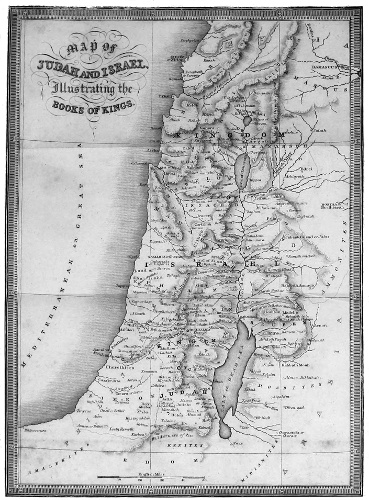
MAP OF
JUDAH AND ISRAEL.
Illustrating the
BOOKS OF KINGS.
565Kings, Books of. The first book of Kings
commences with an account of the death of
David, and contains a period of a hundred and
twenty-six years, to the death of Jehoshaphat;
and the second book of Kings continues the
history of the kings of Israel and Judah
through a period of three hundred years, to the
destruction of the city and temple of Jerusalem
by Nebuchadnezzar. These two books
formed only one in the Hebrew canon, and
they were probably compiled by Ezra from the
records which were regularly kept, both in
Jerusalem and Samaria, of all public transactions.
These records appear to have been
made by the contemporary prophets, and frequently
derived their names from the kings
whose history they contained. They are mentioned
in many parts of Scripture; thus 1 Kings
xi, 41, we read of the book of the Acts of Solomon,
which is supposed to have been written
by Nathan, Ahijah, and Iddo, 2 Chron. ix, 29.
We elsewhere read that Shemaiah the prophet,
and Iddo the seer, wrote the Acts of Rehoboam,
2 Chron. xii, 15; that Jehu wrote the
Acts of Jehoshaphat, 2 Chron. xx, 34; and Isaiah
those of Uzziah and Hezekiah, 2 Chron. xxvi,
22; xxxii, 32. We may therefore conclude,
that from these public records, and other authentic
documents, were composed the two
books of Kings; and the uniformity of their
style favours the opinion of their being put
into their present shape by the same person.
KISHON. That ancient river, the river
Kishon,” falls into the bay of Acre, and has
its source in the hills to the east of the plain
of Esdraelon, which it intersects. Being
enlarged by several small streams, it passes
between Mount Carmel and the hills to the
north, and then falls into the sea at this point.
In the condition we saw it, says Maundrell,
its waters were low and inconsiderable; but in
passing along the side of the plain, we discerned
the tracts of many lesser torrents, falling
down into it from the mountains, which must
needs make it swell exceedingly upon sudden
rains, as doubtless it actually did at the destruction
of Sisera’s host.
KISS, a mode of salutation, and token of
respect, which has been practised in all nations.
It was also in ordinary use among the Jews;
hence Judas in this way saluted his Master.
But there was also the kiss of homage, as one
of the ceremonies performed at the inauguration
of the kings of Israel. The Jews called
it the kiss of majesty. Psalm ii, 12, seems to
be an allusion to this. St. Paul speaks frequently
of the kiss of peace, which was in use
among believers, and was given by them to
one another as a token of charity and union,
publicly in their religious assemblies, Heb. xiii,
24. Kissing the feet is in eastern countries
expressive of exuberant gratitude or reverence.
KITE, איה, Lev. xi, 14; Deut. xiv, 13; Job
xxviii, 7. Bochart supposes this to be the bird
which the Arabians call the ja-jao, from its
note; and which the ancients named æsalon,
the merlin,” a bird celebrated for its sharp-sightedness.
This faculty is referred to in Job
xxviii, 7, where the word is rendered vulture.”
As a noun masculine plural, איים, in
Isaiah xiii, 22; xxxiv, 14; and Jer. 1, 39, Bochart
says that jackals are intended; but, by
the several contexts, particularly the last, it
may well mean a kind of unclean bird, and so
be the same with that mentioned above.
KOHATH, the second son of Levi, and
father of Amram, Izhar, Hebron, and Uzziel,
Gen. xlvi, 11; Exod. vi, 18. Kohath’s family
was appointed to carry the ark and sacred
vessels of the tabernacle, while the Israelites
marched through the wilderness, Num. iv, &c.
KORAH was the son of Izhar, of the race
of Levi, and father of Asher, Elkanah, and
Aliasaph, and head of the Korites, a celebrated
family among the Levites. Korah, being dissatisfied
with the rank he held among the sons
of Levi, and envying the authority of Moses
and Aaron, formed a party against them, in
which he engaged Dathan, Abiram, and On,
with two hundred and fifty of the principal
Levites, Num. xvi, 1–3, &c. Korah, at the
head of the rebels, went to Moses and Aaron,
and complained that they alone arrogated to
themselves all the authority over the people
of the Lord. Moses falling with his face on
the earth, answered them as follows: Tomorrow,
in the morning, the Lord will discover
who are his. Let every one of you take, therefore,
his censer, and to-morrow he shall put
incense into it, and offer it before the Lord;
and he shall be acknowledged priest whom the
Lord shall choose and approve.” The next
day, Korah, with two hundred and fifty of his
faction, presenting themselves with their censers
before the Lord, the glory of the Lord
appeared visibly over the tabernacle, and a
voice was heard to say, Separate yourselves
from among this congregation, that I may consume
them in a moment.” Upon this, Moses
and Aaron, falling with their faces to the
ground, said, O God, the God of the spirits
of all flesh, shall one man sin, and wilt thou
be wroth with all the congregation?” And the
Lord said unto Moses, Command all the people
to depart from about the tents of Korah,
Dathan, and Abiram.” When, therefore, the
people were retired, Moses said, If these men
die the common death of all men, then the
Lord hath not sent me; but if the earth open
and swallow them up quick, ye shall know
that they have blasphemed the Lord.” As soon
as he had spoken, the earth opened from under
their feet, and swallowed them up with what
belonged to them. There was one thing which
added to this surprising wonder, and which
was, that when Korah was thus swallowed up
in the earth, his sons were preserved from his
misfortunes. We know not the exact year
in which the death of Korah and his companions
happened. The sons of Korah continued
as before to serve in the tabernacle of
the Lord. David appointed them their office
in the temple, to guard the doors, and sing the
praises of God. To them are ascribed several
psalms, which are designated by the name of
Korah; as the forty-second, forty-fourth to
the forty-ninth, eighty-fourth to the eighty-seventh;
in all, eleven psalms.
566LABAN, the son of Bethuel, grandson of
Nahor, brother to Rebekah, and father of
Rachel and Leah, Gen. xxviii, 2, &c. Of this
man, the first thing we hear is his entertainment
of Abraham’s servant when he came on
his errand to Rebekah. Hospitality was the
virtue of his age and country. In his case,
however, it seems to have been no little stimulated
by the sight of “the ear ring and
the bracelets on his sister’s hands,” which the
servant had already given her, Gen. xxiv, 30;
so he speedily made room for the camels. He
next is presented to us as beguiling that sister’s
son, who had sought a shelter in his
house, and whose circumstances placed him at
his mercy, of fourteen years’ service, when he
had covenanted with him for seven only; endeavouring
to retain his labour when he would
not pay him his labour’s worth, himself devouring
the portion which he should have given to
his daughters, counting them but as strangers,
Gen. xxxi, 15. Compelled, at length, to pay
Jacob wages, he changes them ten times,
and, in the spirit of a crafty, griping worldling,
makes him account for whatever of the
flock was torn of beasts or stolen, whether by
day or night. When Jacob flies from this
iniquitous service with his family and cattle,
Laban still pursues and persecutes him, intending,
if his intentions had not been overruled
by a mightier hand, to send him away empty,
even after he had been making, for so long a
period, so usurious a profit of him.
LACHISH, a city of Palestine, Joshua x,
23; xv, 39. Sennacherib besieged Lachish,
but did not make himself master of it. From
thence it was that he sent Rabshakeh against
Jerusalem, 2 Kings xviii, 17; xix, 8; 2 Chron.
xxxii, 9.
LAMAISM, the religion of the people of
Thibet. The Delai Lama, Grand Lama,”
is at once the high priest, and the visible object
of adoration, to this nation, to the hordes
of wandering Tartars, and to the prodigious
population of China. He resides at Patoli, a
vast palace on a mountain near the banks of
the Burampooter, about seven miles from Lahasse.
The foot of the mountain is surrounded
by twenty thousand lamas, or priests, in attendance
on their sovereign pontiff, who is
considered as the viceregent of the Deity on
earth; and the remote Tartars are said to
regard him absolutely as the Deity himself,
and call him God, the everlasting Father of
heaven. They believe him to be immortal,
and endowed with all knowledge and virtue.
Every year they come up from different parts
to worship, and make rich offerings at his
shrine. Even the emperor of China, who is a
Mantchou Tartar, does not fail in acknowledgments
to him in his religious capacity;
and entertains in the palace of Pekin an inferior
lama, deputed as his nuncio from Thibet.
The grand lama is only to be seen in a secret
place of his palace, amidst a great number of
lamps, sitting cross-legged on a cushion, and
decked all over with gold and precious stones;
while, at a distance, the people prostrate themselves
before him, it being not lawful for any
so much as to kiss his feet. He returns not
the least sign of respect, nor ever speaks, even
to the greatest princes; but only lays his hand
upon their heads, and they are fully persuaded
that they thereby receive a full forgiveness of
their sins. The Sunniasses, or Indian pilgrims,
often visit Thibet as a holy place; and
the lama entertains a body of two or three
hundred in his pay. Beside his religious
influence and authority, he is possessed of unlimited
power throughout his dominions, which
are very extensive. The inferior lamas, who
form the most numerous as well as the most
powerful body in the state, have the priesthood
entirely in their hands, and, beside, fill up
many monastic orders, which are held in great
veneration among them. The whole country,
like Italy, abounds with priests; and they
entirely subsist on the rich presents sent them
from the utmost extent of Tartary, from the
empire of the great mogul, and from almost
all parts of the Indies. The opinion of the
orthodox among the Thibetians is, that when
the grand lama seems to die, either of old age
or infirmities, his soul, in fact, only quits a
crazy habitation to enter another, younger and
better; and is discovered again in the body of
some child, by certain tokens, known only to
the lamas, or priests, in which order he always
appears. Almost all the nations of the east,
except the Mohammedans, believe the metempsychosis,
or transmigration of the soul, as the
most important article of their faith; especially
the inhabitants of Thibet and Ava, the
Peguans, the Siamese, the greater part of the
Chinese and Japanese, and the Monguls and
Kalmucks. According to their doctrine, the soul
no sooner leaves her old habitation than she
enters a new one. The delai lama, therefore,
or rather the god Foe or Fuh, residing in the
delai lama, passes to his successor; and he
being a god, to whom all things are known,
the grand lama is therefore acquainted with
every thing which happened during his residence
in his former bodies. This religion, which
was early adopted in a large part of the globe,
is said to have been of three thousand years’
standing; and neither time, nor the influence
of men, has had the power of shaking the
authority of the grand lama. This theocracy,
which extends as fully to temporal as to spiritual
concerns, is professed all over Thibet
and Mongalia; is almost universal in Greater
and Less Bucharia, and several provinces of
Tartary; has some followers in the kingdom
of Cashmere, in India; and is the predominant
religion of China.
It has been observed that the religion of
Thibet is the counterpart of the Roman Catholic,
since the inhabitants of that country
use holy water, and a singing service. They
also offer alms, prayers, and sacrifices for the
dead. They have a vast number of convents
filled with monks and friars, amounting to
thirty thousand, and confessors chosen by their
superiors. They use beads, wear the mitre, like
the bishops; and their delai lama is nearly the
same among them as the sovereign pontiff was
formerly, in the zenith of his power, among
567the Roman Catholics. So complete is the
resemblance, that, when one of the first Romish
missionaries penetrated Thibet, he came to the
conclusion that the devil had set up there an
imitation of the rites of the Catholic church,
in order the more effectually to destroy the
souls of men. Captain Turner, speaking of
the religion of Thibet, says, It seems to be
the schismatical offspring of the religion of the
Hindoos, deriving its origin from one of the
followers of that faith, a disciple of Bouddhu,
who first broached the doctrine which now
prevails over the wide extent of Tartary. It
is reported to have received its earliest admission
in that part of Tibet, or Thibet, bordering
upon India, which from hence became the
seat of the sovereign lamas, to have traversed
over Mantchieux Tartary, and to have been
ultimately disseminated over China and Japan.
Though it differs from the Hindoo in many of
its outward forms, yet it still bears a very close
affinity with the religion of Brumha in many
important particulars. The principal idol in
the temples of Tibet, or Thibet, is Muha-Moonee,
the Booddhu of Bengal, who is worshipped
under these and various other epithets,
throughout the great extent of Tartary, and
among all nations to the eastward of the
Brumhapootru. In the wide-extended space
over which this faith prevails, the same object
of veneration is acknowledged under numerous
titles: among others, he is styled Godumu, or
Gotumu, in Assam and Ava, Shumunu in Siam,
Amida Buth in Japan, Fohi in China,” &c.
LAMBETH ARTICLES. See Predestination.
LAMECH, a descendant of Cain, the son
of Mathusael, and father of Jabal, Jubal, Tubal-Cain,
and Naamah, Gen. iv, 18–20, &c.
He stands branded as the father of polygamy,
the first who dared to violate the sacred command,
Gen. ii, 24; giving way to his unbridled
passion, and thus overleaping the divine mound
raised by the wisdom of our great Creator;
which restraint is enforced by the laws of
nature herself, who peoples the earth with an
equal number of males and females, and thereby
teaches foolish man that polygamy is incompatible
with her wise regulations. He married
Adah and Zillah: the former was the mother
of Jabal and Jubal, and the latter of Tubal-Cain
and Naamah, his sister.
2. Lamech, the son of Methuselah, and
father of Noah. He lived a hundred fourscore
and two years before the birth of Noah, Gen.
v, 25, 31; after which he lived five hundred
and ninety-five years longer: thus the whole
term of his life was seven hundred and seventy-seven
years.
LAMENTATIONS OF JEREMIAH.
This book was formerly annexed to his prophecies,
though it now forms a separate book.
Josephus, and several other learned men, have
referred them to the death of Josiah; but the
more common opinion is, that they were applicable
only to some period subsequent to the
destruction of Jerusalem by Nebuchadnezzar.
But though it be allowed that the Lamentations
were primarily intended as a pathetic
description of present calamities, yet while
Jeremiah mourns the desolation of Judah and
Jerusalem during the Babylonian captivity, he
may be considered as prophetically painting
the still greater miseries they were to suffer at
some future time: this seems plainly indicated
by his referring to the time when the punishmentpunishment
of their iniquity shall be accomplished,
and they shall no more be carried into captivity,
Lam. iv, 22. The Lamentations are
written in metre, and consist of a number of
plaintive effusions, composed after the manner
of funeral dirges. They seem to have been
originally written by their author as they
arose in his mind, and to have been afterward
joined together as one poem. There is no
regular arrangement of the subject, or disposition
of the parts: the same thought is frequently
repeated with different imagery, or
expressed in different words. There is, however,
no wild incoherency, or abrupt transition;
the whole appears to have been dictated by the
feelings of real grief. Tenderness and sorrow
form the general character of these elegies;
and an attentive reader will find great beauty
in many of the images, and great energy in
some of the expressions. This book of Lamentations
is divided into five chapters; in
the first, second, and fourth, the prophet speaks
in his own person, or by an elegant and interesting
personification introduces the city of
Jerusalem as lamenting her calamities, and
confessing her sins; in the third chapter a
single Jew, speaking in the name of a chorus
of his countrymen, like the Coryphæus of the
Greeks, describes the punishment inflicted
upon him by God, but still acknowledges his
mercy, and expresses some hope of deliverance;
and in the fifth chapter, the whole
nation of the Jews pour forth their united
complaints and supplications to almighty God.
Every chapter, with the exception of the
third, contains twenty-two verses, corresponding
in number with the letters of the Hebrew
alphabet; and each verse commences with a
different letter, the first with aleph, the second
with beth, the third with gimel, &c. The
third chapter, consisting of sixty-six verses,
has three verses together beginning with the
same letter, the following three with the next
letter, &c. This peculiarity may be seen in
Psalm cxix; the first eight verses in which
commence with aleph, the next eight with
beth, &c, till the whole alphabet has been
consecutively taken. This mode of versification,
which has some distant resemblance to
the modern acrostic style, seems to have been
employed by the Hebrews in some of their
elegiac poetry, perhaps to assist the memory.
LAMP, λαμπας. There is frequent mention
of lamps in Scripture, and the word is often
used figuratively. The houses in the east
were, from the remotest antiquity, lighted with
lamps; and hence it is so common in Scripture
to call every thing which enlightens the
body or mind, which guides or refreshes, by
the name of a lamp. These lamps were sustained
by a large candlestick set upon the
ground. The houses of Egypt, in modern
568times, are never without lights: they burn
lamps all the night long, and in every occupied
apartment. So requisite to the comfort
of a family is this custom reckoned, or so
imperious is the power which it exercises, that
the poorest people would rather retrench part
of their food than neglect it. As this custom
no doubt prevailed in Egypt and the adjacent
regions of Arabia and Palestine in former
times, it imparts a beauty and force to some
passages of Scripture which have been little
observed. Thus, in the language of Jeremiah,
to extinguish the light in an apartment is a
convertible phrase for total destruction; and
nothing can more properly and emphatically
represent the total destruction of a city than
the extinction of the lights: I will take from
them the light of a candle, and this whole
land shall be a desolation and an astonishment.”
Job describes the destruction of a
family among the Arabs, and the desolation of
their dwellings, in the very language of the
prophet: How oft is the candle of the wicked
put out, and how oft cometh their destruction
upon them!” Job xxi, 17. Bildad expresses
the same idea in the following beautiful passage:
Yea, the light of the wicked shall be
put out, and the spark of his fire shall not
shine. The light shall be dark in his tabernacle,
and his candle shall be put out with
him,” Job xviii, 5, 6. A burning lamp is, on
the other hand, the chosen symbol of prosperity,
a beautiful instance of which occurs in
the complaint of Job: O that I were as in
months past, as in the days when God preserved
me; when his candle shined upon my
head, and when by his light I walked through
darkness,” Job xxix, 2, 3. When the ten
tribes were taken from Rehoboam, and given
to his rival, Jehovah promised to reserve one
tribe, and assigns this reason: That David
my servant may have a light always before me
in Jerusalem,” 1 Kings xi, 36. In many parts
of the east, and in particular in the Indies,
instead of torches and flambeaux, they carry
a pot of oil in one hand, and a lamp full of
oily rags in the other.
LANGUAGE, the faculty of human speech,
concerning the origin of which there have
been entertained different opinions among
philosophers and learned men. The Mosaic
history, which gives us an account of the formation
and first occupations of man, represents
him as being immediately capable of conversing
with his Maker; of giving names to the
various tribes and classes of animals; and of
reasoning consecutively, and in perfectly
appropriate terms, concerning his own situation,
and the relation he stood in to the other
creatures. As in man’s first attempt at speech,
according to this account, there appear no
crudeness of conception, no barrenness of
ideas, and no inexpressive or unappropriate
terms, we must certainly infer, that God who
made and endued him with corporeal and
mental powers perfectly suited to his state
and condition in life, endued him, also, not
only with the faculty of speech, but with
speech or language itself; which latter was
as necessary to his comfort, and to the perfection
and end of his being, as any other
power or faculty which his Creator thought
proper to bestow upon him.
Among the antediluvians there was but one
language; and even now the indications that
the various languages of the earth have had
one common source are very convincing.
Whether this primitive language was the same
with any of the languages of which we have
still any remains, has been a subject of much
dispute. That the primitive language continued
at least till the dispersion of mankind,
consequent upon the building of Babel, there
seems little reason to doubt. When, by an
immediate interposition of divine power, the
language of men was confounded, we are not
informed to what extent this confusion of
tongues prevailed. Under the article Confusion of Tongues
some reasons are given to
show that the primitive language was not lost
at that event, but continued in the form of
the Hebrew.
There are, however, other opinions on the
oft disputed subject as to the primitive language.
The Armenians allege, that as the
ark rested in their country, Noah and his
children must have remained there a considerable
time, before the lower and marshy country
of Chaldea could be fit to receive them; and
it is therefore reasonable to suppose they left
their language there, which was probably the
very same that Adam spoke. Some have
fancied the Greek the most ancient tongue,
because of its extent and copiousness. The
Teutonic, or that dialect of it which is spoken
in the Lower Germany and Brabant, has
found a strenuous patron in Geropius Becanus,
who endeavours to derive even the Hebrew
itself from that tongue. The pretensions of
the Chinese to this honour have been allowed
by several Europeans. The patrons of this
opinion endeavour to support it, partly, by the
great antiquity of the Chinese, and their having
preserved themselves so many ages from
any considerable mixture or intercourse with
other nations. It is a notion advanced by
Dr. Allix, and maintained by Mr. Whiston,
with his usual tenacity and fervour, that the
Chinese are the posterity of Noah, by his
children born after the flood; and that Fohi,
the first king of China, was Noah. As for
those which are called the oriental languages,
they have each their partisans. The generality
of eastern writers allow the preference
to the Syriac, except the Jews, who assert the
antiquity of the Hebrew with the greatest
warmth; and with them several Christian
writers agree, particularly Chrysostom, Austin,
Origen, and Jerome, among the ancients; and
among the moderns, Bochart, Heidegger, Selden,
and Buxtorf. The Sanscrit has also put
in its claims; and some have thought that the
Pali bears the character of the highest antiquity.
All these are however useless speculations.
The only point worth contending
for is, that language was conveyed at once to
the first pair in sufficient degree for intellectual
intercourse with each other, and devotional
569intercourse with God; and that man
was not left, as infidel writers have been
pleased to say, to form it for himself out of
rude and instinctive sounds. On this subject
the remarks of Delaney are conclusive: “That
God made man a sociable creature, does not
need to be proved; and that when he made him
such, he withheld nothing from him that was
in any wise necessary for his well being in
society, is a clear consequence from the wisdom
and goodness of God; and if he withheld
nothing any way necessary to his well being,
much less would he withhold from him that
which is the instrument of the greatest happiness
a reasonable creature is capable of in this
world. If the Lord God made ‘Adam a help
meet for him,’ because ‘it was not good for
man to be alone,’ can we imagine he would
leave him unfurnished with the means to make
that help useful and delightful to him? If it
was not good for him to be alone, certainly
neither was it good for him to have a companion
to whom he could not readily communicate
his thoughts, with whom he could
neither ease his anxieties, nor divide or double
his joys, by a kind, a friendly, a reasonable, a
religious conversation; and how he could do
this in any degree of perfection, or to any
height of rational happiness, is utterly inconceivable
without the use of speech.
“If it be said, that the human organs being
admirably fitted for the formation of articulate
sounds, these, with the help of reason, might
in time lead men to the use of language. I
own it imaginable that they might: but still,
till that end were attained in perfection,
which possibly might not be in a series of
many generations, it must be owned that
brutes were better dealt by, and could better
attain all the ends of their creation. And if
that be absurd to be supposed, certainly the
other is not less absurd to be believed. Nay,
I think it justly doubtful, whether, without
inspiration from God in this point, man could
ever attain the true ends of his being; at
least, if we may judge in this case, by the
example of those nations who, being destitute
of the advantages of a perfect language, are,
in all probability, from the misfortune of that
sole defect, sunk into the lowest condition of
barbarism and brutality. And as to the perfection
in which the human organs are framed
and fitted for the formation of articulate
sounds, this is clearly an argument for believing
that God immediately blessed man with
the use of speech, and gave him wherewithal
to exert those organs to their proper ends;
for this is surely as credible, as that when he
gave him an appetite for food, and proper
organs to eat and to digest it, he did not leave
him to seek painfully for a necessary supply,
(till his offence had made such a search his
curse and punishment,) but placed him at once
in the midst of abundant plenty. The consequence
from all which is, that the perfection
and felicity of man, and the wisdom and goodness
of God, necessarily required that Adam
should be supernaturally endowed with the
knowledge and use of language. And therefore,
as certain as it can be, that man was
made perfect and happy, and that God is wise
and good; so certain is it, that, when Adam
and Eve were formed, they were immediately
enabled by God to converse and communicate
their thoughts, in all the perfection of language
necessary to all the ends of their creation.
And as this was the conduct most
becoming the goodness of God, so we are
assured from Moses, that it was that to which
his infinite wisdom determined him; for we
find that Adam gave names to all the creatures
before Eve was formed; and, consequently,
before necessity taught him the use
of speech.”
It is true that many languages bear marks
of being raised to their improved state from
rude and imperfect elements, and that all are
capable of being enriched and rendered more
exact; and it is this which has given some
colour to those theories which trace all language
itself up from elemental sounds, as the
necessities of men, their increasing knowledge,
and their imagination led to the invention of
new words and combinations. All this is,
however, consistent with the Scripture fact,
that language was taught at first by God to
our first parents. The dispersion of mankind
carried many tribes to great distances, and
wars still farther scattered them, and often
into wide regions where they were farther dispersed
to live chiefly by the chase, by fishing,
or at best but an imperfect agriculture. In
various degrees we know they lost useful arts;
and for the same reasons they would lose much
of their original language; those terms being
chiefly retained which their immediate necessities,
and the common affairs of a gross life,
kept in use. But when civilization again
overtook these portions of mankind, and kingdoms
and empires were founded among them,
or they became integral parts of the old empires,
then their intercourse with each other
becoming more rapid, and artificial, and intellectual,
their language was put into a new
process of improvement, and to the eye of the
critic would exhibit the various stages of advancement;
and in many it would be pushed
beyond that perfection which it had when it
first began to deteriorate. See Letters.
LANTERN. The word occurs, John
xviii, 3: μετὰ φανῶν καὶ λαμπάδων: with torches
and lanterns:” but both terms appear to signify
torches; the former of a ruder kind than the
latter, being formed of split laths bound into
bundles, throwing around a strong glare of
light. They came thus furnished to apprehend
our Lord, lest he should escape through
the darkness of the night.
LAODICEA. There were several cities
of this name, but the Scripture speaks only of
that in Phrygia, upon the river Lycus, near
Colosse. Its ancient name was Diospolis: it
was afterward called Rhoas. Lastly, Antiochus,
the son of Stratonice, rebuilt it, and
called it Laodicea, from the name of his wife
Laodice. It became the mother church of
sixteen bishoprics. Its three theatres, and the
immense circus, which was capable of containing
570upward of thirty thousand spectators, the
spacious remains of which (with other ruins
buried under ruins) are yet to be seen, give proof
of the greatness of its ancient wealth and population;
and indicate too strongly that in that
city where Christians were rebuked, without
exception, for their lukewarmness, there were
multitudes who were lovers of pleasure more
than lovers of God. The amphitheatre was built
after the Apocalypse was written, and the warning
of the Spirit had been given to the church of
the Laodiceans to be zealous and repent. There
are no sights of grandeur, nor scenes of temptation
around it now. Its own tragedy may
be briefly told. It was lukewarm, and neither
cold nor hot; and therefore it was loathsome
in the sight of God. And it has been blotted
from the world. It is now as desolate as its
inhabitants were destitute of the fear and love
of God. It is, as described in his Travels by
Dr. Smith, utterly desolated, and without
any inhabitant except wolves, and jackals, and
foxes.” It can boast of no human inhabitants,
except occasionally when wandering Turcomans
pitch their tents in its spacious amphitheatre.
The finest sculptured fragments are
to be seen at a considerable depth, in excavations
which have been made among the
ruins. And Colonel Lake observes, There
are few ancient cities more likely than Laodicea
to preserve many curious remains of
antiquity beneath the surface of the soil. Its
opulence, and the earthquakes to which it was
subject, render it probable that valuable works
of art were often there buried beneath the
ruins of the public and private edifices.”
LAPWING, דוכיפת, Levit. xi, 19; Deut.
xiv, 18. The bird intended by the Hebrew
name in these places is undoubtedly the hoopoe;
a very beautiful, but most unclean and filthy,
species of birds. The Septuagint renders it
ἔποπα; and the Vulgate, upupa; which is the
same with the Arabian interpreters. The
Egyptian name of the bird is kukuphah; and
the Syrian, kikuphah; which approach the
Hebrew dukiphath. It may have its name
from the noise or cry it makes, which is very
remarkable, and may be heard a great way.
LATITUDINARIANS, a term applied to
those divines who, in the seventeenth century,
attempted to bring Episcopalians, Presbyterians,
and Independents, into one communion,
by compromising the differences between
them. The chief leaders of this party were
the great Chillingworth and John Hales; to
whom may be added More, Cudworth, Gale,
Tillotson, and Whitchcot. They were zealously
attached to the church of England, but
did not look upon episcopacy as indispensable
to the constitution of the Christian church.
Hence they maintained that those who adopted
other forms of government and worship, were
not on that account to be excluded from the
communion, or to forfeit the title of brethren.
They reduced the fundamental doctrines of
Christianity to a few points. By this way of
proceeding, they endeavoured to show that
neither the Episcopalians, who, generally
speaking, were then Arminians, nor the Presbyterians
and Independents, who as generally
adopted the doctrines of Calvin, had any reason
to oppose each other with such animosity
and bitterness; since the subjects of their
debates were matters non-essential to salvation,
and might be variously explained and
understood without prejudice to their eternal
interests. This plan failing, through the
violence of the bishops on one hand, (though
sanctioned by the Lord Chancellor Clarendon,)
and by the jealousy of the more rigid on the
other, the name Latitudinarian became a term
of reproach, as implying an indifferency to all
religions, and has been generally so used ever
since.
LAVER. Between the altar and the tabernacle,
a little to the south, stood a circular
laver, which, together with its base, was made
of the brazen ornaments which the women had
presented for the use of the tabernacle, and
was thence called כור נחשת, Exodus xxx, 18;
xl, 7. The priests, when about to perform their
duties, washed their hands in this laver.
LAW, a rule of action; a precept or command,
coming from a superior authority, which
an inferior is bound to obey. The manner in
which God governs rational creatures is by a
law, as the rule of their obedience to him, and
this is what we call God’s moral government
of the world. The term, however, is used in
Scripture with considerable latitude of meaning;
and to ascertain its precise import in any
particular place, it is necessary to regard the
scope and connection of the passage in which
it occurs. Thus, for instance, sometimes it
denotes the whole revealed will of God as
communicated to us in his word. In this
sense it is generally used in the book of
Psalms, i, 2; xix, 7; cxix; Isaiah viii, 20;
xlii, 21. Sometimes it is taken for the Mosaical
institution distinguished from the Gospel,
John i, 17; Matt. xi, 13; xii, 5; Acts
xxv, 8. Hence we frequently read of the law
of Moses as expressive of the whole religion
of the Jews, Heb. ix, 19; x, 28. Sometimes,
in a more restricted sense, for the ritual or
ceremonial observances of the Jewish religion.
In this sense the Apostle speaks of the law
of commandments contained in ordinances,”
Eph. ii, 15; Heb. x, 1; and which, being
only a shadow of good things to come,”
Christ Jesus abolished by his death, and so in
effect destroyed the ancient distinction between
Jew and Gentile, Gal. iii, 17. Very frequently
it is used to signify the decalogue, or ten precepts
which were delivered to the Israelites
from Mount Sinai. It is in this acceptation
of the term that the Lord Jesus declares he
came not to destroy the law, but to fulfil it,”
Matt. v, 17; and he explains its import as
requiring perfect love to God and man, Luke
x, 27. It is in reference to this view that St.
Paul affirms, By the deeds of the law shall
no flesh living be justified; for by the law is
the knowledge of sin,” Rom. iii, 20. The language
of this law is, The soul that sinneth
it shall die,” and Cursed is every one that
continueth not in all things that are written,”
or required, in the book of the law, to do
571them,” Gal. iii, 10. To deliver man from this
penalty, Christ hath redeemed us from the
curse of the law, being himself made a curse
for us,” Gal. iii, 13. The law, in this sense,
was not given that men should obtain righteousness
or justification by it, but to convince
them of sin, to show them their need of a
Saviour, to shut them up, as it were, from all
hopes of salvation from that source, and to
recommend the Gospel of divine grace to their
acceptance, Gal. iii, 19–25. Again, the law
often denotes the rule of good and evil, or of
right and wrong, revealed by the Creator and
inscribed on man’s conscience, even at his
creation, and consequently binding upon him
by divine authority; and in this respect it is in
substance the same with the decalogue. That
such a law was connate with, and, as it were,
implanted in, man, appears from its traces,
which, like the ruins of some noble building,
are still extant in every man. It is from those
common notions, handed down by tradition,
though often imperfect and perverted, that the
Heathens themselves distinguished right from
wrong, by which they were a law unto themselves,
showing the work of the law written
in their hearts, their conscience bearing witness,”
Rom. ii, 12–15, although they had no
express revelation.
The term law, is, however, eminently given
to the Mosaic law; on the principles and spirit
of which, a few general remarks may be offered.
The right consideration of this divine institute,
says Dr. Graves, will surround it with a glory
of truth and holiness, not only worthy of its
claims, but which has continued to be the light
of the world on theological and moral subjects,
and often on great political principles, to this
day. If we examine the Jewish law, to discover
the principle on which the whole system depends,
the primary truth, to inculcate and
illustrate which is its leading object, we find
it to be that great basis of all religion, both
natural and revealed, the self-existence, essential
unity, perfections, and providence of the
supreme Jehovah, the Creator of heaven and
earth. The first line of the Mosaic writings
inculcates this great truth: In the beginning
God created the heaven and the earth.” When
the lawgiver begins to recapitulate the statutes
and judgments he had enjoined to his nation,
it is with this declaration: Hear, O Israel, the
Lord our God is one Lord,” Deut. vi, 4; or,
as it might be more closely expressed, Jehovah
our Elohim, or God, is one Jehovah. And at
the commencement of that sublime hymn, delivered
by Moses immediately before his death,
in which this illustrious prophet sums up the
doctrines he had taught, the wonders by which
they had been confirmed, and the denunciations
by which they were enforced, he declares
this great tenet with the sublimity of eastern
poetry, but at the same time with the precision
of philosophic truth: Give ear,” says he,
O ye heavens, and I will speak: and hear,
O earth, the words of my mouth. My doctrine
shall drop rain: my speech shall distil as
the dew, as the small rain upon the tender
herb, and as the showers upon the grass,”
Deut. xxxii, 1, &c. What, is that doctrine so
awful, that the whole universe is thus invoked
to attend to it? so salutary as to be compared
with the principle whose operation diffuses
beauty and fertility over the vegetable world?
Hear the answer: Because I will publish the
name of Jehovah; ascribe ye greatness unto
our God. He is the rock, his work is perfect:
a God of truth, and without iniquity, just and
right is he.”
This, then, is one great leading doctrine of
the Jewish code. But the manner in which
this doctrine is taught displays such wise
accommodation to the capacity and character
of the nation to whom it is addressed, as deserves
to be carefully remarked. That character
by which the supreme Being is most clearly
distinguished from every other, however exalted;
that character from which the acutest
reasoners have endeavoured demonstratively
to deduce, as from their source, all the divine
attributes, is self-existence. Is it not then
highly remarkable, that it is under this character
the Divinity is described on his first manifestation
to the Jewish lawgiver? The Deity
at first reveals himself unto him as the God of
Abraham, of Isaac, and of Jacob; and therefore
the peculiar national and guardian God of
the Jewish race. Moses, conscious of the
degeneracy of the Israelites, their ignorance
of, or their inattention to, the true God, and
the difficulty and danger of any attempt to
recall them to his exclusive worship, and to
withdraw them from Egypt, seems to decline
the task; but when absolutely commanded to
undertake it, he said unto God, Behold, when
I come unto the children of Israel, and shall
say unto them, The God of your fathers hath
sent me unto you; and they shall say to me,
What is his name? what shall I say unto
them? And God said unto Moses, I am that
I am: and he said, Thus shalt thou say unto
the children of Israel, I Am hath sent me unto
you,” Exod. iii, 13, 14. Here we observe, according
to the constant method of the divine
wisdom, when it condescends to the prejudices
of men, how in the very instance of indulgence
it corrects their superstition. The religion
of names arose from an idolatrous polytheism;
and the name given here directly
opposes this error, and in the ignorance of
that dark and corrupted period establishes that
great truth, to which the most enlightened
philosophy can add no new lustre, and on which
all the most refined speculations on the divine
nature ultimately rest, the self-existence, and,
by consequence, the eternity and immutability,
of the one great Jehovah.
But though the self-existence of the Deity
was a fact too abstract to require its being
frequently inculcated, his essential unity was
a practical principle, the sure foundation on
which to erect the structure of true religion,
and form a barrier against the encroachments
of idolatry: for this commenced not so frequently
in denying the existence, or even the
supremacy, of the one true God, as in associating
with him for objects of adoration inferior
intermediate beings, who were supposed to be
572more directly employed in the administration
of human affairs. To confute and resist this
false principle was, therefore, one great object
of the Jewish scheme. Hence the unity of
God is inculcated with perpetual solicitude;
it stands at the head of the system of moral
law promulgated to the Jews from Sinai by
the divine voice, heard by the assembled nation,
and issuing from the divine glory, with
every circumstance which could impress the
deepest awe upon even the dullest minds: I
am the Lord thy God, which have brought
thee out of the land of Egypt, out of the house
of bondage; thou shalt have no other gods
beside me,” Exod. xx, 2, 3. And in the recapitulation
of the divine laws in Deuteronomy,
it is repeatedly enforced with the most solemn
earnestness: Hear, O Israel, The Lord our
God is one Lord,” Deut. vi, 4. And again:
Unto thee it was showed, that thou mightest
know that the Lord he is God; there is none
else beside him. Know, therefore, this day,
and consider it in thine heart, that the Lord
he is God in heaven above, and in the earth
beneath: there is none else,” Deut. iv, 35, 39.
This self-existent, supreme and only God is
moreover described as possessed of every perfection
which can be ascribed to the Divinity:
Ye shall be holy,” says the Lord to the people
of the Jews; for I the Lord your God
am holy,” Lev. xix, 2. Ascribe ye,” says
the legislator, greatness unto our God; he
is the rock; his work is perfect; a God of
truth, and without iniquity, just and right is
he,” Deut. xxxii, 4. And in the hymn of
thanksgiving on the miraculous escape of the
Israelites at the Red Sea, this is its burden:
Who is like unto thee, O Lord, among the
gods? who is like unto thee, glorious in holiness,
fearful in praises, doing wonders?” Exod.
xv, 11. And when the Lord delivered to
Moses the two tables of the moral law, he is
described as descending in the cloud, and proclaiming
the name of the Lord: And the
Lord passed by before him, and proclaimed,
The Lord, the Lord God, merciful and gracious,
long-suffering, and abundant in goodness,
keeping mercy for thousands, forgiving
iniquity, transgression, and sin, and that will by
no means clear the guilty,” Exod. xxxiv, 6, 7.
But to teach the self-existence, the unity,
the wisdom, and the power of the Deity, nay,
even his moral perfections of mercy, justice,
and truth, would have been insufficient to arrest
the attention, and command the obedience of
a nation, the majority of which looked no
farther than mere present objects, and at that
early period cherished scarcely any hopes higher
than those of a temporal kind,--if, in addition
to all this, care had not been taken to represent
the providence of God as not only directing
the government of the universe by general
laws, but also perpetually superintending the
conduct and determining the fortune of every
nation, of every family, nay, of every individual.
It was the disbelief or the neglect of
this great truth which gave spirit and energy,
plausibility and attraction, to the whole system
of idolatry. While men believed that the
supreme God and Lord of all was too exalted
in his dignity, too remote from this sublunary
scene, to regard its vicissitudes with an attentive
eye, and too constantly engaged in the
contemplation of his own perfections, and the
enjoyment of his own independent and all-perfect
happiness, to interfere in the regulation
of human affairs, they regarded with indifference
that supreme Divinity who seemed to take
no concern in their conduct, and not to interfere
as to their happiness. However exalted
and perfect such a Being might appear to abstract
speculation, he was to the generality of
mankind as if he did not exist; as their happiness
or misery were not supposed to be influenced
by his power, they referred not their
conduct to his direction. If he delegated to
inferior beings the regulation of this inferior
world; if all its concerns were conducted by
their immediate agency, and all its blessings
or calamities distributed by their immediate
determination; it seemed rational, and even
necessary, to supplicate their favour and submit
to their authority; and neither unwise nor
unsafe to neglect that Being, who, though
all-perfect and supreme, would, on this supposition
appear, with respect to mankind, altogether
inoperative. In truth, this fact of the
perpetual providence of God extending even
to the minutest events, is inseparably connected
with every motive which is offered to sway
the conduct of the Jews, and forcibly inculcated
by every event of their history. This
had been manifested in the appointment of the
land of Canaan for the future settlement of
the chosen people on the first covenant which
God entered into with the Patriarch Abraham;
in the prophecy, that for four hundred years
they should be afflicted in Egypt, and afterward
be thence delivered; in the increase of
their nation, under circumstances of extreme
oppression, and their supernatural deliverance
from that oppression. The same providence
was displayed in the destruction of the Egyptians
in the Red Sea; the travels of the thousands
of Israel through the wilderness, sustained
by food from heaven; and in their
subsequent settlement in the promised land
by means entirely distinct from their own
strength. Reliance on the same providence
was the foundation of their civil government,
the spirit and the principle of their constitution.
On this only could they be commanded
to keep the sabbatic year without tilling their
land, or even gathering its spontaneous produce;
confiding in the promise, that God
would send his blessing on the sixth year, so
that it should bring forth fruit for three years,
Lev. xxv, 21. The same faith in Divine Providence
alone could prevail on them to leave
their properties and families exposed to the
attack of their surrounding enemies; while all
the males of the nation assembled at Jerusalem
to celebrate the three great festivals, enjoined
by divine command, with the assurance
that no man should desire their land when they
went up to appear before the Lord their God
thrice in the year, Exodus xxxiv, 24. And,
finally, it is most evident, that, contrary to all
573other lawgivers, the Jewish legislator renders
his civil institutions entirely subordinate to his
religious; and announces to his nation that
their temporal adversity or prosperity would
entirely depend, not on their observance of
their political regulations; not on their preserving
a military spirit, or acquiring commercial
wealth, or strengthening themselves by
powerful alliances; but on their continuing to
worship the one true God according to the religious
rites and ceremonies by him prescribed,
and preserving their piety and morals untainted
by the corruptions and vices which idolatry
tended to introduce.
Such was the theology of the Jewish religion,
at a period when the whole world was
deeply infected with idolatry; when all knowledge
of the one true God, all reverence for his
sacred name, all reliance on his providence,
all obedience to his laws, were nearly banished
from the earth; when the severest chastisements
had been tried in vain; when no hope
of reformation appeared from the refinements
of civilization or the researches of philosophy;
for the most civilized and enlightened nations
adopted with the greatest eagerness, and disseminated
with the greatest activity, the absurdities,
impieties, and pollutions of idolatry.
Then was the Jewish law promulgated to a
nation, who, to mere human judgment, might
have appeared incapable of inventing or receiving
such a high degree of intellectual and
moral improvement; for they had been long
enslaved to the Egyptians, the authors and
supporters of the grossest idolatry; they had
been weighed down by the severest bondage,
perpetually harassed by the most incessant
manual labours; for the Egyptians made
their lives bitter with hard bondage, in mortar,
and in brick, and in all manner of service in
the field,” Exod. i, 14. At this time, and in
this nation, was the Mosaic law promulgated,
teaching the great principles of true religion,
the self-existence, the unity, the perfections,
and the providence of the one great Jehovah;
reprobating all false gods, all image worship,
all the absurdities and profanations of idolatry.
At this time, and in this nation, was a system
of government framed, which had for its basis
the reception of, and steady adherence to, this
system of true religion; and establishing many
regulations, which would be in the highest
degree irrational, and could never hope to be
received, except from a general and thorough
reliance on the superintendence of Divine Providence,
controlling the course of nature, and
directing every event, so as to proportion the
prosperity of the Hebrew people, according to
their obedience to that law which they had
received as divine.
It is an obvious, but it is not therefore a less
important remark, that to the Jewish religion
we owe that admirable summary of moral duty,
contained in the ten commandments. All fair
reasoners will admit that each of these must
be understood to condemn, not merely the extreme
crime which it expressly prohibits, but
every inferior offence of the same kind, and
every mode of conduct leading to such transgression;
and, on the contrary, to enjoin opposite
conduct, and the cultivation of opposite
dispositions. Thus, the command, Thou
shalt not kill,” condemns not merely the single
crime of deliberate murder, but every kind of
violence, and every indulgence of passion and
resentment, which tends either to excite such
violence, or to produce that malignant disposition
of mind, in which the guilt of murder
principally consists: and similarly of the rest.
In this extensive interpretation of the commandments,
we are warranted, not merely by
the deductions of reason, but by the letter of
the law itself. For the addition of the last,
Thou shalt not covet,” proves clearly that in
all, the dispositions of the heart, as much as
the immediate outward act, is the object of the
divine Legislator; and thus it forms a comment
on the meaning, as well as a guard for the
observance, of all the preceding commands.
Interpreted in this natural and rational latitude,
how comprehensive and important is this
summary of moral duty! It inculcates the adoration
of the one true God, who made heaven
and earth, the sea, and all that in them is;”
who must, therefore, be infinite in power, and
wisdom, and goodness; the object of exclusive
adoration; of gratitude for every blessing we
enjoy; of fear, for he is a jealous God; of
hope, for he is merciful. It prohibits every
species of idolatry; whether by associating
false gods with the true, or worshipping the
true by symbols and images. Commanding
not to take the name of God in vain, it enjoins
the observance of all outward respect for
the divine authority, as well as the cultivation
of inward sentiments and feelings suited to
this outward reverence; and it establishes the
obligation of oaths, and, by consequence, of
all compacts and deliberate promises; a principle,
without which the administration of laws
would be impracticable, and the bonds of society
must be dissolved. By commanding to
keep holy the Sabbath, as the memorial of the
creation, it establishes the necessity of public
worship, and of a stated and outward profession
of the truths of religion, as well as of the
cultivation of suitable feelings; and it enforces
this by a motive which is equally applicable to
all mankind, and which should have taught
the Jew that he ought to consider all nations
as equally creatures of that Jehovah whom he
himself adored; equally subject to his government,
and, if sincerely obedient, entitled to all
the privileges his favour could bestow. It is
also remarkable, that this commandment, requiring
that the rest of the Sabbath should
include the man-servant, and the maid-servant,
and the stranger that was within their gates,
nay, even their cattle, proved that the Creator
of the universe extended his attention to all
his creatures; that the humblest of mankind
were the objects of his paternal love; that no
accidental differences, which so often create
alienation among different nations, would
alienate any from the divine regard; and that
even the brute creation shared the benevolence
of their Creator, and ought to be treated by
men with gentleness and humanity.
574When we proceed to the second table, comprehending
more expressly our social duties,
we find all the most important principles on
which they depend clearly enforced. The
commandment which enjoins, Honour thy
father and mother,” sanctions the principles,
not merely of filial obedience, but of all those
duties which arise from our domestic relations;
and, while it requires not so much any one
specific act, as the general disposition which
should regulate our whole course of conduct
in this instance, it impresses the important
conviction, that the entire law proceeds from
a Legislator able to search and judge the heart
of man. The subsequent commands coincide
with the clear dictates of reason, and prohibit
crimes which human laws in general have prohibited
as plainly destructive of social happiness.
But it was of infinite importance to rest
the prohibitions, Thou shalt not kill,” Thou
shalt not commit adultery,” Thou shalt not
steal,” Thou shalt not bear false witness,”
not merely on the deductions of reason, but
also on the weight of a divine authority. How
often have false ideas of public good in some
places, depraved passions in others, and the
delusions of idolatry in still more, established
a law of reputation contrary to the dictates of
reason, and the real interests of society. In
one country we see theft allowed, if perpetrated
with address; in others, piracy and
rapine honoured, if conducted with intrepidity.
Sometimes we perceive adultery permitted, the
most unnatural crimes committed without remorse
or shame; nay, every species of impurity
enjoined and consecrated as a part of divine
worship. In others, we find revenge honoured
as spirit, and death inflicted at its impulse with
ferocious triumph. Again, we see every feeling
of nature outraged, and parents exposing
their helpless children to perish for deformity
of body or weakness of mind; or, what is still
more dreadful, from mercenary or political
views; and this inhuman practice familiarized
by custom, and authorized by law. And, to
close the horrid catalogue, we see false religions
leading their deluded votaries to heap
the altars of their idols with human victims;
the master butchers his slave, the conqueror
his captive; nay, dreadful to relate, the parent
sacrifices his children, and, while they shriek
amidst the tortures of the flames, or in the
agonies of death, he drowns their cries by the
clangour of cymbals and the yells of fanaticism.
Yet these abominations, separate or
combined, have disgraced ages and nations
which we are accustomed to admire and celebrate
as civilized and enlightened,--Babylon
and Egypt, Phenicia and Carthage, Greece
and Rome. Many of these crimes legislators
have enjoined, or philosophers defended. What,
indeed, could be hoped from legislators and
philosophers, when we recollect the institutions
of Lycurgus, especially as to purity of
manners, and the regulations of Plato on the
same subject, in his model of a perfect republic;
when we consider the sensuality of the
Epicureans, and immodesty of the Cynics;
when we find suicide applauded by the Stoics,
and the murderous combats of gladiators defended
by Cicero, and exhibited by Trajan?
Such variation and inconstancy in the rule
and practice of moral duty, as established by
the feeble or fluctuating authority of human
opinion, demonstrates the utility of a clear
divine interposition, to impress these important
prohibitions; and it is difficult for any
sagacity to calculate how far such an interposition
was necessary, and what effect it may
have produced by influencing human opinions
and regulating human conduct, when we
recollect that the Mosaic code was probably
the first written law ever delivered to any nation;
and that it must have been generally
known in those eastern countries, from which
the most ancient and celebrated legislators and
sages derived the models of their laws and the
principles of their philosophy.
But the Jewish religion promoted the interests
of moral virtue, not merely by the positive
injunctions of the decalogue; it also inculcated
clearly and authoritatively the two great
principles on which all piety and virtue depend,
and which our blessed Lord recognised
as the commandments on which hang the law
and the prophets,--the principles of love to
God and love to our neighbour. The love of
God is every where enjoined in the Mosaic
law, as the ruling disposition of the heart, from
which all obedience should spring, and in
which it ought to terminate. With what
solemnity does the Jewish lawgiver impress it
at the commencement of his recapitulation of
the divine law: Hear, O Israel: the Lord
our God is one Lord: And thou shalt love the
Lord thy God with all thine heart, and with
all thy soul, and with all thy might,” Deut. vi,
4, 5. And again: And now, Israel, what
doth the Lord thy God require of thee, but to
fear the Lord thy God, to walk in all his ways,
and to love him, and to serve the Lord thy
God with all thy heart and with all thy soul?”
Deut. x, 12. Nor is the love of our neighbour
less explicitly enforced: Thou shalt not,”
says the law, avenge, nor bear any grudge
against the children of thy people, but thou
shalt love thy neighbour as thyself: I am the
Lord,” Lev. xix, 18. The operation of this benevolence,
thus solemnly required, was not to
be confined to their own countrymen; it was to
extend to the stranger, who, having renounced
idolatry, was permitted to live among them,
worshipping the true God, though without
submitting to circumcision or the other ceremonial
parts of the Mosaic law: If a
stranger,” says the law, sojourn with thee
in your land, ye shall not vex him. But the
stranger that dwelleth with you shall be unto
you as one born among you, and thou shalt
love him as thyself; for ye were strangers in
the land of Egypt: I am the Lord thy God,”
Lev. xix, 33, 34.
Thus, on a review of the topics we have
discussed, it appears that the Jewish law promulgated
the great principles of moral duty in
the decalogue, with a solemnity suited to their
high preëminence; that it enjoined love to God
with the most unceasing solicitude, and love
575to our neighbour, as extensively and forcibly,
as the peculiar design of the Jewish economy,
and the peculiar character of the Jewish people,
would permit; that it impressed the deepest
conviction of God’s requiring, not mere
external observances, but heart-felt piety, well
regulated desires, and active benevolence;
that it taught sacrifice could not obtain pardon
without repentance, or repentance without
reformation and restitution; that it described
circumcision itself, and, by consequence, every
other legal rite, as designed to typify and inculcate
internal holiness, which alone could
render men acceptable to God; that it represented
the love of God as designed to act as a
practical principle, stimulating to the constant
and sincere cultivation of purity, mercy, and
truth; and that it enforced all these principles
and precepts by sanctions the most likely to
operate powerfully on minds unaccustomed to
abstract speculations and remote views, even
by temporal rewards and punishments; the
assurance of which was confirmed from the
immediate experience of similar rewards and
punishments, dispensed to their enemies and
to themselves by that supernatural Power
which had delivered the Hebrew nation out
of Egypt, conducted them through the wilderness,
planted them in the land of Canaan,
regulated their government, distributed their
possessions, and to which alone they could
look to obtain new blessings, or secure those
already enjoyed. From all this we derive another
presumptive argument for the divine
authority of the Mosaic code; and it may be
contended, that a moral system thus perfect,
promulgated at so early a period, to such a
people, and enforced by such sanctions as no
human power could undertake to execute,
strongly bespeaks a divine original.
2. The moral law is sometimes called the
Mosaic law, because it was one great branch
of those injunctions which, under divine
authority, Moses enjoined upon the Israelites
when they were gathered into a political community
under the theocracy. But it existed
previously as the law of all mankind; and it
has been taken up into the Christian system,
and there more fully illustrated. As the obligation
of the moral law upon Christians has,
however, been disputed by some perverters of
the Christian faith, or held by others on loose
and fallacious grounds, this subject ought to
be clearly understood. It is, nevertheless, to
be noticed, that the morals of the New Testament
are not proposed to us in the form of a
regular code. Even in the books of Moses,
which have the legislative form to a great
extent, not all the principles and duties which
constituted the full character of godliness,”
under that dispensation, are made the subjects
of formal injunction by particular precepts.
They are partly infolded in general principles,
or often take the form of injunction in an
apparently incidental manner, or are matters
of obvious inference. A preceding code of
traditionary moral law is all along supposed
in the writings of Moses and the prophets, as
well as a consuetudinary ritual and a doctrinal
theology, both transmitted from the patriarchs.
This, too, is eminently the case with Christianity.
It supposes that all who believed in
Christ admitted the divine authority of the
Old Testament; and it assumes the perpetual
authority of its morals, as well as the truth of
its fundamental theology. The constant allusions
in the New Testament to the moral
rules of the Jews and patriarchs, either expressly
as precepts, or as the data of argument,
sufficiently guard us against the notion, that
what has not in so many words been re-enacted]
by Christ and his Apostles is of no
authority among Christians. In a great number
of instances, however, the form of injunction
is directly preceptive, so as to have all
the explicitness and force of a regular code of
law, and is, as much as a regular code could
be, a declaration of the sovereign will of
Christ, enforced by the sanctions of eternal
life and death. This, however, is a point on
which a few confirmatory observations may
be usefully adduced. No part of the preceding
dispensation, designated generally by the
appellation of the law,” is repealed in the
New Testament, but what is obviously ceremonial,
typical, and incapable of coëxisting
with Christianity. Our Lord, in his discourse
with the Samaritan woman, declares, that the
hour of the abolition of the temple worship
was come; the Apostle Paul, in the Epistle to
the Hebrews, teaches us that the Levitical
services were but shadows, the substance and
end of which is Christ; and the ancient visible
church, as constituted upon the ground of
natural descent from Abraham, was abolished
by the establishment of a spiritual body of
believers to take its place. No precepts of a
purely political nature, that is, which respect
the civil subjection of the Jews to their theocracy,
are, therefore, of any force to us as
laws, although they may have, in many cases,
the greatest authority as principles. No ceremonial
precepts can be binding, since they
were restrained to a period terminating with
the death and resurrection of Christ; nor are
even the patriarchal rites of circumcision and
the passover obligatory upon Christians, since
we have sufficient evidence that they were of
an adumbrative character, and were laid aside
by the first inspired teachers of Christianity.
With the moral precepts which abound in
the Old Testament the case is very different,
as sufficiently appears from the different, and
even contrary, manner in which they are
always spoken of by Christ and his Apostles.
When our Lord, in his sermon on the mount,
says, Think not that I am come to destroy
the law or the prophets; I am not come to
destroy the law, but to fulfil;” that is, to confirm
or establish it; the entire scope of his
discourse shows that he is speaking exclusively
of the moral precepts of the law,” eminently
so called, and of the moral injunctions of the
prophets founded upon them, and to which he
thus gives an equal authority. And in so
solemn a manner does he enforce this, that he
adds, doubtless as foreseeing that attempts
would be made by deceiving or deceived men
576professing his religion, to lessen the authority
of the moral law, Whosoever, therefore,
shall break one of these least commandments,
and shall teach men so, he shall be called the
least in the kingdom of heaven;” that is, as
St. Chrysostom interprets, He shall be the
farthest from attaining heaven and happiness,
which imports that he shall not attain it at
all.” In like manner St. Paul, after having
strenuously maintained the doctrine of justification
by faith alone, anticipates an objection
by asking, Do we then make void the law
through faith?” and subjoins, God forbid:
yea, we establish the law;” meaning by the
law,” as the context and his argument clearly
show, the moral and not the ceremonial law.
After such declarations, it is worse than
trifling for any to contend that, in order to
establish the authority of the moral law of the
Jews over Christians, it ought to have been
formally reënacted. To this we may, however,
farther reply, not only that many important
moral principles and rules found in
the Old Testament were never formally enacted
among the Jews; were traditional from
an earlier age; and received at different times
the more indirect authority of inspired recognition;
but, to put the matter in a stronger
light, that all the leading moral precepts of
the Jewish Scriptures are, in point of fact,
proposed in the New Testament in a manner
which has the full force of formal reënactment,
as the laws of the Christian church. This
argument, from the want of formal reënactment,
will therefore have no weight. The
summary of the law and the prophets, which
is to love God with all our heart, and to serve
him with all our strength, and to love our
neighbour as ourselves, is unquestionably enjoined,
and even reënacted by the Christian
lawgiver. When our Lord is explicitly asked
by one who came unto him and said, Good
Master, what good thing shall I do, that I
may have eternal life?” the answer given
shows that the moral law contained in the
decalogue is so in force under the Christian
dispensation, that obedience to it is necessary
to final salvation:--“If thou wilt enter into
life, keep the commandments.” And that
nothing ceremonial is intended by this term,
is manifest from what follows: He saith
unto him, Which? Jesus said, Thou shalt do
no murder. Thou shalt not commit adultery.
Thou shalt not steal,” &c. Matt. xix, 17–19.
Here, also, we have all the force of a formal
reënactment of the decalogue, a part of it
being evidently put for the whole. Nor were
it difficult to produce passages from the discourses
of Christ and the writings of the
Apostles, which enjoin all the precepts of this
law taken separately, by their authority, as
indispensable parts of Christian duty, and
that, too, under their original sanctions of
life and death; so that the two circumstances
which form the true character of a law in its
highest sense, divine authority and penal
sanctions, are found as truly in the New
Testament as in the Old. It will not, for
instance, be contended, that the New Testament
does not enjoin the acknowledgment
and worship of one God alone; nor that it
does not prohibit idolatry; nor that it does
not level its maledictions against false and profane
swearing; nor that the Apostle Paul
does not use the very words of the fifth commandment
preceptively, when he says, Honour
thy father and mother, which is the first
commandment with promise,” Eph. vi, 2;
nor that murder, adultery, theft, false witness,
and covetousness are not all prohibited under
pain of exclusion from the kingdom of God.
Thus, then, we have the whole decalogue
brought into the Christian code of morals, by
a distinct injunction of its separate precepts,
and by their recognition as of permanent and
unchangeable obligation; the fourth commandment,
respecting the Sabbath only, being
so far excepted, that its injunction is not so
expressly marked. This, however, is no exception
in fact; for beside that its original
place in the two tables sufficiently distinguishes
it from all positive, ceremonial, and typical
precepts, and gives it a moral character, in
respect to its ends, which are, first, mercy to
servants and cattle, and, second, the worship
of almighty God, undisturbed by worldly
interruptions and cares, it is necessarily included
in that law” which our Lord declares
he came not to destroy, or abrogate; in that
law” which St. Paul declares to be established
by faith,” and among those commandments”
which our Lord declares must be
kept,” if any one would enter into life.”
To this, also, the practice of the Apostles is
to be added, who did not cease themselves
from keeping one day in seven holy, nor teach
others so to do; but gave to “the Lord’s day”
that eminence and sanctity in the Christian
church which the seventh day had in the
Jewish, by consecrating it to holy uses; an
alteration not affecting the precept at all,
except in an unessential circumstance, (if indeed
in that,) and in which we may suppose
them to have acted under divine suggestion.
Thus, then, we have the obligation of the
whole decalogue as fully established in the
New Testament as in the Old, as if it had
been formally reënacted; and that no formal
reënactment of it took place, is itself a presumptive
proof that it was never regarded by
the lawgiver as temporary, which the formality
of republication might have supposed.
It is important to remark, however, that,
although the moral laws of the Mosaic dispensation
pass into the Christian code, they
stand there in other and higher circumstances;
so that the New Testament is a more perfect
dispensation of the knowledge of the moral
will of God than the Old. In particular, (1.)
They are more expressly extended to the
heart, as by our Lord, in his sermon on the
mount; who teaches us that the thought and
inward purpose of any offence is a violation of
the law prohibiting its external and visible
commission. (2.) The principles on which
they are founded are carried out in the New
Testament into a greater variety of duties,
which, by embracing more perfectly the social
577and civil relations of life, are of a more universal
character. (3.) There is a much more
enlarged injunction of positive and particular
virtues, especially those which constitute the
Christian temper. (4.) By all overt acts being
inseparably connected with corresponding
principles in the heart, in order to constitute
acceptable obedience, which principles suppose
the regeneration of the soul by the Holy
Ghost. This moral renovation is, therefore,
held out as necessary to our salvation, and
promised as a part of the grace of our redemption
by Christ. (5.) By being connected with
promises of divine assistance, which is peculiar
to a law connected with evangelical provisions.
(6.) By their having a living illustration
in the perfect and practical example of
Christ. (7.) By the higher sanctions derived
from the clearer revelation of a future state,
and the more explicit promises of eternal life,
and threatenings of eternal punishment. It
follows from this, that we have in the Gospel
the most complete and perfect revelation of
moral law ever given to men; and a more
exact manifestation of the brightness, perfection,
and glory of that law, under which
angels and our progenitors in paradise were
placed, and which it is at once the delight and
the interest of the most perfect and happy
beings to obey.
LAZARUS, brother to Martha and Mary.
He dwelt at Bethany with his sisters, near
Jerusalem; and the Lord Jesus did him the
honour sometimes of lodging at his house
when he visited the city. See the account
of his resurrection related at large in John
xi, 5, &c.
LEAD, עפרתעפרת, Exod. xv, 10; Num. xxxi, 22;
Job xix, 24; Jer. vi, 29; Ezek. xxii, 18; xxvii,
12; Zech. v, 7, 8; a mineral of a bluish white
colour. It is the softest next to gold, but has
no great tenacity, and is not in the least sonorous.
It is mentioned with five other species
of metal, Num. xxxi, 22; and there is no doubt
but that this is the meaning of the word; so
the Septuagint render it throughout, μόλιϐδος
or μόλιϐος.
LEAVEN. The Hebrews were forbidden
by the law to eat leavened bread, or a food
with leaven in it, during the seven days of the
passover, Exod. xii, 15–19; Lev. ii, 11. They
were very careful in purifying their houses
from all leaven before this feast began. God
forbad either leaven or honey to be offered to
him in his temple; that is, in cakes or in any
baked meats. But on other occasions they
might offer leavened bread or honey. St. Paul,
1 Cor. v, 7, 8, expresses his desire that the
faithful should celebrate the Christian passover
with unleavened bread; which, figuratively,
signifies sincerity and truth. In this he teaches
us two things; first, that the law which obliged
the Jews to a literal observance of the passover
is no longer in force; and, secondly, that by
unleavened bread, truth and purity of heart
were denoted. The same Apostle alludes to
the ceremony used at the passover, when he
says, A little leaven leaveneth the whole
lump;” that is, a small portion of leaven, in a
quantity of bread or paste, corrupts the whole,
and renders it unclean. Our Saviour, in the
Gospel, Matthew xvi, 11, warns his Apostles
to beware of the leaven of the Herodians and
Pharisees; meaning their doctrines.
LEBANON, or LIBANUS, signifying white,
from its snows,--the most elevated mountain
or mountain chain in Syria, celebrated in all
ages for its cedars; which, as is well known,
furnished the wood for Solomon’s temple.
This mountain is the centre, or nucleus, of all
the mountain ridges which, from the north,
the south, and the east, converge toward this
point; but it overtops them all. This configuration
of the mountains, and the superiority
of Lebanon, are particularly striking to the
traveller approaching both from the Mediterranean
on the west, and the desert on the east.
On either side, he first discovers, at a great
distance, a clouded ridge, stretching from
north to south, as far as the eye can see; the
central summits of which are capped with
clouds, or tipped with snow. This is Lebanon,
which is often referred to in Holy Writ for its
streams, its timber, and its wines; and at the
present day the seat of the only portion of
freedom of which Syria can boast.
The altitude of Lebanon is so considerable,
that it appears from the reports of travellers to
have snow on its highest eminences all the
year round. Volney says, that it thus remains
toward the north-east, where it is sheltered
from the sea winds and the rays of the sun.
Maundrell found that part of the mountain
which he crossed, and which in all probability
was by no means the highest, covered with
deep snow in the month of May. Dr. E. D.
Clarke, in the month of July, saw some of the
eastern summits of Lebanon, or Anti-Libanus,
near Damascus, covered with snow, not lying
in patches, as is common in the summer season
with mountains which border on the line of
perpetual congelation, but do not quite reach
it, but with that perfect white, smooth, and
velvetlike appearance, which snow only exhibits
when it is very deep,--a striking spectacle
in such a climate, where the beholder, seeking
protection from a burning sun, almost considers
the firmament to be on fire. At the time this
observation was made, the thermometer, in an
elevated situation near the sea of Tiberias,
stood at 102½° in the shade. Sir Frederic
Henniker passed over snow in July; and Ali
Bey describes the same eastern ridge as covered
with snow in September. Of the noble cedars
which once adorned the upper parts of this
mountain but few now remain, and those much
decayed. Burckhardt, who crossed Mount
Libanus in 1810, counted about thirty-six large
ones, fifty of middle size, and about three hundred
smaller and young ones: but more might
exist in other parts of the mountain. The
wine, especially that made about the convent
of Canobin, still preserves its ancient celebrity;
and is reported by travellers, more particularly
by Rauwolff, Le Bruyn, and De la Roque, to
be of the most exquisite kind for flavour and
fragrance. The rains which fall in the lower
regions of Lebanon, and the melting of the
578snow in the upper ones, furnish an abundance
of perennial streams, which are alluded to by
Solomon, Cant. iv, 15. On the declivities of
the mountain grew the vines which furnished
the rich and fragrant wine which Hosea celebrated,
xiv, 7, and which may still be obtained
by proper culture.
The cedar of Lebanon has, in all ages, been
reckoned as an object of unrivalled grandeur
and beauty in the vegetable kingdom. It is,
accordingly, one of the natural images which
frequently occur in the poetical style of the
Hebrew prophets; and is appropriated to
denote kings, princes, and potentates of the
highest rank. Thus, the Prophet Isaiah,
whose writings abound with metaphors and
allegories of this kind, in denouncing the
judgments of God upon the proud and arrogant,
declares that the day of the Lord of
Hosts shall be upon all the cedars of Lebanon
that are high and lifted up, and upon all the
oaks of Bashan,” Isaiah ii, 13. The king of
Israel used the same figure in his reply to the
challenge of the king of Judah: The thistle
that was in Lebanon sent to the cedar that was
in Lebanon, saying, Give thy daughter to my
son to wife: and there passed by a wild beast
that was in Lebanon, and trod down the
thistle,” 2 Kings xiv, 9. The spiritual prosperity
of the righteous man is compared by
the Psalmist to the same noble plant: The
righteous shall flourish as the palm tree; he
shall grow as the cedar in Lebanon.” To
break the cedars, and shake the enormous mass
on which they grow, are the figures that David
selects to express the awful majesty and power
of Jehovah: The voice of the Lord is powerful;
the voice of the Lord is full of majesty.
The voice of the Lord breaketh the cedars:
yea, the Lord breaketh the cedars of Lebanon.
He maketh them also to skip like a calf; Lebanon
and Sirion like a young unicorn,” Psalm
xxix, 4–6. This description of the divine
majesty and power possesses a character of
awful sublimity.
The stupendous size, the extensive range,
and great elevation of Libanus; its towering
summits capped with perpetual snow, or
crowned with fragrant cedars; its olive plantations;
its vineyards, producing the most
delicious wines; its clear fountains, and cold-flowing
brooks; its fertile vales, and odoriferous
shrubberies,--combine to form in Scripture
language, the glory of Lebanon.” But that
glory, liable to change, has, by the unanimous
consent of modern travellers, suffered a sensible
decline. The extensive forests of cedar,
which adorned and perfumed the summits and
declivities of those mountains, have almost
disappeared. Only a small number of these
trees of God, planted by his almighty hand,”
which, according to the usual import of the
phrase, signally displayed the divine power,
wisdom, and goodness, now remain. Their
countless number in the days of Solomon, and
their prodigious bulk, must be recollected, in
order to feel the force of that sublime declaration
of the prophet: Lebanon is not sufficient
to burn, nor the beasts thereof sufficient
for a burnt-offering,” Isaiah xl, 16. Though
the trembling sinner were to make choice of
Lebanon for the altar; were to cut down all
its forests to form the pile; though the fragrance
of this fuel, with all its odoriferous
gums, were the incense; the wine of Lebanon
pressed from all its vineyards, the libation;
and all its beasts, the propitiatory sacrifice;
all would prove insufficient to make atonement
for the sins of men; would be regarded
as nothing in the eyes of the supreme Judge
for the expiation of even one transgression.
The just and holy law of God requires a
nobler altar, a costlier sacrifice, and a sweeter
perfume,--the obedience and death of a divine
Person to atone for our sins, and the incense
of his continual intercession to secure our
acceptance with the Father of mercies, and
admission into the mansions of eternal rest.
The conversion of the Gentile nations from
the worship of idols and the bondage of corruption,
to the service and enjoyment of the
true God, is foretold in these beautiful and
striking terms: The wilderness and the solitary
place shall be glad for them: and the
desert shall rejoice, and blossom as the rose.
It shall blossom abundantly, and rejoice even
with joy and singing; the glory of Lebanon
shall be given unto it, the excellency of Carmel
and Sharon: they shall see the glory of
the Lord, and the excellency of our God,”
Isaiah xxxv, 4.
LEEK, חציר, in Numbers xi, 5, translated
leek;” in 1 Kings xviii, 5; 2 Kings xix, 26;
Job xl, 15; Psalm xxxvii, 2; xc, 5; ciii, 15;
civ, 14; cxxix, 6; cxlvii, 8; Isaiah xxxv, 7;
xxxvii, 27; xl, 6, it is rendered grass;” in
Job viii, 12, herb;” in Prov. xxvii, 25; Isaiah
xv, 6, hay;” and in Isaiah xxxiv, 13, a
court.” It is much of the same nature with
the onion. The kind called karrat by the
Arabians, the allium porrum of Linnæus, Hasselquist
says, must certainly have been one of
those desired by the children of Israel, as it
has been cultivated and esteemed from the
earliest times to the present in Egypt. The
inhabitants are very fond of eating it raw, as
sauce for their roasted meat; and the poor
people eat it raw with their bread, especially
for breakfast. There is reason, however, to
doubt whether this plant is intended in Num.
xi, 5, and so differently rendered every where
else: it should rather intend such vegetables
as grow promiscuously with grass. Ludolphus
supposes that it may mean lettuce and sallads
in general; and Maillet observes, that the
succory and endive are eaten with great relish
by the people in Egypt: some or all of these
may be meant.
LEGION. The Roman legions were composed
each of ten cohorts; a cohort, of fifty
maniples; a maniple, of fifteen men; consequently,
a full legion contained six thousand
soldiers. Jesus cured one who called himself
legion,” as if possessed by a legion of devils,
Mark v, 9. He also said to Peter, who drew
his sword to defend him in the olive garden:
Thinkest thou that I cannot now pray
to my Father, who shall presently give me
579more than twelve legions of angels?” Matt.
xxvi, 53.
LEMUEL. See Agur.
LENTIL, עדשים, Gen. xxv, 34; 2 Sam.
xvii, 28; xxiii, 11; Ezek. iv, 9, a sort of pulse;
in the Septuagint φακὸς, and Vulgate lens. The
lentils of Egypt were very much esteemed
among the ancients. St. Austin says, they
grow abundantly in Egypt, are much used as
a food there, and those of Alexandria are considered
particularly valuable. Dr. Shaw says,
beans, lentils, kidney beans, and garvancos
are the chief of their pulse kind. Beans, when
boiled and stewed with oil and garlic, are the
principal food of persons of all distinctions.
Lentils are dressed in the same manner as
beans, dissolving easily into a mass, and
making a pottage of a chocolate colour. This,
we find, was the red pottage” which Esau,
from thence called Edom, exchanged for his
birthright.
LEOPARD, נמר, Cant. iv, 8; Isaiah xi, 6;
Jer. v, 6; xiii, 23; Hosea xiii, 7; Hab. i, 8;
Dan. vii, 6; ϖάρδαλις, Rev. xiii, 2; Ecclus.
xxviii, 23. There can be no doubt that the
pard or leopard is the animal mentioned.
Bochart shows that the name is similar in the
Chaldee, Syriac, Arabic, and Ethiopic. The
LXX uniformly render it by ϖάρδαλις; and
Jerom, pardus. Probably, these animals were
numerous in Palestine; as we find places with
a name intimating their having been the haunts
of leopards: Nimrah, Num. xxxii, 3; Beth-Nimrah,
Num. xxxii, 36; Joshua xiii, 27; and
waters of Nimrim,” Isa. xv, 6; Jer. xlviii, 34;
and mountains of leopards,” Cant. iv, 8.
Nimrod might have his name from this animal:
He was a mighty hunter before the Lord;
wherefore it is said, Even as Nimrod the mighty
hunter before the Lord,” Gen. x, 9. It is
supposed, however, that his predations were
not confined to the brute creation. Dr. Geddes
remarks, that the word hunter” expresses too
little. He was a freebooter, in the worst sense
of the word; a lawless despot:
Proud Nimrod first the bloody chase began,
A mighty hunter, and his prey was man.
Isaiah, describing the happy state of the reign
of Messiah, says, The leopard shall lie down
with the kid,” Isaiah xi, 6. Even animals
shall lose their fierceness and cruelty, and become
gentle and tame. Jeremiah, v, 6, mentions
the artful ambuscades of this animal;
and in xiii, 23, alludes to his spots: Can a
Cushite change his skin; or a leopard his
spots? Then may ye prevail with them to
do good who are habituated to do evil;” and
Habakkuk, i, 8, refers to its alertness.
LEPROSY. See Diseases.
LETTERS, marks for the purpose of expressing
sounds, used in writing. Few subjects
have given rise to more discussion than
the origin of alphabetic characters. If they
are of human invention, they must be considered
as one of the most admirable efforts of
the ingenuity of man. So wonderful is the
facility which they afford for recording human
thought; so ingenious, and at the same time
so simple, is the analysis which they furnish
for the sounds of articulate speech, and for all
the possible variety of words; that we might
expect the author of this happy invention to
have been immortalized by the grateful homage
of succeeding ages, and his name delivered
down to posterity with the ample honours it
so justly merited. But the author and the
era of this discovery, if such it be, are both
lost in the darkness of remote antiquity. Even
the nation to which the invention is due cannot
now be ascertained. The Egyptians, the
Assyrians, the Phenicians, the Persians, the
Indians, have all laid claim to the honour of
it; and each has named its inventor among
the remote, and probably fabulous, personages
that figure in the earlier ages of their history.
In consequence of this uncertainty respecting
the author of alphabetic writing, and the high
value and extreme difficulty of the invention
itself, many have been inclined to attribute
this art to an immediate revelation from the
Deity; contending that it was communicated
with other invaluable gifts from above, in
remote ages, to the descendants of Abraham,
and probably to the Patriarch Moses, who was
the author of the most ancient compositions in
alphabetical writing that we at present possess.
The arguments which are brought in support
of the divine revelation of the alphabet, are
chiefly these: 1. The high antiquity of the use
of letters; the Hebrew characters having existed
in a perfect state when Moses composed
the Pentateuch, the most ancient writing now
known to be extant. 2. The similarity between
the various alphabets of different nations,
which, for the most part, are the same, in the
order, power, and even form, of their letters
with the Hebrew. 3. The complete want of
alphabetic characters among those nations,
which have been cut off from all communication
with the ancient civilized world, as the
aboriginal Americans; or that part of the
human race which had no opportunity of borrowing
the system of written characters revealed
to the Hebrews, as China.
Had man been left to himself, the first and
most natural way of making his thoughts
visible to the eye would be by pictorial representations.
The second step would, for convenience’
sake, be to invent an abbreviated
form of these pictures, sufficiently legible
to call to mind the original picture in full, and
yet so reduced and intermixed with a few easily
remembered arbitrary characters, or symbols,
as to be more extensively useful. The next
and most difficult step would be the alphabet
so formed as to express all the sounds of the
language, by convenient combination. The
Egyptian monuments show specimens of each;
the hieroglyph, the mixed and abbreviated, and
the alphabetical. The magnificent ruins of
Persepolis, the capital of ancient Persia, exhibit
also the pure pictorial style, and tablets
of abbreviated emblems. The characters on
the bricks dug up from the ruins of ancient
Babylon have characters, which are supposed
to be, not alphabetic, but abbreviated symbols,
and therefore suppose the existence of the
larger picture writing, whether the people
580possessed a proper alphabet or not. All the
savage tribes of America had their picture
writings, and this style was carried to great
perfection by the Mexicans. The latter had,
likewise, abbreviated marks, which were used
as symbols; and thus made an approach to
letters, although they never reached this discovery.
It is a curious fact, that in our day a
Cherokee chief has actually invented an alphabet,
and that in the process he commenced
with a pictorial representation of animals which
uttered sounds somewhat like those of his
own tongue; which thought seems not to have
entered into the picture writing of the ancients,
whose delineations spoke wholly to the
eye, and not at all to the ear. Finding this
method imperfect and cumbersome, he at last
hit upon the expedient of arbitrary characters,
which he gradually reduced in number, and so
perfected, that, with a few European improvements,
books are now printed in them for the
use of his nation. In China the language is
a complete system of abbreviated pictures,
emblems, or symbols; and there is no proper
alphabet to this day.
These facts are urged as direct proofs
or strong presumptions that all alphabetical
characters have been preceded by picture or
imitative characters; and that as the whole is
within the compass of human ingenuity, the
notion of a divine suggestion of letters, or of
the important art of alphabetical writing, is
bringing in the divine agency without necessity.
But the assumption that alphabets have
in all cases been formed through this process,
is wholly hypothetic. Certain it is that we
can prove from the Scriptures that literal writing
was in use at an earlier period than can be
assigned to any picture writing whatever.
Writing and reading were familiar to Moses
and the Israelites when the law was given,
and must have long previously existed among
them, and, probably, among the Egyptians of
the same age too; which is much earlier than
any of those monuments bearing hieroglyphical
characters reach. We have given sufficient
reason to conclude that Job lived at an earlier
period still, and as he expresses a wish that
his words should be written in a book, and
engraven on the rock, the knowledge of reading
as well as writing must have been pretty
general in his country, or the book and the
inscription could not have been a testimony of
his faith and hope to his countrymen, as he
passionately desired it to be. Here, too, it is
to be observed, that in the early Mosaic history
we have not the least intimation of writing by
pictures or symbols, nor any that the art of
writing had been revealed from heaven in the
days of Moses, preparatory to the giving of a
written law and the introduction of inspired
books for the religious instruction of the people.
We must trace it up higher; though
whether of divine revelation, or human invention,
cannot certainly be determined. Its importance
was assuredly worthy of the former;
and if this was not done by particular revelation,
doubtless we may reasonably and piously
ascribe it to a divine suggestion.
It may, indeed, be asked, How then is it that
in other nations we can so accurately trace the
progress from the picture to the symbol, and
thence on to the alphabet; as for instance in
Egypt? We answer, that if this were allowed,
still it might be, and probably was, a part of
the divine procedure with reference to the preservation
of the true religion, that the knowledge
of letters should be early given to the
Abrahamic family, or, at least, preserved
among them, while many others of the more
dispersed branches of the human race becoming
barbarous, as stated under the article Language,
might lose it; because picture writing
was easily convertible to idolatrous purposes,
and in reality was greatly encouraged from
that source. The same care would be exerted
to prevent pictorial representations of spiritual
beings and things as the forming of images; and
the race of true worshippers of God was never
therefore placed under the necessity of thus
expressing their thoughts by such delineations.
But it is, in fact, far from being proved, that the
hieroglyph, or picture writing, of Egypt for
example, was more ancient among that people
than alphabetic writing. One of the most recent
writers on this side is the Marquis Spineto,
in his Lectures on Egyptian Hieroglyphics.”
His theory is, in fact, that of Warburton; and
he thinks that the recent discoveries as to the
hieroglyphics of Egypt fully establish it. The
opinion of this learned prelate was, that the
primitive mode of writing among the Egyptians
was by figurative delineations or hieroglyphics;
that this becoming too tedious and
voluminous, by degrees they perfected another
character, which he calls the running-hand of
hieroglyphics, resembling the Chinese characters;
which being at first formed only by the
outlines of figures, became at length a kind of
marks; and at last led to the compendious use
of letters by an alphabet. His argument against
the knowledge of letters by the immediate
descendants of Noah is as follows: For, if
the invention of the alphabet had preceded the
dispersion, we should have found the use of it
generally established among mankind, and
hieroglyphics and picture writing entirely lain
aside. But this is not the case. The Mexicans
and the Peruvians, up to the fifteenth
century, and, to this day, the Chinese, have
no knowledge of the alphabet. They all, like
the Egyptians, made use of hieroglyphics,
more or less abridged, more or less symbolical,
or, if you please, more or less arbitrary; but
they had no knowledge of the alphabet. The
invention of letters, therefore, must have happened
after the dispersion, at a time when
picture or hieroglyphical writing was generally
used; it was thus imported into the respective
countries, by the primitive inhabitants, as they
separated themselves from the common society,
carrying in their migrations those partly true
and partly false notions of the Deity, and of
the great event which had submerged the
world; notions which, in fact, are to be found
in the theology and ritual of all the nations in
the universe, although more or less disfigured
and altered.”
581But as the running-hand hieroglyphics,
spoken of by Warburton, were no more alphabetical
than the hieroglyphics themselves, still
we are left to make the inquiry, Who was the
inventor of the Egyptian alphabet? This is
supposed by the Marquis on the authority of
a passage in Plato, to be a secretary of one of
the kings of Egypt. This king is called
Thamus; who forbade his ingenius secretary,
Thouth, or Theuth, to make the invention
public; lest the people should no longer pay
attention to the hieroglyphics, which would
then be soon forgotten. The secret, however,
soon escaped; and as it diminished to a prodigious
degree the difficulty of writing, it was
generally adopted by the Egyptians, and from
them passed into other nations. The first,”
says the Marquis, who seem to have got a
knowledge of this system, were the Phenicians;
they imparted it to the Arabians, to the Jews,
and carried it over to Greece. From that
country it was exported to the several islands,
carried to the continent, and reached the
northern nations. The Chinese alone refused
to adopt the valuable discovery; proud of the
antiquity of their social establishment, believing
themselves superior to the rest of mankind,
they still adhered to their ancient mode of
writing. This, as I have already observed,
though originally the same with that used by
the Egyptians, became, in process of time,
materially different, being made up of arbitrary
marks, which are for the most part ideographical.
With the discovery of the alphabet,
however, a very material change took place
in regard to hieroglyphics. Originally, as we
have seen, they had been the common, nay,
the sole mode of writing, employed by the
nation at large, in all the transactions of life,
and through the policy of King Thamus, the
alphabetical letters were kept secret: but, as
soon as this discovery became known, the
contrary happened; alphabetical writing became
common, and hieroglyphics mysterious,
not because they were purposely hidden in
mystery, but simply because they required
greater application and greater trouble. They
indeed still continued to be used in matters of
religion, funerals, public monuments, and the
like; but in all business, and common transactions,
the alphabetical writing was employed.
This was a necessary consequence of the
general use of hieroglyphics in their primitive
state; for although the Egyptians might, and,
in fact, did, give the preference to the alphabet,
yet they did not think it necessary to
erase the old hieroglyphical characters from
their temples, from their obelisks, from their
tombs, and religious vases. The priests, therefore,
still continued to study and preserve the
knowledge of hieroglyphics; and these, partly
by their showy nature, partly by the continuation
of the old custom, continued still to be
used in public monuments of a votive and
funeral nature. To distinguish them, therefore,
from the alphabetical letters newly
invented, they obtained the name of sacred,
on the score of their being employed only in
matters of religion. The priests, however,
who had already invented a new set of arbitrary
marks, as a shorter way of hieroglyphical
writing, which they employed exclusively in
transactions which concerned their body and
their pursuits, after the invention of the alphabet
turned these marks into letters, and thus
they formed another set of characters, or mode
of writing, to which they gave the appellation
of hieratic, as belonging exclusively to their
order. In these characters they wrote all
historical, political, and religious transactions.
And as the common, or demotic letters were
employed in all the common business of life,
and hieroglyphics confined to public monuments,
and funereal and votive ceremonies, the
Egyptians became possessed of at least three
different modes of writing, or sets of characters,
which were hieroglyphic, demotic, and
hieratic. Whether the priests had invented
another set of characters, unknown to the
people, and in which they concealed their
doctrine and their knowledge, is a question
which cannot be solved at present. The want
of monuments disables us from saying any
thing of a decisive nature on this subject. One
thing alone we can suppose with certainty,
that if such a mode of writing did ever exist,
and for the purpose for which it is supposed
to have existed, the knowledge of it must have
been confined to the priests only, and the
records so written concealed with the greatest
care from the eye of the nation. If, therefore,
such records exist, they must be sought for in
the dwelling of the hierophant, in the most
recondite places of the temples; perhaps in
those subterraneous passages which now lie
hidden under mountains of sand, and in which
no one but the priests were ever permitted to
enter.”
The whole of this account, we may however
observe, is far from being satisfactory.
Whether the early Egyptians wrote hieroglyphics
at all, no monuments yet discovered
are so ancient as to prove; since all such
characters now known must have been written
subsequently to the advancement of the
kingdom into great power, and after considerable
progress had been made in architecture
and other arts. The passage, too, in Plato,
on which the argument is made to depend,
may just as well refer to the running-hand or
abridged hieroglyphical signs, as to alphabetical
writing; and the supposition, that the
priests gave an alphabetical character to this
kind of abridged pictorial writing after the discovery
of the real alphabet, (and alphabetical
Ackerblad and Dr. Young have proved it to
be,) is quite hypothetic. We think it more
probable that alphabetical writing is much
older than the hieroglyphics; that the phonetic
hieroglyphics were fanciful representations
of the alphabetic characters, intermingled
with those symbols which idolatry and the
natural peculiarities of Egypt would suggest;
that the whole was originally easy to be deciphered
by those who knew letters at all; and
that the leading motive of fixing them on public
monuments in preference to literal inscriptions,
was the taste of the day, which custom,
582and antiquity, and superstition at length consecrated.
We have thus an easy way of accounting
for the alphabetical, though obscure,
character of the hieroglyphic running-hand,
or hieratic writing, so much used in manuscripts.
As an abridged form of the hieroglyphical
outline, it would at least be phonetic
wherever the hieroglyphic was so; and where
that was symbolical, it would naturally present
greater difficulty in deciphering, which, in fact,
has been proved to be the case, by modern students
in the art. It is, indeed, acknowledged
by those who advocate the priority of the
hieroglyphic to the alphabetic signs, that the
number of ideas which could thus be expressed
is few; and this the Marquis Spineto considers
as a presumptive proof of his theory. In these
early ages, the position of mankind after the
flood,” he observes, was such as to preclude
the possibility of supposing that they had many
ideas and many wants; therefore we may
reasonably conclude, that their language consisted
of words only which were intended to
express the things most necessary to life, and
consequently contained a small number of
words.” We know, indeed, that it is the notion
of many infidel writers, that the original race
or races of mankind were a sort of savages;
and that a state of society gradually increased
the ideas, and enriched the language of those
who at first were capable of uttering but a few
simple articulate sounds; but that any person
should talk in a similar strain, who professes
to receive the Mosaic history, is absurd. The
antediluvians had surely much knowledge.
Many arts were invented before the flood; and
the ark itself is a vast monument of mechanical
skill. Arts, science, morals, legislation, theology,
were all known before the flood; and
were all transmitted from the old world to the
new, by Noah and his sons. These were not
men of few ideas,” nor was the pastoral mode
of life incompatible with great moral knowledge,
eloquence, and the highest and richest
poetry, as we see in the book of Job. Men
were not then, as many moderns have supposed,
a race of babies, able only to ask for
what they needed to eat and drink, or childishly
to play with; and we may therefore rest
assured that they had a language so copious,
and enunciations of ideas so various in their
respective tongues, that picture writing neither
was nor could be adequate to their full expression.
The true origin of hieroglyphic
writing is still unexplained; and will, after all,
probably, remain inexplicable: but it has little
claim to be considered as the first mode of expressing
the sounds of language. As for the
Chinese language, it is evident that it cannot
be urged in proof of alphabetical writing having
in all cases passed through the process
above mentioned; for to this day the Chinese
have no alphabet. As a language it is indeed
peculiar, as being wholly monosyllabic; and
we must be better acquainted with the early
circumstances of that people before we can
account for either. See Writing.
LEVIATHAN, לויתן, Job iii, 8; xli, 1;
Psalm lxxiv, 14; civ, 26; Isa. xxvii, 1. The
old commentators concurred in regarding the
whale as the animal here intended. Beza and
Diodati were among the first to interpret it the
crocodile: and Bochart has since supported
this last rendering with a train of argument
which has nearly overwhelmed all opposition,
and brought almost every commentator over
to his opinion. It is very certain that it could
not be the whale, which does not inhabit the
Mediterranean, much less the rivers that empty
themselves into it; nor will the characteristics
at all apply to the whale. The crocodile, on
the contrary, is a natural inhabitant of the
Nile, and other Asiatic and African rivers;
of enormous voracity and strength, as well as
fleetness in swimming; attacks mankind and
the largest animals with most daring impetuosity;
when taken by means of a powerful net,
will often overturn the boats that surround it;
has, proportionally, the largest mouth of all
monsters whatever; moves both its jaws
equally, the upper of which has not less than
forty, and the lower than thirty-eight sharp,
but strong and massy, teeth; and is furnished
with a coat of mail, so scaly and callous as to
resist the force of a musket ball in every part,
except under the belly. Indeed, to this animal
the general character of the leviathan
seems so well to apply, that it is unnecessary
to seek farther.
LEVITES. Under this name may be comprised
all the descendants of Levi; but it principally
denotes those who were employed in
the lowest ministries of the temple, by which
they were distinguished from the priests, who,
being descended from Aaron, were likewise of
the race of Levi by Kohath, but were employed
in higher offices. The Levites were descendants
of Levi, by Gershom, Kohath, and Merari,
excepting the family of Aaron; for the children
of Moses had no part in the priesthood, and
were only common Levites. God chose the
Levites instead of the first-born of all Israel,
for the service of his tabernacle and temple,
Num. iii, 6, &c. They obeyed the priests in
the ministrations of the temple, and brought
to them wood, water, and other things necessary
for the sacrifices. They sung and played
on instruments, in the temple, &c; they studied
the law, and were the ordinary judges of the
country, but subordinate to the priests. God
provided for the subsistence of the Levites, by
giving them the tithe of corn, fruit, and cattle;
but they paid to the priests the tenth of their
tithes; and as the Levites possessed no estates
in the land, the tithes which the priests received
from them were looked on as the first-fruits
which they were to offer to the Lord, Num.
xviii, 21–24. God assigned them for their
habitations forty-eight cities, with fields, pastures,
and gardens, Num. xxxv. Of these thirteen
were given to the priests, six of which
were cities of refuge, Joshua xx, 7; xxi, 19,
20, &c. While the Levites were actually employed
in the temple, they were subsisted out
of the provisions in store there, and out of
the daily offerings there made; and if any Levite
quitted the place of his abode, to serve the
temple, even out of the time of his half-yearly
583or weekly waiting, he was received there,
kept and provided for, in like manner as his
other brethren, who were regularly in waiting,
Deut. xviii, 6–8. The consecration of Levites
was without much ceremony. They wore no
particular habit to distinguish them from the
other Israelites, and God ordained nothing particularly
for their mourning, 2 Chron. xxix, 34.
The manner of their consecration may be seen
in Num. viii, 5–7, &c.
Josephus says, that in the reign of Agrippa,
king of the Jews, about A. D. 62, six years
before the destruction of the temple by the
Romans, the Levites desired permission from
that prince to wear the linen tunic like the
priests; and this was granted. This innovation
was displeasing to the priests; and the
Jewish historian remarks, that the ancient
customs of the country were never forsaken
with impunity. He adds, that Agrippa permitted
likewise the families of the Levites,
whose duty it was to guard the doors, and perform
other troublesome offices, to learn to sing
and play on instruments, that they might be
qualified for the temple service as musicians.
The Levites were divided into different classes:
Gershonites, Kohathites, Merarites, and Aaronites
or priests, Num. iii, &c. The Gershonites,
whose number was seven thousand five
hundred, were employed in the marches
through the wilderness in carrying the veils
and curtains of the tabernacle; the Kohathites,
whose number was eight thousand six hundred,
in carrying the ark and sacred vessels of the
tabernacle; the Merarites, whose number was
six thousand two hundred, in carrying the
several pieces of the tabernacle which could
not be placed upon the chariots; and the
Aaronites were the priests who served the
sanctuary. When the Hebrews encamped in
the wilderness, the Levites were placed around
the tabernacle; Moses and Aaron at the east,
Gershon at the west, Kohath at the south, and
Merari at the north. Moses ordained that the
Levites should not begin in the service of the
tabernacle till they were five-and-twenty years
of age, Num. viii, 24–26; or, as he says elsewhere,
from thirty to fifty years old, Num.
iv, 3. But David, finding that they were no
longer employed in these grosser offices of
transporting the vessels of the tabernacle, appointed
them to enter on service at the temple
at twenty years of age. The priests and Levites
waited by turns, weekly, in the temple.
They began their weeks on one Sabbath day,
and on the Sabbath day in the following week
went out of waiting, 1 Chronicles xxiii, 24;
2 Chron. xxi, 17; Ezra iii, 8. When an Israelite
made a religious entertainment in the temple,
God required that the Levites should be invited
to it, Deut. xii, 18, 19.
LEVITICUS, a canonical book of Scripture,
being the third book of the Pentateuch
of Moses; thus called because it contains principally
the laws and regulations relating to
the Levites, priests, and sacrifices; for which
reason the Hebrews call it the law of the
priests, because it includes many ordinances
concerning their services. See Pentateuch.
LIBATION. This word is used in sacrificial
language, to express an affusion of liquors,
poured upon victims to be sacrificed to the
Lord. The quantity of wine for a libation was
the fourth part of a hin, rather more than two
pints. Libations among the Hebrews were
poured on the victim after it was killed, and
the several pieces of it were laid on the altar,
ready to be consumed by the flames, Lev. vi,
20; viii, 25, 26; ix, 4; xvi, 12, 20. These
libations consisted in offerings of bread, wine,
and salt. The Greeks and Latins offered libations
with the sacrifices, but they were poured
on the victim’s head while it was living. So
Sinon, relating the manner in which he was
to be sacrificed, says he was in the priest’s
hands ready to be slain, was loaded with bands
and garlands; that they were preparing to
pour upon him the libations of grain and salted
meal:--
Jamque dies infanda aderat, mihi sacra parari,
Et salsæ fruges, et circum tempora vittæ.
Æneid ii, 130, 131.
[And now the horrible day being come, they
began to prepare for me the sacred rites.]
The salted barley on my front was spread,
The sacred fillets bound my destined head.”
Pitt.
And Dido, beginning to sacrifice, pours wine
between the horns of the victim:--
Ipsa tenens dextra pateram pulcherrima Dido,
Candentsi vaccæ media inter cornua fudit.
Æneid iv.
The queen before the snowy heifer stands,
Amid the shrines, a goblet in her hands;
Between the horns she sheds the sacred wine,
And pays due honours to the powers divine.”
Pitt.
St. Paul describes himself, as it were, a victim
about to be sacrificed, and that the accustomed
libations of meal and wine were already, in a
manner, poured upon him: For I am ready
to be offered, and the time of my departure is
at hand,” 2 Tim. iv, 6. The same expressive
sacrificial term occurs in Phil. ii, 17, where
the Apostle represents the faith of the Philippians
as a sacrifice, and his own blood as a
libation poured forth to hallow and consecrate
it: “Yea, and if I be offered, σπένδομαι, upon the
sacrifice and service of your faith, ἐπῖ τῆ θυσίᾳ
καὶ λειτουργίᾳ, I joy and rejoice with you all.”
LIBERTINES. Mention is made of the
synagogue of the Libertines, Acts vi, 9; concerning
whom there are different opinions, two
of which bid fairest for the truth. The first is
that of Grotius and Vitringa, that they were
Italian Jews or proselytes. The ancient Romans
distinguished between libertus and libertinus.
Libertus was one who had been a slave,
and obtained his freedom; libertinus was the
son of a libertus. But this distinction in after
ages was not strictly observed; and libertinus
also came to be used for one not born, but
made free, in opposition to ingenuus, or one
born free. Whether the libertini mentioned in
this passage of the Acts were Gentiles, who
had become proselytes to Judaism, or native
Jews, who having been made slaves to the
Romans were afterward set at liberty, and in
remembrance of their captivity called themselves
584libertini, and formed a synagogue by
themselves, is differently conjectured by the
learned. It is probable the Jews of Cyrenia,
Alexandria, &c, built synagogues at Jerusalem
at their own charge, for the use of their brethren
who came from those countries; as the
Danes, Swedes, &c, build churches for the use
of their own countrymen in London; and that
the Italian Jews did the same; and because
the greatest number of them were libertini,
their synagogue was therefore called the synagogue
of the Libertines. The other opinion,
which is hinted by Œcumenius on the Acts,
and mentioned by Dr. Lardner, as more lately
advanced by Mr. Daniel Gerdes, professor of
divinity in the university of Groningen, is this,
that the Libertines are so called from a city or
country called Libertus, or Libertina, in Africa,
about Carthage. Suidas, in his Lexicon, on
the word λιβερτινος, says it was ονομα εθνους,
nomen gentis. [The name of a nation.] And
the glossa interlinearis, of which Nicolas de
Lyra made great use in his notes, hath over
the word libertini, e regione, denoting that they
were so styled from a country. In the acts
of the famous conference with the Donatists
at Carthage, A. D. 411, there is mentioned one
Victor, bishop of the church of Libertina: and
in the acts of the Lateran council, which was
held in 649, there is mention of Januarius
gratiâ Dei episcopus sanctæ ecclesiæ Libertinensis;
[Januarius by the grace of God bishop
of the holy church of Libertina;] and therefore
Fabricius, in his Geographical Index of
Christian Bishoprics,” has placed Libertina in
what was called Africa Propria, or the proconsular
province of Africa. Now, as all the
other people of the several synagogues, mentioned
in this passage of the Acts, are denominated
from the places from whence they
came, it is probable that the Libertines were
so too; and as the Cyrenians and Alexandrians,
who came from Africa, are placed next
to the Libertines in that catalogue, it is probable
they also belonged to the same country.
So that, upon the whole, there is little reason
to doubt of the Libertines being so called from
the place from whence they came; and the
order of the names in the catalogue might lead
us to think, that they were farther off from
Jerusalem than Alexandria and Cyrenia, which
will carry us to the proconsular province in
Africa about Carthage.
LIBNAH, a city in the southern part of the
tribe of Judah, Joshua xv, 42, of which a cession
was made to the priests for their habitation,
and which was declared a city of refuge,
1 Chron. vi, 57.
LIBYA. The name, in its largest sense,
was used by the Greeks to denote the whole
of Africa. But Libya Proper, or the Libya of
the New Testament, the country of the Lubims
of the Old, was a large country lying along
the Mediterranean, on the west of Egypt. It
was called Pentapolitana Regio by Pliny, from
its five chief cities, Berenice, Arsinoe, Ptolemais,
Apollonia, and Cyrene; and Libya Cyrenaica
by Ptolemy, from Cyrene its capital.
Libya is supposed to have been first peopled
by, and to have derived its name from, the
Lehabim, or Lubim. These, its earlier inhabitants,
appear in the times of the Old Testament,
to have consisted of wandering tribes, who
were sometimes in alliance with Egypt, and at
others with the Ethiopians of Arabia; as they
are said to have assisted both Shishak and Zerah
in their expeditions into Judea, 2 Chron.
xii, xiv, xvi. They were for a time sufficiently
powerful to maintain a war with the Carthaginians,
by whom they were in the end entirely
overcome. Since that period, Libya, in
common with the rest of the east, has successively
passed into the hands of the Greeks,
Romans, Saracens, and Turks. The city Cyrene,
built by a Grecian colony, was the capital
of this country, in which, and other parts,
dwelt many Jews, who came up to Jerusalem
at the feast of pentecost, together with those
dispersed among other nations, and are called
by St. Luke dwellers in the parts of Libya
about Cyrene,” Acts ii, 10.
LICE. Swarms of lice was the third plague
with which God punished the Egyptians,
Exod. viii, 16. The Hebrew word בנים,
which the LXX render σκνίφες, some translate
flies,” and think them the same as gnats.
Origen says that the sciniphe is so small a fly,
that it is scarcely perceptible to the eye, but
that it occasions a sharp stinging pain. However,
the original, according to the Syriac,
and several good interpreters, signifies lice.”
But Josephus, the Jewish rabbins, and most
of the modern translators render the Hebrew
word at large lice; and Bochart and Bryant
support this interpretation. The former argues
that gnats could not be meant. 1. Because
the creatures here mentioned sprang from the
dust of the earth, and not from the waters.
2. Because they were both on men and cattle,
which cannot be spoken of gnats. 3. Because
their name comes from the radix כון, which
signifies to make firm, fix, establish, which can
never agree to gnats, flies, &c, which are ever
changing their place, and are almost constantly
on the wing. 4. Because כנה is the
term by which the talmudists express the
term louse, &c. To which may be added,
that if they were winged and stinging insects,
as Jerom, Origen, and others have supposed,
the plague of flies is unduly anticipated; and
the next miracle will be only a repetition of
the former. Mr. Bryant, in illustrating the
aptness of this miracle, has the following
remarks: “The Egyptians affected great external
purity, and were very nice both in their
persons and clothing; bathing and making
ablutions continually. Uncommon care was
taken not to harbour any vermin. They were
particularly solicitous on this head; thinking
it would be a great profanation of the temple
which they entered, if any animalcule of this
sort were concealed in their garments.”garments.” The
priests, says Herodotus, are shaved, both as
to their heads and bodies, every third day, to
prevent any louse, or any other detestable
creature, being found upon them when they
are performing their duty to the gods. The
same is mentioned by another author, who
585adds, that all woollen was considered as foul,
as from a perishable animal; but flax is the
product of the immortal earth, affords a delicate
and pure covering, and is not liable to
harbour lice. We may hence see what an
abhorrence the Egyptians showed toward this
sort of vermin, and what care was taken by
the priests to guard against them. The judgments,
therefore, inflicted by the hands of
Moses, were adapted to their prejudices. It
was, consequently, not only most noisome to
the people in general, but was no small odium
to the most sacred order in Egypt, that they
were overrun with these filthy and detestable
vermin.
LIGHT, φῶς, is used in a physical sense,
Matt. xvii, 2; Acts ix, 3; xii, 7; 2 Cor. iv, 6;
for a fire giving light, Mark xiv, 54; Luke
xxii, 56; for a torch, candle, or lamp, Acts
xvi, 29; and for the material light of heaven,
as the sun, moon, or stars, Psalm cxxxvi, 7;
James i, 17. Figuratively taken, it signifies
a manifest or open state of things, Matt. x, 27;
Luke xii, 3; also prosperity, truth, and joy.
God is said to dwell in light inaccessible,
1 Tim. vi, 16. This seems to contain a reference
to the glory and splendour which shone
in the holy of holies, where Jehovah appeared
in the luminous cloud above the mercy seat,
and which none but the high priest, and he
only once a year, was permitted to approach
unto, Lev. xvi, 2; Ezek. i, 22, 26, 28; but
this was typical of the glory of the celestial
world. It signifies, also, instruction, both by
doctrine and example, Matt. v, 16; John v,
35; or persons considered as giving such light,
Matt. v, 14; Rom. ii, 19. It is applied figuratively
to Christ, the true Light, the Sun of
Righteousness, who is that in the spiritual,
which the material light is in the natural,
world; who is the great Author, not only of
illumination and knowledge, but of spiritual
life, health, and joy to the souls of men.
The images of light and darkness, says
Bishop Lowth, are commonly made use of in
all languages to imply or denote prosperity
and adversity, agreeably to the common sense
and perception which all men have of the
objects themselves. But the Hebrews employ
those metaphors more frequently and with less
variation than other people: indeed, they seldom
refrain from them whenever the subject
requires or will even admit of their introduction.
These expressions, therefore, may be
accounted among those forms of speech, which
in the parabolic style are established and defined;
since they exhibit the most noted and
familiar images, and the application of them
on this occasion is justified by an acknowledged
analogy, and approved by constant and
unvarying custom. In the use of images, so
conspicuous and so familiar among the Hebrews,
a degree of boldness is excusable. The
Latins introduce them more sparingly, and
therefore are more cautious in the application
of them. But the Hebrews, upon a subject
more sublime indeed, in itself, and illustrating
it by an idea which was more habitual to
them, more daringly exalt their strains, and
give a loose rein to the spirit of poetry.
They display, for instance, not the image of
the spring, of Aurora, of the dreary night,
but the sun and stars as rising with increased
splendour in a new creation, or again involved
in chaos and primeval darkness. Does the
sacred bard promise to his people a renewal of
the divine favour, and a recommencement of
universal prosperity? In what magnificent
colours does he depict it! Such, indeed, as no
translation can illustrate, but such as none
can obscure:--
The light of the moon shall be as the light of the sun,
And the light of the sun shall be sevenfold.”
Isaiah xxx, 26.
But even this is not sufficient:--
No longer shalt thou have the sun for thy light by day;
Nor by night shall the brightness of the moon enlighten thee:
For Jehovah shall be to thee an everlasting light,
And thy God shall be thy glory.
Thy sun shall no more decline;
Neither shall thy moon wane;
For Jehovah shall be thine everlasting light;
And the days of thy mourning shall cease.”
Isaiah lx, 19, 20.
In another place he has admirably diversified
the same sentiment:--
And the moon shall be confounded, and the sun shall be ashamed;
For Jehovah, God of Hosts, shall reign
On Mount Sion, and in Jerusalem:
And before his ancients shall he be glorified.”
Isaiah xxiv, 25.
On the other hand, denouncing ruin against
the proud king of Egypt:--
And when I shall put thee out, I will cover the heavens,
And the stars thereof will I make dark:
I will involve the sun in a cloud,
Nor shall the moon give out her light.
All the bright lights of heaven will I make dark over thee,
And I will set darkness upon thy land, saith the Lord Jehovah.”
Ezekiel xxvii, 7, 8.
These expressions are bold and daring; but
the imagery is well known, the use of it is
common, the signification definite: they are
therefore perspicuous, clear, and truly magnificent.
LIGN-ALOES. See Aloe.
LIGURE, לשם, Exod. xxviii, 19; xxxix,
12, a precious stone of a deep red colour,
with a considerable tinge of yellow. Theophrastus
and Pliny describe it as resembling
the carbuncle, of a brightness sparkling like
fire.
LILY, שישן, 1 Kings vii, 19, 22, 26; 2
Chron. iv, 5; Cant. ii, 2, 16; iv, 5; v, 13; vi,
2, 3; vii, 2; Hosea xiv, 5; κρίνον, Matt. vi,
28; Luke xii, 27; a well known sweet and
beautiful flower, which furnished Solomon
with a variety of charming images in his
Song, and with graceful ornaments in the
fabric and furniture of the temple. The title
of some of the Psalms upon Shushan,” or
Shoshanim,” Psalms xlv; lx; lxix; lxxx,
probably means no more than that the music
of these sacred compositions was to be regulated
by that of some odes, which were known
by those names or appellations. By the lily
586of the valley,” Cant. ii, 2, we are not to understand
the humble flower, generally so called
with us, the lilium convallium, but the noble
flower which ornaments our gardens, and
which in Palestine grows wild in the fields,
and especially in the valleys. Pliny reckons
the lily the next plant in excellency to the
rose; and the gay Anacreon compares Venus
to this flower. In the east, as with us, it is
the emblem of purity and moral excellence.
So the Persian poet, Sadi, compares an amiable
youth to the white lily in a bed of narcissuses,”
because he surpassed all the young
shepherds in goodness. As, in Cant. v, 13,
the lips are compared to the lily, Bishop Patrick
supposes the lily here instanced to be the
same which, on account of its deep red colour,
is particularly called by Pliny rubens lilium,
and which, he tells us, was much esteemed in
Syria. Such may have been the lily mentioned
in Matt. vi, 28–30; for the royal robes were
purple: Consider the lilies of the field, how
they grow; they toil not, neither do they spin:
and yet I say unto you, that Solomon in all
his glory was not arrayed like one of these:”
so in Luke xii, 27. The scarcity of fuel in
the east obliges the inhabitants to use, by
turns, every kind of combustible matter. The
withered stalks of herbs and flowers, the tendrils
of the vine, the small branches of rosemary,
and other plants, are all used in heating
their ovens and bagnios. We can easily recognize
this practice in that remark of our
Lord, If God so clothe the grass of the field,
which to-day is, and to-morrow is cast into
the oven, shall he not much more clothe you,
O ye of little faith?” Matt. vi, 30. The grass
of the field, in this passage, evidently includes
the lilies of which he had just been speaking,
and, by consequence, herbs in general; and in
this extensive sense the word χόρτος is not unfrequently
taken. Those beautiful productions
of nature, so richly arrayed, and so exquisitely
perfumed, that the splendour even of Solomon
is not to be compared to theirs, shall soon
wither and decay, and be used as fuel. God
has so adorned these flowers and plants of the
field, which retain their beauty and vigour but
for a few days, and are then applied to some
of the meanest purposes of life: will he not
much more take care of his servants who are
so precious in his sight, and designed for such
important services in the world? This passage
is one of those of which Sir Thomas Browne
says, The variously interspersed expressions
from plants and flowers elegantly advantage
the significancy of the text.”
Mr. Salt, in his Voyage to Abyssinia,”
says, “At a few miles from Adowa, we discovered
a new and beautiful species of amaryllis,
which bore from ten to twelve spikes of
bloom on each stem, as large as those of the
belladonna, springing from one common receptacle.
The general colour of the corolla
was white, and every petal was marked with
a single streak of bright purple down the middle.
The flower was sweet scented, and its
smell, though much more powerful, resembled
that of the lily of the valley. This superb
plant excited the admiration of the whole
party; and it brought immediately to my
recollection the beautiful comparison used on
a particular occasion by our Saviour: ‘I say
unto you, that Solomon in all his glory was
not arrayed like one of these.’” And Sir
James E. Smith observes, “It is natural to
presume the divine Teacher, according to his
usual custom, called the attention of his
hearers to some object at hand; and as the
fields of the Levant are overrun with the amaryllis
lutea, whose golden lilaceous flowers in
autumn afford one of the most brilliant and
gorgeous objects in nature, the expression of
‘Solomon in all his glory not being arrayed
like one of these,’ is peculiarly appropriate. I
consider the feeling with which this was expressed
as the highest honour ever done to
the study of plants; and if my botanical conjecture
be right, we learn a chronological fact
respecting the season of the year when the
sermon on the mount was delivered.”
LIME, שיד, Deut. xxvii, 2, 4; Isaiah xxxiii,
12; Amos ii, 1; a soft friable substance, obtained
by calcining or burning stones, shells,
or the like. From Isa. xxxiii, 12, it appears
that it was made in a kiln lighted with thorn
bushes; and from Amos ii, 1, that bones were
sometimes calcined for lime. The use of it
was for plaster or cement, the first mention
of which is in Deut. xxvii, where Moses
directed the elders of the people, saying,
Keep all the commandments which I command
you this day. And it shall be on the
day when you shall pass over Jordan unto the
land which the Lord your God giveth you,
that you shall set up great stones, and plaster
them with plaster, and shall write upon them
all the words of this law,” &c. The book of
the law, in order to render it the more sacred,
was deposited beside the ark of the covenant.
The guardians of the law, to whom was entrusted
the duty of making faithful transcripts
of it, were the priests. But Moses did not
account even this precaution sufficient for the
due preservation of his law in its original
purity; for he commanded that it should beside
be engraven on stones, and these stones
kept on a mountain near Sichem, in order that
a genuine exemplar of it might be transmitted
even to the latest generations.
LION, ארי, or ארה, Genesis xlix, 9; Deut.
xxxiii, 22; Psalm vii, 2; xxii, 13; Hosea
xiii, 8; Micah v, 8; a large beast of prey, for
his courage and strength called the king of
beasts. This animal is produced in Africa,
and the hottest parts of Asia. It is found in
the greatest numbers in the scorched and
desolate regions of the torrid zone, in the
deserts of Zaara and Billdulgerid, and in all
the interior parts of the vast continent of
Africa. In these desert regions, from whence
mankind are driven by the rigorous heat of
the climate, this animal reigns sole master.
His disposition seems to partake of the ardour
of his native soil. Inflamed by the influence
of a burning sun, his rage is tremendous, and
his courage undaunted. Happily, indeed, the
species is not numerous, and is said to be
587greatly diminished; for, if we may credit the
testimony of those who have traversed those
vast deserts, the number of lions is not nearly
so great as formerly. Mr. Shaw observes that
the Romans carried more lions from Libya in
one year for their public spectacles, than could
be found in all that country at this time. The
lion was also found in Palestine, and the neighbouring
countries. The length of the largest
lion is between eight and nine feet, the tail
about four, and its height about four feet and
a half. The female is about one-fourth part
less, and without a mane. As the lion advances
in years, his mane grows longer and
thicker. The hair on the rest of the body is
short and smooth, of a tawny colour, but
whitish on the belly. Its roaring is loud and
dreadful. When heard in the night it resembles
distant thunder. Its cry of anger is
much louder and shorter. The attachment of
a lioness to her young is remarkably strong.
For their support she is more ferocious than
the lion himself; makes her incursions with
greater boldness; destroys, without distinction,
every animal that falls in her way, and carries
it reeking to her cubs. She usually brings
forth in the most retired and inaccessible
places; and when afraid that her retreat
should be discovered, endeavours to hide her
track by brushing the ground with her tail.
When much disturbed or alarmed, she will
sometimes transport her young, which are
usually three or four in number, from one
place to another in her mouth; and, if obstructed
in her course, will defend them to the
last extremity. The habits of the lion and the
lioness afford many spirited, and often sublime,
metaphors to the sacred writers.
The lion has several names in Scripture,
according to his different ages or character:
1. גור, a little lion, a lion’s whelp, Deut. xxxiii,
22; Jer. li, 38; Ezek. xix, 2; Nahum ii, 13.
2. כפיר, a young lion that has done sucking
the lioness, and, leaving the covert, begins to
seek prey for himself. So Ezekiel xix, 2, 3:
The lioness hath brought up one of her
whelps; it became a chephir; it learned to
catch the prey; it devoured men.” See Psalm
xci, 13; Prov. xix, 12. 3. ארי, a grown and
vigorous lion, having whelps, eager in pursuit
of prey for them, Nahum ii, 12; valiant, 2 Sam.
xvii, 10; arrogantly opposing himself, Num.
xxiii, 24. This is, indeed, the general name,
and occurs frequently. 4. שחל, one in the full
strength of his age; a black lion, Job iv, 10;
x, 16; Psalm xci, 13; Prov. xxvi, 13; Hosea
v, 14; xiii, 7. 5. ליש, a fierce or enraged lion,
Job iv, 11; Prov. xxx, 30; Isaiah xxv, 6. A
regard to these characteristics and distinctions
is very important for illustrating the passages
of Scripture where the animal is spoken of,
and discovering the propriety of the allusions
and metaphors which he so often furnishes to
the Hebrew poets. The lion of the tribe of
Judah, mentioned Rev. v, 5, is Jesus Christ,
who sprung from the tribe of Judah, and overcame
death, the world, and the devil. The
lion from the swelling of Jordan, Jer. l, 44, is
Nebuchadnezzar marching against Judea, with
the strength and fierceness of a lion. Isaiah,
describing the happy time of the Messiah, says,
that then the calf, and the young lion, and the
fatling should lie down together; and that a
little child should lead them; and that the lion
should eat straw like the ox, Isaiah xi, 6, 7,
which is hyperbolical, and signifies the peace
and happiness which the church of Christ
should enjoy. The lion hath roared, and
who shall not fear?” Amos iii, 8. “The
king’s wrath is as the roaring of a lion. Who
provoketh him to anger sinneth against his
own soul,” Prov. xix, 12; xx, 2; that is, he
seeketh his own death. Solomon says, A
living dog is better than a dead lion,” Eccles.
x, 4; showing that death renders those contemptible
who otherwise are the greatest, most
powerful, and most terrible.
Then went Samson down and, behold, a
young lion roared against him, and the Spirit
of the Lord came mightily upon him, and he
rent him as he would have rent a kid, and he
had nothing in his hand,” Judges xiv, 5, 6.
An instance in quite modern times of an unarmed
man attempting to combat a lion is
related by Poiret: “In a douar, or a camp of
Bedouin Arabs, near La Calle, a French factory,
a young lion had seized a cow. A young
Moor threw himself upon the savage beast, to
tear his booty from him, and as it were to
stifle him in his arms, but he would not let go
his prey. The father of the young man
hastened to him, armed with a kind of hoe;
and aiming at the lion, struck his son’s hand,
and cut off three of his fingers. It cost a great
deal of trouble to rescue the prey from the
lion. I saw this young man, who was attended
by Mr. Gay, at that time surgeon to the hospital
of La Calle.” David, according to 1 Sam.
xvii, 34, had, when a shepherd, once fought
with a lion, and another time with a bear, and
rescued their prey from them. Tellez relates,
that an Abyssinian shepherd had once killed
a lion of extraordinary size with only two poles.
Behold, he shall come up like a lion from the
swelling of Jordan against the habitation of the
strong,” Jer. xlix, 19. The comparison used
by the prophet in these words will be perfectly
understood by the account which Mr. Maundrell
gives of the river Jordan: After having
descended,” says he, “the outermost bank of
Jordan, you go about a furlong upon a level
strand, before you come to the immediate bank
of the river. This second bank is so beset
with bushes and trees, such as tamarisks, willows,
oleanders, &c, that you can see no water
till you have made your way through them.
In this thicket anciently, and the same is reported
of it at this day, several sorts of wild
beasts were wont to harbour themselves, whose
being washed out of the covert by the overflowings
of the river gave occasion to that
allusion: ‘He shall come up like a lion from
the swelling of Jordan.’”
He shall be cast into the den of lions,”
Dan. vi, 7. In Morocco,” says Höst, “the
king has a lions’ den, into which men, particularly
Jews, are sometimes thrown; but the
latter generally come off unhurt, because the
588keepers of these animals are Jews, who may
safely be with them, with a rod in the hand,
if they only take care to go out backward, as
the lion does not suffer any one to turn his
back upon him. The other Jews do not let
their brethren remain longer than a night
among the lions, as they might otherwise become
too hungry; but ransom them with
money, which is, in fact, the king’s object.”
In another place in the same work we find the
following description of the construction of
this lions’ den: “At one end of the royal
palace there is a place for ostriches and their
young; and beyond the other end, toward the
mountains, there is a large lions’ den, which
consists of a large square hole in the ground,
with a partition, in the middle of which there
is a door, which the Jews, who are obliged to
maintain and keep them for nothing, are able
to open and shut from above, and can thus
entice the lions, by means of the food, from
one division to the other, to clean the other
in the mean time. It is all in the open air, and
a person may look down over a wall, which is
a yard and a quarter high.”
LITANY, a solemn form of supplication to
God. The word is derived from λιτανεία, supplication.
At first the use of litanies was not
fixed to any stated time; but they were employed
only as exigencies required. They
were observed in imitation of the Ninevites
with ardent supplications and fastings, to avert
the threatened judgments of fire, earthquake,
inundations, or hostile invasions. The days
on which they were used were called rogation
days. Several of these days were appointed
by the canons of different councils, till the
seventeenth council of Toledo decreed that
litanies should be used in every month. Thus,
by degrees, these solemn supplications came
to be used weekly, on Wednesdays and Fridays,
the ancient stationary days in all churches. As
to the form in which litanies are made, namely,
in short petitions by the priest with responses
by the people, St. Chrysostom derives the custom
from the primitive ages, when the priest
began and uttered by the Spirit some things
fit to be prayed for, and the people joined the
intercessions, saying, We beseech thee to
hear us, good Lord.” When the miraculous
gift of the Spirit began to cease, they wrote
down several of these forms, which were the
original of our present litanies. St. Ambrose
has left us one, which agrees in many particulars
with that of our own church. About the
year 400, litanies began to be used in processions,
the people walking barefoot, and repeating
them with great devotion. It is pretended
that several countries were delivered from great
calamities by this means. About the year 600,
Gregory the Great, from all the litanies extant,
composed the famous sevenfold litany,
by which Rome, it is said, was delivered from
a grievous mortality. This has served as a
pattern to all the western churches since; and
to it ours of the church of England comes
nearer than that of the Romish missal, in
which later popes have inserted the invocation
of saints, which our Reformers properly expunged.
These processional litanies having
occasioned much scandal, it was decreed that
in future the litanies should be used only within
the walls of the church. Before the last review
of the Common Prayer, the litany was a distinct
service by itself, and used some time after
the morning prayer was ended. At present it
forms one office with the morning service,
being ordered to be read after the third collect
for grace, instead of the intercessional prayers
in the daily service.
LITURGY denotes all the ceremonies in
general belonging to divine service. The word
comes from the Greek, λειτȣργία, public service,
or public ministry; formed of λεῖτος, public, and
ἔργον, work. In a more restrained signification,
liturgy is used among the Romanists to signify
the mass; and among us, the common prayer.
All who have written on liturgies agree that,
in primitive days, divine service was exceedingly
simple, clogged with very few ceremonies,
and consisted of but a very small number
of prayers; but, by degrees, they increased the
number of ceremonies, and added new prayers,
to render the office more awful and venerable
to the people. At length, things were carried
to such a pitch that a regulation became necessary;
and it was found needful to put the
service, and the manner of performing it, into
writing; and this was what they called a
liturgy. Liturgies have been different at different
times and in different countries. We
have the liturgy of St. Chrysostom, of St.
Peter, the Armenian liturgy, Gallican liturgy,
&c. The properties required in a public
liturgy,” says Paley, are these: it must be
compendious; express just conceptions of the
divine attributes; recite such wants as a congregation
are likely to feel, and no other; and
contain as few controverted propositions as
possible.” The liturgy of the church of England
was composed A. D. 1547, and established
in the second year of King Edward VI. In
the fifth year of this prince, it was reviewed,
because some things were contained in that
liturgy which showed a compliance with the
superstitions of those times; and exceptions
were taken against it by learned men at home,
and by Calvin abroad. Some alterations were
made in it, which consisted in adding the
general confession and absolution, and the
communion service, to begin with the commandments.
The use of oil in confirmation
and extreme unction, was left out, and also
prayers for souls departed, and what related to
a belief of the real presence of Christ in the
eucharist. The liturgy, so reformed, was established
by the acts of 5th and 6th of Edward
VI., chap. 1. However, it was abolished by
Queen Mary, who enacted that the service
should stand as it was commonly used in the
last year of King Henry VIII. That of Edward
VI. was reëstablished, with some few
alterations, by Elizabeth. Some farther alterations
were introduced, in consequence of the
review of the Common Prayer Book, by order
of King James, in the first year of his reign;
particularly in the office of private baptism, in
several rubrics, and other passages, with the
589addition of five or six new prayers and thanksgivings,
and all that part of the catechism
which contains the doctrines of the sacraments.
This Book of Common Prayer, so altered,
remained in force from the first year of King
James to the fourteenth of Charles II. The
last review of the liturgy was in the year 1661.
It is an invidious cavil, says Dr. Nichols, that
our liturgy was compiled out of popish books.
Our reformers took nothing from them, but
what was taken before from the oldest writers.
We have many things out of the Greek liturgies
of Basil and Chrysostom; more out of
the litanies of Ambrose and Gregory; very
much out of the ancient forms of the church
dispersed in the works of the fathers, who
wrote long before the Roman Breviary, and
Canon of the Mass. Our Reformers added
many prayers, and thanksgivings, and exhortations,
to supply the defect.
LIZARD, לטאה, Levit. xi, 30. All interpreters
agree that the original word here
signifies a sort of lizard. Bochart takes it
for that kind which is of a reddish colour,
lies close to the earth, and is of a venomous
nature.
LOCUST, ארבה. The word is probably derived
from רבה, which signifies to multiply, to
become numerous, &c; because of the immense
swarms of these animals by which different
countries, especially in the east, are infested.
See this circumstance referred to, Judges vi, 5;
vii, 12; Psalm cv, 34; Jer. xlvi, 23; li, 14;
Joel i, 4; Nahum iii, 15; Judith ii, 19, 20;
where the most numerous armies are compared
to the arbeh, or locust.
The locust, in entomology, belongs to a
genus of insects known among naturalists by
the name of grylli. The common greatσκνιφες brown
locust is about three inches in length, has two
antennæ about an inch long, and two pairs of
wings. The head and horns are brown; the
mouth, and insides of the larger legs, bluish;
the upper side of the body, and upper wings,
brown; the former spotted with black, and the
latter with dusky, spots. The back is defended
by a shield of a greenish hue; the under wings
are of a light brown hue, tinctured with green,
and nearly transparent. The general form and
appearance of the insect is that of the grasshopper
so well known in this country. These
creatures are frequently mentioned in the Old
Testament. They were employed as one of
the plagues for the punishment of the Egyptians;
and their visitation was threatened to
the Israelites as a mark of the divine displeasure.
Their numbers and destructive powers
very aptly fit them for this purpose. When
they take the field, they always follow a leader,
whose motions they invariably observe. They
often migrate from their native country, probably
in quest of a greater supply of food. On
these occasions they appear in such large flocks
as to darken the air; forming many compact
bodies or swarms, of several hundred yards
square. These flights are very frequent in
Barbary, and generally happen at the latter
end of March or beginning of April, after the
wind has blown from the south for some days.
The month following, the young brood also
make their appearance, generally following
the track of the old ones. In whatever country
they settle, they devour all the vegetables,
grain, and, in fine, all the produce of the earth;
eating the very bark off the trees; thus destroying
at once the hopes of the husbandman,
and all the labours of agriculture: for though
their voracity is great, yet they contaminate a
much greater quantity than they devour; as
their bite is poisonous to vegetables, and the
marks of devastation may be traced for several
succeeding seasons. There are various species
of them, which consequently have different
names; and some are more voracious and destructive
than others, though all are most
destructive and insatiable spoilers. Bochart
enumerates ten different kinds which he thinks
are mentioned in the Scripture.
Writers in natural history bear abundant
testimony to the Scriptural account of these
creatures. Dr. Shaw describes at large the
numerous swarms and prodigious broods of
those locusts which he saw in Barbary. Dr.
Russel says, Of the noxious kinds of insects
may well be reckoned the locusts, which sometimes
arrive in such incredible multitudes, that
it would appear fabulous to give a relation of
them; destroying the whole of the verdure
wherever they pass.” Captain Woodroffe, who
was for some time at Astrachan, a city near
the Volga, sixty miles to the north-west of the
Caspian Sea, in latitude 47°, assures us, that,
from the latter end of July to the beginning of
October, the country about that city is frequently
infested with locusts, which fly in such
prodigious numbers as to darken the air, and
appear at a distance as a heavy cloud. As for
the Mosaic permission to the Jews of eating
the locusts, Lev. xi, 22, however strange it
may appear to the mere English reader, yet
nothing is more certain than that several nations,
both of Asia and Africa, anciently used
these insects for food; and that they are still
eaten in the east to this day. Niebhur gives
some account of the several species of locusts
eaten by the Arabs, and of their different ways
of dressing them for food. The Europeans,”
he adds, do not comprehend how the Arabs
can eat locusts with pleasure; and those Arabs
who have had no intercourse with the Christians
will not believe, in their turn, that these
latter reckon oysters, crabs, shrimps, cray-fish,
&c, for dainties. These two facts, however,
are equally certain.” Locusts are often used
figuratively by the prophets, for invading
armies; and their swarms aptly represented
the numbers, the desolating march of the vast
military hordes and their predatory followers,
which the ancient conquerors of the east
poured down upon every country they attacked.
LOG, Lev. xiv, 12, a Hebrew measure for
things liquid, containing five-sixths of a pint.
LOLLARDS, the supposed followers of
Walter Lollard, or rather of Walter the Lollard,
who, according to Dr. Mosheim, was a
Dutchman of remarkable eloquence and piety,
though tinctured with mysticism, and who, for
teaching sentiments contrary to the church of
590Rome, and nearly corresponding with those of
Wickliffe, was burned alive at Cologne in
1322. But before this there existed, in different
parts of Germany and Flanders, various
societies of Cellites, to whom the term Lollards
was applied, and who were protected by the
magistrates and inhabitants, on account of
their usefulness to the sick, and in burying the
dead. They received the name Lollards, from
the old German or Belgic word lullen, (Latin,
lallo,) to sing with a low voice,” to lull to
sleep,” (whence lullaby,) because when they
carried to the grave, the bed of death, such as
died of the plague, which at that period ravaged
all Europe, they sung a dirge or hymn, probably,
in a soft and mournful tone. These Lollards
obtained many papal grants, by which their
institution was confirmed, their persons exempted
from the cognizance of the inquisitors,
and subjected entirely to the jurisdiction of the
bishops; and, at last, for their farther security,
Charles, duke of Burgundy, in 1472, obtained
a bull from Pope Sixtus IV., by which they
were ranked among the religious orders, and
delivered from the jurisdiction of their bishops;
which privileges were yet more extended by
Pope Julius II. in 1506.
In England the followers of Wickliffe were
called Lollards by way of reproach, either on
account of the humble offices of the original
Lollards, (the Cellites,) or from the attachment
of the Wickliffites to singing hymns. Their
enemies probably meant to describe them as
poor melancholy creatures, only fit to sing
psalms at a funeral.
LOOKING GLASS. Moses states that
the women who waited all night at the door
of the tabernacle, cheerfully offered their looking
glasses, to be employed in making a brazen
laver for the purification of the priests, Exod.
xxxviii, 8. These looking glasses were doubtless
of brass, since the basin here mentioned,
and the basis thereof, were made from them.
The ancient looking glasses were mirrors, not
made of glass as ours; but of brass, tin, silver,
and a mixture of brass and silver, which last
were the best and most valuable.
LORD’s DAY. See Sabbath.
LORD’s SUPPER, an ordinance instituted
by our Saviour in commemoration of his death
and sufferings. The institution of this sacrament
is recorded by the first three evangelists,
and by the Apostle Paul, whose words differ
very little from those of his companion St.
Luke; and the only difference between St.
Matthew and St. Mark is, that the latter omits
the words, for the remission of sins.” There
is so general an agreement among them all,
that it will only be necessary to recite the
words of one of them: Now, when the even
was come, he sat down with the twelve,” to
eat the passover which had been prepared by
his direction; and as they were eating, Jesus
took bread, and blessed it, and brake it, and
gave it to the disciples, and said, Take, eat:
this is my body. And he took the cup, and
gave thanks, and gave it to them, saying,
Drink ye all of it; for this is my blood of the
New Testament, which is shed for many for
the remission of sins,” Matt. xxvi, 20, 26–28.
The sacrament of the Lord’s Supper being thus
instituted, was adopted by all the early Christians,
with very few exceptions; and no modern
sect rejects it, except the Quakers and
some mystics, who make the whole of religion
to consist of contemplative love.
In the early times of the Gospel the celebration
of the Lord’s Supper was both frequent
and numerously attended. Voluntary absence
was considered as a culpable neglect; and
exclusion from it, by the sentence of the church,
as a severe punishment. Every one brought
an offering proportioned to his ability; these
offerings were chiefly of bread and wine; and
the priests appropriated as much as was necessary
for the administration of the eucharist.
The clergy had a part of what was left for
their maintenance; and the rest furnished the
repast called ἀγάπη, or love-feast, which immediately
followed the celebration of the Lord’s
Supper, and of which all the communicants,
both rich and poor, partook. The sacrament
of the Lord’s Supper greatly resembled the
religious feasts to which the Jews were accustomed.
At those feasts they partook of bread
and wine in a serious and devout manner,
after a solemn blessing or thanksgiving to God
for his manifold mercies. This was particularly
the case at the feast of the passover,
which our Saviour was celebrating with his
Apostles when he instituted this holy sacrament.
At that feast, they commemorated the
deliverance of their own peculiar nation from
the bondage of Egypt; and there could not be
a more suitable opportunity for establishing an
ordinance which was to commemorate the
infinitely more important deliverance of all
mankind from the bondage of sin. The former
deliverance was typical of the latter; and
instead of keeping the Jewish passover, which
was now to be abrogated, they were to commemorate
Christ, their passover, who was
sacrificed for them; the bread broken was to
represent his body offered upon the cross; and
the wine poured out was to represent his blood,
which was shed for the salvation of men. The
nourishment which these elements afford to
our bodies is figurative of the salutary effects
which the thing signified has upon our souls.
And as the celebration of the passover was
not only a constant memorial of the deliverance
of the Israelites out of the land of Egypt,
but also a symbolical action, by which they
had a title to the blessings of the old covenant;
so the celebration of the Lord’s Supper is not
only a constant memorial of the death of
Christ, but also a pledge or earnest to the
communicant of the benefits promised by the
new covenant. As the passover was instituted
the night before the actual deliverance of the
Israelites, so the Lord’s Supper was instituted
the night before the redemption of man was
accomplished by the crucifixion of the blessed
Jesus. It is to be partaken of by all who look
for remission of sins by the death of Christ;
we are not only to cherish that trust in our
minds, and express it in our devotions, but we
are to give an outward proof of our reliance
591upon the merits of his passion as the means of
our salvation, by eating that bread, and drinking
that wine, which are typical representations
of the body and blood of Christ, who by his
one oblation of himself once offered, made a
full, perfect, and sufficient sacrifice, oblation,
and satisfaction for the sins of the whole
world.” See Sacraments.
LOT, the son of Haran, and nephew to
Abraham. He accompanied his uncle from
Ur to Haran, and from thence to Canaan; a
proof of their mutual attachment, and similarity
of principles respecting the true religion.
With Abraham he descended into Egypt, and
afterward returned with him into Canaan:
but the multiplicity of their flocks, and still
more the quarrels of their servants, rendered a
friendly separation necessary. When God
destroyed the cities of the plain with fire and
brimstone, he delivered just Lot” from the
conflagration, according to the account of the
divine historian. The whole time that Lot
resided there was twenty-three years. During
all this period he had been a preacher of righteousness
among this degenerate people. In
him they had before their eyes an illustrious
example of the exercise of genuine piety, supported
by unsullied justice and benevolent
actions. And doubtless it was for these purposes
that Divine Providence placed him for a
time in that city. The losses which Lot sustained
on this melancholy occasion were very
great; his wife, property, and all the prospects
of the future settlement of his family
blasted. Pity must therefore draw a friendly
veil over the closing scene of this man of
affliction; and let him that thinketh he standeth,
take heed lest he fall into deeds more
reprehensible than those of Lot, without having
equal trials and sufferings to plead in his
favour. Respecting his wife, whether grieving
for the loss of her property, or inwardly censuring
the severity of the divine dispensation,
or whether moved by unbelief or curiosity,
cannot now be known; but, looking back, she
became a pillar of salt, Gen. xix, 26. It would
be endless to present the reader with all the
opinions on this subject. Some contend that
nothing more is meant than that she was suffocated:
others, that a column or monument of
metallic salt was erected upon her grave:
others affirm that she became encrusted with
the sulphur, insomuch that she appeared like an
Egyptian mummy, which is embalmed with
salt. Our Lord warns his disciples to remember
Lot’s wife in their flight from Jerusalem,
and not to imitate her tardiness, Luke xvii, 32.
2. Lot, any thing cast or drawn in order to
determine any matter in question, Proverbs
xviii, 18. We see the use of lots among the
Hebrews in many places of Scripture: God
commands, for example, that lots should be
cast upon the two goats which were offered
for the sins of the people, upon the solemn
day of expiation, to know which of the two
should be sacrificed, and which liberated, Lev.
xvi, 8–10. He required also that the land of
promise should be divided by lot as soon as it
was conquered; which command Joshua accordingly
executed, Num. xxvi, 55, 56; xxxiii,
54; xxxiv, 13, &c; Joshua xiv-xvi; hence
the term lot” is used for an inheritance,
Thou maintainest my lot;” and figuratively
for a happy state or condition. The priests
and Levites had their cities appointed by lot.
Lastly, in the time of David, the four and
twenty classes of the priests and Levites were
distributed by lot, to determine in what order
they should wait in the temple, 1 Chron. vi,
54, 61; xxiv, 5; xxv, 8. In the division of
the spoil, after victory, lots were likewise cast,
to give every man his portion, Obadiah 11;
Nahum iii, 10, &c. In the New Testament,
after the death of Judas, lots were cast to
decide who should occupy the place of the
traitor, Acts i, 26. From the above instances,
it is clear that when men have recourse to this
method, the matter ought to be of the greatest
importance, and no other apparent way left to
determine it; and the manner of making the
appeal should be solemn and grave, if we
would escape the guilt of taking the name of
God in vain. It unquestionably implies a
solemn appeal to the Most High to interpose
by his decision; and so every thinking man
will be very careful that he has a true and
religious ground for so serious a proceeding;
and few if any cases can now occur in which
it can have any justification. The ancient
manner of casting lots, was either in some
person’s lap,” or fold of the robe; into a helmet,
or urn, or other vessel, in which they
might be shaken before they were drawn
or cast.
LOVE-FEASTS. It is Godwin’s opinion,
that the agapæ, or love-feasts, of the primitive
Christians, were derived from the חגים or
feasts upon the sacrifices, at which the Jews
entertained their friends, and fed the poor;
Deut. xii, 18; xxvi, 12. There were also
feasts of much the same kind in use among
the Greeks and Romans. The former were
wont to offer certain sacrifices to their gods,
which were afterward given to the poor. They
had likewise public feasts for certain districts,
suppose for a town or a city, toward which all
who could afford it, contributed, in proportion
to their different abilities, and all partook of it
in common. Of this sort were the συσσίτια of
the Cretans; and the φιδιτία of the Lacedæmonians,
instituted by Lycurgus, and so called
ϖαρὰ τῆς φιλίας, (the λ being changed into δ according
to their usual orthography,) as denoting
that love and friendship which they were intended
to promote among neighbours and fellow
citizens. The Romans likewise had a feast of
the same kind, called charistia; which was a
meeting only of those who were akin to each
other; and the design of it was, that if any
quarrel or misunderstanding had happened
among any of them, they might there be reconciled.
To this Ovid alludes in the second book
of his Fasti:--
Proxima cognati dixere charistia cari,
Et venit ad socios turba propinqua deos. v. 617.
[The feasts next in order beloved relatives
called charistia, at which the kindred throng
assembled under their family household gods.]
592In imitation either of these Jewish or Gentile
love-feasts, or probably of both, the primitive
Christians, in each particular church, had
likewise their love-feasts, which were supplied
by the contribution of the members, according
to their several abilities, and partaken of by
all in common. And whether they were converts
from among the Jews or Gentiles, they
retained their old custom with very little
alteration, and as their ἀγάπαι had been commonly
annexed to their sacrifices, so they were
now annexed to the commemoration of the
sacrifice of Christ at the Lord’s Supper; and
were therefore held on the Lord’s day before
or after the celebration of that ordinance. It
would seem at Corinth, in the Apostles’ days,
they were ordinarily held before; for when the
Corinthians are blamed for unworthily receiving
the Lord’s Supper, it is partly charged upon
this, that some of them came drunk to that
ordinance, having indulged to excess at the
preceding love-feast: Every one taketh before,
ϖρολαμϐανει, his own supper, and one is
hungry, and another is drunken,” 1 Cor. xi, 21.
This shows, says Dr. Whitby, that this banquet,
namely, the love-feast, was celebrated before
the Lord’s Supper. But Chrysostom gives an
account of it, as being in his time kept after it.
It is commonly supposed, that when St. Jude
mentions certain persons, who were spots in
the feasts of charity, ἐν ταῖς ἀγάπαις, verse 12,
he means in the Christian love-feasts; though
Dr. Lightfoot and Dr. Whitby apprehend the
reference in this passage is rather a custom of
the Jews, who, on the evening of their Sabbath,
had their κοινωνία, or communion, when
the inhabitants of the same city met in a common
place to eat together. However that be,
all antiquity bears testimony to the reality of
the Christian ἀγάπαι, or love-feasts.
The most circumstantial account, says Dr.
Townley, of the manner in which the ancient
agapæ were celebrated, is given by Tertullian,
in his Apology,” written in the second century:
Our supper,” says he, which you
accuse of luxury, shows its reason in its very
name, for it is called ἀγάπη, that is, love.
Whatever charge we are at, it is gain to be at
expense upon the account of piety. For we
therewith relieve and refresh the poor. There
is nothing vile or immodest committed in it.
For we do not sit down before we have first
offered up prayer to God. We eat only to
satisfy hunger, and drink only so much as becomes
modest persons. We fill ourselves in
such a manner, as that we remember still that
we are to worship God by night. We discourse
as in the presence of God, knowing that he
hears us. Then, after water to wash our
hands, and lights brought in, every one is moved
to sing some hymn to God, either out of Scripture,
or, as he is able, of his own composing,
and by this we judge whether he has observed
the rules of temperance in drinking. Prayer
again concludes our feast; and thence we depart,
not to fight and quarrel; not to run about
and abuse all we meet; not to give up ourselves
to lascivious pastime; but to pursue the
same care of modesty and chastity, as men
that have fed at a supper of philosophy and
discipline, rather than a corporeal feast.” Ignatius,
in his epistle to the church of Smyrna,
in the first century, affords us the additional
information, that it was not lawful to baptize,
or celebrate the love-feasts, without the
bishop, or minister.” Lucian, the epicurean,
has also a passage which seems to refer to the
agapæ. He tells us that when Peregrinus, a
Christian, was in prison, you might have
seen, early in the morning, old women, some
widows, and orphans, waiting at the prison.
Their presidents bribed the guards, and lodged
in the prison with him. Afterward (that is,
in the evening) various suppers (that is, suppers
consisting of various dishes, and various
kinds of meat, brought thither by various persons
of the company) were brought in, and
they held their sacred conversations, ἴεροι λογοι,
or their sacred discourses were delivered.”
Pliny, in his celebrated epistle to Trajan, mentions
the “cibus promiscuus et innoxius,”--“common
and harmless meal” of the Christians,
which they ate together after the celebration
of the eucharist. This primitive practice,
though under a simpler form, and more
expressly religious, is retained in modern times,
only by the Moravians, and by the Wesleyan
Methodists.
LOVE TO GOD. To serve and obey God
on the conviction that it is right to serve and
obey him, is in Christianity joined with that
love to God which gives life and animation to
service, and renders it the means of exalting
our pleasures, at the same time that it accords
with our convictions. The supreme love of
God is the chief, therefore, of what have sometimes
been called our theopathetic affections.
It is the sum and the end of the law; and
though it has been lost by us in Adam, it is
restored to us by Christ. When it regards God
absolutely, and in himself, as a Being of infinite
and harmonious perfections and moral
beauties, it is that movement of the soul toward
him which is produced by admiration,
approval, and delight. When it regards him
relatively, it fixes upon the ceaseless emanations
of his goodness to us all in the continuance
of the existence which he at first bestowed;
the circumstances which render that
existence felicitous; and, above all, upon that
great love wherewith he loved us,” manifested
in the gift of his Son for our redemption, and
in saving us by his grace; or, in the forcible
language of St. Paul, upon the exceeding
riches of his grace in his kindness to us through
Christ Jesus.” Under all these views an unbounded
gratitude overflows the heart which
is influenced by this spiritual affection. But
the love of God is more than a sentiment of
gratitude: it rejoices in his perfections and
glories, and devoutly contemplates them as
the highest and most interesting subjects of
thought; it keeps the idea of this supremely
beloved object constantly present to the mind;
it turns to it with adoring ardour from the
business and distractions of life; it connects it
with every scene of majesty and beauty in
nature, and with every event of general and
593particular providence; it brings the soul into
fellowship with God, real and sensible, because
vital; it moulds the other affections into conformity
with what God himself wills or prohibits,
loves or hates; it produces an unbounded
desire to please him, and to be accepted of
him in all things; it is jealous of his honour,
unwearied in his service, quick to prompt to
every sacrifice in the cause of his truth and his
church; and it renders all such sacrifices, even
when carried to the extent of suffering and
death, unreluctant and cheerful. It chooses
God as the chief good of the soul, the enjoyment
of which assures its perfect and eternal
interest and happiness: Whom have I in
heaven but thee? and there is none upon earth
that I desire beside thee,” is the language of
every heart, when its love of God is true in
principle and supreme in degree.
If, then, the will of God is the perfect rule
of morals; and if supreme and perfect love to
God must produce a prompt and unwearied, a
delightful subjection to his will, or rather an
entire and most free choice of it as the rule of
all our principles, affections, and actions; the
importance of this affection in securing that
obedience to the law of God in which true morality
consists, is manifest; and we clearly
perceive the reason why an inspired writer has
affirmed, that love is the fulfilling of the
law.” The necessity of keeping this subject
before us under those views in which it is
placed in the Christian system, and of not surrendering
it to mere philosophy, is, however,
an important consideration. With the philosopher
the love of God may be the mere approval
of the intellect; or a sentiment which
results from the contemplation of infinite perfection,
manifesting itself in acts of power and
goodness. In the Scriptures it is much more
than either, and is produced and maintained
by a different process. We are there taught
that the carnal mind is enmity to God,” and
is not, of course, capable of loving God. Yet
this carnal mind may consist with deep attainments
in philosophy, and with strongly impassioned
poetic sentiment. The mere approval
of the understanding, and the susceptibility
of being impressed with feelings of admiration,
awe, and even pleasure, when the character of
God is manifested in his works, as both may
be found in the carnal mind which is enmity
to God, are not therefore the love of God.
They are principles which enter into that love,
since it cannot exist without them; but they
may exist without this affection itself, and be
found in a vicious and unchanged nature. The
love of God is a fruit of the Holy Spirit; that
is, it is implanted by him only in the souls which
he has regenerated; and as that which excites
its exercise is chiefly, and in the first place, a
sense of the benefits bestowed by the grace of
God in our redemption, and a well grounded
persuasion of our personal interest in those benefits,
it necessarily presupposes our reconciliation
to God through faith in the atonement
of Christ, and that attestation of it to the heart
by the Spirit of adoption. We here see, then,
another proof of the necessary connection of
Christian morals with Christian doctrine, and
how imperfect and deceptive every system must
be which separates them. Love is essential to
true obedience; for when the Apostle declares
love to be the fulfilling of the law,” he declares,
in effect, that the law cannot be fulfilled
without love; and that every action which
has not this for its principle, however virtuous
in its show, fails of accomplishing the precepts
which are obligatory upon us. But this love
to God cannot be felt so long as we are sensible
of his wrath, and are in dread of his judgments.
These feelings are incompatible with
each other, and we must be assured of his reconciliation
to us, before we are capable of
loving him. Thus the very existence of love
to God implies the doctrines of atonement,
repentance, faith, and the gift of the Spirit of
adoption to believers; and unless it be taught
in this connection, and through this process
of experience, it will be exhibited only as a
bright and beauteous object to which man has
no access; or a fictitious and imitative sentimentalism
will be substituted for it, to the
delusion of the souls of men.
LUCIAN, a philosopherphilosopher and wit, who appeared
as one of the early opposers of the Christian
religion and its followers. The hostile
sentiments of the Heathens toward Christianity,
says Dr. Neander, were different according
to the difference of their philosophical and religious
views. There entered then upon the
contest two classes of men, who have never
since ceased to persecute Christianity. These
were the superstitious, to whom the honouring
God in spirit and in truth was a stumbling
stone, and the careless unbeliever, who, unacquainted
with all feelings of religious wants,
was accustomed to laugh and to mock at every
thing which proceeded from them, whether he
understood it or not, and at all which supposed
such feelings, and proposed to satisfy them.
Such was Lucian. To him Christianity, like
every other remarkable religious phenomenon,
appeared only as a fit object for his sarcastic
wit. Without giving himself the trouble to
examine and to discriminate, he threw Christianity,
superstition, and fanaticism, into the
same class. It is easy enough, in any system
which lays deep hold on man’s nature, to find
out some side open to ridicule, if a man brings
forward only that which is external in the
system, abstracted from all its inward power
and meaning, and without either understanding,
or attempting to understand, this power.
He, therefore, who looked on Christianity with
cold indifference, and the profane every-day
feelings of worldly prudence, might easily here
and there find objects for his satire. The
Christian might indeed have profited by that
ridicule, and have learned from the children
of darkness to join the wisdom of the serpent
with the meekness of the dove. In the end
the scoffer brings himself to derision, because
he ventures to pass sentence on the phenomena
of a world of which he has not the slightest
conception, and which to his eyes, buried as
they are in the films of the earth, is entirely
closed. Such was Lucian. He sought to bring
594forward all that is striking and remarkable in
the external conduct and circumstances of
Christians, which might serve for the object
of his sarcastic raillery, without any deeper
inquiry as to what the religion of the Christians
really was. And yet even in that at
which he scoffed, there was much which might
have taught him to remark in Christianity
no common power over the hearts of men,
had he been capable of such serious impressions.
The firm hope of eternal life which
taught them to meet death with tranquillity,
their brotherly love one toward another, might
have indicated to him some higher spirit which
animated these men; but instead of this he
treats it all as delusion, because many gave
themselves up to death with something like
fanatical enthusiasm. He scoffs at the notion
of a crucified man having taught them to regard
all mankind as their brethren, the moment
they should have abjured the gods of Greece;
as if it were not just the most remarkable part
of all this, that an obscure person in Jerusalem,
who was deserted by every one, and executed
as a criminal, should be able, a good
century after his death, to cause such effects
as Lucian, in his own time, saw extending in
all directions, and in spite of every kind of persecution.
How blinded must he have been to
pass thus lightly over such a phenomenon!
But men of his ready wit are apt to exert it
with too great readiness on all subjects. They
are able to illustrate every thing out of nothing;
with their miserable nil admirari,” they can
close their hearts against all lofty impressions.
With all his wit and keenness, with all his
undeniably fine powers of observation in all
that has no concern with the deeper impulses
of man’s spirit, he was a man of very little
mind. But hear his own language: The
wretched people have persuaded themselves
that they are altogether immortal, and will live
for ever; therefore they despise death, and
many of them meet it of their own accord.
Their first lawgiver has persuaded them also
to regard all mankind as their brethren, as
soon as they have abjured the Grecian gods,
and, honouring their crucified Master, have
begun to live according to his laws. They despise
every thing Heathen equally, and regard
all but their own notions as profaneness, while
they have yet embraced those notions without
sufficient examination.” He has no farther
accusation to make against them here, except
the ease with which they allowed their benevolence
toward their fellow Christians to be
abused by impostors, in which there may be
much truth, but there is, nevertheless, some
exaggeration.
LUDIM. There were two Luds; the one
the son of Shem, from whom the Lydians of
Asia Minor are supposed to have sprung, and
the other the son of Mizraim, whose residence
was in Africa. The descendants of the latter
only are mentioned in Scripture: they are
joinedjoined by Isaiah, lxvi, 19, with Pul, whose
settlement is supposed to have been about the
island Philoe, near the first cataract of the
Nile; by Jeremiah, xlvi, 9, with the Ethiopians
and Libyans; by Ezekiel, xxvii, 10, with Phut,
as the mercenary soldiers of Tyre, and xxx, 5,
with the Ethiopians and Libyans; all plainly
denoting their African position; but in what
particular part of that continent this position
was, is not known.
LUKE. The New Testament informs us
of very few particulars concerning St. Luke.
He is not named in any of the Gospels. In
the Acts of the Apostles, which were, as will
hereafter be shown, written by him, he uses
the first person plural, when he is relating
some of the travels of St. Paul; and thence it
is inferred, that at those times he was himself
with that Apostle. The first instance of this
kind is in the eleventh verse of the sixteenth
chapter; he there says, Loosing from Troas,
we came up with a straight course to Samothracia.”
Thus, we learn that St. Luke accompanied
St. Paul in this his first voyage to
Macedonia. From Samothracia they went to
Neapolis, and thence to Philippi. At this last
place we conclude that St. Paul and St. Luke
separated, because in continuing the history
of St. Paul, after he left Philippi, St. Luke
uses the third person, saying, Now when
they had passed through Amphipolis,” &c,
Acts xvii, 1; and he does not resume the first
person till St. Paul was in Greece the second
time. We have no account of St. Luke during
this interval; it only appears that he was not
with St. Paul. When St. Paul was about to
go to Jerusalem from Greece, after his second
visit into that country, St. Luke, mentioning
certain persons, says, These going before
tarried for us at Troas; and we sailed away
from Philippi,” Acts xx, 5, 6. Thus again we
learn that St. Luke accompanied St. Paul out
of Greece, through Macedonia to Troas; and
the sequel of St. Paul’s history in the Acts,
and some passages in his epistles, 2 Tim. iv,
11; Col. iv, 14, Philemon 24, written while he
was a prisoner at Rome, informs us that St.
Luke continued from that time with Paul, till
he was released from his confinement at Rome;
which was a space of about five years, and
included a very interesting part of St. Paul’s
life, Acts xx-xxviii.
Here ends the certain account of St. Luke.
It seems probable, however, that he went from
Rome into Achaia; and some authors have
asserted that he afterward preached the Gospel
in Africa. None of the most ancient
fathers having mentioned that St. Luke suffered
martyrdom, we may suppose that he died
a natural death; but at what time, or in what
place, is not known. We are told by some
that St. Luke was a painter, and Grotius and
Wetstein thought that he was in the earlier
part of his life a slave; but I find, says Bishop
Tomline, no foundation for either opinion in
any ancient writer. It is probable that he
was by birth a Jew, and a native of Antioch
in Syria; and I see no reason to doubt that
Luke, the beloved physician,” mentioned in
the Epistle to the Colossians, iv, 14, was Luke
the evangelist.
Lardner thinks that there are a few allusions
to this Gospel in some of the apostolical
595fathers, especially in Hermas and Polycarp; and
in Justin Martyr there are passages evidently
taken from it; but the earliest author, who
actually mentions St. Luke’s Gospel, is Irenæus;
and he cites so many peculiarities in it,
all agreeing with the Gospel which we now
have, that he alone is sufficient to prove its
genuineness. We may however observe, that
his testimony is supported by Clement of Alexandria,
Tertullian, Origen, Eusebius, Jerom,
Chrysostom, and many others. Dr. Owen and
Dr. Townson have compared many parallel
passages of St. Mark’s and St. Luke’s Gospels;
and Dr. Townson has concluded that St. Luke
had seen St. Mark’s Gospel, and Dr. Owen,
that St. Mark had seen St. Luke’s; but there
does not appear to be a sufficient similarity of
expression to justify either of these conclusions.
There was among the ancients a difference
of opinion concerning the priority of
these two Gospels; and it must be acknowledged
to be a very doubtful point.
There is also great doubt about the place
where this Gospel was published. It seems
most probable that it was published in Greece,
and for the use of Gentile converts. Dr.
Townson observes, that the evangelist has
inserted many explanations, particularly concerning
the scribes and Pharisees, which he
would have omitted if he had been writing for
those who were acquainted with the customs
and sects of the Jews. We must conclude
that the histories of our Saviour, referred to
in the preface to this Gospel, were inaccurate
and defective, or St. Luke would not have
undertaken this work. It does not, however,
appear that they were written with any bad
design; but being merely human compositions,
and perhaps put together in great haste, they
were full of errors. They are now entirely
lost, and the names of their authors are not
known. When the four authentic Gospels
were published, and came into general use, all
others were quickly disregarded and forgotten.
St. Luke’s Gospel is addressed to Theophilus;
but there was a doubt, even in the time
of Epiphanius, whether a particular person,
or any good Christian in general, be intended
by that name. Theophilus was probably a real
person, that opinion being more agreeable to
the simplicity of the sacred writings. We have
seen that St. Luke was for several years the
companion of St. Paul; and many ancient
writers consider this Gospel as having the
sanction of St. Paul, in the same manner as
St. Mark’s had that of St. Peter. Whoever
will examine the evangelist’s and the Apostle’s
account of the eucharist in their respective
original works, will observe a great coincidence
of expression, Luke xxii; 1 Cor. xi.
St. Luke seems to have had more learning
than any other of the evangelists, and his language
is more varied, copious, and pure. This
superiority in style may perhaps be owing to
his longer residence in Greece, and greater
acquaintance with Gentiles of good education,
than fell to the lot of the writers of the other
three Gospels. This Gospel contains many
things which are not found in the other
Gospels; among which are the following:
the birth of John the Baptist; the Roman
census in Judea; the circumstances attending
Christ’s birth at Bethlehem; the vision
granted to the shepherds; the early testimony
of Simeon and Anna; Christ’s conversation
with the doctors in the temple when
he was twelve years old; the parables of the
good Samaritan, of the prodigal son, of Dives
and Lazarus, of the wicked judge, and of the
publican and Pharisee; the miraculous cure
of the woman who had been bowed down by
illness eighteen years; the cleansing of the
ten lepers; and the restoring to life the son
of a widow at Nain; the account of Zaccheus,
and of the penitent thief; and the particulars
of the journey to Emmaus. It is very satisfactory
that so early a writer as Irenæus has
noticed most of these peculiarities; which
proves not only that St. Luke’s Gospel, but
that the other Gospels also, are the same now
that they were in the second century.
LUNATICS, σεληνιαζομένους, lunatici, Matt.
iv, 24. Thus those sick persons were called,
who were thought to suffer most severely at
the changes of the moon; for example, epileptical
persons, or those who have the falling
sickness, insane persons, or those tormented
with fits of morbid melancholy. Mad people
are still called lunatics, from an ancient, but
now almost exploded, opinion, that they are
much influenced by that planet. A sounder
philosophy has taught us, that, if there be any
thing in it, it must be accounted for, not in
the manner the ancients imagined, nor otherwise
than by what the moon has in common
with other heavenly bodies, occasioning various
alterations in the gravity of our atmosphere,
and thereby affecting human bodies.
However, there is considerable reason to doubt
the fact; and it is certain that the moon has
no perceivable influence on our most accurate
barometers. It has been the fashion to decry
and ridicule the doctrine of demoniacal possessions,
and to represent the patients merely
as lunatics or madmen. And some think that
this is countenanced by the calumny of the
unbelieving Jews concerning Christ, He
hath a demon, and is mad,” John x, 20; both
possession and madness often producing the
same symptoms of convulsions, paralysis, &c,
Matt. xvii, 15–18. But that they were distinct
diseases, may be collected from the following
considerations: 1. The evangelists, enumerating
the various descriptions of patients, distinguish
δαιμονιζόμενοι, demoniacs, σεληνιαζόμενοι,
lunatics, and ϖαραλυτικοί, paralytics, from persons
afflicted with other kinds of diseases,
Matt. iv, 24; Mark i, 34; Luke vi, 17, 18.
2. That a real dispossession took place, seems
to follow from the number of these impure
inmates. Mary of Magdala, or the Magdalene,
was afflicted with seven demons, Mark
xvi, 9. A legion” besought Christ’s permission
to enter into a numerous herd of two
thousand swine; which they did, and drove
the whole herd down a precipice into the sea,
where they were all drowned. This remarkable
case is noticed by the three evangelists
596most circumstantially, Matt. viii, 28; Mark
v, 1; Luke viii, 26. 3. The testimony of the
demoniacs to Christ was not that of madmen
or idiots. It evinced an intimate knowledge both
of his person and character, which was hidden
from the wise and prudent” of the nation,
the chief priests, scribes, and Pharisees. Their
language was, What hast thou to do with
us, Jesus of Nazareth? Art thou come to torment
us before the time?” I know thee who
thou art, the Holy One of God:” thou art
the Christ, the Son of God, the Son of the
most high God,” Matt. viii, 29; Mark i, 24;
iii, 11; Luke iv, 34–41. And they repeatedly
besought him not to torment them, not to order
them to depart into the abyss, Luke viii, 28–31.
See Demoniacs.
LUTHERANS, or the LUTHERAN
CHURCH, the disciples and followers of
Martin Luther, an Augustine friar, who was
born at Isleben, in Upper Saxony, in the year
1483. He possessed an invincible magnanimity,
and uncommon vigour and acuteness of
genius. He first took offence at the indulgences
which were granted in 1517, by Pope Leo
X., to those who contributed toward finishing
St. Peter’s church at Rome, Luther being then
professor of divinity at Wittemberg. Those
indulgences promised remission of all sins,
past, present, and to come, however enormous
their nature, to all who were rich enough to
purchase them. At this Luther raised his
warning voice; and in ninety-five propositions,
which he maintained publicly at Wittemberg,
September 30, 1517, exposed the doctrine of
indulgences, which led him to attack also the
authority of the pope. This was the commencement
of that memorable revolution in
the church which is styled the Reformation;
though Mosheim fixes the era of the Reformation
from 1520, when Luther was excommunicated
by the pope.
In 1523 Luther drew up a liturgy, that, in
many things, differed but little from the Mass
Book; but he left his followers to make farther
reforms, as they saw them necessary; and, in
consequence, the forms of worship in the Lutheran
churches vary in points of minor importance:
but they agree in reading the Scriptures
publicly, in offering prayers and praises
to God through the Mediator in their own
language, in popular addresses to the congregation,
and the reverend administration of the
sacraments.
The Augsburgh Confession (see Confessions)
forms the established creed of the Lutheran
church. The following are a few of the principal
points of doctrine maintained by this
great reformer, and a few of the Scriptures by
which he supported them.
1. That the Holy Scriptures are the only
source whence we are to draw our religious
sentiments, whether they relate to faith or
practice, John v, 39; 1 Cor. iv, 16; 2 Tim.
iii, 15–17. Reason also confirms the sufficiency
of the Scriptures; for, if the written word be
allowed to be a rule in one case, how can it
be denied to be a rule in another?
2. That justification is the effect of faith
exclusive of good works; and that faith ought
to produce good works purely in obedience to
God, and not in order to our justification; for
St. Paul, in his Epistle to the Galatians, strenuously
opposed those who ascribed our justification,
though but in part, to works: If
righteousness come by the law, then Christ is
dead in vain,” Gal. ii, 21. Therefore it is
evident we are not justified by the law, or by
our works; but to him that believeth, sin is
pardoned, and Christ’s righteousness imputed.
This article of justification by faith alone,
Luther used frequently to call articulus stantis
vel cadentis ecclesiæ;” that by which the
church must stand or fall.
3. That no man is able to make satisfaction
for his sins; for our Lord teaches us to say,
when we have done all things that are commanded
us, We are unprofitable servants,”
Luke xvii, 10. Christ’s sacrifice is alone sufficient
to satisfy for sin, and nothing need be
added to the infinite value of his atonement.
Luther also rejected tradition, purgatory,
penance, auricular confession, masses, invocation
of saints, monastic vows, and other
doctrines of the church of Rome. Luther differed
widely from Calvin on matters of church
discipline; and on the presence of Christ’s
body in the sacrament. His followers also
deviated from him in some things; but the
following may be considered as a fair statement
of their principles, and the difference
between them and the Calvinists: 1. The Lutherans
in Germany reject both Episcopacy and
Presbyterianism, but appoint superintendents
for the government of the church, who preside
in their consistories, when that office is not
supplied by a delegate from the civil government;
and they hold meetings in the different
towns and villages, to inquire into the state
of the congregations and the schools. The
appointment of superintendents, and the presentation
to livings, is generally in the prince,
or ecclesiastical courts. The Swedes and
Danes have an ecclesiastical hierarchy, similar
to that of England. 2. They differ in their
views of the sacrament of the Lord’s Supper.
All the Lutherans reject trans-substantiation,
but affirm that the body and blood of Christ
are materially present in the sacrament, though
in an incomprehensible manner: this they
called con-substantiation. The Calvinists hold,
on the contrary, that Jesus Christ is only
spiritually present in the ordinance, by the
external signs of bread and wine. 3. They
differ as to the doctrine of the eternal decrees
of God respecting man’s salvation. The
modern Lutherans maintain that the divine
decrees, respecting the salvation and misery of
men, are founded upon the divine prescience.
The Calvinists, on the contrary, consider these
decrees as absolute and unconditional.
The Lutherans are generally divided into
the moderate and the rigid. The moderate
Lutherans are those who submitted to the
Interim published by the Emperor Charles V.
Melancthon was the head of this party, and
they were called Adiaphorists. The rigid
Lutherans are those who would not endure
597any change in their master’s sentiments, of
whom M. Flaccius was the head. The Lutherans
are partial to the use of instrumental
music in their churches, and admit statues and
paintings, as the church of England does,
without allowing them any religious veneration;
but the rigid Calvinists reject these, and
allow only the simplest forms of psalmody.
The modern Lutherans, about the close of the
seventeenth century, enlarged their liberality
toward other sects, and gave up the supposed
right of persecution; confessing that Christians
are accountable to God only for their
religious faith. They admit, also, into their
sacred canon the Epistle of St. James, which
Luther rashly rejected, because he could not
reconcile it with St. Paul’s doctrine of justification;
and the Revelation of St. John, which
Luther also rejected, because he could not
explain it.
On some of the doctrines of the early German
reformers the following remarks by Archbishop
Laurence are entitled to high consideration:--Against
the church of Rome, which
always, when attacked, fled for protection to
the shield of scholastical sophistry, Luther had
waged a dauntless, unwearied, and effectual
warfare. He entered the field of contest without
distrust or apprehension, under a rooted persuasion
that the victory over superstition would
prove easy at an era when learning had already
begun to extend itself in every direction, and
was become closely allied to theological attainments.
When the light of day appeared, the
genuine doctrines of Scripture and the primitive
opinions of antiquity began to be more
distinctly perceived, and more accurately
investigated. With an attachment to classical
pursuits arose a zeal for Biblical inquiries.
Taste and truth went hand in hand. Luther,
than whom no one was more capable of
infusing energy into the cause in which he
had embarked, was of all men the worst
adapted to conduct it with moderation: he
was calculated to commence, but not to
complete, reformation. Prompt, resolute, and
impetuous, he laboured with distinguished
success in the demolition of long established
error; he also hastily threw together the
rough and cumbrous materials of a better system.
But the office of selecting, modelling,
and arranging them was consigned to a correcter
hand. Melancthon was of a character
directly opposite to that of Luther, possessing
every requisite to render truth alluring and
reformation respectable; and hence upon him,
in preference, the princes of Germany conferred
the honour of compiling the public profession
of their faith. But it ought not to be concealed,
that, previously to the time when Lutheranism
first became settled upon a permanent basis,
and added public esteem to public notice, tenets
were advanced, which retarded the progress of
truth more than all the subtleties of scholastic
argument, or the terrors of papal anathema.
At the beginning of the Reformation, as Melancthon
frankly observed to Cranmer, there
existed among its advocates stoical disputations
respecting fate, offensive in their nature,
and noxious in their tendency. The duration,
however, of these stoical disputations was but
short; and the substitution of a more rational
as well as practical system, for the space of
more than twenty years before the appearance
of our Articles, prevented the founders of our
church from mistaking, for the doctrines of the
Lutherans, those which they themselves wished
to forget, and were anxious to obliterate. As
we descend to particulars, it will be necessary
to keep our eye upon one prominent doctrine,
which was eminently conspicuous in all the
controversies of the Lutherans,--the doctrine
of complete redemption by CHRIST, which in
their idea their adversaries (the Papists) disregarded,
who denied in effect the depravity
of our nature, believed the favour of Heaven
in this life recoverable by what was denominated
merit of congruity, and, in the life to
come, by that which was termed merit of condignity,
and founded predestination upon
merits of such a description; thus in every
instance, while retaining the name of Christians,
rendering Christianity itself superfluous.
In opposition to opinions so repugnant in
many respects to reason, and in almost all so
subversive of Scripture, the Lutherans constantly
pressed the unsophisticated tenet of
the atonement, not contractedly in a Calvinistical,
but comprehensively in a Christian,
point of view,--in one in which both Calvinists
and Arminians alike embrace it.
Upon original sin the doctrine of the
schoolmen was no less fanciful and remote
from every Scriptural idea, than flattering to
human pride. They contended that the infection
of our nature is not a mental but a
mere corporeal taint; that the body alone
receives and transmits the contagion, while
the soul in all instances proceeds immaculate
from the hands of her Creator. This disposition
to disease, such as they allowed it to
be, was considered by some of them as the
effect of a peculiar quality in the forbidden
fruit; by others, as having been contracted
from the poisonous breath of the infernal spirit
which inhabited the serpent’s body. On one
point they were all united; by preserving to
the soul the bright traces of her divine origin
unimpaired, they founded on a deceitful basis
an arrogant creed, which, in declaring peace
and pardon to the sinner, rested more upon
personal merit than the satisfaction of a Saviour.
In commenting upon the celebrated
Book of Sentences, a work once not much less
revered than the Scriptures themselves, the
disciples of Lombard never failed to improve
every hint which tended to degrade the grace
of God and exalt the pride of man. Original
sin the Romish schoolmen directly opposed to
original righteousness; and this they considered
not as something connatural with man,
but as a superinduced habit or adventitious
ornament, the removal of which could not
prove detrimental to the native powers of his
mind. When, therefore, they contemplated
the effects of the fall, by confining the evil to
a corporeal taint, and not extending it to the
nobler faculties of the soul, they regarded man
598as an object of divine displeasure, not because
he possessed that which was offensive, but
because he was defective in that which was
pleasing to the Almighty. Adam, they said,
received for himself and his posterity the gift
of righteousness, which he subsequently forfeited;
in his loins we were included, and by
him were virtually represented: his will was
ours, and hence the consequence of his lapse
is justly imputable to us his descendants. By
our natural birth, therefore, under this idea,
we are alienated from God, innocent in our
individual persons, but guilty in that of him
from whom we derived our existence; a guilt
which, although contracted through the fault
of another, yet so closely adheres to us that it
effectually precludes our entrance at the gate
of everlasting life, until the reception of a new
birth in baptism. Thus they contended, that
the sin of Adam conveys to us solely imputed
guilt; the corporeal infection which they
admitted not being sin itself, but only the
subject matter of it,--not peccatum, but, according
to their phraseology, fomes peccati, a
kind of fuel which the human will kindles or
not at pleasure. Such was the outline of the
doctrine maintained in the church of Rome.
The tenet of the Lutherans, on the other hand,
is remarkable for its simplicity and perspicuity.
Avoiding all intricate questions upon the subject,
they taught that original sin is a corruption
of our nature in a general sense, a depravation
of the mental faculties and the corporeal
appetites; that the resplendent image of the
Deity, which man received at the creation of
the world, although not annihilated, is nevertheless
greatly impaired; and that, in consequence,
the bright characters of unspotted
sanctity, once deeply engraven on his mind
by the hand of the living God, are become
obliterated, the injury extending to his intellect,
and affecting as well his reason and his
will as his affections and passions. To conceive
that inclination to evil incurs not in
itself the disapprobation of Heaven, appeared
to them little better than an apology for crime,
or at least a dangerous palliation of that which
the Christian’s duty compels him not only to
repress but abhor.
The case of Cornelius, whose prayers and
alms are said to have ascended up for a memorial
before God, was often quoted, by the
advocates of the church of Rome, to prove the
merit of works before the reception of grace;
to prove the human will capable, by its own
inherent rectitude, of deserving the favour
and approbation of Heaven. The Lutherans,
on the other hand, contended, that the argument
supported not the conclusion drawn
from it, and was therefore irrelevant; that the
works of Cornelius were not the causes but
the effects of grace; and that this is sufficiently
apparent from the context, in which
he is described as a devout man, who feared
God and prayed continually.” The disciples
of Lombard, in whatever mode disposed to
pervert reason and annihilate Scripture, universally
held, that neither before nor after the
fall was man in himself capable of meriting
heaven; that by the gratuitous endowments
of his creation, even in paradise, he was only
enabled to preserve his innocence, and not to
sin; and that he was utterly incompetent to
proceed one step farther, efficaciously to will
a remunerable good, and by his natural exertions
to obtain a reward above his nature;
original righteousness being reputed not a
connate quality, but a supernatural habit.
Thus, he could resist evil, but not advance
good to perfection; could in some sense live
well, by living free from sin, but could not
without divine aid so live as to deserve everlasting
life. For such a purpose they asserted
that grace was necessary, to operate upon his
will in its primary determinations, and to co-operate
with it in its ultimate acts. It was,
therefore, in the loss of this celestial aid, this
superadded gift, and not in any depravity of
his mind, that they supposed the principal evil
derivable from his lapse to consist; a loss,
however, which, by a due exertion of his
innate abilities, they deemed to be retrievable;
and hence sprung that offensive doctrine
of human sufficiency which, in the Lutheran’s
eye, completely obscured the glory of
the Gospel, and which, when applied to the
sinner’s conscience, taught the haughty to
presume, and the humble to despair. According,
then, to the system under consideration,
the favour of God in this life, and his beatific
vision in the life to come, are both attainable
by personal merit; the former by congruous,
as it was termed, the latter by condign; the
one without, the other with, the assistance of
grace. By our natural strength, it was said,
we can fulfil the commands of God as far as
their obligation extends; yet was it added,
that we cannot fulfil them according to the
intention of the divine Legislator; an intention
of rewarding only those who obey them
in virtue formed by charity, under the influence
of a quality rather regulating the tendency,
than augmenting the purity, of the
action. They stated, that we may so prepare
ourselves for grace as to become entitled to it
congruously, not as to a debt which in strict
justice God is bound to pay, but as to a grant
which it is congruous in him to give, and
which it would be inconsistent with his attributes
to withhold. This favourite doctrine
was supported by every denomination of
scholastics, and by every individual of the
church of Rome. Congruous merit was universally
esteemed a pearl above all price, the
intrinsic value of which attracted the regard,
and conciliated the benevolence, of the
Almighty. According to their conception,
we are endowed with an innate propensity to
good, which vice itself can never obliterate,
and are able not only to reverence and adore
the supreme Being, but to love him above
other objects. They supposed man competent
no less to the efficient practice, than to the
barren admiration, of holiness; enabled as
well to obey the laws, as to love the goodness,
of the Almighty; and, if not to deserve the
rewards, at least to discharge the obligations,
of religion. Impressed, therefore, with such
599exalted notions of human ability, and forgetful
of the Christian propitiation for sin, the
sophists of the schools maintained, that the
soul of man possesses in the freedom, or
rather in the capacity, of her WILL a faculty
almost divine. Stimulated by the most upright
propensities, and undepraved in her noblest
powers, she directs her progress in the path of
truth and the road to bliss, by the pure and
inextinguishable light of an unperverted reason.
Although mutable in her decisions,
nevertheless complete controller of her conduct,
she becomes at pleasure either the servant
of righteousness or the slave of sin; and, disdaining
to be anticipated by God himself,
prevents him in his supernatural gifts by a
previous display of her own meritorious deeds,
challenging, as a congruous right, that which
only could have been otherwise conferred as
a favour undeserved. By the bare observance
of my holy order,” exclaimed the secluded
devotee, I am able not solely to obtain grace
for myself, but, by the works which I then
may do, can accumulate merit sufficient both
to supply my own wants and those of others;
so that I may sell the superabundance of my
acquired treasure.” Can we be surprised that
a reformer of Luther’s manly disposition, who
wrote without reserve and reasoned without
control, when adverting to opinions of so
noxious a tendency, should sometimes, from
excess of zeal, lose sight of moderation in his
censures? The Lutherans commenced the
attack upon these unscriptural dogmas, under
a persuasion that the position of their opponents
militated against the leading principles
of Christianity. If man,” they said, be
capable of pleasing God by his own works
abstractedly considered, without divine assistance,
where is the necessity, and what is the
utility, of that assistance?” They argued,
that, were it possible for the moral virtues of
the mind by their own efficiency to render our
persons acceptable to God and obtain his lost
favour, no need would exist of any other satisfaction
for sin, and thus the whole scheme of
Gospel redemption would have been fruitless,
and Christ have died in vain. While, therefore,
the doctrine of the atonement presented
nothing but a cloud and darkness to their
adversaries, it gave light by night to these; on
them it shone, amidst surrounding gloom, with
lustre unobscured. Luther advanced a proposition
which proved highly offensive to the
Papists, and which they never ceased to condemn
and calumniate. His assertion was,
that he who exerts himself to the utmost of
his ability still continues to sin. On the other
side, unassisted man was thought incapable of
performing an action remunerably good, or,
as it was usually termed, condignly meritorious,
even before his lapse; and that consequently,
in his fallen state, all to which he
was conceived competent by his innate strength
was not to sin. When Luther therefore drew
up his thesis for public disputation against the
tenet of congruous works, if little delicacy,
yet some caution, and much discrimination,
appeared requisite. Had he stated them to be
thus good in a scholastic sense, he would have
completely lost sight of his object, and allowed
more than even his opponents themselves.
Had he described them as not demeritorious,
or, in other words, not sinful, he would have
precisely maintained the adverse position, and
might consequently have spared his labour, at
the same time that he would have tacitly
acknowledged them to possess, what he could
not consistently with truth attribute to them,
every natural perfection of virtue and holiness.
Under what denomination, then, could he
class them, except under that of sinful? a
denomination which he the more readily
adopted because, even among his adversaries
themselves, the words SIN and GRACE, as he
remarked, were in general immediately opposed
to each other. Anxious to rescue
Christian theology from the grasp of those
who embraced only to betray, the Lutherans
laboured to restore that importance to the
doctrine of redemption with which the Scriptures
invest it, but of which, by a subtle perversity,
it had been deprived. The principal
object, therefore, in their view evidently was,
to Christianize the speculations of the schools;
and the principal drift of their argument is to
prove, that human virtue, how extravagantly
soever extolled by a vain philosophy, is wholly
insufficient (because imperfect) to merit the
favour of Heaven. Allowing no medium between
righteousness and unrighteousness,
the approbation and disapprobation of the
Almighty, characterizing that as sinful which
is confessedly not holy, and thus annihilating
every ground of self-presumption, they inculcated
the necessity of contemplating with
the eye of faith those means of reconciliation
which Christianity alone affords. But it has
been insinuated, that the Lutheran doctrine
went to prove man’s total inability to extricate
himself from crime, until the arrival of
some uncertain moment, which brings with
it a regeneration from on high, the sudden
transfusion of a new light and new virtues.
But those who thus conceive of it are not
probably aware, that Melancthon, the venerable
author of the Augsburgh Confession,
warmly reprobates this precise idea, which he
denominates a Manichean conceit and a horrible
falsehood. Upon the abstract question of
free will it is indeed true, that Melancthon,
no less than Luther, at first held opinions
which he was happy to retract. But when
this is acknowledged it should be added, that
he made ample amends for his indiscretion by
not only expunging the offensive passages
from the single work which contained them,
but by introducing others of a nature diametrically
opposite. And although the more inflexible
coadjutor of Melancthon was too lofty
to correct what he had once made public, and
too magnanimous to regard the charge of
inconsistency which his adversaries urged
against him; yet what his better judgment
approved clearly appears from a preface written
not long before his death; in which, while
he expressed an anxiety to have his own
chaotic labours, as he styled them, buried in
600eternal oblivion, he recommended in strong
terms, as a work admirably adapted to form
the Christian divine, that very performance of
his friend which was remarkable for something
more than a mere recantation of the opinions
alluded to. It was not against any conceived
deficiency in the quality of our virtue that
they argued, but against its supposed competency,
whether wrought in or out of grace,
with greater or less degrees of purity, to effect
that which the oblation of Christ alone accomplishes.
Upon both points Luther treated the
doctrine of his adversaries as altogether frivolous,
and incapable of corroboration by a single
fact. Futile, however, as the scholastical tenet
appeared to be, although deficient in proof
and unsupported by example, upon this, he
remarked with indignation and grief, was
founded the whole system of papal delusion.
Justification was on both sides supposed to
consist entirely in the remission of sins. The
popish scholastics, on this head, were remarkably
distinct in their ideas, and express in their
language. They represented it as an effect
produced by the infusion of divine grace into
the mind; not as a consequent to a well spent
life, but as preceding all remunerable obedience,
as the intervening point between night and
day, the gloom of a guilty and the light of a
self-approving conscience; or, in other words,
and to adopt their own phraseology, as the
exact boundary where merit of congruity ends
and where merit of condignity begins, the
infallible result of a previous disposition on
our part, which never fails of alluring from
on high that supernatural quality which, being
itself love, renders the soul beloved. While
the Lutherans, however, adhered to the general
import of the term as understood in the
schools, they waged an incessant warfare upon
another point; while they allowed that justification
consists in the remission of sin, they
denied that this remission is to be acquired by
the merit of the individual. Their scholastic
opponents maintained that man is justified in
the sight of God in consequence of his own
preparation, and on account of his personal
qualities. They, on the other band, argued
with an inflexibility which admitted of no
compromise, that, possessing not merits of his
own to plead, man freely received forgiveness
through the mercy of God solely on account
of the merits of Christ. The effective principle,
therefore, or meritorious cause of justification,
was the great point contested. The
doctrine of the popish divines, explained more
at large, was this: When the sinner, conscious
of his past transgressions, inquired where he
was to seek the expiation of his crime, and
deliverance from the dreadful consequences of
it, the general answer was, In the merit of
penitence; a merit capable of annihilating
guilt, and appeasing the anger of incensed Omnipotence.
He, they argued, who, having disobeyed
the laws of Heaven, is desirous of
returning into that state of acceptance from
which he has fallen, must not expect free forgiveness;
but previously by unfeigned sorrow
of heart deserve the restoration of grace, and,
with it, the obliteration of his offences. To
effect this desirable purpose he is bound strictly
to survey and detest his former conduct, accurately
to enumerate his transgressions and
deeply feel them; and, impressed with a due
sense of their magnitude, impurity, and consequences,
to condemn his folly and deplore
his fault, which have made him an outcast of
Heaven, and exposed him to eternal misery.
So far he can proceed by that operation of the
mind which they denominated ATTRITION, and
which, being within the sphere of his natural
powers, they regarded as congruous piety
meritorious of justification, as a preparation of
the soul more or less necessary to receive and
merit justifying grace. When, therefore, he
is arrived at this point, ATTRITION ceases and
CONTRITION commences; the habit of sin is expelled,
while that of holiness is superinduced
in its stead, and with the infusion of charity,
the plastic principle of a new obedience, justification
becomes complete. But even here it
was not conceived that a total deliverance
takes place; a liberation from guilt and eternal
punishment is effected, but not from temporal,
which is never remitted unless either by the
infliction of some personal suffering or satisfactory
compensation required of him who is
already justified and approved by Heaven.
However, to accomplish this remaining object,
nothing more is wanting than a continuation,
to a sufficient intensity, of that compunction
of heart which is now denominated CONTRITION,
grace supplying the defects of nature, and
enabling penitential merit not only to justify,
but to obtain exemption from punishment of
every species. But so great appeared to the
popish scholastics the frailty of man and the
severity of God, that no inconsiderable difficulty
occurred in the due application of this
favourite doctrine to individuals; for the means
of expiation, they imagined, ought always to
be proportionate to the magnitude of the
offences. How,” they reasoned, are we
to be assured that our contrition has been
either sufficient or sincere, and whether it has
been so in the obliteration not only of one
crime, but of all; whether it has atoned for past
transgressions of every kind, the number of
which may perplex, as well as their guilt confound,
us?” Instead, therefore, of penitence
in its strictest acceptation as a perfect virtue,
God, they said, in condescension to human
infirmity, has substituted for general practice
the sacrament of penitence, which, for the
attainment of full remission, requires only a
moderate compunction of soul, with confession
to the priest, and the discharge of such satisfaction
as he may enjoin. And, still lower to
reduce the terms of acceptance, they even
argued that it is not absolutely necessary for
the penitent to experience an entire conversion
of heart, but only not to oppose the
impediment of mortal crime, to feel some displeasure
at his past conduct, and to express a
resolution of amending it in future. But, after
all, and in spite of the boasted authority of the
keys, complete confidence in divine forgiveness
was never inculcated; for it was neither the
601interest nor the inclination of the church of
Rome to teach the simple doctrine of Christian
faith, but rather to involve it in metaphysical
obscurity. Under the pretext, therefore, of
relieving the throbbing breast from its apprehensions,
they had recourse to numerous
inventions for propping the insecure fabric of
penitential hope; asserting, among other extravagancies,
that the sacraments are in themselves
efficacious by virtue of their own operation,
exclusively of all merit in the recipient;
and that the sacrament of the altar, in particular,
acts so powerful in this respect as to
communicate grace not only to those who
partake of it, but to others from whom it is
received by substitution, provided its operation
be not hindered by confessedly flagrant immorality.
So deeply rooted in the minds of the
papists had become the persuasion of its thus
effecting the best of purposes, and that even
without the necessity of an actual participation
of it by him upon whom the benefit is
conferred, that the celebration of the mass
was universally regarded as the means of
appeasing the anger of Heaven, and obtaining
pardon and peace, of procuring divine assistance
for the living, and, for the dead, deliverance
from the bitter pains of purgatory. Nor
by the sacraments alone, but by every good
external work, as well as internal disposition,
was justifying grace supposed to be merited
congruously, and satisfaction for sin to be made
condignly. In monastical institutions, likewise,
were found no mean materials for similar
purposes; for in those feigned religions,”
as the homily On Good Works describes them,
the devotees boasted of having lamps which
ran always over, able to satisfy not only for
their own sins, but also for all other their
benefactors, brothers and sisters of religion,
as most ungodly and craftily they had persuaded
the multitude of ignorant people; keeping in
divers places marts or markets of merits, being
full of their holy relics, images, shrines, and
works of overflowing abundance, ready to be
sold.” Yet, whether the dubious penitent was
instructed to derive consolation from the efficacy
of the sacraments, from his own personal
qualities, or from any of what Cranmer aptly
termed “the fantastical works of man’s invention,”
it should be observed that he was
not directly taught to consider these as wholly
superseding the virtue of repentance, but as
supplying his deficiencies in the performance
of it; an incongruous system of atonement,
fabricated by the avarice of Rome, and the obsequiousness
of scholastical philosophy, to
augment the treasures and extend the influence
of the church, to extinguish the light of
Gospel truth, and, while keeping the world at
large in ignorance, to hold the conscience of
the individual in slavery. Upon the whole,
then, the scholastics maintained that justification
is unattainable without repentance, at
least, without some degree of attrition on our
part; but in the common apprehension of the
doctrine even this seems to have been forgotten,
and merit of congruity considered in a
general point of view as alone efficacious.
Thus good works of every species preceding
grace were said to deserve it, and, by deserving
grace, to deserve the justifying principle. And
always were they careful to impute the cause
of forgiveness, not to the mercy of God in
Christ, but to the sole change in the individual,
to his transmutation from a state of
unrighteousness to one of righteousness, to
his possession of a quality which renders him
a worthy object of divine approbation. For
in every instance personal merit was conceived
to be the solid basis upon which rests the complete
remission of sin. Upon no one point,
perhaps, has the opinion of Luther been more
misrepresented than upon this. Some have
ascribed to it a solifidian tendency, if not of
the most enthusiastical, at least, of the most
unqualified, description. But it seems indeed
impossible accurately to comprehend the position
which he maintained, if we examine it in
an insulated point of view, unless we connect
it with that of which in the church of Rome it
properly formed a part, and from which he
never intended to separate it,--the doctrine
of penitence. In opposing the absurdity of
papal indulgences, (the first impiety against
which his manly mind revolted,) a ray of light,
before unnoticed, darted upon him, and opened
a completely new scene, which, while it stimulated
his efforts as a reformer, animated his
hopes as a Christian. Hence, averting with
disdain from the speculations of sophists, and
turning to the sacred page of revelation, he
there beheld an affiance very different from
what the schools inculcated; and thus, while
their vain language was, Repent, and trust
to the efficacy of your contrition, either with
or without extraneous works, according to the
degree of its intensity, for the expiation of your
offences;” his, more Scriptural and more consoling,
became simply this: Repent, and trust
not for expiation to your own merits of any
kind, but solely to those of your Redeemer.”
Rejecting the dreams of their adversaries with
respect to the nature and effects of this important
duty, they represented it as consisting
of two essential parts, CONTRITION and FAITH,
the latter as always associated with the former.
Hence, in the Apology of their Confession,
they repeatedly declared a disavowal of all
faith, except such as exists in the contrite
heart. Far was it from their intention to
encourage the presumptuous or fanatical sinner
in a false security; their object was very
different and laudable,--they laboured to fix the
eye of him who both laments and detests his
offences, upon the only deserving object of
human confidence and divine complacency.
Properly, then, as they frequently remarked,
their doctrine of justification was appropriated
to troubled consciences, at every period of true
repentance, and particularly at the awful hour
of death, when the time for habitual proofs of
amendment has elapsed, and when the past
appears replete with guilt and the future with
terror. At such moments, they taught not,
with the schools, an affiance in human merit,
but in the gratuitous mercy of God through
Christ: to contrition, as a preparatory qualification
602or previous requisite, they added faith;
and from faith they deemed every principle of
real piety and virtue inseparable. Good works,
or the outward fruits of an inward renovation
of mind, were said to follow remission of sins;
internal necessarily preceding external reformation.
For the individual, they argued, must
himself be good before the action can be so
denominated, be justified before it can be
deemed just, and accepted before it can prove
acceptable,--distinguishing between the primary
admission into God’s favour, and the
subsequent preservation of that favour.
The unfathomable depths of divine predestination
and predetermination human reason
in vain attempts to sound, finite faculties to
scan infinite, or the limited intellect of man to
comprehend the immensity of the Godhead.
Erasmus, a peculiar favourite with the reformers
of our own country, when contemplating
this inexplicable subject, observed, that in
the Holy Scriptures there are certain secret
recesses, which God is unwilling for us too
minutely to explore; and which, if we endeavour
to explore, in proportion as we penetrate
farther, our minds become more and more
oppressed with darkness and stupefaction; that
thus we might acknowledge the inscrutable
majesty of the divine wisdom, and the imbecility
of the human mind.” Congenial, also,
with the feelings and sentiments of Erasmus
upon this point were those of Luther. To
acquire any knowledge,” he remarked, of a
deity not revealed in Scripture, to know what
his existence is, his actions and dispositions,
belongs not to me. My duty is only this; to
know what are his precepts, his promises, and
his threatenings. Pernicious and pestilent is
the thought of investigating causes, and brings
with it inevitable ruin, especially when we
ascend too high, and wish to philosophize
upon predestination.” How differently Calvin
felt upon the same subject, and with what little
reserve, or rather with what bold temerity, he
laboured to scrutinize the unrevealed Divinity,
is too well known to require any thing beyond
a bare allusion to the circumstance. His sentiments,
however, were much less regarded
than some are disposed to allow; and upon this
particular question, so far were they from having
attained their full celebrity at the period
when the articles of the church of England
were framed, that they were not taught without
opposition even in his own unimportant
territory of Geneva. For at that precise era
he was publicly accused (by Sebastian Castellio)
of making God the author of sin; and
although, not contented with silencing, he first
imprisoned and afterward banished his accuser,
yet he could not expel the opinions of his adversary.
While the church of Rome maintained
a predestination to life of one man in
preference to another individually on account
of personal merit, the Lutherans taught a
gratuitous predestination of Christians collectively,
of those whom God has chosen in Christ
out of mankind; and by this single point of
difference were the contending opinions principally
contradistinguished. With us the system
of Calvin still retains so many zealous
advocates, that to a modern ear the very term
PREDESTINATION seems to convey a meaning
only conformable with his particular system.
It should, however, be observed that this word
was in familiar use for centuries before the Reformation,
in a sense, very different from what
Calvin imputed to it, not as preceding the
divine prescience, but as resulting from it,
much in the same sense as that in which it has
since been supported by the Arminians. Yet,
obvious as this appears, writers of respectability
strangely persuade themselves, that, immediately
prior to the Reformation, the doctrines
of the church of Rome were completely
Calvinistical; a conclusion to which, certainly,
none can subscribe who are sufficiently conversant
with the favourite productions of that
time. So far, indeed, was this from being the
fact, that Calvin peculiarly prided himself on
departing from the common definition of the
term, which had long been adopted by the
adherents of the schools, and retained with a
scrupulous precision. For while they held that
the expression predestinati is exclusively applicable
to the elect, whom God, foreknowing as
meritorious objects of his mercy, predestinates
to life; and while they appropriated that of
præsciti to the non-elect, whose perseverance
in transgression is simply foreknown; Calvin,
on the other side, treating the distinction as a
frivolous subterfuge, contended that God, decreeing
the final doom of the elect and non-elect
irrespectively, predestinates both, not
subsequently but previously to all foreknowledge
of their individual dispositions, especially
devotes the latter to destruction through the
medium of crime, and creates them by a fatal
destiny to perish. Whatever, therefore, modern
conjecture may have attributed to the popish
scholastics, it is certain that, abhorring every
speculation which tends in the remotest degree
to make God the author of sin, they believed
that only salutary good is predestinated; grace
to those who deserve it congruously, and glory
to those who deserve it condignly. They maintained
that almighty God, before the foundations
of the world were laid, surveying in his comprehensive
idea, or, as they phrased it, in his
prescience of simple intelligence, the possibilities
of all things before he determined their
actual existence, foresaw that, if mankind were
created, (although he willed the salvation of
all, and was inclined to assist all indifferently,
yet) some would deserve eternal happiness, and
others eternal misery; and that therefore he approved
and elected the former, but disapproved
or reprobated the latter. Thus, grounding election
upon foreknowledge, they contemplated
it, not as an arbitrary principle, separating one
individual from another under the influence of
a blind chance or an irrational caprice; but,
on the contrary, as a wise and just principle,
which presupposes a diversity between those
who are accepted and those who are rejected.
Hence it was, that in order to systematize
upon this principle of election, and to
show how consistent it is as well with the
justice as the benevolence of the Deity, the
603will of God was considered in a double point
of view, as absolute and conditional, or, in
the technical language of the schools, as antecedent
and consequent. In the first instance,
by his absolute or antecedent will, he was said
to desire the salvation of every man; in the
latter, by his conditional or consequent will,
that only of those whom he foresaw abstaining
from sin and obeying his commandments:
the one expressed his general inclination, the
other his particular resolution upon the view
of individual circumstances and conditions.
To the inquiry, why some are unendowed with
grace, their answer was, Because some are
not willing to receive it, and not because God
is unwilling to give it.” He,” they said,
offers his light to all. He is absent from
none; but man absents himself from the present
Deity, like one who shuts his eyes against
the noon-day blaze.” To the foregoing statement
it should be added, that they held an
election, or rather an ordination, to grace
(which they expressly asserted to be defectible)
distinct from an election to glory; that according
to them, a name may be written in the
book of life at one period, which at another
many be erased from it; and that predestination
to eternal happiness solely depends upon
final perseverance in well doing. On the whole
it is evident, that they considered the dignity
or worthiness of the individual as the meritorious
basis of predestination; merit of congruity
as the basis of a preordination to grace,
and merit of condignity as that of a preordination
to glory. Thus, not more fastidious in the
choice of their terms than accurate in the use
of them, while they denied that the prescience
of human virtue, correctly speaking, could be
the primary cause of the divine will, because
nothing in time can properly give birth to that
which has existed from eternity, they strenuously
maintained it to be a secondary cause,
the ratio or rule in the mind of the Deity which
regulated his will in the formation of its ultimate
decisions. Although in the established
confession of their faith the Lutherans avoided
all allusion to the subject of predestination, it
was nevertheless introduced into another work
of importance, and of considerable public authority,
the Loci Theologici of Melancthon, a
production which was every where received as
the standard of Lutheran divinity. Both Luther
and Melancthon, after the Diet of Augsburgh,
kept one object constantly in view,--to inculcate
only what was plain and practical, and
never to attempt philosophizing. But to what,
it may be asked, did the Lutherans object in
the theory of their opponents when they themselves
abandoned the tenet of necessity? Certainly,
not to the sobriety and moderation of
that part of it which vindicated the justice, and
displayed the benevolence, of the Almighty;
but, generally, to the principles upon which it
proceeded; to the presumption, in overleaping
the boundary which Heaven has prescribed to
our limited faculties, and which we cannot
pass without plunging into darkness and error;
and to its impiety in disregarding, if not despising,
the most important truths of Christianity.
A system of such a nature they hesitated not
to reject, anxious to conduct themselves by the
light of Scripture alone, nor presuming to be
wise above what God has been pleased to discover.
Maintaining not a particular election
of personal favourites, either by an absolute
will, or even a conditional one, dependent
upon the ratio of merit, but a general election
of all who, by baptism in their infancy, or by
faith and obedience in mature years, become
the adopted heirs of Heaven; they conceived
this to be the only election to which the Gospel
alludes, and, consequently, the only one
upon which we can speak with confidence, or
reason without presumption. If it be observed,
that the selection of an integral body necessarily
infers that of its component parts, the answer
is obvious: The latter, although indeed it be
necessarily inferred by the former, is nevertheless
not a prior requisite, but a posterior result
of the divine ordination. What they deemed
absolute on the part of God was his everlasting
purpose to save his elect in Christ, or real
Christians considered as a whole, and contrasted
with the remainder of the human race;
the completion of this purpose being regulated
by peculiar circumstances, operating as inferior
causes of a particular segregation. For,
persuaded of his good will toward all men
without distinction, of his being indiscriminately
disposed to promote the salvation of all,
and of his seriously (not fictitiously, as Calvin
taught) including all in the universal promise
of Christianity, they imputed to him nothing
like a partial choice, no limitation of favours,
no irrespective exclusion of persons; but assuming
the Christian character as the sole
ground of individual preference, they believed
that every baptized infant, by being made a
member of Christ, not by being comprised in a
previous arbitrary decree, is truly the elect of
God, and, dying in infancy, certain of eternal
happiness; that he who, in maturer years,
becomes polluted by wilful crime, loses that
state of salvation which before he possessed;
that nevertheless by true repentance, and conversion
to the Father of mercy and God of all
consolation, he is again reinstated in it; and
that, by finally persevering in it, he at length
receives the kingdom prepared for every sincere
Christian before the foundation of the
world. Can any man, whom prejudice has
not blinded, rank these sentiments with those
of Calvin? It may seem almost unnecessary
to subjoin, that the Lutherans held the defectibility
of grace; its indefectibility being a position
supported but by those who think that
the Redeemer died for a selected few alone.
Upon the whole then it appears, that the Lutherans,
affecting not in any way to philosophize,
but committing themselves solely to the
guidance of Scripture, differed from the church
of Rome in several important particulars. For,
although on some points they coincided with
her, although they inculcated, with equal zeal
and upon a better principle, both the universality
and the defectibility of grace, as well as
a conditional admission into the number of the
elect, they nevertheless were entirely at variance
604with her upon the very foundation of the
system. Thus while their opponents taught,
that predestination consists in the prospective
discrimination of individuals by divine favour,
according to the foreseen ratio of every man’s
own merit,--works of congruity deserving
grace here, and works of condignity eternal life
hereafter, and that in this way it principally
rests upon human worth; the Lutherans, disclaiming
every idea of such a discrimination,
placed it upon the same basis as they assumed
in the case of justification,--that of an effectual
redemption by Christ. Instead, therefore, of
holding the election of individuals as men on
account of personal dignity or worthiness, they
maintained the election of a general mass as
Christians on account of Christ alone; adding
that we are admitted into that number, or discarded
from it, in the eye of Heaven, proportionably
as we embrace or reject the salvation
offered to all, embracing it with a faith inseparable
from genuine virtue, or rejecting it by
incredulity and crime. For neither in this,
nor in the instance of justification, did they
exclude repentance and a true conversion of
the heart and life, as necessary requisites, but
only as meritorious causes, from the contemplation
of God’s omniscient intellect. Let
those,” said Luther, who wish to be elected
avoid an evil conscience, and not transgress the
divine commandments.” Instructed then by
the unerring page of truth, they asserted no
other predestination than what is there expressly
revealed; that of the good and gracious
Father of mankind, who from eternity has been
disposed to promote the happiness and welfare
of all men, has destined Christ to be the Saviour
of the whole world, and withholden from
none the exalted hope of the Christian calling.
Convinced that this is the only predestination
which Christianity discloses, and consequently
the only one which we can either with safety
or certainty embrace, they discouraged every
attempt at investigating the will, out of the
word, of God; every attempt at effecting impossibilities,
at unveiling the secret counsels of
Him who shrouds his divine perfections in
darkness impervious to mortal eyes. With such
investigations, indeed, the world had already
been sufficiently bewildered by the scholastics,
who, endowed with a ready talent at perplexing
what before was plain, and at rendering
abstruseness still more abstruse, had made the
subject totally inexplicable, vainly labouring to
develope with precision that mysterious will
upon which the wise must ever think it folly,
and the good impiety, to speculate. Disquisitions
of this presumptuous nature, from a
personal experience of their mischievous tendency,
Luther abjured himself, and deprecated
in others. Are we, miserable men,” he exclaimed,
“who as yet are incapable of comprehending
the rays of God’s promises, the glimmerings
of his precepts and his works, although
confirmed by words and miracles, are we, infirm
and impure, eager to comprehend all that is
great and glorious in the solar light itself, in
the incomprehensible light of a miraculous
Godhead? Do we not know, that God dwells
in splendour inaccessible? And yet do we approach,
or rather do we presume to approach
it? Are we not aware, that his judgments are
inscrutable? And yet do we endeavour to
scrutinize them? And these things we do,
before we are habituated even to the faint lustre
of his promises and precepts, with a vision
still imperfect, blindly rushing into the majesty
of that light which, secret and unseen, has
never been by words or miracles exhibited.
What wonder, then, if, while we explore its
majesty, we are overwhelmed with its glory?”
For a farther account of the Lutheran views
on predestination, see the last pages of the
article Calvinism.
After this very ample exposition of the
sentiments of the German reformers on the
chief points of Christian doctrine, it is only
necessary to give a few additional particulars
in corroboration of some portions of the preceding
statement. The high estimation in
which Luther held the productions of the
judicious Melancthon is apparent from a passage
in the preface to the first volume of
Luther’s works, dated 1545. In that year
also appeared the last amended edition of
Melancthon’s Common Places,” to which he
alludes. Long and earnestly,” he says,
have I resisted the importunity of those
who have wished me to publish my works, or,
to speak more correctly, my confused and
disorderly lucubrations; not only because I
was unwilling that the labours of the ancients
should be turned aside by my novelties, and
that the reader should be hindered from perusing
them, but likewise because now, by the
grace of God, a great number of methodical
books are extant; among which the Common
Places of our Philip claim the preference, for
by them a divine and a bishop may be abundantly
and satisfactorily confirmed, so as to
become powerful in the word of the doctrine
of piety, especially when the Holy Bible itself
can now be procured in almost every language.
But the want of order in the matters to be discussed
in my books induced, nay compelled,
me to render them a sort of rude and indigested
chaos, which it would now require even on my
part no small exertion to digest into a methodical
form. Under the influence of such motives
as these, I was desirous that all my
productions should be buried in perpetual
oblivion, that they might give place to others
of a better description.” In this preface Luther
also gives the following testimony to the
general usefulness of Melancthon’s labours:
In the same year Philip Melancthon had
been called to this university by Prince
Frederick to fill the chair of Greek professor,
but no doubt with the intention that I should
have him as my colleague in the labours of the
divinity professorship. For his works are
sufficiently in proof of what the Lord hath
effected by this his choice instrument, not only
in polite literature, but in theology, although
Satan be enraged and all his party.” Though
the early opinions of Luther upon the doctrine
of a philosophical necessity appear to
have been occasionally expressed in a harsh
605and repulsive manner, yet his followers pertinaciously
contend that even the harshest of
them cannot, with propriety, be construed into
a sense favourable to the Calvinistical system.
Those of Melancthon in the first edition of
his Loci Theologici, although occurring but in
one or two instances, were nevertheless still
more offensive, and less capable of a mitigated
interpretation. So far indeed did he carry the
doctrine of divine predetermination as to
degrade man to a level with the brutes, as will
be obvious from the following passage in the
edition of 1525. Lastly, divine predestination
takes away human liberty. For all
things come to pass according to divine predestination,
not only external works, but also
internal thoughts in all creatures.” After the
Diet of Augsburgh in 1530, we hear no more
of this obnoxious tenet. Indeed so early as
1527 these reformers seem to have abandoned
it. At least, when in that year a form of doctrine
was drawn up for the churches of Saxony,
free will in acts of morality was thus inculcated:
The human will is so far free as to
be able in some sort to perform the righteousness
of the flesh, or civil justice, when it is
obliged by the law and by force not to steal,
not to kill, not to commit adultery, &c. Therefore
let ministers teach, that it is in a measure
in our own hands to restrain carnal affections,
and to perform civil justice; and let them diligently
exhort men to a strict and proper course
of life, because God also requires this kind of
righteousness, and will grievously punish those
men who live so negligent of their duty. For
as we are bound to make a good use of the
other gifts of God, so is it likewise our duty to
employ to good purpose those powers which
God has bestowed on nature.” For God
takes no delight in that ferocious mode of life
which is adopted by some men, who, after
having heard that we are not justified by our
own powers and works, foolishly dream that
they will wait until they be drawn by God, and
in the mean time their course of life is most
impure. Such persons God will most severely
punish; and they must therefore be earnestly
reprehended and admonished by those whose
province it is to teach in the churches.” This
work, which is generally termed, Libellus
Visitationis Saxonic, was first composed in
German by Melancthon in 1527, and afterward
republished by Luther with a preface, in which
he thus expresses himself: We do not publish
these as rigorous precepts, nor do we again
employ ourselves in drawing up pontifical
decrees, but we relate matters of history and
public deeds, and present the confession and
symbol of our belief.” The previous controversy
between Luther and Erasmus, on the
topic of free will, had probably tended to produce
an amelioration of the doctrinal system
of the Lutheran church. In this view it was
not without reason that Erasmus made the
following reflections in a letter dated 1528,
soon after he had seen this production: The
Lutheran fever, every succeeding day, assumes
a milder form; so that Luther himself now
writes recantations on almost every thing, and
on this account he is considered by the rest as
a heretic and a madman.” Similar caustic
remarks occur in other letters of Erasmus;
and as, in those days of high religious excitement,
taunts of this kind were considered too
good to be confined as secrets within the breast
of the correspondents to whom they were addressed,
it is not improbable that Luther might
be prevented through them, among other reasons,
from making farther doctrinal concessions;
it being no uncommon circumstance in
the history of the human mind for persons of
otherwise strong understandings to be under
the influence of this pitiable weakness. That
Melancthon not only abandoned but reprehended
the doctrine in 1529, we cannot doubt,
because his own express testimony in proof of
it remains on record. In a letter to Christopher
Stathmio, dated March 20th, 1559,
which was not long before his death, he
notices the subject in these words: Thirty
years ago, not through the desire of contention,
but on account of the glory of God, and
for the sake of discipline, I sharply reprehended
the Stoical paradoxes concerning necessity,
because they are reproachful toward God and
injurious to morals. At this time the legions
of the Stoics are waging war against me; but
in the answer which I have written in opposition
to the Bavarian inquisition, I have once
more pointed out in a modest manner that
opinion (on fate or predestination) in which
anxious minds may acquiesce and be at rest.”
On consulting the tract to which his letter
alludes, we find him employing this strong and
unequivocal language: I also openly reject
and abhor those Stoical and Manichean furies
who affirm that all things necessarily happen,
evil as well as good actions. But concerning
these I refrain at present from any lengthened
discussion; only I entreat young people to avoid
these monstrous opinions, which are contumelious
against God, and pernicious to morals.”
From the Loci Theologici, in which Melancthon
had first introduced this obnoxious tenet,
he expunged necessity in the edition of 1533,
and inserted in its place the opposite one of
contingency. The following are extracts from
this amended work: The discussion on the
cause of sin and that on contingency have sometimes
greatly agitated the church, and excited
mighty tragedies. Men of acute minds collect
multitudes of inextricable and absurd things
about both these subjects. Because there is
some danger in them, young people must be
warned to abstain from these interminable
disputes, and in preference to search out a
simple and pious opinion, beneficial to religion
and morals, in which they may abide, nor
suffer themselves to be withdrawn from it by
those fallacious tricks of disputations. But
this is a pious and true sentiment to be embraced
with both hands, and to be retained
rather by the whole heart,--that God is not
the cause of sin, and that he does not will sin.
But the causes of sin are the will of the devil,
and the will of man.” But this sentiment
being once laid down, that God is not the
cause of sin, it evidently follows that contingency
606must be granted. The freedom of the
will is the cause of the contingency of our
actions.” Neither must the delirious doatings
about Stoical fate, or about necessity, be
conveyed into the church, because they are
inextricable and sometimes injurious to piety
and morals.” From these opinions it becomes
the pious to be abhorrent in their ears and in
their hearts.” These extracts serve to prove,
that Melancthon reprobated the idea of introducing
into the church the doctrine of Stoical
fate, before Calvin had distinguished himself
either as an author or a reformer. Into his
subsequent productions of almost every description
Melancthon introduced the doctrine of
contingency, and strenuously defended it, particularly
in the amended edition of his Loci
Theologici in 1545. Luther never formally
revoked any of his own writings; but on this
last corrected production of his friend, as we
have shown, he bestowed the highest commendations.
Yet he did not scruple publicly
to assert, that at the beginning of the Reformation
he had not completely settled his creed.
In the seventh volume of his works this sentence
is found: I have also published the
confession of my faith; in which I have openly
testified what and how I believe, and in what
articles I think myself at length to be at rest.”
He seems, indeed, to have generally avoided
the subject, from the period of his controversy
with Erasmus, to the publication of his Commentary
on Genesis,--his last work of any
importance. But in this, after a long argument
to prove that, as we have no knowledge
of the unrevealed Deity, we have nothing to
do with those things which are above our comprehension;
and that we are not to reason
upon predestination out of Christianity; he
thus apologizes for his former opinions: “It
has been my wish diligently and accurately to
deliver these charges and admonitions; because,
after my death, many persons will publish
my books to the world, and by that course
will confirm errors of every kind and their own
delirious ravings. But among other matters I
have written, that all things are absolute and
necessary; but at the same time I added, that
we must behold God as he is revealed to us, as
we sing in the Psalm, ‘Jesus Christ is the
Lord of sabaoth, nor is there any other God.’
In several other passages I have used similar
expressions. But these people will pass by all
such passages, and will only seize upon those
concerning a hidden Deity. You, therefore,
who now hear me, recollect that I have taught
this,--We must not inquire concerning the
predestination of a hidden God, but we must
abide and acquiesce in those things which are
revealed by calling and by the ministry of the
word.” But in other passages of my different
works I have inculcated the same sentiments,
and I now deliver them again with an audible
voice; therefore I am excused.” For the more
modern state of the Lutheran church see Neology.
The following account of the union between
the Lutheran and Calvinistic churches, as given
in the advertisement to Baron Von Wessenberg’s
Correspondence with the Court of
Rome,” may not be uninteresting to the reader:
The Germans have just set the noble example
of forming a union between these two branches
of the Protestant faith. This union, which
originated, we believe, in the grand duchy of
Nassau, has taken place almost universally
throughout Germany; and the separate appellations
of Lutheran and Calvinistic churches
have merged in the common appellation of the
Evangelical church. The Lutheran and Reformed
churches of Prussia met in synod
together, on the invitation of their monarch,
the first of October, 1817, and soon came to
an agreement; and the union was celebrated
on the day of the tri-centenary festival of the
Reformation. A similar synod of the Lutherans
and Calvinists in Hesse-Cassel was
held at Hanau in May and June, 1818, and
attended with the same result. The royal confirmation
was given to the Bavarian union on
the first of October following. Saxe-Weimar,
and most of the other small states have followed
this example. The Protestant Germans
have now, therefore, only one Gospel, one
temple, one divine Instructer, and one mode
of communion; and, what is singular, and
highly honourable to their liberality, this
union was every where accomplished with
the greatest ease, and without a dissentient
voice having been raised against it.” How
different was this result from that of the synods
and councils of other times; and what a change
in the state of public opinion does it indicate!
And yet it is to be feared that the liberality
from which this union has resulted, is rather
indifference to the grand peculiarities of the
Christian faith than mutual charity.
LYCAONIA, a province of Asia Minor,
accounted a part of Cappadocia, having Pisidia
on the west, and Cilicia on the south. In it
were the cities of Iconium, Lystra, and Derbe,
mentioned in the travels of St. Paul. The
former was the capital, and the country itself
at that time a Roman province. The speech
of Lycaonia,” mentioned Acts xiv, 11, is supposed
to have been a corrupt Greek, intermingled
with many oriental words.
LYCIA, a country of Asia Minor, having
Phrygia on the north, Pamphylia on the east,
the Mediterranean on the south, and Caria on
the west. The greatest part of the country,
however, is a peninsula projecting into the
Mediterranean. Lycia derived its name from
Lycus, the son of Pandion, who settled here.
It was conquered by Crœsus, king of Lydia,
and passed with his kingdom into the hands
of the Persians. It afterward, in common
with the neighbouring countries of Asia Minor,
formed part of the Macedonian empire, under
Alexander; then of that of the Seleucidæ, his
successors in those countries; and, at the time
of the Apostles, was reduced to the state of a
Roman province.
LYDDA, by the Greeks called Diospolis.
It lay in the way from Jerusalem to Cæsarea,
four or five leagues to the east of Joppa.
Lydda belonged to the tribe of Ephraim. It
seems to have been inhabited by the Benjamites,
607at the return of the Jews from the
Babylonish captivity, Neh. xi, 35. St. Peter
coming to Lydda, cured a sick man of the palsy
named Eneas, Acts ix, 33, 34.
LYDIA, a woman of Thyatira, a seller of
purple, who dwelt in the city of Philippi, in
Macedonia. She was converted to the faith
by St. Paul, and both she and her family were
baptized. She offered her house to the Apostle,
and pressed him to abide there so earnestly,
that he yielded to her entreaties. She was
not a Jewess by birth, but a proselyte, Acts
xvi, 14, 15, 40.
2. Lydia, an ancient celebrated kingdom of
Asia Minor, which, in the time of the Apostles,
was reduced to a Roman province. Sardis was
the capital.
LYSTRA, a city of Lycaonia, the native
place of Timothy. The Apostle Paul and
Barnabas having preached here, and healed a
cripple, were taken for gods. But so fickle are
human praise and popular encomiums, that, in
the space of a few hours, those who had been
deemed gods were regarded as less than mortals,
and were stoned by the very persons who
so lately deified them. See Acts xiv.
MAACAH, or BETH-MAACHA, a little
province of Syria to the east and the north of
the sources of the river Jordan, upon the road
to Damascus. Abel or Abela was in this country,
whence it was called Abelbeth-Maachah.
We learn from Joshua xiii, 13, that the Israelites
did not destroy the Maachathites, but permitted
them to dwell in the land among them.
The distribution of the half tribe of Manasseh,
beyond Jordan, extended as far as this country,
Deut. iii, 14; Joshua xii, 5.
MACCABEES, two apocryphal books of
Scripture, containing the history of Judas and
his brothers, and their wars against the Syrian
kings in defence of their religion and liberties,
so called from Judas, the son of Mattathias,
surnamed Maccabæus, as some authors say,
from the word מכבי, formed of the initials of
מי-כמכה באלים יהוה, Who is like unto thee,
O Lord, among the gods?” Exod. xv, 11,
which was the motto of his standard; whence
those who fought under his standard were
called Maccabees, and the name was generally
applied to all who suffered in the cause of true
religion, under the Egyptian or Syrian kings.
This name, formed by abbreviation according
to the common practice of the Jews, distinguished
Judas Maccabæus by way of eminence,
as he succeeded his father, B. C. 166,
in the command of those forces which he had
with him at his death; and, being joined by
his brothers, and all others that were zealous
for the law, he erected his standard, on which
he inscribed the above mentioned motto.
Those, also, who suffered under Ptolemy Philopater
of Alexandria, fifty years before this
period, were afterward called Maccabees; and
so were Eleazar, and the mother and her
seven sons, though they suffered before Judas
erected his standard with the motto from
which the appellation originated. And therefore,
as these books which contain the history
of Judas and his brothers, and their wars
against the Syrian kings, in defence of their
religion and liberties, are called the first and
second books of the Maccabees; so that book
which gives us the history of those who, in
the like cause, under Ptolemy Philopater, were
exposed to his elephants at Alexandria, is
called the third book of the Maccabees; and
that which is written by Josephus, of the martyrdom
of Eleazar, and the seven brothers and
their mother, is called the fourth book of the
Maccabees.
The first book of the Maccabees is an excellent
history, and comes nearest to the style
and manner of the sacred historians of any
extant. It was written originally in the
Chaldee language, of the Jerusalem dialect,
and was extant in this language in the time of
Jerom, who bad seen it. From the Chaldee
it was translated into Greek, from the Greek
into Latin. Theodotion is conjectured to
have translated it into Greek; but this version
was probably more ancient, as we may infer
from its use by ancient authors, as Tertullian,
Origen, and others. It is supposed to have
been written by John Hyrcanus, the son of
Simon, who was prince and high priest of the
Jews near thirty years, and began his government
at the time where this history ends. It
contains the history of forty years, from the
reign of Antiochus Epiphanes to the death of
Simon, the high priest; that is, from the year
of the world 3829 to the year 3869, B. C. 131.
The second book of the Maccabees begins
with two epistles sent from the Jews of Jerusalem
to the Jews of Egypt and Alexandria,
to exhort them to observe the feast of the
dedication of the new altar erected by Judas,
on his purifying the temple. The first was
written in the 169th year of the era of the
Seleucidæ, that is, B. C. 144; and the second,
in the 188th year of the same era, or B. C.
125; and both appear to be spurious. After
these epistles follows the preface of the author
to his history, which is an abridgment of a
larger work, composed by one Jason, a Jew of
Cyrene, who wrote in Greek the history of
Judas Maccabæus, and his brethren, and the
wars against Antiochus Epiphanes, and Eupator
his son. The two last chapters contain
events under the reign of Demetrius Soter,
the successor of Antiochus Eupator, and contain
such varieties in their style, as render it
doubtful whether they had the same author as
the rest of the work. This second book does
not by any means equal the accuracy and excellency
of the first. It contains a history of
about fifteen years, from the execution of
Heliodorus’s commission, who was sent by
Seleucus to fetch away the treasures of the
temple, to the victory obtained by Judas Maccabæus
over Nicanor; that is, from the year
of the world 3828 to the year 3843, B. C. 157.
There are in the Polyglott Bibles, both of
Paris and London, Syriac versions of both
these books; but they, as well as the English
versions which we have among the apocryphal
writers in our Bibles, are derived from the
Greek. For a farther account of Judas Maccabæus,
608and of his brothers, whose history is
recorded in the first and second books of the
Maccabees, and also by Josephus, we refer to
the article Jews. The third book of the Maccabees
contains the history of the persecution
of Ptolemy Philopater against the Jews in
Egypt, and their sufferings under it; and
seems to have been written by some Alexandrian
Jew in the Greek language, not long
after the time of Siracides. This book, with
regard to its subject, ought to be called the
first, as the things which are related in it
occurred before the Maccabees, whose history
is recorded in the first and second books; but
as it is of less authority and repute than the
other two, it is reckoned after them. It is
extant in Syriac, though the translator did not
seem to have well understood the Greek language.
It is in most of the ancient manuscript
copies of the Greek Septuagint, particularly
in the Alexandrian and Vatican, but
was never inserted into the vulgar Latin version
of the Bible, nor, consequently, into any
of our English copies. The first authentic
mention we have of this book is in Eusebius’s
Chronicon.” It is also named with two other
books of the Maccabees in the eighty-fifth of
the apostolic canons. But it is uncertain
when that canon was added. Grotius thinks
that this book was written after the two first
books, and shortly after the book of Ecclesiasticus,
from which circumstance it was called
the third book of Maccabees. Moreover,
Josephus’s history of the martyrs that suffered
under Antiochus Epiphanes, is found in some
manuscript Greek Bibles, under the name of
the fourth book of the Maccabees. This book,
ascribed to Josephus, occurs under the title,
Concerning the Empire or Government of
Reason;” but learned men have expressed a
doubt whether this was the book known to
the ancients as the fourth book of the Maccabees.
MACEDONIA, a kingdom of Greece, having
Thrace to the north, Thessaly south,
Epirus west, and the Ægean Sea east. Alexander
the Great, son of Philip, king of Macedonia,
having conquered Asia, and subverted
the Persian empire, the name of the Macedonians
became very famous throughout the
east; and it is often given to the Greeks, the
successors of Alexander in the monarchy. In
like manner, the name of Greeks is often put
for Macedonians, 2 Maccabees iv, 36. When
the Roman empire was divided, Macedonia
fell to the share of the emperor of the east.
After it had long continued subject to the
Romans, it fell under the power of the Ottoman
Turks, who are the present masters of it.
St. Paul was invited by an angel of the
Lord, who appeared to him at Troas, to come
and preach the Gospel in Macedonia, Acts
xvi, 9. After this vision, the Apostle no
longer doubted his divine call to preach the
Gospel in Macedonia; and the success that
attended his ministry confirmed him in his
persuasion. Here he laid the foundation of
the churches of Thessalonica and Philippi.
MAGDALA, a city on the west side of the
sea of Galilee, near Dalmanutha; Jesus, after
the miracle of the seven loaves, being said by
St. Matthew to have gone by ship to the
coasts of Magdala, Matt. xv, 39; and by St.
Mark, to the parts of Dalmanutha,” Mark
viii, 10. Mr. Buckingham came to a small
village in this situation called Migdal, close to
the edge of the lake, beneath a range of high
cliffs, in which small grottoes are seen, with
the remains of an old square tower, and some
larger buildings, of rude construction, apparently
of great antiquity. Migdol implies a
tower, or fortress; and this place, from having
this name particularly applied to it, was doubtless,
like the Egyptian Migdol, one of considerable
importance; and may be considered
as the site of the Migdal of the Naphtalites,
as well as the Magdala of the New Testament.
MAGI, or MAGIANS, a title which the
ancient Persians gave to their wise men, or
philosophers. Magi, among the Persians,
answers to σόφοι, or φιλόσοφοι, among the
Greeks; sapientes, among the Latins; druids,
among the Gauls; gymnosophists, among the
Indians; and priests, among the Egyptians.
The ancient magi, according to Aristotle
and Laertius, were the sole authors and conservators
of the Persian philosophy; and the
philosophy principally cultivated among them
was theology and politics; they being always
esteemed as the interpreters of all law, both
divine and human; on which account they
were wonderfully revered by the people.
Hence Cicero observes that none were admitted
to the crown of Persia, but such as
were well instructed in the discipline of the
magi; who taught τὰ βασιλικὰ, and showed
princes how to govern. Plato, Apuleius,
Laertius, and others, agree that the philosophy
of the magi related principally to the worship
of the gods: they were the persons who were
to offer prayers, supplications, and sacrifices,
as if the gods would be heard by them alone.
But, according to Lucian, Suidas, &c, this
theology, or worship of the gods, as it is called,
about which the magi were employed, was
little more than the diabolical art of divination;
so that μαγεί.ἁ, strictly taken, was the
art of divination. These people were held in
such veneration among the Persians, that
Darius, the son of Hystaspes, among other
things, had it engraven on his monument,
that he was the master of the magi. Philo
Judæus describes the magi to be diligent inquirers
into nature, out of the love they bear
to truth; and who, setting themselves apart
from other things, contemplate the divine
virtues the more clearly, and initiate others in
the same mysteries. The magi, or magians,
formed one of the two grand sects into which
the idolatry of the world was divided between
500 and 600 years before Christ. These
abominated all those images which were worshipped
by the other sect, denominated Sabians,
and paid their worship to the Deity under the
emblem of fire. Their chief doctrine was,
that there were two principles, one of which
was the cause of all good, and the other the
609cause of all evil. The former was represented
by light, and the latter by darkness, as their
truest symbols; and of the composition of
these two they supposed that all things in the
world were made. The sect of the magians
was revived and reformed by Zoroaster. This
celebrated philosopher, called by the Persians
Zerdusht, or Zaratush, began about the thirty-sixth
year of the reign of Darius to restore
and reform the magian system of religion.
He was not only excellently skilled in all the
learning of the east that prevailed in his time,
but likewise thoroughly versed in the Jewish
religion, and in all the sacred writings of the
Old Testament that were then extant: whence
some have inferred that he was a native Jew
both by birth and profession; and that he had
been servant to one of the prophets, probably
Ezekiel or Daniel. He made his first appearance
in Media, in the city of Xix, now called
Aderbijan, as some say; or, according to
others in Ecbatana, now called Tauris. Instead
of admitting the existence of two first
causes, with the magians, he asserted the existence
of one supreme God, who created both
these, and out of these two produced, according
to his sovereign pleasure, every thing else.
According to his doctrine, there was one
supreme Being independently and self-existing
from all eternity. Under him there are two
angels: one the angel of light, the author and
director of all good; and the other the angel
of darkness, who is the author and director of
all evil. These two, probably speaking figuratively,
out of the mixture of light and darkness,
made all things that are; and they are
in a state of perpetual conflict; so that where
the angel of light prevails, there the most is
good; and where the angel of darkness prevails,
there the most is evil. This struggle
shall continue to the end of the world; and
then there shall be a general resurrection, and
a day of judgment: after which, the angel of
darkness and his disciples shall go into a world
of their own, where they shall suffer in everlasting
darkness the punishment of their evil
deeds; and the angel of light and his disciples
shall go into a world of their own, where they
shall receive in everlasting light the reward
due unto their good deeds: and henceforward
they shall for ever remain separate.
Of the controversy as to Zoroaster, Zeratusht,
or Zertushta, and the sacred books said
to have been written by him, called Zend or
Zendavesta, which has divided the most eminent
critics, it would answer no important end
to give an abstract. Those who wish for information
on the subject are referred to Hyde’s
Religio Veterum Persarum;” Prideaux’s
Connection;” Warburton’s Divine Legation;”
Bryant’s Mythology;” The Universal
History;” Sir W. Jones’s Works, vol.
iii, p. 115; M. Du Perron, and Richardson’s
Dissertation,” prefixed to his Persian and
Arabic Dictionary. But whatever may become
of the authority of the whole or part of the
Zendavesta, and with whatever fables the
history of the reformer of the magian religion
may be mixed, the learned are generally agreed
that such a reformation took place by his
instrumentality. Zeratusht,” says Sir W.
Jones, reformed the old religion by the addition
of genii or angels, of new ceremonies in
the veneration shown to fire, of a new work
which he pretended to have received from
heaven, and, above all, by establishing the actual
adoration of the supreme Being;” and he farther
adds, The reformed religion of Persia continued
in force till that country was conquered
by the Musselmans; and, without studying the
Zend, we have ample information concerning it
in the modern Persian writings of several who
profess it. Bahman always named Zeratusht
with reverence; he was, in truth, a pure Theist,
and strongly disclaimed any adoration of the
fire or other elements; and he denied that the
doctrine of two coëval principles, supremely
good and supremely bad, formed any part of
his faith.” The Zeratusht of Persia, or the
Zoroaster of the Greeks,” says Richardson,
was highly celebrated by the most discerning
people of ancient times; and his tenets, we
are told, were most eagerly and rapidly embraced
by the highest in rank, and the wisest
men in the Persian empire.” He distinguished
himself by denying that good and evil, represented
by light and darkness, were coëval,
independent principles; and asserted the supremacy
of the true God, in exact conformity
with the doctrine contained in a part of that
celebrated prophecy of Isaiah in which Cyrus
is mentioned by name: I am the Lord, and
there is none else, there is no God beside me,”
no coëval power. I form the light, and
create darkness, I make peace,” or good, and
create evil, I the Lord do all these things.”
Fire, by Zerdushta, appears to have been used
emblematically only; and the ceremonies for
preserving and transmitting it, introduced by
him, were manifestly taken from the Jews, and
the sacred fire of their tabernacle and temple.
The old religion of the Persians was corrupted
by Sabianism, or the worship of the
host of heaven, with its accompanying superstition.
The magian doctrine, whatever it
might be at first, had degenerated; and two
eternal principles, good and evil, had been
introduced. It was therefore necessarily idolatrous
also, and, like all other false systems,
flattering to the vicious habits of the people.
So great an improvement in the moral character
and influence of the religion of a whole
nation as was effected by Zoroaster, a change
which is not certainly paralleled in the ancient
history of the religion of mankind, can scarcely,
therefore, be thought possible, except we suppose
a divine interposition, either directly, or
by the occurrence of some very impressive
events. Now as there are so many authorities
for fixing the time of Zoroaster or Zeratusht
not many years subsequent to the death of the
great Cyrus, the events connected with the
conquest of Babylon may account for his success
in that reformation of religion of which
he was the author. For, had not the minds of
men been prepared for this change by something
extraordinary, it is not supposable that they
would have adopted a purer faith from him.
610That he gave them a better doctrine, is clear
from the admission of even Dean Prideaux,
who has very unjustly branded him as an
impostor. Let it then be remembered, that as
the Most High ruleth in the kingdoms of
men,” he often overrules great political events
for moral purposes. The Jews were sent into
captivity to Babylon to be reformed from their
idolatrous propensities, and their reformation
commenced with their calamity. A miracle
was there wrought in favour of three Hebrew
confessors of the existence of one only God,
and that under circumstances to put shame
upon a popular idol in the presence of the
king and all the rulers of the provinces,” that
the issue of this controversy between Jehovah
and idolatry might be made known throughout
that vast empire.--Worship was refused to the
idol by a few Hebrew captives, and the idol
had no power to punish the public affront:--the
servants of Jehovah were cast into a furnace,
and he delivered them unhurt; and a
royal decree declared that there was no god
who could deliver after this sort.” The proud
monarch himself also is smitten with a singular
disease;--he remains subject to it until he
acknowledges the true God; and, upon his
recovery, he publicly ascribes to him both the
justice and the mercy of the punishment. This
event takes place, also, in the accomplishment
of a dream which none of the wise men of
Babylon could interpret. It was interpreted
by Daniel, who made the fulfilment to redound
to the honour of the true God, by ascribing to
him the perfection of knowing the future,
which none of the false gods, appealed to by
the Chaldean sages, possessed; as the inability
of their servants to interpret the dream sufficiently
proved. After these singular events,
Cyrus takes Babylon, and he finds there the
sage and the statesman, Daniel, the worshipper
of the true God, who creates both good
and evil,” who makes the light, and forms
the darkness.” There is little doubt but that
he and the principal Persians throughout the
empire would have the prophecy of Isaiah
respecting Cyrus, delivered more than a hundred
years before he was born, and in which
his name stood recorded, along with the predicted
circumstances of the capture of Babylon,
pointed out to them. Every reason, religious
and political, urged the Jews to make the prediction
a matter of notoriety; and from Cyrus’s
decree in Ezra it is certain that he was acquainted
with it; because there is in the decree
an obvious reference to the prophecy. This
prophecy, so strangely fulfilled, would give
mighty force to the doctrine connected with
it, and which it proclaims with so much
majesty:--
I am Jehovah, and none else,
Forming LIGHT, and creating DARKNESS,
Making PEACE, and creating EVIL;
I Jehovah am the author of all these things.”
Here the great principle of corrupted magianism
was directly attacked; and, in proportion
as the fulfilment of the prophecy was felt
to be singular and striking, the doctrine blended
with it would attract notice. Its force was
both felt and acknowledged, as we have seen,
in the decree of Cyrus for the rebuilding of
the temple. In that Cyrus acknowledged the
true God to be supreme, and thus renounced
his former faith; and the example, the public
example, of a prince so beloved, and whose
reign was so extended, could not fail to influence
the religious opinions of his people. That
the effect did not terminate in Cyrus, we
know; for, from the book of Ezra, it appears
that both Darius and Artaxerxes made decrees
in favour of the Jews, in which Jehovah has
the emphatic appellation repeatedly given to
him, the God of heaven,” the very terms
used by Cyrus himself. Nor are we to suppose
the impression confined to the court; for
the history of the three Hebrew youths, of
Nebuchadnezzar’s dream, sickness, and reformation
from idolatry, of the interpretation
of the hand writing on the wall by Daniel the
servant of the living God, of his deliverance
from the lions, and the publicity of the prophecy
of Isaiah respecting Cyrus, were too
recent, too public, and too striking in their
nature, not to be often and largely talked of.
Beside, in the prophecy respecting Cyrus, the
intention of almighty God in recording the
name of that monarch in an inspired book,
and showing beforehand that he had chosen
him to overturn the Babylonian empire, is
expressly mentioned as having respect to two
great objects, first, the deliverance of Israel,
and, second, the making known his supreme
divinity among the nations of the earth. We
again quote Lowth’s translation:--
For the sake of my servant Jacob,
And of Israel my chosen,
I have even called thee by thy name,
I have surnamed thee, though thou knewest me not.
I am Jehovah, and none else,
Beside me there is no God;
I will gird thee, though thou hast not known me,
That they may know, from the rising of the sun,
And from the west, that there is NONE BESIDE ME.”
It was therefore intended by this proceeding
on the part of Providence to teach, not only
Cyrus, but the people of his vast empire, and
surrounding nations, 1. That the God of the
Jews was Jehovah, the self-subsistent, the
eternal God; 2. That he was God alone, there
being no deity beside himself; and, 3. That
good and evil, represented by light and darkness,
were neither independent nor eternal
subsistences, but his great instruments, and
under his control.
The Persians, who had so vastly extended
their empire by the conquest of the countries
formerly held by the monarchs of Babylon,
were thus prepared for such a reformation of
their religion as Zoroaster effected. The principles
he advocated had been previously adopted
by Cyrus and other Persian monarchs, and probably
by many of the principal persons of that
nation. Zoroaster himself thus became acquainted
with the great truths contained in
this famous prophecy, which attacked the very
foundations of every idolatrous and Manichean
system. From the other sacred books of the
Jews, who mixed with the Persians in every
part of the empire, he evidently learned more.
611This is sufficiently proved from the many
points of similarity between his religion and
Judaism, though he should not be allowed to
speak so much in the style of the Holy Scriptures
as some passages in the Zendavesta would
indicate. He found the people, however, prepared
of the Lord” to admit his reformations,
and he carried them. This cannot but be looked
upon as one instance of several merciful dispensations
of God to the Gentile world, through
his own peculiar people, the Jews, by which
the idolatries of the Heathen were often checked,
and the light of truth rekindled among
them. In this view the ancient Jews evidently
considered the Jewish church as appointed not
to preserve only but to extend true religion.
God be merciful to us and bless us; that thy
way may be known upon earth, thy saving
health unto all nations.” This renders Pagan
nations more evidently without excuse.”
That this dispensation of mercy was afterward
neglected among the Persians, is certain. How
long the effect continued we know not, nor
how widely it spread; perhaps longer and wider
than may now distinctly appear. If the magi,
who came from the east to seek Christ, were
Persians, some true worshippers of God would
appear to have remained in Persia to that day;
and if, as is probable, the prophecies of Isaiah
and Daniel were retained among them, they
might be among those who waited for redemption,”
not at Jerusalem, but in a distant part
of the world. The Parsees, who were nearly
extirpated by Mohammedan fanaticism, were
charged by their oppressors with the idolatry
of fire, and this was probably true of the multitude.
Some of their writers, however, warmly
defended themselves against the charge. A
considerable number of them remain in India
to this day, and profess to have the books of
Zoroaster.
2. The term magi was also anciently used
generally throughout the east, to distinguish
philosophers, and especially astronomers. Pliny
and Ptolemy mention Arabi as synonymous
with magi; and it was the opinion of many
learned men in the first ages of Christianity,
that the magi who presented offerings to the
infant Saviour, Matt. ii, 1, came from southern
Arabia; for it is certain that gold, frankincense,
and myrrh,” were productions of that
country. They were philosophers among
whom the best parts of the reformed magian
system, which was extensively diffused, were
probably preserved. They were pious men,
also, who had some acquaintance, it may be,
with the Hebrew prophecies, and were favoured
themselves with divine revelations. They are
to be regarded as members of the old patriarchal
church, never quite extinguished among
the Heathen; and they had the special honour
to present the homage of the Gentile world to
the infant Saviour.
MAGICIAN not unfrequently occurs in
Scripture. Generally it signifies a diviner, a
fortune teller, &c. Moses forbids recourse to
such on pain of death: The soul that turneth
after such as have familiar spirits, and
after wizards, to go a whoring after them, I
will even set my face against that soul, and
even cut him off from among his people,”
Leviticus xix, 31; xx, 6. The Hebrew is
אל-האבת ואל-הידענים, which signify literally,--the
first, those possessed with a spirit of Python,
or a demon that fortels future events;--the
second, knowers, they who boast of the
knowledge of secret things. It was such
sort of people that Saul extirpated out of the
land of Israel, 1 Sam. xxviii, 3. Daniel also
speaks of magicians and diviners in Chaldea,
under Nebuchadnezzar, Daniel i, 20, &c;
לחרטמים ולאשׁפים ולמכשׁפים ולכשדים. He names
four sorts: Chartumim, Asaphim, Mecasphim,
and Casdim, Daniel ii, 2. The first, Chartumim,
according to Theodotion, signifies enchanters;”
according to the LXX, sophists;”
according to Jerom, hariolas, diviners, fortune
tellers, casters of nativities.” The second
word, Asaphim, has a great resemblance to the
Greek word σοφὸς, wise man;” whether the
Greeks took this word from the Babylonians,
or vice versâ. Theodotion and Jerom have
rendered it magicians;” the LXX, philosophers.”
The third word, Mecasphim, by Jerom
and the Greeks, is translated malefici, enchanters;”
such as used noxious herbs and
drugs, the blood of victims, and the bones of the
dead, for their superstitious operations. The
fourth word, Casdim, or Chaldeans, has two
significations: first, the Chaldean people, over
whom Nebuchadnezzar was monarch; the
second, a sort of philosophers, who dwelt in a
separate part of the city, who were exempt
from all public offices and employments. Their
studies were physic, astrology, divination,
foretelling of future events by the stars, interpretation
of dreams, augury, worship of the
gods, &c. All these inquisitive and superstitious
arts were prohibited among the Israelites,
as founded on imposture or devilism, and as
inconsistent with faith in God’s providence,
and trust in his supremacy.
MAGOG. See Gog.
MAHANAIM, a city of the Levites, of the
family of Merari, in the tribe of Gad, upon the
brook Jabbok, Joshua xxi, 38; xiii, 26. The
name Mahanaim signifies two hosts,” or
two fields.” The patriarch gave it this
name because in this place he had a vision of
angels coming to meet him, Genesis xxxii, 2.
Mahanaim was the seat of the kingdom of
Ishbosheth, after the death of Saul, 2 Sam. ii,
9, 12. It was also to this place that David
retired during the usurpation of Absalom,
2 Sam. xvii, 24; and this rebellious son was
subdued, and suffered death, not far from this
city.
MAHOMETANISM. Mohammed, its distinguished
founder, was born in Arabia, toward
the conclusion of the sixth century. Although
he had been reduced to poverty, he was descended
from ancestors who had long been
conspicuous by rank and by influence; but
having been shut out from the advantages of
education, which in his peculiar case might
have rather cramped than invigorated the
astonishing powers of his mind, he had been
compelled to seek his subsistence by devoting
612himself to a menial occupation. Yet although
thus unfavourably situated, he was led, in conducting
the commercial transactions which,
in the service of Cadijah, a woman of great
wealth, he was employed to arrange, to survey
the state of several of the neighbouring nations;
became acquainted with the most
striking features in the characters of those by
whom he was surrounded; and he was enabled
to profit by the information which he thus procured,
from his adding to the graces of personal
elegance and beauty, the most captivating
manners, and the most winning address. Exalted
by the partiality of Cadijah, who conferred
on him her hand and her extensive
possessions, he seems early to have formed the
scheme of announcing himself as the author
of a new religion, and, in virtue of this sacred
office, of ascending to that supremacy of political
influence which it was his singular fortune,
soon after he unfolded his pretensions,
to attain. Taking advantage of that insensibility
into which, by the attacks of epilepsy,
he was occasionally thrown, he pretended that
he was wrapped in divine contemplation, or
was actually holding communication with
higher orders of beings, who were committing
to him the divine instructions which he was
to disseminate through the world.
When the time which he conceived to be
favourable for the grand object of his ambition
had arrived, he openly declared that he was the
prophet of the most high God; but the magistrates
of Mecca, despising his pretensions, or
dreading the evils which might result from
religious innovation, vigorously opposed him,
and he found himself compelled, in order to
avoid the punishment which they were preparing
to inflict on him, to have recourse to
flight. He did not, however, relinquish the
scheme upon which he had so long meditated,
and which he was convinced that he was
qualified to carry into execution. After his
departure from Mecca, from which event the
Mohammedan era of the hegira takes its commencement,
he was joined by a few followers
determined to share his fate; and having
solemnly consecrated the banner under which
he was to extend his power and propagate his
tenets, he commenced hostilities against those
by whom he had been opposed. His first efforts,
however, were not crowned with success, but
he had infused into his attendants a spirit
which misfortune could not subdue: they renewed
their enterprise, and Mecca at length
submitted to his arms. From this period his
exaltation was very rapid; he was venerated
as the favoured messenger of Heaven, and his
countrymen bowed down before a sovereign
protected, as they believed, by the Omnipotent,
and commissioned to reveal his will. There
were many causes which satisfactorily account
for his success. The Christian religion, in
the corrupted form in which it existed in the
regions contiguous to the country of the prophet,
was not interwoven with the affections
of its professors; they were split into factions,
contending about the most frivolous distinctions
and the most ridiculous tenets; and the
sword of persecution was mutually wielded by
them all, to spread misery where there should
have been the ties of charity and love. Thus
divided, they presented no steady resistance to
the attempt made to wrest from them their
religion; and, indeed, as many of them had
adopted that religion, not from conviction, but
from dread of the tyranny by which it had
been imposed on them, they only did what
they had previously done, when, shrinking
from the ferocious zeal of the emissaries of the
prophet, they submitted to his doctrine. With
admirable address, too, he had framed his religious
system, so as to gratify those to whom
it was announced. Laying down the sublime
and unquestionable doctrine of the unity of
God, he professed to revere the patriarchs,
whose memory the Arabs held in veneration;
he admitted that Moses was a messenger from
God; he acknowledged Jesus as an exalted
prophet; and he founded his own pretensions
upon the intimation which our Saviour had
given that the Paraclete, or Comforter, was
to be sent to lead the world into all truth.
Thus each party found in the Koran much of
what it had been accustomed to believe; and
the transition was in this way rendered more
easy to the admission that a new revelation
had been vouchsafed.
This effect was facilitated by the ignorance
which prevailed in Arabia. Accustomed to a
wandering life, the Arabs had devoted no time
to the acquisition of knowledge; most of them
were even unable to read the Koran, the
sublimity and beauty of which were held forth
to them as incontestable proofs of the inspiration
of its author. Had Mohammed, indeed
rested his doctrine upon miracles, it might
have happened that the imposture by some
would have been detected; but, with his usual
policy, he avoided what he knew was so
hazardous; and, with the exception of his
reference to the Koran, as surpassing the capacity
of man, he explicitly disclaimed having
been authorized to do such mighty works as
had been wrought to establish the previous
dispensations of the Almighty. The fascinating
representation that he gave of the joys of
paradise, which he accommodated to the conceptions
and wishes of the eastern nations,
also made a deep and favourable impression;
the wantonness of imagination was gratified
with the anticipation of a state abounding
with sensual gratification raised to the highest
degree of exquisiteness; while the dismal fate
allotted through eternity to all who rejected
the message which he brought, alarmed the
fears of the credulous and superstitious multitude
whom he was eager to allure. When
with these causes are combined the vigour of
his administration, and the certainty of suffering
or of death in the event of withstanding
his doctrine, there is sufficient to account for
the success of his religion; and there is in that
success nothing which can, with the shadow
of reason, be employed, as, with strange perversion
of argument, it has sometimes been,
to invalidate the proof for the truth of Christianity
deduced from its rapid diffusion. That
613proof does not rest upon the mere circumstance
that the religion of Jesus was widely
and speedily propagated; there might, under
particular circumstances, have been in this
nothing wonderful; but on the facts that it
was so propagated, when all the human means
to which they who preached it could have
recourse, would have retarded rather than
promoted what actually took place; that it
employed no force; that it held out no earthly
advantages; that it accommodated itself to no
previous religious prejudices; and that it opposed
and reproved all, and did not gratify
any, of the corruptions and lusts of human
nature.
But Mohammed did not limit his views to
the sovereignty of Arabia: he was elevated by
the hope of universal empire; and he moulded
his system so as to promote what he was eager
to attain. For this purpose he promised to all
who enrolled themselves under his banner full
license to plunder the nations against which
they were led; and he made it a fundamental
tenet of his faith that they who fell in the warlike
enterprises destined to enlarge the number
of believers were at once delivered from the
guilt and misery of their sins, and were admitted
to the happy scenes prepared for the faithful.
He thus collected around him an army
thoroughly devoted, prepared for meeting every
danger, stimulated to the most laborious exertions
by the hope of plunder, and steeled
against all which can weaken courage or exhaust
resolution, by the enthusiasm of hope;
whatever was their fate, they had nothing to
dread; if they escaped the weapons of their
enemies, they were loaded with spoil, and invited
to indulgence; and if they fell, they were
canonized by those who survived, and exchanged
the vicissitudes and troubles of this
world for the delights of a sensual paradise. An
army thus constituted and thus impelled must,
under any circumstances, have been formidable;
against them the usual methods to defeat invasion
and to prevent conquest would have failed;
they could have been successfully encountered
only by men who had imbibed a similar spirit,
and who identified patience and courage in the
field with the most sacred duty required by religion.
Of the advantages which, after Arabia
had acknowledged his sway, and hailed him as
the prophet of the Lord, he might confidently
anticipate, Mohammed was abundantly sensible;
but while he was preparing to bring into
action the mighty machine which he had
erected, his earthly career was terminated, and
he left to others to execute the schemes which
he had fondly devised.
The energy of the system remained after
the author of it was removed from the world;
and his successors lost no time in extending
their dominions far beyond the bounds of Arabia.
The obstacles opposed to them instantly
yielded; a feeble and degenerate empire sinking
under its own weight, and unable to resist
any power acting against it, at once submitted
to the host of fanatical plunderers, who spread
desolation as they advanced; the richest provinces
soon were wrested from it; and the
most fertile regions of Asia fell under the conquering
fury of the caliphs. Persia, which
had long persecuted Christianity, was added
to their increasing territories; Syria submitted
to their yoke; and, what filled with horror
and with anguish the believers in the Gospel,
Palestine, that holy land from which the light
of divine truth had beamed upon the nations,
which had been the scene of those awful or
interesting events recorded in the inspired
Scriptures, which had witnessed the life, the
ministry, the death, the resurrection, and ascension
of the Redeemer of mankind, bent
under the iron sceptre of an infidel sovereign,
nominally, indeed, revering the Founder of
its religion, but filled with bigoted and implacable
hatred against the most attached
and conscientious of his disciples. But the
caliphs did not accomplish their principal object
when they reduced to subjection the countries
which they ravaged: to them it was of
infinitely more moment to propagate the Musselman
faith; and, accordingly, although in the
commencement of that faith some indulgence
was, from political considerations, granted to
the Christians, there was soon no alternative
left to the trembling captives but to embrace the
doctrine of the prophet, or to submit to slavery
or death. We cannot wonder that tenets thus
enforced rapidly spread; they supplanted, in
many extensive regions, the religion of Jesus;
and, incorporating themselves with civil governments,
or rather founding all governments
upon the Koran, they continue, at the distance
of eleven hundred years, to be believed through
a large proportion of the world.
The effect of this signal revolution was first
experienced by those Christians who inhabited
the eastern parts of the empire; but the
account of it must have been speedily conveyed
throughout Christendom, and the gigantic
enterprises of the Saracens soon threatened all
nations with slavery and superstition. The
successors of the prophet, in the eighth century,
directed their steps toward Europe; and
having at length crossed the narrow sea which
separates Africa from Spain, they dispersed
the troops of Roderick, king of the Goths, took
possession of the greater part of his dominions,
subverted the empire of the Visigoths, which
had been established in Spain for upward of
three centuries, and planted themselves along
the coast of Gaul, from the Pyrenean mountains
to the Rhine. Charlemagne, alarmed at
their progress, made a great effort to crush
them; but he failed in accomplishing his object,
and they committed, in various parts of
Europe which they visited, the most shocking
devastations.
When a great part of the life of Mohammed
had been spent in preparatory meditation on
the system he was about to establish, the chapters
of the Alcoran or Koran, which was to
contain the rule of the faith and practice of
his followers, were dealt out slowly and separately
during the long period of three-and-twenty
years. He entrusted his beloved wife,
Raphsa, the daughter of Omar, with the keeping
of the chest of his apostleship, in which
614were laid up all the originals of the revelations
he pretended to have received by the ministration
of the Angel Gabriel, and out of which
the Koran, consisting of one hundred and fourteen
surats, or chapters, of very unequal length,
was composed after his death. Yet, defective
in its structure, and not less exceptionable in
its doctrines and precepts, was the work which
he thus delivered to his followers as the oracles
of God. We will not detract from the real
merit of the Koran; we allow it to be generally
elegant and often sublime; but at the same
time we reject with disdain its arrogant pretensions
to any thing supernatural. Nay, if,
descending to a minute investigation of it, we
consider its perpetual inconsistency and absurdity,
we shall indeed have cause for astonishment
at that weakness of humanity which
could ever have received such compositions as
the work of the Deity, and which could still
hold it in such high admiration as it is held by
the followers of Mohammed to the present day.
Far from supporting its arrogant claim to a
supernatural work, it sinks below the level of
many compositions confessedly of human original;
and still lower does it fall when compared
with that pure and perfect pattern which
we justly admire in the Scriptures of truth.
The first praise of all the productions of genius
is invention; but the Koran bears little impression
of this transcendent character. It
does not contain one single doctrine which
may not fairly be derived either from the Jewish
and Christian Scriptures, from the spurious
and apocryphal Gospels, then current in the
east, from the Talmudical legends, or from the
traditions, customs, and opinions of the Arabians.
And the materials collected from these
several sources are here heaped together with
perpetual and needless repetitions, without any
settled principle, or visible connection. The
most prominent feature of the Koran, that
point of excellence in which the partiality of
its admirers has ever delighted to view it, is
the sublime notion it generally impresses of
the nature and attributes of God. But if its
author had really derived these just conceptions
from the inspiration of that Being whom
they attempt to describe, they would not have
been surrounded, as they now are, on every
side with error and absurdity. By attempting
to explain what is inconceivable, to describe
what is ineffable, and to materialize
what in itself is spiritual, he absurdly and impiously
aimed to sensualize the purity of the
divine essence. But it might easily be proved,
that whatever the Koran justly defines of the
divine attributes, was borrowed from our Holy
Scriptures; which, even from their first promulgation,
but especially from the completion
of the New Testament, have extended the
views, and enlightened the understandings, of
mankind.
The Koran, indeed, every where inculcates
that grand and fundamental doctrine of the
unity of the supreme Being, the establishment
of which was constantly alleged by the impostor
as the primary object of his pretended
mission; but on the subject of the Christian
trinity, its author seems to have entertained
very gross and mistaken ideas, and to have
been totally ignorant of the perfect consistency
of that opinion with the unity of the Deity.
With respect to the great doctrine of a future
life, and the condition of the soul after its departure
from the body, it must indeed be acknowledged
that the prophet of Arabia has
presented us with a nearer prospect of the
invisible world, and disclosed to us a thousand
particulars concerning it, which the Holy Scriptures
had wrapped in the most profound and
mysterious silence. But in his various representations
of another life, he generally descends
to an unnecessary minuteness and
particularity, which excite disgust and ridicule,
instead of reverence. He constantly
pretended to have received these stupendous
secrets by the ministry of the Angel Gabriel,
from that eternal book in which the divine
decrees have been written by the finger of the
Almighty from the foundation of the world;
but the learned inquirer will discover a more
accessible, and a far more probable, source
whence they might be derived, partly in the
wild and fanciful opinions of the ancient
Arabs, and chiefly in those exhaustless stores
of marvellous and improbable fiction, the works
of the rabbins. Hence, that romantic fable of
the angel of death, whose peculiar office it is,
at the destined hour, to dissolve the union between
soul and body, and to free the departing
spirit from its prison of flesh. Hence, too, the
various descriptions of the general resurrection
and final judgment with which the Koran
every where abounds; and hence the vast but
ideal balance in which the actions of all mankind
shall then be impartially weighed, and
their eternal doom be assigned them, either in
the regions of bliss or misery, according as
their good or evil deeds shall preponderate.
Here, too, may be traced the grand and original
outlines of that sensual paradise, and those
luxurious enjoyments, which were so successfully
employed in the Koran, to gratify the
ardent genius of the Arabs, and allure them to
the standard of the prophet.
The same observation which has been applied
with respect to the sources whence the
doctrines were drawn, may, with some few
limitations, be likewise extended to the precepts
which the Arabian legislator has enjoined.
That the Koran, amidst a various and confused
heap of ridiculous and even immoral precepts,
contains many interesting and instructive lessons
of morality, cannot with truth be denied.
Of these, however, the merit is to be ascribed,
not to the feeble imitation, but to the great and
perfect original from which they were manifestly
drawn. Instead of improving on the
Christian precepts by a superior degree of
refinement; instead of exhibiting a purer and
more perfect system of morals than that of the
Gospel; the prophet of Arabia has miserably
debased and weakened even what he has borrowed
from that system. We are told by our
Saviour, that a man is to be the husband of
one wife, and that there is to be an inseparable
union between them. By Mohammed’s confession,
615Jesus Christ was a prophet of the true
God, and the Holy Spirit was with him. Yet in
the Koran we find permission for any person to
have four wives, and as many concubines as he
can maintain. Again: our Saviour expressly
tells us, that, at the resurrection, they will neither
marry nor be given in marriage; but be like
the angels of God in heaven.” We are informed
also by St. Paul, that we shall be changed, and
have a spiritual and glorified body; for flesh and
blood cannot inherit the kingdom of heaven;
neither can corruption inherit incorruption.”
But Mohammed gives a very different account:
it is clear, from his own confession, that the
happiness promised in the Koran consists in
base and corporeal enjoyments. According to
its author, there will not only be marriage, but
also servitude in the next world. The very
meanest in paradise will have eighty thousand
servants, and seventy-two wives of the girls
of paradise, beside the wives he had in this
world; he will also have a tent erected for
him of pearls, hyacinths, and emeralds. And
as marriage will take place, so a new race will
be introduced in heaven; for, says the Koran,
If any of the faithful in paradise be desirous
of issue, it shall be conceived, born, and grown
up in the space of an hour.” But on the contradictions
in point of doctrine, though sufficient
of themselves to confute the pretensions
of Mohammed, we forbear to insist.
The impure designs which gave birth to the
whole system may be traced in almost every
subordinate part; even its sublimest descriptions
of the Deity, even its most exalted moral
precepts, not unfrequently either terminate in,
or are interwoven with, some provision to
gratify the inordinate cravings of ambition, or
some license for the indulgence of the corrupt
passions of the human heart. It has allowed
private revenge, in the case of murder; it has
given a sanction to fornication; and, if any
weight be due to the example of its author, it
has justified adultery. It has made war, and
rapine, and bloodshed, provided they be exercised
against unbelievers, not only meritorious
acts, but even essential duties to the good
Musselman; duties by the performance of
which he may secure the constant favour and
protection of God and his prophet in this life,
and in the next entitle himself to the boundless
joys of paradise. In the Koran are advanced
the following assertions, among others already
noticed: That both Jews and Christians are
idolaters; that the patriarchs and Apostles
were Mohammedans; that the angels worshipped
Adam, and that the fallen angels were
driven from heaven for not doing so; that our
blessed Saviour was neither God, nor the Son
of God; and that he assured Mohammed of
this in a conference with the Almighty and
him; yet that he was both the word and Spirit
of God: not to mention numberless absurdities
concerning the creation, the deluge, the end
of the world, the resurrection, the day of judgment,
too gross to be received by any except
the most debased understandings.
It was frequently the triumphant boast of
St. Paul, that the Gospel of Jesus Christ had
for ever freed mankind from the intolerable
burden of ceremonial observances. But the
Koran renews and perpetuates the slavery, by
prescribing to its votaries a ritual still more
oppressive, and entangling them again in a
yoke of bondage yet more severe than that of
the law. Of this kind, amidst a variety of
instances, is that great and meritorious act of
Mohammedan devotion, the pilgrimage to the
holy city of Mecca; an act which the Koran
has enjoined, and the pious Musselman implicitly
performs, as necessary to the obtaining
pardon of his sins, and qualifying him to be a
partaker of the alluring pleasures and exquisite
enjoyments of paradise. To the several articles
of faith to which all his followers were to
adhere, Mohammed added four fundamental
points of religious practice; namely, prayer
five times a day, fasting, alms-giving, and the
pilgrimage to Mecca. Under the first of these
are comprehended those frequent washings or
purifications which he prescribed as necessary
preparations for the duty of prayer. So necessary
did he think them, that he is said to
have declared, that the practice of religion is
founded upon cleanliness, which is one half
of faith, and the key of prayer. The second
of these he conceived to be a duty of so great
moment, that he used to say it was the gate
of religion, and that the odour of the mouth
of him who fasteth is more grateful to God
than that of musk. The third is looked upon
as so pleasing in the sight of God, that the
Caliph Omar Ebn Abdalaziz used to say,
Prayer carries us half way to God; fasting
brings us to the door of his palace; and alms
procure us admission.” The last of these practical
religious duties is deemed so necessary,
that, according to a tradition of Mohammed,
he who dies without performing it, may as
well die a Jew or a Christian.” As to the
negative precepts and institutions of this religion,
the Mohammedans are forbidden the use
of wine, and are prohibited from gaming,
usury, and the eating of blood and swine’s
flesh, and whatever dies of itself, or is strangled,
or killed by a blow, or by another beast.
They are said, however, to comply with the
prohibition of gaming, (from which chess
seems to be excepted,) much better than they
do with that of wine, under which all strong
and inebriating liquors are included; for both
the Persians and Turks are in the habit of
drinking freely.
However successful and triumphant from
without, the progress of the followers of Mohammed
received a considerable check by the
civil dissensions which arose among themselves
soon after his death. Abubeker and
Ali, the former the father-in-law, the latter
the son-in-law, of this pretended prophet,
aspired both to succeed him in the empire
which he had erected. Upon this arose a
cruel and tedious contest, whose flames produced
that schism which divided the Mohammedans
into two great factions; and this
separation not only gave rise to a variety of
opinions and rites, but also excited the most
implacable hatred, and the most deadly animosities,
616which have been continued to the
present day. With such furious zeal is this
contention still carried on between these
two factions, who are distinguished by the
name of Sonnites and Schiites, that each party
detest and anathematize the other as abominable
heretics, and farther from the truth than
either the Christians or the Jews. The chief
points in which they differ are: 1. The Schiites
reject Abubeker, Omar, and Othman, the
first three caliphs, as usurpers and intruders;
but the Sonnites acknowledge and respect
them as rightful caliphs or imams. 2. The
Schiites prefer Ali to Mohammed, or, at least,
esteem them both equal; but the Sonnites
admit neither Ali, nor any of the prophets, to
be equal to Mohammed. 3. The Sonnites
charge the Schiites with corrupting the Koran,
and neglecting its precepts; and the Schiites
retort the same charge on the Sonnites.
4. The Sonnites receive the Sonna, or book
of traditions of their prophet, as of canonical
authority; but the Schiites reject it as apocryphal,
and unworthy of credit. The Sonnites
are subdivided into four chief sects, of which
the first is that of the Hanefites, who generally
prevail among the Turks and Tartars; the
second, that of the Malecites, whose doctrine is
chiefly followed in Barbary, and other parts of
Africa; the third, that of the Shafeites, who are
chiefly confined to Arabia and Persia; and the
fourth orthodox sect is that of the Hanbalites,
who are not very numerous, and seldom to be
met with out of the limits of Arabia. The
heretical sects among the Mohammedans are
those which are counted to hold heterodox
opinions in fundamentals, or matters of faith;
and they are variously compounded and decompounded
of the opinions of four chief
sects; the Motazalites, the Safatians, the
Kharejites, and the Schiites.
Ever since the valour of John Sobieski rolled
back the hosts of Islamism from eastern and
central Europe, the civil dominion of the false
prophet has been rather retrograde than advancing.
A free philosophy in many places
is destroying the influence of the system
among the better informed; and the barbarism
and misery which a bad government inflicts
upon the people, weakens its power, and is
preparing the way for great changes. The
throwing off the Turkish yoke by the Greeks,
and the rising greatness of Russia, are symptoms
of the approaching subversion of Mohammedanism
as a power; and thus the fall
of this eastern antichrist cannot long be
delayed. It is, indeed, even now supported
only by the rival interests of Christian powers;
and a new combination among them would
suddenly withdraw its only support.
MALACHI, the last of the twelve minor
prophets. Malachi prophesied about B. C. 400;
and some traditionary accounts state that he
was a native of Sapha, and of the tribe of
Zebulun. He reproves the people for their
wickedness, and the priests for their negligence
in the discharge of their office; he threatens
the disobedient with the judgments of God,
and promises great rewards to the penitent and
pious; he predicts the coming of Christ, and
the preaching of John the Baptist; and with a
solemnity becoming the last of the prophets,
he closes the sacred canon with enjoining the
strict observance of the Mosaic law, till the
forerunner, already promised, should appear
in the spirit of Elias, to introduce the Messiah,
who was to establish a new and everlasting
covenant.
MAMMON, a Syriac word which signifies
riches, Matt. vi, 24.
MAMRE, an Amorite, brother of Aner and
Eshcol, and friend of Abraham, Gen. xiv, 13.
It was with these three persons, together with
his own and their domestics, that Abraham
pursued and overcame the kings after their
conquest of Sodom and Gomorrah.
2. Mamre, the same as Hebron. In Gen.
xxiii, 19, it is said, that Abraham buried
Sarah in the cave of the field of Machpelah,
before Mamre: the same is Hebron in the
land of Canaan.” And in Gen. xxxv, 27, it is
said, that Jacob came unto Isaac his father,
unto Mamre, unto the city of Arba, which is
Hebron.” The city probably derived its name
from that Mamre who joined Abraham in the
pursuit of Chedorlaomer, and the rescue of
Lot, Gen. xiv.
Mamre, Plain of, a plain near Mamre, or
Hebron, said to be about two miles to the south
of the town. Here Abraham dwelt after his
separation from Lot; here he received from
God himself a promise of the land, in which he
was then a stranger, for his posterity; here he
entertained the angels under an oak, and
received a second promise of a son; and here
he purchased a burying place for Sarah; which
served also as a sepulchre for himself and the
rest of his family.
MANAHEM was the sixteenth king of
Israel, and son of Gadi. He revenged the
death of his master Zachariah, by killing Shallum,
son of Jabesh, who had usurped the crown
of Israel, A. M. 3232, 2 Kings xv, 13, &c.
Manahem reigned in his stead.
MANASSEH, the eldest son of Joseph, and
grandson of the patriarch Jacob, Gen. xii, 50,
was born, A. M. 2290, B. C. 1714. The name
Manasseh signifies forgetfulness, because Joseph
said, “God hath made me forget all my
toil, and all my father’s house.” When Jacob
was going to die, Joseph brought his two sons
to him, that his father might give them his
last blessing, Gen. xlviii. Jacob, having seen
them, adopted them. The tribe of Manasseh
came out of Egypt in number thirty-two thousand
two hundred men, upward of twenty
years old, under the conduct of Gamaliel,
son of Pedahzur, Num. ii, 20, 21. This tribe
was divided in the land of promise. One half
tribe of Manasseh settled beyond the river Jordan,
and possessed the country of Bashan,
from the river Jabbok, to Mount Libanus;
and the other half tribe of Manasseh settled
on this side Jordan, and possessed the country
between the tribe of Ephraim south, and the
tribe of Issachar north, having the river Jordan
east, and the Mediterranean Sea west,
Joshua xvi; xvii.
6172. Manasseh, the fifteenth king of Judah,
and son and successor of Hezekiah, was twelve
years old when he began to reign, and reigned
fifty-five years, 2 Kings xx, 21; xxi, 1, 2;
2 Chron. xxxiii, 1, 2, &c. His mother’s name
was Hephzibah. He did evil in the sight of the
Lord; worshipped the idols of the land of Canaan;
rebuilt the high places that his father
Hezekiah had destroyed; set up altars to Baal;
and planted groves to false gods. He raised
altars to the whole host of heaven, in the
courts of God’s house; made his son pass
through the fire in honour of Moloch; was
addicted to magic, divinations, auguries, and
other superstitions; set up the idol Astarte in
the house of God; finally, he involved his
people in all the abomination of the idolatrous
nations to that degree, that Israel committed
more wickedness than the Canaanites, whom
the Lord had driven out before them. To all
these crimes Manasseh added cruelty; and he
shed rivers of innocent blood in Jerusalem.
The Lord being provoked by so many crimes,
threatened him by his prophets, I will blot
out Jerusalem as a writing is blotted out of a
writing tablet.” The calamities which God
had threatened began toward the twenty-second
year of this impious prince. The king of Assyria
sent his army against him, who, seizing
him among the briers and brambles where he
was hid, fettered his hands and feet, and carried
him to Babylon, 2 Chron. xxxiii, 11, 12, &c. It
was probably Sargon or Esar-haddon, king of
Assyria, who sent Tartan into Palestine, and
who taking Azoth, attacked Manasseh, put him
in irons, and led him away, not to Nineveh,
but to Babylon, of which Esar-haddon had
become master, and had reunited the empires
of the Assyrians and the Chaldeans. Manasseh,
in bonds at Babylon, humbled himself before
God, who heard his prayers, and brought him
back to Jerusalem; and Manasseh acknowledged
the hand of the Lord. Manasseh was
probably delivered out of prison by Saosduchin,
the successor of Esar-haddon, 2 Chron. xxxiii,
13, 14, &c. Being returned to Jerusalem, he
restored the worship of the Lord; broke down
the altars of the false gods; abolished all traces
of their idolatrous worship; but he did not destroy
the high places: which is the only thing
Scripture reproaches him with, after his return
from Babylon. He caused Jerusalem to be
fortified; and he inclosed with a wall another
city, which in his time was erected west of
Jerusalem, and which went by the name of the
second city, 2 Chron. xxxiii, 14. He put garrisons
into all the strong places of Judah.
Manasseh died at Jerusalem, and was buried
in the garden of his house, in the garden of
Uzza, 2 Kings xxi, 18. He was succeeded by
his son Amon.
MANDRAKE, דודאים, Gen. xxx, 14–16;
Cant. vii, 13. Interpreters have wasted much
time and pains in endeavouring to ascertain
what is intended by the Hebrew word dudaim.
Some translate it by violet,” others, lilies,”
jasmines,” truffle or mushroom,” and some
think that the word means flowers,” or fine
flowers,” in general. Bochart, Calmet, and
Sir Thomas Browne, suppose the citron intended;
Celsius is persuaded that it is the
fruit of the lote tree; Hiller, that cherries are
spoken of; and Ludolf maintains that it is the
fruit which the Syrians call mauz, resembling
in figure and taste the Indian fig; but the
generality of interpreters and commentators
understand by dudaim, mandrakes, a species
of melon; and it is so rendered in the Septuagint,
and in both the Targums, on Gen. xxx, 14.
It appears from Scripture, that they were in
perfection about the time of wheat harvest,
have an agreeable odour, may be preserved,
and are placed with pomegranates. Hasselquist,
the pupil and intimate friend of Linnæus,
who travelled into the Holy Land to make discoveries
in natural history, imagines that the
plant commonly called mandrake, is intended.
Speaking of Nazareth, in Galilee, he says,
“What I found most remarkable at this village
was the great number of mandrakes which
grew in a vale below it. I had not the pleasure
to see this plant in blossom, the fruit now
(May 5th, O. S.) hanging ripe on the stem,
which lay withered on the ground. From the
season in which this mandrake blossoms and
ripens fruit, one may form a conjecture that it
was Rachel’s dudaim. These were brought
her in the wheat harvest, which in Galilee is
in the month of May, about this time, and the
mandrake was now in fruit.”
MANICHÆANS, or MANICHEES, a denomination
founded in the latter part of the
third century, by Mani, Manes, or Manichæus.
Being a Persian or Chaldean by birth, and educated
among the magi, he attempted a coalition
of their doctrine with the Christian system, or
rather, the explication of the one by the other.
Dr. Lardner, so far from taking Mani and his
followers for enthusiasts, as some have done,
thinks they erred on the other side, and were
rather a sect of reasoners and philosophers,
than visionaries and enthusiasts. So Faustus,
one of their leaders, says, the doctrine of Mani
taught him not to receive every thing recommended
as said by our Saviour, but first to
examine and consider whether it be true, sound,
right, genuine; while the Catholics, he says,
swallowed every thing, and acted as if they
despised the benefit of human reason, and were
afraid to examine and distinguish between
truth and falsehood. St. Augustine, it is well
known, was for some time among this sect;
but they were not pretensions to inspiration,
but specious and alluring promises of rational
discoveries, by which Augustine was deluded,
as he particularly states in his letter to his
friend Honoratus. So Beausobre remarks:
These heretics were philosophers, who,
having formed certain systems, accommodated
revelation to them, which was the servant of
their reason, not the mistress.”
Mani, according to Dr. Lardner, believed in
an eternal self-existent Being, completely happy
and perfect in goodness, whom alone he called
God, in a strict and proper sense; but he believed,
also, in an evil principle or being,
which he called hyle, or the devil, whom he
considered as the god of this world, blinding
618the eyes of them that believe not, 2 Cor. iv, 4.
God, the supreme and good, they considered
as the Author of the universe; and, according
to St. Augustine, they believed, also, in a
consubstantial trinity, though they strangely
supposed the Father to dwell in light inaccessible,
the Son to have his residence in the
solar orb, and the Holy Spirit to be diffused
throughout the atmosphere; on which account
they paid a superstitious, and perhaps an idolatrous,
reverence to the sun and moon. Their
belief in the evil principle was, no doubt,
adopted to solve the mysterious question of
the origin of evil, which, says Dr. Lardner,
was the ruin of these men, and of many others.
As to the hyle, or the devil, though they dared
not to consider him as the creature of God,
neither did they believe in his eternity; for
they contended, from the Greek text of John
viii, 44, that he had a father. But they admitted
the eternity of matter, which they called
darkness; and supposed hyle to be the result of
some wonderful and unaccountable commotion
in the kingdom of darkness, which idea seems
to be borrowed from the Mosaic chaos. In
this commotion darkness became mingled with
light, and thus they account for good and evil
being so mixed together in the world. Having
thus brought hyle, or Satan, into being, they
next found an empire and employment for him.
Every thing, therefore, which they conceived
unworthy of the fountain of goodness, they attributed
to the evil being; particularly the material
world, the Mosaic dispensation, and the
Scriptures on which it was founded. This
accounts for their rejecting the Old Testament.
Dr. Lardner contends, however, that they
received generally the books of the New Testament,
though they objected to particular
passages as corrupted, which they could not
reconcile to their system. On Rom. vii, Mani
founded the doctrine of two souls in man, two
active principles; one, the source and cause
of vicious passions, deriving its origin from
matter; the other, the cause of the ideas of
just and right, and of inclinations to follow
those ideas, deriving its origin from God.
Considering all sensual enjoyments to be in
some degree criminal, they were enemies to
marriage; though, at the same time, knowing
that all men cannot receive this saying, they
allowed it to the second class of their disciples,
called auditors; but by no means to the
perfect or confirmed believers. Another absurd
consequence of believing the moral evil of
matter was, that they denied the real existence
of Christ’s human nature, and supposed him to
suffer and die in appearance only. According
to them, he took the form only of man; a
notion that was afterward adopted by Mohammed,
and which necessarily excludes all faith in
the atonement. Construing too literally the
assertion that flesh and blood could not inherit
the kingdom of God, they denied the doctrine
of the resurrection. Christ came, they said, to
save the souls of men, and not the bodies. No
part of matter, according to them, could be
worthy of salvation. In many leading principles
they thus evidently agreed with the
Gnostics, of whom, indeed, they may be considered
a branch.
MANNA, מן, Exod. xvi, 15, 33, 35; Num.
xi, 6, 7, 9; Josh. v, 12; Neh. ix, 20; Psa. lxxviii,
24; μάννα, John vi, 31, 49, 58; Heb. ix, 4; Rev.
ii, 17; the food which God gave the children
of Israel during their continuance in the deserts
of Arabia, from the eighth encampment in the
wilderness of Sin. Moses describes it as white
like hoar frost, round, and of the bigness of
coriander seed. It fell every morning upon
the dew; and when the dew was exhaled by
the heat of the sun, the manna appeared alone,
lying upon the rocks or the sand. It fell every
day except on the Sabbath, and this only around
the camp of the Israelites. Every sixth day
there fell a double quantity; and though it putrefied
and bred maggots when it was kept any
other day, yet on the Sabbath there was no
such alteration. The same substance which
was melted by the heat of the sun when it was
left abroad, was of so hard a consistence when
brought into the tent, that it was beaten in
mortars, and would even endure the fire, being
made into cakes and baked in pans. It fell in
so great quantities during the whole forty
years of their journey, that it was sufficient to
feed the whole multitude of above a million of
souls. Every man, that is, every male or
head of a family, was to gather each day the
quantity of an omer, about three quarts English
measure; and it is observed that he
that gathered much had nothing over, and he
that gathered little had no lack,” because his
gathering was in proportion to the number of
persons for whom he had to provide. Or every
man gathered as much as he could; and then,
when brought home and measured by an omer,
if he had a surplus, it went to supply the wants
of some other family that had not been able to
collect a sufficiency, the family being large,
and the time in which the manna might be
gathered, before the heat of the day, not being
sufficient to collect enough for so numerous a
household, several of whom might be so confined
as not to be able to collect for themselves.
Thus there was an equality; and in this light
the words of St. Paul lead us to view the passage,
2 Cor. viii, 15. To commemorate their
living upon manna, the Israelites were directed
to put one omer of it into a golden vase; and
it was preserved for many generations by the
side of the ark.
Our translators and others make a plain
contradiction in the relation of this account
of the manna, by rendering it thus: And
when the children of Israel saw it, they said
one to another, It is manna; for they knew
not what it was;” whereas the Septuagint,
and several authors, both ancient and modern,
have translated the text according to
the original: “The Israelites seeing this,
said one to another, What is it? מן הוא; for
they knew not what it was,” and therefore
they could not give it a name. Moses immediately
answers the question, and says,
This is the bread which the Lord hath given
you to eat.” From Exod. xvi, 31, we learn
that this substance was afterward called מן,
619probably in commemoration of the question
they had asked on its first appearance. What
this substance was, we know not. It was
nothing that was common in the wilderness.
It is evident that the Israelites never saw it
before; for Moses says, He fed thee with
manna which thou knewest not, neither did
thy fathers know,” Deut. viii, 3, 16; and it is
very likely that nothing of the kind had
ever been seen before; and by a pot of it
being laid up in the ark, it is as likely that
nothing of the kind ever appeared after the
miraculous supply in the wilderness had
ceased. The author of the book of Wisdom,
xvi, 20, 21, says, that the manna so accommodated
itself to every one’s taste that it proved
palatable and pleasing to all. It has been
remarked that at this day, what is called
manna is found in several places; in Arabia,
on Mount Libanus, Calabria, and elsewhere.
The most famous is that of Arabia, which is
a kind of condensed honey, which exudes from
the leaves of trees, from whence it is collected
when it has become concreted. Salmasius
thinks this of the same kind which fed the
children of Israel; and that the miracle lay,
not in creating any new substance, but in
making it fall duly at a set time every day
throughout the whole year, and that in such
plenty as to suffice so great a multitude. But
in order for this, the Israelites must he supposed
every day to have been in the neighbourhood
of the trees on which this substance
is formed; which was not the case, neither do
these trees grow in those deserts. Beside,
this kind of manna is purgative, and the
stomach could not endure it in such quantity
as is implied by its being eaten for food. The
whole history of the giving the manna is evidently
miraculous; and the manna was truly
bread from heaven,” as sent by special interposition
of God.
MANOAH, the father of Samson, was of
the tribe of Dan, and a native of the city of
Zorah, Judges xiii, 6–23. See Samson.
MARAH, or MARA, a word which signifies
bitterness. When the Israelites came out
of Egypt, and had arrived at the desert of
Etham, they found the water so bitter that
neither themselves nor their cattle could drink
of it, Exod. xv, 23. On this account they
gave the name of Marah to that encampment.
And here their murmurings began against
Moses; for they asked, What shall we
drink?” Moses prayed to the Lord, who
instructed him to take a particular kind of
wood, and cast it into the water, which he
did; and immediately the water became palatable.
According to the orientals, this wood
was called Alnah.
MARANATHA. See Anathema.
MARBLE, שיש, 1 Chron. xxix, 2; Esther i,
6; Canticles v, 15; a valuable kind of stone,
of a texture so hard and compact, and of a
grain so fine, as readily to take a beautiful
polish. It is dug out of quarries in large
masses, and is much used in buildings, ornamental
pillars, &c. Marble is of different
colours, black, white, &c; and is sometimes
elegantly clouded and variegated. The stone
mentioned in the places cited above is called
the stone of sis or sish: the LXX and Vulgate
render it Parian stone,” which was remarkable
for its bright white colour. Probably the
cliff Ziz, 2 Chron. xx, 16, was so called from
being a marble crag: the place was afterward
called Petra. The variety of stones, בהט, שיש,
דר, סחרת, mentioned in the pavement of
Ahasuerus, might be marble of different
colours. The ancients sometimes made pavements
wherein were set very valuable stones.
MARK was the nephew of Barnabas, being
his sister’s son; and he is supposed to have
been converted to the Gospel by St. Peter,
who calls him his son, 1 Peter v, 13; but no
circumstances of his conversion are recorded.
The first historical fact mentioned of him in
the New Testament is, that he went, in the
year 44, from Jerusalem to Antioch, with
Paul and Barnabas. Not long after, he set
out from Antioch with those Apostles upon a
journey, which they undertook by the direction
of the Holy Spirit, for the purpose of
preaching the Gospel in different countries:
but he soon left them, probably without sufficient
reason, at Perga in Pamphylia, and went
to Jerusalem, Acts xiii. Afterward, when
Paul and Barnabas had determined to visit the
several churches which they had established,
Barnabas proposed that they should take
Mark with them; to which Paul objected,
because Mark had left them in their former
journey. This produced a sharp contention
between Paul and Barnabas, which ended in
their separation. Mark accompanied his uncle
Barnabas to Cyprus, but it is not mentioned
whither they went when they left that island.
We may conclude that St. Paul was afterward
reconciled to St. Mark, from the manner in
which he mentions him in his epistles written
subsequently to this dispute; and particularly
from the direction which he gives to Timothy:
Take Mark, and bring him with thee; for
he is profitable to me for the ministry,” 2
Tim. iv, 11. No farther circumstances are
recorded of St. Mark in the New Testament;
but it is believed, upon the authority of ancient
writers, that soon after his journey with
Barnabas he met Peter in Asia, and that he
continued with him for some time; perhaps
till Peter suffered martyrdom at Rome.
Epiphanius, Eusebius, and Jerom, all assert
that Mark preached the Gospel in Egypt;
and the two latter call him bishop of Alexandria.
Dr. Lardner thinks that St. Mark’s Gospel
is alluded to by Clement of Rome; but the
earliest ecclesiastical writer upon record who
expressly mentions it is Papias. It is mentioned,
also, by Irenæus, Clement of Alexandria,
Tertullian, Origen, Eusebius, Epiphanius,
Jerom, Augustine, Chrysostom, and many
others. The works of these fathers contain
numerous quotations from this Gospel; and,
as their testimony is not contradicted by any
ancient writer, we may safely conclude that
the Gospel of St. Mark is genuine. The authority
of this Gospel is not affected by the
620question concerning the identity of Mark the
evangelist, and Mark the nephew of Barnabas;
since all agree that the writer of this Gospel
was the familiar companion of St. Peter, and
that he was qualified for the work which he
undertook, by having heard, for many years,
the public discourses and private conversation
of that Apostle.
Some writers have asserted that St. Peter
revised and approved this Gospel, and others
have not scrupled to call it the Gospel according
to St. Peter; by which title they did not
mean to question St. Mark’s right to be considered
as the author of this Gospel, but merely
to give it the sanction of St. Peter’s name.
The following passage in Eusebius appears to
contain so probable an account of the occasion
of writing this Gospel, and comes supported
by such high authority, that we think
it right to transcribe it: “The lustre of piety
so enlightened the minds of Peter’s hearers at
Rome, that they were not contented with the
bare hearing and unwritten instruction of his
divine preaching, but they earnestly requested
St. Mark, whose Gospel we have, being an
attendant upon St. Peter, to leave with them
a written account of the instructions which
had been delivered to them by word of mouth;
nor did they desist till they had prevailed upon
him; and thus they were the cause of the
writing of that Gospel, which is called according
to St. Mark; and they say, that the Apostle
being informed of what was done, by the
revelation of the Holy Ghost, was pleased
with the zeal of the men, and authorized the
writing to be introduced into the churches.
Clement gives this account in the sixth book
of his Institutions; and Papias, bishop of
Hierapolis, bears testimony to it.” Jerom also
says, that St. Mark wrote a short Gospel from
what he had heard from St. Peter, at the request
of the brethren at Rome, which, when
St. Peter knew, he approved, and published it
in the church, commanding the reading of it
by his own authority.
Different persons have assigned different
dates to this Gospel; but there being almost
a unanimous concurrence of opinion, that it
was written while St. Mark was with St.
Peter at Rome, and not finding any ancient
authority for supposing that St. Peter was in
that city till A. D. 64, we are inclined to place
the publication of this Gospel about A. D. 65.
St. Mark having written this Gospel for the
use of the Christians at Rome, which was at
that time the great metropolis and common
centre of all civilized nations, we accordingly
find it free from all peculiarities, and equally
accommodated to every description of persons.
Quotations from the ancient prophets, and
allusions to Jewish customs, are, as much as
possible, avoided; and such explanations are
added as might be necessary for Gentile readers
at Rome; thus, when Jordan is first mentioned
in this Gospel, the word river is prefixed,
Mark i, 5; the oriental word corban is
said to mean a gift, Mark vii, 11; the preparation
is said to be the day before the Sabbath,
Mark xv, 42; and defiled hands are said to
mean unwashed hands, Mark vii, 2; and the
superstition of the Jews upon that subject is
stated more at large than it would have been
by a person writing at Jerusalem.
Some learned men, from a collation of St.
Matthew’s and St. Mark’s Gospels have pointed
out the use of the same words and expressions
in so many instances that it has been supposed
St. Mark wrote with St. Matthew’s Gospel
before him; but the similarity is not strong
enough to warrant such a conclusion; and
seems no greater than might have arisen from
other causes. St. Peter would naturally recite
in his preaching the same events and discourses
which St. Matthew recorded in his
Gospel; and the same circumstances might be
mentioned in the same manner by men who
sought not after excellency of speech,” but
whose minds retained the remembrance of facts
or conversations which strongly impressed
them, even without taking into consideration
the idea of supernatural guidance. We may
farther observe that the idea of St. Mark’s
writing from St. Matthew’s Gospel does not
correspond with the account given by Eusebius
and Jerom as stated above.
MARK ON THE FOREHEAD. See
Forehead.
MARONITES, a sect of eastern Christians
who follow the Syrian rite, and are subject to
the pope; their principal habitation being on
Mount Libanus, or between the Ansarians to
the north and the Druses to the south. Mosheim
informs us, that the Monothelites,
condemned and exploded by the council of
Constantinople, found a place of refuge among
the Mardaites, signifying in Syriac rebels, a
people who took possession of Lebanon,
A. D. 676, which became the asylum of vagabonds,
slaves, and all sorts of rabble; and
about the conclusion of the seventh century
they were called Maronites, after Maro, their
first bishop; a name which they still retain.
None, he says, of the ancient writers, give
any certain account of the first person who
instructed these mountaineers in the doctrine
of the Monothelites; it is probable, however,
from several circumstances, that it was John
Maro, whose name they have adopted; and
that this ecclesiastic received the name of Maro
from his having lived in the character of a
monk, in the famous convent of St. Maro,
upon the borders of the Orontes, before his
settlement among the Mardaites of Mount
Libanus. One thing is certain, from the testimony
of Tyrius, and other unexceptionable
witnesses, as also from the most authentic
records, namely, that the Maronites retained
the opinions of the Monothelites until the
twelfth century, when, abandoning and renouncing
the doctrine of one will in Christ,
they were reädmitted into the communion of
the Roman church. The most learned of the
modern Maronites have left no method unemployed
to defend their church against this
accusation; they have laboured to prove, by
a variety of testimonies, that their ancestors
always persevered in the Catholic faith, and
in their attachment to the Roman pontiff,
621without ever adopting the doctrine of the
Monophysites or Monothelites. But all their
efforts are insufficient to prove the truth of
these assertions, and the testimonies they
allege will appear absolutely fictitious and
destitute of authority.
The nation may be considered as divided
into two classes, the common people and the
shaiks, by whom must be understood the most
eminent of the inhabitants, who, from the
antiquity of their families, and the opulence
of their fortunes are superior to the ordinary
class. They all live dispersed in the mountains,
in villages, hamlets, and even detached
houses; which is never the case in the plains.
The whole nation consists of cultivators.
Every man improves the little domain he possesses,
or farms, with his own hands. Even
the shaiks live in the same manner, and are
only distinguished from the rest by a bad peliss,
a horse, and a few slight advantages in
food and lodging; they all live frugally, without
many enjoyments, but also with few wants,
as they are little acquainted with the inventions
of luxury. In general, the nation is
poor, but no one wants necessaries; and if
beggars are sometimes seen, they come rather
from the sea coast than the country itself.
Property is as sacred among them as in Europe;
nor do we see there those robberies and
extortions so frequent with the Turks. Travellers
may journey there, either by night or by
day, with a security unknown in any other
part of the empire, and the stranger is received
with hospitality, as among the Arabs: it must
be owned, however, that the Maronites are
less generous, and rather inclined to the vice
of parsimony. Conformably to the doctrines
of Christianity, they have only one wife, whom
they frequently espouse without having seen,
and always without having been much in her
company. Contrary to the precepts of that
same religion, however, they have admitted,
or retained, the Arab custom of retaliation,
and the nearest relation of a murdered person
is bound to avenge him. From a habit founded
on distrust, and the political state of the country,
every one, whether shaik or peasant, walks
continually armed with a musket and poinards.
This is, perhaps, an inconvenience; but this
advantage results from it, that they have no
novices in the use of arms among them, when
it is necessary to employ them against the
Turks. As the country maintains no regular
troops, every man is obliged to join the army
in time of war; and if this militia were well
conducted, it would be superior to many European
armies. From accounts taken in late
years, the number of men fit to bear arms,
amounts to thirty-five thousand.
In religious matters the Maronites are dependent
on Rome. Though they acknowledge
the supremacy of the pope, their clergy continue,
as heretofore, to elect a head, with the
title of batrak, or patriarch of Antioch. Their
priests marry, as in the first ages of the church;
but their wives must be maidens, and not
widows; nor can they marry a second time.
They celebrate mass in Syriac, of which the
greatest part of them comprehend not a word.
The Gospel, alone, is read aloud in Arabic,
that it may be understood by the people. The
communion is administered in both kinds. In
the small country of the Maronites there are
reckoned upward of two hundred convents for
men and women. These religious are of the
order of St. Anthony, whose rules they observe
with an exactness which reminds us of
earlier times. The court of Rome, in affiliating
the Maronites, has granted them a hospitium
at Rome, to which they may send several
of their youth to receive a gratuitous education.
It should seem that this institution
might introduce among them the ideas and
arts of Europe; but the pupils of this school,
limited to an education purely monastic, bring
home nothing but the Italian language, which
is of no use, and a stock of theological learning,
from which as little advantage can be
derived; they accordingly soon assimilate
with the rest. Nor has a greater change
been operated by the three or four missionaries
maintained by the French capuchins at
Gazir, Tripoli, and Bairout. Their labours
consist in preaching in their church, in instructing
children in the catechism, Thomas
a Kempis, and the Psalms, and in teaching
them to read and write. Formerly, the Jesuits
had two missionaries at their house at Antoura,
and the Lazarites have now succeeded them
in their mission. The most valuable advantage
that has resulted from these labours is, that
the art of writing has become more common
among the Maronites, and rendered them, in
this country, what the Copts are in Egypt, that
is, they are in possession of all the posts of
writers, intendants, and kaiyas among the
Turks, and especially of those among their
allies and neighbours, the Druses.
Mosheim observes, that the subjection of
the Maronites to the spiritual jurisdiction of
the Roman pontiff was agreed to with this
express condition, that neither the popes nor
their emissaries should pretend to change or
abolish any thing that related to the ancient
rites, moral precepts, or religious opinions of
this people; so that, in reality, there is nothing
to be found among the Maronites that savours
of popery, if we except their attachment to the
Roman pontiff. It is also certain that there are
Maronites in Syria, who still behold the church
of Rome with the greatest aversion and abhorrence;
nay, what is still more remarkable,
great numbers of that nation residing in Italy,
even under the eye of the pontiff, opposed his
authority during the seventeenth century, and
threw the court of Rome into great perplexity.
One body of these non-conforming Maronites
retired into the valleys of Piedmont, where
they joined the Waldenses; another, above
six hundred in number, with a bishop, and
several ecclesiastics at their head, flew into
Corsica, and implored the protection of the
republic of Genoa, against the violence of the
inquisitors.
MARRIAGE, a civil and religious contract,
by which a man is joined and united to a woman,
for the ends of procreation. The essence
622of marriage consists in the mutual consent of
the parties. Marriage is a part of the law of
nations, and is in use among all people. The
public use of marriage institutions consists,
according to Archdeacon Paley, in their promoting
the following beneficial effects: 1. The
private comfort of individuals. 2. The production
of the greatest number of healthy children,
their better education, and the making
of due provision for their settlement in life.
3. The peace of human society, in cutting off
a principal source of contention, by assigning
one or more women to one man, and protecting
his exclusive right by sanctions of morality
and law. 4. The better government of society,
by distributing the community into separate
families, and appointing over each the authority
of a master of a family, which has more
actual influence than all civil authority put
together. 5. The additional security which
the state receives for the good behaviour of its
citizens, from the solicitude they feel for the
welfare of their children, and from their being
confined to permanent habitations. 6. The
encouragement of industry.
Whether marriage be a civil or a religious
contract, has been a subject of dispute. The
truth seems to be that it is both. It has its
engagements to men, and its vows to God. A
Christian state recognizes marriage as a branch
of public morality, and a source of civil peace
and strength. It is connected with the peace
of society by assigning one woman to one
man, and the state protects him, therefore, in
her exclusive possession. Christianity, by
allowing divorce in the event of adultery, supposes,
also, that the crime must be proved by
proper evidence before the civil magistrate;
and lest divorce should be the result of unfounded
suspicion, or be made a cover for
license, the decision of the case could safely
be lodged no where else. Marriage, too, as
placing one human being more completely
under the power of another than any other
relation, requires laws for the protection of
those who are thus so exposed to injury. The
distribution of society into families, also, can
only be an instrument for promoting the order
of the community, by the cognizance which
the law takes of the head of a family, and by
making him responsible, to a certain extent,
for the conduct of those under his influence.
Questions of property are also involved in
marriage and its issue. The law must, therefore,
for these and many other weighty reasons,
be cognizant of marriage; must prescribe
various regulations respecting it; require publicity
of the contract; and guard some of the
great injunctions of religion in the matter by
penalties. In every well ordered society marriage
must be placed under the cognizance and
control of the state. But then those who
would have the whole matter to lie between
the parties themselves, and the civil magistrate,
appear wholly to forget that marriage is
also a solemn religious act, in which vows are
made to God by both persons, who, when the
rite is properly understood, engage to abide by
all those laws with which he has guarded the
institution; to love and cherish each other;
and to remain faithful to each other until death.
For if, at least, they profess belief in Christianity,
whatever duties are laid upon husbands
and wives in Holy Scripture, they engage to
obey, by the very act of their contracting marriage.
The question, then, is whether such
vows to God as are necessarily involved in
marriage, are to be left between the parties
and God privately, or whether they ought to
be publicly made before his ministers and the
church. On this the Scriptures are silent;
but though Michaëlis has shown that the
priests under the law were not appointed to
celebrate marriage; yet in the practice of the
modern Jews it is a religious ceremony, the
chief rabbi of the synagogue being present,
and prayers being appointed for the occasion.
This renders it probable that the character of
the ceremony under the law, from the most
ancient times, was a religious one. The more
direct connection of marriage with religion in
Christian states, by assigning its celebration
to the ministers of religion, appears to be a
very beneficial custom, and one which the
state has a right to enjoin. For since the
welfare and morals of society are so much
interested in the performance of the mutual
duties of the married state; and since those
duties have a religious as well as a civil character,
it is most proper that some provision
should be made for explaining those duties;
and for this a standing form of marriage is
best adapted. By acts of religion, also, they
are more solemnly impressed upon the parties.
When this is prescribed in any state, it becomes
a Christian cheerfully, and even thankfully, to
comply with a custom of so important a tendency,
as matter of conscientious subjection to
lawful authority, although no Scriptural precept
can be pleaded for it. That the ceremony
should be confined to the clergy of an established
church, is a different consideration.
We think that the religious effect would be
greater, were the ministers of each religious
body to be authorized by the state to celebrate
marriages among their own people, due provision
being previously made by the civil
magistrate for the regular and secure registry
of them, and to prevent the laws respecting
marriage from being evaded; which is indeed
his business. The offices of religion would
then come in by way of sanction and moral
enforcement.
When this important contract is once made,
then certain rights are acquired by the parties
mutually, who are also bound by reciprocal
duties, in the fulfilment of which the practical
virtue of each consists. And here the superior
character of the morals of the New Testament,
as well as their higher authority, is illustrated.
It may, indeed, be within the scope of mere
moralists to show that fidelity,and affection, and
all the courtesies necessary to maintain affection,
are rationally obligatory upon those who
are connected by the nuptial bond; but in Christianity
nuptial fidelity is guarded by the express
law, Thou shalt not commit adultery;” and
by our Lord’s exposition of the spirit of that
623law which forbids the indulgence of loose
thoughts and desires, and places the purity of
the heart under the guardianship of that hallowed
fear which his authority tends to inspire.
Affection, too, is made a matter of diligent cultivation
upon considerations, and by a standard,
peculiar to our religion. Husbands are
placed in a relation to their wives, similar to
that which Christ bears to his church, and his
example is thus made their rule. As Christ
loved the church, so husbands are to love their
wives; as Christ gave himself,” his life, for
the church,” Eph. v, 25, so are they to hazard
life for their wives; as Christ saves his church,
so is it the bounden duty of husbands to endeavour,
by every possible means, to promote
the religious edification and salvation of their
wives. The connection is thus exalted into a
religious one; and when love which knows no
abatement, protection at the hazard of life,
and a tender and constant solicitude for the
salvation of a wife, are thus enjoined, the
greatest possible security is established for
the exercise of kindness and fidelity. The
oneness of this union is also more forcibly
stated in Scripture than any where beside.
They twain shall be one flesh.” So ought
men to love their wives as their own bodies;
he that loveth his wife loveth himself. For
no man ever yet hated his own flesh, but nourisheth
and cherisheth it, even as the Lord the
church.” Precept and illustration can go no
higher than this; and nothing evidently is
wanting either of direction or authority to
raise the state of marriage into the highest,
most endearing, and sanctified relation in
which two human beings can stand to each
other.
2. We find but few laws in the books of
Moses concerning the institution of marriage.
Though the Mosaic law no where obliges men
to marry, the Jews have always looked upon
it as an indispensable duty implied in the words,
Increase and multiply,” Gen. i, 28; so that a
man who did not marry his daughter before
she was twenty years of age, was looked upon
as accessary to any irregularities the young
woman might be guilty of for want of being
timely married. Moses restrained the Israelites
from marrying within certain degrees of
consanguinity; which had till then been permitted,
to prevent their taking wives from
among the idolatrous nations among whom
they lived. Abraham gave this as a reason
for choosing a wife for Isaac from among his
own kindred, Gen. xxxiv, 3, &c. But when
his descendants became so exceedingly multiplied,
this reason ceased; and the great lawgiver
prohibited, under pain of death, certain
degrees of kindred as incestuous. Polygamy,
though not expressly allowed, is however
tacitly implied in the laws of Moses, Gen. xxxi;
Exod. xxi, 10. This practice likewise was authorized
by the example of the patriarchs. Thus
Jacob married both the daughters of Laban.
In respect to which custom, Moses enjoins that,
upon the marriage of a second wife, a man
shall be bound to continue to the first her
food, raiment, and the duty of marriage. The
Jews did not always content themselves with
the allowance of two wives, as may be seen in
the examples of David, Solomon, and many
others. However, they made a distinction
between the wives of the first rank, and those
of the second. The first they called nashim,
and the other pilgashim; which last, though
most versions render it by the words concubines,”
harlots,” and prostitutes,” yet it has
no where in Scripture any such bad sense.
There is a particular law called the Levirate,
which obliged a man, whose brother died without
issue, to marry his widow, and raise up
seed to his brother, Deut. xxv, 5, &c. But
Moses in some measure left it to a man’s
choice, whether he would comply with this
law or not; for in case of a refusal, the widow
could only summon him before the judges of
the place, when, if he persisted, she untied his
shoe, and spit in his face, and said, “Thus
shall it be done unto the man who refuses to
build up his brother’s house.” A man was at
liberty to marry not only in the twelve tribes,
but even out of them, provided it was among
such nations as used circumcision; such were
the Midianites, Ishmaelites, Edomites, Moabites,
and Egyptians. Accordingly, we find
Moses himself married to a Midianite, and
Boaz to a Moabite. Amasa was the son of
Jether, an Ishmaelite, by Abigail, David’s
sister; and Solomon, in the beginning of his
reign, married Pharaoh’s daughter. Whenever
we find him and other kings blamed for
marrying strange women, we must understand
it of those nations which were idolatrous and
uncircumcised.
It appears almost impossible to Europeans,
says Mr. Hartley, that a deception like that of
Laban’s could be practised. But the following
extract, from a journal which I kept at Smyrna,
presents a parallel case: “The Armenian brides
are veiled during the marriage ceremony; and
hence deceptions have occurred, in regard to
the person chosen for wife. I am informed
that, on one occasion, a young Armenian at
Smyrna solicited in marriage a younger daughter,
whom he admired. The parents of the
girl consented to the request, and every previous
arrangement was made. When the time
for solemnizing the marriage arrived, the elder
daughter, who was not so beautiful, was conducted
by the parents to the altar, and the
young man was unconsciously married to her.
And ‘it came to pass, that in the morning,
behold, it was the elder daughter.’ The deceit
was not discovered, till it could not be rectified;
and the manner in which the parents
justified themselves was precisely that of Laban:
‘It must not be so done in our country,
to give the younger before the first-born.’ It is
really the rule among the Armenians, that
neither a younger son nor daughter be married,
till their elder brother or sister have
preceded them.” I was once present at the
solemnization of matrimony among the Armenians;
and some recollections of it may
tend to throw light on this and other passages
of Scripture. The various festivities attendant
on these occasions continue for three days;
624and during the last night the marriage is celebrated.
I was conducted to the house of the
bride, where I found a very large assemblage
of persons. The company was dispersed
through various rooms; reminding me of the
directions of our Saviour, in regard to the
choice of the lowermost rooms at feasts. On
the ground floor I actually observed that the
persons convened were of an inferior order of
the community, while in the upper rooms were
assembled those of higher rank. The large
number of young females who were present,
naturally reminded me of the wise and foolish
virgins in our Saviour’s parable. These being
friends of the bride, the virgins, her companions,
had come to meet the bridegroom,
Psalm xlv, 14. It is usual for the bridegroom
to come at midnight; so that, literally, at midnight
the cry is made, Behold, the bridegroom
cometh! go ye out to meet him,” Matt.
xxv, 6. But, on this occasion the bridegroom
tarried: it was two o’clock before he arrived.
The whole party then proceeded to the Armenian
church, where the bishop was waiting to
receive them; and there the ceremony was
completed. See Divorce and Bride.
MARTHA was sister of Lazarus and Mary,
and mistress of the house where our Saviour
was entertained, in the village of Bethany.
Martha is always named before Mary, probably
because she was the elder sister.
MARY, the mother of Jesus, and wife of
Joseph. She is called by the Jews the daughter
of Eli; and by the early Christian writers,
the daughter of Joakim and Anna: but Joakim
and Eliakim are sometimes interchanged,
2 Chron. xxxvi, 4; and Eli, or Heli, is therefore
the abridgment of Eliakim, Luke iii, 23.
She was of the royal race of David, as was
also Joseph her husband; and she was also
cousin to Elizabeth, the wife of Zacharias the
priest, Luke i, 5, 36. Mary being espoused to
Joseph, the Angel Gabriel appeared to her, to
announce to her that she should be the mother
of the Messiah, Luke i, 26, 27, &c. To confirm
his message, and to show that nothing is
impossible to God, he added that her cousin
Elizabeth, who was old, and had been hitherto
barren, was then in the sixth month of her
pregnancy. Mary answered, Behold the
handmaid of the Lord, be it unto me according
to thy word;” and presently she conceived.
She set out for Hebron, a city in the mountains
of Judah, to visit her cousin Elizabeth.
As soon as Elizabeth heard the voice of Mary,
her child, John the Baptist, leaped in her
womb; and she was filled with the Holy
Ghost, and spake with a loud voice, saying,
Blessed art thou among women,” &c. Then
Mary praised God, saying, My soul doth
magnify the Lord, and my spirit hath rejoiced
in God my Saviour,” &c. Mary continued
with Elizabeth about three months, and then
returned to her own house. An edict of Cæsar
Augustus having decreed, that all subjects
of the empire should go to their own cities, to
register their names according to their families,
Joseph and Mary, who were both of the
lineage of David, went to Bethlehem, from
whence sprung their family. But while they
were here, the time being fulfilled in which
Mary was to be delivered, she brought forth
her first-born son. She wrapped him in swaddling
clothes, and laid him in the manger of
the stable or cavern whither they had retired,
because there was no room in the inn. Angels
made this event known to shepherds, who
were in the fields near Bethlehem, and these
came in the night to Joseph and Mary, and
saw the child lying in the manger, and paid
him their adoration. The presentation of
Christ in the temple, the flight into Egypt, the
slaughter of the innocents, and other events
connected with the birth and infancy of our
Lord, are plainly related in the Gospels.
Mary and Joseph went every year to Jerusalem
to the passover; and when Jesus was
twelve years of age, they took him with them.
When they were returning, the youth continued
at Jerusalem, without their perceiving
it. Three days after, they found him in the
temple, sitting among the doctors, hearing
them and asking them questions. Afterward,
he returned with them to Nazareth, and lived
in filial submission to them. But his mother
laid up all these things in her heart, Luke ii,
51, &c. The Gospel speaks nothing more of
the Virgin Mary till the marriage at Cana of
Galilee, at which she was present with her
son Jesus. She was at Jerusalem at the last
passover our Saviour celebrated there. There
she saw all that was transacted; followed him
to Calvary; and stood at the foot of his cross
with an admirable constancy and courage.
Jesus seeing his mother, and his beloved disciple
near, he said to his mother, Woman,
behold thy son; and to the disciple, Behold
thy mother. And from that hour the disciple
took her home to his own house.” No farther
particulars of this favoured woman are mentioned,
except that she was a witness of
Christ’s resurrection. A veil is drawn over
her character and history; as though with the
design to reprove that wretched idolatry of
which she was made the subject when Christianity
became corrupt and paganized.
2. Mary, the mother of John Mark, a disciple
of the Apostles. She had a house in
Jerusalem, whither, it is thought, the Apostles
retired after the ascension of our Lord, and
where they received the Holy Ghost. After
the imprisonment of St. Peter, the faithful
assembled in this house, and were praying
there when Peter, delivered by the ministry
of an angel, knocked at the door of the house,
Acts xii, 12.
3. Mary, of Cleophas. St. Jerom says, she
bore the name of Cleophas, either because of
her father, or for some other reason which
cannot now be known. Others believe, with
greater probability, that she was wife of Cleophas,
as our version of the New Testament
makes her, by supplying the word wife, John
xix, 25, and mother of James the less, and of
Simon, brethren of our Lord. These last
mentioned authors take Mary mother of James,
and Mary wife of Cleophas, to be the same
person, Matthew xxvii, 56; Mark xv, 40, 41;
625Luke xxiv, 10; John xix, 25. St. John gives
her the name of Mary of Cleophas; and the
other evangelists, the name of Mary, mother
of James. Cleophas and Alpheus are the same
person; as James, son of Mary, wife of Cleophas,
is the same as James, son of Alpheus.
It is thought she was the sister of the Virgin
Mary, and that she was the mother of James
the less, of Joses, of Simon, and of Judas,
who in the Gospel are named the brethren of
Jesus Christ, Matt. xiii, 55; xxvii, 56; Mark
vi, 3; that is, his cousin-germans. She was
an early believer in Jesus Christ, and attended
him on his journeys, to minister to him. She
was present at the last passover, and at the
death of our Saviour she followed him to Calvary;
and during his passion she was with the
mother of Jesus at the foot of the cross. She
was also present at his burial; and on the
Friday before had, in union with others, prepared
the perfumes to embalm him, Luke
xxiii, 56. But going to his tomb very early
on the Sunday morning, with other women,
they there learned from the mouth of an angel,
that he was risen; of which they carried the
news to the Apostles, Luke xxiv, 1–5; Matt.
xxviii, 9. By the way, Jesus appeared to them;
and they embraced his feet, worshipping him.
This is all we know with certainty concerning
Mary, the wife of Cleophas.
4. Mary, sister of Lazarus, who has been
preposterously confounded with that female
sinner spoken of, Luke vii, 37–39. She lived
with her brother and her sister Martha at
Bethany; and Jesus Christ, having a particular
affection for this family, often retired to their
house with his disciples. Six days before the
passover, after having raised Lazarus from the
dead, he came to Bethany with his disciples,
and was invited to sup with Simon the leper,
John xii, 1, &c; Matthew xxvi, 6, &c; Mark
xiv, 3, &c. Martha attended at the table, and
Lazarus was one of the guests. Upon this
occasion, Mary, taking a pound of spikenard,
which is the most precious perfume of its kind,
poured it upon the head and feet of Jesus. She
wiped his feet with her hair, and the whole
house was filled with the odour of the perfume.
Judas Iscariot murmured at this; but Jesus
justified Mary in what she had done, saying,
that by this action she had prevented his embalmment,
and in a manner had declared his
death and burial, which were at hand. From
this period the Scriptures make no mention
of either Mary or Martha.
5. Mary Magdalene, so called, it is probable,
from Magdala, a town of Galilee, of which
she was a native, or where she had resided
during the early part of her life. Out of her,
St. Luke tells us, Jesus had cast seven devils,
Luke viii, 2. He informs us, also, in the same
place, that Jesus, in company with his Apostles,
preached the Gospel from city to city; and
that there were several women with them,
whom he had delivered from evil spirits, and
healed of their infirmities; among whom was
this Mary, whom some, without a shadow of
proof, have supposed to be the sinful woman
spoken of, Luke vii, 37–39; as others have as
erroneously imagined her to be Mary, the sister
of Lazarus. Mary Magdalene is mentioned
by the evangelists as being one of those women
that followed our Saviour, to minister to him,
according to the custom of the Jews. She
attended him in the last journey he made from
Galilee to Jerusalem, and was at the foot of
the cross with the holy virgin, John xix, 25;
Mark xv, 47; after which she returned to
Jerusalem, to buy and prepare with others
certain perfumes, that she might embalm him
after the Sabbath was over, which was then
about to begin. All the Sabbath day she remained
in the city; and the next day, early in
the morning, went to the sepulchre along with
Mary, the mother of James, and Salome, Mark
xvi, 1, 2; Luke xxiv, 1, 2. For other particulars
respecting her, see also Matt. xxviii,
1–5; John xx, 11–17. In Dr. Townley’s
Essays, there is one of considerable research
on Mary Magdalene; and his conclusion is,
that it is probable that the woman mentioned
by St. Luke, and called in the English translation
a sinner,” had formerly been a Heathen;
but whether subsequently a proselyte to
Judaism or not, is uncertain; and that, having
been brought to the knowledge of Christian
truth, and having found mercy from the Redeemer,
she pressed into Simon’s house, and
gave the strongest proofs of her gratitude and
veneration by anointing the Saviour’s feet,
bedewing them with her tears, and wiping
them with the hairs of her head:--that by a
wilful and malicious misrepresentation, the
Jews confounded Mary Magdalene with Mary
the mother of Jesus, and represented her as
an infamous character:--and that, from the
blasphemous calumny of the Jews, a stigma
of infamy has been affixed to the name of
Mary Magdalene, and caused her to be regarded
in the false light of a penitent prostitute.
There is no doubt but that Mary Magdalene,
both in character and circumstances,
was a woman of good reputation.
MASCHIL, a title, or inscription, at the
head of several psalms of David and others,
in the book of Psalms. Thus Psalm xxxii is
inscribed, A Psalm of David, Maschil;” and
Psalm xlii, To the chief musician, Maschil,
for the sons of Korah.” The word Maschil,
in the Hebrew, signifies, he that instructs;”
though some interpreters take it for the name
of a musical instrument. Some of the rabbins
believe that, in repeating the psalms which
have this inscription, it was usual to add an
interpretation or explication to them. Others,
on the contrary, think it shows the clearness
and perspicuity of such psalms, and that they
needed no particular explication. The most
probable opinion is, that Maschil means an
instructive song.
MASS, MISSA, in the church of Rome,
the office of prayers used at the celebration of
the eucharist; or, in other words, the consecrating
the bread and wine so that it is transubstantiated
into the body and blood of Christ,
and offer them as an expiatory sacrifice for the
quick and the dead. Nicod, after Baronius,
observes that the word comes from the Hebrew
626missach, (oblatum,) or from the Latin missa
missorum; because in former times the catechumens
and excommunicated were sent out
of the church, when the deacons said, Ite,
missa est,” after sermon and reading of the
epistle and Gospel; they not being allowed to
assist at the consecration. Menage derives
the word from missio, dismissing;” others,
from missa, sending;” because in the mass
the prayers of men on earth are sent up to
heaven.
As the mass is in general believed to be a
representation of the passion of our blessed
Saviour, so every action of the priest, and
every particular part of the service, are supposed
to allude to the particular circumstances
of his passion and death. The general division
of masses is into high and low mass. The
first is that sung by the choristers, and celebrated
with the assistance of a deacon and sub-deacon:
low masses are those in which the
prayers are barely rehearsed without singing.
There are a great number of different or occasional
masses in the Romish church, many of
which have nothing peculiar but the name.
Such are the masses of the saints: that of St.
Mary of the Snow, celebrated on the fifth of
August; that of St. Margaret, patroness of
lying-in women; that at the feast of St. John
the Baptist, at which are said three masses;
that of the Innocents, at which the Gloria in
excelsis and Hallelujah are omitted; and, it
being a day of mourning, the altar is of a
violet colour. As to ordinary masses, some
are said for the dead, and, as is supposed, contribute
to extricate the soul out of purgatory.
At these masses the altar is put in mourning,
and the only decorations are a cross in the
middle of six yellow wax lights; the dress of
the celebrant, and the very mass book, are
black; many parts of the office are omitted,
and the people are dismissed without the benediction.
If the mass be said for a person distinguished
by his rank or virtues, it is followed
with a funeral oration; they erect a chapelle
ardente, that is, a representation of the deceased,
with branches and tapers of yellow
wax, either in the middle of the church, or
near the deceased’s tomb, where the priest
pronounces a solemn absolution of the deceased.
There are likewise private masses
said for stolen or strayed goods or cattle, for
health, for travellers, &c, which go under the
name of votive masses. There is still a farther
distinction of masses, denominated from the
countries in which they were used: thus the
Gothic mass, or missa mosarabum, is that used
among the Goths when they were masters of
Spain, and which is still observed at Toledo
and Salamanca; the Ambrosian mass is that
composed by St. Ambrose, and used only at
Milan, of which city he was bishop; the Gallic
mass, used by the ancient Gauls; and the Roman
mass, used by almost all the churches in
the Roman communion.
MATERIALISM, the doctrine which resolves
the thinking principle in man, or the
immaterial and immortal soul with which God
was pleased to endue Adam at his creation,
into mere matter, or into a faculty resulting
from its organization. Much has been written
of late years against this doctrine, and the different
modifications which it has assumed;
but in substance nothing new has been said on
either side; and the able and condensed argument
of Wollaston in his Religion of Nature
Delineated,” if well considered, will furnish
every one with a most clear and satisfactory
refutation of this antiscriptural and irrational
error:--The soul cannot be mere matter: for
if it is, then either all matter must think; or
the difference must arise from the different
modification, magnitude, figure, or motion of
some parcels of matter in respect of others;
or a faculty of thinking must be superadded to
some systems of it, which is not superadded
to others. But in the first place, that position,
which makes all matter to be cogitative, is
contrary to all the apprehensions and knowledge
we have of the nature of it; nor can it
be true, unless our senses and faculties be contrived
only to deceive us. We perceive not
the least symptom of cogitation or sense in our
tables, chairs, &c. Why doth the scene of
thinking lie in our heads, and all the ministers
of sensation make their reports to something
there, if all matter be apprehensive and cogitative?
For in that case there would be as
much thought and understanding in our heels,
and every where else, as in our heads. If all
matter be cogitative, then it must be so quatenus
[so far forth as] matter, and thinking must
be of the essence and definition of it; whereas
by matter no more is meant than a substance
extended and impenetrable to other matter.
And since, for this reason, it cannot be necessary
for matter to think, (because it may be
matter without this property,) it cannot think
as matter only; if it did, we should not only
continue to think always, till the matter of
which we consist is annihilated, and so the
asserter of this doctrine would stumble upon
immortality unawares; but we must also have
thought always in time past, ever since that
matter was in being; nor could there be any
the least intermission of actual thinking; which
does not appear to be our case. If thinking,
self-consciousness, &c, were essential to matter,
every part of it must have them; and then
no system could have them. For a system of
material parts would be a system of things
conscious, every one by itself of its own existence
and individuality, and, consequently,
thinking by itself; but there could be no one
act of self-consciousness or thought common
to the whole. Juxtaposition, in this case,
could signify nothing; the distinction and individuation
of the several particles would be
as much retained in their vicinity, as if they
were separated by miles.
In the next place, the faculties of thinking,
&c, cannot arise from the size, figure, texture,
or motion of it; because bodies by the alteration
of these only become greater or less, round
or square, &c, rare or dense, translated from
one place to another with this or that new
direction or velocity, or the like; all which
ideas are quite different from that of thinking;
627there can be no relation between them. These
modifications and affections of matter are so
far from being principles or causes of thinking
and acting, that they are themselves but effects,
proceeding from the action of some other matter
or thing upon it, and are proofs of its passivity,
deadness and utter incapacity of becoming
cogitative: this is evident to sense. They
who place the essence of the soul in a certain
motion given to some matter, (if any such men
there really be,) should consider, among many
other things, that to move the body spontaneously,
is one of the faculties of the soul; and
that this, which is the same with the power
of beginning motion, cannot come from motion
already begun, and impressed ab extra. Let
the materialist examine well, whether he does
not feel something within himself that acts
from an internal principle; whether he does
not experience some liberty, some power of
governing himself, and choosing; whether he
does not enjoy a kind of invisible empire in
which he commands his own thoughts, sends
them to this or that place, employs them about
this or that business, forms such and such designs
and schemes; and whether there is any
thing like this in bare matter, however fashioned
or proportioned; which, if nothing should
protrude or communicate motion to it, would
for ever remain fixed to the place where it
happens to be, an eternal monument of its
own being dead. Can such an active being as
the soul is, the subject of so many powers, be
itself nothing but an accident? When I begin
to move myself, I do it for some reason, and
with respect to some end, the means to effect
which I have, if there be occasion for it, concerted
within myself; and this does not at all
look like motion merely material, or in which
matter is only concerned, which is all mechanical.
Who can imagine matter to be moved
by arguments, or ever placed syllogisms and
demonstrations among levers and pullies? We
not only move ourselves upon reasons which
we find in ourselves, but upon reasons imparted
by words or writings from others, or perhaps
merely at their desire or bare suggestion:
in which case, again, nobody surely can
imagine that the words spoken or written, the
sound in the air, or the strokes on the paper,
can, by any natural or mechanical efficience,
cause the reader or hearer to move in any determinate
manner, or at all. The reason, request,
or friendly admonition, which is the
true motive, can make no impression upon matter.
It must be some other kind of being that
apprehends the force and sense of them. Do
not we see in conversation, how a pleasant
thing said makes people break out into laughter,
a rude thing into passion, and so on?
These affections cannot be the physical effects
of the words spoken; because then they would
have the same effect, whether they were understood
or not. And this is farther demonstrable
from hence, that though the words do
really contain nothing which is either pleasant
or rude, or perhaps words are thought to be
spoken which are not spoken; yet if they are
apprehended to do that, or the sound to be
otherwise than it was, the effect will be the
same. It is therefore the sense of the words,
which is an immaterial thing, that by passing
through the understanding, and causing that
which is the subject of the intellectual faculties
to influence the body, produces these motions
in the spirits, blood, and muscles.
They who can fancy that matter may come
to live, think, and act spontaneously, by being
reduced to a certain magnitude, or having its
parts placed after a certain manner, or being
invested with such a figure, or excited by such
a particular motion; they, I say, would do
well to discover to us that degree of fineness,
that alteration in the situation of its parts, &c,
at which matter may begin to find itself alive
and cogitative; and which is the critical
minute, that introduces these important properties.
If they cannot do this, nor have their
eye upon any particular crisis, it is a sign that
they have no good reason for what they say.
For if they have no reason to charge this
change upon any particular degree or difference,
one more than another, they have no
reason to charge it upon any degree or difference
at all; and then they have no reason by
which they can prove that such a change is
made at all. Beside all which, since magnitude,
figure, and motion are but accidents of
matter, not matter, and only the substance
is truly matter; and since the substance of any
one part of matter does not differ from that of
another, if any matter can be by nature cogitative,
all must be so: but this we have seen
cannot be. So then, in conclusion, if there is
any such thing as matter that thinks, &c, this
must be a particular privilege granted to it;
that is, a faculty of thinking must be superadded
to certain parts or parcels of it; which,
by the way, must infer the existence of some
being able to confer this faculty; who, when
the ineptness of matter has been well considered,
cannot appear to be less than omnipotent,
or God. But the truth is, matter seems not to
be capable of such improvement, of being made
to think. For since it is not the essence of
matter, it cannot be made to be so without
making matter another kind of substance from
what it is. Nor can it be made to arise from
any of the modifications or accidents of matter;
and in respect of what else can any matter
be made to differ from other matter.
The accidents of matter are so far from being
made by any power to produce cogitation,
that some even of them show it incapable
of having a faculty of thinking superadded.
The very divisibility of it does this. For that
which is made to think must either be one
part, or more parts joined together. But we
know no such thing as a part of matter purely
one, or indivisible. It may, indeed, have
pleased the Author of nature, that there should
be atoms, whose parts are actually indiscerptible,
and which may be the principles of other
bodies; but still they consist of parts, though
firmly adhering together. And if the seat of
cogitation be in more parts than one, whether
they lie close together, or are loose, or in a
state of fluidity, it is the same thing, how can
628it be avoided, but that either there must be so
many several minds, or thinking substances,
as there are parts, and then the consequence
which has been mentioned would return upon
us again; or else that there must be something
else superadded for them to centre in, to unite
their acts, and make their thoughts to be one?
And then what can this be but some other
substance, which is purely one?
Matter by itself can never entertain abstracted
and general ideas, such as many in our
minds are. For could it reflect upon what
passes within itself, it could possibly find there
nothing but material and particular impressions;
abstractions and metaphysical ideas
could not be printed upon it. How could one
abstract from matter who is himself nothing
but matter?
If the soul were mere matter, external visible
objects could only be perceived within us
according to the impressions they make upon
matter, and not otherwise. For instance: the
image of a cube in my mind, or my idea of a
cube, must be always under some particular
prospect, and conform to the rules of perspective;
nor could I otherwise represent it to
myself; whereas now I can form an idea of it
as it is in itself, and almost view all its hedræ
at once, as it were encompassing it with my
mind. I can within myself correct the external
appearances and impressions of objects,
and advance, upon the reports and hints received
by my senses, to form ideas of things
that are not extant in matter. By seeing a
material circle I may learn to form the idea
of a circle, or figure generated by the revolution
of a ray about its centre; but then, recollecting
what I know of matter upon other
occasions, I can conclude there is no exact
material circle. So that I have an idea, which
perhaps was raised from the hints I received
from without, but is not truly to be found
there. If I see a tower at a great distance,
which, according to the impressions made
upon my material organs, seems little and
round, I do not therefore conclude it to be
either; there is something within that reasons
upon the circumstances of the appearance,
and as it were commands my sense, and corrects
the impression; and this must be something
superior to matter, since a material soul
is no otherwise impressible itself but as material
organs are: instances of this kind are
endless. If we know any thing of matter, we
know that by itself it is a lifeless thing, inert
and passive only; and acts necessarily, or
rather is acted, according to the laws of motion
and gravitation. This passiveness seems
to be essential to it. And if we know any
thing of ourselves, we know that we are conscious
of our own existence and acts, that is,
that we live; that we have a degree of freedom;
that we can move ourselves spontaneously;
and, in short, that we can, in many
instances, take off the effect of gravitation,
and impress new motions upon our spirits, or
give them new directions, only by a thought.
Therefore, to make mere matter do all this is
to change the nature of it; to change death
into life, incapacity of thinking into cogitativity,
necessity into liberty. And to say that
God may superadd a faculty of thinking, moving
itself, &c, to matter, if by this be meant,
that he may make matter to be the suppositum
of these faculties, that substance in which
they inhere, is the same in effect as to say,
that God may superadd a faculty of thinking
to incogitativity, of acting freely to necessity,
and so on. What sense is there in this? And
yet so it must be, while matter continues to be
matter.
That faculty of thinking, so much talked of
by some as superadded to certain systems of
matter, fitly disposed, by virtue of God’s omnipotence,
though it be so called, must in
reality amount to the same thing as another
substance with the faculty of thinking. For
a faculty of thinking alone will not make up
the idea of a human soul, which is endued
with many faculties; apprehending, reflecting,
comparing, judging, making deductions
and reasoning, willing, putting the body in
motion, continuing the animal functions by
its presence, and giving life; and therefore,
whatever it is that is superadded, it must be
something which is endued with all those
other faculties. And whether that can be a
faculty of thinking, and so these other faculties
be only faculties of a faculty, or whether
they must not all be rather the faculties of
some substance, which, being by their own
concession, superadded to matter, must be different
from it, we leave the unprejudiced to
determine. If men would but seriously look
into themselves, the soul would not appear to
them as a faculty of the body, or a kind of
appurtenance to it, but rather as some substance,
properly placed in it, not only to use
it as an instrument, and act by it, but also to
govern it, or the parts of it, as the tongue,
hands, feet, &c, according to its own reason.
For I think it is plain enough, that the mind,
though it acts under great limitations, doth,
however, in many instances govern the body
arbitrarily; and it is monstrous to suppose
this governor to be nothing but some fit disposition
or accident, superadded, of that matter
which is governed. A ship, it is true,
would not be fit for navigation, if it was not
built and provided in a proper manner; but
then, when it has its proper form, and is become
a system of materials fitly disposed, it is
not this disposition that governs it: it is the
man, that other substance, who sits at the
helm, and they who manage the sails and
tackle, that do this. So our vessels without
a proper organization and conformity of parts
would not be capable of being acted as they
are; but still it is not the shape, or modification,
or any other accident, that can govern
them. The capacity of being governed or
used can never be the governor, applying and
using that capacity. No, there must be at the
helm something distinct, that commands the
body, and without which the vessel would run
adrift or rather sink.
For the foregoing reasons it is plain, that
matter cannot think, cannot be made to think.
629But if a faculty of thinking can be superadded
to a system of matter, without uniting an immaterial
substance to it; yet a human body is
not such a system, being plainly void of
thought, and organized in such a manner as
to transmit the impressions of sensible objects
up to the brain, where the percipient, and that
which reflects upon them, certainly resides;
and therefore that which there apprehends,
thinks, and wills, must be that system of matter
to which a faculty of thinking is superadded.
All the premises then well considered,
judge whether, instead of saying that this inhabitant
of our heads (the soul) is a system of
matter to which a faculty of thinking is superadded,
it might not be more reasonable to say,
it is a thinking substance intimately united to
some fine material vehicle, which has its residence
in the brain. Though I understand
not perfectly the manner how a cogitative
and spiritual substance can be thus closely
united to such a material vehicle, yet I can
understand this union as well as how it can
be united to the body in general, perhaps as
how the particles of the body itself cohere
together, and much better than how a thinking
faculty can be superadded to matter; and
beside, several phenomena may more easily be
solved by this hypothesis; which, in short, is
this, that the human soul is a cogitative substance
united to a material vehicle; that these
act in conjunction, that which affects the one
affecting the other; that the soul is detained
in the body till the habitation is spoiled, and
their mutual tendency interrupted, by some
hurt or disease, or by the decays and ruins of
old age, or the like.
But many a man, says Mr. Rennell, has
maintained, that the brain has the power of
thought, from the conclusions which his
own experience, and, perhaps, his extended
knowledge of the human frame, have enabled
him to draw. He has observed the action of
the brain, has watched the progress of its
diseases, and has seen the close connection
which exists between many of its afflictions,
and the power of thought. But in this, as in
most other cases, partial knowledge leads him
to a more mistaken view of the matter than
total ignorance. Satisfied with the correctness
of his observations, he hastily proceeds
to form his opinion, forgetting that it is not
on the truth only, but on the whole truth,
that he should rest his decision. By an accidental
blow, the scull is beaten in, the brain is
pressed upon, and the patient lies without
sense or feeling. No sooner is the pressure
removed than the power of thought immediately
returns. It is known, again, that the
phenomena of fainting arise from a temporary
deficiency of blood in the brain; the vessels
collapse, and the loss of sense immediately
ensues. Restore the circulation, and the sense
is as instantly recovered. On the contrary,
when the circulation in the brain is too rapid,
and inflammation of the organ succeeds, we
find that delirium, frenzy, and other disorders
of the mind arise in proportion to the inflammatory
action, by which they are apparently
produced. It is observed, also, that when the
stomach is disordered by an excess of wine,
or of ardent spirits, the brain is also affected
through the strong sympathies of the nervous
system, the intellect is disordered, and the
man has no longer a rational command over
himself or his actions. From these, and
other circumstances of a similar nature, it is
concluded, that thought is a quality or function
of the brain, that it is inseparable from the
organ in which it resides, and as Mr. Lawrence,
after the French physiologists, represents
it, that medullary matter thinks.”
Now it must certainly be inferred from all
these circumstances, that there is a close connection
between the power of thinking and
the brain; but it by no means follows, that
they are, therefore, one and the same. Allowing,
however, for a moment, the justice of the
inference, from the premises which have been
stated, we must remember, that we have not
as yet taken in all the circumstances of the
case. We have watched the body rather than
the mind, and that only in a diseased state;
and from this partial and imperfect view of
the subject, our conclusions have been deduced.
Let us take a healthy man in a sound sleep.
He lies without sense or feeling, yet no part
of his frame is diseased, nor is a single power
of his life of vegetation suspended. All within
his body is as active as ever. The blood circulates
as regularly, and, almost as rapidly, in
the sleeping as in the waking subject. Digestion,
secretion, nutrition, and all the functions
of the life of vegetation proceed, and yet
the understanding is absent. Sleep, therefore,
is an affection of the mind, rather than of the
body; and the refreshment which the latter
receives from it, is from the suspension of its
active and agitating principle. Now if thought
was identified with the brain, when the former
was suspended, the latter would undergo a
proportionate change. Memory, imagination,
perception, and all the stupendous powers of
the human intellect are absent; and yet the
brain is precisely the same, the same in every
particle of matter, the same in every animal
function. Of not a single organ is the action
suspended. When, again, the man awakens,
and his senses return, no change is produced
by the recovery; the brain, the organs of
sense, and all the material parts of his frame
remain precisely in the same condition.
Dreaming may perhaps be adduced as an exception
to this statement. But it is first to
be remarked, that this affection is by no means
general. There are thousands who never
dream at all, and thousands who dream only
occasionally. Dreaming therefore, even though
it were to be allowed as an exception, could
not be admitted to invalidate the rule. And
if there be a circumstance, which to any philosophic
mind will clearly intimate the independency
of thought upon matter, it is the
phenomenon of dreaming. Perception, that
faculty of the soul which unites it with the
external world, is then suspended, and the
avenues of sense are closed. All communication
with outward objects being thus removed,
630the soul is transported, as it were, into a world
of its own creation. There appears to be an
activity in the motions, and a perfection in
the faculties, of the mind, when disengaged
from the body, and disencumbered of its material
organs. The slumber of its external
perception seems to be but the awakening of
every other power. The memory is far more
keen, the fancy far more vividvivid, in the dreaming
than in the waking man. Ideas rise in
rapid succession, and are varied in endless
combination; so that the judgment, which,
next to the perception, depends most upon
external objects, is unable to follow the imagination
in all its wild and unwearied flights.
A better notion of the separate and independent
existence of the soul cannot be formed,
than that which we derive from our observations
on the phenomena of dreaming. Again:
when the mind is anxiously engaged in any
train of thought, whether in company or alone,
it frequently neglects the impressions made
upon the external organs. When a man is
deeply immersed in meditation, or eagerly engaged
in a discussion, he often neither hears
a third person when he speaks, nor observes
what he does, nor even when gently touched
does he feel the pressure. Yet there is no
defect either in the ear, the eye, or the nervous
system; the brain is not disordered, for if
his mind were not so fully occupied, he would
perceive every one of those impressions which
he now neglects. In this case, therefore, as
in sleep, the independence of mind upon the
external organ is clearly shown.
But let us take the matter in another point
of view. We have observed the action of the
brain upon thought, and have seen that when
the former is unnaturally compressed, the
latter is immediately disordered or lost. Let
us now turn our attention to the action of
thought upon the brain. A letter is brought
to a man containing some afflicting intelligence.
He casts his eye upon its contents,
and drops down without sense or motion.
What is the cause of this sudden affection?
It may be said that the vessels have collapsed,
that the brain is consequently disordered, and
that loss of sense is the natural consequence.
But let us take one step backward, and inquire
what is the cause of the disorder itself, the
effects of which are thus visible. It is produced
by a sheet of white paper distinguished
by a few black marks. But no one would be
absurd enough to suppose, that it was the effect
of the paper alone, or of the characters inscribed
upon it, unless those characters conveyed
some meaning to the understanding. It
is thought then which so suddenly agitates and
disturbs the brain, and makes its vessels to
collapse. From this circumstance alone we
discover the amazing influence of thought
upon the external organ; of that thought
which we can neither hear, nor see, nor touch,
which yet produces an affection of the brain
fully equal to a blow, a pressure, or any other
sensible injury. Now this very action of
thought upon the brain clearly shows that the
brain does not produce it, while the mutual
influence which they possess over each other,
as clearly shows that there is a strong connection
between them. But it is carefully to
be remembered, that connection is not identity.
While we acknowledge then, on the one side,
the mutual connection of the understanding
and the brain, we must acknowledge, on the
other, their mutual independence. The phenomena
which we daily observe lead us of
necessity to the recognition of these two important
principles. If then from the observations
which we are enabled to make on the
phenomena of the understanding and of the
brain, we are led to infer mutual independence,
we shall find our conclusions still farther
strengthened by a consideration of the substance
and composition of the latter. Not
only is the brain a material substance, endowed
with all those properties of matter which we
have before shown to be inconsistent with
thought, but it is a substance, which, in common
with the rest of our body, is undergoing
a perpetual change. Indeed experiments and
observations give us abundant reason for concluding
that the brain undergoes within itself
precisely the same change with the remainder
of the body. A man will fall down in a fit of
apoplexy, and be recovered; in a few years he
will be attacked by another, which will prove
fatal. Upon dissection it will be found that
there is a cavity formed by the blood effused
from the ruptured vessel, and that a certain
action had been going on, which gradually
absorbed the coagulated blood. If then an
absorbent system exists in the brain, and the
organ thereby undergoes, in the course of a
certain time, a total change, it is impossible
that this flux and variable substance can be
endowed with consciousness or thought. If
the particles of the brain, either separately or
in a mass, were capable of consciousness, then
after their removal the consciousness which
they produced must for ever cease. The consequence
of which would be, that personal
identity must be destroyed, and that no man
could be the same individual being that he was
ten years ago. But our common sense informs
us, that as far as our understanding and our
moral responsibility are involved, we are the
same individual beings that we ever were. If
the body alone, or any substance subject to
the laws of body, were concerned, personal
identity might reasonably be doubted: but it
is something beyond the brain that makes the
man at every period of his life the same: it
is consciousness, that, amidst the perpetual
change of our material particles, unites every
link of successive being in one indissoluble
chain. The body may be gradually changed,
and yet by the deposition of new particles,
similar to those which absorption has removed,
it may preserve the appearance of identity.
But in consciousness there is real, not an
apparent, individuality, admitting of no change
or substitution.
So inconsistent with reason is every attempt
which has been made to reduce our thoughts
to a material origin, and to identify our understanding
with any part of our corporeal frame!
631The more carefully we observe the operation,
both of the mind and of the brain, the more
clearly we shall distinguish, and the more
forcibly shall we feel, the independence of the
one upon the other. We know that the brain
is the organ or instrument by which the mind
operates on matter, and we know that the brain
again is the chain of communication between
the mind and the material world. That certain
disorders therefore in the chain should
either prevent or disturb this communication
is reasonably to be expected; but nothing more
is proved from thence than we knew before,
namely, that the link is imperfect. And when
that link is again restored, the mind declares
its identity, by its memory of things which
preceded the injury or the disease; and where
the recovery is rapid, the patient awakes as it
were from a disturbed dream. How indeed
the brain and the thinking principle are connected,
and in what manner they mutually
affect each other, is beyond the reach of our
faculties to discover. We must, for the present,
be contented with our ignorance of the
cause, while from the effects we are persuaded
both of their connection on the one hand, and
of their independence on the other.
MATTHEW, called also Levi, was the son
of Alpheus, but probably not of that Alpheus
who was the father of the Apostle James the
less. He was a native of Galilee; but it is
not known in what city of that country he
was born, or to what tribe of the people of
Israel he belonged. Though a Jew, he was a
publican or tax-gatherer under the Romans;
and his office seems to have consisted in collecting
the customs due upon commodities
which were carried, and from persons who
passed, over the lake of Gennesareth. Our
Saviour commanded him, as he was sitting at
the place where he received these customs, to
follow him. He immediately obeyed; and
from that time he became a constant attendant
upon our Saviour, and was appointed one of
the twelve Apostles. St. Matthew, soon after
his call, made an entertainment at his house,
at which were present Christ and some of his
disciples, and also several publicans. After
the ascension of our Saviour, he continued,
with the other Apostles, to preach the Gospel
for some time in Judea; but as there is no
farther account of him in any writer of the
first four centuries, we must consider it as
uncertain into what country he afterward
went, and likewise in what manner and at
what time he died.
In the few writings which remain of the
apostolical fathers, Barnabas, Clement of
Rome, Hermas, Ignatius, and Polycarp, there
are manifest allusions to several passages in
St. Matthew’s Gospel; but the Gospel itself is
not mentioned in any one of them. Papias,
the companion of Polycarp, is the earliest
author on record who has expressly named
St. Matthew as the writer of a Gospel; and
we are indebted to Eusebius for transmitting
to us this valuable testimony. The work itself
of Papias is lost; but the quotation in Eusebius
is such as to convince us that in the time of
Papias no doubt was entertained of the genuineness
of St. Matthew’s Gospel. This Gospel
is repeatedly quoted by Justin Martyr, but
without mentioning the name of St. Matthew.
It is both frequently quoted, and St. Matthew
mentioned as its author, by Irenæus, Origen,
Athanasius, Cyril, Epiphanius, Jerom, Chrysostom,
and a long train of subsequent writers.
It was, indeed, universally received by the
Christian church; and we do not find that its
genuineness was controverted by any early
profane writer. We may therefore conclude,
upon the concurrent testimony of antiquity,
that this Gospel is rightly ascribed to St. Matthew.
It is generally agreed, upon the most
satisfactory evidence, that St. Matthew’s Gospel
was the first which was written; but
though this is asserted by many ancient authors,
none of them, except Irenæus and Eusebius,
have said any thing concerning the
exact time at which it was written. The only
passage in which the former of these fathers
mentions this subject, is so obscure, that no
positive conclusion can be drawn from it; Dr.
Lardner, and Dr. Townson, understand it in
very different senses; and Eusebius, who lived
a hundred and fifty years after Irenæus, barely
says, that Matthew wrote his Gospel just before
he left Judea to preach the religion of
Christ in other countries; but when that was,
neither he nor any other ancient author informs
us with certainty. The impossibility
of settling this point upon ancient authority
has given rise to a variety of opinions among
moderns. Of the several dates assigned to this
Gospel, which deserve any attention, the earliest
is A.D. 38, and the latest, A.D. 64.
It appears very improbable that the Christians
should be left any considerable number
of years without a written history of our Saviour’s
ministry. It is certain that the Apostles,
immediately after the descent of the Holy
Ghost, which took place only ten days after
the ascension of our Saviour into heaven,
preached the Gospel to the Jews with great
success; and surely it is reasonable to suppose,
that an authentic account of our Saviour’s doctrines
and miracles would very soon be committed
to writing, for the confirmation of those
who believed in his divine mission, and for the
conversion of others; and, more particularly,
to enable the Jews to compare the circumstances
of the birth, death, and resurrection
of Jesus with their ancient prophecies relative
to the Messiah; and we may conceive that the
Apostles would be desirous of losing no time
in writing an account of the miracles which
Jesus performed, and of the discourses which
he delivered, because the sooner such an account
was published, the easier it would be to
inquire into its truth and accuracy; and, consequently,
when these points were satisfactorily
ascertained, the greater would be its weight and
authority. We must own that these arguments
are so strong in favour of an early publication
of some history of our Saviour’s ministry, that
we cannot but accede to the opinion of Jones,
Wetstein, and Dr. Owen, that St. Matthew’s
Gospel was written A.D. 38.
632There has also of late been great difference
of opinion concerning the language in which
this Gospel was originally written. Among
the ancient fathers, Papias, as quoted by Eusebius,
Irenæus, Origen, Cyril, Epiphanius,
Chrysostom, and Jerom, positively assert that
it was written by St. Matthew in Hebrew, that
is, in the language then spoken in Palestine;
and indeed Dr. Campbell says, that this point
was not controverted by any author for fourteen
hundred years. Erasmus was one of the
first who contended that the present Greek is
the original; and he has been followed by Le
Clerc, Wetstein, Basnage, Whitby, Jortin, Hug,
and many other learned men. On the other
hand, Grotius, Du Pin, Simon, Walton, Cave,
Hammond, Mill, Michaëlis, Owen, and Campbell
have supported the opinion of the ancients.
In a question of this sort, which is a question
of fact, the concurrent voice of antiquity is
decisive. Though the fathers are unanimous
in declaring that St. Matthew wrote his Gospel
in Hebrew, yet they have not informed us
by whom it was translated into Greek. No
writer of the first three centuries makes any
mention whatever of the translator; nor does
Eusebius: and Jerom tells us, that in his time
it was not known who was the translator. It
is, however, universally allowed, that the
Greek translation was made very early, and
that it was more used than the original. This
last circumstance is easily accounted for.
After the destruction of Jerusalem, the language
of the Jews, and every thing which
belonged to them, fell into great contempt;
and the early fathers, writing in Greek, would
naturally quote and refer to the Greek copy
of St. Matthew’s Gospel, in the same manner
as they constantly used the Septuagint version
of the Old Testament. There being no longer
any country in which the language of St.
Matthew’s original Gospel was commonly
spoken, that original would soon be forgotten;
and the translation into Greek, the language
then generally understood, would be substituted
in its room. This early and exclusive
use of the Greek translation is a strong proof
of its correctness, and leaves us but little reason
to lament the loss of the original.
As the sacred writers,” says Dr. Campbell,
“especially the evangelists, have many qualities
in common, so there is something in every
one of them, which, if attended to, will be
found to distinguish him from the rest. That
which principally distinguishes St. Matthew,
is the distinctness and particularity with which
he has related many of our Lord’s discourses
and moral instructions. Of these, his sermon
on the mount, his charge to the Apostles, his
illustrations of the nature of his kingdom, and
his prophecy on Mount Olivet, are examples.
He has also wonderfully united simplicity and
energy in relating the replies of his Master
to the cavils of his adversaries. Being early
called to the apostleship, he was an eye-witness
and ear-witness of most of the things
which he relates; and though I do not think
it was the scope of any of these historians to
adjust their narratives to the precise order of
time wherein the events happened, there are
some circumstances which incline me to think,
that St. Matthew has approached at least as
near that order as any of them.” And this,
we may observe, would naturally be the distinguishing
characteristic of a narrative, written
very soon after the events had taken place.
The most remarkable things recorded in St.
Matthew’s Gospel, and not found in any other,
are the following: the visit of the eastern magi;
our Saviour’s flight into Egypt; the slaughter
of the infants at Bethlehem; the parable of
the ten virgins; the dream of Pilate’s wife;
the resurrection of many saints at our Saviour’s
crucifixion; and the bribing of the Roman
guard appointed to watch at the holy sepulchre
by the chief priests and elders.
MATTHIAS the Apostle was first in the
rank of our Saviour’s disciples, and one of
those who continued with him from his baptism
to his ascension, Acts i, 21, 22. It is very
probable he was of the number of the seventy,
as Clemens Alexandrinus and other ancients
inform us. We have no particulars of his
youth or education, for we may reckon as
nothing what is read in Abdias, or Obadiah,
concerning this matter. After the ascension
of our Lord, the Apostles retiring to Jerusalem
in expectation of the effusion of the Holy
Ghost, as had been promised, Peter proposed
to fill up the place of Judas: to this the disciples
agreed. They then presented two persons,
Joseph Barsabas, surnamed Justus, and
Matthias. The lot falling on Matthias, he was
from that time associated with the eleven
Apostles. The Greeks believe that Matthias
preached and died at Colchis.
MEASURE, that by which any thing is
measured, or adjusted, or proportioned, Prov.
xx, 10; Micah vi, 10. Tables of Scripture
measures of length and capacity are found at
the end of this volume.
MEATS. The Hebrews had several kinds
of animals which they refused to eat. Among
domestic animals they only ate the cow, the
sheep, and the goat; the hen and pigeon,
among domestic birds; beside several kinds of
wild animals. To eat the flesh with the blood
was forbidden them, much more to eat the
blood without the flesh. We may form a
judgment of their taste by what the Scripture
mentions of Solomon’s table, 1 Kings iv, 22,
23. Thirty measures of the finest wheat flour
were provided for it every day, and twice as
much of the ordinary sort; twenty stall-fed
oxen, twenty pasture oxen, a hundred sheep,
beside the venison of deer and roebucks, and
wild fowls. It does not appear that the ancient
Hebrews were very nice about the seasoning
and dressing of their food. We find
among them roast meat, boiled meat, and
ragouts. They roasted the paschal lamb.
At the first settling of the Christian church,
very great disputes arose concerning the use
of meats offered to idols. Some newly converted
Christians, convinced that an idol was
nothing, and that the distinction of clean and
unclean creatures was abolished by our Saviour,
ate indifferently of whatever was served up to
633them, even among Pagans, without inquiring
whether these meats had been first offered to
idols. They took the same liberty in buying
meat sold in the markets, not regarding whether
it was pure or impure according to the
Jews, or whether it was that which had been
offered to idols. But other Christians, weaker
or less instructed, were offended at this
liberty; and thought to eat of meat that had
been once offered to idols, was a kind of
partaking of that wicked and sacrilegious
offering. This diversity in opinion produced
some scandal, to which St. Paul thought it
behoved him to provide a suitable remedy,
Rom. xiv, 20; Titus i, 15. He determined,
therefore, that all things were clean to such
as were clean, and that an idol was nothing
at all; that a man might safely eat of whatever
was sold in the shambles, and though it
might be a part of what had been previously
offered in the temple, and there exposed to
sale, he need not scrupulously inquire whence
it came; that if an unbeliever should invite a
believer to eat with him, the believer might
eat of whatever was set before him, &c, 1 Cor.
x, 25–27. But at the same time he enjoins,
that the law of charity and prudence should
be observed; that men should be cautious of
scandalizing or offending weak minds; that
though all things may be lawful, yet all things
are not always expedient; that no one ought
to seek his own accommodation or satisfaction,
but that of his neighbour; that if any
one should say to us, This has been offered
to idols,” we may not then eat of it, for the
sake of him who gives the information; not
so much for fear of wounding our own conscience,
but his; in a word, that he who is
weak, and thinks he may not indifferently use
all sorts of food, should forbear, and eat herbs,
rather than offend a brother, Rom. xiv, 1, 2.
Yet it is certain, that generally Christians abstained
from eating meat that had been offered
to idols.
MEDIA. It has been commonly thought
that Media was peopled by the descendants of
Madai, son of Japheth, Gen. x, 2. The Greeks
maintain that this country took its name from
Medus, the son of Medea. If, however, Madai
and his immediate descendants did not people
this country, some of his posterity might have
carried his name thither, since we find it so
often given to Media, from the times of the
Prophets Isaiah and Jeremiah, and from the
transportation of the ten tribes, and the destruction
of Samaria under Salmaneser, A. M.
3283. Media Proper was bounded by Armenia
and Assyria Proper on the west, by Persia on
the east, by the Caspian provinces on the north,
and by Susiana on the south. It was an elevated
and mountainous country, and formed a
kind of pass between the cultivated parts of
eastern and western Asia. Hence, from its
geographical position, and from the temperature,
verdure, and fertility of its climate, Media
was one of the most important and interesting
regions of Asia. Into this country the ten
tribes who composed the kingdom of Israel
were transplanted, in the Assyrian captivity,
by Tiglath-pileser and Salmaneser. The former
prince carried away the tribes of Reuben,
Gad, and half Manasseh, on the east side of
Jordan, to Halah, and Habor, and Hara, and
to the river of Gozan. His successor carried
away the remaining seven tribes and a half,
to the same places, which are said to be cities
of the Medes, by the river of Gozan,” 1 Chron.
v, 26; 2 Kings xvii, 6. The geographical
position of Media was wisely chosen for the
distribution of the great body of the captives;
for, it was so remote, and so impeded and intersected
with great mountains and numerous
and deep rivers, that it would be extremely
difficult for them to escape from this natural
prison, and return to their own country. They
would also be opposed in their passage through
Kir, or Assyria Proper, not only by the native
Assyrians, but also by their enemies, the Syrians,
transplanted thither before them. The
superior civilization of the Israelites, and their
skill in agriculture and in the arts, would tend
to civilize and improve those wild and barbarous
regions.
MEDIATOR, one who stands in a middle
office or capacity between two differing parties,
and has a power of transacting every thing
between them, and of reconciling them to each
other. Hence a mediator between God and
man is one whose office properly is to mediate
and transact affairs between them relating to
the favour of almighty God, and the duty and
happiness of man. No sooner had Adam
transgressed the law of God in paradise, and
become a sinful creature, than the Almighty
was pleased in mercy to appoint a Mediator
or Redeemer, who, in due time should be born
into the world, to make an atonement both for
his transgression, and for all the sins of men.
This is what is justly thought to be implied
in the promise, that “the seed of the woman
should bruise the serpent’s head;” that is, that
there should some time or other be born, of
the posterity of Eve, a Redeemer, who, by
making satisfaction for the sins of men, and
reconciling them to the mercy of almighty
God, should by that means bruise the head of
that old serpent, the devil, who had beguiled
our first parents into sin, and destroy his empire
and dominion among men. Thus it became
a necessary part of Adam’s religion after
the fall, as well as that of his posterity after
him, to worship God through hope in this
Mediator. To keep up the remembrance of it
God was pleased, at this time, to appoint sacrifices
of expiation or atonement for sin, to be
observed through all succeeding generations,
till the Redeemer himself should come, who
was to make the true and only proper satisfaction
and atonement.
The particular manner in which Christ interposed
in the redemption of the world, or his
office as Mediator between God and man, is
thus represented to us in the Scripture. He
is the light of the world, John i; viii, 12; the
revealer of the will of God in the most eminent
sense. He is a propitiatory sacrifice, Rom.
iii, 25; v, 11; 1 Cor. v, 7; Eph. v, 2; 1 John
ii, 2; Matt. xxvi, 28; John i, 29, 36; and, as
634because of his peculiar offering, of a merit
transcending all others, he is styled our High
Priest. He was also described beforehand in the
Old Testament, under the same character of a
priest, and an expiatory victim, Isa. liii; Dan.
ix, 24; Psa. cx, 4. And whereas it is objected,
that all this is merely by way of allusion to the
sacrifices of the Mosaic law, the Apostle on
the contrary affirms, that the law was a
shadow of good things to come, and not the
very image of the things,” Heb. x, 1; and that
the priests that offer gifts according to the
law, serve unto the example and shadow of
heavenly things, as Moses was admonished of
God, when he was about to make the tabernacle:
for see, saith he, that thou make all
things according to the pattern showed to
thee in the mount,” Heb. viii, 4, 5; that is,
the Levitical priesthood was a shadow of the
priesthood of Christ; in like manner as the
tabernacle made by Moses was according to
that showed him in the mount. The priesthood
of Christ, and the tabernacle in the
mount, were the originals; of the former of
which, the Levitical priesthood was a type;
and of the latter, the tabernacle made by Moses
was a copy. The doctrine of this epistle, then,
plainly is, that the legal sacrifices were allusions
to the great atonement to be made by
the blood of Christ; and not that it was an
allusion to those. Nor can any thing be more
express or determinate than the following
passage: It is not possible that the blood of
bulls and of goats should take away sin. Wherefore
when he [Christ] cometh into the world,
he saith, Sacrifice and offering,” that is, of
bulls and of goats, thou wouldest not, but a
body hast thou prepared me. Lo, I come to
do thy will, O God! By which will we are
sanctified, through the offering of the body of
Jesus Christ once for all,” Heb. x, 4, 5, 7, 9, 10.
And to add one passage more of the like kind:
Christ was once offered to bear the sins of
many; and unto them that look for him shall
he appear the second time, without sin;” that
is, without bearing sin, as he did at his first
coming, by being an offering for it; without
having our iniquities again laid upon him;
without being any more a sin-offering:--“And
unto them that look for him shall he appear
the second time without sin unto salvation,”
Heb. ix, 28. Nor do the inspired writers at
all confine themselves to this manner of speaking
concerning the satisfaction of Christ; but
declare that there was an efficacy in what he
did and suffered for us, additional to and beyond
mere instruction and example. This they declare
with great variety of expression: that
he suffered for sins, the just for the unjust,”
1 Peter iii, 18; that he gave his life a
ransom,” Matt. xx, 28; Mark x, 45; 1 Tim.
ii, 6; that we are bought with a price,” 2 Pet.
ii, 1; Rev. xiv, 4; 1 Cor. vi, 20; that he
redeemed us with his blood,” redeemed us
from the curse of the law, being made a curse
for us,” 1 Peter i, 19; Rev. v, 9; Gal. iii, 13;
that he is our advocate, intercessor, and propitiation,”
Heb. vii, 25; 1 John ii, 1, 2; that
he was made perfect, through sufferings; and
being thus made perfect, he became the author
of salvation,” Heb. ii, 10; v, 9; that God was
in Christ, reconciling the world to himself, not
imputing their trespasses unto them,” 2 Cor.
v, 19; Rom. v, 10; Eph. ii, 16; and that
through death he destroyed him that had
the power of death,” Heb. ii, 14. Christ, then,
having thus humbled himself, and become
obedient to death, even the death of the cross;
God, also, hath highly exalted him, and given
him a name which is above every name;” hath
commanded us to pray in his name; constituted
him man’s advocate and intercessor;
distributes his grace only through him, and in
honour of his death; hath given all things
into his hands; and hath committed all judgment
unto him; that at the name of Jesus
every knee should bow,” and that all men
should honour the Son even as they honour
the Father,” Phil. ii, 8–10; John iii, 35; v,
22, 23.
All the offices of Christ, therefore, arise out
of his gracious appointment, and voluntary
undertaking, to be the Mediator between
God and man;” between God offended, and
man offending; and therefore under the penalty
of God’s violated law, which denounces death
against every transgressor. He is the Prophet
who came to teach us the extent and danger of
our offences, and the means which God had appointed
for their remission. He is the great
High Priest of our profession,” who, having
offered himself without spot to God,” has
entered the holiest to make intercession for
us, and to present our prayers and services to
God, securing to them acceptance by virtue of
his own merits. He is King, ruling over the
whole earth, for the maintenance and establishment
and enlargement of his church, and for
the punishment of those who reject his authority;
and he is the final Judge of the quick and
the dead, to whom is given the power of distributing
the rewards and penalties of eternity.
See Atonement and Jesus Christ.
There is an essential connection between
the mediation of our Lord and the covenant of
grace. (See Covenant.) He is therefore called
the Mediator of a better covenant,” and of a
new covenant.” The word μεσίτης literally
means a person in the middle,” between two
parties; and the fitness of there being a Mediator
of the covenant of grace arises from
this, that the nature of the covenant implies that
the two parties were at variance. Those who
hold the Socinian principles understand a mediator
to mean nothing more than a messenger
sent from God to give assurance of forgiveness
to his offending creatures. Those who hold
the doctrine of the atonement understand, that
Jesus is called the Mediator of the new covenant,
because he reconciles the two parties, by
having appeased the wrath of God which man
had deserved, and by subduing that enmity to
God by which their hearts were alienated from
him. It is plain that this is being a mediator
in the strict and proper sense of the word;
and there seems to be no reason for resting in
a meaning less proper and emphatical. This
sense of the term mediator coincides with the
635meaning of another phrase applied to him,
Heb. vii, 22, where he is called κρείττονος διαθήκης
ἔγγυος. If he is a Mediator in the last sense,
then he is also ἔγγυος, the sponsor, the surety,
of the covenant. He undertook, on the part of
the supreme Lawgiver, that the sins of those
who repent shall be forgiven; and he fulfilled
this undertaking by offering, in their stead, a
satisfaction to divine justice. He undertook,
on their part, that they should keep the terms
of the covenant; and he fulfils this undertaking
by the influence of his Spirit upon
their hearts.
If a mediator be essential to the covenant
of grace, and if all who have been saved from
the time of the first transgression were saved
by that covenant, it follows that the Mediator
of the new covenant acted in that character
before he was manifested in the flesh. Hence
the importance of that doctrine respecting the
person of Christ; that all the communications
which the Almighty condescended to hold with
the human race were carried on from the beginning
by this person; that it is he who spake
to the patriarchs, who gave the law by Moses,
and who is called in the Old Testament, the
angel of the covenant.” These views open to
us the full importance of a doctrine which
manifestly unites in one faith all who obtain
deliverance from that condition; for, according
to this doctrine, not only did the virtue of
the blood which he shed as a priest extend to
the ages past before his manifestation, but all
the intimations of the new covenant established
in his blood were given by him as the great
Prophet, and the blessings of the covenant
were applied in every age by the Spirit, which
he, as the King of his people, sends forth. The
Socinians, who consider Jesus as a mere man,
having no existence till he was born of Mary,
necessarily reject the doctrine now stated:
and the church of Rome, although they admit
the divinity of our Saviour, yet, by the system
which they hold with regard to the mediation
of Christ, agree with the Socinians in throwing
out of the dispensations of the grace of
God that beautiful and complete unity which
arises from their having been conducted by
one person. The church of Rome considers
Christ as Mediator only in respect of his human
nature. As that nature did not exist till he was
born of Mary, they do not think it possible
that he could exercise the office of Mediator
under the Old Testament; and as they admit
that a mediator is essential to the covenant of
grace, they believe that those who lived under
the Old Testament, not enjoying the benefit of
his mediation, did not obtain complete remission
of sins. They suppose, therefore, that
persons in former times who believed in a
Saviour that was to come, and who obtained
justification with God by this faith, were
detained after death in a place of the infernal
regions, which received the name of limbus
patrum; a kind of prison where they did not
endure punishment, but remained without
partaking of the joys of heaven, in earnest
expectation of the coming of Christ, who,
after suffering on the cross, descended to hell
that he might set them free. This fanciful
system has no other foundation than the slender
support which it appears to receive from
some obscure passages of Scripture that admit
of another interpretation. But if Christ acted
as the Mediator of the covenant of grace from
the time of the first transgression, this system
becomes wholly unnecessary; and we may
believe, according to the general strain of
Scripture, and what we account the analogy
of faith, that all who died in faith,” since the
world began, entered immediately after death
into that heavenly country which they desired.”
Although the members of the church of
Rome adopt the language of Scripture, in which
Jesus is styled the Mediator of the new covenant,
they differ from all Protestants in acknowledging
other mediators; and the use which
they make of the doctrine that Christ is Mediator
only in his human nature is to justify their
admitting those who had no other nature to
share that office with him. Saints, martyrs,
and especially the Virgin Mary, are called mediatores
secundarii, because it is conceived that
they hold this character under Christ, and that,
by virtue of his mediation, the superfluity of
their merits may be applied to procure acceptance
with God for our imperfect services.
Under this character, supplications and solemn
addresses are presented to them; and the mediatores
secundarii receive in the church of
Rome, not only the honour due to eminent
virtue, but a worship and homage which that
church wishes to vindicate from the charge of
idolatry, by calling it the same kind of inferior
and secondary worship which is offered to the
man Christ Jesus, who in his human nature
acted as Mediator. In opposition to all this,
we hold that Jesus Christ was qualified to act
as Mediator by the union between his divine
and his human nature; that his divine nature
gave an infinite value to all that he did, rendering
it effectual for the purpose of reconciling
us to God, while the condescension by
which he approached to man, in taking part
of flesh and blood, fulfilled the gracious intention
for which a Mediator was appointed; that
the introducing any other mediator is unnecessary,
derives no warrant from Scripture, and
is derogatory to the honour of him who is
there called the one Mediator between God
and men;” and that as the union of the divine
to the human nature is the foundation of that
worship which in Scripture is often paid to the
Mediator of the new covenant, this worship
does not afford the smallest countenance to
the idolatry and will worship of those who
ascribe divine honours to any mortal.
MEGIDDO, a city of the tribe of Manasseh,
famous for the battle fought there between
Pharaoh-Necho and King Josiah, in
which the latter was defeated and mortally
wounded, Josh. xvii, 11; Judges i, 27; 2 Kings
xxiii, 29.
MELCHIZEDEK. When Abram returned
from the slaughter of the Assyrians, in his
way to Hebron, he was met at Shaveh, or
King’s Dale, afterward the valley of Jehoshaphat,
636between Jerusalem and Mount Olivet,
by Melchizedek, king of Salem, the most ancient
quarter of Jerusalem, a priest of the most
high God, who gave him bread and wine, and
blessed him in the name of the most high
God, Creator of heaven and earth;” to whom
Abram in return piously gave tithes, or the
tenth part of all the spoils as an offering to
God, Heb. vii, 2. This Canaanitish prince
was early considered as a type of Christ in the
Jewish church: Thou art a priest for ever,
after the order of Melchizedek,” Psalm cx, 4.
He resembled Christ in the following particulars:
1. In his name, Melchizedek, King
of Righteousness;” 2. In his city, Salem,
Peace;” 3. In his offices of king and priest
of the most high God; and 4. In the omission
of the names of his parents and genealogy,
the time of his birth and length of his life, exhibiting
an indefinite reign and priesthood, according
to the Apostle’s exposition, Heb. vii, 5.
The import of this is, that he came not to his
office by right of primogeniture, (which implies
a genealogy,) or by the way of succession,
but was raised up and immediately called of
God to it. In that respect Christ is said to be
a priest after his order.” Then, again, that
he had no successor, nor could have; for there
was no law to constitute an order of succession,
so that he was a priest only upon an extraordinary
call. In this respect our Lord’s
priesthood answers to his, because it is wholly
in himself, who has no successor. An infinite
number of absurd opinions have been at
different times held respecting this mystic
personage, as that he was Shem, or Ham; or,
among those who think he was more than
human, that he was the Holy Ghost, or the
Son of God himself; absurdities which are too
obsolete to need refutation.
MELITA, now called Malta, an island in
the African or Mediterranean Sea, between
Africa and Sicily, twenty miles in length and
twelve in breadth, formerly reckoned a part
of Africa, but now belonging to Europe. St.
Paul suffered shipwreck upon the coast of
Malta, Acts xviii, 1–3. In the opinion of Dr.
Hales, the island where this happened was not
Malta, but Meleda. His words are: “That
this island was Meleda, near the Illyrian coast,
not Malta, on the southern coast of Sicily,
may appear from the following considerations:
1. It lies confessedly in the Adriatic Sea, but
Malta a considerable distance from it. 2. It
lies nearer the mouth of the Adriatic than any
other island of that sea; and would of course,
be more likely to receive the wreck of any
vessel driven by tempests toward that quarter.
And it lies north-west by north of the south-west
promontory of Crete; and came nearly
in the direction of a storm from the south-east
quarter. 3. An obscure island called Melite,
whose inhabitants were ‘barbarous,’ was not
applicable to the celebrity of Malta at that
time, which Cicero represents as abounding
in curiosities and riches, and possessing a remarkable
manufacture of the finest linen; and
Diodorus Siculus more fully: ‘Malta is furnished
with many and very good harbours,
and the inhabitants are very rich; for it is full
of all sorts of artificers, among whom there
are excellent weavers of fine linen. Their
houses are very stately and beautiful, adorned
with graceful eaves, and pargetted with white
plaster. The inhabitants are a colony of Phenicians,
who, trading as merchants, as far as
the western ocean, resorted to this place on
account of its commodious ports and convenient
situation for maritime commerce; and
by the advantage of this place, the inhabitants
frequently became famous both for their wealth
and their merchandise.’ 4. The circumstance
of the viper, or venomous snake, which fastened
on St. Paul’s hand, agrees with the damp
and woody island of Meleda, affording shelter
and proper nourishment for such, but not with
the dry and rocky island of Malta, in which there
are no serpents now, and none in the time of
Pliny. 5. The disease with which the father
of Publius was affected, dysentery combined
with fever, probably intermittent, might well
suit a country woody and damp, and probably,
for want of draining, exposed to the putrid
effluvia of confined moisture; but was not
likely to affect a dry, rocky, and remarkably
healthy island like Malta.”
MELON, אבטחים, Numbers xi, 5, a luscious
fruit so well known that a description of it
would be superfluous. It grows to great perfection,
and is highly esteemed in Egypt, especially
by the lower class of people, during
the hot months. The juice is peculiarly cooling
and agreeable in that sultry climate, where
it is justly pronounced one of the most delicious
refreshments that nature, amidst her
constant attention to the wants of man, affords
in the season of violent heat. There are varieties
of this fruit; but that more particularly
referred to in the text must be the water melon.
It is cultivated, says Hasselquist, on the banks
of the Nile, in the rich clayey earth, which
subsides during the inundation. This serves
the Egyptians for meat, drink, and physic. It
is eaten in abundance during the season, even
by the richer sort of people; but the common
people, on whom Providence has bestowed
nothing but poverty and patience, scarcely
eat any thing but these, and account this the
best time of the year, as they are obliged to
put up with worse fare at other seasons. This
fruit sometimes serves them for drink, the
juice refreshing these poor creatures, and they
have less occasion for water than if they were
to live on more substantial food in this burning
climate. This well explains the regret
expressed by the Israelites for the loss of this
fruit, whose pleasant liquor had so often
quenched their thirst, and relieved their weariness
in their servitude, and which would have
been exceedingly grateful in a dry scorching
desert.
MEMPHIS. See Noph.
MENNONITES, a society of Baptists in
Holland, so called from Menno Simon of
Friesland, who lived in the sixteenth century.
He was originally a Romish priest, but joined
a party of the Anabaptists, and, becoming their
leader, cured them of many extravagancies,
637and reduced the system to consistency and
moderation. The Mennonites maintain that
practical piety is the essence of religion, and
that the surest mark of the true church is the
sanctity of its members. They plead for universal
toleration in religion, and debar none
from their societies who lead pious lives, and
own the Scriptures for the word of God. They
teach that infants are not the proper subjects
of baptism; that ministers of the Gospel ought
to receive no salary. They also object to the
terms person and trinity, as not consistent
with the simplicity of the Scriptures. They
are, like the Society of Friends, utterlyutterly averse
to oaths and war, and to capital punishments,
as contrary to the spirit of the Christian dispensation.
In their private meetings every
one has the liberty to speak, to expound the
Scriptures, and to pray. They assemble, or
used to do so, twice every year from all parts
of Holland, at Rynsbourg, a village two leagues
from Leyden, at which time they receive the
communion, sitting at a table in the manner
of the Independents; but in their form of discipline
they are said more to resemble the
Presbyterians. The ancient Mennonites professed
a contempt of erudition and science,
and excluded all from their communion who
deviated in the least from the most rigorous
rules of simplicity and gravity: but this primitive
austerity is greatly diminished in their
most considerable societies. Those who adhere
to their ancient discipline are called
Flemings or Flandrians. The whole sect were
formerly called Waterlandians, from the district
in which they lived. The Mennonites in
Pennsylvania do not baptize by immersion,
though they administer the ordinance to none
but adult persons. Their common method is
this: The person to be baptized kneels, the
minister holds his hands over him, into which
the deacon pours water, so that it runs on the
head of the baptized; after which follow imposition
of hands and prayer.
Divine worship is conducted among the
Mennonites much as among the churches of
the reformed, or among the Dissenters in England,
only with this peculiarity, that collections
are made every Sabbath day, sometimes
in the middle of the sermon, in two bags, one
for the poor, and the other for the expenses of
public worship. They have a Mennonite college
at Amsterdam, and the ministers are
chosen in some places by the congregation,
and in others by the elders only. As they reject
infant baptism, they refuse to commune
at the Lord’s table with any who administer
the ordinance to children, unless resprinkled.
They train up catechumens under their ministers,
and, about the age of sixteen, baptize
them, taking from the candidate, before the
minister and elders, an account of his repentance
and faith. In some parts of North Holland,
young people are baptized on the day of
their marriage. They baptize by pouring or
sprinkling thrice.
With respect to their confession of faith, as
it is stated by one of their ministers, Mr. Gan,
of Ryswick, they believe that in the fall man
lost his innocence, and that all his posterity
are born with a natural propensity to evil, and
with fleshly inclinations, and are exposed to
sickness and death. The posterity of Adam
derive no moral guilt from his fall: sin is personal,
and the desert of punishment cannot be
inherited. The incarnate Son of God is set
forth to us as inferior to the Father, not only
in his state of humiliation, but in that of his
exaltation, and as subject to the Father: he is
nevertheless an object of religious trust and
confidence in like manner as the Father.
With respect to the number of Mennonites in
Holland, they are calculated at only thirty
thousand, including children, and form about
a hundred and thirty churches. In the United
States of America, it appears, there are more
than two hundred Mennonite churches, some
of which contain as many as three hundred
members in each. They are mostly the descendants
of the Mennonites who emigrated
in great numbers from Paltz.
MERCY SEAT, ἱλαϛήριον, propitiatory. This
word is properly an adjective, agreeing with
ἐπίθεμα, a lid, understood, which is expressed
by the LXX, Exod. xxv, 17. In that version,
ἱλαϛήριον generally answers to the Hebrew
כפרת, from the verb כפר, to cover, expiate, and
was the lid or covering of the ark of the covenant,
made of pure gold, on and before which
the high priest was to sprinkle the blood of
the expiatory sacrifices on the great day of
atonement, and where God promised to meet
his people, Exod. xxv, 17, 22; xxix, 42; xxx,
36; Lev. xvi, 2, 14. St. Paul, by applying
this name to Christ, Rom. iii, 25, assures us
that he is the true mercy seat, the reality of
what the כפרת represented to the ancient believers;
by him our sins are covered or expiated,
and through him God communes with
us in mercy. The mercy seat also represents
our approach to God through Christ; we come
to the throne of grace;” which is only a
variation of the term mercy seat.”
MEROM, Waters of, or lacus Samechonitis:
the most northern and the smallest of
the three lakes which are supplied by the
waters of the Jordan. Indeed the numerous
branches of this river, descending from the
mountains, unite in this small piece of water;
out of which issues the single stream which
may be considered as the Jordan Proper. It
is at present called the lake of Houle; and is
situated in a hollow or valley, about twelve
miles wide, called the Ard Houle, formed by
the Djebel Heish on the west, and Djebel Safat
on the east, the two branches into which the
mountains of Hasbeya, or Djebel Esheikh, the
ancient Hermon, divides itself about fifteen
miles to the north.
MEROZ, a place in the neighbourhood of
the brook Kishon, whose inhabitants, refusing
to come to the assistance of their brethren,
when they fought with Sisera, were put under
an anathema, Judges v, 23.
MESHECH, Country of. Meshech was
the sixth son of Japheth, and is generally
mentioned in conjunction with his brother
Tubal; and both were first seated in the northeastern
638angle of Asia Minor, from the shores
of the Euxine, along to the south of Caucasus;
where were the Montes Moschisi, and where,
in after times, were the Iberi, Tibareni, and
Moschi; near to whom also, or mingled with
them, were the Chalybes, who, it is probable,
derived their Grecian appellation from the
general occupation of the families of Tubal
and Meshech, as workers in brass and iron,
as the inhabitants of the same countries have
been in all ages, for the supply of Tyre, Persia,
Greece, and Armenia. There appears also to
have been in the same neighbourhood, namely,
in Armenia, a river and country termed Rosh:
for so, Bochart says, the river Araxes is called
by the Arabs; and that there was a people in
the adjoining country called Rhossi. That
passage in Ezekiel, xxxviii, also, which in our
Bibles is rendered the chief prince of Meshech
and Tubal,” is, in the Septuagint, the
prince of Rosh, Meshech, and Tubal.” These
Rossi and Moschi, who were neighbours in
Asia, dispersed their colonies jointly over the
vast empire of Russia; and preserve their
names still in those of Russians and Muscovites.
MESOPOTAMIA, an extensive province
of Asia, the Greek name of which denotes
between the rivers,” and on this account
Strabo says, ὅτι κεῖται μεταξὺ τοῦ Εὐφράτου καὶ τοῦ
Τίγρος, that it was situated between the Euphrates
and the Tigris.” In Scripture this
country is called Aram, and Aramea. But as
Aram also signifies Syria, it is denominated
Aram Naharaim, or the Syria of the rivers.
This province, which inclines from the south-east
to the north-west, commenced at 33° 20´
N. lat., and terminated near 37° 30´ N. lat.
Toward the south it extended as far as the
bend formed by the Jordan at Cunaxa, and to
the wall of Semiramis which separated it from
Messene. Toward the north, it comprehended
part of Taurus and the Mesius, which lay between
the Euphrates and the Tigris. The
modern name, given by the Arabs to this part,
is of the same import with the ancient appellation;
they call it isle,” or, in their language,
Al-Dgezera. In this northern part is found
Osrhoene, which seems to have been the same
place with Anthemusir. The northern part of
Mesopotamia is occupied by chains of mountains
passing from north-west to south-east, in
the situation of the rivers. The central parts
of these mountains were called Singaræ Montes.
The principal rivers were Chaboras, (Al
Kabour,) which commenced at Charræ, (Harran,)
east of the mountains, and discharged
itself into the Euphrates at Circesium (Kirkisieh;)
the Mygdonius, (Hanali,) the source of
which was near Nisibis, and its termination in
the Chaboras. The principal towns in the
eastern part along the Tigris and near it, are
Nisibis, (Nisibin,) Bezabde, (Zabda,) Singora,
(Sindja,) Labbana on the Tigris, (Mosul,)
Hatru, (Harder,) and Apamea-Mesenes. At
some distance to the south, upon the Tigris
and on the borders of Mesopotamia, was the
town of Antiochia, near which commenced
the wall that passed from the Tigris to the
Euphrates, under the name of Murus Mediæ,
or Semiramidis. In the western part were
Edessa, called also Callin-Rhæ, (Orfa,) Charræ,
(Harran,) Nicephorium, (Racca,) Circesium
at the mouth of the Chaboras, Anatho, (Anah,)
Neharda, (Hadith Unnour,) upon the right of
the Euphrates. There are several other towns
of less importance. According to Strabo, this
country was fertile in vines, and afforded
abundance of good wine. According to
Ptolemy, Mesopotamia had on the north a
part of Armenia, on the west the Euphrates
on the side of Syria, on the east the Tigris
on the borders of Assyria, and on the south
the Euphrates which joined the Tigris. Mesopotamia
was a satrapy under the kings of
Syria.
In the earliest accounts we have of this
country, subsequent to the time of Abraham,
it was subject to a king, called Cushan-Rishathaim,
then perhaps the most powerful potentate
of the east, and the first by whom the
Israelites were made captive, which happened
soon after the death of Joshua, and about
B. C. 1400, Judges iii, 8. The name of this
king bespeaks him a descendant of Nimrod;
and it was probably of the Lower Mesopotamia
only, or Babylonia, of which he was
sovereign; the northern parts being in the
possession of the Arameans. This is implied
in the history of Abraham; who, when ordered
to depart from his country, namely, Chaldea,
in the southern part of Mesopotamia, removed
to Charran, still in Mesopotamia, but beyond
the boundary of the Chaldees, and in the territory
of Aram. About four hundred years
after Cushan-Rishathaim, we find the northern
parts of Mesopotamia in the hands of the
Syrians of Zobah; as we are told, in 2 Sam. x,
that Hadarezer, king of Zobah, after his defeat
by Joab, sent and brought out the
Syrians that were beyond the river” Euphrates.
The whole country was afterward seized
by the Assyrians; to whom it pertained till
the dissolution of their empire, when it was
divided between the Medes and the Babylonians.
It subsequently formed a part of the
Medo-Persian, second Syrian or Macedonian,
and Parthian empires, as it does at the present
day of the modern Persian. The southern
part of Mesopotamia answers nearly to the
country anciently called the land of Shinar;
to which the Prophet Daniel, i, 2, refers, and
Zechariah v, 11.
On the fifth or sixth day after leaving
Aleppo,” says Campbell in his Overland Journey
to India, “we arrived at the city of Diarbeker,
the capital of the province of that
name; having passed over an extent of country
of between three and four hundred miles, most
of it blessed with the greatest fertility, and
abounding with as rich pastures as I ever beheld,
covered with numerous herds and flocks.
The air was charmingly temperate in the day
time, but, to my feeling, extremely cold at
night. Yet notwithstanding the extreme fertility
of this country, the bad administration
of government, conspiring with the indolence
of the inhabitants, leaves it unpeopled and uncultivated.
639Diarbeker Proper, called also
Mesopotamia from its lying between two
famous rivers, and by Moses called Padanaram,
that is, ‘the fruitful Syria,’ abounds with
corn, wine, oil, fruits, and all the necessaries
of life. It is supposed to have been the seat
of the earthly paradise; and all geographers
agree that here the descendants of Noah settled
immediately after the flood. To be treading
that ground which Abraham trod, where
Nahor the father of Rebecca lived, where holy
Job breathed the pure air of piety and simplicity,
and where Laban the father-in-law of
Jacob resided, was to me a circumstance productive
of delightful sensations. As I rode
along, I have often mused upon the contemptible
stratagems to which I was reduced, in
order to get through this country, for no other
reason than because I was a Christian; and I
could not avoid reflecting with sorrow on the
melancholy effects of superstition, and regretting
that this fine tract of country, which
ought to be considered above all others as the
universal inheritance of mankind, should now
be cut off from all except a horde of senseless
bigots, barbarous fanatics, and inflexible
tyrants.”
MESSIAH. The Greek word Χριϛὸς, from
whence comes Christ and Christian, exactly
answers to the Hebrew Messiah, which signifies
him that hath received unction, a prophet,
a king, or a priest. See Jesus Christ.
Our Lord warned his disciples that false
messiahs should arise, Matt. xxiv, 24; and the
event has verified the prediction. No less
than twenty-four false Christs have arisen in
different places and at different times: Caziba
was the first of any note who made a noise in
the world. Being dissatisfied with the state
of things under Adrian, he set himself up as
the head of the Jewish nation, and proclaimed
himself their long expected messiah. He was
one of those banditti that infested Judea, and
committed all kinds of violence against the
Romans; and had become so powerful that he
was chosen king of the Jews, and by them
acknowledged their messiah. However, to
facilitate the success of this bold enterprise,
he changed his name from Caziba, which it
was at first, to that of Barchocheba, alluding
to the star foretold by Balaam; for he pretended
to be the star sent from heaven to
restore his nation to its ancient liberty and
glory. He chose a forerunner, raised an
army, was anointed king, coined money inscribed
with his own name, and proclaimed
himself messiah and prince of the Jewish
nation. Adrian raised an army, and sent it
against him; he retired into a town called
Bither, where he was besieged. Barchocheba
was killed in the siege, the city was taken,
and a dreadful havoc succeeded. The Jews
themselves allow, that, during this short war
against the Romans in defence of this false
messiah, they lost five or six hundred thousand
souls. This was in the former part of the
second century. In the reign of Theodosius
the younger, A. D. 434, another impostor
arose, called Moses Cretensis. He pretended
to be a second Moses, sent to deliver the Jews
who dwelt in Crete, and promised to divide
the sea, and give them a safe passage through
it. Their delusion proved so strong and universal,
that they neglected their lands, houses,
and other concerns, and took only so much
with them as they could conveniently carry.
And on the day appointed, this false Moses,
having led them to the top of a rock, men,
women, and children threw themselves headlong
down into the sea, without the least
hesitation or reluctance, till so great a number
of them were drowned as opened the eyes of
the rest, and made them sensible of the cheat.
They then began to look for their pretended
leader; but he had disappeared, and escaped
out of their hands. In the reign of Justin,
about A. D. 520, another impostor appeared,
who called himself the son of Moses. His
name was Dunaan. He entered into a city of
Arabia Felix, and there he greatly oppressed
the Christians; but he was taken prisoner,
and put to death by Elesban, an Ethiopian
general. The Jews and Samaritans rebelled
against the Emperor Justinian, A. D. 529,
and set up one Julian for their king, and
accounted him the messiah. The emperor
sent an army against them, killed great numbers
of them, took their pretended messiah
prisoner, and immediately put him to death.
In the time of Leo Isaurus, about A. D. 721,
arose another false messiah in Spain; his
name was Serenus. He drew great numbers
after him, to their no small loss and disappointment;
but all his pretensions came to
nothing. The twelfth century was fruitful in
messiahs. About A. D. 1137, there appeared one
in France, who was put to death, and numbers
of those who followed him. In A. D. 1138,
the Persians were disturbed with a Jew, who
called himself the messiah. He collected a
vast army; but he too was put to death, and
his followers treated with great inhumanity. A
false messiah stirred up the Jews at Corduba
in Spain, A. D. 1157. The wiser and better
sort looked upon him as a madman, but the
great body of the Jews in the nation believed
in him. On this occasion nearly all the Jews
in Spain were destroyed. Another false messiah
arose in the kingdom of Fez, A. D. 1167,
which brought great troubles and persecutions
upon the Jews that were scattered throughout
that country. In the same year, an Arabian
professed to be the messiah, and pretended to
work miracles. When search was made for
him, his followers fled, and he was brought
before the Arabian king. Being questioned
by him, he replied, that he was a prophet sent
from God. The king then asked him what
sign he could show to confirm his mission.
Cut off my head,” said he, and I will return
to life again.” The king took him at his
word, promising to believe him if his prediction
was accomplished. The poor wretch,
however, never came to life again, and the
cheat was sufficiently discovered. Those who
had been deluded by him were grievously punished,
and the nation condemned to a very
heavy fine. Not long after this, a Jew who dwelt
640beyond the Euphrates, called himself the messiah,
and drew vast multitudes of people after
him. He gave this for a sign of it, that he
had been leprous, and had been cured in the
course of one night. He, like the rest,
perished, and brought great persecution on
his countrymen. A magician and false christ
arose in Persia, A. D. 1174, who seduced
many of the common people, and brought the
Jews into great tribulation. Another of these
impostors arose, A. D. 1176, in Moravia, who
was called David Almusser. He pretended he
could make himself invisible; but he was soon
taken and put to death, and a heavy fine laid
upon the Jews. A famous cheat and rebel
exerted himself in Persia, A. D. 1199, called
David el David. He was a man of learning,
a great magician, and pretended to be the
messiah. He raised an army against the king,
but was taken and imprisoned; and, having
made his escape, was afterward retaken and
beheaded. Vast numbers of the Jews were
butchered for taking part with this impostor.
Rabbi Lemlem, a German Jew of Austria,
declared himself a forerunner of the messiah,
A. D. 1500, and pulled down his own oven,
promising his brethren that they should bake
their bread in the holy land next year. A false
christ arose in the East Indies, A. D. 1615,
and was greatly followed by the Portuguese
Jews who are scattered over that country.
Another in the Low Countries declared himself
to be the messiah of the family of David,
and of the line of Nathan, A. D. 1624. He
promised to destroy Rome, and to overthrow
the kingdom of antichrist, and the Turkish
empire. In A. D. 1666, appeared the false
messiah Sabatai Tzevi, who made a great
noise, and gained a great number of proselytes.
He was born at Aleppo, and imposed on the
Jews for a considerable time; but afterward,
with a view of saving his life, he turned Mohammedan,
and was at last beheaded. The last
false christ that made any considerable number
of converts was one rabbi Mordecai, a
Jew of Germany: he appeared, A. D. 1682.
It was not long before he was found out to be
an impostor, and was obliged to flee from Italy
to Poland to save his life: what became of him
afterward does not seem to be recorded.
METEMPSYCHOSIS, the doctrine of the
transmigration of souls into other bodies.
This tenet has been attributed to the sect
of the Pharisees. Josephus, who was himself
a Pharisee, gives this account of their doctrine
in these points: Every soul is immortal; those
of the good only enter into another body, but
those of the bad are tormented with everlasting
punishment.” From whence it has been pretty
generally concluded, that the resurrection they
held was only a Pythagorean one, namely, the
transmigration of the soul into another body;
from which they excluded all that were notoriously
wicked, who were doomed at once to
eternal punishment; but their opinion was,
that those who were guilty only of lesser
crimes were punished for them in the bodies
into which their souls were next sent. It is
also supposed, that it was upon this notion the
disciples asked our Lord, Did this man sin,
or his parents, that he was born blind?” John
ix, 2; and that some said, Christ was John
the Baptist, some Elias, others Jeremias, or
one of the prophets,” Matt. xvi, 14. The
transmigration of souls into other bodies was
undoubtedly the opinion of the Pythagoreans
and Platonists, and was embraced by some
among the Jews; as by the author of the Book
of Wisdom, who says, that being good, he
came into a body undefiled,” viii, 20. Nevertheless,
it is questioned by some persons,
whether the words of Josephus, before quoted,
are a sufficient evidence of this doctrine of the
metempsychosis being received by the whole
sect of the Pharisees; for passing into another
or different body,” may only denote its receiving
a body at the resurrection; which will be
another, not in substance, but in quality; as
it is said of Christ at his transfiguration, το
ειδος του προσωπου αυτου ἑτερον, the fashion of
his countenance was” another, or, as we render
it, was altered,” Luke ix, 29. As to the
opinion which some entertained concerning
our Saviour, that he was either John the Baptist,
or Elias, or Jeremias, or one of the prophets,
Matt. xvi, 14, it is not ascribed to the
Pharisees in particular, and if it were, one
cannot see how it could be founded on the doctrine
of the metempsychosis; since the soul
of Elias, now inhabiting the body of Jesus,
would no more make him to be Elias, than
several others had been, in whose bodies the
soul of Elias, according to this doctrine, is
supposed to have dwelt since the death of that
ancient prophet, near a thousand years before.
Beside, how was it possible any person that
saw Christ, who did not appear to be less than
thirty years old, should, according to the notion
of the metempsychosis, conceive him to be
John the Baptist, who had been so lately beheaded?
Surely this apprehension must be
grounded on the supposition of a proper
resurrection. It was probably, therefore, upon
the same account, that others took him to
be Elias, and others Jeremias. Accordingly,
St. Luke expresses it thus: Others say, that
one of the old prophets is risen from the dead,”
Luke ix, 19. It may farther be observed, that
the doctrine of the resurrection, which St.
Paul preached, was not a present metempsychosis,
but a real future resurrection, which
he calls the hope and resurrection of the
dead,” Acts xxiii, 6. This he professed as a
Pharisee, and for this profession the partisans
of that sect vindicated him against the Sadducees,
Acts xxiii, 7–9. Upon the whole, therefore,
it appears most reasonable to adopt the
opinion of Reland, though in opposition to the
sentiments of many other learned men, that
the Pharisees held the doctrine of the resurrection
in a proper sense.
METHODISTS, a name given in derision
at different times to religious persons and parties
which have appeared in this country; but
which now principally designates the followers
of the Rev. John Wesley. The societies
raised up by the instrumentality of the
Rev. George Whitefield were also called Methodists,
641and in Wales especially are still
known by that appellation. For distinction’s
sake, therefore, and also because a number of
smaller sects have broken off from the Methodist
societies since Mr. Wesley’s death, the
religious body which he raised up and left organized
under his rules, have of late been
generally denominated the Wesleyan Methodists.
In the year 1729, Mr. John Wesley,
being then fellow of Lincoln College, began to
spend some evenings in reading the Greek
Testament with Charles Wesley, student, and
Mr. Morgan, commoner of Christ Church, and
Mr. Kirkham, of Merton College. Not long
after, two or three of the pupils of Mr. John
Wesley, and one pupil of Mr. Charles Wesley,
obtained leave to attend these meetings. They
then began to visit the sick in different parts
of the town, and the prisoners also, who were
confined in the castle. Two years after, they
were joined by Mr. Ingham, of Queen’s College,
Mr. Broughton, and Mr. Hervey; and in
1735, by the celebrated Mr. George Whitefield,
then in his eighteenth year. At this time their
number in Oxford amounted to about fourteen.
They obtained the name of Methodists, from
the exact regularity of their lives, and the
manner of spending their time. In October,
1735, John and Charles Wesley, Mr. Ingham,
and Mr. Delamotte, son of a merchant in London,
embarked for Georgia, having been engaged
by the trustees of that colony as chaplains;
but their ultimate design was to preach
the Gospel to the Indians. No favourable opportunity
offering itself for this pious work, and
the strict and faithful preaching of the Wesleys
having involved them in much persecution,
and many disputes with the colonists, they returned
to England, Mr. Charles Wesley in
1737, Mr. John Wesley in 1738. On the
passage to America, and while in Georgia,
Mr. John had met with several pious Moravians;
whose doctrines of justification by faith
alone, conscious pardon of sin, and peace with
God, confirmed by their own calmness in danger
and freedom from the fear of death, greatly
impressed him. On his return to England, he
was more fully instructed in these views by
Bohler, a Moravian minister; and having
proved their truth in his own experience, he
began to preach in the churches of the metropolis,
and other places, and then in rooms,
fields, and streets, the doctrine of salvation by
faith. In this his brother Charles was his
zealous coadjutor; and the effect was the
awakening of great multitudes to a religious
concern, and the commencement of a great
revival of religion throughout the land, which
has in its effects extended itself to the most
distant parts of the world. At the time of
Mr. Wesley’s death, the societies in connection
with him in Europe, America, and the West
Indies, amounted to eighty thousand members;
they are now [1831] upward of three hundred
thousand, beside about half a million in the
United States of America, who since the
acquisition of independence by that country
have formed a separate church. The rules
of this religious society were drawn up by
Messrs. John and Charles Wesley in 1743, and
continue to be in force. They state the nature
and design of a Methodist society in the
following words: “Such a society is no other
than a company of men, having the form and
seeking the power of godliness: united, in
order to pray together, to receive the word of
exhortation, and to watch over one another in
love, that they may help each other to work
out their own salvation. That it may the
more easily be discerned whether they are
indeed working out their own salvation, each
society is divided into smaller companies, called
classes, according to their respective places of
abode. There are about twelve persons, sometimes
fifteen, twenty, or even more, in each
class; one of whom is styled the leader. It is
his business, 1. To see each person in his class
once a week, at least, in order to inquire how
their souls prosper; to advise, reprove, comfort,
or exhort, as occasion may require; to
receive what they are willing to give to the
poor, or toward the support of the Gospel.
2. To meet the minister and the stewards of
the society once a week, to inform the minister
of any that are sick, or of any that walk disorderly
and will not be reproved; to pay to the
stewards what they have received of their
several classes in the week preceding; and to
show their account of what each person has
contributed. There is only one condition previously
required of those who desire admission
into these societies, namely, a desire to flee
from the wrath to come; to be saved from their
sins: but wherever this is really fixed in the
soul, it will be shown by its fruits. It is therefore
expected of all who continue therein, that
they should continue to evidence their desire
of salvation, 1. By doing no harm; by avoiding
evil in every kind, especially that which is
most generally practised, such as taking the
name of God in vain; profaning the day of the
Lord, either by doing ordinary work thereon,
or by buying or selling; drunkenness; buying
and selling spirituous liquors, or drinking them,
unless in cases of extreme necessity; fighting,
quarrelling, brawling; brother going to law
with brother; returning evil for evil, or railing
for railing; the using many words in buying
or selling; the buying or selling uncustomed
goods; the giving or taking things on usury,
that is, unlawful interest; uncharitable or unprofitable
conversation, particularly speaking
evil of magistrates or of ministers; doing to
others as we would not they should do unto
us; doing what we know is not for the glory
of God, as the putting on of gold or costly apparel;
the taking such diversions as cannot be
used in the name of the Lord Jesus; singing
those songs, or reading those books, which do
not tend to the knowledge or love of God;
softness, or needless self-indulgence; laying
up treasure upon earth; borrowing without a
probability of paying; or taking up goods,
without a probability of paying for them. It is
expected of all who continue in these societies,
that they should continue to evidence their
desire of salvation, 2. By doing good; by
being in every kind merciful after their power,
642as they have opportunity; doing good of every
possible sort, and, as far as possible, to all
men; to their bodies, of the ability which God
giveth, by giving food to the hungry, by clothing
the naked, by visiting or helping them that
are sick or in prison; to their souls, by instructing,
reproving, or exhorting all we have any
intercourse with; trampling under foot that
enthusiastic doctrine of devils,--that we are
not to do good unless our hearts be free to it:
by doing good, especially to them that are of
the household of faith, or groaning so to be;
employing them preferably to others; buying
one of another; helping each other in business,
and so much the more as the world will
love its own, and them only; by all possible
diligence and frugality, that the Gospel be not
blamed; by running with patience the race set
before them, denying themselves, and taking
up their cross daily; submitting to bear the
reproach of Christ; to be as the filth and off-scouring
of the world, and looking that men
should say all manner of evil of them falsely
for the Lord’s sake. It is expected of all who
continue in these societies, that they should
continue to evidence their desire of salvation,
3. By attending on all the ordinances of God:
such are, the public worship of God; the ministry
of the word either read or expounded; the
supper of the Lord; family and private prayer;
searching the Scriptures, and fasting and abstinence.
These are the general rules of our
societies, all which we are taught of God to observe,
even in his written word, the only rule,
and the sufficient rule, both of our faith and
practice; and all these we know his Spirit writes
on every truly awakened heart. If there be
any among us who observe them not, who
habitually breaks any of them, let it be made
known to them who watch over that soul, as
they that must give an account. We will admonish
him of the error of his ways; we will
bear with him for a season; but then, if he
repent not, he hath no more place among us:
we have delivered our own souls.”
The effect produced by the preaching of the
two brothers in various parts of the kingdom,
and those frequently the most populous and
rude, rendered it necessary to call out preachers
to their assistance, and especially since the
clergy generally remained negligent, and rather
opposed and persecuted, than encouraged, the
Wesleys in their endeavours to effect a national
reformation. The association of preachers
with themselves in the work led to an
annual meeting of the ministers, then and
since called the conference. The first conference
was held in June 1744, at which Mr.
Wesley met his brother, two or three other
clergymen, and a few of the preachers, whom
he had appointed to come from various parts,
to confer with them on the affairs of the societies.
Monday, June 25,” observes Mr. Wesley,
and the five following days, we spent in
conference with our preachers, seriously considering
by what means we might the most
effectually save our own souls, and them that
heard us; and the result of our consultations
we set down to be the rule of our future practice.”
Since that time a conference has been
annually held; Mr. Wesley himself having
presided at forty-seven. The subjects of their
deliberations were proposed in the form of
questions, which were amply discussed; and
the questions, with the answers agreed upon,
were afterward printed under the title of
Minutes of several Conversations between
the Rev. Mr. Wesley and others,” commonly
called Minutes of Conference.
As the kingdom had been divided into circuits,
to each of which several preachers were
appointed for one or two years, a part of the
work of every conference was to arrange these
appointments and changes. In the early conferences
various points of doctrine were discussed
with reference to the agreement of all
in a common standard; and when this was
settled, and the doctrinal discussions discontinued,
new regulations continued to be
adopted, as the state of the societies, and the
enlarging opportunities of doing good, required.
The character of all those who were
engaged in the ministry was also annually
examined; and those who had passed the appointed
term of probation, were solemnly
received into the ministry. All the preachers
were itinerants, and, animated by the example
of Mr. Wesley, went through great labours,
and endured many privations and persecutions,
but with such success that societies and congregations
were in a few years raised up in almost
every part of England, and in a very considerable
number of places in Ireland, Wales, and
Scotland. The doctrines held by the Methodists,
Mr. Wesley declared repeatedly in his
writings to be those contained in the Articles
of the church of England; for he understood
the article on predestination, as many others
have done, in a sense not contrary to the doctrine
of the redemption and the possible salvation
of the whole human race. It will, therefore,
be merely necessary to state those views
of certain doctrines which it has been thought
the Wesleyan Methodists hold in a somewhat
peculiar way, or on which they have been most
liable to misrepresentation.
They maintain the total fall of man in Adam,
and his utter inability to recover himself, or
take one step toward his recovery, without
the grace of God preventing him, that he may
have a good will, and working with him when
he has that good will.” They assert that
Christ, by the grace of God, tasted death for
every man.” This grace they call free, as
extending itself freely to all. They say that
Christ is the Saviour of all men, especially
of them that believe;” and that, consequently,
they are authorized to offer salvation to all,
and to preach the Gospel to every creature.”
They hold justification by faith. Justification,”
says Mr. Wesley, “sometimes means
our acquittal at the last day, Matt. xii, 37: but
this is altogether out of the present question;
for that justification whereof our Articles and
Homilies speak, signifies present forgiveness,
pardon of sins, and consequently acceptance
with God, who therein declares his righteousness,
or justice, and mercy, by or for the remission
643of sins that are past, Romans iii, 25,
saying, ‘I will be merciful to thy unrighteousness,
and thine iniquities I will remember no
more.’ I believe the condition of this is faith,
Rom. iv, 5, &c; I mean, not only that without
faith we cannot be justified, but also that
as soon as any one has true faith, in that moment
he is justified. Faith, in general, is a
divine supernatural evidence, or conviction,
of things not seen, not discoverable by our
bodily senses, as being either past, future, or
spiritual. Justifying faith implies, not only a
divine evidence, or conviction, that ‘God was
in Christ, reconciling the world unto himself,’
but a full reliance on the merits of his death,
a sure confidence that Christ died for my sins;
that he loved me, and gave himself for me:
and the moment a penitent sinner believes
this, God pardons and absolves him.” This
faith, Mr. Wesley affirms, “is the gift of God.
No man is able to work it in himself. It is a
work of Omnipotence. It requires no less
power thus to quicken a dead soul, than to
raise a body that lies in the grave. It is a
new creation; and none can create a soul
anew but He who at first created the heavens
and the earth. It is the free gift of God,
which he bestows not on those who are worthy
of his favour, not on such as are previously
holy, and so fit to be crowned with all the
blessings of his goodness; but on the ungodly
and unholy, on those who till that hour were
fit only for everlasting destruction; those in
whom is no good thing, and whose only plea
was, ‘God be merciful to me, a sinner!’ No
merit, no goodness, in man, precedes the forgiving
love of God. His pardoning mercy
supposes nothing in us but a sense of mere
sin and misery; and to all who see and feel
and own their wants, and their utter inability
to remove them, God freely gives faith, for the
sake of Him in whom he is always well pleased.
Good works follow this faith, Luke vi, 43, but
cannot go before it; much less can sanctification,
which implies a continued course of good
works springing from holiness of heart.” As
to repentance he insisted that it is conviction
of sin, and that repentance, and works meet
for repentance, go before justifying faith; but
he held, with the church of England, that all
works, before justification, had the nature of
sin;” and that, as they had no root in the love
of God, which can only arise from a persuasion
of his being reconciled to us, they could
not constitute a moral worthiness preparatory
to pardon. That true repentance springs from
the grace of God, is most certain; but, whatever
fruits it may bring forth, it changes not
man’s relation to God. He is a sinner, and is
justified as such; for it is not a saint, but a
sinner, that is forgiven, and under the notion
of a sinner.” God justifieth the ungodly, not
the godly. Repentance, according to his statement,
is necessary to true faith; but faith
alone is the direct and immediate instrument
of pardon. They hold also the direct internal
testimony of the Holy Spirit to the believer’s
adoption; for an exposition of which see
Holy Spirit.
They maintain also that, by virtue of the
blood of Jesus Christ, and the operations of
the Holy Spirit, it is their privilege to arrive
at that maturity in grace, and participation of
the divine nature, which excludes sin from
the heart, and fills it with perfect love to God
and man. This they denominate Christian
perfection. On this doctrine Mr. Wesley observes,
“Christian perfection does not imply
an exemption from ignorance or mistake,
infirmities or temptations; but it implies the
being so crucified with Christ, as to be able to
testify, ‘I live not, but Christ liveth in me,’
Gal. ii, 23, and ‘hath purified their hearts by
faith,’ Acts xv, 9.” Again: To explain myself
a little farther on this head: 1. Not only
sin, properly so called, that is, a voluntary
transgression of a known law; but sin, improperly
so called, that is, an involuntary transgression
of a divine law known or unknown,
needs the atoning blood. 2. I believe there is
no such perfection in this life as excludes these
involuntary transgressions, which I apprehend
to be naturally consequent on the ignorance and
mistakes inseparable from mortality. 3. Therefore,
sinless perfection is a phrase I never use, lest
I should seem to contradict myself. 4. I believe
a person filled with the love of God is still liable
to these involuntary transgressions. 5. Such
transgressions you may call sins, if you please;
I do not, for the reasons above mentioned.”
The rules of the Methodist societies have
been already given; but, in order to have a
general view of their ecclesiastical economy,
it must be remarked, that a number of these
societies united together form what is called a
circuit. A circuit generally includes a large
market town, and the circumjacent villages to
the extent of ten or fifteen miles. To one circuit
two or three, and sometimes four, preachers
are appointed, one of whom is styled the superintendent;
and this is the sphere of their
labour for at least one year, or not more than
three years. Once a quarter the preachers
meet all the classes, and speak personally to
each member. Those who have walked orderly
the preceding quarter then receive a ticket.
These tickets are in some respects analogous
to the tesseræ of the ancients, and answer all
the purposes of the commendatory letters
spoken of by the Apostle. Their chief use is
to prevent imposture. After the visitation of
the classes a meeting is held, consisting of
all the preachers, leaders, and stewards in
the circuit. At this meeting the stewards deliver
their collections to a circuit steward,
and every thing relating to temporal matters
is publicly settled. At this meeting the candidates
for the ministry are proposed, and the
stewards, after officiating a definite period, are
changed. A number of circuits, from five to
ten, more or fewer, according to their extent,
form a district, the preachers of which meet
annually. Every district has a chairman, who
fixes the time of meeting. These assemblies
have authority, 1. To examine candidates for
the ministry, and probationers, and to try and
suspend preachers who are found immoral,
erroneous in doctrine, or deficient in abilities.
6442. To decide concerning the building of chapels.
3. To examine the demands from the
poorer circuits respecting the support of the
preachers and of their families, from the public
funds. 4. To elect a representative to attend
and form a committee to sit previously to
the meeting of the conference, in order to prepare
a draught of the stations of all the preachers
for the ensuing year. The judgment of
this meeting is conclusive until conference, to
which an appeal is allowed in all cases.
The conference, strictly speaking, consists
only of a hundred of the senior preachers, according
to the arrangements prescribed in a
deed of declaration, executed by Mr. Wesley,
and enrolled in chancery. But the preachers
elected at the preceding district meetings as
representatives, the superintendents of the circuits,
and such preachers as the districts allow
to attend, sit and vote usually as one body.
At the conference, every preacher’s character
undergoes the strictest scrutiny; and if any
charge be proved against him, he is dealt with
accordingly. The preachers are also stationed,
the proceedings of the subordinate meetings
reviewed, and the state of the connection
at large is considered. The conference is
commonly held in London, Leeds, Bristol,
Manchester, Liverpool, and Sheffield, in rotation,
at the latter end of July.
By the minutes of the last conference, 1831,
it appears that this religious body had three
hundred and sixty-three circuits in England,
Wales, and Scotland; forty-five in Ireland;
and a hundred and fifty-six mission stations,
most of them being also circuits, in Sweden,
France, the Mediterranean, Continental India,
Ceylon, the South Seas, Africa, the West Indies,
and British America. The number of
members in the societies were, in Great Britain,
two hundred and forty-nine thousand one
hundred and nineteen; in Ireland, twenty-two
thousand four hundred and seventy; in the
foreign stations, forty-two thousand seven
hundred and forty-three. Their regular preachers
were eight hundred and forty-six in Great
Britain; in Ireland, a hundred and forty-six;
in foreign stations, exclusive of catechists, a
hundred and eighty-seven.
[The preceding account, so far as it respects
the original history, the doctrines, and the
moral discipline of Wesleyan Methodists, is
equally applicable to those in America and in
Europe. The Methodist Episcopal Church in
the United States, however, which became a
distinct and independent church in the year
1784, differs considerably in its organization,
and in the details of its ecclesiastical economy,
from the British Wesleyan connection. The
circuits, into which the whole field of labour
occupied by the itinerant ministry is divided,
are in general much larger, nor is any preacher
allowed to remain on them more than two
years successively. Of these circuits, from five
or six to fifteen or more, according to circumstances,
constitute a district. Of the districts,
from four or five to six or eight, usually, comprise
the tract of country embraced within the
boundaries of an annual conference; and of
annual conferences, the whole of the United
States and Territories, agreeably to the minutes
of the last year, (1831,) were divided into nineteen.
From all these annual conferences, delegates,
in a certain prescribed ratio, are sent
once in four years to constitute a general conference,
the highest ecclesiastical assemblage
among American Wesleyan Methodists. The
minister or preacher first named of those appointed
to each circuit or station, is thereby
invested with the pastoral charge thereof, and
is usually denominated the preacher in charge.
Each district is committed to the care of an
elder, denominated the presiding elder, who is
appointed annually, and may remain four years
successively on a district, but not longer; and
all the districts comprising the whole extent
of the church, are under the general superintendence
of the bishops. These at present,
(April, 1832,) are four in number, and like all
others of our stated ministry, are required to
be itinerant. If they cease to travel at large,
without the consent of the general conference,
they forfeit the exercise of their episcopal
functions. Their visitations are annual and
alternate, on a preconcerted plan, through the
bounds of the entire work. They preside in
the annual and general conferences, station
the preachers, with (by established usage) the
counsel of the presiding elders, and are jointly
and severally responsible to the general conference
for their administration and conduct.
(See also the articles Episcopalians,” and
Imposition of Hands.”)
For a more minute detail of the ecclesiastical
economy, spiritual and temporal, of American
Wesleyan Methodists, (which would lead
us too far for a work of this sort,) reference
may be had to the small volume published at the
Conference Office, entitled ‘The Doctrines and
Discipline of the Methodist Episcopal Church.’
By the minutes of the annual conferences
for the last year, (1831,) there were in the
communion of the Methodist Episcopal Church
in the United States, five hundred and thirteen
thousand one hundred and twenty-four members;
of whom four hundred and thirty-seven
thousand and twenty-four were whites, seventy-one
thousand five hundred and eighty-nine
coloured, and four thousand five hundred and
one Indians. The number of itinerant ministers
was two thousand and ten, of whom one
hundred and thirty four were superannuated,
or worn out. In addition to these, there are
also several thousand local ministers and
preachers, many of whom were once itinerant;
and who, though not statedly devoted to the
work of the ministerial office, as the itinerant
ministers are, yet, by their valuable services on
the Sabbath, or at other times occasionally in
their respective vicinities, constitute an important
auxiliary branch of the system, and contribute
much to its compactness and efficiency.
Beside the above, there are in the United
States several smaller associations of persons
bearing the name of Methodists, who hold and
teach, in general, the doctrines of Wesleyan
Methodists, but are not in connection with the
Methodist Episcopal Church, and differ from
645it in various points of ecclesiastical economy
and discipline.
The Wesleyan Methodists in Upper Canada,
who were formerly in connection with the
church in the United States, have recently,
with the consent of the general conference of
the latter body, been constituted a distinct
church, under an episcopal form. Its organization,
however, has not yet been completed
by the consecration of a bishop, though we
understand that a reverend individual has been
selected, who will probably shortly be set apart
for that holy office. This branch of the American
Wesleyan Methodists, agreeably to their
minutes for the year 1831, consisted of sixty-five
itinerant ministers, and twelve thousand
five hundred and sixty-three members; of
whom one thousand two hundred and thirty-three
were Indians.]
METHUSELAH, the son of Enoch, and
father of Lamech, Gen. v, 21. He was born
A. M. 687, and died A. M. 1656, being the very
year of the deluge, at the age of nine hundred
and sixty-nine, the greatest age to which any
mortal man ever attained.
MICAH, the seventh in order of the twelve
lesser prophets, is supposed to have prophesied
about B. C. 750. He was commissioned
to denounce the judgments of God against both
the kingdoms of Judah and Israel, for their
idolatry and wickedness. The principal predictions
contained in this book are, the invasions
of Shalmanezer and Sennecharib; the
destruction of Samaria and of Jerusalem, mixed
with consolatory promises of the deliverance
of the Jews from the Babylonian captivity,
and of the downfall of the power of their Assyrian
and Babylonian oppressors; the cessation
of prophecy in consequence of their continued
deceitfulness and hypocrisy; and a
desolation in a then distant period, still greater
than that which was declared to be impending.
The birth of the Messiah at Bethlehem is also
expressly foretold; and the Jews are directed
to look to the establishment and extent of his
kingdom, as an unfailing source of comfort
amidst general distress. The style of Micah is
nervous, concise, and elegant, often elevated,
and poetical, but sometimes obscure from sudden
transitions of subject; and the contrast
of the neglected duties of justice, mercy, humility,
and piety, with the punctilious observance
of the ceremonial sacrifices, affords a
beautiful example of the harmony which subsists
between the Mosaic and Christian dispensations,
and shows that the law partook of that
spiritual nature which more immediately characterizes
the religion of Jesus.
The prophecy of Micah, contained in the fifth
chapter, is, perhaps the most important single
prophecy in all the Old Testament, and the most
comprehensive respecting the personal character
of the Messiah, and his successive manifestations
to the world. It crowns the whole chain
of predictions respecting the several limitations
of the promised seed: to the line of Shem; to
the family of Abraham, of Isaac, and of Jacob;
to the tribe of Judah; and to the royal house
of David, terminating in his birth at Bethlehem,
the city of David.” It carefully distinguishes
his human nativity from his divine
nature and eternal existence; foretels the
casting off of the Israelites and Jews for a season;
their ultimate restoration; and the universal
peace which should prevail in the kingdom
and under the government of the Messiah.
This prophecy, therefore, forms the basis of
the New Testament revelation which commences
with the birth of the Messiah at Bethlehem,
the miraculous circumstances of which
are recorded by St. Matthew and St. Luke in
the introduction to their respective histories;
the eternal subsistence of Christ as the
Word,” in the sublime introduction to St. John’s
Gospel; his prophetic character and second
coming, illustrated in the four Gospels and in
the apostolic epistles.
MICHAEL. See Archangel.
MIDIAN, Land of, a country of the Midianites,
derived its name and its inhabitants
from Midian, the son of Abraham by Keturah.
This country extended from the east of the
land of Moab, on the east of the Dead Sea,
southward, along the Elanitic gulf of the Red
Sea, stretching some way into Arabia. It
farther passed to the south of the land of
Edom, into the peninsula of Mount Sinai,
where Moses met with the daughter of Jethro,
the priest of Midian, whom he married. The
Midianites, together with their neighbours, the
Ishmaelites, were early engaged in the trade
between the east and the west, as we find the
party to whom Joseph was sold, carrying
spices, the produce of the east, into Egypt;
and, taking Gilead in their way, to add the
celebrated and highly prized balm of that
country to their merchandise. It appears that,
at the time of the passage of the Israelites
through the country of the Amorites, the Midianites
had been subdued by that people, as
the chiefs or kings of their five principal tribes
are called dukes of Sihon, and dwelt in his
country, Joshua xiii, 21. It was at this time
that the Midianites, alarmed at the numbers
and the progress of the Israelites, united with
the Moabites in sending into Syria for Balaam,
the soothsayer; thinking to do that by incantation
which they despaired of effecting by
force. The result of this measure, the constraint
imposed on Balaam to bless instead of to
curse, and the subsequent defeat and slaughter
of the Midianites, forms one of the most interesting
narratives in the early history of the
Jews, Num. xxii-xxv, xxxi. About two hundred
years after this, the Midianites, having
recovered their numbers and their strength,
were permitted by God to distress the Israelites
for the space of seven years, as a punishment
for their relapse into idolatry. But at
length their armies, like grasshoppers for
multitude, with camels out of number as sand
by the sea side for multitude,” which had encamped
in the valley of Jezreel, were miraculously
defeated by Gideon, Judges vi-viii. The
Midianites appear not to have survived this
second discomfiture as a nation; but their remains
became gradually incorporated with the
Moabites and Arabians.
646MIGDOL. Moses writes, that when the
Israelites came out of Egypt, the Lord commanded
them to encamp over against Pihahiroth,
between Migdol and the sea, over against
Baal-Zephon, Exod. xiv, 2. It is not known
whether this Migdol was a city, or only a fortress:
probably the latter, in which a garrison
was stationed.
MILE, a measure of length, containing a
thousand paces. Eight stadia or furlongs make
a mile. The Romans commonly measured by
miles, and the Greeks by furlongs. The furlong
was a hundred and twenty-five paces;
the pace was five feet. The ancient Hebrews
had neither miles, furlongs, nor feet, but only
the cubit, the reed, and the line. The rabbins
make a mile to consist of two thousand cubits,
and four miles make a parasang.
MILETUS, a city on the continent of Asia
Minor, and in the province of Caria, memorable
for being the birthplace of Thales, one of
the seven wise men of Greece, of Anaximander
and Anaximines, the philosophers, and of Timotheus,
the musician. It was about thirty-six
miles south of Ephesus, and the capital of
both Caria and Ionia. The Milesians were
subdued by the Persians, and the country
passed successively into the power of the
Greeks and Romans. At present the Turks
call it Molas, and it is not far distant from the
true Meander, which encircles all the plain
with many mazes, and innumerable windings.
It was to this place that St. Paul called the
elders of the church of Ephesus, to deliver his
last charge to them, Acts xx, 15, &c. There
was another Miletus in Crete, mentioned
2 Tim. iv, 20.
MILL. In the first ages they parched or
roasted their grain; a practice which the people
of Israel, as we learn from the Scriptures,
long continued: afterward they pounded it
in a mortar, to which Solomon thus alludes:
Though thou shouldest bray a fool in a
mortar among wheat with a pestle, yet will
not his foolishness depart from him,” Prov.
xxvii, 22. This was succeeded by mills, similar
to the hand mills formerly used in this
country, of which there were two sorts: the
first were large, and turned by the strength
of horses or asses; the second were smaller,
and wrought by men, commonly by slaves
condemned to this hard labour, as a punishment
for their crimes. Chardin remarks, in
his manuscript, that the persons employed are
generally female slaves, who are least regarded,
or are least fitted for any thing else; for the
work is extremely laborious, and esteemed the
lowest employment about the house. Most
of their corn is ground by these little mills,
although they sometimes make use of large
mills, wrought by oxen or camels. Near Ispahan,
and some of the other great cities of
Persia, he saw water mills; but he did not
meet with a single wind mill in the east. Almost
every family grind their wheat and barley
at home, having two portable mill stones for
that purpose; of which the uppermost is turned
round by a small handle of wood or iron that
is placed in the rim. When this stone is large,
or expedition is required, a second person is
called in to assist; and as it is usual for the
women only to be concerned in this employment,
who seat themselves over against each
other, with the mill stone between them, we
may see the propriety of the expression in the
declaration of Moses: And all the first-born
in the land of Egypt shall die, from the first-born
of Pharaoh that sitteth upon his throne
even unto the first-born of the maid-servant
that is behind the mill,” Exod. xi, 5. The
manner in which the hand mills are worked
is well described by Dr. E. D. Clarke, in his
Travels: “Scarcely had we reached the apartment
prepared for our reception, when, looking
from the window into the court yard
belonging to the house, we beheld two women
grinding at the mill, in a manner most forcibly
illustrating the saying of our Saviour: ‘Two
women shall be grinding at the mill, the one
shall be taken and the other left.’ They were
preparing flour to make our bread, as it is
always customary in the country when strangers
arrive. The two women, seated upon the
ground opposite to each other, held between
them two round flat stones, such as are seen
in Lapland, and such as in Scotland are called
querns. In the centre of the upper stone was
a cavity for pouring in the corn, and by the
side of this an upright wooden handle for
moving the stone. As this operation began,
one of the women opposite received it from
her companion, who pushed it toward her,
who again sent it to her companion; thus
communicating a rotatory motion to the upper
stone, their left hands being all the while
employed in supplying fresh corn, as fast as
the bran and flour escaped from the sides of
the machine.” When they are not impelled,
as in this instance, to premature exertions by
the arrival of strangers, they grind their corn
in the morning at break of day: the noise of
the mill is then to be heard every where, and
is often so great as to rouse the inhabitants of
the cities from their slumbers; for it is well
known they bake their bread every day, and
commonly grind their corn as it is wanted.
The noise of the mill stone is therefore, with
great propriety, selected by the prophet as one
of the tokens of a populous and thriving country:
Moreover, I will take from them the
voice of mirth, and the voice of gladness, the
voice of the bridegroom and the voice of the
bride, the sound of mill stones and the light of
a candle, and their whole land shall be a desolation,”
Jer. xxv, 10. The morning shall no
more be cheered with the joyful sound of the
mill, nor the shadows of evening by the light
of a candle; the morning shall be silent, and
the evening dark and melancholy, where desolation
reigns. At the earliest dawn of the
morning,” says Mr. Forbes, in all the Hindoo
towns and villages, the hand mills are at
work, when the menials and widows grind
meal for the daily consumption of the family:
this work is always performed by women, who
resume their task every morning, especially
the forlorn Hindoo widows, divested of every
ornament, and with their heads shaved, degraded
647to almost a state of servitude.” How
affecting, then, is the call to the daughter of
Babylon!--“Come down, and sit in the dust,
O daughter of Babylon, sit on the ground:
there is no throne, O daughter of the Chaldeans;
for thou shalt no more be called tender
and delicate. Take the mill stones, and grind
meal; uncover thy locks, make bare the leg,
uncover the thigh, pass over the rivers,” Isaiah
xlvii, 1, 2.
The custom of daily grinding their corn for
the family, shows the propriety of the law:
“No man shall take the nether or the upper
mill stone to pledge, for he taketh a man’s life
to pledge;” because if he take either the upper
or the nether mill stone, he deprives him of
his daily provision, which cannot be prepared
without them. That complete and perpetual
desolation which, by the just allotment of Heaven,
is ere long to overtake the mystical Babylon,
is clearly signified by the same precept:
The sound of the mill stone shall be heard no
more at all in thee,” Rev. xviii, 22. The means
of subsistence being entirely destroyed, no human
creature shall ever occupy the ruined
habitations more. In the book of Judges, the
sacred historian alludes, with characteristic
accuracy, to several circumstances implied in
that custom, where he describes the fall of
Abimelech. A woman of Thebez, driven to
desperation by his furious attack on the tower,
started up from the mill at which she was
grinding, seized the upper mill stone, פלח רכב,
and, rushing to the top of the gate, cast it on
his head, and fractured his skull. This was
the feat of a woman, for the mill is worked
only by females; it was not a piece of a mill
stone, but the rider, the distinguishing name of
the upper mill stone, which literally rides upon
the other, and is a piece or division of the mill:
it was a stone of two feet broad, and therefore
fully sufficient, when thrown from such a
height, to produce the effect mentioned in the
narrative. It displays, also, the vindictive
contempt which suggested the punishment of
Samson, the captive ruler of Israel, that the
Philistines, with barbarous contumely, compelled
him to perform the meanest service of a
female slave; they sent him to grind in the
prison, Judges xvi, 21, but not for himself
alone; this, although extremely mortifying to
the hero, had been more tolerable; they made
him grinder for the prison, perhaps while the
vilest malefactor was permitted to look on,
and join in the mockery. Samson, the ruler
and avenger of Israel, labours, as Isaiah foretold
the virgin daughter of Babylon should
labour: Come down, and sit in the dust,
O virgin daughter of Babylon: there is no
throne,” no seat for thee, O daughter of the
Chaldeans. Take the mill stones and grind
meal,” but not with the wonted song; Sit
thou silent, and get thee into darkness,” there
to conceal thy vexation and disgrace, Isaiah
xlvii, 1, 2, 5. The females engaged in this
operation, endeavoured to beguile the lingering
hours of toilsome exertion with a song. We
learn from an expression of Aristophanes, preserved
by Athenæus, that the Grecian maidens
accompanied the sound of the mill stones with
their voices. This circumstance imparts force
to the description of the prophet, the light of
a candle was no more to be seen in the evening;
the sound of the mill stones, the indication
of plenty, and the song of the grinders,
the natural expression of joy and happiness,
were no more to be heard at the dawn. The
grinding of corn at so early an hour throws
light on a passage of considerable obscurity:
And the sons of Rimmon the Beerothite,
Rechab and Baanah, went, and came about
the heat of the day to the house of Ishbosheth,
who lay on a bed at noon; and they came
thither into the midst of the house, as though
they would have fetched wheat, and they smote
him under the fifth rib; and Rechab and
Baanah his brother escaped,” 2 Sam. iv, 5–7.
It is still a custom in the east, according to
Dr. Perry, to allow their soldiers a certain
quantity of corn, with other articles of provisions,
together with some pay; and as it
was the custom, also, to carry their corn to
the mill at break of day, these two captains
very naturally went to the palace the day before
to fetch wheat, in order to distribute it to
the soldiers, that it might be sent to the mill
at the accustomed hour in the morning. The
princes of the east in those days, as the history
of David shows, lounged in their divan, or reposed
on their couch, till the cool of the evening
began to advance. Rechab and Baanah,
therefore, came in the heat of the day, when
they knew that Ishbosheth, their master, would
be resting on his bed; and as it was necessary,
for the reason just given, to have the
corn the day before it was needed, their coming
at that time, though it might be a little
earlier than usual, created no suspicion, and
attracted no notice.
MILLENARIANS are those who believe,
according to an ancient tradition in the church,
grounded on some doubtful texts in the book
of Revelation and other scriptures, that our
Saviour shall reign a thousand years with the
faithful upon earth after the first resurrection,
before the full completion of final happiness;
and their name, taken from the Latin
word mille, a thousand,” has a direct allusion
to the duration of this spiritual empire,
which is styled the millennium. A millennium,
or a future paradisaical state of the earth, is
viewed by some as a doctrine not of Christian,
but of Jewish, origin. The tradition which
fixes the duration of the world, in its present
imperfect state, to six thousand years, and
announces the approach of a Sabbath of one
thousand years of universal peace and plenty,
to be ushered in by the glorious advent of the
Messiah, has been traced up to Elias, a rabbinical
writer, who flourished about two centuries
before the birth of Christ. It certainly
obtained among the Chaldeans from the earliest
times; and it is countenanced by Barnabas,
Irenæus, and other primitive writers, and also
by the Jews at the present day. But though
the theory may not be very improbable, yet, as
it has not the sanction of Scripture to support
it, we are not bound to respect it any farther
648than as a doubtful tradition. The Jews understood
several passages of the prophets, as
Zechariah xiv, 16, &c, of the millennium; in
which, according to their carnal apprehensions,
the Messiah is to reign on earth, and
to bring all nations within the pale, and under
subjection to the ordinances, of the Jewish
church.
Justin Martyr, the most ancient of the fathers,
was a great supporter of the doctrine of
the millennium, or that our Saviour shall reign
with the faithful upon earth, after the resurrection,
for a thousand years; which he declares
was the belief of all orthodox Christians.
But this opinion is not generally followed;
for, though there has been, perhaps, no age
of the church in which this doctrine was not
admitted by one or more divines of the first
eminence, it yet appears, from the writings of
Eusebius, Irenæus, and others among the
ancients, as well as from the histories of Dupin,
Mosheim, and other moderns, that it was
never adopted by the whole church, nor formed
an article of the established creed in any nation.
Origen, the most learned of the fathers, and
Dionysius, bishop of Alexandria, usually, for his
immense erudition, surnamed the Great, both
opposed the doctrine that prevailed on the
subject in their day; and Dr. Whitby, in his
learned treatise on the subject, proves, first,
that the millennium was never generally received
in the church of Christ; and, secondly,
that there is no just ground to think it was
derived from the Apostles.
On the other hand, Dr. T. Burnet and others
maintain that it was very generally admitted
till the Nicene council, in 325, or till the fourth
century. The doctor supposes Dionysius of
Alexandria, who wrote against Nepos, an
Egyptian bishop, before the middle of the
third century, to have been the first that
attacked this doctrine; but Origen had previously
assailed it in many of his fictitious
additions. The truth seems to be, as one well
remarks, that a spiritual reign of Christ was
believed by all who carefully examined the
Scriptures, though the popular notions of the
millennium were often rejected; and ancient
as well as modern writers assailed the extravagant
superstructure, not the Scriptural foundation
of the doctrine.” During the interregnum
in England, in the time of Cromwell, there
arose a set of enthusiasts sometimes called
Millenarians, but more frequently Fifth Monarchy
Men, who expected the sudden appearance
of Christ, to establish on earth a
new monarchy or kingdom. In consequence
of this, some of them aimed at the subversion
of all human government. In ancient history
we read of four great monarchies; the Assyrian,
Persian, Grecian, and the Roman; and
these men, believing that this new spiritual
kingdom of Christ was to be the fifth, obtained
the name by which they were called. They
claimed to be the saints of God, and to have
the dominion of saints, Dan. vii, 27; expecting
that, when Christ was come into this kingdom,
to begin his reign on earth, they, as his deputies,
were to govern all things under him.
They went so far as to give up their own
Christian names, and assume others from
Scripture, like the Manicheans of old.
The opinions of the moderns on this subject
may be reduced to two: 1. Some believe that
Christ will reign personally on the earth, and
that the prophecies of the millennium point to
a resurrection of martyrs and other just men,
to reign with him a thousand years in a visible
kingdom. 2. Others are inclined to believe
that, by the reign of Christ and the saints for
a thousand years on earth, nothing more is
meant than that, before the general judgment,
the Jews shall be converted, genuine Christianity
be diffused through all nations, and mankind
enjoy that peace and happiness which the
faith and precepts of the Gospel are calculated
to confer on all by whom they are sincerely
embraced.” The state of the Christian church,
say they, will be, for a thousand years before
the general judgment, so pure and so widely
extended, that, when compared with the state
of the world in the ages preceding, it may, in
the language of Scripture, be called a resurrection
from the dead. In support of this interpretation,
they quote two passages from St.
Paul, in which a conversion from Paganism to
Christianity, and a reformation of life is called
a resurrection from the dead,” Rom. vi, 13;
Ephesians v, 14. There is, indeed, an order
in the resurrection, 1 Cor. xv, 24; but we no
where observe mention made of a first and
second resurrection at the distance of a thousand
years from each other: yet, were the
millenarian hypothesis well founded, the words
should rather have run thus: Christ, the first-fruits,
then the martyrs at his coming, and a
thousand years afterward the residue of mankind,--then
cometh the end,” &c.
Mr. Joseph Mede, Dr. Gill, Bishop Newton,
Mr. Winchester, Mr. Eyre, Mr. Kett, and a
host of writers recently, are advocates for the
first of these opinions, and contend for the
personal reign of Christ on earth. When
these great events shall come to pass,” says
Bishop Newton, “of which we collect from
the prophecies this to be the proper order,--the
Protestant witnesses shall be greatly exalted,
and the twelve hundred and sixty years
of their prophesying in sackcloth, and of the
tyranny of the beast, shall end together; the
conversion and restoration of the Jews succeed;
then follows the ruin of the Ottoman
empire; and then the total destruction of
Rome and of antichrist. When these great
events, I say, shall come to pass, then shall
the kingdom of Christ commence, or the reign
of saints upon earth. So Daniel expressly
informs us that the kingdom of Christ and the
saints will be raised upon the ruins of the
kingdom of antichrist, Daniel vii, 26, 27. So
likewise St. John saith, that, upon the final
destruction of the beast and of the false prophet,
‘Satan is bound,’ &c, Rev. xx, 2–6. It
is, I conceive, to these great events, the fall
of antichrist, the reëstablishment of the Jews,
and the beginning of the glorious millennium,
that the three different dates in Daniel, of
twelve hundred and sixty years, twelve hundred
649and ninety years, and thirteen hundred
and thirty-five years, are to be referred. And,
as Daniel saith, ‘Blessed is he that waiteth,
and cometh to the thirteen hundred and thirty-five
years,’ Daniel xii, 12: so St. John saith,
‘Blessed and holy is he that hath part in the
first resurrection,’ Rev. xx, 6. Blessed and
happy, indeed, will be this period; and it is
very observable, that the martyrs and confessors
of Jesus, in papist as well as Pagan times,
will be raised to partake of this felicity. Then
shall all those gracious promises in the Old
Testament be fulfilled, of the amplitude and
extent of the peace and prosperity, of the
glory and happiness, of the church in the
latter days. Then, in the full sense of the
words, ‘shall the kingdoms of this world become
the kingdoms of our Lord, and of his
Christ, and he shall reign for ever and ever,’
Rev. xi, 15. According to tradition, these
thousand years of the reign of Christ and the
saints will be the seventh millenary of the
world; for, as God created the world in six
days, and rested on the seventh, so the world,
it is argued, will continue six thousand years,
and the seventh thousand will be the great
sabbatism, or holy rest of the people of God;
‘one day being with the Lord as a thousand
years, and a thousand years as one day,’ 2 Pet.
iii, 8. According to tradition, too, these thousand
years of the reign of Christ and the saints
are the great day of judgment, in the morning
or beginning whereof shall be the coming of
Christ in flaming fire, and the particular judgment
of antichrist, and the first resurrection;
and in the evening or conclusion whereof shall
be the general resurrection of the dead, small
and great; ‘and they shall be judged every
man according to his works.’”
Such is the representation of the millennium,
as given by those who embrace the opinion of
Christ’s reigning personally on earth during
the period of one thousand years. But Dr.
Whitby, Mr. Lowman, &c, contend against
the literal interpretation of the millennium,
both as to its nature and duration. Mr. Faber
observes that, “respecting the yet future and
mysterious millennium, the less that is said
upon the subject the better. Unable myself to
form the slightest conception of its specific
nature, I shall weary neither my own nor my
reader’s patience with premature remarks upon
it. That it will be a season of great blessedness,
is certain; farther than this we know
nothing definitely.” The millenarians do not
form a sect distinct from others; but their
distinguishing tenet, in one view or other,
prevails, in a greater or less degree, among
most denominations into which the Christian
world is divided.
The following observations from Jones’s
Biblical Cyclopædia are worthy great attention
for their sobriety:--Some have supposed that
the passage, Rev. xx, 4, is to be taken literally,
as importing that at that time Jesus Christ will
come, in his human nature, from heaven to
earth, and set his kingdom up here, reigning
visibly and personally, with distinguished glory
on earth; that the bodies of the martyrs, and
of other eminent Christians will then be raised
from the dead, in which they shall live and
reign with Christ here on earth a thousand
years. And some suppose, that all the saints,
the true friends to God and Christ, who have
lived before that time, will then be raised from
the dead, and live on earth perfectly holy,
during this thousand years. And this they
suppose is meant by the first resurrection.
Those who agree in general in this notion of
the millennium differ with respect to many
circumstances, which it is needless to mention
here. Others have understood this paragraph
of Scripture in a figurative sense: that by this
reign of Christ on earth, is not meant his
coming from heaven to earth in his human
visible nature; but his taking to himself his
power, and utterly overthrowing the kingdom
of Satan, and setting up his own kingdom
throughout the world which, before this, had
been confined to very narrow bounds; subduing
all hearts to a willing subjection, and thus
reigning generally over the men who shall
then be in the world, and live in that thousand
years. And by the souls of them which were
beheaded for the witness of Jesus, and for the
word of God, and which had not worshipped
the beast, neither his image, neither had received
his mark upon their foreheads, or in
their hands,” living again and reigning with
Christ a thousand years; they suppose, is not
meant a literal resurrection, or the resurrection
of their bodies, which is not asserted here, as
there is nothing said of their bodies, or of their
being raised to life; but that they shall live
again, and reign with Christ, in the revival,
prosperity, reign, and triumph of that cause
and interest in which they lived, and for the
promotion of which they died; and in whose
death the cause seemed to languish and become
extinct. Thus they shall live again in
their successors, who shall arise and stand up
with the same spirit, and in the same cause,
in which they lived and died, agreeable to ancient
prophecies. The meek shall inherit
the earth.” And the kingdom and dominion,
and the greatness of the kingdom under the
whole heaven, shall be given to the people of
the saints of the Most High; whose kingdom
is an everlasting kingdom, and all dominions
shall serve him.” And they suppose that this
revival of the cause of Christ, by the numerous
inhabitants of the earth rising up to a new and
holy life, is that which is here called the first
resurrection, in distinction from the second,
which will consist in the resurrection of the
body; whereas this is a spiritual resurrection;
a resurrection of the cause of Christ, which
had been, in a great degree, dead and lost; a
resurrection of the souls of men, by the renovation
of the Holy Spirit. That this important
passage of Scripture is to be understood in the
figurative sense, last mentioned, is probable,
and the following considerations are thought
sufficient to support it:--
1. Most if not all the prophecies in this
book are delivered in figurative language, referring
to types and events recorded in the Old
Testament; and in imitation of the language
650of the ancient prophets. And this was proper,
and even necessary, in the best manner to
answer the ends of prophecy, as might easily
be shown were it necessary. The first part of
this passage, all must allow, is figurative. Satan
cannot be bound with a literal, material chain.
The key, the great chain, and the seal, cannot
be understood literally. The whole is a figure,
and can mean no more than, that, when the
time of the millennium arrives, or rather previous
to it, Jesus Christ will lay effectual
restraints on Satan, so that his powerful and
prevailing influence, by which he had before
deceived and destroyed a great part of mankind,
shall be wholly taken from him for a
thousand years. And it is most natural to
understand the other part of the description
of this remarkable event to be represented in
the same figurative language, as the whole is
a representation of one scene; especially, since
no reason can be given why it should not be
so understood.
2. To suppose that Christ shall come in his
human nature to this earth, and live here in
his whole person visible a thousand years
before the day of judgment, appears to be contrary
to several passages of Scripture. The
coming of Christ, and his appearing at the
day of judgment in his human nature, is said
to be his second appearance, answering to his
first appearance, in his human nature on earth,
from his birth to his ascension into heaven,
which was past. And as it is appointed
unto men once to die, but after this the judgment:
so Christ was once offered to bear the
sins of many; and unto them who look for
him shall he appear the second time, without
sin, unto salvation,” Heb. ix, 27, 28. The
appearance here spoken of is the appearance
of Christ at the day of judgment, to complete
the salvation of his church. This could not
be his appearing the second time, were he thus
to appear, and to be bodily present in his
human nature on earth, in the time of the
millennium, which is to take place before the
day of judgment. The coming of Christ does
not always intend his coming visibly in his
human nature; but he is said to come, when
he destroyed the temple and nation of the
Jews, and appeared in favour of his church.
So his destruction of Heathen Rome, and
delivering his church from that persecuting
power, was an instance of his coming. And
he will, in the same way, come to destroy
antichrist, and the kingdom of Satan in the
world, and introduce the millennium; and in
these instances, and others, he may be said to
appear. But his coming to judgment, and
appearing to complete the final destruction of
all his enemies, and to perfect the salvation
of his church, is his last coming and appearance.
But if he were here on earth, visible in
his human nature, and reigning in his glorified
body, during the millennium, he would be
already here to attend the last judgment, and
he could not be properly said to come from
heaven, and to be revealed from heaven, because
this was done a thousand years before.
Beside, that Christ should come from heaven,
and appear and reign in his human nature
and presence before the day of judgment, seems
to be contrary to the following scriptures:
For the Lord himself shall descend from
heaven with a shout, with the voice of the
archangel, and with the trump of God: and
the dead in Christ shall rise first.” When
the Lord Jesus shall be revealed from heaven,
with his mighty angels, in flaming fire, taking
vengeance on them that know not God,” &c.
When he shall come to be glorified in his
saints,” 1 Thess. iv, 16; 2 Thess. i, 7, 8, 10.
This is evidently his appearing the second
time, for the salvation of all them that look
for him; but were he on earth before this, in
the human nature, during the time of the millennium,
how could he be said to be revealed,
to descend and come from heaven to judge
the world?
3. There is nothing expressly said of the
resurrection of the body in this passage. The
Apostle John saw the souls of them which
were beheaded for the witness of Jesus, &c,
and they lived and reigned with Christ. The
resurrection of the body is no where expressed
in Scripture by the soul’s living. And as
there is nothing said of the body, and he only
saw their souls to live: this does not appear
to be a proper expression to denote the resurrection
of the body, and their living in that.
As this, therefore, does not seem to be the
natural meaning of the words, and certainly
is not the necessary meaning, we are warranted
to look for another meaning, and to
acquiesce in it, if one can be found which is
more easy and natural, and more agreeable to
the whole passage and to the Scripture in
general. Therefore,
4. The most easy and probable meaning is,
that the souls of the martyrs, and all the faithful
followers of Christ, who have lived in the
world, and have died before the millennium
shall commence, shall revive and live again in
their successors, who shall rise up in the same
spirit, and in the same character, in which
they lived and died; and in the revival and
flourishing of that cause which they espoused,
and spent their lives in promoting. This is
therefore a spiritual resurrection, denoting that
all Christ’s people shall appear in the spirit
and power of those martyrs and holy men,
who had before lived in the world, and who
shall live again in these their successors, and
in the revival of their cause, or in the resurrection
of the church, from the very low state
in which it had been before the millennium,
to a state of great prosperity and glory. This
is agreeable to the way of representing things
in Scripture in other instances. John the
Baptist was Elijah, because he rose in the
spirit of Elijah, and promoted the same cause
in which Elijah lived and died; and Elijah
revived and lived in John the Baptist, because
he went before Christ, in the spirit and power
of Elijah, Luke i, 17. Therefore Christ says
of John, This is Elijah who was to come,”
Matt. xi, 14.
With regard to the nature of the millennial
state, or the blessings which shall be more
651particularly enjoyed during that period, the
following things seem to be marked out in
prophecy:--
1. It is expressly said of those who shall
partake of this first resurrection, that they
shall be blessed and holy;” by which the
inspired writer seems to denote that it will be
a time of eminent holiness. This will constitute
the peculiar glory and the source of the
happiness of the millennium state, Zech. xiv,
20, 21. And that such will be the case, we
may infer, also, from the consideration, that,
2. There is reason to expect a remarkable
effusion of the Spirit, about the commencement
of this happy period, even as there was
at the first setting up of Christ’s kingdom in
the world. Beside the promises of the Spirit
which were accomplished in the apostolic age,
there are others which from the connection
appear to refer to the time we are now speaking
of. Thus Isaiah, after having described
Christ’s kingdom which was set up at his first
coming, and then the succeeding desolate state
of the Jews, represents this as continuing
until the Spirit be poured upon us from on
high, and the wilderness be a fruitful field, and
the fruitful field be counted for a forest,” Isa.
xxxii, 15–19. The Apostle Paul, speaking of
the conversion of the Jews at this period,
refers to a passage in Isaiah where a promise
of the Spirit is made to them: “As for
me, this is my covenant with them, saith the
Lord: My Spirit which is upon thee, and my
words which I have put in thy mouth, shall
not depart out of thy mouth, nor out of the
mouth of thy seed, nor out of the mouth of
thy seed’s seed, saith the Lord, from henceforth
and for ever,” Isa. lix, 20, 21; Rom. xi,
26, 27. The Lord having mentioned the forlorn
dispersed state of Israel throughout the
nations, among whom they had profaned his
name, promises to gather them, cleanse them,
and give them a new heart and spirit, and
adds, And I will put my Spirit within you,
and cause you to walk in my statutes; and ye
shall keep my judgments and do them,” Ezek.
xxxvi, 27; xxxix, 28, 29. The promise of
pouring upon them the spirit of grace and
supplication has also a view to this period,
Zech. xii, 10. Though we are not to expect
the miraculous gifts of the apostolic age, yet
the work of the Spirit will abundantly appear
in qualifying men for propagating the Gospel
throughout the world, filling them with light,
zeal, courage, and activity, in that work; in
giving success and effect to the Gospel by
converting multitudes to the faith, quickening
the dead in trespasses and sins, and translating
them into the kingdom of Christ; and in
enlightening, quickening, purifying, and comforting
the children of God, stirring them up
to greater liveliness, love, zeal, activity, and
fruitfulness in his service.
3. A universal spread of the Gospel, diffusing
the knowledge of the Lord throughout
the world in a more extensive and effectual
manner than ever it was before. This is repeatedly
promised: The earth shall be full
of the knowledge of the Lord, as the waters
cover the sea;” and this shall take place in
that day when the Gentiles shall seek to the
branch of the root of Jesse, whose rest shall
be glorious, and when the Lord shall set his
hand again the second time to recover the
remnant of his people, and shall set up an
ensign for the nations, and shall assemble the
outcasts of Israel, and gather together the
dispersed of Judah, from the four corners of
the earth,” Isaiah xi, 9–12. The same promise
of the universal knowledge of the glory of the
Lord is repeated in the prophecy of Habakkuk,
ii, 14. This will be attended with corresponding
effects: All the ends of the world
shall remember and turn unto the Lord; and
all the kindreds of the nations shall worship
before him,” Psalm xxii, 27; yea, all kings
shall fall down before him, all nations shall
serve him,” Psalm lxxii, 11. And though we
may not imagine that all the inhabitants of
the globe will have the true and saving knowledge
of the Lord; yet we may expect such
a universal spread of light and religious
knowledge as shall root up Pagan, Mohammedan,
and antichristian delusions, and produce
many good effects upon those who are not
really regenerated, by awing their minds,
taming their ferocity, improving their morals,
and making them peaceable and humane.
4. The Jews will then be converted to the
faith of the Messiah, and partake with the
Gentiles of the blessings of his kingdom.
The Apostle Paul, in the eleventh chapter of
his Epistle to the Romans, treats of this at
large, and confirms it from the prophecies of
the Old Testament. He is speaking of Israel
in a literal sense, the natural posterity of
Abraham; for he distinguishes them both from
the believing Gentiles and the Jewish converts
of his time, and describes them as the rest who
were blinded, had stumbled and fallen, and so
had not obtained, but were broken off and
cast away, Rom. xi, 7, 11, 12, 15, 17. Yet he
denies that they have stumbled that they
should fall, that is, irrecoverably, so as in no
future period to be restored; but shows that
God’s design in permitting this was, that
through their fall salvation might come unto
the Gentiles, and that this again might provoke
them to jealousy or emulation, verse 11. He
argues that if their fall and diminishing was
the riches of the Gentiles, and the casting
away of them was the reconciling of the world,
their fulness will be much more so, and the
receiving of them be life from the dead, verses
12, 15. He farther argues, that if the Gentiles
were grafted contrary to nature into a good
olive tree, how much more shall these which
be the natural branches be grafted into their
own olive tree?” verse 24. Nor did he consider
this event as merely probable, but as
absolutely certain; for he shows that the present
blindness and future conversion of that
people is the mystery or hidden sense of prophecies
concerning them; and he cites two of
these prophecies where the context foretels
both their rejection and recovery, Isaiah lix,
20, 21; xxvii, 9.
5. The purity of visible church communion,
652worship, and discipline, will then be restored
according to the primitive apostolic pattern.
During the reign of antichrist a corrupted
form of Christianity was drawn over the nations,
and established in the political constitutions
of the kingdoms which were subject to
that monstrous power. By this means the
children of God were either mixed in visible
religious communion with the profane world,
in direct opposition to the word of God, or
persecuted for their nonconformity. In reference
to this state of things, the angel commands
St. John to leave out the court which
is without the temple, and not to measure it,
for this reason, because it is given to the
Gentiles; and the holy city shall they tread
under foot forty and two months,” Rev. xi, 2;
that is, they shall pollute and profane the
worship and communion of the church during
the one thousand two hundred and sixty years
of antichrist’s reign, so that it cannot be measured
by the rule of God’s word. But when
the period we are speaking of shall arrive, the
sanctuary shall be cleansed, Dan. viii, 14;
the visible communion, worship, order, and
discipline of the house of God will then be restored
to their primitive purity, and accord with
the rule of the New Testament. So it is promised
to Zion, Henceforth there shall no
more come into thee the uncircumcised and
the unclean,” Isaiah lii, 1. Thy people shall
be all righteous; they shall inherit the land
for ever, the branch of my planting, the work
of my hands, that I may be glorified,” Isaiah
lx, 21. And in that day there shall be no
more the Canaanite in the house of the Lord
of Hosts,” Zech. xiv, 21.
6. The Lord’s special presence and residence
will then be in the midst of his people. Christ
hath promised to be with his people in every
period of the church, even unto the end of the
world, Matt. xxviii, 20, and that he will be in
the midst even of two or three of them when
gathered together in his name, Matt. xviii, 20.
He also calls them to purity of communion
and personal holiness, and promiseth to dwell
in them and walk in them, 2 Cor. vi, 16, 17;
but this will be fulfilled in an eminent and
remarkable manner during the millennial
period. The Lord, having promised to raise
Israel out of their graves, to gather them from
among the Heathen, and bring them into the
church and kingdom of Christ, as one fold
having one shepherd, adds, And I will set
my sanctuary in the midst of them for evermore;
my tabernacle also shall be with them;
yea, I will be their God, and they shall be my
people,” Ezek. xxxvii, 11–27. This alludes to
his dwelling among Israel in the tabernacle
and sanctuary of old, Lev. xxvi, 11, 12; and
imports his manifesting himself unto them,
admitting them into the most intimate correspondence
and communion with himself in his
ordinances, communicating light, life, and
consolation to them by his Spirit; and also his
protection and care of them as his peculiar
people. It is intimated that there will be such
visible tokens of the divine presence and residence
among them as will fall under the notice
of the world, and produce conviction and awe,
as was in some measure the case in the first
churches, Acts ii, 47; v, 11, 13; 1 Cor. xiv,
24, 25; for it is added, And the Heathen
shall know that I the Lord do sanctify Israel,
when my sanctuary shall be in the midst of
them for evermore,” Ezek. xxxvii, 28. Indeed,
this is that very promise which is represented
to St. John as accomplished: And I heard a
great voice out of heaven, saying, Behold, the
tabernacle of God is with men, and he will
dwell with them, and they shall be his people,
and God himself shall be with them, and be
their God,” Rev. xxi, 3.
7. This will be a time of universal peace,
tranquillity and safety. Persons naturally of
the most savage, ferocious, and cruel disposition,
will then be tame and harmless; so it is
promised, Isaiah xi, 6–10. Whether we consider
the persons represented by these hurtful
animals to be converted or not, it is certain
they will then be effectually restrained from
doing harm, or persecuting the saints. There
shall be no war nor bloodshed among the nations
during this happy period; for we are
told, that, in the last days, when the mountain
of the Lord’s house shall be established in the
top of the mountains, and shall be exalted above
the hills, and all nations shall flow unto it;
the Lord shall judge among the nations, and
shall rebuke many people; and they shall beat
their swords into ploughshares, and their
spears into pruning hooks; nation shall not
lift up sword against nation, neither shall they
learn war any more,” Isaiah ii, 4. The same
promise is repeated word for word in the prophecies
of Micah, iv, 3. Much to the same
purpose is that promise in Hosea ii, 18.
Though war has hitherto deluged the world
with human blood, and been a source of complicated
calamities to mankind, yet, when
Satan is bound, his influence upon wicked
men restrained, and the saints bear rule, it
must necessarily cease.
8. The civil rulers and judges shall then be
all maintainers of peace and righteousness.
Though Christ will put down all that rule,
power, and authority which opposeth the
peace and prosperity of his kingdom; yet as
rulers are the ordinance of God, and his ministers
for good; as some form of government
seems absolutely necessary to the order and
happiness of society in this world; it is thought
that when the kingdoms of this world are become
our Lord’s and his Christ’s, the promise
will be accomplished, I will also make thy
officers peace, and thine exactors righteousness;”
and in consequence of this, violence
shall no more be heard in thy land, wasting
nor destruction within thy borders; but thou
shalt call thy walls salvation, and thy gates
praise,” Isaiah lx, 17, 18. Peace and righteousness
are the two great ends of government:
Christ himself is king of righteousness, and
king of peace, and the civil rulers during that
happy period will resemble him in their character
and administration; for then shall that
promise be fulfilled: In righteousness shalt
thou be established: thou shalt be far from
653oppression, for thou shalt not fear; and from
terror, for it shall not come near thee,” Isaiah
liv, 14.
9. The saints shall then have the dominion,
and the wicked shall be in subjection. This
is clear from the united voice of prophecy:
The kingdom and dominion, and the greatness
of the kingdom under the whole heaven,
shall be given to the people of the saints of
the Most High,” Dan. vii, 27. The saints
of the Most High shall take the kingdom, and
possess the kingdom for ever,” Dan. vii, 18.
The meek shall inherit the earth,” Matt. v,
5; shall reign on the earth,” Rev. v, 10;
shall reign with Christ a thousand years,”
Rev. xx, 4; they shall be priests of God, and
of Christ, and shall reign with him a thousand
years,” Rev. xx, 6. The saints are at present
made kings and priests unto God, a kingly
priesthood, 1 Peter ii, 9; but then they shall
be more eminently so, when, by the holiness
of their lives, the purity of their faith and
worship, and their diligence in promoting pure
and undefiled religion, the earth shall he filled
with the knowledge of the Lord. Then shall
that promise be fully accomplished, Ye shall
be named the priests of the Lord; men shall
call you the ministers of our God,” Isaiah
lxi, 6. With regard to the nature of their
reign, it will undoubtedly correspond in all
respects with the spiritual and heavenly nature
of Christ’s kingdom, to the promotion of
which all their power will be subservient.
Those who cannot conceive of any reign upon
earth, but such as consists in lordly and oppressive
dominion, maintained by policy and
force, and made subservient to the purposes of
pride, ambition, avarice, and other worldly
lusts, can have no idea at all of this reign of
the saints with Christ, which is a reign of
peace on earth and good will to men; a reign
of truth and righteousness, of true godliness
and universal humanity. In short, it is the
prevalence and triumph of the cause of Christ
in this world over that of Satan and all his
instruments. How delightful then the prospects
which open upon the eye of faith in the
prophetic vision! Christianity prevails universally,
and the consequences are most blissful.
Our race assumes the appearance of one vast
virtuous and peaceful family. Our world becomes
the seat of one grand triumphant adoring
assembly. At length the scene mingles
with the heavens, and, rising in brightness, is
blended with the glories on high. The mysteries
of God on earth are finished, the times
of the regeneration are fulfilled. The Son of
God descends. The scene closes with divine
grandeur: And I heard as it were the voice
of a great multitude, and as the voice of many
waters, and as the voice of many thunderings,
saying, Alleluia; for the Lord God omnipotent
reigneth. The kingdoms of this world are
become the kingdoms of our Lord and his
Christ. And I saw a new heaven and a new
earth; for the first heaven and the first earth
were passed away; and there was no more
sea. And I saw the holy city, New Jerusalem,
coming down from God out of heaven.
And I heard a great voice out of heaven, saying,
Behold, the tabernacle of God is with
men, and he will dwell with them, and they
shall be his people, and God himself shall be
with them, and be their God.”
MILLET, דחן, Ezek. iv, 9, a kind of plant
so called from its thrusting forth such a
quantity of grains. Thus in Latin it is called
millium, as if one stalk bore a thousand seeds.
It has been supposed that the dochan means
what is now called in the east durra; which,
according to Niebuhr, is a sort of millet, and
when made into bad bread with camel’s milk,
oil, butter, or grease, is almost the only food
which is eaten by the common people in
Arabia Felix. I found it so disagreeable,”
says he, that I should willingly have preferred
plain barley bread to it.” This illustrates
the appointment of it to the Prophet
Ezekiel as a part of his hard fare. Durra is
also used in Palestine and Syria, and it is
generally agreed that it yields much more than
any other kind of grain. Hiller and Celsius
insist that the dochan is the panic; but Forskal
has expressly mentioned the dokn, holcus
dochna, as a kind of maize, of considerable use
in food; and Brown, in his Travels, describes
the mode of cultivating it.
MILLO, a part or suburb of Jerusalem.
David built round about from Millo and
inward,” 2 Sam. v, 9; that is, he built round
about from the place where Millo was afterward
erected by Solomon, or where more
probably the senate house, or Millo of the
Jebusites, had stood, which was pulled down
to make room for the more sumptuous edifice
of Solomon, to his own house; so that David
built from Mount Zion, quite round to the
opposite point. Hence, the residence of
David, even in the reign of that renowned
monarch, began to assume the size and splendour
of a city.
MINISTER, one who attends or waits on
another; so we find Elisha was the minister
of Elijah, and did him services of various kinds,
2 Kings iii, 11. So Joshua was the servant
of Moses, Exod. xxiv, 13; xxxiii, 11. And
these persons did not by any means feel themselves
degraded by their stations, but in due
time they succeeded to the offices of their masters.
In like manner John Mark was minister
to Paul and Barnabas, Acts xiii, 5. Christ is
called a minister of the true, that is, the heavenly,
sanctuary. The minister of the synagogue
was appointed to keep the book of the
law, to observe that those who read it, read it
correctly, &c, Luke iv, 20. The rabbins say
he was the same as the angel of the church,
or overseer. Lightfoot says, Baal Aruch expounds
the chazan, or minister of the congregation,
by sheliach hatzibbor, or angel of the
congregation; and from this common platform
and constitution of the synagogue, we may
observe the Apostle’s expression of some elders
ruling and labouring in word and doctrine,
others in the general affairs of the synagogue.
Ministers were servants, yet servants not
menial, but honourable; those who explain
the word, and conduct the service of God;
654those who dispense the laws and promote the
welfare of the community; the holy angels
who in obedience to the divine commands protect,
preserve, succour, and benefit the godly,
are all ministers, beneficial ministers, to those
who are under their charge, Heb. viii, 2; Exod.
xxx, 10; Lev. xvi, 15; 1 Cor. iv, 1; Romans
xiii, 6; Psalm civ, 4.
MINT, Matt. xxiii, 23; Luke xi, 42; a garden
herb well known. The law did not oblige
the Jews to give the tithe of this sort of herbs;
it only required it of those things which could
be comprehended under the name of income
or revenue. But the Pharisees, desirous of
distinguishing themselves by a more scrupulous
and literal observance of the law than
others, gave the tithes of mint, anise, and
cummin,” Matt. xxiii, 23. Christ reproved
them because that, while they were so precise
in these lesser matters, they neglected the
more essential commandments of the law,
and substituted observances, frivolous and
insignificant, in the place of justice, mercy,
and truth.
MIRACLES. A miracle, in the popular
sense, is a prodigy, or an extraordinary event,
which surprises us by its novelty. In a more
accurate and philosophic sense, a miracle is
an effect which does not follow from any of
the regular laws of nature, or which is inconsistent
with some known law of it, or contrary
to the settled constitution and course of things.
Accordingly, all miracles presuppose an established
system of nature, within the limits of
which they operate, and with the order of
which they disagree. Of a miracle in the
theological sense many definitions have been
given. That of Dr. Samuel Clarke is: A
miracle is a work effected in a manner unusual,
or different from the common and regular
method of providence, by the interposition of
God himself, or of some intelligent agent
superior to man, for the proof or evidence of
some particular doctrine, or in attestation of
the authority of some particular person.” Mr.
Hume has insidiously or erroneously maintained
that a miracle is contrary to experience;
but in reality it is only different from
experience. Experience informs us that one
event has happened often; testimony informs
us that another event has happened once or
more. That diseases should be generally
cured by the application of external causes,
and sometimes at the mere word of a prophet,
and without the visible application of causes,
are facts not inconsistent with each other in
the nature of things themselves, nor irreconcilable
according to our ideas. Each fact may
arise from its own proper cause; each may
exist independently of the other; and each is
known by its own proper proof, whether of
sense or testimony. As secret causes often
produce events contrary to those we do expect
from experience, it is equally conceivable that
events should sometimes be produced which
we do not expect. To pronounce, therefore,
a miracle to be false, because it is different
from experience is only to conclude against
its general existence from the very circumstance
which constitutes its particular nature;
for if it were not different from experience,
where would be its singularity? or what
particular proof could be drawn from it,
if it happened according to the ordinary
train of human events, or was included in the
operation of the general laws of nature? We
grant that it does differ from experience; but
we do not presume to make our experience
the standard of the divine conduct. He that
acknowledges a God must, at least, admit the
possibility of a miracle. The atheist, that
makes him inseparable from what is called
nature, and binds him to its laws by an insurmountable
necessity; that deprives him of will,
and wisdom, and power, as a distinct and independent
Being; may deny even the very possibility
of a miraculous interposition, which
can in any instance suspend or counteract
those general laws by which the world is
governed. But he who allows of a First
Cause in itself perfect and intelligent, abstractedly
from those effects which his wisdom
and power have produced, must at the
same time allow that this cause can be under
no such restraints as to be debarred the liberty
of controlling its laws as often as it sees fit.
Surely, the Being that made the world can
govern it, or any part of it, in such a manner
as he pleases; and he that constituted the very
laws by which it is in general conducted, may
suspend the operation of those laws in any
given instance, or impress new powers on
matter, in order to produce new and extraordinary
effects.
In judging of miracles there are certain
criteria, peculiar to the subject, sufficient to
conduct our inquiries, and warrant our determination.
Assuredly they do not appeal to
our ignorance, for they presuppose not only
the existence of a general order of things, but
our actual knowledge of the appearance which
that order exhibits, and of the secondary material
causes from which it, in most cases, proceeds.
If a miraculous event were effected by
the immediate hand of God, and yet bore no
mark of distinction from the ordinary effects
of his agency, it would impress no conviction,
and probably awaken no attention. Our knowledge
of the ordinary course of things, though
limited, is real; and therefore it is essential to
a miracle, both that it differ from that course,
and be accompanied with peculiar and unequivocal
signs of such difference. We have
been told that the course of nature is fixed
and unalterable, and therefore it is not consistent
with the immutability of God to perform
miracles. But, surely, they who reason
in this manner beg the point in question. We
have no right to assume that the Deity has
ordained such general laws as will exclude his
interposition; and we cannot suppose that he
would forbear to interfere where any important
end could be answered. This interposition,
though it controls, in particular cases, the
energy, does not diminish the utility, of those
laws. It leaves them to fulfil their own proper
purposes, and effects only a distinct purpose,
for which they were not calculated. If
655the course of nature implies the general laws
of matter and motion, into which the most
opposite phenomena may be resolved, it is
certain that we do not yet know them in their
full extent; and, therefore, that events, which
are related by judicious and disinterested persons,
and at the same time imply no gross
contradiction, are possible in themselves, and
capable of a certain degree of proof. If the
course of nature implies the whole order of
events which God has ordained for the government
of the world, it includes both his ordinary
and extraordinary dispensations, and among
them miracles may have their place, as a part
of the universal plan. It is, indeed, consistent
with sound philosophy, and not inconsistent
with pure religion, to acknowledge that they
might be disposed by the supreme Being at
the same time with the more ordinary effects
of his power; that their causes and occasions
might be arranged with the same regularity;
and that, in reference chiefly to their concomitant
circumstances of persons and times, to
the specific ends for which they were employed,
and to our idea of the immediate necessity
there is for a divine agent, miracles
would differ from common events, in which
the hand of God acts as efficaciously, though
less visibly. On this consideration of the subject,
miracles, instead of contradicting nature,
might form a part of it. But what our limited
reason and scanty experience may comprehend
should never be represented as a full and exact
view of the possible or actual varieties which
exist in the works of God.
2. If we be asked whether miracles are
credible, we reply, that, abstractedly considered,
they are not incredible; that they are
capable of indirect proof from analogy, and
of direct, from testimony; that in the common
and daily course of worldly affairs, events, the
improbability of which, antecedently to all
testimony, was very great, are proved to have
happened, by the authority of competent and
honest witnesses; that the Christian miracles
were objects of real and proper experience to
those who saw them; and that whatsoever the
senses of mankind can perceive, their report
may substantiate. Should it be asked whether
miracles were necessary, and whether the end
proposed to be effected by them could warrant
so immediate and extraordinary an interference
of the Almighty, as such extraordinary operations
suppose; to this we might answer, that,
if the fact be established, all reasonings à priori
concerning their necessity must be frivolous,
and may be false. We are not capable of
deciding on a question which, however simple
in appearance, is yet too complex in its parts,
and too extensive in its object, to be fully comprehended
by the human understanding. Whether
God could or could not have effected all
the ends designed to be promoted by the Gospel,
without deviating from the common course
of his providence, and interfering with its general
laws, is a speculation that a modest inquirer
would carefully avoid; for it carries on the
very face of it a degree of presumption totally
unbecoming the state of a mortal being. Infinitely
safer is it for us to acquiesce in what
the Almighty has done, than to embarrass our
minds with speculations about what he might
have done. Inquiries of this kind are generally
inconclusive, and always useless. They rest
on no solid principles, are conducted by no
fixed rules, and lead to no clear conviction.
They begin from curiosity or vanity, they are
prosecuted amidst ignorance and error, and
they frequently terminate in impious presumption
or universal skepticism. God is the best
and indeed the only judge how far miracles
are proper to promote any particular design of
his providence, and how far that design would
have been left unaccomplished, if common and
ordinary methods only had been pursued. So,
from the absence of miracles, we may conclude,
in any supposed case, that they were not necessary;
from their existence, supported by
fair testimony, in any given case, we may infer
with confidence that they are proper. A view
of the state of the world in general, and of the
Jewish nation in particular, and an examination
of the nature and tendency of the Christian
religion, will point out very clearly the
great expediency of a miraculous interposition;
and when we reflect on the gracious and important
ends that were to be effected by it, we
shall be convinced that it was not an idle and
useless display of divine power; but that while
the means effected and confirmed the end, the
end fully justified and illustrated the means.
If we reflect on the almost irresistible force of
prejudice, and the strong opposition it universally
made to the establishment of a new
religion on the demolition of rites and ceremonies,
which authority had made sacred, and
custom had familiarized; if we reflect on the
extent and importance, as well as the singularity,
of the Christian plan; what was its
avowed purpose to effect, and what difficulties
it was necessarily called to struggle with before
that purpose could be effected; how much
it was opposed by the opinions and the practice
of the generality of mankind, by philosophy,
by superstition, by corrupt passions and
inveterate habits, by pride and sensuality, in
short, by every engine of human influence,
whether formed by craft, or aided by power;--if
we seriously reflect on these things, and give
them their due force, (and experience shows
us that we can scarcely give them too much,)
we shall be induced to admit even the necessity
of a miraculous interposition, at a time when
common means must inevitably, in our apprehensions,
have failed of success.
The revelation of the divine will by inspired
persons is, as such, miraculous; and therefore,
before the adversaries of the Gospel can employ
with propriety their objections to the particular
miracles on which its credibility is based,
they should show the impossibility of any revelation.
In whatever age the revelation is
given, succeeding ages can know it only from
testimony; and, if they admit, on the report
of their fellow creatures, that God had inspired
any being with the preternatural knowledge
of his will, why should they deny that he had
enabled the same being to heal the sick, or to
656cleanse the leprous? How, may it be asked,
should the divine Teacher give a more direct
and consistent proof of his preternatural commission,
than by displaying those signs and
wonders which mark the finger of God? That
the Apostles could not be deceived, and that
they had no temptation to deceive, has been
repeatedly demonstrated. So powerful, indeed,
is the proof adduced in support of their testimony,
that the infidels of these later days
have been obliged to abandon the ground on
which their predecessors stood; to disclaim all
moral evidences arising from the character
and relation of eye-witnesses; and to maintain,
upon metaphysical, rather than historical,
principles, that miracles are utterly incapable,
in their own nature, of existing in any circumstances,
or of being supported by any evidence.
Miracles may be classed under two heads:
those which consist in a train or combination
of events, which distinguish themselves from
the ordinary arrangements of Providence; and
those particular operations which are performed
by instruments and agents incompetent to
effect them without a preternatural power. In
the conduct of Providence respecting the Jewish
people, from the earliest periods of their
existence, as a distinct class of society, to the
present time, we behold a singularity of circumstance
and procedure which we cannot
account for on common principles. Comparing
their condition and situation with that of
other nations, we can meet with nothing similar
to it in the history of mankind. So remarkable
a difference, conspicuous in every
revolution of their history, could not have subsisted
through mere accident. There must
have been a cause adequate to so extraordinary
an effect. Now, what should this cause be,
but an interposition of Providence in a manner
different from the course of its general
government? For the phenomenon cannot be
explained by an application of those general
causes and effects that operate in other cases.
The original propagation of Christianity was
likewise an event which clearly discovered a
miraculous interposition. The circumstances
which attended it were such as cannot rationally
be accounted for on any other postulatum.
(See the article Christianity.) It may
now be observed, that the institutions of the
law and the Gospel may not only appeal for
their confirmation to a train of events which,
taken in a general and combined view, point
out an extraordinary designation, and vindicate
their claim to a divine authority; but also
to a number of particular operations which,
considered distinctly, or in a separate and detached
light, evidently display a supernatural
power, immediately exerted on the occasion.
Since Christ himself constantly appealed to
these works as the evidences of his divine mission
and character, we may briefly examine
how far they justified and confirmed his pretensions.
That our Lord laid the greatest stress on
the evidence they afforded; nay, that he considered
that evidence as sufficient to authenticate
his claims to the office of the Messiah
with all reasonable and well disposed inquirers,
is manifest not only from his own words, John
x, 25, but also from a great variety of other
passages in the evangelists. Thus, when the
disciples of John were sent to Christ, to receive
from his own lips the most satisfactory
proofs of his divine mission, he referred them
to his miracles. Go,” said he, and show
to John again those things which ye hear and
see: the blind receive their sight, the lame
walk, the lepers are cleansed, the deaf hear,
and the dead are raised up,” Matt. xi, 4, 5.
Again: If I do not the works of my Father,
believe me not: but if I do, though ye believe
not me, believe the works,” John x, 37. This
appeal to miracles was founded on the following
just and obvious grounds:--
First: That they are visible proofs of divine
approbation, as well as of divine power: for it
would have been quite inconclusive to rest an
appeal on the testimony of the latter, if it had
not at the same time included an evidence of
the former; and it was, indeed a natural inference,
that working of miracles, in defence
of a particular cause, was the seal of Heaven
to the truth of that cause. To suppose the
contrary, would be to suppose that God not
only permitted his creatures to be deceived,
but that he deviated from the ordinary course
of his providence, purposely with a view to
deceive them. The conclusion which the man
whom our Saviour restored to sight drew from
this miracle was exceedingly just, and founded
on the common sentiments and impressions of
the human heart. We know,” says he, that
God heareth not sinners: but if any man be a
worshipper of God, and doeth his will, him he
heareth. Since the world began was it not
heard that any man opened the eyes of one that
was born blind. If this man were not of God,
he could do nothing,” John ix, 31–33. If the
cause which our Saviour was engaged in had
not been approved of by God, it would not
have been honoured with the seal of miracles:
for the divine power can never be supposed to
counteract the divine will. This would be to
set his nature at variance with itself; and, by
destroying his simplicity, would destroy his
happiness, and terminate in confusion and
misery. Hence we may justly reject, as incredible,
those miracles which have been ascribed
to the interposition of wicked spirits. The
possibility of their interference is a mere hypothesis,
depending upon gratuitous assumption,
and leading to very dangerous consequences;
and the particular instances in which credulous
superstition, or perverted philosophy, has supposed
them to interfere, are, as facts, destitute
of any clear and solid evidence; or, as effects,
often resolvable into natural causes.
Secondly: When our Lord appealed to his
miracles, as proofs of his divine mission, it
presupposed that those miracles were of such
a nature as would bear the strictest examination;
that they had all those criteria which
could possibly distinguish them from the delusions
of enthusiasm, and the artifices of imposture;
else the appeal would have been fallacious
and equivocal. He appealed to them
with all the confidence of an upright mind,
657totally possessed with a consciousness of their
truth and reality. This appeal was not drawn
out into any laboured argument, nor adorned
by any of the embellishments of language. It
was short, simple, and decisive. He neither
reasoned nor declaimed on their nature or their
design: he barely pointed to them as plain and
indubitable facts, such as spoke their own
meaning, and carried with them their own
authority. The miracles which our Lord performed
were too public to be suspected of imposture;
and, being objects of sense, they were
secured against the charge of enthusiasm. An
impostor would not have acted so absurdly as
to have risked his credit on the performance
of what, he must have known, it was not in
his power to effect; and though an enthusiast,
from the warmth of imagination, might
have flattered himself with a full persuasion
of his being able to perform some miraculous
work; yet, when the trial was referred to an
object of sense, the event must soon have exposed
the delusion. The impostor would not
have dared to say to the blind, Receive thy
sight; to the deaf, Hear; to the dumb, Speak;
to the dead, Arise; to the raging of the sea,
Be still; lest he should injure the credit of his
cause, by undertaking more than he could perform;
and though the enthusiast, under the
delusion of his passions, might have confidently
commanded disease to fly, and the powers
of nature to be subject to his control; yet
their obedience would not have followed his
command.
The miracles of Christ then were such as an
impostor would not have attempted, and such
as an enthusiast could not have effected. They
had no disguise; and were in a variety of
instances of such a nature as to preclude the
very possibility of collusion. They were performed
in the midst of his bitterest enemies;
and were so palpable and certain, as to extort
the following acknowledgment even from
persons who were most eager to oppose his
doctrines, and to discredit his pretensions:
This man doeth many miracles. If we let
him thus alone, all men will believe on him,”
John xi, 47, 48. The miracles Christ performed
were indeed sufficient to alarm the
fears of those whose downfall was involved in
his success. And it was impossible for them
to deny the facts, which so many thousands
were ready to attest on evidence too certain to
admit even the possibility of mistake, delusion,
or imposture. But his enemies, who admitted
their reality and yet resisted their design, by
not acknowledging the person who wrought
them to be the Messiah, had recourse to the
most impious and most absurd suppositions,
in order to evade their evidence. The Heathen
imputed them to some occult power of
magic: and thus applied what has no existence
in nature, in order to account for a phenomenon
that existed out of its common
course. The stories of the Jews, who confessed
the miracles, but denied what they
were intended to establish, are too ridiculous
to be mentioned. We must not, however,
omit to take notice of the wicked and blasphemous
cavil of the Pharisees, and the noble
reply which our Lord made to it. They could
not deny the fact, but they imputed it to the
agency of an infernal spirit: This fellow,”
said they, doth not cast out devils, but by
Beelzebub, the prince of the devils. And
Jesus knew their thoughts, and said unto
them, Every kingdom divided against itself is
brought to desolation; and every city or house
divided against itself shall not stand: and if
Satan cast out Satan, he is divided against
himself; how shall then his kingdom stand?”
Matt. xii, 24–26. The purity of the doctrine
which was taught by our blessed Lord was
totally adverse to the kingdom of darkness.
It tended to overthrow it, by the introduction
of principles far different from those which
Satan would inspire, and by prosecuting objects
totally opposite to those which that wicked
and malignant spirit would tempt us to pursue:
so that in proportion to the prevalence of the
kingdom of Christ, the kingdom of Satan
would of course be diminished. Now, supposing
miracles to be in the power of an
infernal spirit, can it be imagined that he would
communicate an ability of performing them
to persons who were counteracting his designs?
Would he by them give credit to a cause that
tended to bring his own into disgrace? Thus,
as our Saviour appealed to miracles as proofs
of his power; so he appealed to the inherent
worth and purity of the doctrines they were
intended to bear witness to, as a proof that the
power was of God. In this manner do the
external and internal evidences give and
receive mutual confirmation and mutual lustre.
The truth of the Christian religion does
not, however, wholly depend on the miracles
wrought by its divine Founder, though sufficient
in themselves to establish his claims:
but, in order to give the evidence of miracles
the strongest force they could possibly acquire,
that evidence was extended still farther; and
the same power that our Lord possessed was
communicated to his disciples, and their more
immediate successors. While yet on earth he
imparted to them this extraordinary gift, as
the seal of their commission, when he sent
them to preach the Gospel: and after his
glorious resurrection and ascension into heaven,
they were endowed with powers yet more
stupendous. Sensible of the validity of this
kind of evidence, the Apostles of our Lord,
with the same artless simplicity, and the same
boldness of conscious integrity, which distinguished
their great Master, constantly insisted
upon the miracles they wrought, as strong and
undeniable proofs of the truth of their doctrines.
Thus the miracles of our blessed Lord may be
justly considered as the evidence of his divine
mission and character. If we consider their
nature, their greatness, and their number; and
if to this consideration we add that which
respects their end and design, we must acknowledge
that no one could have performed them,
unless God was with him. They were too public
to be the artifices of imposture; too substantial
and too numerous to afford the slightest suspicion
of undesigned and fortuitous coincidence.
658In a word, supposing that the Most
High should in any instance so far counteract
the common laws of nature, as to produce a
miracle; and should design that miracle as a
monument to future times of the truth of any
peculiar doctrine, we cannot conceive any
mode of communicating it more effectual than
that which he has chosen. Stronger proofs
could not be afforded, consistently with the
design of the Gospel, which is not to overpower
our understandings by an irresistible
and compulsory light, but to afford us such
rational evidence as is sufficient to satisfy
moral inquirers, who are endowed with faculties
to perceive the truth; but at the same
time who also have power totally to resist it,
and finally to forfeit all its blessings. These
miracles were of a nature too palpable to be
mistaken. They were the objects of sense,
and not the precarious speculations of reason
concerning what God might do; or the chimerical
suggestions of fancy concerning what
he did. The facts were recorded by those who
must have known whether they were true or
false. The persons who recorded them were
under no possible temptations to deceive the
world. We can only account for their conduct
on the supposition of their most perfect conviction
and disinterested zeal. That they
should assert what they knew to be false;
that they should publish it with so much
ardour; that they should risk every thing dear
to humanity, in order to maintain it; and at
last submit to death, in order to attest their
persuasion of its truth in those moments when
imposture usually drops its mask, and enthusiasm
loses its confidence; that they should
act thus in opposition to every dictate of common
sense, and every principle of common
honesty, every restraint of shame, and every
impulse of selfishness, is a phenomenon not
less irreconcilable to the moral state of things
than miracles are to the natural constitution
of the world. Falsehood naturally entangles
men in contradiction, and confounds them
with dismay: but the love of truth invigorates
the mind; the consciousness of integrity anticipates
the approbation of God; and conscience
creates a fortitude, to which mere unsupported
nature is often a stranger.
3. How long miracles were continued in
the church, has been a matter of keen dispute,
and has been investigated with as much anxiety
as if the truth of the Gospel depended upon the
manner in which it was decided. Assuming,
as we are here warranted to do, that real
miraculous power was conveyed in the way
detailed by the inspired writers, it is plain,
that it may have been exercised in different
countries, and may have remained, without any
new communication of it, throughout the first,
and a considerable part of the second century.
The Apostles, wherever they went to execute
their commission, would avail themselves of
the stupendous gift which had been imparted
to them; and it is clear, not only that they
were permitted and enabled to convey it to
others, but that spiritual gifts, including the
power of working miracles, were actually conferred
on many of the primitive disciples.
Allusions to this we find in the epistles of St.
Paul; such allusions, too, as it is utterly inconceivable
that any man of a sound judgment
could have made, had he not known that he
was referring to an obvious fact, about which
there could be no hesitation. Of the time at
which several of the Apostles died, we have
no certain knowledge. St. Peter and St. Paul
suffered at Rome about A. D. 66, or 67; and
it is fully established, that the life of John was
much longer protracted, he having died a
natural death, A. D. 100, or 101. Supposing
that the two former of these Apostles imparted
spiritual gifts till the time of their suffering
martyrdom, the persons to whom they were
imparted might, in the course of nature, have
lived through the earlier part of the second
century; and if John did the same till the end
of his life, such gifts as were derived from him
might have remained till more than the half
of that century had elapsed. That such was
the fact, is asserted by ancient ecclesiastical
writers. Whether, after the generation immediately
succeeding the Apostles had passed
away, the power of working miracles was
anew communicated, is a question, the solution
of which cannot be nearly so satisfactory.
The probability is, that there was no such
renewal; and this opinion rests upon the
ground that natural causes were now sufficient
to accomplish the end for which miracles were
originally designed; and it does not appear to
have been any part of the scheme of the blessed
Author of our religion, that, solely for the
purpose of hastening that conversion of the
nations which might gradually be accomplished,
miracles should be wrought, when
these could be of no use in establishing after
ages in the faith.
MIRACULOUS CONCEPTION. By this
is meant, that the human nature of Jesus
Christ was formed, not in the ordinary method
of generation, but out of the substance of the
Virgin Mary, by the immediate operation of
the Holy Ghost. The evidence upon which
this article of the Christian faith rests is found
in Matt. i, 18–23, and in the more particular
narration which St. Luke has given in the
first chapter of his Gospel. If we admit this
evidence of the fact, we can discern the emphatical
meaning of the appellation given to
our Saviour when he is called the seed of
the woman,” Gen. iii, 15; we can perceive
the meaning of a phrase which St. Luke has
introduced into the genealogy of Jesus, Luke
iii, 23, and of which, otherwise, it is not possible
to give a good account, ων, ὡς ενομιζετο,
ὑιος Ιωσηφ; [being, as was supposed, the son
of Joseph;] and we can discover a peculiar
significancy in an expression of the Apostle
Paul, Gal. iv, 4, God sent forth his Son,
made of a woman.” The conception of Jesus
is the point from which we date the union
between his divine and human nature; and,
this conception being miraculous, the existence
of the person in whom they are united,
was not physically derived from Adam. But,
as Dr. Horsley speaks in his sermon on the
659incarnation, the union with the uncreated
Word is the very principle of personality and
individual existence in the son of Mary.
According to this view of the matter, the
miraculous conception gives a completeness
and consistency to the revelation concerning
Jesus Christ. Not only is he the Son of God,
but, as the Son of man, he is exalted above
his brethren, while he is made like them. He
is preserved from the contamination adhering
to the race whose nature he assumed; and
when the only begotten Son, who is in the
bosom of the Father, was made flesh, the
intercourse which, as man, he had with God,
is distinguished, not in degree only, but in
kind, from that which any prophet ever enjoyed,
and it is infinitely more intimate, because
it did not consist in communications occasionally
made to him, but arose from the manner
in which his human nature had its existence.
MIRIAM, sister of Moses and Aaron, and
daughter of Amram and Jochebed, was born
about A. M. 2424. She might be ten or twelve
years old when her brother Moses was exposed
on the banks of the Nile, since Miriam was
watching there, and offered herself to Pharaoh’s
daughter to fetch her a nurse. The
princess accepting the offer, Miriam fetched
her own mother, to whom the young Moses
was given to nurse, Exod. ii, 4, 5, &c. It is
thought that Miriam married Hur, of the tribe
of Judah; but it does not appear that she had
any children by him, Exod. xvii, 10, 11. Miriam
had the gift of prophecy, as she intimates,
Num. xii, 2: Hath the Lord indeed spoken
only by Moses? hath he not spoken also by
us?” After the passage of the Red Sea,
Miriam led the choirs and dances of the women,
and sung with them the canticle, Sing
ye to the Lord, for he hath triumphed gloriously;
the horse and his rider hath he thrown
into the sea:” while Moses led the choir of
men, Exod. xv, 21. When Zipporah, the
wife of Moses, arrived in the camp of Israel,
Miriam and Aaron disputed with her, speaking
against Moses on her account, Num. xii. This
conduct the Lord punished by visiting Miriam
with a leprosy. Aaron interceded with Moses
for her recovery, and besought the Lord, who
ordered her to be shut out of the camp seven
days. We are acquainted with no subsequent
particulars of the life of Miriam. Her death
happened in the first month of the fortieth
year after the exodus, at the encampment of
Kadesh in the wilderness of Zin, Num. xx, 1.
The people mourned for her, and she was there
buried.
MIRRORS, usually, but improperly, rendered
looking glasses. The eastern mirrors
were made of polished metal, and for the most
part convex. So Callimachus describes Venus
as taking the shining brass,” that is, to adjust
her hair. If they were thus made in the country
of Elihu, the image made use of by him
will appear very lively: Hast thou with him
spread out the sky, which is strong, and as a
molten looking glass?” Job xxxvii, 18. Shaw
informs us that “in the Levant, looking glasses
are a part of female dress. The Moorish
women in Barbary are so fond of their ornaments,
and particularly of their looking glasses,
which they bang upon their breasts, that they
will not lay them aside, even when, after the
drudgery of the day, they are obliged to go
two or three miles with a pitcher or a goat’s
skin, to fetch water.” The Israelitish women
used to carry their mirrors with them, even to
their most solemn place of worship. The
word mirror should be used in the passages
here referred to. To speak of looking
glasses made of steel,” and glasses molten,”
is palpably absurd; whereas the term mirror
obviates every difficulty, and expresses the true
meaning of the original.
MISHNA, or MISNA, משנה, signifies repetition,
and is properly the code of the Jewish
civil law. The Mishna contains the text; and
the Gemara, which is the second part of the
Talmud, contains the commentaries: so that
the Gemara is, as it were, a glossary on the
Mishna. The Mishna consists of various traditions
of the Jews, and of explanations of
several passages of Scripture. These traditions,
serving as an explication of the written
law, and supplementary to it, are said to have
been delivered to Moses during the time of his
abode upon the mount; which he afterward
communicated to Aaron, Eleazar, and his servant
Joshua. By these they were transmitted
to the seventy elders; by them to the prophets,
who communicated them to the men of the
great sanhedrim, from whom the wise men
of Jerusalem and Babylon received them.
According to Dr. Prideaux, they passed from
Jeremiah to Baruch, from him to Ezra, and
from Ezra to the men of the great synagogue,
the last of whom was Simon the Just, who
delivered them to Antigonus of Socho. From
him they came down in regular succession to
Simeon, who took our Saviour in his arms;
to Gamaliel, at whose feet St. Paul was brought
up; and last of all to rabbi Judah the holy,
who committed them to writing in the Mishna.
Dr. Prideaux, rejecting this Jewish fiction,
observes, that after the death of Simon the
Just, about B. C. 299, arose the Tannaim or
Mishnical doctors, who by their comments and
conclusions, added to the number of those
traditions which had been received and allowed
by Ezra and the men of the great synagogue.
Hence toward the middle of the second century
after Christ, under the reign of the Roman
Emperor Antoninus Pius, it was found necessary
to commit these traditions to writing. This
was requisite, because the traditions had been
so much increased that they could no longer
be preserved by the memory of man; and also
because their country had suffered considerably
in the reign of the Emperor Adrian, and many
of their schools being dissolved, and their
learned men cut off, the usual method of
preserving their traditions had failed. Lest,
therefore, the traditions should be forgotten
and lost, it was resolved that they should be
collected and committed to writing. Rabbi
Judah, who was at that time rector of the
school at Tiberias in Galilee, and president of
the sanhedrim at that place, undertook the
660work. He compiled it in six books, each consisting
of several tracts, which altogether form
the number of sixty-three. Dr. Prideaux computes,
that the Mishna was composed about
A. D. 150. Dr. Lightfoot, however, says, that
rabbi Judah compiled the Mishna about A. D.
190, in the latter end of the reign of Commodus;
or, as some compute, A. D. 220. Dr.
Lardner is of opinion, that this work could not
have been finished before A. D. 190, or later.
Thus the book called the Mishna was formed;
a book which was received by the Jews with
great veneration, and which has been always
held in high esteem among them. Their opinion
of it is, that all the particulars which it
contains were dictated by God himself to Moses
upon Mount Sinai, as well as the written
word itself; and, consequently, that it must
be of the same divine authority, and ought to
be as religiously observed. See Cabbala, Gemara,
Jews.
MITE. See Money.
MITYLENE, the capital of the island of
Lesbos, through which St. Paul passed as he
went from Corinth to Jerusalem, Acts xx, 14.
MIZPAH, or MIZPEH, a city of the tribe
of Benjamin, situated in a plain, about eighteen
miles west of Jerusalem. Here Samuel
dwelt; and here he called Israel together, to
observe a solemn fast for their sins, and to
supplicate God for his assistance against the
Philistines; after which they sallied out on
their enemies, already discomfited by the thunders
of heaven, and gave them a total defeat,
1 Sam. vii. Here, also, Saul was anointed
king, 1 Sam. x, 17–25. It appears that between
this and the time of Asa, king of Judah,
Mizpah had suffered probably in some of the
intervening wars, as we are told that Asa built
it with the stones and timber of Ramah,
1 Kings xv, 22. There was another Mizpeh
in Gilead; on the spot where Jacob set up the
pillar or heap of stones, to commemorate the
covenant there made between him and Laban,
Gen. xxxi, 49. (See Gilead.) There was also
a third Mizpeh, in the land of Moab, where
David placed his father and mother, while he
remained in his retreat at Adullam, 1 Sam.
xxii, 3. It is to be observed, that Mizpeh
implies a beacon or watch tower, a pillar or
heap of commemoration; and at all the places
bearing this name, it is probable that a single
pillar, or a rude pile, was erected as the witness
and the record of some particular event.
These, subsequently, became altars and places
of convocation on public occasions, religious
and civil.
MIZRAIM, or MESRAIM, son of Ham,
and father of Ludim, Anamim, Lehabim,
Naphtuhim, Pathrusim, and Casluhim, Gen.
x, 6. Meser or Misor was father of the
Mizraim, the Egyptians; and he himself is
commonly called Mizraim, although there is
very strong probability that Mizraim, being of
the plural number, signifies rather the Egyptians
themselves, than the father of that people.
Mizraim is also put for the country of Egypt:
thus it has three significations, which are perpetually
confounded and used promiscuously,
sometimes denoting the land of Egypt, sometimes
him who first peopled Egypt, and sometimes
the inhabitants themselves. Cairo, the
capital of Egypt, and even Egypt itself, are to
this day called Mezer by the Arabians. But
the natives call Egypt Chemi, that is, the land
of Cham, or Ham, as it is also sometimes called
in Scripture, Psalm lxxviii, 12; cv, 23; cvi, 22.
The Prophet Micah, vii, 15, gives to Egypt
the name of Mezor, or Matzor; and rabbi
Kimchi, followed in this by several learned
commentators, explains by Egypt what is said
of the rivers of Mezor, 2 Kings xix, 24; Isaiah
xix, 6; xxxvii, 25.
MOABMOAB was the son of Lot, and of his eldest
daughter, Gen. xix, 31, &c. He was born
about the same time as Isaac, A. M. 2108, and
was father of the Moabites, whose habitation
lay beyond Jordan and the Dead Sea, on both
sides of the river Arnon. Their capital city
was situated on that river, and was called Ar
or Areopolis, or Ariol of Moab, or Rabbah
Moab, that is, the capital of Moab, or Kir-haresh,
that is, a city with brick walls. This
country was originally possessed by a race of
giants called Emim, Deut. ii, 11, 12. The
Moabites conquered them, and afterward the
Amorites took a part from the Moabites, Judges
xi, 13. Moses conquered that part which
belonged to the Amorites, and gave it to the
tribe of Reuben. The Moabites were spared
by Moses, for God had restricted him, Deut.
ii, 9. But there always was a great antipathy
between the Moabites and the Israelites,
which occasioned many wars between
them. Balaam seduced the Hebrews to idolatry
and uncleanness, by means of the daughters
of Moab, Num. xxv, 1, 2; and Balak, king of
this people, endeavoured to prevail on Balaam
to curse Israel. God ordained that the Moabites
should not enter into the congregation of his
people, because they had the inhumanity to
refuse the Israelites a passage through their
country, nor would they supply them with
bread and water in their necessity. Eglon,
king of the Moabites, was one of the first that
oppressed Israel after the death of Joshua.
Ehud killed Eglon, and Israel expelled the
Moabites, Judges iii, 12, &c. Hanun king of
the Ammonites having insulted David’s ambassadors,
David made war against him, and
subdued Moab and Ammon; under which subjection
they continued till the separation of
the ten tribes. The Ammonites and the
Moabites continued in subjection to the kings
of Israel to the death of Ahab. Presently
after the death of Ahab the Moabites began to
revolt, 2 Kings iii, 4, 5. Mesha, king of Moab,
refused the tribute of a hundred thousand
lambs, and as many rams, which till then had
been customarily paid, either yearly, or at the
beginning of every reign; which of these two
is not clearly expressed in Scripture. The
reign of Ahaziah was too short to make war
with them; but Jehoram, son of Ahab, and
brother to Ahaziah, having ascended the
throne, thought of reducing them to obedience.
He invited Jehoshaphat, king of Judah, who,
with the king of Edom, then his vassal, entered
661Moab, where they were near perishing
with thirst, but were miraculously relieved,
2 Kings iii, 16, &c.
It is not easy to ascertain what were the
circumstances of the Moabites from this time;
but Isaiah, at the beginning of the reign of
King Hezekiah, threatens them with a calamity,
which was to happen three years after his
prediction, and which probably referred to the
war that Shalmaneser, king of Assyria, made
with the ten tribes and the other people beyond
Jordan. Amos, i, 13, &c, also foretold
great miseries to them, which, probably, they
suffered under Uzziah and Jothan, kings of Judah,
or under Shalmaneser, 2 Chron. xxvi, 7, 8;
xxvii, 5; or, lastly, in the war of Nebuchadnezzar,
five years after the destruction of Jerusalem.
This prince carried them captive
beyond the Euphrates, as the prophets had
threatened, Jer. ix, 26; xii, 14, 15; xxv, 11,
12; xlviii, 47, &c; xlix, 3, 6, 39; l, 16; and
Cyrus sent them home again, as he did the rest
of the captives. After their return from captivity
they multiplied, and fortified themselves,
as the Jews did, and other neighbouring people,
still in subjection to the kings of Persia.
They were afterward conquered by Alexander
the Great, and were in obedience to the kings
of Syria and Egypt successively, and finally to
the Romans. There is a probability, also, that
in the later times of the Jewish republic they
obeyed the Asmonean kings, and afterward
Herod the Great. The principal deities of the
Moabites were Chemosh and Baal-peor.
The prophecies concerning Moab are numerous
and remarkable. There are, says Keith,
abundant predictions which refer so clearly to
its modern state, that there is scarcely a single
feature peculiar to the land of Moab, as it now
exists, which was not marked by the prophets
in their delineation of the low condition to
which, from the height of its wickedness and
haughtiness, it was finally to be brought down.
The land of Moab lay to the east and south-east
of Judea, and bordered on the east, north-east,
and partly on the south of the Dead Sea.
Its early history is nearly analogous to that
of Ammon; and the soil, though perhaps more
diversified, is, in many places where the desert
and plains of salt have not encroached on its
borders, of equal fertility. There are manifest
and abundant vestiges of its ancient greatness:
the whole of the plains are covered with the
sites of towns, on every eminence or spot convenient
for the construction of one; and as the
land is capable of rich cultivation, there can
be no doubt that the country now so deserted
once presented a continued picture of plenty
and fertility. The form of fields is still visible;
and there are the remains of Roman highways,
which in some places are completely paved,
and on which there are mile stones of the times
of Trajan, Marcus Aurelius, and Severus, with
the number of the miles legible upon them.
Wherever any spot is cultivated the corn is
luxuriant; and the riches of the soil cannot
perhaps be more clearly illustrated than by the
fact, that one grain of Heshbon wheat exceeds
in dimensions two of the ordinary sort, and
more than double the number of grains grow
on the stalk. The frequency, and almost, in
many instances, the close vicinity of the sites
of the ancient towns, prove that the population
of the country was formerly proportioned
to its natural fertility. Such evidence may
surely suffice to prove that the country was
well cultivated and peopled at a period so long
posterior to the date of the predictions, that no
cause less than supernatural could have existed
at the time when they were delivered, which
could have authorized the assertion with the
least probability or apparent possibility of its
truth, that Moab would ever have been reduced
to that state of great and permanent desolation
in which it has continued for so many ages,
and which vindicates and ratifies to this hour
the truth of the Scriptural prophecies. The
cities of Moab were to be desolate without
any to dwell therein;” no city was to escape:
Moab was to flee away.” And the cities of
Moab have all disappeared. Their place, together
with the adjoining part of Idumea, is
characterized, in the map of Volney’s Travels,
by the ruins of towns. His information respecting
these ruins was derived from some of
the wandering Arabs; and its accuracy has
been fully corroborated by the testimony of
different European travellers of high respectability
and undoubted veracity, who have since
visited this devastated region. The whole
country abounds with ruins; and Burckhardt,
who encountered many difficulties in so desolate
and dangerous a land, thus records the
brief history of a few of them: The ruins of
Eleale, Heshbon, Meon, Medaba, Dibon, Aroer,
still subsist to illustrate the history of the Beni
Israel.” And it might with equal truth have
been added, that they still subsist to confirm
the inspiration of the Jewish Scriptures, or to
prove that the seers of Israel were the prophets
of God; for the desolation of each of these
very cities was a theme of a prediction. Every
thing worthy of observation respecting them
has been detailed, not only in Burckhardt’s
Travels in Syria,” but also by Seetzen, and,
more recently, by Captains Irby and Mangles,
who, along with Mr. Bankes and Mr. Leigh,
visited this deserted district. The predicted
judgment has fallen with such truth upon these
cities, and upon all the cities of the land of
Moab far and near, and they are so utterly
broken down,” that even the prying curiosity
of such indefatigable travellers could discover
among a multiplicity of ruins only a few
remains so entire as to be worthy of particular
notice. The subjoined description is drawn
from their united testimony: Among the ruins
of El Aal (Eleale) are a number of large cisterns,
fragments of buildings, and foundations
of houses. At Heshban, (Heshbon,) are the
ruins of a large ancient town, together with
the remains of a temple, and some edifices.
A few broken shafts of columns are still standing;
and there are a number of deep wells cut
in the rock. The ruins of Medeba are about
two miles in circumference. There are many
remains of the walls of private houses constructed
with blocks of silex, but not a single
662edifice is standing. The chief object of interest
is an immense tank or cistern of hewn
stones, which, as there is no stream at Medeba,”
Burckhardt remarks, might still be
of use to the Bedouins, were the surrounding
ground cleared of the rubbish to allow the water
to flow into it; but such an undertaking is
far beyond the views of the wandering Arabs.”
There is also the foundation of a temple built
with large stones, and apparently of great antiquity,
with two columns near it. The ruins
of Diban, (Dibon,) situated in the midst of a
fine plain, are of considerable extent, but present
nothing of interest. The neighbouring
hot wells, and the similarity of the name,
identify the ruins of Myoun with Meon, or
Beth Meon of Scripture. Of this ancient city,
as well as of Araayr, (Areor,) nothing is now
remarkable but what is common to them with
all the cities of Moab, their entire desolation.
The extent of the ruins of Rabba, (Rabbath
Moab,) formerly the residence of the kings of
Moab, sufficiently proves its ancient importance;
though no other object can be particularized
among the ruins, than the remains of a
palace or temple, some of the walls of which
are still standing, a gate belonging to another
building, and an insulated altar. There are
many remains of private buildings, but none
of them is entire. There being no springs on
the spot, the town had two birkets, the largest
of which is cut entirely out of the rocky
ground, together with many cisterns. Mount
Nebo was completely barren when Burckhardt
passed over it, and the site of the ancient city
had not been ascertained. Nebo is spoiled.”
While the ruins of all these cities still retain
their ancient names, and are the most conspicuous
amidst the wide scene of general desolation,
and while each of them was in like manner
particularized in the visions of the prophet,
they yet formed but a small number of the
cities of Moab; and the rest are also, in similar
verification of the prophecies, desolate,
without any to dwell therein.” None of the
ancient cities of Moab now remain as tenanted
by men. Kerek, which neither bears any resemblance
in name to any of the cities of Moab
which are mentioned as existing in the time
of the Israelites, nor possesses any monuments
which denote a very remote antiquity, is the
only nominal town in the whole country, and,
in the words of Seetzen, who visited it, in
its present ruined state it can only be called a
hamlet; and the houses have only one floor.”
But the most populous and fertile province in
Europe, especially any situated in the interior
of a country like Moab, is not covered so
thickly with towns as Moab is plentiful in
ruins, deserted and desolate though now it be.
Burckhardt enumerates about fifty ruined sites
within its boundaries, many of them extensive.
In general they are a broken down and undistinguishable
mass of ruins; and many of them
have not been closely inspected. But, in some
instances, there are the remains of temples,
sepulchral monuments; the ruins of edifices
constructed of very large stones, in one of
which buildings some of the stones are twenty
feet in length, and so broad that one constitutes
the thickness of the wall; traces of hanging
gardens; entire columns lying on the
ground, three feet in diameter, and fragments
of smaller columns; and many cisterns out of
the rock. When the towns of Moab existed in
their prime, and were at ease; when arrogance,
and haughtiness, and pride prevailed
among them; the desolation, and total desertion
and abandonment of them all, must have
utterly surpassed all human conception. And
that such numerous cities which subsisted for
many ages, some of them being built on eminences,
and naturally strong; others on plains,
and surrounded by the richest soil; some situated
in valleys by the side of a plentiful
stream; and others where art supplied the deficiencies
of nature, and where immense cisterns
were excavated out of the rock, and
which exhibit in their ruins many monuments
of ancient prosperity, and many remains easily
convertible into present utility; should have
all fled away, all met the same indiscriminate
fate, and be all desolate, without any to dwell
therein,” notwithstanding all these ancient indications
of permanent durability, and their
existing facilities and inducements for becoming
the habitations of men, is a matter of just
wonder in the present day. They shall cry
of Moab, How is it broken down!”
The strong contrast between the ancient
and the actual state of Moab is exemplified in
the condition of the inhabitants as well as of
the land; and the coincidence between the
prediction and the fact is as striking in the one
case as in the other. The days come, saith
the Lord, that I will send unto him (Moab)
wanderers that shall cause him to wander, and
shall empty his vessels.” The Bedouin (wandering)
Arabs are now the chief and almost
the only inhabitants of a country once studded
with cities. Traversing the country, and fixing
their tents for a short time in one place,
and then decamping to another, depasturing
every part successively, and despoiling the
whole land of its natural produce, they are
wanderers who have come up against it, and
who keep it in a state of perpetual desolation.
They lead a wandering life; and the only regularity
they know or practise, is to act upon
a systematic scheme of spoliation. They prevent
any from forming a fixed settlement who
are inclined to attempt it; for although the
fruitfulness of the soil would abundantly repay
the labour of settlers, and render migration
wholly unnecessary, even if the population
were increased more than tenfold; yet the Bedouins
forcibly deprive them of the means of
subsistence, compel them to search for it elsewhere,
and, in the words of the prediction,
literally cause them to wander.” It may
be remarked generally of the Bedouins,” says
Burckhardt, in describing their extortions in
this very country, that wherever they are
the masters of the cultivators, the latter are
soon reduced to beggary by their unceasing
demands.” “O ye that dwell in Moab, leave
the cities and dwell in the rock, and be like
the dove that maketh her nest in the sides of
663the hole’s mouth.” In a general description
of the condition of the inhabitants of that extensive
desert which now occupies the place of
these ancient flourishing states, Volney in
plain but unmeant illustration of this prediction,
remarks, that the wretched peasants
live in perpetual dread of losing the fruit of
their labours; and no sooner have they gathered
in their harvest, than they hasten to secrete
it in private places, and retire among the rocks
which border on the Dead Sea.” Toward the
opposite extremity of the land of Moab, and at
a little distance from its borders, Seetzen relates,
that there are many families living in
caverns;” and he actually designates them the
inhabitants of the rocks.” And at the distance
of a few miles from the ruined site of Heshbon,
according to Captains Irby and Mangles,
there are many artificial caves in a large
range of perpendicular cliffs, in some of which
are chambers and small sleeping apartments.”
While the cities are desolate, without any to
dwell therein, the rocks are tenanted. But
whether flocks lie down in the city without
any to make them afraid, or whether men are
to be found dwelling in the rocks, and are
“like the dove that maketh her nest in the
sides of the hole’s mouth,” the wonderful transition,
in either case, and the close accordance,
in both, of the fact to the prediction, assuredly
mark it in characters that may be visible to the
purblind mind, as the word of that God before
whom the darkness of futurity is as light, and
without whom a sparrow cannot fall unto the
ground.
MOLE. This word, in our version of Lev.
xi, 30, answers to the word תנשמת, which
Bochart has shown to be the cameleon; but
he conjectures, with great propriety, that
חלד, translated weasel,” in the preceding
verse, is the true word for the mole. The
present name of the mole in the east is khuld,
which is undeniably the same word as the
Hebrew choled. The import of the Hebrew
word is, to creep into,” and the same Syriac
word implies, to creep underneath,” to creep
into by burrowing; which are well known
characteristics of the mole.
MOLOCH, מלך, signifies king. Moloch,
Molech, Milcom, or Melchom, was a god of
the Ammonites. The word Moloch signifies
king,” and Melchom signifies their king.”
Moses in several places forbids the Israelites,
under the penalty of death, to dedicate their
children to Moloch, by making them pass
through the fire in honour of that god, Lev.
xviii, 21; xx, 2–5. God himself threatens to
pour out his wrath against such offenders.
There is great probability that the Hebrews
were addicted to the worship of this deity,
even before their coming out of Egypt; since
the Prophet Amos, v, 26, and after him St.
Stephen, reproach them with having carried
in the wilderness the tabernacle of their god
Moloch, Acts vii, 43. Solomon built a temple
to Moloch upon the Mount of Olives, 1 Kings
xi, 7; and Manasseh a long time after imitated
his impiety, making his son pass through the
fire in honour of Moloch, 2 Kings xxi, 3–6.
It was chiefly in the valley of Tophet and
Hinnom, east of Jerusalem, that this idolatrous
worship was paid, Jer. xix, 5, 6, &c. Some
are of opinion that they contented themselves
with making their children leap over a fire
sacred to Moloch, by which they consecrated
them to some false deity: and by this lustration
purified them; this being a usual ceremony
among the Heathens on other occasions.
Some believe that they made them pass
through two fires opposite to each other, for
the same purpose. But the word העביר, to
cause to pass through,” and the phrase to
cause to pass through the fire,” are used in
respect to human sacrifices in Deut. xii, 31;
xviii, 10; 2 Kings xvi, 3; xxi, 6; 2 Chron.
xxviii, 3; xxxiii, 6. These words are not to
be considered as meaning in these instances
literally to pass through, and that alone.
They are rather synonymous with שרף, to
burn, and זבח, to immolate, with which they
are interchanged, as may be seen by an examination
of Jer. vii, 31; xix, 5; Ezek. xvi, 20,
21; Psalm cvi, 38. In the later periods of
the Jewish kingdom, this idol was erected in
the valley south of Jerusalem, namely, in the
valley of Hinnom, and in the part of that
valley called Tophet, תפת, so named from the
drums, תפים תף, which were beaten to prevent
the groans and cries of children sacrificed from
being heard, Jer. vii, 31, 32; xix, 6–14; Isaiah
xxx, 33; 2 Kings xxiii, 10. The place was so
abhorrent to the minds of the more recent
Jews, that they applied the name ge hinnom
or gehenna to the place of torments in a future
life. The word gehenna is used in this way,
namely, for the place of punishment beyond
the grave, very frequently in oriental writers,
as far as India. There are various sentiments
about the relation that Moloch had to the
other Pagan divinities. Some believe that
Moloch was the same as Saturn, to whom
it is well known that human sacrifices were
offered; others think it was the same with
Mercury; others, Venus; others, Mars, or
Mithra. Calmet has endeavoured to prove
that Moloch signified the sun, or the king of
heaven.
MONEY. Scripture often speaks of gold,
silver, brass, of certain sums of money, of
purchases made with money, of current money,
of money of a certain weight; but we do not
observe coined or stamped money till a late
period; which makes it probable that the ancient
Hebrews took gold and silver only by
weight; that they only considered the purity
of the metal, and not the stamp. The most
ancient commerce was conducted by barter,
or exchanging one sort of merchandise for
another. One man gave what he could spare
to another, who gave him in return part of
his superabundance. Afterward, the more
precious metals were used in traffic, as a value
more generally known and fixed. Lastly, they
gave this metal, by public authority, a certain
mark, a certain weight, and a certain degree
of alloy, to fix its value, and to save buyers
and sellers the trouble of weighing and examining
the coins. At the siege of Troy in Homer,
664no reference is made to gold or silver
coined; but the value of things is estimated
by the number of oxen they were worth. For
instance: they bought wine, by exchanging
oxen, slaves, skins, iron, &c, for it. When
the Greeks first used money, it was only little
pieces of iron or copper, called oboli or spits,
of which a handful was a drachma, says Plutarch.
Herodotus thinks that the Lydians
were the first that stamped money of gold or
silver, and introduced it into commerce.
Others say it was Ishon, king of Thessaly, a
son of Deucalion. Others ascribe this honour
to Erichthonius; who had been educated by
the daughters of Cecrops, king of Athens:
others, again, to Phidon, king of Argos.
Among the Persians it is said Darius, son of
Hystaspes, first coined golden money. Lycurgus
banished gold and silver from his commonwealth
of Lacedæmon, and only allowed a
rude sort of money, made of iron. Janus, or
rather the kings of Rome, made a kind of
gross money of copper, having on one side
the double face of Janus, on the other the
prow of a ship. We find nothing concerning
the money of the Egyptians, Phenicians, Arabians,
or Syrians, before Alexander the Great.
In China, to this day, they stamp no money
of gold or silver, but only of copper. Gold
and silver pass as merchandise. If gold or
silver be offered, they take it and pay it by
weight, as other goods: so that they are
obliged to cut it into pieces with shears for
that purpose, and they carry a steel yard at
their girdles to weigh it.
But to return to the Hebrews. Abraham
weighed out four hundred shekels of silver, to
purchase Sarah’s tomb, Genesis xxiii, 15, 16;
and Scripture observes that he paid this in
current money with the merchant.” Joseph
was sold by his brethren to the Midianites for
twenty pieces (in Hebrew twenty shekels) of
silver, Gen. xxxvii, 28. The brethren of Joseph
bring back with them into Egypt the
money they found in their sacks, in the same
weight as before, Gen. xliii, 21. The bracelets
that Eliezer gave Rebekah weighed ten
shekels, and the ear rings two shekels, Gen.
xxiv, 22. Moses ordered that the weight of
five hundred shekels of myrrh, and two hundred
and fifty shekels of cinnamon, of the
weight of the sanctuary, should be taken, to
make the perfume which was to be burnt to
the Lord on the golden altar, Exod. xxx, 24.
He acquaints us that the Israelites offered for
the works of the tabernacle seventy-two thousand
talents of brass, Exod. xxxviii, 29. We
read, in the books of Samuel, that the weight
of Absalom’s hair was two hundred shekels of
the ordinary weight, or of the king’s weight,
2 Sam. xiv, 26. Isaiah, xlvi, 6, describes the
wicked as weighing silver in a balance, to
make an idol of it; and Jeremiah, xxxii, 10,
weighs seventeen pieces of silver in a pair of
scales, to pay for a field he had bought. Isaiah
says, Come, buy wine and milk without
money and without price. Wherefore do ye
weigh money for that which is not bread?”
Amos, viii, 5, represents the merchants as encouraging
one another to make the ephah
small, wherewith to sell, and the shekel great,
wherewith to buy, and to falsify the balances
by deceit.
In all these passages three things only are
mentioned: 1. The metal, that is, gold or
silver, and never copper, that not being used
in traffic as money. 2. The weight, a talent,
a shekel, a gerah or obolus, the weight of the
sanctuary, and the king’s weight. 3. The
alloy (standard) of pure or fine gold and silver,
and of good quality, as received by the merchant.
The impression of the coinage is not
referred to; but it is said they weighed the
silver, or other commodities, by the shekel
and by the talent. This shekel, therefore, and
this talent, were not fixed and determined
pieces of money, but weights applied to things
used in commerce. Hence those deceitful
balances of the merchants, who would increase
the shekel, that is, would augment the weight
by which they weighed the gold and silver
they were to receive, that they might have a
greater quantity than was their due; hence
the weight of the sanctuary, the standard of
which was preserved in the temple to prevent
fraud; hence those prohibitions in the law,
Thou shalt not have in thy bag divers
weights,” in Hebrew, stones, a great and a
small,” Deut. xxv, 13; hence those scales that
the Hebrews wore at their girdles, Hosea xii,
7, and the Canaanites carried in their hands,
to weigh the gold and silver which they received
in payment. It is true that in the
Hebrew we find Jacob bought a field for a
hundred kesitahs, Gen. xxxiii, 19; and that
the friends of Job, after his recovery, gave to
that model of patience each a kesitah, and a
golden pendant for the ears, Job xlii, 11. We
also find there darics, (in Hebrew, darcmonim
or adarcmonim,) and minæ, stateræ, oboli; but
this last kind of money was foreign, and is put
for other terms, which in the Hebrew only
signifies the weight of the metal. The kesitah
is not well known to us: some take it for a
sheep or a lamb; others, for a kind of money,
having the impression of a lamb or a sheep:
but it was more probably a purse of money.
The darcmonim or darics are money of the
kings of Persia; and it is agreed that Darius,
son of Hystaspes, first coined golden money.
Ezekiel, xlv, 12, tells us that the mina makes
fifty shekels: he reduces this foreign money
to the weight of the Hebrews. The mina
might probably be a Persian money originally,
and adopted by the Greeks and by the Hebrews.
But under the dominion of the Persians, the
Hebrews were hardly at liberty to coin money
of their own, being in subjection to those
princes, and very low in their own country.
They were still less able under the Chaldeans,
during the Babylonish captivity; or afterward
under the Grecians, to whom they were subject
till the time of Simon Maccabæus, to
whom Antiochus Sidetes, king of Syria, granted
the privilege of coining money in Judea,
1 Mac. xv, 6. And this is the first Hebrew
money, properly so called, that we know of.
There were shekels and demi-shekels, also the
665third part of a shekel, and a quarter of a
shekel, of silver.
The shekel of silver, or the silverling, Isa.
vii, 23, originally weighed three hundred and
twenty barleycorns; but it was afterward increased
to three hundred and eighty-four barleycorns,
its value, being considered equal to
four Roman denarii, was two shillings and
seven pence, or, according to Bishop Cumberland,
two shillings and four pence farthing.
It is said to have had Aaron’s rod on the one
side, and the pot of manna on the other. The
bekah was equal to half a shekel, Exod. xxxviii,
26. The denarius was one-fourth of a shekel,
seven pence three farthings of our money.
The gerah, or meah, Exod. xxx, 13, was the
sixth part of the denarius, or diner, and the
twenty-fourth part of the shekel. The assar,
or assarion, Matt. x, 29, was the ninety-sixth
part of a shekel: its value was rather more
than a farthing. The farthing, Matt. v, 26,
was in value the thirteenth part of a penny
sterling. The mite was the half of a farthing,
or the twenty-sixth part of a penny sterling.
The mina, or maneh, Ezek. xlv, 12, was equal
to sixty shekels, which, taken at two shillings
and seven pence, was seven pounds fifteen
shillings. The talent was fifty minas; and
its value, therefore, three hundred and eighty-seven
pounds ten shillings. The gold coins
were as follows: a shekel of gold was about
fourteen and a half times the value of silver,
that is, one pound seventeen shillings and five
pence halfpenny. A talent of gold consisted
of three thousand shekels. The drachma was
equal to a Roman denarius, or seven pence
three farthings of our money. The didrachma,
or tribute money, Matt. xvii, 24, was equal to
fifteen pence halfpenny. It is said to have
been stamped with a harp on one side, and a
vine on the other. The stater, or piece of
money which Peter found in the fish’s mouth,
Matt. xvii, 27, was two half shekels. A daric,
dram, 1 Chron. xxix, 7; Ezra viii, 27, was a
gold coin struck by Darius the Mede. According
to Parkhurst its value was one pound
five shillings. A gold penny is stated by
Lightfoot to have been equal to twenty-five
silver pence.
Hug derives a satisfactory argument for the
veracity of the Gospels from the different kinds
of money mentioned in them:--The admixture
of foreign manners and constitutions proceeded
through numberless circumstances of life.
Take, for example, the circulation of coin;
at one time it is Greek coin; at another,
Roman; at another time ancient Jewish.
But how accurately is even this stated according
to history, and the arrangement of
things! The ancient imposts which were
introduced before the Roman dominion were
valued according to the Greek coinage; for
example, the taxes of the temple, the διδραχμον,
Matt. xvii, 24. The offerings were paid in
these, Mark xii, 42; Luke xxi, 2. A payment
which proceeded from the temple treasury was
made according to the ancient national payment
by weight, Matt. xxvi, 15; but in common
business, trade, wages, sale, &c, the assis
and denarius and Roman coin were usual, Matt.
x, 29; xx, 3; Luke xii, 6; Mark xiv, 5; John
xii, 5; vi, 7. The more modern state taxes
are likewise paid in the coin of the nation
which exercises at the time the greatest authority,
Matthew xxii, 19; Mark xii, 15; Luke
xx, 24. Writers, who, in each little circumstance,
which otherwise would pass by unnoticed,
so accurately describe the period of
time, must certainly have had a personal
knowledge of it.
MONEY-CHANGERS, in the Gospels,
were persons who exchanged native for
foreign coin, to enable those who came to
Jerusalem from distant countries to purchase
the necessary sacrifices. In our Lord’s time
they had established themselves in the court
of the temple; a profanation which had probably
grown up with the influence of Roman
manners, which allowed the argentarii [money-dealers]
to establish their usurious mensas,
tables, by the statues of the gods, even at the
feet of Janus, in the most holy places, in porticibus
Basilicarum, or in the temples, pone
ædem Castoris. The following extract from
Buckingham’s Travels among the Arabs, is
illustrative:--“The mosque at the time of
our passing through it was full of people,
though these were not worshippers, nor was
it at either of the usual hours of public prayers.
Some of the parties were assembled to smoke,
others to play at chess, and some apparently
to drive bargains of trade, but certainly none
to pray. It was, indeed, a living picture of
what we might believe the temple at Jerusalem
to have been, when those who sold oxen,
and sheep, and doves, and the changers of
money sitting there, were driven out by Jesus,
with a scourge of cords, and their tables overturned.
It was, in short, a place of public
resort and thoroughfare, a house of merchandise,
as the temple of the Jews had become in
the days of the Messiah.”
MONK anciently denoted a person who
retired from the world to give himself up
wholly to God, and to live in solitude and
abstinence. The word is derived from the
Latin monachus, and that from the Greek
μοναχὸς, solitary. The original of monks seems
to have been this: The persecutions which
attended the first ages of the Gospel forced
some Christians to retire from the world, and
live in deserts and places more private and
unfrequented, in hopes of finding that peace
and comfort among beasts which were denied
them among men; and this being the case of
some very extraordinary persons, their example
gave such reputation to retirement, that the
practice was continued when the reason of its
commencement ceased. After the empire became
Christian, instances of this kind were
numerous; and those whose security had
obliged them to live separately and apart became
afterward united into societies. We may
also add, that the mystic theology, which
gained ground toward the close of the third
century, contributed to produce the same
effect, and to drive men into solitude, for the
purposes of devotion. The monks, at least
666the ancient ones, were distinguished into
solitaries, cœnobites, and sarabaites. The first
were those who lived in places remote from
all towns and habitations of men, as do still
some of the hermits. The cœnobites were
those who lived in community with several
others in the same house, and under the same
superiors. The sarabaites were strolling monks,
having no fixed rule of residence. Those who
are now called monks are cœnobites, who live
together in a convent or monastery, who make
vows of living according to a certain rule
established by the founder, and wear a habit
which distinguishes their order. Those that
are endowed, or have a fixed revenue, are
most properly called monks, monachi; as the
Chartereux, Benedictines, Bernardines, &c.
The Mendicants, or those that beg, as the
Capuchins and Franciscans, are more properly
called religious, and friars, though the names
are frequently confounded.
The first monks were those of St. Anthony,
who, toward the close of the fourth century,
formed them into a regular body, engaged
them to live in society with each other, and
prescribed to them fixed rules for the direction
of their conduct. These regulations, which
Anthony had made in Egypt, were soon introduced
into Palestine and Syria by his disciple
Hilarion. Almost about the same time, Aones,
or Eugenius, with their companions, Gaddanus
and Azyzas, instituted the monastic order in
Mesopotomia, and the adjacent countries; and
their example was followed with such rapid
success, that in a short time the whole east
was filled with a lazy set of mortals, who,
abandoning all human connections, advantages,
pleasures, and concerns, wore out a
languishing and miserable existence amidst
hardships of want, and various kinds of suffering,
in order to arrive at a more close and
rapturous communication with God and angels.
From the east this gloomy institution passed
into the west, and first into Italy and its neighbouring
islands, though it is uncertain who
transplanted it thither. St. Martin, the celebrated
bishop of Tours, erected the first monasteries
in Gaul, and recommended this religious
solitude with such power and efficacy, both by
his instruction and example, that his funeral
is said to have been attended by no less than
two thousand monks. From hence the monastic
discipline extended its progress gradually
through the other provinces and countries
of Europe. There were beside, the monks of
St. Basil, called in the east calogeri, from καλος
γερων, a good old man, and those of St. Jerom,
the hermits of St. Augustine, and afterward
those of St. Benedict and St. Bernard: at
length came those of St. Francis and St. Dominic,
with a legion of others.
Toward the close of the fifth century, the
monks who had formerly lived only for themselves
in solitary retreats, and had never
thought of assuming any rank among the
sacerdotal order, were gradually distinguished
from the populace, and endowed with such
opulence and honourable privileges that they
found themselves in a condition to claim an
eminent station among the pillars and supporters
of the Christian community. The
fame of their piety and sanctity was so great,
that bishops and presbyters were often chosen
out of their order; and the passion of erecting
edifices and convents, in which the monks and
holy virgins might serve God in the most commodious
manner, was at this time carried beyond
all bounds. However, their licentiousness,
even in this century, was become a proverb;
and they are said to have excited the most
dreadful tumults and seditions in various
places. The monastic orders were at first under
the immediate jurisdiction of the bishops,
from which they were exempted by the Roman
pontiff about the end of the seventh century;
and the monks in return devoted themselves
wholly to advance the interest and to maintain
the dignity of the bishop of Rome. This
immunity which they obtained was a fruitful
source of licentiousness and disorder, and occasioned
the greatest part of the vices with
which they were afterward so justly charged.
In the eighth century the monastic discipline
was extremely relaxed, both in the eastern and
western provinces, and all efforts to restore it
were ineffectual. Nevertheless, this kind of
institution was in the highest esteem; and
nothing could equal the veneration that was
paid about the close of the ninth century to
such as devoted themselves to the sacred gloom
and indolence of a convent. This veneration
caused several kings and emperors to call them
to their courts, and to employ them in civil
affairs of the greatest moment. Their reformation
was attempted by Louis the meek, but
the effect was of short duration. In the
eleventh century, they were exempted by the
popes from the authority of their sovereigns,
and new orders of monks were continually
established, insomuch that in the council of
Lateran, that was held A. D. 1215, a decree
was passed, by the advice of Innocent III., to
prevent any new monastic institutions; and
several were entirely suppressed. In the fifteenth
and sixteenth centuries, it appears, from
the testimony of the best writers, that the
monks were generally lazy, illiterate, profligate,
and licentious epicures, whose views in life
were confined to opulence, idleness, and pleasure.
However, the reformation had a manifest
influence in restraining their excesses, and
rendering them more circumspect and cautious
in their external conduct.
Monks are distinguished by the colour of
their habits, into black, white, gray, &c.
Among the monks, some are called monks of
the choir, others, professed monks, and others,
lay monks; which last are destined for the service
of the convent, and have neither clericate
nor literature. Cloistered monks are those
who actually reside in the house, in opposition
to extra monks, who have benefices depending
on the monastery. Monks are also distinguished
into reformed, whom the civil and
ecclesiastical authority have made masters of
ancient convents, and empowered to retrieve
the ancient discipline, which had been relaxed;
and ancient, who remain in the convent, to
667live in it according to its establishment at the
time when they made their vows, without
obliging themselves to any new reform. Anciently
the monks were all laymen, and were
only distinguished from the rest of the people
by a peculiar habit and an extraordinary piety
or devotion. Not only the monks were prohibited
the priesthood, but even priests were
expressly prohibited from becoming monks,
as appears from the letters of St. Gregory.
Pope Syricius was the first who called them to
the clericate, on account of some great scarcity
of priests that the church was supposed to labour
under; and since that time the priesthood
has been usually united to the monastical profession.
MONOPHYSITES. See Hypostatic Union.
MONOTHELITES, a denomination in
the seventh century. See Hypostatic Union.
MONTHS, ירחים, sometimes also called
חדשים, new moons, from the circumstance of
their commencing with the new moon, anciently
had no separate names, with the exception
of the first, which was called Abib, that
is, the month of the young ears of corn,”
Exod. xiii, 4; xxiii, 15; xxxiv, 18; Deut. xvi, 1.
During the captivity, the Hebrews adopted the
Babylonian names for their months; which
were as follows, and they were reckoned
thus:--
| 1. ניסן, Nisan, from the new moon |
of April, Neh. ii, 1. |
| 2. זיו, Zif or Ziv, also called אייר, |
of May, 1 Kings vi, 1. |
| 3. סִיוָן, Sivan, |
of June, Esther viii, 9. |
| 4. תמוז, Tammuz, |
of July. |
| 5. אב, Ab, |
of August. |
| 6. אלול, Elul, |
of September, Neh. vi, 15. |
| 7. תשרי, Tishri, also ירח האתנים, |
of October, 1 Kings viii, 2. |
| 8. בול, Bul, also מרחשון, |
of November, 1 Kings vi, 38. |
| 9. כסלו, Kislev, |
of December, Neh. i, 1. |
| 10. טבת, Tebeth, |
of January, Esther ii, 16. |
| 11. שבט, Shebat, |
of February, Zech. i, 7. |
| 12. אדר, Adar, |
of March, Esther iii, 7. |
| The first month here mentioned, Nisan, was originally called Abib. The intercalary month is denominated in Hebrew אדר. |
MOON. Particular sacrifices were enjoined
by Moses at every new moon, which day was
also celebrated as a feast. It is promised in
Psalm cxxi, 6, The sun shall not smite thee
by day, nor the moon by night.” The effect
of a coup de soleil, or stroke of the sun, is well
known; and in some climates the beams of the
moon are reputed hurtful. Anderson, in his
Description of the East,” says, One must
here (in Batavia) take great care not to sleep
in the beams of the moon uncovered. I have
seen many people whose neck has become
crooked, so that they look more to the side
than forward. I will not decide whether it is
to be ascribed to the moon, as people imagine
here.” In some of the southern parts of Europe
the same opinions are entertained of the
pernicious influence of the moon beams. An
English gentleman walking in the evening in
the garden of a Portuguese nobleman at Lisbon,
was most seriously admonished by the
owner to put on his hat, to protect him from
the moon beams. The fishermen in Sicily are
said to cover, during the night, the fish which
they expose to dry on the sea shore, alleging
that the beams of the moon cause them to
putrefy.
MORAL OBLIGATION. Different opinions
have been held as to the ground of moral
obligation. Grotius, Balguy, and Dr. Samuel
Clarke, place it in the eternal and necessary
fitness of things. To this there are two objections.
The first is, that it leaves the distinction
between virtue and vice, in a great
measure, arbitrary and indefinite, dependent
upon our perception of fitness and unfitness,
which, in different individuals will greatly
differ. The second is, that when a fitness or
unfitness is proved, it is no more than the
discovery of a natural essential difference or
congruity, which alone cannot constitute a
moral obligation to choose what is fit, and to
reject what is unfit. When we have proved a
fitness in a certain course of action, we have
not proved that it is obligatory. A second
step is necessary before we can reach this conclusion.
Cudworth, Butler, Price, and others,
maintain, that virtue carries its own obligation
in itself; that the understanding at once perceives
a certain action to be right, and therefore
it ought to be performed. Several objections
lie to this notion: 1. It supposes the
understandings of men to determine precisely
in the same manner concerning all virtuous
and vicious actions; which is contrary to fact.
2. It supposes a previous rule, by which the
action is determined to be right; but if the revealed
will of God is not to be taken into consideration,
what common rule exists among
men? There is evidently no such rule, and
therefore no means of certainly determining
what is right. 3. If a common standard were
known among men, and if the understandings
of men determined in the same manner as to
the conformity, or otherwise, of an action to
that standard; what renders it a matter of
obligation that any one should perform it?
The rule must be proved to be binding, or no
ground of obligation is established.
An action is obligatory, say others, because
it is agreeable to the moral sense. This is the
theory of Lord Shaftesbury and Dr. Hutcheson.
By moral sense appears to be meant an
instinctive approbation of right, and abhorrence
668of wrong, prior to all reflection on their
nature, or their consequences. If any thing
else were understood by it, then the moral
sense must be the same with conscience, which
we know to vary with the judgment, and cannot
therefore be the basis of moral obligation.
If conscience be not meant, then the moral
sense must be considered as instinctive: a
notion, certainly, which is disproved by the
whole moral history of man. It may, indeed,
be conceded, that such is the constitution of
the human soul, that when those distinctions
between actions, which have been taught by
religious tradition or direct revelation, are
known in their nature, relations, and consequences,
the calm and sober judgments of men
will approve of them; and that especially when
they are considered abstractedly, that is, as
not affecting and controlling their own interests
and passions immediately, virtue may
command complacency, and vice provoke
abhorrence: but that, independent of reflection
on their nature or their consequences, there is
an instinctive principle in man which abhors
evil, and loves good, is contradicted by that
variety of opinion and feeling on the vices and
virtues, which obtains among all uninstructed
nations. We applaud the forgiveness of an
injury as magnanimous; a savage despises it
as mean. We think it a duty to support and
cherish aged parents; many nations, on the
contrary, abandon them as useless, and throw
them to the beasts of the field. Innumerable
instances of this contrariety might be adduced,
which are all contrary to the notion of instinctive
sentiment. Instincts operate uniformly,
but this assumed moral sense does not.
Beside, if it be mere matter of feeling, independent
of judgment, to love virtue, and abhor
vice, the morality of the exercise of this principle
is questionable; for it would be difficult
to show, that there is any more morality, properly
speaking, in the affections and disgusts
of instinct than in those of the palate. If
judgment, the knowledge and comparison of
things, be included, then this principle supposes
a uniform and universal individual revelation
as to the nature of things to every
man, or an intuitive faculty of determining
their moral quality; both of which are too
absurd to be maintained.
The only satisfactory conclusion on this
subject, is that which refers moral obligation
to the will of God. Obligation,” says Warburton,
necessarily implies an obliger, and
the obliger must be different from, and not one
and the same with, the obliged. Moral obligation,
that is, the obligation of a free agent,
farther implies a law, which enjoins and forbids;
but a law is the imposition of an intelligent
superior, who hath power to exact conformity
thereto.” This lawgiver is God; and
whatever may be the reasons which have led
him to enjoin this, and to prohibit that, it is
plain that the obligation to obey lies not merely
in the fitness and propriety of a creature obeying
an infinitely wise and good Creator,
(though such a fitness exists,) but in that
obedience being enjoined. For, since the
question respects the duty of a created being
with reference to his Creator, nothing can be
more conclusive than that the Creator has an
absolute right to the obedience of his creatures;
and that the creature is in duty obliged
to obey him from whom it not only has received
being, but by whom that being is constantly
sustained. It has, indeed, been said, that even
if it be admitted, that I am obliged to obey the
will of God, the question is still open, Why
am I obliged to obey his will?” and that this
brings us round to the former answer; because
he can only will what is upon the whole best
for his creatures. But this is confounding that
which may be, and doubtless is, a rule to God
in the commands which he issues, with that
which really obliges the creature. Now, that
which in truth obliges the creature is not the
nature of the commands issued by God; but
the relation in which the creature itself stands
to God. If a creature can have no existence,
nor any power or faculty independently of
God, it can have no right to employ its faculties
independently of him; and if it have no
right to employ its faculties in an independent
manner, the right to rule its conduct must rest
with the Creater alone; and from this results
the obligation of absolute and universal obedience.
MORAVIANS, or UNITED BRETHREN.
The name of Moravians, or Moravian Brethren,
was in England given to the members of a
foreign Protestant church, calling itself the
Unitas Fratrum, or United Brethren. This
church formerly consisted of three branches,
the Bohemian, Moravian, and Polish. After
its renovation in the year 1722, some of its
members came to England in 1728, who being
of the Moravian branch, became known by
that appellation; and all those who joined
them, and adopted their doctrines and discipline,
have ever since been called Moravians.
Strictly speaking, however, that name is not
applicable to them, nor generally admitted,
either by themselves, or in any public documents,
in which they are called by their proper
names, the Unitas Fratrum, or United Brethren.
The few remaining members of the ancient
church of the United Brethren in Bohemia,
Moravia, and Poland, being much persecuted
by the popish clergy, many of them left all
their possessions, and fled with their families
into Silesia and Saxony. In Saxony they
found protection from a Saxon nobleman,
Nicholas Lewis, count of Zinzendorff, who
gave them some waste land on one of his
estates, on which, in 1722, they built a village
at the foot of a hill, called the Hut-Berg, or
Watch-Hill. This occasioned them to call
their settlement Herrnhut, the watch of the
Lord.” Hence their enemies designated them
in derision by the name of Herrnhuters, which
is altogether improper, but by it they are
known in some countries abroad. By their
own account, the community derive their origin
from the ancient Bohemian and Moravian
Brethren, who existed as a distinct people
ever since the year 1457, when, separating
from those who took up arms in defence of
669their protestations against popish errors, they
formed a plan for church fellowship and discipline,
agreeable to their insight into the
Scriptures, and called themselves at first,
Fratres Legis Christi, or Brethren after the
Law of Christ; and afterward, on being joined
by others of the same persuasion in other
places, Unitas Fratrum, or Fratres Unitatis.
By degrees, they established congregations
in various places, and spread themselves into
Moravia and other neighbouring states. Being
anxious to preserve among themselves regular
episcopal ordination, and, at a synod held at
Lhota in 1467, taking into consideration the
scarcity of ministers regularly ordained among
them, they chose three of their priests ordained
by Calixtine bishops, and sent them to Stephen,
bishop of the Waldenses, then residing in
Austria, by whom they were consecrated
bishops; co-bishops and conseniores being
appointed from the rest of their presbyters.
In 1468 a great persecution arose against
them, and many were put to death. In 1481
they were banished from Moravia, when many
of them fled as far as Mount Caucasus, and
established themselves there, till driven away
by subsequent troubles.
In the mean time, disputes respecting points
of doctrine, the enmity of the papists, and
other causes, raised continual disturbances
and great persecutions at various periods, till
the Reformation by Luther, when they opened
a correspondence with that eminent reformer
and his associates, and entered into several
negotiations, both with him and Calvin, concerning
the extension of the Protestant cause.
But their strict adherence to the discipline of
their own church, founded, in their view, on
that of the primitive churches, and the acknowledged
impossibility of its application among
the mixed multitude, of which the Lutheran
and Calvinist churches consisted, occasioned
a cessation of coöperation, and, in the sequel,
the Brethren were again left to the mercy of
their persecutors, by whom their churches
were destroyed, and their ministers banished,
till the year 1575, when they obtained an edict
from the emperor of Germany, for the public
exercise of their religion. This toleration was
renewed in 1609, and liberty granted them to
erect new churches. But a civil war, which
broke out in Bohemia in 1612, and a violent
persecution which followed it in 1621, again
occasioned the dispersion of their ministers,
and brought great distress upon the Brethren
in general. Some fled into England, others
to Saxony and Brandenburg; while many,
overcome by the severity of the persecution,
conformed to the rites of the church of Rome.
About the year 1640, by incessant persecution,
and the most oppressive measures, this
ancient church was brought to so low an ebb,
that it appeared nearly extinct. The persecutions
which took place at the beginning of the
eighteenth century, were the occasion that
many of the scattered descendants of the Bohemian
and Moravian Brethren at length resolved
to quit their native land, and seek liberty of
conscience in foreign countries. Some emigrated
into Silesia, and others into Upper
Lusatia, a province of Saxony, adjoining to
Bohemia. The latter, as before observed,
found a protector in Nicholas Count Zinzendorff,
a pious, zealous man, and a Lutheran
by education. He hoped that the religious
state of the Lutherans in his neighbourhood
would be greatly improved by the conversation
and example of these devout emigrants; and
he therefore sought to prevail upon the latter
to join the Lutheran church altogether. To
this the Brethren objected, being unwilling to
give up their ancient discipline, and would
rather proceed to seek an asylum in another
place; when the count, struck with their
steadfast adherence to the tenets of their forefathers,
began more maturely to examine their
pretensions; and being convinced of the justness
of them, he procured for the Brethren the
renovation of their ancient constitution, and
ever after proved a most zealous promoter of
their cause. He is, therefore, very justly
esteemed by them as the chief instrument, in
the hand of God, in restoring the sinking
church, and, in general, gratefully remembered
for his disinterested and indefatigable labours
in promoting the interests of religion, both at
home and abroad. In 1735, having been
examined and received into the clerical order,
by the theological faculty at Tuebingen, in
the duchy of Wurtemburg, he was consecrated
a bishop of the Brethren’s church.
After the establishment of a regular congregation
of the United Brethren at Herrnhut,
multitudes of pious persons from various parts
flocked to it, many of whom had private
opinions in religious matters, to which they
were strongly attached. This occasioned great
disputes, which even threatened the destruction
of the society; but, by the indefatigable
exertions of Count Zinzendorff, these disputes
were allayed, and the statutes being drawn
up, and agreed to in 1727, for better regulation,
brotherly love and union were reëstablished,
and no schism whatever, in point of
doctrine, has since that period disturbed the
peace of the church.
Though the Brethren acknowledge no other
standard of truth than the sacred Scriptures,
they in general profess to adhere to the Augsburg
Confession of Faith. Their church is
episcopal; but though they consider episcopal
ordination as necessary to qualify the servants
of the church for their respective functions,
they allow to their bishops no elevation of
rank or preëminent authority. The Moravian
church, from its first establishment, has been
governed by synods, consisting of deputies
from all the congregations, and by other subordinate
bodies, which they call conferences.
According to their regulations, episcopal ordination,
of itself, does not confer any power to
preside over one or more congregations; and
a bishop can discharge no office except by the
appointment of a synod, or of its delegate, the
elders’ conference of the unity. Presbyters
among them can perform every function of
the bishop, except ordination. Deacons are
assistants to presbyters, much in the same
670way as in the church of England. Deaconesses
are retained for the purpose of privately
admonishing their own sex, and visiting them
in their sickness; but they are not permitted
to teach in public, and, far less, to administer
the sacraments. They have also seniores civiles,
or lay elders, in contradistinction to spiritual
elders or bishops, who are appointed to watch
over the constitution and discipline of the
unity of the Brethren, &c. The synods are
generally held once in seven years; and beside
all the bishops, and the deputies sent by each
congregation, those women who have appointments
as above described, if on the spot, are
also admitted as hearers, and may be called
upon to give their advice in what relates to
the ministerial labour among their own sex;
but they have no decisive vote in the synod.
The votes of all the other members are equal.
In questions of importance, or of which the
consequence cannot be foreseen, neither the
majority of votes, nor the unanimous consent
of all present, can decide: but recourse is had
to the lot, which, however, is never made use
of except after mature deliberation and prayer;
nor is any thing submitted to its decision which
does not, after being thoroughly weighed, appear
to the assembly eligible in itself.
MORDECAI was the son of Jair, of the
race of Saul, and a chief of the tribe of Benjamin.
He was carried captive to Babylon by
Nebuchadnezzar, with Jehoiachin, or Jeconiah,
king of Judah, A. M. 3405, Esther ii, 5, 6.
He settled at Shushan, and there lived to the
first year of Cyrus, when it is thought he
returned to Jerusalem, with several other
captives; but he afterward returned to Shushan.
There is great probability that Mordecai
was very young when taken into captivity.
The book of Esther gives the whole history of
Mordecai’s elevation, the punishment of Haman,
and the wonderful deliverance of the
Jews, in clear and regular narrative. But it
may be asked, For what reason did Mordecai
refuse to pay that respect to Haman, the
neglect of which incensed him against the
Jews? Esther iii, 1–6. Some think the reason
was, because Haman was an Amalekite; a
people whom the Israelites had been commissioned
from God to destroy, because of the
injuries they had formerly done them, Deut.
xxv, 17–19. But this scarcely seems to be
a sufficient account of Mordecai’s refusing
civil respect to Haman, who was first minister
of state; especially when by so doing he exposed
his whole nation to imminent danger.
Beside, if nothing but civil respect had been
intended to Haman, the king need not have
enjoined it on his servants after he had made
him his first minister and chief favourite,
Esther iii, 1, 2; they would have been ready
enough to show it on all occasions. Probably,
therefore, the reverence ordered to be done to
this great man was a kind of divine honour,
such as was sometimes addressed to the Persian
monarchs themselves; which, being a
species of idolatry, Mordecai refused for the
sake of a good conscience. And perhaps it
was because Haman knew that his refusal was
the result of his Jewish principles, that he
determined to attempt the destruction of the
Jews in general, knowing they were all of the
same mind. As to another question, why
Haman cast lots, in order to fix the day for
the massacre of the Jews, Esther iii, 7; from
whence the feast of purim, which is a Persic
word, and signifies lots, took its name, Esther
ix, 26; it was no doubt owing to the superstitious
conceit which anciently prevailed, of
some days being more fortunate than others
for any undertaking; in short, he endeavoured
to find out, by this way of divining, what
month, and what day of the month, was most
unfortunate to the Jews, and most fortunate
for the success of his bloody design against
them. It is very remarkable, that while Haman
sought for direction in this affair from
the Persian idols, the God of Israel so over-ruled
the lot as to fix the intended massacre to
almost a year’s distance, from Nisan the first
month to Adar the last of the year, in order to
give time and opportunity to Mordecai and
Esther to defeat the conspiracy.
MORIAH, Mount. A hill on the north-east
side of Jerusalem, once separated from
that of Acra by a broad valley, which, according
to Josephus, was filled up by the Asmoneans,
and the two hills converted into one.
In the time of David it stood apart from the
city, and was under cultivation; for here was
the threshing floor of Araunah, the Jebusite,
which David bought, on which to erect an
altar to God, 2 Sam. xxiv, 15–25. On the
same spot Solomon afterward built the temple,
2 Chron. iii, 1; when it was included within
the walls of the city. Here, also, Abraham is
supposed to have been directed to offer his son
Isaac, Gen. xxii, 1, 2. Moriah implies vision;”
and the land of Moriah,” mentioned
in the above passage in the history of Abraham,
was probably so called from being seen
afar off.” It included the whole group of
hills on which Jerusalem was afterward built.
MOSES. This illustrious legislator of the
Israelites was of the tribe of Levi, in the line
of Koath and of Amram, whose son he was,
and therefore in the fourth generation after
the settlement of the Israelites in Egypt. The
time of his birth is ascertained by the exode
of the Israelites, when Moses was eighty years
old, Exod. vii, 7. By a singular providence,
the infant Moses, when exposed on the river
Nile, through fear of the royal decree, after
his mother had hid him three months, because
he was a goodly child, was taken up and
adopted by Pharaoh’s daughter, and nursed by
his own mother, whom she hired at the suggestion
of his sister Miriam. Thus did he
find an asylum in the very palace of his intended
destroyer; while his intercourse with
his own family and nation was still most
naturally, though unexpectedly, maintained:
so mysterious are the ways of Heaven. And
while he was instructed in all the wisdom of
the Egyptians,” and bred up in the midst of a
luxurious court, he acquired at home the knowledge
of the promised redemption of Israel;
and, by faith” in the Redeemer Christ, “refused
671to be called the son of Pharaoh’s
daughter; choosing rather to suffer affliction
with the people of God, than to enjoy the
pleasures of sin for a season; esteeming the
reproach of Christ,” or persecution for Christ’s
sake, greater riches than the treasures of
Egypt: for he had respect to the recompense
of reward,” Exodus ii, 1–10; Acts vii, 20–22;
Heb. xi, 23–26; or looked forward to a future
state.
When Moses was grown to manhood, and
was full forty years old, he was moved by a
divine intimation, as it seems, to undertake
the deliverance of his countrymen; for he
supposed that his brethren would have understood
how that God, by his hand, would give
them deliverance; but they understood not.”
For when, in the excess of his zeal to redress
their grievances, he had slain an Egyptian,
who injured one of them, in which he probably
went beyond his commission, and afterward
endeavoured to reconcile two of them
that were at variance, they rejected his mediation;
and the man who had done wrong
said, Who made thee a judge and a ruler over
us? Intendest thou to kill me, as thou killedst
the Egyptian yesterday?” So Moses,
finding it was known, and that Pharaoh
sought to slay him, fled for his life to the land
of Midian, in Arabia Petræa, where he married
Zipporah, the daughter of Jethro, or Reuel,
prince and priest of Midian; and, as a shepherd,
kept his flocks in the vicinity of Mount
Horeb, or Sinai, for forty years, Exodus ii,
11–21; iii, 1; xviii, 5; Num. x, 29; Acts vii,
23–30. During this long exile Moses was
trained in the school of humble circumstances
for that arduous mission which he had prematurely
anticipated; and, instead of the unthinking
zeal which at first actuated him, learned
to distrust himself. His backwardness, afterward,
to undertake that mission for which he
was destined from the womb, was no less remarkable
than his forwardness before, Exod.
iv, 10–13.
At length, when the oppression of the
Israelites was come to the full, and they cried
to God for succour, and the king was dead,
and all the men in Egypt that sought his life,
the God of glory” appeared to Moses in a
flame of fire, from the midst of a bush, and
announced himself as the God of Abraham,
of Isaac, and of Jacob,” under the titles of
Jahoh and Æhjeh, expressive of his unity and
sameness; and commissioned him first to make
known to the Israelites the divine will for
their deliverance; and next to go with the
elders of Israel to Pharaoh, requiring him, in
the name of “the Lord, the God of the Hebrews,
to suffer the people to go three days’
journey into the wilderness, to sacrifice unto
the Lord their God,” after such sacrifices had
been long intermitted during their bondage;
for the Egyptians had sunk into bestial polytheism,
and would have stoned them, had they
attempted to sacrifice to their principal divinities,
the apis, or bull, &c, in the land itself:
foretelling, also, the opposition they would
meet with from the king, the mighty signs and
wonders that would finally compel his assent,
and their spoiling of the Egyptians, by asking
or demanding of them (not borrowing) jewels
of silver, and jewels of gold, and raiment, (by
way of wages or compensation for their services,)
as originally declared to Abraham, that
they should go out from thence with great
substance,” Gen. xv, 14; Exod. ii, 23–25; iii,
2–22; viii, 25, 26.
To vouch his divine commission to the
Israelites, God enabled Moses to work three
signal miracles: 1. Turning his rod into a
serpent, and restoring it again: 2. Making
his hand leprous as snow, when he first drew
it out of his bosom, and restoring it sound as
before when he next drew it out: and, 3.
Turning the water of the river into blood.
And the people believed the signs, and the
promised deliverance, and worshipped. To
assist him, also, in his arduous mission, when
Moses had represented that he was not
eloquent, but slow of speech,” and of a slow
or stammering tongue, God inspired Aaron,
his elder brother, to go and meet Moses in the
wilderness, to be his spokesman to the people,
Exod. iv, 1–31, and his prophet to Pharaoh;
while Moses was to be a god to both, as speaking
to them in the name, or by the authority,
of God himself, Exod. vii, 1, 2. At their first,
interview with Pharaoh, they declared, Thus
saith the Lord, the God of Israel, Let my people
go, that they may hold a feast unto me in
the wilderness. And Pharaoh said, Who is
the Lord, that I should obey his voice to let
Israel go? I know not,” or regard not, the
Lord, neither will I let Israel go.” In answer
to this haughty tyrant, they styled the Lord
by a more ancient title, which the Egyptians
ought to have known and respected, from
Abraham’s days, when he plagued them in the
matter of Sarah: “The God of the Hebrews
hath met with us: Let us go, we pray thee,
three days’ journey into the desert, and sacrifice
unto the Lord our God, lest he fall upon
us with pestilence or with the sword:” plainly
intimating to Pharaoh, also, not to incur his
indignation, by refusing to comply with his
desire. But the king not only refused, but increased
the burdens of the people, Exod. v,
1–19; and the people murmured, and hearkened
not unto Moses, when he repeated from
the Lord his assurances of deliverance and
protection, for anguish of spirit, and for cruel
bondage, Exod. v, 20–23; vi, 1–9.
At their second interview with Pharaoh, in
obedience to the divine command, again requiring
him to let the children of Israel go
out of his land; Pharaoh, as foretold, demanded
of them to show a miracle for themselves,
in proof of their commission, when Aaron
cast down his rod, and it became a serpent
before Pharaoh and before his servants, or
officers of his court. The king then called
upon his wise men and magicians, to know if
they could do as much by the power of their
gods, “and they did so with their enchantments;
for they cast down every man his rod,
and they became serpents; but Aaron’s rod
swallowed up their serpents.” Here the original
672phrase, ויעשו כן, and they did so,” or in
like manner,” may only indicate the attempt,
and not the deed; as afterward, in the plague
of lice, when they did so with their enchantments,
but could not,” Exod. viii, 18. And,
indeed, the original term, להטיהם, rendered
their enchantments,” as derived from the
root לאט, or לוט, to hide or cover, fitly expresses
the secret deceptions of legerdemain, or sleight-of-hand,
to impose on spectators: and the remark
of the magicians, when unable to imitate
the production of lice, which was beyond their
skill and dexterity, on account of their minuteness,--“This
is the finger of a God!”--seems
to strengthen the supposition; especially as
the Egyptians were famous for legerdemain
and for charming serpents: and the magicians,
having had notice of the miracle they were
expected to imitate, might make provision
accordingly, and bring live serpents, which
they might have substituted for their rods.
And though Aaron’s serpent swallowed up their
serpents, showing the superiority of the true
miracle over the false, 2 Thess. ii, 9, it might
only lead the king to conclude, that Moses
and Aaron were more expert jugglers than
Jannes and Jambres, who opposed them,
2 Timothy iii, 8. And the heart of Pharaoh
was hardened, so that he hearkenedhearkened not unto
them, as the Lord had said,” or foretold,
Exod. vi, 10, 11; vii, 8–13. For the conduct
of Moses as the deliverer and lawgiver of the
Israelites, see Plagues of Egypt, Red Sea,
and Law.
At Mount Sinai the Lord was pleased to
make Moses, the redeemer of Israel, an eminent
type of the Redeemer of the world. I
will raise them up a prophet from among their
brethren, like unto thee, and will put my words
in his mouth; and he shall speak unto them
all that I shall command him: and it shall
come to pass, that whosoever will not hearken
unto my words, which he shall speak in my
name, I will require it of him:” which Moses
communicated to the people. The Lord
thy God will raise up unto thee a prophet, from
the midst of thee, of thy brethren, like unto
me: unto him shall ye hearken,” Deut. xviii,
15–19. This prophet like unto Moses was
our Lord Jesus Christ, who was by birth a
Jew, of the middle class of the people, and resembled
his predecessor, in personal intercourse
with God, miracles, and legislation,
which no other prophet did, Deut. xxxiv,
10–12; and to whom God, at his transfiguration,
required the world to hearken, Matt.
xvii, 5. Whence our Lord’s frequent admonition
to the Jewish church, He that hath
ears to hear, let him hear,” Matthew xiii, 9,
&c; which is addressed, also, by the Spirit to
the Christian churches of Asia Minor, Rev.
iii, 22.
In the affair of the Golden Calf, (see Calf,)
the conduct of Moses showed the greatest zeal
for God’s honour, and a holy indignation
against the sin of Aaron and the people. And
when Moses drew nigh, and saw their proceedings,
his anger waxed hot, and he cast away
the tables of the covenant, or stone tablets on
which were engraven the ten commandments
by the finger of God himself, and brake them
beneath the mount, in the presence of the people;
in token that the covenant between God
and them was now rescinded on his part, in
consequence of their transgression. He then
took the golden calf, and burned it in the fire,
and ground it to powder, and mixed it with
water, and made the children of Israel drink
of it. After thus destroying their idol, he inflicted
punishment on the idolaters themselves;
for he summoned all that were on the Lord’s
side to attend him; and all the Levites having
obeyed the call, he sent them, in the name of
the Lord, to slay all the idolaters, from one
end of the camp to the other, without favour
or affection either to their neighbour or to their
brother; and they slew about three thousand
men. The Lord also sent a grievous plague
among them for their idolatry, Exodus xxxii,
2–35, on which occasion Moses gave a signal
proof of his love for his people, by interceding
for them with the Lord; and of his own disinterestedness,
in refusing the offer of the
Almighty to adopt his family in their room,
and make of them a great nation.” He
prayed that God would blot him out of his
book, that is, take away his life, if he would
not forgive the great sin of his people;” and
prevailed with God to alter his determination
of withdrawing his presence from them, and
sending an inferior angel to conduct them to
the land of promise. So wonderful was the
condescension of God to the voice of a man,
and so mighty the power of prayer.
When the Lord had pardoned the people,
and taken them again into favour, he commanded
Moses to hew two tablets of stone,
like the former which were broken, and to present
them to him on the top of the mount;
and on these the Lord wrote again the ten
commandments, for a renewal of the covenant
between him and his people. To reward and
strengthen the faith of Moses, God was pleased,
at his request, to grant him a fuller view of
the divine glory, or presence, than he had
hitherto done. And, to confirm his authority
with the people on his return, after the second
conference of forty days, he imparted to him
a portion of that glory or light by which his
immediate presence was manifested: for the
face of Moses shone so that Aaron and all the
people were afraid to come nigh him, until he
had put a veil on his face, to hide its brightness.
This was an honour never vouchsafed to
mortal before nor afterward till Christ, the
Prophet like Moses, in his transfiguration also,
appeared arrayed in a larger measure of the
same lustre. Then Moses again beheld the
glory of the Word made flesh, and ministered
thereto in a glorified form himself, Exod.
xxxiv, 1–35; Matt. xvii, 1–8.
At Kibroth Hataavah, when the people
loathed the manna, and longed for flesh,
Moses betrayed great impatience, and wished
for death. He was also reproved for unbelief.
At Kadesh-barnea, Moses having encouraged
the people to proceed, saying, Behold, the
Lord thy God hath set the land before thee,
673go up and possess it, as the Lord God of thy
fathers hath said unto you: fear not,” Deut.
i, 19–21; they betrayed great diffidence, and
proposed to Moses to send spies to search out
the land, and point out to them the way they
should enter, and the course they should take.
And the proposal pleased him well,” and
with the consent of the Lord he sent twelve
men, one out of each tribe, to spy out the land,
Deut. i, 22, 23; Num. xiii, 1–20. All these,
except Caleb and Joshua, having brought an
evil report,” so discouraged the people, that
they murmured against Moses and against
Aaron, and said unto them, Would God that
we had died in the land of Egypt; or would
God that we had died in the wilderness! And
wherefore hath the Lord brought us unto this
land to fall by the sword, that our wives and
our children shall be a prey? Were it not
better for us to return into Egypt? And they
said one to another, Let us make a captain,
and return into Egypt.” They even went so
far as to propose to stone Joshua and Caleb,
because they exhorted the people not to rebel
against the Lord, nor to fear the people of the
land, Num. xiv, 1–10; Deut. i, 26–28. Here
again the noble patriotism of Moses was signally
displayed. He again refused the divine
offer to disinherit the Israelites, and make of
him and his family a greater and mightier
nation than they.” He urged the most persuasive
motives with their offended God, not to
destroy them with the threatened pestilence,
lest the Heathen might say, that the Lord
was not able to bring them into the land which
he sware unto them.” He powerfully appealed
to the long-tried mercies and forgivenesses
they had experienced ever since their departure
from Egypt; and his energetic supplication
prevailed; for the Lord graciously said,
I have pardoned, according to thy word: but
verily, as I live, all the earth shall be filled
with the glory of the Lord;” or shall adore him
for his righteous judgments; for all these
men which have seen my glory and my miracles
which I did in Egypt, and in the wilderness,
and have tempted me these ten times, and
have not hearkened to my voice, surely shall
not see the land which I sware unto their
fathers: neither shall any of them that provoked
me see it. As ye have spoken in my
ears, so will I do unto you,” by a righteous
retaliation: your carcasses shall fall in this
wilderness. But your little ones, which ye
said should be a prey, them will I bring in;
and they shall wander in the wilderness forty
years, and bear your whoredoms, after the
number of the days in which ye searched the
land, each day for a year, until your carcasses
be wasted in the wilderness.” And immediately
after this sentence, as the earnest of its
full accomplishment, all the spies, except Caleb
and Joshua, were cut off, and died by the
plague before the Lord, Num. xiv, 11–37;
Deut. i, 34–39.
The people now, to repair their fault, contrary
to the advice of Moses, presumptuously
went to invade the Amalekites and Canaanites
of Mount Seir, or Hor; who defeated them,
and chased them as bees to Hormah, Num.
xiv, 39–45; Deut. i, 41–44. On the morrow
they were ordered to turn away from the promised
land, and to take their journey south-westward,
toward the way of the Red Sea:
and they abode in the wilderness of Kadesh
many days, or years, Num. xiv, 25; Deut.
i, 40–46. The ill success of the expedition
against the Amalekites, according to Josephus,
occasioned the rebellion of Korah, which broke
out shortly after, against Moses and Aaron,
with greater violence than any of the foregoing,
under Korah, the ringleader, who drew
into it Dathan and Abiram, the heads of the
senior tribe of Reuben, and two hundred and
fifty princes of the assembly, among whom
were even several of the Levites. (See Korah.)
But although all Israel round about had fled
at the cry of the devoted families of Dathan
and Abiram, for fear that the earth should
swallow them up also;” yet, on the morrow,
they returned to their rebellious spirit, and
murmured against Moses and Aaron, saying,
Ye have killed the people of the Lord.” On
this occasion also, the Lord threatened to consume
them as in a moment; but, on the intercession
of Moses, only smote them with a
plague, which was stayed by an atonement
made by Aaron, after the destruction of fourteen
thousand seven hundred souls, Num.
xvi, 41–50.
On the return of the Israelites, after many
years’ wandering, to the same disastrous station
of Kadesh-barnea, even Moses himself
was guilty of an offence, in which his brother
Aaron was involved, and for which both were
excluded, as a punishment, from entering the
promised land. At Meribah Kadesh the congregation
murmured against Moses, for bringing
them into a barren wilderness without
water; when the Lord commanded Moses to
take his rod, which had been laid up before the
Lord, and with Aaron to assemble the congregation
together, and to speak to the rock before
their eyes; which should supply water for the
congregation and their cattle. But Moses
said unto the congregation, when they were
assembled, Hear now, ye rebels, must we fetch
you water out of this rock? And he smote
the rock twice with his rod, and the water
came out abundantly; and the congregation
drank, and their cattle also. And the Lord
spake unto Moses and Aaron, Because ye
believed me not, to sanctify me in the eyes of
the children of Israel; therefore ye shall not
bring this congregation into the land which I
have given them,” Num. xx, 1–13; and afterward
in stronger terms: Because ye rebelled
against my commandment,” &c, Numbers
xxvii, 14.
The offence of Moses, as far as may be collected
from so concise an account, seems to
have been, 1. He distrusted or disbelieved that
water could be produced from the rock only by
speaking to it; which was a higher miracle
than he had performed before at Rephidim,
Exod. xvii, 6. 2. He unnecessarily smote the
rock twice; thereby betraying an unwarrantable
impatience. 3. He did not, at least in the
674phrase he used, ascribe the glory of the miracle
wholly to God, but rather to himself and
his brother: Must we fetch you water out
of this rock?” And he denominated them
rebels” against his and his brother’s authority,
which, although an implied act of rebellion
against God, ought to have been stated, as on
a former occasion, Ye have been rebels
against the Lord, from the day that I knew
you,” Deut. ix, 24, which he spake without
blame. For want of more caution on this
occasion, he spake unadvisedly with his lips,
because they provoked his spirit,” Psalm cvi, 33.
Thus was God sanctified at the waters of
Meribah,” by his impartial justice, in punishing
his greatest favourites when they did amiss,
Num. xx, 13. How severely Moses felt his
deprivation, appears from his humble, and it
should seem repeated, supplications to the
Lord to reverse the sentence: O Lord of
gods, thou hast begun to show thy servant thy
greatness, and thy mighty hand; for what god
is there in heaven or in earth that can do according
to thy works, and according to thy
might? I pray thee let me go over and see the
good land beyond Jordan, even that goodly
mountain Lebanon,” or the whole breadth of
the land. But the Lord was wroth with me
for your sakes, and would not hear me: and he
said unto me, Let it suffice thee; speak no more
unto me of this matter. Get thee up unto the
top of Pisgah, and lift up thine eyes westward,
and northward, and southward, and eastward,
and behold it with thine eyes: for thou shalt
not go over this Jordan,” Deut. iii, 23–27.
The faculties of this illustrious legislator,
both of mind and body, were not impaired at
the age of a hundred and twenty years, when
he died. His eye was not dim, nor his natural
strength abated,” Deut. xxxiv, 7: and
the noblest of all his compositions was his
Song, or the Divine Ode, which Bishop Lowth
elegantly styles, Cycnea Oratio, “the Dying
Swan’s Oration.” His death took place after
the Lord had shown him, from the top of
Pisgah, a distant view of the promised land,
throughout its whole extent. He then buried
his body in a valley opposite Beth-peor, in the
land of Moab; but no man knoweth his sepulchre
unto this day,” observes the sacred historian,
who annexed the circumstances of his
death to the book of Deuteronomy, xxxiv, 6.
From an obscure passage in the New Testament,
in which Michael the archangel is said
to have contended with the devil about the
body of Moses, Jude 9, some have thought
that he was buried by the ministry of angels,
near the scene of the idolatry of the Israelites;
but that the spot was purposely concealed, lest
his tomb might also be converted into an object
of idolatrous worship among the Israelites,
like the brazen serpent. Beth-peor lay in the
lot of the Reubenites, Joshua xiii, 20. But on
so obscure a passage nothing can be built.
The body of Moses,” may figuratively mean
the Jewish church; or the whole may be an
allusion to a received tradition which, without
affirming or denying its truth, might be made
the basis of a moral lesson.
Josephus, who frequently attempts to embellish
the simple narrative of Holy Writ, represents
Moses as attended to the top of Pisgah by
Joshua, his successor, Eleazar, the high priest,
and the whole senate; and that, after he had
dismissed the senate, while he was conversing
with Joshua and Eleazar, and embracing them,
a cloud suddenly came over and enveloped
him; and he vanished from their sight, and he
was taken away to a certain valley. In the
sacred books,” says he, it is written, that he
died; fearing to say that on account of his
transcendent virtue, he had departed to the
Deity.” The Jewish historian has here, perhaps,
imitated the account of our Lord’s ascension,
furnished by the evangelist, Luke
xxiv, 50; Acts i, 9; wishing to raise Moses
to a level with Christ. The preëminence of
Moses’s character is briefly described by the
sacred historian, Samuel or Ezra: And there
arose not a prophet since, in Israel, like unto
Moses, whom the Lord knew face to face; in
all the signs and the wonders which the Lord
sent him to do in the land of Egypt, to Pharaoh,
and all his servants, and all his land;
and in all that mighty hand, and in all the
great terror which Moses showed in the sight
of all Israel,” Deut. xxxiv, 10–12.
So marked and hallowed is the character of
this, the most eminent of mere men, that it
has often been successfully made the basis of
an irresistible argument for the truth of his
divine mission. Thus Cellérier observes, Every
imposture has an object in view, and an aim
more or less selfish. Men practise deceit for
money, for pleasure, or for glory. If, by a
strange combination, the love of mankind
ever entered into the mind of an impostor,
doubtless, even then, he has contrived to
reconcile, at least, his own selfish interests
with those of the human race. If men deceive
others, for the sake of causing their own
opinions or their own party to triumph, they
may sometimes, perhaps, forget their own
interests during the struggle, but they again
remember them when the victory is achieved.
It is a general rule, that no impostor forgets
himself long. But Moses forgot himself, and
forgot himself to the last. Yet there is no
middle supposition. If Moses was not a
divinely inspired messenger, he was an impostor
in the strongest sense of the term. It
is not, as in the case of Numa, a slight and
single fraud, designed to secure some good
end, that we have to charge him with, but a
series of deceits, many of which were gross;
a profound, dishonest, perfidious, sanguinary
dissimulation, continued for the space of forty
years. If Moses was not a divinely commissioned
prophet, he was not the saviour of the
people, but their tyrant and their murderer.
Still, we repeat, this barbarous impostor always
forgot himself; and his disinterestedness, as
regarded himself personally, his family, and
his tribe, is one of the most extraordinary
features in his administration. As to himself
personally: He is destined to die in the wilderness;
he is never to taste the tranquillity,
the plenty, and the delight, the possession of
675which he promises to his countrymen; he
shares with them only their fatigues and privations;
he has more anxieties than they, on
their account, in their acts of disobedience,
and in their perpetual murmurings. As to his
family: He does not nominate his sons as his
successors; he places them, without any privileges
or distinctions, among the obscure sons
of Levi; they are not even admitted into the
sacerdotal authority. Unlike all other fathers,
Moses withdraws them from public view, and
deprives them of the means of obtaining glory
and favour. Samuel and Eli assign a part of
their paternal authority to their sons, and permit
them even to abuse it; but the sons of
Moses, in the wilderness, are only the simple
servants of the tabernacle; like all the other
sons of Kohath, if they even dare to raise the
veil which covers the sacred furniture, the
burden of which they carry, death is denounced
against them. Where can we find more complete
disinterestedness than in Moses? Is not
his the character of an upright man, who has
the general good, not his own interests, at
heart; of a man who submissively acquiesces
in the commands of God, without resistance
and without demur? When we consider these
several things; when we reflect on all the
ministry of Moses, on his life, on his death,
on his character, on his abilities, and his success;
we are powerfully convinced that he
was the messenger of God. If we consider
him only as an able legislator, as a Lycurgus,
as a Numa, his actions are inexplicable: we
find not in him the affections, the interests,
the views which usually belong to the human
heart. The simplicity, the harmony, the
verity of his natural character are gone; they
give place to an incoherent union of ardour
and imposture; of daring and of timidity, of
incapacity and genius, of cruelty and sensibility.
No! Moses was inspired by God: he
received from God the law which he left his
countrymen.
To Moses we owe that important portion of
Holy Scripture, the Pentateuch, which brings
us acquainted with the creation of the world,
the entrance of sin and death, the first promises
of redemption, the flood, the peopling of the
postdiluvian earth, and the origin of nations,
the call of Abraham, and the giving of the law.
We have, indeed, in it the early history of
religion, and a key to all the subsequent dispensations
of God to man. The genuineness
and authenticity of these most venerable and
important books have been established by
various writers; but the following remarks
upon the veracity of the writings of Moses
have the merit of compressing much argument
into few words:--1. There is a minuteness
in the details of the Mosaic writings,
which bespeaks their truth; for it often bespeaks
the eye-witness, as in the adventures
of the wilderness; and often seems intended to
supply directions to the artificer, as in the
construction of the tabernacle. 2. There are
touches of nature in the narrative which bespeak
its truth, for it is not easy to regard
them otherwise than as strokes from the life;
as where the mixed multitude,” whether half-castes
or Egyptians, are the first to sigh for
the cucumbers and melons of Egypt, and to
spread discontent through the camp, Num.
xi, 4; as the miserable exculpation of himself,
which Aaron attempts, with all the cowardice
of conscious guilt, I cast into the fire, and
there came out this calf:” the fire, to be sure,
being in the fault, Exod. xxxii, 24. 3. There
are certain little inconveniences represented as
turning up unexpectedly, that bespeak truth
in the story; for they are just such accidents
as are characteristic of the working of a new
system and untried machinery. What is to
be done with the man who is found gathering
sticks on the Sabbath day? Num. xv, 32.
(Could an impostor have devised such a trifle?)
How is the inheritance of the daughters of
Zelophehad to be disposed of, there being no
heir male? Num. xxxvi, 2. Either of them
inconsiderable matters in themselves, but both
giving occasion to very important laws; the
one touching life, and the other property.
4. There is a simplicity in the manner of
Moses, when telling his tale, which bespeaks
its truth: no parade of language, no pomp of
circumstance even in his miracles, a modesty
and dignity throughout all. Let us but compare
him in any trying scene with Josephus;
his description, for instance, of the passage
through the Red Sea, Exod. xiv, of the murmuring
of the Israelites and the supply of
quails and manna, with the same as given by
the Jewish historian, or rhetorician we might
rather say, and the force of the observation
will be felt. 5. There is a candour in the
treatment of his subject by Moses, which bespeaks
his truth; as when he tells of his own
want of eloquence, which unfitted him for a
leader, Exod. iv, 10; his own want of faith,
which prevented him from entering the promised
land, Num. xx, 12; the idolatry of
Aaron his brother, Exod. xxxii, 21; the profaneness
of Nadab and Abihu, his nephews,
Lev. x; the disaffection and punishment of
Miriam, his sister, Num. xii, 1. 6. There is a
disinterestedness in his conduct, which bespeaks
him to be a man of truth; for though
he had sons, he apparently takes no measures
during his life to give them offices of trust or
profit; and at his death he appoints as his successor
one who had no claims upon him, either
of alliance, of clanship, or of blood. 7. There
are certain prophetical passages in the writings
of Moses, which bespeak their truth; as, several
respecting the future Messiah, and the
very sublime and literal one respecting the
final fall of Jerusalem, Deut. xxviii. 8. There
is a simple key supplied by these writings, to
the meaning of many ancient traditions current
among the Heathens, though greatly disguised,
which is another circumstance that
bespeaks their truth: as, the golden age; the
garden of the Hesperides; the fruit tree in the
midst, of the garden which the dragon guarded;
the destruction of mankind by a flood, all except
two persons, and those righteous persons,
Innocuos ambos, cultores numinis ambos;
[Both innocent, both worshippers of Deity;]
676the rainbow, which Jupiter set in the cloud,
a sign to men;” the seventh day a sacred day;
with many others, all conspiring to establish
the reality of the facts which Moses relates,
because tending to show that vestiges of the
like present themselves in the traditional history
of the world at large. 9. The concurrence
which is found between the writings of Moses
and those of the New Testament bespeaks
their truth: the latter constantly appealing to
them, being indeed but the completion of the
system which the others are the first to put
forth. Nor is this an illogical argument; for,
though the credibility of the New Testament
itself may certainly be reasoned out from the
truth of the Pentateuch once established, it is
still very far from depending on that circumstance
exclusively, or even principally. The
New Testament demands acceptance on its own
merits, on merits distinct from those on which
the books of Moses rest, therefore (so far as it
does so) it may fairly give its suffrage for their
veracity, valeat quantum valet: [it may avail as
far as it goes;] and surely it is a very improbable
thing, that two dispensations, separated
by an interval of some fifteen hundred years,
each exhibiting prophecies of its own, since fulfilled;
each asserting miracles of its own, on
strong evidence of its own; that two dispensations,
with such individual claims to be believed,
should also be found to stand in the closest relation
to one another, and yet both turn out impostures
after all. 10. Above all, there is a comparative
purity in the theology and morality of
the Pentateuch, which argues not only its truth,
but its high original; for how else are we to
account for a system like that of Moses, in
such an age and among such a people; that
the doctrine of the unity, the self-existence,
the providence, the perfections of the great
God of heaven and earth, should thus have
blazed forth (how far more brightly than even
in the vaunted schools of Athens at its most
refined era!) from the midst of a nation, of
themselves ever plunging into gross and
grovelling idolatry; and that principles of
social duty, of benevolence, and of self-restraint,
extending even to the thoughts of the heart,
should have been the produce of an age which
the very provisions of the Levitical law itself
show to have been full of savage and licentious
abominations? Exod. iii, 14; xx, 3–17;
Lev. xix, 2, 18; Deut. vi, 4; xxx, 6. Such
are some of the internal evidences for the
veracity of the books of Moses. 11. Then
the situation in which the Jews actually found
themselves placed, as a matter of fact, is no
slight argument for the truth of the Mosaic
accounts; reminded, as they were, by certain
memorials observed from year to year, of the
great events of their early history, just as they
are recorded in the writings of Moses, memorials
universally recognised both in their object
and in their authority. The passover, for
instance, celebrated by all, no man doubting
its meaning, no man in all Israel assigning to
it any other origin than one, viz. that of being
a contemporary monument of a miracle displayed
in favour of the people of Israel; by
right of which credentials, and no other, it
summoned from all quarters of the world, at
great cost, and inconvenience, and danger,
the dispersed Jews, none disputing the obligation
to obey the summons. 12. Then the
heroic devotion with which the Israelites continued
to regard the law, even long after they
had ceased to cultivate the better part of it,
even when that very law only served to condemn
its worshippers, so that they would offer
themselves up by thousands, with their children
and wives, as martyrs to the honour of
their temple, in which no image, even of an
emperor, who could scourge them with scorpions
for their disobedience, should be suffered
to stand, and they live: so that rather than
violate the sanctity of the Sabbath day, the
bravest men in arms would lay down their
lives as tamely as sheep, and allow themselves
to be burned in the holes where they had taken
refuge from their cruel and cowardly pursuers.
All this points to their law, as having been at
first promulgated under circumstances too
awful to be forgotten even after the lapse of
ages. 13. Then again, the extraordinary degree
of national pride with which the Jews
boasted themselves to be God’s peculiar people,
as if no nation ever was or ever could be so
nigh to him; a feeling which the early teachers
of Christianity found an insuperable obstacle
to the progress of the Gospel among
them, and which actually did effect its ultimate
rejection, this may well seem to be founded
upon a strong traditional sense of uncommon
tokens of the Almighty’s regard for them
above all other nations of the earth, which
they had heard with their ears, or their fathers
had declared unto them, even the noble works
that he had done in the old time before them.
14. Then again, the constant craving after
a sign,” which beset them in the latter days
of their history, as a lively certificate of the
prophet; and not after a sign only, but after
such a one as they would themselves prescribe:
What sign showest thou, that we may see,
and believe? Our fathers did eat manna in the
desert,” John vi, 31. This desire, so frequently
expressed, and with which they are so frequently
reproached, looks like the relic of an appetite
engendered in other times, when they had enjoyed
the privilege of more intimate communion
with God; it seems the wake, as it
were, of miracles departed. 15. Lastly, the
very onerous nature of the law; so studiously
meddling with all the occupations of life, great
and small;--this yoke would scarcely have
been endured, without the strongest assurance,
on the part of those who were galled by it, of
the authority by which it was imposed. For
it met them with some restraint or other at
every turn. Would they plough? then it must
not be with an ox and an ass. Would they
sow? then must not the seed be mixed. Would
they reap? then must they not reap clean.
Would they make bread? then must they set
apart dough enough for the consecrated loaf.
Did they find a bird’s nest? then must they
let the old bird fly away. Did they hunt? then
they must shed the blood of their game, and
677cover it with dust. Did they plant a fruit
tree? for three years was the fruit to be uncircumcised.
Did they shave their beards?
they were not to cut the corners. Did they
weave a garment? then must it be only with
threads prescribed. Did they build a house?
they must put rails and battlements on the
roof. Did they buy an estate? at the year of
jubilee, back it must go to its owner. All
these (and how many more of the same kind
might be named!) are enactments which it
must have required extraordinary influence in
the lawgiver to enjoin, and extraordinary reverence
for his powers to perpetuate.
Still, after all, says Mr. Blunt, unbelievers
may start difficulties,--this I dispute not; difficulties,
too, which we may not always be able
to answer, though I think we may be always
able to neutralize them. It may be a part of
our trial, that such difficulties should exist and
be encountered; for there can be no reason
why temptations should not be provided for
the natural pride of our understanding, as well
as for the natural lusts of our flesh. To many,
indeed, they would be the more formidable of
the two, perhaps to the angels who kept not
their first estate they proved so. With such
facts, however, before me, as these which I
have submitted to my readers, I can come to
no conclusion but one,--that when we read
the writings of Moses, we read no cunningly
devised fables, but solemn and safe records of
great and marvellous events, which court examination,
and sustain it; records of such
apparent veracity and faithfulness, that I can
understand our Lord to have spoken almost
without a figure, when he said, that he who
believed not Moses, neither would he be persuaded
though one rose from the dead.
MOTH, עיש, Job iv, 19; and עשש, Job xiii,
28; xxvii, 18; Psalm vi, 7; xxxi, 9, 10; xxxix,
11; Isaiah l, 9; Hosea v, 12. The clothes
moth is the tinea argentea; of a white, shining
silver, or pearl colour. It is clothed with shells,
fourteen in number, and these are scaly. Albin
asserts this to be the insect that eats woollen
stuffs; and says that it is produced from a
gray speckled moth, that flies by night, creeps
among woollens, and there lays her eggs,
which, after a little time, are hatched as
worms, and in this state they feed on their
habitation, till they change into a chrysalis,
and thence emerge into moths. The young
moth, or moth worm,” says the Abbé Pluche,
upon leaving the egg which a papilio had
lodged upon a piece of stuff commodious for
her purpose, finds a proper place of residence,
grows and feeds upon the nap, and likewise
builds with it an apartment, which is fixed to
the groundwork of the stuff with several cords
and a little glue. From an aperture in this
habitation, the moth worm devours and demolishes
all about him; and, when he has
cleared the place, he draws out all the fastenings
of his tent; after which he carries it to
some little distance, and then fixes it with the
slender cords in a new situation. In this manner
he continues to live at our expense, till he
is satisfied with his food, at which period he
is first transformed into the nympha, and then
changed into the papilio.”
The allusions to this insect in the sacred
writings are very striking: Fear ye not the
reproach of men, neither be ye afraid of their
revilings. For the moth shall eat them up like
a garment, and the worm shall eat them like
wool.” They shall perish with as little noise
as a garment under the tooth of a moth, Isaiah
li, 7, 8. In the prophecies of Hosea, God himself
says, I will be as a moth unto Ephraim,
and as a lion;” that is, I will send silent and
secret judgments upon him, which shall imperceptibly
waste his beauty, corrode his power,
and diminish his strength, and will finish his
destruction with open and irresistible calamities.
Or the meaning may be, As the moth
crumbles into dust under the slightest pressure,
or the gentlest touch, so man dissolves with
equal ease, and vanishes into darkness, under
the finger of the Almighty. Deeply sensible
of this affecting truth, the royal Psalmist earnestly
deprecates the judgments of God, humbly
confessing his own weakness, and the inability
of every man to endure his frown: Remove
thy stroke away from me: I am consumed by
the blow of thy hand. When thou with rebukes
doth correct man for iniquity, thou
makest his beauty to consume away like a
moth: surely every man is vanity. Selah,”
Psalm xxxix, 10, 11. Such, in the estimation
of Job, is the fading prosperity of a wicked
man: He buildeth his house as a moth, and
as a booth that the keeper maketh,” Job
xxvii, 18. His unrighteous acquisitions shall
be of short continuance; they shall moulder
insensibly away, returning to the lawful owner,
or pass into the possession of others. It is in
this sense that the Lord threatens: I will be
unto Ephraim as a moth,” Hosea v, 12. By
the secret curse of God he shall fade away,
and whatever is most precious in his estimation
shall be gradually dissolved and consumed,
as a garment eaten by the moth. The same allusion
is involved in the direction of our Lord
to his disciples: Lay not up for yourselves
treasures upon the earth, where moth and rust
doth corrupt, and where thieves break through
and steal. But lay up for yourselves treasures
in heaven, where neither moth nor rust doth
corrupt, and where thieves do not break
through nor steal,” Matthew vi, 19, 20. The
word treasure commonly suggests to our minds
the idea of some durable substance, as precious
stones, gold, and silver, upon which the persevering
industry of a moth can make no
impression; but, in the language of inspiration,
it denotes every thing collected together
which men reckon valuable. The Jews
had treasures of raiment as well as of corn,
of wine, of oil, of honey, Jer. xli, 8; and of
gold, silver, and brass, Ezek. xxxiii, 4; Dan.
xi, 43. The robes of princes were a part of
their treasure, upon which they often set a
particular value. Rich vestments made a conspicuous
figure in the treasury of Ulysses.
These were, from their nature, exposed to the
depredations of the moth; fabricated of perishing
materials, they were liable to be prematurely
678consumed, or taken away by fraud or
violence; but the favour of God, and the graces
of his Spirit, and the enjoyment of eternal
happiness, are neither liable to internal decay
nor external violence, and by consequence,
are the proper objects of our highest regard,
chief solicitude, and constant pursuit. It is
also likely, that by moth” our Lord meant all
the kinds of small insects which devour or
spoil the different kinds of property, such as
corn, honey, fruits, &c, which were treasured
up for the future. These, in warm countries,
are very numerous and destructive.
MOURNING. See Burial and Dead.
MOUSE, עבבר, in Chaldee acalbar, probably
the same with the aliarbui of the Arabians
or the jerboa, Leviticus xi, 29; 1 Samuel vi, 4,
5, 11, 18; Isaiah xlvi, 17. All interpreters
acknowledge that the Hebrew word achbar
signifies a mouse,” and more especially a
field mouse.” Moses declares it to be unclean,
which insinuates that it was sometimes
eaten; and, indeed, it is affirmed that the
Jews were so oppressed with famine during the
siege of Jerusalem by the Romans, that, notwithstanding
this prohibition, they were compelled
to eat dogs, mice, and rats. Isaiah,
lxvi, 17, justly reproaches the Jews with eating
the flesh of mice and other things that
were impure and abominable. It is known
what spoil was made by mice in the fields of
the Philistines, 1 Sam. vi, 5, 6, &c, after this
people had brought into the country the ark
of the Lord; so that they were obliged to take
the resolution to send it back, accompanied
with mice and emerods of gold, as an atonement
for the irreverence they had committed,
and to avert from their land the vengeance
that pursued them. Judea has suffered by these
animals in other times. William, archbishop
of Tyre, records, that in the beginning of the
twelfth century a penitential council was held
at Naplouse, where five and twenty canons
were framed for the correction of the manners
of the inhabitants of the Christian kingdom of
Jerusalem, who, they apprehended, had provoked
God to bring upon them the calamities
of earthquakes, war, and famine. This last the
archbishop ascribes to locusts and devouring
mice, which had for four years together so destroyed
the fruits of the earth, as seemed to
cause almost a total failure in their crops.
Bochart has collected many curious accounts
relative to the terrible devastation made by
these animals.
MULBERRY TREE, בכא, 2 Sam. v, 23,
24; 1 Chronicles xiv, 14, 15; Psalm lxxxiv, 7.
The LXX, in Chronicles, render the word by
ἀπίων, pear trees;” so Aquila and the Vulgate,
both in Samuel and Chronicles, pyrorum.”
Others translate it the mulberry tree.” More
probably it is the large shrub which the Arabs
still call baca;” and which gave name to the
valley where it abounded. Of this valley Celsius
remarks, that it was rugged and embarrassed
with bushes and stones, which could not
be passed through without labour and tears;”
referring to Psalm lxxxiv, 7; and the rough
valley,” Deut. xxi, 4; and he quotes from a
manuscript of Abu'l Fideli a description of the
tree which grew there, and mentions it as bearing
a fruit of an acrid taste.
MULE, פרד, 2 Sam. xiii, 29; 1 Kings i, 33;
x, 25, &c. A mongrel kind of quadruped, between
the horse and the ass. Its form bears
a considerable resemblance to the last mentioned
animal; but in its disposition it is rather
vicious and intractable; so that its obstinacy
has become a proverb. With this creature the
early ages were probably unacquainted. It is
very certain the Jews did not breed mules, because
it was forbidden them to couple together
two creatures of different species, Lev. xix, 19.
But they were not prohibited the making use
of them: thus we find in David’s time that
they had become very common, and made up
a considerable part of the equipage of princes,
2 Sam. xiii, 29; xviii, 9; 1 Kings i, 33, 38,
44; x, 25; 2 Chron. ix, 24.
MURDER. Among the Hebrews murder
was always punished with death; but involuntary
homicide, only by banishment. Cities of
refuge were appointed for involuntary manslaughter,
whither the slayer might retire and
continue in safety till the death of the high
priest, Num. xxxv, 28. Then the offender was
at liberty to return to his own house, if he
pleased. A murderer was put to death without
remission, and the kinsman of the murdered
person might kill him with impunity.
Money could not redeem his life: he was dragged
away from the altar, if he had there taken
refuge. When a dead body was found in the
fields of a person slain by a murderer unknown,
Moses commanded that the elders and judges
of the neighbouring places should resort to the
spot, Deut. xxi, 1–8. The elders of the city
nearest to it were to take a heifer which had
never yet borne the yoke, and were to lead it
into some rude and uncultivated place, which
had not been ploughed or sowed, where they
were to cut its throat. The priests of the
Lord, with the elders and magistrates of the
city, were to come near the dead body, and,
washing their hands over the heifer that had
been slain, were to say, Our hands have not
shed this blood, nor have our eyes seen it shed.
Lord, be favourable to thy people Israel, and
impute not to us this blood, which has been
shed in the midst of our country.” This ceremony
may inform us how much horror they
conceived at the crime of murder; and it
shows their fear that God might avenge it on
the whole country; which was supposed to
contract pollution by the blood spilt in it, unless
it were expiated, and avenged on him who
had occasioned it, if he could be discovered.
MUSIC is probably nearly coeval with our
race, or, at least, with the first attempts to
preserve the memory of transactions. Before
the invention of writing, the history of remarkable
events was committed to memory, and
handed down by oral tradition. The knowledge
of laws and of useful arts was preserved
in the same way. Rhythm and song were
probably soon found important helps to the
memory; and thus the muses became the early
instructers of mankind. Nor was it long, we
679may conjecture, before dancing and song
united contributed to festivity, or to the solemnities
of religion. The first instruments
of music were probably of the pulsatile kind;
and rhythm, it is likely, preceded the observation
of those intervals of sound which are so
pleasing to the ear. The first mention of
stringed instruments, however, precedes the
deluge. Tubal, the sixth descendant from
Cain, was the father of all such as handle
the harp and the organ.” About five hundred
and fifty years after the deluge, or B. C. 1800,
according to the common chronology, both
vocal and instrumental music are spoken of
as things in general use: And Laban said,
What hast thou done, that thou hast stolen
away unawares to me, and carried away my
daughters, as captives taken with the sword?
Wherefore didst thou flee away secretly, and
steal away from me; and didst not tell me,
that I might have sent thee away with mirth
and with songs, with tabret and with harp?”
Gen. xxxi, 26, 27.
Egypt has been called the cradle of the arts
and sciences, and there can be no doubt of the
very early civilization of that country. To
the Egyptian Mercury, or Thoth, who is called
Trismegistos, or thrice illustrious,” is
ascribed the invention of the lyre, which had
at first only three strings. It would be idle to
mention the various conjectures how these
strings were tuned, or to try to settle the
chronology of this invention. The single flute,
which they called photinx, is also ascribed to
the Egyptians. Its shape was that of a horn,
of which, no doubt, it was originally made.
Before the invention of these instruments, as
Dr. Burney justly observes, music could have
been little more than metrical, as no other instruments
except those of percussion were
known. When the art was first discovered
of refining and sustaining tones, the power of
music over mankind was probably irresistible,
from the agreeable surprise which soft and
lengthened sounds must have occasioned.”
The same learned writer has given a drawing,
made under his own eye, of an Egyptian
musical instrument, represented on a very ancient
obelisk at Rome, brought from Egypt by
Augustus. This obelisk is supposed to have
been erected at Heliopolis, by Sesostris, near
four hundred years before the Trojan war.
The most remarkable thing in this instrument
is, that it is supplied with a neck, so that its
two strings were capable of furnishing a great
number of sounds. This is a contrivance
which the Greeks, with all their ingenuity,
never hit upon. I have never been able,”
says the doctor, to discover in any remains of
Greek sculpture, an instrument furnished with
a neck; and Father Montfaucon says that in
examining the representations of near five
hundred ancient lyres, harps, and citharas, he
never met with one in which there was any contrivance
for shortening the strings during the
time of performance, as by a neck and finger
board.” From the long residence of the Hebrews
in Egypt, it is no improbable conjecture
that their music was derived from that source.
However that may be, music, vocal and instrumental,
made one important part of their religious
service. If the excellence of the music
was conformable to the sublimity of the poetry
which it accompanied, there would be no injustice
in supposing it unspeakably superior
to that of every other people; and the pains
that were taken to render the tabernacle and
temple music worthy of the subjects of their
lofty odes, leaves little doubt that it was so.
That the instruments were loud and sonorous,
will appear from what follows; but as the
public singing was performed in alternate
responses, or the chorus of all succeeded to
those parts of the psalm which were sung only
by the appointed leaders, instruments of this
kind were necessary to command and control
the voices of so great a number as was usually
assembled on high occasions.
The Hebrews insisted on having music at
marriages, on anniversary birth days, on the
days which reminded them of victories over
their enemies, at the inauguration of their
kings, in their public worship, and when they
were coming from afar to attend the great
festivals of their nation, Isaiah xxx, 29. In
the tabernacle and the temple, the Levites were
the lawful musicians; but on other occasions
any one might use musical instruments who
chose. There was this exception, however:
the holy silver trumpets were to be blown only
by the priests, who, by the sounding of them,
proclaimed the festival days, assembled the
leaders of the people, and gave the signal for
the battle and for the retreat, Num. x, 1–10.
David, in order to give the best effect to the
music of the tabernacle, divided the four thousand
Levites into twenty-four classes, who
sung psalms, and accompanied them with music.
Each of these classes was superintended
by a leader, placed over it; and they performed
the duties which devolved upon them, each
class a week at a time in succession, 1 Chron.
xvi, 5; xxiii, 4, 5; xxv, 1–31; 2 Chron. v,
12, 13. The classes collectively, as a united
body, were superintended by three directors.
This arrangement was subsequently continued
by Solomon after the erection of the temple,
and was transmitted till the time of the overthrow
of Jerusalem. It was indeed sometimes
interrupted, during the reign of the idolatrous
kings, but was restored by their successors,
2 Chron. v, 12–14; xxix, 27; xxxv, 15. It
was even continued after the captivity, Ezra
iii, 10; Neh. xii, 45–47; 1 Mac. iv, 54; xiii, 51.
It should be remarked, however, that neither
music nor poetry attained to the same excellence
after the captivity as before that period.
There were women singers as well as men
in the temple choir; for in the book of Ezra,
among those who returned from the Babylonish
captivity, there are said to have been
two hundred, Ezra ii, 65; and in Nehemiah
vii, 67, we read of two hundred and forty-five
singing men and women. The Jewish doctors
will, indeed, by no means admit there were
any female voices in the temple choir; and as
for those משררות, meshoreroth, as they are called
in the Hebrew, they suppose them to be the
680wives of those who sung. Nevertheless, the
following passage makes it evident that women,
likewise, were thus employed: God
gave to Heman fourteen sons and three
daughters; and all these were under the hands
of their father for song in the house of the
Lord, with cymbals, psalteries, and harps, for
the service of the house of God,” 1 Chron.
xxv, 5, 6. Instrumental music was first introduced
into the Jewish service by Moses; and
afterward, by the express command of God,
was very much improved with the addition of
several instruments in the reign of David.
When Hezekiah restored the temple service,
which had been neglected in his predecessor’s
reign, “he set the Levites in the house of the
Lord, with cymbals, with psalteries, and with
harps, according to the commandment of
David, and of Gad the king’s seer, and Nathan
the prophet; for so was the commandment of
the Lord by his prophets,” 2 Chron. xxix, 25.
The harp, כנור, kinnor, was the most ancient
of the class of stringed instruments, Gen. iv,
21. It was sometimes called שמינית, or eight
stringed,” 1 Chron. xv, 21; Psalm vi, 1; xii,
1; although, as we may gather from the coins
or medals of the Maccabean age, there were
some harps which were furnished with only
three strings. The nablum or psaltery, ναϐλίον,
ναύλα, נבל, is first mentioned in the Psalms of
David. In Psalms xxxiii, 2, and cxliv, 9, it is
called עשור, a ten-stringed instrument;” but
in Psalm xcii, 3, it is distinguished from it.
Josephus assigns to it twelve strings, which,
taken in connection with the fact above stated,
leaves us to conclude that it sometimes had
ten and sometimes twelve strings. It was not
played with a bow or fret, but with the fingers:
the act of playing it is expressed in Hebrew
by the word מזר. It resembled in form a right-angled
triangle, or the Greek delta, ▽, inverted.
The body of it was of wood and hollow, and
was enclosed with a piece of leather tensely
drawn. The chords were extended on the outside
of the leather, and were fixed at one end
into the transverse part of the triangular body
of the instrument. Such is its form at the
present day in the east; but it has only five
strings in its modern shape, 2 Sam. vi, 5;
1 Kings x, 12. There was another instrument
of this kind used in Babylonia: it was
triangular in form. In Greek it is called
σαμϐύκη; in Hebrew, סבכא and שבכא. It had
originally only four, but subsequently twenty,
strings, Dan. iii, 5, 7, 10, 15. Among their
wind instruments was the organ, so called in
the English version, in Hebrew, עוגב, Gen.
iv, 21. It may be styled the ancient shepherd’s
pipe, corresponding most nearly to
the σύριγξ, or the pipe of Pan among the
Greeks. It consisted at first of only one or
two, but afterward of about seven, pipes made
of reeds, and differing from each other in
length. The instrument called משרוקיתא, used
in Babylon, Dan. iii, 5, was of a similar construction.
חלול, נחילות, and נקב, chalil, nechiloth,
and nekeb, are wind instruments made of
various materials, such as wood, reeds, horns,
and bones. As far as we may be permitted to
judge from the three kinds of pipes now used
in the east, the Hebrew instrument called
nechiloth is the one that is double in its structure;
chalil is perhaps the one of simpler form,
having a single stem with an orifice through
it; while nekeb answers to the one without an
orifice, Isaiah v, 12; xxx, 29; Jer. xlviii, 36;
Psalm v, 1; Ezek. xxviii, 13. סומפוניה, or,
according to the marginal reading, סיפניא, Dan.
iii, 5, 10, was a wind instrument made of
reeds, by the Syrians called sambonja, by the
Greeks samponja, and by the Italians zampogna.
According to Servius, it was of a
crooked shape. קרן, the horn or crooked trumpet,
was a very ancient instrument. It was made
of the horns of oxen, which were cut off at
the smaller extremity, and thus presented an
orifice which extended through. In progress
of time, rams’ horns were hollowed and employed
for the same purpose. It is probable
that in some instances it was made of brass,
fashioned so as to resemble a horn. It was
greatly used in war, and its sound resembled
thunder. תץוץרה, chatsoteroth, the silver trumpet,
was straight, a cubit in length, hollow throughout,
and at the larger extremity shaped so as
to resemble the mouth of a small bell. In
times of peace, when the people or the rulers
were to be assembled together, this trumpet
was blown softly. When the camps were to
move forward, or the people to march to war,
it was sounded with a deeper note.
There were several sorts of drums. The
תפים תף, toph, rendered in the English version
tabret and timbrel, Gen. xxxi, 27, consisted of
a circular hoop, either of wood or brass, three
inches and six-tenths wide, was covered with
a skin tensely drawn, and hung round with
small bells. It was held in the left hand, and
beaten to notes of music with the right. The
ladies through all the east, even to this day,
dance to the sound of this instrument, Exod.
xv, 20; Job xvii, 6; xxi, 12; 2 Sam. vi, 5.
The cymbals, צלצלים, tseltselim, מצלות, were
of two kinds formerly, as there are to this day,
in the east. The first consisted of two flat
pieces of metal or plates: the musician held
one of them in his right hand, the other in his
left, and smote them together, as an accompaniment
to other instruments. This cymbal
and the mode of using it may be often seen in
modern armies. The second kind of cymbals,
consisted of four small plates attached, two to
each hand, which the ladies, as they danced,
smote together. But מצלות, Zech. xiv, 20,
rendered in the English version bells, are not
musical instruments, as some suppose, nor indeed
bells, but concave pieces or plates of
brass, which were sometimes attached to
horses for the sake of ornament.
MUSTARD, σίναπι, Matt. xiii, 32; xvii, 20;
Mark iv, 31; Luke xiii, 19; xvii, 6; a well
known garden herb. Christ compares the
kingdom of heaven to a grain of mustard
seed, which a man took and sowed in the
earth, which indeed,” said he, is the least of
all seeds; but when it is grown is the greatest
among herbs, and becometh a tree, so that the
birds of the air come and lodge in the branches
681thereof,” Matt. xiii, 31, 32. This expression
will not appear strange,” says Sir Thomas
Browne, if we recollect that the mustard
seed, though it be not simply and in itself the
smallest of seeds, yet may be very well believed
to be the smallest of such as are apt to
grow unto a ligneous substance, and become
a kind of tree.” The expression, also, that it
might grow into such dimensions that birds
might lodge on its branches, may be literally
conceived, if we allow the luxuriancy of plants
in India above our northern regions. And he
quotes upon this occasion what is recorded in
the Jewish story, of a mustard tree that was
to be climbed like a fig tree. The Talmud also
mentions one whose branches were so extensive
as to cover a tent. Without insisting on
the accuracy of this, we may gather from it
that we should not judge of eastern vegetables
by those which are familiar to ourselves.
Scheuchzer describes a species of mustard
which grows several feet high, with a tapering
stalk, and spreads into many branches.
Of this arborescent or treelike vegetable, he
gives a print; and Linnæus mentions a species
whose branches were real wood, which he
names sinapi erucoides. But whatever kind of
tree our Lord meant, it is clear, from the fact
that he never takes his illustrations from any
objects but such as were familiar, and often
present in the scene around him, that he spoke
of one which the Jews well knew to have
minute seeds, and yet to be of so large growth
as to afford shelter for the birds of the air.
MYRRH, מור, Exod. xxx, 23; Esther ii,
12; Psalm xiv, 8; Prov. vii, 17; Cant. i, 13;
iii, 6; iv, 6, 14; v, 1, 5, 13; σμύρνα, Ecclus.
xxiv, 15; Matt. ii, Mark xv, 23; John
xix, 39; a precious kind of gum issuing by incision,
and sometimes spontaneously, from the
trunk and larger branches of a tree growing
in Egypt, Arabia, and Abyssinia. Its taste is
extremely bitter, but its smell, though strong,
is not disagreeable; and among the ancients
it entered into the composition of the most
costly ointments. As a perfume, it appears to
have been used to give a pleasant fragrance to
vestments, and to be carried by females in
little caskets in the bosoms. The magi, who
came from the east to worship our Saviour at
Bethlehem, made him a present of myrrh
among other things, Matt. ii, 11.
MYRTLE, הדס, Neh. viii, 15; Isaiah xli,
19; lv, 13; Zech. i, 8–10; a shrub, sometimes
growing to a small tree, very common in Judea.
It has a hard woody root that sends forth
a great number of small flexible branches,
furnished with leaves like those of box, but
much less, and more pointed: they are soft to
the touch, shining, smooth, of a beautiful
green, and have a sweet smell. The flowers
grow among the leaves, and consist of five
white petals disposed in the form of a rose:
they have an agreeable perfume, and ornamental
appearance. Savary, describing a
scene at the end of the forest of Platanea,
says, Myrtles, intermixed with laurel roses,
grow in the valleys to the height of ten feet.
Their snow-white flowers, bordered with a
purple edging, appear to peculiar advantage
under the verdant foliage. Each myrtle is
loaded with them, and they emit perfumes
more exquisite than those of the rose itself.
They enchant every one, and the soul is filled
with the softest sensations.” The myrtle is
mentioned in Scripture among lofty trees, not
as comparing with them in size, but as contributing
with them to the beauty and richness
of the scenery. Thus Isaiah, xii, 19, intending
to describe a scene of varied excellence:
I will plant in the wilderness the cedar, and
the shittah tree, and the myrtle, and the oil
tree;” that is, I will adorn the dreary and barren
waste with trees famed for their stature
and the grandeur of their appearance, the
beauty of their form, and also the fragrance
of their odour. The apocryphal Baruch, v, 8,
speaking of the return from Babylon, expresses
the protection afforded by God to the people
by the same image: Even the woods and
every sweet-smelling tree shall overshadow
Israel by the commandment of God.”
MYSIA, a country of Asia Minor, having
the Propontis on the north, Bithynia on the
north-east and east, Phrygia on the south-east,
Lydia (from which it was separated by the
river Hermus) on the south, the Ægean Sea
on the west, and the narrow strait, called the
Hellespont, on the north-west. Mysia was
visited by St. Paul in his circuit through Asia
Minor; but he was not suffered by the Spirit
to remain there, being directed to pass over
into Macedonia, Acts xvi, 7–10. In this
country stood the ancient city Troy; as
also that of Pergamus, one of the seven
churches of Asia. Under the Romans it was
made a province of the empire, and called
Hellespontus; and its inhabitants are represented
by Cicero as base and contemptible to
a proverb.
MYSTERY. The Greek word μυϛηριον denotes,
1. Something hidden, or not fully manifest.
Thus, 2 Thess. ii, 7, we read of the
mystery of iniquity,” which began to work
in secret, but was not then completely disclosed
or manifested. 2. Some sacred thing
hidden or secret, which is naturally unknown
to human reason, and is only known by the
revelation of God. Thus, Great is the mystery
of godliness; God was manifest in the
flesh, justified by the Spirit,” &c, 1 Tim. iii,
16. The mystery of godliness, or of true religion,
consisted in the several particulars
here mentioned by the Apostle; particulars,
indeed, which it would never have entered
into the heart of man to conceive,” 1 Cor. ii, 9,
had not God accomplished them in fact, and
published them by the preaching of his Gospel;
but which, being thus manifested, are
intelligible, as facts, to the meanest understanding.
In like manner, the term mystery,
Rom. xi, 25; 1 Cor. xv, 51, denotes what was
hidden or unknown, till revealed; and thus
the Apostle speaks of a man’s understanding
all mysteries,” 1 Cor. xiii, 2; that is, all the
revealed truths of the Christian religion,
which is elsewhere called the mystery of
faith,” 1 Tim. iii, 9. And when he who
682spake in an unknown tongue is said to speak
mysteries,” 1 Cor. xiv, 2, it is plain, that these
mysteries, however unintelligible to others on
account of the language in which they were
spoken, were yet understood by the person
himself, because he hereby edified himself,”
1 Cor. xiv, 4; Acts ii, 11; x, 46. And though
in 1 Cor. ii, 7, 8, we read of the wisdom of
God in a mystery, even the hidden wisdom,
which none of the princes of this world knew;”
yet, says the Apostle, we speak or declare this
wisdom; and he observes, verse 10, that God
had revealed the particulars of which it consisted
to them by his Spirit. So when the
Apostles are called stewards of the mysteries
of God,” 1 Cor. iv, 1, these mysteries could
not mean what were, as facts, unknown to
them; (because to them it was given to
know the mysteries of the kingdom of God,”
Matt. xiii, 11;) yea, the character here ascribed
to them implies not only that they knew these
mysteries themselves, but that as faithful stewards
they were to dispense or make them known
to others, Luke xii, 42; 1 Pet. iv, 10. In Col.
ii, 2, St. Paul mentions his praying for his
converts, that their hearts might be comforted
to the knowledge of the mystery of God,
even of the Father, and of Christ;” for thus
the passage should be translated. But if, with
our translators, we render ἐπίγνωσιν, acknowledgment,
still the word μυϛηριον can by no
means exclude knowledge; for this is life
eternal,” saith our Lord, John xvii, 3, that
they may know thee, the only true God, and
Jesus Christ, whom thou hast sent.” And,
lastly, whatever be the particular meaning of
the mystery of God,” mentioned Rev. x, 7,
yet it was something he had declared to (or
rather by) his servants the prophets.” 3. The
word mystery is sometimes in the writings of
St. Paul applied in a peculiar sense to the calling
of the Gentiles, which he styles the
mystery,” Eph. iii, 3–6; and the mystery of
Christ, which in other generations was not
made known to the sons of men, as it is now
revealed to his holy Apostles and prophets by
the Spirit, that the Gentiles should be fellow
heirs, and of the same body, and partakers of
Christ by the Gospel,” Rom. xvi, 25; Eph.
i, 9; iii, 9; vi, 19; Col. i, 26, 27; iv, 3. 4. It
denotes a spiritual truth couched under an
external representation or similitude, and concealed
or hidden thereby, unless some explanation
of it be otherwise given. Thus, Rev.
i, 20, The mystery,” that is, the spiritual
meaning, of the seven stars: The seven
stars are the angels of the seven churches.”
So Rev. xvii, 5, And upon her forehead a
name written, Mystery, Babylon the Great,”
that is, Babylon in a spiritual sense, the
mother of idolatry and abominations;” and,
verse 7, I will tell thee the mystery” or
spiritual signification of the woman.” Compare
Matt. xiii, 11; Mark iv, 11; Luke viii,
10; Eph. v, 32; and their respective contexts.
MYSTICS, who have also been sometimes
called Quietists, are those who profess a pure
and sublime devotion, accompanied with a
disinterested love of God, free from all selfish
considerations; and who believe that the Scriptures
have a mystic and hidden sense, which
must be sought after, in order to understand
their true import. Under this name some comprehend
all those who profess to know that
they are inwardly taught of God. The system
of the Mystics proceeded upon the known
doctrine of the Platonic school, which was
also adopted by Origen and his disciples, that
the divine nature was diffused through all
human souls; or that the faculty of reason,
from which proceed the health and vigour of
the mind, was an emanation from God into
the human soul, and comprehended in it the
principles and elements of all truth, human
and divine. They denied that men could, by
labour or study, excite this celestial flame in
their breasts; and, therefore, they disapproved
highly of the attempts of those who, by definitions,
abstract theorems, and profound speculations,
endeavoured to form distinct notions of
truth, and discover its hidden nature. On the
contrary, they maintained that silence, tranquillity,
repose, and solitude, accompanied with
such acts as might tend to attenuate and exhaust
the body, were the means by which the
hidden and internal word was excited to produce
its latent virtues, and to instruct men in
the knowledge of divine things. They reasoned
as follows: Those who behold, with
a noble contempt, all human affairs, who turn
away their eyes from terrestrial vanities, and
shut all the avenues of the outward senses
against the contagious influence of a material
world, must necessarily return to God, when
the spirit is thus disengaged from the impediments
which prevented that happy union.
And, in this blessed frame, they not only
enjoy inexpressible raptures from that communion
with the supreme Being, but also are
invested with the inestimable privilege of contemplating
truth undisguised and uncorrupted
in its native purity, while others behold it in
a vitiated and delusive form.” The number
of the Mystics increased in the fourth century,
under the influence of the Grecian fanatic, who
gave himself out for Dionysius the Areopagite,
a disciple of St. Paul, and who probably lived
about this period; and, by pretending to higher
degrees of perfection than other Christians,
and practising great austerities, their cause
gained ground, especially in the eastern provinces,
in the fifth century. A copy of the
pretended works of Dionysius was sent by
Balbus to Lewis the meek, A. D. 824, which
kindled the holy flame of Mysticism in the
western provinces, and filled the Latins with
the most enthusiastic admiration of this new
system. In the twelfth century, these Mystics
took the lead in their method of expounding
the Scriptures. In the thirteenth, they
were the most formidable antagonists of the
schoolmen; and, toward the close of the fourteenth,
many of them resided and propagated
their tenets in almost every part of Europe.
They had, in the fifteenth century, many persons
of distinguished merit in their number.
In the sixteenth, previously to the reformation,
if any sparks of real piety subsisted under
683the despotic empire of superstition, they were
chiefly to be found among the Mystics; and in
the seventeenth, the radical principle of Mysticism
was adopted by the Behmists, Bourignonists,
and Quietists.
The Mystics propose a disinterestedness of
love, without other motives, and profess to
feel, in the enjoyment of the temper itself, an
abundant reward; and passive contemplation
in the state of perfection to which they aspire.
They lay little or no stress upon the outward
ceremonies and ordinances of religion, but
dwell chiefly upon the inward operations of
the mind. It is not uncommon for them to
allegorize certain passages of Scripture; at the
same time they do not deny the literal sense,
as having an allusion to the inward experience
of believers. Thus, according to them, the
word Jerusalem, which is the name of the
capital of Judea, signifies, allegorically, the
church militant; morally, a believer; and mysteriously,
heaven. That sublime passage also
in Genesis, Let there be light, and there
was light,” which is, according to the letter,
corporeal light, signifies, allegorically, the
Messiah; morally, grace; and mysteriously,
beatitude, or the light of glory. All this appears
to be harmless; yet we must be careful
not to give way to the sallies of a lively imagination
in interpreting Scripture. Woolston
is said to have been led to reject the Old
Testament by spiritualizing and allegorizing
the New.
The Mystics are not confined to any particular
denomination of Christians, but may be
found in most countries, and among many
descriptions of religionists. Among the number
of Mystics may be reckoned many singular
characters, especially Behmen, a shoemaker
at Gorlitz, in Germany; Molinos, a Spanish
priest, in the seventeenth century; Madam
Guion, a French lady who made a great noise
in the religious world; and the celebrated
Madame Bourignon, who wrote a work entitled,
The Light of the World,” which is
full of Mystic extravagancies. Fenelon, also,
the learned and amiable archbishop of Cambray,
favoured the same sentiments, for which
he was reprimanded by the pope. His work,
entitled, An Explication of the Maxims of
the Saints,” which abounds with Mystical
sentiments was condemned; and to the pope’s
sentence against him, the good archbishop
quietly submitted, and even read it publicly
himself in the cathedral of Cambray. In this
whole affair, his chief opponent is said to have
been the famous Bossuet, bishop of Meaux.
Mr. William Law, author of the Serious
Call,” &c, degenerated in the latter part of
his life, into all the singularities of Mysticism.
In the best sense, Mysticism is to be regarded
as an error arising out of partial views of the
truth, or truth made erroneous, as being put
out of its proper relation to, and connection
with, other truths. As it respects the inward
life of religion, its tendency is to a species of
fanaticism, and to induce a contempt for
divinely appointed ordinances. In many,
however, it has been happily tempered by
good principles; and too frequently has all
Scriptural Christianity, in its inward influence,
been branded with the name of Mysticism.
NAAMAN, general of the army of Benhadad,
king of Syria, mentioned 2 Kings v. He
appears to have been a Gentile idolater; but
being miraculously cured of his leprosy by the
power of the God of Israel, and the direction
of his Prophet Elisha, he renounced his idolatry,
and acknowledged this God to be the only
true God: Behold, now I know that there is
no God in all the earth, but in Israel,” 2 Kings
v, 15, and promised, for the time to come, that
he would worship none other but Jehovah,
verse 17. He also requested the prophet, that
he might have two mules’ load of earth to
carry home with him from the land of Israel,
most probably intending to build an altar with
it in his own country; which seems, indeed,
to be implied in the reason with which he enforces
his request: “Shall there not, I pray
thee, be given to thy servant two mules’ burden
of earth; for thy servant will henceforth
offer neither burnt-offering nor sacrifice to
other gods but unto Jehovah.” He farther
says, In this the Lord pardon thy servant,
that when my master goes into the house of
Rimmon, to worship there, and he leaneth
upon my hand, and I bow myself in the house
of Rimmon; when I bow down in the house
of Rimmon, the Lord pardon thy servant in
this thing,” verse 18; which some understand
to be a reserve, denoting that he would renounce
idolatry no farther than was consistent
with his worldly interest, with his prince’s
favour, and his place at court. But, if so, the
prophet would hardly have dismissed him with
a blessing, saying, Go in peace,” verse 19.
Others, therefore, suppose, that in these words
he begs pardon for what he had done in times
past, not for what he should continue to do.
They observe, that השתחויתי, though rendered
in the future tense by the Targum, and by all the
ancient versions, is really the preterperfect; and
they, therefore, understand it,--“when I have
bowed myself,” or, because I have bowed
myself” in the house of Rimmon, the Lord
pardon thy servant. With this sense Dr.
Lightfoot agrees, and it is defended by the
learned Bochart in a large dissertation on the
case of Naaman. Yet it does not seem very
probable, that, if he meant this for a penitential
acknowledgment of his former idolatry, he
should only mention what he had done as the
king’s servant, and omit his own voluntary
worship of the idol. The more probable
opinion, therefore, is, that he consulted the
prophet, whether it was lawful for him, having
renounced idolatry, and publicly professed the
worship of the true God, still, in virtue of his
office, to attend his master in the temple of
Rimmon, in order that he might lean upon
him, either out of state, or perhaps out of
bodily weakness; because, if he attended him,
as he had formerly done, he could not avoid
bowing down when he did. To this the prophet
returns no direct answer; making no
other reply than, Go in peace;” putting it,
684probably, upon his conscience to act as that
should dictate, and not being willing to relieve
him from this trial of his recent faith.
After this we have no farther mention of
Naaman. But in the following account of the
wars between Syria and Israel, Benhadad seems
to have commanded his army in person; from
whence Mr. Bedford infers, that Naaman was
dismissed from the command for refusing to
worship Rimmon. But the premises are not
sufficient to support the conclusion; for it
appears that Benhadad had commanded his
army in person twice before; once in the
siege of Samaria, 1 Kings xx, 1, and once at
Aphek, verse 26. Yet, from the total silence
concerning Naaman, it is probably enough
conjectured, that he either died, or resigned,
or was dismissed, soon after his return.
NABOTH, an Israelite of the city of Jezreel,
who lived under Ahab, king of the ten
tribes, and had a fine vineyard near the king’s
palace. Ahab coveted his property; but Naboth,
according to the law, Lev. xxv, 23, 24,
refused to sell it: and beside, it was a disgrace
for a Hebrew to alienate the inheritance of his
ancestors. Ahab, returning into his house,
threw himself on his bed, and refused to eat,
when Jezebel, his wife, took upon herself to
procure the vineyard. She wrote letters in
Ahab’s name, and sealed them with the king’s
seal, and sent them to the elders of Jezreel,
directing them to publish a fast, to place
Naboth among the chief of the people, suborn
against him two sons of Belial, or two false
witnesses, who might depose, that Naboth had
blasphemed God and the king. Accordingly,
Naboth was condemned and stoned for the
supposed crime, which brought upon Ahab
and Jezebel the severest maledictions, 1 Kings
xxi. See Ahab.
NADAB, son of Aaron, and brother to
Abihu. He offered incense to the Lord with
strange fire, that is, with common fire, and
not with that which had been miraculously
lighted upon the altar of burnt-offerings.
Therefore, he was slain by the Lord, together
with his brother Abihu, Lev. x, 1, &c.
NAHOR, son of Terah, and brother of
Abraham, Gen. xi, 26. Neither the year of
his birth nor of his death is exactly known.
Nahor married Milcah, the daughter of Haran,
by whom he had several sons, namely, Huz,
Buz, Kemuel, Chesed, Hazo, Pildash, Jidlaph,
and Bethuel. Nahor fixed his habitation at
Haran, which is therefore called the city of
Nahor, Gen. xi, 29; xxii, 20–22; xxiv, 10.
NAHUM is supposed to have been a native
of Elcosh or Elcosha, a village in Galilee, and
to have been of the tribe of Simeon. There is
great uncertainty about the exact period in
which he lived; but it is generally allowed
that he delivered his predictions between the
Assyrian and Babylonian captivities, and probably
about B. C. 715. They relate solely to the
destruction of Nineveh by the Babylonians and
Medes, and are introduced by an animated
display of the attributes of God. Of all the
minor prophets, says Bishop Lowth, none
seems to equal Nahum in sublimity, ardour,
and boldness. His prophecy forms an entire
and regular poem. The exordium is magnificent
and truly august. The preparation for
the destruction of Nineveh, and the description
of that destruction, are expressed in the most
glowing colours; and at the same time the
prophet writes with a perspicuity and elegance
which have a just claim to our highest
admiration.
NAIL. The nail of Jael’s tent with which
she killed Sisera, is called יתד; it was formed
for penetrating earth, or other hard substances,
when driven by sufficient force, as with a
hammer, &c; it includes the idea of strength.
The orientals, in fitting up their houses, were
by no means inattentive to the comfort and
satisfaction arising from order and method.
Their furniture was scanty and plain; but
they were careful to arrange the few household
utensils they needed, so as not to encumber
the apartments to which they belonged.
Their devices for this purpose, which, like
every part of the structure, bore the character
of remarkable simplicitysimplicity, may not correspond
with our ideas of neatness and propriety;
but they accorded with their taste, and sufficiently
answered their design. One of these
consisted in a set of spikes, nails, or large
pegs fixed in the walls of the house, upon
which they hung up the movables and utensils
in common use that belonged to the room.
These nails they do not drive into the walls
with a hammer or mallet, but fix them there
when the house is building; for if the walls
are of brick, they are too hard, or if they
consist of clay, too soft and mouldering, to
admit the action of the hammer. The spikes,
which are so contrived as to strengthen the
walls, by binding the parts together, as well
as to serve for convenience, are large, with
square heads like dice, and bent at the ends so
as to make them cramp irons. They commonly
place them at the windows and doors,
in order to hang upon them, when they choose,
veils and curtains, although they place them
in other parts of the room, to hang up other
things of various kinds. The care with which
they fixed these nails, may be inferred, as well
from the important purposes they were meant
to serve, as from the promise of the Lord to
Eliakim: And I will fasten him as a nail in
a sure place,” Isa. xxii, 23. It is evident from
the words of the prophet, that it was common
in his time to suspend upon them the utensils
belonging to the apartment: Will men take
a pin of it to hang any vessel thereon?” Ezek.
xv, 3. The word used in Isaiah for a nail of
this sort, is the same which denotes the stake,
or large pin of iron, which fastened down to
the ground the cords of their tents. These
nails, therefore, were of necessary and common
use, and of no small importance in all
their apartments; and if they seem to us mean
and insignificant, it is because they are unknown
to us, and inconsistent with our notions
of propriety, and because we have no name for
them but what conveys to our ear a low and
contemptible idea. It is evident from the
frequent allusions in Scripture to these instruments,
685that they were not regarded with contempt
or indifference by the natives of Palestine.
Grace has been shown from the Lord our God,”
said Ezra, to leave us a remnant to escape,
and to give us a nail in his holy place,” Ezra
ix, 8; or, as explained in the margin, a constant
and sure abode. The dignity and propriety
of the metaphor appear from the use
which the Prophet Zechariah makes of it:
Out of him cometh forth the corner, out of
him the nail, out of him the battle bow, out
of him every oppressor together,” Zech. x, 4.
The whole frame of government, both in
church and state, which the chosen people of
God enjoyed, was the contrivance of his wisdom
and the gift of his bounty; the foundations
upon which it rested, the bonds which
kept the several parts together, its means of
defence, its officers and executors, were all the
fruits of distinguishing goodness: even the
oppressors of his people were a rod of correction
in the hand of Jehovah, to convince
them of sin, and restore them to his service.
NAIN, a city of Palestine, in which Jesus
Christ restored the widow’s son to life, as they
were carrying him out to be buried. Eusebius
says, that this was in the neighbourhood of
Endor, and Scythopolis, two miles from Tabor,
toward the south.
NAKEDNESS, NUDITY. These terms,
beside their ordinary and literal meaning,
sometimes signify void of succour, disarmed.
So, after worshipping the golden calf, the
Israelites found themselves naked in the midst
of their enemies. Nakedness of the feet”
was a token of respect. Moses put off his
shoes to approach the burning bush. Most
commentators are of opinion, that the priests
served in the tabernacle with their feet naked;
and afterward in the temple. In the enumeration
that Moses makes of the habit and ornaments
of the priests, he no where mentions
any dress for the feet. Also the frequent
ablutions appointed them in the temple seem
to imply that their feet were naked. To uncover
the nakedness of any one, is commonly
put for a shameful and unlawful conjunction,
or an incestuous marriage, Lev. xx, 19; Ezek.
xvi, 37. Nakedness is sometimes put for being
partly undressed; en déshabillé. Saul continued
naked among the prophets; that is,
having only his under garments on. Isaiah
received orders from the Lord to go naked;
that is, clothed as a slave, half clad. Thus it
is recommended to clothe the naked; that is,
such as are ill clothed. St. Paul says, that he
was in cold, in nakedness; that is, in poverty
and want of raiment. Naked is put for discovered,
known, manifest. So Job xxvi, 6:
Hell is naked before him.” The sepulchre,
the unseen state, is open to the eyes of God.
St. Paul says, in the same sense, Neither is
there any creature that is not manifest in his
sight; but all things are naked and open unto
the eyes of him with whom we have to do,”
Heb. iv, 13.
NAME. A name was given to the male
child at the time of its circumcision, but it is
probable, previous to the introduction of that
rite, that the name was given immediately after
its birth. Among the orientals the appellations
given as names are always significant. In the
Old Testament, we find that the child was
named in many instances from the circumstances
of its birth, or from some peculiarities in
the history of the family to which it belonged,
Gen. xvi, 11; xix, 37; xxv, 25, 26; Exod. ii, 10;
xviii, 3, 4. Frequently the name was a compound
one, one part being the name of the
Deity, and among idolatrous nations the name
of an idol. The following instances may be
mentioned among others, and may stand as specimens
of the whole, namely, שמואל, Samuel,
hear God;” אדניה, Adonijah, God is lord;”
יהוצדק, Josedech, God is just;” אתבעל, Ethbaal,
a Canaanitish name, the latter part of the compound
being the name of the idol deity, Baal;
בלשאצר, Belshazzar, Bel,” a Babylonish deity,
is ruler and king.” Sometimes the name
had a prophetic meaning, Gen. xvii, 15; Isa.
vii, 14; viii, 3; Hos. i, 4, 6, 9; Matt. i, 21;
Luke i, 13, 60, 63. In the later times names
were selected from those of the progenitors of
a family; hence in the New Testament hardly
any other than ancient names occur, Matt. i,
12; Luke i, 61; iii, 23, &c. The inhabitants
of the east very frequently change their names,
and sometimes do it for very slight reasons.
This accounts for the fact of so many persons
having two names in Scripture, Ruth i, 20, 21;
1 Sam. xiv, 49; xxxi, 2; 1 Chron. x, 2; Judges
vi, 32; vii, 1; 2 Sam. xxiii, 8. Kings and
princes very often changed the names of those
who held offices under them, particularly when
they first attracted their notice, and were taken
into their employ, and when subsequently they
were elevated to some new station, and crowned
with additional honours, Gen. xli, 45; xvii, 5;
xxxii, 28; xxxv, 10; 2 Kings xxiii, 34, 35;
xxiv, 17; Dan. i, 6; John i, 42; Mark iii, 17.
Hence a name, a new name, occurs tropically,
as a token or proof of distinction and honour
in the following among other passages, Phil.
ii, 9; Heb. i, 4; Rev. ii, 17. Sometimes the
names of the dead were changed; for instance
that of Abel, הבל, a word which signifies
breath, or something transitory as a breath,
given to him after his death, in allusion to the
shortness of his life, Gen. ii, 8. Sometimes
proper names are translated into other languages,
losing their original form, while they
preserve their signification. This appears to
have been the case with the proper names,
which occur in the first eleven chapters of
Genesis, and which were translated into the
Hebrew from a language still more ancient.
The orientals in some instances, in order to
distinguish themselves from others of the same
name, added to their own name the name of
their father, grandfather, and even great grandfather.
The name of God often signifies God
himself; sometimes his attributes collectively;
sometimes his power and authority. Of the
Messiah it is said, And he hath on his vesture
and on his thigh a name written, King of
kings, and Lord of lords,” Rev. xix, 16. In
illustration of this it may be remarked, that it
appears to have been an ancient custom among
686several nations, to adorn the images of their
deities, princes, victors at their public games,
and other eminent persons, with inscriptions
expressive of their names, character, titles, or
some circumstance which might contribute to
their honour. There are several such images
yet extant, with an inscription written either
on the garment, or one of the thighs. Herodotus
mentions two figures of Sesostris,
king of Egypt, cut upon rocks in Ionia, after
his conquest of that country, with the following
inscription across the breast, extending
from one shoulder to the other: I conquered
this country by the force of my arms.” Gruter
has published a naked statue made of marble,
and supposed to represent the genius either of
some Roman emperor, or of Antinöus, who
was deified by Hadrian, with an inscription on
the inside of the right thigh, written perpendicularly
in Roman letters, and containing the
names of three persons. Near the statue, on
the same side of it, stands an oval shield with
the names of two other persons written round
the rim in letters of the same form. In the
appendix to Dempster’s Etruria Regalis” is
a female image of brass, clothed in a loose
tunic down to the feet, with a shorter garment
over it, on the right side of which is a perpendicular
inscription in Etrurian characters, extending
partly on the lower garment. This
figure, from the diadem on the head, and other
circumstances which accompany it, Philip
Bonarota, the editor of that work, supposes to
have been designed for some Etrurian deity.
Montfaucon has given us a male image of the
same metal, dressed in a tunic, and over that
another vestment something like a Roman
toga, reaching to the middle of the legs, on
the bottom of which is an Etrurian inscription
written horizontally. There are likewise in
both those writers two male figures crowned
with laurel, which Montfaucon calls combatants,
as the laurel was an emblem of victory.
But Bonarota takes one of them for an image
of Apollo, which has a chain round the neck,
a garment wrapped over the right arm, and a
bracelet on the left, with half boots on the
legs; the rest of the body being naked has
an Etrurian inscription written downward in
two lines on the inside of the left thigh. The
other figure has the lower part of the body
clothed in a loose vestment, with an inscription
upon it over the right thigh, perpendicularly
written in Roman letters, which Bonarota
has thus expressed in a more distinct manner
than they appear in Montfaucon: POMPONIO
VIRIO I. To these may be added from Montfaucon,
a marble statue of a naked combatant,
with a fillet about his head in token of victory.
It is drawn in two views, one exhibiting the
back and the other the fore part of the body,
the latter of which has in Greek letters, ΚΑΦΙΣΟΔΟΡΟΣ
for ΚΑΦΙΣΟΔΩΡΟΣ, perpendicularly
inscribed on the outside of the left thigh;
and the former the name ΑΙΣΧΛΑΜΙΟΥ in the
like characters and situation on the right
thigh; these together make one inscription
signifying Caphisodorus filius Æschlamii. [Caphisodorus
the son of Æschlamius.]
NAOMI. See Ruth.
NAPHTALI, the sixth son of Jacob by Bilhah,
Rachel’s handmaid. The word Naphtali
signifies wrestling, or struggling. When Rachel
gave him this name, she said, With
great wrestlings have I wrestled with my sister,
and I have prevailed,” Gen. xxx, 8. Naphtali
had but four sons, and yet at the coming
out of Egypt his tribe made up fifty-three
thousand four hundred men, able to bear arms.
Moses, in the blessing he gave to the same
tribe, says, O Naphtali, satisfied with favour,
and full with the blessing of the Lord, possess
thou the west and the south,” Deut. xxxiii, 23.
The Vulgate reads it, the sea and the south,”
and the Hebrew will admit of either interpretation,
that is, the sea of Gennesareth, which
was to the south by the inheritance of this
tribe. His soil was very fruitful in corn and
oil. His limits were extended into upper and
lower Galilee, having Jordan to the east, the
tribes of Asher and Zebulun to the west, Libanus
to the north, and the tribe of Issachar
to the south. Under Barak, their general, they
and the Zebulunites fought with distinguished
bravery against the army of Jabin the younger;
and at the desire of Gideon they pursued the
Midianites, Judges iv, 10; v, 18; vii, 23. A
thousand of their captains, with thirty-seven
thousand of their troops, assisted at David’s
coronation, and brought great quantities of
provision with them, 1 Chron. xii, 34, 40. We
find no person of distinguished note among
them, save Barak, and Hiram the artificer.
Instigated by Asa, Benhadad the elder, king
of Syria, terribly ravaged the land of Naphtali;
and what it suffered in after invasions by
the Syrians we are partly told, 1 Kings xv, 20.
The Naphtalites were, many, if not most of
them, carried captive by Tiglath-pileser, king
of Assyria, 2 Kings xv, 29. Josiah purged
their country from idols. Our Saviour and
his disciples, during his public ministry, resided
much and preached frequently in the
land of Naphtali, Isaiah ix, 1; Matt. iv, 13, 15.
NAPHTUHIM, a son, or rather the descendants
of a son, of Mizraim, whose proper
name is Naphtuch. Naphtuch is supposed to
have given his name to Naph, Noph, or Memphis,
and to have been the first king of that
division of Egypt. He is, however, placed by
Bochart in Libya; and is conjectured to be
the Aphtuchus, or Autuchus, who had a temple
somewhere here. He is farther conjectured,
and not without reason, to be the original of
the Heathen god Neptune; who is represented
to have been a Libyan, and whose temples
were generally built near the sea coast. By
others, he is supposed to have peopled that
part of Ethiopia between Syene and Meroe,
the capital of which was called Napata.
NATHAN, a prophet of the Lord, who
appeared in Israel in the time of King David,
and had a great share in the confidence of this
prince. His country is unknown, as also the
time in which he began to prophesy. The first
time we find him mentioned, is when David
designed to build the temple, 2 Sam. vii, 3,
&c. We find him mentioned again in the
687affair of David and Bathsheba, when he faithfully
reproved the king for his wicked conduct,
2 Sam. xii, 1–14. And when Adonijah began
to take upon him the state, and to assume the
dignity, of a sovereign, and to form a party in
opposition to his brother Solomon, Nathan
repaired to Bathsheba, and sent her immediately
to the king with instructions what to
say; and while she was yet discoursing with
the king, Nathan came in, reminded David of
his promise, that Solomon should be his successor,
and procured Solomon to be immediately
anointed king of Israel.
NATHANAEL, a disciple of our Lord. He
appears to have been a pious Jew who waited
for the Messiah: and upon Jesus saying to
him, Before Philip called thee, I saw thee
under the fig tree,” Nathanael, convinced, by
some circumstance not explained, of his omniscience,
exclaimed, Master, thou art the
Son of God, and the King of Israel.” Many
have thought that Nathanael was the same as
Bartholomew. The evangelists, who mention
Bartholomew, say nothing of Nathanael; and
St. John, who mentions Nathanael, takes no
notice of Bartholomew. We read at the end
of St. John’s Gospel, that our Saviour, after
his resurrection, manifested himself to Peter,
Thomas, Nathanael, and the sons of Zebedee,
as they were fishing in the lake of Gennesareth.
We know no other circumstances of the life of
this holy man.
NATURAL, ψυχικὸς, is a term that frequently
occurs in the apostolic writings: The natural
man receiveth not the things of the Spirit of
God, neither can he know them, because they
are spiritually discerned,” 1 Cor. ii, 14. Here
it is plain that by the natural man,” is not
meant a person devoid of natural judgment,
reason, or conscience, in which sense the
expression is often used among men. Nor
does it signify one who is entirely governed by
his fleshly appetites, or what the world calls a
voluptuary, or sensualist. Neither does it signify
merely a man in the rude state of nature,
whose faculties have not been cultivated by
learning and study, and polished by an intercourse
with society. The Apostle manifestly
takes his natural man” from among such as
the world hold in the highest repute for their
natural parts, their learning, and their religion.
He selects him from among the philosophers
of Greece, who sought after wisdom, and from
among the Jewish scribes, who were instructed
in the revealed law of God, 1 Cor. i, 22, 23.
These are the persons whom he terms the
wise, the scribes, the disputers of this world--men
to whom the Gospel was a stumbling
block and foolishness, 1 Cor. i, 20, 23. The
natural man is here evidently opposed to, ὁ
πνευματικὸς, him that is spiritual,” 1 Cor. ii, 15,
even as the natural body which we derive from
Adam is opposed to the spiritual body which
believers will receive from Christ at the resurrection,
according to 1 Cor. xv, 44, 45. Now
the spiritual man is one who has the Spirit of
Christ dwelling in him, Rom. viii, 9, not merely
in the way of miraculous gifts, as some have
imagined, (for these were peculiar to the first
age of the Christian church, and even then not
common to all the saints, nor inseparably connected
with salvation, 1 Cor. xiii, 1–4; Heb.
vi, 4–7,) but in his saving influences of light,
holiness, and consolation, whereby the subject
is made to discern the truth and excellency of
spiritual things, and so to believe, love, and
delight in them as his true happiness. If therefore
a man is called spiritual” because the
Spirit of Christ dwells in him, giving him new
views, dispositions, and enjoyments, then the
natural man,” being opposed to such, must
be one who is destitute of the Spirit, and of all
his saving and supernatural effects, whatever
may be his attainments in human learning and
science. It is obviously upon this principle
that our Lord insists upon the necessity of the
new birth in order to our entering into the
kingdom of heaven, John iii, 3, 5.
NATURE. In Scripture the word nature
expresses the orderly and usual course of
things established in the world. St. Paul says,
to ingraft a good olive tree into a wild olive is
contrary to nature, Rom. xi, 24; the customary
order of nature is thereby in some measure inverted.
Nature is also put for natural descent:
We who are Jews by nature,” by birth, and
not Gentiles,” Gal. ii, 15. We were by nature
the children of wrath,” Eph. ii, 3. Nature
also denotes common sense, natural instinct:
Doth not even nature itself teach you, that
if a man have long hair, it is a shame to him?”
1 Cor. xi, 14.
NAZARENES, or NAZARÆANS, a name
originally given to Christians in general, on
account of Jesus Christ’s being of the city of
Nazareth; but was, in the second century,
restrained to certain judaizing Christians, who
blended Christianity and Judaism together.
They held that Christ was born of a virgin,
and was also in a certain manner united to the
divine nature. They refused to abandon the
ceremonies prescribed by the law of Moses;
but were far from attempting to impose the
observance of these ceremonies upon Gentile
Christians. They rejected those additions that
were made to the Mosaic institutions by the
Pharisees and doctors of the law, and admitted
the Scriptures both of the Old and New Testament.
The fathers frequently mention the
Gospel of the Nazarenes, which differs nothing
from that of St. Matthew, but was afterward
corrupted by the Ebionites. These Nazarenes
preserved this first Gospel in its primitive
purity. Some of them were still in being in
the time of St. Jerome, who does not reproach
them with any errors.
NAZARETH, a little city in the tribe of
Zebulun, in Lower Galilee, to the west of
Tabor, and to the east of Ptolemais. This
city is much celebrated in the Scriptures for
having been the usual place of the residence
of Jesus Christ, during the first thirty years of
his life, Luke ii, 51. It was here he lived in
obedience to Joseph and Mary, and hence he
took the name of Nazarene. After he had begun
to execute his mission he preached here
sometimes in the synagogue, Luke iv, 16. But
because his countrymen had no faith in him,
688and were offended at the meanness of his
original, he did not many miracles here, Matt.
xiii, 54, 58, nor would he dwell in the city.
So he fixed his habitation at Capernaum for
the latter part of his life, Matt. iv, 13. The
city of Nazareth was situated upon an eminence,
and on one side was a precipice, from
whence the Nazarenes designed, at one time,
to cast Christ down headlong, because he upbraided
them for their incredulity, Luke iv, 29.
The present state of this celebrated place is
thus described by modern travellers:--Nassara,
or Naszera, is one of the principal towns
in the pashalic of Acre. Its inhabitants are
industrious, because they are treated with less
severity than those of the country towns in
general. The population is estimated at three
thousand, of whom five hundred are Turks;
the remainder are Christians. There are about
ninety Latin families, according to Burckhardt;
but Mr. Connor reports the Greeks to be the
most numerous: there is, beside, a congregation
of Greek Catholics, and another of
Maronites. The Latin convent is a very spacious
and commodious building, which was
thoroughly repaired and considerably enlarged
in 1730. The remains of the more ancient
edifice, ascribed to the mother of Constantine,
may be observed in the form of subverted
columns, with fragments of capitals and bases
of pillars, lying near the modern building.
Pococke noticed, over a door, an old alto-relief
of Judith cutting off the head of Holofernes.
Within the convent is the church of the annunciation,
containing the house of Joseph
and Mary, the length of which is not quite the
breadth of the church; but it forms the principal
part of it. The columns and all the interior
of the church are hung round with damask
silk, which gives it a warm and rich appearance.
Behind the great altar is a subterranean cavern,
divided into small grottoes, where the virgin
is said to have lived. Her kitchen, parlour,
and bed room, are shown, and also a narrow
hole in the rock, in which the child Jesus once
hid himself from his persecutors. The pilgrims
who visit these holy spots are in the habit of
knocking off small pieces of stone from the
walls, which are thus considerably enlarging.
In the church a miracle is still exhibited to the
faithful. In front of the altar are two granite
columns, each two feet one inch in diameter,
and about three feet apart. They are supposed
to occupy the very places where the angel and
the virgin stood at the precise moment of the
annunciation. The innermost of these, that
of the virgin, has been broken away, some say
by the Turks, in expectation of finding treasure
under it; so that,” as Maundrell states,
“eighteen inches’ length of it is clean gone
between the pillar and the pedestal.” Nevertheless,
it remains erect, suspended from the
roof, as if attracted by a loadstone. It has
evidently no support below; and, though it
touches the roof, the hierophant protests that
it has none above. All the Christians of
Nazareth,” says Burckhardt, with the friars,
of course, at their head, affect to believe in this
miracle; though it is perfectly evident that
the upper part of the column is connected with
the roof.” The fact is,” says Dr. E. D.
Clarke, that the capital and a piece of the
shaft of a pillar of gray granite have been
fastened on to the roof of the cave; and so
clumsily is the rest of the hocus pocus contrived,
that what is shown for the lower fragment
of the same pillar resting upon the earth,
is not of the same substance, but of Cipolino
marble. About this pillar, a different story
has been related by almost every traveller since
the trick was devised. Maundrell, and Egmont
and Heyman, were told that it was
broken, in search of hidden treasure, by a
pasha, who was struck with blindness for his
impiety. We were assured that it was separated
in this manner when the angel announced
to the virgin the tidings of her conception.
The monks had placed a rail, to prevent persons
infected with the plague from coming to
rub against these pillars: this had been, for
many years, their constant practice, whenever
afflicted with any sickness. The reputation
of the broken pillar, for healing every kind of
disease, prevails all over Galilee.”
Burckhardt says that this church, next to
that of the holy sepulchre, is the finest in
Syria, and contains two tolerably good organs.
Within the walls of the convent are two gardens,
and a small burying ground: the walls
are very thick, and serve occasionally as a
fortress to all the Christians in the town.
There are, at present, eleven friars in the convent:
they are chiefly Spaniards. The yearly
expenses of the establishment are stated to
amount to upward of nine hundred pounds;
a small part of which is defrayed by the rent
of a few houses in the town, and by the produce
of some acres of corn land: the rest is
remitted from Jerusalem. The whole annual
expenses of the Terra Santa convents are
about fifteen thousand pounds; of which the
pasha of Damascus receives about twelve
thousand pounds. The Greek convent of Jerusalem,
according to Burckhardt’s authority,
pays much more, as well to maintain its own
privileges, as with a view to encroach upon
those of the Latins. To the north-west of the
convent is a small church, built over Joseph’s
work shop. Both Maundrell and Pococke
describe it as in ruins; but Dr. E. D. Clarke
says, This is now a small chapel, perfectly
modern, and neatly whitewashed.” To the
west of this is a small arched building, which,
they say, is the synagogue where Christ exasperated
the Jews, by applying the language of
Isaiah to himself. It once belonged to the
Greeks; but, Hasselquist says, was taken from
them by the Arabs, who intended to convert it
into a mosque, but afterward sold it to the
Latins. This was then so late a transaction
that they had not had time to embellish it.
The Mountain of the Precipitation” is at
least two miles off; so that, according to this
authentic tradition, the Jews must have led
our Lord a marvellous way. But the said
precipice is shown as that which the Messiah
leaped down to escape from the Jews; and as
the monks could not pitch upon any other
689place frightful enough for the miracle, they
contend that Nazareth formerly stood eastward
of its present situation, upon a more elevated
spot. Dr. E. D. Clarke, however, remarks
that the situation of the modern town answers
exactly to the description of St. Luke. “Induced,
by the words of the Gospel, to examine
the place more attentively than we should
otherwise have done, we went, as it is written,
out of the city, ‘to the brow of the hill whereon
the city is built,’ and came to a precipice corresponding
to the words of the evangelist.
It is above the Maronite church, and, probably,
the precise spot alluded to by the text.”
NAZARITES, those under the ancient law
who engaged by a vow to abstain from wine
and all intoxicating liquors, to let their hair
grow, not to enter any house polluted by
having a dead corpse in it, nor to be present at
any funeral. If, by accident, any one should
have died in their presence, they recommenced
the whole of their consecration and Nazariteship.
This vow generally lasted eight days,
sometimes a month, and sometimes their whole
lives. When the time of their Nazariteship
was expired, the priest brought the person to
the door of the temple, who there offered to
the Lord a he-lamb for a burnt-offering, a she-lamb
for an expiatory sacrifice, and a ram for
a peace-offering. They offered, likewise, loaves
and cakes, with wine, for libations. After all
was sacrificed and offered, the priest, or some
other, shaved the head of the Nazarite at the
door of the tabernacle, and burned his hair on
the fire of the altar. Then the priest put into
the hands of the Nazarite the shoulder of the
ram roasted, with a loaf and a cake, which
the Nazarite returning into the hands of the
priest, he offered them to the Lord, lifting
them up in the presence of the Nazarite. And
from this time he might again drink wine, his
Nazariteship being accomplished.
Perpetual Nazarites, as Samson and John
the Baptist, were consecrated to their Nazariteship
by their parents, and continued all
their lives in this state, without drinking wine
or cutting their hair. Those who made a vow
of Nazariteship out of Palestine, and could not
come to the temple when their vow was expired,
contented themselves with observing
the abstinence required by the law, and cutting
off their hair in the place where they were:
the offerings and sacrifices prescribed by Moses,
to be offered at the temple, by themselves or
by others for them, they deferred till a convenient
opportunity. Hence it was that St.
Paul, being at Corinth, and having made the
vow of a Nazarite, had his hair cut off at
Cenchrea, a port of Corinth, and deferred the
rest of his vow till he came to Jerusalem,
Acts xviii, 18. When a person found he was
not in a condition to make a vow of Nazariteship,
or had not leisure fully to perform it, he
contented himself by contributing to the expense
of sacrifices and offerings of those
who had made and were fulfilling this vow;
and by this means he became a partaker
in such Nazariteship. When St. Paul came
to Jerusalem, A. D. 58, St. James, with other
brethren, said to him, that to quiet the minds
of the converted Jews he should join himself
to four persons who had a vow of Nazariteship,
and contribute to their charges and ceremonies;
by which the new converts would
perceive that he did not totally disregard the
law, as they had been led to suppose, Acts
xxi, 23, 24. The institution of Nazaritism is
involved in much mystery; and no satisfactory
reason has ever been given of it. This is certain,
that it had the approbation of God, and
may be considered as affording a good example
of self-denial in order to be given up to the
study of the law, and the practice of exact
righteousness.
NEBO, the name of an idol of the Babylonians:
Bel boweth down, Nebo stoopeth,”
Isaiah xlvi, 1. The word Nebo comes from a
root that signifies to prophesy,” and therefore
may stand for an oracle. There is some
probability in the opinion of Calmet, that Bel
and Nebo are but one and the same deity, and
that Isaiah made use of these names as synonymous.
The god Bel was the oracle of
the Babylonians. The name Nebo, or Nabo,
is found in the composition of the names of
several princes of Babylon; as Nabonassar,
Nabopolassar, Nebuchadnezzar, Nebuzar-adan,
Nebushasban, &c.
NEBUCHADNEZZAR THE GREAT,
son and successor of Nabopolassar, succeeded
to the kingdom of Chaldea, A. M. 3399. Some
time previously to this, Nabopolassar had associated
him in the kingdom, and sent him to
recover Carchemish, which had been conquered
from him four years before by Necho,
king of Egypt. Nebuchadnezzar, having been
successful, marched against the governor of
Phenicia, and Jehoiakim, king of Judah, who
was tributary to Necho, king of Egypt. He
took Jehoiakim, and put him in chains in order
to carry him captive to Babylon; but afterward
left him in Judea, on condition of paying
a large tribute. He took away several
persons from Jerusalem; among others Daniel,
Hananiah, Mishael, and Azariah, all of the
royal family, whom the king of Babylon
caused to be carefully instructed in the language
and in the learning of the Chaldeans,
that they might be employed at court, Dan. i.
Nabopolassar dying about the end of A. M.
3399, Nebuchadnezzar, who was then either
in Egypt or in Judea, hastened to Babylon,
leaving to his generals the care of bringing to
Chaldea the captives whom he had taken in
Syria, Judea, Phenicia, and Egypt; for, according
to Berosus, he had subdued all those
countries. He distributed these captives into
several colonies; and deposited the sacred
vessels of the temple of Jerusalem, and other
rich spoils in the temple of Belus. Jehoiakim,
king of Judah, continued three years in fealty
to King Nebuchadnezzar; but being then
weary of paying tribute, he threw off the yoke.
The king of Chaldea sent troops of Chaldeans,
Syrians, Moabites, and Ammonites, who harassed
Judea during three or four years, and
at last Jehoiakim was besieged and taken in
Jerusalem, put to death, and his body thrown
690to the birds of the air, according to the predictions
of Jeremiah. See Jehoiakim.
In the mean time, Nebuchadnezzar being at
Babylon in the second year of his reign, had
a mysterious dream, in which he saw a statue
composed of several metals, a head of gold, a
breast of silver, belly and thighs of brass, legs
of iron, and feet half of iron and half clay;
and a little stone rolling by its own impulse
from the mountain struck the statue and broke
it. This dream gave him great uneasiness,
yet it faded away from his memory, and he
could not recover more than the general impression
of it. He ordered all his diviners and
interpreters of dreams to be sent for; but none
could tell him the dream or the interpretation:
and, in wrath, he sentenced them all to death,
which was about to be put in execution, when
Daniel was informed of it. He went immediately
to the king, and desired him to respite
the sentence a little, and he would endeavour
to satisfy his desire. God in the night revealed
to him the king’s dream, and also the
interpretation: Thou,” said Daniel, art
represented by the golden head of the statue.
After thee will arise a kingdom inferior to
thine, represented by the breast of silver; and
after this, another, still inferior, denoted by
the belly and thighs of brass. After these
three empires,” which are the Chaldeans, Persians,
and Greeks, will arise a fourth, denoted
by the legs of iron,” the Romans.
Under this last empire God will raise a new
one, of greater strength, power, and extent,
than all the others. This last is that of the
Messiah, represented by the little stone coming
out from the mountain and overthrowing
the statue.” Then the king raised Daniel to
great honour, set him over all the wise men
of Babylon, and give him the government of
that province. At his request he granted to
Shadrach, Meshach, and Abednego, the oversight
of the works of the same province of
Babylon.
In the same year, as Dr. Hales thinks, in
which he had this dream, he erected a golden
statue, whose height was sixty cubits, and
breadth six cubits, in the plains of Dura, in
the province of Babylon. Having appointed
a day for the dedication of this statue, he assembled
the principal officers of his kingdom,
and published by a herald, that all should
adore this image, at the sound of music, on
penalty of being cast into a burning fiery
furnace. The result, as to the three Jews,
companions of Daniel, who would not bend
the knee to the image, is stated in Dan. iii.
Daniel probably was absent. The effect of
the miracle was so great that Nebuchadnezzar
gave glory to the God of Shadrach, Meshach,
and Abednego; and he exalted the three Hebrews
to great dignity in the province of
Babylon, Dan. iv.
Jehoiachin, king of Judah, having revolted
against Nebuchadnezzar, this prince besieged
him in Jerusalem, and forced him to surrender.
Nebuchadnezzar took him, with his
chief officers, captive to Babylon, with his
mother, his wives, and the best workmen of
Jerusalem, to the number of ten thousand
men. Among the captives were Mordecai,
the uncle of Esther, and Ezekiel the prophet.
He took, also, all the vessels of gold which
Solomon made for the temple, and the king’s
treasury, and he set up Mattaniah, Jehoiachin’s
uncle by his father’s side, whom he named
Zedekiah. This prince continued faithful to
Nebuchadnezzar nine years: being then weary
of subjection, he revolted, and confederated
with the neighbouring princes. The king of
Babylon came into Judea, reduced the chief
places of the country, and besieged Jerusalem:
but Pharaoh-Hophra coming out of Egypt to
assist Zedekiah, Nebuchadnezzar overcame
him in battle, and forced him to retire into his
own country. After this he returned to the
siege of Jerusalem, and was three hundred and
ninety days before the place before he could
take it. But in the eleventh year of Zedekiah,
A. M. 3416, the city was taken. Zedekiah
attempted to escape, but was taken and
brought to Nebuchadnezzar, who was then at
Riblah in Syria. The king of Babylon condemned
him to die, caused his children to be
put to death in his presence, and then bored
out his eyes, loaded him with chains, and sent
him to Babylon.
Three years after the Jewish war Nebuchadnezzar
besieged the city of Tyre, which siege
held thirteen years. But during this interval,
he made war, also, on the Sidonians, Moabites,
Ammonites, and Idumeans; and these he
treated in nearly the same manner as the Jews.
Josephus says these wars happened five years
after the destruction of Jerusalem, consequently
in A. M. 3421. The city of Tyre was
taken in A. M. 3432. Ithobaal, who was then
king, was put to death, and Baal succeeded him.
The Lord, as a reward to the army of Nebuchadnezzar,
which had lain so long before Tyre,
gave up to them Egypt and its spoils. Nebuchadnezzar
made an easy conquest of it, because
the Egyptians were divided by civil
wars among themselves: he enriched himself
with booty, and returned in triumph to Babylon,
with a great number of captives. Being
now at peace, he applied himself to the adorning,
aggrandizing, and enriching of Babylon
with magnificent buildings. To him some
ascribe those famous gardens, supported by
arches, reckoned among the wonders of the
world; and also the walls of Babylon, though
many give the honour of this work to Semiramis.
About this time Nebuchadnezzar had a
dream of a great tree, loaded with fruit. Suddenly,
an angel descending from heaven, commanded
that the tree should be cut down, but
that the root should be preserved in the earth,
Dan. iv. The king sent for all the diviners
in the country, but none could explain his
dream, till Daniel, by divine revelation,
showed that it represented his present greatness,
his signal approaching humiliation, and
his restoration to reason and dignity. A year
after, as Nebuchadnezzar was walking on his
palace at Babylon, he began to say, Is not
this great Babylon, which I have built for the
691house of the kingdom, by the might of my
power, and for the honour of my majesty?”
and scarcely had he pronounced these words,
when he fell into a distemper or distraction,
which so altered his imagination that he fled
into the fields and assumed the manners of
an ox. After having been seven years in this
state, God opened his eyes, his understanding
was restored to him, and he recovered his
royal dignity.
Nebuchadnezzar died, A. M. 3442, after
having reigned forty-three years. Megasthenes,
quoted by Eusebius, says, that this prince
having ascended to the top of his palace, was
there seized with a fit of divine enthusiasm,
and cried out, O Babylonians, I declare to
you a misfortune, that neither our father Belus,
nor Queen Baltis has been able to prevent.
A Persian mule shall one day come into this
country, who, supported by the power of your
gods, shall bring you into slavery. He shall
be assisted by the Mede, the glory of the Assyrians.”
This Persian mule is Cyrus, whose
mother was a Mede, and whose father was a
Persian. The Mede who assisted Cyrus was
Cyaxares, or Darius the Mede. This story at
least shows that the Heathens had traditions
of an extraordinary kind respecting this monarch,
and that the fate of Babylon had been
the subject of prophecy.
NEBUZAR-ADAN, a general of Nebuchadnezzar’s
army, and the chief officer of his
household. He managed the siege of Jerusalem,
and made himself master of the city,
while his sovereign was at Riblah in Syria,
2 Kings xxv; Jer. xxxix; xl; lii.
NECESSITARIANS. The doctrine of
necessity regards the origin of human actions,
and the specific mode of the divine government;
and it seems to be the immediate result of the
materiality of man; for mechanism is the undoubted
consequence of materialism. Hence all
materialists are of course necessitarians; but
it does not follow that all necessitarians are or
must be materialists. Whatever is done by a
cause or power that is irresistible, is by necessity;
in which sense this term is opposed to
freedom. Man is, therefore, a necessary agent,
if all his actions be so determined by the causes
preceding each action, that not one past action
could possibly not have come to pass, or have
been otherwise than it hath been; and not one
future action can possibly not come to pass,
or be otherwise than it shall be. But man is
a free agent, if he be able at any time, in the
circumstances in which he is placed, to do
different things; or, in other words, if he be
not unavoidably determined in every point of
time by the circumstances he is in, and the
causes he is under, to do that one thing he
does, and not possibly to do any other thing.
This abstruse subject has occasioned much
controversy, and has been debated by writers
of the first eminence, from Hobbes and Clarke,
to Priestley and Gregory. The anti-necessitarians
allege, that the doctrine of necessity
charges God as the author of sin; that it takes
away the freedom of the will; renders man
unaccountable to his Maker; makes sin to be
no evil, and morality or virtue to be no good;
and that it precludes the use of means, and is
of the most gloomy tendency. The necessitarians,
on the other hand, deny these to be legitimate
consequences of their doctrine, which
they declare to be the most consistent mode of
explaining the divine government; and they
observe, that the Deity acts no more immorally
in decreeing vicious actions, than in permitting
all those irregularities which he could so easily
have prevented. All necessity, say they, doth
not take away freedom. The actions of a
man may be at one and the same time both
free and necessary. Thus, it was infalliblyinfallibly
certain that Judas would betray Christ, yet he
did it voluntarily; Jesus Christ necessarily became
man, and died, yet he acted freely. A
good man doth naturally and necessarily love
his children, yet voluntarily. They insist that
necessity doth not render actions less morally
good; for, if necessary virtue be neither moral
nor praiseworthy, it will follow that God himself
is not a moral being, because he is a necessary
one; and the obedience of Christ cannot
be good, because it was necessary. Farther,
say they, necessity does not preclude the use
of means; for means are no less appointed than
the end. It was ordained that Christ should
be delivered up to death; but he could not
have been betrayed without a betrayer, nor
crucified without crucifiers. That it is not a
gloomy doctrine they allege, because nothing
can be more consolatory than to believe, that
all things are under the direction of an all-wise
Being, that his kingdom ruleth over all,
and that he doeth all things well. They also
urge, that to deny necessity, is to deny the
foreknowledge of God, and to wrest the sceptre
from the hand of the Creator, and to place
that capricious and undefinable principle, the
self-determining power of man, upon the throne
of the universe. In these statements there is
obviously a confused use of terms in different
meanings, so as to mislead the unwary. For
instance: necessity is confounded with certainty;
but an action may be certain, though
free; that is to say, certain to an omniscient
Being, who knows how a free agent will finally
resolve; but this certainty is, in fact, a quality
of the prescient Being, not that of the action,
to which, however, men delusively transfer it.
Again: God is called a necessary Being, which,
if it mean any thing, signifies, as to his moral
acts, that he can only act right. But then
this is a wrong application of the term necessity,
which properly implies such a constraint
upon actions, exercised ab extra, as renders
choice or will impossible. But such necessity
cannot exist as to the supreme Being. Again:
the obedience of Christ unto death was necessary,
that is to say, unless he had died guilty
man could not have been forgiven; but this
could not make the act of the Jews who put
him to death a necessary act, that is to say, a
forced and constrained one; nor did this necessity
affect the act of Christ himself, who
acted voluntarily, and might have left man
without salvation. That the Jews acted freely,
is evident from their being held liable to punishment,
692although unconsciously they accomplishedaccomplished
the great designs of Heaven, which,
however, was no excuse for their crime.
Finally: as to the allegation, that the doctrine
of free agency puts man’s self-determining
power upon the throne of the universe, that
view proceeds upon notions unworthy of God,
as though he could not accomplish his plans
without compelling and controlling all things
by a fixed fate; whereas it is both more glorious
to him, and certainly more in accordance
with the Scriptures, to say that he has a perfect
foresight of the manner in which all creatures
will act, and that he, by a profound and
infinite wisdom, subordinates every thing without
violence to the evolution and accomplishment
of his own glorious purposes.
The doctrine of necessity is nearly connected
with that of predestination, which, of late
years, has assumed a form very different from
that which it formerly possessed; for, instead
of being considered as a point to be determined
almost entirely by the sacred writings, it
has, in the hands of a number of able writers,
in a great measure resolved itself into a question
of natural religion, under the head of the
philosophical liberty or necessity of the will;
or, whether all human actions are, or are not,
necessarily determined by motives arising from
the character which God has impressed on our
minds, and the train of circumstances amidst
which his providence has placed us? The
Calvinistic doctrine of predestination is, that
God for his own glory, hath foreordained
whatsoever comes to pass.” The scheme of
philosophical necessity, as stated by the most
celebrated necessitarian of the age, is, that
every thing is predetermined by the divine
Being; that whatever has been, must have
been; and that whatever will be, must be;
that all events are preordained by infinite wisdom
and unlimited goodness; that the will, in
all its determinations, is governed by the state
of mind; that the state of mind is, in every
instance, determined by the Deity; and that
there is a continued chain of causes and effects,
of motives and actions, inseparably connected,
and originating from the condition in which
we are brought into existence by the Author
of our being.” On the other hand, it is justly
remarked, that “those who believe the being
and perfections of God, and a state of retribution,
in which he will reward and punish mankind
according to the diversity of their actions,
will find it difficult to reconcile the justice of
punishment with the necessity of crimes punished.
And they that believe all that the Scripture
says on the one hand, of the eternity of
future punishments, and on the other, of God’s
compassion to sinners, and his solemn assurance
that he desires not their death, will find
the difficulty greatly increased.” It is doubtless
an article of the Christian faith, that God
will reward or punish every man hereafter according
to his actions in this life. But we
cannot maintain his justice in this particular, if
men’s actions be necessary either in their own
nature, or by the divine decrees. Activity and
self-determining powers are the foundation of
all morality; and to prove that such powers
belong to man, it is urged that we ourselves
are conscious of possessing them. We blame
and condemn ourselves when we do amiss; but
guilt, and inward sense of shame, and remorse
of conscience, are feelings which are inconsistent
with the scheme of necessity. It is
also agreed that some actions deserve praise,
and afford an inward satisfaction; but for
this, there would be no foundation, if we were
invincibly determined in every volition: so
that approbation and blame are consequent on
free actions only. Nor is the matter at all
relieved by bringing in a chain of circumstances
as motives necessarily to determine
the will. This comes to the same result in
sound argument, as though there was an immediate
coäction of omnipotent power compelling
one kind of volitions only; which is
utterly irreconcilable to all just notions of the
nature and operations of will, and to all accountability.
Necessity, in the sense of irresistible
control, and the doctrine of Scripture,
cannot coëxist.
NECROMANCY, νεκρομαντεία, is the art of
raising up the ghosts of deceased persons, to
get information from them concerning future
events. This practice, no doubt, the Israelites
brought with them from Egypt, which affected
to be the mother of such occult sciences;
and from thence it spread into the neighbouring
countries, and soon infected all the east.
The injunction of the law is very express against
this vice; and the punishment to be inflicted
on the practisers of it was stoning to death,
Lev. xx, 27. What forms of enchantment were
used in the practice of necromancy we are at
a loss to know, because we read of none that
the pythoness of Endor employed; however,
that there were several rites, spells, and invocations
used upon these occasions, we may learn
from almost every ancient author, but from
none more particularly than from Lucan in
his Pharsalia. Whether the art of conversing
with the dead was mere imposture, or grounded
upon diabolical agency, is a question which
has been disputed in all ages.
NEHEMIAH professes himself the author
of the book which bears his name, in the very
beginning of it, and he uniformly writes in the
first person. He was of the tribe of Judah,
and was probably born at Babylon during the
captivity. He was so distinguished for his
family and attainments, as to be selected for
the office of cup bearer to the king of Persia,
a situation of great honour and emolument.
He was made governor of Judea, upon his own
application, by Artaxerxes Longimanus; and
his book, which in the Hebrew canon was
joined to that of Ezra, gives an account of his
appointment and administration through a
space of about thirty-six years to A. M. 3595,
at which time the Scripture history closes; and,
consequently, the historical books, from Joshua
to Nehemiah inclusive, contain the history of
the Jewish people from the death of Moses,
A. M. 2553, to the reformation established by
Nehemiah, after the return from captivity, being
a period of one thousand and forty-two years.
693NEOLOGY. This term, which signifies
new doctrine, has been used to designate a species
of theology and Biblical criticism which
has of late years much prevailed among the
Protestant divines of Germany, and the professors
of their universities. It is now, however,
more frequently termed rationalism, and
is supposed to occupy a sort of middle place
between the orthodox system and pure deism.
The German divines themselves speak of naturalism,
rationalism, and supernaturalism.
The term naturalism arose first in the sixteenth
century, and was spread in the seventeenth.
It was understood to be the system of
those who allowed no other knowledge of religion
than the natural, which man could shape
out by his own strength, and, consequently,
excluded all supernatural revelation. As to
the different forms of naturalism, theologians
say there are three: the first, which they call
Pelagianism, and which considers human dispositions
and notions as perfectly pure, and the
religious knowledge derived from them as sufficiently
explicit. A grosser kind denies all
particular revelation; and the grossest of all
considers the world as God. Rationalism has
been thus explained: Those who are generally
termed rationalists,” says Dr. Bretschneider,
admit universally in Christianity, a
divine, benevolent, and positive appointment
for the good of mankind, and Jesus as a messenger
of Divine Providence, believing that the
true and everlasting word of God is contained
in the Holy Scripture, and that by the same
the welfare of mankind will be obtained and
extended. But they deny therein a supernatural
and miraculous working of God, and
consider the object of Christianity to be that
of introducing into the world such a religion
as reason can comprehend; and they distinguish
the essential from the unessential, and
what is local and temporary from that which
is universal and permanent in Christianity.”
There is, however, a third class of divines
who in fact differ very little from this, though
very widely in profession. They affect to allow
a revealing operation of God, but establish on
internal proofs rather than on miracles the
divine nature of Christianity. They allow
that revelation may contain much out of the
power of reason to explain, but say that it
should assert nothing contrary to reason, but
rather what may be proved by it. Supernaturalism
consists in general in the conviction that
God has revealed himself supernaturally and
immediately. The notion of a miracle cannot
well be separated from such a revelation,
whether it happens out of, on, or in men.
What is revealed may belong to the order of
nature, but an order higher and unknown to
us, which we could never have known without
miracles, and cannot bring under the laws of
nature.
The difference between the naturalists and
the rationalists, as Mr. Rose justly remarks, is
not quite so wide either as it would appear to
be at first sight, or as one of them assuredly
wishes it to appear. For if I receive a system,
be it of religion, of morals, or of politics, only
so far as it approves itself to my reason, whatever
be the authority that presents it to me,
it is idle to say that I receive the system out
of any respect to that authority. I receive it
only because my reason approves it; and I
should, of course, do so if an authority of far
inferior value were to present the system to
me. This is what that division of rationalists,
which professes to receive Christianity, and at
the same time to make reason the supreme
arbiter in matters of faith, has done. Their
system, in a word, is this: They assume certain
general principles, which they maintain
to be the necessary deductions of reason from
an extended and unprejudiced contemplation
of the natural and moral order of things, and
to be in themselves immutable and universal.
Consequently, any thing which, on however
good authority, may be advanced in apparent
opposition to them must either be rejected as
unworthy of rational belief, or, at least, explained
away till it is made to accord with the
assumed principles; and the truth or falsehood
of all doctrines proposed is to be decided according
to their agreement or disagreement
with those principles.
It is easy, then, to anticipate how, with
such principles, the Biblical critics of Germany,
distinguished as many of them have
been for learning, would proceed to interpret
the Scriptures. Many of the sacred books
and parts of others have, of course, been rejected
by them as spurious, the strongest
external evidence being thought by them insufficient
to prove the truth of what was determined
to be contradictory to their reason;
and the inspiration of the rest was understood
in no higher a sense, to use the language of
one of their professors, than the expressions of
Cicero as to the inspiration of the poets, or
those of Quintilian respecting Plato. It would
be disgusting, says Rose, to go through all
the strange fancies which were set afloat, and
which tended only to set Scripture on the
same footing as an ingenious but improbable
romance. They all proceeded from the determination
that whatever was not intelligible
was incredible, that only what was of familiar
and easy explanation deserved belief, and that
all which was miraculous and mysterious in
Scripture must be rejected; and they rested
perpetually on notions and reasonings which
were in themselves miracles of incredibility.
But there were many of the German divines
of this rationalist period who went much farther,
and who imputed a deception to our
Lord and his disciples, not for evil but for
good purposes. In reading or in hearing of
these wretched productions, the mind is divided
between disgust at folly, and indignation at
wickedness. What can be said for the heart
which could suppose that the founders of
Christianity could have taught the sublime
and holy doctrines of the Gospel with a lie in
their hearts and on their lips? or for the intellect
which could believe that ambitious and
designing men would encounter years of
poverty, and shame, and danger, with no prospect
but that of an ignominious death? But
694where the supernatural and miraculous accounts
were not rejected, they were, by many
of the most eminent of these writers, explained
away by a monstrous ingenuity, which, on
any other subject, and applied to any ancient
classic or other writer, would provoke the
most contemptuous ridicule. When Korah,
Dathan, and Abiram were swallowed up,
Moses had previously secretly undermined
the earth.” Jacob wrestled with the angel in
a dream;” and a rheumatic pain in his thigh
during sleep suggested the incident in his
dream of the angel touching the sinew of his
thigh. Professor Paulus gravely explains the
miracle of the tribute money thus: That Christ
only meant to give a moral lesson, that is, that
we are not, if we can avoid it by trifling sacrifices,
to give offence to our brethren; that
he probably reasoned thus with St. Peter:
Though there is no real occasion for us to
pay the tribute, yet, as we may be reckoned
as enemies of the temple, and not attended to
when we wish to teach what is good, why
should not you who are a fisherman,” a remark
which might very properly be made at a place
where St. Peter had been engaged in a fishery
for two years, “and can easily do it, go and
get enough to pay the demand? Go, then, to
the sea, cast your hook, and take up ϖρῶτον
ἴχθυν, the first and best fish.” St. Peter was
not to stay longer at his work this time than
to gain the required money: ϖρῶτος often refers
not to number but to time; and ἴχθυν may undoubtedly
be taken as a collective. St. Peter
must either have caught so many fish as would
be reckoned worth a stater at Capernaum, (so
near to a sea rich in fish,) or one so large and
fine as would have been valued at that sum.
As it was uncertain whether one or more
would be necessary, the expression is indefinite,
τὸν ἀναϐάντα ϖρῶτον ἴχθυν; [the fish first
coming up;] but it would not be ambiguous to
St. Peter, as the necessity and the event would
give it a fixed meaning. Ἀνοίξας τὸ ϛόμα.
[Opening the mouth.] This opening of the
mouth might have different objects, which
must be fixed by the context. If the fisherman
opens the mouth of a fish caught with a
hook, he does it first to release him from the
hook; for if he hangs long he is less saleable:
he soon decays. The circumstantiality in the
account is picturesque. Take the hook out
his mouth!” Ἑυρήσεις ἑυρίσκειν is used in Greek
in a more extended sense than the German
finden, as in Xenophon, where it is to get by
selling.” When such a word is used of saleable
articles, like fish, and in a connection
which requires the getting a piece of money,
it is clear that getting by sale and not by finding
is referred to. “And this from a professor’s
chair!” In like manner the miracle of
feeding the five thousand in the desert is resolved
into the opportune passing by of a caravan
with provisions, of which the hungry
multitude were allowed to partake, according
to eastern hospitality; and the Apostles were
merely employed in conveying it out in baskets.
Christ’s walking upon the sea is explained
by his walking upon the sea shore, and St.
Peter’s walking on the sea is resolved into
swimming. The miracles of healing were the
effect of fancy operating favourably upon the
disorders; and Ananias and Sapphira died of
a fright; with many other absurdities, half
dreams and half blasphemies; and of which
the above are given but as a specimen.
The first step in this sorrowful gradation
down to a depth of falsehood and blasphemy,
into which certainly no body of Christian
ministers, so large, so learned, and influential,
in any age or period of the church ever before
fell, was, contempt for the authority of the
divines of the Reformation, and of the subsequent
age. They were about to set out on a
voyage of discovery; and it was necessary to
assume that truth still inhabited some terra
incognita, [unknown region,] to which neither
Luther, Melancthon, nor their early disciples,
had ever found access. One of this school is
pleased, indeed, to denominate the whole even
of the seventeenth and the first half of the
eighteenth century, the age of theological
barbarism; an age, notwithstanding, which
produced in the Lutheran church alone Calovius,
Schmidt, Hackspan, Walther, Glass, and
the Carpzoffs, and others, as many and as
great writers as any church can boast in an
equal space of time; writers whose works are,
or ought to be, in the hands of the theological
student. The general statements of the innovators
amount to this, that the divines of the
age of which we speak had neither the inclination
nor the power to do any thing but fortify
their own systems, which were dogmatical,
and not to search out truth for themselves
from Scripture; that theology, as a science,
was left from the epoch of the Reformation as
it had been received from the schoolmen; that
the interpretation of the Bible was made the
slave, not the mistress, of dogmatical theology,
as it ought to be.
The vain conceit that the doctrines of religion
were capable of philosophic demonstration,
which obtained among the followers of
Wolf, is considered by Mr. Rose as having
hastened onward the progress of error. We
find some of them not content with applying
demonstration to the truth of the system, but
endeavouring to establish each separate dogma,
the Trinity, the nature of the Redeemer,
the incarnation, the eternity of punishment,
on philosophical and, strange as it may appear,
some of these truths on mathematical, grounds.
We have had instances of this in our own
country; and the reason why they have done
little injury is, that none of those who thus
presumed, whether learned or half learned,
had success enough to form a school. So far
as such a theory does obtain influence, it must
necessarily be mischievous. The first authors
may hold the mysteries of Christianity sacred;
they may fancy that they can render faith in
them more easy by affecting demonstrative
evidence, which, indeed, were the subjects
capable of it, would render faith unnecessary;
but they are equally guilty of a vain presumption
in their own powers, and of a want of
real reverence to God, and to his revelation.
695With them, this boast of demonstration generally
ends in the rejection of some truth, or
the adoption of some positive error; while
their followers fail not to bound over the limits
at which they have stopped. The fallacy of
the whole lies in assuming that divine things
are on the same level with those which the
human mind can grasp, and may therefore be
compared with them. One of these consequences
must therefore follow: either that the
mind is exalted above its own sphere, or that
divine things are brought down below theirs.
In the former case, a dogmatical pride is the
result; in the latter, the scheme of revelation
is stripped of its divinity, and sinks gradually
into a system of human philosophy, with the
empty name of a revelation still appended to
it to save appearances. What can bear the
test of the philosophical standard is retained,
and what cannot be thus proved is, by degrees,
rejected; so that the Scripture is no longer
the ground of religious truth; but a sort of
witness to be compelled to assent to any conclusions
at which this philosophy may arrive.
The effect in Germany was speedily developed,
though Wolf, the founder of this
school, and most of his followers, were pious
and faithful Christians. By carrying demonstrative
evidence beyond its own province,
they had nurtured in their followers a vain
confidence in human reason; and the next
and still more fatal step was, that it was the
province of human reason in an enlightened
and intellectual age to perfect Christianity,
which, it was contended, had hitherto existed
in a low and degraded state, and to perfect
that system of which the elements only were
contained in the Scripture. All restraint was
broken by this principle. Philosophy, good
and bad, was left to build up these elements”
according to its own views; and as, after all,
many of these elements were found to be too
untractable and too rudely shaped to accord
with the plans of these manifold constructions,
formed according to every pattern,” except
that in the mount;” when the stone could
not be squared and framed by any art which
these builders possessed, it was rejected,”
even to the head stone of the corner.” Semler
appears to have been the author of that
famous theory of accommodation, which, in
the hands of his followers, says Mr. Rose,
became the most formidable weapon ever
devised for the destruction of Christianity.”
As far as Germany is concerned, this language
is not too strong; and we may add, that it was
the most impudent theory ever advocated by
men professing still to be Christians, and one,
the avowal of which can scarcely be accounted
for, except on the ground, that as, because of
their interests, it was not convenient for these
teachers of theology and ministers of the
German churches to disavow Christianity altogether;
it was devised and maintained, in order
to connect the profits of the Christian profession
with substantial and almost undisguised
deism. This theory was, that we are not to
take all the declarations of Scripture as addressed
to us; but to consider them as, in
many points, purposely adapted to the feelings
and dispositions of the age when they originated;
but by no means to be received by
another and more enlightened period; that, in
fact, Jesus himself and his Apostles had accommodated
themselves in their doctrines to the
barbarism, ignorance, and prejudices of the
Jews; and that it was therefore our duty to
reject the whole of this temporary part of
Christianity, and retain only what is substantial
and eternal. In plain words they assumed,
as the very basis of their Scriptural interpretations,
the blasphemous principle, that our Lord
and his Apostles taught, or, at least, connived
at doctrines absolutely false, rather than they
would consent to shock the prejudices of their
hearers! This principle is shown at length by
Mr. Rose, to run through the whole maze of
error into which this body of Protestant divines
themselves wandered, and led their flocks.
Thus the chairs of theology and the very
pulpits were turned into the seats of the
scornful;” and where doctrines were at all
preached, they were too frequently of this
daring and infidel character. It became even,
at least, a negative good, that the sermons delivered
were often discourses on the best modes
of cultivating corn and wine, and the preachers
employed the Sabbath and the church in instructing
their flocks how to choose the best
kinds of potatoes, or to enforce upon them the
benefits of vaccination. Undisguised infidelity
has in no country treated the grand evidences
of the truth of Christianity with greater contumely,
or been more offensive in its attacks upon
the prophets, or more ridiculous in its attempts
to account, on natural principles, for the miracles.
Extremes of every kind were produced,
philosophic mysticism, pantheism, and atheism.
We have hitherto referred chiefly to Mr.
Rose’s work on this awful declension in the
Lutheran and other continental churches. In
a work on the same subject by Mr. Pusey,
the stages of the apostasy are more carefully
marked, and more copiously and deeply investigated.
Our limits will, however, but allow
us to advert to two or three points. In Mr.
Pusey’s account of the state of German theology
in the seventeenth century, he opens to
us the sources of the evil. Francke, he observes,
assigns as a reason for attaching the
more value to the opportunities provided at
Halle for the study of Scripture, that “in
former times, and in those which are scarcely
past, one generally found at universities opportunities
for every thing rather than a solid
study of God’s word.” In all my university
years,” says Knapp, I was not happy enough
to hear a lecture upon the whole of Scripture;
we should have regarded it as a great blessing
which came down from heaven.” It is said to
be one only of many instances, that at Leipzig,
Carpzoff, having in his lectures for one half
year completed the first chapter of Isaiah, did
not again lecture on the Bible for twenty
years, while Olearius suspended his for ten.
Yet Olearius, as well as Alberti, Spener says,
were diligent theologians, but that most
pains were employed on doctrinal theology
696and controversy.” It is, moreover, a painful
speaking fact, which is mentioned by Francke,
(1709,) that in Leipzig, the great mart of
literature as well as of trade, “twenty years
ago, in no bookseller’s shop was either Bible
or Testament to be found.” Of the passages
in Francke, which prove the same state of
things, I will select one or two only: Youth
are sent to the universities with a moderate
knowledge of Latin; but of Greek, and especially
of Hebrew next to none. And it
would even then have been well, if what had
been neglected before had been made up in
the universities. There, however, most are
borne, as by a torrent, with the multitude;
they flock to logical, metaphysical, ethical,
polemical, physical, pneumatical lectures, and
what not; treating least of all those things
whose benefit is most permanent in their future
office, especially deferring, and at last neglecting,
the study of the sacred languages.” “To
this is added, that, they comfort themselves,
that in examinations for orders these things
are not generally much attended to. Hence
most who are anxious about a maintenance,
hurry to those things which may hasten their
promotion, attend above all things a lecture
on the art of preaching, and if they can remain
so long at the university, one on doctrinal
theology, (would that all were anxious about
a salutary knowledge of the sacred doctrines,)
and having committed these things to paper
and memory, return home, as if excellently
armed against Satan, are examined, preach, are
promoted, provide for their families.” And
having spoken farther on the superficial knowledge,
pedantry, and other faults of those few
who acquired knowledge of these subjects, he
sums up: As the vernacular Scriptures are
ordinarily neglected or ill employed by the
illiterate, so are the original by the lettered:
whence there cannot but arise either ignorance
in matters of faith, or an unfruitful and vain
knowledge; a pleasurable fancy is substituted
for the substance of the faith; impiety daily
increases. In a word, from the neglect of
Scripture all impiety is derived; and so again
from the impiety or unbelief of men, there is
derived a contempt of Scripture, or at all
events an abuse, and an absurd and perverted
employment of it: and hence follows either a
neglect of the original languages, or a senseless
method, or an unfitting employment of
them; which evils, since they are continued
from the teachers to the disciples, the corrupted
state of the schools and universities continually
increases: and these we cannot remedy, unless
we can prevail upon ourselves to make the
word of God our first object, to look for Christ
in it, and to embrace him, when found, with
genuine faith, and perseveringly to follow
him.” Pfaff thus describes the previous state
of doctrinal theology: All the compendia of
holy doctrines, which have hitherto appeared,
are of such a character, that, though their excellence
has been hitherto extolled by the common
praise of our countrymen, and they still
enjoy considerable reputation, (suâ utique luce
niteat,) they can even on this ground not be
satisfactory to our age,--that since one system
was extracted and worked out of the other, with
a very few variations, they dwell uniformly
on the same string; and that metaphysical
clang of causes, which sounds somewhat
harshly and unpleasantly to well cultivated
ears, constantly reverberates in them, the
same terms uniformly recurring in all. To
this is added, that a certain coldness appears
to prevail in the common mode of treating
these subjects, especially in the practical topics
of theology; these being set forth as theoretical
propositions, so that scarcely any life or
any religious influence finds its way into the
minds of readers; and the edification of mind,
(though it should be the principal object in
sacred theology,) derived from them is very
slight. Nor does it appear less a subject of
blame, that various theological τόποι, and those
the very chief, are here altogether omitted;
that every thing is choked with the thorns of
scholasticism; and that divine truths are often
made secondary to the zeal for authority: nor
is there sufficient reference to the language of
the symbolical books, to the promotion of the
peace of the church, to the exhibition of what
is of real importance in controverted points,
and of the unreality of the mere logomachies,
with which all theology abounds; nor again,
to destroy theological pedantry and a sectarian
spirit, or to treat the subjects themselves in a
style becoming to them: but most of all, sufficient
pains are not bestowed upon that which
is of chief importance, the building up the
kingdom of God in the hearts of men, and the
influencing their hearts more thoroughly with
vivid conceptions of true Christianity.”
Yet these were but effects of a still higher
cause,--the rapid decay of piety in this century,
of which the statements of Mr. Pusey,
and the authorities he quotes, present a melancholy
picture. Speaking of J. V. Andrea,
he says, the want of practical religious instruction
in the early schools, the perverted state of
all education, the extravagance and dissoluteness
of the universities, the total unfitness of
the teachers whom they sent forth and authorized,
the degraded state of general as well
as of theological science, the interested motives
for entering into holy orders, the canvassing
for benefices, the simony in obtaining
them, the especial neglect of the poorer, the
bad lives, the carelessness and bitter controversies
of the preachers, and the general corruption
of manners in all ranks, are again and
again the subjects of his deep regrets or of his
censure. “After the evangelic church,” he
says, in an energetic comparison of the evils
which reigned in the beginning of this period
with those which had occasioned the yoke of
Rome to be broken, “after the evangelic church
had thrown off the yoke of human inventions,
they should have bowed their neck under the
easy yoke of the Lord. But now one set
of human inventions are but exchanged for
another, equally, or indeed very little, human;
and these are called the word of God, though
in reality things are nothing milder than before.
Idols were cast out, but the idols of sins
697are worshipped. The primacy of the pope is
denied, but we constitute lesser popes. The
bishops are abrogated, but ministers are still
introduced or cast out at will; simony came
into ill repute, but who now rejects a hand
laden with gold? the monks were reproached
for indolence,--as if there were too much
study at our universities; the monasteries
were dissolved,--to stand empty, or to be stalls
for cattle; the regularly recurring prayers are
abolished, yet so that now most pray not at all;
the public fasts were laid aside, now the command
of Christ is held to be but useless words;
not to say any thing of blasphemers, adulterers,
extortioners,” &c. After many testimonies
of a similar and even stronger kind from
other pious divines, who lifted up their voice
strongly but almost ineffectually against the
growing corruption of the universities, the
clergy, and the people, Mr. Pusey adds the
following passages from Francke: “The works
of the flesh are done openly and unrestrainedly,
with so little shame, that one who does not
approve of many things not consistent with
the truth which is in Jesus, would almost be enrolled
among heretics. Ambition, pride, love of
pleasure, luxury, impurity, wantonness, and all
the crop of foulest wickednesses which spring
from these; injustice also, avarice, and a species
of rivalry among all vices every where
sensibly increases, atheism joining itself with
epicurism and libertinism. Thus while Christ
is held to, while orthodoxy is presented as a
shield, all imitation of Christ, all anxiety for
true and spiritual holiness, “without which no
one shall see the Lord,” nay, all the decorum
befitting a Christian, is banished, is exterminated,
that it may not disturb the societies of
perverse men.” Into the state of the clergy
he enters more fully in another work. I
remember,” he says, “that a theologian of no
common learning, piety, and practical knowledge,
νῦν ἐν ἁγίοις, told me, that a certain
monarch, at his suggestion, applied to a university,
where there was a large concourse of
students of theology, for two candidates for
holy orders, who, by the excellence and purity
of their doctrine, and by holiness of life, might
serve as an example to the congregation committed
to their charge; the professors candidly
answered that there was no such student of
theology among them. Nor is this surprising.
I remember that Kortholt used to say with
pain, that in the disgraceful strifes, disturbances,
and tumults in the universities, which
were, alas, but too frequent, it scarcely ever
happened that theological students were not
found to be accomplices, nay, the chiefs. I
remember that another theologian often lamented,
that there was such a dearth in the
church of such persons as the Apostle would
alone think worthy of the ministerial functions,
that it was to be regarded as a happiness
if, of many applicants, some one of outwardly
decent life could at length be found.”
With several happy exceptions, and the
raising up of a few pious people in some
places, and a partial revival of evangelical doctrines,
which, however, often ran at length into
mysticism and antinomianism, the evil, both
doctrinally and morally, continued to increase
to our own day; for if any ask what has been
the moral effect of the appalling apostasy of
the teachers of religion, above described, upon
the people of Germany, the answer may be
given from one of these rationalizing divines
themselves, whose statement is not therefore
likely to be too highly coloured. It is from a
pamphlet of Bretschneider, published in 1822,
and the substance is, Indifference to religion
among all classes; that formerly the Bible
used to be in every house, but now the people
either do not possess it, or, as formerly, read
it; that few attend the churches, which are
now too large, though fifty years ago they
were too small; that few honour the Sabbath;
that there are now few students of theology,
compared with those in law and medicine;
that if things go on so, there will shortly not
be persons to supply the various ecclesiastical
offices; that preaching had fallen into contempt;
and that distrust and suspicion of the
doctrines of Christianity prevailed among all
classes.” Melancholy as this picture is, nothing
in it can surprise any one, except that the very
persons who have created the evil should themselves
be astonished at its existence, or even
affect to be so. But the mercy of God has begun
to answer the prayers of the few faithful
who are left as the gleanings of grapes after
the vintage; and to revive, in some active,
learned, and influential men, the spirit of primitive
faith and zeal. The effect of the exertions
of these excellent men, both from the
professor’s chair, the pulpit, and the press, has
been considerable; and it is remarked by Mr.
Rose, that no small degree of disgust at the
past follies of the rationalists prevails; that the
cold and comfortless nature of their system
has been perceived; that a party of truly Christian
views has arisen; and that there is a disposition
alike in the people, the better part of
the divines, and the philosophers, to return to
that revealed religion which alone can give
them comfort and peace. It is equally clear
that some at least of the governments perceive
the dangerous tendency of the rationalist
opinions, and that they are sincerely desirous
of promoting a better state of religious feeling.
We close this article with the excellent remarks
of Dr. Tittman of Dresden, on the neological
interpreters: What is the interpretation
of the Scriptures, if it relies not on words,
but things, not on the assistance of languages,
but on the decrees of reason that is, of modern
philosophy? What is all religion, what the
knowledge of divine things, what are faith and
hope placed in Christ, what is all Christianity, if
human reason and philosophy is the only fountain
of divine wisdom, and the supreme judge in
the matter of religion? What is the doctrine of
Christ and the Apostles more than some philosophical
system? But what, then, I pray you,
is, to deny, to blaspheme Jesus the Lord, to
render his divine mission doubtful, nay vain
and useless, to impugn his doctrinedoctrine, to disfigure
it shamefully, to attack it, to expose it to ridicule,
and, if possible, to suppress it, to remove
698all Christianity out of religion, and to bound religion
within the narrow limits of reason alone,
to deride miracles, and hold them up to derision,
to accuse them as vain, to bring them
into disrepute, to torture sacred Scripture into
seeming agreement with the fancies of human
wisdom, to alloy it with human conjectures,
to bring it into contempt, and to break down
its divine authority, to undermine, to shake, to
overthrow utterly the foundations of Christian
faith? What else can be the event than this,
as all history, a most weighty witness in this
matter, informs us, namely, that when sacred
Scripture, its grammatical interpretation and a
sound knowledge of languages are, as it were,
despised and banished, all religion should be
contemned, shaken, corrupted, troubled, undermined,
utterly overturned, and should be entirely
removed and reduced to natural religion;
or that it should end in a mystical theology,
than which nothing was ever more pernicious
to the Christian doctrine, and be converted
into an empty μυθολογία, or even into a poetical
system, hiding every thing in figures and fictions,
to which latter system not a few of the
sacred orators and theologians of our time
seem chiefly inclined.”
NEOMENIA, νεομηνία, new moon, Col. ii, 16,
a Greek word, signifying the first day of the
moon or month. The Hebrews had a particular
veneration for the first day of every month;
and Moses appointed peculiar sacrifices for the
day, Num. xxviii, 11, 12; but he gave no orders
that it should be kept as a holy day, nor
can it be proved that the ancients observed it
so: it was a festival of merely voluntary devotion.
It appears that even from the time of
Saul they made, on this day, a sort of family
entertainment, since David ought then to
have been at the king’s table; and Saul took
his absence amiss, 1 Sam. xx, 5, 18. Moses
insinuates that, beside the national sacrifices
then regularly offered, every private person
had his particular sacrifices of devotion,
Num. x, 10. The beginning of the month was
proclaimed by sound of trumpet, at the offering
of the solemn sacrifices. But the most celebrated
neomenia was that at the beginning of
the civil year, or first day of the month Tizri,
Lev. xxiii, 24. This was a sacred day, on
which no servile labour was performed; on this
they offered public or national burnt-sacrifices,
and sounded the trumpets in the temple. In
the kingdom of the ten tribes, the serious
among the people used to assemble at the
houses of the prophets, to hear their instructions.
The Shunamite, who entertained Elisha,
proposing to visit that prophet, her husband
said to her, Why do you go to-day,
since it is neither Sabbath nor new moon?”
2 Kings iv, 23. Isaiah declares that the Lord
abhors the new moons, the Sabbaths, and other
days of festival and assembly of those Jews
who in other things neglected his laws, Isaiah
i, 13, 14. Ezekiel says that the burnt-offerings
offered on the day of the new moon were
provided at the king’s expense, and that on this
day was to be opened the eastern gate of the
court of the priests, Ezek. xiv, 17; xlvi, 1, 2;
1 Chron. xxiii, 31; 2 Chron. viii, 13. Judith
kept no fast on festival days, or on the new
moon, Judith viii, 6. The modern Jews keep
the neomenia only as a feast of devotion, to be
observed or not at pleasure. They think it
rather belongs to the women than to the men.
The women forbear work, and indulge a little
more on this day than on others. In the prayers
of the synagogue, they read from Psalm cxiii,
to cxviii. They bring forth the roll of the law,
and read therein to four persons. They call
to remembrance the sacrifice that on this day
used to be offered in the temple. On the evening
of the Sabbath which follows the new
moon, or some other evening following, when
the new moon first appears, they assemble and
pray to God, as the Creator of the planets,
and the restorer of the new moon; raising
themselves toward heaven, they entreat of God
to be preserved from misfortune; then, after
mentioning David, they salute each other, and
separate. See Moon.
NEONOMIANISM, so called from the
Greek νέος, new, and νόμος, law. This is not
the appellation of a separate sect, but of those
both among Arminians and Calvinists who
regard Christianity as a new law, mitigated in
its requisitions for the sake of Christ. This
opinion has many modifications, and has been
held by persons very greatly differing from
each other in the consequences to which they
carry it, and in the principles from which they
deduce it. One opinion is, that the new covenant
of grace which, through the medium of
Christ’s death, the Father made with men,
consists, according to this system, not in our
being justified by faith, as it apprehends the
righteousness of Christ; but in this, that God,
abrogating the exaction of perfect legal obedience,
reputes or accepts of faith itself, and
the imperfect obedience of faith, instead of the
perfect obedience of the law, and graciously
accounts them worthy of the reward of eternal
life. Toward the close of the seventeenth
century, a controversy was agitated among
the English Dissenters, in which the one side,
who were partial to the writings of Dr. Crisp,
were charged with antinomianism, and the
other, who favoured those of Mr. Baxter, were
accused of neonomianism. Dr. Daniel Williams
was a principal writer on what was called
the neonomian side.
The following objection, among others, was
made by several ministers in 1692, against Dr.
Williams’s Gospel Truth Stated,” &c: “To
supply the room of the moral law, vacated by
him, he turns the Gospel into a new law, in
keeping of which we shall be justified for the
sake of Christ’s righteousness, making qualifications
and acts of ours a disposing subordinate
righteousness, whereby we become capable
of being justified by Christ’s righteousness.”
To this, among other things, he answers:
“The difference is not, 1. Whether the Gospel
be a new law in the Socinian, popish, or Arminian
sense. This I deny. Nor, 2. Is faith,
or any other grace or acts of ours, any atonement
for sin, satisfaction to justice, meriting
qualification, or any part of that righteousness
699for which we are justified at God our Creator’s
bar. This I deny in places innumerable. Nor,
3. Whether the Gospel be a law more new than
is implied in the first promise to fallen Adam,
proposed to Cain, and obeyed by Abel, to the
differencing him from his unbelieving brother.
This I deny. 4. Nor whether the Gospel be a
law that allows sin, when it accepts such
graces as true, though short of perfection, to
be the conditions of our personal interest in
the benefits purchased by Christ. This I deny.
5. Nor whether the Gospel be a law, the promises
whereof entitle the performers of its
conditions to the benefits as of debt. This I
deny. The difference is, 1. Is the Gospel a law
in this sense; namely, God in Christ thereby
commandeth sinners to repent of sin, and receive
Christ by a true operative faith, promising
that thereupon they shall be united to him,
justified by his righteousness, pardoned, and
adopted; and that, persevering in faith and
true holiness, they shall be finally saved; also
threatening that if any shall die impenitent,
unbelieving, ungodly, rejecters of his grace,
they shall perish without relief, and endure
sorer punishments than if these offers had not
been made to them? 2. Hath the Gospel a
sanction, that is, doth Christ therein enforce
his commands of faith, repentance, and perseverance,
by the foresaid promises and threatenings,
as motives to our obedience? Both
these I affirm, and they deny; saying, the
Gospel in the largest sense is an absolute promise
without precepts and conditions, and a
Gospel threat is a bull. 3. Do the Gospel promises
of benefits to certain graces, and its
threats that those benefits shall be withheld,
and the contrary evils inflicted for the neglect
of such graces, render these graces the condition
of our personal title to those benefits?
This they deny, and I affirm,” &c.
It does not appear to have been a question
in this controversy, whether God in his word
commands sinners to repent, and believe in
Christ, nor whether he promises life to believers,
and threatens death to unbelievers;
but whether it be the Gospel under the form of
a new law that thus commands or threatens,
or the moral law on its behalf, and whether its
promises to believing render such believing a
condition of the things promised. In another
controversy, however, which arose about forty
years afterward among the same people, it
became a question whether God did by his word,
call it law or Gospel, command unregenerate
sinners to repent and believe in Christ, or do
any thing also, which is spiritually good. Of
those who took the affirmative side of this
question, one party maintained it on the ground
of the Gospel being a new law, consisting of
commands, promises, and threatenings, the
terms or conditions of which were repentance,
faith, and sincere obedience. But those who
first engaged in the controversy, though they
allowed the encouragement to repent and believe
to arise merely from the grace of the
Gospel, yet considered the formal obligation to
do so as arising merely from the moral law,
which, requiring supreme love to God, requires
acquiescence in any revelation which he shall
at any time make known.
NERO. The Emperor Nero is not named
in Scripture; but he is indicated by his title
of emperor, and by his surname Cæsar. To
him St. Paul appealed after his imprisonment
by Felix, and his examination by Festus, who
was swayed by the Jews. St. Paul was therefore
carried to Rome, where he arrived A. D.
61. Here he continued two years, preaching
the Gospel with freedom, till he became famous
even in the emperor’s court, in which were
many Christians; for he salutes the Philippians
in the name of the brethren who were of the
household of Cæsar, that is, of Nero’s court,
Phil. i, 12, 13; iv, 22. We have no particular
information how he cleared himself from the
accusations of the Jews, whether by answering
before Nero, or whether his enemies dropped
their prosecutions, which seems probable, Acts
xxviii, 21. However, it appears that he was
liberated in the year 63. Nero is reckoned the
first persecutor of the Christian church: his
persecution was A. D. 64. Nero, the most
cruel and savage of all men, and also the most
wicked and depraved, began his persecution
against the Christian church, A. D. 64, on
pretence of the burning of Rome, of which
some have thought himself to be the author.
He endeavoured to throw all the odium on the
Christians: those were seized first that were
known publicly as such, and by their means
many others were discovered. They were
condemned to death, and were even insulted
in their sufferings. Some were sewed up in
skins of beasts, and then exposed to dogs
to be torn in pieces; some were nailed to
crosses; others perished by fire. The latter
were sewed up in pitched coverings, which,
being set on fire, served as torches to the
people, and were lighted up in the night. Nero
gave leave to use his own gardens, as the
scene of all these cruelties. From this time
edicts were published against the Christians,
and many martyrs suffered, especially in Italy.
St. Peter and St. Paul are thought to have
suffered martyrdom, consequent on this persecution,
A. D. 65. The revolt of the Jews from
the Romans happened about A. D. 65 and 66,
in the twelfth and thirteenth of Nero. The
city of Jerusalem making an insurrection, A. D.
66, Florus there slew three thousand six hundred
persons, and thus began the war. A little
while afterward, those of Jerusalem killed the
Roman garrison. Cestius on this came to Jerusalem
to suppress the sedition; but he was
forced to retire, after having besieged it about
six weeks, and was routed in his retreat, A. D.
66. About the end of the same year, Nero gave
Vespasian the command of his troops against
the Jews. This general carried on the war in
Galilee and Judea during A. D. 67 and 68, the
thirteenth and fourteenth of Nero. But Nero
killing himself in the fourteenth year of his
reign, Jerusalem was not besieged till after
his death, A. D. 70, the first and second of
Vespasian.
NESTORIANS, a denomination which arose
in the fifth century, from Nestorius, bishop of
700Constantinople; a man of considerable learning
and eloquence, and of an independent spirit.
The Catholic clergy were fond of calling the
Virgin Mary Mother of God,” to which Nestorius
objected, as implying that she was mother
of the divine nature, which he very properly
denied; and this raised against him, from Cyril
and others, the cry of heresy, and perhaps led
him into some improper forms of expression
and explication. It is generally agreed, however,
by the moderns, that Nestorius showed
a much better spirit in controversy than his
antagonist, St. Cyril. As to the doctrine of
the trinity, it does not appear that Nestorius
differed from his antagonists, admitting the
coëquality of the divine Persons; but he was
charged with maintaining two distinct persons,
as well as natures, in the mysterious character
of Christ. This, however, he solemnly and
constantly denied; and from this, as a foul
reproach, he has been cleared by the moderns,
and particularly by Martin Luther, who lays
the whole blame of this controversy on the
turbulent and angry Cyril. (See Hypostatic Union.)
The discordancy not only between the
Nestorians and other Christians, but also among
themselves, arose, no doubt, in a great measure,
from the ambiguity of the Greek terms hypostasis
and prosopon. The councils assembled at
Seleucia on this occasion decreed that in Christ
there were two hypostases. But this word, unhappily,
was used both for person and subsistence,
or existence; hence the difficulty and
ambiguity: and of these hypostases it is said
the one was divine, and the other human;--the
divine Word, and the man Jesus. Now of
these two hypostases it is added, they had only
one barsopa, the original term used by Nestorius,
and usually translated by the Greeks,
person;” but to avoid the appearance of an
express contradiction, Dr. Mosheim translates
this barbarous word aspect,” as meaning a
union of will and affection, rather than of nature
or of person. And thus the Nestorians
are charged with rejecting the union of two
natures in one person, from their peculiar
manner of expressing themselves, though they
absolutely denied the charge.
In the earliest ages of Nestorianism, the
various branches of that numerous and powerful
sect were under the spiritual jurisdiction
of the Catholic patriarch of Babylon,--a vague
appellation which has been successively applied
to the sees of Seleucia, Ctesiphon, and Bagdad,--but
who now resides at Mousul. In the
sixteenth century the Nestorians were divided
into two sects; for in 1551 a warm dispute
arose among them about the creation of a new
patriarch, Simeon Barmamas, or Barmana,
being proposed by one party, and Sulaka,
otherwise named Siud, earnestly desired by
the other; when the latter, to support his pretensions
the more effectually, repaired to Rome,
and was consecrated patriarch in 1553, by Pope
Julius III., whose jurisdiction he had acknowledged,
and to whose commands he had promised
unlimited submission and obedience.
Upon this new Chaldean patriarch’s return to
his own country, Julius sent with him several
persons skilled in the Syriac language, to assist
him in establishing and extending the papal
empire among the Nestorians; and from that
time, that unhappy people have been divided
into two factions, and have often been involved
in the greatest dangers and difficulties, by the
jarring sentiments and perpetual quarrels of
their patriarchs. In 1555, Simeon Denha,
archbishop of Gelu, adopted the party of the
fugitive patriarch, who had embraced the communion
of the Latin church; and, being afterward
chosen patriarch himself, he fixed his
residence in the city of Van, or Ormia, in the
mountainous parts of Persia, where his successors
still continue, and are all distinguished
by the name of Simeon; but they seem of late
to have withdrawn themselves from their communion
with the church of Rome. The great
Nestorian pontiffs who form the opposite party,
and who have, since 1559, been distinguished
by the general denomination of Elias, and
reside constantly at Mousul, look with a hostile
eye on this little patriarch; but since 1617 the
bishops of Ormus have been in so low and
declining a state, both in opulence and credit,
that they are no longer in a condition to excite
the envy of their brethren at Mousul, whose
spiritual dominion is very extensive, taking in
great part of Asia, and comprehending within
its circuit the Arabian Nestorians, as also the
Christians of St. Thomas, who dwell along the
coast of Malabar.
NETHINIMS. The Nethinims were servants
who had been given up to the service
of the tabernacle and temple, to perform the
meanest and most laborious services therein,
in supplying wood and water. At first the
Gibeonites were appointed to this service,
Joshua ix, 27. Afterward the Canaanites
who surrendered themselves, and whose lives
were spared, were consigned to the performance
of the same duties. We read, Ezra viii,
20, that the Nethinims were slaves devoted by
David and the other princes to the ministry
of the temple; and elsewhere, that they were
slaves given by Solomon; the children of
Solomon’s servants, Ezra ii, 58; and we see,
in 1 Kings ix, 20, 21, that this prince had subdued
the remains of the Canaanites, and had
constrained them to several servitudes; and,
it is very probable, he gave a good number of
them to the priests and Levites for the service
of the temple. The Nethinims were carried
into captivity with the tribe of Judah, and
there were great numbers of them near the
coast of the Caspian Sea, from whence Ezra
brought some of them back, Ezra viii, 17.
After the return from the captivity, they dwelt
in the cities appointed them, Ezra ii, 17.
There were some of them also at Jerusalem,
who inhabited that part of the city called
Ophel, Neh. iii, 26. Those who returned with
Ezra were to the number of two hundred and
twenty, Ezra viii, 20; and those who followed
Zerubbabel made up three hundred and ninety-two,
Ezra ii, 58. This number was but small
in regard to the offices that were imposed on
them; so that we find them afterward instituting
a solemnity called Xylophoria, in which
701the people carried wood to the temple with
great ceremony, to keep up the fire on the
altar of burnt sacrifices.
NETTLES. We find this name given to
two different words in the original. The first
is חרול, Job xxx, 7; Proverbs xxiv, 31; Zeph.
ii, 9. It is not easy to determine what species
of plant is here meant. From the passage in
Job, the nettle could not be intended; for a
plant is referred to large enough for people to
take shelter under. The following extract
from Denon’s Travels may help to illustrate
the text, and show to what an uncomfortable
retreat those vagabonds must have resorted.
One of the inconveniences of the vegetable
thickets of Egypt is, that it is difficult to remain
in them; as nine-tenths of the trees and
the plants are armed with inexorable thorns,
which suffer only an unquiet enjoyment of the
shadow which is so constantly desirable, from
the precaution necessary to guard against
them.” The קימוש, Prov. xxiv, 31; Isaiah
xxxiv, 13; Hosea ix, 6; is by the Vulgate
rendered urtica,” which is well defended by
Celsius, and very probably means the nettle.”
NICE or NICENE CREED is so denominated,
because the greater part of it, namely,
as far as the words, Holy Ghost,” was
drawn up and agreed to at the council of Nice,
or Nicæa, in Bithynia, A. D. 325. This council
was assembled against Arius, who, though
he brought down the Son to the condition of
a creature, inferior, for that reason, in nature
to the Father, yet acknowledged his personal
subsistence before the world, and his superiority
in nature to all the things that were created
by him. So that there was need of some
higher expression in this case than the other,
to import his equal dignity of nature with the
Father and Creator of all; and nothing was
found to answer the purpose so well as the
term ὁμοούσιος. The rest of this creed was
added at the council of Constantinople, A. D.
581, except the words, and the Son,” which
follow the words, who proceedeth from the
Father,” and they were inserted A. D. 447.
The addition made at Constantinople was
caused by the denial of the divinity of the
Holy Ghost by Macedonius and his followers;
and the creed, thus enlarged, was immediately
received by all orthodox Christians. The insertion
of the words, and the Son,” was
made by the Spanish bishops; and they were
soon after adopted by the Christians in France.
The bishops of Rome for some time refused to
admit these words into the creed; but at last,
A. D. 883, when Nicholas the First was pope,
they were allowed, and from that time they
have stood in the Nicene creed, in all the
western churches; but the Greek church has
never received them. See Arius.
NICODEMUS, a disciple of Jesus Christ,
a Jew by nation, and a Pharisee, John iii, 1,
&c. At the time when the priests and Pharisees
had sent officers to seize Jesus, Nicodemus
declared himself openly in his favour,
John vii, 45, &c; and still more so when he
went with Joseph of Arimathea to pay the
last duties to his body, which they took down
from the cross, embalmed, and laid in a sepulchre.
NICOLAITANS. St. John says in his
Revelation, to the angel of the church of
Ephesus, But this thou hast, that thou hatest
the deeds of the Nicolaitans, which I also
hate,” Rev. ii, 6; and again, to the angel of the
church of Pergamos: So hast thou also them
that hold the doctrine of the Nicolaitans, which
thing I hate,” Rev. ii, 15. These are the only
two places where the Nicolaitans are mentioned
in the New Testament: and it might appear
at first, that little could be inferred from these
concerning either their doctrine or their practice.
It is asserted, however, by all the fathers,
that the Nicolaitans were a branch of
the Gnostics: and the epistles, which were
addressed by St. John to the seven Asiatic
churches, may perhaps lead us to the same
conclusion. Thus to the church at Ephesus
he writes: Thou hast tried them which say
they are Apostles and are not, and hast found
them liars,” Rev. ii, 2. This may be understood
of the Gnostic teachers, who falsely
called themselves Christians, and who would
be not unlikely to assume also the title of
Apostles. It appears from this and other passages,
that they had distinguished themselves
at Ephesus; and it is when writing to that
church, that St. John mentions the Nicolaitans.
Again, when writing to the church at
Smyrna, he says: I know the blasphemy of
them which say they are Jews, and are not,
but are the synagogue of Satan,” Rev. ii, 9.
The Gnostics borrowed many doctrines from
the Jews, and thought by this means to attract
both the Jews and Christians. We might
therefore infer, even without the testimony of
the fathers, that the Gnostic doctrines were
prevalent in these churches, where St. John
speaks of the Nicolaitans: and if so, we have
a still more specific indication of their doctrine
and practice, when we find St. John saying to
the church in Pergamos, I have a few things
against thee, because thou hast there them that
hold the doctrine of Balaam, who taught Balak
to cast a stumbling block before the children
of Israel, to eat things sacrificed unto idols,
and to commit fornication,” Rev. ii, 14. Then
follow the words already quoted, So hast
thou also them that hold the doctrine of the
Nicolaitans, which thing I hate.” There
seems here to be some comparison between
the doctrine of Balaam and that of the Nicolaitans:
and I would also point out, that to
the church in Thyatira the Apostle writes,
I have a few things against thee, because
thou sufferest that woman Jezebel, which calleth
herself a prophetess, to teach and to seduce
my servants to commit fornication, and
to eat things sacrificed unto idols,” Rev. ii, 20.
The two passages are very similar, and may
enable us to throw some light upon the history
of the Nicolaitans. Tertullian has preserved
a tradition, that the person here spoken of as
Jezebel was a female heretic, who taught what
she had learned from the Nicolaitans: and
whether the tradition be true or not, it seems
certain, that to eat things sacrificed unto
702idols, and to commit fornication, was part of
the practice of the Nicolaitans.
These two sins are compared to the doctrine
of Balaam: and though the Bible tells us little
of Balaam’s history, beyond his prophecies and
his death, yet we can collect enough to enable
us to explain this allusion of St. John. We
read, that when Israel abode in Shittim, the
people began to commit whoredom with the
daughters of Moab: and they,” that is, the
women, called the people unto the sacrifices
of their gods: and the people did eat, and bowed
down to their gods,” Num. xxv, 1, 2. But
we read farther, that when the Midianites
were spoiled and Balaam slain, Moses said of
the women who were taken, Behold, these
caused the children of Israel, through the
counsel of Balaam, to commit trespass against
the Lord in the matter of Peor,” Num. xxxi,
16. This, then, was the insidious policy and
advice of Balaam. When he found that he
was prohibited by God from cursing Israel, he
advised Balak to seduce the Israelites by the
women of Moab, and thus to entice them to
the sacrifices of their gods. This is what St.
John calls the doctrine of Balaam,” or the
wicked artifice which he taught the king of
Moab: and so he says, that in the church of
Pergamos there were some who held the doctrine
of the Nicolaitans. We have therefore
the testimony of St. John, as well as of the
fathers, that the lives of the Nicolaitans were
profligate and vicious; to which we may add,
that they ate things sacrificed to idols. This
is expressly said of Basilides and Valentinus,
two celebrated leaders of Gnostic sects: and
we perhaps are not going too far, if we infer
from St. John, that the Nicolaitans were the
first who enticed the Christians to this impious
practice, and obtained from thence the distinction
of their peculiar celebrity. Their motive
for such conduct is very evident. They wished
to gain proselytes to their doctrines; and they
therefore taught that it was lawful to indulge
the passions, and that there was no harm in
partaking of an idol sacrifice. This had now
become the test to which Christians must submit,
if they wished to escape persecution: and
the Nicolaitans sought to gain converts by
telling them that they might still believe in
Jesus though they ate of things sacrificed
unto idols.” The fear of death would shake
the faith of some; others would be gained over
by sensual arguments: and thus many unhappy
Christians of the Asiatic churches were
found by St. John in the ranks of the Nicolaitans.
We might wish perhaps to know at what
time the sect of the Nicolaitans began; but
we cannot define it accurately. If Irenæus is
correct in saying that it preceded by a considerable
time the heresy of Cerinthus, and
that the Cerinthian heresy was a principal
cause of St. John writing his Gospel, it follows,
that the Nicolaitans were in existence
at least some years before the time of their
being mentioned in the Revelation; and the
persecution under Domitian, which was the
cause of St. John being sent to Patmos, may
have been the time which enabled the Nicolaitans
to exhibit their principles. Irenæus
indeed adds, that St. John directed his Gospel
against the Nicolaitans as well as against
Cerinthus: and the comparison which is made
between their doctrine and that of Balaam,
may perhaps authorize us to refer to this sect
what is said in the second Epistle of St. Peter.
The whole passage contains marked allusions
to Gnostic teachers. There is another question
concerning the Nicolaitans, which has excited
much discussion. It is a question entirely of
evidence and detail; and the two points to be
considered are, 1. Whether the Nicolaitans
derived their name from Nicolas of Antioch,
who was one of the seven deacons: 2. Supposing
this to be the fact, whether Nicolas
had disgraced himself by sensual indulgence.
Those writers who have endeavoured to clear
the character of Nicolas have generally tried
also to prove that he was not the man whom
the Nicolaitans claimed as their head. But
the one point may be true without the other:
and the evidence is so overwhelming, which
states that Nicolas the deacon was at least the
person intended by the Nicolaitans, that it is
difficult to come to any other conclusion upon
the subject. We must not deny that some of
the fathers have also charged him with falling
into vicious habits, and thus affording too true
a support to the heretics who claimed him as
their leader. These writers, however, are of
a late date; and some, who are much more
ancient, have entirely acquitted him, and furnished
an explanation of the calumnies which
attach to his name. We know that the Gnostics
were not ashamed to claim as their founders
the Apostles, or friends of the Apostles.
The same may have been the case with Nicolas
the deacon; and though we allow, that if
the Nicolaitans were distinguished as a sect
some time before the end of the century, the
probability is lessened that his name was thus
abused; yet if his career was a short one, his
history, like that of the other deacons, would
soon be forgotten: and the same fertile invention,
which gave rise in the two first centuries
to so many apocryphal Gospels, may
also have led the Nicolaitans to give a false
character to him whose name they had assumed.
NICOPOLIS, a city of Epirus, on the gulf
of Ambracia, whither, as some think, St. Paul
wrote to Titus, then in Crete, to come to him,
Titus iii, 12; but others, with greater probability,
are of opinion, that the city of Nicopolis,
where St. Paul was, was not that of Epirus,
but that of Thrace, on the borders of Macedonia,
near the river Nessus. Emmaus in
Palestine was also called Nicopolis by the Romans.
NIGHT. The ancient Hebrews began their
artificial day in the evening, and ended it the
next evening; so that the night preceded the
day, whence it is said, evening and morning
one day,” Gen. i, 5. They allowed twelve
hours to the night, and twelve to the day.
Night is put for a time of affliction and adversity:
Thou hast proved mine heart, thou
703hast visited me in the night, thou hast tried
me,” Psalm xvii, 3; that is, by adversity and
tribulation. And the morning cometh, and
also the night,” Isaiah xxi, 12. Night is also
put for the time of death: The night cometh,
wherein no man can work,” John ix, 4. Children
of the day, and children of the night, in
a moral and figurative sense, denote good men
and wicked men, Christians and Gentiles.
The disciples of the Son of God are children
of light: they belong to the light, they walk
in the light of truth; while the children of the
night walk in the darkness of ignorance and
infidelity, and perform only works of darkness.
Ye are all the children of the light, and the
children of the day; we are not of the night,
nor of darkness,” 1 Thess. v, 5.
NIGHT-HAWK, תחמס, Lev. xi, 16; Deut.
xiv, 15. That this is a voracious bird seems
clear from the import of its name; and interpreters
are generally agreed to describe it as
flying by night. On the whole, it should seem
to be the strix orientalis, which Hasselquist
thus describes: It is of the size of the common
owl, and lodges in the large buildings or ruins
of Egypt and Syria, and sometimes even in
the dwelling houses. The Arabs settled in
Egypt call it massasa,” and the Syrians
banu.” It is extremely voracious in Syria;
to such a degree, that if care is not taken to
shut the windows at the coming on of night,
he enters the houses and kills the children:
the women, therefore, are very much afraid of
him.
NILE, the river of Egypt, whose fountain
is in the Upper Ethiopia. After having watered
several kingdoms, the Nile continues its
course far into the kingdom of Goiam. Then
it winds about again, from the east to the
north. Having crossed several kingdoms and
provinces, it falls into Egypt at the cataracts,
which are waterfalls over steep rocks of the
length of two hundred feet. At the bottom of
these rocks the Nile returns to its usual pace,
and thus flows through the valley of Egypt.
Its channel, according to Villamont, is about
a league broad. At eight miles below Grand
Cairo, it is divided into two arms, which make
a triangle, whose base is at the Mediterranean
Sea, and which the Greeks call the Delta, because
of its figure Δ. These two arms are
divided into others, which discharge themselves
into the Mediterranean, the distance of which
from the top of the Delta is about twenty
leagues. These branches of the Nile the
ancients commonly reckoned to be seven.
Ptolemy makes them nine, some only four,
some eleven, some fourteen. Homer, Xenophon,
and Diodorus Siculus testify, that the
ancient name of this river was Egyptus; and
the latter of these writers says, that it took the
name Nilus only since the time of a king of
Egypt called by that name. The Greeks gave
it the name of Melas; and Diodorus Siculus
observes, that the most ancient name by which
the Grecians have known the Nile was Oceanus.
The Egyptians paid divine honours to this
river, and called it Jupiter Nilus.
Very little rain ever falls in Egypt, never
sufficient to fertilize the land; and but for the
provision of this bountiful river, the country
would be condemned to perpetual sterility. As
it is, from the joint operation of the regularity
of the flood, the deposit of mud from the water
of the river and the warmth of the climate, it
is the most fertile country in the world; the
produce exceeding all calculation. It has in
consequence been, in all ages, the granary of
the east; and has on more than one occasion,
an instance of which is recorded in the history
of Joseph, saved the neighbouring countries
from starvation. It is probable, that, while in
these countries, on the occasion referred to,
the seven years’ famine was the result of the
absence of rain, in Egypt it was brought about
by the inundation being withheld: and the
consternation of the Egyptians, at witnessing
this phenomenon for seven successive years,
may easily be conceived. The origin and
course of the Nile being unknown to the
ancients, its stream was held, and is still held
by the natives, in the greatest veneration; and
its periodical overflow was viewed with mysterious
wonder. But both of these are now,
from the discoveries of the moderns, better understood.
It is now known, that the sources,
or permanent springs, of the Nile are situated
in the mountains of Abyssinia, and the unexplored
regions to the west and south-west of
that country; and that the occasional supplies,
or causes of the inundation, are the periodical
rains which fall in those districts. For a correct
knowledge of these facts, and of the true
position of the source of that branch of the
river, which has generally been considered to
be the continuation of the true Nile, we are
indebted to our countryman, the intrepid and
indefatigable Bruce. Although the Nile, by
way of eminence, has been called the river
of Egypt,” it must not be confounded with
another stream so denominated in Scripture,
an insignificant rivulet in comparison, which
falls into the Mediterranean below Gaza.
NIMROD. He is generally supposed to
have been the immediate son of Cush, and the
youngest, or sixth, from the Scriptural phrase,
Cush begat Nimrod,” after the mention of
his five sons, Gen. x, 8. But the phrase is
used with considerable latitude, like father”
and son,” in Scripture. And the beginning
of his kingdom was Babel, and Erech, and
Accad, and Calneh, in the land of Shinar:
out of that land he went forth to invade
Assyria; and built Nineveh, and the city
Rehoboth, and Calah, and Resin, between
Nineveh and Calah: the same is a great city,”
Gen. x, 8–12. Though the main body of the
Cushites was miraculously dispersed, and sent
by Providence to their destinations along the
sea coasts of Asia and Africa, yet Nimrod
remained behind, and founded an empire in
Babylonia, according to Berosus, by usurping
the property of the Arphaxadites in the land
of Shinar; where the beginning of his kingdom
was Babel,” or Babylon, and other towns:
and, not satisfied with this, he next invaded
Assur, or Assyria, east of the Tigris, where
he built Nineveh, and several other towns.
704The marginal reading of our English Bible,
He went out into Assyria,” or to invade
Assyria, is here adopted in preference to that
in the text: And out of that land went forth
Ashur, and builded Nineveh,” &c. The meaning
of the word Nineveh may lead us to his
original name, Nin, signifying a son,” the
most celebrated of the sons of Cush. That of
Nimrod, or Rebel,” was probably a parody,
or nickname, given him by the oppressed
Shemites, of which we have several instances
in Scripture. Thus nahash, the brazen serpent”
in the wilderness, was called by Hezekiah,
in contempt, nehushtan, a piece of
brass,” when he broke it in pieces, because it
was perverted into an object of idolatrous worship
by the Jews, 2 Kings xviii, 4. Nimrod,
that arch rebel, who first subverted the patriarchal
government, introduced also the Zabian
idolatry, or worship of the heavenly host; and,
after his death, was deified by his subjects, and
supposed to be translated into the constellations
of Orion, attended by his hounds, Sirius
and Canicula, and still pursuing his favourite
game, the great bear; supposed also to be
translated into ursa major, near the north pole;
as admirably described by Homer,--
Ἄρκτον θ’, ἣν καὶ ἄμαξαν ἐπίκλησιν καλέουσιν,
Ἤ τ’ αὐτου ϛρέφεται, καὶ τ’ Ὠρίωνα δοκεύει.
Iliad xviii, 485.
And the bear, surnamed also the wain, by
the Egyptians, who is turning herself about
there, and watching Orion.” Homer also
introduces the shade of Orion, as hunting in
the Elysian fields,--
Τὸν δὲ μέτ’, Ὠρίωνα πελώριον είσενόησα
Θῆρας ὁμοῦ εἰλεῦντα, κατ’ ἀσφοδελον λειμωνα·
Τοὺς αὐτος κατέπεφνεν ἐν οἰοπόλοισιν ὄρεσσι
Χερσὶν ἔχων ρὅπαλον παγχάλκεον, αἰὲν ἀαγές.
Odyss. xi, 571.
Next, I observed the mighty Orion
Chasing wild beasts through an asphodel mead,
Which himself had slain on the solitary mountains:
Holding in his hands a solid brazen mace, ever unbroken.”
The Grecian name of this mighty hunter”
may furnish a satisfactory clue to the name
given him by the impious adulation of the
Babylonians and Assyrians. Ὠρίων nearly
resembles, Ὀυρίαν, the oblique case of Ὀυρίας,
which is the Septuagint rendering of Uriah, a
proper name in Scripture, 2 Sam. xi, 6–21.
But Uriah, signifying the light of the Lord,”
was an appropriate appellation of that most
brilliant constellation. He was also called
Baal, Beel, Bel, or Belus, signifying lord,”
or master,” by the Phenicians, Assyrians,
and Greeks; and Bala Rama, by the Hindus.
At a village called Bala-deva, or Baldeo in the
vulgar dialect, thirteen miles east by south
from Muttra, in Hindustan, there is a very
ancient statue of Bala Rama, in which he is
represented with a ploughshare in his left
hand, and a thick cudgel in his right, and his
shoulders covered with the skin of a tiger.
Captain Wilford supposes that the ploughshare
was designed to hook his enemies; but may it
not more naturally denote the constellation of
the great bear, which strikingly represents the
figure of a plough in its seven bright stars;
and was probably so denominated by the earliest
astronomers, before the introduction of
the Zabian idolatry, as a celestial symbol of
agriculture? The thick cudgel corresponds
to the brazen mace of Homer. And it is highly
probable that the Assyrian Nimrod, or Hindu
Bala, was also the prototype of the Grecian
Hercules, with his club and lion’s skin.
Nimrod is said to have been a mighty
hunter before the Lord;” which the Jerusalem
paraphrast interprets of a sinful hunting
after the sons of men to turn them off from
the true religion. But it may as well be taken
in a more literal sense, for hunting of wild
beasts; inasmuch as the circumstance of his
being a mighty hunter is mentioned with great
propriety to introduce the account of his setting
up his kingdom; the exercise of hunting
being looked upon in ancient times as a means
of acquiring the rudiments of war; for which
reason, the principal heroes of Heathen antiquity,
as Theseus, Nestor, &c, were, as Xenophon
tells us, bred up to hunting. Beside, it
may be supposed, that by this practice Nimrod
drew together a great company of robust young
men to attend him in his sport, and by that
means increased his power. And by destroying
the wild beasts, which, in the comparatively
defenceless state of society in those
early ages, were no doubt very dangerous enemies,
he might, perhaps, render himself farther
popular; thereby engaging numbers to join
with him, and to promote his chief design of
subduing men, and making himself master of
many nations.
NINEVEH. This capital of the Assyrian
empire could boast of the remotest antiquity.
Tacitus styles it, Vetustissima sedes Assyriæ;”
[the most ancient seat of Assyria;] and
Scripture informs us that Nimrod, after he
had built Babel, in the land of Shinar, invaded
Assyria, where he built Nineveh, and several
other cities, Genesis x, 11. Its name denotes
the habitation of Nin,” which seems to have
been the proper name of that rebel,” as Nimrod
signifies. And it is uniformly styled by
Herodotus, Xenophon, Diodorus, Lucian, &c,
Ἡ Νίνος, the city of Ninus.” And the village
of Nunia, opposite Mosul, in its name, and the
tradition of the natives, ascertains the site of
the ancient city, which was near the castle of
Arbela, according to Tacitus, so celebrated for
the decisive victory of Alexander the Great
over the Persians there; the site of which is
ascertained by the village of Arbil, about ten
German miles to the east of Nunia, according
to Niebuhr’s map. Nineveh at first seems
only to have been a small city, and less than
Resen, in its neighbourhood; which is conjectured
by Bochart, and not without reason,
to have been the same as Larissa, which Xenophon
describes as the ruins of a great city,
formerly inhabited by the Medes,” and which
the natives might have described as belonging
la Resen, to Resen.” Nineveh did not rise
to greatness for many ages after, until its
second founder, Ninus II., about B. C. 1230,
enlarged and made it the greatest city in the
705world. According to Diodorus, it was of an
oblong form, a hundred and fifty stadia long,
and ninety broad, and, consequently, four
hundred and eighty in circuit, or forty-eight
miles, reckoning ten stadia to an English mile,
with Major Rennel. And its walls were a
hundred feet high, and so broad that three
chariots could drive on them abreast; and on
the walls were fifteen hundred towers, each
two hundred feet high. We are not, however,
to imagine that all this vast enclosure
was built upon: it contained great parks and
extensive fields, and detached houses and buildings,
like Babylon, and other great cities of
the east even at the present day, as Bussorah,
&c. And this entirely corresponds with the
representations of Scripture. In the days of
the Prophet Jonah, about B. C. 800, it seems
to have been a “great city, an exceeding great
city, of three days’ journey,” Jonah i, 2; iii, 3;
perhaps in circuit. The population of Nineveh,
also, at that time was very great. It contained
more than sixscore thousand persons
that could not discern between their right hand
and their left, beside much cattle,” Jonah iv, 11.
Reckoning the persons to have been infants of
two years old and under, and that these were
a fifth part of the whole, according to Bochart,
the whole population would amount to six
hundred thousand souls. The same number
Pliny assigns for the population of Seleucia,
on the decline of Babylon. This population
shows that a great part of the city must have
been left open and unbuilt.
The threatened overthrow of Nineveh within
three days, was, by the general repentance and
humiliation of the inhabitants, from the highest
to the lowest, suspended for near two hundred
years, until their iniquity came to the full;”
and then the prophecy was literally accomplished,
in the third year of the siege of the
city, by the combined Medes and Babylonians;
the king, Sardanapalus, being encouraged to
hold out in consequence of an ancient prophecy,
that Nineveh should never be taken by
assault, till the river became its enemy; when
a mighty inundation of the river, swollen by
continual rains, came up against a part of the
city, and threw down twenty stadia of the wall
in length; upon which, the king, conceiving
that the oracle was accomplished, burned himself,
his concubines, eunuchs, and treasures;
and the enemy, entering by the breach, sacked
and rased the city, about B. C. 606. Diodorus,
also, relates that Belesis, the governor of
Babylon, obtained from Arbaces, the king of
Media, the ashes of the palace, to erect a
mount with them near the temple of Belus at
Babylon; and that he forthwith prepared shipping,
and, together with the ashes, carried
away most of the gold and silver, of which he
had private information given him by one of
the eunuchs who escaped the fire. Dr. Gillies
thinks it incredible that these could be
transported from Nineveh to Babylon, three
hundred miles distant; but likely enough, if
Nineveh was only fifty miles from Babylon,
with a large canal of communication between
them, the Nahar Malka, or Royal River. But
we learn from Niebuhr, that the conveyance
of goods from Nosul to Bagdat by the Tigris
is very commodious, in the very large boats
called helleks; in which, in spring, when the
river is rapid, the voyage may be made in three
or four days, which would take fifteen by land.
The complete demolition of such immense piles
as the walls and towers of Nineveh may seem
matter of surprise to those who do not consider
the nature of the materials of which they
were constructed, that is, of bricks, dried or
baked in the sun, and cemented with bitumen,
which were apt to be dissolved” by water,
or to moulder away by the injuries of the
weather. Beside, in the east, the materials
of ancient cities have been often employed in
the building of new ones in the neighbourhood.
Thus Mosul was built with the spoils
of Nineveh. Tauk Kesra, or the Palace of
Chosroes, appears to have been built of bricks
brought from the ruins of Babylon; and so
was Hellah, as the dimensions are nearly the
same, and the proportions so singular. And
when such materials could conveniently be
transported by inland navigations, they are to
be found at very great distances from their
ancient place, much farther, indeed, than
are Bagdat and Seleucia, or Ctesiphon, from
Babylon.
The book of Nahum was avowedly prophetic
of the destruction of Nineveh; and it is there
foretold that the gates of the river shall be
opened, and the palace shall be dissolved.
Nineveh of old, like a pool of water, with an
overflowing flood he will make an utter end
of the place thereof,” Nahum ii, 6; i, 8, 9.
The historian describes the facts by which the
other predictions of the prophet were as literally
fulfilled. He relates that the king of
Assyria, elated with his former victories, and
ignorant of the revolt of the Bactrians, had
abandoned himself to scandalous inaction;
had appointed a time of festivity, and supplied
his soldiers with abundance of wine; and that
the general of the enemy, apprised by deserters,
of their negligence and drunkenness,
attacked the Assyrian army while the whole
of them were fearlessly giving way to indulgence,
destroyed great part of them, and drove
the rest into the city. The words of the prophet
were hereby verified: While they be
folden together as thorns, and while they are
drunken as drunkards, they shall be devoured
as stubble fully dry,” Nahum i, 10. The prophet
promised much spoil to the enemy: Take
the spoil of silver, take the spoil of gold; for
there is no end of the store and glory out of
all the pleasant furniture,” Nahum ii, 9. And
the historian affirms that many talents of gold
and silver, preserved from the fire, were carried
to Ecbatana. According to Nahum, iii,
15, the city was not only to be destroyed by
an overflowing flood, but the fire, also, was to
devour it; and, as Diodorus relates, partly by
water, partly by fire, it was destroyed.
The utter and perpetual destruction and
desolation of Nineveh were foretold: The
Lord will make an utter end of the place thereof.
Affliction shall not rise up the second time.
706She is empty, void, and waste,” Nahum i, 8, 9;
ii, 10; iii, 17–19. The Lord will stretch out
his hand against the north, and destroy Assyria,
and will make Nineveh a desolation, and
dry like a wilderness. How is she become a
desolation, a place for beasts to lie down in,”
Zeph. ii, 13–15. In the second century, Lucian,
a native of a city on the banks of the
Euphrates, testified that Nineveh was utterly
perished, that there was no vestige of it remaining,
and that none could tell where once
it was situated. This testimony of Lucian, and
the lapse of many ages during which the place
was not known where it stood, render it at
least somewhat doubtful whether the remains
of an ancient city, opposite to Mosul, which
have been described as such by travellers, be
indeed those of ancient Nineveh. It is, perhaps,
probable that they are the remains of the
city which succeeded Nineveh, or of a Persian
city of the same name, which was built on the
banks of the Tigris by the Persians subsequently
to A. D. 230, and demolished by the
Saracens, A. D. 632. In contrasting the then
existing great and increasing population, and
the accumulating wealth of the proud inhabitants
of the mighty Nineveh, with the utter
ruin that awaited it, the word of God by the
Prophet Nahum, was, Make thyself many as
the canker worm, make thyself many as the
locusts. Thou hast multiplied thy merchants
above the stars of heaven: the canker worm
spoileth and flieth away. Thy crowned are
as the locusts, and thy captains as the great
grasshoppers which camp in the hedges in the
cold day: but when the sun riseth, they flee
away; and their place is not known where they
are,” or were. Whether these words imply
that even the site of Nineveh would in future
ages be uncertain or unknown; or, as they
rather seem to intimate, that every vestige of
the palaces of its monarchs, of the greatness
of its nobles, and of the wealth of its numerous
merchants, would wholly disappear; the
truth of the prediction cannot be invalidated
under either interpretation. The avowed ignorance
respecting Nineveh, and the oblivion
which passed over it, for many an age, conjoined
with the meagreness of evidence to
identify it, still prove that the place where it
stood was long unknown, and that, even now,
it can scarcely with certainty be determined.
And if the only spot that bears its name, or that
can be said to be the place where it was, be indeed
the site of one of the most extensive of cities
on which the sun ever shone, and which continued
for many centuries to be the capital of
Assyria,--the principal mounds, few in number,
which show neither bricks, stones, nor
other materials of building,--but are in many
places overgrown with grass, and resemble
the mounds left by intrenchments and fortifications
of ancient Roman camps, and the appearances
of other mounds and ruins less
marked than even these, extending for ten
miles, and widely spread, and seeming to be
the wreck of former buildings,--show that
Nineveh is left without one monument of
royalty, without any token whatever of its
splendour or wealth; that their place is not
known where they were; and that it is indeed
a desolation, empty, void, and waste,” its
very ruins perished, and less than the wreck
of what it was. Such an utter ruin, in every
view, has been made of it; and such is the
truth of the divine predictions!
NISAN, a month of the Hebrews, answering
to our March, and which sometimes takes
from February or April, according to the course
of the moon. It was made the first month of
the sacred year, at the coming out of Egypt,
Exod. xii, 2; and it was the seventh month
of the civil year. By Moses it is called Abib.
The name Nisan was introduced only since the
time of Ezra, and the return from the captivity
of Babylon.
NISROCH, a god of the Assyrians. Sennacherib
was killed by two of his sons, while
he was paying his adorations in the temple of
this deity, 2 Kings xix, 37; Isaiah xxxvii, 38.
It is uncertain who this god was.
NITRE, נתר, Prov. xxv, 20; Jer. ii, 22.
This is not the same that we call nitre, or saltpetre,
but a native salt of a different kind, distinguished
among naturalists by the name of
natrum. The natrum of the ancients was an
earthy alkaline salt. It was found in abundance
separated from the water of the lake Natron
in Egypt. It rises from the bottom of
the lake to the top of the water, and is there
condensed by the heat of the sun into the hard
and dry form in which it is sold. This salt
thus scummed off is the same in all respects
with the Smyrna soap earth. Pliny, Matthiolus,
and Agricola, have described it to us:
Hippocrates, Galen, Dioscorides, and others,
mention its uses. It is also found in great
plenty in Sindy, a province in the inner part
of Asia, and in many other parts of the east;
and might be had in any quantities. The learned
Michaëlis plainly demonstrates, from the
nature of the thing and the context, that this
fossil and natural alkali must be that which
the Hebrews called nether. Solomon must
mean the same when he compares the effect
which unseasonable mirth has upon a man in
affliction to the action of vinegar upon nitre,
Prov. xxv, 20; for vinegar has no effect upon
what we call nitre, but upon the alkali in question
has a great effect, making it rise up in
bubbles with much effervescence. It is of a
soapy nature, and was used to take spots from
clothes, and even from the face. Jeremiah
alludes to this use of it, ii, 22.
NO, or NO-AMMON, a city of Egypt, supposed
to be Thebes.
NOAH, the son of Lamech. Amidst the
general corruption of the human race, Noah
only was found righteous, Gen. vi, 9. He
therefore found grace in the sight of the
Lord,” and was directed for his preservation
to make an ark, the shape and dimensions of
which were prescribed by the Lord. In A. M.
1656, and in the six hundredth year of his age,
Noah, by divine appointment, entered the ark
with his family, and all the animals collected
for the renewal of the world. (See Deluge.)
After the ark had stranded, and the earth was
707in a measure dried, Noah offered a burnt-sacrifice
to the Lord, of the pure animals that were
in the ark; and the Lord was pleased to accept
of his offering, and to give him assurance that
he would no more destroy the world by water,
Genesis ix. He gave Noah power over all
the brute creation, and permitted him to kill
and eat of them, as of the herbs and fruits of
the earth, except the blood, the use of which
was prohibited. After the deluge Noah lived
three hundred and fifty years; and the whole
time of his life having been nine hundred and
fifty years, he died, A. M. 2006. According to
common opinion, he divided the earth among
his three sons, Shem, Ham, and Japheth. To
Shem he gave Asia, to Ham Africa, and to
Japheth Europe. Some will have it, that beside
these three sons he had several others.
St. Peter calls Noah a preacher of righteousness,
because before the deluge he was incessantly
preaching and declaring to men, not
only by his discourses, but by the building of
the ark, in which he was employed a hundred
and twenty years, that the cloud of divine vengeance
was about to burst upon them. But
his faithful ministry produced no effect, since,
when the deluge came, it found mankind practising
their usual enormities, Matt. xxiv, 37.
Several learned men have observed that the
Heathens confounded Saturn, Deucalion, Ogyges,
the god Cœlus or Ouranus, Janus, Protheus,
Prometheus, &c, with Noah. The fable
of Deucalion and his wife Pyrrha is manifestly
drawn from the history of Noah. The rabbins
pretend that God gave Noah and his sons
certain general precepts, which contain, according
to them, the natural duties which are
common to all men indifferently, and the observation
of which alone will be sufficient to
save them. After the law of Moses was given,
the Hebrews would not suffer any stranger to
dwell in their country, unless he would conform
to the precepts of Noah. In war, they
put to death without quarter all who were
ignorant of them. These precepts are seven
in number: the first was against the worship
of idols; the second, against blasphemy, and
required to bless the name of God; the third,
against murder; the fourth, against incest and
all uncleanness; the fifth, against theft and rapine;
the sixth required the administration of
justice; the seventh was against eating flesh
with life. But the antiquity of these precepts
is doubted, since no mention of them is made
in the Scripture, or in the writings of Josephus,
or in Philo; and none of the ancient
fathers knew any thing of them.
NOD, Land of, the country to which Cain
withdrew after the murder of Abel. As the
precise situation of this country cannot possibly
be known, so it has given rise to much ingenious
speculation. All that we are told of it
is, that it was on the east of Eden,” or, as it
may be rendered, before Eden;” which very
country of Eden is no sure guide for us, as the
situation of that also is disputed. But, be it
on the higher or lower Euphrates, (see Eden,)
the land of Nod which stood before it with
respect to the place where Moses wrote, may
still preserve the curse of barrenness passed on
it for Cain’s sake, namely, in the deserts of
Syria or Arabia. The Chaldee interpreters
render the word Nod, not as the proper name
of a country, but as an appellative applied to
Cain himself, signifying a vagabond or fugitive,
and read, He dwelt a fugitive in the
land.” But the Hebrew reads expressly, He
dwelt in the land of Nod.”
NONCONFORMISTS, dissenters from the
church of England; but the term applies more
particularly to those ministers who were ejected
from their livings by the Act of Uniformity
in 1662; the number of whom, according to
Dr. Calamy, was nearly two thousand; and to
the laity who adhered to them. The celebrated
Mr. Locke says, Bartholomew-day (the day
fixed by the Act of Uniformity) was fatal to
our church and religion, by throwing out a
very great number of worthy, learned, pious,
and orthodox divines, who could not come up
to this and other things in that act. And it is
worth your knowledge, that so great was the
zeal in carrying on this church affair, and so
blind was the obedience required, that if you
compare the time of passing the act with the
time allowed for the clergy to subscribe the
book of Common Prayer thereby established,
you shall plainly find, it could not be printed
and distributed, so as one man in forty could
have seen and read the book before they did so
perfectly assent and consent thereto.”
By this act, the clergy were required to subscribe,
ex animo, [sincerely,] their assent and
consent to all and every thing contained in
the book of Common Prayer,” which had never
before been insisted on, so rigidly as to deprive
them of their livings and livelihood. Several
other acts were passed about this time, very
oppressive both to the clergy and laity. In the
preceding year 1661, the Corporation Act incapacitated
all persons from offices of trust
and honour in a corporation, who did not receive
the sacrament in the established church.
The Conventicle Act, in 1663 and 1670, forbade
the attendance at conventicles; that is,
at places of worship other than the establishment,
where more than five adults were present
beside the resident family; and that under
penalties of fine and imprisonment by the
sentence of magistrates without a jury. The
Oxford Act of 1665 banished nonconforming
ministers five miles from any corporate town
sending members to parliament, and prohibited
them from keeping or teaching schools.
The Test Act of the same year required all
persons, accepting any office under government,
to receive the sacrament in the established
church.
Such were the dreadful consequences of
this intolerant spirit, that it is supposed that
near eight thousand died in prison in the reign
of Charles II. It is said that Mr. Jeremiah
White had carefully collected a list of those
who had suffered between Charles II. and the
revolution, which amounted to sixty thousand.
The same persecutions were carried on in
Scotland; and there, as well as in England,
numbers, to avoid the persecution, left their
708country. But, notwithstanding all these dreadful
and furious attacks upon the dissenters,
they were not extirpated. Their very persecution
was in their favour. The infamous
character of their informers and persecutors;
their piety, zeal, and fortitude, no doubt, had
influence on considerate minds; and, indeed,
they had additions from the established church,
which several clergymen in this reign deserted
as a persecuting church, and took their lot
among them. King William coming to the
throne, the famous Toleration Act passed, by
which they were exempted from suffering the
penalties above mentioned, and permission
was given them to worship God according to
the dictates of their own consciences. In the
reign of George III., the Act for the Protection
of Religious Worship superseded the Act
of Toleration, by still more liberal provisions
in favour of religious liberty; and in the last
reign the Test and Corporation Acts were repealed.
NOPH, Memphis, a celebrated city of Egypt,
and, till the time of the Ptolemies, who removed
to Alexandria, the residence of the ancient
kings of Egypt. It stood above the
dividing of the river Nile, where the Delta begins.
Toward the south of this city stood the
famous pyramids, two of which were esteemed
the wonders of the world; and in this city was
fed the ox Apis, which Cambyses slew, in contempt
of the Egyptians who worshipped it as
a deity. The kings of Egypt took much pleasure
in adorning this city; and it continued in
all its beauty till the Arabians made a conquest
of Egypt under the Caliph Omar. The general
who took it built another city near it,
named Fustal, merely because his tent had
been a long time set up in that place; and the
Fatimite caliphs, when they became masters of
Egypt, added another to it, which is known
to us at this day by the name of Grand Cairo.
This occasioned the utter decay of Memphis,
and led to the fulfilment of the prophecy, that
it should be waste and without inhabitant.”
The prophets often speak of this city, and
foretel the miseries it was to suffer from the
kings of Chaldea and Persia, Isaiah xix, 13;
Jer. xliv, 1; xlvi, 14, 19; Hosea ix, 6; Ezek.
xxx, 13, 16.
NOVATIANS, the followers of Novatian,
a priest of Rome, and of Novatus, a priest of
Carthage, in the third century. They were
distinguished merely by their discipline; for
their religious and doctrinal tenets do not appear
to be at all different from those of the
church. They condemned second marriages,
and for ever excluded from their communion
all those who after baptism had fallen into
sin. They affected very superior purity; and,
though they conceived that the worst might
possibly hope for eternal life, they absolutely
refused to reädmit into their communion any
who had lapsed into sin. They separated from
the church of Rome, because the members of
it admitted into their communion many who
had, during a season of persecution, rejected
the Christian faith.
NUMBERS, a canonical book of the Old
Testament, being the fourth of the Pentateuch,
or five books of Moses; and receives
its denomination from the numbering of the
families of Israel by Moses and Aaron, who
mustered the tribes, and marshalled the army,
of the Hebrews in their passage through the
wilderness. A great part of this book is historical,
relating several remarkable events
which happened in that journey, and also
mentioning various of their journeyings in the
wilderness. This book comprehends the history
of about thirty-eight years, though the
greater part of the things recorded fell out in
the first and last of those years; and it does
not appear when those things were done
which are recorded in the middle of the book.
See Pentateuch.
NURSE. The nurse in an eastern family
is always an important personage. Modern
travellers inform us, that in Syria she is considered
as a sort of second parent, whether
she has been foster-mother or otherwise. She
always accompanies the bride to her husband’s
house, and ever remains there an honoured
character. Thus it was in ancient Greece.
This will serve to explain Genesis xxiv, 59:
And they sent away Rebekah their sister,
and her nurse.” In Hindostan the nurse is
not looked upon as a stranger, but becomes
one of the family, and passes the remainder
of her life in the midst of the children she has
suckled, by whom she is honoured and cherished
as a second mother. In many parts of
Hindostan are mosques and mausoleums, built
by the Mohammedan princes, near the sepulchres
of their nurses. They are excited by a
grateful affection to erect these structures in
memory of those who with maternal anxiety
watched over their helpless infancy: thus it
has been from time immemorial.
OAK. The religious veneration paid to
this tree, by the original natives of our island
in the time of the Druids, is well known to
every reader of British history. We have reason
to think that this veneration was brought
from the east; and that the Druids did no
more than transfer the sentiments their progenitors
had received in oriental countries. It
should appear that the Patriarch Abraham resided
under an oak, or a grove of oaks, which
our translators render the plain of Mamre;
and that he planted a grove of this tree, Gen.
xiii, 18. In fact, since in hot countries
nothing is more desirable than shade, nothing
more refreshing than the shade of a tree, we
may easily suppose the inhabitants would resort
for such enjoyment to
Where’er the oak’s thick branches spread
A deeper, darker shade.
Oaks, and groves of oaks, were esteemed proper
places for religious services; altars were
set up under them, Joshua xxiv, 26; and,
probably, in the east as well as in the west,
appointments to meet at conspicuous oaks
were made, and many affairs were transacted
or treated of under their shade, as we read in
Homer, Theocritus and other poets. It was
common among the Hebrews to sit under oaks,
709Judges vi, 11; 1 Kings xiii, 14. Jacob buried
idolatrous images under an oak, Gen. xxxv, 4;
and Deborah, Rebekah’s nurse, was buried
under one of these trees, Genesis xxxv, 8.
See 1 Chron. x, 12. Abimelech was made
king under an oak, Judges ix, 6. Idolatry
was practised under oaks, Isaiah i, 29; lvii, 5;
Hosea iv, 13. Idols were made of oaks, Isa.
xliv, 14.
OATH, a solemn invocation of a superior
power, admitted to be acquainted with all the
secrets of our hearts, with our inward thoughts
as well as our outward actions, to witness the
truth of what we assert, and to inflict his vengeance
upon us if we assert what is not true,
or promise what we do not mean to perform.
Almost all nations, whether savage or civilized,
whether enjoying the light of revelation or led
only by the light of reason, knowing the importance
of truth, and willing to obtain a
barrier against falsehood, have had recourse
to oaths, by which they have endeavoured to
make men fearful of uttering lies, under the
dread of an avenging Deity. Among Christians,
an oath is a solemn appeal for the truth
of our assertions, the sincerity of our promises,
and the fidelity of our engagements, to the one
only God, the Judge of the whole earth, who
is every where present, and sees, and hears,
and knows, whatever is said, or done, or
thought in any part of the world. Such is
that Being whom Christians, when they take
an oath, invoke to bear testimony to the truth
of their words, and the integrity of their hearts.
Surely, then, if oaths be a matter of so much
moment, it well behoves us not to treat them
with levity, nor ever to take them without due
consideration. Hence we ought, with the utmost
vigilance, to abstain from mingling oaths
in our ordinary discourse, and from associating
the name of God with low or disgusting images,
or using it on trivial occasions, as not only a
profane levity in itself, but tending to destroy
that reverence for the supreme Majesty which
ought to prevail in society, and to dwell in our
own hearts.
The forms of oaths,” says Dr. Paley, like
other religious ceremonies, have in all ages
been various; consisting, however, for the
most part of some bodily action, and of a prescribed
form of words.” Among the Jews,
the juror held up his right hand toward heaven,
Psalm cxliv, 8; Rev. x, 5. The same form is
retained in Scotland still. Among the Jews,
also, an oath of fidelity was taken by the servant’s
putting his hand under the thigh of his
lord, Genesis xxiv, 2. Among the Greeks and
Romans, the form varied with the subject and
occasion of the oath: in private contracts, the
parties took hold of each other’s hands, while
they swore to the performance; or they
touched the altar of the god by whose
divinity they swore: upon more solemn occasions,
it was the custom to slay a victim; and
the beast being struck down with certain ceremonies
and invocations, gave birth to the expression,
ferire pactum; and to our English
phrase, translated from this, of striking a
bargain.” The form of oaths in Christian
countries is also very different; but in no
country in the world worse contrived, either
to convey the meaning or impress the obligation
of an oath, than in our own. The juror
with us, after repeating the promise or affirmation
which the oath is intended to confirm,
adds, So help me God;” or, more frequently,
the substance of the oath is repeated to the
juror by the magistrate, who adds in the conclusion,
So help you God.” The energy of
this sentence resides in the particle so: So,
that is, hâc lege, upon condition of my speaking
the truth, or performing this promise, and
not otherwise, may God help me! The juror,
while he hears or repeats the words of the
oath, holds his right hand upon a Bible, or
other book containing the Gospels, and at the
conclusion kisses the book. This obscure and
elliptical form, together with the levity and
frequency of them, has brought about a general
inadvertency to the obligation of oaths,
which, both in a religious and political view,
is much to be lamented; and it merits public
consideration, whether the requiring of oaths
upon so many frivolous occasions, especially
in the customs, and in the qualification for
petty offices, has any other effect than to make
such sanctions cheap in the minds of the people.
A pound of tea cannot travel regularly
from the ship to the consumer, without costing
half a dozen oaths at least; and the same
security for the due discharge of their office,
namely, that of an oath, is required from a
churchwarden and an archbishop; from a
petty constable and the chief justice of England.
Oaths, however, are lawful; and, whatever
be the form, the signification is the same.
Historians have justly remarked, that when
the reverence for an oath began to diminish
among the Romans, and the loose epicurean
system, which discarded the belief of providence,
was introduced, the Roman honour
and prosperity from that period began to decline.
The Quakers refuse to swear upon any
occasion, founding their scruples concerning
the lawfulness of oaths upon our Saviour’s
prohibition, Swear not at all,” Matt. v, 34.
But it seems our Lord there referred to the
vicious, wanton, and unauthorized swearing
in common discourse, and not to judicial
oaths; for he himself answered, when interrogated,
upon oath, Matt. xxvi, 63, 64; Mark
xiv, 61. The Apostle Paul also makes use
of expressions which contain the nature of
oaths, Romans i, 9; 1 Cor. xv, 31; 2 Cor. i,
18; Gal. i, 20; Heb. vi, 13–17. The administration
of oaths supposes that God will punish
false swearing with more severity than a simple
lie, or breach of promise; for which belief there
are the following reasons: 1. Perjury is a sin
of greater deliberation. 2. It violates a superior
confidence. 3. God directed the Israelites
to swear by his name, Deut. vi, 13; x, 20;
and was pleased to confirm his covenant with
that people by an oath; neither of which, it is
probable, he would have done, had he not intended
to represent oaths as having some
meaning and effect beyond the obligation of a
bare promise.
710OBADIAH the prophet is thought to have
been the same as the governor of Ahab’s house,
1 Kings xviii, 3, &c; and some are of opinion,
he was that Obadiah whom Josiah made overseer
of the works of the temple, 2 Chron.
xxxiv, 12. Indeed, the age in which this
prophet lived is very uncertain. Some think
that he was contemporary with Hosea, Amos,
and Joel; while others are of opinion that he
lived in the time of Jeremiah and Ezekiel,
and that he delivered his prophecy about B. C.
585, soon after the destruction of Jerusalem
by Nebuchadnezzar. His book, which consists
of a single chapter, is written with great
beauty and elegance, and contains predictions
of the utter destruction of the Edomites, and
of the future restoration and prosperity of the
Jews.
OBED-EDOM, son of Jeduthun, a Levite,
1 Chron. xvi, 38, and the father of Shemaiah
and others, 1 Chron. xvi, 5. We learn that
the Lord blessed this man exceedingly, on
account of the ark resting under his roof,
2 Sam. vi, 10, 11. David having removed the
ark to the place he had previously prepared
for its reception, Obed-Edom and his sons
were appointed to be keepers of the doors of
the temple, 1 Chron. xv, 18, 21. Obed-Edom
is called the Gittite, probably because he was
of Gathrimmon, a city of the Levites beyond
Jordan, Joshua xxi, 24, 25.
ODED, a prophet of the Lord, who, being
at Samaria when the Israelites of the ten tribes
returned from the war with their King Pekah,
together with two hundred thousand of the
people of Judah, whom they had taken captive,
went out to meet them; and through his remonstrances
the captives were liberated,
2 Chron. xxviii. This circumstance is all
that is recorded concerning Oded.
OFFERINGS. Among the Jews, under
the Mosaic law, a variety of offerings of different
kinds were appointed, which are accurately
and fully described in the beginning of
the book of Leviticus.
Burnt-offerings, or holocausts, sacrifices in
which the victims were wholly consumed,
were expiatory, and more ancient than any
others, and were, for that reason, held in
special honour. It was in consideration of
these circumstances that Moses gave precepts
in regard to this kind of sacrifices first, Lev.
i, 3. Holocausts might be offered by means
of the Hebrew priests, when brought by the
Heathen, or those who had originated from
another nation; such persons being unable to
offer sin or trespass-offerings, since this sort
of sacrifices had particular reference to some
neglect or violation of the Mosaic law, by
whose authority they did not acknowledge
themselves bound. Holocausts were expiatory,
and we accordingly find that they were offered
sometimes for the whole people; for instance,
the morning and the evening sacrifices;
and sometimes by an individual for himself
alone, either from the free impulse of his feelings,
or in fulfilment of a vow, Psalm li, 19;
lxvi, 13, 14. They were required to be offered
under certain combinations of circumstances
pointed out in the Mosaic laws; namely, by
a Nazarite, who had been unexpectedly rendered
unclean, or who had completed the days
of his separation, Num. vi, 11–16; by those
who had been healed of leprosy; and by women
after child-birth, Lev. xii, 6, 8. The
victims immolated at a holocaust were bullocks
of three years old, goats and lambs of a year
old, turtle doves, and young pigeons. Not
only the parts which were expressly destined
for the altar, but also the other parts of the
victims, were burned. A libation of wine was
poured out upon the altar. It was the practice
among the Gentile nations, (an allusion to
which occurs in Phil. ii, 17, and 2 Tim. iv,
6,) to pour the wine out between the horns of
the victims which they immolated to their idols.
The priest partially wrung or cut off the heads
of the turtle doves and young pigeons, sprinkled
the blood on the side of the altar, plucked out
the feathers and the crop, and cast them to
the east of the altar into the place for the reception
of ashes, and placed the remainder,
after having cleft or broken the wings, upon
the fire, Lev. i, 3–17.
Drink-offerings. With a bullock, half a hin
of wine, with three-tenth deals of flour, and
half a hin of oil. With a ram, one-third of a
hin of wine, with two-tenth deals of flour, and
one-third of a hin of oil. With a lamb or a
kid of the goats, one quarter of a hin of wine,
one-tenth deal of flour, and one quarter of a
hin of oil. With a sheaf of the first-fruits,
one quarter of a hin of wine, one-tenth deal
of flour, with oil.
Meat-offerings. These, like the drink-offerings,
were appendages to the sacrifices. They
were of thin cakes or wafers. In some instances
they were offered alone.
Heave-offerings. So called from the sacrifice
being lifted up toward heaven, in token of
its being devoted to Jehovah.
Peace-offerings. Bullocks, heifers, goats,
rams, and sheep, were the only animals sacrificed
on these occasions, Lev. iii, 1–17; vii,
23–27. These sacrifices, which were offered
as an indication of gratitude, were accompanied
with unleavened cakes, covered with oil,
by pouring it upon them; with thin cakes or
wafers, likewise unleavened, and besmeared
with oil; also with another kind of cakes,
made of fine meal, and kneaded with oil. The
priest, who sprinkled the blood, presented one
of each of these kinds of cakes as an offering,
Lev. vii, 11–14, 28–35. The remainder of the
animal substance and of the cakes was converted
by the person who made the offering
into an entertainment, to which widows,
orphans, the poor, slaves, and Levites were
invited. What was not eaten on the day of
the offering might be reserved till the succeeding;
but that which remained till the third
was to be burned: a regulation which was
made in order to prevent the omission or putting
off of the season of this benevolence and
joy, Lev. vii, 15–21; Deut. xii, 18. This feast
could be celebrated beyond the limits of the
tabernacle, or temple, but not beyond the city.
Sin-offerings were for expiation of particular
711sins, or legal imperfections, called therefore
sin-offerings: the first sort were for sins of
ignorance or surprise, either from the high
priest, or body of the community, from the
rulers, or any one of the common people.
The other sort of sin-offerings were for voluntary
sins; but as to the more capital violations
of the moral law, as murder, adultery, or the
worship of idols, no expiatory sacrifice was
admitted.
Trespass-offerings were not required of the
people as a body. They were to be offered by
individuals, who, through ignorance, mistake,
or want of reflection, had neglected some of
the ceremonial precepts of Moses, or some of
those natural laws, which had been introduced
into his code, and sanctioned with the penalty
of death; and who were subsequently conscious
of their error. The person who, being
sworn as a witness, concealed the truth by
keeping silent; the man who, having become
contaminated without knowing it, had omitted
purification, but had afterward become
acquainted with the fact; the person who had
rashly sworn to do a thing, and had not done
it; all these delinquents offered a lamb or kid,
or, in case of poverty, two doves or young
pigeons, the one for a trespass, the other for a
sin-offering. In case the person was unusually
poor, he was required to offer merely the tenth
part of an ephah of fine meal, without oil or
frankincense, Lev. iii, 1–16. Whoever appropriated
to himself any thing consecrated, or
any thing that was promised, or found, or
stolen, or deposited in his possession for keeping;
whoever swore falsely, or omitted to restore
the goods that belonged to another, or
injured him in any other way, presented for
his trespass a ram, which had been submitted
to the estimation of the priest, and not only
made restitution, but allowed an additional
amount of a fifth part by way of indemnification.
He who had committed fornication with
a betrothed bondmaid, previously to her being
redeemed from servitude, offered a ram for the
trespass, Lev. xix, 20–22. Nazarites, who had
been unexpectedly rendered unclean, presented
a lamb of a year old, Num. vi, 11. Finally,
lepers, when restored to health, and purified,
sacrificed a ram, Lev. xiv, 10–14. The ceremonies
were the same as in the sin-offerings.
Wave-offering. It was so called, because
it was waved up and down, and toward the
east, west, north, and south, to signify, that
he to whom it was offered was Lord of the
universe, the God who fills all space, and to
whom all things of right belong. See Sacrifices>.
OG, a king of Bashan; being a giant of the
race of the Rephaim. Moses records the conquest
of Og, and his destruction. After which
his country was given to the tribe of Reuben,
Gad, and the half tribe of Manasseh, Num.
xxi, 33. See Giants.
OIL, שמן. The invention and use of oil is
of the highest antiquity. It is said that Jacob
poured oil upon the pillar which he erected at
Bethel, Gen. xxviii, 18. The earliest kind was
that which is extracted from olives. Before
the invention of mills, this was obtained by
pounding them in a mortar, Exod. xxvii, 20;
and sometimes by treading them with the feet
in the same manner as were grapes, Deut.
xxxiii, 24; Micah vi, 15. The Hebrews used
common oil with their food, in their meat-offerings,
for burning in their lamps, &c. As
vast quantities of oil were made by the ancient
Jews, it became an article of exportation.
The great demand for it in Egypt led the Jews
to send it thither. The Prophet Hosea thus
upbraids his degenerate nation with the servility
and folly of their conduct: Ephraim
feedeth on wind, and followeth after the east
wind; he daily increaseth falsehood and
vanity: and a league is made with Assyria,
and oil carried into Egypt,” Hosea xii, 1.
The Israelites, in the decline of their national
glory, carried the produce of their olive plantations
into Egypt as a tribute to their ancient
oppressors, or as a present to conciliate their
favour, and obtain their assistance in the sanguinary
wars which they were often compelled
to wage with the neighbouring states. There
was an unguent, very precious and sacred,
used in anointing the priests, the tabernacle,
and furniture. This was compounded of spicy
drugs; namely, myrrh, sweet cinnamon, sweet
calamus, and cassia, mixed with oil olive.
OLIVE TREE, וית, ἐλαία, Matt. xxi, 1;
Rom. xi, 17, 24; James iii, 12; ἀγριέλαιος,
oleaster, the wild olive, Rom. xi, 17, 24. Tournefort
mentions eighteen kinds of olives; but
in the Scripture we only read of the cultivated
and wild olive. The cultivated olive is of a
moderate height, and thrives best in a sunny
and warm soil. Its trunk is knotty; its bark
is smooth, and of an ash colour; its wood is
solid, and yellowish; its leaves are oblong,
and almost like those of the willow, of a dark
green colour on the upper side, and a whitish
below. In the month of June it puts forth
white flowers, growing in bunches, each of
one piece, and widening toward the top, and
dividing into four parts. After this flower
succeeds the fruit, which is oblong and plump.
It is first green, then pale, and, when quite
ripe, becomes black. Within it is enclosed a
hard stone, filled with oblong seeds. The wild
olives were of a less kind. Canaan much
abounded with olives. It seems almost every
proprietor, whether kings or subjects, had their
olive yards. The olive branch was, from most
ancient times, used as the symbol of reconciliation
and peace.
OLIVES. The Mount of Olives was situated
to the east of Jerusalem, and divided from
the city only by the brook Kidron, and by the
valley of Jehoshaphat, which stretches out
from the north to the south. It was upon this
mount that Solomon built temples to the gods
of the Ammonites, 1 Kings xi, 7, and the
Moabites, out of complaisance to his wives of
those nations. Hence it is that the Mount of
Olives is called the mountain of corruption,
2 Kings xxiii, 13. The Mount of Olives forms
part of a ridge of limestone hills, extending to
the north and the south west. Pococke describes
it as having four summits. On the
712lowest and most northerly of these, which, he
tells us, is called Sulman Tashy, the stone of
Solomon, there is a large domed sepulchre,
and several other Mohammedan tombs. The
ascent to this point, which is to the north-east
of the city, he describes as very gradual,
through pleasant corn fields, planted with olive
trees. The second summit is that which
overlooks the city: the path to it rises from
the ruined gardens of Gethsemane, which
occupy part of the valley. About half way up
the ascent is a ruined monastery, built, as the
monks tell us, on the spot where our Saviour
wept over Jerusalem. From this point, the
spectator enjoys, perhaps, the best view of the
holy city. On reaching the summit, an extensive
view is obtained toward the east, embracing
the fertile plain of Jericho, watered
by the Jordan, and the Dead Sea, enclosed by
mountains of considerable grandeur. Here
there is a small village, surrounded by some
tolerable corn land. This summit is not relatively
high, and would more properly be termed
a hill than a mountain: it is not above
two miles distant from Jerusalem. At a short
distance from the summit is shown the supposed
print of our Saviour’s left foot; Chateaubriand
says the mark of the right was
once visible, and Bernard de Breidenbach saw
it in 1483! This is the spot fixed upon by the
mother of Constantine, as that from which our
Lord ascended, and over which she accordingly
erected a church and monastery, the
ruins of which still remain. Pococke describes
the building which was standing in his time,
as a small Gothic chapel, round within, and
octagonal without, and tells us that it was converted
into a mosque. The Turks, for a
stipulated sum, permit the Christian pilgrims
to take an impression of the foot print in wax
or plaster, to carry home. Twice,” says
Dr. Richardson, I visited this memorable
spot; and each time it was crowded with devout
pilgrims, taking casts of the holy vestige.
They had to purchase permission of the Turks;
but, had it not been in the possession of the
Turks, they would have had to purchase it
from the more mercenary and not less merciless
Romans or Greeks.” On ascension eve,
the Christians come and encamp in the court,
and that night they perform the offices of the
ascension. Here, however, as with regard to
Calvary and almost all the supposed sacred
places, superstition has blindly followed the
blind. That this is not the place of the ascension,
is certain from the words of St. Luke,
who says that our Lord led out his disciples
as far as Bethany, and lifted up his hands,
and blessed them. And it came to pass, while
he blessed them, he was parted from them,
and carried up to heaven,” Acts i. Bethany
is a small village to the east of the Mount of
Olives, on the road to Jericho, not farther from
Jerusalem than the pinnacle of the hill. There
are two roads to it; one passes over the Mount
of Olives; the other, which is the shorter and
easier, winds round the eastern end, having
the greater part of the hill on the north or left
hand, and on the right the elevation called by
some writers the Mount of Offence, which is,
however, very little above the valley of Jehoshaphat.
The village of Bethany is small and
poor, and the cultivation of the soil is much
neglected; but it is a pleasant and somewhat
romantic spot, sheltered by Mount Olivet on
the north, and abounding with trees and long
grass. The inhabitants are Arabs.
The olive is still found growing in patches
at the foot of the mount to which it gives its
name; and as a spontaneous produce, uninterruptedly
resulting from the original growth
of this part of the mountain, it is impossible,”
says Dr. E. D. Clarke, to view even these
trees with indifference.” Titus cut down all the
wood in the neighbourhood of Jerusalem; but
there would seem to have been constantly
springing up a succession of these hardy trees.
It is truly a curious and interesting fact,”
adds the learned traveller, that, during a
period of little more than two thousand years,
Hebrews, Assyrians, Romans, Moslems, and
Christians, have been successively in possession
of the rocky mountains of Palestine; yet,
the olive still vindicates its paternal soil, and
is found, at this day, upon the same spot which
was called by the Hebrew writers Mount Olivet
and the Mount of Olives, eleven centuries before
the Christian era,” 2 Sam. xv, 30; Zech. xiv, 4.
OMEGA, the last letter in the Greek alphabet,
Rev. i, 8; a title of Christ.
OMNIPOTENCE. See Almighty.
OMNIPRESENCE, that attribute of God
by which he is present in all places. The
statement of this doctrine in the inspired records,
like that of all the other attributes of
God, is made in their own peculiar tone and
emphasis of majesty and sublimity. Whither
shall I go from thy Spirit, or whither shall I
flee from thy presence? If I ascend up to
heaven, thou art there; if I make my bed in
hell, behold thou art there; if I take the wings
of the morning, and dwell in the uttermost
parts of the sea, even there shall thy hand
lead me, and thy right hand shall hold me.
Can any hide himself in secret places that I
shall not see him? Do not I fill heaven and
earth, saith the Lord? Am I a God at hand,
saith the Lord, and not a God afar off?” “Thus
saith the Lord, Behold, heaven is my throne,
and the earth is my footstool.” Behold,
heaven, and the heaven of heavens cannot
contain thee.” “Though he dig into hell,
thence shall my hand take him; though he
climb up into heaven, thence will I bring him
down; and though he hide himself in the top
of Carmel, I will search and take him out from
thence.” In him we live, and move, and have
our being.” “He filleth all things.”
Some striking passages on the ubiquity of
the divine presence may be found in the writings
of some of the Greek philosophers, arising
out of this notion, that God was the soul of the
world; but their very connection with this speculation,
notwithstanding the imposing phrase
occasionally adopted, strikingly marks the difference
between their most exalted views, and
those of the Hebrew prophets on this subject.
To a large proportion of those who hold a distinguished
713rank among the ancient theistical
philosophers, the idea of the personality of the
Deity was in a great measure unknown. The
Deity by them was considered not so much an
intelligent Being, as an animating power, diffused
throughout the world, and was introduced
into their speculative system to account for the
motion of that passive mass of matter, which
was supposed coëval, and indeed coëxistent,
with himself. These defective notions are
confessed by Gibbon, a writer not disposed to
undervalue their attainments: The philosophers
of Greece deduced their morals from the
nature of man, rather than from that of God.
They meditated, however, on the divine nature,
as a very curious and important speculation;
and, in the profound inquiry, they displayed
the strength and weakness of the human understanding.
Of the four most considerable sects,
the Stoics and the Platonicians endeavoured to
reconcile the jarring interests of reason and
piety. They have left us the most sublime
proofs of the existence and perfections of the
First Cause; but as it was impossible for them
to conceive the creation of matter, the workman,
in the Stoic philosophy, was not sufficiently
distinguished from the work; while, on
the contrary, the spiritual god of Plato and
his disciples resembled more an idea than a
substance.”
Similar errors have been revived in the
infidel philosophy of modern times, from Spinoza
down to the later offspring of the German
and French schools. The same remark applies
also to the oriental philosophy, which presents
at this day a perfect view of the boasted wisdom
of ancient Greece, which was brought
to nought” by the foolishness” of apostolic
preaching. But in the Scriptures there is
nothing confused in the doctrine of the divine
ubiquity. God is every where, but he is not
every thing. All things have their being in
him, but he is distinct from all things; he fills
the universe, but is not mingled with it. He
is the intelligence which guides, and the power
which sustains; but his personality is preserved,
and he is independent of the works of his hands,
however vast and noble. So far is his presence
from being bounded by the universe itself, that,
as we are taught in the passage above quoted
from the Psalms, were it possible for us to wing
our way into the immeasurable depths and
breadths of space, God would there surround
us, in as absolute a sense as that in which he
is said to be about our bed and our path in that
part of the world where his will has placed us.
On this, as on all similar subjects, the Scriptures
use terms which are taken in their common-sense
acceptation among mankind; and
though the vanity of the human mind disposes
many to seek a philosophy in the doctrine thus
announced deeper than that which its popular
terms convey, we are bound to conclude, if we
would pay but a common respect to an admitted
revelation, that, where no manifest figure
of speech occurs, the truth of the doctrine lies
in the tenor of the terms by which it is expressed.
Otherwise there would be no revelation,
we do not say of the modus, [manner,]
(for that is confessedly incomprehensible,) but
of the fact. In the case before us, the terms
presence and place are used according to common
notions; and must be so taken, if the
Scriptures are intelligible. Metaphysical refinements
are not Scriptural doctrines, when
they give to the terms chosen by the Holy
Spirit an acceptation out of their general and
proper use, and make them the signs of a perfectly
distinct class of ideas; if, indeed, all distinctness
of idea is not lost in the attempt. It
is therefore in the popular and just, because
Scriptural, manner, that we are to conceive
of the omnipresence of God. If we reflect
upon ourselves, we may observe that we fill
but a small space, and that our knowledge or
power reaches but a little way. We can act at
one time in one place only, and the sphere of
our influence is narrow at largest. Would we
be witnesses to what is done at any distance
from us, or exert there our active powers, we
must remove ourselves thither. For this reason
we are necessarily ignorant of a thousand
things which pass around us, incapable of
attending and managing any great variety of
affairs, or performing at the same time any
number of actions, for our own good, or for
the benefit of others. Although we feel this
to be the present condition of our being, and
the limited state of our intelligent and active
powers, yet we can easily conceive there may
exist beings more perfect, and whose presence
may extend far and wide: any one of whom,
present in what are to us various places, at the
same time, may know at once what is done in
all these, and act in all of them; and thus be
able to regard and direct a variety of affairs at
the same instant: and who farther being qualified,
by the purity and activity of their nature,
to pass from one place to another, with great
ease and swiftness, may thus fill a large sphere
of action, direct a great variety of affairs, confer
a great number of benefits, and observe a
multitude of actions at the same time, or in so
swift a succession as to us would appear but
one instant. Thus perfect we may readily
believe the angels of God.
We can farther conceive this extent of
presence, and of ability for knowledge and
action, to admit of degrees of ascending perfection
approaching to infinite. And when
we have thus raised our thoughts to the idea
of a being, who is not only present throughout
a large empire, but throughout our world; and
not only in every part of our world, but in every
part of all the numberless suns and worlds
which roll in the starry heavens,--who is not
only able to enliven and actuate the plants,
animals, and men who live upon this globe, but
countless varieties of creatures every where in
an immense universe,--yea, whose presence is
not confined to the universe, immeasurable as
that is by any finite mind, but who is present
every where in infinite space; and who is
therefore able to create still new worlds, and
fill them with proper inhabitants, attend, supply,
and govern them all,--when we have thus
gradually raised and enlarged our conceptions,
we have the best idea we can form of the universal
714presence of the great Jehovah, who
filleth heaven and earth. There is no part of
the universe, no portion of space, uninhabited
by God; none wherein this Being of perfect
power, wisdom, and benevolence is not essentially
present. Could we with the swiftness
of a sun beam dart ourselves beyond the limits
of the creation, and for ages continue our
progress in infinite space, we should still be
surrounded with the divine presence; nor ever
be able to reach that space where God is not.
His presence also penetrates every part of
our world; the most solid parts of the earth
cannot exclude it; for it pierces as easily the
centre of the globe as the empty air. All
creatures live and move and have their being
in him. And the inmost recesses of the human
heart can no more exclude his presence, or
conceal a thought from his knowledge, than
the deepest caverns of the earth.
The illustrations and confirmatory proofs of
this doctrine which the material world furnishes,
are numerous and striking. It is a
most evident and acknowledged truth that a
being cannot act where it is not: if, therefore,
actions and effects, which manifest the highest
wisdom, power, and goodness in the author of
them, are continually produced every where,
the author of these actions, or God, must be
continually present with us, and wherever he
thus acts. The matter which composes the
world is evidently lifeless and thoughtless: it
must therefore be incapable of moving itself,
or designing or producing any effects which
require wisdom or power. The matter of our
world, or the small parts which constitute the
air, the earth, and the waters, is yet continually
moved, so as to produce effects of this
kind; such are the innumerable herbs, and
trees, and fruits which adorn the earth, and
support the countless millions of creatures
who inhabit it. There must therefore be constantly
present, all over the earth, a most
wise, mighty, and good Being, the author
and director of these motions.
We cannot, it is true, see him with our
bodily eyes, because he is a pure Spirit; yet
this is not any proof that he is not present.
A judicious discourse, a series of kind actions,
convince us of the presence of a friend, a person
of prudence and benevolence. We cannot
see the present mind, the seat and principle of
these qualities; yet the constant regular motion
of the tongue, the hand, and the whole
body, (which are the instruments of our souls,
as the material universe and all the various
bodies in it are the instruments of the Deity,)
will not suffer us to doubt that there is an
intelligent and benevolent principle within the
body which produces all these skilful motions
and kind actions. The sun, the air, the earth,
and the waters, are no more able to move
themselves, and produce all that beautiful and
useful variety of plants, and fruits, and trees,
with which our earth is covered, than the
body of a man, when the soul hath left it, is
able to move itself, form an instrument, plough
a field, or build a house. If the laying out
judiciously and well cultivating a small estate,
sowing it with proper grain at the best time of
the year, watering it in due season and quantities,
and gathering in the fruits when ripe,
and laying them up in the best manner,--if
all these effects prove the estate to have a
manager, and the manager possessed of skill
and strength,--certainly the enlightening and
warming the whole earth by the sun, and so
directing its motion and the motion of the
earth as to produce in a constant useful succession
day and night, summer and winter,
seed time and harvest; the watering the earth
continually by the clouds, and thus bringing
forth immense quantities of herbage, grain,
and fruits,--certainly all these effects continually
produced, must prove that a Being of the
greatest power, wisdom, and benevolence is
continually present throughout our world,
which he thus supports, moves, actuates, and
makes fruitful.
The fire which warms us knows nothing of
its serviceableness to this purpose, nor of the
wise laws according to which its particles are
moved to produce this effect. And that it is
placed in such a part of the house, where it
may be greatly beneficial and no way hurtful,
is ascribed without hesitation to the contrivance
and labour of a person who knew its
proper place and uses. And if we came daily
into a house wherein we saw this was regularly
done, though we never saw an inhabitant
in it, we could not doubt that the house was
occupied by a rational inhabitant. That huge
globe of fire in the heavens, which we call the
sun, and on the light and influences of which
the fertility of our world, and the life and
pleasure of all animals, depend, knows nothing
of its serviceableness to these purposes, nor of
the wise laws according to which its beams
are dispensed, nor what place or motions were
requisite for these beneficial purposes. Yet its
beams are darted constantly in infinite numbers,
every one according to those well chosen
laws, and its proper place and motion are
maintained. Must not, then, its place be
appointed, its motion regulated, and beams
darted, by almighty wisdom and goodness,
which prevent the sun’s ever wandering in the
boundless spaces of the heavens, so as to leave
us in disconsolate cold and darkness, or coming
so near, or emitting his rays in such a manner,
as to burn us up? Must not the great Being
who enlightens and warms us by the sun, his
instrument, who raises and sends down the
vapours, brings forth and ripens the grain and
fruits, and who is thus ever acting around us
for our benefit, be always present in the sun,
throughout the air, and all over the earth,
which he thus moves and actuates?
This earth is in itself a dead, motionless
mass, and void of all counsel; yet proper parts
of it are continually raised through the small
pipes which compose the bodies of plants and
trees, and are made to contribute to their
growth, to open and shine in blossoms and
leaves, and to swell and harden into fruit.
Could blind, thoughtless particles thus continually
keep on their way, through numberless
windings, without once blundering, if they
715were not guided by an unerring hand? Can
the most perfect human skill from earth and
water form one grain, much more a variety of
beautiful and relishing fruits? Must not the
directing mind, who does all this constantly,
be most wise, mighty, and benevolent? Must
not the Being who thus continually exerts his
skill and energy around us, for our benefit, be
confessed to be always present and concerned
for our welfare? Can these effects be ascribed
to any thing below an all-wise and almighty
cause? And must not this cause be present
wherever he acts? Were God to speak to us
every month from heaven, and with a voice
loud as thunder declare that he observes, provides
for, and governs us; this would not be a
proof, in the judgment of sound reason, by
many degrees so valid: since much less wisdom
and power are required to form such
sounds in the air, than to produce these
effects; and to give, not merely verbal declarations,
but substantial evidences of his presence
and care over us. In every part and
place of the universe, with which we are acquainted,
we perceive the exertion of a power,
which we believe, mediately or immediately,
to proceed from the Deity. For instance: in
what part or point of space, that has ever been
explored, do we not discover attraction? In
what regions do we not find light? In what
accessible portion of our globe do we not meet
with gravity, magnetism, electricity; together
with the properties also and powers of organized
substances, of vegetable or of animated
nature? Nay, farther, what kingdom is there
of nature, what corner of space, in which there
is any thing that can be examined by us, where
we do not fall upon contrivance and design?
The only reflection, perhaps, which arises in
our minds from this view of the world around
us, is, that the laws of nature every where prevail;
that they are uniform and universal.
But what do we mean by the laws of nature,
or by any law? Effects are produced by power,
not by laws. A law cannot execute itself.
A law refers us to an agent.
The usual argument a priori, on this attribute
of the divine nature, has been stated as
follows; but, amidst such a mass of demonstration
of a much higher kind, it cannot be
of any great value:--The First Cause, the supreme
all-perfect Mind, as he could not derive
his being from any other cause, must be independent
of all other, and therefore unlimited.
He exists by an absolute necessity of nature;
and as all the parts of infinite space are exactly
uniform and alike, for the same reason that he
exists in any one part he must exist in all.
No reason can be assigned for excluding him
from one part, which would not exclude him
from all. But that he is present in some
parts of space, the evident effects of his wisdom,
power, and benevolence continually produced,
demonstrate beyond all rational doubt.
He must therefore be alike present every where,
and fill infinite space with his infinite Being.
Among metaphysicians, it has been matter
of dispute, whether God is present every where
by an infinite extension of his essence. This
is the opinion of Newton, Dr. S. Clarke, and
their followers; others have objected to this
notion, that it might then be said, God is
neither in heaven nor in earth, but only a part
of God in each. The former opinion, however,
appears most in harmony with the Scriptures;
though the term extension, through
the inadequacy of language, conveys too material
an idea. The objection just stated is
wholly grounded on notions taken from material
objects, and is therefore of little weight,
because it is not applicable to an immaterial
substance. It is best to confess with one who
had thought deeply on the subject, There is
an incomprehensibleness in the manner of
every thing about which no controversy can
or ought to be concerned.” That we cannot
comprehend how God is fully, and completely,
and undividedly present every where, need not
surprise us, when we reflect that the manner
in which our own minds are present with our
bodies is as incomprehensible as the manner
in which the supreme Mind is present with
every thing in the universe.
OMNISCIENCE. This attribute of God
is constantly connected in Scripture with his
omnipresence, and forms a part of almost
every description of that attribute; for, as
God is a Spirit, and therefore intelligent, if
he is every where, if nothing can exclude him,
not even the most solid bodies, nor the minds
of intelligent beings, then are all things naked
and opened to the eyes of him with whom we
have to do. Where he acts, he is; and where
he is, he perceives. He understands and considers
things absolutely, and as they are in their
own natures, powers, properties, differences,
together with all the circumstances belonging
to them. Known unto him are all his works
from the beginning of the world,” rather, απ
αιωνος, from, all eternity; known, before they
were made, in their possible, and known, now
they are made, in their actual, existence.
Lord, thou hast searched me and known me;
thou knowest my down-sitting and mine uprising,
thou understandest my thought afar
off. Thou compassest my path and my lying
down, and art acquainted with all my ways.
For there is not a word in my tongue, but lo,
O Lord, thou knowest it altogether. The
darkness hideth not from thee; but the night
shineth as the day. The ways of man are
before the eyes of the Lord, and he pondereth
all his goings; he searcheth their hearts, and
understandeth every imagination of their
thoughts.” Nor is this perfect knowledge to
be confined to men or angels; it reaches
into the state of the dead, and penetrates
the regions of the damned. Hell,” hades,
is naked before him; and destruction,” the
seats of destruction, hath no covering.”
No limits at all are to be set to this perfection:
Great is the Lord, his understanding
is infinite.”
In Psalm xciv, the knowledge of God is
argued from the communication of it to men:
Understand, ye brutish among the people;
and, ye fools, when will ye be wise? He that
planted the ear, shall he not hear? He that
716formed the eye, shall he not see? He that
chastiseth the Heathen, shall not he correct?
He that teacheth man knowledge, shall not
he know?” This argument is as easy as it is
conclusive, obliging all who acknowledge a
First Cause, to admit his perfect intelligence,
or to take refuge in atheism itself. It fetches
not the proof from a distance, but refers us to
our bosoms for the constant demonstration
that the Lord is a God of knowledge, and that
by him actions are weighed. We find in ourselves
such qualities as thought and intelligence,
power and freedom, &c, for which we
have the evidence of consciousness as much
as for our own existence. Indeed, it is only
by our consciousness of these, that our existence
is known to ourselves. We know, likewise,
that these are perfections, and that to
have them is better than to be without them.
We find also that they have not been in us
from eternity. They must, therefore, have had
a beginning, and consequently some cause, for
the very same reason that a being beginning
to exist in time requires a cause. Now this
cause, as it must be superior to its effect, must
have those perfections in a superior degree;
and if it be the First Cause it must have them
in an infinite or unlimited degree, since bounds
or limitations, without a limiter, would be an
effect without a cause. If God gives wisdom
to the wise, and knowledge to men of understanding;
if he communicates this perfection
to his creatures, the inference must be that he
himself is possessed of it in a much more eminent
degree than they; that his knowledge
is deep and intimate, reaching to the very
essence of things, theirs but slight and superficial;
his clear and distinct, theirs confused
and dark; his certain and infallible, theirs
doubtful and liable to mistake; his easy and
permanent, theirs obtained with much pains,
and soon lost again by the defects of memory
or age; his universal and extending to all objects,
theirs short and narrow, reaching only
to some few things, while that which is
wanting cannot be numbered; and therefore,
as the heavens are higher than the earth, so,
as the prophet has told us, are his ways
above our ways, and his thoughts above our
thoughts.
But his understanding is infinite; a doctrine
which the sacred writers not only authoritatively
announce, but confirm by referring to
the wisdom displayed in his works. The only
difference between wisdom and knowledge is,
that the former always supposes action, and
action directed to an end. But wherever there
is wisdom there must be knowledge; and as the
wisdom of God in the creation consists in the
formation of things which, by themselves, or in
combination with others, shall produce certain
effects, and that in a variety of operation which
is to us boundless, the previous knowledge of
the possible qualities and effects inevitably
supposes a knowledge which can have no
limit. For as creation out of nothing argues
a power which is omnipotent; so the knowledge
of the possibilities of things which are
not, (a knowledge which, from the effect, we
are sure must exist in God,) argues that such
a Being must be omniscient. For all things
being not only present to him, but also
entirely depending upon him, and having received
both their being itself, and all their
powers and faculties from him; it is manifest
that, as he knows all things that are, so he
must likewise know all possibilities of things,
that is, all effects that can be. For, being
himself alone self-existent, and having alone
given to all things all the powers and faculties
they are endued with; it is evident he must of
necessity know perfectly what all and each of
those powers and faculties, which are derived
wholly from himself, can possibly produce:
and seeing, at one boundless view, all the possible
compositions and divisions, variations
and changes, circumstances and dependencies
of things; all their possible relations one to
another, and their dispositions or fitnesses to
certain and respective ends, he must, without
possibility of error, know exactly what is best
and properest in every one of the infinite possible
cases or methods of disposing things;
and understand perfectly how to order and
direct the respective means, to bring about
what he so knows to be, in its kind, or in the
whole, the best and fittest in the end. This is
what we mean by infinite wisdom.
On the subject of the divine omniscience,
many fine sentiments are to be found in the
writings of Pagans; for an intelligent First
Cause being in any sense admitted, it was most
natural and obvious to ascribe to him a perfect
knowledge of all things. They acknowledge
that nothing is hid from God, who is intimate
to our minds, and mingles himself with our
very thoughts; nor were they all unaware of
the practical tendency of such a doctrine, and
of the motive it affords to a cautious and virtuous
conduct. But among them it was not
held, as by the sacred writers, in connection
with other right views of the divine nature,
which are essential to give to this its full moral
effect. Not only on this subject does the manner
in which the Scriptures state the doctrine
far transcend that of the wisest Pagan theists;
but the moral of the sentiment is infinitely
more comprehensive and impressive. With
them it is connected with man’s state of trial;
with a holy law, all the violations of which, in
thought, word, and deed, are both infallibly
known, and strictly marked; with promises of
grace, and of a mild and protecting government
as to all who have sought and found the mercy
of God in forgiving their sins and admitting
them into his family. The wicked are thus
reminded, that their hearts are searched, and
their sins noted; that the eyes of the Lord are
upon their ways; and that their most secret
works will be brought to light in the day when
God the witness shall become God the judge.
But as to the righteous, the eyes of the Lord
are said to be over them; that they are kept
by him who never slumbers or sleeps; that he
is never far from them; that his eyes run to
and fro throughout the whole earth, to show
himself strong in their behalf; that foes, to
them invisible, are seen by his eye, and
717controlled by his arm; and that this great
attribute, so appalling to wicked men, affords
to them, not only the most influential reason
for a perfectly holy temper and conduct, but
the strongest motive to trust, and joy, and
hope, amidst the changes and afflictions of the
present life. Socrates, as well as other philosophers,
could express themselves well, so
long as they expressed themselves generally,
on this subject. The former could say, Let
your own frame instruct you. Does the mind
inhabiting your body dispose and govern it
with ease? Ought you not then to conclude,
that the universal Mind with equal ease actuates
and governs universal nature; and that,
when you can at once consider the interest of
the Athenians at home, in Egypt, and in Sicily,
it is not too much for the divine wisdom to
take care of the universe? These reflections
will soon convince you, that the greatness of
the divine mind is such, as at once to see all
things, hear all things, be present every where,
and direct all the affairs of the world.” These
views are just, but they wanted that connection
with others relative both to the divine nature
and government, which we see only in the
Bible, to render them influential; they neither
gave correct moral distinctions nor led to a
virtuous practice, no, not in Socrates, who, on
some subjects, and especially on the personality
of the Deity, and his independence on
matter, raised himself far above the rest of his
philosophic brethren, but in moral feeling and
practice was perhaps as censurable as they.
See Prescience.
ON, or AVEN, a city of Egypt, situated in
the land of Goshen, on the east of the Nile,
and about five miles from the modern Cairo.
It was called Heliopolis by the Greeks, and
Bethshemeth by the Hebrews, Jer. xliii, 13;
both of which names, as well as its Egyptian
one of On, imply the city or house of the sun.
The inhabitants of this city are represented by
Herodotus as the wisest of the Egyptians; and
here Moses resided, and received that education
which made him learned in all the wisdom
of the Egyptians.” But notwithstanding its
being the seat of the sciences, such were its
egregious idolatries, that it was nicknamed
Aven, or Beth-Aven, the house of vanity,”
or idolatry, by the Jews. A village standing
on part of its site, at the present day, is called
Matarea; while the spring of excellent water,
or fountain of the sun, which is supposed to
have given rise to the city, is still called Ain
Shems, or fountain of the sun, by the Arabs.
This is one of the most ancient cities of the
world of which any distinct vestige can now be
traced. It was visited eighteen hundred and
fifty years ago by Strabo, whose description
proves it to have been nearly as desolate then
as now. Most of the ruins of this once famous
city, described by that geographer, are buried
in the accumulation of the soil: but that which
marks its site, and is, perhaps, the most ancient
work at this time existing in the world,
in a perfect state, is a column of red granite,
seventy feet high, and covered with hieroglyphics.
Dr. E. D. Clarke has given a very
good representation of this column; to whom,
also, the curious reader is referred for a learned
dissertation on the characters engraved
upon it.
The city On, according to Josephus, was
given to the Israelites to dwell in, when they
first went into Egypt; and it was a daughter
of a priest of the temple of the sun at this
place, who was given in marriage to Joseph
by Pharaoh. Here, also, in the time of Ptolemy
Philadelphus, leave was obtained of that
king by Onias, high priest of the Jews, to build
a temple, when dispossessed of his office by
Antiochus; which was long used by the Hellenist
Jews. It was predicted by Jeremiah,
xliii, 13, and by Ezekiel, xxx, 17, that this
place, with its temples and inhabitants, should
be destroyed; which was probably fulfilled by
Nebuchadnezzar. See Noph.
ONESIMUS was a Phrygian by nation, a
slave to Philemon, and a disciple of the Apostle
Paul. Onesimus having run away from his
master, and also having robbed him, Philemon
v, 18, went to Rome while St. Paul was there
in prison the first time. As Onesimus knew
him by repute, (his master Philemon being a
Christian,) he sought him out. St. Paul
brought him to a sense of the greatness of his
crime, instructed him, baptized him, and sent
him back to his master Philemon with a letter,
inserted among St. Paul’s epistles, which is
universally acknowledged as canonical. This
letter had all the good success he could desire.
Philemon not only received Onesimus as a
faithful servant, but rather as a brother and a
friend. A little time after, he sent him back
to Rome to St. Paul, that he might continue
to be serviceable to him in his prison. And
we see that after this Onesimus was employed
to carry such epistles as the Apostle wrote at
that time. He carried, for example, that which
was written to the Colossians, while St. Paul
was yet in his bonds.
ONESIPHORUS is mentioned, 2 Tim. i,
16, 17, and highly commended by St. Paul.
ONION, בצל, Num. xi, 5; a well known
garden plant with a bulbous root. Onions
and garlics were highly esteemed in Egypt;
and not without reason, this country being
admirably adapted to their culture. The allium
cepa, called by the Arabs basal, Hasselquist
thinks one of the species of onions for which
the Israelites longed. He would infer this
from the quantities still used in Egypt, and
their goodness. Whoever has tasted onions
in Egypt,” says he, “must allow that none
can be had better in any part of the universe.
Here they are sweet; in other countries they
are nauseous and strong. Here they are soft;
whereas in the northern and other parts they
are hard, and their coats so compact that they
are difficult of digestion. Hence they cannot
in any place be eaten with less prejudice,
and more satisfaction, than in Egypt.” The
Egyptians are reproached with swearing by
the leeks and onions of their gardens. Juvenal
ridicules some of these superstitious people who
did not dare to eat leeks, garlic, or onions, for
fear of injuring their gods:--
718Quis nescit, Volusi Bythynice, qualia demens
Ægyptus portenta colit?
Porrum et cepe nefas violare aut frangere morsu;
O sanctas gentes quibus hæc nascuntur in hortis Numina!
Sat. xv.
“How Egypt, mad with superstition grown,
Makes gods of monsters, but too well is known.
’Tis mortal sin an onion to devour;
Each clove of garlic has a sacred power.
Religious nation, sure! and blest abodes,
Where ev’ry garden is o’errun with gods!”
So Lucian in his Jupiter, where he is giving
an account of the different deities worshipped
by the several inhabitants of Egypt, says,
Πηλουσίωταις δὲ κρόμμυον, those of Pelusium
worship the onion.” Hence arises a question,
how the Israelites durst venture to violate the
national worship, by eating those sacred plants.
We may answer, in the first place, that whatever
might be the case of the Egyptians in
later ages, it is not probable that they were
arrived at such a pitch of superstition in the
time of Moses; for we find no indications of
this in Herodotus, the most ancient of the
Greek historians: secondly, the writers here
quoted appear to be mistaken in imagining
these plants to have been generally the objects
of religious worship. The priests, indeed,
abstained from the use of them, and several
other vegetables; and this might give rise to
the opinion of their being reverenced as divinities:
but the use of them was not prohibited
to the people, as is plain from the testimonies
of ancient authors, particularly of Diodorus
Siculus.
ONYX, שהם, Gen. ii, 12; Exod. xxv, 7;
xxviii, 9, 20; xxxv, 27; xxxix, 6; 1 Chron.
xxix, 2; Job xxviii, 16; Ezekiel xxviii, 13.
A precious stone, so called from the Greek
ὅνυξ, the nail, to the colour of which it nearly
approaches. It is first mentioned with the
gold and bdellium of the river Pison in Eden;
but the meaning of the Hebrew word is not
easily determined. The Septuagint render it,
in different places, the sardius, beryl, sapphire,
emerald, &c. Such names are often ambiguous,
even in Greek and Latin, and no wonder
if they are more so in Hebrew. In Exodus
xxviii, 9, 10, a direction is given that two
onyx stones should be fastened on the ephod
of the high priest, on which were to be graven
the names of the children of Israel, like the
engravings on a signet; six of the names on
one stone, and six on the other. In 1 Chron.
xxix, 2, onyx stones are among the things
prepared by David for the temple. The author
of Scripture Illustrated” observes, upon
this passage, that “the word onyx is equivocal;
signifying, first, a precious stone or gem; and,
secondly, a marble called in Greek onychites,
which Pliny mentions as a stone of Caramania.
Antiquity gave both these stones this name,
because of their resemblance to the nail of the
fingers. The onyx of the high priest’s pectoral
was, no doubt, the gem onyx; the stone prepared
by David was the marble onyx, or rather
onychus; for one would hardly think that gems
of any kind were used externally in such a
building, but variegated marble may readily be
admitted.”
OPHIR, a place or country remote from
Judea, to which the ships of Solomon traded.
There has been much discussion respecting
the situation of this place; some supposing it
to have been the island of Socotora, without
the straits of Babelmandel; others, that anciently
called Tabrobana, which is supposed
by some to have been Ceylon, and by others
Sumatra; while others fix its situation on the
continent of India. M. Huet and, after him,
Bruce, place Ophir at Sofala, in South Africa,
where mines of gold and silver have been
found, which show marks of having been very
anciently and extensively worked. The latter
says, also, that the situation of this place explains
the period of three years which the
Ophir ships were absent, from the different
courses of the monsoons and trade winds,
which they would have to encounter going
and returning. Ruins of ancient buildings
have also been found in the neighbourhood of
these mines. In confirmation of this opinion,
Bruce says there was a place called Tarshish
near Melinda.
In the same direction with Ophir lay Tarshish;
the voyage to both places being accomplished
under one, and always, as it would
seem, in the same space of time, three years;
by which it may be inferred that, notwithstanding
the imperfect navigation of the times,
they must be at a considerable distance from
the ports of Judea. But the true situation of
these places must ever remain matter of conjecture;
and all that can be considered as certain
respecting them is, that from the articles
imported from them, namely, gold, silver,
ivory, apes, peacocks, and precious stones,
they must have been situated in the tropical
parts of either Africa or Asia.
ORACLE denotes something delivered by
supernatural wisdom; and the term is also
used in the Old Testament to signify the most
holy place from whence the Lord revealed his
will to ancient Israel, 1 Kings vi, 5, 19–21, 23.
But when the word occurs in the plural number,
as it mostly does, it denotes the revelations
contained in the sacred writings of
which the nation of Israel were the depositaries.
So Moses is said by Stephen to have
received the lively oracles” to give unto the
Israelites. These oracles contained the law,
both moral and ceremonial, with all the types
and promises relating to the Messiah which
are to be found in the writings of Moses.
They also contained all the intimations of the
divine mind which he was pleased to communicate
by means of the succeeding prophets
who prophesied beforehand of the coming and
of the sufferings of the Messiah with the glory
that should follow. The Jews were a highly
privileged people in many and various respects,
Rom. ix, 4, 5; but the Apostle Paul mentions
it as their chief advantage that unto them
were committed the oracles of God,” Romans
iii, 2. What nation,” says Moses, is there
that hath statutes and judgments so righteous
as all this law which I set before you this
day?” Deut. iv, 8. The psalmist David enumerates
their excellent properties under various
719epithets; such as the law of the Lord, his
testimony, his statutes, his commandments,
his judgments, &c. Their properties are extolled
as perfect, sure, right, pure, clean, true,
and righteous altogether; more to be desired
than much fine gold; sweeter than honey and
the honey comb. Their salutary effects are
all mentioned; such as their converting the
soul, making wise the simple, rejoicing the
heart, enlightening the eyes; and the keeping
of them is connected with a great reward,
Psalm xix. The hundred and nineteenth
Psalm abounds with praises of the lively
oracles, the word of the living God; it
abounds with the warmest expressions of love
to it, of delight in it, and the most fervent
petitions for divine illumination in the knowledge
of it. Such was the esteem and veneration
which the faithful entertained for the
lively oracles under the former dispensation,
when they had only Moses and the prophets;
how, then, ought they to be prized by Christians,
who have also Christ and his Apostles!
Among the Heathen the term oracle is
usually taken to signify an answer, generally
couched in very dark and ambiguous terms,
supposed to be given by demons of old, either
by the mouths of their idols, or by those of
their priests, to the people, who consulted
them on things to come. Oracle is also used
for the demon who gave the answer, and the
place where it was given. Seneca defines
oracles to be enunciations by the mouths of
men of the will of the gods; and Cicero simply
calls them, deorum oratio, the language of the
gods. Among the Pagans they were held in
high estimation; and they were consulted on
a variety of occasions pertaining to national
enterprises and private life. When they made
peace or war, enacted laws, reformed states,
or changed the constitution, they had in all
these cases recourse to the oracle by public
authority. Also, in private life, if a man
wished to marry, if he proposed to take a
journey, or to engage in any business of importance,
he repaired to the oracle for counsel.
Mankind have had always a propensity to explore
futurity; and conceiving that future
events were known to their gods, who possessed
the gift of prophecy, they sought information
and advice from the oracles, which,
in their opinion, were supernatural and divine
communications. The institution of oracles
seemed to gratify the prevalent curiosity of
mankind, and proved a source of immense
wealth, as well as authority and influence, to
those who had the command of them. Accordingly,
every nation, in which idolatry has
subsisted, had its oracles, by means of which
imposture practised on superstition and credulity.
The principal oracles of antiquity are,
that of Abæ, mentioned by Herodotus; that
of Amphiaraus, at Oropus in Macedonia; that
of the Branchidæ at Didymeum; that of the
camps at Lacedæmon; that of Dodona; that
of Jupiter Ammon; that of Nabarca in the
country of the Anariaci, near the Caspian Sea;
that of Trophonius, mentioned by Herodotus;
that of Chrysopolis; that of Claros, in Ionia;
that of Amphilochus at Mallos; that of Petarea;
that of Pella in Macedonia; that of
Phaselides in Cilicia; that of Sinope in Paphlagonia;
that of Orpheus’s head at Lesbos,
mentioned by Philostratus. But of all oracles,
the oracle of Apollo Pythius at Delphi was
the most celebrated; this was consulted in the
dernier resort by most of the princes of those
ages.
Most of the Pagan deities had their appropriate
oracles. Apollo had the greatest number:
such as those of Claros, of the Branchidæ,
of the suburbs of Daphne at Antioch, of Delos,
of Argos, of Troas, Æolis, &c, of Baiæ in
Italy, and others in Cilicia, in Egypt, in the
Alps, in Thrace, at Corinth, in Arcadia, in
Laconia, and in many other places enumerated
by Van Dale. Jupiter, beside that of Dodona
and some others, the honour of which he
shared with Apollo, had one in Bœotia under
the name of Jupiter the Thunderer, and another
in Elis, one at Thebes and at Meroe, one near
Antioch, and several others. Æsculapius was
consulted in Cilicia, at Apollonia, in the isle
of Cos, at Epidaurus, Pergamos, Rome, and
elsewhere. Mercury had oracles at Patras,
upon Hæmon, and in other places; Mars, in
Thrace, Egypt, and elsewhere; Hercules, at
Cadiz, Athens, in Egypt, at Tivoli, in Mesopotamia,
where he issued his oracles by dreams,
whence he was called Somnialis. Isis, Osiris,
and Serapis delivered in like manner their
oracles by dreams, as we learn from Pausanias,
Tacitus, Arrian, and other writers; that
of Amphilochus was also delivered by dreams;
the ox Apis had also his oracle in Egypt. The
gods, called Cabiri, had their oracle in Bœotia.
Diana, the sister of Apollo, had several oracles
in Egypt, Cilicia, Ephesus, &c. Those of
fortune at Præneste, and of the lots at Antium
are well known. The fountains also
delivered oracles, for to each of them a divinity
was ascribed: such was the fountain of Castalia
at Delphi, another of the same name in
the suburbs of Antioch, and the prophetic
fountain near the temple of Ceres in Achaia.
Juno had several oracles: one near Corinth,
one at Nysa, and others at different places.
Latona had one at Butis in Egypt; Leucothea
had one in Colchis; Memnon in Egypt; Machaon
at Gerania in Laconia; Minerva had
one in Egypt, in Spain, upon mount Ætna, at
Mycenæ and Colchis, and in other places.
Those of Neptune were at Delphos, at Calauria,
near Neocesarea, and elsewhere. The nymphs
had theirs in the cave of Corycia. Pan had
several, the most famous of which was that in
Arcadia. That of the Palici was in Sicily.
Pluto had one at Nysa. Saturn had oracles in
several places, but the most famous were those
of Cumæ in Italy, and of Alexandria in Egypt.
Those of Venus were dispersed in several
places, at Gaza, upon Mount Libanus, at Paphos,
in Cyprus, &c. Serapis had one at
Alexandria, consulted by Vespasian. Venus
Aphacite had one at Aphaca between Heliopolis
and Byblus. Geryon, the three-headed
monster slain by Hercules, had an oracle in
Italy near Padua, consulted by Tiberius; that
720of Hercules was at Tivoli, and was given by
lots, like those of Præneste and Antium. The
demi-gods and heroes had likewise their oracles,
such were those of Castor and Pollux at Lacedæmon,
of Amphiaraus, of Mopsus in Cilicia,
of Ulysses, Amphilochus, Sarpedon in Troas,
Hermione in Macedonia, Pasiphäe in Laconia,
Chalcas in Italy, Aristæus in Bœotia, Autolycus
at Sinope, Phryxus among the Colchi,
Zamolxis among the Getæ, Hephæstion the
minion of Alexander, and Antinous, &c.
The responses of oracles were delivered in a
variety of ways: at Delphi, they interpreted
and put into verse what the priestess pronounced
in the time of her furor. Mr. Bayle
observes that at first this oracle gave its answers
in verse; and that it fell at length to
prose, upon the people’s beginning to laugh at
the poorness of its versification. The Epicureans
made this the subject of their jests, and
said, in raillery, it was surprising enough, that
Apollo, the god of poetry, should be a much
worse poet than Homer, whom he himself had
inspired. By the railleries of these philosophers,
and particularly by those of the Cynics
and Peripatetics, the priests were at length
obliged to desist from the practice of versifying
the responses of the Pythia, which, according
to Plutarch, was one of the principal causes of
the declension of the oracle of Delphos. At
the oracle of Ammon, the priests pronounced
the response of their god; at Dodona, the
response was issued from the hollow of an
oak; at the cave of Trophonius, the oracle
was inferred from what the suppliant said
before he recovered his senses; at Memphis,
they drew a good or bad omen, according as
the ox Apis received or rejected what was presented
to him, which was also the case with
the fishes of the fountain of Limyra. The
suppliants, who consulted the oracles, were
not allowed to enter the sanctuaries where
they were given; and, accordingly, care was
taken that neither the Epicureans nor Christians
should come near them. In several
places, the oracles were given by letters sealed
up, as in that of Mopsus, and at Mallus in
Cilicia. Oracles were frequently given by lot,
the mode of doing which was as follows: the
lots were a kind of dice, on which were engraven
certain characters or words, whose
explanations they were to seek on tables made
for the purpose. The way of using these dice
for knowing futurity, was different, according
to the places where they were used. In some
temples, the person threw them himself; in
others, they were dropped from a box; whence
came the proverbial expression, The lot is
fallen.” This playing with dice was always
preceded by sacrifices and other customary
ceremonies. The ambiguity of the oracles in
their responses, and their double meaning,
contributed to their support.
Ablancourt observes, that the study or research
of the meaning of oracles was but a
fruitless thing; and that they were never understood
till after their accomplishment. Historians
relate, that Crœsus was tricked by the
ambiguity and equivocation of the oracle:
Κροισος Ἁλυν διαβας μεγαλην αρχην καταλυσει.
Thus rendered in Latin:
Crœsus Halym superans magnam pervertet opum vim.”
[If Crœsus cross the Halys he will overthrow a great empire.]
Thus, if the Lydian monarch had conquered
Cyrus, he overthrew the Assyrian empire; if
he himself was routed, he overturned his own.
That delivered to Pyrrhus, which is comprised
in this Latin verse,
Credo equidem Æacidas Romanos vincere posse,”
[I believe indeed that the sons of Æacus the Romans will conquer,]
had the same advantage; for, according to the
rules of syntax, either of the two accusatives
may be governed by the verb, and the verse be
explained, either by saying the Romans shall
conquer the Æacidæ, of whom Pyrrhus was
descended, or those shall conquer the Romans.
When Alexander fell sick at Babylon, some
of his courtiers who happened to be in Egypt,
or who went thither on purpose, passed the
night in the temple of Serapis, to inquire if it
would not be proper to bring Alexander to be
cured by him. The god answered, it was
better that Alexander should remain where he
was. This in all events was a very prudent
and safe answer. If the king recovered his
health, what glory must Serapis have gained
by saving him the fatigue of the journey! If
he died, it was but saying he died in a favourable
juncture after so many conquests; which,
had he lived, he could neither have enlarged
nor preserved. This is actually the construction
they put upon the response; whereas had
Alexander undertaken the journey, and died in
the temple, or by the way, nothing could have
been said in favour of Serapis. When Trajan
had formed the design of his expedition against
the Parthians, he was advised to consult the
oracle of Heliopolis, to which he had no more
to do but send a note under a seal. That
prince, who had no great faith in oracles, sent
thither a blank note; and they returned him
another of the same kind. By this Trajan was
convinced of the divinity of the oracle. He
sent back a second note to the god, in which
he inquired whether he should return to Rome
after finishing the war he had in view. The
god, as Macrobius tells the story, ordered a
vine, which was among the offerings of his
temple, to be divided into pieces, and brought
to Trajan. The event justified the oracle;
for the emperor dying in that war, his bones
were carried to Rome, which had been represented
by that broken vine. As the priests of
that oracle knew Trajan’s design, which was
no secret, they happily devised that response,
which, in all events, was capable of a favourable
interpretation, whether he routed and cut
the Parthians in pieces, or if his army met
with the same fate. Sometimes the responses
of the oracles were mere banter, as in the case
of the man who wished to know by what means
he might become rich, and who received for
answer from the god, that he had only to make
himself master of all that lay between Sicyon
721and Corinth. Another, wanting a cure for the
gout, was answered by the oracle, that he was
to drink nothing but cold water.
There are two points in dispute on the subject
of oracles; namely, whether they were
human, or diabolical machines; and whether
or not they ceased upon the publication or
preaching of the Gospel. Most of the fathers
of the church supposed that the devil issued
oracles; and looked on it as a pleasure he took
to give dubious and equivocal answers, in
order to have a handle to laugh at them. Vossius
allows that it was the devil who spoke in
oracles; but thinks that the obscurity of his
answers was owing to his ignorance as to the
precise circumstances of events. That artful
and studied obscurity in which the answers
were couched, says he, showed the embarrassment
the devil was under; as those double
meanings they usually bore provided for their
accomplishment. Where the thing foretold
did not happen accordingly, the oracle, forsooth,
was misunderstood. Eusebius has preserved
some fragments of a philosopher, called
Œnomaus; who, out of resentment for his having
been so often fooled by the oracles, wrote an
ample confutation of all their impertinencies:
When we come to consult thee,” says he to
Apollo, “if thou seest what is in futurity, why
dost thou use expressions that will not be understood?
Dost thou not know, that they will
not be understood? If thou dost, thou takest
pleasure in abusing us; if thou dost not, be
informed of us, and learn to speak more clearly.
I tell thee, that if thou intendest an equivoque,
the Greek word whereby thou affirmedst that
Crœsus should overthrow a great empire was
ill chosen; and that it could signify nothing
but Crœsus’s conquering Cyrus. If things
must necessarily come to pass, why dost thou
amuse us with thy ambiguities? What doest
thou, wretch as thou art, at Delphi? employed
in muttering idle prophecies!” But Œnomaus
is still more out of humour with the oracle, for
the answer which Apollo gave the Athenians,
when Xerxes was about to attack Greece with
all the strength of Asia. The Pythian declared,
that Minerva, the protectress of Athens, had endeavoured
in vain to appease the wrath of
Jupiter; yet that Jupiter, in complaisance to
his daughter, was willing the Athenians should
save themselves within wooden walls; and that
Salamis should behold the loss of a great many
children, dear to their mothers, either when
Ceres was spread abroad, or gathered together.
Here Œnomaus loses all patience with the god
of Delphi. This contest,” says he, “between
father and daughter is very becoming the
deities! It is excellent, that there should be
contrary inclinations and interests in heaven.
Poor wizard, thou art ignorant whose the
children are that Salamis shall see perish;
whether Greeks or Persians. It is certain
they must be either one or the other; but thou
needest not to have told so openly, that thou
knewest not which. Thou concealest the time
of the battle under those fine poetical expressions,
‘either when Ceres is spread abroad, or
gathered together;’ and wouldest thou cajole
us with such pompous language? Who knows
not, that if there be a sea fight, it must either
be in seed time or harvest? It is certain it
cannot be in winter. Let things go how they
will, thou wilt secure thyself by this Jupiter,
whom Minerva is endeavouring to appease.
If the Greeks lose the battle, Jupiter proved
inexorable to the last; if they gain it, why
then Minerva at length prevailed.”
It is a very general opinion among the more
learned, that oracles were all mere cheats and
impostures; either calculated to serve the
avaricious ends of the Heathen priests, or the
political views of the princes. Bayle says positively,
they were mere human artificers, in
which the devil had no hand. He was strongly
supported by Van Dale and Fontenelle, who
have written expressly on the subject. Father
Balthus, a Jesuit, wrote a treatise in defence
of the fathers with regard to the origin of oracles;
but without denying the imposture of
the priests, often blended with the oracles.
He maintains the intervention of the devil in
some predictions, which could not be ascribed
to the cheats of the priests alone. The Abbé
Banier espouses the same side of the question,
and objects that oracles would not have lasted
so long, and supported themselves with so
much splendour and reputation, if they had
been merely owing to the forgeries of the
priests. Bishop Sherlock, in his Discourses
concerning the Use and Intent of Prophecy,”
expresses his opinion, that it is impious to disbelieve
the Heathen oracles, and to deny them
to have been given out by the devil; to which
assertion, Dr. Middleton, in his Examination,”
&c, replies, that he is guilty of this impiety,
and that he thinks himself warranted to
pronounce from the authority of the best and
wisest of the Heathens themselves, and the
evidence of plain facts, which are recorded of
those oracles, as well as from the nature of the
thing itself, that they were all mere imposture,
wholly invented and supported by human craft,
without any supernatural aid or interposition
whatsoever. He alleges, that Cicero, speaking
of the Delphic oracle, the most revered of any
in the Heathen world, declares, that nothing
was become more contemptible, not only in
his days, but long before him; that Demosthenes,
who lived about three hundred years
earlier, affirmed of the same oracle, in a public
speech to the people of Athens, that it was
gained to the interests of King Philip, an enemy
to that city; that the Greek historians tell
us, how, on several other occasions, it had
been corrupted by money, to serve the views
of particular persons and parties, and the prophetess
sometimes had been deposed for bribery
and lewdness; that there were some great
sects of philosophers, who, on principle, disavowed
the authority of all oracles; agreeably
to all which Strabo tells us, that divination in
general and oracles had been in high credit
among the ancients, but in his days were treated
with much contempt; lastly, that Eusebius
also, the great historian of the primitive church,
declares, that there were six hundred writers
among the Heathens themselves who had publicly
722written against the reality of them. Plutarch
has a treatise on the ceasing of some
oracles; and Van Dale, a Dutch physician,
has a volume to prove they did not cease at
the coming of Christ; but that many of them
ceased long before, and that others held till the
fall of Paganism, under the empire of Theodosius
the Great, when Paganism being dissipated,
these institutions could no longer subsist.
Van Dale was answered by a German,
one Mœbius, professor of theology at Leipsic,
in 1685. Fontenelle espoused Van Dale’s system,
and improved upon it in his History of
Oracles;” and showed the weakness of the
argument used by many writers in behalf of
Christianity, drawn from the ceasing of oracles.
Cicero says, the oracles became dumb
in proportion as people, growing less credulous,
began to suspect them for cheats. Plutarch
alleges two reasons for the ceasing of
oracles: the one was Apollo’s chagrin; who,
it seems, took it in dudgeon to be interrogated
about so many trifles. The other was, that in
proportion as the genii, or demons, who had
the management of the oracles, died, and became
extinct, the oracles must necessarily
cease. He adds a third and more natural cause
for the ceasing of oracles; namely, the forlorn
state of Greece, ruined and desolated by wars;
for, hence, the smallness of the gains let the
priests sink into a poverty and contempt too
bare to cover the fraud. That the oracles
were silenced about or soon after the time of
our Saviour’s advent, may be proved, says Dr.
Leland, in the first volume of his learned work
on The Necessity and Advantage of Revelation,”
&c, from express testimonies, not only
of Christian but of Heathen authors. Lucan,
who wrote his Pharsalia” in the reign of
Nero, scarcely thirty years after our Lord’s
crucifixion, laments it as one of the greatest
misfortunes of that age, that the Delphian oracle,
which he represents as one of the choicest
gifts of the gods, was become silent.
Non ullo sæcula dono
Nostra carent majore Deum, quam Delphica sedes
Quod sileat.
Pharsal. lib. v, 111.
Of all the wants with which the age is curst,
The Delphic silence surely is the worst.”
Rowe.
In like manner, Juvenal says,
Delphis oracula cessant,
Et genus humanum damnat caligo futuri.
Sat. vi, 554.
Since Delphi now, if we may credit fame,
Gives no responses, and a long dark night
Conceals the future hour from mortal sight.”
Gifford.
Lucian says, that when he was at Delphi, the
oracle gave no answer, nor was the priestess inspired.
This likewise appears from Plutarch’s
treatise, why the oracles cease to give answers,
already cited; whence it is also manifest, that
the most learned Heathens were very much at
a loss how to give a tolerable account of it.
Porphyry, in a passage cited from him by Eusebius,
says, The city of Rome was overrun
with sickness, Æsculapius and the rest of the
gods having withdrawn their converse with
men; because since Jesus began to be worshipped,
no man had received any public help
or benefit from the gods.” With respect to the
origin of oracles, they were probably imitations,
first, of the answers given to the holy
patriarchs from the divine presence or Shechinah,
and secondly, of the responses to the
Jewish high priest from the mercy seat: for
all Paganism is a parody of the true religion.
ORDINATION, the act of conferring holy
orders, or of initiating a person into the ministry
of the Gospel, by prayer and with or without
the laying on of hands. In the church of
England, ordination has always been esteemed
the principal prerogative of bishops; and
bishops still retain the function as a mark of
their spiritual sovereignty in their diocess.
Without ordination no person can receive any
benefice, parsonage, vicarage, &c. A person
must be twenty-three years of age, or near it,
before he can be ordained deacon, or have any
share in the ministry; and full twenty-four
before he can be ordained priest, and by that
means be permitted to administer the holy
communion. A bishop, on the ordination of
clergymen, is to examine them in the presence
of the ministers, who in the ordination of priests,
but not of deacons, assist him at the imposition
of hands; but this is only done as a mark
of assent, not because it is thought necessary.
In case any crime, as drunkenness, perjury,
forgery, &c, is alleged against any one that
is to be ordained, either priest or deacon, the
bishop ought to desist from ordaining him.
The person to be ordained is to bring a testimonial
of his life and doctrine to the bishop,
and to give an account of his faith in Latin;
and both priests and deacons are obliged to
subscribe to the thirty-nine articles. In the
ancient discipline there was no such thing as a
vague and absolute ordination; but every one
was to have a church, whereof he was to be
ordained clerk or priest. In the twelfth century
the bishops grew more remiss, and ordained
without any title or benefice. The council
of Trent, however, restored the ancient discipline,
and appointed that none should be ordained
but those who were provided with a
benefice; which practice still obtains in the
church of England.
The reformed held the call of the people the
only thing essential to the validity of the
ministry; and teach, that ordination is only a
ceremony, which renders the call more august
and authentic. Accordingly the Protestant
churches of Scotland, France, Holland, Switzerland,
Germany, Poland, Hungary, Denmark,
&c, have no episcopal ordination. For
Luther, Calvin, Bucer, Melancthon, &c, and
all the first reformers and founders of these
churches, who ordained ministers among them,
were themselves presbyters, and no other.
And though in some of these churches there
are ministers called superintendents, or
bishops, yet these are only primi inter pares,
the first among equals; not pretending to any
superiority of orders. Having themselves no
other orders than what either presbyters gave
them, or what was given them as presbyters,
they can convey no other to those they ordain.
723On this ground the Protestant Dissenters plead
that their ordination, though not episcopal, is
the same with that of all the illustrious Protestant
churches abroad; and object, that a
priest ordained by a popish bishop should be
received into the church of England as a valid
minister, rightfully ordained; while the orders
of another, ordained by the most learned religious
presbyter, which any foreign country
can boast, are pronounced not valid, and he is
required to submit to be ordained afresh. In
opposition to episcopal ordination, they urge
that Timothy was ordained by the laying on
of the hands of the presbytery, 1 Tim. iv, 14;
that Paul and Barnabas were ordained by certain
prophets and teachers in the church of
Antioch, and not by any bishop presiding in
that city, Acts xiii, 1–3; and that it is a well
known fact, that presbyters in the church of
Alexandria ordained even their own bishops
for more than two hundred years in the earliest
ages of Christianity. They farther argue, that
bishops and presbyters are in Scripture the
same, and not denominations of distinct orders
or offices in the church, referring to Phil.
i, 1; Titus i, 5, 7; Acts xx, 27, 28; 1 Peter
v, 1, 2. To the same purpose they maintain,
that the superiority of bishops to presbyters is
not pretended to be of divine, but of human,
institution; not grounded on Scripture, but
only upon the custom or ordinances of this
realm, by the first reformers and founders of
the church of England; nor by many of its
most learned and eminent doctors since. See
Stillingfleet’s Irenicum, in which the learned
author affirms and shows this to be the sentiment
of Cranmer, and other chief reformers
both in Edward VI. and Queen Elizabeth’s
reign, of Archbishop Whitgift, Bishop Bridges,
Lee, Hooker, Sutcliff, Hales, Chillingworth,
&c. Moreover, the book entitled, the Institution
of a Christian Man,” subscribed by the
clergy in convocation, and confirmed by parliament,
owns bishops and presbyters by Scripture
to be the same. Beside, the Protestant
Dissenters allege, that if episcopal ordination
be really necessary to constitute a valid minister,
it does not seem to be enjoined by the
constitution of the church of England; because
the power of ordination which the bishops exercise
in this kingdom, is derived entirely and
only from the civil magistrate; and he authoritatively
prescribes how, and to whom ordination
is to be given: that if an ordination should
be conducted in other manner and form than
that prescribed by him, such ordination would
be illegal, and of no authority in the church.
Accordingly the bishop at the ordination of
the candidate asks, Are you called according
to the will of our Lord Jesus Christ, and the
due order of this realm?” The constitution
and law of England seem to know nothing of
uninterrupted lineal descent, but considers the
king vested, by act of parliament, or the suffrage
of the people, with a fulness of all power
ecclesiastical in these realms, as empowering
and authorizing bishops to ordain: and this
power of ordination was once delegated to
Cromwell, a layman, as vicegerent to the king.
They farther think it strange, that the validity
of orders and ministrations should be derived,
as some have contended, from a succession of
popish bishops; bishops of a church, which,
by the definition of the nineteenth article of
the church, can be no part of the true visible
church of Christ, and bishops, likewise, who
consider the Protestant clergy, although ordained
by Protestant bishops, as mere common
unconsecrated laymen.
On reviewing the whole of this controversy,
says Dr. Watts, that since there are some texts
in the New Testament, wherein single persons,
either Apostles, as Paul and Barnabas, ordained
ministers in the churches, or evangelists, as
Timothy and Titus; and since other missions
or ordinations are intimated to be performed by
several persons, namely, prophets, teachers,
elders, or a presbytery, Acts xiii, 1; 1 Timothy
iv, 14; since there is sometimes mention made
of the imposition of hands in the mission of a
minister, and sometimes no mention is made
of it; and since it is evident that in some cases
popular ordinations are and must be valid without
any bishop or elder,--I think none of these
differences should be made a matter of violent
contest among Christians; nor ought any words
to be pronounced against each other by those
of the episcopal, presbyterian, or independent
way. Surely all may agree thus far, that various
forms or modes, seeming to be used in
the mission or ordination of ministers in primitive
times, may give a reasonable occasion
or colour for sincere and honest searchers after
truth to follow different opinions on this head,
and do therefore demand our candid and charitable
sentiments concerning those who differ
from us. Among the Wesleyan Methodists,
the ordination of their ministers is in the
annual conference, with a president at its
head, and is by prayer without imposition of
hands. The latter they hold to be a circumstance
of ordination, not an essential. They
sometimes therefore use it, and at others omit
it. The missionaries sent out by that body, if
not previously ordained by the conference,
are set apart by a few senior ministers; and
ordinarily in this case, the service of the church
of England, with some alterations, is used,
with imposition of the hands of the ministers
present.
OSSIFRAGE, פרס, Lev. xi, 13; Deut.
xiv, 12. Interpreters are not agreed on this
bird; some read vulture,” others the black
eagle,” others the falcon.” The name peres,
by which it is called in Hebrew, denotes to
crush, to break;” and this name agrees with
our version, which implies the bone-breaker,”
which name is given to a kind of eagle, from
the circumstance of its habit of breaking the
bones of its prey, after it has eaten the flesh:
some say also, that he even swallows the bones
thus broken. Onkelos uses a word which signifies
naked,” and leads us to the vulture:
indeed, if we were to take the classes of birds
in any thing like a natural order in the passages
here referred to, the vulture should follow
the eagle as an unclean bird. The Septuagint
interpreter also renders vulture; and
724so do Munster, Schindler, and the Zurick versions.
OSTRICH, יענה; in Arabic neamah; in
Greek ϛρȣθοκάμηλος, the camel bird; and still in
the east, says Niebuhr, it is called thar edsjammel,
the camel bird,” Lev. xi, 16; Deut.
xiv, 15; Job xxx, 29; Isaiah xiii, 21; xxxiv, 13;
xliii, 20; Jer. 1, 39; Lam. iv, 3; Micah i, 8;
רננים, Job xxxix, 13. The first name in the
places above quoted is, by our own translators,
generally rendered owls.” “Now it should
be recollected,” says the author of Scripture
Illustrated,” “that the owl is not a desert bird,
but rather resides in places not far from habitations,
and that it is not the companion of serpents;
whereas, in several of these passages,
the joneh is associated with deserts, dry, extensive,
thirsty deserts, and with serpents, which
are their natural inhabitants. Our ignorance
of the natural history of the countries which
the ostrich inhabits has undoubtedly perverted
the import of the above passages; but let any
one peruse them afresh, and exchange the owl
for the ostrich, and he will immediately discover
a vigour of description, and an imagery much
beyond what he had formerly perceived.” The
Hebrew phrase בת היענה, means the daughter בת היענה
of vociferation,” and is understood to be the
female ostrich, probably so called from the
noise which this bird makes. It is affirmed by
travellers of good credit, that ostriches make
a fearful, screeching, lamentable noise.
Ostriches are inhabitants of the deserts of
Arabia, where they live chiefly upon vegetables;
lead a social and inoffensive life, the male assorting
with the female with connubial fidelity.
Their eggs are very large, some of them measuring
above five inches in diameter, and weighing
twelve or fifteen pounds. These birds are
very prolific, laying forty or fifty eggs at a
clutch. They will devour leather, grass, hair,
stones, metals, or any thing that is given to
them; but those substances which the coats
of the stomach cannot act upon pass whole.
It is so unclean an animal as to eat its own
ordure as soon as it voids it. This is a sufficient
reason, were others wanting, why such
a fowl should be reputed unclean, and its use
as an article of diet prohibited. The ostrich,”
says M. Buffon, was known in the remotest
ages, and mentioned in the most ancient books.
How indeed could an animal so remarkably
large, and so wonderfully prolific, and peculiarly
suited to the climate as is the ostrich,
remain unknown in Africa, and part of Asia,
countries peopled from the earliest ages, full
of deserts indeed, but where there is not a spot
which has not been traversed by the foot of
man? The family of the ostrich, therefore, is
of great antiquity. Nor in the course of ages
has it varied or degenerated from its native
purity. It has always remained on its paternal
estate; and its lustre has been transmitted
unsullied by foreign intercourse. In short, it
is among the birds what the elephant is among
the quadrupeds, a distinct race, widely separated
from all the others by characters as striking
as they are invariable.” “On the least noise,”
says Dr. Shaw, “or trivial occasion, she forsakes
her eggs, or her young ones; to which
perhaps she never returns; or if she does, it
may be too late either to restore life to the one,
or to preserve the lives of the others. Agreeably
to this account the Arabs meet sometimes
with whole nests of these eggs undisturbed:
some of them are sweet and good, others are
addle and corrupted; others again have their
young ones of different growth, according to
the time, it may be presumed, they have been
forsaken of the dam. The Arabs often meet
with a few of the little ones no bigger than
well grown pullets, half starved, straggling and
moaning about like so many distressed orphans
for their mother. In this manner the ostrich
may be said to be hardened against her young
ones as though they were not hers; her labour,
in hatching and attending them so far, being
vain, without fear, or the least concern of what
becomes of them afterward. This want of
affection is also recorded, Lam. iv, 3, ‘the
daughter of my people is become cruel, like
ostriches in the wilderness;’ that is, by apparently
deserting their own, and receiving
others in return.” Natural affection and
sagacious instinct are the grand instruments
by which providence continues the race of
other animals: but no limits can be set to the
wisdom and power of God. He preserveth
the breed of the ostrich without those means,
and even in a penury of all the necessaries of
life. Notwithstanding the stupidity of this
animal, its Creator hath amply provided for its
safety, by endowing it with extraordinary swiftness,
and a surprising apparatus for escaping
from its enemy. They, when they raise themselves
up for flight, laugh at the horse and
his rider.” They afford him an opportunity
only of admiring at a distance the extraordinary
agility and the stateliness likewise of their
motions, the richness of their plumage, and
the great propriety there was in ascribing to
them an expanded quivering wing. Nothing
certainly can be more entertaining than such
a sight, the wings, by their rapid but unwearied
vibrations, equally serving them for sails and
oars; while their feet, no less assisting in conveying
them out of sight, seem to be insensible
of fatigue.
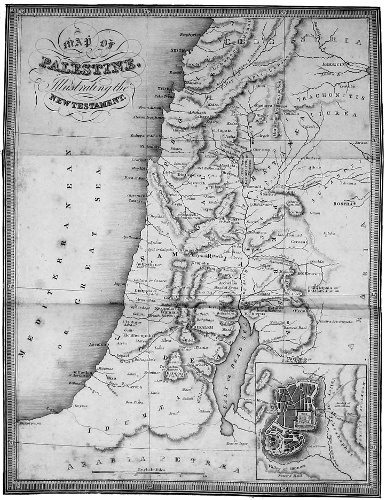
MAP OF
PALESTINE.
Illustrating the
NEW TESTAMENT.
OWL. There are several varieties of this
species, all too well known to need a particular
description. They are nocturnal birds of prey,
and have their eyes better adapted for discerning
objects in the evening or twilight than in
the glare of day. 1. כוס, Lev. xi, 17; Deut.
xiv, 16; Psalm cii, 6, is in our version rendered
the little owl.” Aquila, Theodotion, Jerom,
Kimchi, and most of the older interpreters, are
quoted to justify this rendering. Michaëlis, at
some length, supports the opinion that it is
the horned owl. Bochart, though with some
hesitation, suspected it to be the onocrotalus, a
kind of pelican, because the Hebrew name
signifies cup, and the pelican is remarkable for
a pouch or bag under the lower jaw; but there
are good reasons for supposing that bird to be
the קאת of the next verse. Dr. Geddes thinks
this bird the cormorant; and as it begins the
list of water fowl, and is mentioned always in
725the same contexts with קאת, confessedly a
water bird, his opinion may be adopted. 2. קאת,
Lev. xi, 17; Deut. xiv, 16; Isaiah xxxiv, 11.
In the two first places our translators render
this the great owl,” which is strangely placed
after the little owl, and among water birds.
Our translators,” says the author of Scripture
Illustrated,” “seem to have thought the
owl a convenient bird, as we have three owls
in two verses.” Some critics think it means
a species of night bird, because the word may
be derived from נשף, which signifies the twilight,
the time when owls fly about. But this
interpretation, says Parkhurst, seems very
forced; and since it is mentioned among
water fowls, and the LXX. have, in the first
and last of those texts, rendered it by ἴβις, the
ibis, we are disposed to adopt it here, and
think the evidence strengthened by this, that
in a Coptic version of Lev. xi, 17, it is called
ip or hip, which, with a Greek termination,
would very easily make ιβις. 3. קפון, which
occurs only in Isaiah xxxiv, 15, is in our version
rendered the great owl.” 4. לילית, Isa.
xxxiv, 14, in our version the screech owl.”
The root signifies night; and as undoubtedly
a bird frequenting dark places and ruins is
referred to, we must admit some kind of owl.
A place of lonely desolation, where
The screeching tribe and pelicans abide,
And the dun ravens croak mid ruins drear,
And moaning owls from man the farthest hide.
OX, בקר, in Arabic bœkerre and bykar, the
male of horned cattle of the beeve kind, at full
age, when fit for the plough. Younger ones
are called bullocks. Michaëlis, in his elaborate
work on the laws of Moses, has proved
that castration was never practised. The
rural economy of the Israelites led them to
value the ox as by far the most important of
domestic animals, from the consideration of
his great use in all the operations of farming.
In the patriarchal ages, the ox constituted no
inconsiderable portion of their wealth. Thus
Abraham is said to be very rich in cattle, Gen.
xxiv, 35. Men of every age and country have
been much indebted to the labours of this animal.
So early as in the days of Job, who was
probably contemporary with Isaac, the oxen
were ploughing, and the asses were feeding
beside them,” when the Sabeans fell upon
them, and took them away. In times long
posterior, when Elijah was commissioned to
anoint Elisha, the son of Shaphat, prophet in
his stead, he found him ploughing with twelve
yoke of oxen, 1 Kings xix, 19. For many ages
the hopes of oriental husbandmen depended
entirely on their labours. This was so much
the case in the time of Solomon, that he observes,
in one of his proverbs, Where no
oxen are, the crib is clean,” or rather empty;
but much increase is by the strength of the
ox,” Prov. xiv, 4. The ass, in the course of
ages was compelled to bend his stubborn neck
to the yoke, and share the labours of the ox;
but still the preparation of the ground in the
time of spring depended chiefly on the more
powerful exertions of the latter. When this
animal was employed in bringing home the
produce of the harvest, he was regaled with a
mixture of chaff, chopped straw, and various
kinds of grain, moistened with acidulated
water. But among the Jews, the ox was best
fed when employed in treading out the corn;
for the divine law, in many of whose precepts
the benevolence of the Deity conspicuously
shines, forbad to muzzle him, and, by consequence,
to prevent him from eating what he
would of the grain he was employed to separate
from the husks. The ox was also compelled
to the labour of dragging the cart or
wagon. The number of oxen commonly
yoked to one cart appears to have been two,
Num. vii, 3, 7, 8; 1 Sam. vi, 7; 2 Sam. vi, 3, 6.
The wild ox, תאן, Deut. xiv, 5, is supposed
to be the oryx of the Greeks, which is a species
of large stag.
PADAN-ARAM, called also Sedan-Aram
in Hosea; both names denoting Aram or Syria
the fruitful, or cultivated, and apply to the
northern part of Mesopotamia, in which Haran
or Charran was situated. See Mesopotamia.
PAGANS, Heathens, and particularly those
who worship idols. The term came into use
after the establishment of Christianity, the
cities and great towns affording the first converts.
The Heathens were called Pagans,
from pagus, a village,” because they were
then found chiefly in remote country places;
but we use the term commonly for all who do
not receive the Jewish, Christian, or Mohammedan
religions.
PAINTING THE FACE, 2 Kings ix, 30.
See Eyes.
PALESTINE, taken in a limited sense, denotes
the country of the Philistines or Palestines,
including that part of the land of promise
which extended along the Mediterranean Sea,
from Gaza south to Lydda north. The LXX.
were of opinion that the word Philistiim,
which they generally translate Allophyli, signified
strangers,” or men of another tribe.
Palestine, taken in a more general sense, signifies
the whole country of Canaan, the whole
land of promise, as well beyond as on this side
Jordan, though pretty frequently it is restrained
to the country on this side that river; so that
in later times the words Judea and Palestine
were synonymous. We find, also, the name
of Syria Palestina given to the land of promise,
and even sometimes this province is comprehended
in Cœlo-Syria, or the Lower Syria.
Herodotus is the most ancient writer we
know that speaks of Syria Palestina. He
places it between Phenicia and Egypt. See
Canaan.
PALM TREE, תמר, Exodus xv, 27, &c.
This tree, sometimes called the date tree,
grows plentifully in the east. It rises to a
great height. The stalks are generally full
of rugged knots, which are the vestiges of the
decayed leaves; for the trunk of this tree is
not solid, like other trees, but its centre is
filled with pith, round which is a tough bark
full of strong fibres when young, which, as
the tree grows old, hardens and becomes ligneous.
726To this bark the leaves are closely
joined, which in the centre rise erect; but,
after they are advanced above the vagina
which surrounds them, they expand very wide
on every side the stem; and, as the older
leaves decay, the stalk advances in height.
The leaves, when the tree has grown to a size
for bearing fruit, are six or eight feet long,
are very broad when spread out, and are used
for covering the tops of houses, &c. The fruit,
which is called date, grows below the leaves
in clusters and is of a sweet and agreeable
taste. The learned Kæmpfer, as a botanist,
an antiquary, and a traveller, has exhausted
the whole subject of palm trees. The diligent
natives,” says Mr. Gibbon, celebrated,
either in verse or prose, the three hundred and
sixty uses to which the trunk, the branches,
the leaves, the juice, and the fruit, were skilfully
applied.” “The extensive importance
of the date tree,” says Dr. E. D. Clarke, is
one of the most curious subjects to which a
traveller can direct his attention. A considerable
part of the inhabitants of Egypt, of Arabia,
and Persia, subsist almost entirely upon
its fruit. They boast also of its medicinal virtues.
Their camels feed upon the date stone.
From the leaves they make couches, baskets,
bags, mats, and brushes; from the branches,
cages for their poultry, and fences for their
gardens; from the fibres of the boughs, thread,
ropes, and rigging; from the sap is prepared
a spirituous liquor; and the body of the tree
furnishes fuel. It is even said that from one
variety of the palm tree, the phœnix farinifera,
meal has been extracted, which is found among
the fibres of the trunk, and has been used for
food.”
In the temple of Solomon were pilasters
made in the form of palm trees, 1 Kings vi, 29.
It was under a tree of this kind that Deborah
dwelt between Ramah and Bethel, Judges iv, 5.
To the fair, flourishing, and fruitful condition
of this tree, the psalmist very aptly compares
the votary of virtue, Psalm xcii, 12, 13, 14:--
The righteous shall flourish like a palm tree.
Those that are planted in the house of Jehovah,
In the courts of our God, shall flourish;
In old age they shall still put forth buds,
They shall be full of sap and vigorous.
The palm tree is crowned at its top with a
large tuft of spiring leaves about four feet
long, which never fall off, but always continue
in the same flourishing verdure. The tree, as
Dr. Shaw was informed, is in its greatest
vigour about thirty years after it is planted,
and continues in full vigour seventy years
longer; bearing all this while, every year,
about three or four hundred pounds’ weight
of dates. The trunk of the tree is remarkably
straight and lofty. Jeremiah, speaking of the
idols that were carried in procession, says they
were upright as the palm tree, Jer. x, 5. And
for erect stature and slenderness of form, the
spouse, in Canticles vii, 7, is compared to this
tree:--
How framed, O my love, for delights!
Lo, thy stature is like a palm tree,
And thy bosom like clusters of dates.
On this passage Mr. Good observes, that “the
very word tamar, here used for the palm tree,
and whose radical meaning is ‘straight,’ or
‘upright,’ (whence it was afterward applied to
pillars or columns, as well as to the palm,)
was also a general name among the ladies of
Palestine, and unquestionably adopted in honour
of the stature they had already acquired,
or gave a fair promise of attaining.”
A branch of palm was a signal of victory,
and was carried before conquerors in the
triumphs. To this, allusion is made, Rev.
vii, 9: and for this purpose were they borne
before Christ in his way to Jerusalem, John
xii, 13. From the inspissated sap of the tree,
a kind of honey, or dispse, as it is called, is
produced, little inferior to that of bees. The
same juice, after fermentation, makes a sort
of wine much used in the east. It is once
mentioned as wine, Num. xxviii, 7; Exodus
xxix, 40; and by it is intended the strong
drink, Isaiah v, 11; xxiv, 9. Theodoret and
Chrysostom, on these places, both Syrians,
and unexceptionable witnesses in what belongs
to their own country, confirm this declaration.
This liquor,” says Dr. Shaw, which has a
more luscious sweetness than honey, is of the
consistence of a thin syrup, but quickly grows
tart and ropy, acquiring an intoxicating quality,
and giving by distillation an agreeable spirit,
or arâky, according to the general name of
these people for all hot liquors, extracted by
the alembic.” Its Hebrew name is שכר, the
σικερα of the Greeks; and from its sweetness, probably,
the saccharum of the Romans. Jerom informs
us that in Hebrew any inebriating liquor
is called sicera, whether made of grain, the juice
of apples, honey, dates, or any other fruit.”
This tree was formerly of great value and
esteem among the Israelites, and so very
much cultivated in Judea, that, in after times,
it became the emblem of that country, as may
be seen in a medal of the Emperor Vespasian
upon the conquest of Judea. It represents a
captive woman sitting under a palm tree, with
this inscription, Judea capta;” [Judea captivated;]
and upon a Greek coin, likewise, of
his son Titus, struck upon the like occasion,
we see a shield suspended upon a palm tree,
with a Victory writing upon it. Pliny also
calls Judea palmis inclyta, renowned for
palms.” Jericho, in particular, was called
the city of palms,” Deut. xxxiv, 3; 2 Chron.
xxviii, 15; because, as Josephus, Strabo, and
Pliny, have remarked, it anciently abounded
in palm trees. And so Dr. Shaw remarks,
that, though these trees are not now either
plentiful or fruitful in other parts of the holy
land, yet there are several of them at Jericho,
where there is the conveniency they require
of being often watered; where, likewise, the
climate is warm, and the soil sandy, such as
they thrive and delight in. Tamar, a city
built in the desert by Solomon, 1 Kings ix, 18;
Ezekiel xlvii, 19; xlviii, 28, was probably so
named from the palm trees growing about it;
as it was afterward by the Romans called
Palmyra, or rather Palmira, on the same account,
from palma, a palm tree.”
727PALMER WORM, גום, Joel i, 4; Amos
iv, 9. Bochart says that it is a kind of locust,
furnished with very sharp teeth, with which it
gnaws off grass, corn, leaves of trees, and even
their bark. The Jews support this idea by
deriving the word from גוז or גזן, to cut, to
shear, or mince. Notwithstanding the unanimous
sentiments of the Jews that this is a
locust, yet the LXX. read κάμπη, and the Vulgate
eruca, a caterpillar;” which rendering
is supported by Fuller. Michaëlis agrees with
this opinion, and thinks that the sharp cutting
teeth of the caterpillar, which, like a sickle, clear
away all before them, might give name to this
insect. Caterpillars also begin their ravages
before the locust, which seems to coincide with
the nature of the creature here intended.
PALSY. See Diseases.
PAMPHYLIA, a province of Asia Minor
which gives name to that part of the Mediterranean
Sea which washes its coast, Acts xxvii,
5. To the south it is bounded by the Mediterranean,
and to the north by Pisidia; having
Lycia to the west, and Cilicia to the east.
Paul and Barnabas preached at Perga, in
Pamphylia, Acts xiii, 13; xiv, 24.
PANTHEISM, a doctrine into which some
of the sages of antiquity fell by revolting at
the monstrous absurdities of Polytheism. Not
knowing the true God as an infinite and personal
subsistence, a cause above and distinct
from all effects, they believed that God was
every thing, and every thing God. This
monstrous, and in its effects immoral, notion,
is still held by the Brahmins of India.
PAPER REED, גמא, Exod. ii, 3; Job viii,
11; Isaiah xviii, 2; xxxv, 7. When the outer
skin, or bark, is taken off, there are several
films, or inner pellicles, one within another.
These, when separated from the stalk, were
laid on a table artfully matched and flatted
together, and moistened with the water of the
Nile, which, dissolving the glutinous juices of
the plant, caused them to adhere closely together.
They were afterward pressed, and
then dried in the sun, and thus were prepared
sheets or leaves for writing upon in characters
marked by a coloured liquid passing through
a hollow reed. The best papyrus was called
ἱερατικὴ, or paper of the priests. On this the
sacred documents of Egypt were written.
Ancient books were written on papyrus, and
those of the New Testament among the rest.
In the fourth century however these sacred
writings are found on skins. This was preferred
for durability; and many decayed copies
of the New Testament, belonging to libraries,
were early transferred to parchment. Finally
came paper, the name of which was taken from
the Egyptian reed; but the materials of which
it was fabricated were cotton and linen. See
Bulrush and Book.
PAPHOS, a celebrated city of Cyprus, lying
on the western coast of the island, where
Venus (who from hence took the name of
Paphia) had her most ancient and most famous
temple; and here the Roman proconsul, Sergius
Paulus, resided, whom St. Paul converted
to Christianity, Acts xiii, 6.
PARABLE, ϖαραβολή, formed from ϖαραβάλλειν,
to oppose or compare, an allegorical instruction,
founded on something real or apparent
in nature or history, from which a moral
is drawn, by comparing it with some other
thing in which the people are more immediately
concerned. (See Allegory.) Aristotle
defines parable, a similitude drawn from form
to form. Cicero calls it a collation; others, a
simile. F. de Colonia calls it a rational fable;
but it may be founded on real occurrences, as
many parables of our Saviour were. The
Hebrews call it משל, from a word which signifies
either to predominate or to assimilate; the
Proverbs of Solomon are by them also called
>משלים, parables, or proverbs.
Parable, according to the eminently learned
Bishop Lowth, is that kind of allegory which
consists of a continued narration of a fictitious
or accommodated event, applied to the illustration
of some important truth. The Greeks
call these αἶνοι, allegories, or apologues; the
Latins, fabulæ, or fables;” and the writings
of the Phrygian sage, or those composed in
imitation of him, have acquired the greatest
celebrity. Nor has our Saviour himself disdained
to adopt the same method of instruction;
of whose parables it is doubtful whether
they excel most in wisdom and utility, or in
sweetness, elegance, and perspicuity. As the
appellation of parable has been applied to his
discourses of this kind, the term is now restricted
from its former extensive signification
to a more confined sense. But this species of
composition occurs very frequently in the prophetic
poetry, and particularly in that of
Ezekiel. If to us they should sometimes appear
obscure, we must remember, that, in those
early times when the prophetical writings
were indited, it was universally the mode
throughout all the eastern nations to convey
sacred truths under mysterious figures and
representations. In order to our forming a
more certain judgment upon this subject, Dr.
Lowth has briefly explained some of the primary
qualities of the poetic parables; so that,
by considering the general nature of them, we
may decide more accurately on the merits of
particular examples.
It is the first excellence of a parable to turn
upon an image well known and applicable to
the subject, the meaning of which is clear and
definite; for this circumstance will give it
perspicuity, which is essential to every species
of allegory. If the parables of the sacred prophets
are examined by this rule, they will not
be found deficient. They are in general
founded upon such imagery as is frequently
used, and similarly applied by way of metaphor
and comparison in the Hebrew poetry. Examples
of this kind occur in the parable of the
deceitful vineyard, Isaiah v, 1–7, and of the
useless vine, Ezek. xv; xix, 10–14; for under
this imagery the ungrateful people of God are
more than once described; Ezek. xix, 1–9;
xxxi; xvi; xxiii. Moreover, the image must
not only be apt and familiar, but it must be
also elegant and beautiful in itself; since it is
the purpose of a poetic parable, not only to
728explain more perfectly some proposition, but
frequently to give it some animation and
splendour. As the imagery from natural objects
is in this respect superior to all others,
the parables of the sacred poets consist chiefly
of this kind of imagery. It is also essential
to the elegance of a parable, that the imagery
should not only be apt and beautiful, but that
all its parts and appendages should be perspicuous
and pertinent. Of all these excellencies,
there cannot be more perfect examples
than the parables that have been just specified;
to which we may add the well known parable
of Nathan, 2 Sam. xii, 1–4, although written
in prose, as well as that of Jotham, Judges ix,
7–15, which appears to be the most ancient
extant, and approaches somewhat nearer to
the poetical form. It is also the criterion of
a parable, that it be consistent throughout,
and that the literal be never confounded with
the figurative sense; and in this respect it
materially differs from that species of allegory,
called the continued metaphor, Isaiah v, 1–7.
It should be considered, that the continued
metaphor and the parable have a very different
view. The sole intention of the former is
to embellish a subject, to represent it more
magnificently, or at the most to illustrate it,
that, by describing it in more elevated language,
it may strike the mind more forcibly;
but the intent of the latter is to withdraw the
truth for a moment from our sight, in order to
conceal whatever it may contain ungrateful
or reproving, and to enable it secretly to insinuate
itself, and obtain an ascendency as it
were by stealth. There is, however, a species
of parable, the intent of which is only to illustrate
the subject; such is that remarkable one
of the cedar of Lebanon, Ezek. xxxi; than
which, if we consider the imagery itself, none
was ever more apt or more beautiful; or the
description and colouring, none was ever
more elegant or splendid; in which, however,
the poet has occasionally allowed himself to
blend the figurative with the literal description,
verses 11, 14–17; whether he has done
this because the peculiar nature of this kind
of parable required it, or whether his own fervid
imagination alone, which disdained the
stricter rules of composition, was his guide,
our learned author can scarcely presume to
determine.
In the New Testament, the word parable is
used variously: in Luke iv, 23, for a proverb,
or adage; in Matt. xv, 15, for a thing darkly
and figuratively expressed; in Heb. ix, 9, &c,
for a type; in Luke xiv, 7, &c, for a special
instruction; in Matt. xxiv, 32, for a similitude
or comparison.
PARADISE, according to the original
meaning of the term, whether it be of Hebrew,
Chaldee, or Persian derivation, signifies, a
place enclosed for pleasure and delight.” The
LXX., or Greek translators of the Old Testament,
make use of the word paradise, when
they speak of the garden of Eden, which Jehovah
planted at the creation, and in which
he placed our first parents. There are three
places in the Hebrew text of the Old Testament
where this word is found, namely, Neh.
ii, 8; Cant. iv, 13; Eccles. ii, 5. The term
paradise is obviously used in the New Testament,
as another word for heaven; by our
Lord, Luke xxiii, 43; by the Apostle Paul,
2 Cor. xii, 4; and in the Apocalypse, ii, 7.
See Eden.
PARAN, Desert of, a great and terrible
wilderness” which the children of Israel entered
after leaving Mount Sinai, Num. x, 12;
Deut. i, 19; and in which thirty-eight of their
forty years of wandering were spent. It extended
from Mount Sinai on the south, to the
southern border of the land of Canaan on the
north; having the desert of Shur, with its
subdivisions, the deserts of Etham and Sin,
on the west, and the eastern branch of the
Red Sea, the desert of Zin and Mount Seir,
on the east. Burckhardt represents this desert,
which he entered from that of Zin, or valley
of El Araba, about the parallel of Suez, as a
dreary expanse of calcareous soil, covered with
black flints.
PARTRIDGE, קדא, 1 Samuel xxvi, 20; Jer.
xvii, 11; ϖέρδιξ, Ecclus. xi, 30. In the first of
these places David says, The king of Israel
is come out to hunt a partridge on the mountains;”
and in the second, The partridge sitteth,”
on eggs, and produceth,” or hatcheth,
not; so he that getteth riches, and not by
right, shall leave them in the midst of his
days, and at his end shall be contemptible.”
This passage does not necessarily imply that
the partridge hatches the eggs of a stranger,
but only that she often fails in her attempts to
bring forth her young. To such disappointments
she is greatly exposed from the position
of her nest on the ground, where her eggs are
often spoiled by the wet, or crushed by the
foot. So he that broods over his ill-gotten
gains will often find them unproductive; or,
if he leaves them, as a bird occasionally driven
from her nest, may be despoiled of their possession.
As to the hunting of the partridge,
which, Dr. Shaw observes, is the greater, or
red-legged kind, the traveller says: The
Arabs have another, though a more laborious,
method of catching these birds; for, observing
that they become languid and fatigued after
they have been hastily put up twice or thrice,
they immediately run in upon them, and knock
them down with their zerwattys, or bludgeons
as we should call them.” Precisely in this
manner Saul hunted David, coming hastily
upon him, putting him up incessantly, in hopes
that at length his strength and resources
would fail, and he would become an easy prey
to his pursuer. Forskal mentions a partridge
whose name in Arabic is kurr; and Latham
says, that, in the province of Andalusia in
Spain, the name of the partridge is churr;
both taken, no doubt, like the Hebrew, from
its note.
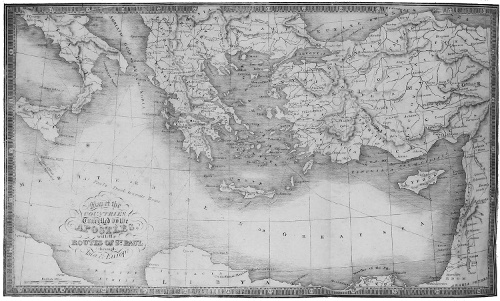
Map of the
COUNTRIES
Travelled by the
APOSTLES
with the
ROUTES OF ST. PAUL
through
Asia & Europe
PASSOVER, פסח, signifies leap, passage.
The passover was a solemn festival of the
Jews, instituted in commemoration of their
coming out of Egypt; because the night before
their departure the destroying angel that slew
the first-born of the Egyptians passed over the
729houses of the Hebrews without entering them,
because they were marked with the blood of
the lamb, which, for this reason, was called
the paschal lamb. The following is what God
ordained concerning the passover: the month
of the coming out of Egypt was after this to
be the first month of the sacred or ecclesiastical
year; and the fourteenth day of this month,
between the two evenings, that is, between the
sun’s decline and its setting, or rather, according
to our reckoning, between three o’clock in
the afternoon and six in the evening, at the
equinox, they were to kill the paschal lamb,
and to abstain from leavened bread. The day
following, being the fifteenth, reckoned from
six o’clock of the preceding evening, was the
grand feast of the passover, which continued
seven days; but only the first and seventh days
were peculiarly solemn. The slain lamb was
to be without defect, a male, and of that year.
If no lamb could be found, they might take a
kid. They killed a lamb or a kid in each family;
and if the number of the family was not sufficient
to eat the lamb, they might associate two
families together. With the blood of the lamb
they sprinkled the door posts and lintel of every
house, that the destroying angel at the sight of
the blood might pass over them. They were
to eat the lamb the same night, roasted, with
unleavened bread, and a sallad of wild lettuces,
or bitter herbs. It was forbid to eat any part
of it raw, or boiled; nor were they to break a
bone; but it was to be eaten entire, even with
the head, the feet, and the bowels. If any
thing remained to the day following it was
thrown into the fire, Exod. xii, 46; Num. ix, 12;
John xix, 36. They who ate it were to be in
the posture of travellers, having their reins girt,
shoes on their feet, staves in their hands, and
eating in a hurry. This last part of the ceremony
was but little observed; at least, it was
of no obligation after that night when they
came out of Egypt. During the whole eight
days of the passover no leavened bread was to
be used. They kept the first and last day of
the feast; yet it was allowed to dress victuals,
which was forbidden on the Sabbath day. The
obligation of keeping the passover was so
strict, that whoever should neglect it was condemned
to death, Num. ix, 13. But those who
had any lawful impediment, as a journey, sickness,
or uncleanness, voluntary or involuntary,
for example, those who had been present at a
funeral, &c, were to defer the celebration of
the passover till the second month of the ecclesiastical
year, the fourteenth day of the month
Jair, which answers to April and May. We
see an example of this postponed passover
under Hezekiah, 2 Chron. xxx, 2, 3, &c.
The modern Jews observe in general the
ceremonies practised by their ancestors in the
celebration of the passover. While the temple
was in existence, the Jews brought their lambs
thither, and there sacrificed them; and they
offered their blood to the priest, who poured it
out at the foot of the altar. The paschal lamb
was an illustrious type of Christ, who became
a sacrifice for the redemption of a lost world
from sin and misery; but resemblances between
the type and antitype have been strained by
many writers into a great number of fanciful
particulars. It is enough for us to be assured,
that as Christ is called our passover;” and
the Lamb of God,” without spot,” by the
sprinkling of whose blood” we are delivered
from guilt and punishment; and as faith in
him is represented to us as eating the flesh
of Christ,” with evident allusion to the eating
of the paschal sacrifice; so, in these leading
particulars, the mystery of our redemption was
set forth. The paschal lamb therefore prefigured
the offering of the spotless Son of God,
the appointed propitiation for the sins of the
whole world; by virtue of which, when received
by faith, we are delivered from the
bondage of guilt and misery; and nourished
with strength for our heavenly journey to that
land of rest, of which Canaan, as early as the
days of Abraham, became the divinely instituted
figure.
PATMOS, a small rocky island in the
Ægean Sea, about eighteen miles in circumference;
which, on account of its dreary and
desolate character, was used by the Roman
emperors as a place of confinement for criminals.
To this island St. John was banished
by the Emperor Domitian; and here he had
his revelation, recorded in the Apocalypse.
PATRIARCHS. This name is given to the
ancient fathers, chiefly those who lived before
Moses, as Adam, Lamech, Noah, Shem, &c,
Abraham, Isaac, Jacob, the sons of Jacob, and
heads of the tribes. The Hebrews call them
princes of the tribes, or heads of the fathers.
The name patriarch is derived from the Greek
patriarcha, head of a family.”
PAUL was born at Tarsus, the principal
city of Cilicia, and was by birth both a Jew
and a citizen of Rome, Acts xxi, 39; xxii, 25.
He was of the tribe of Benjamin, and of the
sect of the Pharisees, Phil. iii, 5. In his
youth he appears to have been taught the art
of tent making, Acts xviii, 3; but we must
remember that among the Jews of those days
a liberal education was often accompanied by
instruction in some mechanical trade. It is
probable that St. Paul laid the foundation of
those literary attainments, for which he was
so eminent in the future part of his life, at his
native city of Tarsus; and he afterward studied
the law of Moses, and the traditions of the
elders, at Jerusalem, under Gamaliel, a celebrated
rabbi, Acts xxii, 4. St. Paul is not
mentioned in the Gospels; nor is it known
whether he ever heard our Saviour preach, or
saw him perform any miracle. His name first
occurs in the account given in the Acts of the
martyrdom of St. Stephen, A. D. 34, to which
he is said to have consented, Acts viii, 1: he
is upon that occasion called a young man; but
we are no where informed what was then his
precise age. The death of St. Stephen was
followed by a severe persecution of the church
at Jerusalem, and St. Paul became distinguished
among its enemies by his activity and violence,
Acts viii, 3. Not contented with displaying
his hatred to the Gospel in Judea, he obtained
authority from the high priest to go to Damascus,
730and to bring back with him bound any
Christians whom he might find in that city.
As he was upon his journey thither, A. D. 35,
his miraculous conversion took place, the circumstances
of which are recorded in Acts ix,
and are frequently alluded to in his epistles,
1 Cor. xv, 9; Gal. i, 13; 1 Tim. i, 12, 13.
Soon after St. Paul was baptized at Damascus,
he went into Arabia; but we are not
informed how long he remained there. He returned
to Damascus; and being supernaturally
qualified to be a preacher of the Gospel, he
immediately entered upon his ministry in that
city. The boldness and success with which
he enforced the truths of Christianity so irritated
the unbelieving Jews, that they resolved
to put him to death, Acts ix, 23; but, this
design being known, the disciples conveyed
him privately out of Damascus, and he went
to Jerusalem, A. D. 38. The Christians of
Jerusalem, remembering St. Paul’s former hostility
to the Gospel, and having no authentic
account of any change in his sentiments or
conduct, at first refused to receive him; but
being assured by Barnabas of St. Paul’s real
conversion, and of his exertions at Damascus,
they acknowledged him as a disciple, Acts
ix, 27. He remained only fifteen days among
them, Gal. i, 18; and he saw none of the
Apostles except St. Peter and St. James. It
is probable that the other Apostles were at this
time absent from Jerusalem, exercising their
ministry at different places. The zeal with
which St. Paul preached at Jerusalem had the
same effect as at Damascus: he became so
obnoxious to the Hellenistic Jews, that they
began to consider how they might kill him,
Acts ix, 29; which when the brethren knew,
they thought it right that he should leave the
city. They accompanied him to Cæsarea, and
thence he went into the regions of Syria and
Cilicia, where he preached the faith which
once he destroyed, Gal. i, 21, 23.
Hitherto the preaching of St. Paul, as well
as of the other Apostles and teachers, had been
confined to the Jews; but the conversion of
Cornelius, the first Gentile convert, A. D. 40,
having convinced all the Apostles that to the
Gentiles, also, God had granted repentance
unto life,” St. Paul was soon after conducted
by Barnabas from Tarsus, which had probably
been the principal place of his residence since
he left Jerusalem, and they both began to
preach the Gospel to the Gentiles at Antioch,
A. D. 42, Acts xi, 25. Their preaching was
attended with great success. The first Gentile
church was now established at Antioch; and
in that city, and at this time, the disciples
were first called Christians, Acts xi, 26. When
these two Apostles had been thus employed
about a year, a prophet called Agabus predicted
an approaching famine, which would affect
the whole land of Judea. Upon the prospect
of this calamity, the Christians of Antioch
made a contribution for their brethren in
Judea, and sent the money to the elders at
Jerusalem by St. Paul and Barnabas, A. D. 44,
Acts xi, 28, &c. This famine happened soon
after, in the fourth or fifth year of the Emperor
Claudius. It is supposed that St. Paul
had the vision, mentioned in Acts xxii, 17,
while he was now at Jerusalem this second
time after his conversion.
St. Paul and Barnabas, having executed
their commission, returned to Antioch; and
soon after their arrival in that city they were
separated, by the express direction of the Holy
Ghost, from the other Christian teachers and
prophets, for the purpose of carrying the glad
tidings of the Gospel to the Gentiles of various
countries, Acts xiii, 1. Thus divinely appointed
to this important office, they set out from Antioch,
A. D. 45, and preached the Gospel successively
at Salamis and Paphos, two cities of
the isle of Cyprus, at Perga in Pamphylia,
Antioch in Pisidia, and at Iconium, Lystra,
and Derbe, three cities of Lycaonia. They
returned to Antioch in Syria, A. D. 47, nearly
by the same route. This first apostolical
journey of St. Paul, in which he was accompanied
and assisted by Barnabas, is supposed
to have occupied about two years; and in the
course of it many, both Jews and Gentiles,
were converted to the Gospel.
Paul and Barnabas continued at Antioch a
considerable time; and while they were there,
a dispute arose between them and some Jewish
Christians of Judea. These men asserted, that
the Gentile converts could not obtain salvation
through the Gospel, unless they were circumcised;
Paul and Barnabas maintained the contrary
opinion, Acts xv, 1, 2. This dispute was
carried on for some time with great earnestness;
and it being a question in which not
only the present but all future Gentile converts
were concerned, it was thought right that St.
Paul and Barnabas, with some others, should
go up to Jerusalem to consult the Apostles and
elders concerning it. They passed through
Phenicia and Samaria, and upon their arrival
at Jerusalem, A. D. 49, a council was assembled
for the purpose of discussing this important
point, Gal. ii, 1. St. Peter and St. James the
less were present, and delivered their sentiments,
which coincided with those of St. Paul
and Barnabas; and after much deliberation it
was agreed, that neither circumcision, nor
conformity to any part of the ritual law of
Moses, was necessary in Gentile converts; but
that it should be recommended to them to abstain
from certain specified things prohibited
by that law, lest their indulgence in them
should give offence to their brethren of the
circumcision, who were still very zealous for
the observance of the ceremonial part of their
ancient religion. This decision which was
declared to have the sanction of the Holy
Ghost, was communicated to the Gentile
Christians of Syria and Cilicia by a letter
written in the name of the Apostles, elders, and
whole church at Jerusalem, and conveyed by
Judas and Silas, who accompanied St. Paul
and Barnabas to Antioch for that purpose.
St. Paul, having preached a short time at
Antioch, proposed to Barnabas that they should
visit the churches which they had founded in
different cities, Acts xv, 36. Barnabas readily
consented; but while they were preparing for
731the journey, there arose a disagreement between
them, which ended in their separation.
In consequence of this dispute with Barnabas,
St. Paul chose Silas for his companion, and
they set out together from Antioch, A. D. 50.
They travelled through Syria and Cilicia, confirming
the churches, and then came to Derbe
and Lystra, Acts xvi. Thence they went
through Phrygia and Galatia; and, being desirous
of going into Asia Propria, or the Proconsular
Asia, they were forbidden by the
Holy Ghost. They therefore went into Mysia;
and, not being permitted by the Holy Ghost to
go into Bithynia as they had intended, they
went to Troas. While St. Paul was there, a
vision appeared to him in the night: There
stood a man of Macedonia, and prayed him,
saying, Come over into Macedonia, and help us.”
St. Paul knew this vision to be a command from
Heaven, and in obedience to it immediately sailed
from Troas to Samothracia, and the next day
to Neapolis, a city of Thrace; and thence he
went to Philippi, the principal city of that part
of Macedonia. St. Paul remained some time
at Philippi, preaching the Gospel; and several
occurrences which took place in that city, are
recorded in Acts xvii. Thence he went through
Amphipolis and Apollonia to Thessalonica,
Acts xvii, where he preached in the synagogues
of the Jews on three successive Sabbath days.
Some of the Jews, and many of the Gentiles
of both sexes, embraced the Gospel; but the
unbelieving Jews, moved with envy and indignation
at the success of St. Paul’s preaching,
excited a great disturbance in the city, and
irritated the populace so much against him,
that the brethren, anxious for his safety,
thought it prudent to send him to Berea, where
he met with a better reception than he had
experienced at Thessalonica. The Bereans
heard his instructions with attention and candour,
and having compared his doctrines with
the ancient Scriptures, and being satisfied that
Jesus, whom he preached, was the promised
Messiah, they embraced the Gospel; but his
enemies at Thessalonica, being informed of his
success at Berea, came thither, and, by their
endeavours to stir up the people against him,
compelled him to leave that city also. He
went thence to Athens, where he delivered that
discourse recorded in Acts xvii. From Athens,
Paul went to Corinth, Acts xviii, A. D. 51,
and lived in the house of Aquila and Priscilla,
two Jews, who, being compelled to leave
Rome in consequence of Claudius’s edict
against the Jews, had lately settled at Corinth.
St. Paul was induced to take up his residence
with them, because, like himself, they were
tent makers. At first he preached to the Jews
in their synagogue; but upon their violently
opposing his doctrine, he declared that from
that time he would preach to the Gentiles only;
and, accordingly, he afterward delivered his
instructions in the house of one Justus, who
lived near the synagogue. Among the few
Jews who embraced the Gospel, were Crispus,
the ruler of the synagogue, and his family;
and many of the Gentile Corinthians hearing
believed, and were baptized.” St. Paul was
encouraged in a vision to persevere in his exertions
to convert the inhabitants of Corinth;
and although he met with great opposition and
disturbance from the unbelieving Jews, and
was accused by them before Gallio, the Roman
governor of Achaia, he continued there a year
and six months, teaching the word of God.”
During this time he supported himself by working
at his trade of tent making, that he might
not be burdensome to the disciples. From
Corinth St. Paul sailed into Syria, and thence
he went to Ephesus: thence to Cæsarea; and is
supposed to have arrived at Jerusalem just before
the feast of pentecost. After the feast he
went to Antioch, A. D. 53; and this was the
conclusion of his second apostolical journey,
in which he was accompanied by Silas; and
in part of it, Luke and Timothy were also
with him.
Having made a short stay at Antioch, St.
Paul set out upon his third apostolical journey.
He passed through Galatia, and Phrygia,
A. D. 54, confirming the Christians of
those countries; and thence, according to his
promise, he went to Ephesus, Acts xix. He
found there some disciples, who had only been
baptized with John’s baptism: he directed that
they should be baptized in the name of Jesus,
and then he communicated to them the Holy
Ghost. He preached for the space of three
months in the synagogue; but the Jews being
hardened beyond conviction, and speaking reproachfully
of the Christian religion before the
multitude, he left them; and from that time
he delivered his instructions in the school of
a person called Tyrannus, who was probably
a Gentile. St. Paul continued to preach in
this place about two years, so that all the inhabitants
of that part of Asia Minor heard
the word of the Lord Jesus, both Jews and
Greeks.” He also performed many miracles at
Ephesus; and not only great numbers of people
were converted to Christianity, but many
also of those who in this superstitious city
used incantations and magical arts, professed
their belief in the Gospel, and renounced their
former practices by publicly burning their
books. Previous to the disturbance raised by
Demetrius, Paul had intended to continue at
Ephesus till Titus should return, whom he had
sent to inquire into the state of the church at
Corinth, 2 Cor. xii, 18. He now thought it
prudent to go from Ephesus immediately, Acts
xx, A. D. 56; and having taken an affectionate
leave of the disciples, he set out for Troas,
2 Cor. ii, 12, 13, where he expected to meet
Titus. Titus, however, from some cause which
is not known, did not come to Troas; and
Paul was encouraged to pass over into Macedonia,
with the hope of making converts. St.
Paul, after preaching in Macedonia, receiving
from the Christians of that country liberal
contributions for their poor brethren in Judea,
2 Cor. viii, 1, went to Corinth, A. D. 57, and
remained there about three months. The
Christians also of Corinth, and of the rest of
Achaia, contributed to the relief of their brethren
in Judea. St. Paul’s intention was to
have sailed from Corinth into Syria; but being
732informed that some unbelieving Jews, who
had discovered his intention, lay in wait for
him, he changed his plan, passed through Macedonia,
and sailed from Philippi to Troas in
five days, A. D. 58. He stayed at Troas seven
days, and preached to the Christians on the
first day of the week, the day on which they
were accustomed to meet for the purpose of
religious worship. From Troas he went by
land to Assos; and thence he sailed to Mitylene;
and from Mitylene to Miletus. Being
desirous of reaching Jerusalem before the feast
of pentecost, he would not allow time to go
to Ephesus, and therefore he sent for the elders
of the Ephesian church to Miletus, and gave
them instructions, and prayed with them. He
told them that he should see them no more,
which impressed them with the deepest sorrow.
From Miletus he sailed by Cos, Rhodes, and
Patara in Lycia, to Tyre, Acts xxi. Finding
some disciples at Tyre, he stayed with them
several days, and then went to Ptolemais, and
thence to Cæsarea. While St. Paul was at
Cæsarea, the Prophet Agabus foretold by the
Holy Ghost, that St. Paul, if he went to Jerusalem,
would suffer much from the Jews. This
prediction caused great uneasiness to St. Paul’s
friends, and they endeavoured to dissuade him
from his intention of going thither. St. Paul,
however, would not listen to their entreaties,
but declared that he was ready to die at Jerusalem,
if it were necessary, for the name of the
Lord Jesus. Seeing him thus resolute, they
desisted from their importunities, and accompanied
him to Jerusalem, where he is supposed
to have arrived just before the feast of pentecost,
A. D. 58. This may be considered as
the end of St. Paul’s third apostolical journey.
St. Paul was received by the Apostles and
other Christians at Jerusalem with great joy
and affection; and his account of the success
of his ministry, and of the collections which
he had made among the Christians of Macedonia
and Achaia, for the relief of their brethren
in Judea, afforded them much satisfaction; but
not long after his arrival at Jerusalem, some
Jews of Asia, who had probably in their own
country witnessed St. Paul’s zeal in spreading
Christianity among the Gentiles, seeing him
one day in the temple, endeavoured to excite
a tumult, by crying out that he was the man
who was aiming to destroy all distinction between
Jew and Gentile; who taught things
contrary to the law of Moses; and who had
polluted the holy temple, by bringing into it
uncircumcised Heathens. This representation
did not fail to enrage the multitude against St.
Paul; they seized him, dragged him out of the
temple, beat him, and were upon the point of
putting him to death, when he was rescued out
of their hands by Lysias, a Roman tribune, and
the principal military officer then at Jerusalem.
What followed,--his defence before Felix and
Agrippa,--his long detention at Cæsarea, and
his appeal to the emperor, which occasioned
his voyage to Rome, are all circumstantially
stated in the latter chapters of the Acts. Upon
his arrival at Rome, St. Paul was committed to
the care of the captain of the guard, A. D. 61.
The Scriptures do not inform us whether he
was ever tried before Nero, who was at this
time emperor of Rome; and the learned are
much divided in their opinion upon that point.
St. Luke only says, Paul was suffered to dwell
by himself with a soldier that kept him. And
Paul dwelt two whole years in his own hired
house, and received all that came in unto him,
preaching the kingdom of God, and teaching
those things which concern the Lord Jesus
Christ, with all confidence, no man forbidding
him.” During his confinement he converted
some Jews resident at Rome, and many Gentiles,
and, among the rest, several persons belonging
to the emperor’s household, Phil. iv, 22.
The Scripture history ends with the release
of St. Paul from his two years’ imprisonment
at Rome, A. D. 63; and no ancient author
has left us any particulars of the remaining
part of this Apostle’s life. It seems probable,
that, immediately after he recovered his liberty,
he went to Jerusalem; and that afterward
he travelled through Asia Minor, Crete, Macedonia,
and Greece, confirming his converts,
and regulating the affairs of the different
churches which he had planted in those countries.
Whether at this time he also preached
the Gospel in Spain, as some have imagined,
is very uncertain. It was the unanimous tradition
of the church, that St. Paul returned to
Rome, that he underwent a second imprisonment
there, and at last was put to death by the
Emperor Nero. Tacitus and Suetonius have
mentioned a dreadful fire which happened at
Rome in the time of Nero. It was believed,
though probably without any reason, that the
emperor himself was the author of that fire; but
to remove the odium from himself, he chose to
attribute it to the Christians; and, to give some
colour to that unjust imputation, he persecuted
them with the utmost cruelty. In this persecution
St. Peter and Paul suffered martyrdom,
probably, A. D. 65; and if we may credit Sulpitius
Severus, a writer of the fifth century, the
former was crucified, and the latter beheaded.
St. Paul was a person of great natural abilities,
of quick apprehension, strong feelings,
firm resolution, and irreproachable life. He
was conversant with Grecian and Jewish literature;
and gave early proofs of an active and
zealous disposition. If we may be allowed to
consider his character independent of his supernatural
endowments, we may pronounce
that he was well qualified to have risen to
distinction and eminence, and that he was by
nature peculiarly adapted to the high office
to which it pleased God to call him. As a
minister of the Gospel, he displayed the most
unwearied perseverance and undaunted courage.
He was deterred by no difficulty or
danger, and endured a great variety of persecutions
with patience and cheerfulness. He
gloried in being thought worthy of suffering
for the name of Jesus, and continued with
unabated zeal to maintain the truth of Christianity
against its bitterest and most powerful
enemies. He was the principal instrument
under Providence of spreading the Gospel
among the Gentiles; and we have seen that
733his labours lasted through many years, and
reached over a considerable extent of country.
Though emphatically styled the great Apostle
of the Gentiles, he began his ministry, in
almost every city, by preaching in the synagogue
of the Jews; and though he owed by
far the greater part of his persecutions to the
opposition and malice of that proud and obstinate
people, whose resentment he particularly
incurred by maintaining that the Gentiles were
to be admitted to an indiscriminate participation
of the benefits of the new dispensation,
yet it rarely happened in any place, that some
of the Jews did not yield to his arguments,
and embrace the Gospel. He watched with
paternal care over the churches which he had
founded; and was always ready to strengthen
the faith, and regulate the conduct of his converts,
by such directions and advice as their
circumstances might require.
The exertions of St. Paul in the cause of
Christianity were not confined to personal
instruction: he also wrote fourteen epistles
to individuals or churches which are now
extant, and form a part of our canon. These
letters furnish evidence of the soundness and
sobriety of his judgment. His caution in distinguishing
between the occasional suggestions
of inspiration, and the ordinary exertions
of his natural understanding, is without example
in the history of enthusiasm. His morality
is every where calm, pure, and rational;
adapted to the condition, the activity, and the
business of social life, and of its various relations;
free from the overscrupulousness and
austerities of superstition, and from, what was
more perhaps to be apprehended, the abstractions
of quietism, and the soarings or extravagancies
of fanaticism. His judgment concerning
a hesitating conscience, his opinion
of the moral indifferency of many actions, yet
of the prudence and even the duty of compliance,
where non-compliance would produce
evil effects upon the minds of the persons who
observed it, are all in proof of the calm and
discriminating character of his mind; and the
universal applicability of his precepts affords
strong presumption of his inspiration. What
Lord Lyttleton has remarked of the preference
ascribed by St. Paul to rectitude of principle
above every other religious accomplishment,
is weighty: Though I speak with the tongues
of men and of angels, and have not charity, I
am become as sounding brass, or a tinkling
cymbal,” &c, 1 Cor. xiii, 1–3. Did ever enthusiast
prefer that universal benevolence,
meant by charity here, (which, we may add,
is attainable by every man,) to faith, and to
miracles, to those religious opinions which he
had embraced, and to those supernatural graces
and gifts which he imagined he had acquired,
nay, even to the merit of martyrdom? Is it
not the genius of enthusiasm to set moral
virtues infinitely below the merit of faith; and
of all moral virtues to value that least which
is most particularly enforced by St. Paul, a
spirit of candour, moderation, and peace?
Certainly, neither the temper nor the opinions
of a man subject to fanatic delusions are to be
found in this passage. His letters, indeed,
every where discover great zeal and earnestness
in the cause in which he was engaged;
that is to say, he was convinced of the truth
of what he taught; he was deeply impressed,
but not more so than the occasion merited,
with a sense of its importance. This produces
a corresponding animation and solicitude in
the exercise of his ministry. But would not
these considerations, supposing them to have
been well founded, have holden the same
place, and produced the same effect, in a mind
the strongest and the most sedate? Here,
then, we have a man of liberal attainments,
and in other respects of sound judgment, who
had addicted his life to the service of the Gospel.
We see him in the prosecution of his
purpose, travelling from country to country,
enduring every species of hardship, encountering
every extremity of danger, assaulted by
the populace, punished by the magistrates,
scourged, beaten, stoned, left for dead; expecting,
wherever he came, a renewal of the
same treatment, and the same dangers; yet,
when driven from one city, preaching in the
next; spending his whole time in the employment;
sacrificing to it his pleasures, his ease,
his safety; persisting in this course to old
age, unaltered by the experience of perverseness,
ingratitude, prejudice, desertion; unsubdued
by anxiety, want, labour, persecutions;
unwearied by long confinement; undismayed
by the prospect of death. Such was St. Paul;
and such were the proofs of Apostleship
found in him.”
The following remarks of Hug on the character
of this Apostle are equally just and eloquent:
This most violent man, having such
terrible propensities, whose turbulent impulses
rendered him of a most enterprising character,
would have become nothing better than a John
of Gishala, a blood-intoxicated zealot, εμπνεων
απειλης και φονου, breathing out threatenings and
slaughter, Acts ix, 1, had not his whole soul
been changed. The harsh tone of his mind
inclined him to the principles of Pharisaism,
which had all the appearance of severity, and
was the predominant party among the Jews.
Nature had not withholden from him the external
endowments of eloquence, although he
afterward spoke very modestly of them. At
Lystra he was deemed the tutelar god of eloquence.
This character, qualified for great
things, but, not master of himself from excess
of internal power, was an extreme of human
dispositions, and, according to the natural
course, was prone to absolute extremities.
His religion was a destructive zeal, his anger
was fierceness, his fury required victims. A
ferocity so boisterous did not psychologically
qualify him for a Christian nor a philanthropist;
but, least of all, for a quietly enduring man.
He, nevertheless, became all this on his conversion
to Christianity, and each bursting
emotion of his mind subsided directly into a
well regulated and noble character. Formerly
hasty and irritable, now only spirited and resolved;
formerly violent, now full of energy
and enterprising: once ungovernably refractory
734against every thing which obstructed
him, now only persevering; once fanatical
and morose, now only serious; once cruel,
now only firm; once a harsh zealot, now
fearing God; formerly unrelenting, deaf to
sympathy and commiseration, now himself
acquainted with tears, which he had seen
without effect in others. Formerly the friend
of none, now the brother of mankind, benevolent,
compassionate, sympathizing; yet never
weak, always great; in the midst of sadness
and sorrow manly and noble; so he showed
himself at his deeply moving departure from
Miletus, Acts xx: it is like the departure of
Moses, like the resignation of Samuel, sincere
and heart-felt, full of self-recollection, and in
the midst of pain full of dignity. His writings
are a true expression of this character,
with regard to the tone predominant in them.
Severity, manly seriousness, and sentiments
which ennoble the heart, are interchanged
with mildness, affability, and sympathy: and
their transitions are such as nature begets in
the heart of a man penetrated by his subject,
noble and discerning. He exhorts, reproaches,
and consoles again; he attacks with energy,
urges with impetuosity, then again he speaks
kindly to the soul; he displays his finer feelings
for the welfare of others, his forbearance
and his fear of afflicting any body: all as the
subject, time, opposite dispositions, and circumstances
require. There prevails throughout
in them an importuning language, an
earnest and lively communication. Rom. i,
26–32, is a comprehensive and vigorous description
of morals. His antithesis, Rom. ii,
21–24; 2 Cor. iv, 8–12; vi, 9–11; ix, 22–30;
his enumerations, 1 Cor. xiii, 4–10; 2 Cor. vi,
4–7; 2 Tim. iii, 1–5; Eph. iv, 4–7; v, 3–6;
his gradations, Romans viii, 29, 30; Titus iii,
3, 4; the interrogations, exclamations, and
comparisons, sometimes animate his language
even so as to give a visible existence to it.
That, however, which we principally perceive
in Paul, and from which his whole actions
and operations become intelligible, is the peculiar
impression which the idea of a universal
religion has wrought upon his mind. This idea
of establishing a religion for the world had not
so profoundly engrossed any soul, no where
kindled so much vigour, and projected it into
such a constant energy. In this he was no
man’s scholar; this he had immediately received
from the Spirit of his Master; it was a
spark of the divine light which enkindled him.
It was this which never allowed him to remain
in Palestine and in Syria, which so powerfully
impelled him to foreign parts. The portion
of some others was Judea and its environs:
but his mission was directed to the nations,
and his allotment was the whole of the Heathen
world. Thus he began his career among
the different nations of Asia Minor, and when
this limit also became too confined for him, he
went with equal confidence to Europe, among
other nations, ordinances, sciences, and customs;
and here likewise he finally with the
same indefatigable spirit circulated his plans,
even to the pillars of Hercules. In this manner
Paul prepared the overthrow of two religions,
that of his ancestors, and that of the
Heathens.
PEACOCK, תוכיים, 1 Kings x, 22; 2 Chron.
ix, 21; a bird distinguished by the length of its
tail, and the brilliant spots with which it is
adorned; which displays all that dazzles in the
sparkling lustre of gems, and all that astonishes
in the rainbow. The peacock is a bird originally
of India; thence brought into Persia and
Media. Aristophanes mentions Persian peacocks;
and Suidas calls the peacock the Median
bird. From Persia it was gradually dispersed
into Judea, Egypt, Greece, and Europe. If
the fleet of Solomon visited India, they might
easily procure this bird, whether from India
itself, or from Persia; and certainly the bird
by its beauty was likely to attract attention,
and to be brought among other rarities of natural
history by Solomon’s servants, who would
be instructed to collect every curiosity in the
countries they visited.
PEARL, a hard, white, shining body, usually
roundish, found in a shell fish resembling an
oyster. The oriental pearls have a fine polished
gloss, and are tinged with an elegant blush of
red. They are esteemed in the east beyond all
other jewels.
PELAGIANS, a sect that arose in the fifth
century. Pelagius was a British monk, of
some rank, and very exalted reputation. He,
with his friend Celestius, travelled to Rome,
where they resided very early in the fifth century,
and opposed with warmth certain received
notions respecting original sin, and the necessity
of divine grace. What reception their
doctrines met with at Rome does not appear;
but their virtue excited general approbation.
On the approach of the Goths, they retired to
Africa, where Celestius remained, with a view
of gaining admittance as a presbyter into the
church of Carthage. Pelagius proceeded to
Palestine, where he enjoyed the favour and
protection of John, bishop of Jerusalem. But
his friend and his opinions met with a very
different reception from St. Augustine, the
celebrated bishop of Hippo. Whatever parts
were visited by these unorthodox friends, they
still asserted their peculiar opinions; and they
were gradually engaged in a warm contest, in
the course of which they were probably led to
advance more than had originally occurred to
them. In contending for the truth of their
doctrines, they are said to have asserted, that
mankind derived no injury from the sin of
Adam; that we are now as capable of obedience
to the will of God as he was; that,
otherwise, it would have been cruel and absurd
to propose to mankind the performance of
certain duties, with the sanction of rewards,
and the denunciation of punishments; and
that, consequently, men are born without vice,
as well as without virtue.” Pelagius is charged
also with having maintained, that it is possible
for men, provided they fully employ the
powers and faculties with which they are endued,
to live without sin;” and though he did
not deny that external grace, or the doctrines
and motives of the Gospel, are necessary, yet
735he is said to have rejected the necessity of
internal grace, or the aids of the divine Spirit.
He acknowledged, that the power we possess
of obeying the will of God, is a divine gift;”
but asserted, that the direction of this power
depends upon ourselves; that natural death is
not a consequence of the sin of Adam, but of
the frame of man; and that Adam would have
died, though he had not sinned.” Isidore,
Chrysostom, and Augustine strenuously opposed
these opinions; and the latter procured
their condemnation in a synod held at Carthage
in 412. They were, however, favourably received
at Rome, and Pope Zozimus was at the
head of the Pelagian party: but his decision
against the African bishops, who had opposed
Pelagianism, was disregarded by them, and the
pontiff yielded at length to their reasonings
and remonstrances, and condemned the men
whom he had before honoured with his approbation.
The council of Ephesus likewise condemned
the opinions of Pelagius and Celestius;
and the Emperor Honorius, in 418, published
an edict, which ordained that the leaders of
the sect should be expelled from Rome, and
their followers exiled. Some of the Pelagians
taught that Christ was a mere man, and that
men might lead sinless lives, because Christ
did so; that Jesus became Christ after his
baptism, and God after his resurrection; the
one arising from his unction, the other from
the merit of his passion. The Pelagian controversy,
which began with the doctrines of
grace and original sin, was extended to predestination,
and excited continual discord and
division in the church. It must however be
recollected, that we are acquainted with the
sentiments of Pelagius only through the medium
of his opponents; and that it is probable
that they were much misrepresented. See
Augustine.
The followers of the truly evangelical Arminius,
or those who hold the tenet of general
redemption with its concomitants, have often
been greatly traduced, by the ignorant among
their doctrinal opponents, as Pelagians, or at
least as Semi-Pelagians. It may therefore
serve the cause of truth to exhibit the appropriate
reply which the Dutch Arminians gave
to this charge when urged against them at the
synod of Dort, and which they verified and
maintained by arguments and authorities that
were unanswerable. In their concluding observations
they say, “From all these remarks
a judgment may easily be formed at what an
immense distance our sentiments stand from
the dogmatical assertions of the Pelagians and
Semi-Pelagians on the grace of God in the conversion
of man. Pelagius, in the first instance,
attributed all things to nature: but we acknowledge
nothing but grace. When Pelagius was
blamed for not acknowledging grace, he began
indeed to speak of it, but it is evident that by
grace he understood the power of nature as
created by God, that is, the rational will: but
by grace we understand a supernatural gift.
Pelagius, when afterward pressed with passages
of Scripture, also admitted this supernatural
grace; but he placed it solely in the external
teaching of the law: though we affirm that
God offers his word to men, yet we likewise
affirm that he inwardly causes the understanding
to believe. Subsequently Pelagius joined
to this external grace that by which sins are
pardoned: we acknowledge not only the grace
by which sins are forgiven, but also that by
which men are assisted to refrain from the
commission of sin. In addition to his previous
concessions Pelagius granted, that the grace of
Christ was requisite beside the two kinds which
he had enumerated; but he attributed it entirely
to the doctrine and example of Christ
that we are aided in our endeavours not to
commit sin: we likewise admit that the doctrine
and example of Christ afford us some aid
in refraining from sin, but in addition to their
influence we also place the gift of the Holy
Spirit with which God endues us, and which
enlightens our understandings, and confers
strength and power upon our will to abstain
from sinning. When Pelagius afterward owned
the assistance of divine power inwardly working
in man by the Holy Spirit, he placed it
solely in the enlightening of the understanding:
but we believe, that it is not only necessary
for us to know or understand what we
ought to do, but that it is also requisite for us
to implore the aid of the Holy Spirit that we
may be rendered capable of performing, and
may delight in the performance of, that which
it is our duty to do. Pelagius admitted grace,--but
it has been a question with some whether
he meant only illumination, or, beside this, a
power communicated to the will;--he admitted
grace, but he did this only to show that by
means of it man can with greater ease act
aright: we, on the contrary, affirm that grace
is bestowed, not that we may be able with
greater ease to act aright, (which is as though
we can do this even without grace,) but that
grace is absolutely necessary to enable us to
act at all aright. Pelagius asserted, that man,
so far from requiring the aid of grace for the
performance of good actions, is, through the
powers implanted in him at the time of his
creation, capable of fulfilling the whole law,
of loving God, and of overcoming all temptations:
we, on the contrary, assert that the
grace of God is required for the performance
of every act of piety. Pelagius declared, that
by the works of nature man renders himself
worthy of grace: but we, in common with the
church universal, condemn this dogma. When
Pelagius afterward himself condemned this
tenet, he understood by grace, partly natural
grace, which is antecedent to all merit, and
partly remission of sins, which he acknowledged
to be gratuitous; but he added, that
through works performed by the powers of
nature alone, at least through the desire of
good and the imperfect longing after it, men
merit that spiritual grace by which they are
assisted in good works: but we declare, that
men will that which is good on account of
God’s prevenience or going before them by his
grace, and exciting within them a longing
after good; otherwise grace would no longer
be grace, because it would not be gratuitously
736bestowed, but only on account of the merit of
man.” That many who have held some tenets
in common with the true Arminians have
been, in different degrees, followers of Pelagius
is well known; but the original Arminians
were in truth as far from Pelagian or
Semi-Pelagian errors, granting the opinions
of Pelagius to be fairly reported by his adversaries,
as the Calvinists themselves. This is
also the case with the whole body of Wesleyan
Methodists, and of the cognate societies to
which they have given rise, both in Great
Britain and America.
PELICAN, קאת, Lev. xi, 18; Deut. xiv, 17;
Psa. cii, 7; Isa. xxxiv, 11; Zeph. ii, 14; a very
remarkable aquatic bird, of the size of a large
goose. Its colour is a grayish white, except
that the neck looks a little yellowish, and the
middle of the back feathers are blackish. The
bill is long, and hooked at the end, and has
under it a lax membrane, extended to the
throat, which makes a bag or sack, capable
of holding a very large quantity. Feeding her
young from this bag has so much the appearance
of feeding them with her own blood, that
it caused this fabulous opinion to be propagated,
and made the pelican an emblem of
paternal, as the stork had been before chosen,
more justly, of filial affection. The voice of
this bird is harsh and dissonant, which some
say resembles that of a man grievously complaining.
David compares his groaning to it,
Psalm cii, 7.
PENTATEUCH. This word, which is derived
from the Greek Πεντάτευχος, from ϖέντε,
five, and τεῦχος, a volume, signifies the collection
of the five books of Moses, which are
Genesis, Exodus, Leviticus, Numbers, and
Deuteronomy. That the Jews have acknowledged
the authenticity of the Pentateuch,
from the present time back to the era of their
return from the Babylonish captivity, a period
of more than two thousand three hundred
years, admits not a possibility of doubt. The
five books of Moses have been during that
period constantly placed at the head of the
Jewish sacred volume, and divided into fixed
portions, one of which was read and explained
in their synagogues, not only every Sabbath
with the other Scriptures, but in many places
twice a week, and not unfrequently every
evening, when they alone were read. They
have been received as divinely inspired by
every Jewish sect, even by the Sadducees, who
questioned the divinity of the remaining works
of the Old Testament. In truth, the veneration
of the Jews for their Scriptures, and above
all for the Pentateuch, seems to have risen
almost to a superstitious reverence. Extracts
from the Mosaic law were written on pieces
of parchment, and placed on the borders of
their garments, or round their wrists and foreheads:
nay, they at a later period counted,
with the minutest exactness, not only the
chapters and paragraphs, but the words and
letters, which each book of their Scriptures
contains. Thus also the translation, first of
the Pentateuch, and afterward of the remaining
works of the Old Testament, into Greek,
for the use of the Alexandrian Jews, disseminated
this sacred volume over a great part of
the civilized world, in the language most universally
understood, and rendered it accessible
to the learned and inquisitive in every country;
so as to preclude all suspicion that it
could be materially altered by either Jews or
Christians, to support their respective opinions
as to the person and character of the Messiah;
the substance of the text being, by this translation,
fixed and authenticated at least two
hundred and seventy years before the appearance
of our Lord.
But, long previous to the captivity, two particular
examples, deserving peculiar attention,
occur in the Jewish history, of the public and
solemn homage paid to the sacredness of the
Mosaic law as promulgated in the Pentateuch;
and which, by consequence, afford the fullest
testimony to the authenticity of the Pentateuch
itself: the one in the reign of Hezekiah,
while the separate kingdoms of Judah and
Israel still subsisted; and the other in the
reign of his great grandson Josiah, subsequent
to the captivity of Israel. In the former we
see the pious monarch of Judah assembling
the priests and Levites and the rulers of the
people; to deplore with him the trespasses of
their fathers against the divine law, to acknowledge
the justice of those chastisements which,
according to the prophetic warnings of that
law, had been inflicted upon them; to open
the house of God which his father had impiously
shut, and restore the true worship
therein according to the Mosaic ritual, 2 Kings
xviii; 2 Chron. xxix; xxx; with the minutest
particulars of which he complied, in the sin-offerings
and the peace-offerings which, in
conjunction with his people, he offered for the
kingdom and the sanctuary and the people, to
make atonement to God for them and for all
Israel; restoring the service of God as it had
been performed in the purest times. And
Hezekiah,” says the sacred narrative, rejoiced,
and all the people, that God had prepared
the people; for the thing was done
suddenly,” 2 Chron. xxix, 36; immediately on
the king’s accession to the throne, on the first
declaration of his pious resolution. How
clear a proof does this exhibit of the previous
existence and clearly acknowledged authority
of those laws which the Pentateuch contains!
But a yet more remarkable part of this transaction
still remains. At this time Hoshea
was king of Israel, and so far disposed to
countenance the worship of the true God,
that he appears to have made no opposition to
the pious zeal of Hezekiah; who, with the
concurrence of the whole congregation which
he had assembled, sent out letters and made a
proclamation, not only to his own people of
Judah, 2 Chron. xxx, 1, but to Ephraim and
Manasseh and all Israel, from Beersheba even
unto Dan, that they should come to the house
of the Lord at Jerusalem, to keep the passover
unto the Lord God of Israel; saying, Ye
children of Israel, turn again to the Lord God
of Abraham, Isaac, and Jacob, and he will return
to the remnant of you who are escaped
737out of the hands of the kings of Assyria; and
be not ye like your fathers and your brethren,
which trespassed against the Lord God of their
fathers, who therefore gave them up to desolation
as ye see. Now be ye not stiff-necked,
as your fathers were; but yield yourselves unto
the Lord, and enter into his sanctuary
which he hath sanctified for ever, and serve
the Lord your God, that the fierceness of his
wrath may turn away from you. So the posts
passed from city to city through the country
of Ephraim and Manasseh even unto Zebulun,”
2 Chron. xxx, 6, &c.
Now, can we conceive that such an attempt
as this could have been made, if the Pentateuch
containing the Mosaic code had not
been as certainly recognized through the ten
tribes of Israel as in the kingdom of Judah?
The success was exactly such as we might
reasonably expect if it were so acknowledged;
for, though many of the ten tribes laughed to
scorn and mocked the messengers of Hezekiah,
who invited them to the solemnity of the passover,
from the impious contempt which
through long disuse they had conceived for it;
Nevertheless,” says the sacred narrative,
divers of Asher and Manasseh and of Zebulun
humbled themselves and came to Jerusalem;
and there assembled at Jerusalem much
people, to keep the feast of unleavened bread
in the second month, a very great congregation;
and they killed the passover, and the
priests and Levites stood in their places after
their manner, according to the law of Moses,
the man of God. So there was great joy in
Jerusalem; for since the time of Solomon, the
son of David, king of Israel, there was not
the like at Jerusalem: and when all this was
finished, all Israel that were present went out
to the cities of Judah, and brake the images in
pieces, and cut down the groves, and threw
down the high places and the altars out of all
Judah and Benjamin, in Ephraim also and
Manasseh, until they had utterly destroyed
them all,” 2 Chronicles xxx, 11; xxxi. Can
any clearer proof than this be desired of the
constant and universal acknowledgment of
the divine authority of the Pentateuch throughout
the entire nation of the Jews, notwithstanding
the idolatries and corruptions which
so often prevented its receiving such obedience
as that acknowledgment ought to have produced?
The argument from this certain antiquity
of the Pentateuch, a copy of which
existed in the old Samaritan character as well
as in the modern Hebrew, is most conclusive
as to the numerous prophecies of Christ, and
the future and present condition of the Jews
which it contains. These are proved to have
been delivered many ages before they were
accomplished; they could be only the result
of divine prescience, and the uttering of them
by Moses proves therefore the inspiration and
the authority of his writings. See Law and
Moses.
PENTECOST, Πεντεκοϛὴ, a solemn festival
of the Jews; so called, because it was celebrated
on the fiftieth day after the sixteenth
of Nisan, which was the second day of the
passover. The Hebrews call it the feast of
weeks, because it was kept seven weeks after
the passover. They then offered the first
fruits of the wheat harvest, which was then
completed; beside which, they presented at
the temple seven lambs of that year, one calf,
and two rams for a burnt-offering; two lambs
for a peace-offering; and a goat for a sin-offering,
Lev. xxiii, 15, 16; Exod. xxxiv, 22;
Deut. xvi, 9, 10. The feast of pentecost was
instituted among the Israelites, first, to oblige
them to repair to the temple of the Lord, there
to acknowledge his absolute dominion over
the whole country, by offering him the first
fruits of the harvest; and, secondly, to commemorate
and give thanks to God for the law
which he had given them from Sinai, on the
fiftieth day after their coming out of Egypt.
The modern Jews celebrate the pentecost for
two days. They deck the synagogues, where
the law is read, and their own houses, with
garlands of flowers. They hear an oration in
praise of the law, and read from the Pentateuch
and prophets lessons which have a relation
to this festival, and accommodate their
prayers to the same occasion. It was on the
feast of pentecost that the Holy Ghost descended
in the miraculous manner related,
Acts ii.
PERGAMUS, a city of Troas, very considerable
in the time of John the evangelist,
Rev. ii, 12, 13. This city was, for the space
of one hundred and fifty years, the capital of
a kingdom of the same name founded by Philetærus,
B. C. 283; who treacherously made
use of the treasures committed to his care by
Lysimachus after the battle of Ipsus, and,
seizing on Pergamus, established an independent
kingdom. After Philetærus were five kings
of the same race; the last of whom, Attalus
Philopater, left his kingdom, which comprehended
Mysia, Æolis, Ionia, Lydia, and Caria,
to the Roman empire; to which it belonged
when the first Christian church was established
there. This church early became corrupted
by the Nicolaitans, for which it was reproved
by St. John, and charged quickly to repent,
Rev. ii, 14–16. Pergamus, now called Bergamo,
like most other places which have been
cursed by the presence of the Turks, is reduced
to comparative decay, containing a poor population,
who are too indolent or too oppressed
to profit by the richness of their soil and the
beauty of the climate. The number of inhabitants,
however, is still said to amount to thirty
thousand, of whom three thousand are Greek
Christians. Many remains of former magnificence
are still to be found; among which are
those of several Christian churches. It is
about sixty miles north of Smyrna. The
celebrated physician Galen was a native of
this place.
PERIZZITES. The ancient inhabitants
of Palestine, mingled with the Canaanites.
There is also a great probability that they
themselves were Canaanites, but, having no
fixed habitations, were wandering about here
and there, and scattered over all the country.
Thus, in the time of Abraham and Lot, the
738Canaanite and Perizzite were in the land,
Gen. xiii, 7; Josh. xvii, 15. Solomon subdued
the remains of the Canaanites and Perizzites,
which the children of Israel had not rooted
out, and made them tributary to him, 1 Kings
ix, 20, 21; 2 Chron. viii, 7. There still remained
some of this people as late as the time
of Ezra, ix, 1.
PERSECUTION is any pain or affliction
which a person designedly inflicts upon another;
and, in a more restrained sense, the
sufferings of Christians on account of their
religion. The establishment of Christianity
was opposed by the powers of the world, and
occasioned several severe persecutions against
Christians, during the reigns of several Roman
emperors. Though the absurdities of
polytheism were openly derided and exposed
by the Apostles and their successors, yet it
does not appear that any public laws were
enacted against Christianity till the reign of
Nero, A. D. 64, by which time it had acquired
considerable stability and extent. As far the
greater number of the first converts to Christianity
were of the Jewish nation, one secondary
cause for their being so long preserved
from persecution may probably be deduced
from their appearing to the Roman governors
only as a sect of Jews, who had seceded from
the rest of their brethren on account of some
opinion, trifling in its importance, and perhaps
difficult to be understood. Nor, when their
brethren were fully discovered to have cast off
the religion of the synagogue, did the Jews
find it easy to infuse into the breasts of the
Roman magistrates that rancour and malice
which they themselves experienced. But the
steady and uniform opposition made by the
Christians to Heathen superstition could not
long pass unnoticed. Their open attacks upon
Paganism made them extremely obnoxious to
the populace, by whom they were represented
as a society of atheists, who, by attacking the
religious constitution of the empire, merited
the severest animadversion of the civil magistrate.
Horrid tales of their abominations
were circulated throughout the empire; and
the minds of the Pagans were, from all these
circumstances, prepared to regard with pleasure
or indifference every cruelty which could
be inflicted upon this despised sect. Historians
usually reckon ten general persecutions.
First general persecution.--Nero selected the
Christians as a grateful sacrifice to the Roman
people, and endeavoured to transfer to this
hated sect the guilt of which he was strongly
suspected; that of having caused and enjoyed
the fire which had nearly desolated the city.
(See Nero.) This persecution was not confined
to Rome: the emperor issued edicts
against the Christians throughout most of the
provinces of the empire. He was far, however,
from obtaining the object of his hopes
and expectations; and the virtues of the
Christians, their zeal for the truth, and their
constancy in suffering, must have considerably
contributed to make their tenets more generally
known.
Second general persecution.--From the
death of Nero to the reign of Domitian, the
Christians remained unmolested and daily
increasing; but toward the close of the first
century, they were again involved in all the
horrors of persecution. In this persecution
many eminent Christians suffered; but the
death of Domitian soon delivered them from
this calamity.
Third general persecution.--This persecution
began in the third year of the Emperor
Trajan, A. D. 100. Many things contributed
toward it; as the laws of the empire, the emperor’s
zeal for his religion, and aversion to
Christianity, and the prejudices of the Pagans,
supported by falsehoods and calumnies against
the Christians. Under the plausible pretence
of their holding illegal meetings and societies,
they were severely persecuted by the governors
and other officers; in which persecution great
numbers fell by the rage of popular tumult, as
well as by laws and processes. This persecution
continued several years, with different
degrees of severity in many parts of the empire;
and was so much the more afflicting,
because the Christians generally suffered under
the notion of malefactors and traitors, and
under an emperor famed for his singular justice
and moderation. The most noted martyr
in this persecution was Clement, bishop of
Rome. After some time the fury of this persecution
was abated, but did not cease during
the whole reign of Trajan. In the eighth
year of his successor Adrian, it broke out with
new rage. This is by some called the fourth
general persecution; but is more commonly
considered as a revival or continuance of the
third.
Fourth general persecution.--This took place
under Antoninus the philosopher; and at different
places, with several intermissions, and
different degrees of severity, it continued the
greater part of his reign. Antoninus himself
has been much excused as to this persecution.
As the character of the virtuous Trajan, however,
is sullied by the martyrdom of Ignatius,
so the reign of the philosophic Marcus is for
ever disgraced by the sacrifice of the venerable
Polycarp, bishop of Smyrna, the friend and
companion of St. John. A few days previous
to his death, he is said to have dreamed that
his pillow was on fire. When urged by the
proconsul to renounce Christ, he replied,
Fourscore and six years have I served him,
and he has never done me an injury: can I
blaspheme my King and my Saviour?” Several
miracles are reported to have happened at
his death. The flames, as if unwilling to injure
his sacred person, are said to have arched over
his head; and it is added, that at length, being
despatched with a sword, a dove flew out of
the wound; and that from the pile proceeded
a most fragrant smell. It is obvious that the
arching of the flames might be an accidental
effect, which the enthusiastic veneration of his
disciples might convert into a miracle; and as
to the story of the dove, &c, Eusebius himself
apparently did not credit it; since he has omitted
it in his narrative of the transaction. Among
739many other victims of persecution in this philosophic
reign, we must also record that of the
excellent and learned Justin. But it was at
Lyons and Vienne in Gaul, that the most
shocking scenes were acted. Among many
nameless sufferers, history has preserved from
oblivion Pothinus, the respectable bishop of
Lyons, who was then more than ninety years
of age; Sanctus, a deacon of Vienne; Attalus,
a native of Pergamus; Maturus, and Alexander;
some of whom were devoured by wild
beasts, and some of them tortured in an iron
chair made red hot. Some females, also, and
particularly Biblias and Blandina, reflected
honour both upon their sex and religion by
their constancy and courage.
Fifth general persecution.--A considerable
part of the reign of Severus proved so far
favourable to the Christians, that no additions
were made to the severe edicts already in force
against them. For this lenity they were probably
indebted to Proculus, a Christian, who,
in a very extraordinary manner, cured the
emperor of a dangerous distemper by the application
of oil. But this degree of peace,
precarious as it was, and frequently interrupted
by the partial execution of severe laws, was
terminated by an edict, A. D. 197, which prohibited
every subject of the empire, under
severe penalties, from embracing the Jewish
or Christian faith. This law appears, upon a
first view, designed merely to impede the farther
progress of Christianity; but it incited
the magistracy to enforce the laws of former
emperors, which were still existing, against
the Christians; and during seven years they
were exposed to a rigorous persecution in
Palestine, Egypt, the rest of Africa, Italy,
Gaul, and other parts. In this persecution
Leonidas, the father of Origen, and Irenæus,
bishop of Lyons, suffered martyrdom. On this
occasion Tertullian composed his Apology.”
The violence of Pagan intolerance was most
severely felt in Egypt, and particularly at
Alexandria.
Sixth general persecution.--This persecution
began with the reign of the Emperor Maximinus,
A. D. 235, and seems to have arisen
from that prince’s hatred to his predecessor,
Alexander, in whose family many Christians
had found shelter and patronage. Though
this persecution was very severe in some
places, yet we have the names of only a few
martyrs. Origen at this time was very industrious
in supporting the Christians under these
fiery trials.
Seventh general persecution.--This was the
most dreadful persecution that ever had been
known in the church. During the short reign
of Decius, the Christians were exposed to
greater calamities than any they had hitherto
suffered. It has been said, and with some
probability, that the Christians were involved
in this persecution by their attachment to the
family of the Emperor Philip. Considerable
numbers were publicly destroyed; several purchased
safety by bribes, or secured it by flight;
and many deserted from the faith, and willingly
consented to burn incense on the altars of
the gods. The city of Alexandria, the great
theatre of persecution, had even anticipated
the edicts of the emperor, and had put to death
a number of innocent persons, among whom
were some women. The imperial edict for
persecuting the Christians was published A. D.
249; and shortly after, Fabianus, bishop of
Rome, with a number of his followers, was put
to death. The venerable bishops of Jerusalem
and Antioch died in prison, the most cruel
tortures were employed, and the numbers that
perished are by all parties confessed to have
been very considerable.
Eighth general persecution.--The Emperor
Valerian, in the fourth year of his reign, A. D.
257, listening to the suggestions of Macrinus,
a magician of Egypt, was prevailed upon to
persecute the Christians, on pretence that by
their wicked and execrable charms they hindered
the prosperity of the emperor. Macrinus
advised him to perform many impious rites,
sacrifices, and incantations; to cut the throats
of infants, &c; and edicts were published in
all places against the Christians, who were
exposed without protection to the common
rage. We have the names of several martyrs,
among whom were the famous St. Laurence,
archdeacon of Rome, and the great St. Cyprian,
bishop of Carthage.
Ninth general persecution.--This persecution
took place under the Emperor Aurelian, A. D.
274; but it was so small and inconsiderable,
that it gave little interruption to the peace of
the church.
Tenth general persecution.--The tenth and
last general persecution of the Christians began
in the nineteenth year of the Emperor Diocletian,
A. D. 303. The most violent promoters
of it were Hierocles the philosopher, who
wrote against the Christian religion, and Galerius,
whom Diocletian had declared Cæsar.
This latter was excited not only by his own
cruelty and superstition, but likewise by his
mother, who was a zealous Pagan. Diocletian,
contrary to his inclination, was prevailed upon
to authorize the persecution by his edicts.
Accordingly, it began in the city of Nicomedia,
whence it spread into other cities and provinces,
and became at last universal. Great numbers
of Christians suffered the severest tortures in
this persecution, though the accounts given
of it by succeeding historians are probably
exaggerated. There is, however, sufficient
of well authenticated facts to assure us amply
of the cruel and intolerant disposition of the
professors of Pagan philosophy. The human
imagination was, indeed, almost exhausted in
inventing a variety of tortures. Some were
impaled alive; some had their limbs broken,
and in that condition were left to expire.
Some were roasted by slow fires; and some
suspended by their feet with their heads downward,
and, a fire being placed under them,
were suffocated by the smoke. Some had
melted lead poured down their throats, and
the flesh of some was torn off with shells, and
others had splinters of reeds thrust under the
nails of their fingers and toes. The few who
were not capitally punished had their limbs
740and their features mutilated. It would be
endless to enumerate the victims of superstition.
The bishops of Nicomedia, of Tyre, of
Sidon, of Emesa, several matrons and virgins
of the purest character, and a nameless number
of plebians, arrived at immortality through
the flames of martyrdom. At last it pleased
God that the Emperor Constantine, who himself
afterward became a Christian, openly declared
for the Christians, and published the
first law in favour of them. The death of
Maximin, emperor of the east, soon after put a
period to all their troubles; and this was the
great epoch when Christianity triumphantly
got possession of the thrones of princes.
The guilt of persecution has, however, been
attached to professing Christians. Had men
been guided solely by the spirit and the precepts
of the Gospel, the conduct of its blessed Author,
and the writings and example of his immediate
disciples, we might have boldly affirmed that
among Christians there could be no tendency
to encroach upon freedom of discussion, and
no approach to persecution. The Gospel, in
every page of it, inculcates tenderness and
mercy; it exhibits the most unwearied indulgence
to the frailties and errors of men; and
it represents charity as the badge of those who
in sincerity profess it. In St. Paul’s inimitable
description of this grace he has drawn a picture
of mutual forbearance and kindness and toleration,
upon which it is scarcely possible to
dwell, without being raised superior to every
contracted sentiment, and glowing with the
most diffusive benevolence. In the churches
which he planted he had often to counteract
the efforts of teachers who had laboured to
subvert the foundation which he had laid, to
misrepresent his motives, and to inculcate
doctrines which, through the inspiration that
was imparted to him, he discerned to proceed
from the most perverted views, and to be
inconsistent with the great designs of the Gospel.
These teachers he strenuously and conscientiously
opposed; he endeavoured to show
the great importance of those to whom he wrote
being on their guard against them; and he
evinced the most ardent zeal in resisting their
insidious purposes: but he never, in the most
distant manner, insinuated that they should
be persecuted, adhering always to the maxim
which he had laid down, that the weapons of
a Christian’s warfare are not carnal but spiritual.
He does, indeed, sometimes speak of
heretics; and he even exhorts that, after expostulation
with him, a heretic should be rejected,
and not acknowledged to be a member
of the church to which he had once belonged.
But that precept of the Apostle has no reference
to the persecution which it has sometimes
been conceived to sanction, and which has
been generally directed against men quite sincere
in their belief, however erroneous that
belief may be esteemed.
Upon a subject thus enforced by precept and
example, it is not to be supposed that the first
converts, deriving their notions of Christianity
immediately from our Lord or his Apostles,
could have any opinion different in theory, at
least, from that which has been now established.
Accordingly, we find that the primitive fathers,
although, in many respects, they erred, unequivocally
express themselves in favour of the
most ample liberty as to religious sentiment,
and highly disapprove of every attempt to control
it. Passages from many of these writers
might be quoted to establish that this was
almost the universal sentiment till the age of
Constantine. Lactantius in particular has,
with great force and beauty, delivered his
opinion against persecution: There is no
need of compulsion and violence, because
religion cannot be forced; and men must be
made willing, not by stripes, but by arguments.
Slaughter and piety are quite opposite to each
other; nor can truth consist with violence, or
justice with cruelty. They are convinced that
nothing is more excellent than religion, and
therefore think that it ought to be defended
with force; but they are mistaken, both in the
nature of religion, and in proper methods to
support it; for religion is to be defended, not
by murder, but by persuasion; not by cruelty,
but by patience; not by wickedness, but by
faith. If you attempt to defend religion by
blood, and torments, and evil, this is not to
defend, but to violate and pollute it; for there
is nothing that should be more free than the
choice of religion, in which, if consent be
wanting, it becomes entirely void and ineffectual.”
The general conduct of Christians during
the first three centuries was in conformity with
the admirable maxims now quoted. Eusebius
has recorded that Polycarp, after in vain
endeavouring to persuade Anicetus, who was
bishop of Rome, to embrace his opinion as to
some point with respect to which they differed,
gave him, notwithstanding, the kiss of peace,
while Anicetus communicated with the martyr;
and Irenæus mentions that although
Polycarp was much offended with the Gnostic
heretics, who abounded in his days, he converted
numbers of them, not by the application
of constraint or violence, but by the facts and
arguments which he calmly submitted for their
consideration. It must be admitted, however,
that even during the second century some
traces of persecution are to be found. Victor,
one of the early pontiffs, because the Asiatic
bishops differed from him about the rule for
the observation of Easter, excommunicated
them as guilty of heresy; and he acted in the
same manner toward a person who held what
he considered as erroneous notions respecting
the trinity. This stretch of authority was,
indeed, reprobated by the generality of Christians,
and remonstrances against it were accordingly
presented. There was, however, in
this proceeding of Victor, too clear a proof
that the church was beginning to deviate from
the perfect charity by which it had been
adorned, and too sure an indication that the
example of one who held so high an office,
when it was in harmony with the corruption
or with the worst passions of our nature, would
be extensively followed. But still there was,
in the excommunication rashly pronounced
741by the pope, merely an exertion of ecclesiastical
power, not interfering with the personal security,
with the property, or with the lives of
those against whom it was directed; and we
may, notwithstanding this slight exception,
consider the first three centuries as marked by
the candour and the benevolence implied in
the charity which judgeth not, and thinketh
no evil.
It was after Christianity had been established
as the religion of the empire, and after wealth
and honour had been conferred on its ministers,
that the monstrous evil of persecution acquired
gigantic strength, and threw its blasting influence
over the religion of the Gospel. The
causes of this are apparent. Men exalted in
the scale of society were eager to extend the
power which had been intrusted to them; and
they sought to do so by exacting from the people
acquiescence in the peculiar interpretations
of tenets and doctrines which they chose to
publish as articles of faith. The moment that
this was attempted, the foundation was laid
for the most inflexible intolerance; because
reluctance to submit was no longer regarded
solely as a matter of conscience, but as interfering
with the interest and the dominion of
the ruling party. It was therefore proceeded
against with all the eagerness which men so
unequivocally display when the temporal blessings
that gratify their ambition or add to their
comfort are attempted to be wrested from them.
To other dictates than those of the word of
God the members of the church now listened;
and opinions were viewed, not in reference to
that word, but to the effect which they might
produce upon the worldly advancement or
prosperity of those by whom they were avowed.
From the era, then, of the conversion of Constantine
we may date, if not altogether the
introduction, at least the decisive influence of
persecution.
PERSIA, an ancient kingdom of Asia,
bounded on the north by Media, on the west
by Susiana, on the east by Carmania, and on
the south by the Persian Gulf. The Persians
became very famous from the time of Cyrus,
the founder of the Persian monarchy. Their
ancient name was Elamites, and in the time
of the Roman emperors they went by the name
of Parthians; but now Persians. See Cyrus;
and for the religion of the ancient Persians,
Magi.
PESTILENCE, or plague, generally is used
by the Hebrews for all epidemic or contagious
diseases. The prophets usually connect together
sword, pestilence, and famine, being
three of the most grievous inflictions of the
Almighty upon a guilty people. See Diseases.
PETER, the great Apostle of the circumcision,
was the son of Jona, and born at Bethsaida,
a town situated on the western shore of
the lake of Gennesareth, but in what particular
year we are not informed, John i, 42, 43. His
original name was Simon or Simeon, which
his divine Master, when he called him to the
Apostleship, changed for that of Cephas,
a Syriac word signifying a stone or rock;
in Latin, petra, from whence is derived the
term Peter. He was a married man, and had
his house, his mother-in-law, and his wife, at
Capernaum, on the lake of Gennesareth,
Matt. viii, 14; Mark i, 29; Luke iv, 38. He
had also a brother of the name of Andrew, who
had been a disciple of John the Baptist, and
was called to the knowledge of the Saviour
prior to himself. Andrew was present when
the venerable Baptist pointed his disciples to
Jesus, and added, Behold the Lamb of God
that taketh away the sin of the world;” and,
meeting Simon shortly afterward, said, We
have found the Messiah,” and then brought
him to Jesus, John i, 41. When the two brothers
had passed one day with the Lord Jesus,
they took their leave of him, and returned to
their ordinary occupation of fishing. This
appears to have taken place in the thirtieth
year of the Christian era. Toward the end of
the same year, as Jesus was one morning standing
on the shore of the lake of Gennesareth,
he saw Andrew and Peter engaged about their
employment. They had been fishing during
the whole night, but without the smallest success;
and, after this fruitless expedition, were
in the act of washing their nets, Luke v, 1–3.
Jesus entered into their boat, and bade Peter
throw out his net into the sea, which he did;
and now, to his astonishment, the multitude
of fishes was so immense that their own vessel,
and that of the sons of Zebedee, were filled
with them. Peter evidently saw there was
something supernatural in this, and, throwing
himself at the feet of Jesus, he exclaimed,
Depart from me, O Lord, for I am a sinful
man.” The miracle was no doubt intended
for a sign to the four disciples of what success
should afterward follow their ministry in
preaching the doctrine of his kingdom; and
therefore Jesus said unto them, Follow me,
and I will make you fishers of men;” on which
they quitted their boats and nets, and thenceforth
became the constant associates of the
Saviour, during the whole of his public ministry,
Luke xviii, 28.
From the instant of his entering upon the
apostolic office, we find St. Peter on almost
every occasion evincing the strength of his
faith in Jesus as the Messiah, and the most
extraordinary zeal in his service, of which
many examples are extant in the Gospels.
When Jesus in private asked his disciples, first,
what opinion the people entertained of him;
next, what was their own opinion: Simon
Peter answered and said, Thou art the Christ,
the Son of the living God,” Matt. xvi, 16.
Having received this answer, Jesus declared
Peter blessed on account of his faith; and in
allusion to the signification of his name, added,
Thou art Peter, and upon this rock I will
build my church; and I will give thee the keys
of the kingdom of heaven, and whatsoever
thou shalt bind on earth,” &c. Many think
these things were spoken to St. Peter alone,
for the purpose of conferring on him privileges
and powers not granted to the rest of the
Apostles. But others, with more reason, suppose
that, though Jesus directed his discourse
to St. Peter, it was intended for them all; and
742that the honours and powers granted to St.
Peter by name were conferred on them all
equally. For no one will say that Christ’s
church was built upon St. Peter singly: it was
built on the foundation of all the Apostles
and prophets, Jesus Christ himself being the
chief corner stone. As little can any one say
that the power of binding and loosing was
confined to St. Peter, seeing it was declared
afterward to belong to all the Apostles, Matt.
xviii, 18; John xx, 23. To these things add
this, that as St. Peter made his confession in
answer to a question which Jesus put to all
the Apostles, that confession was certainly
made in the name of the whole; and, therefore,
what Jesus said to him in reply was
designed for the whole without distinction;
excepting this, which was peculiar to him,
that he was to be the first who, after the descent
of the Holy Ghost, should preach the
Gospel to the Jews, and then to the Gentiles:
an honour which was conferred on St. Peter
in the expression, I will give thee the
keys,” &c.
St. Peter was one of the three Apostles
whom Jesus admitted to witness the resurrection
of Jairus’s daughter, and before whom he
was transfigured, and with whom he retired to
pray in the garden the night before he suffered.
He was the person who in the fervour of
his zeal for his Master cut off the ear of the
high priest’s slave, when the armed band came
to apprehend him. Yet this same Peter, a few
hours after that, denied his Master three different
times in the high priest’s palace, and that
with oaths. In the awful defection of the
Apostle on this occasion we have melancholy
proof of the power of human depravity even
in regenerate men, and of the weakness of
human resolutions when left to ourselves. St.
Peter was fully warned by his divine Master
of his approaching danger; but confident in
his own strength, he declared himself ready to
accompany his Lord to prison and even to
judgment. After the third denial Jesus turned
and looked upon Peter;” that look pierced
him to the heart; and, stung with deep remorse,
he went out, and wept bitterly.” St.
Peter, however, obtained forgiveness; and,
when Jesus had risen from the dead, he ordered
the glad tidings of his resurrection to be
conveyed to St. Peter by name: Go tell my
disciples and Peter,” Mark xvi, 8. He afterward
received repeated assurances of his Saviour’s
love, and from that time uniformly
showed the greatest zeal and fortitude in his
Master’s service.
Soon after our Lord’s ascension, in a numerous
assembly of the Apostles and brethren,
St. Peter gave it as his opinion, that one
should be chosen to be an Apostle in the room
of Judas. To this they all agreed; and, by
lot, chose Matthias, whom on that occasion
they numbered with the eleven Apostles. On
the day of pentecost following, when the Holy
Spirit fell on the Apostles and disciples, St.
Peter, standing up with the eleven, lifted up his
voice; that is, St. Peter, rising up, spake with
a loud voice, in the name of the Apostles, as
he had done on various occasions in his Master’s
lifetime, and gave the multitude an account
of that great miracle, Acts ii, 14. St.
Peter now began to experience the fulfilment
of Christ’s promise to make him a fisher of
men, and also that he would give him the keys
of the kingdom of heaven. His sermon on this
occasion produced an abundant harvest of
converts to Christ. Three thousand of his
audience were pricked to the heart, and cried
out, Men and brethren, what shall we do?”
St. Peter proclaimed to them the riches of
pardoning mercy through the divine blood of
the Son of God; and they that gladly received
his doctrine were baptized and added to the
church, Acts ii, 37–43. The effects produced
on the mind of this great Apostle of the circumcision
by the resurrection of his divine
Master, and the consequent effusion of the
Holy Spirit, were evidently of the most extraordinary
kind, and such as it is impossible to
account for upon natural principles. He was
raised superior to all considerations of personal
danger and the fear of man. And though all
the Apostles could now say, God hath not
given us the spirit of fear, but of power, and
of love, and of a sound mind;” yet an attentive
reader of the Acts of the Apostles cannot fail
to perceive that upon almost every occasion
of difficulty St. Peter is exhibited to our view
as standing foremost in the rank of Apostles.
When St. Peter and John were brought before
the council to be examined concerning the
miracle wrought on the impotent man, St. Peter
spake. It was St. Peter who questioned
Ananias and Sapphira about the price of their
lands; and, for their lying in that matter,
punished them miraculously with death. It is
remarkable, also, that although by the hands
of the Apostles many signs and wonders were
wrought, it was by St. Peter’s shadow alone
that the sick, who were laid in the streets of
Jerusalem, were healed as he passed by. Lastly:
It was St. Peter who replied to the council
in the name of the Apostles, not obeying their
command to preach no more in the name of
Jesus.
St. Peter’s fame was now become so great,
that the brethren of Joppa, hearing of his being
in Lydda, and of his having cured Eneas
miraculously of a palsy, sent, desiring him to
come and restore a disciple to life, named Tabitha,
which he did. During his abode in Joppa,
the Roman centurion, Cornelius, directed
by an angel, sent for him to come and preach
to him. On that occasion the Holy Ghost fell
on Cornelius and his company, while St. Peter
spake. St. Peter, by his zeal and success in
preaching the Gospel, having attracted the
notice of the inhabitants of Jerusalem, Herod
Agrippa, who, to please the Jews, had killed
St. James, the brother of St. John, still farther
to gratify them, cast St. Peter into prison.
But an angel brought him out; after which he
concealed himself in the city, or in some neighbouring
town, till Herod’s death, which happened
about the end of the year. Some learned
men think St. Peter at that time went to
Antioch or to Rome. But if he had gone to
743any celebrated city, St. Luke, as L’Enfant observes,
would probably have mentioned it.
Beside, we find him in the council of Jerusalem,
which met not long after this to determine
the famous question concerning the circumcision
of the Gentiles. The council being
ended, St. Peter went to Antioch, where he
gave great offence, by refusing to eat with the
converted Gentiles. But St. Paul withstood
him to the face, rebuking him before the whole
church for his pusillanimity and hypocrisy,
Gal. ii, 11–21.
In the Acts of the Apostles, no mention is
made of St. Peter after the council of Jerusalem.
But from Gal. ii, 11, it appears that after
that council he was with St. Paul at Antioch.
He is likewise mentioned by St. Paul, 1 Cor.
i, 12; iii, 22. It is generally supposed that
after St. Peter was at Antioch with St. Paul,
he returned to Jerusalem. What happened to
him after that is not told in the Scriptures.
But Eusebius informs us that Origen wrote to
this purpose: St. Peter is supposed to have
preached to the Jews of the dispersion in Pontus,
Galatia, Bithynia, Cappadocia, and Asia;
and at length, coming to Rome, was crucified
with his head downward.
We are indebted to this Apostle for two
epistles, which constitute a valuable part of
the inspired writings. The first epistle of St.
Peter has always been considered as canonical;
and in proof of its genuineness we may observe
that it is referred to by Clement of Rome,
Hermas, and Polycarp; that, we are assured
by Eusebius, that it was quoted by Papias; and
that it is expressly mentioned by Irenæus, Clement
of Alexandria, Tertullian, Origen, and
most of the later fathers. The authority of
the second epistle of St. Peter was for some
time disputed, as we learn from Origen, Eusebius,
and Jerom; but since the fourth century
it has been universally received, except
by the Syriac Christians. It is addressed to
the same persons as the former epistle, and
the design of it was to encourage them to adhere
to the genuine faith and practice of the
Gospel.
PETHOR, a city of Mesopotamia, of which
the Prophet Balaam was a native. The Hebrews
call this city Pethura. Ptolemy calls it
Pachora; and Eusebius, Pathara. He places
it in the Upper Mesopotamia.
PHARAOH, a common name of the kings
of Egypt. We meet with it as early as Gen.
xii, 15. Josephus says, that all the kings of
Egypt, from Minæus, the founder of Memphis,
who lived several ages before Abraham, always
had the name of Pharaoh, down to the time of
Solomon, for more than three thousand three
hundred years. He adds, that, in the Egyptian
language, the word Pharaoh means king, and
that these princes did not assume the name
until they ascended the throne, at which time
they quitted their former name.
PHARISEES, a sect of the Jews. The earliest
mention of them is by Josephus, who tells
us that they were a sect of considerable weight
when John Hyrcanus was high priest, B. C.
108. They were the most numerous, distinguished,
and popular sect among the Jews. TheJews. The
time when they first appeared is not
known, but it is supposed to have been not
long after the institution of the Sadducees, if,
indeed the two sects did not gradually spring
up together. They derived their name from
the Hebrew word pharash, which signifies
separated,” or set apart;” because they
separated themselves from the rest of the Jews
to superior strictness in religious observances.
They boasted that, from their accurate knowledge
of religion, they were the favourites of
Heaven; and thus, trusting in themselves that
they were righteous, despised others, Luke
xi, 52; xviii, 9, 11. Among the tenets inculcated
by this sect, we may enumerate the following:
namely, they ascribed all things to
fate or providence; yet not so absolutely as to
take away the free will of man; for fate does
not coöperate in every action, Acts v, 38, 39.
They also believed in the existence of angels
and spirits, and in the resurrection of the dead;
Acts xxiii, 8. Lastly: the Pharisees contended
that God stood engaged to bless the Jews,
to make them all partakers of the terrestrial
kingdom of the Messiah, to justify them, and
make them eternally happy. The cause of
their justification they derived from the merits
of Abraham, from their knowledge of God,
from their practising the rite of circumcision,
and from the sacrifices they offered. And as
they conceived works to be meritorious, they
had invented a great number of supererogatory
ones, to which they attached greater merit
than to the observance of the law itself. To
this notion St. Paul has some allusions in those
parts of his Epistle to the Romans, in which
be combats the erroneous suppositions of the
Jews, Rom. i-xi.
The Pharisees were the strictest of the three
principal sects that divided the Jewish nation,
Acts xxvi, 5, and affected a singular probity
of manners according to their system; which,
however, was, for the most part, both lax and
corrupt. Thus many things which Moses had
tolerated in civil life, in order to avoid a greater
evil, the Pharisees determined to be morally
right: for instance, the law of divorce from a
wife for any cause, Matt. v, 31, &c; xix, 3–12.
(See Divorce.) Farther: they interpreted certain
of the Mosaic laws most literally, and distorted
their meaning so as to favour their own
selfish system. Thus, the law of loving their
neighbour, they expounded solely of the love of
their friends, that is, of the whole Jewish race;
all other persons being considered by them as
natural enemies, whom they were in no respect
bound to assist, Matt. v, 43; Luke x, 31–33.
They also trifled with oaths. Dr. Lightfoot
has cited a striking illustration of this from
Maimonides. An oath, in which the name
of God was not distinctly specified, they taught
was not binding, Matt. v, 33; maintaining
that a man might even swear with his lips,
and at the same time annul it in his heart!
And yet so rigorously did they understand the
command of observing the Sabbath day, that
they accounted it unlawful to pluck ears of
corn, and heal the sick, &c, Matt. xii; Luke
744vi, 6, &c; xiv. Many moral rules they accounted
inferior to the ceremonial laws, to
the total neglect of mercy and fidelity, Matt.
v, 19; xv, 4; xxiii, 23. Hence they accounted
causeless anger and impure desires as trifles
of no moment, Matt. v, 21, 22, 27–30; they
compassed sea and land to make proselytes to
the Jewish religion from among the Gentiles,
that they might rule over their consciences
and wealth; and these proselytes, through the
influence of their own scandalous examples
and characters, they soon rendered more profligate
and abandoned than ever they were before
their conversion, Matt. xxiii, 15. Esteeming
temporal happiness and riches as the
highest good, they scrupled not to accumulate
wealth by every means, legal or illegal, Matt.
v, 1–12; xxiii, 5; Luke xvi, 14; James ii,
1–8; vain and ambitious of popular applause,
they offered up long prayers in public places,
but not without self-complacency in their own
holiness, Matt. vi, 2–5; Luke xviii, 11; under
a sanctimonious appearance of respect for the
memories of the prophets whom their ancestors
had slain, they repaired and beautified their
sepulchres, Matt. xxiii, 29; and such was their
idea of their own sanctity, that they thought
themselves defiled if they but touched or conversed
with sinners, that is, with publicans or
tax-gatherers, and persons of loose and irregular
lives, Luke vii, 39; xv, 1.
But, above all their other tenets, the Pharisees
were conspicuous for their reverential
observance of the traditions or decrees of the
elders: these traditions, they pretended, had
been handed down from Moses through every
generation, but were not committed to writing;
and they were not merely considered as of
equal authority with the divine law, but even
preferable to it. The words of the scribes,”
said they, are lovely above the words of the
law; for the words of the law are weighty and
light, but the words of the scribes are all
weighty.” Among the traditions thus sanctimoniously
observed by the Pharisees, we may
briefly notice the following: the washing of
hands up to the wrist before and after meat,
Matthew xv, 2; Mark vii, 3; which they accounted
not merely a religious duty, but considered
its omission as a crime equal to fornication,
and punishable by excommunication:
the purification of the cups, vessels, and
couches used at their meals by ablutions or
washings, Mark vii, 4; for which purpose the
six large water pots mentioned by St. John,
ii, 6, were destined: their fasting twice a
week with great appearance of austerity, Luke
xviii, 12; Matt. vi, 16; thus converting that
exercise into religion which is only a help
toward the performance of its hallowed duties:
their punctilious payment of tithes, (temple-offerings,)
even of the most trifling things,
Luke xviii, 12; Matt. xxiii, 23. And their wearing
broader phylacteries and larger fringes to
their garments than the rest of the Jews, Matt.
xxiii, 5. See Phylacteries.
With all their pretensions to piety, the Pharisees
entertained the most sovereign contempt
for the people; whom, being ignorant of the
law, they pronounced to be accursed, John
vii, 49. Yet such was the esteem and veneration
in which they were held by the populace,
that they may almost be said to have
given what direction they pleased to public
affairs; and hence the great men dreaded their
power and authority. It is unquestionable,
as Mosheim has well remarked, that the religion
of the Pharisees was, for the most part,
founded in consummate hypocrisy; and that,
at the bottom, they were generally the slaves
of every vicious appetite, proud, arrogant, and
avaricious, consulting only the gratification
of their lusts, even at the very moment when
they professed themselves to be engaged in
the service of their Maker. These odious
features in the character of the Pharisees
caused them to be reprehended by our Saviour
with the utmost severity, even more so
than the Sadducees; who, although they had
departed widely from the genuine principles
of religion, yet did not impose on mankind by
a pretended sanctity, or devote themselves
with insatiate greediness to the acquisition
of honours and riches. A few, and a few
only of the sect of the Pharisees in those
times, might be of better character,--men
who, though self-righteous and deluded and
bigoted, were not like the rest, hypocritical.
Of this number was Saul of Tarsus; but as a
body their attachment to traditions; their passionate
expectation of deliverance from the
Roman yoke by the Messiah, and the splendour
of his civil reign, their pride, and above
all their vices, sufficiently account for that
unconquerable unbelief which had possessed
their minds as to the claims of Christ, and
their resistance to the evidence of his miracles.
The sect of the Pharisees was not extinguished
by the ruin of the Jewish commonwealth. The
greater part of the Jews are still Pharisees, being
as much devoted to traditions, or the oral
law, as their ancestors were.
PHARPAR. See Abana.
PHEBE, a deaconess of the port of Corinth,
called Cenchrea. St. Paul had a particular
esteem for this holy woman; and Theodoret
thinks the Apostle lodged at her house for
some time, while he continued in or near
Corinth. It is thought she carried the epistle
to Rome, which he wrote to the church of that
city, in which she is so highly commended,
Rom. xvi, 1, 2. It is thought that, in quality
of deaconess, she was employed by the church
in some ministrations suitable to her sex and
condition; as to visit and instruct the Christian
women, and attend them in their sickness,
and distribute alms to them in their
necessities.
PHENICIA, a province of Syria, the limits
of which have been differently represented.
Sometimes it has been defined as extending
from north to south, from Orthosia as far as
Pelusium. At other times its southern limit
is said to have been Mount Carmel and Ptolemais.
It is certain that, from the conquest of
Palestine by the Hebrews, its limits were narrow,
containing no part of the country of the
Philistines, which occupied all the coast from
745Mount Carmel along the Mediterranean, as
far as the borders of Egypt. It had also very
little extent on the land side, because the
Israelites, who possessed all Galilee, confined
it to the coast of the Mediterranean Sea. The
chief cities of Phenicia were Sidon, Tyre,
Ptolemais, Ecdippe, Sarepta, Berythe, Biblos,
Tripoli, Orthosia, Simira, Aradus. They
formerly had possession of some cities in
Libanus: and sometimes the Greek authors
comprehend all Judea under the name of Phenicia.
Phenicia may be considered as the
birthplace of commerce, if not also of letters
and the arts. It was a Phenician who introduced
into Greece the knowledge and the use
of letters. Phenician workmen built the temple
of Solomon; Phenician sailors navigated his
ships; Phenician pilots directed them; and
before other nations had ventured to lose
sight of their own shores, colonies of Phenicians
were established in the most distant
parts of Europe, Asia, and Africa. These
early advantages were owing, doubtless, in
part to their own enterprising character, and
in part also to their central situation, which
enabled them to draw into their own narrow
territory all the commerce between the east
and the west. Bochart has laboured to show
that they sent colonies to almost all the isles
and coasts of the Mediterranean Sea; but the
most famous of all their colonies was that of
Carthage.
PHILADELPHIA, a city of Lydia, in Asia
Minor, and one of the seven churches of Asia.
It derived its name from Attalus Philadelphus,
its founder; and was seated on a branch of
Mount Tmolus, about twenty-five miles south-east
of Sardis, and seventy, in nearly the
same direction, from Smyrna. It suffered
greatly, in common with all this part of Asia,
in the terrible earthquake during the reign of
Tiberius, and in the seventeenth year of the
Christian era. It has, however, retained a
better fate than most of its neighbours; for
under the name of Alahsher, or the city of
God, it is still a place of some repute, chiefly
supported by trade, it being in the route of the
caravans to Smyrna. Among the Greek
colonies and churches of Asia,” says Gibbon,
Philadelphia is still erect, a column in a
scene of ruins.” Although this city is now
in the possession of the Turks, it has about a
thousand Christian inhabitants, chiefly Greeks;
who have five churches with a resident bishop,
and inferior clergy.
PHILEMON was an inhabitant of Colosse;
and from the manner in which he is addressed
by St. Paul in his epistle to him, it is probable
that he was a person of some consideration
in that city. St. Paul seems to have been the
means of converting him to the belief of the
Gospel, Philemon 19. He calls him his fellow-labourer;
and from that expression some have
thought that he was bishop or deacon of the
church at Colosse; but others have been of
opinion, that he was only a private Christian,
who had shown a zealous and active disposition
in the cause of Christianity, without
holding any ecclesiastical office. We learn
from this epistle itself, that it was written
when St. Paul was a prisoner, and when he
had hope of soon recovering his liberty, Philemon
1, 22; and thence we conclude that it
was written toward the end of his first confinement
at Rome. This epistle has always
been deservedly admired for the delicacy and
address with which it is written; and it places
St. Paul’s character in a very amiable point of
view. He had converted a fugitive slave to
the Christian faith; and he here intercedes
with his master in the most earnest and affectionate
manner for his pardon; he speaks of
Onesimus in terms calculated to soften Philemon’s
resentment, engages to make full compensation
for any injury which he might have
sustained from him, and conjures him to reconciliation
and forgiveness by the now endearing
connection of Christian brotherhood. See
Onesimus.
PHILIP, the Apostle, was a native of Bethsaida
in Galilee. Jesus Christ having seen
him, said to him, Follow me,” John i, 43, 44.
Philip followed him; he was present at the
marriage of Cana in Galilee. Philip was
called at the beginning of our Saviour’s mission.
He is mentioned, Luke vi, 13; Matt.
x, 3; John vi, 5–7. Some Gentiles having a
curiosity to see Jesus, a little before his passion,
addressed themselves to Philip, John xii,
21, 22, who mentioned it to Andrew, and these
two to Christ. At the last supper Philip desired
the Saviour to show them the Father,
John xiv, 8–10. This is all that we find concerning
Philip in the Gospel.
2. Philip, the second of the seven deacons,
Acts vi, 5, was, some say, of Cæsarea in Palestine.
It is certain his daughters lived in that
city, Acts xxi, 8, 9. After the death of Stephen
all the Christians, except the Apostles,
having left Jerusalem, and being dispersed in
several places, Philip went to preach at Sebaste
or Samaria, where he performed several
miracles, and converted many persons, Acts
viii, 1–3, &c. He baptized them; but informed
the Apostles at Jerusalem that Samaria had
received the word of God, that they might
come and communicate the Holy Ghost to
them. Peter and John came thither for that
purpose. Philip was, probably, at Samaria,
when an angel commanded him to go on the
road that leads from Jerusalem to old Gaza.
Philip obeyed, and there met with an Ethiopian
eunuch, belonging to Candace, queen of
Ethiopia, whom he converted and baptized,
Acts viii, 26. Being come out of the water,
the Spirit of the Lord took away Philip, and
the eunuch saw him no more.
PHILIPPI, one of the chief cities of Macedonia,
lying on the north-west of Neapolis,
and formerly called Datum or Datos, but
afterward taking its name from Philip, the
celebrated king of Macedon, by whom it was
repaired and beautified. In process of time, it
became a Roman colony. It was the first place
at which St. Paul preached the Gospel upon
the continent of Europe, A. D. 51. He made
many converts there, who soon afterward
gave strong proofs of their attachment to him,
746Phil. iv, 15. He was at Philippi a second
time, but nothing which then occurred is
recorded. The Philippian Christians having
heard of St. Paul’s imprisonment at Rome,
with their accustomed zeal, sent Epaphroditus
to assure him of the continuance of their
regard, and to offer him a supply of money.
His epistle was written in consequence of that
act of kindness; and it is remarkable for its
strong expressions of affection. As the Apostle
tells the Philippians that he hoped to see
them shortly, Phil. ii, 24, and there are plain
intimations in this epistle of his having been
some time at Rome, Phil. i, 12; ii, 26, it is
probable that it was written A. D. 62, toward
the end of his confinement.
It is a strong proof,” says Chrysostom,
of the virtuous conduct of the Philippians,
that they did not afford the Apostle a single
subject of complaint; for, in the whole epistle
which he wrote to them, there is nothing but
exhortation and encouragement, without the
mixture of any censure whatever.”
PHILISTIM, or PHILISTINES, a people
who are commonly said to have descended
from Casluhim, the son of Mizraim or Mizr,
who peopled Egypt. The Philistines, it is
probable, continued with their progenitors in
Egypt until they were sufficiently numerous
and powerful to stretch themselves along the
coast of Canaan; doubtless by driving out that
portion of the family of Ham. It is certain
that, in the time of Abraham, the Canaanites
were in possession of the rest of the land, to
which they gave their name: but the extreme
south of Philistia, or Palestine, was even then
possessed by the Philistines, whose king, Abimelech,
reigned at Gerar. After this, in the
time of Joshua, we find their country divided
into five lordships or principalities; namely,
Gaza, Askelon, Ashdod, Gath, and Ekron;
giving sometimes also, as it appears, the title
of king to their respective rulers; Achish being
termed king of Gath, I Sam. xxi, 10. The
time of their coming to Palestine is unknown;
but they had been long in Canaan when Abraham
came thither, in the year of the world
2083. The name Philistine is not Hebrew.
The Septuagint generally translate it Ἀλλόφυλοι,
strangers. The Pelethites and Cherethites
were also Philistines; and the Septuagint
sometimes translate Cherethim, Κρῆται, Cretes.
They were not of the cursed seed of Canaan.
However, Joshua did not forbear to give their
land to the Hebrews, and to attack them by
command from the Lord, because they possessed
a country promised to Israel. But these
conquests of Joshua must have been ill maintained,
since, under the Judges, under Saul,
and at the beginning of the reign of King
David, the Philistines had their kings, and
their lords, whom they called Sazenim; since
their state was divided into five little kingdoms,
or satrapies; and since they oppressed the
Israelites during the government of the high
priest Eli, and of Samuel, and during the reign
of Saul, for about a hundred and twenty years,
from A. M. 2848 to A. M. 2960. True it is,
that Shamgar, Samson, Samuel, and Saul, opposed
them, and killed some of their people,
but did not reduce their power. They continued
independent till the time of David, who
subdued them, 2 Sam. v, 17; viii, 1, 2, &c.
They continued in subjection to the kings
of Judah down to the reign of Jehoram, son of
Jehoshaphat, about two hundred and forty-six
years, when they revolted from Jehoram,
2 Chron. xxi, 16. Jehoram made war against
them, and probably reduced them to his obedience
again; because it is observed in Scripture,
that they revolted again from Uzziah,
who kept them to their duty during his whole
reign, 2 Chron. xxvi, 6, 7. Uzziah began to
reign A. M. 3194. During the unfortunate
reign of Ahaz, the Philistines made great
havoc in the territory of Judah; but his son
and successor Hezekiah subdued them again,
2 Chron. xxviii, 18; 2 Kings xviii, 8. Lastly,
they regained their full liberty under the later
kings of Judah; and we may see, by the menaces
made against them by the Prophets
Isaiah, Amos, Zephaniah, Jeremiah, and Ezekiel,
that they brought a thousand hardships
and calamities on the children of Israel, for
which God threatened to punish them with
great misfortunes.
Esar-haddon, successor to Sennacherib, besieged
Ashdod, or Azoth, and took it by the
arms of his general, Thasthan, or Tartan.
Psammetichus, king of Egypt, took the same
city after a siege of twenty-nine years, according
to Herodotus. During the siege of Tyre,
which held out thirteen years, Nebuchadnezzar
used part of his army to subdue the Ammonites,
the Moabites, the Egyptians, and other
nations bordering on the Jews. There is great
probability that the Philistines could not withstand
him, but were reduced to his obedience,
as well as the other people of Syria, Phenicia,
and Palestine. Afterward they fell under the
dominion of the Persians; then under that of
Alexander the Great, who destroyed the city
of Gaza, the only city of the Phenicians that
dared to oppose him. After the persecution
of Antiochus Epiphanes, the Asmoneans took
by degrees several cities from the country of
the Philistines, which they subjected. Tryphon,
regent of the kingdom of Syria, gave to
Jonathan, the Asmonean, the government of
the whole coast of the Mediterranean, from
Tyre to Egypt; consequently, all the country
of the Philistines.
The land of the Philistines bordered on the
west and south-west of Judea, and lies on the
south-east point of the Mediterranean Sea.
The country to the north of Gaza is very fertile;
and, long after the Christian era, it
possessed a very numerous population, and
strongly fortified cities. No human probability,
says Keith, could have existed, in the time of
the prophets, or at a much more recent date,
of its eventual desolation. But it has belied,
for many ages, every promise which the fertility
of its soil, and the excellence both of its
climate and situation, gave for many preceding
centuries of its permanency as a rich and
well cultivated region. And the voice of prophecy,
which was not silent respecting it,
747proclaimed the fate that awaited it, in terms as
contradictory, at the time, to every natural
suggestion, as they are descriptive of what
Philistia now actually is. I will stretch out
my hand upon the Philistines, and destroy the
remnant of the sea coasts,” Ezek. xxv, 16.
Baldness is come upon Gaza; Ashkelon is
cut off with the remnant of their valley,” Jer.
xlvii, 5. Thus saith the Lord, For three
transgressions of Gaza, and for four, I will not
turn away the punishment thereof. I will send
a fire upon the wall of Gaza, which shall devour
the palaces thereof. And I will cut off
the inhabitant from Ashdod, and him that
holdeth the sceptre from Ashkelon; and I will
turn my hand against Ekron; and the remnant
of the Philistines shall perish, saith the
Lord God,” Amos i, 6, 7, 8. For Ashkelon
shall be a desolation;” it shall be cut off with
the remnant of the valley; and Ekron shall
be rooted up.--O Canaan, the land of the Philistines,
I will even destroy thee, that there
shall be no inhabitant; and the sea coast shall
be dwellings and cottages for shepherds, and
folds for flocks,” Zeph. ii, 4, 5, 6. The king
shall perish from Gaza, and Ashkelon shall not
be inhabited,” Zech. ix, 5.
The land of the Philistines was to be destroyed.
It partakes of the general desolation
common to it with Judea and other neighbouring
states. While ruins are to be found in all
Syria, they are particularly abundant along
the sea coast, which formed, on the south, the
realm of the Philistines. But its aspect presents
some existing peculiarities, which travellers
fail not to particularize, and which, in
reference both to the state of the country and
the fate of its different cities, the prophets
failed not to discriminate as justly as if their
description had been drawn both with all the
accuracy which ocular observation, and all the
certainty which authenticated history, could
give. Volney, (though, like one who in ancient
times was instrumental to the fulfilment
of a special prediction, he meant not so, neither
did his heart think so,”) from the manner
in which he generalizes his observations, and
marks the peculiar features of the different
districts of Syria, with greater acuteness and
perspicuity than any other traveller whatever,
is the ever ready purveyor of evidence in all
the cases which came within the range of his
topographical description of the wide field of
prophecy: while, at the same time, from his
known, open, and zealous hostility to the Christian
cause, his testimony is alike decisive and
unquestionable: and the vindication of the truth
of the following predictions may safely be committed
to this redoubted champion of infidelity.
In the plain between Ramla and Gaza,” the
very plain of the Philistines along the sea coast,
we met with a number of villages badly built,
of dried mud, and which, like the inhabitants,
exhibit every mark of poverty and wretchedness.
The houses, on a nearer view, are only
so many huts, (cottages,) sometimes detached,
at others ranged in the form of cells, around a
court yard, enclosed by a mud wall. In winter,
they and their cattle may be said to live
together; the part of the dwelling allotted to
themselves being only raised two feet above
that in which they lodge their beasts:”--“dwellings
and cottages for shepherds, and
folds for flocks.”--“Except the environs of
these villages, all the rest of the country is a
desert, and abandoned to the Bedouin Arabs,
who feed their flocks on it.”--Thus accomplishing
the words of prophecy, The remnant
shall perish; the land of the Philistines shall
be destroyed, that there shall be no inhabitant;
and the sea coast shall be dwellings and cottages
for shepherds, and folds for flocks.”
“The ruins of white marble, sometimes found
at Gaza, prove that it was formerly the abode
of luxury and opulence. It has shared in the
general destruction; and, notwithstanding its
proud title of the capital of Palestine, it is now
no more than a defenceless village,” (baldness
has come upon it,) peopled by, at most, only
two thousand inhabitants.”--“It is forsaken,”
says the prophet, and bereaved of its king.”
“The sea coast, by which it was formerly
washed, is every day removing farther from
the deserted ruins of Ashkelon.” Amidst
the various successive ruins, those of Edzoud,”
Ashdod, so powerful under the Philistines,
are now remarkable for their scorpions.”--Here
again we are reminded of the words of
inspiration: The inhabitants shall be cut off
from Ashdod.”
Thus Volney becomes an unconscious commentator
upon prophecy. But let us hear a
Christian traveller. Ashkelon,” says Richardson,
“was one of the proudest satrapies of
the lords of the Philistines: now there is not
an inhabitant within its walls; and the prophecy
of Zechariah is fulfilled: ‘The king
shall perish from Gaza, and Ashkelon shall not
be inhabited.’ When the prophecy was uttered,
both cities were in an equally flourishing condition;
and nothing but the prescience of
Heaven could pronounce on which of the two,
and in what manner, the vial of its wrath
should be poured out. Gaza is truly without
a king. The lofty towers of Ashkelon lie
scattered on the ground, and the ruins within
its walls do not shelter a human being. How
is the wrath of man made to praise his Creator!
Hath he not said, and shall he not do it? The
oracle was delivered by the mouth of the prophet
more than five hundred years before the
Christian era, and we beheld its accomplishment
eighteen hundred years after that event.”
There is yet another city which was noted by
the prophets, the very want of any information
respecting which, and the absence of its name
from several modern maps of Palestine, while
the sites of other ruined cities are marked, are
really the best confirmation of the truth of
the prophecy that could possibly be given.
Ekron shall be rooted up.” It is rooted up.
It was one of the chief cities of the Philistines;
but, though Gaza still subsists, and while Ashkelon
and Ashdod retain their names in their
ruins, the very name of Ekron is missing.
PHILOSOPHY, in general, is defined, the
knowledge and study of nature and morality,
founded on reason and experience.” Philosophy
748owes its name to the modesty of Pythagoras,
who refused the high title of σοφός, wise,
given to his predecessors, Thales, Pherecydes,
&c, as too assuming; and contented himself
with the simple appellation of φιλόσοφος, quasi
φίλος τῆς σοφίας, a friend or lover of wisdom: but
Chauvin rather chooses to derive the name
from φιλία, desire to study, and σοφία, studium
sapientiæ; and says that Pythagoras, conceiving
that the application of the human mind
ought rather to be called study than science,
set aside the appellation of wise, and, in lieu
thereof, took that of philosopher.
A knowledge of the animal, vegetable, and
mineral kingdoms, or the science of natural
history, was always an object of interest. We
are informed that Solomon himself had given
a description of the animal and vegetable
kingdoms, 1 Kings iv, 33. Traces of philosophy,
strictly so called, that is, the system of
prevailing moral opinions, may be found in
the book of Job, in the thirty-seventh, thirty-ninth,
and seventy-third Psalms; also in the
books of Proverbs and Ecclesiastes, but chiefly
in the apocryphal book of Wisdom, and the
writings of the son of Sirach. During the
captivity, the Jews acquired many new notions,
particularly from the Mahestani, and
appropriated them, as occasion offered, to
their own purposes. They at length became
acquainted with the philosophy of the Greeks,
which makes its appearance abundantly in the
book of Wisdom. After the captivity, the
language in which the sacred books were
written was no longer vernacular. Hence
arose the need of an interpreter on the sabbatic
year, a time when the whole law was
read, and also on the Sabbath in the synagogues,
which some think had been recently
erected, in order to make the people understand
what was read. These interpreters
learned the Hebrew language at the schools.
The teachers of these schools, who, for the
two generations preceding the time of Christ,
had maintained some acquaintance with the
Greek philosophy, were not satisfied with a
simple interpretation of the Hebrew idiom, as
it stood, but shaped the interpretation so as to
render it conformable to their philosophy.
Thus arose contentions, which gave occasion
for the various sects of Pharisees, Sadducees,
and Essenes. In the time of our Saviour,
divisions had arisen among the Pharisees themselves.
No less than eighteen nice questions,
if we may believe the Jewish rabbins, were
contested at that period between the schools
of Hillel and Shammai; one of which questions
was an inquiry, what cause was sufficient for
a bill of divorce. If the Shammai and Hillel
of the Talmud are the same with the learned
men mentioned in Josephus, namely, Sameas
and Pollio, who flourished thirty-four years
before Christ, then Shammai or Sameas is
undoubtedly the same with the Simeon who is
mentioned, Luke ii, 25–35; and his son Gamaliel,
so celebrated in the Talmud, is the same
with the Gamaliel mentioned, Acts v, 34;
xxii, 3.
Anciently, learned men were denominated
among the Hebrews חכמים, as among the
Greeks they were called σοφοὶ, wise men. In
the time of Christ, the common appellative for
men of that description was γραμματεὺς, in the
Hebrew סופר, a scribe. They were addressed
by the honorary title of rabbi, רבי, great,” or
master.” The Jews, in imitation of the
Greeks, had their seven wise men, who were
called rabboni. Gamaliel was one of the number.
They called themselves the children of
wisdom; expressions which correspond very
nearly to the Greek φιλόσοφος, Matthew xi, 19;
Luke vii, 35. The heads of sects were called
fathers;” the disciples were denominated
sons,” or children,” Matt. xii, 27; xxiii,
1–9. The Jewish teachers, at least some of
them, had private lecture rooms; but they also
taught and disputed in synagogues, in temples,
and, in fact, wherever they could find an audience.
The method of these teachers was
the same with that which prevailed among the
Greeks. Any disciple who chose might propose
questions, upon which it was the duty of
the teachers to remark and give their opinions,
Luke ii, 46. The teachers were not invested
with their functions by any formal act of the
church, or of the civil authority: they were
self-constituted. They received no other salary
than some voluntary present from the disciples,
which was called an honorary,” τιμὴ, honorarium,
1 Tim. v, 17. They acquired a subsistence,
in the main, by the exercise of some art
or handicraft. That they took a higher seat
than their auditors, although it was probably
the case, does not follow, as is sometimes supposed,
from Luke ii, 46. According to the
Talmudists, they were bound to hold no conversation
with women, and to refuse to sit at
table with the lower class of people, Matt. ix,
11; John iv, 27. The subjects on which they
taught were numerous, commonly intricate,
and of no great consequence; of which there
are abundant examples in the Talmud.
St. Paul bids the Colossians beware lest any
man should spoil them through philosophy
and vain deceit;” that is, a vain and deceitful
philosophy, such as was popular in that day,
and had been compounded out of all preceding
systems, Grecian and oriental. An explanation
of this philosophy is given under Gnostics,
and Cabbala.
On these ancient systems of pretended wisdom,
Dr. Burton justly remarks: “Philosophy
is indeed the noblest stretch of intellect which
God has vouchsafed to man; and it is only
when man forgets that he received his reasoning
powers from God, that he is in danger of
losing himself in darkness when he sought for
light. To measure that which is infinite, is
as impossible in metaphysics as in physics. If
it had not been for revelation, we should have
known no more of the Deity than the Heathen
philosophers knew before: and to what did
their knowledge amount? They felt the necessity
of a First Cause, and they saw that that
Cause must be intrinsically good; but when
they came to systems, they never went farther
than the point from which they first set out,
that evil is not good, and good is not evil.
749The Gnostics thought to secure the triumph
of their scheme by veiling its weaker points in
mystery, and by borrowing a part from almost
every system. But popular, and even successful,
as this attempt may have been, we may
say with truth, that the scheme which flattered
the vanity of human wisdom, and which strove
to conciliate all opinions, has died away, and
is forgotten; while the Gospel, the unpresuming,
the uncompromising doctrine of the Gospel,
aided by no human wisdom, and addressing
itself not merely to the head, but to the
heart, has triumphed over all systems and all
philosophers; and still leads its followers to
that true knowledge which some have endeavoured
to teach ‘after the tradition of men,
after the rudiments of the world, and not after
Christ.’”
PHINEHAS, son of Eleazar, and grandson
of Aaron, third high priest of the Jews, A. M.
2571 to about A. M. 2590, B. C. 1414. He is
particularly commended in Scripture for zeal
in vindicating the glory of God, when the
Midianites had sent their daughters into the
camp of Israel, to tempt the Hebrews to fornication
and idolatry, Num. xxv, 7. On this
account the Lord promised the priesthood to
Phinehas by perpetual covenant; evidently
including this tacit condition, that his children
should continue faithful and obedient: for we
know the priesthood passed out of the family
of Eleazar and Phinehas to that of Ithamar,
and that it returned not to the posterity of
Eleazar until after about a hundred and fifty
years.
PHUT or PUT, the posterity of Phut, the
son of Ham, Gen. x, 6. Calmet is of opinion
that Phut, the third son of Ham, peopled
either the canton of Phtemphu, Phtemphti,
Phtembuti, of Pliny and Ptolemy, whose
capital was Thara, in Lower Egypt, inclining
toward Libya; or the canton called Phtenotes,
of which Buthas was the capital. The prophets
often speak of Phut. In the time of
Jeremiah, xlvi, 9, Phut was under the obedience
of Necho, king of Egypt. Nahum, iii,
9, reckons this people in the number of those
who ought to come to the assistance of No-Ammon,
or Diospolis.
PHYLACTERIES, called by the Jews
תפלין, are little scrolls of parchment, in which
are written certain sentences of the law, enclosed
in leather cases, and bound with thongs
on the forehead and on the left arm. They
are called in Greek φυλακτήρια, from φυλάττω,
custodio, either because they were supposed to
preserve the law in memory, or rather because
they were looked upon as a kind of amulets
or charms to keep them from danger. The
making and wearing these phylacteries, as the
Jews still do in their private devotions, is
owing to a misinterpretation of those texts, on
which they ground the practice, namely, God’s
commanding them to bind the law for a sign
on their hands, and to let it be as frontlets between
their eyes,” &c, Deut. vi, 8. The command
ought doubtless to be understood metaphorically,
as a charge to remember it, to
meditate upon it, to have it as it were continually
before their eyes, and to conduct their
lives by it; as when Solomon says, concerning
the commandments of God in general,
Bind them about thy neck, write them upon
the table of thy heart,” Prov. iii, 1, 3; vi, 21.
However, the Jews understanding the precept
literally, wrote out the several passages
wherever it occurs, and to which it seems to
refer, and bound them upon their foreheads
and upon their arms. It seems the Pharisees
used to make broad their phylacteries.” This
some understand of the knots of the thongs
by which they were fastened, which were tied
very artificially in the form of Hebrew letters;
and that the pride of the Pharisees induced
them to have these knots larger than ordinary,
as a peculiar ornament. The Pharisees are
farther said to enlarge the borders of their
garments,” τὰ κράσπεδα τῶν ἱματίων, Matt. xxiii,
5. These κράσπεδα were the ציצית, the fringes
which the Jews are commanded to wear upon
the borders of their garments, Num. xv, 38,
39. The Targum of Onkelos calls them
כרספדין, which has so near an affinity with the
Greek word κράσπεδον, that there is no doubt
but it signifies the same thing; which is, therefore,
an evidence that the κράσπεδα were the
ציצית. These were worn by our Saviour, as
appears from the following passage: Behold,
a woman, which was diseased with an issue
of blood twelve years, came behind him, and
touched the hem of his garment,” κράσπεδον του
ἱματιου, Matt. ix, 20. Again: the inhabitants
of Gennesaret are said to have brought unto
him their diseased, and to have besought
him, that they might only touch the hem of
his garment,” κρασπεδον τοῦ ἱματίου, Matt. xiv,
36. Κράσπεδον τοῦ ἱματίου is, in both these passages,
very improperly translated the hem
of his garment.” It should have been rendered
the fringe.” The Pharisees are censured
by our Saviour for enlarging these fringes of
their garments, which we may suppose they
did partly from pride, and partly from hypocrisy,
as pretending thereby an extraordinary
regard for the precepts of the law.
It is reported by Jerom, as quoted by Godwin,
that they used to have fringes extravagantly
long; sticking thorns in them, that,
by pricking their legs as they walked, they
might put them in mind of the law. See
Frontlets.
PIETISTS, Protestant, a denomination in
the seventeenth century, which owed its origin
to the pious and learned Spener,” as Dr.
Mosheim calls him, who formed private devotional
societies at Frankfort, in order to cultivate
vital and practical religion; and published
a book entitled Pious Desires,” which
greatly promoted this object. His followers
laid it down as an essential maxim, that none
should be admitted into the ministry but those
who not only had received a proper education,
but were also distinguished by their wisdom
and sanctity of manners, and had hearts filled
with divine love. Hence they proposed an
alteration in the schools of divinity, which
embraced the following points: 1. That the
scholastic theology, which reigned in the academies,
750and was composed of intricate and disputable
doctrines, and obscure and unusual
forms of expression, should be totally abolished.
2. That polemical divinity, which comprehended
the controversies subsisting between
Christians of different communions, should be
less eagerly studied, and less frequently treated,
though not entirely neglected. 3. That all
mixture of philosophy and human science with
divine wisdom, was to be most carefully avoided;
that is, that Pagan philosophy and classical
learning should be kept distinct from, and by
no means supersede, Biblical theology. But,
4. That, on the contrary, all those students,
who were designed for the ministry, should be
accustomed from their early youth to the
perusal and study of the Holy Scriptures, and
be taught a plain system of theology, drawn
from these unerring sources of truth. 5. That
the whole course of their education was to be
so directed as to render them useful in life, by
the practical power of their doctrine, and the
commanding influence of their example. Such,
in substance, is Mosheim’s account of the meditated
reforms in the public schools. But it
was not intended to confine these reforms to
students and the clergy. Religious persons of
every class and rank were encouraged to meet
in what were called Biblical colleges, or colleges
of piety, (we might call them prayer
meetings,) where some exercised in reading
the Scriptures, singing, and prayer, and others
engaged in the exposition of the Scriptures;
not in a dry and critical way, but in a strain
of practical and experimental piety, by which
they mutually edified each other. This practice,
which always more or less obtains where
religion flourishes, as, for instance, at the Reformation,
raised the same sort of outcry as at
the rise of Methodism; and those who entered
not into the spirit of the design, were eager to
catch at every instance of weakness or imprudence,
to bring disgrace on that which, in fact,
brought disgrace upon themselves, as lukewarm
and formal Christians. In so saying,
Master, thou reproachest us also.” This work
began about 1670. In 1691 Dr. Spener removed
from Dresden to Berlin, where he propagated
the same principles, which widely spread,
and were well supported in many parts of Germany
by the excellent Professor Francke and
others, until the general decline of religion
which has unhappily prevailed in Germany for
the last half century. See Neology.
PI-HAHIROTH. The Hebrew pi answers
to the modern Arabic word fum, signifying
mouth;” and is generally applied to the
passes in the mountains. In the English and
Septuagint versions, Hahiroth is taken as a proper
name; and the whole word would imply the
mouth or pass of Hahiroth or Hiroth, whatever
particular origin or signification may belong
to that word. The name, however, sufficiently
explains the situation of the children of Israel;
who were hemmed in at this place, between
the sea in front, and a narrow mountain pass
behind; which no doubt encouraged Pharaoh
to make his attack upon them in so disadvantageous
a position; thinking that they must
inevitably fall an easy prey into his hands, or be
cut to pieces: when their deliverance, and his
own destruction, were unexpectedly wrought
by the parting of the waters of the sea. The
place where this miracle is supposed to have
happened, is still called Bahral-Kolsum, or the
Sea of Destruction; and just opposite to the
situation which answers to the opening called
Pi-hahiroth, is a bay, where the north cape is
called Ras Musa, or the Cape of Moses. That
part of the western or Heroopolitan branch of
the Red Sea where, from these coincidences,
the passage most probably took place, is described
by Bruce as about three leagues over,
with fourteen fathoms of water in the channel,
nine at the sides, and good anchorage every
where. The farther side is also represented
as a low sandy coast, and an easy landing
place. See Red Sea.
PILATE. It is not known of what country
or family Pontius Pilate was, but it is believed
that he was of Rome, or, at least, of
Italy. He was sent to govern Judea in the room
of Gratus, A. D. 26, or 27. He presided over
this province for ten years, from the twelfth
or thirteenth year of Tiberius, to the twenty-second
of the same emperor. He is represented,
both by Philo and Josephus, as a man of
an impetuous and obstinate temper, and, as a
judge, one who used to sell justice, and, for
money, to pronounce any sentence that was
desired. The same authors make mention of
his rapines, his injuries, his murders, the torments
that he inflicted upon the innocent, and
the persons he put to death without any form
of process. Philo, in particular, describes him
as a man that exercised an excessive cruelty
during the whole time of his government;
who disturbed the repose of Judea; and was
the occasion of the troubles and revolt that
followed. St. Luke acquaints us, that Pilate
had mingled the blood of the Galileans with
their sacrifices; and that the matter, having
been related to Jesus Christ, he introduced the
subject into his discourse, Luke xiii. The
reason why Pilate treated them in this manner,
while sacrificing in the temple, is not known.
At the time of our Saviour’s passion, Pilate
made some attempts to deliver him out of the
hands of the Jews. He knew the reasons of
their enmity against him, Matthew xxvii, 18.
His wife, also, having had a dream that
alarmed her, requested he would not stain his
hands with the blood of that just person, verse
19. He therefore attempted to appease the
wrath of the Jews by scourging Jesus, John
xix, 1; Matt. xxvii, 26; and also tried to take
him out of their hands by proposing to deliver
him or Barabbas on the day of the passover.
Lastly, be thought to discharge himself from
pronouncing judgment against him, by sending
him to Herod, king of Galilee, Luke xxiii,
7, 8. When he saw all this would not satisfy
the Jews, and that they even threatened him
in some manner, saying, he could be no friend
to the emperor if he suffered Jesus to be set at
liberty, John xix, 12–15, he caused water to
be brought, and washed his hands before all
the people, and publicly declared himself innocent
751of the blood of that just person, Matthew
xxvii, 23, 24. Yet at the same time he delivered
him to his soldiers that they might crucify
him. This was enough to justify Jesus Christ,
as Calmet observes, and to prove that he held
him as innocent; but it was not enough to
vindicate the conscience and integrity of a
judge, whose duty it was as well to assert the
cause of oppressed innocence, as to punish the
guilty. He ordered the inscription to be placed
over the head of our Saviour, John xix, 19;
and when requested by the Jews to alter it,
peremptorily refused. He also gave leave for
the removal of our Lord’s body, and to place
a guard over the sepulchre, Matthew xxvii, 65.
These are all the particulars that we learn
concerning Pilate from the writers of the
Gospels.
The extreme reluctance of Pilate to condemn
Christ, considering his merciless character,
is signally remarkable, and still more his
repeated protestations of the innocence of his
prisoner; although, on occasions of massacre,
he made no scruple of confounding the innocent
with the guilty. But he was unquestionably
influenced by the overruling providence
of God, to make the righteousness of his Son
appear as clear as the noon day, even when
condemned and executed as a malefactor, by
the fullest, the most authentic, and the most
public evidence: 1. By the testimony even of
his judges, Pilate and Herod, after examination
of evidence. 2. By the message of Pilate’s
wife, delivered to him on the tribunal. 3. By
the testimony of the traitor Judas, who hanged
himself in despair, for betraying the innocent
blood. 4. By the testimony of the Roman
centurion and guard, at his crucifixion, to his
divinity and righteousness. And, 5. Of his
fellow sufferer on the cross. Never was innocence
so attested as his innocence.
Justin Martyr, Tertullian, Eusebius, and
after them several others, both ancient and
modern, assure us that it was formerly the
custom for Roman magistrates to prepare
copies of all verbal processes and judical acts,
which they passed in their several provinces,
and to send them to the emperor. And Pilate,
in compliance with the custom, having sent
word to Tiberius of what had passed relating
to Jesus Christ, the emperor wrote an account
of it to the senate, in a manner that gave reason
to judge that he thought favourably of
the religion of Jesus Christ, and showed that
he should be willing for them to confer divine
honours upon him; but the senate was not of
the same opinion, and so the matter dropped.
It appears by what Justin says of these acts,
that the miracles of Christ were mentioned
there, and even that the soldiers had divided
his garments among them. Eusebius insinuates
that they spoke of his resurrection and
ascension. Tertullian and Justin refer to these
acts with so much confidence, as would make
one believe they had read and handled them.
However, neither Eusebius nor Jerom, who
were both inquisitive and understanding persons,
nor any other author who wrote afterward,
seems to have seen them, at least not
the true and original acts. For as to what we
have now in great number, they are not authentic,
being neither ancient nor uniform.
There are also some pretended letters of Pilate
to Tiberius, giving a history of our Saviour;
but they are universally allowed to be spurious.
Pilate being a man who, by his excessive cruelties
and rapine, had disturbed the repose of
Judea, during the whole time of his government,
was at length deposed by Vitellius, the
proconsul of Syria, A. D. 36, and sent to Rome
to give an account of his conduct to the emperor.
But, though Tiberius died before Pilate
arrived at Rome, yet his successor Caligula
banished him to Vienne in Gaul, where he
was reduced to such extremity that he laid
violent hands upon himself. The evangelists
call him governor, though in reality he was
nothing more than procurator of Judea, not
only because governor was a name of general
use, but because Pilate, in effect, acted as one,
by taking upon him to judge in criminal matters,
as his predecessors had done, and as other
procurators in the small provinces of the empire,
where there was no proconsul, constantly
did.
PILLAR properly means a column raised
to support a building; but in Scripture the
term mostly occurs in a metaphorical or figurative
sense. Thus we have a pillar of cloud,
a pillar of fire, a pillar of smoke, &c; signifying
a cloud, a fire, a smoke raised up toward
heaven in the form or shape of a pillar, Exod.
xiii, 21; Judges xx, 40. Job speaks of the
pillars of heaven and the pillars of the earth,
Job ix, 6; xxvi, 11; which are strong metaphorical
expressions, that suppose the heavens
and the earth to be an edifice raised by the
hand of the almighty Creator, and founded
upon its basis. St. Paul speaks of the Christian
church under the similitude of a pillar or
column on which the truth, or doctrine of the
glorious Gospel is inscribed, 1 Tim. iii, 15.
PILLOWS. The prophet speaks of sewing
pillows to arm holes.” There is here,
probably, an allusion to the easy indulgence
of the great. To this day in the east they
cover the floors of their houses with carpets:
and along the sides of the wall or floor, a
range of narrow beds or mattresses is often
placed upon these carpets; and, for their
farther ease and convenience, several velvet
or damask bolsters are placed upon these
carpets or mattresses,--indulgences that seem
to be alluded to by the stretching of themselves
upon couches, and by the sewing
of pillows to arm holes,” Ezekiel xiii, 18;
Amos vi, 4.
PINE TREE. The pine appears in our
translation three times, Neh. viii, 15; Isaiah
xli, 19; lx, 13. Nehemiah, viii, 15, giving
directions for observing the feast of tabernacles,
says, “Fetch olive branches, pine
branches, myrtle branches, and branches of
thick trees, to make booths.” The Hebrew
phrase שמן, means literally “branches“branches of oily
or gummy plants.” The LXX. say cypress.
Scheuchzer says the Turks call the cypress
zemin. The author of Scripture Illustrated”
752says, I should prefer the whole species called
jasmin, on account of its verdure, its fragrance,
and its flowers, which are highly esteemed.
The word jasmin and jasemin of the Turks,
resembles strongly the shemen of the Hebrew
original here. The Persians also name this
plant semen and simsyk.” The authority,
however, of the Septuagint must prevail. In
Isa. xli, 19; lx, 13, the Hebrew word is תדהר;
a tree, says Parkhurst, so called from the
springiness or elasticity of its wood. Luther
thought it the elm, which is a lofty and spreading
tree; and Dr. Stock renders it the ash.
After all, it may be thought advisable to retain
the pine. La Roche, describing, a valley near
to Mount Lebanon, has this observation: “La
continuelle verdure des pins et des chênes verds
fait toujours sa beauté.” [The perpetual verdure
of the pines and the live oaks makes it
ever beautiful.]
PISGAH, a part of Mount Nebo, so called,
being, in all probability, a distinct, and most
likely the highest, summit of that mountain.
Here Moses climbed to view the land of Canaan;
and here he died.
PISIDIA, a province of Asia Minor, having
Lycaonia to the north, Pamphylia to the
south, Cilicia and Cappadocia to the east, and
the province of Asia to the west. St. Paul
preached at Antioch in Pisidia, Acts xiii, 14;
xiv, 24.
PITCH, ופת, Exod. ii, 3; Isaiah xxxiv, 9;
Septuagint ἄσφαλτος; a fat, combustible, oily
matter, sometimes called asphaltos, from the
lake Asphaltites, or Dead Sea, in Judea, on
the surface of which it rises in the nature of
liquid pitch, and floats like other oleaginous
bodies; but is condensed by degrees, through
the heat of the sun, and grows dry and hard.
The word which our translators have rendered
pitch in Gen. vi, 14, and חמר, slime, Gen. xi,
3; xiv, 10, is generally supposed to be bitumen.
In the first of these places it is mentioned
as used for smearing the ark, and
closing its interstices. It was peculiarly
adapted to this purpose. Being at first soft,
viscous, and pliable, it might be thrust into
every chasm and crevice with the greatest
ease; but would soon acquire a tenacity and
hardness superior to those of our pitch. A
coat of it spread over both the inside and outside
of the ark would make it perfectly water
proof. The longer it was kept in the water,
the harder and stronger it would grow. The
Arabs still use it for careening their vessels.
In the second passage it is described as applied
for cement in building the tower of
Babel. It was much used in ancient buildings
in that region; and, in the ruins of Babylon,
large masses of brick work cemented with
it are discovered. It is known that the plain
of Shinar did abound with it, both in its liquid
and solid state; that there was there a cave
and fountain which was continually casting it
out; and that the famous tower and no less
famous walls of Babylon were built by this
kind of cement, is confirmed by the testimony
of several ancient authors. The slime pits of
Siddim, Gen. xiv, 10, were holes out of which
issued this liquid bitumen, or naphtha. Bitumen
was formerly much used by the Egyptians
and Jews in embalming the bodies of
their dead.
PITHOM, one of the cities that the Israelites
built for Pharaoh in Egypt, during the
time of their servitude, Exod. i, 11.
PLAGUES OF EGYPT. The design of
these visitations, growing more awful and tremendous
in their progress, was to make Pharaoh
know, and confess, that the God of the
Hebrews was the supreme Lord, and to exhibit
his power and his justice in the strongest light
to all the nations of the earth, Exod. ix, 16;
1 Sam. iv, 8, &c; to execute judgment upon
the Egyptians and upon all their gods, inanimate
and bestial, for their cruelty to the Israelites,
and for their grovelling polytheism and
idolatry, Exod. vii, 14–17; xii, 12. The Nile
was the principal divinity of the Egyptians.
According to Heliodorus, they paid divine
honours to this river, and revered it as the
first of their gods. They declared him to be
the rival of heaven, since he watered the
country without the aid of the clouds and
rain. His principal festival was at the summer
solstice, when the inundation commenced;
at which season, in the dog days, by a cruel
idolatrous rite, they sacrificed red-haired persons,
principally foreigners, to Typhon, or the
power that presided over tempests, at Busiris,
Heliopolis, &c, by burning them alive, and
scattering their ashes in the air, for the good
of the people, as we learn from Plutarch.
Hence Bryant infers the probability, that these
victims were chosen from among the Israelites,
during their residence in Egypt. The judgment
then inflicted upon the river, and all the
waters of Egypt, in the presence of Pharaoh
and of his servants, as foretold,--when, as
soon as Aaron had smitten the waters of the
river, they were turned into blood, and continued
in that state for seven days, so that all
the fish died, and the Egyptians could not
drink of the waters of the river, in which they
delighted as the most wholesome of all waters,
but were forced to dig wells for pure water to
drink--was a significant sign of God’s displeasure
for their senseless idolatry in worshipping
the river and its fish, and also a
manifest reproof of that bloody edict whereby
the infants were slain,” Wisdom xi, 7.
In the plague of frogs, their sacred river
itself was made an active instrument of their
punishment, together with another of their
gods. The frog was one of their sacred animals,
consecrated to the sun, and considered
as an emblem of divine inspiration in its inflations.
The plague of lice, which was produced
without any previous intimation to Pharaoh,
was peculiarly offensive to a people so superstitiously
nice and cleanly as the Egyptians;
and, above all, to their priests, who used to
shave their whole body every third day, that
neither louse, nor any other vermin, might be
found upon them while they were employed
in serving their gods, as we learn from Herodotus;
and Plutarch informs us, that they
753never wore woollen garments, but linen only,
because linen is least apt to produce lice. This
plague, therefore, was particularly disgraceful
to the magicians themselves; and when they
tried to imitate it, but failed, on account of
the minuteness of the objects, (not like serpents,
water, or frogs, of a sensible bulk that
could be handled,) they were forced to confess
that this was no human feat of legerdemain,
but rather the finger of God.” Thus were
the illusions of their magic put down, and
their vaunting in wisdom reproved with disgrace,”
Wisdom xvii, 7. Their folly was
manifest unto all men,” in absurdly and wickedly
attempting at first to place the feats of
human art on a level with the stupendous
operations of divine power, in the first two
plagues; and being foiled in the third, by
shamefully miscarrying, they exposed themselves
to the contempt of their admirers.
Philo, the Jew, has a fine observation on the
plagues of Egypt: Some, perhaps, may
inquire, Why did God punish the country by
such minute and contemptible animals as
frogs, lice, flies, rather than by bears, lions,
leopards, or other kinds of savage beasts
which prey on human flesh? Or, if not by
these, why not by the Egyptian asp, whose bite
is instant death? But let him learn, if he be
ignorant, first, that God chose rather to correct
than to destroy the inhabitants; for, if he
desired to annihilate them utterly, he had no
need to have made use of animals as his auxiliaries,
but of the divinely inflicted evils of
famine and pestilence. Next, let him farther
learn that lesson so necessary for every state
of life, namely, that men, when they war, seek
the most powerful aid to supply their own
weakness; but God, the highest and the greatest
power, who stands in need of nothing, if
at any time he chooses to employ instruments,
as it were, to inflict chastisement, chooses not
the strongest and greatest, disregarding their
strength, but rather the mean and the minute,
whom he endues with invincible and irresistible
power to chastise offenders.” The first three
plagues were common to the Egyptians and
the Israelites, to convince both that “there
was none like the Lord;” and to wean the
latter from their Egyptian idolatries, and
induce them to return to the Lord their God.
And when this end was answered, the Israelites
were exempted from the ensuing plagues;
for the Lord severed the land of Goshen from
the rest of Egypt; whence the ensuing plagues,
confined to the latter, more plainly appeared
to have been inflicted by the God of the Hebrews,
Exodus viii, 20–23, to convince both
more clearly of “the goodness and severity of
God,” Rom. xi, 22; that great plagues remain
for the ungodly, but mercy embraceth
the righteous on every side,” Psalm xxxii, 10.
The visitation of flies, of the gad fly, or
hornet, was more intolerable than any of the
preceding. By this, his minute, but mighty
army, God afterward drove out some of the
devoted nations of Canaan before Joshua,
Exod. xxiii, 28; Deut. vii, 20; Josh. xxiv, 12.
This insect was worshipped in Palestine and
elsewhere under the title of Baal-zebub, lord
of the gad fly,” 2 Kings i, 1, 2. Egypt, we
learn from Herodotus, abounded with prodigious
swarms of flies, or gnats; but this was
in the heat of summer, during the dog days;
whence this fly is called by the Septuagint
κυνόμνια, the dog fly. But the appointed time
of this plague was in the middle of winter;
and, accordingly, this plague extorted Pharaoh’s
partial consent, Go ye, sacrifice to
your God, but in the land;” and when Moses
and Aaron objected the offence they would
give to the Egyptians, who would stone them
for sacrificing the abomination of the Egyptians,”
namely, animal sacrifices, he reluctantly
consented, only ye shall not go very far
away;” for he was apprehensive of their flight,
like his predecessor, who first enslaved the
Israelites, Exod. i, 10; and he again desired
them to entreat for him.” But he again
dealt deceitfully; and after the flies were
removed so effectually that not one was left,
when Moses entreated the Lord, Pharaoh
hardened his heart this fifth time also, neither
would he let the people go.”
This second breach of promise on the part
of Pharaoh drew down a plague of a more
deadly description than the preceding. The
fifth plague of murrain destroyed all the cattle
of Egypt, but of the cattle of the Israelites
died not one.” It was immediately inflicted
by God himself, after previous notification,
and without the agency of Moses and Aaron,
to manifest the divine indignation at Pharaoh’s
falsehood. And though the king sent and
found that not one of the Israelites was dead,
yet his heart was hardened this sixth time
also, and he would not let the people go,
Exod. ix, 1–7.
At length, after Pharaoh had repeatedly
abused the gracious respites and warnings
vouchsafed to him and his servants, a sorer
set of plagues, affecting themselves, began to
be inflicted; and Moses now, for the first time,
appears as the executioner of divine vengeance;
for in the presence of Pharaoh, by the divine
command, he sprinkled ashes of the furnace
toward heaven, and it became a boil, breaking
forth with blains upon man and upon beast.
And the magicians could not stand before
Moses because of the boil, which affected them
and all the Egyptians, Exod. ix, 8–11. This
was a very significant plague: the furnace
from which the ashes were taken aptly represented
the iron furnace” of Egyptian bondage,
Deut. iv, 20, and the scattering of the
ashes in the air might have referred to the
usage of the Egyptians in their Typhonian
sacrifices of human victims; while it converted
another of the elements, and of their gods, the
air, or ether, into an instrument of their chastisement.
And now the Lord,” for the first
time, hardened the heart of Pharaoh,” after
he had so repeatedly hardened it himself, and
he hearkened not unto them, as the Lord had
foretold unto Moses,” Exod. ix, 12. Though
Pharaoh probably felt, the scourge of the boil,
as well as his people, it did not soften nor
humble his heart; and when he wilfully and
754obstinately turned away from the light, and
shut his eyes against the luminous evidences
vouchsafed to him of the supremacy of the God
of the Hebrews, and had twice broken his promise
when he was indulged with a respite, and
dealt deceitfully, he became a just object of
punishment; and God now began to increase
the hardness or obduracy of his heart. And
such is the usual and the righteous course of
his providence; when nations or individuals
despise the warnings of Heaven, abuse their
best gifts, and resist the means of grace, God
then delivers them over to a reprobate” or
undiscerning mind, to work all uncleanness
with greediness,” Rom. i, 28.
In the tremendous plague of hail, the united
elements of air, water, and fire, were employed
to terrify and punish the Egyptians by their
principal divinities. This plague was formally
announced to Pharaoh and his people: I
will at this season send all my plagues upon
thine heart, and upon thy servants, and upon
thy people, that thou mayest know that there
is none like me in all the earth. For now I
could stretch out my hand, and smite thee and
thy people with pestilence,” or destroy thee at
once, like thy cattle with the murrain, and
thou shouldest be cut off from the earth; but,
in truth, for this cause have I sustained thee,
that I might manifest in thee my power, and
that my name might be declared throughout
the whole earth,” Exod. ix, 13–16. This rendering
of the passage is more conformable to
the context, the Chaldee paraphrase, and to
Philo, than the received translation, For
now I will stretch out my hand, that I may
smite thee and thy people with pestilence;”
for surely Pharaoh and his people were not
smitten with pestilence; and they were preserved”
or kept from immediate destruction,
according to the Septuagint, διετηρήθης, to
manifest the divine power,” by the number and
variety of their plagues. Still, however, in the
midst of judgment, God remembered mercy;
he gave a gracious warning to the Egyptians,
to avoid, if they chose, the threatened calamity:
Send, therefore, now, and gather thy cattle,
and all that thou hast in the field; every man
and beast that shall be found in the field, and
shall not be brought home, the hail shall come
down upon them, and they shall die.” And
this warning had some effect: He that feared
the word of the Lord among the servants of
Pharaoh, made his servants and his cattle flee
into the houses; and he that regarded not the
word of the Lord, left his servants and his
cattle in the field,” Exod. ix, 17–21. But it
may be asked, If all the cattle of the Egyptians
were destroyed by the foregoing plague of
murrain, as asserted Exod. ix, 6, how came
there to be any cattle left? Surely the Egyptians
might have recruited their stock from
the land of Goshen, where not one of the
cattle of the Israelites died.” And this justifies
the supposition, that there was some respite,
or interval, between the several plagues, and
confirms the conjecture of the duration of the
whole, about a quarter of a year. And that
the warning, in this case, was respected by
many of the Egyptians, we may infer from the
number of chariots and horsemen that went in
pursuit of the Israelites afterward. This was
foretold to be a very grievous hail, such as had
not been in Egypt since the foundation thereof:
and the Lord sent thunder and hail, and the
fire ran along the ground; and the hail smote
throughout all the land of Egypt all that was
in the field, both man and beast; and the hail
smote every herb of the field, and brake every
tree of the field. Only in the land of Goshen,
where the children of Israel were, there was
no hail.” Pharaoh sent and called for Moses
and Aaron, and said unto them, I have sinned
this time; the Lord is righteous, and I and my
people are wicked: entreat the Lord,” for it is
enough, that there might be no more mighty
thunderings and hail; and I will let you go,
and ye shall stay no longer.” But when there
was respite, Pharaoh sinned yet more, and
hardened his heart, he and his servants; neither
would he let the people go,” Exod. ix, 27–35.
In this instance, there is a remarkable suspension
of the judicial infatuation. Pharaoh had
humbled himself, and acknowledged his own
and his people’s guilt, and the justice of the
divine plague: the Lord, therefore, forbore
this time to harden his heart. But he abused
the long sufferance of God, and this additional
respite; he sinned yet more, because he now
sinned wilfully, after he had received information
of the truth; he relapsed, and hardened
his own heart a seventh time. He became,
therefore, a vessel of wrath, fitted to destruction,”
Heb. x, 26; Rom. ix, 22.
The design of the eighth and the ensuing
plagues, was to confirm the faith of the Israelites:
“That thou mayest tell in the ears of
thy son, and of thy son’s son, what I have
wrought in Egypt, and my signs which I have
done among them; that ye may know how
that I am the Lord.” This plague of locusts,
inflicted on the now devoted Egyptians and
their king, completed the havoc begun by the
hail; by this the wheat and rye were destroyed,
and every herb of the land, and all
the fruit of the trees which the hail had left:
and there remained not any verdure in the
trees, nor in the herbs of the field, throughout
the land of Egypt. Very grievous were they;
before them were no such locusts as they,
neither after them shall there be such,” Exod.
x, 3–15.
The awful plague of darkness over all the
land of Egypt, for three days, a thick darkness
which might be felt,” in the emphatic
language of Scripture, was inflicted on the
Egyptians, and their chief god, the sun; and
was, indeed, a most significant sign of the
divine displeasure, and of that mental darkness
under which they now laboured. Their consternation
thereat is strongly represented by
their total inaction; neither rose any from his
place for three days, petrified, as they were,
with horror. They were also scared with
strange apparitions and visions, while a heavy
night was spread over them, an image of that
darkness which should afterward receive them.
But yet, they were unto themselves more
755grievous than that darkness,” Wisdom xvii,
3–21; Psalm lxxviii, 49. This terrific and
horrible plague compelled Pharaoh to relax;
he offered to let the men and their families
go; but he wished to keep the flocks and herds
as security for their return; but Moses peremptorily
declared, that not a hoof should be
left behind. Again “the Lord hardened Pharaoh’s
heart, so that he would not let them
go,” Exod. x, 21–27. And the Lord said
unto Moses, Pharaoh shall not hearken unto
you, that my wonders may be multiplied in
the land of Egypt. And Moses and Aaron
did all these wonders before Pharaoh; and the
Lord” ultimately “hardened Pharaoh’s heart,
so that he would not let the children of Israel
go out of his land,” Exod. xi, 9, 10. This
passage forms the conclusion to the nine
plagues, and should properly follow the preceding;
for the result of the tenth and last
plague was foretold, that Pharaoh should not
only let them go, but surely thrust them out
altogether, Exod. xi, 1.
The tenth plague was announced to Pharaoh
with much solemnity: Thus saith the
Lord, About midnight will I go out into the
midst of Egypt, and all the first-born in the
land of Egypt shall die, from the first-born of
Pharaoh that sitteth upon his throne, even to
the first-born of the maid-servant that is behind
the mill; and all the first-born of cattle. And
there shall be a great cry throughout the land
of Egypt, such as there was none like it, nor
shall be any more. But against any of the
children of Israel shall not a dog move his
tongue, against man or beast; that ye may
know, how that the Lord doth make a difference
between the Egyptians and Israel. And
all these thy servants shall come down unto
me, and bow themselves unto me, saying, Get
thee out, and all the people that follow thee.
And after that I will go out,” Exod. xi, 4–8.
Such a threat, delivered in so high a tone,
both in the name of the God of Israel and of
Moses, did not fail to exasperate the infatuated
Pharaoh, and he said, Get thee from me;
take heed to thyself; see my face no more:
for in the day thou seest my face thou shalt die.
And Moses said, Be it so as thou hast spoken;
I will see thy face again no more. And he
went out from Pharaoh in great anger,” Exod.
x, 28, 29; xi, 8. And at midnight the Lord
smote all the first-born in the land of Egypt;
and there was a great cry in Egypt, for there
was not a house in which there was not one
dead,” Exod. xii, 1–30. This last tremendous
judgment is described with much sublimity in
the book of Wisdom, xviii, 14–18.
For when all things were wrapt in still silence,
And night, in her proper speed, holding her mid course,
Thy all powerful oracle leapt down from heaven,
Out of the royal throne, a fierce warrior,
Into the midst of the land of destruction,
Wielding a sharp sword, thine unfeigned command,
And standing up, he filled the whole with death,
He touched the heavens, indeed, but trod upon the earth!”
And Pharaoh rose up in the night, he and
all his servants, and all the Egyptians; and
he called for,” or sent to, Moses and Aaron
by night, and said, Get you forth from among
my people, both ye and the children of Israel;
and go, serve the Lord, as ye said; take also
your flocks and your herds, and be gone; and
bless me also. And the Egyptians also were
urgent upon the people, to send them out of
the land in haste; for they said, We shall all
be dead.” It is evident from the extreme urgency
of the occasion, when all the Egyptians
apprehended total destruction, if the departure
of the Israelites was delayed any longer, that
Pharaoh had no personal interview with Moses
and Aaron, which would have wasted time,
and was quite unnecessary; he only sent them
a peremptory mandate to be gone on their own
terms. And the children of Israel did according
to the word of Moses; and they asked
of the Egyptians jewels of silver, and jewels
of gold, and raiment. And the Lord gave the
people favour in the sight of the Egyptians, so
that they freely gave what they required, and
they spoiled the Egyptians,” Exod. xii, 31–36,
as originally foretold to Abraham, Gen. xv, 14;
and to Moses before the plagues began. This
was an act of perfect retributive justice, to
make the Egyptians pay for the long and laborious
services of the Israelites, whom they
had unjustly enslaved, in violation of their
charter.
The Israelites were thrust out of Egypt on
the fifteenth day of the first month, about
six hundred thousand men on foot, beside
women and children. And a mixed multitude
went up also with them; and flocks and herds,
even very much cattle,” Exod. xii, 37–38;
Num. xi, 4; xxxiii, 3. And they went out
with a high hand; for the Lord went before
them by day, in a pillar of a cloud, to lead them
the way; and by night in a pillar of fire, to give
them light, to go by day and night. He took
not away the pillar of the cloud by day, nor
the pillar of fire by night, from before the people,”
Exod. xiii, 22; Num. ix, 15–23. And
the motion or rest of this divine guide regulated
their marches, and their stations or encampments
during the whole of their route, Num.
x, 33–36. See Red Sea.
PLATONISTS. The Platonic philosophy
is denominated from Plato, who was born about
B. C. 426. He founded the old academy on the
opinions of Heraclitus, Pythagoras, and Socrates;
and by adding the information he had
acquired to their discoveries, he established a
sect of philosophers, who were esteemed more
perfect than any who had before appeared in
the world. The outlines of Plato’s philosophical
system were as follows:--that there is
one God, eternal, immutable, and immaterial;
perfect in wisdom and goodness, omniscient,
and omnipresent: that this all-perfect Being
formed the universe out of a mass of eternally
preëxisting matter, to which he gave form and
arrangement: that there is in matter a necessary,
but blind and refractory force, which
resists the will of the supreme Artificer, so
that he cannot perfectly execute his designs;
and this is the cause of the mixture of good
and evil which is found in the material world:
that the soul of man was derived by emanation
756from God; but that this emanation was not
immediate, but through the intervention of the
soul of the world, which was itself debased by
some material admixture: that the relation
which the human soul, in its original constitution,
bears to matter, is the source of moral
evil; that when God formed the universe, he
separated from the soul of the world inferior
souls, equal in number to the stars, and assigned
to each its proper celestial abode: that these
souls were sent down to earth to be imprisoned
in mortal bodies; hence arose the depravity and
misery to which human nature is liable: that
the soul is immortal; and by disengaging itself
from all animal passions, and rising above sensible
objects to the contemplation of the world
of intelligence, it may be prepared to return to
its original habitation: that matter never suffers
annihilation, but that the world will remain
for ever; and that by the action of its animating
principle it accomplishes certain periods,
within which every thing returns to its ancient
place and state. This periodical revolution of
nature is called the Platonic, or great year.
The Platonic system makes the perfection
of morality to consist in living in conformity
to the will of God, the only standard of truth,
and teaches that our highest good consists in
the contemplation and knowledge of the supreme
Being. In this divine Being Plato
admitted a sort of trinity of three hypostases.
The first he considered as self-existent, calling
him, by way of eminence, τὸ hὸν, the Being, or
τὸ hὲν, the One. The only attribute which he
acknowledged in this person was goodness;
and therefore he frequently styles him, τὸ
ἀγαθὸν, the good. The second he considered
as, νοῦς, the mind, or, λογὸς, the wisdom or reason
of the former, and the δημιȣργὸς, maker of
the world. The third he always speaks of as,
ψυχὴ, the soul of the world. He taught that
the second is a necessary emanation from the
first, and the third from the second, or perhaps
from both; comparing these emanations to
those of light and heat from the sun. From
the above use of Logos for the second person
of the Platonic trinity, it has been thought
that St. John borrowed the term from Plato;
but it is not likely that this Apostle was conversant
with his writings, and therefore both
Le Clerc and Dr. Campbell think it more probable
that he took it from the Old Testament.
The end of all knowledge, or philosophy, according
to Plato, was to make us resemble the
Deity as much as is compatible with human
nature. This likeness consists in the possession
and practice of all the moral virtues.
After the death of Plato, many of his disciples
deviated from his doctrines. His school was
then divided into the old, the middle, and the
new academy. The old academy strictly
adhered to his tenets. The middle academy
partially receded from his system, without
entirely deserting it. The new academy
almost entirely relinquished the original doctrines
of Plato, and verged toward the skeptical
philosophy. An infusion of Platonism,
though in a perverted form, is seen in the
philosophy most prevalent in the times of the
Apostles. It was Judaized by the contemplative
Hellenists, and, through them, their native
Judaism was Platonized. The eclectic philosophy
added other ingredients to the compound,
from the oriental systems. All however
issued in pride, and the domination of
bewildering and monstrous imaginations.
PLOUGH. The Syrian plough, which was
probably used in all the regions around, is a
very simple frame, and commonly so light,
that a man of moderate strength might carry
it in one hand. Volney states that in Syria it
is often nothing else than the branch of a tree
cut below a bifurcation, and used without
wheels. It is drawn by asses and cows, seldom
by oxen. And Dr. Russel informs us,
the ploughing of Syria is performed often by
a little cow, at most with two, and sometimes
only by an ass. In Persia it is for the most
part drawn by one ox only, and not unfrequently
even by an ass, although it is more
ponderous than in Palestine. With such an
imperfect instrument, the Syrian husbandman
can do little more than scratch the surface of
his field, or clear away the stones or weeds
that encumber it, and prevent the seed from
reaching the soil. The ploughshare is a piece
of iron, broad, but not large, which tips the
end of the shaft.” So much does it resemble
the short sword used by the ancient warriors,
that it may with very little trouble, be converted
into that deadly weapon; and when
the work of destruction is over, reduced again
into its former shape, and applied to the purposes
of agriculture. In allusion to the first
operation, the Prophet Joel summons the nations
to leave their peaceful employments in
the cultivated field, and buckle on their armour:
Beat your ploughshares into swords,
and your pruning hooks into spears,” Joel
iii, 10. This beautiful image the Prophet
Isaiah has reversed, and applied to the establishment
of that profound and lasting peace
which is to bless the church of Christ in the
latter days: And they shall beat their swords
into ploughshares, and their spears into pruning
hooks; nation shall not lift up sword
against nation, neither shall they learn war
any more,” Isaiah ii, 4. The plough used in
Syria is so light and simple in its construction,
that the husbandman is under the necessity of
guiding it with great care, bending over it,
and loading it with his own weight, else the
share would glide along the surface without
making any incision. His mind should be
wholly intent on his work, at once to press
the plough into the ground, and direct it in a
straight line. Let the ploughman,” said
Hesiod, attend to his charge, and look before
him; not turn aside to look on his associates,
but make straight furrows, and have his mind
attentive to his work.” And Pliny: Unless
the ploughman stoop forward,” to press his
plough into the soil, and conduct it properly,
he will turn it aside.” To such careful and
incessant exertion, our Lord alludes in that
declaration, No man having put his hand to
the plough, and looking back, is fit for the
kingdom of heaven,” Luke ix, 62.
757POETRY OF THE HEBREWS. Among
the books of the Old Testament, says Bishop
Lowth, there is such an apparent diversity in
style, as sufficiently discovers which of them
are to be considered as poetical, and which as
prose. While the historical books and legislative
writings of Moses are evidently prosaic
compositions, the book of Job, the Psalms of
David, the Song of Solomon, the Lamentations
of Jeremiah, a great part of the prophetical
writings, and several passages scattered occasionally
through the historical books, carry the
most plain and distinguishing marks of poetical
writing. There is not the least reason for
doubting that originally these were written in
verse, or some kind of measured numbers;
though, as the ancient pronunciation of the
Hebrew language is now lost, we are not able
to ascertain the nature of the Hebrew verse,
or at most can ascertain it but imperfectly.
Let any person read the historical introduction
to the book of Job, contained in the first and
second chapters, and then go on to Job’s
speech in the beginning of the third chapter,
and he cannot avoid being sensible that he
passes all at once from the region of prose to
that of poetry. From the earliest times music
and poetry were cultivated among the Hebrews.
In the days of the judges mention is
made of the schools or colleges of the prophets,
where one part of the employment of the persons
trained in such schools was to sing the
praises of God, accompanied with various instruments.
But in the days of King David
music and poetry were carried to the greatest
height. In 1 Chron. xxv, an account is given
of David’s institutions relating to the sacred
music and poetry, which were certainly more
costly, more splendid and magnificent, than
ever obtained in the public service of any other
nation. See Psalms.
The general construction of the Hebrew
poetry is of a singular nature, and peculiar to
itself. It consists in dividing every period
into correspondent, for the most part into
equal, members, which answer to one another
both in sense and sound. In the first member
of the period a sentiment is expressed; and in
the second member the same sentiment is amplified,
or is repeated in different terms, or
sometimes contrasted with its opposite; but in
such a manner, that the same structure, and
nearly the same number of words, is preserved.
This is the general strain of all the Hebrew
poetry. Instances of it occur every where on
opening the Old Testament. Thus, in Psalm
xcvi:--
Sing unto the Lord a new song.
Sing unto the Lord, all the earth.
Sing unto the Lord, and bless his name.
Show forth his salvation from day to day.
Declare his glory among the Heathen,
His wonders among all the people.
For the Lord is great, and greatly to be praised.
He is to be feared above all the gods.
Honour and majesty are before him;
Strength and beauty are in his sanctuary.”
It is owing in a great measure to this form
of composition, that our version, though in
prose, retains so much of a poetical cast: for,
the version being strictly word for word after
the original, the form and order of the original
sentence are preserved; which, by this artificial
structure, this regular alternation and
correspondence of parts, makes the ear sensible
of a departure from the common style and
tone of prose. The origin of this form of
poetical composition among the Hebrews is
clearly to be deduced from the manner in
which their sacred hymns were wont to be
sung. They were accompanied with music,
and they were performed by choirs or bands of
singers and musicians, who answered alternately
to each other. When, for instance,
one band began the hymn thus: The Lord
reigneth, let the earth rejoice;” the chorus,
or semi-chorus, took up the corresponding versicle,
Let the multitude of the isles be glad
thereof.” “Clouds and darkness are round
about him,” sung the one; the other replied,
Judgment and righteousness are the habitation
of his throne.” And in this manner
their poetry, when set to music, naturally divided
itself into a succession of strophes and
antistrophes correspondent to each other;
whence it is probable the antiphon, or responsory,
in the public religious service of so many
Christian churches, derived its origin. The
twenty-fourth Psalm, in particular, which is
thought to have been composed on the great
and solemn occasion of the ark of the covenant
being brought back to Mount Zion, must
have had a noble effect when performed after
this manner, as Dr. Lowth has illustrated it.
The whole people are supposed to be attending
the procession. The Levites and singers,
divided into their several courses, and accompanied
with all their musical instruments, led
the way. After the introduction to the Psalm,
in the two first verses, when the procession
begins to ascend the sacred mount, the question
is put, as by a semi-chorus, Who shall
ascend into the hill of the Lord, and who shall
stand in his holy place?” The response is
made by the full chorus with the greatest dignity:
He that hath clean hands and a pure
heart; who hath not lifted up his soul to
vanity, nor sworn deceitfully.” As the procession
approaches to the doors of the tabernacle,
the chorus, with all their instruments,
join in this exclamation: Lift up your heads,
ye gates, and be ye lifted up, ye everlasting
doors, and the King of glory shall come in.”
Here the semi-chorus plainly breaks in, as
with a lower voice, Who is this King of
glory?” And at the moment when the ark is
introduced into the tabernacle, the response is
made by the burst of the whole chorus: The
Lord, strong and mighty; the Lord, mighty
in battle.”
The method of composition which has been
explained, by correspondent versicles being
universally introduced into the hymns or musical
poetry of the Jews, easily spread itself
through their other poetical writings, which
were not designed to be sung in alternate
portions, and which, therefore, did not so
much require this mode of composition. But
the mode became familiar to their ears, and
758carried with it a certain solemn majesty of
style, particularly suited to sacred subjects.
Hence, throughout the prophetical writings,
we find it prevailing as much as in the Psalms
of David. This form of writing is one of the
great characteristics of the ancient Hebrew
poetry; very different from, and even opposite
to, the style of the Greek and Roman poets.
Independently of this peculiar mode of construction,
the sacred poetry is distinguished
by the highest beauties of strong, concise,
bold, and figurative expression. Conciseness
and strength are two of its most remarkable
characters. One might, indeed, imagine that
the practice of the Hebrew poets, of always
amplifying the same thought, by repetition or
contrast, might tend to enfeeble their style.
But they conduct themselves so as not to produce
this effect. Their sentences are always
short. Few superfluous words are used. The
same thought is never dwelt upon long. To
their conciseness and sobriety of expression
their poetry is indebted for much of its sublimity;
and all writers who attempt the sublime
might profit much by imitating, in this respect,
the style of the Old Testament.
No writings whatever abound so much with
the most bold and animated figures as the
sacred books. In order to do justice to these,
it is necessary that we transport ourselves as
much as we can into the land of Judea, and
place before our eyes that scenery and those
objects with which the Hebrew writers were
conversant. Natural objects are in some measure
common to them with poets of all ages
and countries. Light and darkness, trees and
flowers, the forest and the cultivated field,
suggest to them many beautiful figures. But,
in order to relish their figures of this kind,
we must take notice that several of them arise
from the particular circumstances of the land
of Judea. During the summer months little
or no rain falls throughout all that region.
While the heats continued, the country was
intolerably parched; want of water was a great
distress; and a plentiful shower falling, or a
rivulet breaking forth, altered the whole face
of nature, and introduced much higher ideas
of refreshment and pleasure than the like
causes can suggest to us. Hence, to represent
distress, such frequent allusions among
them, to a dry and thirsty land where no
water is;” and hence, to describe a change
from distress to prosperity, their metaphors
are founded on the falling of showers, and the
bursting out of springs in the desert. Thus:
The wilderness and the solitary place shall
be glad, and the desert shall rejoice and blossom
as the rose. For in the wilderness shall
waters break out, and streams in the desert;
and the parched ground shall become a pool,
and the thirsty land, springs of water; in the
habitation of dragons there shall be grass,
with rushes and reeds,” Isaiah xxxv, 1, 6, 7.
Images of this nature are very familiar to
Isaiah, and occur in many parts of his book.
Again: as Judea was a hilly country, it was,
during the rainy months, exposed to frequent
inundations by the rushing of torrents, which
came down suddenly from the mountains, and
carried every thing before them; and Jordan,
their only great river, annually overflowed its
banks. Hence the frequent allusions to the
noise, and to the rushings of many waters;”
and hence great calamities so often compared
to the overflowing torrent, which, in such a
country, must have been images particularly
striking: Deep calleth unto deep at the noise
of thy water spouts; all thy waves and thy
billows are gone over me,” Psalm xlii, 7. The
two most remarkable mountains of the country
were Lebanon and Carmel; the former noted
for its height, and the woods of lofty cedars
that covered it; the latter, for its beauty and
fertility, the richness of its vines and olives.
Hence, with the greatest propriety, Lebanon
is employed as an image of whatever is great,
strong, or magnificent; Carmel, of what is
smiling and beautiful. The glory of Lebanon
shall be given to it, and the excellency of
Carmel,” Isaiah xxxv, 2. Lebanon is often
put metaphorically for the whole state or
people of Israel, for the temple, for the king
of Assyria; Carmel, for the blessings of peace
and prosperity. His countenance is as
Lebanon,” says Solomon, speaking of the dignity
of a man’s appearance; but when he
describes female beauty, Thine head is like
Mount Carmel,” Cant. v, 15; vii, 5. It is
farther to be remarked under this head, that,
in the images of the awful and terrible kind,
with which the sacred poets abound, they
plainly draw their descriptions from that violence
of the elements, and those great concussions
of nature, with which their climate
rendered them acquainted. Earthquakes were
not unfrequent; and the tempests of hail,
thunder, and lightning, in Judea and Arabia,
accompanied with whirlwinds and darkness,
far exceed any thing of that sort which happens
in more temperate regions. Isaiah, xxiv,
20, describes, with great majesty, the earth,
reeling to and fro like a drunkard, and removed
like a cottage.” And in those circumstances
of terror, with which an appearance of
the Almighty is described, in Psalm xviii,
when his pavilion round about him was darkness;
when hail stones and coals of fire were
his voice; and when, at his rebuke, the channels
of the waters are said to be seen, and the
foundations of the hills discovered; though
there may be some reference, as Dr. Lowth
thinks, to the history of God’s descent upon
Mount Sinai; yet it seems more probable that
the figures were taken directly from those
commotions of nature with which the author
was acquainted, and which suggested stronger
and nobler images than those which now
occur to us.
Beside the natural objects of their own
country, we find the rites of their religion,
and the arts and employments of their common
life, frequently employed as grounds of
imagery among the Hebrews. Hence flowed,
of course, the many allusions to pastoral life,
to the green pastures and the still waters,”
and to the care and watchfulness of a shepherd
over his flock, which carry to this day so much
759beauty and tenderness in them, in Psalm xxiii,
and in many other passages of the poetical
writings of Scripture. Hence all the images
founded upon rural employments, upon the
wine press, the threshing floor, the stubble
and the chaff. To disrelish all such images is
the effect of false delicacy. Homer is at least
as frequent, and much more minute and particular,
in his similes, founded on what we
now call low life; but, in his management of
them, far inferior to the sacred writers, who
generally mix with their comparisons of this
kind somewhat of dignity and grandeur to ennoble
them. What inexpressible grandeur
does the following rural image in Isaiah, for
instance, receive from the intervention of the
Deity!--“The nations shall rush like the rushings
of many waters; but God shall rebuke
them, and they shall fly far off; and they shall
be chased as the chaff of the mountain before
the wind, and like the down of the thistle before
the whirlwind.” Figurative allusions,
too, we frequently find to the rites and ceremonies
of their religion, to the legal distinctions
of things clean and unclean, to the mode
of their temple service, to the dress of their
priests, and to the most noted incidents recorded
in their sacred history; as, to the destruction
of Sodom, the descent of God upon Mount
Sinai, and the miraculous passage of the Israelites
through the Red Sea. The religion of
the Hebrews included the whole of their laws
and civil constitution. It was full of splendid
external rites, that occupied their senses; it
was connected with every part of their national
history and establishment; and hence, all ideas
founded on religion possessed in this nation a
dignity and importance peculiar to themselves,
and were uncommonly suited to impress the
imagination.
From all this it results that the imagery of
the sacred poets is, in a high degree, expressive
and natural; it is copied directly from real
objects that were before their eyes; it has this
advantage, of being more complete within
itself, more entirely founded on national ideas
and manners, than that of the most of other
poets. In reading their works we find ourselves
continually in the land of Judea. The
palm trees, and the cedars of Lebanon, are
ever rising in our view. The face of their
territory, the circumstances of their climate,
the manners of the people, and the august
ceremonies of their religion, constantly pass
under different forms before us. The comparisons
employed by the sacred poets are
generally short, touching on one point only
of resemblance, rather than branching out
into little episodes. In this respect they have
an advantage over the Greek and Roman authors;
whose comparisons, by the length to
which they are extended, sometimes interrupt
the narration too much, and carry too visible
marks of study and labour; whereas, in the
Hebrew poets, they appear more like the
glowings of a lively fancy, just glancing aside
to some resembling object, and presently returning
to its track. Such is the following
fine comparison, introduced to describe the
happy influence of good government upon a
people, in what are called the last words of
David: He that ruleth over men must be
just, ruling in the fear of God; and he shall
be as the light of the morning when the sun
riseth, even a morning without clouds; as the
tender grass springing out of the earth, by
clear shining after rain,” 2 Sam. xxiii, 3.
This is one of the most regular and formal
comparisons in the sacred books.
Allegory, likewise, is a figure frequently
found in them. But the poetical figure which,
beyond all others, elevates the style of Scripture,
and gives it a peculiar boldness and sublimity,
is prosopopœia, or personification. No
personifications employed by any poets are so
magnificent and striking as those of the inspired
writers. On great occasions they animate
every part of nature, especially when any appearance
or operation of the Almighty is concerned.
Before him went the pestilence.”
“The waters saw thee, O God, and were
afraid.” The mountains saw thee, and they
trembled.” “The overflowing of the water
passed by.” The deep uttered his voice, and
lifted up his hands on high.” When inquiry
is made about the place of wisdom, Job introduces
the deep, saying, It is not in me; and
the sea saith, It is not in me. Destruction and
death say, We have heard the fame thereof
with our ears.” That noted sublime passage
in the book of Isaiah, which describes the fall
of the king of Assyria, is full of personified
objects; the fir trees and cedars of Lebanon
breaking forth into exultation on the fall of
the tyrant; hell from beneath stirring up all
the dead to meet him at his coming; and the
dead kings introduced as speaking and joining
in the triumph. In the same strain are those
many lively and passionate apostrophes to
cities and countries, to persons and things,
with which the prophetical writings every
where abound. O thou sword of the Lord,
how long will it be ere thou be quiet? Put
thyself up into the scabbard, rest, and be still.
How can it be quiet,” as the reply is instantly
made, seeing the Lord hath given it a
charge against Askelon, and the sea shore?
there hath he appointed it,” Jer. xlvii, 6. In
general, for it would carry us too far to enlarge
upon all the instances, the style of the
poetical books of the Old Testament is, beyond
the style of all other poetical works, fervid,
bold, and animated. It is extremely different
from that regular correct expression to which
our ears are accustomed in modern poetry. It
is the burst of inspiration. The scenes are not
coolly described, but represented as passing before
our eyes. Every object and every person
is addressed and spoken to, as if present. The
transition is often abrupt; the connection often
obscure; the persons are often changed;
figures crowded, and heaped upon one another.
Bold sublimity, not correct elegance, is its
character. We see the spirit of the writer
raised beyond himself, and labouring to find
vent for ideas too mighty for his utterance.
The several kinds of poetical composition
which we find in Scripture are chiefly the
760didactic, elegiac, pastoral, and lyric. Of the
didactic species of poetry, the book of Proverbs
is the principal instance. The first nine chapters
of that book are highly poetical, adorned
with many distinguished graces, and figures of
expression. The book of Ecclesiastes comes,
likewise, under this head; and some of the
Psalms, as the hundred and nineteenth in particular.
Of elegiac poetry, many very beautiful
specimens occur in Scripture; such as the
lamentation of David over his friend Jonathan;
several passages in the prophetical books; and
several of David’s Psalms, composed on occasions
of distress and mourning. The forty-second
Psalm, in particular, is, in the highest
degree, tender and plaintive. But the most regular
and perfect elegiac composition in the Scripture,
perhaps in the whole world, is the Lamentations
of Jeremiah. As the prophet mourns, in
that book, over the destruction of the temple and
the holy city, and the overthrow of the whole
state, he assembles all the affecting images
which a subject so melancholy could suggest.
The Song of Solomon affords us a high exemplification
of pastoral poetry. Considered
with respect to its spiritual meaning, it is undoubtedly
a mystical allegory; in its form it
is a dramatic pastoral, or a perpetual dialogue
between personages in the character of shepherds;
and, suitably to that form, it is full of
rural and pastoral images from beginning to end.
Of lyric poetry, or that which is intended to
be accompanied with music, the Old Testament
is full. Beside a great number of hymns
and songs, which we find scattered in the historical
and prophetical books, such as the
song of Moses, the song of Deborah, and many
others of like nature, the whole book of Psalms
is to be considered as a collection of sacred
odes. In these we find the ode exhibited in
all the varieties of its form, and supported with
the highest spirit of lyric poetry; sometimes
sprightly, cheerful, and triumphant; sometimes
solemn and magnificent; sometimes
tender and soft. From these instances it
clearly appears, that there are contained in
the Holy Scriptures full exemplifications of
several of the chief kinds of poetical writing.
POLLUX, a tutelar deity of mariners in ancient
times, Acts xxviii, 11, whose image was
placed either at the prow or stern of the ship.
POMEGRANATE, רמון, Numbers xiii, 23;
xx, 5; 1 Sam. xiv, 2, &c, a low tree growing
very common in Palestine, and in other parts
of the east. Its branches are very thick and
bushy; some of them are armed with sharp
thorns. They are garnished with narrow spear-shaped
leaves. Its flowers are of an elegant
red colour, resembling a rose. It is chiefly
valued for the fruit, which is as big as a large
apple, is quite round, and has the general
qualities of other summer fruits, allaying heat
and quenching thirst. The high estimation
in which it was held by the people of Israel,
may be inferred from its being one of the three
kinds of fruit brought by the spies from Eshcol
to Moses and the congregation in the wilderness,
Num. xiii, 23; xx, 5; and from its being
specified by that rebellious people as one of the
greatest luxuries which they enjoyed in Egypt,
the want of which they felt so severely in the
sandy desert. The pomegranate, classed by
Moses with wheat and barley, vines and figs,
oil olive and honey, was, in his account, one
principal recommendation of the promised
land, Deut. viii, 8. The form of this fruit was
so beautiful, as to be honoured with a place at
the bottom of the high priest’s robe, Exodus
xxviii, 33; Ecclus. xlv, 9; and was the principal
ornament of the stately columns of Solomon’s
temple. The inside is full of small
kernels, replenished with a generous liquor.
In short there is scarcely any part of the
pomegranate which does not delight and recreate
the senses.
PORTERS OF THE TEMPLE. The Levites
discharged the office of porters of the
temple both day and night, and had the care
both of the treasure and offerings. The office
of porter was in some sort military; properly
speaking, they were the soldiers of the Lord,
and the guards of his house, to whose charge
the several gates of the courts of the sanctuary
were appointed by lot, 1 Chronicles xxvi, 1,
13, 19. They waited at every gate; and
were not permitted to depart from their service,”
2 Chron. xxxv, 15; and they attended
by turns in their courses, as the other Levites
did, 2 Chron. viii, 14. Their proper business
was to open and shut the gates, and to attend
at them by day, as a sort of peace officers, in
order to prevent any tumult among the people;
to keep strangers and the excommunicated and
unclean persons, from entering into the holy
court; and, in short, to prevent whatever might
be prejudicial to the safety, peace, and purity
of the holy place and service. They also kept
guard by night about the temple and its courts;
and they are said to have been twenty-four, including
three priests, who stood sentry at so
many different places. There was a superior
officer over the whole guard, called by Maimonides,
the man of the mountain of the house;”
he walked the round as often as he pleased;
when he passed a sentinel that was standing,
he said, Peace be unto you;” but if he found
one asleep, he struck him, and he had liberty
to set fire to his garment. This custom may,
perhaps, be alluded to in the following passage:
Behold, I come as a thief,” that is,
unawares; blessed is he that watcheth and
keepeth his garments,” Rev. xvi, 15. Psalm
cxxxiv, seems to be addressed to these watchmen
of the temple, who by night stand in the
house of the Lord;” in which they are exhorted
to employ their waking hours in acts of
praise and devotion.
POST, a messenger or regulated courier,
appointed to carry with expedition the despatches
of princes, or the letters of private persons
in general, Job ix, 25; Jer. li, 31; 2 Chron.
xxx, 6; Esther iii, 13, &c. It is thought that
the use of posts is derived from the Persians.
Diodorus Siculus observes, that the kings of
Persia, in order to have intelligence of what
was passed through all the provinces of their
vast dominions, placed centinels at eminences,
at convenient distances, where towers were
761built. These centinels gave notice of public
occurrences from one to another, with a very
loud and shrill voice, by which news was transmitted
from one extremity of the kingdom to
another with great expedition. But as this
could not be practised, except in the case of
general news, which it was expedient that the
whole nation should be acquainted with, Cyrus,
as Xenophon relates, appointed couriers
and places for post horses, building on purpose
on all the high roads houses for the reception
of the couriers, where they were to deliver
their packets to the next, and so on. This
they did night and day, so that no inclemency
of weather was to stop them; and they are
represented as moving with astonishing speed.
In the judgment of many they went faster
than cranes could fly. Herodotus owns, that
nothing swifter was known for a journey by
land. Xerxes, in his famous expedition against
Greece, planted posts from the Ægean Sea to
Shushan, or Susa, to send notice thither of
what might happen to his army; he placed
these messengers from station to station, to
convey his packets, at such distances from
each other as a horse might easily travel.
POTTER. Frequent mention is made of
the potter in Scripture, Jer. xviii, 3; Ecclus.
xxxviii, 29, 30. Homer says, that the potter
turns his wheel with his hands. But at the
present day, the wheel on which the work is
formed is turned by another.
POTTER’s FIELD, the land that was
bought with the money for which Judas sold
our Saviour, Matt. xxvii, 7, 10, and which he
returned. See Aceldama.
PRAYER has been well defined, the offering
up of our desires unto God, for things
agreeable to his will, in the name or through
the mediation of Jesus Christ, by the help of
the Holy Spirit, with a confession of our sins,
and a thankful acknowledgment of his mercies.
1. Prayer is in itself a becoming acknowledgment
of the all-sufficiency of God, and of our
dependence upon him. It is his appointed
means for the obtaining of both temporal and
spiritual blessings. He could bless his creatures
in another way: but he will be inquired
of, to do for them those things of which they
stand in need, Ezek. xxxvi, 37. It is the act
of an indigent creature, seeking relief from
the fountain of mercy. A sense of want excites
desire, and desire is the very essence of
prayer. One thing have I desired of the
Lord,” says David: that will I seek after.”
Prayer without desire is like an altar without
a sacrifice, or without the fire from heaven to
consume it. When all our wants are supplied,
prayer will be converted into praise; till then
Christians must live by prayer, and dwell at
the mercy seat. God alone is able to hear
and to supply their every want. The revelation
which he has given of his goodness lays
a foundation for our asking with confidence
the blessings we need, and his ability encourages
us to hope for their bestowment. O
thou that hearest prayer; unto thee shall all
flesh come,” Psalm lxv, 2. 2. Prayer is a
spiritual exercise, and can only be performed
acceptably by the assistance of the Holy Spirit,
Rom. viii, 26. The sacrifice of the wicked
is an abomination to the Lord, but the prayer
of the upright is his delight.” The Holy Spirit
is the great agent in the world of grace, and
without his special influence there is no acceptable
prayer. Hence he is called the Spirit
of grace and of supplication: for he it is that
enables us to draw nigh unto God, filling our
mouth with arguments, and teaching us to
order our cause before him, Zech. xii, 10.
3. All acceptable prayer must be offered in
faith, or a believing frame of mind. If any
man lack wisdom, let him ask of God, who
giveth to all men liberally, and upbraideth not,
and it shall be given him. But let him ask in
faith, nothing wavering--for let not the wavering
man think that he shall receive any thing
of the Lord,” James i, 5–7. He that cometh
unto God must believe that he is, and that he
is a rewarder of them that diligently seek
him,” Heb. xi, 6. It must be offered in the
name of Christ, believing in him as revealed
in the word of God, placing in him all our
hope of acceptance, and exercising unfeigned
confidence in his atoning sacrifice and prevalent
intercession. 4. Prayer is to be offered
for things agreeable to the will of God.” So
the Apostle says: This is the confidence
that we have in him, that, if we ask any thing
according to his will, he heareth us; and if
we know that he hear us, whatsoever we ask,
we know that we have the petitions that we
desired of him,” 1 John v, 14, 15. Our prayers
must therefore be regulated by the revealed
will of God, and come within the compass of
the promises. These are to be the matter and
the ground of our supplications. What God
has not particularly promised he may nevertheless
possibly bestow; but what he has
promised he will assuredly perform. Of the
good things promised to Israel of old not one
failed, but all came to pass; and in due time
the same shall be said of all the rest. 5. All
this must be accompanied with confession of
our sins, and thankful acknowledgment of
God’s mercies. These are two necessary ingredients
in acceptable prayer. I prayed,”
says the Prophet Daniel, and made confession.”
Sin is a burden, of which confession
unloads the soul. Father,” said the returning
prodigal, I have sinned against Heaven
and in thy sight.” Thanksgiving is also as
necessary as confession; by the one we take
shame to ourselves; by the other, we give
glory to God. By the one, we abase the
creature; by the other we exalt the Creator.
In petitioning favours from God, we act like
dependent creatures; in confession, like sinners;
but in thanksgiving, like angels.
The reason on which this great and efficacious
duty rests, has been a subject of some
debate. On this point, however, we have
nothing stated in the Scriptures. From them
we learn only, that God has appointed it; that
he enjoins it to be offered in faith, that is, faith
in Christ, whose atonement is the meritorious
and procuring cause of all the blessings to
which our desires can be directed; and that
762prayer so offered is an indispensable condition
of our obtaining the blessings for which we
ask. As a matter of inference, however, we
may discover some glimpses of the reason in
the divine Mind on which its appointment
rests. That reason has sometimes been said
to be the moral preparation and state of fitness
produced in the soul for the reception of the
divine mercies which the act and, more especially
the habit of prayer must induce. Against
this stands the strong, and, in a Scriptural view,
fatal objection, that an efficiency is thus ascribed
to the mere act of a creature to produce
those great, and, in many respects, radical
changes in the character of man, which we
are taught, by inspired authority, to refer to
the direct influences of the Holy Spirit. What
is it that fits man for forgiveness, but simply
repentance? Yet that is expressly said to be
the gift” of Christ, and supposes strong
operations of the illuminating and convincing
Spirit of truth, the Lord and Giver of spiritual
life; and if the mere acts and habit of prayer
had efficiency enough to produce a Scriptural
repentance, then every formalist attending
with ordinary seriousness to his devotions
must, in consequence, become a penitent.
Again: if we pray for spiritual blessings
aright, that is, with an earnestness of desire
which arises from a due apprehension of their
importance, and a preference of them to all
earthly good, who does not see that this implies
such a deliverance from the earthly and
carnal disposition which characterizes our degenerate
nature, that an agency far above our
own, however we may employ it, must be supposed?
or else, if our own prayers could be
efficient up to this point, we might, by the
continual application of this instrument, complete
our regeneration, independent of that
grace of God, which, after all, this theory
brings in. It may indeed be said, that the
grace of God operates by our prayers to produce
in us a state of moral fitness to receive
the blessings we ask. But this gives up the
point contended for, the moral efficiency of
prayer; and refers the efficiency to another
agent working by our prayers as an instrument.
Still, however, it may be affirmed, that
the Scriptures no where represent prayer as
an instrument for improving our moral state,
in any other way than as the means of bringing
into the soul new supplies of spiritual life
and strength. It is therefore more properly
to be considered as a condition of our obtaining
that grace by which such effects are
wrought, than as the instrument by which it
effects them. In fact, all genuine acts of
prayer depend upon a grace previously bestowed,
and from which alone the disposition
and the power to pray proceed. So it was
said of Saul of Tarsus, Behold, he prayeth!”
He prayed in fact then for the first time; but
that was in consequence of the illumination
of his mind as to his spiritual danger, effected
by the miracle on the way to Damascus, and
the grace of God which accompanied the
miracle. Nor does the miraculous character
of the means by which conviction was produced
in his mind, affect the relevancy of this
to ordinary cases. By whatever means God
may be pleased to fasten the conviction of our
spiritual danger upon our minds, and to awaken
us out of the long sleep of sin, that conviction
must precede real prayer, and comes from the
influence of his grace, rendering the means
of conviction effectual. Thus it is not the
prayer which produces the conviction, but the
conviction which gives birth to the prayer;
and if we pursue the matter into its subsequent
stages, we shall come to the same result.
We pray for what we feel we want;
that is, for something not in our possession;
we obtain this either by impartation from
God, to whom we look up as the only Being
able to bestow the good for which we ask
him; or else we obtain it, according to this
theory, by some moral efficiency being given
to the exercise of prayer to work it in us.
Now, the latter hypothesis is in many cases
manifestly absurd. We ask for pardon of sin,
for instance; but this is an act of God done
for us, quite distinct from any moral change
which prayer may be said to produce in us,
whatever efficiency we may ascribe to it; for
no such change in us can be pardon, since
that must proceed from the party offended.
We ask for increase of spiritual strength; and
prayer is the expression of that want. But if
it supply this want by its own moral efficiency,
it must supply it in proportion to its intensity
and earnestness; which intensity and earnestness
can only be called forth by the degree in
which the want is felt, so that the case supposed
is contradictory and absurd, as it makes
the sense of want to be in proportion to the
supply which ought to abate or remove it.
And if it be urged, that prayer at least produces
in us a fitness for the supply of spiritual
strength, because it is excited by a sense of
our wants, the answer is, that the fitness contended
for consists in that sense of want itself
which must be produced in us by the previous
agency of grace, or we should never pray for
supplies. There is, in fact, nothing in prayer
simply which appears to have any adaptation,
as an instrument, to effect a moral change in
man, although it should be supposed to be
made use of by the influence of the Holy
Spirit. The word of God is properly an
instrument, because it contains the doctrine
which that Spirit explains and applies, and
the motives to faith and obedience which he
enforces upon the conscience and affections;
and although prayer brings these truths and
motives before us, prayer cannot properly be
said to be an instrument of our regeneration,
because that which is thus brought by prayer
to bear upon our case is the word of God itself
introduced into our prayers, which derive their
sole influence in that respect from that circumstance.
Prayer simply is the application
of an insufficient to a sufficient Being for the
good which the former cannot otherwise obtain,
and which the latter only can supply;
and as that supply is dependent upon prayer,
and in the nature of the thing consequent,
prayer can in no good sense be said to be the
763instrument of supplying our wants, or fitting
us for their supply, except relatively, as a mere
condition appointed by the Donor.
If we must inquire into the reason of the
appointment of prayer, and it can scarcely be
considered as a purely arbitrary institution,
that reason seems to be, the preservation in
the minds of men of a solemn and impressive
sense of God’s agency in the world, and the
dependence of all creatures upon him. Perfectly
pure and glorified beings, no longer in a
state of probation, and therefore exposed to no
temptations, may not need this institution;
but men in their fallen state are constantly
prone to forget God; to rest in the agency of
second causes; and to build upon a sufficiency
in themselves. This is at once a denial to
God of the glory which he rightly claims, and
a destructive delusion to creatures, who, in
forsaking God as the object of their constant
affiance, trust but in broken reeds, and attempt
to drink from broken cisterns which can hold
no water.” It is then equally in mercy to us,
as in respect to his own honour and acknowledgment,
that the divine Being has suspended
so many of his blessings, and those of the
highest necessity to us, upon the exercise of
prayer; an act which acknowledges his uncontrollable
agency, and the dependence of all
creatures upon him; our insufficiency, and his
fulness; and lays the foundation of that habit
of gratitude and thanksgiving which is at once
so meliorating to our own feelings, and so
conducive to a cheerful obedience to the will
of God. And if this reason for the injunction
of prayer is no where in Scripture stated in so
many words, it is a principle uniformly supposed
as the foundation of the whole scheme
of religion which they have revealed.
To this duty objections have been sometimes
offered, at which it may be well at least to
glance. One has been grounded upon a supposed
predestination of all things which come
to pass; and the argument is, that as this
established predetermination of all things cannot
be altered, prayer, which supposes that God
will depart from it, is vain and useless. The
answer which a pious predestinarian would
give to this objection is, that the argument
drawn from the predestination of God lies with
the same force against every other human
effort, as against prayer; and that as God’s
predetermination to give food to man does not
render the cultivation of the earth useless and
impertinent, so neither does the predestination
of things shut out the necessity and efficacy
of prayer. It would also be urged, that God
has ordained the means as well as the end;
and although he is an unchangeable Being, it
is a part of the unchangeable system which he
has established, that prayer shall be heard and
accepted. Those who have not these views
of predestination will answer the objection
differently; for if the premises of such a predestination
as is assumed by the objection, and
conceded in the answer, be allowed, the answer
is unsatisfactory. The Scriptures represent
God, for instance, as purposing to inflict
a judgment upon an individual or a nation,
which purpose is often changed by prayer. In
this case either God’s purpose must be denied,
and then his threatenings are reduced to words
without meaning; or the purpose must be
allowed; in which case either prayer breaks
in upon predestination, if understood absolutely,
or it is vain and useless. To the objection
so drawn out it is clear that no answer
is given by saying that the means as well as
the end are predestinated, since prayer in such
cases is not a means to the end, but an instrument
of thwarting it; or is a means to one
end in opposition to another end, which, if
equally predestinated with the same absoluteness,
is a contradiction. The true answer is,
that although God has absolutely predetermined
some things, there are others which respect
his government of free and accountable agents,
which he has but conditionally predetermined.
The true immutability of God consists, not in
his adherence to his purposes, but in his never
changing the principles of his administration;
and he may therefore, in perfect accordance
with his preördination of things, and the immutability
of his nature, purpose to do, under
certain conditions dependent upon the free
agency of man, what he will not do under
others; and for this reason, that an immutable
adherence to the principles of a wise, just, and
gracious government requires it. Prayer is
in Scripture made one of these conditions;
and if God has established it as one of the
principles of his moral government to accept
prayer, in every case in which he has given us
authority to ask, he has not, we may be assured,
entangled his actual government of the world
with the bonds of such an eternal predestination
of particular events, as either to reduce
prayer to a mere form of words, or not to be
able himself, consistently with his decrees, to
answer it, whenever it is encouraged by his
express engagements.
A second objection is, that as God is infinitely
wise and good, his wisdom and justice
will lead him to bestow whatever is fit for
us without praying; and if any thing be not
fit for us, we cannot obtain it by praying.”
To this Dr. Paley very well replies, that it
may be agreeable to perfect wisdom to grant
that to our prayers which it would not have
been agreeable to the same wisdom to have
given us without praying for.” This, independent
of the question of the authority of the
Scriptures which explicitly enjoin prayer, is
the best answer which can be given to the
objection; and it is no small confirmation of
it, that it is obvious to every reflecting man,
that for God to withhold favours till asked for,
tends,” as the same writer observes, to
encourage devotion among his rational creatures,
and to keep up and circulate a knowledge
and sense of their dependency upon
him.” But it is urged, God will always do
what is best from the moral perfection of his
nature, whether we pray or not.” This objection,
however, supposes that there is but
one mode of acting for the best, and that the
divine will is necessarily determined to that
mode only; both which positions,” says Paley,
764presume a knowledge of universal nature,
much beyond what we are capable of
attaining.” It is, indeed, a very unsatisfactory
mode of speaking, to say, God will always do
what is best; since we can conceive him
capable in all cases of doing what is still
better for the creature, and also that the creature
is capable of receiving more and more
from his infinite fulness for ever. All that
can be rationally meant by such a phrase is,
that, in the circumstances of the case, God
will always do what is most consistent with
his own wisdom, holiness, and goodness; but
then the disposition to pray, and the act of
praying, add a new circumstance to every case,
and often bring many other new circumstances
along with them. It supposes humility, contrition,
and trust, on the part of the creature;
and an acknowledgment of the power and
compassion of God, and of the merit of the
atonement of Christ: all which are manifestly
new positions, so to speak, of the circumstances
of the creature, which, upon the very
principle of the objection, rationally understood,
must be taken into consideration.
But if the efficacy of prayer as to ourselves
be granted, its influence upon the case of
others is said to be more difficult to conceive.
This may be allowed without at all affecting
the duty. Those who bow to the authority
of the Scriptures will see, that the duty of
praying for ourselves and for others rests upon
the same divine appointment; and to those
who ask for the reason of such intercession in
behalf of others, it is sufficient to reply, that
the efficacy of prayer being established in one
case, there is the same reason to conclude that
our prayers may benefit others, as any other
effort we may use. It can only be by divine
appointment that one creature is made dependent
upon another for any advantage, since it
was doubtless in the power of the Creator to
have rendered each independent of all but
himself. Whatever reason, therefore, might
lead him to connect and interweave the interests
of one man with the benevolence of another,
will be the leading reason for that kind
of mutual dependence which is implied in the
benefit of mutual prayer. Were it only that a
previous sympathy, charity, and good will, are
implied in the duty, and must, indeed, be cultivated
in order to it, and be strengthened by
it, the wisdom and benevolence of the institution
would, it is presumed, be apparent to every
well constituted mind. That all prayer for
others must proceed upon a less perfect knowledge
of them than we have of ourselves, is
certain; that all our petitions must be, even in
our own mind, more conditional than those
which respect ourselves, though many of these
must be subjected to the principles of a general
administration, which we but partially apprehend;
and that all spiritual influences upon
others, when they are subject to our prayers,
will be understood by us as liable to the control
of their free agency, must also be conceded;
and, therefore, when others are concerned,
our prayers may often be partially or
wholly fruitless. He who believes the Scriptures
will, however, be encouraged by the declaration
that the effectual fervent prayer of a
righteous man,” for his fellow creatures, availeth
much;” and he who demands something
beyond mere authoritative declaration, as he
cannot deny that prayer is one of those instruments
by which another may be benefited, must
acknowledge that, like the giving of counsel,
it may be of great utility in some cases, although
it should fail in others; and that as no man can
tell how much good counsel may influence another,
or in many cases say whether it has
ultimately failed or not, so it is with prayer.
It is a part of the divine plan, as revealed in
his word, to give many blessings to man independent
of his own prayers, leaving the subsequent
improvement of them to himself. They
are given in honour of the intercession of
Christ, man’s great Advocate;” and they are
given, subordinately, in acceptance of the
prayers of Christ’s church, and of righteous
individuals. And when many or few devout
individuals become thus the instruments of
good to communities, or to whole nations,
there is no greater mystery in this than in the
obvious fact, that the happiness or misery of
large masses of mankind is often greatly affected
by the wisdom or the errors, the skill or the
incompetence, the good or the bad conduct,
of a few persons, and often of one.
PREACHING is the discoursing publicly
on any religious subject. From the sacred
records, says Robert Robinson, we learn that
when men began to associate for the purpose
of worshipping the Deity, Enoch prophesied,
Jude 14, 15. We have a very short account
of this prophet and his doctrine; enough, however,
to convince us that he taught the principal
truths of natural and revealed religion.
Conviction of sin was in his doctrine, and
communion with God was exemplified in his
conduct, Gen. v, 24; Heb. xi, 5, 6. From the
days of Enoch to the time of Moses, each
patriarch worshipped God with his family:
probably several assembled at new moons,
and alternately instructed the whole company.
Noah,” it is said, was a preacher of righteousness,”
1 Peter iii, 19, 20; 2 Peter ii, 5.
Abraham commanded his household after him
to keep the way of the Lord, and to do justice
and judgment, Gen. xviii, 19; and Jacob, when
his house lapsed to idolatry, remonstrated
against it, and exhorted all them that were
with him to put away the strange gods, and
go up with him to Bethel, Gen. xxxv, 2, 3.
Melchisedec, also, we may consider as the
father, the priest, and the prince, of his people;
publishing the glad tidings of peace and salvation,
Gen. xiv; Heb. vii.
Moses was a most eminent prophet and
preacher, raised up by the authority of God,
and by whom, it was said, came the law, John
i, 17. This great man had much at heart the
promulgation of his doctrine: he directed it
to be inscribed on pillars, to be transcribed in
books, and to be taught both in public and private
by word of mouth, Deut. iv, 9; vi, 9;
xvii, 18; xxvii, 8; xxxi, 19; Num. v, 23. He
himself set the example of each; and how he
765and Aaron preached, we may see by several
parts of his writings. The first discourse was
heard with profound reverence and attention;
the last was both uttered and received with
raptures, Exod. iv, 31; Deut. xxxiii, 7, 8, &c.
Public preaching does not appear under this
economy to have been attached to the priesthood:
priests were not officially preachers;
and we have innumerable instances of discourses
delivered in assemblies by men of other
tribes beside that of Levi, Psalm lxviii, 11.
Joshua was an Ephraimite; but, being full of
the spirit of wisdom, he gathered the tribes to
Shechem, and harangued the people of God,
Deut. xxxiv, 9; Joshua xxiv. Solomon was
a prince of the house of Judah; Amos, a herdsman
of Tekoa; yet both were preachers, and
one at least was a prophet, 1 Kings ii; Amos
vii, 14, 15. When the ignorant notions of
Pagans, the vices of their practice, and the
idolatry of their pretended worship, were in
some sad periods incorporated into the Jewish
religion by the princes of that nation, the prophets
and all the seers protested against this
apostasy; and they were persecuted for so
doing. Shemaiah preached to Rehoboam, the
princes, and all the people at Jerusalem,
2 Chron. xii, 5; Azariah and Hanani preached
to Asa and his army, 2 Chron. xv, 1; xvi, 7;
Micaiah, to Ahab. Some of them opened
schools, or houses of instruction; and there to
their disciples they taught the pure religion of
Moses. At Naioth, in the suburbs of Ramah,
there was one where Samuel dwelt; and there
was one at Jericho, and a third at Bethel,
to which Elijah and Elisha often resorted.
Thither the people went on Sabbath days and
at new moons, and received public lessons of
piety and morality, 1 Sam. xix, 18; 2 Kings
ii, 2, 5; iv, 2, 3. Through all this period,
however, there was a dismal confusion of the
useful ordinance of public preaching. Sometimes
they had no open vision, and the word
of the Lord was precious, or scarce; the people
heard it only now and then. At other
times they were left without a teaching priest,
and without law. And at other seasons again,
itinerants, both princes, priests, and Levites,
were sent through all the country, to carry
the book of the law, and to teach in the cities.
In a word, preaching flourished when pure
religion grew; and when the last decayed, the
first was suppressed. Moses had not appropriated
preaching to any order of men: persons,
places, times, and manners, were all left
open and discretional. Many of the discourses
were preached in camps and courts, in streets,
schools, cities, villages; sometimes, with great
composure and coolness; at other times, with
vehement action and rapturous energy; sometimes,
in a plain, blunt style; at other times,
in all the magnificent pomp of eastern allegory.
On some occasions, the preachers appeared in
public with visible signs, with implements
of war, with yokes of slavery, or something
adapted to their subject. They gave lectures
on these, held them up to view, girded them
on, broke them in pieces, rent their garments,
rolled in the dust, and endeavoured, by all the
methods they could devise, agreeably to the
customs of their country, to impress the minds
of their auditors with the nature and importance
of their doctrines. These men were highly esteemed
by the pious part of the nation; and
princes thought proper to keep seers and others
who were scribes, who read and expounded the
law, 2 Chron. xxxiv, 29, 30; xxxv, 15. Hence,
false prophets, bad men, who found their account
in pretending to be good, crowded the
courts of princes. Jezebel, an idolatress, had
four hundred prophets of Baal; and Ahab, a
pretended worshipper of Jehovah, had as many
pretended prophets of his own profession,
2 Chron. xviii, 5.
When the Jews were carried captive into
Babylon, the prophets who were with them
inculcated the principles of religion, and endeavoured
to possess their minds with an
aversion to idolatry; and, to the success of
preaching, we may attribute the re-conversion
of the Jews to the belief and worship of one
God; a conversion that remains to this day.
The Jews have since fallen into horrid crimes;
but they have never since this period lapsed
into gross idolatry, Hosea ii, iii; Ezekiel
ii, iii, xxxiv. There were not wanting, however,
multitudes of false prophets among them,
whose characters are strikingly delineated by
the true prophets, and which the reader may
see in Ezek. xiii; Isa. lvi; Jer. xxiii. When
the seventy years of the captivity were expired,
the good prophets and preachers, Zerubbabel,
Joshua, Haggai, and others, having confidence
in the word of God, and being concerned to
possess their natural, civil, and religious rights,
endeavoured, by all means, to extricate themselves
and their countrymen from that mortifying
state into which the crimes of their
ancestors had brought them. They wept,
fasted, prayed, preached, prophesied, and at
length prevailed. The chief instruments were
Nehemiah and Ezra; the former was governor,
and reformed the civil state; the latter was a
scribe of the law of the God of heaven, and
applied himself to ecclesiastical matters, in
which he rendered the noblest service to his
country, and to all posterity. He collected
and collated MSS. of the sacred writings, and
arranged and published the books of the holy
canon in their present form. To this he added
a second work, as necessary as the former: he
revised and new modelled public teaching, and
exemplified his plan in his own person. The
Jews had almost lost, in the seventy years’
captivity, their original language; that was
now become dead; and they spoke a jargon
made up of their own language and that of the
Chaldeans, and other nations, with whom they
had been mingled. Formerly, preachers had
only explained subjects: now they were obliged
to explain words; words which, in the sacred
code, were become obsolete, equivocal, or dead.
Houses were now opened, not for ceremonial
worship, as sacrificing, for this was confined
to the temple; but for moral and religious
instruction, as praying, preaching, reading the
law, divine worship, and social duties. These
houses were called synagogues: the people
766repaired thither for morning and evening
prayer; and on Sabbaths and festivals, the law
was read and expounded to them. We have a
short but beautiful description of the manner
of Ezra’s first preaching, Neh. viii. Upward
of fifty thousand people assembled in a street,
or large square, near the water gate. It was
early in the morning of a Sabbath day. A
pulpit of wood, in the fashion of a small tower,
was placed there on purpose for the preacher;
and this turret was supported by a scaffold, or
temporary gallery, where, in a wing on the
right hand of the pulpit, sat six of the principal
preachers; and in another on the left, seven.
Thirteen other principal teachers, and many
Levites, were present also, on scaffolds erected
for the purpose, alternately to officiate. When
Ezra ascended the pulpit, he produced and
opened the book of the law, and the whole
congregation instantly rose up from their seats,
and stood. Then he offered up prayer and
praise to God. The people bowing their heads
and worshipping the Lord with their faces to
the ground; and at the close of the prayer,
with uplifted hands, they solemnly pronounced,
Amen! Amen!” Then all standing, Ezra,
assisted at times by the Levites, read the law
distinctly, gave the sense, and caused them
to understand the reading. The sermons delivered
so affected the hearers, that they wept
excessively; and about noon the sorrow became
so exuberant and immeasurable, that it
was thought necessary by the governor, the
preacher, and the Levites, to restrain it. Go
your way,” said they, eat the fat, and drink
the sweet, send portions to them for whom
nothing is prepared.” The wise and benevolent
sentiments of these noble souls were imbibed
by the whole congregation, and fifty
thousand troubled hearts were calmed in a
moment. Home they returned, to eat, to
drink, to send portions, and rejoice, because
they had understood the words that were
declared unto them. Plato was living at this
time, teaching dull philosophy to cold academics;
but what was he, and what was
Xenophon, or Demosthenes, or any of the
Pagan orators, in comparison with these men?
From this period to that of the appearance of
Jesus Christ, public preaching was universal;
synagogues were multiplied, vast numbers attended,
and elders and rulers were appointed
for the purpose of order and instruction.
The most celebrated preacher that arose before
the appearance of Jesus Christ was John
the Baptist. He was commissioned from heaven
to be the harbinger of the Messiah. His
subjects were few, plain, and important. His
style was vehement, his images bold, his deportment
solemn, his action eager, and his
morals strict. But this bright morning star
gave way to the illustrious Sun of Righteousness,
who now arose on a benighted world.
Jesus Christ certainly was the Prince of teachers.
Who but can admire the simplicity and
majesty of his style, the beauty of his images,
the alternate softness and severity of his
address, the choice of his subjects, the gracefulness
of his deportment, and the indefatigableness
of his zeal? Let the reader charm
and solace himself in the study and contemplation
of the character, excellency, and dignity
of this divine teacher, as he will find them
delineated in the evangelists.
The Apostles copied their divine Master.
They formed multitudes of religious societies,
and were abundantly successful in their labours.
They confined their attention to
religion, and left the schools to dispute, and
politicians to intrigue. The doctrines they
preached they supported entirely by evidence;
and neither had nor required such assistance
as human laws or worldly policy, the eloquence
of schools or the terror of arms, could afford
them.
The Apostles being dead, every thing came
to pass as they had foretold; the whole Christian
system, in time, underwent a miserable
change; preaching shared the fate of other
institutions, and the glory of the primitive
church gradually degenerated. Those writers
whom we call the fathers, however, held up to
view by some as models for imitation, do not
deserve that indiscriminate praise ascribed to
them. Christianity, it is true, is found in their
writings; but how sadly incorporated with
Pagan philosophy and Jewish allegory! It
must, indeed, be allowed, that, in general, the
simplicity of Christianity was maintained,
though under gradual decay, during the first
three centuries. The next five centuries produced
many pious and excellent preachers,
both in the Latin and Greek church, though
the doctrine continued to degenerate. The
Greek pulpit was adorned with some eloquent
orators. Basil, bishop of Cæsarea, John Chrysostom,
preacher at Antioch, and afterward
patriarch, as he was called, of Constantinople,
and Gregory Nazianzen, who all flourished in
the fourth century, seem to have led the
fashion of preaching in the Greek church;
Jerom and Augustine did the same in the
Latin church. The first preachers differed
much in pulpit action; the greater part used
very moderate and sober gestures. They delivered
their sermons all extempore, while there
were notaries who took down what they said.
Sermons in those days were all in the vulgar
tongue: the Greeks preached in Greek, the
Latins in Latin. They did not preach by
the clock, so to speak, but were short or long
as they saw occasion; though an hour was
about the usual time. Sermons were generally
both preached and heard standing; but sometimes
both speaker and auditors sat, especially
the aged and the infirm. The fathers were
fond of allegory; for Origen, that everlasting
allegorizer, had set them the example. Before
preaching, the preacher usually went into a
vestry to pray, and afterward to speak to such
as came to salute him. He prayed with his
eyes shut in the pulpit. The first word the
preacher uttered to the people when he ascended
the pulpit was, Peace be with you;”
or, The grace of our Lord Jesus Christ, the
love of God, and the fellowship of the Holy
Ghost, be with you all;” to whom the assembly
first added, Amen,” and in after times they
767answered, And with thy spirit.” Degenerate,
however, as these days were, in comparison
of those of the Apostles, yet they were golden
ages in comparison with the times that followed,
when metaphysical reasoning, mystical
divinity, yea, Aristotelian categories, and reading
the lives of saints, were substituted in the
place of sermons. The pulpit became a stage
where ludicrous priests obtained the vulgar
laugh by the lowest kind of wit, especially at
the festivals of Christmas and Easter.
But the glorious Reformation was the offspring
of preaching, by which mankind were
reformed; there was a standard, and the religion
of the times was put to the trial by it.
The avidity of the common people to read the
Scriptures, and to hear them expounded, was
wonderful; and the papists were so fully convinced
of the benefits of frequent public instruction,
that they, who were justly called
unpreaching prelates, and whose pulpits to
use an expression of Latimer, had been bells
without clappers” for many a long year, were
obliged for shame to set up regular preaching
again. The church of Rome has produced
some great preachers since the Reformation,
but none equal to the reformed preachers.
And a question naturally arises here, which it
would be unpardonable to pass over in silence,
concerning the singular effect of the preaching
of the reformed, which was general, national,
universal reformation. In the dark times of
popery there had arisen now and then some
famous popular preachers, who had zealously
inveighed against the vices of the times, and
whose sermons had produced sudden and
amazing effects on their auditors; but all
these effects had died away with the preachers
who had produced them, and all things had
gone back into their old state. Law, learning,
commerce, society at large had not been improved.
Here a new scene opens; preachers
arise less popular, perhaps less indefatigable
and exemplary; their sermons produce less
striking immediate effects; and yet their auditors
go away and agree by whole nations to
reform. Jerom Savonarola, Jerom Narni,
Capistran, Connecte, and many others, had
produced, by their sermons, great immediate
effects. When Connecte preached, the ladies
lowered their head dresses, and committed
quilled caps by hundreds to the flames. When
Narni taught the people in lent, from the pulpits
of Rome, half the city went from his sermons
crying along the streets, Lord, have
mercy upon us;” so that in only one passion
week, two thousand crowns’ worth of ropes
were sold to make scourges with; and when
he preached before the pope to the cardinals
and bishops, and painted the sin of non-residence
in its own colours, he frightened thirty
or forty bishops, who heard him, home to their
diocesses. In the pulpit of the university of
Salamanca, he induced eight hundred students
to quit all worldly prospects of honour, riches,
and pleasure, and to become penitents in
divers monasteries. We know the fate of
Savonarola, and others might be added; but
all lamented the momentary duration of the
effects produced by their labours. Narni himself
was so disgusted with his office, that he
renounced preaching, and shut himself up in
his cell to mourn over his irreclaimable contemporaries;
for bishops went back to the
court, and rope makers lay idle again.
Our reformers taught all the good doctrines
which had been taught by these men, and they
added two or three more, by which they laid
the axe to the root of the apostasy, and produced
general reformation. Instead of appealing
to popes and canons, and founders and
fathers, they only quoted them, and referred
their auditors to the Holy Scriptures for law.
Pope Leo X. did not know this when he told
Prierio, who complained of Luther’s heresy,
Friar Martin has a fine genius.” They also
taught the people what little they knew of
Christian liberty; and so led them into a belief
that they might follow their own ideas in
religion, without the consent of a confessor,
a diocesan, a pope, or a council. They went
farther, and laid the stress of all religion on
justifying faith.
Since the reformers we have had multitudes
who have entered into their views with disinterestedness
and success; and in the present
times, both in the church and among other
religious societies, names might be mentioned
which would do honour to any nation; for
though there are too many who do not fill up
that important station with proportionate piety
and talents, yet we have men who are conspicuous
for their extent of knowledge, depth
of experience, originality of thought, fervency
of zeal, consistency of deportment, and great
usefulness in the Christian church.
The preceding sketch will show how mighty
an agent preaching has been in all ages, in
raising, and maintaining, and reviving the spirit
of religion. Wherever it has had this power,
let it however be remarked, it has consisted
in the declaration, the proclamation, of the
truth of God, as contained in his early revelations
to man, and afterward embodied in the
Holy Scriptures. The effect too has been produced
by preachers living themselves under
the influence of this truth, and filled with
faith and the Holy Ghost,” depending wholly
upon God’s blessing for success, and going
forth in his name, with ardent longing to
win souls,” and to build up the church in
knowledge and holiness. For preaching is
not a profession; but a work of divine appointment,
to be rightly discharged only by
him who receives a commission from God,
and fulfils it as under his eye, and in dependence
upon his promise, Lo, I am with you
alway.”
PREDESTINATION, according to some,
is a judgment, or decree of God, by which he
has resolved, from all eternity, to save a certain
number of persons, hence named elect.
Others define it, a decree to give faith in Jesus
Christ to a certain number of men, and to
leave the rest to their own malice and hardness
of heart. A third, more Scripturally,
God’s eternal purpose to save all that truly
repent and unfeignedly believe his holy
768Gospel,”--according to the Apostle Paul,
Whom he did foreknow” as believers them
he also did predestinate to be conformed to
the image of his Son;” to his moral image
here, and to the image of his glorified humanity
in heaven. According to the Calvinistical
scheme, the reason of God’s predestinating
some to everlasting life is not founded
in a foresight of their faith and obedience;
nevertheless, it is also maintained on this
scheme, that the means are decreed as well as
the end, and that God purposes to save none
but such as by his grace he shall prepare for
salvation by sanctification. The Remonstrants
define predestination to be God’s decree to
save believers, and condemn unbelievers.
Some represent the election and predestination
spoken of in Scripture, as belonging only
to nations, or, at least, bodies of men, and not
to particular persons. The greatest difficulties
with which the modern theology is clogged
turn on predestination; both the Romish
and Reformed churches are divided about it;
the Lutherans speak of it with horror; the
Calvinists contend for it with the greatest
zeal; the Molinists and Jesuits preach it down
as a most dangerous doctrine; the Jansenists
assert it as an article of faith; the Arminians,
Remonstrants, and many others, are all avowed
enemies of absolute predestination. Those
strenuous patrons of Jansenism, the Port-royalists,
taught, that God predestinates those
whom he foresees will coöperate with his grace
to the end. Dupin adds, that men do not fall
into sin because not predestinated to life, but
they are not predestinated because God foresaw
their sins. See Calvinism.
This doctrine has been already treated of.
We shall here therefore merely subjoin a
sketch of its history previous to the Reformation.
The apostolic fathers, men little accustomed
to the intricacy of metaphysical disquisition,
deeply impressed with the truth of the
Gospel, powerfully influenced by its spirit, and
from their particular situation naturally dwelling
much upon it as a system of direction and
consolation, do not, in their writings, at all
advert to the origin of evil, or to predestination,
so closely allied to it. They press, with
much earnestness, upon those in whom they
were interested the vast importance of practical
holiness, exhibit the motives which appeared
to them calculated to secure it, and
represent the blessedness which awaits good
men, and the condemnation reserved for the
wicked; but they do not once attempt to determine
whether the sin which they were
solicitous to remove could be accounted for,
in consistency with the essential holiness and
the unbounded mercy of the Deity. In short,
they just took that view of this subject which
every man takes when he is not seeking to
enter into philosophical disquisition; never for
one moment doubting that whatever is wrong
was ultimately to be referred to man, and that
the economy of grace proceeding from God
was the most convincing proof of the tenderness
of his compassion for mankind.
When, however, the church received within
its communion those who had been educated
in the schools of philosophy, and to whom the
question as to the origin of evil must, while
they frequented these schools, have become
familiar, it was not to be supposed that, even
although they were convinced that we should
be chiefly solicitous about the formation of the
Christian character, there would be no allusion
to what had formerly interested them, or that
they would refrain from delivering their sentiments
upon it. Agreeably to this, we find, in
the works of Justin Martyr, Tatian, Irenæus,
Tertullian, and Origen, sufficient intimations
that they had directed their attention to the
difficulty now under review; and that, whether
upon adequate grounds or not, they had
come to a decision as to the way in which it
should be explained consistently with the
divine perfections. It is evident that they
did not investigate the subject to the depth to
which it is requisite for the full discussion of
it to go; and that various questions which
must be put before it can be brought completely
before us, they either did not put, or
hastily regarded as of very little moment: but
it is enough to dwell upon the fact, that they
did employ their thoughts upon it, and have
so expressed themselves as to leave no doubt
of the light in which it was contemplated by
them. Justin, in his dialogue with Trypho,
remarks that “they who were foreknown as
to become wicked, whether angels or men, did
so not from any fault of God, ἀιτίᾳ τοῦ Θεοῦ,
but from their own blame;” by which observation
he shows it to have been his opinion
that God foresaw in what manner his intelligent
creatures would act; but that this did not
affect their liberty, and did not diminish their
guilt. A little after he says more fully, that
God created angels and men free to the
practice of righteousness, having planted in
them reason, through which they knew by
whom they were created and through whom
they existed, when before they were not, and
who prescribed to them a law by which
they were to be judged, if they acted contrary
to right reason. Wherefore, we, angels and
men, are through ourselves convicted as being
wicked, if we do not lay hold of repentance.
But if the Logos of God foretels that some
angels and men would go to be punished, he
does so because he foreknew that they would
certainly become wicked by no means, however,
because God made them such.” Justin
thus admits that man is wholly dependent
upon God, deriving existence and every thing
which he has from the Almighty; but he is
persuaded that we were perfectly able to retain
our integrity, and that, although it was foreseen
that we should not do so, this did not
abridge our moral power, or fix any imputation
on the Deity in consequence of our transgression.
Tatian, in his oration against the
Greeks, an excellent work which, although
composed after the death of Justin, was written,
in all probability, before its author had
adopted the wild opinions which he defended
toward the conclusion of his life, expresses
very much the same sentiments avowed by
769Justin. He says, Both men and angels were
created free, so that man becoming wicked
through his own fault may be deservedly
punished, while a good man, who, from the
right exercise of his free will, does not transgress
the law of God, is entitled to praise;
that the power of the divine Logos having in
himself the knowledge of what was to happen,
not through fate or unavoidable necessity,
but from free choice, predicted future things,
condemning the wicked and praising the
righteous.”
Irenæus, in the third book of his work
against heresies, has taken an opportunity to
state his notions about the origin of evil. The
seventy-first chapter of that book is entitled,
A proof that man is free, and has power to
this extent, that of himself he can choose what
is good or the contrary.” In illustration of
this he remarks, God gave to man the power
of election as he did to the angels. They,
therefore, who do not obey are justly not
found with the good, and receive deserved
punishment, because God having given them
what was good, they did not keep it, but despised
the riches of the divine mercy.” The
next chapter is entitled, A proof that some
men are not good by nature, and others wicked,
and that what is good is within the choice of
man.” In treating on this subject, Irenæus
observes, that if the reverse were the case,
the good would not merit praise nor the wicked
blame, because being merely what, without any
will of theirs, they had been made, they could
not be considered as voluntary agents. But,”
he adds, since all have the same nature, and
are able to retain and to do what is good, and
may, on the other hand, lose it and not do it,
some are, even in the sight of men, and much
more in that of God, deservedly praised and
others blamed.” In support of this he introduces
a great variety of passages from Scripture.
It appears, however, that the real
difficulty attending the subject had suggested
itself to his mind; for he inquires in the
seventy-third chapter, why God had not from
the beginning made man perfect, all things
being possible to him. He gives to this question
a metaphysical and unsatisfactory answer,
but which so far satisfied himself as to convince
him that there could not, on this ground,
be any imputation justly cast on the perfections
of the Almighty, and that, consequently, a sufficient
explanation of the origin of evil and of
the justice of punishing it, was to be found in
the nature of man as a free agent, or in the
abuse of that liberty with which man had been
endowed. Tertullian had also speculated upon
the moral condition of man, and has recorded
his sentiments with respect to it. He explicitly
asserts the freedom of the will; lays
down the position, that, if this be denied, there
can be neither reward nor punishment; and,
in answer to an objection, that since free will
has been productive of such melancholy consequences,
it would have been better that it
had not been bestowed, he enters into a formal
vindication of this part of our constitution. In
reply to another suggestion, that God might
have interposed to prevent the choice which
was to be productive of sin and misery, he
maintains that this could not have been done
without destroying that admirable constitution
by which alone the interests of virtue can be
really promoted. He thus thought that sin was
to be imputed wholly to man, and that it was
perfectly consistent with the attributes of God,
or rather illustrated these attributes, that there
should be a system under which sin was possible,
because without this possibility there
could have been no accountable agents.
From what has been stated on this subject,
it seems unquestionable that the apostolic
fathers did not at all enter upon the subject
of the origin of evil; that the writers by
whom they were succeeded were satisfied that,
in the sense in which the term is now most
commonly used, there was no such thing as
predestination; that they uniformly represented
the destiny of man as regulated by the use
or abuse of his free will; that, with the exception
of Irenæus, they did not attempt to
explain why such a creature as man, who was
to fall into sin, was created by a Being of infinite
goodness; that the sole objection to their
doctrine seemed to them to be, that prescience
was incompatible with liberty, and that, when
they answered this, they considered that nothing
more was requisite for receiving, without
hesitation, the view of man upon which they
often and fondly dwelt, as a free and accountable
agent, who might have held fast his integrity,
and whose fall from that integrity was to be ascribed
solely to himself, as it did not at all result
from any appointment of the supreme Being.
Although opinions respecting original sin,
directly tending to a very different view of the
subject than had been previously taken, had
been stated by Cyprian, yet a thorough investigation
of it, and the sentiments which afterward
were widely received in the Christian
church, took their rise from the discussions to
which the Pelagian controversy gave occasion.
Previous to the part which Augustine took in
that controversy, he seems to have been very
much of the same sentiments with Origen and
the other early fathers. But, either from what
he considered as a more deliberate and complete
examination of Scripture, or from perceiving
the necessity imposed on him, in consequence
of some of the positions which he
had laid down in his writings against Pelagius,
he soon changed his opinion, and advanced a
notion more in harmony with these positions.
Having to show the absolute necessity of
divine grace, he inculcated that, in consequence
of original sin, man was infallibly
determined to evil, and was therefore in a
state of condemnation, and he thus took away
the foundation upon which the prevailing
tenets rested; because it was impossible that
men could be predestined to life, or the reverse,
from prescience of their actions, when, without
the special grace of God, they were absolutely
incapacitated for obedience to the divine
law. To get rid of this difficulty, Augustine,
in some degree, transferred the search for the
origin of sin from the state of man to the purposes
770of God, asserting that from all eternity
the Almighty had determined to choose from
the mass of mankind, lost in guilt and corruption,
a certain number to be transformed to
holiness, and to be admitted after this life to
eternal happiness; that he did this to promote
his own glory; and that, by the operation of
his Spirit, granted of his own free and undeserved
mercy, he produced in the elect or
chosen the fruits of righteousness, and qualified
them for the enjoyment of heaven. The
whole of the remainder of the human race
were, according to this system, left in their
condition by nature, or in other words, were
given up to endless misery. There immediately
arose out of this view of the subject,
the formidable and heart-rending objection,
that God was really the author of sin; that,
having so created mankind that of themselves
they could not be holy, there was on the part
of those delivered no virtue, as there was on
the other part no blame; the case being quite
different from what it would have been had
God interposed with respect to creatures who
had not received from himself their physical and
moral constitution. Accordingly, it has been
asserted that a sect did arise, which, carrying
out, as the members of it affirmed, the principles
of Augustine, maintained that God not
only predestinated the wicked to eternal
punishment, but also to the guilt and transgression
for which they were punished; that
the human race was thus wholly passive, the
good and bad actions of men, or what were
commonly termed such, being determined from
all eternity by a divine decree, or fixed by hopeless,
irresistible necessity. These opinions it is
said that the venerable and enlightened bishop
of Hippo zealously opposed, labouring to show
that they were not fairly deduced from what
he had taught, making a distinction probably
between his account of free will and the necessity
here confounded with it, and perhaps
reluctant to push his tenets so far as apparently
they might be carried. The fact is, that
although the doctrine of absolute predestination
is occasionally clearly taught by Augustine,
and obviously follows from his other
principles, yet he does not always write consistently
with regard to it; or, at least, there
is sometimes so much vagueness in his assertions
and illustrations, that his authority has
been claimed in support of their peculiar tenets
both by the Jansenists and the Jesuits, opposite
to each other as the sentiments of these two
orders are upon the subject of which we are
treating. Still it is beyond a question that
this celebrated theologian did fix the attention
of the church upon that subject much more
closely than before his age had been the case,
and gave rise to those discussions in relation
to it which have so often agitated Christians,
and tended much more to destroy the mild
and tolerant spirit of the Gospel, than to throw
light upon its momentous truths. The subject
of predestination, however, was long regarded
as one which it was not esteemed requisite
absolutely to define, and which might be very
much left open to speculation; for although
in different countries decrees were passed,
guarding against what were viewed as errors
resulting from it, it is plain, from what took
place upon the revival of the controversy in
an after age, that there had not been formed
any standard to which ecclesiastical authority
required that all who were esteemed orthodox
should strictly conform. See Augustine.
In the ninth century, Godeschalchus, a man
of illustrious birth, who had, contrary to his
inclinations, been devoted by his parents to a
monastic life, and who had, with unwearied
diligence, studied the science of theology, inflamed
by an unhappy desire to unravel all the
difficulties with which that science abounds,
occupied his mind with the consideration of
the question of predestination, and finally
adopted, with regard to it, the doctrine of
Augustine. Not satisfied with having convinced
himself, he conceived it to be his duty
to labour for the conviction of others; and he
accordingly openly and zealously inculcated
that the elect were predestinated to life, and
the rest of mankind to everlasting misery.
Rabanus, archbishop of Mentz, who had for
some reason before this been inspired with
enmity to Godeschalchus, having been informed
of the tenets which he was publishing,
and, as has too often been the case, veiling
private antipathy under the cloak of anxiety
for the purity of divine truth, opposed him
with the utmost vehemence; and, having assembled
a council in his own metropolitan
city, procured the condemnation of the views
which he reprobated. The matter was afterward
taken up by Hincmar, archbishop of
Rheims, who was the zealous friend of Rabanus;
and he also having procured the meeting
of a council, confirmed the sentence that had
been already passed. Not satisfied with this,
he degraded Godeschalchus from the priesthood;
and, with an inhumanity infinitely
more detestable than heresy, he put the unfortunate
monk to the torture. The fortitude of
Godeschalchus was for a moment overpowered,
and he consented to commit to the flames
a justification of his opinions which he had
presented to his execrable tormentors. It was
not to be supposed that by atrocious violence
like this sincere conviction could be produced
in the person against whom it was directed, or
that others would be disposed universally to
submit to it. The controversy, accordingly,
soon was renewed; writers on both sides of
the question contended with the utmost
warmth, and eagerly displayed the extent of
their erudition. New councils were summoned,
by which the decrees of former councils were
reversed, and the tenets of Godeschalchus
were confirmed; and the whole agitation terminated
by leaving the subject in the same
undefined state on the part of the church in
which it had been before it was thus intemperately
and cruelly discussed.
To the schoolmen, who delighted much
more in losing themselves amidst inextricable
difficulties and endless distinctions, than in
opening the sources of knowledge and removing
the difficulties with which these were surrounded,
771this subject, from its intricate or
inexplicable nature, was admirably adapted;
and they did not fail to exercise upon it their
diligence and their ingenuity. Thomas Aquinas,
who flourished during the thirteenth
century, was a man who in more enlightened
times would have really merited the high reputation
which he enjoyed, and which procured
for him from his contemporaries the appellation
of the Angelic Doctor. He was capable
of vast mental exertion, and, amidst all his
avocations, produced works so voluminous
that in modern days even students would
shrink from the perusal of them as an overwhelming
task. He wrote largely upon the
nature of grace, and predestination, so intimately
connected with it. His opinions upon
these subjects were nearly the same with those
of Augustine; and so much, indeed, was he
conceived to resemble in genius and understanding
that distinguished prelate, that it was
asserted the soul of Augustine had been sent
into the body of Aquinas. He taught that
God had, from all eternity, and without any
regard to their works, predestinated a certain
number to life and happiness; but he found
great delight in endeavouring to reconcile this
position with the freedom of the human will.
His celebrated antagonist, John Duns Scotus,
an inhabitant of Britain, surnamed, from the
acuteness and bent of his mind, the Subtile
Doctor, also directed his attention, in the subsequent
century, to the same thorny speculations,
taking a different view of them from
Aquinas; and we find in the works of these
two brilliant lights of the schoolmen all that
the most learned in the dark ages thought
upon them.
It is unnecessary to trace the various shades
of opinion which existed in the church as to
predestination from this era till the Reformation:
it is enough to remark, that, after all
which had been written upon it, it does not
appear that any peculiar sentiments with respect
to it were, by the reformers, judged
essential to orthodoxy. It was more wisely
considered that, upon a point involved in impenetrable
difficulties, and raised far above
human comprehension, men might be allowed
to differ, while their attachment to the best
interests of pure religion could not be called in
question. See Calvinism and Lutherans.
The seventeenth article of the church of
England is often adduced by Calvinists as favourable
to their peculiar views of absolute
predestination; but such a representation of
it is rendered plausible only by adding to its
various clauses qualifying expressions to suit
that purpose. Under the articles Church of England,
Confessions, and Calvinism, have
been exhibited the just and liberal views of
Cranmer and the principal English reformers
on this subject,--the sources from which they
drew the articles of religion and the public
formularies of devotion,--and some of the
futile attempts of the high predestinarians in
the church to inoculate the public creed with
their dogmas. Cartwright and his followers,
in their second Admonition to the Parliament”
in 1572, complained that the articles
speak dangerously of falling from grace;”
and in 1587 they preferred a similar complaint.
The labours of the Westminster Assembly at
a subsequent period, and their abortive result,
in relation to this subject, are well known.
Long before Arminius had turned his thoughts
to the consideration of general redemption, a
great number of the English clergy had publicly
taught and defended the same doctrine.
It was about 1571 when Dr. Peter Baroe, a
zealous Anti-Calvinian,” as one of our church
historians observes, was made Margaret Professor
of Divinity in the university of Cambridge;
and “he went on teaching in his
lectures, preaching in his sermons, determining
in the schools, and printing in several
books, divers points contrary to Calvinism.
And this he did for several years, without any
manner of disturbance or interruption. The
heads of the university, in a letter to the Lord
Burleigh, dated March 8, 1595, say, he had
done it for fourteen or fifteen years preceding
and they might have said twenty; for he
printed some of his lectures in 1574, and the
prosecution he was at last under, which will
be considered hereafter, was not till 1595. In
1584, Mr. Harsnet, afterward archbishop of
York, preached against absolute reprobation
at St. Paul’s Cross, the greatest audience then
in the kingdom; as did the judicious Mr.
Hooker at the Temple in the year following.
In the year 1594, Mr. Barret preached at St.
Mary’s in Cambridge against Calvinism, with
very smart reflections upon Calvin himself,
Beza, Zanchy, and several others of the most
noted writers in that scheme. In the same
year, Dr. Baroe preached at the same place to
the same purpose. By this time Calvinism had
gained considerable ground, being much promoted
by the learned Whitaker and Mr. Perkins;
and several of the heads of the university
being in that scheme, they complained of
the two sermons above mentioned to the Lord
Burleigh their chancellor. Their heads endeavoured
to bring Barret to a retraction, to
which whether he ever submitted according to
the form they drew up, may reasonably be
doubted. At length the matter was laid before
Archbishop Whitgift, who was offended at
their proceedings, and writes to the Lord Burleigh,
that some of the points which the heads
had enjoined Barret to retract were such as
the most learned Protestants, then living,
varied in judgment upon; and that the most
ancient and best divines in the land were in the
chiefest points in opinion against the heads and
their resolutions. Another letter he sent to
the heads themselves, telling them that they
had enjoined Barret to affirm that which was
contrary to the doctrine holden and expressed
by many sound and learned divines in the
church of England, and in other churches
likewise men of best account; and that which
for his own part he thought to be false and
contrary to the Scriptures; for the Scriptures
are plain, that God by his absolute will did not
hate and reject any man. There might be
impiety in believing the one, there could be
772none in believing the other; neither was it
contrary to any article of religion established
by authority in this church of England, but
rather agreeable thereto. This testimony of
the archbishop is very remarkable; and though
he afterward countenanced the Lambeth articles,
that is of little or no weight in the case.
The question is not about any man’s private
opinion, but about the doctrine of the church;
and supposing the archbishop to be a Calvinist,
as he seems to have been at least in some
points, this only adds the greater weight to
his testimony, that our church has no where
declared in favour of that scheme. The archbishop
descended to the particulars charged
against Barret, asking the heads what article
of the church was contradicted by this or that
notion of his; and Whitaker in his reply does
not appeal to one of the articles, as against
Barret, but forms his plea upon the doctrines
which then generally obtained in pulpits. His
words are, ‘We are fully persuaded that Mr.
Barret hath taught untruth, if not against the
articles, yet against the religion, of our church,
publicly received, and always held in her
majesty’s reign, and maintained in all sermons,
disputations, and lectures.’ And even
this pretence of his, weak as it would have
been though true, is utterly false, directly contrary,
not only to what has been already shown
to be the facts of the case, but also to what
the archbishop affirmed, and that too, as must
be supposed, upon his own knowledge. As
to Dr. Baroe, he met with many friends, who
espoused his cause. Mr. Strype particularly
mentions four, Mr. Overal, Dr. Clayton, Mr.
Harsnet, Dr. Andrews; all of them great and
learned men, men of renown, and famous in
their generation. How many more there were,
nobody can tell. The heads in their letter to
the Lord Burleigh do not pretend that the
preaching against Calvinism gave a general
offence, but that it offended many; which implies
that there were many others on the opposite
side; and they expressly say there were
divers in the Anti-Calvinian scheme, whom
they represent as maintaining it with great
boldness. But what put a stop to this prosecution
against Baroe was, a reprimand from
their chancellor, the Lord Burleigh, who
wrote to the heads, that as good and as ancient
were of another judgment, and that they
might punish him, but it would be for well
doing.”
But Dr. Whitaker, Regius Professor of Divinity
in Cambridge, could not endure the
farther prevalence of the doctrines of general
redemption in that university; he therefore, in
1595, drew up nine affirmations, elucidatory
of his views of predestination, and obtained
for them the sanction of several Calvinian
heads of houses, with whom he repaired to
Archbishop Whitgift. Having heard their ex
parte statement, his grace summoned Bishops
Flecher and Vaughan, and Dr. Tyndal, dean
of Ely, to meet Dr. Whitaker and the Cambridge
deputation at his palace in Lambeth, on
the tenth of November, 1595; where, after
much polishing and altering, they produced
Whitaker’s affirmation in the following form,
called the Lambeth Articles,” from the place
in which their secret sittings had been held:--“1.
God from eternity hath predestinated certain
men unto life; certain men he hath reprobated.
2. The moving or efficient cause of
predestination unto life is not the foresight of
faith or of perseverance, or of good works, or
of any thing that is in the person predestinated;
but it is only the good will and pleasure
of God. 3. A certain number of the predestinate
is predetermined, which can neither be
augmented nor diminished. 4. Those who
are not predestinated to salvation shall be
necessarily damned for their sins. 5. A true,
living, and justifying faith, and the Spirit of
God justifying, is not extinguished, doth not
fall off, or vanish away, in the elect, either
totally or finally. 6. A man who is a true
believer, that is, one who is endued with a
justifying faith, is assured with a plerophory,
or firm persuasion, of faith concerning the
remission of his sins, and his eternal salvation
through Christ. 7. Saving grace is neither
given, communicated, nor granted to all men,
by which they can be saved if they will. 8. No
one is able to come unto Christ unless it shall
be given unto him, and unless the Father shall
draw him; and all men are not drawn by the
Father, that they may come unto the Son.
9. It is not placed in the choice, will, or capacity
of every one to be saved.” Dr. Whitaker
died a few days after his return from
Lambeth, with the nine articles to which he
had procured the patronage of the primate.
After his demise, two competitors appeared
for the vacant King’s Professorship, Dr. Wotton,
of King’s College, a professed Calvinian,
and Dr. Overal of Trinity College, almost as
far,” says Heylin, from the Calvinian doctrine
in the main platform of predestination as
Baroe, Harsnet, or Barret are conceived to be.
But when it came to the vote of the university,
the place was carried for Overal by the major
part; which plainly shows, that though the
doctrines of Calvin were so hotly stickled here
by most of the heads, yet the greater part of
the learned body entertained them not.” “The
Lambeth articles,” it is well observed, are no
part of the doctrine of the church of England,
having never had any the least sanction either
from the parliament or the convocation. They
were drawn up by Professor Whitaker; and
though they were afterward approved by Archbishop
Whitgift, and six or eight of the inferior
clergy, in a meeting they had at Lambeth, yet
this meeting was only in a private manner, and
without any authority from the queen; who
was so far from approving of their proceedings,
that she not only ordered the articles to be
suppressed, but was resolutely bent for some
time to bring the archbishop and his associates
under a premunire, for presuming to make them
without any warrant or legal authority.”
Such, in brief, was the origin and such the
fate of the Lambeth articles, without the countenance
of which the defenders of Calvinism in
the church of England could find no semblance
of support for their manifold affirmations on
773predestination and its kindred topics. These
articles afford another instructive instance of
the extreme ignorance of the real sentiments
of their opponents, which often betrays itself
in the conduct of many eminent men, when
they rashly begin to fence off the reputed
heterodoxy of their brethren from the sacred
precincts of their own orthodoxy. Two of
the ablest and most consistent Arminians of
the old English school, Baroe and Plaifere,
have lucidly shown how every one of these
nine assertions may, without difficulty, be
interpreted in accordance with their individual
belief. Baroe’s clever dissertation on this
subject will be found in Strype’s Life of
Whitgift;” and that of Plaifere, in his own
unanswerable Apello Evangelium.”
PRE-EXISTENCE OF JESUS CHRIST
is his existence before he was born of the
Virgin Mary. That he really did exist, is
plain from John iii, 13; vi, 50, &c; viii, 58;
xvii, 5, 24; 1 John i, 2; but there are various
opinions respecting this existence. Some acknowledging,
with the orthodox, that in Jesus
Christ there is a divine nature, a rational soul,
and a human body, go into an opinion peculiar
to themselves. His body was formed in the
virgin’s womb; but his human soul, they suppose,
was the first and most excellent of all
the works of God; was brought into existence
before the creation of the world, and subsisted
in happy union in heaven with the second person
of the Godhead, till his incarnation. These
divines differ from those called Arians, for the
latter ascribe to Christ only a created deity,
whereas the former hold his true and proper
divinity. They differ from the Socinians, who
believe no existence of Jesus Christ before his
incarnation: they differ from the Sabellians,
who only own a trinity of names: they differ
also from the generally received opinion, which
is, that Christ’s human soul began to exist in
the womb of his mother, in exact conformity
to that likeness unto his brethren of which St.
Paul speaks, Heb. ii, 17. The writers in favour
of the preëxistence of Christ’s human soul
recommend their opinion by these arguments:
1. Christ is represented as his Father’s messenger,
or angel, being distinct from his Father,
sent by his Father, long before his incarnation,
to perform actions which seem to be too low
for the dignity of pure Godhead. The appearances
of Christ to the patriarchs are described
like the appearance of an angel, or man really
distinct from God; yet one, in whom God,
or Jehovah, had a peculiar indwelling, or
with whom the divine nature had a personal
union. 2. Christ, when he came into the
world, is said, in several passages of Scripture,
to have divested himself of some glory which
he had before his incarnation. Now if there
had existed before this time nothing but his
divine nature, this divine nature, it is argued,
could not properly have divested itself of any
glory, John xvii, 4, 5; 2 Cor. viii, 9. It cannot
be said of God that he became poor: he is
infinitely self-sufficient; he is necessarily and
eternally rich in perfections and glories. Nor
can it be said of Christ, as man, that he was
rich, if he were never in a richer state before
than while he was on earth. 3. It seems
needful, say those who embrace this opinion,
that the soul of Jesus Christ should preëxist,
that it might have an opportunity to give its
previous actual consent to the great and painful
undertaking of making atonement for our
sins. On the other side, it is affirmed that the
doctrine of the preëxistence of the human soul
of Christ weakens and subverts that of his
divine personality. 1. A pure intelligent spirit,
the first, the most ancient, and the most excellent
of creatures, created before the foundation
of the world, so exactly resembles the second
person of the Arian trinity, that it is impossible
to show the least difference except in name.
2. This preëxistent intelligence, supposed in
this doctrine, is so confounded with those other
intelligences called angels, that there is great
danger of mistaking this human soul for an
angel, and so of making the person of Christ
to consist of three natures. 3. If Jesus Christ
had nothing in common like the rest of mankind
except a body, how could this semi-conformity
make him a real man? 4. The passages
quoted in proof of the preëxistence of the
human soul of Jesus Christ, are of the same
sort with those which others allege in proof
of the preëxistence of all human souls. 5. This
opinion, by ascribing the dignity of the work
of redemption to this sublime human soul,
detracts from the deity of Christ, and renders
the last as passive as the first is active. 6. This
notion is contrary to the Scripture. St. Paul
says, In all things it behoved him to be made
like unto his brethren,” Heb. ii, 17: he partook
of all our infirmities, except sin. St. Luke
says, He increased in stature and wisdom,”
Luke ii, 52. Upon the whole, this scheme,
adopted to relieve the difficulties which must
always surround mysteries so great, only creates
new ones. This is the usual fate of
similar speculations, and shows the wisdom
of resting in the plain interpretation of the
word of God.
PRESBYTERIANS are those that affirm
there is no order in the church, as established
by Christ and his Apostles, superior to that of
presbyters; that all ministers, being ambassadors,
are equal by their commission; and that
elder, or presbyter, and bishop, are the same
in name and office, and the terms synonymous.
Their arguments against the Episcopalians are
as follows:--With respect to the successors
of the Apostles, they seem to have been placed
on a footing of perfect equality, the διάκονοι, or
deacons, not being included among the teachers.
They were inferior officers, whose province
it originally was to care for the poor,
and to discharge those secular duties arising
out of the formation of Christian communities,
which could not be discharged by the ministers
without interfering with the much higher
duties which they had to perform. These
ministers are sometimes in the New Testament
styled ϖρεσϐύτεροι, or presbyters, at other times
ἐπίσκοποι, or bishops; but the two appellations
were indiscriminately applied to all the pastors
who were the instructers of the different
774churches. Of this various examples may be
given from the sacred writings. The Apostle
Paul, upon a very affecting occasion, when he
was convinced that he could never again have
an opportunity of addressing them, sent for
the elders or presbyters of Ephesus, the persons
to whom the ministry in that church had
been committed; and after mentioning all that
he had done, and intimating to them the sufferings
which awaited him, he addressed to
them what may be considered as his dying
advice, and as comprehending in it all that he
judged it most essential for them to do. Take
heed, therefore, unto yourselves, and to all the
flock over which the Holy Ghost hath made
you bishops or overseers, to feed the church
of God,” Acts xx, 17, 28. Here they whose
duty it was to feed the church of God, as
having been set apart through the Holy Spirit
for that interesting work, are termed by the
Apostle presbyters and bishops, and there is
not the slightest allusion to the existence of
any other ἐπίσκοπος, or bishop, superior to those
ἐπίσκοποι, or bishops, to whom he gives the
moving charge now recorded. In his epistle
to Titus, St. Paul thus writes: For this purpose
I left thee in Crete,” where, as yet, it is
probable that no teachers had been appointed,
that thou shouldest ordain elders, or presbyters,
in every city.” He then points out
the class of men from which the presbyters
were to be selected, adding, as the reason of
this, for a bishop must be blameless as the
steward of God,” Titus i, 5, 7. It is quite
plain that the epithet bishop is here applicable
to the same persons who were a little before
styled elders, and both are declared to be the
stewards of God, the guardians and instructers
of his church. The Apostle Peter, in his first
epistle addressed to the Jewish converts, has
these words: “The elders which are among
you I exhort, who am also an elder, ὁ συμπρεσϐύτερος,
and a witness of the sufferings of Christ,
feed the flock of God which is among you,
taking the oversight of it, ἐπισκοποῦντες, being
bishops of it, not by constraint but willingly,”
1 Peter v, 1, 2. This passage is a very strong
one. The Apostle speaks of himself in his
extraordinary capacity, a witness of the sufferings
of Christ, and in his ordinary capacity
as a teacher; showing, by the use of a very
significant term, that as to it he was on a footing
of equality with the other pastors or presbyters.
He gives it in charge to them to feed
the flock of God; the charge which, under
most particular and affecting circumstances, he
had received from the Lord after the resurrection,
and which includes in it the performance
of every thing requisite for the comfort and the
edification of Christians; and he accordingly
expresses this by the word ἐπισκοποῦντες, being
bishops over them. It cannot, with any shadow
of reason, be supposed that the Apostle would
exhort the elders or presbyters to take to themselves
the office, and to perform the duties, of
a bishop, if that term really marked out a distinct
and higher order; or that he would have
considered the presbyters as fitted for the discharge
of the whole ministerial office, if there
were parts of that office which he knew that it
was not lawful for them to exercise.
It seems, by the passages that have been
quoted, to be placed beyond a doubt, that, in
what the Apostles said respecting the ministers
of Christ’s religion, they taught that the
ἐπίσκοποι and the ϖρεσβύτεροι were the same class
of instructers; and that there were, in fact,
only two orders pointed out by them, bishops
or presbyters, and deacons. This being the
case, even although it should appear that there
were bishops, in the common sense of that
term, recognized in the apostolic age, all that
could be deduced from the fact would be, that
the equality at first instituted among the teachers,
had, for prudential reasons, or under peculiar
circumstances, been interrupted; but it
would not follow either that the positive and
general declarations on the subject by the
inspired writers were not true, or that it was
incumbent at all times, and upon all Christians,
to disregard them. It has been strenuously
contended that there were such bishops
in the infancy of the church, and that allusion
is made to them in Scripture; but without
directly opposing the assertion, this much
must be admitted, that the proof of it is less
clear than that bishops and presbyters were
represented as the same in rank and in authority.
Indeed, there does not appear to have been
any occasion for this higher order. To presbyters
was actually committed the most important
charge of feeding the church of God, that is,
of promoting the spiritual improvement of
mankind; and it is remarkable that their privilege
of separating from the people by ordination
the ministers of religion, is explicitly acknowledged
in the case of Timothy, whom the
Apostle admonishes not to neglect the gift
that was in him, and which had been given
by prophecy, and by the laying on of the
hands of the presbytery; by which can be
meant only the laying on of the hands of those
who were denominated presbyters or bishops.
But although all the parts of the ministerial duty
had been intrusted to presbyters, it is still contended
that the New Testament indicates the
existence of bishops as a higher order. There
has, however, been much diversity of opinion
in relation to this point by those who contend
for the divine institution of episcopacy. Some
of them maintain that the Apostles, while they
lived, were the bishops of the Christian church;
but this, and upon irrefragable grounds, is
denied by others. Some urge that Timothy
and Titus were, in what they call the true
sense of the term, bishops; but many deny
that, founding their denial upon these evangelists
not having resided within the bounds,
or been limited to the administration of any
one church, being sent wherever it was resolved
to bring men to the knowledge of divine truth.
Many conceive that the question is settled by
the epistles in the book of Revelation being
addressed to the angels of the respective
churches named by the Apostle. But it is far
from being obvious what is implied under the
appellation angel; there has been much dispute
about this point, and it is certainly a
775deviation from all the usual rules by which we
are guided in interpreting Scripture, to bring
an obscure and doubtful passage in illustration
of one, about the import of which, if we attend
to the language used, there can be no doubt.
It may, therefore, be safely affirmed that there
is nothing clear and specific in the writings of
the New Testament which qualifies the positive
declarations that bishops and presbyters
were the same officers; that the ground upon
which the distinction between them is placed,
is, at least, far from obviously supporting it;
and that there is not the slightest intimation
that the observance of such a distinction is at
all important, much less absolutely essential
to a true Christian church, insomuch that,
where it is disregarded, the ordinances of divine
appointment cannot be properly dispensed. If
therefore it be established,--and some of the
most learned and zealous advocates for the
hierarchy which afterward arose have been
compelled to admit it,--that Scripture has not
recognized any difference of rank or order
between the ordinary teachers of the Gospel,
all other means of maintaining this difference
should be with Protestants of no force. It
may be shown that the admission of the distinction
is not incompatible with the great
ends for which a ministry was appointed, and
even in particular cases may tend to promote
them; but still it is merely a matter of human
regulation, not binding upon Christians, and
not in any way connected with the vital influence
of the Gospel dispensation. The whole
of the writers of antiquity may be urged in
support of it, if that could be done; and, after
all, every private Christian would be entitled
to judge for himself, and to be directed by his
own judgment, unless it be maintained that
where Scripture has affirmed the existence of
equality, this is to be counteracted and set
at nought by the testimonies and assertions
of a set of writers, who, although honoured
with the name of fathers, are very far, indeed,
from being infallible, and who have, in fact,
often delivered sentiments which even they
who, upon a particular emergency, cling to
them, must confess to be directly at variance
with all that is sound in reason, or venerable
and sublime in religion. It also follows, from
the Scriptural identity of bishops and presbyters,
that no church in which this identity is
preserved, can on that account be considered
as having departed from the apostolic model,
or its ministers be viewed, at least with any
good reason, as having less ground to hope
for the blessing of God upon their spiritual
labours; because if we admit the contrary, we
must also admit that the inspired writers,
instead of properly regulating the church,
betrayed it into error, by omitting to make a
distinction closely allied with the essence of
religion. What is this but to say that it is
safer to follow the erring direction of frail
mortals, than to follow the admonitions of
those who, it is universally allowed, were
inspired by the Holy Spirit, or commissioned
by him to be the instructers of the world?
It is to be observed, however, that although
bishops and presbyters were the same when
the epistles of the New Testament were written,
it would be going too far to contend that
no departure from this should ever take place;
because, to justify such a position, it would be
requisite that a positive injunction should have
been given that equality must at all times be
carefully preserved. There is, however, no
such injunction. Unlike the Old Testament,
which specified every thing, even the most
minute, in relation to the priesthood, the New
only alludes in general terms, and very seldom,
to the ministry; and the reason probably is,
that, being intended for all nations, it left
Christians at liberty to make such modifications
in the ecclesiastical constitution as in
their peculiar situation appeared best adapted
for religious edification. The simple test to
be applied to the varying or varied forms of
church government is that indicated by our
Lord himself: By their fruits ye shall know
them.” Wherever the regulations respecting
the ministry are such as to divert it from the
purposes for which it was destined, to separate
those who form it from the flock of Christ, to
relax their diligence in teaching, and to destroy
the connection between them and their people,
so as to render their exertions of little or of
no use, there we find a church not apostolical.
But wherever the blessed fruits of Gospel teaching
are in abundance produced, where the
people and the ministers are cordially united,
and where every regulation is calculated to
give efficacy to the labours of those who have
entered into the vineyard, we have an apostolical
church, or, to speak more properly, a
church of Christ, built upon a rock, because
devoted to the beneficent objects for which
our Saviour came into the world.
The form of church government among the
Scotch Presbyterians is as follows:--The kirk
session, consisting of the minister and lay
elders of the congregation, is the lowest ecclesiastical
judicature. The next is the presbytery,
which consists of all the pastors within a certain
district, and one ruling elder from each
parish. The provincial synods, of which there
are fifteen, meet twice in the year, and are
composed of the members of the several presbyteries
within the respective provinces. From
the kirk sessions appeal lies to the presbyteries,
from these to the synods, and from them to the
general assembly, which meets annually, and
is the highest ecclesiastical authority in the
kingdom. This is composed of delegates from
each presbytery, from every royal borough,
and from each of the Scotch universities; and
the king presides by a commission of his own
appointment. The Scotch ordain by the laying
on of the hands of the presbytery,” before
which persons may be licensed to preach as
probationers, but cannot administer the sacraments.
The clergy are maintained by the
state, and nominated to livings by patrons, as
in other establishments. Those properly called
the English Presbyterians, have no connection
with the Scotch kirk. They are now indeed
broken into separate churches, and follow the
same form of church government as the Congregationalists
776or Independents. The name
Presbyterian, therefore, is now inapplicable to
them although retained. So Dr. Doddridge:
Those who hold every pastor to be so a bishop
or overseer of his own congregation, as that
no other person or body of men have, by divine
institution, a power to exercise any superior or
pastoral office in it, may, properly speaking,
be called, so far at least, congregational; and
it is by a vulgar mistake that any such are
called Presbyterians.” See Episcopalians.
PRESCIENCE, or foreknowledge, an attribute
of God. (See Omniscience.) On this
subject three leading theories have been resorted
to, in order to evade the difficulties which are
supposed to be involved in the opinion commonly
received. The Chevalier Ramsay,
among his other speculations, holds it a matter
of choice in God, to think of finite ideas;
and similar opinions, though variously worded,
have been occasionally adopted. In substance
these opinions are, that though the knowledge
of God be infinite as his power is infinite, there
is no more reason to conclude, that his knowledge
should be always exerted to the full extent
of its capacity, than that his power should be
employed to the extent of his omnipotence;
and that if we suppose him to choose not to
know some contingencies, the infiniteness of
his knowledge is not thereby impugned. To
this it may be answered, that the infinite power
of God is in Scripture represented, as in the
nature of things it must be, as an infinite capacity,
and not as infinite in act; but that the
knowledge of God is on the contrary never
represented there to us as a capacity to acquire
knowledge, but as actually comprehending all
things that are, and all things that can be.
2. That the notion of God’s choosing to know
some things, and not to know others, supposes
a reason why he refuses to know any class of
things or events; which reason, it would seem,
can only arise out of their nature and circumstances,
and therefore supposes at least a partial
knowledge of them, from which the reason
for his not choosing to know them arises. The
doctrine is therefore somewhat contradictory.
But, 3. It is fatal to this opinion that it does
not at all meet the difficulty arising out of the
question of the consistency of divine prescience,
and the free actions of men; since some contingent
actions, for which men have been
made accountable, we are sure, have been
foreknown by God, because by his Spirit in
the prophets they were foretold; and if the
freedom of man can in these cases be reconciled
to the prescience of God, there is no
greater difficulty in any other case which can
possibly occur.
A second theory is, that the foreknowledge
of contingent events, being in its own nature
impossible, because it implies a contradiction,
it does no dishonour to the divine Being to
affirm, that of such events he has, and can
have, no prescience whatever; and thus the
prescience of God, as to moral actions, being
wholly denied, the difficulty in question is got
rid of. To this the same answer must be
given as to the former. It does not meet the
case, so long as the Scriptures are allowed to
contain prophecies of rewardable and punishable
actions. The great fallacy in the argument,
that the certain prescience of a moral action
destroys its contingent nature, lies in supposing
that contingency and certainty are the
opposites of each other. It is, perhaps, unfortunate,
that a word which is of figurative etymology,
and which consequently can only
have an ideal application to such subjects,
should have grown into common use in this
discussion, because it is more liable, on that
account, to present itself to different minds
under different shades of meaning. If, however,
the term contingent in this controversy
has any definite meaning at all, as applied to
the moral actions of men, it must mean their
freedom, and stands opposed, not to certainty,
but to necessity. A free action is a voluntary
one; and an action which results from the
choice of the agent, is distinguished from a
necessary one in this, that it might not have
been, or have been otherwise, according to the
self-determining power of the agent. It is
with reference to this specific quality of a free
action, that the term contingency is used; it
might have been otherwise, in other words, it
was not necessitated. Contingency in moral
actions is, therefore, their freedom, and is
opposed, not to certainty, but to constraint.
The very nature of this controversy fixes this
as the precise meaning of the term. The question
is not, in point of fact, about the certainty
of moral actions, that is, whether they will
happen or not; but about the nature of them,
whether free or constrained, whether they must
happen or not. Those who advocate this
theory care not about the certainty of actions,
simply considered, that is, whether they will
take place or not; the reason why they object
to a certain prescience of moral actions, is
this,--they conclude, that such a prescience
renders them necessary. It is the quality of
the action for which they contend, not whether
it will happen or not. If contingency meant
uncertainty, the sense in which such theorists
take it, the dispute would be at an end. But
though an uncertain action cannot be foreseen
as certain, a free, unnecessitated action may;
for there is nothing in the knowledge of the
action, in the least, to affect its nature. Simple
knowledge is, in no sense, a cause of action,
nor can it be conceived to be causal, unconnected
with exerted power: for mere knowledge,
therefore, an action remains free or
necessitated as the case may be. A necessitated
action is not made a voluntary one by its
being foreknown; a free action is not made a
necessary one. Free actions foreknown will
not, therefore, cease to be contingent. But
how stands the case as to their certainty? Precisely
on the same ground. The certainty of
a necessary action foreknown, does not result
from the knowledge of the action, but from the
operation of the necessitating cause; and, in
like manner, the certainty of a free action does
not result from the knowledge of it, which is no
cause at all, but from the voluntary cause, that
is, the determination of the will. It alters not
777the case in the least, to say that the voluntary
action might have been otherwise. Had it been
otherwise, the knowledge of it would have
been otherwise; but as the will which gives
birth to the action, is not dependent upon the
previous knowledge of God, but the knowledge
of the action upon foresight of the choice of
the will, neither the will nor the act is controlled
by the knowledge; and the action, though foreseen,
is still free or contingent. The foreknowledge
of God has then no influence upon
either the freedom or the certainty of actions,
for this plain reason, that it is knowledge, and
not influence; and actions may be certainly
foreknown, without their being rendered necessary
by that foreknowledge. But here it is
said, If the result of an absolute contingency
be certainly foreknown, it can have no
other result, it cannot happen otherwise.”
This is not the true inference. It will not
happen otherwise; but it may be asked, Why
can it not happen otherwise? Can is an expression
of potentiality, it denotes power or possibility.
The objection is, that it is not possible
that the action should otherwise happen. But
why not? What deprives it of that power? If
a necessary action were in question, it could
not otherwise happen than as the necessitating
cause shall compel; but then that would arise
from the necessitating cause solely, and not
from the prescience of the action which is not
causal. But if the action be free, and it enter
into the very nature of a voluntary action to be
unconstrained, then it might have happened
in a thousand other ways, or not have happened
at all; the foreknowledge of it no more
affects its nature in this case than in the other.
All its potentiality, so to speak, still remains,
independent of foreknowledge, which neither
adds to its power of happening otherwise,
nor diminishes it. But then we are told,
that the prescience of it, in that case, must
be uncertain.” Not unless any person can
prove, that the divine prescience is unable to
dart through all the workings of the human
mind, all its comparison of things in the judgment,
all the influences of motives on the
affections, all the hesitances and haltings of
the will, to its final choice. Such knowledge
is too wonderful for us,” but it is the
knowledge of Him who understandeth the
thoughts of man afar off.” “But if a contingency
will have a given result, to that result
it must be determined.” Not in the least. We
have seen that it cannot be determined to a
given result by mere precognition; for we
have evidence in our own minds that mere
knowledge is not causal to the actions of another.
It is determined to its result by the
will of the agent; but even in that case, it cannot
be said, that it must be determined to that
result, because it is of the nature of freedom
to be unconstrained: so that here we have an
instance in the case of a free agent that he
will act in some particular manner; but it by
no means follows from what will be, whether
foreseen or not, that it must be.
The third theory amounts, in brief, to this,
that the foreknowledge of God must be supposed
to differ so much from any thing of the
kind which we perceive in ourselves, and from
any ideas which we can possibly form of that
property of the divine nature, that no argument
respecting it can be grounded upon our
imperfect notions; and that all controversy on
subjects connected with it, is idle and fruitless.
But though foreknowledge in God should be
admitted to be something of a very different
nature” to the same quality in man, yet as it
is represented as something equivalent to foreknowledge,
whatever that something may be,
since in consequence of it, prophecies have
actually been uttered and fulfilled, and of such
a kind, too, as relate to actions for which men
have in fact been held accountable; all the
original difficulty of reconciling contingent
events to this something, of which human
foreknowledge is a kind of shadow,” as a
map of China is to China itself,” remains in
full force. The difficulty is shifted, but not
removed. It may, therefore, be certainly concluded,
if at least the Holy Scriptures are to be
our guide, that the omniscience of God comprehends
his certain prescience of all events
however contingent; and if any thing more
were necessary to strengthen the argument
above given, it might be drawn from the irrational,
and, above all, the unscriptural consequences,
which would follow from the denial
of this doctrine. These are forcibly stated by
President Edwards:--“It would follow from
this notion, (namely, that the Almighty doth
not foreknow what will be the result of future
contingencies,) that as God is liable to be continually
repenting what he has done; so he
must be exposed to be constantly changing
his mind and intentions as to his future conduct;
altering his measures, relinquishing his
old designs, and forming new schemes and
projections. For his purposes, even as to the
main parts of his scheme, namely, such as belong
to the state of his moral kingdom, must
be always liable to be broken, through want
of foresight; and he must be continually putting
his system to rights, as it gets out of order,
through the contingence of the actions of
moral agents: he must be a Being who, instead
of being absolutely immutable, must necessarily
be the subject of infinitely the most numerous
acts of repentance, and changes of intention,
of any being whatsoever; for this plain
reason, that his vastly extensive charge comprehends
an infinitely greater number of those
things which are to him contingent and uncertain.
In such a situation he must have
little else to do, but to mend broken links as
well as he can, and be rectifying his disjointed
frame and disordered movements, in the best
manner the case will allow. The supreme
Lord of all things must needs be under great
and miserable disadvantages, in governing the
world which he has made, and has the care of,
through his being utterly unable to find out
things of chief importance, which hereafter
shall befall his system; which, if he did but
know, he might make seasonable provision
for. In many cases, there may be very great
necessity that he should make provision, in
778the manner of his ordering and disposing
things, for some great events which are to
happen, of vast and extensive influence, and
endless consequence to the universe; which he
may see afterward, when it is too late, and
may wish in vain that he had known beforehand,
that he might have ordered his affairs
accordingly. And it is in the power of man,
on these principles, by his devices, purposes,
and actions, thus to disappoint God, break his
measures, make him continually to change his
mind, subject him to vexation, and bring him
into confusion.”
Socinus and his early followers would not
allow that God possesses any knowledge of
future contingencies. The schoolmen, in reference
to this species of knowledge in God,
invented that called scientia media, and which
they define as that by which God knows sub
conditione, what men or angels will do according
to the liberty which they have, when they
are placed in these or those circumstances, or
in this or in that order of things.” When Gomarus,
the opponent of Arminius, found that his
opinion concerning the object of reprobation
was clogged with this absurdity--that it made
God to be the author of Adam’s sin, he very
astutely took refuge in this conditionate foreknowledge,
and, in his corrected theses on
predestination, published after the death of
Arminius, he describes it as that by which
God, through the infinite light of his own
knowledge, foreknows some future things, not
absolutely, but as placed under a certain condition.”
Walæus, the celebrated antagonist
of Episcopius, had recourse to the same expedient.
This distinction has been adopted by
very few of those who espouse the doctrines
of general redemption; and who believe that
every event, how contingent soever to the
creature, is, with respect to God, certainly
foreknown. An old English divine thinks,
that, “in the sacred Scriptures certain not obscure
vestiges are apparent of this kind of
knowledge, of things that will happen thus or
otherwise, on the supposition of the occurrence
of this or that circumstance. Omitting the
well known example of David in Keilah, 1 Sam.
xxii, 12, and of Chorazin and Bethsaida, Matt.
xi, 21; Luke x, 13, consult, among other sayings
of the same description, the answer of
our Saviour to the chief priests and scribes,
who had asked, ‘Art thou the Christ? Tell
us.’ And he said unto them, ‘If I tell you, ye
will not believe.’ In the subsequent verse he
adds, ‘If I also ask you, ye will not answer
me, nor let me go,’ Luke xxii, 67, 68. You
have here three events specified, which yet
will not occur even on the supposition of
Christ our Lord himself.” This kind of knowledge
might very well be included in that of
scientia visionis, because the latter ought to
include, not what God will do and what his
creatures will do under his appointment, but
what they will do by his permission as free
agents, and what he will do, as a consequence
of this, in his character of Governor and Lord.
But since the predestinarians had confounded
scientia visionis with a predestinating decree,
the scientia media well expressed what they
had left quite unaccounted for, and which they
had assumed did not really exist,--the actions
of creatures endowed with free will, and the
acts of Deity which from eternity were consequent
upon them. If such actions do not
take place, then men are not free; and if the
rectoral acts of God are not consequent upon
the actions of the creature in the order of the
divine intention, and the conduct of the creature
is consequent upon the foreordained rectoral
acts of God, then we reach a necessitating
eternal decree, which in fact, the predestinarian
contends for; but it unfortunately brings after
it consequences which no subtleties have ever
been able to shake off,--that the only actor in
the universe is God himself; and that the only
distinction among events is, that one class is
brought to pass by God directly, and the other
indirectly, not by the agency, but by the mere
instrumentality, of his creatures.
PRIEST, a general name for the minister
of religion. The priest under the law was,
among the Hebrews, a person consecrated and
ordained of God to offer up sacrifices for his
own sins and those of the people, Lev. iv,
5, 6. The priesthood was not annexed to a
certain family till after the promulgation of
the law of Moses. Before that time the first-born
of every family, the fathers, the princes,
the kings were priests. Cain and Abel, Noah,
Abraham, Job, Abimelech and Laban, Isaac
and Jacob, offered themselves their own sacrifices.
In the solemnity of the covenant that
the Lord made with his people at the foot of
Mount Sinai, Moses performed the office of
mediator, Exod. xxiv, 5, 6; and young men
were chosen from among the children of Israel
to perform the office of priests. But after the
Lord had chosen the tribe of Levi to serve
him in his tabernacle, and the priesthood was
annexed to the family of Aaron, then the right
of offering sacrifices to God was reserved to
the priests alone of this family. The Lord ordained,
Num. xvi, 40, that no stranger, which
was not of the seed of Aaron, should come
near to offer incense unto the Lord, that he
might not be as Korah and his company. The
punishment of Uzziah is well known, 2 Chron.
xxvi, 19, who, having presumed to offer incense
to the Lord, was suddenly smitten with a leprosy,
put out of his palace, and excluded from
the administration of affairs to the day of his
death. However, it seems that, on certain
occasions, the judges and the kings of the Hebrews
offered sacrifices unto the Lord, especially
before a constant place of worship was
fixed at Jerusalem; for in 1 Sam. vii, 8, we are
told that Samuel, who was no priest, offered
a lamb for a burnt-sacrifice to the Lord; and in
1 Sam. ix, 13, it is said that this prophet was
to bless the offering of the people, which should
seem to be a function appropriated to the
priests; lastly, 1 Sam. xvi, 5, he goes to Bethlehem,
where he offers a sacrifice at the inauguration
or anointing of David. Saul himself
offered a burnt-offering to the Lord, perhaps
as being king of Israel, 1 Sam. xiii, 9, 10.
Elijah also offered a burnt-offering upon Mount
779Carmel, 1 Kings xviii, 33. David himself
sacrificed, (at least the text expresses it so,)
at the ceremony of bringing the ark to Jerusalem,
and at the floor of Araunah, 2 Sam.
vi, 13. Solomon went up to the brazen altar
that was at Gibeon, and there offered sacrifices,
2 Chron. i, 5. It is true the above passages
are commonly explained by supposing
that these princes offered their sacrifices by
the hands of the priests; but the sacred text
will by no means favour such explanations;
and it is very natural to imagine, that in the
quality of kings and heads of the people, they
had the privilege of performing some sacerdotal
functions, upon some extraordinary occasions;
thus we see David clothed with the
priestly ephod, and consulting the Lord; and
upon another occasion we find David and
Solomon pronounce solemn benedictions on
the people, 2 Sam. vi, 18; 1 Kings viii, 55.
God having reserved to himself the first-born
of all Israel, because he had preserved them
from the hand of the destroying angel in
Egypt, by way of exchange or compensation
accepted of the tribe of Levi for the service of
the tabernacle, Numbers iii, 41. Of the three
sons of Levi, Gershon, Kohath, and Merari,
the Lord chose the family of Kohath, and out
of this the house of Aaron, to exercise the
functions of the priesthood. All the rest of
the family of Kohath, even the children of
Moses and their descendants, remained of the
order of mere Levites. See Levites.
The posterity of the sons of Aaron, namely,
Eleazar and Ithamar, Lev. x, 1–5; 1 Chron.
xxiv, 1, 2, had so increased in number in the
time of David, that they were divided into
twenty-four classes, which officiated a week at
a time alternately. Sixteen classes were of the
family of Eleazar, and eight of the family of
Ithamar. Each class obeyed its own prefect or
ruler. The class Jojarib was the first in order,
and the class Abia was the eighth, 1 Mac. ii, 1;
Luke i, 5; 1 Chron. xxiv, 3–19. This division
of the priesthood was continued as a permanent
arrangement after the time of David, 2 Chron.
viii, 14; xxxi, 2; xxxv, 4, 5. Indeed, although
only four classes returned from the captivity,
the distinction between them, and also the ancient
names, were still retained, Ezra ii, 36–39;
Neh. vii, 39–42; xii, 1.
Aaron, the high priest was set apart to his
office by the same ceremonies with which his
sons the priests were, with this exception, that
the former was clothed in his robes, and the
sacred oil was poured upon his head, Exod.
xxix, 5–9; Lev. viii, 2. The other ceremonies
were as follows. The priests, all of them with
their bodies washed, and clad in their appropriate
dress, assembled before the altar, where
a bullock, two rams, unleavened bread, and
wafers of two kinds in baskets, were in readiness.
When they had placed their hands
upon the head of the bullock, he was slain by
Moses as a sin-offering. He touched the horns
of the altar with the blood, poured the remainder
of it round its base, and placed the parts
which were to compose the sacrifice on its
top. The remaining parts of the animal were
all burned without the camp, Exod. xxix, 10–14;
Lev. viii, 2, 3, 14–17. They in like manner
placed their hands on the head of one of the
rams, which was also slain by Moses for a
whole burnt-offering, the blood was sprinkled
around the altar, and the parts of the ram
were separated and burned upon it, Exod. xxix,
15–18; Lev. viii, 18–21. The other ram, when
the priests had laid their hands upon him, was
likewise slain by Moses for the sacrifice of consecration.
He touched with the blood the tip
of the right ear of the priests, the thumb of
the right hand, and the great toe of the right
foot. The rest of the blood he sprinkled in
part upon the bottom of the altar, and a part
he mingled with the consecrated oil, and
sprinkled on the priests and their garments.
He anointed the high priest by pouring a profusion
of oil upon his head; whence he is called
the anointed, Lev. v, 3, 5, 16; vi, 15;
Psalm cxxxiii, 2. Certain parts of the sacrifice,
namely, the fat, the kidneys, the haunches,
the caul above the liver, and the right shoulder,
also one cake of unleavened bread, a cake of
oiled bread, and a wafer, were placed by Moses
upon the hands of the priests, that they
might offer them to God. This ceremony
was called “filling the hands,” expressions
which accordingly in a number of passages
mean the same as consecrating, Exod. xxxii,
29; Leviticus xvi, 32; 1 Chronicles xxix, 5.
All the parts which have been mentioned as
being placed in the hands of the priests, were
at last burned upon the altar. This ceremony,
which continued for eight days, for ever separated
the priests from all the other Israelites,
not excepting the Levites; so that there was
subsequently no need of any farther consecration,
neither for themselves nor their posterity,
Exodus xxix, 35–37; Lev. x, 7; Rom. i, 1;
Eph. iii, 3; Acts xiii, 2, 3. That the ceremonies
of inauguration or consecration, however,
were practised at every new accession of a
high priest to his office, seems to be hinted in
the following passages, Exod. xxix, 29; Lev.
xvi, 32; xxi, 10; Num. xx, 26–28; xxxv, 25.
It was not customary for the priests to wear
the sacerdotal dress except when performing
their official duties, Exod. xxviii, 4, 43; Ezek.
xlii, 14; xliv, 19. The description of the
dress of the priests which is given in Exodus
xxviii, is by some thought defective, as many
things are passed in silence, apparently for
the reason that they were at that time sufficiently
well known, without being expressly
stated. Some additional information is communicated
to us by Josephus; but the dress of
the priests, as he describes it, may have been
in some respects of recent origin. It was as
follows: 1. A sort of hose, made of cotton or
linen, which was fastened round the loins, and
extended down so as to cover the thighs, Lev.
vi, 10; Ezek. xliv, 18. 2. A tunic of cotton
which extended, in the days of Josephus, down
to the ankles. It was furnished with sleeves,
and was fabricated all of one piece without
being sewn, Exod. xxviii, 39, 41; xxix, 5; John
xix, 23. 3. The girdle. According to Josephus
it was a hand’s breadth in width, woven
780in such a manner as to exhibit the appearance
of scales, and ornamented with embroidered
flowers in purple, dark blue, scarlet, and white.
It was worn a little below the breast, encircled
the body twice, and was tied in a knot before.
The extremities of the girdle hung down nearly
to the ankle. The priest, when engaged in
his sacred functions, in order to prevent his
being impeded by them, threw them over his
left shoulder, Exod. xxxix, 27–29. 4. The
mitre or turban was originally acuminated in
its shape, was lofty, and was bound upon the
head, Exod. xxviii, 8, 40; xxix, 9; Lev. viii, 13.
In the time of Josephus the shape of the mitre
had become somewhat altered; it was circular,
was covered with a piece of fine linen, and sat
so closely on the upper part of the head, (for
it did not cover the whole of the head,) that it
would not fall off when the body was bent
down. The Hebrew priests, like those of
Egypt and other nations, performed their sacred
duties with naked feet; a symbol of reverence
and veneration, Exod. iii, 5; Josh. v, 15.
The ordinary priests served immediately at
the altar, offered sacrifices, killed and flayed
them, and poured the blood at the foot of the
altar, 2 Chron. xxix, 34; xxxv, 11. They kept
a perpetual fire burning upon the altar of
burnt-sacrifices, and in the lamps of the golden
candlestick that was in the sanctuary; they
prepared the loaves of shew bread, baked them,
and changed them every Sabbath day. Every
day, night, and morning, a priest appointed
by casting lots at the beginning of the week,
brought into the sanctuary a smoking censer,
and set it upon the golden table, otherwise
called the altar of perfumes, Luke i, 9. The
priests were not suffered to offer incense to
the Lord with strange fire, Lev. x, 1, 2; that
is, with any other fire than what should be
taken from the altar of burnt-sacrifices. It is
well known with what severity God chastised
Nadab and Abihu for having failed in this.
Those that would dedicate themselves to perpetual
service in the temple were well received,
and were maintained by the constant and
daily offerings, Deut. xviii, 6–8. The Lord
had given no lands of inheritance to the tribe
of Levi in the distribution of the land of promise.
He designed that they should be supported
by the tithes, the first fruits, the offerings
that were made in the temple, by their
share of the sin-offerings, and thanksgiving-offerings
that were sacrificed in the temple, of
which certain parts were appropriated to the
priests. They had also a share in the wool
when the sheep were shorn. All the first-born,
both of man and beast, belonged to the
Lord, that is, to his priests. The men were
redeemed for the sum of five shekels, Num.
xviii, 15, 16. The first-born of impure animals
were redeemed or exchanged, but the
clean animals were not redeemed; they were
sacrificed to the Lord, their blood was sprinkled
about the altar, and all the rest belonged to the
priest, Num. xviii, 17–19. The first fruits of
trees, Lev. xix, 23, 24, that is, those that
came on the fourth year, belonged also to the
priest. They gave also to the priests and Levites
an allowance out of the dough that they
kneaded. They had the tithe of all the fruits
of the land, and of all animals which were fed
under the shepherd’s crook, Lev. xxvii, 31,
32. God also provided them with houses and
accommodations, by appointing them forty-eight
cities for their habitations, Num. xxxv,
1–3. In the precincts of these cities they possessed
as far as a thousand cubits beyond the
walls. Of these forty-eight cities six were
appointed to be cities of refuge, for the sake
of those who should commit any casual or
involuntary manslaughter; the priests had
thirteen of these for their share, and all the
others belonged to the Levites, Josh. xxi, 19.
One of the chief employments of the priests,
next to attending upon the sacrifices and the
service of the tabernacle or temple, was the
instruction of the people and the deciding controversies,
distinguishing the several sorts of
leprosy, the causes of divorce, the waters of
jealousy, vows, all causes relating to the law,
the uncleannesses that were contracted several
ways; all these things were brought before
the priests, Hosea iv, 6; Mal. ii, 7, &c; Lev.
xiii, 14; Num. v, 14, 15. They publicly blessed
the people in the name of the Lord. In
time of war their business was to carry the
ark of the covenant, to consult the Lord, to
sound the holy trumpets, and encourage and
harangue the army.
The term priest is most properly given to
Christ, of whom the high priests under the
law were types and figures, he being the high
priest especially ordained of God, who, by the
sacrifice of himself, and by his intercession,
opens the way to reconciliation with God,
Heb. viii, 17; ix, 11–25. The word is also
applied to every true believer who is enabled
to offer up himself “a spiritual sacrifice acceptable
to God through Christ,” 1 Pet. ii, 5;
Rev. i, 6. But it is likewise improperly applied
to Christian ministers, who have no sacrifices
to offer; unless, indeed, when it is considered
as contracted from presbyter, which signifies
an elder, and is the name given in the New
Testament to those who were appointed to
the office of teaching and ruling in the church
of God. See Aaron.
PRISCILLA, a Christian woman, well
known in the Acts, and in St. Paul’s epistles;
sometimes placed before her husband Aquila.
From Ephesus this pious pair went to Rome,
where they were when St. Paul wrote his
epistle to the Romans, A. D. 58. He salutes
them the first of all, with great commendations,
Rom. xvi, 3. They returned into Asia
some time afterward; and St. Paul, writing to
Timothy, desires him to salute them on his
behalf, 2 Tim. iv, 19, A. D. 65.
PROFANE, an epithet applied to those who
abuse and contemn holy things. The Scripture
calls Esau profane, because he sold his
birthright, which was considered a holy thing,
not only because the priesthood was annexed
to it, but also because it was a privilege relating
to Christ, and a type of the title of believers
to the heavenly inheritance, Heb. xii,
16. The priests of the race of Aaron were
781enjoined to distinguish between sacred and
profane, between pure and polluted, Lev. x,
10; xix, 7, 8. Hence they were prohibited the
use of wine during their attendance on the
temple service, that their spirits might not be
discomposed by excitement. To profane the
temple, to profane the Sabbath, to profane the
altar, are common expressions to denote the
violation of the rest of the Sabbath, the entering
of foreigners into the temple, or the want
of reverence in those that entered it, and the
impious sacrifices that were offered on the
altar of the Lord.
PROMISE, an assurance given by God, in
his word, of bestowing blessings upon his
people, 2 Pet. i, 4. The word in the New
Testament is usually taken for the promises
that God heretofore made to Abraham, and the
other patriarchs, of sending the Messiah, and
conferring his Holy Spirit and eternal life on
those that should believe on him. It is in this
sense that the Apostle Paul commonly uses
the word promise, Rom. iv, 13, 14; Gal. iii,
14, 17, 18, 21, 22, 29. The promises of the
new covenant are called better than those of
the old, Heb. viii, 6, because they are more
spiritual, clear, comprehensive, and universal
than those of the Mosaic covenant. The time
of the promise, Acts vii, 17, is the time of fulfilling
the promise. The “children of the
promise” are, 1. The Israelites descended from
Isaac, in opposition to the Ishmaelites descended
from Ishmael and Hagar. 2. The
Jews converted to Christianity, in opposition
to the obstinate Jews, who would not believe
in Christ. 3. All true believers who are born
again by the supernatural power of God, and
who by faith lay hold on the promise of salvation
in Jesus Christ.
PROPHECY, the prediction of future
events; it is especially understood of those
predictions which are contained in the Holy
Scriptures; all of which claim divine inspiration,
and by their wonderful fulfilment are
proved to have proceeded from God, who only
with certainty can know the future. Prophecy
is one great branch of the external evidence of
the truth of the Scriptures; and the nature
and force of this kind of evidence may here
be properly pointed out. No argument à priori
against the possibility of prophecy can be
attempted by any one who believes in the existence
and infinitely perfect nature of God.
The infidel author of “The Moral Philosopher,”
indeed, rather insinuates than attempts
fully to establish a dilemma with which to
perplex those who regard prophecy as one of
the proofs of a divine revelation. He thinks
that either prophecy must respect events necessary,
as depending upon necessary causes,
which might be certainly foreknown and predicted;
or that, if human actions are free, and
effects contingent, the possibility of prophecy
must be given up, as it implies foreknowledge,
which, if granted, would render them necessary.
The first part of this objection might
be allowed, were there no predictions to be
adduced in favour of a professed revelation,
except such as related to events which human
experience has taught to be dependent upon
some cause, the existence and necessary operation
of which are within the compass of
human knowledge. But to foretel such events
would not be to prophesy, any more than to
say that it will be light to-morrow at noon, or
that on a certain day and hour next year there
will occur an eclipse of the sun or moon, when
that event has been previously ascertained by
astronomical calculation. If, however, it were
allowed that all events depended upon a chain
of necessary causes, yet, in a variety of instances,
the argument from prophecy would
not be at all affected; for the foretelling of
necessary results in certain circumstances is
beyond human intelligence, because they can
only be known to him by whose power those
necessary causes on which they depend have
been arranged, and who has prescribed the
times of their operation. To borrow a case,
for the sake of illustration, from the Scriptures,
though the claims of their predictions
are not now in question; let us allow that
such a prophecy as that of Isaiah respecting
the taking of Babylon by Cyrus was uttered,
as it purports to be, more than a century before
Cyrus was born, and that all the actions
of Cyrus and his army, and those of the Babylonian;
monarch and his people, were necessitated
is it to be maintained that the chain
of necessitating causes running through more
than a century could be traced by a human
mind, so as to describe the precise manner in
which that fatality would unfold itself, even
to the turning of the river, the drunken carousal
of the inhabitants, and the neglect of shutting
the gates of the city? This being by uniform
and universal experience known to be above
all human apprehension, would therefore prove
that the prediction was made in consequence
of a communication from a superior and divine
Intelligence. Were events, therefore, subjected
to invincible fate and necessity, there
might nevertheless be prophecy.
The other branch of the dilemma is founded
on the notion that if we allow the moral freedom
of human actions, prophecy is impossible,
because certain foreknowledge is contrary to
that freedom, and fixes and renders the event
necessary. To this the reply is, that the objection
is founded on a false assumption, the
divine foreknowledge having no more influence
in effectuating or making certain any event
than human foreknowledge in the degree in
which it may exist, there being no moral
causality at all in knowledge. This lies in the
will, which is the determining acting principle
in every agent; or, as Dr. Samuel Clarke has
expressed it, in answer to another kind of objector,
“God’s infallible judgment concerning
contingent truths does no more alter the nature
of the things, and cause them to be necessary,
than our judging right at any time concerning
a contingent truth makes it cease to be contingent;
or than our science of a present truth
is any cause of its being either true or present.
Here, therefore, lies the fallacy of our author’s
argument. Because, from God’s foreknowing
the existence of things depending upon a chain
782of necessary causes, it follows that the existence
of the things must needs be necessary;
therefore, from God’s judging infallibly concerning
things which depend not on necessary
but free causes, he concludes that these things
also depend not upon free but necessary causes.
Contrary, I say, to the supposition in the argument;
for it must not be first supposed that
things are in their own nature necessary; but
from the power of judging infallibly concerning
free events, it must be proved that things,
otherwise supposed free, will thereby unavoidably
become necessary.” The whole question
lies in this, Is the simple knowledge of an action
a necessitating cause of the action? And
the answer must be in the negative, as every
man’s consciousness will assure him. If the
causality of influence, either immediate, or by
the arrangement of compelling events, be
mixed up with this, the ground is shifted; and
it is no longer a question which respects simple
prescience. (See Prescience.) This metaphysical
objection having no foundation in
truth, the force of the evidence arising from
predictions of events, distant, and beyond the
power of human sagacity to anticipate, and
uttered as authentications of a divine commission,
is apparent. “Such predictions, whether
in the form of declaration, description, or representation
of things future,” as Mr. Boyle
justly observes, “are supernatural things, and
may properly be ranked among miracles.” For
when, for instance, the events are distant
many years or ages from the uttering of the
prediction itself, depending on causes not so
much as existing when the prophecy was
spoken and recorded, and likewise upon various
circumstances and a long arbitrary series
of things, and the fluctuating uncertainties of
human volitions, and especially when they
depend not at all upon any external circumstances
nor upon any created being, but arise
merely from the counsels and appointment of
God himself,--such events can be foreknown
only by that Being, one of whose attributes is
omniscience, and can be foretold by him only
to whom the “Father of lights” shall reveal
them; so that whoever is manifestly endued
with that predictive power must, in that instance,
speak and act by divine inspiration,
and what he pronounces of that kind must be
received as the word of God; nothing more
being necessary to assure us of this than credible
testimony that such predictions were
uttered before the event, or conclusive evidence
that the records which contain them are of the
antiquity to which they pretend.
The distinction between the prophecies of
Scripture and the oracles of Heathenism is
marked and essential. In the Heathen oracles
we cannot discern any clear and unequivocal
tokens of genuine prophecy. They were destitute
of dignity and importance, had no connection
with each other, tended to no object of
general concern, and never looked into times
remote from their own. We read only of some
few predictions and prognostications, scattered
among the writings of poets and philosophers,
most of which, beside being very weakly authenticated,
appear to have been answers to
questions of merely local, personal, and temporary
concern, relating to the issue of affairs
then actually in hand, and to events speedily
to be determined. Far from attempting to
form any chain of prophecies, respecting things
far distant as to time or place, or matters contrary
to human probability, and requiring supernatural
agency to effect them, the Heathen
priests and soothsayers did not even pretend to
a systematic and connected plan. They hardly
dared, indeed, to assume the prophetic character
in its full force, but stood trembling, as it
were, on the brink of futurity, conscious of
their inability to venture beyond the depths of
human conjecture. Hence their predictions
became so fleeting, so futile, so uninteresting,
that, though they were collected together as
worthy of preservation, they soon fell into disrepute
and almost total oblivion. (See Oracles.)
The Scripture prophecies, on the other
hand, constitute a series of divine predictions,
relating principally to one grand object, of
universal importance, the work of man’s redemption,
and carried on in regular progression
through the patriarchal, Jewish, and
Christian dispensations, with a harmony and
uniformity of design, clearly indicating one
and the same divine Author. They speak of
the agents to be employed in it, and especially
of the great agent, the Redeemer himself; and
of those mighty and awful proceedings of Providence
as to the nations of the earth, by which
judgment and mercy are exercised with reference
both to the ordinary principles of moral
government, and especially to this restoring
economy, to its struggles, its oppositions, and
its triumphs. They all meet in Christ, as in
their proper centre, and in him only; however
many of the single lines, when considered
apart, may be imagined to have another direction,
and though they may pass through intermediate
events. If we look, says Bishop Hurd,
into the prophetic writings, we find that prophecy
is of a prodigious extent; that it commenced
from the fall of man, and reaches to
the consummation of all things; that for many
ages it was delivered darkly to a few persons,
and with large intervals from the date of one
prophecy to that of another; but, at length,
became more clear, more frequent, and was
uniformly carried on in the line of one people,
separated from the rest of the world,--among
other reasons assigned, for this principally, to
be the repository of the divine oracles; that,
with some intermission, the spirit of prophecy
subsisted among that people to the coming of
Christ; that he himself and his Apostles exercised
this power in the most conspicuous manner,
and left behind them many predictions,
recorded in the books of the New Testament,
which profess to respect very distant events,
and even run out to the end of time, or, in St.
John’s expression, to that period “when the
mystery of God shall be perfected.” Farther,
beside the extent of this prophetic scheme, the
dignity of the Person whom it concerns deserves
our consideration. He is described in
terms which excite the most august and magnificent
783ideas. He is spoken of, indeed, sometimes
as being “the seed of the woman,” and
as “the Son of man;” yet so as being at the
same time of more than mortal extraction. He
is even represented to us as being superior to
men and angels; as far above all principality
and power; above all that is accounted great,
whether in heaven or in earth; as the word
and wisdom of God; as the eternal Son of the
Father; as the Heir of all things, by whom he
made the worlds; as the brightness of his glory,
and the express image of his person. We
have no words to denote greater ideas than
these; the mind of man cannot elevate itself
to nobler conceptions. Of such transcendent
worth and excellence is that Jesus said to be,
to whom all the prophets bear witness! Lastly,
the declared purpose for which the Messiah,
prefigured by so long a train of prophecy, came
into the world, corresponds to all the rest of
the representation. It was not to deliver an
oppressed nation from civil tyranny, or to erect
a great civil empire, that is, to achieve one of
those acts which history accounts most heroic.
No: it was not a mighty state, a victor people,
Non res Romanæ perituraque regna,
[Not the empire of Rome and kingdoms about to perish,]
that was worthy to enter into the contemplation
of this divine Person. It was another and
far sublimer purpose, which he came to accomplish;
a purpose, in comparison of which all
our policies are poor and little, and all the performances
of man as nothing. It was to deliver
a world from ruin; to abolish sin and
death; to purify and immortalize human nature;
and thus, in the most exalted sense of
the words, to be the Saviour of men and the
blessing of all nations. There is no exaggeration
in this account: a spirit of prophecy pervading
all time, characterizing one Person of
the highest dignity, and proclaiming the accomplishment
of one purpose, the most beneficent,
the most divine, the imagination itself
can project. Such is the Scriptural delineation
of that economy which we call prophetic.
The advantage of this species of evidence
belongs then exclusively to our revelation.
Heathenism never made any clear and well
founded pretensions to it. Mohammedanism,
though it stands itself as a proof of the truth
of Scripture prophecy, is unsupported by a
single prediction of its own.
The objection which has been raised to
Scripture prophecy, from its supposed obscurity,
has no solid foundation. There is, it
is true, a prophetic language of symbol and
emblem; but it is a language which is definite
and not equivocal in its meaning, and as easily
mastered as the language of poetry, by attentive
persons. This, however, is not always
used. The style of the prophecies of Scripture
very often differs in nothing from the ordinary
style of the Hebrew poets; and, in not a few
cases, and those too on which the Christian
builds most in the argument, it sinks into the
plainness of historical narrative. Some degree
of obscurity is essential to prophecy: for the
end of it was not to gratify human curiosity,
by a detail of future events and circumstances;
and too great clearness and speciality might
have led to many artful attempts to fulfil the
predictions, and so far the evidence of their
accomplishment would have been weakened.
The two great ends of prophecy are, to excite
expectation before the event, and then to confirm
the truth by a striking and unequivocal
fulfilment; and it is a sufficient answer to the
allegation of the obscurity of the prophecies
of Scripture, that they have abundantly accomplished
those objects, among the most
intelligent and investigating, as well as among
the simple and unlearned, in all ages. It cannot
be denied, for instance, leaving out particular
cases which might be given, that by
means of these predictions the expectation of
the incarnation and appearance of a divine
Restorer was kept up among the people to
whom they were given, and spread even to
the neighbouring nations; that as these prophecies
multiplied, the hope became more
intense; and that at the time of our Lord’s
coming, the expectation of the birth of a very
extraordinary person prevailed, not only among
the Jews, but among other nations. This purpose
was then sufficiently answered, and an
answer is given to the objection. In like manner
prophecy serves as the basis of our hope
in things yet to come; in the final triumph of
truth and righteousness on earth, the universal
establishment of the kingdom of our Lord, and
the rewards of eternal life to be bestowed at
his second appearing. In these all true Christians
agree; and their hope could not have
been so uniformly supported in all ages and
under all circumstances, had not the prophecies
and predictive promises conveyed with sufficient
clearness the general knowledge of the
good for which they looked, though many of
its particulars be unrevealed. The second end
of prophecy is, to confirm the truth by the
subsequent event. Here the question of the
actual fulfilment of Scripture prophecy is
involved; and it is no argument against the
unequivocal fulfilment of several prophecies,
that many have doubted or denied what the
believers in revelation have on this subject so
strenuously contended for. How few of mankind
have read the Scriptures with serious
attention, or been at the pains to compare
their prophecies with the statements in history.
How few, especially of the objectors to the
Bible, have read it in this manner! How many
of them have confessed unblushingly their unacquaintance
with its contents, or have proved
what they have not confessed by the mistakes
and misrepresentations into which they have
fallen! As for the Jews, the evident dominion
of their prejudices, their general averseness to
discussion, and the extravagant principles of
interpretation they have adopted for many
ages, which set all sober criticism at defiance,
render nugatory any authority which might
be ascribed to their denial of the fulfilment of
certain prophecies in the sense adopted by
Christians. We may add to this, that among
Christian critics themselves there may be much
disagreement. Eccentricities and absurdities
are found among the learned in every department
784of knowledge, and much of this waywardness
and affectation of singularity has
infected interpreters of Scripture. But, after
all, there is a truth and reason in every subject,
which the understandings of the generality of
men will apprehend and acknowledge whenever
it is fully understood and impartially considered;
to this in all such cases the appeal
can only be made, and here it may be made
with confidence. Instances of the signal fulfilment
of numerous prophecies are scattered
through various articles in this volume; so
that it is not necessary to repeat them here.
A few words on the double sense of prophecy
may, however, be added.
For want of a right apprehension of the
true meaning of this somewhat unfortunate
term which has obtained in theology, an objection
of another kind has been raised, as
though no definite meaning could be assigned
to the prophecies of Scripture. Nothing can
be more unfounded. The double sense of many
prophecies in the Old Testament, says an able
writer, has been made a pretext by ill disposed
men, for representing them as of uncertain
meaning, and resembling the ambiguity of the
Pagan oracles. But whoever considers the
subject with due attention, will perceive how
little ground there is for such an accusation.
The equivocations of the Heathen oracles
manifestly arose from their ignorance of
future events, and from their endeavours to
conceal that ignorance by such indefinite expressions,
as might be equally applicable to
two or more events of a contrary description.
But the double sense of the Scripture prophecies,
far from originating in any doubt or uncertainty,
as to the fulfilment of them in either
sense, springs from a foreknowledge of their
accomplishment in both; whence the prediction
is purposely so framed as to include both
events, which, so far from being contrary to
each other, are typical the one of the other,
and are thus connected together by a mutual
dependency or relation. This has often been
satisfactorily proved, with respect to those
prophecies which referred, in their primary
sense, to the events of the Old Testament,
and, in their farther and more complex signification,
to those of the New: and on this
double accomplishment of some prophecies is
grounded our firm expectation of the completion
of others, which remain yet unfulfilled in
their secondary sense, but which we justly
consider as equally uncertain in their issue as
those which are already past. So far, then,
from any valid objection lying against the
credibility of the Scripture prophecies, from
these seeming ambiguities of meaning, we may
urge them as additional proofs of their coming
from God. For, who but the Being that is
infinite in knowledge and in counsel could so
construct predictions as to give them a twofold
application, to events distant from, and,
to human foresight, unconnected with, each
other? What power less than divine could so
frame them as to make the accomplishment
of them in one instance a solemn pledge and
assurance of their completion in another instance,
of still higher and more universal importance?
Where will the scoffer find any
thing like this in the artifices of Heathen
oracles, to conceal their ignorance, and to
impose on the credulity of mankind? See
Oracles.
On this subject it may be observed, by way
of general illustration, that the remarkable
personages under the old dispensation were
sometimes in the description of their characters,
and in the events of their lives, the representatives
of the future dispensers of evangelical
blessings, as Moses and David were
unquestionably types of Christ, Ezek. xxxiv,
23; Matt. xi, 14; Heb. vi, 20; vii, 1–3. Persons
likewise were sometimes descriptive of
things, as Sarah and Hagar were allegorical
figures of the two covenants, Gal. iv, 22–31;
Rom. ix, 8–13. And, on the other hand,
things were used to symbolize persons, as the
brazen serpent and the paschal lamb were
signs of our healing and spotless Redeemer,
Exodus xii, 46; John iii, 14; xix, 36. And
so, lastly, ceremonial appointments and legal
circumstances were preördained as significant
of Gospel institutions, 1 Cor. x, 1–11;
Heb. viii, 5; ix, x; 1 Pet. iii, 20, 22. Hence
it was that many of the descriptions of the
prophets had a twofold character; bearing
often an immediate reference to present circumstances,
and yet being in their nature predictive
of future occurrences. What they
reported of the type was often in a more signal
manner applicable to the thing typified, Psalm
xxi, 4–6; xl, 1, 7–10; xii, 4; Lam. xiii, 1–30;
John xiii, 18; Dan. xi, 36, 37; what they
spoke literally of present, was figuratively descriptive
of future particulars; and what was
applied in a figurative sense to existing persons,
was often actually characteristic of their
distant archetypes, Psalm xxii, 16–18, &c.
Many passages then in the Old Testament,
which in their first aspect appear to be historical,
are in fact prophetic, and they are so
cited in the New Testament, not by way of
ordinary accommodation, or casual coincidence,
but as intentionally predictive, as having
a double sense, a literal and a mystical
interpretation, Hosea xi, 1; Matt. ii, 15.
Beside these historical passages, of which
the covert allusions were explained by the
interpretation of the Gospel writers, who were
enlightened by the Spirit to unfold the mysteries
of Scripture, the prophets often uttered
positive predictions which, in consequence of
the correspondence established between the
two dispensations, were descriptive of a double
event, however they might be themselves ignorant
of the full extent of those prophecies
which they delivered. For instance, their
promises of present success and deliverances
were often significant of distant benefits, and
secular consolations conveyed assurances of
evangelical blessings, 2 Sam. vii, 13, 14; Heb.
i, 5. Thus their prophecies received completion
in a first and secondary view. As being
in part signs to excite confidence, they had an
immediate accomplishment, but were afterward
fulfilled in a more illustrious sense,
7851 Kings xiii, 2, 3; Isaiah vii, 14; Matt. i, 22;
Dan. ix, 27; xii, 7; 1 Macc. i, 54; Matt.
xxiv, 15; the prophets being inspired, by the
suggestions of the Spirit, to use expressions
magnificent enough to include the substance
in the description of the figure. That many
of the prophecies in the Old Testament were
direct, and singly and exclusively applicable to,
and accomplished in, our Saviour, is certain,
Gen. xlix, 10; Psalm xlii, xlv; Isaiah lii, liii;
Daniel vii, 13, 14; Micah v, 2; Zech. ix, 9;
Mal. iii, 1.
It requires much attention to comprehend
the full import and extent of this typical dispensation,
and the chief obscurities which
prevail in the sacred writings are to be attributed
to the double character of prophecy.
To unravel this is, however, an interesting
and instructive study; though an admiration
of the spiritual meaning should never lead us
to disregard or undervalue the first and evident
signification; for many great men have
been so dazzled by their discoveries in this
mode of explication, as to be hurried into wild
and extravagant excess; as is evident from
the writings of Origen and Jerom; as also
from the Commentaries of Austin, who acknowledges
that he had too far indulged in the
fancies of an exuberant imagination, declaring
that the other parts of Scripture are the best
commentaries. The Apostles and the evangelists
are, indeed, the best expositors; and
where those infallible guides have led the way,
we need not hesitate to follow their steps by
the light of clear reason and just analogy.
It is this double character of prophecy
which occasions those unexpected transitions
and sudden interchanges of circumstance so
observable in the prophetic books. Hence
different predictions are sometimes blended
and mixed together; temporal and spiritual
deliverances are foretold in one prophecy; and
greater and smaller events are combined in
one point of view. Hence, likewise, one chain
of connected design runs through the whole
scheme of prophecy, and a continuation of
events successively fulfilling, and successively
branching out into new predictions, continued
to confirm the faith, and to keep alive the expectations,
of the Jews. Hence was it the
character of the prophetic spirit to be rapid in
its description, and regardless of the order of
history; to pass with quick and unexpected
celerity from subject to subject, and from
period to period. “And we must allow,” says
Lord Bacon, “for that latitude that is agreeable
and familiar to prophecy, which is of the
nature of its Author, with whom a thousand
years are but as one day.” The whole of the
great scheme must have been at once present
to the divine Mind; but God described its parts
in detail to mankind, in such measures and in
such proportions, that the connection of every
link was obvious, and its relations apparent in
every point of view, till the harmony and entire
consistency of the plan were displayed to
those who witnessed its perfection in the advent
of Christ.
PROPHETS. A prophet, in the strict and
proper sense, was one to whom the knowledge
of secret things was revealed, that he might
declare them to others, whether they were
things past, or present, or to come. The woman
of Samaria perceived our Saviour was a prophet,
by his telling her the secrets of her past
life, John iv, 19. The Prophet Elisha had
the present conduct of his servant Gehazi
revealed to him, 2 Kings v, 26. And most of
the prophets had revelations concerning future
events; above all, concerning the coming and
kingdom of the Messiah: “He has raised up
a horn of salvation for us in the house of his
servant David, as he spake by the mouth of
his holy prophets, which have been since the
world began,” Luke i, 69, 70. Nevertheless,
in a more lax or analogical sense, the title
prophet is sometimes given to persons who
had no such revelation, nor were properly inspired.
Thus Aaron is said to be Moses’s
prophet: “The Lord said unto Moses, See, I
have made thee a god to Pharaoh, and Aaron
thy brother shall be thy prophet,” Exod. vii, 1:
because Aaron received the divine messages,
which he carried immediately from Moses;
whereas other prophets receive their messages
immediately from God himself. In this respect,
as Moses stood in the place of God to Pharaoh,
so Aaron acted in the character of his
prophet. The title of prophets is given also
to the sacred musicians, who sung the praises
of God, or who accompanied the song with
musical instruments. Thus “the sons of
Asaph, and of Heman, and of Jeduthun,” are
said to “prophesy with harps, with psalteries,
and with cymbals,” 1 Chron. xxv, 1; and they
prophesied, it is said, “according to the order
of the king.” Perhaps Miriam, the sister of
Aaron, may be called a prophetess only on
this account, that she led the concert of the
women, who sung the song of Moses with
timbrels and with dances, Exodus xv, 20, 21.
Thus the Heathen poets, who sung or composed
verses in praise of their gods, were called
by the Romans vates, or prophets; which is
of the same import with the Greek ϖροφήτης, a
title which St. Paul gives to Epimenides, a
Cretan poet, Titus i, 12.
Godwin observes, that, for the propagation
of learning, colleges and schools were in divers
places erected for the prophets. The first intimation
we have in Scripture of these schools
is in 1 Sam. x, 5, where we read of “a company
of prophets coming down from the high
place with a psaltery, a tabret, a pipe, and a
harp before them, and they did prophesy.”
They are supposed to be the students in a
college of prophets at גכעת, or “the hill,” as
we render it, “of God.” Our translators elsewhere
retain the same Hebrew word, as supposing
it to be the proper name of a place,
“Jonathan smote the garrison of the Philistines
that was in Geba,” 1 Sam. xiii, 3. Some
persons have imagined that the ark, or at least
a synagogue, or some place of public worship,
was at this time at Geba, and that this is the
reason of its being styled in the former passage
גבעת האלהים, the hill of God. We read
afterward of such another company of prophets
786at Naioth in Ramah, “prophesying, and
Samuel standing as appointed over them,”
1 Sam. xix, 19, 20. The students in these
colleges were called sons of the prophets, who
are frequently mentioned in after ages, even
in the most degenerate times. Thus we read
of the sons of the prophets that were at
Bethel; and of another school at Jericho;
and of the sons of the prophets at Gilgal,
2 Kings ii, 3, 5; iv, 38. It should seem, that
these sons of the prophets were very numerous;
for of this sort were probably the prophets
of the Lord, whom Jezebel cut off; “but
Obadiah took a hundred of them, and hid them
by fifty in a cave,” 1 Kings xviii, 4. In these
schools young men were educated under a
proper master, who was commonly, if not
always, an inspired prophet, in the knowledge
of religion, and in sacred music, 1 Sam. x, 5;
xix, 20, and were thereby qualified to be public
preachers, which seems to have been part
of the business of the prophets on the Sabbath
days and festivals, 2 Kings iv, 23. It should
seem, that God generally chose the prophets,
whom he inspired, out of these schools. Amos,
therefore, speaks of it as an extraordinary case,
that though he was not one of the sons of the
prophets, but a herdsman, “yet the Lord took
him as he followed the flock, and said unto
him, Go, prophesy unto my people Israel,”
Amos vii, 14, 15. That it was usual for some
of these schools, or at least for their tutors, to
be endued with a prophetic spirit, appears from
the relation of the prophecies concerning the
ascent of Elijah, delivered to Elisha by the
sons of the prophets, both at Jericho and at
Bethel, 2 Kings ii, 3, 5.
The Hebrew prophets present a succession
of men at once the most singular and the most
venerable that ever appeared, in so long a line
of time, in the world. They had special communion
with God; they laid open the scenes
of the future; they were ministers of the promised
Christ. They upheld religion and piety
in the worst times, and at the greatest risks;
and their disinterestedness was only equalled
by their patriotism. The houses in which
they lived were generally mean, and of their
own building, 2 Kings vi, 2–4. Their food
was chiefly pottage of herbs, unless when the
people sent them some better provision, as
bread, parched corn, honey, dried fruits, and
the like, 1 Kings xiv, 3; 2 Kings iv, 38, 39,
42. Their dress was plain and coarse, tied
about with a leathern girdle, Zech. xiii, 4;
2 Kings i, 8. Riches were no temptation to
them; therefore Elisha not only refused Naaman’s
presents, but punished his servant Gehazi
very severely for clandestinely obtaining
a small share of them, 2 Kings v, 15, &c. To
succeeding ages they have left a character
consecrated by holiness, and “visions of the
Holy One,” which still unveil to the church
his most glorious attributes, and his deepest
designs. “Prophecy,” says the Apostle Peter,
“came not of old time by the will of man:
but holy men of God spake as they were
moved by the Holy Ghost,” 2 Pet. i, 21. They
flourished in a continued succession during a
period of more than a thousand years, reckoning
from Moses to Malachi, all coöperating in
the same designs, uniting in one spirit to deliver
the same doctrines, and to predict the
same blessings to mankind. Their claims to
a divine commission were demonstrated by
the intrinsic excellency of their doctrine; by
the disinterested zeal and undaunted courage
with which they prosecuted their ministry,
and persevered in their great design, and by
the unimpeachable integrity of their conduct.
But even those credentials of a divine mission
were still farther confirmed by the exercise of
miraculous powers, and by the completion of
many less important predictions which they
uttered, Deut. xiii, 1–3; xviii, 22; Joshua x,
13; 1 Sam. xii, 8; 2 Kings i, 10; Isa. xxxviii,
8; xlii, 9; 1 Sam. ix, 6; 1 Kings xiii, 3; Jer.
xxviii, 9; Ezek. xxxiii, 33. When not immediately
employed in the discharge of their sacred
office, they lived sequestered from the world,
in religious communities, or wandered “in
deserts, in mountains, and in caves of the
earth;” distinguished by their apparel, and
by the general simplicity of their style of life,
2 Kings i, 8; iv, 10, 38; vi, 1; Isa. xx, 2; Matt.
iii, 4; Heb. xi, 38; Rev. xi, 3. They were
the established oracles of their country, and
consulted upon all occasions when it was
necessary to collect the divine will on any
civil or religious question. These illustrious
personages were likewise as well the types as
the harbingers of that greater Prophet whom
they foretold; and in the general outline of
their character, as well as in particular events
of their lives, they prefigured to the Jews the
future Teacher of mankind. Like him, also,
they laboured by every exertion to instruct
and reclaim; reproving and threatening the
sinful, however exalted in rank, or encircled
by power, with such fearless confidence and
sincerity as often excited respect. The most
intemperate princes were sometimes compelled
unwillingly to hear and to obey their directions,
1 Kings xii, 21–24; xiii, 2–6; xx, 42,
43; xxi, 27; 2 Chron. xxviii, 9–14; though
often so incensed by their rebuke, as to resent
it by the severest persecutions. Then it was
that the prophets exhibited the integrity of
their characters, by zealously encountering
oppression, hatred, and death, in the cause of
religion. Then it was that they firmly supported
“trial of cruel mockings and scourgings,
yea, moreover, of bonds and imprisonment.
They were stoned, they were sawn
asunder, were tempted, were slain with the
sword; they wandered about, destitute, afflicted,
tormented,” evil intreated for those virtues
of which the memorial should flourish to posterity,
and martyred for righteousness, which,
whenever resentment should subside, it would
be deemed honourable to reverence, Matthew
xxiii, 27–29.
The manner in which the prophets published
their predictions was, either by uttering them
aloud in some public place, or by affixing them
on the gates of the temple, Jer. vii, 2; Ezek.
iii, 10, where they might be generally seen
and read. Upon some important occasions,
787when it was necessary to rouse the fears of a
disobedient people, and to recall them to repentance,
the prophets, as objects of universal attention,
appear to have walked about publicly
in sackcloth, and with every external mark of
humiliation and sorrow. They then adopted
extraordinary modes of expressing their convictions
of impending wrath, and endeavoured
to awaken the apprehensions of their country,
by the most striking illustration of threatened
punishment. Thus Jeremiah made bonds and
yokes, and put them upon his neck, Jer. xxvii,
strongly to intimate the subjection that God
would bring on the nations whom Nebuchadnezzar
should subdue. Isaiah likewise walked
naked, that is, without the rough garment of
the prophet, and barefoot, as a sign of the distress
that awaited the Egyptians, Isa. xx. So
Jeremiah broke the potter’s vessel, Jer. xix;
and Ezekiel publicly removed his household
goods from the city, 2 Kings xxv, 4, 5; Ezek.
xii, 7; more forcibly to represent by these actions
some correspondent calamities ready to
fall on nations obnoxious to God’s wrath; this
mode of expressing important circumstances
by action, being customary and familiar among
all eastern nations. The great object of prophecy
was, as has been before observed, a
description of the Messiah, and of his kingdom,
Matt. xxvi, 56; Luke i, 70; xviii, 31; xxiv,
44; John i, 45; Acts iii, 18, 24; x, 43; xiii,
29; xv, 15; xxviii, 23; 1 Pet. i, 10–12. These
were gradually unfolded by successive prophets
in predictions more and more distinct.
They were at first held forth in general promises;
they were afterward described by figures,
and shadowed out under types and allusive
institutions, and finally foretold in the full
lustre of descriptive prophecy. The Hebrew
prophets were chosen of God to testify beforehand
of the sufferings of Christ, and the glory
that should follow. See Prophecy.
PROPITIATION. To propitiate is to appease,
to atone, to turn away the wrath of an
offended person. In the case before us, the
wrath turned away is the wrath of God; the
person making the propitiation is Christ; the
propitiating offering or sacrifice is his blood.
All this is expressed in most explicit terms in
the following passages: “And he is the propitiation
for our sins,” 1 John ii, 2. “Herein
is love, not that we loved God, but that he
loved us, and sent his Son to be the propitiation
for our sins,” 1 John iv, 10. “Whom
God hath set forth to be a propitiation through
faith in his blood,” Rom. iii, 25. The word
used in the two former passages is ἱλασμὸς; in
the last ἱλαϛήριον. Both are from the verb ἱλάσκω,
so often used by Greek writers to express the
action of a person who, in some appointed
way, turned away the wrath of a deity; and
therefore cannot bear the sense which Socinus
would put upon it,--the destruction of sin.
This is not supported by a single example.
With all Greek authorities, whether poets,
historians, or others, the word means to propitiate,
and is, for the most part, construed
with an accusative case, designating the person
whose displeasure is averted. As this
could not be denied, Crellius comes to the aid
of Socinus, and contends that the sense of
this word was not to be taken from its common
use in the Greek tongue, but from the
Hellenistic use of it in the Greek of the New
Testament, the LXX. and the Apocrypha. But
this will not serve him; for both by the LXX.
and in the Apocrypha, it is used in the same
sense as in the Greek classic writers. “He
shall offer his ἱλασμὸν, sin-offering, saith the
Lord God,” Ezek. xliv, 27. “And the priest
shall take the blood of the ἐξιλασμοῦ, sin-offering,”
Ezek. xlv, 19. Κριὸς τοῦ ἱλασμοῦ, “The
ram of the atonement,” Num. v, 8. To which
may be added, out of the Apocrypha, “Now
as the high priest was making ἱλασμὸν, an
atonement,” 2 Macc. iii, 33.
The propitiatory sense of the word ἱλασμὸς
being thus fixed, the modern Socinians have
conceded, in their note on 1 John ii, 2, in their
Improved Version, that it means the “pacifying
of an offended party;” but they subjoin,
that Christ is a propitiation, because by his
Gospel he brings sinners to repentance, and
thus averts the divine displeasure. The concession
is important; and the comment cannot
weaken it, because of its absurdity; for, in
that interpretation of propitiation, Moses, or
any of the Apostles, or any minister of the
Gospel now, who succeeds in bringing sinners
to repentance, is as truly a propitiation for sin
as Christ himself. On Rom. iii, 25, however,
the authors of the Improved Version continue
to follow their master Socinus, and translate
the passage, “whom God hath set forth a propitiation,
through faith in his blood,” “whom
God hath set forth as a mercy seat in his own
blood,” and lay great stress upon this rendering,
as removing that countenance to the doctrine
of atonement by vicarious sufferings which
the common translation affords. The word
ἱλαϛὴριον is used in the Septuagint version, and
in the Epistle to the Hebrews, to express the
mercy seat or covering of the ark. But so
little is to be gained by taking it in this sense
in this passage, that this rendering is adopted
by several orthodox commentators as expressing,
by a figure, or rather by emphatically supplying
a type to the antitype,--the doctrine of
our Lord’s atonement. The mercy seat was
so called, because, under the Old Testament,
it was the place where the high priest, on the
feast of expiation, sprinkled the blood of the
sin-offerings, in order to make an atonement
for himself and the whole congregation; and,
since God accepted the offering which was
then made, it was, for this reason, accounted
the medium through which God showed himself
propitious to the people. With reference
to this, Jesus Christ may be called a mercy
seat, as being the person in or through whom
God shows himself propitious to mankind.
And as, under the law, God was propitious to
those who came to him by appearing before
his mercy seat with the blood of their sin-offerings;
so, under the Gospel dispensation, he is
propitious to those who come unto him by Jesus
Christ, through faith in that blood which is
elsewhere called “the blood of sprinkling,”
788and which he shed for the remission of sins.
Some able critics have, however, argued, from
the force of the context, that the word ought
to be taken actively, and not merely declaratively;
not as “a propitiatory,” but as “a propitiation,”
which, says Grotius, is shown by the
mention which is afterward made of blood, to
which the power of propitiation is ascribed.
Others supply θῦμα or ἱερεῖον, and render it expiatory
sacrifice. But, whichever of these renderings
be adopted, the same doctrine is held forth
to us. The covering of the ark was rendered
a propitiatory only by the blood of the victims
sprinkled before and upon it; and when the
Apostle says, that God hath set forth Jesus
Christ to be a propitiatory, he immediately
adds, having the ceremonies of the temple in
his view, “through faith in his blood.” The
text, therefore, contains no exhibition of any
means of obtaining mercy but through the
blood of sacrifice, according to the rule laid
down in the Epistle to the Hebrews, “Without
shedding of blood there is no remission;”
and is in strict accordance with Ephesians i, 7,
“We have redemption through his blood, the
remission of sins.” It is only by his blood
that Christ reconciles us to God.
Unable as they who deny the vicarious nature
of the sufferings of Christ are to evade the
testimony of the above passages which speak
of our Lord as “a propitiation,” their next resource
often is to deny the existence of wrath
in God, in the hope of proving that propitiation,
in a proper sense, cannot be the doctrine
of Scripture, whatever may be the force of the
mere terms which the sacred writers employ.
In order to give plausibility to their statement,
they pervert the opinion of the orthodox, and
argue as though it formed a part of the doctrine
of Christ’s propitiation and oblation for
sin, to represent God as naturally an implacable
and vengeful being, and only made placable
and disposed to show mercy by satisfaction
being made to his displeasure through our
Lord’s sufferings and death. This is as contrary
to Scripture as it is to the opinionsopinions of all
sober persons who hold the doctrine of Christ’s
atonement. God is love; but it is not necessary,
in order to support this truth, to assume
that he is nothing else. He has other attributes,
which harmonize with this and with
each other; though, assuredly, that harmony
cannot be established by any who deny the
propitiation for sin made by the death of
Christ. It sufficiently proves that there is not
only no implacability in God, but a most tender
and placable affection toward the sinning
human race itself, and that the Son of God,
by whom the propitiation was made, was the
free gift of the Father to us. This is the most
eminent proof of his love, that, for our sakes,
and that mercy might be extended to us, “He
spared not his own Son; but delivered him
up freely for us all.” Thus he is the fountain
and first moving cause of that scheme of
recovery and salvation which the incarnation
and death of our Lord brought into full and
efficient operation. The true questions are,
indeed, not whether God is love, or whether
he is of a placable nature; but whether God
is holy and just; whether we, his creatures,
are under law or not; whether this law has
any penalty, and whether God, in his rectoral
character, is bound to execute and uphold that
law. As the justice of God is punitive, (and
if it is not punitive, his laws are a dead letter,)
then is there wrath in God; then is God angry
with the wicked; then is man, as a sinner,
obnoxious to this anger; and so a propitiation
becomes necessary to turn it away from him.
Nor are these terms unscriptural; they are
used in the New Testament as emphatically
as in the Old; though, the former is, in a special
sense, a revelation of the mercy of God to
man. John declares that, if any man believeth
not on the Son of God, “the wrath of God
abideth upon him;” and St. Paul affirms, that
“the wrath of God is revealed from heaven
against all ungodliness and unrighteousness
of men.” The day of judgment is, with reference
to the ungodly, said to be “the day of
wrath;” God is called “a consuming fire;”
and, as such, is the object of “reverence and
godly fear.” Nor is this his displeasure light,
and the consequences of it a trifling and temporary
inconvenience. When we only regard
the consequences which have followed sin in
society, from the earliest ages, and in every
part of the world, and add to these the many
direct and fearful inflictions of punishment
which have proceeded from the “Judge of the
whole earth,” then, to use the language of
Scripture, “our flesh may well tremble because
of his judgments.” But when we look at the
future state of the wicked as represented in
Scripture, though it is expressed generally,
and surrounded with the mystery of a place,
and a condition of being, unknown to us in
the present state, all evils which history has
crowded into the lot of man appear insignificant
in comparison of banishment from God,
separation from good men, public condemnation,
torment of spirit, “weeping, wailing, and
gnashing of teeth,” “everlasting destruction,”
“everlasting fire.” Let men talk ever so
much or eloquently of the pure benevolence of
God, they cannot abolish the facts recorded in
the history of human suffering in this world
as the effects of transgression; nor can they
discharge these fearful comminations from the
pages of the book of God. These cannot be criticised
away; and if it is “Jesus who saves us
from this wrath to come,” that is, from those
effects of the wrath of God which are to come,
then, but for him, we should have been liable
to them. That principle in God, from which
such effects follow, the Scriptures call wrath;
and they who deny the existence of wrath in
God, deny, therefore, the Scriptures.
It by no means follows, however, that this
wrath is a passion in God; or that, though we
contend that the awful attribute of his justice
requires satisfaction, in order to the forgiveness
of the guilty, we afford reason to any to charge
us with attributing vengeful affections to the
divine Being. “Our adversaries,” says Bishop
Stillingfleet, “first make opinions for us, and
then show that they are unreasonable. They
789first suppose that anger in God is to be considered
as a passion, and that passion a desire
of revenge; and then tell us, that if we do not
prove that this desire of revenge can be satisfied
by the sufferings of Christ, then we can
never prove the doctrine of satisfaction to be
true; whereas, we do not mean by God’s anger,
any such passion, but the just declaration
of God’s will to punish, upon our provocation
of him by our sins; we do not make the design
of the satisfaction to be that God may please
himself in revenging the sins of the guilty upon
the most innocent person, because we make
the design of punishment not to be the satisfaction
of anger as a desire of revenge, but to be
the vindication of the honour and rights of the
offended person by such a way as he himself
shall judge satisfactory to the ends of his government.”
See Atonement and Expiation.
PROPITIATORY, among the Jews, was
the cover or lid of the ark of the covenant,
which was lined both within and without with
plates of gold, insomuch that there was no
wood to be seen. Some even take it to have
been one piece of massive gold. The cherubims
spread their wings over the propitiatory.
This propitiatory was a type or figure of Christ.
See Propitiation.
PROSELYTE, Προσήλυτος, signifies a stranger,
a foreigner; the Hebrew word גר, or נכרנכר,
also denotes a stranger, one who comes from
abroad, or from another place. In the language נכר
of the Jews, those were called by this
name who came to dwell in their country, or
who embraced their religion, being not Jews
by birth. In the New Testament they are
called sometimes proselytes, and sometimes
Gentiles, fearing God, Acts ii, 5; x, ii, 22;
xiii, 16, 50. The Jews distinguish two kinds
of proselytes. The first, proselytes of the gate;
the others, proselytes of justice or righteousness.
The first dwelt in the land of Israel, or
even out of that country, and, without obliging
themselves to circumcision, or to any other
ceremony of the law, feared and worshipped
the true God, observing the rules imposed on
Noah. These were, according to the rabbins,
1. To abstain from idolatry; 2. From blasphemy;
3. From murder; 4. From adultery;
5. From theft; 6. To appoint just and upright
judges; 7. Not to eat the flesh of any animal
cut off while it was alive. Maimonides says,
that the first six of these precepts were given
to Adam, and the seventh to Noah. The privileges
of proselytes of the gate were, first,
that through holiness they might have hope
of eternal life. Secondly, they could dwell in
the land of Israel, and share in the outward
prosperities of it. It is said they did not dwell
in the cities, but only in the suburbs and the
villages; but it is certain that the Jews often
admitted into their cities, not only proselytes
of habitation, but also Gentiles and idolaters,
as appears by the reproaches on this account,
throughout the Scriptures.
Proselytes of justice or of righteousness were
those converted to Judaism, who had engaged
themselves to receive circumcision, and to
observe the whole law of Moses. Thus were
they admitted to all the prerogatives of the
people of the Lord. The rabbins inform us
that, before circumcision was administered to
them, and before they were admitted into the
religion of the Hebrews, they were examined
about the motives of their conversion; whether
the change was voluntary, or whether it proceeded
from interest, fear, ambition, &c. When
the proselyte was well proved and instructed,
they gave him circumcision; and when the
wound of his circumcision healed, they gave
him baptism, by plunging his whole body into
a cistern of water, by only one immersion.
Boys under twelve years of age, and girls under
thirteen, could not become proselytes till
they had obtained the consent of their parents,
or, in case of refusal, the concurrence of the
officers of justice. Baptism in respect of girls
had the same effect as circumcision in respect
of boys. Each of them, by means of this,
received, as it were, a new birth, so that those
who were their parents before were no longer
regarded as such after this ceremony, and those
who before were slaves now became free.
Many, however, are of opinion that there
appears to be no ground whatever in Scripture
for this distinction of proselytes of the gate,
and proselytes of righteousness. “According
to my idea,” says Dr. Tomline, “proselytes
were those, and those only, who took upon
themselves the obligation of the whole Mosaic
law, but retained that name till they were admitted
into the congregation of the Lord as
adopted children. Gentiles were allowed to
worship and offer sacrifices to the God of
Israel in the outer court of the temple; and
some of them, persuaded of the sole and universal
sovereignty of the Lord Jehovah, might
renounce idolatry without embracing the Mosaic
law; but such persons appear to me never
to be called proselytes in Scripture, or in any
ancient Christian writer.” He also observes that
“the term proselytes of the gate is derived from
an expression frequent in the Old Testament;
namely, ‘the stranger that is within thy gates;’
but I think it evident that the strangers were
those Gentiles who were permitted to live
among the Jews under certain restrictions,
and whom the Jews were forbidden ‘to vex or
oppress,’ so long as they live in a peaceable
manner.” Dr. Lardner says, “I do not believe
that the notion of two sorts of Jewish proselytes
can be found in any Christian writer
before the fourteenth century or later.” Dr.
Jennings also observes that “there does not
appear to be sufficient evidence in the Scripture
history of the existence of such proselytes
of the gate, as the rabbins mention; nor,
indeed, of any who with propriety can be
styled proselytes, except such as fully embraced
the Jewish religion.”
PROSEUCHÆ. That the Jews had houses,
or places for prayer, called ϖροσευχαὶ, appears
from a variety of passages in Philo; and, particularly
in his oration against Flaccus, he
complains that their ϖροσευχαὶ were pulled down,
and there was no place left in which they might
worship God and pray for Cæsar. Among those
who make the synagogues and proseuchæ to be
790different places, are the learned Mr. Joseph
Mede and Dr. Prideaux; and they think the
difference consists partly in the form of the
edifice; a synagogue, they say, being roofed
like our houses or churches; and a proseucha
being only encompassed with a wall, or some
other mound or enclosure, and open at the
top, like our courts. They make them to
differ in situation; synagogues being in towns
and cities, proseuchæ in the fields, and frequently
by the river side. Dr. Prideaux mentions
another distinction in respect to the
service performed in them. In synagogues,
he says, the prayers were offered up in public
forms in common for the whole congregation;
but in the proseuchæ they prayed, as in the
temple, every one apart for himself. And thus
our Saviour prayed in the proseucha into which
he entered. Yet, after all, the proof in favour
of this notion is not so strong, but that it still
remains a question with some, whether the
synagogues and the proseuchæ were any thing
more than two different names for the same
place; the one taken from the people’s assembling
in them, the other from the service to
which they were more immediately appropriated,
namely, prayer. Nevertheless, the name
proseuchæ will not prove that they were appropriated
only to prayer, and therefore were different
from synagogues, in which the Scriptures
were also read and expounded; since the temple,
in which sacrifices were offered, and all the parts
of divine service were performed, is called οικος
προσευχης, a house of prayer, Matt. xxi, 13.
PROTESTANT. The Emperor Charles V.
called a diet at Spire, in 1529, to request aid
from the German princes against the Turks,
and to devise the most effectual means for
allaying the religious disputes which then
raged in consequence of Luther’s opposition
to the established religion. In this diet it was
decreed by Ferdinand, archduke of Austria,
and other popish princes, that in the countries
which had embraced the new religion it should
be lawful to continue in it till the meeting of
a council; but that no Roman Catholic should
be allowed to turn Lutheran, and that the
reformers should deliver nothing in their sermons
contrary to the received doctrine of the
church. Against this decree, six Lutheran
princes, namely, John and George, the electors
of Saxony and Brandenburg, Ernest and
Francis, the two dukes of Lunenburg, the
landgrave of Hesse, and the prince of Anhalt,
with the deputies of thirteen imperial towns,
namely, Strasburg, Ulm, Nuremberg, Constance,
Rottingen, Windsheim, Memmingen,
Nortlingen, Lindaw, Kempten, Hailbron, Wissemburg,
and St. Gall, formally and solemnly
protested and declared that they appealed to a
general council; and hence the name of Protestants,
by which the followers of Luther
have ever since been known. Nor was it confined
to them; for it soon after included the
Calvinists, and has now of a long time been
applied generally to the Christian sects, of
whatever denomination, and in whatever country
they may be found, which have separated
from the see of Rome.
Mr. Chillingworth, addressing himself to a
writer in favour of the church of Rome, speaks
of the religion of the Protestants in the following
excellent terms: “Know then, sir, that
when I say the religion of Protestants is in
prudence to be preferred before yours, on the
one side, I do not understand by your religion
the doctrine of Bellarmine, or Baronius, or
any other private man among you, nor the
doctrine of the Sorbonne, of the Jesuits, or of
the Dominicans, or of any other particular
company among you, but that wherein you all
agree, or profess to agree, the doctrine of the
council of Trent; so, accordingly, on the
other side, by the religion of Protestants, I
do not understand the doctrine of Luther, or
Calvin, or Melancthon, nor the confession of
Augsburg, or Geneva, nor the catechism of
Heidelberg, nor the articles of the church of
England; no, nor the harmony of Protestant
confessions; but that in which they all agree,
and which they all subscribe with a greater
harmony, as a perfect rule of faith and action;
that is, the Bible. The Bible, I say, the Bible
only, is the religion of Protestants. Whatsoever
else they believe beside it, and the plain,
irrefragable, indubitable consequences of it,
well may they hold it as a matter of opinion;
but as a matter of faith and religion, neither
can they with coherence to their own grounds
believe it themselves, nor require belief of it
of others, without most high and most schismatical
presumption. I, for my part, after a
long, and, as I verily believe and hope, impartial,
search of the true way to eternal happiness,
do profess plainly that I cannot find any rest
for the sole of my foot but upon this rock only.
I see plainly, and with my own eyes, that there
are popes against popes, and councils against
councils; some fathers against other fathers,
the same fathers against themselves; a consent
of fathers of one age against a consent of
fathers of another age; traditive interpretations
of Scripture are pretended, but there are
few or none to be found; no tradition but that
of Scripture can derive itself from the fountain,
but may be plainly proved either to have been
brought in in such an age after Christ, or that
in such an age it was not in. In a word, there
is no sufficient certainty but of Scripture only
for any considering man to build upon. This,
therefore, and this only, I have reason to believe.
This I will profess; according to this
I will live; and for this, if there be occasion,
I will not only willingly, but even gladly, lose
my life, though I should be sorry that Christians
should take it from me. Propose me any
thing out of this book, and require whether I
believe or no, and, seem it never so incomprehensible
to human reason, I will subscribe it
with hand and heart, as knowing no demonstration
can be stronger than this, God hath
said so, therefore it is true. In other things,
I will take no man’s liberty of judging from
him; neither shall any man take mine from me.”
Under such views the Bible is held as the
only sure foundation upon which all true Protestants
build every article of the faith which
they profess, and every point of doctrine which
791they teach; and all other foundations, whether
they be the decisions of councils, the confessions
of churches, the prescripts of popes, or
the expositions of private men, are considered
by them as sandy and unsafe, or as in nowise
to be ultimately relied on. Yet, on the other
hand, they by no means fastidiously reject
them as of no use; for while they admit the
Bible, or the Scriptures of the Old and New
Testament, to be the only infallible rule by
which we must measure the truth or falsehood
of every religious opinion, they are sensible
that all men are not equally fitted to understand
or to apply this rule; and that the wisest
men want, on many occasions, all the helps
afforded by the learning and research of others
to enable them to understand its precise nature,
and to define its certain extent. These helps
are great and numerous, having been supplied,
in every age of the church, by the united labours
of learned men in every country, and by none
in greater abundance than by those in Protestant
communions.
PROVERBS, short aphorisms, and sententious
moral and prudential maxims, usually
expressed in numbers, or rhythm, or antithesis,
as being more easily remembered, and of more
use, than abstruse and methodical discourses.
This method of instruction appears to be peculiarly
suited to the disposition and genius of
the Asiatics, among whom it has prevailed
from the earliest ages. The Gymnosophists
of India delivered their philosophy in brief
enigmatical sentences; a practice adopted and
carried to a great extent by the ancient Egyptians.
The mode of conveying instruction by
compendious maxims obtained among the Jews,
from the first dawn of their literature, to its
final extinction in the east through the power
of the Mohammedan arms; and it was familiar
to the inhabitants of Syria and Palestine, as
we learn from the testimony of St. Jerom.
The eloquence of Arabia was mostly exhibited
in detached and unconnected sentences, which,
like so many loose gems, attracted attention
by the fulness of the periods, the elegance of
the phraseology, and the acuteness of proverbial
sayings. Nor do the Asiatics at present
differ, in this respectrespect, from their ancestors, as
numerous amthâl, or moral sentences, are in
circulation throughout the regions of the east,
some of which have been published by Hottinger,
Erpenius, the younger Schultens, and
others who have distinguished themselves by
the pursuit of oriental learning. “The moralists
of the east,” says Sir William Jones, “have,
in general, chosen to deliver their precepts in
short sententious maxims, to illustrate them by
sprightly comparisons, or to inculcate them in
the very ancient forms of agreeable apologues:
there are, indeed, both in Arabic and Persian,
philosophical tracts on ethics, written with
sound ratiocination and elegant perspicuity;
but in every part of the eastern world, from
Pekin to Damascus, the popular teachers of
moral wisdom have immemorially been poets;
and there would be no end of enumerating
their works, which are still extant in the five
principal languages of Asia.” The ingenious
but ever disputing and loquacious Greeks were
indebted to the same means for their earliest
instruction in wisdom. The sayings of the
seven wise men, the golden verses of Pythagoras,
the remains of Theognis and Phocylides,
if genuine, and the gnomai of the older poets,
testify the prevalence of aphorisms in ancient
Greece. Had no specimens remained of Hellenic
proverbs, we might have concluded this
to have been the case; for the Greeks borrowed
the rudiments, if not the principal part,
of their knowledge from those whom they
arrogantly termed barbarians; and it is only
through the medium of compendious maxims
and brief sentences that traditionary knowledge
can be preserved. This mode of communicating
moral and practical wisdom accorded
with the sedate and deliberative character of
the Romans; and, in truth, from its influence
over the mind, and its fitness for popular
instruction, proverbial expressions exist in all
ages and in all languages.
Proverbs, in the Hebrew language, are
called meshalim, which is derived from a verb
signifying both “to rule,” “to have dominion,”
and “to compare,” “to liken,” “to assimilate:”
hence the term denotes the highly figurative
and poetical style in general, and likewise
those compendious and authoritative sentences
in particular which are commonly denominated
proverbs. This term, which our translators
have adopted after the Vulgate, denotes, according
to our great lexicographer, “a short
sentence frequently repeated by the people, a
saw, an adage;” and no other word can, perhaps,
be substituted more accurately expressing
the force of the Hebrew; or, if there could, it
has been so long familiarized by constant use,
that a change is totally inadmissible.
The Meshalim, or Proverbs of Solomon, on
account of their intrinsic merit, as well as of
the rank and renown of their author, would be
received with submissive deference; in consequence
of which, they would rapidly spread
through every part of the Jewish territories.
The pious instructions of the king would be
listened to with the attention and respect they
deserve, and, no doubt, would be carefully recorded
by a people attached to his person, and
holding his wisdom in the highest admiration.
These, either preserved in writing, or handed
down by oral communication, were subsequently
collected into one volume, and constitute
the book in the sacred canon, entitled,
“The Proverbs of Solomon, the son of David,
king of Israel.” The genuineness and authenticity
of this title, and those in chap. x, 1, and
xxv, 1, cannot be disputed; not the smallest
reason appears for calling them in question.
One portion of the book, from the twenty-fifth
chapter to the end of the twenty-ninth, was
compiled by the men of Hezekiah, as appears
from the title prefixed to it. Eliakim, Shebna,
Joah, Isaiah, Hosea, and Micah, personages
of eminence and worth, were contemporary
with Hezekiah; but whether these or others
executed the compilation, it is now impossible
to determine. They were persons, however,
as we may reasonably suppose, well qualified
792for the undertaking, who collected what were
known to be the genuine proverbs of Solomon
from the various writings in which they were
dispersed, and arranged them in their present
order. Whether the preceding twenty-four
chapters, which, doubtless, existed in a combined
form previous to the additional collection,
were compiled by the author, or some
other person, is quite uncertain. Both collections,
however, being made at so early a period,
is a satisfactory evidence that the Proverbs
are the genuine production of Solomon, to
whom they are ascribed; for, from the death
of Solomon to the reign of Hezekiah, according
to the Bible chronology, was a period of
two hundred and forty-nine years, or, according
to Dr. Hales, two hundred and sixty-five
years; too short a space to admit of any
forgery or material error, as either must have
been immediately detected by the worthies
who flourished during the virtuous reign of
Hezekiah.
PROVIDENCE, the conduct and direction
of the several parts of the universe, by a superior
intelligent Being. The notion of a
providence is founded upon this truth, that
the Creator has not so fixed and ascertained
the laws of nature, nor so connected the chain
of second causes, as to leave the world to
itself, but that he still preserves the reins in
his own hands, and occasionally intervenes,
alters, restrains, enforces, suspends, &c, those
laws by a particular providence. Some use
the word providence in a more general sense,
signifying by it that power or action by which
the several parts of the creation are ordinarily
directed. Thus Damascenus defines providence
to be that divine will by which all
things are ordered and directed to the proper
end: which notion of providence supposes no
laws at all fixed by the author of nature at the
creation, but that he reserved it at large, to
be governed by himself immediately. The
Epicureans denied any divine providence, as
thinking it inconsistent with the ease and repose
of the divine nature to meddle at all with
human affairs. Simplicius argues thus for a
providence: If God does not look to the affairs
of the world, it is either because he cannot or
will not; but the first is absurd, since, to
govern cannot be difficult where to create was
easy; and the latter is both absurd and blasphemous.
In Plato’s Tenth Dialogue of Laws,
he teaches excellently, that (since what is self-moving
is, by its nature, before that which
moves only in consequence of being moved)
mind must be prior to matter, and the cause
of all its modifications and changes; and that,
therefore, there is a universal Mind possessed
of all perfection, which produced and which
actuates all things. After this he shows that
the Deity exercises a particular providence
over the world, taking care of small no less
than great things. In proving this he observes
“that a superior nature of such excellence as
the divine, which hears, sees, and knows all
things, cannot, in any instance, be subject to
negligence or sloth; that the meanest and the
greatest part of the world are all equally his
work or possession; that great things cannot
be rightly taken care of without taking care
of small; and that, in all cases, the more able
and perfect any artist is, (as a physician, an
architect, or the ruler of the state,) the more
his skill and care appear in little as well as
great things. Let us not, then,” says he,
“conceive of God as worse than even mortal
artists.”
The term providence, in its primary signification,
simply denotes foresight; and if we
allow the existence of a supreme Being who
formed the universe at first, we must necessarily
allow that he has a perfect foresight of
every event which at any time takes place in
the natural or moral world. Matter can have
no motion, nor spirit any energy, but what is
derived from him; nor can he be ignorant of
the effects which they will, either separately
or conjointly, produce. A common mechanic
has knowledge of the work of his own hands:
when he puts the machine which he has made
in motion, he foresees how long it will go,
and what will be the state and position of its
several parts at any particular point of time;
or, if he is not perfectly able to do this, it is
because he is not perfectly acquainted with all
the powers of the materials which he has used
in its construction: they are not of his making,
and they may therefore have qualities
which he does not understand, and consequently
cannot regulate. But in the immense
machine of the universe there is nothing except
that which God has made; all the powers
and properties, relations and dependencies,
which created things have, they have, both in
kind and degree, from him. Nothing, therefore,
it should seem, can come to pass at any
time, or in any part of the universe, which its
incomprehensible Architect did not, from the
moment his almighty fiat called it into existence,
clearly foresee. The providence of God
is implied in his very existence as an intelligent
Creator; and it imports not only an abstract
foresight of all possible events, but such
a predisposition of causes and effects, such an
adjustment of means and ends, as seems to us
to exclude that contingency of human actions
with which, as expectants of positive rewards
and punishments in another world, we firmly
believe it to be altogether consistent.
By providence we may understand, not
merely foresight, but a uniform and constant
operation of God subsequent to the act of creation.
Thus, in every machine formed by human
ingenuity, there is a necessity for the
action of some extraneous power to put the
machine in motion: a proper construction and
disposition of parts not being sufficient to effect
the end: there must be a spring, or a weight,
or an impulse of air or water, or some substance
or other, on which the motion of the
several parts of the machine must depend. In
like manner, the machine of the universe depends
upon its Creator for the commencement
and the conservation of the motion of its
several parts. The power by which the insensible
particles of matter coalesce into sensible
lumps, as well as that by which the great
793orbs of the universe are reluctantly, as it were,
retained in their courses, admits not an explanation
from mechanical causes: the effects of
both of them are different from such as mere
matter and motion can produce; they must
ultimately be referred to God. Vegetable and
animal life and increase cannot be accounted
for, without recurring to him as the primary
cause of both. In all these respects the providence
of God is something more than foresight;
it is a continual influence, a universal
agency; “by him all things consist,” and “in
him we live, and move, and have our being.”
Much labour has been employed to account
for all the phenomena of nature by the powers
of mechanism, or the necessary laws of matter
and motion. But this, as we imagine, cannot
be done. The primary causes of things must
certainly be some powers and principles not
mechanical, otherwise we shall be reduced to
the necessity of maintaining an endless progression
of motions communicated from matter
to matter, without any first mover; or of saying
that the first impelling matter moved itself.
The former is an absurdity too great to be
embraced by any one; and there is reason to
hope that the essential inactivity of matter is
at present so well understood, and so generally
allowed, notwithstanding some modern oppugners
of this hypothesis, that there can be
but few who will care to assert the latter. All
our reasonings about bodies, and the whole of
natural philosophy, are founded on the three
laws of motion laid down by Sir Isaac Newton,
at the beginning of the “Principia.” These
laws express the plainest truths; but they
would have neither evidence nor meaning,
were not inactivity contained in our idea of
matter. Should it be said that matter, though
naturally inert, may be made to be otherwise
by divine power, this would be the same with
saying that matter may be made not to be
matter. If inactivity belong to it at all, it
must belong to it as matter, or solid extension,
and therefore must be inseparable from it.
Matter is figured, movable, discerptable, inactive,
and capable of communicating motion by
impulse to other matter: these are not accidental
but primary qualities of matter. Beside,
matter void of inactivity, if we were to suppose
it possible, could produce no effects. The
communication of motion, its direction, the
resistance it suffers, and its cessation, in a
word, the whole doctrine of motion cannot be
consistently explained or clearly understood
without supposing the inertia of matter. Self-moving
matter must have thought and design,
because, whenever matter moves, it must move
in some particular direction, and with some
precise degree of velocity; and as there is an
infinity of these equally possible, it cannot
move itself without selecting one of these
preferably to and exclusively of all others, and
therefore not without design. Moreover, it
may be plainly proved that matter cannot be
the ultimate cause of the phenomena of nature,
or the agent which, by any powers inherent in
itself, produces the general laws of nature,
without possessing the highest degree of
knowledge and wisdom; which might be easily
evinced or exemplified by adverting to the particular
law of gravitation. “The philosopher,”
says an excellent writer, “who overlooks the
laws of an all-governing Deity in nature, contenting
himself with the appearance of the
material universe only, and the mechanical
laws of motion, neglects what is most excellent,
and prefers what is imperfect to what is
supremely perfect, finitude to infinity, what is
narrow and weak to what is unlimited and
almighty, and what is perishing to what endures
for ever. Sir Isaac Newton thought it
most unaccountable to exclude the Deity only
out of the universe. It appeared to him much
more just and reasonable to suppose that the
whole chain of causes, or the several series of
them, should centre in him as their source;
and the whole system appear depending on
him the only independent cause.” If, then,
the Deity pervades and actuates the material
world, and his unremitting energy is the cause
to which every effect in it must be traced; the
spiritual world, which is of greater consequence,
cannot be disregarded by him. Is
there not one atom of matter on which he does
not act; and is there one living being about
which he has no concern? Does not a stone
fall without him; and does, then, a man suffer
without him? The inanimate world is of no
consequence, abstracted from its subserviency
to the animate and reasonable world: the former,
therefore, must be preserved and governed
entirely with a view to the latter. But it is
not mere energy or the constant exertion of
power that is discernible in the frame or laws
of the universe, in maintaining the succession
of men, and in producing men and other beings;
but wisdom and skill are also conspicuous
in the structure of every object in the
inanimate creation. After a survey of the
beauty and elegance of the works of nature,
aided by the perusal of Matt. vi, 28, &c, we
may ask ourselves, Has God, in the lowest of
his works, been lavish of wisdom, beauty,
and skill; and is he sparing of these in the
concerns of reasonable beings? Or does he
less regard order, propriety, and fitness in the
determination of their states? The answer is
obvious. Providence also implies a particular
interposition of God in administering the affairs
of individuals and nations, and wholly distinct
from that general and incessant exertion of his
power, by which he sustains the universe in
existence.
The doctrine of providence may be evinced
from the consideration of the divine perfections.
The first cause of all things must be
regarded as a being absolutely perfect; and
the idea of absolute perfection comprehends
infinite power, wisdom, and goodness; hence
we deduce the doctrine of providence. The
Deity cannot be an indifferent spectator of the
series of events in that world to which he has
given being. His goodness will as certainly
engage him to direct them agreeably to the
ends of goodness, as his wisdom and power
enable him to do it in the most effectual manner.
This conclusion is conformable to all
794our ideas of those attributes. Could we call
that being good who would refuse to do any
good which he is able to do without the least
labour or difficulty? God is present every
where. He sees all that happens, and it is in
his power, with perfect ease, to order all for
the best. Can he then possess goodness, and
at the same time not do this? A God without
a providence is undoubtedly a contradiction.
Nothing is plainer than that a being of perfect
reason will, in every instance, take such care
of the universe as perfect reason requires.
That supreme intelligence and love, which are
present to all things, and from whence all
things sprung, must govern all occurrences.
These considerations prove what has been
called a particular, in opposition to a general,
providence. We cannot conceive of any reasons
that can influence the Deity to exercise
any providence over the world, which are not
likewise reasons for extending it to all that
happens in the world. As far as it is confined
to generals, or overlooks any individual, or any
event, it is incomplete, and therefore unsuitable
to the idea of a perfect being.
One common prejudice against this doctrine
arises from the apprehension that it is below
the dignity of the Deity to watch over, in the
manner implied in it, the meanest beings, and
the minutest affairs. To which it may be
replied, that a great number of minute affairs,
if they are each of them of some consequence,
make up a sum which is of great consequence;
and that there is no way of taking care of this
sum, without taking care of each particular.
This objection, therefore, under the appearance
of honouring God, plainly dishonours him.
Nothing is absolutely trifling in which the
happiness of any individual, even the most
insignificant, is at all concerned; nor is it
beneath a wise and good being to interpose in
any thing of this kind. To suppose the Deity
above this, is to suppose him above acting up
to the full extent of goodness and rectitude.
The same eternal benevolence that first engaged
him to produce beings, must also engage
him to exercise a particular providence over
them; and the very lowest beings, as well as
the highest, seem to have a kind of right to his
superintendence, from the act itself of bringing
them into existence. Every apprehension
that this is too great a condescension in him
is founded on the poorest ideas; for, surely,
whatever it was not too great condescension
in him to create, it cannot be too great a condescension
in him to take care of. Beside,
with regard to God, all distinctions in the
creation vanish. All beings are infinitely, that
is, equally, inferior to him.
Accident, and chance, and fortune, are
words which we often hear mentioned, and
much is ascribed to them in the life of man.
But they are words without meaning; or, as
far as they have any signification, they are no
other than names for the unknown operations
of providence; for it is certain that in God’s
universe nothing comes to pass causelessly, or
in vain. Every event has its own determined
direction. That chaos of human affairs and
intrigues where we can see no light, that mass
of disorder and confusion which they often
present to our view, is all clearness and order
in the sight of Him who is governing and
directing the whole, and bringing forward
every event in its due time and place. “The
Lord sitteth on the flood. The Lord maketh
the wrath of man to praise him,” as he maketh
the “hail and rain to obey his word. He hath
prepared his throne in the heavens; and his
kingdom ruleth over all. A man’s heart deviseth
his way, but the Lord directeth his steps.”
No other principle than this, embraced with a
steady faith, and attended with a suitable
practice, can ever be able to give repose and
tranquillity to the mind; to animate our hopes,
or extinguish our fears; to give us any true
satisfaction in the enjoyments of life, or to
minister consolation under its adversities. If
we are persuaded that God governs the world,
that he has the superintendence and direction
of all events, and that we are the objects of his
providential care; whatever may be our distress
or our danger, we can never want consolation;
we may always have a fund of hope, always a
prospect of relief. But take away this hope
and this prospect, take away the belief of God
and of a superintending providence, and man
would be of all creatures the most miserable;
destitute of every comfort, every support, under
present sufferings, and of every security
against future dangers.
PSALMS. The book of Psalms is a collection
of hymns, or sacred songs, in praise
of God, and consists of poems of various kinds.
They are the productions of different persons,
but are generally called the Psalms of David,
because a great part of them was composed by
him, and David himself is distinguished by the
name of the Psalmist. We cannot now ascertain
all the Psalms written by David, but their
number probably exceeds seventy; and much
less are we able to discover the authors of the
other Psalms, or the occasions upon which
they were composed. A few of them were
written after the return from the Babylonian
captivity. The titles prefixed to them are of
very questionable authority; and in many cases
they are not intended to denote the writer but
refer only to the person who was appointed to
set them to music. David first introduced the
practice of singing sacred hymns in the public
service of God; and it was restored by Ezra.
The authority of the Psalms is established not
only by their rank among the sacred writings,
and by the unvaried testimony of ages, but
likewise by many intrinsic proofs of inspiration.
Not only do they breathe through
every part a divine spirit of eloquence, but
they contain numberless illustrious prophecies
that were remarkably accomplished, and are
frequently appealed to by the evangelical writers.
The sacred character of the whole book
is established by the testimony of our Saviour
and his Apostles, who, in various parts of the
New Testament, appropriate the predictions
of the Psalms as obviously apposite to the circumstances
of their lives, and as intentionally
composed to describe them. The veneration
795for the Psalms has in all ages of the church
been considerable. The fathers assure us, that
in the earlier times the whole book of Psalms
was generally learned by heart; and that the
ministers of every gradation were expected to
be able to repeat them from memory. These
invaluable Scriptures are daily repeated without
weariness, though their beauties are often
overlooked in familiar and habitual perusal.
As hymns immediately addressed to the Deity,
they reduce righteousness to practice; and
while we acquire the sentiments, we perform
the offices of piety; while we supplicate for
blessings, we celebrate the memorial of former
mercies; and while in the exercise of devotion,
faith is enlivened by the display of prophecy.
Josephus asserts, and most of the ancient writers
maintain, that the Psalms were composed
in metre. They have undoubtedly a peculiar
conformation of sentences, and a measured
distribution of parts. Many of them are elegiac,
and most of David’s are of the lyric kind.
There is no sufficient reason however to believe,
as some writers have imagined, that they
were written in rhyme, or in any of the Grecian
measures. Some of them are acrostic;
and though the regulations of the Hebrew
measure are now lost, there can be no doubt,
from their harmonious modulation, that they
were written with some kind of metrical order;
and they must have been composed in accommodation
to the measure to which they were
set. (See Poetry of the Hebrews.) The Hebrew
copies and the Septuagint version of this book
contain the same number of Psalms; only the
Septuagint translators have, for some reason
which does not appear, thrown the ninth and
tenth into one, as also the one hundred and
fourteenth and one hundred and fifteenth, and
have divided the one hundred and sixteenth
and one hundred and forty-seventh each into
two.
It is very justly observed by Dr. Allix, that,
“although the sense of near fifty Psalms be
fixed and settled by divine authors, yet Christ
and his Apostles did not undertake to quote
all the Psalms they could, but only to give a
key to their hearers, by which they might
apply to the same subjects the Psalms of the
same composure and expression.” With regard
to the Jews, Bishop Chandler very pertinently
remarks, that “they must have understood
David, their prince, to have been a
figure of Messiah. They would not otherwise
have made his Psalms part of their daily worship;
nor would David have delivered them to
the church to be so employed, were it not to
instruct and support them in the knowledge
and belief of this fundamental article. Were
the Messiah not concerned in the Psalms, it
would have been absurd to celebrate twice a
day, in their public devotions, the events of
one man’s life, who was deceased so long ago,
as to have no relation now to the Jews and
the circumstances of their affairs; or to transcribe
whole passages from them into their
prayers for the coming of the Messiah.” Upon
the same principle it is easily seen that the
objections, which may seem to lie against the
use of Jewish services in Christian congregations,
may cease at once. Thus it may be
said, Are we concerned with the affairs of
David and of Israel? Have we any thing to
do with the ark and the temple? They are no
more. Are we to go up to Jerusalem, and to
worship on Sion? They are desolated, and
trodden under foot by the Turks. Are we to
sacrifice young bullocks according to the law?
The law is abolished, never to be observed
again. Do we pray for victory over Moab,
Edom, and Philistia; or for deliverance from
Babylon? There are no such nations, no such
places in the world. What then do we mean,
when, taking such expressions into our mouths,
we utter them in our own persons, as parts of
our devotions, before God? Assuredly we must
mean a spiritual Jerusalem and Sion; a spiritual
ark and temple; a spiritual law; spiritual
sacrifices; and spiritual victories over spiritual
enemies; all described under the old names,
which are still retained, though “old things
are passed away, and all things are become
new,” 2 Cor. v, 17. By substituting Messiah
for David, the Gospel for the law, the church
Christian for that of Israel, and the enemies
of the one for those of the other, the Psalms
are made our own. Nay, they are with more
fulness and propriety applied now to the substance,
than they were of old to the “shadow
of good things then to come,” Heb. x, 1. For
let it not pass unobserved, that when, upon the
first publication of the Gospel, the Apostles
had occasion to utter their transports of joy,
on their being counted worthy to suffer for
the name of their Lord and Master, which was
then opposed by Jew and Gentile, they brake
forth into an application of the second Psalm
to the transactions then before their eyes,
Acts iv, 25. The Psalms, thus applied, have
advantages which no fresh compositions, however
finely executed, can possibly have; since,
beside their incomparable fitness to express
our sentiments, they are at the same time
memorials of, and appeals to, former mercies
and deliverances; they are acknowledgments
of prophecies accomplished; they point out
the connection between the old and new dispensations,
thereby teaching us to admire and
adore the wisdom of God displayed in both,
and furnishing while we read or sing them, an
inexhaustible variety of the noblest matter that
can engage the contemplations of man.
Very few of the Psalms, comparatively, appear
to be simply prophetical, and to belong
only to Messiah, without the intervention of
any other person. Most of them, it is apprehended,
have a double sense, which stands
upon this ground and foundation, that the ancient
patriarchs, prophets, priests, and kings,
were typical characters, in their several offices,
and in the more remarkable passages of their
lives, their extraordinary depressions and miraculous
exaltations foreshowing him who
was to arise as the head of the holy family,
the great prophet, the true priest, the everlasting
king. The Israelitish polity, and the
law of Moses, were purposely framed after the
example and shadow of things spiritual and
796heavenly; and the events which happened to
the ancient people of God were designed to
shadow out parallel occurrences, which should
afterward take place in the accomplishment
of man’s redemption, and the rise and progress
of the Christian church. (See Prophecy.) For
this reason, the Psalms composed for the use
of Israel, and by them accordingly used at the
time, do admit of an application to us, who are
now “the Israel of God,” Gal. vi, 16, and to
our Redeemer, who is the King of this Israel.
It would be an arduous and adventurous undertaking
to attempt to lay down the rules
observed in the conduct of the mystic allegory,
so diverse are the modes in which the Holy
Spirit has thought proper to communicate his
counsels to different persons on different occasions;
inspiring and directing the minds of the
prophets according to his good pleasure; at
one time vouchsafing more full and free discoveries
of future events; while, at another,
he is more obscure and sparing in his intimations.
From hence, of course, arises a great
variety in the Scripture usage of this kind of
allegory as to the manner in which the spiritual
sense is couched under the other. Sometimes
it can hardly break forth and show itself at
intervals through the literal, which meets the
eye as the ruling sense, and seems to have
taken entire possession of the words and
phrases. On the contrary, it is much oftener
the capital figure in the piece, and stands confessed
at once by such splendour of language,
that the letter, in its turn, is thrown into shade,
and almost totally disappears. Sometimes it
shines with a constant equable light, and
sometimes it darts upon us on a sudden, like
a flash of lightning from the clouds. But a
composition is never more truly elegant and
beautiful, than when the two senses, alike conspicuous,
run parallel together through the
whole poem, mutually corresponding with and
illustrating each other.
Thus the establishment of David upon his
throne, notwithstanding the opposition made to
it by his enemies, is the subject of the second
Psalm. David sustains in it a twofold character,
literal and allegorical. If we read over
the Psalm first with an eye to the literal David,
the meaning is obvious, and put out of all dispute
by the sacred history. There is indeed
an uncommon glow in the expression, and
sublimity in the figures; and the diction is
now and then exaggerated, as it were, on purpose
to intimate and lead us to the contemplation
of higher and more important matters
concealed within. In compliance with this
admonition, if we take another survey of the
Psalm, as relative to the person and concerns
of the spiritual David, a nobler series of events
instantly rises to view, and the meaning becomes
more evident, as well as exalted. The
colouring, which may perhaps seem too bold
and glaring for the king of Israel, will no
longer appear so, when laid upon his great
antitype. After we have thus attentively considered
the subject apart, let us look at them
together, and we shall behold the full beauty
and majesty of this most charming poem. We
shall perceive the two senses very distinct from
each other, yet conspiring in perfect harmony,
and bearing a wonderful resemblance in every
feature and lineament, while the analogy between
them is so exactly preserved, that either
may pass for the original, from whence the
other was copied. New light is continually
cast upon the phraseology, fresh weight and
dignity are added to the sentiment, till gradually
ascending from things below to things
above, from human affairs to those which are
divine, they bear the great important theme
upward with them, and at length place it in
the height and brightness of heaven. What
has been observed with regard to this Psalm,
may also be applied to the seventy-second;
the subject of which is of the same kind, and
treated in the same manner. Its title might
be, “The Inauguration of Solomon.” The
scheme of the allegory is alike in both; but a
diversity of matter occasions an alteration in
the diction. For whereas one is employed in
celebrating the magnificent triumphs of victory,
it is the design of the other to draw a
pleasing picture of peace, and of that felicity
which is her inseparable attendant. The style
is therefore of a more even and temperate sort,
and more richly ornamented. It abounds not
with those sudden changes of the person
speaking which dazzle and astonish; but the
imagery is borrowed from the delightful scenes
with which creation cheers the sight, and the
pencil of the divine artist is dipped in the softer
colours of nature. And here we may take
notice how peculiarly adapted to the genius
of this kind of allegory the parabolical style
is, on account of that great variety of natural
images to be found in it. For as these images
are capable of being employed in the illustration
of things divine and human, between
which there is a certain analogy maintained,
so they easily afford that ambiguity which is
necessary in this species of composition, where
the language is applicable to each sense, and
obscure in neither; it comprehends both parts
of the allegory, and may be clearly and distinctly
referred to one or the other.
On this book Bishop Horsley remarks:--These
Psalms go, in general, under the name
of the Psalms of David. King David gave a
regular and noble form to the musical part of
the Jewish service. He was himself a great
composer, both in poetry and music, and a
munificent patron, no doubt, of arts in which
he himself so much delighted and excelled.
The Psalms, however, appear to be compositions
of various authors, in various ages; some
much more ancient than the times of King
David, some of a much later age. Of many,
David himself was undoubtedly the author;
and that those of his composition were prophetic,
we have David’s own authority, which
may be allowed to overpower a host of modern
expositors. For thus King David, at the close
of his life, describes himself and his sacred
songs: “David, the son of Jesse, said, and
the man who was raised up on high, the
anointed of the God of Jacob, and the sweet
psalmist of Israel, said, TheThe Spirit of Jehovah
797spake by me, and his word was in my tongue.’
It was the word, therefore, of Jehovah’s Spirit
which was uttered by David’s tongue. But it
should seem, the Spirit of Jehovah would not
be wanting to enable a mere man to make
complaint of his own enemies, to describe his
own sufferings just as he felt them, and his
own escapes just as they happened. But the
Spirit of Jehovah described by David’s utterance
what was known to that Spirit only, and
that Spirit only could describe. So that, if
David be allowed to have had any knowledge
of the true subject of his own compositions,
it was nothing in his own life, but something
put into his mind by the Holy Spirit of God;
and the misapplication of the Psalms to the
literal David has done more mischief than the
misapplication of any other parts of the Scriptures
among those who profess the belief of
the Christian religion.
The Psalms are all poems of the lyric kind,
that is, adapted to music, but with great variety
in the style of composition. Some are simply
odes. An ode is a dignified sort of song, narrative
of the facts, either of public history or
private life, in a highly adorned and figured
style. But the figure in the Psalms is that
which is peculiar to the Hebrew language, in
which the figure gives its meaning with as
much perspicuity as the plainest speech. Some
are of the sort called elegiac, which are pathetic
compositions upon mournful subjects.
Some are ethic, delivering grave maxims of
life, or the precepts of religion, in solemn, but
for the most part simple, strains. Some are
enigmatic, delivering the doctrines of religion
in enigmata, contrived to strike the imagination
forcibly, and yet easy to be understood.
In all these the author delivers the whole matter
in his own person. But a very great, I
believe the far greater, part are a sort of dramatic
ode, consisting of dialogues between persons
sustaining certain characters. In these
dialogue Psalms the persons are frequently the
psalmist himself, or the chorus of priests and
Levites, or the leader of the Levitical band,
opening the ode with a proem declarative of
the subject, and very often closing the whole
with a solemn admonition drawn from what
the other persons say. The other persons are
Jehovah, sometimes as one, sometimes as another,
of the three Persons; Christ in his incarnate
state, sometimes before, sometimes
after, his resurrection; the human soul of
Christ as distinguished from the divine essence.
Christ, in his incarnate state, is personated
sometimes as a priest, sometimes as a king,
sometimes as a conqueror; and in those Psalms
in which he is introduced as a conqueror, the
resemblance is very remarkable between this
conqueror in the book of Psalms and the warrior
on the white horse in the book of Revelation,
who goes forth with a crown on his head,
and a bow in his hand, conquering and to
conquer. And the conquest in the Psalms is
followed, like the conquest in the Revelation,
by the marriage of the conqueror. These are
circumstances of similitude which, to any one
versed in the prophetic style, prove beyond a
doubt that the mystical conqueror is the same
personage in both.
PSALMODY. The service of the ancient
Christian church usually began with reading
or with the singing of psalms. We are not to
understand this as if their psalmody was performed
in one course of many psalms together,
without intermission, but rather, with some
respite, and a mixture of other parts of divine
service, to make the whole more agreeable and
delightful. As to the persons concerned in singing
the Psalms publicly in the church, they may
be considered in four different respects, according
to the different ways of psalmody; for sometimes
the Psalms were sung by one person
alone; and sometimes the whole assembly
joined together, men, women, and children:
this was the most ancient and general practice.
At other times the Psalms were sung alternately;
the congregation dividing themselves into
two parts, and singing verse for verse. Beside
all these, there was yet a fourth way of singing,
pretty common in the fourth century, which
was, when a single person began the verse,
and the people joined with him in the close.
Psalmody was always esteemed a considerable
part of devotion, and upon that account
was usually performed in the standing posture.
As to the voice or pronunciation, used in
singing, it was of two sorts, the plain song,
and the more artificial; the plain song was
only a gentle inflexion, or turn of the voice,
not very different from the chanting in our
cathedrals; the artificial song seems to have
been a regular musical composition, like our
anthems. It was no objection against the
psalmody of the church, that she sometimes
made use of psalms and hymns of human composition,
beside those of the inspired writers.
St. Augustine himself made a psalm of many
parts, in imitation of the hundred and nineteenth,
to preserve his people from the errors
of the Donatists. St. Hilary and St. Ambrose
likewise made many hymns, which were sung
in their respective churches. But two corruptions
crept into the psalmody, which the fathers
declaim against with great zeal. The
first was, the introducing secular music, or
an imitation of the light airs of the theatre,
in the devotions of the church. The other
was, the regarding more the sweetness of the
composition than the sense and meaning;
thereby pleasing the ear, without raising the
affections of the soul.
The use of musical instruments in singing
of psalms, seems to be as ancient as psalmody
itself. The first psalm we read of was sung
to a timbrel, namely, that which Moses and
Miriam sung after the deliverance of the children
of Israel from Egypt; and afterward, at
Jerusalem, when the temple was built, musical
instruments were constantly used at their public
services. And this has been the common
practice in all ages of the church. When the
use of organs was first introduced, is not certainly
known; but we find, that about A. D.
660, Constantine Copronymus, emperor of
Constantinople, sent a present of an organ to
King Pepin of France.
798Clement Marot, groom of the bed chamber
to Francis I., king of France, was the first
who engaged in translating the Psalms into
metre. He versified the first fifty at the instigation
of Vatablus, Hebrew professor at Paris;
and afterward, upon his return to Geneva, he
made an acquaintance with Beza, who versified
the rest, and had tunes set to them; and thus
they began to be sung in private houses, and
afterward were brought into the churches of
the French and other countries. In imitation
of this version, Sternhold, one of the grooms
of the privy chamber to our King Edward VI.,
undertook a translation of the Psalms into
metre. He went through but thirty-seven of
them, the rest being soon after finished by
Hopkins and others. This translation was at
first discountenanced by many of the clergy,
who looked upon it as done in opposition to
the practice of chanting the Psalms in the
cathedrals.
Early in the reign of Queen Elizabeth,
metrical psalmody was introduced into this
country. The new morning prayer began at
St. Antholin’s, London, when a psalm was
sung in the Geneva fashion, all the congregation,
men, women, and boys singing together.
Bishop Jewel says, that “the singing of psalms,
begun in one church in London, did quickly
spread itself, not only through the city, but in
the neighbouring places; sometimes at Paul’s
Cross six thousand people singing together.”
A curious controversy on this subject arose
among the Dissenters in the end of the seventeenth
century. Whether singing in public
worship had been partially discontinued during
the times of persecution to avoid informers,
or whether the miserable manner in which it
was performed gave persons a distaste to it, so
it appears, that in 1691, Mr. Benjamin Keach
published a tract entitled, “The Breach Repaired
in God’s Worship: or, Psalms, Hymns,
&c, proved to be a Holy Ordinance of Jesus
Christ.” To us it may appear strange that
such a point should be disputed; but Mr.
Keach was obliged to labour earnestly, and
with a great deal of prudence and caution, to
obtain the consent of his people to sing a
hymn at the conclusion of the Lord’s Supper.
After six years more, they agreed to sing on
the thanksgiving days; but it required still
fourteen years more before he could persuade
them to sing every Lord’s day; and then it
was only after the last prayer, that those who
chose it might withdraw without joining in
it! Nor did even this satisfy these scrupulous
consciences; for, after all, a separation took
place, and the inharmonious seceders formed
a new church in May’s Pond, where it was
above twenty years longer before singing the
praises of God could be endured. It is difficult
at this period to believe it; but Mr. Ivimey
quotes Mr. Crosby, as saying, that Mr. Keach’s
was the first church in which psalm singing
was introduced. This remark, however, must
probably be confined to the Baptist churches.
The Presbyterians, it seems, were not quite so
unmusical; for the Directory of the Westminster
divines distinctly stated, that “it is the duty
of Christians to praise God publicly by singing
of Psalms together in the congregation.” And
beside the old Scotch Psalms, Dr. John Patrick,
of the Charter house, made a version which
was in very general use among Dissenters,
Presbyterians, and Independents, before it was
superseded by the far superior compositions of
Dr. Watts. These Psalms, however, like those
of the English and Scotch establishment, were
drawled out in notes of equal length, without
accent or variety. Even the introduction of
the triple-time tunes, probably about the time
of Dr. Watts’s psalms, gave also great offence
to some people, because it marked the accent
of the measure. Old Mr. Thomas Bradbury
used to call this time “a long leg and a short
one.” The beautiful compositions of Dr. Watts,
Mr. C. Wesley, and others, have produced a
considerable revolution in modern psalmody.
Better versions of the Psalms, and many excellent
collections of hymns, are now in use, and
may be considered as highly important gifts
bestowed upon the modern church of God.
PSALTERY. See Music.
PTOLEMAIS. See Accho.
PUBLICAN, a collector or receiver of the
Roman revenues. Judea being added to the
provinces of the Roman empire, and the taxes
paid by the Jews directly to the emperor, the
publicans were the officers appointed to collect
them. The ordinary taxes which the Romans
levied in the provinces were of three sorts:
1. Customs upon goods imported and exported;
which tribute was therefore called portorium,
from portus, “a haven.” 2. A tax upon cattle
fed in certain pastures belonging to the
Roman state, the number of which being kept
in writing, this tribute was called scriptura.
3. A tax upon corn, of which the government
demanded a tenth part. This tribute was called
decuma. These publicans are distinguished
by Sigonius into three sorts or degrees,--the
farmers of the revenue, their partners, and
their securities; in which he follows Polybius.
These are called the mancipes, socii, and prædes,
who were all under the quæstore særarii, that
presided over the finances at Rome. The
mancipes farmed the revenue of large districts
or provinces, had the oversight of the inferior
publicans, received their accounts and collections,
and transmitted them to the quæstores
ærarii. They often let out their provinces in
smaller parcels to the socii; so called, because
they were admitted to a share in the contract,
perhaps for the sake of more easily raising the
purchase money; at least to assist in collecting
the tribute. Both the mancipes and socii
are therefore properly styled τελῶναι, from τελος,
tributum, and ὠνέομαι, emo. They were obliged
to procure prædes, or sureties, who gave security
to the government for the fulfilment of the
contract. The distribution of Sigonius, therefore,
or rather of Polybius, is not quite exact,
since there were properly but two sorts of publicans,
the mancipes and the socii. The former
are, probably, those whom the Greeks call
ἀρχιτελώναι, chiefs of the publicans; of which
sort was Zaccheus. As they were superior to
the common publicans in dignity, being mostly
799of the equestrian order, so they were generally
in their moral character. But as for the common
publicans, the collectors or receivers, as
many of the socii were, they are spoken of
with great contempt, by Heathens as well as
Jews; and particularly by Theocritus, who
said, that “among the beasts of the wilderness,
bears and lions are the most cruel;
among the beasts of the city, the publican and
parasite.” The reason of the general hatred
to them was, doubtless, their rapine and extortion.
For, having a share in the farm of
the tribute, at a certain rate, they were apt to
oppress the people with illegal exactions, to
raise as large a fortune as they could for themselves.
Beside, publicans were particularly
odious to the Jews, who looked upon them to
be the instruments of their subjection to the
Roman emperors, to which they generally held
it sinful for them to submit. They considered
it as incompatible with their liberty to pay
tribute to any foreign power, Luke xx, 22, &c;
and those of their own nation that engaged in
this employment they regarded as Heathens,
Matthew xviii, 17. It is even said, that they
would not allow them to enter into their temple
or synagogues, nor to join in prayers, nor
even allow their evidence in a court of justice
on any trial; nor would they accept of their
offerings in the temple.
It appears by the Gospel that there were
many publicans in Judea at the time of our
Saviour. Zaccheus, probably, was one of the
principal receivers, since he is called the chief
of the publicans, Luke xix, 2; but St. Matthew
was only an inferior publican. The Jews reproached
our Saviour for showing kindness to
these persons, Luke vii, 34; and he himself
ranks them with harlots, Matt. xxi, 31. Some
of them, it should seem, had humbling views
of themselves, Luke xviii, 10. Zaccheus assures
our Lord, who had honoured him with a
visit, that he was ready to give the half of his
goods to the poor, Luke xix, 8, and to return
fourfold of whatever he had unjustly acquired.
PUBLIUS, the governor of Melita, Acts
xxviii, 7–9. When St. Paul was shipwrecked
on this island, Publius received him and his
company into his house very kindly, and
treated them for three days with great humanity.
PUL, king of Assyria. He came into the
land of Israel in the time of Manahem, king
of the ten tribes, 2 Kings xv, 19, &c, and
invaded the kingdom on the other side of
Jordan. But Manahem, by a present of one
thousand talents of silver, prevailed on the
king of Assyria, not only to withdraw his
forces, but to recognize his title to the crown
of Israel before he left the kingdom. This is
the first time that we find any mention made
of the kingdom of Assyria since the days of
Nimrod; and Pul is the first monarch of that
nation who invaded Israel, and began their
transportation out of their own country.
PULSE, קלי, Lev. xxiii, 14; 1 Sam. xvii, 17;
2 Sam. xvii, 28; a term applied to those grains
or seeds which grow in pods, as beans, peas,
vetches, &c, from פול, a bean. The Vulgate
renders this kali in 2 Sam. xvii, 28, frixum
cicer, “parched peas.” In Daniel i, 12, 16,
the word זרעים, rendered pulse, may signify
seeds in general.
PUNISHMENTS OF THE HEBREWS.
There were several sorts of punishments in
use among the Jews which are mentioned in
the Scripture. 1. The punishment of the
cross. (See Cross.) 2. Suspension, Esther
vii, 10; Joshua viii, 29; 2 Samuel xxi, 12.
3. Stoning. 4. Fire. This punishment was
common, Gen. xxxviii, 24; Leviticus xxi, 9.
5. The rack or tympanum, mentioned Heb.
xi, 35. Commentators are much divided about
the meaning of this punishment; but most of
them are of opinion that the bastinado, or the
punishment of the stick, is intended, and that
the Apostle alludes to the cruelties exercised
upon old Eleazar; for, in 2 Mac. vi, 19, where
his martyrdom is spoken of, it is said that he
came to the tympanum. 6. The precipice, or
throwing persons headlong from a rock, with
a stone tied about the neck, 2 Chron. xxv, 12.
7. Decapitation, Gen. xl, 19; Judges ix, 5;
2 Kings x, 7; Matt. xiv, 8. 8. The punishment
of the saw, or to be cut asunder in the
middle, Heb. xi, 37. This punishment was
not unknown to the Hebrews. Some think it
was originally from the Persians or Chaldeans.
9. Plucking out the eyes, Exod. xxi, 24. Some
think this punishment was seldom executed,
but the offender was made to suffer in his property
rather than in his person: yet there are
some instances on record, Judges xvi, 21;
1 Sam. xi, 2; 2 Kings xxv, 7. 10. The cutting
off the extremities of the feet and hands,
Judges i, 5–7; 2 Sam. iv, 12.
PUR, פור, κλῆρος, signifies lot. Pur, Phur,
or Purim, was a solemn feast of the Jews,
instituted in memory of the lots cast by
Haman, the enemy of the Jews, Esther iii, 7.
These lots were cast in the first month of the
year, and gave the twelfth month of the same
year for the execution of Haman’s design, to
destroy all the Jews in Persia. Thus the superstition
of Haman, in crediting these lots,
caused his own ruin, and the preservation of
the Jews, who, by means of Esther, had time
to avert this blow. The Jews have exactly
kept this feast down to our times. See Haman,
Esther, and Mordecai.
PURGATORY, a place in which, according
to the church of Rome, the just, who depart
out of this life, are supposed to expiate certain
offences which do not merit eternal damnation.
Broughton has endeavoured to prove that this
notion has been held by Pagans, Jews, and
Mohammedans, as well as by Christians; and
that in the days of the Maccabees, the Jews
believed that sin might be expiated by sacrifice
after the death of the sinner. The arguments
advanced for purgatory by the papists are
these: Every sin, how slight soever, though
no more than an idle word, as it is an offence
to God, deserves punishment from him, and
will be punished by him hereafter, if not cancelled
by repentance here. 2. Such small sins
do not deserve eternal punishment. 3. Few
depart this life so pure as to be totally exempt
800from spots of this nature, and from every kind
of debt due to God’s justice. 4. Therefore,
few will escape without suffering something
from his justice for such debts as they have
carried with them out of this world, according
to the rule of divine justice, by which he treats
every soul hereafter according to his works,
and according to the state in which he finds it
in death. From these positions, which the
papist considers as so many self-evident truths,
he infers that there must be some third place
of punishment; for since the infinite holiness
of God can admit nothing into heaven that is
not clean and pure from all sin, both great and
small, and his infinite justice can permit none
to receive the reward of bliss, who as yet are
not out of debt, but have something in justice
to suffer, there must, of necessity, be some
place or state, where souls departing this life,
pardoned as to the eternal guilt of sin, yet
obnoxious to some temporal penalty, or with
the guilt of some venial faults, are purged and
purified before their admittance into heaven.
And this is what he is taught concerning purgatory;
though he know not where it is, of
what nature the pains are, or how long each
soul is detained there, yet he believes that
those who are in this place are relieved by the
prayers of their fellow members here on earth,
as also by alms and masses offered up to God
for their souls. And as for such as have no
relations or friends to pray for them, or give
alms to procure masses for their relief, they
are not neglected by the church, which makes
a general commemoration of all the faithful
departed, in every mass, and in every one of
the canonical hours of the divine office. Beside
the above arguments, the following passages
are alleged as proofs: 2 Macc. xii, 43–45;
Matt. xii, 31, 32; 1 Cor. iii, 15; 1 Peter iii, 19.
But it may be observed, 1. That the books of
Maccabees have no evidence of inspiration,
therefore quotations from them are not to be
regarded. 2. If they were, the texts referred to
would rather prove that there is no such place
as purgatory, since Judas did not expect the
souls departed to reap any benefit from the
sin-offering till the resurrection. The texts
quoted from the Scriptures have no reference
to the doctrine, as may be seen by consulting
the context, and any just commentator upon
it. 3. The Scriptures, in general, speak of
departed souls going immediately, at death, to
a fixed state of happiness or misery, and give
us no idea of purgatory, Isaiah lvii, 2; Rev.
xiv, 13; Luke xvi, 22; 2 Cor. v, 8. 4. It is
derogatory from the doctrine of the satisfaction
of Christ. If Christ died for us, and redeemed
us from sin and hell, as the Scripture
speaks, then the idea of farther meritorious
suffering detracts from the perfection of his
sacrifice, and places merit still in the creature;
a doctrine exactly opposite to the Scriptures.
PURITANS. In England, the term Puritans
was applied to those who wished for a
farther degree of reformation in the church
than was adopted by Queen Elizabeth; and a
purer form, not of faith, but of discipline and
worship. It was a common name given to all
who, from conscientious motives, though on
different grounds, disapproved of the established
religion, from the reformation under Elizabeth,
to the Act of Uniformity in 1662. From that
time to the revolution in 1688, as many as
refused to comply with the established worship,
(among whom were about two thousand clergymen,
and perhaps five hundred thousand people,)
were denominated Nonconformists. From
the passing of the Act of Toleration on the
accession of William and Mary, the name of
Nonconformists was changed to that of Protestant
Dissenters. Prior to the grand rebellion
in 1640, the Puritans were, almost without
exception, Episcopalians; but after the famous
“League and Covenant” of those turbulent
times the greater part of them became Presbyterians.
Some, however, were Independents,
and some Baptists. The objections of the latter
were more fundamental; they disapproved
of all national churches, as such, and disavowed
the authority of human legislation in matters
of faith and worship. The persecutions carried
on against the Puritans during the reigns of
Elizabeth and the Stuarts served to lay the
foundation of a new empire, and eventually a
vast republic, in the western world. Thither,
as into a wilderness, they fled from the face of
their persecutors; and, being protected in the
free exercise of their religion, continued to increase,
until at length they became an independent
nation. The different principles,
however, on which they had originally divided
from the church establishment at home, operated
in a way that might have been expected,
when they came to the possession of the civil
power abroad. Those who formed the colony
of Massachusetts having never relinquished
the principle of a national church, and of the
power of the civil magistrate in matters of faith
and worship, were less tolerant than those who
settled at New Plymouth, at Rhode Island, and
Providence Plantations. The very men who
had just escaped the persecutions of the English
prelates, now, in their turn, persecuted others
who dissented from them; until, at length, the
liberal system of toleration established in the
parent country at the revolution, extended to
the colonies, and in a good measure put an end
to these censurable proceedings.
PURPLE, ארגמן, Exodus xxv, 4, &c; ϖορφύρα,
Mark xv, 17, 20; Luke xvi, 19; John
xix, 2, 5; Rev. xvii, 4; xviii, 12, 16. This is
supposed to be the very precious colour extracted
from the purpura or murex, a species
of shell fish; and the same with the famous
Tyrian dye, so costly, and so much celebrated
in antiquity. The purple dye is called in
1 Macc. iv, 23, “purple of the sea,” or sea
purple; it being the blood or juice of a turbinated
shell fish, which the Jews call חלזון.
(See Scarlet.) Among the blessings pronounced
by Moses upon the tribes of Israel,
those of Zebulun and Issachar are, “They
shall suck of the abundance of the seas, and
of the treasures hid in the sand,” Deut. xxxiii,
19. Jonathan Ben Uzziel explains the latter
clause thus: “From the sand are produced
looking glasses, and glass in general; the
801treasures, the method of finding and working
which, was revealed to these tribes.” Several
ancient writers inform us, that there were
havens in the coasts of the Zebulunites, in
which the sand proper for making glass was
found. The words of Tacitus are remarkable:
“Et Belus amnis Judaico mari illabitur, circa
ejus os lectæ arenæ admixto nitro in vitrum excoquuntur.”
“The river Belus falls into the
Jewish sea, about whose mouth those sands
mixed with nitre are collected, out of which
glass is formed.” But it seems much more
natural to explain “the treasures hid in the
sand,” of those highly valuable murices and
purpuræ which were found on the sea coast,
near the country of Zebulun and Issachar, and
of which those tribes partook in common with
their Heathen neighbours of Tyre, who rendered
the curious dyes made from those shell
fish so famous among the Romans by the
names of Sarranum ostrum, Tyrii colores. In
reference to the purple vestment, Luke xvi,
19, it may be observed that this was not appropriately
a royal robe. In the earlier times
it was the dress of any of high rank. Thus all
the courtiers were styled by the historians purpurati.
This colour is more properly crimson
than purple; for the LXX., Josephus, and
Philo, constantly use ϖορφύραν to express the
Hebrew ארגמן, by which the Talmudists understood
crimson; and that this Hebrew word
expressed, not the Tyrian purple, but that
brought to the city from another country, appears
from Ezek. xxvii, 7. The purple robe
put on our Saviour, John xix, 2, 5, is explained
by a Roman custom, the dressing of a person
in the robes of state, as the investiture of
office. Hence the robe brought by Herod’s or
the Roman soldiers, scoffingly, was as though
it had been the pictæ vestes usually sent by
the Roman senate. In Acts xvi, 14, Lydia is
said to be “a seller of purple.” Mr. Harmer
styles purple the most sublime of all earthly
colours, having the gaudiness of red, of which
it retains a shade, softened with the gravity of
blue.
PUTEOLI, so called from its baths of hot
water, a city of Campania, in Italy; now called
Pozzuoli, in a province of the kingdom of
Naples, called Terra di Lavoro, and about
eight miles from Naples. St. Paul stayed a
week with the Christians of this place, in his
journey as a prisoner to Rome, Acts xxviii,
13. The Alexandrian merchant vessels preferred
Puteoli to all the harbours in Italy, and
here they deposited their rich freights. They
conducted the ships adorned with wreaths and
festive garments, in the form of a fleet, one
after another, into the harbour, where they
were received with the greatest demonstrations
of friendship. Such was the case with the
sale of Alexandrian commodities throughout
Italy. According to the course then pursued,
the vessel in which St. Paul sailed went direct
into this harbour.
QUAIL, שלו, Exod. xvi, 13; Num. xi, 31,
32; Psalm cv, 10; a bird of the gallinaceous
kind. Hasselquist, mentioning the quail of
the larger kind, says, “It is of the size of the
turtle dove. I have met with it in the wilderness
of Palestine, near the shores of the Dead
Sea and the Jordan, between Jordan and
Jericho, and in the deserts of Arabia Petrea.
If the food of the Israelites was a bird, this is
certainly it; being so common in the places
through which they passed.” It is said that
God gave quails to his people in the wilderness
upon two occasions: first, within a few
days after they had passed the Red Sea, Exod.
xvi, 3–13. The second time was at the encampment
at the place called in Hebrew,
Kibroth-hataavah, the graves of lust, Num.
xi, 32; Psalm cv, 40. Both of these happened
in the spring, when the quails passed from
Asia into Europe. They are then to be found
in great quantities upon the coast of the Red
Sea and Mediterranean. God caused a wind
to arise that drove them within and about the
camp of the Israelites; and it is in this that
the miracle consists, that they were brought
so seasonably to this place, and in so great
number as to furnish food for above a million
of persons for more than a month. The Hebrew
word shalav signifies “a quail,” by the
agreement of the ancient interpreters. And
the Chaldee, Syriac, and Arabic languages
call them nearly by the same name. The Septuagint,
Symmachus, and most of commentators,
both ancient and modern, understand it
in the same manner; and with them agree
Philo, Josephus, Apollinaris, and the rabbins;
but Ludolphus has endeavoured to prove that
a species of locust is spoken of by Moses.
Dr. Shaw answers, that the holy psalmist, in
describing this particular food of the Israelites,
by calling the animals feathered fowls, entirely
confutes this supposition. And it should be
recollected, that this miracle was performed in
compliance with the wish of the people that
they might have flesh to eat.
QUAKERS. See Friends.
QUESTIONS. Among the ancients no
pastime was more common than that of proposing
and answering difficult questions. The
person who solved the question was honoured
with a reward; he who failed in the attempt
suffered a certain punishment; both the rewards
and penalties were varied according to
the disposition of the company. That the
custom of proposing riddles was very ancient,
and derived from the eastern nations, appears
from the story of Samson, in the book of
Judges, who proposed one to the Philistines at
his nuptial feast. Nor were these questions
confined to entertainments, but, in the primitive
times, were proposed on other occasions,
by those who desired to make proof of another’s
wisdom and learning. Agreeably to this custom,
the queen of Sheba came to prove Solomon
with hard questions, 1 Kings x, 1.
QUIETISTS, the disciples of Michael de
Molinos, a Spanish priest, who flourished in
the seventeenth century, and wrote a book
called “The Spiritual Guide.” He had many
disciples in Spain, Italy, France, and the
Netherlands. Some pretend that he borrowed
his principles from the Spanish Illuminati;
802and M. Gregoire will have it that they came
originally from the Persian Soofees; while
others no less confidently derive them from the
Greek Hesycasts. The Quietists, however,
deduce their principles from the Scriptures.
They argue thus: “The Apostle tells us, that
‘the Spirit makes intercession for’ or in ‘us.’
Now if the Spirit pray in us, we must resign
ourselves to his impulses, by remaining in a
state of absolute rest, or quietude, till we
attain the perfection of the unitive life,” a life
of union with, and, as it should seem, of absorption
in, the Deity. They contend, that
true religion consists in the present calm and
tranquillity of a mind removed from all external
and finite things, and centered in God; and in
such a pure love of the supreme Being, as is
independent of all prospect of interest or reward.
To prove that our love to the Deity
must be disinterested, they allege, that the
Lord hath made all things for himself, as saith
the Scripture; and it is for his glory that he
wills our happiness. To conform, therefore,
to the great end of our creation, we must prefer
God to ourselves, and not desire our own
happiness but for his glory; otherwise we
shall go contrary to his order. As the perfections
of the Deity are intrinsically amiable,
it is our glory and perfection to go out of ourselves,
to be lost and absorbed in the pure love
of infinite beauty. Madam Guion, a woman
of fashion in France, born 1648, becoming
pious, was a warm advocate of these principles.
She asserted, that the means of arriving
at this perfect love, are prayer and the self-denial
enjoined in the Gospel. Prayer she
defines to be the entire bent of the soul toward
its divine origin. Some of her pious canticles
were translated by the poet Cowper, and represent
her sentiments to the best advantage.
Fenelon, the amiable archbishop of Cambray,
also favoured these sentiments in his celebrated
publication, entitled, “The Maxims of the
Saints.” The distinguishing tenet in his
theology was the doctrine of the disinterested
love of God for his own excellencies, independent
of his relative benevolence: an important
feature also in the system of Madam
Guion, who, with the good archbishop, was
persecuted by the pope and by Bossuet. See
Mystics.
RAB. The title rabbi, with several others
from the same root, רבב, magnus est, vel multiplicatus
est, began first to be assumed, according
to Godwin, as a distinguishing title of
honour by men of learning, about the time of
the birth of Christ. We find it anciently
given, indeed, to several magistrates and
officers of state. In Esther i, 8, it is said, the
king appointed כל-רב ביתו, which we render
“all the officers of his house.” In Jeremiah
xli, 1, we read of the ורּי המלך, “the princes of
the king.” In Job xxxii, 9, it is said, that the
רבים, which we render “great men, are not
always wise;” a rendering which well expresses
the original meaning of the word. It
was not therefore in those days properly a
title of honour, belonging to any particular
office or dignity, in church or state; but all
who were of superior rank, and condition in
life were called רבים. We do not find the
prophets, or other men of learning in the Old
Testament, affecting any title beside that
which denoted their office; and they were
contented to be addressed by their bare names.
The first Jewish rabbi, said to have been distinguished
with any title of honour, was
Simeon, the son of Hillel, who succeeded his
father as president of the sanhedrim; and his
title was that of rabban. The later rabbies
tell us, this title was conferred with a good
deal of ceremony. When a person had gone
through the schools and was thought worthy
of the degree of rabbi, he was first placed in a
chair somewhat raised above the company;
then were delivered to him a key and a table
book: the key, as a symbol of the power or
authority now conferred upon him, to teach
that knowledge to others which he had learned
himself; and this key he afterward wore as a
badge of his honour, and when he died it was
buried with him: the table book was a symbol
of his diligence in his studies, and of his endeavouring
to make farther improvements in
learning. The next ceremony in the creation
of a rabbi was the imposition of hands on him
by the delegates of the sanhedrim, practised in
imitation of Moses’s ordaining Joshua by this
rite, to succeed him in his office, Num. xxvii,
18; Deut. xxxiv, 9. And then they proclaimed
his title.
According to Maimonides, the imposition
of hands was not looked upon to be essential;
but was sometimes omitted. They did not
always, saith he, lay their hands on the head
of the elder to be ordained; but called him
rabbi, and said, “Behold thou art ordained,
and hast power,” &c. We find this title given
to John the Baptist, John iii, 26; and frequently
to our blessed Saviour; as by John’s
disciples, by Nicodemus, and by the people
that followed, John i, 38; iii, 2; vi, 20. The
reason of our Saviour’s prohibiting his disciples
to be called rabbi is expressed in these
words: “Be not ye called rabbi, for one is
your master, even Christ,” καθηγητὴς, your
guide and conductor, on whose word and
instructions alone you are to depend in matters
of religion and salvation. Accordingly
the inspired Apostles pretend to nothing more
than, as the ambassadors of Christ, to deliver
his instructions; and, for their own part, they
expressly disclaim all dominion over the faith
and consciences of men, 2 Cor. i, 24; v, 20.
The Jewish writers distinguish between the
titles rab, rabbi, rabban. As for rab and rabbi,
the only difference between them is, that rab
was the title of such as had had their education,
and taken their degree, in some foreign
Jewish school; suppose at Babylon, where
there was a school or academy of considerable
note; rabbi was the title of such as were educated
in the land of Judea, who were accounted
more honourable than the others. But as for
rabban, it was the highest title; which, they
say, was never conferred on more than seven
persons, namely, on R. Simeon, five of his
803descendants, and on R. Jochanan, who was of
a different family. It was on this account, it
should seem, that the blind man gave this title
to Christ, Mark x, 51; being convinced that
he was possessed of divine power, and worthy
of the most honourable distinctions. And
Mary Magdalene, when she saw Christ after
his resurrection, “said unto him, Rabboni,”
John xx, 16, that is, my rabban, like my lord
in English; for rabbon is the same with rabban,
only pronounced according to the Syriac
dialect.
There were several gradations among the
Jews before the dignity of rabbin, as among
us, before the degree of doctor. The head of a
school was called chacham, or wise. He had
the head seat in the assemblies and in the synagogues.
He reprimanded the disobedient, and
could excommunicate them; and this procured
him great respect. In their schools they sat
upon raised chairs, and their scholars were
seated at their feet. Hence St. Paul is said
to have studied at the feet of Rabbi Gamaliel,
Acts xxii, 3. The studies of the rabbins are
employed either on the text of the law, or the
traditions, or the cabbala; these three objects
form so many different schools and different
sorts of rabbins. Those who chiefly apply to
the letter of Scripture are called Caraites,
Literalists. Those who chiefly study the traditions
and oral laws of the Talmud are called
Rabbanists. Those who give themselves to
their secret and mysterious divinity, letters
and numbers, are called Cabbalists, Traditionaries.
The rabbins are generally very ignorant
in history, chronology, philology, antiquity,
and geography. They understand the holy
language but imperfectly. They know not
the true signification of a multitude of words
in the sacred text. They are prodigiously
conceited about their traditions, so that there
is very little profit in reading them; and experience
shows that most who have applied
themselves to peruse their books, have been
but little benefited by them, and have entertained
a perfect contempt of their understanding
and their works. The chief function of
the rabbins is to preach in the synagogue, to
make public prayers there, and to interpret
the law; they have the power of binding and
loosing, that is, of declaring what is forbidden,
and what allowed. When the synagogue is
poor and small, there is but one rabbin, who
at the same time discharges the office of a
judge and a teacher. But when the Jews are
numerous and powerful, they appoint three
pastors, and a house of judgment, where all
their civil affairs are determined. Then the
rabbin applies himself to instruction only, unless
it be thought proper to call him into the
council to give his advice, in which case he
takes the chief place.
RABBATH, or RABBAT-AMMON, the
capital city of the Ammonites, situated beyond
Jordan. See Ammon.
RABBATH-MOAB, the capital city of the
Moabites, called otherwise Ar, or Areopolis.
See Moab.
RABBI. See Rab.
RABSHAKEH, a chief butler, or cupbearer.
This is a term of dignity, and not a proper
name. Rabshakeh was sent by Sennacherib,
king of Assyria, to summon Hezekiah to surrender
Jerusalem, 2 Kings xviii, 17, 18; xix, 4;
Isaiah xxxvi.
RACA, a Syriac word which properly signifies
empty, vain, beggarly, foolish, and which
includes in it a strong idea of contempt. Our
Saviour pronounces a censure on every person
using this term to his neighbour, Matt. v, 22.
Lightfoot assures us that, in the writings of
the Jews, the word raca is a term of the utmost
contempt, and that it was usual to pronounce
it with marked signs of indignation.
RACHEL, the daughter of Laban, and sister
of Leah. The Prophet Jeremiah, xxxi, 15, and
St. Matthew, ii, 18, have put Rachel for the
tribes of Ephraim and Manasseh, the children
of Joseph, the son of Rachel. This prophecy
was completed when these two tribes were
carried into captivity beyond the Euphrates;
and St. Matthew made application of it to what
happened at Bethlehem, when Herod put to
death the children of two years old and under.
Then Rachel, who was buried there, might be
said to make her lamentations for the death
of so many innocent children sacrificed to the
jealousy of a wicked monarch.
RAHAB was a hostess of the city of Jericho,
who received and concealed the spies sent by
Joshua. The Hebrew calls her Zona, Joshua
ii, 1, which Jerom and many others understand
of a prostitute. Others think she was only a
hostess or innkeeper, and that this is the true
signification of the original word. Had she
been a woman of ill fame, would Salmon, a
prince of the tribe of Judah, have taken her
to wife? Or could he have done it by the law?
Beside, the spies of Joshua would hardly have
gone to lodge with a common harlot, they
who were charged with so nice and dangerous
a commission. Those who maintain that she
was a harlot, pretend that she was perhaps
one of those women who prostituted themselves
in honour of the Pagan deities; as if
this could extenuate her crime, or the scandal
of her profession if she was a public woman.
It is also observable that such women are
called kadeshah, not zona, in the Hebrew.
Rahab married Salmon, a prince of Judah, by
whom she had Boaz, from whom descended
Obed, Jesse, and David. Thus Jesus Christ
condescended to reckon this Canaanitish woman
among his ancestors. St. Paul magnifies
the faith of Rahab, Heb. xi, 31.
Rahab is also a name of Egypt, Isa. xxx, 7;
li, 9.
RAIMENT. In addition to what occurs
under the article Habits, it may be observed
that to make presents of changes of raiment,
Gen. xlv, 22, has always been common among
all ranks of orientals. The perfuming of raiment
with sweet-scented spices or extracts is
also still a custom, which explains the smell
of Jacob’s raiment. A coat or robe of many
colours, such as Jacob gave to Joseph, is
also a mark of distinction. The Turks at
Aleppo thus array their sons; and, in the time
804of Sisera, a coat of divers colours is mentioned
among the rich spoils which fell to the conquerors.
A frequent change of garments is
also very common both to show respect and
to display opulence. Is there an allusion to
this in Psalm cii, 26: “As a vesture shalt thou
change them, and they shall be changed?”
If so, it conveys the magnificent idea of the
almighty Creator investing himself with the
whole creation as with a robe, and having laid
that aside, by new creations, or the successive
production of beings, clothing himself with
others, at his pleasure.
RAIN, the vapours exhaled by the sun,
which descend from the clouds to water the
earth, Eccles. xi, 3. The sacred writers often
speak of the rain of the former and latter season,
Deut. xi, 14; Hosea vi, 3. Twice in the
year there generally fell plenty of rain in
Judea; in the beginning of the civil year,
about September or October; and half a year
after, in the month of Abib, or March, which
was the first month in the ecclesiastical or
sacred year, whence it is called the latter rain
in the first month, Joel ii, 23. (See Canaan.)
The ancient Hebrews compared elocution, and
even learning or doctrine, to rain: “My doctrine
shall drop as the rain,” Deut. xxxii, 2.
RAMESES, or RAAMSES, a city supposed
to have been situated in the eastern part of
Egypt, called the land of Goshen, which was
also hence termed the land of Rameses. It
was one of the cities built by the Israelites as
a treasure city, as it is translated in our Bibles;
probably a store city, or, as others interpret it,
a fortress. Its position may be fixed about six
or eight miles above the modern Cairo, a little
to the south of the Babylon of the Persians,
the ancient Letopolis; as Josephus says that
the children of Israel, after quitting this place,
in their first march to Succoth, passed by the
latter city.
RAMOTH, a famous city in the mountains
of Gilead, 1 Kings iv, 13. It is often called
Ramoth-Gilead. Josephus calls it Ramathan,
or Aramatha. The city belonged to the tribe
of Gad, Deut. iv, 43. It was assigned for a
dwelling of the Levites, and was one of the
cities of refuge beyond Jordan, Joshua xx, 8;
xxi, 38. It became famous during the reigns
of the latter kings of Israel, and was the occasion
of several wars between them and the
kings of Damascus, who had made a conquest
of it, which the sovereigns of Israel endeavoured
to regain, 1 Kings xxii, 3–5. Eusebius
says, that Ramoth was fifteen miles from Philadelphia
toward the east. St. Jerom places it
in the neighbourhood of Jabbok, and consequently
to the north of Philadelphia.
RAVEN, עורב, in Chaldee, orba, in Syriac,
croac, in Latin, corvus, Gen. viii, 7; Lev. xi,
15; Deut. xiv, 14; 1 Kings xvii, 4, 6; Job
xxxviii, 41; Psalm cxlvii, 9; Prov. xxx, 17;
Cant. v, 11; Isa. xxxiv, 11; κόραξ, Luke xii, 24;
a well known bird of prey. All the interpreters
agree that oreb signifies the raven, from
oreb, “evening,” on account of its colour.
Michaëlis, in proposing a question respecting
certain birds, says of the oreb, “Il est decidé,
que c’est le corbeau; il seroit donc superflu de le
demander. Mais je desirerois plus de certitude
sur le nom Syriaque des corbeaux.” [It is settled
that this is the raven; it would therefore
be superfluous to investigate it. But I could
wish more certainty respecting the Syriac
name of ravens.] One can hardly doubt that
it is taken from the note of this bird. On the
decrease of the waters of the flood, so that the
tops of the mountains became visible, Noah
sent forth out of one of the windows of the ark
a raven, a bold and adventurous bird, by way
of experiment, to see whether the waters were
sunk or abated. Forty days the violent rain
had continued; and he might think this, therefore,
a likely time for the waters to run off
again. In the original text, in the Samaritan,
in the Chaldee and Arabic, it is said that the
raven “returned” to the ark; but the Greek
interpreters, the Syriac, the Latin, and most
of the eminent fathers and commentators, say
that it did not return any more. Here are
great authorities on both sides, but the latter
reading, though so contrary in sense to the
other, yet in the Hebrew is not very different
in the form of the letters, and appears to be
the better reading of the two. For if the raven
had returned, what occasion had Noah to send
forth a dove? Or why did he not take the
raven in unto him into the ark, as he did afterward
the dove? Or why did he not send forth
the same raven again, as he did afterward the
same dove again? It is not improperly expressed
in our translation, that “the raven
went forth to and fro,” flying hither and
thither, “until the waters were dried up from
off the face of the earth.” He found, perhaps,
in the higher grounds, some of the carcasses
of those who had perished in the deluge.
The Prophet Elijah was in his retirement
fed by this bird. A writer, indeed, in the Memoirs
of Literature, for April, 1710, endeavours
to show, from many authors, that there
was in the country of Bethschan, in Decapolis,
by the brook Cherith or Carith, a little
town called Aorabi or Orbo, Judges vii, 25;
Isa. x, 6; and he therefore explains the word
orebim, which, in 1 Kings xvii, 4, we translate
“ravens,” of the inhabitants of that village,
some of whom, he contends, daily carried
bread and flesh to Elijah, who had retired to
and lay in a cave in the neighbourhood. On
the other hand, Scheuchzer ably vindicates
the commonly received opinion. The editor
of Calmet, also, in the appendix, under the
article Elijah, has some pertinent observations
on this subject. “We ought to consider,” says
he, “1. That Ahab sought Elijah with avidity,
and took an oath of every people, no doubt,
also, in his dominions, that he was not concealed
among its inhabitants; his situation,
therefore, required the utmost privacy, even to
solitude. 2. That when the brook Cherith
was dried up, the prophet was obliged to quit
his asylum, which he needed not to have done,
had a people been his suppliers, for they could
have brought him water as well as food.”
In Psalm cxlvii, 9, it is said, “The Lord
giveth to the beast his food, and to the young
805ravens which cry.” And in Job xxxviii, 41,
“Who provideth for the raven his food, when
his young ones cry unto God, wandering for
want of meat?” Job and the psalmist may
allude to what is said by some naturalists, that
the ravens drive out their young ones early
from their nests, and oblige them to seek food
for their own sustenance. The same kind
Providence which furnishes support to his
intelligent offspring is not unmindful of the
wants, or inattentive to the desires, of the
meanest of his creatures.
Lo, the young ravens, from their nest exiled,
On hunger’s wing attempt the aerial wild!
Who leads their wanderings, and their feast supplies?
To God ascend their importuning cries.
Christ instructs his disciples, from the same
circumstance, to trust in the care and kindness
of Heaven: “Consider the ravens; for they
neither sow nor reap, neither have storehouse,
nor barn; and God feedeth them. How much
better are ye than the fowls!” Luke xii, 24.
Solomon, speaking of the peculiar regard and
veneration due to the worthy persons and
salutary instructions of parents, observes, that
an untimely fate, and the want of decent interment,
may be expected from contrary conduct;
and that the leering eye, which throws
wicked contempt on a good father, and insolent
disdain on a tender mother, shall be dug
out of the unburied exposed corpse by the
ravens of the valley, and eaten up by the
young eagles, Prov. xxx, 17. It was a common
punishment in the east, and one which
the orientals dreaded above all others, to expose
in the open fields the bodies of evil doers
that had suffered by the laws of their offended
country, to be devoured by the beasts of the
field, and the fowls of heaven. The wise man
insinuates that the raven makes his first and
keenest attack on the eye, which perfectly
corresponds with his habits, for he always
begins his banquet with that part. Isiodore
says of him, Primo in cadaveribus occulum
petit; [he attacks first the eye of the dead;]
and Epictetus, Ὁι μεν κορακες των τετελευτηκοτων
τους οφθαλμους λυμαινονται, “the ravens devour
the eyes of the dead.” Many other testimonies
might be adduced, but these are sufficient
to justify the allusion in the proverb.
The raven, it is well known, delights in
solitude. He frequents the ruined tower or
the deserted habitation. In Isaiah, xxxiv, 11,
it is accordingly foretold that the raven, with
other birds of similar dispositions, should fix
his abode in the desolate houses of Edom. In
the Septuagint and other versions the Hebrew
word for desolation is rendered raven. The
meaning is, that in those splendid palaces,
where the voice of joy and gladness was heard,
and every sound which could ravish the ear
and subdue the heart, silence was, for the
wickedness of their inhabitants, to hold her
reign for ever, interrupted only by the scream
of the cormorant and the croaking of the
raven.
READING. In the countries of the Levant
the people never read silently, but go on in a
kind of singing voice, aloud. The eunuch
was probably thus reading when Philip overheard
him, and finding that he was reading
the Scriptures, said, “Understandest thou
what thou readest?”
REASON, Use of, in Religion. The sublime,
incomprehensible nature of some of the
Christian doctrines has so completely subdued
the understanding of many pious men, as to
make them think it presumptuous to apply
reason in any way to the revelations of God;
and the many instances in which the simplicity
of truth has been corrupted by an alliance
with philosophy confirm them in the belief
that it is safer, as well as more respectable, to
resign their minds to devout impressions, than
to exercise their understandings in any speculations
upon sacred subjects. Enthusiasts and
fanatics of all different names and sects agree
in decrying the use of reason, because it is the
very essence of fanaticism to substitute, in
place of the sober deductions of reason, the
extravagant fancies of a disordered imagination,
and to consider these fancies as the
immediate illumination of the Spirit of God.
Insidious writers in the deistical controversy
have pretended to adopt those sentiments of
humility and reverence, which are inseparable
from true Christians, and even that total subjection
of reason to faith which characterizes
enthusiasts. A pamphlet was published about
the middle of the last century that made a
noise in its day, although it is now forgotten,
entitled, “Christianity not founded on Argument,”
which, while to a careless reader it
may seem to magnify the Gospel, does in
reality tend to undermine our faith, by separating
it from a rational assent; and Mr.
Hume, in the spirit of this pamphlet, concludes
his Essay on Miracles with calling those dangerous
friends or disguised enemies to the
Christian religion who have undertaken to
defend it by the principles of human reason:
“Our most holy religion,” he says, with a
disingenuity very unbecoming his respectable
talents, “is founded on faith, not on reason;”
and, “mere reason is insufficient to convince
us of its veracity.” The church of Rome, in
order to subject the minds of her votaries to
her authority, has reprobated the use of reason
in matters of religion. She has revived an
ancient position, that things may be true in
theology which are false in philosophy; and
she has, in some instances, made the merit of
faith to consist in the absurdity of that which
was believed.
The extravagance of these positions has
produced, since the Reformation, an opposite
extreme. While those who deny the truth of
revelation consider reason as in all respects a
sufficient guide, the Socinians, who admit that
a revelation has been made, employ reason as
the supreme judge of its doctrines, and boldly
strike out of their creed every article that is
not altogether conformable to those notions
which may be derived from the exercise of
reason. These controversies concerning the
use of reason in matters of religion are disputes,
not about words, but about the essence
of Christianity. But a few plain observations
806are sufficient to ascertain where the truth lies
in this subject.
The first use of reason in matters of religion
is to examine the evidences of revelation. For,
the more entire the submission which we consider
as due to every thing that is revealed, we
have the more need to be satisfied that any
system which professes to be a divine revelation
does really come from God.
After the exercise of reason has established
in our minds a firm belief that Christianity is
of divine original, the second use of reason is
to learn what are the truths revealed. As
these truths are not in our days communicated
to any by immediate inspiration, the knowledge
of them is to be acquired only from books
transmitted to us with satisfying evidence that
they were written above seventeen hundred
years ago, in a remote country and foreign
language, under the direction of the Spirit of
God. In order to attain the meaning of these
books we must study the language in which
they were written; and we must study also
the manners of the times, and the state of the
countries, in which the writers lived; because
these are circumstances to which an original
author is often alluding, and by which his
phraseology is generally affected; we must lay
together different passages in which the same
word or phrase occurs, because without this
labour we cannot ascertain its precise signification;
and we must mark the difference of
style and manner which characterizes different
writers, because a right apprehension of their
meaning often depends upon attention to this
difference. All this supposes the application
of grammar, history, geography, chronology,
and criticism in matters of religion; that is,
it supposes that the reason of man had been
previously exercised in pursuing these different
branches of knowledge, and that our success
in attaining the true sense of Scripture depends
upon the diligence with which we avail ourselves
of the progress that has been made in
them. It is obvious that every Christian is
not capable of making this application. But
this is no argument against the use of reason,
of which we are now speaking. For they who
use translations and commentaries rely only
upon the reason of others, instead of exercising
their own. The several branches of
knowledge have been applied in every age by
some persons for the benefit of others; and
the progress in sacred criticism, which distinguishes
the present times, is nothing else
but the continued application, in elucidating
the Scripture, of reason enlightened by every
kind of subsidiary knowledge, and very much
improved in this kind of exercise by the employment
which the ancient classics have
given it since the revival of letters.
After the two uses of reason that have been
illustrated, a third comes to be mentioned,
which may be considered as compounded of
both. Reason is of eminent use in repelling
the attacks of the adversaries of Christianity.
When men of erudition, of philosophical acuteness,
and of accomplished taste, direct their
talents against our religion, the cause is very
much hurt by an unskilful defender. He cannot
unravel their sophistry; he does not see
the amount and the effect of the concessions
which he makes to them; he is bewildered by
their quotations, and he is often led by their
artifice upon dangerous ground. In all ages
of the church there have been weak defenders
of Christianity; and the only triumphs of the
enemies of our religion have arisen from their
being able to expose the defects of those
methods of defending the truth which some of
its advocates had unwarily chosen. A mind
trained to accurate and philosophical views of
the nature and the amount of evidence, enriched
with historical knowledge, accustomed
to throw out of a subject all that is minute and
irrelative, to collect what is of importance
within a short compass, and to form the comprehension
of a whole, is the mind qualified to
contend with the learning, the wit, and the
sophistry of infidelity. Many such minds have
appeared in this honourable controversy during
the course of this and the last century; and the
success has corresponded to the completeness of
the furniture with which they engaged in the
combat. The Christian doctrine has been vindicated
by their masterly exposition from various
misrepresentations; the arguments for its divine
original have been placed in their true
light; and the attempts to confound the miracles
and prophecies upon which Christianity
rests its claim, with the delusions of imposture,
have been effectually repelled. Christianity
has, in this way, received the most important
advantages from the attacks of its enemies;
and it is not improbable that its doctrines would
never have been so thoroughly cleared from all
the corruptions and subtleties which had attached
to them in the progress of ages, nor the
evidences of its truths have been so accurately
understood, nor its peculiar character been so
perfectly discriminated, had not the zeal and
abilities which have been employed against it
called forth in its defence some of the most distinguished
masters of reason. They brought
into the service of Christianity the same weapons
which had been drawn for her destruction,
and, wielding them with confidence and
skill in a good cause, became the successful
champions of the truth.
The fourth use of reason consists in judging
of the truths of religion. Every thing which
is revealed by God comes to his creatures from
so high an authority, that it may be rested in
with perfect assurance as true. Nothing can
be received by us as true which is contrary to
the dictates of reason, because it is impossible
for us to receive at the same time the truth
and the falsehood of a proposition. But many
things are true which we do not fully comprehend;
and many propositions, which appear
incredible when they are first enunciated, are
found, upon examination, such as our understandings
can readily admit. These principles
embrace the whole of the subject, and they
mark out the steps by which reason is to proceed
in judging of the truths of religion. We
first examine the evidences of revelation. If
these satisfy our understandings, we are certain
807that there can be no contradiction between the
doctrines of this true religion, and the dictates
of right reason. If any such contradiction
appear, there must be some mistake; by not
making a proper use of our reason in the interpretation
of the Gospel, we suppose that it contains
doctrines which it does not teach; or we
give the name of right reason to some narrow
prejudices which deeper reflection, and more
enlarged knowledge, will dissipate; or we consider
a proposition as implying a contradiction,
when, in truth, it is only imperfectly understood.
Here, as in every other case, mistakes
are to be corrected by measuring back our steps.
We must examine closely and impartially the
meaning of those passages which appear to
contain the doctrine; we must compare them
with one another; we must endeavour to derive
light from the general phraseology of Scripture
and the analogy of faith; and we shall generally
be able, in this way, to separate the doctrine
from all those adventitious circumstances
which give it the appearance of absurdity. If
a doctrine which, upon the closest examination,
appears unquestionably to be taught in Scripture,
still does not approve itself to our understanding,
we must consider carefully what it is
that prevents us from receiving it. There may
be preconceived notions hastily taken up which
that doctrine opposes; there may be pride of
understanding that does not readily submit to
the views which it communicates; or reason
may need to be reminded, that we must expect
to find in religion many things which we are
not able to comprehend. One of the most
important offices of reason is to recognize her
own limits. She never can be moved, by any
authority, to receive as true what she perceives
to be absurd. But, if she has formed a just
estimate of human knowledge, she will not
shelter her presumption in rejecting the truths
of revelation under the pretence of contradictions
that do not really exist; she will readily
admit that there may be in a subject some points
which she knows, and others of which she is
ignorant; she will not allow her ignorance of
the latter to shake the evidence of the former,
but will yield a firm assent to that which she
does understand, without presuming to deny
what is beyond her comprehension. And thus,
availing herself of all the light which she now
has, she will wait in humble hope for the time
when a larger measure shall be imparted.
REBEKAH, the wife of Isaac. See Isaac.
RECEIPT OF CUSTOM. Matthew, when
called, was sitting at the receipt of custom, or
dues on merchandise. He was a publican or
tax-gatherer, or, as we should say, a custom
house officer. The publicans had houses or
booths built for them at the foot of bridges, at
the mouth of rivers, by the sea shore, and the
parts of the lake of Gennesareth, or sea of
Tiberias, to collect the taxes on passengers and
merchandise. See Publican.
RECHABITES. The Rechabites, though
they dwelt among the Israelites, did not belong
to any of their tribes; for they were Kenites,
as appears from 1 Chron. ii, 55, where the
Kenites are said to have come of “Hemath,
the father of the house of Rechab.” These
Kenites, afterward styled Rechabites, were of
the family of Jethro, otherwise called Hobab,
whose daughter Moses married; for “the children
of the Kenite, Moses’s father-in-law,” it
is said, “went up out of the city of palm trees
with the children of Judah, and dwelt among
the people,” Judges i, 16; and we read of
“Heber the Kenite, who was of the children
of Hobab, the father-in-law of Moses, who had
severed himself from the Kenites,” or from the
bulk of them who settled in the tribe of Judah,
“and pitched his tent in the plain of Zaanaim,”
Judges iv, 11. They appear to have sprung
from Midian, the son of Abraham by Keturah,
Gen. xxv, 2; for Jethro, from whom they are
descended, is called a Midianite, Num. x, 23.
Of this family was Jehonadab, the son of
Rechab, a man of eminent zeal for the pure
worship of God against idolatry, who assisted
King Jehu in destroying the house of Ahab,
and the worshippers of Baal, 2 Kings x, 15,
16, 23, &c. It was he who gave that rule of
life to his children and posterity which we read
of in Jer. xxxv, 6, 7. It consisted of these
three articles: that they should drink no wine;
that they should neither possess nor occupy
any houses, fields, or vineyards; that they
should dwell in tents. This was the institution
of the children of Rechab; and this they continued
to observe for upward of three hundred
years, from the time of Jehu to that of Jehoiakim,
king of Judah, when Nebuchadnezzar
coming to besiege Jerusalem, the Rechabites
were obliged to leave the country and take
refuge in the city. In Jer. xxxv, there is a
promise made to this people, that Jonadab, the
son of Rechab, should not want a man to stand
before the Lord; that is, that his posterity
should not fail: and to this day this tribe is
found among the Arabians of the desert, distinct,
free, and practising exactly the institutions
of Jonadab, whose name they bear, and
of whose institutions they boast. This is a remarkable
instance of the exact fulfilment of a minute
and isolated prophecy. See Beni Khaibir.
RECONCILIATION. The expressions
“reconciliation” and “making peace” necessarily
suppose a previous state of hostility
between God and man, which is reciprocal.
This is sometimes called enmity, a term, as it
respects God, rather unfortunate, since enmity
is almost fixed in our language to signify a
malignant and revengeful feeling. Of this,
the oppugners of the doctrine of the atonement
have availed themselves to argue, that as there
can be no such affection in the divine nature,
therefore, reconciliation in Scripture does not
mean the reconciliation of God to man, but of
man to God, whose enmity the example and
teaching of Christ, they tell us, is very effectual
to subdue. It is, indeed, a sad and humbling
truth, and one which the Socinians in their
discussions on the natural innocence of man
are not willing to admit, that by the infection
of sin “the carnal mind is enmity to God,”
that human nature is malignantly hostile to
God and to the control of his law; but this is
far from expressing the whole of that relation
808of man in which, in Scripture, he is said to be
at enmity with God, and so to need a reconciliation,
the making of peace between God
and him. That relation is a legal one, as that
of a sovereign in his judicial capacity, and a
criminal who has violated his laws and risen
up against his authority, and who is, therefore,
treated as an enemy. The word ἐχθρὸς is used
in this passive sense, both in the Greek writers
and in the New Testament. So, in Romans
xi, 28, the Jews, rejected and punished for
refusing the Gospel, are said by the Apostle,
“as concerning the Gospel,” to be “enemies
for your sakes;” treated and accounted such;
“but, as touching the election, they are beloved
for the fathers’ sakes.” In the same epistle,
v, 10, the term is used precisely in the same
sense, and that with reference to the reconciliation
by Christ: “For if when we were
enemies we were reconciled to God by the
death of his Son;” that is, when we were
objects of the divine judicial displeasure, accounted
as enemies, and liable to be capitally
treated as such. Enmity, in the sense of malignity
and the sentiment of hatred, is added to
this relation in the case of man; but it is no
part of the relation itself; it is rather a cause
of it, as it is one of the actings of a corrupt
nature which render man obnoxious to the
displeasure of God, and the penalty of his law,
and place him in the condition of an enemy.
It is this judicial variance and opposition between
God and man which is referred to in the
term reconciliation, and in the phrase “making
peace,” in the New Testament; and the hostility
is, therefore, in its own nature, mutual.
But that there is no truth in the notion, that
reconciliation means no more than our laying
aside our enmity to God, may also be shown
from several express passages. The first is the
passage we have above cited: “For if when
we were enemies we were reconciled to God,”
Rom. v, 10. Here the act of reconciling is
ascribed to God, and not to us; but if this
reconciliation consisted in the laying aside of
our own enmity, the act would be ours alone:
and, farther, that it could not be the laying
aside of our enmity, is clear from the text,
which speaks of reconciliation while we were
yet enemies. The reconciliation spoken of
here is not, as Socinus and his followers have
said, our conversion. For that the Apostle is
speaking of a benefit obtained for us previous
to our conversion, appears evident from the
opposite members of the two sentences, “much
more, being justified, we shall be saved from
wrath through him,” “much more, being
reconciled, we shall be saved by his life.” The
Apostle argues from the greater to the less.
If God were so benign to us before our conversion,
what may we not expect from him
now we are converted? To reconcile here
cannot mean to convert; for the Apostle evidently
speaks of something greatly remarkable
in the act of Christ; but to convert sinners is
nothing remarkable, since none but sinners
can be ever converted; whereas it was a rare
and singular thing for Christ to die for sinners,
and to reconcile sinners to God by his death,
when there have been but very few good men
who have died for their friends. In the next
place, conversion is referred more properly to
his glorious life, than to his shameful death;
but this reconciliation is attributed to his
death, as contradistinguished from his glorious
life, as is evident from the antithesis contained
in the two verses. Beside, it is from the
latter benefit that we learn the nature of the
former. The latter, which belongs only to
the converted, consists of the peace of God,
and salvation from wrath, Rom. v, 9, 10. This
the Apostle afterward calls receiving the reconciliation.
And what is it to receive the reconciliation,
but to receive the remission of sins?
Acts x, 43. To receive conversion is a mode
of speaking entirely unknown. If, then, to
receive the reconciliation is to receive the remission
of sins, and in effect to be delivered
from wrath or punishment, to be reconciled
must have a corresponding signification.
“God was in Christ reconciling the world
to himself, not imputing their trespasses unto
them,” 2 Cor. v, 19. Here the manner of this
reconciliation is expressly said to be, not our
laying aside our enmity, but the non-imputation
of our trespasses to us by God; in other
words, the pardoning of our offences and restoring
us to favour. The promise, on God’s
part, to do this, is expressive of his previous
reconciliation to the world by the death of
Christ; for our actual reconciliation is distinguished
from this by what follows, “and hath
committed to us the ministry of reconciliation,”
by virtue of which all men were, by the Apostles,
entreated and besought to be reconciled
to God. The reason, too, of this reconciliation
of God to the world, by virtue of which he
promises not to impute sin, is grounded by the
Apostle, in the last verse of the chapter, not
upon the laying aside of enmity by men, but
upon the sacrifice of Christ: “For he hath
made him to be sin,” a sin-offering, “for us,
who knew no sin, that we might be made the
righteousness of God in him.” “And that he
might reconcile both unto God in one body
by the cross, having slain the enmity thereby,”
Eph. ii, 16. Here the act of reconciling is
attributed to Christ. Man is not spoken of as
reconciling himself to God; but Christ is said
to reconcile Jews and Gentiles together, and
both to God, “by his cross.” Thus, says the
Apostle, “he is our peace;” but in what manner
is the peace effected? Not, in the first
instance, by subduing the enmity of man’s
heart, but by removing the enmity of “the
law.” “Having abolished in” or by “his
flesh the enmity, even the law of commandments.”
The ceremonial law only is here,
probably meant; for by its abolition, through
its fulfilment in Christ, the enmity between
Jews and Gentiles was taken away; but still
it was not only necessary to reconcile Jew
and Gentile together, but to “reconcile both
unto God.” This he did by the same act;
abolishing the ceremonial law by becoming the
antitype of all its sacrifices, and thus, by the
sacrifice of himself, effecting the reconciliation
of all to God, “slaying the enmity by his
809cross,” taking away whatever hindered the
reconciliation of the guilty to God, which, as
we have seen, was not enmity and hatred to
God in the human mind only, but that judicial
hostility and variance which separated God
and man as Judge and criminal. The feeble
criticism of Socinus, on this passage, in which
he has been followed by his adherents to this
day, is thus answered by Grotius: “In this
passage the dative Θεῷ, to God, can only be
governed by the verb ἀποκατάλλαξῃ, that he might
reconcile; for the interpretation of Socinus,
which makes to God stand by itself, or that
to reconcile to God is to reconcile them among
themselves, that they might serve God, is distorted
and without example. Nor is the argument
valid which is drawn from thence, that
in this place St. Paul properly treats of the
peace made between Jews and Gentiles; for
neither does it follow from this argument,
that it was beside his purpose to mention the
peace made for each with God. For the two
opposites which are joined, are so joined among
themselves, that they should be primarily and
chiefly joined by that bond; for they are not
united among themselves, except by and for
that bond. Gentiles and Jews, therefore, are
made friends among themselves by friendship
with God.”
Here also a critical remark will be appropriate.
The above passages will show how
falsely it has been asserted that God is no
where in Scripture said to be reconciled to
us, and that they only declare that we are
reconciled to God; but the fact is, that the very
phrase of our being reconciled to God imports
the turning away of his wrath from us. Whitby
observes, on the words καταλλάττειν and καταλλαγὴ,
“that they naturally import the reconciliation
of one that is angry or displeased with
us, both in profane and Jewish writers.” When
the Philistines suspected that David would
appease the anger of Saul, by becoming their
adversary, they said, “Wherewith should he
reconcile himself to his master? Should it not be
with the heads of these men?” not, surely, How
shall he remove his own anger against his master?
but, how shall he remove his master’s anger
against him? How shall he restore himself to
his master’s favour? “If thou bring thy gift to
the altar, and there rememberest that thy brother
hath aught against thee,” not, that thou
hast aught against thy brother, “first be reconciled
to thy brother;” that is, appease and conciliate
him; so that the words, in fact, import,
“See that thy brother be reconciled to thee,”
since that which goes before is, not that he
hath done thee an injury, but thou him. Thus,
then, for us to be reconciled to God is to avail
ourselves of the means by which the anger of
God toward us is to be appeased, which the
New Testament expressly declares to be meritoriously
“the sin-offering” of Him “who
knew no sin,” and instrumentally, as to each
individual personally, “faith in his blood.”
See Propitiation.
REDEEMER. The Hebrew goel is thus
rendered, and the title is applied to Christ, as
he is the Avenger of man upon his spiritual
enemy, and delivers man from death and the
power of the grave, which the human avenger
could not do. The right of the institution of
goel was only in a relative, one of the same
blood; and hence our Saviour’s assumption of
our nature is alluded to and implied under this
term. There was also the right of buying back
the family inheritance when alienated; and
this also applies to Christ, our Goel, who
has purchased back the heavenly inheritance
into the human family. Under these views
Job joyfully exclaims, “I know that my Redeemer,”
my Goel, “liveth,” &c. See Goel,
Mediator, and Jesus Christ.
REDEMPTION denotes our recovery from
sin and death by the obedience and sacrifice
of Christ, who, on this account, is called the
Redeemer. “Being justified freely by his
grace, through the redemption that is in Christ
Jesus,” Rom. iii, 24. “Christ hath redeemed
us from the curse of the law, being made a
curse for us,” Gal. iii, 13. “In whom we
have redemption through his blood, the forgiveness
of sins, according to the riches of his
grace,” Eph. i, 7. “Forasmuch as ye know
that ye were not redeemed with corruptible
things, as silver and gold, from your vain
conversation received by tradition from your
fathers; but with the precious blood of Christ,
as of a lamb without blemish, and without
spot,” 1 Pet. i, 18, 19. “And ye are not your
own, for ye are bought with a price,” 1 Cor.
vi, 19, 20.
By redemption, those who deny the atonement
made by Christ wish to understand deliverance
merely, regarding only the effect, and
studiously putting out of sight the cause from
which it flows. But the very terms used in
the above cited passages, “to redeem,” and
“to be bought with a price,” will each be
found to refute this notion of a gratuitous deliverance,
whether from sin or punishment, or
both. Our English word, to redeem, literally
means “to buy back;” and λυτρόω, to redeem,
and ἀπολύτρωσις, redemption, are, both in Greek
writers and in the New Testament, used for
the act of setting free a captive, by paying
λυτρον, a ransom or redemption price. But, as
Grotius has fully shown, by reference to the
use of the words both in sacred and profane
writers, redemption signifies not merely “the
liberation of captives,” but deliverance from
exile, death, and every other evil from which
we may be freed; and λύτρον signifies every
thing which satisfies another, so as to effect
this deliverance. The nature of this redemption
or purchased deliverance, (for it is not
gratuitous liberation, as will presently appear,)
is, therefore, to be ascertained by the circumstances
of those who are the subjects of it.
The subjects in the case before us are sinful
men. They are under guilt, under “the curse
of the law,” the servants of sin, under the
power and dominion of the devil, and “taken
captive by him at his will,” liable to the death
of the body and to eternal punishment. To
the whole of this case, the redemption, the
purchased deliverance of man, as proclaimed
in the Gospel, applies itself. Hence, in the
810above cited and other passages, it is said, “We
have redemption through his blood, the forgiveness
of sins,” in opposition to guilt; redemption
from “the curse of the law;”
deliverance from sin, that “we should be set
free from sin;” deliverance from the power of
Satan; from death, by a resurrection; and
from future “wrath,” by the gift of eternal
life. Throughout the whole of this glorious
doctrine of our redemption from these tremendous
evils there is, however, in the New
Testament, a constant reference to the λύτρον,
the redemption price, which λύτρον is as constantly
declared to be the death of Christ,
which he endured in our stead. “The Son
of man came to give his life a ransom for
many,” Matt. xx, 28. “Who gave himself a
ransom for all,” 1 Tim. ii, 6. “In whom we
have redemption through his blood,” Eph. i, 7.
“Ye were not redeemed with corruptible things,
as silver and gold, but with the precious blood
of Christ,” 1 Pet. i, 18, 19. That deliverance of
man from sin, misery, and all other penal evils
of his transgression, which constitutes our
redemption by Christ, is not, therefore, a gratuitous
deliverance, granted without a consideration,
as an act of mere prerogative; the
ransom, the redemption price, was exacted
and paid; one thing was given for another,
the precious blood of Christ for captive and
condemned men. Of the same import are
those passages which represent us as having
been “bought,” or “purchased” by Christ.
St. Peter speaks of those “who denied the
Lord τὸν ἀγοράσαντα αὐτους, that bought them;”
and St. Paul, in the passage above cited, says,
“Ye are bought with a price, ἠγόρασθητε;”
which price is expressly said by St. John to
be the blood of Christ: “Thou wast slain,
and hast redeemed us to God (ἠγόρασας, hast
purchased us) by thy blood,” Rev. v, 9.
RED SEA, celebrated chiefly for the miraculous
passage of the Israelites through its
waters. They were thrust out of Egypt, says
Dr. Hales, on the fifteenth day of the first
month; “about six hundred thousand men on
foot, beside women and children. And a
mixed multitude went up also with them; and
flocks and herds, even very much cattle,”
Exod. xii, 37–39; Num. xi, 4; xxxiii, 3. After
they set out from Rameses, in the land of
Goshen, in the neighbourhood of Cairo, their
first encampment was at Succoth, signifying
“booths,” or an “enclosure for cattle,” after a
stage of about thirty miles; their second, at
Etham, or Adsjerud, on the edge of the wilderness,
about sixty miles farther; “for the Lord
led them not by the way of the land of the
Philistines, although that was near; for God
said, Lest peradventure the people repent when
they see war, and they return to Egypt: but
God led the people about by the way of the
wilderness of the Red Sea,” or by a circuitous
rout to the land of promise, in order to train
them and instruct them, in the solitudes of
Arabia Petræa, Exodus xiii, 17–20; Deut.
xxxii, 10. Instead of proceeding from Etham,
round the head of the Red Sea, and coasting
along its eastern shore, the Lord made them
turn southward along its western shore, and,
after a stage of about twenty or thirty miles,
to encamp in the valley of Bedea, where there
was an opening in the great chain of mountains
that line the western coast, called Pi-hahiroth,
the mouth of the ridge between Migdol
westward, and the sea eastward, “over against
Baal-zephon,” on the eastern coast; to tempt
Pharaoh, whose heart he finally hardened, to
pursue them when they were “entangled in
the land,” and shut in by the wilderness on
their rear and flanks, and by the sea in their
front. The leading motive with Pharaoh and
his servants was to bring back the Israelites to
bondage, and of the Egyptians in general, to
recover the treasures of which they had been
spoiled, Exod. xiv, 1–5. So Pharaoh pursued
the Israelites by the direct way of Migdol,
with six hundred chariots, his horsemen, and
his army, and overtook them encamping by
the sea, beside Pi-hahiroth, over against Baal-zephon.
When their destruction, or their return
to bondage, seemed to be inevitable, the
Lord interposed and fought for Israel. He
opened for them a passage across the Red Sea,
where it was about twelve miles wide, and
brought them through in safety; while he
drowned the Egyptians, who blindly followed
them to their own destruction, Psalm lxxvii,
18, &c.
On this memorable deliverance Moses composed
a thanksgiving, which he and the Israelites
sung unto the Lord. It is also a sublime
prophecy, foretelling the powerful effect of
this tremendous judgment on the neighbouring
nations of Edom, Moab, Palestine, and
Canaan, the future settlement of the Israelites
in the promised land; and the erection of the
temple and sanctuary on Mount Zion, and the
perpetuity of the dominion and worship of God.
The precise place of this passage has been
much contested. Some place it near Suez, at
the head of the gulf; others, with more probability,
about ten hours’ journey lower down, at
Clysma, or the vale of Bedea. The day before
the passage, by the divine command, the
Israelites encamped beside Pi-hahiroth, “between
Migdol and the sea, over against Baal-zephon,”
Exodus xiv, 2; Num. xxxiii, 7. Pi-hahiroth
signifies “the mouth of the ridge,” or
chain of mountains, which line the western
coast of the Red Sea, called Attaka, “deliverance,”
in which was a gap, which formed the
extremity of the valley of Bedea, ending at the
sea eastward, and running westward to some
distance, toward Cairo; Migdol, signifying “a
tower,” probably lay in that direction; and
Baal-zephon, signifying “the northern Baal,”
was probably a temple on the opposite promontory,
built on the eastern coast of the Red
Sea. And the modern names of places in the
vicinity tend to confirm these expositions of
the ancient. Beside Attaka, on the eastern
coast opposite, is a head land, called Ras Musa,
or “the Cape of Moses;” somewhat lower,
Hamam Faraun, “Pharaoh’s Springs;” below
Girondel, a reach of the gulf, called Birket
Faraun; and the general name of the gulf is
Bahr al Kolsum, “the Bay of Submersion.”
811These names indicate that the passage was
considerably below Suez, according to the tradition
of the natives. The depth and breadth
of the gulf, from Suez downward, is thus described
by Niebuhr: “I have not found in this
sea, from Suez southward, any bank or isthmus
under water. When we departed from Suez, we
sailed as far as Girondel, without fear of encountering
any such. We had in the first place,
the road of Suez, four fathom and half; at three
German leagues from Suez, in the middle of the
gulf, four fathoms; and about Girondel, near
the shore, even to ten fathoms.” Bruce, also,
describing the place of passage opposite Ras
Musa, or a little below it, says, “There is here
about fourteen fathom of water in the channel,
and about nine in the sides, and good anchorage
every where. The farthest side, the eastern,
is a low sandy coast, and a very easy landing
place.” Shaw reckons the breadth of the gulf
at this place about ten miles; Neibuhr, three
leagues and more; Bruce, something less than
four leagues: we may therefore estimate it
about twelve miles, from their joint reports.
But this space the host of the Israelites could
easily have passed in the course of a night,
from the evening to the ensuing morning
watch, or dawn of day, according to the Mosaical
account. And surely the depth of the
sea was no impediment, when the Lord divided
it by “a strong east wind,” which blew across
the sea all that night, and made the bottom of
the sea dry land; “and the children of Israel
went into the midst of the sea upon the dry
ground, and the waters were a wall unto them,
on their right hand and on their left,” Exodus
xiv, 21, 22.
In the queries of Michaëlis, sent to Niebuhr,
when in Egypt, it was proposed to him to inquire
upon the spot, whether there were not
some ridges of rocks where the water was shallow,
so that an army at particular times may
pass over; secondly, whether the Etesian
winds, which blow strongly all summer from
the north-west, could not blow so violently
against the sea as to keep it back on a heap,
so that the Israelites might have passed without
a miracle. And a copy of these queries
was left, also, for Bruce, to join his inquiries
likewise; his observations on which are excellent:
“I must confess, however learned the
gentlemen were who proposed these doubts, I
did not think they merited any attention to
solve them. This passage is told us by Scripture
to be a miraculous one; and if so, we
have nothing to do with natural causes. If we
do not believe Moses, we need not believe the
transaction at all, seeing that it is from his authority
alone we derive it. If we believe in
God, that he made the sea, we must believe he
could divide it when he sees proper reason;
and of that he must be the only judge. It is
no greater miracle to divide the Red Sea than
to divide the river Jordan. If the Etesian
wind, blowing from the north-west in summer,
could keep up the sea as a wall on the right,
or to the south, of fifty feet high, still the difficulty
would remain of building the wall on the
left hand, or to the north. Beside, water standing
in that position for a day must have lost
the nature of fluid. Whence came that cohesion
of particles which hindered that wall to
escape at the sides? This is as great a miracle
as that of Moses. If the Etesian winds had
done this once, they must have repeated it
many a time before and since, from the same
causes. Yet Diodorus Siculus says the Troglodytes,
the indigenous inhabitants of that very
spot, had a tradition from father to son, from
their very earliest ages, that ‘once this division
of the sea did happen there; and that, after
leaving its bottom some time dry, the sea again
came back, and covered it with great fury.’
The words of this author are of the most remarkable
kind: we cannot think this Heathen
is writing in favour of revelation: he knew
not Moses, nor says a word about Pharaoh and
his host; but records the miracle of the division
of the sea in words nearly as strong as
those of Moses, from the mouths of unbiassed,
undesigning Pagans.” Still skeptical queries
have their use; they lead to a stricter investigation
of facts, and thereby tend strongly to
confirm the veracity of the history they mean
to impeach. Thus it appears from the accurate
observations of Niebuhr and Bruce, that
there is no ledge of rocks running across the
gulf any where, to afford a shallow passage.
And the second query, about the Etesian or
northerly wind, is refuted by the express mention
of a strong easterly wind blowing across,
and scooping out a dry passage; not that it
was necessary for Omnipotence to employ it
there as an instrument, any more than at Jordan;
but it seems to be introduced in the sacred
history by way of anticipation, to exclude
the natural agency that might in after times
be employed for solving the miracle; and it is
remarkable that the monsoon in the Red Sea
blows the summer half of the year from the
north, the winter half from the south, neither
of which therefore, even if wind could be supposed
to operate so violently upon the waters,
could produce the miracle in question.
Wishing to diminish, though not to deny,
the miracle, Niebuhr adopts the opinion of
those who contend for a higher passage near
Suez. “For,” says he, “the miracle would
be less if they crossed the sea there than near
Bedea. But whosoever should suppose that
the multitude of the Israelites could be able to
cross it here without a prodigy would deceive
himself; for, even in our days, no caravan
passes that way to go from Cairo to Mount
Sinai, although it would considerably shorten
the journey. The passage would have been
naturally more difficult for the Israelites some
thousands of years back, when the gulf was
probably larger, deeper, and more extended
toward the north; for, in all appearance, the
water has retired, and the ground near this
end has been raised by the sands of the neighbouring
desert.” But it sufficiently appears,
even from Niebuhr’s own statement, that the
passage of the Israelites could not have been
taken near Suez; for, 1. He evidently confounded
the town of Kolsum, the ruins of
which he places near Suez, and where he
812supposed the passage to be made, with the
bay of Kolsum, which began about forty-five
miles lower down; as Bryant has satisfactorily
proved, from the astronomical observations of
Ptolemy and of Ulug Beigh, made at Heroum,
the ancient head of the gulf. 2. Instead of
crossing the sea at or near Ethan, their second
station, the Israelites turned southward, along
the western shore; and their third station at
Pi-hahiroth, or Bedea, was at least a full day’s
journey below Ethan, as Bryant has satisfactorily
proved from Scripture, Exodus xiv, 2.
And it was this unexpected change in the direction
of their march, and the apparently disadvantageous
situation in which they were
then placed, entangled in the land, and shut
in by the wilderness, with a deep sea in front,
the mountains of Attaka on the sides, and the
enemy in their rear, that tempted the Egyptians
to pursue them through the valley of Bedea,
by the direct route from Cairo, who overtook
them encamping by the sea, beside Pi-hahiroth,
opposite to Ball-zephon, Exod. xiv, 2–9.
Niebuhr wonders how the Israelites could
suffer themselves to be brought into such a
disadvantageous situation, or be led blindfold
by Moses to their apparent destruction. “One
need only travel with a caravan,” says he,
“which meets with the least obstacle, namely,
a small torrent, to be convinced that the orientals
do not let themselves be led, like fools,
by their caravan baschi,” or leader of the caravan.
But the Israelites went out of Egypt
with “a high hand,” though led by Moses, yet
under the visible guidance and protection of
“the Lord God of the Hebrews,” who “went
before them by day in a pillar of a cloud, and
by night in a pillar of fire;” and who, for their
encouragement, to enter the passage of the sea
miraculously prepared for them, removed the
cloud which went before the camp of Israel
hitherto, and placed it behind them. “And it
came between the camp of the Egyptians and
the camp of Israel; and it was a cloud and
darkness to the one, but gave light by night to
the other: so that the one came not near the
other all the night,” Exod. xiv, 8–20.
Niebuhr wonders, also, how Pharaoh and
the Egyptians could be led to follow the Israelites.
“Pharaoh must have wanted prudence,
if, after having seen so many prodigies in
Egypt, he had entered into a sea of more than
three leagues wide: all the Egyptians, too,
must have been bereft of understanding, in
wishing to pursue the Israelites into such a sea.
Doubtless they knew their own country well
enough to distinguish the bottom of a large
sea, which bounds Egypt on that side, from a
desert.” But Pharaoh and the Egyptians probably
did not know their situation. The cloud
which separated them from the Israelites increased
the darkness of the night; and they
probably did not enter into the sea till about
midnight, by which time the van of the Israelites
might have reached the eastern shore.
Meanwhile, the bed of the sea, now beaten by
the feet of the immense multitude of men and
cattle that had gone before, might not have
been easily distinguishable from the desert.
If we ask, Why did the Egyptians venture to
pursue the Israelites by night? Why did they
not wait till day light, when they could see
whither they were going? Niebuhr himself
has unwittingly answered the question: Pharaoh
wanted “prudence,” indeed, and the
Egyptians were “bereft of understanding.”
And this is the Scriptural solution; for God
hardened the heart of Pharaoh to follow after
them, that he might be honoured upon Pharaoh
and all his host; and that, by their miraculous
destruction, the Egyptians might know that
he was the Lord supreme, Exod. xiv, 4–18.
The Egyptians did not find out their mistake
till the “morning appeared,” or till day-break,
when the rear of the Israelites had gained the
shore, and the Egyptians had reached the middle
of the sea, and their whole host had entered
into it: then, indeed, they attempted to fly
back, but in vain; for “their chariot wheels
were broken off, so that they drave them
heavily, and their host was troubled” by the
Lord, who looked or frowned upon them
through the cloudy pillar of fire, and overwhelmed
all their host in the midst of the sea;
when the sea suddenly returned to his strength
at the signal of Moses stretching forth his
hand over it, Exod. xiv, 24–28.
The particulars of this transaction demonstrate,
that neither the host of the Israelites,
nor the host of Pharaoh, could possibly have
passed at the head of the gulf near Suez; where
the sea was only half a league broad, according
to Niebuhr’s own supposition, and consequently
too narrow to contain the whole
host of Pharaoh at once; whose six hundred
chariots alone, exclusive of his cavalry and
infantry, must have occupied more ground.
Manetho, and the Egyptian writers, have
passed over in silence this tremendous visitation
of their nation. An ancient writer, however,
Artapanus, who wrote a history of the
Jews, about B. C. 130, has preserved the following
curious Egyptian traditions:--“The
Memphites relate, that Moses, being well acquainted
with the country, watched the influx
of the tide, and made the multitude pass through
the dry bed of the sea. But the Heliopolitans
relate, that the king, with a great army, accompanied
by the sacred animals, pursued after
the Jews, who had carried off with them the
substance of the Egyptians; and that Moses,
having been directed by a divine voice to strike
the sea with his rod, when he heard it, touched
the water with his rod; and so the fluid divided,
and the host passed over through a dry way.
But when the Egyptians entered along with
them, and pursued them, it is said, that fire
flashed against them in front, and the sea,
returning back, overwhelmed the passage.
Thus the Egyptians perished, both by the fire,
and by the reflux of the tide.“
The latter account is extremely curious: it
not only confirms Scripture, but it notices three
additional circumstances: 1. That for their
protection against the God of Israel, the Egyptians
brought with them the sacred animals;
and by this means God executed judgment
upon all the bestial gods of Egypt, as foretold,
813Exod. xii, 12, that perished with their infatuated
votaries; completing the destruction of
both, which began with smiting the first-born
both of man and beast. 2. That the recovery
of the jewels of silver and jewels of gold, and
raiment, which they asked and obtained of the
Egyptians, according to the divine command,
Exod. xii, 35, 36, was a leading motive with
the Egyptians to pursue them; as the bringing
back the Israelites to slavery had been with
Pharaoh and his servants, or officers. 3. That
the destruction of the Egyptians was partly
occasioned by lightning and thunderbolts from
the presence of the Lord; exactly corresponding
to the psalmist’s sublime description:
“The waters saw thee, O God, the waters saw
thee; they were afraid: the depths also were
troubled. The clouds poured out water, the
air thundered, thine arrows also went abroad.
Yea, he sent out his arrows, and scattered them;
he shot forth lightnings, hail stones, and coals
of fire, and discomfited them. Then the channels
of waters were seen, and the foundations
of the world were discovered, at thy rebuke, O
Lord, at the blast of the breath of thy nostrils,”
Psalm lxxvii, 16, 17; xviii, 13–15.
The Red Sea derived its name from Edom,
signifying “red,” a title of Esau, to whom
the bordering country of Edom, or Idumæa, belonged,
Gen. xxv, 30; xxxvi, 31–40. It was also
called Yam Suph, “the weedy sea,” in several
passages, Num. xxxiii, 10; Psalm cvi, 9, &c,
which are improperly rendered “the Red Sea.”
Some learned authors have supposed that it
was so named from the quantity of weeds in it.
“But in contradiction to this,” says Bruce,
“I must confess, that I never in my life, and
I have seen the whole extent of it, saw a weed
of any sort in it. And indeed, upon the slightest
consideration, it will appear to any one,
that a narrow gulf, under the immediate influence
of monsoons, blowing from contrary
points six months each year, would have too
much agitation to produce such vegetables,
seldom found but in stagnant water, and seldomer,
if ever, found in salt ones. My opinion
then is, that it is from the large trees, or plants,
of white coral, perfectly in imitation of plants
on land, that the sea has taken the name
‘weedy.’ I saw one of these, which, from a
root nearly central, threw out ramifications in
a nearly central form, measuring twenty-six
feet diameter every way.” This seems to be
the most probable solution that has been
hitherto proposed of the name. The tides in
this sea are but moderate. At Suez the difference
between high and low water did not
exceed from three to four feet, according to
Niebuhr’s observations on the tides in that
gulf, during the years 1762 and 1763.
REED, אגמון, Job xl, 21; xli, 2, 20; Isaiah
ix, 14; xix, 15; lviii, 5; κάλαμος, Matt. xi, 7;
a plant growing in fenny and watery places;
very weak and slender, and bending with the
least breath of wind, Matt. xi, 7; Luke vii, 24.
Thus it is threatened, “The Lord shall smite
Israel as a reed is shaken in the water, and he
shall root up Israel out of the good land which
he gave to their fathers, and shall scatter them
beyond the river, because they have made
their idol groves, provoking him to anger,”
1 Kings xiv, 15. The slenderness and fragility
of the reed is mentioned in 2 Kings
xviii, 21; Isaiah xxxvi, 6; and is referred to
in Matt. xii, 20, where the remark, illustrating
the gentleness of our Saviour, is quoted from
the prophecy of Isaiah, xlii, 3. The Hebrew
word in these places is קנה, as also in Job
xl, 21; Isaiah xix, 6; xxxv, 7; Ezek. xxix, 6.
See Cane.
REFORMATION, usually spoken of the
great Reformation in the church, begun by
Luther in 1517. The sad departure from the
standard of holiness which the Romish hierarchy
should have placed before them, combined
with the indecency and arrogance with which
they trampled upon the rights of sovereigns,
and upon the property and the comfort of all
classes of men, had, for a considerable period,
produced a general conviction, that a reformation
of the church in its head and members, to
use the expression which was then prevalent,
was absolutely requisite: and some steps to
accomplish this had been actually taken. The
celebrated council of Constance, while, in its
efforts to heal the schism which had so long
grieved and scandalized the Catholic world, it
set aside the rival pontiffs who claimed to be
the successors of St. Peter, laid down the
important maxim, that a general council was
superior to a pope, and that its decisions can
restrain his power; and this doctrine, which
might otherwise have appeared to arise out of
the extraordinary circumstances under which
it was declared, was fully confirmed by the
council of Basil, which met several years after,
and which decided the point upon grounds that
might at all times be urged. The popes, indeed,
remonstrated against this, but still they
were compelled to lower their tone; and they
were often reminded, even within the precincts
of their own court, that the period was fast
approaching when the fallacy of many of their
pretensions would be ascertained and exposed.
It had become common, before the election of
a new pontiff, to frame certain articles of reformation,
which the successful candidate was
required to swear that he would carry into
effect; and although the oath was uniformly
disregarded or violated, the views which led
to the imposition of it indicated the existence
of a spirit which could not be eradicated,
and which might, from events that could
not be foreseen, and could not be controlled,
acquire a vigour which no exertion of power
could resist. Such, under the beneficent
arrangement of Providence, was soon actually
the case. In the progress of the opposition
made to some of the worst abuses of
Rome, they who conducted that opposition
were guided to the word of life; they studied
it with avidity and with delight; and they
found themselves furnished by it with sufficient
armour for the mighty contest in which they
were to engage. They discovered in the New
Testament what Christianity really was; their
representations of it were received with wonder,
and read with avidity; the secession from
814the church of Rome became much more rapid
and much more extensive than it had previously
been, and all possibility of reconciliation with
that church was done away. Of this the popes
were fully aware; and as the only way of
counteracting that which was to them so formidable,
they attempted, by various devices, to
fetter the press, to prevent the circulation of
the Bible, and thus again to plunge the world
into that intellectual darkness from which it
had been happily delivered. The scheme was
impracticable. The “Indices Expurgatorii,”
in which they pointed out the works that they
condemned, and which they declared it to be
heresy and pollution to peruse, increased the
desire to become acquainted with them; and
although some who indulged that curiosity
suffered the punishment denounced by the
inquisition against the enemies of papal superstition,
there was an immense proportion which
even spiritual tyranny could not reach; so
that the light which had been kindled daily
brightened, till it shone with unclouded lustre
through many of the most powerful and the
most refined nations of Europe.
It is worthy of careful observation, that the
resistance which ultimately proved so successful,
was first occasioned by practices that had
been devised for establishing the monstrous
despotism of the popes; that when it commenced,
it was directed against what was conceived
to be an abuse of power, without the
slightest suspicion being entertained that the
power itself was unchristian; that the reformers
gradually advanced; every additional inquiry
to which they were conducted enlarging
their views, and bringing them acquainted
with fresh proofs of that daring usurpation to
which men had long submitted, till at length
the foundation upon which the whole system,
venerated through ages, rested, was disclosed to
them, and perceived to be a foundation of sand.
The consequence was, that the supremacy of
the pope was by multitudes abjured; that he
was branded as antichrist; that communion
with the popish church was avoided as sinful,
and that the form of ecclesiastical polity, the
essential principle of which was the infallibility
of the bishop of Rome, was for ever renounced.
The wonderful manner in which this signal
revolution, so fraught with blessings to mankind,
was accomplished, the various events
which mark its history, and the characters and
exertions of the men by whose agency it was
effected, cannot be too often surveyed, or too
deeply fixed in the memory. The whole, even
with reference to the illumination of the human
mind and the improvement of the social
state of the world, is in a high degree interesting;
and that interest is unspeakably increased
by our discerning the most striking evidence
of the gracious interposition of Providence
dissipating the cloud which obscured divine
truth, and restoring to mankind that sacred
treasure which is sufficient to make all who
seriously examine it wise unto salvation. It
does not, however, come within the province
of this work to give a minute history of the
origin and progress of the Reformation, to
trace the steps of Zuinglius and of Luther,
and to detail the circumstances which advanced
or retarded them in the glorious career upon
which they had entered. Much discussion
has taken place with respect to the motives by
which Luther was actuated. This point, in
reference to what he accomplished, is really
of little moment; but there cannot be a doubt
that although he might, throughout his arduous
struggle, be guided occasionally by inferior
considerations, he was eventually, at least,
chiefly animated by the noble and disinterested
wish to emancipate his fellow creatures from
what he was convinced was the direct and
most infatuated spiritual oppression; that he
looked to Heaven for support, and that such
support he largely received.
REFUGE, Cities of. In order to provide
for the security of those who, without design,
might happen to kill a person in whatever
manner it should be, the Lord commanded
Moses to appoint six cities of refuge, Exod.
xxi, 18; Num. xxxv, 11, &c, that whoever
should undesignedly spill the blood of a fellow
creature, might retire thither, and have time
to prepare for his defence before the judges;
so that the relatives of the deceased might not
pursue and kill him. Of these cities there
were three on each side Jordan. Those on
this side Jordan were Kedesh of Naphtali,
Hebron, and Shechem; those beyond Jordan
were Bezer, Golan, and Ramoth-Gilead, Joshua
xx, 7, 8. They served not only for the Hebrews,
but for strangers also that should dwell
in their country. These cities were to be of
easy access, and to have good roads to them,
and bridges wherever there should be occasion.
The width of these roads was, at least,
to be two-and-thirty cubits, or eight-and-forty
feet. When there were any cross roads, they
were careful to erect posts with an inscription
pointing to the city of refuge. Every year,
on the fifteenth of the month Adar, which
answers to our February moon, the magistrates
of the city visited the roads, to see if they
were in good condition. The city was to be
well supplied with water and provisions. It
was not allowed to make any weapons there,
lest the relatives of the deceased should be
furnished with arms for the gratifying of their
revenge. Lastly, it was necessary that whoever
took refuge there, should understand a
trade or calling, that he might not be chargeable
to the inhabitants. They were wont to
send some prudent persons to meet those who
were pursuing their revenge for the relations,
that they might dispose them to clemency, and
persuade them to wait the decision of justice.
Though the man-slayer had fled to the city
of refuge, yet he was not on this account exempted
from the pursuit of justice. An information
was preferred against him, Num. xxxv,
12; he was summoned before the judges, and
before the people, to clear himself, and to
prove that the murder was merely casual and
involuntary. If he was found innocent, he
dwelt safely in the city to which he had
retired; if otherwise, he was put to death according
to the severity of the law. The following
815texts of Scripture are not very explicit
whether the affair was under the cognizance
of the judges of the place where the murder
was committed, or of the judges of the city of
refuge to which the murderer had fled, Deut.
xix, 11, 12; Joshua xx, 4–6; Num. xxxv, 25;
and the commentators are at variance in this
matter. But it appears, from a passage of
Joshua, that the man-slayer was to undergo
two trials; first, in the city of refuge, where
the judges summarily examined the affair, and
heard his allegations at his first arrival;
secondly, when he was taken back to his own
city, to be judged by the magistrates of the
place, who took the cause under a more strict
and scrupulous examination. If the latter
judges declared him innocent, they had him
reconducted, under a strong guard, to the city
of refuge to which he had before fled. He
was not, however, immediately liberated; but,
to inspire the greater horror even of involuntary
murder, it seems as if the law would
punish it by a kind of banishment; for he was
obliged to dwell in the city, without going out
of it, till the death of the high priest; and if
before that time he was imprudent enough to
leave the city, the avenger of blood might
safely kill him; but after the death of the high
priest, he was at liberty to go whither he
pleased without molestation.
It is a curious fact, that the North American
Indian nations have most of them either
a house or town of refuge, which is a sure
asylum to protect a man-slayer, or the unfortunate
captive, if they can once enter it. “In
almost every Indian nation,” says Adair,
“there are several peaceable towns which are
called old, beloved, ancient, holy, or white
towns: (white being their fixed emblem of
peace, friendship, prosperity, happiness, purity,
&c:) they seem to have been formerly towns
of refuge; for it is not in the memory of their
oldest people that ever human blood was shed
in them, although they often force persons
from thence, and put them to death elsewhere.”
Sanctuaries affording security for criminals
are still known in the east, and anciently
were established in Europe.
REGENERATION, a new birth; that
work of the Holy Spirit by which we experience
a change of heart. It is expressed in
Scripture by being born again, John iii, 7;
born from above; being quickened, Eph. ii, 1;
by Christ being formed in the heart, Gal. iv,
19; by our partaking of the divine nature,
2 Peter i, 4. The efficient cause of regeneration
is the divine Spirit. That man is not
the author of it, is evident from John i, 12,
13; iii, 4; Eph. ii, 8, 10. The instrumental
cause is the word of God, James i, 18; 1 Peter
i, 23; 1 Cor. iv, 15. The change in regeneration
consists in the recovery of the moral
image of God upon the heart; that is to say,
so as to love him supremely and serve him
ultimately as our highest end, and to delight
in him superlatively as our chief good. The
sum of the moral law is to love the Lord our
God with all our heart, and soul, and strength,
and mind. This is the duty of every rational
creature; and in order to obey it perfectly, no
part of our inward affection or actual service
ought to be, at any time, or in the least degree,
misapplied. Regeneration consists in the principle
being implanted, obtaining the ascendancy,
and habitually prevailing over its opposite.
It may be remarked, that though the
inspired writers use various terms and modes
of speech in order to describe this change of
mind, sometimes terming it conversion, regeneration,
a new creation, or the new creature,
putting off the old man with his deeds,
and putting on the new man, walking not
after the flesh, but after the Spirit, &c; yet it
is all effected by the word of truth, or the
Gospel of salvation, gaining an entrance into
the mind, through divine teaching, so as to
possess the understanding, subdue the will,
and reign in the affections. In a word, it is
faith working by love that constitutes the new
creature, the regenerate man, Gal. v, 6; 1
John v, 1–5. Regeneration is to be distinguished
from our justification, although it is
connected with it. Every one who is justified,
is also regenerated; but the one places
us in a new relation, and the other in a new
moral state. Our Lord, in one instance, uses
the term regeneration for the resurrection
state: “Ye which have followed me, in the
regeneration, when the Son of man shall sit
on the throne of his glory, ye also shall sit
upon twelve thrones, judging,” Matt. xix, 28.
And, accordingly, Dr. Campbell translates the
passage thus: “At the renovation, when the
Son of man shall be seated on the glorious
throne, ye, my followers, sitting also upon
twelve thrones, shall judge.” We are accustomed,
says he, to apply the term solely to the
conversion of individuals; whereas its relation
here is to the general state of things. The
principal completion will be at the general
resurrection, when there will be, in the most
important sense, a renovation or regeneration
of heaven and earth, when all things shall
become new.
REHOBOAM, the son and successor of
Solomon; his mother was Naamah, an Ammonitish
woman, whom Solomon had married,
1 Kings xiv, 20, 21. He was forty-one years
of age when he began to reign, and, consequently,
was born in the first year of his
father’s reign, A. M. 2990, or the year before.
This prince reigned seventeen years at Jerusalem,
and died A. M. 3046. After the death
of Solomon, Rehoboam came to Shechem,
because all Israel was there assembled to make
him king, 1 Kings xii. Jeroboam, the son of
Nebat, who had headed a sedition against Solomon,
and had been compelled, toward the
close of his reign, to take refuge in Egypt, as
soon as he heard that this prince was dead,
returned into Judea, and came to the assembly
of the people of Shechem. The Israelites
would have made terms with Rehoboam; but,
being a poor politician, and following the advice
of some junior counsellors, he managed
his business so imprudently that he lost the
whole house of Israel, save the tribes of Judah
and Benjamin.
816RELIGION. See Christianity.
REMONSTRANTS have obtained this
name, particularly on the continent, because,
in 1610, they presented to the states of Holland
a petition, entitled their Remonstrance,
in which they stated their grievances, and
prayed for relief. They are also called Arminians,
because they maintained the doctrines
respecting predestination and grace, which
were embraced and defended by James Harmenson
or Arminius, an eminent Protestant
divine, and a native of Holland, who was born
in 1560, and died in 1609. He first studied at
Leyden, and then at Geneva. While at the
university of Geneva, he studied under Beza,
by whom he was instructed in the doctrines
of Calvin; and having been judged by Martin
Lydius, professor of divinity at Franeker, a
proper person to refute a work in which the
Calvinistic doctrine of predestination had been
attacked by some ministers of Delft, he undertook
the task. On a strict examination of the
reasons on both sides, however, he became a
convert to the opinions which he was employed
to refute. The result of his inquiries
on this, and other subjects connected with it,
was, that, thinking the doctrine of Calvin with
respect to free will, predestination, and grace,
too severe, he expressed his doubts respecting
them in the year 1591, and at length adopted
the religious system of those who extend the
love of God, and the merits of his Son, to all
mankind. After his appointment to the theological
chair of Leyden, in 1603, he avowed
and vindicated the principles which he had
embraced; but the prudence and caution with
which he published and defended them could
not screen him from the resentment of those
who adhered to the theological system of Calvin,
and in particular from the opposition of
Gomar his colleague. After the death of Arminius,
the controversy, thus begun, became
more general, and threatened to involve the
United Provinces in civil discord. However,
the Arminian tenets gained ground, and were
adopted by several persons of merit and distinction.
The Calvinists or Gomarists as they
were now called, appealed to a national synod.
Accordingly, a synod was at length convened
at Dordrecht or Dort, and was composed of
ecclesiastical and lay deputies from the United
Provinces, and also of ecclesiastical deputies
from the reformed churches of England, Switzerland,
Bremen, Hesse, and the Palatinate.
This synod sat from the first of November,
1618, to the twenty-sixth of April, 1619. The
principal advocate in favour of the Arminians
was Episcopius, who was at that time professor
of divinity at Leyden. The religious principles
of the Arminians have insinuated themselves
more or less into the established church in
Holland, and imbued the theological system
of many of those pastors who are appointed to
maintain the doctrine and authority of the
synod of Dort. The principles of Arminius
were early introduced into various other countries,
as Great Britain, France, Geneva, and
many parts of Switzerland; but their progress
is said to have been rather retarded of late,
especially in Germany and several parts of
Switzerland, by the prevalence of the Leibnitzian
and Wolfian philosophy, which is
more favourable to Calvinism. The distinguishing
tenets of the Remonstrants may be
said to consist chiefly in the different light in
which they view the subjects of the five points,
or in the different explanation which they give
to them, and comprised in the five following
articles: predestination, universal redemption,
the operation of grace, the freedom of the will,
and perseverance. They believe that God,
having an equal regard for all his creatures,
sent his Son to die for the sins not of the elect
only, but of the whole world; that no mortal
is rendered finally unhappy by an eternal and
invincible decree, but that the misery of those
who perish arises from themselves; and that,
in this present imperfect state, believers, if
not vigilant, may, through the force of temptation,
and the influence of Satan, fall from
grace, and sink into final perdition. See
Arminianism.
REMPHAN, כיון Ῥεμφὰ, signifies an idol,
according to the Septuagint. Amos, v, 26,
upbraids the Hebrews with having carried,
during their wanderings in the wilderness, the
tabernacle of their Moloch and Chiun, their
images, the star of their god, which they made
to themselves, according to our version of the
Bible. St. Stephen, quoting this passage of
Amos, says, “Ye took up the tabernacle of
Moloch, and the star of your god Remphan,”
Acts vii, 43, which has given occasion to a
variety of conjectures. Grotius thinks it to
have been some deity, as Rimmon; and Capellus
and Hammond take this Remphan to be
a king of Egypt, deified by his subjects; a late
writer is of opinion, that God here refers to
the idolatries to which in succeeding ages the
Jews were gradually given up, after having
begun to revolt in the wilderness by the sin
of the golden calf.
REPENTANCE is sometimes used generally
for a change of mind, and an earnest
wishing that something were undone that has
been done. Esau found no place for repentance,
though he sought it carefully with tears;
he could not move his father Isaac to repent
of what he had done, or to recall the blessing
from Jacob and confer it on himself, Heb. xii,
17; Matt. iii, 2; iv, 17. Taken in a religious
sense it signifies conviction of sin and sorrow
for it. But there is, 1. A partial or worldly
repentance, wherein one is grieved for and
turns from his sin, merely on account of the
hurt it has done, or is likely to do, him: so a
malefactor, who still loves his sin, repents of
doing it, because it brings him to punishment.
2. An evangelical repentance, which is a godly
sorrow wrought in the heart of a sinful person
by the word and Spirit of God, whereby, from
a sense of his sin, as offensive to God, and defiling
and endangering to his own soul, and
from an apprehension of the mercy of God in
Christ, he, with grief and hatred of all his
known sins, turns from them to God, as his
Saviour and Lord. This is called “repentance
toward God,” as therein we turn from sin to
817him; and “repentance unto life,” as it leads
to spiritual life, and is the first step to eternal
life, Matt. iii, 2; Acts iii, 19; xi, 18; xx, 12.
God himself is said to repent, but this can
only be understood of his altering his conduct
toward his creatures, either in the bestowing
of good or the infliction of evil: which change
in the divine conduct is founded on a change
in his creatures; and thus, speaking after the
manner of men, God is said to repent.
REPETITIONS IN PRAYER. These are
forbidden by our Lord, and were well styled
“vain,” if they consisted, as among the Mohammedans,
in the repetition of words and
phrases. Richardson mentions an old man
who travelled with him, who was thought to
be of peculiar sanctity, and most devout in
prayer: “Certainly he did not pray in secret,
communing with his heart, but called aloud
with all his might, and repeated the words as
fast as his tongue could give them utterance.
The form and words of his prayer were the
same with those of the others; but this good
man had made a vow to repeat certain words
of the prayer a given number of times, both
night and morning. The word rabboni, for
example, answering to our word Lord, he
would bind himself to repeat a hundred or
two hundred times, twice a day; and, accordingly,
went on in the hearing of all the party;
and, on his knees sometimes with his face
directed steadily to heaven, and at other times
bowing down to the ground, and calling out
rabboni, rabboni, rabboni, rabboni, rabboni,
&c, as fast as he could articulate the words
after each other, like a school boy going
through his task, not like a man who, praying
with the heart and the understanding also, continues
longer on his knees, in the rapture of
devotion, whose soul is a flame of fire, enkindled
by his Maker, and fixing upon his
God, like Jacob, will not let him go until he
bless him. Having settled his accounts with
the word rabboni, which the telling of his
beads enabled him to know when he had done,
he proceeded to dispose of his other vows in a
similar manner. Allah houakbar, perhaps,
came next, ‘God most great;’ and he would
go on, as with the other, Allah houakbar,
Allah houakbar, Allah houakbar, Allah houakbar,
&c, repeating them as fast as he could
frame his organs to pronounce them.”
REPHAIM. The Rephaim were the ancient
giants of the land of Canaan. There
were anciently several families of them in this
country. It is commonly thought that they
were descended from one called Rephah or
Rapha; but others imagine that the word
Rephaim properly signifies giants, in the ancient
language of this people. There were
some of the Rephaim beyond Jordan, at Ashteroth
Karnaim, in the time of Abraham, when
Chedorlaomer made war against them, Gen.
xiv, 5. There were also some of them in the
country in the days of Moses. Og, king of
Bashan, was one of the posterity of the Rephaim,
Joshua xii, 4. Also in the time of
Joshua there were some of their descendants
in the land of Canaan, Joshua xvii, 15. Lastly,
we hear of them still in David’s time, in the
city of Gath, 1 Chron. xx, 4–6. The giants
Goliah, Sippai, Lahmi, and others, were some
remains of the Rephaim; their magnitude and
strength are known from Scripture. See
Giants.
REPHIDIM, a station or encampment of
the Israelites, Exod. xvii, 1. At this station,
adjoining to Mount Horeb, the people again
murmured for want of water; and they chid
Moses, saying, “Give us water that we may
drink.” And “they tempted the Lord, saying,
Is the Lord among us or not?” Moses,
therefore, to convince them that he was, by
a more obvious miracle than at Marah, smote
the rock with his rod, by the divine command,
and brought water out of it for the people to
drink: wherefore, he called the place Meribah,
“chiding,” and the rock Massah, “temptation.”
On their way to Rephidim, the
Amalekites, the original inhabitants of the
country, who are noticed in Abraham’s days,
Gen. xiv, 7, not having the fear of God before
their eyes, nor regarding the judgments recently
inflicted on the Egyptians, attacked
the rear of the Israelites when they were faint
and weary; but were defeated by a chosen
party, under the command of Joshua, the faithful
lieutenant of Moses, who is first noticed
on this occasion, and even then pointed out
by the Lord as his successor. This victory
was miraculous; for while Moses held up his
hand Israel prevailed, but when he let it down
Amalek prevailed. So Aaron and Hur (the
husband of Miriam, according to Josephus)
held up both his hands steadily till sunset, and
thereby gave a decided victory to Israel. This
unprovoked aggression of the Amalekites drew
down upon them from the Lord the sentence
of “war from generation to generation,” between
them and the Israelites, and of final
extermination, which was commanded to be
written or registered in a book, for a memorial
to Joshua and his successors, the judges and
kings of Israel, and was carried into execution
by Saul, 1 Sam. xv, 8, by David, 1 Sam. xxx,
17, and finally accomplished by the Simeonites
in Hezekiah’s reign, Exod. xvii, 8–13; Deut.
xxv, 17; 1 Chron. iv, 43. While the Israelites
were encamped at Rephidim, on the western
side of Horeb, the mount of God, Jethro, the
father-in-law of Moses, who lived in that
neighbourhood, and was priest and prince of
Midian, came to visit him, with his wife Zipporah,
and his two sons, Eleazar and Gershom,
who had accompanied him part of the way to
Egypt, but returned home again; and they
rejoiced with him “for all the goodness which
the Lord had done for Israel, whom he had
delivered out of the hand of the Egyptians;”
and upon this occasion, Jethro, as “a priest
of the most high God,” of the order of Melchizedek,
“offered a burnt-offering and sacrifices
of thanksgiving to God, at which Aaron
and all the elders of Israel ate bread with
Jethro before God,” by a repetition of the
eucharistic feast upon a sacrifice which Melchizedek
formerly administered to Abraham,
Gen. xiv, 18; Exod. xviii, 1–12. Thus was
818fulfilled the prophetic sign which the Lord
had given to Moses when he first appeared to
him in the burning bush: “This shall be a
token unto thee that I have sent thee: when
thou hast brought forth the people out of
Egypt, ye shall serve God upon this mountain,”
Exod, iii, 12. The speedy accomplishment,
therefore, of this sign, at the beginning
of their journey, was well calculated to
strengthen their faith or reliance on the divine
protection throughout. Jethro appears
to have been distinguished not only for his
piety, but also for his political wisdom. By
his advice, which also was approved by the
Lord, Moses, to relieve himself from the
fatigue of administering justice to the people,
the whole day, from morning until evening,
instituted inferior judges or magistrates over
thousands, hundreds, fifties, and tens, as his
deputies, who were to relieve him from the
burden of judging the smaller causes, but to
refer the greater or more difficult to Moses,
for his decision.
REPROBATION is equivalent to rejection.
Rejection always implies a cause: “Reprobate
silver shall men call them, insomuch that the
Lord hath rejected them,” Jer. vi, 30; that is,
they are base metal, which will not bear the
proof. Conditional reprobation, or rejecting
men from the divine mercy, because of their
impenitence or refusal of salvation, is a Scriptural
doctrine; but to the unconditional, absolute
reprobation of the rigid Calvinists, the
following objections may be urged:--
1. It cannot be reconciled to the love of
God. “God is love.” “He is loving to every
man, and his tender mercies are over all his
works.”
2. Nor to the wisdom of God; for the bringing
into being a vast number of intelligent
creatures under a necessity of sinning, and of
being eternally lost, teaches no moral lesson
to the world; and contradicts all those notions
of wisdom in the ends and processes of government,
which we are taught to look for,
not only from natural reason, but from the
Scriptures.
3. Nor to the grace of God, which is so
often magnified in the Scriptures; for doth it
argue any sovereign or high strain, any superabounding
richness of grace or mercy in any
man, when ten thousand have equally offended
him, only to pardon one or two of them? Or
in what sense has “the grace of God appeared
unto all men,” or even to one-millionth part
of them?
4. Nor can this merciless reprobation be
reconciled to any of those numerous passages
in which almighty God is represented as tenderly
compassionate and pitiful to the worst
and most unworthy of his creatures, even them
who finally perish. “I have no pleasure in
the death of him that dieth.” “Being grieved
at the hardness of their hearts.” “How often
would I have gathered thy children together,
as a hen gathereth her chickens under her
wings, and ye would not!” “The Lord is
long-suffering to us-ward, not willing that any
should perish.” “Or despisest thou the riches
of his goodness, and forbearance, and long-suffering;
not knowing that the goodness of
God leadeth thee to repentance?”
5. It is as manifestly contrary to his justice.
Here, indeed, we would not assume to measure
this attribute of God by unauthorized human
conceptions; but when God himself has appealed
to those established notions of justice
and equity which have been received among
all enlightened persons, in all ages, as the
measure and rule of his own, we cannot be
charged with this presumption. “Shall not
the Judge of all the earth do right?” “Are
not my ways equal? saith the Lord.” We may
then be bold to affirm that justice and equity
in God are what they are taken to be among
reasonable men; and if all men every where
would condemn it, as most contrary to justice
and right, that a sovereign should condemn to
death one or more of his subjects for not obeying
laws which it is absolutely impossible for
them, under any circumstances which they
can possibly avail themselves of, to obey, and
much more the greater part of his subjects;
and to require them, on pain of aggravated
punishment, to do something in order to the
pardon and remission of their offences, which
he knows they cannot do, say to stop the tide
or to remove a mountain; it implies a charge
as obviously unjust against God, who is “just
in the judgments which he executeth,” to suppose
him to act precisely in the same manner
in regard to those whom he has passed by and
rejected, without any avoidable fault of their
own; to destroy them by the simple rule of
his own sovereignty, or, in other words, to
show that he has power to do it. In whatever
light the subject be viewed, no fault, in any
right construction, can be chargeable upon the
persons so punished, or, as we may rather say,
destroyed, since punishment supposes a judicial
proceeding, which this act shuts out. For
either the reprobates are destroyed for a pure
reason of sovereignty without any reference to
their sinfulness, and thus all criminality is left
out of the consideration; or they are destroyed
for the sin of Adam, to which they were not
consenting; or for personal faults resulting
from a corruption of nature which they brought
into the world with them, and which God wills
not to correct, and which they have no power
to correct themselves. Every received notion
of justice is thus violated. We grant, indeed,
that some proceedings of the Almighty may
appear at first irreconcilable with justice, which
are not so; as that we should suffer pain and
death, and be infected with a morally corrupt
nature, in consequence of the transgression of
our first progenitors; that children should
suffer for their parents’ faults in the ordinary
course of providence; and that in general
calamities the comparatively innocent should
suffer the same evils as the guilty. But none
of these are parallel cases. For the “free
gift” has come upon all men, “to justification
of life,” through “the righteousness” of the
second Adam, so that the terms of our probation
are but changed. None are doomed to
inevitable ruin, or the above words of the
819Apostle would have no meaning; and pain
and death, as to all who avail themselves of
the remedy, are made the instruments of a
higher life, and of a superabounding of grace
through Christ. The same observation may
be made as to children who suffer evils for
their parents’ faults. This circumstance alters
the terms of their probation; but if every condition
of probation leaves to men the possibility
and the hope of eternal life, and the
circumstances of all are balanced and weighed
by Him who administers the affairs of individuals
on principles, the end of which is to
turn all the evils of life into spiritual and
higher blessings, there is, obviously, no impeachment
of justice in the circumstances of
the probation assigned to any person whatever.
As to the innocent suffering equally with the
guilty in general calamities, the persons so
suffering are but comparatively innocent, and
their personal transgressions against God deserve
a higher punishment than any which
this life witnesses; this may also as to them
be overruled for merciful purposes, and a
future life presents its manifold compensations.
But as to the non-elect, the whole case, in this
scheme of sovereign reprobation, or sovereign
preterition, is supposed to be before us. Their
state is fixed, their afflictions in this life will
not in any instance be overruled for ends
of edification and salvation; they are left
under a necessity of sinning in every condition;
and a future life presents no compensation,
but a fearful looking for of fiery and
quenchless indignation. It is surely not possible
for the ingenuity of man to reconcile this
to any notion of just government which has
ever obtained; and by the established notions
of justice and equity in human affairs, we are
taught by the Scriptures themselves to judge
of the divine proceedings in all completely
stated and comprehensible cases.
6. Equally impossible is it to reconcile this
notion to the sincerity of God in offering salvation
by Christ to all who hear the Gospel,
of whom this scheme supposes the majority,
or at least great numbers to be among, the reprobate.
The Gospel, as we have seen, is
commanded to be preached to every creature;
which publication of good news to every creature
is an offer of salvation to every creature,
accompanied with earnest invitations to embrace
it, and admonitory comminations lest
any should neglect and despise it. But does
it not involve a serious reflection upon the
truth and sincerity of God which men ought
to shudder at, to assume, that at the very time
the Gospel is thus preached, no part of this
good news was ever designed to benefit the
majority, or any great part, of those to whom
it is addressed? that they to whom this love
of God in Christ is proclaimed were never
loved by God? that he has decreed that many
to whom he offers salvation, and whom he invites
to receive it, shall never be saved? and
that he will consider their sins aggravated by
rejecting that which they never could receive,
and which he never designed them to receive?
It is no answer to this to say that we also
admit that the offers of mercy are made by
God to many whom he, by virtue of his prescience,
knows will never receive them. We
grant this; but it is enough to reply, that in
this case there is no insincerity. On the Calvinian
scheme the offer of salvation is made
to those for whose sins Christ made no atonement;
on the other, he made atonement for
the sins of all. On the former, the offer is
made to those whom God never designed to
embrace it; on the latter to none but those
whom God seriously and in truth wills that
they should avail themselves of it; on one
theory, the bar to the salvation of the nonelect
lies in the want of a provided sacrifice for
sin; on the other, it rests solely in men themselves;
one consists, therefore, with a perfect
sincerity of offer, the other cannot be maintained
without bringing the sincerity of God
into question, and fixing a stigma upon his
moral truth.
7. Unconditional reprobation cannot be reconciled
with that frequent declaration of
Scripture, that “God is no respecter of persons.”
This phrase, we grant, is not to be
interpreted as though the bounties of the Almighty
were dispensed in equal measures to
his creatures. In the administration of favour,
there is place for the exercise of that prerogative
which, in a just sense, is called the sovereignty
of God; but justice knows but of one
rule; it is, in its nature, settled and fixed, and
looks not at the person, but the case. To have
respect of persons is a phrase, therefore, in
Scripture, which sometimes refers to judicial
proceedings, and signifies to judge from partiality
and affection, and not upon the merits
of the question. It is also used by St. Peter
with reference to the acceptance of Cornelius:
“Of a truth I perceive that God is no respecter
of persons; but in every nation he that feareth
him, and worketh righteousness, is accepted
with him.” Here it is clear, that to respect
persons, would be to reject or accept them
without regard to their moral qualities, and on
some national and other prejudice or partiality
which forms no moral rule of any kind. But,
if the doctrine of absolute election and reprobation
be true; if we are to understand that
men like Jacob and Esau, in the Calvinistic
construction of the passage, while in the womb
of their mother, nay, from eternity, are loved
and hated, elected or reprobated, before they
have done “good or evil,” then it necessarily
follows, that there is precisely this kind of respect
of persons with God; for his acceptance
or rejection of men stands on some ground of
aversion or dislike, which cannot be resolved
into any moral rule, and has no respect to the
merits of the case itself; and if the Scripture
affirms that there is no such respect of persons
with God, then the doctrine which implies it
is contradicted by inspired authority.
8. The doctrine of which we are showing
the difficulties, brings with it the repulsive and
shocking opinion of the eternal punishment
of infants. Some Calvinists have, indeed, to
get rid of the difficulty, or rather to put it out
of sight, consigned them to annihilation; but
820of the annihilation of any human being there
is no intimation in the word of God. In order,
therefore, to avoid the fearful consequence of
admitting the punishment of beings innocent
as to all actual sin, there is no other way than
to suppose all children, dying in infancy, to be
an elected portion of mankind, which, however,
would be a mere hypothesis brought in
to serve a theory without any evidence. That
some of those who, as they suppose, are under
this sentence of reprobation, die in their infancy,
is, probably, what most Calvinists allow;
and, if their doctrine be received, cannot be
denied; and it follows, therefore, that all such
infants are eternally lost. Now, we know
that infants are not lost, because our Lord
gave it as a reason why little children ought
not to be hindered from coming unto him, that
“of such is the kingdom of heaven.” On
which Calvin himself remarks, “In this word,
‘for of such is the kingdom of heaven,’ Christ
comprehends as well little children themselves,
as those who in disposition resemble them.
Hac voce, tam parvulos, quam eorum similes,
comprehendit.” We are assured of the salvation
of infants, also, because “the free gift has
come upon all men to,” in order to, “justification
of life,” and because children are not
capable of rejecting that blessing, and must,
therefore, derive benefit from it. The point,
also, on which we have just now touched, that
“there is no respect of persons with God,”
demonstrates it. For, as it will be acknowledged,
that some children, dying in infancy,
are saved, it must follow, from this principle
and axiom in the divine government, that all
infants are saved; for the case of all infants,
as to innocence or guilt, sin or righteousness,
being the same, and God as a judge, being
“no respecter of persons,” but regarding only
the merits of the case, he cannot make this
awful distinction as to them, that one part shall
be eternally saved and the other eternally lost.
That doctrine, therefore, which implies the
perdition of infants, cannot be congruous to
the Scriptures of truth, but is utterly abhorrent
to them.
Finally, not to multiply these instances of
the difficulties which accompany the doctrine
of absolute reprobation, or of preterition, (to
use the milder term, though the argument is
not in the least changed by it,) it destroys the
end of punitive justice. That end can only be,
to deter men from offence, and to add strength
to the law of God. But if the whole body of
the reprobate are left to the influence of their
fallen nature without remedy, they cannot be
deterred from sin by threats of inevitable punishment;
nor can they ever submit to the
dominion of the law of God: their doom is
fixed, and threats and examples can avail
nothing.
RESTITUTION, that act of justice by
which we restore to our neighbour whatever we
have unjustly deprived him of, Exod. xxii, 1;
Luke xix, 8. Moralists observe, respecting
restitution, 1. That where it can be made in
kind, or the injury can be certainly valued, we
are to restore the thing or the value. 2. We
are bound to restore the thing with the natural
increase of it, that is, to satisfy for the loss
sustained in the mean time, and the gain hindered.
3. When the thing cannot be restored,
and the value of it is not certain, we are to
give reasonable satisfaction, according to a
liberal estimation. 4. We are at least to give,
by way of restitution, what the law would
give; for that is generally equal, and in most
cases rather favourable than rigorous. 5. A
man is not only bound to make restitution for
the injury he did, but for all that directly follows
upon the injurious act: for the first injury
being wilful, we are supposed to will all
that which follows upon it.
RESURRECTION. The belief of a general
resurrection of the dead, which will come
to pass at the end of the world, and will be
followed with an immortality either of happiness
or misery, is an article of religion in common
to Jews and Christians. It is very expressly
taught both in the Old and New Testaments,
Psalm xvi, 10; Job xix, 25, &c; Ezek.
xxxvii, 1, &c; Isaiah xxvi, 19; John v, 28,
29; and to these may be added, Wisdom iii, 1,
&c; iv, 15; 2 Macc. vii, 14, 23, 29, &c. At
the time when our Saviour appeared in Judea,
the resurrection from the dead was received as
one of the principal articles of the Jewish religion
by the whole body of the nation, the
Sadducees excepted, Matt. xxii, 23; Luke xx,
28; Mark xii, 18; John xi, 23, 24; Acts xxiii,
6, 8. Our Saviour arose himself from the dead,
to give us, in his own person, a proof, a pledge,
and a pattern of our future resurrection. St.
Paul, in almost all his epistles, speaks of a
general resurrection, refutes those who denied
or opposed it, and proves and explains it by
several circumstances, Rom. vi, 5; 1 Cor. xv,
12–15; Phil. iii, 10, 11; Heb. xi, 35; 1 Thess.
iv, 13–17, &c.
On this subject no point of discussion, of
any importance, arises among those who admit
the truth of Scripture, except as to the way in
which the doctrine of the resurrection of the
body is to be understood;--whether a resurrection
of the substance of the body be meant,
or some minute and indestructible part of it.
The latter theory has been adopted for the sake
of avoiding certain supposed difficulties. It cannot
however fail to strike every impartial reader
of the New Testament, that the doctrine of the
resurrection is there taught without any nice
distinctions. It is always exhibited as a miraculous
work; and represents the same body which
is laid in the grave as the subject of this change
from death to life, by the power of Christ.
Thus our Lord was raised in the same body in
which he died, and his resurrection is constantly
held forth as the model of ours; and
the Apostle Paul expressly says, “Who shall
change our vile body, that it may be fashioned
like unto his glorious body.” The only passage
of Scripture which appears to favour the
notion of the rising of the immortal body from
some indestructible germ, is 1 Cor. xv, 35, &c:
“But some men will say, How are the dead
raised up, and with what body do they come?
Thou fool, that which thou sowest is not
821quickened except it die; and that which thou
sowest, thou sowest not that body that shall
be, but bare grain, it may chance of wheat, or
of some other grain,” &c. If, however, it had
been the intention of the Apostle, holding this
view of the case, to meet objections to the doctrine
of the resurrection, grounded upon the
difficulties of conceiving how the same body,
in the popular sense, could be raised up in substance,
we might have expected him to correct
this misapprehension by declaring, that this
was not the Christian doctrine; but that some
small parts of the body only, bearing as little
proportion to the whole as the germ of a seed
to the plant, would be preserved, and be unfolded
into the perfected body at the resurrection.
Instead of this, he goes on immediately
to remind the objector of the differences which
exist between material bodies as they now exist;
between the plant and the bare or naked
grain; between one plant and another; between
the flesh of men, of beasts, of fishes, and
of birds; between celestial and terrestrial bodies;
and between the lesser and greater celestial
luminaries themselves. Still farther he
proceeds to state the difference, not between
the germ of the body to be raised, and the body
given at the resurrection; but between the
body itself, understood popularly, which dies,
and the body which shall be raised. “It is
sown in corruption, it is raised in incorruption,”
which would not be true of the supposed
incorruptible and imperishable germ of this hypothesis;
and can only be affirmed of the body
itself, considered in substance, and, in its present
state, corruptible. Farther: the question
put by the objector,--“How are the dead
raised up?” does not refer to the modus agendi
of the resurrection, or the process or manner
in which the thing is to be effected, as the advocates
of the germ hypothesis appear to
assume. This is manifest from the answer of
the Apostle, who goes on immediately to state,
not in what manner the resurrection is to be
effected, but what shall be the state or condition
of the resurrection body; which is no answer
at all to the question, if it be taken in
that sense.
Thus, in the argument, the Apostle confines
himself wholly to the possibility of the resurrection
of the body in a refined and glorified
state; but omits all reference to the mode in
which the thing will be effected, as being out
of the line of the objector’s questions, and in
itself above human thought, and wholly miraculous.
It is, however, clear, that when he
speaks of the body, as the subject of this
wondrous “change,” he speaks of it popularly,
as the same body in substance, whatever
changes in its qualities or figure may be impressed
upon it. Great general changes it will
experience, as from corruption to incorruption,
from mortality to immortality; great changes of
a particular kind will also take place, as its
being freed from deformities and defects, and
the accidental varieties produced by climate,
aliments, labour, and hereditary diseases. It
is also laid down by our Lord, that “in the
resurrection they shall neither marry nor be
given in marriage, but be like to the angels of
God;” and this also implies a certain change
of structure; and we may gather from the
declaration of the Apostle, that though “the
stomach” is now adapted “to meats, and meats
to the stomach,” yet God will “destroy both it
and them;” that the animal appetite for food
will be removed, and the organ now adapted
to that appetite will have no place in the
renewed frame. But great as these changes
are, the human form will be retained in its
perfection, after the model of our Lord’s “glorious
body,” and the substance of the matter
of which it is composed will not thereby be
affected. That the same body which was laid
in the grave shall arise out of it, is the manifest
doctrine of the Scriptures. The notion of
an incorruptible germ, or that of an original
and unchangeable stamen, out of which a new
and glorious body, at the resurrection, is to
spring, appears to have been borrowed from
the speculations of some of the Jewish rabbins.
But if by this hypothesis it was designed to
remove the difficulty of conceiving how the
scattered parts of one body could be preserved
from becoming integral parts of other bodies,
it supposes that the constant care of Providence
is exerted to maintain the incorruptibility of
those individual germs, or stamina, so as to
prevent their assimilation with each other.
Now, if they have this by original quality,
then the same quality may just as easily be
supposed to appertain to every particle which
composes a human body; so that, though it be
used for food, it shall not be capable of assimilation,
in any circumstances, with another
human body. But if these germs, or stamina,
have not this quality by their original nature,
they can only be prevented from assimilating
with each other by that operation of God which
is present to all his works, and which must
always be directed to secure the execution of
his own ultimate designs. If this view be
adopted, then, if the resort must at last be to
the superintendence of a Being of infinite
power and wisdom, there is no greater difficulty
in supposing that his care to secure this object
may extend to a million as easily as to a hundred
particles of matter. This is, in fact, the
true and rational answer to the objection that
the same piece of matter may happen to be a
part of two or more bodies, as in the instances
of men feeding upon animals which have fed
upon men, and of men feeding upon one
another. The question here is one which
simply respects the frustrating a final purpose
of the Almighty by an operation of nature.
To suppose that he cannot prevent this, is to
deny his power; to suppose him inattentive to
it, is to suppose him indifferent to his own
designs; and to assume that he employs care
to prevent it, is to assume nothing greater,
nothing in fact so great, as many instances of
control, which are always occurring; as, for
instance, the regulation of the proportion of
the sexes in human births, which cannot be
attributed to chance, but must either be referred
to superintendence, or to some original law.
Another objection to the resurrection of the
822body has been drawn from the changes of its
substance during life; the answer to which is,
that, allowing a frequent and total change of
the substance of the body (which, however, is
but an hypothesis) to take place, it affects not the
doctrine of Scripture, which is, that the body
which is laid in the grave shall be raised up.
But then, we are told, that if our bodies have in
fact undergone successive changes during life,
the bodies in which we have sinned or performed
rewardable actions may not be, in many instances,
the same bodies as those which will
be actually rewarded or punished. We answer,
that rewards and punishments have their relation
to the body, not so much as it is the
subject but as it is the instrument of reward
and punishment. It is the soul only which
perceives pain or pleasure, which suffers or
enjoys, and is, therefore, the only rewardable
subject. Were we, therefore, to admit such
corporeal mutations as are assumed in this
objection, they affect not the case of our accountability.
The personal identity or sameness
of a rational being, as Mr. Locke has
observed, consists in self-consciousness: “By
this every one is to himself what he calls self,
without considering whether that self be continued
in the same or divers substances. It
was by the same self which reflects on an
action done many years ago, that the action
was performed.” If there were indeed any
weight in this objection, it would affect the
proceedings of human criminal courts in all
cases of offences committed at some distance
of time; but it contradicts the common sense,
because it contradicts the common consciousness
and experience, of mankind.
Our Lord has assured us, that “the hour is
coming in which all that are in their graves
shall hear his voice, and come forth; they that
have done good, unto the resurrection of life,
and they that have done evil, unto the resurrection
of damnation.” Then we shall “all be
changed, in a moment, in the twinkling of an
eye, at the last trump,” and “the dead shall be
raised incorruptible.” It is probable that the
bodies of the righteous and the wicked, though
each shall in some respects be the same as
before, will each be in other respects not the
same, but undergo some change conformable
to the character of the individual, and suited
to his future state of existence; yet both, as
the passage just quoted clearly teaches, are
then rendered indestructible. Respecting the
good it is said, “When Christ, who is our life,
shall appear, we shall appear with him in
glory,” “we shall be like him; our body shall
be fashioned like his glorious body;” yet, notwithstanding
this, “it doth not yet fully appear
what we shall be,” Col. iii, 4; 1 John iii, 2;
Phil. iii, 21. This has a very obvious reason.
Our present manner of knowing depends upon
our present constitution, and we know not the
exact relation which subsists between this constitution
and the manner of being in a future
world; we derive our ideas through the medium
of the senses; the senses are necessarily
conversant with terrestrial objects only; our
language is suited to the communication of
present ideas; and thus it follows that the objects
of the future world may in some respects
(whether few or many we cannot say) differ
so extremely from terrestrial objects, that language
cannot communicate to us any such
ideas as would render those matters comprehensible.
But language may suggest striking
and pleasing analogies; and with such we are
presented by the holy Apostle: “All flesh,”
says he, “is not the same flesh: but there is
one flesh of men, another of beasts, another
of fishes, and another of birds;” and yet
all these are fashioned out of the same
kind of substance, mere inert matter, till
God gives it life and activity. It is sown
an animal body; a body which previously
existed with all the organs, faculties, and propensities,
requisite to procure, receive, and
appropriate nutriment, as well as to perpetuate
the species; but it shall be raised a spiritual
body, refined from the dregs of matter, freed
from the organs and senses required only in
its former state, and probably possessing the
remaining senses in greater perfection, together
with new and more exquisite faculties, fitted
for the exalted state of existence and enjoyment
to which it is now rising. In the present
state the organs and senses appointed to transmit
the impressions of objects to the mind,
have a manifest relation to the respective
objects: the eye and seeing, for example, to
light; the ear and hearing, to sound. In the
refined and glorious state of existence to which
good men are tending, where the objects which
solicit attention will be infinitely more numerous,
interesting, and delightful, may not
the new organs, faculties, and senses, be proportionally
refined, acute, susceptible, or penetrating?
Human industry and invention have
placed us, in a manner, in new worlds; what,
then, may not a spiritual body, with sharpened
faculties, and the grandest possible objects of
contemplation, effect in the celestial regions
to which Christians are invited? There the
senses will no longer degrade the affections,
the imagination no longer corrupt the heart;
the magnificent scenery thrown open to view
will animate the attention, give a glow and
vigour to the sentiments; that roused attention
will never tire; those glowing sentiments will
never cloy; but the man, now constituted of
an indestructible body, as well as of an immortal
soul, may visit in eternal succession the
streets of the celestial city, may “drink of the
pure river of the water of life, clear as crystal,
proceeding out of the throne of God, and of
the Lamb;” and dwell for ever in those abodes
of harmony and peace, which, though “eye
hath not seen, nor ear heard, nor has it entered
into the imagination of man to conceive,” we
are assured “God hath prepared for them that
love him,” 1 Cor. ii, 9.
REUBEN, Tribe of. This tribe, having
much cattle, solicited and obtained from Moses
possessions east of the Jordan; by which
river it was separated from the main body of
Israel: it was, in consequence, exposed to
various inroads and oppressions from which
the western tribes were free; and it was among
823the first carried into captivity by Tiglath pileser,
1 Chron. v, 26.
REVELATION, or APOCALYPSIS, is
the name given to a canonical book of the
New Testament. See Apocalypse.
RHODES, an island lying south of the province
of Caria, in Lesser Asia, and, among
the Asiatic islands, is accounted for dignity
next to Cyprus and Lesbos. It is pleasant and
healthful, and was anciently celebrated for the
skill of its inhabitants in navigation, but most,
for its prodigious statue of brass consecrated
to the sun, and called the Colossus. This
statue was seventy cubits high, and bestrode
the mouth of the harbour, so that ships could
sail between its legs, and it was accounted one
of the seven wonders of the world. St. Paul,
on his way to Jerusalem, A. D. 58, went from
Miletus to Coos, from Coos to Rhodes, and
from thence to Patara, in Lycia, Acts xxi, 1.
RIGHTEOUSNESS, justice, holiness.
The righteousness of God is the essential perfection
of his nature; sometimes it is put for
his justice. The righteousness of Christ denotes,
not only his absolute perfection, but, is
taken for his perfect obedience unto death,
and his suffering the penalty of the law in our
stead. The righteousness of the law is that
obedience which the law requires. The righteousness
of faith is the justification which is
received by faith.
RIMMON. See Naaman.
RINGS. The antiquity of rings appears
from Scripture and from profane authors.
Judah left his ring with Tamar, Gen. xxxviii,
18. When Pharaoh committed the government
of Egypt to Joseph, he took his ring
from his finger and gave it to Joseph, Gen.
xli, 42. After the victory of the Israelites
over the Midianites, they offered to the Lord
the rings, the bracelets, and the golden necklaces,
taken from the enemy, Num. xxxi, 50.
The Israelitish women wore rings, not only
on their fingers, but also in their nostrils and
their ears. St. James distinguishes a man of
wealth and dignity by the ring of gold on his
finger, James ii, 2. At the return of the
prodigal son, his father orders him to be dressed
in a new suit of clothes, and to have a ring
put on his finger, Luke xv, 22. When God
threatened Jeconiah with the utmost effects of
his anger, he tells him, that though he were
the signet or ring on his finger, yet he should
be torn off, Jer. xxii, 24. The ring was used
chiefly to seal with, and Scripture generally
assigns it to princes and great persons; as the
king of Egypt, Joseph, Ahaz, Jezebel, King
Ahasuerus, his favourite Haman, Mordecai,
King Darius, 1 Kings xxi, 8; Esther iii, 10,
&c; Dan. vi, 17. The patents and orders of
these princes were sealed with their rings or
signets, an impression from which was their
confirmation. The ring was one mark of
sovereign authority. Pharaoh gave his ring
to Joseph, as a token of authority. When
Alexander the Great gave his ring to Perdiccas,
this was understood as nominating him
his successor.
RIVER. The Hebrews give the name of
“the river,” without any addition, sometimes
to the Nile, sometimes to the Euphrates, and
sometimes to Jordan. It is the tenor of the
discourse that must determine the sense of
this vague and uncertain way of speaking.
They give also the name of river to brooks
and rivulets that are not considerable. The
name of river is sometimes given to the sea,
Hab. iii, 8; Psalm lxxviii, 16. It is also used
as a symbol for plenty, Job xxix, 6; Psalm
xxxvi, 8.
ROCK. Palestine, being a mountainous
country, had also many rocks, which formed
a part of the country’s defence; for in time of
danger the people retired to them, and found
a refuge against any sudden irruption of the
enemy. The Benjamites took shelter in the
rock Rimmon, Judges xx, 47. Samson kept
garrison in the rock of Etham, Judges xv, 8.
David found shelter in the rocks of Maon,
Engedi, &c, 1 Sam. xxii, 1; xxiii, 25, 28;
xxiv, 2–5. Jerom says that the southern parts
of Judea were full of caves under ground, and
of caverns in the mountains, to which the
people retired in time of danger. The Kenites
dwelt in the hollow places of the rocks,
Num. xxiv, 21. Even at this day the villages of
this country are subterraneous, or in the rocks.
Josephus in several places speaks of hollow
rocks, where thieves and robbers had their
haunts; and travellers still find a great number
of them in Palestine, and in the adjoining
provinces. Toward Lebanon, the mountains
are high, but covered in many places with as
much earth as fits them for cultivation. Among
the crags of the rocks, the beautiful and far-famed
cedar waves its lofty top, and extends
its powerful arms, surrounded by the fir and
the oak, the fig and the vine. On the road to
Jerusalem, the mountains are not so lofty nor
so rugged, but become fitter for tillage. They
rise again to the south-east of Mount Carmel;
are covered with woods, and afford very picturesque
views; but advancing toward Judea,
they lose their verdure, the valleys become
narrow, dry, and stony, and terminate at the
Dead Sea in a pile of desolate rocks, precipices,
and caverns. These vast excavations, some
of which will contain fifteen hundred men,
are the grottoes of Engedi, which have been
a refuge to the oppressed or the discontented
in all ages. Westward of Jordan and the lake
Asphaltites, another chain of rocks, still
loftier and more rugged, presents a yet more
gloomy aspect, and announces the distant entrance
of the desert, and the termination of
the habitable regions.
The name of rock is also given to God, by
way of metaphor, because God is the strength,
the refuge, and defence of Israel, as those
places were to the people who resided among
them, Psalm xviii, 2, 31; xxxi, 2, 3; Deut.
xxxii, 15, 18, 30, 31; Psalm lxi, 2, &c.
ROD. This word is used sometimes for the
branches of a tree: “And Jacob took him
rods of green poplar, and of the hazel and
chesnut tree,” Gen. xxx, 37; sometimes for a
staff or wand: “And thou shalt take this rod
in thine hand, wherewith thou shalt do signs.
824And Moses took the rod of God in his hand,”
Exod. iv, 17, 20; or for a shepherd’s crook:
“And concerning the tithe of the herd, or of
the flock, even of whatsoever passeth under
the rod; the tenth shall be holy unto the
Lord,” Lev. xxvii, 32; or for a rod, properly
so called, which God makes use of to correct
men: “If he commit iniquity, I will chasten
him with the rod of men, and with the stripes
of the children of men,” 2 Sam. vii, 14. “Let
him take his rod away from me,” Job ix, 34.
The empire of the Messiah is sometimes represented
by a rod of iron, to show its power
and its might, Psalm ii, 9; Rev. ii, 27; xii, 5;
xix, 15. Rod is sometimes put to signify a
tribe or a people: “Remember thy congregation
which thou hast purchased of old, the rod
of thine inheritance which thou hast redeemed,”
Psalm lxxiv, 2. “Israel is the rod of his
inheritance,” Jer. x, 16. The rod of Aaron is
the staff commonly used by the high priest.
This is the rod that budded and blossomed like
an almond tree, Num. xvii. See Aaron.
ROMAN CATHOLICS, or members of the
church of Rome, otherwise called papists,
from the pope being considered by them as
the supreme head of the universal church, the
successor of St. Peter, and the fountain of
theological truth and ecclesiastical honours.
He keeps his court in great state at the palace
of the Vatican, and is attended by seventy
cardinals as his privy counsellors, in imitation
of the seventy disciples of our Lord. The
pope’s authority in other kingdoms is merely
spiritual, but in Italy he is a temporal sovereign,
Louis XVIII. and the allies having, in
1814, restored him to his throne, and to those
temporalities of which he was deprived by
Buonaparte and the French revolution. On
resuming his government, Pope Pius VII. soon
restored the order of Jesuits and the inquisition;
so that the Roman Catholic religion is
now reinstated in its ancient splendour and
authority. The principal dogmas of this religion
are as follows: 1. That St. Peter was
deputed by Christ to be his vicar, and the head
of the catholic church; and that the bishops
of Rome, being his successors, have the same
apostolical authority; for our Saviour declares,
in Matt. xvi, 18, “Thou art Peter, and upon
this rock will I build my church;” by which
rock they understand St. Peter himself, as the
name signifies, and not his confession, as the
Protestants explain it. And a succession in
the church being now supposed necessary
under the New Testament, as Aaron had his
succession under the old dispensation, which
was a figure of the new, this succession can
now, they contend, be shown only in the chair
of St. Peter at Rome, where it is asserted he
presided twenty-five years previous to his
death; therefore, the bishops of Rome are his
true successors. 2. That the Roman Catholic
church is the mother and mistress of all
churches, and cannot possibly err in matters
of faith; for the church has the promise of the
Spirit of God to lead it into all truth, John
xvi, 13; “and the gates of hell shall not prevail
against it,” Matt. xvi, 18. Christ also,
who is himself the truth, has promised to the
pastors and teachers of the church to be with
them “always, even to the end of the world,”
Matt. xxviii, 20. “It is from the testimony
and authority of the church, therefore,” say
they, “that we receive the Scriptures as the
word of God.” 3. That the Scriptures thus
received on the authority of the church are
not sufficient to our faith without apostolical
traditions, which are of equal authority with
the Scriptures; for St. Peter assures us, that
in St. Paul’s epistles there “are some things
hard to be understood, which they who are
unlearned and unstable wrest, as they do also
the other scriptures, to their own destruction,”
2 Peter iii, 16. We are directed by St.
Paul to “stand fast, and hold the traditions
which we have been taught, whether by word
or by epistle,” 2 Thess. ii, 15. 4. That seven
sacraments were instituted by Jesus Christ,
namely, baptism, confirmation, eucharist, penance,
extreme unction, orders, and matrimony;
and that they confer grace. To prove
that confirmation, or imposition of hands, is a
sacrament, they quote Acts viii, 17: “They,”
the Apostles, “laid their hands on them,” believers,
“and they received the Holy Ghost.”
Penance is a sacrament in which the sins we
commit after baptism, duly repented of, and
confessed to a priest, are forgiven; and which
they think was instituted by Christ himself
when he breathed upon his Apostles after his
resurrection, and said, “Receive ye the Holy
Ghost: whose sins ye remit, are remitted;
and whose sins ye retain, are retained,” John
xx, 23. In favour of extreme unction, or
anointing the sick with oil, they argue from
James i, 14, 15, which is thus rendered in the
Vulgate: “Is any sick among you? Let him
call for the priests of the church, and let them
pray over him, anointing him with oil,” &c.
The sacrament of holy orders is inferred from
1 Tim. iv, 14: “Neglect not the gift that is
in thee, which was given thee by prophecy,
with the laying on the hands of the presbytery,”
or priesthood, as they render it. That
marriage is a sacrament, they think evident
from Ephes. v, 32: “This is a great mystery,”
representing the mystical union of
Christ and his church. “Matrimony,” say
they, “is here the sign of a holy thing, and
therefore it is a sacrament.” Notwithstanding
this, they enjoin celibacy upon the clergy,
because they do not think it proper that those
who, by their office and function, ought to be
wholly devoted to God, should be diverted
from those duties by the distractions of a married
life, 1 Cor. vii, 32, 33. 5. That in the
mass, or public service, there is offered unto
God a true and propitiatory sacrifice for the
quick and dead; and that in the sacrament of
the eucharist, under the forms of bread and
wine, are really and substantially present the
body and blood, together with the soul and
divinity, of our Lord Jesus Christ; and that
there is a conversion made of the whole substance
of the bread into his body, and of the
wine into his blood, which is called transubstantiation;
according to our Lord’s words to
825his disciples, “This is my body,” &c, Matt.
xxvi, 26; wherefore it becomes with them an
object of adoration. Farther: it is a matter
of discipline, not of doctrine, in the Roman
church, that the laity receive the eucharist
in one kind, that is, in bread only. This sacrifice
of the mass was, they think, predicted
by the Prophet Malachi, i, 11, who says, “In
every place incense shall be offered unto my
name, and a pure offering.” 6. That there is
a purgatory; and that souls kept prisoners
there do receive help by the suffrages of the
faithful. For it is said, in 1 Cor. iii, 15, “If
any man’s work shall be burned, he shall suffer
loss; but he himself shall be saved, yet so
as by fire;” which they understand of the
flames of purgatory. They also believe that
souls are released from purgatory by the prayers
and alms which are offered for them, principally
by the holy sacrifice of the mass.
They call purgatory a middle state of souls,
into which those enter who depart this life in
God’s grace; yet not without some less stains
of guilt, which retard them from entering
heaven, where nothing unclean can enter.
7. That the saints reigning with Christ (and
especially the blessed virgin) are to be honoured
and invoked; that they offer prayers
unto God for us; and that their relics are to
be had in veneration. These honours, however,
are not divine, but relative, and redound
to the divine glory, Rev. v, 8; viii, 4, &c.
8. That the image of Christ, of the blessed virgin,
the mother of God, and of other saints,
ought to be retained in churches, and honour
and veneration ought to be given unto them.
And as the images of cherubims were allowed
in the temples, so images should be placed in
churches, and had in veneration. 9. That the
power of indulgences was left by Christ to the
church, and that the use of them is very beneficial
to Christian people; according to Matt.
xvi, 19: “I will give thee the keys of the kingdom
of heaven.” By indulgences they do not
mean leave to commit sin, nor pardon for sins
to come; but only releasing, by the power of
the keys committed to the church, the debt of
temporal punishment which may remain due
upon account of our sins, after the sins themselves,
as to their guilt and eternal punishment,
have been already remitted through
repentance and confession, and by virtue of
the merit of Christ, and of all the saints. By
their indulgences they assert that they apply
to their souls the merits of Christ, and of the
saints and martyrs through him.
The ceremonies of this church are numerous
and splendid, as, 1. They make use of the sign
of the cross in all their sacraments, to give us
to understand, that they have their whole force
and efficacy from the cross. 2. Sprinkling of
the holy water by the priest on solemn days is
used likewise by every one going in or coming
out of church. 3. The ceremony of blessing
bells is, by the Catholics, called christening
them; because the name of some saint is ascribed
to them, by virtue of whose invocation
they are presented, in order that they may
obtain his favour and protection. 4. They
always bow at the name of Jesus, (which is
also done as regularly in the church of England,)
and they found the practice on Phil. ii,
10: “That at the name of Jesus every knee
should bow.” 5. They keep a number of
lamps and wax candles continually burning
before the shrines and images of the saints.
6. They make use of incense, and have lighted
candles upon the altar at the celebration of the
mass. 7. The practice of washing the poor’s
feet, in imitation of our Lord’s washing the
feet of his disciples, is solemnized on Holy
Thursday by all the princes of the Romish
religion in Europe. The church of Rome
also professes to keep the fast of Lent with
great strictness, and observes a much greater
number both of feasts and festivals than the
church of England.
The church of Rome assumes the title of
Catholic, or universal, as answering to that
article in the Apostles’ Creed, “I believe in
the holy Catholic church.” The above is perhaps
a sufficient account of the Roman Catholic
faith; but as the creed of Pope Pius IV. is
universally admitted to be the true standard
of that faith, it would be decidedly wrong to
conclude without inserting it. Mr. Butler
says it contains a succinct and explicit summary
of the canons of the council of Trent,
and was published in the form of a papal bull,
in 1564. He adds, “It is received throughout
the whole Roman Catholic church; every one
who is admitted into that church, publicly
reads and professes his assent to it.” This
document commences with reciting the Nicene
Creed, which, as it is admitted by the Protestant
church of England, and inserted in the
Common Prayer Book, need not be here repeated.
It then proceeds with the twelve
following articles, in addition to those of the
Apostles’ Creed, which they also reckon
twelve: “13. I most firmly admit and embrace
apostolical and ecclesiastical traditions,
and all other constitutions and observances of
the same church. I also admit the sacred
Scriptures according to the sense which the
holy mother church has held, and does hold,
to whom it belongs to judge of the true sense
and interpretation of the Holy Scriptures; nor
will I ever take and interpret them otherwise
than according to the unanimous consent of
the fathers. 14. I profess also that there are
truly and properly seven sacraments of the
new law, instituted by Jesus Christ our Lord,
and for the salvation of mankind, (though all
are not necessary for every one,) namely, baptism,
confirmation, eucharist, penance, extreme
unction, order, and matrimony; and
that they confer grace; and of these, baptism,
confirmation, and order cannot be reiterated
without sacrilege. 15. I also receive and admit
the ceremonies of the Catholic church,
received and approved in the solemn administration
of all the above said sacraments.
16. I receive and embrace all and every one
of the things which have been defined and
declared in the holy council of Trent, concerning
original sin and justification. 17. I
profess, likewise, that in the mass, is offered
826to God a true, proper, and propitiatory sacrifice
for the living and the dead; and that in
the most holy sacrament of the eucharist there
is truly, really, and substantially the body and
blood, together with the soul and divinity, of
our Lord Jesus Christ; and that there is made
a conversion of the whole substance of the
bread into the body, and of the whole substance
of the wine into the blood, which conversion
the Catholic church calls transubstantiation.
18. I confess, also, that under either
kind alone, Christ whole and entire, and a
true sacrament, is received. 19. I constantly
hold that there is a purgatory, and that the
souls detained therein are helped by the
suffrages of the faithful. 20. Likewise, that
the saints reigning together with Christ are
to be honoured and invocated; that they offer
prayers to God for us, and that their relics
are to be venerated. 21. I most firmly assert,
that the images of Christ, and of the mother
of Christ, ever a virgin, and also of the other
saints, are to be had and retained, and that
due honour and veneration are to be given to
them. 22. I also affirm, that the power of
indulgences was left by Christ in the church,
and that the use of them is most wholesome
to Christian people. 23. I acknowledge the
holy Catholic and apostolic Roman church,
the mother and mistress of all churches; and
I promise and swear true obedience to the
bishop of Rome, the successor of St. Peter,
prince of the Apostles, and vicar of Jesus
Christ. 24. I also profess, and undoubtedly
receive, all other things, delivered, defined,
and declared by the sacred canons and general
councils, and particularly by the holy council
of Trent; and likewise, I also condemn, reject,
and anathematize all things contrary
thereto; and all heresies whatsoever, condemned
and anathematized by the church.
This true catholic faith, out of which none
can be saved, which I now freely profess, and
truly hold, I, N., promise, vow, and swear
most constantly to hold and profess the same,
whole and entire, with God’s assistance, to
the end of my life. Amen.”
Such is the avowed and accredited faith of
the church of Rome; but it seems a most extraordinary
circumstance, that, while this
church has so enlarged the creed, it has reduced
the number of the commandments,
omitting altogether the second, “Thou shalt
not make unto thee a graven image,” &c,
Exod. xx, 3–6; as if the Catholics were conscious
it could by no means be reconciled with
the twenty-first article of the above recited
creed. And then, to prevent alarm, as every
body must know there should be ten commandments,
the last is divided into two, to
make up the number. This is said to have
been done, even before the Reformation. It
was done in the French National Catechism,
published in 1806, and sanctioned by Pope
Pius VII., by the archbishop of Paris, and by
the Emperor Napoleon. It is remarkable,
also, that in Dr. Chalenor’s “Garden of the
Soul,” printed in London by Coglan, in 1787,
in a form of self-examination for the penitent
upon each commandment, there is no reference
to the one omitted; nor is there any reference
to it in Bossuet’s famous “Exposition of the
Doctrines of the Catholic Church,” when
treating upon images, and the manner in
which they are directed to be honoured.
Lastly, in Butler’s Catechism, the eighth edition,
printed at Dublin in 1811, and sanctioned
by four Roman Catholic archbishops, the commandments
stand literally as follows: “1. I
am the Lord thy God; thou shalt have no
strange gods before me. 2. Thou shalt not
take the name of the Lord thy God in vain.
3. Remember that thou keep holy the Sabbath
day. 4. Honour thy father and thy mother.
5. Thou shalt not kill. 6. Thou shalt not
commit adultery. 7. Thou shalt not steal.
8. Thou shalt not bear false witness against
thy neighbour. 9. Thou shalt not covet thy
neighbour’s wife. 10. Thou shalt not covet
thy neighbour’s goods.” Here it may be added,
that by omitting the second command, the
others are numbered differently from what they
are by us. Thus, the third is brought in for
the second, the fourth is made the third, &c,
till they come to the last which is divided in
two, for the purpose above mentioned. The
gross and antiscriptural errors, leading to
superstition, idolatry, and many other evils,
which are contained in the peculiarities of the
papistical faith, are abundantly pointed out
and refuted by the leading Protestant writers.
ROMANS, Epistle to the. This epistle
was written from Corinth, A. D. 58, being the
fourth year of the Emperor Nero, just before
St. Paul set out for Jerusalem with the contributions
which the Christians of Macedonia
and Achaia had made for the relief of their
poor brethren in Judea, Acts xx, 1; Rom. xv,
25, 26. It was transcribed or written as St.
Paul dictated it, by Tertius; and the person
who conveyed it to Rome was Phœbe, a deaconess
of the church of Cenchrea, which was
the eastern port of the city of Corinth, Rom.
xvi, 1, 22. It is addressed to the church at
Rome, which consisted partly of Jewish and
partly of Heathen converts; and throughout
the epistle it is evident that the Apostle has
regard to both these descriptions of Christians.
St. Paul, when he wrote this epistle had not
been at Rome, Rom. i, 13; xv, 23; but he had
heard an account of the state of the church in
that city from Aquila and Priscilla, two Christians
who were banished from thence by the
edict of Claudius, and with whom he lived
during his first visit to Corinth. Whether
any other Apostle had at this time preached
the Gospel at Rome, cannot now be ascertained.
Among those who witnessed the
effect of the first effusion of the Holy Ghost
are mentioned “strangers of Rome, Jews and
proselytes,” Acts ii, 10; that is, persons of the
Jewish religion, who usually resided at Rome,
but who had come to Jerusalem to be present
at the feast of pentecost. It is highly probable
that these men, upon their return home, proclaimed
the Gospel of Christ; and we may
farther suppose that many Christians who
had been converted at other places afterward
827settled at Rome, and were the cause of others
embracing the Gospel. But, by whatever
means Christianity had been introduced into
Rome, it seems to have flourished there in
great purity; for we learn from the beginning
of this epistle that the faith of the Roman
Christians was at this time much celebrated,
Rom. i, 8. To confirm them in that faith, and
to guard them against the errors of Judaizing
Christians, was the object of this letter, in
which St. Paul takes occasion to enlarge upon
the nature of the Mosaic institution; to explain
the fundamental principles and doctrines
of Christianity; and to show that the whole
human race, formerly divided into Jews and
Gentiles, were now to be admitted into the
religion of Jesus, indiscriminately, and free
from every other obligation. The Apostle,
after expressing his affection to the Roman
Christians, and asserting that the Gospel is
the power of God unto salvation to all who
believe, takes a comprehensive view of the
conduct and condition of men under the different
dispensations of Providence; he shows
that all mankind, both Jews and Gentiles,
were equally “under sin,” and liable to the
wrath and punishment of God; that therefore
there was a necessity for a universal propitiation
and redemption, which were now offered
to the whole race of men, without any preference
or exception, by the mercy of him who is
the God of the Gentiles as well as of the Jews;
that faith in Jesus Christ, the universal Redeemer,
was the only means of obtaining this
salvation, which the deeds of the law were
wholly incompetent to procure; that as the
sins of the whole world originated from the
disobedience of Adam, so the justification
from those sins was to be derived from the
obedience of Christ; that all distinction between
Jew and Gentile was now abolished,
and the ceremonial law entirely abrogated;
that the unbelieving Jews would be excluded
from the benefits of the Gospel, while the believing
Gentiles would be partakers of them;
and that this rejection of the Jews, and call
of the Gentiles, were predicted by the Jewish
Prophets Hosea and Isaiah. He then points
out the superiority of the Christian over the
Jewish religion, and earnestly exhorts the
Romans to abandon every species of wickedness,
and to practise the duties of righteousness
and holiness, which were now enjoined
upon higher sanctions, and enforced by more
powerful motives. In the latter part of the
epistle, St. Paul gives some practical instructions,
and recommends some particular virtues;
and he concludes with a salutation and a doxology.
This epistle is most valuable, on account
of the arguments and truths which it
contains, relative to the necessity, nature,
and universality of the Gospel dispensation.
ROOFS. The letting down of the paralytic
through the roof of the house where Jesus was,
is satisfactorily explained by the following
extract from Shaw’s Travels: “The houses
throughout the east are low, having generally
a ground floor only, or one upper story, and
flat-roofed, the roof being covered with a strong
coat of plaster of terrace. They are built round
a paved court, into which the entrance from the
street is through a gateway or passage room
furnished with benches, and sufficiently large
to be used for receiving visits or transacting
business. The stairs which lead to the roof
are never placed on the outside of the house in
the street, but usually in the gateway, or passage
room to the court, sometimes at the entrance
within the court. This court is now
called, in Arabic, el woost, or ‘the middle of
the house,’ literally answering to τὸ μέσον of St.
Luke, v, 19. It is customary to fix cords from
the parapet walls, Deut. xxii, 8, of the flat
roofs across this court, and upon them to expand
a veil or covering, as a shelter from the
heat. In this area, probably, our Saviour
taught. The paralytic was brought on to the
roof by making a way through the crowd to
the stairs in the gateway, or by the terraces
of the adjoining houses. They rolled back the
veil, and let the sick man down over the parapet
of the roof into the area or court of the
house, before Jesus.” The windows of the
eastern houses being chiefly within, facing
the court, in order to see what was going on
without in the streets of the city, the only way
was to run up to the flat roof. Hence the frequent
expression in Scripture, when allusion is
made to sudden tumults and calamities, to get
up to “the house top.” See Houses.
ROSE, הבצלת, Cant., ii, 1; Isaiah xxxv, 1.
The rose, so much and so often sung by the
poets of Persia, Arabia, Greece, and Rome, is,
indeed, the pride of the garden for elegance
of form, for glow of colour, and fragrance of
smell. Tournefort mentions fifty-three kinds,
of which the Damascus rose, and the rose of
Sharon, are the finest. The beauty of these
flowers is too well known to be insisted on;
and they are at this day much admired in the
east, where they are extremely fragrant. In
what esteem the rose was among the Greeks,
may be learned from the fifth and fifty-third
odes of Anacreon. Among the ancients it
occupied a conspicuous place in every chaplet;
it was a principal ornament in every festive
meeting, and at every solemn sacrifice; and
the comparisons in Ecclesiasticus xxiv, 14,
and l, 8, show that the Jews were likewise
much delighted with it. The rose bud, or
opening rose, seems in particular a favourite
ornament. The Jewish sensualists, in Wisdom
ii, 8, are introduced saying, “Let us fill
ourselves with costly wine and ointments; and
let no flower of the spring pass by us. Let us
crown ourselves with rose buds before they are
withered.”
ROSH. The Hebrew speaks of a people
called Rosh, Ezek. xxxviii, 2, 3. “The orientals
hold,”hold,” says D’Herbelot, “that Japheth
had a son called Rous, not mentioned by Moses,
who peopled Russia, that is, Muscovy.”
We question not but Rosh, or Ros, signifies
Russia, or the people that dwell on the Araxes,
called Rosch by the inhabitants; which was
the habitation of the Scythians. It deserves
notice, that the LXX. render the passage in
Ezekiel, Γὼγ, ἄρχοντα Ῥὼς, Μεσὸχ, καὶ Θοβὲλ, Gog,
828the chief of Ros, Mesoch, and Thobel; and Jerom,
not absolutely to reject this name, inserts
both renderings: Gog, terram Magog, principem
capitis (sive Ros) Mosoch, et Thubal.
Symmachus and Theodotion also perceived
Ros to be in this place the name of a people;
and this is now the prevailing judgment of interpreters.
Bochart, about A. D. 1640, contended
that Russia was the nation meant by
the term Ros; and this opinion is supported
by the testimony of various Greek writers, who
describe “the Ros as a Scythian nation, bordering
on the northern Taurus.” Mosok, or
Mesech, appears to be the same as the Moskwa,
or Moscow, of the moderns; and we know,
that not only is this the name of the city, but
also of the river on which it stands. See Gog.
RUBY, a beautiful gem, whose colour is
red, with an admixture of purple, and is, in its
most perfect state, a gem of extreme value. In
hardness it is equal to the sapphire, and second
only to the diamond. It is mentioned in Job
xxviii, 18, and Prov. viii, 11, &c.
RUE, ϖήγανον, Luke xi, 42, a small shrubby
plant, common in gardens. It has a strong,
unpleasant smell, and a bitterish, penetrating
taste.
RUSH, גמא, Exodus ii, 3; Job viii, 11;
Isaiah xviii, 2; xxxv, 7; a plant growing in
the water at the sides of rivers, and in marshy
grounds.
RUSSIAN CHURCH. The Russians, like
other nations, were originally Pagans, and
worshipped fire, which they considered as the
cause of thunder, under the name of Perun,
and the earth under the name Volata; at the
same time having some notions of a future
state of rewards and punishments. Christianity
was first professed by the Princess Olga,
who was baptized at Constantinople. She
recommended it to her grandson Vladimir, on
whose baptism, in 988, it was adopted by the
nation generally; and from that time the Greek
church has been the established religion
throughout Russia, and Greek literature greatly
encouraged. During the middle ages, however,
the doctrine of transubstantiation, and some
other popish peculiarities, were covertly introduced;
and, by the irruption of the Mongol
Tartars, in the fifteenth century, a stop was put
to learning and civilization for full two centuries;
but, on the accession of the present
dynasty in 1613, civilization and Christianity
were restored, and schools established for the
education of the clergy. The Russian clergy
are divided into regular and secular; the former
are all monks, and the latter are the parochial
clergy. The superior clergy are called
archires; but the title of metropolitan, or
bishop, is personal, and not properly attached
to the see, as in the western church. Next
after the archires rank the black clergy, including
the chiefs of monasteries and convents,
and after them the monks. The secular priests
are called the white clergy, including the protoires,
or proto-popes, priests, and deacons,
together with the readers and sacristans.
These amounted, in 1805, throughout the empire,
to ninety-eight thousand seven hundred
and twenty-six. The white clergy must be
married before they can be ordained, but must
not marry a second time; they are at liberty
then to enter among the black clergy, and a
way is thus opened for their accession to the
higher orders. The whole empire is divided
into thirty-six diocesses, or eparchies, in which
are four hundred and eighty-three cathedrals,
and twenty-six thousand, five hundred and
ninety-eight churches. The churches are divided
into three parts. 1. The altar, where
stands the holy table, crucifix, &c, which is
separated from the body of the church by a
large screen, on which are painted our Saviour,
the virgin, the Apostles, and other saints.
Upon a platform before this are placed the
readers and singers, and here the preacher
generally stands behind a movable desk. 2. The
nave, or body of the church, which may be
called the inner court. 3. The trapeza, or
outer court. The two last are designed for
the congregation, but neither have any seats.
The walls of the church are highly embellished
with Scripture paintings, ornamented with
gold, silver, and precious stones, but no
images.
The church service is contained in twenty-four
volumes, folio, in the Slavonian language,
which is not well understood by the common
people. Parts of the Scriptures are read in the
service; but few, even of the ecclesiastics,
possess a complete Bible. The patriarch of
Russia was formerly almost equal in authority
with the czar himself; but Peter the Great, on
the death of the patriarch in 1700, abolished
his office, and appointed an exarch. In 1721
he abolished this office also, and appointed a
“holy legislative synod” for the government
of the church, at the head of which is always
placed a layman of rank and eminence. The
monastic life was once so prevalent in this
country, that there were four hundred and
seventy-nine convents for men, and seventy-four
for women, in which there were about
seventy thousand monks and nuns, &c; but
this kind of life was so much discouraged by
Peter the Great and the Empress Catherine,
that the religious are now reduced to about
five thousand monks and seventeen hundred
nuns. Great part of their revenues has also
been alienated, and appropriated to the support
of hospitals and houses for the poor.
RUTH. The book of Ruth is so called
from the name of the person, a native of Moab,
whose history it contains. It may be considered
as a supplement to the book of Judges, to
which it was joined in the Hebrew canon, and
the latter part of which it greatly resembles,
being a detached story belonging to the same
period. Ruth had a son called Obed, who was
the grandfather of David, which circumstance
probably occasioned her history to be written,
as the genealogy of David, from Pharez, the
son of Judah, from whom the Messiah was to
spring, is here given; and some commentators
have thought, that the descent of our Saviour
from Ruth, a Gentile woman, was an intimation
of the comprehensive nature of the Christian
dispensation. We are no where informed
829when Ruth lived; but as King David was her
great-grandson, we may place her history about
B. C. 1250. This book was certainly written
after the birth of David, and probably by the
Prophet Samuel, though some have attributed
it to Hezekiah, and others to Ezra. The story
related in this book is extremely interesting;
the widowed distress of Naomi, her affectionate
concern for her daughters, the reluctant departure
of Orpah, the dutiful attachment of
Ruth, and the sorrowful return to Bethlehem,
are very beautifully told. The simplicity of
manners, likewise, which is shown in Ruth’s
industry and attention to Naomi; the elegant
charity of Boaz; and his acknowledgment of
his kindred with Ruth, afford a pleasing contrast
to the turbulent scenes described in the
book of the Judges. The respect, likewise,
which the Israelites paid to the law of Moses,
and their observance of ancient customs, are
represented in a very lively and animated manner,
Ruth iv. It is a pleasing digression from
the general thread of the sacred history.
SABAOTH, or rather Zabaoth, a Hebrew
word, signifying hosts or armies, יהוה צבאות,
Jehovah Sabaoth, The Lord of Hosts. By this
phrase we may understand the host of heaven,
or the angels and ministers of the Lord; or
the stars and planets, which, as an army ranged
in battle array, perform the will of God; or,
lastly, the people of the Lord, both of the old
and new covenant, which is truly a great army,
of which God is the Lord and commander.
SABBATH. The obligation of a sabbatical
institution upon Christians, as well as the extent
of it, have been the subjects of much controversy.
Christian churches themselves have
differed; and the theologians of the same
church. Much has been written upon the subject
on each side, and much research and learning
employed, sometimes to darken a very plain
subject. The question respects the will of
God as to this particular point,--Whether one
day in seven is to be wholly devoted to religion,
exclusive of worldly business and worldly
pleasures. Now, there are but two ways in
which the will of God can be collected from
his word; either by some explicit injunction
upon all, or by incidental circumstances. Let
us then allow, for a moment, that we have no
such explicit injunction; yet we have certainly
none to the contrary: let us allow that we
have only for our guidance, in inferring the
will of God in this particular, certain circumstances
declarative of his will; yet this important
conclusion is inevitable, that all such
indicative circumstances are in favour of a
sabbatical institution, and that there is not one
which exhibits any thing contrary to it. The
seventh day was hallowed at the close of the
creation; its sanctity was afterward marked
by the withholding of the manna on that day,
and the provision of a double supply on the
sixth, and that previous to the giving of the
law from Sinai: it was then made a part of
that great epitome of religious and moral duty,
which God wrote with his own finger on tables
of stone; it was a part of the public political
law of the only people to whom almighty God
ever made himself a political Head and Ruler;
its observance is connected throughout the
prophetic age with the highest promises, its
violations with the severest maledictions; it
was among the Jews in our Lord’s time a day
of solemn religious assembling, and was so observed
by him; when changed to the first day
of the week, it was the day on which the first
Christians assembled; it was called, by way
of eminence, “the Lord’s day;” and we have
inspired authority to say, that both under the
Old and New Testament dispensations, it is
used as an expressive type of the heavenly and
eternal rest. Now, against all these circumstances
so strongly declarative of the will of
God, as to the observance of a sabbatical institution,
what circumstance or passage of
Scripture can be opposed, as bearing upon it
a contrary indication? Certainly, not one;
for those passages in St. Paul, in which he
speaks of Jewish Sabbaths, with their Levitical
rites, and of a distinction of days, the observance
of which marked a weak or a criminal
adherence to the abolished ceremonial dispensation;
touch not the Sabbath as a branch of
the moral law, or as it was changed, by the
authority of the Apostles, to the first day of
the week. If, then, we were left to determine
the point by inference, the conclusion must be
irresistibly in favour of the institution.
It may also be observed, that those who
will so strenuously insist upon the absence of
an express command as to the Sabbath in the
writings of the evangelists and Apostles, as
explicit as that of the decalogue, assume, that
the will of God is only obligatory when manifested
in some one mode, which they judge to
be most fit. But this is a dangerous hypothesis;
for, however the will of God may be
manifested, if it is with such clearness as to
exclude all reasonable doubt, it is equally obligatory
as when it assumes the formality of
legal promulgation. Thus the Bible is not
all in the form of express and authoritative
command; it teaches by examples, by proverbs,
by songs, by incidental allusions and occurrences;
and yet is, throughout, a manifestation
of the will of God as to morals and religion in
their various branches, and, if disregarded, it
will be so at every man’s peril. But strong as
this ground is, we quit it for a still stronger. It
is wholly a mistake, that the Sabbath, because
not reënacted with the formality of the decalogue,
is not explicitly enjoined upon Christians,
and that the testimony of Scripture to
such an injunction is not unequivocal and irrefragible.
The Sabbath was appointed at the
creation of the world, and sanctified, or set
apart for holy purposes, “for man,” for all
men, and therefore for Christians; since there
was never any repeal of the original institution.
To this we add, that if the moral law
be the law of Christians, then is the Sabbath
as explicitly enjoined upon them as upon the
Jews. But that the moral law is our law, as
well as the law of the Jews, all but Antinomians
must acknowledge; and few, we suppose,
will be inclined to run into the fearful
830mazes of that error, in order to support lax
notions as to the obligation of the Sabbath;
into which, however, they must be plunged,
if they deny the law of the decalogue to be
binding. That it is so bound upon us, a few
passages of Scripture will prove as well as
many. Our Lord declares, that he “came not
to destroy the law and the prophets, but to
fulfil.” Take it, that by “the law,” he meant
both the moral and the ceremonial; ceremonial
law could only be fulfilled in him, by
realizing its types; and moral law, by upholding
its authority. For “the prophets,” they
admit of a similar distinction; they either enjoin
morality, or utter prophecies of Christ;
the latter of which were fulfilled in the sense
of accomplishment, the former by being sanctioned
and enforced. That the observance of
the Sabbath is a part of the moral law, is clear
from its being found in the decalogue, the doctrine
of which our Lord sums up in the moral
duties of loving God and our neighbour; and
for this reason the injunctions of the prophets,
on the subject of the Sabbath, are to be
regarded as a part of their moral teaching.
Some divines have, it is true, called the observance
of the Sabbath a positive, and not a
moral precept. If it were so, its obligation is
precisely the same, in all cases where God
himself has not relaxed it; and if a positive
precept only, it has surely a special eminence
given to it, by being placed in the list of the
ten commandments, and being capable, with
them, of an epitome which resolves them into
the love of God and our neighbour. The truth
seems to be, that it is a mixed precept, and
not wholly positive, but intimately, perhaps
essentially connected with several moral principles
of homage to God, and mercy to men;
with the obligation of religious worship, of
public religious worship, and of undistracted
public worship: and this will account for its
collocation in the decalogue with the highest
duties of religion, and the leading rules of personal
and social morality. The passage from
our Lord’s sermon on the mount, with its context,
is a sufficiently explicit enforcement of
the moral law, generally, upon his followers;
but when he says, “The Sabbath was made
for man,” he clearly refers to its original institution,
as a universal law, and not to its obligation
upon the Jews only, in consequence of
the enactments of the law of Moses. It “was
made for man,” not as he may be a Jew, or a
Christian; but as man, a creature bound to
love, worship, and obey his God and Maker,
and on his trial for eternity.
Another explicit proof that the law of the
ten commandments, and, consequently, the
law of the Sabbath, is obligatory upon Christians,
is found in the answer of the Apostle to
an objection to the doctrine of justification by
faith: “Do we then make void the law through
faith?” Rom. iii, 31; which is equivalent to
asking, Does Christianity teach that the law is
no longer obligatory on Christians, because it
teaches that no man can be justified by it?
To this he answers, in the most solemn form
of expression, “God forbid; yea, we establish
the law.” Now, the sense in which the Apostle
uses the term, “the law,” in this argument,
is indubitably marked in Rom. vii, 7: “I had
not known sin but by the law; for I had not
known lust, except the law had said, Thou
shalt not covet:” which, being a plain reference
to the tenth command of the decalogue,
as plainly shows that the decalogue is “the
law” of which he speaks. This, then, is the
law which is established by the Gospel; and
this can mean nothing else but the establishment
and confirmation of its authority, as the
rule of all inward and outward holiness. Whoever,
therefore, denies the obligation of the
Sabbath on Christians, denies the obligation
of the whole decalogue; and there is no real
medium between the acknowledgment of the
divine authority of this sacred institution, as a
universal law, and that gross corruption of
Christianity, generally designated Antinomianism.
Nor is there any force in the dilemma into
which the anti-sabbatarians would push us,
when they argue, that, if the case be so, then
are we bound to the same circumstantial exactitude
of obedience with regard to this command,
as to the other precepts of the decalogue; and,
therefore, that we are bound to observe the
seventh day, reckoning from Saturday, as the
Sabbath day. But, as the command is partly
positive, and partly moral, it may have circumstances
which are capable of being altered in
perfect accordance with the moral principles
on which it rests, and the moral ends which it
proposes. Such circumstances are not indeed
to be judged of on our own authority. We
must either have such general principles for
our guidance as have been revealed by God, and
cannot therefore be questioned, or some special
authority from which there can be no just
appeal. Now, though there is not on record
any divine command issued to the Apostles, to
change the Sabbath from the day on which it
was held by the Jews, to the first day of the
week; yet, when we see that this was done
in the apostolic age, and that St. Paul speaks
of the Jewish Sabbaths as not being obligatory
upon Christians, while he yet contends that
the whole moral law is obligatory upon them;
the fair inference is, that this change of the
day was made by divine direction. It is indeed
more than inference that the change was made
under the sanction of inspired men; and those
men, the appointed rulers in the church of
Christ; whose business it was to “set all
things in order,” which pertained to its worship
and moral government. We may therefore
rest well enough satisfied with this,--that
as a Sabbath is obligatory upon us, we act under
apostolic authority for observing it on the
first day of the week, and thus commemorate
at once the creation and the redemption of
the world.
Thus, even if it were conceded, that the
change of the day was made by the agreement
of the Apostles, without express directions
from Christ, which is not probable, it is certain
that it was not done without that general
authority which was confided to them by
831Christ; but it would not follow even from this
change, that they did in reality make any
alteration in the law of the Sabbath, either as
it stood at the time of its original institution
at the close of the creation, or in the decalogue
of Moses. The same portion of time
which constituted the seventh day from the
creation could not be observed in all parts of
the earth; and it is not probable, therefore,
that the original law expresses more, than
that a seventh day, or one day in seven, the
seventh day after six days of labour, should
be thus appropriated, from whatever point the
enumeration might set out, or the hebdomadal
cycle begin. For if more had been intended,
then it would have been necessary to establish
a rule for the reckoning of days themselves,
which has been different in different nations;
some reckoning from evening to evening, as
the Jews now do, others from midnight to
midnight, &c. So that those persons in this
country and in America, who hold their Sabbath
on Saturday, under the notion of exactly
conforming to the Old Testament, and yet
calculate the days from midnight to midnight,
have no assurance at all that they do not
desecrate a part of the original Sabbath, which
might begin, as the Jewish Sabbath now, on
Friday evening, and, on the contrary, hallow
a portion of a common day, by extending the
Sabbath beyond Saturday evening. Even if
this were ascertained, the differences of latitude
and longitude would throw the whole
into disorder; and it is not probable that a
universal law should have been fettered with
that circumstantial exactness, which would
have rendered difficult, and sometimes doubtful,
astronomical calculations necessary in
order to its being obeyed according to the
intention of the lawgiver. Accordingly we
find, says Mr. Holden, that in the original
institution it is stated in general terms, that
God blessed and sanctified the seventh day,
which must undoubtedly imply the sanctity of
every seventh day; but not that it is to be
subsequently reckoned from the first demiurgic
day. Had this been included in the command
of the Almighty, something, it is probable,
would have been added declaratory of the
intention; whereas expressions the most undefined
are employed; not a syllable is uttered
concerning the order and number of the days;
and it cannot reasonably be disputed that the
command is truly obeyed by the separation of
every seventh day, from common to sacred
purposes, at whatever given time the cycle
may commence. The difference in the mode of
expression here, from that which the sacred
historian has used in the first chapter, is very
remarkable. At the conclusion of each division
of the work of creation, he says, “The evening
and the morning were the first day,” and
so on; but at the termination of the whole, he
merely calls it the seventh day; a diversity of
phrase, which, as it would be inconsistent
with every idea of inspiration to suppose it
undesigned, must have been intended to denote
a day, leaving it to each people as to
what manner it is to be reckoned. The term
obviously imports the period of the earth’s
rotation round its axis, while it is left undetermined,
whether it shall be counted from
evening or morning, from noon or midnight.
The terms of the law are, “Remember the
Sabbath day, to keep it holy. Six days shalt
thou labour, and do all thy work; but the
seventh day is the Sabbath of the Lord thy
God. For in six days the Lord made heaven
and earth, the sea, and all that in them is, and
rested the seventh day; wherefore the Lord
blessed the Sabbath day, and hallowed it.”
With respect to time, it is here mentioned in
the same indefinite manner as at its primeval
institution, nothing more being expressly required
than to observe a day of sacred rest
after every six days of labour. The seventh
day is to be kept holy; but not a word is said
as to what epoch the commencement of the
series is to be referred; nor could the Hebrews
have determined from the decalogue what day
of the week was to be kept as their Sabbath.
The precept is not, Remember the seventh day
of the week, to keep it holy, but, “Remember
the Sabbath day, to keep it holy;” and in the
following explication of these expressions, it
is not said that the seventh day of the week is
the Sabbath, but without restriction, “The
seventh day is the Sabbath of the Lord thy
God;” not the seventh according to any particular
method of computing the septenary
cycle, but, in reference to the six before mentioned,
every seventh day in rotation after six
of labour.
Thus that part of the Jewish law, the decalogue,
which, on the authority of the New
Testament, we have shown to be obligatory
upon Christians, leaves the computation of
the hebdomadal cycle undetermined; and,
after six days of labour, enjoins the seventh
as the Sabbath, to which the Christian practice
as exactly conforms as the Jewish. It is
not, however, left to every individual to determine
which day should be his Sabbath,
though he should fulfil the law so far as to abstract
the seventh part of his time from labour.
It was ordained for worship, for public worship;
and it is therefore necessary that the
Sabbath should be uniformly observed by a
whole community at the same time. The
divine Legislator of the Jews interposed for
this end, by special direction, as to his people.
The first Sabbath kept in the wilderness was
calculated from the first day in which the
manna fell; and with no apparent reference
to the creation of the world. By apostolic
authority, it is now fixed to be held on the first
day of the week; and thus one of the great
ends for which it was established, that it
should be a day of “holy convocation,” is
secured.
Traces of the original appointment of the
Sabbath, and of its observance prior to the
giving forth of the law of Moses, have been
found by the learned in the tradition which
universally prevailed of the sacredness of the
number seven, and the fixing of the first period
of time to the revolution of seven days. The
measuring of time by a day and night is pointed
832out to the common sense of mankind by the
diurnal course of the sun. Lunar months and
solar years are equally obvious to all rational
creatures; so that the reason why time has
been computed by days, months, and years, is
readily given; but how the division of time
into weeks of seven days, and this from the
beginning, came to obtain universally among
mankind, no man can account for, without
having respect to some impressions on the
minds of men from the constitution and law of
nature, with the tradition of a sabbatical rest
from the foundation of the world. Yet plain
intimations of this weekly revolution of time
are to be found in the earliest Greek poets:
Hesiod, Homer, Linus, as well as among the
nations of the Chaldeans, Egyptians, Greeks,
and Romans. It deserves consideration, too,
on this subject, that Noah, in sending forth
the dove out of the ark, observed the septenary
revolution of days, Gen. viii, 10, 12; and at a
subsequent period, in the days of the Patriarch
Jacob, a week is spoken of as a well known
period of time, Gen. xxix, 27; Judges xiv, 12,
15, 17. These considerations are surely sufficient
to evince the futility of the arguments
which are sometimes plausibly urged for the
first institution of the Sabbath under the law;
and the design of which, in most cases is, to
set aside the moral obligation of appropriating
one day in seven to the purposes of the public
worship of God, and the observation of divine
ordinances. But the truth is, that the seventh
day was set apart from the beginning as a day
of rest; and it was also strictly enjoined upon
the Israelites in their law, both on the ground
of its original institution, Exod. xx, 8–11, and
also to commemorate their deliverance from
the bondage of Egypt, Deut. v, 15.
“A Sabbath day’s journey” was reckoned
to be two thousand cubits, or one mile, Acts
i, 12. The sabbatical year was celebrated
among the Jews every seventh year when the
land was left without culture, Exod. xxii, 10.
God appointed the observation of the sabbatical
year, to preserve the remembrance of the
creation of the world, to enforce the acknowledgment
of his sovereign authority over all
things, and in particular over the land of Canaan,
which he had given to the Israelites, by
delivering up the fruits to the poor and the
stranger. It was a sort of tribute, or small rent,
by which they held the possession. Beside,
he intended to inculcate humanity upon his
people, by commanding that they should resign
to the slaves, the poor, and the strangers,
and to the brutes, the produce of their fields,
of their vineyards, and of their gardens. In
the sabbatical year all debts were remitted,
and the slaves were liberated, Exodus xxi, 2;
Deut. xv, 2.
SABEANS, or “men of stature,” Isa. xlv,
14. These men were probably the Sabeans
of Arabia Felix, or of Asia. They submitted
to Cyrus. The Sabeans of Arabia were descended
from Saba; but as there are several
of this name, who were all heads of peoples,
or of tribes, we must distinguish several kinds
of Sabeans. 1. Those Sabeans who seized the
flocks of Job, i, 15, were, probably, a people
of Arabia Deserta, about Bozra; or, perhaps,
a flying troop of Sabeans which infested that
country. 2. Sabeans, descendants from Sheba,
son of Cush, Gen. x, 7, are probably of Arabia
Felix: they were famous for spices; the poets
gave them the epithet of soft and effeminate,
and say they were governed by women:
Medis, levibusque Sabæis
Imperat hic sexus.
[This sex governs the Medes, and the gentle Sabeans.]
Several are of opinion, that from them came
the queen of Sheba, 1 Kings x, 1, 2; and that
of these Sabeans the psalmist speaks, Psalm
lxxii, 10, “The kings of Arabia and Sheba
shall give gifts;” and Jeremiah, vi, 20: “What
are the perfumes of Sheba to me?” and Isaiah,
lx, 6: “All who come from Sheba shall offer
gold and perfumes.” 3. Sabeans, sons of
Shebah, son of Reumah, Gen. x, 7, probably
dwelt in Arabia Felix. Probably it is of these
Ezekiel speaks, xxvii, 22, who came with their
merchandise to the fairs of Tyre: and Joel,
iii, 8: “I will deliver up your children to the
tribe of Judah, who shall sell them to the Sabeans,
a very distant nation.” 4. Sabeans,
descendants from Joktan, may very well be
those mentioned by Ezekiel, xxvii, 23: “Saba,
Assur, and Chelmad, thy dealers.” They are
thought to have inhabited beyond the Euphrates;
whence they are connected with
Asshur and Chilmad, Gen. x, 28; 1 Chron. i,
22. 5. Sabeans are also placed in Africa, in
the isle of Meroë. Josephus brings the queen
of Sheba from thence, and pretends that it
had the name of Shebah, or Saba, before that
of Meroë.
SABELLIANS were so called from Sabellius,
a presbyter, or, according to others, a
bishop, of Upper Egypt, who was the founder
of the sect. As, from their doctrine, it follows
that God the Father suffered, they were hence
called by their adversaries, Patripassians; and,
as their idea of the trinity was by some called
a modal trinity, they have likewise been called
Modalists. Sabellius having been a disciple
of Noëtus, Noëtians is another name by
which his followers have sometimes been
known; and as, from their fears of infringing
on the fundamental doctrine of all true religion,
the unity of God, they neglected all distinctions
of persons, and taught the notion of
one God with three names, they may hence
be also considered as a species of Unitarians.
Sabellius flourished about the middle of the
third century, and his doctrine seems to have
had many followers for a short time. Its
growth, however, was soon checked by the
opposition made to it by Dionysius, bishop of
Alexandria, and the sentence of condemnation
pronounced upon its author by Pope Dionysius,
in a council held at Rome, A. D. 263. Sabellius
taught that there is but one person in the
Godhead; and, in confirmation of this doctrine,
he made use of this comparison: As man,
though composed of body and soul, is but one
person, so God, though he is Father, Son, and
Holy Ghost, is but one person. Hence the
Sabellians reduced the three persons in the
833trinity to three characters or relations, and
maintained that the Word and Holy Spirit are
only virtues, emanations, or functions, of the
Deity; that he who is in heaven is the Father
of all things; that he descended into the virgin,
became a child, and was born of her as a
son; and that, having accomplished the mystery
of our redemption, he effused himself
upon the Apostles in tongues of fire, and was
then denominated the Holy Ghost. This they
explain by resembling God to the sun, the
illuminative virtue or quality of which was the
word, and its quickening virtue the Holy
Spirit. The word, according to their doctrine,
was darted, like a divine ray, to accomplish
the work of redemption; and having
reäscended to heaven, the influences of the
Father were communicated, after a like manner,
to the Apostles. They also attempted to
illustrate this mystery, by one light kindled by
another; by the fountain and stream, and by
the stock and branch. With respect to the
sentiments of Sabellius himself, the accounts
are various. According to some, he taught
that the Father, Son, and Holy Ghost, were
one subsistence, and one person, with three
names; and that, in the Old Testament, the
Deity delivered the law as the Father; in the
New Testament dwelt among men as the
Son; and descended on the Apostles as the
Holy Spirit. According to Mosheim, his sentiments
differed from those of Noëtus, in this,
that the latter was of opinion, that the person
of the Father had assumed the human nature
of Christ; whereas Sabellius maintained, that
a certain energy only proceeded from the
supreme Parent, or a certain portion of the
divine nature was united to the Son of God,
the man Jesus; and he considered, in the
same manner, the Holy Ghost as a portion of
the everlasting Father.
Between the system of Sabellianism and
what is termed the indwelling scheme, there
appears to be a considerable resemblance, if it
be not precisely the same, differently explained.
The indwelling scheme is chiefly founded
on that passage in the New Testament, where
the Apostle speaking of Christ says, “In him
dwelleth all the fulness of the Godhead bodily.”
Dr. Watts, toward the close of his life, adopted
this opinion, and wrote several pieces in
its defence. His sentiments on the trinity
appear to have been, that the Godhead, the
Deity itself, personally distinguished as the
Father, was united to the man Christ Jesus;
in consequence of which union or indwelling
of the Godhead, he became properly God.
Mr. Palmer observes, that Dr. Watts conceived
this union to have subsisted before the
Saviour’s appearance in the flesh, and that the
human soul of Christ existed with the Father
from before the foundation of the world: on
which ground he maintains the real descent
of Christ from heaven to earth, and the whole
scene of his humiliation, which he thought
incompatible with the common opinion concerning
him.
SACKCLOTH, a sort of mourning worn at
the death of a friend or relation. In great
calamities, in penitence, in trouble also, they
wore sackcloth about their bodies: “Gird
yourselves with sackcloth, and mourn for
Abner,” 2 Sam. iii, 31. “Let us gird ourselves
with sackcloth; and let us go and implore
the clemency of the king of Israel,”
1 Kings xx, 31. Ahab rent his clothes, put
on a shirt of haircloth next to his skin, fasted,
and lay upon sackcloth, 1 Kings xxi, 27.
When Mordecai was informed of the destruction
threatened to his nation, he put on sackcloth,
and covered his head with ashes, Esther
iv. On the contrary, in time of joy, or
on hearing good news, those who were clad in
sackcloth tore it from their bodies, and cast it
from them, Psalm xxx, 11. The prophets
were often clothed in sackcloth, and generally
in coarse clothing. The Lord bids Isaiah to
put off the sackcloth from about his body, and
to go naked, that is, without his upper garment,
Isaiah xx, 2. Zechariah says that false
prophets shall no longer prophesy in sackcloth,
to deceive the simple, Zech. xiii, 4.
SACRAMENT. There is no word in the
Bible which corresponds to the word sacrament.
It is a Latin word; and, agreeably to
its derivation, it was applied by the early
writers of the western church to any ceremony
of our holy religion, especially if it were figurative
or mystical. But a more confined signification
of this word by degrees prevailed,
and in that stricter sense it has been always
used by the divines of modern times. Sacraments,
says Dr. Hill, are conceived in the
church of Rome to consist of matter, deriving,
from the action of the priest in pronouncing
certain words, a divine virtue, by which grace
is conveyed to the soul of every person who
receives them. It is supposed to be necessary
that the priest, in pronouncing the words, has
the intention of giving to the matter that
divine virtue; otherwise it remains in its
original state. On the part of those who receive
the sacrament, it is required that they be
free from any of those sins, called in the church
of Rome mortal; but it is not required of them
to exercise any good disposition, to possess
faith, or to resolve that they shall amend their
lives; for such is conceived to be the physical
virtue of a sacrament administered by a priest
with a good intention, that, unless when it is
opposed by the obstacle of a mortal sin, the
very act of receiving it is sufficient. This act
was called, in the language of the schools,
opus operatum, the work done independently
of any disposition of mind attending the deed;
and the superiority of the sacraments of the
New Testament over the sacraments of the
Old was thus expressed, that the sacraments
of the Old Testament were effectual ex opere
operantis, from the piety and faith of the persons
to whom they were administered; while
the sacraments of the New Testament convey
grace, ex opere operato, from their own intrinsic
virtue, and an immediate physical influence
upon the mind of him who receives them.
This notion represents the sacraments as a
mere charm, the use of which, being totally
disjoined from every mental exercise, cannot
834be regarded as a reasonable service. It gives
men the hope of receiving, by the use of a
charm, the full participation of the grace of
God, although they continue to indulge that
very large class of sins, to which the accommodating
morality of the church of Rome extends
the name of venial; and yet it makes
this high privilege entirely dependent upon the
intention of another, who, although he performs
all the outward acts which belong to
the sacrament, may, if he chooses, withhold
the communication of that physical virtue,
without which the sacrament is of none avail.
The Socinian doctrine concerning the nature
of the sacraments is founded upon a sense
of the absurdity and danger of the popish doctrine,
and a solicitude to avoid any approach
to it, and runs into the opposite extreme. It
is conceived that the sacraments are not essentially
distinct from any other rites or ceremonies;
that, as they consist of a symbolical
action, in which something external and material
is employed to represent what is spiritual
and invisible, they may by this address to
the senses be of use in reviving the remembrance
of past events, and in cherishing pious
sentiments; but that their effect is purely moral,
and that they contribute, by that moral effect,
to the improvement of the individual in the
same manner with reading the Scriptures, and
many other exercises of religion. It is admitted,
indeed, by the Socinians, that the sacraments
are of farther advantage to the whole
society of Christians, as being the solemn
badges by which the disciples of Jesus are discriminated
from other men, and the appointed
method of declaring that faith in Christ, by
the public profession of which Christians minister
to the improvement of one another. But
in these two points, the moral effect upon the
individual, and the advantage to society, is
contained all that a Socinian holds concerning
the general nature of the sacraments.
This doctrine, like all other parts of the Socinian
system, represents religion in the simple
view of being a lesson of righteousness, and
loses sight of that character of the Gospel,
which is meant to be implied in calling it a
covenant of grace. The greater part of Protestants,
therefore, following an expression of
the Apostle, Rom. iv, 11, when he is speaking
of circumcision, consider the sacraments as
not only signs, but also seals, of the covenant
of grace. Those who apply this phrase to the
sacraments of the New Testament, admit
every part of the Socinian doctrine concerning
the nature of sacraments, and are accustomed
to employ that doctrine to correct those
popish errors upon this subject which are not
yet eradicated from the minds of many of the
people. But although they admit that the
Socinian doctrine is true as far as it goes,
they consider it as incomplete. For, while
they hold that the sacraments yield no benefit
to those upon whom the signs employed in
them do not produce the proper moral effect,
they regard these signs as intended to represent
an inward invisible grace, which proceeds
from him by whom they are appointed,
and as pledges that that grace will be conveyed
to all in whom the moral effect is produced.
The sacraments, therefore, in their opinion,
constitute federal acts, in which the persons
who receive them with proper dispositions,
solemnly engage to fulfil their part of the covenant,
and God confirms his promise to them
in a sensible manner; not as if the promise of
God were of itself insufficient to render any
event certain, but because this manner of exhibiting
the blessings promised gives a stronger
impression of the truth of the promise, and
conveys to the mind an assurance that it will
be fulfilled. According to this account of the
sacraments, the express institution of God is
essentially requisite to constitute their nature;
and in this respect sacraments are distinguished
from what may be called the ceremonies of
religion. Ceremonies are in their nature
arbitrary; and different means may be employed
by different persons with success,
according to their constitution, their education,
and their circumstances, to cherish the
sentiments of devotion, and to confirm good
purposes. But no rite which is not ordained
by God can be conceived to be a seal of his
promise, or the pledge of any event that depends
upon his good pleasure. Hence, that
any rite may come up to our idea of a sacrament,
we require in it, not merely a vague
and general resemblance between the external
matter which is the visible substance of the
rite, and the thing thereby signified, but also
words of institution, and a promise by which
the two are connected together; and hence
we reject five of the seven sacraments that
are numbered in the church of Rome, because
in some of the five we do not find any matter
without which there is not that sign which
enters into our definition of a sacrament; and
in others we do not find any promise connecting
the matter used with the grace said to be
thereby signified, although upon this connection
the essence of a sacrament depends.
SACRIFICE, properly so called, is the
solemn infliction of death on a living creature,
generally by the effusion of its blood, in a
way of religious worship; and the presenting
of this act to God, as a supplication for the
pardon of sin, and a supposed means of compensation
for the insult and injury thereby
offered to his majesty and government. Sacrifices
have, in all ages, and by almost every
nation, been regarded as necessary to placate
the divine anger, and render the Deity propitious.
Though the Gentiles had lost the
knowledge of the true God, they still retained
such a dread of him, that they sometimes
sacrificed their own offspring for the purpose
of averting his anger. Unhappy and bewildered
mortals, seeking relief from their guilty fears,
hoped to atone for past crimes by committing
others still more awful; they gave their first-born
for their transgression, the fruit of their
body for the sin of their soul. The Scriptures
sufficiently indicate that sacrifices were instituted
by divine appointment, immediately after
the entrance of sin, to prefigure the sacrifice
of Christ. Accordingly, we find Abel, Noah,
835Abraham, Job, and others, offering sacrifices
in the faith of the Messiah; and the divine
acceptance of their sacrifices is particularly
recorded. But, in religious institutions, the
Most High has ever been jealous of his prerogative.
He alone prescribes his own worship;
and he regards as vain and presumptuous
every pretence of honouring him which he has
not commanded. The sacrifice of blood and
death could not have been offered to him without
impiety, nor would he have accepted it,
had not his high authority pointed the way by
an explicit prescription.
Under the law, sacrifices of various kinds
were appointed for the children of Israel; the
paschal lamb, Exod. xii, 3; the holocaust, or
whole burnt-offering, Lev. vii, 8; the sin-offering,
or sacrifice of expiation, Lev. iv, 3, 4;
and the peace-offering, or sacrifice of thanksgiving,
Lev. vii, 11, 12; all of which emblematically
set forth the sacrifice of Christ, being
the instituted types and shadows of it, Heb.
ix, 9–15; x, 1. Accordingly, Christ abolished
the whole of them when he offered his own
sacrifice. “Above, when he said, Sacrifice,
and offering, and burnt-offerings, and offering
for sin, thou wouldest not, neither hadst pleasure
therein, which are offered by the law;
then said he, Lo, I come to do thy will, O God.
He taketh away the first, that he may establish
the second. By the which will we are sanctified
through the offering of the body of Christ
once for all,” Heb. x, 8–10; 1 Cor. v, 7. In
illustrating this fundamental doctrine of Christianity,
the Apostle Paul, in his Epistle to the
Hebrews, sets forth the excellency of the sacrifice
of our great High Priest above those of the
law in various particulars. The legal sacrifices
were only brute animals, such as bullocks,
heifers, goats, lambs, &c; but the sacrifice of
Christ was himself, a person of infinite dignity
and worth, Heb. ix, 12, 13; i, 3; ix, 14, 26; x, 10.
The former, though they cleansed from ceremonial
uncleanness, could not possibly expiate
sin, or purify the conscience from the guilt of
it; and so it is said that God was not well
pleased in them, Heb. x, 4, 5, 8, 11. But
Christ, by the sacrifice of himself, hath effectually,
and for ever, put away sin, having made
an adequate atonement unto God for it, and
by means of faith in it he also purges the conscience
from dead works to serve the living
God, Heb. ix, 10–26; Ephes. v, 2. The legal
sacrifices were statedly offered, year after year,
by which their insufficiency was indicated, and
an intimation given that God was still calling
sins to his remembrance, Heb. x, 3; but the
last required no repetition, because it fully and
at once answered all the ends of sacrifice, on
which account God hath declared that he will
remember the sins and iniquities of his people
no more.
The term sacrifice is often used in a secondary
or metaphorical sense, and applied to the
good works of believers, and to the duties of
prayer and praise, as in the following passages:
“But to do good, and to communicate, forget
not; for with such sacrifices God is well
pleased,” Heb. xiii, 16. “Having received of
Epaphroditus the things which ye sent, an odour
of a sweet smell, a sacrifice acceptable, well
pleasing to God,” Phil. iv, 18. “Ye are built
up a spiritual house, a holy priesthood, to offer
up spiritual sacrifices, acceptable to God by
Jesus Christ,” 1 Peter ii, 5. “By him, therefore,
let us offer the sacrifice of praise to God
continually; that is, the fruit of our lips, giving
thanks to his name,” Heb. xiii, 15. “I
beseech you, by the mercies of God, that ye
present your bodies a living sacrifice, holy acceptable
unto God, which is your reasonable
service,” Rom. xii, 1. “There is a peculiar
reason,” says Dr. Owen, “for assigning this
appellation to moral duties; for in every sacrifice
there was a presentation of something unto
God. The worshipper was not to offer that
which cost him nothing; part of his substance
was to be transferred from himself unto God.
So it is in these duties; they cannot be properly
observed without the alienation of something
that was our own,--our time, ease, property,
&c, and a dedication of it to the Lord.
Hence they have the general nature of sacrifices.”
The ceremonies used in offering the
Jewish sacrifices require to be noticed as illustrative
of many texts of Scripture, and some
points of important doctrine. See Atonement,
Offerings, Expiation, Propitiation, Reconciliation,
and Redemption.
SADDUCEES, a sect among the Jews. It
is said that the principles of the Sadducees
were derived from Antigonus Sochæus, president
of the sanhedrim, about B. C. 250, who,
rejecting the traditionary doctrines of the
scribes, taught that man ought to serve God
out of pure love, and not from hope of reward,
or fear of punishment; and that they derived
their name from Sadoc, one of his followers,
who, mistaking or perverting this doctrine,
maintained that there was no future state of
rewards and punishments. Whatever foundation
there may be for this account of the
origin of the sect, it is certain, that in the
time of our Saviour the Sadducees denied the
resurrection of the dead, Acts xxiii, 8, and
the existence of angels and spirits, or souls of
departed men; though, as Mr. Hume observes,
it is not easy to comprehend how they could
at the same time admit the authority of the
law of Moses. They carried their ideas of
human freedom so far as to assert that men
were absolutely masters of their own actions,
and at full liberty to do either good or evil.
Josephus even says that they denied the essential
difference between good and evil; and,
though they believed that God created and
preserved the world, they seem to have denied
his particular providence. These tenets, which
resemble the Epicurean philosophy, led, as
might be expected, to great profligacy of life;
and we find the licentious wickedness of the
Sadducees frequently condemned in the New
Testament; yet they professed themselves
obliged to observe the Mosaic law, because of
the temporal rewards and punishments annexed
to such observance; and hence they were
always severe in their punishment of any
crimes which tended to disturb the public tranquillity.
836The Sadducees rejected all tradition,
and some authors have contended that they
admitted only the books of Moses; but there
seems no ground for that opinion, either in
the Scriptures or in any ancient writer. Even
Josephus, who was himself a Pharisee, and
took every opportunity of reproaching the Sadducees,
does not mention that they rejected
any part of the Scriptures; he only says that
“the Pharisees have delivered to the people
many institutions as received from the fathers,
which are not written in the law of Moses.
For this reason the Sadducees reject these
things, asserting that those things are binding
which are written, but that the things received
by tradition from the fathers are not to be observed.”
Beside, it is generally believed that
the Sadducees expected the Messiah with great
impatience, which seems to imply their belief
in the prophecies, though they misinterpreted
their meaning. Confining all their hopes to
this present world, enjoying its riches, and
devoting themselves to its pleasures, they
might well be particularly anxious that their
lot of life should be cast in the splendid reign
of this expected temporal king, with the hope
of sharing in his conquests and glory; but this
expectation was so contrary to the lowly appearance
of our Saviour, that they joined their
inveterate enemies, the Pharisees, in persecuting
him and his religion. Josephus says, that
the Sadducees were able to draw over to them
the rich only, the people not following them;
and he elsewhere mentions that this sect spread
chiefly among the young. The Sadducees were
far less numerous than the Pharisees, but they
were in general persons of greater opulence
and dignity. The council before whom our
Saviour and St. Paul were carried consisted
partly of Pharisees and partly of Sadducees.
SALAMIS, once a famous city in the isle
of Cyprus, opposite to Seleucia, on the Syrian
coast; and as it was the first place where the
Gospel was preached, it was in the primitive
times made the see of the primate of the whole
island. It was destroyed by the Saracens, and
from the ruins was built Famagusta, which
was taken by the Turks in 1570. Here St.
Paul preached, A. D. 44, Acts xiii, 5.
SALMON, son of Nahshon: he married
Rahab, by whom he had Boaz, 1 Chron. ii,
11, 51, 54; Ruth iv, 20, 21; Matt. i, 4. He
is named the father of Bethlehem, because his
descendants peopled Bethlehem.
SALOME, the wife of Zebedee, and mother
of St. James the greater, and St. John the
evangelist, Matthew xxvii, 56; and one of
those holy women who used to attend upon
our Saviour in his journeyings, and to minister
to him. She was the person who requested
of Jesus Christ, that her two sons, James and
John, might sit on his right and left hand when
he should enter upon his kingdom, having then
but the same obscure views as the rest of the
disciples; but she gave proof of her faith when
she followed Christ to Calvary, and did not
forsake him even at the cross, Mark xv, 40;
Matt. xxvii, 55, 56. She was also one of the
women that brought perfumes to embalm him,
and who came, for this purpose, to the sepulchre
“early in the morning,” Mark xvi, 1, 2.
At the tomb they saw two angels, who informed
them that Jesus was risen. Returning to Jerusalem,
Jesus appeared to them on the way, and
said to them, “Be not afraid: go, tell my brethren
that they go into Galilee, and there shall
they see me.”
SALT. God appointed that salt should be
used in all the sacrifices that were offered to
him, Leviticus ii, 13. Salt is esteemed the
symbol of wisdom and grace, Colossians iv, 6;
Mark ix, 50; also of perpetuity and incorruption,
Numbers xviii, 19; 2 Chronicles xiii, 5.
The orientals were accustomed also to ratify
their federal engagements by salt. This substance
was, among the ancients, the emblem
of friendship and fidelity, and therefore used
in all their sacrifices and covenants. It was a
sacred pledge of hospitality which they never
ventured to violate. Numerous instances occur
of travellers in Arabia, after being plundered
and stripped by the wandering tribes of the
desert, claiming the protection of some civilized
Arab, who, after receiving them into his
tent, and giving them salt, instantly relieves
their distress, and never forsakes them till he
has placed them in safety. An agreement, thus
ratified, is called, in Scripture, “a covenant
of salt.” The obligation which this symbol
imposes on the mind of an oriental, is well
illustrated by the Baron du Tott in the following
anecdote: One who was desirous of his
acquaintance promised in a short time to return.
The baron had already attended him
half way down the staircase, when stopping,
and turning briskly to one of his domestics,
“Bring me directly,” said he, “some bread
and salt.” What he requested was brought;
when, taking a little salt between his fingers,
and putting it with a mysterious air on a bit
of bread, he ate it with a devout gravity, assuring
du Tott he might now rely on him.
Although salt, in small quantities, may contribute
to the communicating and fertilizing
of some kinds of stubborn soil, yet, according
to the observations of Pliny, “all places in
which salt is found are barren and produce
nothing.” The effect of salt, where it abounds,
on vegetation, is described by burning, in Deut.
xxix, 23, “The whole land thereof is brimstone,
and salt of burning.” Thus Volney,
speaking of the borders of the Asphaltic lake,
or Dead Sea, says, “The true cause of the
absence of vegetables and animals is the acrid
saltness of its waters, which is infinitely greater
than that of the sea. The land surrounding
the lake, being equally impregnated with that
saltness, refuses to produce plants; the air itself,
which is by evaporation loaded with it,
and which moreover receives vapours of sulphur
and bitumen, cannot suit vegetation;
whence that dead appearance which reigns
around the lake.” So a salt land, Jer. xvii, 6,
is the same as the “parched places of the
wilderness,” and is descriptive of barrenness,
as saltness also is, Job xxxix, 6; Psalm cvii,
34; Ezek. xlvii, 11; Zech. ii, 9. Hence the
ancient custom of sowing an enemy’s city,
837when taken,with salt, in token of perpetual
desolation, Judges iv, 45; and thus in after
times the city of Milan was burned, razed, sown
with salt, and ploughed by the exasperated
emperor, Frederic Barbarossa. The salt used
by the ancients was what we call rock or fossil
salt; and also that left by the evaporation of
salt lakes. Both these kinds were impure,
being mixed with earth, sand, &c, and lost
their strength by deliquescence. Maundrell,
describing the valley of salt, says, “On the
side toward Gibul there is a small precipice,
occasioned by the continual taking away of
the salt; and in this you may see how the
veins of it lie. I broke a piece of it, of which
that part that was exposed to the sun, rain,
and air, though it had the sparks and particles
of salt, yet it had perfectly lost its savour;
the inner part, which was connected with the
rock, retained its savour, as I found by proof.”
Christ reminds his disciples, Matt. v, 13, “Ye
are the salt of the earth; but if the salt have
lost its savour, wherewith shall it be salted?
It is thenceforth good for nothing but to be
cast out, and to be trodden under foot of
men.” This is spoken of the mineral salt as
mentioned by Maundrell, a great deal of which
was made use of in offerings at the temple;
such of it as had become insipid was thrown
out to repair the road. The existence of such a
salt, and its application to such a use, Schoetgenius
has largely proved in his “Horæ Hebraicæ.”
The salt unfit for the land, Luke xvi,
34, Le Clerc conjectures to be that made of
wood ashes, which easily loses its savour, and
becomes no longer serviceable.
Effœtos cinerem immundum jactare per agros.
Virgil. Georg. i, 81.
“But blush not fattening dung to cast around,
Or sordid ashes o’er th’ exhausted ground.”
Warton.
SALUTATIONS at meeting are not less
common in the east than in the countries of
Europe, but are generally confined to those of
their own nation or religious party. When
the Arabs salute each other, it is generally in
these terms: Salum aleikum, “Peace be with
you;” laying, as they utter the words, the right
hand on the heart. The answer is, Aleikum
essalum, “With you be peace;” to which
aged people are inclined to add, “and the mercy
and blessing of God.” The Mohammedans
of Egypt and Syria never salute a Christian
in these terms: they content themselves with
saying to them, “Good day to you;” or,
“Friend, how do you do?” Niebuhr’s statement
is confirmed by Mr. Bruce, who says that
some Arabs, to whom he gave the salam, or
salutation of peace, either made no reply, or
expressed their astonishment at his impudence
in using such freedom. Thus it appears that
the orientals have two kinds of salutations;
one for strangers, and the other for their
own countrymen, or persons of their own religious
profession. The Jews in the days of
our Lord seem to have generally observed the
same custom; they would not address the usual
compliment of, “Peace be with you,” to either
Heathens or publicans; the publicans of the
Jewish nation would use it to their countrymen
who were publicans, but not to Heathens,
though the more rigid Jews refused to do it
either to publicans or Heathens. Our Lord
required his disciples to lay aside the moroseness
of Jews, and cherish a benevolent disposition
toward all around them: “If ye salute
your brethren only, what do ye more than
others? Do not even the publicans so?” They
were bound by the same authority to embrace
their brethren in Christ with a special affection,
yet they were to look upon every man as
a brother, to feel a sincere and cordial interest
in his welfare, and at meeting to express their
benevolence, in language corresponding with
the feelings of their hearts. This precept is
not inconsistent with the charge which the
Prophet Elisha gave to his servant Gehazi, not
to salute any man he met, nor return his salutation;
for he wished him to make all the
haste in his power to restore the child of the
Shunamite, who had laid him under so many
obligations. The manners of the country
rendered Elisha’s precautions particularly proper
and necessary, as the salutations of the
east often take up a long time. For a similar
reason our Lord himself commanded his disciples
on one occasion to salute no man by the
way: it is not to be supposed that he would
require his followers to violate or neglect an
innocent custom, still less one of his own
precepts; he only directed them to make the
best use of their time in executing his work.
This precaution was rendered necessary by the
length of time which their tedious forms of salutation
required. They begin their salutations
at a considerable distance, by bringing the hand
down to the knees, and then carrying it to the
stomach. They express their devotedness to
a person by holding down the hand, as they
do their affection by raising it afterward to the
heart. When they come close together, they
take each other by the hand in token of friendship.
The country people at meeting clap
each other’s hands very smartly twenty or
thirty times together, without saying any thing
more than, “How do ye do? I wish you good
health.” After this first compliment, many
other friendly questions about the health of
the family, mentioning each of the children
distinctly, whose names they know. To avoid
this useless waste of time, our Lord commanded
them to avoid the customary salutations of
those whom they might happen to meet by the
way. All the forms of salutation now observed
appear to have been in general use in the days
of our Lord; for he represents a servant as
falling down at the feet of his master, when
he had a favour to ask; and an inferior servant,
as paying the same compliment to the
first, who belonged, it would seem, to a higher
class; “The servant, therefore, fell down and
worshipped him, saying, Lord, have patience
with me, and I will pay thee all. And his fellow
servant fell down at his feet, and besought
him, saying, Have patience with me, and I
will pay thee all,” Matt. xviii, 26, 29. When
Jairus solicited the Saviour to go and heal his
daughter, he fell down at his feet: the Apostle
838Peter, on another occasion, seems to have
fallen down at his knees, in the same manner
as the modern Arabs fall down at the knees of
a superior. The woman who was afflicted with
an issue of blood touched the hem of his garment,
and the Syro-Phenician woman fell
down at his feet. In Persia, the salutation
among intimate friends is made by inclining
the neck over each other’s neck, and then inclining
cheek to cheek; which Mr. Morier
thinks is most likely the falling upon the neck
and kissing, so frequently mentioned in Scripture,
Gen. xxxiii, 4; xlv, 14; Luke xv, 20.
SALVATION imports, in general, some
great deliverance from any evil or danger.
Thus, the conducting the Israelites through
the Red Sea, and delivering them out of the
hands of the Egyptians, is called a great salvation.
But salvation by way of eminence, is
applied to that wonderful deliverance which
our blessed Saviour procured for mankind, by
saving them from the punishment of their sins;
and in the New Testament is the same as our
redemption by Christ. This is that salvation
referred to by St. Paul: “How shall we escape
if we neglect so great salvation?” The salvation
which Christ purchased, and the Gospel
tenders to every creature, comprehends the
greatest blessings which God can bestow; a deliverance
from the most dreadful evils that mankind
can suffer. It contains all that can make
the nature of man perfect or his life happy,
and secures him from whatever can render his
condition miserable. The blessings of it are
inexpressible, and beyond imagination. “Eye
hath not seen, nor ear heard, neither have entered
into the heart of man, the things which
God hath prepared for them that love him.”
For, to be saved as Christ saves, is to have all
our innumerable sins and transgressions forgiven
and blotted out; all those heavy loads
of guilt which oppressed our souls perfectly
removed from our minds. It is to be reconciled
to God, and restored to his favour, so
that he will be no longer angry, terrible, and
retributive, but a most kind, compassionate,
and tender Father. It is to be at peace with
him and with our consciences; to have a title
to his peculiar love, care, and protection,
all our days; to be rescued from the bondage
and dominion of sin, and the tyranny of the
devil. It is to be translated from the power
of darkness, into the kingdom of Christ; so
that sin shall reign no longer in our mortal
bodies, but we shall be enabled to serve God
in newness of life. It is to be placed in a state
of true freedom and liberty, to be no longer
under the control of blind passions, and hurried
on by our impetuous lusts to do what our reason
condemns. It is to have a new principle
of life infused into our souls; to have the Holy
Spirit resident in our hearts, whose comfortable
influence must ever cheer and refresh us,
and by whose counsels we may be always advised,
directed, and governed. It is to be
transformed into the image of God; and to be
made like him in wisdom, righteousness, and
all other perfections of which man’s nature is
capable.
Finally, to be saved as Christ came to save
mankind, is to be translated, after this life is
ended, into a state of eternal felicity, never
more to die or suffer, never more to know pain
and sickness, grief and sorrow, labour and
weariness, disquiet, or vexation, but to live in
perfect peace, freedom, and liberty, and to enjoy
the greatest good after the most perfect
manner for ever. It is to have our bodies
raised again, and reünited to our souls; so that
they shall be no longer gross, earthly, corruptible
bodies, but spiritual, heavenly, immortal ones,
fashioned like unto Christ’s glorious body, in
which he now sits at the right hand of God.
It is to live in the city of the great King, the
heavenly Jerusalem, where the glory of the
Lord fills the place with perpetual light and
bliss. It is to spend eternity in the most noble
and hallowed employments, in viewing and
contemplating the wonderful works of God,
admiring the wisdom of his providence, adoring
his infinite love to the sons of men, reflecting
on our own inexpressible happiness, and
singing everlasting hymns of praise, joy, and
triumph to God and our Lord Jesus Christ
for vouchsafing all these blessings. It is to
dwell for ever in a place, where no objects of
pity or compassion, of anger or envy, of hatred
or distrust, are to be found; but where all will
increase the happiness of each other, by mutual
love and kindness. It is to converse with the
most perfect society, to be restored to the fellowship
of our friends and relations who have
died in the faith of Christ, and to be with Jesus
Christ, to behold his glory, to live for ever in
seeing and enjoying the great God, in “whose
presence is fulness of joy, and at whose right
hand are pleasures for evermore.” This is
the salvation that Christ has purchased for
us; and which his Gospel offers to all mankind.
SAMARIA, one of the three divisions of
the Holy Land, having Galilee on the north,
Judea on the south, the river Jordan on the
east, and the Mediterranean Sea on the west.
It took its name from its capital city, Samaria;
and formed, together with Galilee and some
cantons on the east of Jordan, during the
reigns of the kings of Israel and Judah, the
kingdom of the former. The general aspect
and produce of the country are nearly the same
as those of Judea. But Mr. Buckingham observes,
that “while in Judea the hills are
mostly as bare as the imagination can paint
them, and a few of the narrow valleys only
are fertile, in Samaria, the very summits of
the eminences are as well clothed as the sides
of them. These, with the luxuriant valleys
which they enclose, present scenes of unbroken
verdure in almost every point of view,
which are delightfully variegated by the picturesque
forms of the hills and vales themselves,
enriched by the occasional sight of
wood and water, in clusters of olive and other
trees, and rills and torrents running among
them.”
2. Samaria, the capital city of the kingdom
of the ten tribes that revolted from the house
of David. It was built by Omri, king of Israel,
839who began to reign A. M. 3079, and who died
3086. He bought the hill Samaria of Shemer
for two talents of silver, or for the sum of
684l. 7s. 6d. It took the name of Samaria
from Shemer, the owner of the hill, 1 Kings
xvi, 24. Some think, however, that there
were before this some beginnings of a city in
that place, because, antecedent to the reign
of Omri, there is mention made of Samaria,
1 Kings xiii, 32, A. M. 3030. But others take
this for a prolepsis, or an anticipation, in the
discourse of the man of God. However this
may be, it is certain that Samaria was no considerable
place, and did not become the capital
of the kingdom, till after the reign of Omri.
Before him, the kings of Israel dwelt at Shechem
or at Tirzah. Samaria was advantageously
situated upon an agreeable and fruitful
hill, twelve miles from Dothaim, twelve from
Merrom, and four from Atharath. Josephus
says it was a day’s journey from Jerusalem.
The kings of Samaria omitted nothing to make
this city the strongest, the finest, and the
richest that was possible. Ahab built there a
palace of ivory, 1 Kings xxii, 39; that is, in
which there were many ivory ornaments; and,
according to Amos, iii, 15; iv, 1, 2, it became
the seat of luxury and effeminacy. Benhadad,
king of Syria, built public places, called
“streets,” in Samaria, 1 Kings xx, 34; probably
bazaars for trade, and quarters where
his people dwelt to pursue commerce. His
son Benhadad besieged this place under the
reign of Ahab, 1 Kings xx, A. M. 3103. It
was besieged by Shalmaneser, king of Assyria,
in the ninth year of the reign of Hoshea, king
of Israel, 2 Kings xvii, 6, &c, which was the
fourth of Hezekiah, king of Judah. It was
taken three years after, A. M. 3283. The
Prophet Hosea, x, 4, 8, 9, speaks of the
cruelties exercised by Shalmaneser against
the besieged; and Micah, i, 6, says that the
city was reduced to a heap of stones. The
Cuthites that were sent by Esar-haddon to
inhabit the country of Samaria did not think
it worth their while to repair the ruined city:
they dwelt at Shechem, which they made the
capital city of their state. They were in this
condition when Alexander the Great came into
Phenicia and Judea. However, the Cuthites
had rebuilt some of the houses of Samaria,
even from the time of the return of the Jews
from the captivity, since the inhabitants of
Samaria are spoken of, Ezra iv, 17; Neh. iv, 2.
And the Samaritans, being jealous of the Jews,
on account of the favours that Alexander the
Great had conferred on them, revolted from
him, while he was in Egypt, and burned Andromachus
alive, whom he had left governor
of Syria. Alexander soon marched against
them, took Samaria, and appointed Macedonians
to inhabit it, giving the country round
it to the Jews; and to encourage them in the
cultivation, he exempted them from tribute.
The kings of Egypt and Syria, who succeeded
Alexander, deprived them of the property of
this country. But Alexander Balas, king of
Syria, restored to Jonathan Maccabæus the
cities of Lydda, Ephrem, and Ramatha, which
he cut off from the country of Samaria,
1 Macc. x, 30, 38; xi, 28, 34. Lastly, the
Jews reëntered into the full possession of this
whole country under John Hircanus, the Asmonean,
who took Samaria, and, according to
Josephus, made the river run through its
ruins. It continued in this state till A. M.
3947, when Aulus Gabinius, the proconsul of
Syria, rebuilt it, and gave it the name of Gabiniana.
Yet it remained very inconsiderable
till Herod the Great restored it to its ancient
splendour.
The sacred authors of the New Testament
speak but little of Samaria; and when they
do mention it, the country is rather to be understood
than the city, Luke xvii, 11; John
iv, 4, 5. After the death of Stephen, Acts
viii, 1, 2, 3, when the disciples were dispersed
through the cities of Judea and Samaria, Philip
made several converts in this city. There it
was that Simon Magus resided, and thither
Peter and John went to communicate the gifts
of the Holy Spirit.
Travellers give the following account of its
present state:--Sebaste is the name which
Herod gave to the name of the ancient Samaria,
the imperial city of the ten tribes, in
honour of Augustus (Sebastos) Cæsar, when
he rebuilt and fortified it, converting the
greater part of it into a citadel, and erecting
here a noble temple. “The situation,” says
Dr. Richardson, “is extremely beautiful, and
strong by nature; more so, I think, than Jerusalem.
It stands on a fine, large, insulated
hill, compassed all around by a broad deep
valley; and when fortified, as it is stated to
have been by Herod, one would have imagined
that, in the ancient system of warfare, nothing
but famine could have reduced such a place.
The valley is surrounded by four hills, one on
each side, which are cultivated in terraces up
to the top, sown with grain, and planted with
fig and olive trees, as is also the valley. The
hill of Samaria likewise rises in terraces to a
height equal to any of the adjoining mountains.
The present village is small and poor,
and, after passing the valley, the ascent to it
is very steep. Viewed from the station of our
tents, it is extremely interesting, both from its
natural situation, and from the picturesque
remains of a ruined convent, of good Gothic
architecture. Having passed the village, toward
the middle of the first terrace, there is a
number of columns still standing. I counted
twelve in one row, beside several that stood
apart, the brotherless remains of other rows.
The situation is extremely delightful, and my
guide informed me, that they belonged to the
serai, or palace. On the next terrace there
are no remains of solid building, but heaps of
stone and lime and rubbish mixed with the
soil in great profusion. Ascending to the
third or highest terrace, the traces of former
building were not so numerous, but we enjoyed
a delightful view of the surrounding
country. The eye passed over the deep valley
that encompasses the hill of Sebaste, and
rested on the mountains beyond, that retreated
as they rose with a gentle slope, and met the
840view in every direction, like a book laid out
for perusal on a reading desk. This was the
seat of the capital of the short-lived and wicked
kingdom of Israel; and on the face of these
mountains the eye surveys the scene of many
bloody conflicts and many memorable events.
Here those holy men of God, Elijah and
Elisha, spoke their tremendous warnings in
the ears of their incorrigible rulers, and wrought
their miracles in the sight of all the people.
From this lofty eminence we descended to
the south side of the hill, where we saw the
remains of a stately colonnade that stretches
along this beautiful exposure from east to west.
Sixty columns are still standing in one row.
The shafts are plain; and fragments of Ionic
volutes, that lie scattered about, testify the
order to which they belonged. These are
probably the relics of some of the magnificent
structures with which Herod the Great adorned
Samaria. None of the walls remain.” Mr.
Buckingham mentions a current tradition,
that the avenue of columns formed a part of
Herod’s palace. According to his account,
there were eighty-three of these columns erect
in 1816, beside others prostrate; all without
capitals. Josephus states, that, about the
middle of the city, Herod built “a sacred
place, of a furlong and a half in circuit, and
adorned it with all sorts of decorations; and
therein erected a temple, illustrious for both
its largeness and beauty.” It is probable that
these columns belonged to it. On the eastern
side of the same summit are the remains, Mr.
Buckingham states, of another building, “of
which eight large and eight small columns are
still standing, with many others fallen near
them. These also are without capitals, and
are of a smaller size and of an inferior stone to
the others.” “In the walls of the humble
dwellings forming the modern village, portions
of sculptured blocks of stone are perceived,
and even fragments of granite pillars
have been worked into the masonry.”
SAMARITANS, an ancient sect among the
Jews, still subsisting in some parts of the Levant,
under the same name. Its origin was in
the time of Rehoboam, under whose reign a
division was made of the people of Israel into
two distinct kingdoms. One of these kingdoms,
called Judah, consisted of such as adhered to
Rehoboam and the house of David; the other
retained the ancient name of Israelites, under
the command of Jeroboam. The capital of the
state of these latter was Samaria; and hence
it was that they were denominated Samaritans.
Some affirm that Salmanazar, king of Assyria,
having conquered Samaria, led the whole people
captive into the remotest parts of his
empire, and filled their places with colonies of
Babylonians, Cutheans, and other idolaters.
These finding themselves daily destroyed by
wild beasts, it is said, desired an Israelitish
priest to instruct them in the ancient laws and
customs of the land they inhabited. This was
granted them; and they thenceforth ceased to
be incommoded with any beasts. However,
with the law of Moses, they still retained
somewhat of their ancient idolatry. The rabbins
say, they adored the figure of a dove on
Mount Gerizim. As the revolted tribes had
no more of the Scriptures than the five books
of Moses, so the priest could bring no others
with him beside those books written in the old
Phenician letters.
Upon the return of the Jews from the
Babylonish captivity, and the rebuilding of
Jerusalem and the temple, the religion of the
Samaritans received another alteration on the
following occasion: one of the sons of Jehoiada,
the high priest, whom Josephus calls
Manasseh, married the daughter of Sanballat
the Horonite; but the law of God having forbidden
the intermarriages of the Israelites with
any other nation, Nehemiah set himself to
reform this corruption, which had spread into
many Jewish families, and obliged all that had
taken strange wives immediately to part with
them, Neh. xiii, 23–30. Manasseh, unwilling
to surrender his wife, fled to Samaria; and
many others in the same circumstances, and
with similar disposition, went and settled under
the protection of Sanballat, governor of Samaria.
Manasseh brought with him some
other apostate priests, with many other Jews,
who disliked the regulations made by Nehemiah
at Jerusalem; and now the Samaritans,
having obtained a high priest, and other priests
of the descendants from Aaron, were soon
brought off from the worship of the false gods,
and became as much enemies to idolatry as the
best of the Jews. However, Manasseh gave
them no other Scriptures beside the Pentateuch,
lest, if they had the other Scriptures, they
should then find that Jerusalem was the only
place where they should offer their sacrifices.
From that time the worship of the Samaritans
came much nearer to that of the Jews, and
they afterward obtained leave of Alexander
the Great to build a temple on Mount Gerizim,
near the city of Samaria, in imitation of the
temple at Jerusalem, where they practised the
same forms of worship. To this mountain
and temple the Samaritan woman of Sychar
refers in her discourse with our Saviour, John
iv, 20. The Samaritans soon after revolted
from Alexander, who drove them out of Samaria,
introduced Macedonians in their room,
and gave the province of Samaria to the Jews.
This circumstance contributed in no small
degree to increase the hatred and animosity
between those two people. When any Israelite
deserved punishment on account of the
violation of some important point of the law,
he presently took refuge in Samaria or Shechem,
and embraced the worship at the temple
of Gerizim. When the affairs of the Jews
were prosperous, the Samaritans did not fail
to call themselves Hebrews, and of the race of
Abraham. But when the Jews suffered persecution,
the Samaritans disowned them, and
alleged that they were Phenicians originally,
or descended from Joseph, or Manasseh his
son. This was their practice in the time of
Antiochus Epiphanes. It is certain, the
modern Samaritans are far from idolatry;
some of the most learned among the Jewish
doctors own, that they observe the law of
841Moses more rigidly than the Jews themselves.
They have a Hebrew copy of the Pentateuch,
differing in some respects from that of the
Jews; and written in different characters,
commonly called Samaritan characters; which
Origen, Jerom, and other fathers and critics,
ancient and modern, take to be the primitive
character of the ancient Hebrews, though
others maintain the contrary. The point of
preference, as to purity, antiquity, &c, of the
two Pentateuchs, is also much disputed by
modern critics.
The Samaritans are now few in number;
though it is not very long since they pretended
to have priests descended directly from the
family of Aaron. They were chiefly found
at Gaza, Neapolis or Shechem, (the ancient
Sichem or Naplouse,) Damascus, Cairo, &c.
They had a temple, or chapel, on Mount Gerizim,
where they performed their sacrifices.
They have also synagogues in other parts of
Palestine, and also in Egypt. Joseph Scaliger,
being curious to know their usages, wrote
to the Samaritans of Egypt, and to the high
priest of the whole sect, who resided at Neapolis.
They returned two answers, dated in the
year 998 of the Hegira of Mohammed. These
answers never came to the hands of Scaliger.
They are now in the library at Paris, and have
been translated into Latin by Father Morin,
priest of the oratory; and printed in the collection
of letters of that father in England,
1662, under the title of “Antiquitates Ecclesiæ
Orientalis.” M. Simon has inserted a French
translation in the first edition of “Ceremonies
et Coutumes des Juifs,” in the manner of a
supplement to Leo de Modena. In the first
of these answers, written in the name of the
assembly of Israel, in Egypt, they declare that
they celebrate the passover every year, on the
fourteenth day of the first month, on Mount
Gerizim, and that he who then did the office
of high priest was called Eleazar, a descendant
of Phinehas, son of Aaron. In the second
answer, which is in the name of the high priest
Eleazar, and the synagogue of Shechem, they
declare, that they keep the Sabbath in all the
rigour with which it is enjoined in the book
of Exodus; none among them stirring out of
doors, but to the synagogue. They add, that
they begin the feast of the passover with the
sacrifice appointed for that purpose in Exodus;
that they sacrifice no where else but on Mount
Gerizim; that they observe the feasts of harvest,
the expiation, the tabernacles, &c. They
add farther, that they never defer circumcision
beyond the eighth day; never marry their
nieces, as the Jews do; have but one wife; and,
in fine, do nothing but what is commanded in
the law: whereas the Jews frequently abandon
the law to follow the inventions of their rabbins.
At the time when they wrote to Scaliger,
they reckoned one hundred and twenty-two
high priests; affirmed that the Jews had no
high priests of the race of Phinehas; and that
the Jews belied them in calling them Cutheans;
for that they are descended from the tribe of
Joseph by Ephraim.
SAMSON, son of Manoah, of the tribe of
Dan, Judges xiii, 2, &c. We are no where
acquainted with the name of his mother. He
was born, A. M. 2849, and was a Nazarite from
his infancy, by the divine command. He was
brought up in a place called the camp of Dan,
between Zorah and Estaol, Judges xiii, 25.
His extraordinary achievements are particularly
recorded in Judges xiv-xvi. “Faith” is
attributed to him by St. Paul, though whether
he retained it to the end of his life may be
doubted. He is not inaptly called by an old
writer, “a rough believer.”
SAMUEL, the son of Elkanah and of Hannah,
of the tribe of Levi, and family of Kohath,
was born, A. M. 2848. He was an eminent
inspired prophet, historian, and the seventeenth
and last Judge of Israel; and died in
the ninety-eighth year of his age, two years
before Saul, A. M. 2947, 1 Sam. xxv. To
Samuel are ascribed the book of Judges, that
of Ruth, and the first book of Samuel. There
is, indeed, great probability that he composed
the first twenty-four chapters of the first book
of Samuel; since they contain nothing but
what he might have written, and such transactions
as he was chiefly concerned in. However,
in these chapters there are some small
additions, which seem to have been inserted
after his death. Samuel began the order of
the prophets, which was never discontinued
till the death of Zechariah and Malachi, Acts
iii, 24. From early youth to hoary years, the
character of Samuel is one on which the mind
rests with veneration and delight.
SANBALLAT, the governor of the Cuthites
or Samaritans, and an enemy to the Jews.
He was a native of Horon, a city beyond
Jordan, in the country of the Moabites, Neh.
ii, 10, 19; iv, vi.
SANCTIFICATION, that work of God’s
grace by which we are renewed after the image
of God, set apart for his service, and enabled
to die unto sin and live unto righteousness.
Sanctification is either of nature, whereby we
are renewed after the image of God, in knowledge,
righteousness, and true holiness, Eph.
iv, 24; Col. iii, 19, or of practice, whereby we
die unto sin, have its power destroyed in us,
cease from the love and practice of it, hate it
as abominable, and live unto righteousness,
loving and studying good works, Tit. ii, 11, 12.
Sanctification comprehends all the graces of
knowledge, faith, repentance, love, humility,
zeal, patience, &c, and the exercise of them
in our conduct toward God or man, Gal.
v, 22–24; 1 Peter i, 15, 16; Matt. v, vi, vii.
Sanctification in this world must be complete;
the whole nature must be sanctified, all sin
must be utterly abolished, or the soul can never
be admitted into the glorious presence of God,
Heb. xii, 14; 1 Peter i, 15; Rev. xxi, 27; yet
the saints, while here, are in a state of spiritual
warfare with Satan and his temptations, with
the world and its influence, 2 Cor. ii, 11; Gal.
v, 17, 24; Rom. vii, 23; 1 John ii, 15, 16.
SANCTIFY. In the Old Testament, to
sanctify often denotes to separate from a common
to a holy purpose; to set apart or consecrate
to God as his special property, and for his service.
842Our Lord also uses this term, when he
says, “For their sakes I sanctify myself,” John
xvii, 19; that is, I separate and dedicate myself
to be a sacrifice to God for them, “that they
also may be sanctified through the truth;” that
is, that they may be cleansed from the guilt of
sin. Under the law of Moses, there was a
church purity, or ceremonial sanctification,
which might be obtained by the observance of
external rites and ordinances, while persons
were destitute of internal purity or holiness.
Every defiled person was made “common,”
and excluded from the privilege of a right to
draw nigh to God in his solemn worship; but
in his purification he was again separated to
him, and restored to his sacred right. Hence
St. Paul speaks of “the blood of bulls and goats,
and the ashes of an heifer sprinkling the unclean,
as sanctifying unto the purifying of the
flesh,” Heb. ix, 13. These things were in reality
of no moral worth or value; they were
merely typical institutions, intended to represent
the blessings of the new and better covenant,
those “good things that were to come;”
and therefore God is frequently spoken of in
the prophets as despising them, namely, in any
other view than that for which his wisdom had
ordained them, Isaiah i, 11–15; Psalm 1, 8, 9;
li, 16. But that dispensation is now at an end;
under the New Testament, the state of things
is changed, for now “neither circumcision
availeth any thing, nor uncircumcision, but a
new creature.” The thing signified, namely,
internal purity and holiness, is no less necessary
to a right to the privileges of the Gospel,
than the observance of those external rites was
unto the privileges of the law.
SANCTUARY. See Temple.
SANDALS, at first, were only soles tied to
the feet with strings or thongs; afterward they
were covered; and at last they called even shoes
sandals. When Judith went to the camp of
Holofernes, she put sandals on her feet; and
her sandals ravished his eyes, Judith x, 4;
xvi, 9. They were a magnificent kind of buskins
proper only to ladies of condition, and
such as dressed themselves for admiration. But
there were sandals also belonging to men, and
of mean value. We read, “If the man like
not to take his brother’s wife, then let his
brother’s wife go up to the gate unto the
elders, and say, My husband’s brother will
not perform the duty of a husband’s brother;
then shall his brother’s wife come unto him,
in the presence of the elders, and loose his
shoe from off his foot, and spit in his face; and
shall say, So shall it be done unto that man that
will not build up his brother’s house. And his
name shall be called in Israel, The house of
him who hath had his shoe loosed,” Deuteronomy
xxv, 7. A late writer observes that the
word rendered “shoe,” usually means “sandal,”
that is, a mere sole fastened on the foot in a
very simple manner; and that the primary and
radical meaning of the word rendered face, is
surface, the superficies of any thing. Hence
he would submit, that the passage may be to
the following purpose: The brother’s wife shall
loose the sandal from off the foot of her husband’s
brother; and shall spit upon its face or
surface, (that is, of the shoe,) and shall say,
&c. This ceremony is coincident with certain
customs among the Turks. We are told that
in a complaint against her own husband, for
withholding himself from her intimacy, the wife
when before the judge takes off her own shoe,
and spits upon it; but in case of complaint
against her husband’s brother, she takes off his
shoe and spits upon it.
The business of untying and carrying the
sandals being that of a servant, the expressions
of the Baptist, “whose shoes I am not worthy
to bear,” “whose shoe latchet I am not worthy
to unloose,” was an acknowledgment of his
great inferiority to Christ, and that Christ was
his Lord. To pull off the sandals on entering
a sacred place, or the house of a person of distinction,
was the usual mark of respect. They
were taken care of by the attendant servant.
At the doors of an Indian pagoda, there are as
many sandals and slippers hung up, as there
are hats in our places of worship.
SANHEDRIM, SANHEDRIN, or SYNEDRIUM,
among the ancient Jews, the supreme
council, or court of judicature, of that
republic; in which were despatched all the
great affairs both of religion and policy. The
word is derived from the Greek συνέδριον, a council,
assembly, or company of people sitting together;
from σὺν, together, and hήδρα, a seat.
Many of the learned agree, that it was instituted
by Moses, Numbers xi; and consisted at
first of seventy elders, who judged finally of
all causes and affairs; and that they subsisted,
without intermission, from Moses to Ezra,
Deut. xxvii, 1; xxxi, 9; Josh. xxiv, 1, 31; Judg.
ii, 7; 2 Chron. xix, 8; Ezek. viii, 11. Others
will have it, that the council of seventy elders,
established by Moses, was temporary, and did
not hold after his death; adding, that we find
no sign of any such perpetual and infallible
tribunal throughout the whole Old Testament;
and that the sanhedrim was first set up in
the time when the Maccabees, or Asmoneans,
took upon themselves the administration of the
government under the title of high priests, and
afterward of kings, that is, after the persecution
of Antiochus. This is by far the most
probable opinion. The Jews, however, contend
strenuously for the antiquity of their great
sanhedrim: M. Simon strengthens and defends
their proofs, and M. Le Clerc attacks them.
Whatever may be the origin and establishment
of the sanhedrim, it is certain that it was subsisting
in the time of our Saviour, since it is
spoken of in the Gospels, Matt. v, 21; Mark
xiii, 9; xiv, 55; xv, 1; and since Jesus Christ
himself was arraigned and condemned by it;
that it was held at Jerusalem; and that the
decision of all the most important affairs among
the Jews belonged to it. The president of this
assembly was called nasi, or prince; his deputy
was called abbeth-din, father of the house of judgment;
and the sub-deputy was called chacan, the
wise: the rest were denominated tzekanim, elders
or senators. The room in which they sat was
a rotunda, half of which was built without the
temple, and half within; that is, one semicircle
843of the room was within the compass of the
temple; and as it was never allowed to sit
down in the temple, they tell us this part was
for those who stood up; the other half, or semicircle,
extended without the holy place, and
here the judges sat. The nasi, or prince, sat
on a throne at the end of the hall, having his
deputy at his right hand, and his sub-deputy at
his left; the other senators were ranged in
order on each side.
The sanhedrim subsisted until the destruction
of Jerusalem, but its authority was almost
reduced to nothing, from the time in which the
Jewish nation became subject to the Roman
empire. The rabbins pretend, that the sanhedrim
has always subsisted in their nation from
the time of Moses to the destruction of the
temple by the Romans; and they maintain that
it consisted of seventy counsellors, six out of
each tribe, and Moses as president; and thus
the number was seventy-one: but six senators
out of each tribe make the number seventy-two,
which, with the president, constitute a council
of seventy-three persons, and therefore it
has been the opinion of some authors that this
was the number of the members of the sanhedrim.
As to the personal qualifications of the
judges of this court, it was required that they
should be of untainted birth; and they were
often of the race of the priests or Levites, or of
the number of inferior judges, or of the lesser
sanhedrim, which consisted of twenty-three
judges. They were to be skilful in the written
and traditional law; and they were obliged to
study magic, divination, fortune telling, physic,
astrology, arithmetic, and languages. It was
also required, that none of them should be
eunuchs, usurers, decrepid or deformed, or
gamesters; and that they should be of mature
age, rich, and of good countenance and body.
Thus say the rabbins.
The authority of the sanhedrim was very
extensive. This council decided causes brought
before it by appeal from inferior courts. The
king, high priest, and prophets were subject to
its jurisdiction. The general officers of the
nation were brought before the sanhedrim.
How far their right of judging in capital cases
extended, and how long it continued, have
been subjects of controversy. Among the rabbins
it has been a generally received opinion,
that about forty years before the destruction
of Jerusalem, their nation had been deprived of
the power of life and death. And most authors
assert, that this privilege was taken from
them ever since Judea was made a province of
the Roman empire, that is, after the banishment
of Archelaus. Others, however, maintain
that the Jews had still the power of life
and death; but that this privilege was restricted
to crimes committed against their law, and
depended upon the governor’s will and pleasure.
In the time of Moses, this council was held at
the door of the tabernacle of the testimony.
As soon as the people were in possession of
the land of promise, the sanhedrim followed
the tabernacle, and it continued at Jerusalem,
whither it was removed, till the captivity.
During the captivity it was kept at Babylon.
After the return from Babylon, it remained at
Jerusalem, as it is said, to the time of the
sicarii or assassins; afterward it was removed
to Jamnia, thence to Jericho, to Uzzah, to
Sepharvaim, to Bethsamia, to Sephoris, and
last of all to Tiberias, where it continued till
its utter extinction. Such is the account which
the Jews give of their sanhedrim. But, as
stated above, much of this is disputed. Petau
fixes the beginning of the sanhedrim to the
period when Gabinius was governor of Judea,
by whom were erected tribunals in the five
cities of Judea, namely, Jerusalem, Gadara,
Amathus, Jericho, and Sephoris. Grotius
agrees in the date of its commencement with
the rabbins, but he fixes its termination at the
beginning of Herod’s reign. Basnage places
it under Judas Maccabæus and his brother Jonathan.
Upon the whole, it may be observed,
that the origin of the sanhedrim has not been
satisfactorily ascertained; and that the council
of the seventy elders, established by Moses, was
not what the Hebrews understood by the name
of sanhedrim.
Before the death of our Saviour, two very
famous rabbins had been presidents of the sanhedrim,
namely Hillel and Schammai, who entertained
very different opinions on several
subjects, and particularly that of divorce. This
gave occasion to the question which the Pharisees
put to Jesus Christ upon that head, Matt.
xix, 3. (See Divorce.) Hillel had Menahem
for his associate in the presidency of the sanhedrim.
But the latter afterward deserted that
honourable post, and joined himself with a
great number of his disciples, to the party of
Herod Antipas, who promoted the levying of
taxes for the use of the Roman emperors with
all his might. These were probably the Herodians
mentioned in the Gospel, Matt. xxii, 16.
To Hillel succeeded Simeon his son, who by
some is supposed to have been the person who
took Jesus Christ in his arms, Luke ii, 28, and
publicly acknowledged him to be the Messiah.
If this be the case, the Jewish sanhedrim had for
president a person that was entirely disposed to
embrace Christianity. Gamaliel, the son and
successor of Simeon, seems to have been also
of a candid disposition and character. There
were several inferior sanhedrims in Palestine,
all depending on the great sanhedrim at Jerusalem.
The inferior sanhedrim consisted each
of twenty-three persons; and there was one
in each city and town. Some say, that to have
a right to hold a sanhedrim, it was requisite
there should be one hundred andand twenty inhabitants
in the place. Where the inhabitants
came short of the number of one hundred and
twenty, they only established three judges. In
the great as well as the inferior sanhedrim
were two scribes; the one to write down the
suffrages of those who were for condemnation,
the other to take down the suffrages of those
who were for absolution.
SAPPHIRE, ספיר, Exod. xxiv, 10; xxviii,
18; Job xxviii, 6, 16; Cantic. v, 14; Isa. liv,
11; Ezek. i, 26; x, 1; xxviii, 13, σάϖφειρος,
Rev. xxi, 19, only. That this is the sapphire,
there can be no doubt. The Septuagint, the
844Vulgate, and the general run of commentators,
ancient and modern, agree in this. The sapphire
is a pellucid gem. In its finest state it
is extremely beautiful and valuable, and second
only to the diamond in lustre, hardness, and
value. Its proper colour is pure blue; in the
choicest specimens it is of the deepest azure;
and in others varies into paleness, in shades
of all degrees between that and a pure crystal
brightness, without the least tinge of colour,
but with a lustre much superior to the crystal.
The oriental sapphire is the most beautiful
and valuable. It is transparent, of a fine sky
colour, sometimes variegated with veins of a
white sparry substance, and distinct separate
spots of a gold colour. Whence it is that the prophets
describe the throne of God like unto sapphire,
Ezek. i, 26; x, 1. Isaiah, liv, 11, 12, prophesying
the future grandeur of Jerusalem, says,
“Behold, I lay thy stones in cement of vermilion,
And thy foundations with sapphires:
And I will make thy battlements of rubies,
And thy gates of carbuncles;
And the whole circuit of thy walls shall be of precious stones.”
“These seem,” says Bishop Lowth, “to be
general images to express beauty, magnificence,
purity, strength, and solidity, agreeably to the
ideas of the eastern nations; and to have never
been intended to be strictly scrutinized, or minutely
and particularly explained, as if they
had each of them some precise moral or spiritual
meaning.” Tobit, xiii, 16, 17, in his prophecy
of the final restoration of Israel, describes
the New Jerusalem in the same oriental manner:
“For Jerusalem shall be built up with
sapphires, and emeralds, and precious stones;
thy walls, and towers, and battlements, with
pure gold. And the streets of Jerusalem shall
be paved with the beryl and carbuncle, and
with stones of Ophir,” Rev. xxi, 18–21.
SARAH, the wife of Abraham, and his sister,
as he himself informs us, by the same
father, but not the same mother, Gen. xx, 12.
See Abraham.
SARDIS, a city of Asia Minor, and formerly
the capital of Crœsus, king of the Lydians.
The church of Sardis was one of the seven
churches of Asia, to which the writer of the
Apocalypse was directed to send an epistle,
Rev. iii, 1–3.
SARDIUS, אדם, so called from its redness,
Exod. xxviii, 17; xxxix, 10; Ezek. xxviii, 13;
σάρδιος, Rev. xxi, 20; a precious stone of a
blood-red colour. It took its Greek name from
Sardis, where the best of them were found.
SARDONYX, σαρδόνυξ, Rev. xxi, 20. A precious
stone which seems to have its name from
its resemblance partly to the sardius and partly
to the onyx. It is generally tinged with black
and blood colour, which are distinguished from
each other by circles or rows, so distinct that
they appear to be the effect of art.
SATAN signifies an adversary or enemy,
and is commonly applied in the Scriptures to
the devil, or the chief of the fallen angels. By
collecting the passages where Satan, or the
devil, is mentioned, it may be concluded, that
he fell from heaven with his company; that
God cast him down from thence for the punishment
of his pride; that by his envy and
malice, sin, death, and all other evils came
into the world; that, by the permission of
God he exercises a sort of government in the
world over subordinate apostate angels like
himself; that God makes use of him to prove
good men, and chastise bad ones; that he is a
lying spirit in the mouth of false prophets and
seducers; that it is he, or his agents, that torment
or possess men, and inspire them with
evil designs, as when he suggested to David,
the numbering of the people, to Judas to betray
his Lord and Master, and to Ananias and
Sapphira to conceal the price of their field;
that he is full of rage like a roaring lion, and
of subtlety like a serpent, to tempt, to betray,
to destroy, and to involve us in guilt and wickedness;
that his power and malice are restrainedrestrained
within certain limits, and controlled by the
will of God; in a word, that he is an enemy to
God and man, and uses his utmost endeavours
to rob God of his glory, and men of their souls.
See Devil and Demoniacs.
SAUL, the son of Kish, of the tribe of Benjamin,
the first king of the Israelites, 1 Sam.
ix, 1, 2, &c. Saul’s fruitless journey when
seeking his father’s asses; (See Ass;) his meeting
the Prophet Samuel; the particulars foretold
to him, with his being anointed as king,
about A. M. 2909; his prophesying along with
the young prophets; his appointment by the
lot; his modesty in hiding himself; his first
victory over the Ammonites; his rash sacrifice
in the absence of Samuel; his equally rash
curse; his victories over the Philistines and
Amalekites; his sparing of King Agag with the
judgment denounced against him for it; his
jealousy and persecution of David; his barbarous
massacre of the priests and people of Nob;
his repeated confessions of his injustice to David,
&c, are recorded in 1 Sam. ix-xxxi. He
reigned forty years, but exhibited to posterity
a melancholy example of a monarch, elevated
to the summit of worldly grandeur, who, having
cast off the fear of God, gradually became
the slave of jealousy, duplicity, treachery, and
the most malignant and diabolical tempers.
His behaviour toward David shows him to have
been destitute of every generous and noble
sentiment that can dignifydignify human nature; and
it is not an easy task to speak with any moderation
of the atrocity and baseness which uniformly
mark it. His character is that of a
wicked man, “waxing worse and worse;” but
while we are shocked at its deformity, it should
be our study to profit by it, which we can only do
by using it as a beacon to warn us, “lest we also
be hardened through the deceitfulness of sin.”
SCARLET, תולעת, Gen. xxxviii, 28; Exod.
xxv, 4. This tincture or colour expressed by
a word which signifies worm colour, was produced
from a worm or insect which grew in a
coccus, or excrescence of a shrub of the ilex
kind, which Pliny calls “coccus scolecius,”
the wormy berry, and Dioscorides terms “a
small dry twig, to which the grains adhere like
lentiles:” but these grains, as a great author
observes on Solinus, “are within full of little
845worms or maggots, whose juice is remarkable
for dying scarlet, and making that famous
colour which we admire, and with which the
ancients were enraptured.”enraptured.” We retain the
name in the cochineal, from the opuntia of
America; but we improperly call a mineral
colour “vermilion,” which is derived from vermiculus,
a little worm. The shrub on which
the cochineal insect is found is sometimes called
the “kermez oak,” from kermez, the Arabic
word both for the worm and the colour;
whence “carmasinus,” the French “cramoisi,”
and the English “crimson.”
SCEPTRE, a word derived from the Greek,
properly signifies, a rod of command, a staff of
authority, which is supposed to be in the hands
of kings, governors of a province, or of the
chief of a people, Gen. xlix, 10; Numb. xxiv,
17; Isa. xiv, 5. The sceptre is put for the rod
of correction, and for the sovereign authority
that punishes and humbles, Psalm ii, 9; Prov.
xxii, 15. The term sceptre is frequently used
for a tribe, probably because the prince of each
tribe carried a sceptre, or a wand of command,
to show his dignity.
SCEVA, a Jew, and chief of the priests,
Acts xix, 14, 15, 16. He was probably a person
of authority in the synagogue at Ephesus,
and had seven sons.
SCHISM, from σχίσμα, a rent or fissure. In
its general meaning, it signifies division or
separation; and in particular, on account of
religion. Schism, is properly a division among
those who stand in one connection or fellowship;
but when the difference is carried so far
that the parties concerned entirely break off
all communion and intercourse one with another,
and form distinct connections for obtaining
the general ends of that religious fellowship
which they once cultivated; it is undeniable
there is something different from the schism
spoken of in the New Testament. This is a
separation from the body. Dr. Campbell shows
that the word schism in Scripture does not
usually signify an open separation, but that
men may be guilty of schism by such an alienation
of affection from their brethren as violates
the internal union in the hearts of Christians,
though there be no error in doctrine, nor separation
from communion.
SCORPION, עקרב, Deut. viii, 15; 1 Kings
xii, 11, 14; 2 Chron. x, 11, 14; Ezek. ii, 6,
σκορϖίος, Luke x, 19; xi, 12; Rev. ix, 3; Ecclus.
xxvi, 7; xxxix, 30. Parkhurst derives the
name from עק, to press, squeeze, and רב, much,
greatly, or קרב, near, close. Calmet remarks,
that “it fixes so violently on such persons as
it seizes upon, that it cannot be plucked off
without difficulty;” and Martinius declares:
Habent scorpii forfices seu furcas tanquam brachia,
quibus retinent quod apprehendunt, postquam
caudæ aculeo punxerunt: “Scorpions
have pincers or nippers, with which they keep
hold of what they seize after they have wounded
it with their sting.”
The scorpion, el-akerb, is generally two
inches in length, and resembles so much the
lobster in form, that the latter is called by the
Arabs akerb d’elbahar, the “sea scorpion.” It
has several joints or divisions in its tail, which
are supposed to be indicative of its age; thus,
if it have five, it is considered to be five years
old. The poison of this animal is in its tail,
at the end of which is a small, curved, sharp-pointed
sting, similar to the prickle of a buckthorn
tree; the curve being downward, it turns
its tail upward when it strikes a blow. The
scorpion delights in stony places and in old
ruins. Some are of a yellow colour, others
brown, and some black. The yellow possess
the strongest poison, but the venom of each
affects the part wounded, with frigidity, which
takes place soon after the sting has been inflicted.
Dioscorides thus describes the effect
produced: “Where the scorpion has stung,
the place becomes inflamed and hardened; it
reddens by tension, and is painful by intervals,
being now chilly, now burning. The pain
soon rises high, and rages, sometimes more,
sometimes less. A sweating succeeds, attended
by a shivering and trembling; the extremities
of the body become cold; the groin swells;
the hair stands on end; the visage becomes
pale; and the skin feels, throughout it, the sensation
of perpetual prickling, as if by needles.”
This description strikingly illustrates Revelation
ix, 3–5, 10, in its mention of “the torment
of a scorpion, when he striketh a man.”
Some writers consider the scorpion as a species
of serpent, because the poison of it is
equally powerful: so the sacred writers commonly
join the scorpion and serpent together
in their descriptions. Thus Moses, in his
farewell address to Israel, Deut. viii, 15, reminds
them, that God “led them through the
great and terrible wilderness, wherein were
fiery serpents and scorpions.” We find them
again united in the commission of our Lord to
his disciples, Luke x, 19, “I give you power
to tread upon serpents and scorpions, and over
all the power of the enemy;” and in his directions
concerning the duty of prayer, Luke xi,
11, 12, “If a son shall ask bread of any of you
that is a father, will he give him a stone? or
if he shall ask an egg, will hehe offer him a
scorpion?”
The scorpion is contrasted with an egg, on
account of the oval shape of its body. The
body of the scorpion, says Lamy, is very like
an egg, as its head can scarcely be distinguished;
especially if it be a scorpion of the white
kind, which is the first species mentioned by
Ælian, Avicenna, and others. Bochart has
produced testimonies to prove that the scorpions
in Judea were about the bigness of an
egg. So the similitude is preserved between
the thing asked and given. The Greeks have
a proverb, ἀντὶ ϖέρκης σκορπίον, instead of a perch,
or fish, a scorpion.
SCOURGE or WHIP. This punishment
was very common among the Jews, Deut. xxv,
1–3. There were two ways of giving the lash;
one with thongs, or whips, made of ropes’
ends, or straps of leather; the other with rods,
or twigs. St. Paul informs us, that at five
different times he received thirty-nine stripes
from the Jews, 2 Cor. xi, 24, namely, in their
synagogues, and before their courts of judgment.
846For, according to the law, punishment
by stripes was restricted to forty at one beating,
Deut. xxv, 3. But the whip, with which
these stripes were given, consisting of three
separate cords, and each stroke being accounted
as three stripes, thirteen strokes made thirty-nine
stripes, beyond which they never went.
He adds, that he had been thrice beaten with
rods, namely, by the Roman lictors, or beadles,
at the command of the superior magistrates.
SCRIBES. The scribes are mentioned very
early in the sacred history, and many authors
suppose that they were of two descriptions,
the one ecclesiastical, the other civil. It is
said, “Out of Zebulon come they that handle
the pen of the writer,” Judges v, 14; and the
rabbins state, that the scribes were chiefly of
the tribe of Simeon; but it is thought that only
those of the tribe of Levi were allowed to
transcribe the Holy Scriptures. These scribes
are very frequently called wise men, and counsellors;
and those of them who were remarkable
for writing well were held in great esteem.
In the reign of David, Seraiah, 2 Sam. viii,
17, in the reign of Hezekiah, Shebna, 2 Kings
xviii, 18, and in the reign of Josiah, Shaphan,
2 Kings xxii, 3, are called scribes, and are
ranked with the chief officers of the kingdom;
and Elishama the scribe, Jer. xxxvi, 12, in the
reign of Jehoiakim, is mentioned among the
princes. We read also of the “principal scribe
of the host,” or army, Jer. lii, 25; and it is
probable that there were scribes in other departments
of the state. Previous to the Babylonian
captivity, the word scribe seems to have
been applied to any person who was concerned
in writing, in the same manner as the word
secretary is with us. The civil scribes are not
mentioned in the New Testament.
It appears that the office of the ecclesiastical
scribes, if this distinction be allowed, was
originally confined to writing copies of the
law, as their name imports; but the knowledge,
thus necessarily acquired, soon led them to become
instructers of the people in the written
law, which, it is believed, they publicly read.
Baruch was an amanuensis or scribe to Jeremiah;
and Ezra is called “a ready scribe in
the law of Moses, having prepared his heart to
seek the law of the Lord, and to do it, and to
teach in Israel statutes and judgments,” Ezra
vii, 6, 10; but there is no mention of the scribes
being formed into a distinct body of men till
after the cessation of prophecy. When, however,
there were no inspired teachers in Israel,
no divine oracle in the temple, the scribes presumed
to interpret, expound, and comment
upon the law and the prophets in the schools
and in the synagogues. Hence arose those
numberless glosses, and interpretations, and
opinions, which so much perplexed and perverted
the text instead of explaining it; and hence
arose that unauthorized maxim, which was the
principal source of all the Jewish sects, that
the oral or traditionary law was of Divine origin,
as well as the written law of Moses. Ezra
had examined the various traditions concerning
the ancient and approved usages of the
Jewish church, which had been in practice before
the captivity, and were remembered by the
chief and most aged of the elders of the people;
and he had given to some of these traditionary
customs and opinions the sanction
of his authority. The scribes, therefore, who
lived after the time of Simon the Just, in order
to give weight to their various interpretations
of the law, at first pretended that they also
were founded upon tradition, and added them
to the opinions which Ezra had established as
authentic; and in process of time it came to
be asserted, that when Moses was forty days
on Mount Sinai, he received from God two
laws, the one in writing, the other oral; that
this oral law was communicated by Moses to
Aaron and Joshua, and that it passed unimpaired
and uncorrupted from generation to
generation, by the tradition of the elders, or
great national council, established in the time
of Moses; and that this oral law was to be
considered as supplemental and explanatory
of the written law, which was represented as
being in many places obscure, scanty, and
defective. In some cases they were led to
expound the law by the traditions, in direct
opposition to its true intent and meaning;
and it may be supposed that the intercourse of
the Jews with the Greeks, after the death of
Alexander, contributed much to increase those
vain subtleties with which they had perplexed
and burdened the doctrines of religion. During
our Saviour’s ministry, the scribes were
those who made the law of Moses their particular
study, and who were employed in instructing
the people. Their reputed skill in
the Scriptures induced Herod, Matt. ii, 4, to
consult them concerning the time at which
the Messiah was to be born. And our Saviour
speaks of them as sitting in Moses’s seat, Matt.
xxiii, 2, which implies that they taught the
law; and he foretold that he should be betrayed
unto the chief priests and unto the scribes,
Matt. xvi, 21, and that they should put him to
death, which shows that they were men of
great power and authority among the Jews.
Scribes, doctors of law, and lawyers, were
only different names for the same class of persons.
Those who in Luke v, are called Pharisees
and doctors of the law, are soon afterward
called Pharisees and scribes; and he who, in
Matt. xxii, 35, is called a lawyer, is, in Mark
xii, 28, called one of the scribes. They had
scholars under their care, whom they taught
the knowledge of the law, and who, in their
schools, sat on low stools just beneath their
seats; which explains St. Paul’s expression
that he was “brought up at the feet of Gamaliel,”
Acts xxii, 3. We find that our Saviour’s
manner of teaching was contrasted with that
of those vain disputers; for it is said, when he
had ended his sermon upon the mount, “the
people were astonished at his doctrine; for he
taught them as one having authority, and not
as the scribes,” Matt. vii, 29. By the time of
our Saviour, the scribes had, indeed, in a manner,
laid aside the written law, having no farther
regard to that than as it agreed with their
traditionary expositions of it; and thus, by their
additions, corruptions, and misinterpretations,
847they had made “the word of God of none effect
through their traditions,” Matt. xv, 6. It may
be observed, that this in a great measure accounts
for the extreme blindness of the Jews
with respect to their Messiah, whom they had
been taught by these commentators upon the
prophecies to expect as a temporal prince.
Thus, when our Saviour asserts his divine
nature, and appeals to “Moses and the prophets
who spake of him, the people sought to
slay him,” John v; and he expresses no surprise
at their intention. But when he converses
with Nicodemus, John iii, who appears to have
been convinced by his miracles that he was “a
teacher sent from God,” when he “came to
Jesus by night,” anxious to obtain farther information
concerning his nature and his doctrine,
our Lord, after intimating the necessity
of laying aside all prejudices against the spiritual
nature of his kingdom, asks, “Art thou
a master in Israel, and knowest not these
things?” that is, knowest not that Moses and
the prophets describe the Messiah as the Son
of God? and he then proceeds to explain in
very clear language the dignity of his person
and office, and the purpose for which he came
into the world, referring to the predictions of
the ancient Scriptures. And Stephen, Acts
vii, just before his death, addresses the multitude
by an appeal to the law and the prophets,
and reprobates in the most severe terms the
teachers who misled the people. Our Lord,
when speaking of “them of old time,” classed
the “prophets, and wise men, and scribes,” together,
Matt. xxiii, 34; but of the later scribes
he uniformly speaks with censure and indignation,
and usually joins them with the Pharisees,
to which sect they in general belonged.
St. Paul asks, 1 Cor. i, 20, “Where is the wise?
Where is the scribe? Where is the disputer of
this world?” with evident contempt for such
as, “professing themselves wise above what
was written, became fools.”
SCRIPTURE, a term most commonly used
to denote the writings of the Old and New
Testament, which are sometimes called The
Scriptures, sometimes the sacred or holy writings,
and sometimes canonical scripture. See
Bible.
SEA. The Hebrews gave the name of sea
to all great collections of water, to great lakes
or pools. Thus the sea of Galilee, or of Tiberias,
or of Cinnereth, is no other than the lake
of Tiberias, or Gennesareth, in Galilee. The
Dead Sea, the sea of the Wilderness, the sea of
the East, the sea of Sodom, the sea of Salt, or
the Salt Sea, the sea of Asphaltites, or of bitumen,
is no other than the lake of Sodom. The
Arabians and orientals in general frequently
gave the name of sea to great rivers, as the
Nile, the Euphrates, the Tigris, and others,
which, by their magnitude, and by the extent
of their overflowings, seemed as little seas, or
great lakes. In Isa. xi, 15, these words particularly
apply to the Nile at the Delta.
SEAL. The ancient Hebrews wore their
seals or signets, in rings on their fingers, or in
bracelets on their arms, as is now the custom
in the east. Haman sealed the decree of King
Ahasuerus against the Jews with the king’s
seal, Esther iii, 12. The priests of Bel desired
the king to seal the door of their temple with
his own seal. The spouse in the Canticles,
viii, 6, wishes that his spouse would wear him
as a signet on her arm. Pliny observes, that the
use of seals or signets was rare at the time of
the Trojan war, and that they were under the
necessity of closing their letters with several
knots. But among the Hebrews they are much
more ancient. Judah left his seal as a pledge
with Tamar, Gen. xxxviii, 25. Moses says,
Deut. xxxii, 34, that God keeps sealed up in
his treasuries, under his own seal, the instruments
of his vengeance. Job says, ix, 7, that
he keeps the stars as under his seal, and allows
them to appear when he thinks proper. He
says also, “My transgression is sealed up in
a bag,” Job xiv, 7. When they intended to seal
up a letter, or a book, they wrapped it round
with flax, or thread, then applied the wax to
it, and afterward the seal. The Lord commanded
Isaiah to tie up or wrap up the book
in which his prophecies were written, and to
seal them till the time he should bid him publish
them, Isaiah viii, 16, 17. He gives the
same command to Daniel, xii, 4. The book
that was shown to St. John the evangelist,
Rev. v, 1; vi, 1, 2, &c, was sealed with seven
seals. It was a rare thing to affix such a number
of seals; but this insinuated the great importance
and secrecy of the matter. In civil
contracts they generally made two originals:
one continued open, and was kept by him for
whose interest the contract was made; the
other was sealed and deposited in some public
office.
SECEDERS, a numerous body of Presbyterians
in Scotland, who, in the last century,
seceded from the Scotch establishment. They
did not, as they have uniformly declared,
secede from the principles of the church of
Scotland, as they are represented in her confession
of faith, catechisms, longer and shorter,
directory for worship, and form of Presbyterian
government; but only from her present
judicatories, that, they suppose, have departed
from her true principles. A sermon preached
by Mr. Ebenezer Erskine, of Stirling, at the
opening of the synod of Perth and Sterling, in
1732, gave rise to this party. In this discourse,
founded on Psalm cxviii, 22, “The stone which
the builders refused,” &c, he boldly testified
against what he supposed corruptions in the
national church; for which freedom the synod
voted him censurable, and ordered him to be
rebuked at their bar. He, and three other
ministers, protested against this sentence, and
appealed to the next assembly. The assembly,
which met in May, 1733, approved of the proceedings
of the synod, and ordered Mr. Erskine
to be rebuked at their bar. He refused to submit
to the rebuke; whence he and his brethren
were, by the sentence of the assembly, suspended
from the ministry. Against this, he
and his friends protested; and, being joined by
many others, both ministers and elders, declaring
their secession from the national church,
they did, in 1736, constitute themselves into
848an ecclesiastical court, which they called the
Associate Presbytery, and published a defence
of their proceedings. They admit that the
people have a right to choose their own pastors;
that the Scriptures are the supreme judge
by which all controversies must be determined;
and that Jesus Christ is the only Head of his
church, and the only King in Zion.
In 1745, the seceding ministers were become
so numerous, that they were erected into three
different presbyteries, under one synod. In
1747, through a difference in civil matters,
they were divided into Burghers and Anti-Burghers.
Of these two classes, the latter
were the most rigid in their sentiments, and
associated, therefore, the least with any other
body of Christians. But this difference has
been lately healed, and no longer subsists,
either in Scotland or America.
SECHEM, SICHEM, SYCHEM, or SHECHEM,
called also Sychar in the New Testament,
afterward Neapolis, and in the present
day Nablous, Naplous, Napolose, and Naplosa,
(for it is thus variously written,) a city of Samaria,
near the parcel of ground which Jacob
bought of Hamor, the father of Shechem, and
gave to his son Joseph. Here Joseph’s bones
were brought out of Egypt to be interred; and
on the same piece of ground was the well called
Jacob’s well, at which our Saviour sat down
when he had the memorable conversation with
the woman of Samaria, John iv, which caused
her, and many other inhabitants of Sechem,
or Sychar, as it is there called, to receive him
as the Messiah. On contemplating this place
and its vicinity, Dr. E. D. Clarke says, “The
traveller directing his footsteps toward its ancient
sepulchres, as everlasting as the rocks in
which they are hewn, is permitted, upon the
authority of sacred and indisputable record, to
contemplate the spot where the remains of Joseph,
of Eleazer, and of Joshua, were severally
deposited. If any thing connected with the
memory of past ages be calculated to awaken
local enthusiasm, the land around this city is
preëminently entitled to consideration. The
sacred story of events transacted in the field
of Sichem, from our earliest years, is remembered
with delight; but with the territory before
our eyes where those events took place,
and in the view of objects existing as they
were described above three thousand years ago,
the grateful impression kindles into ecstacy.
Along the valley, we beheld ‘a company of
Ishmaelites coming from Gilead,’ as in the days
of Reuben and Judah, ‘with their camels bearing
spicery, and balm, and myrrh,’ who would
gladly have purchased another Joseph of his
brethren, and conveyed him as a slave to some
Potiphar in Egypt. Upon the hills around flocks
and herds were feeding, as of old; nor in the
simple garb of the shepherds of Samaria was
there any thing repugnant to the notions we
may entertain of the appearance presented by
the sons of Jacob.” The celebrated well called
Jacob’s well, but which, with the inhabitants
of Sechem, is known by the name of Bir Samaria,
or the “Well of Samaria,” is situated
about half an hour’s walk east of the town.
SEEING. To see, in Scripture, is often
used to express the sense of vision, knowledge
of spiritual things, and even the supernatural
knowledge of hidden things, of prophecy, of
visions, of ecstacies. Whence it is that formerly
those were called seers who afterward were
termed, nabi, or prophets; and that prophecies
were called visions. Moreover, to see, is used
for expressing all kinds of sensations. It is
said in Exodus, xx, 18, that the Israelites saw
voices, thunder, lightning, the sounding of the
trumpet, and the whole mountain of Sinai
covered with clouds, or smoke. And St. Austin
observes, that the verb, to see, is applied to
all the five natural senses; to see, to hear, to
smell, to taste, to touch. “To see goodness,”
is to enjoy it. “To see the goodness of the
Lord,” Psalm xxvii, 13; that is, to enjoy the
mercy or blessing which God hath promised.
“Blessed are the pure in heart, for they shall
see God;” that is, they shall have the perfect
and immediate fruition of the glorious presence
of God in heaven; or they shall understand the
mysteries of salvation; they shall perceive the
loving kindness of God toward them in this
life, and shall at length perfectly enjoy him in
heaven.
SEIR, the Horite, whose dwelling was to
the east and south of the Dead Sea, in the
mountains of Seir, Genesis xiv, 6; xxxvi, 20;
Deuteronomy ii, 12; where at first reigned the
descendants of Seir the Horite, of whom Moses
gives us a list in Genesis xxxvi, 20, 21–30;
1 Chron. 38, 39, &c. The posterity of Esau
afterward were in possession of the mountains
of Seir, and Esau himself dwelt there when
Jacob returned from Mesopotamia, Gen. xxxiii,
3; xxxiii, 14; xxxvi, 8, 9.
Seir, Mount, a mountainous tract, extending
from the southern extremity of the Dead
Sea, to the gulf of Acaba, or Ezion-Geber.
The whole of this tract was probably before
called Mount Hor, and was inhabited by the
Horites, the descendants, as it is thought, of
Hor, who is no otherwise known, and whose
name is now only retained in that part of the
plain where Aaron died. These people were
driven out from their country by the Edomites,
or the children of Esau, who dwelt there
in their stead, and were in possession of this
region when the Israelites passed by in their
passage from Egypt to the land of Canaan.
The country had, however, been previously
overrun, and no doubt very much depopulated,
by the invasion of Chedorlaomer, king of Elam.
At what time the name of Hor was changed to
that of Seir cannot be ascertained. Mount
Seir rises abruptly on its western side from the
valleys of El Ghor and El Araba; presenting
an impregnable front to the strong country of
the Edomite mountaineers, which compelled
the Israelites, who were unable (if permitted
by their leader) to force a passage through this
mountain barrier, to skirt its western base,
along the great valley of the Ghor and Araba,
and so to “compass the land of Edom by the
way of the Red Sea,” that is, to descend to its
southern extremity at Ezion-Geber, as they
could not penetrate it higher up. To the southward
849of this place Burckhardt observed an
opening in the mountains, where he supposed
the Israelites to have passed. This passage
brought them into the high plains on the east
of Mount Seir, which are so much higher than
the valley on the west, that the mountainous
territory of the Edomites was every where
more accessible: a circumstance which perhaps
contributed to make them more afraid of the
Israelites on this border, whom they had set
at defiance on the opposite one. The mean
elevation of this chain cannot be estimated at
less than four thousand feet. In the summer it
produces most of the European fruits, namely,
apricots, figs, pomegranates, olives, apples, and
peaches; while in winter deep snows occasionally
fall, with frosts, to the middle of March.
The inhabitants, like those of most mountainous
regions, are very healthy. Burckhardt
says, that there was no part of Syria in which
he saw so few invalids: a circumstance which
did not escape the observation of the ancients,
who denominated it, Palæstina tertia sive
salutaris. [Palestine the third or the healthy.]
SELAH. This expression is found in the
Psalms seventy-four times, and thrice in the
Prophet Habakkuk. The interpreters Symmachus
and Theodotion generally translate
selah by diapsalma, which signifies “a rest” or
“pause” in singing. Jerom and Aquila translate
it “for ever.” Some moderns pretend that
selah has no signification, and that it is only a
note of the ancient music, whose use is no
longer known; and, indeed, selah may be taken
away from all the places where it is found
without interrupting the sense of the psalm.
Calmet says it intimates the end, or a pause,
and that is its proper signification; but as it is
not always found at the conclusion of the
sense, or of the psalm or song, so it is highly
probable the ancient musicians put selah in the
margin of their psalters, to show where a musical
pause was to be made, or where the tune
ended.
SELEUCIA, a city of Syria, situated upon
the Mediterranean, near the place where the
Orontes discharges itself into the sea. St.
Paul and Barnabas were at this place when
they embarked for Cyprus, Acts xiii, 4. The
same city is mentioned in 1 Mac. xi, 8.
SENNACHERIB, king of Assyria, son and
successor of Shalmaneser. He began his reign
A. M. 3290, and reigned only four years. Hezekiah,
king of Judah, having refused to pay
him tribute, though he afterward submitted,
he invaded Judea with a great army, took
several forts, and after repeated, insolent, and
blasphemous messages, besieged Jerusalem;
but his army being suddenly smitten with a
pestilence, which cut off a hundred and eighty-five
thousand in a single night, he returned to
Nineveh, where he was murdered in the temple
of Nisroch by his sons Adrammelech and
Sharezer, and was succeeded by his other son,
Esar-haddon, 2 Kings xix, 7, 13, 37.
SEPHARVAIM, a country of Assyria,
2 Kings xvii, 24, 31. This province cannot
now be exactly delineated in respect to its
situation. The Scripture speaks of the king of
the city of Sepharvaim, which probably was
the capital of the people of this name, 2 Kings
xix, 13; Isaiah xxxvii, 13.
SEPTUAGINT. Among the Greek versions
of the Old Testament, says Mr. Horne,
the Alexandrian or Septuagint is the most
ancient and valuable, and was held in so much
esteem both by the Jews as well as by the first
Christians, as to be constantly read in the synagogues
and churches. Hence it is uniformly
cited by the early fathers, whether Greek or
Latin; and from this version all the translations
into other languages which were anciently
approved by the Christian church were executed,
with the exception of the Syriac; as the
Arabic, Armenian, Ethiopic, Gothic, and old
Italic or the Latin version in use before the
time of Jerom; and to this day the Septuagint
is exclusively read in the Greek and most other
oriental churches. This version has derived
its name either from the Jewish account of
seventy-two persons having been employed to
make it, or from its having received the approbation
of the sanhedrim or great council of
the Jews, which consisted of seventy, or, more
correctly, of seventy-two persons. Much uncertainty,
however, has prevailed concerning
the real history of this ancient version; and
while some have strenuously advocated its
miraculous and Divine origin, other eminent
philologists have laboured to prove that it must
have been executed by several persons and at
different times. According to one account,
Ptolemy Philadelphus, king of Egypt, caused
this translation to be made for the use of
the library which he had founded at Alexandria,
at the request and with the advice
of the celebrated Demetrius Phalereus, his
principal librarian. For this purpose, it is reported,
that he sent Aristeas and Andreas, two
distinguished officers of his court, to Jerusalem,
on an embassy to Eleazar, then high
priest of the Jews, to request of the latter a
copy of the Hebrew Scriptures, and that there
might also be sent to him seventy-two persons,
six chosen out of each of the twelve tribes,
who were equally well skilled in the Hebrew
and Greek languages. These learned men
were accordingly shut up in the island of Pharos;
where, having agreed in a translation of
each period after a mutual conference, Demetrius
wrote down their version as they dictated
it to him; and thus, in the space of seventy-two
days, the whole was accomplished. This
relation is derived from a letter ascribed to
Aristeas himself, the authenticity of which
has been greatly disputed. If, as there is every
reason to believe is the case, this piece is a
forgery, it was made at a very early period;
for it was in existence in the time of Josephus,
who has made use of it in his Jewish Antiquities.
The veracity of Aristeas’s narrative was
not questioned until the seventeenth or eighteenth
century, at which time, indeed, Biblical
criticism was, comparatively, in its infancy,
Vives, Scaliger, Van Dale, Dr. Prideaux, and,
above all, Dr. Hody, were the principal writers
in the seventeenth and eighteenth centuries
who attacked the genuineness of the pretended
850narrative of Aristeas; and though it was ably
vindicated by Bishop Walton, Isaac Vossius,
Whiston, Brett, and other modern writers, the
majority of the learned of our own time are
fully agreed in considering it as fictitious.
Philo, the Jew, who also notices the Septuagint
version, was ignorant of most of the circumstances
narrated by Aristeas; but he relates
others which appear not less extraordinary.
According to him, Ptolemy Philadelphus sent
to Palestine for some learned Jews, whose
number he does not specify; and these, going
over to the island of Pharos, there executed so
many distinct versions, all of which so exactly
and uniformly agreed in sense, phrases, and
words, as proved them to have been not common
interpreters, but men prophetically inspired
and divinely directed, who had every
word dictated to them by the Spirit of God
throughout the entire translation. He adds,
that an annual festival was celebrated by the
Alexandrian Jews in the isle of Pharos, where
the version was made, until his time, to preserve
the memory of it, and to thank God for
so great a benefit.
It is not a little remarkable that the Samaritans
have traditions in favour of their version
of the Pentateuch, equally extravagant with
these preserved by the Jews. In the Samaritan
chronicle of Abul Phatach, which was
compiled in the fourteenth century from ancient
and modern authors, both Hebrew and
Arabic, there is a story to the following effect:
that Ptolemy Philadelphus, in the tenth year
of his reign, directed his attention to the difference
subsisting between the Samaritans and
Jews concerning the law, the former receiving
only the Pentateuch, and rejecting every other
work ascribed to the prophets by the Jews.
In order to determine this difference, he commanded
the two nations to send deputies to
Alexandria. The Jews entrusted this mission
to Osar, the Samaritans to Aaron, to whom
several other associates were added. Separate
apartments in a particular quarter of Alexandria
were assigned to each of these strangers,
who were prohibited from having any personal
intercourse, and each of them had a Greek
scribe to write his version. Thus were the
law and other Scriptures translated by the
Samaritans; whose version being most carefully
examined, the king was convinced that
their text was more complete than that of the
Jews. Such is the narrative of Abul Phatach,
divested, however, of numerous marvellous
circumstances with which it has been decorated
by the Samaritans, who are not surpassed,
even by the Jews, in their partiality for idle
legends.
A fact, buried under such a mass of fables
as the translation of the Septuagint has been
by the historians who have pretended to record
it, necessarily loses all its historical character,
which, indeed, we are fully justified in disregarding
altogether. Although there is no
doubt but that some truth is concealed under
this load of fables, yet it is by no means an
easy task to discern the truth from what is
false: the following, however, is the result
of our researches concerning this celebrated
version:--
It is probable that the seventy interpreters,
as they are called, executed their version of the
Pentateuch during the joint reigns of Ptolemy
Lagus and his son Philadelphus. The pseudo
Aristeas, Josephus, Philo, and many other
writers whom it were tedious to enumerate,
relate that this version was made during the
reign of Ptolemy II., or Philadelphus; Joseph
Ben Gorion, however, among the rabbins,
Theodoret, and many other Christian writers,
refer its date to the time of Ptolemy Lagus.
Now, these two traditions can be reconciled
only by supposing the version to have been
performed during the two years when Ptolemy
Philadelphus shared the throne with his father;
which date coincides with the third and fourth
years of the hundred and twenty-third Olympiad,
that is, about B. C. 286 and 285. Farther,
this version was neither made by the command
of Ptolemy, nor at the request nor under the
superintendence of Demetrius Phalereus; but
was voluntarily undertaken by the Jews for the
use of their countrymen. It is well known,
that, at the period above noticed, there was a
great number of Jews settled in Egypt, particularly
at Alexandria: these, being most
strictly observant of the religious institutions
and usages of their forefathers, had their sanhedrim
or grand council composed of seventy
or seventy-two members, and very numerous
synagogues, in which the law was read to them
on every Sabbath; and as the bulk of the common
people were no longer acquainted with
Biblical Hebrew, the Greek language alone
being used in their ordinary intercourse, it became
necessary to translate the Pentateuch
into Greek for their use. This is a far more
probable account of the origin of the Alexandrian
version than the traditions above stated.
If this translation had been made by public
authority, it would unquestionably have been
performed under the direction of the sanhedrim,
who would have examined and perhaps corrected
it, if it had been the work of a single
individual, previously to giving it the stamp of
their approbation, and introducing it into their
synagogues. In either case the translation
would probably be denominated the Septuagint,
because the sanhedrim was composed of seventy
or seventy-two members. It is even possible
that the sanhedrim, in order to ascertain the
fidelity of the work, might have sent to Palestine
for some learned men, of whose assistance
and advice they would have availed themselves
in examining the version. This fact, if it
could be proved, for it is offered as a mere conjecture,
would account for the story of the
king of Egypt’s sending an embassy to Jerusalem:
there is, however, one circumstance
which proves that, in executing this translation,
the synagogues were originally in contemplation,
namely, that all the ancient writers
unanimously concur in saying that the Pentateuch
was first translated. The five books of
Moses, indeed, were the only books read in the
synagogues until the time of Antiochus Epiphanes,
king of Syria; who having forbidden
851that practice in Palestine, the Jews evaded
his commands by substituting for the Pentateuch
the reading of the prophetic books.
When, afterward, the Jews were delivered
from the tyranny of the kings of Syria, they
read the law and the prophets alternately
in the synagogues; and the same custom
was adopted by the Hellenistic or Græcising
Jews.
But, whatever was the real number of the
authors of the version, their introduction of
Coptic words, such as οἴφι ἄχι ρεμφὰν, &c, as
well as their rendering of ideas purely Hebrew
altogether in the Egyptian manner, clearly
prove that they were natives of Egypt. Thus,
they express the creation of the world, not by
the proper Greek word κτίσις, but by γένεσις, a
term employed by the philosophers of Alexandria
to express the origin of the universe. The
Hebrew word thummim, Exodus xxviii, 30,
which signifies “perfections,” they render
ἀλήθεια, truth. The difference of style also
indicates the version to have been the work
not of one but of several translators, and to
have been executed at different times. The
best qualified and most able among them was
the translator of the Pentateuch, who was
evidently master of both Greek and Hebrew:
he has religiously followed the Hebrew text,
and has in various instances introduced the
most suitable and best chosen expressions.
From the very close resemblance subsisting
between the text of the Greek version and the
text of the Samaritan Pentateuch, Louis De
Dieu, Selden, Whiston, Hassencamp, and
Bauer, are of opinion that the author of the
Alexandrian version made it from the Samaritan
Pentateuch. And in proportion as these
two correspond, the Greek differs from the
Hebrew. This opinion is farther supported by
the declarations of Origen and Jerom, that the
translator found the venerable name of Jehovah,
not in the letters in common use, but in
very ancient characters; and also by the fact
that those consonants in the Septuagint are
frequently confounded together, the shapes of
which are similar in the Samaritan, but not in the
Hebrew, alphabet. This hypothesis, however
ingenious and plausible, is by no means determinate;
and what militates most against it is,
the inveterate enmity subsisting between the
Jews and Samaritans, added to the constant
and unvarying testimony of antiquity, that the
Greek version of the Pentateuch was executed
by Jews. There is no other way by which
to reconcile these conflicting opinions than by
supposing either that the manuscript used by
the Egyptian Jews approximated toward the
letters and text of the Samaritan Pentateuch,
or that the translators of the Septuagint made
use of manuscripts written in ancient characters.
Next to the Pentateuch, for ability and
fidelity of execution, ranks the translation of
the book of Proverbs, the author of which was
well skilled in the two languages: Michaëlis
is of opinion that, of all the books of the Septuagint,
the style of the Proverbs is the best, the
translator having clothed the most ingenious
thoughts in as neat and elegant language as
was ever used by a Pythagorean sage, to express
his philosophical maxims.
The Septuagint version, though originally
made for the use of the Egyptian Jews, gradually
acquired the highest authority among
the Jews of Palestine, who were acquainted
with the Greek language, and subsequently also
among Christians: it appears, indeed, that the
legend above confuted, of the translators having
been divinely inspired, was invented in
order that the LXX. might be held in the
greater estimation. Philo, the Jew, a native of
Egypt, has evidently followed it in his allegorical
expositions of the Mosaic law; and though
Dr. Hody was of opinion that Josephus, who
was a native of Palestine, corroborated his
work on Jewish antiquities from the Hebrew
text, yet Salmasius, Bochart, Bauer, and others,
have shown that he has adhered to the Septuagint
throughout that work. How extensively
this version was in use among the Jews, appears
from the solemn sanction given to it by
the inspired writers of the New Testament, who
have in very many passages quoted the Greek
version of the Old Testament. Their example
was followed by the earlier fathers and doctors
of the church, who, with the exception of Origen
and Jerom, were unacquainted with Hebrew:
notwithstanding their zeal for the word of God,
they did not exert themselves to learn the
original language of the sacred writings, but
acquiesced in the Greek representation of them,
judging it, no doubt, to be fully sufficient for all
the purposes of their pious labours. The Greek
Scriptures were the only Scriptures known to
or valued by the Greeks. This was the text
commented on by Chrysostom and Theodoret:
it was this which furnished topics to Athanasius,
Nazianzen, and Basil. From this fountain
the stream was derived to the Latin church,
first by the Italic or Vulgate translation of the
Scriptures, which was made from the Septuagint,
and not from the Hebrew; and, secondly,
by the study of the Greek fathers. It was by
this borrowed light that the Latin fathers illumined
the western hemisphere; and, when the
age of Cyprian, Ambrose, Augustine, and
Gregory, successively passed away, this was
the light put into the hands of the next dynasty
of theologists, the schoolmen, who carried on
the work of theological disquisition by the aid
of this luminary, and none other. So that,
either in Greek or in Latin, it was still the Septuagint
Scriptures that were read, explained,
and quoted as authority, for a period of fifteen
hundred years.
SEPTUAGINT CHRONOLOGY is that
which is formed from the dates and periods of
time mentioned in the Septuagint translation
of the Old Testament. It reckons one thousand
five hundred years more from the creation to
Abraham than the Hebrew Bible. Dr. Kennicott,
in the dissertation prefixed to his Hebrew
Bible, has shown it to be very probable, that
the chronology of the Hebrew Scriptures, since
the period just mentioned, was corrupted by
the Jews between A. D. 175 and 200; and that
the chronology of the Septuagint is more
agreeable to truth. It is a fact, that, during
852the second and third centuries, the Hebrew
Scriptures were almost entirely in the hands
of the Jews, while the Septuagint was confined
to the Christians. The Jews had, therefore, a
very favourable opportunity for this corruption.
The following is the reason which is given by
the oriental writers: It being a very ancient
tradition that Messiah was to come in the sixth
chiliad, because he was to come in the last
days, founded on a mystical application of the
six days of the creation, the contrivance was
to shorten the age of the world from about
5500 to 3760; and thence to prove that Jesus
could not be the Messiah. Dr. Kennicott adds,
that some Hebrew copies, having the larger
chronology, were extant till the time of Eusebius,
and some till the year 700.
SEPULCHRES. The descriptions of the
eastern sepulchres, by travellers, serve to
explain several passages of Scripture. Shaw
says, “If we except a few persons who are
buried within the precincts of some sanctuary,
the rest are carried out at a small distance
from their cities and villages, where a great
extent of ground is allotted for that purpose.
Each family has a particular portion of it,
walled in like a garden, where the bones of
their ancestors have remained undisturbed for
many generations: for in these inclosures the
graves are all distinct and separate, having each
of them a stone placed upright, both at the
head and feet, inscribed with the name of the
person who lieth there interred, while the intermediate
space is either planted with flowers,
bordered round with stone, or paved all over
with tiles. The graves of the principal citizens
are farther distinguished by some square chambers
or cupolas that are built over them, Mark
v, 3. Now, as all these different sorts of tombs
and sepulchres, with the very walls likewise of
the inclosures, are constantly kept clean,
white-washed, and beautified, they continue to
this day to be an excellent comment upon that
expression of our Saviour, where he mentions
the garnishing of the sepulchres, Matt. xxiii,
29; and again, verse 27, where he compares
the scribes, Pharisees, and hypocrites, to
whited sepulchres.” With respect to the demoniacs
who are said by St. Matthew to come out
of the tombs, Light observes, “I trod the
ground celebrated for the miracle of the unclean
spirit, driven by our Saviour among the
swine. The tombs still exist in the form of
caverns, on the sides of the hills that rise from
the shore of the lake; and from their wild appearance
may well be considered the habitation
of men exceeding fierce, possessed by a
devil; they extend at a distance for more than
a mile from the present town.” In the account
we have of the resurrection of Lazarus, when
Mary went suddenly out to meet Jesus, the
Jews supposed that she was gone to the grave,
“to weep there.” The following extract from
Buckingham illustrates this: “Not far from
the spot at which we halted to enjoy this enchanting
view, was an extensive cemetry, at
which we noticed the custom so prevalent
among eastern nations of visiting the tombs of
their deceased friends. These were formed
with great care, and finished with extraordinary
neatness: and at the foot of each grave was
enclosed a small earthen vessel, in which was
planted a sprig of myrtle, regularly watered
every day by the mourning friend who visited
it. Throughout the whole of this extensive
place of burial we did not observe a single grave
to which this token of respect and sorrow was
not attached; and, scattered among the tombs,
in different quarters of the cemetry, we saw from
twenty to thirty parties of females, sitting near
the honoured remains of some recently lost
and deeply regretted relative or friend, and
either watering their myrtle plants, or strewing
flowers over the green turf that closed upon
their heads.” See Burial.
SERPENT. In Egypt and other oriental
countries, a serpent was the common symbol
of a powerful monarch; it was embroidered on
the robes of princes, and blazoned on their
diadem, to signify their absolute power and
invincible might, and that, as the wound inflicted
by the basilisk is incurable, so the fatal
effects of their displeasure were neither to be
avoided nor endured. These are the allusions
involved in the address of the prophet, to the
irreconcilable enemies of his nation: “Rejoice
not thou, whole Palestina, because the rod of
him that smote thee is broken; for out of the
serpent’s roots shall come forth a cockatrice,
and his fruit shall be a fiery flying serpent,”
Isaiah xiv, 29. Uzziah, the king of Judah,
had subdued the Philistines; but taking advantage
of the weak reign of Ahaz, they again
invaded the kingdom of Judea, and reduced
some cities in the southern part of the country
under their dominion. On the death of Ahaz,
Isaiah delivers this prophecy, threatening them
with a more severe chastisement from the hand
of Hezekiah, the grandson of Uzziah, by whose
victorious arms they had been reduced to sue
for peace; which he accomplished, when “he
smote the Philistines, even unto Gaza and the
borders thereof,” 2 Kings xviii, 8. Uzziah,
therefore, must be meant by the rod that smote
them, and by the serpent from whom should
spring the fiery flying serpent, that is, Hezekiah,
a much more terrible enemy than even
Uzziah had been. But the symbol of regal
power which the oriental kings preferred to all
others, was the basilisk. This fact is attested
by its Arabian name melecha, from the Hebrew
verb malach, “to reign;” from its Greek name
ϐασιλίσκος, and its Latin name regulus: all of
which, it is asserted, referred to the conspicuous
place it occupied among the regal ornaments
of the east. The basilisk is of a reddish
colour, and its head is decorated with a crest
in the form of a crown; it is not entirely prostrate,
like other serpents, but moves along with
its head and half the body erect; the other
parts sweep the ground behind,
And wind its spacious back in rolling spires.
All the other species of serpents are said to
acknowledge the superiority of the real or the
fabled basilisk, by flying from its presence, and
hiding themselves in the dust. It is also supposed
to live longer than any other serpent;
853the ancient Heathens therefore pronounced it
immortal, and placed it in the number of their
deities; and because it had the dangerous
power, in general belief, of killing with its
pestiferous breath the strongest animals, it
seemed to then invested with the power of
life and death. It became, therefore, the
favourite symbol of kings; and was employed
by the prophet, to symbolize the great and
good Hezekiah, with strict propriety.
2. The cerastes, or horned snake. The only
allusion to this species of serpent in the sacred
volume occurs in the valedictory predictions
of Jacob, where he describes the character
and actions of Dan and his posterity: “Dan
shall be a serpent by the way, an adder, שפיפון,
in the path, that biteth the horse’s heels, so
that his rider shall fall backward,” Gen. xlix,
17. It is indisputably clear, that the patriarch
intended some kind of serpent; for the circumstances
will not apply to a freebooter watching
for his prey. It only remains to investigate
the species to which it belongs. The
principal care of the Jewish writers is to ascertain
the etymology of the name, about which
their sentiments are much divided. The Arabian
authors quoted by Bochart inform us, that
the sephiphon is a most pernicious reptile, and
very dangerous to man. It is of a sandy colour,
variegated with black and white spots. The
particulars in the character of Dan, however,
agree better with the cerastes, or horned snake,
than with any other species of serpent. It lies
in wait for passengers in the sand, or in the
rut of the wheels on the highway. From its
lurking place it treacherously bites the horse’s
heels, so that the rider falls backward, in consequence
of the animal’s hinder legs becoming
almost immediately torpid by the dreadful
activity of the poison. The cerastes is equally
formidable to man and the lower animals;
and the more dangerous, because it is not easy
to distinguish him from the sand in which he
lies; and he never spares the helpless traveller
who unwarily comes within his reach. Like the
cerastes, Dan was to excel in cunning and artifice,
to prevail against his enemies rather by his policy
in the cabinet than by his valour in the field.
3. The seraph, or fiery flying serpent, to a
Biblical student, is one of the most interesting
creatures that has yet been mentioned. It
bears the name of an order among the hosts
of heaven, whom Isaiah beheld in vision,
placed above the throne of Jehovah in the
temple; the brazen figure of this serpent is
supposed to be a type of our blessed Redeemer,
who was for our salvation lifted up upon the
cross, as the serpent was elevated in the camp
of Israel, for the preservation of that people.
It is the only species of serpent which the
almighty Creator has provided with wings, by
means of which, instead of creeping or leaping,
it rises from the ground, and leaning upon the
extremity of its tail, moves with great velocity.
It is a native of Egypt, and the deserts of
Arabia; and receives its name from the Hebrew
verb seraph, which signifies to burn, in
allusion to the violent inflammation which its
poison produces, or rather to its fiery colour,
which the brazen serpent was intended to
represent. Bochart is of opinion, that the
seraph is the same as the hydrus, or, as Cicero
calls it, the serpent of the waters. For, in the
book of Isaiah, the land of Egypt is called the
region from whence come the viper and flying
seraph, or burning serpent. Ælian says, they
come from the deserts of Libya and Arabia, to
inhabit the streams of the Nile; and that they
have the form of the hydrus.
The existence of winged serpents is attested
by many writers of modern times. A kind of
snakes were discovered among the Pyrenees,
from whose sides proceeded cartilages in the
form of wings; and Scaliger mentions a peasant
who killed a serpent of the same species
which attacked him, and presented it to the
king of France. Le Blanc, as quoted by Bochart,
says, at the head of lake Chiamay are
extensive woods and vast marshes, which it is
very dangerous to approach, because they are
infested with very large serpents, which, raised
from the ground on wings resembling those of
bats, and leaning on the extremity of their tails,
move with great rapidity. They exist, it is
reported, about these places in so great numbers,
that they have almost laid waste the
neighbouring province. And, in the same
work, Le Blanc affirms that he had seen some
of them of immense size, which, when hungry,
rushed impetuously on sheep and other tame
animals. But the original term מעופף does not
always signify flying with wings; it often expresses
vibration, swinging backward and forward,
a tremulous motion, a fluttering; and
this is precisely the motion of a serpent, when
he springs from one tree to another. Niebuhr
mentions a sort of serpent at Bassorah, which
they call heie thiare. “They commonly keep
upon the date trees; and as it would be laborious
for them to come down from a very high
tree, in order to ascend another, they twist
themselves by the tail to a branch of the
former, which, making a spring by the motion
they give it, throws them to the branches of
the second. Hence it is that the modern Arabs
call them flying serpents, heie thiare. Admiral
Anson also speaks of the flying serpents that
he met with at the island of Quibo, but which
were without wings.” From this account it
may be inferred, that the flying serpent mentioned
in the prophet was of that species of
serpents which, from their swift darting motion,
the Greeks call aconitias, and the Romans,
jaculus. The original phrase will bear another
interpretation, which, perhaps, approaches still
nearer the truth. The verb עופ sometimes
means to sparkle, to emit coruscations of light.
In this sense, the noun תעפה frequently occurs
in the sacred volume; thus Zophar says: “The
coruscation, תעפה, shall be as the morning.”
The word in the verse under consideration
may therefore refer to the ruddy colour of that
serpent, and express the sparkling of the
blazing sunbeams upon its scales, which are
extremely brilliant.
4. The dragon. In Hebrew, the word תנין
signifies either a dragon or a whale. As the
name of a serpent, it frequently denotes one
854of any species; as when the rod of Moses is
said to have been turned into a serpent, לתנין.
But, in its more strict and appropriate application,
it is the proper name of the dragon,
which differs from the serpent chiefly in its
size. “Three kinds of dragons were formerly
distinguished in India. 1. Those of the hills
and mountains. 2. Those of the valleys and
caves. 3. Those of the fens and marshes.
The first is the largest, and covered with scales
resplendent as burnished gold. They have a
kind of beard hanging from their lower jaw,
their aspect is frightful, their cry loud and
shrill, their crest bright yellow, and they have
a protuberance on their heads, as the colour
of a burning coal. Those of the flat country
are of a silver colour, and frequent rivers, to
which the former never come. Those of the
marshes are black, slow, and have no crest.
Their bite is not venomous, though the creatures
be dreadful.” This description agrees in
every particular with the boa, which is justly
considered as the proper dragon. But so great
is the inconsistency of the human mind, that
the creature which is now an object of universal
dislike was, in early times, honoured
with religious worship by every nation of the
earth. Rites were devised and temples built
to its honour; and priests were appointed to
conduct the ceremonies. These miserable
idolaters appeared before the altars of their
contemptible deity in gorgeous vestments,
their heads adorned with serpents, or with the
figures of serpents embroidered on their tiaras,
when the creatures themselves were not to be
had; and in their frantic exclamations cried
out, in evident allusion to the triumph which
the old serpent obtained over our first mother,
Eva, Eva. So completely was Satan permitted
to insult our fallen race, that the serpent,
his chosen agent in accomplishing our ruin,
was actually raised to the first place among the
deities of the Heathen world, and reverenced
by the most solemn acts of worship. The
figure of the serpent adorned the portals of the
proudest temples in the east.
The serpent was a very common symbol of the
sun; and he is represented biting his tail, and
with his body formed into a circle, in order to
indicate the ordinary course of this luminary;
and under this form it was an emblem of time
and eternity. The serpent was also the symbol
of medicine, and of the gods which presided
over it, as of Apollo and Æsculapius. In
most of the ancient rites we find some allusion
to the serpent, under the several titles of Ob,
Ops, Python, &c. This idolatry is alluded to
by Moses, Lev. xx, 27. The woman of Endor,
who had a familiar spirit, is called Oub, or Ob,
and it is interpreted Pythonissa: the place
where she resided, says the learned Mr. Bryant,
seems to have been named from the worship
then instituted; for Endor is compounded of
En-ador, and signifies fons pithonis, the “fountain
of light,” the oracle of the god Ador;
which oracle was probably founded by the
Canaanites, and had never been totally suppressed.
His pillar was also called Abbadir,
or Abadir, compounded of ab and adir, and
meaning the serpent deity Addir, the same as
Adorus. In the orgies of Bacchus, the persons
who partook of the ceremony, used to carry
serpents in their hands, and with horrid screams
call upon Eva! Eva! Eva being, according to
the writer just mentioned, the same as epha,
or opha, which the Greeks rendered ophis, and
by it denoted a serpent, and containing no
allusion to Eve, as above conjectured. These
ceremonies, and this symbolic worship, began
among the magi, who were the sons of Chus;
and by them they were propagated in various
parts. Wherever the Ammonians founded any
places of worship, and introduced their rites,
there was generally some story of a serpent.
There was a legend about a serpent at Colchis,
at Thebes, and at Delphi; and likewise in other
places. The Greeks called Apollo himself Python,
which is the same as Oupis, Opis, or Oub.
In Egypt there was a serpent named Thermuthis,
which was looked upon as very sacred;
and the natives are said to have made use of it
as a royal tiara, with which they ornamented
the statues of Isis. The kings of Egypt wore
high bonnets, terminating in a round ball, and
surrounded with figures of asps; and the priests
likewise had the representation of serpents
upon their bonnets. Abadon, or Abaddon,
mentioned in the Revelation, ix, 11, is supposed
by Mr. Bryant to have been the name
of the Ophite god, with whose worship the
world had been so long infected. This worship
began among the people of Chaldea, who
built the city of Ophis upon the Tigris, and
were greatly addicted to divination, and to the
worship of the serpent. From Chaldea the
worship passed into Egypt, where the serpent
deity was called Canoph, Can-eph, and C’neph;
it also had the name of Ob, or Oub, and was
the same as the Basiliscus, or royal serpent,
the same as the Thermuthis, and made use of
by way of ornament to the statues of their gods.
The chief deity of Egypt is said to have been
Vulcan, who was styled Opas; he was the
same as Osiris, the sun, and hence was often
called Ob-el, or Pytho, sol; and there were
pillars sacred to him, with curious hieroglyphical
inscriptions bearing the same name,
whence among the Greeks, who copied from
the Egyptians, every thing gradually tapering
to a point was styled obelos, or obeliscus. As
the worship of the serpent began among the
sons of Chus, Mr. Bryant conjectures that from
thence they were denominated Ethiopians and
Aithiopians, from Ath-ope, or Ath-opes, the
god whom they worshipped, and not from their
complexion: the Ethiopes brought these rites
into Greece, and called the island where they
first established them, Ellopia, Solis Serpentis
insula, the same with Eubœa, or Oubaia, that
is, the Serpent Island. The same learned writer
discovers traces of the serpent worship among
the Hyperboreans, at Rhodes, named Ophiusa,
in Phrygia, and upon the Hellespont, in the
island Cyprus, in Crete, among the Athenians,
in the name of Cecrops, among the natives of
Thebes in Bœotia, among the Lacedæmonians,
in Italy, in Syria, &c, and in the names of
many places, as well as the people where the
855Ophites settled. One of the most early heresies
introduced into the Christian church was
that of the Ophitæ, who introduced serpents
emblematically among their rites. This is seen
in many of the medals, the relics of Gnosticism
which are still preserved.
The form assumed by the tempter when he
seduced our first parents, has been handed
down in the traditions of most ancient nations;
and, though animals of the serpent tribe were
very generally worshipped by the Pagans, as
symbols of the Agathodemon; they were likewise
viewed as types or figures of the evil
principle. 1. One of the most remarkable
accounts of the primeval tempter under the
shape of a serpent occurs in the Zend-Avesta
of the ancient Persians. 2. To the dracontian
Ahriman of the Persians, the malignant serpent
caliya of Hindoo theology appears to be very
closely allied. He is represented, at least, as
the decided enemy of the mediatorial god;
whom he persecutes with the utmost virulence,
though he is finally vanquished by his celestial
adversary. 3. The serpent typhon of the Egyptians,
who is sometimes identified with the
ocean, because the deluge was esteemed the
work of the evil principle; and the serpent
python of the Greeks, who is evidently the
same as the monster typhon; appear to have
similarly originated, in the first instance, from
some remembrance of the form which Satan
assumed when in paradise. Perhaps also the
notion, that python was oracular,--a notion
which caused the so frequent use of serpents
in the rites of divination, may have sprung
from a recollection of the vocal responses
which the tempter gave to Eve under the borrowed
figure of that reptile. 4. We may still
ascribe to the same source that rebellious serpent
whose treason seems to have been so well
remembered among the inhabitants of Syria.
Pherecydes, a native of that country, bestows
upon him the Greek name of ophioneus, or the
“serpent god;” which, in fact, is a mere translation
of the Syriac or Chaldaic nachash. He
represents him as being the prince of those
evil spirits who contended with the supreme
god Cronus, and who in consequence were
ejected from heaven. Their happiness being
thus justly forfeited, they were henceforth
plunged in the depths of Tartarus, hateful and
mutually hating each other. From Syria and
the east the legend passed into Greece, mingled,
however, with allusions to the deluge. 5. The
same evil being, in the same form, appears
again in the mythology of the Goths or Scythians.
We are told by the ancient Scalds,
that the bad principle, whom they denominate
loke, unites great personal beauty with a malignant
and inconstant nature: and he is
described as surpassing all creatures in the
depth of his cunning and the artfulness of his
perfidy. Here the pristine glory and majesty
of Satan, before the lineaments of celestial
beauty were defaced by his rebellious apostasy,
seem not obscurely to be alluded to; while the
craft and malevolence, which mark his character
as a fallen angel, are depicted with sufficient
accuracy.
The most remarkable corroboration, however,
of the Mosaic history is to be found in
those fables which involve the mythological
serpent, and in the worship which was so
generally offered to him throughout the world.
The worship of the serpent may be traced in
almost every religion through ancient Asia,
Europe, Africa, America. But how an object
of abhorrence could have been exalted into an
object of veneration, must be referred to the
subtlety of the arch enemy himself, whose constant
endeavour has been rather to corrupt than
obliterate the true faith, that, in the perpetual
conflict between truth and error, the mind of
man might be more surely confounded and debased.
Among other devices, that of elevating
himself into an object of adoration, has ever
been the most cherished. It was that which
he proposed to our Lord: “All these things
will I give thee, if thou wilt fall down and
worship me.” We cannot, therefore, wonder
that the same being who had the presumption
to make this proposal to the Son of God, should
have had the address to insinuate himself into
the worship of the children of men. In this
he was unhappily but too well seconded by the
natural tendency of human corruption. The
unenlightened Heathen, in obedience to the
voice of nature, acknowledged his dependence
upon a superior being. His reason assured
him that there must be a God; his conscience
assured him that God was good; but he felt
and acknowledged the prevalence of evil, and
attributed it, naturally to an evil agent. But
as the evil spirit, to his unillumined mind,
seemed as omnipotent as the good agent, he
worshipped both; the one, that he might propitiate
his kindness; the other that he might
avert his displeasure. The great point of devil
worship being gained, namely, the acknowledgment
of the evil spirit as God, the transition
to idolatry became easy. The mind, once darkened
by the admission of an allegiance divided
between God and Satan, became gradually
more feeble and superstitious, until at length
sensible objects were called in to aid the weakness
of degraded intellect; and from their first
form as symbols, passed rapidly through the
successive stages of apotheosis, until they were
elevated into gods. Of these the most remarkable
was the serpent; upon the basis of tradition,
regarded, first as the symbol of the
malignant being; subsequently considered talismanic
and oracular; and lastly, venerated
and worshipped as divine.
SERPENT, Brazen. This was a figure of
a serpent, called above the seraph, which Moses
caused to be put on the top of a pole, Num.
xxi, 9, that all those bitten by the serpent, who
should look upon this image, might be healed.
Our Saviour, in the Gospel of St. John, iii, 14,
declares, that “as Moses lifted up the serpent
in the wilderness, even so must the Son of
man be lifted up,” alluding to his own death
which, through faith, was to give life to the
world. The brazen serpent was preserved
among the Israelites down to the time of Hezekiah;
who, being informed that the people
paid a superstitious worship to it, had it broken
856in pieces, and by way of contempt gave it the
name of Nehushtan, that is to say, a brazen
bauble or trifle, 2 Kings xviii, 4. See Type.
SERVANT. This word generally signifies
a slave. For formerly among the Hebrews,
and the neighbouring nations, the greater part
of servants were slaves, that is to say, they
belonged absolutely to their masters, who had
a right to dispose of their persons, their bodies,
goods, and even of their lives, in some cases.
The Hebrews had two sorts of servants or
slaves, Leviticus xxv, 44, 45, &c. Some were
strangers, either bought, or taken in the wars.
The others were Hebrew slaves, who, being
poor, sold themselves, or were sold to pay their
debts; or were delivered up for slaves by their
parents, in cases of necessity. This sort of
Hebrew slaves continued in slavery but to the
year of jubilee; then they might return to liberty
again, and their masters could not retain
them against their wills. If they would continue
voluntarily with their masters, they were
brought before the judges; there they made a
declaration, that for this time they disclaimed
the privilege of the law, had their ears bored
with an awl, by applying them to the door-posts
of their master, Exod. xxi, 2, 5–7, &c;
and after that they had no longer any power
of recovering their liberty, except at the next
year of jubilee. Servant is also taken for a
man that dedicates himself to the service of
another, by the choice of his own will and inclination.
Thus Joshua was the servant of
Moses, Elisha of Elijah, Gehazi of Elisha; St.
Peter, St. Andrew, St. Philip, and the rest,
were servants of Jesus Christ.
SETH, son of Adam and of Eve, was born
A. M. 130, Gen. v, 3, 6, 10, 11. Seth, at the
age of one hundred and five years, begat Enos,
A. M. 235. He lived after this eight hundred
and seven years, in all nine hundred and twelve
years, and died A. M. 1042. Seth was the chief
of “the children of God,” as the Scripture
calls them, Gen. vi, 2; that is, those who before
the flood preserved true religion and piety
in the world, while the descendants of Cain
gave themselves up to wickedness. The invention
of letters and writing is by the rabbins
ascribed to this patriarch.
SEVEN. The number seven is consecrated,
in the holy books and in the religion of the
Jews, by a great number of events and mysterious
circumstances. God created the world
in the space of seven days, and consecrated
the seventh day to repose. This rest of the
seventh day, according to St. Paul, Heb. iv, 4,
intimates eternal rest. And not only the
seventh day is honoured among the Jews, by
the repose of the Sabbath, but every seventh
year is also consecrated to the rest of the earth,
by the name of a sabbatical year; as also the
seven times seventh year, or forty-ninth year,
is the year of jubilee. In the prophetic style,
a week often stands for seven years, Dan. ix,
24–26. Jacob served his father-in-law Laban
seven years for each of his daughters. Pharaoh’s
mysterious dream represented to his
imagination seven fat oxen, and seven lean
ones; seven full ears of corn, and as many
that were empty and shrivelled. These stood
for seven years of plenty, and seven of scarcity.
The number of seven days is observed
in the octaves of the great solemnities of the
passover, of tabernacles, and of the dedication
of the tabernacle and the temple; the
seven branches of the golden candlestick, the
number of seven sacrifices appointed on several
occasions, Numbers xxvii, 11; xxix, 17–21,
&c. Seven trumpets, seven priests that sounded
them, seven days to surround the walls of
Jericho, Joshua vi, 4, 6, 8. In the Revelation,
are the seven churches, seven candlesticks,
seven spirits, seven stars, seven lamps, seven
seals, seven angels, seven phials, seven plagues,
&c. In certain passages, the number seven is
put for a great number. Isaiah, iv, 1, says
that seven women should lay hold on one man,
to ask him to marry them. Hannah, the mother
of Samuel, says, 1 Sam. ii, 5, that she
who was barren should have seven children.
Jeremiah, xv, 9, makes use of the same expression.
God threatens his people to smite them
seven times for their transgressions, Lev. xxvi,
24, that is to say several times. The Psalmist,
speaking of very pure silver, says it is “purified
seven times,” Psalm xii, 6. And elsewhere,
“Render unto our neighbours sevenfold into
their bosom,” Psalm lxxix, 12; punish them
severely, and as often as they deserve it. The
slayer of Cain was to be punished seven times;
but of Lamech seventy times seven times, Gen.
iv, 15, 24. The slothful man thinks himself
wiser than seven men, that set forth proverbs,
Prov. xxvi, 16; he thinks himself of more
worth than many wise men. St. Peter asks
our Saviour, Matthew xviii, 21, 22, How many
times should he forgive his brother? till seven
times? And Christ answers him, I say not
only seven times, but seventy times seven;
meaning, as often as he may offend, however
frequent it may be.
SHARON, Plain of, a beautiful and spacious
plain, extending from Cæsarea to Joppa
on the sea coast, and eastward to the mountains
of Judea; and is celebrated for its wines,
its flowers, and its pastures. It still preserves
some portions of its natural beauty, and is
adorned in the spring with the white and red
rose, the narcissus, the white and orange lily,
the carnation and other flowers; but for the
rest of the year it appears little better than a
desert, with here and there a ruined village,
and some clumps of olive trees and sycamores.
This name was almost become a proverb, to
express a place of extraordinary beauty and
fruitfulness, Isaiah xxxiii, 9; xxxv, 2. But
there are three cantons of Palestine known by
the name of Sharon. The first, according to
Eusebius and St. Jerom, is a canton between
Mount Tabor and the sea of Tiberias. The
second, a canton between the city of Cæsarea
of Palestine and Joppa. And the third a canton
beyond Jordan, in the country of Basan,
and in the division of the tribe of Gad. Modern
travellers give this name also to the plain that
lies between Ecdippe and Ptolemais.
SHAVING. In time of mourning the Jews
shaved their heads, and neglected to trim their
857beards. The king of the Ammonites shaved off
half the beards of David’s ambassadors, which
was the greatest insult he could offer. This will
appear from the regard which the easterns have
ever paid to the beard. D’Arvieux gives a remarkable
instance of an Arab who, having received
a wound in his jaw, chose to hazard his
life rather than to suffer his surgeon to take
off his beard. It was one of the most infamous
punishments of cowardice in Sparta, that they
who turned their backs in the day of battle
were obliged to appear abroad with one half of
their beard shaved, and the other half unshaved.
The easterns considered the beard as venerable,
because it distinguished men from women,
and was the mark of freemen in opposition to
slaves. It was still, in times comparatively
modern, the greatest indignity that could be
offered in Persia. Shah Abbas, king of that
country, enraged that the emperor of Hindostan
had inadvertently addressed him by a title
far inferior to that of the great shah-in-shah, or
king of kings, ordered the beards of the ambassadors
to be shaved off, and sent them home to
their master. “One of the buffoons of the
bashaw,” says Belzoni, “took it into his head
one day, for a frolic, to shave his beard, which
is no trifle among the Turks; for some of
them, I really believe, would sooner have their
head cut off than their beard. In this state he
went home to his women, who actually thrust
him out of the door; and such was the disgrace
of cutting off his beard, that even his fellow
buffoons would not eat with him till it was
grown again.”
SHEAF. After the feast of the passover the
Jews brought a sheaf into the temple, as the
first fruits of the barley harvest, Lev. xxiii, 10,
12; and these were the ceremonies that were
then performed. On the 16th of the month
Nisan, in the evening, when the feast day of
the passover was ended, and the second day
was begun, which was a working day, the house
of judgment deputed three men to go in solemnity,
and gather the sheaf of barley. The
inhabitants of the neighbouring cities came
together, to be present at the ceremony. The
barley was gathered in the territory of Jerusalem.
The deputies demanded three times
successively if the sun was set; and were
as often answered that it was. Then they
demanded three times if they might be permitted
to cut the sheaf, and permission was as
often granted. They reaped it out of three
different fields, with three different sickels,
and put the ears into three boxes to carry to
the temple. This sheaf was threshed in the
court; and of the grain they took a full omer,
and after it had been winnowed, parched, and
bruised, they sprinkled oil over it, and added a
handful of incense; then the priest who
received the offering, waved it before the
Lord to the four quarters of the world, crosswise;
he cast part of it upon the altar, and the
rest was his own. After this every one might
begin to reap the harvest.
SHEBA. Of “the queen of Sheba,” mention
is made 1 Kings x, 1, 2, &c; 2 Chron. ix, 1, 2,
&c; Matt. xii, 42; Luke xi, 31. She is called
“queen of the south,” and was, according to
some, a queen of Arabia; and, according to
others, a queen of Ethiopia. Josephus says,
that Sheba was the ancient name of the city
of Meroe, before Cambyses gave it that of his
sister; and that it was from thence the queen
came of whom we are speaking. This opinion
has much prevailed. The Abyssinians at this
day, maintain, that this princess was of their
country, and that her posterity reigned there
a long time. They preserve a catalogue of
them, their names and successions.
שח
SHEEP, שה, occurs frequently, and צאן, a
general name for both sheep and goats, considered
collectively in a flock, Arabic zain.
The sheep is a well known animal. The benefits
which mankind owe to it are numerous. Its
fleece, its skin, its flesh, its tallow, and even its
horns and bowels are articles of great utility to
human life and happiness. Its mildness and
inoffensiveness of temper, strongly recommend
it to human affection and regard; and have
designated it the pattern and emblem of meekness,
innocence, patience, and submission. It
is a social animal. The flock follow the ram
as their leader; who frequently displays the
most impetuous courage in their defence:
dogs, and even men, when attempting to molest
them, have often suffered from his sagacious
and generous valour. There are two
varieties of sheep found in Syria. The first,
called the “Bidoween sheep,” differs little from
the large breed among us, except that the tail
is somewhat longer and thicker. The second
is much more common, and is more valued on
account of the extraordinary bulk of its tail,
which has been remarked by all the eastern
travellers. The carcass of one of these sheep,
without including the head, feet, entrails, and
skin, weighs from fifty to sixty pounds, of
which the tail makes up fifteen pounds. Some
of a larger size, fattened with care, will sometimes
weigh one hundred and fifty pounds,
the tail alone composing one third of the whole
weight. It is of a substance between fat and
marrow, and is not eaten separately, but mixed
with the lean meat in many of their dishes, and
often also used instead of butter. A reference
to this part is made in Exod. xxix, 22; Lev. iii,
9; where the fat and the tail were to be burnt
on the altar of sacrifice. Mr. Street considers
this precept to have had respect to the health
of the Israelites; observing that “bilious disorders
are very frequent in hot countries; the
eating of fat meat is a great encouragement
and excitement to them; and though the fat
of the tail is now considered as a delicacy, it
is really unwholesome.” The conclusion of
the seventeenth verse, which is, “Ye shall eat
neither fat nor blood,” justifies this opinion.
The prohibition of eating fat, that is of fat
unmixed with the flesh, the omentum or caul,
is given also, Lev. vii, 23.
SHEKEL, שקל, signifies weight, money,
shekel, siclus, a Hebrew weight and money,
Exod. xxx, 23, 24; 2 Sam. xiv, 26. Shekel
is used to denote the weight of any thing; as
iron, hair, spices, &c. Dr. Arbuthnot makes
the weight of the shekel equal to 9 dwt. 24⁄7 gr.
858English troy weight; and the value equal to
2s. 3⅜d. sterling money: but the golden shekel
was worth 1l. 16s. 6d. English money.
Some are of opinion that the Jews had two
kinds of shekels, namely, the common one
already noticed, and the shekel of the sanctuary,
which last they make double the former.
But most authors make them the same, and
think that the word sanctuary is added to express
a just and exact weight, according to the
standards kept in the temple or tabernacle.
Moses, Num. xviii, 16, and Ezekiel, xlv, 12,
say, that the shekelshekel was worth twenty gerahs.
SHEM, the son of Noah, Gen. vi, 10. He
was born A. M. 1558. It is the opinion of the
generality of commentators, that Shem was
younger than Japheth, and the second son of
Noah, for reasons given under the article Japheth.
See also Gen. ix, 23–25. He lived
six hundred years, and died A. M. 2158. The
posterity of Shem obtained their portion in the
best parts of Asia. The Jews ascribe to Shem
the theological tradition of the things that
Noah had learned from the first men. Shem
communicated them to his children, and by
this means the true religion was preserved in
the world. Some have thought Shem the same
as Melchisedec, and that he himself had been
at the school of Methuselah before the deluge:
that he gave to Abraham the whole tradition,
the ceremonies of the sacrifices of religion,
according to which this patriarch afterward
offered his sacrifices. But this opinion has no
adequate support. Lastly, the Jews say, that
he taught men the law of justice, and the manner
of reckoning months and years, and the
intercalations of the months. All that can be
said as to these speculations is, that Noah and
all his sons were the depositaries of the knowledge
which existed among men before the
flood, and were perhaps both specially qualified
by God first to attain it, and then to transmit
it to their descendants. Shem had five sons,
Elam, Asher, Arphaxad, Lud, and Aran, who
peopled the richest provinces of Asia.
SHEPHERDS. The patriarchal shepherds,
rich in flocks and herds, in silver and gold,
and attended by a numerous train of servants
purchased with their money, or hired from the
neighbouring towns and villages, acknowledge
no civil superior; they held the rank, and exercised
the rights, of sovereign princes; they
concluded alliances with the kings in whose
territories they tended their flocks; they made
peace or war with the surrounding states; and,
in fine, they wanted nothing of sovereign authority
but the name. Unfettered by the cumbrous
ceremonies of regal power, they led a
plain and laborious life, in perfect freedom and
overflowing abundance. Refusing to confine
themselves to any particular spot, (for the pastures
were not yet appropriated,) they lived in
tents, and removed from one place to another
in search of pasture for their cattle. Strangers
in the countries where they sojourned, they
refused to mingle with the permanent settlers,
to occupy their towns, and to form with them
one people. They were conscious of their
strength, and jealous of their independence;
and although patient and forbearing, their conduct
proved, on several occasions, that they
wanted neither skill nor courage to vindicate
their rights and avenge their wrongs. In the
wealth, the power, and the splendour of patriarchal
shepherds, we discover the rudiments
of regal grandeur and authority; and in their
numerous and hardy retainers, the germ of
potent empires. Hence the custom so prevalent
among the ancients, of distinguishing the
office and duties of their kings and princes, by
terms borrowed from the pastoral life: Agamemnon,
shepherd of the people, Αγαμεμνονα
ποιμενα λαων, is a phrase frequently used in the
strains of Homer. The sacred writers very
often speak of kings under the name of shepherds,
and compare the royal sceptre to the
shepherd’s crook: “He chose David also his
servant, and took him from the sheep folds;
from following the ewes great with young, he
brought him to feed Jacob his people, and Israel
his inheritance. So he fed them according
to the integrity of his heart, and guided
them by the skilfulness of his hands.” And
Jehovah said to David himself: “Thou shalt
feed my people Israel, and thou shalt be a captain
over Israel.” The royal Psalmist, on the
other hand, celebrates under the same allusions,
the special care and goodness of God
toward himself, and also toward his ancient
people. “The Lord is my shepherd, I shall
not want.” “Give ear, O shepherd of Israel,
thou that leadest Joseph like a flock; thou that
dwellest between the cherubim, shine forth.”
In many other places of Scripture, the church
is compared to a sheep fold, the saints to sheep,
and the ministers of religion to shepherds, who
must render, at last, an account of their administration
to the Shepherd and Overseer to
whom they owe their authority.
The patriarchs did not commit their flocks
and herds solely to the care of menial servants
and strangers; they tended them in person,
or placed them under the superintendence
of their sons and their daughters, who were
bred to the same laborious employment, and
taught to perform, without reluctance, the
meanest services. Rebecca, the only daughter
of a shepherd prince, went to a considerable
distance to draw water; and it is evident,
from the readiness and address with which she
let down her pitcher from her shoulder, and
gave drink to the servant of Abraham, and
afterward drew for all his camels, that she had
been long accustomed to that humble employment.
From the same authority we know
that Rachel, the daughter of Laban, kept her
father’s flocks, and submitted to the various
privations and hardships of the pastoral life,
in the deserts of Syria. The patriarch Jacob,
though he was the son of a shepherd prince,
kept the flocks of Laban, his maternal uncle;
and his own sons followed the same business,
both in Mesopotamia, and after his return to
the land of Canaan. This primeval simplicity
was long retained among the Greeks. Homer
often sends the daughters of princes and nobles
to tend the flocks, to wash the clothes of the
family at the fountain, or in the flowing stream,
859and to perform many other menial services.
Adonis, the son of Cinyras, a king of Cyprus,
fed his flocks by the streaming rivers:
Et formosus oves ad flumina pavit Adonis.
Vir. Ecl. x, l. 18.
“Along the streams his flock Adonis fed.”
Dryden.
Andromache, the wife of Hector, complains
that Achilles had slain her seven brothers
when they were tending their flocks and herds.
Æneas pastured his oxen on Mount Ida, when
Achilles seized them, and forced the Trojan
hero to flee. Phœbus himself was a keeper of
oxen in the groves and valleys of Mount Ida.
This custom has descended to modern times;
for in Syria the daughters of the Turcoman
and Arabian shepherds, and in India the Brahmin
women of distinction, are seen drawing
water at the village wells, and tending their
cattle to the lakes and rivers.
The flocks and herds of these shepherds
were immensely numerous. The sheep of
the Bedoween Arabs in Egypt, and probably
throughout the east, are very fine, black-faced
and white-faced, and many of them clothed in
a brown coloured fleece: and of this superior
breed the ample flocks of the Syrian shepherds
consisted. So great was the stock of Abraham
and Lot, that they were obliged to separate,
because “the land was not able to bear them.”
From the present which Jacob made to his
brother Esau, consisting of five hundred and
eighty head of different sorts, we may form
some idea of the countless numbers of great
and small cattle which he had acquired in the
service of Laban. In modern times, the numbers
of cattle in the Turcoman flocks, which
feed on the fertile plains of Syria, are almost
incredible. They sometimes occupy three or
four days in passing from one part of the
country to another. Chardin had an opportunity
of seeing a clan of Turcoman shepherds
on their march, about two days’ distance from
Aleppo. The whole country was covered with
them. Many of their principal people with
whom he conversed on the road, assured him,
that there were four hundred thousand beasts
of carriage, camels, horses, oxen, cows, and
asses, and three millions of sheep and goats.
This astonishing account of Chardin is confirmed
by Dr. Shaw, who states, that several
Arabian tribes, who can bring no more than
three or four hundred horses into the field,
are possessed of more than as many thousand
camels, and triple the number of sheep and
black cattle. Russel, in his “History of
Aleppo,” speaks of vast flocks which pass that
city every year, of which many sheep are sold
to supply the inhabitants. The flocks and herds
which belonged to the Jewish patriarchs were
not more numerous.
The care of such overgrown flocks, says
Paxton, required many shepherds. These
were of different kinds; the master of the
family and his children, with a number of
herdsmen who were hired to assist them, and
felt but little interest in the preservation and
increase of their charge. In Hebrew, these
persons, so different in station and feeling,
were not distinguished by appropriate names;
the master, the slave, and the hired servant,
were all known by the common appellation of
shepherds. The distinction, not sufficiently
important to require the invention of a particular
term, is expressed among every people by
a periphrasis. The only instance in the Old
Testament, in which the hired servant is distinguished
from the master, or one of his family,
occurs in the history of David, where he is
said to have left the sheep, על שומר, “in the
hand of a keeper,” while he went down to
visit his brethren, and the armies who were
fighting against the Philistines under the banners
of Saul, 1 Samuel xvii, 20. This word
exactly corresponds with the Latin term custos,
“a keeper,” which Virgil uses to denote a hireling
shepherd, in his tenth Eclogue:
Atque utinam ex vobis unus vestrique fuissem,
Aut custos gregis, aut maturæ vinitor uvæ.
“O that your birth and business had been mine,
To feed the flock and prune the spreading vine!”
Wharton.
In such extensive pastoral concerns, the vigilance
and activity of the master were often
insufficient for directing the operations of so
many shepherds, who were not unfrequently
scattered over a considerable extent of country.
An upper servant was therefore appointed
to superintend their labours, and take care
that his master suffered no injury. In the
house of Abraham, this honourable station was
held by Eliezer, a native of Damascus, a servant
in every respect worthy of so great and
good a master. The numerous flocks of Pharaoh
seem to have required the superintending
care of many overseers, Gen. xlvii, 6. Doeg,
an Edomite, was entrusted with the whole
pastoral establishment of Saul, 1 Sam. xxi, 7.
But in the reign of David, the important office
of chief herdsman was abolished, and the vast
flocks and herds of that monarch were entrusted
to a number of superintendents; animals of
the same species forming a separate flock, under
its proper overseer, 1 Chronicles xxvii, 29.
These overseers, in the language of the Hebrews,
were called the princes of the flock; they
were treated with great distinction, and seem
to have been selected in the reign of David
from among the nobles of his court. Eumæus,
a person of noble birth, agreeably to this custom,
was charged with the care of the herds
of swine belonging to Ulysses. The office of
chief shepherd is frequently mentioned by the
classic authors of antiquity. Diodorus relates
from Ctesias, that Simma was overseer of the
royal flocks under Ninus, king of Assyria.
According to Plutarch, one Samo managed the
flocks and herds of Neoptolemus, the king of
the Molossians. The office of chief shepherd
was also known among the Latins; for, in the
seventh Æneid, Tyrrheus is named as governor
of the royal flocks:
Tyrrheusque pater, cui regia parent
Armenta, et late custodia credita camp.
“Their father, Tyrrheus, did his fodder bring;
Tyrrheus, chief ranger to the Latian king.”
Dryden.
And Livy informs us, that Faustulus held the
860same office under Numitor, king of the Latins.
But it is needless to multiply quotations; every
scholar knows that the Greek and Roman
classics abound with allusions to this office,
which in those days was one of great importance
and dignity, on the faithful discharge of
which the power and splendour of an eastern
potentate greatly depended. The office of
chief shepherd, therefore, being in pastoral
countries one of great trust, of high responsibility,
and of distinguished honour, is with
great propriety applied to our Lord by the
Apostle Peter: “And when the chief shepherd
shall appear, ye shall receive a crown of glory
which fadeth not away,” 1 Peter v, 4. The
same allusion occurs in these words of Paul:
“Now the God of peace, that brought again
from the dead our Lord Jesus Christ, that
great shepherd of the sheep, through the blood
of the everlasting covenant, make you perfect
in every good work to do his will,” Hebrews
xiii, 20.
SHIBBOLETH, “an ear of corn,” was a
word which the Gileadites used as the test of
an Ephraimite. For the Ephraimites could
not, from disuse, pronounce the Hebrew letter
shin; therefore, they said Sibboleth instead of
Shibboleth, Judges xii, 6. The Greeks, says
Hartley, have not the sound sh in their language:
hence they are liable to be detected,
like the Ephraimites. I was struck with this
circumstance, in learning Turkish from a
Greek tutor; pasha, he pronounced pasa;
shimdi, he called simdi; Dervish, Dervis, &c.
Shibboleth he would, of course, pronounce
Sibboleth.
SHIELD. See Arms.
SHILOH, Gen. xlix, 10. The Hebrew text
is, “until Shiloh come.” All Christian commentators
agree, that this word ought to be
understood of the Messiah, that is, of Jesus
Christ. The LXX. read it, “Until the coming
of him to whom it is reserved.” It must be
owned that the signification of the Hebrew
word Shiloh is not well known. Some translate
the clause, “The sceptre shall not depart
from Judah, till he comes to whom it belongs;”
others, “till the coming of the peacemaker, or
the pacific, or prosperity;” and some, “The
sceptre shall not depart from Judah till its end,
its ruin,” till the downfall of the kingdom of
the Jews. However, this much is clear, that
the ancient Jews are in this matter agreed with
the Christians, in acknowledging that the word
stands for Messiah, the King. It is thus that
the paraphrasts, Onkelos and Jonathan, and
the ancient Hebrew commentaries upon Genesis,
and the Talmudists explain it. If Jesus
Christ and his Apostles did not make use of
this passage to prove the coming of the Messiah,
it was because then the completion of
this prophecy was not sufficiently manifest.
The sceptre still continued among the Jews;
they had still kings of their own nation, in
the persons of the Herods; but soon after the
sceptre was entirely taken away from them,
and a people began to be gathered to Christ,
out of the Gentile nations.
2. Shiloh, a celebrated city of the tribe of
Ephraim, twelve miles from Shechem, Joshua
xviii, xix, xxi. It was in this place that the
tabernacle of the Lord was set up, when the
people were settled in the country. The ark
and the tabernacle of the Lord continued at
Shiloh from A. M. 2560 till 2888, when it was
taken by the Philistines, under the administration
of the high priest Eli, 1 Sam. iv. Here
the Prophet Ahijah dwelt, 1 Kings xiv, 2.
SHINAR, a province of Babylonia, where
men undertook to build the tower of Babel,
Genesis xi, 2; x, 10. Calneh was built in
this country. Amraphel was king of Shinar
in the days of Abraham, Genesis xiv, 1. See
Babylon.
SHISHAK, king of Egypt, declared war
against Rehoboam in the fifth year of the reign
of that prince, 2 Chron. xii, 2, 3, &c. This
Shishak, according to Sir Isaac Newton, was
the greatest conqueror, and the most celebrated
hero, of all antiquity, being the son of Ammon,
or the Egyptian Jupiter, and known to
the Greeks by the name of Bacchus, Osiris,
and Hercules; was the Belus of the Chaldeans,
and the Mars or Mavors of the Thracians, &c.
He made great conquests in India, Assyria,
Media, Scythia, Phenicia, Syria, Judea, &c.
His army was at last routed in Greece by Perseus;
which, with other circumstances, compelled
him to return home.
SHITTIM, SITTIM, SITTAH, שטים,
Exod. xxv, 5, 10, 13, 23, 28; xxvi, 26, 32,
37; xxvii, 1, 6; xxx, 5; xxxv, 7, 24; xxxvi,
20, 31, 36; xxxvii, 1, 4, 10, 15, 25, 28; xxxviii,
1, 6; Deut. x, 3; Isaiah xli, 19. What particular
species of wood this is, interpreters are
not agreed. The LXX. render ἄσηπτα ξύλα, incorruptible
wood. St. Jerom says, the shittim
wood grows in the deserts of Arabia, and is
like white thorn, as to its colour and leaves:
but the tree is so large as to furnish very long
planks. The wood is hard, tough, smooth,
and extremely beautiful. It is thought that
this wood is the black acacia, because that, it
is said, is the most common tree growing in
the deserts of Arabia; and agrees with what
the Scriptures say of the shittim wood. The
acacia vera grows abundantly in Egypt, in
places far from the sea; in the mountains of
Sinai, near the Red Sea, and in the deserts.
It is of the size of a large mulberry tree. The
spreading branches and larger limbs are armed
with thorns which grow three together; the
bark is rough; the leaves are oblong, and stand
opposite each other; the flowers, though sometimes
white, are generally of a bright yellow;
and the fruit which resembles a bean, is contained
in pods like those of the lupin. “The
acacia tree,” says Dr. Shaw, “being by much
the largest and most common tree in these
deserts, Arabia Petræa, we have some reason
to conjecture, that the shittim wood was the
wood of the acacia; especially as its flowers
are of an excellent smell, for the shittah tree
is, in Isaiah xli, 19, joined with the myrtle and
other fragrant shrubs.”
SHOES. To put off the shoes from one’s
feet, was an act of reverence to the Divine
majesty of God, Exod. iii, 5. It was likewise
861a sign of mourning and humiliation. David
went up the ascent of Mount Olivet barefoot,
2 Sam. xv, 30; Isa. xx, 2, 4; Ezek. xxiv, 17.
See Sandal.
SHOULDER. To give or lend the shoulder
for the bearing of a burden, signifies to submit
to servitude. “Issachar bowed his shoulder
to bear, and became a servant unto tribute,”
Gen. xlix, 15. And Isaiah, x, 27, comforting
Israel with the promise of deliverance from
Assyria, says, “His burden shall be taken away
from off thy shoulder.” The Scripture calls that
a rebellious shoulder, a withdrawing shoulder,
which will not submit to the yoke; and to
bear it together with joint consent, is termed
“serving with one shoulder.” To bear any
thing upon the shoulder, is to sustain it, and this
is applied to government and authority. Thus
Messiah was to bear the government upon his
shoulder: “For unto us a child is born, unto
us a son is given: and the government shall
be upon his shoulder: and his name shall be
called Wonderful, Counsellor,” &c, Isa. ix, 6;
and God promises Eliakim the son of Hilkiah,
to give him the key of the house of David,
and to lay it upon his shoulder; “so he shall
open, and none shall shut, and he shall shut, and
none shall open;” that is, the sole authority
shall rest upon him.
SHUSHAN, or SUSA, the ancient capital
of Persia, seated on the river Ulai, the modern
Abzal. After the union of the kingdoms of
Media and Persia by Cyrus, Susa was made the
winter residence of the kings of Persia, from
its southern position, and the shelter afforded
by a range of mountains on the north and east,
which rendered the heat insupportable in the
summer season; while Ecbatana, in Media,
from its greater elevation, and more northern
situation, was preferred at this season, as being
more cool and agreeable. Here the transactions
occurred related in the book of Esther.
Here also Daniel had the vision of the ram
with two horns, and the goat with one horn,
&c, in the third year of Belshazzar’s reign.
Susa was situated in the ancient province of
Elam, or Elymais, called also Susiana, and
now forming a part of Kuzestan. It has for
several hundred years, like Babylon, been reduced
to a heap of undistinguished ruins. Mr.
Kinneir says, “About seven or eight miles to
the west of Dezphoul, commence the ruins of
Shus, stretching not less, perhaps, than twelve
miles, from one extremity to the other. They
extend as far as the eastern bank of the Kerah;
occupying an immense space between that
river and the Abzal; and, like the ruins of
Ctesiphon, Babylon, and Kufa, consist of
hillocks of earth and rubbish, covered with
broken pieces of brick and coloured tile. The
largest and most remarkable of these mounds
stand at the distance of about two miles from
the Kerah. The first is, at the lowest computation,
a mile in circumference, and nearly a
hundred feet in height; and the other, although
not quite so high, is double the circuit of the
former. These mounds bear some resemblance
to the pyramids of Babylon; with this difference,
that instead of being entirely made of brick,
they are formed of clay and pieces of tile, with
irregular layers of brick and mortar, five or six
feet in thickness, to serve, it should seem, as
a kind of prop to the mass. Large blocks of
marble, covered with hieroglyphics, are not
unfrequently here discovered by the Arabs
when digging in search of hidden treasure;
and at the foot of the most elevated of the
pyramids stands the tomb of Daniel, a small
and apparently a modern building, erected on
the spot where the relics of that prophet are
believed to rest. The site of the city of Shus
is now a gloomy wilderness, infested by lions,
hyænas, and other beasts of prey. The dread of
these furious animals compelled Mr. Monteith
and myself to take shelter for the night within
the walls that encompass Daniel’s tomb.” Of
this tomb Sir John Malcom observes, that “it
is a small building, but sufficient to shelter
some dervishes who watch the remains of the
prophet, and are supported by the alms of
pious pilgrims who visit the holy sepulchre.
These dervishes are now the only inhabitants
of Susa; and every species of wild beast roams
at large over that spot on which some of the
proudest palaces ever raised by human art
once stood.” He also observes, respecting the
authenticity of this tomb, that “although the
building at the tomb of Daniel be comparatively
modern, nothing could have led to its being
built where it is, but a belief that this was the
real site of the prophet’s sepulchre.”
SIDON, or ZIDON, a celebrated city and
port of Phenicia, and one of the most ancient
cities in the world; as it is supposed to have
been founded by Sidon, the eldest son of Canaan,
which will carry it up to above two
thousand years before Christ. But if it was
founded by Sidon, his descendants were driven
out by a body of Phenician colonists, or Cushim
from the east; who are supposed either to have
given it its name, or to have retained the old
one in compliment to their god Siton, or Dagon.
Its inhabitants appear to have early
acquired a preëminence in arts, manufactures,
and commerce; and from their superior skill
in hewing timber, by which must be understood
their cutting it out and preparing it for building,
as well as the mere act of felling it, Sidonian
workmen were hired by Solomon to
prepare the wood for the building of his temple.
The Sidonians are said to have been the first
manufacturers of glass; and Homer often
speaks of them as excelling in many useful
and ingenious arts, giving them the title of
Πολυδαιδάλοι. Add to this, they were, if not
the first shipwrights and navigators, the first
who ventured beyond their own coasts, and in
those early ages engrossed the greatest part of
the then commerce of the world. The natural
result of these exclusive advantages to the
inhabitants of Sidon was, a high degree of
wealth and prosperity; and content with the
riches which their trade and manufactures
brought them, they lived in ease and luxury,
trusting the defence of their city and property,
like the Tyrians after them, to hired troops;
so that to live in ease and security, is said in
Scripture to be after the manner of the Sidonians.
862In all these respects, however, Sidon
was totally eclipsed by her neighbour and
rival Tyre; whose more enterprising inhabitants
pushed their commercial dealings to the
extremities of the known world, raised their
city to a rank in power and opulence unknown
before, and converted it into a luxurious metropolis,
and the emporium of the produce of all
nations. After the subversion of the Grecian
empire by the Romans, Sidon fell into the
hands of the latter; who, to put an end to the
frequent revolt of the inhabitants, deprived it
of its freedom. It then fell successively under
the power of the Saracens, the Seljukian
Turks, and the sultans of Egypt; who, in
1289, that they might never more afford shelter
to the Christians, destroyed both it and Tyre.
But it again somewhat revived, and has ever
since been in the possession of the Ottoman
Turks.
SIGN. This word is used in the sense of
token and pledge; as, when the Lord gave to
Noah the rainbow, as a sign of his covenant,
Gen. ix, 12, 13; and when he appointed to
Abraham the use of circumcision, as the seal
of the covenant he had made with him and his
posterity, Gen. xvii, 11. Sign is also put for
a miracle: “Thou shalt do these signs and
wonders in the midst of Egypt,” Exodus iv,
7–9, &c. A sign or token is often put for the
proof or evidence of a thing: For example,
“This shall be a token or sign unto thee, that
I have sent thee,” Exod. iii, 12. “Shew me
a sign, that thou talkest with me,” Judges vi,
17, that is a proof. “What shall be the sign,”
or evidence, “that the Lord will heal me?”
2 Kings xx, 8. This acceptation agrees with
the first above mentioned; as also what is said
in Gen. iv, 15, “And the Lord set a mark or
sign upon Cain;” he gave him a pledge that
his life should not be taken away. The signs
of heaven, and the signs of the magicians, are
the phenomena of the heavens, and the impostures
of magicians, which they made use of
for the purposes of deception: “The Lord
frustrateth the tokens or signs of the liars, and
maketh diviners mad,” Isaiah xliv, 25. “Be
not dismayed at the signs of heaven, for the
Heathen are dismayed at them,” Jer. x, 2. To
be a sign was farther to be a type, or prediction,
of what should happen. Thus the Prophet
Isaiah, viii, 18, “Behold, I and the children
whom the Lord hath given me, are for signs and
for wonders in Israel.” See also Ezek. iv, 3.
SILAS, or Sylvanus, was, according to St.
Luke, Acts xv, 22, one of the “chief men
among the brethren,” which makes it probable,
that he was of the number of the seventy disciples.
When a dispute was raised at Antioch
about the observation of the legal ceremonies,
they chose Paul, Barnabas, Judas, and Silas,
to go to Jerusalem, to advise with the Apostles
concerning this question. He is thought to
be the same Silas who is mentioned by the
name of Sylvanus, in the title of the two epistles
of St. Paul to the Thessalonians. St. Peter
sent his first epistle by him from Rome, wherein
he styles him “a faithful brother.” Silas joined
himself to St. Paul; and after Saul and Barnabas
had parted, on account of John Mark,
Acts xv, 37–41, Silas followed St. Paul, and
went with him to visit the churches of Syria
and Cilicia.
SILENCE. This word not only signifies
to refrain from speaking; but also in the style
of the Hebrews, it is taken for, “to be quiet,
to remain immovable.” As for example:
“Sun, stand thou still upon Gibeon,” in Hebrew,
be silent. “And the sun stood still, and
the moon stayed,” Joshua x, 12, 13, or were
silent, at the commandment of Joshua.
SILOAH, the same as Siloam, Neh. iii, 15;
Luke xiii, 4; a fountain under the walls of
Jerusalem, toward the east, between the city
and the brook Kidron, perhaps the same with
Enrogel. Near this was a tower, Luke xiii, 4.
שריקות
SILK, משי. As the word which is rendered
“silk” in our version more probably meant
cotton, or rather muslin, it is doubtful whether
silk is mentioned expressly in the Scripture,
unless, perhaps, in Isaiah xix, 9, where we
find the Hebrew word שריקות, from שרק, yellowish,
tawny; which is generally the natural
colour of raw silk; hence the Latin sericum:
or it may be from the Seres, a nation whence
the Greeks and Romans first obtained the article
silk. Calmet remarks that the ancient
Greeks and Romans had but little knowledge
of the nature of silk. The Seres communicated
their silk to the Persians, from whom it
passed to the Greeks, and from them to the
Romans. But the Persians and orientals for a
long time kept the secret of manufacturing it
among themselves. Silk was first brought into
Greece after Alexander’s conquest of Persia,
and came into Italy during the flourishing
times of the Roman empire; but was long so
dear in all these parts as to be worth its weight
in gold. At length the emperor Justinian,
who died in the year 365, by means of two
monks, whom he sent into India for that purpose,
procured great quantities of silk worms’
eggs to be brought to Constantinople, and from
these have sprung all the silk worms and all
the silk trade that have been since in Europe,
See Flax.
SILVER, כסף, Gen. xx, 16; ἀργύριον, 1 Pet.
i, 18; Acts iii, 4; xx, 33; a well known metal,
of a white shining colour; next in value to
gold. It does not appear to have been in use
before the deluge; at least Moses says nothing
of it: he speaks only of the metals brass and
iron, Gen. iv, 22. But in Abraham’s time it
was become common, and traffic was carried
on with it, Gen. xxiii, 2, 15. Yet it was not
then coined, but was only in bars or ingots;
and in commerce was always weighed.
SIMEON, son of Jacob and Leah, was
born A. M. 2247, Genesis xxix, 33; xxxiv, 25.
Jacob, on his death bed, showed his indignation
against Simeon and Levi for their cruelty
to the Shechemites, Gen. xlix, 5: “I will divide
them in Jacob, and scatter them in Israel.”
And in effect these two tribes were scattered
in Israel. As to Levi, he never had any fixed
lot or portion; and Simeon received only a
canton that was dismembered from the tribe
of Judah, Joshua xix, 1, &c, and some other
863lands they went to conquer in the mountains
of Seir, and the desert of Gedor, 1 Chronicles
iv, 27, 39, 42.
2. Simeon, a holy man, who was at Jerusalem,
full of the Holy Ghost, and expecting the
redemption of Israel, Luke ii, 25, 26, &c. The
Holy Ghost had assured him, that he should
not die before he had seen the Christ of the
Lord; he therefore came into the temple,
prompted by inspiration, just at the time when
Joseph and Mary presented Jesus Christ there,
in obedience to the law. Simeon took the
child into his arms, gave thanks to God, and
then blessed Joseph and Mary. It is believed,
with good reason, that he died soon after he
had given his testimony to Jesus Christ. Some
have conjectured, that Simeon, who received
Jesus Christ into his arms, was the same as
Simeon the Just, the son of Hillel, and master
of Gamaliel, whose disciple St. Paul was. See
Sanhedrim.
SIMON MACCABÆUS, surnamed Thossi,
son of Mattathias, and brother of Judas and
Jonathan. He was chief prince and pontiff of
the Jews from A. M. 3860 to 3869, and was
succeeded by John Hyrcanus. For the particulars
of his life and transactions, see 1 Mac.
ii, 65; v, 17; x, 74–82; xii, 33, &c; xiii, 1,
&c; xiv, 4, &c; xv, 1, &c.
2. Simon, the Canaanite, an Apostle of Jesus
Christ. It is doubtful whether the name of
Canaanite was derived to him from the city
Cana in Galilee, or whether it should not be
taken according to its signification in the Hebrew,
by deriving it from the root kana, “to
be zealous,” and this is the opinion of some
learned men. See Luke vi, 15; Acts i, 13,
where he is surnamed Zelotes; see also Matt.
x, 4; Mark iii, 18.
3. Simon, brother of our Lord, Matt. xiii,
55; Mark vi, 3; that is to say, his cousin-german,
being son of Mary, sister to the holy
virgin. He is thought to be the same with
Simeon, bishop of Jerusalem, and son of
Cleopas.
4. Simon Magus. Of this heretic, or rather
father of heresy, Dr. Burton gives the following
account:--Justin Martyr, about A. D. 140,
presented a defence of Christianity to the emperor
Antoninus Pius, in which he mentions,
as a well known fact, that Simon, a native of
Gittum, a village in Samaria, came to Rome in
the reign of Claudius, was looked upon there
as a god, and had a statue erected to him, with
a Latin inscription, in the river Tiber, between
the two bridges. Justin adds, that nearly all
the Samaritans, and a few also in other nations,
acknowledged and worshipped him as
the supreme God. There is in this passage
such a minute detail, such a confident appeal
to the emperor’s own knowledge of what the
apologist was saying, that we can hardly suppose
the story to be false, when not only the
emperor, but every person in Rome would have
been able to detect it. I would observe, also,
that Justin Martyr was himself a native of Samaria;
hence he was able to name the very
place where Simon was born; and when he
says, in his second defence, which was presented
a few years later, “I have despised the
impious and false doctrine of Simon which is
in my country;” when we see the shame which
he felt at the name of Christian being assumed
by the followers of that impostor; we can never
believe that he would have countenanced the
story, if the truth of it had not been notorious,
much less would he have given to his own
country the disgrace of originating the evil.
Simon Magus was a native of Gittum, a
town in Samaria; and it is stated in a suspicious
document of ancient though doubtful
date, that he studied for some time at Alexandria.
Concerning the time of his birth, and
of his first rising into notice, little can now be
known. The only contemporary document
which mentions him is the Acts of the Apostles;
and we there read, that, when Philip the
deacon preached the Gospel in Samaria after
the death of Stephen, “there was a certain
man, called Simon, which beforetime in the
same city used sorcery, and bewitched the people
of Samaria, giving out that himself was
some great one; to whom they all gave heed,
from the least to the greatest, saying, This man
is the great power of God. And to him they
had regard, because that of long time he had
bewitched them with sorceries,” Acts viii, 9–11.
According to my calculation, the death of Stephen
happened in the same year with the crucifixion
of our Lord; and it appears from the
passage now quoted, that Simon’s celebrity had
begun some time before. We are then told that
“Simon himself believed also; and when he
was baptized, he continued with Philip, and
wondered, beholding the miracles and signs
which were done,” Acts viii, 13. I need not
mention how he shortly fell away from the
faith which he had embraced, and how St.
Peter rebuked him for thinking that the gift
of God might be purchased for money, Acts
viii, 20; but I would observe, that some of
those persons who insist upon the fact that
Simon was not a Christian appear to have forgotten
that he was actually baptized. For a
time, at least, he believed in Jesus Christ; and
part of this belief he appears always to have
retained; that is, he always believed that Jesus
Christ was a being more than human, who
came from God. If these events happened, as
I have supposed, within a short time of our
Lord’s ascension, the fathers had good reason
to call Simon Magus the parent of all heresies;
for he must then have been among the first
persons, beyond the limits of Jerusalem, who
embraced the Gospel; and we might hope that
there was no one before him who perverted the
faith which he had professed.
From the detailed account which we have
of Simon in the Acts of the Apostles, I should
be inclined to infer these two things: 1. That
St. Luke knew no earlier instance of apostasy
from the Gospel; and he mentions this because
it was the first: and 2. That when St. Luke
wrote the Acts of the Apostles the heresy of
Simon was widely spread; and therefore he
tells his readers how it had begun. Concerning
the remainder of Simon’s life we know little,
and in that little it is difficult to separate truth
864from fiction. I should be inclined, for the reasons
given above, to believe the account of Justin
Martyr, who says that Simon Magus went
to Rome in the reign of Claudius, and attracted
numerous followers. Eusebius quotes this passage
of Justin Martyr; but he adds, upon some
other authority, which he does not name, that
St. Peter came to Rome at the same time; and
that, in consequence of his preaching, the
popularity of the impostor was entirely destroyed.
This would be a most interesting and important
fact, if we were certain of its being
true; but Eusebius contradicts himself in his
account of Simon Magus going to Rome; and
later writers have so embellished the story of
this meeting, and made the death of Simon so
astonishingly miraculous, that criticism is at a
loss to know what to believe. The account
which we have of Simon’s death is, in a few
words, as follows: St. Peter and St. Paul being
both at Rome, Simon Magus gave out that
he was Christ; and, in proof of his assertion,
he undertook to raise himself aloft into the
air. The attempt at first appeared as if it
would succeed; but the two Apostles addressing
themselves in prayer to God, the impostor
fell to the ground, and his death ensued shortly
after. It is difficult to give this marvellous
narration, without forgetting that we are treating
of a grave and sacred subject; and the
question for us to consider is, whether we are
to look upon the whole as a fiction, or whether,
as is most probable, it contains a basis and
groundwork of truth. I must observe, in the
first place, that Arnobius, who did not write
till the fourth century, is the first person who
says anything of Simon’s death at all approaching
to this story; nor does he by any means
give it all the particulars which later writers
have supplied. It will be observed, also, that
Eusebius, who wrote after Arnobius, does not
say any thing of Simon’s extraordinary end;
but merely states that his credit and influence
were extinguished, as soon as St. Peter began
to preach in Rome. It is probable, therefore,
that no Greek writer before the time of Eusebius
had mentioned this story; but, on the
other hand, there is such a host of evidence,
that the death of Simon Magus was in some
way or other connected with the presence of
St. Peter and St. Paul at Rome, that we might
be carrying our skepticism too far if we rejected
it.
With respect to the doctrines of Simon
Magus, we know for certain that Christ held
a conspicuous place in the philosophy which
he taught; but to define with accuracy the
various points of this philosophy, is a difficult,
if not impossible, task. The fathers perhaps
may be suspected of laying too many impieties
to the charge of this heretic; and some of their
accounts cannot be reconciled with each other.
Still, however, we may extract from their
writings an outline of the truth; and in this
instance, as before, I would attach particular
weight to the authority of Justin Martyr. That
writer says that nearly all the inhabitants of
Samaria, and a few persons in other countries,
acknowledged and worshipped Simon Magus
as the first or supreme God: and in another
place he says that they styled him God, above
all dominion and authority and power. Later
writers have increased the blasphemy of this
doctrine, and said that Simon declared himself
to the Samaritans as the Father, to the Jews
as the Son, and to the rest of the world as the
Holy Ghost. But I cannot bring myself to
believe that he ever advanced so far in wickedness
or absurdity. The true state of the
case may perhaps be collected from the words
of St. Luke, who tells us that Simon gave
himself out to be “some great one,” and that
the people said of him, “This man is the great
power of God,” Acts viii, 10. Such is the
title which he bore before he had heard of
Christ; and there is no reason to think that he
afterward raised his pretensions, and identified
himself with God. He gave himself out as
“the great power of God,” that is, a person
in whom divine power resided: and, after he
had heard the Apostles, he seems to have so
far enlarged his doctrine, as to have said, that
the God whose minister he was, and who had
always been worshipped in Samaria, had revealed
himself to the Jews by his Son, and to
the rest of the world by the Holy Ghost. There
is reason to believe that he declared himself
to be the Christ who appeared to the Jews;
or rather, he said that the same spirit which
descended upon Jesus had descended afterward
upon himself; for he did not believe that Jesus
had a real body, but he taught that he was
only a phantom. To this he added, that the
Holy Ghost, by which God was revealed to the
Gentiles, resided in himself: and this I take to
be the real origin of the story, that he was the
God who revealed himself as the Father to the
Samaritans, as the Son to the Jews, and as the
Holy Ghost to the rest of the world.
Another charge, which is equally difficult to
believe, relates to a female companion, whom
he is said to have declared to be the first idea,
or conception, which he, as God, put forth
from his mind. By another mental process,
in which this first idea was a partner, he produced
the angels, and they created the world.
All this was highly mystical, and writers have
had recourse to different allegories, by which the
absurdity may be explained. That Simon never
identified a real living person with an idea
emanating from the mind of God, may, I think,
be assumed as certain. But we see, in this
story, evident traces of the Gnostic doctrines.
Valentinus, in the second century, made the
first cause, or Bythus, act upon Σιγὴ, or Ἐννοία,
that is, upon his own mind, and produce the
first pair of æons. This then was the doctrine
of Simon: the supreme God, by a mental
process, produced different orders of angels,
and they created the world. It was this same
God, whose first or principal power resided in
Simon Magus. But when later writers had said
that he actually proclaimed himself as God, it
followed that it was he, who, by an operation
of his own mind, produced the angels. If I
have argued rightly, I have freed the doctrine
of Simon Magus from some of its impieties;
but there is still much which is absurd, and
865much which is impious; for he believed that
the world was created, not by the supreme
God, but by inferior beings: he taught also,
that Christ was one of those successive generations
of æons which were derived from God;
not the æon which created the world; but he
was sent from God to rescue mankind from
the tyranny of the demiurgus, or creative æon.
Simon was also inventor of the strange notion,
that the Jesus who was said to be born and
crucified had not a material body, but was only
a phantom. His other doctrines were, that the
writers of the Old Testament were not inspired
by the supreme God, the Fountain of good, but
by those inferior beings who created the world,
and who were the authors of evil. He denied a
general resurrection; and the lives of himself
and his followers are said to have been a continued
course of impure and vicious conduct.
Such was the doctrine and the practice of
Simon Magus, from whom all the pseudo-Christian
or Gnostic heresies were said to be
derived. Simon himself seems to have been
one of those Jews who, as we learn from
the Acts of the Apostles, travelled about the
country, exorcising evil spirits. But he was
also a man of speculative mind; and, having
studied the doctrines of Plato, he entered into
the questions which were then so commonly
agitated, concerning the eternity of matter,
and the origin of evil. Hence we find him
embracing the opinion, that the world was
created by angels, who were themselves produced
from God. This was a corrupted Platonism.
Plato imagined that the ideas which
were in the mind of the Deity created intellectual
beings: Simon taught that the supreme God
by an operation of his own mind produced the
angels. The first intelligences of Plato were
employed by God to create the world: Simon
also taught that the angels, or æons, created
the world; but in one respect the Gnostics had
totally changed the philosophy of Plato; for
they taught that the angel, or angels, who
created the world, acted contrary to the wishes
of the supreme God.
SIN, the transgression of the law, or want
of conformity to the will of God, 1 John iii, 4.
Original sin is that whereby our whole nature
is corrupted, and rendered contrary to the
nature and law of God; or, according to the
ninth article of the church of England, “It is
that whereby man is very far gone from original
righteousness, and is, of his own nature,
inclined to evil.” This is sometimes called,
“indwelling sin,” Rom. vii. The imputation
of the sin of Adam to his posterity, is also
what divines call, with some latitude of expression,
original sin. Actual sin is a direct
violation of God’s law, and generally applied
to those who are capable of committing moral
evil; as opposed to idiots or children, who have
not the right use of their powers. Sins of
omission consist in leaving those things undone
which ought to be done. Sins of commission
are those which are committed against affirmative
precepts, or doing what should not be
done. Sins of infirmity are those which arise
from ignorance, surprise, &c. Secret sins are
those committed in secret, or those of which,
through blindness or prejudice, we do not
see the evil, Psalm xix, 7–12. Presumptuous
sins are those which are done boldly against
light and conviction. The unpardonable sin
is, according to some, the ascribing to the
devil the miracles which Christ wrought by
the power of the Holy Ghost. This sin, or
blasphemy, as it should rather be called, many
scribes and Pharisees were guilty of, who, beholding
our Lord do his miracles, affirmed that
he wrought them by Beelzebub, the prince of
devils, which was, in effect, calling the Holy
Ghost Satan, a most horrible blasphemy; and,
as on this ground they rejected Christ, and
salvation by him, their sin could certainly have
no forgiveness, Mark iii, 22–30. No one therefore
could be guilty of this blasphemy, except
those who were spectators of Christ’s miracles.
There is, however, another view of this unpardonable
offence, which deserves consideration:
The sin or blasphemy against the Holy
Ghost, says Bishop Tomline, is mentioned in
the first three Gospels. It appears that all the
three evangelists agree in representing the sin
or blasphemy against the Holy Ghost as a
crime which would not be forgiven; but no
one of them affirms that those who had ascribed
Christ’s power of casting out devils to Beelzebub,
had been guilty of that sin, and in St.
Luke it is not mentioned that any such charge
had been made. Our Saviour, according to
the account in St. Matthew and St. Mark, endeavoured
to convince the Jews of their error;
but so far from accusing them of having committed
an unpardonable sin in what they had
said concerning him, he declares that “whosoever
speaketh a word against the Son of man,
it shall be forgiven him;” that is, whatever
reproaches men may utter against the Son of
man during his ministry, however they may
calumniate the authority upon which he acts,
it is still possible that hereafter they may repent
and believe, and all their sins may be
forgiven them; but the reviling of the Holy
Ghost is described as an offence of a far more
heinous nature: “The blasphemy against the
Holy Ghost shall not be forgiven unto men.”
“He that shall blaspheme against the Holy
Ghost hath never forgiveness.” “Unto him
that blasphemeth againstagainst the Holy Ghost it
shall not be forgiven.” It is plain that this
sin against the Holy Ghost could not be committed
while our Saviour was upon earth, since
he always speaks of the Holy Ghost as not
being to come till after his ascension into
heaven. A few days after that great event,
the descent of the Holy Ghost enabled the
Apostles to work miracles, and communicated
to them a variety of other supernatural gifts.
If men should ascribe these powers to Beelzebub,
or in any respect reject their authority,
they would blaspheme the Holy Ghost, from
whom they were derived; and that sin would
be unpardonable, because this was the completion
of the evidence of the divine authority of
Christ and his religion; and they who rejected
these last means of conviction, could have no
other opportunity of being brought to faith in
866Christ, the only appointed condition of pardon
and forgiveness. The greater heinousness of
the sin of these men would consist in their rejecting
a greater body of testimony; for they
are supposed to be acquainted with the resurrection
of our Saviour from the dead, with his
ascension into heaven, with the miraculous
descent of the Holy Ghost, and with the supernatural
powers which it communicated; circumstances,
all of which were enforced by the
Apostles when they preached the Gospel; but
none of which could be known to those who
refused to acknowledge Jesus as the Messiah
during his actual ministry. Though this
was a great sin, it was not an unpardonable
one, it might be remedied by subsequent belief,
by yielding to subsequent testimony. But,
on the other hand, they who finally rejected
the accumulated and complete evidence of
Jesus being the Messiah, as exhibited by the
inspired Apostles, precluded themselves from
the possibility of conviction, because no farther
testimony would be afforded them, and consequently,
there being no means of repentance,
they would be incapable of forgiveness and
redemption. Hence it appears that the sin
against the Holy Ghost consisted in finally
rejecting the Gospel as preached by the Apostles,
who confirmed the truth of the doctrine
which they taught “by signs and wonders,
and divers miracles, and gifts of the Holy
Ghost,” Heb. ii, 4. It was unpardonable, because
this was the consummation of the proofs
afforded to the men of that generation of the
divine mission of Christ. This sin was manifestly
distinct from all other sins; it indicated
an invincible obstinacy of mind, an impious
and unalterable determination to refuse the
offered mercy of God. It would appear from
this, that those only committed or could commit
this irremissible offence, who were witnesses
of the mighty works wrought by the
Holy Spirit in the Apostles after Christ’s ascension
and the day of pentecost. Our Lord’s
declaration appears chiefly to respect the Jews.
This view will serve to explain those passages
in the Epistle to the Hebrews, in which the
hopeless case of Jewish apostates is described.
But see Blasphemy.
SIN, Desert of. To this the tenth station
the Israelites came exactly a month after they
left Egypt. And here again they murmured
for “the bread and the flesh-pots of Egypt.”
So the Lord gave them quails for a day, and
manna for forty years, till they came to the
borders of Canaan. On this occasion the institution
of the Sabbath was revived, as a day
of rest, which had been intermitted during
their Egyptian bondage. On this day there
fell no manna, but on the preceding they were
directed to gather two days’ provision. To
perpetuate the memorial of “this bread from
heaven” to future generations, a pot of manna,
which was preserved fresh, by a standing miracle,
was ordered to be laid up beside the ark of
the covenant, in the sanctuary, Exod. xvi.
SINAI, a famous mountain of Arabia Petræa,
on which God gave the law to Moses,
Exod. xix, 1; xxiv, 16; xxxi, 18; xxxiv, 2, 4,
&c; Lev. xxv, 1; xxvi, 46. It stands in a
kind of peninsula, formed by the two arms of
the Red Sea; one extending north, called the
Gulf of Kolsom; the other extending east,
called the Gulf of Elan. The Arabs call
Mount Sinai by the name of Tor, that is, the
mountain, by way of excellence; or Gibel
Mousa, “the mountain of Moses.” It is two
hundred and sixty miles from Cairo, which is
a journey of ten days. The wilderness of Sinai,
where the Israelites continued encamped
almost a year, and where Moses erected the
tabernacle of the covenant, is considerably
elevated above the rest of the country; the
ascent to it is very craggy, the greater part
cut out of the rock; then one comes to a large
space of ground, which is a plain surrounded
on all sides by rocks and eminences, whose
length is nearly twelve miles. Toward the
extremity of this plain, on the north, two high
mountains appear; the highest is called Sinai,
the other Horeb. They are of very steep ascent,
and do not stand on much ground in
comparison to their extraordinary height. Sinai
is at least one third part higher than the
other, and its ascent more upright and difficult.
The top of the mountain terminates in
an uneven and rugged space, which might
contain about sixty persons. On this eminence
is built a little chapel, called St. Catherine’s,
where it is thought the body of this saint
rested for three hundred and sixty years; but
afterward it was removed into a church at the
foot of the mountain. Near this chapel issues
a fountain of very good fresh water; it is looked
upon as miraculous, it not being conceivable
how water can flow from the brow of so
high and so barren a mountain. Mount Horeb
stands west of Sinai; so that at sun-rising the
shadow of Sinai covers Horeb. Beside the
little fountain at the top of Sinai, there is another
at the foot of Horeb, which supplies the
monastery of St. Catherine. Five or six paces
from thence they show a stone, whose height
is four or five feet, and breadth about three,
which they say is the very stone from whence
Moses caused the water to gush out. Its colour
is of a spotted grey; and it is, as it were, set in
a kind of earth, where no other rock appears.
This stone has twelve holes or channels, which
are about a foot wide, from whence they say
the water issued which the Israelites drank.
“Sinai,” says Sandys, “has three tops of a
marvellousmarvellous height; that on the west side, where
God appeared to Moses in a bush, fruitful in
pasturage, far lower than the middlemost, and
shadowed when the sun riseth thereon; which
is that whereon God gave the law to Moses,
and which is now called the Mount of Moses,
at the foot of which stands the monastery
called St. Catherine’s, from which there were
steps formerly up to the very top of the mountain,
and were computed fourteen thousand in
number. At present some of them are broken,
but those that remain are well made, and easy
to go up and down. There are, in several
places of the ascent, good cisterns; and especially
near the top, a fair and good one. The
third or most easterly summit is called by the
867religious in those parts, Mount Catherine; on
the top of which there is a dome, under which
they say was interred the body of this saint,
brought thither by angels after she was beheaded
at Alexandria.” One may judge of the
height of St. Catherine’s Mount, which certainly
is not so high as that of Moses by a
third part, from this circumstance, that Thevenot
found much snow on both when he was
there, which was in February. The monastery
of St. Catherine is from Cairo some eight days’
journey over the deserts.
SION, or ZION, Mount, a mount or hill on
the south of Old Jerusalem or Salem, and
higher than that on which the ancient city
stood. This hill was, perhaps, on this account,
made choice of by the Jebusites for building
a fort or citadel upon; which fort was taken
by David, who transferred his court thither
from Hebron, and brought the ark of the Lord
and set it in a tabernacle or tent pitched for it.
On this account it is, that this hill is so frequently
styled in the Psalms the “holy hill;”
and, by way of excellence, is used in the poetical
language of Scripture to denote the whole
city of Jerusalem. Here David built a palace,
and a city, called after him the city of David;
and which subsequently formed a part of
Jerusalem, enclosed within the same walls,
although a great part of the hill is now left
without them; while, on the contrary, Calvary,
which is supposed to have stood formerly
without the walls, is now enclosed within
them, the city having drawn itself round about
this sacred mount. “This hill,” says M. Chateaubriand,
“is of a yellowish colour, and barren
appearance; open in form of a crescent,
toward Jerusalem; and is about as high as
Montmartre at Paris, but rounder at the top.
This sacred summit is distinguished by three
monuments, or, more properly, by three ruins,
the house of Caiaphas, the place where Christ
celebrated his last supper, and the tomb or
palace of David. From the top of the hill
you see, to the south, the valley of Ben Hinnom;
beyond this, the field of blood, purchased
with the thirty pieces of silver given to Judas;
the hill of Evil Counsel, the tombs of the
judges, and the whole desert toward Hebron
and Bethlehem. To the north, the wall of
Jerusalem, which passes over the top of Sion,
intercepts the view of the city, the site of
which gradually slopes toward the Valley of
Jehoshaphat.”
Dr. Richardson observes of Sion, “At the
time when I visited this sacred ground, one
part of it supported a crop of barley, another
was undergoing the labour of the plough, and
the soil turned up consisted of stones and lime
mixed with earth, such as is usually met with
in the foundations of ruined cities. It is nearly
a mile in circumference, is highest on the west
side, and toward the east falls down in broad
terraces on the upper part of the mountain,
and narrow ones on the side as it slopes down
toward the brook Kedron. Each terrace is divided
from the one above it by a low wall of dry
stone, built of the ruins of this celebrated spot.
The terraces near the bottom of the hill are
used as gardens, and are watered from the pool
of Siloam. We have here another remarkable
instance of the special fulfilment of prophecy.
‘Therefore shall Zion for your sakes be ploughed
as a field, and Jerusalem shall become heaps,’
Micah iii, 12.” Mr. Jolliffe represents the hill
of Sion as not more raised above the city than
the Aventine hill above the Roman forum;
but conjectures that its height, from its base
in the Valley of Gehinnon, from which it rises
abruptly, may be equivalent to some of the
lowest hills which encompass Bath; that is,
if the estimate be correct, about three hundred
and sixty feet, which is the height of the lowest
of the hills above that city.
SISTER, in the style of the Hebrews, has
equal latitude as brother. It is used not only
for a sister by natural relation from the same
father and mother, but also for a sister only
by the same father or by the same mother, or
a near relation only. Sarah is called sister to
Abraham, Gen. xii, 13; xx, 12, though only
his niece according to some, or sister by the
father’s side according to others. In the law,
Lev. xviii, 18, it is forbidden to take to wife
the sister of a wife; to marry two sisters; or,
according to some interpreters, to marry a
second wife, having one already. Literally,
“Thou shalt not take a wife over her sister to
afflict her;” as if meaning to forbid polygamy.
In the Gospels, the brothers and sisters of Jesus
Christ are his cousins, children of the sisters of
the holy virgin, Matt. xiii, 56; Mark vi, 3.
SLAVE. See Servant.
SLEEP, Sleeping, Slumbering, is taken
either for the sleep or repose of the body; or
for the sleep of the soul, which is supineness,
indolence, stupidity; or for the sleep of death.
“You shall sleep with your fathers;” you shall
die, as they are dead. Jeremiah, li, 39, threatens
Babylon, in the name of the Lord, with a
perpetual sleep, out of which they shall not
awake. Daniel, xii, 2, speaks of those that
sleep in the dust of the grave. “Lazarus our
friend sleepeth; let us go and awake him,”
John xi, 11; he is dead, let us go and raise
him up. “Awake, thou that sleepest, and
arise from the dead, and Christ shall give thee
light,” Eph. v, 14. Here St. Paul speaks to
those that were dead in sin and infidelity. St.
Peter says of the wicked, “Their damnation
slumbereth not,” 2 Peter ii, 3. God is not
asleep, he will not forget to punish them in
his own due time. Isaiah, lxv, 4, speaks of a
superstitious practice among the Pagans, who
went to sleep in the temples of their idols, to
obtain prophetic dreams: “They remain among
the graves, and lodge in the monuments.” The
word, which we translate “monuments,” signifies
places “kept” or “observed.” Some interpret
it of idol temples, some of caves and
dens, in which the Heathens used to worship
their idols; and some of tombs or monuments
for dead persons. Thus also the superstitious
and idolatrous Jews, in contempt of the prophets,
and of the temple of the Lord, went
into the tombs and temples of idols to sleep
there, and to have dreams that might discover
future events to them. The Pagans for this
868purpose used to lie upon the skins of the sacrificed
victims.
SLINGS. See Arms.
SMYRNA, a city of Asia Minor, and one
of the finest in all the Levant. It contended
for the honour of giving birth to Homer, and
its title is by many thought to be the best
founded. The Christian church in Smyrna
was one of the seven churches of Asia to
which the Apostle John was commanded to
address an epistle, Rev. ii, 8–10. The present
Smyrna, which the Turks call Esmir, is about
four miles in circumference, and contains a
population of about a hundred thousand souls.
It is less remarkable for the elegance of its
buildings than for the beauty of its situation,
the extent of its commerce, and the riches of
its inhabitants.
SOCINIANS, a sect so called from Faustus
Socinus, who died in Poland in 1604. This
celebrated man was born in Tuscany, and was
descended from an ancient and noble family.
In the earlier period of his life he devoted little
time to literary acquisitions, but he was
possessed of a vigorous understanding, and of
that steady fortitude which qualified him for the
memorable part which he afterward acted. His
connection with his uncle Lælius probably gave
a bias to his mind with respect to religion. He
warmly embraced his tenets, and he spent a
great part of his days in studying and disseminating
them. Having left his native country,
he visited Poland; and finally he settled in it
for the express purpose of propagating his own
peculiar views of religious truth. The fundamental
principles which he assumed were, the
rejection of all mystery from revelation, and
the necessity of trying its doctrines by the
light of reason; and he rigorously applied this
latter maxim in conducting his theological investigations.
He inculcated in the strictest
sense, the unity of God; considered the Word
and the Holy Ghost as attributes of the supreme
Being; taught that Christ was a man
peculiarly honoured by the Almighty, having
been born through the operation of the Spirit;
and that he was so highly exalted, in consequence
of his office as the Saviour of the world,
that he might be styled the Son of God, and
ought to be worshipped. Struck with several
declarations of our Lord which seemed to imply
that he had descended from heaven, and
which militated against his leading tenet respecting
Jesus, he endeavoured to evade the
application of them, by supposing or affirming
that, previous to the commencement of our
Saviour’s ministry, he had, through the power
of God, been taken up to the celestial regions,
and had in them received from the Almighty the
truths which he was commissioned to reveal.
The first reception of Socinus in Poland,
even by those who might have been expected
to welcome him, was most discouraging. The
Unitarian churches which had been previously
established in that kingdom, differing from
him in several points, would not admit him
into their communion; and he had to encounter
the enmity of the great majority of Christians,
who abhorred his tenets, and branded
them as impious. But, notwithstanding all
this, and although he was visited with much
suffering and affliction, his perseverance, his
talents, and his zeal soon excited admiration;
his views were adopted by many even in the
highest stations of life; his principles were
embodied in a catechism, which, though not
imposed upon his followers, they read with
very extensive acquiescence; and he had the
satisfaction of beholding the sentiments which
he had long cherished, embraced by various
churches enjoying the protection of government,
and permitted to establish seminaries
of education by which the impression made on
the public mind might be preserved and deepened.
There was not, however, perfect unanimity
of faith among all his associates who
united in denying the divinity of our Lord.
Vast numbers of these, previous to their having
perused the papers of Lælius Socinus, had so
far received the system of Arianism, that they
believed Christ to have existed before he entered
into the world; and although many, in
consequence of the reasonings and representations
of Socinus, abandoned this doctrine, it
was retained by some, who, from their leader,
were called Farnovians. Socinus conducted
himself toward these men with admirable address.
Fully aware that the tendency of their
having departed so far from the orthodox tenets
was to lead them to still farther recession,
and sensible that his own system naturally and
consequentially resulted from what they readily
admitted, he used every method to conciliate
them, and he permitted them to remain
with his followers, upon condition of their not
openly insisting on the preëxistence of Christ.
They did, however, at length separate from
the great body of his adherents; but they gradually
approached nearer and nearer to them,
and, upon the death of Farnovius, most of them
incorporated themselves with the Socinians,
and all trace of them as a distinct party was
obliterated.
Socinus was much more agitated by the promulgation
of an opinion very opposite to those
now mentioned. As might have been anticipated,
there were some who, having adopted
the sentiments of Lælius Socinus as to the
simple humanity of Christ, deduced from this
tenet consequences which appeared to them
obviously to flow from it, although these had
not been perceived or admitted by Lælius himself.
A striking example of this took place in
the time of Faustus Socinus. Francis David,
a man of considerable influence among the
Unitarians, being the superintendent of their
churches in Transylvania, maintained that, as
Christ was born just like other men, so he continued,
notwithstanding his exaltation, to be
merely a human being; and that therefore all
invocation of him, and worship paid to him,
were to be shunned as impiety or idolatry.
Socinus inveighed with the utmost warmth
against this opinion; he used every method to
induce David to renounce it; and, at the desire
of one of his friends, he resided for a considerable
time at the house of his opponent,
that the subject at issue might be fully and
869calmly discussed. He failed, however, in accomplishing
his object. David persisted, as
he had, upon the ground which he had taken,
good reason to do, in asserting the doctrine
which he had announced; and he was soon
after this thrown by the prince of Transylvania
into prison, where he lingered for several years,
and then died at an advanced age. It has been
insinuated that Socinus was accessary to this
cruel deed of detestable persecution; and, although
attempts have been made to wipe off the
imputation, there is too much cause to think
that it is not wholly unfounded. Most certain
it is, that he had it much at heart to root out
what he viewed as the heresy of David, and
that the support of it after the death of the
unhappy sufferer by some distinguished Unitarians
gave him much uneasiness. It is not
unlikely that the zeal which he thus displayed
arose from his apprehension that the tenets
which he opposed would supplant his own, and
from the difficulty that he must have experienced
in turning aside the inferences which
were affirmed to follow from what he admitted.
If such was the case, and it seems in many respects
more probable than the conjecture of
Mosheim, that it is to be attributed to the dread
of rendering the sect more odious than it actually
was, we have a striking proof of his discernment,
though at the expense of his candour;
for the present creed of Unitarianism approaches
much nearer to that of David than
to the doctrines of the founder of Socinianism
himself.
But, while he was thus disquieted by opposition
which, after the liberty with which he
had himself departed from the faith of the most
ancient and numerous Christian churches,
should have created no surprise, he was highly
gratified by the zeal and the establishment of
his followers. Under the protection of the ample
toleration which they enjoyed in Poland
they were sedulous in their attempts to imprint
their tenets upon those among whom
they lived, and to send these tenets abroad to
foreign nations. The Anti-trinitarians in Poland
had early translated the Scriptures, and
their successors under Socinus composed many
works with the design of defending the principles
of their faith. They also sent missionaries
to propagate their views and to disseminate
the books which supported them, anticipating
success similar to that which had accompanied
their efforts in Transylvania. But in Hungary
and in Austria they were successfully opposed
by the united and cordial efforts of Catholics
and Protestants. In Holland they were more
fortunate; and in England they established only
one congregation, which differed in some points
from the parent sect, and which soon dwindled
away.
These failures, which the ardour, the ability,
and the high rank of many who engaged in
the diffusion of Socinianism were unable to
prevent, were soon followed by their expulsion
from the country in which they had so long
remained in security and peace. Toward the
middle of the seventeenth century some of the
students attending the academy at Racow,
wantonly insulted the feelings and the principles
of the Catholics, by a contemptible act of
outrage against a crucifix, which, with stones,
they threw down from the place in which it
had been erected. By men warmly attached
to their own religion, and who had at all times
regarded the Socinians as undermining its
foundation, this youthful excess was represented
as confirming all the charges that had
been made against the community to which
the perpetrators belonged, and they determined
to exert themselves to procure their punishment
or extirpation. The supporters of the
established religion accordingly applied to the
diet at Warsaw; and, notwithstanding the powerful
influence used in favour of the Socinians,
a cruel edict was passed, abolishing their academy
at Racow, banishing the learned men who
had taught in it, breaking the printing presses,
and shutting up the churches. This edict was
carried into effect with much severity; but it
did not exhaust the enmity now cherished
against the sect; for within a few years after,
by a solemn act of the Polish diet, they were
banished from the territories of the republic,
and, with sad departure from the tolerant and
beneficent spirit of the Gospel, death was denounced
against all who held their opinions,
or who even sheltered and protected those who
entertained them. A short time was allowed
to the unfortunate victims to arrange their affairs
before they bade an eternal adieu to scenes
which all the ties of human life must have endeared
to them; but this period was abridged.
Some, however, had escaped the operation of
the law, and had remained in Poland; but three
years after the edict was renewed, and the
Socinians who still lingered in their beloved
country were driven from it with a rigour and
an inhumanity reflecting infamy upon those
who were guilty of them, and leading to the
most melancholy reflections upon that dismal
perversion of all that is amiable in our nature,
which has so often been effected by a mistaken
zeal for a religion breathing the tenderest concern
for the happiness of mankind. The
principles of Socinus were, notwithstanding,
secretly fostered, and various causes tended to
perpetuate them even where in profession they
were abjured. The propensity, so natural to
man, of dissipating every shade of mystery, and
casting the light of his own understanding
around the subjects of his contemplation, did
not cease to operate; and the application of
this principle, so gratifying to the pride of human
reason, carried many farther than even
Socinus had probably anticipated.
The Socinians hold, that Jesus Christ was
a mere man, who had no existence before he
was born of the virgin Mary; that the Holy
Ghost is no distinct person; but that the Father
only is truly and properly God. They
own that the name of God is given in Scripture
to Jesus Christ, but contend that it is only a deputed
title; which, however, invests him with
a great authority over all creatures. They
deny the doctrine of satisfaction and imputed
righteousness, and say, that Christ only preached
the truth to mankind, set before them in
870himself an example of heroic virtue, and sealed
his doctrines with his blood. Original sin they
esteem a mere scholastic chimera. Some of
them, likewise, maintain the sleep of the soul,
which, they say, becomes insensible at death,
and is raised again with the body at the resurrection,
when the good shall be established in
the possession of eternal felicity, while the
wicked shall be consigned to a fire that will
torment them, not eternally, but for a certain
duration, proportioned to their demerits.
SODOM, the capital of Pentapolis, which
for some time was the residence of Lot, the
nephew of Abraham. The history of its destruction
is given in the book of Genesis. See
Abraham, Lot, and Dead Sea.
SOLOMON, or SALOMON, son of David
and Bathsheba, was born A. M. 2971. The
Lord loved him, and sent Nathan to David to
give Solomon the name of Jedidiah, or, “beloved
of the Lord,” 2 Sam. xii, 24, 25. This
was probably when Nathan assured David that
his son should succeed him, and that he should
inherit those promises which had been made to
him some years before, when he had conceived
the design of building a temple to the Lord;
for then God declared, by the prophet Nathan,
that the honour of building a temple should be
reserved for his son, 2 Sam. vii, 5, &c. Solomon,
being confirmed in his kingdom, contracted
an alliance with Pharaoh, king of
Egypt, and married his daughter, A.M. 2291.
He brought her to Jerusalem, and had apartments
for her in the city of David, till he
should build her a palace, which he did some
years afterward, when he had finished the
temple. It is thought that on occasion of this
marriage, Solomon composed the Canticles,
which are a kind of epithalamium. The Scripture
speaks of the daughter of Pharaoh, as
contributing to pervert Solomon, 1 Kings xi,
1, 2; Neh. xiii, 26; and it is very likely, that
if at first this princess might seem converted
to the Lord, she afterward might retain her
private disposition to idolatry, and might engage
her husband in it.
Solomon, accompanied by his troops and all
Israel, went up to Gibeon, where was then the
brazen altar, upon which he offered a thousand
burnt-offerings. The night following, God appeared
to him in a dream, and said, “Ask of
me what thou wilt.” Solomon begged of God
a wise and understanding heart, and such qualities
as were necessary for the government of
the people committed to him. This request
pleased the Lord, and was fully granted by
him. Solomon returned to Jerusalem, where
he offered a great number of sacrifices on the
altar before the ark of the Lord, and made a
great feast for his servants. He enjoyed a
profound peace throughout his dominions;
Judah and Israel lived in security; and his
neighbours either paid him tribute, or were his
allies; he ruled over all the countries and
kingdoms from the Euphrates to the Nile, and
his dominions extended even beyond the former;
he had abundance of horses and chariots
of war; he exceeded the orientals, and all the
Egyptians, in wisdom and prudence; he was
the wisest of mankind, and his reputation was
spread through all nations. He composed or
collected, three thousand proverbs, and one
thousand and five canticles. He knew the
nature of plants and trees, from the cedar on
Libanus to the hyssop on the wall; also of
beasts, of birds, of reptiles, of fishes. There
was a concourse of strangers from all countries
to hear his wisdom, and ambassadors from the
most remote princes.
When Hiram, king of Tyre, knew that Solomon
was made king of Israel, he sent ambassadors
to congratulate him on his accession
to the crown. Some time afterward, Solomon
desired him to supply wood and workmen, to
assist in building a temple to the Lord. Hiram
gladly undertook this service, and Solomon,
on his part, obliged himself to give twenty
thousand measures of wheat, and twenty thousand
measures of oil. The Hebrew and the
Vulgate have only twenty measures of oil;
but the reading ought no doubt to be twenty
thousand. Solomon began to build the temple
in the fourth year of his reign, and the second
after the death of David; four hundred
and eighty years after the exodus from Egypt.
He employed in this great work seventy thousand
proselytes, descendants of the ancient
Canaanites, in carrying burdens, fourscore
thousand in cutting stones out of the quarries,
and three thousand six hundred overseers of
the works; beside thirty thousand Israelites
in the quarries of Libanus.
The temple was completed in the eleventh
year of Solomon, so that he was but seven
years in performing this vast work. The dedication
was made the year following, A. M. 3001.
To make this ceremony the more august, Solomon
chose for it the eighth day of the seventh
month of the holy year, which was the
first of the civil year, and answered to our
October. The ceremony of the dedication
lasted seven days, at the end of which began
the feast of tabernacles, which continued seven
days longer; so that the people continued at
Jerusalem fourteen or fifteen days, from the
eighth to the twenty-second of the seventh
month. When the ark was placed in the sanctuary,
while the priests and Levites were celebrating
the praises of the Lord, the temple was
filled with a miraculous cloud, so that the
priests could no longer stand to perform the
functions of their ministry. Then Solomon,
being on his throne, prostrated himself with
his face to the ground; and rising up, and
turning toward the sanctuary, he addressed
his prayer to God, and besought him that the
house which he had built might be acceptable
to him, that he would bless and sanctify it,
and hear the prayers of those who should address
him from this holy place. He besought
him also to fulfil the promises he had made to
David his servant in favour of his family, and
of the kings his successors. Then turning
himself to the people, he solemnly blessed
them. Fire coming down from heaven consumed
the victims and burnt sacrifices on the
altar, and the glory of the Lord filled the whole
temple. On this day the king caused to be
871sacrificed twenty-two thousand oxen, and one
hundred and twenty thousand sheep for peace-offerings.
And because the altar of burnt-offerings
was not sufficient for all these victims,
the king consecrated the court of the people.
Solomon afterward built a palace for himself,
and another for his queen, the king of
Egypt’s daughter. He was thirteen years in
finishing these buildings, and employed in
them whatever the most exquisite art, or the
most profuse riches, could furnish. The palace
in which he generally resided was called
the house of the forest of Lebanon; probably
because of the great quantity of cedar used in
it. Solomon also built the walls of Jerusalem,
and the place called Millo in this city; he repaired
and fortified Hazor, Megiddo, Gezer,
the two Bethhorons, Upper and Lower, Baalath,
and Palmyra in the desert of Syria. He
also fortified the cities where he had magazines
of corn, wine, and oil; and those where
his horses and chariots were kept. He brought
under his government the Hittites, the Hivites,
the Amorites, and the Perizzites, which remained
in the land of Israel. He made them
tributaries, and compelled them to work at the
public works. He fitted out a fleet at Ezion-Geber,
and at Elath, on the Red Sea, to go to
Ophir. Hiram, king of Tyre, furnished him
with mariners, who instructed the subjects of
Solomon. They performed this voyage in
three years, and brought back gold, ivory,
ebony, precious wood, peacocks, apes, and
other curiosities. In one voyage they brought
Solomon four hundred and fifty talents of gold,
2 Chron. ix, 21. About the same time, the
queen of Sheba came to Jerusalem, attracted
by the great fame of the king. She brought
rich presents of gold, spices, and precious
stones; and proposed several enigmas and
hard questions, to which Solomon gave her
such satisfactory answers, that she owned
what had been told her of his wisdom and
magnificence was far short of what she had
found. The king, on his part, made her rich
presents in return.
Solomon was one of the richest, if not the
very richest, of all princes that have ever
lived; and the Scripture expressly tells us he
exceeded in riches and wisdom all the kings
of the earth. His annual revenues were six
hundred and sixty-six talents of gold, without
reckoning tributes from kings and nations, or
paid by Israelites, or sums received for customs.
The bucklers of his guards, and the
throne he sat on, were overlaid with gold.
All the vessels of his table, and the utensils of
his palaces, were of gold. From all parts he
received presents, vessels of gold and silver,
precious stuffs, spices, arms, horses, and mules;
and the whole earth desired to see his face, and
to hear the wisdom which God had put into
his heart. But the latter actions of his life
disgraced his character. Beside Pharaoh’s
daughter, he married wives from among the
Moabites, Ammonites, Idumeans, Sidonians,
and Hittites. He had seven hundred wives,
who were so many queens, beside three hundred
concubines. These women perverted his
heart in his declining age, so that he worshipped
Ashtoreth, goddess of the Sidonians, Moloch,
idol of the Ammonites, and Chemosh,
god of the Moabites. To these he built temples
on the Mount of Olives, over against and
east of Jerusalem, and thus insulted openly
the Majesty he had adored.
Solomon died after he had reigned forty
years, A. M. 3029. He might be about fifty-eight
years of age; for he was about eighteen
when he began to reign. Josephus makes
him to have reigned eighty years and to have
lived ninety-four years; but this is a manifest
error. The history of this prince was written
by the prophets Nathan, Ahijah, and Iddo.
He was buried in the city of David; and Rehoboam
his son reigned in his stead. Of all
the ingenious works composed by Solomon, we
have nothing remaining but his Proverbs, Ecclesiastes,
and the Canticles; that is, every
literary monument respecting him has perished,
except those written under inspiration--the
inspired history which registers his apostasy,
and his own inspired works, which, in all the
principles they contain, condemn his vices.
Some have ascribed to him the book of Wisdom,
and Ecclesiasticus; but these were written
by Hellenistic Jews.
SOUL, that immortal, immaterial, active
substance or principle in man, whereby he
perceives, remembers, reasons, and wills. See
Materialism.
SOWING. Our Lord, in his parable of the
sower, says, “Some seeds fell by the wayside,
and the fowls came and devoured them.”
Buckingham, in his Travels in Palestine, remarks,
“We ascended to an elevated plain
where husbandmen were sowing, and some
thousands of starlings covered the ground, as
the wild pigeons do in Egypt, laying a heavy
contribution on the grain thrown into the furrows,
which are not covered by harrowing, as
in Europe.” The sowing “beside all waters,”
mentioned by Isaiah, seems to refer to the
sowing of rice, which is done on low grounds
flooded, and prepared for sowing by being
trodden by oxen and asses, mid-leg deep; thus,
they send “forth thither the feet of the ox and
the ass.”
SPARROW, צפור, Gen. vii, 14, and afterward
frequently; ϛρουθίον, Matt. x, 29; Luke
xii, 6, 7; a little bird every where known. The
Hebrew word is used not only for a sparrow,
but for all sorts of clean birds, or for those the
use of which was not forbidden by the law.
That the sparrow is not intended in Psalm cii,
7, is evident from several circumstances; for
that is intimated to be a bird of night, one that
is both solitary and mournful; none of which
characteristics is applicable to the sparrow,
which rests by night, is gregarious and cheerful.
It seems rather to mean a bird melancholy
and drooping, much like one confined
in a cage. See Swallow.
SPEECH. See Language.
SPIDER, עכביש, Job viii, 14; Isa. lix, 5.
An insect well known, remarkable for the
thread which it spins, with which it forms a
web of curious texture, but so frail that it is
872exposed to be broken and destroyed by the
slightest accident. To the slenderness of this
filmy workmanship, Job compares the hope of
the wicked. This, says Dr. Good, was “doubtless
a proverbial allusion; and so exquisite,
that it is impossible to conceive any figure
that can more fully describe the utter vanity
of the hopes and prosperity of the wicked.”
“Deceiving bliss! in bitter shame it ends,
His prop a cobweb, which an insect rends.”
So Isaiah says, “They weave the web of
the spider; of their webs no garment shall be
made; neither shall they cover themselves
with their works.”
SPIKENARD, נרד. By this was meant a
highly aromatic plant growing in the Indies,
called “nardostachys,” by Dioscorides and
Galen; from whence was made the very valuable
extract or unguent, or favourite perfume,
used at the ancient baths and feasts, unguentum
nardinum, unguentum nardi spicatæ, [the
perfume or unction of spikenard,] which it appears
from a passage in Horace, was so valuable,
that as much of it as could be contained
in a small box of precious stone, was considered
as a sort of equivalent for a large vessel
of wine, and a handsome quota for a guest
to contribute at an entertainment, according
to the custom of antiquity:
Nardo vina merebere:
Nardi parvus onyx eliciet cadum.
“Bring you the odours, and a cask is thine.
Thy little box of ointment shall produce
A mighty cask.”
Francis.
St. Mark, xiv, 3, mentions “ointment of
spikenard very precious,” which is said to be
worth more than three hundred denarii; and
John, xii, 3, mentions a pound of ointment of
spikenard, very costly; the house was filled
with the odour of the ointment; it was worth
three hundred denarii. It is not to be supposed
that this was a Syrian production, but
the true “atar” of Indian spikenard; an unguent,
containing the very essence of the
plant, and brought at a great expense from a
remote country.
SPIRIT, in Hebrew, רוח, in Greek, ϖνεῦμα,
and in Latin, spiritus, is in the Scriptures
sometimes taken for the Holy Ghost, the third
person of the Holy Trinity. The word signifies
also the reasonable soul which animates
us, and continues in existence even after the
death of the body: that spiritual, thinking and
reasoning substance, which is capable of eternal
happiness, Num. xvi, 22; Acts vii, 59.
The term spirit is also often used for an angel,
a demon, and a ghost, or soul separate from
the body. It is said, in Acts xxiii, 8, that the
Sadducees denied the existence of angels and
spirits. Jesus Christ appearing to his disciplesdisciples,
said to them, Luke xxiv, 39, “Handle me and
see, for a spirit hath not flesh and bones, as ye
see me have.” And St. Paul calls the good
angels “ministering spirits,” Heb. i, 14. In
1 Sam. xvi, 14; xviii, 10; xix 9, it is said that
an evil spirit from the Lord troubled Saul: and
we have also the expression unclean spirits.
Add to this, spirit is sometimes put for the disposition
of the heart or mind: see Num. v,
14; Zech. xii, 10; Luke xiii, 11; Isa. xi, 2.
Discerning of spirits, or the secret character
and thoughts of men, was a gift of God, and
placed among the miraculous gifts of the Holy
Ghost, 1 Cor. xii, 10; 1 John iv, 1.
STAR, in Hebrew, בוכב. Under the name
of stars, the ancient Hebrews comprehended
all the heavenly bodies, constellations, and
planets; in a word, all the luminaries, the sun
and moon excepted. The number of the stars
was looked upon as infinite. And the Psalmist,
to exalt the power and magnificence of
God, says, that he numbers the stars and calls
them by their names; and so are they put to
express a vast multitude, Gen. xv, 5; xxii, 17;
Exod. xxxiii, 13.
STEPHEN, the first martyr. He is always
put at the head of the seven deacons; and
it is believed he had studied at the feet of
Gamaliel. As he was full of the Holy Ghost,
and of zeal, Acts vi, 5, 6, &c, he performed
many wonderful miracles: and those of the
synagogue of the Libertines, of the Cyrenians,
of the Alexandrians, and others, disputing
with him, could not withstand the wisdom
and the power with which he spoke. Then
having suborned false witnesses, to testify that
they had heard him blaspheme against Moses,
and against God, they drew him before the
sanhedrim. Stephen appeared in the midst of
this assembly, with a countenance like that of
an angel; and the high priest asking him
what he had to answer, in his defence he
rapidly traced the history of the Jews, showing
that they had always opposed themselves
to God and his prophets; faithfully upbraided
them with the hardness of their hearts, with
their putting the prophets to death, and, lastly,
with slaying Christ himself. At these words
they were filled with rage, and gnashed their
teeth against him. But Stephen, lifting up
his eyes to heaven, calmly exclaimed, “I see
the heavens opened, and the Son of man standing
at the right hand of God.” Then the Jews
cried out, and stopped their ears as though
they had heard blasphemy, and falling on
him, they drew him out of the city, and
stoned him. The witnesses laid down their
clothes at the feet of a young man called Saul,
afterward St. Paul, who then appears to have
commenced his career of persecution. “And
they stoned Stephen, calling upon God, and
saying, Lord Jesus, receive my spirit; and he
kneeled down and cried with a loud voice,
Lord, lay not this sin to their charge. And
when he had said this, he fell asleep,” an example
of the majesty and meekness of true
Christian heroism, and as the first, so also the
pattern, of all subsequent martyrsmartyrs. His Christian
brethren forsook not the remains of this
holy man; but took care to bury him, and
accompanied his funeral with great mourning,
Acts viii, 2.
STOICS, a sect of Heathen philosophers,
Acts xvii, 18. Their distinguishing tenets
were, that God is underived, incorruptible,
and eternal; possessed of infinite wisdom and
goodness; the efficient cause of all the qualities
and forms of things; and the constant
873preserver and governor of the world: That
matter, in its original elements, is also underived
and eternal; and is by the powerful energy
of the Deity impressed with motion and
form: That though God and matter subsisted
from eternity, the present regular frame of
nature had a beginning originating in the gross
and dark chaos, and will terminate in a universal
conflagration, that will reduce the world
to its pristine state: That at this period all
material forms will be lost in one chaotic mass;
and all animated nature be reunited to the
Deity: That from this chaotic state, however,
the world will again emerge by the energy of
the efficient principle; and gods, and men, and
all forms of regulated nature be renewed and
dissolved, in endless succession: And that
after the revolution of the great year all things
will be restored, and the race of men will return
to life. Some imagined, that each individual
would return to its former body; while
others supposed, that similar souls would be
placed in similar bodies. Those among the
stoics who maintained the existence of the soul
after death, supposed it to be removed into the
celestial regions of the gods, where it remains
until, at the general conflagration, all souls,
both human and divine, shall be absorbed in
the Deity. But many imagined that, before
they were admitted among the divinities, they
must purge away their inherent vices and imperfections,
by a temporary residence in some
aërial regions between the earth and the planets.
According to the general doctrine of the
stoics, all things are subject to a stern irresistible
fatality, even the gods themselves. Some
of them explained this fate as an eternal chain
of causes and effects; while others, more approaching
the Christian system, describe it as
resulting from the divine decrees--the fiat of
an eternal providence. Considering the system
practically, it was the object of this philosophy
to divest men of their passions and
affections. They taught, therefore, that a wise
man might be happy in the midst of torture;
and that all external things were to him indifferent.
Their virtues all arose from, and
centred in, themselves; and self approbation
was their great reward.
STONE. This word is sometimes taken in
the sense of rock, and is applied figuratively to
God, as the refuge of his people. See Rock,
The Hebrews gave the name of “stones” to
the weights used in commerce; no doubt because
they were originally formed of stone.
“Just weights,” is therefore in Hebrew, “just
stones.” “The corner stone,” or “the head
stone of the corner,” is a figurative representation
of Christ. It is the stone at the angle of
a building, whether at the foundation or the
top of the wall. Christ was that corner stone,
which, though rejected by the Jews, became
the corner stone of the church, and the stone
that binds and unites the synagogue and the
Gentiles in the unity of the same faith. Some
have thought the showers of stones cast down
by the Lord out of heaven, mentioned several
times in the Old Testament, to be showers of
hail of extraordinary size; which was probably
the case, as they even now sometimes occur
in those countries in a most terrific and
destructive form, and show how irresistible an
agent this meteor is in the hands of an offended
God. The knives of stone that were made use
of by the Jews in circumcision, were not enjoined
by the law; but the use of them was
founded, either upon custom, or upon the experience
that this kind of instrument is found
to be less dangerous than those made of metal.
Zipporah made use of a stone to circumcise
her sons, Exod. iv, 25. Joshua, v, 2, did the
same, when he caused such of the Israelites to
be circumcised at Gilgal, as had not received
circumcision during their journey in the wilderness.
The Egyptians, according to Herodotus,
made use of knives of stone to open
dead bodies that were to be embalmed; and
Pliny assures us, that the priests of the mother
of the gods had sharp stones, with which they
cut and slashed themselves, which they thought
they could not do with any thing else without
danger. Great heaps of stones, raised up for
a witness of any memorable event, and to preserve
the remembrance of some matter of great
importance, are among the most ancient monuments.
In those elder ages, before the use of
writing, these monuments were instead of inscriptions,
pyramids, medals, or histories. Jacob
and Laban raised such a monument upon
Mount Gilead in memory of their covenant,
Gen. xxxi, 46. Joshua erected one at Gilgal,
made of stones taken out of the Jordan, to
preserve the memorial of his miraculous passage
over this river, Josh. iv, 5–7. The Israelites
that dwelt beyond Jordan also raised one
upon the banks of the river, as a testimony
that they constituted but one nation with their
brethren on the other side, Joshua xxii, 10.
Sometimes they heaped up such a collection
of stones upon the burying place of some
odious persons, as was done in the case of
Achan and Absalom, Joshua vii, 26; 2 Kings
xviii, 17.
A “heart of stone” may be understood several
ways. Job, xli, 24, speaking of the leviathan,
says, that “his heart is as firm as a
stone, yea as hard as a piece of the nether
millstone:” that is, he is of a very extraordinary
strength, boldness, and courage. It is
said, 1 Sam. xxv, 37, that Nabal’s heart died
within him, and he became as a stone, when
he was told of the danger he had incurred by
his imprudence; his heart became contracted
or convulsed, and this was the occasion of his
death. Ezekiel, xxxvi, 26, says, that the Lord
will take away from his people their heart of
stone, and give them a heart of flesh; that is,
he will render them contrite, and sensible to
spiritual things. “I will give him a white
stone,” Rev. ii, 17; that is, I will give him
full and public pardon and absolution. It is
spoken in allusion to an ancient custom of delivering
a white stone to such as they acquitted
in judgment. They used likewise to give a
white stone to such as conquered in the Grecian
games.
STORK, חסידה, Lev. xi, 19; Deut. xiv, 18;
Job xxxix, 13; Psalm civ, 17; Jer. viii, 7;
874Zech. v, 9; a bird similar to the crane in size,
has the same formation as to the bill, neck, legs,
and body, but is rather more corpulent. The
colour of the crane is ash and black; that of
the stork is white and brown. The nails of
its toes are also very peculiar; not being clawed
like those of other birds, but flat like the
nails of a man. It has a very long beak, and
long red legs. It feeds upon serpents, frogs,
and insects, and on this account might be
reckoned by Moses among unclean birds. As
it seeks for these in watery places, nature has
provided it with long legs; and as it flies away,
as well as the crane and heron, to its nest with
its plunder, therefore its bill is strong and jagged,
the sharp hooks of which enable it to
retain its slippery prey. It has long been remarkable
for its love to its parents, whom it
never forsakes, but tenderly feeds and cherishes
when they have become old, and unable to provide
for themselves. The very learned and
judicious Bochart has collected a variety of
passages from the ancients, in which they testify
this curious particular. Its very name in
the Hebrew language, chasida, signifies mercy
or piety: and its English name is taken, if not
directly, yet secondarily, through the Saxon,
from the Greek word στοργὴ, which is often
used for natural affection.
The stork’s an emblem of true piety;
Because, when age has seized and made his dam
Unfit for flight, the grateful young one takes
His mother on his back, provides her food,
Repaying thus her tender care of him
Ere he was fit to fly.
Beaumont.
It is a bird of passage, and is spoken of as
such in Scripture: “The stork knoweth her
appointed time,” Jer. viii, 7.
Who bid the stork, Columbus-like, explore
Heavens not its own, and worlds unknown before?
Who calls the council, states the certain day,
Who forms the phalanx, and who points the way?
Pope.
Bochart has collected several testimonies of
the migration of storks. Ælian says, that in
summer time they remain stationary, but at
the close of autumn they repair to Egypt, Libya,
and Ethiopia. “For about the space of a
fortnight before they pass from one country to
another,” says Dr. Shaw, “they constantly
resort together, from all the adjacent parts, in
a certain plain; and there forming themselves,
once every day, into a ‘douwanne,’ or council,
(according to the phrase of these eastern nations,)
are said to determine the exact time of
their departure, and the place of their future
abodes.” See Swallow.
STRANGER. Moses inculcated and enforced
by numerous and by powerful considerations,
as well as by various examples of
benevolent hospitality, mentioned in the book
of Genesis, the exhibition of kindness and humanity
to strangers. There were two classes
of persons who, in reference to this subject,
were denominated strangers, גרים. One class
were those who, whether Hebrews or foreigners,
were destitute of a home, in Hebrew
תושבים. The others were persons who, though
not natives, had a home in Palestine; the latter
were גרים, strangers or foreigners, in the
strict sense of the word. Both of these classes,
according to the civil code of Moses, were to
be treated with kindness, and were to enjoy
the same rights with other citizens, Lev. xix,
33, 34; xxiv, 16, 22; Num. ix, 14; xv, 14;
Deut. x, 18; xxiii, 7; xxiv, 17; xxvii, 19. In
the earlier periods of the Hebrew state, persons
who were natives of another country, but who
had come, either from choice or from necessity,
to take up their residence among the Hebrews,
appear to have been placed in favourable
circumstances. At a later period, namely, in
the reigns of David and Solomon, they were
compelled to labour on the religious edifices
which were erected by those princes; as we
may learn from such passages as these: “And
Solomon numbered all the strangers that were
in the land of Israel, after the numbering
wherewith David his father had numbered
them; and they were found a hundred and
fifty thousand and three thousand and six
hundred; and he set three score and ten thousand
of them to be bearers of burdens,” &c,
1 Chron. xxii, 2; 2 Chron. ii, 1, 16, 17. The
exaction of such laborious services from foreigners
was probably limited to those who
had been taken prisoners in war; and who,
according to the rights of war, as they were
understood at that period, could be justly employed
in any offices, however low and however
laborious, which the conqueror thought
proper to impose. In the time of Christ, the
degenerate Jews did not find it convenient to
render to the strangers from a foreign country
those deeds of kindness and humanity which
were not only their due, but which were demanded
in their behalf by the laws of Moses.
They were in the habit of understanding by
the word רע, neighbour, their friends merely,
and accordingly restricted the exercise of their
benevolence by the same narrow limits that
bounded in this case their interpretation; contrary
as both were to the spirit of those passages
which have been adduced above, Lev.
xix, 18.
STREETS, Corners of. Our Lord reproves
the Pharisees for praying in the corners of the
streets, that is, choosing public places for what
ought to have been private devotion. The
Hindoos, Mohammedans, and others still have
this practice. “Both Hindoos and Mussulmans
offer their devotions in the most public
places; as, at the landing places of rivers, in
the public streets, and on the roofs of boats,
without the least modesty or attempt at concealment.”
“An aged Turk,” observes Richardson,
“is particularly proud of a long flowing
white beard, a well shaved cheek and
head, and a clean turban. It is a common
thing to see such characters, far past the
bloom of life, mounted on stone seats, with a
bit of Persian carpet, at the corner of the
streets, or in front of their bazaars, combing
their beards, smoking their pipes, or drinking
their coffee, with a pitcher of water standing
beside them, or saying their prayers, or reading
the Koran.”
STUMBLING, Stone of. “We set out
from Argos very early in the morning,” says
875Hartley, “and were almost eleven hours in
reaching Tripolitza. The road is, for the most
part, dreary; leading over lofty and barren
hills, the principal of which is Mount Parthenius.
In England, where the roads are so
excellent, we do not readily perceive the force
and just application of the Scriptural figures,
derived from a ‘stone of stumbling, and a rock
of offence,’ Isaiah viii, 14, and similar passages;
but in the east, where the roads are,
for the most part, nothing more than an accustomed
track, the constant danger and impediment
arising to travellers from stones and
rocks fully explain the allusion.”
In the grand description which Isaiah gives,
lxiii, 13, of God “with his glorious arm” leading
his people through the Red Sea, it is said,
“That led them through the deep, as a horse
in the wilderness, that they should not stumble;”
that is, who preserved them from falling
amidst the numerous inequalities in the bed of
the sea, caused in some instances by deep cavities,
and in others by abrupt intervening
rocks. The figure is a very natural one, especially
in the east, where the Arabs and
Tartars are famed for their dexterity in the
management of even bad horses. A curious
instance of this occurs in Colonel Campbell’s
“Overland Journey to the East Indies.” Speaking
of the Tartar, an accredited courier of the
Turkish government, under whose guidance
he travelled in disguise across the desert from
Aleppo to Mosul, he says, “One day, after
riding about four miles from a caravansera, at
which we had changed our cattle, I found that
a most execrably bad horse had fallen to my
lot. He was stiff, feeble, and foundered; in
consequence of which he stumbled very much,
and I every minute expected that he would fall
and roll over me. I therefore proposed to the
guide to exchange with me; a favour which
he had hitherto never refused, and for which
I was the more anxious as the beast that he
rode was of the very best kind. To my utter
astonishment, he peremptorily refused; and as
this had been a day of unusual taciturnity on
his part, I attributed his refusal to peevishness
and ill temper, and was resolved not to let the
matter rest there. I therefore desired the interpreter
to inform him, that as he had at
Aleppo agreed to change horses with me as
often as I pleased, I should consider our agreement
infringed if he did not comply, and
would write to the consul at Aleppo to that
effect. As soon as this was conveyed to him,
he seemed strongly agitated by anger, yet endeavoured
to conceal his emotions under affected
contempt and derision, which produced
from him one of the most singular grins that
ever yet marred the human physiognomy. At
length he broke forth:--‘You will write to
Aleppo, will you? Foolish Frank! they will
not believe you,’ &c.--‘Why do you not, then,’
said I, interrupting him; ‘why do you not
perform your promise by changing horses,
when you are convinced in your conscience
(if you have any) that it was part of our agreement?’--‘Once
for all, I tell you,’ interrupted
he, ‘I will not give up this horse. There is
not,’ said he gasconadingly, ‘there is not a Mussulman
that ever wore a beard, not to talk of
a wretched Frank, who should get this horse
from under me. I would not yield him to the
Commander of the Faithful this minute, were
he in your place; and I have my own reasons
for it.’--‘I dare say you have,’ returned I, ‘love
of your ease, and fear of your bones.’ At hearing
this he grew quite outrageous; called Mohammed
and Allah to witness, that he did not
know what it was to fear any thing; declared
that he was convinced some infernal spirit had
that day got possession of me, &c. At length
observing that I looked at him with sneering
contemptuous defiance, he rode up alongside
of me. I thought it was to strike, and prepared
to defend myself. I was however mistaken:
he snatched the reins out of my hand,
and caught hold of them collected close at the
horse’s jaw, then began to flog my horse and
to spur his own, till he got them both into full
speed: nor did he stop there, but continued to
belabour mine with his whip and to spur his
own, driving headlong over every impediment
that came in our way, till I really thought he
had run mad, or designed to kill me. Several
times I was on the point of striking him with
my whip, in order to knock him off his horse;
but as often patience providentially came in to
my assistance, and whispered to me to forbear,
and see it out. Meantime I considered myself
as being in some danger; and yet such
was the power which he had over the cattle,
that I found it impossible to stop him. So,
resigning the event to the direction of Providence,
I suffered him, without a farther effort,
to proceed. He continued this for some miles,
over an uncultivated tract, here and there intersected
with channels formed by rills of water
in the periodical rains, thickly set with low
furze, ferns, and other dwarf bushes, and broken
up and down into little hills. His horse
carried him clear over all; and though mine
was every minute stumbling and nearly down,
yet, with a dexterity inexpressible and a vigour
altogether amazing, he kept him up by the
bridle, and, I may say, carried him gallantly
over every thing. At all this I was very much
astonished; and, toward the end, as much
pleased as astonished; which he perceiving,
cried out frequently and triumphantly, ‘Behold,
Frank, behold!’ and at last, drawing in
the horses, stopping short, and looking me full
in the face, he exclaimed, ‘Frank, what say
you now?’ For some time I was incapable
of making him any answer, but continued surveying
him from head to foot as the most extraordinary
savage I had ever beheld; while
he stroked his whiskers with great self-complacency
and composure, and nodded his head
every now and then, as much as to say, ‘Look
at me! Am I not a very capital fellow?’ We
alighted on the brow of a small hill, whence
was to be seen a full and uninterrupted prospect
of the country all round. The interpreter
coming up, the Tartar called to him, and desired
him to explain to me carefully the meaning
of what he was about to say. ‘You see
those mountains,’ said he, pointing to the east;
876‘they are in the province of Kurdestan, and
inhabited by a vile race of robbers, who pay
homage to a god of their own, and worship the
devil from fear. They live by plunder; and
often descend from those mountains, cross
the Tigris which runs between them and us,
and plunder and ravage this country in bands
of great number and formidable strength, carrying
away into slavery all they can catch,
and killing all who resist them. This country
therefore, for some distance round us, is very
dangerous to travellers, whose only safety lies
in flight. Now it was our misfortune this
morning to get a very bad horse. Should we
meet with a band of those Curds, what could
we do but fly? And if you, Frank, rode this
horse, and I that, we could never escape; for
I doubt you could not keep him up from falling
under ME, as I did under YOU. I should therefore
come down and be taken; you would lose
your guide and miss your way; and all of us
would be undone.’ As soon as the interpreter
had explained this to me, ‘Well,’ continued
the Tartar, ‘what does he say to it now?’--‘Why,
I say,’ returned I, ‘that you have
spoken good sense and sound reason; and I
am obliged to you.’ This, when fully interpreted,
operated most pleasingly upon him,
and his features relaxed into a broad look of
satisfaction.”
SUPERSTITION may be described to be
either the careful and anxious observation of
numerous and unauthorized ceremonies in religion,
under the idea that they possess some
virtue to propitiate God and obtain his favour,
or, as among Pagans and others, the worship
of imaginary deities, and the various means of
averting evil by religious ceremonies, which a
heart oppressed with fears, and a perverted
fancy, may dictate to those ignorant of the
true God, and the doctrines of salvation. Dr.
Neander observes, The consideration of human
nature and history shows us that the transition
from unbelief to superstition is always easy.
Both these conditions of the human heart proceed
from the self-same ground, the want of
that which may be properly called faith, the
want of a life in God, of a lively communion
with divine things by means of the inward
life; that is, by means of the feelings. Man,
whose inward feelings are estranged from the
divine nature, is inclined, sometimes to deny the
reality of that of which he has nothing within
him, and for the conception and application
of which to himself he has no organ. Or else,
the irresistible force of his inward nature impels
man to recognize that higher power from
which he would fain free himself entirely, and
to seek that connection with it which he cannot
but feel needful to his comfort; but, inasmuch
as he is without any real inward sympathy of
disposition with the Divinity, and wants a true
sense of holiness, the Divinity appears to his
darkened religious conscience only under the
form of power and arbitrary rule. His conscience
paints to him this power as an angry
and avenging power. But as he has no idea
of that which the Divinity really is, he cannot
duly understand this feeling of estrangement
from God, this consciousness of divine wrath;
and, instead of seeking in moral things the
source of this unquiet feeling, which leaves
him no rest by day or night, and from which
there is no escape, he fancies that by this or
that action, which of itself is perfectly indifferent,
he may have offended this higher power,
and he seeks by outward observances again to
reconcile the offended power. Religion here
becomes a source, not of life, but of death;
the source, not of consolation and blessing, but
of the most unspeakable anxiety which torments
man day and night with the spectres
of his own imagination. Religion here is no
source of sanctification, but may unite in man’s
heart with every kind of untruth, and serve to
promote it. There is one kind of superstition
in which, while man torments himself to the
utmost, he still remains estranged from the
true nature of inward holiness; and while he
is restrained from many good works of charity
by his constant attendance on mischievous,
arbitrary, and outward observances, he is still
actuated by a horror of any great sin, a superstition
in which man avoids pleasure so completely
that he falls into the opposite extreme;
and even the most innocent enjoyments,
which a childlike simplicity would receive with
thankfulness from the hand of a heavenly Father,
he dares not indulge in. But there is
also another kind of superstition, which makes
it easy for man, by certain outward observances,
to silence his conscience under all kinds
of sin, and which therefore serves as a welcome
support to it.
SUPPER, Lord’s, derives its name from
having been instituted by Jesus, after he had
supped with his Apostles, immediately before
he went out to be delivered into the hands of
his enemies. In Egypt, for every house of
the children of Israel, a lamb was slain upon
that night, when the Almighty punished the
cruelty and obstinacy of the Egyptians by killing
their first-born, but charged the destroying
angel to pass over the houses upon which
the blood of the lamb was sprinkled. This
was the original sacrifice of the passover. In
commemoration of it, the Jews observed the
annual festival of the passover, when all the
males of Judea assembled before the Lord in
Jerusalem. A lamb was slain for every house,
the representative of that whose blood had
been sprinkled in the night of the escape from
Egypt. After the blood was poured under the
altar by the priests, the lambs were carried
home to be eaten by the people in their tents
or houses at a domestic feast, where every
master of a family took the cup of thanksgiving,
and gave thanks with his family to the
God of Israel. Jesus having fulfilled the law
of Moses, to which in all things he submitted,
by eating the paschal supper with his disciples,
proceeded after supper to institute a rite, which,
to any person that reads the words of the institution
without having formed a previous
opinion upon the subject, will probably appear
to have been intended by him as a memorial
of that event which was to happen not many
hours after. “He took bread, and gave thanks,
877and brake it, and gave it unto them, saying,
This is my body which is given for you: this
do in remembrance of me. Likewise also the
cup after supper, saying, This cup is the new
testament in my blood, which is shed for you,”
Luke xxii, 19, 20. He took the bread which
was then on the table, and the wine, of which
some had been used in sending round the cup
of thanksgiving; and by saying, “This is my
body, this is my blood, do this in remembrance
of me,” he declared to his Apostles that this
was the representation of his death by which
he wished them to commemorate that event.
The Apostle Paul, not having been present at
the institution, received it by immediate revelation
from the Lord Jesus; and the manner
in which he delivers it to the Corinthians,
1 Cor. xi, 23–26, implies that it was not a
rite confined to the Apostles who were present
when it was instituted, but that it was meant
to be observed by all Christians till the end of
the world. “As often as ye eat this bread,
and drink this cup, ye do show the Lord’s death
till he come.” Whether we consider these
words as part of the revelation made to St.
Paul, or as his own commentary upon the
nature of the ordinance which was revealed to
him, they mark, with equal significancy and
propriety, the extent and the perpetuity of the
obligation to observe that rite which was first
instituted in presence of the Apostles.
There is a striking correspondence between
this view of the Lord’s Supper, as a rite by
which it was intended that all Christians
should commemorate the death of Christ, and
the circumstances attending the institution of
the feast of the passover. Like the Jews, we
have the original sacrifice: “Christ our passover
is sacrificed for us,” and by his substitution
our souls are delivered from death. Like
the Jews, we have a feast in which that sacrifice,
and the deliverance purchased by it, are
remembered. Hence the Lord’s Supper was
early called the eucharist, from its being said
by St. Luke, “Jesus, when he took the bread,
gave thanks;” and his disciples in all ages,
when they receive the bread, keep a feast of
thanksgiving. To Christians, as to Jews, there
is “a night to be much observed unto the
Lord,” in all generations. To Christians, as
to Jews, the manner of observing the night is
appointed. To both it is accompanied with
thanksgiving.
The Lord’s Supper exhibits, by a significant
action, the characteristical doctrine of the
Christian faith, that the death of its author,
which seemed to be the completion of the rage
of his enemies, was a voluntary sacrifice, so
efficacious as to supersede the necessity of
every other; and that his blood was shed for
the remission of sins. By partaking of this
rite, his disciples publish an event most interesting
to all the kindreds of the earth; they
declare that, far from being ashamed of the
suffering of their Master, they glory in his
cross; and, while they thus perform the office
implied in that expression of the Apostle, “Ye
do show forth the Lord’s death,” they at the
same time cherish the sentiments by which
their religion ministers to their own consolation
and improvement. They cannot remember
the death of Christ, the circumstances
which rendered that event necessary, the disinterested
love and the exalted virtues of their
deliverer, without feeling their obligations to
him. Unless the vilest hypocrisy accompany
an action, which, by its very nature, professes
to flow from warm affection, the love of Christ
will constrain them to fulfil the purposes of
his death, by “living unto him who died for
them;” and we have reason to hope, that, in
the places where he causes his name to be remembered,
he will come and bless his people.
As the object of faith is thus explicitly set before
them in every commemoration, so the
renewed exercise of that faith, which the ordinance
is designed to excite, must bring renewed
life, and a deeper experience of the “great
salvation.” See Sacrament.
SURETY, in common speech, is one who
gives security for another; and hence it has
become prevalent among theological writers to
confound it with the terms substitute and representative,
when applied to Christ. In fact,
the word “surety” occurs only once in our
translation of the Scriptures, namely, Heb. vii,
22: “By so much was Jesus made the surety
of a better covenant.” It is certainly true that
the Son of God, in all that he has done or is
still doing as Mediator, may be justly viewed
as the surety of the new and everlasting covenant,
and as affording the utmost security to
believers that, as the Father hath given all
things into his hands, they will be conducted
with effect, and all the exceeding great and
precious promises of that covenant assuredly be
accomplished. But this does not appear to be
the precise idea which the Apostle has in view
in the above passage. This has been sufficiently
evinced by many critics and commentators,
particularly by Pierce, Macknight, and
M’Lean, in their notes on the place. The substance
of their remarks is, that the original
term employed by the Apostle, and which occurs
no where else in Scripture, is ἔγγυος, which
is derived from ἐγγὺς, near, and signifies one
who draws near, or who brings others near;
which sense of the word will not very well accord
with that of a substitute or representative.
The Greek commentators very properly explain
the word by μεσίτης, a mediator. Now,
as in this passage a comparison is stated between
Jesus, as a high priest, and the Levitical
high priests; and as the latter were considered
by the Apostle to be the mediators of the Sinai
covenant, because through their mediation the
Israelites worshipped God with sacrifices; it is
evident that the Apostle in this passage terms
Jesus the High Priest or Mediator of the better
covenant, because, through his mediation, or
in virtue of the sacrifice which he offered of
himself to God, believers receive all the blessings
of the new covenant. And as in verse 16
the Apostle had said that “by the introduction
of a better hope we draw near to God,” he, in
verse 22, very properly calls Jesus ἔγγυος, “he
by whom we draw nigh,” thereby denoting the
effect of his mediation. From the whole,
878therefore, it is plain that the word “surety”
in this place is equivalent with that of mediator
or high priest.
SWALLOWS, סיס, a bird too well known to
need description. Our translators of the Bible
have given this name to two different Hebrew
words. The first, דרור, in Psalm lxxxiv, 3,
and Prov. xxvi, 2, is probably the bird which
Forskal mentions among the migratory birds
of Alexandria, by the name of dururi; and the
second, עגור, Isa. xxxviii, 14, and Jer. viii, 7,
is the crane; but the word סיס, in the two last
places rendered in our version “crane,” is
really the swallow. So the Septuagint, Vulgate,
and two ancient manuscripts, Theodotion,
and Jerom, render it, and Bochart and
Lowth follow them. Bochart assigns the note
of this bird for the reason of its name, and
ingeniously remarks that the Italians about
Venice call a swallow zizilla, and its twittering
zizillare. The swallow being a plaintive
bird, and a bird of passage, perfectly agrees
with the meaning of Isaiah and Jeremiah.
The annual migration of the swallow has been
familiarly known in every age, and perhaps in
every region of the earth. In Psalm lxxxiv, 3,
it is said, “The sparrow hath found a house,
and the swallow a nest for herself, where she
may lay her young, even thine altars, O Lord
of hosts.” By the altars of Jehovah we are to
understand the temple. The words probably
refer to the custom of several nations of antiquity,--that
birds which built their nests on
the temples, or within the limits of them, were
not suffered to be driven away, much less
killed; but found a secure and uninterrupted
dwelling. Hence, when Aristodicus disturbed
the birds’ nests of the temple of Kumæ, and
took the young from them, a voice, according
to a tradition preserved by Herodotus, is said
to have spoken these words from the interior
of the temple: “Most villainous of men, how
darest thou to drive away such as seek refuge
in my temple?” The Athenians were so enraged
at Atarbes, who had killed a sparrow
which built on the temple of Æsculapius, that
they killed him. Among the Arabs, who are
more closely related to the Hebrews, birds
which build their nests on the temple of Mecca
have been inviolable from the earliest times.
In the very ancient poem of a Dschorhamidish
prince, published by a Schulten, in which he
laments that his tribe had been deprived of the
protection of the sanctuary of Mecca, it is
said,
“We lament the house, whose dove
Was never suffer’d to be hurt:
She remain’d there secure; in it, also,
The sparrow built its nest.”
In another ancient Arabian poet, Nabega, the
Dhobianit swears “by the sanctuary which
affords shelter to the birds which seek it there.”
Niebuhr says, “I will observe, that among the
Mohammedans, not only is the kaba a refuge for
the pigeons, but also on the mosques over the
graves of Ali and Hassein, on the Dsjamea, or
chief mosque, at Helle, and in other cities,
they are equally undisturbed.” And Thevenot
remarks: “Within a mosque at Oudjicum lies
interred the son of a king, called Schah-Zadeh-Imam
Dgiafer, whom they reckon a saint. The
dome is rough cast over; before the mosque
there is a court, well planted with many high
plane trees, on which we saw a great many
storks, that haunt thereabout all the year
round.” See Sparrow.
SWAN, תנשמת, Lev. xi, 18; Deut. xiv, 16.
The Hebrew word is very ambiguous, for in
the first of these places, it is ranked among
water-fowls; and by the Vulgate, which our
version follows, rendered “swan,” and in the
thirtieth verse, the same word is rendered
“mole,” and ranked among reptiles. Some
translate it in the former place, “the bat,”
which they justify by the affinity which there
is between the bat and the mole. The LXX.
in the former verse render it ϖορφυρίωνα, the
porphyrion, or “purple bird,” probably the
“flamingo;” and in the latter, “ibis.” Parkhurst
shows that the name is given from the
creature’s breathing in a strong and audible
manner; and Michaëlis learnedly conjectures,
that in verse eighteen, and Deut. xiv, 16, it may
mean the “goose,” which every one knows is
remarkable for its manner of “breathing out”
or “hissing,” when approached.
SWEDENBORGIANS denote that particular
denomination of Christians who admit the
testimony of Baron Swedenborg, and receive
the doctrines taught in the theological writings
of that author. Emanuel Swedenborg was the
son of a bishop of West Gothnia, in the kingdom
of Sweden, whose name was Swedberg, a
man of considerable learning and celebrity in
his time. The son was born at Stockholm,
January 29, 1688. He enjoyed early the advantages
of a liberal education, and being naturally
endowed with uncommon talents for
the acquirement of learning, his progress in
the sciences was rapid and extensive; and he
soon distinguished himself by several publications
in the Latin language, which gave proof
of equal genius and erudition. It may reasonably
be supposed that under the care of his
pious and reverend father our author’s religious
instruction was not neglected. This, indeed,
appears plain from the general tenor of his
life and writings, which are marked with
strong and lively characters of a mind deeply
impressed with a sense of the divine Being,
and of all the relative duties thence resulting.
He was ennobled in the year 1719, by Queen
Ulrica Eleonora, and named Swedenborg, from
which time he took his seat with the nobles of
the equestrian order, in the triennial assembly
of the states. The philosophical works, published
in Latin, by Baron Swedenborg, are numerous;
but his theological works are said to
be still more so.
1. The first and principal distinguishing
doctrine contained in the writings of Baron
Swedenborg, and maintained by his followers,
relates to the person and character of Jesus
Christ, and to the redemption wrought by him.
On this subject it is insisted that Jesus Christ
is Jehovah, manifested in the flesh; and that
he came into the world to glorify his human
nature, by making it one with the divine. It
879is therefore insisted farther that the humanity
of Jesus Christ is itself divine, by virtue of its
indissoluble union with the indwelling Father,
agreeably to the testimony of St. Paul, that,
“in Jesus Christ dwelleth all the fulness of the
Godhead bodily,” Col. ii, 9; and that thus, as
to his humanity, he is the Mediator between
God and man, since there is now no other
medium of God’s access to man, or of man’s
access to God, but this divine humanity, which
was assumed for this purpose. Thus it is
taught, that in the person of Jesus Christ
dwells the whole Trinity of Father, Son, and
Holy Spirit; the Father constituting the soul
of the above humanity, while the humanity
itself is the Son, and the divine virtue or operation
proceeding from it is the Holy Spirit;
forming altogether one God, just as the soul,
the body, and operation of man, form one man.
On the subject of the redemption wrought by
this incarnate God, it is lastly taught that it
consisted not in the vicarious sacrifice of
Christ, but in the real subjugation of the powers
of darkness and their removal from man,
by continual combats and victories over them,
during his abode in the world; and in the consequent
descent to man of divine power and
life, which was brought near to him in the
thus glorified humanity of this victorious God.
They who receive this testimony concerning
Jesus Christ therefore acknowledge no other
God but him; and believe that in approaching
his divine humanity, they approach, at the
same time, and have communication with, all
the fulness of the Godhead, seeing and worshipping
the invisible in the visible, agreeably
to the tenor of those words of Jesus Christ:
“He that believeth on me believeth not on me,
but on him that sent me; and he that seeth me,
seeth him that sent me,” John xii, 44, 45.
2. A second doctrine taught by the same
author relates to the sacred Scripture, or word
of God, which is maintained to be divinely inspired
throughout, and, consequently, to be
the repository of the whole will and wisdom
of the most high God. It is, however, insisted,
that this will and wisdom are not in all places
discoverable from the letter or history of the
sacred pages, but lie deeply concealed under
the letter. For it is taught by Baron Swedenborg,
that the sense of the letter of the holy
word is the basis, the continent, and the firmament,
of its spiritual and celestial senses, being
written according to the doctrine of correspondencies
between things spiritual and things
natural, and thus designed by the Most High
as the vehicle of communication of the eternal
spiritual truths of his kingdom to the minds of
men. It is farther endeavoured to be shown
that Jesus Christ spake continually according
to this same doctrine, veiling divine and spiritual
truths under natural images, especially in
his parables, and thus communicating to man
the most important mysteries relative to himself
and his kingdom, under the most beautiful
and edifying figures taken from the natural
things of this world. Thus, according to Baron
Swedenborg, even the historical parts both
of the Old and New Testament contain vast
stores of important and spiritual wisdom under
the outward letter; and this consideration, as
he farther asserts, justifies the pages of divine
revelation, even in those parts which to a
common observer appear trifling, nugatory,
and contradictory. It is lastly maintained,
on this subject, that the sacred Scripture, or
word of God, is the only medium of communication
and conjunction between God and man,
and is likewise the only source of all genuine
truth and knowledge respecting God, his kingdom,
and operation, and the only sure guide
for man’s understanding, in whatever relates
to his spiritual or eternal concerns.
3. The next branch of the system is practical,
and relates to the life, or to that rule of
conduct on the part of man which is truly acceptable
to the Deity, and at the same time
conducive to man’s eternal happiness and salvation,
by conjoining him with his God. This
rule is taught to be simply this: to shun all
known evils as sins against God, and at the
same time to love, to cherish, and to practise
whatsoever is wise, virtuous, and holy, as
being most agreeable to the will of God, and
to the spirit of his precepts. On this subject
it is strongly and repeatedly insisted that evil
must of necessity remain with man, and prove
his eternal destruction, unless it be removed
by sincere repentance, leading him to note
what is disorderly in his own mind and life;
and, when he has discovered it, to fight resolutely
against its influence, in dependence on
the aid and grace of Jesus Christ. It is insisted
farther, that this opposition to evil ought to
be grounded on the consideration that all evil
is against God, since, if evil be combated from
any inferior motive, it is not radically removed,
but only concealed, and on that account is
even more dangerous and destructive than
before. It is added, that when man has done
the work of repentance, by shunning his hereditary
evils as sins against God, he ought to
set himself to the practice of what is wise and
good by a faithful, diligent, and conscientious
discharge of all the duties of his station; by
which means his mind is preserved from a
return of the power of disorder, and kept in
the order of heaven, and the fulfilment of the
great law of charity.
4. A fourth doctrine inculcated in the same
writings, is the coöperation on the part of man
with the divine grace or agency of Jesus
Christ. On this subject it is insisted that man
ought not indolently to hang down his hands,
under the idle expectation that God will do
every thing for him in the way of purification
and regeneration, without any exertion of his
own; but that he is bound by the above law
of coöperation to exert himself, as if the whole
progress of his purification and regeneration
depended entirely on his own exertions; yet,
in exerting himself, he is continually to recollect,
and humbly to acknowledge, that all his
power to do so is from above, agreeably to the
declaration of Jesus Christ, “Without me ye
can do nothing,” John xv, 5.
5. A fifth and last distinguishing doctrine
taught in the theological writings of our author,
880relates to man’s connection with the other
world, and its various inhabitants. On this
subject, it is insisted, not only from his view of
the sacred Scriptures, but also from the experience
of the author himself, that every man
is in continual association with angels and
spirits, and that without such association he
could not possibly think or exert any living
faculty. It is insisted farther, that man, according
to his life in the world, takes up his
eternal abode, either with angels of light, or
with the spirits of darkness; with the former, if
he is wise to live according to the precepts
of God’s holy word; or with the latter, if,
through folly and transgression, he rejects the
counsel and guidance of the Most High.
Some other peculiar doctrines of minor importance
might be enlarged on in this place
if it was deemed necessary; such as the doctrine
concerning the human soul, as being in a
human form; concerning the marriage of the
good and the true, as existing in the holy word,
and in all things in nature. But it may be
observed generally, that the fundamental error
of the system is a denial of the divinity of Christ,
while it appears to be acknowledged, and of the
doctrine of the atonement. Many true things
are said also of the figurative and typical character
of the word of God; but the interpretation
of it in this view runs into the wildest
extravagance for want of principles; while the
whole is clothed with mysticism on the one
hand and gross and carnal conceptions of
spiritual things on the other. There is, indeed,
much in which this sect agrees with other
Christians, and much, therefore, that is true in
their strange system; but it is unconnected
with other great and vital truths of the Gospel;
and is joined also with great errors. It is a
dreamy delusion, which defies all rational defence:
it rests upon the assumed experience of
a man of genius, it is true, but one who was
not always in his wits.
In London, and some of the other cities and
great towns in England, places of public worship
have been opened, for the express purpose of
preaching the preceding doctrines. In all
such places particular forms of prayer have
been adopted, in agreement with the ideas of the
worshippers, as grounded in the religious sentiments
above stated, especially respecting the
supreme object of adoration, who is acknowledged
to be the Lord and Saviour Jesus Christ,
in his divine humanity. But in no place have
any peculiar rites and ceremonies been introduced,
the worshippers being content with
retaining the celebration of the two sacraments
of baptism and the holy supper, since no
other rites are insisted on by the author whose
testimony they receive. It is believed, by a
large majority of them, that it was never his
intention that any particular sect should be
formed upon his doctrines, but that all who
receive them, whether in the establishment, or
in any other communion of Christians, should
be at perfect liberty either to continue in their
former communion, or to quit it, as their conscience
dictates. England appears to be the
country where the system has been most generally
received. Baron Swedenborg had many
eccentricities; but perhaps the most remarkable
circumstance respecting him, was his
asserting, that, during the uninterrupted period
of twenty-seven years, he enjoyed open intercourse
with the world of departed spirits, and
during that time was instructed in the internal
sense of the sacred Scriptures, hitherto undiscovered!
This is a correspondence with the
invisible world, to which few or no writers,
before or since his time, ever pretended, if we
except the Arabian prophet.
SWINE, חזיר, Lev. xi, 7; Deut. xiv, 8;
Psalm lxxx, 13; Prov. xi, 22; Isaiah lxv, 4;
lxvi, 3, 17; χοῖρος, Matt. vii, 6; viii, 30; Mark
v, 14; Luke viii, 33; xv, 15; the plural of
hog, an animal well known. In impurity and
grossness of manners, this creature stands
almost unrivalled among the order of quadrupeds;
and the meanness of his appearance
corresponds to the grossness of his manners.
He has a most indiscriminate, voracious, and
insatiable appetite. The Prophet Isaiah, lxv,
4, charges his degenerate people with eating
swine’s flesh, and having broth of abominable
things in their vessels, Isaiah lxvi, 3.
Conduct so contrary to their solemn engagements,
so hateful in the sight of the Holy One,
though long endured, was not always to pass
with impunity. “They that sanctify themselves,
and purify themselves in the gardens,
behind one tree in the midst, eating swine’s
flesh, and the abomination, and the mouse, shall
be consumed together, saith the Lord,” Isaiah
lxvi, 17. Such a sacrifice was an abomination
to the Lord, because the eating of the blood
was prohibited, and because the sacrifice consisted
of swine’s flesh. To these precepts and
threatenings, which were often enforced by
severe judgments may be traced the habitual
and unconquerable aversion of the latter Jews
to the use of swine’s flesh; an aversion which
the most alluring promises and the most cruel
sufferings have been found alike insufficient
to subdue.
In such detestation was the hog held by
the Jews that they would not so much as pronounce
its name, but called it “the strange
thing;” and we read in the history of the
Maccabees, that Eleazer, a principal scribe,
being compelled by Antiochus Epiphanes to
open his mouth and receive swine’s flesh, spit
it forth, and went of his own accord to the
torment, choosing rather to suffer death than
to break the law of God, and give offence to
his nation, 2 Mac. vi, 18; vii, 1. It is observed
that when Adrian rebuilt Jerusalem,
he set up the image of a hog, in bas-relief, upon
the gates of the city, to drive the Jews away
from it, and to express the greater contempt
for that miserable people. It was avarice, a
contempt of the law of Moses, and a design to
supply the neighbouring idolaters with victims,
that caused whole herds of swine to be fed on
the borders of Galilee. Whence the reason is
plain of Christ’s permitting the devils to throw
the swine headlong into the lake of Genesareth,
Matthew viii, 32. We read, in Matthew
vii, 6, “Give not that which is holy unto the
881dogs, neither cast ye your pearls before swine,
lest they trample them under their feet, and
turn again and rend you.” There is a similar
maxim in the Talmudical writings: “Do not
cast pearls before swine;” to which is added,
by way of explanation, “Do not offer wisdom
to one who knows not the value of it, but profanes
its glory.”
SYCAMINE, συκάμινος, in Arabic sokam,
Luke xvii, 6. This is a different tree from the
sycamore, mentioned Luke xix, 4. Dioscorides
says that this tree is the mulberry,
though he allows that some apprehend that it
is the same with the sycamore. Galen has a
separate article on the sycamorus, which he
speaks of as rare, and mentions as having seen
it at Alexandria in Egypt. The Greeks name
the morus the sycamine. Grotius says the
word συκάμινος has no connection with συκέη, the
fig-tree, but is entirely Syrian, שקמין, in Hebrew,
שקמים. It should seem, indeed, to be
very similar to the mulberry, as not only the
Latin, but the Syriac and the Arabic, render
it by morus; and thus Coverdale’s, the Rheim’s,
and Purver’s English translations render it by
the mulberry; and so it is in Bishop Wilson’s
Bible.
SYCAMORE, שקמות, שקמים, 1 Kings x, 27;
1 Chron. xxvii, 28; 2 Chron. i, 15; Psalm
lxxviii, 47; Isa. ix, 9; Amos viii, 14; συκομορέα,
Luke xix, 4; a large tree, according to the
description of Theophrastus, Dioscorides, and
Galen, resembling the mulberry-tree in the
leaf, and the fig in its fruit; hence its name,
compounded of συκέη fig, and μόρος, mulberry;
and some have fancied that it was originally
produced by ingrafting the one tree upon the
other. Its fruit is palatable. When ripe it is
soft, watery, somewhat sweet, with a little of
an aromatic taste. The trees are very common
in Palestine, Arabia, and Egypt; grow
large, and to a great height; and though their
grain is coarse are much used in building. To
change sycamores into cedars, Isa. ix, 10,
means, to render the buildings of cities, and
the state of the nation, much more magnificent
than before. Dr. Shaw remarks, that as
the grain and texture of the sycamore is remarkably
coarse and spongy, it could therefore
stand in no competition at all with the cedar
for beauty and ornament. We meet with the
same opposition of cedars to sycamores in
1 Kings x, 27, where Solomon is said to have
made silver as the stones, and cedars as the
sycamores of the vale for abundance. “By this
mashal, or figurative and sententious speech,”
says Bishop Lowth, “they boast, in this place
of Isaiah, that they shall be easily able to repair
their present losses, suffered, perhaps, by
the first Assyrian invasion under Tiglath-Pileser,
and to bring their affairs to a more flourishing
condition than ever.” The wood of this
tree is very durable. “The mummy chests,”
says Dr. Shaw, “and whatever figures and instruments
of wood are found in the catacombs,
are all of them of sycamore, which, though
spongy and porous to appearance, has, notwithstanding,
continued entire and uncorrupted
for at least three thousand years. From its
value in furnishing wood for various uses, from
the grateful shade which its wide-spreading
branches afforded, and on account of the fruit
which Mallet says the Egyptians hold in the
highest estimation, we perceive the loss which
the ancient inhabitants of Egypt must have
felt when their vines were destroyed with hail,
and their sycamore trees with frost,” Psalm
lxxviii, 47. “The sycamore,” says Mr. Norden,
“is of the height of a beech, and bears
its fruit in a manner quite different from other
trees; it has them on the trunk itself, which
shoots out little sprigs, in form of grape stalks,
at the end of which grow the fruit close to one
another, almost like clusters of grapes. The
tree is always green, and bears fruit several
times in the year, without observing any certain
seasons; for I have seen some sycamores
that have given fruit two months after others.
The fruit has the figure and smell of real figs,
but is inferior to them in the taste, having a disgustful
sweetness. Its colour is a yellow, inclining
to an ochre, shadowed by a flesh colour.
In the inside it resembles the common
figs, excepting that it has a blackish colouring
with yellow spots. This sort of tree is pretty
common in Egypt; the people, for the greater
part, live upon its fruit, and think themselves
well regaled when they have a piece of bread,
a couple of sycamore figs, and a pitcher of
water.” There might be many of these trees
in Judea. David appointed a particular officer,
whose sole duty it was to watch over
the plantations of sycamore and olive-trees,
1 Chron. xxviii, 28; and being joined with the
olive, the high estimation in which it was held is
intimated; for the olive is considered as one
of the most precious gifts which the God of
nature has bestowed on the oriental nations.
There seem to have been great numbers of
them in Solomon’s time, 1 Kings x, 27; and in
the Talmud they are mentioned as growing in
the plains of Jericho.
One curious particular in the cultivation of
the fruit must not be passed over. Pliny,
Dioscorides, and Theophrastus observe that the
fruit must be cut or scratched, either with the
nail or with iron, or it will not ripen; but four
days after this process it will become ripe. To
this same purpose Jerom, on Amos vii, 14,
says, that without this management the figs
are excessively bitter. These testimonies, together
with the Septuagint and Vulgate version,
are adduced to settle the meaning of the
word בולס, in Amos vii, 14, which must signify
scraping, or making incisions in the sycamore
fruit; an employment of Amos before he
was called to the prophetic office: “I was no
prophet, neither was I a prophet’s son; but I
was a herdman, and a gatherer of sycamore
fruit.” Hasselquist, describing the ficus sycamorus,
or Scripture sycamore, says, “It buds
the latter end of March, and the fruit ripens
in the beginning of June. At the time when
the fruit has arrived to the size of an inch diameter,
the inhabitants pare off a part at the
centre point. They say that without this paring
it would not come to maturity.” The figs
thus prematurely ripened are called djumeis
882bædri, that is, “precocious sycamore figs.” As
the sycamore is a large spreading tree, sometimes
shooting up to a considerable height,
we see the reason why Zaccheus climbed up
into a sycamore tree to get a sight of our Saviour.
This incident also furnishes a proof
that the sycamore was still common in Palestine;
for this tree stood to protect the traveller
by the side of the highway.
SYENE, a city of Egypt, now called Assouan,
situated at its southern extremity. Ezekiel,
xxix, 10, describing the desolation to be
brought upon Egypt says, “Therefore thus
saith the Lord, Behold, I will make the land
of Egypt utterly desolate, from the tower of
Syene even to the border of Cush,” or Arabia,
or, as some read it, “from Migdol to Syene,”
implying, according to either version of the
passage, the whole length of the country from
north to south. The latitude of Syene, according
to Bruce, is 24° 0´ 45´´; that of AlexandriaAlexandria,
31° 11´ 33´´; difference 7° 10´ 48´´, equal
to four hundred and thirty geographical miles
on the meridian, or about five hundred British
miles; but the real length of the valley of
Egypt, as it follows the windings of the Nile,
is full six hundred miles.
SYNAGOGUE, συναγωγὴ, “an assembly,”
Rev. ii, 9; iii, 9. The word often occurs in
the Gospels and in the Acts, because Jesus
Christ and his Apostles generally went to
preach in those places. Although the sacrifices
could not be offered, except in the tabernacle
or the temple, the other exercises of
religion were restricted to no particular place.
Accordingly we find that the praises of God
were sung, at a very ancient period, in the
schools of the prophets; and those who felt
any particular interest in religion, were assembled
by the seers on the Sabbath, and the new
moons, for prayers and religious instruction,
1 Sam. x, 5–11; xix, 18–24; 2 Kings iv, 23.
During the Babylonish captivity, the Jews,
who were then deprived of their customary religious
privileges, were wont to collect around
some prophet or other pious man, who taught
them and their children in religion, exhorted to
good conduct, and read out of the sacred books,
Ezek. xiv, 1; xx, 1; Dan. vi, 11; Neh. viii, 18.
These assemblies, or meetings, became, in progress
of time, fixed to certain places, and a
regular order was observed in them. Such
appears to have been the origin of synagogues.
In speaking of synagogues, it is worthy to be
noticed, that there is nothing said in respect
to the existence of such buildings in Palestine,
during the reign of Antiochus Epiphanes.
They are, therefore, by some supposed to have
been first erected under the Maccabean princes,
but that, in foreign countries, they were
much more ancient. Whether this statement
be correct or not, it is nevertheless certain,
that in the time of the Apostles, there were
synagogues wherever there were Jews. They
were built, in imitation of the temple of Jerusalem,
with a court and porches, as is the case
with the synagogues in the east at the present
day. In the centre of the court is a chapel,
supported by four columns, in which, on an
elevation prepared for it, is placed the book of
the law, rolled up. This, on the appointed
days, is publicly read. In addition to the
chapel, there is erected within the court a large
covered hall or vestry, into which the people
retire, when the weather happens to be cold
and stormy, and each family has its particular
seat. The uppermost seats in the synagogue,
that is, those which were nearest the chapel
where the sacred books were kept, were esteemed
peculiarly honourable, Matt. xxiii, 6;
James ii, 3. The “proseuchæ,” ϖροσευχαὶ, are
understood by some to be smaller synagogues,
but by others are supposed to be particular
places under the open sky, where the Jews assembled
for religious exercise. But Josephus
calls the proseucha of Tiberias a large house,
which held very many persons. See Proseuchæ.
The Apostles preached the Gospel in
synagogues and proseuchæ, and with their
adherents performed in them all the religious
services. When excluded, they imitated the
Jews in those places, where they were too poor
to erect these buildings, and held their religious
meetings in the houses of individuals.
Hence we not only hear of synagogues in
houses in the Talmud, but of churches in
houses in the New Testament, Rom. xvi, 5;
1 Cor. xvi, 19; Col. iv, 15; Phil. ii; Acts iii,
46; v, 42. The Apostles sometimes hired a
house, in which they performed religious services,
and taught daily, Acts xix, 9; xx, 8.
Συναγωγὴ means literally a convention or assembly,
but by metonymy, was eventually used for
the place of assembling; in the same way,
that ἐκκλησία, which means literally a calling
together, or convocation, signifies also at the
present time the place of convocation. Synagogues
were sometimes called by the Jews
schools; but they were careful to make an
accurate distinction between such, and the
schools, properly so called, the מדרשים, or
“sublimer schools,” in which the Talmud was
read, while the law merely was read in the
synagogues, which they placed far behind the
Talmud.
The mode of conducting religious instruction
and worship in the primitive Christian
churches was derived for the most part from
the practice which anciently prevailed in synagogues.
But there were no regular teachers
in the synagogues who were officially qualified
to pronounce discourses before the people; although
there were interpreters who rendered
into the vernacular tongue, namely, the Hebræo-aramean,
the sections, which had been
publicly read in the Hebrew.
The “synagogue preacher,” דרשן, whose
business it is, in consequence of his office, to
address the people, is an official personage that
has been introduced in later times; at least we
find no mention of such a one in the New
Testament. On the contrary, in the time of
Christ, the person who read the section for the
Sabbath, or any other person who was respectable
for learning and had a readiness of speech,
addressed the people, Luke iv, 16–21; Acts
xiii, 5, 15; xv, 21; Matt. iv, 23.
The other persons who were employed in the
883services and government of the synagogue, in
addition to the one who read the Scriptures, and
the person who rendered them into the vernacular
tongue, were as follows: 1. “The ruler
of the synagogue,” ἀρχισυνάγωγος, ראש הכנסת,
who presided over the assembly, and invited
readers and speakers, unless some persons who
were acceptable voluntarily offered themselves,
Mark v, 22, 35–38; Luke viii, 41; xiii, 14, 15;
Acts xiii, 15. 2. “The elders of the synagogue,”
וקנים, ϖρεσβύτεροι. They appear to have
been the counsellors of the head or ruler of
the synagogue, and were chosen from among
the most powerful and learned of the people,
and are hence called ἀρχισυνάγωγοι, Acts xiii,
15. The council of elders not only took a part
in the management of the internal concerns
of the synagogue, but also punished transgressors
of the public laws, either by turning them
out of the synagogue, or decreeing the punishment
of thirty-nine stripes, John xii, 42; xvi,
2; 2 Cor. xi, 24. 3. “The collectors of alms,”
גבאי צדקה, διάκονοι, “deacons.” Although every
thing which is said of them by the Jews was
not true concerning them in the time of the
Apostles, there can be no doubt that there were
such officers in the synagogues at that time,
Acts vi. 4. “The servants of the synagogue,”
חזן, ὑπηρέτης, Luke iv, 20; whose business it
was to reach the book of the law to the person
who was to read it, and to receive it back
again, and to perform other services. The
ceremonies which prevail in the synagogues
at the present day in presenting the law
were not observed in the time of our Saviour.
5. “The messenger or legate of the synagogue,”
שליה צבור. This was a person who
was sent from synagogues abroad, to carry alms
to Jerusalem. The name, messenger of the
synagogue, was applied likewise to any person,
who was commissioned by a synagogue,
and sent forth to propagate religious knowledge.
A person likewise was denominated
the messenger, or angel, ἄγγελλος, τῆς ἄγγελλος
ἐκκλησίας, &c, who was selected by the assembly
to recite for them the prayers; the same that
is called by the Jews of modern times the synagogue
singer, or cantilator, Rev. ii, 1, 8, 12,
18; iii, 1, 7, 14.
The Jews anciently called those persons
who, from their superior erudition, were capable
of teaching in the synagogue, פרנסים,
“shepherds,” or “pastors.” They applied the
same term, at least in more recent times, to
the elders of the synagogue, and also to the
collectors of alms, or deacons. The ground
of the application of this term in such a way,
is as follows: the word פרנם is, without doubt,
derived from the Greek word ϖύρνος, “bread,”
or “a fragment of bread;” and, as it is used
in the Targums, it corresponds to the Hebrew
verb רעה, “to feed.” It is easy to see, therefore,
how the word פרנס might be applied to
persons who sustained offices in the synagogue,
in the same way as רעה is applied to
kings, &c.
We do not find mention made of public worship
in the synagogues, except on the Sabbath,
Matthew xii, 9; Mark i, 21; iii, 1; vi, 2; Luke
iv, 16, 32, 33; vi, 6; xiii, 10; Acts xiii, 14;
xv, 21; xvi, 13–25; xvii, 2; xviii, 4. What
is said of St. Paul’s hiring the school of one
Tyrannus at Ephesus, and teaching in it daily,
is a peculiar instance, Acts xix, 9, 10. Yet
there can be no doubt that those Jews who
were unable to go to Jerusalem attended worship
on their festival days, as well as on the
Sabbath, in their own synagogues. Individuals
sometimes offered their private prayers in the
synagogue. When an assembly was collected
together for worship, the services began, after
the customary greeting, with a doxology. A
section was then read from the Mosaic law.
Then followed, after the singing of a second
doxology, the reading of a portion from the
prophets, Acts xv, 31; Luke iv, 16. The person
whose duty it was to perform the reading,
placed upon his head, as is done at the present
day, a covering called tallith, to which St. Paul
alludes, 2 Cor. iii, 15. The sections which
had been read in the Hebrew were rendered
by an interpreter into the vernacular tongue,
and the reader or some other man then addressed
the people, Luke iv, 16; Acts xiii, 15.
It was on such occasions as these, that Jesus,
and afterward the Apostles, taught the Gospel.
The meeting, as far as the religious exercises,
were concerned, was ended with a prayer, to
which the people responded Amen, when a
collection was taken for the poor.
The customs which prevail at the present
day, and which Vitringa has treated of, were
not all of them practised in ancient times.
The readers, for instance, were not then, as
they are at the present day, called upon to perform,
but presented themselves voluntarily,
Luke iv, 16; the persons also who addressed
the people were not rabbins expressly appointed
for that purpose, but were either invited from
those present, or offered themselves, Acts xiii,
15; Luke iv, 17. The parts to be publicly
read, likewise, do not appear to have been previously
pointed out, although the book was
selected by the ruler of the synagogue, Luke
iv, 16. Furthermore, the forms of prayer that
are used by the Jews at the present time
do not appear to have been in existence in
the time of Christ; unless this may perhaps
have been the case in respect to the substance
of some of them, especially the one called
שמץ קרי, concerning which the Talmudists, at
a very early period, gave many precepts.
It was by ministering in synagogues that
the Apostles gathered the churches. They retained
also essentially the same mode of worship
with that of the synagogues, excepting
that the Lord’s Supper was made an additional
institution, agreeably to the example of Christ,
Acts ii, 42; xx, 7–11; 1 Cor. xi, 16–34.
They were at length excluded from the synagogue
and assembled at evening in the house of
some Christian, which was lighted for the purpose
with lamps, Acts xx, 7–11. The Apostle,
with the elders, when engaged in public worship,
took a position where they would be
most likely to be heard by all. The first service
was merely a salutation or blessing,
namely, “The Lord be with you,” or, “Peace
884be with you.” Then followed the doxologies
and prelexions, the same as in the synagogues.
The Apostle then addressed the people on
the subject of religion, and urged upon them
that purity of life which it required. Prayer
succeeded, which was followed by the commemoration
of the Saviour’s death in the breaking
and distribution of bread. The meeting
was ended by taking a collection for the poor,
especially those at Jerusalem, 2 Cor. ix, 1–15.
Those who held some office in the church
were the regularly qualified instructers in
these religious meetings; and yet laymen
had liberty to address their brethren on these
occasions the same as in the synagogues; also
to sing hymns, and to pray; which, in truth,
many of them did, especially those who were
supernaturally gifted, not excepting the women.
Those females who were not under a
supernatural influence were forbidden by the
Apostle Paul to make an address on such occasions,
or to propose questions; and it was
enjoined on those who did speak, not to lay
aside their veils, 1 Cor. xi, 5; xiv, 34–40.
The reader and the speaker stood; the others
sat; all arose in the time of prayer. Whatever
was stated in a foreign tongue was immediately
rendered by an interpreter into the
speech in common use. This was so necessary,
that Paul enjoined silence on a person
who was even endowed with supernatural gifts,
provided an interpreter was not at hand, 1 Cor.
xiv, 1–33. It was the practice among the
Greek Christians to uncover their heads when
attending divine service, 1 Cor. xi, 11–16;
but in the east, the ancient custom of worshipping
with the head covered was retained. Indeed,
it is the practice among the oriental
Christians to the present day, not to uncover
their heads in their religious meetings, except
when they receive the eucharist.
It is affirmed that in the city of Jerusalem
alone there were no less than four hundred
and sixty or four hundred and eighty synagogues.
Every trading company had one of
its own, and even strangers built some for
those of their own nation. Hence we find
synagogues of the Cyrenians, Alexandrians,
Cilicians, and Asiatics, appointed for such as
came up to Jerusalem from those countries,
Acts vi, 9.
SYNODS, though actually synonymous with
Councils, are in common historical parlance
employed to designate minor ecclesiastical
conventions. In virtue of this distinction
councils have usually claimed for themselves
the ample epithet of œcumenical or general,
while synods have long been known only by
the humbler term of local or provincial. In the
apostolic age four local assemblies were held,
which some have called councils and others
synods. The first was convened for the election
of a successor to Judas in the apostleship,
Acts i, 26. At the second, seven deacons
were chosen, Acts vi, 5. The third, like the
two which preceded it, was held at Jerusalem,
according to some authors, A. D. 47, but, according
to others, A. D. 51; that is, at the
latest, eighteen years after Christ’s ascension.
It originated in the attempt made to oblige the
Gentile converts at Antioch to submit to the
rite of circumcision. St. Paul and Barnabas
opposed this attempt; and, after “no small
dissension and disputation,” it was determined,
that the question should be referred to the
judgment of the Apostles and elders at Jerusalem.
Accordingly, some of the Apostles and
several of the “elders came together” to deliberate
on the propriety of dispensing with the
ceremonial law. The result of their deliberations
was, that the Mosaic ordinances, being
too rigorous, should be abrogated; and that
their decision should be communicated to “the
brethren which were of the Gentiles,” Acts xv,
1–30. The fourth apostolic synod was convened
in reference to the toleration of legal
rites, Acts xxi, 18. With respect to all these,
the fact is, that, instead of being councils or
synods in any proper sense, they were mere
meetings of the church at Jerusalem, and all of
them ordinary meetings except the third, when
they assembled upon the request of the deputies
from Antioch who came to ask advice.
Dr. Neander, speaking of the origin, use,
and abuse of synods, says,--As a closer bond of
union was early formed between the churches
of the same province, so also the Christian
catholic spirit introduced the custom that, in
all pressing matters, controversies on doctrinal
points, things relating to the ecclesiastical life,
and very commonly in those relating to church
discipline, general deliberations should be held
by deputies from these churches. Such assemblies
become familiar to us in the controversies
about the time of celebrating Easter, and in the
transactions about the Montanistic prophecies,
in the last half of the second century. But
these provincial synods appear, for the first
time, as a constant and regular institution,
fixed to definite times, about the end of the
second or the beginning of the third century;
and it was in this case a peculiarity of one
country, where particular local causes may
have introduced such an arrangement earlier
than in other regions. This country was, in
fact, exactly Greece, where, from the time of
the Achaic league, the system of confederation
had maintained itself; and as Christianity is
able to connect itself with all the peculiarities
of a people, provided they contain nothing immoral,
and, entering into them, to take itself
a peculiar form resembling them, so, also, it
might easily happen that here the civil federal
spirit which already existed worked upon the
ecclesiastical catholic spirit, and gave it earlier
than in other regions a tolerably good
form, so that out of the representative assemblies
of the civil communities, the Amphictyonic
councils, were formed the representative
assemblies of the ecclesiastical communities,
that is, the provincial synods. As the Christians,
in the consciousness that they are nothing,
and can do nothing, without the Spirit
from above, were accustomed to begin all important
business with prayer, they prepared
themselves here, also, for their general deliberations
by common prayer, at the opening of
these assemblies, to Him who has promised
885that he will enlighten and guide, by his Spirit,
those who believe in him, if they will give
themselves up to him wholly, and that he will
be among them, where they are gathered together
in his name. It appears that this regular
institution met at first with opposition as
an innovation, so that Tertullian felt himself
called upon to stand up in its defence. Nevertheless,
the ruling spirit of the church decided
for this institution; and, down to the middle
of the third century, the annual provincial
synods appear to have been general in the
church, as we may conclude, because we find
them prevalent, at the same time, in parts of
the church as far distant from each other as
North Africa and Cappadocia.
These provincial synods might certainly become
very useful for the churches; and, in
many respects, they did become so. By means
of a general deliberation, the views of individuals
might mutually be enlarged and corrected;
wants, abuses, and necessary reforms,
might thus more easily be mutually communicated,
and be deliberated on in many different
points of view; and the experience of every
individual, by being communicated, might be
made useful to all. Certainly, men had every
right to trust that Christ would be among
them, according to his promise, and would
lead those who were assembled in his name by
his Spirit. Certainly it was neither enthusiasm
nor hierarchical presumption, if the deputies,
collected together to consult upon the
affairs of their churches, and the pastors of
these churches, hoped that a higher Spirit than
that of man, by his illumination, would show
them what they could never find by their own
reason, whose insufficiency they felt deeply, if
it were left to itself. It would far rather have
been a proud self-confidence, had they been so
little acquainted with the shallowness of their
own heart, the poverty of human reason, and
the self-deceits of human wisdom, as to expect
that without the influence of that higher Spirit
of holiness and truth they could provide sufficiently
for the advantage of their churches.
But this confidence, in itself just and salutary,
took a false and destructive turn, when it was
not constantly accompanied by the spirit of
humility and self-watchfulness, with fear and
trembling; when men were not constantly
mindful of the important condition under
which alone man could hope to share in the
fulfilment of that promise, in that divine illumination
and guidance,--the condition, that
they were really assembled in the name of
Christ, in lively faith in him, and honest devotion
to him, and prepared to sacrifice their
own wills; and when the people gave themselves
up to the fancy, that such an assembly,
whatever might be the hearts of those who
were assembled, had unalienable claims to the
illumination of the Holy Spirit; for then, in
the confusion and the intermixture of human
and divine, men were abandoned to every kind
of self-delusion; and the formula, “Spiritu
Sancto suggerente,” “By the suggestion of
the Holy Spirit,” might become a pretence
and sanction for all the suggestions of man’s
own will. And farther, the provincial synods
would necessarily become prejudicial to the
progress of the churches, if, instead of providing
for the advantage of the churches according
to the changing wants of each period, they
wished to lay down unchanging laws in
changeable things. Evil was it at last, that
the participation of the churches was entirely
excluded from these synods, that at length the
bishops alone decided every thing in them,
and that their power, by means of their connection
with each other in these synods, was
constantly on the increase. As the provincial
synods were also accustomed to communicate
their resolutions to distant bishops in weighty
matters of general concernment, they were
serviceable, at the same time, toward setting
distant parts of the church in connection with
each other, and maintaining that connection.
In the second century after the birth of
Christ, eight local synods were held on church
affairs, about which little information is now
extant, except that they related to the heresy
of Montanus, the rebaptizing of heretics, and
the time for celebrating the festival of Easter.
In the third century eighteen synods were held;
the principal of which were, that of Alexandria,
against Origen; that of Africa, against
the schismatic Novatus; that of Antioch,
against the heresy of Sabellius, and another
in the same city against Paul of Samosata;
that of Carthage, against such persons as fell
away in time of persecution; and that of Rome,
against Novatian and other schismatics. Prior
to the assembling of the first general council
at Nice, A. D. 325, three synods were held at
Sinuessa, Cirtha, and Alexandria, the subjects
discussed in which are unworthy of notice.
Others were held, the discussions in which are
so far interesting as they show how desirous
the Ante-Nicene fathers were to regulate the
doctrine and practice of the church according
to the apostolic model. The fourth was that
of Elvira, which rejected by its thirty-sixth
canon any use whatever even of pictures.
“We would not,” say they, “have pictures
placed in churches, that the object of our
worship and adoration should not be painted
on their walls.” The synod at Carthage not
having brought the rival pretensions of Cæcilian
and Majorinus to the episcopate of that
city to a favourable issue, the Emperors Constantine
appointed a commission (there being
so few bishops present, it could not deserve
any other title) to sit, first at Rome, and afterward
at Arles, for the purpose of rehearing
the matter. At Arles, it was decreed, that
Easter should be celebrated on the same Sunday
throughout the world; and that heretics,
who had been baptized in the name of the Trinity,
should not be rebaptized. The synods
of Ancyra and Neo-Cæsarea followed. The
tenth canon, decreed by the latter, shows the
sense of the fathers on the subject of celibacy:
namely, “If deacons declare at the time of
their ordination that they would marry, they
should not be deprived of their function if they
did marry.” Rigid decrees were passed generally
against such of the clergy as ate meats
886which had been sacrificed to idols. After the
forementioned synods, two were convened at
Alexandria, A. D. 322, against Arius. But
their acts merge in the subsequent proceedings
of the church. From the termination of the
council of Nice to the next œcumenical council,
A. D. 381, no fewer than forty-three synods,
eastern and western were convened.
The professed object of these meetings was the
tranquillity of the church; yet, from the unhappy
divisions which prevailed in these assemblies,
their deliberations were conducted
with much of the violence of party feeling;
and, according as the one party or the other
prevailed, they severally hurled spiritual thunder-bolts
against their doctrinal rivals, as if
against the enemies of God himself. Of the
synod of Sardica a separate and more particular
account will be subsequently given, because
on the authority of that unimportant
assembly the church of Rome grounds the
right of appeal to itself before any other church.
In the whole, no fewer than eighty-one synods
were assembled throughout the universal
church in this century. The principal subjects
which engaged their attention related to
Arianism, which was generally rejected by the
western church; but experienced various vicissitudes
in the east, according to the view taken
of it by the reigning power. Unfortunately
for the peace of the church, this heresy gave
birth to numerous others. Marcellus, Photinus,
Macedonius, and Priscilian, were severally
betrayed by their violence into systems no
less revolting to reason and common sense
than the Arian impieties. Of sixty synods
which were convened to regulate the affairs of
the church between the second and third general
councils, A. D. 381–431, more than half of
that number were assembled in Africa:--no
inconsiderable proof of the vigilance exercised
by the local bishops over the interests of that
portion of the church universal committed to
their care. In the latter part of the fifth century
many synods were held, some eastern and
others western, but none of them possessed
peculiar interest. In the commencement of
this century, Zosimus, bishop of Rome, absolved
the heresiarchs, Pelagius and Cælestius,
and by this act confirmed their errors. On the
latter appealing to him for support, Zosimus
sent the Sardican canon to a council held at
the time in Carthage, as if that canon had been
decreed by the council of Nice; because it
allowed the right of appeal to the see of Rome.
The African council rejected it with disdain,
having found, on reference to the eastern patriarchs,
that no such canons belonged to the
Nicene council, or were ever before heard of.
Thus was the reputed infallible head of an
equally infallible church detected in a gross
act of imposition; so gross as to compel our
good Bishop Jewel to call Zosimus “a forger
and falsifier of councils,” The same pope pronounced
his unerring judgment in the dispute
between the bishops of Arles and Vincennes;
while Boniface, his successor, under the influence
of the same inerrant principle and in the
plenitude of the same apostolic power, reversed
that judgment. In the year 498, Symmachus
and Laurentius were elected to the pontificate
on the same day by different parties; and while
they maintained the validity of their respective
elections, they reciprocally denounced each
other. Where, then, did infallibility reside before
Theodoric, king of the Goths, gave it a
supposed habitation in the person of Symmachus?
Theodoric, an Arian, and consequently
a heretic in the eyes of the Romish church,
awarded the keys of St. Peter to Symmachus;
a circumstance which must have vitiated the
boasted apostolic succession in the bishops of
Rome, and therefore have destroyed their title
to infallibility! Cabals and intrigues for being
elected to the popedom disgraced the commencement
of the sixth century. Their prevention
in future, however, was decreed; and
certain rules, having in view the peace and
order of the western church, were laid down
by two synods convened at Rome about the
same time. From this period to the middle of
the century, upward of twenty local meetings
of the clergy were held in different parts of
Europe, fifteen in Asia, and only four in Africa.
The directions for the married clergy,
which occasionally present themselves to view
in the proceedings of these synods, prove that
celibacy was not at this period a general regulation;
while communion in both kinds appears
to have been an established usage. The synods
which were held during the remainder of the
sixth century were confined to France and
Spain. They amount in number to twenty-six;
and, like the rest of the minor class which
preceded them, canons are interspersed among
their acts which have in view the security of
church property, and the rights, privileges,
and powers of the different ranks of the clergy.
The remaining canons relate to discipline,
with the exception of the few which were at
different times ordained for the suppression of
heretical opinions, for the regulation of both
the married and celibate clergy, and of the
fees to which they should be entitled on the
performance of certain duties. In none of
them is to be found the least authority for the
distinguishing tenets of the modern church of
Rome; so that, to the very close of the sixth
century, she may be considered as being orthodox,
pure, and uncorrupt. Whatever deference
she might claim as an elder branch of
the church of Christ, she raised no pretensions
to a lordly preëminence over the rights and
privileges of other churches. Her jurisdiction
was circumscribed within her own diocesan
boundaries; and, beyond them, none was demanded.
After the commencement of the
seventh century, however, a complete change
took place in this respect, so that if a comparison
be instituted between the tenets which the
church of Rome held in the first ages, and those
which she subsequently professed, the precise
period at which the novelties commenced which
now distinguish her from her former self might
easily be ascertained. The order of St. Benedict,
which served as a model for the other monastic
fraternities that were subsequently instituted,
was founded in the early part of this century
887As the history of synods after the sixth century
dwindles down into a meagre narrative of
the unjust incroachments and corrupt innovations
of the church of Rome, and of the
ineffectual struggles of Christian churches in
various parts of Europe to resist his usurpation,
we shall close this article with an account
of the popish synod of Sardica and of the Protestant
synod of Dort. After a long night of
darkness, the glimmerings of a bright day were
perceived at a distance, when, in the fourteenth
century, our celebrated countryman, the immortal
Wickliffe, appeared as the precursor of
the reformation from popery. The light increased
during the succeeding century, when
those brave witnesses for the truth, John Huss
and Jerome of Prague, suffered martyrdom;
and the sixteenth century was favoured with
the full blaze of day when Luther and Melancthon
were encouraged and supported in their
benevolent and arduous undertaking, and succeeded
in putting down the shadowy forms of
superstition and idolatry. Soon was the greatest
part of irradiated Europe called upon to
rejoice in this light; and to some of the best
patriots in those countries that slighted such
an opportunity, their own culpable supineness
or neglect has been a source of deep national
regret from one generation to another.
The Synod of Sardica was held A. D. 347.
The Emperors Constans and Constantius, being
anxious to restore that peace to the church of
which it was deprived by the continuance of
Arius’s heresy, agreed to convene an ecclesiastical
assembly in Sardica, a city of Mæsia on
the verge of their respective empires. About
a hundred western and seventy eastern bishops
attended; but altercation, and not debate, ensued.
The smaller party, apprehensive for
their personal safety, withdrew to a town in
Thrace; a circumstance that disclosed the first
symptoms of discord and schism between the
Greek and Latin churches. Before this period
the right of appeal from all other churches to
the see of Rome had not been claimed; but
from it we date the first aspirations of Roman
pontiffs to lordly preëminence, and they bent
their restless energies to establish a spiritual
tyranny over all the nations of the earth.
Ecclesiastics, excommunicated by the oriental
or African churches, fled to Rome for refuge,
one after another; and as the bishop of that
city afforded them his protection, gratified as
he was at every occasion which made it necessary,
they, in order to testify their gratitude,
unwittingly compromised the rights of the
clergy, when, to the extent of their individual
sanction, they invested him with the appellant
jurisdiction. Among the refugees at Rome was
the celebrated bishop of Alexandria. Athanasius,
persecuted by the Arian party in the east,
knelt as a suppliant on the threshold of the
Vatican. Julius gladly espoused his cause,
and declared him to have been illegally condemned;
a declaration that seemed to come
with authority, but which the eastern bishops
opposed as an usurpation of undue power.
They went so far as even to excommunicate
Hosius, Gaudentius, Julius the bishop of Rome,
and others, on the alleged assumption of authority.
They maintained the principle laid
down in the canons, that the judgment passed
on any individual, either by an eastern or
western synod, ought to be confirmed by the
other. And while they complained that the
bishops of the west should disturb the whole
church, on account of one or two troublesome
fellows, they accused them of arrogantly attempting
to establish a new law for the purpose
of empowering themselves to reëxamine
what had been already determined. Chrysostom,
too, in his distress, implored, at a
subsequent period, the interference of Innocent,
the then occupant of the papal chair,
with the emperor of the east, for the purpose
of procuring a reversal of the sentence of deposition
pronounced against him by an obscure
synod in the suburbs of Chalcedon. But that
father never once supposed that the Roman
pontiff had any right to hear his cause. His
appeal lay to the supreme tribunal of a free
and general council, from a packed assembly
which the empress Eudoxia had been instrumental
in calling together, in order to effect
his ruin. As these two cases of Athanasius
and Chrysostom are pleaded by Romish writers
in support of the appellant authority with
which they invest the bishop of Rome, it is a
matter of importance to examine the stability
of this ground-work, on which is laid the immense
structure of papal supremacy. Hosius,
who presided in the Sardican synod, as he did
at every council where he happened to be present,
is reported to have proposed that an appeal
should be made to Rome out of respect to
the chair of St. Peter, and not, as was ruled
at the council of Nice, to the bishops of the
neighbouring province, when any decision had
been come to in a provincial synod. But what
is the language of the proposition made by
Hosius? “If it be a favourite object with you,
let us honour the memory of Peter, so that a
letter may be addressed to Julius, bishop of
Rome, by those who decided on the matter;
that, if necessary, the judgment may be reviewed
by the bishops in his neighbourhood,
and that he may appoint some to hear the
cause.” Here neither canon nor Scripture is
referred to; while it is left optional with the
assembly whether deference was or was not to
be paid to Julius, who is simply styled συνεπίσκοπος,
“a fellow bishop.” The fourth canon
of this synod ordains, “that an archbishop,
&c, deposed by a provincial synod, must not
be expelled, until the bishop of Rome shall
determine whether the cause shall be reëxamined;”
and the fifth canon decrees, “that the
bishop of Rome, if he deem it proper, shall
order a rehearing of the matter; that, if convenient,
he shall send deputies for the purpose;
if not, that he should leave the decision of the
case to the synod itself.” From the third and
fourth canons it appears that a novelty in discipline
is established, and made obligatory on
the churches of both empires, but only by a
handful of bishops belonging to one of them;
and from the fifth, that the bishop of Rome, if
he deemed a judgment erroneous, might convene
888a new council and send deputies to it, for
the purpose of reconsidering the matter. These
canons, no doubt, were very flattering to the
ambition of the Roman pontiff, and, accordingly,
they are pleaded in behalf of his supremacy;
but how preposterous is it to ascribe
that to a human law, which, it is asserted,
belongs to him by the law of God! There are
other canons regulating the intercourse between
bishops and the imperial court; after
such a manner, however, as to make the bishop
of Rome the judge of the propriety of the petitions
which they intended to prefer. Notwithstanding
all this, they can never be rescued
from the imputation of being forgeries. For, 1.
They were never received by either the eastern
or African church as general laws. At the
sixth council of Carthage, Austin strenuously
denied the right of appeal to the Roman see,
although a letter has been forged in his name,
strenuously contending for it, which is now
deposited among the pious frauds of the Vatican.
It happened, also, in the early part of
the fifth century, that Appiarius, who had been
excommunicated by the African bishops, applied
to Zosimus, bishop of Rome. This pontiff
forthwith sent them the Sardican canon,
which conferred on him the right of appeal.
This they indignantly rejected, inasmuch as
their predecessors, who attended the council
of Sardica, left no record of it; and because
the eastern patriarchs, whom they consulted
on the occasion, not only disclaimed all knowledge
of any such canon being in existence,
but furnished their brethren with an exact
copy of the Nicene canons, among which the
Sardican one was not to be found. 2. The
Sardican canons were not inserted in the code
of canons approved of by the council of Chalcedon.
3. The council which passed them is
not reckoned, even by the church of Rome, as
one of the eighteen general councils, whose
authority it acknowledges; nor does Bellarmine
himself say that it is one of those councils
which his church receives in part and
rejects in part. 4. When the western bishops
entreated the Emperor Theodosius to summon a
council, A.D. 407, so far were they from making
any allusion to the doctrine of an appeal to the
Roman see, that they distinctly disclaimed
the thought of such a prerogative, and only
sought the fellowship of a common arbitration.
5. Lastly, if, as the historian Sozomen says,
the Sardican synod wrote to Julius, bishop of
Rome, to apprize him of what they had done,
and of their decrees being drawn up in the
spirit of the council of Nice, the purport of the
letter was not so strong as that which they addressed
to the church of Alexandria, in which
they pray it to give its suffrage to the determination
of the council, additional suspicions
are created. From all these circumstances
taken together, it is evident that no value is to
be attached to the decrees of this obscure
council; and that, although due respect was
paid to St. Peter’s chair, it was no acknowledgment
of the superiority of its possessor as
to ecclesiastical authority or jurisdiction.
The Synod of Dort. The Dutch churches
forsook the communion of the corrupt church
of Rome soon after the church of England had
cast off the papal yoke; and they were generously
aided in their endeavours to recover their
civil and religious liberties by our good Queen
Elizabeth and her wise counsellors. The first
Christian teachers among them were Lutherans;
but in process of time, the celebrity of
Geneva as a place of public instruction for
ministers of religion induced the majority of
the candidates for the ministry to repair to
that university; and, as might naturally be expected,
they imported into the Low Countries
the peculiar views of Calvin and Beza on the
subject of predestination. It is justly observed
by Le Vassor, “Some learned Hollanders had
boldly defended this doctrine, before Arminius
became a minister at Amsterdam and a professor
at Leyden, and likewise before Gomarus
had risen up against him. Their writings are
still extant; although it is true that certain ministers,
who were too hasty, exerted themselves
to bring those authors and their productions into
disrepute; but the states of Holland uniformly
checked this impetuous zeal. The professors
of Leyden were allowed a perfect liberty of
teaching conformably to the sentiments of
Melancthon; and when Arminius was called
to that university, his opinions were generally
known; for he had declared them in the church
of Amsterdam, from the consistory of which
he received very honourable testimonials. Gomarus,
and many others of the same opinion,
having entered into conversation with Arminius,
made no scruple of acknowledging immediately
that the difference of sentiments
which existed between them did not at all
concern the foundations of the Reformation.
True it is, that Gomarus did not remain long
on good terms with Arminius. Whether he
had taken umbrage at the reputation of his
new colleague, or the enemies of Arminius
had found means to provoke the anger of Gomarus
by some artful insinuation or other;
he violently set his face against a man whom,
some time before, he looked upon as orthodox.”
The struggles of the party of Arminius in Holland,
after the death of that great man, to
obtain a toleration for their opinions, are matters
of history. The political circumstances
of that country and of Europe in general were
at that period very peculiar, and exercised
great influence in the convening and conducting
of that famous ecclesiastical assembly, the
synod of Dort; but in a sketch like this, they
can only be briefly mentioned. Frederic, the
elector Palatine, married Elizabeth, the only
daughter of our King James the First; he was
nephew to Maurice the prince of Orange: and
he sent his Heidelberg divines to the synod to
assist his uncle in the condemnation of the
Remonstrant party, as the Arminians were
generally called, and to gratify his polemical
father-in-law in the overthrow of the heretical
Vorstius. In return, he naturally expected
both of his relations to aid him in his grand
enterprise of seizing on the crown of Bohemia;
in which, soon after the banishment of
the Remonstrants, he completely succeeded,--though
889he subsequently lost that crown and
all his hereditary possessions, and embroiled
nearly the whole of Protestant Europe in the
famous thirty years’ war.
The Remonstrants, according to Nichols,
in the ample notes to his translation of the
“Works of Arminius,” had long wished to
have their “Five Points” of doctrine brought
for adjudication either before a provincial synod,
to prepare matters for a national one; or
to have them brought at once before a general
council of Protestant divines. But the Calvinists
would listen to neither of these equitable
proposals. If a provincial synod were convened,
especially in that province (Holland)
which most needed such a remedy, these men
well knew, from trial, how difficult it would
be to combat and refute the strong and popular
arguments of the Remonstrants, when both
parties were placed nearly on an equality in
the same assembly; and if a general council of
Protestants was summoned together, they were
certain that the principles of Arminius would,
without demur, be recognized as integral parts
of Scripture verity, and consequently entitled
not only to toleration, (which was all that the
Remonstrants had desired,) but to the especial
patronage of the civil authorities. The latter
result was anticipated, from the immense preponderance
which the Lutheran divines, from
all the small states of Germany, and from other
parts of the north of Europe, would have had
in such a council. Numerous state papers on
this subject were written by the public functionaries
of the different provinces in the year
1617; among which those of the composition
of the learned Grotius, who conducted the
arguments in favour of a general council, are
very conspicuous for the superior ability which
they display. A national synod was therefore
the sole remedy which the wisdom, or rather
the worldly prudence, of the Calvinists could
discover for removing the maladies under
which the churches of Holland were at that
time labouring. In showing cause for their
preference, they were placed in an awkward
dilemma; for they perceived, that the strongest
reasons to be adduced for the adoption of
this measure would extend too far, and might,
in the hands of their able antagonists, be made
to apply with greater cogency to the convening
of a general council.
The designs which Prince Maurice had long
cherished against the ancient liberties and internal
jurisdiction of the states, (each of which
possessed by the act of union the complete
management of its own affairs,) were then in
a course of execution. By the forcible and
illegal removal of the old burgomasters and
governors, and the appointment of new ones;
by the preponderance which these newly elected
individuals gave to their own party in their
election of persons to fill the higher offices of
state in the various towns which had been ill-affected
toward Calvinism and arbitrary power;
and by the untrue and scandalous reports which
were invented and industriously propagated respecting
the alleged secret intentions of Barnevelt
and the Arminians to deliver up their
country to the Spaniards; the prince was
enabled to succeed in his ambitious enterprises.
To the party, therefore, that had forwarded his
views he willingly gave all the weight of his
influence, and that of the States General, the
majority of whom, in virtue of the late unlawful
changes effected in the provinces, were
favourable, not only to Calvinism, but to any
measure which the prince might think fit to
propose. It was in allusion to the revolution,
thus craftily completed, that Bogerman, as
president of the synod of Dort, told Episcopius,
in a sarcastic style, as Hales tells us, “You
may remember what you told the foreign divines
in your letter to them, that there had of
late been a great metamorphosis in the state;
you are no longer judges and men in power,
but persons under citation.” In such a state
of affairs, an ordinance of government was
easily obtained for convening a national synod,
which was to consist of native divines appointed
by the different classes and presbyteries, of civil
deputies chosen out of each province by the
states, and of foreign divines deputed by such
churches as had adopted both the platform and
the doctrine of Geneva. The temper and intolerant
conduct of the various ecclesiastical
meetings with whom rested the inland appointments,
had been but too apparent; and time
had not mollified their intolerant principles;
for, under the new order of things, and with
the sanction of the fresh race of magistrates,
they were emboldened to effect a schism in
many of the chief towns, and forcibly to exclude
the Arminian ministers from the churches
which they occupied. In other towns, in
which these bold practices could not be attempted
with any probability of success, they
employed the ecclesiastical arms of the classes,
provincial synods, and other packed vestry-meetings,
the members of which (consisting
generally of Calvinists) summoned before them
all the chief Arminian pastors in the various
districts, accused them of holding heterodox
opinions on the subject of predestination, and
suspended or expelled them from the ministry.
This work of expulsion and suspension was
carried on by the dominant party, even during
the time in which the fate of Arminianism was
in a course of determination by the synod of
Dort: so that, had that far-famed and reverend
assembly decided in favour of a toleration of
the Arminian doctrines, the minor church
meetings had left few ministers of that persecuted
denomination to profit from such a
decision. The Calvinistic account of this
summary and iniquitous process is thus given,
in the preface to the acts of the National Synod:
“And since there were several pastors in
that province, [Guelderland,] some of whom
had been suspected of many other errors beside
the Five Points of the Remonstrants, others of
them had illegally intruded into the office of
the ministry, while others were men of profligate
habits; certain persons of this description
being cited before the [provincial] synod [of
Guelderland and Zutphen, held at Arnheim, in
July, 1618,] were suspended from the ministry
for some of the before-mentioned reasons, and
890by no means on account of the opinion contained
in the Five Points of the Remonstrants,
which was reserved for the cognizance of the
national synod. The trial of the rest of these
men being dismissed in the name of the synod,
was committed to a deputation from their body,
to whom the states added certain of their own
delegates. When they had fully investigated
the cases of these men in their classes, they
suspended some of them from the ministry, and
entirely removed others.” In the very able
memorial which the Remonstrants, on their
arrival at the synod, presented to the foreign
members, it is justly observed, respecting those
who were accused of having taught, beside the
Five Points, those doctrines which were contrary
to the fundamentals of faith: “Such
particular cases do not in any manner affect
the common cause of the Remonstrants, but
concern those alone who may be found guilty
of them. Nor are we adverse to the issuing
of ecclesiastical censures against such persons,
provided they be lawfully put upon their trials,
and fairly heard in defence of themselves
against such charges.” Because the members
of these Calvinistic provincial synods could
not be long absent from their respective congregations,
such galloping commissions as
these, endowed with ample powers, were appointed
to traverse every province in which
Arminianism had been planted; and they soon
showed to the world the most compendious
method of rooting out reputed heresies. Their
track through the land resembled that of the
angel of destruction; it was marked by anguish,
mourning, and desolation. After this
detail, established by the synodical documents
themselves, few words will suffice to point out
the purely Calvinistic constitution of the synod
of Dort. When very few Remonstrant ministers
remained in the land, except such as were
ejected from the church or under suspension,
it was no difficult matter to procure an assemblage
of men that were of one heart respecting
the main object that was then sought to be
accomplished.
In the original order for holding the synod,
and in the list appended to it, as they were
both passed by the States General, no mention
was made of inviting any other churches, except
those of England, France, the Palatinate,
Hesse, and Switzerland, and it was a matter
postponed for farther deliberation, whether
any invitation should be transmitted to the
churches of Bremen, Brandenburgh, Geneva,
and Nassau. The clergy of the principality
of Anhalt were not invited to the synod, because
their opinions were understood to be
similar to those of the Remonstrants, the ancient
confession adopted by their churches
being decided on the subject of conditional
predestination. The divines of Bremen were
viewed as men inclined too much to moderate
counsels, and on that account improper representatives
in an assembly that intended to carry
every proposition with the unanimity of force.
The divines of Brandenburgh were the last of
those invited. Indeed no invitation was transmitted
to them, till the state and temper of
their churches had been ascertained with tolerable
accuracy; and when it was generally
thought that the deputies from that electorate
were tractable and would follow in the train
of the Contra-Remonstrants, it was determined
to summon them to the synod. It was for
some time a matter of doubt with the leading
men of Holland, whether they ought to invite
the divines of Geneva and Nassau, two of the
greatest nurseries of Calvinism, to be present
at the synod. The cause of this demur was,
to avoid the appearance of partiality, which
they justly thought all the world would have
imputed to them had they convened an assembly
consisting only of Calvinistic doctors. To
keep up this semblance of moderation, the synodical
summons was not transmitted to those
divines when they were sent to the churches
of other states and countries. But when
Prince Maurice’s schemes of secular aggrandizement
and political power had succeeded
beyond his utmost wishes, they no longer
studied to “avoid the appearance of evil,” but
boldly summoned all those divines about whose
presence at the synod they had formerly hesitated.
This was a most notable and certain
method of procuring a strict Calvinian uniformity
in the members. On this topic, Hales, in
his letters from Dort, to the English ambassador
at the Hague, says, “For a general confession
of faith, at least so far as those churches
stretch who have delegates here in the synod,
I think his project very possible, there being
no point of faith in which they differ.” Great
interest was made at the court of France, to
procure the attendance of deputies from the reformed
churches of that country; but the king
of France prohibited the Protestant clergy
within his dominions from becoming members
of the synod, or assisting at its deliberations.
The letters of the States General, inviting
the foreign divines to the national synod, were
issued on the 25th of June, 1618; and the
members were summoned to meet together in
the city of Dort, on the first day of November
in the same year. The letters of invitation to
the divines of the united provinces were dated
Sept. 20th, and the synod of Dort was formally
opened Nov. 13th. Whosoever casts his eye
over the list of the foreign divines that composed
this last of Protestant councils, will find
scarcely one man who had not distinguished
himself by his decided opposition to the doctrine
of conditional predestination, and who
was not consequently disqualified from acting
the part of an impartial judge of the existing
religious differences, or that of a peace-maker.
This caused the famous Daniel Tilenus to observe,
that “no persons were summoned to
Dort who were not well known to be zealous
promoters of Calvin’s predestination. In former
ages, men were accustomed, first to go to the
councils, and then to declare their sentiments:
just the reverse of this is the practice in our
days; for no one could be admitted into the
synod of Dort unless he had previously manifested
the bearing of his opinions.”
It will be perceived from the preceding statement,
by what kind of ecclesiastical management
891the Remonstrants had been excluded from
having any deputies in the synod of Dort. So
completely had the Calvinistic plan of exclusion
succeeded, that three of the members
from Utrecht were the only Remonstrants in
that synod. The reason of their being there
at all, was, because that province was almost
equally divided between Remonstrant and Calvinist
churches, and it had been agreed that
three of each denomination should be summoned.
But so obnoxious were the persons as
well as the doctrines of the Remonstrants to
their adversaries, that they would not allow
even those three individuals to have a place in
the seat of judgment. In the twenty-fourth
session, it was unanimously declared, that
they could only be reputed as cited persons;
however, as the Acts express it, “that this
synod might not be exposed to calumnies, as if
they wished to exclude them, it was allowed
them to sit among the judges” on five conditions,
the chief of which were, “that while the
affairs of the Remonstrants were under discussion,
they should not disturb the proceedings
of the synod by unseasonable interruptions,
and not acquaint their party with any thing
done or said in the synod, which concerned
their cause.” Two of them, after a day’s deliberation,
united themselves with their suffering
brethren; and the third, who was a layman,
had seen enough of the partial conduct
of that venerable assembly to induce him to
absent himself from their farther deliberations.
As the Remonstrants formed no part of the
members convened, it was debated, in the
fourth session, how they ought to be summoned.
It was proposed and resolved, that a letter
should be composed and sent to the whole
body, that they might depute three out of each
province as deputies to the synod. The president
Bogerman then inquired, if all the Remonstrants
were to be admitted; the president
of the lay commissioners answered, that the
ecclesiastical president and the secretaries
should receive a private explanation from him
respecting their numbers. In the interview
which the two presidents and the secretaries
had together, they concerted matters so well,
that next day the preceding resolution for writing
to the whole body was withdrawn for
amendment; and it was finally agreed, that it
should be left to the determination of the lay
commissioners, what persons, and how many,
should be convened. These gentlemen selected
thirteen of the Remonstrants, to each of
whom they addressed a letter of citation, commanding
them to appear before the synod,
“within fourteen days after the receipt of it
without any tergiversation, excuse, or exception,
that in it they might freely propose, explain,
and defend the before-mentioned five
points as far as they were able and should deem
to be necessary.” In the mean time the Remonstrants,
without knowing the resolution
of the synod, had deputed three of their body
from Leyden, to obtain leave for their appearance
at the synod, in a competent number and
under safe conduct to defend their cause. On
making their request known to the lay commissioners,
they were informed of the resolution
which had passed the synod only the preceding
day. To which they replied, that it
was unreasonable to cite those to justify themselves
who were both ready and willing to
come of their own accord; and that if they
persisted in proceeding with their plan of citation,
they would by that act furnish just cause,
not only to them, but to all good men, to entertain
strange notions and suspicions of the
synodical proceedings. Not being permitted to
choose those men from their own body whom
they deemed the best qualified to state and
defend their cause, they accounted it an additional
hardship, that their enemies should assume
that unlawful authority to themselves.
But neither at that time nor afterward, when
they wished to add two of the most accomplished
of the brethren to their number, were
their representations of the least avail. On
the sixth of December these valiant defenders
of the truth arrived, and requested, by a deputation,
to be allowed a few days to unpack
their books, arrange their papers, &c. But
they were commanded immediately to appear
in a body before the synod, and to prefer their
own request. They were introduced by their
brethren of Utrecht, and ordered to sit down
at a long table placed in the middle of the hall.
Episcopius then, with the permission of the
president, addressed an apostolic greeting to the
synod; and, having repeated the request previously
made, he said, that “the cited Remonstrants
appeared there to defend their good and
righteous cause before that venerable assembly,
by reasons and arguments drawn from the
word of God,--or else to be confuted and better
informed from the same word. In reference
to the favour which they had asked, they left it
to the discretion of the commissioners of the
States General, being ready on their parts, immediately
and without delay, to engage in a
conference, if that should be required.” Then
were they desired to withdraw into a chamber
prepared for them adjoining the hall of the synod.
After some time spent in deliberation, they
were recalled, and informed by the president,
that they would be expected at the synod next
morning at nine o’clock. He added, according
to Hales, “that they came not to conference,
neither did the synod profess themselves an
adverse party against them. Conferences had
been heretofore held to no purpose. They ought
to have heeded the words of the letters by which
they were cited. They were called not to conference,
but to propose their opinions with
their reasons, and leave it with the synod to
judge of them.” Episcopius replied, that it
was not necessary so nicely to criticise the
word conference, and that they had come there
with no other view than to treat about the doctrines
which were controverted, according to
the summons which they had received. The
next day, December 7th, the Remonstrants
were called in, when after Episcopius had desired
and obtained leave to speak, he uttered
an oration, the delivery of which occupied
nearly two hours, and which, on account of
the noble sentiments contained in it, deserves
892to be recorded in letters of gold. The gracefulness,
force, and energy with which it was
spoken, made such an impression on the auditory
as drew tears from several of them, and
even from some of the states’ deputies. This
effect gave mighty umbrage to the choleric
Bogerman, who, as president, according to Mr.
Hales’s account, “signified unto Episcopius,
that, because there were in his speech many
things considerable, he was therefore to deliver
the copy of it. Episcopius replied, that he had
none handsomely written: if the synod would
have patience, he would cause a fair transcript
to be drawn for them. But this excuse would
not serve; fair or foul, deliver it up he must,
and so he did.” In the session, December 10,
after the president had ceased to speak, he desired
the Remonstrants to proceed with their
explanation and defence of the five points.
They requested leave to have a paper read by
Episcopius. Bogerman would not consent to
this; but the lay president ordered another of
the Remonstrants, Bernard Dwinglo, to read
it. This very convincing document was addressed
to the synod, and consisted of two
parts. It may be seen at full length in the
acts, and is in every respect worthy of the
great men whose holy cause it defended. The
first part declared, that the Remonstrants did
not own the members of the synod for lawful
judges, because the great majority of them,
with the exception of the foreign divines, were
their professed enemies; and that most of the
inland divines then assembled, as well as those
whose representatives they were, had been
guilty of the unhappy schism which was made
in the churches of Holland. The second part
contained the twelve qualifications, of which the
Remonstrants thought a well constituted synod
should consist. The observance of the stipulations
proposed in it, they would gladly have
obtained from the synod, averring that they
were exceedingly equitable, and that the Protestants
had offered similar conditions for the
guidance of the Papists, and the Calvinists for
the direction of the Lutherans. The production
of such a mass of evidence from writers
of the Calvinistic persuasion, in favour of a
toleration and moderate measures, and against
the principle of interested parties usurping the
place of judges,--gave dreadful offence to that
powerful body in the synod, and especially
when they were charged with being at once
plaintiff, judge, and jury. No one can form
an adequate conception of the scene which followed
the reading of this document. Bogerman,
the Remonstrants, the lay president, and
the commissioners, were warm interlocutors
during that session and the succeeding one
which was held in the afternoon of the same
day. Bogerman laboured hard to show, that,
by denying the competency and impartial constitution
of the tribunal before which they were
summoned, they in reality were guilty of disaffection
to the higher powers, who had appointed
and convened the synod; and that, by
charging the majority of the members with being
the authors of the schism, they had in
effect accused the prince of Orange and the
States General, because those great personages
had frequented the separate meetings. In reference
to the latter circumstance, which exceedingly
galled him and the inland divines, he
said, “The proper time has not yet arrived for
discussing it. But when it shall have been
proved to the synod, what kind of doctrine is
sanctioned by the church, those who have
departed from it, and who are consequently
guilty of the schism, will appear in their true
colours.” Charles Niellius, one of the Walloon
ministers, answered in behalf of the Remonstrants,
that though they acknowledged the
authority of the states, and held the synod in
due estimation, yet it was as lawful for them
to challenge this synod, as for several of the
Christian fathers who challenged some of the
ancient councils, and their ancestors that of
Trent. The laws themselves allowed men for
certain reasons to challenge even sworn judges.
But it was never known, that any law allowed
parties to be judges. Nor was it equitable,
that those who had previously separated from
the Remonstrants should sit in the synod to try
them, after they had by such separation pre-judged
their doctrine and entered into mutual
engagements to procure its condemnation.
Episcopius then said, “Mr. President, if you
were in our places and we in yours, would you
submit to our judgment?” Bogerman replied,
“If it had so happened, we must have endured
it; and since government has ordered matters
in a different way, it becomes you to bear
it with patience.” Episcopius rejoined, “It is
one thing to acknowledge a person for a judge,
and it is another to bear with patience the
sentence which he may impose. We also will
endure it; but our consciences cannot be persuaded
to acknowledge you for the judges of
our doctrines, since you are our sworn adversaries,
and have churches totally separated from
ours.”
On the morning of the next day, the Remonstrants,
being called in, were urged by the
synod to present their objections in writing
against the Confession and Catechism. Before
they proceeded to do that, they craved permission
to read another document: after some
demur, leave was granted, when Dwinglo read
a paper which commenced thus: “The celebrated
Paræus, in his Irenicum, prudently observes,
that he would advise no man to approach
any council in which the same persons had to
appear in the character of both adversaries and
judges.” The rest of the paper was occupied
in wiping off the aspersions which had been
cast upon them in the four preceding sessions,
and particularly the foul charge of their want
of respect for the constituted authorities of
their country. They declared, that in case
men of peaceable dispositions had been deputed
to the synod, as the States General had intended,
and such men as had never been concerned in
making or promoting these unhappy divisions,
they would have had little reason to offer exceptions
against such a synod. This document
concluded with a protest. After the delivery
of this protest, the synod invented various
methods to vex the cited Remonstrants and to
893impede the prosecution of their cause. Among
those methods one of the most artful was, to
ask them questions singly, and not in a body,
with an evident design to entrap them in their
answers. They had with the greatest injustice
chosen those Remonstrants whom they thought
proper, to be cited as guilty persons at the bar
of the synod, without the least regard to the
useful or splendid qualifications of the individuals
thus selected. Of the six prudent and
accomplished men who had represented the
Remonstrant party at the celebrated Hague
Conference in 1611, only three were summoned
to the present synod; and though those who
appeared on this occasion were generally men
of good natural talents and sound understandings,
and well versed in the matters under discussion,
yet they were not all endowed with
the gift of rendering a ready and extempore
reply in Latin to every question that might be
suddenly asked; and if they had possessed such
a gift in an eminent degree, it would still have
been necessary that they should have had time
for reflection, and for each to compare his own
views and reasons with those of his brethren.
This request, however, which cannot be viewed
as a favour but as an act of justice, was almost
without exception refused. Having presented
to the synod their opinions relative to the Five
Points and their remarks on the Catechism and
Confession, the Remonstrants wished to enter
on the “proposing, explanation, and defence
of them, as far as they were able or should
think necessary,” according to the very terms
of the letters by which they had been cited; but
the synod in opposition to the plain and obvious
meaning which those expressions conveyed,
decided that it was a privilege belonging to
themselves alone to judge how far the Remonstrants
might be permitted to enter into the
explanation and defence of their doctrines.
This was accounted an act of great injustice
by the Remonstrants, who also alleged, that
“they did not feel many scruples about the
doctrine of election, but that it was reprobation
in which the chief difficulty lay.” They were
very desirous, therefore, of having reprobation
discussed in the first instance: but the Calvinists
of those days wished to keep unconditional
reprobation enshrined in the dark penetralia of
their temples, only to be produced, as opportunity
might serve, for their own private purposes,
either to terrify the careless among their
hearers, or to quicken the occasionally sluggish
current of congregational benevolence. It was
not to be expected, therefore, that the Calvinists
of the synod would allow the Remonstrants
to give reprobation that prominence in their discussions
to which it was justly entitled. In
one of the debates which these two questions
produced, Bogerman again took advantage of
the disingenuous trickery which we have just
exposed, and asked Pynakker, one of the cited
ministers, “Do you imagine the synod will
suffer the Remonstrants to examine the doctrine
of reprobation?” Pynakker replied,
“Yes, I do: because, as this is the chief source
of the troubles of the church, it ought to be
first discussed.” Perceiving either that his
meaning was not correctly understood, or that
he had expressed it in an imperfect manner,
Pynakker immediately explained himself by
adding, that by first he meant chiefly, (both of
which significations the Latin word conveys,)
and by acknowledging that election ought to
have the precedence of discussion. When
relating this occurrence, Poppius remarks,
“This, being received in a wrong sense, was
imputed to all of us, as though we were unanimously
of opinion, that the discussion of the
doctrine of reprobation ought to precede that
of election. Upon this question the foreign
divines and others were desired by the president
to deliver their sentiments. However, the expression
imputed to us was employed by none
of us, much less by all. But this was their
manner: if one of us, in the name of all, said
any thing that proved advantageous to the rest,
the president seemed much displeased at our
unanimity: then we were told that we were
cited singly and personally, and that we did
not compose a society or corporation. But
when any of us happened to employ a word
that was capable of being wrested to our common
injury and misconstrued, then what was
said by one was certain to be imputed to all!”
After gaining a favourable opportunity like
this, Bogerman always hastily dismissed the
cited persons; and on this occasion he dwelt
largely, in their absence, on Pynakker’s expression,
and persuaded the foreign divines that the
proposal of the Remonstrants, to treat of reprobation
before election, was a sine quâ non, and
that without it was granted to them they would
not proceed. This alarmed all the Calvinistic
brotherhood, who rose vi et armis, delivered
seriatim their objections to such a bold proceeding,
and thought, with the professor of
Heidelberg, “that it was unreasonable for the
Remonstrants to disturb the consciences of the
elect on account of God’s judgments against
the reprobated, and to plead the cause of the
latter, as though they had been hired to undertake
the defence of those who had by the just
judgment of God been rejected; and that for
these reasons the synod neither could nor
ought to grant the Remonstrant brethren any
farther liberty, unless the members designed to
expose the orthodox doctrine of predestination
to be openly ridiculed.” Finding this great
aversion in the synod to the precedence of
reprobation, the Remonstrants proposed, since
they were forbidden to explain or defend their
sentiments vivâ voce, “to explain their doctrines
in writing, beginning with the article
of election, and proceeding to that of reprobation;
to defend their doctrines, and to refute
the contrary opinions of the Contra-Remonstrants
and of those whom they consider
orthodox: but that, in case this explanation
or defence seems to be defective, they would
answer in writing the questions which the
president might think proper to propose to
them, or in oral communications by those of
their body whom they might judge best qualified
for that purpose. And that the liberty
which they desired might not appear unlimited,
they bound themselves to proceed in such a
894manner as should not savour in the least of an
insolent licentiousness: and that their discussions
might not be extended too far, the lay
commissioners were empowered to curtail them
at pleasure.” But these very equitable terms,
which were much worse than those which the
unsophisticated and grammatical sense of the
citatory letters held out to them, were rejected
by the synod, at the instigation and by the
management of the president, who, after having
had recourse to his old trick of propounding
questions to each of the cited persons, and
after procuring against them three or four
synodical censures, had them at length, (Jan.
14th,) dismissed from the synod, with every
mark of contumely and scorn which he could
invent. Bogerman had previously busied himself
in extracting the opinions of the Remonstrants
from such writings of theirs as had
been published long before, and in forming
them into articles, to be separately discussed
by the synod. This passing of judgment on
the Remonstrants from the testimony of their
own writings, was an employment which
Deodatus and his colleague from Geneva had
at one of the earliest sessions mentioned as
very desirable, and in which they appeared
eager to engage. Any one who attentively
reads the Acts of the synod, and compares
them with the private accounts both of Remonstrants
and Contra-Remonstrants will find,
that this had also been the intention of the
president from the very commencement, and
that all his shifting schemes and boisterous
conduct was intended to irritate the Remonstrants,
who possessed more patience than he
had contemplated, and who were therefore to
be removed from the synod by a greater exercise
of art and with greater difficulty. But one
of the greatest injuries of which the Remonstrants
had to complain, was, that the book
from which their supposed opinions were
chiefly collected, was the production of a
declared enemy, who wrote a highly coloured
account of a conference respecting the Five
Points, in which he pretended that the Calvinists
had obtained a complete victory. A
Remonstrant author had also written an able
statement of the same conference, and had
claimed a triumph for his party. The latter
would therefore have certainly been the most
proper authority from which to extract the real
opinions of his body.
But though dismissed from their farther
attendance on the synod, the Remonstrants
were not permitted to depart from Dort; the
states’ commissioners having charged them
not to quit the town, without their special permission.
The president, in his speech dimissory,
had said, that they would receive an intimation
when the synod had any farther occasion for
them. When a Remonstrant deputy, by leave
of the acting burgomaster of Dort, who was
one of the commissioners, had hastily gone to
Utrecht, to visit one of his children that was
expected soon to die, he was on his return
called to an account for his conduct, and the
former order repeated. In the course of their
detention at Dort during eight months, they
were as strictly watched as if they had been
condemned malefactors. One of them whose
sister lay on her death-bed and earnestly desired
to see him, could not obtain permission
to visit her while she lived; and after her decease
he was not allowed to attend her funeral.
Another, whose wife was near the time of her
accouchment, wished, like a good family man,
to be at home for a few days at that critical
period; but his request was refused. When
the uncle of another of them was at the point
of death, he longed for the presence of his
nephew, to receive his dying commands, and
to benefit him by his counsels and prayers;
but the wishes of the good old man could not
be gratified. After his death, the nephew was
not allowed to look after the pressing concerns
of his orphan cousins, although his uncle had
appointed him their legal guardian. None of
these favours, though reasonable and asked
with much humility, could be obtained from
the high bigots, in whose hands, at that time,
was vested the personal liberty of the persecuted
and cited Remonstrants. Toward the
close of February, the magistrates of different
towns deposed from the ministry three of the
cited Remonstrant ministers who were present
at the synod, and sent regular notices to their
families, speedily to quit the parsonage houses
which they severally occupied. These three
good men, being heartily tired of the strict
durance in which they had been held since
their arrival at Dort, represented to the states’
commissioners, that, as they were not now in
the ministry, they could no longer be considered
amenable to the jurisdiction of the
synod: this was the very argument of the
commissioners, when, at the commencement
of the synod, the Remonstrants had wished to
have associated with them the two recently
deposed ministers, Grevinchovius and Goulart.
Though, for very obvious reasons, at that early
stage of the business, they would permit no
Remonstrants to appear among the cited, “except
such as were actually in the exercise of
the ministry;” yet they would not listen to the
same argument when it militated against their
favourite purposes: and the three ministers
were commanded to remain at Dort with their
brethren. One of the three, however, whose
wife then far advanced in pregnancy, had been
ordered to leave her house within eight days,
ventured to return to Horn, and to assist her
to remove from their former dwelling. But,
on his arrival, he found her already removed to
another house; and his return to Dort was
speedily required by the higher powers. To
expedite his departure, two or three of the Calvinist
magistrates employed their official authority
in a manner the most reprehensible:
they placed him, like a criminal, in the town
wagon openly before his own door, though he
had provided a carriage for himself on the outside
of the town, to which he wished to have
retired privately and without noise. A tumult
ensued between the populace who were attached
to their good pastor, and the soldiers
whom the magistrates had placed before his
house two hours before his departure. On his
895return to Dort, he was severely examined before
the commissioners respecting the unhappy
commotion; but being convinced that he had
not been at all to blame in that affair, they
passed it over in silence. At different times
the Remonstrants wished to depute a few of
their small body to the Hague, to make a proper
representation of the manner in which they
were treated by the synod; but this indulgence
was invariably refused. Their only resource
then was, to write to their high mightinesses an
account of their proceedings, and to implore
their interference and protection. But such
an attempt, in that posture of their affairs, was
unavailing; for their doom was already sealed.
Soon after their appearance at Dort, the magistrates
of that city issued a proclamation, commanding
the inhabitants, all of whom were
celebrated for their attachment to Calvin, to
refrain from insulting any of the foreign or
native professors, divines, or other persons that
were called to appear at the synod, on pain of
summary punishment to the offenders. This
document was not required for the protection
of the Calvinists; but the persecuted Remonstrants
were such objects of hatred to the
populace, as scarcely to be allowed to pass
along the streets without being maltreated.
This bad spirit was excited and encouraged by
the violent sermons which were fulminated
against them, from the different pulpits in the
city. Whenever these good men were required
to be in attendance, (and they were liable to be
summoned from their lodgings at a few minutes’
notice,) they were not permitted to enter the
large hall in which the synodical sessions were
held, but were ordered to wait the pleasure of
that venerable body in an ante-chamber, the
door of which was generally locked, and the
passage leading to it guarded by two or three
of the police, who hindered them from holding
any communication with their friends, and
kept them in as strict durance as if they had
been convicted of some capital offence. At
the formal conclusion of the principal business
of the synod, May the 6th, when the farther
attendance of the foreign divines was declared
to be no longer necessary, the Remonstrants
were summoned from their lodgings, and waited
upon the lay commissioners, at six o’clock in
the evening, when the resolution and censure of
the synod were read to them in Latin by Heinsius,
the secretary; in which they were accused
of “having corrupted the true religion, dissolved
the unity of the church, given grievous cause
of scandal, and shown themselves contumacious
and disobedient: for these several reasons,
the synod prohibited them from the farther
exercise of their ministry, deprived them of
their offices in the church and university, and
declared them incapable of performing any
ecclesiastical function, till, by sincere repentance,
they should have given the church full
satisfaction, and, being thus reconciled to her,
should be re-admitted into her communion.”
They were then required to wait at Dort till
farther orders from their high mightinesses;
and when they requested to have a copy of the
synodical censure and sentence against them,
they were as usual refused. On the 24th of
May, the cited Remonstrants were summoned
to appear before three new commissioners
whom the States General had deputed from
their body, when each of them was called into
the room and separately interrogated; after
which, he who had been last called in was
ordered into another room, and prevented from
holding any communication with those who
had not been ushered into the presence of the
commissioners. The proposal and questions
addressed to each of them were in substance
the following: “Since you have been deprived
by the synod, the States General have directed
us to ask you the following questions: Whether
you are, notwithstanding this decision, resolved
to act as ministers? Or whether you will be
content in future to lead quiet and peaceable
lives in obedience to the government, as private
burghers, without any place or office,
abstaining from all ecclesiastical ministrations
in any meeting of the people of your sect, from
all manner of teaching and preaching, exhorting,
reading, administering the sacraments,
visiting the sick, writing letters, or transmitting
papers?--It is the intention of their high
mightinesses to allow to those who shall conform
to these requisitions such a competency
as may enable them to live comfortably either
in or out of these united provinces, as their
own choice may determine.” In addition to
these things, Episcopius was required to promise,
“not to write either letters or books to
confirm the people in the sentiments of the
Remonstrants, or to seduce them from the doctrine
of the synod.” All of them professed their
willingness to obey their governors in all such
matters as might be performed with a safe conscience,
to live peaceably themselves, and to
exhort all others to the same practice. They
also expressed their readiness to refrain from
the exercise of their ecclesiastical functions in
the public churches; but none of them, except
Leo, could reconcile it to their consciences to
abstain from feeding in smaller assemblies the
flock of Christ over which the Holy Ghost had
made them overseers. The majority of them
added, “Not only those who abuse or squander
away their talent will be punished, but those
also who bury it in the earth, either through
fear of trouble or hope of advantage. It is
therefore our duty to place our lights on candlesticks,
and not to hide or smother them
under a bushel or an easy bed; and we hope
your lordships will neither hinder us, nor be
displeased with us for so doing.” In a subsequent
interview with the commissioners, the
Remonstrants proved, that their reasons for
continuing the exercise of their ministry had
formerly received the sanction of the States
General themselves: for at the treaty of Cologne,
in 1579, their high mightinesses had
insisted, “that subjects who professed any
religion different from that which was established,
could not satisfy their consciences by
foregoing its exercise.” But, after several
unavailing conferences together, the commissioners
left them in a state of suspense and
confinement, about twenty days longer. During
896that time, several reports were brought to them
from various quarters, “that some great calamity
was impending;” and they were seriously
advised to avoid it by a timely flight.
They were likewise informed of Barneveldt’s
execution, and of the perpetual imprisonment
to which Grotius and Hogerbeets had been
sentenced; and that several of their brethren
in the ministry, who had lately attended a
meeting at Rotterdam about their affairs in
general, had been taken into custody, and
brought to the Hague, for that offence. They
thought, however, that all these reports were
only intended to create an artificial alarm, and
to induce them to attempt an escape,--thus
delivering their enemies from the hatred to
which they would be exposed by their farther
rigorous proceedings. But their firmness on
that occasion corresponded with all their previous
conduct, and they refused to dishonour
their good cause by flight, or any other act of
cowardice. On the 3d of July, after having
been summoned from Dort to the Hague, they
appeared before the States General, and when
they had been called in singly before their lordships,
some time was spent to induce each of
them to sign the act of cessation from the
ministry. But to these renewed solicitations
they separately returned the same modest
answer as that which they had delivered at
Dort. After allowing them two days for farther
deliberation, their lordships on the fifth
of the same month, having heard a repetition
of their refusal, passed a resolution to banish
them “out of the united provinces and the
jurisdiction thereof, without ever being allowed
to return till the said states be fully satisfied
that they are ready to subscribe the said act of
cessation, and till they have obtained special
leave from their high mightinesses for that
purpose, on pain, in case of non-compliance,
of being treated as disturbers of the public
peace, for an example to others.” Episcopius
delivered a short speech, in which, among
other matters, he reminded their high mightinesses,
“that they had been invited to a free
synod, and had received frequent verbal promises
of a safe conduct.” To this speech they
did not deign a reply, but ordered the Remonstrants
to be conducted into another room, and
to have the door locked and bolted, while the
provost and his officers attended on the outside
for purposes of intimidation. After being kept
some time in this kind of imprisonment they
were at length permitted to depute to their high
mightinesses two of their body, who requested
that they might have leave to adjust their domestic
affairs, to collect what was owing to
them, and to pay their debts, that their wives
and children might not be rendered miserable
and turned naked into the streets. They offered
to give unexceptionable security for their return
at such a period and to such places as their
lordships might require. While they were
preferring this request, the Heer Muis often
interrupted them, and at last sarcastically told
them “not to be so greatly concerned about
their families; for if they had received an
extraordinary call from God to serve his
church, he would undoubtedly support them
after an extraordinary manner.” But the only
favour which the Remonstrants could obtain,
was, the deferring of their departure till four
o’clock the next morning, provided each of
them would promise to retire to his lodgings
without speaking to any body, and to be ready
at the appointed early hour next day. Each
of them had fifty guilders allowed for his travelling
expenses, and a copy of the sentence of
the States General. But it was between nine
and ten o’clock the next day, before the magistrates
removed them in nine wagons toward
Walwick in Brabant, the place of banishment
which they had desired, where they arrived
after a journey of three days. The canons of
Dort, as the grand test of Calvinism, were then
carried triumphantly by the synodists throughout
the land; and every clergyman, professor,
and schoolmaster, that refused to sign them,
was deprived of his benefice and compelled to
lay aside his functions. Several of them, in
addition to their deprivation, were also banished
out of the country, to various parts on the continent.
So ended these proceedings of the
Synod of Dort as to these suffering men; proceedings
which would have disgraced the worst
age of popery!
While in a state of banishment, these excellent
ministers of Christ Jesus provided for
the spiritual wants of their destitute flocks;
and, at the imminent hazard of life and liberty,
discharged in person, as often as they found
opportunity, the duties of the pastoral office.
After the death of Prince Maurice, in 1631,
they were permitted to return to their native
country, and to resume the peaceable exercise
of their ministry. But the immense literary
labours in which they were compelled to engage
during this troublous period have, by the
admirably over-ruling acts of Divine Providence,
been rendered most valuable blessings
to the whole of Christendom. Such doctrines
and principles were then brought under discussion,
as served to enlighten every country
in Europe on the grand subject of civil and
religious liberty, the true nature of which has
from that time been better understood, and its
beneficial effects more generally appreciated
and enjoyed.
We subjoin their opinions on the “Five
Points” in dispute between them and the
Contra-Remonstrants, translated from the Latin
papers which they presented to the synod.
It is, however, necessary for the reader to be
apprized, that, in framing these doctrinal articles,
which served them as texts or theses
for some most valuable dissertations on various
cognate subjects, they intended rather to expose
the unguarded assertions and extravagant
dogmas of their theological adversaries, than
to exhibit a simple statement of their own
sentiments.
I. On predestination. 1. God has not decreed
to elect any one to eternal life or to
reprobate any man from it, in an order prior
to that by which he has decreed to create that
man, without any insight into any antecedent
obedience or disobedience, but according to his
897own good pleasure, to demonstrate the glory
of his mercy and justice, or of his power or
absolute dominion. 2. As the decree of God
concerning both the salvation and the destruction
of every man is not the decree of an end
absolutely [intenti] fixed, it follows that neither
are such means subordinated to that decree as
through them both the elect and the reprobate
may efficaciously and inevitably be brought to
the destined end. 3. Wherefore, neither did
God with this design in one man Adam create
all men in an upright condition, nor did he ordain
the fall or even its permission, nor did he
withdraw from Adam necessary and sufficient
grace, nor does he now cause the Gospel to be
preached and men to be outwardly called, nor
does he confer on them the gifts of the Holy
Spirit,--[he has done none of these things with
the design] that they should be means by which
he might bring some of mankind to life everlasting,
and leave others of them destitute of
eternal life. Christ the Mediator is not only
the executor of election, but also the foundation
of the very decree of election itself. The
reason [causa] why some men are efficaciously
called, justified, persevere in faith, and are
glorified, is not because they are absolutely
elected to life eternal: nor is the reason why
others are deserted and left in the fall, have
not Christ bestowed upon them, or, farther,
why they are inefficaciously called, are hardened
and damned, because these men are absolutely
reprobated from eternal life. 4. God
has not decreed, without the intervening of
actual sins, to leave by far the greater part of
mankind in the fall, and excluded from all
hope of salvation. 5. God has ordained that
Christ shall be the propitiation for the sins of
the whole world; and, in virtue of this decree,
he has determined to justify and save those
who believe in him, and to administer to men
the means which are necessary and sufficient
for faith, in such a manner as he knows to be
befitting his wisdom and justice. But he has
not in any wise determined, in virtue of an
absolute decree, to give Christ as a Mediator
for the elect only, and to endow them alone
with faith through an effectual call, to justify
them, to preserve them in the faith, and to
glorify them. 6. Neither is any man by some
absolute antecedent decree rejected from life
eternal, nor from means sufficient to attain
it: so that the merits of Christ, calling, and
all the gifts of the Spirit, are capable of profiting
all men for their salvation, and are in
reality profitable to all men, unless by an abuse
of these blessings they pervert them to their
own destruction. But no man whatever is destined
to unbelief, impiety, or the commission
of sin, as the means and causes of his damnation.
7. The election of particular persons is
[peremptoria] absolute, from consideration of
their faith in Jesus Christ and their perseverance,
but not without consideration of their
faith and of their perseverance in true faith as
a prerequisite condition in electing them. 8.
Reprobation from eternal life is made according
to the consideration of preceding unbelief
and perseverance in unbelief, but not without
consideration of preceding unbelief or perseverance
in unbelief. 9. All the children of
believers are sanctified in Christ; so that not
one of them perishes who departs out of this
life prior to the use of reason. But some children
of believers who depart out of this life in
their infancy, and before they have in their
own persons committed any sin, are on no account
to be reckoned in the number of the reprobate:
so that neither is the sacred laver of
baptism, nor are the prayers of the church, by
any means capable of profiting them to salvation.
10. No children of believers who have
been baptized in the name of the Father, of
the Son, and of the Holy Ghost, and who live
in the state of their infancy, are by an absolute
decree numbered among the reprobate.
II. On the universality of the merit of Christ.
1. The price of redemption which Christ offered
to his Father is in and of itself not only
sufficient for the redemption of the whole human
race, but it has also, through the decree,
the will, and the grace of God the Father, been
paid for all men and every man; and therefore
no one is by an absolute and antecedent
decree of God positively excluded from all
participation in the fruits of the death of Christ.
2. Christ, by the merit of his death, has [hactenus]
thus far reconciled God the Father to the
whole of mankind,--that he can and will, without
injury to his justice and truth, enter into
and establish a new covenant of grace with
sinners and men obnoxious to damnation. 3.
Though Christ has merited for all men and
for every man reconciliation with God and forgiveness
of sins, yet, according to [pactum]
the tenor or terms of the new and gracious covenant,
no man is in reality made a partaker of
the benefits procured by the death of Christ in
any other way than through faith; neither are
the trespasses and offences of sinful men forgiven
prior to their actually and truly believing in
Christ. 4. Those only for whom Christ has
died are obliged to believe that Christ has died
for them. But those whom they call reprobates,
and for whom Christ has not died, can
neither be obliged so to believe, nor can they
be justly condemned for the contrary unbelief;
but if such persons were reprobates, they
would be obliged to believe that Christ has
not died for them.
III. & IV. On the operation of grace in the
conversion of man. 1. Man has not saving
faith from and of himself, nor has he it from
the powers of his own free will; because in a
state of sin he is able from and of himself to
think, will, or do nothing that is good, nothing
that is indeed saving good; of which description,
in the first place, is saving faith. But it
is necessary that, by God in Christ through
his Holy Spirit, he should be regenerated and
renewed in his understanding, affections, will,
and in all his powers, that he may be capable
of rightly understanding, meditating, willing,
and performing such things as are savingly
good. 2. We propound the grace of God to be
the beginning, the progress, and the completion
of every good thing; so that even the man
who is born again is not able without this preceding
898and prevenient, this exciting and following,
this accompanying and coöperating
grace, to think, to will, or to perform any good,
or to resist any temptations to evil: so that
good works, and the good actions which any
one is able to find out by thinking, are to be
ascribed to the grace of God in Christ. 3.
Yet we do not believe that all the zeal, care,
study, and pains, which are employed to obtain
salvation, before faith and the Spirit of renovation,
are vain and useless; much less do we
believe that they are more hurtful to man than
useful and profitable. But, on the contrary,
we consider that to hear the word of God, to
mourn on account of the commission of sin,
and earnestly to seek and desire saving grace
and the Spirit of renovation, (none of which
is any man capable of doing without divine
grace,) are not only not hurtful and useless,
but that they are rather most useful and exceedingly
necessary for obtaining faith and the
Spirit of renovation. 4. The will of man in a
lapsed or fallen state, and before the call of
God, has not the capability and liberty of
willing any good that is of a saving nature;
and therefore we deny that the liberty of willing
as well what is a saving good as what is an
evil is present to the human will in every state
or condition. 5. Efficacious grace, by which
any man is converted, is not irresistible: and
though God so affects the will of man by his
word and the inward operation of his Spirit, as
to confer upon him a capability of believing,
or supernatural power, and actually [faciat]
causes man to believe; yet man is of himself
capable to spurn and reject this grace and not
believe, and therefore, also, to perish through
his own culpability. 6. Although, according
to the most free and unrestrained will of God,
there is very great disparity or inequality of
divine grace, yet the Holy Spirit either bestows,
or is ready to bestow, upon all and upon
every one to whom the word of faith is preached,
as much grace as is sufficient to promote
[suis gradibus] in its gradations the conversion
of men; and therefore grace sufficient for faith
and conversion is conceded not only to those
whom God is said to be willing to save according
to his decree of absolute election, but
likewise to those who are in reality not converted.
7. Man is able, by the grace of the
Holy Spirit, to do more good than he actually
does, and to omit more evil than he actually
omits. Neither do we believe that God [simpliciter]
absolutely wills that man should do no
more good than that which he does, and to
omit no more evil than that which he omits;
nor do we believe it to have been determinately
decreed from all eternity that each of such acts
should be so done or omitted. 8. Whomsoever
God calls he calls them seriously, that is, with
a sincere and not with a dissembled intention
and will of saving them. Neither do we subscribe
to the opinion of those persons who
assert that God outwardly calls certain men
whom he does not will to call inwardly, that
is, whom he is unwilling to be truly converted,
even prior to their rejection of the grace of
calling. 9. There is not in God a secret will
of that kind which is so opposed to his will
revealed in his word, that according to this
same secret will he does not will the conversion
and salvation of the greatest part of those
whom, by the word of his Gospel, and by his
revealed will, he seriously calls and invites to
faith and salvation. 10. Neither [hîc] on this
point do we admit of a holy dissimulation, as
it is the manner of some men to speak, or of
a twofold person in the Deity. 11. It is not
true, that, through the force and efficacy of
the secret will of God or of the divine decree,
not only are all good things necessarily done,
but likewise all evil things; so that whosoever
commit sin, they are not able, in respect to the
divine decree, to do otherwise than commit
sin; and that God wills, decrees, and [procurat]
is the manager of men’s sins, and of their insane,
foolish, and cruel actions, also of the
sacrilegious blasphemy of his own name; that
he moves the tongues of men to blaspheme,
&c. 12. We also consider it to be a false and
horrible dogma, that God by secret means impels
men to the commission of those sins
which he openly prohibits; that those who sin
do not act in opposition to the true will of God
and that which is properly so called; that what
is unjust, that is, what is contrary to God’s
command, is agreeable to his will; nay, farther,
that it is a real and capital fault to do the
will of God.
V. On the perseverance of true believers in
faith. 1. The perseverance of believers in
faith is not the effect of that absolute decree
of God by which he is said to have elected or
chosen particular persons circumscribed with
no condition of their obedience. 2. God furnishes
true believers with supernatural powers
or strength of grace, as much as according to
his infinite wisdom he judges to suffice for
their perseverance, and for their overcoming
the temptations of the devil, the flesh, and the
world; and on the part of God stands nothing
to hinder them from persevering. 3. It is
possible for true believers to fall away from
true faith, and to fall into sins of such a description
as cannot consist with a true and
justifying faith; nor is it only possible for
them thus to fall, but such lapses not unfrequently
occur. 4. True believers are capable
by their own fault of falling into flagrant
crimes and atrocious wickedness, to persevere
and die in them, and therefore finally to fall
away and to perish. 5. Yet though true believers
sometimes fall into grievous sins, and
such as destroy the conscience, we do not believe
that they immediately fall away from all
hope of repentance; but we acknowledge this
to be an event not impossible to occur,--that
God, according to the multitude of his mercies
may again call them by his grace to repentance;
nay, we are of opinion that such a recalling
has often occurred, although such fallen
believers cannot be “most fully persuaded”
about this matter that it will certainly and
undoubtedly take place. 6. Therefore do we
with our whole heart and soul reject the following
dogmas, which are daily affirmed in various
publications extensively circulated among
899the people: namely, (1.) “True believers cannot
possibly sin with deliberate counsel and
design, but only through ignorance and infirmity.”
(2.) “It is impossible for true believers,
through any sins of theirs, to fall away from
the grace of God.” (3.) “A thousand sins,
nay, all the sins of the whole world, are not
capable of rendering election vain and void.”
If to this be added, “Men of every description
are bound to believe that they are elected to
salvation, and therefore are incapable of falling
from that election,” we leave men to think
what a wide window such a dogma opens to
carnal security. (4.) “No sins, however great
and grievous they may be, are imputed to believers;
nay, farther, all sins, both present and
future, are remitted to them.” (5.) “Though
true believers fall into destructive heresies,
into dreadful and most atrocious sins, such as
adultery and murder, on account of which the
church, according to the institution of Christ,
is compelled to testify that it cannot tolerate
them in its outward communion, and that unless
such persons be converted, they will have
no part in the kingdom of Christ; yet it is
impossible for them totally and finally to fall
away from faith.” 7. As a true believer is
capable at the present time of being assured
concerning the integrity of his faith and conscience,
so he is able and ought to be at this
time assured of his own salvation and of the
saving good will of God toward him. On this
point we highly disapprove of the opinion of
the papists. 8. A true believer, respecting
the time to come, can and ought, indeed, to
be assured that he is able, by means of watching,
prayer, and other holy exercises, to persevere
in the true faith; and that divine grace
will never fail to assist him in persevering.
But we cannot see how it is possible for him
to be assured that he will never afterward be
deficient in his duty, but that he will persevere,
in this school of Christian warfare, in the performance
of acts of faith, piety, and charity,
as becomes believers; neither do we consider
it to be a matter of necessity that a believer
should be assured of such perseverance.
Under the article Pelagians has been shown
the line of distinction which the Remonstrants
drew between their doctrines and those of
Pelagius; and the following are the just distinctions,
which they presented to the synod
of Dort, between Semi-Pelagianism and Arminianism:
“But we must declare, likewise,
what our judgment is respecting Semi-Pelagianism.
The Massilians, after the time of
Pelagius, partly corrected his error and partly
retained it; on which account they received
from Prosper the appellation of the relics or
remains of Pelagius, and are commonly styled
Semi-Pelagians. They allowed the existence
of prevenient grace, but only that which precedes
or goes before good works; not that
also which precedes the commencement of
faith and of a good will, by which they believed
that man preceded God,--yet this not
always, but only sometimes: On the contrary
we say, that God precedes or goes before the
beginning of faith and of a good will; and that
it is of grace both that our will be excited to
begin well, and likewise, that, being thus prepared,
it be led through to the grace of regeneration.
The Semi-Pelagians asserted, that
man, through the previous dispositions which
had been implanted in his nature, obtained
grace as a reward; and, however they might
sometimes decline the use of the term merit,
they by no means excluded merit itself: But
we deny, that, through the endeavours of nature,
man merits grace. The opinion of the
Semi-Pelagians was, that, for the preservation
of the grace of the Holy Spirit, we want nothing
more than that which either by nature
we may have, or that which we may once obtain
in conjunction with grace: But we acknowledge,
that, in order to our perseverance
in good, special grace is likewise required.
“Wherefore we are unjustly accused of
Semi-Pelagianism by the Contra-Remonstrants,
since we condemn in the Semi-Pelagians those
things which the church universal formerly
condemned in them. Yet these are great
signs of inconstancy and consequently of a
false judgment,--that while some among them
fasten Pelagianism upon us and others Semi-Pelagianism,
there are others who declare that
we are nearly and almost Semi-Pelagians, all
of them having chosen and employed these
epithets only for purposes of odium. Our conclusion
therefore is, that we derogate nothing
from divine grace, but acknowledge its supernatural
and unmerited acts, and their absolute
necessity for the work of conversion. But, on
the other hand, we frankly confess, that the
indifferency or liberty of the will is not taken
away by grace, but that it is perfected for the
better; and that the will is not necessitated, or
so determined toward good as not to be able
to do the opposite.
“This was also the judgment of all antiquity
and of the church universal; and the
orthodox accounted this way to be the safest,
which lay between two precipices, the one
that of the Manichees, the other that of the
Pelagians. St. Jerom says, ‘We thus preserve
free will, that we do not deny to it the help
which it requires in every thing which it performs,’
Dialog. adversus Pelagium. And St.
Augustine, who was at other times a most
fierce defender of absolute election, judiciously
observes, in his forty-sixth letter to Valentinus,
‘If there be no grace of God, how does
he save the world? And if there be no free
will, how does he judge the world?’ And, as
St. Bernard says, in the commencement of his
book On Grace and Free Will, ‘Take away
free will, and there will be nothing to be saved;
take away grace, and there will then be nothing
from which salvation can come.’ We
have had regard to both of them; lest, if we
denied the existence of freedom in the will, we
should encourage the sloth and listlessness of
men; or if the existence of grace, we should
give up the reins to pride and haughtiness.--From
these quotations [and others which they
give] it is evident that the opinion of the fathers
was, that free will and grace so completely
conspire together, that free will is
900perfected by grace, and not destroyed; the
destruction of the will in this case being a
calumny invented by the Pelagians, which was
generally refuted by the patrons of grace.”
For other particulars relating to general redemption
consult the articles Arminianism,
Baxterianism, Calvinism:CALVINISM, #Church of England,
and Lutherans.
SYRACUSE, a famous city of Sicily, seated
on the east side of the island, Acts xxviii, 12.
SYRIA, that part of Asia which, bathed by
the Mediterranean on the west, had to the
north Mount Taurus, to the east the Euphrates
and a small portion of Arabia, and to the south
Judea, or Palestine. The orientals called it
Aram. The name, which has been transmitted
to us by the Greeks, is a corruption or abridgment
of Assyria, which was first adopted by
the Ionians, who frequented these coasts after
the Assyrians of Nineveh had reduced that
country to be a province of their empire, about
B. C. 750. By the appellation of Syria is ordinarily
meant the kingdom of Syria, of which,
since the reign of the Seleucidæ, Antioch has
been the capital. The government of Syria
was for a long time monarchical; but some of
its towns, which formed several states, were
republics. With regard to religion, the Syrians
were idolaters. The central place of
their worship was Hieropolis, in which was a
magnificent temple, and near the temple a lake
that was reputed sacred. In this temple was
an oracle, the credit of which the priests used
every method to support. The priests were
distributed into various classes, and among
them were those who were denominated Galli,
and who voluntarily renounced the power of
transmitting the succession in their own families.
The Syrians had bloody sacrifices.
Among the religious ceremonies of the Syrians,
one was that any one who undertook a
journey to Hieropolis began with shaving his
head and eye-brows. He was not allowed to
bathe, except in cold water, to drink any
liquor, nor to lie on any but a hard bed, before
the term of his pilgrimage was finished. When
the pilgrims arrived, they were maintained at
the public expense, and lodged with those who
engaged to instruct them in the sacred rites
and ceremonies. All the pilgrims were marked
on the neck and wrists. The youth consecrated
to the goddess the first-fruits of their
beard and hair, which was preserved in the
temple, in a vessel of gold or silver, on which
was inscribed the name of the person who
made the offering. The sight of a dead person
rendered it unfit for any one to enter into
the temple during the whole day. The dynasties
of Syria may be distributed into two
classes; those that are made known to us in
the sacred writings, or in the works of Josephus,
acknowledged by the orientals; and the
Seleucidan kings, successors of Alexander,
with whom we are acquainted by Greek authors.
The monarchy of Syria continued two
hundred and fifty-seven years.
SYRO-PHENICIA, or PHENICIA PROPER,
called Syro or Syrian Phenicia from
being included in the kingdom of Syria. It
implies that part of the coast of Canaan on the
Mediterranean in which the cities of Tyre and
Sidon were situated; and this same country,
called Syro-Phenicia in the Acts, is in the
Gospels called the coasts of Tyre and Sidon.
The woman also called a Syro-Phenician in
Mark vii, 26, is in Matt. xv, 22, called a Canaanitish
woman, because that country was
still inhabited by the descendants of Canaan,
of whom Sidon was the eldest son.
TABERNACLE, in Hebrew, אהל, in Greek,
σκηνἠ, a word which properly signifies a tent, but
is particularly applied by the Hebrews to a kind
of building in the form of a tent, set up by the
express command of God, for the performance
of religious worship, sacrifices, &c, during the
journeyings of the Israelites in the wilderness;
and after their settlement in the land of Canaan
made use of for the same purpose, till
the temple was built in Jerusalem. The tabernacle
was covered with curtains and skins. It
was divided into two parts, the one covered,
and properly called the tabernacle, and the
other open, called the court. The covered part
was again divided into two parts, the one called
holy, and the other called the holy of holies.
The curtains which covered it were made of
linen of several colours embroidered. There
were ten curtains, twenty-eight cubits long,
and four in breadth. Five curtains together
made two coverings, which, being made fast
together, enveloped all the tabernacle. Over
the rest there were two other coverings, the
one of goat’s hair, and the other of sheep skins.
These vails or coverings were laid on a square
frame of planks, resting on bases. There were
forty-eight large planks, each a cubit and a
half wide, and ten cubits high; twenty of them
on each side, and six at one end to the westward;
each plank was supported by two silver
bases; they were let into one another, and held
by bars running the length of the planks. The
holy of holies was parted from the rest of the
tabernacle by a curtain, made fast to four pillars
standing ten cubits from the end. The whole
length of the tabernacle was thirty-two cubits,
that is, about fifty feet; and the breadth twelve
cubits, or nineteen feet. The end was thirty cubits
high; the upper curtain hung on the north
and south sides eight cubits, and on the east
and west four cubits. The court was a place a
hundred cubits long, and fifty in breadth, inclosed
by twenty columns, each of them twenty
cubits high, and ten in breadth, covered with
silver, and standing on copper bases, five cubits
distant from each other, between which
there were curtains drawn, and fastened with
hooks. At the east end was an entrance
twenty cubits wide, covered with a curtain
hanging loose. In the tabernacle was the ark
of the covenant, the table of shew bread, the
golden candlestick, and the altar of incense;
and in the court opposite to the entrance of
the tabernacle, or holy place, stood the altar
of burnt-offerings, and the laver or bason for
the use of the priests.
The tabernacle was finished on the first day
of the first month of the second year after the
901departure out of Egypt, A. M. 2514. When
it was set up, a dark cloud covered it by day,
and a fiery cloud by night. Moses went into
the tabernacle to consult the Lord. It was
placed in the midst of the camp, and the Hebrews
were ranged in order about it, according
to their several tribes. When the cloud arose
from off the tabernacle, they decamped; the
priests carried those things which were most
sacred, and the Levites all the several parts of
the tabernacle. Part of the tribes went before,
and the rest followed after, and the baggage
of the tabernacle marched in the centre. The
tabernacle was brought into the land of Canaan
by Joshua, and set up at Gilgal. Here it rested
till the land was conquered. Then it was
removed to Shiloh, and afterward to Nob. Its
next station was Gibeah, and here it continued
till the ark was removed to the temple.
The word also means a frail dwelling, Job
xi, 14; and is put for our bodies, 2 Cor. v, 1.
TABERNACLES, Feast of, a solemn festival
of the Hebrews, observed after harvest,
on the fifteenth day of the month Tisri, Lev.
xxiii, 34–44. It was one of the three great
solemnities, wherein all the males of the Israelites
were obliged to present themselves
before the Lord; and it was instituted to commemorate
the goodness of God, who protected
them in the wilderness, and made them dwell
in tents or booths after they came out of Egypt.
(See Feasts.) This feast continued eight days,
of which the first and last days were the most
solemn, Lev. xxiii, 34, &c. It was not allowed
to do any labour on this feast, and particular
sacrifices were offered, which, together with
the other ceremonies used in celebrating this
festival, were as follows: The first day of the
feast, they cut down branches of the handsomest
trees, with their fruit, branches of palm
trees, and such as were fullest of leaves, and
boughs of the willow trees that grew upon the
sides of brooks, Neh. viii, 16. These they
brought together, and waved them toward the
four quarters of the world, singing certain
songs. These branches were also called hosanna,
because when they carried them and
waved them, they cried Hosanna; not unlike
what the Jews did at our Saviour’s entry into
Jerusalem, Matthew xxi, 8, 9. On the eighth
day they performed this ceremony oftener, and
with greater solemnity, than upon the other
days of the feast. They called this day hosanna
rabba, or “the great hosanna.”
TABLES OF THE LAW. Those that
were given to Moses upon Mount Sinai were
written by the finger of God, and contained the
decalogue or ten commandments of the law,
as they are rehearsed in Exodus xx. Many
questions have been started about these tables;
about their matter, their form, their number,
he that wrote them, and what they contained.
Some oriental authors make them amount to
ten in number, others to seven; but the Hebrews
reckon but two. Some suppose them to
have been of wood, and others of precious
stones. Moses observes, Exod. xxxii, 15, that
these tables were written on both sides. Many
think they were transparent, so that they might
be read through; on one side toward the
right, and on the other side toward the left.
Others will have it, that the lawgiver only
makes this observation, that the tables were
written on both sides, because generally in
writing tables they only wrote on one side.
Others thus translate the Hebrew text: “They
were written on the two parts that were contiguous
to each other;” because, being shut
upon one another, the two faces that were
written upon touched one another, so that no
writing was seen on the outside. Some think
that the same ten commandments were written
on each of the two tables, others that the ten
were divided, and only five on one table, and
five on the other. The words which intimate
that the tables were written by the finger of
God, some understand simply and literally;
others, of the ministry of an angel; and others
explain them merely to signify an order of God
to Moses to write them. The expression,
however, in Scripture always signifies immediate
divine agency. See Decalogue.
TABOR, a mountain not far from Kadesh,
in the tribe of Zebulun, and in the confines of
Issachar and Naphtali. It has its name from
its eminence, because it rises up in the midst
of a wide champaign country, called the Valley
of Jezreel, or the great plain. Maundrell tells
us that the area at the top of this mountain is
enclosed with trees, except to the south, from
whence there is the most agreeable prospect
in the world. Many have believed that our
Lord’s transfiguration took place on this mountain.
This place is mentioned, 1 Sam. x, 3. It
is minutely described by both Pococke and
Maundrell. The road from Nazareth lies for
two hours between low hills; it then opens into
the plain of Esdraelon. At about two or three
furlongs within the plain, and six miles from
Nazareth, rises this singular mount, which is
almost entirely insulated, its figure representing
a half sphere. “It is,” says Pococke,
“one of the finest hills I ever beheld, being a
rich soil that produces excellent herbage, and
is most beautifully adorned with groves and
clumps of trees. The ascent is so easy, that
we rode up the north side by a winding road.
Some authors mention it as near four miles
high, others as about two: the former may be
true, as to the winding ascent up the hill. The
top of it, about half a mile long, and near a
quarter of a mile broad, is encompassed with a
wall, which Josephus says was built in forty
days: there was also a wall along the middle
of it, which divided the south part, on which
the city stood, from the north part, which is
lower, and is called the meidan, or place, being
probably used for exercises when there was a
city here, which Josephus mentions by the
name of Ataburion. Within the outer wall on
the north side are several deep fosses, out of
which, it is probable, the stones were dug to
build the walls; and these fosses seem to have
answered the end of cisterns, to preserve the
rain water, and were also some defence to the
city. There are likewise a great number of
cisterns under ground for preserving the rain
water. To the south, where the ascent was
902most easy, there are fosses cut on the outside,
to render the access to the walls more difficult.
Some of the gates, also, of the old city remain,
as Bab-el-houah, ‘the gate of the winds,’ to
the west; and Bab-el-kubbe, ‘the arched gate,’
a small one to the south. Antiochus, king of
Syria, took the fortress on the top of this hill.
Vespasian, also, got possession of it; and, after
that, Josephus fortified it with strong walls.
But what has made it more famous than any
thing else is the common opinion, from the
time of St. Jerom, that the transfiguration of
our Saviour was on this mountain.” Van Egmont
and Heyman give the following account:
“This mountain, though somewhat rugged and
difficult, we ascended on horseback, making
several circuits round it, which took us up
about three quarters of an hour. It is one of
the highest in the whole country, being thirty
stadia, or about four English miles, a circumstance
that rendered it more famous. And it
is the most beautiful I ever saw, with regard
to verdure, being every where decorated with
small oak trees, and the ground universally
enamelled with a variety of plants and flowers,
except on the south side, where it is not
so fully covered with verdure. On this mountain
are great numbers of red partridges, and
some wild boars; and we were so fortunate as
to see the Arabs hunting them. We left, but
not without reluctancy, this delightful place,
and found at the bottom of it a mean village,
called Deboura, or Tabour, a name said to be
derived from the celebrated Deborah mentioned
in Judges.”
Pococke notices this village, which stands
on a rising ground at the foot of Mount Tabor
westward; and the learned traveller thinks,
that it may be the same as the Daberath, or
Daberah mentioned in the book of Joshua, as
on the borders of Zabulon and Issachar.
“Any one,” he adds, “who examines the
fourth chapter of Judges, may see that this is
probably the spot where Barak and Deborah
met at Mount Tabor with their forces, and
went to pursue Sisera; and on this account,
it might have its name from that great prophetess,
who then judged and governed Israel;
for Josephus relates, that Deborah and Barak
gathered the army together at this mountain.”
“From the top of Tabor,” says Maundrell,
“you have a prospect which, if nothing else,
will reward the labour of ascending it. It is
impossible for man’s eyes to behold a higher
gratification of this nature. On the northwest
you discern at a distance the Mediterranean,
and all round you have the spacious and
beautiful plains of Esdraelon and Galilee.
Turning a little southward, you have in view
the high mountains of Gilboa, fatal to Saul and
his sons. Due east you discover the sea of
Tiberias, distant about one day’s journey. A
few points to the north appears that which
they call the mount of Beatitudes. Not far
from this little hill is the city Saphet: it stands
upon a very eminent and conspicuous mountain,
and is seen far and near.” Beyond this
is seen a much higher mountain, capped with
snow, a part of the chain of Antilibanus. To
the south-west is Carmel, and on the south the
hills of Samaria.
TADMOR, a city built by Solomon, 1 Kings
ix, 18, afterward called Palmyra; situated in
a wilderness of Syria, upon the borders of
Arabia Deserta, inclining toward the Euphrates.
Josephus places it two days’ journey
from the Euphrates, and six days’ journey
from Babylon. He says there is no water any
where else in the wilderness, but in this place.
At the present day there are to be seen vast
ruins of this city. There was nothing more
magnificent in the whole east. There are still
found a great number of inscriptions, the most
of which are Greek, and the other in the Palmyrenian
character. Nothing relating to the
Jews is seen in the Greek inscriptions; and
the Palmyrenian inscriptions are entirely unknown,
as well as the language and the character
of that country. The city of Tadmor
preserved this name to the time of the conquest
by Alexander the Great: then it had the name
of Palmyra given to it, which it preserved for
several ages. About the middle of the third
century, it became famous, because Odenatus
and Zenobia, his queen, made it the seat of
their empire. When the Saracens became
masters of the east, they restored its ancient
name of Tadmor to it again, which it has always
preserved since. It is surrounded by
sandy deserts on all sides. It is not known
when, nor by whom, it was reduced to the
ruinous condition in which it is now found.
It may be said to consist at present of a forest
of Corinthian pillars, erect and fallen. So
numerous are these, consisting of many thousands,
that the spectator is at a loss to connect
or arrange them in any order or symmetry, or
to conceive what purpose or design they could
have answered. “In the space covered by
these ruins,” says Volney, “we sometimes find
a palace of which nothing remains but the
court and walls; sometimes a temple, whose
peristyle is half thrown down; and now a
portico, a gallery, or triumphal arch. Here
stand groups of columns, whose symmetry is
destroyed by the fall of many of them; there
we see them ranged in rows of such length,
that, similar to rows of trees, they deceive
the sight, and assume the appearance of continued
walls. If from this striking scene we
cast our eyes upon the ground, another almost
as varied presents itself On all sides we behold
nothing but subverted shafts, some whole,
others shattered to pieces or dislocated in their
joints; and on which side soever we look, the
earth is strewed with vast stones half buried,
with broken entablatures, mutilated friezes,
disfigured reliefs, effaced sculptures, violated
tombs, and altars defiled by dust.”
It is probable, says Mansford, that, although
Tadmor is said to have been built by Solomon,
or, in other words, to have been erected by
him into a city, it was a watering station between
Syria and Mesopotamia before; with
perhaps accommodations suited to the mode of
travelling in those times, as we read of palm-trees
being found there, which are not trees
that come by chance in these desert regions.
903The mere circumstance of wholesome water
being afforded by any spot in such a country
was sufficient to give it importance, and to
draw toward it the stream of communication,
for whatever purpose. This was probably the
condition of Tadmor long before it received
its name and its honours from Solomon. But,
after all, what motive could there be to induce
a peaceable king, like Solomon, to undertake
a work so distant, difficult, and dangerous?
There is but one which at all accords with his
character, or the history of the times,--commercial
enterprise. Solomon was at great
pains to secure himself in the possession of
the ports of Elath and Ezion-Geber on the Red
Sea, and to establish a navy for his Indian commerce,
or trade to Ophir,--in all ages the great
source of wealth. The riches of India, thus
brought into Judea, were from thence disseminated
over those countries of the north and
west at that time inhabited or known; while
the same country, Judea, became, for a season,
like Tyre, the point of return and exchange
of the money and the commodities of those
countries, the centre of communication between
the east and the west.
TALENT, a measure of weight among the
ancients, equivalent to sixty maneh, or one
hundred and thirteen pounds ten ounces one
pennyweight and ten grains. The value of a
talent of silver was three hundred and forty-two
pounds three shillings and nine-pence, and a
talent of gold was equal to five thousand four
hundred and seventy-five pounds sterling. In
the writings of the evangelists, the term is employed
to denote the various gifts or opportunities
for usefulness which the Lord of heaven
confers upon his servants, and for which he
will call them to give in their account at the
last day, Matt. xxv, 15; Luke xix, 12.
TALITHA-CUMI, the words that Jesus
Christ made use of when he raised up the
daughter of Jairus, chief of the synagogue of
Capernaum. They are not pure Hebrew, but
Syriac, and signify, “My daughter, arise,”
Mark v, 41.
TALMUD. See Jews.
TARE, Matt. xiii, 25–27, 29, 30, 36, 38,
40. It is not easy to determine what plant or
weed is here intended, as the word zizania is
neither mentioned in any other part of Scripture,
nor in any ancient Greek writer. Some
Greek and Latin fathers have made use of it,
as have also Suidas and Phavorinus: but it is
probable that they have all derived it from this
text. As this Gospel was first written in Syriac,
it is probably a word belonging to that language.
Buxtorf gives several interpretations,
but at last concludes with submitting it to the
decision of others. In a treatise in the Mishna,
called “Kilayim,” which treats expressly
of different kinds of seeds, a bastard or degenerate
wheat is mentioned by the name
of זונים, which the very sound, in pronouncing,
proves to be the same as the zizanion; and
which may lead to the true derivation of the
word, that is, from the Chaldee זן, “a kind,” or
“species” of grain, namely, whence the corrupt
Hebrew or Syriac זניא, which in the ancient
Syriac version answers to the Greek ζιζονια,
Matt. xiii, 25, &c. In Psalm cxliv, 13, the
words מזן אל־זן, are translated, “all manner of
store;” but they properly signify “from species
to species.” Might not the Chaldee word זונין,
and the Greek word ζιζάνιον, come from the
psalmist’s זנ־זן, which might have signified a
“mixture” of grain of any kind, and be here
used to point out the mixing bastard or degenerate
wheat among the good seed-wheat?
Mintert says, that “it is a kind of plant, not
unlike corn or wheat, having at first the same
sort of stalk, and the same viridity, but bringing
forth no fruit, at least none good:” and he
adds, from John Melchior, “ζιζάνιον does not
signify every weed in general which grows
among corn, but a particular seed, known in
Canaan, which was not unlike wheat, but,
being put into the ground, degenerated, and
assumed another nature and form.” Parkhurst,
and Dr. Campbell, render it “the darnel,”
“lolium temulentum.” The same plant
is called “zizana” by the Spaniards; as it
appears to be zuvan, by the Turks and Arabs.
“It is well known to the people at Aleppo,”
says M. Forskal; “it grows among corn. If
the seeds remain mixed with the meal, they
occasion dizziness to those who eat of the
bread. The reapers do not separate the plant;
but after the threshing, they reject the seeds
by means of a van or sieve.” Other travellers
mention, that in some parts of Syria, the plant
is drawn up by the hand in the time of harvest,
along with the wheat, and is then gathered
out, and bound up in separate bundles. In the
parable of the tares, our Lord states the very
same circumstances. They grew among the
grain; they were not separated by the tillers,
but suffered to grow up together till the harvest;
they were then gathered from among the
wheat with the hand, and bound up in bundles.
TARGUM. See Jews.
TARSHISH, a country of this name,
whither Solomon sent his fleets, 1 Kings x,
22; 2 Chron. ix, 11. There is a multitude of
different opinions concerning this country.
Josephus, and the Chaldee and Arabic paraphrasts,
explain it of Tarsus, a city of Cilicia;
the Septuagint, St. Jerom, and Theodoret, understand
it of Carthage. The Arabian geographer
will have it to be Tunis in Africa.
Bochart makes it to be Tartessus, an island in
the Straits of Gades. By Tarshish, M. Le
Clerc understands Thassus, an island and city
in the Ægean sea. Grotius thinks that the
whole ocean was called Tarshish, because of
the famous city of Tartessus, now mentioned.
Sanctius believes the sea in general to be called
Tarshish, and that the ships of Tarshish were
those that are employed in voyages at sea, in
opposition to the small vessels that are used
only in most navigable rivers. The LXX.
translate Tarshish sometimes by “the sea;”
and the Scripture gives the names of ships of
Tarshish to those that were fitted out at Ezion-Geber,
on the Red Sea, and which sailed upon
the ocean, as well as to those that were fitted
out at Joppa, and in the ports of the Mediterranean.
Therefore, when we see ships fitted
904out upon the Red Sea, or at Ezion-Geber, in
order to go to Tarshish, we must conclude one
of these two things, either that there were two
countries called Tarshish, one upon the ocean,
and another upon the Mediterranean, or that
ships of Tarshish in general signifies nothing
else but ships able to bear a long voyage; large
merchant ships, in opposition to the small craft
intended for a home trade in navigable rivers.
TARSUS, the capital of Cilicia, and the
native city of St. Paul, Acts ix, 11; xxi, 39.
Some think it obtained the privileges of a Roman
colony because of its firm adherence to
Julius Cæsar; and this procured the inhabitants
the favour of being acknowledged citizens of
Rome, which St. Paul enjoyed by being born
in it. Others maintain that Tarsus was only
a free city, but not a Roman colony, in the
time of St. Paul, and that his privilege as a
Roman citizen was founded upon some other
right, perhaps gained by his ancestors.
TEARS. The prayer of David, “Put my
tears into thy bottle,” is unintelligible without
an acquaintance with ancient customs. “This
passage,” says Burder, “seems to intimate that
the custom of putting tears into the ampullæ,
or urnal lachrymales, so well known among
the Romans, was more anciently in use among
the eastern nations, and particularly the Hebrews.
These urns were of different materials,
some of glass, some of earth; as may be seen
in the work of Montfaucon, where also may
be seen the various forms or shapes of them.
These urns were placed on the sepulchres of
the deceased, as a memorial of the distress and
affection of their surviving relations and
friends. It will be difficult to account for this
expression of the psalmist, but upon this supposition.
If this be allowed, the meaning will
be, ‘Let my distress, and the tears I shed in
consequence of it, be ever before thee, excite
thy kind remembrance of me, and plead with
thee to grant the relief I stand in need of.’”
TEMPLE, the house of God; properly the
temple of Solomon. David first conceived the
design of building a house somewhat worthy
of the divine majesty, and opened his mind to
the Prophet Nathan, 2 Sam. vii; 1 Chron.
xvii; xxii, 8, &c. God accepted of his good
intentions, but refused him the honour. Solomon
laid the foundation of the temple, A. M.
2992, completed it in 3000, and dedicated it in
3001, 1 Kings viii, 2; 2 Chron. v, vi, vii. According
to the opinion of some writers, there
were three temples, namely, the first, erected
by Solomon; the second, by Zerubbabel, and
Joshua the high priest; and the third, by Herod,
a few years before the birth of Christ. But
this opinion is, very properly, rejected by the
Jews; who do not allow the third to be a new
temple, but only the second temple repaired
and beautified: and this opinion corresponds
with the prophecy of Haggai, ii, 9, “that the
glory of this latter house,” the temple built by
Zerubbabel, “should be greater than that of
the former;” which prediction was uttered
with reference to the Messiah’s honouring it
with his presence and ministry. The first temple
is that which usually bears the name of
Solomon; the materials for which were provided
by David before his death, though the
edifice was raised by his son. It stood on
Mount Moriah, an eminence of the mountainous
ridge in the Scriptures termed Mount Zion,
Psalm cxxxii, 13, 14, which had been purchased
by Araunah, or Ornan, the Jebusite, 2 Sam.
xxiv, 23, 24; 1 Chron. xxi, 25. The plan, and
the whole model of this superb structure, were
formed after that of the tabernacle, but of much
larger dimensions. It was surrounded, except
at the front or east end, by three stories of
chambers, each five cubits square, which
reached to half the height of the temple; and
the front was ornamented with a magnificent
portico, which rose to the height of one hundred
and twenty cubits: so that the form of
the whole edifice was not unlike that of some
ancient churches, which have a lofty tower in
the front, and a low aisle running along each
side of the building. The utensils for the sacred
service were the same; excepting that
several of them, as the altar, candlestick, &c,
were larger, in proportion to the more spacious
edifice to which they belonged. Seven years
and six months were occupied in the erection
of the superb and magnificent temple of Solomon,
by whom it was dedicated, A. M. 3001,
B. C. 999, with peculiar solemnity, to the worship
of the Most High; who on this occasion
vouchsafed to honour it with the Shechinah, or
visible manifestation of his presence. Various
attempts have been made to describe the proportions
and several parts of this structure; but
as scarcely any two writers agree on this subject,
a minute description of it is designedly
omitted. It retained its pristine splendour only
thirty-three or thirty-four years, when Shishak,
king of Egypt, took Jerusalem, and carried
away the treasures of the temple; and after
undergoing subsequent profanations and pillages,
this stupendous building was finally
plundered and burnt by the Chaldeans under
Nebuchadnezzar, A. M. 3416, or B. C. 584,
2 Kings xxv, 13–15; 2 Chron. xxxvi, 17–20.
After the captivity, the temple emerged from
its ruins being rebuilt by Zerubbabel, but with
vastly inferior and diminished glory; as appears
from the tears of the aged men who had beheld
the former structure in all its grandeur, Ezra
iii, 12. The second temple was profaned by
order of Antiochus Epiphanes, A. M. 3837,
B. C. 163, who caused the daily sacrifices to be
discontinued, and erected the image of Jupiter
Olympus on the altar of burnt-offering. In
this condition it continued three years, 1 Mac.
iv, 42, when Judas Maccabæus purified and
repaired it, and restored the sacrifices and true
worship of Jehovah. Some years before the
birth of our Saviour, the repairing and beautifying
of this second temple, which had become
decayed in the lapse of five centuries, was undertaken
by Herod the Great, who for nine years
employed eighty thousand workmen upon it,
and spared no expense to render it equal, if not
superior, in magnitude, splendour, and beauty,
to any thing among mankind. Josephus calls
it a work the most admirable of any that had
ever been seen or heard of, both for its curious
905structure and its magnitude, and also for the
vast wealth expended upon it, as well as for
the universal reputation of its sanctity. But
though Herod accomplished his original design
in the time above specified, yet the Jews continued
to ornament and enlarge it, expending
the sacred treasure in annexing additional
buildings to it; so that they might with great
propriety assert, that their temple had been
forty and six years in building, John ii, 20.
Before we proceed to describe this venerable
edifice, it may be proper to remark, that by the
temple is to be understood not only the fabric
or house itself, which by way of eminence is
called the temple, namely, the holy of holies,
the sanctuary, and the several courts both of
the priests and Israelites, but also all the numerous
chambers and rooms which this prodigious
edifice comprehended; and each of
which had its respective degree of holiness,
increasing in proportion to its contiguity to
the holy of holies. This remark it will be
necessary to bear in mind, lest the reader of
Scripture should be led to suppose, that whatever
is there said to be transacted in the temple
was actually done in the interior of that sacred
edificeedifice. To this infinite number of apartments,
into which the temple was disposed, our Lord
refers, John xiv, 2; and by a very striking and
magnificent simile, borrowed from them, he
represents those numerous seats and mansions
of heavenly bliss which his Father’s house contained,
and which were prepared for the everlasting
abode of the righteous. The imagery
is singularly beautiful and happy, when considered
as an allusion to the temple, which our
Lord not unfrequently called his Father’s house.
The second temple, originally built by Zerubbabel
after the captivity, and repaired by
Herod, differed in several respects from that
erected by Solomon, although they agreed in
others.
The temple erected by Solomon was more
splendid and magnificent than the second temple,
which was deficient in five remarkable
things that constituted the chief glory of the
first: these were, the ark and the mercy seat;
the shechinah, or manifestation of the divine
presence, in the holy of holies; the sacred fire
on the altar, which had been first kindled from
heaven; the urim and thummim; and the spirit
of prophecy. But the second temple surpassed
the first in glory; being honoured by the frequent
presence of our divine Saviour, agreeably
to the prediction of Haggai, ii, 9. Both, however,
were erected upon the same site, a very
hard rock, encompassed by a very frightful
precipice; and the foundation was laid with
incredible expense and labour. The superstructure
was not inferior to this great work:
the height of the temple wall, especially on the
south side, was stupendous. In the lowest
places it was three hundred cubits, or four
hundred and fifty feet, and in some places even
greater. This most magnificent pile was constructed
with hard white stones of prodigious
magnitude. The temple itself, strictly so called,
which comprised the portico, the sanctuary, and
the holy of holies formed only a small part of
the sacred edifice on Mount Moriah, being surrounded
by spacious courts, making a square of
half a mile in circumference. It was entered
through nine gates, which were on every side
thickly coated with gold and silver; but there
was one gate without the holy house, which
was of Corinthian brass, the most precious
metal in ancient times, and which far surpassed
the others in beauty. For while these were of
equal magnitude, the gate composed of Corinthian
brass was much larger; its height being
fifty cubits, and its doors forty cubits, and its
ornaments both of gold and silver being far
more costly and massive. This is supposed to
have been the “gate called Beautiful” in Acts
iii, 2, where Peter and John, in the name of
Christ, healed a man who had been lame from
his birth. The first or outer court, which encompassed
the holy house and the other courts,
was named the court of the Gentiles; because
the latter were allowed to enter into it, but
were prohibited from advancing farther. It
was surrounded by a range of porticoes, or
cloisters, above which were galleries, or apartments,
supported by pillars of white marble,
each consisting of a single piece, and twenty-five
cubits in height. One of these was called
Solomon’s porch, or piazza, because it stood
on a vast terrace, which he had originally raised
from a valley beneath, four hundred cubits high,
in order to enlarge the area on the top of the
mountain, and make it equal to the plan of
his intended building; and as this terrace was
the only work of Solomon that remained in
the second temple, the piazza which stood
upon it retained the name of that prince. Here
it was that our Lord was walking at the feast
of dedication, John x, 23; and that the lame
man, when healed by Peter and John, glorified
God before all the people, Acts iii, 11. This
superb portico is termed the royal portico by
Josephus, who represents it as the noblest
work beneath the sun, being elevated to such
a prodigious height, that no one could look
down from its flat roof to the valley below,
without being seized with dizziness; the sight
not reaching to such an immeasurable depth.
The south-east corner of the roof of this portico,
where the height was the greatest, is supposed
to have been the ϖτερύγιον, pinnacle, or
extreme angle, whence Satan tempted our
Saviour to precipitate himself, Matt, iv, 5;
Luke iv, 9. This also was the spot where it
was predicted that the abomination of desolation,
or the Roman ensigns, should stand,
Daniel ix, 27; Matt, xxiv, 15. Solomon’s portico
was situated in the eastern front of the
temple, opposite to the mount of Olives, where
our Saviour is said to have sat when his disciples
came to show him the grandeur of its
various buildings, of which, grand as they
were, he said, the time was approaching when
one stone should not be left upon another,
Matt, xxiv, 1–3. This outer court being assigned
to the Gentile proselytes, the Jews, who
did not worship in it themselves, conceived that
it might lawfully be put to profane uses: for
here we find that the buyers and sellers of
animals for sacrifices, and also the moneychangers,
906had stationed themselves; until
Jesus Christ, awing them into submission by
the grandeur and dignity of his person and
behaviour, expelled them; telling them that it
was the house of prayer for all nations, and
was not to be profaned, Matt. xxi, 12, 13;
Mark xi, 15–17. Within the court of the Gentiles
stood the court of the Israelites, divided
into two parts, or courts; the outer one being
appropriated to the women, and the inner one
to the men. The court of the women was
separated from that of the Gentiles by a low
stone wall, or partition, of elegant construction,
on which stood pillars at equal distances,
with inscriptions in Greek and Latin, importing
that no alien should enter into the holy place.
To this wall St. Paul most evidently alludes in
Eph. ii, 13, 14: “But now in Christ Jesus, ye,
who sometimes were far off, are made nigh by
the blood of Christ: for he is our peace, who
hath made both one, (united both Jews and
Gentiles into one church,) and hath broken
down the middle wall of partition between us;”
having abolished the law of ordinances, by
which, as by the wall of separation, both Jews
and Gentiles were not only kept asunder, but
also at variance. In this court was the treasury,
over against which Christ sat, and beheld
how the people threw their voluntary offerings
into it, for furnishing the victims and other
things necessary for the sacrifices, Mark xii, 41;
John viii, 20. From the court of the women,
which was on higher ground than that of the
Gentiles, there was an ascent of fifteen steps
into the inner or men’s court: and so called
because it was appropriated to the worship of
the male Israelites. In these two courts, collectively
termed the court of the Israelites, were
the people praying, each apart by himself, for
the pardon of his sins, while Zacharias was
offering incense within the sanctuary, Luke
i, 10. Within the court of the Israelites was
that of the priests, which was separated from
it by a low wall, one cubit in height. This
enclosure surrounded the altar of burnt-offerings,
and to it the people brought their oblations
and sacrifices; but the priests alone were permitted
to enter it. From this court twelve
steps ascended to the temple, strictly so called;
which was divided into three parts, the portico,
the outer sanctuary, and the holy place. In
the portico was suspended the splendid votive
offerings made by the piety of various individuals.
Among other treasures, there was a golden
table given by Pompey, and several golden
vines of exquisite workmanship, as well as of
immense size; for Josephus relates, that there
were clusters as tall as a man. And he adds,
that all around were fixed up and displayed the
spoils and trophies taken by Herod from the
barbarians and Arabians. These votive offerings,
it should seem, were visible at a distance;
for when Jesus Christ was sitting on the mount
of Olives, and his disciples called his attention
to the temple, they pointed out to him the gifts
with which it was adorned, Luke xxi, 5. This
porch had a very large portal or gate, which,
instead of folding doors, was furnished with a
costly Babylonian veil, of many colours, that
mystically denoted the universe. From this the
sanctuary, or holy place, was separated from
the holy of holies by a double veil, which is
supposed to have been the veil that was rent
in twain at our Saviour’s crucifixion; thus emblematically
pointing out that the separation
between Jews and Gentiles was abolished; and
that the privilege of the high priest was communicated
to all mankind, who might henceforth
have access to the throne of grace through
the one great Mediator, Jesus Christ, Heb. x,
19–22. The holy of holies was twenty cubits
square: into it no person was admitted but the
high priest, who entered it once a year on the
great day of atonement, Exod. xxx, 10; Lev.
xvi, 2, 15, 34; Heb. ix, 2–7.
Magnificent as the rest of the sacred edifice
was, it was infinitely surpassed in splendour
by the inner temple, or sanctuary. Its appearance,
according to Josephus, had every thing
that could strike the mind, or astonish the
sight: for it was covered on every side with
plates of gold; so that when the sun rose upon
it, it reflected so strong and dazzling an effulgence,
that the eye of the spectator was
obliged to turn away, being no more able to
sustain its radiance than the splendour of the
sun. To strangers who were approaching, it
appeared at a distance like a mountain covered
with snow; for where it was not decorated
with plates of gold, it was extremely white
and glistering. On the top it had sharp-pointed
spikes of gold, to prevent any bird from resting
upon it, and polluting it. There were, continues
the Jewish historian, in that building,
several stones which were forty-five cubits in
length, five in height, and six in breadth.
“When all these things are considered,” says
Harwood, “how natural is the exclamation of
the disciples, when viewing this immense building
at a distance: ‘Master, see what manner
of stones’ (ϖοταποὶ λίθοι, ‘what very large ones’)
‘and what buildings are here!’ Mark xiii, 1:
and how wonderful is the declaration of our
Lord upon this, how unlikely to be accomplished
before the race of men who were then living
should cease to exist! ‘Seest thou these great
buildings? There shall not be left one stone
upon another that shall not be thrown down.’
Improbable as this prediction must have appeared
to the disciples at that time, in the short
space of about thirty years after it was exactly
accomplished; and this most magnificent temple,
which the Jews had literally turned into a
den of thieves, through the righteous judgment
of God upon that wicked and abandoned
nation, was utterly destroyed by the Romans
A. D. 70, or 73 of the vulgar era, on the same
month, and on the same day of the month,
when Solomon’s temple had been razed to the
ground by the Babylonians!”
Both the first and second temples were contemplated
by the Jews with the highest reverence.
Of their affectionate regard for the first
temple, and for Jerusalem, within whose walls
it was built, we have several instances in those
Psalms which were composed during the Babylonish
captivity; and of their profound
veneration for the second temple we have
907repeated examples in the New Testament.
They could not bear any disrespectful or dishonourable
thing to be said of it. The least
injurious slight of it, real or apprehended, instantly
awakened all the choler of a Jew, and
was an affront never to be forgiven. Our Saviour,
in the course of his public instructions,
having said, “Destroy this temple, and in three
days I will raise it up again,” John ii, 19, it was
construed into a contemptuous disrespect, designedly
thrown out against the temple; his
words instantly descended into the heart of the
Jews, and kept rankling there for some years;
for, upon his trial, this declaration, which it
was impossible for a Jew ever to forget or to
forgive, was immediately alleged against him,
as big with the most atrocious guilt and impiety:
they told the court they had heard him
publicly assert, “I am able to destroy this
temple,” Matt. xxvi, 61. The rancour and
virulence they had conceived against him
for this speech, was not softened by all the
affecting circumstances of that wretched death
they saw him die; even as he hung upon the
cross, with triumph, scorn, and exultation,
they upbraided him with it, contemptuously
shaking their heads, and saying, “Thou that
destroyest the temple, and buildest it in three
days, save thyself! If thou be the Son of
God, come down from the cross!” Matt. xxvii,
40. It only remains to add, that it appears,
from several passages of Scripture, that the
Jews had a body of soldiers who guarded the
temple, to prevent any disturbances during
the ministration of such an immense number
of priests and Levites. To this guard Pilate
referred, when he said to the chief priests and
Pharisees who waited upon him to desire he
would make the sepulchre secure, “Ye have a
watch, go your way, and make it as secure as
ye can,” Matt. xxvii, 65. Over these guards
one person had the supreme command, who in
several places is called the captain of the temple,
or officer of the temple guard. “And as
they spake unto the people, the priests and the
captain of the temple and the Sadducees came
upon them,” Acts iv, 1; v, 25, 26; John xviii,
12. Josephus mentions such an officer.
TENT MAKER. St. Paul, according to the
practice of the Jews, who, however opulent,
always taught their children some trade, appears
to have been a tent maker. This, however,
is understood by some moderns to mean
a maker of tent cloth, St. Paul being a Cilician,
a country which produced a species of rough-haired
goats, from which the Cilicians manufactured
a thick and coarse cloth, much used for
tents. The fathers, however, say that he made
military tents, the material of which was skins.
TERAPHIM. It is said, Gen. xxxi, 19, that
Rachel had stolen the images (teraphim) of
her father. What then were these teraphim?
The Septuagint translate this word by “oracle,”
and sometimes by “vain figures.” Aquila generally
translates it by “figures.” It appears,
indeed, from all the passages in which this
word is used, that they were idols or superstitious
figures. Some Jewish writers tell us the
teraphim were humanhuman heads placed in niches,
and consulted by way of oracles. Others think
they were talismans or figures of metal cast
and engraven under certain aspects of the planets,
to which they ascribed extraordinary
effects. All the eastern people are much addicted
to this superstition, and the Persians
still call them telefin, a name nearly approaching
to teraphim. M. Jurieu supposes them to
have been a sort of dii penates, or household
gods; and this appears to be, perhaps, the
most probable opinion.
TESTAMENT. The property or estate of
the father fell, after his decease, into the possession
of his sons, who divided it among themselves
equally, with this exception, that the
eldest son had two portions. The father expressed
his last wishes or will in the presence
of witnesses, and probably in the presence of
the heirs, 2 Kings xx, 1. At a more recent
period the will was made out in writing.
The portion that was given to the sons of concubines
depended altogether upon the feelings
of the father. Abraham gave presents to
what amount is not known, both to Ishmael
and to the sons whom he had by Keturah, and
sent them away before his death. It does not
appear that they had any other portion in the
estate. But Jacob made the sons whom he
had by his concubines heirs as well as the
others, Gen. xxi, 8–21; xxv, 1–6; xlix, 1–27.
Moses laid no restrictions upon the choice of
fathers in this respect; and we should infer
that the sons of concubines, for the most part,
received an equal share with the other sons,
from the fact, that Jephtha, the son of a concubine,
complained that he was excluded without
any portion from his father’s house, Judg. xi,
1–7. The daughters not only had no portion
in the estate, but, if they were unmarried, were
considered as making a part of it, and were
sold by their brothers into matrimony. If they
had no brothers, or if they had died, the daughters
then took the estate, Num. xxvii, 1–8. If
any one died intestate, and without offspring,
the property was disposed of according to
Num. xxvii, 8–11. The servants or the slaves
in a family could not claim any share in the
estate as a right; but the person who made a
will, might, if he chose, make them his heirs,
Gen. xv, 3. Indeed, in some instances, those
who had heirs, recognized as such by law, did
not deem it unbecoming to bestow the whole
or a portion of their estates on faithful and
deserving servants, Prov. xvii, 2. The widow
of the deceased, like his daughters, had no
legal right to a share in the estate. The sons,
however, or other relations, were bound to
afford her an adequate maintenance, unless it
had been otherwise arranged in the will. She
sometimes returned back again to her father’s
house, particularly if the support which the
heirs gave her was not such as had been promised,
or was not sufficient, Gen. xxxviii, 11.
See also the story of Ruth. The prophets very
frequently, and undoubtedly not without cause,
exclaim against the neglect and injustice shown
to widows, Isa. i, 17; x, 2; Jer. vii, 6; xxii, 3;
Ezek. xxii, 7; Exod. xxii, 22–24; Deut. x, 18;
xxiv, 17.
908TESTIMONY, a witnessing, evidence, or
proof, Acts xiv, 3. The whole Scripture or
word of God, which declares what is to be
believed, practised, and expected by us, is
called God’s “testimony,” and sometimes in
the plural “testimonies,” Psalm xix, 7. The
two tables of stone on which the law or ten
commandments were written, which were witnesses
of that covenant made between God
and his people, and testified what it was that
God had required of them, have the same title,
Exod. xxv, 16, 21; xxxi, 18.
TETRARCH, a sovereign prince that has
the fourth part of a state, province, or kingdom
under his dominion, without wearing the
diadem, or bearing the title of king, Matt, xiv,
1; Luke iii, 1, 19; ix, 7; Acts xiii, 1.
THEOPHILUS, one to whom St. Luke
addresses the books of his Gospel and Acts of
the Apostles, which he composed, Acts i, 1;
Luke i, 3. It is doubted whether the name
Theophilus be here the proper name of a man,
or an appellative or common name, which, according
to its etymology, may stand for any
good man, or a lover of God. Some think
this name is generic, and that St. Luke’s design
here is to address his work to those that
love God; but it is much more probable that
this Theophilus was a Christian to whom the
evangelist has dedicated those two works; and
the epithet of “most excellent,” which is given
to him, shows him to have been a man of great
quality. Œcumenius concludes from thence
that he was governor or intendant of some
province, because such a personage had generally
the title of “most excellent” given to
him. Grotius conjectures he might be a magistrate
of Achaia, converted by St. Luke.
THERAPEUTÆ. One particular phenomenon
which resulted from the theosophico-ascetic
spirit among the Alexandrian Jews,
was the sect of the Therapeutæ. Their head
quarters were at no great distance from Alexandria,
in a quiet pleasant spot on the shores
of the Lake Mœris, where they lived, like the
anchorites in later periods, shut up in separate
cells, and employed themselves in nothing
but prayer, and the contemplation of
divine things. An allegorical interpretation
of Scripture was the foundation of their speculations;
and they had old theosophical writings
which gave them this turn. They lived only
on bread and water, and accustomed themselves
to fasting. They only ate in the evening, and
many fasted for several days together. They
met together every Sabbath day, and every
seven weeks they held a still more solemn assembly,
because the number seven was peculiarly
holy in their estimation. They then
celebrated a simple love-feast, consisting of
bread with salt and hyssop; theosophical discussions
were held, and the hymns which they
had from their old traditions were sung; and
mystical dances, bearing reference to the wonderful
works of God with the fathers of their
people, were continued, amidst choral songs,
to a late hour in the night. Many men of distinguished
learning have considered this sect
as nothing but a scion of the Essenes, trained
up under the peculiar influence of the Egyptian
spirit.
THESSALONIANS, Christians of Thessalonica,
to whom St. Paul sent two epistles. It
is recorded in the Acts, that St. Paul, in his
first journey upon the continent of Europe,
preached the Gospel at Thessalonica, at that
time the capital of Macedonia, with considerable
success; but that after a short stay he was
driven thence by the malice and violence of
the unbelieving Jews. From Thessalonica St.
Paul went to Berea, and thence to Athens, at
both which places he remained but a short
time. From Athens he sent Timothy to Thessalonica,
to confirm the new converts in their
faith, and to inquire into their conduct. Timothy,
upon his return, found St. Paul at Corinth.
Thence, probably in A. D. 52, St. Paul wrote
the First Epistle to the Thessalonians; and it
is to be supposed that the subjects of which it
treats, were suggested by the account which
he received from Timothy. It is now generally
believed that this was written the first of all
St. Paul’s epistles, but it is not known by
whom it was sent to Thessalonica. The
church there consisted chiefly of Gentile converts,
1 Thess. i, 9. St. Paul, after saluting
the Thessalonian Christians in the name of
himself, Silas, and Timothy, assures them that
he constantly returned thanks to God on their
account, and mentioned them in his prayers;
he acknowledges the readiness and sincerity
with which they embraced the Gospel, and the
great reputation which they had acquired by
turning from idols to serve the living God,
1 Thess. i; he reminds them of the bold and
disinterested manner in which he had preached
among them; comforts them under the persecutions
which they, like other Christians, had
experienced from their unbelieving countrymen,
and informs them of two ineffectual attempts
which he had made to visit them again,
1 Thess. ii; and that, being thus disappointed,
he had sent Timothy to confirm their faith,
and inquire into their conduct; he tells them
that Timothy’s account of them had given
him the greatest consolation and joy in the
midst of his affliction and distress, and that he
continually prayed to God for an opportunity of
seeing them again, and for their perfect establishment
in the Gospel, 1 Thess. iii; he exhorts
to purity, justice, love, and quietness, and dissuades
them against excessive grief for their
deceased friends, 1 Thess. iv; hence he takes
occasion to recommend preparation for the
last judgment, the time of which is always
uncertain; and adds a variety of practical precepts.
He concludes with his usual benediction.
This epistle is written in terms of high
commendation, earnestness, and affection.
It is generally believed that the messenger
who carried the former epistle into Macedonia,
upon his return to Corinth, informed St. Paul
that the Thessalonians had inferred, from
some expressions in it, that the coming of
Christ and the final judgment were near at
hand, and would happen in the time of many
who were then alive, 1 Thess. iv, 15, 17; v, 6.
The principal design of the Second Epistle to
909the Thessalonians was to correct that error,
and prevent the mischief which it would naturally
occasion. It was written from Corinth,
probably at the end of A. D. 52. St. Paul
begins with the same salutation as in the former
epistle, and then expresses his devout
acknowledgments to God for the increasing
faith and mutual love of the Thessalonians in
the midst of persecution; he represents to
them the rewards which will be bestowed upon
the faithful, and the punishment which will
be inflicted upon the disobedient, at the coming
of Christ, 2 Thess. i; he earnestly entreats
them not to suppose, as upon authority from
him, or upon any other ground, that the last
day is at hand; he assures them, that before
that awful period a great apostasy will take
place, and reminds them of some information
which he had given them upon that subject
when he was at Thessalonica; he exhorts them
to steadfastness in their faith, and prays to
God to comfort their hearts, and establish them
in every good word and work, 2 Thess. ii; he
desires their prayers for the success of his
ministry, and expresses his confidence in their
sincerity; he cautions them against associating
with idle and disorderly persons, and recommends
diligence and quietness. He adds a
salutation in his own hand, and concludes with
his usual benediction.
THESSALONICA, a celebrated city in Macedonia,
and capital of that kingdom, standing
upon the Thesmaic Sea. Stephen of Byzantium
says that it was improved and beautified
by Philip, king of Macedon, and called Thessalonica
in memory of the victory that he obtained
over the Thessalians. Its old name was
Thesma. The Jews had a synagogue here,
and their number was considerable, Acts xvii.
THIEF. Among the Hebrews theft was
not punished with death: “Men do not despise
a thief if he steal to satisfy his soul when
he is hungry. But if he be found, he shall restore
sevenfold; he shall give all the substance
of his house,” Prov. vi, 30, 31. The law allowed
the killing of a night-robber, because it
was supposed his intention was to murder as
well as to rob, Exod. xxii, 2. It condemned a
common thief to make double restitution, Exod.
xxii, 4. If he stole an ox he was to restore
it fivefold; if a sheep, only fourfold, Exod.
xxii, 1; 2 Sam. xii, 6. But if the animal that
was stolen was found alive in his house he
only rendered the double of it. If he did not
make restitution, they seized what was in his
house, put it up to sale, and even sold the person
himself if he had not wherewithal to make
satisfaction, Exod. xxii, 3.
THOMAS, the Apostle, otherwise called
Didymus, which in Greek signifies a twin,
Matt. x, 3; Luke vi, 15. We know no particulars
of his life till A. D. 33, John xi, 16;
xiv, 5, 6; xx, 24–29; xxi, 1–13. Ancient tradition
says, that in the distribution which the
Apostles made of the several parts of the
world, wherein they were to preach the Gospel,
the country of the Parthians fell to the
share of St. Thomas. It is added, that he
preached to the Medes, Persians, Carmanians,
Hircanians, Bactrians, &c. Several of the
fathers inform us that he also preached in the
East Indies, &c.
THORN. A general name for several kinds
of prickly plants. 1. In the curse denounced
against the earth, Gen. iii, 18, its produce is
threatened to be “thorns and thistles,” קוץ ודרדר,
in the Septuagint ἀκάνθας καὶ τριϐόλους. St. Paul
uses the same words, Heb. vi, 8, where the last
is rendered “briers;” they are also found Hos.
x, 8. The word kutz is put for “thorns,” in
other places, as Exod. xxii, 6; Judges viii, 7;
Ezek. ii, 6; xxviii, 24; but we are uncertain
whether it means a specific kind of thorn, or
may be a generic name for all plants of a
thorny kind. In the present instance it seems
to be general for all those obnoxious plants,
shrubs, &c, by which the labours of the husbandman
are impeded, and which are only fit
for burning. If the word denotes a particular
plant, it maybe the “rest-harrow,” a pernicious
prickly weed, which grows promiscuously
with the large thistles in the uncultivated
grounds, and covers entire fields and plains,
in Egypt and Palestine. From the resemblance
of the Hebrew dardar, to the Arabic
word dardargi, Scheuchzer supposes the cnicus
to be intended. 2. תות, from its etymology,
must be a kind of thorn, with incurvated
spines, like fish hooks, similar to those of the
North American “witch hazel.” Celsius says
that the same word, and of the same original
in Arabic, is the “black thorn,” or “sloe tree,”
the prunus spinosa of Linnæus. 3. סירים. It
is impossible to determine what plants are
intended by this word. Meninski says that
serbin, in the Persic language, is the name of
a tree bearing thorns. In Eccles. vii, 6, and
Nahum i, 10, they are mentioned as fuel which
quickly burns up; and in Hosea ii, 6, as obstructions
or hedges; it may be the lycium
Afrum. 4. סלון, mentioned Josh. xxiii, 13;
Ezek. ii, 6, xxviii, 24. From the vexatious
character ascribed to this thorn in the places
just referred to, compared with Num. xxxiii, 55;
Judges ii, 3; it is probably the kantuffa, as
described by Bruce. 5. By שבים, Num. xxxiii,
55, may be intended goads, or sharp-pointed
sticks, like those with which cattle were
driven. 6. The שית, Isa. v, 6; x, 17, must
mean some noxious plant that overruns waste
grounds. 7. The word צנים, Num. xxxiii, 55;
Josh. xxiii, 13; Isa. v, 5. It seems, from its
application, to describe a bad kind of thorn.
Hiller supposes it to be the vepris. Perhaps it
is the rhamnus paliurus, a deciduous plant or
tree, a native of Palestine, Spain, and Italy.
It will grow nearly to the height of fourteen
feet, and is armed with sharp thorns, two of
which are at the insertion of each branch, one
of them straight and upright, the other bent
backward. 8. כרקנים, translated “briers,”
Judges viii, 16. “There is no doubt but this
word means a sharp, jagged kind of plant: the
difficulty is to fix on one, where so many offer
themselves. The Septuagint preserves the
original word. We should hardly think Gideon
went far to seek these plants. The thorns
are expressly said to be from the wilderness,
910or common hard by; probably the barkanim
were from the same place. In our country
this would lead us to the blackberry bushes on
our commons; but it might not be so around
Succoth. There is a plant mentioned by Hasselquist,
whose name and properties somewhat
resemble those which are required in the barkanim
of this passage: “Nabka paliurus Athenæi,
is the nabka of the Arabs. There is every
appearance that this is the tree which furnished
the crown of thorns which was put on the
head of our Lord. It is common in the east.
A plant more proper for this purpose could not
be selected; for it is armed with thorns, its
branches are pliant, and its leaf of a deep green
like that of ivy. Perhaps the enemies of
Christ chose this plant, in order to add insult
to injury by employing a wreath approaching
in appearance that which was used to crown
emperors and generals.” In the New Testament,
the Greek word translated “thorn,” is
ἄκανθα; Matt. vii, 16, xiii, 7, xxvii, 29, John
xix, 2. The note of Bishop Pearce on Matt.
xxvii, 29, is this: “The word ἀκανθῶν may as
well be the plural genitive case of the word
ἄκανθος, as of ἄκανθα; if of the latter, it is rightly
translated ‘of thorns,’ but the former would
signify what we call ‘bear’s foot,’ and the
French branche ursine. This is not of the
thorny kind of plants, but is soft and smooth.
Virgil calls it mollis acanthus. So does Pliny:
and Pliny the elder says that it is lævis,
“smooth;” and that it is one of those plants
that are cultivated in gardens. I have somewhere
read, but cannot at present recollect
where, that this soft and smooth herb was very
common in and about Jerusalem. I find nothing
in the New Testament concerning this
crown which Pilate’s soldiers put on the head
of Jesus, to incline one to think that it was of
thorns, and intended, as is usually supposed,
to put him to pain. The reed put into his
hand, and the scarlet robe on his back, were
meant only as marks of mockery and contempt.
One may also reasonably judge by the soldiers
being said to plat this crown, that it was not
composed of such twigs and leaves as were of
a thorny nature. I do not find that it is mentioned
by any of the primitive Christian writers
as an instance of the cruelty used toward
our Saviour before he was led to crucifixion,
till the time of Tertullian, who lived after
Jesus’ death at the distance of above one hundred
and sixty years. He indeed seems to have
understood ἀκανθῶν in the sense of thorns, and
says, ‘Quale oro te, Jesus Christus sertum pro
utrogue sexu subiit? Ex spinis, opinor, et tribulis.’
[What kind of a crown, I beseech you,
did Jesus Christ sustain? One made of thorns
and thistles, I think.] The total silence of
Polycarp, Barnabas, Clemens Romanus, and
all the other Christian writers whose works are
now extant, and who wrote before Tertullian,
in particular, will give some weight to incline
one to think that this crown was not platted
with thorns. But as this is a point on which
we have not sufficient evidence, I leave it almost
in the same state of uncertainty in which
I found it.” See Garden.
THRESHING FLOORS, among the ancient
Jews, were only, as they are to this day
in the east, round level plats of ground in the
open air, where the corn was trodden out by
oxen, the libycæ areæ of Horace. Thus, Gideon’s
floor, Judges vi, 37, appears to have
been in the open air; as was likewise that of
Araunah the Jebusite; else it would not have
been a proper place for erecting an altar and
offering sacrifice. In Hosea xiii, 3, we read
of the chaff which is driven by the whirlwind
from the floor. This circumstance of the
threshing floor’s being exposed to the agitation
of the wind seems to be the principal reason
of its Hebrew name; which may be farther
illustrated by the direction which Hesiod gives
his husbandman to thresh his corn in a place
well exposed to the wind. From the above
account it appears that a threshing floor (rendered
in our textual translation “a void place”)
might well be near the entrance of the gate of
Samaria, and that it might afford no improper
place in which the kings of Israel and Judah
could hear the prophets, 1 Kings xxii, 10; 2
Chron. xviii, 9; Psalm i, 4.
THRONE is used for that magnificent seat
on which sovereign princes usually sit to receive
the homage of their subjects, or to give
audience to ambassadors; where they appear
with pomp and ceremony, and from whence
they dispense justice; in a word, the throne,
the sceptre, the crown, are the ordinary symbols
of royalty and regal authority. The
Scripture commonly represents the Lord as
sitting upon a throne; sometimes it is said that
the heaven is his throne, and the earth his
footstool, Isaiah lxvi, 1. The Son of God is
also represented as sitting upon a throne, at
the right hand of his Father, Psalm cx, 1;
Heb. i, 8; Rev. iii, 21. And Jesus Christ
assures his Apostles that they should sit upon
twelve thrones, to judge the twelve tribes of
Israel, Luke xxii, 30. Though a throne and
royal dignity seem to be correlatives, or terms
that stand in reciprocal relation to each other,
yet the privilege of sitting on a throne has been
sometimes granted to those that were not
kings, particularly to some governors of important
provinces. We read of the throne of
the governor of this side the river; the throne,
in other words, of the governor for the king of
Persia of the provinces belonging to that empire
on the west of the Euphrates. So D’Herbelot
tells us that a Persian monarch of
aftertimes gave the governor of one of his
provinces permission to seat himself in a gilded
chair, when he administered justice; which
distinction was granted him on account of the
importance of that post, to which the guarding
a pass of great consequence was committed.
This province, he tells us, is now called Shirvan,
but was formerly named Serir-aldhahab,
which signifies, in Arabic, “the throne of
gold.” To which he adds, that this privilege
was granted to the governor of this province,
as being the place through which the northern
nations used to make their way into Persia;
on which account, also, a mighty rampart or
wall was raised there.
911In the Revelation of St. John, we find the
twenty-four elders sitting upon as many thrones
in the presence of the Lord; “and they fall
down before him that sat on the throne, &c,
and cast their crowns before the throne.”
Many of the travellers in eastern countries
have given descriptions highly illustrative of
this mode of adoration. Thus Bruce, in his
Travels, says, “The next remarkable ceremony
in which these two nations (of Persia and
Abyssinia) agreed is that of adoration, inviolably
observed in Abyssinia to this day, as often
as you enter the sovereign’s presence. This is
not only kneeling, but absolute prostration;
you first fall upon your knees, then upon the
palms of your hands, then incline your head and
body till your forehead touches the ground;
and, in case you have an answer to expect, you
lie in that posture till the king, or somebody
from him, desires you to rise.” And Stewart
observes, “We marched toward the emperor
with our music playing, till we came within
about eighty yards of him, when the old monarch,
alighting from his horse, prostrated
himself on the earth to pray, and continued
some minutes with his face so close to the
earth, that, when we came up to him, the dust
remained upon his nose.”
The circumstance of “casting their crowns
before the throne” may be illustrated by several
cases which occur in history. That of Herod,
in the presence of Augustus, has been already
mentioned. (See Herod.) Tiridates, in this
manner, did homage to Nero, laying the ensigns
of his royalty at the statue of Cæsar, to receive
them again from his hand. Tigranes, king of
Armenia, did the same to Pompey. In the
inauguration of the Byzantine Cæsars, when
the emperor comes to receive the sacrament,
he puts off his crown. “This short expedition,”
says Malcolm, “was brought to a close
by the personal submission of Abool Fyze
Khan, who, attended by all his court, proceeded
to the tents of Nadir Shah, and laid his crown,
and other ensigns of royalty, at the feet of the
conqueror, who assigned him an honourable
place in his assembly, and in a few days afterward
restored him to his throne.”
THYATIRA, a city of Lydia, in Asia Minor,
and the seat of one of the seven churches
in Asia. It was situated nearly midway between
Pergamos and Sardis, and is still a
tolerable town, considering that it is in the
hands of the Turks, and enjoys some trade,
chiefly in cottons. It is called by that people
Ak-hisar, or White Castle.
TIBERIAS, a city situated in a small plain,
surrounded by mountains, on the western coast
of the sea of Galilee, which, from this city,
was also called the sea of Tiberias. Tiberias
was erected by Herod Antipas, and so called
in honour of Tiberius Cæsar. He is supposed
to have chosen, for the erection of his new
city, a spot where before stood a more obscure
place called Chenereth or Cinnereth, which
also gave its name to the adjoining lake or sea.
TIMBRELS. See Music.
TIMOTHEUS, commonly called Timothy,
a disciple of St. Paul. He was a native of
Lystra in Lycaonia. His father was a Gentile;
but his mother, whose name was Eunice, was
a Jewess, Acts xvi, 1, and educated her son
with great care in her own religion, 2 Tim. i,
5; iii, 15. To this young disciple St. Paul
addressed two epistles; in the first of which
he calls him his “own son in the faith,” 1
Tim. i, 2; from which expression it is inferred
that St. Paul was the person who converted
him to the belief of the Gospel; and as, upon
St. Paul’s second arrival at Lystra, Timothy is
mentioned as being then a disciple, and as
having distinguished himself among the Christians
of that neighbourhood, his conversion,
as well as that of Eunice his mother, and Lois
his grandmother, must have taken place when
St. Paul first preached at Lystra, A. D. 46.
Upon St. Paul’s leaving Lystra, in the course
of his second apostolical journey, he was induced
to take Timothy with him, on account
of his excellent character, and the zeal which,
young as he was, he had already shown in the
cause of Christianity; but before they set out,
St. Paul caused him to be circumcised, not as
a thing necessary to his salvation, but to avoid
giving offence to the Jews, as he was a Jew by
the mother’s side, and it was an established
rule among the Jews that partus sequitur
ventrem. Timothy was regularly appointed to
the ministerial office by the laying on of hands,
not only by St. Paul himself, but also by the
presbytery, 1 Tim. iv, 14; 2 Tim. i, 6. From
this time Timothy acted as a minister of the
Gospel; he generally attended St. Paul, but
was sometimes employed by him in other
places; he was very diligent and useful, and is
always mentioned with great esteem and affection
by St. Paul, who joins his name with his
own in the inscription of six of his epistles. He
is sometimes called bishop of Ephesus, and it
has been said that he suffered martyrdom in
that city, some years after the death of St.
Paul.
The principal design of St. Paul’s First Epistle
to Timothy was to give him instructions
concerning the management of the church of
Ephesus; and it was probably intended that it
should be read publicly to the Ephesians, that
they might know upon what authority Timothy
acted. After saluting him in an affectionate
manner, and reminding him of the reason
for which he was left at Ephesus, the Apostle
takes occasion, from the frivolous disputes
which some Judaizing teachers had introduced
among the Ephesians, to assert the practical
nature of the Gospel, and to show its superiority
over the law; he returns thanks to God
for his own appointment to the apostleship,
and recommends to Timothy fidelity in the discharge
of his sacred office; he exhorts that
prayers should be made for all men, and especially
for magistrates; he gives directions for
the conduct of women, and forbids their teaching
in public; he describes the qualifications
necessary for bishops and deacons, and speaks
of the mysterious nature of the Gospel dispensation;
he foretels that there will be apostates
from the truth, and false teachers in the latter
times, and recommends to Timothy purity of
912manners and improvement of his spiritual gifts;
he gives him particular directions for his behaviour
toward persons in different situations
in life, and instructs him in several points of
Christian discipline; he cautions him against
false teachers, gives him several precepts, and
solemnly charges him to be faithful to his trust.
That the Second Epistle to Timothy was
written while St. Paul was under confinement
at Rome, appears from the two following passages:
“Be not thou therefore ashamed of the
testimony of our Lord, nor of me his prisoner,”
2 Timothy i, 8. “The Lord give mercy unto
the house of Onesiphorus; for he oft refreshed
me, and was not ashamed of my chain; but
when he was at Rome, he sought me out very
diligently, and found me,” 2 Tim. i, 16, 17.
The epistle itself will furnish us with several
arguments to prove that it could not have been
written during St. Paul’s first imprisonment.
1. It is universally agreed that St. Paul wrote
his epistles to the Ephesians, Colossians, Philippians,
and to Philemon, while he was confined
the first time at Rome. In no one of
these epistles does he express any apprehension
for his life; and in the two last mentioned
we have seen that, on the contrary, he
expresses a confident hope of being soon liberated;
but in this epistle he holds a very different
language: “I am now ready to be offered,
and the time of my departure is at hand. I
have fought a good fight, I have finished my
course, I have kept the faith. Henceforth
there is laid up for me a crown of righteousness,
which the Lord, the righteous Judge,
shall give me at that day,” 2 Tim. iv, 6, &c.
The danger in which St. Paul now was, is evident
from the conduct of his friends, when he
made his defence: “At my first answer no man
stood with me, but all men forsook me,” 2 Tim.
iv, 16. This expectation of death, and this
imminent danger, cannot be reconciled either
with the general tenor of his epistles written
during his first confinement at Rome, with the
nature of the charge laid against him when he
was carried thither from Jerusalem, or with
St. Luke’s account of his confinement there;
for we must remember that in A. D. 63, Nero
had not begun to persecute the Christians;
that none of the Roman magistrates and officers
who heard the accusations against St.
Paul at Jerusalem thought that he had committed
any offence against the Roman government;
that at Rome St. Paul was completely
out of the power of the Jews; and, so little
was he there considered as having been guilty
of any capital crime, that he was suffered to
dwell “two whole years,” that is, the whole
time of his confinement, “in his own hired
house, and to receive all that came in unto
him, preaching the word of God, and teaching
those things which concern the Lord Jesus
Christ with all confidence, no man forbidding
him,” Acts xxviii, 30, 31. 2. From the inscriptions
of the epistles to the Colossians, Philippians,
and Philemon, it is certain that Timothy
was with St. Paul in his first imprisonment at
Rome; but this epistle implies that Timothy
was absent. 3. St. Paul tells the Colossians
that Mark salutes them, and therefore he was
at Rome with St. Paul in his first imprisonment;
but he was not at Rome when this epistle
was written, for Timothy is directed to
bring him with him, 2 Tim. iv, 11. 4. Demas,
also, was with St. Paul when he wrote to the
Colossians: “Luke, the beloved physician,
and Demas, greet you,” Col. iv, 14. In this
epistle he says, “Demas has forsaken me, having
loved this present world, and is departed
into Thessalonica,” 2 Tim. iv, 10. It may be
said that this epistle might have been written
before the others, and that in the intermediate
time Timothy and Mark might have come to
Rome, more especially as St. Paul desires
Timothy to come shortly, and bring Mark with
him. But this hypothesis is not consistent
with what is said of Demas, who was with St.
Paul when he wrote to the Colossians, and had
left him when he wrote this second epistle to
Timothy; consequently the epistle to Timothy
must be posterior to that addressed to the Colossians.
The case of Demas seems to have
been, that he continued faithful to St. Paul
during his first imprisonment, which was attended
with little or no danger; but deserted
him in the second, when Nero was persecuting
the Christians, and St. Paul evidently considered
himself in great danger. 5. St. Paul tells
Timothy, “Erastus abode at Corinth, but Trophimus
have I left at Miletum sick,” 2 Tim.
iv, 20. These were plainly two circumstances
which had happened in some journey which
St. Paul had taken not long before he wrote
this epistle, and since he and Timothy had
seen each other; but the last time St. Paul
was at Corinth and Miletum, prior to his first
imprisonment at Rome, Timothy was with him
at both places; and Trophimus could not have
been then left at Miletum, for we find him at
Jerusalem immediately after St. Paul’s arrival
in that city; “for they had seen before with
him in the city Trophimus, an Ephesian, whom
they supposed that Paul had brought into the
temple,” Acts xxi, 29. These two facts must
therefore refer to some journey subsequent to
the first imprisonment; and, consequently, this
epistle was written during St. Paul’s second imprisonment
at Rome, and probably in A. D. 65,
not long before his death. It is by no means
certain where Timothy was when this epistle
was written to him. It seems most probable
that he was somewhere in Asia Minor, since
St. Paul desires him to bring the cloak with
him which he had left at Troas, 2 Tim. iv, 13;
and also at the end of the first chapter, he speaks
of several persons whose residence was in Asia.
Many have thought that he was at Ephesus;
but others have rejected that opinion, because
Troas does not lie in the way from Ephesus to
Rome, whither he was directed to go as quickly
as he could. St. Paul, after his usual salutation,
assures Timothy of his most affectionate
remembrance; he speaks of his own apostleship
and of his sufferings; exhorts Timothy to
be steadfast in the true faith, to be constant
and diligent in the discharge of his ministerial
office, to avoid foolish and unlearned questions,
and to practise and inculcate the great duties of
913the Gospel; he describes the apostasy and general
wickedness of the last days, and highly commends
the Holy Scriptures; he again solemnly
exhorts Timothy to diligence; speaks of his
own danger, and of his hope of future reward;
and concludes with several private directions,
and with salutations.
TIN, בדיל, Num. xxxi, 22; Isa. i, 25; Ezek.
xxii, 18, 20; xxvii, 12; a well-known coarse
metal, harder than lead. Mr. Parkhurst observes,
that Moses, in Num. xxxi, 22, enumerates
all the six species of metals. The Lord,
by the Prophet Isaiah, having compared the
Jewish people to silver, declares, “I will turn
my hand upon thee, and purge away thy dross,
and remove all בדיליך, thy particles of tin:”
where Aquila, Symmachus, and Theodotion
have κασσίτερον σου, and the Vulgate stannum
tuum, “thy tin;” but the LXX. ἀνόμους, wicked
ones. This denunciation, by a comparison of
the preceding and following context, appears
to signify that God would, by a process of
judgment, purify those among the Jews who
were capable of purification, as well as destroy
the reprobate and incorrigible, Jer. vi, 29, 30;
ix, 7; Mal. iii, 3; Ezek. xii, 18, 20. In Ezek.
xxvii, 12, Tarshish is mentioned as furnishing
כדיל; and Bochart proves from the testimonies
of Diodorus, Pliny, and Stephanus, that Tartessus
in Spain, which he supposes the ancient
Tarshish, anciently furnished tin. As
Cornwall in very ancient times was resorted to
for this metal, and probably first by the Phenicians,
some have thought that peninsula to be
the Tarshish of the Scriptures; a subject which,
however, from the vague use of the word, is
involved in much uncertainty. See Tarshish.
TITHES. We have nothing more ancient
concerning tithes, than what we find in Gen.
xiv, 20, that Abraham gave tithes to Melchisedec,
king of Salem, at his return from his expedition
against Chedorlaomer, and the four
kings in confederacy with him. Abraham
gave him tithe of all the booty he had taken
from the enemy. Jacob imitated this piety of
his grandfather, when he vowed to the Lord
the tithe of all the substance he might acquire
in Mesopotamia, Gen. xxviii, 22. Under
the law, Moses ordained, “All the tithe
of the land, whether of the seed of the land,
or of the fruit of the tree, is the Lord’s;
it is holy unto the Lord. And if a man will at
all redeem aught of his tithes, he shall add
thereto the fifth part thereof. And concerning
the tithe of the herd, or of the flock, even of
whatsoever passeth under the rod, the tenth
shall be wholly unto the Lord,” Lev. xxvii,
30–32. The Pharisees, in the time of Jesus
Christ, to distinguish themselves by a more
scrupulous observance of the law, did not content
themselves with paying the tithe of the
grain and fruits growing in the fields; but they
also paid tithe of the pulse and herbs growing
in their gardens, which was more than the
law required of them. The tithes were taken
from what remained, after the offerings and
first fruits were paid. They brought the tithes
to the Levites in the city of Jerusalem, as appears
from Josephus and Tobit, i, 6. The Levites
set apart the tenth part of their tithes for
the priest; because the priests did not receive
them immediately from the people, and the
Levites were not to meddle with the tithes they
had received, before they had given the priests
such a part as the law assigned them. Of those
nine parts that remained to the proprietors,
after the tithe was paid to the Levites, they
took still another tenth part, which was either
sent to Jerusalem in kind, or, if it was too far,
they sent the value in money; adding to it a
fifth from the whole as the rabbins inform us.
This tenth part was applied toward celebrating
the festivals in the temple, which bore a near
resemblance to the agapæ, or love feasts of the
first Christians. Thus are those words of Deuteronomy
understood by the rabbins: “Thou
shalt truly tithe all the increase of thy seed,
that the field bringeth forth year by year. And
thou shalt eat before the Lord thy God, in the
place which he shall choose to place his name
there, the tithe of thy corn, of thy wine, and
of thy oil, and of the firstlings of thy herds and
of thy flocks: that thou mayest learn to fear
the Lord thy God always,” Deut. xiv, 22, 23.
Tobit i, 6, says, that every three years he
punctually paid his tithe to strangers and proselytes.
This was probably because there
were neither priests nor Levites in the city
where he dwelt. Moses speaks of this last
kind of tithe: “At the end of three years thou
shalt bring forth all the tithe of thine increase
the same year, and shalt lay it up within thy
gates. And the Levite, (because he hath no part
nor inheritance with thee,) and the stranger,
and the fatherless, and the widow, which are
within thy gates, shall come, and shall eat and
be satisfied; that the Lord thy God may bless
thee in all the work of thine hand which thou
doest,” Deut. xiv, 28; xxvi, 12. It is thought
that this tithe was not different from the second
kind before noticed, except that in the third
year it was not brought to the temple, but was
used upon the spot by every one in the city of
his habitation. So, properly speaking, there
were only two sorts of tithes, that which was
given to the Levites and priests, and that which
was applied to making feasts of charity, either
in the temple of Jerusalem, or in other cities.
Samuel tells the children of Israel, that the
king they had a mind to have over them would
“take the tenth of their seed, and of their vineyards,
and give to his officers, and his servants.
He will take the tenth of your sheep,
and ye shall be his servants,” 1 Sam. viii, 15,
17. Yet it does not clearly appear from the
history of the Jews, that they regularly paid
any tithe to their princes. But the manner in
which Samuel expresses himself, seems to insinuate
that it was looked upon as a common
right among the kings of the cast. At this
day, the Jews no longer pay any tithe; at least
they do not think themselves obliged to do it,
except it be those who are settled in the territory
of Jerusalem, and the ancient Judea. For
there are few Jews now that have any lands
of their own, or any flocks. They only give
something for the redemption of the first-born,
to those who have any proofs of their being
914descended from the race of the priests or Levites.
However, we are assured, that such among the
Jews as would be thought to be very strict and
religious give the tenth part of their whole income
to the poor.
TITUS. It is remarkable that Titus is not
mentioned in the Acts of the Apostles. The
few particulars which are known of him, are
collected from the epistles of St. Paul. We
learn from them that he was a Greek, Gal. ii, 3;
but it is not recorded to what city or country
he belonged. From St. Paul’s calling him “his
own son according to the common faith,” Titus
i, 4, it is concluded that he was converted
by him; but we have no account of the time
or place of his conversion. He is first mentioned
as going from Antioch to the council at
Jerusalem, A. D. 49, Gal. ii, 1, &c; and upon
that occasion St. Paul says that he would not
allow him to be circumcised, because he was
born of Gentile parents. He probably accompanied
St. Paul in his second apostolical journey,
and from that time he seems to have been
constantly employed by him in the propagation
of the Gospel; he calls him his partner and
fellow-helper, 2 Cor. viii, 23. St. Paul sent
him from Ephesus with his First Epistle to the
Corinthians, and with a commission to inquire
into the state of the church at Corinth; and he
sent him thither again from Macedonia with
his Second Epistle, and to forward the collections
for the saints in Judea. From this time
we hear nothing of Titus till he was left by
St. Paul in Crete, after his first imprisonment
at Rome, to “set in order the things that were
wanting, and to ordain elders in every city,”
Titus i, 5. It is probable that he went thence
to join St. Paul at Nicopolis, Titus iii, 12; that
they went together to Crete to visit the churches
there, and thence to Rome. During St. Paul’s
second imprisonment at Rome Titus went into
Dalmatia, 2 Tim. iv, 10; and after the apostle’s
death, he is said to have returned into Crete,
and to have died there in the ninety-fourth
year of his age: he is often called bishop of
Crete by ecclesiastical writers. St. Paul always
speaks of Titus in terms of high regard, and
intrusted him, as we have seen, with commissions
of great importance. It is by no means
certain from what place St. Paul wrote this
epistle; but as he desires Titus to come to him
at Nicopolis, and declares his intention of
passing the winter there, some have supposed
that, when he wrote it he was in the neighbourhood
of that city, either in Greece or
Macedonia; others have imagined that he
wrote it from Colosse, but it is difficult to say
upon what ground. As it appears that St.
Paul, not long before he wrote this epistle, had
left Titus in Crete for the purpose of regulating
the affairs of the church, and at the time he
wrote it had determined to pass the approaching
winter at Nicopolis, and as the Acts of the
Apostles do not give any account of St. Paul’s
preaching in that island, or of visiting that city,
it is concluded that this epistle was written after
his first imprisonment at Rome, and probably
in A. D. 64. It may be considered as some
confirmation of that opinion, that there is a
great similarity between the sentiments and
expressions of this epistle and of the First
Epistle to Timothy, which was written in that
year. It is not known at what time a Christian
church was first planted in Crete; but as some
Cretans were present at the first effusion of the
Holy Ghost at Jerusalem, Acts ii, 11, it is not
improbable that, upon their return home, they
might be the means of introducing the Gospel
among their countrymen. Crete is said to have
abounded with Jews; and from the latter part
of the first chapter of this epistle it appears
that many of them were persons of very profligate
lives, even after they had embraced the
Gospel. The principal design of this epistle
was to give instructions to Titus concerning
the management of the churches in the different
cities of the island of Crete, and it was
probably intended to be read publicly to the
Cretans, that they might know upon what
authority Titus acted. St. Paul, after his usual
salutation, intimates that he was appointed an
apostle by the express command of God, and
reminds Titus of the reason of his being left
in Crete; he describes the qualifications necessary
for bishops, and cautions him against persons
of bad principles, especially Judaizing
teachers, whom he directs Titus to reprove
with severity; he informs him what instructions
he should give to people in different
situations of life, and exhorts him to be exemplary
in his own conduct; he points out the
pure and practical nature of the Gospel, and
enumerates some particular virtues which he
was to inculcate, avoiding foolish questions and
frivolous disputes; he instructs him how he is
to behave toward heretics and concludes with
salutations.
TIZRI, or TISRI, the first Hebrew month
of the civil year, and the seventh of the sacred
year, answering to the moon of September.
On the first day of this month was kept the
feast of trumpets, because the beginning of
the civil year was proclaimed with the sound
of trumpets.
TOB, a country of Palestine, lying beyond
Jordan, in the northern part of the portion of
Manasseh. To this district Jephthah retired,
when he was driven away by his brethren,
Judges xi, 3, 5. It is also called Tobie, or
Tubin, 1 Mac. v, 13; and the inhabitants of
this canton were called Tubieni. It is supposed
to be the same as Ishtob, one of the
small principalities of Syria, which appears,
like the other little kingdoms in its neighbourhood,
to have been swallowed up in the kingdom
of Damascus. This principality furnished
twelve thousand men to the confederacy formed
by the Syrians and Ammonites against David,
2 Sam. x.
TOBIAH, an Ammonite, an enemy to the
Jews. He was one of those who strenuously
opposed the rebuilding of the temple, after the
return from the captivity of Babylon, Neh. ii,
10; iv, 3; v, 1, 12, 14. This Tobiah is called
“the servant,” or “slave,” in some parts of
Nehemiah; probably because he was of a servile
condition. However, he was of great
consideration in the land of the Samaritans,
915of which he was governor with Sanballat.
This Tobiah married the daughter of Shechaniah,
one of the principal Jews of Jerusalem,
Neh. vi, 18, and had a powerful party in Jerusalem
itself, who were opposed to that of Nehemiah.
He maintained a correspondence by
letter with this party against the interest of
Nehemiah, vi, 17–19; but that prudent governor,
by his wisdom and moderation, defeated
all their machinations. After some time, Nehemiah
was obliged to return to Babylon,
subsequent to having repaired the walls of
Jerusalem. Tobiah took this opportunity to
come and dwell at Jerusalem; and even obtained
of Eliashib, who had the care of the house
of the Lord, to have an apartment in the temple.
But at Nehemiah’s return from Babylon,
some years after, he drove Tobiah out of the
courts of the temple, and threw his goods out
of the holy place, Neh. xiii, 4–8. From this
time the Scripture makes no farther mention
of Tobiah. It is probable he retired to Sanballat
at Samaria.
TOGARMAH, the third son of Gomer, Gen.
x, 4. The learned are divided as to what country
he peopled. Josephus and St. Jerom were
of opinion, that Togarmah was the father of
the Phrygians: Eusebius, Theodoret, and Isidorus
of Seville, that he peopled Armenia: the
Chaldee and the Talmudists are for Germany.
Several moderns believe that the children of
Togarmah peopled Turcomania in Tartary and
Scythia. Bochart is for Cappadocia: he builds
upon what is said in Ezekiel xxvii, 14, “They
of the house of Togarmah traded in thy fairs,”
that is, at Tyre, “with horses and horsemen
and mules.” He proves that Cappadocia was
famous for its excellent horses and its asses.
He observes also, that certain Gauls, under
the conduct of Trocmus, made a settlement
at Cappadocia, and were called Trocmi, or
Throgmi. The opinion, says Calmet, which
places Togarmah in Scythia and Turcomania,
seems to stand upon the best foundation.
TOKENS, TESSERÆ, or TICKETS,
were written testimonials to character, much
in use in the primitive church. By means of
letters, and of brethren who travelled about,
even the most remote churches of the Roman
empire were connected together. When a
Christian arrived in a strange town, he first
inquired for the church; and he was here received
as a brother, and provided with every
thing needful for his spiritual or corporeal
sustenance. But since deceivers, spies with
evil intentions, and false teachers abused the
confidence and the kindness of Christians,
some measure of precaution became necessary,
in order to avert the many injuries which might
result from this conduct. An arrangement was
therefore introduced, that only such travelling
Christians should be received as brethren into
churches where they were strangers, as could
produce a testimonial from the bishop of the
church from which they came. They called
these church letters, which were a kind of tesseræ
hospitales, [tickets of hospitality,] by which
the Christians of all quarters of the world were
brought into connection, epistolæ, or literæ
formatæ, [formal letters,] γράμματα τετυπώμενα,
because, in order to avoid forgery, they were
made after a certain schema, (τυπὸς, forma,) or
else, epistolæ communicatoriæ, [epistles of fellowship,]
γράμματα κοινωνικά, because they contained
a proof that those who brought them
were in the communion of the church, as well
as that the bishops, who mutually sent and
received such letters, were in connection together
by the communion of the church; and
afterward these church letters, epistolæ clericæ,
were divided into different classes, according
to the difference of their purposes.
TONGUE. This word is taken in three
different senses. 1. For the material tongue, or
organ of speech, James iii, 5. 2. For the tongue
or language that is spoken in any country,
Deut. xxviii, 49. (See Language.) 3. For good
or bad discourses, Prov. xii, 18; xvii, 20.
Tongue of the sea signifies a gulf. To gnaw
the tongue, Rev. xvi, 10, is a token of fury,
despair, and torment. The gift of tongues was
that which God granted to the apostles and
disciples assembled at Jerusalem on the day of
pentecost, Acts ii. The tongue of angels, a
kind of hyperbole made use of by St. Paul,
1 Cor. xiii, 1.
TOOTH. It was ordered by the law of retaliation,
that they should give tooth for tooth,
Exod. xxi, 24. The opinion that it is every
man’s right and duty to do himself justice, and
to revenge his own injuries, is by no means
eradicated from among the Afghans, a people
of India, to the southward of Cashmere, and
according to a paper in the Asiatic Researches,
supposed to be descended from the Jews; and
the right of society, even to restrain the reasonable
passions of individuals, and to take
the redress of wrongs and the punishment of
crimes into its own hands, is still very imperfectly
understood; or, if it is understood, is
seldom present to the thoughts of the people;
for although, in most parts of their country,
justice might now be obtained by other means,
and though private revenge is every where
preached against by the mollahs, priests, and
forbidden by the government, yet it is still
lawful, and even honourable in the eyes of the
people, to seek that mode of redress. The injured
party is considered to be entitled to strict
retaliation on the aggressor. If the offender
be out of his power, he may wreak his vengeance
on a relation, and, in some cases, on
any man in the tribe. If no opportunity of
exercising this right occurs, he may defer his
revenge for years; but it is disgraceful to neglect
or abandon it entirely; and it is incumbent
on his relations, and sometimes on his
tribe, to assist him in his retaliation. To gnash
the teeth is a token of sorrow, rage, despair,
Psalm xxxv, 16, &c. God breaks the teeth of
the wicked, Psalm iii, 7. Cleanness of teeth
denotes famine, Amos iv, 6. The wicked complain,
that the “fathers have eaten sour grapes,
and their children’s teeth are set on edge,”
Ezek. xviii, 2, to signify, that the children have
suffered for their transgressions.
TOPAZ, הטדה, Exod. xxviii, 17; xxxix, 10;
Job xxviii, 19; Ezek. xxviii, 13; τοπάζιον, Rev.
916xxi, 20; a precious stone of a pale dead green,
with a mixture of yellow; and sometimes of
fine yellow, like gold. It is very hard, and
takes a fine polish. We have the authority of
the Septuagint and Josephus for ascertaining
this stone. The oriental topazes are most esteemed.
Those of Ethiopia were celebrated for
their wonderful lustre, Job xxviii, 19.
TOPHET. It is thought that Tophet was
the butchery, or place of slaughter, at Jerusalem,
lying to the south of the city, in the valley
of the children of Hinnom. It is also said,
that a large fire was constantly kept there for
burning carcasses, garbage, and other filth
brought thither from the city. It was the place
where they burned the remains of images and
false gods, &c, Isa. xxx, 33. Others think the
name Tophet was given to the valley of Hinnom,
from the beating of drums, (the word
toph signifying a drum,) which accompanied
the sacrifices of infants that were offered there
to the god Moloch. For the manner of performing
those sacrifices in Tophet, see Moloch.
TOWER. “The tower of the flock,” or the
tower of Ader, Micah iv, 8. It is said this
tower was in the neighbourhood of Bethlehem,
Gen. xxxv, 21, and that the shepherds, to whom
the angel revealed the birth of our Saviour,
were near to this tower, Luke ii, 8, 15. Many
interpreters assert, that the passage of Micah,
in which mention is made of the tower of the
flock: “And thou tower of the flock, the
strong hold of the daughter of Zion,” is to be
understood of the city of Bethlehem, out of
which our Saviour was to come. Others maintain,
that the prophet speaks of the city of
Jerusalem, in which there was a tower of this
name, through which the flocks of sheep were
driven to the sheep-market. “From the tower
of the watchmen to the fenced city,” 2 Kings
xvii, 9. This form of speaking expresses in
general all the places of the country, from the
least to the greatest. The towers of the watchmen,
or of the shepherds, stood alone in the
midst of the plain, in which the shepherds and
herdsmen who looked after the flocks, or
watchmen, might lodge. King Uzziah caused
several towers to be built for the shepherds in
the desert, and made many cisterns there,
because he had a great number of flocks, 2
Chronicles xxvi, 10. The tower of the flock,
and that which Isaiah, v, 2, notices, which
was built in the midst of a vineyard, were of
the same kind.
Tower of Babel. See Babel.
Tower of Shechem was a citadel, or fortress,
standing upon a higher ground than the rest
of the city, and capacious enough to contain
above a thousand persons. This tower, filled
with the inhabitants of Shechem, was burned
by Abimelech down to the very ground, together
with those who had taken refuge in it.
TRACHONITIS, Luke iii, 1. This province
had Arabia Deserta to the east, Batanea to the
west, Iturea to the south, and the country of
Damascus to the north. It belonged rather to
Arabia than Palestine; was a rocky province,
and served as a shelter for thieves and depredators.
TRADITION. See Cabbala.
TRANSFIGURATION OF CHRIST. This
event relates to a very remarkable occurrence
in the history of our Lord’s life, which is recorded
by three of the evangelists, Matthew
xvii; Mark ix; Luke ix. The substance of
what we learn from their accounts is, that upon
a certain occasion Jesus took Peter, James, and
John, into a high mountain apart from all other
society, and that he was there transfigured
before them; his face shining as the sun, and
his raiment white as the light; that moreover
there appeared unto them Moses and Elias,
conversing with him; and that while they
spake together on the subject of his death,
which was soon afterward to take place at
Jerusalem, a bright cloud overshadowed them,
and a voice out of the cloud proclaimed, “This
is my beloved Son, in whom I am well pleased.”
The Apostle Peter, adverting to this memorable
occurrence, says, “We have not followed cunningly
devised fables, when we made known
unto you the power and coming of our Lord
Jesus Christ, but were eye-witnesses of his
majesty. For he received from God the Father
honour and glory, when there came such a
voice to him from the excellent glory, This is
my beloved Son, in whom I am well pleased.
And this voice which came from heaven we
heard, when we were with him in the holy
mount,” 2 Peter i, 16–18. This event is to be
considered: 1. As a solemn confirmation of
the prophetic office of Christ. 2. As designed
to support the faith of the disciples, which was
to be deeply tried by his approaching humiliations;
and to afford consolation to the human
nature of our Lord himself, by giving him a
foretaste of “the joy set before him.” 3. As
an emblem of humanity glorified at the resurrection.
4. As declaring Christ to be superior
to Moses and Elias, the giver and the restorer
of the law. 5. As an evidence to the disciples
of the existence of a separate state, in which
good men consciously enjoy the felicity of
heaven. 6. As a proof that the bodies of good
men shall be so refined and changed, as, like
Elias, to live in a state of immortality, and in
the presence of God. 7. As exhibiting the
sympathy which exists between the church in
heaven and the church on earth, and the instruction
which the former receives from the
events which take place in the latter:--Moses
and Elias conversed with our Lord on his approaching
death, doubtless to receive, not to
convey information. 8. As maintaining the
grand distinction, the infinite difference, between
Christ and all other prophets: he is
“THE SON.” “This is my beloved Son, hear
him.” It has been observed, with much truth,
that the condition in which Jesus Christ appeared
among men, humble, weak, poor, and
despised, was a true and continual transfiguration;
whereas, the transfiguration itself, in
which he showed himself in the real splendour
of his glory, was his true and natural condition.
TRANSUBSTANTIATION. The Lord’s
Supper being observed in commemoration of
the death of Christ, which was the sacrifice
offered for the sins of men, the idea of a sacrifice
917was early conjoined with it; and finally, it
came to be regarded not merely as the symbol
of a sacrifice, but in some sense a sacrifice
itself. There was also another cause which
contributed to this belief. It was the anxious
wish of some of the fathers to give to their
religion a degree of splendour, which might
make a powerful impression upon the senses.
Under the Jewish economy, the numerous sacrifices
that were offered, in a remarkable degree
riveted the attention; and, with reference to
this, it became customary to hold forth the
Lord’s Supper as the great sacrifice in the
Christian church. This mode of speaking
quickly gained ground; it is often used by
Cyprian, although he plainly understood it in
a mystical sense; and the ordinance of the
supper was not unfrequently styled the eucharistical
sacrifice. It was very early the practice
to hold up the elements, previous to their being
distributed, to the view of the people, probably
to excite in them more effectually devout and
reverential feelings; and this laid the foundation
for that adoration of them which was, at
a subsequent period, as we shall soon find, extensively
introduced.
For several ages, says Dr. Cook, the state of
opinion respecting the sacramental elements
was, that they were memorials of Christ’s
death, but that, agreeably to his own declaration,
his body and blood were, in some sense,
present with them. The questions, however,
what was the nature of that presence? and
what were the physical consequences as to the
bread and the wine? however much we may
conceive these points to have been involved in
the opinion actually held, or the language actually
used, seem not to have been for a long
period much agitated, or, at all events, not
authoritatively decided, although the Roman
Catholic writers gladly and triumphantly bring
forward the expressions that were so often
used from the earliest age, in support of the
tenet which their church at length espoused.
But it was not to be supposed that the curiosity
of man would be permanently arrested at the
threshold of this most mysterious inquiry;
and accordingly a definite theory, with respect
to it, was, in the ninth century, avowed, and
zealously defended. Pascasius Radbert, a
monk, and afterward abbot of Corbey in
Picardy, published a treatise concerning the
sacrament of the body and blood of Christ, in
which he did not hesitate to maintain the following
most extraordinary positions: “That
after the consecration of the bread and wine
in the Lord’s Supper, nothing remained of
these symbols but the outward form or figure
under which the body and blood of Christ were
really and locally present; and that this body
so present was the identical body that had
been born of the Virgin Mary, had suffered on
the cross, and had been raised from the dead.”
The publication of notions so decidedly at
war with all which human beings must credit,
excited, as might have been expected, astonishment
and indignation; and, accordingly,
many writers exerted their talents against it.
Among these was the celebrated Johannes
Scotus, who laid the axe to the root of the
tree, and, shaking off all that figurative language
which had been so sadly abused, distinctly
and powerfully stated, that the bread
and wine used in the eucharist were the signs
or symbols of the absent body and blood of
Christ. The light of reason and truth was,
however, too feeble to penetrate through the
darkness which during this age was spread
over the minds and understandings of men.
No public declaration, indeed, as to the nature
of the sacramental elements was made; and
even the popes did not interpose their high and
revered authority with regard to it; but there
seems little doubt that the opinion of Pascasius
was adopted by the greater part of the western
church, although it is not likely that much
deference was paid to his explanations of it.
The question was again agitated, and attracted
more notice than it had ever before done, in
the course of the eleventh century. Several
theologians, distinguished for the period at
which they lived, shocked with the grossness
and absurdity of the conversion which had
been defended, strenuously opposed it. Among
these Berenger holds the most conspicuous
place, both on account of the zeal and ability
which he displayed, and the cruel and unchristian
manner in which he was resisted.
About the commencement of the century, he
began to inculcate that the bread and wine of
the eucharist were not truly and actually, but
only figuratively, and by similitude, the body
and blood of Christ; and a doctrine so rational
obtained many adherents in France, Italy, and
England. He was, however, encountered by
a host of opponents, numbers of whom possessed
the highest situations in the church;
and the church itself, either from having perceived
that the doctrine which he laboured to
confute was grateful to the people, or, what is
more likely, tended to exalt the powers and to
increase the influence and wealth of the priesthood,
declared against him, various councils
having been assembled, and having pronounced
their solemn decrees in condemnation of what
he taught. The councils did not rest their
hope of overcoming Berenger upon the strength
of the reasoning which they could urge against
him: they took a much more summary method,
and threatened to put him to death if he did
not recant. At one synod held at Rome, under
the immediate eye of the pope, the fathers of
whom it consisted so successfully alarmed
Berenger, that, not having sufficient vigour of
mind to stand firm against their cruelty, he
confessed that he had been in error, and subscribed
the following declaration composed by one
of the cardinals: “The bread and wine which
are placed on the altar are, after consecration,
not merely a sacrament, symbol, or figure, but
even the true body and blood of our Lord Jesus
Christ, which is handled by the hands of the
priests, and broken and chewed by the teeth
of the faithful.” He had no sooner escaped
from the violence which he had dreaded, than
he shrunk from the tenet to which he had been
forced to give his assent, and he again avowed
his original sentiments; but he was afterward
918turned aside from his integrity by the arts and
the infamous persecution of new councils, although
he died adhering to the spirituality of
Christ’s presence in the eucharist. From this
time the strange opinion of Pascasius rapidly
gained ground, being supported by all the influence
of popes and councils; but there had
not yet been devised a term which clearly expressed
what was really implied in that opinion.
In the next century, the ingenuity of some
theologian invented what was wanting; the
change that takes place on the elements after
consecration having been denominated by him
transubstantiation. Still, however, some latitude
was afforded to those who interpreted the
epithet; but this in the thirteenth century was
taken away, a celebrated council of the Lateran,
attended by no fewer than four hundred
and twelve bishops, and eight hundred abbots
and priors, having, at the instigation of Innocent
the Third, one of the most arrogant and
presumptuous of the pontiffs, explicitly adopted
transubstantiation as an article of faith, in the
monstrous form in which it is now held in the
popish church, and denounced anathemas
against all who hesitated to give their assent.
The opposition which after this was made to
a doctrine so revolting to the senses and the
reason, was very feeble, insomuch that it may,
in consequence of the decree of the Lateran
council, be considered as having become the
established faith of the western church. In
the Greek church it was long resisted, and,
indeed, was not embraced till the seventeenth
century, a time at which it might have been
thought that it could not have extended the
range of its influence.
After transubstantiation was thus sanctioned,
a change necessarily took place with
respect to various parts of the service used in
administering the eucharist. That solemn
service was now viewed as an actual sacrifice
or offering of the body of Christ for the sins
of men, and the elevation of the host was held
forth as calling for the adoration and worship
of believers; so that an ordinance mercifully
designed to preserve the pure influence of the
most spiritual and elevated religion, became
the instrument, in the hands of ignorant or
corrupt men, of introducing the most senseless
and degrading idolatry. When the Reformation
shook the influence of the church, and
brought into exercise the intellectual faculties
of man, the subject of the eucharist demanded
and received the closest and most anxious
attention. It might have been naturally supposed,
that when Luther directed his vigorous
mind to point out and to condemn the abuses
which had been sanctioned in the popish
church, he would not have spared a doctrine
the most irrational and objectionable which
that church avows, and that he would have
vindicated the holy ordinance of the Lord’s
Supper from the abomination with which it had
been associated. He did, indeed, object to
transubstantiation, but he did so with a degree
of hesitation truly astonishing, although that
hesitation was displayed by many of the first
reformers. He declared that he saw no warrant
for believing that the bread and wine were
actually changed into the body and blood of
Christ; but he adhered to the literal import of
our Saviour’s words, teaching that his body
and blood were received, and that they were
in some incomprehensible manner conjoined
or united with the bread and wine. It is quite
evident, that although this system got rid of
one difficulty by leaving the testimony of the
senses as to the bread and wine unchallenged,
yet it is just as incomprehensible as the other,
assumes as a fact what the senses cannot discern,
and involves in it difficulties equally
repugnant to the plainest dictates of reason.
Powerful accordingly as most deservedly was
his ascendency, and great as was the veneration
with which he was contemplated, he was
upon this point happily opposed; his colleague,
the celebrated Carlostadt, openly avowing,
that when our Lord said of the bread, “This
is my body,” he pointed to his own person,
and thus taught that the bread was merely the
sign or emblem of it. Luther warmly resisted
this opinion; Carlostadt was obliged, surely in
little consistency with the fundamental principle
of Protestantism, in consequence of having
professed it, to leave Wirtemberg; and although
it procured some adherents, yet as it rested
upon an assertion of which there could be no
proof, it was never extensively disseminated,
and was ultimately abandoned by Carlostadt
himself. The discussion, however, which he
had commenced stimulated others to the consideration
of the subject, and led Zuinglius,
who had previously often meditated upon it,
and Œcolampadius, two of the most distinguished
reformers, to submit to the public the
doctrine, that the bread and wine are only
symbols of Christ’s body and blood, but that
the body of our Lord was in heaven, to which
after his resurrection he had ascended. Luther
composed several works to confute the opinions
of Zuinglius. At the commencement of the
controversy respecting the eucharist among
the defenders of the Protestant faith, there
seem to have been only two opinions, that of
Luther, asserting that the body and blood of
Christ were actually with the bread and wine,
and that of Zuinglius, Œcolampadius, and
Bucer, that the bread and wine were the emblems
or signs of Christ’s body and blood, no
other advantage being derived from partaking
of them than the moral effect naturally resulting
from the commemoration of an event so
awful and so deeply interesting as the crucifixion
of our Redeemer. Calvin soon published
what may be regarded as a new view of the
subject. Admitting the justness of the interpretation
of our Lord’s words given by Zuinglius,
he maintained that spiritual influence
was conveyed to worthy partakers of the Lord’s
Supper, insomuch that Christ may be said to
be spiritually present with the outward elements.
The sentiments of this most eminent
theologian made a deep impression upon the
public mind; and although the churches of
Zurich and Berne long adhered to the creed of
Zuinglius, yet, through the perseverance and
dexterity of Calvin, the Swiss Protestant
919churches at length united with that of Geneva
in assenting to the spiritual presence of Christ
in the sacrament of the Lord’s Supper. In
other countries, too, he saw many adhering to
what he had taught, and carrying to as great
length as it could be carried what, under his
system, must be termed the allegorical language
which he recommended. The French Protestants
in their confession thus express themselves:
“We affirm that the holy supper of
our Lord is a witness to us of our union with
the Lord Jesus Christ, because that he is not
only once dead and raised up again from the
dead for us, but also he doth indeed feed and
nourish us with his flesh and blood. And
although he be now in heaven, and shall remain
there till he come to judge the world, yet
we believe that, by the secret and incomprehensible
virtue of his Spirit, he doth nourish
and quicken us with the substance of his body
and blood. But we say that this is done in a
spiritual manner; nor do we hereby substitute
in place of the effect and truth an idle fancy
and conceit of our own; but rather, because
this mystery of our union with Christ is so
high a thing that it surmounteth all our senses,
yea and the whole order of nature, and in
short, because it is celestial, it cannot be comprehended
but by faith.” Knox, who revered
Calvin, carried into Scotland the opinions of
that reformer; and in the original Scottish
confessions, similar language, though somewhat
more guarded than that which has been
just quoted, is used: “We assuredly believe
that in the supper rightly used, Christ Jesus is
so joined with us, that he becometh the very
nourishment and food of our souls. Not that
we imagine any transubstantiation,--but this
union and communion which we have with the
body and blood of Christ Jesus in the right use
of the sacrament, is wrought by the operation
of the Holy Ghost, who by true faith carrieth
us above all things that are visible, carnal, and
earthly, and maketh us to feed upon the body
and blood of Christ Jesus. We most assuredly
believe that the bread which we break is the
communion of Christ’s body, and the cup
which we bless is the communion of his blood;
so that we confess and undoubtedly believe,
that the faithful in the right use of the Lord’s
table so do eat the body and drink the blood
of the Lord Jesus, that he remaineth in them
and they in him; yea, that they are so made
flesh of his flesh, and bones of his bones, that
as the eternal Godhead hath given to the flesh
of Christ Jesus life and immortality, so doth
Christ Jesus’s flesh and blood, eaten and
drunken by us, give to us the same prerogatives.”
The church of Scotland, which did
not long use this first confession, seems to
have seen, in the course of the following century,
the propriety, if not of relinquishing, yet
of more cautiously employing the phraseology
now brought into view; for in the Westminster
confession, which is still the standard of faith
in that church, there is unquestionably a great
improvement in the style which has been
adopted in treating of this subject. In it the
compilers declare, that “the outward elements
in the sacrament of the Lord’s Supper duly set
apart to the uses ordained by Christ, have such
relation to him crucified, as that truly, yet
sacramentally only, they are sometimes called
by the name of the things they represent;
namely the body and blood of Christ, albeit in
substance and nature they still remain truly
and only bread and wine, as they were before.”
Then after most powerfully exposing the absurdity
of transubstantiation, representing it
as repugnant not to Scripture alone, but to
reason and common sense, they proceed:
“Worthy receivers, outwardly partaking of
the visible elements in this sacrament, do then
also inwardly by faith, really and indeed, yet
not carnally and corporally, but spiritually, receive
and feed upon Christ crucified, and all
benefits of his death: the body and blood of
Christ being then not corporally or carnally
in, with, or under the bread and wine, yet as
really but spiritually present to the faith of
believers in that ordinance, as the elements
themselves are to their outward senses.” The
church of England was in its first reformation
from popery inclined to adhere to the Lutherans;
but in the time of Edward the Sixth,
a more correct and Scriptural view seems to
have been taken. In the thirty-nine articles,
the present creed of the English church, it is
said of this ordinance: “The supper of the
Lord is not only a sign of the love that Christians
ought to have among themselves one to
another, but rather it is a sacrament of our
redemption by Christ’s death; insomuch that,
to such as rightly, worthily, and with faith
receive the same, the bread which we break is
a partaking of the body of Christ, and likewise
the cup is a partaking of the blood of
Christ.” This strong language is, however,
in the same article, so modified, as to show
that all which was intended by it was to represent
the spiritual influence conveyed through
the Lord’s Supper; for it is taught, “that the
body of Christ is given, taken, and eaten in
the supper, only after a heavenly and spiritual
manner.” The idea of Zuinglius, that the
Lord’s Supper is merely a commemoration of
Christ’s death, naturally producing a moral
effect upon the serious and considerate mind,
has been held by members of both the established
churches in Great Britain. It was
vigorously defended, about the beginning of
last century, by Bishop Hoadly, in a work
which he entitled, “A plain Account of the
Nature and Ends of the Sacrament of the
Lord’s Supper;” and it has more recently been
supported by Dr. Bell, in a treatise denominated
“An Attempt to ascertain the Authority,
Nature, and Design of the Lord’s Supper.”
The ingenuity of particular individuals has
been exerted in giving other peculiar illustrations
of the subject. Cudworth and Bishop
Warburton, for example, represented the sacrament
of the supper under the view of a feast
upon a sacrifice; but such speculations have
not influenced the faith of any large denomination
of Christians.
TRAVELLING. The mode in which the
patriarchs performed their pastoral migrations
920will be illustrated, with several differences in
circumstances, by the following extract from
Parsons’ Travels: “It was entertaining enough
to see the horde of Arabs decamp, as nothing
could be more regular. First went the sheep
and goat herds, each with their flocks in divisions,
according as the chief of each family
directed; then followed the camels and asses,
loaded with the tents, furniture, and kitchen
utensils; these were followed by the old men,
women, boys, and girls, on foot. The children
that cannot walk are carried on the backs of
the young women, or the boys and girls; and
the smallest of the lambs and kids are carried
under the arms of the children. To each tent
belong many dogs, among which are some
greyhounds; some tents have from ten to
fourteen dogs, and from twenty to thirty men,
women, and children, belonging to it. The
procession is closed by the chief of the tribe,
whom they call emir and father, (emir means
prince,) mounted on the very best horse, and
surrounded by the heads of each family, all on
horses, with many servants on foot. Between
each family is a division or space of one hundred
yards, or more, when they migrate; and
such great regularity is observed, that neither
camels, asses, sheep, nor dogs, mix, but each
keeps to the division to which it belongs, without
the least trouble. They had been here
eight days, and were going four hours’ journey
to the north-west, to another spring of water.
This tribe consisted of about eight hundred
and fifty men, women, and children. Their
flocks of sheep and goats were about five
thousand, beside a great number of camels,
horses, and asses. Horses and greyhounds
they breed and train up for sale: they neither
kill nor sell their ewe lambs. At set times a
chapter in the Koran is read by the chief of
each family, either in or near each tent, the
whole family being gathered round, and very
attentive.” Instead of the Koran of modern
times, let us conceive of Abraham, and other
patriarchal emirs, collecting their numerous
dependents and teaching them the true religion,
and we then see with what truth they
are called the Lord’s “prophets.”
TREASURE. The Hebrew word signifies
any thing collected together, provisions, or
magazines. So they say, a treasure of corn,
of wine, of oil, of honey, Jer. xli, 8; treasures
of gold, silver, brass, Ezek. xxviii, 4; Dan.
xi, 43. Snow, winds, hail, rain, waters, are
in the treasuries of God, Psalm cxxxv, 7; Jer.
li, 16. The wise men opened their treasures,
Matt. ii, 11, that is, their packets, or bundles,
to offer presents to our Saviour. Joseph acquainted
his brethren, when they found their
money returned in their sacks, that God had
given them treasures, Genesis xliii, 23. The
treasures of the house of God, whether in silver,
corn, wine, or oil, were under the care of
the Levites. The kings of Judah had also
keepers of the treasures both in city and country,
1 Chron. xxvii, 25; and the places where
these magazines were laid up were called treasure
cities. Pharaoh compelled the Hebrews
to build him treasure cities, or magazines.
TREE is the first and largest of the vegetable
kind, consisting of a single trunk, out of
which spring forth branches and leaves. Heat
is so essential to the growth of trees, that we
see them grow larger and smaller in a sort of
gradation as the climates in which they stand
are more or less hot. The hottest countries
yield, in general, the largest and tallest trees,
and those, also, in much greater beauty and
variety than the colder do; and even those
plants which are common to both arrive at a
much greater bulk in the southern than in the
northern climates; nay, there are some regions
so bleak and chill, that they raise no vegetables
at all to any considerable height. Greenland,
Iceland, and similar places, afford no trees at
all; and the shrubs which grow in them are
always little and low. In the warmer climates,
where trees grow to a moderate size, any accidental
diminution of the common heat is found
very greatly to impede vegetation; and even
in England the cold summers we sometimes
have give us an evident proof of this in the
scarcity of produce from all our large fruit
trees. Heat, whatever be the producing cause,
acts as well upon vegetation one way as another.
Thus the heat of manure, and the
artificial heat of coal fires in stoves, are found
to supply the place of the sun. Great numbers
of the eastern trees, in their native soil, flower
twice in a year, and some flower and bear ripe
fruit all the year round; and it is observed of
these last, that they are at once the most frequent
and the most useful to the inhabitants;
their fruits, which always hang on them in
readiness, containing cool juices, which are
good in fevers, and other of the common diseases
of hot countries. The umbrageous
foliage, with which the God of providence has
generally furnished all trees in warm climates,
affords a most refreshing and grateful shade to
those who seek relief from the direct and hurtful
rays of a tropical sun.
The Land of Promise cannot boast, like
many other countries, of extensive woods; but
considerable thickets of trees and of reeds sometimes
arise to diversify and adorn the scene.
Between the Lake Samochonites and the sea
of Tiberias, the river Jordan is almost concealed
by shady trees from the view of the
traveller. When the waters of the Jordan are
low, the Lake Samochonites is only a marsh,
for the most part dry and overgrown with
shrubs and reeds. In these thickets, among
other ferocious animals, the wild boar seeks a
covert from the burning rays of the sun. Large
herds of them are sometimes to be seen on the
banks of the river, near the sea of Tiberias,
lying among the reeds, or feeding under the
trees. Such moist and shady places are in all
countries the favourite haunts of these fierce
and dangerous animals. Those marshy coverts
are styled woods in the sacred Scriptures; for
the wild boar of the wood is the name which
that creature receives from the royal psalmist:
“The boar out of the wood doth waste it; and
the wild beast of the field doth devour it,”
Psalm lxxx, 13. The wood of Ephraim, where
the battle was fought between the forces of
921Absalom and the servants of David, was probably
a place of the same kind; for the sacred
historian observes, that the wood devoured
more people that day than the sword, 2 Sam.
xviii, 8. Some have supposed the meaning of
this passage to be, that the soldiers of Absalom
were destroyed by the wild beasts of the wood;
but it can scarcely be supposed, that in the
reign of David, when the Holy Land was
crowded with inhabitants, the wild beasts could
be so numerous in one of the woods as to cause
such a destruction. But, supposing the wood
of Ephraim to have been a morass covered with
trees and bushes, like the haunts of the wild
boar near the banks of Jordan, the difficulty is
easily removed. It is certain that such a place
has more than once proved fatal to contending
armies, partly by suffocating those who in the
hurry of flight inadvertently venture over places
incapable of supporting them, and partly by
retarding them till their pursuers come up and
cut them to pieces. In this manner a greater
number of men than fell in the heat of battle
may be destroyed. It is probable, however,
that nothing more is intended by the sacred
historian, than the mention of a fact familiar
to military men in all ages, and whatever kind
of weapons were then employed in warfare,--that
forests, especially such thick and impassable
forests as are common in warm countries,
constitute the very worst ground along which
a discomfited army can be compelled to retreat.
Their orderly ranks are broken; the direction
which each warrior for his own safety must
take is uncertain; and while one tumultuous
mass is making a pass for itself through intervening
brushwood and closely matted jungle,
and another is hurrying along a different path
and encountering similar or perhaps greater
impediments, the cool and deliberate pursuers,
whether archers or sharp shooters, enjoy an
immense advantage in being able to choose
their own points of annoyance, and by flank
or cross attacks to kill their retreating foes,
with scarcely any risk to themselves, but with
immense carnage to the routed army.
Several critics imagine that by עץ חדר, rendered
“goodly trees,” Lev. xxiii, 40, the citron
tree is intended. עץ-עבת, rendered “thick
trees” in the same verse, and in Neh. viii, 15;
Ezek. xx, 28, is the myrtle, according to the
rabbins, the Chaldee paraphrase, Syriac version,
and Deodatus. The word אשל, translated
“grove” in Gen. xxi, 33, has been variously
translated. Parkhurst renders it an oak, and
says, that from this word may be derived the
name of the famous asylum, opened by Romulus
between two groves of oak at Rome. On
the other hand, Celsius, Michaēlis, and Dr.
Geddes render it the tamarisk, which is a lofty
and beautiful tree, and grows abundantly in
Egypt and Arabia. The same word in 1 Sam.
xxii, 6; xxxi, 13, is rendered “a tree.” It
must be noted too, that in the first of these
places, the common version is equally obscure
and contradictory, by making ramah a proper
name: it signifies hillock or bank. Of the
trees that produced precious balsams there was
one in particular that long flourished in Judea,
having been supposed to have been an object
of great attention to Solomon, which was afterward
transplanted to Matarea, in Egypt, where
it continued till about two hundred and fifty
years ago, according to Maillet, who gives a
description of it, drawn, it is supposed, from
the Arabian authors, in which he says, “This
shrub had two very differently coloured barks,
the one red, the other perfectly green; that
they tasted strongly like incense and turpentine,
and when bruised between the fingers
they smelt very nearly like cardamoms. This
balsam, which was extremely precious and
celebrated, and was used by the Coptic church
in their chrism, was produced by a very low
shrub; and it is said, that all those shrubs that
produced balsams are every where low, and do
not exceed two or three cubits in height.”
Descriptions of the principal trees and shrubs
mentioned in Holy Writ the reader will find
noticed in distinct articles under their several
denominations.
TRIBE. Jacob having twelve sons, who
were the heads of so many great families, which
altogether formed a great nation; every one
of these families was called a tribe. But Jacob
on his death bed adopted Ephraim and
Manasseh, the sons of Joseph, and would have
them also to constitute two tribes of Israel,
Gen. xlviii, 5. Instead of twelve tribes, there
were now thirteen, that of Joseph being divided
into two. However, in the distribution of
lands to each which Joshua made by the order
of God, they counted but twelve tribes, and
made but twelve lots. For the tribe of Levi,
which was appointed to the service of the tabernacle
of the Lord, had no share in the distribution
of the land, but only some cities in
which to dwell, and the first fruits, tithes, and
oblations of the people, which was all their
subsistence. The twelve tribes continued
united under one head, making but one state,
one people, and one monarchy, till after the
death of Solomon. Then ten of the tribes of
Israel revolted from the house of David, and
received for their king Jeroboam, the son of
Nebat; and only the tribes of Judah and Benjamin
continued under the government of Rehoboam.
This separation may be looked upon
as the chief cause of those great misfortunes
that afterward happened to those two kingdoms,
and to the whole Hebrew nation. For,
first, it was the cause of the alteration and
change of the old religion, and of the ancient
worship of their forefathers. Jeroboam the
son of Nebat substituted the worship of golden
calves for the worship of the true God; which
was the occasion of the ten tribes forsaking
the temple of the Lord. Secondly, this schism
caused an irreconcilable hatred between the ten
tribes, and those of Judah and Benjamin, and
created numerous wars and disputes between
them. The Lord, being provoked, delivered
them up to their enemies. Tiglath-Pileser
first took away captive the tribes of Reuben,
Gad, Naphtali, and the half tribe of Manasseh,
which were beyond Jordan, and carried them
beyond the Euphrates, 2 Kings xv, 29; 1 Chron.
v, 26; A. M. 3264. Some years after, Shalmaneser
922king of Assyria took the city of Samaria,
destroyed it, took away the rest of the
inhabitants of Israel, carried them beyond the
Euphrates, and sent other inhabitants into the
country to cultivate and possess it, 2 Kings
xvii, 6; xviii, 10, 11. Thus ended the kingdom
of the ten tribes of Israel, A. M. 3283.
As to the tribes of Judah and Benjamin, who
remained under the government of the kings
of the family of David, they continued a much
longer time in their own country. But at last,
after they had filled up the measure of their
iniquity, God delivered them all into the hands
of their enemies. Nebuchadnezzar took the
city of Jerusalem, entirely ruined it, and took
away all the inhabitants of Judah and Benjamin
to Babylon, and the other provinces of his
empire, A. M. 3416. The return from this
captivity is stated in the books of Ezra and
Nehemiah. See Jews.
TRIBUTE. The Hebrews acknowledged
none for sovereign over them but God alone;
whence Josephus calls their government a theocracy,
or divine government. They acknowledged
the sovereign dominion of God by a
tribute, or capitation tax, of half a shekel a
head, which every Israelite paid yearly, Exod.
xxx, 13. Our Saviour, in the Gospel, thus
reasons with St. Peter: “What thinkest thou,
Simon? of whom do the kings of the earth
take custom or tribute? of their own children,
or of strangers?” Matt. xvii, 25, meaning, that
as he was the Son of God, he ought to be exempt
from this capitation tax. We do not
find that either the kings or the judges of the
Hebrews, when they were themselves Jews,
demanded any tribute of them. Solomon, at
the beginning of his reign, 1 Kings xi, 22, 33;
2 Chron. viii, 9, compelled the Canaanites,
who were left in the country, to pay him tribute,
and to perform the drudgery of the public
works he had undertaken. As to the children
of Israel, he would not suffer one of them
to be employed upon them, but made them his
soldiers, ministers, and chief officers, to command
his armies, his chariots, and his horsemen.
Yet, afterward, toward the end of his
reign, he imposed a tribute upon them, and
made them work at the public buildings,
1 Kings v, 13, 14; ix, 15; xi, 27; which much
alienated their minds from him, and sowed the
seeds of that discontent which afterward appeared
in an open revolt, by the rebellion of
Jeroboam, the son of Nebat; who was at first
indeed obliged to take shelter in Egypt. But
afterward the defection became general, by the
total revolt of the ten tribes. Hence it was,
that the Israelites said to Rehoboam the son
of Solomon, “Thy father made our yoke grievous;
now therefore, make thou the grievous
service of thy father, and the heavy yoke
which he put upon us, lighter, and we will
serve thee,” 1 Kings xii, 4. It is needless to
observe, that the Israelites were frequently
subdued by foreign princes, who laid great
taxes and tribute upon them, to which fear
and necessity compelled them to submit. Yet
in the latter times, that is, after Archelaus had
been banished to Vienne in France, in the sixth
year of the vulgar era, and after Judea was reduced
to a province, Augustus sent Quirinius
into this country to take a new poll of the
people, and to make a new estimate of their
substance, that he might thereby regulate the
tribute that every one was to pay to the Romans.
Then Judas, surnamed the Galilean,
formed a sedition, and made an insurrection,
to oppose the levying of this tribute. See in
St. Matthew xxii, 16, 17, &c, the answer that
Jesus Christ returned to the Pharisee, who
came with an insidious design of tempting
him, and asked him, whether or not it was
lawful to pay tribute to Cæsar? and in John
viii, 33, where the Jews boast of having never
been slaves to any body, of being a free nation,
that acknowledged God only for master
and sovereign.
TRINITY. That nearly all the Pagan nations
of antiquity, says Bishop Tomline, in their
various theological systems, acknowledged a
kind of Trinity, has been fully evinced by those
learned men who have made the Heathen mythology
the subject of their elaborate inquiries.
The almost universal prevalence of this doctrine
in the Gentile kingdoms must be considered
as a strong argument in favour of its
truth. The doctrine itself bears such striking
internal marks of a divine original, and is so
very unlikely to have been the invention of
mere human reason, that there is no way of
accounting for the general adoption of so singular
a belief, but by supposing that it was revealed
by God to the early patriarchs, and that
it was transmitted by them to their posterity.
In its progress, indeed, to remote countries,
and to distant generations, this belief became
depraved and corrupted in the highest degree;
and he alone who brought “life and immortality
to light,” could restore it to its original
simplicity and purity. The discovery of the
existence of this doctrine in the early ages,
among the nations whose records have been
the best preserved, has been of great service to
the cause of Christianity, and completely refutes
the assertion of infidels and skeptics, that
the sublime and mysterious doctrine of the
Trinity owes its origin to the philosophers of
Greece. “If we extend,” says Mr. Maurice,
“our eye through the remote region of antiquity,
we shall find this very doctrine, which
the primitive Christians are said to have borrowed
from the Platonic school, universally
and immemorially flourishing in all those countries
where history and tradition have united
to fix those virtuous ancestors of the human
race, who, for their distinguished attainments
in piety, were admitted to a familiar intercourse
with Jehovah and the angels, the divine
heralds of his commands.” The same learned
author justly considers the first two verses of
the Old Testament as containing very strong,
if not decisive, evidence in support of the truth
of this doctrine: Elohim, a noun substantive
of the plural number, by which the Creator is
expressed, appears as evidently to point toward
a plurality of persons in the divine nature,
as the verb in the singular, with which
it is joined, does to the unity of that nature:
923“In the beginning God created;” with strict
attention to grammatical propriety, the passage
should be rendered, “In the beginning Gods
created,” but our belief in the unity of God forbids
us thus to translate the word Elohim.
Since, therefore, Elohim is plural, and no plural
can consist of less than two in number,
and since creation can alone be the work of
Deity, we are to understand by this term so
particularly used in this place, God the Father,
and the eternal Logos, or Word of God; that
Logos whom St. John, supplying us with an
excellent comment upon this passage, says,
was in the beginning with God, and who also
was God. As the Father and the Son are expressly
pointed out in the first verse of this
chapter, so is the Third Person in the blessed
Trinity not less decisively revealed to us in
Gen. i, 2: “And the Spirit of God moved upon
the face of the waters:” “brooded upon” the
water, incubavit, as a hen broods over her eggs.
Thus we see the Spirit exerted upon this occasion
an active effectual energy, by that energy
agitating the vast abyss, and infusing into
it a powerful vital principle.
Elohim seems to be the general appellation
by which the Triune Godhead is collectively
distinguished in Scripture; and in the concise
history of the creation only, the expression,
bara Elohim, “the Gods created,” is used above
thirty times. The combining this plural noun
with a verb in the singular would not appear
so remarkable, if Moses had uniformly adhered
to that mode of expression; for then it would
be evident that he adopted the mode used by
the Gentiles in speaking of their false gods in
the plural number, but by joining with it a
singular verb or adjective, rectified a phrase
that might appear to give a direct sanction to
the error of polytheism. But, in reality, the
reverse is the fact; for in Deut. xxxii, 15, 17,
and other places, he uses the singular number
of this very noun to express the Deity, though
not employed in the august work of creation:
“He forsook God,” Eloah; “they sacrificed
to devils not to God,” Eloah. But farther,
Moses himself uses this very word Elohim
with verbs and adjectives in the plural. Of
this usage Dr. Allix enumerates many other
striking instances that might be brought from
the Pentateuch; and other inspired writers use
it in the same manner in various parts of the
Old Testament, Job xxxv, 10; Joshua xxiv, 19;
Psalm cix, 1; Ecclesiastes xii, 3; 2 Samuel
vii, 23. It must appear, therefore, to every
reader of reflection, exceedingly singular, that
when Moses was endeavouring to establish a
theological system, of which the unity of the
Godhead was the leading principle, and in
which it differed from all other systems, he
should make use of terms directly implicative
of a plurality in it; yet so deeply was the awful
truth under consideration impressed upon the
mind of the Hebrew legislator, that this is constantly
done by him; and, indeed, as Allix has
observed, there is scarcely any method of
speaking from which a plurality in Deity may
be inferred, that is not used either by himself
in the Pentateuch, or by the other inspired
writers in various parts of the Old Testament.
A plural is joined with a verb singular, as in
the passage cited before from Genesis i, 1; a
plural is joined with a verb plural, as in Gen.
xxxv, 7, “And Jacob called the name of the
place El-beth-el, because the Gods there appeared
to him;” a plural is joined with an
adjective plural, Joshua xxiv, 19, “You cannot
serve the Lord; for he is the holy Gods.” To
these passages, if we add that remarkable one
from Ecclesiastes, “Remember thy Creators in
the days of thy youth,” and the predominant
use of the terms, Jehovah Elohim, or, the
“Lord thy Gods,” which occur a hundred
times in the law, (the word Jehovah implying
the unity of the essence, and Elohim a plurality
in that unity,) we must allow that nothing
can be more plainly marked than this doctrine
in the ancient Scriptures.
Though the august name of Jehovah in a
more peculiar manner belongs to God the
Father, yet is that name, in various parts of
Scripture, applied to each person in the holy
Trinity. The Hebrews considered that name
in so sacred a light, that they never pronounced
it, and used the word Adonai instead
of it. It was, indeed, a name that ranked first
among their profoundest cabala; a mystery,
sublime, ineffable, incommunicable. It was
called tetragrammaton, or the name of four
letters, and these letters are jod, he, vau, he,
the proper pronunciation of which, from long
disuse, is said to be no longer known to the
Jews themselves. This awful name was first
revealed by God to Moses from the centre of
the burning bush; and Josephus, who, as well
as Scripture, relates this circumstance, evinces
his veneration for it, by calling it the name
which his religion did not permit him to mention.
From this word the Pagan title of Iao
and Jove is, with the greatest probability, supposed
to have been originally formed; and in
the Golden Verses of Pythagoras, there is an
oath still extant to this purpose, “By Him who
has the four letters.” As the name Jehovah,
however, in some instances applied to the Son
and the Holy Spirit, was the proper name of
God the Father, so is Logos in as peculiar a
manner the appropriated name of God the Son.
The Chaldee Paraphrasts translate the original
Hebrew text by Mimra da Jehovah, literally,
“the Word of Jehovah,” a term totally different,
as Bishop Kidder has incontestably
proved, in its signification, and in its general
application among the Jews, from the Hebrew
dabar, which simply means a discourse or
decree, and is properly rendered by pithgam.
In the Septuagint translation of the Bible, a
work supposed by the Jews to have been undertaken
by men immediately inspired from above,
the former term is universally rendered Λόγος,
and it is so rendered and so understood by
Philo and all the more ancient rabbins. The
name of the third person in the ever blessed
Trinity has descended unaltered from the days
of Moses to our own time; for, as well in the
sacred writings as by the Targumists, and by
the modern doctors of the Jewish church, he
is styled Ruach Hakhodesh, the Holy Spirit.
924He is sometimes, however, in the rabbinical
books, denominated by Shechinah, or glory of
Jehovah; in some places he is called Sephirah,
or Wisdom; and in others the Binah, or Understanding.
From the enumeration of these circumstances,
it must be sufficiently evident to
the mind which unites piety and reflection, that
so far from being silent upon the subject, the
ancient Scriptures commence with an avowal
of this doctrine, and that, in fact, the creation
was the result of the joint operations of the
Trinity.
If the argument above offered should still appear
inconclusive, the twenty-sixth verse of the
first chapter of Genesis contains so pointed an
attestation to the truth of it, that, when duly
considered, it must stagger the most hardened
skeptic; for in that text not only the plurality
is unequivocally expressed, but the act which
is the peculiar prerogative of Deity is mentioned
together with that plurality, the one
circumstance illustrating the other, and both
being highly elucidatory of this doctrine:
“And God (Elohim) said, Let us make man in
our image, after our likeness.” Why the Deity
should speak of himself in the plural number,
unless that Deity consisted of more than one
person, it is difficult to conceive; for the
answer given by the modern Jews, that this is
only a figurative mode of expression, implying
the high dignity of the speaker, and that it is
usual for earthly sovereigns to use this language
by way of distinction, is futile, for two reasons.
In the first place it is highly degrading to the
Supreme Majesty to suppose he would take his
model of speaking and thinking from man,
though it is highly consistent with the vanity
of man to arrogate to himself, as doubtless
was the case in the licentiousness of succeeding
ages, the style and imagined conceptions
of Deity; and it will be remembered, that these
solemn words were spoken before the creation
of any of those mortals, whose false notions of
greatness and sublimity the Almighty is thus
impiously supposed to adopt. In truth, there
does not seem to be any real dignity in an expression,
which, when used by a human sovereign
in relation to himself, approaches very
near to absurdity. The genuine fact, however,
appears to be this. When the tyrants of the
east first began to assume divine honours, they
assumed likewise the majestic language appropriated
to, and highly becoming, the Deity, but
totally inapplicable to man. The error was
propagated from age to age through a long
succession of despots, and at length Judaic
apostasy arrived at such a pitch of profane
absurdity, as to affirm that very phraseology
to be borrowed from man which was the original
and peculiar language of the Divinity.
It was, indeed, remarkably pertinent when
applied to Deity; for, in a succeeding chapter,
we have more decisive authority for what is
thus asserted, where the Lord God himself
says, “Behold, the man is become as one of
us;” a very singular expression, which some
Jewish commentators, with equal effrontery,
contend was spoken by the Deity to the council
of angels, that, according to their assertions,
attended him at the creation. From the name
of the Lord God being used in so emphatical a
manner, it evidently appears to be addressed to
those sacred persons to whom it was before
said, “Let us make man;” for would indeed
the omnipotent Jehovah, presiding in a less
dignified council, use words that have such an
evident tendency to place the Deity on a level
with created beings?
The first passage to be adduced from the
New Testament in proof of this important doctrine
of the Trinity, is, the charge and commission
which our Saviour gave to his apostles,
to “go and teach all nations, baptizing them
in the name of the Father, and of the Son, and
of the Holy Ghost,” Matt. xxviii, 19. The Gospel
is every where in Scripture represented as
a covenant or conditional offer of eternal salvation
from God to man; and baptism was the
appointed ordinance by which men were to be
admitted into that covenant, by which that
offer was made and accepted. This covenant
being to be made with God himself, the ordinance
must of course be performed in his name;
but Christ directed that it should be performed
in the name of the Father, and of the Son, and
of the Holy Ghost; and therefore we conclude
that God is the same as the Father, the Son,
and the Holy Ghost. Since baptism is to be
performed in the name of the Father, the Son,
and the Holy Ghost, they must be all three
persons; and since no superiority or difference
whatever is mentioned in this solemn form of
baptism, we conclude that these three persons
are all of one substance, power, and eternity.
Are we to be baptized in the name of the
Father, of the Son, and of the Holy Ghost,
and is it possible that the Father should be
self-existent, eternal, the Lord God Omnipotent;
and that the Son, in whose name we are
equally baptized, should be a mere man, born
of a woman, and subject to all the frailties and
imperfections of human nature? or, is it possible
that the Holy Ghost, in whose name also
we are equally baptized, should be a bare energy
or operation, a quality or power, without even
personal existence? Our feelings, as well as our
reason, revolt from the idea of such disparity.
This argument will derive great strength
from the practice of the early ages, and from
the observations which we meet with in several
of the ancient fathers relative to it. We learn
from Ambrose, that persons at the time of their
baptism, declared their belief in the three persons
of the Holy Trinity, and that they were
dipped in the water three times. In his Treatise
upon the Sacraments he says, “Thou wast
asked at thy baptism, Dost thou believe in God
the Father Almighty? and thou didst reply, I
believe, and thou wast dipped; and a second
time thou wast asked, Dost thou believe in
Jesus Christ the Lord? thou didst answer
again, I believe, and thou wast dipped; a third
time the question was repeated, Dost thou believe
in the Holy Ghost? and the answer was,
I believe, then thou wast dipped a third time.”
It is to be noticed, that the belief, here expressed
separately, in the three persons of the
Trinity, is precisely the same in all. Tertullian,
925Basil, and Jerom, all mention this practice
of trine immersion as ancient; and Jerom
says, “We are thrice dipped in the water, that
the mystery of the Trinity may appear to be
but one. We are not baptized in the names
of Father, Son, and Holy Ghost, but in one
name, which is God’s; and, therefore, though
we be thrice put under water to represent the
mystery of the Trinity, yet it is reputed but
one baptism.” Thus the mysterious union
of the Father, the Son, and the Holy Ghost,
as one God, was, in the opinion of the purer
ages of the Christian church, clearly expressed
in this form of baptism. By it the primitive
Christians understood the Father’s gracious
acceptance of the atonement offered by the
Messiah; the peculiar protection of the Son,
our great High Priest and Intercessor; and
the readiness of the Holy Ghost to sanctify, to
assist, and to comfort all the obedient followers
of Christ, confirmed by the visible gift of
tongues, of prophecy, and divers other gifts to
the first disciples. And as their great Master’s
instructions evidently distinguished these persons
from each other, without any difference
in their authority or power, all standing forth as
equally dispensing the benefits of Christianity,
as equally the objects of the faith required in
converts upon admission into the church, they
clearly understood that the Father, the Son,
and the Holy Ghost, were likewise equally the
objects of their grateful worship: this fully
appears from their prayers, doxologies, hymns,
and creeds, which are still extant.
The second passage to be produced in support
of the doctrine now under consideration,
is, the doxology at the conclusion of St. Paul’s
Second Epistle to the Corinthians, “The grace
of our Lord Jesus Christ, the love of God, and
the fellowship of the Holy Ghost, be with you.”
The manner in which Christ and the Holy
Ghost are here mentioned, implies that they
are persons, for none but persons can confer
grace or fellowship; and these three great
blessings of grace, love, and fellowship, being
respectively prayed for by the inspired apostle
from Jesus Christ, God the Father, and the
Holy Ghost, without any intimation of disparity,
we conclude that these three persons
are equal and Divine. This solemn benediction
may therefore be considered as another
proof of the Trinity, since it acknowledges the
divinity of Jesus Christ and of the Holy Ghost.
The third passage is the following salutation
or benediction in the beginning of the Revelation
of St. John: “Grace and peace from Him
which is, and which was, and which is to come;
and from the seven spirits which are before
his throne, and from Jesus Christ.” Here the
Father is described by a periphrasis taken
from his attribute of eternity; and “the seven
spirits” is a mystical expression for the Holy
Ghost, used upon this occasion either because
the salutation is addressed to seven churches,
every one of which had partaken of the Spirit,
or because seven was a sacred number among
the Jews, denoting both variety and perfection,
and in this case alluding to the various gifts,
administrations, and operations of the Holy
Ghost. Since grace and peace are prayed for
from these three persons jointly and without
discrimination, we infer an equality in their
power to dispense those blessings; and we
farther conclude that these three persons together
constitute the Supreme Being, who is
alone the object of prayer, and is alone the
Giver of every good and of every perfect gift.
It might be right to remark, that the seven
spirits cannot mean angels, since prayers are
never in Scripture addressed to angels, nor are
blessings ever pronounced in their name. It
is unnecessary to quote any of the numerous
passages in which the Father is singly called
God, as some of them must be recollected by
every one, and the divinity of the Father is
not called in question by any sect of Christians;
and those passages which prove the
divinity of the Son and of the Holy Ghost
separately, will be more properly considered
under those heads. In the mean time we may
observe, that if it shall appear from Scripture,
that Christ is God, and the Holy Ghost is God,
it will follow, since we are assured that there
is but one God, that the three persons, the
Father, the Son, and the Holy Ghost, by a
mysterious union, constitute the one God, or,
as it is expressed in the first article of the
church of England: “There is a Trinity in
Unity; and in the unity of this Godhead there
be three Persons of one substance, power, and
eternity, the Father, the Son, and the Holy
Ghost.”
The word Trinity does not occur in Scripture,
nor do we find it in any of the early
confessions of faith; but this is no argument
against the doctrinedoctrine itself, since we learn from
the fathers of the first three centuries, that the
divinity of the Son and of the Holy Ghost was,
from the days of the Apostles, acknowledged
by the catholic church, and that those who
maintained a contrary opinion were considered
as heretics; and as every one knows that neither
the divinity of the Father, nor the unity
of the Godhead, was ever called in question at
any period, it follows that the doctrine of the
Trinity in Unity has been in substance, in
all its constituent parts, always known among
Christians. In the fourth century it became
the subject of eager and general controversy;
and it was not till then that this doctrine was
particularly discussed. While there was no
denial or dispute, proof and defence were unnecessary:
Nunquid enim perfecté de Trinitate
tractatum est, antequam oblatrarent Ariani?
But this doctrine is positively mentioned as
being admitted among catholic Christians, by
writers who lived long before that age of controversy.
Justin Martyr, in refuting the charge
of atheism urged against Christians, because
they did not believe in the gods of the Heathen,
expressly says, “We worship and adore the
Father, and the Son who came from him and
taught us these things, and the prophetic
Spirit;” and soon after, in the same apology,
he undertakes to show the reasonableness of
the honour paid by Christians to the Father in
the first place, to the Son in the second, and
to the Holy Ghost in the third; and says, that
926their assigning the second place to a crucified
man, was, by unbelievers, denominated madness,
because they were ignorant of the mystery,
which he then proceeds to explain. Athenagoras,
in replying to the same charge of atheism
urged against Christians, because they refused
to worship the false gods of the Heathen, says,
“Who would not wonder, when he knows that
we, who call upon God the Father, and God
the Son, and God the Holy Spirit, showing
their power in the unity, and their distinction
in order, should be called atheists?” Clement
of Alexandria not only mentions three divine
persons, but invokes them as one only God.
Praxeas, Sabellius, and other Unitarians, accused
the orthodox Christians of tritheism,
which is of itself a clear proof that the orthodox
worshipped the Father, the Son, and the
Holy Ghost; and though in reality they considered
these three persons as constituting the
one true God, it is obvious that their enemies
might easily represent that worship as an acknowledgment
of three Gods. Tertullian, in
writing against Praxeas, maintains, that a
Trinity rationally conceived is consistent with
truth, and that unity irrationally conceived
forms heresy. He had before said, in speaking
of the Father, Son, and Holy Ghost, that
“there are three of one substance, and of one
condition, and of one power, because there is
one God:” and he afterward adds, “The connection
of the Father in the Son, and of the
Son in the Comforter, makes three united
together, the one with the other; which three
are one thing, not one person; as it is said, I
and the Father are one thing, with regard to
the unity of substance, not to the singularity
of number:” and he also expressly says, “The
Father is God, and the Son is God, and the
Holy Ghost is God;” and again, “The Father,
the Son, and the Holy Ghost, believed to be
three, constitute one God.” And in another
part of his works he says, “There is a Trinity
of one Divinity, the Father, and the Son, and
the Holy Ghost.” And Tertullian not only
maintains these doctrines, but asserts that they
were prior to any heresy, and had, indeed, been
the faith of Christians from the first promulgation
of the Gospel. To these writers of the
second century, we may add Origen and
Cyprian in the third; the former of whom
mentions baptism (alluding to its appointed
form) as “the source and fountain of graces
to him who dedicates himself to the divinity
of the adorable Trinity.” And the latter, after
reciting the same form of baptism, says that
“by it Christ delivered the doctrine of the
Trinity, unto which mystery or sacrament the
nations were to be baptized.” It would be easy
to multiply quotations upon this subject; but
these are amply sufficient to show the opinions
of the early fathers, and to refute the assertion
that the doctrine of the Trinity was an invention
of the fourth century. To these positive
testimonies may be subjoined a negative argument:
those who acknowledged the divinity
of Christ and of the Holy Ghost, are never
called heretics by any writer of the first three
centuries; and this circumstance is surely a
strong proof that the doctrine of the Trinity
was the doctrine of the primitive church; more
especially, since the names of those who first
denied the divinity of Christ and of the Holy
Ghost, are transmitted to us as of persons
who dissented from the common faith of Christians.
But while we contend that the doctrine of
the Trinity in Unity is founded in Scripture,
and supported by the authority of the early
Christians, we must acknowledge that it is not
given to man to understand in what manner
the three persons are united, or how, separately
and jointly, they are God. It would, perhaps,
have been well, if divines, in treating this
awful and mysterious subject, had confined
themselves to the expressions of Scripture; for
the moment we begin to explain it beyond the
written word of God, we plunge ourselves into
inextricable difficulties. And how can it be
otherwise? Is it to be expected that our finite
understandings should be competent to the full
comprehension of the nature and properties of
an infinite Being? “Can we find out the
Almighty to perfection,” Job xi, 7; or penetrate
into the essence of the Most High? “God
is a Spirit,” John iv, 24, and our gross conceptions
are but ill-adapted to the contemplation
of a pure and spiritual Being. We know not
the essence of our own mind, nor the precise
distinction of its several faculties; and why
then should we hope to comprehend the personal
characters which exist in the Godhead?
“If I tell you earthly things, and you understand
them not, how shall ye understand if I
tell you heavenly things?” When we attempt
to investigate the nature of the Deity, whose
existence is commensurate with eternity, by
whose power the universe was created, and by
whose wisdom it is governed; whose presence
fills all space, and whose knowledge extends to
the thoughts of every man in every age, and
to the events of all places, past, present, and to
come, the mind is quickly lost in the vastness
of these ideas, and, unable to find any sure
guide to direct its progress, it becomes, at every
step, more bewildered and entangled in the
endless mazes of metaphysical abstraction.
“God is a God that hideth himself.” “We
cannot by searching find out God.” “Behold,
God is great, and we know him not,” Job xxiii,
9; xi, 7; xxxvi, 26. “Such knowledge is too
wonderful and excellent for us; it is high; we
cannot attain unto it,” Psalm cxxxix, 6. It is
for us, simply and in that docile spirit which
becomes us, to receive the testimony of God as
to himself, and to fix ourselves upon that firmest
of all foundations, and most rational of all
evidence, “Thus saith the Lord.”
TRIUMPHS, Military. The Hebrews, under
the direction of inspired prophets, celebrated
their victories by triumphal processions,
the women and children dancing, and playing
upon musical instruments, and singing hymns
and songs of triumph to the living and true
God. The song of Moses at the Red Sea,
which was sung by Miriam and the women of
Israel to the dulcet beat of the timbrel, is a
majestic example of the triumphal hymns of
927the ancient Hebrews. The song of Deborah
and Barak, after the decisive battle in which
Sisera lost his life, and Jabin his dominion over
the tribes of Israel, is a production of the same
sort, in which the spirit of genuine heroism
and of true religion are admirably combined.
But the song which the women of Israel
chanted when they went out to meet Saul and
his victorious army, after the death of Goliath,
and the discomfiture of the Philistines, possesses
somewhat of a different character, turning
chiefly on the valorous exploits of Saul
and the youthful champion of Israel: “And it
came to pass, as they came, when David was
returned from the slaughter of the Philistine,
that the women came out of all the cities of
Israel, singing and dancing, to meet King Saul
with tabrets, with joy, and with instruments of
music: and the women answered one another
as they played, and said, Saul hath slain his
thousands, and David his ten thousands,” 1
Sam. xviii, 6, 7. But the most remarkable festivity,
perhaps, on the records of history, was
celebrated by Jehoshaphat, the king of Judah,
in a succeeding age. When that religious
prince led forth his army to battle against a
powerful confederacy of his neighbours, he
appointed a band of sacred music to march in
front, praising the beauty of holiness as they
went before the army, “and to say, Praise the
Lord, for his mercy endureth for ever.” After
the discomfiture of their enemies, he assembled
his army in the valley of Beracha, near the
scene of victory, where they resumed the anthem
of religious praise: “Then they returned,
every man of Judah and Jerusalem, and Jehoshaphat
in the fore front of them, to go again
to Jerusalem with joy; for the Lord had made
them to rejoice over their enemies. And they
came to Jerusalem with psalteries, and harps,
and trumpets, unto the house of the Lord,”
2 Chron. xx, 21, 27. Instead of celebrating his
own heroism, or the valour of his troops, on
this memorable occasion, that excellent prince
sung with his whole army the praises of the
Lord of hosts, who disposes of the victory
according to his pleasure. This conduct was
becoming the descendant and successor of David,
the man according to God’s own heart,
and a religious people, the peculiar inheritance
of Jehovah.
The Roman conquerors used to carry branches
of palm in their hands when they went in
triumph to the capitol; and sometimes wore
the toga palmata, a garment with the figures of
palm trees upon it, which were interwoven in
the fabric. In the same triumphant attitude,
the Apostle John beheld in vision those who
had overcome by the blood of the lamb, standing
“before the throne, clothed with white
robes, and palms in their hands,” Rev. vii, 9.
The highest military honour which could be
obtained in the Roman state, was a triumph,
or solemn procession, in which a victorious
general and his army advanced through the
city to the capitol. He set out from the Campus
Martius, and proceeded along the Via
Triumphalis, and from thence through the most
public places of the city. The streets were
strewed with flowers, and the altars smoked
with incense. First went a numerous band of
music, singing and playing triumphal songs;
next were led the oxen to be sacrificed, having
their horns gilt, and their heads adorned with
fillets and garlands; then, in carriages, were
brought the spoils taken from the enemy; also
golden crowns sent by the allied and tributary
states. The titles of the vanquished nations
were inscribed on wooden frames; and images
or representations of the conquered countries
and cities were exhibited. The captive leaders
followed in chains, with their children and
attendants; after the captives came the lictors,
having their faces wreathed with laurel, followed
by a great company of musicians and
dancers, dressed like satyrs, and wearing crowns
of gold; in the midst of whom was a pantomime,
clothed in a female garb, whose business
it was, with his looks and gestures, to insult
the vanquished; a long train of persons followed,
carrying perfumes; after them came the
general, dressed in purple, embroidered with
gold, with a crown of laurel on his head, a
branch of laurel in his right hand, and in his
left an ivory sceptre, with an eagle on the top,
his face painted with vermilion, and a golden
ball hanging from his neck on his breast; he
stood upright in a gilded chariot, adorned with
ivory, and drawn by four white horses, attended
by his relations, and a great crowd of citizens,
all in white. His children rode in the chariot
along with him; his lieutenants and military
tribunes, commonly by his side. After the general
followed the consuls and senators, on
foot; and the whole procession was closed by
the victorious army drawn up in order, crowned
with laurel, and decorated with the gifts which
they had received for their valour, singing
their own and their general’s praises. The
triumphal procession was not confined to the
Romans; the Greeks had a similar custom;
for the conquerors used to make a procession
through the middle of their city, crowned with
garlands, repeating hymns and songs, and
brandishing their spears; the captives followed
in chains, and all their spoils were exposed to
public view.
The great Apostle of the Gentiles alludes to
these splendid triumphal scenes in his Epistle
to the Ephesians, where he mentions the glorious
ascension of his Redeemer into heaven:
“When he ascended up on high, he led captivity
captive, and gave gifts unto men,” Eph.
iv, 8. These words are a quotation from the
sixty-eighth Psalm, where David in spirit describes
the ascension of Messiah in very glowing
colours: “The chariots of God are twenty
thousand, even thousands of angels: the Lord
is among them, as in Sinai, in the holy place.
Thou hast ascended on high, thou hast led
captivity captive,” or an immense number of
captives; “thou hast received gifts for men;
yea, for the rebellious also; that the Lord God
might dwell among them. Blessed be the Lord,
who daily loadeth us with his benefits, even
the God of our salvation. Selah,” Psalm lxviii,
17–19. Knowing the deep impression which
such an allusion is calculated to make on the
928mind of a people familiarly acquainted with
triumphal scenes, the Apostle returns to it in
his Epistle to the Colossians, which was written
about the same time: “Having spoiled principalities
and powers, he made a show of them
openly, triumphing over them in it,” Col. ii, 15.
After obtaining a complete victory over all his
enemies, he ascended in splendour and triumph
into his Father’s presence on the clouds of
heaven, the chariots of the Most High, thousands
of holy angels attending in his train; he
led the devil and all his angels, together with
sin, the world, and death, as his spoils of war,
and captives in chains, and exposed them to
open contempt and shame, in the view of all
his angelic attendants, triumphing like a glorious
conqueror over them, in virtue of his
cross, upon which he made complete satisfaction
for sin, and by his own strength, without
the assistance of any creature, destroyed him
that had the power of death, that is, the devil.
And as mighty princes were accustomed to
scatter largesses among the people, and reward
their companions in arms with a liberal hand,
when, laden with the spoils of vanquished nations,
they returned in triumph to their capital;
so the Conqueror of death and hell, when he
ascended far above all heavens, and sat down
in the midst of the throne, shed forth blessings
of his grace and Holy Spirit, upon people of
every tongue and of every nation.
The officers and soldiers, also, were rewarded
according to their merit. Among the Romans,
the noblest reward which a soldier could receive,
was the crown, made of leaves. Alluding
to this high distinction, the Apostle says to his
son Timothy, “I have fought a good fight;
henceforth there is laid up for me a crown of
righteousness, which the Lord, the righteous
Judge, will give me at that day; and not to
me only, but unto all them also that love his
appearing,” 2 Tim. iv, 7, 8. And lest any one
should imagine that the Christian’s crown is
perishable in its nature, and soon fades away,
like a crown of oak leaves, the Apostle Peter
assures the faithful soldier of Christ that his
crown is infinitely more valuable and lasting:
“Ye shall receive a crown of glory that fadeth
not away,” 1 Peter v, 4. And this account is
confirmed by St. James: “Blessed is the man
that endureth temptation; for when he is tried,
he shall receive the crown of life, which the
Lord hath promised to them that love him,”
James i, 12. The military crowns were conferred
by the general in presence of his army;
and such as received them, after a public eulogium
on their valour, were placed next his
person. The Christian also receives his unmerited
reward from the hand of the Captain
of his salvation: “Be thou faithful unto death,
and I will give thee a crown of life,” Rev. ii, 10.
And, like the brave veteran of ancient times,
he is promoted to a place near his Lord: “To
him that overcometh, will I grant to sit with
me in my throne, even as I also overcame, and
am set down with my Father on his throne,”
Rev. iii, 21.
TROAS, a city of Phrygia, or of Mysia,
upon the Hellespont, having the old city of
Troy to the north, and that of Assos to the
south. Sometimes the name of Troas is put
for the province, wherein the city of Troy
stood. St. Paul was at Troas, when he had
the vision of the Macedonian inviting him to
come and preach in that kingdom, Acts xvi, 8.
Beside this, the Apostle was several times at
Troas; but we know nothing particular of his
transactions there, Acts xx, 5, 6; 2 Cor. ii, 14;
2 Tim. iv, 13.
TROPHIMUS, a disciple of St. Paul, and an
Ephesian by birth. He came from Ephesus to
Corinth with the Apostle, and kept him company
in his whole journey from Corinth to Jerusalem,
A. D. 58, Acts xx, 4. When St. Paul was in
the temple there, the Jews laid hold of him,
crying out, “Men of Israel, help; this is the
man that teacheth all men every where against
the people, and the law, and this place; and
farther, brought Greeks also into the temple,
and hath polluted this holy place,” Acts xxi,
28, 29. And this they said, because certain
Jews of Ephesus having seen Trophimus with
St. Paul in the city, whom they looked upon
as a Gentile, imagined that St. Paul had introduced
him into the temple. The whole city
was immediately in an uproar, and St. Paul was
secured. Trophimus afterward accompanied
St. Paul; for that Apostle writes to Timothy,
that he had left Trophimus sick at Miletus,
2 Tim. iv, 20.
TRUMPET. The Lord commanded Moses
to make two trumpets of beaten silver, to be
employed in calling the people together when
they were to decamp, Num. x, 2, 3, &c. They
also chiefly made use of these trumpets, to
proclaim the beginning of the civil year, the
beginning of the Sabbatical year, and the
beginning of the jubilee, Lev. xxv, 9, 10.
Josephus says, that these trumpets were near
a cubit long; and had a tube, or pipe, of the
thickness of a common flute. Their mouths
were only wide enough to be blown into, and
their ends were like those of a modern trumpet.
At first there were but two in the camp,
but afterward a greater number were made.
Even in the time of Joshua there were seven
of them, Joshua vi, 4. At the dedication of
the temple of Solomon six-score priests sounded
as many trumpets, 2 Chron. v, 12. Beside the
sacred trumpets of the temple, the use of which
was restrained to the priests only, in war there
were others, which the generals sometimes
employed for gathering their troops together.
For example, Ehud sounded the trumpet, to
assemble the Israelites against the Moabites,
who oppressed them, and whose king Eglon
he had lately slain, Judg. vi, 27. Gideon took
a trumpet in his hand, and gave every one of
his people one, when he assaulted the Midianites,
Judges vii, 2, 16. Joab sounded the
trumpet, to give the signal of retreat to his
soldiers, in the battle against those of Abner’s
party, and in that against Absalom; and lastly,
in the pursuit of Sheba the son of Bichri,
2 Sam. ii, 28; xviii, 16; xx, 22. The feast
of trumpets was kept on the first day of the
seventh month of the sacred year, the first of
the civil year. See Music.
929TRUTH is used, 1. In opposition to falsehood,
lies, or deceit, Prov. xii, 17, &c. 2. It
signifies fidelity, sincerity, and punctuality in
keeping promises; and to truth taken in this
sense is generally joined mercy or kindness, as
in Gen. xxiv, 27, and other places of Scripture.
3. Truth is put for the true doctrine of the
Gospel, Galatians iii, 1. 4. Truth is put for
the substance of the types and ceremonies of
the law, John i, 17.
TUBAL, the fifth son of Japheth. The
Scripture commonly joins together Tubal and
Meshech, which makes it thought that they
peopled countries bordering upon each other.
The Chaldee interpreters, by Tubal and Meshech
understand Italy and Asia, or rather Ausonia.
Josephus accounts them to be Iberia
and Cappadocia. St. Jerom affirms that Tubal
represents the Spaniards, heretofore called
Iberians. Bochart is very copious in proving,
that by Meshech and Tubal are intended the
Muscovites and the Tibarenians.
TUBAL-CAIN, or THUBAL-CAIN, son
of Lamech the bigamous, and of Zillah,
Gen. ix, 29. The Scriptures tell us, that he
was the father and inventor, or master, of
the art of forging and managing iron, and of
making all kinds of iron-work. There is great
reason to believe that this was the Vulcan of
the Heathens.
TURTLE, תזו, τρυγὼν, Gen. xv, 9; Lev. i, 14;
v, 7, 11; xii, 6, 8; xiv, 22, 30; xv, 14, 29;
Num. vi, 10; Psalm lxxiv, 19; Cant. ii, 12;
Jer. viii, 7; τρυγὼν, Luke ii, 24. We have the
authority of the Septuagint, the Targum, and
of all the ancient interpreters, for understanding
this of the turtle. Indeed, it is one of
those evident instances in which the name of
the bird is by onomatopœia formed from its note
or cry. The turtle is mentioned among migratory
birds by Jeremiah viii, 7, and in this
sense differs from the rest of its family, which
are all stationary. The fact to which the prophet
alludes is attested by Aristotle in these
words: “The pigeon and the dove are always
present, but the turtle only in summer: that
bird is not seen in winter.” And in another
part of his work, he asserts that the dove
remains, while the turtle migrates. Varro, and
other ancient writers, make the like statement.
Thus Solomon, Cant. ii, 12, mentions the return
of this bird as one of the indications of spring:
“The voice of the turtle is heard in the land.”
See Dove.
TYCHICUS, a disciple of St. Paul, whom
the Apostle often employed to carry his letters
to the several churches. He was of the province
of Asia, and accompanied St. Paul, when, in
A. D. 58, he made his journey from Corinth
to Jerusalem, Acts xx, 4. It was he that
carried the epistle to the Colossians, that to
the Ephesians, and the first to Timothy. St.
Paul did not send him merely to carry his letters,
but also to learn the state of the churches,
and to bring him an account of them. Wherefore
he calls him his dear brother, a faithful
minister of the Lord, and his companion in the
service of God, Eph. vi, 21, 22; Col. iv, 7, 8.
He had thoughts also of sending him into Crete,
to preside over that church in the absence of
Titus, iii, 12.
TYPE. This word is not frequently used
in Scripture; but what it signifies is supposed
to be very frequently implied. We usually
consider a type as an example, pattern, or
general similitude to a person, event, or thing
which is to come: and in this it differs from a
representation, memorial, or commemoration
of an event, &c, which is past. The Spirit of
God has adopted a variety of means to indicate
his perfect foreknowledge of all events, and
his power to control them. This is sometimes
declared by express verbal prophecy;
sometimes by specific actions performed by
divine command; and sometimes by those
peculiar events, in the lives of individuals, and
the history or religious observances of the Israelites,
which were caused to bear a designed
reference to some parts of the Gospel history.
The main point, says Chevallier, in an inquiry
into these historical types, is to establish the
fact of a preconcerted connection between the
two series of events. No similarity, in itself,
is sufficient to prove such a correspondence.
Even those recorded in Scripture are recorded
under very different circumstances. If the first
event be declared to be typical, at the time
when it occurs, and the second correspond
with the prediction so delivered, there can be
no doubt that the correspondence was designed.
If, before the occurrence of the second event,
there be delivered a distinct prophecy, that it
will happen, and will correspond with some
previous event; the fulfilment of the prophecy
furnishes an intrinsic proof, that the person
who gave it spake by divine inspiration. It
may not, from this fact, follow, that the two
events were connected by a design formed
before either of them occurred: but it certainly
does follow, that the second event, in some
measure, had respect to the first; and that
whatever degree of connection was, by such a
prophet, assumed to exist, did really exist. If,
again, no specific declaration be made, respecting
the typical character of any event or person,
until after the second event has occurred,
which is then declared to have been prefigured;
the fact of preconcerted connection will rest
solely upon the authority of the person who
advances the assertion. But, if we know, from
other sources, that his words are the words of
truth, our only inquiry will be, if he either distinctly
asserts, or plainly infers, the existence
of a designed correspondence. The fact, then,
of a preconcerted connection between two
series of events, is capable of being established
in three ways: and the historical types may be
accordingly arranged in three principal divisions.
Some of them afford intrinsic evidence,
that the Scriptures, which record them,
are given by inspiration of God; the others
can be proved to exist only by assuming that
fact: but all, when once established, display
the astonishing power and wisdom of God;
and the importance of that scheme of redemption,
which was ushered into the world with
such magnificent preparations. In contemplating
this wonderful system, we discern one
930great intention interwoven, not only into the
verbal prophecies and extraordinary events
of the history of the Israelites, but into the
ordinary transactions of the lives of selected
individuals, even from the creation of the
world. Adam was “the figure of him that
was to come,” Romans v, 14. Melchisedec
was “made like unto the Son of God,” Heb.
vii, 3. Abraham, in the course of events in
which he was engaged by the especial command
of Heaven, was enabled to see Christ’s day,
John viii, 56; and Isaac was received from
the dead “in a figure,” Heb. xi, 19. At a later
period, the paschal lamb was ordained to be
sacrificed, not only as a memorial of the immediate
deliverance, which it was instituted to
procure and to commemorate, but also as a
continued memorial of that which was to be
“fulfilled in the kingdom of God,” Luke xxii,
16. Moses was raised up to deliver the people
of Israel; to be to them a lawgiver, a prophet,
a priest; and to possess the regal authority, if
not the title of king. But, during the early
period of his life, he was himself taught, that
one great prophet should be raised up like unto
him: before his death he delivered the same
prophecy to the people: and, after that event,
the Israelites continually looked for that faithful
prophet, who should return answer to their
inquiries, 1 Macc. iv, 46; xiv, 41. Their prophets
all pointed to some greater lawgiver, who
should introduce a new law into their hearts,
and inscribe them upon their minds, Jer. xxxi,
33. The whole people of Israel were also
made, in some instances, designedly representative
of Christ: and the events, which
occurred in their national history, distinctly
referred to him. During their wanderings in
the wilderness, God left not himself without
witness, which should bear reference to the
great scheme of the Gospel. They ate spiritual
meat. It was an emblem of the true bread of
life, which came down from heaven, John vi,
32. “They drank of that spiritual Rock that
followed them: and that Rock was Christ,”
1 Cor. x, 4. They were destroyed of serpents;
and a brazen serpent was lifted up on a pole,
that whosoever looked might live. It was a
sensible figure of the Son of man, who was,
in like manner to be lifted up; “that whosoever
believeth in him should not perish, but have
eternal life,” John iii, 15. Beside, their religious
ordinances were only “a figure for the
time then present,” Heb. ix, 9. Their tabernacle
was made after the pattern of heavenly
things, Heb. viii, 5; Exod. xxv, 9, 40; and
was intended to prefigure the “greater and
more perfect tabernacle, not made with hands,”
Heb. ix, 11. The high priest was a living representative
of the great “High Priest of our
profession,” Heb. iii, 1: and the Levitical
sacrifices plainly had respect to the one great
sacrifice for sins. Joshua the son of Nun
represented Jesus in name: and by his earthly
conquests in some measure prefigured the
heavenly triumphs of his Lord. In a subsequent
period, David was no indistinct type
of “the Messiah the Prince,” Dan. ix, 25, for
a long time humbled, and at length triumphant
over his enemies. And the peaceable dominion
of Solomon prefigured that eternal rest and
peace, which remaineth to the people of God.
In a still later age, the miraculous preservation
of the Prophet Jonah displayed a sign, which
was fulfilled in the resurrection of Christ. And
when the temple was rebuilt, Joshua, the son of
Josedech, the high priest, and his fellows, were
set forth as “men of sign,” representatives of
the Branch, which should, in the fulness of time,
be raised up to the stem of Jesse, Zech. iii, 8;
Isa. xi, 1. The illustration, then, to be derived
from the historical types of the Old Testament,
is found diffused over the whole period, which
extends from the creation of the world, to the
time when vision and prophecy were sealed.
And all the light, which emanates from so
many various points, is concentrated in the
person of Christ.
TYRANNUS. It is said in Acts xix, 9,
that St. Paul being at Ephesus, and seeing that
the Jews to whom he preached, instead of
being converted, were rather more hardened
and obstinate, he withdrew from their society,
nor went to preach in their synagogue, but
taught every day in the school of one Tyrannus.
It is inquired, Who was this Tyrannus?
Some think him to have been a prince or great
lord, who accommodated the Apostle with his
house, in which to receive and instruct his
disciples. But the generality conclude, that
Tyrannus was a converted Gentile, a friend
of St. Paul, to whom he withdrew.
TYRE, or Tyrus, was a famous city of Phenicia.
Its Hebrew name is צור or צר, which
signifies a rock. The city of Tyre was allotted
to the tribe of Asher, Joshua xix, 29, with the
other maritime cities of the same coast; but it
does not appear that the Asherites ever drove
out the Canaanites. Isaiah, xxiii, 12, calls
Tyre the daughter of Sidon, that is, a colony
from it. Homer never speaks of Tyre, but
only of Sidon. Josephus says, that Tyre was
built not above two hundred and forty years
before the temple of Solomon; which would
be in A. M. 2760, two hundred years after
Joshua. Tyre was twofold, insular and continental.
Insular Tyre was certainly the most
ancient; for this it was which was noticed
by Joshua: the continental city, however, as
being more commodiously situated, first grew
into consideration, and assumed the name of
Palætyrus, or Old Tyre. Want of sufficient
attention to this distinction, has embarrassed
both the Tyrian chronology and geography.
Insular Tyre was confined to a small rocky
island, eight hundred paces long, and four
hundred broad, and could never exceed two
miles in circumference. But Tyre, on the opposite
coast, about half a mile from the sea,
was a city of vast extent, since many centuries
after its demolition by Nebuchadnezzar, the
scattered rains measured nineteen miles round,
as we learn from Pliny and Strabo. Of these,
the most curious and surprising are, the cisterns
of Roselayne, designed to supply the city
with water; of which there are three still entire;
about one or two furlongs from the
sea, so well described by Maundrell, for their
931curious construction and solid masonry. Old
Tyre withstood the mighty Assyrian power,
having been besieged in vain, by Shalmaneser,
for five years; although he cut off their supplies
of water from the cisterns; which they
remedied by digging wells within the city. It
afterward held out thirteen years against Nebuchadnezzar,
king of Babylon, and was at
length taken; but not until the Tyrians had
removed their effects to the insular town, and
left nothing but the bare walls to the victor,
which he demolished. What completed the
destruction of the city was, that Alexander
afterward made use of these materials to build
a prodigious causeway, or isthmus, above half
a mile long, to the insular city, which revived,
as the phœnix, from the ashes of the old, and
grew to great power and opulence, as a maritime
state; and which he stormed after a most
obstinate siege of five months. Pococke observes,
that “there are no signs of the ancient
city; and as it is a sandy shore, the face of
every thing is altered, and the great aqueduct
is in many parts almost buried in the sand.”
Thus has been fulfilled the prophecy of Ezekiel:
“Thou shalt be built no more: though
thou be sought for, yet shalt thou never be
found again,” Ezek. xxvi, 21. The fate of
insular Tyre has been no less remarkable.
When Alexander stormed the city, he set fire
to it. This circumstance was foretold. “Tyre
did build herself a strong hold, and heaped up
silver as the dust, and fine gold as the mire of
the streets. Behold, the Lord will cast her
out, and he will smite her power in the sea,
and she shall be devoured with fire,” Zech. ix,
3, 4. After this terrible calamity, Tyre again
retrieved her losses. Only eighteen years after,
she had recovered such a share of her ancient
commerce and opulence, as enabled her to
stand a siege of fourteen months against Antigonus,
before he could reduce the city; but
after this, Tyre fell alternately under the dominion
of the kings of Syria and Egypt, and
then of the Romans, until it was taken by the
Saracens, about A. D. 639, retaken by the
Crusaders, A. D. 1124; and at length sacked
and razed by the Mamelukes of Egypt, with
Sidon, and other strong towns, that they might
no longer harbour the Christians, A. D. 1289.
The final desolation of Tyre was thus foretold:
“I will scrape her dust from her, and
make her like the top of a rock: it shall be a
place for the spreading of nets in the midst of
the sea: for I have spoken it, saith the Lord
God.” “I will make thee like the top of a
rock: thou shalt be a place to spread nets
upon: thou shalt be built no more; for I the
Lord have spoken it, saith the Lord God.”
Nothing can be more literally and astonishingly
executed than this sentence. Huetius
relates of one Hadrianus Parvillerius, that
“when he approached the ruins of Tyre, and
beheld the rocks stretched forth to the sea, and
the great stones scattered up and down on the
shore, made clean and smooth by the sun and
waves and wind, and useful only for the drying
of fishermen’s nets, many of which happened
at that time to be spread thereon, it brought to
his memory the prophecy of Ezekiel concerning
Tyre, that such should be its fate.” Maundrell,
who visited the Holy Land, A. D. 1697,
describes it thus: “This city, standing in the
sea upon a peninsula, promises at a distance,
something very magnificent; but when you
come to it, you find no similitude of that glory
for which it was so renowned in ancient times,
and which the Prophet Ezekiel describes, xxvi,
xxvii, xxviii. On the north side it has an old
Turkish ungarrisoned castle; beside which,
you see nothing here but a mere Babel of
broken walls, pillars, vaults, &c; there being
not so much as one entire house left! Its present
inhabitants are only a few poor wretches
harbouring themselves in the vaults, and
subsisting chiefly by fishing: who seem to be
preserved in this place by Divine Providence,
as a visible argument how God has fulfilled his
word concerning Tyre, namely, that it should
be as the top of a rock; a place for fishers to
dry their nets upon, Ezek. xxvi, 14.” Hasselquist,
who saw it since, in A. D. 1751, observes
as follows: “None of those cities which were
formerly famous are so totally ruined as Tyre,
now called Zur; except Troy. Zur now scarcely
can be called a miserable village, though it was
formerly Tyre, the queen of the sea. Here
are about ten inhabitants, Turks and Christians,
who live by fishing.” Bruce, who visited
this country about eighty years after Maundrell,
says, that “passing by Tyre from curiosity,
I came to be a mournful witness of the
truth of that prophecy, that Tyre, the queen
of nations, should be a rock for fishers to dry
their nets on.” Mr. Buckingham, who visited
it in 1816, represents it as containing about
eight hundred substantial stone-built houses,
and from five to eight thousand inhabitants.
But Mr. Jowett, on the authority of the Greek
archbishop, reduces this number to less than
four thousand; namely, one thousand two
hundred Greek Catholics, one hundred Maronites,
one hundred Greeks, one thousand Montonalis,
and one hundred Turks. Mr. Jowett
observed numerous and beautiful columns
stretched along the beach, or standing in fragments
half buried in the sand, that has been
accumulating for ages: “the broken aqueduct,
and the ruins which appear in its neighbourhood,
exist as an affecting monument of the
fragile and transitory nature of earthly grandeur.”
Mr. Joliffe states, that there now exist
scarcely any traces of this once powerful city.
“Some miserable cabins, ranged in irregular
lines, dignified with the name of streets, and
a few buildings of a rather better description,
occupied by the officers of government, compose
nearly the whole of the town. It still
makes, indeed, some languishing efforts at
commerce, and contrives to export annually
to Alexandria cargoes of silk and tobacco;
but the amount merits no consideration. The
noble dust of Alexander, traced by the imagination
till found stopping a beer barrel, would
scarcely afford a stronger contrast of grandeur
and debasement, than Tyre, at the period of
being besieged by that conqueror, and the modern
town of Tsour erected on its ashes.”
932As commercial cities, says Mansford, ancient
Alexandria and London may be considered
as approaching the nearest to Tyre. But
Alexandria, during the whole of her prosperous
days, was subject to foreign rule; and
London, great as are her commerce and her
wealth, and possessing as she does almost a
monopoly of what has in all ages been the
most enviable and most lucrative branch of
trade, that with the east, does not centre in
herself, as Tyre did, without a rival and without
competition, the trade of all nations, and
hold an absolute monopoly, not of one, but of
every branch of commerce. For the long period
of a thousand years, not a single production
of the east passed to the west, or of the
west to the east, but by the merchants of Tyre.
Nor for many ages were any ships found but
those of Tyre daring enough to pass the straits
of the Red Sea on one side, or of the Mediterranean
on the other. While the vessels of
other countries were groping along their coasts,
clinging to their landmarks, and frightened at
a breeze, the ships of Tyre were found from
Spain, if not from Britain, on the west, to the
coast of Malabar and Sofala on the east and
south. No wonder that her merchants were
princes, and that they lived in a style of magnificence
unknown in any other country in
the same age; or that she should be considered
a desirable prey by the conquerors of the times.
But enterprise and wealth did not alone complete
the character of the Tyrians; they had
an undoubted claim to valour of no common
order. Their city, which possessed scarcely
any territory beyond their own walls, maintained
a siege of thirteen years (the longest in
history except that of Ashdod) against the
whole power of Babylon; and another of seven
months against Alexander, whose successes
had afforded no instance of similar delay.
And in neither case had the captors much to
boast of, as the Tyrians had shipped off their
most valuable property to Carthage; and in
the former particularly, as has been already
related, they so effectually secured or sacrificed
the whole, that the soldiers of Nebuchadnezzar
found nothing to reward them for their
length of labour, during which, by excessive
toil and heat, “their heads were made bald,
and their very shoulders peeled,” but vacant
streets, and houses already sacked. Carthage,
Utica, and Cadiz, are celebrated monuments
of the power of Tyre on the Mediterranean,
and in the west. She extended her navigation
even into the ocean, and carried her commerce
beyond England to the north, and the Canaries
to the south. Her connections with the east,
though less known, were not less considerable;
the islands of Tyrus and Aradus, (the
modern Barhain,) in the Persian Gulf. The
cities of Faran and Phœnicum Oppidum, on
the Red Sea, in ruins even in the time of the
Greeks, prove that the Tyrians had long frequented
the coast of Arabia and the Indian
Sea. But, through the vicissitudes of time,
Tyre, reduced to a miserable village, has no
other trade than the exportation of a few sacks
of corn and raw cotton, nor any merchant,
says Volney, but a single Greek factor in the
service of the French Saide, (Sidon,) who
scarcely makes sufficient profit to maintain
his family. In allusion to Tyre in her better
days, Forbes observes, when speaking of Surat,
“The bazars, filled with costly merchandise;
picturesque and interesting groups of
natives on elephants, camels, horses, and
mules; strangers from all parts of the globe,
in their respective costume; vessels building
on the stocks, others navigating the river; together
with Turks, Persians, and Armenians,
on Arabian chargers; European ladies in splendid
carriages, the Asiatic females in hackeries
drawn by oxen; and the motley appearance of
the English and nabob’s troops on the fortifications,
remind us of the following description
of Tyre, “O thou that art situate at the entry
of the sea, which art a merchant of the people
for many isles,” &c, Ezek. xxvii, 3. This
is a true picture of oriental commerce in ancient
times; and a very exact description of
the port and the bazars of Surat, at the present
day.”
Dr. Vincent has given the following able
illustration of the trade of Tyre as described
in Ezek. xxvii, which must be considered as
one of the most ample and early accounts extant.
The learned author has rendered the
Hebrew names into others better known in the
geography of more recent times:--Tyre produced
from Hermon, and the mountains near
it, fir for planking; and from Libanus, cedars
for masts. From Bashan, east of the sea of
Galilee, oaks for oars. From Greece, or the
Grecian isles, ivory to adorn the benches or the
waists of the galleys. From Egypt, linen, ornamented
with different colours, for sails, or
flags, or ensigns. From Peloponnesus, blue and
purple cloths for awnings. From Sidon and
Aradus, mariners; but Tyre itself furnished
pilots and commanders. From Gebal, or Biblos,
on the coast between Tripolis and Berytus,
caulkers. From Persia and Africa, mercenary
troops. From Aradus, the troops that garrisoned
Tyre with the Gamadim. From Tarshish,
or by distant voyages toward the west,
and toward the east, great wealth, iron, tin,
lead, and silver. Tin implies Britain or Spain,
or at least a voyage beyond the Straits of Hercules.
From Greece, and the countries bordering
on Pontus, slaves, and brass ware.
From Armenia, horses, horsemen, and mules.
From the Gulf of Persia, and the isles within
that gulf, horns (tusks) of ivory, and ebony.
The export to these isles was the manufacture
of Tyre. From Syria, emeralds, purple,
broidered work, fine linen, coral, and agate.
The exports to Syria were the manufactures
of Tyre in great quantities. From Judah and
Israel, the finest wheat, honey, oil, and balsam.
From Damascus, wine of Chalybon,
(the country bordering on the modern Aleppo,)
and wool in the fleece. The exports to
Damascus were costly and various manufactures.
From the tribe of Dan, situated nearest
to the Philistines, the produce of Arabia,
bright or wrought iron, cassia or cinnamon, and
the calamus aramaticus. In conducting the
933transport of these articles, Dan went to and
fro, that is, formed or conducted the caravans.
By one interpretation, they are said to come
from Uzal; and Uzal is said to be Sana, the
capital of Yemen, or Arabia Felix. From the
Gulf of Persia, rich cloth for the decoration
of chariots or horsemen. From Arabia Petræa
and Hedjaz, lambs, and rams, and goats.
From Sabea and Oman, the best of spices.
From India, gold, and precious stones. From
Mesopotamia, from Carrhæ, and Babylonia,
the Assyrians brought all sorts of exquisite
things; that is, fine manufacture, blue cloth,
and broidered work, or fabric of various colours,
in chests of cedar bound with cords,
containing rich apparel. If these articles were
obtained farther from the east, may they not
be the fabrics of India, first brought to Assyria
by the Gulf of Persia, or by caravans from
Karmania and the Indus, and then conveyed
by the Assyrians, in other caravans, to Tyre
and Syria? In this view, the care of package,
the chests of cedar, and the cording of the
chests, are all correspondent to the nature of
such a transport. From Tarshish the ships
came that rejoiced in the markets of Tyre:
they replenished the city, and made it glorious
in the midst of the sea, Ezek. xxvii, 5–25.
Dr. Vincent observes, that from the Tarshish
last mentioned the ships returned to the ports
in the Red Sea; as from the nineteenth to the
twenty-fourth verse every particular relates to
the east, while that referred to in the twelfth
implies the west--Spain, or beyond. We have
here some light thrown on the obscurity
which surrounds the situation of this distant
and unknown place. There is, indeed, a clear
reference to two distinct places, or parts of the
world, denominated Tarshish; perhaps from
those very circumstances, their distance, and
the little that was known respecting them.
That one was situated westward, and reached
by a passage across the Mediterranean, is certain
from other parts of Scripture; that the
other was eastward, or southward, on the coast
of Arabia, India, or Africa, is equally certain.
See Tarshish, and Ophir.
UNBELIEF or INFIDELITY is a want
of credence in the word of God; or it may be
defined, a calling in question the divine veracity,
in what God hath either testified, promised,
or threatened; and thus it is the opposite
of faith, which consists in crediting what God
hath said, John iii, 18, 33. It is said that the
Jews could not enter into the promised land,
“because of their unbelief,” Heb. iii, 18, 19.
And the Apostle, teaching the believing Hebrews
what instruction they should deduce
from that portion of the history of their forefathers,
says, as the words literally translated
would run, “We are evangelized as well as
they were; but the word which they heard did
not profit them, not being mixed with faith in
them that heard it,” Heb. iv, 2. The meaning
is, We Christians are favoured with the good
news of the heavenly rest, as well as Israel in
the wilderness were with the good news of the
earthly rest in Canaan; but the word which
they heard concerning that rest did not profit
them, because they did not believe it. Hence
it appears that faith and unbelief are not confined
to the spiritual truths and promises of the
Gospel of Christ, but respect any truth which
God may reveal, or any promise which he may
make even concerning temporal things. It is
a crediting or discrediting God in what he
says, whatever be the subject. Christ could
not do many mighty works in his own country,
because of their unbelief, Matt. vi, 5, 6;
their mean opinion of him, and contempt of
his miracles, rendered them unfit objects to
have miracles wrought upon or among them.
The Apostles’ distrust of Christ’s promises, of
enabling them to cast out devils, rendered them
incapable of casting one out, Mark xvii, 16;
and St. Peter’s distrust of his Master’s power
occasioned his sinking in the water, Matt. xiv,
30, 31. The unbelief for which the Jews were
broken off from their being a church was their
denial of Christ’s Messiahship, their contempt
and refusal of him, and their violent persecution
of his cause and members, Rom. xi, 20.
Adverting to the infidelity which prevailed
among the educated class of Heathens when
Christianity first appeared in the world, Dr.
Neander observes:--It was Christianity which
first presented religion under the form of objective
truth, as a system of doctrines perfectly
independent of all individual conceptions of
man’s imagination, and calculated to meet the
moral and religious wants of man’s nature,
and in that nature every where to find some
point on which it might attach itself. The religions
of antiquity, on the contrary, consist of
many elements of various kinds, which, either
by the skill of the first promulgator, or, in the
length of years, by the impress of national peculiarities,
were moulded together into one
whole. By the transmission of tales, half
mythical, and half historical, by forms and
statutes bearing the impress of religious feelings
or ideas, mingled with multifarious poems,
which showed a powerful imaginative spirit,
rugged indeed, or, if animated by the spirit of
beauty, at least devoid of that of holiness,--all
these varied materials were interwoven so completely
into all the characters, customs, and
relations of social life, that the religious matter
could no longer be separated from the mixed
mass, nor be disentangled from the individual
nature of the life and political character
of each people with which it was interwoven.
There was no religion generally adapted to
human nature, only religions fitted to each
people. The Divinity appeared here, not as
free and elevated above nature; not as that
which, overruling nature, might form and illuminate
the nature of man; but was lowered to
the level of nature, and made subservient to it.
Through this principle of deifying the powers
of nature, by which every exertion of bare power,
even though immoral, might be received
among the objects of religious veneration, the
idea of holiness which beams forth from man’s
conscience must continually have been thrown
into the back ground and overshadowed. The
old lawgivers were well aware how closely the
934maintenance of an individual state religion
depends on the maintenance of the individual
character of the people, and their civil and
domestic virtues. They were well aware that
when once this union is dissolved no power
can restore it again. Therefore we find, especially
in Rome, where politics were the ruling
passion, a watchfulness after the most punctilious
observance of traditional religious ceremonies,
and a jealous aversion to any innovations
in religion. The belief of a divine origin
of all existence is a first principle in man’s
nature, and he is irresistibly impelled to ascend
from many to One. This very feeling showed
itself even in the polytheism of national religions,
under the idea of a highest God, or a
father of the gods. Among those who gave
themselves up to the consideration of divine
things, and to reflection upon them, this idea
of an original unity must have been more clearly
recognized, and must have formed the centre
point of all their inward religious life and
thought. The imagination of the people was
to be engaged with the numerous powers and
energies flowing forth from that one highest
Being, while to the contemplation of that unity,
only a small number of exalted spirits, the
initiated leaders of the multitude, could elevate
themselves. The one God was the God of
philosophers alone. The ruling opinion of all
the thinking men of antiquity, from which all
religious legislation proceeded, was, that pure
religious truth could not be proposed to the
multitude, but only such a mixture of fiction,
poetry, and truth, as would serve to represent
religious notions in such a manner that they
might make an impression on men, whose only
guide was their senses. The principle of a so
called fraus pia [pious fraud] was prevalent in
all the legislation of antiquity. But how
miserable would be the case of mankind, if
the higher bond, connecting human affairs
with heaven, could only be united by means
of lies; if lies were necessary in order to restrain
the greater portion of mankind from
evil! And what could their religion in such
a case effect? It could not impart holy dispositions
to the inward heart of man; it could
only restrain the open outbreaking of evil that
existed in the heart, by the power of fear.
Falsehood, which cannot be arbitrarily imposed
on human nature, would never have
been able to obtain this influence, had not a
truth, which is sure to make itself felt by human
nature, been working through it,--had
not the belief in an unseen God, on whom man
universally feels himself dependent, and to
whom he feels himself attracted,--had not the
impulse toward an invisible world, which is
implanted in the human heart,--been able to
work also through this covering of superstition.
The geographer Strabo thinks that, in
the same manner that mythical tales and fables
are needful for children, so also they are necessary
for the uneducated and uninformed, who
are in some sort children, and also for those
who are half educated; for even with them
reason is not sufficiently powerful, and they
are not able to free themselves from the habits
they have acquired as children. This is, indeed,
a sad condition of humanity, when the
seed of holiness, which can develope itself only
in the whole course of a life, cannot be strewn
in the heart of the child, and when mature
reason must destroy that which was planted in
the early years of infancy! when holy truth
cannot form the foundation of the future developement
of life from the earliest dawn of
childish consciousness! The thinking Roman
statesmen also of the time at which Christianity
appeared, as Varro, for instance, distinguish
between the theologia philosophica [philosophical
theology] and the theologia civilis, [civil
theology,] which contradicts the principles of
the former, as Cotta in Cicero distinguished
between the belief of Cotta, and the belief of
the Pontifex. The philosopher required in religion
a persuasion grounded on reasoning;
the citizen, the statesman, followed the tradition
of his ancestors without inquiry. Suppose
now this theologia civilis, and this theologia
philosophica to proceed together, without
a man’s wishing to set the opposition between
the two in a very clear light to himself; that
the citizen and the statesman, the philosopher
and the man, could be united in the same individual
with contradictory sentiments, (a division
which in the same man is very unnatural,)
and then he would perhaps say, “Philosophical
reason conducts to a different result from
that which is established by the state religion;
but the latter has in its favour the good fortune
which the state has enjoyed in the exercise
of religion handed down from our ancestors.
Let us follow experience even where we do
not thoroughly understand.” Thus speaks
Cotta, and thus also many Romans of education
in his time, either more or less explicitly.
Or perhaps we may suppose, that men openly
expressed this contradiction, and did not scruple
to assign the pure truth to the theologia philosophica,
and to declare the theologia civilis only
a matter of politics. In the east, which is less
subject to commotions, where tranquil habits
of life were more common, and where a mystical
spirit of contemplation, accompanying and
spiritualizing the symbolical religion of the
people, was more prevalent than an intellectual
cultivation opposed to it, and developing itself
independently, it was possible that this kind of
esoteric and exoteric religion should proceed
hand in hand without change for many centuries.
But it was otherwise with the more
stirring spirits and habits of the west. Here
this independently proceeding developement of
the intellect must have been at open war with
the religion of the people; and as intellectual
culture spread itself more widely, so also must
a disbelief of the popular religion have been
more extensively diffused; and, in consequence
of the intercourse between the people and the
educated classes, this disbelief must also have
found its way at last among the people themselves;
more especially since, as this perception
of the nothingness of the popular religion
spread itself more widely, there would naturally
be many who would not, with the precaution
of the men of old, hide their new illumination
935from the multitude, but would think themselves
bound to procure for it new adherents, without
any regard to the injury of which they might
be laying the foundations, without inquiring
of themselves, whether they had any thing to
offer to the people in the room of that of which
they robbed them; in the room of their then
source of tranquillity under the storms of life;
instead of that which taught them moderation
under affliction; and, lastly, in the place of
their then counterpoise against the power of
wild desires and passions. Men saw, in the
religious systems of different nations which
then came into contact with each other in the
enormous empire of Rome, nothing but utter
contradiction and opposition. The philosophical
systems also exhibited nothing but opposition
of sentiments, and left those who could
see in the moral consciousness no criterion of
truth to doubt whether there were any such
thing or not. In this sense, as representing
the opinions of many eminent and cultivated
Romans, with a sneer at all desire for truth,
Pilate made the sarcastic inquiry, “What is
truth?” Many contented themselves with a
shallow lifeless deism, which usually takes its
rise where the thirst after a living union with
heaven is wanting; a system which, although
it denies not the existence of a God, yet drives
it as far into the back ground as possible; a
listless God! who suffers every thing to take
its own course, so that all belief in any inward
connection between this Divinity and man,
any communication of this Divinity to man,
would seem to this system fancy and enthusiasm!
The world and human nature remain at
least free from God. This belief in God, if we
can call it a belief, remains dead and fruitless,
exercising no influence over the life of man.
The belief in God here produced neither the
desire after that ideal perfection of holiness,
the contemplation of which shows at the same
time to man the corruption of his own nature,
so opposite to that holiness; nor that consciousness
of guilt by which man, contemplating
the holiness of God within him, feels himself
estranged from God; nor does this belief
impart any lively power of sanctification. Man
is not struck by the inquiry, “How shall I,
unclean as I am, approach the holy God, and
stand before him, when he judges me according
to the holy law which he has himself engraven
on my conscience? What shall I do
to become free from the guilt which oppresses
me, and again to attain to communion with
him?” To make inquiries such as these, this
spirit of deism considers as fanaticism; and it
casts away from itself all notions of God’s anger,
judgments, or punishments, as representations
arising only from the limited nature of
the human understanding. More lively and
penetrating spirits, who felt in the world an
infinite Spirit which animated all things, fell
into an error of quite an opposite nature to this
deism, which removed God too far from the
world; namely into a pantheism, which confused
God and the world, which was just as
little calculated to bestow tranquillity and consolation.
They conceived God only as the infinite
Being elevated above frail man, and not
as being connected with him, attracting him
to himself, and lowering himself down to him.
It was only the greatness, not the holiness nor
the love, of God which filled their souls. Yet
the history of all ages proves that man cannot
for any length of time disown the desire for
religion implanted in his nature. Whenever
man, entirely devoted to the world, has for a
long time wholly overwhelmed the perception
of the Divinity which exists in his nature, and
has long entirely estranged himself from divine
things, these at last prevail over humanity with
greater force. Man feels that something is
wanting to his heart, which can be replaced to
him by nothing else; he feels a hollowness
within him which can never be satisfied by
earthly things, and can find satisfaction and
blessing suited to his condition in the Divinity
alone, and an irresistible desire impels him to
seek again his lost connection with Heaven.
The times of the dominion of superstition also,
as history teaches us, are always times of
earthly calamity; for the moral corruption
which accompanies superstition necessarily,
also, destroys all the foundations of earthly
prosperity. Thus the times in which superstition
extended itself among the Romans were
those of the downfall of civil freedom, and of
public suffering under cruel despots. But, however,
the consequences of these evils conducted
man, also to their remedy; for by distress from
without man is brought to the consciousness of
his own weakness, and his dependence on a
higher than earthly power; and when he is forsaken
by human help, he is compelled to seek it
here. Man becomes induced to look upon his
misfortunes as the punishments of a higher Being,
and to seek for means by which he may secure
again for himself the favour of that Being.
The need of a connection with Heaven, from
which man felt himself estranged, and dissatisfaction
with the cold and joyless present, obtained
a more ready belief for the picture which
mythology presented, of a golden age, when
gods and men lived together in intimate union;
and warm imaginations looked back on such a
state with longing and desire. This belief and
this desire, it must be owned, were founded on
a great truth which man could rightly apprehend
only through Christianity; and this desire
was a kind of intimation which pointed to
Christianity. From the nature of the case,
however, it is clear that a fanatical zeal, where
the heat of passion concealed from man the
hollowness and falsehood of his faith, might
be created for a religion, to which man only
betook himself as a refuge in his misery, and
in his dread of the abyss of unbelief; a religion
which no longer served for the developement
of man’s nature, and into which, nevertheless,
he felt himself driven back from the want of
any other; and that men must use every kind
of power and art to uphold that which was in
danger of falling from its own internal weakness,
and to defend that which was unable to
defend itself by its own power. Fanaticism
was therefore obliged to avail itself of every
kind of power in the struggle with Christianity,
936in order to uphold Heathenism, which was fast
sinking by its own weakness. Although the
Romans had from the oldest times been noted
for their repugnance to all foreign sorts of religious
worship, yet this trait of the old Roman
character had with many altogether disappeared.
Because the old national temples of the
Romans had lost their respect, in many dispositions
man was inclined to bring in to their
assistance foreign modes of worship. Those
which obtained the readiest admission were
such as consisted of mysterious, symbolical
customs, and striking, sounding forms. As is
always the case, men looked for some special
and higher power in what is dark and mysterious.
The very simplicity of Christianity became
therefore a ground of hatred to it.
UNICORN, ראם, Num. xxiii, 22; xxiv, 8;
Deut. xxxiii, 17; Job xxxix, 9, 10; Psalm xxii,
21; xxix, 6; xcii, 10; Isa. xxxiv, 7. In each
of these places it is rendered in the Septuagint
μονόκερως, except in Isaiah, where it is ἁδροὶ, the
great or mighty ones. Barrow, in his “Travels
in Southern Africa,” has given a drawing of
the head of the unicorn, “a beast with a single
horn projecting from the forehead;” accompanied
with such details as, he thinks, offer
strong arguments for the existence of such
animals in the country of the Bosjesmans.
He observes that this creature is represented
as a “solid-ungulous animal resembling a horse,
with an elegantly shaped body, marked from
the shoulders to the flanks with longitudinal
stripes or bands.” Still he acknowledges that
the animal to which the writer of the book of
Job, who was no mean natural historian, makes
a poetical allusion, has been supposed, with
great plausibility, to be the one-horned rhinoceros;
and that Moses also very probably meant
the rhinoceros, when he mentions the unicorn
as having the strength of God.
“There are two animals,” says Bruce,
“named frequently in Scripture, without
naturalists being agreed what they are. The
one is the behemoth, the other the reem; both
mentioned as types of strength, courage, and
independence on man; and, as such, exempted
from the ordinary lot of beasts, to be subdued
by him, or reduced under his dominion. The
behemoth, then, I take to be the elephant; his
history is well known, and my only business
is with the reem, which I suppose to be the
rhinoceros. The derivation of this word, both
in the Hebrew and Ethiopic, seems to be from
erectness, or standing straight. This is certainly
no particular quality in the animal itself,
which is not more, nor even so much erect as
many other quadrupeds, for its knees are rather
crooked; but it is from the circumstance and
manner in which his horn is placed. The
horns of all other animals are inclined to some
degree of parallelism with the nose, or os frontis,
[front bone.] The horn of the rhinoceros alone
is erect and perpendicular to this bone, on
which it stands at right angles; thereby possessing
a greater purchase or power, as a lever,
than any horn could possibly have in any other
position. This situation of the horn is very
happily alluded to in the sacred writings: ‘My
horn shalt thou exalt like the horn of a reem,’reem,’
Psalm xcii, 10. And the horn here alluded to
is not wholly figurative, but was really an
ornament worn by great men in the days of
victory, preferment, or rejoicing, when they
were anointed with new, sweet, or fresh oil;
a circumstance which David joins with that of
erecting the horn. Balaam, a priest of Midian,
and so in the neighbourhood of the haunts of
the rhinoceros, and intimately connected with
Ethiopia, for they themselves were shepherds
of that country, in a transport, from contemplating
the strength of Israel, whom he was
brought to curse, says, that they had as it were
the strength of the reem, Num. xxiii, 22. Job,
xxxix, 9, 10, makes frequent allusion to his
great strength, ferocity, and indocility. Isaiah,
xxxiv, 7, who of all the prophets seems to have
known Egypt and Ethiopia the best, when
prophesying about the destruction of Idumea,
says, that the reem shall come down with the
fat cattle: a proof that he knew his habitation
was in the neighbourhood. In the same manner
as when foretelling the desolation of Egypt,
he mentions, as one manner of effecting it, the
bringing down the fly from Ethiopia, Isa. vii,
18, 19, to meet the cattle in the desert and
among the bushes, and destroy them there,
where that insect did not ordinarily come but
on command, Exodus viii, 22, and where the
cattle fled every year, to save themselves from
that insect.
“The rhinoceros in Geez is called arwé harish,
and in the Amharic auraris, both which names
signify the large wild beast with the horn.
This would seem as if applied to the species
that had but one horn. The Ethiopic text
renders the word reem, arwe harish, and this
the Septuagint translates μονόκερως, or unicorn.
If the Abyssinian rhinoceros had invariably
two horns, it seems to me improbable the Septuagint
would call him μονόκερως, especially as
they must have seen an animal of this kind
exposed at Alexandria in their time, when first
mentioned in history, at an exhibition given
to Ptolemy Philadelphus, at his accession to
the crown, before the death of his father. The
principal reason for translating the word reem
unicorn, and not rhinoceros, is from a prejudice
that he must have but one horn. But
this is by no means so well founded, as to be
admitted as the only argument for establishing
the existence of an animal, which never has
appeared after the search of so many ages.
Scripture speaks of the horns of the unicorn,
Deut. xxxiii, 17; Psalm xxii, 21; so that even
from this circumstance the reem may be the
rhinoceros as the rhinoceros may be the unicorn.”
In the book of Job, xxxix, 9, 10, the reem is
represented as an unmanageable animal, which,
although possessed of sufficient strength to
labour, sternly and pertinaciously refused to
bend his neck to the yoke.
Will the reem submit to serve thee?
Will he, indeed, abide at thy crib?
Canst thou make his harness bind the reem to the furrow?
Will he, forsooth, plough up the valleys for thee?
Wilt thou rely on him for his great strength,
937And commit thy labour unto him?
Wilt thou trust him that he may bring home thy grain,
And gather in thy harvest?
The rhinoceros, in size, is only exceeded by
the elephant; and in strength and power is
inferior to no other creature. He is at least
twelve feet in length, from the extremity of
the snout to the insertion of the tail; six or
seven feet in height, and the circumference of
the body is nearly equal to its length. He is
particularly distinguished from the elephant
and all other animals by the remarkable and
offensive weapon he carries upon his nose.
This is a very hard horn, solid throughout,
directed forward, and has been seen four feet
in length. Mr. Browne, in his Travels, says,
that the Arabians call the rhinoceros abu-kurn,
“father of the one horn.” The rhinoceros is
very hurtful, by the prodigious devastation
which he makes in the fields. This circumstance
peculiarly illustrates the passage from
Job. Instead of trusting him to bring home
the grain, the husbandman will endeavour to
prevent his entry into the fields, and hinder
his destructive ravages. In a note upon this
passage, Mr. Good says, “The original reem,
by all the older translators rendered rhinoceros,
or unicorn, is by some modern writers supposed
to be the bubalus, bison, or wild ox. There
can be no doubt that rhinoceros is the proper
term; for this animal is universally known in
Arabia, by the name of reem, to the present
day.” The rhinoceros, though next in size,
yet in docility and ingenuity greatly inferior,
to the elephant, has never yet been tamed, so
as to assist the labours of mankind, or to appear
in the ranks of war. The rhinoceros is
perfectly indocile and untractable, though neither
ferocious nor carnivorous. He is among
large animals what the hog is among smaller
ones, brutal and insensible; fond of wallowing
in the mire, and delighting in moist and marshy
situations near the banks of rivers. He is,
however, of a pacific disposition; and, as he
feeds on vegetables, has few occasions for conflict.
He neither disturbs the less, nor fears
the greater, beasts of the forest, but lives
amicably with all. He subsists principally on
large succulent plants, prickly shrubs, and the
branches of trees; and lives to the age of
seventy or eighty years.
UNITARIANS, a comprehensive term, including
all who believe the Deity to subsist in
one person only. The chief article in the religious
system of the Unitarians is, that Christ
was a mere man. But they consider him as
the great instrument in the hands of God of
reversing all the effects of the fall; as the object
of all the prophecies from Moses to his
own time; as the great bond of union to virtuous
and good men, who, as Christians, make
one body in a peculiar sense. The Socinian
creed was reduced to what Dr. Priestley calls
Humanitarianism, by denying the miraculous
conception, the infallibility, and the impeccability
of the Saviour; and, consequently, his
right to any divine honours or religious worship.
As to those texts which declare that
Jesus Christ “knew no sin,” &c, his followers
explain them in the sense in which it is said
of believers, “Whosoever is born of God doth
not commit sin,” 1 John iii, 9. Or, if this be
not satisfactory, Dr. Priestley refers us to the
“Theological Repository,” “in which,” he
says, “I think I have shown that the Apostle
Paul often reasons inconclusively; and, therefore,
that he wrote as any other person of his
turn of mind or thinking, and in his situation,
would have written, without any particular
inspiration. Facts, such as I think I have
there alleged, are stubborn things, and all
hypotheses must be accommodated to them.”
Nor is this sentiment peculiar to Dr. Priestley.
Mr. Belsham says, “The Unitarian doctrine
is, that Jesus of Nazareth was a man constituted
in all respects like other men, subject to
the same infirmities, the same ignorance, prejudices,
and frailties; descended from the
family of David, the son of Joseph and Mary,
though some indeed still adhere to the popular
opinion of the miraculous conception; that he
was born in low circumstances, having no
peculiar advantages of education or learning,
but that he was a man of exemplary character;
and that, in conformity to ancient prophecy,
he was chosen and appointed by God to introduce
a new moral dispensation into the world,
the design of which was to abolish the Jewish
economy, and to place believing Gentiles upon
an equal ground of privilege and favour with
the posterity of Abraham; in other words, he
was authorized to reveal to all mankind, without
distinction, the great doctrine of a future
life, in which men shall be rewarded according
to their works.” Mr. Belsham goes on to
state the Unitarian opinion to be, that Jesus
was not conscious of his high character till
after his baptism; that he afterward spent
some time in the wilderness, where he was
invested with miraculous powers, and favoured
with heavenly visions, like St. Paul, 2 Cor. xii,
in which he supposed himself taken up into
heaven, and in consequence of which he speaks
of his descent from heaven; that he exercised
his ministry on earth for the space of a year
or more, and then suffered death upon the
cross, not to exhibit the evil of sin, or in any
sense to make atonement for it, but as a martyr
to the truth, and as a necessary preliminary
to his resurrection, which they consider as a
pledge of the resurrection of mankind. Many
also believe that Jesus maintained some personal
and sensible connection with the church
during the apostolic age, and the continuance
of miraculous powers in the church. They
farther believe that he is appointed to revisit
the earth, and to judge the world,--a difficult
task one would suppose, if “he be constituted,”
as said above, “in all respects like other men,
subject to the same ignorance, prejudices
frailties,” &c! So this blasphemous system
contains, in this respect, and in almost every
other, its own refutation. See Socinians.
The creed which the celebrated council of
Nice established, says Grier, in his “Epitome
of General Councils,” is that which Christians
now profess; the errors and impieties which it
condemned are those which, according to the
938refinements of Socinus, his followers of the
present day have moulded into their antichristian
system. Arius, a presbyter in the church
of Alexandria, a man of consummate talent
and address, but of a cold and speculative
mind, impiously maintained that there had
been a time when the Son of God was not;
that he was capable of virtue and vice; and
that he was a creature, and mutable as creatures
are! It is true that Arius held a qualified
preëxistence, when he said that God created
the Son from nothing before he created the
world; in other words, that the Son was the
first of created beings; but such preëxistence
does not imply coëxistence or coëternity with
the Father. After this manner did he deny
the divinity of the Son, and his coëternity
with the Father. Seduced by the pride of
reasoning, no less than by his fondness for
novelty, did he likewise reject the ὁμοούσιαν, as
it is called, or the tenet of the Son being of
the same substance with the Father. The
blasphemies of Arius consisted in the denial
of Christ’s being either co-eternal or consubstantial
with God. After a lapse of twelve
centuries, Socinus lowered him another step
by declaring his inferiority to the Father; for
that he, as well as all other things, was subject
to the supreme Creator of the universe;
and although he held his mere humanity, yet,
inconsistently enough, he would offer him
divine worship! Inconsistently it may be
said, because the Socinian, on his own principles,
thereby incurs the guilt of idolatry as
much as the Roman Catholic who worships
the Virgin Mary, a mere created being. The
Unitarian, or Humanitarian, sinks the character
of the Saviour still lower, by withholding
all worship from him; and while he considers
him as a mere man, and therefore as not possessing
the attributes of the Deity, with an
inconsistency as singular as that of Socinus,
he acknowledges his divinity so as to call him
God; as if the terms Deity and Divinity bore
different significations, or as if the principle
which constituted the essence of the Godhead
were separable from the Godhead itself! It
should be observed, that the lowest denomination
of unbelievers in the descending scale,
namely, the modern Unitarian, combines with
his own peculiar errors and impieties all the
errors and impieties of both Arius and Socinus,
together with an absolute denial of the Holy
Ghost being a divine Person. Having touched
on the shades of difference which exist between
the followers of Arius and Socinus, a more
minute detail of the division and subdivision
of the classes into which they may be ranged
may not be unacceptable to the reader: Arians
and Semi-Arians constituted the original distinction;
that of a subsequent day was high
and low Arians. The high Arians entertain
the highest views of the mediatorial influence
of Christ, and believe in the entire Scriptures;
the low Arians run into the opposite extreme,
yet neither high nor low Arians consider
Christ to be truly God. The old Socinians
admitted the miraculous conception, and the
worship of the Son; the modern Socinians do
not; a circumstance that identifies the modern
Socinian with the Unitarian. Some high
Arians, such as Dr. Samuel Clarke, &c,
thought that Christ might be worshipped;
others of them affect to have no distinct notion
of what the Holy Ghost meant, and to believe
that worship is not to be addressed to Christ,
but through Christ! These variations in the
Unitarian creed have been deduced from the
evidence of Unitarians themselves, given before
the Commissioners of Education Inquiry in
Ireland in 1826, as detailed in their Report to
Parliament; a circumstance that renders them
the more valuable, as it imparts to them a living,
speaking authority. It must, however, be observed,
that motley as they are, they all terminate
in one point, the rejection of Christ’s
divinity; and that, diversified as the distinctions
appear to be, they all will be ultimately found
to be without a shadow of difference. In
short, Arians, Socinians, Unitarians, &c, not
only agree with each other in their antichristian
scheme; but can scarcely be said to
differ from the infidel Musselmans, who are
taught by their Koran to regard Christ as a
great prophet, and the forerunner of their
own. With Deism doubtless Unitarianism has
an intimate alliance. For Deists reject all the
doctrines of the Christian revelation, while
Unitarians reject all its peculiar doctrines:
1. The Trinity of Persons in the Godhead.
2. The divinity of Christ. 3. The personality
of the Holy Spirit. 4. The miraculous birth
of Christ. 5. The atonement of Christ. 6.
The sanctification of the Spirit. 7. The existence
of angels and spirits; 8. And, therefore,
of the devil and his angels. “In what, then,”
says the learned Dr. Burgess, bishop of Salisbury,
after this enumeration of the peculiar
doctrines of Christianity, “does Unitarianism
differ from Deism? Deists deny the essential
doctrines of Christianity by rejecting the whole
of the Christian revelation; Unitarians reject
the Christian revelation by denying all its peculiar
and essential doctrines.”
UNIVERSALISTS. Those who believe
that Christ so died for all, that, before he shall
have delivered up his mediatorial kingdom, all
fallen creatures shall be brought to a participation
of the benefits of his death, in their
restoration to holiness and happiness. They
are called also Universal Restorationists, and
their doctrine, the doctrine of universal restoration.
Some of its friends have maintained it,
also, under the name of universal salvation;
but perhaps the former name is that by which
it should be distinguished; for the Universalists
do not hold any universal exemption from
future punishment, but merely the recovery of
all those that shall have been exposed to it.[A]
They have likewise a just claim to this title on
other grounds; for their doctrine, which includes
the restoration, or “restitution of all
the intelligent offspring of God,” or of all
[Footnote A: This may be true in respect to the Universalists in
Europe; but in America there are those who deny any
future punishment whatever. In this country also they
have formed themselves into separate and distinct
societies. Am. Ed.]
939“lapsed intelligences,” seems to embrace even
the fallen angels. They admit the reality and
equity of future punishment; but they contend
that it will be corrective in its nature, and
limited in its duration. They teach the doctrine
of election, but not in the exclusive
Calvinistic sense of it. They suppose that
God has chosen some for the good of all; and
that his final purpose toward all is intimated
by his calling his elect the first-born and the
first-fruits of his creatures, which, say they,
implies other branches of his family, and a
future ingathering of the harvest of mankind.
They teach, also, that the righteous shall have
part in the first resurrection, shall be blessed
and happy, and be made priests and kings to
God and to Christ in the millennial kingdom,
and that over them the second death shall have
no power; that the wicked will receive a
punishment apportioned to their crimes; that
punishment itself is a mediatorial work, and
founded upon mercy, and, consequently, that
it is a means of humbling, subduing, and finally
reconciling the sinner to God. They add, that
the words rendered “eternal,” “everlasting,”
“for ever,” and “for ever and ever,” in the
Scriptures, are frequently used to express the
duration of things that have ended or must
end; and if it is contended that these words
are sometimes used to express proper eternity,
they answer, that then the subject with which
the words are connected must determine the
sense of them; and as there is nothing in the
nature of future punishment which can be
offered as a reason why it should be endless,
they infer that the above words ought always
to be taken in a limited sense when connected
with the infliction of misery.
Those who deny the eternity of future punishments
have not formed themselves into any
separate body or distinct society; but are to
be found in most Christian countries, and
among several denominations. Their doctrines
form part of the creed of some Arians,
as of Mr. Whiston; of many Deists, as of Mr.
Hobbes, Mr. Tindal, &c; and of most Socinians.
Nor need we be surprised that libertines
and atheists hold it, and that they strive
to bring others over to their opinion. “The
tyranny of priests,” said Dupont the atheist,
in the national convention, December, 1792,
“extends their opinion to another life, of
which they have no other idea than that of
eternal punishment; a doctrine which some
men have hitherto had the good nature to
believe. But these prejudices must now fall:
we must destroy them, or they will destroy us.”
The Mennonites in Holland have long held the
doctrine of the Universalists; the people called
Dunkers, or Tunkers, in America, descended
from the German Baptists, hold it; and also
the Shakers. Excellent refutations of this
specious system have been published by the
Rev. S. Jerram, and the Rev. Daniel Isaac.
The Arminians are sometimes called “Universalists,”
on account of their holding the
tenet of general redemption; in opposition to
the Calvinists, who, from their specifically
restricting the saving grace of God to certain
fore ordained individuals, receive the denomination
of “Particularists.” By the epithet
“Hypothetical Universalists,” are designated
on the continent those who have adopted the
theological system of Amyraut and Cameron,
but who are better KNOWN in this country as
“Baxterians.” See Amyraut, Baxterianism,
and Cameron.
UPPER ROOM. The principal rooms anciently
in Judea were those above, as they are
to this day at Aleppo; the ground floor being
chiefly made use of for their horses and servants.
“The house in which I am at present
living,” says, Jowett, “gives what seems to be
a correct idea of the scene of Eutychus’ falling
from the upper loft while St. Paul was preaching,
Acts xx, 6–12. According to our idea of
houses, the scene is very far from intelligible;
and, beside this, the circumstance of preaching
generally leaves on the mind of cursory
readers the notion of a church. To describe
this house, which is not many miles distant
from the Troad, and perhaps, from the unchanging
character of oriental customs, nearly
resembles the houses then built, will fully
illustrate the narrative. On entering my
host’s door, we find the first floor entirely used
as a store: it is filled with large barrels of oil,
the produce of the rich country for many miles
round: this space, so far from being habitable,
is sometimes so dirty with the dripping of the
oil, that it is difficult to pick out a clean footing
from the door to the first step of the staircase.
On ascending, we find the first floor, consisting
of an humble suit of rooms, not very high;
these are occupied by the family for their daily
use. It is on the next story that all their
expense is lavished: here my courteous host
has appointed my lodging: beautiful curtains
and mats, and cushions to the divan, display
the respect with which they mean to receive
their guest. Here, likewise, their splendour,
being at the top of the house, is enjoyed by the
poor Greeks with more retirement, and less
chance of molestation from the intrusion of
Turks: here, when the professors of the college
waited upon me to pay their respects, they
were received in ceremony, and sat at the
window. The room is both higher and also
larger than those below; it has two projecting
windows; and the whole floor is so much
extended in front beyond the lower part of the
building, that the projecting windows considerably
overhang the street. In such an upper
room, secluded, spacious, and commodious, St.
Paul was invited to preach his parting discourse.
The divan, or raised seat, with mats
or cushions, encircles the interior of each
projecting window; and I have remarked that
when the company is numerous, they sometimes
place large cushions behind the company
seated on the divan; so that a second tier of
company, with their feet upon the seat of the
divan, are sitting behind, higher than the front
row. Eutychus, thus sitting, would be on a
level with the open window; and, being overcome
with sleep, he would easily fall out from
the third loft of the house into the street, and
be almost certain, from such a height, to lose
940his life. Thither St. Paul went down, and
comforted the alarmed company by bringing
up Eutychus alive. It is noted that ‘there
were many lights in the upper chamber.’ The
very great plenty of oil in this neighbourhood
would enable them to afford many lamps; the
heat of these and so much company would
cause the drowsiness of Eutychus, at that late
hour, and be the occasion, likewise, of the
windows being open.”
URIM AND THUMMIM. The high
priests of the Jews, we are told, consulted God
in the most important affairs of their commonwealth,
and received answers by the Urim and
Thummim. What these were, is disputed
among the critics. Josephus, and some others,
imagine the answer was returned by the stones
of the breastplate appearing with an unusual
lustre when it was favourable, or in the contrary
case dim. Others suppose, that the Urim
and Thummim were something enclosed between
the folding of the breastplate; this some
will have to be the tetragrammaton, or the
word יהוה Jehovah. Christophorus de Castro,
and after him Dr. Spencer, maintain them to
be two little images shut up in the doubling of
the breastplate, which gave the oracular answer
from thence by an articulate voice. Accordingly,
they derive them from the Egyptians,
who consulted their lares, and had an oracle,
or teraphim, which they called Truth. This
opinion, however, has been sufficiently confuted
by the learned Dr. Pococke and by Witsius.
The more common opinion among Christians
concerning the oracle by Urim and Thummim,
and which Dr. Prideaux espouses, is, that when
the high priest appeared before the veil, clothed
with his ephod and breastplate, to ask counsel
of God, the answer was given with an audible
voice from the mercy seat, within the veil; but,
it has been observed, that this account will by
no means agree with the history of David’s
consulting the oracle by Abiathar, 1 Sam. xxiii,
9, 11; xxx, 7, 8; because the ark, on which
was the mercy seat, was then at Kirjathjearim;
whereas David was in the one case at Ziklag,
and in the other in the forest of Hareth.
Braunius and Hottinger have adopted another
opinion: they suppose, that, when Moses is
commanded to put in the breastplate the Urim
and Thummim, signifying lights and perfections
in the plural number, it was meant that
he should make choice of the most perfect set
of stones, and have them so polished as to give
the brightest lustre; and, on this hypothesis,
the use of the Urim and Thummim, or of these
exquisitely polished jewels, was only to be a
symbol of the divine presence, and of the light
and perfection of the prophetic inspiration;
and, as such, constantly to be worn by the high
priest in the exercise of his sacred function,
especially in consulting the oracle.
Michaëlis observes: That in making distributions
of property, and in cases of disputes
relative to meum [mine] and tuum, [thine,] recourse
was had to the lot, in default of any
other means of decision, will naturally be supposed.
The whole land was partitioned by lot;
and that, in after times, the lot continued to
be used, even in courts of justice, we see from
Prov. xvi, 33; xviii, 18; where we are expressly
taught to remember, that it is Providence which
maketh the choice, and that therefore we ought
to be satisfied with the decision of the lot, as
the will of God. It was for judicial purposes,
in a particular manner, that the sacred lot
called Urim and Thummim was employed; and
on this account the costly embroidered pouch,
in which the priest carried this sacred lot on
his breast, was called the judicial ornament.
“But was this sacred lot used likewise in criminal
trials?” Yes, says Michaëlis, only to
discover the guilty, to convict them; for in
the only two instances of its use in such cases
which occur in the whole Bible, namely, in
Joshua vii, 14–18, 1 Sam. xiv, 37–45, we find
the confessions of the two delinquents, Achan
and Jonathan, annexed. It appears also to
have been used only in the case of an oath
being transgressed which the whole people had
taken, or the leader of the host in their name,
but not in the case of other crimes; for an
unknown murder, for example, was not to be
discovered by recourse to the sacred lot.
The inner sanctuary, within the veil of the
tabernacle, observes Dr. Hales, or most holy
place, was called the oracle, 1 Kings vi, 16,
because there the Lord communed with Moses,
face to face, and gave him instructions in cases
of legal difficulty or sudden emergency, Exod.
xxv, 22; Num. vii, 89; ix, 8; Exod. xxxiii, 11;
a high privilege granted to none of his successors.
After the death of Moses a different
mode was appointed for consulting the oracle
by the high priest, who put on “the breastplate
of judgment,” a principal part of the
pontifical dress, on which were inscribed the
words Urim and Thummim, emblematical of
divine illumination; as the inscription on his
mitre, “Holiness to the Lord,” was of sanctification,
Exod. xxviii, 30–37; Lev. viii, 8. Thus
prepared, he presented himself before the Lord
to ask counsel on public matters, not in the
inner sanctuary, which he presumed not to
enter, except on the great day of national
atonement, but without the veil, with his face
toward the ark of the covenant, inside; and
behind him, at some distance, without the sanctuary,
stood Joshua, the judge, or person who
wanted the response, which seems to have been
given with an audible voice from within the
veil, Num. xxvii, 21, as in the case of Joshua,
vi, 6–15; of the Israelites during the civil war
with Benjamin, Judges xx, 27, 28; on the appointment
of Saul to be king, when he hid
himself, 1 Sam. x, 22–24; of David, 1 Sam.
xxii, 10; xxiii, 2–12; xxx, 8; 2 Sam. v, 23, 24;
of Saul, 1 Sam. xxviii, 6. This mode of consultation
subsisted under the tabernacle erected
by Moses in the wilderness, and until the
building of Solomon’s temple; after which we
find no instances of it. The oracles of the
Lord were thenceforth delivered by the prophets;
as by Ahijah to Jeroboam, 1 Kings xi,
29; by Shemaiah to Rehoboam, 1 Kings xii, 22;
by Elijah to Ahab, 1 Kings xvii, 1; xxi, 17–29;
by Michaiah to Ahab and Jehoshaphat, 1 Kings
xxii, 7; by Elisha to Jehoshaphat and Jehoram,
9412 Kings iii, 11–14; by Isaiah to Hezekiah, 2
Kings xix, 6–34; xx, 1–11; by Huldah to
Josiah, 2 Kings xxii, 13–20; by Jeremiah to
Zedekiah, Jer. xxxii, 3–5, &c. After the Babylonish
captivity, and the last of the prophets,
Haggai, Zechariah, and Malachi, the oracle
ceased; but its revival was foretold by Ezra,
ii, 63, and accomplished by Christ, who was
himself the oracle, under the old and new covenants,
Gen. xv, 1; John i, 1. See Breastplate.
USURY, profit or gain from lending money
or goods. Moses enacted a law to the effect
that interest should not be taken from a poor
person, neither for borrowed money, nor for
articles of consumption, for instance, grain,
which was borrowed with the expectation of
being returned, Exod. xxii, 25; Lev. xxv, 35–37.
A difficulty arose in determining who was to
be considered a poor person in a case of this
kind; and the law was accordingly altered in
Deut. xxiii, 20, 21, and extended in its operation
to all the Hebrews, whether they had more
or less property; so that interest could be
lawfully taken only of foreigners. As the
system of the Jews went to secure every man’s
paternal inheritance to his own family, they
could not exact it from their brethren, but only
from strangers. As the law of nature does not
forbid the receipt of moderate interest in the
shape of rent, for the use of lands or houses,
neither does it prohibit it for the loan of money
or goods. When one man trades with the
capital of another, and obtains a profit from it,
he is bound in justice to return a part of it to
his benefactor, who, in the hands of God, has
been a second cause of “giving him power to
get wealth.” But should Divine Providence
not favour the endeavours of some who have
borrowed money, the duty of the lenders is to
deal gently with them, and to be content with
sharing in their losses, as they have been
sharers in their gains. The Hebrews were
therefore exhorted to lend money, &c, as a
deed of mercy and brotherly kindness, Deut.
xv, 7–11; xxiv, 13. And hence it happens that
we find encomiums every where bestowed upon
those who were willing to lend without insisting
upon interest for the use of the thing lent,
Psalm xv, 15; xxxvii, 21, 26; cxii, 5; Prov.
xix, 17; Ezek. xviii, 8. This regulation in regard
to taking interest was very well suited to
the condition of a state that had been recently
founded, and which had but very little mercantile
dealings; and its principle, though not
capable of being generally introduced into communities
that are much engaged in commerce,
may still be exercised toward those who stand
toward us in the relation of brethren.
UZ, Land of, the country of Job. As there
were three persons of this name, namely, the
son of Aram, the son of Nahor, and the grandson
of Seir the Horite, commentators are divided
in their opinion as to the situation of the
country meant by the land of Uz. Bochart,
Spanheim, Calmet, Wells, and others, place it
in Arabia Deserta. Michaëlis places it in the
valley of Damascus; which city was, in fact,
built by Uz, the grandson of Shem. Archbishop
Magee, Bishop Lowth, Dr. Hales, Dr. Good,
and others, with more reason, fix the scene of
the history of Job in Idumea. This is also the
opinion of Mr. Horne, who refers for a confirmation
of it to Lam. iv, 21, where Uz is expressly
said to be in Edom; and to Jer. xlix,
7, 8, 20; Ezek. xxv, 13; Amos i, 11, 12; Obad.
8, 9, where both Teman and Dedan are described
as inhabitants of Edom. In effect, says
Mr. Horne, nothing is clearer than that the
history of an inhabitant of Idumea is the subject
of the poem which bears the name of Job,
and that all the persons introduced into it were
Idumeans, dwelling in Idumea; in other words,
Edomite Arabs.
VEIL. Women were wont to cover their
faces with veils in token of modesty, of reverence,
and subjection to their husbands,
Gen. xxiv, 65; 1 Cor. xi, 3, &c. In modern
times, the women of Syria never appear in the
streets without their veils. These are of two
kinds, the furragi and the common Aleppo
veil; the former being worn by some of the
Turkish women only, the latter indiscriminately
by all. The first is in the form of a large
cloak, with long straight sleeves, and a square
hood hanging flat on the back; it is sometimes
made of linen, sometimes of a shawl or cloth.
This veil, reaching to the heels, conceals the
whole of the dress, from the neck downward;
while the head and face are covered by a large
white handkerchief over the head dress and
forehead, and a smaller one tied transversely
over the lower part of the face, hanging down
on the neck. Many of the Turkish women,
instead of the smaller handkerchief, use a long
piece of black crape stiffened, which, sloping
a little from the forehead, leaves room to
breathe more freely. In this last way, the
ladies are completely disguised; in the former,
the eyes and nose remaining visible, they are
easily known by their acquaintances. The
radid is a species of veil, which Calmet supposes
is worn by married women, as a token
of their submission and dependence, and
descends low down on the person. To lift up
the veil of a virgin is reckoned a gross insult;
but to take away the veil of a married woman
is one of the greatest indignities that she can
receive, because it deprives her of the badge
which distinguishes and dignifies her in that
character, and betokens her alliance to her
husband, and her interest in his affections.
This is the reason why the spouse so feelingly
complains: “They took away my veil, רדד,
from me,” Cant. v, 7. When it is forcibly
taken away by the husband, it is equivalent to
divorce, and justly reckoned a most severe
calamity; therefore, God threatened to take
away the ornamental dresses of the daughters
of Zion, including the radidim, the low descending
veils: “In that day the Lord will take away
the changeable suits of apparel, and the mantles,
and the fine linen, and the hoods, and the
veils,” Isaiah iii, 18, &c.
The ordinary Aleppo veil is a linen sheet,
large enough to cover the whole habit from
head to foot, and is brought over the face in a
manner to conceal all but one eye. This is
942perhaps alluded to by the bridegroom in these
words: “Thou hast ravished my heart with
one of thine eyes,” Cant. iv, 9. In Barbary,
when the ladies appear in public, they always
fold themselves up so closely in their hykes,
that, even without their veils, one can discover
very little of their faces. But, in the summer
months, when they retire to their country seats,
they walk abroad with less caution; though,
even then, on the approach of a stranger, they
always drop their veils, as Rebekah did on the
approach of Isaac. But, although they are so
closely wrapped up, that those who look at
them cannot see even their hands, still less
their face, yet it is reckoned indecent in a man
to fix his eyes upon them; he must let them
pass without seeming at all to observe them.
When a lady of distinction, says Hanway,
travels on horseback, she is not only veiled,
but has generally a servant, who runs or rides
before her to clear the way; and on such
occasions the men, even in the market places,
always turn their backs till the women are past,
it being thought the highest ill manners to look
at them. A lady in the east considers herself
degraded when she is exposed to the gaze of
the other sex, which accounts for the conduct
of Vashti in refusing to obey the command of
the king. Their ideas of decency, on the other
hand, forbid a virtuous woman to lay aside or
even to lift up her veil in the presence of the
other sex. She who ventures to disregard this
prohibition inevitably ruins her character.
From that moment she is noted as a woman
of easy virtue, and her act is regarded as a
signal for intrigue. Pitts informs us that in
Barbary the courtezan appears in public without
her veil; and, in Prov. vii, 13, 14, the
harlot exposes herself in the same indecent
manner: “So she caught him, and kissed him,
and with an impudent face,” a face uncovered
and shameless, “said unto him, I have peace-offerings
with me, this day have I paid my
vows.” But it must nevertheless be remarked,
that, at different times, and in different parts
of the east, the use, or partial use of the veil
has greatly varied.
VINE, גפן, Gen. xl, 9; ἄμπελος, Matt. xxvi, 29;
Mark xiv, 25; Luke xxii, 18; John xv, 4, 5;
James iii, 12; Rev. xiv, 19; a noble plant of
the creeping kind, famous for its fruit, or
grapes, and the liquor they afford. The vine
is a common name or genus, including several
species under it; and Moses, to distinguish the
true vine, or that from which wine is made,
from the rest, calls it, the wine vine, Num. vi, 4.
Some of the other sorts were of a poisonous
quality, as appears from the story related
among the miraculous acts of Elisha, 2 Kings
iv, 39, 41. (See Grapes.) The expression of
“sitting every man under his own vine,” probably
alludes to the delightful eastern arbours,
which were partly composed of vines. Capt.
Norden, in like manner, speaks of vine arbours
as common in the Egyptian gardens; and the
Prænestine pavement in Dr. Shaw gives us the
figure of an ancient one. Plantations of trees
about houses are found very useful in hot countries,
to give them an agreeable coolness. The
ancient Israelites seem to have made use of the
same means, and probably planted fruit trees,
rather than other kinds, to produce that effect.
“It is their manner in many places,” says Sir
Thomas Rowe’s chaplain, speaking of the
country of the Great Mogul, “to plant about
and among their buildings, trees which grow
high and broad, the shadow whereof keeps
their houses by far more cool: this I observed
in a special manner, when we were ready to
enter Amadavar; for it appeared to us as if we
had been entering a wood rather than a city.”
“Immediately on entering,” says Turner, “I
was ushered into the court yard of the aga,
whom I found smoking under a vine, surrounded
by horses, servants, and dogs, among
which I distinguished an English pointer.”
There were in Palestine many excellent
vineyards. Scripture celebrates the vines of
Sorek, of Sebamah, of Jazer, of Abel. Profane
authors mention the excellent wines of
Gaza, Sarepta, Libanus, Saron, Ascalon, and
Tyre. Jacob, in the blessing which he gave
Judah, “Binding his foal unto the vine, and
his ass’s colt unto the choice vine, he washed
his garments in wine, and his clothes in the
blood of grapes,” Gen. xlix, 11; he showed the
abundance of vines that should fall to his lot.
“Joseph is a fruitful bough, even a fruitful
bough by a well, whose branches hang over
the wall,” Gen. xlix, 22. “To the northward
and westward,” says Morier, “are several villages,
interspersed with extensive orchards and
vineyards, the latter of which are generally enclosed
by high walls. The Persian vine dressers
do all in their power to make the vine run up
the wall, and curl over on the other side, which
they do by tying stones to the extremity of the
tendril. The vine, particularly in Turkey and
Greece, is frequently made to entwine on trellises
around a well, where, in the heat of the
day, whole families collect themselves, and sit
under the shade.”
Noah planted the vine after the deluge, and is
supposed to have been the first who cultivated it,
Gen. ix, 20. Many are of opinion that wine was
not unknown before the deluge; and that this
patriarch only continued to cultivate the vine
after that event, as he had done before it: but
the fathers think that he knew not the force
of wine, having never used it before, nor having
ever seen any one use it. He was the first that
gathered the juice of the grape, and preserved
it till by fermentation it became a potable liquor.
Before him men only ate the grapes like other
fruit. The law of Moses did not allow the
planters of vineyards to eat the fruit before the
fifth year, Lev. xix, 24, 25. The Israelites were
also required to indulge the poor, the orphan,
and the stranger, with the use of the grapes on
the seventh year. A traveller was allowed to
gather and eat the grapes in a vineyard as he
passed along, but he was not permitted to carry
any away, Deut. xxiii, 24. The scarcity of
fuel, especially wood, in most parts of the east,
is so great, that they supply it with every thing
capable of burning; cow dung dried, roots,
parings of fruits, withered stalks of herbs and
flowers, Matthew vi, 30. Vine twigs are particularly
943mentioned as used for fuel in dressing
their food, by D’Arvieux, La Roque, and others:
Ezekiel says, in his parable of the vine, used
figuratively for the people of God, “Shall wood
be taken thereof to do any work? Or will men
take a pin of it to hang any vessel thereon?
Behold, it is cast into the fire for fuel,” Ezekiel
xv, 3, 4. “If a man abide not in me,” saith
our Lord, “he is cast forth as a branch” of the
vine, “and is withered; and men gather them,
and cast them into the fire, and they are burned,”
John xv, 6.
VINEGAR, חמץ, Num. vi, 3; Ruth ii, 14;
Psalm lxix, 21; Prov. x, 26; xxv, 20; ὄξος,
Matt. xxvii, 48; Mark xv, 36; John xix, 29, 30;
an acid produced by a second fermentation of
vinous liquors. The law of the Nazarite was
that he should “separate himself from wine and
strong drink, and should drink no vinegar of
wine, nor vinegar of strong drink, nor any liquor
of grapes.” This is exactly the same prohibition
that was given in the case of John the Baptist,
Luke i, 15, οἶνον καὶ σίκερα οὺ μὴ ϖίῃ, wine and sikera
he shall not drink. Any inebriating liquor, says
Jerom, is called sicera, whether made of corn,
apples, honey, dates, or other fruits. One of
the four prohibited drinks among the Mohammedans
in India is called sakar, which signifies
inebriating drink in general, but especially date
wine. From the original word, probably, we
have our term cider or sider, which among us,
exclusively means the fermented juice of apples.
Vinegar was used by harvesters for their refreshment.
Boaz told Ruth that she might
come and dip her bread in vinegar with his
people. Pliny says, ”Aceto summa vis in refrigerando.”
[There is the greatest power in
vinegar, in cooling.] It made a very cooling
beverage. It was generally diluted with water.
When very strong, it affected the teeth disagreeably,
Prov. x, 26. In Proverbs xxv, 20,
the singing of songs to a heavy heart is finely
compared to the contrariety or colluctation
between vinegar and nitre; untimely mirth to
one in anxiety serves only to exasperate, and
as it were put into a ferment by the intrusion.
The Emperor Pescennius Niger gave orders
that his soldiers should drink nothing but
vinegar on their marches. That which the
Roman soldiers offered to our Saviour at his
crucifixion, was, probably, the vinegar they
made use of for their own drinking. Constantine
the Great allowed them wine and vinegar
alternately, every day. This vinegar was not
of that sort which we use for salads and sauces;
but it was a tart wine called pesca, or sera.
They make great use of it in Spain and Italy,
in harvest time. They use it also in Holland,
and on shipboard, to correct the ill taste of
the water.
VIPER, אפעה, Job xx, 16; Isaiah xxx, 6;
lix, 5; ἔχιδνα, Matt. iii, 7; xii, 34; xxiii, 33;
Luke iii, 7; Acts xxviii, 3; a serpent famed
for the venomousness of its bite, which is one
of the most dangerous poisons in the animal
kingdom. So remarkable, says Dr. Mead, has
the viper been for its venom, that the remotest
antiquity made it an emblem of what is hurtful
and destructive. Nay, so terrible was the nature
of these creatures, that they were very
commonly thought to be sent as executioners of
divine vengeance upon mankind, for enormous
crimes which had escaped the course of justice.
An instance of such an opinion as this we have
in the history of St. Paul, Acts xxviii, whom
the people of Melita, when they saw the viper
leap upon his hand, presently concluded to be
a murderer; and as readily made a god of him
when, instead of having his hand inflamed, or
falling down dead, one or other of which is
usually the effect of these bites, he without
any harm shook the reptile into the fire: it
being obvious enough to imagine that he must
stand in a near relation at least to the gods
themselves, who could thus command the messengers
of their vengeance, and counterwork
the effects of such powerful agents.
VISION, the act of seeing; but, in Scripture,
it generally signifies a supernatural appearance,
either by dream or in reality, by which God
made known his will and pleasure to those to
whom it was vouchsafed, Acts ix, 10, 12; xvi,
9, xxvi, 13; 2 Cor. xii, 1. Thus, in the earliest
times, to patriarchs, prophets, and holy
men God sent angels, he appeared to them
himself by night in dreams, he illuminated
their minds, he made his voice to be heard by
them, he sent them ecstasies, and transported
them beyond themselves, and made them hear
things that eye had not seen, ear had not heard,
and which had not entered into the heart of
man. The Lord showed himself to Moses,
and spoke to him when he was at the mouth
of the cave. Jesus Christ manifested himself
to his Apostles, in his transfiguration upon the
mount, and on several other occasions after his
resurrection. God appeared to Abraham under
the form of three travellers; he showed himself
to Isaiah and Ezekiel, in the splendour of
his glory. Vision is also used for the prophecies
written by the prophets. The beatific
vision denotes the act of angels and glorified
spirits beholding in heaven the unveiled splendours
of the Lord Jehovah, and privileged to
contemplate his perfections and plans in and
by himself.
VOCATION, or CALLING, is a gracious
act of God in Christ, by which, through his
word and Spirit, he calls forth sinful men, who
are liable to condemnation and placed under
the dominion of sin, from the condition of the
animal life, and from the pollutions and corruptions
of this world, 2 Tim. i, 9; Matt. xi,
28; 1 Peter ii, 9, 10; Gal. i, 4; 2 Peter ii, 20;
Romans x, 13–15; 1 Peter iii, 19; Gen. vi, 3,
unto “the fellowship of Jesus Christ,” and of
his kingdom and its benefits; that, being united
unto him as their head, they may derive
from him life, sensation, motion, and a plenitude
of every spiritual blessing, to the glory of
God and their own salvation, 1 Cor. i, 9; Gal.
ii, 20; Eph. i, 3, 6; 2 Thess. ii, 13, 14. The
end intended is, that they who have been called
answer by faith to God and to Christ who give
the call, and that they thus become the covenanted
people of God through Christ the Mediator
of the new covenant; and, after having
become believers and parties to the covenant,
944that they love, fear, honour, and worship God
and Christ, render in all things obedience to
the divine precepts “in righteousness and true
holiness,” and that by this means they “make
their calling and election sure,” Prov. i, 24;
Heb. iii, 7; Rev. iii, 20; Eph. ii, 11–16; Titus
iii, 8; Deut. vi, 4, 5; Jer. xxxii, 38, 39; Luke
i, 74, 75; 2 Peter i, 1, 10. The glory of God,
who is supremely wise, good, merciful, just,
and powerful, is so luminously displayed in
this communication both of his grace and
glory, as deservedly to raise into rapturous
admiration the minds of angels and of men,
and to employ their loosened tongues in celebrating
the praises of Jehovah, Rev. iv, 8–11;
v, 8–10. See Calling.
VOW, a promise made to God, of doing
some good thing hereafter. The use of vows
is observable throughout Scripture. When
Jacob went into Mesopotamia, he vowed to
God the tenth of his estate, and promised to
offer it at Bethel, to the honour of God, Gen.
xxviii, 22. Moses enacts several laws for the
regulation and execution of vows. A man
might devote himself, or his children, to the
Lord. Jephthah devoted his daughter, Judges
xi, 30, 31. Samuel was vowed or consecrated
to the service of the Lord before his birth, by
his pious mother Hannah; and was really
offered to him, to serve in the tabernacle,
1 Sam. i, 21, &c. If a man and woman vowed
themselves to the Lord, they were obliged to
adhere strictly to his service, according to the
conditions of the vow; but in some cases they
might be redeemed. A man from twenty years
of age till sixty, gave fifty shekels of silver;
and a woman thirty, Lev. xxvii, 3. From the
age of five years to twenty, a man gave twenty
shekels, and a woman ten; from a month old
to five years, they gave for a boy five shekels,
and for a girl three. A man of sixty years old,
or upward, gave fifteen shekels, and a woman
of the same age gave ten. If the person was
poor, and could not procure this sum, the priest
imposed a ransom upon him, according to his
abilities. If any one had vowed an animal
that was clean, he had not the liberty of redeeming
it, or of exchanging it, but was obliged
to sacrifice it to the Lord. If it was an unclean
animal, and such as was not allowed to be
sacrificed, the priest made a valuation of it;
and if the proprietor would redeem it, he added
a fifth part to the value, by way of forfeit.
They did the same in proportion, when the
thing vowed was a house or a field. They
could not devote the first born, because in their
own nature they belonged to the Lord, Lev.
xxvii, 28, 29. Whatever was devoted by way
of anathema, could not be redeemed, of whatever
nature or quality it was. An animal was
put to death, and other things were devoted
for ever to the Lord. The consecration of
Nazarites was a particular kind of vow. The
vows and promises of children were void, of
course, except they were ratified either by the
express or tacit consent of their parents. It
was the same with the vows of a married woman;
they were of no validity, except confirmed
by the express or tacit consent of her
husband, Num. xxx. But widows, or liberated
wives, were bound by their vows, whatever
they were.
Whosoever invokes the awful name of God
to witness any untruth, knowing it to be such,
is guilty of taking it in vain. Our Lord did not
mean to preclude solemn appeals to heaven,
whether oaths or vows, in courts of justice, or
in important compacts. For an oath, or appeal
to the greatest of all beings, as the Searcher
of hearts, to witness a transaction, and to
punish falsehood or perjury, is necessary, for
putting an end to all strife or controversy
among men, to promote confirmation or security
of property, Heb. vi, 16. And it was
sanctioned by the example of God, swearing
by himself, Genesis xxii, 15; Heb. vi, 17, 18;
and by the example of the patriarchs and saints
of old; thus Abraham swore by the most high
God, Creator of heaven and earth, Gen. xiv,
22; the transjordanite tribes, by the God of
gods, the Lord, Joshua xxii, 22. And the law
prescribed, “Thou shalt fear the Lord thy God,
and serve him, and shalt swear by his name,”
Deut. vi, 13. And afterward, “All Judah rejoiced
at the oath, for they had sworn unto
the Lord with a loud voice, with all their heart,
and sought him with their whole desire: and
he was found of them; and the Lord gave
them rest round about,” 2 Chron. xv, 14, 15.
And a highly gifted Apostle uses the following
most solemn asseveration, “The God and
Father of our Lord Jesus Christ, who is blessed
for evermore, knoweth that I lie not,” 2 Cor.
xi, 31. See the vows of the priests and Levites,
to put away strange wives, Ezra x, 5; and to
take no usury from their brethren, Neh. x, 29.
St. Paul also vowed a vow, which he performed,
Acts xviii, 18; xxi, 23. Our Lord, therefore,
reënacted the law, while he guarded against
the abuse of it, by prohibiting all oaths in common
conversation, as a profanation either of
God’s name, where that was irreverently used,
or where any of his works was substituted
instead of the awful and terrible name of the
Lord, which the Jews, through superstitious
dread, at length ceased to use, from misinterpretation
of Deut. xxviii, 58: “But I say unto
you, Swear not at all,” in common conversation,
by any of your usual oaths, “neither by
heaven, for it is God’s throne; nor by the earth,
for it is his footstool,” &c. For, by the detestable
casuistry of the scribes and Pharisees,
some oaths were reckoned binding, others not,
as we learn from the sequel; thus, to swear by
the temple, the altar, heaven, &c, they considered
as not binding: but to swear by the
gold of the temple, by the gift on the altar, &c,
they considered as binding; the absurdity and
impiety of which practice is well exposed by
our Lord in Matt. xxiii, 16–22.
VULGATE, a very ancient Latin translation
of the Bible; and the only one the church
of Rome acknowledges to be authentic. The
ancient Vulgate of the Old Testament was
translated almost word for word, from the
Greek of the Septuagint. The author of the
version is not known. It was a long time
known by the name of the Italic, or old version;
945as being of very great antiquity in the
Latin church. It was the common, or vulgar
version, before St. Jerom made a new one from
the Hebrew original, with occasional references
to the Septuagint; whence it has its name
Vulgate. Nobilius, in 1558, and F. Morin, in
1628, gave new editions of it; pretending to
have restored and re-collated it from the ancients
who had cited it. It has since been
retouched from the correction of St. Jerom;
and it is this mixture of the ancient Italic version,
and some corrections of St. Jerom, that
is now called the Vulgate, and which the council
of Trent has declared to be authentic. It
is this Vulgate alone that is used in the Romish
church, excepting some passages of the ancient
Vulgate, which were left in the Missal and the
Psalms, and which are still sung according to
the old Italic version. St. Jerom declares that,
in his revisal of the Italic version, he used great
care and circumspection, never varying from
that version but when he thought it misrepresented
the sense. But as the Greek copies to
which he had access were not so ancient as
those from which the Italic version had been
made, some learned authors have been of
opinion that it would have been much better
if he had collected all the copies, and, by comparing
them, have restored that translation to
its original purity. It is plain that he never
completed this work, and that he even left
some faults in it, for fear of varying too much
from the ancient version, since he renders in
his commentaries some words otherwise than
he has done in his translation. This version
was not introduced into the church but by
degrees, for fear of offending weak persons.
Rufinus, notwithstanding his enmity to St.
Jerom, and his having exclaimed much against
this performance, was one of the first to prefer
it to the vulgar or Italian. This translation
gained at last so great an authority, by the
approbation of Pope Gregory I., and his declared
preference of it to every other, that it
was subsequently brought into public use
through all the western churches. Although
it was not regarded as authentic, except by the
council of Trent, it is certainly of some use,
as serving to illustrate several passages both
of the Old and New Testament.
The two principal popish editions of the
Vulgate are those of pope Sixtus V. and Clement
VIII.: the former was printed in 1590,
after Pope Sixtus had collected the most ancient
MSS. and best printed copies, summoned
the most learned men out of all the nations of
the Christian world, assembled a congregation
of cardinals for their assistance and counsel,
and presided over the whole himself. This
edition was declared to be corrected in the
very best manner possible, and published with
a tremendous excommunication against every
person who should presume ever afterward to
alter the least particle of the edition thus authentically
promulgated by his holiness, sitting
in that chair, in quâ Petri vivit potestas, et
excellit auctoritas, [in which the power of Peter
lived, and his authority excelled.] The
other edition was published in 1592, by Pope
Clement VIII.; which was so different from
that of Sixtus, as to contain two thousand variations,
some of whole verses, and many
others clearly and designedly contradictory in
sense; and yet this edition is also, ex cathedrâ,
[from the chair,] pronounced as the only authentic
one, and enforced by the same sentence
of excommunication with the former. Clement
suppressed the edition of his predecessor; so
that copies of the Sixtine Vulgate are now
very scarce, and have long been reckoned
among literary rarities. Our learned countryman,
Dr. James, the celebrated correspondent
and able coadjutor of Archbishop Usher, relates,
with all the ardour of a hard student,
the delight which he experienced on unexpectedly
obtaining a Sixtine copy; and he used it
to good and effective purpose in his very clever
book, entitled “Bellum Papale,” in which he
has pointed out numerous additions, omissions,
contradictions, and glaring differences
between the Sixtine and Clementine editions.
All the popish champions are exceedingly shy
about recognizing this irreconcilable conflict
between the productions of two such infallible
personages; and the boldest of them wish to
represent it as a thing of nought. But it is no
light matter thus to tamper with the word of
God.
The Romanists generally hold the Vulgate
of the New Testament preferable to the common
Greek text; because it is this alone, and
not the Greek text, that the council of Trent
has declared authentic: accordingly that
church has, as it were, adopted this edition,
and the priests read no other at the altar, the
preachers quote no other in the pulpit, nor the
divines in the schools. Yet some of their best
authors, F. Bouhours for instance, own, that
among the differences that are found between
the common Greek and the Vulgate, there are
some in which the Greek reading appears more
clear and natural than that of the Latin; so
that the second might be corrected from the
first, if the holy see should think fit. But those
differences, taken in general, only consist in a
few syllables or words; they rarely concern
the sense. Beside, in some of the most considerable,
the Vulgate is authorized by several
ancient manuscripts. Bouhours spent the last
years of his life in giving a French translation
of the New Testament according to the Vulgate.
It is probable that at the time the ancient
Italic or Vulgate version of the New
Testament was made, and at the time it was
afterward compared with the Greek manuscripts
by St. Jerom, as they were then nearer
the times ofof the Apostles, they had more accurate
Greek copies, and those better kept, than
any of those used when printing was invented.
“Highly as the Latin Vulgate is extolled by
the church of Rome,” says Michaëlis, “it was
depreciated beyond measure at the beginning
of the sixteenth century by several learned
Protestants, whose example has been followed
by men of inferior abilities. At the restoration
of learning, when the faculty of writing
elegant Latin was the highest accomplishment
of a scholar, the Vulgate was regarded with
946contempt, as not written with classical purity.
But after the Greek manuscripts were discovered,
their readings were preferred to those
of the Latin, because the New Testament was
written in Greek, and the Latin was only a
version; but it was not considered that these
Greek manuscripts were modern in comparison
of those originals from which the Latin
was taken; nor was it known at that time,
that the more ancient the Greek manuscripts
and the other versions were, the closer was
their agreement with the Vulgate. Our ablest
writers, such as Mill and Bengel, have been
induced by F. Simon’s treatise to abandon the
opinion of their predecessors, and have ascribed
to the Latin Vulgate a value perhaps
greater than it deserves.”
VULTURE, דאה, and ראה, Lev. xi, 14; Isa.
xxxiv, 15; a large bird of prey, somewhat resembling
the eagle. There are several birds
of the vulturine kind, which, though they differ
much in respect to colour and dimensions,
yet are all easily distinguished by their naked
heads, and beaks partly straight and partly
crooked. They are frequent in Arabia, Egypt,
and many parts of Africa and Asia. They
have a most indelicate voracity, preying more
upon carrion than live animals. They were
declared unclean in the Levitical constitution.
WALDENSES, WALLENSES, or ALBIGENSES,
the Vaudois, or inhabitants of the
beautiful valleys of the Alps, between Italy
and Provence. Many have supposed that they
derived their name from Peter Waldo, or Valdo,
a merchant of Lyons, in the twelfth century,
and one of their leaders and patrons; but
their history has been traced considerably farther
back, which has led others to suppose
that, on the contrary, he derived his name
from them, as Peter the Waldensian, or Peter
of the Valleys. The learned Dr. Allix, in his
“History of the Churches of Piedmont,” gives
this account: For three hundred years or
more, the bishop of Rome attempted to subjugate
the church of Milan under his jurisdiction;
and at last the interest of Rome grew too potent
for the church of Milan, planted by one
of the disciples; insomuch that the bishop and
the people, rather than own their jurisdiction,
retired to the valleys of Lucerne and Angrogne,
and thence were called Vallenses, Wallenses,
or, The People in the Valleys. From a confession
of their faith, of the early date, A. D.
1120, we extract the following particulars:
1. That the Scriptures teach that there is one
God, almighty, all-wise, and all-good, who
made all things by his goodness; for he formed
Adam in his own image and likeness; but that
by the envy of the devil sin entered into the
world, and that we are sinners in and by Adam.
2. That Christ was promised to our fathers,
who received the law; that so knowing by the
law their unrighteousness and insufficiency,
they might desire the coming of Christ, to satisfy
for their sins, and accomplish the law by
himself. 3. That Christ was born in the time
appointed by God the Father; that is to say,
in the time when all iniquity abounded, that
he might show us grace and mercy, as being
faithful. 4. That Christ is our life, truth,
peace, and righteousness; as also our pastor,
advocate, and priest, who died for the salvation
of all who believe, and is risen for our justification.
5. That there is no mediator and advocate
with God the Father, save Jesus Christ.
6. That after this life there are only two places,
the one for the saved, and the other for the
damned. 7. That the feasts, the vigils of
saints, the water which they call holy, as
also to abstain from flesh on certain days,
and the like, but especially the masses, are the
inventions of men, and ought to be rejected.
8. That the sacraments are signs of the holy
thing, visible forms of the invisible grace; and
that it is good for the faithful to use those
signs or visible forms; but that they are not
essential to salvation. 9. That there are no
other sacraments but baptism and the Lord’s
Supper. 10. That we ought to honour the
secular powers by subjection, ready obedience,
and paying of tribute. On the subject of infant
baptism, they held different opinions, as
Christians do in the present day.
For bearing this noble testimony against the
church of Rome, these pious people were for
many centuries the subjects of a most cruel
persecution; and in the thirteenth century the
pope instituted a crusade against them, and
they were pursued with a fury perfectly diabolical.
Their principles, however, continued
unsubdued, and at the Reformation their descendants
were reckoned among the ProtestantsProtestants,
with whom they were in doctrine so
congenial; but in the seventeenth century the
flames of persecution were again rekindled
against them by the cruelty of Louis XIV. At
the revocation of the edict of Nantz, about fifteen
thousand perished in the prisons of Pignerol,
beside great numbers who perished among
the mountains. They received, however, the
powerful protection and support of England
under William III. But still the house of
Saxony continued to treat them as heretics,
and they were oppressed by a variety of cruel
edicts.
When Piedmont was subjected to France in
1800, the French government, Buonaparte
being first consul, placed them on the same
plan of toleration with the rest of France; but
on the return of the king of Sardinia to Genoa,
notwithstanding the intercession of Lord William
Bentinck, the old persecuting edicts were
revived in the end of 1814; and though they
have not been subjected to fire and faggot as
aforetime, their worship has been restrained,
and they were not only stripped of all employments,
but, by a most providential circumstance
only, saved from a general massacre.
Since then they have been visited by some
pious and benevolent Englishmen; and the
number of Waldenses, or Vaudois, has been
taken at nineteen thousand seven hundred
and ten, beside about fifty families residing at
Turin.
Mr. Milner very properly connects this people
with the Cathari, or Paulicians, of the
seventh century, who resided chiefly in the
947valleys of Piedmont, and who, in the twelfth
century, according to this valuable historian,
received a great accession of members from
the learned labours and godly zeal of Peter
Waldo, a pious man of unusual learning for a
layman at that period. His thoughts being
turned to divine things by the sudden death of
a friend, he applied himself to the study of the
Scriptures, and was, according to Mr. Milner,
the first who, in the west of Europe, translated
the Bible into a modern language. Waldo was
rich, and distributed his wealth among the
poor, and with it the bread of life, which endeared
him to the lower classes; and it was
probably the great increase of these pious people,
in consequence of his exertions, which
brought upon them the horrible crusade in the
next century. This was, however, wholly on
account of their pretended heresies,--their bitterest
enemies bearing testimony to the purity
of their life and manners. Thus a pontifical
inquisitor, quoted by Usher, says, “These heretics
are known by their manners and conversation;
for they are orderly and modest in
their behaviour and deportment; they avoid
all appearance of pride in their dress; they are
chaste, temperate, and sober; they seek not to
amass riches; they abstain from anger; and,
even while at work, are either learning or
teaching.” Seysillius, another popish writer,
says of them, “Their heresy excepted, they
generally live a purer life than other Christians.”
Liclenstenius, a Dominican, says, “In
morals and life they are good; true in words;
unanimous in brotherly love; but their faith is
incorrigible and vile, as I have shown you in
my treatise.” But most remarkable is the testimony
of Reinerus, an inquisitor of the thirteenth
century: “Of all the sects which have
been, or now exist, none is more injurious to
the church, (that is, of Rome,) for three reasons:
1. Because it is more ancient. Some
say it has continued from the time of Silvester;
others from the time of the Apostles. 2.
Because it is more general. There is scarcely
any country into which this sect has not crept.
3. Because all other heretics excite horror by
the greatness of their blasphemies against God;
but these have a great appearance of piety, as
they live justly before men, and believe rightly
all things concerning God, and all the articles
which are contained in the creed.”
WAR, or WARFARE, the attempt to decide
a contest or difference between princes, states,
or large bodies of people, by resorting to extensive
acts of violence, or, as the phrase is, by
an appeal to arms. The Hebrews were formerly
a very warlike nation. The books that
inform us of their wars display neither ignorance
nor flattery; but are writings inspired
by the Spirit of truth and wisdom. Their
warriors were none of those fabulous heroes or
professed conquerors, whose business it was
to ravage cities and provinces, and to reduce
foreign nations under their dominion, merely
for the sake of governing, or purchasing a
name for themselves. They were commonly
wise and valiant generals, raised up by God
“to fight the battles of the Lord,” and to
exterminate his enemies. Such were Joshua,
Caleb, Gideon, Jephthah, Samson, David,
Josiah, and the Maccabees, whose names alone
are their own sufficient encomiums. Their
wars were not undertaken upon slight occasions,
or performed with a handful of people.
Under Joshua the affair was of no less importance
than to make himself master of a vast
country which God had given up to him; and
to root out several powerful nations that
God had devoted to an anathema; and
to vindicate an offended Deity, and human
nature which had been debased by a wicked
and corrupt people, who had filled up the
measure of their iniquities. Under the Judges,
the matter was to assert their liberty, by shaking
off the yoke of powerful tyrants, who kept them
in subjection. Under Saul and David the same
motives prevailed to undertake war; and to
these were added a farther motive, of making
a conquest of such provinces as God had promised
to his people. Far was it from their
intention merely to reduce the power of the
Philistines, the Ammonites, the Moabites, the
Idumeans, the Arabians, the Syrians, and the
several princes that were in possession of those
countries. In the later times of the kingdoms
of Israel and Judah, we observe their kings
bearing the shock of the greatest powers of
Asia, of the kings of Assyria and Chaldea,
Shalmaneser, Sennacherib, Esarhaddon, and
Nebuchadnezzar, who made the whole east
tremble. Under the Maccabees a handful of
men opposed the whole power of the kings of
Syria, and against them maintained the religion
of their fathers, and shook off the yoke of their
oppressors, who had a design both against their
religion and liberty. In still later times, with
what courage, intrepidity, and constancy, did
they sustain the war against the Romans, who
were then masters of the world!
We may distinguish two kinds of wars
among the Hebrews: some were of obligation,
as being expressly commanded by the Lord;
but others were free and voluntary. The first
were such as God appointed them to undertake:
for example, against the Amalekites and the
Canaanites, which were nations devoted to an
anathema. The others were undertaken by
the captains of the people, to revenge some
injuries offered to the nation, to punish some
insults or offences, or to defend their allies.
Such was that which the Hebrews made against
the city of Gibeah, and against the tribe of
Benjamin, which would support them in their
fault; that which David made against the
Ammonites, whose king had affronted his
ambassadors; and that of Joshua against the
kings of the Canaanites, to protect the Gibeonites.
Whatever reasons authorize a nation
or a prince to make war against another, obtained,
likewise, among the Hebrews; for all
the laws of Moses suppose that the Israelites
might make war, and might defend themselves,
against their enemies. When a war was resolved
upon, all the people that were capable
of bearing arms were collected together, or
only part of them, according as the exigence
of the existing case and the necessity and importance
948of the enterprise required. For it
does not appear that, before the reign of King
David, there were any regular troops or magazines
in Israel. A general rendezvous was
appointed, a review was made of the people by
tribes and by families, and then they marched
against the enemy. When Saul, at the beginning
of his reign, was informed of the cruel
proposal that the Ammonites had made to the
men of the city of Jabesh-Gilead, he cut in
pieces the oxen belonging to his plough, and
sent them through the country, saying, “Whosoever
cometh not forth after Saul and Samuel,
to the relief of Jabesh-Gilead, so shall it be
done unto his oxen,” 1 Sam. xi, 7. In ancient
times, those that went to war generally carried
their own provisions along with them, or they
took them from the enemy. Hence these wars
were generally of short continuance; because it
was hardly possible to subsist a large body of
troops for a long time with such provisions as
every one carried along with him. When David,
Jesse’s younger son, stayed behind to look
after his father’s flocks while his elder brothers
went to the wars along with Saul, Jesse sent David
to carry provisions to his brothers, 1 Sam.
xvii, 13. We suppose that this way of making
war prevailed also under Joshua, the Judges,
Saul, David at the beginning of his reign, the
kings of Judah and Israel who were successors
to Rehoboam and Jeroboam, and under the Maccabees,
till the time of Simon Maccabæus,
prince and high priest of the Jews, who had
mercenary troops, that is, soldiers who received
pay, 1 Mac. xiv, 32. Every one also provided
his own arms for the war. The kings of the
Hebrews went to the wars in person, and, in
earlier times, fought on foot, as well as the
meanest of their soldiers; no horses being used
in the armies of Israel before David. The
officers of war among the Hebrews were the
general of the army, and the princes of the
tribes or of the families of Israel, beside other
princes or captains, some of a thousand, some
of a hundred, some of fifty, and some of ten,
men. They had also their scribes, who were a
kind of commissaries that kept the muster roll
of the troops; and these had others under
them who acted by their direction.
Military fortifications were at first nothing
more than a trench or ditch, dug round a few
cottages on a hill or mountain, together with
the mound, which was formed by the sand dug
out of it; except, perhaps, there might have
sometimes been an elevated scaffolding for the
purpose of throwing stones with the greater
effect against the enemy. In the age of Moses
and Joshua, the walls which surrounded cities
were elevated to no inconsiderable height, and
were furnished with towers. The art of fortification
was encouraged and patronized by the
Hebrew kings, and Jerusalem was always well
defended, especially Mount Zion. In later
times the temple itself was used as a castle.
The principal parts of a fortification were, 1.
The wall, which, in some instances, was triple
and double, 2 Chron. xxxii, 5. Walls were
commonly made lofty and broad, so as to be
neither readily passed over nor broken through,
Jer. li, 58. The main wall terminated at the
top in a parapet for the accommodation of the
soldiers, which opened at intervals in a sort of
embrasures, so as to give them an opportunity
of fighting with missile weapons. 2. Towers,
which were erected at certain distances from
each other on the top of walls, and ascended
to a great height, terminated at the top in a
flat roof, and were surrounded with a parapet,
which exhibited openings similar to those in
the parapet of the walls. Towers of this kind
were erected, likewise, over the gates of cities.
In these towers guards were kept constantly
stationed; at least, this was the case in the
time of the kings. It was their business to
make known any thing that they discovered at
a distance; and whenever they noticed an
irruption from an enemy, they blew the trumpet,
to arouse the citizens, 2 Sam. xiii, 34; xviii,
26, 27; 2 Kings ix, 17–19; Nahum ii, 1; 2
Chron. xvii, 2. Towers, likewise, which were
somewhat larger in size, were erected in different
parts of the country, particularly on
places which were elevated; and these were
guarded by a military force, Judges viii, 9,17;
ix, 46, 49, 51; Isaiah xxi, 6; Hab. ii, 1;
Hosea v, 8; Jer. xxxi, 6. We find, even to
this day, that the circular edifices of this sort,
which are still erected in the solitudes of Arabia
Felix, bear their ancient name of castles or
towers. 3. The walls were erected in such a
way as to curve inward; the extremities of
them, consequently, projected outward, and
formed a kind of bastions. The object of
forming the walls so as to present such projections,
was to enable the inhabitants of the
besieged city to attack the assailants in flank.
We learn from the history of Tacitus, that the
walls of Jerusalem, at the time of its being
attacked by the Romans, were built in this
manner. These projections were introduced
by King Uzziah, B.C. 810, and are subsequently
mentioned in Zeph. i, 16. 4. The digging of
a fosse put it in the power of the inhabitants
of a city to increase the elevation of the walls,
and of itself threw a serious difficulty in the
way of an enemy’s approach, 2 Sam. xx, 15;
Isaiah xxvi, 1; Neh. iii, 8; Psalm xlviii, 13.
The fosse, if the situation of the place admitted
it, was filled with water. This was the case
at Babylon. 5. The gates were at first made
of wood, and were small in size. They were
constructed in the manner of valve doors, and
were secured by means of wooden bars. Subsequently,
they were made larger and stronger;
and, in order to prevent their being burned, were
covered with plates of brass or iron. The
bars were covered in the same manner, in
order to prevent their being cut asunder; but
it was sometimes the case that they were made
wholly of iron. The bars were secured by a
sort of lock, Psalm cvii, 16; Isaiah xlv, 2.
Previously to commencing war, the Heathen
nations consulted oracles, soothsayers,
necromancers, and also the lot, which was
ascertained by shooting arrows of different
colours, 1 Sam. xxviii, 1–10; Isaiah xli, 21–24;
Ezek. xxv, 11. The Hebrews, to whom things
of this kind were interdicted, were in the habit,
949in the early part of their history, of inquiring
of God by means of Urim and Thummim,
Judges i, 1; xx, 27, 28; 1 Sam. xxiii, 2; xxviii,
6; xxx, 8. After the time of David, the kings
who reigned in Palestine consulted, according
to the different characters which they sustained,
and the feelings which they exercised, sometimes
true prophets, and sometimes false, in
respect to the issue of war, 1 Kings xxii, 6–13;
2 Kings xix, 2, &c. Sacrifices were also offered,
in reference to which the soldiers were said to
consecrate themselves to the war, Isaiah xiii,
3; Jer. vi, 4; li, 27; Joel iii, 9; Obad. 1. There
are instances of formal declarations of war, and
sometimes of previous negotiations, 2 Kings
xiv, 8; 2 Chron. xxv, 27; Judges xi, 12–28;
but ceremonies of this kind were not always
observed, 2 Sam. x, 1–12. When the enemy
made a sudden incursion, or when the war was
unexpectedly commenced, the alarm was given
to the people by messengers rapidly sent forth,
by the sound of warlike trumpets, by standards
floating on the loftiest places, by the clamour
of many voices on the mountains, that echoed
from summit to summit, Judges iii, 27; vi, 34;
vii, 22; xix, 29, 30; 1 Sam. xi, 7, 8; Isaiah
v, 26; xiii, 2; xviii, 3; xxx, 17; xlix, 2; lxii, 10.
Military expeditions commonly commenced in
the spring, 2 Sam. xi, 1, and were continued in
the summer, but in the winter the soldiers went
into quarters. The firm persuasion that God
fights for the good against the wicked, discovers
itself in the Old Testament, and accounts for
the fact, that, not only in the Hebrew, but also
in the Arabic, Syriac, and Chaldaic languages,
words, which originally signify justice, innocence,
or uprightness, signify likewise victory;
and that words, whose usual meaning is injustice
or wickedness, also mean defeat or overthrow.
The same may be said in respect to
words which signify help or aid, inasmuch as
the nation which conquered received aid from
God, and God was its helper, Psalm vii, 9; ix,
9; xx, 6; xxvi, 1; xxxv, 24; xliii, 1; xliv, 5;
lxxv, 3; lxxvi, 13; lxxviii, 9; lxxxii, 8; 1 Sam.
xiv, 45; 2 Kings v, 1; Isa. lix, 17; Hab. iii, 8.
The attack of the orientals in battle has
always been, and is to this day, characterized
by vehemence and impetuosity. In case the
enemy sustain an unaltered front, they retreat,
but it is not long before they return again with
renewed ardour. It was the practice of the
Roman armies to stand still in the order of
battle, and to receive the shock of their opposers.
To this practice there are allusions in
the following passages: 1 Cor. xvi, 13; Gal.
v, 1; Eph. vi, 14; Phil. i, 27; 1 Thess. iii, 8;
2 Thess. ii, 15. The Greeks, while they were
yet three or four furlongs distant from the
enemy, commenced the song of war; something
resembling which occurs in 2 Chron. xx,
21. They then raised a shout, which was also
done among the Hebrews, 1 Sam. xvii, 52;
Joshua vi, 6; Isa. v, 29, 30; xvii, 12; Jer. iv,
19; xxv, 30. The war shout in Judges vii, 20,
was as follows, “The sword of the Lord and
of Gideon.” In some instances it seems to have
been a mere yell or inarticulate cry. The mere
march of armies with their weapons, chariots,
and trampling coursers, occasioned a great and
confused noise, which is compared by the prophets
to the roaring of the ocean, and the dashing
of the mountain torrents, Isa. xvii, 12, 13;
xxvii, 2. The descriptions of battles in the
Bible are very brief; but although there is
nothing especially said, in respect to the order
in which the battle commenced and was conducted,
there is hardly a doubt that the light-armed
troops, as was the case in other nations,
were the first in the engagement. The main
body followed them, and, with their spears extended,
made a rapid and impetuous movement
upon the enemy. Hence swiftness of foot in
a soldier is mentioned as a ground of great
commendation, not only in Homer, but in the
Bible, 2 Sam. ii, 19–24; 1 Chron. xii, 8; Psalm
xviii, 33. Those who obtained the victory
were intoxicated with joy; the shout of triumph
resounded from mountain to mountain,
Isa. xlii, 11; lii, 7, 8; Jer. 1, 2; Ezek. vii, 7;
Nahum i, 15. The whole of the people, not
excepting the women, went out to meet the
returning conquerors with singing and with
dancing, Judges xi, 34–37; 1 Sam. xviii, 6, 7.
Triumphal songs were uttered for the living,
and elegies for the dead, 2 Sam. i, 17, 18;
2 Chron. xxxv, 25; Judges v, 1–31; Exod. xv,
1–21. Monuments in honour of the victory were
erected, 2 Sam. viii, 13; Psalm lx, 1; and the
arms of the enemy were hung up as trophies in
the tabernacle, 1 Sam. xxxi, 10; 2 Kings xi, 10.
The soldiers who conducted themselves meritoriously
were honoured with presents, and
had the opportunity of entering into honourable
matrimonial connections, Joshua xiv; 1 Sam.
xvii, 25; xxviii, 17; 2 Sam. xviii, 11. See
Armies, and Arms.
WATER. In the sacred Scriptures, bread
and water are commonly mentioned as the
chief supports of human life; and to provide
a sufficient quantity of water, to prepare it for
use, and to deal it out to the thirsty, are among
the principal cares of an oriental householder.
The Moabites and Ammonites are reproached
for not meeting the Israelites with bread and
water; that is, with proper refreshments, Deut.
xxxiii, 4. Nabal says in an insulting manner
to David’s messengers, “Shall I then take my
bread and my water, and my flesh that I have
killed for my shearers, and give it unto men
whom I know not whence they be?” 1 Sam.
xxv, 11. To furnish travellers with water is,
even in present times, reckoned of so great importance,
that many of the eastern philanthropists
have been at considerable expense to
procure them that enjoyment. The nature of
the climate, and the general aspect of the oriental
regions, require numerous fountains to
excite and sustain the languid powers of vegetation;
and the sun, burning with intense heat
in a cloudless sky, demands for the fainting
inhabitants the verdure, shade, and coolness
which vegetation produces. Hence fountains
of living water are met with in the towns and
villages, in the fields and gardens, and by the
sides of the roads and of the beaten tracks on
the mountains; and a cup of cold water from
these wells is no contemptible present. “Fatigued
950with heat and thirst,” says Carne, “we
came to a few cottages in a palm wood, and
stopped to drink of a fountain of delicious
water. In this northern climate no idea can
be formed of the luxury of drinking in Egypt:
little appetite for food is felt; but when, after
crossing the burning sands, you reach the rich
line of woods on the brink of the Nile, and
pluck the fresh limes, and, mixing their juice
with Egyptian sugar and the soft river water,
drink repeated bowls of lemonade, you feel
that every other pleasure of the senses must
yield to this. One then perceives the beauty
and force of those similes in Scripture, where
the sweetest emotions of the heart are compared
to the assuaging of thirst in a thirsty
land.” In Arabia, equal attention is paid, by
the wealthy and benevolent, to the refreshment
of the traveller. On one of the mountains of
Arabia, Niebuhr found three little reservoirs,
which are always kept full of fine water for
the use of passengers. These reservoirs, which
are about two feet and a half square, and from
five to seven feet high, are round, or pointed
at the top, of mason’s work, having only a
small opening in one of the sides, by which
they pour water into them. Sometimes he
found, near these places of Arab refreshment,
a piece of a ground shell, or a little scoop of
wood, for lifting the water. The same attention
to the comfort of travellers is manifested
in Egypt, where public buildings are set apart
in some of their cities, the business of whose
inhabitants is to supply the passengers with
water free of expense. Some of these houses
make a very handsome appearance; and the
persons appointed to wait on the passengers
are required to have some vessels of copper,
curiously tinned and filled with water, always
ready on the window next the street. Some
of the Mohammedan villages in Palestine, not
far from Nazareth, brought Mr. Buckingham
and his party bread and water, while on horseback,
without even being solicited to do so;
and when they halted to accept it, both compliments
and blessings were mutually interchanged.
“Here, as in every other part of
Nubia,” says Burckhardt, “the thirsty traveller
finds, at short distances, water jars placed
by the road side under a low roof. Every village
pays a small monthly stipend to some
person to fill these jars in the morning, and
again toward evening. The same custom prevails
in Upper Egypt, but on a larger scale:
and there are caravanserais often found near
the wells which supply travellers with water.”
In India the Hindoos go sometimes a great
way to fetch water, and then boil it, that it
may not be hurtful to travellers that are hot;
and after this stand from morning till night in
some great road, where there is neither pit nor
rivulet, and offer it in honour of their gods, to
be drunk by the passengers. This necessary
work of charity in these hot countries seems
to have been practised among the more pious
and humane Jews; and our Lord assures them,
that if they do this in his name, they shall not
lose their reward. Hence a cup of water is a
present in the east of great value, though there
are some other refreshments of a superior
quality. It is still the proper business of the
females to supply the family with water.
From this drudgery, however, the married
women are exempted, unless when single
women are wanting. The proper time for
drawing water in those burning climates is in
the morning, or when the sun is going down;
then they go forth to perform that humble
office adorned with their trinkets, some of
which are often of great value. Agreeably to
this custom Rebecca went instead of her mother
to fetch water from the well, and the servant
of Abraham expected to meet an unmarried
female there who might prove a suitable match
for his master’s son. In the East Indies, the
women also draw water at the public wells, as
Rebecca did, on that occasion, for travellers,
their servants and their cattle; and women of
no mean rank literally illustrate the conduct
of an unfortunate princess in the Jewish history,
by performing the services of a menial,
2 Sam. xiii, 8. The young women of Guzerat
daily draw water from the wells, and carry the
jars upon the head; but those of high rank
carry them upon the shoulder. In the same
way Rebecca carried her pitcher; and probably
for the same reason, because she was the daughter
of an eastern prince, Gen. xxiv, 45.
Water sometimes signifies the element of
water, Gen. i, 10; and metaphorically, trouble
and afflictions, Psalm lxix, 1. In the language
of the prophets, waters often denote a great
multitude of people, Isa. viii, 7; Rev. xvii, 15.
Water is put for children or posterity, Num.
xxiv, 7; Isa. xlviii, 1; for the clouds, Psalm
civ, 3. Waters sometimes stand for tears, Jer.
ix, 1, 7; for the ordinances of the Gospel, Isa.
xii, 3; xxxv, 6, 7; lv, 1; John vii, 37, 38.
“Stolen waters” denote unlawful pleasures
with strange women, Prov. ix, 17. The Israelites
are reproached with having forsaken
the fountain of living water, to quench their
thirst at broken cisterns, Jer. ii, 13; that is,
with having quitted the worship of God for the
worship of false and ridiculous deities. Waters
of Meribah, or the waters of strife, were so
called because of the quarrelling or contention
and murmuring of the Israelites against Moses
and against God. When they came to
Kadesh, and there happened to be in want
of water, they made a sedition against him and
his brother Aaron, Numbers xx, 1, &c. Upon
this occasion Moses committed that great sin
with which God was so much displeased, that
he deprived him of the honour of introducing
his people into the land of promise.
WAX, דונג, Psalm xxii, 14; lxviii, 2; xcvii,
5; Micah i, 4. Thus the LXX. throughout,
κηρὸς, and vulgate cera; so there is no room to
doubt but this is the true meaning of the word:
and the idea of the root appears to be soft,
melting, yielding, or the like, which properties
are not only well known to belong to wax, but
are also intimated in all the passages of Scripture
in which this word occurs.
WAYFARING MEN. In the primitive
ages of the world there were no public inns or
taverns. In those days the voluntary exhibition
951of hospitality to one who stood in need
of it was highly honourable. The glory of an
open-hearted and generous hospitality continued
even after public inns or caravanserais
were erected, and continues to this day in the
east, Job xxii, 7; xxxi, 17; Gen. xviii, 3–9;
xix, 2–10; Exodus ii, 20; Judges xix, 2–10;
Acts xvi, 15; xvii, 7; xxviii, 7; Matt. xxv,
35; Mark ix, 41; Rom. xii, 13; 1 Tim. iii, 2;
v, 10; Heb. xiii, 2. Buckingham in his “Travels
among the Arab Tribes,” says, “A foot
passenger could make his way at little or no
expense, as travellers and wayfarers of every
description halt at the sheikh’s dwelling, where,
whatever may be the rank or condition of the
stranger, before any questions are asked him
as to where he comes from, or whither he is
going, coffee is served to him from a large pot
always on the fire; and a meal of bread, milk,
oil, honey, or butter, is set before him, for
which no payment is ever demanded or even
expected by the host, who, in this manner,
feeds at least twenty persons on an average
every day in the year from his own purse; at
least, I could not learn that he was remunerated
in any manner for this expenditure,
though it is considered as a necessary consequence
of his situation, as chief of the community,
that he should maintain this ancient
practice of hospitality to strangers.--We had
been directed to the house of Eesa, or Jesus.
Our horses were taken into the court yard of
the house, and unburdened of their saddles,
without a single question being asked on either
side; and it was not until we had seated ourselves
that our intention to remain here for the
night was communicated to the master of the
house: so much is it regarded a matter of
course, that those who have a house to shelter
themselves in, and food to partake of, should
share those comforts with wayfarers.” The
passage in Isa. xxxv, 8, “The wayfaring men,
though fools, shall not err therein,” receives
elucidation from some of the accounts of modern
travellers. Irwin, speaking of his passing
through the deserts on the eastern side of
the Nile, in his going from Upper Egypt to
Cairo, tells us, that, after leaving a certain
valley, which he mentions, their road lay over
level ground. “As it would be next to an
impossibility to find the way over these stony
flats, where the heavy foot of a camel leaves
no impression, the different bands of robbers,”
wild Arabs, he means, who frequent that desert,
“have heaped up stones at unequal distances
for their direction through this desert.
We have derived great assistance from the
robbers in this respect, who are our guides
when the marks either fail, or are unintelligible
to us.” “It was on the 24th of March,”
says Hoste, “that I departed from Alexandria
for Rosetta: it was a good day’s journey
thither, over a level country, but a perfect desert,
so that the wind plays with the sand, and
there is no trace of a road. We travel first
six leagues along the sea coast; but when
we leave this, it is about six leagues more
to Rosetta, and from thence to the town
there are high stone or bark pillars, in a
line, according to which travellers direct their
journey.”
WAYS, in Scripture, means conduct: for
example: “Make your paths straight.” The
paths of the wicked are crooked. To forsake
the ways of the Lord, is to forsake his laws.
Ways also signifies custom, manners, and way
of life: “All flesh had corrupted his way upon
the earth,” Gen. vi, 12; xix, 31; Jer. xxxii, 19.
The way of the Lord expresses his conduct to
us: “My thoughts are not your thoughts,
neither are your ways my ways, saith the
Lord,” Isa. lv, 8. We find through the whole
of Scripture this kind of expressions: The way
of peace, of justice, of iniquity, of truth, of
darkness. To go the way of all the earth,
Joshua xxiii, 14, signifies dying and the grave.
A hard way represents the way of sinners, a
way of impiety, Judges ii, 19. Jesus Christ is
called the Way, John xiv, 6, because it is by
him alone that believers obtain eternal life, and
an entrance into heaven. The psalmist says,
“Thou wilt show me the path of life,” Psalm
xvi, 11; that is, Thou wilt raise my body from
death to life, and conduct me to the place and
state of everlasting happiness. When a great
prince in the east sets out on a journey, it is
usual to send a party of men before him, to
clear the way. The state of those countries
in every age, where roads are almost unknown,
and, from the want of cultivation, in many
parts overgrown with brambles, and other
thorny plants, which renders travelling, especially
with a large retinue, very incommodious,
requires this precaution. The emperor of Hindostan,
in his progress through his dominions,
as described in the narrative of Sir Thomas
Roe’s embassy to the court of Delhi, was preceded
by a very great company, sent before
him to cut up the trees and bushes, to level
and smooth the road, and prepare their place
of encampment. Balin, who swayed the imperial
sceptre of India, had five hundred chosen
men, in rich livery, with their drawn sabres,
who ran before him, proclaiming his approach,
and clearing the way. Nor was this honour
reserved exclusively for the reigning emperor;
it was often shown to persons of royal birth.
When an Indian princess made a visit to her
father, the roads were directed to be repaired,
and made clear for her journey; fruit trees
were planted, water vessels placed in the road
side, and great illuminations prepared for the
occasion. Mr. Bruce gives nearly the same
account of a journey, which the king of Abyssinia
made through a part of his dominions.
The chief magistrate of every district through
which he had to pass was, by his office,
obliged to have the roads cleared, levelled, and
smoothed; and he mentions, that a magistrate
of one of the districts, having failed in this
part of his duty, was, together with his son,
immediately put to death on the spot, where a
thorn happened to catch the garment, and interrupt
for a moment the progress of his majesty.
This custom is easily recognized in that
beautiful prediction: “The voice of him that
crieth in the wilderness, Prepare ye the way
of the Lord, make straight in the desert a
952highway for our God. Every valley shall be
exalted, and every mountain and hill shall be
brought low; and the crooked shall be made
straight, and the rough places plain; and the
glory of the Lord shall be revealed, and all
flesh shall see it together, for the mouth of the
Lord hath spoken it,” Isa. xl, 3–5. We shall
be able, perhaps, to form a more clear and
precise idea, from the account which Diodorus
gives of the marches of Semiramis, the celebrated
queen of Babylon, into Media and
Persia. In her march to Ecbatane, says the
historian, she came to the Zarcean mountain,
which, extending many furlongs, and being
full of craggy precipices and deep hollows,
could not be passed without taking a great
compass. Being therefore desirous of leaving
an everlasting memorial of herself, as well as of
shortening the way, she ordered the precipices
to be digged down, and the hollows to be filled
up; and at great expense she made a shorter
and more expeditious road; which to this day
is called, from her, the road of Semiramis.
Afterward she went into Persia, and all the
other countries of Asia subject to her dominion;
and wherever she went, she ordered the
mountains and the precipices to be levelled,
and raised causeways in the plain country, and
at a great expense made the ways passable.
Whatever may be in this story, the following
statement is entitled to the fullest credit: “All
eastern potentates have their precursors and a
number of pioneers to clear the road, by removing
obstacles, and filling up the ravines
and the hollow ways in their route. In the
days of Mogul splendour, the emperor caused
the hills and mountains to be levelled, and the
valleys to be filled up for his convenience.
This beautifully illustrates the figurative language
in the approach of the Prince of Peace,
when every valley shall be exalted, and every
mountain and hill shall be made low, and the
crooked shall be made straight, and the rough
places plain.”
WEAVING. The combined arts of spinning
and weaving are among the first essentials
of civilized society, and we find both to
be of very ancient origin. The fabulous story
of Penelope’s web, and, still more, the frequent
allusions to this art in the sacred writings, tend
to show that the fabrication of cloth from
threads, hair, &c, is a very ancient invention.
It has, however, like other useful arts, undergone
a vast succession of improvements, both
as to the preparation of the materials of which
cloth is made, and the apparatus necessary in
its construction, as well as in the particular
modes of operation by the artist. Weaving,
when reduced to its original principle, is nothing
more than the interlacing of the weft or
cross threads into the parallel threads of the
warp, so as to tie them together, and form a
web or piece of cloth. This art is doubtless
more ancient than that of spinning; and the
first cloth was what we now call matting, that
is, made by weaving together the shreds of the
bark, or fibrous parts of plants, or the stalks,
such as rushes and straws. This is still the
substitute for cloth among most rude and savage
nations. When they have advanced a
step farther in civilization than the state of
hunters, the skins of animals become scarce,
and they require some more artificial substance
for clothing, and which they can procure in
greater quantities. When it was discovered
that the delicate and short fibres which animals
and vegetables afford could be so firmly
united together by twisting, as to form threads
of any required length and strength, the weaving
art was placed on a very permanent foundation.
By the process of spinning, which
was very simple in the origin, the weaver is
furnished with threads far superior to any natural
vegetable fibres in lightness, strength, and
flexibility; and he has only to combine them
together in the most advantageous manner.
In the beautiful description which is given, in
the last chapter of Solomon’s Proverbs, of the
domestic economy of the virtuous woman, it
is said, “She seeketh wool and flax, and worketh
willingly with her hands: she layeth her
hands to the spindle, and her hands hold the
distaff. She maketh herself coverings of tapestry,”
&c. Such is the occupation of females
in the east in the present day. Not only do
they employ themselves in working rich embroideries,
but in making carpets filled with
flowers and other pleasing figures. Dr. Shaw
gives us an account of the last: “Carpets,
which are much coarser than those from Turkey,
are made here in great numbers, and of
all sizes. But the chief branch of their manufactories
is the making of hykes, or blankets,
as we should call them. The women alone
are employed in this work, (as Andromache
and Penelope were of old,) who do not use the
shuttle, but conduct every thread of the woof
with their fingers.” Hezekiah says, “I have
cut off like a weaver my life,” Isa. xxxviii, 12.
Mr. Harmer suggests whether the simile here
used may not refer to the weaving of a carpet
filled with flowers and other ingenious devices;
and that the meaning may be, that, just as a
weaver, after having wrought many decorations
into a piece of carpeting, suddenly cuts
it off, while the figures were rising into view
fresh and beautiful, and the spectator expecting
he would proceed in his work; so, after a variety
of pleasing transactions in the course of life,
it suddenly and unexpectedly comes to its end.
WEEKS. A period of seven days, under
the usual name of a week, שבעה, is mentioned
as far back as the time of the deluge, Gen. vii,
4, 10; viii, 10, 12; xxix, 27, 28. It must, therefore,
be considered a very ancient division of
time, especially as the various nations among
whom it has been noticed, for instance, the
Nigri in Africa, appear to have received it
from the sons of Noah. The enumeration of
the days of the week commenced at Sunday.
Saturday was the last or seventh, and was the
Hebrew Sabbath, or day of rest. The Egyptians
gave to the days of the week the same
names that they assigned to the planets.
From the circumstance that the Sabbath was
the principal day of the week, the whole period
of seven days was likewise called שפת, in Syriac
שבתא, in the New Testament σάϐϐατον and
953σάϐϐατα. The Jews, accordingly, in designating
the successive days of the week, were accustomed
to say, the first day of the Sabbath,
that is, of the week; the second day of the
Sabbath, that is, Sunday, Monday, &c, Mark
xvi, 2, 9; Luke xxiv, 1; John xx, i, 19. In
addition to the week of days, the Jews had
three other seasons, denominated weeks, Lev.
xxv, 1–17; Deut. xvi, 9–10: 1. The week of
weeks. It was a period of seven weeks or
forty-nine days, which was succeeded on the
fiftieth day by the feast of pentecost, ϖεντηκοσὴ,
“fifty,” Deut. xvi, 9, 10. 2. The week of
years. This was a period of seven years, during
the last of which the land remained untilled,
and the people enjoyed a Sabbath or
season of rest. 3. The week of seven sabbatical
years. It was a period of forty-nine
years, and was succeeded by the year of jubilee,
Lev. xxv, 1–22; xxvi, 34. See Year.
WEIGHTS. See “Table of Weights and
Measures” at the end of the volume.
WELLS. When the pool, the fountain, and
the river fail, the oriental shepherd is reduced
to the necessity of digging wells; and, in the
patriarchal age, the discovery of water was
reckoned of sufficient importance to be the
subject of a formal report to the master of the
flock, who commonly distinguished the spot
by an appropriate name. A remarkable instance
of this kind is recorded by Moses in
these terms: “And Isaac departed thence,
and pitched his tent in the valley of Gerar,
and dwelt there. And Isaac digged again the
wells of water which they had digged in the
days of Abraham his father; for the Philistines
had stopped them after the death of
Abraham; and he called their names after the
names by which his father had called them.
And Isaac’s servants digged in the valley, and
found there a well of springing water. And
the herdmen of Gerar did strive with Isaac’s
herdmen, saying, The water is ours; and he
called the name of the well Ezek, because they
strove with him. And they digged another
well; and they strove for that also, and he
called the name of it Sitnah, (opposition;) and
he removed from thence and digged another
well: and for that they strove not; and he
called the name of it Rehoboth, (room;) and
he said, For now the Lord hath made room for
us, and we shall be fruitful in the land,” Gen.
xxvi, 17, &c. “Strife,” says Dr. Richardson,
“between the different villagers and the different
herdsmen here, exists still, as it did in the
days of Abraham and Lot: the country has
often changed masters; but the habits of the
natives, both in this and other respects, have
been nearly stationary.” So important was
the successful operation of sinking a well in
Canaan, that the sacred historian remarks in
another passage: “And it came to pass the
same day, (that Isaac and Abimelech had concluded
their treaty,) that Isaac’s servants came
and told him concerning the well which they
had digged, and said unto him, We have found
water; and he called it Shebah, (the oath,)
therefore the name of the city is Beershebah
unto this day,” Gen. xxvi, 33. To prevent the
sand, which is raised from the parched surface
of the ground by the winds, from filling up
their wells, they were obliged to cover them
with a stone. In this manner the well was
covered, from which the flocks of Laban were
commonly watered: and the shepherds, careful
not to leave them open at any time, patiently
waited till all the flocks were gathered
together, before they removed the covering,
and then, having drawn a sufficient quantity
of water, they replaced the stone immediately.
The extreme scarcity of water in these arid
regions, entirely justifies such vigilant and
parsimonious care in the management of this
precious fluid; and accounts for the fierce contentions
about the possession of a well, which
so frequently happened between the shepherds
of different masters. But after the question
of right, or of possession, was decided, it would
seem the shepherds were often detected in
fraudulently watering their flocks and herds
from their neighbour’s well. To prevent this,
they secured the cover with a lock, which
continued in use so late as the days of Chardin,
who frequently saw such precautions used
in different parts of Asia, on account of the
real scarcity of water there. According to
that intelligent traveller, when the wells and
cisterns were not locked up, some person was
so far the proprietor that no one dared to open
a well or cistern but in his presence. This
was probably the reason that the shepherds of
Padanaram declined the invitation of Jacob
to water the flocks, before they were all assembled;
either they had not the key of the
lock which secured the stone, or, if they had,
they durst not open it but in the presence of
Rachel, to whose father the well belonged. It
is ridiculous to suppose the stone was so heavy
that the united strength of several Mesopotamian
shepherds could not roll it from the
mouth of the well, when Jacob had strength
or address to remove it alone; or that, though
a stranger, he ventured to break a standing
rule for watering the flocks, which the natives
did not dare to do, and that without opposition.
The oriental shepherds were not on other occasions
so passive, as the violent conduct of
the men of Gerar sufficiently proves.
Twice in the day they led their flocks to the
wells; at noon, and when the sun was going
down. To water the flocks was an operation
of much labour, and occupied a considerable
space of time. It was, therefore, an office of
great kindness with which Jacob introduced
himself to the notice of his relations, to roll
back the stone which lay upon the mouth of
the well, and draw water for the flocks which
Rachel tended. Some of these wells are furnished
with troughs and flights of steps down
to the water, and other contrivances to facilitate
the labour of watering the cattle. It is
evident the well to which Rebekah went to
draw water, near the city of Nahor, had some
convenience of this kind; for it is written,
“Rebekah hasted and emptied her pitcher into
the trough, and ran again unto the well to
draw water, and drew for all his camels,” Gen.
xxiv, 20. A trough was also placed by the
954well, from which the daughters of Jethro watered
his flocks, Exod. ii, 16; and, if we may
judge from circumstances, was a usual contrivance
in every part of the east. In modern
times, Mr. Park found a trough near the well,
from which the Moors watered their cattle, in
the sandy deserts of Sahara. Dr. Shaw, speaking
of the occupation of the Moorish women
in Barbary, says, “To finish the day, at the
time of the evening, even at the time that the
women go out to draw water, they are still to
fit themselves with a pitcher or goat skin, and
tying their sucking children behind them,
trudge it in this manner two or three miles to
fetch water.” “The women in Persia,” says
Morier, “go in troops to draw water for the
place. I have seen the elder ones sitting and
chatting at the well, and spinning the coarse
cotton of the country, while the young girls
filled the skins which contain the water, and
which they all carry on their backs into the
town.” “A public well,” says Forbes, “without
the gate of Diamonds, in the city Dhuboy,
was a place of great resort: there, most travellers
halted for shade and refreshment: the women
frequented the fountains and reservoirs
morning and evening, to draw water. Many
of the Gwzerat wells have steps leading down
to the surface of the water; others have not,
nor do I recollect any furnished with buckets
and ropes for the convenience of a stranger;
most travellers are therefore provided with
them, and halcarras and religious pilgrims frequently
carry a small brass pot affixed to a
long string for this purpose.”
WHALE, תן and תניין, Gen. i, 21; Job vii,
12; Ezek. xxxii, 2; κῆτος, Matt. xii, 40; the
largest of all the inhabitants of the water. A
late author, in a dissertation expressly for the
purpose, has proved that the crocodile, and
not the whale, is spoken of in Gen. i, 21. The
word in Job vii, 12, must also be taken for the
crocodile. It must mean some terrible animal,
which, but for the watchful care of Divine
Providence, would be very destructive.
Our translators render it by dragon in Isaiah
xxvii, 1, where the prophet gives this name to
the king of Egypt: “He shall slay the dragon
that is in the sea.” The sea there is the river
Nile, and the dragon the crocodile, Ezek.
xxxii, 2. On this passage Bochart remarks,
”The תנין is not a whale, as people imagine;
for a whale has neither feet nor scales, neither
is it to be found in the rivers of Egypt; neither
does it ascend therefrom upon the land;
neither is it taken in the meshes of a net; all
of which properties are ascribed by Ezekiel to
the תנין of Egypt. Whence it is plain that it
is not a whale that is here spoken of, but the
crocodile. Merrick supposes David, in Psalm
lxxiv, 13, to speak of the tunnie, a kind of
whale, with which he was probably acquainted;
and Bochart thinks it has its Greek name
thunnos from the Hebrew thanot. The last-mentioned
fish is undoubtedly that spoken of
in Psalm civ, 26. We are told, that, in order
to preserve the Prophet Jonah when he was
thrown overboard by the mariners, “the Lord
prepared a great fish to swallow him up.”
What kind of fish it was, is not specified; but
the Greek translators take the liberty to give
us the word κῆτος, whale; and though St. Matthew,
xii, 40, makes use of the same word, we
may probably conclude that he did so in a general
sense; and that we are not to understand
it as an appropriated term, to point out the
particular species of fish. It is notorious that
sharks are common in the Mediterranean.
WHEAT, חטה, Gen. xxx, 14; Deut. viii, 8;
σῖτος, Matt. xiii, 25; Luke xvi, 7; 1 Cor. xv,
37; the principal and the most valuable kind
of grain for the service of man. (See Barley,
and Fitches.) In Lev. ii, directions are given
for oblations, which in our translation are
called meat-offerings; but as meat means flesh,
and all kinds of offerings there specified, were
made of wheat, it had been better to render it
“wheaten offerings.” Calmet has observed,
that there were five kinds of these, simple
flour, oven cakes, cakes of the fire plate, cakes
of the frying pan, and green ears of corn.
The word בר, translated corn, Gen. xli, 35,
and wheat in Jer. xxiii, 28; Joel ii, 24; Amos
v, 11, &c, is undoubtedly the burr, or wild
corn of the Arabs, mentioned by Forskal.
WHIRLWIND, a wind which rises suddenly
from almost every point, is exceedingly
impetuous and rapid, and imparts a whirling
motion to dust, sand, water, and occasionally
to bodies of great weight and bulk, carrying
them either upward or downward, and scattering
them about in different directions.
Whirlwinds and water spouts are supposed to
proceed from the same cause; their only difference
being, that the latter pass over the
water, and the former over the land. Both of
them have a progressive as well as a circular
motion, generally rise after calms and great
heats, and occur most frequently in warm
latitudes. The wind blows in every direction
from a large surrounding space, both toward
the water spout and the whirlwind; and a
water spout has been known to pass, in its
progressive motion, from sea to land, and,
when it has reached the latter, to produce all
the phenomena and effects of a whirlwind.
There is no doubt, therefore, of their arising
from a similar cause, as they are both explicable
on the same general principles. In the
imagery employed by the sacred writers, these
frightful hurricanes are introduced as the
immediate instruments of the divine indignation:
“He shall take them away as with a
whirlwind, both living and in his wrath,”
Psalm lviii, 9. “God shall rebuke them, and
they shall flee far off, and shall be chased as
the chaff of the mountains before the wind,
and like a rolling thing before the whirlwind,”
Isaiah xvii, 13. “The Lord hath his way in
the whirlwind and in the storm, and the clouds
are the dust of his feet,” Nahum i, 3. All
these are familiar images to the inhabitants of
eastern countries, and receive some elucidation
from the subjoined descriptions of English
travellers. “On the 25th,” says Bruce, “at
four o’clock in the afternoon, we set out from
the villages of the Nuba, intending to arrive at
Basbock, where is the ferry over the Nile;
955but we had scarcely advanced two miles into
the plain, when we were enclosed in a violent
whirlwind, or what is called at sea the water
spout. The plain was red earth, which had
been plentifully moistened by a shower in the
night time. The unfortunate camel that had
been taken by Cohala seemed to be nearly in
the centre of its vortex; it was lifted and
thrown down at a considerable distance, and
several of its ribs broken; although, as far as I
could guess, I was not near the centre, it whirled
me off my feet, and threw me down upon my
face, so as to make my nose gush out with
blood: two of the servants, likewise, had the
same fate. It plastered us all over with mud,
almost as smoothly as could have been done
with a trowel. It took away my sense and
breathing for an instant; and my mouth and
nose were full of mud when I recovered. I
guess the sphere of its action to be about two
hundred feet. It demolished one half of a
small hut, as if it had been cut through with
a knife, and dispersed the materials all over
the plain, leaving the other half standing.”
“When there was a perfect calm,” observes
Morier, “partial and strong currents of air
would arise, and form whirlwinds, which produced
high columns of sand all over the plain.
Those that we saw at Shiraz were formed and
dissipated in a few minutes: nor is it the nature
of this phenomenon to travel far; it being a
current of air that takes its way in a capricious
and sudden manner, and is dissolved by the
very nature of its formation. Whenever one
of them took our tents, it generally disturbed
them very materially, and frequently threw
them down. Their appearance was that of
water spouts at sea, and perhaps they are produced
in the same manner.” And Burchell
remarks: “The hottest days are often the
most calm; and at such times the stillness of
the atmosphere was sometimes suddenly disturbed
in an extraordinary manner. Whirlwinds,
raising up columns of dust to a great
height in the air, and sweeping over the plains
with momentary fury, were no unusual occurrence.
As they were always harmless, it was
an amusing sight to watch these tall pillars of
dust as they rapidly passed by, carrying up
every light substance to the height of from one
to even three or four hundred feet. The rate
at which they travelled varied from five to ten
miles in the hour: their form was seldom
straight, nor were they quite perpendicular,
but uncertain and changing. Whenever they
happened to pass over our fire, all the ashes
were scattered in an instant, and nothing remained
but the heavier sticks and logs. Sometimes
they were observed to disappear, and in
a minute or two afterward to make their re-appearance
at a distance farther on. This
occurred whenever they passed over rocky
ground, or a surface on which there was no
dust, nor other substances sufficiently light to
be carried up in the vortex. Sometimes they
changed their colour, according to that of the
soil or dust which lay in their march; and
when they crossed a tract of country where
the grass had lately been burned, they assumed
a corresponding blackness. But to-day the
calm and heat of the air was only the prelude
to a violent wind, which commenced as soon
as the sun had sunk, and continued during the
greater part of the night. The great heat and
long-protracted drought of the season had
evaporated all moisture from the earth, and
rendered the sandy soil excessively light and
dusty. Astonishing quantities of the finer
particles of this sand were carried up by the
wind, and filled the whole atmosphere, where,
at a great height, they were borne along by
the tempest, and seemed to be real clouds,
although of a reddish hue; while the heavier
particles, descending again, presented, at a
distance, the appearance of mist or driving
rains.”
WHITE, a favourite and emblematical
colour in Palestine. See Habits.
WIDOW. Among the Hebrews, even before
the law, a widow who had no children by
her husband was to marry the brother of her
deceased spouse, in order to raise up children
who might inherit his goods and perpetuate
his name and family. We find the practice of
this custom before the law in the person of
Tamar, who married successively Er and
Onan, the sons of Judah, and who was likewise
to have married Selah, the third son of
this patriarch, after the two former were dead
without issue, Gen. xxxviii, 6–11. The law
that appoints these marriages is Deut. xxv, 5,
&c. Two motives prevailed to the enacting
of this law. The first was, the continuation
of estates in the same family; and the other
was to perpetuate a man’s name in Israel. It
was looked upon as a great misfortune for a
man to die without an heir, or to see his inheritance
pass into another family. This law
was not confined to brothers-in-law only, but
was extended to more distant relations of the
same kind; as we see in the example of Ruth,
who married Boaz after she had been refused
by a nearer kinsman. See Sandals.
WILL. “In his primitive condition as he
came out of the hands of his Creator, man
was endowed with such a portion of knowledge,
holiness, and power, as enabled him to understand,
esteem, consider, will, and to perform
the true good, according to the commandment
delivered to him: yet none of these acts could
he do, except through the assistance of divine
grace. But in his lapsed and sinful state, man
is not capable, of and by himself, either to
think, to will, or to do that which is really
good; but it is necessary for him to be regenerated
and renewed in his intellect, affections
or will, and in all his powers, by God in
Christ through the Holy Spirit, that he may
be qualified rightly to understand, esteem,
consider, will, and perform whatever is truly
good. When he is made a partaker of this
regeneration, or renovation, since he is delivered
from sin, he is capable of thinking,
willing, and doing that which is good, but yet
not without the continued aids of divine grace.”
Such were the sentiments of the often misrepresented
Arminius on this subject; to which
is only to be added, to complete the Scriptural
956view, that a degree of grace to consider his
ways, and to return to God, is through the
merit of Christ vouchsafed to every man.
Every one must be conscious that he possesses
free will, and that he is a free agent; that is,
that he is capable of considering and reflecting
upon the objects which are presented to his
mind, and of acting, in such cases as are possible,
according to the determination of his will.
And, indeed, without this free agency, actions
cannot be morally good or bad; nor can the
agents be responsible for their conduct. But
the corruption introduced into our nature by
the fall of Adam has so weakened our mental
powers, has given such force to our passions,
and such perverseness to our wills, that a man
“cannot turn and prepare himself by his own
natural strength and good works to faith and
calling upon God.” The most pious of those
who lived under the Mosaic dispensation often
acknowledged the necessity of extraordinary
assistance from God: David prays to God to
open his eyes, to guide and direct him; to
create in him a clean heart, and renew a right
spirit within him, Psalm li, 10; cxix, 18, 33,
35. Even we, whose minds are enlightened
by the pure precepts of the Gospel, and urged
by the motives which it suggests, must still be
convinced of our weakness and depravity, and
confess, in the words of the tenth article, that
“we have no power to do good works pleasant
and acceptable to God, without the grace of
God preventing us, that we may have a good
will, and working with us when we have that
good will.” The necessity of divine grace to
strengthen and regulate our wills, and to coöperate
with our endeavours after righteousness,
is clearly asserted in the New Testament:
“They that are in the flesh cannot please
God,” Rom. viii, 8. “Abide in me,” says our
Saviour, “and I in you. As the branch cannot
bear fruit of itself, except it abide in the
vine, no more can ye, except ye abide in me.
I am the vine, and ye are the branches: he
that abideth in me, and I in him, the same
bringeth forth much fruit; for without me ye
can do nothing,” John xv, 4, 5. “No man
can come to me, except the Father, which hath
sent me, draw him.” “It is God that worketh
in you, both to will and to do of his good
pleasure,” Phil. ii, 13. “Not that we are
sufficient of ourselves to think any thing as of
ourselves, but our sufficiency is of God,” 2
Cor. iii, 5. “We know not what to pray for
as we ought, but the Spirit helpeth our infirmities,”
Rom. viii, 26. We are said to be
“led by the Spirit,” and to “walk in the
Spirit,” Rom. viii, 14; Gal. v, 16, 25. These
texts sufficiently prove that we stand in need
both of a prevenient and of a coöperating
grace. This doctrine we find asserted in many
of the ancient fathers, and particularly in
Ambrose, who, in speaking of the effects of
the fall, uses these words: “Thence was derived
mortality, and no less a multitude of
miseries than of crimes. Faith being lost,
hope being abandoned, the understanding
blinded, and the will made captive, no one
found in himself the means of repairing these
things. Without the worship of the true God,
even that which seems to be virtue is sin; nor
can any one please God without God. But
whom does he please who does not please God,
except himself and Satan? The nature therefore,
which was good is made bad by habit:
man would not return unless God turned him.”
And Cyprian says, “We pray day and night
that the sanctification and enlivening, which
springs from the grace of God, may be preserved
by his protection.” Dr. Nicholls, after
quoting many authorities to show that the
doctrine of divine grace always prevailed in the
catholic church, adds, “I have spent, perhaps,
more time in these testimonies than was
absolutely necessary; but whatever I have done
is to show that the doctrine of divine grace is
so essential a doctrine of Christianity, that
not only the Holy Scriptures and the primitive
fathers assert it, but likewise that the Christians
could not in any age maintain their religion
without it,--it being necessary, not only for
the discharge of Christian duties, but for the
performance of our ordinary devotions.” And
this seems to have been the opinion of the compilers
of our excellent liturgy, in many parts of
which both a prevenient and a coöperating
grace is unequivocally acknowledged; particularly
in the second collect for the evening
service; in the fourth collect at the end of
the communion service; in the collect for
Easter day; in the collect for the fifth Sunday
after Easter; in the collects for the third, ninth,
seventeenth, nineteenth, and twenty-fifth Sundays
after Trinity. This assistance of divine
grace is not inconsistent with the free agency
of men: it does not place them under an irresistible
restraint, or compel them to act contrary
to their will. Our own exertions are
necessary to enable us to work out our salvation;
but our sufficiency for that purpose is
from God. It is, however, impossible to
ascertain the precise boundary between our
natural efforts and the divine assistance,
whether that assistance be considered as a coöperating
or a prevenient grace. Without
destroying our character as free and accountable
beings, God may be mercifully pleased to
counteract the depravity of our hearts by the
suggestions of his Spirit; but still it remains
with us to choose whether we will listen to
those suggestions, or obey the lusts of the
flesh. We may rest assured that he will, by
the communication of his grace, varied often
as to power and distinctness, help our infirmities,
invigorate our resolutions, and supply
our defects. The promises that if we draw
nigh to God, God will draw nigh to us, and
pour out his Spirit upon us, James iv, 8; Acts
ii, 17, and that he will give his Holy Spirit to
every one that asketh him, Luke xi, 13, imply
that God is ever ready to work upon our
hearts, and to aid our well-doing through the
powerful, though invisible, operation of his
Spirit: “The wind bloweth where it listeth,
and thou hearest the sound thereof, but canst
not tell whence it cometh and whither it goeth;
so is every one that is born of the Spirit,”
John iii, 8. The joint agency of God and
957man, in the work of human salvation, is
pointed out in the following passage: “Work
out your own salvation with fear and trembling;
for it is God that worketh in you both
to will and to do of his good pleasure,” Phil,
ii, 12, 13; and therefore we may assure ourselves
that free will and grace are not incompatible,
though the mode and degree of their
coöperation be utterly inexplicable, and though
at different times one may appear for a season
to overwhelm the other. This doctrine has,
however, been the subject of much dispute
among Christians: some sects contend for the
irresistible impulses of grace, and others reject
the idea of any influence of the divine Spirit
upon the human mind. The former opinion
seems irreconcilable with the free agency of
man, if held as the constant unvarying mode
in which he carries on his work in the soul of
man, and the latter contradicts the authority
of Scripture; “and therefore,” says Veneer,
“let us neither ascribe nothing to free will,
nor too much; let us not, with the defenders
of irresistible grace, deny free will, or make it
of no effect, not only before, but even under,
grace; nor let us suffer the efficacy of saving
grace, on the other hand, to be swallowed up
in the strength and freedom of our wills; but,
allowing the government or superiority to the
grace of God, let the will of man be admitted
to be its handmaid, but such a one as is free,
and freely obeys; by which, when it is freely
excited by the admonitions of prevenient grace,
when it is prepared as to its affections, strengthened
and assisted as to its powers and faculties,
a man freely and willingly coöperates with
God, that the grace of God be not received in
vain.” “All men are also to be admonished,”
observes Cranmer, in his “Necessary Doctrine,”
“and chiefly preachers, that in this high
matter they, looking on both sides, so temper
and moderate themselves, that they neither so
preach the grace of God that they take away
thereby free will, nor on the other side so extol
free will, that injury be done to the grace of
God.” And Jortin remarks: “Thus do the
doctrine of divine grace and the doctrine of
free will or human liberty unite and conspire,
in a friendly manner, to our everlasting good.
The first is adapted to excite in us gratitude,
faith, and humility; the second, to awaken
our caution and quicken our diligence.”
Many, indeed, relying on mere abstract arguments,
deny free will, in the strict meaning
of the term, altogether, and define the mental
faculties of man according to their various
fancies. But the existence and nature of our
moral and rational powers are and ought to be,
in true philosophy, the subject of mental observation,
not the sport of hypothesis. Those
who love metaphysical abstractions may people
the worlds of their imagination with beings of
whatsoever character they prefer; but the nature
and capabilities of man, as he really is,
must be determined not by speculation but by
experience. It is true that this experience is
the object of consciousness, not of the senses;
and, accordingly, each man is, in some respect,
the judge in his own case, and may, if he
chooses, deny his own freedom and his power
of self control, or of using those means which
God hath appointed to lead to this result. But
this is seldom done in ordinary life, except by
those abandoned individuals who seek, in such
a statement, an excuse for capricious or unprincipled
conduct,--an excuse which is never
admitted by the majority of reasoning persons,
much less by the truly pious. The latter, indeed,
will always be found attributing any thing
good they achieve to the coöperating efficacy
of superior assistance. But they will, with
equal sincerity, blame themselves for what
they have done amiss; or, in other words, acknowledge
that they should and might have
willed and acted otherwise; and this is exactly
the practical question, the very turning point,
on which the whole controversy hinges. The
only competent judges in such a question, says
Dr. R. H. Graves, are those who have made it
the subject of mental observation, exertion, and
pursuit; or, in other words, those who have
sought after righteousness, under whatever
dispensation, Acts x, 35; Romans ii, 7, 10.
And surely the confessions, the prayers, the
repentance, and the sacrifices, of the humble
and pious of all ages show that they felt, not
only that they were themselves to blame for
their actions, and therefore that they might
have done otherwise, that is, they had a free
will, but that, to make this will operative in
spiritual matters, they required an aid beyond
the reach of mere human attainment. Some
may fancy this statement inconsistent in itself;
and I allow that it cannot satisfy the mere
speculative supporters either of free will or its
opponents. But to me it seems the testimony
of conscience and experience, which, in natural
religion, must, as I conceive, be preferred to
abstract hypothesis. The inquiry is not how
the mind may be, but how it is actually, constituted.
This surely is a question of fact, not
of conjecture, and must therefore be decided
by an appeal to common sense and experience,
not by random speculation. Again: even
those who in theory contend for the doctrine
of necessity, yet in all the affairs of life where
their interests, comforts, or gratifications are
concerned, both speak and act as if they disbelieved
it, and as if they really imagined
themselves capable of such self determination
and self control, as to improve their talents,
their opportunities, and their acquirements, and
so to exercise a material influence on their
worldly fortunes. But suppose the assertions
of individuals, as to their consciousness in this
particular, to disagree. It is then evident, that,
the question being as to the nature of man in
general, it must be determined by the voice of
preponderating testimony. But how, it may
be asked, are the suffrages to be collected?
Since the judgment of each individual must in
this scheme be considered as a separate fact,
how is a sufficiently extensive induction to be
made? In answer, it may be asserted, that in
every civilized nation the induction has been
already made, the suffrages have been taken,
the case has been tried, and the decision is on
record. And the verdict is the most impartial
958that can be looked for in such a case, because
given without any reference to the controversy
in dispute. All human laws, forbidding, condemning,
and punishing vicious actions, are
grounded on the acknowledged supposition that
man is possessed of a self control, a self determining
power, by which he could, both in will
and in deed, have avoided the very actions for
which he is condemned, and in the very circumstances
in which he has committed them.
Nor would it be easy to find a case where the
criminal has deceived himself, or hoped to deceive
his judges, by pleading that he laboured
under a fatal necessity, which rendered his
crimes unavoidable, and therefore excusable.
The justice of all legislative enactments evidently
and essentially depends on the principle,
that the things prohibited can be avoided, or,
in other words, might have been done otherwise
than they were done; and this is the very
turning point of the controversy. Accordingly,
in whatever instances such freedom of will is
not presupposed, (as in the cases of idiots and
madmen,) the operation of such enactments is
suspended. All nations, therefore, who consent
to frame and abide by such laws, do thereby
testify their deliberate and solemn assent to the
truth of this principle, and, consequently, to
the existence of free will in man; and do certify
the sincerity of their conviction by staking
upon it their properties, their liberties, and their
lives. Numberless other instances might be
adduced in which the practice of mankind
implies their belief in this principle. And so
conscious of this are the opponents of free will,
that they generally deprecate appeals to common
sense and experience, and resort to metaphysical
arguments to examine what is in truth
a matter of truth, not of conjecture; or, in
other words, to determine, not what man is,
but what they imagine he must be. In their
reasonings they differ, as might have been
expected, as much from each other as they do
from truth and reality. But the experience of
common sense and conscience will always
decide, that no man can conscientiously make
this excuse for his crimes, that he could not
have willed or acted otherwise than he did.
The existence of the above faculties in the
human mind once acknowledged leads, by
necessary inference, to the admission, that
there exists in the great First Cause a power to
create them. Not, indeed, that these faculties
themselves exist in him in the same manner as
in us, but the power of originating and producing
them in all possible variety. We can
indeed conclude, that having created all these
in us, his nature must be so perfect that we
cannot attribute to him any line of conduct
inconsistent with whatever is excellent in the
exercise of these faculties in ourselves. And
therefore we cannot ascribe to him, as his
special act, any thing we should perceive to be
unworthy of any just or merciful, any wise or
upright, being. But this furnishes no clue
whatever to a knowledge of the real constitution
of his nature, or of the manner in which
his divine attributes exist together. In truth,
we no more comprehend how he wills than how
he acts, and therefore we have no better right to
assert that he wills evil than that he does evil.
Again: we as little understand how he knows
as how he sees, and therefore might as well
argue that all things exist in consequence of
his beholding them, as that all events arise in
consequence of his foreknowing them. In
short, all that can be inferred by reason concerning
the intrinsic nature of the invisible,
unsearchable Deity, must be admitted by the
candid inquirer to be no better than conjecture.
And he who should hope from such doubtful
support as his fancied insight into the unknown
operations of the divine mind to suspend a system
of irrespective decrees, embracing the
moral government of the world, would but too
much resemble him who should imagine the
material globe adequately sustained if upheld
by a chain whose highest links were wrapped
in clouds and darkness. Thus our affirmative
knowledge of the Deity, as derived from this
part of our inquiry, consists in the certainty,
(though his nature is unknown to us,) that he
is the creative source of all that is great, glorious,
and good in heaven or in earth; while
we may negatively conclude, that his moral
government shall, on the whole, be conducted
in a manner not inconsistent with whatever is
excellent in the exercise of power and wisdom,
justice and mercy, goodness and truth. Nor
is it a little important, as connected with the
present inquiry, to keep in mind this distinction
between our affirmative and negative
knowledge in this matter. For it shows us
that as, on the one side, we cannot pretend to
such an insight into the nature and character
of the divine knowledge as to deduce therefrom
a system of eternal and irrespective decrees;
so neither, on the other, can this system of
moral government be ascribed to the Deity,
because it would be manifestly unworthy, not
merely of him who has created all moral excellence,
but of any of those beings on whom
he has conferred the most ordinary degrees of
mercy and justice. The natural benefits or
evils arising out of moral or immoral practices
are, in fact, so many rewards or punishments,
exhibiting the Being who has so constituted
our nature as a moral governor. This part of
his government may not be so clearly discernible
in individual instances, because much of
the happiness and unhappiness attending virtue
and vice is mental and invisible. In the
case of nations, however, considered merely as
bodies politic, the internal sanction of an approving
or reproaching conscience, of subdued
or distracting passions, can have no existence;
and therefore the external sanctions are more
uniformly enforced. Hence, whoever carefully
examines the dealings of Providence with the
human race will admit, that national prosperity
has ever kept pace with national wisdom and
integrity; whereas, the greatest empires, when
once corrupted, have soon become the prey of
internal strife or foreign domination. Again:
man is made for society, and cannot exist without
it: consequently, all the regulations which
are really conducive to the maintenance of
civil policy and social order must be regarded
959as evident consequences of our nature, when
enlightened to the rational pursuit of its own
advantage; and therefore should be considered
as intimations of a moral government, carried
on through their intervention. In addition to
which, it ought to be observed, that these laws
may be regarded in another point of view,--as
a most important class of moral phenomena;
inasmuch as they virtually exhibit the most
unexceptionable declarations of reason on this
subject, because they are collected from the
common consent of mankind, and therefore
rendered, in a great measure, independent of
the obliquities of individual intellect, the errors
of private judgment, and the partial views of
self interest, prejudice, or passion. But all the
laws of civilized nations, both in their enactment
and administration, not only presuppose
certain notions concerning the freedom and
accountableness of man, the merit and demerit
of human actions, and the inseparable connection
of virtue and vice with rewards and
punishments, but greatly contribute to fix and
perpetuate these notions. It is therefore evidently
the intention of that part of the moral
government with which we are acquainted, to
impress these principles deeply on the human
mind, and to induce the human race to regulate
their conduct accordingly. The laws, then, of
this moral government under which we find
ourselves placed, and from which we cannot
escape, correspond with and corroborate the
conclusions deduced from the observation of
mental phenomena. And from both we conclude
that similar principles of government
will be adopted, (so far, at least, as man is concerned,)
in other worlds and in future ages;
only more developed, and therefore more evidently
free from its present apparent imperfections.
Upon this account we look, in another
life, for some such general disclosure and
consummation of the ways and wisdom of
Providence as shall vindicate, even in the
minor details, the grand principles upon which,
generally speaking, the government of God is
at present obviously conducted. How this may
be done, with many questions connected therewith,
reason without revelation could, as I
conceive, do little more than form plausible
conjectures. Though now that it has pleased
God in Christ to bring “life and immortality
to light through the Gospel,” it is possible for
reason to estimate the beauty and the mercy
and the wisdom of the dispensation by which
it has been effected.
WIND. The Hebrews, like us, acknowledge
four principal winds, Ezek. xiii, 16–18: the east
wind, the north wind, the south wind, and the
west wind, or that from the Mediterranean sea.
See Whirlwind.
WINDOWS. The method of building both
in Barbary and the Levant seems to have continued
the same from the earliest ages. All
the windows open into private courts, if we
except sometimes a latticed window or balcony
toward the street. It is only during the celebration
of some zeenah, or public festival, that
these houses and their latticed windows are left
open; for this being a time of great liberty,
revelling, and extravagance, each family is
ambitious of adorning both the inside and outside
of their houses with the richest part of
their furniture; while crowds of both sexes,
dressed out in their best apparel, and laying
aside all ceremony and restraint, go in and out
where they please. The account we have,
2 Kings ix, 30, of Jezebel’s painting her face,
tiring her head, and looking out at a window
upon Jehu’s public entry into Jezreel, gives us
a lively idea of an eastern lady at one of those
solemnities.
WINE, יין, Gen. xix, 32, οινος, Matt. ix, 17,
a liquor expressed from grapes. The art of
refining wine upon the lees was known to the
Jews. The particular process, as it is now practised
in the island of Cyprus, is described in
Mariti’s Travels. The wine is put immediately
from the vat into large vases of potters’ ware,
pointed at the bottom, till they are nearly full,
when they are covered tight and buried. At the
end of a year what is designed for sale is drawn
into wooden casks. The dregs in the vases are
put into wooden casks destined to receive wine,
with as much of the liquor as is necessary to
prevent them from becoming dry before use.
Casks thus prepared are very valuable. When
the wine a year old is put in, the dregs rise, and
make it appear muddy, but afterward they subside
and carry down all the other feculences.
The dregs are so much valued that they are not
sold with the wine in the vase, unless particularly
mentioned.
The “new wine,” or “must,” is mentioned,
Isa. xlix, 26; Joel i, 5; iii, 18; and Amos ix,
13, under the name עסים. The “mixed wine,”
ממסד, Prov. xxiii, 30, and in Isaiah lxv, 11
rendered “drink-offering,” may mean wine
made stronger and more inebriating by the addition
of higher and more powerful ingredients,
such as honey, spices, defrutum, or wine inspissated
by boiling it down, myrrh, mandragora,
and other strong drugs. Thus the drunkard
is properly described as one that seeketh
“mixed wine,” Prov. xxiii, 30, and is mighty
to “mingle strong drink,” Isa. v, 22; and hence
the psalmist took that highly poetical and
sublime image of the cup of God’s wrath, called
by Isaiah, li, 17, “the cup of trembling,” containing,
as St. John expresses it, Rev. xiv, 10,
pure wine made yet stronger by a mixture of
powerful ingredients: “In the hand of Jehovah
is a cup, and the wine is turbid; it is full of a
mixed liquor, and he poureth out of it,” or
rather, “he poureth it out of one vessel into
another,” to mix it perfectly; “verily the dregs
thereof,” the thickest sediment of the strong
ingredients mingled with it, “all the ungodly
of the earth shall wring them out, and drink
them.” “Spiced wine,” Cant. viii, 2, was wine
rendered more palatable and fragrantfragrant with aromatics.
This was considered as a great delicacy.
Spiced wines were not peculiar to the Jews;
Hafiz speaks of wines “richly bitter, richly
sweet.” The Romans lined their vessels, amphoræ,
with odorous gums, to give the wine a
warm bitter flavour: and the orientals now use
the admixture of spices to give their wines a
favourite relish. The “wine of Helbon,”
960Ezek. xxvii, 18, was an excellent kind of wine,
known to the ancients by the name of chalibonium
vinum. It was made at Damascus; the
Persians had planted vineyards there on purpose,
says Posidosius, quoted by Athenæus.
This author says that the kings of Persia used
no other wine. Hosea, xiv, 7, mentions the
wine of Lebanon. The wines from the vineyards
on that mount are even to this day in
repute; but some think that this may mean a
sweet-scented wine, or wine flavoured with
fragrant gums.
WINE PRESS. The vintage in Syria
commences about the middle of September,
and continues till the middle of November.
But grapes in Palestine, we are informed, were
ripe sometimes even in June or July, which
arose perhaps from a triple pruning, in which
case there was also a third vintage. The first
vintage was in August, the second in September,
and the third in October. The grapes
when not gathered were sometimes found on
the vines until November and December. The
Hebrews were required to leave gleanings for
the poor, Lev. xix, 10. The season of vintage
was a most joyful one, Judges ix, 27; Isaiah
xvi, 10; Jer. xxv, 30; xlviii, 33. With shoutings
on all sides, the grapes were plucked off
and carried to the wine press, פורה, פארה, ληνὸς,
which was in the vineyard, Isa. liii, 3; Zech.
xiv, 10; Haggai ii, 16; Matt. xxi, 33; Rev.
xiv, 19, 20. The presses consisted of two
receptacles, which were either built of stones
and covered with plaster, or hewn out of a large
rock. The upper receptacle, called נת, as it is
constructed at the present time in Persia, is
nearly eight feet square and four feet high.
Into this the grapes are thrown and trodden
out by five men. The juice flows out into the
lower receptacle, through a grated aperture,
which is made in the side near the bottom of
the upper one. The treading of the wine press
was laborious, and not very favourable to cleanliness;
the garments of the persons thus employed
were stained with the red juice, and yet
the employment was a joyful one. It was
performed with singing, accompanied with
musical instruments; and the treaders, as they
jumped, exclaimed, הידד, Isa. xvi, 9, 10; Jer.
xxv, 30; xlviii, 32, 33. Figuratively, vintage,
gleaning, and treading the wine press, signified
battles and great slaughters, Isa. xvii, 6; lxiii,
1–3; Jer. xlix, 9; Lam. i, 15. The must, as is
customary in the east at the present day, was
preserved in large firkins, which were buried in
the earth. The wine cellars were not subterranean,
but built upon the earth. When deposited
in these, the firkins, as is done at the
present time in Persia, were sometimes buried
in the ground, and sometimes left standing
upon it. Formerly, also, new wine or must
was preserved in leathern bottles; and, lest
they should be broken by fermentation, the
people were very careful that the bottles should
be new, Job xxxii, 19; Matt. ix, 17; Mark ii, 22.
Sometimes the must was boiled and made into
syrup, which is comprehended under the
term דבש, although it is commonly rendered
“honey,” Gen. xliii, 11; 2 Chron. xxxi, 5.
Sometimes the grapes were dried in the sun
and preserved in masses, which were called
“bunches or clusters of raisins,” 1 Sam. xxv,
18; 2 Sam. xvi, 1; 1 Chron. xii, 40; Hosea
iii, 1. From these dried grapes, when soaked
in wine and pressed a second time, was manufactured
sweet wine, which is also called new
wine, γλεῦκος, Acts ii, 13.
WISDOM is put for that prudence and
discretion which enables a man to perceive
that which is fit to be done, according to the
circumstances of time, place, persons, manners,
and end of doing, Eccles. ii, 13, 14. It
was this sort of wisdom that Solomon intreated
of God with so much earnestness, and which
God granted him with such divine liberality,
1 Kings iii, 9, 12, 28. It also signifies quickness
of invention, and dexterity in the execution
of several works, which require not so
much strength of body, as industry, and labour
of the mind. For example, God told Moses,
Exod. xxxi, 3, that he had filled Bezaleel and
Aholiab with wisdom, and understanding, and
knowledge, to invent and perform several sorts
of work for completing the tabernacle. It is
used for craft, cunning, and stratagem, and
that whether good or evil. Thus it is said by
Moses, that Pharaoh dealt wisely with the
Israelites, when he opposed them in Egypt,
Exodus i, 10: it is observed of Jonadab, the
friend of Ammon, and nephew of David, that
he was very wise, that is, very subtle and crafty,
2 Sam. xiii, 3; and Job, v, 13, says, that God
“taketh the wise in their own craftiness.” Wisdom
means also doctrine, learning, and experience:
“With the ancient is wisdom, and in
length of days understanding,” Job xii, 12. It
is put for true piety, or the fear of God, which
is spiritual wisdom: “So teach us to number
our days, that we may apply our hearts unto
wisdom,” Psalm xc, 12; “The fear of the Lord
that is wisdom,” Job xxvii, 28. Wisdom is put
for the eternal Wisdom, the Word of God.
It was by wisdom that God established the
heavens, and founded the earth, Prov. iii, 19.
How magnificently does Solomon describe the
primeval birth of the eternal Son of God, under
the character of Wisdom personified; to which
so many references and allusions are to be
found in the Old and New Testament! “The
Lord possessed me in the beginning of his way,
before his works of old. I was set up from
everlasting, from the beginning, or ever the
earth was. When there were no depths, I was
brought forth; when there were no fountains
abounding with water. Before the mountains
were settled, before the hills was I brought
forth,” Prov. viii, 22–25. The apocryphal
book of Wisdom introduces, by a reference to
this passage, the following admirable invocation,
Wisdom ix, 9, 10:--
“O send forth wisdom, out of thy holy heavens,
Even from the throne of thy glory;
That being present she may labour with me,
That I may know what is pleasing in thy sight!”
And our Lord assumes the title of Wisdom,
Luke xi, 49; Matt. xxiii, 34; and declares that
“wisdom shall be justified of all her children,”
Matt. xi, 19; Luke vii, 35.
961WISDOM, Book of, an apocryphal book
of Scripture, so called on account of the wise
maxims contained in it. This book has been
commonly ascribed to Solomon, either because
the author imitated that king’s manner of writing,
or because he sometimes speaks in his
name. But it is certain Solomon was not the
author of it; for it was not written in Hebrew,
nor was it inserted in the Jewish canon, nor
is the style like that of Solomon; and therefore
St. Jerom observes justly that it smells
strong of the Grecian eloquence; that it is
composed with art and method, after the manner
of the Greek philosophers, very different
from that noble simplicity so full of life and
energy to be found in the Hebrew books. It
has been ascribed by many of the ancients to
Philo.
WOLF, זאב, in Arabic, zeeb, Gen. xlix, 27;
Isa. xi, 6; lxv, 25; Jer. v, 6; Ezek. xxii, 27;
Zeph. iii, 3; Hab. i, 8; λύκος, Matt. vii, 15;
x, 16; Luke x, 3; John x, 12; Acts xx, 29;
Eccles. xiii, 17. M. Majus derives it from the
Arabic word zaab or daaba, “to frighten;”
and hence, perhaps, the German word dieb,
“a thief.” The wolf is a fierce, strong, cunning,
mischievous, and carnivorous quadruped;
externally and internally so nearly resembling
the dog, that they seem modelled alike, yet
have a perfect antipathy to each other. The
Scripture observes of the wolf, that it lives
upon rapine; is violent, bloody, cruel, voracious,
and greedy; goes abroad by night to
seek its prey, and is a great enemy to flocks
of sheep. Indeed, this animal is fierce without
cause, kills without remorse, and by its indiscriminate
slaughter seems to satisfy its malignity
rather than its hunger. The wolf is
weaker than the lion or the bear, and less
courageous than the leopard; but he scarcely
yields to them in cruelty and rapaciousness.
His ravenous temper prompts him to destructive
and sanguinary depredations; and these
are perpetrated principally in the night. This
circumstance is expressly mentioned in several
passages of Scripture. “The great men have
altogether broken the yoke and burst the
bonds; wherefore, a lion out of the forest
shall slay them, and a wolf of the evenings
shall spoil them,” Jer. v, 6. The rapacious
and cruel conduct of the princes of Israel is
compared by Ezekiel, xxii, 27, to the mischievous
inroads of the same animal: “Her
princes in the midst thereof are like wolves
ravening the prey, to shed blood, to destroy
lives, to get dishonest gain;” and Zephaniah,
iii, 3, says, “Her princes within her are roaring
lions, her judges are evening wolves: they
gnaw not the bones till the morrow.” Instead
of protecting the innocent and restraining the
evil doer, or punishing him according to the
demerit of his crimes, they delight in violence
and oppression, in blood and rapine; and so
insatiable is their cupidity, that, like the evening
wolf, they destroy more than they are
able to possess. The dispositions of the wolf
to attack the weaker animals, especially those
which are under the protection of man, is
alluded to by our Saviour in the parable of the
hireling shepherd: “The wolf catcheth them,
and scattereth the flock,” Matt. vii, 15. And
the Apostle Paul, in his address to the elders
of Ephesus, gives the name of this insidious
and cruel animal to the false teachers who
disturbed the peace and perverted the faith of
their people: “I know this, that after my
departing shall grievous wolves enter in among
you, not sparing the flock,” Acts xx, 29.
WORD. Sometimes the Scripture ascribes
to the word of God certain supernatural effects,
and often represents it as animated and active:
“He sent his word and healed them,” Psalm
cvii, 20. It also signifies what is written in
the sacred books of the Old and New Testament,
Luke xi, 28; James i, 22; the divine law
which teaches and commands good things, and
forbids evil, Psalm cxix, 101; and is used to
express every promise of God, Psalm cxix, 25,
&c, and prophecy or vision, Isaiah, ii, 1. This
term is likewise consecrated and appropriated
to signify the only Son of the Father, the uncreated
Wisdom, the second Person of the
most holy Trinity, equal to and consubstantial
with the Father. St. John the evangelist, more
expressly than any other, has opened to us the
mystery of the Word of God, when he tells us,
“In the beginning was the Word, and the
Word was with God, and the Word was God.
The same was in the beginning with God.
All things were made by him, and without
him was not any thing made that was made,”
John i, 1–3. The Chaldee paraphrasts, the
most ancient Jewish writers extant, generally
make use of the word memra, which signifies
“the Word,” in those places where Moses puts
the name Jehovah. They say, for example,
that it was the Memra, or the Word, which
created the world, which appeared to Moses
on Mount Sinai, which gave him the law,
which spoke to him face to face, which brought
Israel out of Egypt, which marched before the
people, and which wrought all those miracles
that are recorded in Exodus. It was the same
Word that appeared to Abraham in the plain
of Mamre, that was seen of Jacob at Bethel,
to whom Jacob made his vow, and acknowledged
as God, saying, “If God will be with
me, and will keep me in this way that I go,
then shall the Lord be my God,” Gen. xxviii,
20, 21. The manner in which St. John commences
his Gospel is strikingly different from
the introductions to the histories of Christ by
the other evangelists; and no less striking and
peculiar is the title under which he announces
him--“the Word.” It has therefore been a
subject of much inquiry and discussion, from
whence this evangelist drew the use of this
appellation, and what reasons led him, as
though intending to solicit particular attention,
to place it at the very head of his Gospel.
That it was for the purpose of establishing an
express opinion, as to the personal character
of him it is used to designate, is made more
than probable from the predominant character
of the whole Gospel, which is more copiously
doctrinal, and contains a record more full of
what Jesus “said” than the others. As to the
source from which the term Logos was drawn
962by the Apostle, some have held it to be taken
from the Jewish Scriptures; others, from the
Chaldee paraphrases; others, from Philo and
the Hellenizing Jews. The most natural conclusion
certainly appears to be, that, as St.
John was a plain, “unlearned” man, chiefly
conversant in the Holy Scriptures, he derived
this term from the sacred books of his own
nation, in which the Hebrew phrase, Dabar
Jehovah, “the Word of Jehovah,” frequently
occurs in passages which must be understood
to speak of a personal Word, and which phrase
is rendered Λόγος Κυρίου [the word of the Lord]
by the Septuagint interpreters. Certainly, there
is not the least evidence in his writings, or in
his traditional history, that he ever acquainted
himself with Philo or with Plato; and none,
therefore, that he borrowed the term from
them, or used it in any sense approaching to
or suggested by these refinements:--in the
writings of St. Paul there are allusions to
poets and philosophers; in those of St. John,
none, except to the rising sects afterward
known under the appellation of Gnostics.
The Hebrew Scriptures contain frequent intimations
of a distinction of Persons in the Godhead;
one of these Divine Persons is called
Jehovah; and, though manifestly represented
as existing distinct from the Father, is yet
arrayed with attributes of divinity, and was
acknowledged by the ancient Jews to be, in
the highest sense, “their God,” the God with
whom, through all their history, they chiefly
“had to do.” This Divine Person is proved
to have been spoken of by the prophets as the
future Christ; the evangelists and Apostles
represent Jesus as that Divine Person of the
prophets; and if, in the writings of the Old
Testament, he is also called the Word, the
application of this term to our Lord is naturally
accounted for. It will then appear to be
a theological, not a philosophic appellation,
and one which, previously even to the time of
the Apostle, had been stamped with the authority
of inspiration.
Celebrated as this title of the Logos was in
the Jewish theology, it is not, however, the
appellation by which the Spirit of inspiration
has chosen that our Saviour should be principally
designated. It occurs but a very few
times, and principally and emphatically in the
introduction to St. John’s Gospel. A cogent
reason can be given why this Apostle adopts it;
and we are not without a probable reason why,
in the New Testament, the title “Son of God”
should have been preferred, which is a frequent
title of the Logos in the writings also of Philo.
Originating from the spiritual principle of connection,
between the first and the second Being
in the Godhead; marking this, by a spiritual
idea of connection; and considering it to be
as close and as necessary as the Word is to the
energetic mind of God, which cannot bury its
intellectual energies in silence, but must put
them forth in speech; it is too spiritual in itself,
to be addressed to the faith of the multitude.
If with so full a reference to our bodily ideas,
and so positive a filiation of the second Being
to the first, we have seen the attempts of Arian
criticism endeavouring to resolve the doctrine
into the mere dust of a figure; how much more
ready would it have been to do so, if we had
only such a spiritual denomination as this for
the second! This would certainly have been
considered by it as too unsubstantial for distinct
personality, and therefore too evanescent for
equal divinity. One of the first teachers of
this system was Cerinthus. We have not any
particular account of all the branches of his
system; and it is possible that we may ascribe
to him some of those tenets by which later sects
of Gnostics were discriminated. But we have
authority for saying, that the general principle
of the Gnostic scheme was openly taught by
Cerinthus before the publication of the Gospel
of St. John. The authority is that of Irenæus,
a bishop who lived in the second century, who
in his youth had heard Polycarp, the disciple of
the Apostle John, and who retained the discourses
of Polycarp in his memory till his
death. There are yet extant of the works of
Irenæus, five books which he wrote against
heresies, one of the most authentic and valuable
monuments of theological erudition. In
one place of that work he says, that Cerinthus
taught in Asia that the world was not made by
the Supreme God, but by a certain power very
separate and far removed from the Sovereign
of the universe, and ignorant of his nature. In
another place, he says that John the Apostle
wished, by his Gospel, to extirpate the error
which had been spread among men by Cerinthus;
and Jerom, who lived in the fourth century,
says that St. John wrote his Gospel, at
the desire of the bishops of Asia, against Cerinthus
and other heretics, and chiefly against
the doctrines of the Ebionites, then springing
up, who said that Christ did not exist before he
was born of Mary.
“It appears,” says Dr. Hill, “to have been
the tradition of the Christian church, that St.
John, who lived to a great age, and who resided
at Ephesus, in Proconsular Asia, was moved
by the growth of the Gnostic heresies, and by
the solicitations of the Christian teachers, to
bear his testimony to the truth in writing, and
particularly to recollect those discourses and
actions of our Lord, which might furnish the
clearest refutation of the persons who denied
his preëxistence. This tradition is a key to a
great part of his Gospel. Matthew, Mark, and
Luke had given a detail of those actions of
Jesus which are the evidences of his divine
mission; of those events in his life upon earth
which are most interesting to the human race;
and of those moral discourses in which the
wisdom, the grace, and the sanctity of the
Teacher shine with united lustre. Their whole
narration implies that Jesus was more than
man. But as it is distinguished by a beautiful
simplicity, which adds very much to their credit
as historians, they have not, with the exception
of a few incidental expressions, formally stated
the conclusion that Jesus was more than man;
but have left the Christian world to draw it for
themselves from the facts narrated, or to receive
it by the teaching and the writings of
the Apostles. St. John, who was preserved by
963God to see this conclusion, which had been
drawn by the great body of Christians, and had
been established in the epistles, denied by different
heretics, brings forward, in the form of a
history of Jesus, a view of his exalted character,
and draws our attention particularly to the truth
of that which had been denied. When you
come to analyze the Gospel of St. John, you
will find that the first eighteen verses contain
the positions laid down by the Apostle, in order
to meet the errors of Cerinthus; that these
positions, which are merely affirmed in the
introduction, are proved in the progress of the
Gospel, by the testimony of John the Baptist,
and by the words and the actions of our Lord;
and that after the proof is concluded by the
declaration of Thomas, who, upon being convinced
that Jesus had risen, said to him, ‘My
Lord, and my God,’ St. John sums up the
amount of his Gospel in these few words:
‘These are written that ye might believe that
Jesus is the Christ, the Son of God;’ that is,
that Jesus and the Christ are not distinct persons,
and that Jesus Christ is the Son of God.
The Apostle does not condescend to mention
the name of Cerinthus, because that would
have preserved, as long as the world lasts, the
memory of a name which might otherwise be
forgotten. But, although there is dignity and
propriety in omitting the mention of his name,
it was necessary, in laying down the positions
that were to meet his errors, to adopt some of
his words, because the Christians of those days
would not so readily have applied the doctrine
of the Apostle to the refutation of those heresies
which Cerinthus was spreading among them,
if they had not found in the exposition of that
doctrine some of the terms in which the heresy
was delivered; and as the chief of these terms,
Logos, which Cerinthus applied to an inferior
spirit, was equivalent to a phrase in common
use among the Jews, ‘the Word of Jehovah,’
and was probably borrowed from thence, John
by his use of Logos rescues it from the degraded
use of Cerinthus, and restores it to a
sense corresponding to the dignity of the Jewish
phrase.”
The Logos was no fanciful term, merely invented
by St. John, pro re natâ, [according to
circumstances,] or even suggested by the Holy
Spirit, as a suitable title for a prophet by whom
God chose to reveal himself or his Word. It
was a term diversely understood in the world
before St. John began his Gospel. Is it possible,
therefore, that he should have used the
term without some express allusion to these
prevailing opinions? Had he contradicted them
all, it would, of course, have been a plain proof,
that they were all equally fabulous and fanciful;
but by adopting the term, he certainly meant to
show, that the error did not consist in believing
that there was a Logos, or Word of God, but
in thinking amiss of it. We might, indeed,
have wondered much had he decidedly adopted
the Platonic or Gnostic notions, in preference
to the Jewish; but that he should harmonize
with the latter, is by no means surprising; first,
because he was a Jew himself; and, secondly,
because Christianity was plainly to be shown
to be connected with, and, as it were, regularly
to have sprung out of, Judaism. It is certainly,
then, in the highest degree consistent with all
we could reasonably expect, to find St. John
and others of the sacred writers expressing
themselves in terms not only familiar to the
Jews under the old covenant, but, in such as
might tend, by a perfect revelation of the truth,
to give instruction to all parties; correcting
the errors of the Platonic and oriental systems,
and confirming, in the clearest manner, the
hopes and expectations of the Jews.
While the reasons for the use of this term
by St. John are obvious, the argument from it
is irresistible; for, first, the Logos of the evangelist
is a person, not an attribute, as many
Socinians have said, who have, therefore, sometimes
chosen to render it wisdom. For if it be
an attribute, it were a mere truism to say, that
“it was in the beginning with God;” because
God could never be without his attributes. The
Apostle also declares, that the Logos was the
Light; but that John Baptist was not the light.
Here is a kind of parallel supposed, and it presumes,
also, that it was possible that the same
character might be erroneously ascribed to both.
Between person and person this may, undoubtedly,
be the case; but what species of parallel
can exist between man and an attribute? Nor
will the difficulty be obviated by suggesting,
that wisdom here means not the attribute itself,
but him whom that attribute inspired, the man
Jesus Christ, because the name of our Saviour
has not yet been mentioned; because that rule
of interpretation must be inadmissible, which
at one time would explain the term Logos by
an attribute, at another by a man, as best suits
the convenience of hypothesis; and because,
if it be, in this instance, conceived to indicate
our Saviour, it must follow, that our Saviour
created the world, (which the Unitarians will
by no means admit,) for the Logos, who was
that which John the Baptist was not, the true
Light, is expressly declared to have made the
world. Again: the Logos was made flesh, that
is, became man; but in what possible sense
could an attribute become man? The Logos
is “the only begotten of the Father;” but it
would be uncouth to say of any attribute, that it
is begotten; and, if that were passed over, it
would follow, from this notion, either that God
has only one attribute, or that wisdom is not
his only begotten attribute. Farther: St. John
uses terms decisively personal, as that he is
God, not divine as an attribute, but God personally;
not that he was in God, which would
properly have been said of an attribute, but with
God, which he could only say of a person; that
“all things were made by him;” that he was
“in the world;” that “he came to his own;”
that he was “in the bosom of the Father;”
and that “he hath declared the Father.” The
absurdity of representing the Logos of St. John
as an attribute seems, at length, to have been
perceived by the Socinians themselves, and
their new version accordingly regards it as a
personal term.
If the Logos be a person, then is he Divine;
for, first, eternity is ascribed to him: “In the
964beginning was the Word.” The Unitarian
comment is, “from the beginning of his ministry,”
or “the commencement of the Gospel
dispensation;” which makes St. John use another
trifling truism, and solemnly tell his readers,
that our Saviour, when he began his
ministry, was in existence! “in the beginning
of his ministry the Word was!” It is true, that
ἀρχὴ, “the beginning,” is used for the beginning
of Christ’s ministry, when he says that
the Apostles had been with him from the beginning;
and it may be used for the beginning
of any thing whatever. It is a term which
must be determined in its meaning by the context;
and the question, therefore, is, how the
connection here determines it. Almost immediately
it is added, “All things were made by
him;” which can only mean the creation of
universal nature. He, then, who made all
things was prior to all created things; he was
when they began to be, and before they began
to be; and, if he existed before all created
things, he was not himself created, and was,
therefore, eternal. Secondly, he is expressly
called God; and, thirdly, he is as explicitly
said to be the Creator of all things. The two
last particulars have often been largely established,
and nothing need be added, except, as
another proof that the Scriptures can only be
fairly explained by the doctrine of a distinction
of divine Persons in the Godhead, the declaration
of St. John may be adduced, that “the
Word was with God, and the Word was God.”
What hypothesis but this goes a single step to
explain this wonderful language? Arianism,
which allows the preëxistence of Christ with
God, accords with the first clause, but contradicts
the second. Sabellianism, which reduces
the personal to an official, and therefore a temporal,
distinction, accords with the second
clause, but contradicts the first; for Christ,
according to this theory, was not with God in
the beginning, that is in eternity. Socinianism
contradicts both clauses; for on that scheme
Christ was neither with God in the beginning,
nor was he God. “The faith of God’s elect”
agrees with both clauses, and by both it is established:
“The Word was with God, and the
Word was God.” See Unitarians.
WORM, the general name in Scripture for
little creeping insects. Several kinds are
spoken of: 1. Those that breed in putrefied
bodies, רמה, Exod. xvi, 20, 24; Job vii, 5;
xvii, 14; xxi, 26; xxiv, 20; xxv, 6; Isa. xiv,
11; σκώληξ, Ecclus. vii, 17; x, 11; 1 Mac. ii,
62; 2 Mac. ix, 9; Judith xvi, 17; Mark ix, 44,
46, 48; Acts xii, 23. 2. That which eats
woollen garments, סס, Isa. li, 8; σὴς, Matt. vi,
19, 20; Luke xii, 33. 3. That which, perforating
the leaves and bark of trees, causes the
little excrescences called kermes, whence is
made a crimson dye, תולע, Deut. xxviii, 39;
Job xxv, 6; Psalm xxii, 6; Isa. xiv, 11; xii, 14;
lxvi, 24; Exod. xvi, 20; Jonah iv, 7. 4. The
worm destructive of the vines, referred to in
Deut. xxviii, 39; which was the pyralis vitanæ,
or pyralis fasciana, of Forskal, the vine weevil,
a small insect extremely hurtful to the vines.
WORMWOOD, לענה, Deut. xxix, 18; Prov.
v, 4; Jer. ix, 15; xxiii, 15; Lam. iii, 15, 19;
Amos v, 7; vi, 12; ἄψινθον, Rev. viii, 11. In
the Septuagint the original word is variously
rendered, and generally by terms expressive of
its figurative sense, for what is offensive,
odious, or deleterious; but in the Syriac and
Arabic versions, and in the Latin Vulgate, it
is rendered “wormwood;” and this is adopted
by Celsius, who names it the absinthium santonicum
Judaicum, [bitter wormwood of Judea.]
From the passages of Scripture, however,
where this plant is mentioned, something more
than the bitterness of its qualities seems to be
intimated, and effects are attributed to it
greater than can be produced by the wormwood
of Europe. The Chaldee paraphrase
gives it even the character of “the wormwood
of death.” It may therefore mean a plant allied,
perhaps, to the absinthium in appearance
and in taste, but possessing more nauseous,
hurtful, and formidable properties.
WORSHIP. The Scriptural obligation of
public worship is partly founded upon example,
and partly upon precept; so that no person
who admits that authority, can question this
great duty without manifest and criminal inconsistency.
The institution of public worship
under the law, and the practice of synagogue
worship among the Jews, from at least
the time of Ezra, cannot be questioned; both
of which were sanctioned by the practice of
our Lord and his Apostles. The preceptive
authority for our regular attendance upon public
worship, is either inferential or direct.
The command to publish the Gospel includes
the obligation of assembling to hear it; the
name by which a Christian society is designated
in Scripture is a church; which signifies
an assembly for the transaction of business;
and, in the case of a Christian assembly, that
business must necessarily be spiritual, and include
the sacred exercises of prayer, praise,
and hearing the Scriptures. But we have more
direct precepts, although the practice was
obviously continued from Judaism, and was
therefore consuetudinary. Some of the epistles
of St. Paul are commanded to be read in
the churches. The singing of psalms, hymns,
and spiritual songs is enjoined as an act of
solemn worship to the Lord; and St. Paul
cautions the Hebrews that they “forsake not
the assembling of themselves together.” The
practice of the primitive age is also manifest
from the epistles of St. Paul. The Lord’s
Supper was celebrated by the body of believers
collectively; and this Apostle prescribes to the
Corinthians regulations for the exercises of
prayer and prophesyings, “when they came
together in the church,”--the assembly. The
statedness and order of these holy offices in
the primitive church, appear also from the
apostolical epistle of St. Clement: “We ought
also, looking into the depths of the divine
knowledge, to do all things in order, whatsoever
the Lord hath commanded to be done.
We ought to make our oblations, and perform
our holy offices, at their appointed seasons;
for these he hath commanded to be done, not
irregularly or by chance, but at determinate
965times and hours; as he hath likewise ordained
by his supreme will, where, and by what persons,
they shall be performed; that so all
things being done according to his pleasure,
may be acceptable in his sight.” This passage
is remarkable for urging a divine authority for
the public services of the church, by which
St. Clement, no doubt, means the authority of
the inspired directions of the Apostles. The
ends of the institution of public worship are
of such obvious importance, that it must ever
be considered as one of the most condescending
and gracious dispensations of God to man.
By this his church confesses his name before
the world; by this the public teaching of his
word is associated with acts calculated to affect
the mind with that solemnity which is the
best preparation for hearing it to edification.
It is thus that the ignorant and the vicious are
collected together, and instructed and warned;
the invitations of mercy are published to the
guilty, and the sorrowful and afflicted are
comforted. In these assemblies God, by his
Holy Spirit, diffuses his vital and sanctifying
influence, and takes the devout into a fellowship
with himself, from which they derive
strength to do and to suffer his will in the
various scenes of life, while he there affords
them a foretaste of the deep and hallowed
pleasures which are reserved for them at his
right hand for evermore. Prayers and intercessions
are offered for national and public
interests; and while the benefit of these exercises
descends upon a country, all are kept
sensible of the dependence of every public and
personal interest upon God. Praise calls forth
the grateful emotions, and gives cheerfulness
to piety; and that instruction in righteousness
which is so perpetually repeated, diffuses the
principles of morality and religion throughout
society; enlightens and gives activity to conscience;
raises the standard of morals; attaches
shame to vice, and praise to virtue; and
thus exerts a powerfully purifying influence
upon mankind. Laws thus receive a force,
which, in other circumstances, they could not
acquire, even were they enacted in as great
perfection; and the administration of justice
is aided by the strongest possible obligation
and sanction being given to legal oaths. The
domestic relations are rendered more strong
and interesting by the very habit of the attendance
of families upon the sacred services of the
sanctuary of the Lord; and the rich and the
poor meeting together, and standing on the
same common ground as sinners before God,
equally dependent upon him, and equally suing
for his mercy, has a powerful, though often an
insensible, influence in humbling the pride
which is nourished by superior rank, and in
raising the lower classes above abjectness of
spirit, without injuring their humility. Piety,
benevolence, and patriotism are equally dependent
for their purity and vigour upon the
regular and devout worship of God in the simplicity
of the Christian dispensation.
The following is an abridgment of Dr.
Neander’s account of the mode of conducting
public worship among the primitive Christians,
which, though questionable on some points, is
upon the whole just and interesting:--Since
the religion of the New Testament did not
admit of any peculiar outward priesthood,
similar to that of the Old, the same outward
kind of worship, dependent on certain places,
times, and outward actions and demeanours,
would also have no place in its composition.
The kingdom of God, the temple of the Lord,
were to be present, not in this or that place,
but in every place where Christ himself is
active in the Spirit, and where through him the
worship of God in spirit and in truth is established.
Every Christian in particular, and
every church in general, were to represent a
spiritual temple of the Lord; the true worship
of God was to be only in the inward heart, and
the whole life proceeding from such inward
disposition, sanctified by faith, was to be a
continued spiritual service; this is the great
fundamental idea of the Gospel, which prevails
throughout the New Testament, by which the
whole outward appearance of religion was to
assume a different form, and all that once was
carnal was to be converted into spiritual, and
ennobled. This notion came forward most
strongly in the original inward life of the first
Christians, particularly when contrasted with
Judaism, and still more so when contrasted
with Heathenism; a contrast which taught the
Christians to avoid all pomp that caught the
eye, and all multiplication of means of devotion
addressed to the senses, while it made them
hold fast the simple, spiritual character of the
Christian worship of God. It was this which
always struck the Heathen so much in the
Christian worship; namely, that nothing was
found among them of the outward pomp of
all other religions; no temples, no altars, no
images. This reproach was made to the Christians
by Celsus, and answered thus by Origen:
“In the highest sense the temple and image
of God are in the human nature of Christ; and
hence, also, in all the faithful, who are animated
by the Spirit of Christ,--living images!
with which no statue of Jove by Phidias is fit
to be compared.” Christianity impelled men
frequently to seek for the stillness of the inward
sanctuary, and here to pour forth their
heart to God, who dwells in such temples; but
then the flames of love were also lighted in
their hearts, which sought communion in order
to strengthen each other mutually, and to unite
themselves into one holy flame which pointed
toward heaven. The communion of prayer
and devotion was thought a source of sanctification,
inasmuch as men knew that the Lord
was present by his Spirit among those who
were gathered together in his name; but then
they were far from ascribing any peculiar sacredness
and sanctity to the place of assembly.
Such an idea would appear to partake of Heathenism;
and men were at first in less danger
of being seduced into such an idea, because
the first general places of assembly of the
Christians were only common rooms in private
houses, just according as it happened that any
member of the church had sufficient accommodation
for the purpose. Thus Gaius of Corinth,
966Rom. xvi, is called the host of the church,
because the church was in the habit of assembling
in a room of his house. Origen says,
“The place where believers come together to
pray has something agreeable and useful about
it;” but then he only says this in respect to
that spiritual communion. Man, we must
avow, is very easily led to fall away from the
worship of God in spirit and in truth, and to
connect the religion of the Spirit with outward
and earthly things; as the Apostle says,
“Having begun in the Spirit, to wish to end
in the flesh.” Watchfulness on this point was
constantly needed, lest the Jewish or the Heathen
notions should here intrude themselves
on those of the Gospel, which was likely
enough to happen as soon as the Old and the
New Testament notions of the priesthood had
been confused. Even in the time of Clemens
of Alexandria he found himself obliged to
combat the notion, which allowed the essentials
of a Christian life to be of one kind in,
and of another out of, the church. “The disciples
of Christ,” he says, “must form the
whole course of their life and conduct on the
model which they assume in the churches, for
the sake of propriety; they must be such, and
not merely seem so; as mild, as pious, and as
charitable. But now, I know not how it is,
they change their habits and their manners
with the change of place, as the polypus, they
say, changes its colour, and becomes like the
rock on which it hangs. They lay aside the
spiritual habit which they had assumed in the
church, as soon as they have left the church,
and assimilate themselves to the multitude
among whom they live. I should rather say,
that they convict themselves of hypocrisy, and
show what they really are in their inward nature,
by laying aside the mask of piety which
they had assumed; and while they honour the
word of God, they leave it behind them in the
place where they heard it.”
The Christian places of assembly were, at
first, in the rooms of private houses; it may
perhaps be the case, that in large towns, where
the number of Christians was soon considerable,
and no member of the church had any
room in his house sufficient to contain all his
brethren, or in places where men did not fear
any prejudicial consequences from large assemblies,
the church divided itself into different
sections, according to the habitations of
its members, of which each section held its
assemblies in one particular chamber of the
house of some wealthy member of the church;
or, perhaps, while it was usual to unite on
Sundays in one general assembly, yet each
individual part of the church met together
daily in the rooms which lay the most convenient
to it. Perhaps the passages in St. Paul’s
epistles, which speak of churches in the houses
of particular persons, are thus to be understood.
The answer of Justin Martyr to the question
of the prefect, “Where do you assemble?”
exactly corresponds to the genuine Christian
spirit on this point. This answer was, “Where
each one can and will. You believe, no doubt,
that we all meet together in one place; but it
is not so, for the God of the Christians is not
shut up in a room, but, being invisible, he fills
both heaven and earth, and is honoured every
where by the faithful.” Justin adds, that when
he came to Rome, he was accustomed to dwell
in one particular spot, and that those Christians
who were instructed by him, and wished
to hear his discourses, assembled at his house.
He had not visited any other congregations of
the church. The arrangements which the peculiarities
of the Christian worship required,
were gradually made in these places of assembly,
such as an elevated seat for the purpose
of reading the Scriptures and preaching, a
table for the distribution of the sacrament, to
which as early as the time of Tertullian the
name of altar, ara or altare, was given, and
perhaps not without some mixture of the
unevangelical Old Testament notion of a
sacrifice; or at least this idea might easily
attach itself to this name. When the churches
increased, and their circumstances improved,
there were, during the course of the third century,
already separate church buildings for the
Christians, as the name θρησκεύσιμοι τοπόι, [religious
places,] of the Christians occurs in the
edict of Gallienus. In the time of the external
prosperity of the church, during the reign of
Diocletian, many handsome churches arose in
the great towns. The use of images was originally
quite foreign to the Christian worship
and churches, and it remained so during this
whole period. The intermixture of art and
religion, and the use of images for the latter,
appeared to the first Christians a Heathenish
practice. As in Heathenism the divine becomes
desecrated and tarnished by intermixture
with the natural; and as men have often
paid homage to the beauties of nature, with
injury to the cause of holiness, the first warmth
of Christian zeal, which opposed the idolatry
of nature, so common to Heathenism, and
sought to maintain the divine in all its purity
and elevation, was inclined rather to set holiness
in the strongest contrast with what is
beautiful by nature, than to endeavour to
grace it by lending it a beautiful form. Men
were more inclined in general to carry into
extremes the idea of the appearance of the
Divinity in the form of a servant, which suited
the oppressed condition of the church in these
centuries than to throw it into the back ground,
and overwhelm it under the predominance of
their æsthetic dispositions, and their love of art.
This is peculiarly shown by the general belief
of the early church, that Christ had clothed
his inward divine glory in a mean outward
form, which was in direct contradiction to it;
a conclusion which was drawn from interpreting
the prophecy of the Messiah in Isa. liii, 2,
too literally. Thus, Clemens of Alexandria
warns the Christians, from the example of
Christ, not to attribute too much value to outward
beauty: “The Lord himself was mean
in outward form; and who is better than the
Lord? But he revealed himself not in the
beauty of the body, perceptible to our senses,
but in the true beauty of the soul as well as of
the body; the beauty of the soul consisting in
967benevolence, and that of the body in immortality!”
Fathers of entirely opposite habits of
mind, the adherents of two different systems
of conceiving divine things, were nevertheless
united on this point by their common opposition
to the mixture of the natural and the
divine in Heathenism, and by the endeavour
to maintain the devotion to God, in spirit and
in truth, pure and undefiled. Clemens of
Alexandria is as little favourable as Tertullian
to the use of images. Heathens, who, like
Alexander Severus, saw something divine in
Christ’s personal form, and sects which mixed
Heathenism and Christianity together, were
the first who made use of images of Christ;
as, for instance, the Gnostic sect of the followers
of Carpocratian, who put his image beside
those of Plato and Aristotle. The use of religious
images among the Christians did not
proceed from their ecclesiastical but from their
domestic life. In the intercourse of daily life,
the Christians saw themselves every where
surrounded by objects of Heathen mythology,
or by such as shocked their moral and Christian
feelings. Similar objects adorned the
walls of chambers, the drinking vessels, and
the signet rings, (on which the Heathen had
constantly idolatrous images,) to which, whenever
they pleased, they could address their
devotions; and the Christians naturally felt
themselves obliged to replace these objects,
which wounded their moral and religious feelings,
with others more suited to those feelings.
Therefore, they gladly put the likeness of a
shepherd carrying a lamb upon his shoulders,
on their cups, as a symbol of the Redeemer,
who saves the sinners that return to him, according
to the parable in the Gospel. And
Clemens of Alexandria says, in reference to
the signet rings of the Christians, “Let our
signet rings consist of a dove,” the emblem of
the Holy Ghost, “or a fish, or a ship sailing
toward heaven,” the emblem of the Christian
church, or of individual Christian souls, “or a
lyre,” the emblem of Christian joy, “or an
anchor,” the emblem of Christian hope; “and
he who is a fisherman, let him remember the
Apostle, and the children who were dragged
out from the water; for those men ought not
to engrave idolatrous forms, to whom the use
of them is forbidden; those can engrave no
sword and no bow, who seek for peace; the
friends of temperance cannot engrave drinking
cups.” And yet, perhaps, religious images
made their way from domestic life into the
churches as early as the end of the third century,
and the walls of the churches were painted
in the same way. The council of Elvira set
itself against this innovation as an abuse, for
it made the following order: “Objects of reverence
and worship shall not be painted on the
walls.” It is probable that the visible representation
of the cross found its way very early
into domestic and ecclesiastical life. This
token was remarkably common among them;
it was used to consecrate their rising and their
going to bed, their going out and their coming
in, and all the actions of daily life; it was the
sign which Christians made involuntarily whenever
any thing of a fearful nature surprised
them. This was a mode of expressing, by
means perceptible to the senses, the purely
Christian idea, that all the actions of Christians,
as well as the whole course of their life,
must be sanctified by faith in the crucified
Jesus, and by dependence upon him; and that
this faith is the most powerful means of conquering
all evil, and preserving oneself against
it. But here also, again, men were too apt to
confuse the idea and the token which represented
it; and they attributed the effects of
faith in the crucified Redeemer to the outward
sign, to which they ascribed a supernatural,
sanctifying, and preservative power; an error
of which we find traces as early as the third
century.
We now pass from the consideration of the
places of public worship, to that of the seasons
of worship, and the festivals of the early Christians.
It is here shown again, that the Gospel,
as it remodelled the former conceptions
of the priesthood, of worship in general, and
of holy places, also entirely changed the then
views of sacred seasons. And here again, also,
the character of the theocracy of the New
Testament revealed itself, a theocracy spiritualized,
ennobled, and freed from its outward
garb of sense, and from the limits which
bounded its generalization. The Jewish laws
relating to their festivals were not merely abrogated
by the Gospel, in such a manner as to
transfer these festivals to different seasons; but
they were entirely abolished, as far as fixing
religious worship to particular times is concerned.
St. Paul expressly declares all sanctifying
of certain seasons, as far as men deduced
this from the divine command, to be Jewish
and unevangelical, and to be like returning to
the slavery of the law, and to captivity to outward
precepts. Such was the opinion of the
early church. At first the churches assembled
every day; as, for instance, the first church of
Jerusalem, which assembled daily for prayer
in common, and for the public consideration
of the divine word, for the common celebration
of the Lord’s Supper and the agapæ, as well
as to maintain the connection between the
common head of the spiritual body of the
church and themselves, and between one another
as members of this body. Traces of this
are also found in later times in the daily assembling
of the churches for the purpose of
hearing the Scriptures read, and of celebrating
the communion. Although, in order to meet
the wants of human nature generally, consisting
as it does of sense as well as soul, and
those of a large body of Christians in particular,
who were only in a state of education, and
were to be brought up to the ripeness of Christian
manhood, men soon selected definite times
[beside the authorized Christian Sabbath, the
first day of the week] for religious admonitions,
and to consecrate them to a fuller occupation
with religious things, as well as to public devotion,
with the intention, that the influence
of these definite times should animate and
sanctify the rest of their lives, and that
Christians who withdrew themselves from the
968distractions of business on these days, and
collected their hearts before God in the stillness
of solitude, as well as in public devotion,
might make these seasons of service to the
other parts of their life; yet this was in itself,
and of itself, nothing unevangelical. It was
only a dropping down from the purely spiritual
point of view, on which even the Christian, as
he still carries about two natures in himself,
cannot always maintain himself, to the carnal;
a dropping down which became constantly
more necessary, the more the fire of the first
animation and the warmth of the first love of
the Christians died away. It was no more
unevangelic than the gradual limitation of the
exercise of many rights, belonging to the common
priesthood of all Christians, to a certain
class in the church, which circumstances rendered
necessary. But just as the unevangelic
made its appearance, men supposed certain
days distinguished from others, and hallowed
by divine right, when they introduced a distinction
between holy and common days into
the life of the Christian, and in this distinction
forgot his calling to sanctify all days alike.
When the Montanists wished to introduce and
make imperative new fasts, which were fixed
to certain days, the Epistle to the Galatians
was very properly brought to oppose them;
but Tertullian, who stood on the boundary
between the original pure evangelic times and
those when the intermixture of Jewish and
Christian notions first took place, confuses
here the views of the two religions, because
he makes the evangelical to consist, not in a
wholly different method of considering festivals
altogether, but in the celebration of different
particular festivals; and he makes the
Judaizing, which the Apostle condemns, to
consist only in the observation of the Jewish
instead of the peculiarly Christian festivals.
The weekly and the yearly festivals originally
arose from the self-same fundamental idea,
which was the centre point of the whole Christian
life; the idea of imitating Christ, the
crucified and the risen; to follow him in his
death, by appropriating to ourselves, in penitence
and faith, the effects of his death, by
dying to ourselves and to the world; to follow
him in his resurrection, by rising again with
him, by faith in him and by his power, to a
new and holy life, devoted to God, which, beginning
here below in the seed, is matured in
heaven. Hence the festival of joy was the
festival of the resurrection; and the preparation
for it, the remembrance of the sufferings
of Christ, with mortification and crucifixion
of the flesh, was the day of fasting and penitence.
Thus in the week the Sunday was the
joyful festival; and the preparation for it was
a day of penitence and prayer, consecrated to
remembrance of the sufferings of Christ and
the preparations for them, and this was celebrated
on the Friday; and thus also the yearly
festivals were to celebrate the resurrection of
Christ, and the operations of the Redeemer
after he had risen again; the preparation for
this day was in commemoration of the sufferings
and fastings of our Saviour. Allusion is
made to Sunday under the character of a festival,
as a symbol of a new life, consecrated to
the Lord in opposition to the old Sabbath, in
the epistle of Ignatius to the Magnesians: “If
they who were brought up under the Old Testament
have attained to a new hope, and no
longer keep [Jewish] Sabbaths holy, but have
consecrated their life to the day of the Lord,
on which also our life rose up in him, how
shall we be able to live without him?” Sunday
was distinguished as a day of joy by the circumstances,
that men did not fast upon it, and
that they prayed standing up and not kneeling,
as Christ had raised up fallen man to heaven
again through his resurrection. And farther:
two other days in the week, Friday and Wednesday,
particularly the former, were consecrated
to the remembrance of the sufferings of
Christ, and of the circumstances preparatory
to them; congregations were held on them,
and a fast till three o’clock in the afternoon,
but nothing was positively appointed concerning
them; in respect to joining in these solemnities
every one consulted his own convenience
or inclination. Such fasts, joined with prayer,
were considered as the watches of the milites
Christi [soldiers of Christ] on their post by the
Christians, who compared their calling to a
warfare, the militia Christi, and they were
stationes, and the days on which they took place
were called dies stationum, [day of their stations.]
The churches, which were a graft of a
Christian on a Jewish spirit, although they
received the Sunday, retained also that of the
Sabbath; and from them the custom spread
abroad in the oriental church, of distinguishing
this day, as well as the Sunday, by not fasting
and by praying in an erect posture; in the
western churches, particularly the Roman,
where opposition to Judaism was the prevailing
tendency, this very opposition produced
the custom of celebrating the Saturday in particular
as a fast day. This difference in customs
would of course be striking, where members
of the oriental church spent their Sabbath day
in the western church. It was only too soon
that men lost sight of the principle of the
apostolic church, which retained the unity of
faith and spirit in the bond of love, but allowed
all kinds of difference in external things;
and then they began to require uniformity in
these things. The first yearly festivals of the
Christians proceeded from similar views; and
at first the contrast which had in early times
the most powerful influence on the developement
as well of the churchly life, as of the
doctrines of Christianity, is peculiarly prominent;
I mean the contrast between the Jewish
churches and those of the Gentile converts.
The former retained all the Jewish festivals as
well as the whole ceremonial law; although
by degrees they introduced into them a Christian
meaning which spontaneously offered
itself. On the contrary, there was probably
no yearly festival at all, from the beginning,
among the Heathen converts; for no trace of
any thing of the sort is found in the whole of
the New Testament. The passover of the Old
Testament was easily ennobled and converted
969to a passover which suited the New Testament,
by merely substituting the idea of deliverance
from spiritual bondage, that is, from the
slavery of sin, for that of deliverance from
earthly bondage. The paschal lamb was a
type of Christ, by whom that deliverance was
wrought. These representations went on the
supposition, that Christ had partaken his last
meal with his disciples, as a proper passover,
at the very time that the Jews were celebrating
theirs. This passover was, therefore, always
celebrated on the night between the fourteenth
and fifteenth of the Jewish month Nisan, as a
remembrance at the same time of the last supper
of Christ. This was the fundamental
notion of the whole Jewish Christian passover,
on which all the rest was built. The day following
this passover was consecrated to the
remembrance of the sufferings of Christ, and
the third day from it to the remembrance of his
resurrection. On the contrary, in the greater
number of Heathen churches, as soon as men
began to celebrate yearly festivals, (a time
which cannot be determined very precisely,)
they followed the method observed in the
weekly festivals. They appointed one Sunday
in the year for the festival of the resurrection,
and one Friday as a day of penitence and fasting
preparatory to this Sunday, in remembrance
of the sufferings of Christ; and they gradually
lengthened this time of penitence and fasting,
as a preparation for that high and joyful festival.
In these churches they were more inclined
to take up a kind of antithetical turn against
the Jewish festivals, than to graft Christian
ones upon them. It was far from their notions
to think of observing a yearly passover
with the Jews. The following was the view
which they took of the matter: “Every typical
feast has lost its true meaning by the realization
of that which is typified; in the sacrifice
of Christ, the Lord’s Supper, as the new covenant,
has taken the place of that of the old
covenant.” This difference of outward customs
between the Jewish Christian churches
and the churches allied to them on the one
hand, and the Heathen Christian churches
founded by St. Paul on the other, existed at
first without its being supposed that external
things of this nature were of importance enough
to lead to a controversy. A fast formed the
introduction to the passover; and this was the
only fast formally established by the church.
The necessity of this fast was deduced from
Matthew ix, 15; but it was by a carnal interpretation
of the passage, and an application of
it quite contrary to its real sense. For it does
not relate to the time of Christ’s suffering, but
to the time when he should be with his disciples
no more. As long as they enjoyed his
society they were to give themselves up to joy,
and to be disturbed in it by no forced asceticism.
But a time of sorrow was to follow this
time of joy, although only for a season, after
which a time of higher and imperishable joy,
in invisible communion with him, was to follow,
John xvi, 22. The duration of this fast,
however, was not determined; the imitation
of the temptation of our Lord for forty days
introduced the custom of fasting forty hours
in some places, which afterward was extended
to forty days; and thus the fast of forty days,
the quadrigesimal fast, arose. The festival of
pentecost, Whitsuntide, was closely connected
with that of the resurrection; and this was
dedicated to commemorating the first visible
effects of the operations of the glorified Christ
upon human nature, now also ennobled by
him, the lively proofs of his resurrection and
reception into glory; and therefore Origen
joins the festivals of the resurrection and of
pentecost together as one whole. The means
of transition from an Old Testament festival
to one befitting the New Testament, were here
near at hand. The first fruits of harvest in the
kingdom of nature; the first fruits of harvest in
the kingdom of grace; the law of the letter from
Mount Sinai--the law of the Spirit from the
heavenly Jerusalem. This festival originally
embraced the whole season of fifty days from
Easter, and was celebrated like a Sunday, that
is to say, no fasts were kept during the whole
of it, and men prayed standing, and not kneeling;
and perhaps also in some places assemblies
of the church were held, and the communion
was celebrated every day. Afterward,
two peculiar points of time, the ascension of
Christ and the effusion of the Holy Spirit, were
selected from this whole interval. These were
the only festivals generally celebrated at that
time, as the passage cited from Origen proves.
The fundamental notion of the whole Christian
life, which referred every thing to the
suffering, the resurrection, and the glorification
of Christ, as well as the adherence, or, on
the other hand, the opposition, to the Jewish
celebration of festivals, were the cause that
these were the only general festivals. The
notion of a birth-day festival was far from the
ideas of the Christians of this period in general;
they looked upon the second birth as the
true birth of men. The case must have been
somewhat different with the birth of the Redeemer;
human nature was to be sanctified by
him from its first developement; but then this
last notion could not at first come so prominently
forward among the early Christians,
because so many of them were first converted
to Christianity when well advanced in years,
after some decisive excitement of their life;
but then it may have entered generally into
domestic life, though at first gradually. Nevertheless,
we find in this period apparently one
trace of Christmas as a festival. Its history is
intimately connected with the history of a
kindred festival; the festival of the manifestation
of Jesus in his character of Messiah, his
consecration to the office of Messiah by the
baptism of John, and the beginning of his public
ministry as the Messiah, which was afterward
called Epiphany, the ἑυρτη τῶν ἐπιφανίων, or
τῆς ἐπιφανείας τοῦ Χριϛοῦ, [the festival of Epiphany,
or of the appearance of Christ.] We find in later
times that these festivals extended themselves in
opposite directions, that of Christmas spreading
from west to east, and the other from east to
west. Clemens of Alexandria merely relates,
that the Gnostic sect of the Basilidians celebrated
970the festival of the Epiphany at Alexandria
in his time. We can hardly suppose
that this sect invented the festival, although
they may have had some dogmatical reason for
celebrating it; for it is highly improbable that
the catholic church should have afterward
received a festival from the Gnostics; and
these Gnostics most probably received it from
the Jewish Christian churches in Palestine or
Syria. For this time of our Saviour’s life
would appear the most important to the notions
of the Jewish Christians; and the Gnostics
would afterward explain it according to
their own ideas.
The character of a spiritual worship of God
distinguished the Christian worship from that of
other religions, which consisted in symbolical
pageantry and lifeless ceremonies. As a
general elevation of spirit and sanctification of
heart was the object of every thing in this religion,
instruction and edification, through a
common study of the divine word, and through
prayer in common, were the leading features
in the Christian worship. And in this respect
it might in its form adhere to the arrangements
made about the congregations in the Jewish
synagogues, in which also the element of a
spiritual religious worship was the prevailing
ingredient. As the reading of portions of the
Old Testament had formed the ground work of
religious instruction in the Jewish synagogues,
this custom also passed into the Christian congregations.
First the Old Testament, and especially
the prophetic parts of it, were read as
things that pointed to the Messiah; then
followed the Gospels, and after that the
epistles of the Apostles. The reading of the
Scriptures was of still greater consequence
then, because it was desirable that every
Christian should be acquainted with them;
and yet, by reason of the rarity and dearness
of manuscripts, and the poverty of a great proportion
of the Christians, or perhaps also
because all were not able to read, the Bible
itself could not be put into the hands of all.
Frequent hearing was therefore with many to
supply the place of their own reading. The
Scriptures were therefore read in the language
which all could understand, and that was, in
most parts of the Roman empire, the Greek or
the Latin. In very early times different translations
of the Bible into Latin were in existence;
as every one who knew a little of
Greek, found it needful to have his own Bible
in his own mother tongue. In places where
the Greek or the Latin language was understood
only by a part of the church, that is to
say, by the educated classes, while the rest
understood only their native language, as was
the case in many Egyptian and Syrian towns,
church interpreters were appointed, as in the
Jewish synagogues, and they immediately
translated what had been read into the language
of the country, so that it might be intelligible
to all. After the reading of the Scripture
there followed, as there had previously in the
Jewish synagogues, short, and at first very
simple, addresses in familiar language, the
momentary effusions of the heart, which contained
an explanation and application of what
had just been read. Justin Martyr expresses
himself thus on the subject: “After the reading
of the Scriptures, the president instructs the
people in a discourse, and incites them to the
imitation of these good examples.” Among
the Greeks, where the taste was more rhetorical,
the sermon from the very earliest times was of
a more lengthened kind, and formed a very
important part of the service. Singing also
passed from the Jewish service into that of
the Christian church. St. Paul exhorts the
early churches to sing spiritual songs. What
was used for this purpose were partly the
Psalms of the Old Testament, and partly songs
composed with this very object, especially
songs of praise and thanks to God and Christ;
and these, we know, Pliny found to be customary
among the Christians. In the controversies
with the Unitarians, about the end of
the second century, and the beginning of the
third, the hymns, in which from early times
Christ had been honoured as a God, were
appealed to. The power of church singing
over the heart was soon recognized; and hence
those who wished to propagate any peculiar
opinions, like Bardasanes, or Paul of Samosata,
endeavoured to spread them by means of
hymns. In compliance with the infirmities
of human nature, composed as it is of sense
and spirit, the divine Founder of the church,
beside his word, ordained two outward signs,
as symbols of the invisible communion which
existed between him, the Head of the spiritual
body, and the faithful, its members; and also
of the connection of these members, as with
him, so also with one another. These were
visible means to represent the invisible,
heavenly benefits to be bestowed on the members
of this body through him; and while man
received in faith the sign presented to his
senses, the enjoyment of that heavenly communion
and those heavenly advantages was
to gladden his inward heart. As nothing in
all Christianity and in the whole Christian life
stands isolated, but all forms one whole, proceeding
from one centre, therefore, also, that
which this outward sign represented must be
something which should continue through the
whole of the inward Christian life, something
which, spreading itself forth from this one
moment over the whole Christian life, should
be capable of being especially excited again
and promoted in return, by the influence of
isolated moments. Thus, baptism was to be
the sign of a first entrance into communion
with the Redeemer, and with the church, the
first appropriation of those advantages which
Christ has bestowed on man, namely, of the
forgiveness of sins and the inward union of
life, which proceeds from it, as well as of the
participation in a sanctifying divine Spirit of
life. And the Lord’s Supper was to be the
sign of a constant continuance in this communion,
in the appropriation and enjoyment
of these advantages; and thus were represented
the essentials of the whole inward Christian
life, in its earliest rise and its continued progress.
The whole peculiar spirit of Christianity
971was particularly stamped in the mode in which
these external things were administered; and
the mode of their administration in return
exerted a powerful influence on the whole
nature of the Christian worship. The connection
of the moments, represented by these
signs, with the whole Christian life, the connection
of inward and divine things with the
outward act was present to the lively Christian
feelings of the first Christians.
WRITING. In regard to alphabetic writing,
all the ancient writers attribute the invention
of it to some very early age, and some
country of the east; but they do not pretend
to designate precisely either the time or the
place. They say, farther, that Cadmus introduced
letters from Phenicia into Greece, if we
may credit the Parisian Chronicle, B. C. 1519,
that is, forty-five years after the death of
Moses. Anticlides asserts, and attempts to
prove, that letters were invented in Egypt fifteen
years before Phoroneus, the most ancient king
of Greece; that is, four hundred and nine
years after the deluge, and in the one hundred
and seventeenth year of Abraham. On this it
may be remarked that they might have been
introduced into Egypt at this time, but they
had been previously invented by the Phenicians.
Epigenes, who, in the estimation of
Pliny, is weighty authority, informs us that
observations, made upon the heavenly bodies
for seven hundred and twenty years at Babylon,
were written down upon baked tiles; but
Berosus and Critodemus, also referred to by
Pliny, make the number of years four hundred
and eighty. Pliny from these statements
draws the conclusion that the use of letters, as
he expresses it, must have been eternal, that
is, beyond all records. Simplicius, who lived
in the fifth century, states, on the authority of
Porphyry, an acute historian, that Callisthenes,
the companion of Alexander, found at Babylon
a record of observations on the heavenly bodies
for one thousand nine hundred and three
years. Of course the record must have been
begun B. C. 2234, that is, the eighty-ninth
year of Abraham. This statement receives
some confirmation from the fact that the month
of March is called Adar in the Chaldaic dialect;
and at the time mentioned, namely, the
eighty-ninth year of Abraham, the sun, during
the whole month of March, was in the sign of
the zodiac called Aries, or the Ram. The word
Adar means the same with Aries. But, as
letters would be unquestionably first used for
the purposes of general intercourse, they must
have been known long before they were employed
to transmit the motions of the stars.
Of this we have an evidence in the bill of sale,
which, as we have reason to suppose from the
expressions used in Gen. xxiii, 20, was given
to Abraham by the sons of Heth. Hence it is
not at all wonderful that books and writings
are spoken of in the time of Moses, as if well
known, Exodus xvii, 14; xxiv, 4; xxviii, 9–11;
xxxii, 32; xxxiv, 27, 28; Numbers xxxiii, 2;
Deut. xxvii, 8. Nor is it a matter of surprise
that long before his time there had been public
scribes, who kept written genealogies: they
were called by the Hebrews שוטרים, Exod. v,
14; Deut. xx, 5–9. Even in the time of Jacob,
seals, upon which names are engraved in the
east, were in use, Gen. xxxviii, 18; xii, 42;
which is another probable testimony to the
great antiquity of letters.
Letters, which had thus become known at
the earliest period, were communicated by
means of the Phenician merchants and colonies,
and subsequently by Egyptian emigrants,
through all the east and the west. A strong
evidence of this is to be found in the different
alphabets themselves, which betray by their
resemblance a common origin. That the posterity
of the Hebrew patriarchs preserved a
knowledge of alphabetical writing during their
abode in Egypt, where essentially the same
alphabet was in use, is evident from the fact,
that the Hebrews while remaining there always
had public genealogists. The law, also, was
ordered to be inscribed on stones; a fact which
implies a knowledge of alphabetical writing.
The writing thus engraven upon stones is
designated by its appropriate name, namely,
חרות, Exodus xxxii, 16, 32. Not a few of the
Hebrews might be unable to read and write,
Judges viii, 14; but those who were capable
of writing wrote for others, when necessary.
Such persons were commonly priests, who, as
they do to this day in the east, bear an inkhorn
in their girdle, Ezek. x, 2, 3, 11. In the inkhorn
were the materials for writing, and a knife
for sharpening the pen, Jer. xxxvi, 23. The
rich and noble had scribes of their own, and
readers also; whence there is more frequent
mention made of hearing than of reading,
1 Kings iv, 3; 2 Kings xii, 10; Isa. xxix, 18;
Jer. xxxvi, 4; Rom. ii, 13; James v, 11; Rev.
i, 3. The scribes took youth under their care,
who learned from them the art of writing. Some
of the scribes seem to have held public schools
for instruction; some of which, under the care
of Samuel and other prophets, became in time
quite illustrious, and were called the schools
of the prophets, 1 Sam. xix, 16, &c; 2 Kings
ii, 3, 5; iv, 38; vi, 1. The disciples in these
schools were not children or boys, but young
men, who inhabited separate edifices, as is the
case in the Persian academies. They were
taught music and singing, and without doubt
writing also, the Mosaic law and poetry. They
were denominated, in reference to their instructers,
the sons of the prophets; teachers and
prophets being sometimes called fathers. After
the captivity there were schools for instruction
either near the synagogues or in them.
The materials and instruments of writing
were, 1. The leaves of trees. 2. The bark of
trees, from which, in the process of time, a sort
of paper was manufactured. 3. A table of
wood, πίναξ, לוח, Deut. ix, 9; Ezek. xxxvii, 5;
Luke i, 63. In the east, these tables were not
covered with wax as they were in the west; or
at any rate very rarely so. 4. Linen was first
used for the object in question at Rome. Linen
books are mentioned by Livy. Cotton cloth
also, which was used for the bandages of
Egyptian mummies, and inscribed with hieroglyphics,
was one of the materials for writing
972upon. 5. The paper made from the reed papyrus,
which, as Pliny has shown, was used before
the Trojan war. 6. The skins of various animals;
but they were poorly prepared for the
purpose, until some improved methods of
manufacture were invented at Pergamus,
during the reign of Eumenes, about B. C. 300.
Hence the skins of animals, prepared for writing,
are called in Latin pergamena, in English
parchment, to this day, from the city Pergamus.
They are sometimes denominated in Greek,
μεμβράνα, 2 Tim. iv, 13. 7. Tables of lead,
עפרת, Job xix, 24. 8. Tables of brass, δέλτοι
χαλκαὶ. Of all the materials, brass was considered
among the most durable, and was
employed for those inscriptions which were
designed to last the longest, 1 Macc. viii, 22;
xiv, 20–27. 9. Stones or rocks, upon which
public laws, &c, were written. Sometimes the
letters engraved were filled up with lime, Exod.
xxiv, 12; xxxi, 18; xxxii, 19; xxxiv, 1; Deut.
xxvii, 1–9; Joshua viii, 32; Job xix, 24.
10. Tiles. The inscriptions were made upon
the tiles first, and afterward they were baked
in the fire. They are yet to be found in the
ruins of Babylon; others of later origin are
to be found in many countries in the east.
11. The sand of the earth, in which the children
in India to this day learn the art of writing,
and in which Archimedes himself delineated
his mathematical figures, John viii, 1–8. If in
Ezekiel iii, 1, and in Revelation x, 9, we are
informed that books were eaten, we must remember
that the descriptions are figurative,
and that they were eaten in vision; and consequently
we are not at liberty to draw the
conclusion from these passages, that any substance
was used as materials for writing upon,
which was at the same time used for food.
The representations alluded to are symbolic,
introduced to denote a communication or revelation
from God.
As to the instruments used in writing, when
it was necessary to write upon hard materials,
as tables of stone and brass, the style was made
of iron, and sometimes tipped with diamond,
Jer. xvii. 1. The letters were formed upon
tablets of wood, (when they were covered with
wax,) with a style sharpened at one end, broad
and smooth at the other; by means of which
the letters, when badly written, might be rubbed
out and the wax smoothed down. 2. Wax, however,
was but rarely used for the purpose of
covering writing tables in warm regions.
When this was not the case, the letters were
painted on the wood with black tincture or
ink. 3. On linen, cotton cloth, paper, skins,
and parchment, the letters were painted with a
very small brush, afterward with a reed, which
was split. The orientals use this elegant instrument
to the present day instead of a pen.
Ink, called דיו, is spoken of in Num. v, 23, as
well known and common, Jer. xxxvi, 18, and
was prepared in various ways, which are related
by Pliny. The most simple, and consequently
the most ancient, method of preparation was a
mixture of water with coals broken to pieces,
or with soot, with an addition of gum. The
ancients used other tinctures also; particularly,
if we may credit Cicero and Persius, the ink
extracted from the cuttle fish, although their
assertion is in opposition to Pliny. The Hebrews
went so far as to write their sacred books
in gold, as we may learn from Josephus compared
with Pliny.
Hieroglyphics, that is, sacred sculptures or
engravings, received that appellation, because
it was once, and indeed till very lately, thought,
that they were used only to express, in a manner
hidden from the vulgar, what was exclusively
religious; and which it was thought
proper to conceal from all but the learned.
The fact, however, is, that the hieroglyphic
was a kind of picture writing, which passed
through various modifications, and was applied
alike to sacred and to civil purposes; to the
emblazonment of the attributes of idols, the
exploits of warriors, and the events of illustrious
history. Rudiments of the same art have
been found among almost all savages. Among
the semi-civilized Mexicans history was pictorial:
and in Ceylon and Continental India
the same vehicle of instruction is made use of
on the walls of their temples, to convey moral
lessons, or to indicate the character and exploits
of their deities. In Egypt, however, the
art was carried into a more perfect system, and
was more ostensibly set before the public eye
on the massive and almost eternal monuments
which cover the country. There, too, it
ascends to ages of the world with which the
Scriptures have made us familiar, and stands
associated with royal dynasties, and vicissitudes
of conquest, more intimately blended with that
stream of civil history, along the margin of
which European education conducts us. These
mystic characters have acquired an adventitious
interest also, from the circumstance that the key
to them was for so many ages lost. This knowledge
perished among that people themselves,
the records of whose kings and conquests lay
hid under the inexplicable symbol, or the fanciful
representation of letters and sounds which
were still familiar to the lips of those to whom
the signs had become wholly unmeaning. Age
after age they were gazed at by the curious;
conjectures respecting their nature and use
were offered by the learned, some absurd and
some approaching the truth, but all failing to
throw light upon a mystery, which at length
was surrendered, by common consent, to the
receptacle of lost and irrecoverable knowledge.
Whether the hieroglyphics were symbols only,
or words, or picturesque alphabetical characters,
or expressed the popular tongue, or one
known only to the priests, were questions
answered at random by the prompt and dogmatic;
and even the more modest and probable
solutions of the cautious had so little collateral
evidence to support them, that they led to no
result. As to their intent, one thought that
they involved the mysteries of magic; another,
that they were a form of the Chinese language;
a third, that they veiled the doctrines of the
true patriarchal religion; a fourth, that they
enveloped the dogmatic arcana of the Egyptian
priesthood. The great point, however, to be determined
was, whether the hieroglyphics were
973the signs of a language; that is, of the sounds
of any language; and, if so, whether the language
was now known, or knowable, from
books still extant. Each of these points was
of equal importance; for in vain would it have
been ascertained that these signs represented
the sounds of a tongue once spoken, if that
tongue had perished from the earth. Clement
of Alexandria, who lived about the end of the
second century, asserted that the Egyptians
had three modes of writing,--the epistolographic,
or common characters; the hieratic,
or sacerdotal, employed chiefly by the priesthood
in writing books; and the hieroglyphic,
used on public monuments. The symbolical
he again distributes into imitative, which
represent the plain figure of an object, as a
circle to express the sun, and a half circle the
moon; tropical,--which have recourse to analogy
for the representation of the object; and
enigmatical,--as “a serpent, to signify the
oblique course of the stars.” This writer could
not so accurately have expressed the truth of
the case, unless he had known much more than
he has written; and we may presume, that if
he had been more liberal in his communications,
the present age would not have had the honour
of throwing open the gate to this branch of
ancient learning. The notion which has
generally prevailed, that by whatever rule the
hieroglyphics were composed, they were invented
by the Egyptian priests to conceal their
wisdom from the vulgar, was combated by
Bishop Warburton, with his usual acuteness.
According to him, the first kind of hieroglyphics
were mere pictures; because the most
natural way of communicating our conceptions
by marks or figures was, to trace out the images
of things. But the hieroglyphics invented by
the Egyptians were an improvement on this
rude and inconvenient essay toward writing;
for they contrived to make them both pictures
and characters. He proceeds to other observations,
which have lost their interest in consequence
of the recent discoveries; but he
argues conclusively, that hieroglyphics could
not, in a vast number of cases, have been
resorted to for purposes of secrecysecrecy, since they
were employed to record openly and plainly
their laws, history, and all kinds of civil matters.
This, as a general view, has been proved
to be correct; but still no key to the reading
of these characters was found. The figures of
deities might, in many instances, be deciphered
by their attributes; other symbols were not
difficult to explain, as they spoke a universal
language. Thus two hands, one holding a
bow, and another a shield, suggested a battle;
an eye and a sceptre, a monarch of intelligence
and vigilance; a ship and a pilot, the governor
of a state if associated with a man, the ruler of
the universe if associated with a deity. A lion
was a natural emblem of strength and courage;
a bullock, of agriculture; a horse, of liberty;
a sphynx, of subtlety. But still those hieroglyphics
were in the greatest number which
appeared to represent letters; and many might
prove, at the same time, both emblematic and
alphabetical. Approaches to the truth of the
case had been, indeed, made. Warburton, from
an attentive perusal of what Clemens Alexandrinus
had said on the subject, had, in fact,
concluded, in a way highly creditable to his
acuteness, that hieroglyphics were a real written
language, applicable to the purposes of
history and common life, as well as to those of
religion; and that, among the different sorts
of hieroglyphics, the Egyptians possessed those
which were used phonetically, or alphabetically,
as letters; but, till recently, the means of
following out this ingenious and correct conjecture
were wanting to the learned. The first
effectual step was taken by M. Quattermere,
who proved, in his work Sur la Langue et Littérature
de l’Egypte, [Concerning the Language
and Literature of Egypt,] that the Coptic, a language
of easy attainment, at least to a considerable
extent, was the language of the ancient
Egyptians. The second favouring circumstance
of modern times was, the publication
of the researches made as to the monuments of
Egypt by the literary men and artists who
accompanied the French expedition to that
country. Previous to this, the specimens which
had been brought to Europe were few, and the
impressions and the fac similes of them incorrect.
Some, too, were imitations, and others
spurious. In the works published in France
after this expedition, the representations of
Egyptian monuments were numerous; and the
inscriptions were given with perfect exactness
and fidelity. Still, however, those would have
remained as unintelligible as the originals but
for the discovery of the Rosetta stone, now
among the Egyptian antiquities in the gallery
of the British museum. This stone was dug
up by the French, near Rosetta, and contained
an inscription in three sets of characters: one
in hieroglyphics; a second in a sort of running
hand, called enchorial, that is, in the common
characters of the country; and a third in Greek.
The latter appearing, from the disposition of
the whole, to be a translation of the enchorial
inscription, as that was of the hieroglyphic, the
importance of this stone was at once seen by
the French savans; but by the fortune of war,
it was taken, with other valuables, by the
British troops, and was sent to this country.
The Antiquarian Society had it immediately
engraved; and the fac similes, which were
circulated through Europe attracted great attention.
Dr. Young has, however, the honour
of being the discoverer of the nature and use
of the hieroglyphical inscription. M. de Sacy,
and more especially Mr. Ackerblad, a Danish
gentleman, made some progress in identifying
the sense of several parts of the second inscription,
or that in demotic or enchorial characters,
but made no progress in the hieroglyphics; and
it was left for British industry to convert to
permanent profit a monument which had been
a useless, though a glorious, monument of
British valour. The inscription upon this
celebrated stone proved to be a decree of the
Egyptian priests, solemnly assembled in the
temple, to record upon a monument, as a public
expression of their gratitude, all the events
of the reign of Ptolemy Epiphanes; his liberality
974to the temples and to the gods; his success
against his rebellious subjects; his clemency
toward some of the traitors; his measures
against the fatal consequences of excessive inundations
of the Nile; and his munificence toward
the college of the priests, by remitting the
arrears of several years’ payment of taxes. It
was an important circumstance, that the whole
concludes by ordering that this decree “shall be
engraved on a hard stone in sacred characters,
in common characters, and in Greek.” By this
it was ascertained that the second and third
inscriptions were translations of the first; and
that the second inscription was in the common
character of the country. It was this that led
Ackerblad to the investigation of the enchorial
text, in order to discover its alphabet; in which
he partially succeeded. His labours were, however,
for some time unnoticed; but in 1814,
Dr. Young published, in the Archæologia, an
improvement on the alphabet of Ackerblad,
and a translation of the Egyptian inscription.
Difficulties of no ordinary kind, beside those
arising from the mutilated state of the stone,
presented themselves to all who had applied
to make out even the second, or enchorial
inscription.
“The method,” says the Marquis Spineto,
“pursued by our learned men in this Herculean
task of deciphering the Rosetta stone, deserves
to be noticed; it may serve to give you a proper
idea of the infinite labour to which they
have been obliged to submit; a labour which
at first seemed calculated to deter the most
indefatigable scholar. Figure to yourself, for
a moment, the fashion introduced of writing
the English language with the omission of most
of its vowels, and then suppose our alphabet to
be entirely lost or forgotten, a new mode of
writing introduced, letters totally different from
those we use, and then conceive what our labour
would be, if, after the lapse of fifteen
hundred years, when the English language, by
the operation of ages, and the intercourse with
foreigners, was much altered from what it now
is, we should be required, by the help of a Greek
translation, to decipher a bill of parliament
written in this old, forgotten, and persecuted
alphabet, in every word of which we should
find, and even this not always, the regular
number of consonants, but most of the vowels
left out. And yet this is precisely what our
learned antiquarians have been obliged to do.
The Egyptians, like most of the orientals, left
out many of the vowels in writing. The enchorial,
or demotic alphabet, which they used,
has been laid aside since the second or third
century of our era. From that time to this,
that is, for nearly sixteen hundred years, the
Coptic alphabet has been used; and yet in this
Coptic language, and in these very enchorial
or demotic characters, was engraved on the
Rosetta stone the inscription which they have
deciphered.”
The steps of this interesting process are given
by Dr. Young, in the Supplement to the Encyclopædia
Britannica. The substance is as
follows: “As the demotic characters showed
something like the shape of letters, it was
shrewdly suspected that they might have been
used as an alphabet. By comparing, therefore,
its different parts with each other, and with the
Greek, it was observed that the two groups in
the fourth and seventeenth lines of the Greek
inscription, in which Alexander and Alexandria
occur, corresponded with two other groups in
the second and the tenth line of the demotic
inscription. These two groups, therefore, were
considered as representing these two names,
and thus not less than seven characters, or letters,
were ascertained. Again: it was observed
that a small group of character occurs very
often in almost every line. At first it was supposed
that this group was either a termination,
or some very common particle; and after some
words had been identified, it was found to mean
the conjunction and. It was then observed,
that the next remarkable collection of characters
was repeated twenty-nine or thirty times
in the enchorial inscription; and nothing found
to occur so often in the Greek, except the word
king, which with its compounds, is repeated
about thirty-seven times. A fourth assemblage
of characters was found fourteen times in the
enchorial inscription, agreeing sufficiently well
in frequency with the name of Ptolemy, which
occurs eleven times in the Greek, and generally
in passages corresponding to those of the enchorial
text, in their relative situation; and, by
a similar comparison, the name of Egypt was
identified. Having thus obtained a sufficient
number of common points of subdivision, the
next step was to write the Greek text over the
enchorial, in such a manner that the passages
ascertained should coincide as nearly as possible;
taking, however, a proper care to observe
that the lines of the demotic or enchorial
inscription are written from right to left, while
those of the Greek run in a contrary direction
from left to right. At first sight this difficulty
seemed very great; but it was conquered by
proper attention and practice; because, after
some trouble, the division of the several words
and phrases plainly indicated the direction in
which they were to be read. Thus it was
obvious that the intermediate parts of each
inscription stood then very near to the corresponding
passages of the other.”
By means of the process above mentioned,
Ackerblad, De Sacy, and Dr. Young, among
whom a correspondence had been carried on,
obtained a sort of alphabet from the enchorial
characters, which might aid them in future
researches. This result was published by Dr.
Young in 1814. The examination of another
stone at Menoup, containing an inscription in
enchorial and in Greek characters, enabled Dr.
Young to confirm the accuracy of former discoveries,
and to add several new characters to
the enchorial or demotic alphabet. Dr. Young
next turned his attention to the hieroglyphics;
and, though not with equal success, yet so as to
demonstrate that they were phonetic or alphabetical,
and to spell several proper names. The
difficulty here, indeed, was how to begin; but
his success opened a certain way to future progress;
and it was upon Dr. Young’s discovery
that Champollion afterward engrafted his system,
975and was enabled to carry his researches
into Egyptian antiquities and Egyptian hieroglyphics,
to an extent which is now deeply
engaging the attention of the literary world.
Two practical ends appear to have been
answered already by the deciphering of the
mystic monuments of Egypt. The first is,
that the inscriptions which have been read by
Champollion, afford assistance in settling some
questions of ancient chronology; the other is,
that important collateral proof has been afforded
of the historical accuracy of the Old Testament,
and the antiquity of its books. It is presumptive
in favour of the genuineness and antiquity of
the writings of Moses, that such proper Egyptian
names as are found in no other ancient
writings beside his own, such as On, and Rameses,
and Potipherah, and Asenath, should
now be read in hieroglyphic characters on
monuments still standing in the same country.
But the confirmatory evidence goes still farther.
In one inscription the names of two of the
Pharaohs, Osorgon and Scheschonk, are exhibited.
Of the characters which compose this
legend some are phonetic, some figurative, and
some symbolic. The whole reading in Coptic,
is, “Ouab an Amon-re soten annenoute Osorchon
pri (or pre) ce or ci an ouab an Amon-re Souten
Scheschonk-re Soten Nebto, (Amonmai Osorchon,)”
&c. The meaning of which is, “The
pure by Amon-re, king of the gods, Osorchon
deceased, son of the pure, by Amon-re, king of
the gods, Scheschonk deceased, son of king of
the world, (beloved by Amon-re, Osorchon,)
imparting life, like the sun, for ever.” This
Osorchon seems to have been the Zarah, or
Zarach, the king of Ethiopia, recorded in the
Second Book of Chronicles, who, with a host
of a thousand thousand and three hundred
chariots, came to make war against Asa, the
grandson of Jeroboam, and was defeated at
Mareshah. Although the Greek historians have
never mentioned either the name or exploits of
Osorchon, this fact is attested by an hieroglyphical
manuscript, published by Denon. It is
a funeral legend, loaded with figures, on and
round which there are several hieroglyphical
inscriptions. With respect to the other Pharaoh,
Champollion, speaking of the temple of
Karnac, says, “In this marvellous place I saw
the portraits of most of the ancient Pharaohs,
known by their great actions. They are real
portraits, represented a hundred times on the
basso-relievos of the outer and inner walls.
Each of them has his peculiar physiognomy,
different from that of his predecessors and successors.
Thus, in colossal representations, the
sculpture of which is lively, grand, and heroic,
more perfect than can be believed in Europe,
we see the Pharaoh Mandouei combating the
nations hostile to Egypt, and returning triumphant
to his country. Farther on, the
campaigns of Rhamses Sesostris; elsewhere
Sesonchis, or Shishak, dragging to the feet
of the Theban Trinity, Ammon, Mouth, and
Khous, the chiefs of thirty conquered nations,
among which is found, written in letters at
full length, the word Joudahamalek, that is, the
kingdom of the Jews, or the kingdom of Judah.
This is a commentary on the fourteenth chapter
of the First Book of Kings, which relates the
arrival of Shishak at Jerusalem, and his success
there. Thus the identity between the Egyptian
Sheschonk, the Sesonchis of Manetho, and the
Sesac, or Schischak of the Bible, is confirmed
in the most satisfactory manner.”
YEAR. The Hebrews had always years,
of twelve months each. But at the beginning,
and in the time of Moses, these were solar
years, of twelve months; each having thirty
days, except the twelfth which had thirty-five.
We see, by the reckoning that Moses gives us
of the days of the deluge, Gen. vii, that the
Hebrew year consisted of three hundred and
sixty-five days. It is supposed that they had
an intercalary month at the end of one hundred
and twenty years; at which time the
beginning of their year would be out of its
place full thirty days. But it must be owned,
that no mention is made in Scripture of the
thirteenth month, or of any intercalation. It
is not improbable that Moses retained the order
of the Egyptian year, since he himself came
out of Egypt, was born in that country, had
been instructed and brought up there, and
since the people of Israel, whose chief he was,
had been for a long time accustomed to this
kind of year. But the Egyptian year was
solar, and consisted of twelve months of thirty
days each, and that for a very long time before.
After the time of Alexander the Great, and
the reign of the Grecians in Asia, the Jews
reckoned by lunar months, chiefly in what
related to religion, and the order of the festivals.
St. John, in his Revelation, xi, 2, 3; xii, 6, 14;
xiii, 5, assigns but twelve hundred and sixty
days to three years and a half, and consequently
just thirty days to every month, and
just three hundred and sixty days to every
year. Maimonides tells us, that the years of
the Jews were solar, and their months lunar.
Since the completing of the Talmud, they have
made use of years that are purely lunar, having
alternately a full month of thirty days, and
then a defective month of twenty-nine days.
And to accommodate this lunar year to the
course of the sun, at the end of three years
they intercalate a whole month after Adar;
which intercalated month they call Ve-adar,
or the second Adar.
The beginning of the year was various
among different nations: the ancient Chaldeans,
Babylonians, Medes, Persians, Armenians,
and Syrians, began their year about the
vernal equinox; and the Chinese in the east,
and Latins and Romans in the west, originally
followed the same usage. The Egyptians, and
from them the Jews, began their civil year
about the autumnal equinox. The Athenians
and Greeks in general began theirs about the
summer solstice; and the Chinese, and the
Romans after Numa’s correction, about the
winter solstice. At which of these the primeval
year, instituted at the creation, began, has
been long contested among astronomers and
chronologers. Philo, Eusebius, Cyril, Augustine,
Abulfaragi, Kepler, Capellus, Simpson,
976Lange, and Jackson, contend for the vernal
equinox; and Josephus, Scaliger, Petavius,
Usher, Bedford, Kennedy, &c, for the autumnal.
The weight of ancient authorities, and
also of argument, seems to preponderate in
favour of the former opinion. 1. All the
ancient nations, except the Egyptians, began
their civil year about the vernal equinox: but
the deviation of the Egyptians from the general
usage may easily be accounted for, from a
local circumstance peculiar to their country;
namely, that the annual inundation of the
Nile rises to its greatest height at the autumnal
equinox. 2. Josephus, the only ancient authority
of any weight on the other side seems to
be inconsistent with himself, in supposing that
the deluge began in the second civil month,
Dius, or Marheshvan, rather than in the second
sacred month; because Moses, throughout the
Pentateuch, uniformly adopts the sacred year;
and fixes its first month by an indelible and
unequivocal character, calling it Abib, as
ushering in the season of green corn. And as
Josephus calls the second month elsewhere
Artemisius, or Iar, in conformity with Scripture,
there is no reason why he should deviate
from the same usage in the case of the deluge.
3. To the authority of Josephus, we may oppose
that of the great Jewish antiquary, Philo, in
the generation before him; who thus accounts
for the institution of the sacred year by
Moses:--“This month, Abib, being the seventh
in number and order according to the sun’s
course, or civil year, reckoned from the
autumnal equinox, is virtually the first, and is
therefore called ‘the first month’ in the sacred
books. And the reason, I think, is this: because
the vernal equinox is the image and
representative of the original epoch of the
creation of the world. Thereby God notified
the spring, in which all things bloom
and blossom, to be an annual memorial of
the world’s creation. Wherefore this month
is properly called the first in the law, as being
the image of the first original month, stamped
upon it, as it were, by that archetypal seal.”
4. The first sacrifice on record seems to decide
the question. The time of the sacrifice of
Cain and Abel appears to have been spring;
when Cain, who was a “tiller of the ground,”
brought the first fruits of his tillage, or a sheaf
of new corn; and Abel, who was “a feeder of
sheep,” “the firstlings of his flock,” lambs:
and this was done “at the end of days,” or “at
the end of the year;” which is the correct
meaning of the phrase מקץ ימם, and not the
indefinite expression, “in process of time,”
Gen. iv, 3. It is a remarkable proof of the accuracy
of Moses, and a confirmation of this
expression, that he expresses the end of the
civil year, or “ingathering of the harvest,” by
different phrases, בצאת השנה, “at the going out
of the year,” Exod. xxiii, 16; and תקופת השנה,
“at the revolution of the year,” Exod. xxxiv,
22; as those phrases may more critically be
rendered. But, in process of time, it was
found that the primeval year of three hundred
and sixty days was shorter than the tropical
year; and the first discovery was, that it was
deficient five entire days, which therefore it
was necessary to intercalate, in order to keep
up the correspondence of the civil year to the
stated seasons of the principal festivals. How
early this discovery and intercalation was
made, is nowhere recorded. It might have
been known and practised before the deluge.
The apocryphal book of Enoch, which probably
was as old as the Septuagint translation of
the Pentateuch, stated that “the archangel
Ariel, president of the stars, discovered the
nature of the month and of the year to Enoch,
in the one hundred and sixty-fifth year of his
age, and A. M. 1286.” And it is remarkable,
that Enoch’s age at his translation, three hundred
and sixty-five years, expressed the number
of entire days in a tropical year. This knowledge
might have been handed down to Noah
and his descendants; and that it was early
communicated indeed to the primitive Egyptians,
Chaldeans, and Chinese, we learn from
ancient tradition.
This article would be rendered too prolix
were we to notice the various inventions of
eminent men in different ages to rectify the
calendar by adjusting the difference between
lunar and tropical years; which at length was
effected by Gregory XIII. in 1583. This
Gregorian, or reformed Julian year, was not
adopted in England until A. D. 1751, when,
the deficiency from the time of the council of
Nice then amounting to eleven days, this
number was struck out of the month of September,
by act of parliament; and the third
day was counted the fourteenth, in that year
of confusion. The next year, A. D. 1752,
was the first of the new style. Russia is the
only country in Europe which retains the old
style.
The civil year of the Hebrews has always
begun at autumn, at the month they now call
Tisri, which answers to our September, and
sometimes enters into October, according as
the lunations happen. But their sacred years,
by which the festivals, assemblies, and all other
religious acts, were regulated, begin in the
spring, at the month Nisan, which answers to
March, and sometimes takes up a part of
April, according to the course of the moon.
See Months.
Nothing is more equivocal among the
ancients, than the term year. It always has
been, and still is, a source of disputes among
the learned, whether on account of its duration,
its beginning, or its end. Some people
heretofore made their year consist only of one
month, others of four, others of six, others of
ten, and others of twelve. Some have divided
one of our years into two, and have made one
year of winter, another of summer. The beginning
of the year was fixed sometimes at
autumn, sometimes at the spring, and sometimes
at midwinter. Some people have used
lunar months, others solar. Even the days
have been differently divided: some people
beginning them at evening, others at morning,
others at noon, and others at midnight. With
some the hours were equal, both in winter and
summer; with others, they were unequal.
977They counted twelve hours to the day, and as
many to the night. In summer the hours of
the day were longer than those of the night;
but, on the contrary, in winter the hours of the
night were longer than those of the day.
While the Jews continued in the land of
Canaan, the beginnings of their months and
years were not settled by any astronomical
rules or calculations, but by the phasis, or
actual appearance of the new moon. When
they saw the new moon, they began the month.
Persons were therefore appointed to watch on
the tops of the mountain for the first appearance
of the moon after the change. As soon
as they saw it, they informed the sanhedrim,
and public notice was given by lighting beacons
throughout the land; though after they had
been often deceived by the Samaritans, who
kindled false fires, they used, say the Mishnical
rabbins, to proclaim its appearance by sending
messengers. Yet as they had no months
longer than thirty days, if they did not see the
new moon the night following the thirtieth
day, they concluded the appearance was obstructed
by the clouds, and, without watching
any longer, made the next day the first of the
following month. But after the Jews became
dispersed through all nations, where they had
no opportunity of being informed of the first
appearance of the new moon, as they formerly
had, they were forced to make use of astronomical
calculations and cycles for fixing the
beginning of their months and years. The
first cycle they made use of for this purpose
was of eighty-four years. But that being discovered
to be faulty, they came afterward into
the use of Meto’s cycle of nineteen years,
which was established by the authority of
Rabbi Hillel Hannasi, or prince of the sanhedrim,
about A. D. 360. This they still use,
and say it is to be observed till the coming of
the Messiah. In the compass of this cycle
there are twelve common years, consisting of
twelve months, and seven intercalary years,
consisting of thirteen months. We find the
Jews and their ancestors computing their years
from different eras, in different parts of the
Old Testament; as from the birth of the
patriarchs, for instance, of Noah, Gen. vii, 11;
viii, 13; afterward from their exit out of
Egypt, Num. xxxiii, 38; 1 Kings vi, 1; then
from the building of Solomon’s temple, 2
Chron. viii, 1; and from the reigns of the kings
of Judah and Israel. In latter times the
Babylonish captivity furnished them with a
new epocha, from whence they computed their
years, Ezek. xxxiii, 21; xl, 1. But since the
times of the Talmudical rabbins, they have
constantly used the era of the creation.
There is not a more prolific source of confusion
and embarrassment in ancient chronology,
than the substitution of the cardinal numbers,
one, two, three, for the ordinals, first, second,
third, &c, which frequently occurs in the sacred
and profane historians. Thus Noah was six
hundred years old when the deluge began, Gen.
vii, 6; and presently after, in his six hundredth
year: confounding complete and current years.
And the dispute whether A. D. 1800, or A. D.
1801, was the first of the nineteenth century,
should be decided in favour of the latter; the
former being in reality the last of the eighteenth
century; which is usually, but improperly,
called the year one thousand eight hundred,
complete; whereas it is really the one thousandth,
eight hundredth; as in Latin we say,
Anno Domini millesimo octingentesimo. There
is also another and a prevailing error, arising
from mistranslation of the current phrases,
μεθ’ ἡμέρας ὀκτὼ, μετὰ τρεῖς ἡμέρας, &c, usually rendered,
“after eight days,” “after three days,”
&c; but which ought to be rendered “eight
days after,” “three days after,” as in other
places, μετὰ τινὰς ἡμέρας, μετ’ οὐ πολλὰς ἡμέρας,
which are correctly rendered “some days after,”
“not many days after,” in our English Bible,
Acts xv, 36; Luke xv, 13, the extreme days
being included. Such phrases seem to be elliptical,
and the ellipsis is supplied, Luke ix, 28,
speaking of our Lord’s transfiguration, μετὰ τοὺς
λόγους τούτους, ὡσεὶ ἡμέραι ὀκτὼ: “After these
sayings, about eight days,” or rather about the
eighth day, counted inclusively; for in the parallel
passages, Matt. xvii, 1, Mark ix, 2, there
are only “six days,” counted exclusively, or
omitting the extremes. Thus, circumcision is
prescribed, Gen. xvii, 11, when the child is
“eight days old;” but in Lev. xii, 3, “on the
eighth day.” And Jesus accordingly was circumcised,
ὅτεὅτε ἐπλήσθησαν ἡμέραι ὀκτὼ, “when eight
days were accomplished,” Luke ii, 21; whereas
John the Baptist, τῇ ογδοῃ ἡμέρᾳ, “on the eighth
day.” The last, which was the constant usage,
explains the meaning of the former. This
critically reconciles our Lord’s resurrection,
μετὰ τρεῖς ἡμέρας, “three days after,” according
to Matt. xxvii, 63; Mark viii, 31; with his resurrection,
τῇ τρίτη hήμερᾳ, “on the third day,”
according to Matt. xvi, 21; Luke ix, 22; and
according to fact: for our Lord was crucified
on Good Friday, about the third hour; and he
arose before sunrise, πρωΐ, “early,” on Sunday;
so that the interval, though extending through
three calendar days current, did not in reality
amount to two entire days, or forty-eight hours.
This phraseology is frequent among the most
correct classic writers. Some learned commentators,
Beza, Grotius, Campbell, Newcome,
render such phrases, “within eight days,”
“within three days;” which certainly conveys
the meaning, but not the literal translation, of
the preposition μετὰ, “after.” In memory of
the primeval week of creation, revived among
the Jews, after their departure from Egypt,
their principal festivals, the passover, pentecost,
and tabernacles, lasted a week each.
They had weeks of seven years a piece, at the
term of which was the sabbatical year; as also
weeks of seven times seven years, that were
terminated by the year of jubilee; and finally
weeks of seven days. And it is remarkable
that, from the earliest times, sacrifices were
offered by sevens. Thus, in the patriarch Job’s
days, “seven bullocks and seven rams were
offered up for a burnt offering” of atonement,
by the divine command, Job xiii, 8. The Chaldean
diviner, Balaam, built seven altars, and
prepared seven bullocks and seven rams, Num.
978xxiii, 1. And the Cumæan sibyl, who came
from Chaldea, or Babylonia, gives the same
directions to Æneas, that Balaam did to Balak:
Nunc grege de intacto septem mactare juvencos
Præstiterit, totidem lectas, de more, bidentes.
“Seven bullocks, yet unyoked, for Phœbus choose,
And for Diana seven unspotted ewes.”
Dryden.
And when the ark was brought home by David,
the Levites offered seven bullocks and seven
rams, 1 Chronicles xv, 26. And hence we may
account for the peculiar sanctity of the seventh
day, among the older Heathen writers, even
after the institution of the Sabbath fell into
disuse, and was lost among them.
The Fallow or Sabbatic Year. Agricultural
labour among the Jews ceased every seventh
year. Nothing was sown and nothing reaped;
the vines and the olives were not pruned; there
was no vintage and no gathering of fruits, even
of what grew wild; but whatever spontaneous
productions there were, were left to the poor,
the traveller, and the wild beast, Lev. xxv, 1–7;
Deut. xv, 1–10. The object of this regulation
seems to have been, among others, to let the
ground recover its strength, and to teach the
Hebrews to be provident of their income and to
look out for the future. It is true, that extraordinary
fruitfulness was promised on the sixth
year, but in such a way as not to exclude care
and foresight, Lev. xxv, 20–24. We are not to
suppose, however, that the Hebrews spent the
seventh year in absolute idleness: they could
fish, hunt, take care of their bees and flocks,
repair their buildings and furniture, manufacture
cloths of wool, linen, and of the hair of
goats and camels, and carry on commerce.
Finally, they were obliged to remain longer in
the tabernacle or temple this year, during which
the whole Mosaic law was read, in order to be
instructed in religious and moral duties, and
the history of their nation, and the wonderful
works and blessings of God, Deut. xxxi, 10–13.
This seventh year’s rest, as Moses predicted,
Lev. xxvi, 34, 35, was for a long time neglected,
2 Chron. xxxvi, 21; after the captivity it was
more scrupulously observed.
As a period of seven days was every week
completed by the Sabbath, so was a period of
seven years completed by the sabbatic year.
It seems to have been the design of this institution,
to afford a longer opportunity than would
otherwise have been enjoyed for impressing on
the memory the great truth, that God the Creator
is alone to be worshipped. The commencement
of this year was on the first day of
the seventh month Tishri, or October. During
the continuance of the feast of tabernacles this
year, the law was to be publicly read for eight
days together, either in the tabernacle or temple,
Deut. xxxi, 10–13. Debts, on account of
there being no income from the soil, were not
collected, Deut. xv, 1, 2; they were not, however,
cancelled, as was imagined by the Talmudists,
for we find in Deut. xv, 9, that the
Hebrews are admonished not to deny money
to the poor on account of the approach of the
sabbatical year, during which it could not be
exacted; but nothing farther than this can be
educed from that passage. Nor were servants
manumitted on this year, but on the seventh
year of their service, Exodus xxi, 2; Deut.
xv, 12; Jer. xxxiv, 14.
The Year of Jubilee followed seven sabbatic
years; it was on the fiftieth year, Lev. xxv,
8–11. To this statement agree the Jews generally,
their rabbins, and the Caraites; and say
farther, that the argument of those who maintain
that it was on the forty-ninth, for the reason
that the omission to till the ground for two
years in succession, namely, the forty-ninth
and fiftieth, would produce a famine, is not to
be attended to. It is not to be attended to,
simply because these years of rest being known
long beforehand, the people would of course lay
up provision for them. It may be remarked
farther in reference to this point, that certain
trees produced their fruits spontaneously, particularly
the fig and sycamore, which yield half
the year round, and that those fruits could be
preserved for some months; which explains at
once how a considerable number of the people
might have obtained no inconsiderable portion
of their support. The return of the year of
jubilee was announced on the tenth day of the
seventh month, or Tishri, October, being the
day of propitiation or atonement, by the sound
of trumpet, Lev. xxv, 8–13; xxvii, 24; Num.
xxxvi, 4; Isa. lxi, 1, 2. Beside the regulations
which obtained on the sabbatic year, there were
others which concerned the year of jubilee
exclusively: 1. All the servants of Hebrew
origin on the year of jubilee obtained their
freedom, Lev. xxv, 39–46; Jer. xxxiv, 7, &c.
2. All the fields throughout the country, and
the houses in the cities and villages of the
Levites and priests which had been sold on the
preceding years, were returned on the year of
jubilee to the sellers, with the exception of
those which had been consecrated to God, and
had not been redeemed before the return of the
said year, Lev. xxv, 10, 13–17, 24–28; xxvii,
16–21. 3. Debtors, for the most part, pledged
or mortgaged their lands to the creditor, and
left it to his use till the time of payment, so
that it was in effect sold to the creditor, and
was, accordingly, restored to the debtor on the
year of jubilee. In other words, the debts for
which land was pledged were cancelled; the
same as those of persons who had recovered
their freedom after having been sold into slavery,
on account of not being able to pay.
Hence it usually happened in the later periods
of Jewish history, as we learn from Josephus,
that, at the return of jubilee, there was a general
cancelling of debts.
ZABII, or ZABÆANS, or ZABIANS, or
SABIANS. The Sabians mentioned in Scripture
were evidently a nation, or perhaps a
wandering horde, such as fell upon Job’s cattle,
Job i, 15; men of stature, Isa. xiv, 14; a
people afar off, Joel iii, 8. But we speak here
of the Zabians as a sect, probably the first corrupters
of the patriarchal religion; and so
called, as is believed, from tsabiim, the “hosts,”
that is, of heaven; namely, the sun, moon,
and stars, to whom they rendered worship;
979first immediately, and afterward through the
medium of images; this particularly distinguished
them from the magi, whose idolatry
was confined to the solar orb, and its earthly
representative, the fire. If the above derivation
be right, the Zabians were originally
Chaldeans, though afterward the same sect
arose in Arabia. Their study of the heavenly
bodies led them, not only to astronomy, but to
astrology, its degenerate daughter, which was
for many ages the favourite pursuit of the
oriental nations.
The following account is abridged from Dr.
Townley’s “Essays;”--The Zabii, or Zabians,
were a sect of idolaters who flourished in the
early ages of the world, considerable in their
numbers, and extensive in their influence.
The denomination of Zabii, given to these
idolaters, appears to have been derived from
the Hebrew צבא, a host; with reference to the
צכא השמים or, host of heaven, which they worshipped;
though others have derived it from
the Arabic tsaba “to apostatize,” “to turn
from one religion to another;” or from צביים,
or the Arabic Tsabin, “Chaldeans,” or “inhabitants
of the east.” Lactantius considers
Ham, the son of Noah, as the first seceder
from the true religion after the flood; and supposes
Egypt, which was peopled by his descendants,
to have been the country in which
Zabaism, or the worship of the stars, first prevailed.
That the worship of the heavenly bodies
prevailed in the east at a very early period,
is certain from the words of Job, who thus
exculpates himself from the charge of idolatry:
“If I beheld the sun when it shined, or the
moon walking in brightness, and my heart
hath been secretly enticed, or my mouth hath
kissed my hand; this also were an iniquity to
be punished by the judge: for I should have
denied the God that is above,” Job xxii, 26–28.
It would appear that the idolatrous opinions
of the Zabii originated with the posterity of
Ham, at a very early period after the flood, in
Egypt or Chaldea; but spread so rapidly and
extensively, that in a very short time nearly
the whole of the descendants of Noah were
infected with their pestiferous sentiments and
practices. Maimonides says, “This people,”
that is, the Zabii, “had filled the whole world.”
Their first and principal adoration was directed
to the host of heaven, or the stars. They were
ignicolæ, or “worshippers of fire.” The city
of Ur, in Chaldea, seems to have had its name
from the inhabitants being devoted to the worship
of fire. They dedicated images to the
sun and the other celestial orbs, supposing that,
by a formal consecration of them to those luminaries,
a divine virtue was infused into them,
by which they acquired the faculty of understanding,
and the power of conferring prophecy
and other gifts upon their worshippers.
These images were formed of various metals,
according to the particular star to which any
of them was dedicated. They also regarded
certain trees as being appropriated to particular
stars, and, when idolatrously dedicated, as
being possessed of very singular virtues. From
these opinions sprang the adoption of astrology
by them, in all its various forms. They
maintained the doctrine of the eternity of the
world. “All the Zabii,” says Maimonides,
“believe in the eternity of the world; for, according
to them, the heavens are God.” Holding
the eternity of the world, they easily
became Pre-Adamites, affirming that Adam
was not the first man. They also fabled concerning
him, that he was the apostle of the
moon, and the author of several works on husbandry.
Of Noah, they taught, that he was a
husbandman, and was imprisoned for dissenting
from their opinions. They add, that Seth was
another of those who forsook the worship of the
moon. They held agriculture in the highest estimation,
regarding it as intimately connected
with the worship of the heavenly bodies. On
this account, it was deemed criminal, by the
major part of them, to slay or feed upon cattle.
Goats were also reputed to be sacred animals, because
the demons whom they worshipped were
said to appear in the woods and deserts in the
forms of goats or of satyrs. Of their superstitious
practices, some were dangerous, as the
sacrifices of lions, tigers, and other wild beasts.
Certain of their rites were cruel, as the passing
of their children through the fire, and branding
themselves also with fire. Some of their practices
were loathsome and disgustful; such as
eating blood, believing it to be the food of
demons, &c. Others were frivolous and tedious;
as offering bats and mice to the sun,
various and frequent ablutions, lustrations, &c.
Some of them were obscene and beastly, as
the rites practised on engrafting a tree, or to
obtain rain. Many of the rites were magical.
These Maimonides divides into three kinds:--“The
first is that which respects plants, animals,
and metals. The second consists in the
limitation and determination of the times in
which certain works ought to be performed.
The third consists in human gestures and actions,
as leaping, clapping the hands, shouting,
laughing, lying down, or stretching at full
length upon the ground, burning particular
things, raising a smoke, and, lastly, repeating
certain intelligible or unintelligible words.
Some things cannot be completed without the
use of all these rites.” It is generally acknowledged
that some traces of Zabianism are still
to be found both among the Hindoos and Chinese
in the east, and the Mexicans and other
nations in the south. The Guebres, or Parsees,
who inhabit Persia, and are scattered
through various parts of Hindostan, are the
acknowledged worshippers of fire, or the supreme
Deity under that symbol. “That the
Persians,” says Hyde, “were formerly Sabians
or Zabii, is rendered probable by Ibn Phacreddin
Angjou, a Persian, who, in his book
‘Pharhangh Gjihanghiri,’ treating of the Persians
descended from Shem, says in the preface,
‘Their religion, at that time, was Zabianism;
but at length they became magi, and built fire
temples.’ And the author of the book ‘Mu’gjizat
Pharsi,’ adopts the same opinion: ‘In
ancient times, the Persians were of the Zabian
religion, worshipping the stars, until the time
of Gushtasp, son of Lohrasp.’ For then Zoroaster
980reformed their religion.” The modern
Sabians, who inhabit the country round about
Mount Libanus, believe the unity of God, but
pay an adoration to the stars, or the angels
and intelligences which they suppose reside in
them, and govern the world under the supreme
Deity. They are obliged to pray three times
a day, and they fast three times a year. They
offer many sacrifices, but eat no part of them;
and abstain from beans, garlic, and some
other pulse and vegetables. They greatly
respect the temple of Mecca and the pyramids
of Egypt, fancying these last to be the sepulchres
of Seth, and of Enoch and Sabi, his two
sons, whom they look on as the first propagators
of their religion. At these structures,
they sacrifice a cock and a black calf, and
offer up incense. Their principal pilgrimage,
however, is to Haran, the supposed birth place
of Abraham. Such is the account of this sect
given by Sale, D’Herbelot, and Hyde.
ZACCHEUS, chief of the publicans; that
is, farmer general of the revenues, Luke xix,
1, &c. This is all that is known concerning
this person. See Publicans and Sycamore.
ZADOK, son of Ahitub, high priest of the
Jews, of the race of Eleazar. At the death
of Ahimelech, or Abiathar, he came to the
pontificate, A. M. 2944. For some time there
were two high priests in Israel, 2 Sam. viii, 17;
xv, 24, &c; xix, 11, 12; 1 Kings i, 8, &c.
After the death of David, 1 Kings ii, 35, Solomon
excluded Abiathar from the high priesthood,
because he espoused the party of Adonijah,
and made Zadok high priest alone.
ZAMZUMMIM, or ZUZIM, a gigantic
race of people, who, together with the Rephaim
and Emim, men of like stature, occupied,
in the time of Abraham, the country east
of Jordan and the Dead Sea, where they were
routed by Chedorlaomer, and from which they
were afterward expelled by the Ammonites,
Deut. ii, 20, 21. These, together with the
Anakim, another family of giants, were all
evidently of a race foreign to the original inhabitants
of the countries where they were
found; they were probably tribes of invading
Cushites. The Vulgate and the Septuagint say,
they were conquered with the Rephaim in
Ashteroth-Karnaim. The Chaldee interpreters
have taken Zuzim in the sense of an appellative,
for stout and valiant men; and the
Septuagint have rendered the word Zuzim,
ἔθνη ἰσχυρὰ, robust nations. We meet with the
word Zuzim only in Gen. xiv, 5.
ZEAL. The original word, in its primary
signification, means heat; such as the heat of
boiling water. When it is figuratively applied
to the mind, it means any warm emotion or
affection. Sometimes it is taken for envy: so
we render it, Acts v, 17, where we read, “The
high priest, and all that were with him, were
filled with envy,” ἐπλήσθησαν ζήλου: although it
might as well be rendered, “were filled with
zeal.” Sometimes it is taken for anger and
indignation; sometimes, for vehement desire.
And when any of our passions are strongly
moved on a religious account, whether for any
thing good, or against any thing which we
conceive to be evil, this we term religious zeal.
But it is not all that is called religious zeal
which is worthy of that name. It is not properly
religious or Christian zeal, if it be not
joined with charity. A fine writer (Bishop
Sprat) carries the matter farther still. “It
has been affirmed,” says he, “no zeal is right,
which is not charitable, but is mostly so.
Charity, or love, is not only one ingredient,
but the chief ingredient, in its composition.”
May we not go farther still? May we not
say, that true zeal is not mostly charitable, but
wholly so? that is, if we take charity, in St.
Paul’s sense, for love; the love of God and
our neighbour. For it is a certain truth,
although little understood in the world, that
Christian zeal is all love. It is nothing else.
The love of God and man fills up its whole
nature. Yet it is not every degree of
that love to which this appellation is given.
There may be some love, a small degree of it,
where there is no zeal. But it is, properly,
love in a higher degree. It is fervent love.
True Christian zeal is no other than the flame
of love. This is the nature, the inmost essence
of it. Phinehas is commended for having expressed
much zeal against those wicked persons
that violated the law of the Lord, Num.
xxv, 11, 13; and in Psalm lxix, 9, the psalmist
says, “The zeal of thine house hath eaten me
up;” my earnest desire to have all things duly
ordered about thy worship, and my just displeasure
and indignation at all abuses in it,
have wasted my natural moisture and vital
spirits.
ZEBOIM, one of the four cities of the Pentapolis,
consumed by fire from heaven, Gen.
xiv, 2; xix, 24. Eusebius and St. Jerom speak
of Zeboim as of a city remaining in their time,
upon the western shores of the Dead Sea. Consequently,
after the time of Lot this city must
have been rebuilt near the place where it had
stood before. Mention is made of the valley
of Zeboim, 1 Sam. xiii, 18, and of a city of
the same name in the tribe of Benjamin, Neh.
xi, 34.
ZEBULUN, the sixth son of Jacob and
Leah, Gen. xxx, 20. He was born in Mesopotamia,
about A. M. 2256. His sons were
Sered, Elon, and Jahleel, Gen. xlvi, 14. Moses
acquaints us with no particulars of his life;
but Jacob, in his last blessing, said of Zebulun,
“Zebulun shall dwell at the haven of the sea;
and he shall be for a haven of ships; and his
border shall be unto Zidon,” Gen. xlix, 13.
His portion extended along the coast of the
Mediterranean Sea, one end of it bordering on
this sea, and the other on the sea of Tiberias,
Joshua xix, 10, &c. In the last words of Moses,
he joins Zebulun and Issachar together,
saying, “Rejoice Zebulun, in thy going out,
and Issachar in thy tents. They shall call the
people unto the mountain, there shall they offer
sacrifices of righteousness. For they shall suck
of the abundance of the seas, and of treasures
hid in the sand,” Deut. xxxiii, 18; meaning,
that these two tribes being at the greatest distance
north, should come together to the temple
at Jerusalem, to the holy mountain, and
981should bring with them such of the other tribes
as dwelt in their way; and that being situated
on the coast of the Mediterranean Sea, they
should apply themselves to trade and navigation,
and to the melting of metals and glass,
denoted by those words, “treasures hid in the
sand.” The river Belus, whose sand was very
fit for making glass, was in this tribe. When
the tribe of Zebulun left Egypt, it had for its
chief Eliab the son of Elon, and comprehended
fifty-seven thousand four hundred men able to
bear arms, Num. i, 9–30. In another review
thirty-nine years afterward, this tribe amounted
to sixty thousand five hundred men of age to
bear arms, Num. xxvi, 26, 27. The tribes of
Zebulun and Naphtali distinguished themselves
in the war of Barak and Deborah against
Sisera, the general of the armies of Jabin,
Judges iv, 5, 6, 10; v, 14, 18. It is thought
these tribes were the first carried into captivity
beyond the Euphrates by Pul and Tiglath Pileser,
kings of Assyria, 1 Chron. v, 26. They
had also the advantage of hearing and seeing
Jesus Christ in their country, oftener and
longer than any other of the twelve tribes,
Isa. ix, 1; Matthew iv, 13, 15.
ZECHARIAH, king of Israel, 2 Kings
xiv, 29. He succeeded his father Jeroboam
II. A. M. 3220. He reigned but six months,
and was murdered.
2. Zechariah, son of Jehoiada, high priest
of the Jews; probably the same as Azariah,
1 Chron. vi, 10, 11. He was put to death by
the order of Joash, A. M. 3164, 2 Chron. xxiv,
20–22. Some think this is the Zacharias mentioned
Matt. xxiii, 35.
3. Zechariah, the eleventh of the twelve
lesser prophets, was the son of Barachiah, and
the grandson of Iddo. He was born during
the captivity, and came to Jerusalem when the
Jews were permitted by Cyrus to return to
their own country. He began to prophesy two
months later than Haggai, and continued to
exercise his office about two years. Like his
contemporary Haggai, Zechariah begins with
exhorting the Jews to proceed in the rebuilding
of the temple; he promises them the aid
and protection of God, and assures them of the
speedy increase and prosperity of Jerusalem;
he then emblematically describes the four great
empires, and foretels the glory of the Christian
church when Jews and Gentiles shall be united
under their great High Priest and Governor,
Jesus Christ, of whom Joshua the high priest,
and Zerubbabel the governor, were types; he
predicts many particulars relative to our Saviour
and his kingdom, and to the future condition
of the Jews. Many moral instructions
and admonitions are interspersed throughout
the work. Several learned men have been of
opinion that the last six chapters were not
written by Zechariah; but whoever wrote them,
their inspired authority is established by their
being quoted in three of the Gospels, Matt.
xxvi, 31; Mark xiv, 27; John xix, 37. The
style of Zechariah is so remarkably similar to
that of Jeremiah, that the Jews were accustomed
to observe, that the spirit of Jeremiah
had passed into him. By far the greater part
of this book is prosaic; but toward the conclusion
there are some poetical passages which
are highly ornamented. The diction is in
general perspicuous, and the transitions to the
different subjects are easily discerned.
ZEDEKIAH, or MATTANIAH, was the
last king of Judah before the captivity of
Babylon. He was the son of Josiah, and
uncle to Jehoiachin his predecessor, 2 Kings
xxiv, 17, 19. When Nebuchadnezzar took
Jerusalem, he carried Jehoiachin to Babylon,
with his wives, children, officers, and the best
artificers in Judea, and put in his place his
uncle Mattaniah, whose name he changed into
Zedekiah, and made him promise, with an oath,
that he would continue in fidelity to him, A. M.
3405, 2 Chron. xxxvi, 13; Ezek. xvii, 12, 14, 18.
He was twenty-one years old when he began
to reign at Jerusalem, and he reigned there
eleven years. He did evil in the sight of the
Lord, committing the same crimes as Jehoiakim,
2 Kings xxiv, 18–20; 2 Chron. xxxvi,
11–13; and regarded not the menaces of the
Prophet Jeremiah, from the Lord; but hardened
his heart. The princes of the people, and the
inhabitants of Jerusalem, imitated his impiety,
and abandoned themselves to all the abominations
of the Gentiles. In the first year of his
reign, Zedekiah sent to Babylon Elasah, the
son of Shaphan, and Gemariah, the son of
Hilkiah, probably to carry his tribute to Nebuchadnezzar.
By these messengers Jeremiah
sent a letter to the captives at Babylon, Jer.
xxix, 1–23. Four years afterward, either
Zedekiah went thither himself, or at least he
sent thither; for the Hebrew text may admit
either of these interpretations, Jer. li, 59; Baruch
i, 1; Jer. xxxii, 12. The chief design of
this deputation was to entreat Nebuchadnezzar
to return the sacred vessels of the temple,
Baruch i, 8. In the ninth year of his reign,
he revolted against Nebuchadnezzar, 2 Kings
xxv. It was a sabbatical year, in which the
people should set their slaves at liberty,
according to the law, Exod. xxi, 2; Deut.
xv, 1, 2, 12; Jer. xxxiv, 8–10. Then King
Nebuchadnezzar marched his army against
Zedekiah, and took all the fortified places of
his kingdom, except Lachish, Azekah, and
Jerusalem. He sat down before the last-mentioned
city on the tenth day of the tenth
month of the holy year, which answers to our
January. Some time afterward, Pharaoh
Hophrah, king of Egypt, marched to assist
Zedekiah, Jer. xxxvii, 3–5, 10. Nebuchadnezzar
left Jerusalem, and went to meet him,
defeated him, and obliged him to return into
Egypt; after which he resumed the siege of
Jerusalem. In the mean while, the people of
Jerusalem, as if freed from the fear of Nebuchadnezzar,
retook the slaves whom they had
set at liberty, which drew upon them great
reproaches and threatenings from Jeremiah,
xxxiv, 11, 22. During the siege Zedekiah
often consulted Jeremiah, who advised him to
surrender, and pronounced the greatest woes
against him if he should persist in his rebellion,
Jer. xxxvii, 3, 10; xxi. But this unfortunate
prince had neither patience to hear, nor resolution
982to follow, good counsels. In the eleventh
year of Zedekiah, on the ninth day of the fourth
month, (July,) Jerusalem was taken, 2 Kings
xxv, 2–4; Jer. xxxix, 2, 3; lii, 5–7. Zedekiah
and his people endeavoured to escape by favour
of the night; but the Chaldean troops pursuing
them, they were overtaken in the plains of
Jericho. He was seized and carried to Nebuchadnezzar,
then at Riblah, a city of Syria.
The king of Chaldea, reproaching him with his
perfidy, caused all his children to be slain before
his face, and his eyes to be put out; then
loading him with chains of brass, he ordered
him to be sent to Babylon, 2 Kings xxv, 4–7;
Jer. xxxii, 4–7; lii, 4–11. Thus were accomplished
two prophecies which seemed contradictory:
one of Jeremiah, who said that Zedekiah
should see and yet not see, Nebuchadnezzar
with his eyes, Jer. xxxii, 4, 5; xxxiv, 3; and the
other of Ezek. xii, 13, which intimated that he
should not see Babylon, though he should die
there. The year of his death is not known.
Jeremiah had assured him that he should die
in peace; that his body should be burned, as
those of the kings of Judah usually were; and
that they should mourn for him, saying, “Ah,
lord!” Jer. xxxiv, 4, 5.
ZEPHANIAH was the son of Cushi, and
was probably of a noble family of the tribe of
Simeon. He prophesied in the reign of Josiah,
about B. C. 630. He denounces the judgments
of God against the idolatry and sins of his
countrymen, and exhorts them to repentance;
he predicts the punishment of the Philistines,
Moabites, Ammonites, and Ethiopians, and
foretels the destruction of Nineveh; he again
inveighs against the corruptions of Jerusalem,
and with his threats mixes promises of future
favour and prosperity to his people; whose
recall from their dispersion shall glorify the
name of God throughout the world. The
style of Zephaniah is poetical; but it is not
distinguished by any peculiar elegance or
beauty, though generally animated and impressive.
ZERUBBABEL, or ZEROBABEL, was
son of Salathiel, of the royal race of David.
St. Matthew, i, 12, and 1 Chron. iii, 17, 19,
make Jeconiah king of Judah to be father to
Salathiel; but they do not agree as to the father
of Zerubbabel. The Chronicles say Pedaiah
was father of Zerubbabel; but St. Matthew,
St. Luke, Ezra, and Haggai, constantly make
Salathiel his father. We must therefore take
the name of son in the sense of grandson, and
say that Salathiel having educated Zerubbabel,
he was always afterward looked upon as his
father. Some think that Zerubbabel had also
the name of Sheshbazzar, and that he has this
name in Ezra i, 8. Zerubbabel returned to
Jerusalem long before the reign of Darius, son
of Hystaspes. He returned at the beginning
of the reign of Cyrus, A. M. 3468, fifteen years
before Darius. Cyrus committed to his care
the sacred vessels of the temple with which he
returned to Jerusalem, Ezra i, 11. He is
always named first, as being the chief of the
Jews that returned to their own country, Ezra
ii, 2; iii, 8; v, 2; he laid the foundations of
the temple, Ezra iii, 8, 9; Zech. iv, 9, &c; and
restored the worship of the Lord, and the usual
sacrifices. When the Samaritans offered to
assist in rebuilding the temple, Zerubbabel and
the principal men of Judah refused them this
honour, since Cyrus had granted his commission
to the Jews only, Ezra iv, 2, 3.
ZIKLAG, a city of the Philistines, first assigned
to the tribe of Judah, and afterward to
that of Simeon, Joshua xv, 31; xix, 5; but it
does not appear that the Philistines were ever
driven out; as, when David fled into their
country from Saul, Achish gave the city to
him, 1 Sam. xxvii, 5, 6. It was afterward
burned by the Amalekites, 1 Sam. xxx, 1. But
it appears to have been rebuilt, as the author
of the First Book of Samuel, when relating its
being given to David, adds, that it pertained
to the kings of Judah in his time.
ZION. See Sion.
ZUZIM. See Zamzummim.