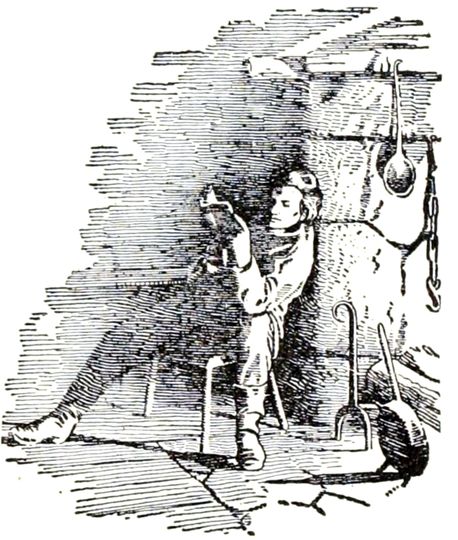
Washington's
birthday
and birthplace
63. George Washington as a Boy. When Washington
was born, February 22, 1732, in the old colony of Virginia,
the early settlements had grown into towns, and planters
had prospered. His father's house stood upon a gentle
hill slope which ran down to the lazily flowing Potomac.
Across the river one could see the wooded Maryland
shore, broken with a few great farms and plantations.
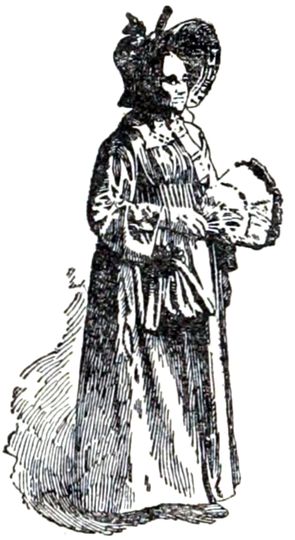
The
mother
of Washington
Washington's father owned more than one plantation,
and had many negro slaves. He was also a partner in
some iron mines, and once had been captain of a ship
carrying iron ore to London. It was in London that he
had fallen in love with Mary Ball, called, on account of
her beauty, the "Rose of Epping Forest." She, too, was
a Virginian, and she married Augustine Washington, and
became the greatly revered mother of George.
School
in Fredericksburg
When George was but three years old his parents
moved to the plantation on the Rappahannock. Across
the river, in the old town of Fredericksburg, George went
to a school taught by the church sexton. Both teachers
and schools were scarce in Virginia then because the
people lived miles apart on their great plantations.
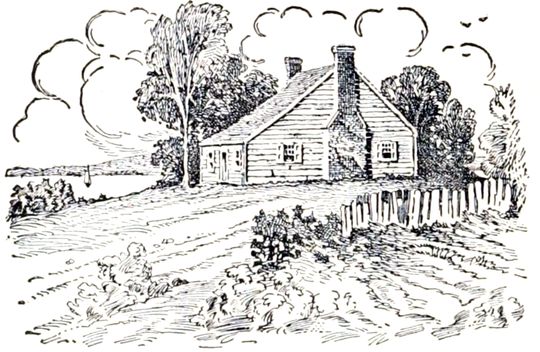
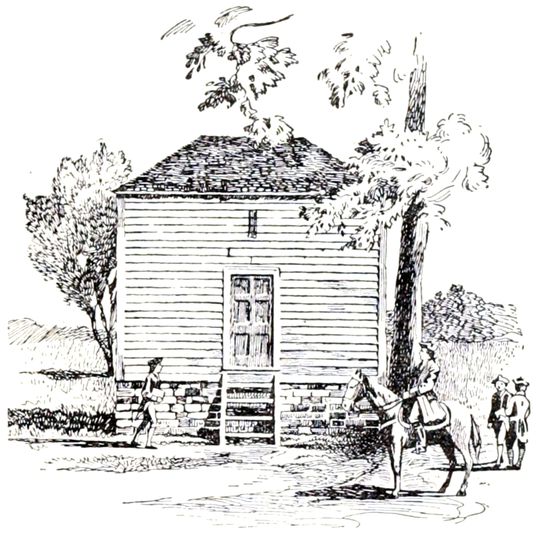
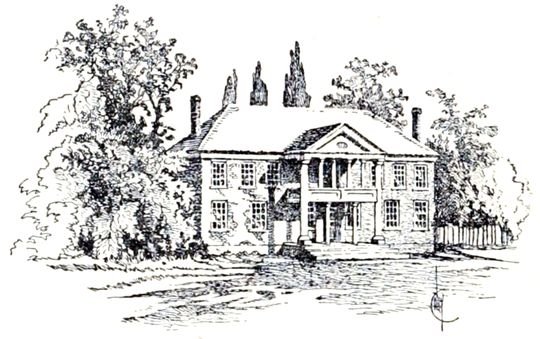
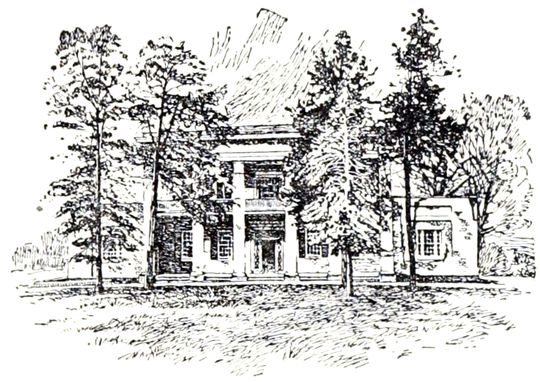
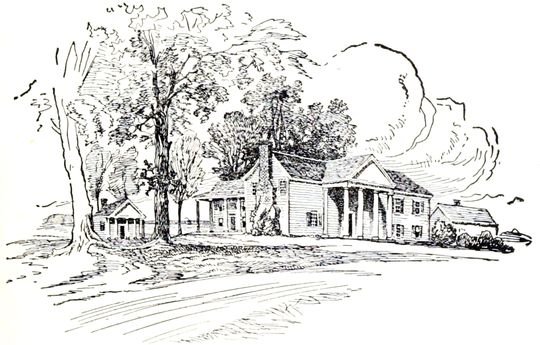
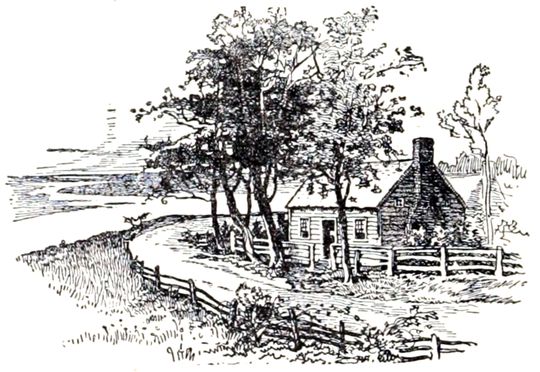
THE BOYHOOD HOME OF WASHINGTON
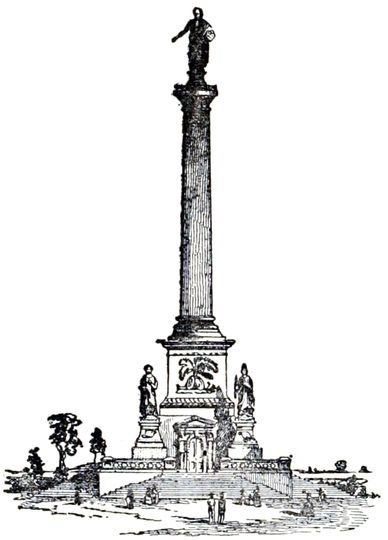
Here on the site of the farmhouse, a slope on the river bank,
stands the first monument erected to Washington, the bricks
from the great chimney forming its foundation
In Washington's
day the plantations
were usually located
on the rivers or
bays. The rivers
were the best roadways
in those old
times. Besides, the
planter was glad
to have the yearly
ship from London
stop at his door.
The
yearly
ship from
London
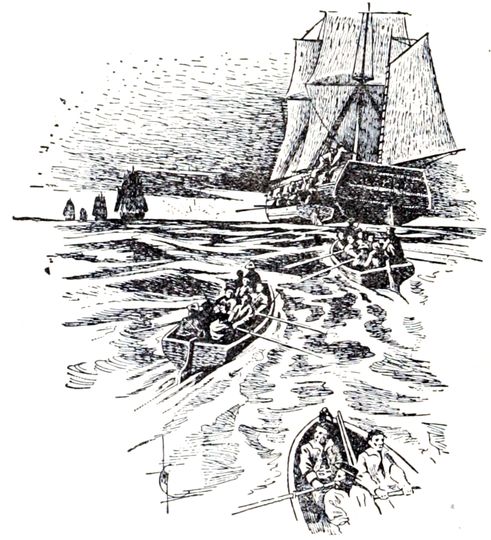
The coming of the ship brought happy days to the
young people, for it often brought furniture for the house
and fine clothes for the family. Sometimes, too, it
brought back some long-absent son or daughter, or letters
from relatives in the old English home. Then there
were the stories such as only sailors can tell.
When all the stores of tobacco and grain had been
loaded, once more the great ship spread her wings and
sailed away. Then many a Virginia boy longed to go
on board and sail away, too.
Mary
Washington
George's father died and left him, at the age of eleven,
to the care of his mother. Mary Washington was a wise,
firm mother, and always held the love and admiration
of her children.
The
eldest
son in
Virginia
According to the custom of those old Virginia days, the
eldest son, Lawrence Washington, received the beautiful
plantation on the Potomac, which he named Mount
Vernon in honor of Admiral Vernon, an English naval
officer under whom he had fought in the West Indies.
George
studied
hard and
played
hard
To George fell a smaller plantation on the Rappahannock.
He could hardly hope to go to England to
study, but went to a school near his birthplace. Here
he studied hard, mastering mathematics, and business
papers of all sorts. The book into which he copied
business letters, deeds, wills, and bills of sale and exchange
shows how careful he was and how he mastered everything
he undertook.
At school, George was a spirited leader in all outdoor
sports. He outran, outjumped, as well as outwrestled
all his comrades. He could throw farther than any of
them. The story is told that he once threw a stone across
the Rappahannock, and that at another time he threw
a stone from the valley below to the top of the Natural
Bridge, a distance of more than two hundred feet.
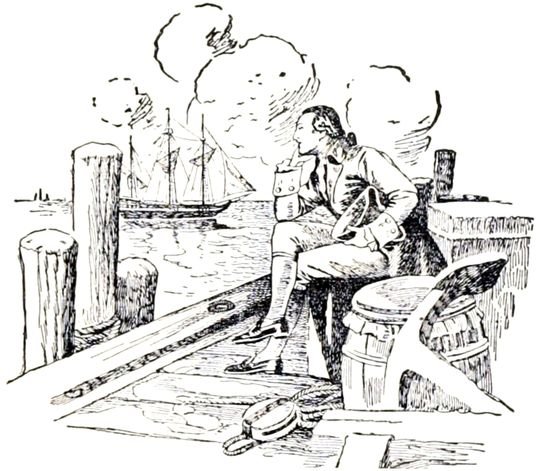
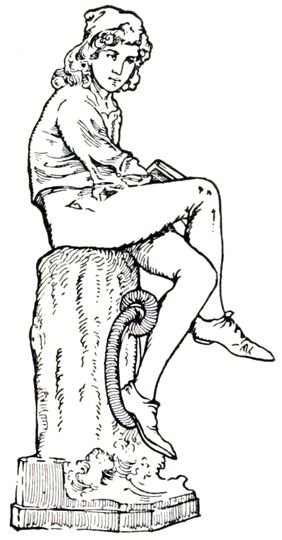
WASHINGTON DREAMING OF A SEAMAN'S LIFE
Playing
war
Washington was
captain when the
boys played at war.
Every boy among
them expected to
be a soldier some
day. George listened
to the stories
told by his brother
Lawrence, who had
been a captain in
the West Indies.
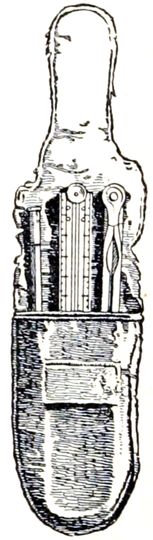
WASHINGTON'S
SURVEYING
INSTRUMENTS
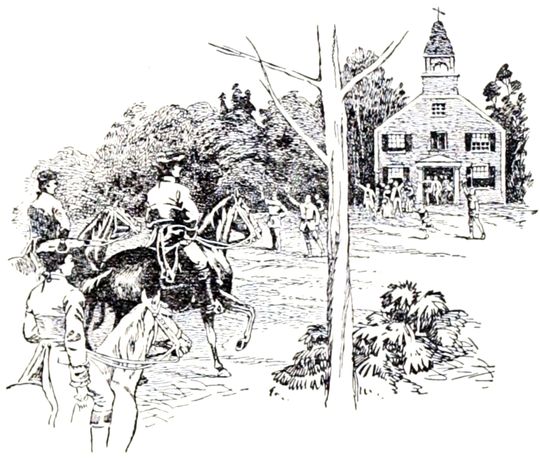
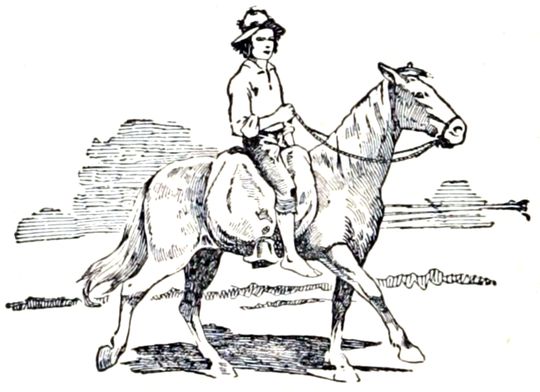
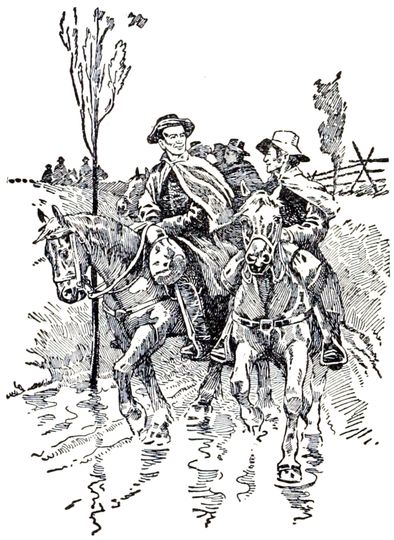
A horseback
rider
As a boy George
Washington also
learned many useful things outside of school. He became
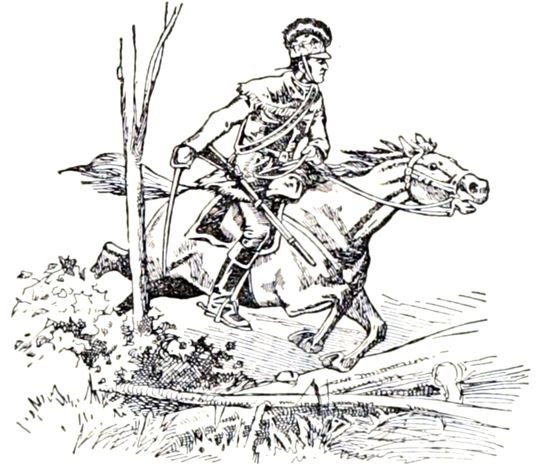
a skillful horseback rider, for every Virginia
plantation had fine riding horses. People lived so far apart
that they had to ride horseback when they visited each
other and when they went to church or to
town. Whether George rode a wild colt to
"break" it, or whether he rode with his
neighbors through woods and fields, jumping
fences or swimming streams, or in a wild chase
after the fox, he always kept his seat.
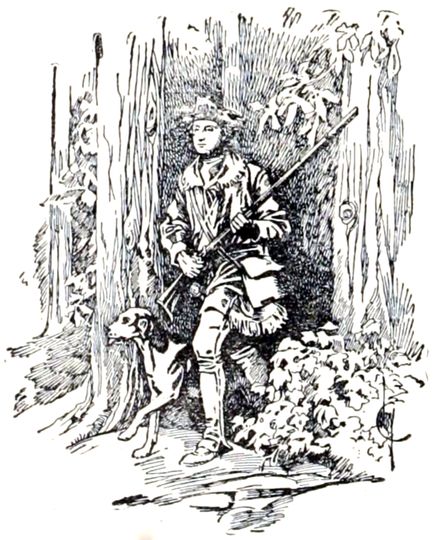
A woodsman
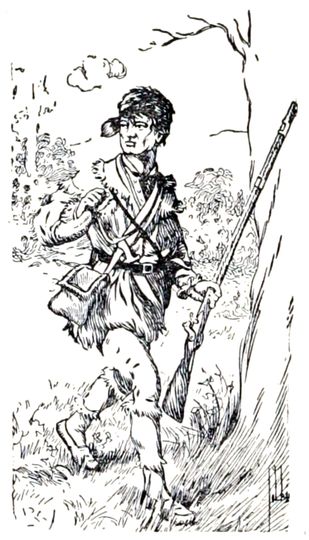
Even while a boy Washington was learning
the ways of a woodsman. With only a
gun and a dog for companions, he made long
trips into the deep, dark Virginia forests,
where no road or path showed the way. He
could cross rivers without bridge or boat,
could build a shelter at night, could trap,
and shoot, and cook over the fire by the
side of which he slept. All this knowledge
was soon put to use by Washington.
Washington
wanted
to be a
sailor
When George was fourteen
it was decided that he
might "go to sea." No doubt
he dreamed of the time when
he should be a seaman, or
perhaps an officer on one of
the king's great war ships.
But when all was ready, he
gave up his plans to please
his mother and went back to
school. He now studied surveying,
and was soon able
to mark off the boundaries
of farms and lay out roads.
Lord
Fairfax
George was now more and more at Mount Vernon,
where he met many fine people. Among these visitors
he admired most an old English nobleman, Lord Fairfax,
who had come to spend the rest of his days beyond the
Blue Ridge in the beautiful valley of the Shenandoah.
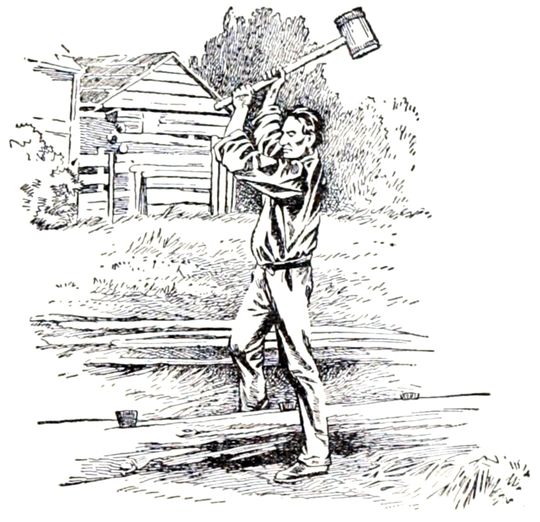
A surveyor
at
sixteen
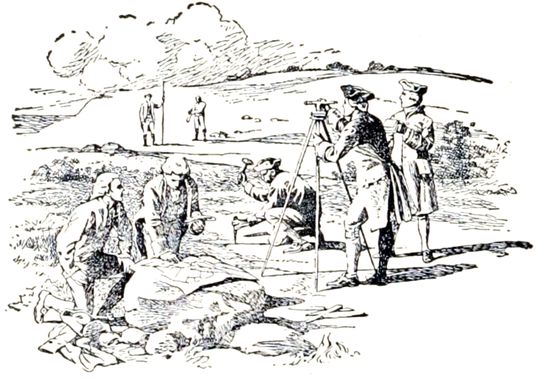
64. Washington as Surveyor. Lord Fairfax was
pleased with Washington, who was then tall, strong,
active, and manly looking, although but sixteen years
old. Accordingly, one spring Washington, with a number
of companions, started over the mountains to survey the
wild lands of Lord Fairfax.
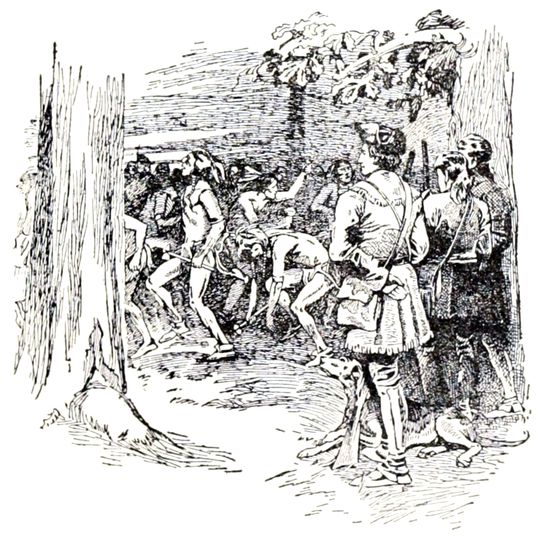
THE SURVEYING PARTY AT AN INDIAN WAR DANCE
Life in
the Shenandoah
in 1748
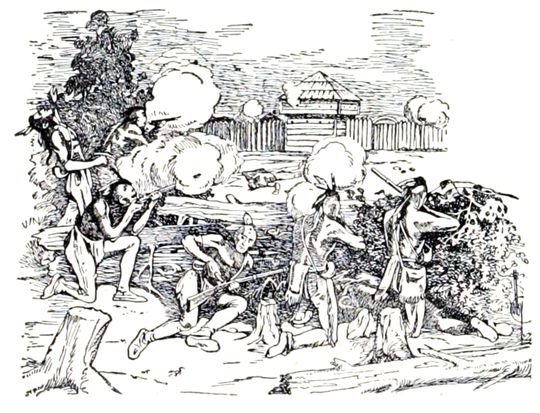
The trip was full of danger. There were no roads,
bridges, or houses after the party reached the mountains;
but deep rivers, wild animals, and savage Indians were
plentiful. Some nights they slept in rude huts, other
nights in tents, but more often under the stars and
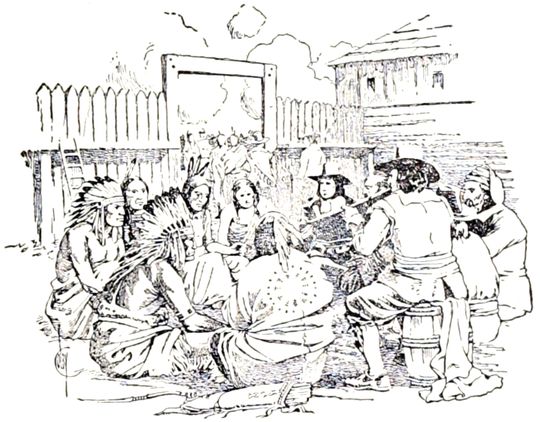
around the camp fire. One night they saw a party of Indians
dance their
wild war dance to
the music of a
rude drum, made
by stretching a
hide over a pot,
and to the noise
of a rattle, made
by putting shot in
a gourd.
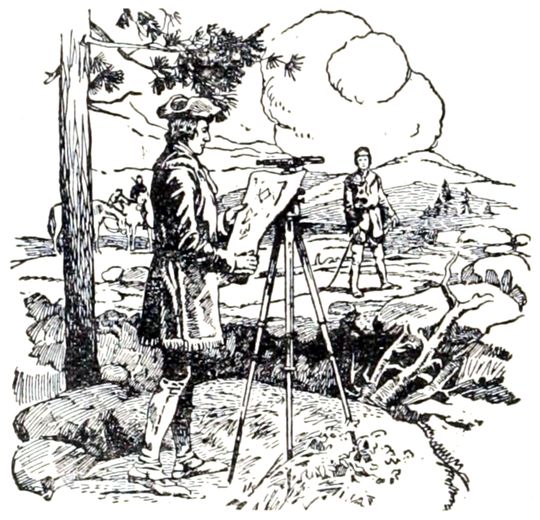
WASHINGTON SURVEYING LORD FAIRFAX'S
LANDS
Work
well done
Within a month
Washington was
back with maps
and figures showing
what lands
belonged to Lord Fairfax. Few men could have done
better, and a warm friendship grew up between this
white-haired English
nobleman and the young
Virginian. Lord Fairfax
immediately built a great
hunting lodge in the
Shenandoah, near where
Winchester is, and named
it Greenway Court. It
became a favorite visiting
place for many Virginians.
A public
surveyor
Washington had done
his work so well that
Lord Fairfax had him
made a public surveyor, and invited him to make Greenway
Court his headquarters.
For three years Washington was hard at work in that
western wilderness marking out the lands of settlers.
It was a rough but health-giving life and made his bones
and muscles strong. He had to take many risks and
face many dangers.
Once he wrote to a friend: "Since you received my
letter in October I have not slept above three or four
nights in a bed; but, after walking a great deal all the
day, I have lain down upon a little hay, straw, fodder,
or a bear skin, whichever was to be had, with man, wife,
and children, like dogs and cats, and happy is he who
gets the berth nearest the fire."
At
Greenway
Court
But the young surveyor was often at Greenway Court
taking part in its pastimes, or spending his time in sober
conversation with Lord Fairfax, or in reading the books
on history which were found in his friend's library.
Heavy
responsibility
at
twenty
65. Washington as a Soldier against the French.
Suddenly Washington's whole life was changed. His
brother Lawrence died and left to George the beautiful
Mount Vernon home and the care of his only daughter.
At the age of twenty Washington found himself at the
head of two large plantations. But he had hardly begun
his new duties before he was called to serve his governor
and the king.
The French in Canada were building a chain of outposts
from Lake Erie into Pennsylvania to the headwaters
of the Ohio River so that they might have a shorter
route to their trading posts on the Mississippi. Governor
Dinwiddie of Virginia had sent orders for them to get
out of the country, but his messenger did not get within
a hundred miles of the French soldiers.
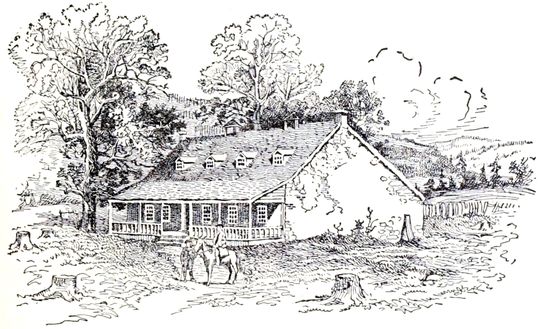
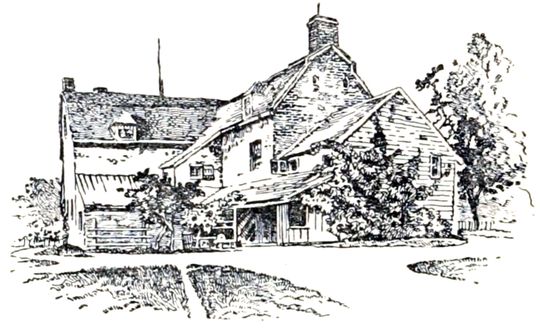
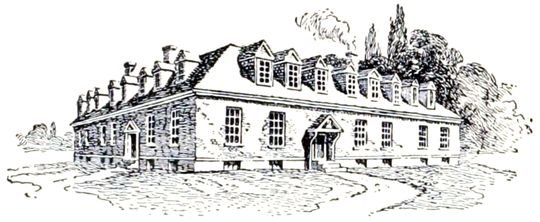
GREENWAY COURT, THE VIRGINIA HOME OF LORD FAIRFAX
Surmounting the broad, sweeping roof, pierced by dormer windows, were two belfries, doubtless
designed for bells to call the settlers together when an Indian uprising was feared
It was probably Lord Fairfax who said to the governor:
"Here is the very man for you; young and daring, but
sober minded and responsible, who only lacks opportunity
to show the stuff that is in him."
George
Washington
sent
to order
the
French
out of
Virginia
territory
In October, 1753, Washington, not then twenty-two,
set out with servants, horses, and two companions for
the French posts. One companion was the old Dutch
soldier who had taught Washington to use the sword,
and the other was the famous backwoodsman, Christopher
Gist. They pushed on through deep forests, over the
mountains, across swift rivers, to the Indian village near
where Pittsburgh now stands. From there Washington
hurried on to the fort on French Creek.
The French commander received him with great
politeness, and tried to keep him many days. But
Washington saw that the French were really preparing
to fight to hold this "gateway to the West."
The trip
back to
Virginia
The Frenchmen very politely said that they intended
to hold that region at all hazard. Washington and his
party at once started back with the answer.
Washington's party traveled through rain and snow,
hurrying through dense forests where savages lurked
ready to scalp them. An Indian shot at Washington,
but missed him. Their horses gave out, and Washington
and Gist plunged into the forest alone, on foot, anxious
to lose no time. At last they reached Williamsburg.
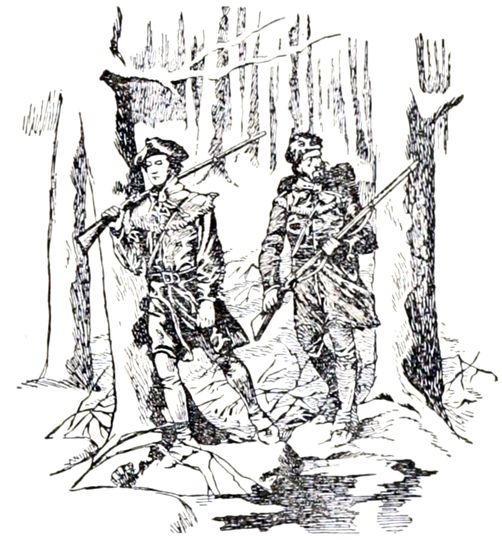
WASHINGTON ON HIS WAY BACK FROM
THE FRENCH POSTS
Washington
cuts a
road over
the
mountains
War now seemed certain, and the governor hurried
Washington forward with about one hundred fifty men
to cut a road through the forests and over the mountains.
But the French had already reached and built Fort
Duquesne, where the Ohio is formed, and were then
hurrying forward a party to look for the English. Just
after Washington's men crossed the mountains they
surprised the French scouts, killed their commander, and
took the rest prisoners.
Young Washington wrote
home that he had heard
the whistle of bullets and
liked the music.
He wins
one battle,
and
loses
another
Although Washington's
company soon grew to
three hundred fifty men,
he built Fort Necessity, for
a French force numbering
four times his own was now
close upon him. A battle
followed. Standing knee
deep in mud and water, the
English fired all day at the hidden foe. Their ammunition
was about gone, and their men were falling. Washington
surrendered the fort, and the little army, with sad
hearts, started home along their newly made road.
Washington
joins
Braddock's
army
66. Washington and Braddock. But these were
stirring times in Virginia, for an English general, Braddock,
had come up the Potomac; and soldiers, cannon,
and supplies were passing right by the doors of Mount
Vernon. Every day Washington looked upon the king's
soldiers, and saw the flash of sword and bayonet. How
could he keep out of it? General Braddock liked the
young Virginian, and made him an officer on his staff.
Braddock was a brave man, but he had never made war
in the woods, or against Indians. One day Washington
suggested that a long train of heavily loaded wagons
would make the march very, very slow. He was thinking
of Indians. Braddock only smiled, as if to say that a
young backwoodsman could not teach him how to fight.
Braddock
too vain
to take
good advice
Benjamin Franklin, a very wise man from Philadelphia,
was also troubled when he thought of how the Indians
and French would cut to pieces that long line of troops
as they marched through the deep, dark forests. Braddock
smiled again, and said: "These savages may be
dangerous to the raw American militia, but it is impossible
that they should make any impression on the king's
troops."
The army, over two thousand strong, slowly crossed
the mountains, and by July had almost reached Fort
Duquesne. One day nearly one thousand French and
Indians swarmed on both sides of the road, and from
behind the safe cover of trees
poured a deadly fire upon Braddock's
men. "God save the king!"
cried the British soldiers, as they
formed in line of battle.
A great
defeat
Washington
thanked
for his
bravery
by the
Burgesses
Washington urged Braddock to
permit the English to take to the
trees and fight Indian fashion, as
the Virginians were doing, but
Braddock forced his men to stand
and be shot down by the unseen
foe. Braddock himself was mortally
wounded. Washington had
two horses shot under him and his
clothes pierced by four bullets.
The British regulars soon ran
madly back upon the soldiers in the rear. They threw
away guns and left their cannon and wagons, while the
Virginians under Washington kept the Indians back.
The British army retreated to Philadelphia, but Washington
returned to Virginia, where he received the thanks
of the Burgesses. He at once collected troops, and hastened
into the Shenandoah Valley to protect the settlers
from the French and Indians.
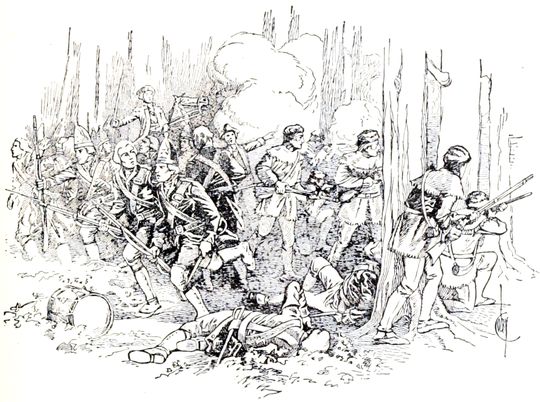
WASHINGTON AND THE VIRGINIANS SAVE BRADDOCK'S ARMY
Colonel
Washington
visits
Boston
The next year (1756) Washington journeyed on horseback
to Boston. He wore his colonel's uniform of buff
and blue, with a white and scarlet cloak over his shoulders.
At his side hung a fine sword. With him rode two aids
in uniform, besides two servants. Many an admiring
eye was turned toward this stately young cavalier. After
this journey he returned to the frontier, near Greenway
Court, and remained there a year or two more.
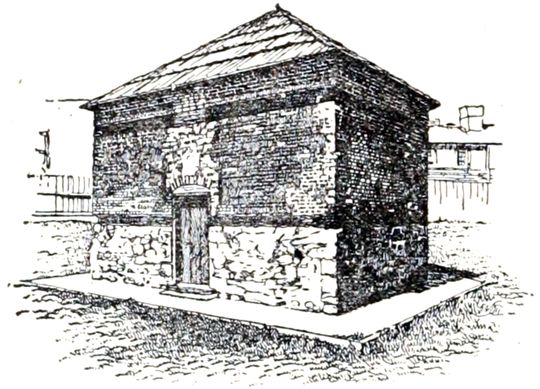
THE OLD BLOCK HOUSE, PITTSBURGH
Still standing to-day in the heart of the city, formed
part of Fort Pitt
Washington
introduced
to
Martha
Custis
67. Washington Meets his Future Wife. One day
while on his way to Williamsburg with war dispatches,
Washington halted at
a plantation to take
dinner with a friend.
There he was introduced
to Mrs. Martha
Custis, a charming
young widow of his
own age.
After dinner the conversation
with her was
too interesting for the
young officer to see the horses being led back and forth
near the window. The horses were stabled again. After
supper Washington was not yet ready to mount. Not
until late in the afternoon next day did he mount and
ride away with all speed for the capital. On his return
he visited Mrs. Custis at her own beautiful plantation,
and did not leave until he had her promise of marriage.
Wolfe
made it
easy to
capture
Fort Duquesne
Great armies were already gathering. William Pitt,
who sent Wolfe to capture Quebec, also ordered General
Forbes to march against Fort Duquesne. But it was
November before the army reached the Ohio. The
French and Indians had nearly all gone to fight on the
St. Lawrence, and the place was easily captured. It
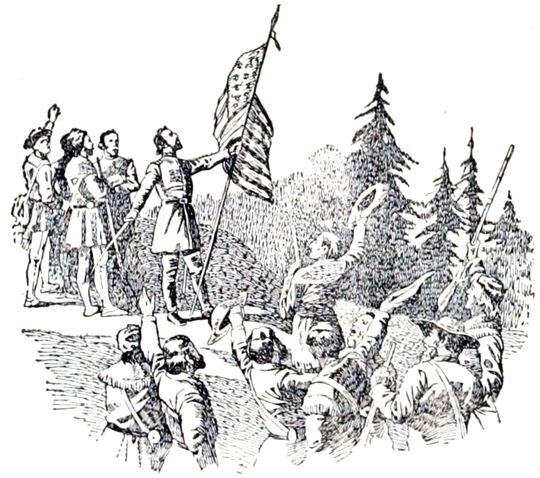
is said that Washington himself ran up the English flag.
The fort's name was changed to Fort Pitt.
A
Virginia
wedding
68. Old Days in Virginia. Washington now hastened
home to claim his bride. To the wedding came the new
royal governor in scarlet and gold, and the king's officers
in bright uniforms. There, too, came the great planters
with their wives dressed in the best that the yearly ship
could bring from London. The bride rode home in a
coach drawn by six beautiful horses, while Washington,
well mounted, rode by the side of the coach, attended by
many friends on horseback.
Elected
to the
House
of Burgesses
The hardy settlers of the frontier, grateful to their
brave defender, had already elected him to represent
them in the House of Burgesses. He was proud to take
his young wife to the meeting of the Burgesses when the
old capital town was at its gayest, and when the planters
came pouring in to attend the governor's reception.
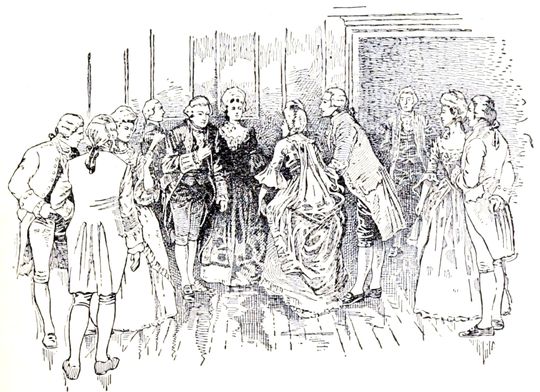
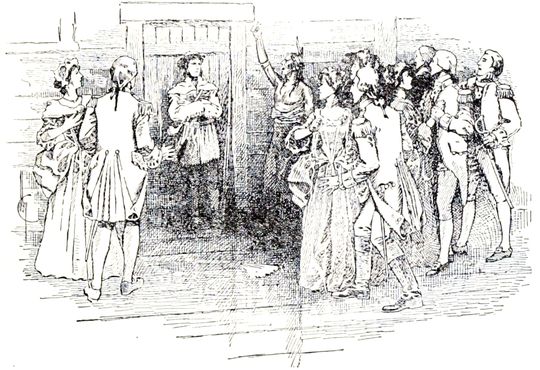
A RECEPTION AT THE GOVERNOR'S
At these receptions gay cavaliers and high-born ladies trod the stately minuet or danced
the famous Virginia reel
Too confused
to
make a
speech
Washington had already taken his seat among the
Burgesses when the speaker arose and, in a very eloquent
speech, praised him and presented him the thanks of the
House for his gallant deeds as a soldier. Washington
was so confused to hear himself so highly praised that,
when he arose to reply, he could not say a word. "Sit
down, Mr. Washington," said the speaker, "your modesty
is equal to your valor, and that surpasses any language
that I possess."
Washington took his young bride to Mount Vernon,
and there began the life that he enjoyed far more than
the life of a soldier. He felt a deep interest in everything
on the plantation. Early every morning he visited his
stables and his kennel, for he liked horses and dogs very
much. He then mounted a spirited horse and rode over
his plantation to look at the growing fields of tobacco
or wheat, or at the work of his slaves.
When the king's inspectors in the West Indies and in
London saw barrels of flour marked "George Washington,
Mount Vernon," they let them pass without examining
them, for they were always good. He looked after
his own and his wife's plantations so well that in a few
years he was one of the richest men in America.
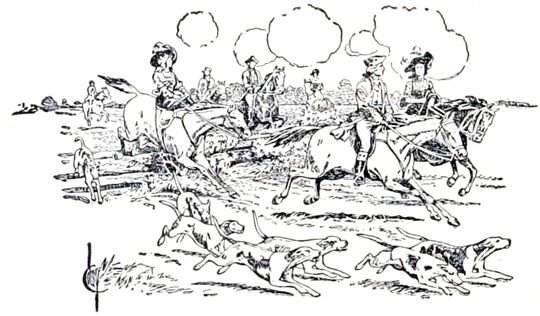
FOX HUNTING IN VIRGINIA
In some sections of our country this popular sport of the Virginia
colonists is still followed as in the days of George
and Martha Washington
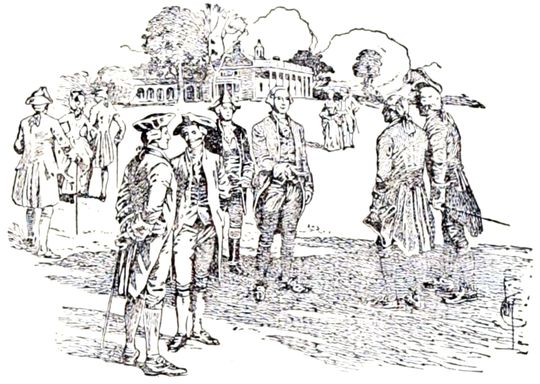
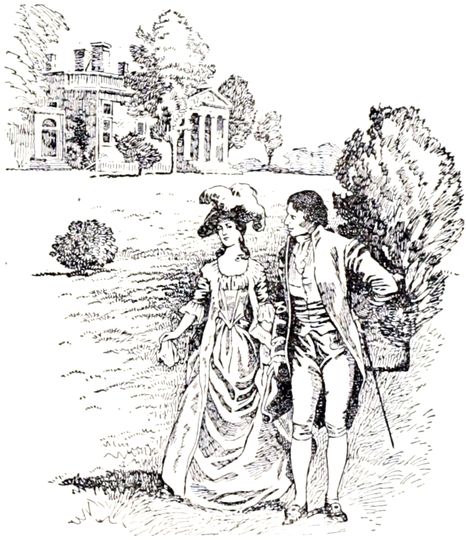
SCENE AT MOUNT VERNON IN THE DAYS OF WASHINGTON
Old
Mount
Vernon
days
But besides
such duties,
there were
many simple
pleasures to
be enjoyed at
Mount Vernon.
Here his soldier
friends always
found a
warm welcome.
Lord Fairfax
and other Virginia gentlemen went often to Mount Vernon
to enjoy a fox chase. Sometimes Mrs. Washington
and the ladies rode
with dash and
courage after the
hounds. Now and
then boating parties
on the wide
Potomac were the
order of the day.
Many times the
halls and grounds
of Mount Vernon
rang with the shouts and laughter of younger people,
guests, who had come from miles around, for George and
Martha Washington were young in spirit.
Washington
took
sides with
Patrick
Henry
69. The Mutterings of War. One day in June, 1765,
Washington came back from Williamsburg and told his
family and neighbors about the bold resolutions and fiery
speech of a rustic-looking member named Patrick Henry.
He said that many of the older members opposed Henry.
Washington took Henry's side, but his friends, the Fairfaxes,
took the king's side in favor of the Stamp Act.
When the king put a tax on tea, Washington and many
of his neighbors signed an agreement not to buy any more
tea of England until the tax was taken off. When he
heard that Samuel Adams and the "Mohawks" had
thrown the tea into Boston Harbor, he knew that
exciting times would soon be at hand.
Sent to
the Continental
Congress
The very next year the king ordered more soldiers to
go to Boston and put in force the Boston Port Bill and
other unjust laws. The colonies saw the danger, and
sent their best men to hold the first Continental Congress
at Philadelphia. Virginia sent George Washington, Patrick
Henry, Richard Henry Lee, and other great men.
Washington, however, was not an orator, and made no
speech in the Congress, as others did. He was a man of
deeds. His time had not yet come.
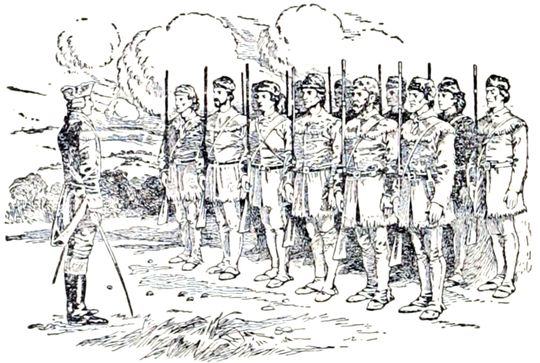
WASHINGTON DRILLING HIS VIRGINIANS
A
youthful
colonel
Many persons were surprised to find him so young, for
twenty years before they had heard of his deeds against
the French, and how he had saved the broken pieces of
Braddock's army. A member of Congress declared that
"if you speak of
solid information,
and of sound
judgment, Colonel
Washington is
unquestionably
the greatest man
on the floor."
The Congress,
among other
things, resolved
to stand by Boston, if General Gage should make war on
that town. Washington knew what that meant. He was
not at home many months before he was busy drilling
his brave Virginians, many of whom had been with him
in the French and Indian War.
In Congress
again
What
John
Adams
said
70. Washington Made Commander of the American
Armies. In the last days of April, 1775, the news of the
fight at Lexington and Concord was spreading rapidly
southward. Washington, dressed in the buff and blue
uniform of a Virginia colonel, hurried to Philadelphia
to the meeting of the second Continental Congress. His
day had come. It was now a time for deeds. The
American army that surrounded Gage in Boston must
have a head. John Adams arose in Congress and said
that for the place of commander he had "but one gentleman
in mind—a gentleman from Virginia—whose
skill and experience as an officer, whose independent
fortune, great talents, and excellent universal character
would command the approbation of all America, and
unite the colonies better than any other person in the
Union."
What
Washington
said to
Congress
and
wrote to
his wife
Before all these words were spoken, Washington,
much moved, had left the room. Congress elected him
unanimously to be commander in chief of its armies.
When he accepted the honor, he said: "I beg it may
be remembered by every gentleman in this room,
that I this day declare, with the utmost sincerity, I
do not think myself equal to the command I am honored
with."
Washington wrote immediately to his wife: "You may
believe me, my dear Patsey, that so far from seeking this
appointment, I have used every endeavor in my power to
avoid it, not only from my own unwillingness to part
from you and the family, but from the consciousness
of its being a trust too great for my capacity." Great
men are often the most modest.
On the
way to
take command
News
from
Bunker
Hill
Washington was soon on the way to Boston by the
very route he had gone nearly twenty years before.
But how different the journey! Then he was a Virginia
colonel. Now he was the honored commander of all the
American armies. Then only a few friends were with
him. Now congressmen, citizens of Philadelphia, and
great crowds cheered him on the way. Only twenty
miles out from Philadelphia, they met the news from
Bunker Hill. When Washington heard how the Americans
faced the British bayonets, and twice forced the
Redcoats to retreat, he exclaimed: "The liberties of the
country are safe!"
Took
command
of
the army,
July 3,
1775
Through New Jersey he was hailed by the people with
delight. A military procession escorted him through
New York City, where he appointed that noble general,
Philip Schuyler, to take command in New York. The
students at Yale gave him a real college welcome—a
parade with a band and student songs.
On Cambridge Common, under the famous Harvard
Elm, on July 3, 1775, Washington drew his sword and
took command of the Continental army. There was a
great task before him. He had to drill the troops, collect
cannon from Ticonderoga, which Americans had captured,
and get ready to drive the British out of Boston.
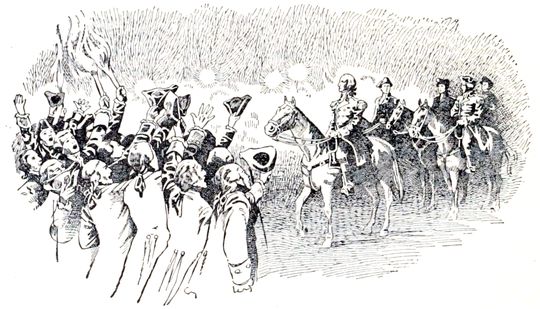
A COLLEGE WELCOME AT YALE
A
bloodless
victory
It took all winter to do these things. One night in
March, 1776, Washington secretly sent some of his
best troops to build a fort on Dorchester Heights. The
next morning Howe, the
new British general, saw
Washington's cannon pointing
down on his army and
ships. He immediately put
his army on board and sailed away. This was a victory
without a fight.
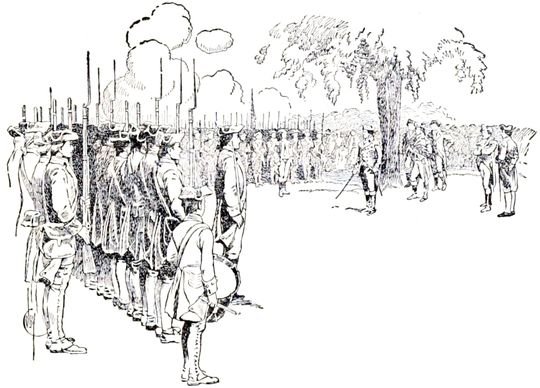
WASHINGTON TAKING COMMAND OF THE
ARMY
Washington
outwits
Howe
Washington took his army to New York, and built
a fort on Long Island to protect the city. He was none
too quick, for Howe came with thirty thousand men
and many war ships.
In the battle on Long Island a part of Washington's
army was defeated. General Howe planned to capture
the defeated troops next day, but Washington was too
shrewd. In the night he collected all the boats in that
region and rowed his army over to New York before the
British knew what he was doing.
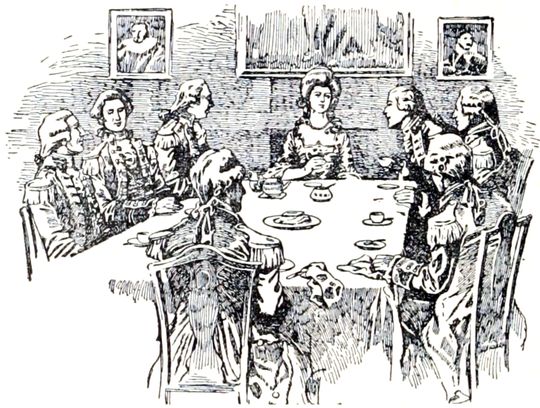
ENTERTAINING GENERAL HOWE AND HIS OFFICERS
At Murray Hill, then a great farmstead, now the heart of New York
City, Mrs. Murray entertained them so delightfully two hours
slipped away, and the Americans were out of reach
New
York
captured
The great British army and fleet took the city, but
by the help of a patriotic lady, Mrs. Murray, who entertained
General Howe and his officers too long for their
own good, all of Washington's regiments got away safely
up the Hudson. During the fall of 1776, General Howe
tried to get
above Washington's
army
and capture
it. But he did
neither, for
Washington's
troops defeated
the British
both at Harlem
Heights and at
White Plains.
Heroic
Nathan
Hale
While at
Harlem Heights
Washington felt that he must learn some secrets about
the enemy. Nathan Hale, a young officer, volunteered
to bring General Washington the information he wanted;
but Hale was caught by the British and hanged. "I
only regret," he said, "that I have but one life to lose
for my country."
Washington
retreats,
but fights
Howe then turned back as if to march against Philadelphia
and capture Congress. Washington quickly
threw a part of his army across the Hudson into New
Jersey, but he had to retreat. The British followed in a
hot chase across New Jersey. Washington crossed the
Delaware, and took with him all the boats for many
miles up and down the river. The British decided to
wait till they could cross on the ice. Some of their
generals thought the war was about over, and hastened
back to New York to spend the Christmas holidays.
Americans
discouraged
71. The People Did Not Know Washington. Those
were, indeed, dark days for the Americans. Hundreds
of Washington's soldiers had gone home discouraged,
and many other faint-hearted Americans thought
the cause lost, and were again promising obedience to
George III. But the people did not yet know Washington.
On Christmas night, with two thousand five hundred
picked men, Washington took to his boats, and crossed
the Delaware in spite of the floating ice. Nine miles
away, in Trenton, lay the Hessians, those soldiers from
Hesse-Cassel, in Europe, whom George III had hired
to fight his American subjects, because Englishmen
refused to fight Americans.
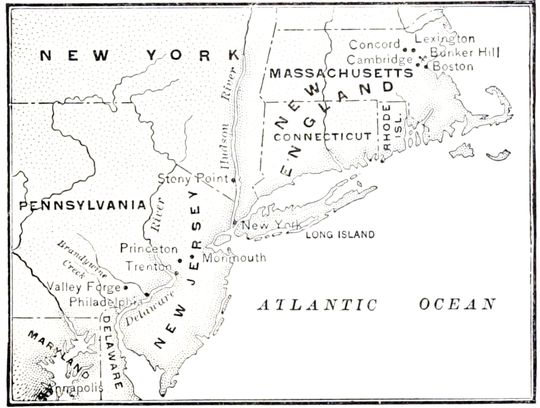
SCENE OF WASHINGTON'S CAMPAIGNS IN THE NORTH
On went the little army in spite of the biting cold and
the blinding snow. During this fearful night two men
froze to death and many others were numb with cold.
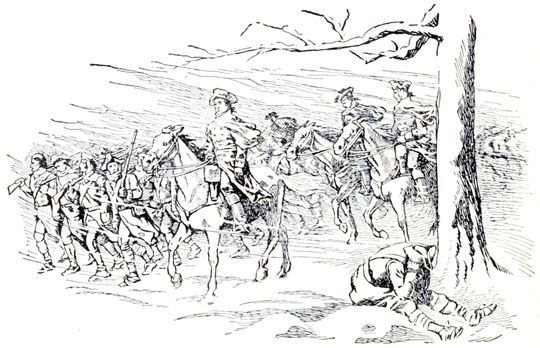
WASHINGTON ON THE MARCH TO TRENTON
An early
morning
surprise
"Our guns are wet," said an officer. "Then use the
bayonet!" replied Washington. There was a sudden
rush of tramping feet and the roar of cannon in the
streets. The Hessian general was killed, and one thousand
of his men surrendered.
All night, thinly clad, many without shoes and with bleeding feet, over the frozen ground,
on marched the shivering men, bringing at daybreak disaster to the
Hessians asleep after their Christmas revels
These were a strange lot of prisoners. Not one could
speak a word of English or cared a thing for George III.
No doubt they wished themselves at home on that
morning. But the Hessians were not more surprised
than the British generals in New York.
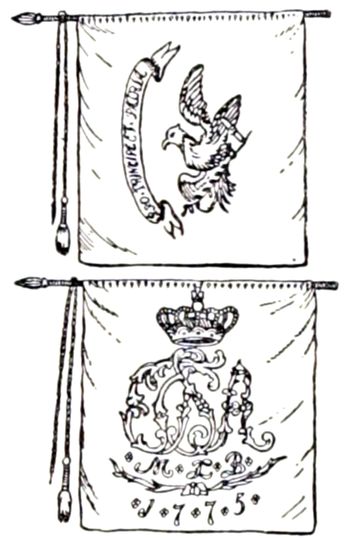
HESSIAN FLAG
From a photo of the flag
taken by Washington from
the Hessians at Trenton and
now in the museum at
Alexandria
Washington
outwits
another
English
general
Cornwallis, the British commander, hurried forward
with troops to capture Washington, but rested his army
at Trenton. That night Washington's army stole away,
and Cornwallis awoke in the morning to hear the
booming of Washington's cannon at Princeton, where
Washington was defeating another part of the British
army. Cornwallis hastened to Princeton. It was too
late. Washington was safe among the
heights of Morristown, where Cornwallis
did not dare attack him.
These two victories turned the tide
and aroused the Americans. Reënforcements
and supplies made Washington's
army stronger and more comfortable.
The next spring (1777) General Howe
decided to capture Philadelphia. But
Washington boldly moved his army
across Howe's line of march. Howe
did not want to fight, so he put his army
on board his ships, sailed around into
the Chesapeake, landed, and marched
for the "rebel capital," as the British called Philadelphia.
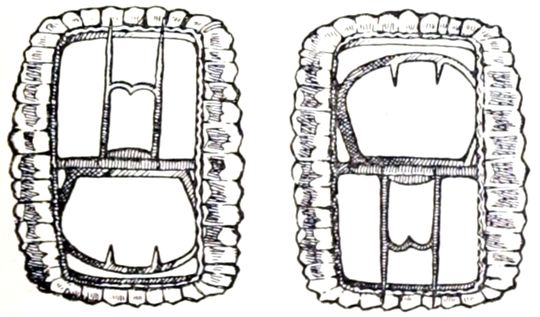
KNEE BUCKLES WORN BY GENERAL
WASHINGTON
Washington
and
Howe
meet at
the Brandywine
At Brandywine Creek, south of Philadelphia, Washington
faced him. A severe battle was fought. Each side
lost about one thousand men. The Americans slowly
retreated. In this battle Lafayette, a young French
nobleman, was wounded. Lafayette had heard in France
how the American farmers
had beaten the king's regulars
at Lexington, and he
had made up his mind
to go to help them. On
his arrival Congress had
made Lafayette a general
in the Continental army.
Valley
Forge
72. The Winter at Valley Forge. After the battle at
Brandywine Creek the British slowly made their way to
Philadelphia. Washington took post for the winter at
Valley Forge, on the Schuylkill River, twenty miles
northwest of Philadelphia. There, in the deep woods
among the hills, and in log huts built by their own hands,
the American forces passed a winter so full of suffering
that it makes one shudder to read the story.
What the
soldiers
suffered
for independence
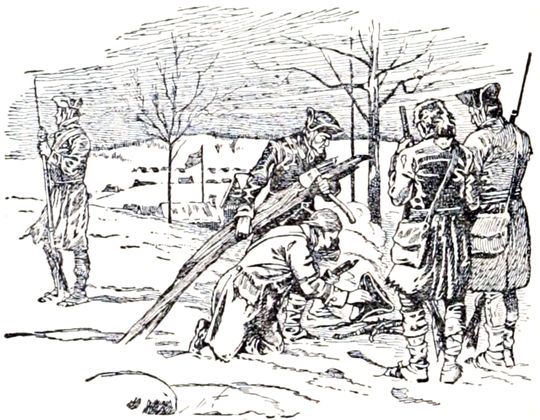
When the army marched into Valley Forge, "their
route could be traced on the snow by the blood that
oozed from their bare, frost-bitten feet." Washington
wrote to Congress that nearly three thousand of his men
were "barefoot or otherwise naked."
A part of the army had no bread for three days, and for
two days no meat. Hundreds had no beds, and gladly
slept on piles of straw. Others had no blankets, and sat
up nights before the fire to keep from freezing. Many sickened
and died. But in Philadelphia the well-fed British
soldiers had a gay season, with balls and banquets.
Steuben
helps
drill
the men
Washington grieved over the suffering of his men, but
never lost heart.
All the long winter
through, with the
aid of General
Steuben, a noble
German officer, he
drilled his men.
In the spring when
the British started
back to New York,
he gave them such
a bayonet charge at
Monmouth, New Jersey (1778), they were glad to escape
that night, instead of stopping to rest and bury their dead.
73. The Crowning Victory at Yorktown. For the
next three years the British army remained in New
York, not daring to come out and
attack Washington.
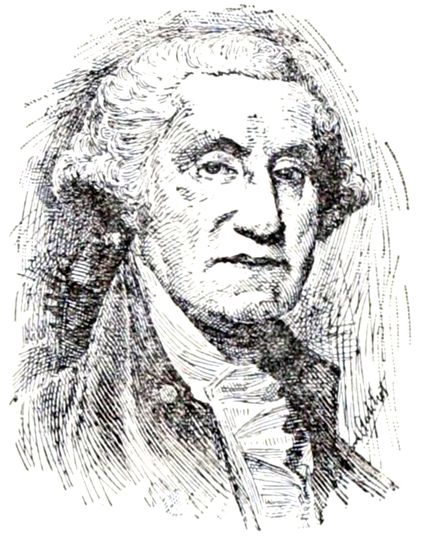
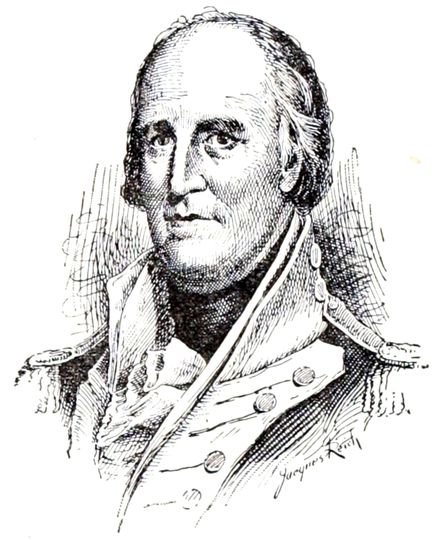
GEORGE WASHINGTON
From the Gibbs-Channing portrait
painted by Gilbert Stuart, the first
portrait of Washington, now in
the possession of Samuel P. Avery
of New York
Good
news
from Lafayette
Finally, in the summer of 1781,
General Lafayette, who had now
recovered from his wound, and
had fought with the Americans
at Monmouth, was sent to Virginia
by Washington to watch the
British army there. Lafayette
sent Washington word that Cornwallis
had come up from the
Carolinas, and had taken post at
Yorktown. After receiving more
soldiers, Lafayette followed Cornwallis
to Yorktown and stationed
his army near that place. Washington also got word
that a large French war fleet was coming to the coast
of Virginia to aid the Americans. This fleet had been
sent to aid the Americans by the King of France.
Washington also had six thousand fine French troops
under the command of General Rochambeau. This aid
had been secured through the influence of Lafayette, who
had visited his home in France in 1779.
Washington
again
outwits
Cornwallis
Washington now saw his chance. He ordered Lafayette
to watch Cornwallis while he himself took two
thousand ragged Continentals and four thousand French
troops in bright uniforms, and slipped away from New
York. He was almost in Philadelphia before the British
or his own soldiers could guess where he was going.
At Yorktown, Washington and his army found both
Lafayette and the French fleet keeping watch. Day
and night the siege went on amid the roar of cannon.
When all was ready, then came the wild charge of the
Americans and the French in the face of British cannon
and over British breastworks. The outer works were
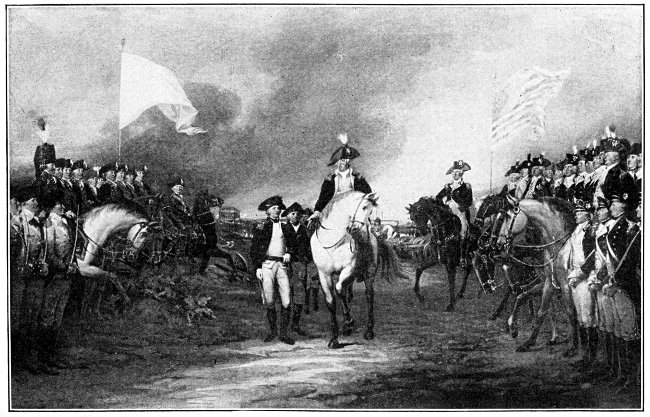
won, and Cornwallis saw that he must surrender. Seven
thousand of the king's troops marched out and gave up
their arms.
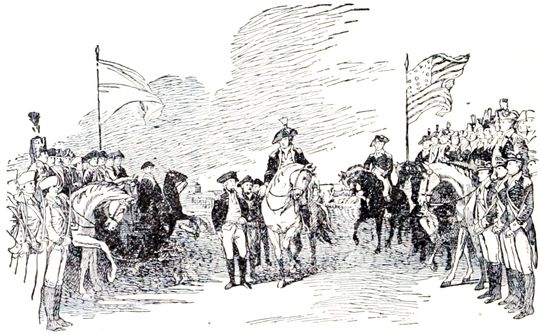
THE SURRENDER OF CORNWALLIS
After the painting by John Trumbull which hangs in the rotunda of the Capitol at Washington
Cornwallis
surrenders
The victory at Yorktown made all Americans happy,
and they rang bells, fired cannon, built bonfires, and
praised Washington and Lafayette. But England was
now tired of war, and many of her great men declared in
favor of peace, which was soon made, in 1783.
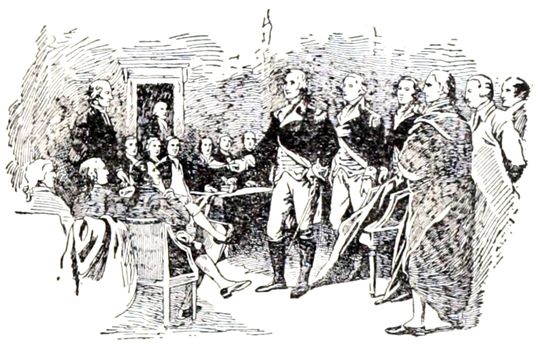
WASHINGTON'S RESIGNATION
After the painting by Trumbull in the Capitol at Washington
A
touching
scene
74. Washington Bids Farewell to his Officers and to
Congress. Washington bade farewell to his brave
soldiers, with whom he had fought so long. The parting
with his officers in Fraunces' Tavern, New York, was
a touching scene. With tears in his eyes, and with a
voice full of tenderness, he embraced each one as he bade
him good-by. It
was like the parting
of a father
from his sons.
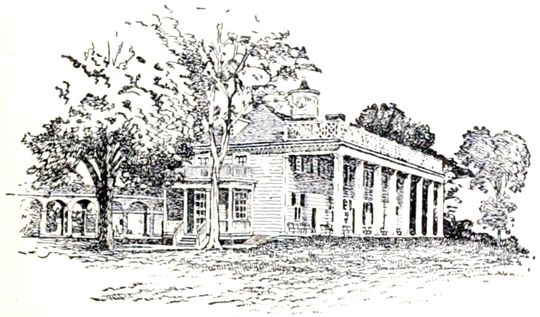
MOUNT VERNON, THE HOME OF WASHINGTON
A noble
act
Washington
now journeyed to
Annapolis, Maryland,
where Congress
was then
held, to give back
the authority of
commander in chief which Congress had bestowed on
him eight years before. How unselfish had been the
conduct of Washington in refusing pay for his services!
How noble was the act of giving up his power over an
army which idolized him, and which he might have used
to make himself king! But he did not think of these
things as he hastened to his beautiful Mount Vernon to
enjoy Christmas
time once more
with his loved
ones.
How the
war had
changed
things
Many
people
visit
Washington
But what a
change had come
to Virginia!
Eight years before
George III was
king over all the
Thirteen Colonies, and Virginia was ruled by one of his
governors. Now the people were ruling themselves, and
had elected one of Washington's neighbors, Benjamin
Harrison, to be their governor. He missed some old
friends. Some had died on the field of battle; others,
like Lord Fairfax, had gone back to England, where they
could be ruled by George III. Soon visitors began to
come—old soldiers, beloved generals, and great statesmen
from America, as well as distinguished people from
Europe. They all wanted the honor of visiting the man
who had led the American armies to victory, but who,
again, was only a Virginia planter.
75. Lafayette Visits Washington. The year after
peace was made Lafayette came back to America to visit
General Washington. There were great times at Mount
Vernon. Washington, Lafayette, and other noble men
sat around the table and there told stories of their
struggles and of their triumphs.
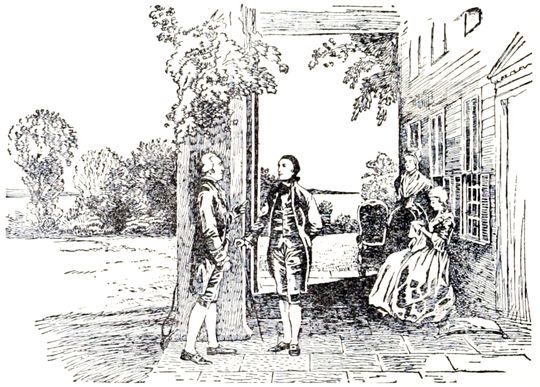
LAFAYETTE AT MOUNT VERNON
After a painting by Rossiter and Mignot
Lafayette visited many other places and received a
warm welcome wherever he went; he had taken active
part in many battles of the Revolution; his blood had
flowed for the American cause. At Monmouth he had
saved the Americans from retreat by sending for Washington.
He had had an important part in the crowning
victory at Yorktown. The Americans loved and admired
him, and did all in their power to show their gratitude.
Many years after, on another visit to America, Congress
voted him two hundred thousand dollars and twenty-four
thousand acres of land as a reward for his great services.
Another
call to
duty
76. Washington Elected First President. The American
people would not let Washington long enjoy Mount
Vernon, for when they met to make a new constitution,
or plan of government, he was chairman of the meeting,
and when that government was to go into operation they
would have no other man for their first president than
George Washington.
A triumphal
procession
from
Mount
Vernon
to New
York
In 1789 he once more bade Mount Vernon and his
aged mother good-by, and began the journey to New York,
which was at that time the capital of the new nation.
What a journey! It was almost one continual procession
and celebration! At every town and roadside the people
came to show their love for Washington, whom they
rightly called the "Father of his Country." School
children scattered flowers in his way and beautiful young
women sang patriotic songs as he passed under decorated
arches. When he reached New York Harbor the bay was
white with the sails of many nations. Crowds thronged
the streets, cannon boomed, and flags were thrown to
the breeze to welcome him.
Washington
takes the
oath as
first
president
On April 30, 1789, standing on the balcony of Federal
Hall in Wall Street, Washington took the oath of office,
and pledged himself to govern the people according to
the Constitution they had just made. He reverently
bent and kissed the Bible, and became the first President
of the United States. From the street, from doors and
windows, and from the housetops, the people cried out:
"Long live George Washington, President of the United
States!"
His new office was almost as hard a task as the Revolution
had been. He was now in charge of the affairs of
the country. He had to see to it that laws were made
to protect the rights of every one. Then he had to see
that these laws were carried out. He could not guide
himself by what another president had done, for there
had been none before him.
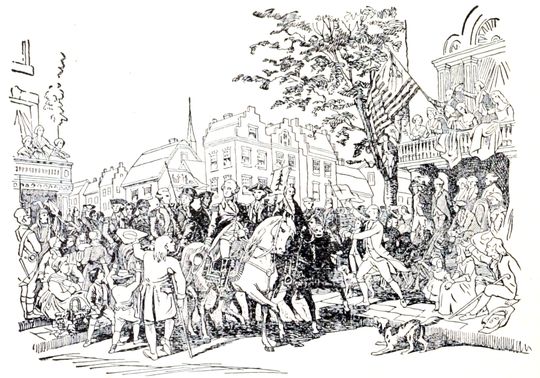
WASHINGTON'S GRAND ENTRY INTO NEW YORK CITY, 1789
From a chromo-lithograph after an original drawing by Alphonse Bigot
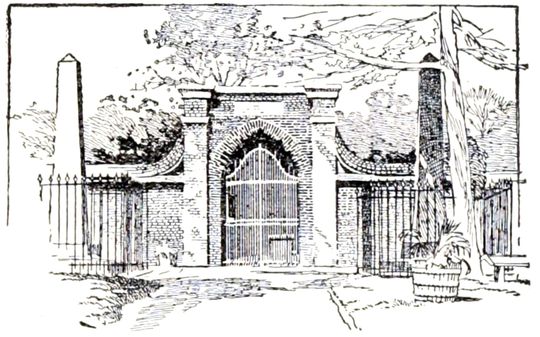
WASHINGTON'S TOMB, MOUNT VERNON
But Washington directed the new ship of state so that
it suffered no harm. When it looked as though we should
have another war
with England, he
wisely preserved
peace. So well
were the people
satisfied that they
made him president
a second time.
When they offered
him the office for
a third term he refused. Thousands gathered to see him
leave the capital. As he gave them his final farewell,
tears rolled down his cheeks, and men cried like children.
Death
in 1799
He was glad to get back to Mount Vernon, for he had
grown old and weary in serving his country. He spent
his remaining years among the scenes he loved so well.
There he died in 1799, mourned as a father by the whole
people.
The Leading Facts. 1. Washington was born on the
Potomac, spent his early days on the Rappahannock, and went
to school at Fredericksburg. 2. He learned many things
outside of school, such as horseback riding, fox hunting, and
how to find his way in the deep forests. 3. He became a
surveyor in the Shenandoah for Lord Fairfax. 4. Governor
Dinwiddie sent Washington to order the French to leave the
Ohio. 5. Washington joined Braddock's campaign against
the French, and in the battle tried to save the army. 6. Washington
married young Mrs. Martha Custis, and was elected
to the House of Burgesses. 7. Heard Patrick Henry's fiery
speech, went to first Continental Congress, and the second
Congress made him commander over the Continental army.
8. Washington drove the British out of Boston, outwitted
them around New York, retreated across the Jerseys, and
then beat them at Trenton and Princeton, 9. He fought at
Brandywine, suffered at Valley Forge, penned the British up
in New York, and finally captured Cornwallis at Yorktown.
10. Washington gave up his command and retired to Mount
Vernon, but was called to be the first president of the new
republic.
Study Questions. 1. Who was Washington's father and
where did he meet Washington's mother? 2. What was a
plantation and why so large? 3. What things did Washington
love to do besides study? 4. Why did George make a
good captain? 5. Picture the yearly ship from London at
Mount Vernon. 6. Who was Lord Fairfax and what did he
engage Washington to do? 7. What did Washington do at
Greenway Court? 8. Why was Washington chosen for the
mission to the French, and what was the result? 9. What
were the preliminary events before the great war? 10. Picture
Braddock's defeat. 11. How old was Washington when he
first visited Boston? 12. How did he become so rich? 13.
What news did Washington bring back to Mount Vernon in
1765? 14. Who went to Congress with George Washington,
and how did a member speak of him? 15. What did he learn
at Congress? 16. Picture the scene in the second Congress.
17. Describe the trip to Boston. 18. What task did he set
before himself, and how did he accomplish it? 19. How did
Washington outwit Howe? 20. Who was Nathan Hale?
21. What discouraged the Americans? 22. Picture the
surprise and capture of the Hessians. 23. How did Washington
outwit Cornwallis? 24. What effect did these victories
have? 25. What sort of a time did the soldiers spend at
Valley Forge? 26. Who was Steuben, and what did he do?
27. How did Lafayette aid Washington? 28. Picture the
surrounding and capture of Cornwallis. 29. What changes
had the war made in Virginia? 30. In what way did Congress
honor Lafayette? 31. Picture Washington's journey to New
York.
Suggested Readings. Washington: Cooke, Stories of the
Old Dominion, 94-139; Blaisdell and Ball, Hero Stories from
American History, 62-76, 123-155; Hart, Camps and Firesides
of the Revolution, 239-255, 261-266, 307-309; Glascock, Stories
of Columbia, 101-113; Baldwin, Four Great Americans, 9-68;
Hart, How our Grandfathers Lived, 45-47; Mabie, Heroes
Every Child Should Know, 274-288; Hawthorne, Grandfather's
Chair, 186-191; Magell, Stories from Virginia History, 56-78,
79-94; Brooks, True Story of Lafayette; Wister, The Seven Ages
of Washington; Mace, George Washington: A Virginia Cavalier.
BENJAMIN FRANKLIN, THE WISEST AMERICAN OF HIS TIME — SUGGESTIONS INTENDED TO HELP THE PUPIL
Born in
colonial
times
77. Benjamin Franklin, the Boy Printer. When
Franklin was born in Boston (1706) there were men
still living who had seen John Winthrop, the first governor
of Massachusetts, and Roger Williams, the founder of
Rhode Island.
The
scholar
of the
family
Franklin's father was a poor but hard-working man.
He made soap and candles. Benjamin's nine brothers
had learned trades, but his parents had decided that he
should be the "scholar of the family." At eight he went
to school to prepare for college and was soon at the head
of his class.
Put to
work
But it was hard to feed and clothe a family of seventeen,
and Benjamin was sent to another school where he
could fit himself for business. But he did poorly in arithmetic,
and at ten was taken out of school and put to
work with his father.
Longs
for the
sea
In the port of Boston Franklin saw the ships and sailors
of all nations, and longed to go to sea, but his father took
him to visit the shops, where he saw men busy at work
with all kinds of tools. Although Benjamin liked to
work with tools, he liked to read better, and spent all
his little earnings in buying books. He borrowed books
when he could not buy them.
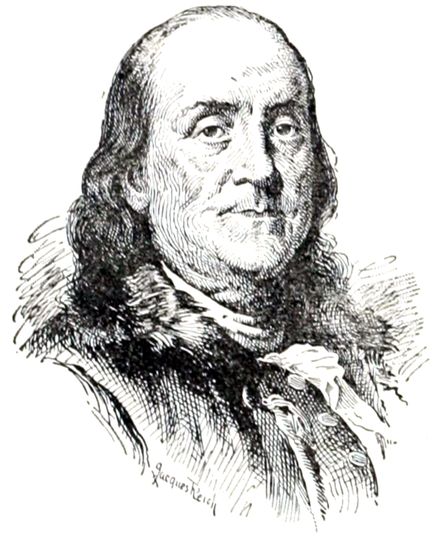
BENJAMIN FRANKLIN
From the original portrait by Joseph Siffrein
Duplessis, in the Museum of Fine Arts,
Boston
How he
improved
his
language
Finally Franklin's parents
decided that since he
loved books so well he might
be a printer, and put him
to learn the trade with an
older brother. Benjamin
was to serve his brother for
his board and clothes until
he was twenty-one.
He worked hard at his
trade, and read more
books than before. He
improved his own language
by writing out in
his own words what he had
read, and then comparing his account with the author's.
He now offered to take half the money that his board
cost, and board himself. His brother agreed to this plan,
and Benjamin saved money and bought more books.
Writes
for his
brother's
paper
He longed to write something for his brother's paper.
He did so, and put it at night under the door, but he did
not dare sign his name to what he had written. His
brother showed it to his friends. They praised it, and
it was printed. It was fun for Benjamin to hear people
guessing that the writer must be some great man in Boston.
Franklin wrote several other articles, and called
them the "Dogood Papers," but his brother was angry
when he learned who wrote them.
Leaves
home
Franklin was now only seventeen, but because of his
brother's cruelty he sold his books and took a boat for
New York without saying good-by to his parents. He
afterwards said that leaving home in this way was a
great mistake.
From
New
York to
Philadelphia
No one in New York wanted a printer, so young
Franklin took a boat for Perth-Amboy, New Jersey, on
his way to Philadelphia. His ship was caught in a
storm, and the passengers were wet and hungry when
they landed.
Franklin set out on foot across the state for Burlington.
For nearly three days he walked in the rain along muddy
roads, looking so rough people thought he was a runaway
servant. He was tired and homesick. But he took
boat again, and reached Philadelphia on Sunday morning,
landing at the foot of Market Street.
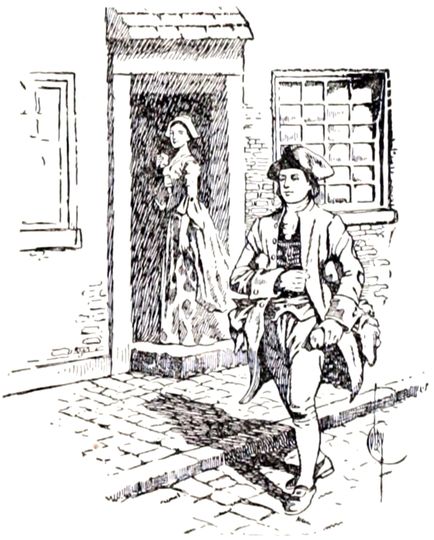
FRANKLIN AND DEBORAH REED
The first meeting of Franklin and the young
girl who was to be his wife
His
sorry
plight
He was so hungry, he thought more of something to
eat than of dressing up
for Sunday. He was in
a sorry plight. With his
pockets stuffed with soiled
shirts and stockings, and
a roll of bread under each
arm and one in his hand,
Franklin walked up Market
Street, and passed the
home of his future wife,
Deborah Reed. No wonder
she laughed at him.
She would have laughed
more if some one had
said: "There goes a boy
who will some day become
your husband and the greatest man in Philadelphia."
Good
books
and good
company
Franklin found work in a printing office, saved his
money, and bought books to study. He got acquainted
with other young people who also loved books, and he
often spent his evenings with them.
A call
from the
governor
To the surprise of Franklin and his brother printers,
one day Sir William Keith, the governor of Pennsylvania,
called at the shop to see Franklin. Governors
did not then pay much attention to poor printers. The
governor, who was dissatisfied with Philadelphia printers,
promised to send him to England to buy a printing
press.
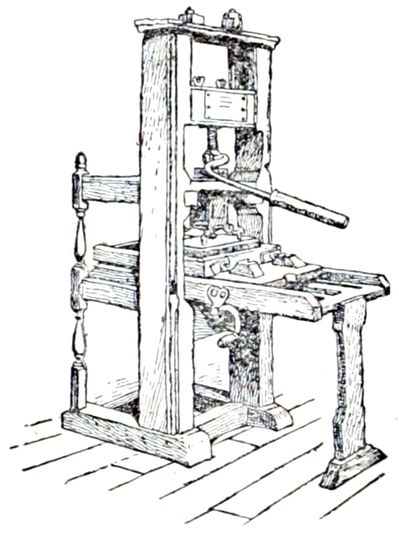
PRINTING PRESS
From a photo of the press used by
Franklin when in London, and
now in the National Museum,
Washington, D.C.
Returns
home
before
going to
London
Franklin, with the governor's letter in his pocket,
hastened back to Boston in order to get his father's help
to go to London. How happy were parents, brothers,
and sisters to see the long-absent son and brother! But
his father could give him no aid, and the young printer
returned to Philadelphia. The
governor, however, promised to
pay his expenses, and Benjamin
took ship for England.
The governor had not even
given him letters of introduction,
to say nothing of money, and
Franklin found himself a stranger
in one of the largest cities in the
world.
In a
London
printing
office
He did not whine or spend
his time grumbling, but went
bravely to work in a printing
office. He set a good example
to his beer-drinking comrades by
drinking only water and proving he was stronger and
able to do more work and do it better than any of them.
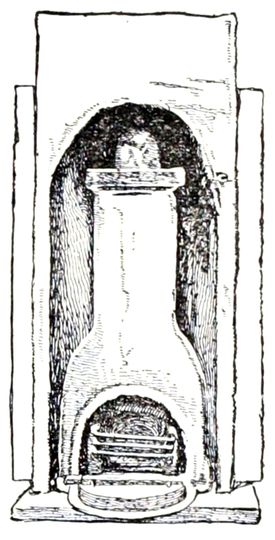
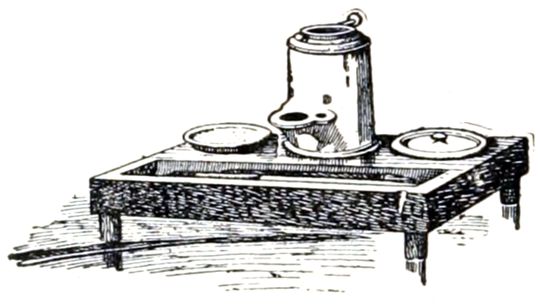
A FRANKLIN STOVE
After a model in the rooms
of the American Philosophical
Society, Philadelphia
Returns
to Philadelphia
and
marries
The next year a Philadelphia merchant
persuaded Franklin to return to
America to become his clerk. But in
a few years he went to work again
at his old trade as printer, and in a
short time became the editor of the
Pennsylvania Gazette.
Franklin had already married Miss
Reed, the young lady who had laughed
at him for making a show of himself
on his first day in Philadelphia.
Founds
three
great
institutions
78. A Rising Young Man. He
was now a rising young man in the old
Quaker city. From year to year he
did many things to help others. He
started a circulating library, the first
in America, out of which has grown
the Philadelphia Public Library. He founded a school
which has become the great University of Pennsylvania,
and a society, called the American Philosophical Society,
which still holds important meetings.
Invents
a stove
Forms
the
first fire
department
Franklin improved the heating of houses by inventing
the "Franklin stove," but refused to take out a patent
and thus make himself rich at other people's expense.
He also formed the first "fire department" in any American
town.
Poor
Richard's
sayings
Who has not heard of Poor Richard's Almanac?
Franklin printed it, and the people liked it so well that
he sometimes printed ten thousand copies. Here are a
few of the quaint and true sayings: "A word to the wise
is enough." "God helps those who help themselves."
"Early to bed and early to rise,
Makes a man healthy, wealthy, and wise."
Economy
is the
road to
wealth
Franklin and his young wife kept these rules faithfully.
She worked in the printing office as well as in the house.
They hired no servants: Their furniture, dress, and
food were plain. He ate his breakfast of bread and milk
out of a wooden bowl with a pewter spoon. Mrs. Franklin
surprised him one day by giving him a china bowl and
a silver spoon. She said her husband deserved such
things as well as other men.
Elected
to office
The people of Philadelphia admired Benjamin Franklin
more and more. At the age of thirty he was chosen
clerk of the Assembly of Pennsylvania, and afterward
was elected a lawmaker in the Assembly. Every year
for ten years his neighbors elected him to help make the
laws of the colony.
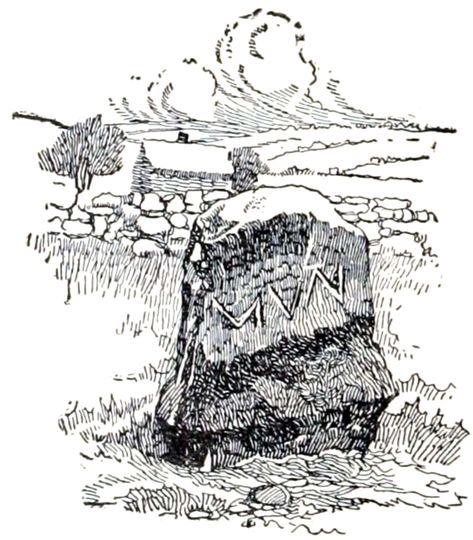
MILESTONE, LYME, CONN.
This milestone, still standing at Lyme, marks
the distance on a road surveyed by Franklin
Deputy
postmaster-general
In a few years Franklin was made deputy postmaster-general
for all the colonies
by the king. He surprised
the people by declaring that
the mail should be carried
from Philadelphia to Boston
every week! He was postmaster-general
for more than
twenty years.
Franklin
plans a
union
of the
colonies
In 1754 Franklin was sent
by the colony of Pennsylvania
to Albany, New York,
to meet men from other
colonies to make a treaty
with the Iroquois, and to
plan a union of the Thirteen Colonies. While George
Washington was still a surveyor, before Wolfe captured
Quebec, and when Patrick Henry was yet a boy,
Franklin wrote out a plan of union which pointed the
way toward that greater Union, the United States of
America.
Fame
begins
to come
Franklin was now becoming famous outside of Pennsylvania.
Yale College honored him with the degree of
Master of Arts. The old University of Cambridge,
England, gave him the same degree.
All the wise men in England and France were excited
by news of an experiment made by Benjamin Franklin.
He had made electricity by using glass tubes, and he
had seen the lightning flash in the storm cloud. He
decided to prove, if he could, that lightning and electricity
are the same. No one had yet done this.
Proves
that
lightning
and electricity
are the
same
He made a kite out of silk, to which he fastened a small
iron rod. Then he tied a hempen string to the kite and
the rod. To the lower end of the string he tied a silken
cord to protect his hand from the electricity. On the
string he tied a key.
One day when the storm clouds came rolling up,
Franklin sent his kite high up among them, while he
waited. Soon the loose fibers on the hempen string
moved. Franklin placed his knuckles close to the key,
and sparks came flying at his hand.
More
honors
When the news of this experiment was published some
very wise men smiled; others said it was a trick. The
great universities of Oxford and Edinburgh, however,
gave him the doctor's degree, and societies of wise men
in England, France, and Spain elected him a member.
He was now the most famous American.
Sent to
England
to defend
the
colonies
79. Franklin's Part in the Revolution. Already we
have seen that England and her colonies were beginning
to quarrel. What wiser man could
be sent to England to defend the colonies
by tongue and pen than Benjamin
Franklin? He made friends for
America among the great men of
England.
How
Franklin
helped
the English
understand
the
Stamp
Act
When the Stamp Act was passed
the members of Parliament asked
him nearly two hundred questions
about the effects of the Stamp Act
on America. He wrote many letters
to great men, and long articles to
the English newspapers, explaining
how the Stamp Act injured America.
Both England and America rejoiced
when the king and Parliament
repealed the Stamp Act, and Franklin
sent his wife a fine London gown
in honor of the event.
Franklin
and Pitt
For eight years more, while America
was busy opposing the tax on tea, Franklin was in England
trying to get Parliament and the king to give the Americans
better treatment. But it was all in vain. He often
talked with William Pitt, the great friend of America, who
introduced into Parliament a plan for making friends between
the two countries. But the plan was defeated.
Hastens
home
Franklin saw that war would come, and hastened back
to his beloved America, where he arrived just after the
battle at Lexington and Concord (1775).
Franklin
plans
union
Pennsylvania sent him to the Congress of 1775, which,
sitting in Philadelphia, made George Washington general
of the Continental army. Franklin saw that if the
thirteen scattered colonies were to defeat Great Britain
they must unite. So he introduced into Congress a plan
of union, but the other members were not ready for it.
Helps
write the
Declaration
of
Independence
Franklin was one of five men who were named by Congress
to write the Declaration of Independence (1776).
Franklin
in France
Soon after, Congress sent him to France to influence the
king and the people of that country to aid America in
winning independence. The French hated the English,
but admired Benjamin Franklin. The king gave money
secretly, and many French officers came to serve in the
American army.
France
sends aid
In 1778 Franklin influenced the King of France to take
sides openly with the Americans. French warships and
French soldiers by thousands now came to help fight
our battles.
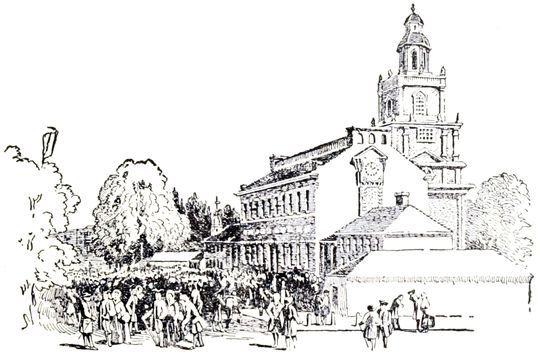
INDEPENDENCE HALL, PHILADELPHIA, IN THE DAYS OF FRANKLIN
From an old print
Treaty
with
England
After helping to make the treaty of
peace with England in 1783, Franklin
came home with many honors. Though
nearly eighty years old, the people of Pennsylvania
immediately elected him governor.
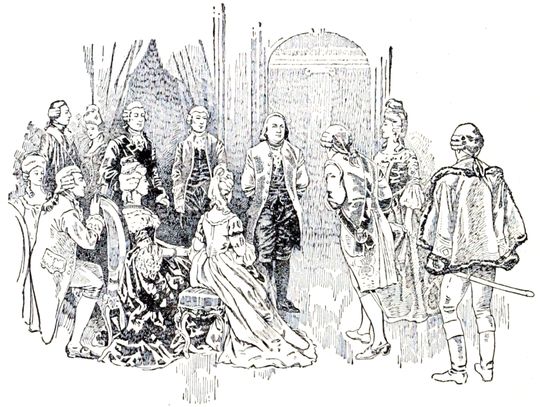
FRANKLIN AT THE COURT OF FRANCE
Franklin did one more great work for his country.
In 1787 the states sent their wisest men to Philadelphia
to make a constitution, or plan of government. Pennsylvania
chose Franklin, with others, to meet with these
men in Independence Hall.
Helps
make our
Constitution
Franklin
signs
the Constitution
George Washington, as we have seen, was the president
of this meeting. Many speeches were made, and there
was debating for many weeks. The meeting was always
glad to hear Franklin speak, for he was a very wise man.
As he had helped to make, and had signed, the Declaration
of Independence, so now, after helping make the Constitution,
he signed it. Many persons did not like the
Constitution. Franklin said there were some things in
the new plan which he did not like, but declared that he
signed it because of the good things it did contain. He
showed his wisdom, for it is one of the best plans of
government ever made.
Died in
1790
Franklin spent his last days with his daughter, and,
surrounded by his grandchildren, died in 1790, at the age
of eighty-four.
The Leading Facts. 1. Franklin's parents were poor, had
seventeen children; hence Benjamin, though a studious fellow,
was put to the printer's trade. 2. Franklin wrote the
"Dogood Papers." Left home for New York, but went on to
Philadelphia. 3. Persuaded to go to London. He returned
and married. 4. Franklin started a circulating library, a
school which became the University of Pennsylvania, and a
society called the American Philosophical Society. 5. He
invented a stove, founded the first fire department in America,
and printed Poor Richard's Almanac. 6. Wrote the first
plan of an American Union, and won degrees from English
and Scotch universities. 7. Franklin was one of the committee
to write the Declaration of Independence. 8. Was
sent to France, where he won the help of France in the War
of the Revolution. 9. Franklin was governor of the state
of Pennsylvania, was a delegate to help make the Constitution,
and died at the age of 84.
Study Questions. 1. How long ago was Franklin born?
2. Tell of his school experiences. 3. Why did Franklin not
go to sea? 4. Tell the story of his bargain with his brother.
5. What did Franklin hear about the "Dogood Papers"?
6. Tell the story of the "runaway printer." 7. How did
he save his time in Philadelphia? 8. How did he happen to
go to London the first time? 9. What good example did he
set to London printers? 10. Why did he return to Philadelphia?
11. What three great institutions did he found?
12. Why did the people like Poor Richard's Almanac? 13.
What public offices did he hold? 14. Picture Franklin
proving that electricity and lightning are the same. 15. What
did he go to England a second time for? 16. How did
Franklin aid in the repeal of the Stamp Act? 17. In what
great events did he have a part? 18. What was his work
in France? 19. What was his last great work? 20. How
did he spend his last days? 21. Point out the obstacles he
overcame all along in his career.
Suggested Readings. Franklin: Baldwin, Four Great
Americans, 71-122; Hart, Camps and Firesides of the Revolution,
158-162; Hart, Colonial Children, 197-199, 210-214;
Wright, Children's Stories of Great Scientists, 71-89; Bolton,
Famous American Statesmen, 38-66; Brooks, Century Book of
Famous Americans, 65-76.
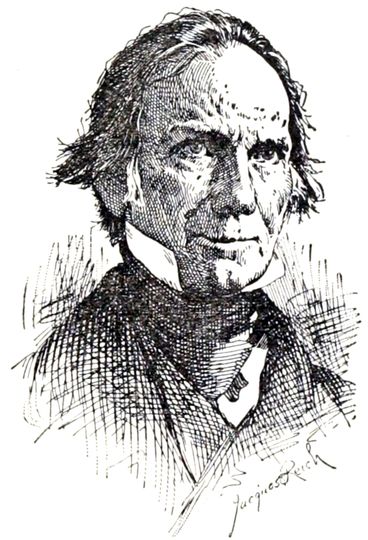
PATRICK HENRY, THE ORATOR OF THE REVOLUTION
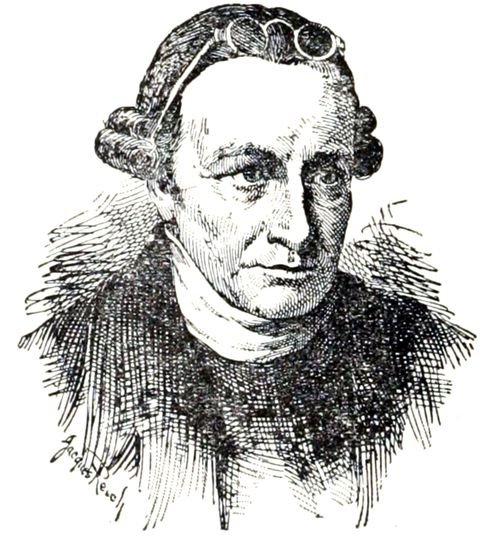
PATRICK HENRY
After the painting by Thomas Sully, owned by
William Wirt Henry, the orator's
grandson, Richmond, Virginia
Why the
king
wished
to tax
America
80. The Stamp Act. The surrender of Quebec and
the fall of New France
caused great rejoicing
among the thirteen colonies.
But the long, hard
war had left both England
and her colonies deeply in
debt. King George III,
however, thinking only of
England's debt, decided
that England ought to tax
the colonies to pay for an
army which he wished to
keep in America.

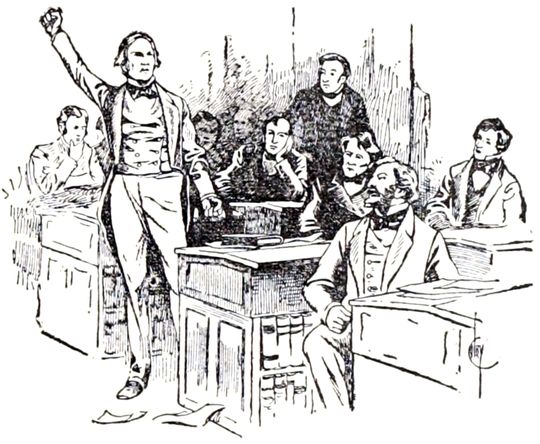
PATRICK HENRY SPEAKING IN THE HOUSE OF
BURGESSES
From an engraving after the original painting
by Rothermal
What the
Stamp
Act was
So the Parliament of England
passed a law that all
licenses to marry, all deeds to property, licenses to trade,
newspapers, almanacs, and other pamphlets had to be
printed on stamped paper.
This paper ranged in
value from a few cents
to many dollars.
Leading men in every
one of the thirteen colonies
spoke and wrote
against the Stamp Act.
Of all the men who did
so, Patrick Henry, of Virginia,
was the most eloquent
and fiery. He had
been elected by the people
of his county to go
up to Williamsburg, the
capital of Virginia, to
help make the laws. There were many able men in that
old House of Burgesses, but none of them wished to
take the lead in opposing the king's plan of a stamp tax.
Patrick
Henry
in the
House
of Burgesses
One day young Henry, although a new member,
snatched a blank leaf from a law book and wrote down
a set of resolutions declaring that only the Virginia
Assembly could tax Virginians, and that any one who
asserted the contrary was an enemy of the colony.
Patrick
Henry's
famous
speech
He backed up these resolutions with a speech that
stirred the Burgesses. He was so fiery and bold that
men almost held their breath while they listened to the
young orator. He closed by declaring that George III
was acting like a tyrant, and that "Caesar had his Brutus,
Charles the First his Cromwell, and George the Third—"
"Treason! treason!" shouted the Speaker of the House.
Waiting a moment till the noise ceased, the orator,
with a calm and steady voice, added, "may profit by
their example. If this be treason, make the most of it."
Henry's resolutions were passed, and were printed in
almost every newspaper in the colonies. They made the
people more determined than ever not to buy stamped
paper.
Who was this young lawyer that stirred these dignified
Virginia gentlemen in powdered hair, knee breeches, and
silver buckles?
Patrick
as a boy
81. The Orator of the Revolution. Patrick Henry
was born in Virginia (1736). His father was a well-educated
Scotchman, who taught school and became a
lawyer. His mother was of Welsh blood. Young
Patrick went to school, but he liked to hunt and fish far
better than to study. He was a puzzle to his parents.
Early
failures
By the time he was eighteen he had failed as a student,
as a clerk, and as a storekeeper. He then married. The
parents on both sides helped them to start farming with
a few slaves. In two years Patrick Henry was forced
to sell. Once more he tried keeping a country store. In
three years the store closed its doors and Patrick Henry,
aged twenty-three, was without an occupation.
Liked to
study
history
and law
He now turned to the study of law. Although not in
love with school when a boy, he loved to read the Bible.
He also had a strong liking for history, and, in his youth,
read the histories of Greece, of Rome, of England, and
of the colonies. By a few months of hard study of the
law he passed the examination. He succeeded from the
first, and in less than four years had been engaged in more
than one thousand cases.
Succeeded
as a
lawyer
Patrick's
father
the
judge
82. The Parsons' Case. In 1763 Patrick Henry set
all Virginia to talking about him as a lawyer. This
colony had paid its clergymen from the beginning.
Each one received a certain number of pounds of tobacco
for his salary. But the price was now high and now low.
A dispute arose because of this and was taken into court.
But no great lawyer would take the people's side. Patrick
Henry did. The courthouse was filled with people,
many clergymen among them. In the judge's chair sat
Patrick's own father.
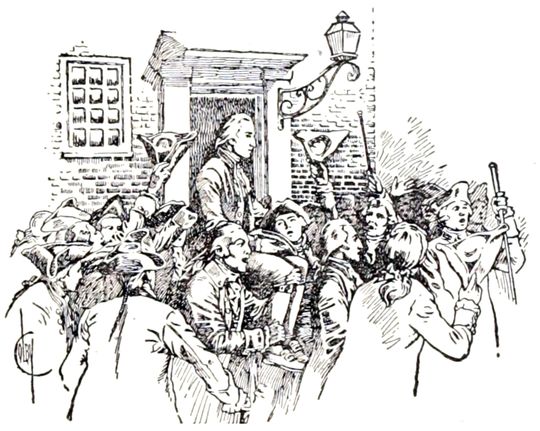
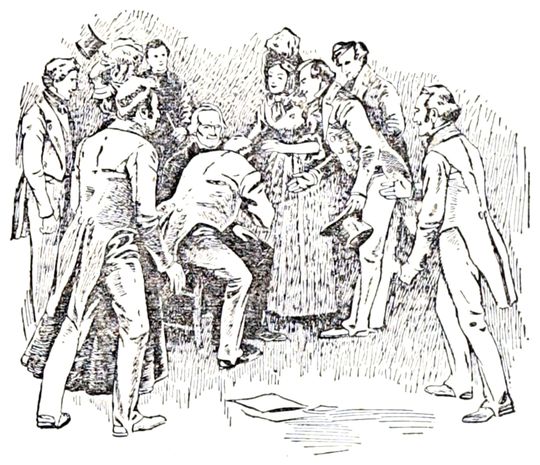
PEOPLE OF THE COURT CARRYING PATRICK HENRY ON
THEIR SHOULDERS AROUND THE GREEN
Henry's
first
great
speech
The
people
overjoyed
Henry began his speech in an awkward way. The
clergymen felt encouraged, while his friends and father
felt uneasy. Soon he began to warm up. His words
came more freely, and his gestures grew more graceful.
The people began to listen, and then to lean forward
spellbound by the charm of his eloquence and the power
of his argument. The clergy grew angry and left the
room. His father,
forgetting that he
was judge, cried
for joy. When
Henry finished, the
people seized him
and carried him
on their shoulders
from the court
room and around
the yard, shouting
and cheering all
the while.
Elected
a lawmaker
Patrick Henry was now the people's hero. At the
election the following year his friends chose him to go to
the House of Burgesses, and there, in 1765, he made
his stirring speech against the Stamp Act.
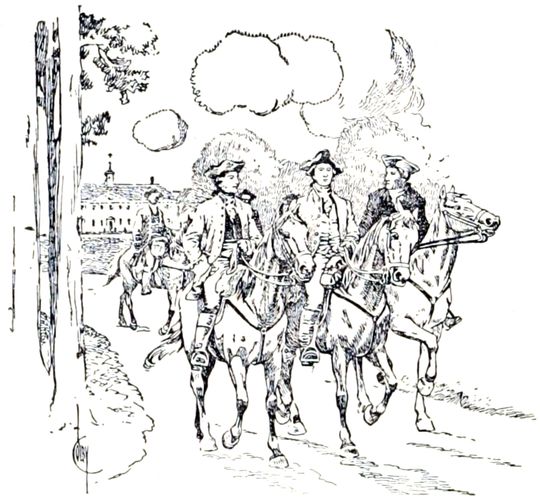
ON THE WAY TO THE GREAT CONGRESS
AT PHILADELPHIA
The
Stamp
Act repealed
Many great Englishmen,
such as
William Pitt and
Edmund Burke,
opposed the
Stamp Tax. Finally,
King George
and his Parliament
repealed the unpopular
act. The
Americans were
happy when they
heard of its repeal.
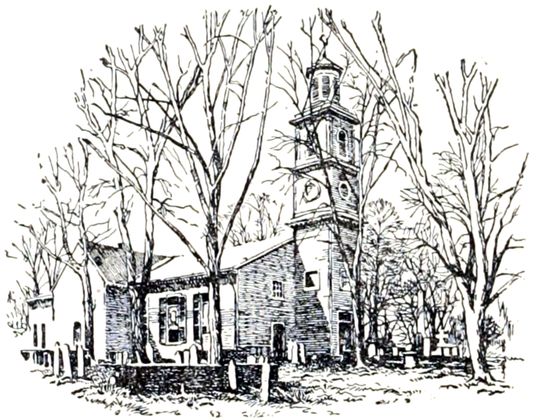
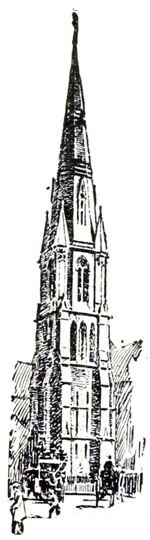
ST. JOHN'S CHURCH, RICHMOND
The
Americans
angry
over the
Tea Tax
83. New Taxes.
As if the king
and Parliament could learn nothing, they passed a Tea
Tax the very next year, placing a tax on all the tea
imported into the
colonies. Then the
Americans everywhere
refused to buy the
tea and pay the tax.
When the tea ships
came to America the
people of New York
and Philadelphia
sent them back, and
the "Sons of Liberty"
at Annapolis burned a ship full of tea. The king's governor
at Boston refused to permit the ships to carry the
tea back to England, but the people, one night, threw
the tea into the sea. King George grew angry at such
"tea parties," and had laws passed
to punish Boston. More British
soldiers were sent there to force the
people to obey these detested laws.
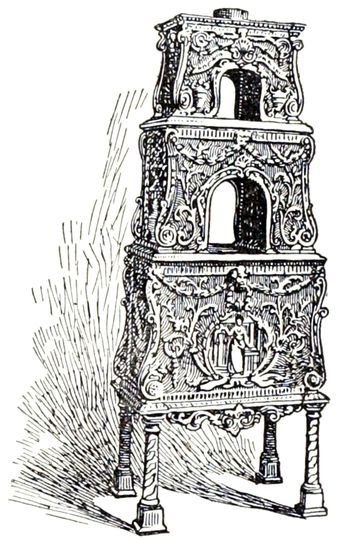
THE STOVE IN THE HOUSE OF THE
BURGESSES
This stove is now in the State Library
of Virginia
Patrick
Henry
meets
Samuel
Adams at
the great
Congress
The colonies, more excited than
ever, decided to hold a great Congress
in Philadelphia (1774). Virginia,
like the others, sent
her best men. There in
Carpenter's Hall, a building
still standing, Henry made
friends of leading men of
other colonies. There he met
Samuel Adams, who was doing
with his pen what Henry
was doing with his tongue,
and they became life-long
friends.
A new
sentiment
One day, when speaking in favor of united action,
Patrick Henry declared: "The distinctions between
Virginians, Pennsylvanians, New Yorkers, and New
Englanders are no more. I am not a Virginian, but an
American."
As Patrick Henry talked with men from other colonies
and heard how the king's troops were acting at Boston,
he was convinced that war must come. He went home
and urged the people of Virginia to arm for the coming
struggle. The king's governor refused to permit meetings
in the old capitol at Williamsburg, so they were held in
St. John's Church, Richmond, a church still standing.
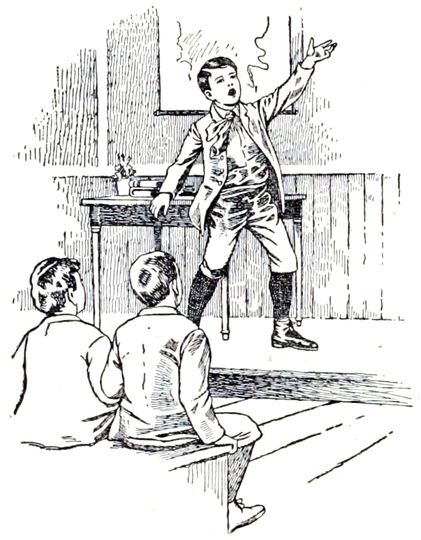
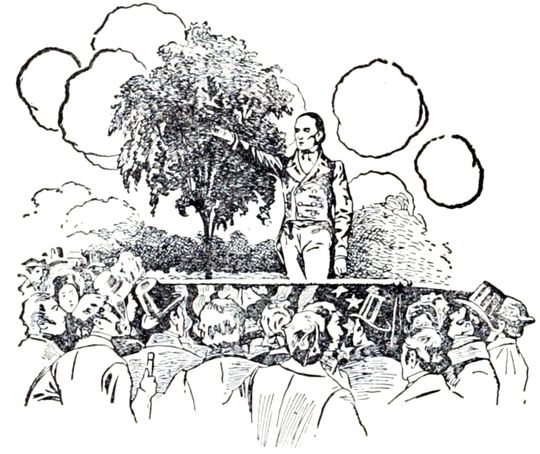
DECLAIMING PATRICK HENRY'S FAMOUS SPEECH
As a favorite declamation this great speech still rouses
the spirit of patriotism in America
Patrick
Henry's
new resolutions
Here Patrick Henry offered resolutions declaring that
Virginia should arm herself for the coming war. It was
a serious time, and
these were serious resolutions.
Should the
thirteen colonies go to
war with one of the
greatest nations in the
world? Would it not
be wise to send more
petitions to the king?
Some of the ablest
men in Virginia opposed
Henry's resolutions.
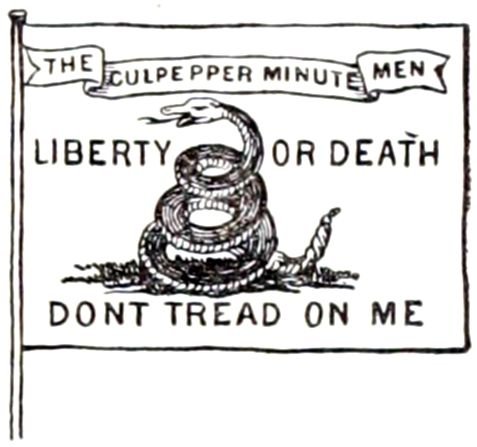
THE FLAG OF THE
VIRGINIA MINUTEMEN
Patrick
Henry's
greatest
speech
War is
inevitable
84. Patrick Henry
Defends his Resolutions.
Patrick Henry
listened to the speeches
with smothered excitement.
When he rose to defend his resolutions his face
was pale and his voice was trembling. But soon his
audience forgot what other men had said. They leaned
forward and listened as if no other man had spoken.
He stirred their deepest feelings when he declared:
"We must fight! I repeat it, Sir, we must fight! An
appeal to arms and the God of Hosts is all that is left to
us. They tell us, Sir, that we are weak; unable to cope
with so formidable an adversary. But when shall we
be stronger? Will it be the next week or the next year?
Sir, we are not weak, if we make a proper use of the
means which the God of Nature hath placed in our
power. There is no retreat but in submission and
slavery. Our chains are forged! Their clanking may be
heard on the plains of Boston! The
war is inevitable, and let it come!
I repeat it, Sir: Let it come!—The
war is actually begun! The next
gale that sweeps from the north will
bring to our ears the clash of resounding
arms. Our brothers are already
in the field! Why stand we here idle! Is life so dear,
or peace so sweet, as to be purchased at the price of
chains and slavery? Forbid it, Almighty God! I know
not what course others may take; but as for me, give
me liberty, or give me death."
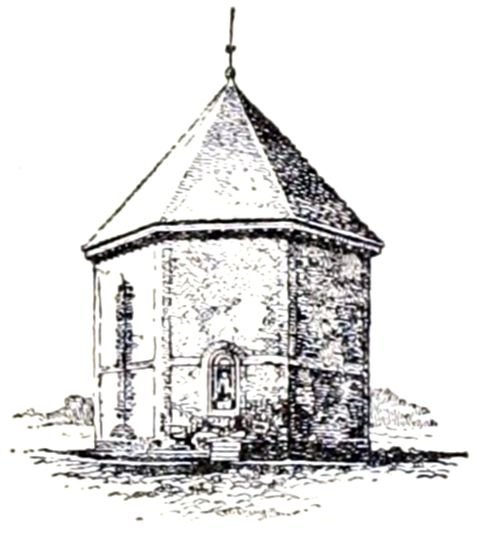
OLD POWDER HOUSE,
WILLIAMSBURG
The removal of the powder
from this house to a British
man-of-war caused the first
uprising of the Virginians
What a
listener
in St.
John's
Church
saw and
heard
One who heard this speech says that when the orator
spoke the words "chains and slavery," he stood like a
slave with his body bent, his wrists crossed, as if bound
by chains, and that his face looked like that of a hopeless
slave. After a solemn pause he raised his eyes and
chained hands toward heaven, and said, as if in prayer:
"Forbid it, Almighty God!" He then slowly bent his
body still nearer the floor, looking
like a man oppressed, heart-broken,
and helpless, and said: "I know not
what course others may take."
Then, rising grandly and proudly,
with every muscle strained, as if
he would break his imaginary chains,
he exclaimed: "Give me liberty, or
give me death!"
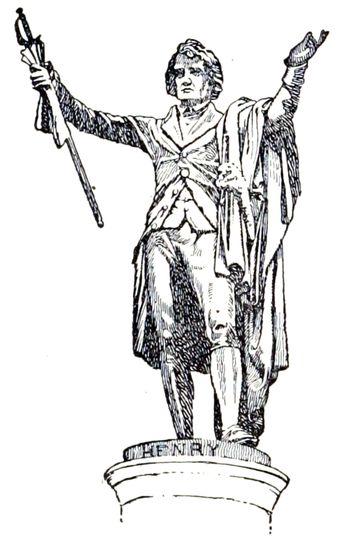
PATRICK HENRY
From the bronze figure of the Washington
monument by Crawford at Richmond
What
Washington
saw
in Boston
in 1775
The men who heard this great
speech never forgot it. The people of
Virginia now pushed forward the work of arming her men.
And when her own Washington went to take command of
the army at Boston he found
Virginia soldiers there wearing
on their hunting shirts
the words "Liberty or death!"
Patrick
Henry
loved by
Virginians
From this time on Patrick
Henry was in the forefront
of the struggle with England.
Virginia sent him to
Congress, then she made
him an officer in the army,
and finally not only made
him the first governor after
independence was declared,
but elected him to that office
three times in succession, and
offered him the same office
three times more.
After independence was won
Patrick Henry opposed the adoption of our constitution,
although Washington, Madison, and many of his friends
were in favor of it. When, however, he saw that the
new constitution was a good one, he gave his support
to his friend, President Washington.
Patrick
Henry
in his old
age
Patrick Henry finally retired to his plantation and
refused all offers of office. Many old friends and many
great strangers went to visit him in his old age as one of
the great men of the American Revolution. In the year
of his death (1799), when some danger threatened Virginia,
Patrick Henry came forth at Washington's request,
old and feeble as he was, and aroused the people once
more with his burning words. They elected him to the
House of Burgesses by a great majority, but he did not
live to take office.
SAMUEL ADAMS, THE FIREBRAND OF THE REVOLUTION — SUGGESTIONS INTENDED TO HELP THE PUPIL
Samuel
Adams
the pen
of the
Revolution
85. Samuel Adams. While Patrick Henry was stirring
the feelings of the people by his fiery eloquence,
Samuel Adams was stirring them by strong arguments in
his writings, to oppose the acts of king and of Parliament.
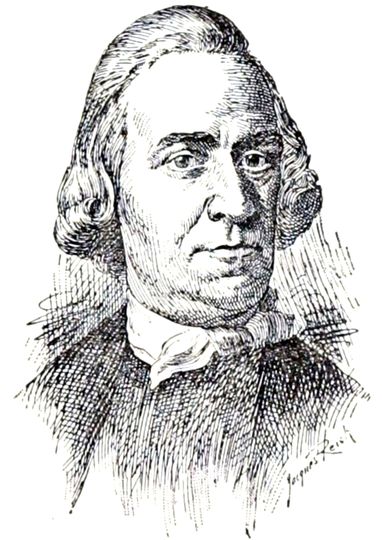
SAMUEL ADAMS
From the original painting by John
Singleton Copley, representing Adams
in 1771, now hanging in the Museum
of Fine Arts, Boston
A
student
Samuel Adams was born in Massachusetts (1722).
While he loved school and books he cared very little for
spending his time in outdoor amusements. At eighteen
Samuel was graduated from Harvard College. His
parents hoped that he would be a minister, but he began
to study law. His mother was so opposed to his becoming
a lawyer that he gave up the
study and turned to business.
He set up in business for himself,
but, like Patrick Henry, soon lost
all. He next went into business
with his father, but in that, too,
he failed. Finally Samuel Adams
turned to politics.
Early
love for
politics
While a student in Harvard
he had debated the question
whether it was right to resist
the king to save the country
from ruin. He took an active
part in debating clubs and very
soon began to write for the newspapers,
encouraging resistance.
He never hesitated to take what he thought the right
side of any question.
Why
Adams
opposed
the
Stamp
Act
Speaking before a meeting of Boston people, Samuel
Adams boldly declared that if England could tax the
business of the colonies, then, "why not tax our lands
and everything we possess or make use of?" Such
taxes, he said, would make the colonists slaves.
In a short time the people of Boston were reading in
the papers the fiery resolutions and the still more fiery
speech of Patrick Henry. Samuel Adams seized his
pen and also began to pour hot shot into the Stamp Act.
How he
opposed
the
Stamp
Act
The Boston people elected him to be their representative
in the Massachusetts Assembly. More and more
he took the lead in the movement against the Stamp Act.
He went about the shops, into the stores, wherever he
found people to listen to him.
He helped them form a society, called the Sons of
Liberty, which destroyed the hated stamps as soon as
they arrived. He talked with the merchants, and they
signed a pledge not to buy any more goods from England
until the Stamp Act was repealed. At this the British
merchants felt the loss of trade and joined in the cry
against the Stamp Act.
86. The Tea Tax. We have seen that Parliament,
after the Stamp Act was repealed, passed the famous
Tea Act. The Americans were angry again, and the
Sons of Liberty declared that no tea should be landed.
The merchants took the pledge again to buy no more
English goods, and patriotic women began to make tea
out of the leaves of other plants.
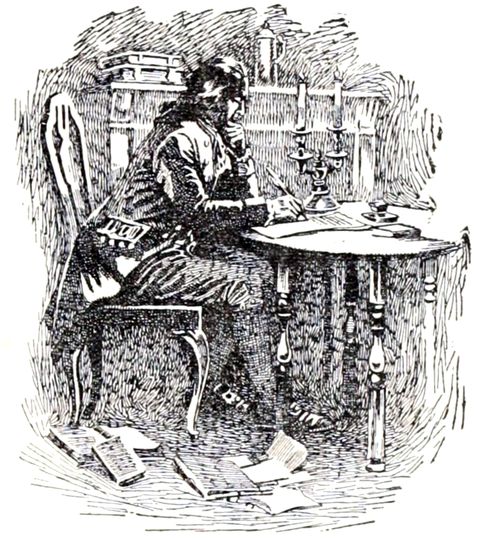
SAMUEL ADAMS WRITING THE FAMOUS
CIRCULAR LETTER
Samuel
Adams
writes
the "Circular
Letter"
Samuel Adams again sharpened his pen, and wrote
the famous old "Circular Letter," which urged all the
colonies to unite and stand firm in opposing the tax on
tea. This letter made King George very angry, but
Samuel Adams only wrote
the more.
Night after night as
the people passed his
window they saw by his
lamp that he was busy
with his pen, and said
to one another: "Samuel
Adams is hard at work
writing against the Tories."
People in England
and America who took
the king's side in these disputes
were called Tories.
Conflicts
between
people
and
soldiers
The king now sent two
regiments of soldiers to Boston to force the people to
pay the Tea Tax. There were frequent quarrels between
the soldiers and the people. One evening in a street
quarrel the soldiers killed three men and wounded eight
others (1770). Immediately the fire bells rang and
great crowds of angry people filled the streets. The
next day they filled to overflowing Faneuil Hall, the
"Cradle of Liberty." A still larger meeting in the Old
South Church cried out that both regiments of soldiers
must leave town.
Samuel
Adams
and the
people
drive the
soldiers
out of
Boston
Adams and other leaders were sent to the king's officers
to tell them what the people had said. Before the
governor and the general, backed by the king's authority
and by two regiments, stood plain Samuel Adams, with
only the voice of the people to help him.
The governor, unwilling to obey the demand of the
people, said he would send one regiment away. But
Samuel Adams stood firm, and said: "Both regiments
or none!" The governor finally gave up, and Samuel
Adams, the man of the people, was a greater leader than
ever before.
The king now tried to trick the Americans into paying
the tax by making tea cheaper in America than in England,
but leaving on the tax. But the people everywhere
declared that they did not object to the price, but to
the tax.
The tea
ships
guarded
while
town
meetings
are held
87. The Boston Tea Party. When the ships carrying
this cheaper tea arrived in Boston, Samuel Adams set a
guard of armed men to keep the tea from being landed.
Town meeting followed town meeting. On December
16, 1773, the greatest one of all was held. Early that
morning hundreds of country people started for Boston.
They found the shops and stores closed and people
standing on the street corners talking earnestly.
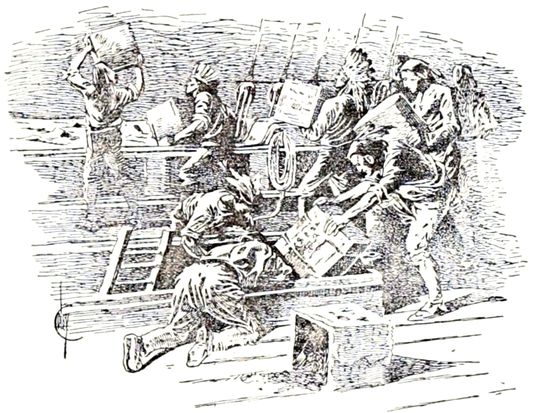
THE BOSTON TEA PARTY ABOARD THE TEA SHIP
IN THE HARBOR
At ten o'clock
the people met
in the Old South
Church, and
voted that the
tea should never
be landed.
They also sent
the owner of the
ships to the governor
for permission
to take
the tea ships out
of the harbor.
Permission
to
return
tea
denied
In the afternoon still greater crowds pushed and
jammed into the seats, aisles, and galleries of that famous
church. Samuel Adams was chairman. He made a
speech. Other leaders spoke. One stirred the audience
by asking "how tea would mix with salt water." Evening
came, and candles were lighted. The owner of the tea
vessels returned and said the governor would not give
him the permission.
The
Boston
Tea
Party
Immediately Samuel Adams arose and said: "This
meeting can do nothing to save the country!" In a moment
the war whoop of the "Mohawks" sounded outside.
The crowd rushed out and found the people following
a band of men disguised as Indians down where the tea
ships lay at anchor. The "Mohawks" went on board,
brought up the boxes of tea, broke them open, and threw
the tea into the sea.
Paul
Revere's
first ride
That very night Samuel Adams sent fast riders to
carry the news to the country towns. The next day,
with letters to the leaders in other colonies in his saddlebags,
Paul Revere, the great courier of the Revolution,
started on his long ride to New York and Philadelphia.
As he went from town to town and told the story of the
Tea Party the people cheered him, spread dinners for
him, built bonfires, and fired cannon. He saw thousands
of people gather in New York and Philadelphia, and
heard them declare that they would stand by Boston.
Boston
Port Bill
Boston soon needed help, for the king and Parliament
passed a law that no ship could enter or leave Boston
Harbor, and another which forbade town meetings.
Other hard laws were also passed, and an army was
sent to Boston to force the people to obey them.
88. The First Continental Congress. We have seen
a call go forth for a Congress at Philadelphia (1774).
The Massachusetts legislature chose Samuel Adams and
his cousin, John Adams, with two others to go to the
Congress.
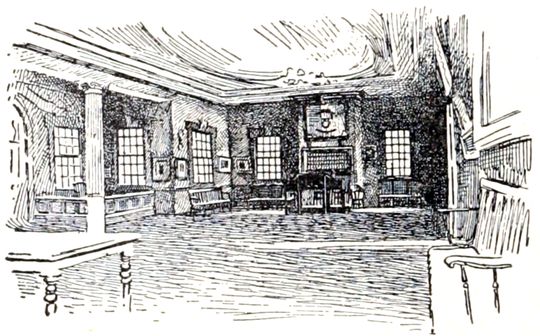
ASSEMBLY ROOM IN CARPENTER'S HALL
Here met the first Continental Congress of the colonies
Strange
visitors
But Samuel Adams was very poor and could not afford
to dress in a style suited to meet the rich merchants
of New York and
Philadelphia and
the great planters
of the southern
colonies. One evening
while the
family was at tea,
in came the most
fashionable tailor
of the town to take
his measure. Next came a hatter, and then a shoemaker.
In a few days a new trunk at his door told the story, for
in it were a suit of clothes, two
pairs of shoes, silver shoe buckles,
gold knee buckles, a cocked hat,
a gold-headed cane, and a fashionable
red cloak. What proof
of the people's love for their
neighbor!
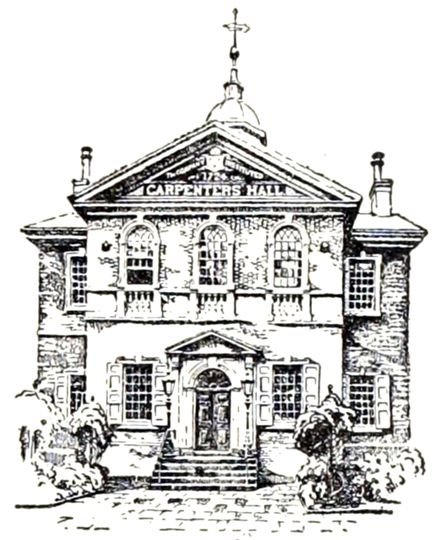
CARPENTER'S HALL,
PHILADELPHIA
Poor
but loyal
Although Samuel Adams was
a very poor man, George III did
not have offices enough to bribe
him or gold enough to buy his
pen. Several times the king's
officers had tried to do both, but they did not succeed.
What
Samuel
and John
Adams
saw on
the way
to Philadelphia
In a carriage drawn by four horses, the delegates to
Congress were escorted by their friends right by the king's
soldiers. The people of the large towns met them,
escorted them, rang bells, fired cannon, feasted them at
banquets, and talked of the Congress.
New and
noble
friends
At New York Samuel Adams and his friends were
kept nearly a week. Many persons in carriages and on
horseback came out to welcome them to Philadelphia,
the city of William Penn. People were anxious to see the
man who had written the "Circular Letter," who had
driven the king's regiments out of Boston, who had
planned the Tea Party, and whom the king could not
bribe. Here, in Carpenter's Hall, for the first time, he
met George Washington, Patrick Henry, and Richard
Henry Lee, of Virginia, Christopher Gadsden, who was
called the "Samuel Adams of South Carolina," and many
other noble men who became his life-long friends.
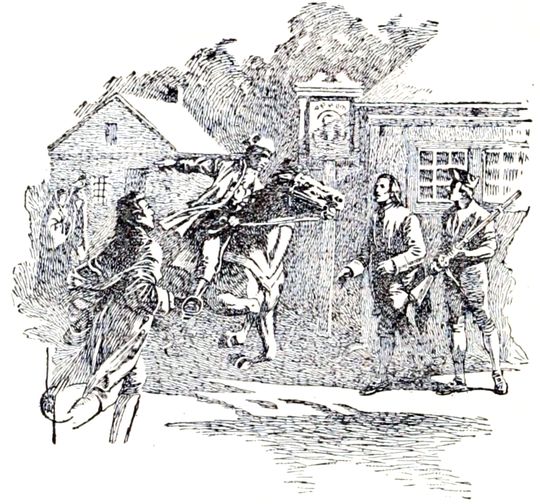
PAUL REVERE ALARMING THE MINUTEMEN
The old Hancock House, where, guarded by the minutemen,
Samuel Adams and John Hancock lay sleeping when
Paul Revere rode by, still stands in Lexington
Other
colonies
to help
Boston
Soon Paul Revere came riding into Philadelphia with
the news that the patriots of Boston were in danger of
being attacked
by the British.
The Congress
immediately declared
that if the
British made
war on Boston,
it was the duty
of every colony
to help her people
fight. It now
looked as if war
might come at
any moment.
Minutemen
When Congress
was over,
Samuel Adams hastened home to help form, in all the
Massachusetts towns, companies of minutemen ready to
fight at a moment's warning. The next spring the news
got out that British soldiers were going to Concord to
destroy the powder and provisions collected there by
the minutemen, and also to capture Samuel Adams and
John Hancock and send them to England to be tried for
treason. Paul Revere agreed to alarm the minutemen the
moment the soldiers left Boston.
Alarming
the
minutemen
89. Paul Revere's Midnight Ride. Standing by his
horse across the river from Boston, one April evening,
waiting for signals, Paul Revere saw two lanterns flash
their light from the tower of the Old North Church.
He mounted and rode in hot haste toward Lexington,
arousing the sleeping villages as he cried out: "Up and
arm, the regulars are coming!" Soon he heard the
alarm gun of the minutemen and the excited ringing of
the church bells. He knew the country was rising.
At Lexington minutemen who guarded the house
where Samuel Adams and John Hancock were sleeping
ordered Revere not to make so much noise. "You will
soon have noise enough," he shouted. "The regulars
are coming!" And he rode on toward Concord.
The first
conflict
of the
minutemen
90. The Battle at Lexington and at Concord Bridge.
As the British soldiers reached Lexington at sunrise,
April 19, 1775, the captain of the minutemen gave the
command: "Stand your ground. Don't fire unless fired
upon. But if they mean to have war, let it begin here!"
A bold speech for a captain of only about sixty men
when facing as brave soldiers as Europe had ever seen!
The minutemen stood their ground till seven were killed
and nine wounded—nearly one third of their number.
Then they retreated.
The
retreat
of the
British
The British pushed on to Concord. But the minutemen,
now coming from every direction, made a stand at
Concord Bridge. Their musket fire was so deadly that
the British started back, running at times to escape with
their lives. At Lexington they fell upon the ground,
tired out with the chase the minutemen gave them, and
were met by fresh troops from Boston.
Many
redcoats
fall
Soon the British soldiers were forced to run again, for
minutemen by hundreds were gathering, and they
seldom missed their aim. From behind rocks, trees,
fences, and houses they cut down the tired redcoats.
Nearly three hundred British soldiers were killed or
wounded before Boston was reached that night.
Bunker
Hill,
June 17,
1775
91. The Battle of Bunker Hill. Day and night for
weeks minutemen from other New England colonies,
and even from as far south as Virginia, marched in hot
haste to Boston. The British general soon found his
army in Boston entirely cut off from the mainland. He
resolved to fortify Bunker Hill, but what was his surprise
to wake one morning (June 17) and find the Americans
under Colonel Prescott already building breastworks on
the hill.
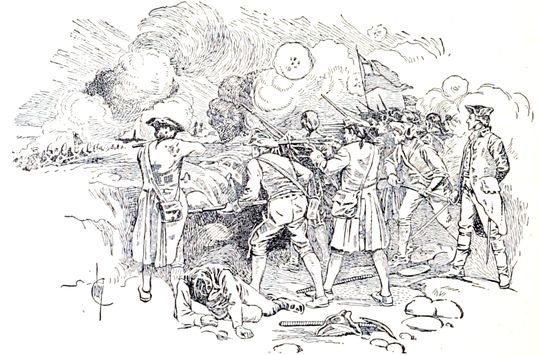
THE BATTLE OF BUNKER HILL
Three
fierce
charges
That afternoon three thousand picked troops, in solid
columns and with bayonets gleaming, marched up the
hill to storm that breastwork. "Don't fire till you can
see the whites of their eyes!" said the commander of the
minutemen. On came the lines of red, with banners
flying and drums beating. From the breastworks there
ran a flame of fire which mowed the redcoats down like
grass. They reeled, broke, and ran. They rested.
Again they charged; again they broke and ran. They
were brave men, and, although hundreds of their companions
had fallen, a third time the British charged, and
won, for the Americans had used up their powder, and
they had no bayonets. More than one thousand British
soldiers fell that day. The Americans did not lose half
that number. But among the killed was brave General
Joseph Warren.
Adams
and Hancock
on
the way
to the
second
Congress
92. The Second Continental Congress. Just as the
British were marching into Lexington on that famous
April morning, Samuel Adams, with John Hancock, was
leaving for Philadelphia, where Congress was to meet
again. As he heard the guns of the minutemen answer
the guns of the regulars, Adams said to Hancock: "What
a glorious morning is this!"
The members from Massachusetts, Connecticut, and
New York were escorted across the Hudson to Newark,
New Jersey, and entertained at a great dinner, with
speeches. Near Philadelphia a large procession of armed
men and carriages met and escorted them into the city,
where bells told of their coming.
When this Congress met, Samuel Adams seconded the
motion of his cousin, John Adams, that George Washington,
of Virginia, be made the general of all the American
troops. He saw his own neighbor, John Hancock, made
president of the Congress.
Samuel
Adams
among
the first
to favor
independence
93. The Declaration of Independence. For more
than a year Samuel Adams worked hard to get the
Congress to make a Declaration of Independence.
Richard Henry Lee, of Virginia, introduced a motion
into the Congress for independence. The Declaration
was made, July 4, 1776, and Samuel Adams, as a great
leader of the Revolution, had done his work.
But, with other noble men, he still labored
with all his powers, in Congress and at home,
to help America win her independence.
Governor
of Massachusetts
After independence had been won, Samuel
Adams still served his state, and was
elected governor of Massachusetts only a
few years before his death, which occurred
in 1803, at the age of eighty-one.
The Leading Facts. 1. The French and Indian
War put both England and her colonies in
debt, but the king thought only of England's debt.
2. Great opposition to the Stamp Act in all the
colonies. 3. Patrick Henry made a great speech
against the Virginia parsons, and a second on the
Stamp Act. 4. He went to the first Continental
Congress and made many friends; came home and made a
great speech saying that war would come. 5. Made governor
of Virginia many times. 6. Samuel Adams studied hard, failed
in several occupations, and went into politics. 7. Led the
patriots against the soldiers, the Stamp Act, and planned the
Tea Party. 8. Samuel Adams sent to Continental Congress,
where he made many friends. 9. Urged a Declaration of
Independence in 1776. 10. Made governor of Massachusetts.
Study Questions. 1. Why were the colonists happy because
England defeated France? 2. What was the Stamp
Act, and why did men in America oppose this act? 3. What
did Patrick Henry say in his resolution and in his speech?
4. Picture the scene while Patrick Henry spoke and afterwards.
5. Why did not the Americans like the Tea Tax? 6. Why
did not the king like the American "Tea Parties"? 7. What
is a Congress; and why should Patrick Henry and Samuel
Adams become good friends? 8. Commit to memory a part
of Henry's famous "liberty or death" speech. 9. How did
the people trust Patrick Henry? 10. What did Samuel Adams
do against the Stamp Act? 11. What was the Circular Letter
and why should the king be angry about it? 12. Tell how
Samuel Adams drove two regiments out of Boston. 13. What
caused a Congress? 14. Tell what Samuel and John Adams
saw and did on their way to Philadelphia. 15. Why were
people glad to see Samuel Adams? 16. What made war
seem likely to happen at any time? 17. Read Longfellow's
poem, "The Midnight Ride of Paul Revere." 18. Give an
account of the Battle of Lexington. 19. Picture the retreat
from Concord to Boston. 20. Picture the charge of the British
soldiers at Bunker Hill. 21. What did Samuel Adams see on
his way to the second Continental Congress? 22. Who introduced
the motion for independence into the Congress?
Suggested Readings. Patrick Henry: Cooke, Stories of the
Old Dominion, 158-180; Brooks, Century Book of Famous Americans,
93-101; Magill, Stories from Virginia History, 116-128.
Samuel Adams: Dawes, Colonial Massachusetts, 42-72;
Brooks, Century Book of Famous Americans, 10-30; Hart,
Camps and Firesides of the Revolution, 162-166; Hawthorne,
Grandfather's Chair, 153-189, 205, 206.
GENERALS GREENE, MORGAN, AND MARION, THE MEN WHO HELPED WIN THE SOUTH FROM THE BRITISH — SUGGESTIONS INTENDED TO HELP THE PUPIL
Moultrie
repulses
attack on
Charleston
95. The War in the South. Early in the Revolutionary
War British vessels made an attack on Charleston,
South Carolina (1776). But Colonel Moultrie, from his
rude fort of palmetto logs, gave them such a welcome that
they were glad to get away, and for two years the British
gave the southern colonies little trouble.
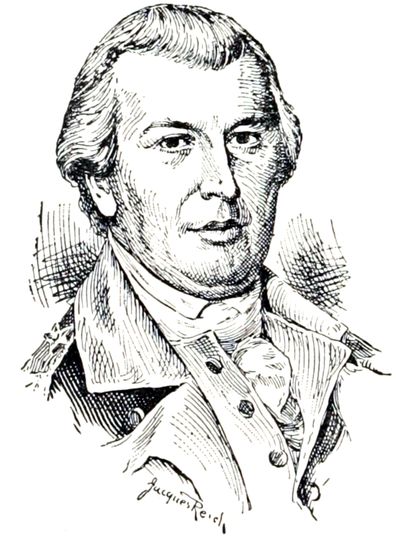
NATHANAEL GREENE
From a painting by Charles Wilson Peale,
once owned by Mrs. William Brenton
Greene, Jr., Princeton, New Jersey,
and now in Independence Hall,
Philadelphia
Charleston
surrenders
to Cornwallis
But in 1778 another British
army captured Savannah,
Georgia. In 1780 the city
of Charleston, South Carolina,
with General Lincoln's
entire army, surrendered to
Cornwallis. Congress hastened
General Gates to the
South to check the British,
but Cornwallis surprised
Gates and cut his army to
pieces near Camden.
GREENE'S
GUN
Now in the
possession of
the Rhode Island
Historical
Association
Greene
goes
south to
watch
Cornwallis
96. Nathanael Greene,
the Quaker General. Washington
now chose Nathanael
Greene, the "Quaker general,"
to go south, take command
of the American army,
and to watch Cornwallis, who had just defeated Gates.
Greene was born in Roger Williams' old colony, and was
ten years younger than Washington. His father
was a farmer, a miner, and a blacksmith on
week days, and a Quaker preacher on Sundays.
The
"learned
blacksmith"
As a boy Nathanael had plenty of hard work
to do, and at thirteen could "only read, write,
and cipher." But he was hungry for more
knowledge, and began to study Latin, mathematics,
philosophy, and history. Besides, he
made iron toys, and sold them to buy books.
His family got into a lawsuit, and Nathanael
took up the study of law. He was called the
"learned blacksmith."
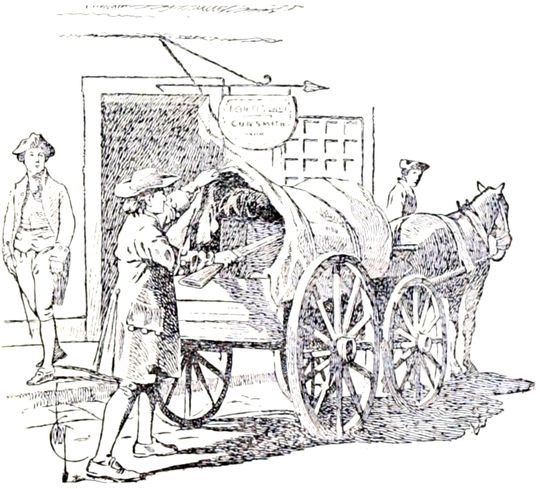
GREENE CONCEALING THE MUSKET IN HIS WAGON
He buys
a musket
When Greene saw that King George was likely
to force the Americans to fight, he joined the
militia and went to Boston to buy a musket, a
very unusual thing for a man in Quaker dress
to do. He hid the
gun in his wagon.
There he watched
General Gage drilling
British soldiers.
He persuaded one
of them to go
with him to drill
his company of
minutemen.
News
from
Lexington
sends
Greene
to Boston
When the stirring
news from
Lexington reached
him, Greene was
among the first to start for Boston, and there Washington
found him when he arrived to take command of the army.
Greene was made one of Washington's generals, and followed
his great commander till Washington sent him to the
South to win back that part of the country from Cornwallis.
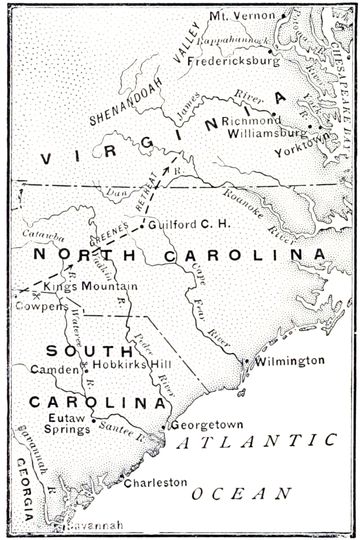
SCENE OF THE CAMPAIGNS IN THE SOUTH
He found only a small army in North Carolina, but he
knew the southern men would fight if they had a chance,
for the backwoodsmen
had just killed
or captured one
thousand British
soldiers at Kings
Mountain.
Men who
helped
Greene in
the South
Besides, he had
some of the bravest
and ablest leaders
in America to help
him, among them
Daniel Morgan,
Francis Marion,
William Washington
(a cousin of
General Washington),
Henry Lee
(called "Light
Horse Harry"),
and Thomas
Sumter.
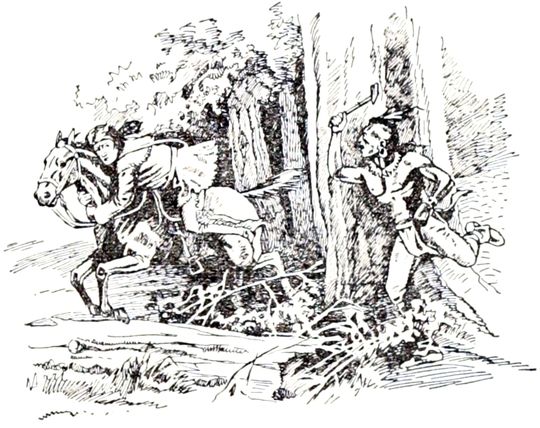
MORGAN'S ESCAPE FROM THE INDIANS
Greene
divides
his army
Greene divided
his army into two
parts. He took one thousand men and marched into
northeastern South Carolina, where Marion and Lee, with
small bands of cavalry, stole upon the British outposts.
In broad daylight they charged pellmell into Georgetown,
captured the officer
in command
there, and got safely
away before the
British were over
their fright.
Morgan
goes to
northwestern
South
Carolina
Greene sent General
Morgan and
Colonel William
Washington with
nine hundred men
into northwestern
South Carolina to
threaten some British posts, and to encourage the
patriots in the mountains. Very shortly after this,
Washington and his cavalry swooped down on a party of
British soldiers and captured two hundred fifty of them.
Tarleton
sent to
capture
him
Cornwallis was now thoroughly roused, and resolved
to put an end to such events. He therefore ordered his
favorite cavalry officer, Colonel Tarleton, to take eleven
hundred picked soldiers and capture Morgan and his men.
97. General Morgan. But Morgan was not the kind of
man to be caught napping. When a young man, he had
fought the French and Indians on the Virginia frontier.
Morgan's
training
He was at Braddock's defeat. He had once knocked a
British officer down for striking him. In an Indian fight
he had been shot through the neck and thought himself
dying, but, to escape being scalped, locked his arms
tightly around his horse's neck, while the horse ran wildly
through the woods.
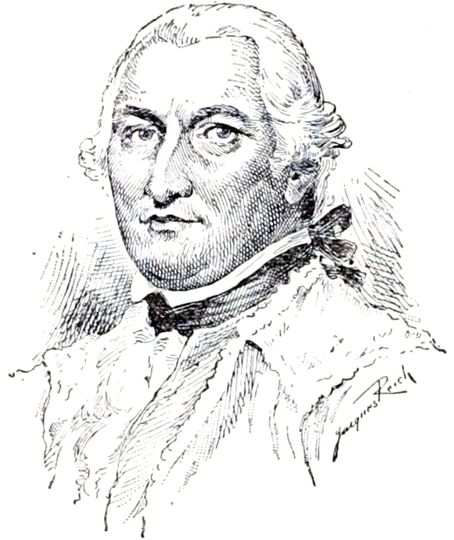
DANIEL MORGAN
From a miniature painted by John Trumbull
now in the Art Gallery of
Yale University
At the head of a company of ninety-six Virginia backwoodsmen,
Morgan had marched six hundred miles in
twenty-one days, and joined
Washington at Boston.
Burgoyne's
compliment
Later, Washington sent
him to join in the capture
of Burgoyne, at Saratoga.
His men did such splendid
fighting that Burgoyne said
to Morgan: "Sir, you command
the finest regiment
in the world!" Fighting in
the woods of America, such
a man was likely to be a
match for any British officer.
When Morgan heard of
Tarleton's approach he retreated
to a good place for fighting, called the Cowpens.
On the top of a long, rising slope he placed the Continental
troops—men trained to fight. In the rear he hid Colonel
Washington and his cavalrymen.
Morgan
places
his men
Some distance in front of the Continentals he placed
the militia with orders not to retreat till they had fired
twice. In front of the militia Morgan hid a company of
deadly sharpshooters in the woods on the right and
another company in the woods on the left.
As soon as Tarleton's men came in sight they charged
pellmell, thinking victory an easy matter. The militia
and sharpshooters poured in their fire not twice, but several
times, and retreated behind the Continentals, who now
poured deadly volleys into the ranks of the on-coming
British, and then made at them with their bayonets.
A
brilliant
victory
Just at this moment, Colonel Washington's cavalry
dashed out and struck the right flank of the redcoats. In
another moment the militia, which had reformed and
reloaded, rushed out and struck their left flank. Most of
Tarleton's men threw down their guns and surrendered
on the spot. Only two hundred seventy redcoats got
away. Tarleton barely escaped after being wounded in a
hand-to-hand sword fight with Colonel Washington.
Stories
of
Tarleton
Tarleton was not permitted to forget his defeat. In
conversation one day he remarked that he had never seen
Colonel Washington. A patriotic lady present replied:
"If you had only looked behind you at the battle of
Cowpens, you would have had that pleasure."
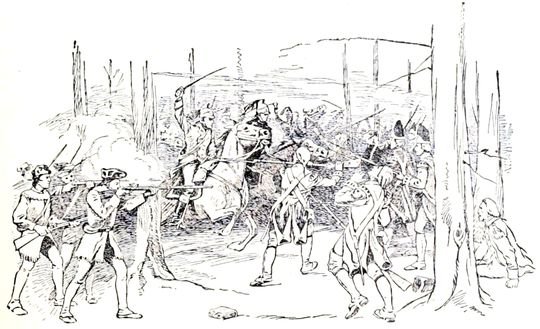
THE BATTLE OF THE COWPENS
Where General Morgan, in one of the most brilliant battles of the war, defeated the brave but
overconfident General Tarleton, destroying the famous legion Tarleton
boasted could not be defeated
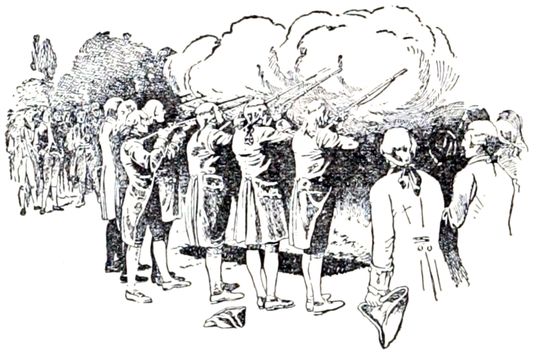
THE LAST SALUTE TO MORGAN
On another occasion it is told that Tarleton said to a
lady, in a sneering way, that he understood Colonel
Washington was so ignorant he could not even write his
own name. This lady looked at Tarleton's wounded
hand, and said: "You certainly carry proof that he can
at least 'make his
mark.'"
The defeat of
Tarleton at the
Cowpens roused
Cornwallis. He
destroyed all his
heavy baggage,
and started in hot
haste after Morgan.
But Morgan
knew a thing or two, and marched for the fords of the
Catawba River as soon as the battle was over.
Greene's
great
march
There Greene joined him, and away the armies went
for the Yadkin River. Greene had brought along boats on
light wheels, and had no trouble in crossing, but Cornwallis
had to march up the river until his army could
wade across. Greene was already on his way to the Dan,
which he crossed into southern Virginia.
General
Morgan
retires
General Morgan, now broken in health by long years
of hard fighting, retired to his home, "Soldiers' Rest,"
in the Shenandoah Valley. After the war was over his
neighbors elected him to Congress, where he gave hearty
support to President Washington.
A touching
scene
When Daniel Morgan died he was followed to the
grave by the largest procession that the valley had yet
seen. The people, who had come from near and far,
witnessed a touching sight. They saw seven gray-haired
veterans, with old rifles in their hands, stand beside
the grave of the hero, and fire a military salute. They
were the last of that hardy band of ninety-six which had
marched with Morgan to Boston to join Washington,
nearly thirty years before. This was their last military
farewell!
Greene's
"victory"
98. The Battle of Guilford Court House. General
Greene won a great victory by retreating. He and his
army were still among friends, and his army was growing.
Cornwallis was hundreds of miles from his supplies and
from reënforcements. After a few weeks, Greene crossed
back into North Carolina and fiercely attacked Cornwallis
at Guilford Court House, and killed or wounded one
fourth of his army.
Cornwallis claimed the victory, but instead of attacking
Greene he marched his army rapidly to Wilmington,
on the seacoast, and from there marched into Virginia,
where Washington and Lafayette caught him in a trap
at Yorktown.
Greene
drives
the British
to
Charleston
Greene turned back to South Carolina, where the
British still held Charleston and a few other towns. The
British lost so many men at Hobkirks Hill and at Eutaw
Springs, their last important battles in the South, that
they were compelled to retreat to Charleston, where
they were when the news from Yorktown put an end to
serious fighting.
Congress,
South
Carolina,
and
Georgia
honor
Greene
General Greene's work as a soldier was done. Besides
the medal presented to him by Congress for the battle of
Eutaw Springs, South Carolina, as a token of affection,
gave him a large sum of money, and the state of Georgia
a beautiful plantation on the Savannah River, where
he died in 1786. Greene's fame as a soldier of the
Revolution stands next to that of Washington.
The
"Swamp
Fox"
99. Francis Marion. Of all the brave men who
helped Greene win back the South, none was braver
than General Francis Marion, whom the British named
the "Swamp Fox." Marion was born in the same year
as Washington. He was of French parentage. He was
so very small in size that people wondered how he could
be so great a soldier.
Marion's
"Brigade"
Marion's "Brigade," as his company was called, was
made up of only a handful of men, usually less than one
hundred. But they owned and rode the swiftest horses,
carried their own guns, and wore their own swords,
hammered out of old saws by country blacksmiths.
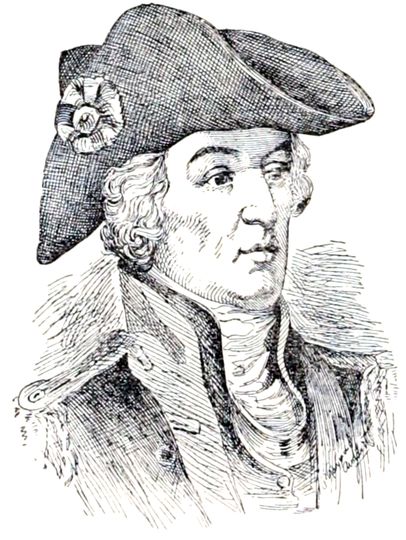
FRANCIS MARION
After the portrait in the painting
by T. Stothard, R.A.
Marion and his men seldom were two successive nights
in the same place. The night was their time for work.
At sundown they swung into their saddles, and were soon
riding for the enemy's camp. When near, they quietly
surrounded the camp, took aim by the light of the fires,
fired, and then rushed upon the frightened British or
Tories, and cut them down
with their terrible broadswords.
How
they
escaped
Before daybreak, Marion
and his men were hiding
safely in some distant swamp
or other safe place. If the
British chased him too closely
his men scattered in different
directions, but always made
their way to the common hiding
place. In a few days they
were ready to strike again.
One hundred
fifty
prisoners
set free
Just after Cornwallis defeated
Gates, near Camden,
Marion pounced upon a guard of British soldiers that
was taking one hundred fifty prisoners to Charleston,
captured them all, and set
the prisoners free.
Tarleton
cannot
catch
Marion
At last Cornwallis ordered
Colonel Tarleton
to get "Mr. Marion," as
he called him. But before
Tarleton could act
Marion had fallen on a
large party of Tories going
to join Cornwallis, and
killed, captured, or scattered
the entire party. Tarleton chased Marion for
twenty-five miles, only to find a large swamp through
which he could see neither road nor path. He gave up
the chase in disgust, declaring he would pursue the
"Swamp Fox" no farther.
Congress
gives
Marion a
vote of
thanks
When Greene returned to the last campaign in South
Carolina he found no better, bolder, or more vigilant
helpers than Marion and his "Brigade." Greene gave
Marion high praise, and Congress gave him a vote of
thanks.
Marion was the true soldier of liberty. He cared
nothing for display, only for the success of the patriot
cause. Marion thought of his men before himself. He
was watchful, patient, and silent. He always struck
his foes where and when they did not look for him. If
they were too strong for him he vanished like smoke in
a brisk breeze.
After
the war
Marion was as true and gentle as he was bold and brave.
He was never cruel to prisoners, and was greatly opposed
to punishing the Tories after the war was over. Marion's
neighbors often elected him to high office and in many
other ways showed that they admired him, even if some
did not agree with him.
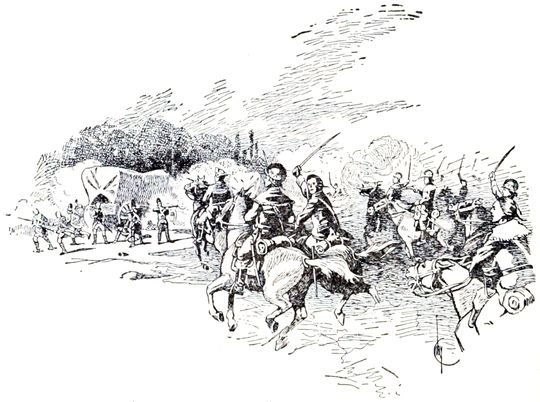
"MARION AND HIS MEN" SURPRISE THE BRITISH
Dashing out of the swamp, Marion fell upon the guard of a band of patriot prisoners,
killed or captured the British, then set the prisoners to guarding the redcoats
A potato
feast
During the war a British officer was invited to take
dinner with Marion. What was his surprise to see only
sweet potatoes, baked in the ashes, set before him.
After this feast the officer resigned, saying it was useless
trying to defeat such soldiers.
The Leading Facts. 1. When Hale heard the news of the
fight at Lexington he hastened to the front. 2. He went
inside the British lines to learn their plans, was caught, and
executed. 3. Greene went to Boston, saw the British army,
returned home and prepared his minutemen. 4. Washington
sent him to the Carolinas after the defeat of Gates. 5. In
the retreat of the American army after the battle of Cowpens,
Greene turned and fought the battles of Guilford Court House,
Hobkirks Hill, and Eutaw Springs. 6. Daniel Morgan with
ninety-six men marched from the Shenandoah Valley to Boston
to join Washington. 7. He won the battle of Cowpens against
Colonel Tarleton. 8. Francis Marion's "Brigade" was made
up of a small number, mounted on their own horses, and armed
with their own guns and swords. 9. He was called the "Swamp
Fox," because his men, attacking after nightfall, usually
escaped to a swamp before daylight.
Study Questions. 1. What was Hale doing when war
broke out? 2. Why did he go within the British lines? 3.
Where was Greene born, and why was he called "the learned
blacksmith"? 4. How did he get his company of minutemen
drilled? 5. What leaders did Greene have to help him?
6. Who was General Morgan? 7. What did Burgoyne say
to Morgan? 8. Explain how Morgan prepared for the battle
of Cowpens. 9. Picture the battle. 10. What anecdotes are
told of Tarleton? 11. Picture the scene at General Morgan's
burial. 12. How did Greene win a victory by retreating?
13. What became of Cornwallis after the battle of Guilford
Court House? 14. What other battles did Greene fight?
15. What proofs of affection did South Carolina and Georgia
give? 16. What is the rank of Greene as a general? 17. How
many were in Marion's "Brigade," how were they armed, and
how did they fight? 18. Why did Tarleton call Marion the
"Swamp Fox"? 19. Who praised General Marion? 20. Read
The Song of Marion's Men, by William Cullen Bryant.
Suggested Readings. Nathan Hale: Brown, Nathan Hale,
the Martyr Spy.
Nathanael Greene: Fiske, Irving's Washington, 430-456;
Francis V. Greene, General Greene, 1-22, 94-105, 160-262;
Frost, Heroes of the Revolution, 27-75.
Daniel Morgan: Blaisdell and Ball, Hero Stories from
American History, 105-122; Brooks, Century Book of the American
Revolution, 168-173; Frost, Heroes of the Revolution, 76-89.
Francis Marion: McCrady, South Carolina in the Revolution,
568-572, 577-652, 660-672, 748-752, 816-881.
JOHN PAUL JONES, A SCOTCHMAN, WHO WON THE GREAT VICTORY IN THE FRENCH SHIP, "BON HOMME RICHARD"
John
Paul
born in
Scotland
100. John Paul. In 1747, in far-away Scotland, on
the arm of the sea called Solway Firth, a great sailor
was born. John Paul played along the seashore, saw
tall ships, and heard wonderful stories of a new land
called America, whose ships filled with tobacco came into
the firth.
Sails on
the
"Friendship"
to
America
John Paul did not get much schooling, and at the age
of thirteen he went as a sailor lad on the Friendship to
America. The ship sailed into Chesapeake Bay and up
the Rappahannock River to the town of Fredericksburg,
where he found his brother William living on a plantation.
In the very same town where George Washington had
just been to school, John Paul also went to school. He
studied hard to make up for lost time, and left a great
name among the boys.
Returns
and sails
for Africa
He afterward returned to Scotland, and at the age of
nineteen sailed as an officer on a slave-trading ship to
Africa, and carried a load of negroes away from their
native land. Many people did not then think it wrong
to do this, but John Paul hated the cruel business, and
left the slave ship as soon as he reached Jamaica.
Made
captain
On his way back to Scotland the officers of the ship
died, and John Paul, although but twenty years old, had
to take charge. The owners of the vessel were so pleased
with the way he handled it that they made him captain,
and he went on many voyages to different countries.
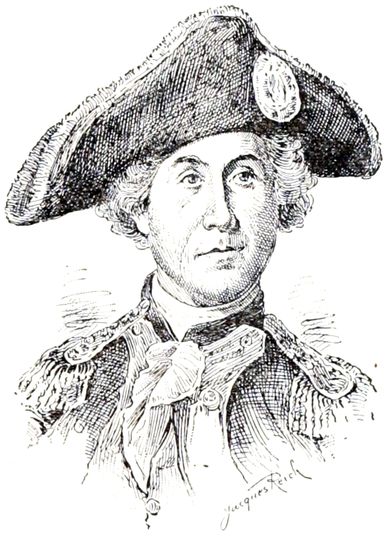
JOHN PAUL JONES
From a painting by Charles Wilson Peale
in Independence Hall, Philadelphia
In
Virginia
again
After a time John Paul went to Virginia to take care
of his dead brother's plantation. While he was living in
Virginia he watched the quarrel between England and
her colonies break out in
open war.
Offers
his services
to
Congress
101. John Paul Jones
Enters the American
Navy. He hastened to
Philadelphia and offered
his services to Congress.
He knew England would
send thousands of soldiers
to America; and that she
would send her war ships
along our seacoasts and
up and down our bays
and rivers, to capture and
burn our towns. He also
knew that the Congress
did not own a single war
ship when the war began.
Congress ordered war ships to be built. While these
were being made, Congress ordered trading vessels to be
fitted with cannon and sent out to capture British ships.
Changes
his name
When John Paul went to Philadelphia he gave his name
as Paul Jones, probably in honor of Willie Jones, a friend
who lived in North Carolina. Some have thought that
he did not want the British to know him, if they should
capture him in a sea fight.
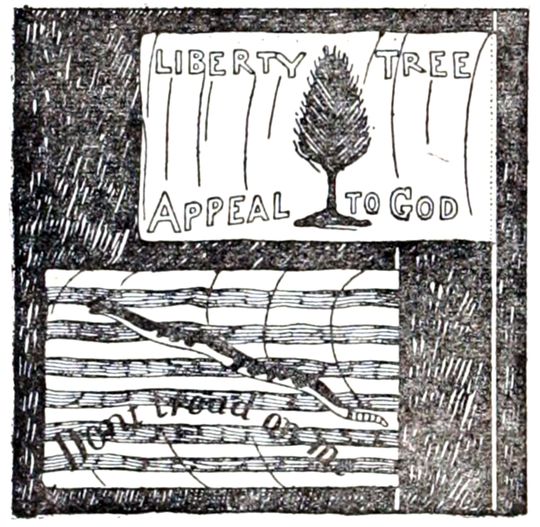
THE FIRST AMERICAN ENSIGN
This, the first flag to float above an American
man-of-war, was raised by John Paul Jones
Really
wants to
fight
What he
could do
Although Paul Jones really knew more about war ships
than most of the men in Philadelphia, Congress gave him
a very low office. But that made no difference to him,
for he really wanted to get into a sea fight. In 1775 he
was made a lieutenant, and joined an expedition to
capture cannon and powder from the British in the
West Indies. He did so well
that Congress made him
captain and gave him a ship.
He then went on a cruise to
the West Indies, where in six
weeks he captured sixteen
prizes and destroyed a number
of small vessels.
Sent to
France
Congress afterward gave
him command of the ship
Ranger, and sent him to
carry letters to Benjamin
Franklin, who was in France
trying to get the king to take sides with the Americans.
With the
"Ranger"
at
Whitehaven
Franklin planned for Jones to take the Ranger to
the coast of England, and show that American as well as
English ships could burn, destroy, and fight. He captured
two vessels, made straight for his old town of
Whitehaven, "spiked" the cannon in the fort, set some
ships on fire, and escaped without harm.
Near by this place, his sailors took all the silver from
the home of a rich lady. This robbery troubled him so
much that, afterward, at great expense to himself, he
returned the silver to its owner.
"Paul,
the
Pirate"
"Look out for Paul Jones, the pirate!" the people said;
and the Drake, carrying two more cannon than the
Ranger, was sent to capture her. Five boatloads of
people went to see the pirate captured. The fight
lasted more than an hour. When the Drake surrendered,
her captain and forty-two men had been killed.
The Ranger had lost only two men. After this fight the
English towns were still more afraid of Paul Jones.
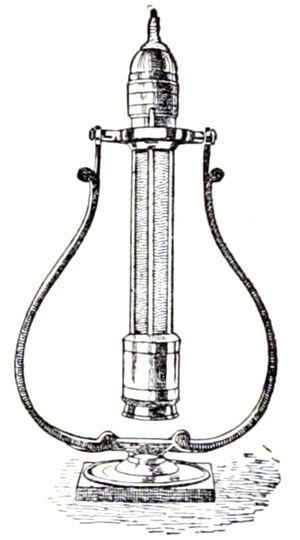
MARINE CANDLESTICK
From man-of-war
"Constitution"
The
"Good
Man
Richard"
There was great joy in France when
Paul Jones sailed into port. The king,
who was now making war on England,
promised him a larger fleet of war vessels.
So, in 1779, he found himself captain
of a large ship armed with fifty
cannon. He called the ship the Bon
Homme Richard in honor of Franklin's
Almanac, the "Poor Richard." Three
smaller vessels joined him, and he again
set sail for the English coast. The
news of his coming caused great alarm.
The
"Richard"
and
the "Serapis"
102. A Great Sea Fight and a
Great Victory. As Paul Jones sailed along the British
coasts he captured many trading ships and frightened the
people. At last he came upon two British war ships. Just
at dark the Richard attacked a larger English ship, the
Serapis. At the first fire two of Jones' cannon burst,
tearing up the deck and killing a dozen of his own men.
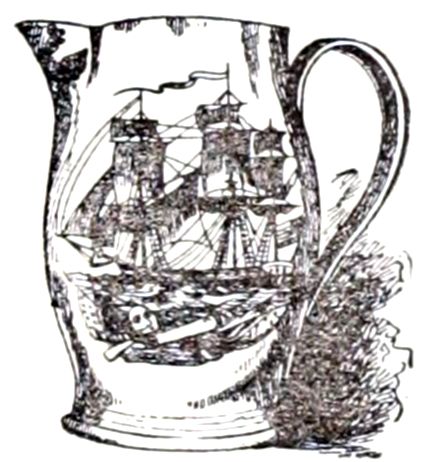
NAVAL PITCHER
This was made in commemoration
of the
American Navy, 1795
The
great sea
fight
The fight went on for an hour, when the Serapis
came near, and Jones ran the Richard into her. "Have
you struck your colors?" called out the
English captain. "I have not yet begun
to fight!" replied Captain Jones.
When the ships came together again
Paul Jones himself seized a great rope
and tied them together. Now the fighting
was terrific. The cannon tore huge
holes in the sides of the ships.
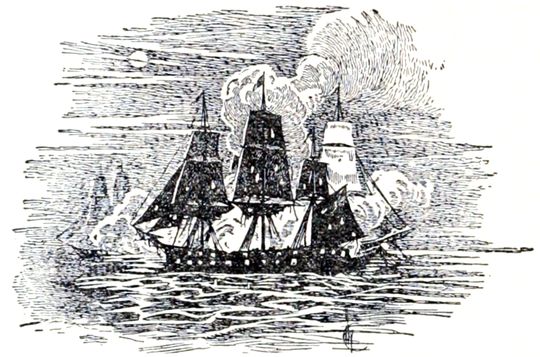
THE CAPTURE OF THE SERAPIS
Because of this victory three nations, France, Russia, and
Denmark, bestowed special honors upon John Paul Jones
as "the valiant assertor of the freedom of the sea"
A great explosion on the Serapis
killed twenty of her men. Both ships were on fire, and
the Richard began to fill with water. The men on each
ship had to fight
fire. It was ten
o'clock at night.
The British prisoners
on the Richard
had to help
pump out water to
keep the ship from
sinking.
A
great
victory
Only a few cannon
on each ship
could be fired. The
decks of both ships were covered with dead and wounded,
but neither captain would give up. Finally Paul Jones,
with his own hands, pointed two cannon at the great
mast of the Serapis. Just as it was about to fall, the
English captain surrendered.
A
great
naval
hero
All night Jones and his men were kept busy fighting
fire and pumping water, while the wounded were removed
to the Serapis. The Good Man Richard sank the
next day at ten o'clock. Paul Jones sailed to France
with his two English ships, where he was praised and
rewarded by the King of France. He was a great hero
in the eyes of the French people, and in the eyes of the
Americans, too.
Finally
buried in
America
After the war Paul Jones was an officer in the Russian
navy. He died in France in 1792. His grave was
forgotten for many years, but was discovered in 1905,
and his bones were brought to America with great honor,
and buried at Annapolis, Maryland.