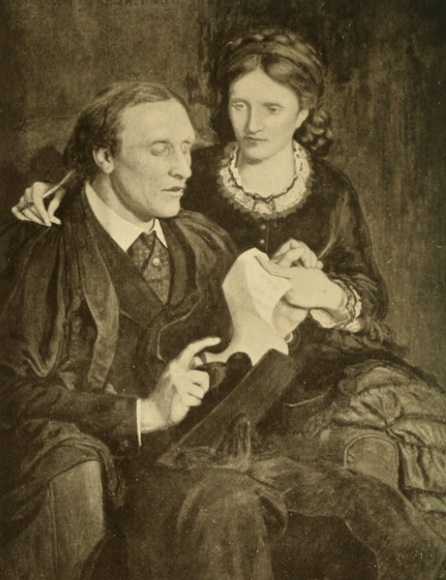
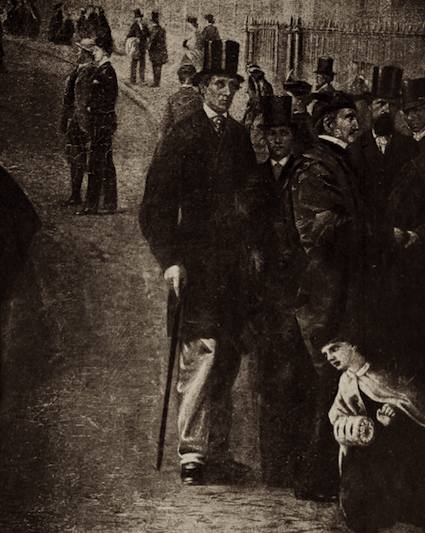
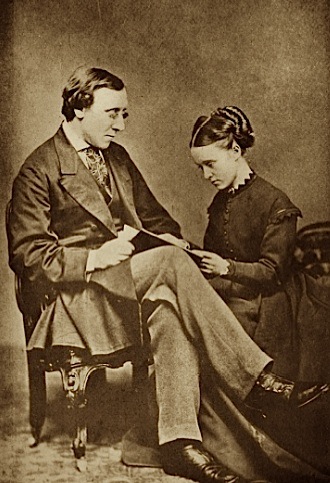
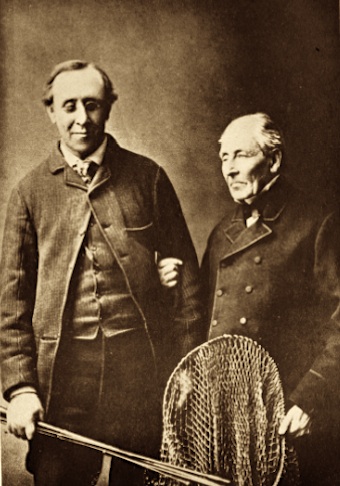
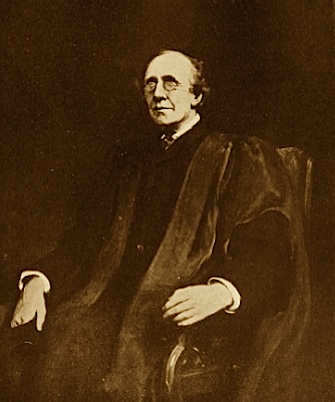
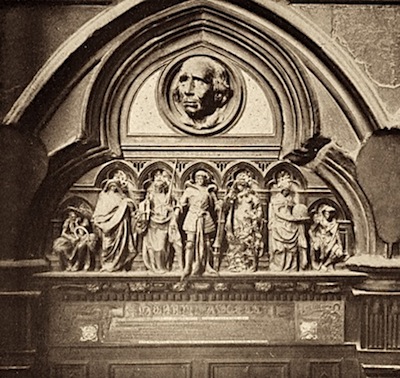
PROFESSOR AND MRS. FAWCETT From the painting by Ford Madox Brown, now in the National Portrait Gallery
A BEACON FOR THE BLIND
BEING A LIFE OF
HENRY FAWCETT
THE BLIND POSTMASTER-GENERAL
BY
WINIFRED HOLT
‘He that is greatest among you
let him be servant of all.’
BOSTON AND NEW YORK
HOUGHTON MIFFLIN COMPANY
1914
THIS BOOK IS DEDICATED
TO THE FIVE ON TWO CONTINENTS
WHO MADE ITS WRITING POSSIBLE——
IN ENGLAND, B. T. AND F. DE G. E.
IN AMERICA, E. H. B., H. H.
AND R. H.
FOREWORD BY The Right Honourable Viscount Bryce late British Ambassador to America
vii
There has been no more striking example in our
time of how self-reliance and strength of purpose
can triumph over adverse fortune than that presented
by the career of Henry Fawcett. The story
of his life as it is to be told in this book will give
ample illustrations of his fortitude and his perseverance.
All that I, an old friend of his, need
speak of is a quality hardly less remarkable than
was his energy. I mean his cheerfulness. It
was specially wonderful and admirable in one
afflicted as he was. Nothing would seem so to cut
a man off from his fellows as the loss of sight, nor
would it appear possible to enjoy the charms of
external nature without seeing them. Fawcett,
however, delighted in society. He never moped.
He loved to be among his friends, and found an
inexhaustible pleasure in talk wherever he was,
in his College (Trinity Hall, Cambridge), at London
viiidinner-parties, in the lobbies or smoking-room of
the House of Commons. If he had moments of
sadness in solitude we knew nothing of them, for
in company he was always bright. His greetings
were joyous; his good spirits proverbial at
Cambridge, and indeed in all the circles that knew
him, making his friends feel, in any moments of
depression that might come upon them, half
ashamed to be less cheery than one with whom
fate had dealt so hardly. Without this natural
buoyancy of temper, even such a resolute will as
his might have failed to achieve so much as he
achieved. He seemed determined to hold on to
every possible source of enjoyment he had ever
known before sight was lost. That determination
used to strike me most in his fondness for open-air
nature and physical exercise. He loved not only
walking but riding. I remember how once when I
was staying with him in the same country house
in Surrey, our host arranged a long excursion on
horseback through the lanes and woods of the
pretty country that lies on both sides of the North
Downs, to the south-west of London. Fawcett
insisted on being one of the party, and when he
approached a place where the bridle-path ran
through a wood of beeches, whose spreading boughs
came down almost to the height of the horses’
heads, he said to me, ‘Tell me to duck my head
ixwhenever we come to a spot where the branches
are low.’ I felt uneasy, for if he had struck against
one of the thick boughs, he might have been unhorsed
and would certainly have been hurt. However,
I went in front and warned him as he had
desired. He rode on fearlessly, stooping low over
the horse’s neck whenever I called out to him to
do so, and he evidently enjoyed the fresh scent of
the woods and the rustling of the leaves just as
much as did all the rest of us.
His love of nature, joined to his sympathy with
the masses of the people, made him eager to secure
the preservation of public rights in commons and
village greens and footpaths. He was one of the
founders of that Commons Preservation Society
which has done so much to save open spaces in
England from the grasp of the spoiler; frequently
attended its meetings, and was always ready to
vote and speak in the House of Commons when
any question involving popular rights in the land
arose there.
At a time when extremely few non-official
persons in Parliament interested themselves in
the government and administration of India,
Fawcett, though he had never visited the East,
and had no family connection with it, felt, and set
himself to impress upon others, the grave responsibility
of Britain for the welfare of the peoples of
xIndia. He studied with characteristic thoroughness
and assiduity the facts and conditions of
Indian life, the financial problems those conditions
involve, the needs and feelings of the subject
population. His speeches were of the greatest
value in calling public attention to these subjects,
and his name is gratefully remembered in India.
His mental powers were remarkable rather for
strength than for subtlety. It was an eminently
English intellect, forcible in its broad commonsense
way of looking at things, and in its disposition to
pass by side issues and refinements in order to go
straight to the main conclusions he desired to
enforce. This was what chiefly gave weight to
his speeches in Parliament and on the platform.
Debarred as he was from the use of writing, he
formed the habit of thinking out fully beforehand
both what he meant to say and the words in which
he meant to say it, and thus he became a master of
lucid statement and cogent argument, making each
of his points sharp and clear, and driving them
home in a way which every listener could comprehend.
The same merits of directness and
coherency are conspicuous in his writings on
political economy, his favourite study. There
were no dark corners in his mind any more than in
his political creed, or indeed in his course of action
as a statesman. In practical politics, it was said
xiof him, to use a familiar phrase, that you always
knew where to find him. That was one of the
qualities which secured for him not only the confidence
of his political friends but the respect of
his political opponents. When he died prematurely
he had reached a position in the House of
Commons which would have secured his early
admission to the Cabinet, and the only doubt
I ever heard raised was whether his blindness,
which would have made it necessary that documents,
however confidential, should be read aloud
to him, would have constituted a fatal obstacle.
The force of his character and the vigour of his
intellect must have ensured him a distinguished
career even had he been stricken by no calamity.
That he should have been stricken by one which
would have overwhelmed almost any other man,
and should have triumphed over it by his cheerful
and persistent courage, marks him out as an extraordinary
man, worthy to be long remembered.
BRYCE.
INTRODUCTION
xiii
‘I wish we had Fawcett here to-day. At this
crisis England needs him sorely.’ These words,
said with much feeling by the late Lord Avebury,
were spoken to the writer of this book only two
years ago.
Fawcett is not needed only in England. His is
the type of man needed sorely to-day and every
day in every empire and democracy under the
sun. His example of valour against odds is just
as necessary for America as for the Mother Country,
for the men who are now doing the world’s work
as for the lads who will be at work to-morrow.
Sir Leslie Stephen said that while writing the
biography of Fawcett, there was not a single fact
which he had to conceal, nothing to explain away,
nothing to apologise for, and he judged the best
way to do his subject honour was to tell the plain
story as fully and as frankly as he could.
Sir Leslie wrote with the reticent dignity of one
recently grieving for the loss of his friend; the
present writer will have executed her task if she
has succeeded in throwing a more personal light
on the heroic figure of Fawcett.
xivThis little book has no pretensions. It endeavours
merely to preserve carefully and reverently
glimpses and flashes—which might have
otherwise been lost—of a great life, a life of deep
significance not only to those who see, but especially
to those who, like Fawcett, must depend for their
vision on that inner eye which no calamity can
darken.
When he lost his sight, Fawcett had his fixed
manner of life, his tastes and ambitions, and he was
painfully forced to readjust himself to altered
aspects. The tracing of the beneficent effect of
this necessity on a man of his strong mind, body
and will, is a psychological study of deep interest.
His attitude towards questions that are still
vital, such as the treatment of dependent peoples,
the widening of the suffrage and the perfecting of
its machinery, make his personality still unique,
modern and absorbing.
A nearer view of the man, seen through the recollections
and anecdotes of his friends, shows his
intense love of fun, his high ideals and bravery, his
tremendous industry and accomplishment.
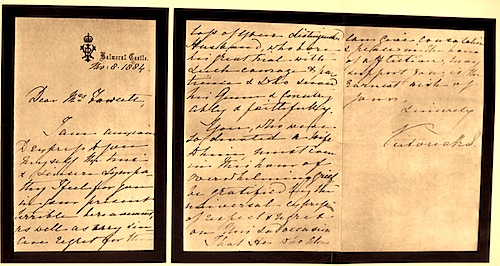
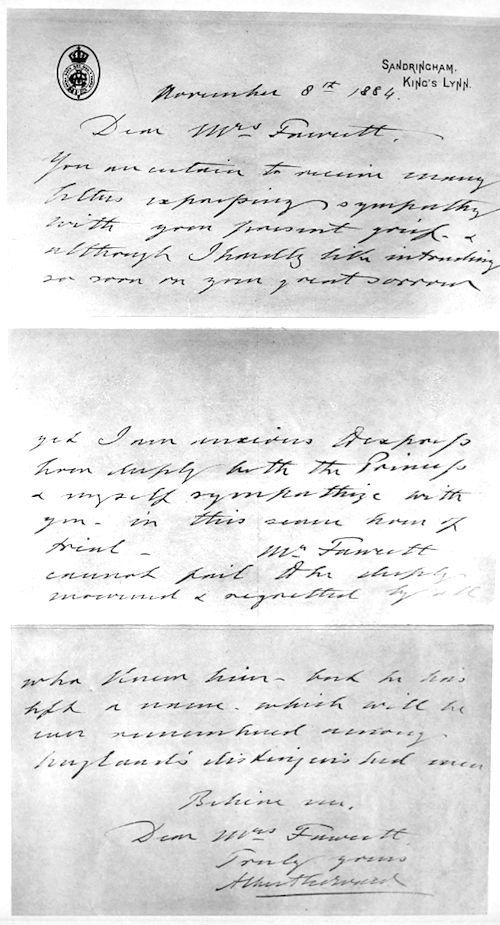
The author is grateful for permission to use the
facsimiles of the letters of Queen Victoria and the
Prince of Wales (King Edward).
She is also deeply obliged for the help given
by reminiscences and anecdotes from the Right
xvHonourable the late Lord Avebury; Dr. Beck,
Master of Trinity Hall, Cambridge; Dr. Henry
Bond; the Right Honourable Viscount Bryce, late
British Ambassador to America; Sir Francis
Campbell; the late Robert Campbell, Esq.; the
Honourable Joseph H. Choate, late American
Ambassador to Great Britain; Lord and Lady
Courtney; Sir Alfred Dale; the late Sir Robert
Hunter; the late Sir William Lee-Warner, G.C.S.I.;
the Right Honourable Viscount Morley; Lady
Ritchie, Miss McCleod Smith; the Right Honourable
the late James Stuart, Esq., and Mr. Sedley
Taylor.
She is particularly indebted to Miss Fawcett, the
sister of Mr. Fawcett, and to Mrs. Fawcett, his
widow, for their assistance. Their interest in the
book was a great stimulus towards its writing.
Mr. F. J. Dryhurst, C.B., who from 1871 to 1884 was
secretary to Mr. Fawcett, has been a great aid in
preparing the book. The greatest assistance has
been given by Miss de Grasse Evans and Miss
Beatrice Taylor, without whose sympathy and help
in various stages of the work its completion might
have been impossible.
It has been inevitable that Sir Leslie’s biography
should be largely quarried. His arrangement of
facts has been followed as the simplest and most
logical framework for the story, and descriptions
xviof scenes which he and his friends witnessed, and
stories of Fawcett not elsewhere given, have been
used. The admiration and gratitude of the novice
for help from the master biographer is here humbly
recorded.
This book should enhance the interest of the
older biography, which perhaps may be reintroduced
after many years oblivion—as it has been
out of print—by its younger and less formal
companion.
The material to be had has been used and
adapted as it might best serve, and the narrative
has not been interrupted to give its source; it is
believed that this policy will be in accordance with
the wishes of those of Mr. Fawcett’s appreciators
who have so generously helped.
The more we know about this brave, patient and
humorous man, the more inspiration we get;
and to help us to achieve and to rejoice—never was
inspiration more sorely needed than to-day! It
is in the hope of supplying a little of this great
need that this brief story of a steadfast life is
written.
Fishing—In the House of Commons—Need for Distraction—What Helen Keller thinks—Sir Francis Campbell—Leap Frog—Despair and Cheer—Paupers and Political Economy
Opposition to Gladstone—‘The Most Thorough Radical Member in the House’—Growing Dissatisfaction with the Government—The Irish Universities Bill—Helping to Defeat his own Party
India Pays for English Hospitality—Royal English Generosity to India paid for by India—How to Deal with an Angry Opponent—Indian Finance and the poor Ryot—Gratitude from India—How Fawcett Prepared his Speeches
xxiChapter XXIII. The ‘One Man who cared for India’
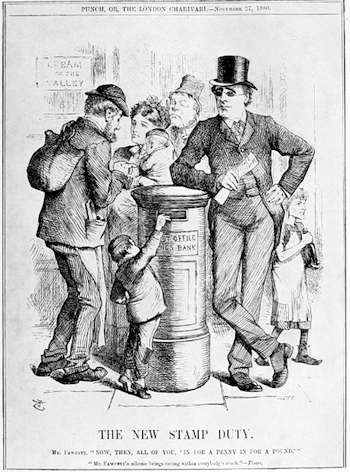
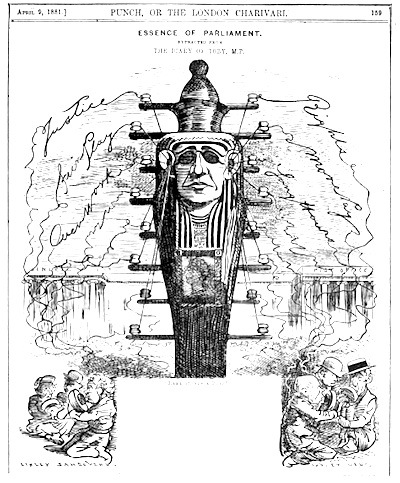
Punch and Fawcett—The Indian Famine—Parliamentary Interest Aroused in India—Bulgarian Atrocities—Afghanistan War—Gladstone’s Faith in Fawcett—A £9,000,000 Mistake
General Expectation that Fawcett would join the Cabinet—Importance of a Fish—Postmaster-General—Queen Victoria Interested—Post Office Problems—Scientific Business Management Anticipated—Women’s Work—A Likeness to Lincoln
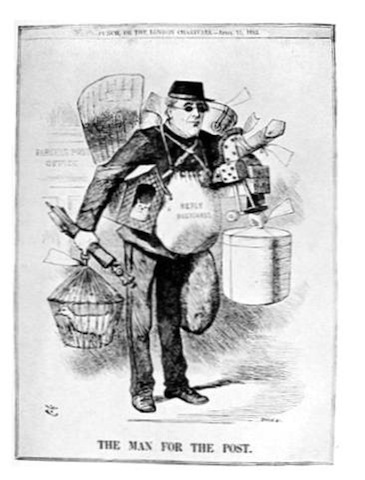
Cheap Postal Orders—Savings Bank—Life Insurance—Two Post Office Pamphlets to Help the People—Cheap Telegrams—Telephones—‘The Man for the Post’—‘Words are Silver, Silence is Gold’
The Passing—The People Grieve—Sorrow in Parliament—The Nation’s Loss—Letters from Queen Victoria, the Prince of Wales (the late King Edward) and Gladstone—The Railroad Men’s Tribute—The Significance of his Life—India’s Loss—Fawcett’s Message
The Fisherman—The Battle of Waterloo—The Mayor
of Salisbury—The Mayor’s Son—The Market-place—The
Circus—Boarding-School and Fun—A Diary.
One midsummer day in 1815 a young draper’s
assistant was gently fishing in the Salisbury Avon.
William Fawcett was but lately come to Salisbury,
yet he already knew his river. While trying a deep
pool in the shadow of a bridge near the town he
was startled by shouts from the roadway above.
‘News from the army! A great victory! Boney
in flight!’
The fisherman forgot his fish, and hurried away
to join the rejoicing crowd gathering in the market-place.
There having been bustled to the roof of
a stage-coach, and had the gazette containing the
news thrust into his hands, he read out in his remarkably
clear and resonant voice the account of the
great battle of Waterloo.
Rejoicings.
Seventeen years later, when the shopkeeper had
become the Mayor of Salisbury, he again led the
town in rejoicings. The great Reform Bill had
become law. Salisbury townsfolk were henceforth
to have a voice in the councils of the nation,
and the barren hill on which stood the pocket
4borough of old Sarum was no longer to mock them
with its political power.
The town joyously prepared to celebrate the
event. The houses were decorated. Elaborate
illuminations were set up. Victory, assisted by
Greek gods and goddesses, presided over a transparency
in which Britannia throttled the hydra
of corruption, while Wellington and Peel scowled
in the background. Meat and beer were given to
the poor; in the market-place, at great fires lighted
in the open air, whole sheep were roasted. The
smoke swirled blindly about the bustling crowd,
and then surged up past the latticed windows of
the Mayor’s house, to seek in ever thinning rifts
the spire of the wonderful cathedral that for
centuries has watched over the destinies of the
town. The next day was held in the market-place
a great banquet, at which the Mayor presided;
and after dinner all adjourned to the Green Croft
Cricket Ground, where his Worship led off the
dance with a prominent and elderly lady of the
town—the Mayor resplendent in plaited shirt frill
and high stock, the buckles on his shoes twinkling
as he cut ‘pigeon wings,’ the lady sedate in
her wide brocade gown, her poke bonnet, and lace
veil.
Fawcett’s heart was as light as his heels on that
occasion. All his life he had been a reformer, a
staunch Liberal, ardent for the extension of the
franchise. It says much for his personal charm
and worth that, in a close Tory borough such as
5Salisbury then was, he should have been chosen
Mayor by his political opponents.
The Mayor and his Wife.
So dear to his heart was the spirit of freedom
that the Mayor had forsooth to fall in love with
the daughter of the solicitor who acted as agent
for the Liberal party. Miss Mary Cooper was a
good and clever woman, deeply interested in
politics, and as ardent a reformer as the man she
married.
The couple were sociable and humorous. They
kept a good table, laid in an excellent stock of
wine, and diffused such a pleasant atmosphere of
hospitality that they became immensely popular,
and many distinguished people sought their company.
But William Fawcett was not only a good
townsman, he was a good countryman as well, a
great jumper, a keen sportsman, a good shot, and
a renowned fisherman.
The Brick-house Baby.
In 1833, when the Princess Victoria was fourteen
years old, when the negro slaves were being freed
throughout the British Colonies, when Stephenson
had completed his locomotive and the first railroads
had been started, when all things seemed
to be pushing and striving for independence and
progress, in the Mayor’s old low red-brick house
overlooking the market-place, in a wonderful Elizabethan
room, on 26th August, Henry Fawcett was
born.
The baby seems to have been singularly like
most other babies. He shared the uneventful
placidity of his nursery with an older brother,
6William, and a sister, Sarah Maria. Six years
later there came another brother, Thomas Cooper.
The Market.
When Harry was four years old Queen Victoria,
whom he was to serve in so distinguished a capacity,
came to the throne. But it was still too early to
find in Harry indications of the future statesman.
He was delicate, and much spoiled at home, had
a strong will of his own, and was on the whole
rather selfish. He was not an imaginative child,
though he loved at times, holding his sister Maria
tightly by the hand, to venture into the great
cathedral and see the coloured light as it filtered
through the high windows, or to thrill in response
to the thundering of the great organ. But more
often we find him, still very tiny, standing squarely
on his feet, inquiring with real interest the price
of bacon, how much sheep and wool brought; or
walking with his father and wearying him with
ceaseless economic questions as to ‘Why are things
cheaper to-day than last month?’ ‘Why does
butter cost more than milk?’ until that patient
man was heard to exclaim not too patiently, ‘Harry
asks me so many questions that he quite worries
me.’
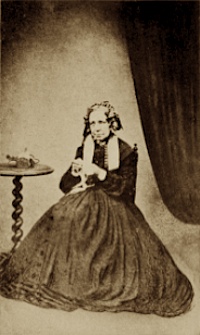
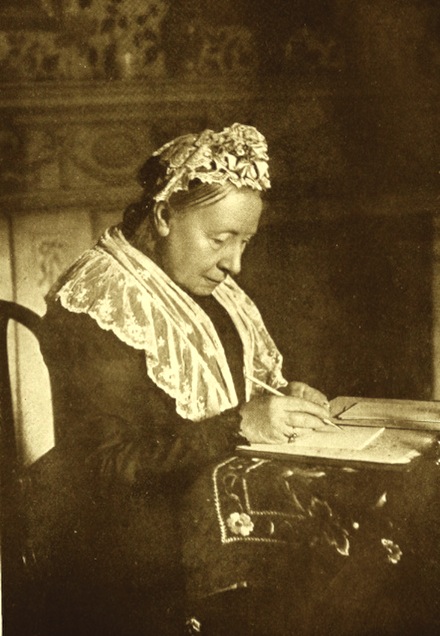
HENRY FAWCETT’s MOTHER
He went to a Dame’s school, where his first
teacher said that she had never had so troublesome
a pupil, that his head was like a colander;
but Harry puts the case more pathetically when
he tells his mother that ‘Mrs. Harris says if we
go on, we shall kill her, and we do go on,’ regretfully
adding, ‘and yet she does not die.’ A
7schoolmate of these days says that Harry lisped
very much, and that the boys used to tease him
about it. He was also so slow about his lessons
that they called him thickhead. But when school
was out Harry entered the realms he loved. From
his home on the market-place he had only to go
outside the door to be at once in touch with the
active world whose economic problems appealed
to him so keenly. He made friends among the
country folk, and talked of their crops and the
money they would bring, and noted in his childish
mind the rise and fall in the price of wheat.
The Circus.
Then to the same open space came all sorts of
travelling shows. Sometimes the circus spread
its mysterious tents, and when the children were
dragged away from the wild beasts and the seductive
freaks and put to bed, the little Fawcetts
would stealthily creep to the bedroom window
overlooking the market and see the lights shining
on all the wonderful but forbidden marvels, and
hear the hurdy-gurdy and the band mix their
triumphal blare with the solemn striking of the
clock in the near-by cathedral.
Boarding-School.
In 1841 Harry’s father took a delightful farmhouse
at Longford, about three miles south of
Salisbury, with delectable streams full of fish.
Harry loved to fish every day, and hated lessons,
but, alas! grim fate backed the lessons, and sent
him ruthlessly to school. He went as a boarder
to Mr. Sopp at Alderbury, a few miles away.
There are many tales showing that Harry loved
8the fleshpots and that he had been much indulged
at home. He writes, ‘I have begun Ovid—I
hate it.’ ‘This is a beastly school—milk and
water, no milk—bread and butter, no butter.
Please give a quarter’s notice.’
And still more heartrending was the prayer to
his mother, ‘Please when the family has quite
finished with the ham bone, send it to me.’ Imagination
can supply the effect of this on the family
circle, and guess what a well-covered ham bone
was shipped to the starving Harry. Starving or
no, he grew immensely stronger and larger, and
though he never admitted that he got enough to
eat at any school, he became ultimately reconciled
to his exile.
He used to come home often for half-holidays,
and to go to Longford and revel in all country
delights. Then began the close friendships with
the cottagers about him which meant so much
to him and influenced all his life.
In the summer that completed his tenth year
there came to Salisbury two men who also loved
the common people and sought to make their
lives easier. It was the year of the great Free
Trade campaign in the agricultural districts, and
the men were Cobden and Bright. They visited
Harry’s father, and perhaps Harry himself met
them then for the first time. Lord Morley has
said in his life of Cobden that ‘the picture of these
two men, leaving their homes and their business,
and going over the length and breadth of the land
9to convert the nation, had about it something
apostolic.’ In a home where they and their teachings
were so reverenced, to even hear of their
journeyings would make a strong impression on
a boy of Harry’s interests, and perhaps helped to
give a definite aim to his ambitions.
At Mr. Sopp’s school he began a diary, of which
the penmanship is admirable. On some days the
only record is the startling fact, ‘It was a very
fine day.’ June 21st, 1847, however, is a very
eventful day, for he lists the capture of the first
fish that he took with a fly, which weighed ‘about
three-quarters of a pound.’
Hedgehogs and Cake.
Again, he is transported with joy by the gift of
a hedgehog and four young ones, and he has a
glorious time in going on board H.M.S. Howe, of
one hundred and twenty guns. On one occasion
he goes to the theatre, on another he is in court
hearing a trial. He begins Greek, and this anguish
is modified by the arrival of a cake for one of his
schoolfellows, which Harry doubtless shares.
A change of scene is recorded in the diary when
on 3rd August Henry becomes the first pupil at
Queenwood College. In its previous career this
temple of learning had been Harmony Hall, built
by Robert Owen for his last socialist experiment.
In 1817 it was opened as a school by Mr. Edmonson,
a Quaker. Special emphasis was given to scientific
training and English literature. The school seems
to have been very congenial to Harry, and his
intellect now began to develop rapidly.
The Editor.
10To continue from the diary, we learn that ‘we
elected the various school officers. J. Mansergh
and I were elected without opposition editors of
the Queenwood Chronicle.’ He had been at Queenwood
but a fortnight, and was fourteen years old
when this great honour came to him. Mr. Fawcett
was delighted at this good news, and offered because
of it and because Harry had been ’studying
most determinedly’ to take the boy to Stonehenge.
His aversion to books had distressed his family,
and this new interest in his studies gave his father
great pleasure. On reading a composition which
Harry had sent home, Mr. Fawcett exclaimed to
his wife, ‘I really think, mother, after all that
there is something in that boy!’ His literary
performances at this time indicate an increasing
imagination, but in the main he never deviated
from the practical paths of thought shown when
as a tiny child he studiously investigated the
Salisbury market. His schoolmates report him
as ‘tall for his age, loose-limbed, and rather ungainly.’
He had become much of a bookworm,
and though later good at games, at this time he
preferred to wander off by himself and read. He
was strongest in mathematics; languages did
not much appeal to him; but he liked to learn
long passages of poetry by heart. There was a
disused chalk-pit near Queenwood where he would
take refuge and declaim his lines. The extravagance
of his gesticulations might well cause unexpecting
passers-by to consider him the village loony.
CHAPTER II THE BOY LECTURER
11
A Lecture on the uses of Steam—Parliamentary Ambitions—King’s
College—Politics in the Fifties—Cribbage
and Cricket.
Fawcett was interested in the scientific lectures,
and he had a very good time. Professor Tyndall
took them out surveying. Harry comments on
a lecture at which he heard that there ‘is fire
in everything, even ice’; he also records some
chemical experiments in the laboratory.
In September the diary states, ‘I began writing
my lecture on phonography, on the uses of steam
without copying any of it.’
There is an error here, as these were two lectures,
not one. That on steam, in a blue marbled-covered
copy-book, lies before the writer. The
title, inscribed in tall, shaded handwriting, contained
within scrupulously ruled lines, is:
=================================
A Lecture delivered by H. Fawcett
On Uses of Steam
At Queenwood College
September 27, 1847.
=================================
12The ink, which was black sixty-six years ago, is
now much faded; but the essay of the fourteen-year-old
schoolboy is still fresh and interesting,
and so prophetic of the man that it is like a simple
map indicating the chief features of the country
we are about to see.
Henry writes in his careful penmanship, for
which he must have been marked at least 9+ in a
scale of 10, ‘Things which appear simple to an
unobserving Person are to an observing Person
the most complicated and beautifully formed
... such a simple Thing as a blade of Grass,
has ever any Man been yet so wise as to tell what
it is?’
The Essayist.
Here is another curious sentence written by the
bright-eyed youngster with the monumental dignity
of the lecturer:
‘What can be so beautifully contrived and
framed as the human Body, where there are innumerable
Parts, acting all in Unity?... if one
of the Parts go wrong, the whole Body is put out
of Tune ... is there any one Part of our Body
which we could dispense with?... I think the
Answer “No” must be evident to every one.’
It is curious that Fawcett should have been
called upon later by the loss of his eyesight to
contradict this childish statement, and to prove
not only that we can get along without some of our
most precious faculties, but that the law of compensation
so works that we may be able to accomplish
more by reason of the loss.
13The essay proceeds to deal with railways, and
contains all kinds of figures relating to tonnage,
trains, traffics, the cost of railroad construction,
etc., all with careful, correct figures; a complicated
study for a railroad expert. This schoolboy is
already coping with the figures and statistics of
which he had later such a marvellous control.
He dwells on the importance of the railroad to the
Wiltshire farmer, who can sell his cheese at sevenpence
a pound in London, when it is only worth
sixpence where it is made. In this and similar
statements we find the political economist foreshadowed:
he speaks of the nobility who selfishly
object to having railways, which he feels are the
greatest help to the common people; and he adds,
‘A Man should sacrifice a little of his own Pleasure
when he knows that by sacrificing that Pleasure
he will benefit the People at large.’ We must note
that pleasure is always spelt with a beautiful and
exceptionally large P.
Later there are some intelligent remarks on the
power of a railway to create traffic, so that ’some
Railways have been made between two Places
where there was not sufficient Traffic for a Coach,
and yet when they are made, a Trade springs up,
and they pay very well indeed.’
Transporta-tion—Rich and Poor.
He further approves of the railway as a means
of cheap transportation, and remarks, ‘Many a
Person can avail himself of a Day’s Pleasure ...’
or, ‘Enjoy the beautiful Air of some Country
Village.’ Here we have not only the keystone of
14Henry Fawcett’s character, but indications of the
political activities in which he was to be so pre-eminent.
His public career was one long, unbroken
effort to do away with the monopolies and prerogatives
of any class, and so to increase the independence
and rights of the poor.
The essay continues by quoting from an article
in the Quarterly Review written in 1825, which
considers it impossible that an engine could travel
eighteen miles an hour. With evident joy he
quotes, ‘The gross Exaggerations of the Powers of
the Locomotive Steam Engine, or to speak English,
the Steam Carriage, may delude for a time, but
must end in Mortification to those concerned.
We should as soon expect the People of Woolwich
to suffer themselves to be fired off in Congreve’s
Ricochet Rockets, as to trust themselves to the
Mercies of such a Machine going at such a rate.’
Harry himself then tells of the M.P. who insisted
that the best possible locomotive could not compete
with a canal boat. The scribe seems fully to
appreciate the humour of this, and so foreshadows
the love of fun and the vibrant laugh of the man
to be.
Steam-engines lead to steamships. Our author
now invites us to cross ‘the wide heaving Ocean,’
saying, ‘When you are on a Voyage in a Steam
Vessel you feel none of that Inconvenience of
having to remain at Anchor for two or three Weeks
waiting for a favourable Wind ... you can proceed,
for you are quite independent of the Winds,
15and the Speed of a Steam Vessel is very considerably
greater than that of any other Vessel.’ A
steam vessel went from Liverpool to Boston in
eleven days and nine hours, and yet when steam
navigation was struggling into existence ‘it struck
the minds of our brave Captains as a poor mean
mechanical Thing unworthy of the least Consideration.’...
‘I think you may almost remark’ (note
the conservative discretion) ‘that the greatest and
most useful inventions when they are struggling
into Existence receive the greatest Opposition, because
they make great changes, and most people,
especially the ignorant, are generally very adverse
to any changes.’
Patriotism—Bonaparte and Babylon.
Now he boasts magnificently about the British
navy and merchant marine, approves of Bonaparte’s
wisdom in coveting the British sailors, and
yet prudently warns all against pride, citing the
lamentable consequence of lack of humility to
Babylon and Nineveh. We are asked to consider
the relative values of coal, diamonds, gold, and
silver, and are informed that ‘every Difficulty
can be overcome by steady Perseverance—some
Persons will never scarcely be overcome by Difficulties—they
say they will do it, and they will
never rest till they have performed what they want
to, and it is to Men like these that we are indebted....
No Improvements or Inventions will run into
a Person’s Mind like Water will run into a Bottle,
but they come from Years of Study and Perseverance.’
16We are asked, ‘Do you suppose that Sir Isaac
Newton established the Laws of Gravitation without
some trouble, do you suppose that such a Piece
of Poetry as Milton’s “Paradise Lost” was written
without a Moment’s Thought—or do you suppose
that Watt improved the Steam Engine without
some hard Labour?’ Our scribe then finishes his
masterpiece with a stupendous finale, by the help
of a bit of poetry culled from an American newspaper
and entitled the ’song of Steam,’ a verse
of which will be sufficient:
‘I’ve no Muscle to weary, no Breast to decay,
No Bones to be laid on the “Shelf,”
And soon I intend you may go and play,
While I manage the World by myself.’
This magnum opus, being now successfully brought
to completion, is signed in full, no longer, as on the
title-page, with only the initial of his first name,
but by Henry Fawcett, writ exceedingly large and
clear, Queenwood College, October 12th, 1847.
Every page in the marbled copy-book has been
filled with various spellings, and only a very few
erasures, between 27th September and 12th October.
We have quoted this delicious essay as fully as
space would allow, not only on account of its
unique charm, but because every page is coloured
by a preoccupation with those subjects and a love
for those traits of human nature which were later
so characteristic of Henry Fawcett, the teacher and
statesman. In fact, we may accept this essay on
17steam as his official debut. The lecture had an
encore at Salisbury in the family circle, when, as
Harry writes, all were ‘much pleased with it, and
Papa promised to give me a sovereign for it.’
Phonography and simplified Spelling.
His lecture on phonography is much in the
spirit of to-day, when simplified spelling is causing
such ardent controversies. Harry comments that
‘out of fifty thousand Words in the language, only
fifty are written as they are pronounced.’ We
must note that in these writings his own inventions
in spelling tend to change these statistics.
The range of his composition at this period is
great. An article on ‘Angling and Sir Isaac
Walton’ is in happy contrast to the account of a
first visit to London. Another fragment contains
the acute observation that ’statesmen depend
upon their brains.’ In another essay called
‘Reflection’ an imaginary trip is taken past Spain,
during which the author ponders on people who
are ‘made poor by gold.’ Progressing to Egypt,
we are told that Mahomet was ‘in many respects
a worthy man.’ Arriving in India, our guide
tells us of a company of men who, ‘occupying a
house of no very considerable size in London, have
entirely from their enterprise and powers of mind,
got possession of many thousand acres of land.’
Does this refer to the East India Company, and
had Harry seen the stately East India House in
Leadenhall Street on that first visit to London?
The breathless exuberant feat of imagination
and philosophy closes with quotations from Portia’s
18lines to Mercy and Cicero’s oration on Verres,
both of which, the author truthfully says, ’show
powers of reflection.’
Harry was writing and studying with a definite
end in view. Already the youth had determined
on a political career, and when the schoolboys
discussed their plans for the future he invariably
declared that he meant to be a Member of Parliament.
The statement was received with roars of
laughter, but Harry remained imperturbably sure.
Still at the foot of the Class.
He was at Queenwood for a year and a half,
and then went to London, where he first attended
King’s College School, and then King’s College.
A schoolmate described him as ‘a very tall boy
with pale whitey brown hair, who always stood
at the bottom of the lower sixth class.’
He attended the school in his fifteenth and
sixteenth years, and then went to lectures in the
college until the summer of 1852, when he was
nineteen years old.
Standing in the school was, in those days,
entirely determined by knowledge of the classics,
for which Fawcett showed a grand indifference;
but he gained the arithmetic prize in 1849, also the
class-work prize, the first prize in German, and the
second in French in the same term. His knowledge
of these languages was always so vague that we fear
his teacher was over-partial in the award, or that
the other boys were strangely deficient. In 1850
he carried off another honour for mathematics,
and a first prize after that in the Michaelmas
19term. The masters noted Fawcett’s unusual
mathematical power, and were also impressed by
his ability to write English prose.
King’s College and Cricket.
At Easter in 1851 he left school and worked
only at the college for mathematics and classics.
We hear that he made no particular mark; but he
occasionally played billiards and cricket, and he
was already an interested spectator in the gallery
of the House of Commons.
During his stay in London he lived with some
family connections, a Mr. and Mrs. Fearon. Mr.
Fearon was a Chief Office Keeper at Somerset
House, and lived there. Somerset House adjoins
King’s College, and this was fortunate for Harry,
who, when he first went to London, had much
outgrown his strength. The hours spent in the
little parlour tucked away in the vast building
were not without charm for the home-loving boy.
Sitting on the corner of the horse-hair sofa, with
its relentless early Victorian back and its unyielding
springs, trying, mostly in vain, not to disturb
Mrs. Fearon’s best antimacassar, he would cheerfully
play cribbage by the hour with his hostess,
while his host expounded pungently on the questions
of the day. Harry had passed from the
Liberalism of the country home to the Liberalism
of the metropolis. For both, Bright and
Cobden were now leaders and standard-bearers,
though Lord Palmerston was the Party Chief.
Free Trade had been won, but neither Parliament
nor country had settled down to it as a policy, and
20the need of another and more democratic Reform
Bill was looming up on the political horizon.
These were the days that followed the abortive
revolutions of ‘48. The battle for political independence
was raging everywhere, but both
leaders and rank and file were learning with
bitterness to make haste slowly. None the less,
hearts were glowing hotly for Freedom, and while
Fawcett was in London, Kossuth, the Hungarian,
was welcomed with enthusiasm. He followed
Carl Schurz, that valiant apostle of Liberty, to
America, where Garibaldi was already working at
his soap factory on Staten Island. There was no
doubt as to the heartiness of Kossuth’s reception
across the Atlantic. The fire of Freedom burnt
to high heaven there: was it not sufficient proof
of this that the dandies of that land reverently
encased their mighty brains in the Kossuth hat?
Talk of these great men, of their vain endeavours,
of the persecution of the poor, of the need of opening
cages and letting in the light of Freedom, made
its mark on Harry, and he often spoke afterwards
of Fearon’s ‘quaint and forcible’ phrases.
In 1851 was the great Exhibition in Hyde Park.
Did Harry’s tall head peer above the crowd that
lined the streets as Queen Victoria drove in state to
the opening of that proud achievement? One would
like to think that once with seeing eyes Fawcett
beheld the little lady who presided over England’s
destinies throughout his working life.
And now Mr. Fawcett, senior, conscientiously
21counting his pennies, and the ability which his
son had already shown as a student, went to his
neighbour, the Dean of Salisbury. He showed the
Dean Harry’s mathematical papers, and asked for
advice about the next step. It was not customary
for one of Harry’s social standing to go to a university,
and the strain on the paternal purse to
send him there would be considerable, but the
Dean had no doubt that Cambridge offered the
proper opening. The sacrifice was cheerfully
made.
CAMBRIDGE
‘I count life just a stuff to try the soul’s strength on
—educe the man.’—Browning.
CHAPTER III THE TALL STUDENT
25
Peterhouse—Quoits and Billiards—Trinity Hall—A
Fellowship—Lincoln’s Inn.
The new Under-graduate.
Harry knew that for his father’s sake it was
necessary for him to be self-supporting as soon
as possible, and therefore chose his college on
purely financial grounds. He went to Peterhouse,
where the fellowships could be held by laymen,
and were reported to be of unusual value.
His great friend, Sir Leslie Stephen, saw him
there for the first time. We cannot do better than
quote from Sir Leslie’s biography of Fawcett the
impression his subject then made upon him:
‘I saw Fawcett for the first time a few months
after his entrance (in October 1852).... I could
point to the precise spot on the bank of the Cam
where I noticed a very tall, gaunt figure swinging
along with huge strides upon the towing path.
He was over 6 feet 3 inches in height. His chest,
I should say, was not very broad in proportion to
his height, but he was remarkably large of bone
and massive of limb.
‘The face was impressive, though not handsome.
The skull was very large; my own head vanished
26as into a cavern if I accidentally put on his hat.
The forehead was lofty, though rather retreating,
and the brow finely arched.
‘The complexion was rather dull, but more than
one of his early acquaintance speaks of the brightness
of his eye and the keenness of his glance.
The eyes were full and capable of vivid expression,
though not, I think, brilliant in colour. The
features were strong, and, though not delicately
carved, were far from heavy, and gave a general
impression of remarkable energy. The mouth
long, thin-lipped, and very flexible, had a characteristic
nervous tremor as of one eager to speak and
voluble of discourse....
‘A certain wistfulness was a frequent shade of
expression. But a singularly hearty and cordial
laugh constantly lighted up the whole face with
an expression of most genial and infectious good-humour.[3-1]
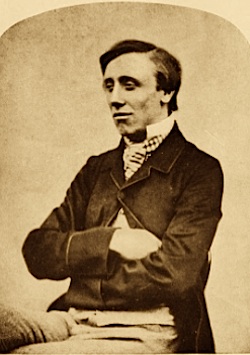
3-1. Sir Leslie Stephen, speaking of the photograph reproduced to
face p. 26, says, ‘The rather peculiar expression of the eyes
results from the weakness of sight presently to be noticed which
made him shrink from any strong light.’
‘On my first glimpse of Fawcett, however, I was
troubled by a question of classification. I vaguely
speculated as to whether he was an undergraduate,
or a young farmer, or possibly somebody connected
with horses at Newmarket, come over to see the
sights. He had a certain rustic air, in strong
contrast to that of the young Pendennises who
might stroll along the bank to make a book upon
the next boat race.
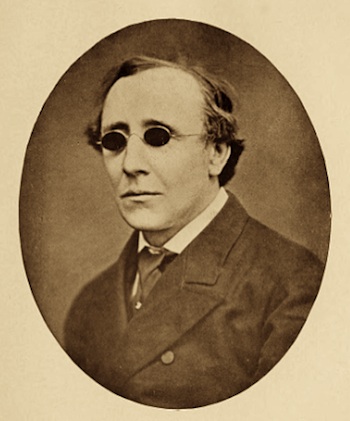
HENRY FAWCETT BEFORE HE WAS BLIND
27‘He rather resembled some of the athletic figures
who may be seen at the side of a north-country
wrestling-ring. Indeed, I fancy that Fawcett may
have inherited from his father some of the characteristics
of the true long-legged, long-limbed
Dandie Dinmont type of north-countryman. The
impression was, no doubt, fixed in my mental
camera because I was soon afterwards surprised
by seeing my supposed rustic dining in our College
Hall. I insist upon this because it may indicate
Fawcett’s superficial characteristics on his first
appearance at Cambridge.
‘Many qualities, which all his friends came to
recognise sooner or later, were for the present
rather latent, or, maybe, undeveloped. The first
glance revealed the stalwart, bucolic figure, with
features stamped by intelligence, but that kind of
intelligence which we should rather call shrewdness
than by any higher name.’
Sports and Games.
At first the men of his own year were inclined
to estimate Harry as an outsider in sports and
games. His simple provincial ways gave little
sign of expert skill. But he won his way in
dramatic fashion. An undergraduate nick-named
the ‘Captain’ challenged him to a game of quoits.
Salisbury’s native game is quoits; Harry was well
trained, and won easily. Then the battle shifted
to billiards. Captain’s score pushed steadily
ahead until in a game of a hundred points he had
ninety-six to Harry’s seventy-five: four points
more for the Captain, twenty-five for Harry. The
28onlookers vociferously offered ten to one on the
Captain. Fawcett gravely took all the bets offered
at this rate, and any others that he could get, and
then calmly, in a single break, made the twenty-five
necessary points.
A successful Game of Billiards.
Fawcett is quoted as having given this account,
‘Bets were forced on me; but the odds were
really more than ten to one against my making
twenty-five in any position of the balls, but I saw
a stroke which I knew that I could make, and which
would leave me a fine game.’ No matter by what
magic the feat was achieved, it filled his pockets,
and cleared for ever any doubts in his companions’
minds as to the capacity and shrewdness of ‘Old
Serpent,’ as he was then dubbed, and by which
nickname he went for a brief time.
He never gambled again. The story is paralleled
in later years by an equally solitary financial
speculation. He then showed the same quickness
in seizing the facts and calculating the chances,
the same boldness in acting on his own judgment,
and the same restraint in not repeating the
adventure.
He disapproved of gambling, and had a wholesome
dislike of it. His sense of fun made it impossible
for him ever to have a holier-than-thou
attitude, but his common sense and natural goodness
kept him singularly free from the failings so
common among his associates. While anything
but a Puritan, he ‘was in all senses perfectly blameless
in his life.’
Making Friends.
29He had a rare talent for friendship, attracting
people to him as easily as he was attracted to
them, and his faculty of making friends and keeping
them held to the end. He was never known
to lose a friend.
Those who knew him well appreciated his strong
intellectual equipment. Perhaps his chief characteristics
were his absolute normality, his remarkable
freedom from self-consciousness, his
common sense, and his ever-present sense of fun.
These early years at the university, when the lank
boy was emerging into the statesman, were years
of great happiness and joviality. Fawcett found
many congenial spirits, and formed intimacies
among men destined to distinguished careers.
Most of his associates were good workers, but not
particularly given to intellectual subtleties. Music
made slight appeal to him, and he was flagrantly
ignorant of classics and modern languages, and
made no pretence to culture. The young Cambridge
men of this period were greatly afraid of
sentimentality, and devotees of the ‘God of Things
as they are.’
But there was one subject peculiarly attractive
to the men with whom Fawcett consorted—political
economy. And in those days political
economy meant Mill. His book, gathering together
all the last words of the science, had been
written a very few years before Fawcett went to
Cambridge. It had had a phenomenal success,
and it and its author were enjoying a phenomenal
30authority. Edward Wilson, a brilliant Senior,
well represented the feeling of his day, when he
would confute all opposition by an apt quotation,
leaving Mill triumphantly supreme, and then close
his vindication with the cry, ‘Read Mill! Read
Mill!’ Fawcett did, from early till late, until he
knew the book by heart. As he was thoroughly
inoculated with this cult, his reverence for Mill
was one of his strong steadfast beliefs through
life.
Fawcett begrudged time taken from his books,
and never rowed in his college boat, although Sir
Leslie Stephen writes:
Boating.
‘That he occasionally performed in the second
boat, I remember by this circumstance, that I can
still hear him proclaiming in stentorian tones and in
good vernacular from an attic window to a captain
of the boat on the opposite side of the quadrangle,
and consequently to all bystanders below, that he
had a pain in his inside and must decline to row.
I have some reason to think that he had felt bad
effects from some previous exertions, and had been
warned by a doctor against straining himself. I
have an impression that there was some weakness
in the heart’s action. Fawcett, like many men who
enjoy unbroken health, was a little nervous about
any trifling symptoms. One day we found him
lying in bed, complaining lustily of his sufferings,
and stating that he had dispatched a messenger
to bring him at once the first doctor attainable.
A doctor arrived, and his first question as to the
31nature of Fawcett’s last dinner resolved the consultation
into a general explosion of laughter, in
which the patient joined most heartily.’
It was characteristic of Fawcett that he treated
all men as equals, and took from them the best of
what they had to offer. He became intimate with
men of all ages. Mr. Hopkins, a Peterhouse man,
with whom Fawcett read, had received his B.A. in
1827, twenty-five years before Fawcett’s appearance
at Cambridge; but this difference in age did
not prevent a close bond. Fawcett never alluded
to Hopkins without great enthusiasm, and in the
days of his grave trial this friend was the most
helpful of all. He was of great service in the first
years at Cambridge, urging Fawcett to regard the
mathematical studies necessary for taking a good
degree as valuable intellectual gymnastics. Fawcett
with his usual keenness and common sense was
quite alive to the fact that a good degree was a
distinct commercial asset, and said that he would
rather be Senior Wrangler in the worst year than
second to Sir Isaac Newton. His definite aim in
life—a political career—made any wanderings into
study for its own sake of no interest to him. He
planned through life so to select that he might
obtain.
From the days of declaiming in the chalk-pit
at Queenwood, Fawcett had realised the value of
public speaking.
The Debater.
The great Macaulay, Sir William Harcourt, and
other distinguished men had tried their oratorical
32pinions in flights at the Debating Club called ‘The
Union.’ Fawcett joined, and after some tentative
efforts, despite his friends’ amusement and discouragement,
boldly won his way, and became a
good speaker. He worked over his orations carefully,
and by great persistence gained an easy and
fearless manner of speaking, and we find that he
opened debates on National Education and University
Reform.
In these years the events which led to the
Crimean War provided the chief subjects of debate,
such as the foreign policy of Austria and Prussia,
the independence of Poland, and the character
of the Emperor Nicholas. On these questions
Fawcett did not share the views of John Bright,
who was then making his great speeches on behalf
of peace; but the undergraduate’s democratic
sympathies are clearly shown in his advocacy of
non-sectarian National Education, of a motion
that ‘the party called “Cobdenites” have done
the country good service,’ or in favour of a ‘considerable
extension of the franchise,’ and of ‘University
Reform.’
Good-bye to Grand-iloquence.
It was during this period of careful self-training
that Fawcett gradually reduced his style of speaking
to that simplicity and directness which became
so marked throughout his career. There is a lingering
trace of grandiloquence and schoolboy rhetoric
in an essay written on the merit of Pope’s poetry,
but that seems to have been his swan-song to
elocution with frills.
The Friend of Friends.
33Fawcett left Peterhouse in his second year, and
went to Trinity Hall as a pensioner, thus reducing
the expense to his father. There chances for
scholarship were alluring, and several immigrants
from other colleges joined forces at Trinity Hall.
There also he met Leslie Stephen, his lifelong
friend and biographer, who speaks of this friendship
as ‘one of the greatest privileges of my life.’
Fawcett set to work with a will to carry off the
Senior Wranglership. We are told that in the
Tripos, for the first and the last time in his life,
Fawcett’s nerve failed. Though he got out of
bed and ran round the college quadrangle to
exhaust himself, he could not sleep, and failed to
gain the success which meant so much to him. He
sank to seventh; but in spite of his comparative
failure he had shown marked ability, and made
so great an impression by his work, that he was
elected to a fellowship at Christmas 1856.
Pounds and Pence.
He adhered to his boyish ambition of entering
Parliament, but there were still great obstacles in
his way. Beyond his fellowship, which brought
him £250 a year, he had no income of his own.
His father was not a rich man, and the strain on
his purse to support his other three children was
sufficient. Harry resolved, therefore, to make his
way by a career at the Bar, and while still at
Cambridge entered Lincoln’s Inn. When he had
won his fellowship he settled in London, and set
himself to study law. No one who came in contact
with him at this time had any doubt that he
34would arrive at his goal by main force. A friendly
firm of solicitors had already promised that he
should have opportunities, and his great talent
for working well with all sorts of people, his genius
for friendship, and his real business ability bid well
for the success of his plan. His will was inflexible,
his good-nature chronic, and his acuteness of mind
and general ability far beyond the average.
In the mimic legislature of the Westminster
Debating Society, which consisted of young
barristers and journalists, Fawcett soon became
the leader of the Radical party. The organisation
followed the form of the House of Commons. It
is said that Bulwer Lytton had once paid it a visit,
and said afterwards that he had entered in a fit of
abstraction, mistaking it for the House of Commons,
and only discovered his error upon finding that
there were no dull speeches and no one asleep,
which seems to prove that it must have been a most
remarkable society.
One of his contemporaries, who saw Fawcett in
the height of these pseudo-Parliamentary triumphs,
speaks of his ‘resonant voice, wild hair, and expressive
eyes.’ But just at this point, when he
seemed to be setting with full sail on the channel
towards success, his eyes began to trouble him.
CHAPTER IV A SET BACK
35
A Trip to France—Wiltshire French—A Discouragement.
In 1857 the great Critchett warned him against
making any exertion, and forbade his reading.
Though he appeared cheerful as usual with his
family, a friend recalls that during his entire
career he had never known him to be so
depressed.
In 1857 he was glad to find occupation by taking
a pupil to Paris. Miss Fawcett went with them.
The pupil was to read mathematics and to learn
French, while it was hoped that the master’s eyes
might benefit under the care of foreign specialists,
as well as by the change.
The oculists gave him some slight encouragement:
one ordered low living, and the other high.
It was characteristic of Fawcett that he frugally
chose the former.
The Ways of the French.
In Paris our long Wiltshire man seems to have
been much of a fish out of water. The Latin
morals and customs were naturally not sympathetic
to his uncompromising though uncensorious
nature. He could never cope successfully
with a foreign language. There was even a
36frequent strong Wiltshire flavour about his English
speech. The difference between ‘February’ and
‘Febuwerry’ never became apparent to him. At
Alderbury he had learnt French with a pronounced
English accent. In Paris he now delighted the
French ladies at the pension where he stayed with
his peculiar and unique speech. There was a
Madame Palliasse there whom, much to her joy,
he called Madame Peleas.
He came back from France with his eyes still in
bad shape and his spirit totally unresponsive to
the lure of Gaul.
On his return he was extremely tried by his
inability to work. His real feelings about life at
this time are well expressed in a letter to his dear
friend, Mrs Hodding:
Confession.
‘I regard you with such true affection that I
have long wished to impart my mind on many
subjects.... You know somewhat of my character;
you shall now hear my views as to my
future. I started life as a boy with the ambition
some day to enter the House of Commons. Every
effort, every endeavour, which I have ever put forth
has had this object in view. I have continually
tried, and shall, I trust, still try not only honourably
to gratify my desire, but to fit myself for such an
important trust. And now the realisation of these
hopes has become something even more than the
gratification of ambition. I feel that I ought to
make any sacrifice, to endure any amount of
labour, to obtain this position, because every day
37I become more deeply impressed with the powerful
conviction that this is the position in which I could
be of the greatest use to my fellow-men, and that
I could in the House of Commons exert an influence
in removing the social evils of our country, and
especially the paramount one—the mental degradation
of millions.
‘I have tried myself severely, but in vain, to
discover whether this desire has not some worldly
source. I could therefore never be happy unless
I was to do everything to secure and fit myself
for this position. For I should be racked with
remorse through life if any selfishness checked such
efforts. For I must regard it as a high privilege
from God if I have such aspirations, and if He has
endowed me with powers which will enable me to
assist in such a work.’
This is an interesting revelation of a pure
ambition. Fawcett wished to succeed for no
self-regarding purpose. His ideals were noble,
and his ambition their legitimate accompaniment.
About this time he shows a lively interest in the
social condition of the people. After an expedition
to some manufacturing towns he mentions an
investigation of ‘gaols and ragged schools,’ and
shows much interest in these sombre centres. He
describes a meeting with a good gentleman whom
he characterises as ’so fine and perfect an example
of a venerable Christian.’
Palmerston, Disraeli, and Gladstone.
Even twelve hours spent in one day at the House
of Commons does not seem to have been for him
38an overdose of politics. It did not tax his eyes,
and it delighted his ears, though he writes, ‘No
one need fear obtaining a position in the House of
Commons now; for I should say never was good
speaking more required. There is not a man in
the Ministry can speak but Lord Palmerston;
Disraeli is the support of the Opposition; but,
although he was considered to have achieved a
success that night, it was done by uttering a
multitude of words and indulging in a great deal
of clap-trap.
‘Gladstone made the speech of the evening, and
he is a fine speaker. He never hesitates, and his
manner and elocution are admirable; in fact, in
this he resembles Bright, but is, in my opinion,
inferior to Bright, in not condensing his matter.’
Towards the close of this letter there is an
exceedingly interesting statement, prophetic of
his future interests. He says that he feels that
Australia must have in future a great effect on
England, and adds these significant words, ‘India
too is the land I much desire to see and know; and
it ought to be by any one who takes part in public
life.’
The doctor now forbade Fawcett all reading, for
fear that he might lose his sight. He took this
sentence philosophically, commenting that it came
at an extremely favourable time, when he could
best afford to take a holiday. He writes, ‘I cannot
be sufficiently thankful that it has occurred just
now, when perhaps I can spare the time with so
39little inconvenience.... Maria will resign her
needle with great composure to devote herself to
reading to me. I shall thus get quite as much
reading as I desire, and I can well foresee that, far
from being a misfortune, it may become an advantage,
since it will perhaps for the next year induce
me to think more than young men are apt to do:
it will give me an opportunity to solidify and
arrange my knowledge, and you will know how
happy Maria and I shall be together.’
Discouraged.
About this time a classmate writes of him: ‘We
recognised as fully as at a later period his energy
and keen intelligence. If we were still a little blind
to some of his nobler qualities, we at least recognised
in him the thoroughly good fellow, whose success
would be as gratifying to his friends as it was confidently
anticipated.’
Yes, anticipated and ardently hoped for; but
could it be expected by Fawcett himself, doomed as
he was to idleness by the condition of his eyes, his
doctor’s warnings, and their orders for absolute
rest—and unfitted as he now was for work, and
able only to send an occasional letter to the papers
on matters of current interest?
He was staying at his father’s house at Longford
with such patience as he could muster. He, however,
enjoyed sitting in the fields near Salisbury
and listening to the sounds about him. The murmuring
streams, the songs of birds, and the hum
of drowsy insects seemed to bring him comfort and
rest.
WINNING BACK
‘If you can meet with triumph and disaster
And treat those two impostors just the same.’
Kipling.
‘Life is sweet, brother.’
. . . . . .
‘In sickness, Jasper?’
‘There’s the sun and the stars, brother.’
‘In blindness, Jasper?’
‘There’s the wind on the heath.’
Borrow.
CHAPTER V DARKNESS
43
A Shooting Accident—Blindness—Readjustment.
A Shooting Accident.
Unfortunate as was the fate which condemned
him to so much trouble with his eyes, it was a
fortunate and strange preparation for what was to
follow. Obedient to his physician’s injunctions
to give up work, Fawcett remained with his family
near Salisbury. On 15 September 1858, he went
shooting with his father. Together they climbed
Harnham Hill. Fawcett turned to look back at the
glorious view, bathed in an autumn light, the trees,
already turning to gold, the village nestled in the
valley through which the river Avon wound, the
spire of the great cathedral touched with glory
by the setting sun. To Fawcett this was one of
the loveliest views in England: he looked on all
this beauty for the last time.
As they were crossing a field he advanced in
front of his father, who, suffering from incipient
cataract of the eye, did not see his son. A partridge
rose and the father fired, hitting the bird, but some
of the stray shot penetrated both the son’s eyes,
blinding him instantly. To protect his eyes from
the glare he was wearing tinted spectacles, both
44glasses were pierced, but the resistance which
they offered to the shot prevented the charge
entering the brain, and so probably saved his life.
His first thought on being blinded was that he
would never again see the beautiful view which he
loved so dearly. There is a widely current story,
which, however, we have been unable to verify,
that after the accident his first words to his agonised
father were, ‘This shall make no difference.’
Unflinching Bravery.
He was taken back to his father’s house in a
cart, and his first words to his sister as she received
him there were, ‘Maria, will you read the newspaper
to me?’ This way of taking his calamity sounded
the key-note of his heroic acceptance of it from the
first. His unflinching bravery gave the cue which
he wished his family to follow. His calmness
remained unaltered even when the doctors gave
little encouragement. All knew that there was
not much hope, though he was in such splendid
physical condition that he suffered very little
pain.
Mrs. Fawcett, whom her relations called ‘the
brightness of the house,’ was having tea with some
friends when her wounded son was brought in.
When she saw him she bravely tried to control her
grief, but it was so overwhelming that she took
refuge in another room, and only appeared in the
short intervals when she was able to master her
distress.
In this crisis his sister Maria was a tower of
strength. The poor father seemed more sorely
45stricken by the accident than the son. But for his
daughter’s wisdom, he would probably have lost
his reason. All through the night Maria kept him
busy at small, useful tasks, and for several days
occupied both her mother and him as fully as
possible.
Blindness.
After a lapse of six weeks Fawcett was able for
three days to perceive light, but after that the
curtain fell for the rest of his life, and he remained
in total darkness. In the following June he suffered
some pain in one of his eyes, and later submitted
to an operation which was unsuccessful, and put
the final seal on his calamity. Perhaps the father
deserves as much sympathy as the son. Their
relations had been particularly affectionate, and
were, if possible, more intensely so after the
catastrophe. The elder Fawcett often said that
his grief at having blinded Henry would be less,
if ‘the boy’ would only complain. But this was
perhaps the only way in his life that the son refused
to gratify the parent whom he loved so tenderly.
He was never known to complain of his loss of
sight, and used to say that blindness was not a
tragedy, but an inconvenience.
The life-long ambition of Fawcett to lend a
hand in public affairs had been shared by his
father, and the hope and pride which he felt in
his son’s career added, if possible, to the tragedy
of seeing it so suddenly broken. The indomitable
pluck shown by more than one blind man which
makes out of his stumbling-block a mounting-stone
46had yet to be proven. It did not then seem
possible for him to win even greater triumphs than
he might have won if he had not been forced to
sharpen his courage because he had to fight his
battle in the dark.
A friend who visited Fawcett a few weeks after
the accident found him serene and cheerful,
although his father was evidently heart-broken,
and his appearance gave abundant evidence of it.
Fawcett, though not much given to quotation, was
fond at this time of repeating the phrase of Henry V.
at the battle of Agincourt:
‘There is some soul of goodness in things evil,
Would men observingly distil it out.’
What Fawcett distilled from the evil thing which
had befallen him was an iron determination, which
triumphed over odds such as few have encountered
on any battlefield.
A Cloud.
But the blind man’s horizon had not yet cleared.
His outlook, despite the loving care of his family,
was still sad, and though he gave no sign, there was
a fearful slough of despond still to be struggled
through. Ten minutes after the accident, he had
made up his mind to stick to his pursuits as much
as possible, but how nearly possible was it for a
blind man to succeed in Parliament, and to give a
helpful impetus to the affairs of nations? This
was still at Fawcett’s time in England untested
and remained for him to show. He lacked fortune
and social position to clear the road for him, and
47the letters of condolence that poured in mostly
obstructed his path with futile sentimentality. He
said, ‘they give more pain than comfort,’ and
added that nothing pained him so much as these
letters. The writers counselled resignation to the
will of Providence, meekness, submission, and of
course all implied inaction. But Fawcett asked
what was the will of Providence. Why, without
trying, should he suppose that inaction would be
the nobler part for him to play. His sister read
to him all the missives from the Job’s comforters,
and he, though much saddened, listened, ‘in a fixed
state of stoical calm.’
The Message of a Friend.
Into this atmosphere, heavy with grief, came the
message of a friend. His dear old Cambridge
teacher, Hopkins, wrote admitting that blindness
is ‘one of the severest bodily calamities that can
befal us,’ yet added cheerfully: ‘But depend
upon it, my dear fellow, it must be our own fault
if such things are without their alleviation....
Give up your mind to meet the evil in the worst
form it can hereafter assume. Now it seems to
me that your mind is eminently adapted to many
of those studies which may be followed with least
disadvantage without the help of sight....
‘I would suggest your directing your attention
to subjects of a philosophical and speculative
character, such as any branch of mental science
and the history of its progress; the Philosophy of
Physical Science, as Herschel’s work in Lardner’s
Encyclopædia, Whewell’s Inductive Philosophy, etc.,
48or any work treating on the general principles,
views, and results of physical science. Political
Economy, statistics, and social science in general
are assuming interesting forms in the present
day.
‘What a wide range of speculative study, full of
interest, do these subjects present to us! For any
part of which, if I mistake not, your mind is well
qualified.
‘The evil that has fallen upon you, like all other
evils, will lose half its terror if regarded steadfastly
in the face with the determination to subdue it as
far as it may be possible to do so.
‘Cultivate your intellectual resources (how
thankful you may be for them!) and cultivate
them systematically: they will avail you much in
your many hours of trial. Under any circumstances
I hope you will visit Cambridge from time
to time. I’ll lend you my aid to amuse you by
talking philosophy or reading an act of Shakespeare
or a canto from Byron. I shall certainly
avail myself of the first opportunity I have of
paying you a visit at Longford, and shall engage
you for my guide across the chalk hills. I may
then perhaps find the means of indoctrinating you
with a few healthy geological principles.’
Hopkins had struck the right chord. He roused
his pupil from his depression and gave him new
hope and ambition. ‘Keep that letter for me,’
he said to his sister, and from its arrival dated
his returning zeal and the spontaneous cheerfulness
49which heretofore had been so skilfully
assumed.
A Rigid Resolution.
Though the sanity and wisdom of this letter
aroused Fawcett as nothing had before, it is not
to be understood that his taking up life again
depended upon the spur given to his hope and
self-confidence by his old friend, but this did come
at the psychological moment. It enabled him to
shoulder his burden with more courage, and to
begin again climbing towards the ambitions he had
entertained before his blindness. Unhelped he
had planned to travel the road already begun,
deviating as little as possible from the course
before mapped out; and he would have done so
without the comfort from his friend’s advice. But
the letter was undoubtedly a first milestone on his
race towards the goal which he had set himself.
Much has been said of the philosophy which is
apt to accompany blindness, of the resignation and
calm of those afflicted with it. The unusual
feature in the bravery with which Fawcett met his
calamity was his almost instantaneous resolution
to disregard it, and to make good just as he would
have made good without it. Too much honour
cannot be given him for this extraordinary and
immediate courage.
Very soon after the accident he took up walking,
and at once showed his fearlessness while going
between his brother and a friend who has recorded
the brave adventure.
Walking.
On leaving the house, he struck out at once with
50the long, quick strides of his old walking era, and
naturally stumbled almost at the first step. One
of the party caught him by the arm, and begged
him to pick his steps more carefully. ‘Leave me
alone!’ was his reply; ‘I’ve got to learn to walk
without seeing, and I mean to begin at once—only
tell me when I am going off the road.’ To say that
he knew not fear would be to give an impression
of callousness which would be entirely false; but
it can be truly said that fear never kept him from
carrying out his purpose.
An early glimpse of the hard conflict and longing
of his soul was given when walking with his dearly
loved sister. He turned to her suddenly as if he
had been thinking, and asked if she knew Southey’s
‘Hymn before Sunrise in the Valley of Chamounix.’
When she replied that she did not, he astonished
her by reciting the poem with rare beauty and
fervour. The vibrant voice gathered intensity
as, with that wistful expression so often on his
newly blinded face, he repeated the last lines:
‘Rise, O ever rise!
Rise like a cloud of incense from the Earth!
Thou kingly Spirit throned among the hills,
Thou dread ambassador from Earth to Heaven,
Great Hierarch! tell thou the silent sky,
And tell the stars, and tell yon rising sun,
Earth, with her thousand voices, praises God.’
MISS MARIA FAWCETT
Social Ways.
After his accident Fawcett took his meals with
his sister from a tray in the drawing-room. When
some weeks had passed, he was persuaded to
51venture out with her to a quiet supper at the home
of friends. Finding that it was not a formidable
undertaking after all, and that he had an extremely
interesting time, he determined to see as much of
people as possible, and resumed his social ways.
It was inevitable that at first his merriment and
cheerfulness were a little bit laboured, but in an
astonishingly short time they became invariable,
and those closest to him detected no permanent
depression. About everything but his sadness
under his affliction, Fawcett was frank, but about
this sadness he remained bravely reticent.
He soon began candidly to enjoy life, and he
seems to have gotten infinitely more of its beauty
and happiness than the average person who is
without handicaps. He had only had one fear,
which he confided to his sister: it would be unbearable
for him if through loss of physical force
he should become useless.
Despite very great difficulty, Fawcett for some
time tried to keep up writing with his own hand,
and there are still several of his autograph letters.
But he found the effort so great that he soon gave
it up and depended entirely on dictation. He was
not entirely loath to do this, because he thought
the practice of dictation useful to him as a speaker.
He never mastered Braille or any other system
of printing for the blind, but depended on being
read to.
Catalogued Collars.
In many minor things Fawcett never acquired
the dexterity possible to those who are blinded in
52youth. When his catastrophe came his habits
were already too fixed, and he was too mature to
adapt himself readily in unimportant matters.
But his ingenuity in studying out scientific
management of all the little problems of daily
routine was marvellously practical and at times
even comic. For example, he had all his clothes
carefully and legibly labelled with numbers, placed
so as not to show during wear. In this way his
garments might easily be identified by any one not
familiar with his wardrobe. If he came home in
a great hurry to metamorphise his attire, directions
like the following to his family or an aide-de-camp
were not infrequent. He would call in his
clarion, cheerful voice, probably from the door as
he entered: ‘I must dress quickly. Please help.
Coat one, vest six, collar one, trousers three;
shoes and socks twelve and thirteen.’ The rest
we will leave to imagination, but there was no
detail, even to pocket-handkerchiefs, which did
not have its allotted place and catalogue number.
A Hero to his Tailor.
He seems long to have remained faithful to his
Salisbury tailor, a charming person of the old
school who recently vouchsafed to the author the
following recollections of his distinguished client:
‘Mr. Fawcett was very matter of fact and
methodical. A very honest kind of man, a sterling
man. He was very susceptible to cold, and was
apt to carry changes of different underwear with
him. He was particular about the material
which he bought for his clothes, and always felt
53of it. He wouldn’t be humbugged. You couldn’t
help liking him. He was that loose and easy in
his walk, his limbs didn’t seem to belong to him. I
often heard him at the hustings, he spoke to the
point—he made a thorough impression.’
CHAPTER VI HAPPINESS
54
The Clear-sighted Man—A Scot’s Accent—Mountain
Climbing—Skating—Riding, etc.
His friends all testify to his spirit, his normal
view of life frequently making them forget the
fact of his blindness. A distinguished writer and
diplomat, who had known Fawcett, on being asked
what impression had been produced on him, replied
quickly and quite simply, ‘I think that he was
an extraordinarily clear-sighted man.’ Stephen
in his biography uses this sentence: ‘Fawcett
had come to see more distinctly the real tendency
of the proposal and to feel the full force of the
objections to which he had never been blind.’
Such remarks illustrate Fawcett’s power of making
people utterly forget his blindness.
How to be happy.
He was always grateful when his companions
paid no attention to his affliction, and would talk
to him about the scenery which they passed and
the people whom they met as if he too could see
them. He kept his resolve to be as happy as was
possible, and often said: ‘There is only one thing
that I ever regret, and that is to have missed a
chance for enjoyment.’ He told his friends that
55he intended to live to be ninety, and to relish every
day of his life. He deliberately set about cultivating
those tastes which would redound to
his happiness: he taught himself to smoke, he
patiently learned to listen to music, which had
never unfolded its full joys to him before he had
lost his sight. He so far succeeded as to be able
to enjoy concerts and the opera.
Doubtless, he systematically trained himself
to remember. It was often remarked of him that
if he had heard a voice once he would remember
it again years after. One day in the Cambridge
streets he was accosted by a Scottish professor.
Fawcett could not remember him, but encouraged
him to talk, and kept up his end of a long conversation.
After a good twenty minutes, a trick
in the Scot’s accent betrayed him, and Fawcett
enthusiastically grasped his hand, and said, ‘How
do you do, Clerk Maxwell?’
He never attempted to modify his vocabulary
to fit his infirmity, and though the effect was at
times strange he would greet people in the most
natural way in the world with: ‘How do you do?
how well you’re looking’; or ‘What’s the matter,
you’re looking pale to-day? Too much work,
eh?’ He commented on a friend’s looking old,
and added: ‘But when men with that colour hair
turn grey, they do look prematurely old.’
It was not unusual for him to mimic people,
whom he had only known since his blindness,
reproducing their gestures as well as their speech.
Games.
56Later he learned to play cribbage and écarté with
cards pricked by his secretary with raised dots,
in the fashion used by the blind to produce tactile
prints. It took him but three days to conquer all
difficulties in this new system, and he played with
quickness and enjoyment. It is of no small interest
to those who have studied the psychology
of those blinded by accident in maturity to note
this successful development of card playing.
Shortly after his accident he had made an attempt
which proved a total failure and yet afterwards
he took it up without effort. This point should be
dwelt on, and may well give courage to many an
adult who is blinded. It shows that it is worth
while to repeat often, and to hope for success in
experiments which have been abandoned as futile.
His hearing developed great acuteness, so that
he could tell in towns by the pressure of the
atmosphere if he was passing an opening caused
by a cross street. When he walked in the country
he loved the sound of the leaves, the feel of
grass, the springing of the sod beneath his feet,
the note of a bird or the leap of a fish. He seems
to have tried to gather from his friends’ descriptions
an even deeper insight into the charm and
subtleties of Nature than before it was shut out
from his bodily vision. When, later, he enjoyed
driving, he would stop the carriage in order to
see the view at some favourite point. He was
so fond of the view at Brighton that he often
telegraphed a friend there to take him a walk to
57Rottingdean. He always enjoyed this intensely,
and spoke of the exquisite prospect as of one of the
most wonderful in England. A breath of the sea
stimulated him greatly. After a storm he loved
to listen to the booming and breaking of the waves
on the shore, and to feel the burn of the brine which
was cast in his face as he breasted the receding gale.
The little shells and the seaweed interested him, and
he liked to pass the latter between his fingers to
get the slippery gluey feeling, and to play with
their little pods and queer tentacles.
Enjoying the View from the Mountain Tops.
Fawcett loved great heights and mountains, a
fellow climber says: ‘I went up Helvellyn with
Fawcett. It was his first mountain since he was
blind—by no means his last. He held one end of a
stick and I the other, to direct his turns; and that
was all the aid he needed. But it warmed one’s
heart to see his hearty enjoyment. He would
have all the views described to him, what hills
and lakes he saw, what colours they were, where
the mist floated, and he anxiously asked of his
secretary who was with us whether he enjoyed it
as much as he expected.’
Later he climbed the Cima di Jazzi, in order to
see the glorious array of snow-covered peaks. It
does not seem too much to believe that the highly
developed blind have a feeling of the beauty which
we say they cannot see, and a realisation of its
presence which we lack and which it is impossible
for them to explain. Though science has not yet
been able to classify this faculty it may before
58long, and in the meantime there is sufficient evidence
that this unclassified vision of the sightless
to a great extent illumines their darkness.
Excepting cricket and rackets, he gave up none
of the sports of which he was already fond.
The Giant’s Stride.
All his friends are agreed that it was almost
impossible to keep up with him in his walks. They
tried to modify his break-neck pace by various
devices, such as engaging him in absorbing discussions,
or stopping to talk to some one on the
road. But in vain. His long legs would shoot
out like relentless walking beams, and if his friend
happened to be small and holding on to Fawcett’s
arm before long he would be swept off his feet,
hanging on like a mere appendage to the rushing
blind man.
Fawcett’s recollection for the places that he had
known before his blindness was astonishing. He
could even remember in closest detail the country
where he had been as a child at school.
Skating.
Having before his accident been a powerful
skater he now took it up again, and after a few
strokes showed no hesitancy. He was known even
to accompany a skating race, leaving the course
clear for the competitors and himself unaccompanied
getting over the rough ice on the side. Of
his first attempt we read:
‘After a few strokes the only difficulty was to
keep his pace down to mine. We each held one
end of a stick, and as we were on the crowded
Serpentine, we came into a good many collisions.
59As, however, we were a couple, and one of us a
heavy man, we had decidedly the best of these
encounters, especially as the conscience of our
antagonists was on our side when they saw that
they had tripped up a blind man.’
In after years his recklessness became proverbial.
He had been on a long expedition on the
frozen Cam one cold winter, and was returning at
sunset, chatting gaily with his friends to the
accompanying click of their skates. They were
flying along at a good fifteen miles an hour when
they came upon a treacherous stretch of very
rough ice. Fawcett, who accepted ice baths as
part of the fun, urged them forward, zealously
calling out: ‘Go on—I only got my legs through!’
Riding.
In the early stages of his blindness, Fawcett’s
purse did not permit him to ride much. Moreover,
some narrow escapes from accident—he was at one
time nearly crushed at Salisbury by a cart—made
him for a short time hesitate as to its expediency.
But later he took it up with enthusiasm, at first
accompanied by a riding master, and later by
groups of friends. One of these tells how he would
often ride over to Newmarket to spend Sunday.
During the Sabbath he would nearly walk his
friend off his legs, and on other days contented
himself with walking his horse off its legs. With
a box of sandwiches provided for luncheon, Fawcett
would ride over from Cambridge at Christmas time
to feast on the sunny side of the Devil’s Ditch.
He loved the chalk downs, and often stopped at a
60cottage to ask for a draught of the sparkling, deep-well
water. He enjoyed, too, gossiping with the
shepherds about the flocks, for his early interest in
agricultural matters was through life a marked
characteristic. Once he came across the harriers,
and joined in their gallops, trusting entirely to the
prudence of his horse to select the most favourable
gaps in the hedgerows.
A frequent companion on these rides tells how
one day, going at a brisk pace, she was so interested
in something he was telling her that she did not
see until within a few feet of it that they were at
the edge of a precipitous gravel pit. Fearing to
alarm Fawcett she simply called out, ’stop at
once, please.’ Fawcett, always quick to act,
pulled up short, and but for his prompt response
to her call would certainly have been killed.
Fawcett was so reckless and enthusiastic an
equestrian that it is still a well-remembered tradition
in the livery-stables at Cambridge that
Professor Fawcett took so much vitality out of his
mounts that he was always charged extra. It
must not be gathered that he was inhuman to his
horses—they probably had just as good a time,
relatively, as he had, but whatever he did, he did
in a whole-souled and muscular fashion.
Fishing.
But for Fawcett, who had been trained from
childhood as a fisherman, the crowning joy of all
sports was a good fishing expedition. Very soon
after the accident, he took up his fishing again.
He remembered his native stream well, and to the
61end of his life he was always eager to run down to
Salisbury to fish. His letters to his father abound
in reference to angling parties, past and to come.
He gave directions about his fishing-boots (they
were so frequently in use that they must have had
a simple number in his catalogue of clothes) and
instructions to secure some expert angler to accompany
him, or framed some subtle tactics for way-laying
and ensnaring some particularly elusive
aquatic prey, who had perhaps been known to his
neighbours but had remained uncaught by them.
Trout and Political Economy.
Many friends urged him to try their waters for
trout, pike, salmon, jack-fishing, and he enjoyed
their hospitality greatly. His father who was
devoted to the sport, in which he excelled even
after his ninetieth year, was very fond of accompanying
him. Fawcett’s early practice enabled
him to throw a fly with great accuracy. He was
fond of combining his amusements, and would
wade in the stream while one of his great friends
often went with him, though walking on the bank
so as not to throw his shadow on the water, but so
that he could talk to his heart’s content without
disturbing the angler. Fawcett was wont to say
that trout hear very badly, and are not distracted
by political economy. So fond was Fawcett of
the study of his favourite subject that his first
secretary records how in moments snatched between
fishing he would accompany Fawcett to a
tea-house, where he would read to him Mill’s
Political Economy.
62Those who accompanied him fishing are agreed
that he was a much better fisherman than sighted
people generally are. This may have been due
to his extraordinary patience, or to his zeal in
learning from the experts with whom he associated.
A Salisbury friend who often fished with him
says: ‘He would make his way through anything.
He often walked along the river’s edge fishing,
and he never fell in. One day he was fishing and
caught his line in a tree overhead. He exclaimed
to his secretary, who came up, “Can’t you see it?”
then, with added impatience, “See it’s up there, I
can see it!”’
With his characteristic pluck he did not hesitate
to wade in the stream or to cross a narrow plank.
He enjoyed all the roughing incidents in fishing,
even bumping about in a donkey cart full of fish,
and he was particularly glad to meet the country
folk and have a chat with them.
CHAPTER VII DISTRACTION
63
Fishing—In the Commons—Need for Distraction—What
Helen Keller thinks—Sir Francis Campbell—Leap
Frog—Despair and Cheer—Paupers and Political
Economy.
What Fishing meant for Fawcett.
It sometimes seems inconsistent that one so acutely
sensitive as Fawcett was to suffering of all kinds
should not have hesitated to get pleasure from a
sport involving the necessary cruelty of fishing.
In discussing this, Fawcett at times would maintain
the usual ground of the fishes insensibility to
pain, but again he would frankly justify it as the
best method of keeping himself employed and distracted
from the weighty problems which often
overburdened him.
It must not be forgotten that, however clever in
adapting themselves to their misfortune the blind
are, they are relieved from the thousands of the
distractions which disturb the concentration of even
the best seeing worker. In his lecture-room the
sighted teacher is unconsciously drawn from the
monotony of his one purpose by seeing his mind
play on the sensibilities of his hearers.
Screened Bobbing Bonnets.
In the House of Commons the statesman’s mind
is unconsciously diverted by the lights, the expressions
64of his opponents, the sympathy on the
faces of his partisans, the guests in the gallery, to
say nothing of his imaginings concerning those
hidden and gracious unseen personalities behind
the screen in the ladies’ gallery—that screen
which, perhaps more than anything else in the
House of Commons, piques the curiosity of the
beholder, and sets his thoughts aglow with the
mysteries of the Orient. If the indiscreet and
objectionable person who devised that screen had
left the wives and mothers and sweethearts of the
members to regale the combatants in the arena
beneath them with a smile of approbation, or a
glimpse of their spring bonnets, or even the pang
caused by the thought of the inevitable bill which
belongs to such plumage, the path of duty and
politics would have been less dull.
Then, think of the countless literary distractions,
the day’s paper, the illustrated magazine, the
picture posters, and even the advertisements which
to the hurrying business man unconsciously suggest
fresh trains of thought. Again, the sight of the
crowd, with its noble and curious personalities, or
the occasional patch of colour made by the passing
omnibus whose garish poster proclaims the
latest star at the theatre. All these, and countless
others, make up a kaleidoscope, which, however
taxing and at times palling to the man with sight,
are counter-irritants which make it difficult for
him to over-concentrate or to become exhausted
by harping continuously on one thought, to the
65exclusion of all else. To think without interruption
the seeing man sometimes closes his eyes.
The blind man’s eyes are always closed, and therefore
to keep his spirits bright, to prevent morbidity
and even insanity, occupations and amusement
are not only advisable, but imperative. In frank
recognition of this Fawcett felt that the larger good—his
usefulness to the community—justified his
‘going fishing.’
What Helen Keller thinks.
The great need of recreation brings as its corollary
the advantages for uninterrupted thought, which
are among the alleviations of the loss of sight.
Helen Keller, in answer to the question, What is it
to be blind? said joyfully, ‘To be blind is to see
the bright side of life.’ She is perfectly sincere in
this, and feels that in blindness, uncomeliness and
ugliness can never obtrude, while imagination is
free to paint the most sublime pictures. Not a
few blind people have said that they would prefer
not to see, because with sight would come many
disillusionments.
It is a question of great interest whether either
Miss Keller or Fawcett, without their spur from
blindness, without that need of iron determination
and unflinching pluck to win their race in the
dark, would, as seeing people, have attained
their respective distinction and have been
such great servants of humanity. Many fail on
account of the insurmountable barriers which
seem to accompany blindness, but not a few
heroic souls are developed and stimulated by
66their blindness in a way that nothing else could
have equalled. To these ranks it seems that
Fawcett belonged.
He hesitated greatly to allude to his blindness,
and we find him doing so voluntarily, only to help
those similarly afflicted. It was a very painful
thing for him to speak on behalf of the blind, and
on one such occasion he confided to a friend that
he had never been so nervous in his life. He hated
to be put, or to place himself, in a position to evoke
pity, still more to seem to show what he had
achieved despite his handicap.
He said to the blind, ‘Act as if you were not
blind, be of good courage, and help yourselves.’
He advised the seeing, ‘Do not patronise; treat
us without reference to our misfortune; and, above
all, help us to be independent.’ Also, he
emphasised that ‘home associations are for the
blind as important as for you’ (meaning the seeing);
‘you must not wall up the blind.’ ‘Do not
sever them from all the pleasures and fascinations
of home.’
Sir Francis Campbell.
He was particularly interested in the work of
Dr. Campbell, later Sir Francis Campbell, the
intrepid American blind man who was knighted
by King Edward for the splendid work he had
done to emancipate the blind through education.
Fawcett spoke often for the benefit of Campbell’s
work at the Royal Normal College for the Blind.
The following quotations from Fawcett’s speeches
were written for this book by some of the blind
67stenographers employed at the college, the work
of which was inspired by Sir Francis.
Fawcett, referring to the blind, said, ‘Nothing,
he found, was so hard to bear as to hear people,
when they spoke of the blind, assume a patronising
tone towards them, as if they were suffering from
something for which in some mysterious way they
should feel thankful. The kindest thing that could
be done or said to a blind person was not to use
patronising language, but to tell him, as far as possible,
to be “of good cheer,” to give him confidence
that help would be afforded him whenever it was required,
that there was still good work for him to do,
and the more active his career, the more useful his
life to others, the more happy his days to himself.’
Fawcett Reminiscences.
To a blind and most responsive audience he said,
‘I did not lose my sight until I had reached manhood.
I was twenty-five years of age at the time,
and when I knew that my sight was gone, never to
return, many friends came forward and, prompted
by the kindest motives, advised me to adopt a
life of quiet contemplation. I very soon, however,
came to the resolution to live, as far as possible,
just as I had lived before, following the same
pursuits and enjoying, as well as I could, the same
pleasures. (Cheers.) I would strongly advise
those who may be similarly situated to try to pursue
the same course, for I have found that there is a
wide range of amusements in which I can take
just the same delight as I did in days of yore. No
one can more enjoy catching a salmon in the Tweed
68or the Spey, or throwing a fly in some quiet trout
stream in Wiltshire or Hampshire. I can take
the greatest delight, accompanied by a friend, in
a gallop over the turf; a long row from Oxford to
London gives me the same invigorating exercise
that it used to do, and during the recent long frost
I do not think any one in the whole country found
more pleasure than I did in a long day’s skating
with a friend. Often in the Cambridgeshire fens I
have skated fifty or sixty miles in the day. (Cheers.)
It is a true remark that nature provides a wonderful
compensating power, but I am bound to say that
of all the compensations which I have found, the
greatest is the generous and cordial readiness with
which people are ever ready to come forward to
offer us that assistance without which we are often
powerless to do anything. (Cheers.) This with
regard to our lot is certainly a silver lining to the
dark cloud.’
‘There are at the present time some nine or ten
different systems of printing for the blind. Each
of these systems has its different advocates, and
as the cost of printing is very heavy, a great and
unnecessary outlay is incurred in printing the same
book in many different ways. If an agreement
could be arrived at to adopt one particular
system, with the same outlay the numbers of
books that would be brought within the reach
of the blind would be increased manyfold, and
an inestimable boon would be conferred upon
them by having brought within their reach
69a greater number of the masterpieces of English
literature.’
Leap-frog.
Fawcett spoke of an apparently hopeless blind
boy who had come to the institution. At last his
chance of making his way seemed assured, because
Dr. Campbell had induced him to play leap-frog.
Fawcett said that that seemed to him ‘the one
test which ought to be applied to any institution
devoted to the training of the youthful blind.
Notwithstanding,’ he said, ‘no one felt more than
he, or was more anxious to acknowledge, that,
however independent they might be made, they
still constantly required some assistance; and he
felt that whatever he might be doing at the present
time, he should be reduced to a state of entire
helplessness if it were not for the friendly arm and
helping voice which were always extended to him.’
An Apostle of Despair.
At a meeting to promote a scheme for the benefit
of the blind an apostle of despair began a prepared
speech; but Fawcett, who had preceded him, so
completely convinced his audience of the sanity of
a cheerful and useful outlook when helping the
blind that the apostle of despair found the wind
completely taken out of his sails, and was forced
to sit down with his speech unfinished. At the
end of the controversy, when the gloomy speaker
had retired, Fawcett said to Lady Campbell, ‘I
hope I didn’t hit him too hard!’
Fawcett was most generous to his opponents,
and feared lest his victories should have caused
them the slightest suffering.
70When Postmaster-General he was anxious to
bring deaf and dumb assorters into the Post Office.
When he heard that telegraphy was thought
of as a possible occupation for the blind, he sent
for Sir Francis Campbell, to talk the matter over
at the Post Office with the Comptroller-General.
‘For,’ said Fawcett, ‘if you think it is practical
for the blind to be employed in this way, I shall
give them a chance.’ The plan was not considered
practical, though Fawcett was eager for it.
Heartening the Blind.
He was zealous to do anything he could by his
energy and gaiety to help those afflicted as he was
but who took a more despondent view of their
condition.
The frank recognition which he gives of his
dependence in his blindness on the help of others
gives touching insight into one of the integral
qualities of his friendship. A friendship meant
for him the acceptance of countless little services
which it would be a privilege for his friend to
perform, and while tacitly accepting these aids
Fawcett felt deeply thankful, and sought automatically
to do what he could in return. His
kindness was not in the least of the give-and-take
type; he revelled in giving fully of his life and
strength where there could not possibly be any
return.
Wright of Salisbury.
Paupers and Political Economy.
An old fisherman and a delightful character,
Wright of Salisbury, was a great friend of Fawcett.
Wright was an ardent politician and a pronounced
Liberal; that he was a celebrated angler is proved
71by Fawcett’s remark, ‘Why, Wright, I was in
Wales fishing and they knew you there, and when
I was in Scotland I asked if they knew you, and
they said, “Oh yes, quite well.”’ The two used
to go fishing together, and Fawcett would make
special request of his companion to tell him of
every blind person they met. He never met any
one afflicted with blindness without offering help.
On one occasion, Wright has chronicled, he was
greatly concerned after he had given a poor blind
person alms, and asked whether Wright had noticed
what coin he had given to the woman. When the
fisherman said he thought that it was a ‘florin or
half a crown,’ Fawcett exclaimed with a sigh of
relief, ‘Oh, I am so glad; I was afraid I gave her
a penny.’
His ear was wonderfully acute, and he would
detect the tapping of a beggar’s stick on the sidewalk
at a great distance, or in the midst of the
roar of London traffic. The distinguished political
economist, as soon as he heard this little progressive
noise, would let all his well-assorted theories of
economy and social justice fly to the winds and
hail the approaching beggar merrily, stop and have
a few cheery words with him, and before they
parted gave him some pence. His secretary
never knew him to overlook a beggar or to fail to
give him money. It is the only instance that I can
find in his life where he did not live up to his
principles.
CAMBRIDGE AGAIN
‘And ye shall know the truth,
and the truth shall make you free.’
‘Be swift to hear; and let thy
life be sincere; and with patience
give answer.’
CHAPTER VIII THE PROBLEM OF THE POOR
75
A Prime Object—Lincoln—Leslie Stephen—Daily Life
at Cambridge—Deepening Interest in Social Questions.
Prime Object of his Career.
When Fawcett first began to pick up the threads
of his life again he planned to continue reading
for the Bar, and obtained special facilities from the
Council of Legal Education. But about a year
after his blindness he decided to give up law altogether.
There have been successful blind lawyers,
but Fawcett’s goal was not law but Parliament,
and he shrewdly perceived that he might make his
way to the front as quickly by distinction as a
political economist as by good work at the Bar.
To live at Cambridge among the colleges and
streets that he knew and loved, and among the
many intimate friends he had there, appealed very
strongly to him in his first blindness.
He determined to avail himself of all that the
University had to give him. While continuing his
economic studies he took occasion to give lectures
and to attend and speak at meetings of learned
societies. Above all, he sought to find and win a
constituency.
Personality at twenty-five.
76Let us try to realise what manner of man he
was when he went back to Trinity Hall. He was
a little over twenty-five years of age, and a little
over six feet three inches in height, not broad in
proportion, but lanky; of commanding presence,
he had a voice of such volume that his friends used
to say it ’scorned concealment.’ Frank and transparent
in all his relations with men and women, he
hated subterfuge of any kind. His quick kindness
saved him from hurting any one’s feelings,
though he was still somewhat rough in his ways.
Never stereotyped in appearance or manner, nor
really conventional, he had a distinction quite his
own. His pronunciation never became entirely
urbane, and his friends had much difficulty in
persuading him that Professor Tyndall might be
right in saying that glacier ice was a viscous fluid,
but that he had never asserted it to be ‘vicious.’
Fawcett hated tyranny in every form. His
sympathies ranged from the smallest child forced
to work in the English mines to the American negro
enslaved, whose problems were then beginning
to shake the Western Hemisphere. Deeply interested
in America, Fawcett became an ardent
Federalist and a great admirer of Lincoln.
English Fun, American Humour.
Not only by his build and love of justice does
he suggest the great emancipator for whom he felt
such interest. If Lincoln had lived in England it is
probable that he would have lent a hand in some of
the many problems which Fawcett helped to solve;
while if Fawcett had been born in a cabin in
77Kentucky instead of by Salisbury Plain, it is not
unthinkable that he might have been a great
fighter for the cause of freedom and integrity of the
Union. Another strong characteristic which these
men shared was an ever-present sense of humour.
In Fawcett it was akin to that of the big schoolboy;
practical jokes appealed to him and called forth
his ringing laughter. His fun was of a hearty
kind that suited his voice and his huge type.
Perhaps Fawcett’s humour would best be described
by the American as an English sense of
fun, and by the Englishman as not in the least
American.
Lincoln’s immortal wit, both in its defects as well
as its perfection, could only have been the outcome
of American conditions. But for the support and
relief afforded to Lincoln by his intense, unfailing
humour he would probably not have been able to
bear the strain necessary to accomplish his mighty
task; but for his present love of fun and his elastic
buoyancy of spirit Fawcett would not have been
able to master his great affliction and to have continued
in his struggle on behalf of the down-trodden,
ignorant, and afflicted of his country.
Grey Suits.
His Conservative Salisbury tailor said recently of
him, ‘He was a very great anti-slavery man, and
sympathised with the abolitionists in America.’
We can imagine Fawcett holding forth in stentorian
tones about the rights of the negro, while his small,
gentle tailor tried in vain to make the new grey
suit fit his giant customer. By the same authority
78we learn that Fawcett ‘was very partial to grey
suits.’
Fawcett and Stephen.
He established himself at the Hall, as the college
is known in Cambridge, in rooms in the main court
that looked south and gathered all the sun grey
Cambridge had to give them. They were on
the first floor, and above them his attendant and
guide, Brown, occupied some garrets. Leslie
Stephen roomed on the same floor, and could
reach Fawcett by passing through a lecture-room.
The two men were always together, and Stephen
writes that Fawcett’s rooms seemed part of his
own.
Onlookers have said that Stephen’s care of
Fawcett at this time ‘was beautiful to see’; it
‘was almost womanly.’ The two men were curiously
different in temperament and traditions.
They seem to have shared little but their earlier
politics and their love of walking. Stephen, from
whom Meredith is said to have modelled his
character of Vernon Whitford, was a writer and
student, a descendant of writers and students.
Though he seems to have much enjoyed the
Cambridge society in which he was then living,
he was usually the silent member of a company
where Fawcett dominated by force of energy if
not always by the intrinsic value of what he said.
Fawcett’s room was gay with photographs and
the flowers which the blind man loved to have
about him. His fondness for them was a strong
and charming trait. In these days he usually
79wore a flower in his button-hole. He loved having
them about him; through their fragrance and the
delicacy of their petals he took in their beauty so
completely that he seemed to lose little because he
could not see them with his bodily eye.
The Fellows’ Garden on the Cam.
Trinity Hall is in the very heart of Collegiate
Cambridge, wedged in between the Senate House
and the Cam. Along the river lies the Fellows’
Garden that Henry James has so warmly praised.
After Fawcett’s death Stephen spoke of this garden
and Fawcett’s love for it.
‘I always associated Fawcett with a garden.
He loved a garden because he could there take the
exercise in which he delighted without the precautions
necessary for a blind man in public places.
He loved it because he heartily enjoyed the sweet
air and the scent of flowers and the song of birds.
He loved it because he could ... enjoy even the
sights, the sky and the trees, through the eyes of
others. He loved it not least because a garden
is the best of all places for those long talks with
friends which were among the greatest pleasures
of his life. The garden where I oftenest met
Fawcett, and where I have talked with him for
long hours, never clouded by an unkind word, is the
garden of an old Cambridge College with a smooth
bowling green, and a terrace walk by the side of
the river, and a noble range of old chestnut trees
and the grand pinnacles of King’s College Chapel
looking down through the foliage.’
Within the limits of his college Fawcett moved
80freely and alone. He would cross the court and
find his way up and down stairs quite unattended,
verifying places with his cane. A Cambridge
friend tells how his coming would be heralded by
his well-known step and by the tapping of that
same cane. Announcing himself outside the door
with ‘Hello, are you there?’ he would come into
the room, waving his stick about to locate objects.
A hearty handshake would be followed by some
such comment as ‘How well you are looking,’ or
‘I am sorry you are not looking so well to-day,’
this information probably reaching him from the
greeting of what was to him the tell-tale voice of
his host.
Sometimes he would wander in the court at
night, annoying the sleepers by his tapping on the
stone flags. Was it as a just retribution that one
night his sleep was hopelessly broken by the continuous
singing of a nightingale near his window?
At last he could stand it no longer, and sought for
a missile to drive the bird away; his soap proving
the only available ammunition, he hurled it at the
offending mistrel, and routed him completely.
But though the blind man achieved his purpose
without injury to the nightingale, later he had a
long and futile hunt for his cherished bit of soap,
and his lusty voice was heard echoing along the
historic Cambridge walls, ‘Oh, I say, who will
lend me some soap?’ until that essential was provided
by a neighbour.
He worked in the mornings, and between tea and
81dinner, the afternoons were given up to exercise,
and the evenings to conversations interminable.
Work and Walks.
His favourite walk was over the Gog Magogs, the
Cambridge Hills. They are perhaps the lowest
hills to be dignified with the name, but he insisted
that the air was purer on their summit than anywhere
else, because there was practically nothing
between him and the Ural Mountains. He would
call attention to the outlook towards the distant
towers of Ely Cathedral, and invariably
paused at certain points ‘to look at the view.’
Through life he took the keenest joy in walking to
some place where the scenery was beautiful, and,
helped by his friends’ description, he would see
with their eyes. His love of Nature was intense;
he would often describe a sunset with such vividness
that he himself forgot whether he had actually
seen it before he was blind, or had only beheld it
in his mind’s eye.
The fascination political economy had for him
grew as he worked. To him it was never the dry
and impersonal science which freezes so many
enthusiasms, but the science which is necessary
knowledge for the statesman who wishes to better
the condition of the man furthest down. We have
seen how Fawcett’s interest in the market folk at
Salisbury began when he was a child. The sight
of many industrious, hard-working people unable
to support themselves in spite of the greatest
frugality, and having nothing better to look forward
to than the poorhouse, had left an indelible
82impression; he wanted to free these people so that
they might have rational lives with a fair return
for their hard work. His father’s political example
and his own sympathetic nature and wish to serve
had made him from his youth a Radical. He had
a passion for justice and a zeal to redress wrongs
and to liberate the poor from the bondage in which
their ignorance kept them. He regarded political
economy and kindred studies as means to his end,
and Parliament as the ultimate stronghold, from
which he could direct his campaign. This was his
prime object, and while achieving it he gathered
on his way all the happiness and merriment that
was honourably to be had.
Freeing the Fellowships.
In the year that Fawcett was elected fellow of
his college the question of reforming the tenure
of the fellowships was newly opened, and at once
he took a hot and revolutionary part. When he
returned to Cambridge he continued to uphold a
policy which would leave the fellowships open to
the freest competition. He insisted that neither
religious opinions nor other disabilities, many of
which existed, should be any bar. The issues
involved by these reforms were intricate and came
up for discussion in the House of Commons when
Fawcett was a member; but all through their
varying phases he kept to the one view that fellowships
should be aids to poor men who desired
a university training and should be open to the
competition of the ablest.
But in 1858 fellowships could be held by unmarried
83men only. Cambridge society consisted
largely of young men before their departure into
those wider fields which permit of matrimony, and
a few belated seniors lingering behind, bachelors
by predilection or compulsion. The youthfulness of
the majority appealed to the youthful; sanguine,
buoyant, and sociable, they could boast of sufficient
ability to have won them places in open competition.
If they gave evidence of the truth of the
famous admonition of Dr. Thompson, the Master of
Trinity College, that ‘we are none of us infallible,
not even the youngest of us,’ their intercourse
was only the more lively.
Into this circle Fawcett came like a huge magnet,
drawing to himself all kinds of curiously different
people. He was most heartily welcomed everywhere,
and even when his hot Radicalism encountered
in some senior a wall of Conservative
opposition, the wall soon crumbled under Fawcett’s
unquestionable sincerity and good-will.
CHAPTER IX THE GOOD SAMARITAN
84
‘Ask Fawcett’—The Ancient Mariners and the Diplomat—Christmas
Exceedings—Fawcett as Host—A Bore
foiled—The British Association.
But if no respecter of persons, Fawcett unfailingly
took every opportunity to play the good Samaritan.
Were a friend in trouble, this great rough comforter
was the first at hand to help. If ill, he had
probably from the beginning been sitting daily at
the patient’s bedside, bringing good cheer, or aiding
in the thousand and one ways which his understanding
of suffering, through his own great suffering,
had taught him. Nothing gave him greater
joy than to help in this way.
He was sent for on one occasion by an old
gentleman on his deathbed.
‘Ask Fawcett.’
The invalid had shared some of his guest’s
tastes, and before the interview ended the old man,
instead of dedicating his last hours to spiritual
things, became so cheered and animated by his
blind friend that he called from his bed for his
fishing-tackle and a bottle of his best port. This
sudden convalescence so scandalised the family
that the vitalising guest was not urged to call again.
85He was sure to give the heartiest, least morbid
cheer, and revelled in his great privilege of service
wherever it was needed, wherever he could enter.
Moreover, his helpfulness was not spasmodic, it was
continuous and unforgetting, and he was counted
on as the most faithful and, in a homespun way, the
most delicate of friends. It necessarily follows
that he became a connecting link to a large circle
of Cambridge friends. To the inquiry where any
Cambridge man was, and how the fates were treating
him, it was the usual thing to say, ‘Ask Fawcett.’
Whether the man had drifted away or had been
wrecked financially, socially, or by bad health, the
blind man always knew all about it, and had
usually tried to set things right. He believed
firmly in the need of ‘keeping his friendships in
constant repair.’ He did not age prematurely and
had the happy talent throughout life of seeing
things from a youthful point of view. It was one
of his principles to make friendships with younger
men. Some of the most brilliant juniors found in
him a warm and loyal comrade.
The Ancient Mariners and the Diplomat.
He joined a famous boat crew known as the
Ancient Mariners, an entirely safe body of athletes
not liable to over-exert itself. Fawcett’s rowing
was as vigorous as it was erratic. He could not
keep time with the others, so they wisely made him
stroke.
The Ancient Mariners shockingly beguiled a
trusting diplomat sent by Napoleon III. to study
Cambridge sport. The young envoy had just
86arrived at Cambridge and was taking in with close
scientific observation all its characteristics. He
paused while passing through the Backs as the
Ancient Mariners stroked by Fawcett, skying
horribly as was his wont, hove into sight. Full of
interest, the Frenchman studied their movements,
and was surprised when the learned body of professors
passed at their aged and intellectual appearance.
He spoke to two undergraduates standing
by. ‘Pardon, messieurs, is that the famous
Cambridge crew?’ ‘Yes,’ solemnly responded
one shameless youth. ‘But, monsieur, they are
very old.’ ‘Oh yes,’ came the answer, ‘the strain
in training makes them so.’ Pondering on this
shocking fact, the Frenchman industriously made
notes which were later digested by his compatriots.
Unfortunately history has not given us his report
to the Emperor on the Cambridge crew.
Trinity Hall.
Christmas Festivities.
Trinity Hall was founded in 1350 by the far-sighted
Bishop Bateman. He had been greatly
alarmed by the terrible black death, and wished to
provide against a scarcity of lawyers. A more
genial benefactor sought to leave a merrier bequest,
and provided for an annual Christmas festivity,
properly ushered in by chapel service and followed
by a Latin oration—a eulogy on Civil Law. These
Yule-Tide ‘exceedings,’ as they were gaily termed
by the fellows, had a picturesque historic reputation,
and are well described by Leslie Stephen, who
enjoyed them to the full. He writes: ‘It was almost
a religious ceremony. If we could not rival the
87luxury of a civic banquet, there was an impressive
solemnity about the series of festivities which
lasted some ten days at Christmas time. The
college butler swelled with patriotic pride as he
arranged the pyramid of plate—the quaint little
enamelled cup bequeathed by our founder, which
had, I think, a shadowy reputation for detecting
poison; the statelier goblet given by Archbishop
Parker, which made its rounds with due ceremony
that we might drink “in piam memoriam fundatoris”;
and the huge silver punchbowl, which
represented Lord Chesterfield’s view of the kind
of conviviality likely to be appreciated by the Fellows
of his own period. The Master ... beamed
hospitality from every feature as he presided at
the table, prolonging the after-dinner sitting till
the port and madeira had made the orthodox
number of rounds.’
Fawcett loved these festivities, and rejoiced
greatly when he could succeed in bringing his
old friends back to Cambridge, where ‘midst the
clatter of forty pair of knives and forks and the
talk of forty guests his ringing volleys of laughter
would assert their supremacy.’
A friend adds: ‘We used to argue whether
Fawcett or one of his friends, whose lungs could
emit a crow of superlative vigour, was capable of
the most effective laughter; but if the single
explosion of his rival was most startling no one
could deny that Fawcett was superior in point of
continuous and infectious hilarity.’
88These Christmas functions would be accompanied
by long expeditions, walking, riding, or when
weather permitted, skating. Fawcett would never
lose a chance of this last. A Cambridge companion
has told that ‘as soon as it was even frosty, Fawcett
wanted to go skating. Even if no one else risked
it he was glad to open the season. Once early in
the winter he insisted on skating on the river Cam
at Cambridge. We took a boy with us. It was
very rough. We skated below the lock, where
there is a long space of river with a strong current.
It wasn’t at all safe, and I was relieved when I
was able to persuade Fawcett to come ashore.
Scarcely had I succeeded when two undergraduates
appeared on the river. “I don’t see why I can’t
skate if they can!” said Fawcett. “They will be
in the river in a minute,” I replied, and so one of
them was, and the boy whom we had taken with
us and I were forced to become life-savers.’
He always remembered to carry pennies in his
pocket for the man to put on his skates, or oranges
for the children.
Fawcett as Host.
In 1859 Fawcett, who had recently opened a
correspondence with Mill, hospitably asked him
to the college Christmasing, but the great
economist did not come. At different times
Fawcett had many guests, notably Cobden, who
came to see Fawcett in the summer of 1864 and
charmed the Dons by his delightful urbanity.
The great agitator was himself glad to make the
discovery that Dons abate their political prejudice
89to be hospitable. Professor Huxley was
also gladly welcomed by Fawcett, besides other
scientists, politicians, economists, and lawyers,
famous in their time, and who if not immortals
now at all events did their share to create that
great epoch of betterment in the English world,
the Victorian era.
Fawcett had now become a well-known figure,
and suffered the usual consequences. His strategy
in self-preservation is described by one friend
thus:
A Bore foiled.
‘I was walking with him one day when he was
stopped by the long conversation of a very uninteresting
Professor. A few days later, when we were
again walking, I told Fawcett of the approach of
the same old bore. “How far off is he?” asked
Fawcett. “About three hundred feet ... now
about a hundred and fifty.” Fawcett’s pace kept
quickening and quickening so that I could hardly
keep up; when about twenty yards off his legs
shot out like the huge pistons of an engine. I had
to run to keep up with him. Like a flash of
lightning we passed the Professor, Fawcett shouting
as he sped furiously by, “How do you do, Professor?
Very fine day. Good-bye”; and when
the Professor in a few seconds was left a marvelling
dot on the horizon, Fawcett turned to me and said,
“He’s even slower than he looks!”’
Fawcett revelled in Cambridge society, and
constantly compared it with London, to its great
disadvantage. He felt that no continuity was
90possible in the talk of London drawing-rooms, and
that an enormous amount of time was lost in unnecessary
pioneering before one could discover a
ground of common interest. At last when you
were established comfortably on this ground, you
were briskly whirled away to repeat the tragedy
in some other circle. He had no patience with the
early break-up of London dinner-parties, owing
to the custom of moving on to other functions,
and he staunchly refused to go to ‘At Homes.’
Cambridge Society.
In Cambridge life was so much simpler, men knew
each other, so that no time was lost by preliminaries,
and one could still have ‘talk such as Johnson
enjoyed at the Turk’s Head.’ One had only to
walk across a court to meet old friends, to strike
at once into the vital things one cared about.
Here serious subjects were considered seriously,
and by men who were young enough to feel what
they had to say and hope that their opinions would
jog the old world a little from its hackneyed
course.
Stephen tells us how at Christmas time he
would rejoice with Fawcett in an early and conversational
breakfast; then discuss the newspaper
until luncheon; the long afternoon tramp and talk
would end just in time to prepare for dinner, and
after dinner more smoking and argument until the
wee hours of the next day. What a triumphant
test of friendship and fluency!
Much of the ability of Fawcett to entertain—and
be entertained—from morning until past midnight
91was the result of his talent for accepting
the small and trivial things of life as legitimate
pabulum for talk. He would begin a morning’s
conversation with, ‘What did you have for breakfast
to-day?’
Anecdotage.
He had a surprising avidity for anecdotes, and
loved to hear certain lengthy ones repeated
numberless times. He would listen, his attention
glued to these worn tales, and would beg with an
infantile eagerness to have some hoary story
retold which he had heard over and over for a
quarter of a century. His friend, the late Master
of Jesus College, had a rare genius for mimicry of
voice and gesture. Fawcett revelled in his performances;
he would be on the qui vive with the
delight of anticipation, and ‘as the well-known
anecdote proceeded every muscle of his body
would quiver with enjoyment and he would end
with laughter-choked petitions for more.’
Though Fawcett possessed a remarkably strong
and rugged mind, his training reflected the limitations
of the Cambridge curriculum of his day, in
which the development of brain fibre by mental
gymnastics and keen competition was the chief
object.
The undeniable charm which accompanies the
type of mind which is attracted by mystery or
the more subtle forms of the æsthetic was denied
to Fawcett. Though his biographers may feel
that he would have been more interesting if he had
possessed these qualities, the frank acceptance of
92his limitations and the record of his achievement
make a story of such heroism that it requires
nothing more than what legitimately belongs to it.
The short-sighted put him down as a Philistine,
an epithet well described as that name which a
prig bestows on the rest of the species; but between
Fawcett and a prig there was a natural lack of
harmony. He appreciated good work wherever
he found it. The novels of George Eliot, the
Brontës, or Jane Austen were a great delight to
him. Esmond and Vanity Fair were read to him
several times over, and he would ask for certain
sonorous passages from Milton or Burke.
The British Association Meeting.
In 1860 he visited Oxford, where the British
Association was holding its meeting. He read a
paper in which he had the hardihood to attack the
caustic Whewell, assailing his preface to the works
of Richard Jones. A large meeting gathered to
witness the encounter. ‘Fawcett had learned by
heart a sentence from Whewell’s preface. Whewell
replied and repudiated the phrases quoted.
Fawcett slowly and accurately repeated the words,
which Whewell again disavowed. Then Fawcett
called to his secretary to produce the volume in
which the unlucky sentence had been marked.
The Chairman read it out, when Fawcett’s quotation
appeared to be perfectly correct. He thus
gained an apparently conclusive triumph.’ ‘There
were not a half-dozen people in the room,’ Fawcett
observed afterwards, ‘who would have understood
if I had got the best of the argument as to the
93inductive method; but they all heard the passage
repeated distinctly three times.’ Though the
younger man had unquestionably routed this
senior, Whewell took his defeat magnanimously,
and was from that time on excellent terms with his
conqueror.
CHAPTER X THE YOUNG ECONOMIST
94
Championing Darwin—Darwin at Downe—Salisbury
Gossip—Meeting Mill—Fawcett for Lincoln and the
Union—John Bright’s Dog—Chair of Political Economy.
Championing Darwin.
In consequence of that Oxford meeting Fawcett
entered another arena. Bishop Wilberforce, representing
the attitude of many not narrow-minded
men, took that occasion to attack Darwin’s recently
published Origin of Species. Fawcett, indignant
at the theological onslaught on the new theories,
published an article in Macmillan’s Magazine in
which he valiantly took up the gauntlet for
Darwin.
Now, when evolution has become so much a
part of our accepted and automatic thought, when
we realise that science can in no way disprove
religion, but if anything recommends it on a
scientific basis, making the wonder of creation
more real, it seems quaint to remember and difficult
to appreciate that in Fawcett’s day the great
evolutionist was hated as an iconoclast whose
teachings would undermine religion, that Darwin
was actually anathema to the orthodox and the
pious minded.
95Fawcett writes with his usual clearness, stating
the true and logical position of Darwin’s theory;
distinguishing carefully between a fruitful hypothesis
and a scientific demonstration; exhibiting
the general nature of the argument and the geological
difficulty with great clearness, and taking
some pains to prove that religion is in no danger
from Darwinism. In any case, he says, ‘life must
have been originally introduced by an act of
creative will.’ He restated these arguments at
the next year’s meeting of the British Association
in Manchester. Although this controversy for
his part went little further, it led to some correspondence
with Darwin, from whose letters it is of
interest to quote:
A Letter from Darwin.
My dear Mr. Fawcett,—I wondered who had so
kindly sent me the newspapers, which I was very glad
to see; and now I have to thank you sincerely for
allowing me to see your MS. It seems to me very
good and sound; though I am certainly not an impartial
judge. You will have done good service in
calling the attention of scientific men to means and
laws of philosophising. As far as I could judge by the
papers your opponents were unworthy of you. How
miserably A. talked of my reputation, as if that had
anything to do with it.... How profoundly ignorant
B. [who had said that Darwin should have published
facts alone] must be of the very soul of observation!
About thirty years ago there was much talk that
geologists ought only to observe and not theorise; and
I well remember some one saying that at this rate a
96man might as well go into a gravel-pit and count the
pebbles and describe the colours. How odd it is
that any one should not see that all observation
must be for or against some view if it is to be of any
service!
I have returned only lately from a two months’
visit to Torquay, which did my health at the time
good; but I am one of those miserable creatures who
are never comfortable for twenty-four hours; and it is
clear to me that I ought to be exterminated. I have
been rather idle of late, or, speaking more strictly,
working at some miscellaneous papers, which, however,
have some direct bearing on the subject of species; yet
I feel guilty at having neglected my larger book.
But, to me, observing is much better sport than writing.
I fear that I shall have wearied you with this
long note.
Pray believe that I feel sincerely grateful that you
have taken up the cudgels in defence of the line of
argument in the Origin; you will have benefited the
subject.
Many are so fearful of speaking out. A German
naturalist came here the other day, and he tells me
that there are many in Germany on our side; but that
all seem fearful of speaking out, and waiting for some
one to speak, and then many will follow. The Naturalists
seem as timid as young ladies should be, about
their scientific reputation. There is much discussion
on the subject on the Continent, even in quiet Holland,
and I had a pamphlet from Moscow the other day by a
man who sticks up famously for the imperfection of
the ‘Geological Record’ but complains that I have sadly
97understated the variability of the old fossilised animals!
But I must not run on. With sincere thanks and
respect, pray believe me, yours very sincerely,
Charles Darwin.
Going to Darwin at Downe.
Fawcett was a great admirer of Darwin, and the
famous scientist had a whole-hearted admiration
for him, and thought most highly of his work on
political economy. While Fawcett was staying
with Lord Avebury they started on the tree-shaded
lane that leads uphill to Downe, where Darwin
lived, but Fawcett sped much too fast for his host,
who had taken his arm. The blind man said, ‘I
don’t need you to lead me; if you just keep close
enough to me to prevent my going into the hedges,
I am all right!’ ‘But I don’t do it to guide you,’
replied Lord Avebury, ‘I do it to help myself, you
walk so quickly.’ Fawcett was hugely amused,
and the blind man continuing thus to lead the
sighted, they arrived at Darwin’s, where they had
a very merry time.
At Salisbury.
It was a great relaxation and joy for Fawcett
when he was able to spend a few days with his beloved
family at Salisbury. He often took his work
with him, and was forced at times to deny himself
to visitors. One morning when he was at work
an old lady called who had been his sister’s schoolmistress.
When, at luncheon, he heard that she
had been there, and had asked for him, but that
they had refused to interrupt him, he exclaimed,
‘Oh, why didn’t you call me for a friend?’
98Although he knew the old lady but slightly, and
she had no claims on him, he was not happy until
he had called on her that same afternoon and told
her how sorry he was not to have seen her.
The Joy of Gossip.
It is refreshing to find that he was devoted to
gossip, and in the home circle at Salisbury he would
often ask Mrs. Fawcett pleadingly, ‘Mother,
can’t you go out to hook a little news for me?’
and the mother would sally forth in search of the
latest village excitement. She had a talent,
perhaps inherited by the son, of, to state it conservatively,
making the very best of any anecdote;
and when she returned to the picturesque stone
cottage in the close, where she found her long son
toasting himself before the fire in pleasant anticipation
of a good dish of fresh gossip, great was their
mutual satisfaction. Urged by him ‘to tell it
all without interruptions,’ she would relate what
she had absorbed with her neighbour’s tea. She
knew well how to give the flowery rendering that
delighted her son. As the story increased in picturesqueness
and interest, Fawcett, who had been
bending forward, his lips slightly parted in anticipation
of coming smiles, would rock back and forth
with sheer glee. As the narrator skilfully made
each point he would shout joyously, ‘Bravo,
mother! Bravo! go it, mother!’ He would
never let any one else retail the village talk. She
gave it so much more point.
He could also ‘hook news’ for himself, and had
a favourite tale culled from a Salisbury gossip.
99An old dairyman who was a great friend of his
announced one day that they had ‘a new, beautiful
clergyman at Harnham.’ ‘What kind?’ asked
Fawcett. ‘Oh, fine—he goes so terrible high and
so terrible low!’
Though he retained his childlike curiosity, it is
notable that he was absolutely free from ill-nature,
and one of his intimates states that he never heard
Fawcett say an ill-natured thing or intentionally
spread a possibly mischievous rumour. Though
he had a splendid contempt for certain weaknesses,
he was always discreet, and tried his best to
promote kindly feeling. His love of talk was so
infective that it stimulated a flow in those who
without him would have been reticent or silent.
Meeting Mill.
In Cambridge he used to be teased about his
total lack of any embarrassment or shyness, but
he would answer these sallies with, ‘If you could
ever see me meeting Mill, you would see me
awkward enough!’ The meeting took place, but
not in the presence of these Cambridge cronies;
and what happened was never known, as Fawcett
kept this sacred mystery to himself.
In the letter, already mentioned, written to Mill
in 1859, he says that he is ‘personally a stranger
to you,’ and then alludes to ‘the very kind
sympathy you have expressed to me,’ and continues:
[Sidenote: Correspondence with Mill.]
For the last three years your books have been the
chief education of my mind; I consequently have
100entertained towards you such a sense of gratitude as
I can only hope at all adequately to repay by doing
what lies in my power to propagate the valuable truths
contained in every page of your writing.
He certainly was a deeply attached pupil.
He writes later:
Pray accept my most sincere thanks for your letter;
I cannot tell you how much I value your words of kind
encouragement. Often when I reflect on my affliction,
I feel that it is rash on my part to attempt anything
like a career of public usefulness; and again and
again, I am sure, my heart would fail me if it was not
stimulated by your thoughts and teachings. I can
therefore assure you that your kind words will remove
many an obstacle to my course.
This allusion to his blindness and to the depressing
effect that it had in making him doubt at times
the practicability of his having a ‘career of public
usefulness’ is as unusual for him as it is touching.
Even his iron will could not exclude the quiet
moments when his disaster weighed on him with the
force of its full burden, and he could not at all
times banish a wistful expression which his friends
grew to recognise when his face was not animated
by talk or the stimulus of debate. It is even
reproduced in some of the photographs, which
show on his features the calm acceptance of a
great tragedy.
Mill had not long lost the wife who had so
radiantly coloured an otherwise grey existence,
101and doubtless the cordial admiration and the open-hearted
friendship of the younger economist was
very pleasant to him.
The pupil and master became great friends.
Fawcett appreciated the gentle charm of the
singular delicacy of feeling which he found under
Mill’s austere and aloof nature. At the unveiling
in 1878 of Mill’s statue, Fawcett said that Mill
possessed qualities supposed to be the peculiar
privileges of women, a gentleness and tenderness
such as no woman could exceed. He revered his
teacher so profoundly that it was sometimes
thought that he was less generous in listening to
the side of their common opponents.
In later years Professor Sidgwick, who ventured
to find some flaws in the crystal, met with scant
sympathy from Fawcett. Walking with a friend
in Cambridge, Fawcett’s attention was called to
the nearness of Professor Sidgwick, apparently
deep in conversation. ‘Oh yes,’ said he, ‘there
goes Sidgwick, carping on Mill.’
American Civil War.
While Fawcett was busying himself with the
theory of economics in the quiet courts of
Cambridge, its practice had given rise to a great
conflagration in the Western Continent. The
American Civil War raised many problems outside
the country where it raged. England was considering
where her sympathies lay. The Palmerstonian
instinct to support a small state revolting
against the possibly arbitrary insistence of a greater
power gave one impulse in favour of the South;
102the grudging desire to see a large country split up
gave another in the same direction. These were
the feelings of the aristocracy and the press. But
the Radicals and the common people had quite
other thoughts. To them the great country in the
West was the home and hope of freedom, and that
|Lancashire Work People and Freedom.|
it should strive to wipe itself free of the stain of
slavery won the full sympathy of the freedom-loving
people in the mother country. The working
people of Lancashire stood by and starved that
they might help America to be free.
In 1863 Leslie Stephen crossed the Atlantic.
His letters to his mother were at his request all
forwarded to Fawcett, who helped his friend by
getting him letters of introduction.
Stephen writes, ‘The letter which Fawcett
got me from Bright to Seward proved very useful.
It brought Seward down completely. Bright’s
name is (as Fawcett may tell him) a complete tower
of strength in these parts. They all talked of him
with extraordinary admiration.’ And again, ‘I
also hear that old fox, Fawcett, with his customary
low cunning, speaks complimentarily of my letters
and suggests my writing a book on America.’
Fawcett for Lincoln and the Union.
Fawcett from the first was a strong Federalist,
and both in public and in private spoke for the
North. At Cambridge he was one of a small
minority, and his rooms were the scene of many
a battle for Lincoln and the Union.
HENRY FAWCETT AT CAMBRIDGE, 1863
From a contemporary painting in Trinity Hall
The other figures from left to right are Fawcett’s guide, Professor Geldart and Leslie Stephen
We have already commented on the curious
resemblance, both physical and mental, between the
103American and the Englishman. If we turn to the
Trinity Hall picture of Fawcett, Leslie Stephen,
and others, the blind man’s lofty top hat made in
England suggests the similar hideous head-gear
which was worn by the American President at his
inauguration, and which was humbly held by
his conquered adversary when the oath of office
was taken by the victor. Fawcett is like Lincoln
in his great wiry, lank length of six feet three inches
or against the American six feet four inches; in
their athletic force and power, as youths, they both
threw their adversaries in wrestling bouts; their
rusticity, simplicity, and felicity in ready speech;
their unfailing love of fun and affection for small
boys, animals, and all weak things in need of help.
In their slight characteristics and in their great
traits they had much in common; their sympathy,
honesty, phenomenal patience and courage. They
started on their careers with similar equipments—their
great hearts and tremendous energies. They
both, through vast suffering, found the road to a
deep happiness, and with all their love and power
they served their countries.
Hooking John Bright’s property.
Fawcett’s friendship for Bright has been referred
to. It may not be out of place to repeat a favourite
story Fawcett used to tell against himself of a
fishing exploit in Bright’s company. They had
had no luck, and Bright was walking ahead along
the river bank when Fawcett called out exultantly,
‘Oh, Bright, I’ve got a big one!’ He pulled hard.
Bright turned round and exclaimed, ‘Yes, indeed,
104you have caught your hook in the long hair of
my dog,’ and went to the rescue of the mystified
collie, who was trying to extricate himself from
Fawcett’s vigorous fishing-line.
Friendship with Macmillan.
Largely at the instigation of his friend and future
publisher, Macmillan, Fawcett began to write his
first book on political economy in 1861. Alexander
Macmillan was a great friend of Fawcett and of his
circle. He often came to Fawcett’s rooms to ask
him and to persuade him to contribute some articles
to the early numbers of Macmillan’s Magazine.
It is possible that these two were drawn to each
other by their great differences—Macmillan to
Fawcett’s strong, dogged common sense, and
Fawcett to that esoteric vein in his friend’s
mentality. The following incident brings out
strongly this contrast. Macmillan was popular
with the graduates, who often spent interesting
evenings at his house. One day he in turn was
their guest in the Common Room. He held the
floor in an extremely metaphysical conversation.
Fawcett, who cared little for such talk and always
said that philosophy ran off him like water off
a duck’s back, showed scant interest in the
proceedings. Macmillan became more and more
introspective and transcendental, and finally exclaimed,
‘I often wonder, Fawcett, what I am
here for,’ to which Fawcett cheerfully replied, ‘O
Macmillan, we all know what you are here for—to
bring out another edition of Hamblin Smith’s
Arithmetic.’
Manual of Political Economy.
105Fawcett’s Manual of Political Economy appeared
early in 1863, when he was in his thirtieth year.
He regarded his book merely as an introduction to
Mill’s larger work, which he said ‘will be remembered
as one of the most enduring productions
of the nineteenth century.’ The manual was very
well received, and opened the way for Fawcett to
succeed the then Professor of Political Economy,
Professor Pryne, who was in failing health. On
the death of this gentleman the choice for a successor
lay among four candidates. The great
ability of one of these, then Mr. Leonard H.
Courtney, now Lord Courtney, was already recognised.
As, however, residents were preferred to
strangers, the real contest was reduced to the two
local candidates, Fawcett and Mayor. Fawcett’s
book was his chief asset in the struggle, and it,
together with his discussion at the London Political
Economy Club, of which he was a member,
|Candidate for the Chair of Political Economy.|
constituted the chief claims urged by his many
influential friends throughout the country. They
wrote the usual laudatory letters, but with perhaps
more than the usual heartiness. Nevertheless, his
blindness seemed a probable barrier to his ambition.
Even one of his dearest friends refused to uphold
his claims, feeling that a blind man could not
properly fill the post, and there was much sincere
doubt whether a man who could not see could keep
order in his lecture-room. In addition to this,
Fawcett’s frank Radicalism counted against him;
he had already, as we shall see in a later chapter,
106twice been a candidate for Parliament in the
Liberal interest, the last time in Cambridge
itself.
Such was the reputation for extreme opinions
Fawcett and Stephen had given by their connection
with Trinity Hall, that a certain country
squire of ancient lineage and Conservative principles
hesitated whether he dared send his son to
the college where his ancestors had gained their
learning. He decided to visit Cambridge, and
there interviewed Stephen and Fawcett. He told
them with unfeigned horror of the serious charges
of Radicalism against the college that made him
afraid to entrust his son to its keeping. The grave
fellows compared notes solemnly before answering
the father, then Fawcett reassured him, saying
that the rumours which he had heard had been
much exaggerated, and though at one time ’some
of us had been rather infected with extreme
opinions, now we have greatly moderated our
views, and shall be content simply with the Disestablishment
of the Church and the abolition
of the Throne.’ The immediate flight of the
horrified squire can be imagined.
Elected.
Undismayed, however, Fawcett and his friends
went to their electioneering with an astuteness and
enthusiasm that vanquished all opposition, and
on 28th November 1863 Fawcett was elected to
the professorial chair. A jubilant letter was
despatched by him to his mother the day after
the election on 28th November 1863:
107My dear Mother,—I hope you duly received the
telegram. The victory yesterday was a wonderful
triumph. I don’t think an election has produced so
much excitement in Cambridge for years. At last
excitement was greatly increased by its being made
quite a church and political question. All the Masters
opposed me with two exceptions, but I was strongly
supported by a great majority of the most distinguished
resident Fellows. My victory was a great surprise to
the University. I thought on the whole that I should
win, but I expected a much smaller majority. Clarke
however was very confident. He managed the election
splendidly for me, and curiously predicted that I should
poll exactly ninety votes, and made a bet with Stephen
that I should beat Mayor by ten to twelve. We are
going to publish a list of the votes, which I shall send
to you. My great strength after all was in Trinity.
This says much for the independence of the College, as
the Master was one of my strongest opponents....
All my friends in town regard it as a great political
triumph. The Forsters [who had supported him in the
election at Cambridge] were in a wonderful state of
delight, and I have been overwhelmed with congratulations.
I must now conclude, as I have many more
letters to write. Give my kindest love to Maria, and
believe me to be, dear Mother, ever yours affectionately,
Henry Fawcett.
THE PROFESSOR
OF POLITICAL ECONOMY
'A man may see how this world goes with no eyes.'
Shakespeare.
'He that hath light within his own dim breast
May sit i' the centre, and enjoy bright day.'
Milton.
CHAPTER XI A PROGRAMME OF HELPFULNESS
111
The Triumph over Blindness—The Professor’s Audience—Free
Trade and Protection—The Luxury of Light—The
Malady of Poverty.
The Triumph over Blindness.
His election to a professorial chair meant much
to Fawcett and helped greatly to carry him successfully
forward in the career which he had mapped
out for himself. It proved two points of much
significance in his life as a blind man: first, that
his colleagues and the elder men in authority at
Cambridge thought that he had the intellectual
training and qualifications to develop the honourable
post to which he was elected; and secondly,
that they did not feel that his blindness would
hinder his making the most of his knowledge or
prevent his students reaping good results from his
lectures. Perhaps no less important was the added
buoyancy and confidence given to Fawcett by a
knowledge of his ability to control and lead men,
even if they were only his pupils at Cambridge.
This was a step, even if a very small one, on his
path towards his election to Parliament. From
that point of vantage he felt that he could
ultimately lead the hosts of the ignorant and
112oppressed and force great issues for the national
welfare.
The material advantages following his victory
were also important: his fellowship yielded from
£250 to £300 a year, which, with his professorship
worth £300 a year, was sufficient for his needs. He
rejoiced that his professorship compelled him to be
at Cambridge for eighteen weeks each year, and
for the rest of his life he continued to give his
annual course of lectures.
The attitude taken towards the duties of a
professor at Cambridge at that time seems to us
now almost comic and Gilbertian. It was not
expected that the professor should have a voluntary
attendance of enthusiastic pupils at his
lectures. When it was considered advisable for
him to have a larger audience, the lecture-rooms
were filled by forcing the ‘poll’ men, that is the
undergraduates taking the Ordinary Degree, to
attend a certain number of lectures; and whilst
this arrangement remained in force Fawcett had
a large share of these coerced auditors. In 1876
the regulation was done away with, and his lectures
were nearly deserted, though in his later years he
had again a respectable audience.
The Professor’s Audience.
A friend who saw Fawcett lecturing at Cambridge
after the repeal of compulsory attendance says
that the impression made upon him was grotesque.
On entering the lecture-room, which was practically
deserted, one saw the huge blind man holding forth
with his ringing voice to space. Fawcett, in answer
113to condolences on this weird phenomenon, replied,
with a merry laugh, that it was quite all right and
he was used to it.
Fawcett was practically the only professor who
objected to the withdrawal of compulsion; he
said that he had been convinced by experience that
his hearers profited more than he had anticipated.
Examinations showed that they had really acquired
useful knowledge. He did not share the objections
of his colleagues, who felt that they had to lecture
above the capacities of their enforced audiences.
He should not, he said, alter in any case the
character of his own lectures. There is something
sublime and adamantine in this attitude; with his
two feet planted firmly, the blind man proposed
not for a moment to lessen the height of his
intellectual stature, but by sheer force and determination,
derrick-like, to hoist even the lowest
members of his audience up to his own level. The
impracticability of this point of view is obvious,
but it is intensely Fawcettian. He felt that the
great truths embodied in political economy were so
simple and vital that he could graft them painlessly
and with good results on the most unfertile mind.
The Science of Helpfulness.
He did not confine himself to elucidating the
essential elements of his science only, nor was he
content to reiterate what he had said to former
audiences. He loved political economy as a living
and helpful science. His lectures were always
fresh, earnest, and illustrated by the bearing of the
subject on history or current political events. He
114did not care to teach subtleties, but to drill his
pupils in a science which he firmly believed would
help them to deal intelligently and efficiently with
the great problems of inequality, poverty, ignorance,
and misery which were calling in vain to high
Heaven to be solved.
Fawcett’s critics among the younger men often
felt that he was too conservative. He idealised
Mill, and his friends maintained that he had read
no book except Mill’s Political Economy; it was
true that he had read no book so exhaustively.
He urged his hearers at one of his lectures to study
some good book until they were prepared to give
the substance and fully to analyse the argument of
every chapter, and then having acted conscientiously
on his advice himself, naïvely suggested Mill’s
Political Economy as excellent for this purpose.
Homely Political Economy.
He proved the teachings of Ricardo and Mill by
what he had learned from the conditions of the
country folk about Salisbury and Cambridge. He
was wont to base his arguments on some homely,
definite fact as illustration for his plain, home-made
reasoning; for instance, he objected to a certain
increased tax because it meant that every old
woman in England would have a lump of sugar the
less in her tea. That was the concrete thing on
which he based his policy; and surely it is not one
to be overlooked by a true statesman. He supplemented
his knowledge by studying inexhaustibly
the political, financial and economic movements of
his time, and delighted in spending a quiet Sunday
115reading through all the newspapers he could collect.
His appetite for them was insatiable, and
he felt that he had been defrauded if his friends,
when reading the Parliamentary debates, skipped
any of even ‘the blow off,’ as they called the
peroration.
He enriched his mind less by a pre-occupation
with the abstract theory of Political Economy
than by keeping constantly in touch with the affairs
which were in actual course of transaction.
Free Trade and Protection.
He was keenly interested in all those questions
where political economy borders on finance. His
book, Free Trade and Protection, published fifteen
years after his first, assailed the tariff fetish dear
to his generation. Terse and masterly, his publication
became popular, and was regarded by many of
the critics of his day as conclusive. In it he limited
the problem to what he deemed its practical viewpoint.
To him this was purely a commercial one,
a question of profit and loss. Was protection profitable
or not? He found that, sporadic evidence
at times to the contrary, protection was not a
paying business, and that it would only be maintained
in the long run by a loss to the community,
and therefore he considered it an obstruction in the
way of progress, capital, and the general weal.
He was impressed by the fact that the evil of the
day was the hopeless poverty of the mass of the
people. He felt that the only way to help them
was to understand the principles that govern ‘the
conditions and consequences of money making
116and money spending,’ and so discover how best to
make it possible for them to earn more money,
that is, to have more power in exchange. He felt
that men should be less content with their lot, and
that schools and savings banks to replace the
public-house would be great factors for regeneration.
|The Luxury of Light.|
He used to tell the following anecdote, which
touched his friend Mill deeply. Fawcett knew a
Wiltshire man who was in the habit of going to
bed at dusk. The man explained that this was
his custom because he could not afford a candle,
and added that, even if he could, he could not read,
so why should he have the expense or luxury of
light? How was it possible to change this labourer’s
horizon, to lift him beyond the degrading pressure
of sordid poverty, and to fill him with ambition,
when he had to support his wife and himself
on nine shillings a week? ‘Let us endeavour,’
Fawcett says, ‘to understand the true causes of
poverty. That is the vital problem.’
Malady of Poverty.
As a Professor of Political Economy he tries,
like a careful doctor, painstakingly to study and
understand the symptoms of the malady of poverty
and misery, refusing to accept any superficial
diagnosis. He wants to discover the cause of
the disturbance which, like a malignant tumour,
vitiates the whole social system. While coping
with these problems he kept his mind cool, critical,
and impersonal, refusing all quack remedies, and
seized every detail that helped him to his goal.
In all simplicity he once asked Leslie Stephen why
117Carlyle called political economy the ‘dismal
Science’—not a difficult question for the average
man! But Fawcett loved budgets and balance-sheets;
they brought to his mind vivid, concrete
pictures that could never be dull, and he studied
them industriously; industriously enough to realise
thoroughly the fallibility of figures and the old
truth so often quoted (can the reader bear it
again?) that there are three kinds of lies, ‘Lies,
Damned Lies, and Statistics.’ Though his respect
for his forerunners was great, his beliefs were fearlessly
his own.
His warm personal relations with country
labourers, many of whom he called his intimate
friends, never lessened. Once, after a day’s fishing
at Salisbury with Wright, he had some beer
with a farmer, who told him that the labourers’
wages were to be lowered after the harvest.
Fawcett, after vainly protesting, refused more beer
and walked home. On his way he met one of his
labouring friends, who accounted for his best
clothes by saying that he was going to a harvest-home
celebration at the church. Fawcett fell
into a long reverie, and at last asked Wright how
he would like to give thanks for a bountiful harvest
when his wages were to be docked of a shilling a
week.
Co-operation.
Such facts touched him deeply and set him
pondering and writing on how best they could
be changed. Co-operation seemed to him to be
the cure for these ills; he felt that it would bind
118together the interests of the capitalists and the
working men, and would ultimately do away with
the friction between them. An article he published
on this subject attracted the notice of George
Eliot, and his proposals were put into practice
at a colliery near Leeds.
CHAPTER XII THE SCHOOLS OF THE POOR
119
Need of Non-Sectarian Education—Charity and Pauperism—Friendship
with Working Men—The Voice that
linked.
Need of Non-Sectarian Education.
But co-operation without intelligence and education
in all classes was impossible. Fawcett felt
keenly the need of non-sectarian national education,
especially for the rural population. Schools
would enlighten the workman so that he could learn
how to make his work more profitable to himself
and others, and how to make the best of his free
hours, and so work out his independence.
To the argument that compulsory school attendance,
when the schooling was not gratuitous, would
impose additional burdens upon the poor, he replied
that the wages of labourers were determined
not by open competition, but by what was
absolutely necessary to keep soul and body together.
The payment for schools would therefore
not come out of their pockets, but be made up in
their wages. The employer would be reimbursed
either by a reduction of his rent or, it might be
confidently hoped, by the increased efficiency of
labour. A man considers himself repaid for keeping
his horses in good condition, whilst he leaves his
120labourers in a state of semi-starvation. Fawcett
held that whatever would give and stimulate the
best in men was good, but he abhorred all that
tended to restrict the independence and freedom of
action of the poor. This latter principle made him
a strong opponent of any form of State regulation
|Charity and Pauperism.|
of the lives and labour of the adult poor. It
seemed to him that charity unsafeguarded which
inevitably increases pauperism. He realised that
tyranny always tries to justify itself; his interest
in America made him familiar with the doctrine
that slavery is best for the slave. ‘Interference
may be tyranny in disguise even when it is really
based on the best motives.’ He wrote sternly
against State socialism and the nationalisation of
the land. These plans, he said, regarded the State
as a kind of supernatural milch cow, a body capable
of making something out of nothing, of directly
commanding supplies of manna from the heavens
and water from the rocks; whereas, in point of
fact, these were simply schemes for taking money
from the prudent and handing it over to the idle.
In his search for practical solutions to these
questions he put himself in close touch with the
individual workman and his conditions, as well
as with Trade Union officials. When at Bradford,
during a strike against the introduction of new
labour-saving machinery, the blind man went fearlessly
among the excited workmen and cautioned
the men against driving away their trade by their
methods. He strongly denounced violence, and
121arguing calmly to these under-fed, discontented
men, he compelled their interest; they listened,
and were largely convinced by his logic and good-will.
Many working men regarded him as their
hero and champion.
Recently a London locksmith told the writer
that he was a member of the Henry Fawcett Club
for Workmen, and that one of their proudest
memories was that Fawcett had at one time
addressed the club and taught it great principles
of life and work.
Friendships with Working Men.
The working men and women appreciated what
his friendship meant, and felt that there was no
one who could better speak for them.
Odger.
George Odger, a shoemaker, the first workman
to stand for Parliament, was a great friend of Fawcett’s.
He used to tell this tale of his candidature.
It was before the ballot, and it was the custom to
publish the state of the poll from time to time
throughout the day. There were two Conservatives
and two Liberals standing for two seats, and
Odger standing as an independent working-class
candidate. As the day went on it became clear
that one of the Liberals would be returned, but that
if the second Liberal and Odger held on a Conservative
would win the second seat. Fawcett and
some other Liberal politicians went more than once
to the Liberal Whip’s headquarters, and implored
him as the chief of the Liberal party organisation
to allow the second Liberal candidate to withdraw
from the contest, and thus both save a seat for
122the Liberal party and allow a workman to get
in. Out of dislike to a working-class candidate,
the party leader refused. The result was that
both Odger and the second Liberal were defeated
and a Conservative got in; and also a lasting bitterness
on the part of Odger and his sympathisers
towards the wire-pullers of the Liberal party, and
apparently an enduring affection for Fawcett. At
one of his political meetings, years after, Odger
appeared to make a speech in defence of his friend,
about whom he said, that if he or any other working-class
leader went to see the professor in the House
of Commons or elsewhere to ask him for his support
for some Bill or proposal in which they were
interested, Fawcett would not keep them standing
in the lobby as some members would, but would
|Frank Fairness.|
receive them in the most friendly and unassuming
manner. If he didn’t agree with their proposal
he would tell them so in the clearest and most direct
terms, so that they always knew where they stood
with him; if he agreed with them and thought
them right he would back them through thick and
thin, and if he thought their views unsound he
would with equal candour tell them so and oppose
them.
Odger had shown the same liking for plain speaking
when he was present at the extraordinary
meeting held during Mill’s election for Westminster.
In an essay in which he compared the
working classes in different countries, Mill had said
that in England the working classes were generally
123liars. At this meeting Mill was publicly asked if
he had made the statement. Mill replied, ‘I did.’
His courage was received with a great burst of
applause, and Odger, who spoke next, said that the
working classes wanted friends not flatterers, and
were truly obliged to any one who could treat them
so straightforwardly.
Friendship till Death.
When, years later, Odger lay dying in the slums
of St. Giles, Fawcett went to his bedside, giving
what comfort he could, and an unfailing sympathy.
When the old man died, Fawcett went to his funeral
in Brompton Cemetery. His secretary, who accompanied
him, gives this description, it was ‘a
long walk in a procession of many thousands, with
trade bands playing funeral marches, alternating
with the Marseillaise, and the banners of working-class
organisations flying. We joined the procession
in Knightsbridge and walked all the way
to Brompton, and the throng at the cemetery was
immense. Mr. Fawcett and I were dragged
through the crowd to the grave, where the leader
who had arranged the procession insisted on his
making a short speech in eulogy of their dead
comrade.’
A characteristic glimpse of Fawcett and his
surroundings at this time is given to us by one of
his sympathisers, who says:
‘The first time I saw Mr. Fawcett was at a
meeting summoned, as I understood, by himself,
for the purpose of hearing an address from him
on some subject connected with political economy
124and the interests of the working class. I was introduced
to Mr. Fawcett after the lecture. Neither
he nor anybody else had ever heard of my name at
that time, but he was as frank and friendly as if we
had met before and had known each other. He told
me he was determined to try for a seat in the House
of Commons, and he added cheerily, “I know I
shall get a seat there some time.”
‘I did not meet him again for more than a year,
it may have been two years, after. I happened to
sit next to him at a small meeting of politicians
and philanthropists. Mr. Mill was at the same
meeting. We had the Reform question to interest
us, the question between the Northern and Southern
States of America, the question of legislation affecting
the position of working men, the Irish question.
Radicalism was then at once curiously robust
and “viewy,” a combination of qualities which
politicians of a more recent birth find it perhaps
a little difficult to understand. Mr. Mill belonged
to some of our fraternities. Mr. Herbert Spencer
was at one of them, at least. Mr. Huxley rather
later came into one or two.
The Voice that linked.
‘Some speaker got up who spoke well, and whom
I did not know, and I asked Mr. Fawcett who
it was. He told me promptly, and then to my
surprise addressed me by name, and reminded
me of the fact that we had talked together after
his speech in St. Martin’s Hall. His power of
recognising men by the sound of their voices was
something wonderful. Seventeen or eighteen years
125afterwards, I happened to sit two rows of benches
behind him in the House of Commons. The House
was nearly empty. Fawcett had spoken a few
words on some subject of interest in India. When
he sat down I uttered one quiet “Hear, hear.” In
a moment he turned towards me, and addressing
me by my name, asked me whether I had seen a
friend of his, the late Sir David Wedderburn, anywhere
in the House that evening.’
The Call of the Outside.
However great his absorption in political affairs,
Fawcett never forgot to satisfy his craving for fresh
air and exercise. His sanity of outlook on serious
things was largely due to his power of throwing
them aside to enjoy a long tramp, a ride or a wintry
skate. His nerve never failed him. One frosty
day he walked across the frozen fens from Cambridge
to Newmarket. The country is intersected
with dikes and at any moment it was
possible to plunge beyond one’s depth into a half-frozen
ditch. To Fawcett this was part of the
fun, but his companion was far more anxious, and
said that the Victoria Cross had been won by deeds
requiring no greater courage and strength than this
feat required of a blind man. Fawcett had learnt
his lesson that for him life without courage was
no life, and he habituated himself to hourly risks.
In company with a seeing confederate, he
would have made a good scout. His knowledge
of the country, of the mysteries of the woods and
fields, intensified as he grew older. In the Wilderness,
many an Indian path-finder would have lost
126the crackling of the branches under the swift hoof
of a distant hurrying deer, or the soft call of the
partridge to her young which Fawcett always
heard. The distinctive smells and sounds of the
seasons were clearly marked for him. The swish
of the rollicking crisp leaves dancing before the
wind along the roadways, and the thud of the
falling apples on the hard ground in the orchard,
made him laugh as it brought autumn to his senses.
Winter, with its clear-cut noises, cracklings of ice
and snow under foot, lost none of its sternness
because he could not see its long white robes. He
loved the smells of spring, and seemed to feel the
pushing and striving in the dank earth and to
divine the fragrance soon to burst forth. Like a
giant lizard he revelled and basked in the heat of
the summer sun, and rejoiced in the contrast of
the cool shadow beneath the heavy-laden trees, the
smell of the hot grass and of fully opened fragrant
flowers, and the sedate ‘brum’ of the bourgeois
bumble-bee.
Increasing Interests.
Though by his professorship attached for life to
Cambridge, Fawcett’s interests were deep in the
world of politics, in which he had already made his
début as the member of Parliament for Brighton.
To simplify our story we will take up the history
of his early political efforts in a new chapter.
The new M.P. was extremely popular; his friends
were among the greatest men of the day—three of
them at least, Darwin, Mill, Thackeray, gave new
life to widely different callings.
CHAPTER XIII THE NEW M.P. AND THE CLUB
127
Thackeray and the Reform Club—The popular M.P.—The
Assassination of Lincoln—Marriage.
Thackeray as Champion.
As Fawcett was often in London, his friends were
anxious for him to belong to a club. He was put
up for membership at the Reform Club, but to the
chagrin of his friends, the committee was loath to
admit a blind man. It felt that he would be helpless
and in the way. It delegated a member to
tell Fawcett tactfully the feeling in the matter.
He received the news with entire good humour and
calmness, remarking quietly that ‘every club has
a perfect right to elect, or to refuse to elect, whomever
it chooses on whatever ground it pleases.’
But the attitude of Thackeray, who was a member
of the club, was quite different; he felt the ruling
was outrageous, and said so, exclaiming ‘It is
ridiculous—if Mr. Fawcett is only brought into
the dining-room or the library every one of us there
will forget that he is blind, and he will find his way
about without any difficulty.’ Vigorously taking
up the cudgels, Thackeray routed all prejudice
against his friend, and Fawcett was enthusiastically
elected a member of the Reform Club. He received
128this news of success with the same genial calm with
which he had before received that of failure.
It was a great disappointment to him that
Thackeray, whom he had asked to the Christmas
dinner at Trinity Hall in 1863, was unable to come
owing to illness. Lady Ritchie remembers her
father’s desire to go to Cambridge for the famous
festivity, and his regretful shake of the head as he
said, ‘No, I must give it up.’ Lady Ritchie adds,
‘We were so sorry for him, and also because he
admired Mr. Fawcett very much.’
Overwhelmed with invitations, he had a tremendously
good time wherever he went. If he
was dining out, he would sometimes arrive at his
host’s a little before dinner, and ask to be shown
to the dining-room and to have the places where
each guest was to sit pointed out to him; he never
forgot his lesson, so that during dinner he was able
to speak quite naturally, turning as if he saw to
any one at the table, addressing them by name.
His conversation was delightful, and he had a
marvellous faculty of putting people at their ease.
On one occasion his hostess was absent when her
guests arrived; a general formality and stiffness
pervaded the circle until Fawcett arrived and at
once broke up the ice and substituted a genial and
comfortable glow of friendliness.
The popular M.P.
We have noted how he remembered people instantly
by their voices, even if many years had
elapsed since an only hearing. To him every
woman seemed both charming and unforgettable.
129A friend tells how his wife, who had not seen
Fawcett for many years, entered the drawing-room
at a large reception. Although Fawcett was at the
other end of the large room, he at once disentangled
the lady’s voice from the web of the general conversation,
and threaded his way through the crowd
to speak with her.
It is worth pausing a moment to think what an
exquisite sense of hearing this story implies. What
must the roar of a political mob have been to an
ear of such delicacy?
At this time, all who saw Fawcett were not only
drawn to him by his delightful and frank personality,
but arrested by his strikingly interesting
appearance. Like Saul, his fine head towered far
above the people, his commanding height dominated
any gathering. A great shock of blond hair at this
time added picturesqueness to his strong face, and
his vibrant voice roused all by its very earnestness;
in intimate talk he spoke rapidly, riveting
attention by his complete sincerity.
Though truly a mighty talker, Fawcett had the
rare accompanying grace of absorbing himself in
the conversation and interests of others. Furthermore,
his blindness, by quickening all his remaining
faculties, enabled him to hear without effort everything
going on around him.
The Lure within.
The chatter in the brilliant drawing-rooms, the
swish of silks, the trailing of velvets on silken
carpets, the rustle of starch and frills on the parquet
floor, the perfume used by the women, the
130smell of furs, candles, lamps and the warm air
heavy with fragrant flowers, the murmur of distant
fountains and music—everything touched the sensitive
nervous organism. Transmitting quickly
hundreds of impressions to his swift brain and
wonderful imagination, they created for the blind
man vividly the scenes in which he moved, and in
which he delighted with greater keenness than the
usual seeing person, and probably even more intensely
than if he had seen them actually with his
bodily eye.
Lincoln’s Assassination.
He must have been in a listening mood one
evening at a reception in London, when he suddenly
heard a girlish voice, vibrant with tense emotion,
say, ‘Oh, it would have been better if every
crowned head in Europe had been shot, than
Lincoln!’ The voice belonged to Miss Millicent
Garrett, a girl of eighteen, who had just heard of
Lincoln’s assassination. Fawcett, too, was deeply
moved by this news, and asked to meet Miss
Garrett. He found himself at once with her on a
common ground of sympathy, not only in the loss
of the great emancipator, but in a deep admiration
for the lofty principles of liberty for which Lincoln
had given his life.
This meeting was the beginning of a rare understanding
between two strangely harmonious and
independent natures, and in the autumn of 1866
Fawcett became engaged to Miss Garrett, whom
he married on April 23, 1867. Mrs. Fawcett was
the daughter of Mr. Newson Garrett of Aldeburgh.
131The following notice of the event is taken from the
Suffolk Mercury of the day:
‘The commanding figure of the bridegroom,
which towered above the surrounding gentlemen,
bespoke him one of the tallest as well as one of the
most distinguished of his countrymen.
‘Amongst the most interesting of the wedding
presents were a massive repeating chronometer,
sent by the Fellows of Cambridge University, and
a beautiful silver inkstand, the gift of one of Mr.
Fawcett’s constituents at Brighton.’
HENRY FAWCETT AND MRS. FAWCETT
Marriage.
The marriage of Fawcett did more to help him
realise his ambitions and develop his intellectual
abilities than any other event in his life. He used
to say that he fell in love with his wife’s mind, but
from this we must not imagine that she lacked
personal charm and a vivacious sense of humour.
Their affection rested on a strong foundation of
common principles and interests and of the love of
freedom and justice.
A vivid impression of this unique and romantic
couple is sketched for us in the accompanying
story told by Lord Avebury.[1]
Sir John Lubbock, as he then was, was waiting at
the Railway Station on his way to Wiltshire, when
his attention was called to a reserved compartment
decorated gaily with flowers. On asking the
station-master to explain this unusual phenomenon,
132he was informed that the compartment was reserved
for Professor Fawcett and his bride, who
were about to start on their wedding trip.
A Trio and a Wedding Trip.
Just then Fawcett loomed in sight, his little
girlish bride hanging on his arm. Sir John tried
to vanish, but Fawcett’s marvellous intuition had
already detected his presence, and the blind man
cried out in that voice which scorned concealment:
‘Hello, Sir John, I want you to meet my wife. We
are going on our wedding trip; you must come
along!’
Willy nilly, Sir John was seized by the giant and
hustled after the bride into the beflowered compartment.
Much embarrassed, he protested as
best he could, and tried to extricate himself, but
Fawcett would not hear of it, and insisted on
his accompanying them upon their wedding
trip. Sir John made another heroic effort for
flight, but just then the guard slammed the door,
and he was forced to form a third for a part of the
honeymoon.
This cordiality to his friends on all occasions was
one of Fawcett’s chief characteristics. He could
not imagine any one whom he liked being in the
way; and his wife’s sense of fun always managed
to make what might have been otherwise a difficult
situation amusing and acceptable.
For the honeymoon Fawcett had taken a small
cottage at Alderbury. The country had been
familiar to him when he was there as a schoolboy.
Each day he took his bride on some new and lovely
133drive, stopping on the way to show her the views
which he loved and so well remembered.
Mrs. Fawcett.
Mrs. Fawcett had been before her marriage
deeply interested in the questions of social interest
which absorbed Fawcett. She had his entire
sympathy both in her independent work as a
political economist and in her championship of
woman suffrage.
After their marriage, they published together a
collection of essays and lectures. Mrs. Fawcett’s
Political Economy for Beginners appeared shortly
after, and quickly won its way to popularity.
Fawcett was always eager in acknowledging his
wife’s help, and not only as his literary critic and
editor. He valued her judgment in political
matters more than his own, and would leave important
questions unsettled until he had discussed
them with her.
He gave a touching proof of his devotion and
belief in her ability when a sudden accident
threatened Mrs. Fawcett’s life, and shook him out
of his usual reserve. They had been riding together
at Brighton, when Mrs. Fawcett was thrown
violently from her horse. The fall knocked her
senseless, and she did not regain consciousness for
some time. The blind man could not be convinced
that her stupor was not death, and that his friends,
were not deceiving him. The grief and uncontrollable
weeping of the big man were infinitely
touching. He was so completely overcome that
he had to give up an election meeting which he had
134expected to attend in the evening. On the following
day, at a great assembly, he referred to his
absence, and thanked the constituency for its
previous support, saying that whatever difficulties
he had met had been surmounted with the aid of
others, and because he had ‘a help-mate whose
political judgment was much less frequently at fault
than his own.’ This was his attitude to his wife
and her opinions throughout his life.
1. The above was given to the writer by the late Lord Avebury at
his home in London in 1911; it is taken directly from the notes
made at the time.
CHAPTER XIV THE WOMAN AND THE VOTE
135
The Home in London—Sympathy with Woman Suffrage—The
Blind Gardener—Clubs—Hatred of Flunkeyism.
The Home in London.
His belief in Woman Suffrage probably began before
he met his wife. It was but a month after his
marriage that he voted for Mill’s motion in favour
of extending the suffrage to women, the first time
the question was introduced into the House of
Commons.
The hampered and restricted position of women
industrially was a condition that stirred Fawcett
strongly. He felt that to bring the necessary
pressure upon legislation, women should have votes,
and that much of the injustice from which they
suffered was due to their political powerlessness.
He loved a fight, and believed in competition
to determine merit, but his spirit revolted at the
unjust restraint of the rights of mind and virtue
by brute force. He found that many paupers
were women, and that their chance to support
themselves was often negligible. So few wage-earning
opportunities were open to them that their
employers were able to make what terms they
pleased with these impoverished seekers for work.
136Poor women often gladly accepted wages which
were insufficient to hold soul and body together.
Fawcett enthusiastically advocated that women
should be given a fair chance to do what work they
could do well. He spoke and worked to have
women admitted to the examinations at Cambridge.
He did not attempt to dwell on the equality or
inequality of man and woman, but consistent with
his lively sense of fairness, he felt that they should
be given at least an equal chance to develop whatever
powers they had. The sad fate of the
hundreds of women whose lives were forced into
useless inactivity depressed him: he did what he
could all his life to open many new fields to them.
Zeal for Fair Play.
His single-handed fight against a Bill restricting
the work of adult women was in the same direction.
In this he took a very independent position. He
considered that restrictions on adult women were
an infringement of their liberty, and that it would
probably have the effect of lessening their already
narrow chances of employment. His quickness
to consider this second point was evidenced also in
his treatment of a question arising out of the bill
for the compulsory registration of teachers. A lady
quite unknown to Fawcett wrote that it would tend
to prevent many a young woman who was not
regularly employed in teaching from adding to, or
temporarily earning, her livelihood: he at once
answered that that side of the question had not
struck him, but that he would call upon her
immediately to hear her statement of facts. Mrs.
137Fawcett, of course, augmented and shared her
husband’s natural enthusiasm for the enfranchisement
of women. When she was asked to speak at
Brighton on Woman’s Suffrage some of his constituents
objected, fearing that it would react
unfavourably on Fawcett’s political position, but
he would not hear of preventing her carrying out
her plan, and did then, as always, everything to
help her in her cause.
Sympathy with Woman’s Suffrage.
Since these pioneer efforts Mrs. Fawcett has been
and is one of the strongest and most successful
workers in a rational and dignified campaign for
obtaining the suffrage for women. She and her
daughter have effectively made great sacrifices
for the cause which they have so much advanced
by their eloquent enthusiasm and disinterested
and legitimate efforts.
A most unusual honour has been accorded to
Mrs. Fawcett. The portrait of Fawcett with his
wife now hangs in the National Portrait Gallery,
and is at this time the only portrait of a living
woman, not of royal blood, in that historic collection.
The Blind Gardener.
Fawcett took his wife to live at 42 Bessborough
Gardens. Later they went to live in The Lawn,
Lambeth, where they stayed during the sittings
of the House until his death. Despite the additional
griminess due to the vicinity of Vauxhall
Station, the Political Economist at once turned
farmer on his estate of about three-quarters of an
acre. He sent the asparagus which he raised
138within fifteen minutes’ walk of the House of
Commons, and which he insisted was a peculiarly
good variety, to his father in Salisbury as proof
of the excellent climate of London. Two small
greenhouses furnished opportunity for raising
flowers. These were an unfailing source of pleasure
to the blind man, always keenly conscious of their
beauty and gratified by their perfume. He knew
them all by name and took pride in showing them
to his guests. The old-fashioned house was made
delightful by the artistic sense of Mrs. Fawcett.
The happy couple were unmindful of the lack of
social distinction inherent in their neighbourhood,
and felt that the nearness to the Houses of Parliament,
which were within pleasant walk along the
river and over Westminster Bridge, as well as
the horticultural opportunities, compensated their
slender purse for any other shortcomings.
Radical Club.
A most fantastic incident occurred shortly after
Fawcett’s marriage which might have seriously
affected his political career. His most sociable
instincts had prompted him to found a club about
the beginning of his first Parliament. It was called
the Radical Club, and it consisted in equal numbers
of politicians in and out of the House. Of course
Mill joined. The club gathered influence. It
met at weekly dinners, when the topics of the day
were discussed. Soon afterwards Fawcett and
his friends founded at Cambridge a new club,
with the fearful name of Republican. It defined
the name Republican as ‘Hostility to the hereditary
139principle as exemplified in monarchical and aristocratic
institutions, and to all social and political
privileges dependent upon difference of sex.’
Republican Club.
The Republican Club was the means of promoting
many delightful and charming dinners and
evenings among a circle of brilliant and interesting
friends. It was not a dark centre of conspiracy
or revolution, and its members were not concocting
a nineteenth-century version of the Gunpowder
Plot. Unfortunately a weird and garbled account
of the Club appeared in the papers and struck
terror in the hearts of Fawcett’s constituents.
To them republicanism meant revolution and all
the horrors depicted by Dickens in his Tale of
Two Cities. One of Fawcett’s best friends talked
of making an amendment to the usual vote of
confidence at the next Liberal meeting in Brighton.
Though the proposed motion was given up, Fawcett
profited by the opening to state clearly his principles;
he said that he adhered to ‘merit, not birth,’
and denied any revolutionary predilections for his
friends or himself, or any sentiment of disloyalty.
Hatred of Flunkeyism.
Fawcett was essentially a peace-loving citizen
when peace and progress could go hand in hand.
He had no plans for upsetting the monarchy,
though he alone objected to the dowry voted by
the House to the Princess Louise. He abominated
flunkeyism as an aping of loyalty, and had no more
regard for distinctions of rank than for differences
of creed.
It is characteristic of him that while a democrat
140to democrats, he did not fall into the mistake of
many broad-minded people, and forget that tact
and congeniality are essential in bringing people
together socially. He was very keenly alive to
the differences in individuals, and took care that
the gatherings at his house should be congenial
and harmonious. When a proposed party was
being plotted out he would say, ‘Oh, don’t ask the
So-and-so’s, they are such frumps.’
His very own Salt Cellar.
Mrs. Fawcett and he were delightful hosts;
they liked having people at their house, and he
greatly enjoyed his own as well as other folks’
dinners. He was abnormally fond of salt, and to
ensure an unfailing and adequate supply, carried
a little sprinkling salt cellar with him, which he had
carefully filled before dinner. He appreciated his
food very much, and though not in any way a
gourmand, paid full tribute to the high art of the
cook.
141THE NEW M.P.
CHAPTER XV BLIND SUPERSTITIONS
143
Speech before the British Association—Mill again—Bright
and Lord Brougham—The Mythical Committee
Room—Defeat at Southwark.
Blind Superstitions.
Fawcett never deviated from his school-boy longing
for a political career. But despite the recognition
which he had obtained as a speaker and
thinker, even his best friends felt that his dream
of a political future was worse than impracticable.
They tried to dissuade him from his purpose, and
make him content with a writer’s life of study,
thought and theory.
Opposition, the breath of life to this dauntless
man, only added another stimulating obstacle to
those he rejoiced to overcome—blindness, lack of
money, and lack of distinguished origin. He had
made up his mind to be a statesman before his
accident; and he would in no wise falter. In the
wonderful crucible of his genial kindliness, the
opposition of his friends was distilled into a warm
co-operation. He forced them to believe in his
powers and future, and changed them into his
enthusiastic political backers. His blindness,
which appealed to the gentleness and pity of many,
144with him became a recognised force to help him
to great feats of memory and prodigies of concentration.
His very inability to read books and
newspapers compelled him to cultivate his memory
and tirelessly to think over the problems he wished
to master. As a result of constant practice, he
became able to memorise statistical information
and use it in debate in a way which utterly baffled
men of average ability. Even the most brilliant
men of his day would have to use notes where
Fawcett could trust to his memory alone.
A Telling Speech.
As we have said, a year after his blindness,
with Brown to guide him, he went to Aberdeen,
and spoke before the British Association. His
paper there on the ‘Social and Economical Influence
of the New Gold’ made a profound impression,
and won him his first public recognition as an
economist and statesman. He was much pleased
with the result of his first effort in public, and the
cordiality with which he was personally received.
But his sociability was not, as we know, confined
to learned persons. During a journey he found
himself in a small Scottish inn with a lonely dinner
in prospect; he was cheered to hear voices in the
next room. He sent for the landlord and asked
who was there. ‘Some commercial gents,’ was
the reply. Fawcett asked the landlord to take his
compliments to the ‘commercial gents,’ upon which
he received an invitation to dine with them. He
accepted with alacrity, and passed a most jovial
evening in their company.
145He next spoke at the Social Science Association
at Bradford on the Protection of Labour from
Immigration, and also on the theory and tendency
of strikes. He made several loyal friends there,
and his manifest ability led some of them to wish
he might become a parliamentary candidate for a
northern Borough.
The next year he acted as the member of a
committee appointed by the Social Science Association,
to investigate the problem of strikes. Lord
Brougham and others of distinction were very
friendly to him, though the veteran Reformer
made some remarks about the American War
which, Fawcett said, ‘drove me half wild.’
Mill and a Political Opening.
In 1860 Fawcett was greatly encouraged by a
meeting with Mill, who congratulated him on his
choice of a political career. Mill considered
that the blind man’s loss of sight could only
injure his prospects of political success if with
sight zeal had also gone. The affliction could
be turned into an asset which would arouse sympathy,
and soften jealousies. Fawcett felt elated
and stimulated by the older man’s interest and
belief in him, and lost no time in hunting for a
political opening.
He interviewed Lord Stanley, but without
results, for, as he reported to a friend, Lord
Stanley ‘thought me, I fancy, rather young.’
And, after all, he was young—only twenty-seven—but
he was determined. He watched for every
chance of a bye-election, and knocked at the door
146of any borough where candidates seemed likely
to be in requisition.
Bright and Lord Brougham.
When he asked Mr. Bright about some Scotch
burgh, he was kindly but firmly advised to
wait until his star had risen a little more above
the public horizon. But Fawcett refused to lose
time, and made his own opportunity. An article
appeared in the Morning Star which stated that
Southwark, then in need of a representative, had
revolted against the control of its paid agents, and
that a committee had been appointed to look for
an independent candidate who would stand upon
‘principles of purity.’ The following morning
Fawcett appeared before the committee. Bringing
with him a letter from Lord Brougham, he introduced
himself as ‘of Norfolk Street, Strand, and
a Fellow of Trinity Hall, Cambridge.’ His declaration
of principles was so satisfactory that the
chairman of the committee consented to preside
at a meeting.
First Political Meeting at Southwark.
Two good stories are told about this election.
There is evidence to show that Fawcett himself
set them in circulation. They curiously illustrate
both his sense of fun and his shrewdness. One
tells of his first meeting. This was held in an inn,
and only one reporter came to it. Fawcett began
chatting to him, asked him if he had anything
special to do that evening, and then, as there was
no audience, suggested to him to go home. He
offered to send on a résumé of his speech. The
reporter gratefully left, Fawcett then asked the
147landlord if there was any one in the ‘parlour.’
There were only a few commercial travellers, but
Fawcett sent his compliments to them and asked
them to come in. They joined him and all started
a joyful evening together. In course of time,
Fawcett asked one of the travellers if he would mind
taking the chair, which he did. Fawcett then
made a brief speech, and after drinks and a very
merry time the party broke up, whereupon Fawcett
wrote an account of the evening to his friend the
reporter, giving the speech from the chair, which
he of course made up, and his own oration.
As there was nothing particular doing, to
Fawcett’s surprise, the next day the London papers
came out with a full account of the meeting at
Southwark.
Fawcett went promptly to see the chairman of
the previous evening, whom he found absorbed in
the account of the great meeting. ‘Why,’ he
exclaimed to Fawcett, ‘I had no idea I made this
speech last night. I have made speeches before,
and I usually remember them! I only had a glass
or two! I cannot see why I should have forgotten
this one.’ To which Fawcett replied quietly,
‘You certainly have been well reported,’ and left
the bewildered orator to revel in his eloquence.
Lord Avebury said of this tale, which he had
repeated to the writer: ‘Tyndall was much
shocked by this story, but I thought that the
cleverness far outweighed the wickedness, and the
humour of it appealed to me greatly.’
The Mythical Committee Room.
148The other story tells of Fawcett’s mythical
committee room. It is to be remembered that he
was quite unknown, and put himself up without
support and with no possibility of winning.
He engaged a very small room and a very small
boy to open its door. The candidate was rarely
at headquarters, but his acolyte kept up appearances
by informing any one who called that Mr.
Fawcett was engaged with his committee.
The Contest.
He stood for a larger franchise; abolition of
Church rates; removal of religious restrictions;
economy; the volunteer movement; the equalisation
of poor rates, and the reform of local government
in London. He proved his principles of
purity by refusing to pay a shilling to influence
votes.
His success was immediate. The meetings that
followed the first were crowded and overflowing.
His interesting personality drew people from all
parts of London to his meetings, till even the
neighbouring streets were crowded.
But the other candidate entered the field. A
campaign was started on behalf of a Mr. Scovell.
This did not open with success. A meeting held
for Scovell broke up in a pandemonium. Fawcett
had the satisfaction a few days later of holding an
orderly and overcrowded meeting in the very
same hall.
The opposition now introduced a more formidable
candidate in Mr. Layard (later Sir Austin Henry);
the Government and the great employers were
149understood to favour him. This opposition seemed
to decide the contest against Fawcett, and his
friend Leslie Stephen says that he doubts if Fawcett
ever seriously expected to go to the poll. Nevertheless
he had his committee room duly placarded,
though the candidate with his small attendant
guide seems still to have been the committee.
Fawcett spoke every night, and urged without
success that a mass meeting of electors should
choose between his qualifications and Layard’s!
The Speaker’s Eye.
Of course his opponents urged that Fawcett’s
obvious disqualification was his blindness, and that
this was an insurmountable obstacle. The matter
was hotly debated on both sides. All sorts of
arguments were brought up at meetings and in the
newspapers. How could a blind man decide
questions about the laying out of streets? Fawcett
showed how he could judge accurately of such
things by putting pins in a map. How could he
‘catch the Speaker’s eye’? This objection amused
Fawcett and his friends greatly. It is true that
no member can raise his voice in the Commons
unless able to perform that ceremony. But, as
Fawcett gleefully explained, that mysterious
ceremony consists in standing in one’s place hat
in hand, no difficult task for a blind man. It is
for the roving eye of the Speaker to note the
standing member and announce his name to the
assembly. He thus gaily disposed of these objections,
and cheerfully asked ‘Mr. Layard to argue
with him any point supposed to require eyesight,’
150when he would show his power of dealing
with it.
Friends came forward to testify, at meetings and
by letter, to his great abilities, and the editor of the
Morning Star, which had treated his first speech so
generously, delivered an eloquent oration in his
favour.
Triumphant Defeat.
Fawcett fought that large borough for a month
on less than £250. But the odds were too great,
and he wisely decided not to go to the poll, where
Layard obtained a majority of one thousand votes
over Scovell.
Fawcett told a friend that this defeat would
ensure him victory at the next contest. Notwithstanding
his optimistic belief, he had still much to
win through. He had shown his power of influencing
a constituency, but he had still to overcome
the scepticism in the minds of practical men as to
the capabilities of a blind man, and to create for
himself a support which could be counted on as a
more positive factor than mere popular enthusiasm.
CHAPTER XVI PURE POLITICS
151
Defeat at Cambridge and Brighton—Routing a Chimæra—Elected
the Member for Brighton—The House of
Commons.
Fawcett’s day was no more free from political
chicanery and wire-pulling than our own. Like
all aspirants, he was sorely pressed to compromise
with the underworld of politics, but he kept himself
clear of the political mire, and made no promise
which he could not justly fulfil.
The Flutter.
While waiting for his next chance his life was as
usual busy and happy, labouring over papers for
Macmillan’s Magazine, editing his books, lecturing,
and generally leading the honest, frugal life of a
man of letters. This quiet was diversified by
Fawcett’s one and only ‘flutter’ in mining shares.
His father had been for some years working to
retrieve the fortunes of a big mining undertaking
in Cornwall. The son had been much interested,
and accompanied his father on several business
journeys to the mine.
The elder Fawcett at last pulled his undertaking
to a successful issue; this success gave a sudden
fillip to mining shares. The son ‘plunged,’ and
plunged with success—so much so that he was
152seriously advised to give up politics, for the time at
least, and go on the Stock Exchange.
But he was not to be tempted by the lure of
quick monetary success.
‘I am convinced,’ he said once, ‘that the duties
of a member of the House of Commons are so
multifarious, the questions brought before him so
complicated and difficult, that if he fully discharges
his duty, he requires almost a lifetime of study.’
And again, ‘If I take up this profession, I will not
trifle with the interests of my country. I will not
trifle with the interests of my constituents by going
into the House of Commons inadequately prepared,
because I gave up to the acquisition of
wealth the time which I ought to have spent in
the acquisition of political knowledge.’
The sacrifice was unquestionable, and it emphasises
his firm adherence to his ideals, and his
willingness to sacrifice great personal interests
for the still uncertain career on which he had set
his heart.
In 1863 a vacancy occurred in the representation
of Cambridge. Fawcett’s friend, Macmillan, now
came forward, begging Fawcett to issue an address,
which was circulated broadcast.
‘Anybody’s Candidate.’
‘If I am anybody’s candidate,’ Fawcett said,
‘I am Macmillan’s candidate,’ but he tried to be
nobody’s candidate.
His friends helped him vigorously, presiding or
speaking at his meetings, or acting as his election
agents.
153Fawcett the elder came to support his son.
Though the local papers assailed him, the most
condemning assertions they could make were that
Fawcett was an advanced Radical, who would
abolish Church rates, though he professed to be
a member of the Church of England; and worst of
all, that he was capable of the crime of admitting
Dissenters to Fellowships. How funny that latter
accusation seems now, when the only question in
obtaining a fellowship is, Has the man the brains
to win it?
The Defeat at Cambridge.
Fawcett was defeated by eighty-one votes.
The cost of the campaign had amounted to £600,
but it had shown that Fawcett ‘could go to the
poll as well as make speeches.’
The election took place the same year that
Fawcett was given the Chair of Political Economy,
and made this latter honour all the greater, as it
came despite his fearless Radical protestations.
The following January we find him coming
forward as a Liberal candidate at a bye-election
in Brighton. Three other Liberals presented themselves,
and it was decided to have a meeting at
which a committee, appointed by the electors,
was to report on the merits of the candidates.
The candidates should then address the meeting,
and the decision was to be made by show of hands.
But the committee managed ill, exceeding its instructions,
and the meeting became a tumult. In
the midst of the uproar Fawcett came forward
and won probably the greatest oratorical triumph
154of his life. He began amidst great interruption,
and after a few sentences the vast body of electors
listened with breathless attention.
Routing a Chimæra.
Fawcett told them his story. ‘You do not know
me now,’ he said, ‘but you shall know me in the
course of a few minutes.’ He proceeded with the
account of his accident, during which, says the
reporter, ‘a deep feeling of pity and sympathy
seemed to pervade the meeting.’ He told them
how he had been blinded by two stray shots
‘from a companion’s gun’; how the lovely landscape
had been instantly blotted out; and how
he knew that every lovely scene would be henceforth
’shrouded in impenetrable gloom.’ ‘It was
a blow to a man,’ he said simply; but in ten
minutes he had made up his mind to face the
difficulty bravely. He would never ask for
sympathy, but he demanded to be treated as an
equal. He went on with the story of his previous
attempts to enter Parliament, and ended with a
profession of his political principles.
This account of the meeting is given by Stephen,
who adds the comment: ‘I do not think Fawcett
ever again referred to his accident in public, except
in speaking to fellow-sufferers. His blindness was
apparently being made an insuperable obstacle;
his best and most natural answer was to tell the
plain story of his struggle, and he told it with a
straightforward manliness which carried away his
audience.’
The other candidates had spoken in a hesitating
155way about the attitude that England should hold
towards the American Civil War. Fawcett began
the political part of his speech by saying: ‘Gentlemen,
I am an uncompromising Northerner,’ a
statement that greatly pleased the meeting.
Sir Leslie helps.
Then the hard work of electioneering began.
Fawcett set himself vigorously to the task, speaking
effectively and often. His father and sister
came to him to inspire and help as they could.
His friend Leslie Stephen buckled on his friendly
armour, and with all his love and great abilities
did much to help in the brave campaign. He
began by writing an article urging Fawcett’s
qualifications. It was refused in all the local
papers, but this difficulty was gallantly surmounted.
The editor of the Morning Star, who had
supported Fawcett in his Southwark campaign,
lent sufficient type; a room was taken, and the
Brighton Election Reporter started a brief but
brilliant career. Leslie Stephen became editor
and moving spirit in chief. The publication was
sold at a halfpenny a copy. Was it shrewdness
or love for boys—for both were in Fawcett in full
measure—that determined that the newsboys
should keep the halfpence for themselves? Certain
it is that the paper had a wide and speedy circulation,
and though Stephen modestly refuses it a
permanent place in the world of letters, it played a
very important and effective part in Fawcett’s
candidature.
When the conflict was at its highest the inaugural
156lecture as Professor of Political Economy
took place. Fawcett delivered the lecture at
Cambridge in the morning, and the same evening
was back in Brighton addressing a meeting.
Nomination Day.
On nomination day the candidates duly drove
to the Town Hall. In the sixties this was an
occasion for much rowdiness. The blind candidate
did not shrink from rough contacts, and doubtless
enjoyed the commotion as much as any. The
varying notes in the discordant shouts of the mob
told his sensitive ears every subtlety of friendly
greeting or enmity. The rattle of pebbles against
the window panes, or their thud as they struck a
victim, the squelch of an ancient egg against the
side of the carriage—all bore their message to the
man from whom sight was withheld. And the
|Political Eggs.|
sense of smell brought him knowledge too—of the
hot, unwashed crowd, of the dust-trampled road,
of the stale vegetables and ‘political eggs’ that
hurtled through the air. Every phase of the day’s
emotion was present to him and shared by him,
thanks to his imagination, alertness and genial
power of good fellowship.
The election took place on February 15.
Fawcett headed the poll in the early hours, when
the working men voted, but he was finally defeated
by one hundred and ninety-five by Moore, the
Conservative candidate. Had the votes not been
so split up by four candidates, the Liberal triumph
would have been secured and Fawcett elected.
He took his defeat cheerfully, and indeed had
157some reason to be satisfied. He had done quite
well enough for his success in the next election to
seem positive.
In the autumn of the same year he again
addressed meetings at Brighton, and made his
best speech on Parliamentary Reform.
‘Fawcett spoke of the honourable attitude of
the working classes during the American War, and
upon the reception of Garibaldi in London. They
proved, he said, that the questions which really
roused enthusiasm in the English people were
those which appealed to their moral sentiments.
He argued that something must be rotten if a
man at 20s. a week had not as much interest in
the peace and prosperity of the country as his
neighbour with £10,000 a year. The sufferings
inflicted by a war fall chiefly upon the poor; and
any argument which implied that they should be
rightfully excluded from the franchise as incompetent
and indifferent, was an argument denoting
a degraded and unwholesome state of feeling.’
The Tide of Freedom.
It is significant how Fawcett’s whole nature
rose to the wave of independence which was flooding
the world. The emancipation of Italy, the
freeing of the American slaves, and kindred
struggles to give the lesser man a fair chance,
found an echo in the policy which he championed
for the helpless labouring classes. He was a lusty
swimmer on this tide of freedom. He believed
that working men were divided in their opinions
as much as any other class, and that therefore, it
158was futile to fear that the rich vote would be
killed by the poor. His attitude towards any
proposal for reform of the franchise was: ‘Do
we think it will cause the various sections of opinion
to be more independently and honestly represented?’
Mill thought well of Fawcett’s speech on Parliamentary
Reform, but he was opposed to his doctrine
that workmen would not probably be united in
their opinions. Mill felt that no matter how
workmen might differ on other points, they
would be united on whatever touched their class
interests.
Back to Brighton.
The Brighton election was now at hand. At a
great meeting held at the riding-school of the
Pavilion, the two Liberal candidates, Mr. White,
the sitting Liberal member, and Fawcett appeared,
and resolutions in their favour were passed.
Fawcett’s father was also present and enthusiastically
received. Fawcett placed his difficulties cheerfully
before his audience. ‘A Tory,’ he said, ‘had
summed them up by saying that he would have to
contend with £1500 from the Carlton, and a cartload
of slander.’
The serious arguments against Fawcett were
that he was a poor man, and that he was plotting
the ruin of the tradesmen by his advocacy of co-operation.
He frankly accepted both these charges,
saying that he favoured co-operation as the best
cure for poverty, and that he was certainly poor,
having deliberately preferred the study of politics
159to money-making. Poverty, he said, did not
weaken a man’s influence in Parliament. Cobden,
then recently dead, was a poor man, but he had
‘vanquished a proud aristocracy and had given
cheap bread to millions of his countrymen.’
‘Every word uttered by Cobden in the House of
Commons made its impression, whilst the words
of millionaires might pass unnoticed.’ Poverty
would not destroy a man’s influence in the House,
if he were thoroughly qualified for his position,
nor would it prevent his return by an independent
constituency in spite of all ostentation of richer
men.
In this case, Fawcett’s optimism was justified,
though Mammon had his usual good position in
Brighton; candidates who could dispense champagne
freely and spend money to help trade and
politics were naturally preferred to candidates
who were equipped solely with lofty principles
and poverty. So it is much to the credit of the
community that for at least a time it accepted
higher things, and elected a blind member with
high ideals and no money.
The Victor.
On the day of the election (July 12, 1865)
6492 out of 8661 electors polled, and the
numbers were—White 3065; Fawcett 2665;
Moore 2134.
At last Fawcett was an M.P., and at thirty-two
had arrived at the goal towards which from boyhood
he had set himself so unflinchingly. The
letter which he wrote to his father of his first day
160in the House of Commons, deserves to be quoted
in full.
‘123 Cambridge Street, Warwick Square,
London, Feb. 1, 1866.
A Letter home.
‘My dear Father,—I have just returned from my
first experience of the House of Commons. I went
there early in the morning, and soon found that I
should have no difficulty in finding my way about. I
walked in with Tom Hughes about five minutes to two,
and a most convenient seat close to the door was at
once, as it were, conceded to me; and I have no doubt
that it will always be considered my seat. Every one
was most kind, and I was quite overwhelmed with congratulations.
I am glad that my first visit is over, as I
shall now feel perfect confidence that I shall be able to
get on without any particular difficulty. The seat I
have is as convenient a one as any in the House, and a
capital place to speak from. I walked away from the
House of Commons with Mill. He sits on the bench
just above me, close to Bright. I sit next but one to
Danby Seymour. White (his colleague for Brighton)
is three or four places from me.
‘Mother has indeed made a most wise selection in
lodgings. They at present seem everything I could
desire; the rooms are larger than I expected, and Mrs.
Lark and the servant are most civil and obliging.
This is everything in lodgings. I can walk to the
House of Commons in exactly a quarter of an hour;
this is not too far. Accept my best thanks for the
hamper. Everything has arrived quite safely, and all
the contents will prove most acceptable. We are going
161to have the fowl for dinner to-night at seven. I hope,
now that I am so comfortably settled, some of you will
often come to London. When am I to expect Maria?
Give my kindest love to Mother and to her, and in
great haste, to save post, believe me, dear Father,
ever yours affectionately,
‘Henry Fawcett.’
Parliamentary Arena.
When Fawcett was elected M.P. the great
‘Pam’ still led the Liberals, Radicals and Whigs,
but he died before Parliament met. By the time
of Fawcett’s visit to the House described in the
foregoing letter, Lord John Russell, the successor
of Lord Palmerston as Prime Minister, had resigned
the leadership of the Commons to Gladstone, who
for a generation was to dominate English
Liberalism. Bright, known to his supporters as
the Tribune of the People, from his seat below the
gangway, led the Radical wing. It was much
strengthened by many new men, among whom
John Stuart Mill was conspicuous. He represented
Westminster, having experienced perhaps
the most unique election in English politics. The
Conservative opposition was led by Disraeli, known
already, not only as a wearer of gorgeous waistcoats
and a writer of brilliant political novels, but
also for his strong and vivid personality. In the
next few years he was to show his even more
extraordinary gifts as a manipulator of Parliaments.
CHAPTER XVII A PROPHETIC QUESTION IN PARLIAMENT
162
The Blind and Silent M.P.—His First Speech—Protecting
Cattle, Neglecting Children—Industry earns Penury—Mill
‘out.’
The Blind and Silent M.P.
Surrounded by these picturesque personages
already so familiar to him, some by repute, and
some by personal friendship, the blind M.P. quietly
took his place. He had to learn the ways of the
House, and, duly estimating the value of the unspoken
word, said very little during his first
Parliament.
His First Speech.
In view of his subsequent career, it is suggestive
that Fawcett spoke in Parliament almost for the
first time ‘when he asked why the wages of certain
letter-carriers had not been raised by the Post
Office.’ His first serious speech was in March 1866,
in favour of the ill-fated Reform Bill brought in
by Russell, and hailed by Bright with the doubtful
welcome that half a loaf is better than no
bread.
Fawcett in this speech repudiated indignantly
the sneers at the working classes made by certain
Whigs, and praised the fine political sense shown
by them during the American War. He said that
the problems of the future were the problems of
163capital and labour, and in these the working classes
were most deeply interested and should directly
affect the decisions to be made. He further maintained
(in spite of the previously noted criticism
of Mill) that the working classes would no more
vote en masse than any other section of the community.
Where Fawcett sat.
As the gentle reader may know, in the House of
Commons the long benches, upholstered in dark
green leather, face one another in two raised tiers.
There are no desks as in the American House of
Representatives, and the men sit close together,
the serried rows of faces making long lines of light
against the dark background. Between them is
the broad passage-way that leads up from the bar
to the Speaker’s chair, in front of which is set the
great table on which many a minister’s hand has
hammered away his superabundant energy as his
words made history. Fawcett sat on the lowest
bench at the end farthest from the table. When
he stood up to speak he was in all his long length
in full view of the members who opposed him and of
the leaders of his own party, who sat near the table
on a bench that was continuous with his own.
The impression he made when speaking was of
intense earnestness. His commanding presence
and strongly marked individuality compelled attention.
His voice was phenomenally clear, ranging
from an almost nasal twang to tones of rare sweetness.
His head was held very erect, every feature
quick with intelligence saving the eyes shaded by
164the dark glasses, which gave a pathos to the face.
The mouth was very mobile, sometimes trembling
with eagerness for utterance, and with an underlying
expression of wistfulness often routed by
swift smiles. There was never anything cheap or
theatrical about the man; he was simple, genuine,
noble, and spoke fearlessly from his big heart,
pleading the cause of the poor and the oppressed.
The Reform Bill was withdrawn, and at the end
of the summer the Liberals resigned office. There
was no general election, and the next year Disraeli
from the Government benches faced a House in
which the majority were in opposition.
Tea-Room Party.
During the winter there had been so much
demonstration of public feeling that the Conservatives
had to bring in a Reform Bill of their
own. Their Bill appeared to be generous, but
was hedged about with many provisoes and
exceptions. Gladstone wished his followers to
vote against it on the ground that it was hopelessly
bad, and Bright agreed with this policy. But
some Radicals, among whom was Fawcett, considered
that to vote against any Reform Bill was
retrograde, and they declined to follow Gladstone’s
lead. These men were known as the Tea-Room
Party, as they plotted their rebellion from that
comfortable retreat within the recesses of the
Parliamentary buildings. They held out, in spite
of the reproach that they were showing more
confidence in their opponents than in their own
leaders, and contended that to vote against any
165Reform was to put themselves in a false position.
A deputation of five, of which one was Fawcett,
waited on Gladstone to give their views. Fawcett
was distressed at this early necessity of opposing
his chief, and often spoke with admiration of
Gladstone’s earnestness and ability. The Tea-Room
party won their way, and Disraeli’s Bill
passed, but the Liberals and Radicals so altered it
that it became a more democratic bill than the one
the Tory leader and his party had opposed the
previous session.
It was during these debates that Fawcett both
spoke and voted in favour of Mill’s amendment
to admit women to the franchise.
Protecting Cattle, neglecting Children.
During his first Parliament he made himself
felt as an ardent and determined Radical. He
made various proposals to help his poor friends the
labourers in the agricultural districts, and spoke
forcibly on ‘the interest taken in the cattle-plague,
by some members, and the want of interest in the
more terrible plague which was ruining thousands
of the constituents of the same gentlemen.’
He urged the extension of the Factory Acts to
agricultural labourers, and complained that these
Acts had been opposed by the rich on the ‘paltry
or cold-hearted plea that they would interfere
with industry; as if it were the mission of a great
nation simply to produce bales of goods and to
swell exports and imports, even at the cost of
sacrificing the health and blighting the minds of
the young!’
166It was in order to promote the prosperity of all
classes that Fawcett longed for a truly national
and representative Parliament. He had no sympathy
with those who thought it necessary to
’stem the tide of democracy.’
He was also eager to make it more possible for
poor men to enter Parliament, and urged a reform
that is still being agitated—that the expenses of
the returning officers at elections should be paid
by the State. ‘It was impossible,’ he said, ‘to
exaggerate the mischief of thus shutting out the
ablest men from political life.’ This reform was
urged many times and in different Parliaments by
Fawcett, but in spite of his tenacity he did not
succeed in carrying it through.
Already he had entered into that discussion of
Indian affairs which was to open up such a noble
chapter in his life. He had also done good service
in committee on the Bill for University Reform.
An impression on the House had been made by his
honest zeal, and though he had been perhaps a
little too radical for his party leader, his Radical
supporters could find no reason for dissatisfaction
with him. For all time the chimæra that his blindness
would prove an obstacle to his remarkable
efficiency had disappeared.
General Election of 1868.
Parliament was dissolved in 1868, and a general
election took place in the summer. Part of the
constituency of Brighton longed for a rich representative,
and as one of his opponents was
popular and kept a yacht, Fawcett’s struggle for
167re-election was sharply fought, and he came out
with no more than a respectable majority.
Gladstone was re-elected, but all the working-class
candidates were defeated. This distressed
Fawcett greatly. His friendships with many working
men, and his knowledge of their fitness to
represent their fellows, made him appreciate the
real loss this meant to the country.
Professor Cairnes of Dublin had first met
Fawcett in the long ago days of the British Association
Meeting at Aberdeen. He was a political
economist of much distinction, but had become a
helpless invalid, and lived for years in great suffering.
Fawcett had much affection for him, and
neglected no opportunity to run down to his friend’s
house at Blackheath, taking to the sufferer by his
own vitality, and high, mirth-loving spirits, encouragement,
new life and energy. Lord Courtney
completed the congenial and closely united trio,
and Fawcett’s public action was often the result of
much careful discussion with the other two.
The following letter, written during these elections
to his invalid friend, shows much of Fawcett’s
feeling at the time.
The Condition of Affairs.
‘I begin to be very confident that Gladstone will
obtain a great majority. The Irish Church would
have been a good cry to have appealed to the old
constituencies on, but working men neither care
about the Irish Church nor any other Church. The
election, though satisfactory in a party sense, will,
I fear, return a House scarcely superior in character
168to the last. Few good new men are coming
out, and more over-rich manufacturers and iron-masters
are standing than ever. Before the next
general election after the coming one, the working
men will have felt their power and will have learnt,
perhaps by bitter experience, that Liberals do not
all belong to the same species; in fact a consummate
naturalist, like Darwin, would classify
Mill and Harvey Lewis as belonging to different
and well-defined genera. Something must be done
immediately Parliament meets to check election
expenses. When last I saw you in Dover Street,
I little thought that late that evening the Government
would give notice of reversing the clause I
passed for throwing necessary election expenses
on the rates.
‘The shabby tactics of Disraeli have done much
to make the country favour the clause. If I am
returned I shall embody the clause in a bill and
introduce it the first night of the session. I have
had no news about Westminster since leaving
London, but I cling to the conviction that Mill is
safe. I spent a day at Brighton about a fortnight
since, and everything there looks as promising as
possible. Did you read Hooker’s address to the
British Association? Some portions of it were
most masterly; the Spectator is, I think, just in
its criticism of his sweeping hostility to all metaphysics.
When the next essay is written on peasant
proprietors, the £26,000,000 which have been subscribed
in cash, a great portion of it by French
169peasants, to the recent loan, will provide a strong
argument in favour of cultivation by the owner. I
am staying in the midst of what is considered to be
|Industry earns Penury.|
one of the most prosperous agricultural districts
of England. It would be almost impossible to
find a labourer who had saved a sovereign, and
not one in a thousand of these labourers will
save enough to keep him from the poor rates
when old age compels him to cease work. Yet
nine Englishmen out of ten think that it is in
agriculture that we show our great superiority to
the French.’
Cairnes replies with an interesting letter of
warm congratulations, in which he deplores bitterly
the defeat as candidate for the Liberal party of
that ‘exemplar of far-seeing statesmanship, commanding
views, and lofty moral purpose,’ Mill,
and adds, ‘How the enemies of truth and light will
blaspheme!’
Mill ‘out.’
Fawcett’s reply to Cairnes’ letter gives a vivid
idea of the condition of politics. He writes in
December 1868, ‘You and I feel alike about the
rejection of Mill. Those who have watched him
in the House of Commons can perhaps fully realise
the injury which his rejection has inflicted on
English politics. He diffused a certain moral
atmosphere over an assembly whose average tone
is certainly not high. A letter which I received
from Mill yesterday confirms me in the belief I
have long entertained, that Parliament involved
to him a most severe personal sacrifice. He speaks
170almost with enthusiastic joy of being restored
to freedom, and he is evidently supremely happy
in the prospect of being able to work uninterruptedly.
Still I am sure his sense of public
duty is so high that he would at once accept a seat
if one were offered to him. The working men
know what a friend he is of theirs, and I believe
they are determined to return him the first time
a good opportunity offers. The Liberal majority
at the general election is of course eminently satisfactory,
but there is much in the constitution of
the present House which is very disappointing.
Intellectually it is inferior to the last, and wealthy
uneducated manufacturers and merchants are more
predominant than ever. Mill always predicted
that this would be the case, thinking that the
new voters would require two or three years
to understand the power which had been given
to them.
The third Brighton contest.
‘I had a hard fight at Brighton. Not only was
there disunion in my own party, got up by a small
section, who thought I did not spend enough
money in the town, but the Tory who opposed me
was very rich, and all that wealth could do against
me was done.
‘My success was peculiarly satisfactory, because
it was obtained without a paid agent or a paid
canvasser; and we never held even a meeting at a
public house.
‘I quite agree with you that the present Government
will have to be most narrowly watched with
171regard to what they do upon education and the
land question.’
His ever-increasing responsibilities exhilarated
Fawcett, and his friendships increased in proportion;
he was always accumulating relays of young
friends who filled up the sad gaps caused by death.
If he had lived to be a Methuselah he would have
died regretted by troops of young folks. He and
his wife were now much sought after, and they
much enjoyed festivities together. Mrs. Fawcett
was frequently amused by her husband’s delight
in gossip and his irrepressible boyishness.
One evening, at the house of a friend, Fawcett met
another M.P. They immediately retired together
to a remote corner of the room, where they discussed
in low and earnest voices. Mrs. Fawcett,
thinking that they were debating matters of State,
was much surprised when she happened to pass
near them to hear Fawcett asking eagerly, ‘Was
it her fault or his fault?’
Roller Skating.
On another occasion, shortly after skating on
rollers was introduced, Mrs. Fawcett went to a
rink, and as she came in was told that a most
extraordinary thing was going on—there was a
blind man trying roller-skating. It was her
husband, whizzing round delightedly. Fawcett
was having a royal time, darting like a huge swallow
in swift circles about the skating rink. He revelled
in the motion and the exercise, which put
him into a fine glow. The merry noise of many
little wooden wheels rolling smoothly over the
172polished floor—the lifting and stumbling of awkward
feet, and the skilful glide of the good skaters
gave him a happy consciousness of the gay revolving
spectacle through which he winged his
way.
CHAPTER XVIII GLADSTONE PRIME MINISTER
173
Opposition to Gladstone—‘The most Thorough Radical
Member in the House’—Growing Dissatisfaction with
the Government—The Irish Universities Bill—Helping
to Defeat his own Party.
Gladstone and Fawcett.
In the new Parliament Gladstone became Prime
Minister for the first time. Fawcett had much
appreciation of his leader’s wonderful powers, of
his ability as a financier, of his sincerity as a reformer,
and of his right to the support of the
Liberal party.
But the ramifications, subtleties and luminosities
of Gladstone’s marvellous intellect and culture
were a closed book to Fawcett’s downright, strong,
unimaginative and limited mind, limited in a
sense by its very excellencies, its honesties, its insistence
on the real, the well proved, his willingness
to consider the workable problem only, rejecting
all inquiries which savoured of the visionary,
the philosophic, or the purely æsthetic. Whatever
Fawcett’s mind was willing to dally with or
to assimilate must have the qualities of serviceableness
and a certain homespun simplicity.
Culture for its own sake, the higher flights of the
imagination, and struggles to pierce the veil of
174the unknown seemed to him a sentimental waste
of good time which could better be spent on real
work or good play.
A Difference in Temperaments.
The great flights which Gladstone’s intellect
revelled in, his delight in ancient as well as in the
most recent philosophy, seemed as amusing and
unnecessary to Fawcett as it was to him profitless
and extravagant.
In their entirely divergent points of view we
must recognise the cause of much of the later incompatibility
of these two temperaments which
really never understood each other, and had not the
power to meet on a truly common footing.
The Bills of 1869.
In the session of 1869 they struck fire more than
once. The Bill for removing Religious Tests at the
Universities did not satisfy Fawcett, and he also
much disapproved of the financial arrangements
in the Bill for disestablishing the Irish Church.
The Education Bill pleased him as little. The
phrase ‘We must educate our masters’ represented
the feeling of many in regard to the newly enfranchised
labour. To them education was a
desperate safeguard against a necessary evil. To
Fawcett it was the beautiful and logical outcome
of a simple act of justice. The Education Bill of
1870 was hampered by conflicting religious difficulties,
and the resultant law was a compromise
little to Fawcett’s liking.
Fawcett’s position in Parliament had now become
strong and unique. A contemporary writes of
him as ‘the most thorough Radical now in the
175House.’ He was regarded as a leader of the
extreme party.
A Radical of the Radicals.
As a critic of the Government he was ruthless
and reckless, like a mighty woodman hacking
mercilessly at ill-grown timber. There was ample
reason for his dissatisfaction, as he emphatically
proved to a crowded meeting at Brighton.
He began by telling a story to which he often
referred. Some old-fashioned Liberal had told
him that after two hours’ reflection he and his
friends had been unable to answer the question,
what there was for the Liberal party to do. Fawcett
said that he had enlightened his friend in the course
of a short stroll, and he now proceeded to enlighten
his constituents. He began by insisting upon the
shortcomings of the previous sessions. The Irish
Church had been disestablished, but at the cost of
a bribe of £7,000,000. The praise bestowed upon
the Education Act was, as often happened, one
more proof that it was ‘a feeble and timorous
compromise.’ Time had been wasted in ’squabbling
over a paltry religious difficulty,’ which had
been handed over to the local authorities instead
of finally settled by Parliament. The University
Tests had been only half settled. The Ballot Bill
was a good measure, yet it left the most serious
difficulty of election expenses inadequately treated.
‘We had therefore still to make up leeway; but
above all we had to introduce new ideas.’ In this
last sentence he emphasised the paralysis of progress
which had so long crippled the advance of
176England. New cures, new methods, new energy,
were what this young politician had craved from
the first of his co-workers.
New Ideas.
Full of life and enthusiasm, the blind youth
abounded in plans to make the world happier and
saner. It should have no rest till his thoughts had
become beneficient law. He prodded those sedate
Whiggish gentlemen who formed so large a part
of the Liberal majority on the importance of a fair
minority representation. He cried out that there
must be ‘no more hereditary legislation, and that
the House of Lords needed reform.’ He held
before them abuses connected with the Poor Laws,
and the horrible fact that in England one in every
twenty of their fellows was then a pauper.
Being disagreeable.
The party whips and organisers used to say that
whatever was proposed, Fawcett would say something
disagreeable. Fawcett did, in fact, say the
‘most disagreeable’ thing pretty often, because
nothing can be so disagreeable as an opposition
based upon the very principle of which the party
claims a special monopoly.
Fawcett’s increasing dissatisfaction with the
Government was strongly set forth in an article in
the Fortnightly Review of 1871 ‘On the Present
Position of the Government.’
It was a vigorous criticism of the ministry.
While giving them credit for what they had done,
he contended that the reforms that had been
attempted were but half-heartedly done, and had
not met the evils they were supposed to overcome.
177He mentioned many of the questions we have
already referred to, but he also spoke of two others
that will be discussed more fully in later chapters.
He complained that the Government had done its
utmost to promote the enclosure of English
commons, and that Indian Finance had been dismissed
by the Cabinet with fifteen minutes’ discussion.
He forestalled the rejoinder that the Government
was not to be expected to satisfy the extreme
Radicals, by claiming that it did not even keep
up with the main body of its supporters. It was
enormously pleased with itself when it, ‘after much
curious twisting, and many a dubious halt, decided
to accept a principle which, years before, had been
endorsed at a hundred provincial meetings.’
He felt that while Government could have kept
the enthusiasm of its supporters by following out
a simple, strong policy, it had injured itself and
disgusted them, not by going too far, but by shilly-shallying,
compromising, and equivocating. This
frankness hurt Fawcett’s position with the strong
supporters of the Government, and he was looked
on as its enemy, so that the Government Whips
did not even send him the usual notices.
The Irish University Bill.
Then came the last great battle of that Parliament,
in which Fawcett was to play so dramatic
a part. Trinity College, Dublin, was a Protestant
university financed by the State. Liberals were
eager to remove the religious tests which prevented
Catholics from enjoying the emoluments of the
178college. This proposal had Fawcett’s enthusiastic
sympathy. His standpoint in dealing with these
questions can best be shown by a comment he once
made on Mill’s book on Liberty.
‘As I was reading Mill’s Liberty—perhaps the
greatest work of our greatest living writer—as I
read his noble, I might almost say his holy ideas,
I thought to myself, if every one in my country
could and would do his work, how infinitely
happier would the nation be! How much less
desirous should we be to wrangle about petty
religious differences! How much less of the
energy of the nation would be wasted in contemptible
quarrels about creeds and formularies;
and how much more powerful should we be as a
nation to achieve works of good, when, as this work
would teach us to be, we were firmly bound together
by the bonds of a wise toleration.’
Fawcett resented any narrow sectarian rules, and,
though never irreligious, was out of sympathy with
ceremonial and dogmatic detail.
He himself really lived according to the creed
that ‘the world was his country, and to do good
his religion.’ He had probably little true understanding
of the depth of feeling that can be aroused
by differences of creed and church. All men
were alike to him, the Catholic, the Jew, or the
Agnostic; and for Ireland as well as for England he
fought for absolute equality of privilege for all.
Even in his first Parliament, Fawcett had urged
the removal of religious tests in Dublin, and had
179continued to do so in the various sessions that
followed. His friend, Professor Cairnes, and he
would discuss the matter. Fawcett studied it
very thoroughly and pressed this reform incessantly.
At last in 1873, when he had again
brought in a Bill for abolishing tests and for certain
other changes, he agreed to withdraw it in favour
of a Government Bill if this latter should seem to
him sufficiently satisfactory.
Gladstone’s Speech.
The Government measure was introduced by
Gladstone in a speech so persuasive that Fawcett
said that ‘if the decision could have taken place
whilst the House was still under its spell, the Bill
would have been almost unanimously carried.’
But, after a careful examination, Fawcett found
it impossible to give it his support. He was, however,
much moved by Gladstone’s speech, and
afterwards congratulated him most heartily on
his eloquence. Gladstone’s eagle eye glanced at
him with a slight air of reproach as he replied, ‘I
could have wished that it had proved more persuasive,
sir.’
The scheme of the Bill was very complicated.
The various colleges in Ireland, Catholic and Protestant,
were to be combined into one university.
Instruction in subjects likely to be controversial
was to be limited to the colleges themselves.
These subjects were theology, moral philosophy,
and modern history. On these the university
Professors were not to lecture, nor was the university
to examine in them. ‘Gagging clauses’
180Fawcett called these, and made against them the
ablest speech of his life. He lifted the debate out
of the level plain of Parliamentary commonplace,
and almost savagely closed with the weak arguments
of his antagonists, and vanquished them.
He contended that the proposed regulations would
make ‘the treatment of all subjects, even political
economy, for example, hopeless’ and would seem
a Government sanction of any criticism advanced
by any religious authority. The separate colleges,
each with their separate religious control, would
perpetuate and deepen the bitter religious quarrels
from which Ireland had suffered so long.
When Fawcett felt that it was his mission to
drive home an idea, so that it would penetrate and
permeate unforgettably the minds of his auditors,
he set out deliberately to pierce like a steel drill the
rock of opposition. His relentless facts bored a
hole in the wall of antagonism, which he then
tried to fill with the dynamite of action. When
embittered and roused to righteous anger, his words
were like blows. Often his enemies gave in from
sheer weariness, because their reasons were too
black and blue to fight his logic any longer.
HENRY FAWCETT
Fawcett’s Bill passed.
Opposition seemed only to feed his triple flame
of courage, resourcefulness, and energy. The
ministers received but lukewarm support, and
were unable to withstand Fawcett’s onslaught.
The Bill was defeated in division, and immediately
Fawcett brought in his own measure. The Government
agreed to support it if all changes but those
181abolishing religious tests were omitted. Fawcett
consented, and at last, after many years struggle,
his Bill became law.
This defeat of the Ministry by some of its own
supporters was one of the main causes which
brought about its fall. Fawcett had dared that
courageous thing, to wreck his own party rather
than consent to a Bill of which he disapproved.
He did more, for Gladstone retired from the leadership
shortly after this, and largely because of the
weak support of members of his own party. It
says well for both that the two men worked together
later on several occasions.
Fawcett was never a party man in the sense
of submitting his judgment to the policy of his
leaders; but he kept their respect, for his honesty
could not be questioned, and when he turned and
rent his own party, it was because he felt it lacked
that Liberalism for which it stood. The fact that
his action was likely to stand in the way of his
chance of office was a consideration which it would
never occur to him to entertain. He desired office,
but as a better means of serving the people;
if office could not mean that to him, it meant
nothing.
SAVING THE PEOPLE’S
PLAYGROUNDS
‘Trust thyself: every heart vibrates to the iron
string. God will not have His work made manifest
by cowards.’—Emerson.
CHAPTER XIX THE STOLEN COMMONS
185
The Disappearance of the English Playgrounds and
Commons—Fawcett’s first Protest—The Annual Enclosure
Bill stopped by his energetic Action.
A Countryman to the Rescue.
Fawcett used to say that there was no part of his
public work on which he looked with so much
unalloyed satisfaction as on his work for the
commons. Perhaps a few words show what a
complicated question he had to deal with, and how
great the need was for the strong and courageous
action which he took in this matter.
He would see the urgency as only those could
see it whose knowledge of country life and country
ways was drawn from the farming and labouring
classes. He kept true to his early lessons
and did not allow his path to be deviated by the
many side issues in which these questions were
involved.
Common Lands.
From the earliest times there had been in every
parish in England a large tract of land held in
common. Part of it was cultivated jointly by the
villagers and part of it was kept as open common
land, and all parishioners had the right to feed their
186beasts there, and to cut wood or furze, and similar
privileges.
This gave much independence to the simpler
folk and added to their resources and comforts,
but it also made it impossible to farm the
common lands by more modern and more productive
methods. So there arose a movement for
enclosing these lands and dividing them up among
the different village inhabitants, to become their
own individual property. As regards the lands
farmed jointly, this course had many advantages
provided that the distribution was made fairly.
But when it came to the commons proper, the
benefit was much more doubtful even from a
wealth-giving point of view. As to the non-economic
value of a common—its value as an
open place for recreation and health-giving—this
only began to be realised as the commons
became few.
Fawcett, in his first professional lectures (1864),
mentions the evils arising from enclosures.
No room for the Cow and the Pig.
‘He declared, from his own knowledge of the
agricultural labourer, that cottagers could no
longer keep a cow, a pig, or poultry; that the
village greens had become extinct, and that the
turnpike road was too often the only playground
for the village children.
‘He doubted whether the enclosure of commons,
involving the breaking up of pastures, had, in
point of fact, permanently increased the wealth of
the country; but the wealth in any case was dearly
187purchased if purchased by a diminution of the
labourers’ comforts. The compensation paid to
the poor commoner had generally been spent by
the first receiver, whilst his descendants were
permanently deprived of many of the little advantages
which might have helped to eke out their
scanty resources.’
The procedure whereby a common was enclosed
was one that dealt very hardly on the poorer folk,
and made it very difficult, if not impossible, for
them to make their objections felt. The matter
went before the Enclosure Commissioners, and they
every year presented a Bill to Parliament recommending
such enclosures as they had at that time
approved. The Bill would be passed almost without
investigation, as part of the routine work of
Parliament.
Fawcett appreciated from a child the blessings
of open free tracts for fresh air and fun. He
watched with distress and indignation the rights of
the people to their woods and open spaces being
put aside, their commons seized and fenced off,
their forests appropriated and their venerable
trees cut down—and all this without protest, nay
by the consent of a Government which undertook
to be the guardian of the people’s interests. Their
historic right in Epping Forest, Hampstead Heath,
and many other places were ignored in mean
schemes for appropriating the land and raising
paltry sums by selling it as farm or building land,
or by marketing the timber. Fawcett might have
188chanted in his sonorous voice the following apt and
classic verse:
The law locks up the man or woman
Who steals the goose from off the common,
But lets the greater villain loose
Who steals the common from the goose.
Battle of Wisley Common.
The annual enclosure Bill, introduced in 1869,
submitted over six thousand acres for enclosure,
of which only three acres were to be reserved for
the public. In this area was included the beautiful
common of Wisley. It chanced that a resident
near Wisley, who was a member of Parliament,
strongly objected to enclosures, and to this one in
particular, and he drew the attention of the House
to the case. The Minister in charge of the Bill
agreed to withdraw Wisley and refer it to a select
committee, but said, at the same time, that it
would be obviously unfair to stop unopposed
enclosures, and he proposed to proceed with the
rest of the Bill.
Fawcett, who joined in the debate, was made
a member of this committee, but his interest and
energy went further. The Wisley case had fixed
his attention on the nature of the Bill itself, and he
saw that there was every reason to suppose that
similar but unnoticed abuses were occurring. The
Bill had almost reached its final stage in the House
of Commons, but Fawcett was not to be stopped.
He gave notice that ‘upon the third reading he
should move for a recommittal of the Bill in order
189that a better provision might be made for allotments.’
This motion created a great outcry.
Why this interference? Parliament had been
getting along most harmoniously with the Enclosure
Commission. Why change this comfortable order
of things and create delay and inconvenience to
those interested in making enclosures? Fawcett
had a hearty contempt for this comfort and
convenience at the expense of the poor. He
continued his efforts to stop the passage of the
Bill.
Outwitting the Whips.
The Government Whips, whose business it is to
get business done, tried to evade Fawcett’s opposition
by arranging for the Bill to be discussed at
awkward times. They arranged for it to come on
half an hour after midnight, after the main business
of the sitting was finished. Night after night it
would be put off on one excuse or another, and
Fawcett and the small band of friends who supported
him would wait in vain. None the less,
they took turns and tried to be always on guard,
for they knew that their absence would be the signal
for hurrying the Bill through. Fawcett used to
tell this story with glee: one night, as he had a
very bad cold, he sent a message to the Whips
asking to have the motion postponed again as
had been so frequently done before. He had no
answer, but trusting that his request would be
granted, he went home to bed. A friend who
dropped in to see him suggested that it would be
unwise to relax guard even for the night. Fawcett
190thereupon hurled on his clothes and arrived to find
the House about to pass the obnoxious Bill.
The wily Whip started ‘like a guilty thing surprised,’
and admitted good-naturedly the failure of
his tactics, and gave a formal undertaking to defer
the Bill then and to arrange for it to be brought
on later at a reasonable hour. Then, at last,
Fawcett moved his resolution, dwelt upon the injustice
to the labourer, of the absurdly small reservations
for public allotments, protested at the
attitude of the speakers for the Government, who
shirked all responsibility beyond confirming the
action of the commissioners. On his motion a
committee was appointed to consider the working
of the present system, and the expediency of better
provision for recreation and allotment grounds.
Fawcett opposes the traditional.
In committee Fawcett opposed the existing
system. The Enclosure Commissioners and their
supporters were content with the doctrine, that
‘the final cause of an enclosure commission is
naturally to enclose,’ and considered it advantageous
to get rid of common rights which
obstructed a more profitable employment of the
land. Surely, they claimed, it is a hardship to
prevent the owners of any piece of property from
distributing their various rights on terms upon
which they all agree. Fawcett argued that the
agreement was illusory. Country gentlemen and
farmers had looked after themselves, but the
cottager had been put off with some trifle, spent as
soon as received.
Withypool Parish Clerk.
191Fawcett was particularly delighted with the
evidence given by Mr. J. Reed, parish clerk of
Withypool. When asked how far people would
have to go for an open space, the witness replied,
‘They could not find one for miles except they did
go on the common.’ ‘Is there no common within
reach of an ordinary walk?’ ‘No, he would not
want any more recreation by the time he came to
any other common. The people say they will be
as badly off as in a town.’ ‘Are there no fields
where they can walk?’ ‘Yes, they can trespass,
if they like that.’
The committee’s report, after vigorous discussion,
accepted the chief principles advocated
by Fawcett; ‘Parliamentary scrutiny was to
become real and searching.’ Bills should be more
carefully prepared in future. It was even admitted
to be questionable whether enclosures were always
beneficial.
Thus was a first great battle won for the safety
of the commons. Others had felt the wrong as
well as Fawcett, and supported him loyally, but
it was his bulldog tenacity and his doing the disagreeable
thing that finally throttled the Annual
Enclosures Bill and stopped the mechanical process
by which so many harmful enclosures were made.
Sir Robert Hunter.
Fawcett made a notable speech against this Bill.
The late Sir Robert Hunter, who saw much of
Fawcett at this time, says: ‘Mr. Fawcett’s memory
was very remarkable, apart from the recognition of
voices. I remember an instance of this which
192struck me very much. He was making a stand
against the enclosure of rural commons; the
question arose whether certain enclosures which
had been commenced should be carried out or
abandoned. There were some twenty or thirty
cases, and Mr. Fawcett in a speech to the House
of Commons gave figured details of each case, the
whole area of each common, the extent of the
allotments for fields, for gardens and a host of
other particulars.
The Style for the House.
But all his friends were not so appreciative.
Lord Courtney tells how Fawcett on one occasion
took a Liverpool man of little humour down to
Cambridge for the Christmas dinner. In return
for his hospitality the guest rewarded Fawcett by
fearless and supercilious criticism of his method of
speaking, saying, ‘Fawcett, you haven’t got the
style for the House of Commons!’ Fawcett
accepted the criticism in good part and his friend
undertook to show how to speak, rising to his
feet and gesticulating dramatically and making
himself greatly absurd. Fawcett, after a little
good-natured listening, excused himself on the plea
of an engagement, saying, ‘Thanks ever so much.
Edward,’ indicating his guide, who was present,
‘is a first-rate reporter, and will tell me the rest of
your speech when I return.’ With which he flung
gaily out of the room, leaving his instructor agape.
Perhaps he had fled to go skating. His enthusiasm
for this sport was unquenchable. A
Cambridge friend of those days writes:
193‘Fawcett insisted that skating was best on the
first day of a thaw. He would come to my room,
calling in his cheerful, loud voice, “Hullo, are you
going skating?” More than once I argued with
him without avail that it was dangerous to skate
when the ice was thinning. He was deaf to all
reason, and would haul me out on the river, where
he would skate ankle deep in water. Well I remember
my alarm once when I saw him—he was
heading full tilt towards a big hole. I shouted to
him to steer clear of it, myself horrified at his
imminent danger. When he barely escaped the
opening he called out cheerily. “Oh, don’t worry,
it will be all right!” Shod with his skates he was
absolutely without fear.’
CHAPTER XX THE FIGHT FOR THE FOREST
194
The Commons Preservation Society—The saving of
Epping Forest—The Queen’s Rights—The Lords of
the Manors’ Rights—The People’s Rights.
A society had been founded in 1865, called the
Commons Preservation Society, which had for
object to defend the public rights in the commons
round London. Two years later Fawcett joined
their committee and attended their meetings
sedulously. One of his first actions was to recommend
that the sphere of their operations be
extended to the country at large.
Epping Forest.
He found them busy in the effort to save Epping
Forest, which stretches some ten to thirty miles
to the north-east of the city. It is one of the most
beautiful forests of England. Old trees stand there
that in their youth witnessed the hunting of Saxon
kings. Epping Forest was for many centuries
a favourite royal hunting-ground. Up to the
time of Charles II., kings followed the deer
there in person. But after that time the Crown
no longer protected the game or looked after the
woodlands, and the district became waste land—subject
only to certain rather vague rights of the
195Crown, of the local lords of the manors, and of
the commoners.
In the nineteenth century the Crown thought to
turn an honest penny out of Epping. It sold its
forestal rights over some four thousand acres,
about half the area of the forest, to the neighbouring
lords of the manors at an average price of £5
an acre. These gentlemen now began gaily to
enclose the land. The commoners were few and
powerless, and the lords of the manors professed
to have compensated them or received their
consent, where they did not ignore them altogether.
One landowner calmly ploughed up three hundred
acres without consent of Crown or commons.
Prison for tree lopping.
But though much of the forest was lost in some
places, in others it was successfully defended. For
four years that part of the forest that is within the
Manor of Loughton was saved by the courage and
public spirit of a labourer named Willingdale. By
immemorial custom the men of that parish had
the right of tree-lopping, and on St. Martin’s Eve
at midnight they used to meet and go into the
forest, cut wood, and drag it to their homes. When
the lord of this manor, who was also the rector
of the parish, enclosed thirteen hundred acres,
Willingdale and his two sons, on the St. Martin’s
Eve following, broke through the fencing and lopped
and carried away their wood. For this assertion
of their rights they were summoned before the local
justices and sentenced to two months’ hard labour.
The sentence roused great indignation in East
196London. The Commons Preservation Society took
up the matter, and a fund was raised to fight
the case in the law-courts on behalf of Willingdale.
Willingdale himself had a hard time. Unless he
continued to live in Loughton he had no right to
bring his suit, but he could get no employment
there, and was forced to accept a pension from the
Commons Preservation Society. Even then he
found it difficult to get a lodging in the village.
He was more than once offered big bribes of money
if he would abandon his suit. One son died in
prison, and he himself died in 1870, but his pluck
had saved the forest long enough for others to be
found to take up the fight.
It was during this litigation that Fawcett became
actively interested in the case. He appeared as
one of a deputation from the Commons Preservation
Society to the Chancellor of the Exchequer,
and shared in the severe rebuke which that gentleman
administered to the deputation.
Royal Rights made People’s Rights.
This reception was enough in itself to set Fawcett
to work. He proposed to move forthwith an
address to the Queen, urging that the Crown rights
might be defended, and by this means the forest
kept free for the recreation of the people. He felt
that a clear statement of a sane and popular
principle would force the Liberal party to choose a
definite course as champion either of popular rights
or private interests.
In his determination to bring the whole matter
thus before the public and challenge the Government
197policy, Fawcett stood quite alone. The
best friends of the movement begged him to desist,
believing he was inviting defeat, and would thus
injure the cause, but he had a firmer belief in the
strength of public opinion. It was another proof
of that far-sighted independence of judgment which
his fellow-workers learned so heartily to respect.
His influence on his friends deepened year by
year. His personality is perhaps most felt in the
strong impression he made on them. Professor
Stewart, also an M.P., tells of Fawcett: ‘He sat
at times when we came to tell him things in his
easy-chair with his hands holding the elbows of it,
his face towards us, his lips a little parted, his
whole physiognomy lit up with intelligence and
interest, his mind evidently drawing before itself
the picture of which we spoke, and the smile that
was on his features playing even to his broad brow.
Or again, when animated with his own clear mental
vision, his whole frame eloquent, he spoke strong,
incisive, direct words, looking through my very
soul with his empty eyes.’
A friendly Cabby.
He very rarely went about alone, but the late
Sir Robert Hunter told of once journeying to
London with him one evening. ‘When we arrived
at Waterloo, Fawcett asked me to put him into
a cab, and refused to let me go with him, shouting
“Good-bye” merrily as he drove off into the
night. Notwithstanding his fearlessness he seemed
to me so helpless, this blind giant all alone in a cab
in London, utterly at the mercy of the cabman.’
198But he had friends among the cabmen too, for
once when he turned to pay a cabby his fare, the
man utterly refused it with ‘No, Mr. Fawcett, no,
sir. You have done too much for the working
man.’
When his motion came on in the House, he reviewed
the whole question of Epping Forest and
showed the value of the Crown rights as a protection
of the people’s rights. He stated that the Crown
had sold its rights on four thousand acres for
£18,603, 16s. 2d., so small an amount as to be
negligible to the Chancellor of the Exchequer, and
a healthful means of enjoyment for the people had
been destroyed. Ten times the sum might have
been saved by abolishing a sinecure office, such as
the Lord Privy Seal. This last a truly Fawcettian
fling.
Deer, yes. Picnickers, no!
The principal argument which he had to meet
now was that ‘the forest rights were relics of
feudalism; they were useful to keep up deer for
the royal hunting. Now that the Queen did not
want to hunt it would be unfair to keep them up
for a different purpose.’ A man may not put up a
fence to keep out the Queen’s deer, but he may
put it up to restrain a picnic party of her subjects.
The Queen might not make over her rights to the
public, but must resign them to the lords of the
manors. Fawcett (taking, I fear, a real and
humorous satisfaction in his reply) answered, ‘If
a right ceased when the original purpose became
obsolete, what would become of the lord of the
199manor? He had ceased to discharge any duties;
should he cease to have any rights?’
Fawcett’s motion was strongly supported. Mr.
Gladstone showed a wider appreciation of the
significance of the problem than other members of
his Government. He conceded that Fawcett had
demonstrated that it was the duty of Government
to take up the question, and as the champions of
the people to secure whatever was practical. He
proposed a modification, accepted by Fawcett, and
the motion was passed.
This was a great triumph, but entire success was
not yet assured. Government endorsed the policy
of the Commons Preservation Society. The Prime
Minister recognised that Fawcett’s road was the
right one to travel, but there were still many
enemies who were to be won over to an appreciation
of the people’s rights. A compromise was proposed
which seemed quite inadequate to the society.
But the Government introduced a Bill on the lines
of this so-called compromise which would have
enclosed nearly all the forest and have left, perhaps,
six hundred acres in various scattered plots to be
reserved for public use.
An inept Proposal.
At once Fawcett gave notice of moving the
rejection of this inept document. For this and
other technical reasons the Bill was dropped. But
even its short life had shown its infirmities to such
a degree that Government was too wise to let it
reappear.
High Beach.
The next year, 1871, the Commons Preservation
200Society was stirred to immediate action by a new
danger. Notice was given that the most beautiful
of the ancient trees in Epping, those of High
Beach, were to be felled! High Beach was a part
of the forest in which there were no Crown rights.
The timber belonged to the lords of the manors
and the rights of the public seemed difficult to
ascertain. The Commons Preservation Society
sat in committee, and Fawcett suggested that a
motion should be proposed in the House of
Commons desiring that measures should be taken
for keeping open those parts of the forest which
had not been enclosed by consent of the Crown,
or by legal authority. This ingenious phrasing,
for all its complicated appearance, would have the
simple and satisfactory effect of saving Epping
Forest until such time as the House of Commons
legislated further on the subject. Fawcett suggested
that this motion should be brought forward
by Mr. Cowper Temple, who, on account of his
previous services and his less extreme views, was
much better qualified to press the matter than
himself. This was like Fawcett, thorough and
direct, standing back to give another his place
whenever it meant better service.
Government opposed this resolution with all its
force, but so strongly had the public feeling been
roused that it was defeated by a majority of one
hundred and one.
The Hunting-ground of Kings.
Later in the session the Government appointed a
Royal Commission. And then the City of London
201found out that it also had forestal rights, and took
the matter into the law-courts. For eleven weary
years more the battle went on. It was not till
|Five thousand acres secured for the People.|
1882 that Queen Victoria went in person to Epping
Forest to hand over five thousand acres of the old
hunting-ground of her ancestors to the people of
England. But the critical time had been in those
first years before the public conscience was roused.
And in those years Fawcett’s persistence had made
the after-work possible.
By his brave common sense, and lucid justice
and eloquence, Fawcett had won this great battle
for the people for all time. In his article in the
Fortnightly, the following November, he says: ‘The
few remaining commons are the only places where
the people, except by sufferance, can leave the
beaten pathway or the frequented high road.’
‘And yet this Government, so grand in its popular
professions, so strong in its hustings denunciations
of those who would divorce the people from the
soil, used the whole weight of official influence to
enclose the few commons that were left.’ ’so
anxious were they to pursue this policy of depriving
the public and the poor of their commons that
night after night the House was kept sitting to
two or three o’clock in the morning in order to pass
an Enclosure Bill,’ ‘and the Ministry, apparently
willing to risk something more than reputation in
the cause, were disastrously defeated by those who
were anxious to preserve Epping Forest.’
The Ministry had come to stigmatise him as
202‘impracticable.’ Yet the course which he obliged
them against their will to follow was of vital importance
to the country, and it seems as if the
‘impracticable’ Fawcett, the blind Don Quixote,
had not tilted in vain at his opponents.
CHAPTER XXI FOR THE PEOPLE’s WOODS AND STREAMS
203
Saving the Forests—‘The monstrous Nation’—Walking
with Lord Morley—The Boat Race—Safeguarding the
Rivers.
The shearing of a Statesman.
Fawcett had the knack of saving time and getting
the most out of it. One spring day when he was
going to pay a promised visit, absent-mindedly he
put his hand to his hair, which he found rather
long. Discovering that he had five minutes to
spare, he shouted in his cheerful loud voice to the
cabby through the opening in the roof of the
hansom: ‘stop at the first hairdresser’s shop.’
Arrived there he sprang out quickly and rushed in
to the barber, exclaiming as he whizzed past him:
‘Cut off as much of my hair as you can in five
minutes.’ Literally following these directions with
zealous enthusiasm, the man quickly left his victim
absolutely shorn to the skull, so that when Fawcett
put on his hat it was far too large for him. A few
minutes later he was shown into the drawing-room
at the very minute of his appointment. He felt
extremely embarrassed and sheepish coming in his
despoiled condition, but his hostess, rising to meet
him, exclaimed with as much tact as concealed
surprise: ‘O Mr. Fawcett, what an improvement!
204I have never before been able to see the
beautiful shape of your head.’ So the hostess
tempered the wind to the shorn statesman. There
was sufficient truth for art in her flattery, as
Fawcett’s head was really of an unusually fine
shape, massive, rugged—even beautiful.
He loved to be read to.
He loved to be read to, and he kept a separate
book for each friend who entertained him in this
fashion. One day The Rhyme of the Duchess May
was being read to him. In each stanza of the
poem recurs the phrase ‘Toll slowly.’ The whole
thing was admirably read—with pathetic emphasis
on the refrain. One of the audience says: ‘We
all thought that Fawcett was asleep, but to our
amusement, when the reader had finished, he said
enthusiastically, with his generous voice, “Thank
you very much; beautifully read, but don’t you
think that you might have left out that ‘told
slowly’?”
HENRY FAWCETT AND HIS FATHER
Salisbury Close.
He continued a frequent visitor at Salisbury, and
always fitted in with the home ways. His parents
had come to pass their closing year in a house in
the Cathedral Close. Opposite the house there
was a stretch of old wall, where before breakfast
Fawcett used to walk quite by himself, enjoying
a seclusion and peace such as was his in the court of
his old Cambridge College. The gates of the close
are shut at eleven o’clock every night. Miss
Fawcett tells the following: ‘As Henry liked to
walk the last thing at night before going to bed,
and as it was not always convenient for one of us
205to accompany him, we arranged for him to go with
the gate closer on his rounds. So regularly, when
Harry was at home, the gate closer’s voice would
be heard at half-past ten, “I’ve come for Mr.
Harry,” and together they would sally forth and
lock the ancient gates about the close.’ The
scheme worked admirably to the entire satisfaction
of Fawcett, and to the delight of the watchman,
who, like the rest of the world, found Fawcett
a stimulating and cheering companion. He
awakened the seeing man’s interest in the beauty
of the cathedral which they passed in their nightly
patrol, and often asked if a different planet had yet
appeared on the horizon, if the moon could be seen
over the church tower, or if the clouds were obscuring
the stars.
The New Forest in peril.
Though he had passed his childhood on the edge
of the New Forest, it is doubtful if Fawcett ever
saw its beauties excepting with his mind’s eye and
by the help of his friends’ description.
In the seventies he was fond of going there and
combining the comfort and joy that he always found
in his walk by the great trees with a fishing expedition
at Ibbesley. Here he liked to stay with
his fisher friend Tizard and his good wife, sharing
their homely meals and chat; the place abounded
in birds whose singing delighted him. It was
here that he caught the huge salmon that graced
the table at his father’s and mother’s golden
wedding feast.
On these fishing expeditions he heard of the
206mania for money-making that threatened to rout
the ancient spirit of romance which for centuries
had lived in the seclusion of the great oaks and
beeches. One enterprising surveyor said that the
old wood should be cleared ’smack smooth.’ The
patrician ancient trees were being replaced by
symmetrical lines of Scotch firs planted for sacrifice
by fire or for building purposes. Fawcett in
answer to inquiry was informed that the woods
would not be cleared till the House of Commons
had come to a division on the treatment of open
spaces. Not content with this rather vague
answer, he moved that ‘no ornamental timber
should be felled, and no timber whatever should
be cut except for necessary purposes, whilst
legislation was pending.’ This resolution came
none too soon and ’stood between the forest and
the axe’ for six years. The official point of view
was that the term ‘public’ was misused; it really
meant taxpayers, not tourists, nor even the neighbouring
residents. The official duty consisted in
making an income for the nation and making the
most of the property of the Heir Apparent, so that
he might make a better bargain on the next settlement
of the Civil List. No resolution of the House
of Commons could prevent the commissioner in
charge of the New Forest from performing his
duties, which were similar to those of a trustee of a
settled estate.
The Forest—Health and Art.
Fawcett received signed petitions protesting
against the devastation of the forest. In 1875
207the Government, this time a Conservative Government,
appointed a select committee on the condition
of the New Forest. Fawcett gave evidence
and spoke forcibly. ‘The forest should be preserved
as a national park. Any money which
could be made by its enclosure was not worth
considering in comparison with the effects upon
the health, happiness, and morality of the people.
Even arguing the matter from a purely economical
point of view, the influence of the forest on the
health and artistic faculties of the people had a far
greater money value than that of the mere timber.’
His comment of the effect of the beauty of the
forest on the ‘artistic faculties of the people’ must
have been peculiarly impressive; that a blind man
could see so true, plead so wisely and far-seeingly
for the best influence that his fellows could get from
the right of those historic glades. Fawcett suggested
that these honest, if penny-wise, stewards
could ease their consciences by accepting the
liberal compensation which the nation would be
glad to pay. It was a mere superstition to feel
that though neither the Crown nor the nation
wished it, there was need to treat the forest as it
would be treated by a timber merchant. He
wisely pointed out that the Secretary of the
Treasury had four years before used the same
arguments to good purpose on behalf of the
Thames Embankment Gardens. The committee
speedily reported, and an Act was passed to preserve
the ancient woods, and stop destructive enclosures,
208and the Verderer’s Court was reconstituted,
so as to represent the commoners more effectually.
Fawcett versus Ruskin.
It is when dwelling on this fight of Fawcett’s
for beauty versus money that it is amusing to
realise that he was once challenged by Ruskin to
a public debate—Fawcett to defend the political
economy of his day against Ruskin’s charge that
it was radically opposed to Christianity. Fawcett
wisely realised that they would have no common
meeting-ground and refused to enter the lists.
‘The monstrous Notion.’
The general questions of enclosures had still to
be settled. The old method had been stopped for
all time in Fawcett’s Battle of Wisley Common,
but no new machinery had been substituted. Bills
were brought in two or three times, but failed
to win sufficient support to be carried. In 1876
Lord Cross, the Home Secretary, brought in a Bill
which showed a distinct advance in public opinion.
Nevertheless, it did not satisfy the Commons
Preservation Society. Next, the chairman of the
society, Mr. Shaw Lefevre, now Lord Eversley,
moved a resolution embodying the enactment of
provisions and safeguards. The Bill was supported
by a speaker who at the same time attacked what
he chose to call ‘the monstrous notion,’ i.e. that
the inhabitants of large towns had a right to wander
over distant commons as they pleased. Fawcett,
who also supported the Bill in a vigorous speech,
swooped down, seized this ‘monstrous notion’
and held it aloft for admiration and support, and
contended that the commons were a great and
209valuable possession for the people of the entire
country.’ He had again to insist that the bill
did not adequately protect the labourers nor provide
sufficient security against a ruthless enclosure
of commons. He pointed out that ‘under the old
Enclosure Commission, 5,500,000 acres had been
added to the estates of great proprietors, whilst
villagers by the hundred had lost their rights of
pasture, and now found it difficult to provide milk
for their children. Yet the commission which had
used this procedure was still to be trusted.’ ‘The
worst and most mischievous of all economies,’ he
declared, ‘was that which aggrandised a few, and
made a paltry addition to the sum-total of wealth
by shutting out the poor from fresh air and lovely
scenery.’ The bill passed through the committee,
doggedly, though not very successfully, opposed by
Fawcett and his friends.
Lord Eversley and Fawcett succeeded later in
amending the procedure to be followed by the
Enclosure Commissioners. The Commissioners
were instructed that they must have proof that
any proposed enclosure should be of real benefit
to the neighbourhood as well as to private interests.
Furthermore, every enclosure scheme had to be
submitted to a standing committee of the House
of Commons of which Fawcett was one of the
first members.
Charm of Home.
The unfailing charm of Fawcett’s home life was
a constant delight and rest to him. Mrs. Fawcett’s
share in his career was of the greatest possible
210moment. Their only child Philippa began to be
a source of great pleasure, and she enjoyed being
with her father on his country expeditions as much
as he delighted in having her with him.
Declaring firmly that he believed in at least
eleven hours’ skating, this serious statesman would
often ponder deeply, as he thoughtfully rubbed
his blue glasses and replaced them on his nose,
how with ingenuity it would be possible to contrive
to fit in another hour on the ice. He not
only skated by himself, depending only on the
voice of his companion to steer him, but he insisted
that his wife, daughter, secretary, and two maids
should all turn out to have a good time with him.
Only the cook, on the uncontrovertible score of old
age, was excused.
Little Philippa greatly enjoyed accompanying
her father, and whistling in order to guide him.
When she was about nine years old she had returned
from a wonderful skate, when she had
steered him in the customary fashion. She told
her mother all about it and what fun they had
had, on a particularly difficult route, her father depending
solely on her piping to guide him. ‘And
what did you whistle?’ asked the mother. ‘Oh,
just “Gentle Jesus,”’ came the prompt reply.
Hymns.
Perhaps it is not amiss to indicate here the
complete control that this small person exercised
over her giant father. At this period of her life
she had been imbued by her nurse with an intense
devoutness. One Sunday morning he was singing
211to himself: it is only proper to say that the word
singing is not an exact term, as all his friends and
family are agreed that he was incapable of producing
melody or sweet noises. His tiny daughter
popped her head in at the crack of the door, saying
solemnly: ‘You mustn’t sing, it’s Sunday!’
‘Are you sure?’ asked Fawcett. ‘Wait,’ was the
answer; closing the door his mentor disappeared,
doubtless to consult with the nurse who had filled
her with so much theological technique. Again
the child appeared at the crack in the door, saying
briefly: ‘If it’s hymns you may, if it isn’t you
mayn’t,’ and the singing ceased abruptly!
The sanctity of Open Spaces.
Open spaces, especially those near the big towns,
had in the railway companies another and most
powerful enemy. It was so much easier to take
a railway across a common than through the
neighbouring enclosed land, that there arose a
serious risk that the commons though at last
secured for the people, would still be despoiled of
their freshness and beauty. Fawcett was quick
to perceive this, and to try to save the open spaces
from such invasions of their sanctity. He was
characteristically amused once by the suggestion
of some more prudent members of the Commons
Preservation Society that he might weaken their
position by failure. It was not by fear of defeat
that he so often succeeded in turning defeat into
victory. He never hesitated in his attack. Even
when Postmaster-General he voted against his
colleague, Mr. Chamberlain, the President of the
212Board of Trade, on a question of railway encroachment
on Wimbledon Common.
It is a beautiful thing for all of us who have the
privilege of enjoying the glory of the commons
and forests of England to appreciate that that
pleasure has been kept for us, and for countless
others for all time, largely by the valiant fight
and generous labours of a man who, though he
loved them as he loved light, freedom and justice,
and gave part of his life to save them, could only
see them through the eyes of others.
Lord Morley takes Fawcett [on] a walk.
Lord Morley tells of Fawcett on these lands
which he saved for the poor. Fawcett had been
walking on Lord Morley’s arm over the Wimbledon
Commons, with that vigour and enjoyment in the
exercise which he invariably found. They paused
on a hill. Lord Morley, impressed with the unusual
loveliness of the sunset and its ineffable melancholy,
was startled to hear Fawcett beside him
ask wistfully: ‘Morley, is the sunset very beautiful?’
‘Yes,’ was the answer. ‘Ah, I thought
so,’ came the comment before a long silence, in
which the blind man seemed to be taking in the
exquisite scene spread before his unseeing eyes.
We know how Fawcett’s deep love of nature and
beauty was a strong factor of his very being. He
loved the forest and the hills, the fields and the
skies, and above all the rivers.
Following the Boat Race.
Until nearly the end of his life, Fawcett rarely
missed the Oxford and Cambridge rowing contests.
It was a matter of course to see him ‘looking
213over’ the crew of the college ‘eight’ and expressing
his opinion frankly about its fitness, or
eagerly ‘watching’ a race. He followed the
University boat race on one occasion in a launch,
and in the keenest excitement continually asked
his friend, ‘How are they going now, Morgan?
How near are they now?’
The race gained much zest for Fawcett from the
motion of the tug from which he watched it, from
the noise of the water lapping against the side of
the boat, the splash of the oars, the occasional
spray dashed in his face as the little ship darted
to hasten its course by benefiting in an opening
in the crowd of craft. The cheers of the spectators,
the calling of the coxswains to the straining crews,
and even the occasional tooting of an unmannerly
tug, all gave colour to the picture for the blind
man. The river’s fascination perhaps even increased
for him after he could not see it.
Safeguarding the Rivers.
When the Thames needed a protector to safeguard
its loveliness, it was the blind man who
eagerly urged that an organisation, similar to the
Commons Preservation Society, should be formed
to protect the river, and it was through his advice
that a Select Committee with this object was later
appointed. He also took occasion to support
Lord Bryce in his efforts to abolish the system
which hampered the public in their enjoyment of
the beauties of the Scottish Highlands.
Stephen speaks of his readiness to refuse prominence
if he thought that others could serve
214better than he, of his eagerness ‘to meet the
strength of the opposite case,’ to see his opponent’s
point of view and to judge it generously; he
dwells on the great interest he took in private
life in considering impartially and thoughtfully
his friends’ problems, so that his advice to them
was of unusual value. The whole chapter of this
fight for the rights of those who were least able to
fight for themselves, sustained and led by a man
who could not see or enjoy, saving vicariously,
what he was fighting for, is as heroic as any in
history. He faced the danger of losing his hard-won
position, and often alone made the decision
to act against the advice of his friends and his own
interests and to stand for the right. In his simple
direct plea for justice he never rested until he got
what was the people’s due, and what must remain
for all time a living monument to his singleness
of purpose and chivalrous bravery.
215THE MEMBER FOR INDIA
‘Let thy dauntless mind
Still ride in triumph over all mischance.’
Shakespeare.
‘Not from without us only, from
Within can come upon us light.’
CHAPTER XXII WHAT INDIA PAID
217
India pays for English Hospitality—Royal English
generosity to India paid for by India—How to deal with
an angry opponent—Indian Finance and the poor Ryot—Gratitude
from India—How Fawcett prepared his
Speeches.
The Sultan’s Ball.
The purpose of this chapter is not to comment
on the condition of India, and of its government
in Fawcett’s time, but through these new labours
of his to know him better, to show how gallantly
he fought for a poor remote people, and how
poignantly he brought their needs before their
English fellow-subjects. It was a work he was
peculiarly fitted to do. His vigorous action, his
picturesque personality, his gift for singling out
a weak point, perhaps trifling in itself, and making
it a vivid symbol of wrong policy, all helped
Englishmen unfamiliar with India to realise better
their responsibilities to a country in whose destinies
they were so closely concerned.
Fawcett once said that in his undergraduate
days he had picked up a book on India which
attracted him to the subject. His comments in
his schoolboy essays have been noted. It is
possible that Mill and other friends of his closely
218connected with India stimulated his interest. He
referred to the country a good deal in his Manual
of Political Economy.
He first dealt with Indian affairs publicly in
1867, and in most characteristic fashion. The
Sultan of Turkey was about to visit England, and
it was proposed to give a ball in his honour at the
India Office. Fawcett demanded who was to foot
the bill. He was told that India was to pay for
this courtesy offered to the Sultan by the British,
because the Sultan had been courteous in the
matter of telegraphic communication between
India and Europe.
India pays for English Hospitality.
Though Mill urged Fawcett not to protest, as
there were greater abuses to be found, Fawcett
could not quiet his resentment at this unfair distribution
of the burden. Had not England benefited
equally by the telegraphic communication,
and should it not at least pay equally? So, when
a motion was made for the list of invitations, with
the usual Parliamentary pleasantries about the
unfair selection of guests, Fawcett rose with true
reluctance to strike a discordant note. He urged
that the really important question was to determine
by what justice the Secretary for India
could tax the people of India for this entertainment.
It might be proper for the officials
themselves to give the entertainment. But why
should the toiling peasant pay for it? At that
very time there was famine in India, and the
Indian press complained of the slowness of relief
219measures. It would have new occasion for
sarcasm, when a part of the much-needed Indian
revenue was voted for an entertainment of smart
folk in London.
His protest against this ‘masterpiece of meanness,’
as he afterwards called it, had little effect
for the time being. But it aroused the attention
of many in India, and began to make known to
them the man whom they learned to call almost
affectionately the ‘Member for India.’
An Insolent Meddler.
When presenting a petition to the House of
Commons from European residents and natives of
India, who complained of the expenditure on public
works and asked for greater economy, Fawcett
moved that a commission be sent to India to obtain
evidence on the spot—a motion that he afterwards
withdrew. During the debate arising out of his
motion, he was attacked with such asperity and
lack of civility by one of the Under Secretaries of
State, that it aroused the protest of other members.
Fawcett was content to reply with a very characteristic
maxim. ‘Five years’ experience in the
House,’ he said, ‘had taught him that a member
was always right in bringing forward a question,
when the fact of his bringing it forward caused the
minister concerned to lose his temper.’ On another
occasion the same antagonist warned Fawcett that
his love of competition was becoming a fetish.
But Fawcett smilingly retaliated, ‘Beware of the
fetish of officialism.’ Good advice for many!
Fawcett’s stand from the first was taken so
220surely and firmly, that his ground could not be
cut from under him. His success was merely a
question of work and time. Part of his power lay
in his frank realisation of his own limitations.
Supporting a family on fourpence halfpenny a day.
He had no special knowledge of Indian religion
and customs, and was not competent to judge
questions of internal policy. But the financial
relations between England and India, as well as
the methods of dealing with finance in India itself,
were well within the compass of his clear mind.
With these he proposed to deal exhaustively. He
knew whether the balance-sheets shown by Indian
statesmen were intelligible or not, whether charges
made to India were just, and he set himself with a
will to study these questions. And to them he
knew how to give a most intimately personal touch.
He was an untravelled man, and lived within the
isolation of his blindness. But he had the great
gift of realising habitually the existence of the
world beyond his experience. He made England
understand that India is no rich country from the
Arabian Nights, but a poor country, where the ryot,
the peasant of India, had but fourpence halfpenny
a day to keep himself and his family, where taxes
were increased only with great hardship to the poor,
and where of all places money must not be wasted.
In 1870, in a long and technical speech, he
criticised the Indian Budget. He complained
that it was brought on so late in the session that
there was no time for proper discussion, and urged
that a committee on Indian finance should be
221appointed. In this speech, which showed his careful
study of the whole Budget, he singled out one
item for especial scorn. The Queen’s second son,
the Duke of Edinburgh, had recently journeyed
through India, and had distributed royal gifts
amounting in value to £10,000. These had been
paid for out of the Indian revenues, that is to say,
by the Indian taxpayers themselves!
The Prime Minister agreed that the Indian
Budget should be presented earlier in the session,
and the next year adopted Fawcett’s proposal to
appoint a committee on Indian finance. It sat
for four years, and Fawcett was a hard-working
member of it, and a most effective one.
The committee, urged by Fawcett, asked for
native witnesses, and two Hindoos were sent to
England to give evidence, and their expenses were
paid by the Government.
Mr. Nadabhai Naoroji, one of them, said that
he wrote a letter telling of the evidence which he
had to give, and then appeared before the Finance
Committee. The chairman was not sympathetic,
and made things as uncomfortable as possible for
him. But when Fawcett, with whom Naoroji had
discussed matters previously, undertook the examination,
by a series of apt questions he brought
out all the distinguished Hindoo had to say. Mr.
Naoroji adds: ‘This was an instance of the justice
and fearlessness with which he wanted to treat
this country. As I saw him pleading our cause, I
felt awe and veneration as for a superior being.’
Grateful messages from India.
222In Miss Maria Fawcett’s dining-room there
hangs at this day a long hand-written document,
with a beautifully illuminated gold and coloured
border. It was sent to her brother from a remote
city in India in 1873, to thank him for the work
he had done. Too long to quote in full, a sentence
from it may show how Fawcett was regarded in
India. ‘We view with feelings of inexpressible
delight your efforts to enlighten your countrymen
of the wants and grievances of the millions of
Her Majesty’s subjects living in a country so far
from the seat of government, and our feeling of
admiration is heightened into that of reverence
on learning that you are labouring in this cause
of philanthropy under great disadvantages, among
which the great physical disability which Providence
has pleased to impose upon you is much to be
regretted.’
Distinguished now as an able critic on Indian
finance, Fawcett had an extensive correspondence
with residents of India, and with members of the
Indian Civil Service, and neglected no opportunity
to increase his knowledge of Indian affairs.
Appreciative resolutions were sent to him from
many native Indian associations. At a meeting
in Calcutta an address was voted to him and also
one to ‘the Mayor of Brighton thanking the constituency
for returning such a worthy representative
and disinterested friend of India.’ He was frequently
begged to present petitions stating the
grievances of the native and non-official community.
223He helped privately, as well as publicly, as
many a poor Indian student or petitioner came
to know. When, however, Fawcett was urged
to represent the grievances of certain Indian
rulers, he refused, saying quaintly that ‘he was
too poor a man to have anything to do with
princes.’
An Optimist.
Mr. Justice Scott said, speaking of the ideal for
which Fawcett worked: ‘It is not enough for us
Englishmen to say that we have given to India
order, peace, security and justice, roads, railroads,
and other material benefits of Western civilisation,
but it should be our duty to ourselves and in co-operation
with the people of India in the great task
of education, private, social and political, never to
rest content till every individual of the teeming
masses of India can take an intelligent part as a
citizen in the management of their own concerns.
This is a great idea. It may seem the Utopian dream
of an optimist. Mr. Fawcett was no doubt an
optimist.’
Fawcett most powerfully influenced people by
his speeches. His appearance was arresting and
interesting, while his brave disregard of his blindness
claimed instant sympathy and admiration.
His voice, which was unusually powerful, softened
in tone with years, and his language grew less
severe; he uttered each word clearly, and what he
said was clearly thought out. What he wanted
was never for himself. What he fought for was
invariably to help some one less fortunate, less
224free, less happy, than the blind man who pleaded
so earnestly.
He delivered two speeches in 1872 and 1873
on the Indian Budgets of those years which an
adversary said ‘he considered to be the most remarkable
intellectual efforts he had ever heard.’
Of course Fawcett, unlike other speakers, had no
notes to help him, yet he gave an exposition of
complex questions with a clearness which might
have raised the envy of the most accomplished
Chancellor of the Exchequer.
How Fawcett prepared his Speeches.
The way he prepared his speeches is interesting.
First, he would master the vital facts and figures
he wanted. Then he would press into his service
some friend well up on the subject with which he
wished to deal, and together they would go over
the ground until Fawcett felt that the facts were
arranged so as to express most clearly and pithily
his contention.
Lucid arrangement helped his memory. His
object was primarily to be clear, to say a thing as
well as he could. He did not hesitate to repeat the
same illustrations and statements, and paid little
attention to rhetoric, epigram or elegance. He
wished to hammer certain leading principles into
people’s heads, and he did this so effectively that
they stuck there, and he pressed his points so vividly
and insistently that he made his audiences, no
matter where he found them, usually become his
supporters, and even workers for his policy.
Photo. Mansell
HENRY FAWCETT
From a painting by Sir Hubert von Herkomer
On one occasion Fawcett spoke on India for
225nearly two hours. He had the House absolutely
in his hand the whole of that time, and never once
had to hark back. The figures that he dealt with
were exceedingly complicated and numerous. Later
an M.P. congratulated him and expressed his
surprise at his wonderful memory. Fawcett, with
his habitual modesty, said, ‘There is nothing strange
about it. You know I see the thing mentally as I
suppose you see whatever you are looking upon
now; really that is the difference.’ The M.P.
replied, ‘Yes, but it doesn’t account for it at all.
I see and forget—you see and don’t forget, there’s
the difference.’
A Cambridge professor said of Fawcett when he
began to make those remarkable speeches on Indian
affairs: ‘We, I think, were mainly struck with the
extraordinary intellectual feats that they were for
a man under his calamity; but the effect produced
in India was of a different and profounder kind.
|Sympathy from Suffering.|
There was the sense of the largeness of heart of the
statesman who had known suffering, and a gratitude
for his broad sympathy with all whom he could
protect against what he conceived to be oppression
of any kind.’
No time in Parliament for India.
He did not hesitate to speak on Indian affairs
to his constituency, and to ask of them their sympathy
and interest. At a meeting in Brighton he
said that the most trumpery question ever brought
before Parliament, a wrangle over the purchase of
a picture or a road through a park excited more
interest than the welfare of the many millions of
226our Indian fellow-subjects. Constituencies were
said to take no interest in the subject. They
would be some day forced to take an interest, if
affairs were neglected in the future as they had
been in the past. ‘The people of India have not
votes; they cannot bring so much pressure to bear
upon Parliament as can be brought by one of our
great railway companies; but with some confidence
I believe that I shall not be misinterpreting
your wishes if, as your representative, I do whatever
can be done by one humble individual to render
justice to the defenceless and powerless.’
That last sentence could be taken as his policy
and motto through life. Could there be a more
valiant one for a blind man, or for any one fighting
against great odds for the right? ‘I do whatever
can be done by one humble individual to render
justice to the defenceless and powerless.’ He does
not limit whom or where. There are no limitations.
That they are defenceless and powerless
is all the recommendation which they need to
claim his warmest interest and ceaseless effort to
help them to find the way out of their misery.
CHAPTER XXIII THE ‘ONE MAN WHO CARED FOR INDIA’
227
Defeated at Brighton—Spectacles and the Man—Elected
for Hackney.
Effect of Speeches in India.
In spite of many warnings that his Indian policy
would be unpopular, his adherence to his high ideal
of a truly Imperial citizenship proved a good
campaign asset, and Fawcett’s constituents were
proud of him, and absorbed in his expositions of
Indian affairs.
Notwithstanding that he lost his seat at Brighton
at the next general election, he was soon in the
House again, representing another constituency.
The prominence of his position in the House of
Commons and out of it was much enhanced by
the power of his Indian speeches.
His popularity in Cambridge was unquestioned.
On his return to residence there, his home was a
merry meeting-place for his many friends old and
new. His original ways were a byword. He once
began a new acquaintanceship in this fashion.
Shaking hands warmly with a young student who
had just been introduced, Fawcett said jovially,
‘What do you do—ride, or row or fish? I
smoke!’
228In speaking of Fawcett, the present head Master
of Trinity used these words: ‘We all had a veneration
for Fawcett, and loved to see the way he
won every one. A friend of all of ours with whom
Fawcett stayed tried us very much by insisting
that all his guests should go to bed by ten o’clock.
One of them vowed that “he’d be hanged if he
would go to bed at ten o’clock.” We were greatly
relieved and amused that when Fawcett appeared
on the scene, his conversation so completely
charmed his host that it was impossible to get him
to bed until long after midnight.’
Mastership of Trinity Hall.
When a vacancy occurred in the Mastership of
Trinity Hall, Fawcett was asked to stand, and
though he retired from the candidature in favour
of Sir Henry Maine, it is an interesting evidence of
Fawcett’s close interest in his old college that no
new interests could weaken.
At this time his chief exercise seems to have been
riding. A friend who often accompanied him gives
this description of one adventurous morning ride:
‘His riding was like the driving of Jehu. He was
entirely fearless, seemed to know all the road, the
turnings, the signposts, and the houses, where the
turf began that was good to go on, and where the
horse must be allowed to walk.
Spectacles and the Man.
‘We were going together at a moderate pace on
his favourite road. I was a yard in front;
suddenly I heard a noise as of a fall, and looking
back saw to my horror Fawcett lying on the ground,
and his horse standing quietly by. How it
229happened I don’t know. I jumped down in terror,
but was soon reassured by Fawcett calling out in
his natural voice, “Just look for my spectacles, will
you?” When I had helped him up and brought
him to his horse, he remounted without the least
appearance of flurry or alarm. He explained to
me as we cantered on, that he thought that in case
of a fall, he was in less danger than a seeing man,
as he did not attempt to move or struggle. He
seemed to think no more of his fall, beyond expressing
a wish that I should not speak of it at home,
and thus cause alarm and nervousness when he
was riding again.’
Enjoying the Sunset.
This courage is the more remarkable in view of
the fact that Fawcett once said: ‘The happiest
moments I spend in my life are when I am in the
companionship of some friend who will forget that
I have lost my eyesight, who will talk to me as if I
could see, who will describe to me the persons I
meet, a beautiful sunset, or scenes of great beauty
through which we may be passing. For so wonderful
is the adaptability of the human mind, that
when for instance some scene of great beauty has
been described to me, I recall that scene in after
years, and I speak about it in such a manner that
sometimes I have to check myself and consider for
a moment whether the impression was produced
when I had my sight or was conveyed by the description
of another.’
It is not conceivable that the man who so
thoroughly saw through the vision given to him by
230others, could have been deficient in the power to
imagine vividly, acutely, all possible dangers. It
meant a very deliberate courage to overcome all
slowness and hesitancy—to gallop alone, trusting
entirely to his horse to save him from, may be,
serious collisions. Yet, so complete was Fawcett’s
self-mastery that he thrust fear utterly behind him,
and found only hearty, high-spirited joy in his
outings.
Hackney. A model campaign.
This same courage stood him in good stead in
the general election in 1874, which resulted in a
great victory for the Conservatives. In Brighton
both the Liberal candidates were thrown out,
though Fawcett polled forty-nine more votes than
before. Within six weeks he was again an M.P.,
this time enthusiastically elected for Hackney;
and the management of his election for that borough
was so inexpensive that it was long cited as a model
of electioneering efficiency and economy.
The Indian papers spoke strongly of his ‘unique
position,’ and a fund of £400 was raised and transmitted
to England to pay the expenses of another
contest. It arrived too late, but went towards the
expenses of the contest at Hackney in 1880.
Another sum of £350 was then raised in India, which
was placed in the hands of trustees with a view to
a future election, and in due time was devoted to
some purpose connected with India.
Fawcett’s first speech to his Hackney constituents
was delivered in March. What he said there, then
and later, was distinguished by his fearless and
231frank adherence to what were considered unpopular
principles. He denounced what he deemed the
unworthy competition between Gladstone and
Disraeli, saying that when the former announced
that in case of his election he would repeal the
Income Tax, the latter promptly announced that
he would do the same. Fawcett considered that
neither could carry out this promise, and that it
was merely a discreditable bid for votes. He said
that he would continue in his efforts for India, then
threatened anew by famine.
The Times.
The Saturday Review, not usually favourable to
his party, hoped for his return as the ‘one man,’
out of official circles, who cared for India. The
Times said ‘he offended publicans by refusing to
use their houses as committee rooms; he offended
the advocates of the Permissive Bill by declaring
his resolution to vote against it; he offended
shopkeepers by his zeal in favour of the co-operative
movement; he offended working men by his opposition
to the latest movement for limiting the
hours of labour of adult women; he offended old-fashioned
Liberals, and Liberals who are getting
old-fashioned, by his persistent advocacy of reforms
that had not come within the range of their education
when they were young; and Liberals of
a later growth remembered how often Fawcett
had found himself unable to acquiesce in Mr.
Gladstone’s policy and plans. Yet he must have
secured the support of men of all these sections,
who concurred in sending him to Parliament, because
232they believed that his presence there would
be advantageous, in spite of errors of opinion which
each section in turn lamented.’
His short absence between his defeat at Brighton
and his fresh appearance as the representative for
Hackney was sincerely regretted in the House of
Commons on all sides. Warm friends missed his
genial personality and the jovial meetings at his
seat, whence many merry stories and much gossip
emanated. Those who saw Fawcett casually found
it difficult to believe that he was blind. It
was his unfailing habit to turn to the person to
whom he was speaking as if he saw them. He
knew his way about the House of Commons so
well that he was quick and sure in all his movements.
He would cross the floor of the House and,
bowing to the Speaker, take his seat with familiar
assurance. His father used often to come up from
Salisbury, and Fawcett would take him to the
privileged strangers’ seats under the gallery, and
bring his Parliamentary friends to talk to the old
gentleman.
One of the favourite ways of drawing attention
to departmental misdeeds is to ask questions of
the Minister of State concerned to be answered
by him at the beginning of the sitting. These
questions were sent up in writing and then read
aloud to the House by the members who asked
them. The Rt. Hon. Thomas Burt, one of the
first working-class representatives, and an old
friend of Fawcett’s, says: ‘Mr. Fawcett often put
233long questions, and he repeated them word for
word as they were printed on the order paper, never
a slip, never the slightest hesitation.’
The hard-worked Hen.
Fawcett was at once added to the committee on
Indian finance appointed a few days before his
election. This was the fourth year that this
committee had worked. Punch said that it
reminded him ‘of the hen that laid so many eggs
she could never come to the hatching of any.’
And indeed it never published a report, though it
collected a great deal of most valuable evidence.
It was before this committee that Lord Salisbury
gave evidence on the difficulty for an Indian
Secretary of State to withstand the demands of the
Treasury. Continued resistance on his part was
‘to stop the machine.’ ’so,’ said Fawcett, ‘you
must either stop the machine, or resign, or go on
tacitly submitting to injustice.’ ‘I should accept
the statement,’ replied Lord Salisbury, ‘barring the
word tacitly. I should go on submitting with loud
remonstrances.’
But a strong echo in the public conscience would
be necessary for these remonstrances to be of any
value to India, and this is what Fawcett saw.
CHAPTER XXIV FAMINE, TURKS AND INDIANS
234
Punch and Fawcett—The Indian Famine—Parliamentary
Interest aroused in India—Bulgarian Atrocities—Afghanistan
War—Gladstone’s Faith in Fawcett—A
£9,000,000 Mistake.
He was becoming one of the most prominent
figures in the House of Commons, and as such is
frequently mentioned in the political diary with
which Punch has amused more than two generations.
Punch gives vivid glimpses of our hero
‘hitting out in fine style,’ giving ‘a well deserved
rap over the knuckles’ to some not too scrupulous
speaker. Then he is ‘the blind gentleman who
cannot see things in his way like other people, and
so will not be turned aside’; or ‘One of the biggest
wigs on India.’ On a night of great debate ‘First
in the lists was that ablest of intractables, Professor
Fawcett, who not seeing when he bores others can
defy the penalties of boredom in the strength of an
honest purpose.’ Finally, when energy was required
‘Professor Fawcett danced over it.’
Then back to the quiet home across the river,
and a peaceful time by his own fireside. In damp
weather the tolling of Big Ben would ring clear
235over the water. Fawcett did not need to be told
it was raining or to depend on the patter on the
window panes for his knowledge. He knew it by
the distinctive noises of the wet wheels of traffic.
All the various noises of the London streets were
acutely present to him: the uneven, slow hammer
of a lame horse’s hoofs, the short quick step of a
donkey, and the whir of the two wheels of a coster’s
donkey-cart piled high with vegetables for Covent
Garden, or the more rhythmic trot of a pair of
carriage horses and the almost noiseless revolutions
of the wheels of prosperous vehicles. He knew
of fog by the muffled cries of the cabbies and the
linkmen, or by the bewildering tooting of the river
craft on the Thames.
In 1875 Gladstone retired from the Liberal leadership,
and Lord Hartington was elected in his stead.
The Liberals were a disorganised and despondent
party, sitting in the coldest of cold shades of opposition.
But there was nothing dispirited about
Fawcett. In this session he reiterated two former
war-cries: the one to reduce the expenses of
Parliamentary candidates—a proposal which still
had little support from either side of the House;
the other, to insist with this Government as he had
insisted with the former one, to bring on the debate
on the Indian Budget in sufficient time for proper
discussion. In the same session funds were voted
to meet the expenses of the tour about to be made
by the Prince of Wales in India. Fawcett was
wishful that the whole cost of this voyage of good
236will should be met by England. But both Disraeli
and Gladstone opposed him, and he was unable to
get his point carried.
The Liberty of the Individual.
His strong belief in individual liberty gave
Fawcett scant sympathy with that school of
thought which was for controlling people into
better conditions of living. When the Conservative
Government brought in a bill for municipal action
in cases of bad housing, and the premier happily
misquoted ’sanitas sanitatum, omnia sanitas,’
Fawcett was scornful. He considered it class
legislation and paternally patronising in a way
that few would understand to-day. He had the
same feeling about the Factory Acts, except when
they were to protect the most helpless. On the
other hand, he was eager to extend the compulsory
attendance of children at school, and urged it
several times during this Parliament.
Empress of India.
Queen Victoria was proclaimed Empress of India
at Delhi in 1877 amidst much stately ceremonial
and much thundering of cannon. But the reverberations
from the Imperial salute had hardly died
|Famine.|
away before ominous news was muttered of famine
in Bengal. It proved only too true, and was very
terrible in its effects. More than two million
people died. Many endeavours were made to
cope with the disaster, and also to provide better
against its recurrence, in all of which Fawcett
took deep interest. A month or two later it was
proposed to remit the duty on cotton. Fawcett,
although a strong free trader, opposed this, as he
237thought the change at this time would deal hardly
with India.
In 1879 Fawcett published an article in the
Nineteenth Century, called ‘The New Departure in
Finance,’ in which he shows the changes that have
been wrought. He points out, amongst other
things, that in that year the Indian Budget was
discussed in May instead of in August, and that it
excited sufficient interest for the debate to last
three nights, whereas in former years it was generally
hurried over in the closing hours of the session.
The vital importance of limiting taxation and
reducing expenditure had been acknowledged by
the highest authorities, and an obstacle had thus
been surmounted which had hitherto stood in the
way of all serious reforms. He insisted on the
importance of developing the resources of the
country, but objected to reckless borrowing for
that purpose. He considered that the expenses
could be reduced until there should be a fair surplus
to spend on works of real value. He emphasised
most particularly a policy always much in his
mind. There might be a great saving of money,
and a great gain politically, if more opportunity
were given to the native races to be employed in
Government posts. After calling attention to the
heavy military expenditure, he ends with the
expression of a hope that a new financial era is
really being inaugurated.
Fawcett was surprised and amused at the way
in which his essay was received with unanimous
238approval, and said that it showed ‘the uncertainty
of any forecast of the effect of an appeal to the
public.’ After years of labour apparently productive
of little result, he had suddenly become an
exponent of accepted principles.
He is now the great man. And a great man’s
jokes, however feeble, make their impress. But
through this atmosphere we see the cheerful
Fawcett of our ken, gay, brusque, and light-hearted.
He walks with a friend from Newmarket to
Cambridge. The friend relates:
Fawcett and the Yokels.
‘We stopped at a roadside inn for lunch; the
country yokels stared, as well they might, at this
strong-faced blind man, full of interest for the
things they knew about. He insisted on paying
more than the landlady asked, because he had
taken all the crust off the loaf!
‘I saw some one on the road whom I thought
Fawcett ought to know, who passed with no sign
of recognition. On inquiry from him why I
thought he would know this man, I described him
as some old fogey who looked like a member of
the University. Later on I had occasion to talk
to him about the strenuous exercise he often took,
and hazarded a conjecture that he was as strong
as any member of the House of Commons. His
version, shouted out to his wife directly he got
inside of his house, was that I had been calling him
an old fogey, and had been trying to make up for
it by calling him the strongest member of the
House.’
239‘In the evening his wife or any friend present
read aloud to him. I remember one evening, after
I had been reading the Spectator to him, Mrs.
Fawcett took up Trevelyan’s Life of Fox, and read
to him for some minutes; she then looked up and
said, ‘Harry, you are asleep!’ He indignantly
denied it, and to show that he had not been asleep
said, “I have heard every word you said. I think
we will have some of Fox’s Life now.” When informed
that we had been reading it for ten minutes,
he said, without being at all disconcerted, “Oh,
have you, then go on!”’
The terrible Turks.
The Beaconsfield Government (for Disraeli was
now Earl of Beaconsfield), which had begun its
course so prosperously, had from 1876 onwards to
meet difficulties arising from war in Eastern Europe.
The Turks put down a rising in Bulgaria with inconceivable
barbarity, and Beaconsfield’s handling
of the question gave great offence to many Englishmen.
The sufferings of the Christians brought
Gladstone out of his retirement and, in the first
days of September, he published a pamphlet that
was sold daily in its thousands. Within a fortnight
Fawcett presided at a great meeting in Exeter Hall,
the birthplace of so many crusades.
It is popularly supposed that it is particularly
difficult for the blind to keep order or to compel
attention. This idea has often been used as an
objection to the blind as teachers or lecturers. As
many things are true in the same degree of the blind
person as of the seeing person. The practical
240question which should be asked in such cases is
irrespective of blindness, and is: ‘Has the man
sufficient personality to be interesting and to
command attention and respect?’ Fawcett had.
Both his blindness and his disregard of it compelled
admiration, even reverence, while they added
interest to what he said, and brought out the latent
chivalrous, gracious qualities of his audience. It
was probably far easier for him to preside at a
meeting than it would have been for a sighted
person of average calibre. He was not forced to
keep order by himself, for most of the men at the
meeting unconsciously helped the blind chairman
by their sympathy and attention. Fawcett’s
natural quickness, keyed to high pitch by his blindness,
made him swift to detect the slightest movement
or half-murmured objection, and to catch the
change of mood in the tones of a speaker who was,
even unknown to himself, being turned from his
original point.
No breach of procedure escaped this chairman,
whose unseeing eyes seemed to watch the expression
of each debater. To see Fawcett in the chair,
dominating the other strong men with whom he
worked, was a sight not to be forgotten. Rising
to his great height, and looking around with his
genial smile, he would open the meeting with a few
words. If their quiet authority left no doubt but
that there would be order, there was a pleasant
marginal sense that it would be order not necessarily
dreary or even unmixed with fun.
241A striking proof of his popularity occurred at
the National Conference in the following December.
Gladstone was chief orator, but Fawcett, who was on
the platform, was called for from the audience to
add his words as well.
But the first popular indignation became overcast
by a jealousy of Russian action, and when the
House met its mood was hesitating and uncertain.
But not Fawcett. In March he moved independently
a resolution demanding that the European
Powers should insist on adequate reforms, and led
an attack on the Government, that claimed to have
a spirited foreign policy which was really a do-nothing
policy. The Conservatives cried, horror-stricken,
that Fawcett wanted a ‘bloody war.’
The Liberal front bench said that the resolution
was inopportune, and they suggested it should be
withdrawn. To this Fawcett felt obliged to consent,
as a weak following from his own party would
have made a most discouraging vote.
Two months later Gladstone brought in a
resolution on the subject, but thought it unwise to
go further than he could persuade the front bench
to follow him. How eagerly he urged the Liberal
leaders, and how reluctantly they consented, was
not known at the time, and the weakness of Gladstone’s
resolution was a great disappointment to
Fawcett. He spoke vigorously at this May debate,
and Punch says of ‘this blind, brave Mr. Fawcett,’
‘And it do me good to hear one so downright in
these over timid times. And do call a spade a
242spade as plain as ever I hear.... And
Mr. Gladstone did speak mighty well to the
same time as Mr. Fawcett, only sharper and
stronger and brisker and fiercer all at once as is
his wont.’
Fawcett, who had so lately been treated as a
firebrand, found himself on the other side of the
scales when in the next year’s phase of the question
Beaconsfield’s Government became bellicose, and
moved troops from India to the Mediterranean.
Beaconsfield sided more and more strongly with
the Turks as the question wrapped itself up into
those complications whose orchestration is called
the Concert of Europe. It was generally felt that
these troops were on hand to help the Turks.
Their removal from India to Malta roused Fawcett
on two issues—the possibility of helping the Turks
and the making of unfair demands on India. He
|The Bengal Tiger.|
again attacked the Ministers, or as Punch says,
‘had it out with the Government about bringing
the Bengal Tiger into European Waters.’
The Eastern question was to continue to disturb
Europe, creating suspicions and fostering disagreements.
Its first dramatic fruit was at the other
end of the Russian dominions, where Afghanistan
lies between the threatening borders of the Russian
and British Empires. The Amir of Afghanistan,
‘an earthen pipkin between two iron pots,’ was
wooed by England and by Russia, but desired the
attentions of neither. But to prove his neutrality
was impossible. The Indian Government accused
243him of favouring Russia, and a clumsy diplomacy
led finally to war.
Fawcett denounced at Bethnal Green, and again
at Hackney, the underhand conduct of the Indian
Government towards the Amir, and demanded that
Parliament should be summoned. He argued
from the opinions of high authorities that an
occupation of the capital city, Cabul, would involve
an intolerable burden upon Indian finances. When
Parliament met to approve the expenditure incurred
in Afghanistan, Fawcett, seconded by Mr.
Gladstone, proposed that the cost of the war
|To shield the Indian Taxpayer.|
should not be thrown upon India. Once more he
was defending the Indian tax-payer. He complained
that when it was a question of declaring
war, the Government had boasted that they were
carrying out a great Imperial policy; when it was
a question of paying for the war, they represented
it as a mere border squabble. The course adopted
by Government was unpopular, because it was
marked by meanness and ‘entire absence of
generosity.’ He declared that his constituents at
Hackney would prefer to pay their fair share of
the expense. His motion was rejected by 235
to 125. Fawcett returned to the charge in the next
session, when a financial arrangement was proposed
for apportioning the burden between England and
India. Fawcett, in criticising, showed that India
would have to pay twice as much as England. He
was again seconded by Gladstone, but was again
unsuccessful.
Gladstone’s Faith in Fawcett’s knowledge.
244A story told of Fawcett at this time shows how
real was the respect for his knowledge and exactness.
He was staying at a week-end house-party in the
country. Gladstone was there, and said to him,
‘What do you think of the news of Afghanistan?
I have not read the papers and I have a speech to
make on the subject. I have been at the Corpus
Christi library, looking at the Parker manuscripts,
comparing the 39 Articles, so that I have had no
time.’ Fawcett told him about the Afghanistan
conditions so fully and accurately that Gladstone,
without having any further information, made a
long and most telling speech about them in
Parliament.
The importance to Gladstone of the Parker
manuscript as compared with the Afghanistan
complications is highly characteristic; we can
imagine Fawcett’s amusement that Gladstone
should become absorbed in an academic question
of theological punctilio, for such it would seem to
him, when there was such really vital matters at
issue.
Before Parliament met again, Fawcett had
accepted his appointment as Postmaster-General
on condition that he would be free ‘to take part in
Indian debates.’ But the great demands made on
his time left little energy for other matters.
A Mistake of Nine Million Pounds, no one to blame.
He expressed himself in 1880 at length on the
Indian Budget, when an error of nine millions in
the accounts of the Afghan War came before the
House. He showed how it emphasised the need
245of the precautions which he had urged on the
Finance Committee, especially when it appeared
that no one could be held responsible for this great
carelessness. It was a comfort for him to be able
to approve, in the main, the trend which the Indian
policy continued to take, and that what he had
laboured for so devotedly became the policy of
the Government.
In reviewing his struggles for India, several
things about him stand out forcefully. The fearlessness
with which he took up a dangerous position,
and by his very bravery made it safe ground.
The scornful way he pushed aside whatever he
considered spurious or unworthy. He gained not
only the love of those whose battles he fought, but
also the respect and goodwill of his adversaries.
Sir William Lee Warner says, ‘His great fear was
that India might be saddled with charges which the
British Treasury ought to bear; and the poverty
of the ryot afflicted him as if he suffered himself.’
This suffering for others, so characteristic
of Fawcett, was another common trait which he
had with Lincoln, who we remember said that
‘he didn’t pull the wretched pig out of the mire
for the pig’s sake, but to take the pain out of his
own heart.’
In recognition of her husband’s great service,
a beautiful necklace was sent in gratitude from
India for Mrs. Fawcett, and a sumptuous tea-service
was sent to him, which was inscribed,
‘Presented to the Rt. Honble. Henry Fawcett,
246M.P., by his native friends and admirers in Bombay,
India, June 1880.’
With no aid save his great heart and tremendous
energy, he had won his battle for India.
Despite his galvanic talk and pioneering energy,
he had shown great diplomacy. His stand had
been made on the rock bed of honesty, and he had
given no quarter to deceit or self-seekers. In
serving his country as he would serve himself he
had found his path of happiness.
247A NEW KIND OF
POSTMASTER-GENERAL
‘You can force your heart and nerve and sinew
to serve your turn long after they have gone—and so
hold on when there is nothing in you except the will
which says hold on.’—Kipling.
CHAPTER XXV LIBERALS IN POWER
249
General Expectation that Fawcett would join the Cabinet—The
Importance of a Fish—Postmaster-General—Queen
Victoria interested—Post Office Problems—Scientific
Business Management anticipated—Women’s Work—A
Likeness to Lincoln.
His Preparation.
It is doubtful if anything but incessant struggles,
the single-handed upholding of forlorn hopes, the
fighting of battles with no other ammunition than
irrefutable fact, and finally, the frequent victory
over overwhelming difficulties, could have fitted
Fawcett for the great task which lay before him.
No easier life could have given him the instinctive
grip of the essential, the sympathy which reads
men truly, and the eagerness to serve the least of
them which fitted this blind man to take efficient
command of an army of over 90,000 people, to
inspire them with an esprit de corps which they
had heretofore lacked, and incidentally to fill
them with a sense of gratitude, loyalty and
affection to their chief. This is what Fawcett did
with the Post Office department of England.
The General Election of 1880 returned the
Liberals into power, with Gladstone once more at
250their head. Fawcett’s prominence before the
public had grown so steadily and surely, and his
attack on the last Government had been so strong,
that he was widely accepted as a probable member
of the new Government.
He ran down to Cambridge just before he received
his appointment. All who knew him there
were on the qui vive, eagerly awaiting the good
tidings which they expected any minute. A friend
|The Importance of a Fish.|
called, in the hope of gathering news. Fawcett
greeted him cordially, and went on to ask,
‘Have you seen that fish I caught yesterday?’
Characteristic this, to discuss fish, not politics, at
the crisis of his career.
Mr. Gladstone offered the Postmaster-Generalship
to Fawcett in April 1880. The following
letter was written to his parents the day after:
‘My dear Father and Mother,—You will I
know all be delighted to hear that last night I received
a most kind letter from Gladstone offering me the
Postmaster-Generalship. It is the office which Lord
Hartington held when Gladstone was last in power.
I shall be a Privy Councillor, but shall not have a seat
in the Cabinet. I believe there was some difficulty
raised about my having to confide Cabinet secrets;
apparently because of the dependence on others for
handling correspondence. This objection, I think,
time will remove. I did not telegraph to you the
appointment at first because Gladstone did not wish it
|Queen Victoria interested.|
to be known until it was formally confirmed by the
Queen; but he told me in my interview with him this
251morning that he was quite sure that the Queen took a
kindly interest in my appointment.’
He adds that Mr. Gladstone said ‘that he has
given me the appointment in order that I might
have time to speak in Indian and other debates.’
He goes on to make some arrangements for fishing
at Salisbury.
He had himself feared that his lack of sight
might keep him from holding office, and was not
surprised that it debarred him from being in the
Cabinet, but his friends were keenly disappointed.
It was generally held at the time that his blindness
was the cause of his exclusion, but it is noteworthy
that Gladstone himself is not reported to have
said so.
A contemporary newspaper wrote:
‘No one asked why Mr. Fawcett was a member
of the Government, but many inquired why he was
not in the Cabinet. We have reason to believe that
if Mr. Fawcett had been definitely apprised that
his blindness was considered an insuperable barrier
in the way of his admission to the Cabinet, he would
have resigned office. He would not have consented
to have been permanently debarred from the free
discussion in Parliament of the questions in which
he was intensely interested, and to which he
brought a greater capacity of judgment than
three-fourths of the members of any Cabinet
England has ever seen. The opinions he could
not express in council, he would have resumed
252the right of expressing in Parliamentary debate.
It is a matter of regret that a barrier of weak
prejudice should have excluded a man who had
overcome so many real, and seemingly insuperable,
barriers.’
It was argued that a member of the Cabinet has
to see many confidential papers, and that there
would be difficulty in admitting some one who, in
order to read them, would have to use other eyes
than his own. This explanation seems hardly
sufficient. Six months later, Lord Hartington
offered Fawcett a seat on the Indian Council, where
confidential documents would also have to be
scrutinised. The English Cabinet, even in its
methods of procedure, is so secret, that it is impossible
to dogmatise on the subject. But for
that very reason, it seems the more plausible that
difficulties such as those due to Fawcett’s blindness
could have been met and overcome. Fawcett’s
exclusion from the Cabinet may as much have been
due to his uncompromising individuality as to his
physical infirmity. It is to be remembered that
Cabinet forming is difficult work, and a Prime
Minister has to think of the claims and capacities
of many candidates, and of how they will pull
together. Furthermore, the principle that a man
should serve in a subordinate office first, before
being asked to join the Cabinet, was a favourite one
with Gladstone.
FAWCETT’s SIGNATURE AND SEAL AS POSTMASTER GENERAL OF ENGLAND
The impression of the seal was taken from the actual seal used by Fawcett; but, at the time of King Edward’s accession, when the expression “Her Majesty’s” became incorrect, the word “his” was cut on the seal in substitution to the word “her”
The reader must draw his own conclusions as
to these high matters of State. The only reference
253Fawcett is known to have made is in the letter to
his father already quoted.
In a previous administration Gladstone had had
reason to know that the financial work of a Postmaster-General
is complex and full of intricate
detail. In his choice of Fawcett for this post he
showed his respect for the economist's financial
ability. This respect was mutual: Fawcett in one
of his letters speaks of 'the pleasure of doing business
with a Master of the Art.'
On the spring day when Fawcett made his first
call at the busy Post Office, he was warmly received
by his predecessor and political opponent, Lord
John Manners, and introduced by him to the
leading officials.
An Official Welcome.
At a more formal reception to Fawcett, 'all the
officials at the General Post Office' were mustered
to be individually introduced to him, beginning
with the heads of departments, with each of whom
he shook hands. These were followed by officials
next in rank. To the first of these Fawcett was
about to hold out his hand, when the hint was
whispered to him, 'It is not usual for Her Majesty's
Postmaster-General to shake hands with any one
in the office below the rank of head of a department.'
|Hand-shaking.|
'I suppose,' rejoined Fawcett, 'that I am
at liberty to make what use I like of my own hand,'
and he went on shaking hands with every one who
was presented to him.
There is a report that this democratic handshaking
proclivity was shown also in the opposite
254direction socially. At some function when Royalty
was present, Fawcett was sent for by the Queen.
It was his first interview with her, and unlike a
seeing man he had no chance to observe the
customary etiquette in these matters. So he
advanced cheerily, heartily grasped Her Majesty’s
hand and spoke of his pleasure in greeting her.
Queen Victoria always knew how to overlook an
unintentional breach of etiquette, and fascinated,
as so many were, by Fawcett’s friendliness, chatted
gaily and unceremoniously with him, while the
court looked on, much amused and somewhat
astounded.
To understand Fawcett’s methods and the
manner in which he took up his new work, it is
essential to get his estimate of its scope, and of his
relation to it as its director. His attitude was very
simple. He was the servant of the people—an
engine to lift their loads and to help them to help
themselves to fuller, happier lives. He regarded
|A great Opening of Service.|
the Post Office neither as an end in itself, nor as a
money-making machine for the Government, but
as an instrument which could be made of service,
especially to the poor.
First, he wished to give the machine a soul and
a heart: the thought of such things in the Post
Office seems comic, but in Fawcett’s time this
miracle was accomplished. Its whole system was
waked up, shaken from its lethargy, and flooded
with a new interest, and that unusual esprit de
corps which has been mentioned, was aroused
255among the employees, and alone made possible
the results which he achieved.
As usual, far ahead of his time, he grasped the
chief principles of scientific business management—that
recent art which has claimed so much attention
from the great capitalists and the directors of
huge enterprises, especially in America. Without
labelling his principles with high-sounding names,
he carried them out, insisting on economy, both
of work and fatigue, which produced contentment,
increased interest and zeal among the employees;
hence greater efficiency.
His method was, first, to diminish fatigue,
perhaps the most wasteful factor in quasi-efficient
business. Working and sanitary conditions were
improved, and the staff of Post Office doctors was
augmented. He noticed the failure in health,
however slight, of those officers with whom he came
in contact, and at once suggested that they should
recruit themselves by leave of absence. Thus he
raised the standard of physique among his workers.
He tried to adjust the work to each individual.
This seems impossible in so vast an enterprise,
but by the tremendous amount of investigation
which he made himself, and by seeing his humble
employees as well as heads of departments,
Fawcett brought this about to an astonishing
degree. The threat of a strike among the telegraphists
soon after he assumed office gave him
an early opportunity to prove this. Fawcett
investigated their grievances with much personal
256inquiry, and, by a re-classification of the employees,
satisfactorily met their complaints.
Before long he had won the loyal adherence of
the officials of his department, and it is delightful
to see how highly he esteemed them and their
integrity and industry. He was careful to give
credit to the work of his subordinates, and to obtain
for them any marks of approval or honorary distinctions
that were their due. He would add to
his own labours rather than cause a subordinate to
be late for luncheon or lose a train home.
At that time the selection of women for Post
Office work was not by open competition, but the
applications were submitted to the Postmaster-General.
Fawcett took much trouble about these,
and would not allow himself to be affected by the
influential backing of an applicant, but tried, other
things being equal, to give the position to the one
who needed it most.
The following interesting anecdote is told by
Fawcett’s old friend, Sir William Lee Warner: ‘I
remember on one occasion I passed him in the
street in London, and he asked me to walk with
him. First he asked me whether by chance any
half-sovereigns had got into the pocket in which
he kept sixpences. Then he wished to visit a
certain Post Office, and as we went he would tell
me his impressions of the names of the streets
down which we passed, and ask me to correct him.
His memory was wonderfully good, and even his
sense of distances. “We must now be near such a
257post office,” he said, and he was nearly always
right. We entered it and I took him to the
counter. “Is Miss B. here?” he asked. “No,
but she will be back directly,” was the reply.
Then ensued a scene which impressed me with the
inconvenience of blindness. Having ascertained
that Miss B. was before him, he told her that he
had received her application for promotion, and
proceeded to discuss the matter with her. The
applicant blushed greatly—her neighbours, and
possibly her rivals, pressed forward to hear, and
perhaps resent her application. The poor creature
looked the more uncomfortable as the Postmaster-General
became the more considerate and promised
to give his best attention to her request.’
Help for Women.
Keen for any efficient service obtainable, he
welcomed what able assistance women could offer.
He largely extended the employment of women
workers in the Post Office. This has proved so
successful that the number of women in the various
branches of the Post Office has steadily increased,
and is now very large. Fawcett was wont to say
that he considered the head of the women’s staff
of the Savings Bank one of the ablest officials in
the whole postal service.
Mrs. Garrett Anderson, his sister-in-law, was
deeply interested in his work for the women in the
Post Office, and especially in his efforts to have
them labour under healthful conditions. She
was a distinguished doctor, and in 1882 Fawcett,
after consultation with her, appointed a woman
258doctor to look after the women in the London post
office. He also, with excellent results, appointed
women doctors at Liverpool and Manchester.
Under the improved conditions for health and of
health, the women’s work was eminently satisfactory,
and at the time of his death there were
two thousand nine hundred and nineteen employed
in the department.
He noted that difficulties occurred when, as was
then customary, on the marriage of a postmistress
her appointment was given to her husband. When
he was not the right person for the new place, this
led to trouble; in 1882 the passage of the Married
Woman’s Property Act enabled him to decide that
a woman should in every case have the option of
retaining the appointment in her own name. This
arrangement was confirmed by Lord Eversley,
who succeeded Fawcett at the Post Office.
Fawcett went personally into many complaints
against petty officials. Unless fully convinced, he
was righteously unwilling to dismiss a man, and so
often leave him with a stigma for life. Losses of
letters having occurred in a local post office, a
watch was set, and suspicion fell on a clerk who
had been caught using telegrams for racing and
betting. As a preliminary measure, the clerk was
removed to another office for a month, and the
irregularities immediately ceased; he was then
sent back, and at once they began again. What
could be a clearer case? He must be dismissed
at once. ‘Give him another chance,’ said Fawcett.
259‘He has admitted his gambling. Had he denied
it I should have been convinced he was guilty of
thefts.’ Certain tests, usual in the Post Office
service, were applied, and the result proved conclusively
that the culprit was a guard on the
railway, who had been astute enough to forgo
taking the letters during the absence of the suspected
clerk, and who began again when the man
returned. ‘There, you see,’ said Fawcett, ‘by a
little extra care I saved a foolish young man from
the absolute ruin of character which his dismissal
from the Post Office would have caused.’
Again we are reminded of his likeness to that
other great, tall, contemporary champion of justice,
who, across the Atlantic, had given his life to serve
the oppressed and the debased. Lincoln’s critics
were always reproaching him for his excessive
leniency and clemency; he would never let a
shadow fall on the life of an unfortunate if he could
help it. He forgot to sign the death warrant for a
scared boy who had run away when his officer told
him to face his first mad sight of battle; and he
meekly granted a widowed mother a pardon for
her renegade son. So Fawcett, in his peaceful rôle
of directing the Post Office, hated and hesitated
to confirm an order for dismissing a subordinate.
His critics say that occasionally he pushed clemency
to weakness, and that he was ‘unwilling to enforce
punishments really called for in the interests of the
necessary discipline.’ More than a quarter of a
century has passed since this was said, and with
260the definition of bad (as good out of place) we
have come to question the use of so-called punishments.
Perhaps Fawcett and Lincoln, in trying
not to inflict them, because of their dislike to give
pain, were in this respect also far ahead of their
time, and, by their intuitive hate of doing an injury
to any one, were anticipating the wisest policy of
to-day, which seeks by scientific adjustment and
inspiration to do away with so crude a thing as
punishment. The future will judge of this, but
we can appreciate the righteous fear such men
had of unjustly interfering with personal rights,
or trying to make a stereotyped formula fit an
erring human being.
When differences of opinion occurred, Fawcett
would discuss the question with his subordinates
to an ‘almost wearisome length’ because he disliked
unnecessarily to thrust their opinions aside.
He often said that as he could not see himself, he
had an earnest wish to see things as much as
possible from the point of view of others. By
bringing home his personality to the great mass of
Post Office servants, and by calling the attention
of the public to the value of the work done by the
permanent staff, he raised the tone of the whole
service, enhanced their self-respect, and increased
the estimation in which they are held by the
public.
Esprit de Corps.
The employee who had fallen under the spell
of his new chief’s enthusiasm and kindliness felt,
no matter how humble a niche he occupied, that
261he was doing part of the good work of a great
country, and forgot that he was, perhaps, a poorly
paid clerk in a God-forsaken hamlet. His efforts
would be redoubled; the golden chain of service
linked all the little outlying posts with the great
ones, bound even the little half-frozen postmistress
in the bleakest settlement of the empire to help
on the work of the jovial, warm-hearted chief in
the brilliant city of London.
CHAPTER XXVI FRESH AIR, BLUE RIBBONS, AND POSTMEN
262
A Day with the Postmaster-General—How he worked
Reform—The Parcel Post.
By his intense love of the open air Fawcett kept
mind and body fresh, and was eager and able to
cope with his problems, and to welcome new ones.
The late Sir Robert Hunter said: ‘He frequently
walked up and down outside the post office in the
middle of the day, while smoking his cigarette,
and on Saturdays he either walked, or rowed on
the Thames with an old friend or two. He rowed
very badly, and caused much discomfort to his
companions by ‘catching crabs.’
‘I often used to accompany him, on long walks
over Wimbledon Common, and he liked walking
on uneven ground as contrasted with smooth
pavements. I remember his saying one day how
much better it was to get out into the country than
to follow the prevalent fashion of hanging about
the clubs on a Saturday, on the chance of picking
up some piece of political gossip, gossip mostly
untrue and worthless.’ It is also told that when
a mutual friend mentioned to Fawcett that he
was going to stay in the country with the newly
263appointed solicitor: ‘Ah,’ said the blind man, ‘you
are going down to ——: Hunter has a wonderful
view there!’
Applications did not need to be influentially
backed to receive his interested attention. The
request of a cottager to have his letters brought
to his own cottage instead of to the house of his
employer would be investigated by Fawcett as
carefully as a request from a Minister of State.
Nothing was too much trouble for him. He received
a petition from the town of Guildford asking
for an additional daily postal delivery. He invited
a small deputation from among the signers of
the petition to come to London and talk the matter
over with him. Among those who formed the
deputation was a medical man who gave the following
account of what took place at the interview:
‘After Fawcett had welcomed us most kindly,
he had a little map of the town, which had been
specially drawn up for the occasion, distributed
among us, and then himself gave us an address on
the work of the Guildford postmen. He described
minutely the various rounds of each of them,
specifying the names of the streets passed through,
and the length of time occupied in traversing them.
Summing up these data, he proved that the
additional delivery for which we asked could only
be provided at the cost of engaging an additional
postman, which the local finances would not
justify. None of us had a word to say against
this demonstration, and I, for my part, quitted the
264General Post Office filled with astonishment that
a blind man should seem to know more than I
myself did about a town in which, as boy and man,
I had been going about all my life.’[2]
What kind of a Donkey?
A large factor in his success was that he always
kept his sense of humour to the fore. A friend
remonstrated with the Postmaster-General because
the post was brought to him by a donkey. But
his only answer was a deeply interested inquiry,
‘What kind of a donkey is it, a lean donkey, or
a fat donkey?’
Blue Ribbon.
When complaint was made to the Postmaster-General
that it was not ‘official’ for women working
in the Post Office to wear the ‘blue ribbon,’
Fawcett replied that by doing so they set a very
good example, and he had no fault to find with
their office work. To a similar complaint about a
postman, he replied that they might wear all
the colours of the rainbow if it would keep them
from drinking.
Though he did not take part in the various
temperance campaigns of his day, Fawcett believed
very strongly in the evils of drink. His own
temperate existence, the fact that even in his
college days he had never drunk too much, put
him in a strong position to talk to others about the
foolishness of drunkenness and the great loss of
strength caused by an indulgence in drink. He
265was much in earnest in trying to persuade men of
all classes to be temperate, and would unhesitatingly
argue with hard-drinking men against their
unwise course.
A day with the Postmaster-General.
The following outline of his daily work is kindly
given by Mr. Dryhurst, who was his secretary at
the time. The official pouches would be brought
to the House of Commons at six o’clock. These
contained the ‘minutes,’ to use the official term,
i.e. the proposals submitted for his approval or
instructions. His secretary would get up these
papers and afterwards read them to his chief.
This had to be a thorough process, for Fawcett,
instead of passing them as a matter of form, was
certain to ask minute questions about them. He
returned home from the House of Commons any
time from one to four A.M. After breakfast the
following morning, ‘the meat,’ as he called it, would
be read to him out of the morning news, and then
important papers would be put before him to be
approved or initialled. If he felt he did not know
enough to approve or disapprove, he would ask
to see So-and-so later at the post office. At eleven-thirty
to twelve, partly by cab and partly on foot,
he would reach the post office, and there spend the
next three to four hours in discussing with the
officials the proposals they had put before him, or
new ones which were in contemplation.
Other important business during the parliamentary
session would be the preparation of
answers to the questions to be asked in the House
266of Commons in the afternoon. As soon as this
work was done, he walked along the Embankment
from Blackfriars to the House of Commons.
It is interesting to set beside this more impressions
of Sir Robert Hunter, which he most kindly
gave to the writer shortly before his death. Sir
Robert was appointed solicitor to the Post Office by
Fawcett, who was particularly glad to make the
appointment, as Mr. Hunter, as he was then, was
an old friend. The two men had worked together
in the Commons Preservation Society, to which
Sir Robert Hunter was the indefatigable solicitor,
and Fawcett had then become thoroughly familiar
with his great abilities.
How he worked.
Speaking of the blind Postmaster-General, Sir
Robert said that he gave the Post Office an enormous
lift; he tried to make it an important social
instrument for the amelioration of the State. His
personality was most inspiriting. He would come
to the post office on Monday morning with a
crumpled little piece of paper, which he would
hand to any one standing near to read to him. It
contained perhaps half a dozen words; for example:
‘Foreign delivery, parcels, stamp, alterations.’
This slight help to his memory was sufficient to
remind him perhaps of all the day’s work, including
investigations and even what he was prepared to
say before the House of Commons in the afternoon.
He took great pains with his answers for question
time, discussing, writing, and re-writing them.
But once they were settled and read over to him
267in their final form, they were delivered by him in
the House verbatim without any effort. If some
proposal came before him in the guise of a file
of papers, he always endeavoured to ascertain
what official had given most consideration to the
question, and he then discussed the matter with
him personally. This was an innovation. The
discussion would suggest ideas which would often
lead to improvements in the administration. His
enthusiasm made every one feel the need of working
harder and doing better than under a less inspiring
leader. He gained the affection of all by
his astonishing consideration, and by not giving
unnecessary trouble.’
Though now a mature and distinguished man, he
had not changed from his buoyant earlier self, and
with each return to Cambridge took up his lectures
and his social life with a new glow and fresh zeal.
He appreciated more than ever, if possible, the value
of work and fun in life, and in return, for his industry
and gaiety, life yielded him full measure of
joy and contentment.
Interested Cows.
A Trinity Hall contemporary tells of going to
stay with a friend in the country, and on his
arrival finding no one at home; but being told
by the butler that Mr. Fawcett had arrived and
was fishing in the neighbourhood, the new guest
went in search. After a short walk in the meadows
he was surprised to see in the neighbourhood of a
brook a large group of cows standing in contemplation
about some central object which he could not
268make out. A nearer view revealed Fawcett seated
in the charmed circle, the cynosure of all the
bovine eyes! In his hand he held a fishing-rod,
the line being firmly caught above his head to the
branch of a tree. The anxious and puzzled observer
asked what was the matter, to which Fawcett
answered unconcernedly: ‘Oh, I’m all right,
thanks; I’m very glad to see you!’ On further
inquiry about his hypnotised audience of cows,
he explained, ‘Oh, it was the boy’s lunch-time,
so I sent him off to get it. My fish-hook
got caught in the tree and these cows just happened
to come round.’ As always, he was having
an idyllic time, and was amused by his friend’s
perplexity.
A Faithful Plaster.
Mr. Dryhurst tells of Fawcett in a different
predicament, the centre of a very different circle
at Cambridge. Like most healthy men, he took
his trifling ailments most seriously, and was much
worried by any unusual symptoms. One day,
having a fearful pain in his chest, he went to a
chemist in Cambridge. The chemist properly made
inquiry as to a possible cause for the trouble. Had
there been perhaps some reckless indulgence?
some forbidden fruit or similar dissipation?
Fawcett could find, however, no possible explanation
for his illness, though he parenthetically remarked
that he had eaten forty walnuts. The
chemist finally prescribed for this mysterious
illness a tar adhesive plaster and applied a large
one to Fawcett’s chest. The same evening the
269invalid went to a dinner-party. The weather
was close, the room badly ventilated. A slight
but rapidly increasing odour of tar was noticed
by one or two of the guests. Fawcett blandly
remarked that they were repairing the streets
of Cambridge, which might perhaps account for
the odour, and thus diverted any awkward investigation.
A German Visitor.
On his return to London, Fawcett was asked by
the head of the German Post Office to allow him
to send an official to study certain points of administration.
Fawcett gladly gave the required
leave, and on reaching the office one morning was
informed that the German official had arrived and
was already at work in one of the departments.
‘Tell him,’ said Fawcett, ‘that I should be glad
to speak to him in my room.’ As a considerable
time elapsed without his putting in an appearance,
Fawcett asked the reason for the delay, and received
the following answer: ‘Directly we told
the German gentleman that you wished to speak
to him, he put on his coat and hat and left the
office, and we saw him drive off in a hansom cab.’
This seemed a very odd way of behaving, but the
matter was satisfactorily cleared up before long
by the return of the German visitor in full official
costume and with all his orders on. Fawcett,
concealing his amusement, expressed his regret
that so much trouble should have been thrown
away on a blind man who could not perceive the
results. The German visitor explained that in
270no case could he have presented himself before a
Minister of a foreign power in ordinary attire.
To have done so would have rendered him
liable to most serious censure from his own
official superiors.
New Ideas.
Fawcett always lent a ready ear to all suggestions
for widening the work. Friends told him of the
reply postcard and of the indicators used abroad
to show when the last collection had been made
at the pillar boxes. Gleefully, like a boy with a
new toy, he seized these, to him, new ideas, and
made them part of the little details of his great
machine. He loved to watch the effect of any
new improvement, and was interested in hearing
of the greater convenience and consequently
greater correspondence due to the erection of a
pillar box in Salisbury near his old home. He
multiplied pillar boxes in railway stations, and had
letter boxes fixed to the travelling post offices in
trains, and greatly accelerated the collection and
delivery of letters. He arranged for the issue of
postal orders on board ship, and earned the
gratitude of pensioners by arranging to have their
money sent by post, thus saving them a journey.
The official reports testify to his love of the minutiæ
of his task.
Five things to be done.
He was as genuinely absorbed in it as if the
administration of the Post Office had been the desire
of his lifetime. In a letter to his father on 7th
April 1883, he names briefly his chief ambitions for
the extension of his work. He writes: ‘Before I
271had been a fortnight at the Post Office I felt that
there were five things to be done: (1) The parcel
post; (2) the issue of postal orders; (3) the receipt
of small savings in stamps and the allowing of small
sums to be invested in the funds; (4) increasing
the facilities for life insurance and annuities;
(5) reducing the price of telegrams. The first four
I have succeeded in getting done, and now the fifth
is to be accomplished.’
Parcel Post.
It is only last year (1913) that the United States
Post Office, after many struggles, has at last followed
the example of the Mother Country in introducing
the parcel post. At this time it may be of especial
interest to take a short survey of the history of this
great agent for helpfulness and of the splendid part
which Fawcett played in promoting it. As early
as 1698 Docwra originated the penny post for
London. It dispensed impartially ‘bank boxes,
tradesmen’s parcels, and apothecaries’ mixtures.’
Patients complained wisely or unwisely (for it
seems that there has always been a faction in
favour of mind cure) that they did not get their
physic in time. But the high rate of postage put
an end to this. Though a parcel post was advocated
by Sir Rowland Hill, the Society of Arts, the
Royal Commission on Railways, and though Lord
John Manners had opened up negotiations with the
various interests involved, no working agreement
had been arrived at. When Fawcett took office
he became keenly interested and persisted resolutely
till the many difficulties were overcome. It
272required tireless patience, tact, and diplomacy, both
with the Treasury department, which had to provide
funds to meet the first outlay, and with the
railway companies. Fawcett’s part in the work of
establishing this new system was interrupted by
illness, but, nevertheless, the new order was in full
swing in August 1883.
The new red Vans.
He took a keen delight in this fresh work, of
which he felt that the public should have the
benefit, even if the Government made little profit.
On the evening when the parcel post was started,
Fawcett, with his wife and daughter, went to the
‘circulation office.’ He writes afterwards on the
same night to his parents, describing the scene,
the extraordinary variety of objects posted,
and the ’smartly painted red vans.’ He begs
them to come and have a look at it. Three
days later he reports that things are working
smoothly, and speaks warmly of the zeal
of all concerned, from the head officials down
to the humblest letter-carrier. He says that
he shall soon issue a general notice of thanks to
the persons co-operating in the result. The only
difficulty was the public inexperience in the art
of packing.
In his report Fawcett writes: ‘The new post had
been introduced without the least interference with
the older services. The number of parcels conveyed
had increased and was now at the rate of
from twenty-one to twenty-two millions a year.
Simplifications, and consequent economies had been
273introduced, and further improvements were under
consideration.’
PUNCH, OR THE LONDON CHARIVARI.——April 15, 1882.
THE MAN FOR THE POST.
With special permission from the Proprietors of “Punch”
Though not at first a financial success, the
parcel post became a great national asset, and
later also a generous contributor to the national
exchequer; and though Fawcett’s death came
too soon, probably, for him to realise the quick
improvement, his innovations and model methods
made the English Post Office an all-important study
for other countries.
The Heart of the Post Office.
Men, not things, interested Fawcett, as they do
most born leaders. He knew that if he could
energise the minds and bodies of the men and
women of the peaceful army he commanded, and
fill them with zeal for their job, the work of
England’s Post Office would go of itself. The
machinery would fly, and each department fill its
mission with miraculous new life. Telegrams,
letters, and parcels would dart and fly with fresh
quickness to their destinations, and the revenue
from his latest ventures would return, like a carrier
pigeon, to his fostering hand.
Fawcett’s magnetism and good nature, combined
with his driving energy, and his love for the work
and the workers, brought about the transformation
of the Post Office from a partially efficient machine
to a highly sensitive, highly organised, democratic
department, highly efficient for the good of his
country and its dependencies. His irrepressible
enthusiasm for service infected his force from the
lowest to the highest, brought out the best in them,
274and knit them together by this bond of interest and
brotherhood. He instilled in them the fervour for
conquest of the nobler kind that inspires patriots,
soldiers, or explorers. Thus he gave wings, interest,
even poetry to the stamping of letters and collecting
of mail.
2. This account was given in approximately the above words by
the late Mr. Henry Taylor of Guildford to his cousin, Mr. Sedley
Taylor of Cambridge.
CHAPTER XXVII THE PENNIES OF THE POOR
275
Cheap Postal Orders—Savings Bank—Life Insurance—Two
Post Office Pamphlets to help the People—Cheap
Telegrams—Telephones—‘The Man for the Post’—‘Words
are Silver, Silence is Gold.’
Postal Money Orders.
It had been felt for some time that it would be
possible to send small sums of money by post more
cheaply. The only method, that of Post Office
Money Orders, in force when Fawcett became Postmaster-General,
was well described by him when he
said: ‘If a boy wanted to send his mother the
first shilling he had saved, he would have to pay
twopence for the order and a penny for postage.’
A committee had a measure prepared to remedy
this, and Fawcett quickly saw its value and got the
measure passed through Parliament. Thus originated
the Postal Order which is so familiar to us all.
Postal Savings Bank.
In making this change Fawcett had to overcome
the opposition of the banking interest, who
considered that the Government was infringing on
their preserves. He came into conflict with them
again when he increased the facilities of the Savings
Bank. He made it possible to begin with the
smallest sums by adopting the scheme of stamp slip
deposits, which had been worked out and devised
276by Mr. Chetwynd, an official of the Post Office.
This was a blank form which could be filled up
with twelve penny stamps, and then deposited in
the Savings Bank.
At this time Fawcett, with the help of a Mr.
Cardin, another official, prepared his first popular
pamphlet, called ‘Aids to Thrift.’ He took an
enormous amount of interest in this little leaflet,
which he felt would be a great help to the poor
and ignorant. He tried to give the information
printed in the regular Post Office Guide in the
simplest language, so that the benefits offered by
the Post Office could be easily grasped by the most
ignorant.
The Working Man who Insured.
A sad incident set his mind to working out
another scheme for lessening the difficulties of the
working man. ‘A poor neighbour employed in a
mill near Salisbury had fallen ill. He had insured
himself in a certain society which was to pay him
an allowance in case of illness. The allowance was
stopped under certain pretences strongly suggestive
of fraud. Fawcett, to whom he appealed, immediately
called at the offices of the society. The
secretary, not recognising his visitor, treated him
with considerable insolence. Fawcett brought the
man to his senses, extracted certain sums from the
society, and took steps to investigate the nature of
its business. He had the satisfaction of obtaining
something for the poor man, who died not long
afterwards. Fawcett did what he could for the
family.’
PUNCH OR, THE LONDON CHARIVARI—November 27, 1880.
THE NEW STAMP DUTY.
Mr. Fawcett. “NOW, THEN, ALL OF YOU, ‘IN FOR A PENNY IN FOR A POUND.’”
“Mr. Fawcett’s scheme brings saving within everybody’s reach.”—Times.
With special permission from the Proprietors of “Punch”
Post Office Annuities.
277The facts which he gleaned in connection with
this case and others, as well as from his many
friendships since childhood with labourers and
peasants, made him realise the problems which
beset the poor who wish to insure against the future.
He improved the system of Post Office Annuities,
and arranged for the publication of a short paper
called ‘Plain Rules for the Guidance of persons
wishing to make provision for the future with the
aid of the Government.’ This also was to be had
gratuitously, and did much to teach the poor how
to provide for themselves.
Cheaper Telegrams.
Fawcett regretted that telegrams were too
expensive to be a convenience for any but the rich.
The betting ring and the Stock Exchange were its
principal patrons. He was deeply interested in
lowering the cost, so that telegrams could become
useful to the ‘plain people.’ Among the first
deputations to be given an audience by the new
Postmaster, was one requesting cheap telegrams.
He set himself with a will to get them, writing and
speaking to urge this new reform. It meant a
fresh expense for the Treasury, at least at the
beginning, and he could not get the consent of that
department. But there were many members of
the House of Commons who favoured the change,
and pushed it, relying on the Postmaster-General’s
well-known sympathy. In 1883 they succeeded
in outvoting the Government, and the adoption of
sixpenny telegrams became certain.
The Telegraph Boys.
Fawcett always had a fellow-feeling for the small
278boy, and he was very anxious that the telegraph
boys used in the Post Office should be kept in the
service, mounting from their positions as understudies
of Mercury to those of greater distinction
and better pay. When on a visit to a friend in a
suburb of a large manufacturing town, Fawcett
found that his friend was able by telephone to
direct his business in the town by half an hour’s
conversation, and was then free for the rest of the
day. This so greatly impressed Fawcett, that he
became eager to give the public as large an enjoyment
of telephones as possible. He was in favour
of granting the widest possible liberty to qualified
persons to start telephone exchanges, making the
condition that the Post Office should be paid a
royalty of ten per cent., and that no written telephone
messages should be delivered. One of his
last acts was the approval of a licence containing
these terms, which was signed by his successor.
He refused firmly but gently, in his last interview
at the Post Office, to grant to a gentleman the protection
which he asked for a small telephone company,
thus showing himself to the last true to his
belief in open competition.
We have now seen something of Fawcett’s task
at the Post Office, thirty-three years ago, and how
he strove to do the work largely in accordance
with our most approved and up-to-date methods.
Some of his tools are now obsolete, the work has
been changed in detail, but the philosophy and
wisdom, the business sense and control which he
279|An Executive Genius.|
showed in his four and a half years of office were
what could be considered to-day so remarkable, so
successful, as to amount to executive genius.
Sir Arthur Blackwood, who was Permanent
Secretary to the Post Office in Fawcett’s day, used
of his chief this striking phrase: ‘He had a passion
for justice.’ His only criticism of Fawcett’s
administration was that he was too lenient to
erring subordinates, and apt to give too much
time to details which might have been entrusted
to others. His conclusion was: ‘The Post Office
could never, I believe, have a more capable Postmaster-General,
nor its officers a truer friend.’
As witness to this last, a post-office clerk wrote:
‘The humblest servant within the dominion of his
authority was not left uncared for. During his
history as Postmaster-General, a greatly improved
state of feeling has been introduced among the
officers in their general tone towards each other and
towards those beneath them.’
The view of the country at large was equally
emphatic. Let these verses from Punch, written
after Fawcett had been two years in office, speak
for the popular appreciation of his work:—
‘THE MAN FOR THE POST
John Bullloquitur
Well, well, here’s comfort, and, by Jove, it’s needed
Amidst the chaos of cantankerous cackle,
Here is one man has silently succeeded—
One man who a tough job can stoutly tackle.
280O si sic omnes! In my blatant Babel
Business is a lost art—at least it seems so.
All the more honour to the Champion able
Who still can realise my hopes and dreams so,
To serve the State, to sagely shape and plan for it,
Is the true Statesman’s part, and here’s the man for it.
No epic hero! Well, I’m getting weary
Of the huge windiness now dubbed heroic,
“Arms and the Man”—and a fiasco dreary
Too oft repeated, irritate a Stoic
Such as I’m grown. And then I’m not quite certain,
Applied to him the name is pure misnomer.
Fawcett, though seldom called before the curtain,
Perhaps in more than one point pairs with Homer.
Although one sang Achilles and his host,
The other schemed, not sang, the Parcels Post.
Perhaps the large ambition that loves spangles
And warrior fame might pooh-pooh the projectors,
But I’m inclined to fancy Red Tape’s tangles
Are tougher foes than many Trojan Hectors.
Achilles as Laocoön might have thundered
And thrust tremendously, and yet been throttled.
St. Stephen’s spouters long have fought and blundered,
And long my rising wrath I’ve choked and bottled,
But I am glad to see one silent, strong fellow,
Who emulates the hero sung by Longfellow.
“Something attempted, something done!” Precisely!
A friend of mine, who much inclined to scoff is,
Declares when Fawcett’s plans have ripened nicely,
The World will be a branch of the Post Office.
Let the Wit wag, the World won’t find salvation
281In parcels or reply-cards, stamps or thriftiness;
Danger there may be in “centralisation,”
But after all the squabbling, hobbling shiftiness
Of the cantankerous, rancorous jaw-jaw-jaw-set,
’Tis a relief to turn to turn to Henry Fawcett!’
The ‘one silent, strong fellow’ had learned a
patience and tact in his later years that stood him
in good stead when he found himself member of a
Government, and there bound to refrain from
criticising its actions. A story told of him at this
time shows a gentle avoidance of differences not
so common in his earlier days.
Professor Clifford, an old Cambridge friend, and
secretary of the whilom Republican Club, died in
1880 leaving his widow in straitened circumstances.
Professor Clifford was a mathematician of the
first order, but, especially in his later years, he
became an aggressive anti-religionist, and wrote
much on these matters.
A Widow’s Pension.
Fawcett wanted to arrange for a pension for the
widow, and took occasion to speak to the Prime
Minister. Gladstone took Fawcett with him down
to his room and asked him, ‘Who is the great man
at Cambridge now?’ Fawcett mentioned the loss
that the university had recently sustained by the
death of its mathematician, carefully alluding to
Professor Clifford in this manner. Gladstone said,
‘I always regarded him as a third-rate theologian.’
To which Fawcett said, ‘I know nothing about his
theology, but as a mathematician he stood in the
282very front rank.’ This opinion of Fawcett’s so
impressed Gladstone that Mrs. Clifford’s name was
added to the Civil Pension List.
Fawcett would not have joined the Ministry
unless he felt in real sympathy with its avowed
principles, but it is probable that had he remained
independent he would have found much to criticise.
Leslie Stephen comments: ‘His position as a
Minister without a seat in the Cabinet imposed
reserve, whilst it did not enable him to exert any
direct influence upon the Government. On some
points I can only conjecture his probable views.
Mr. Gladstone’s Government was especially notable
for its Irish and Egyptian policy. In both cases I
imagine Fawcett’s sympathy must have been imperfect.’
This position requiring silence, without giving
him power to exert direct influence on the Government,
must have been, to one of his frank, honest,
fighting temperament, at times very difficult.
Interest in Ireland.
He was profoundly interested in Ireland, and
felt that the only satisfactory symptom in Irish
matters was the increased use of the Savings Bank.
A friend of Fawcett’s having casually mentioned
his name in a remote part of Ireland, was surprised
at the exclamation, ‘Oh, we know all about him
here!’ This remark was based on the fact that a
girl from the district had gone with great credit
through all the stages of a telegraph clerk’s position
in the English General Post Office. On her
quitting to get married, Fawcett had sent for her,
283and in the kindest manner thanked her for her past
services, and offered his hearty good wishes for
her happiness.
April 9, 1861.] PUNCH, OR THE LONDON CHARIVARI. 159
“Here stands a Post!”
With special permission from the Proprietors of “Punch”
He felt strongly that exceptional legislation was
required to deal with the land questions of Ireland,
and that any legislation would be futile which did
not reflect in some way the wishes of the Irish themselves.
No one could be more opposed than he
to Home Rule, which, he declared, meant ‘the
disruption of the Empire.’ He would rather, as he
said on one occasion, that the Liberal Party should
remain out of office till its youngest member had
grown grey with age, than be intimidated into
voting for Home Rule. Still he held that some such
legislation as that embodied in Mr. Gladstone’s
Land Bill was necessary.
It is related that once at this time, when sitting
with friends who were discussing the Irish irreconcilability,
he kept repeating, as if to himself, ‘We
must press on and do what is right’; and he wrote
to his father, ‘There is nothing for it, but to
persevere in doing justice in spite of all provocation.’
Loyal Work and Loyal Silence.
He felt that the Egyptian policy was weak, and
on one or two occasions so far showed his distrust
as to refuse to vote. But for the most part he
absorbed himself in the work of his own department,
and did it nobly. He gave hard work,
sound sense, resolute purpose, and a gay elasticity
of spirit which no weariness could break. It was
truly said of him that he bettered everything and
284kept his eye on everything. In this, as in every
task, he neared his ideal which he had expressed on
leaving Cambridge: ‘To exert an influence in
removing the social evils of our country, and
especially the paramount one, the mental degradation
of millions. I regard it as a high privilege of
God if He will enable me to assist in such a
work.’
285A TRIUMPHANT END
‘Strive for the truth unto death,
and the Lord shall fight for thee.’
‘The things which are seen are temporal, but
the things which are unseen are eternal.’
CHAPTER XXVIII AT HOME AND AT COURT
287
Appreciating Opponents—Hackney Address—Proportional
Representation—Justice for Women—A State
Concert—Humble Friendships—Pigs—Salisbury again.
Appreciating Opponents.
The same respect for the individuality of others
which made Fawcett unwilling to punish a subordinate
if he could honourably avoid it, which
made him often detect good qualities in the offender
to compensate for the offence, made him also quick
to respect and admire an adversary, even when
strongly repudiating his principles. Fawcett never
forgot that his opponent was a human being, however
different their political creeds. In his later
years his sympathy may not have been any deeper
than in his vigorous youth, but it expressed itself
more gently and more skilfully. When his fine
wrath was roused, he still had at his command
barbed arrows of sarcasm and thunders of denunciation,
but his speech was more apt to be
kindly. He trusted more than in his less experienced
days to force of example and to irrefutable
logic. His fairness and justice stood out in fine
contrast to the hectic verbal warfare raging between
rival factions. When, on 13th October 1884, he
288spoke in public for the last time, he administered a
grave rebuke to ‘the spirit of mutual intolerance,’
saying:
‘Prudence and Patriotism.’
‘If we take a calm review of the situation ... we
refuse to enter into useless recriminations and
taunts about the past. I still have not relinquished
the hope ... that the counsels of common sense,
prudence, and patriotism will prevail.... Can
we come to any other conclusion than that the
present is a time when the dictates of prudence and
patriotism demand that everything should be done
to lessen, rather than to intensify, the bitterness of
party strife.’
He went on to speak on a subject which had been
much in his mind from the beginning of his political
career. Proportional representation meant to him
the method, and the only method, by which the
different elements of the body politic could be fairly
represented in Parliament. So earnestly did he
hold to this view that he made up his mind, with
his friend Lord Courtney, to resign his office should
the Government proceed with legislation incompatible
with these principles. In this last word
on a subject on which it has been necessary in this
book to omit so many other words, Fawcett
emphasised the main principle in these phrases:
‘While we regard it as of the first moment that
no important section of opinion should be effaced
from representation, yet at the same time we are
most anxious to secure to the majority the preponderance
of power to which it is justly entitled.
289Let the voice of the weak be heard as well as the
voice of the strong by your Government, give
fair play to all, and make justice possible.’ And
he added this vital remark: ‘The enfranchisement
of women, already dictated by justice, would soon
become a necessity.’
Fawcett’s unfailing Chivalry.
His unfailing chivalry was always a radiant
characteristic of his courteous nature, and he felt
it his high privilege to serve women; he had the
faculty of encouraging them, and filling them with
confidence in their own ability; his voice, though
not melodious, had a peculiar brightness that raised
drooping spirits, and impressed itself upon the
memory. Besides the encouragement which he
gave by the employment of women in the Post
Office, his efforts for compulsory education, now
accepted as a matter of course, his labours to protect
young children at work in factory or field, as
well as his fight for free playgrounds and commons,
were all helpful to the mothers of the race.
On the day after his death, a poor woman, who
came to the employment office to make inquiries
on behalf of her daughter, who wished to enter the
Civil Service, must have expressed the feelings of
hundreds of struggling women, when she said: ‘We
do not know who will help us now that so good a
friend has gone.’
Fair-play Expedient.
Believing that justice must infallibly become the
most expedient policy, he felt it was not only
repugnant, but bad diplomacy, that any class
should be excluded by force or prejudice from
290having a voice in the Government, and he realised
to the full that government could only be fair
when it existed with the consent of the governed.
The constant society of his wife and other
brilliant women of her family and her friends,
impressed him with the great benefit that it would
be to the community to have the assistance of their
votes, as expressing their fair and able minds. He
said concerning women’s voting: ‘The Parliamentary
suffrage should be applied to those women
who fulfil the qualifications of property and residence
demanded from the elector. That is to say,
if a widow or a spinster is in possession of a house,
and pays rates and taxes, she should have the
borough vote, and if she possesses freehold or leasehold
property, she should have a county vote, as
if it were held by a man.’
The Uses of Adversity.
We have dwelt on the great part that Fawcett’s
blindness played in forming his character. It intensified
his bravery and determination, broadened
his sympathies, sharpened his observation, made
his memory keener, quickened his intellect, and
gave him a greater power to conquer himself and
others. Affliction had given him strength as of steel
well tempered, to withstand and pierce all muddled
thought and murky sentiment, and so make the
clear under-light of his soul a shining beacon to all
who knew him. But there were, inevitably, quiet
moments, when, all efforts unavailing, his blindness
must have weighed heavily upon him. Seated
by his fireside, feeling the glow which he might never
291see, he would listen to the crackling of the coal and
the ticking of the clock as it marked a minute less
of his darkness. Such hours had to be fought
through single-handed, by his own courage and
strength of will.
Hearth and Home.
No small part of his triumph over circumstance
was due to the great affections and friendships
which were at the heart of his life. Chiefest and
most constant of these were his flawless devotion
to his wife and daughter, and the singularly beautiful
sympathy and companionship which he found
at home. It is not for the biographer to intrude
into this holy of holies—enough to know that
Fawcett had with his wife that perfect understanding
and fellowship, that entire sympathy and
intellectual inspiration, which, when he was most
sorely tried, gave him a sure haven of rest and
happiness from which to start forth again, better
armed and braver, to battle anew.
When Mrs. Fawcett was absent, her husband
would postpone a decision of great moment until
he was able to get her opinion. She often acted
as his secretary, and in all matters was his trusted
counsellor. In later years, his daughter Philippa,
whose great talent was a source of deep interest to
him, completed with her brilliant intellect and
happy wit this perfectly attuned trio. There is a
poetic justice that Fawcett having fought so for
the admission of women students at Cambridge,
it was left for his daughter to achieve the highest
mathematical honours bestowed on any woman in
292Great Britain, when as a student at Newnham she
won four hundred marks above the Senior Wrangler.
A blithe Spirit.
He still greatly enjoyed society, and threw himself
so thoroughly into the spirit of sociability and
gaiety, that he seemed to leave his critical Parliamentary
self. Mrs. Fawcett, as a comment on his
whole-souled capacity for finding all things and
everybody lovely, jestingly composed this epitaph
for him: ‘Here lies the man who found every
soup delicious and every woman charming.’ He
did, and what is more, he tried to make every one
else find life lovely and to have as glorious a time
as he did.
He would never overlook any quiet mousy individuals
lost in the general gaiety, but would take
pains to draw them out, to throw himself so
thoroughly into their interests that he put them at
their ease, and made them take part in the conversation
and shine unwontedly.
A contemporary gives a gay glimpse of him
chatting and joking merrily among the smart crowd
at Lady Granville’s. His tall figure towered over
the little knot of friends invariably gathered round
him.
A State Concert.
Fawcett duly attended the levees and occasional
official dinners held by the Prince of Wales, and
on one occasion, when in the neighbourhood of
Balmoral, he dined with the Queen. With his wife
he went to the concerts given by her at Buckingham
Palace. These were very stately events. Arrayed
in his court uniform, Fawcett would drive with his
293wife betimes to the palace; as they approached,
the music of the band in the courtyard was in full
swing, and they liked to hear it as they waited in
line until the preceding carriages had deposited
their burdens. The guests moved through the
glass doors to the entrance-hall, which echoed the
rumbling of wheels and the closing of the carriage
doors, the clanging of the spurs and swords of the
men. They mounted the main staircase between
the stationed Yeomen of the Guard, Fawcett’s
cheery voice and laughter resounding as he greeted
friends above and below him. A moment’s pause
on the threshold of the great concert-room, and here
the parquet floor gave back the tapping of little
slippered feet and the heavy tread of the men, as
the groups of guests flocked together or dispersed
to find places before the music began.
On both sides of the room were raised tiers of
seats for the company. At one end was the low
platform with chairs arranged for Royalty. At
the opposite end, a balcony with the organ provided
places for the singers and musicians. Crystal
chandeliers with hanging stalactites lighted the
brilliant scene. Fawcett’s fine ear caught the tiny
tinkle of the crystals, as they answered to the
draughts from the movement of the crowd, or
trembled when the waves of music shook them on
their little metal moorings. The good acoustics
of the room, and the consequent clearness of all
the sounds, brought the scene with unusual vividness
before the blind man.
Enter Victoria Regina et Imperatrix.
294A sudden expectant murmur rose from the crowd,
a pause, a flutter of silks and a tapping of scabbards,
the organ played ‘God save the Queen,’ and the
mighty little Empress entered and greeted her
guests. Returning her courtesy, the brilliant
throng bowed as a field of wheat swayed by the
wind, until the Queen had seated herself in the
centre of the dais, surrounded in due order by
members of the Royal Family.
Then the guests resumed their places and the
music began.
Voices of Youth and Art.
Here Fawcett, as much if not more than any
other guests, enjoyed the fresh young voices of the
chorus of young girls from the Royal School of
Music, and choir-boys from the Chapel Royal.
This youthfulness contrasted charmingly with the
more formal and perfect singing of the great artists
of whose skill Queen Victoria was so appreciative.
When the programme was finished, the Queen
rose and, preceded by gentlemen of the court
walking backwards, went to the supper-room,
through an aisle formed by her guests, stopping as
she passed the balcony, to speak to the chief
artists. The princesses who followed her often
darted a smile or stole a fleeting word with one of
the throng, and the more decorous ladies-in-waiting
brought up the rear of the procession. The guests
followed, with them Fawcett guided by his wife.
As Royalty was well separated by an encircling
wall of court gentlemen, the assault by the guests
on the sandwiches, cakes and bonbons began
295without restraint. A horseshoe buffet surrounded
the room. The throng stood about chatting
together, waited upon by gorgeous footmen resplendent
in scarlet and white. The clinking of
glass and china was drowned in the general conversation,
all the more lively after the long silent
listening to the music. Then the guests drifted
in friendly groups down to the great hall, where the
names of departing guests called from footman to
footman echoed among the pillars.
A frequent and happy conversation this, as they
sat on the long benches, muffled up and waiting for
their carriages, and doubtless more than one of
Fawcett’s good stories was cut short by the call
‘The Postmaster-General’s carriage stops the
way.’
A Big Friend of all the World.
Though he could find amusement in any form of
social intercourse, it was the opportunities of close
companionship that he most valued. He rarely
lapsed into silence, and with his family, when there
were no guests at table, he would talk with the same
animation as if he had been at a brilliant dinner.
Talk was an essential of life to him; wherever he
went, reserve vanished.
If any unsuccessful schoolmate, who had no
other claim on him, wrote for help, he was always
sure to get it. In his interviews he was marvellously
patient, would never let a person leave him
in anger or displeasure; few people left him without
being his friends. If he said a sharp thing to any
296one, he confessed at once, and was not happy until
he had made full amends; any irritable action
towards another on his part caused him much
more suffering than he inflicted.
His real democratic feeling and disregard of rank
put him at his ease with all classes, his abounding
geniality and accessibility often placed him in
difficult predicaments from which it required a
lively ingenuity successfully to extricate himself.
Once while he was walking, a well-known bore
buttonholed the Postmaster-General, and explained
at length how the Post Office might be regenerated.
Fawcett listened patiently for five
minutes; then when it was clear that the man
had no idea or facts to offer, but only words,
Fawcett held out his hand, saying, ‘Good day,
Mr. J——, I am much obliged to you for your
kind wish to help me,’ and walked on, leaving the
bore, who felt himself just warming to his work,
helplessly stranded.
His Dog.
His servants and his friends loved him; he was
wonderfully considerate to all dependants, and
indeed to every one whom he met. Certainly he
was over-attentive to his dog Oddo, who had
emerged from a refuge of lost dogs to assume the
high office of watch-dog in the garden of the
London house. Fawcett was deeply interested in
the higher education of this humble friend, and
their common affection was very warm.
Sudden Friendships.
His friendships were so sudden, at times so
instantaneous, that their strength and duration
297was surprising. He had an incredible number of
people whom he called in all sincerity his intimate
friends, and, as one of them says, ‘all the overgrowth
of new friendship seemed rather to
strengthen than to stifle the earlier ties.’ As we
have recorded, even the voice of an acquaintance
once made, was to him unforgettable. When walking
in London with his sister, Fawcett met the
Primate of New Zealand, who had been at
Cambridge with him. They had not met for
many years, and the Primate did not wish to
trouble Fawcett by recalling a long-ago acquaintanceship.
But Miss Fawcett, recognising him,
stopped, and as soon as the Primate spoke, Fawcett
exclaimed with delight, ‘Why, it’s Nevill!’
Postmaster and Pigs.
At Salisbury he invariably called on his father’s
old farm servant, Rumbold. Rumbold was one
day giving to Fawcett’s mother the last news from
his sties, and he added ‘Mind you tell Master
Harry when you write to him, for if there’s one
thing he cares about, ‘tis pigs.’ Truly it was one
thing, though it is generally suspected that the
Postmaster had other interests.
His increased income as Postmaster-General
made no change in his simple mode of life, though
he may have spent a little more on riding; he had,
however, the satisfaction of being able to buy his
family more presents, and he took an intense
delight in tactfully giving many little things; he
heard his sister say that she very much liked a
lamp by which she had read to him in London. To
298her surprise and delight, on her return to Salisbury
its twin appeared, found and sent to her by her
brother.
Nothing gave him greater pleasure than to have
his parents and sister under his roof, and to give
them a good time. One of the most touching things
in his life was his intense affection for his father.
When the father grew old and was forced to breakfast
in bed, the big son, after saying good-bye to
him in the morning, would often quickly run
upstairs again just to kiss the old gentleman a
second time.
Presents and Parents.
When his sister told him that his letters gave
his parents the greatest pleasure of their lives, he
never let a week elapse without sending off two
newsy documents to Salisbury. These letters
abound in affection and in many little proofs of his
eagerness to make them happy. He sends a
birthday present, a comfortable pair of ‘Norwegian
slippers,’ or encloses letters containing bits of
political news which he is at liberty to show them;
he tells them of his triumphs, even of compliments
which he thinks that they would like to hear, and
boasts of the admiration expressed for his father’s
remarkable vigour and youthfulness for his years;
he also compliments the admirable packing evinced
by the excellent condition in which sundry gifts
in various interesting hampers have arrived.
He ran down to Salisbury whenever he could
make time, and was there for the ovation given by
299the Liberals to his father on his ninety-first birthday.
The old gentleman had been a fighter in the
Liberal ranks since the days of the great Reform
Bill.
Six months later, in spite of the urgent claims
Cambridge lectures and Post Office work made
upon him, he again went to speak at Salisbury.
Parliament was in session too, an unusual thing in
November, so that he was particularly hard worked.
Still November 17th found him at Salisbury speaking
to an enthusiastic audience, of which his father
was one. After the meeting he seemed exhausted,
but he returned to London on the 20th, lectured at
Cambridge on the 22nd, and on the 23rd discharged
his business at the House of Commons.
CHAPTER XXIX A GRAVE ILLNESS
300
Illness—Convalescence—Musical Discrimination.
He was suffering from a cold, and complained of
feeling ill. Mrs. Fawcett had been called away
by the fatal illness of her cousin. When she returned
to London, it was to hear that her husband’s
illness was pronounced to be diphtheria, and it was
rendered more serious later by typhoid and other
complications.
Through the Valley and Back.
Until the end of December his condition was
grave. During the first stage of the illness he
had frequently been delirious, and remembered little
of what had happened. His mind was made up
that he would not recover, and he insisted on hearing
the bulletins. They were read to him with
omissions.
There was to be an important election at
Liverpool, and he, remembering its date, asked
about the prospect. It was his habit at Christmas
to send to a list of country labourers whom he knew,
or whose names had been given to him by his
father, envelopes each containing a card on which
was written ‘Please give to bearer John Smith
[so many] pounds of beef or mutton.’ With the
301card he sent a personal letter after this fashion:
‘Dear John, I enclose a ticket for Christmas beef.
Hoping you and the children are well, I am,’ etc.
The entire list of these benefactions he kept clearly
in his mind. Before he was out of his delirium, he
asked his secretary to send out the Christmas
letters and food tickets as usual.
A little later, when he was just beginning to
recover, a Cambridge crony was permitted to
stand for a short time by his bedside. In the
midst of his own weakness, Fawcett’s thoughts
flew to a Cambridge friend in trouble, and he
charged his guest to do the utmost to give whatever
help was possible.
The course of Fawcett’s illness was watched
with extraordinary anxiety. It was the dominant
theme at working men’s meetings and in third-class
railway carriages. The Royal Family showed
the same interest as the labourers who discussed
the latest bulletin in the market-place of Salisbury.
The Queen telegraphed for news, at times twice a
day. Gradually the patient improved, and the
danger was pronounced over.
Convalescing with Vanity Fair.
The convalescent was permitted to see his
friends, who in relays read to him the whole of
Vanity Fair. After three weeks’ inaction, he was
allowed to write to his parents, and amidst great
rejoicing the cat and dog were permitted to resume
their usual place in the family circle. In the early
part of January he went to stay at his father-in-law’s,
on the Suffolk coast.
302His friend Mr. Sedley Taylor came to play to
him. Fawcett would listen to him often for an
hour at a time. Though he had little acquaintance
with music, he showed for it a genuine appreciation
and discrimination. There were two compositions
which he particularly enjoyed, one by Mendelssohn
and one by Bach, which Mr. Taylor often played
in that sequence. One day, however, he inverted
the order. After listening with interest, Fawcett
remarked: ‘I don’t know how it is, Taylor, but
somehow that Bach seems to have taken the taste
out of the Mendelssohn.’
Visits he enjoyed.
At the end of this visit, Fawcett sent for all
the servants, so that he might personally give each
a gratuity and shake of the hand, while thanking
them individually for the kindness they had shown
him. When no more were forthcoming, Fawcett
said: ‘Where is that boy that blacks the shoes?
I should like to give him a tip too.’ Whereupon
the boy, who had been overlooked, was sent for
and duly rewarded.
Fawcett went on to pay some other visits in the
west of England, which seemed to help him regain
his strength. It was at this time that he first
successfully amused himself by playing cards,
though his former attempts had been so unpromising.
His secretary devised the simple and
ingenious method of marking the cards, which has
been described, so that he could tell each one by
touch. Thus he was able with great satisfaction
to spend hours at cribbage, écarté and loo.
303In February he went to stay with his parents at
Salisbury, and there used his enforced leisure to
prepare a new edition of his book on Political
Economy. It was there that a stranger to the
town, not knowing his way, questioned a tall
scholarly man who approached briskly. He was
given minute directions; the streets and their
windings were described in detail, and it was only
after an amusing chat that the stranger discovered
that his guide was the learned Professor Fawcett,
and that therefore he must be blind! It was
extraordinary how his own attitude to his affliction
caused others to forget it. Not infrequently his
cottage friends would tidy up and put things in
order ‘in case Mr. Fawcett should drop in.’
With his Parents again.
It was a great joy to his old parents in the
Salisbury Close to have their busy, cheery ‘boy’
back again; and Miss Fawcett, that brave understanding
friend in his affliction and throughout his
life, was very happy in his companionship. One
day they had been talking together as only those
who have always understood each other can,
lovingly they had gone over reminiscences of
Salisbury and Cambridge, and had fought Parliamentary
battles over again. Fawcett told his
sister that above all his other work, he cherished
his privilege of winning the forests and commons
free for the people, theirs to the end of time.
His Sister and the Cathedral.
The two sauntered together into the near-by
cathedral where, as a tiny, half-scared boy, Harry
had gone clinging to his big sister’s hand. Now the
304tall blind man held her arm, and his cane on the
pavement was echoed by the high arches; suddenly
a great glory of music broke forth from the organ,
magic uplifting notes shook the walls, and piercing
with gladness the shadows of centuries, rehallowed
the old sanctuary with melody. Fawcett stood
leaning slightly against a column, his heroic head
uplifted as if he were looking through the vaulting,
his whole being suffused with an inward light, and
his sensitive ear revelling in the lovely harmonies.
The voices of men and women raised in chorus
burst forth in a mighty Hallelujah; the organ
thrilled in glorious fulness, and again the voices
repeated the refrain until it echoed from the wall
like a song of triumph of good over evil, of light over
darkness. A glad smile broke over the blind man’s
face as, pressing his dear companion’s hand, he
exclaimed: ‘Oh, how beautiful that is!’
Back to his Post.
He returned to his work in March, seemingly in
fully restored health.
His reception at the Post Office and the House of
Commons showed how deep had been the love and
anxiety called forth by his illness. He lived in
the hearts of all classes—his bitterest antagonists,
Conservatives as well as Socialists, loved and
trusted him; never was a man more of a democrat
and less of a demagogue.
Humble friends.
The old woman who for many years had the care
of Fawcett’s rooms at Cambridge had been much
distressed by his illness, and had said to the Master
of Trinity Hall, ‘Poor Mrs. Fawcett would miss
305him so terribly.’ ‘Why should she miss him more
than any woman would miss the husband she
loved?’ sympathetically asked the Master. ‘Because
he is such a happy noisy man; whenever he
is in the house you know it, he is always shouting
so,’ was the tearful reply.
A poor old shoemaker who had never spoken to
Fawcett, but whose shop the Postmaster-General
passed daily on his way to his work, gave voice to
the public feeling when he said, ‘If Professor had
died, I should have missed him dreadfully. He
always looked so pleased and cheery, it did one
good.’
CHAPTER XXX AMONG THE BLIND
306
A Leader of the Blind—Honours—His Last Speech.
What he meant to the Blind.
What his happy, successful life meant to the blind,
and how he heartened them by his hearty personality,
cannot be overestimated.
‘I went with him,’ says Mr. Dryhurst, ‘to a tea-meeting
at Bethnal Green. It was night, and the
Assembly Hall, which was low, was crowded with
over one thousand blind people and their guides.
Fawcett, who spoke briefly, was greeted with
fervent enthusiasm when he entered, and when, in
the course of the speech he exclaimed in his
thundering voice, ‘Do not wall us up in institutions,
but let us live as other men live,’ the excitement of
the audience and the animation of the blind faces,
was something which I shall never forget.’
A Leader out of Darkness.
While at Cambridge preparing this book, the
writer was sent for by a blind lady whom she did
not know. She was old and ill in bed, but in
happier times she had known Fawcett, who had
often dined at her house. Recently she also had
lost her sight, and she evidently felt that she had
a debt to the great blind man who had been her
307friend when she could see. She wished the relief
of expressing her indebtedness, as in her weak voice
she struggled to say: ‘I wanted to tell you that in
my life no one has helped me as much as Mr.
Fawcett; his help is constant even now.’
Fawcett had always lived so that he might be
strong and attain. He was careful of his diet,
exercise and clothing; of this last to such a degree
that his friends, as we know, loved to poke fun at
him for his precautions against chills. Tradition
tells of two suits of underclothing being superimposed
while in an express train London-bound
on his way to the Houses of Parliament.
We are given a glimpse of him at this time by
a friend: ‘Coming towards me I saw a man leaning
on the arm of his companion, and walking with
a smiling upturned face, as though he were watching
the clouds of smoke from a small but exceedingly
fragrant cigar.’
The Wear of Work.
He seemed now quite his old self again in mind
and body, though he would often return home
exhausted from his work, and when Mrs. Fawcett
read to him he would frequently fall fast asleep.
On one occasion she was reading to him the
biography of some distinguished man, and had
come to a passage where the author was describing
a moonlight scene, when Fawcett, waking from a
nap, interrupted the peaceful picture with the
exclamation, ‘I always said he was a sagacious old
fool.’
Honours.
It was natural that when his achievements had
308won him such wide popularity and distinction he
should receive many of those tokens which most
men cherish. Oxford gave him the honorary degree
of Doctor of Civil Law; Würzburg, on its tricentenary
celebration, made him Doctor of Political
Economy; he was elected a corresponding member
of the section of political economy of the Institute
of France; the Royal Society elected him to a
Fellowship, and in 1883, a year after his illness, the
University of Glasgow gave him an LL.D. and
elected him their Lord Rector, the other candidates
being Lord Bute and Mr. Ruskin.
He did not live to give his Rectorial address, but
Mrs. Fawcett sent a copy of his Hackney speech
to each of the students, saying as preface, ‘This last
speech appears to me so characteristic of him on
whom the choice of the students fell, so free from
party passion and prejudice, so scrupulously just to
opponents, so fearless in saying what he knew would
not be popular, so instinct with devotion to principle
and love of justice, that I cannot believe it will be
useless or unacceptable to young men just beginning
the battle of life.’
His friends had been over sanguine in their
belief in Fawcett’s restored strength. He did not
take a proper vacation in the summer of 1884, but
devoted himself to settling questions which he found
anxious and onerous about telephone rights. The
work told on his weakened constitution. In
September he went to Wales, ‘made a vigorous
little speech,’ and visited two friends. He returned
309for his lectures at Cambridge, but he was forced to
be much in London. Even so he snatched every
occasion for fresh air and exercise that he could.
He gloried in the great out-of-doors.
Bells.
One Sunday he went rowing with a friend on the
Thames. It was a glorious day, and Fawcett was
delighted with the church bells. They paused to
listen, and he exclaimed, ‘How lovely the bells
are!’ and then added wickedly, ‘and how glad I
am that I am not in church.’ About him there
always hovered a glint of the impish schoolboy
playing ‘hookey,’ especially when he was in the
open air, revelling in the warmth of the sunshine,
listening to the lap and swish of the water, the
rustle of the leaves, the wind in the grass, or the
songs of the birds. He loved all these glad noises,
and at such times his whole being gave out joy, his
gay spirit had the freshness and the unhesitating
truthfulness of early youth. He was so full of the
light of that inner eye which nothing could darken,
that he forgot his blindness in the fulness of his own
bright soul. Heartily would he have assented to
the sentiment: ‘It is a comely fashion to be glad—Joy
is the grace we say to God.’ It surprised and
startled those about him, whom he made so oblivious
of his misfortune, when he would ask, ‘Is the sun
shining?’
Golden Leaves of Autumn.
Hearing that the foliage at Clarendon was
singularly lovely that autumn, the tired, busy, blind
man snatched a moment to run down to see the
woods. The glory of that autumn light on the
310trees at Salisbury, when he was last permitted to
see them, was never to be forgotten. He refused
to remember the catastrophe which had blinded
him, and still delighted to recall the beauty thus
lost, and to love all similar autumn glories.
His Last Speech.
His final speech was made at Hackney on 13th
October; he lectured with weakened voice on the
30th, went to London, and returned to Cambridge,
where, though he found the weather damp and raw,
he enjoyed a ride with some relatives. In the
evening he compared his cold with that of a friend
who was dining with them, and was forced to admit
that the friend’s cold was superior to his own.
The next day, though he did Post Office work
with his secretary, he kept his bed; his lecture for
Monday had to be put off. On Tuesday and
Wednesday he grew worse, though he greatly
enjoyed Mrs. Fawcett’s reading of Dickens, laughing
heartily over it. It was now necessary to ask
Lord Eversley, so often his able substitute, to act
again as his deputy.
CHAPTER XXXI LIGHT
311
The Passing—The People grieve—Sorrow in Parliament—The
Nation’s Loss—Letters from Queen Victoria, the
Prince of Wales (the late King Edward) and Gladstone—The
Railroad Men’s Tribute—The Significance of his
Life—India’s Loss—Fawcett’s Message.
Between the Lights.
On Thursday morning, 6th November 1884, the
two doctors who saw him found that his heart was
weak, and he asked his secretary to notify the
papers of his illness. Another doctor came from
London, and when the three went to Fawcett’s
room, they found that there was no hope of his
recovery. Thoughtful as always of the comfort
of others, he asked in a failing voice if
dinner had been arranged for the doctor who had
just come.
When his hands began to grow cold, he thought
the weather had changed. Practical and exact to
the last, he said: ‘The best things to warm my
hands with would be my fur gloves. They are in
the pocket of my coat in the dressing-room.’ He
never spoke again. In the quiet room, the dull
autumn afternoon darkened as his wife and
daughter sat by the bedside. Very gently, his
brave fight won, the tired blind man’s unquenchable
312spirit left them in the twilight and passed to
find the light.
Remembered and Loved.
Rarely has a loss caused so much deep personal
sorrow in every class. A dearly loved friend of
many had gone, a noble life had been spent for
others. There was mourning in many a little
cottage when the head of the family read aloud
that the good Postmaster-General had passed
away.
In the misty lamplit village squares, and in the
market-place at Salisbury, the rural labourers
gathered to lament his loss, and to recall his many
good deeds and the countless little friendlinesses
which he had personally shown to so many of
them.
‘That such a man should have died at only
fifty-one is one of those apparent wastes in Nature
before which our philosophy stands impotent;
but that such a light should have existed at all
makes philosophy superfluous in contemplating
it.’[3]
The morning after Fawcett’s going, Lady
Courtney told the news to her parlourmaid, who
had known Fawcett. On entering the kitchen, to
her surprise the cook burst out weeping and sat
by the table rocking herself to and fro. ‘Why,’
said Lady Courtney, ‘Maria, you didn’t know
Mr. Fawcett, did you?’ ‘Ah, yes, your ladyship,
I knew him, the kind gentleman. It was when you
313and his lordship were out of town. I opened the
door for him, and when he found you were not at
home, he said, “I have been here to dine very often,
and I want to know you.” “Oh no, sir,” says I,
“I’m only the cook,” with which he puts out his
hand and shakes mine like an old friend, as he says,
“Well, I’m very glad indeed to meet you.” Then
I offered him a glass of water, ma’am, which he
drank so grateful.’ Lady Courtney queried, ‘But
Maria, why didn’t you offer him tea, for the credit
of the house?’ ‘Oh, your ladyship, I didn’t
dare to, for fear he’d see the state of the house with
your ladyship away.’
When the news came to the House of Commons,
sudden as such news always is, it fell to the Marquis
of Hartington to announce it to the House. It is
said that he all but broke down.
Sorrow in Parliament.
Later in the evening there were more formal
expressions of grief. Sir Stafford Northcote, on
behalf of the Conservative Party, whom Fawcett
had so consistently opposed, spoke of the loss the
House had sustained, and said: ‘I do not think
anybody can recall a single word that ever fell
from him that gave unnecessary offence or pain to
any one.’ The Marquis of Hartington, on behalf of
the Government, said Fawcett commanded the
‘respect, I think I may say the affection, of the
whole House’; and Mr. Justin McCarthy, on behalf
of the Irish Party, spoke with much feeling of ‘the
sudden and melancholy close of so promising and
great a career.’ The next evening Gladstone,
314who had not been present the night before, said:
‘Mr. Fawcett’s name is a name which is heard
in all quarters of the House with feelings of the
greatest respect. We have all been accustomed
to regard with admiration his admirable integrity
and independence of mind, his absolute devotion
to the public service, the marvellous tenacity of
his memory, combined with his remarkable clearness
of mental vision; and, I think, even above all
these, if possible, the rare courage, the unfailing,
the unmeasured courage, with which he confronted
and mastered all the difficulties which would have
daunted and repelled an ordinary man in connection
with the loss of the precious gift of sight.
From these and other causes he acquired a place
in the hearts and minds such as is undoubtedly
accorded to few; and I believe that he had won
a place equally high in the esteem and respect of
the House of Commons. I wish in these few words
to place on record, in the name of myself and my
colleagues, our deep sense of the loss of a most
distinguished public servant.’ The last words were
spoken by Lord John Manners, who, referring to
the personal intercourse he had had with Fawcett,
said, ‘It was impossible to exceed in courtesy and
fairness the eminent statesman whose loss we all
deplore.’
Writing of Fawcett shortly after his death, Mr.
Beresford Hope used these words: ‘He was a man
who had conquered all personal enmity, all personal
suspicion, and lived in the hearts of every man, on
315every side of the House, without exception. Ask
me why it was? That is a difficult question to
answer. The appreciation of character—the influence
that a man has—is generally indescribable....
He had gained a strange influence over the
House, from the absolute certainty with which he
inspired every man of the clear, transparent honesty
and courage of his character.’
The Reason of a Boy.
Fawcett was always strongly opposed to taking
away any legitimate pleasure, and the keen appreciation
of this fact by a child seems worth recording.
Soon after the Postmaster’s death, his small nephew,
who had been promised that he should go to the
Lord Mayor’s Show, begged to be taken there;
the family naturally hesitated, and discussed the
propriety of the boy’s going to the festivity the
day before his uncle’s funeral. The natural
question was, ‘What would Fawcett have said
under similar circumstances?’ The small nephew
piped up with ‘I know Uncle Harry would have
said: “Go, my boy!”’ This was so true that the
boy went.
Britain mourns.
Numerous letters were sent to the family, some
from those who, from lack of learning, were forced
to dictate their letters to the village schoolmaster.
Others, who had rarely struggled with the intricate
problems of pen and paper, strove painfully to put
their sympathy into written words. Telegrams
and resolutions of sympathy came from workingmen’s
societies, labour unions, and all kinds of
316associations and societies, tokens of love and grief
from a vaster circle of personal friends than almost
any one ever had.
We have the privilege of printing a facsimile
of the sympathetic letter written with her own
hand by Queen Victoria, and of the note of condolence
from the Prince of Wales (the late King
Edward).
Letters from Queen Victoria and the Prince of Wales (the late King Edward).
‘Balmoral Castle,
‘November 8th, 1884.
‘Dear Mrs. Fawcett,—I am anxious to express
to you myself the true and sincere sympathy I feel for
you in your present terrible bereavement, as well as
my sincere regret for the loss of your distinguished
husband, who bore his great trial with such courage
and patience, and who served his Queen and country
ably and faithfully.
‘You, who were so devoted a wife to him, must, even
in this hour of overwhelming grief, be gratified by the
universal expression of respect and regret on this sad
occasion.
‘That He Who alone can give consolation and peace
in the hour of affliction may support you, is the earnest
wish of yours sincerely,
‘(Signed) Victoria, R. and I.’
Facsimile of a letter from Queen Victoria to Mrs. Fawcett.
‘Sandringham,
‘King’s Lynn, November 8th, 1884.
‘Dear Mrs. Fawcett,—You are certain to receive
many letters expressing sympathy with your present
317grief, and although I hardly like intruding so soon on
your great sorrow, yet I am anxious to express how
deeply both the Princess and myself sympathise with
you in this severe hour of trial. Mr. Fawcett cannot
fail to be deeply mourned and regretted by all who
knew him—but he has left a name, which will ever be
remembered among England’s distinguished men.—Believe
me, dear Mrs. Fawcett, truly yours,
‘(Signed) Albert Edward.’
Facsimile of a letter from the Prince of Wales (King Edward VII) to Mrs. Fawcett
What Gladstone wrote.
Mr. Gladstone wrote to Fawcett’s father. Miss
Fawcett has kindly given us permission to reprint
the letter.
‘10 Downing Street,
‘Whitehall, November 25th, 1884.
‘Dear Sir,—Will you allow me to intrude upon
you for a moment by offering to you in private my assurances
of deep sympathy under the grievous loss you
have sustained, and to repeat also the testimony which
I have endeavoured to render in public to your distinguished
son. There has been no public man in our
day whose remarkable qualities have been more fully
recognised by his fellow-countrymen, and more deeply
enshrined in their memories. There they will long
remain now that they form the subject of recollection
only and are no longer associated, as they were until
the sad event, with sanguine and brilliant hopes.
‘He has left a record of some qualities which are
given to few; but of others, perhaps yet more remarkable,
which all his fellow-countrymen may in their
degree emulate and follow; for integrity so high, and
318courage so far beyond the common range, aid more
often than his great powers of intellect and memory to
profitable imitation, and will, I trust, give to thousands
a powerful incentive to honourable imitation and a
means of real advancement.
‘Heartily wishing to you, dear Sir, both in retrospect
and in prospect every consolation,—I remain,
faithfully yours,
‘W. E. Gladstone.
‘W. Fawcett, Esqr.’
Mr. Fawcett, senior, died at Salisbury at the ripe
age of ninety-five, after a successful and much
honoured life.
It is interesting to read what the Prime Minister
said of Fawcett, by whom he had been at times so
vigorously and successfully opposed, and to whom
the downfall of his Government was once largely
due.
The Old Folk and Salisbury.
The sorrow of the grief-stricken parents in
Salisbury for the loss of their beloved son seemed
too great a burden for their aged shoulders to bear.
But slowly, as time went on, the father gathered
comfort from the sympathy of great and humble.
Reviewing lovingly bit by bit the brave course
which his boy had run, he realised perhaps, as the
crowning comfort, that in the inscrutable workings
of fate, his unwittingly blinding his own child had
not after all proved an irreparable calamity.
Rather it had, by depriving the lad of the blessing
of sight, miraculously sped him on valiantly to a
great life gladly lived.
From Carpenters, Bricklayers, etc.
319Among the many sympathetic letters sent to
Mrs. Fawcett, perhaps none express more truly the
feelings of those to whom her husband had given his
constant solicitude, and certainly none are more
touching, than these two:—
Pangbourne, November 8th, 1884.
‘Dear Madam,—I hope you will forgive us, but
having followed the political life of the late Professor
Fawcett, we felt when we saw his death in the papers
on the 7th that we had lost a personal friend, and that
a great man had gone from us. The loss to you must
be beyond measure; but we as part of the nation do
give you who have been his helper our heartfelt sympathy
in your great trouble, and we do hope you may
find a little consolation in knowing that his work that
he has done for the working classes has not been in
vain.
‘We, as working men, do offer you and your child
our deepest sympathy, and beg to be yours respectfully,
‘Harry Cox, Carpenter.
Charles Eddy, Carpenter.
Richard Bowles, Carpenter.
G. Lewendon, Bricklayer.
George Brown, Bricklayer.
William Cox, Carpenter.
Charles Cox, Blacksmith.
M. Clifford, Postmaster.
F. Clifford, Clerk.’
320‘11 Elder Place,
‘Brighton, November 11th, 1884.
|A Tribute from the Railroad men of Brighton.|
‘Dear Mrs. Fawcett,—Excuse me in not writing
you sooner, on the sad death of your dear lamented
husband. Several of his old friends at the Brighton
Railway Works has wished me to ask you privately
how you are situated in a pecuniary sense. We always
thought that the Professor was a poor man, and only
had what he earned by his talents; his three years of
office could not have brought in much money for you
and the family to live in ease and comfort for the rest
of your days. It is our opinion that you are richly
entitled to a public pension.
‘Failing this, would you accept a public subscription,
say a penny one, from the working classes of this
country, for the many good and noble deeds your noble
partner done for the working classes of this country.
His advice was always sound, good and practical, and
full of sympathy, a good private friend to all men.
‘I see you had a plentiful supply of flowers, but those
flowers soon fade and are no support to the poor and
fatherless ones. I am confident, if you could make up
your mind to accept a penny testimonial the working
classes would give cheerfully, not in the shape of
charity, but for public and striking services rendered
by one of the best men since Edmund Burke. We
only wish he had lived twenty years longer.
‘Pray excuse my plain way of writing to you, as an
honest workman, one of his supporters from first to
last. His last letter to me a month back was full of
sound and good advice concerning our Provident
Society.—Believe me, your sincere friend and well-wisher,
John Short, Senior.’
321Mrs. Fawcett, profoundly touched by this letter,
was able to say that she could not properly accept
the generous offer, as her husband had left her
adequately provided for. Mr. Short, who had
written the letter, replied to Mrs. Fawcett, ‘our
men of the railway works say that you are
entitled to all honour for refusing a pension
or a public subscription from the working men;
also that your dear husband and our best friend
has practised what he always preached to us,
private thrift!’
Burial.
Fawcett was buried in the churchyard at
Trumpington, near Cambridge, by the little old
church, with its square tower, which he had so often
passed on his joyful walks and rides. He was
followed to his resting-place by representatives
of all the classes and the peoples who had loved
him. Those humble folk who were so dear to
him mingled with statesmen of all parties and
many countries, delegates from learned bodies and
universities, his colleagues, and the undergraduates
from his beloved Cambridge.
The significance of Fawcett’s life.
The influence of such a career, the significance
of its eternal echo, grows in value each year. As
life becomes more complicated, and competition
keener, men in the general struggle naturally think
themselves forced to safeguard their own interests,
and forget what, by their very birthright as citizens,
they owe to the community, to the making and
purifying of the Government which should be the
322protector of the weak, the instigator of progress,
and the guardian of national honour.
Fawcett’s life awakens us to the possibilities of
happiness and usefulness without the aid of money
or position, and even despite one of the gravest
impediments under which a man can labour. He
completely forgot himself and his personal interests,
and in so doing found happiness and success. His
career was a forceful illustration of that ancient
truth, ‘He that loses his life shall find it.’
His heroic victory should help to give that faith
and inspiration needed so much in our day in every
field. Like that great friend of liberty with whom
he so deeply sympathised and to whom we have
compared him, Fawcett came from the humble
people whom he fully appreciated, and he too might
have said that ‘God must have loved the plain
people, or He would not have made so many of
them.’ He too struggled against gigantic difficulties,
and became a leader of his countrymen.
From this position of vantage, which he cherished
because it enabled him to do good effectively, he
helped the poor and neglected, and those who had
no voice to ask justice for themselves. Even the
least of these touched his great heart and claimed
his sympathy, and he wrought unsparingly, unselfishly
for their rights. Worn out with his ceaseless
task, he too was taken in his prime, at the
height of his powers, beloved and reverenced by his
own people, and the great and small of many
lands.
MEMORIAL IN WESTMINSTER ABBEY
Gloria Mundis.
323A national memorial and many others were
set up. Contributions were received from all
parts of the Empire, in gifts ranging from the
widow’s mite to the munificent donations of
Indian princes, in recognition of the help which
Fawcett had given to their country. To the one
fittingly placed in Westminster Abbey, the employees
of the Post Office contributed one-quarter
of the cost. Besides the portrait, the memorial
includes two figures symbolising Brotherhood, and
others for Zeal, Justice, Fortitude, Sympathy and
Industry.
The remainder of the National Memorial Fund
was devoted to the Fawcett Scholarship, available
for blind students at the universities, and to the
Fawcett playgrounds, gymnasium, skating rinks,
boating equipment, and other athletic facilities at
the Royal Normal College for the Blind.
India’s loss.
We have spoken of the feeling of India. A
great public meeting was held at Bombay;
extracts from some of the speeches are given below,
and with them some cuttings from the Indian
papers.
‘This great assembly is here to do honour to the
memory of a high-minded English statesman, whose
name has become a household word out here, to express
that policy of strict justice and warm sympathy which
alone can bind India to England.’
‘The best friend of India has gone—the Right
Honble. Henry Fawcett. All people will regret the
324death of this statesman—especially those in India.
He had so identified himself with the interests of India,
and so fearlessly advocated the cause of the dumb
millions of this poor country, that he had gained for
himself the honorary title of the Member for India.
It was certainly unfortunate that he had no place in
the Cabinet. His colleagues, who knew him thoroughly,
were probably afraid that in Indian matters he would
prove too stiff for them. By far the best place for him
would have been that of Secretary of State for India. In
fact, ever since he was Postmaster-General India lost
the services of its Member.’
‘Independently of his political services to India, Mr.
Fawcett was well known among us as an author. His
Manual of Political Economy has become a text-book
in all our colleges and universities, and his other writings
on social and economic questions are extensively
read by the educated portion of our countrymen.’
‘There was no more touching spectacle than that of
the blind Professor devoting himself as the champion
of the country he had never seen, and the steadfast
friend of the people with whom he had never come
into personal contact, simply because that country
needed a champion, and those people wanted a friend
to represent their interests. Such a figure strikes me
as even more chivalrous than the figures of the ideal
knights who went about redressing human wrongs.’
‘To India his loss is truly irreparable.’
The Statue in his Birthplace.
‘In the market-place at Salisbury, near the house
where Fawcett was born, and where he made his first
economic investigation, they have placed a statue of
him, so that the inhabitants of India and others coming
325from distant parts to see Stonehenge and the great
Cathedral may pause before the memorial, and, seeing
Fawcett’s name, will remember that he was the friend
who fought for their rights.’
His Message.
As a friend wrote when deploring Fawcett’s
untimely death: ‘The necessity of the hour is one
brave man, faithful to his convictions, strong
enough to make himself heard above the angry
cries of a mob, and determined that no amount of
popular applause, no momentary party advantage,
no miserable plea of expediency, and no false imputation
of cowardice shall move him one hair’s-breadth
from the path of rectitude.’ Yes, Fawcett
is needed to-day, and his example is needed now—the
teaching of his generous brotherhood, his intense
industry, his fair thoroughness of investigation,
and his conscientious deliberation.
On his grave they have written, ‘Speak to the
people that they go forward.’ In obedience to this
summons this book has been written, and in hope
that it will lead others to tell the story over and
over again. It may too help others to follow in the
footsteps of this country boy, who, blinded, fought
valiantly against tremendous odds, and taught
himself to ignore his misfortune and to make at
last his spirit see so clearly that he found the truth
and pointed it out to others. He became the
champion of those who most needed a protector,
and battled against oppression, ignorance, and
neglect. He gave to the humblest the right to
326enjoy the commons and forests which he himself
could not see. He strove for the friendless in
India, and for the poor woman who had no voice
in the making of the laws which bound her. He
shouldered tasks beyond his strength, loving them.
He attained the best because he believed the best.
There is no parallel in history for this heroic and
romantic life, in spite of the overhanging shadow,
so full of usefulness, of joy and light. So keen was
the sight of the eyes on his finger-tips, that he could
detect the smallest leaf carried by the stream
against his fishing-line. After a score of years he
would recognise the laugh and the voice of a long
absent friend. He worshipped in the cathedral
of the immensity he could not see. His creed was
simple,—love and service; sacrifice, his interpretation
of God, and the secret of his life.
He was called the ‘Messiah of the Blind,’ and
it was said that with his death the beacon for those
who sit in darkness had been extinguished. Let
us rather say that he kindled one for them for all
time; that saving for the blindness of the spirit
there is no blindness; through the light shed by
his bright and noble life this blind man has proved
it, and still teaches us to see.
3. This tribute is from an American appreciator of Fawcett.
HENRY FAWCETT BORN 1833, DIED NOV. 6, 1884
327
Virtus in arducis! Valour against odds
That must have daunted courage less complete.
A spectacle to gladden men, and meet
The calm approval of the gazing gods.
So some large singer of the heroic days
Might well have summed that life the fatal shears
Too soon have severed. Many fruitful years,
More conquests yet, still wider meed of praise,
All hoped of him who had goodwill of all,—
The brave, the justly balanced, calmly strong,
Friend of all truth, and foe of every wrong,
Who now, whilst lingering autumn’s last leaves fall,
Too soon! too soon! if the stern stroke of fate
Ever too early falls, or falls too late,
At least the passing of this stern, strong soul
In fullest strength and clearness wakes lament.
We could have better spared a hundred loud,
Incontinent, blaring flatterers of the crowd
Than him, whose self-respecting years were spent
In silent thought and sense-directed toil,
Ungagged by greed, unshackled and unswayed
By sordid impulse of the sophist’s trade,
By lies unsnared and unseduced by spoil.
No braver conquest o’er ill fortune’s flout
Our age has seen than his, who held straight on
Though the great God-gift from his days was gone,
‘And wisdom at one entrance quite shut out.’
328Held on with genial stoutness, seeing more
Than men with sight undarkened, but with mind
Through prejudice and party bias blind.
The ‘foolish fires’ of faction through the flare
Betraying beacons, in the battle’s van.
Vale! A valid and a valiant man!
Ampler horizons and serener air
Await the fighter of so good a fight
Than favour Party’s low, mist-haunted hollow.
Heart-deep regrets and honest plaudits follow
Him who has passed from darkness into light.
Punch.
APPENDIX — MEMORIALS — HENRY FAWCETT BORN 26 AUGUST 1833. DIED 6 NOVEMBER 1884 — Extract from a Letter from Mrs. Fawcett’s Sister
329
330
The National Memorial in Westminster Abbey
Memorial Scholarship for Blind Students
Playgrounds, Skating Rink, Boats, and other
Athletic Equipment for the Blind
Memorial in Vauxhall Park
Memorial near Charing Cross
Memorial in the Parish Church, Alderburgh
Memorial Window at Trumpington
Memorial at Salisbury
331To make this record complete the following descriptions
of the Fawcett Memorials is appended, together
with the copy of a letter from Mrs. Fawcett’s sister.
There are three memorials in London, besides others
elsewhere.
The national memorial to Fawcett in Westminster
Abbey bears the following inscription, written by Sir
Leslie Stephen.
After losing his sight by an accident, at the
age of 24, he became Professor of Political
Economy in the University of Cambridge,
Member of four Parliaments, and from 1880
to 1884, H.M. Postmaster-General.
His inexorable fidelity to his convictions
commanded the respect of statesmen. His
chivalrous self-devotion to the cause of the
poor and helpless won the affection of
his countrymen and of his Indian fellow-subjects.
His heroic acceptance of the
calamity of blindness has left a memorable
example of the power of a brave man to
332transmute evil into good and wrest victory
from misfortune.
This memorial was erected by the subscribers to a
national memorial.
Memorial Scholarship for the Blind. Playgrounds,
skating rink, boats and other athletic equipment at
the Royal Normal College for the Blind.
As has been said elsewhere, the national memorial
in Westminster Abbey represented contributions received
from all parts of the Empire. This sum was
expended not only in erecting the memorial in Westminster
Abbey, but also in providing the above-mentioned
scholarship and athletic facilities for the
blind.
The small Vauxhall Park, just behind Vauxhall
Station, includes within its area the site of the house
where Fawcett lived from shortly after his marriage
till his death. In it stands a handsome memorial to
Fawcett given by Sir Henry Doulton. The high
pedestal is decorated with eight panels in bas-relief.
Fawcett is represented seated. An angel stands behind
his chair and is about to crown him with a wreath
of laurel. The inscription is the same as that in
Westminster Abbey.
A drinking fountain was erected as a Women’s
Memorial to Fawcett in the Gardens on the Thames
Embankment, east of Charing Cross.
333‘The first person to drink of the waters of the fountain
was a postman; this gracefully recalled the regard
in which Professor Fawcett was held by the humble
servants of the state, whose duties he regulated, and
whose welfare he had ever at heart during his tenure
of the office of Postmaster-General.’—Extract from a
contemporaneous paper.
A memorial was placed by the inhabitants of Alderburgh
in the Parish Church there. The words with
which the memorial is inscribed are as follow:
Erected by the inhabitants of Alderburgh
In memory of the Rt. Hon. Henry Fawcett, M.P.,
who was born August 26, 1833, and who
died November 6, 1884.
His brave and kindly nature will ever live in
the hearts of all who knew and loved him.
Be ye also strong, and of good courage.
There is a memorial window in Trumpington
Church; below the figures of Truth, Fortitude and
Charity is the inscription:
In memory of
Henry Fawcett
Born August 26, 1833
Died November 6, 1884
334A statue of Fawcett was erected to his memory in
the market-place of Salisbury, near the house where
he was born.
‘A clergyman came to me one day in the street and
asked if I was not Mrs. Fawcett’s sister. I said “Yes,”
and then he told me his little story.
‘A friend of his had become blind and had lost hope
and courage, and seemed unable to face the disaster;
then some one reminded him of Mr. Fawcett, and read
his life to him, and the poor man took fresh heart, and
met his misfortune bravely. The clergyman added,
“I do not know Mrs. Fawcett or any of his family, and
could not let slip this chance of telling them what Mr.
Fawcett’s example had done for my friend.”’
May his example continue ceaselessly to help, and
may this little book make his story more widely known,
so that those who sit in darkness may see the light
which his keen spirit saw—and seeing, choose the nobler
part.