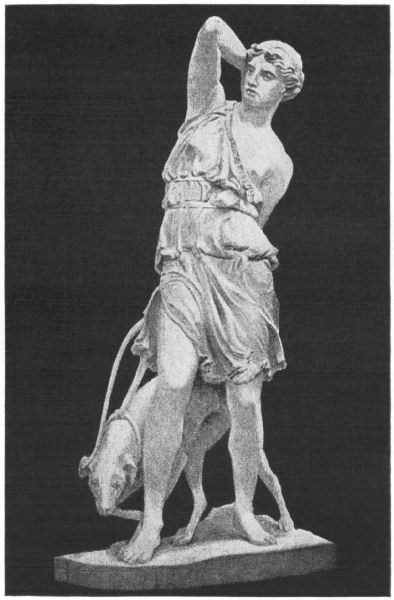
A B C
D E F
G H I
J K L
M N O
P Q R
S T U
V W X
Y Z
Abas (A′bas), a son of Meganira, was turned into a newt,
or water-lizard, for deriding the ceremonies
of the Sacrifice.
Absyrtus (Absy′rtus). After Jason had slain the dragon
which guarded the golden fleece, he fled with
Medea, the beautiful young sorceress, and
daughter of Aeetes, who pursued with great
energy, for Medea had taken with her the
most precious treasure of the king, his only
son and heir, Absyrtus. To delay the pursuit,
Medea slew her little brother, cut the
body in pieces, and dropped them over the
side of the vessel. Thus the cruel daughter
effected her escape.
Achelous (Achelo′us) was a river god, and the rival of Hercules
in his love for Deianira. To decide
who should have the bride, Hercules and
Achelous had recourse to a wrestling bout, the
fame of which extends through all the intervening
centuries. In this fierce struggle,
Achelous changed himself into the form of a
14]
bull and rushed upon his antagonist with
lowered horns, intending to hurl him aside.
Hercules eluded the onset, and seizing one of
the huge horns, held it so firmly that it was
broken off by the furious efforts of Achelous
to free himself. He was defeated, and finally
turned himself into a river, which has since
been known by his name.
Acheron (Ach′eron) (see “The Youth’s Classical Dictionary”).
The current of the river Acheron,
across which all souls had to pass to hear their
decree from Pluto, was so swift that the boldest
swimmer dare not attempt to breast it;
and, since there was no bridge, the spirits
were obliged to rely upon the aid of Charon,
an aged boatman, who plied the only boat
that was available. He would allow no soul
to enter this leaky craft until he had received
the obolus, or fare, which the ancients carefully
placed under the tongue of the dead,
that they might not be delayed in their passage
to Pluto. Those who had not their fare
were forced to wait one hundred years, when
Charon reluctantly ferried them over without
charge.
“Infernal rivers that disgorge
Into the burning lake their baleful streams
... Sad Acheron, of sorrow black and deep.”
Milton.
Achilles (Achil′les) was the most valiant of the Greek heroes
in the Trojan War. He was the son of Peleus,
King of Thessaly. His mother, Thetis,
15]
plunged him, when an infant, into the Stygian
pool, which made him invulnerable wherever
the waters had washed him; but the heel by
which he was held was not wetted, and that
part remained vulnerable. He was shot with
an arrow in the heel by Paris, at the siege of
Troy, and died of his wound.
Acidalia (Acida′lia), a name given to Venus, from a fountain
in Boeotia.
Acis (A′cis). A Sicilian shepherd, loved by the nymph
Galatea. One of the Cyclops who was jealous
of him crushed him by hurling a rock on him.
Galatea turned his blood into a river—the
Acis at the foot of Mount Etna.
Actaeon (Actae′on) was the son of Aristaeus, a famous huntsman.
He intruded himself on Diana while
she was bathing, and was changed by her into
a deer, in which form he was hunted by his
own dogs and torn in pieces.
Ades (A′des), see Hades.
Adonis (Ado′nis), the beautiful attendant of Venus, who
held her train. He was killed by a boar, and
turned by Venus into an anemone.
“Even as the sun with purple-colored face
Had ta’en his last leave of the weeping morn.
Rose-cheeked Adonis hied him to the chase;
Hunting he loved, but love he laughed to scorn.”
Shakespeare.
Adrastaea (Adrastae′a), another name of Nemesis, one of the
goddesses of justice.
16]
Adscriptitii Dii (Adscripti′tii Dii) were the gods of the second
grade.
Adversity, see Echidna.
Aeacus (Ae′acus), one of the judges of hell, with Minos
and Rhadamanthus. See Eacus.
Aecastor (Aecas′tor), an oath used only by women, referring
to the Temple of Castor.
Aedepol (Aed′epol), an oath used by both men and women,
referring to the Temple of Pollux.
Aeetes (Aee′tes), a king of Colchis, and father of Medea.
Aegeon (Aege′on), a giant with fifty heads and one hundred
hands, who was imprisoned by Jupiter under
Mount Etna. See Briareus.
Aegis (Ae′gis), the shield of Jupiter, so called because it
was made of goat-skin.
“Where was thine Aegis Pallas that appall’d?”
Byron.
“Tremendous, Gorgon frowned upon its field,
And circling terrors filled the expressive shield.”
“Full on the crest the Gorgon’s head they place,
With eyes that roll in death, and with distorted face.”
Pope.
Aegle (Ae′gle). The fairest of the Naiads.
Aello (Ael′lo), the name of one of the Harpies.
Aeneas (Aene′as) was the son of Anchises and Venus. He
was one of the few great captains who escaped
the destruction of Troy. He behaved with
great valor during the siege, encountering
Diomed, and even Achilles himself. When
the Grecians had set the city on fire Aeneas
17]
took his aged father, Anchises, on his shoulders,
while his son, Ascanius, and his wife
Creusa, clung to his garments. He saved
them all from the flames. After wandering
about during several years, encountering
numerous difficulties, he at length arrived in
Italy, where he was hospitably received by
Latinus, king of the Latins. After the death
of Latinus Aeneas became king.
“His back, or rather burthen, showed
As if it stooped with its load;
For as Aeneas bore his sire
Upon his shoulders through the fire,
Our knight did bear no less a pack
Of his own buttocks on his back.”
Butler.
Aeolus (Aeo′lus) was the god of the winds. Jupiter was
his reputed father, and his mother is said to
have been a daughter of Hippotus. Aeolus is
represented as having the power of holding
the winds confined in a cavern, and occasionally
giving them liberty to blow over the
world. So much command was he supposed
to have over them that when Ulysses visited
him on his return from Troy he gave him,
tied up in a bag, all the winds that could prevent
his voyage from being prosperous. The
companions of Ulysses, fancying that the bag
contained treasure, cut it open just as they
came in sight of Ithaca, the port they were
making for, and the contrary winds rushing
out drove back the ship many leagues. The
18]
residence of Aeolus was at Strongyle, now
called Strombolo.
“Aeolus from his airy throne
With power imperial curbs the struggling winds,
And sounding tempests in dark prisons binds.”
Dryden.
Aesculapius (Aescula′pius), the god of physic, was a son of
Apollo. He was physician to the Argonauts
in their famous expedition to Colchis. He
became so noted for his cures that Pluto became
jealous of him, and he requested Jupiter
to kill him with a thunderbolt. To revenge
his son’s death Apollo slew the Cyclops who
had forged the thunderbolt. By his marriage
with Epione he had two sons, Machaon and
Podalirius, both famous physicians, and four
daughters, of whom Hygeia, the goddess of
health, is the most renowned. Many temples
were erected in honor of Aesculapius, and
votive tablets were hung therein by people
who had been healed by him; but his most
famous shrine was at Epidaurus, where,
every five years, games were held in his
honor. This god is variously represented,
but the most famous statue shows him seated
on a throne of gold and ivory. His head is
crowned with rays, and he wears a long
beard. A knotty stick is in one hand, and a
staff entwined with a serpent is in the other,
while a dog lies at his feet.
“Thou that dost Aesculapius deride,
And o’er his gallipots in triumph ride.”
Fenton.
19]
Aeson (Ae′son) was father of Jason, and was restored to
youth by Medea.
Agamemnon (Agamem′non) was the son of Plisthenes and
brother of Menelaus. He was king of the
Argives. His brother’s wife was the famous
Helen, daughter of Tyndarus, king of Sparta;
and when she eloped with Paris, Agamemnon
was appointed leader of the Greeks in their
expedition against Troy.
Aganippides (Aganip′pides), a name of the Muses, derived from
the fountain of Aganippe.
Agineus (Agine′us), see Apollo.
Aglaia (Agla′ia) was one of the Three Graces.
Agni (Ag′ni). The Hindoo god of lightning.
Ajax (A′jax) was one of the bravest of the Greek warriors
in the Trojan War. His father was Telamon,
and his mother Eriboea. Some writers
say that he was killed by Ulysses; others
aver that he was slain by Paris; while others
again assert that he went mad after being
defeated by Ulysses, and killed himself. Another
Ajax, son of Oileus, also took a prominent
part in the Trojan War.
Alcestis (Alces′tis), wife of Admetus, who, to save her husband’s
life, died in his stead, and was restored
to life by Hercules.
Alcides (Alci′des), one of the names of Hercules.
Alcmena (Alcme′na), the mother of Hercules, was daughter
of Electryon, a king of Argos.
20]
Alecto (Alec′to) was one of the Furies. She is depicted
as having serpents instead of hair on her head,
and was supposed to breed pestilence wherever
she went.
Alectryon (Alec′tryon), a servant of Mars, who was changed
by him into a cock because he did not warn his
master of the rising of the sun.
Alfadur (Al′fadur), in Scandinavian Mythology the Supreme
Being—Father of all.
Alma Mammosa (Al′ma Mammo′sa), a name of Ceres.
Alpheus (Alphe′us), a river god. See Arethusa.
Altar. A structure on which a sacrifice was
offered. The earliest altars were merely
heaps of earth or turf or rough unhewn stone;
but as the mode of sacrificing became more
ceremonious grander altars were built. Some
were of marble and brass, ornamented with
carvings and bas-reliefs, and the corners with
models of the heads of animals. They varied
in height from two feet to twenty, and some
were built solid; others were made hollow to
retain the blood of the victims. Some were
provided with a kind of dish, into which
frankincense was thrown to overpower the
smell of burning fat. This probably was the
origin of the custom of burning incense at the
altar.
Amalthaea (Amal′thae′a), the goat which nourished Jupiter.
Amazons (Am′azons) were a nation of women-soldiers who
lived in Scythia. Hercules totally defeated
21]
them, and gave Hippolyte, their queen, to
Theseus for a wife. The race seems to have
been exterminated after this battle.
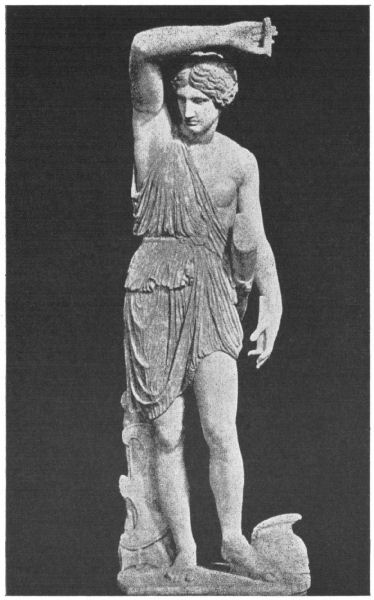
See page 20
Amazon
Ambarvalia (Ambarva′lia) were festivals in honor of Ceres, instituted
by Roman husbandmen to purge their
fields. At the spring festival the head of each
family led an animal, usually a pig or ram,
decked with oak boughs, round his grounds,
and offered milk and new wine. After harvest
there was another festival, at which
Ceres was presented with the first-fruits of the
season. See Ceres.
Amber, see Heliades.
Ambrosia (Ambro′sia) were Bacchanalian festivals.
Amica (Ami′ca), a name of Venus.
Amphion (Amphi′on) was the son of Jupiter and Antiope.
He was greatly skilled in music; and it is
said that, at the sound of his lute, the stones
arranged themselves so regularly as to make
the walls of the city of Thebes.
“Amphion, too, as story goes, could call
Obedient stones to make the Theban wall.”
Horace.
“New walls to Thebes, Amphion thus began.”
William King.
“Such strains I sing as once Amphion played,
When list’ning flocks the powerful call obeyed.”
Elphinston.
Amphitrite (Amphitri′te) (or Salatia), the wife of Neptune,
22]
was a daughter of Oceanus and Tethys. She
was the mother of Triton, a sea god.
“His weary chariot sought the bowers
Of Amphitrite and her tending nymphs.”
Thomson.
Amycus (Amy′cus) was king of Bebrycia. He was a son of
Neptune, and was killed by Pollux.
Ancaeus (Ancae′us). A son of Neptune, who left a cup of
wine to hunt a wild boar which killed him,
and the wine was untasted. This was the
origin of the proverb—“There’s many a slip
’twixt cup and lip.”
Ancilia (Ancil′ia), the twelve sacred shields. The first
Ancile was supposed to have fallen from
heaven in answer to the prayer of Numa
Pompilius. It was kept with the greatest
care, as it was prophesied that the fate of the
Roman people would depend upon its preservation.
An order of priesthood was established
to take care of the Ancilia, and on 1st
March each year the shields were carried in
procession, and in the evening there was a
great feast, called Coena Saliaris.
Andromeda (Androm′eda), the daughter of Cepheus, king of
the Ethiopians, was wife of Perseus, by whom
she was rescued when she was chained to a
rock and was about to be devoured by a sea-monster.
Anemone (Anem′one). Venus changed Adonis into this
flower.
Angeronia (Angero′nia), otherwise Volupia, was the goddess
23]
who had the power of dispelling anguish of
mind.
Anna Perenna (Anna Peren′na), one of the rural divinities.
Antaeus (Antae′us), a giant who was vanquished by Hercules.
Each time that Hercules threw him
the giant gained fresh strength from touching
the earth, so Hercules lifted him off the
ground and squeezed him to death.
Anteros (An′teros), one of the two Cupids, sons of Venus.
Anticlea (Antic′lea), the mother of Ulysses.
Antiope (Anti′ope) was the wife of Lycus, King of Thebes.
Jupiter, disguised as a satyr, led her astray
and corrupted her.
Anubis (Anu′bis) (or Hermanubis (Herman′ubis)). “A god half a dog,
a dog half a man.” Called Barker by Virgil
and other poets.
Aonides (Aon′ides), a name of the Muses, from the country
Aonia.
Apaturia (Apatur′ia), an Athenian festival, which received
its name from a Greek word signifying deceit.
Aphrodite (Aph′rodi′te), a Greek name of Venus.
Apis, a name given to Jupiter by the inhabitants
of the Lower Nile. Also the miraculous ox,
worshiped in Egypt.
Apis (A′pis), King of Argivia. Afterward called Serapis,
the greatest god of the Egyptians.
Apollo (Apol′lo). This famous god, some time King of
Arcadia, was the son of Jupiter and Latona.
He was known by several names, but principally
24]
by the following:—Sol (the sun); Cynthius,
from the mountain called Cynthus in
the Isle of Delos, and this same island being
his native place obtained for him the name of
Delius; Delphinius, from his occasionally assuming
the shape of a dolphin. His name of
Delphicus was derived from his connection
with the splendid Temple at Delphi, where
he uttered the famous oracles. Some writers
record that this oracle became dumb when
Jesus Christ was born. Other common names
of Apollo were Didymaeus, Nomius, Paean,
and Phoebus. The Greeks called him Agineus,
because the streets were under his guardianship,
and he was called Pythius from having
killed the serpent Python. Apollo is usually
represented as a handsome young man without
beard, crowned with laurel, and having in
one hand a bow, and in the other a lyre. The
favorite residence of Apollo was on Mount
Parnassus, a mountain of Phocis, in Greece,
where he presided over the Muses. Apollo
was the accredited father of several children,
but the two most renowned were Aesculapius
and Phaeton.
“Wilt thou have music? Hark! Apollo plays.
And twenty cagëd nightingales do sing.”
Shakespeare.
Apotheosis (Apothe′osis). The consecration of a god. The
ceremony of deification.
Arachne (Arach′ne), a Lydian princess, who challenged
25]
Minerva to a spinning contest, but Minerva
struck her on the head with a spindle, and
turned her into a spider.
“... So her disemboweled web,
Arachne, in a hall or kitchen spreads.
Obvious to vagrant flies.”
John Phillips.
Arcadia (Arca′dia), a delightful country in the center of
Peloponnessus, a favorite place of the gods.
Apollo was reputed to have been King of
Arcadia.
Arcas (Ar′cas), a son of Calisto, was turned into a he-bear;
and afterward into the constellation
called Ursa Minor.
Archer, see Chiron.
Areopagitae (Areop′agi′tae), the judges who sat at the Areopagus.
Areopagus (Areop′agus), the hill at Athens where Mars was
tried for murder before twelve of the gods.
Ares (A′res). The same as Mars, the god of war.
Arethusa (Arethu′sa) was one of the nymphs of Diana. She
fled from Alpheus, a river god, and was enabled
to escape by being turned by Diana
into a rivulet which ran underground. She
was as virtuous as she was beautiful.
Argonauts (Ar′gonauts). This name was given to the fifty
heroes who sailed to Colchis in the ship Argo,
under the command of Jason, to fetch the
Golden Fleece.
Argus (Ar′gus) was a god who had a hundred eyes which
26]
slept and watched by turns. He was charged
by Juno to watch Io, but, being slain by Mercury,
was changed by Juno into a peacock.
Ariadne (Ariad′ne), daughter of Minos, King of Crete.
After enabling Theseus to get out of the
Labyrinth by means of a clew of thread, she
fled with him to Naxos, where he ungratefully
deserted her; but Bacchus wooed her and
married her, and the crown of seven stars
which he gave her was turned into a constellation.
Arion (Ari′on) was a famous lyric poet of Methymna, in
the Island of Lesbos, where he gained great
riches by his art. There is a pretty fable
which has made the name of Arion famous.
Once when traveling from Lesbos his companions
robbed him, and proposed to throw
him into the sea. He entreated the seamen
to let him play upon his harp before they
threw him overboard, and he played so
sweetly that the dolphins flocked round the
vessel. He then threw himself into the sea,
and one of the dolphins took him up and carried
him to Taenarus, near Corinth. For this
act the dolphin was raised to heaven as a constellation.
Aristaeus (Aristae′us), son of Apollo and Cyrene, was the god
of trees; he also taught mankind the use of
honey, and how to get oil from olives. He
was a celebrated hunter. His most famous
son was Actaeon.
27]
Armata (Arma′ta), one of the names of Venus, given to her
by Spartan women.
Artemis (Ar′temis). This was the Grecian name of Diana,
and the festivals at Delphi were called Artemisia.
Arts and Sciences, see Muses.
Aruspices (Arus′pices), sacrificial priests.
Ascalaphus (Ascal′aphus) was changed into an owl, the harbinger
of misfortune, by Ceres, because he
informed Pluto that Proserpine had partaken
of food in the infernal regions, and thus prevented
her return to earth.
Ascanius (Asca′nius), the son of Aeneas and Creusa.
Ascolia (Ascol′ia), Bacchanalian feasts, from a Greek word
meaning a leather bottle. The bottles were
used in the games to jump on.
Asopus (Aso′pus). A son of Jupiter, who was killed by
one of his father’s thunderbolts.
Assabinus (Assabi′nus), the Ethiopian name of Jupiter.
Ass’s ears, see Midas.
Astarte (Astar′te), one of the Eastern names of Venus.
Asteria (Aste′ria), daughter of Caeus, was carried away by
Jupiter, who assumed the shape of an eagle.
Astrea (Astre′a), mother of Nemesis, was the goddess of
justice; she returned to heaven when the
earth became corrupt.
“... Chaste Astrea fled,
And sought protection in her native sky.”
John Hughes.
28]
Atalanta (Atalan′ta) was daughter of Caeneus. The oracle
told her that marriage would be fatal to her,
but, being very beautiful, she had many
suitors. She was a very swift runner, and,
to get rid of her admirers, she promised to
marry any one of them who should outstrip
her in a race, but that all who were defeated
should be slain. Hippomenes, however, with
the aid of Venus, was successful. That goddess
gave him three golden apples, one of
which he dropped whenever Atalanta caught
up to him in the race. She stopped to pick
them up, and he was victorious and married
her. They were both afterward turned into
lions by Cybele, for profaning her temple.
Ate (A′te). The goddess of revenge, also called the
goddess of discord and all evil. She was
banished from heaven by her father Jupiter.
“With Ate by his side come hot from hell.”
Shakespeare.
Athena (Athe′na), a name obtained by Minerva as the
tutelary goddess of Athens.
Atlas, was King of Mauritania, now Morocco, in
Africa. He was also a great astronomer.
He is depicted with the globe on his back, his
name signifying great toil or labor. For his
inhospitality to Perseus that king changed
him into the mountain which bears his name
of Atlas. A chain of mountains in Africa is
called after him, and so is the Atlantic Ocean.
He had seven daughters by his wife Pleione,
29]
they were called by one common name, Pleiades;
and by his wife Aethra he had seven
more, who were, in the same manner, called
Hyades. Both the Pleiades and the Hyades
are celestial constellations.
Atreus (At′reus), the type of fraternal hatred. His dislike
of his brother Thyestes went to the extent of
killing and roasting his nephews, and inviting
their father to a feast, which Thyestes thought
was a sign of reconciliation, but he was the
victim of his brother’s detestable cruelty.
“Media must not draw her murdering knife,
Nor Atreus there his horrid feast prepare.”
Lord Roscommon.
Atropos (At′ropos), one of the three sisters called The
Fates, who held the shears ready to cut the
thread of life.
Atys (A′tys), son of Croesus, was born dumb, but when
in a fight he saw a soldier about to kill the
king he gained speech, and cried out, “Save
the king!” and the string that held his tongue
was broken.
Atys (A′tys) was a youth beloved by Aurora, and was
slain by her father, but, according to Ovid,
was afterward turned into a pine-tree.
Augaeas (Aug′aeas), a king of Elis, the owner of the stable
which Hercules cleansed after three thousand
oxen had been kept in it for thirty years. It
was cleansed by turning the river Alpheus
through it. Augaeas promised to give
30]
Hercules a tenth part of his cattle for his trouble
but, for neglecting to keep his promise, Hercules
slew him.
Augury (Au′gury). This was a means adopted by the
Romans of forming a judgment of futurity by
the flight of birds, and the officiating priest
was called an augur.
Aurora (Auro′ra), the goddess of the morning,
“Whose rosy fingers ope the gates of day.”
She was daughter of Sol, the sun, and was the
mother of the stars and winds. She is represented
as riding in a splendid golden chariot
drawn by white horses. The goddess loved
Tithonus, and begged the gods to grant him
immortality, but forgot to ask at the same
time that he should not get old and decrepit.
See Tithonus.
“... So soon as the all-cheering sun
Should, in the farthest east, begin to draw
The shady curtains of Aurora’s bed.”
Shakespeare.
Auster (Aus′ter), the south wind, a son of Jupiter.
Avernus (Aver′nus), a poisonous lake, referred to by poets
as being at the entrance of the infernal
regions, but it was really a lake in Campania,
in Italy.
Averruncus Deus (Averrun′cus Deus), a Roman god, who could divert
people from evil-doing.
Axe, see Daedalus.
31]
Baal (Ba′al), a god of the Phoenicians.
Baal-Peor (Ba′al-Pe′or), a Moabitish god, associated with
licentiousness and obscenity. The modern
name is Belphegor.
Babes, see Rumia Dea.
Bacchantes (Bac′chantes). The priestesses of Bacchus.
Bacchus (Bac′chus), the god of wine, was the son of Jupiter
and Semele. He is said to have married
Ariadne, daughter of Minos, King of Crete,
after she was deserted by Theseus. The
most distinguished of his children is Hymen,
the god of marriage. Bacchus is sometimes
referred to under the names of Dionysius,
Biformis, Brisaeus, Iacchus, Lenaeus, Lyceus,
Liber, and Liber Pater, the symbol of liberty.
The god of wine is usually represented as
crowned with vine and ivy leaves. In his left
hand is a thyrsus, a kind of javelin, having a
fir cone for the head, and being encircled with
ivy or vine. His chariot is drawn by lions,
tigers, or panthers.
“Jolly Bacchus, god of pleasure,
Charmed the world with drink and dances.”
T. Parnell, 1700.
Balios (Ba′lios). A famous horse given by Neptune to
Peleus as a wedding present, and was afterward
given to Achilles.
Barker, see Anubis.
Bassarides (Bassar′ides). The priestesses of Bacchus were
sometimes so called.
32]
Battle, see Valhalla.
Bear, see Calisto.
Beauty, see Venus.
Bees, see Mellona.
Belisama (Belisa′ma), a goddess of the Gauls. The name
means the Queen of Heaven.
Bellerophon (Beller′ophon), a hero who destroyed a monster
called the Chimaera.
Bellona (Bello′na), the goddess of war, and wife of Mars.
The 24th March was called Bellona’s Day,
when her votaries cut themselves with knives
and drank the blood of the sacrifice.
“In Dirae’s and in Discord’s steps Bellona treads,
And shakes her iron rod above their heads.”
Belphegor (Belphe′gor), see Baal-Peor.
Belus (Be′lus). The Chaldean name of the sun.
Berecynthia (Berecyn′thia), a name of Cybele, from a mountain
where she was worshiped.
Biformis (Bi′formis), a name of Bacchus, because he was
accounted both bearded and beardless.
Birds, see Augury.
Births, see Lucina and Levana.
Blacksmith, see Brontes and Vulcan.
Blind, see Thamyris.
Blue eyes, see Glaukopis.
Bona Dea (Bo′na De′a). “The bountiful goddess,” whose
festival was celebrated by the Romans with
much magnificence. See Ceres.
33]
Bonus Eventus (Bo′nus Even′tus). The god of good success, a
rural divinity.
Boreas (Bo′reas), the north wind, son of Astraeus and
Aurora.
“... I snatched her from the rigid north,
Her native bed, on which bleak Boreas blew,
And bore her nearer to the sun....”
Young, 1710.
Boundaries, see Terminus.
Boxing, see Pollux.
Brahma (Brah′ma). The great Indian deity, represented
with four heads looking to the four quarters
of the globe.
Briareus (Bri′areus), a famous giant. See Aegeon.
Brisaeus (Bris′aeus). A name of Bacchus, referring to the
use of grapes and honey.
Brontes (Bront′es), one of the Cyclops. He is the personification
of a blacksmith.
Bubona (Bubo′na), goddess of herdsmen, one of the rural
divinities.
Buddha (Bud′dha). Primitively, a pagan deity, the Vishnu
of the Hindoos.
Byblis (Byb′lis). A niece of Sol, mentioned by Ovid.
She shed so many tears for unrequited love
that she was turned into a fountain.
“Thus the Phoebeian Byblis, spent in tears,
Becomes a living fountain, which yet bears
Her name.”
Ovid.
Cabiri (Cab′iri). The mysterious rites connected with the
worship of these deities were so obscene that
34]
most writers refer to them as secrets which it
was unlawful to reveal.
Cacodaemon (Cac′odae′mon). The Greek name of an evil spirit.
Cacus (Ca′cus), a three-headed monster and robber.
Cadmus (Cad′mus), one of the earliest of the Greek demi-gods.
He was the reputed inventor of letters,
and his alphabet consisted of sixteen letters.
It was Cadmus who slew the Boeotian dragon,
and sowed its teeth in the ground, from each
of which sprang up an armed man.
Caduceus (Cadu′ceus). The rod carried by Mercury. It has
two winged serpents entwined round the top
end. It was supposed to possess the power
of producing sleep, and Milton refers to it in
Paradise Lost as the “opiate rod.”
Calisto (Calis′to), an Arcadian nymph, who was turned
into a she-bear by Jupiter. In that form she
was hunted by her son Arcas, who would
have killed her had not Jupiter turned him
into a he-bear. The nymph and her son form
the constellations known as the Great Bear
and Little Bear.
Calliope (Calli′ope). The Muse who presided over epic
poetry and rhetoric. She is generally depicted
using a stylus and wax tablets, the
ancient writing materials.
Calpe (Cal′pe). One of the pillars of Hercules.
Calypso (Calyp′so) was queen of the island of Ogygia, on
which Ulysses was wrecked, and where he
was persuaded to remain seven years.
35]
Cama (Ca′ma). The Indian god of love and marriage.
Camillus (Camil′lus), a name of Mercury, from his office of
minister to the gods.
Canache (Can′ache). The name of one of Actaeon’s hounds.
Canopus (Cano′pus). The Egyptian god of water, the conqueror
of fire.
Capis (Cap′is) or Capula (Cap′ula). A peculiar cup with ears,
used in drinking the health of the deities.
Capitolinus (Capitoli′nus). A name of Jupiter, from the
Capitoline hill, on the top of which a temple
was built and dedicated to him.
Capripedes (Cap′ri′pedes). Pan, the Egipans, the Satyrs, and
Fauns, were so called from having goat’s feet.
Caprotina (Caproti′na). A name of Juno.
Cassandra (Cassan′dra), a daughter of Priam and Hecuba,
who was granted by Apollo the power of seeing
into futurity, but having offended that god
he prevented people from believing her predictions.
Cassiopeia (Cassiope′ia). The Ethiopian queen who set her
beauty in comparison with that of the Nereides,
who thereupon chained her to a rock and
left her to be devoured by a sea-monster, but
she was delivered by Perseus. See Andromeda.
Castalia (Casta′lia). One of the fountains in Mount Parnassus,
sacred to the Muses.
Castalides (Casta′li′des), a name of the Muses, from the fountain
Castalia or Castalius.
36]
Castor (Cas′tor), son of Jupiter and Leda, twin brother of
Pollux, noted for his skill in horsemanship.
He went with Jason in quest of the Golden
Fleece.
Cauther (Cau′ther), in Mohammedan mythology, is the lake
of paradise, whose waters are as sweet as
honey, as cold as snow, and as clear as crystal;
and any believer who tastes thereof is
said to thirst no more.
Celeno (Cel′eno) was one of the Harpies, progenitor of
Zephyrus, the west wind.
Centaur (Cen′taur). A huntsman who had the forepart
like a man, and the remainder of the body
like a horse. The Centauri lived in Thessaly.
Cephalus (Cep′halus) was married to Procris, whom he accidentally
slew by shooting her while she was
secretly watching him, he thinking she was a
wild beast. Cephalus was the type of constancy.
Ceraunius (Cerau′nius). A Greek name of Jupiter, meaning
The Fulminator, from his thunderbolts.
Cerberus (Cer′berus). Pluto’s famous three-headed dog,
which guarded the gate of the infernal regions,
preventing the living from entering, and the
inhabitants from going out.
“Three-headed Cerberus, by fate
Posted at Pluto’s iron gate;
Low crouching rolls his haggard eyes,
Ecstatic, and foregoes his prize.”
Ceremonies, see Themis.
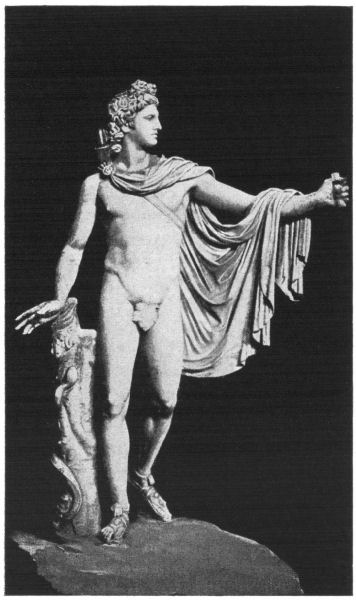
See page 23
Apollo Belvedere
37]
Ceres (Ce′res), daughter of Saturn, the goddess of agriculture,
and of the fruits of the earth. She
taught Triptolemus how to grow corn, and
sent him to teach the inhabitants of the earth.
She was known by the names of Magna Dea,
Bona Dea, Alma Mammosa, and Thesmorphonis.
Ceres was the mother of Proserpine.
See Ambarvalia.
“To Ceres bland, her annual rites be paid
On the green turf beneath the fragrant shade.—
... Let all the hinds bend low at Ceres’ shrine,
Mix honey sweet for her with milk and mellow wine,
Thrice lead the victim the new fruits around,
On Ceres call, and choral hymns resound.”
“Ceres was she who first our furrows plowed,
Who gave sweet fruits and every good allowed.”
Pope.
Cestus (Ces′tus), the girdle of Venus, which excited irresistible
affection.
Chaos (Cha′os) allegorically represented the confused
mass of matter supposed to have existed before
the creation of the world, and out of
which the world was formed.
“... Behold the throne
Of Chaos, and his dark pavilion spread
Wide on the wasteful deep; with him enthroned
Sat sable-vested Night, eldest of all things,
The consort of his reign.”
Milton.
Charon (Char′on) was the son of Nox and Erebus. He was
the ferryman who conveyed the spirits of the
dead, in a boat, over the rivers Acheron and
Styx to the Elysian Fields. “Charon’s toll”
38]
was a coin put into the hands of the dead with
which to pay the grim ferryman.
“From the dark mansions of the dead,
Where Charon with his lazy boat
Ferries o’er Lethe’s sedgy moat.”
Charybdis (Charyb′dis). A dangerous whirlpool on the coast
of Sicily. Personified, it was supposed to
have been a woman who plundered travelers,
but was at last killed by Hercules. Scylla
and Charybdis are generally spoken of together
to represent alternative dangers.
“Charybdis barks, and Polyphemus roars.”
Francis.
Chemos (Che′mos). The Moabitish god of war.
Children, see Nundina.
Chimaera (Chimae′ra). A wild illusion, personified in the
monster slain by Bellerophon. It had the
head and breast of a lion, the body of a goat,
and the tail of a serpent. It used to vomit
fire.
“... And on the craggy top
Chimera dwells, with lion’s face and mane,
A goat’s rough body and a serpent’s train.”
Pope.
“First, dire Chimera’s conquest was enjoined,
A mingled monster of no mortal kind.
Behind, a dragon’s fiery tail was spread,
A goat’s rough body bore a lion’s head,
Her pitchy nostrils flaky flames expire,
Her gaping throat emits infernal fire.”
Milton.
Chiron (Chi′ron), the centaur who taught Achilles hunting,
music, and the use of medicinal herbs. Jupiter
39]
placed him among the stars, where he appears
as Sagittarius, the Archer.
Chloris (Chlo′ris). The Greek name of Flora, the goddess
of flowers.
Chou. An Egyptian god corresponding to the
Roman Hercules.
Chronos (Chro′nos). Time, the Grecian name of Saturn.
Cillaros (Cil′laros), see Cyllaros.
Circe (Cir′ce), daughter of the Sun. The knowledge of
poisonous herbs enabled her to destroy her
husband, the King of the Sarmatians, for
which act she was banished. When Ulysses
landed at Aeaea, where she lived, she turned
all his followers into swine.
Cisseta (Cisse′ta). The name of one of Actaeon’s hounds.
Citherides (Cither′ides). A name of the Muses, from Mount
Citheron.
Clio (Cli′o). One of the Muses, daughter of Jupiter
and Mnemosyne. She presided over history.
Cloacina (Cloaci′na). The Roman goddess of sewers.
Clotho (Clo′tho) was one of the Fates. She was present
at births, and held the distaff from which was
spun the thread of life. See Atropos and
Lachesis.
Clowns of Lycia, The (Ly′cia), were changed into frogs
by Latona, because they refused to allow her
to drink at one of their streamlets.
Cluacina (Clu′aci′na). A name of Venus, given to her at the
time of the reconciliation of the Romans and
40]
the Sabines, which was ratified near a statue
of the goddess.
Clytemnestra (Cly′temnes′tra), wife of Agamemnon, slew her
husband and married Aegisthus. She attempted
to kill her son Orestes, but he was
delivered by his sister Electra, who sent him
away to Strophius. He afterward returned
and slew both Clytemnestra and Aegisthus.
Clytie (Clyt′ie). A nymph who got herself changed into
a sunflower because her love of Apollo was
unrequited. In the form of this flower she is
still supposed to be turning toward Sol, a
name of Apollo.
Cneph. In Egyptian mythology the creator of
the universe.
Cocytus (Cocy′tus), the river of Lamentation. One of the
five rivers of the infernal regions.
“Infernal rivers that disgorge
Into the burning lake their baleful streams.
... Cocytus, named of lamentation loud.
Heard on the rueful stream.”
Milton.
Coeculus (Coe′culus), a violent robber, was a son of Vulcan.
Coelus (Coe′lus), also called Uranus (or Heaven), was the
most ancient of the gods.
Coena Saliaris (Coe′na Salia′ris), see Ancilia.
Collina (Colli′na) was one of the rural deities, the goddess
of hills.
Comedy, see Thalia.
Comus (Co′mus) was the god of revelry. He presided
over entertainments and feasts.
41]
Concord (Con′cord). The symbol of Concord was two right
hands joined, and a pomegranate.
Concordia (Concor′dia). The goddess of peace. One of the
oldest Roman goddesses. She is represented
as holding a horn of plenty in one hand, and
in the other a scepter, from which fruit is
sprouting forth.
Constancy, see Cephalus.
Consualia (Consu′alia). Games sacred to Neptune.
Consus (Con′sus). A name given to Neptune as being the
god of counsel.
Cophetua (Cophe′tua). A legendary king of Africa, who
disliked women, but ultimately fell in love
with a “beggar-maid,” as mentioned in Romeo
and Juliet.
“... Cupid, he that shot so trim
When King Cophetua loved the beggar-maid.”
Shakespeare.
Copia (Co′pia), the goddess of plenty.
Coran (Co′ran). One of Actaeon’s hounds was so named.
Corn, see Ceres.
Coronis (Cor′onis), was a consort of Apollo and mother of
Aesculapius. Another Coronis was daughter
of a king of Phocis, and was changed by
Athena into a crow.
Corybantes (Coryban′tes) were priests of Cybele. They obtained
the name because they were in the
habit of striking themselves in their dances.
Corydon (Cory′don). A silly love-sick swain mentioned by
Virgil.
42]
Corythaix (Cory′thaix). A name given to Mars, meaning
Shaker of the Helmet.
Cotytto (Cotyt′to). The Athenian goddess of immodesty.
“Hail! goddess of nocturnal sport,
Dark-veiled Cotytto, to whom the secret flame
Of midnight torches burns; mysterious dame.”
Milton.
Counsel, see Consus.
Creditors, see Jani.
Crow, see Coronis.
Cultivated Land, see Sylvester.
Cup-bearer, see Ganymede.
Cupid (Cu′pid), the god of love, was the son of Jupiter and
Venus. He is represented as a naked, winged
boy, with a bow and arrows, and a torch.
When he grew up to be a man he married
Psyche.
“For Venus did but boast one only son,
And rosy Cupid was that boasted one;
He, uncontroll’d, thro’ heaven extends his sway,
And gods and goddesses by turns obey.”
Eusden, 1713.
Cuvera (Cuve′ra). The Indian god of wealth corresponding
to the Greek Plutus.
Cybele (Cy′bele). The mother of the gods, and hence called
Magna Mater. She was wife of Saturn. She
is sometimes referred to under the names of
Ceres, Rhea, Ops, and Vesta. She is represented
as riding in a chariot drawn by lions.
In one hand she holds a scepter, and in the
other a key. On her head is a castelated
43]
crown, to denote that she was the first to protect
castles and walls with towers.
“Nor Cybele with half so kind an eye
Surveyed her sons and daughters of the sky.”
Dryden.
“Might she the wise Latona be,
Or the towered Cybele,
Mother of a hundred gods,
Juno dares not give her odds.”
Milton.
Cyclops (Cy′clops) or Cyclopes (Cy′clopes) were the gigantic, one-eyed
workmen of Vulcan, who made Jove’s
thunderbolts. Hesiod gives their names as
Arges, Brontes, and Steropes.
“Meantime, the Cyclop raging with his wound,
Spreads his wide arms, and searches round and round.”
Pope.
Cygnus (Cyg′nus), the bosom friend of Phaeton. He died
of grief on the death of his friend, and was
turned into a swan.
Cyllaros (Cyll′aros), one of Castor’s horses. The color is
mentioned as being coal-black, with white
legs and tail. See Cillaros.
Cyllo (Cyl′lo). The name of one of Actaeon’s hounds,
which was lame.
Cyllopotes (Cyllop′otes). A name given to one of Actaeon’s
hounds which limped.
Cynosure (Cyn′osure). One of the nurses of Jupiter, turned
by the god into a conspicuous constellation.
“Towers and battlements it sees
Bosomed high in tufted trees,
Where perhaps some beauty lies,
The Cynosure of neighboring eyes.”
Milton.
44]
Cyparissus (Cyparis′sus). A boy of whom Apollo was very
fond; and when he died he was changed, at
Apollo’s intercession, into a cypress tree, the
branches of which typify mourning.
Cypress (Cy′press), see Cyparissus.
Cypria (Cy′pria). A name of Venus, because she was
worshiped in the island of Cyprus.
Cythera (Cyth′era). A name of Venus, from the island to
which she was wafted in the shell.
Dactyli (Dacty′li) were priests of Cybele. They were
given the name, because, like the fingers,
they were ten in number.
Daedalus (Daed′alus) was a great architect and sculptor. He
invented the wedge, the axe, the level, and
the gimlet, and was the first to use sails.
Daedalus also constructed the famous labyrinth
for Minos, King of Crete. See Icarus.
“Now Daedalus, behold, by fate assigned,
A task proportioned to thy mighty mind.”
Pope.
Dagon (Da′gon). A god of the Philistines, half man half
fish, like the mermaid. Milton describes him
as “Upward man and downward fish.”
Dahak (Da′hak). The Persian devil.
Daityas (Dai′tyas). In Hindoo mythology the devils or
evil gods.
Danae (Dan′ae) was a daughter of Acrisius and Eurydice.
She had a son by Jupiter, who was drifted out
to sea in a boat, but was saved by Polydectes
and educated.
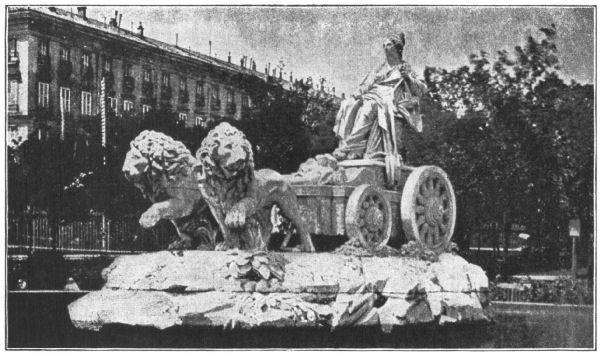
See page 42
Fountain of Cybele (Rhea)
45]
Danaides (Dana′ides), see Danaus.
Danaus (Dana′us), King of Argos, was the father of fifty
daughters, who, all but one, at the command
of their father, slew their husbands directly
after marriage. For this crime they were
condemned to the task of forever trying to
draw water with vessels without any bottoms.
See Hypermnestra.
Dancing, see Terpsichore.
Dangers, see Charybdis, also Scylla.
Daphne (Daph′ne). The goddess of the earth. Apollo
courted her, but she fled from him, and was,
at her own request, turned into a laurel tree.
“... As Daphne was
Root-bound, that fled Apollo.”
Milton.
Dardanus (Dar′danus), a son of Jupiter, who built the city of
Dardania, and by some writers was accounted
the founder of Troy.
Dead-toll, see Charon.
Death, see Nox.
Deceiver, The, see Apaturia.
Deianira (Deiani′ra), daughter of Oeneus, was wife of Hercules.
See Hercules.
Delius (De′lius), a name of Apollo, from the island in
which he was born.
Delphi (Del′phi). A town on Mount Parnassus, famous
for its oracle, and for a temple of Apollo.
See Delphos.
Delphicus (Del′phicus). A name of Apollo, from Delphi.
46]
Delphos (Del′phos), the place where the temple was built,
from which the oracle of Apollo was given.
Demarus (De′marus). The Phoenician name of Jupiter.
Demogorgon (De′mogor′gon) was the tyrant genius of the soil or
earth, the life and support of plants. He
was depicted as an old man covered with
moss, and was said to live underground. He
is sometimes called the king of the elves and
fays.
“Which wast begot in Demogorgon’s hall
And saw’st the secrets of the world unmade.”
Spenser.
Deucalion (Deuca′lion), one of the demi-gods, son of Prometheus
and Pyrra. He and his wife, by making
a ship, survived the deluge which Jupiter
sent on the earth, circa 1503 B.C.
Devil, see Dahak, Daityas, and Obambou.
Diana (Di′ana), goddess of hunting and of chastity. She
was the sister of Apollo, and daughter of
Jupiter and Latona. She was known among
the Greeks as Diana or Phoebe, and was honored
as a triform goddess. As a celestial divinity
she was called Luna; as a terrestrial
Diana or Dictynna; and in the infernal regions
Hecate.
Dictynna (Dictyn′na), a Greek name of Diana as a terrestrial
goddess.
Dido (Di′do). A daughter of Belus, King of Tyre. It
was this princess who bought a piece of land
in Africa as large as could be encompassed by
47]
a bullock’s hide, and when the purchase was
completed, cut the hide into strips, and so
secured a large tract of land. Here she built
Carthage; and Virgil tells that when Aeneas
was shipwrecked on the neighboring coast
she received him with every kindness, and at
last fell in love with him. But Aeneas did
not reciprocate her affections, and this so
grieved her that she stabbed herself. A tale
is told in Facetiae Cantabrigienses of Professor
Porson, who being one of a set party, the
conversation turned on the subject of punning,
when Porson observing that he could
pun on any subject, a person present defied
him to do so on the Latin gerunds, di, do,
dum, which, however, he immediately did
in the following admirable couplet:
“When Dido found Aeneas would not come,
She mourned in silence, and was Dido dumb.”
Dies Pater (Di′es Pa′ter), or Father of the Day, a name of
Jupiter.
Dii Selecti (Dii Selec′ti) composed the second class of gods.
They were Coelus, Saturn, Genius, Oreus,
Sol, Bacchus, Terra, and Luna.
Dindymene (Din′dyme′ne). A name of Cybele, from a mountain
where she was worshiped.
“Nor Dindymene, nor her priest possest,
Can with their sounding cymbals shake the breast
Like furious anger.”
Francis.
Diomedes (Diome′des), the cruel tyrant of Thrace, who fed
his mares on the flesh of his guests. He was
48]
overcome by Hercules, and himself given to
the same horses as food.
Dione (Dio′ne). A poetic name of Venus.
Dionysia (Diony′sia) were festivals in honor of Bacchus.
Dionysius (Diony′sius). A name of Bacchus, either from his
father Jupiter (Dios), or from his nurses, the
nymphs called Nysae.
Dioscuri (Dios′curi). Castor and Pollux, the sons of Jupiter.
Dirae (Di′rae). A name of the Furies.
Dis. A name of Pluto, god of hell, signifying
riches.
“... That fair field
Of Enna, where Proserpine gathering flowers,
Herself a fairer flower, by gloomy Dis
Was gathered.”
Milton.
Discord, see Ate.
Discordia (Discor′dia), sister of Nemesis, the Furies, and
Death, was driven from heaven for having
sown discord among the gods.
Diseases, see Pandora.
Distaff, see Pallas.
Dithyrambus. A surname of Bacchus.
Dodona (Dodo′na) was a celebrated oracle of Jupiter.
“O where, Dodona, is thine aged grove,
Prophetic fount, and oracle divine?”
Byron.
Dodonaeus (Dodonae′us). A name of Jupiter, from the city of
Dodona.
Dog, see Lares.
49]
Dolabra (Dola′bra). The knife used by the priests to cut up
the sacrifices.
Dolphin, see Arion.
Doorga (Door′ga). A Hindoo goddess.
Doris (Do′ris) was daughter of Oceanus, and sister of
Nereus, two of the marine deities. From
these two sisters sprang the several tribes of
water nymphs.
Doto (Do′to). One of the Nereids or sea nymphs.
Draco (Dra′co). One of Actaeon’s hounds.
Dragon, seven-headed, see Geryon.
Dreams, see Morpheus.
Dryads (Dry′ads) were rural deities, the nymphs of the
forests, to whom their votaries offered oil,
milk, and honey.
“Flushed with resistless charms he fired to love
Each nymph and little Dryad of the grove.”
Ticknell.
Dumbness (Dumb′ness), see Atys.
Dweurgar (Dweur′gar). Scandinavian god of the Echo—a
pigmy.
Eacus (E′acus), son of Jupiter and Egina, one of the
judges of the infernal regions, who was appointed
to judge the Europeans. See Aeacus.
Earth, see Antaeus.
Eblis (Eb′lis), the Mohammedan evil genius.
Echidna (Echid′na). A woman having a serpent’s tail.
She was the reputed mother of Chimaera, and
also of the many-headed dog Orthos, of the
50]
three-hundred-headed dragon of the Hesperides,
of the Colchian dragon, of the Sphinx,
of Cerberus, of Scylla, of the Gorgons, of the
Lernaean Hydra, of the vulture that gnawed
away the liver of Prometheus, and also of the
Nemean lion; in fact, the mother of all adversity
and tribulation.
Echnobas (Echno′bas), one of Actaeon’s hounds.
Echo (Ech′o) was a nymph who fell in love with Narcissus.
But when he languished and died she
pined away from grief and died also, preserving
nothing but her voice, which repeats
every sound that reaches her. Another fable
makes Echo a daughter of Air and Tellus.
She was partly deprived of speech by Juno,
being allowed only to reply to questions.
“Sweet Echo, sweetest nymph, that liv’st unseen
Within thy airy shell.
. . . .
Sweet queen of parley, daughter of the sphere,
So may’st thou be translated to the skies,
And give resounding grace to all heaven’s harmonies.”
Milton.
“Oft by Echo’s tedious tales misled.”
Ovid.
Egeon. A giant sea-god, who assisted the
Titans against Jupiter.
Egeria (Ege′ria). A nymph who is said to have suggested
to Numa all his wise laws. She became his
wife, and at his death was so disconsolate,
and shed so many tears, that Diana changed
her into a fountain.
51]
Egil (E′gil). The Vulcan of northern mythology.
Egipans (Egip′ans) were rural deities who inhabited the forests
and mountains, the upper half of the body
being like that of a man, and the lower half
like a goat.
Egis (E′gis) was the shield of Minerva. It obtained its
name because it was covered with the skin of
the goat Amalthaea, which nourished Jupiter.
See Aegis.
Eleusinian Mysteries (Eleusin′ian). Religious rites in honor
of Ceres, performed at Eleusis, in Attica.
Elysium (Elys′ium), or the Elysian Fields. The temporary
abode of the just in the infernal regions.
Empyrean, The (Empyre′an). The fifth heaven, the seat of
the heathen deity.
Endymion (Endym′ion). A shepherd, who acquired from Jupiter
the faculty of being always young. One
of the lovers of Diana.
Entertainments, see Comus.
Envy, see Furies.
Enyo was the Grecian name of Bellona, the goddess
of war and cruelty.
Eolus (E′olus), see Aeolus.
Eos (E′os). The Grecian name of Aurora.
Eous (E′ous). One of the four horses which drew the
chariot of Sol, the sun. The word is Greek,
and means red.
Ephialtes (Eph′ial′tes). A giant who lost his right eye in an
encounter with Hercules, and the left eye was
destroyed by Apollo.
52]
Erato (Er′ato). One of the Muses, the patroness of light
poetry; she presided over the triumphs and
complaints of lovers, and is generally represented
as crowned with roses and myrtle, and
holding a lyre in her hand.
Erebus (Er′ebus), son of Chaos, one of the gods of Hades,
sometimes alluded to as representing the infernal
regions.
Ergatis (Erga′tis). A name given to Minerva. It means
the work-woman, and was given to the goddess
because she was credited with having
invented spinning and weaving.
Erictheus (Eric′theus), fourth King of Athens, was the son
of Vulcan.
Erinnys (Erin′nys). A Greek name of the Furies. It
means Disturber of the Mind.
Erisichthon (Erisich′thon) was punished with perpetual hunger
because he defiled the groves of Ceres, and
cut down one of the sacred oaks.
Eros (Er′os). The Greek god of love.
Erostratus (Eros′tratus). The rascal who burnt the temple of
Diana at Ephesus, thereby hoping to make
his name immortal.
Erycina (Eryc′ina). A name of Venus, from Mount Eryx
in Sicily.
Erythreos (Erythre′os). The Grecian name of one of the
horses of Sol’s chariot.
Esculapius (Escula′pius), see Aesculapius.
Eta (E′ta), see Aeetes.
53]
Ethon (E′thon), one of the horses who drew the chariot of
Sol—the sun. The word is Greek, and signifies
hot.
Etna (Et′na). A volcanic mountain, beneath which, according
to Virgil, there is buried the giant
Typhon, who breathes forth devouring flames.
Eudromos (Eu′dromos). The name of one of Actaeon’s
hounds.
Eulalon (Eu′lalon), one of the names of Apollo.
Eumenides (Eume′nides), a name of the Furies, meaning mild,
and referring to the time when they were approved
by Minerva.
Euphrosyne (Euphro′syne), one of the three Graces, see Graces.
“Come, thou goddess fair and free,
In heaven ycleped Euphrosyne.”
Milton.
Eurus (Eu′rus). The east wind. A son of Aeolus.
Euryale (Eury′ale) was one of the Gorgons, daughter of
Phorcus and Ceto.
Eurydice (Euryd′ice), wife of Orpheus, who was killed by a
serpent on her wedding night.
“Nor yet the golden verge of day begun.
When Orpheus (her unhappy lord),
Eurydice to life restored,
At once beheld, and lost, and was undone.”
F. Lewis.
Eurythion (Euryth′ion). A seven-headed dragon. See Geryon.
Euterpe (Eu′terpe), one of the Muses, the patroness of instrumental
music. The word means agreeable.
54]
Euvyhe (Eu′vyhe), an expression meaning “Well done,
son.” Jupiter so frequently addressed his
son Bacchus by those words that the phrase
at last became one of his names.
Evening Star, see Hesperus.
Evil, see Cacodaemon.
Evils, see Pandora.
Eye, of one, see Cyclops and Glaukopis.
Fame was a poetical deity, represented as having
wings and blowing a trumpet. A temple was
dedicated to her by the Romans.
Fate, see Nereus.
Fates, or Parcae, were the three daughters of
Necessity. Their names were Clotho, who
held the distaff; Lachesis, who turned the
spindle; and Atropos, who cut the thread
with the fatal shears.
Faun. A rural divinity, half man and half goat.
They were very similar to the Satyrs. The
Fauns attended the god Pan, and the Satyrs
attended Bacchus.
Favonius (Favo′nius). The wind favorable to vegetation,
that is, Zephyr—the west wind.
“... Time will run
On smoother, till Favonius reinspire
The frozen earth, and clothe in fresh attire
The lily and the rose, that neither sowed nor spun.”
Milton.
55]
Fays.
“The yellow-skirted Fays
Fly after the night-steeds,
Leaving their moon-loved maze.”
Milton.
Feasts, see Comus.
Febris (Fe′bris) (fever), one of the evil deities, was worshiped
that she might not do harm.
Februus (Feb′ruus). A name of Pluto, from the part of the
funeral rites which consisted of purifications.
Feronia (Fero′nia), the Roman goddess of orchards, was
patroness of enfranchised slaves. Some authors
think Feronia is the same as Juno.
Fertility, see Lupercus.
Festivals, see Thalia.
Fidelity, see Iolaus.
Fides (Fi′des), the goddess of faith and honesty, and a
temple in the Capitol of Rome.
Fine Arts, see Minerva.
Fire, see Salamander, Vesta, and Vulcan.
Fire Insurance, see Canopus.
Fisherman, see Glaucus.
Flath-innis (Flath′-in′nis), in Celtic mythology, is Paradise.
Fleece, Golden, see Golden Fleece, Argonauts,
and Jason.
Flies, see Muscarius.
Flocks, see Pales (goddess of pastures).
Flora (Flo′ra), goddess of flowers and gardens, was wife
of Zephyrus. She enjoyed perpetual youth.
Her Grecian name was Chloris.
56]
Floralia (Flora′lia) were licentious games instituted in
honor of the goddess Flora.
Flowers, see Flora, Chloris, Hortensis, and
Zephyrus.
Flute, see Marsyas.
Fortuna (Fortu′na), the goddess of fortune, had a temple
erected to her by Servius Tullius. She was
supposed to be able to bestow riches or poverty
on mankind, and was esteemed one of
the most potent of the ancient goddesses.
She is usually represented as standing on a
wheel, with a bandage over her eyes, and
holding a cornucopia.
Fraud, one of the evil deities, was represented as
a goddess with a human face and a serpent’s
body, and at the end of her tail was a scorpion’s
sting. She lived in the river Cocytus,
and nothing but her head was ever seen.
Freyr (Frey′r). The Scandinavian god of fertility and
peace. The patron god of Sweden and Iceland.
Freyja (Frey′ja). The Scandinavian Venus. The goddess
of love.
Friga (Fri′ga). The Saxon goddess of earthly enjoyments.
The name Friday is derived from
her. In Scandinavian mythology she is the
goddess of marriage.
Fro. The Scandinavian god of tempests and
winds.
Frogs, see Clowns of Lycia.
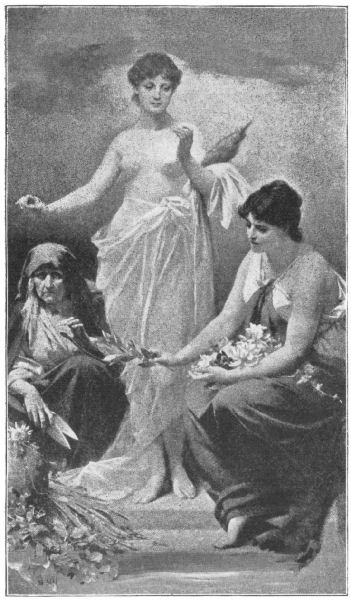
See page 54
The Fates
57]
Fruits, see Ceres, and Pomona.
Funerals, see Libitina, and Manes.
Furies, The, were the three daughters of Acheron
and Nox. They were the punishers of evil-doers.
Their names were Tisiphone, Megaera,
and Alecto, and were supposed to personify
rage, slaughter, and envy.
Futurity, see Cassandra.
Gabriel (Ga′briel), in Jewish mythology is the prince of fire
and thunder, and the angel of death to the
favored people of God.
Galataea (Galatae′a). A sea nymph. Polyphemus, one of
the Cyclops, loved her, but she disdained his
attentions and became the lover of Acis, a
Sicilian shepherd.
Gallantes (Gallan′tes), madmen, from Galli (which see).
Galli (Gal′li) were priests of Cybele who used to cut
their arms with knives when they sacrificed,
and acted so like madmen that demented
people got the name of Gallantes.
Ganesa (Gan′esa). The Indian Mercury. The god of
wisdom and prudence.
Ganga. One of the three Indian river goddesses.
Ganymede, a beautiful Phrygian youth, son of
Tros, King of Troy. He succeeded Hebe in
the office of cup-bearer to Jupiter. He is
generally represented sitting on the back of
a flying eagle.
Gardens, see Pomona (goddess of fruit-trees).
58]
Gates, see Janus.
Gautama (Gau′tama) (Buddha). The chief deity of Burmah.
Genii were domestic divinities. Every man was
supposed to have two of these genii accompanying
him; one brought him happiness,
the other misery.
Genitor (Gen′itor). A Lycian name of Jupiter.
Geometry, see Mercury.
Geryon (Ge′ryon) was a triple-bodied monster who lived
at Gades, where his numerous flocks were
guarded by Orthos, a two-headed dog, and
by Eurythion, a seven-headed dragon. These
guardians were destroyed by Hercules, and
the cattle taken away.
Gimlet, see Daedalus.
Girdle, see Cestus (Venus’s).
Glaucus (Glau′cus) was a fisherman who became a sea-god
through eating a sea-weed, which he thought
invigorated the fishes and might strengthen
him.
Glaukopis (Glauko′pis). A name given to Minerva, because
she had blue eyes.
Gnomes (Gno′mes), a name given by Plato to the invisible
deities who were supposed to inhabit the
earth.
Gnossis (Gnos′sis), a name given to Ariadne, from the city
of Gnossus, in Crete.
Goat, see Iphigenia, Mendes, and Venus.
Goat’s Feet, see Capripedes.
59]
Golden Apple, see Atalanta.
Golden Fleece, The, was a ram’s hide, sometimes
described as white, and at other times as purple
and golden. It was given to Phryxus, who
carried it to Colchis, where King Aeetes entertained
Phryxus, and the hide was hung up
in the grove of Mars. Jason and forty-nine
companions fetched back the golden fleece.
See Argonauts.
Gopya (Gopy′a). Indian mythological nymphs.
Gorgons, The (Gor′gons), were three sisters, named Stheno,
Euryale, and Medusa. They petrified every
one they looked at. Instead of hair their
heads were covered with vipers. Perseus
conquered them, and cut off the head of
Medusa, which was placed on the shield of
Minerva, and all who fixed their eyes thereon
were turned into stone.
Graces, The, were the attendants of Venus.
Their names were, Aglaia, so called from her
beauty and goodness; Thalia, from her perpetual
freshness; and Euphrosyne, from her
cheerfulness. They are generally depicted
as three cheerful maidens with hands joined,
and either nude or only wearing transparent
robes—the idea being that kindnesses, as personified
by the Graces, should be done with
sincerity and candor, and without disguise.
They were supposed to teach the duties of
gratitude and friendship, and they promoted
love and harmony among mankind.
60]
Graces (fourth), see Pasithea.
Gradivus (Grad′ivus). A name given to Mars by the Romans.
It meant the warrior who defended
the city against all external enemies.
Gragus (Gra′gus). The name by which Jupiter was worshiped
in Lycia.
Granaries, see Tutelina.
Grapsios (Grap′sios). A Lycian name of Jupiter.
Grasshopper, see Tithonus.
Grief, see Niobe.
Hada (Ha′da). The Babylonian Juno.
Hades (Ha′des). The Greek name of Pluto, the god of
hell, the word signifying hidden, dark, and
gloomy; the underworld, or infernal regions;
sometimes written Ades.
Hailstorms, see Nuriel.
Halcyone (Halcy′one) (or Alcyone), one of the Pleiades, was
a daughter of Aeolus.
Halcyons (Halcy′ons) were sea birds, supposed to be the
Greek kingfishers. They made their nests
on the waves, and during the period of incubation
the sea was always calm. Hence the
modern term Halcyon Days.
Hamadryades (Hamadry′ades) were wood-nymphs, who presided
over trees.
Happiness, see Genii.
Haroeris (Haroe′ris). The Egyptian god, whose eyes are
the sun and moon.
61]
Harpies, The (Har′pies), (literally, snatchers, demons of destruction,
or, in the modern sense, extortioners).
They were monsters, half-birds, half-maidens,
having the heads and breasts of
women, the bodies of birds, and the claws
of lions. Their names were Aello, Ocypete,
and Celeno. They were loathsome creatures,
living in filth, and poisoning everything they
came in contact with.
“Such fiends to scourge mankind, so fierce, so fell,
Heaven never summoned from the depth of hell.
A virgin face, with wings and hookèd claws,
Death in their eyes, and famine in their jaws,
While proof to steel their hides and plumes remain
We strike the impenetrable fiends in vain.”
Harpikruti (Harpi′kruti). The Egyptian name of the god
Harpocrates.
Harpocrates (Harpoc′rates), or Horus, an Egyptian god, son
of Osiris and Isis. He was the god of silence
and secrecy. He is usually represented as a
young man, holding a finger of one hand to
his lips (expressive of a command to preserve
silence), while in the other hand he holds a
cornucopia, signifying early vegetation.
Harvest, see Segetia. A Roman divinity, invoked
by the husbandman that the harvest might be
plentiful.
Hawk, see Nysus.
Hazis (Ha′zis). The Syrian war-god.
Health, see Hygeia and Salus.
Heaven, Queen of, (Hea′ven) see Belisama. God of, see
Coelus.
62]
Hebe (He′be), daughter of Zeus (Jupiter) and Hera
(Juno), was the goddess of youth. She was
cup-bearer to Jupiter and the gods, until she
had an awkward fall at a festival, causing her
to alight in an indecent posture, which so displeased
Jupiter that she was deprived of her
office, and Ganymede was appointed in her
stead.
“Wreathed smiles,
Such as hung on Hebe’s cheek,
And love to live in dimples sleek.”
Milton.
“Bright Hebe waits; by Hebe ever young
The whirling wheels are to the chariot hung.”
Pope.
Hecate (Hec′ate). There were two goddesses known by
this name, but the one generally referred to in
modern literature is Hecate, or Proserpine,
the name by which Diana was known in the
infernal regions. In heaven her name was
Luna, and her terrestrial name was Diana.
She was a moon-goddess, and is generally
represented in art with three bodies, standing
back to back, a torch, a sword, and a lance
in each right hand.
Hecuba (Hec′uba). The wife of Priam, king of Troy, and
mother of Paris. Taken captive in the Trojan
war, she fell to the lot of Ulysses after the
destruction of Troy, and was afterwards
changed into a hound.
“What’s Hecuba to him, or he to Hecuba?”
Shakespeare.
Heifer, see Ino.
63]
Helena (Hel′ena) when a child was so beautiful that Theseus
and Perithous stole her, but she was
restored by Castor and Pollux. She became
the wife of Menelaus, king of Sparta, but
eloped with Paris, and thus caused the Trojan
War. After the death of Paris she married
Deiphobus, his brother, and then betrayed
him to Menelaus. She was afterward
tied to a tree and strangled by order of
Polyxo, king of Rhodes.
Heliades, The (He′liades), were the daughters of Sol, and the
sisters of Phaeton, at whose death they were so
sad that they stood mourning till they became
metamorphosed into poplar trees, and their
tears were turned into amber.
Helicon (Hel′icon). A mountain in Boeotia sacred to the
Muses, from which place the fountain Hippocrene
flowed.
“Yet still the doting rhymer dreams,
And sings of Helicon’s bright streams;
But Helicon for all his clatter
Yields only uninspiring water.”
Broom, 1720.
Heliconiades (Helico′niades). A name given to the Muses, from
Mount Helicon.
Heliopolis (Heliop′olis), in Egypt, was the city of the sun.
Helios (He′lios). The Grecian sun-god, or charioteer of
the sun, who went home every evening in a
golden boat which had wings.
Heliotrope (Hel′iotrope). Clytie was turned into this flower by
Apollo. See Clytie.
64]
Helle (Hel′le) was drowned in the sea, into which she fell
from off the back of the golden ram, on which
she and Phryxus were escaping from the oppression
of their stepmother Ino. The episode
gave the name of the Hellespont to the
part of the sea where Helle was drowned, and
it is now called the Dardanelles. She was the
daughter of Athamas and Nephele.
Hellespontiacus (Hellespontia′cus). A title of Priapus.
Hemphta (Hemph′ta). The Egyptian god Jupiter.
Hephaestus (Hephaes′tus). The Greek Vulcan, the smith of the
gods.
Hera (He′ra). The Greek name of Juno.
Heracles (Her′acles) is the same as Hercules.
Hercules (Her′cules) was the son of Jupiter and Alcmena.
The goddess Juno hated him from his birth,
and sent two serpents to kill him, but though
only eight months old he strangled them.
As he got older he was set by his master
Eurystheus what were thought to be twelve
impossible tasks which have long been known
as the “Twelve Labors of Hercules.” They
were:
First, To slay the Nemean Lion.
Second, To destroy the Hydra which infested
the marshes of Lerna.
Third, To bring to Eurystheus the Arcadian
Stag with the golden horns and brazen
hoofs.
Fourth, To bring to his master the Boar of
Erymanthus.
65]
Fifth, To cleanse the stable of King Augeas,
in which 3,000 oxen had been kept for thirty
years, but had never been cleaned out.
Sixth, To destroy the Stymphalides, terrible
carnivorous birds.
Seventh, To capture the Bull which was desolating
Crete.
Eighth, To capture the mares of Diomedes,
which breathed fire from their nostrils, and
ate human flesh.
Ninth, To procure the girdle of Hippolyte,
queen of the Amazons.
Tenth, To bring to Eurystheus the flesh-eating
oxen of Geryon, the monster king of Gades.
Eleventh, To bring away some of the golden
apples from the garden of the Hesperides.
Twelfth, To bring up from Hades the three-headed
dog, Cerberus.
All these tasks he successfully accomplished,
and, besides, he assisted the gods in their
wars with the giants. Several other wonderful
feats are mentioned under other headings,
as Antaeus, Cacus, etc. His death was
brought about through his endeavors to preserve
Deianira from the attacks of Nessus,
the centaur, whom he killed. The centaur,
before he expired, gave his mystic tunic to
Deianira, who in turn gave it to Hercules, and
he put it on, but his doing so brought on an
illness of which he could not be cured. In a
fit of desperation he cast himself into a funeral
pile on Mount Oeta; but Jupiter had him
66]
taken to heaven in a four-horse chariot, and
only the mortal part of Hercules was consumed.
“Let Hercules himself do what he may,
The cat will mew, and dog will have his day.”
Shakespeare.
Herdsmen, see Bubona.
Hermae (Her′mae) were statues of Hermes (Mercury), which
were set up in Athens for boundaries, and as
direction marks for travelers.
Hermanubis (Her′manu′bis), see Anubis.
Hermathenae (Hermathe′nae) were statues of Mercury and Minerva
placed together.
Hermes (Her′mes). A Greek name of the god Mercury.
“Hermes obeys. With golden pinions binds
His flying feet and mounts the western winds.”
Virgil.
Hermione (Hermi′one), daughter of Mars and Venus, who was
turned into a serpent, and allowed to live in
the Elysian Fields. There was another Hermione,
daughter of Menelaus and Helen; she
was betrothed to Orestes, but was carried
away by Pyrrhus, the son of Achilles.
Hero (He′ro). A priestess of Venus, with whom Leander
was so enamored that he swam across the
Hellespont every night to visit her, but at
last was drowned; when Hero saw the fate
of her lover she threw herself into the sea and
was also drowned.
Heroes, see Valhalla.
Hesperides (Hesper′ides). Three daughters of Hesperus, King
67]
of Italy. They were appointed to guard the
golden apples which Juno gave Jupiter on
their wedding day. See Hercules.
Hesperus (Hes′perus), brother of Atlas, was changed into
the evening star.
“To the ocean now I fly,
And those happy climes that lie
Where day never shuts his eye,
Upon the broad fields of the sky:
There I suck the liquid air,
All amidst the gardens fair
Of Hesperus and his daughters three,
That sing about the golden tree.”
Milton.
Hestia (Hes′tia). The Greek name of Vesta, the goddess
of the hearth.
Hieroglyphics (Hierogly′phics), see Mercury.
Highways, see Janus.
Hildur (Hil′dur). The Scandinavian Mars.
Hippia (Hip′pia). A surname of Minerva.
Hippius (Hip′pius). A surname of Neptune.
Hippocampus (Hippocam′pus). The name of Neptune’s favorite
horse, a fabulous marine animal, half horse
and half fish.
Hippocrenides (Hippocre′nides), a name of the Muses, from the
fountain of Hippocrene (the horse fountain),
which was formed by a kick of the winged
horse Pegasus.
Hippolyte (Hippol′yte), queen of the Amazons, daughter of
Mars. Her father gave her a famous girdle,
which Hercules was required to procure (see
68]
Hercules). She was conquered by Hercules,
and given by him in marriage to Theseus.
Hippolytus (Hippol′ytus) was the son of Theseus and Hippolyte;
he was killed by a fall from a chariot, but
was raised to life again by Diana, or, as some
say, by Aesculapius.
Hippona (Hippo′na) was a rural divinity, the goddess of
horses.
History, see Clio and Saga.
Honey, see Aristaeus and Dryads.
Hope, see Pandora.
Horae (Ho′rae) were the daughters of Sol and Chronis, the
goddesses of the seasons.
Horse, see Cyllaros.
Horse Races, see Neptune.
Horses, see Hippona.
Hortensis (Horten′sis), a name of Venus, because she looked
after plants and flowers in gardens.
Horus (Ho′rus). The name of two deities, one Sol, the
Egyptian day god; the other, the son of Osiris
and Isis. See Harpocrates.
Hostilina (Hostil′ina). A rural divinity; goddess of growing
corn.
Hunger, see Erisichthon.
Hunting, see Diana.
Huntsmen, see Pan.
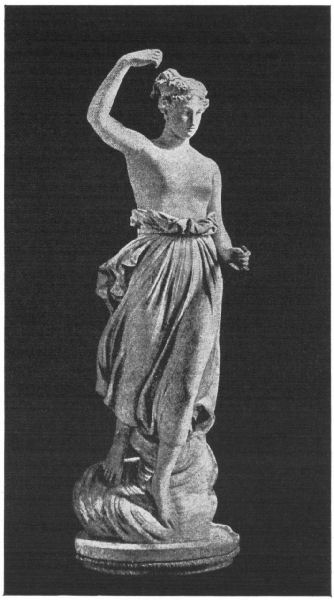
See page 62
Hebe
Hyacinthus (Hyacin′thus) was a boy greatly loved by Apollo;
but he was accidentally slain by him with a
69]
quoit. Apollo caused to spring from his
blood the flower Hyacinth.
Hyades (Hy′ades) were seven daughters of Atlas and
Aethra, and they formed a constellation which,
when it rises with the sun, threatens rain.
Hydra (Hy′dra). A monster serpent, which had a hundred
heads. It was slain by Hercules. See
Hercules.
Hygeia (Hyge′ia), the goddess of health, was a daughter of
Aesculapius and Epione. She was represented
as a young woman giving a serpent
drink out of a saucer, the serpent being
twined round her arm.
Hylas (Hy′las). A beautiful boy beloved by Hercules.
The nymphs were jealous of him, and spirited
him away while he was drawing water for
Hercules. See Wm. Morris’s tragedy, “The
Life and Death of Jason.”
Hymen (Hy′men), the Grecian god of marriage, was either
the son of Bacchus and Venus, or, as some
say, of Apollo and one of the Muses. He was
represented as a handsome youth, holding in
his hand a burning torch.
“Some few there are of sordid mould
Who barter youth and bloom for gold:
But Hymen, gen’rous, just, and kind,
Abhors the mercenary mind;
Such rebels groan beneath his rod,
For Hymen’s a vindictive god.”
Dr. Cotton, 1736.
Hymn, see Paean.
70]
Hyperion (Hype′rion). Son of Coelus and Terra. The model
of manly beauty, synonymous with Apollo.
The personification of the sun.
“So excellent a king; that was to this
Hyperion to a satyr.”
Shakespeare.
Hypermnestra (Hypermnes′tra). One of the fifty daughters of
Danaus, who were collectively called the
Danaides. She was the one who refused to
kill her husband on the wedding night. See
Danaus.
Iacchus (Iac′chus). Another name for Bacchus.
Iapetos (Iap′etos). The father of Atlas. See Japetus.
Iblees (Ib′lees). The Arabian Satan.
Icarus (Ic′arus), son of Daedalus, who with his father
made themselves wings with which to fly from
Crete to escape the resentment of Minos.
The wings were fixed to the shoulders by
wax. Icarus flew too near the sun, and the
heat melting the wax, caused the wings to
drop off, and he fell into the Aegean or Icarian
sea and was drowned.
Ichnobate (Ichnoba′te). One of Actaeon’s hounds; the word
means tracker.
Idaea (Idae′a). A name of Cybele, from Mount Ida, where
she was worshiped.
Idaean Mother (Idae′an Mother). Cybele was sometimes so called,
in Cyprus, in which there is a grove sacred to
Venus.
71]
Idalia (Ida′lia). A name of Venus, from Mount Idalus,
in Cyprus, in which there is a grove sacred to
Venus.
Imperator (Impera′tor) was a name of Jupiter, given to him at
Praeneste.
Inachus (I′nachus) was one of the earliest of the demi-gods
or heroes, King of Argos.
Incendiary, see Erostratus.
Incense, see Venus.
Incubus (In′cubus). A Roman name of Pan, meaning The
Nightmare. See Innus.
Indigetes (Indig′etes) were deified mortals, gods of the fourth
order. They were peculiar to some district.
Indra (In′dra). The Hindoo Jupiter; his wife was Indrant,
who presides over the winds and thunder.
Infants, see Natio.
Innus (In′nus). A name of Pan, the same as Incubus.
Ino (In′o), second wife of Athamas, King of Thebes,
father of Phryxus and Helle. Ino had two
children, who could not ascend the throne
while Phryxus and Helle were alive. Ino
therefore persecuted them to such a degree
that they determined to escape. They did so
on a ram, whose hide became the Golden
Fleece (see Phryxus and Helle). Ino destroyed
herself, and was changed by Neptune
into a sea-goddess.
Inoa (Ino′a) were festivals in memory of Ino.
72]
Instrumental Music, see Euterpe.
Io (I′o) was a daughter of Inachus, and a priestess of
Juno at Argos. Jupiter courted her, and was
detected by Juno, when the god turned Io
into a beautiful heifer. Juno demanded the
beast of Jupiter, and set the hundred-eyed
Argus to watch her. Jupiter persuaded Mercury
to destroy Argus, and Io was set at liberty,
and restored to human shape. Juno
continued her persecutions, and Io had to
wander from place to place till she came to
Egypt, where she became wife of King Osiris,
and won such good opinions from the Egyptians
that after her death she was worshiped
as the goddess Isis.
Iolaus (Iola′us), son of Iphicles, assisted Hercules in conquering
the Hydra, by burning with hot irons
the place where the heads were cut off; and
for his assistance he was restored to youth by
Hebe. Lovers used to go to his monument
at Phocis and ratify their vows of fidelity.
Iothun (Io′thun). Celtic mythological monsters, or giants.
Iphicles (Iph′icles) was twin brother of Hercules, and
father of Iolaus.
Iphigenia (Iphigeni′a) was a daughter of Agamemnon and
Clytemnestra. Agamemnon made a vow to
Diana, which involved the sacrifice of Iphigenia,
but just at the critical moment she
was carried to heaven, and a beautiful goat
was found on the altar in her place.
73]
Iris (I′ris), daughter of Thaumas and Electra, was the
attendant of Juno, and one of the messengers
of the gods. Her duty was to cut the thread
which detained expiring souls. She is the
personification of the rainbow.
Iron, see Vulcan.
Isis (I′sis), wife of Osiris, and a much worshiped
divinity of the Egyptians. See Io.
Itys (I′tys) was killed by his mother Procne when six
years old, and given to his father Tereus,
a Thracian of Daulis, as food. The gods
were so enraged at this that they turned Itys
into a pheasant, Procne into a swallow, and
Tereus into a hawk.
Ixion (Ixi′on), the son of Phlegyas, King of the Lapithae.
For attempting to produce thunder, Jupiter
cast him into hell, and had him bound to a
wheel, surrounded with serpents, which is forever
turning over a river of fire.
“The powers of vengeance, while they hear,
Touched with compassion, drop a tear;
Ixion’s rapid wheel is bound,
Fixed in attention to the sound.”
F. Lewis.
“Or, as Ixion fix’d, the wretch shall feel
The giddy motion of the whirling wheel.”
Pope.
Jani (Ja′ni) was a place in Rome where there were three
statues of Janus, and it was a meeting-place
for usurers and creditors.
Janitor (Ja′nitor). A title of Janus, from the gates before
74]
the doors of private houses being called
Januae.
Janus (Ja′nus). A king of Italy, said to have been the
son of Coelus, others say of Apollo; he sheltered
Saturn when he was driven from heaven
by Jupiter. Janus presided over highways,
gates, and locks, and is usually represented
with two faces, because he was acquainted
with the past and the future; or, according to
others, because he was taken for the sun, who
opens the day at his rising, and shuts it at his
setting. A brazen temple was erected to him
in Rome, which was always open in time of
war, and closed during peace.
“Old Janus, if you please,
Grave two-faced father.”
“In two-faced Janus we this moral find,—
While we look forward, we should glance behind.”
Colman.
Japetus (Jap′etus), son of Coelus and Terra, husband of
Clymene. He was looked upon by the Greeks
as the father of all mankind. See Iapetos.
Jason (Ja′son), the son of Aeson, king of Iolcos; he was
brought up by the centaur Chiron. His uncle
Aeeta sent him to fetch the Golden Fleece from
Colchis (see Argonauts). He went in the
ship Argo with forty-nine companions, the
flower of Greek youth. With the help of
Juno they got safe to Colchis, but the King
Aeetes promised to restore the Golden Fleece
only on condition that the Argonauts
75]
performed certain services. Jason was to tame
the wild fiery bulls, and to make them plow
the field of Mars; to sow in the ground the
teeth of a serpent, from which would spring
armed men who would fight against him who
plowed the field of Mars; to kill the fiery
dragon which guarded the tree on which the
Golden Fleece was hung. The fate of Jason
and the rest of the Argonauts seemed certain;
but Medea, the king’s daughter, fell in love
with Jason, and with the help of charms
which she gave him he overcame all the difficulties
which the king had put in his way.
He took away the Golden Fleece and Medea
also. The king sent his son Absyrtus to overtake
the fugitives, but Medea killed him, and
strewed his limbs in his father’s path, so that
he might be delayed in collecting them, and
this enabled Jason and Medea to escape.
After a time Jason got tired of Medea, and
married Glauce, which cruelty Medea revenged
by killing her children before their
father’s eyes. Jason was accidentally killed
by a beam of the ship Argo falling on him.
Jocasta (Jocas′ta) (otherwise Epicasta), wife of Laius,
King of Thebes, who in after-life married her
own son, Oedipus, not knowing who he was,
and, on discovering the fatal mistake, hanged
herself.
Jove. A very general name of Jupiter.
“From the great father of the gods above
My muse begins, for all is full of Jove.”
Virgil.
76]
Judges in Hell, The, were Rhadamanthus for
Asiatics; Aeacus for Europeans; Minos was
the presiding judge in the infernal regions.
See Triptolemus.
Jugatinus (Jugatin′us) was one of the nuptial deities.
Juno (Ju′no) was the daughter of Saturn and Ops, alias
Cybele. She was married to Jupiter, and
became queen of all the gods and goddesses,
and mistress of heaven and earth. Juno was
the mother of Mars, Vulcan, Hebe, and Lucina.
She prompted the gods to conspire
against Jupiter, but the attempt was frustrated,
and Apollo and Neptune were banished
from heaven by Jupiter. Juno is the
goddess of marriage, and the protectress of
married women; and she had special regard
for virtuous women. In the competition for
the celebrated Golden Apple, which Juno,
Venus, and Minerva each claimed as the fairest
among the goddesses, Juno was much displeased
when Paris gave the apple to Venus.
The goddess is generally represented riding
in a chariot drawn by peacocks, with a diadem
on her head, and a scepter in her hand.
Jupiter (Ju′piter), son of Saturn and Cybele (or Ops), was
born on Mount Ida, in Crete, and nourished
by the goat Amalthaea. When quite young
Jupiter rescued his father from the Titans;
and afterward, with the help of Hercules,
defeated the giants, the sons of earth, when
they made war against heaven. Jupiter was
77]
worshiped with great solemnity under various
names by most of the heathen nations.
The Africans called him Ammon; the Babylonians,
Belus; and the Egyptians, Osiris
(see Jove). He is represented as a majestic
personage seated on a throne, holding in
his hands a scepter and a thunderbolt; at his
feet stood a spread eagle.
Justice, see Astrea, Nemesis.
Kali. A Hindoo goddess, after whom Calicut
is named.
Kaloc (Ka′loc). One of the chief of the Mexican gods.
Kama (Kam′a). The Hindoo god of love.
Kebla (Keb′la). The point of the compass which worshipers
look to during their invocations.
Thus the Sol or Sun worshipers turn to the
east, where the sun rises, and the Mohammedans
turn toward Mecca.
Kederli (Ke′derli), in Mohammedan mythology, is a god
corresponding to the English St. George, and
is still invoked by the Turks when they go to
war.
Kiun (Ki′un). The Egyptian Venus.
Kneph. An Egyptian god, having a ram’s head
and a man’s body.
Krishna (Krish′na). An Indian god, the revenger of
wrongs; also called the Indian Apollo.
Krodo (Kro′do). The Saxon Saturn.
78]
Kumara (Ku′ma′ra). The war-god of the Hindoos.
Kuvera (Ku′vera). The Hindoo god of riches.
Labe (La′be). The Arabian Circe, who had unlimited
power of metamorphosis.
Labor (Lab′or), see Atlas, Hercules.
Labyrinth, see Theseus.
Lachesis (Lach′esis). One of the three goddesses of Fate,
the Parcae. She spun the thread of life.
Lacinia (Lacin′ia). A name of Juno.
Lactura. One of the goddesses of growing corn.
Ladon (La′don). The dragon which guarded the apples
in the garden of the Hesperides. Also the
name of one of Actaeon’s hounds. Also the
river in Arcadia to which Syrinx fled when
pursued by Pan, where she was changed into
a reed, and where Pan made his first pipe.
Laelaps (Lae′laps). One of Diana’s hunting-dogs, which,
while pursuing a wild boar, was petrified.
Also the name of one of Actaeon’s hounds.
Laksmi (Laks′mi) Hindoo goddess of wealth and pleasure.
One of the husbands of Vishnu.
Lamentation, see Cocytus.
Lamia (Lam′ia). An evil deity among the Greeks and
Romans, and the great dread of their children,
whom she had the credit of constantly enticing
away and destroying.
Lamp, see Lares and Penates.
79]
Lampos (Lam′pos). One of Aurora’s chariot horses, the
other being Phaeton.
Laocoon (Laoc′oon). One of the priests of Apollo, who
was, with his two sons, strangled to death by
serpents, because he opposed the admission
of the fatal wooden horse to Troy.
Laomedon (Laom′edon), son of Ilus, a Trojan king. He was
famous for having, with the assistance of
Apollo and Neptune, built the walls of Troy.
Lapis (Lap′is). The oath stone. The Romans used to
swear by Jupiter Lapis.
Lapithus (Lap′ithus), son of Apollo. His numerous children
were called Lapithae, and they are notorious
for their fight with the centaurs at the nuptial
feast of Perithous and Hippodamia.
Lares and Penates (La′res and Pena′tes) were sons of Mercury and
Lara, or, as other mythologists say, of Jupiter
and Lamida. They belonged to the lower
order of Roman gods, and presided over
homes and families. Their statues were generally
fixed within the doors of houses, or near
the hearths. Lamps were sacred to them, as
symbols of vigilance, and the dog was their
sacrifice.
Lark, see Scylla and Nysus.
Latona (Lato′na), daughter of Coelus and Phoebe, mother
of Apollo and Diana. Being admired so
much by Jupiter, Juno was jealous, and
Latona was the object of the goddess’ constant
persecution.
Laughter, see Momus and Venus.
80]
Laurel (Lau′rel), see Daphne.
Laverna (Laver′na). The Roman patroness of thieves.
Law, see Menu.
Lawgiver, see Nomius.
Laws, see Themis.
Leander (Lean′der), see Hero.
Leather Bottle, see Ascolia.
Leda (Le′da) was the mother of Castor and Pollux, their
father being Jupiter, in the shape of a swan.
After her death she received the name of
Nemesis.
Lemnius (Lem′nius). One of the names of Vulcan.
Lemures (Lem′ures). The ghosts of departed souls. Milton,
in his “Ode to the Nativity,” says—
“Lemures moan with midnight plaint.”
They are sometimes referred to as the Manes
of the dead.
Lenaeus (Lenae′us). One of the names of Bacchus.
Lerna (Ler′na). The lake or swamp near Argos where
Hercules conquered the Lernaean Hydra.
Lethe (Le′the). One of the rivers of the infernal regions,
of which the souls of the departed are obliged
to drink to produce oblivion or forgetfulness
of everything they did or knew while alive
on the earth.
“A slow and silent stream,
Lethe, the river of oblivion, rolls
Her watery labyrinth, whereof who drinks
Forthwith his former state and being forgets,
Forgets both joy and grief, pleasure and pain.”
Milton.
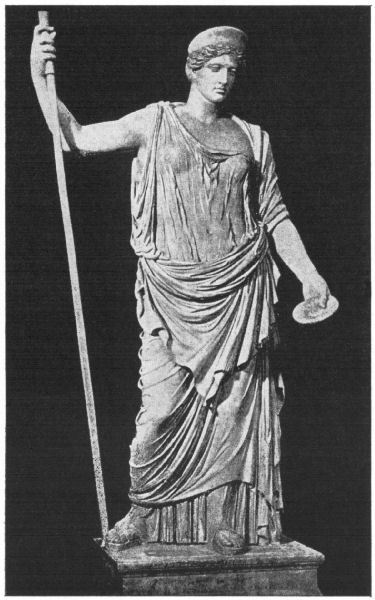
See page 64
Hera
81]
Leucothea (Leucoth′ea). The name of Ino after she was
transformed into a sea nymph.
Levana (Leva′na). The deity who presided over new-born
infants.
Level, The, see Daedalus.
Liakura (Liak′ura). Mount Parnassus.
Liberal Arts, see Minerva.
Liber Pater (Li′ber Pa′ter). A name of Bacchus.
Liberty, see Bacchus.
Libissa (Lib′issa). Queen of fays and fairies.
Libitina (Libiti′na). A Roman goddess, the chief of the
funeral deities.
Licentiousness, see Belphegor.
Ligea (Lige′a). A Greek syren or sea-nymph, one of the
Nereides.
Lightning, see Agni.
Lilith (Li′lith). A Jewish myth representing a finely
dressed woman who is a great enemy to new-born
children. She was said to have been
Adam’s first wife, but, refusing to submit to
him, was turned from Paradise and made a
specter.
Lina (Li′na). The goddess of the art of weaving.
Lindor (Lin′dor). A lover in the shape of a shepherd, like
Corydon; a love-sick swain.
Lion, see Atalanta, Chimaera.
Liver, see Tityus and Prometheus.
Locks, see Janus.
82]
Lofen (Lo′fen). The Scandinavian god who guards
friendship.
Lofua (Lof′ua). The Scandinavian goddess who reconciles
lovers.
Loke. The Scandinavian Satan, the god of
strife, the spirit of evil. Written also Lok,
and Loki.
Lotis (Lo′tis). A daughter of Neptune, who fled from
Priapus, and only escaped from him by being
transformed into a lotus-plant.
Lotus-Plant (Lo′tus-Plant), see Lotis.
Love, see Cupid, Eros, Venus.
Lucian (Lu′cian). The impersonation of folly, changed
into an ass.
Lucifer (Lu′cifer). The morning star.
Lucina (Luci′na). The goddess who presides at the birth
of children. She was a daughter of Jupiter
and Juno, or, according to others, of Latona.
“Lucina, hail! So named from thine own grove,
Or from the light thou giv’st us from above.”
Ovid.
Lud. In ancient British mythology the king of
the Britons. He is said to have given his
name to London.
Luna (Lu′na). The name of Diana as a celestial divinity.
See Diana and Hecate. Also, the Italian
goddess of the moon.
Lupercus (Lu′percus), or Pan. The Roman god of fertility;
his festival day was 15th February, and the
festivals were called Lupercalia.
83]
Lycaonian Food (Lycaon′ian). Execrable viands, such as
were supplied to Jupiter by Lycaon. To test
the divine knowledge of the god he served up
human flesh, which Jove discovered, and punished
Lycaon by turning him into a wolf.
Lycian Clowns were turned into frogs by Latona
or Ceres.
Lymniades (Lymni′ades). Nymphs who resided in marshes.
Lynceus (Lyn′ceus). One of the Argonauts. The personification
of sharpsightedness.
Lyre. This musical instrument is constantly associated
with the doings of the ancient deities.
Amphion built the walls of Thebes by the
music of his lyre. Arion charmed the dolphins
in a similar way. Hercules broke the
head of Linus, his music-master, with the
lyre he was learning to use; and Orpheus
charmed the most savage beasts, and even
the Harpies and gods of the infernal regions,
with the enchanting music of the stringed
lyre. See Mercury.
Maenades (Maen′ades). Priestesses of Bacchus.
Magicians, see Telchines.
Magna Dea (Mag′na De′a), a name of Ceres.
Magpies, see Pierides.
Mahasoor (Ma′ha′soor). The Hindoo god of evil.
Maia (Ma′ia). The mother of the Grecian Mercury.
Mammon (Mam′mon). The money god.
84]
Manes (Ma′nes). The souls of the departed. The Roman
god of funerals and tombs.
“All have their Manes, and their Manes bear.
The few who’re cleansed to those abodes repair,
And breathe in ample fields the soft Elysian air.”
Manuring Land, see Picumnus.
March 24, Bellona’s Day. See Bellona.
Marina (Mari′na). A name of Venus, meaning sea-foam,
from her having been formed from the froth
of the sea. See Aphrodite.
Marriage, see Cama, Hymen, Juno, Jugatinus.
Mars, the god of war, was the son of Jupiter and
Juno. Venus was his favorite goddess, and
among their children were Cupid, Anteros,
and Harmonia. In the Trojan War Mars took
the part of the Trojans, but was defeated by
Diomedes. The first month of the old Roman
year (our March) was sacred to Mars.
Marshes, see Lymniades.
Marsyas (Mar′syas). The name of the piper who challenged
Apollo to a musical contest, and, being defeated,
was flayed to death by the god. He
was the supposed inventor of the flute.
Marut (Ma′rut). The Hindoo god of tempestuous winds.
Matura (Matu′ra). One of the rural deities who protected
the growing corn at time of ripening.
Maximus (Max′imus). One of the appellations of Jupiter,
being the greatest of the gods.
Measures and Weights, see Mercury.
85]
Medea (Mede′a). Wife of Jason, chief of the Argonauts.
To punish her husband for infidelity, Medea
killed two of her children in their father’s
presence. She was a great sorceress. See
Jason.
“Now to Medaea’s dragons fix my reins.”
F. Lewis.
“Let not Medea draw her murdering knife,
And spill her children’s blood upon the stage.”
Lord Roscommon.
Medicine, see Apollo.
Meditation, see Harpocrates.
Medusa (Medu′sa). One of the Gorgons. Minerva changed
her beautiful hair into serpents. She was
conquered by Perseus, who cut off her head,
and placed it on Minerva’s shield. Every
one who looked at the head was turned into
stone.
Ulysses, in the Odyssey, relates that he
wished to see more of the inhabitants of
Hades, but was afraid, as he says—
“Lest Gorgon, rising from the infernal lakes,
With horrors armed, and curls of hissing snakes,
Should fix me, stiffened at the monstrous sight,
A stony image in eternal night.”
Pope.
“Medusa with Gorgonian terror guards
The ford.”
Milton.
“Remove that horrid monster, and take hence
Medusa’s petrifying countenance.”
Addison.
86]
Megaera (Meg′aera). One of the three Furies—Greek goddesses
of vengeance.
Megale (Meg′ale). A Greek name of Juno, meaning great.
Melicerta (Melicer′ta), see Palaemon.
Mellona (Mello′na). One of the rural divinities, the goddess
of bees.
Melpomene (Melpom′ene). One of the nine Muses, the goddess
of tragedy.
Memnon (Mem′non), son of Tithonus and of Eos, who after
the death of Hector brought the Aethiopians
to the assistance of Priam in the war against
Troy.
Memory, see Mnemosyne.
Mendes (Men′des). An Egyptian god like Pan. He was
worshiped in the form of a goat.
Menelaus (Menela′us). A Spartan king, brother of Agamemnon.
The elopement of his wife Helen
with Paris was the cause of the siege of Troy.
See Helena.
Menu (Me′nu), or Manu (Ma′nu). The Hindoo law-giver. See
Satyavrata.
Merchants, see Mercury.
Mercury (Mer′cury), the son of Jupiter and Maia, was the
messenger of the gods, and the conductor of
the souls of the dead to Hades. He was the
supposed inventor of weights and measures,
and presided over orators and merchants.
Mercury was accounted a most cunning thief,
for he stole the bow and quiver of Apollo, the
87]
girdle of Venus, the trident of Neptune, the
tools of Vulcan, and the sword of Mars, and
he was therefore called the god of thieves.
He is the supposed inventor of the lyre, which
he exchanged with Apollo for the Caduceus.
There was also an Egyptian Mercury under
the name of Thoth, or Thaut, who is credited
with having taught the Egyptians geometry
and hieroglyphics. Hermes is the Greek
name of Mercury. In art he is usually represented
as having on a winged cap, and with
wings on his heels.
“And there, without the power to fly,
Stands fix’d a tip-toe Mercury.”
Lloyd, 1750.
“Then fiery expedition be my wing,
Jove’s Mercury, and herald for a king.”
“Be Mercury, set feathers to thy heels
And fly, like thought, from them to me again.”
Shakespeare.
Meru (Me′ru). The abode of the Hindoo god Vishnu.
It is at the top of a mountain 8,000 leagues
high. The Olympus of the East Indians.
Midas (Mi′das). A king of Phrygia, who begged of Bacchus
the special gift that everything that he
touched might be turned into gold. The request
was granted, and as soon as he touched
his food it also was turned to gold, and for
fear of being starved he was compelled to
ask the god to withdraw the power he had
bestowed upon him. He was told to bathe in
the river Pactolus. He did so, and the sands
88]
which he stood on were golden forever after.
It was this same king who, being appointed to
be judge in a musical contest between Apollo
and Pan, gave the satyr the palm; whereupon
Apollo, to show his contempt, bestowed on him
a pair of asses’ ears. This gave rise to the
term “Midas-eared” as a synonym for ill-judged,
or indiscriminate.
“He dug a hole, and in it whispering said,
What monstrous ears sprout from King Midas’ head.”
Ovid.
Milo (Mi′lo), a celebrated Croton athlete, who is said to
have felled an ox with his fist, and to have
eaten the beast in one day. His statue is
often seen with one hand in the rift of a tree
trunk, out of which he is vainly trying to
withdraw it. The fable is, that when he got
to be an old man he attempted to split an oak
tree, but having lost his youthful vigor, the
tree closed on his hand and he was held a
prisoner till the wolves came and devoured
him.
Mimallones (Mimallo′nes). The “wild women” who accompanied
Bacchus, so called because they mimicked
his actions, putting horns on their heads
when they took part in his orgies.
Mimir (Mi′mir). In Scandinavian mythology the god of
wisdom.
Mind, see Erinnys.
Minerva (Miner′va), the goddess of wisdom, war, and the
liberal arts, is said to have sprung from the
89]
head of Jupiter fully armed for battle. She
was a great benefactress of mankind, and
patroness of the fine arts. She was the tutelar
deity of the city of Athens. She is also
known by the names of Pallas, Parthenos,
Tritonia, and Glaukopis. She was very generally
worshiped by the ancients, and her
temple at Athens, the Parthenon, still remains.
She is represented in statues and
pictures as wearing a golden helmet encircled
with an olive branch, and a breastplate. In
her right hand she carries a lance, and by her
side is the famous aegis or shield, covered
with the skin of Amalthaea, the goat which
nourished Jupiter; and for the boss of the
shield is the head of Medusa. An owl, the
emblem of meditation, is on the left; and a
cock, the emblem of courage, on the right.
The Elgin Marbles in the British Museum,
London, were brought from the Parthenon,
her temple at Athens.
Minos (Mi′nos). The supreme of the three judges of
hell, before whom the spirits of the departed
appeared and heard their doom.
Minotaur (Min′otaur). The monster, half man, half bull,
which Theseus slew.
Mirth, see Momus.
Misery, see Genii.
Mithras (Mith′ras). A Persian divinity, the ruler of the
universe, corresponding with the Roman Sol.
90]
Mnemosyne (Mnemos′yne). Mother of the Muses and goddess
of memory. Jupiter courted the goddess in
the guise of a shepherd.
Moakibat (Moak′ibat). The recording angel of the Mohammedans.
Moloch (Mo′loch). A god of the Phoenicians to whom human
victims, principally children, were sacrificed.
Moloch is figurative of the influence
which impels us to sacrifice that which we
ought to cherish most dearly.
“First Moloch, horrid king, besmeared with blood
Of human sacrifice, and parents’ tears,
Though for the noise of drums and timbrels loud,
Their children’s cries unheard, that poured through fire
To this grim idol.”
Milton.
Momus (Mo′mus). The god of mockery and blame. The
god who blamed Jove for not having made a
window in man’s breast, so that his thoughts
could be seen. His bitter jests occasioned
his being driven from heaven in disgrace.
He is represented as holding an image of
Folly in one hand, and raising a mask from
his face with the other. He is also described
as the god of mirth or laughter.
Moneta (Mone′ta). A name given to Juno by those writers
who considered her the goddess of money.
Money, see Moneta.
Money-God, see Mammon.
Moon. The moon was, by the ancients, called
Hecate before and after setting; Astarte
91]
when in crescent form; Diana when in full.
See Luna.
“Soon as the evening shades prevail
The moon takes up her wondrous tale,
And nightly to the list’ning earth
Repeats the story of her birth.”
Addison.
Morpheus (Mor′pheus). The Greek god of sleep and dreams,
the son and minister of Somnus.
“Morpheus, the humble god that dwells
In cottages and smoky cells;
Hates gilded roofs and beds of down,
And though he fears no prince’s frown,
Flies from the circle of a crown.”
Sir John Denman.
Mors. Death, a daughter of Nox (Night).
Mountain, see Atlas, Nymph.
Mulciber (Mul′ciber). A name of Vulcan, sometimes spelled
Mulcifer, the smelter of metals. See Vulcan.
Munin (Mun′in). The Scandinavian god of memory, represented
by the raven that was perched on
Odin’s shoulder.
Muscarius (Musca′rius). A name given to Jupiter because he
kept off the flies from the sacrifices.
Muses, The (Mu′ses), were nine daughters of Jupiter and
Mnemosyne. They presided over the arts
and sciences, music and poetry. Their
names were, Calliope, Clio, Erato, Thalia,
Melpomene, Terpsichore, Euterpe, Polyhymnia,
and Urania. They principally resided
in Mount Parnassus, at Helicon.
“Be thou the tenth Muse, ten times more in worth,
Than those old nine which rhymers advocate.”
Shakespeare.
92]
Music, see Apollo, Muses.
Mythras (My′thras). The Egyptian name of Apollo.
Naiads, The (Nai′ads), were beautiful nymphs of human
form who presided over springs, fountains,
and wells. They resided in the meadows by
the sides of rivers. Virgil mentions Aegle as
being the fairest of the Naiades.
Nandi (Nan′di). The Hindoo goddess of joy.
Narrae (Nar′rae). The name of the infernal regions amongst
the Hindoos.
Narayan (Na′ra′yan). The mover of the waters. The Hindoo
god of tides.
Narcissus (Narcis′sus), son of Cephisus and the Naiad Liriope,
was a beautiful youth, who was so pleased
with the reflection of himself which he saw
in the placid water of a fountain that he
could not help loving it, imagining that it
must be some beautiful nymph. His fruitless
endeavors to possess himself of the supposed
nymph drove him to despair, and he killed
himself. There sprang from his blood a
flower, which was named after him, Narcissus.
“Narcissus so himself forsook,
And died to kiss his shadow in the brook.”
“Hadst thou Narcissus in thy face, to me
Thou wouldst appear most ugly.”
Shakespeare.
Nastrond (Nas′trond). The Scandinavian place of eternal
punishment, corresponding with Hades.
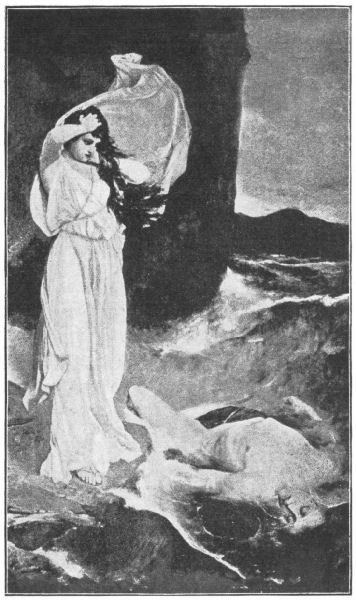
See page 66
Hero and Leander
93]
Natio (Na′tio). A Roman goddess who took care of
young infants.
Nemaean Lion (Nemae′an), see Hercules.
Nemesis (Nem′esis), the goddess of vengeance or justice,
was one of the infernal deities. Her mother
was Nox. She was supposed to be constantly
traveling about the earth in search of wickedness,
which she punished with the greatest
severity. She is referred to by some writers
under the name of Adrasteia. The Romans
always sacrificed to this goddess before they
went to war, because they wished to signify
that they never took up arms but in the cause
of justice.
“Forbear, said Nemesis, my loss to moan,
The fainting, trembling hand was mine alone.”
Dr. J. Wharton.
Nephalia (Nepha′lia). Grecian festivals in honor of Mnemosyne,
the mother of the Muses.
Neptune (Nep′tune), god of the sea, was a son of Saturn and
Cybele, and brother to Jupiter and Pluto.
He quarreled with Jupiter because he did
not consider that the dominion of the sea was
equal to Jupiter’s empire of heaven and
earth; and he was banished from the celestial
regions, after having conspired with Pluto to
dethrone Jupiter. Neptune was married to
Amphitrite, daughter of Oceanus and Tethys,
by whom he had a son named Triton. He
was also father of Polyphemus (one of the
Cyclopes), Phoreus, and Proteus. Neptune
94]
is represented as being seated in a shell chariot,
drawn by dolphins or sea-horses, and
surrounded by Tritons and sea-nymphs. He
holds in his hand a trident, with which he
rules the waves. Though a marine deity, he
was reputed to have presided over horse-training
and horse-races; but he is principally
known as the god of the ocean; and the
two functions of the god are portrayed in the
sea horses with which his chariot is drawn,
the fore-half of the animal being a horse, and
the hind-half a dolphin. Ships were also
under his protection, and whenever he appeared
on the ocean there was a dead calm.
Nereides, The (Nere′ides), were aquatic nymphs. They
were daughters of Nereus and Doris, and were
fifty in number. They are generally represented
as beautiful girls riding on dolphins,
and carrying tridents in the right hand or
garlands of flowers.
Nereus (Nere′us). A sea deity, husband of Doris. He
had the gift of prophecy, and foretold fates;
but he had also the power of assuming various
shapes, which enabled him to escape from
the importunities of those who were anxious
to consult him.
Nessus (Nes′sus). The name of the Centaur that was destroyed
by Hercules for insulting his wife
Deianira. Nessus’s blood-smeared robe
proved fatal to Hercules.
Nestor (Nes′tor). A grandson of Neptune, his father
95]
being Neleus, and his mother Chloris. Homer
makes him one of the greatest of the
Greek heroes. He was present at the famous
battle between the Lapithae and the Centaurs,
and took a leading part in the Trojan war.
“... Here’s Nestor
Instructed by the antiquary times,
He must, he is, he cannot but be wise.”
Shakespeare.
Nicephorus (Niceph′orus). A name of Jupiter, meaning the
bearer of victory.
Nidhogg (Nid′hogg). In Scandinavian mythology the dragon
who dwells in Nastrond.
Niflheim (Nifl′heim). The Scandinavian hell. It was supposed
to consist of nine vast regions of ice
beneath the North Pole, where darkness reigns
eternally. See Nastrond.
Night, see Nox.
Nightingale, see Philomela.
Nightmare, see Incubus.
Nilus (Ni′lus), a king of Thebes, who gave his name to the
Nile, the great Egyptian river.
Nine, The, see Muses.
Niobe (Ni′obe) was a daughter of Tantalus, and is the
personification of grief. By her husband Amphion
she had seven sons and seven daughters.
By the orders of Latona the father and
sons were killed by Apollo, and the daughters
(except Chloris) by Diana. Niobe, being
overwhelmed with grief, escaped further
trouble by being turned into a stone.
96]
Nomius (No′mius). A law-giver; one of the names of Apollo.
This title was also given to Mercury for the
part he took in inventing beneficent laws.
Norns. Three Scandinavian goddesses, who
wove the woof of human destiny. The three
witches in Shakespeare’s “Macbeth” have
their origin in the Scandinavian Norns.
Notus (No′tus). Another name for Auster, the south
wind.
Nox was the daughter of Chaos, and sister of
Erebus and Mors. She personified night,
and was the mother of Nemesis and the
Fates.
Nundina (Nundi′na). The goddess who took charge of children
when they were nine days old—the day
(Nona dies) on which the Romans named
their children.
Nuptialis (Nuptia′lis). A title of Juno. When the goddess
was invoked under this name the gall of the
victim was taken out and thrown behind the
altar, signifying that there should be no gall
(bitterness) or anger between married people.
Nuriel (Nu′riel). In Hebrew mythology the god of hailstorms.
Nyctelius (Nycte′lius). A name given to Bacchus, because
his festivals were celebrated by torchlight.
Nymphs. This was a general name for a class
of inferior female deities who were attendants
of the gods. Some of them presided
over springs, fountains, wells, woods, and
97]
the sea. They are spoken of as land-nymphs
or Naiads, and sea-nymphs or Nereids,
though the former are associated also with
fountains and rivers. The Dryads were forest-nymphs,
and the Hamadryads were
nymphs who lived among the oak-trees—the
oak being always specially venerated by
the ancients. The mountain-nymphs were
called Oreads.
“With flower-inwoven tresses torn,
The nymphs in twilight shade
Of tangled thickets mourn.”
Milton.
Nysae (Ny′sae). The names of the nymphs by whom Bacchus
was nursed. See Dionysius.
Nysaeus (Ny′saeus). A name of Bacchus, because he was
worshiped at Nysa, a town of Aethiopia.
Nysus (Ny′sus). A king of Megara who was invisible by
virtue of a particular lock of hair. This lock
his daughter Scylla cut off, and so betrayed
her father to his enemies. She was changed
into a lark, and the king into a hawk, and he
still pursues his daughter, intending to punish
her for her treachery.
Oannes (Oan′nes). An Eastern (Babylonian) god, represented
as a monster, half-man, half-fish. He
was said to have taught men the use of letters
in the day-time, and at night to have retired
to the depth of the ocean.
Oath, see Lapis.
98]
Obambou (Obam′bou). A devil of African mythology.
Ocean, see Neptune.
Oceanides (Ocean′ides). Sea-nymphs, daughters of Oceanus
and Tethys. Their numbers are variously estimated
by different poets; some saying there
were as many as 3,000, while others say they
were as few as sixteen. The principal of
them are mentioned under their respective
names, as Amphitrite, Doris, Metis, etc.
Oceanus (Oce′anus), son of Coelus and Terra, and husband
of Tethys. Several mythological rivers were
called his sons, as Alpheus, Peneus, etc., and
his daughters were called the Oceanides.
Some of the ancients worshiped him as the
god of the seas, and invariably invoked his
aid when they were about to start on a voyage.
He was also thought to personify the
immense stream which it was supposed surrounded
the earth, and into which the sun
and moon and other heavenly bodies sank
every day.
Ocridion (Ocrid′ion). A king of Rhodes, who was deified
after his death.
Ocypete (Ocy′pete). One of the Harpies, who infected
everything she touched. The word means
swift of flight.
Ocyroe (Ocy′roe). A daughter of Chiron, who had the
gift of prophecy. She was metamorphosed
into a mare.
Odin (O′din). In Scandinavian mythology the god of
99]
the universe, and reputed father of all the
Scandinavian kings. His wife’s name was
Friga, and his two sons were Thor and Balder.
The Wodin of the early German tribes.
Oeagrus (Oe′agrus). King of Thrace, and father of Orpheus.
Oedipus (Oed′ipus). A son of Laius, King of Thebes, best
known as the solver of the famous enigma
propounded by the Sphinx. In solving the
riddle Oedipus unwittingly killed his father,
and, discovering the fact, he destroyed his own
eyesight, and wandered away from Thebes,
attended by his daughter Antigone. Oedipus
is the subject of two famous tragedies by
Sophocles.
Oenone (Oeno′ne). Wife of Paris, a nymph of Mount Ida,
who had the gift of prophecy.
Ogygia (Ogyg′ia). An island, the abode of Calypso, in
the Mediterranean Sea, on which Ulysses was
shipwrecked. It was so beautiful in sylvan
scenery that even Mercury (who dwelt on
Olympus) was charmed with the spot.
Ointment, see Phaon.
Olenus (Ole′nus). A son of Vulcan, who married Lathaea,
a woman who thought herself more beautiful
than the goddesses, and as a punishment she
and her husband were turned into stone
statues.
Olives, see Aristaeus.
Olympius (Olym′pius). A name of Jupiter, from Olympia,
where the god had a splendid temple, which
100]
was considered to be one of the seven wonders
of the world.
Olympus (Olym′pus) was the magnificent mountain on the
coast of Thessaly, 9,000 feet high, where the
gods were supposed to reside. There were
several other smaller mountains of the same
name.
“High heaven with trembling the dread signal took,
And all Olympus to the center shook.”
Pope.
Olyras (Oly′ras). A river near Thermopylae, which, it is
said, attempted to extinguish the funeral
pile on which Hercules was consumed.
Omophagia (Omopha′gia). A Bacchanalian festival at which
some uncooked meats were served.
Omphale (Om′phale). The Queen of Lydia, to whom Hercules
was sold as a bondsman for three years
for the murder of Iphitus. Hercules fell in
love with her, and led an effeminate life in
her society, wearing female apparel, while
Omphale wore the lion’s skin.
Onarus (Ona′rus). A priest of Bacchus, said to have married
Ariadne after she had been abandoned
by Theseus.
Onuva (Onu′va). The Venus of the ancient Gauls.
Opalia (Opa′lia). Roman festivals in honor of Ops, held
on 14th of the calends of January.
Opiate-rod, see Caduceus.
“Eyes ... more wakeful than to drowse,
Charmed with Arcadian pipe—the pastoral reed
Of Hermes or his opiate-rod.”
Milton.
101]
Ops. Mother of the gods, a daughter of Coelus
and Terra. She was known by the several
names of Bona Dea, Rhea, Cybele, Magna
Mater, Proserpine, Tellus, and Thya; and occasionally
she is spoken of as Juno and Minerva.
She personified labor, and is represented
as a comely matron, distributing gifts
with her right hand, and holding in her left
hand a loaf of bread. Her festival was the
14th day of the January calends.
Oracles, see Themis.
Oraea (Orae′a). Certain sacrifices offered to the goddesses
of the seasons to invoke fair weather
for the ripening of the fruits of the earth.
Orbona (Orbo′na). Roman goddess of children, invoked
by mothers when they lost or were in danger
of losing their offspring.
Orchards, see Feronia.
Oreades (O′reades) were mountain nymphs, attendants on
Diana.
Orgies. Drunken revels. The riotous feasts of
Bacchus were so designated.
Orion (Ori′on). A handsome hunter, of great stature, who
was blinded by Oenopion for a grievous wrong
done to Merope, and was therefore expelled
from Chios. The sound of the Cyclops’ hammers
led him to the abode of Vulcan, who gave
him a guide. He then consulted an oracle,
and had his sight restored, as Longfellow
says, by fixing
“His blank eyes upon the sun.”
102]
He was afterward slain by Diana and placed
amongst the stars, where his constellation is
one of the most splendid.
Orithyia (Ori′thy′ia). A daughter of Erechtheus, whose
lover, Boreas, carried her off while she was
wandering by the river Ilissus. Her children
were Zetus and Calais, two winged warriors
who accompanied the Argonauts.
Ormuzd (Or′muzd). In Persian mythology the creator of
all things.
Oros (O′ros). The Egyptian Apollo.
Orphans, see Orbona.
Orpheus (Or′pheus) was son of Apollo and the Muse Calliope.
He was married to Eurydice; but she was
stung by a serpent, and died. Orpheus went
down to Hades to claim her, and played so
sweetly with his lute that Pluto allowed
Eurydice to return to the earth with Orpheus,
but on condition that he did not look
behind him until he had reached the terrestrial
regions. Orpheus, however, in his anxiety
to see if she were following him, looked
round, and Eurydice disappeared from his
sight, instantly and forever.
“Orpheus’ lute was strung with poets’ sinews.”
Shakespeare.
Osiris (Osi′ris). The Egyptian god of the sun, the source
of warmth, life, and fruitfulness; he was
worshiped under the form of a sacred bull,
named Apis.
103]
“... After these appeared
A crew who, under names of old renown,
Osiris, Isis, Orus, and their train,
With monstrous shapes and sorceries abused
Fanatic Egypt and her priests to seek
Their wandering gods, disguised in brutish forms
Rather than human.”
Milton.
Ossa (Os′sa). One of the mountains of Thessaly (once
the residence of the centaurs) which the giants
piled on the top of Mount Pelion to enable
them to ascend to heaven and attack the gods.
Ox, see Apis.
Owl, see Aesculapius and Itys.
Pactolus (Pacto′lus). The river in Lydia where Midas
washed himself by order of Bacchus, and the
sands were turned to gold.
Paean (Pae′an). A name given Apollo, from paean, the
hymn which was sung in his honor after he
had killed the serpent Python. Paeans were
solemn songs, praying either for the averting
of evil and for rescue, or giving thanks for
help vouchsafed.
“With hymns divine the joyous banquet ends,
The Paeans lengthened till the sun descends.”
Pope.
Palaemon (Palae′mon), or Melicerta, a sea-god, son of Athamas
and Ino.
Pales (Pa′les). The goddess of shepherds and sheepfolds
104]
and protectress of flocks; her festivals were
called by the Romans Palilia.
“Pomona loves the orchard,
And Liber loves the wine,
And Pales loves the straw-built shed,
Warm with the breath of kine.”
Macaulay.
“Great Pales help, the pastoral rites I sing,
With humble duty mentioning each thing.”
Pope.
Palladium (Palla′dium). A famous statue of the goddess Pallas
(Minerva). She is sitting with a spear in
her right hand, and in her left a distaff and
spindle. Various accounts are given of the
origin of the statue. Some writers say that
it fell from the skies. It was supposed that
the preservation of the statue would be the
preservation of Troy; and during the Trojan
War the Greeks were greatly encouraged when
they became the possessors of it.
Pallas (Pal′las), or Minerva. The name was given to
Minerva when she destroyed a famous giant
named Pallas. The Greeks called their goddess
of wisdom Pallas Athene. See Minerva.
“Apollo, Pallas, Jove, or Mercury,
Inspire me that I may this treason find.”
Shakespeare.
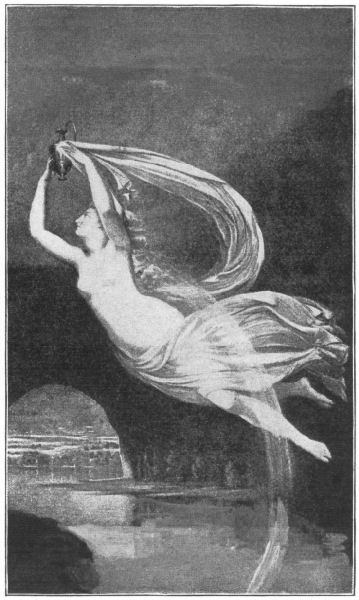
See page 73
Iris
Pan. The Arcadian god of shepherds, huntsmen,
and country folk, and chief of the inferior
deities, is usually considered to have
been the son of Mercury and Penelope. After
105]
his birth he was metamorphosed into the
mythical form in which we find him depicted,
namely, a horned, long-eared man, with the
lower half of the body like a goat. He is
generally seen playing a pipe made of reeds
of various lengths, which he invented himself,
and from which he could produce music
which charmed even the gods. These are
the Pan-pipes, or Syrinx. Pan’s terrific appearance
once so frightened the Gauls when
they invaded Greece that they ran away
though no one pursued them; and the word
panic is said to have been derived from this
episode. The Fauns, who greatly resembled
Pan, were his attendants.
“Piping on their reeds the shepherds go,
Nor fear an ambush, nor suspect a foe.”
Pope.
Pandora (Pando′ra), according to Hesiod, was the first
mortal female. Vulcan made her of clay,
and gave her life. Venus gave her beauty;
and the art of captivating was bestowed upon
her by the Graces. She was taught singing
by Apollo, and Mercury taught her oratory.
Jupiter gave her a box, the famous “Pandora’s
Box,” which she was told to give to her
husband, Epimetheus, brother of Prometheus.
As soon as he opened it there issued from it
numberless diseases and evils which were
soon spread all over the world, and from that
moment they have afflicted the human race.
106]
It is said that Hope alone remained in the
box. Pandora means “the all-gifted.”
“More lovely than Pandora, whom the gods
Endowed with all their gifts.”
Milton.
Pantheon (Panthe′on) (lit. “the all-divine place”). The
temple of all the gods, built by Agrippa at
Rome, in the reign of Augustus (B.C. 27).
It was 144 feet in diameter, and 144 feet high;
and was built in the Corinthian style of architecture,
mostly of marble; while its walls
were covered with engraved brass and silver.
Its magnificence induced Pliny to give it rank
among the wonders of the world.
Paphia (Pa′phia), a name of Venus.
Papremis (Pap′remis). The Egyptian Mars.
Parcae, The (Par′cae), were goddesses who presided over
the destiny of human beings. They were
also called the Fates, and were three in number,
Atropos, Clotho, and Lachesis. See
Fates.
Paris (Par′is), the son of Priam, king of Troy, and of his
mother Hecuba. It had been predicted
that he would be the cause of the destruction
of Troy, and his father therefore ordered him
to be strangled as soon as he was born; but
the slave who had been entrusted with this
mission took the child to Mount Ida, and left
it there. Some shepherds, however, found
the infant and took care of him. He lived
among them till he had grown to man’s
107]
estate, and he then married Oenone, a nymph
of Ida. At the famous nuptial feast of Peleus
and Thetis, Discordia, who had not been invited,
attended secretly; and when all were
assembled, she threw among the goddesses
a golden apple, on which was inscribed “Let
the fairest take it.” This occasioned a great
contention, for each thought herself the fairest.
Ultimately, the contestants were reduced
to three, Juno, Pallas (Minerva), and Venus;
but Jove himself could not make these three
agree, and it was decided that Paris should
be the umpire. He was sent for, and each of
the goddesses courted his favor by offering
all sorts of bribes. Juno offered him power,
Pallas wisdom, and Venus promised him the
most beautiful woman in the world. Paris
gave the golden apple to Venus. Soon after
this episode Priam owned Paris as his son,
and sent him to Greece to fetch Helen, who
was renowned as being the most beautiful
woman in the world. She was the wife of
Menelaus, king of Sparta; but during his absence
Paris carried Helen away to Troy, and
this gave rise to the celebrated war between
the Greeks and the Trojans, which ended in
the destruction of Troy. Paris was among
the 676,000 Trojans who fell during or after
the siege.
Parnassides (Parnas′sides), a name common to the Muses,
from Mount Parnassus.
Parnassus (Parnas′sus). The mountain of the Muses in
108]
Phocis, and sacred to Apollo and Bacchus. Any
one who slept on this mountain became a
poet. It was named after one of the sons of
Bacchus.
Parthenon (Par′thenon). The temple of Minerva (or Pallas)
on the Acropolis at Athens. It was destroyed
by the Persians, and rebuilt by Pericles.
Parthenos (Par′thenos) was a name of Juno, and also of
Minerva. See Pallas.
Pasiphae (Pasiph′ae) was the reputed mother of the Minotaur
killed by Theseus. She was said to be
the daughter of Sol and Perseis, and her
husband was Minos, king of Crete.
Pasithea (Pasith′ea). Sometimes there are four Graces
spoken of; when this is so, the name of the
fourth is Pasithea. Also called Aglaia.
Pavan (Pav′an), the Hindoo god of the winds.
Peace, see Concordia.
Peacock, see Argus.
Pegasus (Peg′asus). The famous winged horse which was
said to have sprung from the blood of Medusa
when her head was cut off by Perseus.
His abode was on Mount Helicon, where, by
striking the ground with his hoof, he caused
water to spring forth, which formed the fountain
afterward called Hippocrene.
“Each spurs his faded
Pegasus apace.”
Byron.
“Thy stumbling founder’d jade can trot as high
As any other Pegasus can fly.”
Earl of Dorset.
109]
“To turn and wind a fiery Pegasus,
And witch the world with noble horsemanship.”
Shakespeare.
Peleus (Pe′leus). A king of Thessaly, who married
Thetis, one of the Nereides. It is said that
he was the only mortal who married an immortal.
Pelias (Pe′lias). A son of Neptune and Tyro. He
usurped the throne of Cretheus, which Jason
was persuaded to relinquish and take the
command of the Argonautic expedition.
On the return of Jason, Medea, the sorceress,
undertook to restore Pelias to youth, but
required that the body should first be cut up
and put in a caldron of boiling water. When
this had been done, Medea refused to fulfil
her promise. Pelias had four daughters,
who were called the Peliades.
Pelias (Pe′lias) was the name of the spear of Achilles,
which was so large that none could wield it
but the hero himself.
Pelion (Pe′lion). A well-wooded mountain, famous for
the wars between the giants and the gods,
and as the abode of the Centaurs, who were
expelled by the Lapithae. See Ossa, a mount,
which the giants piled upon Pelion, to enable
them to scale the heavens.
“The gods they challenge, and affect the skies,
Heaved on Olympus tottering Ossa stood;
On Ossa, Pelion nods with all his wood.”
Pope.
Pelops (Pe′lops), son of Tantalus, king of Phrygia. His
110]
father killed him, and served him up to be
eaten at a feast given to the gods, who, when
they found out what the father of Pelops had
done, restored the son to life, and he afterward
became the husband of Hippodamia.
Penates (Pena′tes). Roman domestic gods. The hearth of
the house was their altar. See Lares.
Perpetual Punishment, see Sisyphus.
Persephone (Perseph′one). The Greek name of Proserpine.
Perseus (Per′seus) was a son of Jupiter and Danae, the
daughter of Acrisius. His first famous exploit
was against the Gorgon, Medusa. He
was assisted in this enterprise by Pluto, who
lent him a helmet which would make him invisible.
Pallas lent him her shield, and Mercury
supplied him with wings. He made a
speedy conquest of the Gorgons, and cut off
Medusa’s head, with which he flew through
the air, and from the blood sprang the
winged horse Pegasus. As he flew along he
saw Andromeda chained to the rock, and a
sea-monster ready to devour her. He killed
the monster, and married Andromeda. When
he got back, he showed the Gorgon’s head to
King Polydectes, and the monarch was immediately
turned into stone.
“Now on Daedalian waxen pinions stray,
Or those which wafted Perseus on his way.”
F. Lewis.
Persuasion, goddess of, see Pitho.
Phaeton (Pha′eton). A son of Sol, or, according to many
111]
mythologists, of Phoebus and Clymene. Anxious
to display his skill in horsemanship,
he was allowed to drive the chariot of the sun
for one day. The horses soon found out the
incapacity of the charioteer, became unmanageable,
and overturned the chariot. There
was such great fear of injury to heaven and
earth, that Jove, to stop the destruction, killed
Phaeton with a thunderbolt.
“Now Phaeton, by lofty hopes possessed,
The burning seat with youthful vigor pressed.”
“The breathless Phaeton, with flaming hair,
Shot from the chariot like a falling star
That in a summer’s evening from the top
Of heaven drops down, or seems at least to drop.”
Addison.
Phaon (Pha′on). A boatman of Mitylene, in Lesbos, who
received from Venus a box of ointment, with
which, when he anointed himself, he grew so
beautiful that Sappho became enamored of
him; but when the ointment had all been used
Phaon returned to his former condition, and
Sappho, in despair, drowned herself.
Pheasant, see Itys.
Philoctetes (Philoct′etes) was son of Poeas, and one of the
companions of Jason on his Argonautic expedition.
He was present at the death of
Hercules, and received from him the poisoned
arrows which had been dipped in the blood
of Hydra. These arrows, an oracle declared,
were necessary to be used in the destruction
of Troy, and Philoctetes was persuaded by
112]
Ulysses to go and assist at the siege. He appears
to have used the weapons with great
dexterity and with wonderful effect, for Paris
was among the heroes whom he killed. The
story of Philoctetes was dramatized by the
Greek tragedians Aeschylus, Euripides, and
Sophocles.
Philomela (Philome′la) was a daughter of Pandion, king of
Athens, who was transformed into a nightingale.
She was sister to Procne, who married
Tereus, King of Thrace. The latter having
offered violence to Philomela, her sister,
Procne, came to her rescue, and to punish her
husband slew her son Itylus, and at a feast
Philomela threw Itylus’s head on the banquet
table.
“Forth like a fury Philomela flew,
And at his face the head of Itys threw.”
Pope.
“And thou, melodious Philomel,
Again thy plaintive story tell.”
Sir Thomas Lyttleton.
Phlegethon (Phleg′ethon). A river of fire in the infernal regions.
It was the picture of desolation, for
nothing could grow on its parched and withered
banks. Also called Pyriphlegethon.
“... Infernal rivers ...
... Fierce Phlegethon,
Whose waves of torrent fire inflame with rage.”
Milton.
Phlegon (Phle′gon) (burning), one of the four chariot horses
of Sol.
113]
Phlegyas (Phle′gyas). Son of Mars and father of Ixion and
Coronis. For his impiety in desecrating and
plundering the temple of Apollo at Delphi, he
was sent to Hades, and there was made to sit
with a huge stone suspended over his head,
ready to be dropped on him at any moment.
Phoebus (Phoe′bus). A name of Apollo, signifying light
and life.
“Gallop apace, you fiery-footed steeds,
Toward Phoebus’ lodging.”
Shakespeare.
Phorcus (Phor′cus), or Porcys. A son of Neptune, father
of the Gorgons. The same as Oceanus.
Phryxus (Phryx′us), see Golden Fleece.
Picumnus (Picum′nus). A rural divinity, who presided over
the manuring of lands, also called Sterentius.
Picus (Pi′cus). A son of Saturn, father of Faunus, was
turned into a woodpecker by Circe, whose
love he had not requited.
Pierides (Pier′ides). A name of the Muses, derived from
Pieria, a fountain in Thessaly, near Mount
Olympus, where they were supposed to have
been born. Also, the daughters of Pierus, a
king of Macedonia, who settled in Boeotia.
They challenged the Muses to sing, and were
changed into magpies.
Pietas (Pie′tas). The Roman goddess of domestic affection.
Pillar, see Calpe.
Pilumnus (Pilum′nus). A rural divinity that presided over
114]
the corn while it was being ground. At Rome
he was hence called the god of bakers.
Pine-Tree, see Atys.
Pirithous (Pirith′ous). A son of Ixion and great friend of
Theseus, king of Athens. The marriage of
Pirithous and Hippodamia became famous for
the quarrel between the drunken Centaurs
and the Lapithae, who, with the help of Theseus,
Pirithous, and Hercules, attacked and
overcame the Centaurs, many of whom were
killed, and the remainder took to flight.
Pitho (Pi′tho), the goddess of Persuasion, daughter of
Mercury and Venus. She is sometimes referred
to under the name of Suada.
Plants, see Demogorgon.
Pleasure, see Rembha.
Pleiades, The (Plei′ades). Seven daughters of Atlas and
Pleione. Their names were Electra, Alcyone,
Celaeno, Maia, Sterope, Taygete, and
Merope. They were made a constellation,
but as there are only six stars to be seen, the
ancients believed that one of the sisters,
Merope, married a mortal, and was ashamed
to show herself among her sisters, who had
all been married to gods.
“... The gray
Dawn and the Pleiades before him danced.
Shedding sweet influence.”
Milton.
Pluto (Plu′to). King of the infernal regions. He was a
son of Saturn and Ops, and husband of
115]
Proserpine, daughter of Ceres. He is sometimes
referred to under the name Dis, and he personifies
hell. His principal attendant was the
three-headed dog Cerberus, and about his
throne were the Eumenides, the Harpies, and
the Furies.
“With equal foot, rich friend, impartial fate
Knocks at the cottage and the palace gate.
. . . . .
Night soon will seize, and you must go below,
To story’d ghosts and Pluto’s house below.”
Creech.
Plutus (Plu′tus), the god of riches, was son of Jasion or
Iasius and Ceres (Demeter), the goddess of
corn. He is described as being blind and
lame; blind because he so often injudiciously
bestows his riches, and lame because fortunes
come so slowly.
Pluvius (Plu′vius). A name of Jupiter, because he had
the rain in his control.
Podalirius (Podalir′ius). A famous surgeon, a son of Aesculapius
and Epione. His skill in medicine made
him very serviceable among the soldiers in the
Trojan war.
Poet, see Parnassus.
Poetry, see Apollo, Calliope, The Muses.
Poisonous Herbs, see Circe.
Poisonous Lake, see Avernus.
Pollear (Poll′ear). Son of Siva, the Hindoo god of wisdom.
116]
Pollux (Pol′lux). Twin brother of Castor. Their father
was Jupiter and their mother Leda. He and
his brother form the constellation Gemini.
His Greek name was Polydeuces. Castor and
Pollux are also known under the name of
Dioscuri, the presiding deities of public games
in Rome, Castor being the god of equestrian
exercise, and Pollux the god of boxing. See
Aedepol.
Polybotes (Polybo′tes). One of the giants who made war
against Jupiter. He was killed by Neptune.
Polydectes (Polydec′tes) was turned into stone when Perseus
showed him Medusa’s head. See Perseus.
Polydeuces (Polydeu′ces). The Greek name of Pollux.
Polyhymnia (Polyhym′nia). Daughter of Jupiter and Mnemosyne.
One of the Muses who presided over
singing and rhetoric.
Polyphemus (Polyphe′mus), one of the most celebrated of the
Cyclops, a son of the nymph Thoosa and
Neptune, or Poseidon, as the Greeks called the
god of the sea. He captured Ulysses and
twelve of his companions, and it is said that
six of them were eaten. The remainder escaped
by the ingenuity of Ulysses, who destroyed
Polyphemus’s one eye with a fire-brand.
“Charybdis barks and Polyphemus roars.”
Francis.
Polyxena (Polyx′ena). Daughter of Hecuba and Priam,
king of Troy. It was by her treachery that
Achilles was shot in the heel.
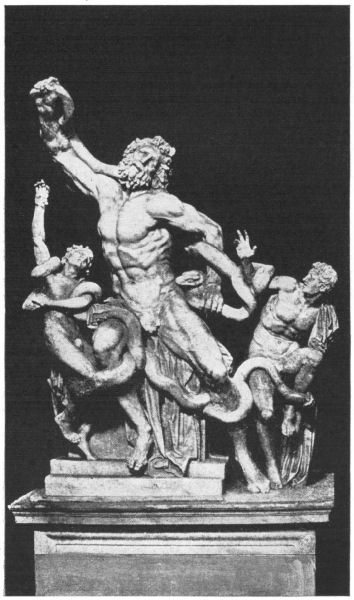
See page 79
Laocoon
117]
Pomona (Pomo′na). The Roman goddess of fruit-trees and
gardens.
“So to the sylvan lodge
They came, that like Pomona’s arbor smiled
With flowerets decked and fragrant smells.”
Milton.
Poplar-Tree, see Heliades.
Portunus (Portu′nus) (Palaemon), son of Ino, was the Roman
god of harbors.
Poseidon (Posei′don). The Greek name of Neptune, god of
the sea.
Pracriti (Prac′riti). The Hindoo goddess of nature.
Predictions, see Cassandra.
Priam (Pri′am). The last king of Troy. See Paris.
Priapus (Pria′pus), the guardian of gardens and god of
natural reproduction, was the son of Venus
and Bacchus.
“Priapus could not half describe the grace
(Though god of gardens) of this charming place.”
Pope.
Prisca (Pris′ca). Another name of Vesta.
Procris (Pro′cris). Daughter of Erechtheus, king of
Athens. See Cephalus, her husband.
Progne (Prog′ne), wife of Tereus. Commonly called
Procne, whose sister was Philomela. See
Itys and Tereus.
“Complaining oft gives respite to our grief,
From hence the wretched Progne sought relief.”
F. Lewis.
Prometheus (Prome′theus), the son of Japetus and father of
Deucalion. He presumed to make clay men,
and animate them with fire which he had
118]
stolen from heaven. This so displeased Jupiter
that he sent him a box full of evils,
which Prometheus refused; but his brother
Epimetheus, not so cautious, opened it, and
the evils spread over all the earth. Jupiter
then punished Prometheus by commanding
Mercury to bind him to Mount Caucasus,
where a vulture daily preyed upon his liver,
which grew in the night as much as it had
been reduced in the day, so that the punishment
was a prolonged torture. Hercules at
last killed the vulture and set Prometheus free.
Prophecy, see Nereus.
Proserpine (Proser′pine). A daughter of Jupiter and Ceres.
Pluto carried her off to the infernal regions
and made her his wife. She was known by
the names of “the Queen of Hell,” Hecate,
Juno Inferna, and Libitina. She was called
by the Greeks Persephone.
“He sung, and hell consented
To hear the poet’s prayer,
Stern Proserpine relented,
And gave him back the fair.”
F. Lewis.
Proteus (Pro′teus). A marine deity, who could foretell
events and convert himself at will into all
sorts of shapes. According to later legends,
Proteus was a son of Poseidon.
“The changeful Proteus, whose prophetic mind,
The secret cause of Bacchus’ rage divined.”
The Lusiad.
“What chain can hold this varying Proteus fast?”
Budgell.
119]
Psyche (Psy′che). The wife of Cupid. The name is
Greek, signifying the soul or spirit.
Pygmalion (Pygma′lion). A famous sculptor who had resolved
to remain unmarried, but he made
such a beautiful statue of a goddess that he
begged Venus to give it life. His request
being granted, Pygmalion married the animated
statue.
“Few, like Pygmalion, doat on lifeless charms,
Or care to clasp a statue in their arms.”
Pylades (Py′lades). The son of Strophius, King of Phanote,
and husband of Electra; famous on account
of his faithful friendship with Orestes.
“His wine
Was better, Pylades, than thine.
... If you please
To choose me for your Pylades.”
F. Lewis.
Pylotis (Pylo′tis). A Greek name of Minerva.
Pyracmon (Pyr′acmon), one of the chiefs of the Cyclopes.
Pyramus and Thisbe (Pyr′amus and This′be). Two Babylonian lovers,
the children of hostile neighbors. See Shakespeare’s
burlesque of the story of their loves,
in “Midsummer Night’s Dream.”
Pyrois (Py′rois) (luminous). One of the four chariot
horses of Sol, the Sun.
Pythia (Py′thia). The priestess of Apollo at Delphi, who
delivered the answers of the oracle. Also the
name of the Pythian games celebrated in
honor of Apollo’s victory over the dragon
Python.
120]
Python (Py′thon). A famous serpent killed by Apollo,
which haunted the caves of Parnassus. See
Septerion.
Quadratus (Quadra′tus). A surname given to Mercury, because
some of his statues were four-sided.
Quadrifrons (Quad′rifrons). Janus was sometimes depicted with
four faces instead of the usual two, and he was
then called Janus Quadrifrons.
Quies (Qui′es). The Roman goddess of rest; she had a
temple just outside the Colline gate of Rome.
Quietus (Quie′tus). One of the names of Pluto.
Quirinus (Quiri′nus). A name given to Mars during wartime;
Virgil refers to Jupiter under the same
name.
Quoit, see Hyacinthus.
Race, see Atalanta.
Radamanthus (Radaman′thus), see Rhadamanthus.
Rage, see Furies.
Rainbow, see Iris.
Rama (Ra′ma). A Hindoo god, who was the terrestrial
representative of Vishnu.
Ram’s Hide, see Golden Fleece.
Reeds, see Pan, also Syrinx.
Rembha (Rem′bha). The Hindoo goddess of pleasure.
Reproduction, see Priapus.
Rest, see Quies.
Revenge, see Ate.
121]
Rhadamanthus (Rhadaman′thus), a son of Jupiter and Europa, was
the ruler of the Greeks in the Asiatic islands,
and judge of the dead in the infernal regions.
“These are the realms of unrelenting fate:
And awful Rhadamanthus rules the state.
He hears and judges each committed crime,
Inquires into the manner, place, and time;
The conscious wretch must all his acts reveal,
Loth to confess, unable to conceal;
From the first moment of his vital breath,
To the last hour of unrepenting death.”
Dryden.
Rhamnusia (Rhamnu′sia). A name of Nemesis, from Rhamnus,
a town in Attica, where she had a temple
in which was her statue, made of one stone
ten cubits high.
Rhea (Rhe′a). The Greek name of Cybele. She was a
daughter of Uranus and Gaea, and was called
Mother of the gods.
Rhetoric, see Calliope, also Polyhymnia.
Riches, see Plutus.
Riddle, see Sphinx.
Rimmon (Rim′mon). A Phrygian god of whom Milton
says—
“... Rimmon, whose delightful seat
Was fair Damascus, on the fertile banks
Of Abana and Pharpar, lucid streams.”
Riot, see Saturnalia.
River of Fire, see Phlegethon.
Roads, see Vialis.
Robber, see Cacus, Coeculus.
122]
Romulus (Rom′ulus). The traditional founder of Rome.
He was a son of Mars and Ilia, and twin
brother of Remus. The infants were thrown
into the Tiber, but were miraculously saved
and suckled by a she-wolf, till they were
found by Faustulus, a shepherd, who brought
them up. Remus was killed in a quarrel
with his brother, and Romulus became the
first King of Rome.
Rumia Dea (Rumi′a Dea). The Roman goddess of babes in
arms.
Rumina (Ru′mina). Roman pastoral deities, who protected
suckling cattle.
Runcina (Runci′na). The goddess of weeding or cleansing
the ground.
Sacrifices were ceremonious offerings made to
the gods. To every deity a distinct victim
was allotted, and the greatest care was always
taken in the selection of them. Anything
in any way blemished was considered
as an insult to the god. At the time of the
sacrifice the people were called together by
heralds led by a procession of musicians.
The priest, clothed in white, was crowned
with a wreath made of the leaves of the tree
which was sacred to the particular god to
whom the sacrifice was offered. The victim
had its horns gilt, and was adorned with a
chaplet similar to that of the priest, and was
decorated with bright-colored ribbons. The
123]
priest then said, “Who is here?” to which
the spectators replied, “Many good people.”
“Begone all ye who are profane,” said the
priest; and he then began a prayer addressed
to all the gods. The sacrifice was begun by
putting corn, frankincense, flour, salt, cakes,
and fruit on the head of the victim. This
was called the Immolation. The priest then
took a cup of wine, tasted it, and handed it
to the bystanders to taste also; some of it
was then poured between the horns of the
victim, and a few of the saturated hairs were
pulled off and put in the fire which was burning
on the altar. Then, turning to the east,
the priest drew with his knife a crooked line
along the back of the beast from the head to
the tail, and told the assistants to kill the
animal. This was done directly, and the entrails
of the victim taken out and carefully
examined by the Haruspices to find out what
was prognosticated. The carcase was then
divided, and the thighs, covered with fat,
were put in the fire, and the rest of the animal
was cut up, cooked, and eaten. This
feast was celebrated with dancing, music,
and hymns, in praise of the god in whose
honor the sacrifice was made. On great occasions
as many as a hundred bullocks were
offered at one time; and it is said that Pythagoras
made this offering when he found out
the demonstration of the forty-seventh proposition
of the book of Euclid.
124]
Saga (Sa′ga). The Scandinavian goddess of history.
The word means a saw or saying; hence
Sagas, which embody Scandinavian legends,
and heroic or mythical traditions.
Sagittarius (Sagitta′rius), see Chiron.
Sails, see Daedalus.
Salamanders (Sal′aman′ders). The genii who, according to
Plato, lived in fire.
“The spirits of fiery termagants in flame,
Mount up and take a Salamander’s name.”
Pope.
Salatia (Sala′tia), or Salacia, a Roman goddess of the salt
water. See Amphitrite.
Salii (Sal′ii). The priests of Mars who had charge of
the sacred shields.
Salmoneus (Salmo′neus). A king of Elis who, for trying to
imitate Jupiter’s thunders, was sent by the
god straight to the infernal regions.
Salus (Sa′lus). The Roman goddess of health.
Sappho (Sap′pho), a celebrated poetess, a native of Lesbos,
who flourished in the seventh century B.C.
Her only connection with the goddesses of the
time is that the Greeks called her “The tenth
Muse.”
Sarcasm, see Momus.
Saron (Sa′ron), a sea-god.
Sarpedon (Sarpe′don), son of Jupiter by Europa. He accompanied
Glaucus, when the latter set out to
assist Priam against the Greeks in the Trojan
War. He was slain by Patroclus.
125]
Saturn (Sat′urn), king of the Universe, was father of
Jupiter, Neptune, and Pluto. These gods
quarreled amongst themselves as to the division
of their father’s kingdom, which ended
in Jupiter having heaven and earth, Neptune
the sea, and Pluto the infernal regions.
Saturnalia (Saturna′lia). Festivals held in honor of Saturn
about the 16th or 18th of December. Principally
famous for the riotous disorder which
generally attended them.
Saturnius (Satur′nius). A name given to Jupiter, Neptune,
and Pluto, as sons of Saturn.
Satyavrata (Satya′vra′ta). The Hindoo god of law. The
same as Menu.
Satyrs (Sat′yrs). Spirits of the woodland, half men, half
goats, and fond of wine and women. They
were the attendants of Dionysus, and were
similar in most respects to the fauns who attended
Pan. See Silenus.
“Five satyrs of the woodland sort.
. . . . . .
With asses’ hoofs, great goggle eyes,
And double chins of monstrous size.”
Yalden.
Scylla (Scyl′la). A beautiful nymph who excited the
jealousy of Neptune’s wife, Amphitrite, and
was changed by the goddess into a frightful
sea-monster, which had six fearfully ugly
heads and necks, and which, rising unexpectedly
from the deep, used to take off as many
as six sailors from a vessel, and carry them
126]
to the bottom of the sea. An alternative
danger with the whirlpool, Charybdis, which
threatened destruction to all mariners.
“There on the right her dogs foul Scylla hides,
Charybdis roaring on the left presides.”
Virgil.
Scylla (Scyl′la). A daughter of Nysus, who was changed
into a lark for cutting off a charmed lock of
her father’s hair. See Nysus.
Sea, see Neptune.
Seasons, see Vertumnus.
Sea-Weed, see Glaucus.
Segetia (Sege′tia). A rural divinity who protected corn
during harvest-time.
Sem. The Egyptian Hercules.
Semele (Sem′ele), daughter of Cadmus and the mother
of Bacchus (Dionysus), who was born in a
miraculous manner after Jupiter had visited
her, at her special request, in all his terrible
splendor. She was deified after her death,
and named Thyone.
Semi-Dei were the demi-gods.
Semones (Semo′nes). Roman gods of a class between the
“immortal” and the “mortal,” such as the
Satyrs and Fauns.
Septerion (Septe′rion). A festival held every nine years at
Delphi in honor of Apollo, at which the victory
of that god over the Python was grandly
represented.
127]
Serapis (Sera′pis). The Egyptian Jupiter, and generally
considered to be the same as Osiris. See
Apis.
Serpent. The Greeks and Romans considered
the serpent as symbolical of guardian spirits,
and as such were often engraved on their
altars. See Aesculapius, Apollo, Chimaera,
Eurydice, and Medusa.
“Pleasing was his shape,
And lovely; never since of serpent kind,
Lovelier; not those that in Illyria changed
Hermione and Cadmus, or the god
In Epidaurus, nor to which transformed
Ammonian Jove, or Capitoline, was seen.”
Milton.
Seshanaga (Sesh′anag′a). The Egyptian Pluto.
Sewers, see Cloacina.
Sharp-sightedness, see Lynceus.
Shepherds, see Pan.
Shields, see Ancilia.
Ships, see Neptune.
Silence, see Harpocrates and Tacita.
Silenus (Sile′nus). A Bacchanalian demi-god, the chief of
the Satyrs. He is generally represented as a
fat, drunken old man, riding on an ass, and
crowned with flowers.
“And there two Satyrs on the ground,
Stretched at his ease, their sire Silenus found.”
Singing, see Polyhymnia, Thamyris.
Sirens, The (Si′rens). Sea nymphs, who by their music
allured mariners to destruction. To avoid the
128]
snare when nearing their abode, Ulysses had
the ears of his companions stopped with wax,
and had himself tied to the mast of his ship.
They thus sailed past in safety; but the
Sirens, thinking that their charms had lost
their powers, drowned themselves.
Sisyphus (Sis′yphus), son of Aeolus and Enaretta. He was
condemned to roll a stone to the top of a hill
in the infernal regions, and as it rolled down
again when he reached the summit, his punishment
was perpetual.
“I turned my eye, and as I turned, surveyed
A mournful vision! The Sisyphian shade.
With many a weary step and many a groan,
Up the high hill he leaves a huge round stone,
The huge round stone, resulting with a bound
Thunders impetuous down, and smokes along the ground.”
Pope.
“Thy stone, O Sisyphus, stands still
Ixion rests upon his wheel,
And the pale specters dance.”
F. Lewis.
Siva (Si′va). In Hindoo mythology the “changer of
form.” He is usually spoken of as the “Destroyer
and Regenerator.”
Slaughter, see Furies.
Slaves, see Feronia.
Sleep, see Caduceus, Morpheus, and Somnus.
Sleipner (Sleip′ner). The eight-legged horse of Odin, the
chief of the Scandinavian gods.
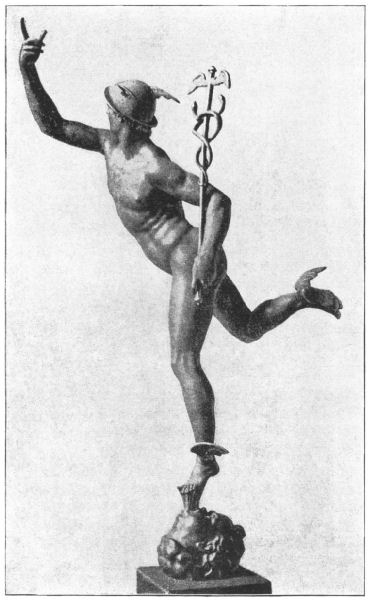
See page 86
Winged Mercury
Sol. The sun. The worship of the god Sol is
129]
the oldest on record, and though he is sometimes
referred to as being the same as the god
Apollo, there is no doubt he was worshiped
by the Egyptians, Persians, and other nations
long before the Apollo of the Greeks
was heard of. See Surya.
“Sol through white curtains shot a timorous ray,
And oped those eyes that must eclipse the day.”
Pope.
Somnus (Som′nus). The Roman god of sleep, son of Erebus
and Nox (Night). He was one of the
infernal deities, and resided in a gloomy cave,
void of light and air.
Sospita (Sos′pita). A name of Juno, as the safeguard of
women. She is called the “saving goddess.”
Soter (So′ter). A Greek name of Jupiter, meaning Savior
or deliverer.
Soul, see Psyche.
South Wind, see Auster.
Spear, see Pelias.
Sphinx, The. A monster having the head and
breast of a woman, the body of a dog, the
tail of a serpent, the wings of a bird, the
paws of a lion, and a human voice. She lived
in the country near Thebes, and proposed
to every passer-by the following enigma:
“What animal is that which walks on four
legs in the morning, two at noon, and three
in the evening.” Oedipus solved the riddle
thus: Man is the animal; for, when an infant
he crawls on his hands and feet, in the
130]
noontide of life he walks erect, and as the
evening of his existence sets in, he supports
himself with a stick. When the Sphinx found
her riddle solved she destroyed herself.
Spider, see Arachne.
Spindle, see Pallas.
Spinning, see Arachne, Ergatis.
Spring, see Vertumnus.
Stable, see Augaeas.
Stars, see Aurora.
Sterentius (Steren′tius). The Roman god who invented the
art of manuring lands. See also Picumnus.
Steropes (Ster′opes). One of the Cyclopes.
Stone, see Medusa and Phlegyas.
Stone (rolling), see Sisyphus.
Streets, see Apollo.
Stymphalides (Stym′phali′des). The carnivorous birds destroyed
in the sixth labor of Hercules.
Styx. A noted river of hell, which was held in
such high esteem by the gods that they always
swore “By the Styx,” and such an oath was
never violated. The river has to be crossed
in passing to the regions of the dead. See
Achilles and Thetis.
“To seal his sacred vow by Styx he swore:—
The lake with liquid pitch,—the dreary shore.”
Dryden.
“... Infernal rivers that disgorge
Into the burning lake their baleful streams,
Abhorrèd Styx, the flood of deadly hate.”
131]
Suada (Sua′da), the goddess of Persuasion. See Pitho.
Success, see Bonus Eventus.
Sun, see Aurora, Belus, Sol, and Surya.
Sunflower, see Clytie.
Suradevi (Sura′de′vi). The Hindoo goddess of wine.
Surgeon (Sur′geon), see Podalirius.
Surya (Su′ry′a). The Hindoo god corresponding to the
Roman Sol, the sun.
Swallow, see Itys.
Swan, see Cygnus and Leda.
Swiftness, see Atalanta.
Swine, see Circe.
Sylphs. Genii who, according to Plato, lived in
the air.
“The light coquettes as Sylphs aloft repair,
And sport and flutter in the fields of air.”
Pope.
Sylvester (Sylves′ter). The name of Mars when he was invoked
to protect cultivated land from the
ravages of war.
Syrinx. The name of the nymph who, to escape
from the importunities of Pan, was by Diana
changed into reeds, out of which he made
his celebrated pipes, and named them “The
Syrinx.”
Tacita (Tac′ita). The goddess of Silence. See Harpocrates,
also Horus.
Tantalus (Tan′talus). Father of Niobe and Pelops, who, as
132]
a punishment for serving up his son Pelops
as meat at a feast given to the gods, was
placed in a pool of water in the infernal regions;
but the waters receded from him
whenever he attempted to quench his burning
thirst. Hence the word “tantalizing”.
Speaking of this god, Homer’s Ulysses says:
“I saw the severe punishment of Tantalus. In
a lake, whose waters approached to his lips,
he stood burning with thirst, without the
power to drink. Whenever he inclined his
head to the stream, some deity commanded
it to be dry, and the dark earth appeared at
his feet. Around him lofty trees spread their
fruits to view; the pear, the pomegranate,
and the apple, the green olive, and the luscious
fig quivered before him, which, whenever
he extended his hand to seize them, were
snatched by the winds into clouds and obscurity.”
“There, Tantalus, along the Stygian bound,
Pours out deep groans,—his groans through hell resound.
E’en in the circling flood refreshment craves
And pines with thirst amidst a sea of waves.”
“... And of itself the water flies
All taste of living wight, as once it fled
The lip of Tantalus.”
Milton.
Tartarus (Tar′tarus). An inner region of hell, to which the
gods sent the exceptionally depraved.
Telchines (Telchi′nes). People of Rhodes, who were envious
sorcerers and magicians.
133]
Tellus (Tel′lus). A name of Cybele, wife of Saturn, and
the Roman deity of mother-earth.
Tempests, see Fro.
Temple. An edifice erected to the honor of a
god or goddess in which the sacrifices were
offered.
Tenth Muse. Sappho was so called.
Tereus (Ter′eus) was a son of Mars. He married Procne,
daughter of the king of Athens, but became
enamored of her sister Philomela, who, however,
resented his attentions, which so enraged
him that he cut out her tongue. When
Procne heard of her husband’s unfaithfulness
she took a terrible revenge (see Itys).
Procne was turned into a swallow, Philomela
into a nightingale, Itys into a pheasant, and
Tereus into a hoopoe, a kind of vulture, some
say an owl.
Tergemina (Tergemi′na). A name of Diana, alluding to her
triform divinity as goddess of heaven, earth,
and hell.
Terminus (Ter′minus). The Roman god of boundaries.
Terpsichore (Terpsich′ore). One of the nine Muses; she presided
over dancing.
Terra. The Earth; one of the most ancient of
the Grecian goddesses.
Thalestris (Thales′tris). A queen of the Amazons.
Thalia (Thali′a). One of the nine Muses; she presided
over festivals, pastoral poetry and comedy.
Thalia (Thali′a). One of the Graces. (See Charities).
134]
Thamyris (Tham′yris). A skilful singer, who presumed to
challenge the Muses to sing, upon condition
that if he did not sing best they might inflict
any penalty they pleased. He was, of course,
defeated, and the Muses made him blind.
Theia (The′ia) or Thea. A daughter of Uranus and
Terra, wife of Hyperion.
Themis (The′mis), a daughter of Coelus and Terra, and wife
of Jupiter, was the Roman goddess of laws,
ceremonies, and oracles.
Theseus (The′seus). One of the most famous of the Greek
heroes. He was a son of Aegeus, king of
Athens. He rid Attica of Procrustes and other
evil-doers, slew the Minotaur, conquered the
Amazons and married their Queen.
“Breasts that with sympathizing ardor glowed,
And holy friendship such as Theseus vowed.”
Budgell.
Thesmorphonis (Thesmorpho′nis). A name of Ceres.
Thetis (The′tis). A sea-goddess, daughter of Nereus and
Doris. Her husband was Peleus, king of
Thessaly, and she was the mother of the
famous Achilles, whom she rendered all but
invulnerable by dipping him into the River
Styx. See Achilles.
Thief, see Laverna, Mercury.
Thor. The Scandinavian war-god (son of Odin),
who had rule over the aerial regions, and,
like Jupiter, hurled thunder against his foes.
Thor’s Belt is a girdle which doubles his strength
whenever the war-god puts it on.
135]
Thoth. The Mercury of the Egyptians.
Thread of Life, see Fates.
Thunderbolts, see Cyclops.
Thunderer, The, Jupiter. See Tonitrualis.
“O king of gods and men, whose awful hand
Disperses thunder on the seas and land,
Disposing all with absolute command.”
Virgil.
“The eternal Thunderer sat enthroned in gold.”
Homer.
“So when thick clouds enwrap the mountain’s head,
O’er heaven’s expanse like one black ceiling spread;
Sudden the Thunderer, with flashing ray,
Bursts through the darkness and lets down the day.”
Pope.
Thya (Thy′a), a name of Ops.
Thyades (Thya′des). Priestesses of Bacchus, who ran wild
in the hills, wearing tiger-skins and carrying
torches.
Thyrsus (Thyr′sus), a kind of javelin or staff carried by
Dionysus and his attendants. It was usually
wreathed with ivy and topped by a pine-cone.
See Bacchus.
Tides, see Narayan.
Time (or Saturn). The husband of Virtue and
father of Truth.
Tisiphone (Tis-iph′one). One of the Furies, daughter of Nox
and Acheron, who was the minister of divine
vengeance upon mankind.
Titan (Ti′tan). Elder brother of Saturn, who made war
136]
against him, and was ultimately vanquished
by Jupiter.
Titans (Ti′tans) were the supporters of Titan in his war
against Saturn and Jupiter. They were the
sons of Uranus and Gaea, men of gigantic
stature and of great strength. Hence our
English word Titanic.
Tithonus (Ti-tho′nus). The husband of Aurora. At the
request of his wife the gods granted him immortality,
but she forgot at the same time to
ask that he should be granted perpetual youth.
The consequence was that Tithonus grew old
and decrepit, while Aurora remained as fresh
as the morning. The gods, however, changed
him into a grasshopper, which is supposed to
moult as it gets old, and grows young again.
Tityus (Tit′yus). A son of Jupiter. A giant who was
thrown into the innermost hell for insulting
Diana. He, like Prometheus, has a vulture
constantly feeding on his ever-growing liver,
the liver being supposed to be the seat of the
passions.
Toil, see Atlas.
Tombs, see Manes.
Tongue, see Tereus.
Tonitrualis (Tonitrua′lis), or Tonans. The Thunderer; a name
of Jupiter.
Towers, see Cybele.
Tragedy, see Melpomene.
Trees, see Aristaeus.
137]
Tribulation, see Echidna.
Triformis (Trifor′mis), see Tergemina.
Triptolemus (Triptol′emus). A son of Oceanus and Terra. He
was a great favorite of the goddess Ceres,
who cured him of a dangerous illness when
he was young, and afterwards taught him
agriculture. She gave him her chariot, which
was drawn by dragons, in which he carried
seed-corn to all the inhabitants of the earth,
and communicated the knowledge given to
him by Ceres. Cicero mentions a Triptolemus
as the fourth judge of the dead.
“Triptolemus, whose useful cares intend
The common good.”
Pope.
Triterica (Triteri′ca). Bacchanalian festivals.
Tritons (Tri′tons) were sons of Triton, a son of Neptune
and Amphitrite. They were the trumpeters
of the sea-gods, and were depicted as a sort
of mermen—the upper half of the body being
like a man, and the lower half like dolphins.
Trivia (Tri′via). A surname given to Diana, because she
presided over all places where three roads
meet.
Trophonius (Tropho′nius). A legendary hero of architecture,
and one of Jupiter’s most famous oracles.
Troy. The classic poets say that the walls of this
famous city were built by the magic sound of
Apollo’s lyre. See Dardanus, Helen, Hercules,
Paris.
Trumpeters, see Tritons.
138]
Truth. A daughter of Time, because Truth is
discovered in the course of Time. Democritus
says that Truth lies hidden at the bottom of a
well.
Tutelina (Tutel′ina). A rural divinity—the goddess of
granaries.
Two Faces, see Janus.
Typhoeus (Typhoe′us), see Typhon.
Typhon (Ty′phon). A monster with a hundred heads who
made war against the gods, but was crushed
by Jove’s thunderbolts, and imprisoned under
Mount Etna.
“... Typhon huge, ending in snaky twine.”
Milton.
Typhon (Ty′phon). In Egyptian mythology the god who
tried to undo all the good work effected by
Osiris. According to the Greek writer, Hesiod,
Typhon or Typhoeus was a monster
giant, son of Terra and Tartarus.
Uller (Ul′ler). The Scandinavian god who presided over
archery and duels.
Ulysses (Ulys′ses). A noted king of Ithaca, whose exploits
in connection with the Trojan war, and his
adventures on his return therefrom, are the
subject of Homer’s Odyssey. His wife’s
name was Penelope, and he was so much endeared
to her that he feigned madness to get
himself excused from going to the Trojan
war; but this artifice was discovered, and he
139]
was compelled to go. He was of great help
to the Grecians, and forced Achilles from his
retreat, and obtained the charmed arrows of
Hercules from Philoctetes, and used them
against the Trojans. He enabled Paris to
shoot one of them at the heel of Achilles, and
so kill that charmed warrior. During his
wanderings on his homeward voyage he was
taken prisoner by the Cyclopes and escaped,
after blinding Polyphemus, their chief. At
Aeolia he obtained all the winds of heaven,
and put them in a bag; but his companions,
thinking that the bags contained treasure
which they could rob him of when they got to
Ithaca, cut the bags, and let out the winds,
and the ships were immediately blown back
to Aeolia. After Circe had turned his companions
into swine on an island where he and
they were shipwrecked, he compelled the goddess
to restore them to their human shape
again. As he passed the islands of the Sirens
he escaped their allurements by stopping the
ears of his companions with wax, and fastening
himself to the mast of his ship. His wife
Penelope was a pattern of constancy; for,
though Ulysses was reported to be dead, she
would not marry any one else, and had the
satisfaction of finding her husband return
after an absence of about twenty years. The
Greek name of Ulysses is Odysseus.
“To show what pious wisdom’s power can do,
The poet sets Ulysses in our view.”
140]
Undine (Un′dine). A water-nymph, or sylph, who, according
to fable, might receive a human soul
by marrying a mortal.
Unknown God, An. With reference to this God,
nothing can be more appropriate than St.
Paul’s address to the Athenians, as recorded
in the 17th chapter of the Acts of the Apostles:
“Ye men of Athens, I perceive that in all things ye are
too superstitious. For as I passed by, and beheld your
devotions, I found an altar with this inscription, TO THE
UNKNOWN GOD. Whom therefore ye ignorantly worship,
him declare I unto you. God that made the world and
all things therein, seeing that he is Lord of heaven and
earth, dwelleth not in temples made with hands; neither
is worshiped with men’s hands, as though he needed anything,
seeing he giveth to all life, and breath, and all
things; and hath made of one blood all nations of men for
to dwell on all the face of the earth, and hath determined
the times before appointed, and the bounds of their habitation;
that they should seek the Lord, if haply they
might feel after him, and find him, though he be not far
from every one of us: for in him we live, and move, and
have our being; as certain also of your own poets have
said, For we are also his offspring. Forasmuch then as
we are the offspring of God, we ought not to think that
the Godhead is like unto gold, or silver, or stone, graven
by art and man’s device. And the times of this ignorance
God winked at; but now commandeth all men everywhere
to repent: because he hath appointed a day, in
the which he will judge the world in righteousness by
that man whom he hath ordained; whereof he hath given
assurance unto all men, in that he hath raised him from
the dead.”
Unxia (Unx′ia). A name of Juno, relating to her protection
of newly married people.
Urania (Ura′nia). A daughter of Jupiter and Mnemosyne—one
141]
of the Muses who presided over astronomy.
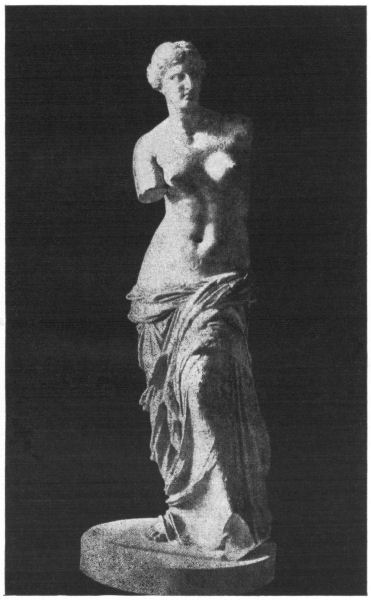
See page 142
Venus de Milo
Uranus (Ura′nus), literally, heaven. Son and husband of
Gaea, the Earth, and father of Chronos
(Time) and the Titans. The Greek name of
Coelus; his descendants are sometimes called
Uranides.
Urgus (Ur′gus). A name of Pluto, signifying the Impeller.
Ursa Major (Ur′sa Ma′jor), see Calisto.
Ursa Minor (Ur′sa Mi′nor), see Arcas.
Usurers, see Jani.
Utgard Loki (Ut′gard Lo′ki). In Scandinavian mythology the
king of the giants.
Valhalla (Valhal′la). The Scandinavian temple of immortality,
inhabited by the souls of heroes slain
in battle.
Vali (Va′li). The Scandinavian god of archery.
Valleys, see Vallonia.
Vallonia (Vallo′nia). The goddess of valleys.
Varuna (Varu′na). The Hindoo Neptune—generally represented
as a white man riding on a sea-horse,
carrying a club in one hand and a rope
or noose to bind offenders in the other.
Vedius (Ve′dius). The same as Vejovis.
Vejovis (Vejo′vis). “Little Jupiter”—a name given to
Jupiter when he appeared without his thunder.
Vejupiter (Veju′piter), see Vejovis.
142]
Vengeance, see Nemesis.
Venus (Ve′nus). The goddess of beauty, and mother of
love. She is said to have sprung from the
foam of the sea, and was immediately carried
to the abode of the gods on Olympus, where
they were all charmed with her extreme
beauty. Vulcan married her, but she permitted
the attentions of others of the gods,
and notably of Mars, their offspring being
Hermione, Cupid, and Anteros. After this
she left Olympus and fell in love with Adonis,
a beautiful youth, who was killed when hunting
a wild boar. Venus indirectly caused the
Trojan War, for, when the goddess of discord
had thrown among the goddesses the golden
apple inscribed “To the fairest,” Paris adjudged
the apple to Venus, and she inspired
him with love for Helen, wife of Menelaus,
king of Sparta. Paris carried off Helen to
Troy, and the Greeks pursued and besieged
the city (see Helen, Paris, and Troy). Venus
is mentioned by the classic poets under
the names of Aphrodite, Cypria, Urania, Astarte,
Paphia, Cythera, and the laughter-loving
goddess. Her favorite residence was
at Cyprus. Incense alone was usually offered
on her altars, but if there was a victim it was
a white goat. Her attendants were Cupids
and the Graces.
Verticordia (Verti′cor′dia). A Roman name of Venus, signifying
the power of love to change the
143]
hard-hearted. The corresponding Greek name
was Epistrophia.
Vertumnus (Vertum′nus) (“the Turner,” “Changer”). God of
spring, or, as some mythologists say, of the
seasons; the husband of Pomona, the goddess
of fruits and orchards.
Vesta (Ves′ta), daughter of Saturn and Cybele, was the
goddess of the hearth and its fire. She had
under her special care and protection a famous
statue of Minerva, before which the
Vestal Virgins kept a fire or lamp constantly
burning.
Vestal Virgins (Ves′tal Vir′gins) were the priestesses of Vesta,
whose chief duty was to see that the sacred
fire in the temple of Vesta was not extinguished.
They were always selected from
the best families, and were under a solemn
vow of chastity, and compelled to live perfectly
pure lives.
Vialis (Via′lis). A name of Mercury, because he presided
over the making of roads.
Victory (Vic′tory). A goddess, the daughter of Styx and
Acheron, generally represented as flying in
the air holding out a wreath of laurel. Her
Greek name is Nike (Nicē). See Nicephorus.
Vidor. A Scandinavian god, who could walk on
the water and in the air. The god of silence
(corresponding with the classic Harpocrates).
Virtue. A goddess worshiped by most of the
ancients under various names. The way to
144]
the temple of honor was through the temple
of virtue.
Virtuous Women, see Juno.
Vishnu (Vish′nu). The Preserver, the principal Hindoo
goddess.
Volupia (Volu′pia), see Angeronia.
Vulcan (Vul′can), the god of fire, was the son of Jupiter
and Juno. He offended Jupiter, and was by
him thrown out of heaven; he was nine days
falling, and at last dropped into Lemnos with
such violence that he broke his leg, and was
lame forever after. Vulcan was married to
Venus. He is supposed to have formed Pandora
out of clay. His servants were the Cyclopes.
He was the patron deity of blacksmiths,
and as the smelter or softener of
metal bears also the name of Mulciber.
“Men call him Mulciber; and how he fell
From heaven, they fabled, thrown by angry Jove,
Sheer o’er the crystal battlements.”
Milton.
Vulcanalia (Vulcān-al′ia) were Roman festivals in honor of
Vulcan, at which the victims (certain fish
and animals) were thrown into the fire and
burned to death.
War, see Bellona, Chemos, Mars.
Water, see Canopus.
Water-Nymphs, see Doris.
Wax Tablets, see Calliope.
145]
Wealth, see Cuvera.
Weaving, see Ergatis.
Weeding, see Runcina.
Weights and Measures, see Mercury.
Well, see Truth.
West Wind, see Favonius.
Winds, see Aurora, Auster, Boreas, Zephyr.
Wine, see Bacchus, Suradevi.
Wisdom, see Pollear, Minerva.
Woden (Wo′den), the Anglo-Saxon form of the Scandinavian
god Odin; Wednesday is called after
him.
Women’s Safeguard, see Sospita.
Woodpecker, see Picus.
Woods, see Dryads.
World, see Chaos.
Xanthus (Xan′thus), the name of the wonderful horse of
Achilles.
Yama (Ya′ma). The Hindoo devil, generally represented
as a terrible monster of a green color, with
flaming eyes.
Ygdrasil (Yg′dra′sil). The famous ash-tree of Scandinavian
mythology, under which the gods held daily
council.
Ymir (Y′mir). The Scandinavian god, corresponding to
Chaos of the classics.
Youth (perpetual), see Tithonus.
146]
Zephyr (Zeph′yr) or Zephyrus (Zeph′yrus). The west wind and god of
flowers, a son of Astraeus and Aurora (Eos).
See Favonius.
“Wanton Zephyr, come away.
. . . . .
The sun, and Mira’s charming eyes,
At thy return more charming grow.
With double glory they appear,
To warm and grace the infant year.”
John Hughes, 1700.
Zetes (Ze′tes), with his brother Calais, drove the Harpies
from Thrace.
Zethus (Ze′thus), twin brother of Amphion. He was the
son of Antiope and Zeus. See Amphion.
Zeus (Zūs). The Greek name of Jupiter, the
greatest god in Grecian mythology. He was
the god of the sky and its phenomena, and as
such was worshiped on the highest mountains,
on which he was enthroned. From Zeus
come all changes in the sky or the winds; he
is the gatherer of the clouds which dispense
fertilizing rain; and is also the thunderer and
hurler of lightning.
THE END.
Entertainments for Every Occasion. Ideas, games,
charades, tricks, plans—for keeping those present
entertained, on whatever occasion, whether a party,
a festival, a bazaar, an entertainment, or merely
“our own folks” or an “entre nous.”
The Humorous Speaker. The choicest, most recent
humor that lends itself to recitation. Easily the best
collection that has been made. The selections are
chosen because they are good literature, and because
they are good recitations. Unhackneyed material—most
of it from recently copyrighted books, for which
special permission has been secured. A hundred and
twenty five selections, about 500 pages.
Commencement Parts. “Efforts” for all occasions.
Models for every possible occasion in high-school and
college career, every one of the “efforts” being
what some fellow has stood on his feet and actually
delivered on a similar occasion—not what the compiler
would say if he should happen to be called
on for an ivy song or a response to a toast, or what
not; but what the fellow himself, when his turn came,
did say! Invaluable, indispensable to those preparing
any kind of “effort.” Unique.
Contains models of the salutatory, the valedictory, orations,
class poems, class songs, class mottoes, class will, ivy poem and
song, Dux’s speech; essays and addresses for flag day, the seasons,
national and other holidays; after-dinner speeches and
responses to toasts. Also models for occasional addresses—social,
educational, political, religious. Also models for superintendents’
and principals’ addresses to graduating class, debating
team, educational conference; on dedication of school building,
public building, library; for holidays, festival days, and scores
of social and other occasions. Also themes for essays, and lists
of subjects for orations, essays, toasts.
College Men’s 3-Minute Declamations. Material
with vitality in it for prize speaking. 14th edit.
College Maids’ 3-Minute Readings. Up-to-date recitations
from living men and women. On the plan
of the popular College Men’s 3-Minute Declamations,
and on the same high plane. Twelfth edition.
Pieces for Prize Speaking Contests. Volume I.
Over one hundred pieces that have actually taken
prizes in prize speaking contests. Successful.
Pieces for Prize Speaking Contests. Vol. II.
Pieces for Every Occasion. “Special days.”
Famous Poems Explained. (Barbe).
How to Attract and Hold an Audience. Every student
in college or school, every lawyer, every teacher,
every clergyman, every man or woman occupying an
official position, every citizen and every youth who is
likely ever to have occasion in committee, or in
public, to enlist the interest, to attract and hold the
attention of one or more hearers, and convince them—every
person who ever has to, or is likely to have
to “speak” to one or more listeners will find in our
new book a clear, concise, complete handbook which
will enable him to succeed!
Thorough, concise, methodical, replete with common sense,
complete. In his logical method, in the crystal-like lucidity of
his style, in his forceful, incisive, penetrating mastery of his
subject, the author has at one bound placed himself on a plane
with the very ablest teacher-authors of his day.
Fenno’s Science and Art of Elocution. Standard.
Probably the most successful of its kind.
The Power of Speech, How to Acquire It.
A comprehensive system of vocal expression. Thorough
and practical instruction in the use of the speaking
voice, embracing deep breathing, articulation,
modulation, emphasis and delivery; vocal coloring,
interpretation of the written word, the conveying of
thought by means of vocal expression, and the principles
of oratory and dramatic art.
The Psychology of Public Speaking. A scientific
treatment of the practical needs of the public speaker.
A worth-while book.
How to Use the Voice in Reading and Speaking.
By Ed. Amherst Ott, head of the School of Oratory,
Drake University. Suitable for class work.
How to Gesture. E. A. Ott. New illus. edit.
Constitution of U. S. In English, German and
French.
Constitution of U. S., with Index. (Thorpe’s Pocket
Edition).
Brief History of Civilization. (Blackmar).
The Changing Values of English Speech.
The Worth of Words. (Bell).
The Religion of Beauty. (Bell).
Dictionaries: The Classic Series. Half morocco.
Especially planned for students and teachers in colleges
and high schools. Up to the times in point of
contents, authoritative while modern as regards
scholarship, instantly accessible in respect to arrangement,
in a binding elegant and durable. 8×5½ in.
French-English and Eng.-French,
German-English and Eng.-German,
Latin-English and Eng.-Latin,
Greek-English and Eng.-Greek,
English-Greek Dictionary.
Dictionaries: The Handy Series. Pocket Edition.
Scholarship modern and accurate; beautiful print.
Spanish-English and Eng.-Spanish,
Italian-English and Eng.-Italian,
New-Testament Lexicon. With a fine presentation
of the Synonyms of the Greek Testament.
Liddell and Scott’s Abridged Greek Lexicon. With
new Appendix of Proper and Geog’l names.
White’s Latin-English Dictionary.
White’s English-Latin Dictionary.
White’s Lat.-Eng. and Eng.-Lat. Diction.
International Pronouncing French-English and
Eng.-French Dictionary. Half morocco. The pronunciation
is indicated by a full re-spelling of each
title-word in the system of the International Phonetic
Associ’n, a widely used means of indicating, simply
and accurately, the pronunciation of all languages
in a single (amplified) Roman alphabet.
Who’s Who in Mythology? A dictionary of
mythological characters. Identifies and locates instanter
every god and goddess, hero and myth that
are likely to be broached either in conversation, sermon,
song, drama, painting or statuary.
Who’s Who in History? A dictionary of classical
characters and allusions. Locates the places, identifies
the persons, describes the things, which are
constantly alluded to in literature, in sermons, in
paintings, in sculpture and in conversation.
BOOKS BY RALCY HUSTED BELL
The Worth of Words
Third Edition, Revised and Enlarged.
The SOULS of words live after their forms change.
This spiritual element of words survives as literature.
The living book contains the EGO of the author—the
spiritual personality of his mind. This book treats of
the right usage of words on this vital basis. It is a
living guide. Simple and clear, it aids correct speech
and shows how to vitalize words with SOUL.
The Changing Values of English Speech
A mate to THE WORTH OF WORDS. Touches
lightly the philosophical side in a practical way: illumines
Style, Soul of Words, Early English, Language Change,
Poetry, Syntax, Variations in Word-Meanings, Distinctions,
Origin of Language, Old Celtic Friends, English Orthography,
Words Changed Since Shakespeare, Commonplace
Poetry, Aborigines. Reads with the fascination of romance.
The Religion of Beauty
Second Edition, Revised and Enlarged.
This is the autobiography of a Soul glad of life—one
who finds riches in the possessions of others and, above
all, a golden wealth in man’s Impersonal Estate—in SKY
and STAR, SUN and CITY, the SEA and the OPEN WORLD—one
who finds the Religion of Beauty in all things, and
reveals the secret whereby all who will may dig up
“real wealth” while having a good time.
Taormina
Illustrated. New Historic Matter.
History is told here with Maeterlinck’s charm of style;
scenes are painted with the power and beauty of Hearn;
philosophy is unconsciously brought forth from events.
Greek legend weaves a necklace of imagery which holds
ETNA in its clasp. Martial echoes mingle with the voices
of ancient poets, the murmur of the Ionian Sea and of
olive leaves in sunny Sicily.
English and American Literature
A One Year Course
FROM CHAUCER TO MARK TWAIN
By B. A. HEYDRICK, A. B.
DEPARTMENT OF ENGLISH, HIGH SCHOOL OF COMMERCE
NEW YORK CITY
Interestingly written, illustrated with portraits and
enlivened by pictures of scenes described, facsimiles of
manuscripts, etc.
In the space of three hundred pages the author has
managed to give a clear account of English literature
from Chaucer to Mark Twain and James Whitcomb
Riley. It is not a mere outline, but a continuous narrative,
and really the most engaging book on the subject
that has appeared. It is written on a different plan
from most brief text-books. The author has wisely not
attempted to treat every author in English literature.
By omitting the names which have no meaning for us
to-day the author has gained space to treat the really
significant writers quite fully enough for the needs of
young students. An excellent feature of the book is
the profusion of illustrations. Throughout the work
emphasis is placed upon books that still live. The
nineteenth century in particular is treated fully; the
writers may be no greater than those of the eighteenth,
but they have more to say to us.
Each chapter is followed by a list of recommended
reading in the chief authors, with references to volumes
where these may be found. By means of this recommended
reading the course covered by this book may
readily be extended to cover two years’ work, or more.
Under each chief author is mentioned a standard library
edition of his works and inexpensive editions of
single volumes.
The Speaker Series
The Speaker Series (32 vols) paper.
| No. |
1 |
Popular Short Stories |
| No. |
2 |
Selections Chosen for Declamation Contest |
| No. |
3 |
Selections for Children to Recite |
| No. |
4 |
Cuttings from Stories |
| No. |
5 |
Cuttings from Stories |
| No. |
6 |
Ten Short Plays |
| No. |
7 |
Readings, and Four Plays |
| No. |
8 |
Briefs of Debates, and Readings |
| No. |
9 |
Cuttings of Popular Stories |
| No. |
10 |
Modern American Oratory |
| No. |
11 |
Dramatic and Humorous Readings |
| No. |
12 |
Centennial Number |
| No. |
13 |
New Platform Selections |
| No. |
14 |
Selections for Religious Occasions |
| No. |
15 |
Encores: Nearly 200 Fresh, Bright Hits |
| No. |
16 |
Popular Platform Readings |
| No. |
17 |
Humorous and Dramatic Readings |
| No. |
18 |
Monologues |
| No. |
19 |
On Temperance |
| No. |
20 |
For Declamation Contests |
| No. |
21 |
After-dinner Speaking |
| No. |
22 |
School and College Readings |
| No. |
23 |
Selections for Entertainments |
| No. |
24 |
Dramatic Selections |
| No. |
25 |
Popular Prose and Poetry |
| No. |
26 |
Readings from Great Authors |
| No. |
27 |
Readings and Debates Not Found Elsewhere |
| No. |
28 |
Classic Masterpieces |
| No. |
29 |
Best Fiction for the Platform |
| No. |
30 |
Humorous and Pathetic Readings |
| No. |
31 |
Patriotic Selections |
| No. |
32 |
Scenes from Plays for Platform Readings |
THE ABOVE NUMBERS IN EIGHT BOUND VOLUMES,
indexed by authors and titles:
| Vol. I. |
Including Nos. 1, 2, 3 and 4, |
| Vol. II. |
Including Nos. 5, 6, 7 and 8, |
| Vol. III. |
Including Nos. 9, 10, 11 and 12, |
| Vol. IV. |
Including Nos. 13, 14, 15 and 16, |
| Vol. V. |
Including Nos. 17, 18, 19, 20, |
| Vol. VI. |
Including Nos. 21, 22, 23, 24, |
| Vol. VII. |
Including Nos. 25, 26, 27, 28, |
| Vol. VIII. |
Including Nos. 29, 30, 31, 32. |
Transcriber's Note
As referred to in the Transcriber's Note at the beginning of this
ebook, proper nouns have been amended for ease of searching as follows:
Page 13—Deianeira amended to Deianira—... in his love for Deianira.
Page 18—Podalirus amended to Podalirius—... Machaon and Podalirius,
both famous physicians, ...
Page 31—Rumina amended to Rumia—Babes, see Rumia Dea.
Page 32—Thanyris amended to Thamyris—Blind, see Thamyris.
Page 49—Antaeas amended to Antaeus—Earth, see Antaeus.
Page 55—Plato amended to Pluto—Februus (Feb′ruus). A name of Pluto,
...
Page 56—Chimera amended to Chimaera—She was the reputed mother of
Chimaera, ...
Page 61—Segestia amended to Segetia—Harvest, see Segetia.
Page 70—Venns amended to Venus—... in which there is a grove sacred
to Venus.
Page 72—Argus amended to Argos—... and a priestess of Juno at Argos.
Page 79—Romas amended to Romans—The Romans used to swear by Jupiter
Lapis.
Page 84—Diomede amended to Diomedes—... but was defeated by
Diomedes.
Page 87—Thot amended to Thoth—There was also an Egyptian Mercury
under the name of Thoth, ...
Page 89—Glaucopis amended to Glaukopis—... Pallas, Parthenos,
Tritonia, and Glaukopis.
Page 117—Japetes amended to Japetus—... the son of Japetus ...
Page 122—Runcia amended to Runcina—Runcina (Runcina). The goddess of
weeding ...
Page 127—Chimera amended to Chimaera—See Aesculapius, Apollo,
Chimaera, ...
Page 127—Thanyris amended to Thamyris—Singing, see Polyhymnia,
Thamyris.
Page 130—Ergotis amended to Ergatis—Spinning, see Arachne, Ergatis.
Page 134—Thesmorphonius amended to Thesmorphonis—Thesmorphonis
(Thesmorphonis). A name of Ceres.
Page 135—Naryanan amended to Narayan—Tides, see Narayan.
Page 141—Calistro amended to Calisto—Ursa Major (Ur′sa Ma′jor), see
Calisto.
Page 145—Ergatos amended to Ergatis—Weaving, see Ergatis.
The book notes Vishnu as a goddess, and Laksmi as one of Vishnu's
husbands. This is preserved as printed.
Minor punctuation errors have been repaired. Hyphenation has been made
consistent.
The following printer errors have been repaired:
Page 102—anxiiety amended to anxiety—Orpheus, however, in his
anxiety ...
Page 124—spirites amended to sprites—The sprites of fiery
termagants in flame, ...
Page 140—preceive amended to perceive—... I perceive that in all
things ye are too superstitious.
With regard to quoted material, all attributions (or lack thereof)
are preserved as in the original.
The transcriber notes that, on page 16, two couplets are attributed
to Pope, although the second is actually from Dryden. However, this
is preserved as printed.
The transcriber has added alphabetic links at the beginning of the book
and at the beginning of the dictionary for ease of navigation.
The frontispiece illustration has been moved to follow the title page.
Other illustrations have been moved where necessary so that they are
not in the middle of a paragraph.